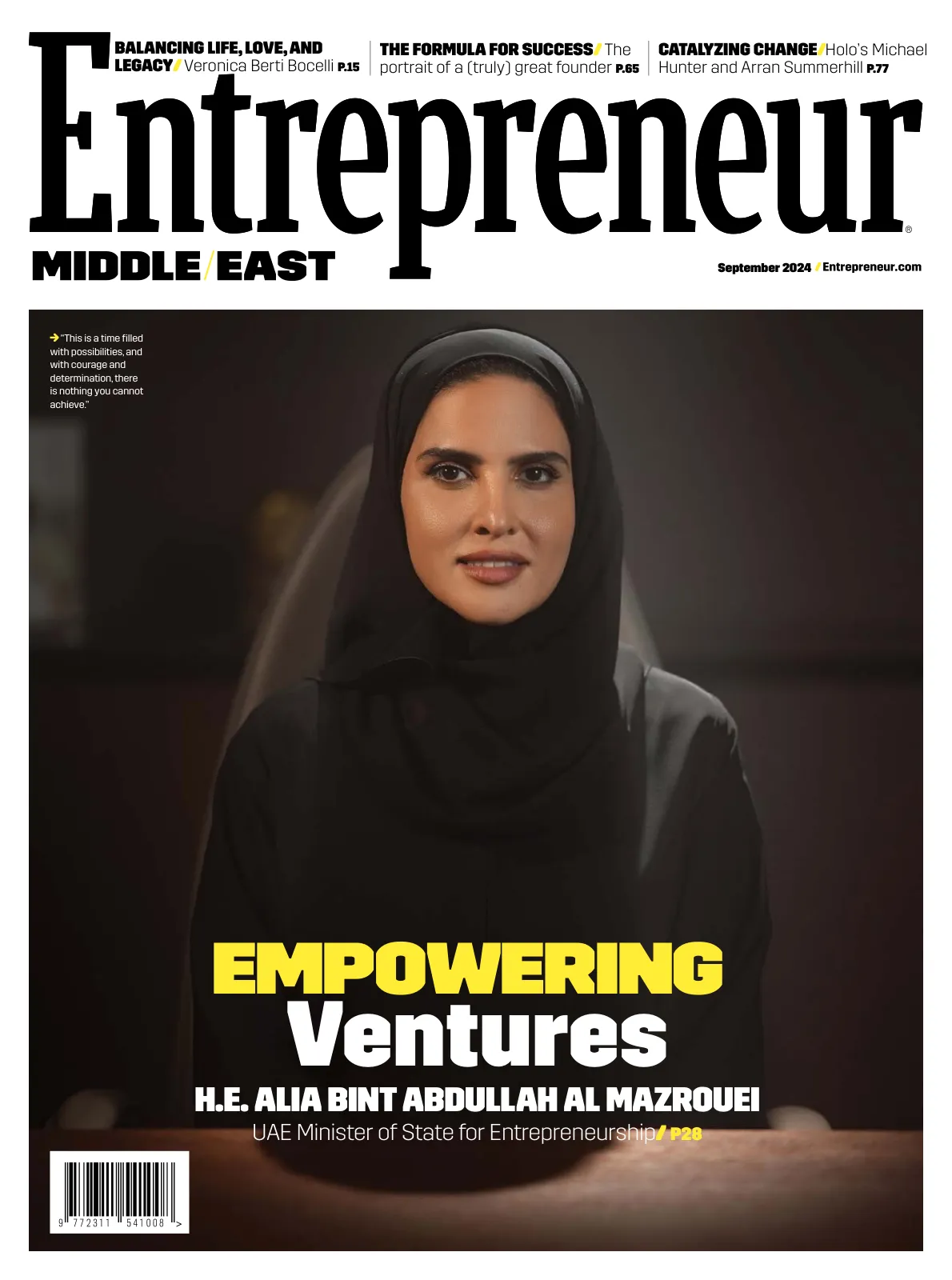
Entrepreneur Middle East, September 2024
Page 1
September 2024
→ “This is a time filled
with possibilities, and
with courage and
determination, there
is nothing you cannot
achieve.”
CATALYZING CHANGE/Holo’s Michael
Hunter and Arran Summerhill P.77
BALANCING LIFE, LOVE, AND
LEGACY/ Veronica Berti Bocelli P.15
THE FORMULA FOR SUCCESS/ The
portrait of a (truly) great founder P.65
H.E. ALIA BINT ABDULLAH AL MAZROUEI
UAE Minister of State for Entrepreneurship/ P28
EMPOWERING
Ventures
Page 2
ANANTARA SHARJAH RESIDENCES
A NEW CHAPTER OF LUXURY EXPERIENCES
BY THE SEA
Bringing luxury seaside living to Sharjah for the first time, owners at the Anantara Sharjah
Residences enjoy access to the Anantara Sharjah Resort’s world-class amenities, including an
infinity pool, five distinctive restaurants, an Anantara Spa and a state-of-the-art gym.
As an investment, owners can enjoy the benefits of a rental management scheme operated by
Anantara Hotels, Resorts & Spas, allowing them to maximize their returns when they are not
resident in the property.
To register your interest, visit arada.com
LIFE IS A JOURNEY.
Page 3
Contents/September 2024
P.26
Follow The
Leader
AISHA ABDULMALIK
H.E. ALIA BINT ABDULLAH AL MAZROUEI
CHARLOTTE BORGHESI
RONALDO MOUCHAWAR
HAISAM ODEIMEH
BRIAR PRESTIDGE
ALI SAJWANI
AMIRA SAJWANI
FEATURES
→ Briar
Prestidge is
the founder
and CEO of
Prestidge
Group.
3
September 2024 / ENTREPRENEUR.COM /
Page 4
Nestled by the coast of Lusail sits the splendor of
Raffles and Fairmont Doha, where luxury is rooted
in even the smallest details. Open the doors to
mesmerizing hospitality and make memories in a
world of sophistication.
Page 5
Page 6
Page 7
SUITE TREAT
Step into a world of opulence when you book a Suite at Raffles Doha.
Experience the added luxury of QAR 750 credit to spend
on dining in the hotel, and QAR 500 towards any Spa treatment.
Children aged 12 and below are welcome to indulge in the
enchantment of complimentary dining.
Rates starting from QAR 3,500 per night
For reservations, please call +974 4030 7100
or email reservations.doha@raffles.com
Raffles Doha, Iconic Towers, Marina District, PO BOX 4747, Lusail, Qatar
Page 8
Page 9
Welcome to the
E X C E P T I O N A L
An iconic hotel featuring
luxury rooms and apartments
with trendy dining options
in the heart of Riyadh
BOOK NOW
Mansard Riyadh, A Radisson Collection Hotel
4248 Prince Mohammed Ibn Salman Ibn Abdulaziz Road, Riyadh 6721-13315, Saudi Arabia
00966118290900 info.mansard@radissoncollection.com
radissonhotels.com/collection
Page 10
10 / ENTREPRENEUR.COM / September 2024
Contents
September 2024
71 Converging Insights
GITEX GLOBAL 2024, running from
October 14-18, 2024, at Dubai World
Trade Centre, is set to feature a stellar
lineup of speakers.
94 “In The Loop”
UAE-headquartered E DADDY raises
US$15 million in a funding round.
72 Everyone’s Talking, but
Nobody’s Listening
PURVA GROVER lists how you can make
yourself stand out as a thought
leader.
IN THE LOOP
77 Catalyzing Change
Holo co-founders MICHAEL HUNTER
and ARRAN SUMMERHILL believe their
startup can transform the process
of buying a home in the UAE (and
beyond).
82 IN FOCUS
Check out a selection of the
companies enrolled in the
MOHAMMED BIN RASHID INNOVATION
FUND (MBRIF) accelerator program.
90 Doomsday or Dawn?
JONATHAN LABIN analyzes artificial
intelligence’s radical reinvention of
software as a service.
15 In Harmony
How VERONICA BERTI BOCELLI
balances life, love, and legacy.
20 For a Greener Future
Meet the MENA startups in the
MEGA GREEN ACCELERATOR program
that are developing disruptive
solutions to pressing sustainability
challenges.
60 Mastering the Art of
Shirting
Ascot & Chapels’ GARY SWEENEY
offers the tailor’s guide to wearing
shirts right.
‘TREPONOMICS
STARTUP
SPOTLIGHT
BUSINESS
UNUSUAL
EDITOR IN CHIEF Aby Sam Thomas
aby@bncpublishing.net
CEO Wissam Younane
wissam@bncpublishing.net
MANAGING DIRECTOR Rabih Najm
rabih@bncpublishing.net
ART DIRECTOR Simona El Khoury
MANAGING EDITOR Tamara Pupic
tamara@bncpublishing.net
FEATURES EDITOR Aalia Mehreen Ahmed
aalia@bncpublishing.net
DIGITAL SOLUTIONS DIRECTOR
Mahdi Hashemi mahdi@bncpublishing.net
DIRECTOR OF INNOVATION
Sarah Saddouk sarah@bncpublishing.net
GROUP SALES DIRECTOR – B2B GROUP
Joaquim D’Costa jo@bncpublishing.net
COLUMNIST Tamara Clarke
CONTRIBUTING WRITERS
Fida Chaaban, Devina Divecha, Purva Grover,
Jonathan Labin, Gary Sweeney,
Khaled Talhouni, Nadine Zidani
SUBSCRIBE
Contact subscriptions@bncpublishing.net to receive
Entrepreneur Middle East every issue
COMMERCIAL ENQUIRIES
sales@bncpublishing.net
ENTREPRENEUR.COM
Access fresh content daily on our website
All Rights Reserved 2024. Opinions expressed are solely those of the contributors.
Entrepreneur Middle East and all subsidiary publications in the MENA region are
officially licensed exclusively to BNC Publishing in the MENA region by Entrepreneur
Media Inc. No part of this magazine may be reproduced or transmitted in any
form or by any means without written permission of the publisher. Images used in
Entrepreneur Middle East are credited when necessary. Attributed use of copyrighted
images with permission. All images not credited otherwise Shutterstock. Printed by
United Printing and Publishing.
PO BOX 502511 DUBAI, UAE
P +971 4 4200 506
EntMagazineME
Entrepreneur-me
↑ Arran Summerhill (left) and Michael
Hunter are the co-founders of Holo, which
was launched in 2020 as the Middle East’s
first digital mortgage platform.
Page 11
Page 12
12 / ENTREPRENEUR.COM / September 2024
Editor’s Note/
Editor’s Note/
FRESH TAKES
If you want to stay innovative, you’ve got to have perspective
I
have always said that even the most innovative
leader, the most decisive founder, and the smartest
CEO all need perspective. And I always endeavor to
apply what I preach—so, to stay on top of my game,
and in support of keeping a great publication fresh,
I have decided to step down from my role as the
Editor in Chief of Entrepreneur Middle East.
After nearly a decade of working with this brand, I’m
sure you can understand that it was not at all easy for
me to make this decision. Not only has it been an
absolute privilege for me to work on this platform that
celebrates the entrepreneurial spirit, it has also been
one of the most fulfilling experiences I’ve had in my
career trajectory.
Of course, it’s been a rollercoaster ride being at the
helm of Entrepreneur Middle East—I’m happy to admit
here that as exhilarating as the highs were, there were
plenty of lows too. And yet, looking back on all of it
now, I just know that I’ll remember this journey only in
the fondest of terms.
The opportunity to witness and document the growth
of the region’s entrepreneurial ecosystem has been a
profound honor, and I am supremely grateful for all the
people I’ve been able to interact with along the way—
from the innovators who chose to trust me with their
stories, to the incredible members of my team who’ve
always had my back.
As I now step away from my role at Entrepreneur
Middle East, I do so with a deep sense of appreciation
for everyone who has supported my work on this brand
through the last 10 years. Your belief in our mission has
been invaluable, and I’m truly proud of what we’ve
accomplished together; now, I look forward to seeing
how Entrepreneur Middle East will continue to impact
and inspire.
As for me, rest assured that I shall remain a proponent
for the region’s entrepreneurs—I don’t see myself ever
stopping in my efforts to champion you and your
stories. My commitment to this vibrant community will
certainly continue, and I’m excited to explore the
opportunities ahead.
Publications, for those of you who have lived it with
us, have personas, and to stay innovative, sometimes,
both magazines and editors need fresh takes. I’ll see you
all soon—and thank you again for your support these
many years.
Aby Sam Thomas
Editor in Chief
@thisisaby
aby@bncpublishing.net
Page 13
Page 14
14 - 18 OCTOBER
DUBAI WORLD TRADE CENTRE
MON
11 AM - 5 PM
TUE - FRI
10 AM - 5 PM
Where the visionaries and policy makers meet.
Exhibitors
6,700+
Speakers
1,800+
Visitors
187k
THE LARGEST TECH & STARTUP
EVENT IN THE WORLD
Global Collaboration
to Forge a Future
AI ECONOMY
# G I T E X G L O B A L
g i t e x . c o m
ORGANISED BY
Scan the QR code to
SECURE YOUR PASS
Page 15
15
September 2024 / ENTREPRENEUR.COM /
In Harmony
How Veronica Berti Bocelli balances life, love, and legacy
by ABY SAM THOMAS
← The wife of Italian
tenor Andrea
Bocelli, Veronica
Berti Bocelli is also
his manager, and
Vice Chair of the
Andrea Bocelli
Foundation.
Page 16
16 / ENTREPRENEUR.COM / September 2024
W
hen I got the
opportunity to
interview Veronica
Berti Bocelli at the
Women’s Empow-
erment Conven-
tion that was
staged in Dubai
earlier this year, I
went into it with the hope
that I’d be able to craft a
piece that focused solely on
her, i.e., her work, her
achievements, her journey,
distinct from her role as the
wife of one of the world’s
most beloved tenors, Andrea
Bocelli. But I soon came to
realize that this would be a
futile exercise—and that’s
because besides being the
spouse of the Italian
maestro, the 43-year-old
Veronica is also his profes-
sional manager (she is the
CEO of Almud, aka the
Andrea Bocelli Business
Management Office), as well
as the Vice Chair of his
philanthropic undertaking,
the Andrea Bocelli Founda-
tion, and therefore, discuss-
ing her without mentioning
him is practically impossible.
As Veronica herself put it: “I
began to exist as Veronica
Berti Bocelli the moment I
met Andrea… Yes, we’re a
couple, and there are two of
us, but at the same time, we
are one single thing as well.”
}Veronica met Andrea in
2002, and though the two
wed each other only in 2014,
her husband has told The
Guardian that “effectively,
the marriage began when we
met.” But before their paths
crossed, Veronica had—
much like Andrea—been
raised in the Italian country-
side, where she grew up in
an opera-loving family that
made sure she was trained in
classical music as well. Then,
after a high school diploma
from a scientific institute,
Veronica went on to pursue a
university education in
literature and philosophy,
and she eventually graduated
with honors in the manage-
ment of music and entertain-
ment. While this moment
kickstarted her foray into the
business of music, it was a
few years after she embarked
on a relationship with
Andrea—in 2006, to be
exact—that he asked her to
become his manager. At the
time, Veronica recalls being
flabbergasted by his request;
however, Andrea reassured
her then that he was certain
that she could do what the
job demands. “Andrea is the
embodiment of empower-
ment,” Veronica says. “He
really believes that if
somebody has the skills, you
just need to give them the
opportunity, and they will
shine. And he’s always happy
when people shine around
him.”
}Now, it’s one thing for
someone else to trust you to
have the chops to get the job
done—it’s another thing
altogether for you to rise to
B/Q&A
YOU CAN EITHER BE THE PERSON WHO SOLVES THE PROBLEM,
OR THE PERSON WHO MAKES THE PROBLEM. THERE IS NOTHING
IN THE MIDDLE.”
↓ Veronica has been Andrea’s manager since 2006.
Page 17
17
September 2024 / ENTREPRENEUR.COM /
ANDREA IS THE
EMBODIMENT OF
EMPOWERMENT. HE REALLY
BELIEVES THAT IF
SOMEBODY HAS THE SKILLS,
YOU JUST NEED TO GIVE
THEM THE OPPORTUNITY,
AND THEY WILL SHINE.”
→ Andrea and
Veronica met each
other in 2002, and
they got married in
2014.
the occasion and, well, do the work. In Veronica’s case,
she was happy to jump in at the deep end as Andrea’s
manager—and she didn’t have any qualms about getting
her hands dirty in the process. “I’ve never cared about
job titles,” she says. “I am more about watching out for
what it is that we need to do, and then just doing it. If we
need for a car to be driven, I’ll drive the car; I don’t need
a driver to do that. If you need your luggage to be
brought to you, I’m not scared to be seen bringing the
baggage to you… I’d rather just get things done.” Now,
this ethos offers a peek into Veronica’s innate nature—
she reveals that she has always been someone who’s
taken responsibility for everything around her; she’s all
about taking charge, and simply tackling the challenge
at hand. “You can either be the person who solves the
problem, or the person who makes the problem,”
Veronica declares. “There is nothing in the middle.”
}Veronica may have been apprehensive about accept-
ing Andrea’s offer to be his manager all those years
ago—however, she was certainly able to make an impact
in this role. Since 2006, she’s been the one who has
ensured Andrea’s presence at events all around the globe
(notable examples include his appearance in New York
City at “Concerto: One Night in Central Park,” which was
attended by 80,000 people, or his performance in the
Brazilian city of Belo Horizonte, which happened in
front of an audience of 200,000 people), and thereby
help continue growing his fame and celebrity as the
biggest-selling singer in the history of classical music.
Veronica has also been a key force behind the Andrea
Bocelli Foundation, which was launched in 2011 with the
mission “to empower people and communities in
“
Page 18
18 / ENTREPRENEUR.COM / September 2024
B/Q&A
situations of poverty, illitera-
cy and distress due to illness
and social exclusion.” In the
years since, Veronica
proudly points out that that
the Foundation has been
able to raise over EUR70
million in funds, with its
projects spread across the
world in locations like Italy,
Haiti, Syria, and Iraq.
}Now, to say that the roles
Veronica plays profession-
ally are “demanding” might
be putting it mildly, and one
can imagine that her
relationship with Andrea
would only add to the taxing
nature of her job. Veronica
admits that there have been
times where the stress of it
all has gotten to her—how-
ever, she has since learned
to take things in stride. “It
took me many, many years
to understand that if I was
not taking into account that
I have to be good, then I
cannot be of any help for
other people,” she says. “But
you have to go through that
point, where you really
reach the lowest point of
your energy, to understand
this… I remember my father
saying that if you don’t
maintain a little energy for
the moment you really need
it, when you need to make a
difference, then you won’t
have it; so, you need to be
sure there is a little pocket
of energy, of ideas, of
strength, hidden some-
where, that you take out
only in case of necessity.
Now, I’ve learned that
lesson. But as much as
people can tell you about it,
you have to face it yourself.
You have to have some time
at the bottom to understand
how high you were before,
and then you find the
average, where you can just
float right.”
}It also helps Veronica that
she’s extremely clear about
what drives her to do
whatever she does for
work—and that is the bond
she has with Andrea, and
the life that she has built
with him. “I live for the
gratitude of this person, the
admiration,” Veronica says.
“My husband’s admiration,
my family’s admiration, my
community’s admiration—
there’s no money that can
buy that.” The feelings she
has for Andrea have been
echoed by him too—on his
website, he states, “Veronica
is my companion, my best
friend, my lover, my partner
in joy and pain; she is my
go-to person, and she brings
peace and unity into our
family. She is also my
manager. I can say that I
was lucky enough to be able
to share not only my private
life, but also my professional
life, with the woman I love.”
Here, Veronica acknowl-
edges that the relationship
she shares with Andrea
carries significant weight—
but she wouldn’t have it any
other way either. “When I
represent my husband, I am
his voice, and I have to be
responsible about that,” she
shares. “I have to be always
mindful of what he’d have
done if he were in my
position… In that sense, I’m
like the rib of my husband,
and it’s a responsibility—but
I adore it, it’s something
that I am proud of.”
IT TOOK ME MANY, MANY YEARS TO UNDERSTAND THAT IF I WAS NOT
TAKING INTO ACCOUNT THAT I HAVE TO BE GOOD, THEN I CANNOT BE OF
ANY HELP FOR OTHER PEOPLE.”
↓ Veronica Berti Bocelli
with Entrepreneur Middle
East Editor in Chief Aby Sam
Thomas at the Women’s
Empowerment Convention
2024.
Page 19
Business Lunch
Monday to Friday | 12PM - 3:30PM
120AED | 3-Course Set Menu
Info & Reservations: +971 4 564 0505
DIFC, Gate Village Building 11, Dubai
Page 20
20 / ENTREPRENEUR.COM / September 2024
AS A TECHNOLOGY LEAD AT
THE KING ABDULLAH
UNIVERSITY OF SCIENCE AND
TECHNOLOGY (KAUST)
SOLAR CENTER in Saudi
Arabia, Dr. Michael Salvador has
been focused on moving
transformational energy
technologies out of the lab and
into the real-world applications.
It is through his work in this
domain that he realized that
while conventional, high-
efficiency solar panels were
being developed for maximum
power output, they were made
very heavy and bulky, which
limited their application to
rooftops and solar farms. “In
order to greatly accelerate the
energy transition, we understood
that we need new form factors
that would allow the usage of
solar energy, everywhere,” Dr.
Salvador says. “For this purpose,
we developed the Mirai Screen,
a one of its kind lightweight and
multifunctional solar panel.”
This is how Dr. Salvador
became the co-founder and
CEO of Mirai Solar, a Saudi
Arabia-based solar technology
startup that specializes in
expanding solar energy use
beyond conventional
applications. Its flagship
product—the aforementioned
Mirai Screen—is now in a pre-
commercial stage, with its
competitive advantage being its
MIRAI SOLAR
miraisolar.com
B/Strategies
W
ith the aim to nurture the next
generation of innovators in the
MENA, the Mega Green Accelerator
program is a new initiative that
aims to support entrepreneurs and
startups developing solutions to
both regional and global
sustainability challenges. An
initiative by PepsiCo, one of the world’s largest
food and beverage companies, SABIC, a global
diversified chemicals company, headquartered in
Riyadh, Saudi Arabia, and 12 other strategic
partners, the Mega Green Accelerator, in its
inaugural 2024 edition, selected eight startups to
participate in the program, which received over
300 submissions from companies working on
innovative solutions focused on either advancing
the circular economy, transitioning to clean energy,
or mitigating climate change through technologies
to improve water use and agricultural processes.
The program will see these eight companies
receive mentorship from industry experts, as well
as market access to scale their innovative
solutions over the course of the six-month
initiative, which will end with one company being
awarded US$30,000 in funds to further its growth
and development. Having showcased four of the
companies in the Mega Green Accelerator in our
August 2024 issue, here’s a look at the other
enterprises remaining in the program. astrolabs.
com/themegagreenaccelerator
Meet the MENA startups in the
Mega Green Accelerator program
that are developing disruptive
solutions to pressing sustainability
challenges by TAMARA PUPIC
For a
Greener
Future
IMAGES COURTESY MIRAI SOLAR
→ MICHAEL
SALVADOR is the
co-founder and
CEO of Mirai Solar.
Page 21
21
September 2024 / ENTREPRENEUR.COM /
design that allows it to serve a
dual purpose, i.e. providing
optimal shading while also
generating electricity. "The
Mirai Screen offers ideal
shading and electricity
generation for a variety of
applications, like agriculture,
building integration and electric
vehicles charging,” Dr.
Salvador explains. "We are
developing Mirai Screen to
achieve commercial readiness
within the next 12 months. We
do this through in-house
research and development and
pilot demonstrations at
customer sites. Currently, we
have three active pilot sites in
Saudi Arabia. We have also
built pilot demonstrations in
Germany and the USA.”
In terms of funding, Mirai
Solar has so far been
supported with grants from
KAUST, but it has also
achieved revenue from its pilot
demonstrations. However, Dr.
Salvador admits that there are
still quite a few roadblocks in
terms of its offering being more
widely accepted by the private
sector at large. "Given that we
are providing a source of
renewable energy, a significant
barrier is the low cost of
electricity, and the lack of
incentives for businesses to
adopt renewable energy
solutions,” he says. "We need
to develop a financing scheme
for businesses, similar to a
purchase power agreement to
alleviate the barriers due to the
significant capital investment.
We hope that the Mega Green
Accelerator can help us shape
such a financing scheme
through contacts with relevant
stakeholders like banks, credit
institutes, and so on, that have
a strong sustainability program
and mission.”
In the meantime, with his
eight-strong team, Dr. Salvador
will be focused on scaling up
Mirai Screen and building a
pilot manufacturing site in the
Kingdom. "In parallel, we have
plans to intensify the
deployment of our product
through stronger customer
engagement,” he adds. Dr.
Salvador also reveals here that
he and the Mirai Solar team are
working on its seed funding
investment strategy, while
adding that the lack of capital
remains the main hurdle to the
growth of cleantech startups.
"The entrepreneurship scene is
flourishing with a growing
interest especially from young
generations,” he says. “There
are several initiatives that
promote entrepreneurship
focusing on sustainability
thanks to many government
and academic initiatives.
However, there is still little
venture capital going into
cleantech. The investment in
cleantech needs to accelerate
greatly for the energy transition
to become a reality."
'TREP
TALK
Mirai Solar’s Dr. Michael
Salvador shares his tips for
entrepreneurs in the
sustainability domain
} Aim for a local focus “It is
important to engage closely with
local stakeholders. The
relationships take time to pay off.
Plus, having a local presence will
help you understand the market
and the needs of the customers."
} Adopt an effective
decision-making approach
"Base your strategy on decision
points (go/no-go) that focus on
early market adoption, instead of a
long product development.
Cleantech solutions need to be
economically sound in addition to
helping customers achieve their
environmental targets.”
KUMULUS WATER
kumuluswater.com
IT WAS BY OBSERVING NATURE THAT IHEB TRIKI GOT
THE IDEA TO CO-FOUND KUMULUS WATER, a Tunisia-born
company that aims to revolutionize water access by creating
what he describes as “clean drinking water as a service.” It was
in the Tunisian desert that he noticed dew clinging to his tent at
dawn, which served as proof that there was water even in the
harshest environments. In that moment, he realized that water
can indeed be accessible even in the most remote and
challenging environments if there was a way to capture the
moisture in the air, and convert it into safe drinking water. “With
an aim to address the issue of inaccessible and unsustainable
drinking water, our company uses atmospheric water
generators (AWG) to transform air into potable water, which is
more accessible, sustainable, and economical,” he explains.
“Kumulus Water's AWG machines thus reduce reliance on
bottled water, mitigating plastic waste and carbon dioxide
emissions along the way.”
Since launching Kumulus Water in 2021, Triki has grown it to
have 15 employees as well as EUR1.7 million (US$1.86 million)
→ KUMULUS
WATER'S
atmospheric water
generators reduce
reliance on bottled
water, mitigating
plastic waste and
carbon dioxide
emissions along
the way.
→ Iheb Triki, founder of
Kumulus Water
Page 22
22 / ENTREPRENEUR.COM / September 2024
“
IMAGE COURTESY VIRIDIA TECH
VIRIDIA TECH
linkedin.com/company/greenalyticsegypt
THE 27TH CONFERENCE OF THE PARTIES TO THE UNITED
NATIONS FRAMEWORK CONVENTION ON CLIMATE CHANGE
(COP27), which took place in the Egyptian city of Sharm el-Sheikh in
2023, proved to be a gamechanger for sustainability startups in Egypt,
says Omar Elboghdady, co-founder and CEO of Viridia Tech, a Cairo-
based startup that offers a platform for crop analytics at scale for
industrial agricultural companies. "Since COP27, the startup scene in
Egypt, particularly in the sustainability sector, has been thriving with
support from both the public and private sectors,” Elboghdady says.
"There is a steadily growing market appetite for sustainability initiatives,
increasingly accommodating a sustainability premium.”
Elboghdady teamed up with Marwan Eltoukhy and Mohamed Elsawy to
found Viridia Tech with an aim to address the challenges faced by
commercial agriculture producers in optimizing their growing operations.
"These challenges include improving resource efficiency for water,
fertilizer, and pesticides consumption,” Elboghdady explains. "Another
challenge is the early detection of operational issues, such as heightened
disease risk. Finally, there is a need and a challenge to forecast the crop
yield to assist in effective resource planning." To address such
challenges, Viridia Tech collects satellite and meteorological data which
are then utilized along with the company's context-sensitive artificial
intelligence models to provide farmers with near real-time, customized
recommendations and actionable insights. "These recommendations
lead to improved crop yield, improved unit economics, and more
sustainable agriculture practices,” Elboghdady adds.
→ OMAR
ELBOGHDADY is
the co-founder and
CEO of Viridia Tech.
}Focus on innovation
"Develop unique solutions
that address local
sustainability challenges.”
}Be resourceful
"Utilize available
resources and networks
to strengthen the
business."
}Adapt to market
needs "Be flexible and
responsive to the specific
demands of the target
market."
'TREP TALK
Kumulus Water’s Iheb Triki shares his tips for
entrepreneurs in the sustainability domain
}Make use of
partnerships
"Collaborate with other
businesses and
organizations to
enhance impact."
}Remain
committed to
sustainability
"Ensure that the
business model
genuinely supports
environmental and
economic
sustainability.”
in equity funding, and he now aims to positing it as a
sustainable alternative to traditional water sources in the
MENA and Southern European regions. "Kumulus is
targeting markets in Tunisia, Morocco, France, and Spain,
focusing on business-to-business clients, such as hotels,
eco-lodges, factories, and offices with corporate social
responsibility (CSR) initiatives,” he says. “For that, we are
currently raising a EUR2.5 million ($2.73 million) pre-Series
A round in order to ramp up production, and push sales in
Southern Europe and the MENA region.”
To date, Kumulus Water has received a number of
industry accolades,including the first prize for startups
specializing in the water sector and being selected as one
of the 15 most promising greentech startups in Africa at
the 2022 edition of Vivatech, a technology conference
dedicated to innovation and startups that is held annually
in Paris. Now, having been selected to be a part of the
Mega Green Accelerator program, Triki expects that it will
further aid efforts in scaling the business, improving
market presence, overcoming logistical and environmental
challenges, and other hurdles that Kumulus Water might
be facing as a sustainable business in the MENA region.
That said, Turki remains quite optimistic about the future
for Kumulus Water in the region, with him saying, "The
sustainability sector in the region, and especially Tunisia,
holds a lot of potential for innovation and development."
THE SUSTAINABILITY SECTOR IN THE
REGION, AND ESPECIALLY TUNISIA,
HOLDS A LOT OF POTENTIAL FOR
INNOVATION AND DEVELOPMENT.”
B/Strategies
Page 23
23
September 2024 / ENTREPRENEUR.COM /
THE ABILITY TO ADAPT YOUR
PROBLEM-SOLVING APPROACH,
SOLUTIONS, AND IMPLEMENTATION
STRATEGIES WHEN NEW
INFORMATION ARISES WILL SET YOUR
STARTUP APART FROM THE REST.”
“
YY REGEN
yy-regen.com
BACK IN 2021, WHEN YY
REGEN, A BEIRUT-BASED
AGRITECH AND RENEWABLE
ENERGY STARTUP, sprang to life,
the Lebanon economy was going
through one of the most
challenging periods which
significantly worsened the energy
security situation in the country
and created unmet demand for
access to energy. This underserved
need prompted a trio of passionate
Lebanese engineers—Hasan
Jaafar, Amer Khayyat, and Habib
Yassine—to introduce an
alternative solution to the market
with their enterprise, YY ReGen.
"Our goal was to address the issue
of high capital costs associated
with fixed solar systems and the
reliance on polluting and expensive
} Develop your idea
within the local context
"For a sustainable solution to
succeed in Egypt, for
example, you need to make
sure that your idea ensuring
that it has mass appeal to
Egyptians.”
'TREP TALK
Viridia Tech’s Omar Elboghdady shares his tips for
entrepreneurs in the sustainability domain
}Roll with the punches
"The ability to adapt your
problem-solving approach,
solutions, and
implementation strategies
when new information arises
will set your startup apart
from the rest.”
The fact that his startup
has been bootstrapped to
date has not prevented it
from growing to a six-
strong team who have
succeeded at establishing
a competitive edge in
certain areas, such as in
supporting farmers who
grow potato and olive
crops. However, their path
has not been without
obstacles. "The biggest
challenge so far has been
gaining the trust of
farmers and agronomists,
particularly when our
recommendations differ
from their traditional
practices, which have not
yet adapted to recent
climate change effects,”
Elboghdady says. “The
Mega Green Accelerator is
now assisting us in
structuring and scaling
our business, enabling us
to build a solid reputation
and leverage it
effectively." As for the
road ahead for the
company, Elboghdady is
being both proactive and
optimistic. "We aim to
expand our product
offering by diversifying the
crops we support, and
enhancing the depth and
coverage of our artificial
intelligence models,” he
says. "Additionally, we are
looking to increase our
strategic partnerships,
reach, and client portfolio.
Our goal is to manage
over 10,000 acres through
our digital platform by
2025, while also planning
for our seed fundraising
round during this period."
diesel generators,” says
Nessim Khayyat, Application
Developer at YY ReGen. “We
are committed to transforming
the way our customers’
ventures are powered,
watered, and grown, with a
focus on a more affordable,
less pollutive, and more
regenerative approach—
partnering with our clients in
creating a sustainable future in
the region,” Khayyat says.
YY ReGen’s flagship product
is the ReGen-R8, an on-
demand solar energy system
based on the energy-as-a-
service (EaaS) model. "Our
focus was primarily on farmers
and rural businesses who
lacked the means to afford
traditional solar systems,”
Khayyat says. "With
ReGen-R8, we aimed to
provide a cheaper, cleaner,
and capital-free option for
accessing clean power. Our
approach involved removing
→ NESSIM
KHAYYAT is
Application
Developer at YY
ReGen.
Page 24
24 / ENTREPRENEUR.COM / September 2024
}Focus on impact "Clearly
define and measure the social
and environmental impact of
your solutions. This not only
drives motivation, but also
attracts investors and partners
who are committed to
sustainability."
}Be adaptable "Be
prepared to pivot and adapt
your business model to
changing circumstances,
especially in a volatile
environment like Lebanon."
}Use local knowledge
"Understand the local context
deeply, and design solutions
that are tailored to the specific
needs and challenges of the
region."
}Build strong
networks "Connect
with other entrepreneurs,
organizations, and
stakeholders in the
sustainability sector.
Collaboration and
knowledge sharing are
crucial for overcoming
common challenges."
}Adopt sustainability
as a core value
"Embed sustainability in
all aspects of your
business, from operations
to product development.
This will resonate with
customers, partners, and
investors who prioritize
ethical and sustainable
practices."
IMAGES COURTESY YY REGEN
'TREP TALK
YY ReGen’s Nessim Khayyat shares his tips for
entrepreneurs in the sustainability domain
the complexities and uncertainties typically associated with electricity
provision by adopting a customer-centric mindset.” Khayyat goes on
the explain that the unique selling point of YY ReGen lies in both in its
business model and its technologies. "We are the first and only
company in the MENA region to provide on-demand renewable
energy as a service where customers can benefit from clean energy
without having to worry about the initial capital investment,” he says.
"As for the technologies, the product comes with internet of things
functionalities that allow for remote system monitoring and control,
resulting in enhanced system performance and uptime. Finally, YY
ReGen offers a holistic approach that addresses multiple challenges
in the agriculture sector – our solution provides efficiency,
sustainability, and resilience, and empowers our customers to
achieve long-term success while minimizing environmental impact.”
He adds that all 10 of YY ReGen's ReGen-R8 units are currently
rented out, which is an indication of the strong demand for its
solutions in the Lebanese market. "We are gaining recognition
as a key player in the renewable energy and sustainable
agriculture sectors in Lebanon,” Khayyat says. "Our unique
approach and focus on holistic solutions give us a competitive
edge by providing rentable solar photovoltaic (PV)
units."Although it can be challenging to convince traditional
farmers to adopt new technologies and practices, there is a high
demand from the agriculture sector and farmers for our
ReGen-R8 units." Khayyat states that the three co-founders
have grown YY ReGen through a combination of personal
investments and grants focused on sustainable development to
a team of 13 professionals. The team now hope that the Mega
Green Accelerator will support them in accessing capital,
networking, and mentoring, and especially with regards to
scaling up their production to meet the high demand from the
agriculture sector, and navigating the unique challenges in
Lebanon.
"The startup scene in Lebanon, particularly in the sustainability
sector, is vibrant, but it faces significant challenges, such as
funding constraints, infrastructure gaps, regulatory hurdles, and
talent retention,” Khayyat says. "However, there is a strong
sense of community and a growing number of initiatives and
support programs aimed at fostering innovation and
sustainability. Notably, the number of initiatives and startups
focusing on sustainability has increased significantly in the past
couple of years. This trend enlightens the future, and fosters
optimism about the sector's potential."
OUR FOCUS WAS PRIMARILY ON FARMERS
AND RURAL BUSINESSES WHO LACKED THE
MEANS TO AFFORD TRADITIONAL SOLAR
SYSTEMS. WITH REGEN-R8, WE AIMED TO
PROVIDE A CHEAPER, CLEANER, AND
CAPITAL-FREE OPTION FOR ACCESSING
CLEAN POWER.”
“
→ YY REGEN’S flagship product is the ReGen-R8, an on-demand
solar energy system based on the energy-as-a-service model.
B/Strategies
Page 25
Oikos Atelier Dubai
Warehouse nr. 9, 45 4th St, Al Quoz,
Al Quoz Industrial Area 3, Dubai - UAE
T +971 4 589 3332 | M + 971 52 556 7376
atelierdubai@oikos.it | oikos.it
Made in Italy Entrances
Designed by You
Page 26
26 / ENTREPRENEUR.COM / September 2024
FOLLOW THE
Leader
Enterprise head honchos talk strategy, industry-specific
tactics, and professional challenges
Page 27
27
September 2024 / ENTREPRENEUR.COM /
Aisha Abdulmalik
Founder, Aisha Jewels
H.E. Alia bint Abdullah Al Mazrouei
UAE Minister of State for Entrepreneurship
Charlotte Borghesi
Co-founder and Managing Director, Kidzink
Ronaldo Mouchawar
Vice President, Amazon MENA
Haisam Odeimeh
Group CEO, Financial Services, Al Ramz
Briar Prestidge
Founder and CEO, Prestidge Group
Ali Sajwani
Co-founder and CEO, Amali Properties
Amira Sajwani
Founder and CEO, PRYPCO, and co-founder, Amali
Properties
Page 28
28 / ENTREPRENEUR.COM / September 2024
↑ H.E. Alia bint
Abdullah Al Mazrouei
is the UAE Minister of
State for
Entrepreneurship.
FOLLOW THE
Leader
Page 29
29
September 2024 / ENTREPRENEUR.COM /
↑ In a statement on H.E. Alia bint Abdullah Al Mazrouei’s appointment as the UAE Minister of State for Entrepreneurship, H.H.
Sheikh Mohammed bin Rashid Al Maktoum, Vice President and Prime Minister of the UAE and Ruler of Dubai, said that “her
mandate is to create more economic opportunities for UAE nationals in line with the national economy's robust growth.”
I
f experience truly is the
best teacher, then it is safe
to say that H.E. Alia bint
Abdullah Al Mazrouei, who
was appointed as the UAE
Minister of State for Entrepre-
neurship in July this year, is
more than ready to excel in
this new role. After all, Al
Mazrouei has come into this
position following extensive
experience in the UAE’s
entrepreneurial arena.
For starters, Al Mazrouei is a
serial entrepreneur who has
built several businesses in the
UAE from the ground up, with
her portfolio including brands
like Just Falafel, Little Haven
Nursery, and FitGround. She
has also worked at Mazrui
International, which is an Abu
Dhabi-headquartered family
office her father set up over 50
years ago, and she’s also been
an Advisor at the Abu Dhabi
Department of Economic
Development. She’s also
enjoyed leadership positions at
the UAE’s Human Resources
Authority and at the Abu
Dhabi School of Government,
and her last professional
role—prior to her appointment
as a UAE Minister of State—
was as the CEO of the Khalifa
Fund for Enterprise Develop-
ment, an independent
economic development agency
of the Government of Abu
Dhabi that is focused on
funding and supporting the
growth of SMEs in the
Emirates.
“THIS IS A TIME
FILLED WITH
POSSIBILITIES,
AND WITH
COURAGE AND
DETERMINATION,
THERE IS NOTHING
YOU CANNOT
ACHIEVE.”
H.E. ALIA
BINT ABDULLAH AL MAZROUEI
UAE MINISTER OF STATE FOR ENTREPRENEURSHIP/
by ABY SAM THOMAS
Page 30
30 / ENTREPRENEUR.COM / September 2024
A
l Mazrouei has thus had a career
trajectory that makes her perfectly
positioned to take on the mandate she’s
now been tasked with as the UAE
Minister of State for Entrepreneurship,
which, she states, is to cultivate an entrepre-
neurial ecosystem that empowers innovation,
while also supporting the growth of businesses
in it. “This ministerial position sends a strong
message to both our citizens and the global
community about our unwavering commitment
to entrepreneurship as a cornerstone of our
economic strategy,” Al Mazrouei adds. “Recent
federal initiatives—such as full foreign
ownership of companies, golden visas for
entrepreneurs, and enhanced intellectual
property rights—underscore our dedication to
fostering a vibrant business environment. As
we aim to position the UAE as a premier hub
for entrepreneurship by 2031, these efforts
reflect our resolve to drive sustainable econom-
ic development and job creation, ultimately
addressing the key challenges of our time.”
Given that her first entrepreneurial venture in
the UAE (i.e. the F&B brand, Just Falafel) got
off the ground in 2007, Al Mazrouei has had a
front-row seat to the evolution of the country’s
startup and SME ecosystem, which she deems
as having been just remarkable, especially over
the last couple of years. “Strategic federal
initiatives have significantly enhanced our
landscape, enabling full foreign ownership,
MY MISSION
IS TO STAND
CONFIDENTLY IN
MY ACHIEVEMENTS,
AND TO ENCOURAGE
OTHERS TO DO SO
WITH PRIDE AND
CONVICTION.”
FOLLOW THE
Leader
“
→ H.E. ALIA BINT ABDULLAH
AL MAZROUEI enjoys
exceptional experience from
both the private and public
sectors, having extensive
expertise in
entrepreneurship. Her last
role, prior to her appointment
as the UAE Minister of State
for Entrepreneurship, was as
the CEO of Khalifa Fund for
Enterprise Development.
Page 31
31
September 2024 / ENTREPRENEUR.COM /
THE
EXECUTIVE
SUMMARY
H.E. Alia bint Abdullah Al
Mazrouei shares her tips
for entrepreneurs
} Embrace innovation
“Innovation is the heartbeat of
entrepreneurship. Always be
curious, explore new ideas, and
embrace the latest technologies.
The UAE’s rapidly changing
market thrives on those who
dare to innovate and adapt.
Don’t be afraid to dream big and
push boundaries—your creativity
is your greatest asset.”
} Leverage government support
“You don’t have to walk this path
alone. The UAE government
offers a wealth of incentives,
grants, and programs designed
to support entrepreneurs like
you. These resources are there
to help you turn your vision into
reality, so take full advantage of
them. They’re a testament to the
UAE’s commitment to nurturing
its entrepreneurial spirit.”
} Build a strong network “No one
succeeds in isolation. Surround
yourself with fellow
entrepreneurs, mentors, and
industry leaders who can offer
guidance and support. Your
network is more than just
connections—it’s a community
that can open doors to
collaborations, funding, and the
wisdom you need to grow.
Together, we can achieve more
than we ever could alone.”
} Focus on customer needs
“Your customers are the core of
your business. Prioritize
understanding their needs and
aspirations, and let that
knowledge drive your decisions.
By actively listening and
adapting your offerings based on
their feedback, you’re not just
ensuring your success—you’re
building strong, lasting
relationships rooted in trust and
loyalty. When you genuinely
connect with your customers,
you create a foundation for
enduring success and mutual
growth.”
} Be resilient “The road to
success is rarely smooth, but it’s
the challenges that shape us.
When you encounter setbacks,
face them with courage and a
problem-solving mindset. Each
challenge is an opportunity to
grow stronger and wiser.
Resilience isn’t just about
surviving tough times—it’s about
thriving despite them.”
} Empower women in business
“For the female entrepreneurs
out there, know that your journey
is both unique and powerful.
Seek mentorship, and don’t
hesitate to lean on the support of
other women who’ve walked this
path. By collaborating and
sharing resources, we can lift
each other up, and create a
future where women in business
are celebrated and supported.
Your success paves the way for
others to follow.”
} The UAE stands by you “By
embracing the aforementioned
principles, you’re not just
navigating the business world—
you’re contributing to the vibrant,
dynamic future of the UAE. The
Ministry of Economy stands with
you, ready to support and guide
you as you turn your dreams into
reality. Remember, every step
you take forward inspires others
to do the same.”
introducing golden visas, and
improving intellectual property
rights, all of which create a condu-
cive environment for business
growth,” Al Mazrouei points out.
“Targeted support for SMEs and
startups has provided essential
training and resources, while robust
legal frameworks ensure the
sustainability of family businesses
and cooperatives. Plus, as we
empower women entrepreneurs and
women-led SMEs, particularly in
emerging sectors, we unlock
immense potential for contributions
to our economy. The UAE’s recogni-
tion as the leading global destina-
tion for new ventures, coupled with
our high score in the Global
Entrepreneurship Monitor Report
for 2023/2024, reinforces our
commitment to nurturing talent and
innovation. We welcome innovators
and entrepreneurs worldwide to
explore our market and leverage its
advantages.”
But as much as the UAE’s entre-
preneurial ecosystem has a lot going
for it, Al Mazrouei does admit that it
can also present a fair number of
challenges for those wanting to
operate in it—however, she is keen
to point out that the country is
making an effort to alleviate them
all the same. “Innovators in our
ecosystem often face hurdles such as
access to finance, navigating
regulatory landscapes, and achiev-
ing full participation in the business
environment,” she says. “But the
UAE government has been proactive
in addressing many of these
challenges through legislative
amendments and policy reforms,
shaped by meaningful consultations
with the private sector. For instance,
the introduction of full foreign
ownership has been a game-changer,
leading to the establishment of over
275,000 new companies in just a
year and a half, pushing the total to
over 788,000 by the end of 2023.”
REMEMBER, YOUR JOURNEY IS MORE THAN JUST YOUR OWN—IT’S AN
INSPIRATION TO OTHERS WHO WILL SEE IN YOUR STORY THE COURAGE TO
CHASE THEIR DREAMS. YOU HAVE THE POWER TO MAKE A DIFFERENCE, NOT
JUST IN YOUR LIFE, BUT IN THE LIVES OF COUNTLESS OTHERS.”
Page 32
32 / ENTREPRENEUR.COM / September 2024
H
owever, despite this progress,
challenges persist,” Al Mazrouei
continues. “Access to finance
remains a significant barrier
for many startups, and
ensuring that every entrepreneur can
fully participate in the business
landscape is an ongoing concern. In
my role as the UAE Minister of State
for Entrepreneurship, I am deeply
committed to tackling these challenges
head-on. By working closely with our
ecosystem of incubators, accelerators,
and investors, I strive to provide the
necessary guidance, connections, and
funding that startups need to thrive.
My approach is rooted in urgency and
purpose, driven by a desire to not only
celebrate our progress, but to also
push for continuous improvement. I
believe that by addressing these
hurdles, we can create an even more
robust and inclusive environment
where every innovator has the chance
to succeed. This commitment is at the
heart of my work, and I am dedicated
to making a meaningful impact in the
UAE’s entrepreneurial landscape.”
To her credit, Al Mazrouei has hit the
ground running with respect to her
ministerial mandate, with her already
being actively engaged in a number of
initiatives that aimed at enhancing the
UAE’s entrepreneurial landscape. “One
notable initiative is the development of
a mentorship program that connects
seasoned entrepreneurs with emerging
startups, providing invaluable
guidance and support,” Al Mazrouei
shares. “We are also focused on
revamping the SME law to make it
more universal and aligned with future
sectors, particularly supporting
innovation enterprises. This legislative
enhancement aims to create a more
robust legal framework that fosters
innovation and positions the UAE as a
global leader in emerging industries.”
The upcoming UAE Entrepreneurship
Summit is another initiative that Al
Mazrouei wants to draw our attention
to, with the event set to serve as a vital
platform that will allow entrepreneurs
to network, exchange ideas, and learn
from industry leaders. “Additionally,
we are working on launching a
transformative project to align all
ecosystem players in support of
fostering and boosting the number of
companies focused on future sectors
and the new economy,” she adds. “This
project is part of our broader strategy
to create a cohesive and supportive
environment for innovation-driven
enterprises.”
But that’s not all. Given that the
UAE’s entrepreneurs are known to
always be on the lookout for opportu-
nities to grow their businesses
internationally, Al Mazrouei reveals
that she is also working on initiatives
that would aid the fulfilment of such
dreams. “We are continuing our efforts
to support startups in scaling up
abroad,” she says. “Currently, we are
developing a platform to connect our
SMEs with our partners in BRICS [an
intergovernmental organization
comprising Brazil, Russia, India,
China, South Africa, Iran, Egypt,
Ethiopia, and the UAE], while also
enhancing our network with our
partners on the Comprehensive
Economic Partnership Agreements
(CEPA). This initiative will provide
UAE startups with greater access to
international markets, fostering
cross-border collaborations and
growth opportunities.” Similarly, given
the common refrain heard from
entrepreneurs in the UAE when it
comes to financing, Al Mazrouei
shares that work is being done to sort
out this challenge as well. “Recogniz-
ing the crucial role of finance in the
success of startups, we have been
working closely with fintech players to
introduce technology-driven and
non-traditional financing solutions,”
she says. “By partnering with our
existing network of banks, we aim to
provide startups with innovative
financial tools and resources that will
support their growth and sustainabil-
ity.”
Al Mazrouei also reveals that work is
underway on this year’s installment of
the Future 100, a national initiative
launched by the UAE Ministry of
Economy in partnership with the UAE
Minister of State for Government
Development and the Future, which,
in its inaugural edition last year, listed
(and accelerated) the startups and
scaleups making a promising contribu-
tion to the UAE’s future economic
sectors. “This year, we plan to celebrate
the top 100 startups and scaleups in
the UAE that are future-ready,
highlighting their achievements and
contributions to the nation’s economy,”
Al Mazrouei says. “I encourage all
entrepreneurs to participate in such
initiatives, and seize the growth
opportunities that they present.” But
what about those among us who are
essentially on the cusp of taking the
leap into entrepreneurship—what
would be the message Al Mazrouei
would give to all you aspiring founders
out there in the UAE? Her reply is
succinct—Al Mazrouei urges you to
simply be bold, and dive right in.
“Pursue your passions with all your
heart, and trust in the supportive
ecosystem that we are fortunate to
have in the UAE,” she says. “This is a
time filled with possibilities, and with
courage and determination, there is
nothing you cannot achieve. Remem-
ber, your journey is more than just
your own—it’s an inspiration to others
who will see in your story the courage
to chase their dreams. You have the
power to make a difference, not just in
your life, but in the lives of countless
others.”
WE WELCOME
INNOVATORS
AND
ENTREPRENEURS
WORLDWIDE TO
EXPLORE OUR
MARKET AND
LEVERAGE ITS
ADVANTAGES.”
“
Page 33
33
September 2024 / ENTREPRENEUR.COM /
Al Mazrouei may well be speaking from experience
here, given how she has been a role model for so many
entrepreneurs in the UAE, and especially so for those
who are women. As a woman in the UAE’s business
realm, she admits that there have been times when,
owing to her gender, the going has gotten tough—but
then again, as the popular aphorism goes, that’s also
when the tough get going. “Throughout my career, I’ve
encountered challenges, some of which were shaped by
my gender,” Al Mazrouei shares. “But rather than
letting these obstacles deter me, I’ve embraced them as
opportunities for growth and self-discovery. Each
hurdle has taught me resilience, and they have been
instrumental in shaping the person and leader I’ve
become. To the women of the UAE, both Emirati and
otherwise, I want to say this: embrace your unique
strengths with pride. Never doubt the value of the
qualities that make you who you are. Seek out
mentorship and build a strong network of support, for
these connections will be your greatest allies in your
journey. Collaboration and community are powerful;
by sharing your experiences and resources, you’re not
only paving the way for your own success, but also
lighting the path for future generations of women.”
Interestingly enough, Al Mazrouei also points to one
of the most cherished aspects of being a woman—
motherhood—as being central to her life today. “From
a personal perspective, being a mother is, without a
doubt, the most profound and fulfilling achievement of
my life,” she says. “Motherhood has been my greatest
priority as well as my most profound teacher, impart-
ing lessons that resonate deeply with the qualities of
successful leadership—perseverance, patience,
collaboration, team-building, and unwavering
resilience. Through this journey, I’ve come to cherish
every moment, understanding the true value of time,
and ensuring that each second is spent with purpose
and love. I am deeply proud of my ability to wear
multiple hats—nurturing my personal life, serving in
public office, and leading in the private sector. As I
look to the future, my personal goals are rooted in
embracing and celebrating my accomplishments, and I
hope to inspire other women to do the same. It’s
essential that we no longer diminish our successes, but
instead recognize and honor our inherent talents and
strengths.” This, in turn, is a reflection of the mantra
with which Al Mazrouei is heading into the future. “My
mission is to stand confidently in my achievements,
and to encourage others to do so with pride and
conviction,” she declares. “As I continue this path in
both the business world and life, I am committed to
staying true to my core values, treating others with
kindness and respect, and fostering a culture of
authenticity. This, to me, is the essence of true
leadership, and a milestone I strive to uphold every
day.”
↑ From left to right: H.H. SHEIKH MOHAMMED BIN RASHID AL MAKTOUM, UAE Vice President, Prime Minister, and Ruler of Dubai, H.E. ALIA
BINT ABDULLAH AL MAZROUEI, UAE Minister of State for Entrepreneurship; H.H. SHEIKH MOHAMED BIN ZAYED AL NAHYAN, UAE President
and Ruler of Abu Dhabi.
Page 34
34 / ENTREPRENEUR.COM / September 2024
I
f one were to highlight recurring
phrases that appear throughout
this interview’s replies from
Ronaldo Mouchawar, Vice
President of Amazon MENA, there
is one that outnumbers any of the
others—and that is “customer obses-
sion.” But these aren’t mere words for
Mouchawar; according to him, they
encapsulate the very essence of Ama-
zon’s presence as an e-commerce giant
across the MENA region. “This
philosophy sits at the heart of every-
thing we do, and it remains the driving
force behind our innovation and
growth,” Mouchawar says. “Putting our
customers first, we are able to work
backwards from their needs, and
continuously innovate on their behalf.“
But this ethos doesn’t exist in and of
itself—Mouchawar explains that there
are three key pillars that it has been
erected upon. “Our commitment to
customer obsession is reflected in the
wide range of products and services we
introduced across the UAE, Saudi
Arabia, and Egypt since launch,” he
continues. “The core pillars of our
offering—selection, price, and conve-
nience—have remained consistent over
the years, which results in an end-to-
end experience customers love, and
growth in sales that our selling partners
enjoy. Customers mainly want access to
a vast selection of products, at great
prices, and want to get them in the
quickest and most convenient ways
possible. This is true today, and it will
continue to be true 10 years from now,
which is why we continue to focus on
these three pillars across all of our
business.”
Now, to many in the region, Amazon
MENA’s story is perhaps almost
synonymous with that of Mouchawar.
After all, it was Souq.com, the company
that he co-founded in 2005 (and has the
honor of being known as the Middle
East’s first unicorn!), which was
acquired by the US-headquartered
Amazon in 2017. As such, it wouldn’t be
an exaggeration to say that Mouchawar
has been a key enabler of the regional
e-commerce ecosystem as we know it
today. And while Mouchawar might
certainly bank on this mountain of past
experiences for his decision-making, he
says that what truly fuels his ideas and
goals today is Amazon’s “Day 1” culture
and operating model. “It is always Day 1
at Amazon, meaning our approach
remains the same as it was on Amazon’s
first day,” he explains. “This mentality is
the foundation of our operations in the
MENA region, and it drives us to
continually push boundaries, innovate,
and deliver exceptional value to our
customers. The Day 1 philosophy
requires patience, a willingness to
experiment, and an acceptance that
failure is part of the process of innova-
tion. By embracing this mindset, we
maintain the agility and entrepreneurial
spirit of a startup, even as we scale.
Fostering a Day 1 culture also means
encouraging a ‘disagree and commit’
attitude within our teams. We value
open debate and diverse perspectives,
but once a decision is made, we commit
fully to executing it. This mindset
prevents us from becoming complacent,
ensuring we constantly evolve and
innovate for our customers. This
FOLLOW THE
Leader
RONALDO
MOUCHAWAR
VICE PRESIDENT/Amazon MENA
by AALIA MEHREEN AHMED
↑ Ronaldo Mouchawar is the
Vice President of Amazon
MENA. In 2017, Souq.com—a
company Mouchawar
co-founded in 2005—was
acquired by e-commerce giant
Amazon, which led to the
creation of Amazon MENA.
Page 35
approach is crucial in a rapidly evolving region like this
one, where customer needs and expectations are
constantly shifting.”
Indeed, Amazon MENA’s operations currently take
place in an incredibly dynamic setting, with a 2023
Mordor Intelligence report showing that the size of the
region’s e-commerce market will almost double by 2028
compared to 2023, at a whopping 11.5% compound
annual growth rate. As such, the magnitude of the
THE EXECUTIVE SUMMARY
Ronaldo Mouchawar shares his tips for entrepreneurs
}It’s always about the customer “This applies to businesses of all
sizes—no matter how big or small. Understanding customers is
crucial, staying true to them pays off. Amazon’s commitment to
customer obsession has been reinforced through some of our
biggest launches and more functional ones. For example, we
launched Prime when customers did not yet know how much they
valued one-day and same-day deliveries. Another example is how
we continue to enhance our selection across categories that are
important to customers such as grocery.”
}Dare to think big “Look around the corners for new ways to serve
customers. Identify their pain points, and what breakthroughs you
need to deliver. At Amazon, our ‘Think Big’ leadership principle
guides us toward continually creating and communicating a bold
direction that inspires results.”
}Speed matters “If you have trouble identifying which opportunities
or challenges to focus on, remind yourself of the importance of
moving fast. Digitalization and a hyperconnected world have
transformed the landscape, creating an even greater need for
speed.”
}Invest in your team “Your local teams should be able to tailor your
company’s offering to your customers, so building and investing in
the right teams can make or break a business.”
}Fail forward “To innovate, you have to experiment, and if you
know in advance that it’s going to work, it’s not an experiment.
Failing forward is about creating an environment where it is safe for
employees to learn and experiment. It embraces failing as a core
part of the journey from idea to success. For example, our first
attempt to penetrate the smartphone market—with the Amazon
Fire phone—didn’t meet customer expectations, and it was
discontinued. But the time spent on the failed Fire phone helped
propel other success and innovation. We were able to take our
learnings and accelerate our efforts building Echo and Alexa, which
is now available in many languages, including Najdi and Hijazi
dialects in the MENA region.”
opportunities presented by the region is definitely not lost on
Mouchawar. “Our growth across the region continues to be guided
by our commitment to doing what’s right for our customers,” he
adds. “The UAE and Saudi Arabia remain the largest and fastest-
growing ecommerce geographies in the region, and while custom-
ers are still spending, we are seeing a definite shift towards value,
and a more price-conscious mindset. This is why we spend a lot of
our time working with our selling and banking partners to help
customers save money year-round as well as during key sale events
like our upcoming White Friday Sale, our biggest sale of the year,
through deals, instant bank discounts, and offers. Moving forward,
we remain focused on delivering even greater value to our
customers through an expanded selection of products, competitive
pricing with flexible payment options, savings opportunities, and a
convenient shopping experience that supports their diverse needs
and lifestyles. Innovation through our Prime membership
program will continue to play a crucial role in how we deliver
incremental value to customers, providing them with the best way
to experience all that Amazon has to offer.”
Now, while customer centricity is clearly the main factor at play
at Amazon MENA, Mouchawar also points out that all of its plans
have not been devised upon a blind belief in the end user either.
“Today’s customers are spoilt for choice; they expect hyper-local-
ized, hyper-personalized experiences,” he says. “At Amazon, we are
customer-obsessed, and we remain committed to innovating on
behalf of customers. However, we don’t simply react to what
customers are telling us; we want to understand them deeply, and
we focus on the durable needs our customers have– not just ones
they have today, but needs they will continue to have into the
future, like the need for great prices, vast selection, and conve-
nience.” One aspect of this strategy can be seen in Amazon
MENA’s emphasis on hyper-localization in the region. “We
launched our Arabic language options on both the mobile app and
the website to cater to customers who prefer shopping in Arabic,”
he adds. “Since then, we have also created several initiatives such}}
35
September 2024 / ENTREPRENEUR.COM /
PUTTING OUR CUSTOMERS FIRST, WE ARE ABLE TO WORK
BACKWARDS FROM THEIR NEEDS, AND CONTINUOUSLY
INNOVATE ON THEIR BEHALF.”
↓ Price, selection, and convenience are
the three main areas that Amazon MENA
primarily focuses on. As the company
continues to introduce new ways to
deliver incremental value, Mouchawar
says it is Amazon’s flagship Prime
membership program that is the biggest
testament of this ethos.
Page 36
36 / ENTREPRENEUR.COM / September 2024
as our ‘Shop Local’ selection to enable
customers across the region to
support locally made products and
Alexa in local Arabic dialects. As the
business grows, I believe maintaining
this kind of a relentless commitment
to customer experience through
innovation and localization will
certainly set the foundation for
long-term success.”
With innovation in customer
experience, of course, comes the
discourse of advanced technologies,
and how they can accentuate the
quality of the overall purchasing
journey. To this, Mouchawar replies
with much vigor about the myriad of
possibilities that can arise by leverag-
ing technology such as generative
artificial intelligence (GenAI). “Today,
we believe that GenAI capabilities are
going to transform virtually every
customer experience while tackling
some of humanity’s most challenging
problems,” he says. “That is why
Amazon is investing in generative AI,
and the responsible development and
deployment of large language models
(LLMs) across all of our businesses.
We have been using machine learning
in a meaningful way across Amazon
for over 20 years; it is in everything
we do. We remain very focused and
practical in our application of AI, and
develop AI for one reason, and one
reason only: to improve the shopping
experience for every customer. Every
one of our teams is working on
building generative AI applications,
for both customer-facing services and
internal operations, from the recom-
mendation engines that personalize
the shopping experience on Amazon,
to the AI-powered robots that
optimize order fulfillment in our
warehouses. We are also working to
democratize GenAI technologies so
that organizations and developers
alike can afford and have access to
build amazing customer experiences.”
Mouchawar obviously has his plate
full when it comes to his role at
Amazon MENA, and there is a
palpable energy that should make
anyone reading this excited about
what he and his team have planned
for the future. But don’t mistake
Mouchawar to be the “all work and no
play” sort either—on a recent episode
of Conversations with Loulou, the
podcast hosted by UAE-based
entrepreneur and investor Loulou
Khazen Baz, the business leader
revealed that he enjoys being a disc
jockey (DJ) in his free time. “I firmly
believe that everyone should pursue
their passions and hobbies—we
always find the time for work, but it’s
equally important to make the time to
unwind and recharge,” Mouchawar
says. “For me, music has always been a
deep passion. It’s more than just a way
to disconnect; it’s a means to refresh,
regroup, and tap into a different
creative energy. In the last few years,
I’ve taken DJing a bit more seriously,
sharing my music with friends and
family, and it’s been rewarding to see
our small following grow. I find
immense joy in making people happy
through music, seeing them dance
and connect. Music transcends
boundaries—it cuts across countries,
religions, cultures, and backgrounds,
creating a common bond. This hobby
has allowed me to build friendships
with people outside of my usual
ecosystem, enriching my perspective
and knowledge.”
For the entrepreneurs reading this,
Mouchawar reminds that setting aside
time for non-work-related activities
goes beyond just striking that much
pursued healthy work-life balance.
“DJ-ing, in many ways, parallels my
early days of entrepreneurship,” he
continues. “Just as starting Souq.com
was an adventurous journey, diving
into this hobby has been equally
exhilarating. It allows me to discon-
nect from the day-to-day demands of
work and reconnect with my creative
spirit. I encourage every entrepreneur
to pursue their passions outside of
work. These interests not only provide
balance but also foster creativity and
innovation in unexpected ways.” And
it is with such a mindset that Moucha-
war now looks forward to what
Amazon MENA can continue to offer
the region’s e-commerce market and
its millions of customers. “I am
optimistic about the region, and I
believe it is full of untapped potential,”
Mouchawar declares. “This sector will
continue to grow in the MENA, as
economies diversify economically,
logistics improve, technology
accelerates, and the number of mobile
users grows, especially given the
region’s younger population (55% of
the MENA population is under the
age of 30, as per the Organization for
Economic Cooperation and Develop-
ment). We are excited to continue
serving customers, helping businesses
grow online, and playing a key role in
driving the region’s ambitious digital
agendas forward.”
I firmly believe that everyone
should pursue their passions
and hobbies—we always find
the time for work, but it’s
equally important to make the
time to unwind and recharge.”
FOLLOW THE
Leader
“
→ Mouchawar credits Amazon’s “Day
1” culture and operating model for
enabling an environment where the
company customer centricity can be
at forefront of innovative strategies.
Page 37
37
September 2024 / ENTREPRENEUR.COM /
AMIRA
SAJWANI
FOUNDER AND CEO/ Prypco
CO-FOUNDER/ Amali Properties
by TAMARA PUPIC
↑ AMIRA SAJWANI is the
founder and CEO of
PRYPCO, and co-founder
of Amali Properties.
Page 38
38 / ENTREPRENEUR.COM / September 2024
A
mira Sajwani can
remember the
moment when she
and her brother Ali
Sajwani got the idea
for a development project
that would redefine luxury in
the real estate sector, not just
regionally, but globally as
well. “Amali Properties, a
boutique ultra-luxury
property development firm,
started when we were at one
of our favorite spots by the
beach in Jumeirah, planning
our trip to the Maldives,” she
recalls. “We thought,
‘Wouldn’t it be great if we
could bring the same
experience to Dubai?’ Then
we saw the World Islands [an
artificial archipelago built in
the shape of a world map off
the coast of Dubai], and we
got on a boat a week later to
check them out. This is the
moment when we realized
that this was the perfect
concept for the perfect place.”
The sister-and-brother entre-
preneurial duo then poured
their energies over the
ensuing 10 months to find a
perfect location for a
nature-infused sanctuary
that would provide not just a
home, but a tranquil retreat
away from the city’s hustle
and bustle. This resulted in
them creating Amali
Properties’ Amali Island
project, Dubai’s first
residential sail-in-and-sail-
out experience, complement-
ed by a private marina,
private beach, and other
unique elements, on one of
the islands within the
archipelago.
“Once the perfect site was
selected, we assembled a
dedicated team of experts
and engaged world-class
architects and interior
designers to bring our vision
to life,” Sajwani continues.
“ELASTIC, a globally
acclaimed architectural firm
known for its high-end
hospitality and immersive
experiences, led the design.
They were supported by the
renowned hospitality design
firm Hirsch Bedner Associ-
ates and the landscaping
experts SquareM. Together,
we crafted a truly exceptional
living environment, blending
luxury and seclusion.” The
Sajwanis invested 10 months
in searching for the ideal
location for this project, and
they will remain committed
to careful planning and
strategic development of
their future projects as well.
“Moving forward, we will
focus on creating even more
distinctive and groundbreak-
ing projects that push the
boundaries of ultra-luxury
living,” she adds. “We are
dedicated to developing
Amali Island into a premier
destination, while continuing
to explore opportunities
within Dubai’s dynamic real
estate market.”
Sajwani’s commitment to
meticulous planning down to
the last detail is also evident
in her other venture, which is
FOLLOW THE
Leader
I BELIEVE YOU GET TRUE
LOYALTY BY NURTURING
PEOPLE AND BUILDING
RELATIONSHIPS, NOT BY
PUSHING THEM WITH FEAR.”
“
→ Amali Properties'
Amali Island project
consists of 24 villas
located on an artificial
island off the coast of
Dubai.
Page 39
39
September 2024 / ENTREPRENEUR.COM /
PRYPCO, a UAE-based proptech firm
on a mission to democratize real estate
investing. “Traditionally, investments
of this sort involved high entry costs,
complex processes, and limited
opportunities,” she explains. “At
PRYPCO, our mission has always been
to revolutionize the market, simplify
the real estate experience, and make it
inclusive to everyone. We enable
individuals to start investing with as
little as AED2,000. Our platform
streamlines the process, allowing users
to browse properties, assess rental
returns, and view market valuations
within just 2.5 minutes.” In addition,
PRYPCO’s digital approach to the
mortgage process streamlines collabo-
ration with multiple parties, enabling
its clients to receive instant pre-ap-
provals without the inconvenience of
extended credit checks. “This reduces
the stress associated with the process
and opens up the market to a broader
range of investors—from newcomers to
experienced professionals—allowing
them to invest without needing to
provide the full amount upfront,”
Sajwani adds. “Plus, our golden visa
services add even more appeal for
those looking to settle in the UAE,
providing long-term residency benefits.
We unite the entire real estate experi-
ence under one roof, addressing the
challenge of high entry prices that can
be a barrier for those with modest
savings. Our platform caters to a
generation eager to invest in the largest
asset class globally, making real estate
investment more accessible and
inclusive.”
With her vast knowledge and
experience, it is no wonder that
Sajwani has become a recognized name
in the real estate industry; however,
she considers continuing education as
being crucial to success. “Both
PRYPCO and Amali are deeply rooted
in my understanding of the industry
and my commitment to innovation,”
she says. “I’ve learned to grasp the finer
details of a business, and turn every
obstacle into an opportunity, staying
true to my vision, despite the ups and
downs.” Her commitment to excellence
extends to her team as well, because
Sajwani believes that leadership
can—and should—be nurtured. “Most
of my direct reports started in junior
roles and grew into leadership
positions, because I believe in nurtur-
ing talent from within, rather than
hiring straight into senior roles,” she
says. “This builds trust and keeps us
aligned towards our goals.” That said,
she describes her leadership style “as
one based on love rather than fear.”
Sajwani concludes, “I believe you get
true loyalty by nurturing people and
building relationships, not by pushing
them with fear. It’s easy to push people,
but love is what inspires them to work
from the heart. I’m proud of the people
I work with; they have a strong bond
with me, and they know I have their
backs.”
WE ARE DEDICATED TO DEVELOPING AMALI ISLAND INTO A
PREMIER DESTINATION WHILE CONTINUING TO EXPLORE
OPPORTUNITIES WITHIN DUBAI’S DYNAMIC REAL ESTATE
MARKET.”
THE EXECUTIVE
SUMMARY
Amira Sajwani shares her tips for
entrepreneurs
}Hard work is essential “Hard work is the
backbone of success. Stay determined,
and don’t let setbacks deter you."
}Know your business “Understanding
your business thoroughly and knowing
the details helps you make informed
decisions and confidently navigate the
market.”
}Invest in communication and
collaboration "Foster a culture of
openness and teamwork to ensure
everyone is aligned with the business’s
goals. These principles will help you build
a solid foundation, and lead with clarity
and purpose."
→ PRYPCO is a
UAE-based
proptech firm that
serves as a
one-stop shop that
brings together
buyers, investors,
homeowners,
developers, brokers,
and agents on a
single platform.
“BOTH PRYPCO AND
AMALI ARE DEEPLY
ROOTED IN MY
UNDERSTANDING OF
THE INDUSTRY AND
MY COMMITMENT TO
INNOVATION.”
Page 40
40 / ENTREPRENEUR.COM / September 2024
I
n 2014, a few months
ahead of her 18th
birthday, Aisha Abdul-
malik—who was still a
high schooler in Bahrain
at the time—declared that
she wanted to use her innate
artistic talent and creativity
to design her own jewelry
line, Aisha Jewels, which
would combine tradition
with technology. A little over
10 years since that decision,
the company has cemented
its position as a successful
homegrown brand among its
loyal customer base in
Bahrain and beyond. “The
emotions are quite mixed,
actually,” Abdulmalik says.
“Like other things in our
lives, we can only tell that we
have grown and passed
certain milestones by
comparing ourselves to how
we were at prior milestones.
My biggest source of
happiness is not the expo-
nential growth we have
achieved over the last ten
years, but rather the fact that
we still maintain the key
pillars upon which we built
Aisha Jewels, but only in a
bigger way. We started the
company on the principles of
‘creativity, happiness, and
giving,’ and we continue to
do so with ever-growing
fervor.”
Envisioned as a brand that
seamlessly weaves in the
Khaleeji culture and heritage
of the Gulf (particularly
Bahrain’s) into its core
design, Aisha Jewels is a
high-end jewelry brand that
offers handmade necklaces,
rings, bracelets, and earrings
made of yellow or white gold,
which are intricately
decorated with the finest
gemstones and pearls. One of
Aisha Jewels’ noteworthy
collections is the Talaed,
which features delicately
designed ornaments made
from gold, natural Bahraini
pearls authenticated by the
Bahrain Institute for Pearls
and Gemstones (Danat),
diamonds, and other natural
gemstones. Another collec-
tion by the brand is Wehaj,
which offers a selection of
jewelry items made of
18-karat solid gold, adorned
with meticulously polished
and cut natural diamonds
and precious stones. Clients
can also order custom-made
jewelry by visiting Aisha
Abdulmalek’s Design Studio,
which offers in-person
services such as testing skin
undertones, shortlisting
colors to match them with a
customer’s personal taste, or
even expert assistance in
designing a given piece.
In ensuring all of its
collections and services are
met with satisfaction by the
end user, Abdulmalik notes
that customer-centricity has
always been at the heart of
Aisha Jewel’s mission. “Over
the last 10 years, while our
brand pillars have been solid
and growing in depth and
breadth, our operational
model has kept being
reinvented every three years
or so to match new growth
targets and enhance the
experience of our clients and
brand followers at the
various touchpoints with the
Aisha Jewels brand,”
Abdulmalik says. “The
common thread running
throughout the various
operational models and
systems since we started is a
vision pursuing a genuine
relationship with our clients
FOLLOW THE
Leader
WE WERE CONTRARIANS IN BETTING THAT GOING HIGH-END WOULD BE
SUCCESSFUL IF YOU PROVIDED EXQUISITE HANDMADE DESIGNS, SOURCED THE
HIGHEST-QUALITY NATURAL MATERIALS, AND PROVIDED A MEMORABLE BRAND
INTERACTION EXPERIENCE—EVEN IF THAT MEANT YOUR COST, AND IN TURN,
YOUR PRICE, WOULD BE HIGHER.”
AISHA
ABDULMALIK
FOUNDER/Aisha Jewels
by AALIA MEHREEN AHMED
Page 41
41
September 2024 / ENTREPRENEUR.COM /
The core of what we strive to create
is a jewelry brand deeply rooted in
the regional culture, with everything
you would expect to experience in
the best global luxury brands.”
(whom we’ve embraced to even call
‘friends’ internally!), using state-of-the-
art technology, and paying attention to
details in everything we do.”
Speaking about her venture’s results,
Abdulmalik says that the company was
able to grow its top line at a rate of
42% annually- starting right from the
first year following its inception. “This
naturally started very high, and it has
slowed down recently as the base
grows yearly,” she continues. “However,
it still means, for example, that at the
end of 2023, we had seven times the
sales we had five years earlier in 2019.
We have also always been self-funded
with no external debt/equity exposure.
Plus, our only loan is a working capital
line from our key banking relationship
with KFH Bahrain, now Al Salam
Bank, a Shari’ah compliant financial
lender in the nation.” Now, watching
your venture grow from strength to
strength is undoubtedly a dream every
entrepreneur on this globe shares. But
when you start a company at just 17
years of age, it is possible that certain
decisions might later be perceived as
having been “childish” or immature.
But that doesn’t seem to be the case at all
for Abdulmalik, who, when asked what
she would tell her teenage self today,
replies, “I would say, ‘Good girl, Aisha!’ I
would tell her you have done the one
thing that a teenager would rarely do:
realizing that older people are not
uncool, and that listening to smart
people and surrounding yourself with
them is the secret to success!”
At the top of this list of “smart people”
that Abdulmalik refers to is her father,
whose advice on business is something
she continues to treasure. “My father is
an investment banker who, by the time I
started Aisha Jewels, had started his
own practice helping regional businesses
build new platforms, and restructuring
challenging ones,” Abdulmalik explains.
“The first question he asked when I
convinced him that I was serious about
Aisha Jewels, and that I wanted to build
it with my own money, was: ‘Have you
heard about the concept of the ‘death
valley curve’ for startups?’ I think the
answer was very obvious on my blank
17-year-old face, as he went on without
waiting for an answer, listing a few
things which I went on to completely
memorize. So, today, while I delegate
much of the financial part of the
company to colleagues who are smarter
and more specialized than me, there are
some key points which I continue to
repeat like a mantra: the first being that
young companies die because of a lack of
liquidity, not profitability; so watch your
cash. Second, don’t be misled by trading
volumes or accounting profits if they
don’t translate into positive cash flow.
And lastly, early-stage debt creates a
false sense of prosperity, so avoid it as
much as possible.”
Now, while her father’s guidance was
the first step of reassurance that came
Abdulmalik’s way in her entrepreneurial
journey, another such moment came in
2015, at the very first Jewelry Arabia
exhibition, an annually held luxury event
in Bahrain that showcases the latest
designs in jewelry, gemstones, and
luxury watches. “The Devji Group of
Companies [a Bahrain-grown business
conglomerate with a key presence in the
jewelry industry], who have been our
family friends for decades and are Aisha
Jewels’ only manufacturing partners
until now, gave me a desk within their
booth at the exhibition to showcase my
few pieces,” she recalls. “We sold them
all, and we got orders for new ones. That
gave me a pretty obvious indication of a
market hungry for exquisitely designed
high-end jewelry pieces.” According to
Abdulmalik, holding on to this ethos—
despite being in a market prone to shifts
in consumer behavior and demand—has
helped Aisha Jewels stand out in this
landscape. “We were contrarians in
betting that going high-end would be
successful if you provided exquisite
handmade designs, sourced the highest-
quality natural materials, and provided a
memorable brand interaction experi-
ence—even if that meant your cost, and
in turn, your price, would be higher,”
Abdulmalik says. “Everyone told us that
the market was shifting toward retail
strategies focusing on standardized, }}
← AISHA ABDULMALIK is
a Bahraini artist and
jewelry designer who
launched her own
jewelry line brand Aisha
Jewels in 2014 while she
was still a high school
student. This year, the 28
year-old is celebrating 10
years of running her
business.
↑ The Majarra necklace is one of the
most renowned designs of the Talaed
collection, where a unique method is
used to arrange and set a special size of
natural pearls on 22-karat gold designs
and are then inlaid with fine natural
stones.
↓AISHA JEWELS’ WEHAJ
COLLECTION is a name derived
from the Arabic word "wahj," which
signifies the brilliance of diamonds,
the warmth of molten gold, and the
fragrance of perfume. Pictured
here is the Wehaj Chic Intense Ring
is made up of 18 karat yellow gold,
pink sapphire, emeralds, peridot,
and diamonds.
“
Page 42
42 / ENTREPRENEUR.COM / September 2024
mass-produced products that
would result in beautiful and
affordable designs. We
agreed with that as a general
market trend, but our bet
was that our target clientele
base would be happy to pay
for higher quality products,
and would wait ten weeks
until we produced them, as
they always run out of stock.
So, we went the other way. It
sounded crazy to most, but it
worked very well for us, and
we feel that we have only
scratched the surface.”
A few years into the
venture, Abdulmalik was
joined by two familiar faces at
Aisha Jewels: her brother
Abdulaziz Abdulmalik, who
joined in 2018 and is
currently the company’s
Creative Director, and her
cousin Awatif Al Samaim,
who was appointed General
Manager in 2020. Today, the
team behind Aisha Jewels
comprises of a group of young
Bahrainis, who are mostly
women. But the demograph-
ics of the team wasn’t
intentional, Abdulmalik says.
“We don’t seek to fill quotas
based on gender or national-
ity,” she says. “The team
formed organically—it just
happens to be mostly
Bahraini women. It started
with my brother, co-founder,
and currently Creative
Director, Abdulaziz, deciding
to join. Then, once we saw
significant growth, Awatif
joined us as a third partner,
and currently General
Manager. The rest of the
team came together organi-
cally, as our most important
prerequisite for hiring is
purely based on talent and
potential. I think it all worked
for the best of Aisha Jewels.”
That said, a workforce with
women in the majority has
indeed led to a lot of
advantages for Aisha Jewels.
“The core of what we strive
to create is a jewelry brand,
deeply rooted in the regional
culture, with everything you
would expect to experience
in the best global luxury
brands,” she says. “So, call me
biased, but I do think that
women have a unique ability
to multitask, and Bahraini
women in specific have a
360-degree vision when
thinking about creating the
right experience for our
brand, especially given that
the majority of our audience
are Khaleeji women with a
discerning taste and high
sensitivity to detail.”
Abdulmalik has lent much of
this perceptiveness to herself
too- after all, a leader must
perhaps, first and foremost,
study one’s own strengths
and shortcomings. “I am told
that I work very hard and
push everyone around me to
work as hard,” Abdulmalik
admits. “Over the years, I
have come to realize that,
surprisingly, this is not
everyone’s cup of tea. I
noticed that some very
talented people do not have
the stamina to work at full
capacity all the time. Because
my father, who continues to
be my mentor, Abdulaziz,
and Awatif work very much
like me, we only learned this
the hard way by losing talent.
To address this, we now
spend a lot of time ensuring
applicants understand our
culture, and we have
quarterly reviews to ensure
everyone works at her/his
own pace. That being said,
some new colleagues still
surprise us by being as driven
as we are, if not more!”
It is with this drive and
vigor that Abdulmalik and
her team now hope to deepen
their impact in the Middle
East. In January 2024, the
company announced its
plans to enter the Egyptian
market by setting up a base
in the country. “We actually
started as a virtual company
with a state-of-the-art
e-commerce platform that
we meticulously crafted to
cater to the needs of our
audience in 2014,” Abdul-
mailk explains. “This meant
that we were technically
global from day one (you can
only imagine the panic we
had when we received our
first order from Canada!).
But when it comes to active
coverage, our focus now is
primarily on the GCC, and
we are determined not to
look beyond it until we have
achieved our regional targets.
As I mentioned, we feel we
have just scratched the
surface, and we don’t want to
distract ourselves.” On a final
note, when asked what is
next for Aisha Jewels,
Abdulmalik displays the
same self-assuredness with
which she began this
venture. “Well, we have
always done the same thing
from the first year we
started: we never forecast/
budget sales numbers, as we
believe they are a result, not
a cause,” Abdulmalik
declares. “We start by
drawing a picture of the next
level to which we want to
take our brand and break it
down into a list of deliver-
ables focusing on our three
pillars of ‘creativity, happi-
ness, and giving’ to the
community. Then, we ensure
we can self-finance it, consid-
ering the ‘death valley’ fear of
running out of cash. Finally,
we work as hard as we can to
achieve it—that’s it!”
aishajewels.com
FOLLOW THE
Leader
My biggest source of happiness is not the
exponential growth we have achieved over
the last ten years, but rather the fact that we
still maintain the key pillars upon which we
built Aisha Jewels, but only in a bigger way.”
“
← In 2018, AISHA
ABDULMALIK was joined by
her brother ABDULAZIZ
ABDULMALIK as a founding
partner of Aisha Jewels;
today he also works as the
company’s Creative
Director. The team at Aisha
Jewels is composed
entirely of Bahraini
individuals, with women
representing 80% of the
workforce.
Page 43
43
September 2024 / ENTREPRENEUR.COM /
ALISAJWANI
CO-FOUNDER AND CEO/
Amali Properties
by TAMARA PUPIC
“I BELIEVE THAT ONCE
THE MARKET AND
INDUSTRY WITNESS
OUR PRODUCT AFTER
ITS DELIVERY, IT WILL
SET A NEW STANDARD
IN THE ULTRA-LUXURY
REAL ESTATE INDUSTRY
WORLDWIDE,
PARTICULARLY IN
TERMS OF ISLAND AND
BEACHFRONT LIVING.”
→ Ali Sajwani is
co-founder and CEO
of Amali Properties.
Page 44
44 / ENTREPRENEUR.COM / September 2024
I
began my journey in the real estate industry when I
was only 13,” says Ali Sajwani,
co-founder and CEO of Amali Properties, a Dubai-
based boutique ultra-luxury property development
firm that he co-founded with his sister Amira Sajwani.
“I used to go to the office on weekends and learn about
gross margins, valuation metrics, and much more. This
early foundation of knowledge helped me carve out a path
for my career in real estate.”
Sajwani’s early exposure to the industry comes from his
family business, DAMAC Properties, a Dubai-headquar-
tered multi-billion dollar global real estate development
company, and it seems to have been pivotal for the
immediate success of Amali Properties which has made
headlines across the globe with its very first project—the
US$544.5 million-worth Amali Island development. “My
sister Amira and I have always aspired to leave our mark
on the real estate industry,” he says. “We have been
considering it for a while, but we took our time because
we wanted to create a brand that would truly disrupt the
market. Amali Properties is the perfect concept, 24
ultra-luxury beachfront mansions, super exclusive, and
unique.”
While developing the Amali Island project, Ali and his
sister invested 10 months in searching for the right
location, and nine months in developing the whole
concept. “We meticulously considered every detail of the
architecture, landscape, and finishes, with the goal of
creating a product that Amira and I would genuinely
want to live in,” Sajwani explains. “Searching for the
perfect location led us to the islands of São Paulo and
Uruguay [within the Dubai World Islands archipelago],
just six minutes away from Dubai mainland by boat. We
merged the two islands to create a land area of 1,200,000
sq. ft., though purchasing those islands was a complex
process.” And despite the duo’s specialist expertise in the
real estate sector, Sajwani admits that “working on a
project like Amali Island—and developing it—is no walk
in the park.” He adds, “Building anything on the Dubai
World Islands [a man-made archipelago arranged to
resemble a world map off the coast of Dubai] requires a
specialized skillset, and we fully recognize the complexity
FOLLOW THE
Leader
“
→ Amali Properties
sold out 22 out of
the 24 mansions
within a month of
the launch of the
Amali Island project.
Page 45
45
September 2024 / ENTREPRENEUR.COM /
involved. It’s complete-
ly different from
constructing a real
estate project on the
Dubai mainland. We
need to carry out
marine works to
ensure pristine beaches
for our clients, manage
all logistics on-site,
position the labor
camp close to the
island, and even
conduct concrete
batching on-site,
among many other
tasks. These challenges
are exactly what
attracted Amira and I
to this project, because
we knew it would be a
learning experience.
We are fully confident
in delivering a product
that no other project in
Dubai offers.”
Another interesting
story about how the
brother-and-sister duo
went about developing
the Amali Island
project relates to some
of its features—Sa-
jwani reveals that the
project was initially
meant to have two
architectural styles and
two interior design
styles. “However, we
ended up appreciating
each other’s styles so
much that we mixed
elements from both,”
Sajwani continues.
“What’s funny is that
when we launched the
project, 90% of our
clients chose an
architectural style
developed by me, and
an interior style
developed by Amira. It
was a fun journey, and
a new experience for
us. We felt that we
truly complemented
each other, as
Amira and I have
always been close since
childhood, and we
share the same taste
and vision.” And their
dedication to the
project paid off quite
quickly. “The total
project value is
US$544.5 million, we
sold out 22 out of the
24 mansions within a
month of our project’s
launch,” Sajwani says.
“The remaining two
mansions are priced
upwards of $13.6
million. These
statistics highlight the
immense demand and
need for such a unique
project.” Sajwani is also
proud that the Amali
Island project has
attracted a variety of
clients representing a
variety of nationalities
and backgrounds.
“Some clients pur-
chased a mansion as
their primary resi-
dence, others as a
weekend or holiday
home, and some for
capital appreciation,
recognizing the
project’s value,” he says.
“Our buyers come from
the local market,
Europe, South and
East Asia, as well as
various Arab countries.
It’s been a pleasure for
us to see that our
project has demand
from various different
nationalities.”
For developing such a
niche and unique
concept that has
managed to stand out
in Dubai’s already
highly competitive
luxury real estate
market, Sajwani has
relied on a leadership
style that he describes
as “assertive but fair.”
He says, “It is about
ensuring that my team
stays sharp and doesn’t
fall into a relaxed
environment that
could ultimately slow
us down,” he explains.
“My direct and close
team knows that I’m
always on top of my
business and fully
dedicated to it. As a
leader, you need to
inspire and instill this
dedication in your
team as well. You know
what they say, ‘The
pack takes its cue from
the alpha wolf, and
when that wolf is wise
and mindful, the whole
pack prospers.’ On the
other hand, if you, as a
leader, are too relaxed,
your team will likely
adopt the same
attitude.” As for the
road ahead, Sajwani
does not plan to rest on
his laurels. “Our main
goal right now is to
successfully build and
deliver Amali Island to
our clients who
believed in us by 2027,”
he concludes. “We have
big plans for the
future. I believe that
once the market and
industry witness our
product after its
delivery, it will set a
new standard in the
ultra-luxury real estate
industry worldwide,
particularly in terms of
island and beachfront
living.”
MY DIRECT AND CLOSE TEAM KNOWS THAT I’M ALWAYS ON TOP OF MY BUSINESS AND FULLY
DEDICATED TO IT. AS A LEADER, YOU NEED TO INSPIRE AND INSTILL THIS DEDICATION IN YOUR TEAM AS
WELL.”
THE
EXECUTIVE
SUMMARY
Ali Sajwani shares
his tips for
entrepreneurs
}Always take risks "Don’t
be afraid to try new things.
People often regret the
things they didn’t do more
than the things they tried."
}Do what you love "When
you’re doing something
you truly enjoy, it doesn’t
feel like work.”
}Pay attention to details
"It goes a long way!"
↑ Spanning over 1,200,000 sq ft, the Amali Island
project encompasses 24 ultra luxury villas that all offer
360-degree views of the sea, the Dubai skyline, and the
Palm Jumeirah.
Page 46
46 / ENTREPRENEUR.COM / September 2024
FOLLOW THE
Leader
46 / ENTREPRENEUR.COM / September 2024
CHARLOTTE
BORGHESI
CO-FOUNDER AND MANAGING DIRECTOR/Kidzink
by TAMARA PUPIC
→ Charlotte Borghesi
is the co-founder and
Managing Director of
Kidzink, a Dubai-
headquartered
educational design
and manufacturing
group.
Page 47
47
September 2024 / ENTREPRENEUR.COM /
B
ack in 2017, when
Charlotte
Borghesi learnt
that her chil-
dren’s nursery
was about to
close as its owner
was going to
retire, she decided to buy the
enterprise to keep it running.
Little did she know that in a
span of only seven years, that
decision would create a
ripple effect that would
eventually lead her to
become the co-founder and
Managing Director of
Kidzink, a Dubai-headquar-
tered educational design and
manufacturing group that
today has projects in 23
countries. “After that
purchase [of the nursery],
we learned that the owner
also had a furniture import
business that she was in the
process of closing down,”
Borghesi explains. “After
some talks with her, she
finally agreed to allow me to
purchase that business,
which essentially was a trade
license, one employee who
was currently in the process
of closing accounts and
sunsetting the business, as
well as a hard drive. I found
myself in a completely
different industry with one
employee, who is still with us
today, and little more than a
piece of paper, and that was
the start of Kidzink as it is
known today, a global
educational design, architec-
tural, and manufacturing
firm dedicated to envisioning
and realizing spaces and
communities, where
knowledge flourishes, and
the dreams of young people
take flight.”
At the beginning, Kidzink
was in the business of
trading school furniture, as
Borghesi and her co-founder
(and husband), Paolo
Borghesi, were buying
furniture from Europe, and
selling it in the UAE. But this
was not without obstacles, as
their young company had no
brand name and no track
record either. “We gained
credibility through a number
of ways, but initially it was
relationship building,”
Borghesi says. “My husband
Paolo and I ensured that we
always attended customer
meetings so that customers
knew us. We also noticed
that there was a trend in our
sector of over-promising and
under-delivering, so we
aimed to do the opposite. We
never discussed how much
money we would make on
each project, and indeed,
many times, we lost money,
but our goal was to make our
delivery and service amazing,
so that all of our customers
would talk about us to their
friends.”
As time went by, the
husband-and-wife entrepre-
neurial duo went on to invest
in a more advanced in-house
design team that would work
with schools to bring
innovation to classroom
design. “The industry had
seen little innovation, which,
in turn, was holding back
school design,” Borghesi says.
“It was then that we started
to design our own furniture,
with the aim that it should be
something European
manufacturers won’t be able
to compete with, given their
strong focus on mass
production; so, our only
option was to work with local
carpentries here in Dubai.
We searched for the best, and
despite paying crazy prices
for our furniture to be made,
we had many issues with
unreliable suppliers who
oversold their capabilities,
low quality, poor services,
and quite frankly, it was an
impossible situation to work
with.”
But this desperation led to
the creation of their own
manufacturing facility that
could ensure the provision of
high quality, well designed,
innovative, and safe furniture
to their clients. “We started
small with one manufactur-
ing method, and then we
invested in high quality
machines and materials, and
we have already expanded
our manufacturing capabili-
ties by 100-fold,” Borghesi
says. “We’ve built this up
from a small rented ware-
house with four people, to our
own purpose-built 15,000 sq.
m. manufacturing facility
that, five years later, }}
WE NOTICED THAT THERE
WAS A TREND IN OUR SECTOR
OF OVER-PROMISING AND
UNDER-DELIVERING, SO WE
AIMED TO DO THE OPPOSITE.”
“
↓ Borghesi proudly
states that the
employee voluntary
retention rate at
Kidzink is above
99%.
Page 48
48 / ENTREPRENEUR.COM / September 2024
produces everything a school needs
in-house.” In addition, the Kidznik
enterprise today also includes
in-house architectural firm called
the Kidzink Office of Design and
Architecture (KODA). “It started as
a dream, and three years later, it has
become a reality, with over 25
projects in design or under some
stage of construction,” Borghesi
says.
While Kidzink today has projects
that range from single room
projects of AED50,000 to over
AED30 million (as well as a healthy
business growth of 40% per year),
Borghesi still has the company’s first
full school order, which was placed
in 2019, etched in her memory. “It
was a single order of over AED6
million,” she says. “The biggest
order we had delivered before that
was less than one-tenth the size. I
can still visualize the day it was
confirmed, and the fear we had
about how to deliver it. We spent
hours as a team planning the
execution and all of the details.
There were many things that we
had never done before, starting with
executing a project in Qatar during
the regional diplomatic crisis [at the
time]. Delivering the project took
teamwork, diligence, innovation,
creativity, and a lot of hard work,
with some headaches. But we
delivered everything on time and as
planned, and we completely
exceeded the customer’s expecta-
tions. This challenging but signifi-
cant order, and the way our team
delivered it, transformed the
trajectory of our company, and
played a monumental role in the
company we are today.”
Speaking about the team at
Kidzink, Borghesi—whose three
(out of seven) children work for the
company—firmly states that it has
been core to the success of the
company. “When we started, we
could not afford experienced and
proven talent, and we also found
that the best people were not always
attracted to startups, and the ‘best’
graduates always had a target list of
companies they wanted to work for,”
Borghesi recalls. “In spite of that, we
specifically sought young talent with
tons of energy, drive, creativity,
brain power, and confidence,
because we knew that the people
and the team were key to success.
Identifying great talent potential
was a huge task, but we gradually
we found a core team of amazing
fresh graduates that we trained, and
we then brought in people from
their networks and their friends.
This is how we both grew the
company, and also fostered a great
culture. We still hire for cultural fit
and attitude rather than strict
technical know-how and experi-
ence.” Borghesi proudly adds here
that the employee voluntary
retention rate at Kidzink is above
99%, adding, “Before Kidzink, Paolo
and I had spent many years working
in some of the most reputable global
multinational companies, who
celebrated achieving voluntary
retention at 75%, and those were
companies that had unlimited
FOLLOW THE
Leader
THE EXECUTIVE
SUMMARY
Charlotte Borghesi shares her tips for
entrepreneurs
}Ditch the ego “When things aren’t going well, take
personal responsibility. When things are going well,
give your team the credit. Never attribute anything to
luck. Through my journey since founding Kidzink, we
have made so many mistakes, mainly through
empowering people to do something they have never
done before. At the same time, we have delivered so
many amazing things that you could say we have been
in the right place at the right time. We have never fired
anyone for making a mistake, and we have never just
been lucky. We have worked hard to convert any lucky
situation into an opportunity, and we have given
everyone the space to grow and make mistakes.”
}Work on understanding yourself first “There is an
amazing book written by Patrick Lencioni, The Three
Big Questions for a Frantic Family, in which he turns his
sights on the most important organization in our lives,
the family. This book is thoughtprovoking, and it has a
process at the end to help you define your personal
and family values. This helped me set the foundation of
our Kidzink values, ensuring that as our company
grows, it reflects me as a person and leader. In addition
to values, know your strengths and weaknesses.”
}Surround yourself with the right people, even if they
not the most experienced, and trust them “Our ultimate
strategy has been to find passionate, driven young
people, put them in a meritocratic culture, challenge
them with big goals, and give them a stake in the
outcome. The production head of our factory, Laswin
Abraham, joined us at age 22, straight out of university,
having studied civil engineering. He had a passion for
designing and making furniture, but no experience. His
hire came after we hired an experienced head of
manufacturing from one of our main global competitors
who, ultimately, was not agile enough to run a startup.
We parted ways with him after a few months, and we
threw Laswin in the deep-end, but with the right
support from us as leaders, and with the right learning
opportunities. We have sent him around the world to
spend time in the best manufacturing facilities in the
industry, and I can guarantee there is no one who can
deliver what he is delivering for our company, and our
customers, anywhere else in the world.”
}Have a relentless determination to do what is right,
not what is easy “It’s important to have an absolute
commitment to do whatever it takes to make your
company great. Often, doing what is right also comes
at a cost, but this investment pays back every time. I
see it over and over again with how we delight our
customers, delivering on our promises, no matter how
hard the challenge is.”
↓A Kidzink project at Dubai British School.
Page 49
49
September 2024 / ENTREPRENEUR.COM /
means and 100+ year
reputations, whereas we are
just a small family-run
business.”
Being based in Dubai is
another key to Kidzink’s
success, says Borghesi. “It is
home to one of the world’s
most competitive education
markets in the world, the
second largest private
education market, as it is
home to more private
schools in close proximity
to each other than any-
where else in the world,”
she says. “I believe that a
company at the leading
edge globally for school
design and school furniture
design should be based in
the UAE. This market has
challenged us, and it also
allows us to innovate,
create, and differentiate,
not just following new
cutting-edge trends and
innovations in education,
construction, and design,
but setting the benchmark
for our industry globally.”
Looking back on her own
experience, Borghesi’s
advice for anyone looking
to start a business in the
UAE is to embrace the
optimism and long-term
vision of the country, but
also to contribute to it.
“Find a way to contribute to
society, or your sector
through your business, and
lean into that—make
something that you are
passionate about and proud
of,” says Borghesi. “Running
a business anywhere in the
world can be like a
rollercoaster, and this is
also true of the UAE where
the business landscape is
extremely dynamic. But like
any rollercoaster, there will
be ups and downs, and
overall, it should be
enjoyable.”
When it comes to
leadership, doing work that
adds value is what head-
lines Borghesi’s approach in
that department. “It is
about giving yourself freely
to others,” she adds. “You
might give through money
or time, or service to a
cause, or to your country.
Being generous does not
deplete your energy; rather,
it is the reverse. Secondly,
it’s about trust. I believe a
leader should assume the
best in their people, and
accept that sometimes they
disappoint. Of course, I
have been burnt, quite a
few times, but it is far more
often that I find that people
rise to what you believe in
them. Finally, leadership
should not be about what
you do, but who you are. A
great company reflects the
core values of its leaders.
It’s important to have a
clear guiding philosophy in
life, not just one defined by
money and business results.
I come across people who
believe that they should
grow more rapidly to earn
more money, but if you
define success by money
and revenues, you always
lose. The real scorecard in
life is how well you build
meaningful relationships,
and how well you live your
core values.”
Now, for all of her accom-
plishments as a business
leader, there’s one other
achievement of Borghesi’s
that we’d like to highlight
here—in February 2024,
she made history by leading
Team Kidzink to victory in
the Dubai Duty Free SB20
Triple Sailing Champion-
ships, and thereby becom-
ing the first UAE-flagged
and women-helmed team to
secure this world champi-
onship title. Looking back
on this win, Borghesi says
that there are many
parallels when it comes to
success in business and
sport. “I would actually say
that being an entrepreneur
helped me learn what I
needed to do to win the
SB20 World Champion-
ships,” Borghesi says.
“These are lessons across
business and sport that can
be applicable anytime you
are working towards
achieving a big goal, from
setting a goal and obses-
sively working towards it, to
accepting that sacrifice is
part of the equation.”
“I FOUND MYSELF IN A
COMPLETELY DIFFERENT
INDUSTRY WITH ONE EMPLOYEE,
WHO IS STILL WITH US TODAY,
AND LITTLE MORE THAN A PIECE
OF PAPER, AND THAT WAS THE
START OF KIDZINK AS IT IS
KNOWN TODAY.
49
”
↓ In February 2024, Charlotte Borghesi made history as the helm and driver of Team Kidzink, securing a victory in
the Dubai Duty Free SB20 Triple Sailing Championships, the first UAE-flagged and women-helmed team to hold the
world championship title.
Page 50
50 / ENTREPRENEUR.COM / September 2024
FOLLOW THE
Leader
W
hen Haisam Odeimeh joined UAE-based
financial institution Al Ramz in the latter
half of 2017 as its Chief Financial Officer
(CFO), he had come into a company that
was already close to celebrating its 20th
anniversary. You see, Al Ramz was founded in 1998,
and since then, the institution has offered its services
in the UAE across a wide range of areas including
asset management, corporate finance, brokerage,
security margins, market making, liquidity providing,
public offering management and financial research.
Odeimeh, who has been a key personnel in introduc-
ing innovation within Al Ramz’s offerings over the
years, is today the company’s Group CEO - Financial
Services, and it is a role that he claims to be relishing.
“My role at Al Ramz is to guide our strategic vision
while ensuring we stay true to our core values,”
Odeimeh shares. “I oversee the formulation and
execution of our plans, particularly in financial
technology, where we aim to pioneer innovative
solutions in trading and investment. What excites me
most is the opportunity to push boundaries, creating
solutions that truly benefit our clients. As such, my
approach to managing responsibilities is rooted in
collaboration; I prioritize strategic goals, and I then
work closely with our teams to ensure alignment and
shared focus, all while fostering an environment of
trust and innovation.”
Now, right from the start of his Al Ramz journey,
Odeimeh has been a part of a firm that carries a lot of
history, and with that comes the added responsibility
of staying true to its legacy as well. So, how has
Odeimeh managed to strike a balance between
keeping up with the latest fintech trends, while also
carrying forward Al Ramz’s core values? “Well,
maintaining this balance requires a flexible yet
steadfast approach,” the Group CEO replies. “While
our principal goals, maximizing investor returns,
reducing risks, and fostering a well-informed investor
community, remain constant, we recognize the need to
adapt our strategies to meet evolving market demands
and regulatory changes. The key is to stay true to our
vision while being open to innovation, allowing us to
HAISAM
ODEIMEH
GROUP CEO /Financial
Services, Al Ramz
by AALIA MEHREEN AHMED
→ Haisam Odeimeh is the
Group CEO - Financial
Services of Al Ramz, a
UAE-based financial
institution that was
founded in the UAE in
1998. then inlaid with fine
natural stones.
pivot when necessary without losing sight of our foundational values.”
This is thus the ethos with which Odeimeh has now taken on a
brand-new responsibility of being at the helm of Al Ramz’s new trading
app, which is simply called the Al Ramz app. Built as an avenue that
offers comprehensive insights into listed companies, this app allows
investors to trade in the US and the UAE markets, while offering
real-time market feeds and news updates, detailed market information,
and an array of analytical tools that enable informed decision-making.
The top distinct feature of the app—one that Odeimeh and his team
are betting on heavily—is the inculcation of a robo-advisor that is
powered by generative artificial intelligence (GenAI). This tool
promises to offer investment advice that is tailored to any given user’s
financial goals at an affordable rate—an end result that is typically
associated with expensive traditional advisory services. “Unlike many
other market participants, we focus on building bespoke portfolios,
rather than relying on proxies like exchange traded funds (ETFs),” Ode-
imeh addss. “This approach, combined with advanced quantitative
models and rapid execution capabilities, allows us to offer a service that
Page 51
51
September 2024 / ENTREPRENEUR.COM /
is not only cost-effective,
but also highly responsive
to market conditions,
safeguarding our clients’
interests.”
A notable highlight of the
app is that in addition to
the American and Emirati
markets, it also allows
trading in other regional
markets, while including
instant access to initial
public offerings (IPOs) in
the UAE. What’s more, in
a bid to provide a simpli-
fied registration process,
users can enjoy quick and
direct access to the app
through their UAE Pass,
Gmail, Apple, or LinkedIn
accounts, thereby enabling
them to start trading
within seconds. Available
in both English and
Arabic, the Al Ramz app
also offers a copy trading
feature using which
investors can automati-
cally replicate the trading
strategies of successful
investors. “Our primary
goals with this trading app
are to create a knowledge-
based investment
community, facilitate
innovative investment
modes like social trading
and robotic advisory, and
ultimately become the
market leader in client
profitability,” Odeimeh
says. “To create a lasting
impact, I believe the key
lies in balancing innova-
tion with a deep under-
standing of our customers’
needs. This means staying
true to our core mission of
maximizing investor
returns while continuously
evolving our services to
meet the demands of a
dynamic market.”
Now, while Odeimeh’s
leadership skills have
certainly been influenced
by the Al Ramz culture, he
notes that his past
experiences at UAE-based
audit, tax and advisory
services firm KPMG
Lower Gulf and UAE-
based Al Hilal Bank have
also played a key role. “My
career has been shaped by
experiences that have
instilled in me the
importance of leading
with vision and empathy,”
Odeimeh observes. “On
this journey, I learned the
value of integrity and
attention to detail, while
my role in setting up a
commercial bank taught
me the importance of
adaptability and collabo-
ration. These lessons have
greatly influenced my
leadership at Al Ramz,
where I strive to lead in a
way that is both decisive
and inclusive.” As such,
the culmination of his
experiences have so far
molded Odeimeh into the
business leader that he is
today, but when asked if
he has any role model he
looks up to, Odeimeh says
there is no one name he’d
pick over another. “I’ve
drawn inspiration from a
diverse range of leaders
across various fields,
rather than any one
individual,” he explains.
“It’s the collective }}
ingenuity, resilience, and
capacity to drive meaning-
ful change that I admire
most. The way these
leaders navigate complex
challenges, foster innova-
tion, and unite teams
towards a common goal is
something I strive to
emulate in my own
leadership. If I had to
describe my leadership
style in three words, they
would be: empowering,
collaborative, visionary.
These traits are at the core
of how I lead, ensuring
that our team is motivat-
ed, aligned, and always
looking ahead to the
future.”
For the foreseeable future,
Odeimeh has his work cut
out for him as he drives
the growth of the Al Ramz
app, a project that, in
many ways, is a manifesta-
tion of the tradition-
meets-innovation premise
that he has carefully
crafted over the years.
“The journey of develop-
ing our latest trading app
has been both challenging
and rewarding,” Odeimeh
says. “One of the most
promising outcomes is the
creation of a platform that
not only meets, but
anticipates, our users’
needs, fostering a more
informed and engaged
investment community.
However, this journey has
also highlighted the need
for continuous adaptation.
We’re committed to
refining the user experi-
ence, integrating feedback,
and enhancing the app’s
capabilities to ensure it
remains a leader in the
market. The challenge of
managing change within
an organization steeped in
tradition has been
significant, but I believe
our accelerated digital
adoption has positioned us
well for future success.”
THE
EXECUTIVE
SUMMARY
Haisam Odeimeh
shares his tips for
entrepreneurs
}Foster a culture of
innovation “Encourage
your teams to think
creatively, and challenge
the status quo. Make
innovation an ongoing
practice, not a one-time
event.”
}Lead with empathy and
vision “Balance strategic
goals with a deep
understanding of your
team’s needs. A clear
vision is essential, but
connecting with your
people is what drives
success.”
}Empower your people
“Trust your team to take
ownership of their roles.
Empowerment leads to
accountability and drives
individuals to exceed
expectations.”
}Adapt and evolve “Stay
flexible and open to
change. The ability to
adapt strategies and
approaches as new
challenges arise is crucial
for long-term success.”
While our principal goals,
maximizing investor returns,
reducing risks, and fostering
a well-informed investor
community, remain constant,
we recognize the need to
adapt our strategies to meet
evolving market demands and
regulatory changes.”
“
Page 52
52 / ENTREPRENEUR.COM / September 2024
FOLLOW THE
Leader
BRIAR
PRESTIDGE
FOUNDER AND CEO/Prestidge Group
by TAMARA PUPIC
→ Briar
Prestidge is
the founder
and CEO of
Prestidge
Group.
Page 53
53
September 2024 / ENTREPRENEUR.COM /
E
ntrepreneurs who have a strong gut feel about an idea,
and more importantly, have the confidence to trust and
follow it, all hope to—one day—reach a point to say, “The
market has finally caught up with us.” In the case of Briar
Prestidge, founder of the executive branding and public
relations (PR) agency Prestidge Group, that moment is now,
given that the business landscape today sees leadership profiles
being a common part of corporate marketing budgets, and the
social media presences of CEOs both influencing purchasing
decisions and building trust in brands. But this certainly
wasn’t the case eight years ago, when Prestidge launched her
enterprise in Dubai—her fledging business was then quite
ahead of its time. “In 2016, CEOs and executives were more
focused on traditional media, and they weren’t considering
building their social media presence,” Prestidge says. “People
only posted on LinkedIn if they were looking or hiring for jobs.
However, with the rise of social media, I could see how fashion
and beauty bloggers were building digital communities on
Instagram, and with this came brand awareness, trust, and
influence.”
However, Prestidge’s idea to propose a similar social media-
focused branding approach to business heavyweights and their
closest teams was quickly dismissed by her peers. “Many
experienced people in the agency and communications spaces
told me that my business would fail, and that companies
wouldn’t pay for this service; only individuals would, and
therefore, it would be hard to grow and scale,” Prestidge
recalls. “It was difficult not to listen at the time, especially
when I had quit my full-time job, downgraded my apartment
to a small, windowless room that barely fit my bed (the
cheapest I could find on the market), and I was eating frozen
vegetables and flavorless pasta every night. But, despite not
having much, it felt like an adventure, and I had hope and
excitement about the future. I could see how the media
landscape was changing, and I knew it was just a matter of
time before companies would write ‘executive branding’ into
their corporate budgets.”
Those early days of Prestidge Group are a stark contrast to
where the business is now—it is today a 360-degree agency
that combines traditional media strategies with comprehensive
digital branding services that boasts of a portfolio of clients
that range “from the granddaughter of a prince, to property
developer conglomerates, to university presidents, to cyberse-
curity advisors to the US government, tech entrepreneurs,
sustainability investors, longevity clinics, and what feels like
everything in-between.” As for what makes her enterprise
stand out in a rather competitive space, Prestidge declares,
“We are strategists with many ex-journalists who work
in-house, not a ChatGPT-driven content creation agency.” The
business has been self-funded thus far, and the Dubai-born
agency now also has an office in New York, which has seen
I believe we are living in the most
exciting time in human history,
it’s an era of extraordinary
possibilities—because
through science, medical and
technological advancements,
we have the power to shape
humanity.”
“
→ In a world-first,
Prestidge spent 48 hours
on metaverse and VR
platforms non-stop,
interviewing 21 experts
across 33 different
“worlds,” for a 50-minute
documentary, 48 hours in
the Metaverse.
Page 54
54 / ENTREPRENEUR.COM / September 2024
FOLLOW THE
Leader
Prestidge get exposed to a
media ballgame that’s quite
different from that of the
UAE and its region. “One of
the most challenging aspects
of working with our US
clients through our New
York office is often the highly
charged and polarized
political climate,” she shares.
“At the same time, younger
generations expect CEOs to
speak out on societal issues.
These conflicting demands
and expectations, along with
geopolitical issues, lobbying
movements, and an
uncertain global business
climate, inevitably impact
what our clients talk about,
and how nuanced the
language must be to avoid
alienating followers.
However, we never want our
clients to sound so generic
that they come across as
inauthentic or lacking a firm
point of view.”
As for notes she’d give her
clients regardless of their
location, Prestidge has an
uncommon proposal—and
that’s to move away from
traditional social media into
more immersive, interactive
spaces. “This shift is
indicative of a larger trend,”
Prestidge says. “Gen Z and
Gen Alpha are the first true
‘virtual natives.’ Unlike
millennials who grew up
with digital devices, these
generations have been
immersed in virtual
experiences from day one.
For them, existing in virtual
worlds like Fortnite or
Roblox isn’t groundbreak-
ing–it’s just normal.”
Prestidge’s exploration of the
metaverse and Web3 sector
has resulted in a number of
interesting projects. In a
world-first, she spent 48
hours on metaverse and
virtual reality (VR) plat-
forms non-stop, interview-
ing 21 experts across 33
different “worlds,” for a
50-minute documentary, 48
hours in the Metaverse. “It
has been awarded four
laurels from major film
festivals, and it premiered at
the Roxy Cinemas in Dubai,”
she says. “In the documen-
tary, I travel to 33 virtual
worlds and interview 21
incredible industry experts
as avatars, all while navigat-
ing the challenges of my
basic human needs like
eating and sleeping in real
life, while wearing an Oculus
Quest Two headset.”
Prestidge has also experi-
mented being a digital
fashion designer, with her
eponymous non-fungible
token fashion label releasing
a suit collection for avatars
that was showcased at the
world’s first Metaverse
Fashion Week held in 2022.
More recently, she launched
Oltair, a futuristic digital
fashion label for avatars and
shopping mall on the online
game platform Roblox,
which offers a unique
gaming experience that
combines fashion, educa-
tion, community, as well as a
glimpse into the future of
retail. It was designed in
collaboration with Boltable
Studio, an Abu Dhabi-based
multimedia corporation that
creates content within the
Roblox platform. Comment-
ing on the digital fashion
domain, Prestidge says,
“Clothing is more than just
fabric—it’s a form of
self-expression and identity.
Shockingly, more than half
(56%) of Gen Z users said
that styling their avatar in
Roblox is more important to
them than styling them-
selves in the physical world.
We believe that Gen Z and
Gen Alpha will drive the
next generation of the
internet, and we want to be
at the forefront of creating
experiences that resonate
with them. As a digital
fashion designer, I love not
being constricted by the
rules of physics like I am
with fashion in the real
world. In the metaverse and
gaming platforms, you can
be whoever you want, and
wear whatever you want.
Dresses made out of fire or
melting ice are fair game,
and the only limit is our
imagination.”
Prestidge’s other exploits in
the Web3 arena include
serving as a metaverse board
advisor to Interpol’s }}
THE EXECUTIVE SUMMARY
Briar Prestidge shares her tips for entrepreneurs
}Understand the difference between being an entrepreneur and a CEO
“As your business grows, you need to shift from being an entrepreneur
wearing all the hats, to a CEO who sets up systems and processes
that can run without you. It’s crucial to build a business that can thrive
even when you’re not in the room.”
}Chase clients or customers, not investment “Many entrepreneurs get
caught up in chasing investments and investor money above all else,
often at the detriment of chasing and acquiring customers. Funding is
not the magic solution to every problem. Focus on improving your
product and service, innovate your marketing, make sure your
customers are happy, and grow your sales. No amount of money can
fix a company built on sand.”
}Build a strong support network and community “Loneliness is a real
challenge for entrepreneurs. Many entrepreneurs I’ve spoken to and
mentored tell me that it can feel like you’re on an island, carrying the
weight of the world on your shoulders. That’s why it’s so important to
cultivate a strong network of fellow entrepreneurs, mentors, and
supporters. Don’t try and do it alone. Having people to talk to, bounce
ideas off of, and lean on during tough times can make all the
difference.”
}Be curious and adaptable “We are transitioning from the fourth
industrial era to an era of intelligence, both biological and
technological, such as artificial intelligence (AI) and robotics. But
rather than be fearful, remember, with change also comes opportunity.
As AI and robotics increasingly automate mundane and repetitive
tasks, we have the opportunity to focus on the uniquely human
aspects of work such as creativity, emotional intelligence, critical
thinking, and building meaningful relationships.”
GEN Z AND GEN ALPHA ARE THE FIRST TRUE ‘VIRTUAL NATIVES.’ UNLIKE MILLENNIALS WHO GREW
UP WITH DIGITAL DEVICES, THESE GENERATIONS HAVE BEEN IMMERSED IN VIRTUAL EXPERIENCES
FROM DAY ONE. FOR THEM, EXISTING IN VIRTUAL WORLDS LIKE FORTNITE OR ROBLOX ISN’T
GROUNDBREAKING—IT’S JUST NORMAL.”
Page 55
55
September 2024 / ENTREPRENEUR.COM /
Investigations and Foren-
sics team, board advisor to
non-profit international
educational organization
Humanity+, board advisor
to the San Francisco-head-
quartered Metaverse
Fashion Council, and
strategic advisor for
Dubai-based Web3 content
agency Imagin3 Studio. For
entrepreneurs in the UAE
wishing to follow her lead
and explore the Web3 space
further, her advice is to
simply remain curious and
experiment. “The UAE has
positioned itself as a hub for
innovation, and it is
investing heavily in the
metaverse and Web3
spaces,” Prestidge says.
“This is not by chance, but a
deliberate strategy to
diversify its economy, and
establish itself as a global
technology leader. This is
the time to experiment, to
push boundaries, and to
create experiences that
captivate and inspire.
Collaborate with others in
the ecosystem, leverage the
support and resources
available, and don’t be
afraid to fail. The metaverse
is still in its early stages, and
there’s so much room for
creativity and innovation.”
On top of all of this,
Prestidge has also been
exploring the futuristic
concepts of longevity and
transhumanism, as well as
the convergence of technol-
ogy and humanity. Through
her podcast Hyperscale and
her docu-series Cyborg to
BE, she dwells into these
topics with some of the
world’s leading experts,
futurists, and scientists. “I
believe we are living in the
most exciting time in
human history, it’s an era of
extraordinary possibilities—
because through scientific,
medical, and technological
advancements, we have the
power to shape humanity,”
Prestidge declares. “Imagine
being able to augment our
bodies and minds with
advanced biotechnology,
artificial intelligence (AI),
and other emerging
technologies? We’re already
seeing the beginnings of
this with developments like
brain-computer interfaces
and AI-powered diagnos-
tics. These tools have the
potential to not only extend
our lifespans, but to reduce
human suffering, and
fundamentally enhance our
human experience.”
Her inspiration to explore
this space also comes from
the work of transhumanist
thinkers, who, as Prestidge
explains, envision a future
where people can transcend
their biological limitations
through technology. “One of
the most impactful
experiences I’ve had was
interviewing and playing
chess with Noland Arbaugh,
the first human to receive a
brain-computer implant
from Neuralink [the
American neurotechnology
company founded by Elon
Musk],” Prestidge says.
“Noland, who is paralyzed
from the shoulders down,
demonstrated the remark-
able potential of this
technology to improve lives.
There is a human side of
brain computer-interfaces
(BCIs) that is often
overlooked due to societal
stigma. At the end of the
day, this is about real people
who could benefit im-
mensely–Neuralink has
given Noland so much hope
and autonomy in his daily
life. In the future, BCIs may
help millions of people
recover from strokes,
Parkinson’s, or traumatic
brain injuries, and get a
second lease on life. One of
Neuralink’s goals is to also
restore vision to the blind.”
Here, Prestidge also reveals
that she has plans to visit
the Alcor Life Extension
Facility in the American
state of Arizona, and
explore signing up to
preserve her body with
cryonics, “with the hope I
can be revived in 300 or so
years’ time, when or ‘if’ I
die.”
In a landscape where
ethical questions are being
asked about the conver-
gence of technology and
humanity, Prestidge is firm
in her belief that all new
and powerful technologies
should be developed and
used responsibly, for the
benefit of all. “How do we
navigate the potential risks
and unintended conse-
quences?” she says.
“Technology is as biased as
the people who made it.
Alternatively, it is as
open-minded and diverse
as the people who made it.
These are complex chal-
lenges that will require
ongoing dialogue, collabo-
ration, and proactive
problem-solving. But
despite the challenges, I
remain deeply optimistic
about the future. I believe
that by embracing a
proactive, solution-oriented
mindset, and harnessing
the power of technology for
good, we can create a world
where every human being
has the opportunity to live
a long, healthy, and
fulfilling life. A world
where we can expand our
horizons beyond what we
ever thought possible, and
explore the boundless
potential of the human
spirit.”
→ Prestidge
launched Oltair, a
futuristic digital
fashion label for
avatars and
shopping mall on
the online game
platform, Roblox.
Page 56
FUN COMES
GUARANTEED
YOU DECIDE WHEN THE PARTY
STOPS WITH 24HR FOOD & DRINK.
NOW OPEN AT DUBAI DIGITAL PARK.
RADISSONHOTELS.COM/RED
Page 57
57
September 2024 / ENTREPRENEUR.COM /
Go All In →
/Acer Aspire C27
B/Gear
#TamTalksTech
Gadgets and doodads that you might’ve missed out on, sourced
by a tech aficionado.. by TAMARA CLARKE
Pump It Up ←
/Sony ULT Field 7
The Sony ULT Field 7 speaker is
designed for durability and delivering
powerful sound on-the-go. Built to
withstand the elements, the speaker is
IP67 rated, making it water, dust, shock,
and rust-proof. Compact yet mighty, the
ULT Field 7 boasts Sony's signature
audio technology for rich, bass-boosted
sound. With a battery life of up to 30
hours and three hours of playing time
with just ten minutes of charging, this
speaker is perfect for long trips and
extended gatherings. ULT Field 7
features a compact design and a multi-
way strap, making it easy to carry and
attach to backpacks or bikes. This blend
of portability and durability makes it an
ideal choice for an active lifestyle.
TAMARA CLARKE, a former software development professional, is the tech and lifestyle enthusiast behind The Global Gazette, one
of the most active blogs in the Middle East. The Global Gazette has been welcomed and lauded by some of the most influential tech
brands in the region. Clarke’s goal is to inform about technology and how it supports our lifestyles.
Talk to her on Twitter @TAMARACLARKE. theglobalgazette.com
IMAGES © ACER | MARSHALL | SONY
Acer’s new Aspire series of
all-in-one personal
computers deliver seamless
artificial intelligence (AI)-
powered experiences for
everyday computing and
entertainment. Aspire C27 is
powered by up to an Intel
Core Ultra 7 processor with
built-in Intel Graphics,
supporting up to 32GB dual
channel DDR5 memory, and
up to 2TB M.2 PCIe SSD for
impressive overall
performance. Aspire C27
features a 27-inch FHD IPS
resolution display with a
narrow bezel and impressive
screen-to-body ratio of up to
95.7%, and it also has a
1440p QHD 5.0-megapixel
webcam and Bluetooth LE
audio. The flexible display
has a tiltable screen (-5 to
25°) and swivel (up to 30°
left/right) that are affixed to a
height-adjustable stand that
Throw It Back ↑
/Marshall Major V
The Major V wireless on-ear headphones,
the latest drop from music pioneer,
Marshall, is making waves with its
impeccable sound and nostalgic design.
Major V features the classic Marshall look,
and it is built to withstand everyday wear
and tear, with the foldable design making it
easy to pack away and carry. With over
100 hours of wireless playtime, you can be
gone for days and never be left without a
soundtrack. With wireless charging, it’s
simple to give Major V a boost—just rest
your headphones on a charging pad, and
you’re good to go. Plus, the customized
M-button allows you to enable in-app
features like Spotify tap, EQ switching, and
voice assistant. Major V also features
Bluetooth LE Audio—this future-proof
technology will deliver superior sound
quality, while also opening a new world of
audio sharing possibilities.
can go up to 120 mm. Meanwhile, with Acer Bluelight Shield
technology, you can lower the level of blue light on screen for more
comfortable viewing. Plus, it is bundled with the elegant Acer Elite
19 wireless keyboard and mouse set that could fit into any space or
workstation, and a generous number of ports for multiple device
connections and fast data transferring: four USB Type-A ports, a
Type-C port, and HDMI. With immersive display options, smart
collaboration features, and AI-enabled software, the Acer Aspire C
range appeals to everyone from students to hybrid workers.
Page 58
B/Gear
Academy Award-nominated actor and
playwright Colman Domingo, singer Aidan
Bissett, and actor Christopher Abbott are
just a few of the many stars making an
appearance in the COS Autumn Winter
2024 campaign, which sees the London-
based fashion brand embrace its timeless
aesthetic, characterized by innovative
design, precise craftsmanship, and
unexpected modern touches. The
menswear collection features modern
twists on traditional styles, including a
contemporary wool herringbone coat
designed for day-to-evening dressing.
Experimental layering highlights innovative
and well-proportioned fits, while relaxed,
loose-fitting suiting and textured knitwear
contrast with the sharp, clean lines of
elegantly tailored shirts. Fluid trousers are
worn with oversized leather jackets, while
casual denim sets feature statement
topstitching. Woven leather accessories,
neckties, and winter scarves complete the
COS menswear looks this season. cos.com
From better goods to better wardrobe bests, every issue,
we choose a few items that make the approved executive
selection list. In this edition, our picks are from COS, TAG
Heuer, Christian Louboutin, and Carolina Herrera.
The Executive
Selection
STAR POWER →
COS Autumn Winter 2024
58 / ENTREPRENEUR.COM / September 2024
Page 59
59
September 2024 / ENTREPRENEUR.COM /
↓ SMELL THE ROSES |Carolina Herrera Burning Rose
↓ SHINE ON |Christian Louboutin Loubibelle Lip Oil
IMAGES COURTESY COS|TAG HEUER|CHRISTIAN LOUBOUTIN| AND CAROLINA HERRERA|
Billed as “the most expansive and romantic fragrance” of Carolina Herrera’s Confidential
collection, Burning Rose is said to have been inspired by the floral compositions created by the
eponymous designer herself during her stays at her family’s historic residence—Hacienda La
Vega—in Caracas, Venezuela. Combining the timeless beauty of the Damascene rose with an
alluring blend of spicy and mysterious notes, it sees pepper, ginger, cinnamon, patchouli, and
myrrh intertwine to create a scent that embodies sophistication and intrigue. carolinaherrera.com
Having embarked on a partnership in 2016,
TAG Heuer and Oracle Red Bull Racing have
now come together again to create the TAG
Heuer Connected Calibre E4 45MM x Oracle
Red Bull Racing Edition. Made with a black
diamond like carbon (DLC) coating grade-2
titanium 45-millimeter case and a bezel made
of black ceramic with a 60-minute scale, this
timepiece will appeal to those who
appreciate both high-end racing aesthetics
and functional design. Its ultra-light caseback
features a photoplethysmography (PPG)
sensor, and it is made from black DLC
grade-2 titanium, making it the perfect
connected watch off, and, most importantly,
on the racetrack. The distinctive and
exclusively made strap features a bi-material
composition (a black rubber base with a blue
leather inlay, accentuated by a red line), as
well as and refined stitching with light grey
and blue tone-on-tone for the harmony. While
the blue leather sports a unique asphalt grip
finish inspired by the racetrack, an additional
black rubber strap is included for those who
prefer a classic look. tagheuer.com
With the captivating names of Neon Sunset,
Rose Paradise, Rouge Louboutin, and Crystal
Show, Christian Louboutin has come out with
four chic new shades of its iconic Loubibelle
lip oil. But beyond the beauty of glowy, oiled
lips that you can expect from them, there is a
level of nourishing care that over time, visibly
moisturizes the lips. Swipe on for soft and
lasting hydration, infused with a delicious
floral fragrance with hints of pear and vanilla.
Housed in a crystal-clear casing featuring a
mermaid tail pattern, this precious oil can be
applied generously any time, any place.
christianlouboutin.com
EDITOR’S PICK
TAG HEUER CONNECTED
CALIBRE E4 45MM X ORACLE
RED BULL RACING EDITION ↓
Page 60
60 / ENTREPRENEUR.COM / September 2024
I
t’s easy to forget about the humble shirt. Somehow, it doesn’t
hold quite the same gravitas as an impeccably tailored jacket,
or a flamboyant silk tie. But while it might be the most
innocuous garment in your wardrobe, a good shirt is also an
unsung hero—versatile, hard-working, and essential.
B/Life
The tailor’s guide to wearing shirts right by GARY SWEENEY
F
rom the boardroom to the
ballroom, the right shirt can
elevate your look or tone it
down. And with countless
options on the market, your
choices are, quite literally,
endless. Gone are the days when
you could get away with a Don
Draper-style white shirt every
day. Now, there are crisp oxfords,
playful prints, sleek linen, bold
stripes, button-downs, and spread
collars to consider. Whether
you’re suiting up for a black-tie
event, a casual Friday, or a
summertime soirée, mastering
the art of shirting is crucial.
So, let’s dive into the fine art of
shirting, and uncover the dos and
don’ts of this wardrobe staple.
TIES AND CUFFLINKS: TO WEAR
OR NOT TO WEAR?
The first rule of shirting might
surprise you: less is more,
especially when it comes to ties
and cufflinks. These accessories,
though small, pack a serious
sartorial punch, so use sparingly.
Ties are a must for formal
occasions, professional settings,
and any event where you want to
make a lasting impression. A
crisp, well-knotted tie signifies
respect, power, and a nod to
tradition. Pair a silk tie with a
spread-collar shirt under a
well-tailored suit, and you’re
playing in the big leagues.
Business meetings, weddings, and
high-profile dinners are prime
occasions for ties.
Ditching the tie is a powerful
statement in itself. If you’re
aiming for easy breezy smart-
casual, going sans tie is the way to
go. A button-down shirt, maybe
with a blazer and chinos, can give
you a polished but approachable
look. First dates, casual Fridays,
or an art gallery opening? Leave
the tie. Just be sure your shirt
collar is structured enough to
stand on its own. There is never
an excuse for a limp collar.
Cufflinks follow the same rule of
Mastering the Art
of Shirting
Page 61
61
September 2024 / ENTREPRENEUR.COM /
formality. They’re the
epitome of elegance, so save
them for when you’re in a
double-cuff shirt, and resist
the temptation to wear them
to the office. Think black-tie
events, weddings, and
high-stakes meetings. In
fact, we would go as far as to
suggest wearing an unbut-
toned cuff in the right
situation to avoid that
“middle management” look.
But beware–cuffs should fit
your wrists perfectly. Too
long, and you risk looking
like you’ve raided your dad’s
wardrobe.
CHOOSING THE RIGHT
FABRIC: IT’S ALL IN THE
WEAVE
Now, onto fabric. This can
drastically change the look
and feel of your entire
outfit, especially when
paired with a suit.
Whether flannel or
worsted, wool suits call for
shirts that provide a smooth
contrast, such as cotton
poplin or broadcloth.
Lightweight with a fine
weave, these give a sleek
finish that complements the
rich texture of wool in
cooler months.
Pair linen with equally
breezy fabrics like a linen or
cotton-linen blend shirt.
The relaxed, breathable
nature of these fabrics
complements the casual
cool of a linen suit, perfect
for garden parties, beach
weddings, or any occasion
where you want to keep
your cool–literally.
Meanwhile, tweed’s heavy,
textured nature pairs best
with a more substantial
shirt. Oxford cloth, with its
rougher texture and thicker
weave, is ideal.
WING-TIPPED BIB FRONT
DRESS SHIRTS: THE
PINNACLE OF FORMALITY
The wing-tipped bib front
dress shirt, designed for
white-tie and black-tie
events, is the big gun in your
shirting arsenal.
For white-tie events, your
wing-tipped shirt should be
paired with a white vest,
white bow tie, and a tailcoat.
This is the most formal dress
code there is–think royal
and public ceremonies,
weddings and balls.
Anything less would be
considered, well, undressed.
When it comes to black-tie,
the same wing-tipped bib
front shirt can be worn, but
with a black bow tie and a
tuxedo. Black-tie is slightly
less formal, but it still
demands sartorial rigor. The
bib front adds a touch of
detail that’s just enough to
make you stand out, while
still adhering to the dress
code.
SHORT SLEEVE SHIRTS:
TREAD LIGHTLY
Much like trying to pull off
white jeans, a short sleeve
can be tricky. When done
right, it can look effortlessly
cool; when done wrong, it
smacks of 90s boy band
reunion.
As a general rule of thumb,
short-sleeved shirts are best
suited for casual, warm-
weather occasions. Think
summer barbecues, a day
out on the boat, or a casual
dinner by the beach. Stick to
light fabrics like linen or
cotton, and keep the
patterns minimal. Avoid
wearing them in formal or
professional settings, no
matter how hot it is.
ROLLING UP YOUR SLEEVES:
AN ART FORM
Instead of reaching for a
short-sleeved shirt, roll up
your sleeves. The most
stylish way to do so is with
the “master roll.” Unbutton
the cuff, flip the cuff back
and inside out, fold it over
once (hiding the cuff behind
the sleeve fabric), and leave
it there.
Remember, your elbows
should only ever be on show
if you’re going to be
working. Avoid bunching
your sleeves around your
forearms as it gives a sloppy
impression.
TIES ARE A MUST FOR FORMAL
OCCASIONS, PROFESSIONAL SETTINGS,
AND ANY EVENT WHERE YOU WANT TO
MAKE A LASTING IMPRESSION. A CRISP,
WELL-KNOTTED TIE SIGNIFIES RESPECT,
POWER, AND A NOD TO TRADITION.
Page 62
62 / ENTREPRENEUR.COM / September 2024
PATTERNED SHIRTS: PROCEED WITH
CAUTION
Once you’ve mastered the fundamen-
tals of fit, you can start getting
creative and play with patterns for an
instant punch to your wardrobe. If
you’re a confident chap and like to
express your personality through your
clothes, there’s no reason to hold
back. Go for checks, stripes, or even
florals if you’re feeling particularly
bold. Just make sure to balance the
rest of your outfit: if your shirt is
loud, keep everything else subdued.
Richer, muted tones in autumn and
winter pair perfectly with dark
business suits, whereas raised color
palettes work better once the
temperature rises.
That said, if you feel uncomfortable
with a pattern, there is absolutely
nothing wrong with opting for a solid
color. Remember, the goal is to wear
the shirt, not let the shirt wear you.
And nothing sets off a dark suit and
good tan as well as a crisp, high-
thread count, perfectly fit white shirt.
FINAL WORDS: THE POWER OF THE
PERFECT SHIRT
The humble shirt is anything but. It’s
a cornerstone of your style and the
foundation of a well-curated
wardrobe. Whether you’re opting for
a crisp, formal look with a tie and
cufflinks, embracing the laid-back
vibe of rolled-up sleeves, or making a
bold statement with a patterned
piece, mastering the nuances of
shirting is key to elevating your style
game.
So, the next time you’re getting
dressed, give your shirt the attention
it deserves. Wear what makes you feel
like the best version of yourself, and
the rest will fall into place–
seamlessly.
Gary Sweeney is the
Brand and Style Director
at Ascots & Chapels, a
British luxury couturier
that specializes in
creating fine, personalized and bespoke
garments for discerning gentlemen.
ascotsandchapels.com
B/Style
Given the legacy of his family name,
Franco Loro Piana is no stranger to the
world of high fashion—and that’s
certainly an advantage for him in his
current role as the co-founder and CEO
of the luxury lifestyle brand, Sease.
}Loro Piana grew up surrounded by the
finest materials and craftsmanship,
thanks to his family’s business in the
textile industry, which has been
synonymous with quality and elegance
since its establishment in 1924. “I was
lucky enough to be born in an entrepre-
neurial family,” Loro Piana says. “We
created a brand that was devoted to the
highest quality, and we delivered the
best product for very discerning clients.
This is in my DNA; I was lucky to work
in the company for more than 10 years
with my uncle and father and learn
from them. I will be always thankful for
the experience.”
}In 2013, the family business was sold
to French luxury goods conglomerate
LVMH for the sum of EUR2 billion. It
was then that Loro Piana found himself
at crossroads. “I felt like I had a blank
canvas in front of me,” he recalls. “It’s
not an easy question when you’re in
your 30s, and you need to find your
way.” But driven by a passion for
creativity and design, Loro Piana set
out to create something entirely new,
and in partnership with his brother,
Giacomo, he launched Sease in 2018.
As Loro Piana puts it, the brand is a
result of his desire to blend his love for
the outdoors with his appreciation for
quality and style. “I wanted to create a
brand that represents my ideal lifestyle,
my credo, and my values,” Loro Piana
says. “I felt there was a gap in the
market for a brand that spoke to the
passion for the outdoors.”
}According to Loro Piana, Sease caters
to the modern man who seeks adven-
ture and sophistication in equal
measure. “My clients are successful
people who work a lot, but in the last
10 years, there has been a reframing
and rebalancing of work/life, and how
they spend their free time. This is the
arena I wanted to play in.” Sease thus
straddles both tradition and innova-
tion, and it offers the best of style and
quality along with high performance. “I
saw an opportunity to bridge the gap
between luxury and performance,”
Loro Piana explains. “In the past,
performance brands lacked style and
sense of elegance, while luxury brands
were focused on the style and the
Style Cred
With Sease, Italian entrepreneur Franco Loro Piana wants to
bridge the gap between luxury and performance in fashion
by DEVINA DIVECHA
Page 63
63
September 2024 / ENTREPRENEUR.COM /
quality, but not on perfor-
mance. I wanted to bridge
these two components and
create a hybrid brand that
blended elegance and
craftsmanship with
innovation, design, and
performance.”
}The Sease product line is
thus designed to be versatile,
combining the functionality
needed for outdoor
activities, with the sophisti-
cation needed for city life. “I
wanted to create a kit which
gives you everything you
need to live your passions to
the fullest—and it ended up
being a wardrobe,” Loro
Piana says. He further
reveals his lifelong passion
for sailing and skiing as
being the inspiration for
Sease’s product line. Indeed,
Franco describes the brand’s
approach as “design for
skiing meant for the city,”
with pieces like a cashmere
ski jacket that transitions
seamlessly from the slopes
to the streets, or a linen
sailing jacket that’s perfect
for Dubai’s urban environ-
ment. This versatility,
naturally, comes with a
price tag—but those who
appreciate an avant-garde
approach want what Sease
offers.
}Expanding the brand
globally has been a strategic
move, and Sease’s entry into
Dubai’s luxury market in
May 2024 marks a signifi-
cant milestone. While it’s
still early days, Loro Piana
is optimistic about the
brand’s future in the Dubai
and its surroundings. He
believes that Dubai’s young,
affluent population, who are
well-educated and deeply
connected to global trends,
represents an ideal market
for Sease. Loro Piana is
particularly excited about
the brand’s flagship store in
The Dubai Mall, with him
describing it as a sign that
the brand is “really heading
to the Champion’s League.”
The venture was made
possible through a partner-
ship with Khalifa Almarri,
the Managing Director of
Almarri Investments, which
has interests in sectors like
real estate, retail, and food
and beverage. The partner-
ship came about after one
fortuitous day when
Almarri walked into Sease’s
Milan store, and then fell in
love with the brand and its
values. One year after this
meeting, the doors to the
Sease store in The Dubai
Mall opened.
}“Dubai is extremely impor-
tant for the growth of the
brand,” Loro Piana adds.
“We feel really blessed
about this opportunity,
because it’s an incredible
matching of two young
entrepreneurs who have the
same values to develop
something special.” Loro
Piana points out here that
while the brand has been
focused on a resort-driven
retail strategy, it is starting
to change tracks in this
regard. “Once we opened in
Milan as a flagship store, we
opened at St. Moritz, and
then we went to Gstaad and
Courchevel. Now, we have
Dubai and Geneva. We also
opened in Forte dei Marmi,
a seaside town in Tuscany,
and maybe St. Tropez will
be on the cards soon. This is
a consolidation of our
position of Europe.” And as
Sease continues to grow,
Loro Piana envisions
further expansion into key
markets such as Saudi
Arabia, Abu Dhabi, the
United States, and eventu-
ally Asia. That said, he is
emphatic about maintain-
ing the brand’s core values
as it scales.
}Reflecting on his entrepre-
neurial journey with Sease,
Loro Piana acknowledges the
challenges he has faced, but
he also admits he finds great
satisfaction in the autonomy
he enjoys. “Here, it’s my
project. If I do well, it’s
because of me; if I do wrong,
it’s because of me,” he says.
That said, he owns up to the
fact that his arrow didn’t
quite hit the mark from the
start. “I was very inexperi-
enced on how many aspects
you need to control to make a
statement clear, a brand
successful, a product sellable,”
he shares. At the beginning,
the designs were more rigid,
he says, but then the
merchandising strategy was
tweaked, and now, he believes
that Sease has an identity of
its own that’s synonymous
with quality. “My biggest
challenge at the beginning
was to create a product that
would be a loyal companion
during your adventures,
when you’re really having fun,
doing what you like when you
are free,” Loro Piana says.
“And once you have a
garment that’s with you in
those moments, it sparks an
emotional connection. So, my
hope is that Sease’s garments
last in your wardrobe, even if
they’re not used, because they
will remind you of the good
times.”
}Understand your
value proposition
“You have to be pragmatic and
rational in understanding what
is your ‘why.’ This market is
very saturated, and the barrier
to entry is high. If you think
about fashion as glamourous
or easy, it’s very misleading.”
}Get your
business basics
right “My advice is to have
a light business model, and
prioritize what is important. For
example, you can design, and
you can have someone else
work on the production, and
you can outsource marketing.”
}Be in tune with
the market “It’s difficult
to succeed at the moment,
because you have to get many
elements right, which include
the product, the marketing, and
the communication. All of these
are evolving faster than
before.”
Franco Loro Piana shares
his notes for entrepreneurs
in the luxury and fashion
space
TREP
TALK
Page 64
THE WORLD’S LARGEST
STARTUP & INVESTOR EVENT
UNITING FOUNDERS, INVESTORS & CORPORATE
INNOVATORS TO CO-CREATE OUR FUTURE
2,000+
STARTUPS
COUNTRIES
100
VISITORS
70,000
INVESTORS
1,200
SPEAKERS
450+
DREAM BIG. SCALE BIGGER!
F E A T U R I N G
N E W
W W W . E X P A N D N O R T H S T A R . C O M
#EXPANDNORTHSTAR
Organised by
Inspired by
GET YOUR FREE TICKET
SCAN THE QR CODE
Page 65
65
September 2024 / ENTREPRENEUR.COM /
The Formula for Success
The portrait of a (truly) great founder in the MENAPT region by KHALED TALHOUNI
Page 66
66 / ENTREPRENEUR.COM / September 2024
O
utside of backing
businesses with
innovative
models, and large
market opportu-
nities, venture
capitalists (VCs)
look to invest in
great founders.
The single, most critical
variable in the investment
decision is the quality and
strength of the founders—es-
pecially for early-stage
startups, where the field for
funding is often crowded.
So, what makes a great
founder in our markets, i.e.
MENA, Pakistan, and Turkey
(MENAPT)? In my role at
Nuwa Capital as a venture
capitalist focused on the
region, I’ve had a front-row
seat to observe the profiles
and key characteristics of
some of the most successful
founders in our regions.
While there is no single
formula for founder great-
ness, certain patterns have
emerged from our firm’s
analysis.
At Nuwa Capital, we
analyzed the top 100
companies in the MENAPT
markets over the past decade,
focusing on those with the
largest exits, or those with the
most significant amounts of
capital raised. While these
metrics aren’t perfect
stand-ins for success, they
offer a valuable proxy for
understanding the potential
trajectory of success,
especially given the relatively
small sample size of exits in
these markets.
We then examined the
profiles of the founders in
each of those 100 companies,
identifying key attributes
from publicly available data
including their education,
years of prior work experi-
ence before setting up the
startup, industry from past
work experience, previous
workplaces, and previous
startup experience.
THE OBJECTIVE SIDE
(I.E. WHAT THE DATA
TELLS US)
T
he back stories of
founders often reveal
a lot of those individu-
als and their capacity to
succeed.
One of the most represent-
ed—yet unsurprising—com-
monalities among the
founders in our sample is
prior entrepreneurial
experience—a full 72% of
them had prior startup
experience, or had previously
founded a company.
Talent with a track record of
launching or scaling new
ventures also tend to have a
clearer understanding of the
arduous journey ahead.
Educational pedigree, while
not critical, also appears to
play a role in founder success,
with 59% of the standouts in
our sample hailing from the
top 250 globally recognized
universities. Institutions like
the American University of
Cairo, King Fahd University
of Petroleum and Minerals,
Columbia University,
Stanford University, and
INSEAD accounted for
nearly 20% of the sample.
In addition to a high
percentage of prior startup
experience, our analysis also
found that most successful
entrepreneurs in the region
tend to be seasoned profes-
sionals. Roughly 75% of the
founders in our sample had
over five years of work experi-
ence at the time of launching
their companies, with 45%
having 10 years or more
under their belt. They thus
perhaps have more skin in
the game, and this transpires
through their approach to
everything from problem-
solving, to managing teams,
etc.
Founders with professional
backgrounds also tend to
have more developed
leadership and management
skills, which become
increasingly crucial as
startups move from seed to
exit. They understand how to
motivate and align teams,
navigate organizational
challenges, and make tough
decisions. The most common
previous workplaces,
accounting for roughly 7% of
all founders in the sample,
were Careem and McKinsey.
The most common industries
in prior work experience,
accounting for roughly 62%,
were technology (either prior
startups, or large corpora-
tions such as Meta, Google,
Microsoft, etc.) and finance,
specifically corporate finance,
investment banking, etc.
These attributes offer a
snapshot of what has
historically contributed to
founder success in our
regions. However, they are
far from predictive guaran-
tees. For example, attending
‘T/Skillset
Page 67
67
September 2024 / ENTREPRENEUR.COM /
a top-tier university may not
inherently make a founder
more successful, but it often
provides access to global
networks and resources that
can be invaluable during a
startup’s growth phase.
BEYOND THE DATA
(I.E. THE QUALITATIVE
AND PRACTICAL SIDE)
B
eyond these objective
metrics, the most
successful founders in
our regions also exhibit a set
of intangible but crucial
qualities. These include:
1/ CLARITY AND CONVICTION
Chief among these qualitative
qualities is a rare clarity of
vision—the ability to deeply
understand a problem space,
and articulate exactly how
their proposed solution will
effectively address it. Take
Hosam Arab at Tabby, for
example. He demonstrated
an acute understanding of the
market, and he was also able
to convey a compelling vision
that resonated with stake-
holders. It’s not just about
having a solution; it’s about
understanding the problem
so deeply that the solution
feels almost inevitable. Very
often, we see founders with
great products, but with
unclear problems. This
signals a lack of understand-
ing of the underlying market/
problems and/or internal
ability to drive towards a goal.
2/ MULTIPLE FOUNDER
TEAMS The most successful
startups often have multiple
founders, ideally with
complementary skills (e.g., a
technical founder paired with
a commercial one). Anass
Boumediene and Mehdi
Oudghiri from Eyewa
exemplify this synergy.
However, it’s worth noting
that multiple founders can
also increase the risk of
internal conflict, which is one
of the most common reasons
for startup failure.
ONE OF THE MOST REPRESENTED—YET UNSURPRISING—COMMONALITIES AMONG THE
FOUNDERS IN OUR SAMPLE IS PRIOR ENTREPRENEURIAL EXPERIENCE—A FULL 72% OF
THEM HAD PRIOR STARTUP EXPERIENCE, OR HAD PREVIOUSLY FOUNDED A COMPANY.”
→ Hosam Arab,
co-founder, Tabby.
→ Anass Boumediene and Mehdi
Oudghiri, co-founders, Eyewa.
Page 68
68 / ENTREPRENEUR.COM / September 2024
3/ CONFIDENCE Founders
need near-maniacal
confidence in their ability
to deliver on their vision.
Jad Antoun at Huspy
exemplifies this trait.
Founders often face
detractors, whether they be
clients, investors, or even
team members. The ability
to stay the course—despite
external noise—is a critical
piece of the puzzle.
4/ THE ABILITY TO PIVOT
The best founders walk a
fine line between confi-
dence and delusional
thinking. They are able to
synthesize new information
and make objective
decisions, even if it means
pivoting or changing
course. Mostafa Kandil at
Swvl is a prime example of
a founder who successfully
navigated this balance.
Founders who refuse to
adapt to market signals
often falter.
5/ HUMILITY While there
are exceptions, successful
founders often possess a
deep sense of humility and
self-awareness. Samih
Toukan, Hussam Khouri,
and Ronaldo Mouchawar
from Maktoob.com and
Souq.com are excellent
examples. Hubris can be a
founder’s downfall; those
who maintain humility and
grace in both victory and
defeat tend to have a
longer-lasting impact.
6/ TENACITY AND GRIT
Building a company is far
from glamorous. It’s a
painful and arduous
process that requires
immense tenacity. Abdu-
laziz Al Loughani from
Floward and Talabat
embodies the grit necessary
to navigate the challenges
of entrepreneurship. The
ability to persevere through
setbacks and challenges is
what often separates the
successful founders from
the rest.
THE (ELUSIVE) FORMU-
LA FOR SUCCESS
I
n the end, the profile of
a great founder in the
MENAPT region is from
both the measurable and
the intangible, the seen and
the unseen. As investors, we
search for these qualities,
knowing that no single trait
guarantees success, but that
together, they form the
foundation upon which the
future is built. The true
measure of a founder’s
greatness thus lies not just
in their ability to build a
company, but in their
capacity to shape the world
around them.
Khaled
Talhouni is the
Managing
Partner of
Nuwa Capital,
a radical investment
platform reshaping the
relationship between
founders and capital.
nuwacapital.io
→ Jad Antoun,
co-founder,
Huspy.
→ Mostafa Kandil,
co-founder, Swvl.
→ Abdulaziz
Al Loughani,
founder,
Floward.
→ Ronaldo
Mouchawar,
co-founder,
Souq.com.
‘T/Skillset
Page 69
The voice of
entrepreneurship
around the world
Access fresh content daily on our website
Page 70
70 / ENTREPRENEUR.COM / September 2023
all people, communities, and the
planet.
As the CEO of a UAE-based company
recently certified as a B Corp, I have
believed in B Lab’s mission from the
very beginning. My goal was to build a
venture that aligns with my core values
as a founder, integrating impact into
our business model and making it part
of our DNA. Embracing the B Corp
standards can truly transform your
business for the better, and here are
four reasons why:
1/Get a baseline of your ESG practices
Businesses often want to jump into
action without first measuring where
they stand. But measuring is the very
first, and most fundamental step of
your ESG journey. I know this
firsthand, as companies in the region
often request initiatives that are
unrelated to their business or areas
where they could make a true impact,
all without understanding their
current impact. B Corp standards offer
practical tools, like the B Impact
Assessment—a customized question-
naire that covers five impact areas:
governance, environment, workers,
community, and customers. Measuring
your impact is the first step toward
meaningful action.
2/ Define your purpose The path to B
Corp certification challenges you to
think about your company’s purpose
from a different perspective. While
businesses often define their purpose,
mission, and vision, these don’t always
account for the environmental and
social impact they want to achieve. Ask
yourself: is the world better with my
business in it? It’s not an easy question,
but it forces business leaders to reflect
deeply. I recall a conversation on my
Impact Talk podcast with the CEO of a
French luxury brand, who became B
Corp certified after questioning their
purpose during the COVID-19
pandemic. This introspection was the
beginning of their transformative
journey.
3/ Develop an impact-driven business
model All businesses are on a journey
of continuous improvement—no one
Driving Positive
Impact
I
n today’s business landscape, companies are increasingly
urged to adopt responsible practices that consider their
environmental and social impact. From supply chain
management to employee engagement, and from reducing
greenhouse gas emissions to promoting diversity and
inclusion, stakeholders demand genuine commitments. Yet, the
question many businesses struggle with is: how? The journey
to sustainability can seem overwhelming, and shortcuts may
tempt those seeking quick results.
How the B Corp certification can transform your MENA business (and
the region) by NADINE ZIDANI
At MENA Impact, we chose a different path by becoming a certified B Corp,
anchoring our commitment to impact in the region, and embracing a journey of
continuous improvement. We believe that MENA businesses should consider the B
Corp standards as a guiding framework in their journey in the environmental, social,
and governance (ESG) domain—a pathway to becoming better companies.
Certified B Corps, or B Corporations, are businesses that meet high standards of
environmental and social impact, accountability, and transparency, balancing purpose
with profit. This global community of businesses is leading the transformation of the
global economic system. B Lab, the network of organizations behind the B Corp
certification, was founded almost 20 years ago with the strong belief that business can
be a force for good. They are on a mission to transform the global economy to benefit
‘T/Pro
Page 71
71
September 2023 / ENTREPRENEUR.COM /
has it all figured out. Embracing this mindset means
constantly seeking ways to become a better company, and the
B Corp assessment offers an opportunity to benchmark your
practices against the best. At MENA Impact, this process
helped us define a business model with impact at its core.
For instance, we are committed to the eighth of the United
Nations’ Sustainable Development Goals (SDGs) that’s
centered on “Decent Work and Economic Growth,” and we
are particularly targeting youth unemployment in the MENA
region. We implemented a remote working policy that allows
us to hire talented youth from the region, and we also
partnered with a social enterprise to provide job opportuni-
ties to youth in Palestine and Jordan. Impact is not philan-
thropy; it’s an integral part of our business model and
practices.
4/ Join a community Being part of a global community of
businesses committed to transforming the economy into an
equitable, fair, and regenerative system is incredibly fulfilling.
Surrounding yourself with like-minded individuals on this
journey, who support and challenge each other to become
better, is essential. This is not a path to be walked alone; it
goes against the very principles of sustainable development.
Tapping into this international network of over 9,000
relentless companies, all striving to balance purpose with
profit, is a game changer.
THE POWER OF PURPOSE-DRIVEN BUSINESS
In the MENA region, the B Corp movement is in its infancy,
with 25 B Corps, 12 of which are in the UAE—four years ago,
there was only one B Corp in the region! The movement is
growing, and at MENA Impact, we proudly serve as B Corp
ambassadors, encouraging businesses to adopt B Corp
standards and tools, whether or not they pursue certification.
The state of the SDGs in MENA is concerning, with only
3% of the goals achieved, according to the 2023/2024 Arab
Region SDG Index & Dashboard Report. Unique challenges,
such as resource scarcity, climate change, and access to
employment, require urgent action. Business has immense
power to address these challenges, just as we’ve seen the
influence of global giants like GAFAM. Business leaders can
use this power as a force for good.
B Corp stands for companies that are not just the best in
the world, but the best for the world. Embracing the B Corp
standards is not just about certification—it’s about joining a
movement that has the potential to transform your business
and the region. It’s about leading by example, driving positive
impact, and showing that business can indeed be a force for
good.
Nadine Zidani is a sustainability expert, impact
entrepreneur, and the founder and CEO of MENA
Impact. She lives in the UAE, and she is dedicated
to supporting the achievement of the United
Nations Sustainable Development Goals (SDGs),
and driving systemic change in the MENA region through her
work and public speaking. menaimpact.ae
Converging
Insights
GITEX Global 2024, running from October 14-18,
2024, at Dubai World Trade Centre, is set to
feature a stellar lineup of speakers
The 44th edition of the annual Dubai-based tech and startup event
GITEX Global, which will be held at Dubai World Trade Centre on
October 14-18, 2024, is set to feature a stellar line-up of speakers and
host delegates from 180 countries.
Aligned with Dubai's ambition to be the home of 30 startup unicorns
by 2030, GITEX Global 2024 will see it launch GITEX Editions, a
program for accelerating scaling and global governance for high-growth
companies.
The early confirmed speaker line-up includes eight fast-growing
startups from eight countries, three of which three are backed by the
European Innovation Council (EIC), a EUR10 billion program of the
European Union (EU) to identify, support, and scale up breakthrough
technologies and deeptech startups.
These speakers include Fabrizio del Maffeo, co-founder, CEO, and
Board Member at Axelera AI, a startup from The Netherlands that is
valued at US$500 million; Dr. Alexander Zhavoronkov, founder and CEO
at InSilico Medicine, a Hong Kong-based biotech company that is
currently valued at $1.5 billion; and Dr. Mazen Rizk, founder and CEO at
Infinite Roots, which is the EU's largest mycelium-biotech investment.
The event will also feature Dr. Joseph Fitzsimons, founder and CEO at
Singapore's biggest quantum startup Horizon Quantum Computing; Dr.
Sunghyun Park, founder and CEO at Rebellions, a company that is
expected to become Korea's first artificial intelligence (AI)
semiconductor chip unicorn with a $1.5 billion value; and Svilen
Rangelov, co-founder and CEO at Dronamics, a UK-based cargo drone
airline that is on a mission to change e-commerce worldwide.
Plus, the audience will also hear from Emilio Scervo, Chief Technology
Officer and Board Member at Buggati - Rimac, the first and fastest-
growing Croatian unicorn, and Philippe Notton, founder and CEO at
SiPearl, a France-based high performance semiconductor manufacturer
for artificial intelligence interfaces and supercomputing.
One of the key topics at this year's event will be cybersecurity, and it
will be discussed by Chenxi Wang, Managing General Partner of
Fortune 500 fund US-based Rain Capital, and Ekaterina Serban, Vice
President of Privacy and Information Security at German automotive
and services supplier Bosch.
Also debuting on the GITEX Global stage will be Michael Spranger,
President of Sony AI Inc, and Chris Duffey, futurist and Head of
GenStudio, Adobe, who co-authored the world's first book on AI with
AI, and Isabell Gradert, Vice President Central Research and
Technology for Airbus in Germany. gitex.com
Page 72
72 / ENTREPRENEUR.COM / September 2024
E
veryone’s talking, but nobody’s
listening. However, your job as
a thought leader is to make
them listen—so, how do you do
that?
As a starting point, accept
that there are too many voices
out there, and the world is
getting crazier, noisier, and busier by
the second. So, amidst the dings,
pings, and rings, when it’s challenging
to catch your breath, it is more
demanding to grab a reader’s
attention.
And who is this reader? This reader
has limited rather than non-existent
patience, and they are borderline
caught between doom-scrolling and
phubbing. The reader scrolls through
both mindlessly and mindfully, and
they happen to chance upon your
LinkedIn post, while waiting for a cup
of coffee to brew, a cab to arrive, or a
meeting to start.
Unfortunately, most of these readers
intend not to read, but to snack on
some information, wisdom,
suggestions, and humor in their
already highly consuming days. Now
that they have accidentally found you,
you need to instantly convince them to
stay with you for a few seconds
(minutes, if you are lucky!), and
absorb in your nuggets. Shall we give it
a try?
Here’s a handy list of things to keep
in mind the next time you write a post
for a social media platform, prepare to
deliver a speech, share your thoughts
as an entrepreneur for a research
paper or a magazine, or talk to your
team members, colleagues, and fellow
leaders.
1/ Go down the rabbit hole It’s
tempting, convenient, reliable, and
costs us nothing. Of course, it’s easy to
fall into the trap of relying on artificial
intelligence (AI) tools like ChatGPT to
pen your thoughts. Who wouldn’t want
Marketing
Here’s how to make yourself stand out as a thought leader by PURVA GROVER
Everyone’s Talking, But
Nobody’s Listening
IRRESPECTIVE OF WHAT ASPECT OF YOUR JOURNEY YOU
SHARE, DO THAT HONESTLY. BE OPEN ABOUT THE NUMBER OF
COFFEE CUPS YOU CONSUME, THE MOMENTS YOU FEEL LIKE
GIVING IT ALL UP, OR THE SMILES AND TEARS THAT COME WITH
THE WINS AND LOSSES.
‘T/
Page 73
73
September 2024 / ENTREPRENEUR.COM /
to save time, effort, and money? But
let’s be clear here—whatever Chat-
GPT gives you won’t be original, and
that is not how you want to be
perceived. Original is better than
copy, correct? Also, machines will
never be able to express emotions like
we do. A well-written piece needs a
good vocabulary, and good grammar
can go a long way, so if you need an
assistant to do that, you may use AI
as a crutch, but it can’t teach you how
to walk—crawl, maybe.
2/ Tell a short story Readers have
zero patience for a novel or even a
novella, so stick to a short story. Why?
Because facts go to our brains, while
stories go to our hearts. We all grew
up listening to bedtime stories;
millennials may have heard it from
parents and grandparents, and
Generation Alpha may have YouTube
or Spotify as sources; the bottom line
is that the stories of your university
days have better recall value versus
the education you got during your
Master’s in Business Development.
Once you tell them a good one, they’ll
come back for the sequel, and that’s
when you can tell them a longer story.
3/ Be honest You were told so in
value education classes, and you use
words like honest, trust, and trans-
parency like confetti when talking to
juniors, clients, and more. Therefore,
go back to the basics, and practice
what you preach. Honest words can
bring change (and business), engage
minds, initiate conversations, attract
good talent, and more. Irrespective of
what aspect of your journey you
share, do that honestly. Be open about
the number of coffee cups you
consume, the moments you feel like
giving it all up, or the smiles and tears
that come with the wins and losses.
4/ Don’t sugarcoat things Talk about
your successes, the little joys of
securing a trade license, the reduced
office rentals, and more, but most
importantly, talk about your fail-
ures—the laptop crashes, the loss of a
big deal, the oversight of reading the
fine print, and more. We all fail, and
it is always a good reminder when
others share their failure; one feels
less lonely and gets a boost to keep
going.
5/ Avoid comparisons Never compare
your path with that of another, uphill
or downhill; each one of us is on a
different journey. So, for instance,
don’t advise a 20-year-old not to be
upset if they have been made
redundant by saying that they have a
lifetime to grow—instead, put
yourself in their shoes for a moment,
and recall how, at that moment, it can
feel like the end of a world. Similarly,
don’t advise struggling businesses to
look for the silver lining—let them
know that you understand the
challenge; so, do your homework, and
offer a plan.
6/ It’s not reality television The
internet loves sob stories—but
remember that you are not on a
reality show to gain votes, but on a
platform to showcase your struggles,
skills, turbulences, and triumphs. As
such, you should be guided by how
close you can bring your audience to
your reality, making it easier for them
to relate to and trust you. At the same
time, know where to draw the line, be
real, and don’t let the “reel” worthi-
ness guide you.
7/ Pat yourself on the back The “I” is
essential, but the “We” defines
growth. Stay focused on how your
team is your strength, but don’t
undersell what you bring to the table.
Speak of what leadership means to
you, and how you practice it or don’t.
8/ Step off the podium End your
piece by letting the readers know
you’re open to feedback, and asking
them what more they want to hear.
Tell them that their opinion is
valuable to you. Interact with them.
Even Netflix asks you to rate the show
after you’re done watching!
9/ Don’t pity yourself You are not
alone in struggling to get your voice
noted. There’s a reason the dictionary
now has a word for the “everybody is
listening, but nobody is listening”
syndrome— look it up; it is called
anecdoche. And that should be your
reminder to listen/read attentively
when others talk/write. Learn from
your counterparts.
10/ Start now. Write your first post
now.Don’t pressure yourself to deliver
a masterpiece as your debut. There is
nothing better than being on the start
line.
Purva Grover is a
Dubai-based author,
journalist, and creative
entrepreneur. She believes
in the power of storytelling and is
convinced stories aren’t going
anywhere. You can meet her at
purvagrover.com or stalk her on
Instagram @purvagr.
Page 74
Page 75
Page 76
Page 77
77
September 2024 / ENTREPRENEUR.COM /
Catalyzing Change
Holo co-founders Michael Hunter and Arran Summerhill believe their startup—the Middle East’s first digital mortgage
platform—can transform the process of buying a home in the UAE (and beyond) by AALIA MEHREEN AHMED
→ Michael Hunter and
Arran Summerhill are
the co-founders of Holo,
which was launched in
2020 as the Middle
East’s first digital
mortgage platform.
Page 78
78 / ENTREPRENEUR.COM / September 2024
}What Hunter and
Summerhill thus proceeded
to create became a
pioneering effort in its own
right- Holo launched in
2020 in the Middle East as
the first-of-its-kind digital
mortgage platform in the
region. And with free access
to over 500 mortgage
products from all the banks
in the UAE today, the
platform directly addresses
pressing issues that the
home buying process is
ridden with till date—top of
the list being some of the
more obvious concerns
such as lengthy waiting
times and tedious paper-
work. “The first step in the
Holo journey is giving
buyers immediate access to
live mortgage products
tailored to their eligibility,
providing a comprehensive
cost breakdown within
minutes,” Hunter—the CEO
of Holo—explains. “This
eliminates the traditional
process of visiting multiple
banks, and waiting weeks
for information. Next, we
offer a fully digital
onboarding experience,
allowing buyers to upload
and verify documents
directly on our platform,
making the entire applica-
tion process seamless and
paperless. All of our buyers
are assigned a case
manager through the
platform to answer any
questions, and provide
ongoing support. Once a
property is selected, buyers
can track and manage their
mortgage at their conve-
nience, until the purchase is
complete.”
}Hunter also points out
that Holo’s services extend
beyond the mortgaging
journey to helping clients
choose their dream homes
too. “We recognize that
finding a home can be a
challenge to home buyers,
so we partner with agencies
through an internal
platform to match buyers
with properties,” he
explains. “This approach
has helped Holo clients find
their perfect home up to
three weeks faster than con-
ventional methods. By
acting solely as the buyer’s
representative, we eliminate
conflicts of interest—a
structure we believe will
become more common in
future transactions.” Now,
consider the implications of
Holo’s model in a global set-
ting where, as per US-based
credit rating agency Fitch
Rating’s Global Housing
and Mortgage Outlook
S/Q&A
W
hen Michael Hunter and
Arran Summerhill were
inspired to create Holo, a
UAE-based digital mortgage
platform, it came in the
aftermath of them having
witnessed firsthand the
many bottlenecks within the mortgage
industry. “I knew something needed to
change,” Hunter recalls. “After more than a
decade in the regional banking and
mortgage industry, I experienced firsthand
the complexities and inefficiencies of the
traditional home-buying process. These
ranged from a lack of transparency and
prolonged timelines to, well, an overall
fragmented ecosystem. Driven to make a
difference, we envisioned a platform that
leverages technology to streamline the
entire process, offering a superior customer
experience. This vision became the
foundation for Holo, aimed at simplifying and
transforming the mortgage journey for UAE
homebuyers.”
← The Holo team comprises
experts who act as the home
buyers’ main point of contact,
and reach out to the banks, and
carry out all the legwork. Once an
ideal mortgage deal has been
finalized, the Holo team gets paid
by the bank, with a promise of no
hidden fees involved.
Page 79
79
September 2024 / ENTREPRENEUR.COM /
2024, high mortgage rates
will “continue to impact
demand and discourage
home sales, especially where
many homeowners still
benefit from low fixed-rates.”
However, the situation is not
necessarily as bleak in the
UAE, with multiple reports
in 2024 having predicted
lower UAE mortgage rates
during the remainder of the
year which will ultimately
result in more property sales.
}But the appeal of Holo’s
services still remains, as the
platform’s ultimate goal is to
help clients find the most
affordable mortgage deal,
regardless of the market’s
fluctuations. “Our ethos is
that using our platform
should not cost more than
navigating the process
yourself!” Hunter declares.
“We have arrangements with
our lenders, who compen-
sate us for managing the
process, ensuring there’s no
additional cost to the buyer.
In fact, we often secure
better products across the
market than buyers could
find on their own. Our goal
is thus to become the
leading property platform
for homebuyers in the
MENAT region. We will
continue to advance our
operations in the UAE while
expanding regionally. We are
passionate about the
MENAT region, and we
believe we can make a
significant impact here. This
focus allows us to better
serve the local market,
compared to the highly
competitive environments in
Europe or the UK.”
}But all this isn’t to say that
the market Holo currently
operates in doesn’t present
its own share of competitive-
ness. With the Middle East
real estate market expected
to record a compound
annual growth rate (CAGR)
of 6.1% from 2023 to 2030,
as per a July 2024 whitepa-
per released by UAE-based
investment platform
Investopia, the region has
seen the birth of a number of
proptech companies lately.
But according to Summer-
hill, who’s the COO of Holo,
the very foundation of his
enterprise’s offerings edge
out any potential competi-
tors on the horizon. “The
UAE has other digital home
finance platforms, but their
business models differ signif-
icantly from ours at Holo,”
Summerhill states. “We pride
ourselves on being the
largest direct-to-consumer
platform in the Middle East,
offering a fully digital
process from start to finish,
while building strong
customer loyalty and brand
recognition. In contrast,
many of our competitors
operate on an aggregation
model, where they facilitate
submissions to banks from
other companies, and do not
directly manage client
relationships. Our focus for
expansion is primarily the
MENAT region, where there
are currently few true
competitors at this time.
This strategic focus allows us
to make a significant impact
in our chosen markets.”
}Summerhill’s confidence
stems, first and foremost,
from the fact that Holo was
built using his and Hunter’s
combined 15-year-long
experience in traditional
mortgage broker firms in the
UK and the UAE. But along
the way, the co-founders also
ensured that they enrolled
themselves in locally tailored
programs that would help
them further finetune their
services. “We have partici-
pated in several prominent
accelerator programs,
including Wamda X in 2020
and the Fintech Saudi
accelerator in 2022,”
Summerhill says. “These
experiences have offered us
valuable insights into the
venture capital and tech
landscapes, revealing
significant opportunities for
regional expansion. Drawing
on our expertise from the
IMAGES COURTESY HOLO
WE PRIDE OURSELVES ON BEING THE LARGEST DIRECT-TO-
CONSUMER PLATFORM IN THE MIDDLE EAST, OFFERING A FULLY
DIGITAL PROCESS FROM START TO FINISH WHILE BUILDING STRONG
CUSTOMER LOYALTY AND BRAND RECOGNITION.”
→ Michael Hunter is
the co-founder and
CEO of Holo. Hunter’s
journey from mortgage
broker to leading Holo
has been a result of a
deep understanding of
the market and
commitment to
improving the
mortgage application
process.
→ Arran Summerhill is the co-founder and
CEO of Holo. With over 18 years of
experience in home finance, Summerhill’s
expertise in the financial services industry
was pivotal in creating Holo.
Page 80
80 / ENTREPRENEUR.COM / September 2024
UK and UAE, we are now preparing to
launch the first specialized digital
mortgage platform in Saudi Arabia,
aiming to establish ourselves as a
leading player in the market.” Indeed,
this proposed move into Saudi Arabia
has been another direct result of the
optimism Summerhill and Hunter have
shown in their venture. “We believe
that Holo is ready to extend its
seamless services to the Kingdom’s
home-buying industry with our
innovative digital mortgage solutions,”
Hunter adds. “This expansion aligns
perfectly with Saudi Arabia’s Vision
2030, which aims to diversify the
economy and enhance the financial
sector.”
}Holo’s endeavors in the regional
mortgage financing industry have
been further strengthened with the
investments it has received. In
February 2023, the startup announced
the completion of an undisclosed
seven-figure seed round. “We initially
planned to transition from our seed
funding round in 2023 directly to a
Series A round in late 2024,” Summer-
hill reveals. “At the time of our seed
raise, we had set a revenue target to
achieve before Series A. We surpassed
this target in the fourth quarter of
2023, prompting us to reassess the
fundraising climate. Over the past 18
months, we observed a shift towards
profitability, and a move away from the
burn-at-all-costs mentality. Conse-
quently, we decided to double our
revenue target for the Series A round.
In response, we approached our
current investors with an opportunity
to participate in a Pre-Series A round,
aimed at reaching our newly set target.
We successfully secured additional
investments from our previous
investors, Orxy Fund and Dubai Future
District Fund, who increased their
contributions, and welcomed a new
investor, Aditum. This pre-Series A
round was oversubscribed, providing
us with additional firepower to fuel
and accelerate our expansion into the
Saudi market, and explore other
opportunities within the MENAT
region.”
}Driving Holo’s mission forward is also
a commitment to stay atop digital
trends that define the mortgage
financing industry. For example, two
persisting challenges in the sector that
multiple studies have highlighted are
that of high labor costs and unsatisfac-
tory customer experiences—both of
which Holo has addressed through its
operational model. “From day one,
Holo has been a technology-first
company, focusing on building
products to minimize the need for
extensive staff, while enhancing the
customer journey simultaneously,”
Summerhill notes. “We launched as
the first digital mortgage platform in
2020, even before the COVID-19
pandemic, and we have since led the
industry with our comprehensive
end-to-end tracking solution. Holo
allows their customers to monitor
their mortgage journey from initial
submission through approval to the
completion of their purchase, ensuring
transparency throughout the process
from day one. We also provide
white-label solutions of our mortgage
journey to hundreds of real estate
agencies, property developers, and
financial advisory firms, helping them
improve their customer experiences
and contribute positively to the
property ecosystem. Recently, we have
been exploring use cases scenarios for
artificial intelligence (AI) and machine
learning (ML). Instead of focusing on
less impactful technologies like
chatbots, we have concentrated on
streamlining application processing.
The AI-driven tools we built reduce
application touchpoints and signifi-
cantly decrease processing times,
benefiting all stakeholders involved.”
}Charged with this future-forward
mindset, Summerhill and Hunter are
now looking forward to what promises
to be a fruitful journey ahead. “We
have significant plans for the remain-
der of 2024 and beyond, the most
important being expanding our
footprint across the GCC, particularly
in Saudi Arabia,” Hunter says. “In
addition, Holo is also refining its
technology to further simplify the user
journey and provide a real-time
snapshot of all available mortgage
offers. As we approach the close of our
upcoming Series A funding round, we
are also preparing to announce
ambitious expansion plans across the
Middle East, positioning ourselves as a
leader in the digital mortgage
industry. Stakeholders can anticipate
more exciting developments, including
potential market entries in other GCC
countries, further solidifying Holo’s
presence as a major player in the
region’s proptech landscape.”
S/Q&A
↑ The Holo platform compares the entire market from over 20 lenders and 500 mortgage options to
find home buyers the perfect deal based on their circumstances. The Holo team then guides the
users through securing the house as well.
Page 81
Page 82
82 / ENTREPRENEUR.COM / September 2024
}“Aqlama essentially
specializes in providing
curated and structured
high-quality data for AI and
machine learning (ML)
training purposes,” says Dr.
Fayeq Oweis, founder and
CEO of Aqlama. “Our services
include the collection of data
(voice, text, and images),
transcription, annotations,
localization, translation, and
content development. We
collect our own curated data,
based on specific languages/
dialects or industries. This
data can then be used to train
virtual assistants, chatbots,
sentiment analysis, speech-to-
text, and content generation
models. Aqlama thus aims to
resolve the problem of the lack
of high-quality and structured
data for AI developers,
especially for dialects and
specific industries.”
}Now, before further explor-
ing Aqlama’s offerings, it is
perhaps more important to
first understand Dr. Oweis’
journey in this field. During
his tenure as a Language
Manager at Google (one that
lasted 10 years), Dr. Oweis was
primarily responsible for
launching many of Google’s
products and services in
Arabic and other languages. In
an overall career that has
surpassed two decades, he has
also managed large teams of
translators and language
specialists covering 45
languages. It is this wealth of
S/Q&A
A roundup of the up-and-coming startups in the Dubai-based Mohammed Bin Rashid
Innovation Fund (MBRIF) accelerator program that you should be keeping an eye on
by AALIA MEHREEN AHMED
IN FOCUS
W
ith the increased assimilation of artificial intelligence (AI)
into the world of business, many commercial businesses
have begun to rely on tools such as virtual assistants,
chatbots, and automatic speech recognition (ASR)
platforms. All of these fall within the category of
conversational AI—a subset of AI in which large amounts
of data, such as text and speech, are processed by a
given system/machine to generate language that is easily understood by
the layman customer. But consider the implications of such data sets
when they come from not just different industries, but also different
regions and nations—as it stands, AI, in and of itself, isn’t built to
accurately decipher such differences in jargon and dialects. And it is to
tackle this glaring loophole that Aqlama Language Services (Aqlama)
was launched in Palestine in 2019.
IMAGES COURTESY AQLAMA
Aqlama
/aqlama.ai /
→ DR. FAYEQ OWEIS is the
founder and CEO of Aqlama.
Page 83
83
September 2024 / ENTREPRENEUR.COM /
knowledge that Dr. Oweis used to get Aqlama off
the ground five years ago, and it isn’t very
surprising, then, to hear his response to being
asked about his company’s unique selling
proposition. “Our strength lies in our knowl-
edge, experience, and the resources we use to
curate and collect high-quality structured data!”
he declares.
}Built as a data as a service (DaaS) company
that collects and validates speech datasets for AI
and ML systems, Aqlama focuses on building
industry-specific virtual assistants by enhancing
language, dialect, and voice-based technologies.
“We have a business-to-business (B2B) business
model, and our services are provided based on
the amount of collected data,” Dr. Oweis
explains. “For example, speech data collection is
sold per hour of audio, while text collection is
priced per word, or per pairs of questions and
answers.” So far, this operational model has held
Aqlama in good stead as a business. “We are a
revenue-generating business, having generated
about US$5 million in the past four years,” Dr.
Oweis shares. “We have not received any
investments, but have received a few grants for a
total of $100,000. Currently, the Aqlama team
has eight full-time employees and thousands of
contract workers. Additionally, the business has
been valued at $7.5 million by experts based on
existing and potential revenues.”
}At the same time, Dr. Oweis and his team are
also working on what they are calling the
Aqlama Platform, which shall be an automated
version of its existing offering. “We have been
using manual processes in the data-collecting
phase, but we now want to create an innovative
platform to automate the process,” Dr. Oweish
says. “The new platform will provide data
contributors and data users with an easy-to-use
process and access to high-quality and struc-
tured data.” Plus, in a bid to expand Aqlama’s
services to a wider audience, Dr. Oweis is now
making its way to the UAE- a move that has
been aided through the startup’s participation in
the MBRIF Innovation Accelerator. “We joined
this program to learn more about entering the
UAE market, and to hopefully get introduced to
a network of potential clients,” he adds. “Our
journey has been mostly in Palestine, and we
want to expand and have a presence in Dubai to
be able to serve the Emirati market. We believe
this is the right time to enter the UAE market,
especially having worked for one UAE-based
client already.”
A
nyone who has frequented the roads of the UAE—or any
nation for that matter—must have noticed how puffs of
gray or black smoke often linger in the air long after it has
come out of a gigantic truck. But did you know that
although heavy-duty vehicles like trucks and buses make
up less than 8% of vehicles (excluding two- and
three-wheelers) globally, they are responsible for more
than 35% of direct carbon dioxide (CO2) emissions from
road transport? ”
↓→ (Clockwise) Andrew Vavilin, Denis
Nevzorov and Ilya Klyuev, are the
co-founders of BaseTrack.
Basetrack
/basetrack.net/
IMAGES COURTESY BASETRACK
Page 84
84 / ENTREPRENEUR.COM / September 2024
}That statistic is as per a
2023 report by the Interna-
tional Energy Agency (IEA),
a Paris-based organization
that works with governments
and industry stakeholders to
offer policy recommenda-
tions and analysis on the
global energy sector. The
same IEA report highlights
how stringent carbon
emission policies are
required to decarbonize the
trucks industry—a mission
that aligns well with that of
Estonia-headquartered
startup BaseTrack, which
offers fuel economy solutions
and transport management
systems that can help
trucking companies reduce
fuel consumption and CO2
emissions.
}“We make the trucking
industry more efficient and
safe by improving the [work
of] the drivers behind the
wheel,” explains Ilya Klyuev,
co-founder and Chief
Development Officer of Base-
Track. “Trucks are very
important, and they offer a
big market with many
opportunities—over 70% of
goods are moved by trucks in
the US alone, as per a study
by the American Trucking
Association. But these
vehicles are not safe, and
they emit a lot of CO2. So,
we found a way to improve it
for a better future, giving
trucking companies not just
sustainability, but also
financial benefits. BaseTrack
offers fuel economy solutions
and a comprehensive
transport management
system to make human-
driven trucks fleet more
efficient.”
}Founded in 2019, this
startup offers what it calls
the BaseTrack Smart Freight
(BaseTrack SF) solution,
which offers real-time
driving recommendations
and efficient cruise-control
calculations using a combi-
nation of internal and
external parameters such as
temperature/weather and
road conditions. For
example, using digital maps
of roads, the BaseTrack SF
tool, which is a device
integrated into the truck’s
system with a screen for the
driver to monitor, will show
optimal speed (i.e whether
the driver needs to speed up
or slow down on a given
road) using easy color
prompts which can be easily
understood by the driver
without focusing too much
on the screen. The software
also takes into account
factors such as a given truck’s
load and engine characteris-
tics, and using this, the
BaseTrack SF solution offers
the driver suggestions on
how to optimally drive trucks
in a way that ensures
sustainable fuel consumption
while simultaneously
ensuring logistics-related
requirements are adhered to.
“Our products make drivers
more efficient, and eventu-
ally reduce fuel consumption
and CO2 emissions of our
customers’ fleets,” Klyuev
adds. “We provide it as a
service and charge clients a
monthly or annual fee. For
clients, the system pays off
within a couple of months!”
}But the BaseTrack SF
solution isn’t the startup’s
only endeavor in trying to
address the issue of carbon
emissions in the trucking
industry. You see, the
technology used in this
particular device is actually a
simpler version of what is
used for BaseTrack’s
long-term goal: autonomous
truck services. Indeed,
Klyuev and his team’s
ultimate goal is to ensure a
transition from human-driv-
en trucks to fully automated
fleets that can be managed
remotely and with reduced
CO2 emissions. “We are
already the leading provider
in multiple regions, and our
automated trucks have
actually delivered commer-
cial goods on public roads,”
Klyuev reveals. “But the
business model topic is yet
quite tricky, as we are still
working on the regulations
for autonomous trucking and
hope to figure out how the
future of trucking will look.
Right now, we own our own
autonomous trucks, and
provide those to customers
(shippers) as a traditional
subcontractor (i.e. a
transport company), but we
are working with our
partners and the government
to shape the sustainable
future trucking ecosystem. In
the UAE, we have already
performed public autono-
mous trucking demonstra-
tions and test drives for
clients in areas such as Ras
Al Khaimah Economic Zone,
Dubai South, and even in
some parts of the desert.”
}Now, although Base-
Track’s enthusiasm for an
automated trucking
industry is a major driving
factor for the enterprise, its
vision remains quite
grounded in reality. For
starters, the startup’s official
website itself mentions that
now is “not the time for
autonomous driving.” To get
to that final destination,
Klyuev believes that
BaseTrack SF is the perfect
tool to induce a gradual
transition. “You see, the same
technology that is capable of
providing partial or full
automation of trucks is
currently being used to focus
on safety and efficiency,”
Klyuev explains. “To provide
fuel economy solutions, we
use a simplified version of
our advanced autonomous
trucking technology, so we
actually slowly prepare the
industry for a transition to
autonomous trucks.” And
while it may be easy to
conflate the negation of
human-driven trucks with a
removal of jobs, Klyuev
assures that that is far from
the case. “Our end users right
now are drivers—we
constantly interact with
them, and exchange
experiences,” he explains.
“There is no autonomous
driving without adopting the
human-driving experience.
We thus aim to act as a
bridge that will transform
regular drivers to remote
operators, and then maybe to
autonomous fleet managers.”
}Upon the observation that
“the UAE has great poten-
tial for technology startups
like ours,” BaseTrack moved
not only its core team, but
also its research and develop-
ment (R&D) facilities to the
S/Q&A
IN THE UAE, WE HAVE ALREADY PERFORMED PUBLIC AUTONOMOUS
TRUCKING DEMONSTRATIONS AND TEST DRIVES FOR CLIENTS IN
AREAS SUCH AS RAS AL KHAIMAH ECONOMIC ZONE, DUBAI SOUTH, AND
EVEN IN SOME PARTS OF THE DESERT.”
Page 85
85
September 2024 / ENTREPRENEUR.COM /
P
ositioning itself as the “ultimate super
app for small businesses,” US-
headquartered BigDot was
incorporated in 2021 with a mission to
help small and medium enterprises
(SMEs) digitally transform and grow
their brands. “We empower small
enterprises to break free from aggregators, own
their customer relationships, and eliminate
commission fees,” explains Mahesh Prajapati,
founder and CEO of BigDot. “Using the BigDot
platform, businesses can boost sales, and drive
growth effortlessly. Our goal is to become the
go-to operating system for small businesses
worldwide, enabling them to thrive in the digital
marketplace. Our global headquarters is in the
United States, and our regional head office for
the Middle East and Africa is in Dubai. We also
have offices in Qatar, Kuwait, and India.”
Bigdot
/ bigdot.ai/
↑ Mahesh Prajapati is the founder and CEO of BigDot, a
US-headquartered platform that enables small businesses
and freelancers to create a digital storefront, showcase their
products or services, and connect with customers online.
UAE in 2023. According to Klyuev, it has been the BaseTrack
team’s initial successful run in Europe—which includes a
year-long “hobby phase” from 2017-18 where they put their
collective geoinformatics experience to create their own autono-
mous car—that has brought about the company’s confidence to
scale into the UAE and the wider Middle East. This wealth of
experience within its core team has also ensured that, so far,
BaseTrack delivers a one-of-its-kind solution to the region. “We
provide the most efficient eco-driving solution on the European
market in terms of fuel efficiency, and it fits mixed fleets or older
trucks as an aftermarket solution, which is unique,” Klyuev says.
“Generally, our technology was the first all-weather autonomous
driving technology, we demonstrated it back in 2017, when it was
just our hobby, and still, we are the only company that operated
in harsh weather conditions (heavy rains, snow, ice, desert). In
the GCC, we are also the first company invited to make an
autonomous trucking demonstration on public roads. And so, in
the UAE, we don’t have competitors yet.”
}But all of this hasn’t meant that it has been a hurdle-free ride
for BaseTrack in the UAE. “Some of the challenges in the UAE
are related to the process of opening bank accounts, setting up
the office (due to bureaucracy, and excessive unexpected fees at
every stage in our case), and getting a local driving license (as
usually you can’t use your national one),” Klyuev says. “We also
saw that the venture capitalists are yet not ready to invest in the
long-term; every investor is looking for short-term returns, and
wishes to invest in software/software as a service (SaaS) or B2C
solutions that are already generating revenues. Nevertheless, the
UAE has business-friendly tax policy, access to funding, and a
bright vision for the future and innovations.” Indeed, one
UAE-based program that has shown interest in BaseTrack’s
long-term goals is the MBRIF Innovation Accelerator. “It seems
generally known among startups in the UAE that MBRIF is the
best place for startups to grow in the country (and even outside),
as they provide great support, and the program is offered at no
cost for startups,” Klyuev says. “The MBRIF program is sup-
ported by the government, the team has leverage to connect
startups with the best mentors or partners, and the amount of
knowledge and connections is truly impressive. As we already
started to participate and receive the perks of the program, we
have only positive feedback!”
}Having already raised US$3 million in funds so far, the
company is now looking to raise a further $5.4 million. But as
BaseTrack sets out on the next leg of its journey, Klyuev empha-
sizes that the team will aim to achieve its dreams of an automat-
ed trucking industry while maintaining a realistic approach.
“Our company has always been focusing on efficiency, and kept
the headcount under 25 employees,” Klyuev says. “Nevertheless,
our ambitions and technical advantage helped us to lead in the
field of all-weather autonomous driving, and later, autonomous
trucking. The company, in contrast to the US-based moonshots,
diversified its product offering, and commercialized both
short-term and long-term products. With that, we are confident
that we can become a unicorn within a few years.”
Page 86
86 / ENTREPRENEUR.COM / September 2024
S/Q&A
BIGDOT IS A COMPANY TO WATCH FOR ITS REMARKABLE GROWTH POTENTIAL, IMPACTFUL
INITIATIVES, AND DEDICATION TO CREATING A HAPPY ECONOMY SUPPORTED BY THRIVING
SMALL BUSINESS OWNERS.”
IMAGES COURTESY BIGDOT
}BigDot’s decision to choose the UAE as its regional head-
quarters should perhaps come as no surprise. In April 2024,
following a number one global ranking for the third consecutive
year by the Global Entrepreneurship Monitor report for 2023-
2024, the UAE’s Minister of Economy, H.E. Abdulla bin Touq Al
Marri, renewed the government’s vow to provide support to
SMEs while acknowledging “their key role in fostering a
competitive knowledge-based economy.” At the end of 2022, the
number of SMEs in the UAE stood at 557,000, accounting for
63.5% of non-oil the UAE gross domestic product. BigDot’s entry
into this market thus comes at a pivotal time. “A happy small
business [sector] leads to a happy economy,” Prajapati adds.
“That’s why governments and financial institutions worldwide
are focused on micro, small and medium enterprise (MSME)
empowerment. BigDot is on a mission to empower small and
medium businesses to run profitable operations without relying
on resource-heavy aggregators, contributing to a less cash-de-
pendent economy. Of course, serving the bottom of the pyramid
is challenging, but our drive comes from the significant impact
we can make on the broader economy through BigDot.”
}BigDot has thus set out to achieve its goal of SME empower-
ment through a three-pronged strategic approach. “The first is
digital transformation, through which we provide tools that help
MSMEs build a digital brand, sell online, book appointments,
engage non-stop with customers, and stay regulatory-compliant,”
Prajapati says. “Our second offering is frictionless e-payment
solutions that allow businesses to accept both card-present and
card-not-present payments seamlessly. Apart from regular
transactions, we integrate hitherto untapped, small transactions
into the e-payments ecosystem, making digital transactions
convenient for both customers and businesses. Our commitment
to creating a less-cash economy is at the core of our mission.
Third, and finally, we offer financial inclusion tools wherein we
enable access to financial services through the BigDot Block-
chain.”
}All of these services, Prajapati says, have been built by solely
keeping the digital needs of MSME merchants at the forefront—
which is also precisely what the founder believes is his startup’s
most important differentiating factor. “From the outset, our focus
is on increasing the revenues and profits of small businesses
through digital transformation,” he reiterates. “With BigDot,
small businesses own their customer relationships, pay no
commissions, and keep all their profits. However, BigDot is not
just a digital transformation platform; it also provides a strategic
roadmap for small businesses to grow. We offer a suite of nine
premium quality, interoperable tools, including a unique custom-
er engagement platform that supports physical, digital, and
social engagements. BigDot is thus easy to use, affordable, and
extensible, positioning itself to become the de-facto operating
system for MSMEs in the near future.”
}With this operating model, BigDot has six main streams of
revenue: sales of BigDot products/services, commissions on
digital payments, advertisements that are placed on BigDot’s
marketplace, lead generation from its aggregator platforms,
value-added services on the BigDot platform, and lastly,
customization options that can tailor online interactions to meet
individual customer needs. “We also leverage artificial intelli-
gence to provide targeted and personalized recommendations
and offers,” Prajapati adds. “With these six key channels, BigDot
operates on a recurring revenue model, with most products and
services requiring annual renewal. This diversified revenue
model ensures sustainable growth and continuous support for
our small business clients.”
}Having successfully onboarded 30,000 small businesses
onto its platform since 2023, BigDot currently has 11,000 active
clients using it, and approximately 2,000 paying customers. “To
date, we have raised a modest US$1 million in investments,
primarily from friends and family,” Prajapati adds. “Our team is
→ SUDHIR DEVAPPA (left) is the Chief
Technological Officer, and MARK RISCH (right) is
the Chief Financial Officer of BigDot.
Page 87
87
September 2024 / ENTREPRENEUR.COM /
Circa Biotech
/circabiotech.com/
I
n April 2024, a World Economic Forum report likened the circular economy
model’s business impact to that of the digital pioneers in the early 1990s
that were agile in adapting to internet and digital technologies. The report
then goes on to declare that companies that embrace the shift towards a
circular economy “will lead in innovation and market share, much as early
adopters of digital technologies outpaced their peers.” It is within such an
ecosystem that UAE-based biotech startup Circa Biotech has stepped up
with its innovative premise. “At Circa Biotech, we transform organic food
waste into valuable resources such as sustainable aviation fuel (SAF), insect
protein for animal feed, and organic fertilizer, using innovative biotechnology and
the black soldier fly larvae [a species of insects, completely harmless to
humans, that can compost waste or convert organic waste into animal feed],”
explains co-founder and COO Dr. Liudmila Prozorova. “We aim to tackle the global
issue of food waste and its environmental impact by converting it into
sustainable products. Inspired by the urgent need for innovative solutions to
reduce greenhouse gas emissions and promote a circular economy, we strive to
address the inefficiencies in waste management, and the growing demand for
renewable energy and sustainable agriculture.”
notably diverse, with over 50%
female members in our
40-person team. Our presence
spans 20 countries in the
Middle East and Africa alone,
and we’ve recently partnered
with a premium bank in Qatar
to roll out BigDot across the
entire nation. Although BigDot
is a global company, our current
focus is on the Middle East and
Africa, which present unique
challenges due to their specific
language, cultural demands,
and developing regulatory and
digital infrastructure.”
}In expanding its operations
across the UAE, BigDot has
found a reliable ally in the
MBRIF Innovation Accelerator
program. “Being a part of the
MBRIF’s eighth cohort makes
our association with Dubai even
sweeter,” Prajapati says. “The
quality of mentorship we’ve
received so far has been
incredible. There are three top
outcomes we expect from this
program: access to key partners
such as telcos, MSME-focused
banks, and government
departments; strengthening
and establishing our brand for a
global launch; and securing
essential financial support and
access to funding for our
growth.”
}With these goals in mind,
and a definitive business model
in place, Prajapati is assured
that his startup is well prepared
to create a tangible impact on
not just the regional market,
but beyond it too. “BigDot is a
company to watch for its
remarkable growth potential,
impactful initiatives, and
dedication to creating a happy
economy supported by thriving
small business owners,” he
declares. “With our innovative
solutions and focus on empow-
ering MSMEs, we are poised to
make a significant difference in
the global market.”
→ DR. HAYTHEM RIAHI (left) and
DR. LIUDMILA PROZOROVA (right)
are the co-founders of Circa
Biotech, a UAE-headquartered
startup that transforms organic
waste into valuable resources
like sustainable aviation fuel
(SAF), insect protein, and organic
fertilizer.
Page 88
88 / ENTREPRENEUR.COM / September 2024
}Launched in 2020 in the UAE’s capital
city of Abu Dhabi, Circa Biotech was
created with the aim to create a circular
economy where waste is minimized,
natural resources are optimized, and
efficient environmental management is
thus at the forefront. The startup has set
out to do this using four main services—
which are also its primary sources of
revenue. “The first service is the waste
processing one, wherein we receive fees
from municipalities and businesses for
processing organic waste,” Dr. Prozorova
says. “Next, we supply SAF feedstock for
SAF producers and distributors, as well
as insect protein, which is primarily a
high-quality protein meal that is
delivered to animal feed manufacturers.
Lastly, we provide organic, nutrient-rich
fertilizer to farmers and agri-businesses.
Our unique value proposition, however,
lies in our patented processes, and in
achieving a 23% cost reduction. We
believe we are pioneers in insect
farming in the Middle East, and we
integrate waste management, renew-
able energy, and sustainable agriculture
into a circular economy model.”
}Prior to reaching such a market
position, however, Dr. Prozorova notes
that setting up shop in Abu Dhabi
wasn’t necessarily a linear process. “It
has been a journey of navigating
regulatory landscapes and building local
partnerships, with the biggest chal-
lenges including market penetration
and scaling operations,” she adds. “How-
ever, the benefits are substantial,
including access to a supportive
ecosystem, strategic location, and robust
infrastructure, all of which have
propelled our growth and innovation.”
Circa Biotech’s ambitions were also
welcomed by the MBRIF Innovation
Accelerator, where the startup is
currently enrolled. “We chose the
MBRIF program specifically for its
comprehensive support in scaling
innovative solutions,” Dr. Prozorova
adds. “The MBRIF offers not only
funding but also mentorship, network-
ing opportunities, and strategic
guidance, aligning perfectly with our
growth objectives and mission to drive
sustainability.”
}Armed with its plans for the future, as
well as the extra preparedness it has
received through its time at the MBRIF
program, Circa Biotech’s next step is set
to be further expansion—which shall
start with operations in a new Emirate.
“Currently, Circa Biotech is in the
growth phase, with a team size of seven
dedicated professionals,” Dr. Prozorova
says. “We have completed our seed
S/Q&A
WE BELIEVE WE ARE PIONEERS IN INSECT FARMING IN
THE MIDDLE EAST, AND WE INTEGRATE WASTE
MANAGEMENT, RENEWABLE ENERGY, AND SUSTAINABLE
AGRICULTURE INTO A CIRCULAR ECONOMY MODEL.”
funding round, and we are preparing for a
Series A round to scale up our operations.
Our new processing facility in Al Ain, set to
launch by the end of 2024, will significantly
increase our capacity, positioning us for
long-term impact and profitability.” And
while it is a tech-driven startup, Circa
Biotech is making it a priority to always
remain connected to the communities it
aims to serve. “Innovation is certainly
central to our success, driving continuous
improvement in our processes and
products,” Dr. Prozorova says. “But
technological advancements aside, we
maintain a human connection through
community engagement programs,
educational workshops, and transparent
communication with our customers and
partners.”
↑ Circa Biotech supplies feedstock
for sustainable aviation fuel, as well
as insect protein, which is a
high-quality meal that is delivered to
animal feed manufacturers. The
startup also offers organic,
nutrient-rich fertilizer to farmers and
agribusinesses.
IMAGES COURTESY CIRCA BIOTECH
Page 89
89
September 2024 / ENTREPRENEUR.COM /
I
magine if finance teams could spend less time
stuck in low-impact tasks, and more on making
strategic decisions!” With this singular statement,
CrossVal founder and CEO Ajinkya Tanpure makes
a compelling case for his UAE-based enterprise,
which offers a software as a service (SaaS)
platform that automates financial planning and
analysis for companies. “The thing is, as much as
70% of finance team hours are lost on low-value
spreadsheet tasks, with most companies in the
region facing the same challenge,” Tanpure explains.
“I myself was actually one of the individuals carrying
out these low-value spreadsheet tasks, and the
realization that I can solve the problem for myself
and many others is what inspired me to take on this
entrepreneurial journey. At Crossval, we thus save
chief financial officers (CFOs) and finance teams
over 120 hours a month, empowering them to operate
as decision makers, as opposed to record keepers.”
Crossval
/crossval.com/
}Launched in 2021, Crossval is based out of the Dubai
International Financial Centre (DIFC), and it aims to
replace time consuming, manual, and error-prone
spreadsheet work with easy financial modeling
options. Using its platform, finance teams can quickly
identify discrepancies between budgeted figures and
actual results, and thus spend less time reconciling
accounting numbers, and instead allocate their efforts
towards gaining valuable business insights using the
data they obtain. The startup also offers artificial
intelligence (AI)-powered tools that can simplify and
quicken the process of financial reporting, compile
the latest information about investors, and also draft
presentation slides for any potential pitch decks.
Finally, Crossval also provides fractional CFO tools,
wherein businesses can leverage the expertise of a
team of seasoned CFOs that can deliver tailored
solutions for a given business’ unique challenges, but
without having to allocate a full-time CFO’s remu-
neration. “Our primary focus is on the small and
medium enterprises (SMEs) that generate anywhere
between US$100,000-$10 million in annual revenue,
and have finance teams of two to 10 people, which
form the backbone of the UAE economy,” Tanpure
adds. “However, our platform is also used by a few
select large enterprises that generate more than $10
million in revenue and comprise finance teams of 10+
people.”
}So far, Crossval’s comprehensive business model
has ensured that the enterprise is off to a good start.
“We have already signed Cafu and Unifonic as paying
users of our product, and these two companies are
currently our flagship clients in the UAE and KSA
respectively,” Tanpure shares. “CrossVal has also been
recognized by Deloitte as one of the top 50 fastest
growing startups in the region. We are also proud to
state that we completed an enterprise proof of
concept that saved a finance team 624 hours and
$10,000 monthly by implementing an automated
workflow with CrossVal. Additionally, we’ve currently
got a sales pipeline that’s filling up fast with compa-
nies like Zurich Insurance, Samsung Gulf, Hilti
Engineering, CityMax Hotels, and more. In December
2022, we closed a pre-seed funding round of
$250,000, and although our current annual recurring
revenue (ARR) is at $120,000, our forecast for this
year, as we unlock enterprise contracts, is an ARR of
$1 million!”
}All of these achievements, of course, have played a
role in CrossVal clinching a place in the ongoing
cohort of the MBRIF Innovation Accelerator. But
Tanpure’s association with the program goes back
much further. “I’ve actually been a part of the MBRIF
program as a mentor in the past, and I have always
valued the hyper-tailored, supportive and resource-
→ AJINKYA TANPURE
is the founder and
CEO of CrossVal, a
UAE-based software
as a service (SaaS)
finance platform that
automates financial
planning and analysis
for companies.
Page 90
90 / ENTREPRENEUR.COM / September 2024
S/Q&A
rich framework,” he reveals. “The
benefits of the network and
hands-on support made it an
attractive choice for CrossVal as
we build the future of finance for
the Middle East.” Having the
MBRIF’s support has been vital in
Tanpure’s journey in navigating
the UAE’s business landscape, the
founder adds. “We’ve been very
lucky to have support from the
ecosystem in the form of partner-
ships, investors, and—most
importantly as a founder—good
founders and peers to learn and
grow with,” he continues. “Setting
up in the DIFC Innovation Hub
has also enabled a lot of our
success, but in addition to that,
the general startup ecosystem has
been great too! Of course, we’ve
had a few challenges: finding the
right tech talent (quickly!),
operational costs could be lower,
and raising capital could be
simpler. But these continue to
move in a positive trend as we ma-
ture.”
}As he and his team at Crossval
now look to the future, Tanpure
says that the startup will aim to
continue to leverage technological
innovation, while keeping human
connection at the heart of it all.
“Although humans are great at
what we do based on our intellect,
emotion and drive are things AI
can’t do (yet)!” he continues.
“That’s how we see our product
too. It automates the boring stuff
so that finance teams have more
time and energy to strategize and
think creatively. All our touch-
points with end users are 100%
human; in fact, that’s how we
learn from our users, and build
according to their needs. We’ve
done this from day zero of the
company, and we are obsessed
with maintaining this as we scale.
We’re building the future of
finance for the Middle East, and
the way to do that is to lead with a
customer-centric approach that’s
supported and enabled by tech.”
Doomsday or Dawn?
Analyzing artificial intelligence’s radical reinvention of software as a
service by JONATHAN LABIN
I
s the rise of artificial intelligence (AI) putting
software as a service (SaaS) on life support,
or is it catapulting it to new heights?
The answer seems to depend on where
you’re standing.
If you tune into the global tech conversation,
you’ll hear a pessimistic narrative. Many
commentators are predicting that AI will be the
death knell for SaaS as we know it. This
pessimism isn’t just talk though—SaaS multiples
have indeed collapsed to 5.2x revenue, which
are well below levels during the COVID-19 crisis,
and even before it.
Yet, in the Middle East and
North Africa (MENA)
region and other emerging
tech markets, SaaS is one
of the hottest startup
categories, with founders
and investors buzzing with
excitement.
How can these conflicting
narratives be reconciled? If
SaaS is truly on its last legs
globally, what does this
mean for regions like the
MENA that are just
beginning to build their
software ecosystems? And
perhaps most intriguingly,
could the rise of AI in
software development
present an unprecedented
opportunity for these
emerging tech hubs?
WHY AI MIGHT KILL
SAAS (AND WHY IT
WON’T)
While cyclical factors like
spending shifts from
“traditional software” to AI
pilots, longer sales cycles,
and high interest rates
explain part of the cooling
SaaS sentiment, two
fundamental arguments
make a more existential
case against the future of
SaaS.
The first argument
suggests that general AI
systems will become so
proficient at a wide array of
tasks that they will
effectively replace
specialized SaaS
applications that leverage
AI. This isn’t just about raw
capabilities. The intuitive,
conversational interface of
↑ Ci caption pplz
Page 91
91
September 2024 / ENTREPRENEUR.COM /
AI systems could make traditional SaaS
feel clunky and tedious by comparison.
However, the software industry has long
alternated between specialized solutions
and broader, bundled offerings for good
reason. While all-encompassing AI systems
have their merits, specialized offerings that
effectively integrate cutting-edge AI will
retain distinct advantages:
}USER EXPERIENCE (I.E. THE POWER OF
LESS) Simplicity often trumps all-encom-
passing complexity. Many “super apps” fail
because user experiences that try to do
everything often excel at nothing.
}HYBRID USER INTERFACE ADVANTAGE
Natural language isn’t the gold standard for
all interactions. The future likely combines
natural language with purpose-built
graphical interfaces, a mix that specialized
SaaS products are uniquely positioned to
offer. For example, Sestek, a conversational
AI company, demonstrates this by blending
domain-specific user interfaces with
natural language interactions in customer
service, thereby optimizing agent support.
}POWER OF TARGETED SOLUTIONS
Businesses prefer targeted solutions to
vague, all-encompassing promises. SaaS
products excel at addressing specific pain
points.
}DOMAIN-SPECIFIC EDGE Effective AI
solutions require more than advanced
models. Domain-specific data and
integrations are equally crucial. Specialized
software solutions powered by AI have the
upper hand here, particularly in areas not
prioritized by general-purpose AI systems.
THE COMMODITIZATION OF SOFT-
WARE: CAN SAAS ESCAPE THE
FATE OF MEDIA?
Chris Paik from Pace Capital presented a
second fundamental argument against a
thriving software ecosystem in his piece,
The End of Software. He contends that AI
will drive software creation costs to near
zero, commoditizing the industry and
eroding companies’ ability to charge
premium prices much like the internet did
with media. Paik envisions software
companies being replaced by AI-powered
“platforms” that dynamically solve
customer problems.
While thought-provoking, this argument
misses key factors that will allow SaaS
companies to thrive in an AI-driven world:
}BEYOND COST (I.E. THE TRUE DRIVERS OF
SOFTWARE PRICING) Software pricing is
determined by the value it creates, not
production costs. Like premium media
content, businesses will pay for SaaS
products that solve real problems effec-
tively and create tangible value in a
differentiated manner.
}ENDURING DIFFERENTIATORS AND MOATS
Even if software development becomes
commoditized, SaaS companies can still
differentiate through superior product
management, user experience, system
architecture, and data science. Traditional
software moats like deep integrations,
network effects, unique datasets, customer
relationships, localization, and brand trust
will persist, especially in enterprise
software. These differentiators and moats
will allow specialized software companies
to coexist with hyperscalers and large
platforms. The software industry has long
adapted to the presence of these larger
players by being nimbler, faster, and by
offering specialized solutions that larger
entities can’t or won’t provide. This
dynamic won’t change in the era of AI.
THE AI-POWERED SAAS REVOLU-
TION: ADAPT, INNOVATE, OR FADE
AWAY
While software isn’t dying, it’s poised for a
revolutionary transformation. AI isn’t just
another tool; it’s a catalyst that will
fundamentally reshape the entire software
industry. While this transformation may
spell doom for laggards, it presents an
unprecedented opportunity for agile
players willing to reinvent themselves.
This revolution goes beyond merely
enhancing existing software solutions.
Through cutting-edge AI capabilities, SaaS
companies are poised to tackle entirely new
challenges cost-effectively, penetrating
markets previously untouched by software.
Take the legal sector, for instance. The US
has seen a proliferation of AI-powered legal
software companies, with dozens of
startups tackling various aspects of legal
work.
This trend isn’t limited to the US. In the
UAE, Specter is differentiating itself by
using local templates and legal datasets to
improve accuracy and relevance in the
Middle Eastern context. This approach
demonstrates how SaaS companies can cre-
ate significant value through regional
specialization, even in a globally
competitive market.
The transformation extends to business
models as well. We’re witnessing a shift
from user and seat-based pricing models to
more dynamic pricing structures based on
usage and outcomes. This evolution allows
software companies to align their revenue
more closely with the actual value they
create, opening up new avenues for growth
and customer satisfaction.
Perhaps most thrilling is the
democratization of software development.
AI is lowering entry barriers across the
globe, potentially igniting a new wave of
SaaS entrepreneurship in regions
traditionally underserved by the tech
industry.
Page 92
92 / ENTREPRENEUR.COM / September 2024
THE GREAT EQUALIZER:
AI’S PROMISE FOR
EMERGING SAAS
ECOSYSTEMS
The Middle East, like many
emerging tech markets, is
experiencing impressive
growth, but it still grapples
with building a robust
software ecosystem.
However, the advent of
AI-powered development
tools and end-to-end
software agents could be a
great equalizer—and the
catalyst for a transformative
leap.
These AI-powered tools,
which assist with code
generation, bug detection,
and automated testing, are
lowering entry barriers
across the globe. They enable
Middle Eastern
entrepreneurs and
businesses to prototype,
develop, and deploy
sophisticated SaaS solutions
with smaller, more focused
teams of software
developers. While not a
silver bullet, this
technological democratiza-
tion will allow Middle
Eastern companies to
compete more easily on a
global scale.
To be clear, software
development is not the only
skill gap emerging software
ecosystems need to address.
To fully capitalize on the
opportunity ahead, the focus
must shift from traditional
coding to a broader set of
critical competencies:
}STRATEGIC PRODUCT
MANAGEMENT Understand-
ing user needs, prioritizing
features, and crafting
intuitive experiences become
paramount.
}AI-AUGMENTED ENGINEER-
ING The emphasis moves
towards system design, AI or
machine learning integra-
tions, and effective collabora-
tion with and oversight of AI
systems.
}DATA SCIENCE AND
ANALYTICS As AI drives more
decision-making, the ability
to work with and interpret
data becomes crucial.
Future software
professionals must evolve
from code writers to strategic
architects, excelling at
conceptualizing needs and
solutions, and orchestrating
AI to bring innovative ideas
to life. They’ll need to
become adept at using
AI-powered development
tools as force multipliers,
allowing them to compete
effectively in the global SaaS
market.
We should focus on
fostering these skills through
education initiatives, startup
incubators, and
public-private partnerships.
Creating a supportive
ecosystem for AI-driven SaaS
innovation, including access
to and training on
cutting-edge AI tools, could
position the Middle East as a
future hub for global SaaS
development.
THE DAWN OF THE
AI-POWERED SAAS ERA
In conclusion, SaaS isn’t
dying–it’s changing, and it’s
changing fast.
The past couple of years
saw AI core infrastructure
providers reaping the initial
benefits of the AI revolution.
As recent developer
conferences from Apple and
Microsoft have shown, we’re
now entering the edge AI
phase, with AI-powered
smartphones and PCs on the
horizon.
However, we’re
approaching another
inflection point. The coming
years will witness a
significant shift towards the
AI software applications
phase, with increasing value
accruing to the software
layer.
This integration of AI into
SaaS is not just an
incremental change; it’s
catalyzing a new era of
innovation, promising
software solutions that are
more efficient, intelligent,
and accessible than ever
before.
Equally excitingly, this
evolution could democratize
software development on a
global scale, allowing regions
like the Middle East to more
easily become major players
in the SaaS economy.
The future of SaaS is
AI-driven, globally
distributed, and brimming
with potential. It’s time to
embrace this change, and
shape the next generation of
software solutions. The AI
SaaS revolution is just
beginning–and this time,
everyone’s invited.
Jonathan Labin
has over 20 years
of leadership
experience as a
tech executive,
advisor, board member, and
investor. Currently, he serves
as a strategic advisor to
Unifonic and as a board
member at Sestek. Previously,
he was the President of
Unifonic, and the Managing
Director of Meta in the MENA.
unifonic.com
IMAGES COURTESY CLOUDED JUDGEMENT, WAMDA, BATTERY, COATUE.
S/Ecosystem
Page 93
Invests
In
Entrepreneurs
What Are
You Building?
Learn more at entrepreneur.vc
Page 94
94 / ENTREPRENEUR.COM / September 2024
E
Daddy, a UAE-head-
quartered business
that manufactures
two-wheeler electric
vehicles (EVs) in
Dubai, has raised US$15
million in a funding round.
The investment is set to
accelerate E Daddy’s
endeavors towards becom-
ing a recognized EV
manufacturer in the UAE
and the wider GCC and
Africa regions.
The key investors who
participated in the round
were Kabeer Khader and
Kabeen Khader -Chief
Exective Officer and Chief
Operating Officer, respec-
tively- of Euroblast Middle
East LLC, a UAE-based
design engineering and
solution provider that
caters to the blasting and
coating industry.
Founded in 2023 by
Mansoor Ali Khan Abdul
Buhari and Yasmeen
Jawahar Ali, E Daddy aims
to make sustainable urban
mobility an accessible
option not just for corpo-
rate industries, but for the
general public as well. The
company has already set up
two Dubai-based state-of-
the-art facilities in this
regard- one in Dubai
Industrial City, and the
other in National Industries
Park.
In the first quarter of
2025, E Daddy will
officially debut its purely
electric motorcycle, a
vehicle that has been
engineered to emit zero
tailpipe emissions, and is
thus expected to reduce
annual carbon emissions by
0.6 million tons. “Our
vision is to establish E
Daddy as a leading name in
the EV industry across the
GCC and Africa,” Ali
declares. “We aim to be
recognized for our innova-
tive approach and unwaver-
ing commitment to
sustainability, setting new
benchmarks for the electric
vehicle market. We strive to
transform urban transpor-
tation by providing electric
vehicles that are not only
technologically advanced
but also accessible and
practical for everyday use in
our region. We are currently
preparing to launch our
first line of electric motor-
cycles in the UAE, with
plans to enter other GCC
markets shortly thereafter.
E Daddy’s long-term vision
includes playing a pivotal
role in the UAE’s green
transition, contributing to
global sustainability efforts,
and setting a standard for
environmental responsibil-
ity in the automotive
industry.”
With fresh funds of $15
million now at their
disposal too, the co-found-
ers believe that they will be
able to push forward
successfully with their
upcoming plans for E
Daddy, with the first point
of allocation for the funds
being be the expansion of
its local manufacturing.
“The $15 million invest-
ment will enable us to set
up facilities in Dubai, which
aligns with the UAE
government’s vision to
promote ‘Made in UAE’
products, and supports our
objective to contribute to
the local economy,” Abdul
Buhari says. “By establish-
ing these facilities, we will
be better positioned to meet
the increasing demand for
our vehicles and strengthen
our role in supporting local
industry. Next, the capital
will also be directed
towards the development of
a unique, high-tech electric
bike tailored specifically for
the UAE market. This bike
will be designed to offer
exceptional safety, comfort,
and high-speed perfor-
mance, with features
adapted to local weather
and road conditions. Our
goal is to deliver a product
that not only meets but
exceeds local market
expectations in terms of
innovation and usability.”
“We Got Funded!”
UAE-headquartered E Daddy raises US$15 million in a funding round by AALIA MEHREEN AHMED
S/Startup Finance
Page 95
Page 96