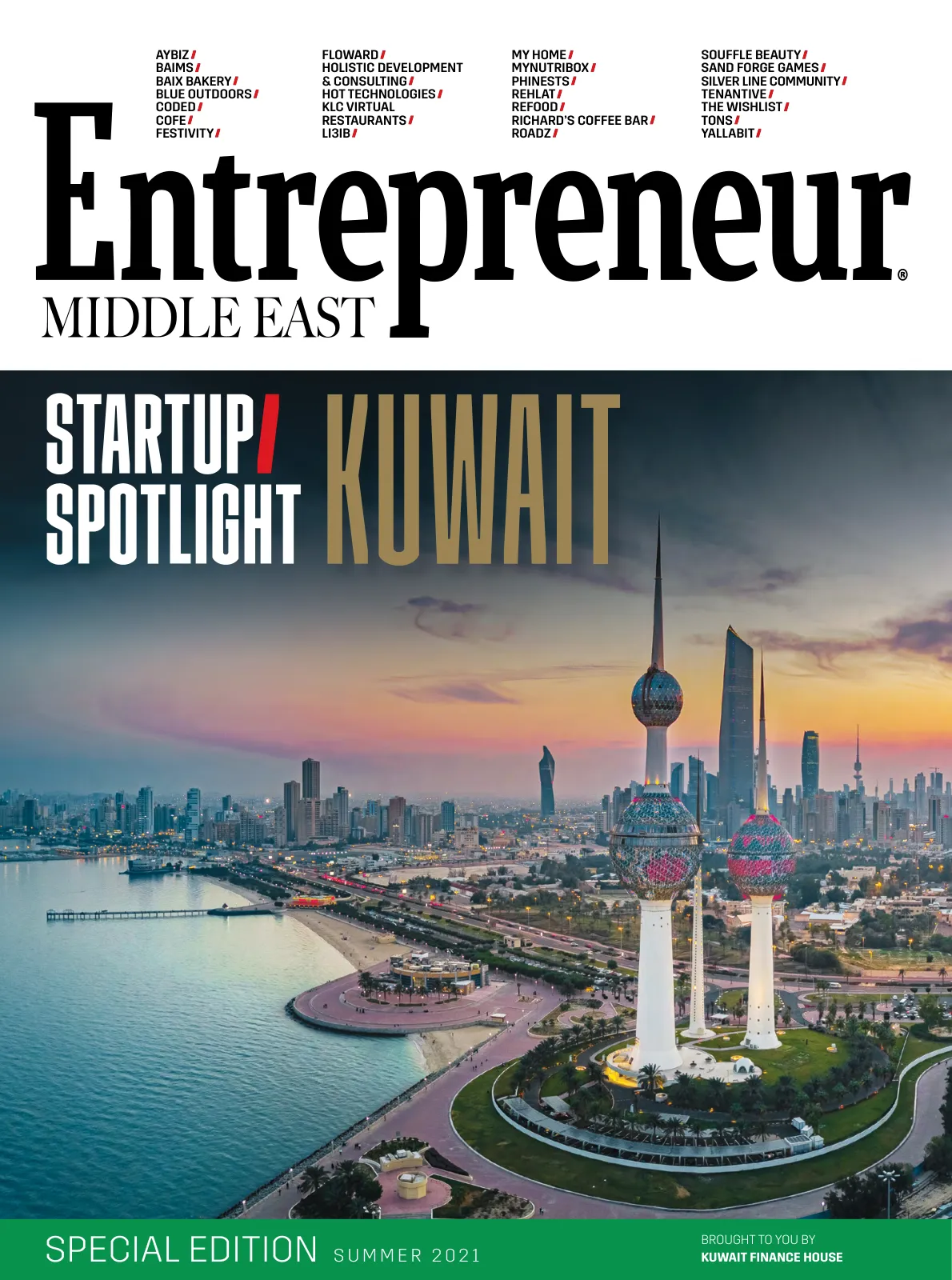
Entrepreneur Middle East, Startup Spotlight: Kuwait | Special Edition, Summer 2021
Page 1
KUWAIT FINANCE HOUSE
SPECIAL EDITION
S U M M E R 2 0 2 1
BROUGHT TO YOU BY
AYBIZ
BAIMS
BAIX BAKERY
BLUE OUTDOORS
CODED
COFE
FESTIVITY
FLOWARD
HOLISTIC DEVELOPMENT
& CONSULTING
HOT TECHNOLOGIES
KLC VIRTUAL
RESTAURANTS
LI3IB
MY HOME
MYNUTRIBOX
PHINESTS
REHLAT
REFOOD
RICHARD’S COFFEE BAR
ROADZ
SOUFFLE BEAUTY
SAND FORGE GAMES
SILVER LINE COMMUNITY
TENANTIVE
THE WISHLIST
TONS
YALLABIT
KUWAIT
Page 2
Page 3
3
KUWAIT / Startup Spotlight / ENTREPRENEUR.COM /
SUBSCRIBE
Contact subscriptions@bncpublishing.net to receive
Entrepreneur Middle East every issue
EDITOR IN CHIEF Aby Sam Thomas aby@bncpublishing.net
CEO Wissam Younane wissam@bncpublishing.net
DIRECTOR Rabih Najm rabih@bncpublishing.net
CREATIVE LEAD Odette Kahwagi
ART DIRECTOR Simona El-Khoury
MANAGING EDITOR Tamara Pupic
STARTUPS SECTION EDITOR Pamella de Leon
FEATURES WRITER Aalia Mehreen Ahmed
DIGITAL SOLUTIONS DIRECTOR Mahdi Hashemi mahdi@bncpublishing.net
HEAD OF INNOVATION Sarah Saddouk sarah@bncpublishing.net
GROUP SALES DIRECTOR – B2B GROUP Joaquim D’Costa
COLUMNIST Tamara Clarke
PO Box 502511 Dubai, United Arab Emirates
P +971 4 4200 506 | F +971 4 4200 196
For all commercial enquiries related to Entrepreneur Middle East
contact sales@bncpublishing.net
All rights reserved 2021
Opinions expressed are solely those of the contributors.
Entrepreneur Middle East and all subsidiary publications in the MENA
region are officially licensed exclusively to BNC Publishing in the MENA
region by Entrepreneur Media Inc.
No part of this magazine may be reproduced or transmitted in any form
or by any means without written permission of the publisher.
Printed by United Printing and Publishing | upp.ae
Images used in Entrepreneur Middle East are credited when necessary. Attributed use of
copyrighted images with permission. All images not credited otherwise Shutterstock.
MIDDLE EAST
4 KUWAIT FINANCE HOUSE
10 REFOOD
14 TENANTIVE
16 BLUE OUTDOORS
18 MY HOME
21 CODED
22 AYBIZ
24 BAIX BAKERY
27 BAIMS
28 LI3IB
30 FLOWARD
32 PHINESTS
34 COFE
36 MYNUTRIBOX
39 FESTIVITY
40 ROADZ
43 RICHARD’S COFFEE BAR
44 THE WISHLIST
46 SOUFFLE BEAUTY
50 SAND FORGE GAMES
52 SILVER LINE COMMUNITY
54 HOLISTIC DEVELOPMENT
& CONSULTING
56 HOT TECHNOLOGIES
58 KLC VIRTUAL RESTAURANTS
60 YALLABIT
62 TONS
64 REHLAT
Page 4
CATALYZING
ENTREPRENEURSHIP
ACTING GROUP CEO, KUWAIT FINANCE HOUSE
ABDULWAHAB
AL ROSHOOD
E
stablished in 1977, Kuwait Finance House (KFH) is
renowned for being one of the country’s oldest Islamic
financial institutions, but that’s not the only notable
detail about this enterprise- it is also known for being
a pioneering supporter of youth and small and
medium-sized enterprises in Kuwait.
/
KFH
Startup Spotlight / KUWAIT
4 / ENTREPRENEUR.COM / Startup Spotlight / KUWAIT
Page 5
Kuwait Finance House /
Page 6
6 / ENTREPRENEUR.COM / Startup Spotlight / KUWAIT
Leading the reins at KFH
today is Acting Group CEO
Abdulwahab Al Roshood, who
has over 30 years of banking
experience in conventional and
Islamic banks, including eight
years of experience in key
executive leadership roles.
When asked about how he’d
describe KFH’s role in
encouraging entrepreneurship
in Kuwait, Al Roshood
characterizes the enterprise’s
efforts as that of being a
“success partner.” To explain
this, he notes how several
companies in Kuwait have
started their relationship with
KFH at a time when their
credit facility was only
KD50,000, to now where it has
reached the value of KD3
million. “This underlines the
significant role of KFH has
played in improving these
businesses and transferring
them to large companies,” Al
Roshood declares.
But that’s not all- when it
comes to supporting small
businesses in Kuwait, KFH has
been aligning itself with
Commercial Bank of Kuwait
(CBK)’s strategy and outlook
for the future as well. In 2020,
for instance, the CBK proposed
a regulatory stimulus package
to ease certain capital and
liquidity requirements to
support bank lending. “KFH
Micro Enterprises was born
out of the SMEs unit to serve
the needs of SMEs and micro
businesses in 2021, which will
provide them with more
attention, assistance, and
financial consultation.” Given
that the entrepreneurial
ecosystem in Kuwait is still
reeling from the repercussions
of the COVID-19 pandemic,
such efforts are certain to be
welcomed from businesses,
both large and small, in the
country.
According to Al Roshood, the
COVID-19 crisis has been a
period of learning for everyone
involved with the business
ecosystem in Kuwait. For
instance, he points out how the
coronavirus pandemic has
taught businesses at large to
learn the significance of
adapting to change, coping
with crisis, and having
different attitudes to risk and
redesign priorities. “Most
importantly, it taught us that
digital transformation is not a
choice, but a must,” Al Roshood
says, noting that as the
importance of offering
KFH MICRO ENTERPRISES WAS BORN OUT OF THE SMES UNIT TO
SERVE THE NEEDS OF SMES AND MICRO BUSINESSES IN 2021,
WHICH WILL PROVIDE THEM WITH MORE ATTENTION, ASSISTANCE,
AND FINANCIAL CONSULTATION.
“
/
KFH
Startup Spotlight / KUWAIT
Page 7
7
KUWAIT / Startup Spotlight / ENTREPRENEUR.COM /
customers with uninterrupted services under all circum
stances became undeniable, so did the need for companies
to digitize themselves rapidly. “This is possible through
having a stronger digital presence with adaptive systems
and multiple channels, both physical and virtual, along
with rigid controls to defend both customers and share
holders’ interests.”
With entrepreneurs today continuing to face unprec
edented challenges in the world at large, Al Roshood says
that their success in such circumstances can be better
guaranteed by staying true to crucial leadership method
ologies. “I believe that patience, agility, ability to adapt to
change are important qualities, in addition to proper
management of cash flows, capital raising, good marketing
and communication strategies, and being able to learn
from competitors,” he says. “Entrepreneurs should also
have a clear vision, while realizing the importance of
perseverance, initiative, and reactiveness, and most
importantly, they should have tremendous belief and
confidence in themselves.” For those looking for opportuni
ties to tap into, Al Roshood suggests that they keep an eye
out for industries like technology, entertainment services,
and food suppliers- those sectors are going to have a pivotal
role in our collective futures, he says.
In terms of the road ahead for small businesses in Kuwait,
Al Roshood is of the belief that they are going to be a
priority for the country’s leadership in the months and
years to come- and that translates into KFH’s mandate as
well. “I would say that the SME sector is one of the main
sectors that are targeted to be supported by the govern
ment and subsequently by banks to achieve the Kuwait
2035 vision,” Al Roshood says. “KFH is considered the first
bank and one of the main banks in Kuwait that designated
a financing department for the SME sector. Moreover, the
Kuwait government continues to support [the] SME
segment through a special program that would encourage
entrepreneurs to start their own businesses.”
This essentially explains why Al Roshood is optimistic
about the prospects for aspiring entrepreneurs in Kuwait.
“Kuwait and the banking sector have always been
supportive to the entrepreneurs and the SME sector,” he
declares. “This segment plays an instrumental role in
boosting [the] economy and paving the way to larger
projects and more advanced and innovative businesses,
while creating jobs for the youth and achieving prosperity
and development.” When it comes to advice for entrepre
neurs, Al Roshood urges them to always keep their
customers in mind when running their businesses, while
also taking steps to safeguard themselves by protecting
their assets, securing smart financing, and ensuring proper
budgeting. “Be innovative,” he concludes. “Be ready to
adapt, and be agile.”
“Entrepreneurs should also have a clear
vision, while realizing the importance of
perseverance, initiative, and
reactiveness, and most importantly, they
should have tremendous belief and
confidence in themselves.”
Kuwait Finance House /
Page 8
8 / ENTREPRENEUR.COM / Startup Spotlight / KUWAIT
STARTUP/SPOTLIGHT
KUWAIT
Built in collaboration with Kuwait Finance House,
Startup Spotlight is a showcase of the enterprising
new businesses that are making their presence felt in
Kuwait right now. As the the first Islamic bank
established in 1977 in the state of Kuwait, Kuwait Finance
House is a pioneer in Islamic finance or Sharia’a compliant
banking, with it today being one of the foremost Islamic
financial institutions in the world, which makes it the right
enterprise to showcase the next generation of
entrepreneurs who are set to shape Kuwait’s future.
Page 9
9
KUWAIT / Startup Spotlight / ENTREPRENEUR.COM /
Page 10
10 / ENTREPRENEUR.COM / Startup Spotlight / KUWAIT
REFOOD
/rfdbyrefood.org /
W
ith three different operations that
work towards one common goal,
Refood’s programs essentially
prevent food products from ending
up in landfills. The first of these
programs involves food
rechanneling, which includes
salvaging excess and near-expired food by forging relationships
with fast-moving consumer goods (FMCG) suppliers before it’s
categorized as waste and sent to landfills, and instead
redistributing it to local beneficiaries with the help of local
volunteers. The second one is a subscription service, called “Rfd
by Refood,” where each Refood subscriber receives a monthly box
of curated food and consumer goods to try at home- this
operation is the main financial lifeline of the startup, and it is
what ensures that there is enough cash flow to keep it running.
“For each subscription box a customer buys, one food package
from Refood’s products is provided for a low-income family,”
explains Maryam Aleisa, founder of Refood. The third and final
vertical is purely educational in nature- the company organizes
multiple awareness campaigns to educate children, students, and
the general public about food waste and its repercussions.
/
01
Startup Spotlight / KUWAIT
Page 11
11
MARYAM ALEISA IS THE FOUNDER OF
REFOOD, a non-profit company
dedicated to eliminate food waste
through food rechanneling and
awareness programs, ultimately to
change social and cultural
behaviors to reduce food waste.
→
11
KUWAIT / Startup Spotlight / ENTREPRENEUR.COM /
Page 12
12 / ENTREPRENEUR.COM / Startup Spotlight / KUWAIT
For the most part,
things had been running
smoothly for Aleisa and her
team over the years. But then,
the COVID-19 crisis happened.
“The most challenging thing in
2020 was to see the company
that I spent years building
simply fall apart,” says an honest
Aleisa. “After years of polishing
the elemental pieces and
financially stabilizing a
non-profit company by utilizing
a diverse range of unconven
tional revenue streams, in the
moment that I finally thought,
‘It’s alright, we’re going to make
it,’ it all came tumbling down
harder than Humpty Dumpty’s
fall.”
According to Aleisa, the
coronavirus pandemic entailed
social distancing and health
protocols that no longer
entertained the distribution of
food and consumer goods
packages from Refood’s
warehouses. “This directly
plummeted the nominal
subscription fees we receive
from beneficiaries,” recounts
Aleisa. “Furthermore, with the
food scarcity issue and the
closure of international borders,
we lost our Rfd By Refood
suppliers, which is the revenue
stream we were building to
support our main line of
operations, in order to keep the
COMPANIES NEED TO BE TAKING CARE OF THEIR EMPLOYEES
AND PROVIDING THEM WITH REFOOD’S FOOD AND CONSUMER
GOODS PACKAGES IS A GREAT WAY TO SHOW THAT.
/
01
Refood team
→
Startup Spotlight / KUWAIT
12 / ENTREPRENEUR.COM / Startup Spotlight / KUWAIT
Page 13
13
KUWAIT / Startup Spotlight / ENTREPRENEUR.COM /
extremely subsidized low-cost nominal fee
program we had in place for underprivileged
families. Not only that, we also lost all our
financial sponsors due to the pandemic and
necessary budget cuts. Basically, we lost all
money-generating streams and were left in a
vortex of uncertainty.” As hard a pill as it
must’ve been to swallow, Alesia was also left
with the option to not take on new
volunteers- a move that also took away from
the community-building spirit that the
startup so desperately wanted to create.
But the founder and her team
crawled through, and decided to bring in
some much-needed pivots to the business
model in order to survive. With no financial
support or incoming cash flow, the team
shut down its main operation of food
distribution via its warehouses- instead, it
opted for a door-to-door delivery of family
packages, with a new, higher price that
reflected the true cost of service. “We
instantly shifted to a delivery-only opera
tion, which was a completely new field for
us,” says Aleisa. “Amidst the urgency of the
matter, I was focused on the underprivileged
families we were serving; if everyone was
having it bad, they were having it worse. We
did not want to leave them without food
during lockdown, so we kept the service [for
them] at the same nominal fee.” The new
pricing also meant that many subscribers
could no longer afford the program- but
Aleisa remains adamant that it was a move
that was necessary to keep the firm running
and to also ensure that low-income families
were not left out amid the pandemic.
The latter sentiment led to Refood
launching another new concept- that of
providing Kuwaiti companies the opportu
nity to support their low-wage employees
with food and consumer goods packages on
a regular basis. “As it is targeted towards
individuals and is centralized in operations,
we are able to provide it at a very affordable
rate,” explains Aleisa. “On the other hand,
companies need to be taking care of their
employees and providing them with
Refood’s food and consumer goods packages
is a great way to show that. Furthermore,
there is a fatwa citing that it is Islamically
permissible to spend zakat money on
purchasing food for the underprivileged,
and that it is always preferable to help those
within one’s community. We actually just got
our first client, and we’re really excited about
it, as we see a promising future for this line
of operation!”
Looking to the future, Aleisa remains
hopeful of finding new business and
humanitarian partners along the way. But
the founder is also wary of the uncertainty
-financial and otherwise- that comes with
running a business during a crisis. “To lose
what you have and what you’ve built,
especially if it never came with financial
reward to fall back on, is an extremely
humbling experience,” she says. “Although
going through this pandemic has shaken my
confidence, as confidence is always based on
certainty, it has given me the opportunity to
further increase my self-worth through this
shared experience, through realizing that no
matter how hard reality hits us, it’s up to us
to change what we can to cope with
uncertainty; more so, to find ways to thrive
within it.”
“To lose what you have
and what you’ve built,
especially if it never
came with financial
reward to fall back on,
is an extremely
humbling experience.”
Refood /
Page 14
14 / ENTREPRENEUR.COM / Startup Spotlight / KUWAIT
/
02
Startup Spotlight / KUWAIT
/tenantive.com /
L
aunched by
Ebrahim Alrashed,
Khaled Alrashed,
Rashed Altammar,
and Khaled
Alhadlaq, Tenan
tive is a platform to collect,
monitor, and organize your real
estate issues easily. With
property management solu
tions on management, mainte
nance, legalities, and listing,
the platform offers a hassle-free
method to manage properties.
TENANTIVE
“We believe that
tenants are very
much neglected in
the property
management cycle
while they are the
movers of the
whole cash cycle.”
EBRAHIM ALRASHED, co-founder and CEO
→
Page 15
15
KUWAIT / Startup Spotlight / ENTREPRENEUR.COM /
According to co-founder and CEO
Alrashed, the startup is aiming to
target a common problem faced by
tenants in Kuwait. “The traditional
property management process
involves many middlemen between
tenants and landlords, such as renting
brokers, messengers, accountants,
etc,” he says. “This process is resulting
in a lack of transparency, high
operational cost, and finally high
barriers of entry for emergent
property managers.” Tenantive’s aim is
therefore to increase transparency,
reduce operational costs, and remove
the barriers of entry for emerging
property managers. “Tenantive is
positioned toward tenants, as we
believe that tenants are very much
neglected in the property
management cycle while they are the
movers of the whole cash cycle.”
Alrashed explains
that the startup uses what is known as
a switchboard profit model. “The
more tenants and landlords join, the
more valuable the switchboard
becomes,” he explains. That shows
why upon the startup’s launch, the
Tenantive team focused their
resources on research and
development of the product, more so
than sales, PR and marketing, which
ended up being a key asset of the
company. It’s a strategy that appears
to have served the startup well amid
the ongoing global coronavirus
pandemic and the uncertainty it
brought to the market. “The will to
pivot provides the ability to survive,
emerge, and grow- that has been the
biggest takeaway of 2020,” says
Alrashed. “Embracing learning and
research reduces uncertainty while
pivoting. Moreover, understanding
that research comes before
development is crucial- always think
of the financial terms in terms of
research and development, with
research always needing to be
prioritized before any development
cost.”
It’s interesting to note that the
startup is the result of a revamp of a
previous product (Ajaraty) that was
launched mid-2017 as a proof of
concept with less than US$2,000 in
sales, PR, and marketing expenses to
date. Tenantive was launched as an
minimum viable product in
September 2020 as a self-financed
venture, until one of the users (Z
Solutions Real Estate Company)
joined as an investor. Alrashed notes
that the funding was undisclosed, but
it consisted of a cash credit line and
efforts. An app for the platform is in
the pipeline, with plans to expand in
“neglected contexts with technology
adoption and a high return on
investment,” Alrashed concludes.
UNDERSTANDING THAT RESEARCH COMES BEFORE DEVELOPMENT IS
CRUCIAL- ALWAYS THINK OF THE FINANCIAL TERMS IN TERMS OF RESEARCH
AND DEVELOPMENT, WITH RESEARCH ALWAYS NEEDING TO BE PRIORITIZED
BEFORE ANY DEVELOPMENT COST.
“
Tenantive /
Page 16
16 / ENTREPRENEUR.COM / Startup Spotlight / KUWAIT
A
s an entrepreneur, Majed
Alhamlan says that he has
always been on the
lookout for opportunities.
His first company, Fresh
Boat Marine, focused on
boat maintenance and detailing
services, and it was through
building relationships with marine
and outdoor suppliers and
customers that he came across
another entrepreneurial idea. He
noted that his clientele often had a
hard time finding the right supplies
and access to customer service,
while outdoor suppliers had
problems reaching their audience
because of showroom locations and
lack of online presence.
BLUEOUTDOORS
/blueoutdoors.co /
Launched in 2017, Blue
Outdoors initially started providing
spare parts and accessories for marine
vehicles, and with fluctuating online
store sales throughout the year,
Alhamlan pivoted the business to
include not only products related to
boats, but also those relating to
summer and winter sports, outdoor
entertainment, and many other
categories. Blue Outdoors has since
become a go-to online marketplace for
outdoor entertainment products in
Kuwait. Through its website and
mobile application available on iOS
and Android, Blue Outdoors provides
products from boat accessories and
water sports equipment to camping
and trips products.
With more than 14 categories, over
100 brands, and more than 45 local
suppliers, the platform also features a
marine directory for water sports
schools, diving centers, and adventure
trips companies, as well as a mainte
nance center, various payment
options, and more. Suppliers can
benefit from having an online point of
sale to potentially increase sales, a
24-hour delivery service for customers
to all areas in Kuwait, as well as
marketing opportunities through
digital and social media outlets. For
customers, it’s a one-stop shop to buy
for all their needs online from
multiple suppliers.
The venture was met with positive
feedback from customers and
suppliers upon launching. The
business model is based on commis
sions and delivery charges. Suppliers
don’t need a fee to join the platform;
they can just provide a fixed percent
age or multiple percentages based on
product cost. Higher percentages will
lead into more benefits for suppliers,
such as extensive marketing cam
paigns and special offers. Customers
are also charged a delivery fee based
on their location. Alhamlam also notes
MAJED ALHAMLAN, founder and Managing Partner
→
/
03
Startup Spotlight / KUWAIT
Page 17
17
KUWAIT / Startup Spotlight / ENTREPRENEUR.COM /
Blue Outdoors /
they do get a small percentage of
products from international suppliers:
“The percentage we get from interna
tional suppliers is much higher than
local suppliers, which will balance the
overall commission percentage average.”
With the outbreak of the COVID-19
pandemic, the Blue Outdoors team
obeyed the health and safety standards
imposed by the government to
safeguard their staff and customers, and
once the curfew regulations were
announced, they minimized office
hours, prioritized working from home,
but continued offering their delivery
services. Alhamlam notes that through
2020, most e-businesses did well,
because online shopping was considered
the best and safest option; however, that
doesn’t mean that such enterprises
didn’t face any obstacles.
To start with, Blue Outdoors was
surprised by a significant increase in
daily orders, ensuring fulfillment and
delivery logistics was a serious challenge
for the company. “Our in-house drivers
were not enough to fulfill and cope with
the daily number of orders, so I had two
options- either to hire new in-house
drivers, or to outsource to a delivery
company,” Alhamlam says. “Hiring new
in-house drivers would have increased
our operation cost significantly, because
we would have had to buy new cars, hire
new drivers, train them, and so on, and
therefore, we decided to outsource
almost 60-70% of our deliveries.” Prior
to the pandemic, Blue Outdoors stored
just a small number of products,
because the team’s usual way of doing
business was to pick up products from
vendors, pack it, and deliver it.
“However, during the pandemic, we
needed a faster and more efficient way
of delivery, and as a result, we moved to
a new location where we could easily
store large quantities,” Alhamlam says.
The third challenge was due to a
pandemic-caused shortage of stock in
Kuwait. “Factories and production facili
ties were shut down for a long time and
shipping logistics was delayed,”
Alhamlam explains. “I started noticing
that many products were becoming sold
out, and updating vendors stock became
a challenge. So, I decided to make a
drastic change- I divided my vendors
into two groups. The first group were
vendors who sold their products
through their websites, so we integrated
our backend system with them so that
stock could be updated instantly. The
second group were traditional vendors
with no online existence or very lousy
platforms to whom I offered to either
allow us to become their online point of
sale with a better and exclusive deal, or
to store their products selectively based
on our sales data.”
These three instances
explain why Alhamlam considers
learning how to operate a business in all
circumstances as having been his main
lesson from the COVID-19 crisis. “The
resilience and ability to change and
modify the business is essential in the
world after the pandemic, because only
businesses that can cope with changes
will succeed in the long term,” he says.
Going forward, Alhamlam aims to focus
on expanding his marketplace and
providing the best possible customer
experience. “During the pandemic,
customers had no choice but to order
online, even if the customer experience
was unpleasant,” he explains. “Now,
customers again have many online
options to shop from, but they will
remain loyal to the online place that
gave them the best experience.”
“Hiring new in-house drivers
would have increased our
operation cost significantly,
because we would have had to
buy new cars, hire new drivers,
train them, and so on, and
therefore, we decided to
outsource almost 60-70% of
our deliveries.”
Page 18
18 / ENTREPRENEUR.COM / Startup Spotlight / KUWAIT
04
MY HOME
/myhomeapp.io /
O
wned by IT company Wabash
Tech General Trading Co. WLL
(which also developed the website
Moqawalat.com), MyHome was
launched in 2018 as a mobile-
based application for the residents
of Kuwait to connect with verified
contractors, technicians, suppliers, and other
professionals for home maintenance needs. The
entrepreneurs behind the venture -Abdullah Abbas
Marafi, Mohammed J. Al-Awadhi and Bader
Altukhaim- came up with the idea after wanting to
reduce friction between residents and service
providers. With the goal to organize the maintenance
market and deliver quality service to their customers,
the platform sets clear and transparent prices and
processes for the customer and technicians, while also
matching providers with customers, giving 24/7
support for customers, handling in-app warranty
requests for jobs, as well as constant ongoing review of
service providers. While customers can have easy
access to technicians without searching through
directories or classified newspapers, service providers
can generate job leads from the platform.
/Startup Spotlight / KUWAIT
Page 19
19
KUWAIT / Startup Spotlight / ENTREPRENEUR.COM /
MyHome /
The co-founders note they’ve made use of
extensive market research to form a strong team
that will ensure the platform delivers the best
service possible, and so far, they’ve received
positive feedback. For their profit model, CEO
Al-Awadhi says it’s all about ensuring they have
capable service providers that work with integrity,
responding to market needs to grow their services
accordingly, listening to user feedback (both from
homeowners and service providers) and
constantly adapting, and finally, satisfying the
needs of both parties. “Different stakeholders
have different needs, and striking the right
balance between the two is key to making this
business model work.”
Adopting to various circumstances was an
approach that proved to be useful as the team
navigated the impact of the COVID-19 pandemic.
Like most businesses affected by lockdowns,
curfews, and regulations in this period, the
startup’s operations, as well as its demand and
supply metrics, were greatly affected.
The team have also had their own
share of hurdles. During the ideation stage,
Al-Awadhi says they were often told that the
maintenance market wasn’t suited for an online
platform, from both potential service providers
and users. To ensure a product-market fit, the
team mirrored the way maintenance is done
offline, and then replicated the process in the
app. “We set prices for standard issues and left an
option for users to request an assessment when
the issue was not clear cut. Moreover, we gave
technicians the ability to raise additional invoices
for cases where additional work was required- it
was key that we did not recreate the wheel to
adapt, especially in a sector such as maintenance.”
“ Different
stakeholders have
different needs, and
striking the right
balance between the
two is key to making
this business model
work.”
Co-founders
MOHAMMED J. AL-AWADHI
and ABDULLAH ABBAS MARAFI
→
Page 20
20 / ENTREPRENEUR.COM / Startup Spotlight / KUWAIT
“Service provider availability was
severely restricted due to the
curfews and area-targeted
lockdowns, which made matching
supply and demand a big challenge.
On top of that, supply of material
and spare parts was limited due to
logistical restrictions, which
affected our service offering as well.”
However, operating
under restricted circumstances indi
rectly played a factor in increasing
MyHome’s demand as well. “The
more people spend time in their
homes, the more home improve
ment ideas pop up,” Al-Awadhi
explains. The team also tried to
adapt to the situation by offering
virtual assistance services to
rebalance the demand and supply
mismatch. “Our operational focus
shifted from a growth mindset, to
maintaining the status quo mindset.
Our efforts were focused on
assisting our service providers in
attaining a permit to work during
the lockdown/curfews, when
applicable.”
As the team strives to recover from
the repercussions of the pandemic,
the co-founders are determined to
use their experiences to guide them
forward. An important lesson
they’ve realized is being adaptable.
Having ample cash reserves is
crucial, says Al-Awadhi. “Having a
diverse set of products and services,
as well as the ability to adapt to
changes goes a long way in making
a business more robust to unex
pected changes. One can either ride
a storm and suffer its consequences,
or shift the boat’s direction towards
manageable terrains.”
But while Al-Awadhi highlights
the importance of having a
contingency plan, he also points out
the issue that comes with optimiz
ing your business for a worst-case
scenario. “Don’t over-optimize your
resources and cost structure during
a crisis. By definition, a crisis is
temporary, and optimizing your
business model for a worst-case
scenario may make things better
during a crisis, but it will hinder
your potential to capture growth,
and in our case, capture pent up
demand post-crisis.”
In terms of what’s next for
MyHome, the co-founders plan to
acquire “a more significant market
share in the Kuwait market,
TREP
TALK
Q&A with Abdullah Abbas
Marafi, Mohammed J. Al-
Awadhi, and Bader Altukhaim,
co-founders, MyHome
What are some of the opportunities
that you see available in the Kuwait
market today, and what would be your
advice to aspiring entrepreneurs?
“There are many industries that are
still offline in Kuwait and the region
that I would advise to search for
gaps in the market or try to cater to
the needs of the people. Also, it is
critical to take ample time to plan
your business model, test your idea
with a prototype and see how the
market responds, then adjust
accordingly. There are many
industries that are ripe for disruption,
mainly because they are operating
offline and lack an online presence.
The internet was mainly used to
gather information, but nowadays
people expect to act and transact
online, and that is where the big
opportunity lies. Be a risk taker, and
don’t fear failure. And if you’re going
to fail, make sure you fail fast, and
then move on, leaving emotions out
of the equation.”
Our operational focus
shifted from a growth
mindset, to maintaining
the status quo mindset.
Our efforts were focused
on assisting our service
providers in attaining a
permit to work during
the lockdown/curfews,
when applicable.”
“
primarily by switching offline
customers to using MyHome for
home services.” They also aim to
introduce more services needed by
users, and expand to other
markets, developing new features
and optimizing their internal
operations to become leaner and
more efficient.
04/Startup Spotlight / KUWAIT
Page 21
21
KUWAIT / Startup Spotlight / ENTREPRENEUR.COM /
L
aunched in 2015 by
Ahmad Marafi and
Hashim
Behbehani, Coded
is a coding
academy on a
mission to train and educate
students in software
development and programming
to prepare them for today’s
demanding job market through
its offline bootcamps, as well as
its new online platform Barmej,
which features various courses
in Arabic.
/
Startup Spotlight / KUWAIT 05
CODED
/joincoded.com /
ONE OF THE MAIN CHALLENGES WAS THE NEED TO
CREATE NEW REVENUE STREAMS IN A VERY SHORT
AMOUNT OF TIME TO MAKE UP FOR LOST BUSINESS,
ESPECIALLY ON THE B2B SIDE.
“
The co-founders wanted to address two
problems: the lack of technical talent for
companies and the high number of people
who are eager to learn coding, but don’t
have the right resources, tools and
algorithms, both online and offline. “We
decided to create a company that focuses
on training the Arab world [on] coding
with both online and offline offerings, and
help them get hired in tech companies in
the Middle East and other countries,” says
co-founder and COO Hashim Behbehani.
Based in Kuwait, the startup holds coding
bootcamps on game development, website
designing and management, as well as
programs designed to turn a university
graduate to a professional coder, or a
complete beginner to a junior professional
coder. Coded also holds customized
bootcamps for enterprises such as
companies, organizations, and governmen
tal entities such as Zain, Kuwait Founda
tion for the Advancement of Sciences, and
Markaz. Since launching, the startup has
organized 24 bootcamps, with more than
250 coders graduating, according to its site.
They have also become a partner for One
Million Arab Coders, a UAE initiative that
aims to help one million Arabs learn
coding.
Having already received a capital boost
from a US$1.3 million pre-Series A funding
round to increase their educational
offerings online (which offers both free
courses and extensive online bootcamps
that costs $350 a month), the startup was
well on its way towards further growth. The
duo note that their customers benefit from
the services as it teaches the basics in a
relatively short period of time through its
intensive course, with graduates being able
to go to the job market more equipped. “I
think it inspired a movement to help more
coding-seeking learners to join the world of
tech, and understand the fundamentals of
coding,” Behbehani says.
But the COVID-19 crisis brought in its
own share of unprecedented hurdles for the
co-founders. “One of the main challenges
was the need to create new revenue streams
in a very short amount of time to make up
for lost business, especially on the B2B
side,” says Marafi. Moving ahead, they
believe it’s important for the team to “avoid
having too many eggs in one basket,” in
order to keep the business alive even if one
vertical fails. “It's critical to have diversified
revenue streams from different types of
customers, business models, and products,”
Marafi concludes.
Co-founders
HASHIM BEHBEHANI
and AHMAD MARAFI
→
Page 22
22 / ENTREPRENEUR.COM / Startup Spotlight / KUWAIT
06
AYBIZ
/owner.aybiz.com /
L
aunched in 2016, Aybiz
utilizes crowdsourcing and
curation techniques powered
by artificial intelligence (AI) to
provide an interactive local
business search engine that
allows users to easily explore
the largest list of places to go in Kuwait.
The founding team -Mohammad AlEisa,
Chief Executive Officer, Talal AlMousherji,
Chief Operating Officer, and Rawan AlEisa,
Chief Marketing Officer- have built a platform
that uses crowdsourcing and AI to customize
a user’s browsing experience by
recommending local businesses that might be
of interest to them. The platform provides
various ways for people to rate, review, and
recommend businesses in Kuwait, with AlEisa
hoping that the customized experience will
help people make more educated decisions,
from which Italian restaurant to visit, to
where to shop for office materials.
Aybiz is currently available as an app for
iPhone and Android devices, with the initial
response from the market having been
remarkably positive. But they’ve got
negative feedback too. “Some people would
say, ‘Why shouldn’t I use Google to search
for businesses instead?’” AlEisa recalls. “But
we believe that the future of business discov
ery should be customized to a local
experience. Users usually use Aybiz to
discover new businesses they never really
knew existed, as opposed to searching for a
particular business they have in mind. Aybiz
takes this approach one step further by
allowing users to shop and interact with
those businesses in a very unique and
localized way.”
Co-founders MOHAMMAD ALEISA and TALAL ALMOUSHERJI
→
/Startup Spotlight / KUWAIT
Page 23
23
KUWAIT / Startup Spotlight / ENTREPRENEUR.COM /
Aybiz /
As a business, Aybiz’s revenue streams
include advertisements and a B2B
monthly membership. “The B2B monthly
membership provides data licensing,
photography, discounts for business
affairs, targeted notifications, and
real-time extensive analytics,” says AlEisa,
adding that more features, such as
real-time analytics and grounds opera
tions assistance, will be added over time
as they studied business owners’ needs. Its
success hasn’t gone unnoticed- Aybiz
raised a pre-Series A funding round of
US$1.8 million to increase the amount of
data on their platform and expand across
the MENA region.
When the global coronavirus pandemic
broke out in 2020, the Aybiz team found
themselves working hard to level the
playing field between small local
businesses and mass chains in the market.
“Aybiz solves this issue by allowing SMEs
to earn new customers organically
without a massive advertising budget, and
amidst the partial lockdown of 2020,
Aybiz received a record number of SMEs
that wanted to sell their products and
learn important analytics about their
business and product performance,”
AlEisa says. “We provided the businesses
and sellers cost-effective tools to help
expand their online presence with
cataloging services, photography, and
logistics.”
On starting up a business in Kuwait,
AlEisa suggests entrepreneurs take
several points into consideration before
taking the plunge. “Showcase patience
and persistence, always have a partner,
and ask for help when it comes to
governmental affairs, because that saves
you time,” he explains. “Never be shy to
ask for help from experienced entrepre
neurs on your chosen industry; collabo
rate with individuals and corporates in
the sector. It’s also important to make
friends, not enemies, and share your ideas
and knowledge with others, including
your team, and never shy away from
sharing, even before inception, because
that will give you in-depth insights on the
do’s and don’ts.”
NEVER BE SHY TO ASK FOR HELP FROM EXPERIENCED
ENTREPRENEURS ON YOUR CHOSEN INDUSTRY;
COLLABORATE WITH INDIVIDUALS AND CORPORATES
IN THE SECTOR.
“
“Users usually
use Aybiz to
discover new
businesses they
never really
knew existed, as
opposed to
searching for a
particular
business they
have in mind.”
Aybiz team
→
Page 24
24 / ENTREPRENEUR.COM / Startup Spotlight / KUWAIT
07
BAIX BAKERY
/order.baixbakery.com /
C
reating a concept has
always been an inter
esting challenge for
Abdullah AlWatayan,
so it’s no surprise that
the entrepreneur has
concocted more than
one venture in Kuwait’s startup scene. His
first concept was Tashi, born out of his
interest in Japanese food and sushi,
through which he introduced sushi
burritos, poke, and sushi donuts to the
Kuwaiti F&B scene. He has also co-found
ed Multitude, an interdisciplinary studio
specializing in identity, creative direction,
and digital design, as well as Cheat, a
dessert shop.
His latest foray into
F&B, launched in 2018 with
co-founder Ahmad Abul, is Baix
Bakery, which aims to serve
premium baked goods made
locally every day. Inspired with
the idea of starting a business of
their own, the co-founders, who
both have full-time jobs, would
even go out and look for locations
after working hours or during
lunch breaks. “The special thing
about Baix is that we knew the
bakery sector of the F&B
industry was lacking the
combination of top quality
freshly baked goods, with
beautiful packaging that you
would want to show off, and that
was rare with bakeries: having
tasty baked goods in beautiful
packaging at a competitive price.”
Currently, Baix has four branches,
with its first shop at AlKhaleejiya
complex, followed by a central
kitchen at Aswaq AlQurain, which
supplies its branches and third-
party vendors, such as Mug Coffee
& Roastery, Mukha, and Kelly’s
Coffee Bar, with fresh pastries,
custom-made sandwiches, and
cakes. The co-founders have also
recently launched a Baix in Corner
at TruValue - AlRai and Abyat-
Shuwaikh, with their store at Abyat
marked as the flagship store, being
the biggest branch of all. The team
is also planning to grow more, with
an aim to push the company’s
delivery and catering revenue
streams further. “We like to take
our time and study new locations
and potential partnerships in and
outside of Kuwait.”
Co-founder ABDULLAH ALWATAYAN
→
/Startup Spotlight / KUWAIT
Page 25
25
KUWAIT / Startup Spotlight / ENTREPRENEUR.COM /
Baix Bakery /
AlWatayan notes that his
entrepreneurship journey
definitely had its ups and
downs. He remembers once
getting an idea of opening a
workspace and cafe in one
setting. “The idea would’ve
been success, if it wasn’t for the
location we chose to open the
cafe. The idea was that the cafe
would supplement the revenue
coming from our design work.”
However, reality soon hit,
AlWatayan says. “The design
studio was and is growing, and
doing very well, but eventually,
the studio’s income was being
drained by the cafe, and that
defeated the whole purpose of
opening the workspace and
cafe concept.” This is when
AlWatayan credits his business
partners who collaborated with
him to identify the problem,
and eventually move back into
having a full-fledged design
studio, with the resolve to try
other ventures again in the
future.
When asked to advise
other serial entrepreneurs out
there, AlWatayan states that
entrepreneurship is a way of
life for him. “It can seem
overwhelming, but if you wake
up every day loving what you
do, it doesn’t feel like a job,” he
says. “I think of it as building
my future, and a way for me to
release the ideas in my head
(and there are a lot of ideas!),
plus I do get this sense of
accomplishment when I create
a concept. Being at one of my
restaurants and seeing people
enjoying our food, that is a
feeling that keeps me coming
back and wanting to do more.
Nevertheless, having great
partners in any business
venture is the most crucial part
of a business success, I got
lucky by picking the right
people to partner up with, each
one of us is responsible for a
part of the business that he/she
is most confident about.”
I GOT LUCKY BY PICKING THE RIGHT PEOPLE TO PARTNER UP
WITH, EACH ONE OF US IS RESPONSIBLE FOR A PART OF THE
BUSINESS THAT HE/SHE IS MOST CONFIDENT ABOUT.
“
Page 26
26 / ENTREPRENEUR.COM / Startup Spotlight / KUWAIT
“I always remember
that with big risks and
big sacrifices, come
big rewards.”
This leads into his advice for
others who are thinking of
starting up a business- they
should definitely consider the
time and effort in doing so, he
says. “There’s a learning curve
to consider, and a lot of
blockers socially, emotionally,
and financially, but the idea,
of course, here is to persevere,”
he says. “I always remember
that with big risks and big
sacrifices, come big rewards.
Also, never underestimate
picking a value added partner,
because the way your
potential partner thinks,
reacts, and their work ethic,
directly reflects your business
success.”
Adding to the refrain
heard from almost every small
business that made it through
the COVID-19 crisis, AlWa
tayan believes that focusing on
his team was key to getting his
enterprise through this
tumultuous period. “Due to
the lockdown measures
imposed by local authorities,
our business was, of course,
halted, which was stressful in
itself, both on us and our
team, because we all had to
deal with uncertainty,”
AlWatayan remembers. “We
managed to overcome this by
blindly sticking by our team,
and making sure our staff
were comfortable and well
taken care of during this tough
time. Thankfully, we did not
have to let people go or
downsize, as we always had in
mind that this was temporary,
and that sooner or later, we
will operate and continue to
expand and grow. So, this
support to our team had us
ready to bounce back to
operating in no time after the
lockdown was lifted.”
The steps AlWatayan took
amid the COVID-19 crisis are
an indication of the important
role he believes good teams
play in ensuring a company’s
long-term success. “Our team
is the foundation of our
business growth,” he declares.
“So, having the right caliber of
people, and giving them
constant support and stability
financially and emotionally, is
key to a stable foundation for
positive growth.”
07/Startup Spotlight / KUWAIT
Page 27
27
KUWAIT / Startup Spotlight / ENTREPRENEUR.COM /
BAIMS
/baims.com /
L
aunched in 2017, Baims is an e-learning platform for Kuwait students that digitizes the
offline tutoring experience and makes content accessible online. Started by Yousef
AlHusaini and Bader Alrshaid while pursuing their engineering degrees at Kuwait
University, Baims was originally focused on engineering subjects, but then it grew to cater
high-quality tutoring courses based on the university curriculum. With a 70% discount
on the price tag of a normal tutoring hour, AlHusaini says that the startup broke even
within the first 24 hours.
Consisting of top tier professors
and tutors, the startup has since
expanded its scope to include
colleges and universities in
Kuwait and Riyadh, as well as
added courses suited for high
school students. The platform is
run on a revenue-sharing model
with its instructors who provide
content tailored for each
subject. Available on web, iOS
and Android devices, it has
more than 1,000 recorded
courses and 30,000+ lectures,
with more than 450,000 course
enrollments.
AlHusaini commends the
help of the startup’s early
supporters, including engineer
Khalid Albash who taught
physics and lent his office to
shoot Baims’ first courses.
They also credit Hemma Tech
Accelerator’s Jassem AlMu
tawa, who, even while the duo
were still university students,
provided guidance on
leadership and negotiation
tactics, and creating a scalable
plan, as well as offered his
office and three studios too.
In early 2020, the startup
successfully raised an undis
closed amount of seed funds in
a round led by AlWazzan
Education, a service provider of
K-12 American, British and
Arabic education in Kuwait,
which was joined by VC firm
Seed Partners and other angel
investors. When the impact of
the coronavirus pandemic crisis
manifested across all industries,
Alhusaini and his team offered
all of its high school courses for
free, amassing over 130,000
new course subscriptions and
introducing a large section of
the high school population to
online learning.
He notes that while
the past year was incredibly
hectic for the firm, it was a
successful one. “We raised an
investment round during
COVID-19, and we hired
actively when everyone was
laying off their employees, and
we were working 24/7 due to
the large demand of online
learning to university and high
school students,” he elaborates.
“We grew over 400% when it
came to content and user
growth and students’ time
spent on the platform. We also
created hundreds of videos on
a daily basis, so we really
struggled to keep up with
growth and hiring, while also
trying not to harm the quality
of content and service that we
offer to our students and
instructors.”
When asked what’s next for
Baims, the co-founders say
they are keen on growing
within the region. “Our
ultimate goal is to be a part of
the student’s life,” says
Alhusaini. “Baims stand for
Big Aims, and our aim is to
build a strong youth commu
nity for a better educational
ecosystem in the GCC and
MENA region, and improve
educational content.”
/
Startup Spotlight / KUWAIT 08
Co-founders YOUSEF ALHUSAINI
and BADER ALRSHAID
→
Page 28
28 / ENTREPRENEUR.COM / Startup Spotlight / KUWAIT
09
LI3IB
/li3ib.com /
T
he year ahead is a
year of growth,”
says Khaled
Al-Amiri,
co-founder and
CEO of Li3ib, with
relief. With Li3ib
being an app and website that
facilitates sports venue reservations
and scheduling recreational games
for sports enthusiasts in Kuwait, it is
clear that Al-Amiri’s business went
through a turbulent period after the
outbreak of the COVID-19 crisis.
“2020 taught us that sports and social
interactions are a pivotal part of
society, and that quarantining for
several months will not tarnish the
appeal of sports, but only make the
demand stronger,” he says. “2021 is
indeed a year of growth.”
And Al-Amiri has many
reasons to feel relieved- not only is
the tough period over, but Li3ib also
got acquired by Kuwait-based
Pro-Vision Sports Management
(now known as Suffix), and is now
considered as one of the success
stories of Zain Great Idea (ZGI)
tech startup accelerator program by
Zain, a leading telecom provider in
Kuwait. Launched in October 2017
by Al-Amiri and his co-founder
Khaled Abdulqader, Li3ib was
developed out of the two
entrepreneurs’ decision to help
amateur football players to join
games happening near them. They
soon discovered that users preferred
to play with their friends and family
members rather than strangers, and
that the real issue was the difficulty
of booking and finding facilities to
play at. They focused on developing
a system to manage the bookings at
sports facilities, improving it from
the traditional reliance on phone
calls, and pen and paper bookings.
After it gained a solid reputation
within Kuwait’s sports community,
companies and individuals took
notice and allowed the Li3ib team
to enter the event management
business, turning the startup into a
sports management company.
Though Al-Amiri says that their
idea was not new, he points out that
“ Kuwait has a very rare
social welfare system for
Kuwaiti citizens that
doesn’t exist anywhere
else in the world.”
Co-founders KHALED AL-AMIRI and KHALED ABDULQADER
→
/Startup Spotlight / KUWAIT
Page 29
29
KUWAIT / Startup Spotlight / ENTREPRENEUR.COM /
Li3ib /
it was the first one of its kind to
succeed locally. “We created a
community for all levels of
athletes and showcased that on
our social media,” he says. Their
community has extended to
include photographers, referees,
medics and other talent
valuable to the sports
community, which is what
Al-Amiri says is one of their
assets. “Establishing such a vast
network of disconnected talent
is what allowed us to organically
enter the events market.
Organizations no longer need to
chase different people and
create multiple invoices.
Instead, [they] can just deal
with us directly for whatever
sports service they require, from
custom jerseys to professional
tournaments.”
Besides providing their venue
partners with significant new
revenue streams, Li3ib also
provides a reliable system for
managing and tracking their
customers, wherein they can
receive a custom report
of the facility’s
performance in
comparison to the
market and receive
suggestions to improve
based on customer
feedback. Therefore, the
revenue from booking
commissions, event
organization, and
advertising are the core
pillars of Li3ib’s
business. However,
events and advertising
as revenue sources came
as a surprise, Al-Amiri
says, and credits it to
their growing traction.
This rapid
growth brought many
lessons for Al-Amiri and
Abdulqader. “Football is
the most popular sport
in Kuwait, and athletes
of other sports complain
that they do not have
enough tournaments to
compete in or venues to
play at,” Al-Amiri says,
while providing an
example of the lessons
they learned while
growing Li3ib. “The
sports market in Kuwait
is very fragmented and
riddled with bureaucracy, which
makes it difficult and slow to
add new venues to our platform.
Essentially, the demand is
higher than the rate at which we
can add new venues. By creating
local events and showcasing it
on our platform and social
media, we are educating the
local market and venue owners
that there is ample demand and
opportunity in the sports
industry.”
And when asked to list some
of the main considerations that
entrepreneurs should keep
when starting up a business in
Kuwait, Al-Amiri is honest and
practical. “There is tremendous
hype around the
entrepreneurial lifestyle, and,
unfortunately, misinformation,”
he says. “My main advice would
be don’t start a business just to
start a business; start a business
to solve a problem. If it’s your
first business, then solve a
personal problem, because that
way you can invest your time
and energy effortlessly into
something that you are
naturally passionate about.
Every business has its struggles
and obstacles, but even this
experience should be enjoyed.”
Similarly, he is open to advice
his fellow Kuwaitis to take
advantage of the benefits that
the country offers to them.
“Kuwait has a very rare social
welfare system for Kuwaiti
citizens that doesn’t exist
anywhere else in the world,”
Al-Amiri explains. “If you create
a company and work solely for
the entity that you have created,
you will receive a salary that is
higher than entry-level wages in
other countries. Take advantage
of this financial support.”
Page 30
30 / ENTREPRENEUR.COM / Startup Spotlight / KUWAIT
10
F
ounded in August 2006, Floward is an online floral and gift retailer
and distribution platform with delivery services across Kuwait. The
platform is the brainchild of Abdulaziz Al Loughani, whose other
forays into entrepreneurship include roles as the co-founder and
Managing Partner of venture capital firm Faith Capital, plus as the
founding Executive Vice Chairman of the Kuwait National Fund for
SMEs Development, as well as the co-founder and Managing Partner of
Talabat.com until 2010. Commenting on the startup’s distinctive niche, Al
Loughani points out that cut flowers is a “US$1.3-1.5 billion industry in the
GCC, 99% of it is offline, and the market is very fragmented with no local
or regional dominant players.” The founder and CEO saw the need to
provide the consumer with a wide variety of high-quality flowers, bundled
with different accessories, brought to the consumer in an easy and
convenient way, using the app or the website.
/floward.com / FLOWARD
The first phase of the business involved
setting up the infrastructure by making sure that the Floward team
had access to the best farmers and growers around the world and at
the best prices, while also sorting out shipments and logistics,
finding local partners for the accessories to bundle their flowers with
(chocolates, cakes, perfumes, etc.), developing a user-friendly and
smooth experience of viewing their products on the app and website,
and finally, managing the last-mile delivery to ensure the best user
experience. Next, the startup focused on validating its market size
assumptions starting with Kuwait, as the goal was to be the preferred
online flowers destination in Kuwait within 12 months. The ensuing
phase was about regionalizing the business- which was a success as
well. Besides Kuwait, Floward has since launched operations in
Saudi Arabia, Bahrain, UAE, Oman, Qatar, and the UK.
Feedback has been positive, as per the company’s
peer reviews, with Al Loughani noting that within 12 months, the
company has had the highest growth rate compared to its competi
tion, and the highest retention figures as well. The secret? Al
Loughani says it’s all because they have full control of the supply
ABDULAZIZ AL LOUGHANI,
founder and CEO
→
/Startup Spotlight / KUWAIT
Page 31
31
KUWAIT / Startup Spotlight / ENTREPRENEUR.COM /
Floward /
chain of flowers (which are purchased around the world) and they
receive shipments twice a week. They also have their own workshop
where florists arrange the best bouquets, which their designer team
presents on the website as well. Like with any other business, the
COVID-19 crisis has also affected Floward. “At the beginning, there
was a lot of uncertainty on how demand will look like, what
business/safety/financial implications would it have on us,” Al
Loughani recalls.
To combat this uncertainty, the startup took major cost-cutting
initiatives and asset-liability management measures. Though
market size has shrunk, Al Loughani notes that e-commerce
penetration has doubled. “We’re no different than this statement:
fortune favors the prepared.” Lockdowns across cities drove revenue
down to zero overnight, but their established markets proved to be
an advantage. The company had seven fulfillment centers servicing
nine cities in over five countries, which gave it the upper hand to
work in other centers when others were closed. In fact, Al Loughani
believes that the startup was well positioned for the pandemic, as it
was a full-fledged e-commerce platform in the flowers gifting
vertical market, and so it had full control over supply chain and
quality of service.
The COVID-19 crisis did cause an interruption in
terms of flowers supply, but Al Loughani and his team managed to
switch the enterprise’s modus operandi from wholesale purchasing
to direct sourcing of farmers and growers around the world. Plus,
having a wide variety of product assortments, such as flowers,
accessories, and gifts, helped the enterprise, with Floward’s business
model enabling it to thrive on its unit economics and customer
experience. In fact, it's worth noting that amidst the pandemic, the
startup achieved a milestone. In October 2020, Floward announced
that it had secured a $2.75 million funding, led by Saudi Arabia-
based Impact46 fund, with the participation of Faith Capital, BNK
Capital, and other regional companies. A statement from the
company notes that Floward was thus able to raise close to $7
million in total funds, with its current net revenue pegged at over
$30 million. “You’re as big as what your vision is,” Al Loughani says,
“The COVID-19 crisis has impacted e-commerce penetration
positively in many verticals around the world- the flowers vertical
was one of them, and we fully took advantage of that during these
hard times.”
In terms of the future, the team at Floward is aiming to achieve
operational efficiency with the enterprise. Al Loughani explains that
he and his team are focused on horizontally expanding their
business model to be the preferred online flowers and gifts
destination regionally in two years, and then perhaps looking at
possible vertical integrations on their supply chain, or consolidation
through M&A. Looking back at what has primarily been a
tumultuous period for businesses around the world, Al Loughani
notes that it offers quite a few crucial lessons that entrepreneurs
need to take to heart. “Take bold decisions, don’t be shy,” he declares.
“Shorten your learning curve. Culture should be by design, not by
chance. Every decision you make should affect your three-year goals,
not end-of-month goals.”
“We’re no different
than this statement:
fortune favors the
prepared.”
Page 32
32 / ENTREPRENEUR.COM / Startup Spotlight / KUWAIT
11
PHINESTS
/phinests.com /
L
aunched in April 2019, Phinests is an online
platform that helps connect the creative economy
and media professionals to their customers
-whether it’s media agencies or businesses- in an
accessible and convenient way. The platform gives
access to local talent and experts specializing in
photography, website and application design,
copywriting, TV commercials, videography, illustrations, marketing,
social media content, branding, graphic design, animation, and
voiceovers. It also features cloud-based scheduling as an easy way to
schedule meetings with professionals, in addition to allowing users
to start projects, transfer files and make secure payments.
The co-founders Hamad Alroumi, Sara
AlRabiah, and Hamad AlGhanim wanted to
highlight the work of talented local
freelancers in Kuwait, and connect them
with businesses looking for creative service
providers. The team started with a mini
mum viable product to validate the idea
before launching a website. Acording to
Alroumi, Phinests’ website was designed
wherein “the creative’s portfolio is show
cased for the purpose of being contacted by
business owners with specific needs, as it
provides business owners with what they
can expect from working with such
professionals.”
HAMAD ALROUMI, co-founder and CEO
→
/Startup Spotlight / KUWAIT
Page 33
33
KUWAIT / Startup Spotlight / ENTREPRENEUR.COM /
The startup is driven by the mission to
simplify the process of matching talent with businesses, provide
career opportunities to individuals offering creative services and
raise awareness of opportunities in the market for creatives.
Alroumi also says, “Professionals [in the creative field] are
extremely busy creating valuable content for their clients. This
results in failure to advertise their own work directly to prospective
clients- signifying the importance of having a platform where they
can be recognized for the work they have done and use that to
attract new clients.”
Initially, some found that the website had too many steps to reach
the desired service on their platform. The team remedied the issue
quickly. They simplified the process of contacting a service provider
by creating a project page for both parties to send messages,
exchange files, and pay through the platform. And the feedback for
the platform has been favorable- Alroumi says that businesses point
out how Phinests has helped avoid the hassle of going through the
tedious search-and-filter process, allowing them a convenience of
being able to look for all their needs in one place.
The startup hasn’t been immune from the impacts of the
COVID-19 pandemic. Though Alroumi states that they’ve experi
enced various challenges from operational restrictions due to
imposed lockdowns, it hasn’t deterred the team from pushing ahead
with their long-term plans. As a result, the Phinests team launched
an application to go along with the existing website, providing a
new avenue wherein business owners can work with local freelanc
ers and agencies. Besides that, to help creatives with diminished
income, the team sought to promote local freelancers and agencies,
and thus, decided to offer free subscriptions on the platform to
provide creatives with more opportunities for income. Alroumi
notes that the pandemic showcased the startup’s USP too.
“Although the pandemic imposed many challenges, it also showed
the power of digital communication,” he says. “Being a digital
platform, which connects business owners with creatives, Phinests
was the perfect solution for many business owners, who were able
to procure creative talent, while being restricted to their homes due
to the lockdowns.”
The entrepreneur is keen to abide by the vital
lessons he’s had during the pandemic- namely, the significance of
being resilient. “Forecasts and plans can all go to waste when
something as unpredictable as a pandemic occurs,” Alroumi says.
“In such situations, the resiliency of a company enables flexibility,
which in effect, [allows] the company to navigate through difficult
situations and make the most [out] of them.” He also adds,
“Although 2020 created issues that needed quick, short-term
solutions, a company should still take the long-term [strategy] into
consideration. Understanding the new working conditions and
having the ability to adapt to these conditions will be a deciding
factor in a company’s success.” On to future opportunities, Alroumi
says, “With the Kuwaiti market lacking a digital directory of
professional service providers, our platform makes the process of
looking for professionals, comparing their work and seeing who
matches their business, the most extremely easy.” With the mission
of Phinests becoming a one-stop-shop for all business require
ments, the team aims to increase the number of services available
on the platform. “Kuwait provides several opportunities for
software-as-a-service companies to thrive,” Alroumi says. “The
market provides several opportunities to improve and simplify
processes.”
Phinests /
UNDERSTANDING THE NEW WORKING
CONDITIONS AND HAVING THE ABILITY TO
ADAPT TO THESE CONDITIONS WILL BE A
DECIDING FACTOR IN A COMPANY’S SUCCESS.
“
“Phinests was
the perfect solution
for many business
owners, who were
able to procure
creative talent, while
being restricted
to their homes due to
the lockdowns.”
Page 34
34 / ENTREPRENEUR.COM / Startup Spotlight / KUWAIT
To start with, he saw a startup opportunity even in the challenging
and over-crowded coffee industry. “The coffee marketplace offers a
multi-billion dollar growth opportunity,” Al Ebrahim replies. “With
the coffee share of beverage growing by 5.5% per annum, that
makes the coffee market the second most lucrative commodity
market after oil. Specialty coffee shops alone have shown a 60%
growth rate in recent years. Some of the biggest deals to be signed
involve the acquisition of coffee-centric companies, like the deals for
Keurig (US$13.9 billion), Einstein Bros ($1.35 billion), Costa Coffee
($5.1 billion) and Pret-A-Manger ($2 billion), to name a few.”
Those working in the coffee industry will
find the COFE app particularly interesting as the COFE market
place gives them quick access to a wide range of independent and
coffee franchise vendors through multiple concierge service options,
while also enabling them to order and pay online. In fact, the entire
selection and purchasing process takes place in the app. Since its
beta launch in February 2018 in Kuwait, it has been the COFE
team’s intention to digitize the coffee marketplace. “It’s been a task
we have succeeded with in Kuwait, and are now in the process of
extending to other markets, starting with the UAE and KSA, before
launching in London,” says Al Ebrahim. “COFE’s expansion efforts
are a way for us to take this integration of everything coffee-related
on a digital platform, to the global market.”
So, how has the COFE team planned to capitalize
in this particular sector? “While there are marketplace apps for
almost all industries; hospitality (Airbnb, Booking.com), food
delivery (Deliveroo, Talabat), travel (Expedia, Priceline), there is a
lack of a coffee marketplace app in the market,” Al Ebrahim notes.
Looking at the current trend in the mobile application industry in
particular, the Starbucks app in 2018 had 23.4 million mobile
paying users, ranking above Apple Pay (22 million users) and
Google Pay (11.1 million users). Even regionally, there have been
some major deals within the mobile application industry, like
Uber-Careem ($3.1 billion) and Talabat-Rocket Internet ($170
million). Given this data, both the coffee market and the mobile
application industries are showing phenomenal growth rates, and
thus, the COFE app.”
12
A
li Al Ebrahim, founder
and CEO of COFE, a
coffee-centric market
place app conceptualized
in Kuwait and developed
in Silicon Valley for
coffee communities around the world, is a
firm believer that “every challenge is also
an opportunity.”
/cofeapp.com / COFE
“This time also proved
the need to hire
multi-talented staff,
instead of sticking
people into silos.”
ALI AL EBRAHIM, founder and CEO
→
/Startup Spotlight / KUWAIT
Page 35
35
KUWAIT / Startup Spotlight / ENTREPRENEUR.COM /
Then, the COVID-19 pandemic
struck the world, but Al
Ebrahim saw an opportunity in
it too, specifically for online
platforms such as the COFE
app. “With COVID-19, where
every kind of business and the
global economy took a hit, the
coffee business was no
exception,” Al Ebrahim says. .
“With the initial regulations
that led to the closure of coffee
shops to the complete lock
downs, coffee businesses had to
struggle with continuity, and in
many cases, just staying afloat.
However, with stores only being
able to offer delivery or pick-up,
an application like COFE
became quintessential to the
coffee shops.”
He explains that, with the
growing preference for
contactless transactions, the
COFE app found itself in the
unique position where users
could order, customize, and pay
for their coffee, without ever
having to enter a store, or physi
cally touch a cash point. “This
was also a phase where the
reluctance shown earlier by
bigger brands started to reduce,
given that every single business
was looking to add an addi
tional revenue stream,” Al
Ebrahim adds. “Brands that
had only signed up for specific
premium services began to
increase their service offerings
in order to attract more
customers.”
In addition, the COFE
team also saw a steady growth
in the number of vendors on
their platform, as well as new
first-time users. “The momen
tum gathered by online
platforms during COVID-19 has
also shown traditional
businesses the value of an
online presence,” Al Ebrahim
adds. “We have always insisted
that the COFE app is an online
partner, and not a competitor.”
In a sense, Al Ebrahim
continues, the COVID-19 crisis
also gave his team the luxury of
time to double down on their
tech and maintenance, as they
geared to scale to different
markets. “Did COVID-19 slow
things down? Yes. But most
smart businesses used this
slump to prepare to soar even
higher, as the pandemic
restrictions began to lift, and
life started to resemble some
kind of normalcy,” he notes.
Therefore, Al Ebrahim’s
key lessons from 2020 was that
the impact of COVID-19
showed to the world the
importance of being able to
adapt quickly. “In the case of
startups especially, the need to
readjust your sails and to be
able to reallocate resources has
become ever-so-important,” he
says. “This time also proved the
need to hire multi-talented
staff, instead of sticking people
into silos. With COFE
especially, it was a learning
experience for all of us, with all
hands on deck, everyone was
doing everything.” With this
being the case, Al Ebrahim is
now looking forward to the
future. “We’re looking into
adding more alternate revenue
streams through new features
and services,” Al Ebrahim
concludes. “Like I mentioned
before, every challenge is an
opportunity. I feel that COFE
will come out on the other side
stronger. The last recession in
2008 gave us companies like
Airbnb, WhatsApp, and Uber,
as people's interest in looking
for complementary business
models increased. The 2003
SARS outbreak catapulted
Alibaba to the forefront because
traditional businesses saw the
value in going online. Hopefully
at the end of this, COFE will
come out as the Alibaba for the
coffee market, as there is no
other marketplace app for this
$150+ billion industry.”
Cofe /
THIS WAS ALSO A PHASE WHERE THE RELUCTANCE SHOWN
EARLIER BY BIGGER BRANDS STARTED TO REDUCE, GIVEN THAT
EVERY SINGLE BUSINESS WAS LOOKING TO ADD AN ADDITIONAL
REVENUE STREAM.
“
The COFE app team
→
Page 36
36 / ENTREPRENEUR.COM / Startup Spotlight / KUWAIT
13
MYNUTRIBOX
/mynutribox.com /
F
ounded in
2018 by
Noora Al
Askar,
MyNutribox
is a health
and wellness
platform that acts as a “virtual
pocket nutritionist” that is
personalized to the individual’s
nutritional needs and health
goals. With a mission to help
the Arab world live healthier
lives, the platform also gives
users access to a network of
global experts who can offer
personalized diet plans, virtual
nutrition consultations, and
product recommendations in
order to help them make
informed choices towards
healthy living. With its algo
rithm, the app sends healthy
habit modification taps and
reminders to personalize a
user’s journey.
“ In 2017, she won the Zain Great
Idea competition, and
MyNutribox ended up getting
selected to be a startup in
residence at an accelerator in
Silicon Valley.”
Al Askar is a US certified clinical
nutritionist, with an aptitude for
entrepreneurship. She obtained her BSc in
Human Genetics from the University of
Leeds, and then moved on to obtain her
MSc in clinical nutrition, with research in
the area of obesity prevention and
management. She then went ahead with
PhD level research in human nutrition,
focusing on obesity management in young
adults. Her journey to entrepreneurship
was ignited when, at the age of 23, she
built the clinical nutrition department at a
top private hospital in Kuwait (which got
accredited by the Joint Commission
International), and turned it into a top
operating profit center.
NOORA AL ASKAR, founder and CEO
→
/Startup Spotlight / KUWAIT
Page 37
37
KUWAIT / Startup Spotlight / ENTREPRENEUR.COM /
MyNutribox /
1. FOCUS ON THE
POSITIVE “Always have faith,
resilience, and be optimistic. I
am a firm believer that there is
always a silver lining in any
situation. As founders and CEOs,
we must find it, communicate it
to our team, and then move
forward as a business. A great
responsibility lies on our
shoulders, so no matter how we
may feel on the inside, we have
to be solid, have grit, and be able
to lead and support our team
during this crisis.”
2. EMBRACE CHANGE
“Believe in yourself and be
brave- you’ve reached this far! If
life throws a curveball, find out
how to turn that challenge into
an opportunity for your business.
Always have a plan, strategy, and
system in place. You can keep
the same vision and end game in
mind but be adaptable with how
you’re going to get there.”
3. FORGET THE BELLS
AND WHISTLES “Focus on
what matters: customer
happiness, creating a community,
growing your startup, and
generating a consistent steady
revenue stream. If you can do that
working from home or a co-
working space, then do so! You
don’t need that amazing sea view
office with floor to ceiling
windows- that rent can be used
for a more useful purpose, such
as digital marketing, for example.”
4. DON’T OVERTHINK
“Focus on agility and swift
decisions. Analyze the situation
properly, find a solution, and
make a quick decision to move
forward and execute. Wasted
time is lost revenue.”
5. ITERATE AND PIVOT
“Don’t be afraid of iterating your
business model and revisiting
your value proposition. We gladly
did. Crisis often accelerates
outcomes and forces us to
change course and make quick
decisions. Most of the time, this
leads to untapped opportunities
for your business that you may
have overlooked! Be creative
with the way you generate
revenue.”
6. MAINTAIN TEAM
RELATIONSHIPS “Learn to
become more productive with a
remote, active team. Have a
work process in place, be
organized and efficient, check in
with your team, have a daily or
biweekly virtual team huddle.
This will give the team a sense of
reassurance, stability,
accountability and direction.”
In 2013, Al Askar also co-founded and
managed a holistic juice company, and later
entered the Idea Track of the MITEF
Startup competition with MyNutribox,
which was just an idea on paper (and with
a different name too) at the time. It was
inspired by her patients at the clinic and
the consistent pain points she was
witnessing in them. The idea was then
selected as one of the top finalists, after
which, they also became finalists for the
Health Innovation Challenge for the FIFA
2022 World Cup. In 2016, she resigned
from her position as Director of Nutrition
at a hospital, and began her journey to
becoming a tech entrepreneur.
Al Askar notes that she was
also inspired from her brother Khalid Al
Askar and cousin Mohammed Jaffar (who
built the online food delivery platform
Talabat), and she spent days learning and
absorbing information from them on social
media, sales, marketing, and product
development. After researching extensively
and talking to various developers and
engineers, she built her core team and
began actual development of the iOS
platform. In 2017, she won the Zain Great
Idea competition, and MyNutribox ended
up getting selected to be a startup in
residence at an accelerator in Silicon Valley.
After licensing the company, hiring a strong
core operations team, and creating
operational systems and process, Al Askar
says that it was the seed program at
Sharjah Entrepreneurship Center (Sheraa)
in May 2019 that gave her company a
boost. It was through this program that she
and her team fine-tuned the customer
journey and value proposition of the
enterprise.
The MyNutribox team had planned that
2020 would be their year of growth, with a
three-month campaign mapped out and set
to launch in March 2020. But the
COVID-19 crisis put all plans on hold, with
Al Askar having to deal with the uncer
tainty as a self-funded startup. “We were
counting on our huge ‘on the ground’
campaign to acquire customers, gain steady
traction, and raise our first VC-led seed
round at a healthy valuation,” she says.
TREP TALK
Noora Al Askar, founder and CEO, MyNutribox
What are some of the crucial lessons you’ve learned from 2020 that you
are taking with you to guide both yourself and your business going
forward?
Page 38
38 / ENTREPRENEUR.COM / Startup Spotlight / KUWAIT
Al Askar says
MyNutribox plans
to “become a
growth machine
and enhance our
entire customer
experience and
business process
through behavioral
science,
automation and
machine learning.”
But she and her team buckled down
and pivoted its business model to
adjust to its new surroundings. “From
being a to-sided marketplace to a
Software-as-a-Service subscription
model, MyNutribox now utilizes both
machine learning and human
coaching to help people in the Arab
world lose weight and become
empowered to live a healthy life, by
creating habits and behavior change,”
she explains. “The pandemic allowed
us to focus on our product and
technology, and we’ve changed the
way we operate at MyNutribox,
becoming lean and efficient.”
On another note, Al Askar says that
the COVID-19 crisis gave her and her
team an opportunity to step back
from the daily hustle, and reflect on
their journey to realize a healthy
balance of grit and grace.” In a way,
the pandemic has positively impacted
the business, says Al Askar. “We
understood our business better, the
market better, and identified the
strengths and weaknesses in our
previous business model.” As a result,
the team examined their USP, and
began the process of tweaking their
product and enhancing their tech.
“How would we generate revenue now
that our plans have changed? This is
where our crisis creativity kicked in,
and we created interactive scalable
community wellness programs and
health initiatives,” she remembers.
At the onset of the
pandemic in March 2020, the team
partnered with Boubyan Bank, a
leading youth driven bank in Kuwait,
to create an interactive evidence-based
14-day Immunity Program. With the
program, MyNutribox was able to help
500 individuals and their families
fortify their immunity against the
COVID-19 virus, and the startup has
since also introduced the program's
second phase. They also introduced
the MyNutribox Wellness Challenge to
help and empower individuals to stay
healthy, while fostering a community.
Its results were remarkable, Al Askar
says since her startup was able to help
more than 95 individuals collectively
lose 400kg of weight.
As for the startup’s future plans, Al
Askar says MyNutribox plans to
“become a growth machine and
enhance our entire customer
experience and business process
through behavioral science, automa
tion and machine learning.” At the
end of the day though, Al Askar aims
to make MyNutribox the go-to
nutrition and weight loss platform in
MENA region that delivers results
and truly helps people transform their
lives.
13/Startup Spotlight / KUWAIT
Page 39
39
KUWAIT / Startup Spotlight / ENTREPRENEUR.COM /
/festivity.com.kw / FESTIVITY
The result? AlTowaijri credits
Kuwait’s young and eager market
space that made entering the events
sector favorable for their startup.
Compared to most traditional event
planning offerings, Festivity
presented a fresh approach by
offering transparency in pricing and
a variety of payment options all in
one platform. But the outbreak of
the coronavirus pandemic in 2020
brought with it a lesson on flexibility
for the startup. “Festivity is all about
letting people to gather, socialize,
and enjoy their celebrations
together, and clearly 2020 was
sponsored by ‘social distancing’, so
that was the main challenge,”
AlTowaijri says. “However, we have
collaborated with many vendors to
customize ‘enjoy staying home’
items, including arts and crafts, DIY
meals, games and puzzles, as well as
to show the disinfecting process that
was being done on trampolines and
rentable items.”
With the aim to become the go-to
online platform for anyone planning
an event, AlTowaijri says he and his
team at Festivity are aiming for
geographical expansion in the
foreseeable future, alongside
realizing growth targets and the use
of advanced technologies. When
asked for his tips for fellow
entrepreneurs, AlTowaijri replies,
“Personally, I’d search for opportuni
ties in the B2B sector. My advice
would be to research the market
precisely, and fight any kind of
despair during the [entrepreneurial]
journey.”
F
estivity was
launched in 2015
by Nasser
AlTowaijri and his
partner
Abdulwahab
AlOthman to make event
planning simple and convenient
by gathering all services related
to events, ranging from private
occasions, family gatherings,
birthday parties, to wedding
ceremonies, on a singular online
platform. The co-founders got
the idea when they hosted a
dinner reception for a mutual
friend and realized the need for a
digital solution to find and book
options for everything from
catering and entertainment, to
valet parking, and even to
heaters. At the time, there was
nothing like this available in
Kuwait, and after conducting
research and financial and
technical analysis, the co-
founders went on to debut this
premier marketplace delivering
event and gathering services.
PERSONALLY, I’D SEARCH FOR OPPORTUNITIES
IN THE B2B SECTOR. MY ADVICE WOULD BE TO
RESEARCH THE MARKET PRECISELY, AND
FIGHT ANY KIND OF DESPAIR DURING THE
[ENTREPRENEURIAL] JOURNEY.
“
/
Startup Spotlight / KUWAIT 14
Festivity co-founders NASSER ALTOWAIJRI and ABDULWAHAB ALOTHMAN
→
Page 40
40 / ENTREPRENEUR.COM / Startup Spotlight / KUWAIT
For co-founder and Managing Director Al Sager, it was a combina
tion of his own experience with requesting roadside assistance in
the past, as well as the general observation of how this was a
common issue that people in the automobile sector faced, that
sparked the idea to create Roadz. Along with close friends who
agreed to be subjects of the primary market study, Al Sager and
Alamhouji conducted surveys on common roadside struggles faced
by drivers. The results showed three main ones: irregular prices
amongst automotive service providers, the hassle of searching for
help and finding the closest towing service to one’s location, and the
communication hurdles that come with this process, since it
involves negotiating with companies, giving directions, and
explaining car troubles.
With these insights in mind, the aim was to
develop a platform for a seamless user experience journey, create a
premier customer service process, and to then grow a customer base
along with increasing brand awareness. The platform was intro
duced on a subscription basis that is applicable for one year, wherein
customers can request services across Kuwait anytime. But Al Sager
admits that the startup’s offerings were initially met with some
dubious concerns from the customers.
“In the beginning, people were confused, and there was a
resistance to absorb the idea,” he explains. “We were receiving the
same questions from different customers regarding how the app
works, and if the services were indeed unlimited for a whole year.
But this was expected, and so we invested our time to educate the
15
F
ounded in 2019 by Sager
Hamad Al Sager and
Khaled Alamhouj, Roadz
International is a Kuwaiti
startup that offers app-
based on-demand automo
tive services. Available on iOS and
Android devices, it provides roadside
assistance and services such as towing,
spare tire change, locked cars, jump
starting batteries, and fuel delivery, as
well as immediate mechanical service in
the case of emergencies. With the click
of a button, it enables a client to locate
his/her address on the app and then
request any of the available services.
/roadzint.com / ROADZ
/Startup Spotlight / KUWAIT
Page 41
41
KUWAIT / Startup Spotlight / ENTREPRENEUR.COM /
Roadz /
“
audience about Roadz and the
application through multiple
channels, such as social media,
emails, and personal conversa
tion. This stage took about
three months, but the
customers eventually became
familiar with our startup’s
concept.”
For those unfamiliar with the
business proposition, the team
also did a special campaign
showcasing the startup’s
offerings and distinct customer
service. “You must be adaptive
and react fast to change
policies or procedures, if
required,” says Al Sager. “We
reacted to change the
audience’s perception and
provided clients with a 50%
discount on our services in
order for them to try and see
the quality of delivery of
service, and in turn gain the
customer’s trust.”
But the COVID-19
crisis presented a problem that
no one at Roadz had even
remotely anticipated- a
national lockdown. A
lockdown obviously entailed
that a majority of the Kuwaiti
population were no longer
allowed to take their cars out
for a drive. This could’ve
potentially put a permanent
dent on Roadz’s operations, but
Al Sager says the team
managed to regroup and find
new ways to deal with the
situation.
“The lockdown curfew was a
disaster for most small
businesses, and it affected us as
well,” he says. “With a limited
time to go out and no need for
roadside assistance, why would
anyone subscribe to Roadz?
But we worked on our
marketing tactics to sell our
subscriptions, and heavily
invested in social media. Since
the rate of views for social
media spiked during the
pandemic, and the prices of the
marketing via social media
dropped due to it, we took
advantage of the situation and
invested in engaging with
multiple influencers. Through
them, we were able to display
the irresistible prices to
subscribe with Roadz’s
roadside assistance for one
year, and we feel this was a
fruitful move.”
We were receiving the
same questions from
different customers
regarding how the app
works, and if the
services were indeed
unlimited for a whole
year.”
Co-founders SAGER AL SAGER and KHALED ALAMHOUJ
→
Page 42
42 / ENTREPRENEUR.COM / Startup Spotlight / KUWAIT
The team also decided to
outsource areas in marketing and IT when
they couldn’t hire anyone during the
lockdown period. “In addition, we restruc
tured the customer process to reduce the
load through better delegation of tasks and
responsibilities. The result of rebuilding our
internal operations was a lean process and
ensured that we were less stressed.”
According to Al Sager, such measures are
necessary for a market as saturated as
Kuwait’s. “Kuwait is a small market, which
is a double-edged sword, where you can
grow fast and be very known, but at the
same time your idea will be replicated in a
short time,” he explains. “We did our SWOT
(strengths, weaknesses, opportunities, and
threats) analysis, evaluated our opportuni
ties and threats, and translated them into
goals. This step helped us to take certain
actions and decisions towards the business,
and where it is going.”
When asked what his biggest lessons over
the course of his entrepreneurial journey
are, Al Sager’s responses remain vividly
customer-centric. “Customers are your
assets and your reputation- taking care of
your customers is taking care of your
business,” he says. As businesses continue to
grapple with the COVID-19 pandemic, Al
Sager advises fellow entrepreneurs to find
multiple sales channels, while also
decreasing fixed costs, getting rid of fixed
assets that aren’t generating income, and
investing with more cost-effective market
ing. “Keeping your name out into the
market during the pandemic reminds the
customer that you are there,” he notes.
Notably, this also aligns with Al Sager’s
future goals for the business: the team plans
to go beyond roadside assistance services, by
aiming to “grow vertically, and diversify the
products and services based on the market’s
requirements, with new features that will be
launched to cater the market’s needs.”
“Grow vertically, and diversify
the products and services
based on the market’s
requirements, with new
features that will be launched to
cater the market’s needs.”
15/Startup Spotlight / KUWAIT
Page 43
43
KUWAIT / Startup Spotlight / ENTREPRENEUR.COM /
The concept proved to be successful, and
Albuloushi went on to collaborate with
Elevation Burger for the second pop-up of
his new business. Fresh from that
momentum, Albuloushi says, he found the
perfect spot for Richard’s Coffee to operate
as a storefront. Gradually, he fully
developed the strategy for the brand that
would center on coffee, culture, and
community.
The capital from the pop-ups became a
source of funds for a small seed round for
the enterprise, with Albuloushi focusing
the Richard’s Coffee brand not only on
providing coffee, but also on bringing
communities together through the
inclusion of artists, streetwear designers,
and other similar startup endeavors.
Today, the raw specialty coffee bar
provides an array of coffee choices, and
supplies coffee as a roastery to more than
27 shops in Kuwait, Dubai, and Turkey. The
brand’s business model is based on a B2B
and direct-to-consumer (D2C) basis,
wherein the brand supplies coffee beans
from their roastery to coffee shops. The
company has also built a partnership with
the Port of Mokha.
As an entrepreneurial team, Albuloushi
notes that a lesson they have come to learn
in business is listening to and taking in the
feedback of their customers. For instance,
when a customer once commented on not
liking the acidic taste in their coffee, this
prompted them to consider letting
customers try out coffee before actually
serving a full cup, and even offer “coffee
cupping” (i.e. coffee tasting) in the roastery.
While the startup had already raised a
Series A round in 2020, the global
COVID-19 pandemic could’ve still posed a
potential threat. But Albuloushi says that
the year couldn’t have gone better due to
his quick decision-making. “We actually did
amazing during 2020 by focusing on
selling online,” he says. “We closed our
coffee shop and started catering to what the
customers needed at the time. The main
challenge in Kuwait was logistics, but my
partner Bader and I made a lot of deliveries
ourselves just to make ends meet. In the
end, a lot of targets we had set for the year
were reached. In fact, I love 2020!”
RICHARD’S
COFFEE BAR
/richardscoffee.shop /
I
t was an idea that Jarrah
B. M. Albuloushi got
during a 2015 trip to Bel
gium that related to the
branding and identity of
his future business (the
future Richard's Coffee
Bar), and later on inspired him
to train in the art of coffee
making and specialty coffee in
Berlin, Germany. In 2016, he
returned to Kuwait and started
building up the Richard's Coffee
Bar brand by launching with its
first Richard’s Coffee 90-day
pop-up.
/
Startup Spotlight / KUWAIT 16
JARRAH B. M. ALBULOUSHI,
founder and CEO
→
Page 44
44 / ENTREPRENEUR.COM / Startup Spotlight / KUWAIT
17
A
vailable as an application
for iOS and Android
devices, The Wishlist is a
Kuwait-based fashion
e-commerce platform
that provides luxury
designer items at affordable prices. It offers
a wide selection of clothes, beauty products,
shoes, bags and accessories for women and
kids. Founded in 2019 by Fahad Albaghli,
the startup aims to showcase an avenue for
retailers, brands, and customers with a
360-degree approach from warehousing
and operations, to marketing and delivery,
and providing customers with a variety of
high-quality fashionable items from well-
known international brands at affordable
prices. The co-founder and CEO -who’s had
a wide range of experience in the finance
and banking industry- says that the enter
prise's goal is to create a positive impact on
the lifecycle of the retailer’s inventory, by
helping to eliminate the burden of disposing
slow-moving inventory and avoid associated
logistical costs, while offering a variety of
fashion and beauty products to customers.
/shop-twl.com / THE WISHLIST
FAHAD
ALBAGHLI,
co-founder
and CEO
→
/Startup Spotlight / KUWAIT
Page 45
45
KUWAIT / Startup Spotlight / ENTREPRENEUR.COM /
The Wishlist started as a marketplace
to sell and promote off-season and
off-priced fashion products on a
consignment basis. It then pivoted to a
platform for stylish and affordable
pieces (whether off-season or new) and
has since extended its offerings to
include beauty and lifestyle products.
Albaghli notes that while they did
initially receive some negative
comments about the user interface and
experience, he and his team took them
into consideration, and they have since
gone on to receive positive and
encouraging feedback. For its business
model, the startup started with
commission income from products sold
on a consignment basis. It has now
diversified to include profit from selling
the startup’s own inventory, as well as
revenue from third-party logistics
division. In the future, the team plans
to scale up its operations, and
ultimately be the most prominent
fashion and beauty e-commerce
platform in the region. The team is also
keen to grow their third-party logistics
division by targeting different client
segments including home businesses,
e-commerce startups and traditional
brick and mortar retailers.
With the outset of the global
coronavirus pandemic, as lockdowns
and mandated curfews proved to be a
challenge, the team outsourced a big
number of its logistics staff to
companies that were licensed to work
during the lockdown. The team
adjusted to remote work, with things
like photoshoots happening at staff
residences. They also noticed a spike on
a few products, with Albaghli saying,
“We had to rebalance our product offer
ings and added items that are in high
demand during COVID-19, including
loungewear, activewear, beauty
products, and fitness equipment, and
significantly reduced the number of
items in some categories like evenin
gwear and jewelry.” As for the road
ahead, Albaghli remains optimistic and
advises his fellow entrepreneurs to keep
an eye out for opportunities, especially
in the fintech and edtech domains.
According to him, startups need to
concentrate on just two key facets:
“One, focus on building a great product
or service, but don’t take forever to
launch. And two, focus on building a
team that shares the same vision. Great
people make a great company!”
The wishlist /
In the future,
the team
plans to scale
up its
operations,
and ultimately
be the most
prominent
fashion and
beauty
e-commerce
platform in
the region.
1. BE AGILE
“Demonstrate adaptability and
flexibility to ensure that we do the
necessary changes to keep
growing as a company.”
2. SEEK POTENTIAL MARKETS
“Look for opportunities amidst any
crisis. The COVID-19 crisis opened
up opportunities for new solutions
and products and we made sure to
capitalize on those opportunities
and think of more creative ways to
do business.”
3. FOCUS ON
YOUR CUSTOMERS
“Be honest and listen to what the
customers actually need and want
and be flexible. This is not the time
to be married to your one-and-only
business model.”
4. STAY TRUE
TO YOUR VALUES
“Most importantly, always remind
yourselves to have compassion
and to stay positive.”
TREP TALK
Fahad Albaghli, co-founder and CEO, The Wishlist
Given the hardships of the COVID-19 crisis, what are the key lessons you’re
taking with you to guide both yourself and your business going forward?
Page 46
46 / ENTREPRENEUR.COM / Startup Spotlight / KUWAIT
18
F
ounded in 2017 by Tarfa Al Farhan and
Minnie Ang, Souffle Beauty was born out of
the duo’s curiosity for personalized skincare,
especially formulated for people living in
hot and humid climates such as the Middle
East or South East Asia. The duo met in
university and went on to gain experience in various
industries, such as hospitality, tech, and international
trade relations, and they ended up reconnecting on
shared beliefs and values on personalized skincare. With
Al Farhan in Kuwait and Ang in Singapore, the co-found
ers wondered about the possibility of a skincare range
that can be personalized to the climate one is living in. “It
started with us struggling to find the right skincare range,
suitable for perpetually hot weather we were living in, and
[our] active lifestyle,” says Al Farhan. “We wanted some
thing light, potent, and effective that can be used on daily
basis. We were aiming to provide a skincare routine that
does not require much time or effort, since our target
market are those who are on the go.”
/soufflebeauty.com /
SOUFFLE
BEAUTY
Co-founder
TARFA AL FARHAN
→
/Startup Spotlight / KUWAIT
Page 47
47
KUWAIT / Startup Spotlight / ENTREPRENEUR.COM /
Souffle Beauty /
Page 48
48 / ENTREPRENEUR.COM / Startup Spotlight / KUWAIT
Once they formulated their hypothesis and the problem
they aimed to tackle, the co-founders surveyed their
friends and acquaintances to understand if adjusting
skincare to the climate one is living in is a factor they
consider important. After validating this, they started
forming their target markets. Since the skincare range
was formulated for hot and humid climates, they
decided to focus on the Middle East and South East
Asia, with the objective of proving that skincare routines
should be adaptable to the environment. The team
focused on creating a formula free from alcohol and
parabens, as well packed with probiotic, antioxidant and
rose ingredients. It has since been certified as a
cruelty-free brand by the People for the Ethical
Treatment of Animals (PETA), with its products made
in Singapore under regulatory guidelines and in a good
manufacturing practice (GMP) lab.
From the inception stage, much like
any other startup, the duo said they focused on
adapting and learning from mistakes to build up their
enterprise. “We sometimes cast our net wide, at the
expense of our resources, but all in the interest of
learning more about our customers and key partners.
No matter how calculated our moves are and how lean
our team is, mistakes are still part of the game,
especially for someone new to the industry. We were
learning and studying ingredients, analyzing competi
tors, selecting key partners, and looking at key
indicators which would indicate a specific territory to be
of high interest to expand into next.” And they’re seeing
the fruit of their efforts- they have been able to focus on
markets and customer segments that are a fit for their
brand, and the startup is all set to expand further.
Though the company started off in Singapore, they
decided to set up another office in Kuwait to fulfill the
demand of Middle East orders. Al Farhan says a benefit
from being operational in two countries is being able to
learn from each other and implement new ideas in
either location—for instance, processes or tactics that
worked in Singapore were put to use in Kuwait too. Ang
“
“We can learn from
our community of
different cultures,
and share the
learnings with
everyone.”
Co-founder MINNIE ANG
→
18/Startup Spotlight / KUWAIT
Page 49
49
KUWAIT / Startup Spotlight / ENTREPRENEUR.COM /
Souffle Beauty /
points out that one of the other
advantages is being able to expand the
brand’s customer base and community.
“We can learn from our community of
different cultures, and share the
learnings with everyone,” says Ang. The
challenge, however, lies in shipping
internationally and regulations, as well
as logistical processes that can
sometimes be painful to deal with,
which the co-founders manage by
understanding the processes better and
shipping in bulk to reduce future costs.
Currently, Souffle Beauty
is retailing in Kuwait, UAE, Singapore,
and Philippines, and they ship around
the world through the website. The
startup has a number of strategic
partners too: in Kuwait, it has
partnered with names like Brandatt,
Vavavoom, Amavi, Urban Point, and
Zay, , while in Singapore, it has teamed
up with Watsons, Naiise, Airport
Pharmacy at Changi Airport, and other
local marketplaces, and in Philippines,
it has tied up with e-commerce beauty
marketplace platform BeautyMNL. But
with the onset of the COVID-19
pandemic in 2020, the company had to
pivot its predominantly retail-based
strategy and focus more on its online
efforts. With stores being closed down
and the disruption of cross-border
deliveries in some regions, the entrepre
neurs made use of the website and
social media channels to make
announcements and share business
information, as well as continue their
customer activation efforts online.
The co-founders had to get creative
and hands-on, with Al Farhan taking
the initiative to conduct deliveries
herself with available drivers in Kuwait,
as there was a limited time for
deliveries with set curfews in place.
“During the curfew hours, we created a
schedule in between non-curfew hours
to deliver to our customers; therefore,
the customer can see which slot would
be a better time, and since it was a
pandemic, people were actually
sympathetic in regard to this matter,” Al
Farhan remembers. In terms of
production and shipping, being fully
stocked in two regions (Kuwait and
Singapore) gave the team the opportu
nity to penetrate the two countries
better. With the goal of being pioneers
of probiotic skincare in product
“Kuwait has a reputation for
innovative local entrepreneurs. It is a
small country; therefore, it’s easier to
start and expand into other GCC
nations. There are many
opportunities out there if you find
your niche and target audience to
cater to. The purchasing power is
high in the GCC region, which allows
people to be more adventurous in
testing new products. Our main
advice to aspiring entrepreneurs is
to never give up. There will always
be humps along the way– but with a
strong will, anything can happen.”
TREP
TALK
Tarfa Al Farhan and
Minnie Ang, co-founders,
Souffle Beauty
What are some of the opportunities
that you see available in the Kuwaiti
market today, and what would be
your advice to aspiring
entrepreneurs?
development, they also managed to successfully
launch two new products (a face mask and a gel
cleanser) amid the global pandemic.
Looking back, the duo emphasize the
importance of being flexible with your business
model to get through any kind of crisis. “Always
be ready, and never hesitate to pivot your
current strategy. The market is a volatile place
now, and we need to do our best to adapt to the
current situation,” Ang notes. “Your previous
strategy may have been perfect to execute pre
COVID-19, but it is not wrong to look back and
change your direction to get to your end goal. In
times like these, it is also important to try living
a balanced life to keep yourself centered. Work
hard, eat well, sleep enough. Keep fine-tuning
your strategy for your business as you work,
until you find something that works.”
Page 50
50 / ENTREPRENEUR.COM / Startup Spotlight / KUWAIT
Founded in 2018 with the help of the
Kuwait National Fund for SME Develop
ment, Sand Forge Games was launched by
Alroumi and Josep Maria Calull with an
aim to create unforgettable gaming
experiences by offering accessible strategy
games that focus on deep strategic play.
But despite the many setbacks
posed by the COVID-19 crisis, Alroumi and
his team have remained passionate about
surging Sand Forge Games’ global outreach
in the free-to-play mobile game market.
“Given that most of our employees work
remotely, the lockdowns that were put in
place in various countries at different times
did not have as much impact on digital
industries like ours as it did for others,”
explains Alroumi. “But our biggest
challenge has been dealing with uncertainty
about our future. We have managed to
overcome that by staying relentlessly
positive. I promote a philosophy in my team
that when it comes to problems over which
we have no control, it is better to
consciously put them out of mind.” This
level of positive focus in management
appears to have served the startup well.
“We’ve learnt to never get too comfortable
because that next challenge is right around
the corner, and so is the next opportunity,”
adds Alroumi. “For example, the wave of
lockdowns meant that a lot more people
worldwide were at home, looking for
entertainment on their phones: that was
something a business like ours had to be
agile enough to take advantage of then and
there.”
Alroumi notes that his startup
operates in a fiercely competitive industry,
and one where customer feedback can make
or break a company- something the team
learnt during the soft launch of their first
game, WarFronts: Battle for Toria. “The
Google Play Store and iOS App Store are a
Darwinian/Hunger Games-style hunting
ground!” he remarks. “We learnt this the
hard way when we made our first tentative
GAMES
SAND FORGE
/sandforge.net /
M
obile game development company Sand
Forge Games’ co-founder and CEO Khaled
Alroumi doesn’t mince his words when
asked to recount the experience of running
a business through the COVID-19 crisis.
“We are a digital company, but we are also
a creative one, and it’s very hard to work on
a creative endeavor while you are not sure about what could happen
to the world or your country in the next few months,” he says.
19
50 / ENTREPRENEUR.COM / Startup Spotlight / KUWAIT
KHALED ALROUMI,
founder and CEO
→
/Startup Spotlight / KUWAIT
Page 51
51
KUWAIT / Startup Spotlight / ENTREPRENEUR.COM /
steps into the world of free-to-play games,
and got eaten alive. As a saturated market,
players, perhaps inundated by badly-made
games, seem to want to separate the good
from the bad, and will do so ruthlessly
through the democracy of reviewing
systems on gaming platforms like Stream or
Google Play Store. Your budget, the time
you may have sunk into your masterpiece,
the fact that this might be your first,
fledgling effort as a developer: these things
won’t matter to a player.”
With all these potential hurdles in mind,
Alroumi says he and his team quickly learnt
that to be a serious competitor, delivering
top-tier quality was needed. “We focused on
producing the best content we could,
spending time and money getting the art,
game mechanics and storytelling perfect,”
he says. “We only started our soft launch
when we thought we had something special
to share.” But the pandemic brought its own
share of new, unprecedented hurdles for
Alroumi post the soft-launch. The
aforementioned funding by Kuwait
National Fund for SME Development is
projected to only last until next year for the
startup- an issue that led to anticipating
new rounds of funding, something that can
be nerve wrecking even when the pressures
of a pandemic aren’t impending. But
Alroumi reiterates that focusing too hard
on the negatives can make it “all too easy to
disappear down the rabbit hole”, and says
it’s important for him and his team of
developers to focus on the big picture.
Notably, the CEO repeatedly brings up
employee wellbeing as an important factor
that contributes to his startup’s perfor
mance. “Strong employee morale is also key
to overcoming obstacles; even small
hindrances can have a disproportionate
impact on companies that have fragile
employee morale,” he elaborates. “Uncer
tainty has been our concern at Sand Forge.
We have managed this carefully by focusing
on how we can maximize our productivity
while remaining as detached as we can
from things outside of our control, such as
the COVID-19 crisis.”
When it comes to generating
profit, Alroumi explains that there is a
simple equation that needs to be kept in
mind- but working on three operational
aspects is what will propel the concept into
reality. “Profit equals average sales per
install, minus average marketing cost per
install: once you manage to tip this
equation into the positive, theoretically you
will have a money printing machine and
you can grow your game into millions of
monthly installs in no time,” he explains.
In his opinion, there are
three main areas developers, like his
team at Sand Forge Games, need to keep in
mind. Firstly, it is retention and loyalty. “If
you can get players coming back to your
game for months or even years on end, you
have a heavily invested audience which
means more daily views on your in-app
purchasable items,” Alroumi says. Secondly,
he continues, it is monetization. “It’s no
good having a crowd of loyal customers if
none of them ever buy any in-game
content!” he explains. “You need to make
each download have as high a yield as
possible, without putting undue pressure on
players, which always annoys them and
often results in them quitting altogether.”
The third point that Alroumi mentions is
marketability. “Ultimately, how attractive is
your game to potential players? What is it
offering that others aren’t?” he says. “In the
end, if you have something unique, that’s
going to make it a whole lot easier to
market- you’ll get more organic downloads
and it’ll be cheaper to acquire users through
performance marketing channels such as
Facebook ads and Google ads.”
When asked what the pros and cons of
setting up business in Kuwait are, Alroumi
remains honest in his appraisal of the
ecosystem. “I have experience of starting
multiple businesses across the GCC
countries, and I must admit that Kuwait is
somewhat hampered by government
bureaucracy,” he says. “This criticism
springs from nothing but my support and
ambition for Kuwait, and from my belief
that the business environment here can and
will improve.” He adds, however, that there
are a lot of perks to starting a business in
Kuwait, such as a generous government
funding available to small businesses
through the Kuwait National Fund and the
Industrial Bank of Kuwait. “They both
provide funding for entrepreneurs, for no
equity stakes, minimal interest, and
generous payback periods,” Alroumi says.
“On top of this, Kuwait companies do not
pay business taxes. Commercial rent is
relatively cheap, when compared to other
GCC cities, such as Dubai. Utility expenses,
like water and electricity, are almost
non-existent, because they are subsidized
by the government here. With all these
advantages, Kuwait starts to look like a very
attractive place for startups!”
Having soft launched their game in
Google Play Store and the initial feedback
for it looking promising, the Sand Forge
Games team is now in the process of adding
more features to the game, which they will
push to reach benchmarks, and then release
the game globally. In the meantime,
Alroumi and team hope to entice investors
to fund their ongoing and future projects,
by presenting their soft launch metrics. In
the long term, the team is planning to
launch new titles in the same gaming
universe they have created to develop a
recognizable franchise. Onward and
upward!
“ The wave of lockdowns meant
that a lot more people
worldwide were at home,
looking for entertainment on
their phones: that was
something a business like ours
had to be agile enough to take
advantage of then and there.”
Sand Forge Games /
51
KUWAIT / Startup Spotlight / ENTREPRENEUR.COM /
Page 52
52 / ENTREPRENEUR.COM / Startup Spotlight / KUWAIT
20
/silverline.me /
SILVER LINE
COMMUNITY
/Startup Spotlight / KUWAIT
Page 53
53
KUWAIT / Startup Spotlight / ENTREPRENEUR.COM /
Silver Line Community /
As a company that was conceived during the
coronavirus pandemic, right from the beginning, the
partners agreed that the business should be fully
digital and location-independent, with every process
from registration and banking, to meetings and
projects, be done online. The first challenge, says
Zeidan, was finding the right jurisdiction that allows
the management of a fully online company
registration. After a thorough research, Estonia
became their country of choice. “The only thing that
required an offline interaction was the pick-up of the
e-residency card from their embassy,” Zeidan explains.
“But once you had that card, everywhere was done
online- from license issuance, power of attorney, bank
account opening and bookkeeping.”
With each partner of the community situated in
different locations (Lebanon, Egypt, and Kuwait), the
team worked together in terms of managing the online
community, and they also started taking on online
consultancy projects from clients in different
countries. Meetings were done over the Zoom
communications platform, brainstorming sessions
were done virtually with the aid of online whiteboard
platform Miro, and work collaborations were done
simultaneously using apps from the Google
Workspace. The team also made use of the fintech
company Wise for banking purposes, and
bookkeeping is done by a certified online accounting
firm in Estonia.
Besides its blockchain-based IP tool
for creatives, the platform also currently holds an
online master class on intellectual property
management. It has also held an online event called
the Resource Mobilization Digithon 2021 from May
26-27, 2021, with the purpose of connecting founders
and artists in the arts and culture sector for a virtual
and interactive 24-hour event. Such digital events are
a reiteration of Zeidan’s belief that that it’s the
relationships that we build that will translate into real
value for us and our work- even if those interactions
happened solely on the internet. “You can have ‘close’
friends purely online, people that I never met in
person at any single point in time,” he says. “I never
thought would be possible, but this has proven to be
true so far.”
Having launched and run a business over the course
of the coronavirus pandemic, Zeidan has a lot of
stories to share with respect to his entrepreneurial
journey. In April of last year, the entrepreneur had to
close down his previous company called Nuqat, which
was a social enterprise that specialized in holding
community events to overcome social challenges and
issues. Looking back, Zeidan says, “If your business
offering is not able to pivot, you might as well just
close it down. Closing down an existing company in
my case, even if you had put your blood and sweat
into it for many years, was a liberating feeling, and it
allowed me to think with new perspectives, without
being grounded to an existing mindset.”
Today, if his current enterprise is any indication,
Zeidan is clearly embracing a forward-thinking
approach when it comes to how he goes about
running a business. “We need to keep an open mind
to new technology, and be able to make it work for
our benefit and not block it out,” he says. “Yes, the
risks are there -from access to your private informa
tion, to being tracked- but eventually, everything in
life has its pros and cons. We are at a stage in our life
where we have the power to choose which of those
technologies will serve us best and filter out the ones
that are hurting us.”
L
aunched during the COVID-19 outbreak in 2020, Silverline Commu
nity is an online platform aimed at supporting creative and cultural
professionals to connect across borders, and developing unique
content such as talks, workshops, articles, and research. At the same
time, through its partnership with the digital app Bernstein, the plat
form aims to provides a blockchain-based intellectual property tool
to manage and prove the ownership of their work. Co-founded by Wakim Zeidan,
Juliette Zeidan, Azza Elhassan, and Abdallah ElChami, Silverline Community is
managed by Silverline Consultancy, which works with individuals, organizations
and government entities with the mission of “improving the cultural and creative
economic value of communities.”
→Co-founder
WAKIM ZEIN
Page 54
54 / ENTREPRENEUR.COM / Startup Spotlight / KUWAIT
21
/hd-consulting.co / L
aunched in 2016 by Abdulrahman Al-Duaij and
Abdulaziz Al-Houqal, Kuwait's Holistic Development
And Consulting aims to help entrepreneurs to be
aware of the importance of risk management and how
investment decisions should be assessed. It sprang to
life when the co-founders noticed that there was an
opportunity gap between SMEs and advisory firms
from a risk management perspective. Building upon a combined 20
years of experience of both co-founders as risk managers at Kuwait
Finance House, where they advise entrepreneurs on how to deal with
market exposure and volatility, Holistic Development And
Consulting is a result of them noticing that most of the defaulted
businesses had common issues that revolved around weak financial
management, bad quality of data, and limited know-how in
managing liquidity, which resulted in massive defaults. “We realized
the help that entrepreneurs needed was not accessible to startups,”
says Al-Duaij. “We believed that with our experience and academic
backgrounds, we can make a difference.”
HOLISTIC
DEVELOPMENT
& CONSULTING
ABDULRAHMAN AL DUAIJ
and ABDULAZIZ AL HOUQAL,
co-founders and
Managing Partners
→
/Startup Spotlight / KUWAIT
Page 55
55
KUWAIT / Startup Spotlight / ENTREPRENEUR.COM /
Holistic Development & Consulting /
Since launching in Kuwait, the consulting
firm has received positive feedback, with
the co-founders pointing out that their
clients have had their business
performances improved following their
recommendations and advice. “We are very
proud of the culture we are spreading with
regards to running your business, knowing
the risks, and always being one step ahead
to manage and mitigate them,” says
Al-Houqal. The company has also gained
quite a few accolades- it was recognized as
a Silver Partner by Xero, a New Zealand-
based accounting software, and it also
secured an exclusive collaboration with
Boubyan Bank for its services in financial
advisory and financial control.
For the startup’s business
model, the co-founders explain that their
business starts with providing the proper
accounting framework, followed by finding
ways to enhance their business
performance using their offerings. The
profit model is inspired by the main three
steps of a risk management cycle, which
they describe as consisting of an
identification phase (setting up accounting
framework), a measurement and
assessment phase (through financial
analysis), and a mitigation phase (risk
management techniques). Once the team
understand a client’s financial framework,
their next step is conducting financial
analysis and accounting advisory. With
most SMEs being exposed to risk, the
co-founders say that their risk management
and business restructuring advice helps
businesses to mitigate those risks and
redeem themselves in the market.
As entrepreneurs
themselves, their business’ offerings
have changed over time with an eye on
market needs. “We aim to stay ahead and
create services that we believe
entrepreneurs will be seeking in the future,”
Al-Duajji says. And that’s exactly what
happened after the COVID-19 outbreak.
Fatmah Al Awadhi, Business Development
Officer, Holistic Development and
Consulting, states that the co-founders were
well aware, back in March 2020, that
business continuity was being put at risk.
Holistic Development and Consulting
therefore started helping businesses by
waiving fees for consultations, undertaking
studies, and providing support to those
applying for financial loans from
institutions.
“The team at Holistic Development and
Consulting has been serving the community
by targeting our services to overcome
business difficulties, and trying to fill a void
from a risk management perspective, while
trying to stabilize all financial aspects of the
client’s needs,” Al Awadhi explains. The
most challenging obstacle that the startup
faced as a consulting company was in trying
to stabilize the financial positions of
companies, and helping them stay in
business. “This responsibility was essential
to keep operations efficient and grounded
during these difficult times,” Al Awadhi
adds. “Weighing in with our experience in
risk management by studying each sector
that was impacted was crucial to planning
and mitigating risks faced by businesses
during this pandemic.”
Al Awadhi adds that 2020
exposed the market to various challenges,
which included market risks due to loss of
demand, operational risks due to the effects
of changing workflows and
implementations of lockdowns and curfews,
as well as risks due to market participants
facing financial difficulties. “Having the
right financial controls in place was
essential to sustain a business during the
economic hardships that plagued the local
and global market,” she notes. Al-Duaij
reiterates here that one of his company’s
main objectives through the pandemic was
to help businesses secure financial stability
to ensure they are able to survive the
market effects of the pandemic, but points
out, “Internally, Holistic also focused on the
emotional stability of the team by making
sure they had financial security, and knew
that their jobs and compensations were
protected.”
Such efforts bode well for the company’s
future prospects, with it hoping to grow in
Kuwait and across the MENA region in the
years to come. The co-founders are hoping
to do this by building relationships with
affiliates to help them grow in terms of
market share while also increasing their
credibility. “We aim to create a change and
build a generation full of successful
entrepreneurs that are aware of the
importance of risk management, and how
investment decisions should be assessed,”
Al-Houqal concludes.
What are some of the main
considerations that entrepreneurs
should keep when starting up a
business in Kuwait?
“Before turning your idea to a
business, there are few questions an
entrepreneur should consider such
as: is the idea feasible? Do you have
the right capital fund? What is the
needed accounting framework for
my business? How can I manage
the business liquidity? How many
employees do you need you have a
strategic business plan? There will
always be hidden obstacles an
entrepreneur missed if he/she did
not consider all aspects of a
business. As such, the first step we
recommend business owners to
take is to conduct a feasibility study.
A feasibility study aims to
objectively uncover the strengths
and weaknesses of any business,
opportunities and threats in the
natural environment, the resources
required and ultimately the
prospects for success.”
TREP
TALK
Holistic Development And
Consulting co-founders
Abdulrahman Al-Duaij and
Abdulaziz Al-Houqal
Page 56
56 / ENTREPRENEUR.COM / Startup Spotlight / KUWAIT
22
/ahotlife.com /
F
ounded in 2018 by Nezar Al Saleh, HOT Technologies, where HOT stands
for “healthy online training,” is an application which aims to make fitness
accessible and rewarding. The platform fosters a community of athletes
and fitness instructors for guided workouts featuring bilingual fitness
content (available in English and Arabic), access to live classes and various
workout programs, as well as achievement badges and opportunities for
prizes with the startup’s brand affiliates. Al Saleh says his startup is driven to
“make fitness accessible, affordable, and fun” in order to help their audience to
achieve a healthier lifestyle. The startup leverages fitness ambassadors across the
MENA region and beyond, and so far, Al Saleh notes that they have been able to
reach over 150,000 users actively using the HOT app to train regularly.
HOT TECHNOLOGIES
→NEZAR AL SALEH,
founder and CEO
/Startup Spotlight / KUWAIT
Page 57
57
KUWAIT / Startup Spotlight / ENTREPRENEUR.COM /
Hot Technologies /
With a user base spread across the GCC, Al
Saleh recalls how, at first, their customers in
Kuwait needed some time to get used to the
concept of training online. But even so, the
concept has been gaining traction, with
many pleased with the rise of a platform
that offered fitness content in Arabic. But Al
Saleh notes that the COVID-19 pandemic
“forced the world to digitize fast, and online
fitness is now a new norm.” Prior to
COVID-19, Al Saleh noted how they were
aware of the product’s market fit in the
market, but with the onset of the pandemic,
every business was incentivized to digitize at
a fast pace because customers transitioned
to consuming more services online. “For a
nascent category like online fitness, this
meant that the market behavior changed
drastically and keeps on getting defined as
we speak,” says Al Saleh. “To overcome this,
we needed to deal with the demand we were
getting, and get insights on where the
market was heading simultaneously to
tweak the product and maintain a product
market fit.”
Available to download for free for iOS and
Android devices, subscribing to the HOT
app offers a free trial period, while a
monthly subscription model starts at
Available to
download for free
for iOS and
Android devices,
subscribing to
the HOT app
offers a free trial
period, while a
monthly
subscription
model starts at
KD5.95 to get
access to all of its
fitness content.
“Be ready to adapt immediately, which means not to be entrenched in
any process or system previously set up. Set up your operations in a
way where it can scale without a lot of effort. Most importantly, invest
in your team by creating an environment that allows them to thrive,
because when a crisis hits, nothing other than solid and smart team
effort will make a startup succeed.”
TREP TALK
Nezar Al Saleh, founder and CEO, HOT Technologies
What’s your advice for fellow entrepreneurs to get their businesses
through the COVID-19 crisis?
KD5.95 to get access to all of its fitness
content. Being receptive to negative
feedback has allowed the startup to
bolster its offering- Al Saleh explains how
customers weren't happy that subscrip
tions were allowed only through Apple
Store and Google Play Store’s in-app
purchases. “We have come to the
realization that in-app purchases are not
yet widely accepted in the MENA region,”
Al Saleh says, with his startup now
allowing subscriptions to be availed using
credit and debit cards as well.
In 2020, the startup was also able to
close a seed round of US$1.1 million from
strategic regional angel investors at an
undisclosed valuation. In terms of future
plans, Al Saleh wants to grow the
business and further develop its product
offerings by including features such as
one-on-one virtual coaching, live classes,
nutrition support, and tracking key
health metrics, as well as onboarding top
coaches across Middle East. “We [want
to] look to understand what hinders the
user in the MENA region from reaching
their health goals, and will not rest until
we have provided them a solution that
empowers them to be the best versions of
themselves.”
Page 58
58 / ENTREPRENEUR.COM / Startup Spotlight / KUWAIT
Jaffar, along with Nabil Khalid Jaffar (Chairman) and Mohamed
Nabil Jaffar (Board Member), set up their first delivery-only restau
rant aptly named The Kitchen - formerly known as Kuwait London
Company - in 2009, focusing on delivering flavorful international
dishes within a reasonable time at affordable prices. Food delivery,
says Jaffar, was then dominated by quick service restaurants, while
casual dining restaurants didn’t have a strong presence in the
delivery market. While the delivery market was challenging at the
time, Jaffar remembers that when they partnered with Talabat as a
restaurant partner, they saw a huge spike in orders. “This encour
aged us to develop and expand our restaurant business further, and
it was also around this time that online food delivery was starting
to grow exponentially.”
This was when they decided to tap into the growing demand for
food delivery, and they went on to create a model that would
leverage this growing market. As such, the business model of the
enterprise focused on creating delivery-only restaurants for high
demand items and cuisines. “We saw a gap in the market for quality
food, from a variety of cuisines, delivered within a reasonable time,”
says Jaffar. By being a delivery-only restaurant (with options for
pick-up and home catering), Jaffar says that his enterprise avoids
all costs associated with a dine-in restaurant. This is a key
advantage for virtual restaurants operating from shared kitchens,
Jaffar notes. “The capital saved from this can instead be invested
into acquiring better ingredients, equipment, and packaging, while
still being competitively priced,” he says.
While the food delivery market is extremely
saturated, the team found that there is still a lot of cuisines in
specific areas that aren’t available to customers yet. “Our goal is to
find these gaps, and introduce brands that can satisfy consumer
demands.” As an example, Jaffar points out how they noticed a high
demand for Mexican food, but found a limited number of
restaurants delivering the cuisine. The startup then launched Taco
Eataco in 2019 to satisfy the demand, and quickly saw positive
results. As a company operating in an extremely competitive
23
/ kuwaitlondoncompany.com / KLC
VIRTUAL RESTAURANTS
M
ubarak Jaffar, who was
driven by his passion for
always improving the
food industry which
includes his experience
as a former Partner at
GCC-based food delivery platform Talabat,
launched KLC Virtual Restaurants with a
pretty simple model: creating food concepts
that can be delivered at home.
MUBARAK JAFFAR, co-founder and CEO
→
/Startup Spotlight / KUWAIT
Page 59
59
KUWAIT / Startup Spotlight / ENTREPRENEUR.COM /
KLC Virtual Restaurants /
“
market, Jaffar leads its strategy
as one that constantly adapts
and evolves to an ever-chang
ing market, leading it to focus
on more niche cuisines. He
commends his team for
working tirelessly for every
launch, striving to appease the
local taste and standard of the
Kuwaiti market. “Our virtual
restaurant business model
gives us the flexibility to take a
higher risk and focus on niche
cuisines, as the cost of
launching these virtual brands
is significantly reduced,
compared to the traditional
restaurant business model
whereby we utilize our cloud
kitchens and only incur other
minimal costs.”
The multi-brand
virtual restaurant company is
operating 18 kitchens and 50
virtual brands in Kuwait and
the UAE covering a variety of
cuisines. With Saudi Arabia,
Qatar, and Bahrain next on
their goals, the startup is keen
on exploring expansion across
the rest of the GCC, with its
brands like The Junkyard,
Proper Sliders, Mission Katsu
Curry, and more. Looking
ahead to the future, Jaffar says
he and his team will continue
researching food delivery
trends in Kuwait and globally,
with an aim to develop and
upgrade menus, recipes, and
introduce new brands to the
market in the region. While in
Kuwait, the team operates
their virtual brands from their
own cloud kitchens, but in
Dubai, they teamed up with a
strategic kitchen operator to
expand their brand with the
operator’s network.
Through the course of the
COVID-19 crisis, while the
virtual restaurants that they
operated from cloud kitchens
were affected, Jaffar notes that
in some territories, they were
still able to operate and meet
market demands during
city-wide lockdowns of dine-in
restaurants. The
implementation of curfews did
affect the team’s ability to serve
customers throughout the day;
however, operating on a
delivery-only approach prior to
the lockdown meant a simpler
transition to the current
landscape. “Along with all
other efficiencies that come
with operating a cloud kitchen,
we were able to efficiently
utilize our delivery fleet
throughout this period as
demand for delivery increased,”
Jaffar explains. “Dine-in
restaurants with higher
overhead expenses
unfortunately weren’t able to
utilize their entire
infrastructure due to the
introduction of new
restrictions, whereas we were
able to as restaurants were
encouraged to deliver directly
to their customers.”
Operating restaurants during
such a volatile period has left
the entrepreneur with a few
pivotal lessons. “The
unpredictable environment
caused fear among our team
and customers, and the biggest
challenge for us was to adapt to
the current landscape,” Jaffar
says. “Having a dedicated and
committed team during this
period was vital and without
our amazing team, it would
have been extremely difficult to
make this transition. It was
important to be patient during
this challenging time, and not
make any impulsive decisions
that would impact the business
moving forward.”
Having a dedicated
and committed team
during this period was
vital and without our
amazing team, it
would have been
extremely difficult to
make this transition.”
“Having the right team with a positive
mentality is key to starting and growing
any business. Each and every one of
our team members have played an
essential role in developing this
organization. These key team members
joined us before we made the transfor-
mation and evolved into a multi-brand
virtual restaurant company, and their
dedication and flexibility to adapt has
seen them excel and grow within this
industry. In addition, conducting all the
groundwork and research prior to
venturing into any business is extreme-
ly crucial. The Kuwaiti market is
relatively small and extremely competi-
tive, given the limited research and
studies available, it is key to really
understand the latest local trends and
developments happening before
considering setting up your business in
Kuwait.”
TREP TALK
Mubarak Jaffar, co-founder and CEO, KLC Virtual Restaurants
What are some of the main considerations that entrepreneurs should keep
when starting up a business in Kuwait?
Page 60
60 / ENTREPRENEUR.COM / Startup Spotlight / KUWAIT
Founded in 2017 by Talal Al Yaseen and Ali
Taqi, YallaBit’s promise to the market was
simple- to offer a simple and fast way for
Kuwait residents to enter and exit the
crypto market, without going through the
complicated process other exchanges may
require. And how did the market respond?
Only a week after launching YallaBit, the
team saw their targets being surpassed by
“a hundred times,” with them describing
their customers’ reactions as simply
unprecedented. It must be noted that this
was achieved with zero marketing budget,
and by simply relying on word-of-mouth-
co-founder and CEO Al Yaseen says it was
obvious then that the market was hungry
for the service.
“I believe that the reason was that many
people wanted to enter the market
instantaneously because bitcoin was at its
all-time high, and we were offering a
service where people could buy crypto with
the facility of their mothertongue, which is
Arabic,” he says. With a crycptocurrency
calculator on its site, the platform used to
let users to use their Knet payment systems
(a joint venture of the national banks of
Kuwait that accepts local debit cards issued
by the member banks) to buy and sell
cryptocurrencies instantly, without having
24
/yallabit.com /
A
n interesting story often has one big
“but” that redirects its narrative to
an unexpected ending. And the
story of Kuwait-based YallaBit,
a cryptocurrency broker that allows
users to instantly buy and sell
various cryptocurrencies, such as bitcoin (BTC), ripple
(XRP), or ethereum (ETH), has been faced with one
of those “buts” recently.
ACQUIRING CRYPTOCURRENCY CAN OFTEN REQUIRE A
LOT OF DOCUMENTATION AND A LENGTHY VERIFICATION
PROCESS, THEREFORE, PEOPLE CAN OFTEN MISS OUT ON
OPPORTUNITIES, BECAUSE THEY CANNOT PURCHASE IT
ON THE SAME DAY.
YALLABIT
ALI TAQI, CTO and co-founder, and
TALAL ALYASEEN, CEO and co-founder
→
/Startup Spotlight / KUWAIT
Page 61
61
KUWAIT / Startup Spotlight / ENTREPRENEUR.COM /
Yallabit /
to transfer money to an
exchange center or wait for
someone to fill your order, all
while having access to live chat
and phone support in both
English and Arabic.
According to the
YallaBit team, with cryptocur
rency, the problem often is
knowledge and access, such as
people not knowing how to
access it, or even take the first
step to have it. “Acquiring
cryptocurrency can often
require a lot of documentation
and a lengthy verification
process, therefore, people can
often miss out on opportuni
ties, because they cannot
purchase it on the same day,”
he says. So, for YallaBit’s
business model, Al Yaseen
decided that most of the
enterprise’s services should be
free- they didn’t charge for
offering custodian services
(“which is basically, securing
our customer’s money”), or if
people wanted to learn about
cryptocurrency. The YallaBit
team decided instead to make
use of a simple buy-and-sell
commission model. “We tried
as much as we could not to
complicate the process, and to
not add hidden fees,” Al Yaseen
explains. “We just focused on
the main goal, which was
giving people the opportunity
to buy and sell cryptocurrency
in the least complicated
manner, in the fastest time
possible.”
It cannot however be said
that the startup’s beginnings
was all smooth sailing. For
instance, the team first focused
on the the problems that their
users were facing, and made
sure they had a viable product
on the way by testing and
verifying constantly. At one
point, they installed a live chat
for their users to chat, pay, and
get their cryptocurrencies. “We
then got flooded with chats
and requests as bitcoin, for the
first time in history, hit
US$19,666,” Al Yaseen recalls.
With the lack of manpower
and overload of chat requests,
the team missed 50% of their
requests- which posed another
problem of building a system
that can automate the process.
But once they were able to
automate the process, and they
were faced with another issue:
“How can we automate the full
cycle of entering and exiting
the market all on the same
day? [How can we] cash in
and out on the same day,
instantaneously?” But the
YallaBit team persevered and
found solutions for such kinds
of problems, which led the
business to thrive and look into
expansion across the MENA
region.
But -and this is that
one big “but”- in September
2020, the YallaBit team was
faced with outages in their
payment service providers, as
well as the closure of their
bank accounts that they believe
have stemmed from a lack of
clarity in Kuwait about
business licenses that explicitly
cover cryptocurrency activity.
“The most pressing challenge
we’ve faced in 2020 is friction
towards innovation in Kuwait,”
Al Yaseen says. “We were
operating for three years in the
cryptocurrency market without
a hitch until Q4 2020. We are
proud to be one of the rarest
startups to have turned our
burn rate into a positive
cashflow just under three
years. The year 2020 was when
YallaBit has shined and when
we quadrupled all the
numbers, from users, revenue,
to profits.” However, the year
also marked when, as Al
Yaseen put it, “just like that, we
went from a multi-million
dollar, monthly, in revenue to
absolute zero.”
While he and his team at
YallaBit are continuing their
conversations with the Central
Bank of Kuwait on how they
can move past this stalemate,
Al Yaseen has also taken steps
to make sure his enterprise is
safeguarded through the
course of this process. “The
challenge here was -and is-
how to survive and persevere,”
he says. “We had to downsize
our company and seek other
regulatory bodies in the
neighboring countries, and are
now working towards the full
relocation of YallaBit. This,
unfortunately, means, we’re not
operating until we get a license
and banking partners, and we
were told that this will take
time and money to accom
plish.” Still, the YallaBit team is
optimistic. Their main piece
of advice for fellow entrepre
neurs is to make sure that
their type of innovation is
supported in the market that
they operate in. “Otherwise,
relocate early, before you get
stopped,” Al Yaseen con
cludes. “And most impor
tantly, never give up, as
nothing good comes easy.”
“We just focused on the
main goal, which was
giving people the
opportunity to buy and
sell cryptocurrency in
the least complicated
manner, in the fastest
time possible.”
Page 62
62 / ENTREPRENEUR.COM / Startup Spotlight / KUWAIT
T
ons is a grocery mobile
application for residents in
Kuwait that was built by Ali
Al Matrouk, Yousef Dashti,
Ahmad Buyabis, Hamad Al
Fadhli, Ahmad Al Mazidi, and
Abdulaziz Al Homaidhi. The co-
founders say they launched the
startup with a very simple premise in
mind- they wanted to help people
save time. “Grocery shopping takes
time, so we were trying to give back
[time] to working professionals who
do not have time for chores such as
grocery,” says Al Matrouk, who serves
as the startup’s Managing Director.
The startup was launched in May
2017, but the team recall surveying
the market back in 2015 and
learning that most people (“around
80%”) wouldn’t shop for their
groceries online. “If we had listened
to them, we wouldn’t be here today,”
recalls Al Matrouk. “But we knew
that online grocery would grow, so
we believed in the prospects of the
market.”
TONS
/tons.com /
25/Startup Spotlight / KUWAIT
ALI ALMATROUK,
co-founder and
Managing Director
→
Page 63
63
KUWAIT / Startup Spotlight / ENTREPRENEUR.COM /
Al Matrouk was soon
proved right. After three years of R&D,
the Tons concept went live, even as the
team experimented with constant
iterations of the app and the business
model. With six stores soon finding its
way to the platform, Tons began to
attract customers owing to the good
experience it offered on its mobile app.
But there were issues too, Al Matrouk
notes. “The most negative part of our
service is the lack of inventory synchro
nization between our system and the
supermarkets we deal with,” explains Al
Matrouk. “This is a very hard problem,
where people order items and they are
not in stock. We haven’t solved it yet,
and we are getting negative feedback
from customers. We have tried
educating customers about it, where we
try to explain to them that not every
item you need you’ll find all the time in
the store. However, this is a problem
that we are trying to address, and we are
quite close to integrating our system
with one of the supermarkets.”
Another hurdle to overcome was
finding the right team. For the first two
recruiting cycles - in January 2015 and
January 2016 - the Tons team relied on
referrals. “Getting the right team on
board is not easy in Kuwait, since
getting talent in certain specialties is
quite difficult,”Al Matrouk explains.
“The team is going to make or break the
venture so you have to get the right
team. Entrepreneurs should look for
people who will complement their skills
and help them achieve their goals
faster.” Another target for the enterprise
was funding, and Al Matrouk has words
of caution about that too. “You don’t
want to be in a situation where you don’t
have enough cash, and you don’t want to
deal with the stress of not having
enough money to fund your operations,”
he says. “It is stressful, believe me.” Al
Matrouk reveals here that the Tons team
first funded the business internally, and
in September 2016, they received an
undisclosed funding capital from the
Industrial Bank of Kuwait. Two other
funding rounds were closed in Decem
ber 2017 and 2018.
And then, the COVID-19
pandemic came and pretty much
stopped much of the world in its tracks,
but for the Tons team, it brought an
unexpected surge in demand for their
services. “The growth was a multiple of
what we typically see, and
accommodating that demand was a real
challenge,” Al Matrouk says. “We were
able to somewhat deliver to our
customers, but it was nearly impossible
to scale our operations multiple fold in a
couple of weeks, given the restrictions
we had during the peak of COVID-19
days. However, we tried to control the
supply and give the customers we serve
the best possible service we can provide.”
Looking back at it now though, Al
Matrouk says he is satisfied how the
startup handled this unexpected
situation, especially because it also
required his team to operate during
government lockdowns and in line with
all the rules and regulations that were
imposed.
With this experience behind him, Al
Matrouk believes that it’s imperative
that entrepreneurs focus on putting
together a business continuity plan on
how to operate if an unexpected disaster
like the COVID-19 crisis were to happen
again. “We realized how the improbable
could happen, and how it would destroy
our organization’s internal systems and
customer experience,” Al Matrouk
advises. “So, we all should be ready for
disasters and put standard operating
procedures in order to be able to
operate with minimal interruptions
during these times. The second lesson is
to be fast and agile scalability. Our
organizations should be significantly
more agile and scalable to take
advantage of the high rise in demand if
it happens. We realized that we’re not
agile, and the massive demand we
encountered could’ve been an opportu
nity of a lifetime, if we were having both
business continuity plan and an agile
and scalable systems in place.”
In conclusion, when it comes to his
advice for entrepreneurs, Al Matrouk
suggests that they focus on ventures
with relatively light operations that can
scale across the region easily. “Our
business is operationally heavy, so, in a
future venture, I would start a business
with developers primarily, and scale it
digitally without the need of labor-
intensive activities,” Al Matrouk says.
“I advise aspiring entrepreneurs to be
confident that entrepreneurship is for
them. It is a fun journey, but it is quite
painful, and entrepreneurs have to
persevere. They’ll encounter many
obstacles and setbacks, so they have to
be ready to deal with them, and they
shouldn’t lose hope- there is light at
the end of the tunnel. It’s a painful
journey, but the results are worth it for
those who handle the struggle, and
persevere.”
“The growth
was a multiple
of what we
typically see,
and
accommodating
that demand
was a real
challenge.”
Tons /
Page 64
64 / ENTREPRENEUR.COM / Startup Spotlight / KUWAIT
26
/rehlat.ae /
With the outbreak of the COVID-19 pandemic, as an online
travel agency, the halt in travel essentially stopped Rehlat’s
ongoing growth that it had had in previous years. “Add to that,
the increased volume of customers calling who wanted to know
what their options were in this situation, and [we] found
ourselves with all of the costs, and none of the revenue,” says Al
Bader. He says that it was only through having an encouraging
support system that the startup got through this period. “The
only way we’ve managed to get past them is by having support
ive shareholders to get us through the dry months, while
business picked up in pockets. Thankfully, despite travel not
being back to 100% yet, we’ve been able to maximize whatever
opportunities we could find to continue our momentum
forward.”
Going forward, Bader says he and his team have learnt the
crucial importance of staying vigilant of future challenges, “The
key lesson from 2020 is to always be paranoid and ready for any
disaster. Whether it’s through cash, credit lines, or diversity in
revenue, you can never go wrong in preparing the company for
the worst of times.”
With operations in Kuwait,
UAE, and KSA, the startup
was started to provide a
travel platform that
“understands your
individual needs and
cultural background.”
F
ounded in early 2014 by
Bader Al Bader, Rehlat
is an online travel
agency focused on
catering to the Middle
East market. With
operations in Kuwait, UAE, and KSA,
the startup was started to provide a
travel platform that “understands your
individual needs and cultural
background.” Seeing the opportunity to
build an online travel company
specifically for the region’s consumers,
Bader entered the market with a vision
for a solution that takes customers’
travel concerns as their own, offering
them a simple and seamless travel
planning and management experience
in the Middle East. The platform has
since grown to be known for its best
fares on flights, cost-effective
accommodation options, ride-hailing
services, bus bookings, discount
options, and its loyalty program Karam
that facilitates faster booking.
Co-founder BADER AL BADER
→
REHLAT
64 / ENTREPRENEUR.COM / Startup Spotlight / KUWAIT
/Startup Spotlight / KUWAIT
Page 65
Page 66