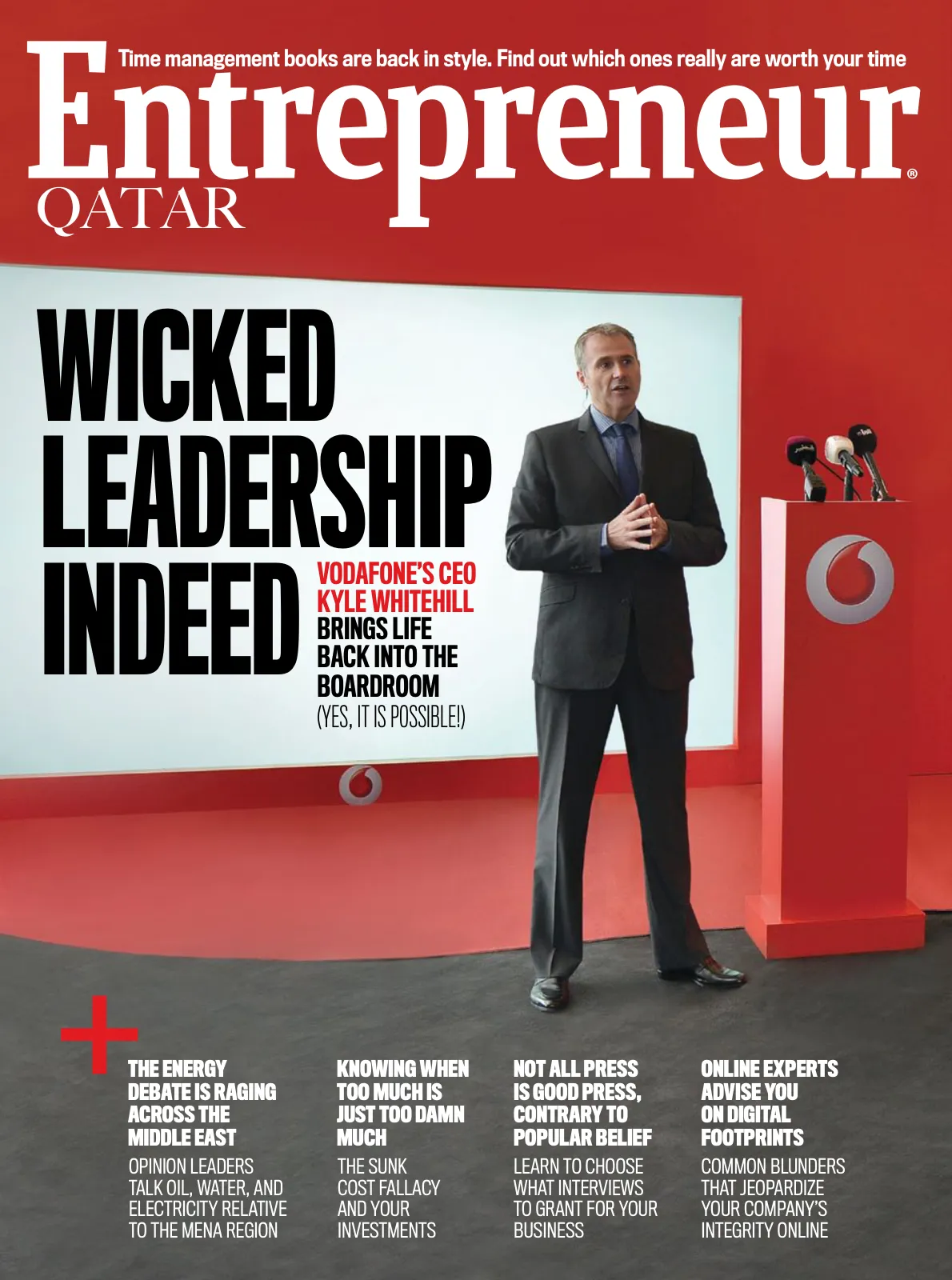
Entrepreneur Qatar, April 2014
Page 1
Time management books are back in style. Find out which ones really are worth your time
QATAR
WICKED
LEADERSHIP
INDEED
VODAFONE’S CEO
KYLE WHITEHILL
BRINGS LIFE
BACK INTO THE
BOARDROOM
(YES, IT IS POSSIBLE!)
THE ENERGY
DEBATE IS RAGING
ACROSS THE
MIDDLE EAST
KNOWING WHEN
TOO MUCH IS
JUST TOO DAMN
MUCH
NOT ALL PRESS
IS GOOD PRESS,
CONTRARY TO
POPULAR BELIEF
ONLINE EXPERTS
ADVISE YOU
ON DIGITAL
FOOTPRINTS
COMMON BLUNDERS
THAT JEOPARDIZE
YOUR COMPANY’S
INTEGRITY ONLINE
OPINION LEADERS
TALK OIL, WATER, AND
ELECTRICITY RELATIVE
TO THE MENA REGION
THE SUNK
COST FALLACY
AND YOUR
INVESTMENTS
LEARN TO CHOOSE
WHAT INTERVIEWS
TO GRANT FOR YOUR
BUSINESS
Page 2
Entrepreneur APRIL 2014
2
Page 3
APRIL 2014 Entrepreneur
3
APRIL 2014 CONTENTS
INNOVATORS:
Energy’s opinion leaders have
some information to share
with you.
14
Water woes in the GCC?
Get empowered
By Ahmed Bin Shafar
16
An unstable equilibrium in the
oil market
By Badar Jafar
20
Energizing the Middle East
By Grégoire Poux-Guillaume
22
INNOVATOR
Wicked leadership indeed
Vodafone’s CEO Kyle whitehill
Brings life back into the
boardroom (Yes, it is possible!)
16 Crescent Petroleum’s
Khor Mor aerial perspective
in Kurdistan, Iraq. Read
Badr Jafar’s take on the
region’s energy.
74
MONEY:
STARTUP FINANCE
Post funding buzz
Simon Hudson walks you
through what to do with your
hard-earned startup cash.
Spending wisely and in the
proper order is easy, when you
plan it properly.
76
YOUR MONEY
The gold standard
The World Gold Council is
tinkled pink that gold has gone
up in price.
80
MONEY:
VC VIEWPOINT
The Middle East needs VC
Arya H. Bolurfrushan discusses
VC’s influence in fostering
innovation in the MENA region.
22 Kyle Whitehill
revitalizes leadership.
Vodafone’s CEO is wicked
indeed.
Page 4
Entrepreneur APRIL 2014
4
CONTENTS
APRIL 2014
38
TECH:
ONLINE ‘TREP
The digital pros tell you
everything there is to
know
ArabNet’s CEO Omar
Christidis gives an
overview for the year
ahead. This is one feature
that you’re going to want
to read- your digi identity
depends on it.
48
MOBILE TECH
Whatspp with that?
IM doesn’t have to stop
now that Facebook has
acquired WhatsApp. Here’s
a slew of alternatives.
51
SHINY
Just in time!
Samsung concentrates on
wearable technology.
60
ONLINE ‘TREP
UAE startup duo is gifted
These ‘treps both have a great
deal of startup and seed capital
know-how. See how they put
it to work in their newest
venture.
64
ASK A GEEK
Online brand alienation
The 10 ways your brand can
screw up large online. It’s
easier than you think.
68
WEBSITE TO WATCH
You scratch my back
The co-founders behind
WePul have decided that
crowdsourcing an extended
network of people could
teach us all a thing or two.
10
EDITOR’S NOTE
By Fida Z. Chaaban
13
FEEDBACK
You’re already talking to us!
36
‘TREPONOMICS:
ESQUIRE GUY
The guide to uncomfortable
conversations
Ross McCammon shares a few
pointers on how to navigate the
sticky convos that come your
way at work.
46
MARKETING
Own your online reputation
Dana Khairallah discusses seven
tactics that she’s put to work
for her clients online, and how
they can work for your brand.
60 Abed Bibi and Husain Makiya
wanna give you prezzies!
38 ArabNet CEO
Omar Christidis
presenting in Riyadh
Page 5
APRIL 2014 Entrepreneur
5
Page 6
Entrepreneur APRIL 2014
6
CONTENTS
APRIL 2014
44
‘TREPONOMICS:
ASK A PRO
Choosing your press coverage
Octavia Nasr educates you
on which coverage to accept,
and which to decline…
gracefully.
12
CULTURE:
BUSINESS UNUSUAL
Pump it up
Ray Ferrer left his corporate
career to become a full-time
artist. Here’s his take on
corporate involvement in the
arts.
30
TRAVEL
The frequent flier’s guide to
healthy skin part deux
A skincare expert tells you
how to keep your skin looking
rested and alive despite the
weekly work trips.
34
LIFE
Time management tomes
Our book reviewer tells you
which books to pick up that
really are worth your time.
52
START IT UP:
Q + A
Animiltech
Dr. Sarah Faisal Al Saud talks
about her startup Anamil
Tech, and where human-
computer interaction comes
into the equation.
66
WACKY IDEA
EyeEm a successful ‘trep!
Ramzi Rizk discusses his
portal and mobile apps, in
addition to the VC firms that
helped him get his idea off the
ground.
66 Ramzi Rizk discusses his
German-based portal EyeEm
52 Dr. Sarah Faisal Al Saud talks
about her startup Anamil Tech
44 Octavia Nasr on determining
corporate press strategies
Page 7
APRIL 2014 Entrepreneur
7
MBII/OR
Page 8
Entrepreneur APRIL 2014
8
EDITOR IN CHIEF Fida Z. Chaaban editor@bncpublishing.net
MANAGING DIRECTOR Walid Zok walid@bncpublishing.net +971556500688
PUBLISHER Nehme Abouzeid nehme@bncpublishing.net
CREATIVE DIRECTION Concept and execution Entrepreneur Middle East
ONLINE LIAISON Kareem Chehayeb socialmedia@bncpublishing.net
WEB DIRECTOR Haydar Mtayrek
Arie Amaya-Akkermans
Arya H. Bolurfrushan
Amal Chaaban
Youmna Chagoury
Kareem Chehayeb
Tamara Clarke
Walid Hassanein
Simon Hudson
Mohammad Hijazi
Leslie Iddison
Badr Jafar
Dana Khairallah
Pamella de Leon
Nita Maru
Ross McCammon
Wassim Mourtada
Shoug Al-Nafisi
Octavia Nasr
Rani Nasr
Grégoire Poux-Guillaume
Ahmad Bin Shafar
Images used in Entrepreneur Middle East are credited when necessary. Attributed use of
copyrighted images with permission. All images not credited otherwise Shutterstock.
SUBSCRIBE
Contact subscriptions@bncpublishing.net to receive
Entrepreneur Middle East every issue
CONTRIBUTING WRITERS
PO Box 502511 Dubai, United Arab Emirates
P +971 4 4200 506 | F +971 4 4200 196
For all commercial enquiries related to Entrepreneur Middle East contact
sales@bncpublishing.net
All rights reserved © 2014. Opinions expressed are solely those of
the contributors.
Entrepreneur Middle East and all subsidiary publications in the MENA region
are officially licensed exclusively to BNC Publishing in the MENA region by
Entrepreneur.
No part of this magazine may be reproduced or transmitted in any form or by any
means without written permission of the publisher.
MIDDLE EAST
www.entrepreneurmiddleeast.com
WE’RE HEAVILY INVESTED IN OUR WEB PRESENCE
In addition to our print edition, we’re bringing you all sorts of
industry news on our web mediums. Joining us online means
getting relevant business and startup content in real-time, so
you’re hearing about the latest developments as soon as we
do. We’re looking forward to interacting with our readers on
all of our social media and web platforms- like any thriving
business, we’re looking to give and take. #TrepTalkME is
already happening on all of our digi platforms, and all good
conversations go both ways. See you on the web!
IS DIGITAL
MIDDLE EAST
Printed by Raidy Emirates Printing Group LLC
www.raidy.com
EntMagazineME
@EntMagazineME | @FidaChaaban
Entrepreneur-me
EntrepreneurMiddleEast
EntMagazineME
EntMagazineME
EntMagazineME
Page 9
APRIL 2014 Entrepreneur
9
Page 10
Entrepreneur APRIL 2014
10
EDITOR’S NOTE
1. “Don’t go into business unless
you’re much better than the bigger
competition.”
2. “The same way Apple went on
after Steve Jobs died, Virgin will
outlive me.”
3. “The people who run companies
must be willing to let their people
make mistakes and to innovate.”
4. “I was asked if I knew the differ-
ence between net and gross. I admit,
I didn’t! I thought I was making a lot
more money than I really was!”
I think the fourth statement -told
as a whimsical anecdote- was part
of the larger picture that Sir Richard
was painting for the audience. Basi-
cally any ‘trep or businessperson
launching and executing the impos-
sible will experience a learning
curve- be it technical knowledge or
otherwise.
My learning curve is maintaining
a work-life balance (in addition to
other things), and I am going to mas-
ter it. I met the man who is living
proof that it can be done. One of the
ways I’ve started to try and address
my shortcoming? By asking every
‘trep I meet about how they actually
make the viral buzzword a reality. If
you’ve got work-life balance tips for
me, send them my way via email or
on Twitter; I’m pretty much always
connected.
I hope that in our next issue I’ll be
able to report that I’ve made good on
my declaration to improve my bal-
ancing act (and whether or not I’ve
made progress I’ll let you know).
Balancing act
Fida Z. Chaaban
Editor in Chief
Follow me @fidachaaban
Email me editor@bncpublishing.net
IF ONE OF THE MOST FAMOUS ENTREPRENEURS
IN THE WORLD CAN DO IT…
I
’m not sleeping, I’m not doing
yoga…” That was me talking
(okay, whining) to a friend two
days before I met Sir Richard
Branson.
“I really have no time for any-
thing!” That was me making an
excuse for not attending a friend’s
party one day before I met Sir Rich-
ard Branson.
What’s my point? Meeting Sir
Richard -easily one of the most
famous entrepreneurs in the world-
reminded me that in the grand
scheme of things, I do have time. Or
I have to make time. And I have to
suck it up and do it with dignity.
Sir Richard was visiting Dubai
for du’s CEO Forum and in addi-
tion to a morning engagement, he
had a private press meet and greet
(that’s when this image was taken).
Later that evening he had a lengthy
onstage dialogue with du’s affable
CEO Mr. Osman Sultan. I’m not sure
what he did between the hours of
4p.m. and 8p.m., but I can comfort-
ably say that I am not as busy as Sir
Richard. No one is, except maybe
other major industry magnates at
his level. The man jumped off a flight
looking impossibly fresh, headed
into a corporate event, addressed the
press, and even managed to do some
personal one-on-one PR afterward.
With a smile. With grace. And then
that same evening he addressed a
room full of the GCC’s business elite,
and he did it with élan- the audience
literally hung on his every word.
I was live-tweeting from the Fo-
rum- here are a few of the things Sir
Richard said that I shared on social
media.
“
Sir Richard Branson in Dubai
for du CEO Forum
Page 11
APRIL 2014 Entrepreneur
11
T R A I N I N G C E N T E R
Page 12
Entrepreneur APRIL 2014
12
CULTURE business unusual | LIFE | TRAVEL | DESIGN
Ray Ferrer pumps it up
Turning your interest into a business venture
R
ay Ferrer, a 34 year-old
multi-medium artist, got
his start with t-shirts.
“It evolved into creating
artwork and from there, the
commissions started to come
in.” While he primarily works
with spray paint and canvas,
Ferrer also uses acrylic and has
executed work on everything
from office and home walls
to building facades. Now
a full-time artist –he has a
Bachelor’s in Engineering and
an MBA- Ferrer was formerly a
consultant/corporate strate-
gist. “I designed large scale
global technology and network
solutions, and assisted large
corporations with strategy
development.”
What’s his view on corporate
involvement in the arts? “Cor-
porations could greatly benefit
from sponsoring art exhibitions
and purchasing artwork be-
cause it promotes community
engagement. Economies thrive
because the arts are a powerful
tool. I believe through artwork
exhibitions and corporate in-
volvement that individuals can
connect with each other and
across cultures, and educate
and enrich societies.” Regard-
ing conceptual development
for corporate spaces, Ferrer
has “worked with clients to
transform their ideas into a
work of art, using my methods
and mediums. I enjoy translat-
ing ideas into actual pieces of
artwork.” Does he think corpo-
rations effectively utilize art? “I
believe corporations could use
art more to leverage commu-
nity engagement and involve-
ment. Artists should be used to
collaborate with businesses to
spur economic activity. Corpo-
rate and community stakehold-
ers can develop a marketing
campaign aimed at attracting
a new market audience and/or
exciting an existing audience.”
The two pieces presented here
were both created as “pro-
motional efforts for X-ACTO.
Typically pieces like this of this
size (20” x 16”) would sell for
US$300 to $400.”
| business unusual |
Page 13
APRIL 2014 Entrepreneur
13
WE’RE ESPECIALLY MOTIVATED BY THE
FEEDBACK WE’RE RECEIVING IN REAL-TIME
ON OUR SOCIAL MEDIA PLATFORMS, SO
WE THOUGHT WE’D SHARE SOME OF OUR
TWITTER ANALYTICS SINCE IT’S ONE OF
OUR MEDIUMS THAT IS DEMONSTRATING
THE QUICKEST ORGANIC GROWTH.
FEEDBACK
WHAT READERS ARE SAYING
BY THE NUMBERS
Our followers are over 70% male,
indicating huge gender disparity. They’re
also following likeminded publications
and yes, inspiring entrepreneurs like Bill
Gates, Fadi Ghandour and Sir Richard
Branson, who you might have heard
was recently in Dubai. (More on that
in our Editor’s Note.) Our followers
are primarily focused on the areas of
business, finance, tech, and of course
entrepreneurship. >>>
LOCATION, LOCATION
Our GCC Twitter followers are primarily in Dubai when looking
at our UAE audience. The next most popular GCC city that our
followers hail from? Riyadh, KSA. Qatar, Egypt, Jordan and
Lebanon also show up in our statistics, with decent representation.
TOP TWEET
In March, the most highly tweeted and
re-tweeted link was contributor Wassim
Mourtada’s March VC Viewpoint article Attack
of the Clones: Venture Capital in the Middle
East. If you missed it in print, see it on our
website in the “Money” section.
0%
10%
20%
30%
40%
50%
60%
70%
STARTUPS
BUSINESS NEWS AND GENERAL INFO
BEGINNING INVESTING
LEADERSHIP
BUSINESS AND FINANCE
INTERESTS
Page 14
Entrepreneur APRIL 2014
14
INNOVATORS
T
he importance of district cool-
ing cannot be underestimated:
with populations on the rise
across the GCC and with bil-
lions of dollars-worth of infrastructure
underway in all major cities to support
world class events, such as Dubai Expo
2020 and FIFA World Cup in Doha in
2022, the need to be more sustainable
in our everyday lives is paramount.
District cooling is used across all
industries and all sectors, yet still many
are unaware of its numerous benefits:
it’s more environmentally-friendly
which supports Dubai’s aim to develop
a green economy to ensure sustainable
development; it results in cheaper
bills for consumers, and it doesn’t
use potable fresh water which is
obviously a valuable resource in this
desert region.
A system used to cool the interior of
buildings through a network of chilled
water rather than electricity, district
cooling straddles three key sectors
of utilities, energy, and water. It is
a growing industry in the UAE and
is implemented in a number of top
residential areas and hotels, and we
at Empower are working hard to raise
awareness of it as a viable and ideal
way to keep our communities cool.
Following our recent acquisition
of Palm Utilities and Palm District
Cooling, Empower is now the world’s
largest district cooling services pro-
vider with a total tonnage of almost
one million refrigeration tonnes (RT).
This gives us an unrivalled opportuni-
ty to install district cooling systems in
the vast majority of Dubai’s residen-
tial properties.
With this as a backdrop, Empower
has worked to promote the use of
district cooling systems in the UAE
and further afield, such as in the U.S.
where we have strong partnerships
with the International District Energy
Ahmad Bin Shafar, CEO of Emirates
Central Cooling Systems Corporation
(Empower), brings over 18 years of
experience in senior management
positions including eight years with
Standard Chartered Bank in the ar-
eas of Corporate and Retail banking,
Finance, Marketing and Customer
Relations. As CEO, Ahmad provides
strategic direction with the goal of
making Empower a blue chip com-
pany and one of the most efficient and profitable District Cool-
ing Services (DCS) provider in the world. Under his leadership,
Empower has achieved global leadership position in the DCS
industry from capacity perspective by acquiring Palm District
Cooling (PDC). Bin Shafar, a key speaker, lecturer and panelist
at a number of events, including industry specific conferences
and trade shows organized by American Society of Heating,
Refrigerating and Air-Conditioning Engineers (ASHRAE) and
International District Energy Association (IDEA), is also the
Chairman of board of directors of Empower Logstor Insulated
Pipe Systems (ELIPS), a joint venture between Empower and
Logstor. A member of Cranfield Management Association,
IMD International, ASHRAE and IDEA, Bin Shafar is the first
UAE national to ever be nominated to the International District
Energy Association (IDEA) Board of Directors in June 2013.
Bin Shafar also holds the positions of Chairman (Bin Shafar
Holding), Chairman (Al Shafar National Contracting), Board
Member (Dubai Sports Council) and Chairman (Investment &
Marketing Committee, Dubai Sports Council).
WATER WOES
IN THE GCC?
GET EMPOWERED
The future of the Middle East might depend on it
By Ahmed Bin Shafar
Page 15
APRIL 2014 Entrepreneur
15
Association (IDEA). It is this partner-
ship we hope to leverage further, by
bringing their annual district cooling
conference back to the Middle East.
The Middle East’s lack of fresh water
resources has forced the region to look at
innovative methods to keep its residents
cool- especially in the searing heat of
summer. Dubai in particular has been at
the forefront of this research, and has
driven the evolution of the industry in
the Emirate. What we are trying to do is
research and invest in new technologies
and innovations to make sure we deliver
the best services to our clients with the
smallest environmental footprint as
possible.
The Middle East is rapidly develop-
ing into a major hub for district cooling
globally. Dubai and the UAE in particular
have shown strong signs of recovery in
the years following the economic crisis,
thanks to the constant support of the
government and long-term visionary
planning. The arrival on the scene of in-
ternational heavyweights, such as IDEA
which is over 100 years old, cements the
region’s position and allows us as an in-
dustry to collate information and share
our experiences on a global platform.
DISTRICT COOLING
STRADDLES THREE KEY
SECTORS OF UTILITIES,
ENERGY AND WATER
Page 16
Entrepreneur APRIL 2014
16
INNOVATORS
in the oil market
An unstable equilibrium
Stability may persist... but it comes with a price
By Badr Jafar
Page 17
APRIL 2014 Entrepreneur
17
Khor Mor in Kurdistan, Iraq
I
f one were to look at oil prices over just the last three years it would appear that nothing was amiss,
that normality had returned after half a decade of turmoil, and that the structural shift to a new and
higher price level was over. Oil prices have shown remarkable stability over the last three years with
Brent averaging US$111, $112, and 109 per barrel in 2011, 2012 and 2013 respectively. Prices in 2014 so
far have shown even less volatility, moving only +/- 2.5% from their average of $108 per barrel.
Yet this has also been a period of great geopolitical unrest directly affecting many oil producers in the
MENA region, a period when an unconventional “shale” or “tight oil” revolution has taken off in North
America, and a period when one of the world’s largest oil reserve holders, Iraq, has returned to the oil
market in force after three decades of curtailment.
APRIL 2014 Entrepreneur
17
Page 18
Entrepreneur APRIL 2014
18
The last few months have also includ-
ed one of the coldest winters in North
American history, with oil demand at
0.7 million barrels per day higher than
usual, and sanctions against the world’s
largest oil producer, Russia, over its
actions in the Crimea.
This begs the question: Why have
prices been able to remain so stable in
the face of such events, and does this
mean that oil markets are now more ro-
bust in the face of supply and demand
shocks?
All is not as it seems. This is the
worst possible time to become com-
placent that the oil markets are stable,
or that prices will remain predictable
and high for the foreseeable future. For
major oil producers, such as those in
the Gulf region, to plan for a future on
this basis would leave us very vulner-
able. To put it simply, the price stability
of recent years has been, in equal parts,
a fluke and the result of the actions of
one party, Saudi Arabia.
Since Q4 2010 almost three million
barrels per day of liquids supply has
been added to the global market, essen-
tially all from the US tight oil revolu-
tion; at the same time almost three
million barrels per day of oil supply has
been lost from Libya, Iran, Syria and
the Sudan due to political unrest. The
combined result, by chance, is that the
North American tight oil revolution has
not yet impacted the global market.
However U.S. tight oil produc-
tion continues to grow rapidly, with
approximately 0.2 million barrels
per day estimated by the U.S. Energy
Information Administration (EIA) to
be added in the first quarter of 2014
alone. Supply interruptions from Libya
and Iran cannot get much worse, and if
circumstances improve they could eas-
ily rebound rapidly. Other likely sources
of supply growth in the coming years
THE CURRENT OIL PRICE
STABILITY MAY PERSIST, BUT
THE RISK TO THE DOWNSIDE
CANNOT BE DISCOUNTED.
INNOVATORS
Badr Jafar at the Mubarak oil platform
Page 19
APRIL 2014 Entrepreneur
19
include Brazil, Iraq and Russian tight
oil; the IEA is already reporting that
February 2014 saw Iraqi oil production
surge to a 35 year high.
On the demand side, the OECD call
on oil is expected to remain flat or
declining for the foreseeable future, and
while demand does continue to grow
in developing markets, the quality and
sustainability of that growth is increas-
ingly open to question, particularly
as the economy of China –estimated
by the International Energy Agency to
account for 27% of global oil demand
growth in 2014– decelerates.
If chance events have neutralized
supply increases over the last few years
at the broad scale, then Saudi Arabia,
as the world’s swing supplier, has done
the fine tuning to ensure that prices
remain stable by adding or subtract-
ing supplies to the global market as
transient events occur. However, Saudi
Arabia’s ability to manage the market
while maintaining high overall produc-
tion is only effective within a relatively
narrow window of supply and demand.
If supplies begin to run away from
demand, which appears to be the case,
then Saudi Arabia and other Organiza-
tion of the Petroleum Exporting Coun-
tries (OPEC) members will face a much
harder choice to materially cut back
production, or risk a material fall in
oil prices, either way sharply reducing
export and fiscal revenues.
Major oil producers and export-
ers need to plan for these risks; the
current oil price stability may persist,
but the risk to the downside cannot
be discounted. Aside from prudently
managing budgets and building up fis-
cal reserves, as the Gulf countries have
proven particularly effective at doing in
the last decade, there needs to be more
root and branch reform of energy policy
at home to create robust domestic sup-
ply and consumption patterns that can
weather changes in the global market.
What is needed? A greater com-
mitment to shift domestic energy
consumption from oil to gas across the
whole economy, in electricity genera-
tion, industry and transport; gradual
removal of the energy subsidies which
result in metastasizing, inefficient,
energy demand for oil, gas, power and
water, and the encouragement of more
private capital alongside the state in
the energy economy. These measures
work best in combination rather than
as piecemeal measures: boosting oil and
gas production, slowing domestic oil
and gas demand growth, easing govern-
ment budgets, creating more export
revenues, and rebalancing the economy
away from an overreliance on oil.
Cohesive, cooperative, and sustain-
able energy polices in the countries
across our region are essential if we
are to convert the oil market stability
experienced over the last few years into
truly sustainable long-term economic
stability.
Badr Jafar is Managing Director of the Crescent
Group, which has been operating from the
UAE as a family business group for over 42
years. The Group today comprises two main
companies: Crescent Petroleum, the region’s
first independent and privately-owned petro-
leum company in the Middle East, of which
Badr is President; and Crescent Enterprises,
the company’s conglomerate operating across
eight core sectors of the global economy,
of which he is Chief Executive Officer. Badr
serves as Chairman of Gas Cities LLC, a joint
venture between Crescent Petroleum and Dana
Gas PJSC, and serves as Chairman of Pearl
Petroleum, a partnership between Crescent
Petroleum, Dana Gas, OMV of Austria and
MOL of Hungary. Badr is an active member of
the Young Presidents’ Organization, serving as
Ex-Officio Chair of the YPO Emirates Chapter.
He was honoured as a Young Global Leader by
the World Economic Forum and is Vice-Chair of
their Global Agenda Council on Energy Security.
THE PRICE STABILITY
OF RECENT YEARS
HAS BEEN, IN EQUAL
PARTS, A FLUKE AND
THE RESULT OF THE
ACTIONS OF ONE
PARTY, SAUDI ARABIA.
Pipeline construction
in Kurdistan Iraq
Badr Jafar
and Sergey
Bogdanchikov,
CEO of Rosneft
Oil Company
Page 20
Entrepreneur APRIL 2014
20
INNOVATORS
T
he Middle East energy market is a fast growing one, with increasing elec-
tricity needs to support population growth and industry development. The
infrastructure needs to keep up, yet any new grid infrastructure technology also
has to be designed with the future in mind- a future with a low carbon economy.
It is no small task.
By Grégoire Poux-Guillaume
Integrated Distribution
Management System in
Jahra control center Kuwait
THE MIDDLE EAST
ENERGIZING
Making the most of what you have
Page 21
APRIL 2014 Entrepreneur
21
With a grid, you can’t just take down
the existing infrastructure and start
from scratch. You have to make the
most of what you have. By adding digital
equipment and software applications
to existing infrastructures, you add
intelligence to the grid and foster better
energy management. Power generation
and electrical utilities can now inter-
connect existing grids –let’s call them
infrastructure assets– and use sophis-
ticated network control technology to
draw power where it is available and get
it to where it is most needed, ensuring
better accessibility to electricity.
Technology can play its part. Alstom’s
technology, which now controls more
than 60% of energy flow in the Middle
East, will create the first ever energy
market management system in the
region, creating electricity wholesale
market between various stakeholders.
Our network management solutions
–essentially software– will interconnect
four regional control centers, providing
National Grid with a simple consolidat-
ed view to better manage and optimize
the complete Saudi extra high voltage
transmission network, for example.
Another trend in the industry –let’s
call it “SuperGrid”– has a key part
to play. High Voltage Direct Current
(HVDC) can move bulk power electricity
efficiently, across very long distances,
enabling cross border energy trading
and supply, sometimes interconnect-
ing networks that were not initially
designed to fit together. This technology
has to also be flexible enough integrate
energy from renewable sources– such
as solar, wind, thus paving the way for
energy diversification in the future.
Alstom has significant experience in
this area and within the region. We pro-
vided the transformer equipment for the
Al Fadhili HVDC interconnection of the
six-member states of the Gulf Coopera-
tion Council Interconnection Authority
(GCCIA). The project was symbolic and
a first- interconnecting Saudi network
with five other Gulf countries. This re-
gional network –spreading across 1000
kilometres and with a combined elec-
tricity output of 1,800 MW- represents
one of the first ‘Supergrids’, providing
cost-effective, reliable power shar-
ing, trading and distribution amongst
member states. Alstom also installed an
integrated energy management system
that manages both the entire GCCIA
network and each individual country
network.
Early March in Dubai, we opened the
first Smart Grid Centre in the Middle
East. Our customers can develop and
integrate tailored software, perform
factory acceptance tests at the center.
Our global experts from Alstom’s
state-of-the-art Smart Grid Centers in
France and the U.S. will also share their
expertise with our customers in the
region, in real-time. Bringing our trail-
blazer technologies close to the region
will help speed up adoption of the latest
technologies in this area.
We have been in the region for over 30
years, we have around 900 employees
bringing their local expertise in network
management, substations automation
and power electronics systems to the
region every day. We are committed to
bring our expertise to the region as part
of this exciting energy transition.
Grégoire Poux-Guillaume, President of
Alstom Grid Sector and Executive Vice
President of Alstom, joined Alstom in
January 2003 as Vice President Strat-
egy. He was then head of Alstom Pow-
er’s Hydro turnkey power plant activi-
ties and then head of its Environmental
Control Systems activities. In July 2011,
he was appointed President of Alstom
Grid and Executive Vice President of Al-
stom. Poux-Guillaume began his career
with Total Exploration & Production
as a drilling engineer, before becoming
Offshore Drilling Supervisor and head
of Drilling Research & Development. In
1999, he joined McKinsey & Company
and subsequently worked as a private
equity investor. He was a Senior Man-
aging Director at CVC Capital Partners
from 2009 until rejoining Alstom in
2011. Poux-Guillaume is a graduate of
Ecole Centrale Paris and Harvard Busi-
ness School.
BRINGING OUR TRAILBLAZER
TECHNOLOGIES CLOSE TO THE
REGION WILL HELP SPEED
UP ADOPTION OF THE LATEST
TECHNOLOGIES IN THIS AREA.
GCCIA national control center in Ghunan, Saudi Arabia
GCCIA control center in Doha, Qatar
Page 22
Entrepreneur APRIL 2014
22
SOMETHING
WICKED
THIS WAY
COMES
Vodafone’s CEO
Kyle Whitehill
leads by example
INNOVATORS
Entrepreneur APRIL 2014
22
By Fida Chaaban
Page 23
APRIL 2014 Entrepreneur
23
I
thought about starting off Entrepreneur Qatar with a bang. I
thought about doing a splashy leadership series, and culling the
best of the best for their tips on how to be a better manager. Not
being a better manager just some of the time, I mean really owning
it all of the time. I had planned to do 10 consecutive interviews, each
revolving around skills that a CEO could bring to the corporate table-
it would’ve been a veritable feast of tips and tricks. Instead, I decided
to focus on one leader who demonstrated more than just “tips and
tricks”. I went with a leader who had to come in swinging to a chal-
lenging GCC market that prides itself on being insular. Why swinging?
Because Vodafone Qatar’s revolving door of CEOs was almost the first
thing that everyone mentioned whenever I brought up the Gulf na-
tion’s mainstay brand. Here, you must know that I’m resisting the urge
to whip out the “one ring to rule them all” adage. But this one leader,
the one I opted for over 10 of his contemporaries, has distinguished
himself in something I find extremely lacking in the upper echelons of
large-scale corporate head honchos: Dynamics. >>>
APRIL 2014 Entrepreneur
23
Page 24
Entrepreneur APRIL 2014
24
Kyle Whitehill has… something.
That something has translated into
boardroom dynamite. The man radi-
ates energy and commitment, and it
even translates over digital mediums
like YouTube and Skype. How do
I know this? Because I requested
the interview with Whitehill after
watching some of his YouTube ap-
pearances, and I did the interview
for this feature over Skype. “I apply
commercial marketing on a day-to-
day basis. My dad once gave me How
to Win Friends & Influence People by
Dale Carnegie, and I still read it once
a month to refresh myself.” Winning
friends and influencing people indeed,
after an hour of talking to Whitehill
I suggest that Vodafone’s in-house
PR put him on the road as a motiva-
tional speaker. No wonder the man
has demonstrated the Midas Touch
in every emerging market that he’s
worked in. It’s not a coincidence, and
if you need proof just watch one of his
presentations online. Winning friends
wasn’t the only leg-up his father gave
him, Whitehill credits his citizen-of-
the-world outlook to his parents as
well. “I was brought up by a mother
and a father whose view in life was
that, ‘Son, you are what you are by
definition because of your birth,
however we want to show you that
there’s a much wider world out there
so that you have ambitions beyond
Paisley.’” Whitehill is referring to the
town where he grew up in Scotland,
prior beginning to travel at 14 because
of his involvement in sports. “That
philosophy from my parents has stuck
with me. I don’t mind who you are, I
don’t mind where you come from- I’m
going to respect you as a person and
treat you as an individual. I think
that’s held me in good stead the more
I’ve moved around the world.” And
moved he has, to several markets and
doubling the growth of the telco in
every country he’s worked in thus far.
How does he stay on top of it all? Like
busy people everywhere, Whitehill
doesn’t switch off (although I have
to corner him to get him to admit
that), and he’s still on his trusted
BlackBerry. “It’s the best device for
accessing email. It’s the best device
for BBM, but then again who can
control the Apple machine?” We’re
discussing some of the latest telco
developments and he’s a dual-device
user, like so many people in upper
management. He’s got an iAddiction
for personal use, but for work he’s
still loyal to the savior device of busy
people everywhere. The conversation
turns to the differences between do-
ing business in the Middle East, and
Kyle’s native Europe and my native
North America. “North America and
Europe have vastly drawn relation-
ships out of senior-level stuff because
of anti-bribery and corruption,
because of conflict of interest, and be-
cause of the desire to have openness
and transparency. The West has very
much embraced a non-relationship
culture; so if you want to go see the
INNOVATORS
“I THINK THE WORKING
MODEL OR PHILOSOPHY FOR
ME IS THAT INTERNATIONAL
COMPANIES ARE GOING TO
TRY AND BEHAVE HERE IN A
VERY CONSISTENT MANNER,
TO HOW YOUR CORPORATE
ETHIC WOULD BE.”
“I WAS MODELLING MYSELF
AFTER THE UK CEO AT THAT
TIME. HE WAS AMERICAN,
CHARISMATIC- SOMEONE
YOU LOOKED UP TO AND
WENT ‘WOW.’”
Page 25
APRIL 2014 Entrepreneur
25
CEO of a company it’s in his or her
office; it’s very formal, it’s minitive,
and back and forward. I think that
transparent type of relationship has
knocked a lot of humanity out of it.
You contrast that to [the] Middle
East, it’s much more relationship fo-
cused and it’s much more, ‘If I trust
you then I’m happy to do business
with you,’ and ‘You came to see me,
that’s you paying respect to me and
therefore I do respect you.’ I think
that humanity of relationships is
the fundamental difference between
the Middle East versus the West.”
How did the Scotsman adapt to
corporate culture in Qatar? “I think
the working model or philosophy for
me is that international companies
are going to try and behave here in a
very consistent manner, to how your
corporate ethic would be. For ours in
Vodafone we have three principles:
speed, simplicity, and trust. It’s the
Vodafone way whether you’re in Qa-
tar or Germany or Sweden. It doesn’t
matter, we want you to behave
the same way.”
The Vodafone way has trav-
elled with Whitehill for many
a year, and to many a country.
Prior to heading up Qatar, he
was CEO of Vodaphone Ghana
for three years, leaving in June
2013. His official bio boasts a
huge increase in business dur-
ing his tenure- Whitehill “grew
the subscriber base from two
million to over five million” in
Ghana before moving on to the
Middle East. “In Ghana, I had 1497
Ghanaians and three expats, so you
only really had to try and understand
Ghanaian culture in order to be ef-
fective. You know, find your style,
engage with Ghanaians, and off you
go. You walk into India and it’s the
same thing, Germany it’s the same
thing. Of course you come here [to
Doha], and among your employee
base you’ve got 44 nationalities.
You’ve got this massively diverse
working culture and so the challenge
for everybody there is, ‘Yes we work
for Vodafone and there’s the Voda-
fone way, but then how do you build
a binding philosophy together? To me
it was built around feelings- really
Arabic culture which is respect, rela-
tionship, and recognition. You have
to have a common language around
[the concepts of] ‘I come to see you
and I’m paying you respect, I recog-
nize who you are what you’ve actually
delivered, and reward [that].’” >>>
Page 26
Entrepreneur APRIL 2014
26
Kyle is a masterful speaker, highly
animated, and seasons his points
here and there with often-amusing
personal anecdotes that are at once
informative and usually entertain-
ing. I press Kyle to admit that he’s
done some big things over his career
-“In my 30 years of business I like
to think I’ve done some good work”-
but mostly demurs and laughs off
my compliments joking that his 1978
history teacher would beg to differ:
“Miss Wilson said I would never make
anything of myself!” They say that
the best leaders often deflect praise
showered on them by highlighting the
strengths of others, and Whitehill is
no exception. Throughout our lengthy
conversation, I learn about the many
Vodafone staffers and which of those
have distinguished themselves since
Whitehill’s work there began. I also
learn about how he deals with the
diverse nationalities and varying
personalities. “Whether you’re speak-
ing to our 27 year-old Indian girl who
has just come over to work in HR, or
speaking to our 54 year-old Qatari
guy who’s got 30 years [of] experi-
ence in the country, you’re always
trying to find a common ground
somewhere about how you can con-
nect and work together, because you
know that when they leave your of-
fice they’ve got to work to find a way
to work together as well.”
Kyle joined Vodafone after working
with multinationals like Pepsi and
cosmetics giant, L’Oreal. A graduate
in economics and marketing from
Scotland, Whitehill came over to
Vodafone United Kingdom in 2001
as head of the Enterprise business.
“Historically at Vodafone, I think
my likeability had three phases.
The early phase -the first four or
five years I joined- it was about
who you knew and relationships,
and to me I was like the outsider. I
think it was very much about ‘He’s
good at what he does and look at
the results that he’s delivering.’ The
second phase was me -the young guy
surprised I got the job- that became
much more about me trying to be
uber-professional, particularly that
I was modelling myself after the UK
CEO at that time. He was American,
charismatic- someone you looked up
to and went ‘Wow.’ I think I became
a little bit inhuman in that way in my
desire to try and model myself after
someone else.” Seven years later,
Whitehill was promoted, taking on
Vodafone India as CEO. This is where
he thinks the magic started, although
judging by his demeanor and some-
what disturbing exceptional memory
for people –he’s able to rattle off staff
names, ages, origins and more at the
drop of the hat- he was a star long
before that. I push Kyle to discuss
how likeable he is as a person, and
how that has served him profession-
ally. “When I went to India my style
had to change enormously. Suddenly
I found myself in amongst 1.3 billion
Indians who really didn’t care where I
came from and how good I was in the
UK. I can remember vividly the CEO
at the time saying, ‘Kyle look, you’re
going to have to start dancing and
singing karaoke socially.” I was staring
at him going, ‘Oh no I’m not,’ because
I come from Europe and we don’t do
INNOVATORS
“IN VODAFONE WE HAVE
THREE PRINCIPLES: SPEED,
SIMPLICITY, AND TRUST.
IT’S THE VODAFONE WAY
WHETHER YOU’RE IN QATAR
OR GERMANY OR SWEDEN.”
“NORTH AMERICA AND EUROPE HAVE VASTLY
DRAWN RELATIONSHIPS OUT OF SENIOR-
LEVEL STUFF BECAUSE OF ANTI-BRIBERY AND
CORRUPTION, BECAUSE OF CONFLICT OF INTEREST,
AND BECAUSE OF THE DESIRE TO HAVE OPENNESS
AND TRANSPARENCY.”
Page 27
APRIL 2014 Entrepreneur
27
stuff like that. And he said, ‘You’re in
India now.’ I think the last five or six
years I’ve gone back toward my true
self and my true personality. I found
it much easier to be more likeable to
connect as a person, and that’s prob-
ably contributed to my success.”
His success in India includes more
than doubling the subscriber base of
Vodafone India “from 47 million to
over 100 million”- triple digits that
translate into nothing short of a gold-
mine for the telco. This has to count
for something and I ask the CEO to
acknowledge his accomplishments.
What I get back is another amusing
yet telling story from Whitehill’s per-
sonal narrative during a January visit
to London. “I was with my best friend
Gregor, he’s Scottish as well and he
also comes from a family of modest
means. We had another friend there
who was chatting to a lady he knew
at a restaurant. She said to me, ‘Your
friends are so impressed by what you
achieved! All they talk about it Kyle
did this, Kyle did that…’ and it was
just a nice moment of reflection about
people being proud of what I’ve done,
maybe I should be a little bit prouder
of what I’ve achieved as well? Men
don’t talk to each other like that, men
don’t say ‘God, that was an amaz-
ing thing you did,’ so to hear it from
someone who heard it from your
friends, it kind of felt worthwhile
what I’ve done: the personal sacrifices
with my family, and from a profes-
sional point of view travelling the
world, working in difficult environ-
ments. I can’t be proud of what I’ve
done, because there’s tomorrow and
I’ve got to keep on going.”
He’s as upbeat and optimistic as I
make him sound, and he knows that
it’s imperative as a leader that he
continues to be the best version of
himself possible. “When you come to
Qatar, and you suddenly see a micro-
cosm of the global village concept, for
me it’s quite motivating. It makes me
work harder, it makes me think hard-
er everyday about who I am talking
to today? What am I talking about?
What do I need to do? Otherwise you
could become a little bit lazy about
your own personal style, and I would
hate to be like that,” adds Whitehill
emphatically. “To me the fundamen-
tal job of a CEO in my opinion is the
ability not just to be able to help your
team create a vision, and a strategy
and a plan, right? I strongly believe
my job is to engage, inspire, and mo-
tivate people all across the organiza-
tion.” Whitehill manages to motivate
me, and while his magic is more the
“Friends, Romans, countrymen,” type
than it is the darker “Bubble bubble
toil and trouble” type, I stand by my
title. Whitehill is wicked.
“I STRONGLY BELIEVE
MY JOB IS TO ENGAGE,
INSPIRE, AND MOTIVATE
PEOPLE ALL ACROSS
THE ORGANIZATION.”
Page 28
Entrepreneur APRIL 2014
28
POWER PLAYERS
URBAN CONSUMPTION GOOD & BAD
F
ive hundred and twenty-four
quadrillion British thermal units
(Btu). That’s how much energy
the world consumed in 2010,
according to the Energy Information Ad-
ministration’s 2013 International Energy
Outlook. You might not speak “energy”,
but you know that’s a lot. According to
the same study, we can expect an 820
quadrillion Btu consumption in 2040, a
30-year increase of 56%. Here’s a list of
three cities that (unfortunately) make
all that possible.
TOXIC BEIJING
According to CNN, “China is the world’s
largest consumer of coal by volume and
will continue to be for years, relying on
the fossil fuel for 70-80% of its energy
needs.” Coal is used for both electricity
generation and industrial use and Bei-
jing alone still has four coal-fired power
plants- they’re working on replacing
them with gas-fired stations, but they’ve
been saying that since 2009 so we’re
not really sure. Factories in neighbor-
hood provinces and an increasing use
of cars in the city have ranked Beijing
as the most polluted city in the world,
recently dethroned by the Indian capital
New Delhi.
VEXING VEGAS
In terms of electricity consumption, the
United States ranks first, according to
the U.S. Energy Information Administra-
tion, an American statistics and analyt-
ics agency. If household energy use is
increasing, industrial use is what makes
the country such an energy-wasteful
one. However, the greatest example of en-
ergy waste, literally, is Las Vegas, Nevada.
If the state’s energy consumption per
capita is below the national average, the
total amount of energy used “on a sum-
mer day” in Las Vegas in 2007 was 5,600
megawatts. “By 2015 that’s expected to hit
8,000.” (Forbes)
In comparison, New York City’s surface
area is more than three times bigger than
Vegas’ yet uses 11,000 megawatts per day.
Blame it on the transportation energy
used to bring all those tourists in and the
24/7 lights and music of the Strip.
BOSTONIAN BONUS
Boston is one of the most energy effi-
cient cities in the world, and an example
to follow. The American Council for an
Energy-Efficient Economy gave Boston the
highest score of “76.75 out of a possible
100 points on a scorecard […] on which
cities received points for their energy-
saving initiatives.” (National Geographic)
In 2009, Boston’s Mayor Thomas Menino
created the Renew Boston initiative,
which set a goal of (among other green
things), reducing greenhouse gases by
70% by 2050. The city is also making its
residents several offers to upgrade their
home insulation and reduce their house-
hold energy waste.
Fujairah gets fueled-up
Petrixo oil & gas invests in sustainable energy
Headquartered in Dubai, Petrixo has committed to launch
a new bio-fuel refinery in Fujairah. The oil and gas con-
cern, affiliated with over 20 companies, has set its sights
on a target of one million metric tons annually of bio-feul
products, including green and bio deisel, bio jet, bio nap-
tha, and bio LPG. Currently operating on four continents,
Petrixo’s investment for the Fujairah refinery is set to
exceed “US$800 million”, and will occupy a whopping
460,000 square meters in the Fujairah free zone and
the Port of Fujerirah. A cooperative initiative, Petrixo has
brought in several international companies and financial
institutions to
execute the
refinery plans.
Currently
present in 25
countries globally, Petrixo was awarded the “Best Fully
Integrated Oil & Gas Company- Middle East” in 2011 by
World Finance. As part of the current move to foster
cleaner -and longer-term energy solutions- the UAE
looks fondly on projects that have a renewable and sus-
tainable component. “Come to Energy” indeed.
innovators
By Youmna Chagoury
Hoover Dam and
the Colorado River
Bridge
Page 29
APRIL 2014 Entrepreneur
29
Raytheon’s got game
in the GCC
MARKET EXPANSION FOR AIR AND
MISSILE DEFENSE SYSTEM
K
uwait has continued its
collaboration with Raytheon
Company with the latter
receiving a US$655 million
contract to provide a new Patriot Air
and Missile Defense System for the
little Gulf state. The contract was
awarded by the U.S. Army and Missile
Command, substantially upgrading
Kuwait’s current arsenal. The new
Patriot fire units have better radar
efficiency, more computing power, and
an improved man-machine interface.
Kuwait is one of 12 countries that use
the Massachusetts-based company’s
Patriot systems- Saudi Arabia and the
UAE are also users of Raytheon’s Pa-
triot Air and Missile Defense System.
Raytheon has also recently clinched
a $1.2 billion deal with Oman -sup-
plying them with the system- and
is aiming to continue its expansion
with recent talks in Qatar. Raytheon
boasts a strong relationship with
the Middle East on its website, and
a constantly expanding foreign busi-
ness portfolio; 27% of Raytheon’s
total revenue comes from abroad.
Beginning nearly five years ago with
Saudi Arabia, the 92 year-old com-
pany eventually started working with
Jordan and Egypt throughout the
70’s, 80’s and 90’s.
The combat proven
Patriot is the world’s most
advanced air and missile
defense system.
R&D ON THE RISE IN UAE PETROCHEM
“Innovation is no longer a luxury but an
absolute necessity for the GCC pet-
rochemicals industry.” This was said
16 months ago by Dr. Abdulwahab
Al Sadoun, Secretary General of Gulf
Petrochemicals and Chemicals Associa-
tion (GPCA), after the association urged
GCC petrochemical companies to increase
investment in research and development
(R&D). In late 2013, the GPCA believed
that the GCC’s petrochemical companies
were at risk of no longer maintaining
their competitive edge in the global
market. While the GCC’s second largest
manufacturing sector was at risk, the
GPCA has announced an increase in R&D
investments from GCC petrochemical
companies, hoping that they will play an
active role in improving performance since
increasing R&D investments has shown
to yield better results in previous years.
R&D investments in 2012 went up by
30% with an estimated US$380 million
spent in comparison to $266 million in
2011. In addition to all this, petrochem
output from the Gulf region in 2012 was
at $97.3 billion- $3.2 billion growth in a
single year. The GPCA also held a summit
in mid-March to emphasize the need for
continued research. Things are looking up!
GPCA GETS SERIOUS ABOUT MAINTAINING MARKET EDGE
Mohammed Al Mady,
Chairman of the Gulf
Petrochemicals &
Chemicals Association,
and CEO of SABIC,
opens the inaugural
GPCA Research &
Innovation Summit
in Dubai, UAE
Page 30
Entrepreneur APRIL 2014
30
CULTURE
business unusual | LIFE | TRAVEL | DESIGN
1. BANISH BAGS
We’re not talking luggage here… Those
sleepy pockets that seemingly appear be-
tween gates can stay behind long after your
trip, especially if you’re jumping time-zones.
Use an eye cream that is specially formulated
to eliminate excess fluids and brighten. Be
sure to press these products both under the
eyes and on the upper contour as well, for
a 360 effect. For ladies, Clarins Eye Revive
Beauty Flash. This SOS eye treatment
brightens, tightens, and instantly corrects
puffiness and dark circles with a botanical
formula that uses rose petal extract to
soothe tired eyes. For men, Clarins Anti-
Fatigue Eye Serum. The gel formula cools,
soothes, and refreshes while Caffeine and
Ginko Biloba decongest and depuff. Apply
right before landing.
2. BLAST BLEMISHES
It never fails; you board the aircraft with
a flawless complexion yet somehow you
arrive with a blazing blemish (usually in a
place that draws considerable attention
and is impossible to conceal). Keep a
handy spot corrector in your carry-on to
dab on throughout your flight to reduce
inflammation and keep blemishes at
bay. For both ladies and men, Clarins
Blemish Control Stick. This handy and
discreet pen contains a blemish control
fluid that can be applied to any imperfec-
tion multiple times. The anti-bacterial
stainless-steel roller ball deposits just the
right amount of the treatment to the lo-
calized area. Witch Hazel controls oils and
tightens the pores while Allantoin acts as
a potent anti-inflammatory to reduce the
size and redness of any spot. Bonus, you
actually get two pens in each box; so keep
one in your toiletry bag and one in your
carry-on.
3. POST FLIGHT PERK
Pack a moisture mask to intensely
rehydrate after your flight like Clarins
HydraQuench Cream Mask. Apply in a
thick, even layer and let your skin take
in all the nourishing benefits for at least
10 minutes. Added bonus, this product
can be used around the eye contour as
an eye mask.
You know your region’s economy is start-
ing to get better when it’s recognized as a
key market for premium cosmetics. Yes,
premium cosmetics as in beauty prod-
ucts. A recent report by London-based
market firm Euromonitor International
has shown that per capita expenditure
on premium cosmetics in the GCC is
increasing at a hyperactively-rapid rate.
Consumers in Saudi Arabia and the
UAE are especially expected to increase
spending- KSA’s expected spend for 2017
is US$68.20 per capita on premium
cosmetics, a jump from the 2012 figure of
$49.20 in 2012. In the UAE, consumers
are expected cash in on beauty products
at $48.70 per capita compared to $40.70
in 2012. Believe it or not, these trends in
the GCC are similar to other markets that
are known to have high consumer expen-
diture on premium cosmetics, including
France, the United Kingdom, and the
United States. That’s a lot of makeup.
Beautyworld Middle East, with exhibitors
from leading beauty and wellness industry
brands, takes place at the Dubai International
Convention and Exhibition Center from May
27-29, 2014.
www.beautyworldme.com
Frequent air travel wreaks havoc on your skin; try some of these tips
to ensure that you arrive at your destination looking fresh-faced.
Get ready to run from the baggage claim straight to the boardroom.
TRAVELLING ‘TREPS
PART DEUX
LAYOVERS, RED-EYES, DOUBLE DAILIES?
YOU LOOK EXHAUSTED!
By Leslie Iddison
Spend & splurge KSA AND THE UAE GET GUSSIED UP MORE THAN EVERYONE ELSE IN THE GCC
Try Make Up For Ever’s
HD Elixir- it gives instant
radiance and hydration
for the long haul in a
fresh gel texture. The
quick-absorbing product
reduces signs of fatigue,
and alleviates dehydra-
tion. On a cleansed face,
apply a thin, even layer
beginning at the middle
of your face and move
outward. This product is suitable for both
men and women who are constantly on
the go. When applied around the eye
contour, HD Elixir helps with fine lines
and unwanted puffiness.
Page 31
APRIL 2014 Entrepreneur
31
TOUR GUIDE
Saudi Arabia sets sights on tourism
While the Kingdom of Saudi Arabia is
not the first country in the GCC that
comes to mind when you think tour-
ism, it looks like that will be changing
very soon. Saudi Arabia’s tourism
industry has been growing, and is pro-
jected to reach new heights in the next
decade. Research consultancy group
Aranca has released reports on tour-
ism and hospitality in the Middle East
and North Africa, and KSA’s data looks
very promising. With an expected
increase of tourists to 21.3 million
from 2013 to 2023, Saudi Arabia is set
generate an estimated total revenue of
SR60.9 billion (US$12.64 billion).
As a result of the continued growth
in their tourism sector, Saudi Arabia
plans to invest over $30 billion in
its airports by 2020. $10 billion has
been allocated for private invest-
ment, and $12.5 has been allotted for
Saudi Arabia’s four key international
airports: Riyadh, Dammam, Jeddah,
and Madinah. It’s worth mentioning
that Saudia, Saudi Arabia’s national
carrier, has resumed direct flights to
Manchester after a seven-year hiatus.
A variety of regional and international
airlines fly directly to Dammam’s King
Fahad International Airport, includ-
ing Emirates Airways, Air India, KLM,
Lufthansa, Turkish Airlines, and Middle
East Airlines.
CULTURE
business unusual | LIFE | TRAVEL | DESIGN
PACK IT UP, PACK IT IN
KSA’s tourism draw
The Riyadh Travel Fair, taking place from
April 15–18, is in its sixth year. Staged
at the Four Seasons Riyadh, between
15,000 to 20,000 guests are expected to
visit the annual event organized by ASAS
Exhibitions including travel and tourism
professionals. In 2013, the RTF attracted
over 13,000 guests- a record number.
Hop on board!
www.riyadhtravel.net
APRIL 2014 Entrepreneur
31
Page 32
Entrepreneur APRIL 2014
32
CULTURE
business unusual | LIFE | TRAVEL | DESIGN
BIG SCREEN BEEF-UP
VOX Cinemas announce regional expansion
VOX Cinemas are planning to continue their expansion
across the Middle East, newly announcing an AED 750
million investment through Majid Al Futtaim. VOX are
hoping to continue growing by opening cinemas in five new
locations, a total of 12 new cinemas throughout the region
in Oman, Qatar, Bahrain, Egypt, and UAE. The big screen
mavericks plan on continuing their expansion projects as of
June 2014. If all goes according to the conglomerate’s strat-
egy, VOX will run over 250 screens in MENA, which is a
massive 400% increase since Majid Al Futtaim took control
of the company less than four years ago. VOX is also plan-
ning on renovating all of their existing cinemas, including
their best known outlet at Mall of the Emirates. Roll ‘em!
Legoland Dubai
Building Frenzy
2016 is the year to look forward to, mostly because
it marks Legoland’s highly-anticipated opening in
Dubai (after a painfully long wait). The project was
officially announced back in 2008 by Merlin Entertain-
ments Group. They announced Legoland’s opening
in Dubailand by late 2011, with a budget of AED 912
million, but put the project on hold, perhaps as a
result of the economic crisis. Despite having recently
announced the involvement of third party companies,
no new financial details have been revealed yet. The
England-based group claimed that a contract in 2012
was signed allowing several third-party companies,
including Hospitality LLC and Meraas Malls, to fund
the developing and construction phases with Merlin
managing UAE’s Legoland for a 25-year period. Merlin
Entertainment manages and operates almost 100
attractions in over 20 countries, most notably the
London Eye, Madame Tussauds, and Legoland Parks.
So close yet so far: The cult
fanbase of 80’s sci-fi tril-
ogy Back to the Future are
probably wallowing in disap-
pointment, having fantasized
about owning a hoverboard
ever since watching Marty
McFly zoom around on one in
the second film… but what’s
this about a viral video? A vid
featuring Christopher Lloyd
-better known as Doctor
Emmet Brown in the Back to
the Future movies- appeared
seemingly out of nowhere,
promoting hoverboards by a
brand called HUVr. Several
celebs made appearances in
the ad, including skateboard-
ing legend Tony Hawk, and
HUVr’s mediums got a crazy
amount of traffic. Much to the
dismay of viewers, Lloyd re-
leased another video the fol-
lowing day admitting that the
HUVr hoverboard ad was a
hoax. But hold up…an intense
advertising campaign star-
ring Christopher Lloyd, Tony
Hawk, and Los Angeles rapper
Schoolboy Q with nothing to
show for it? There’s gotta be
more to this… Keep your eyes
on the prize, no one spends
that kind of ad money for no
reason.
DARN IT, DOC BROWN!
Viral back to the future-eque hoverboard
ad a hoax… or not?
Entrepreneur APRIL 2014
32
Page 33
APRIL 2014 Entrepreneur
33
CULTURE
business unusual | LIFE | TRAVEL | DESIGN
Yes, you heard that right. In terms
of crowdsourcing, this is one of the
most interesting -not to mention sad-
campaigns that we’ve seen in a while.
The Penguin Foundation isn’t asking
for money, they’re asking for sweaters
for the penguins affected by ecological
disasters, namely the nightmarish oil
spill. What’s the correlation? Penguins
caught in oil spills try to use their
beaks to rid themselves of the oil. The
sweaters help them to stay warm,
and they also prevent the penguins
from picking away at themselves.
In addition to collecting the knitted
outerwear for their rescued penguins,
the Penguin Foundation also collect
and distribute the pint-sized sweaters
to other wildlife preservation outfits
as needed, and use them for both
educational program purposes and as a
fundraising technique.
Their new wildlife center is able to care
for up to 1500 penguins in the event of
an oil spill: According to their website,
oiled-up penguins “often die from
exposure and starvation. Oil separates
and mats feathers, allowing water to
get in which makes a penguin very cold,
heavy and less able to successfully
hunt for food.” They’re not even talking
about large amounts of the toxic sub-
stance, all it takes is a “patch of oil the
size of a thumbnail.” If you can’t knit,
you can help by donating on an annual
basis or a one-time basis for penguin-
adoption. Those of you looking for a
gift for the person who has everything
can opt for gifting a penguin adoption.
After all, baby it’s cold outside.
SWEATER WEATHER
Crowdsourced clothing… for penguins
T
he beginning of the end of
your day should include a de-
stressing ritual. Having dead-
lines, a full schedule, and generally
fighting the clock each day is likely
to keep you wide awake at night.
This, however, is one fight you can
definitely take on with a proper diet,
and that doesn’t mean you have to
go for foods and beverages that are
out of the ordinary- these staples are
easy and accessible, even for ‘treps
constantly on the move.
BOUNCE BACK
Oily fish, nuts, and the recently
trending chia seeds all contain
omega-3 fatty acids which have anti-
inflammatory as well as anti-stress
properties. Having varied omega-3
sources of food, regularly and in ap-
propriate amounts, is very helpful in
maintaining physical health, as well
as handling stress.
THAT’S RICH!
Milk has the capacity to increase
serotonin in the brain, subsequently
giving you the feeling of well-being-
perfect for any time of the day. Milk’s
Magnesium, Calcium and Potassium
keep blood pressure down by dilating
blood vessels, while also lowering
cortisol, the stress hormone, further
contributing to that much-needed re-
lief. Serotonin regulates a few impor-
tant things, not the least of which are
mood, appetite, and sleep, so stock
up. Other serotonin-boosting foods?
Dark chocolate that measures at least
70% cocoa, seafood, and bananas.
WARM UP
Warm drinks are associated with com-
fort- you can trigger that response
every time you have something
warm. That said, green tea contains
antioxidants and a specific amino acid,
theanine, responsible for encouraging
a state of relaxation. A promoter of
alpha-wave production and dopamine
increase, you’ll want to have a warm
cup of good-grade green tea to help
you unwind.
Fight stress levels by modifying your diet
Wanna take it down a notch?
By Shoug Al Nafisi
Page 34
Entrepreneur APRIL 2014
34
TIME MANAGEMENT TOMES
FOR ‘TREPS
Board member, author, wife,
and mother; Laura Vanderkam
wears all these hats and still
manages to keep it all together.
In her book, Vanderkam extols
the virtues of using the time you
have in the morning to do the
things you never seem to have
time in your full day to do. If
you don’t get up early enough
to do anything but rush around,
she suggests getting up earlier.
While she provides several
examples of CEOs and others
who have used this method of
getting up earlier and “tak-
ing time” in the morning, she
simply doesn’t account for those
who are not morning people or
who don’t function well in the
morning, not to mention those
who already get precious little
shut-eye. My vote for this book?
Hit the snooze button.
CULTURE
business unusual | LIFE | TRAVEL | DESIGN
THE USEFUL, THE USELESS,
AND THE MUST-READS
By Amal Chaaban
T
he time management fad is in full swing in book-
stores globally- and since time is the most valu-
able resource out there in terms of work, these
books are flying off the shelves. Every author thinks he
can do it better than you can, and while some of them
really are masters of the clock, a lot of them are just
great at PR. Before you hit the business bestseller aisle,
read these reviews to see which of these known books
are actually worth your while. You’re welcome!
David Allen is best known as the creator of
a time management method called “Getting
Things Done”, and as a productivity consult-
ant who attends businesses and advises them
where things are going wrong negatively im-
pacting productivity. Aside from the famous
Covey bestseller, this is the most solid time
management book out there. Concrete ideas
mixed with user-friendly methodology make
this the book for the person who wants real
answers on how to get their workflow under
control and their inbox back from the brink.
My vote for this book? Read it, apply it and
gift it to your staff.
Getting Things Done: The Art
of Stress-Free Productivity
David Allen
What the Most Successful People Do Before Breakfast
Laura Vanderkam
Page 35
APRIL 2014 Entrepreneur
35
John C. Maxwell is a pastor, author, and public speaker
who has authored several books all dealing with various
aspects of leadership. It may be for that reason that
this book can be found in the Business Section of your
local bookstore, but it is far more a lifestyle guide than
a purely business application
book. Mr. Maxwell does give
some solid advice about faith
and family management, but
it is difficult to see how some
of the advice he imparts can
be applied to the day to day
struggles of keeping on top of
a wild workload. My vote for
this book? Use it to manage
your life, not your career.
THE 7 HABITS OF HIGHLY
EFFECTIVE PEOPLE
STEPHEN R. COVEY
Prior to his death in 2012, Dr. Stephen R. Covey was
widely considered the father of the Time Management
movement (his book had sold over 20,000,000 copies
at the time of his death) and it has been said that all
other time management books are merely shadows of
his. He was one of the first to use terms such as “pro-
active” and put them into play in his business deal-
ings. Named one of Time’s 25 most influential people
in 1996, he was awarded several other accolades over
his lifetime. Though he could have easily rested on
his laurels with all the success he reaped early on, Dr.
Covey remained active until complications from a bik-
ing accident ended his life.
Motivational speaker, author and life coach
Brian Tracy has written a small, quick and
easy read on time management that every-
one can begin applying immediately. “Eat
That Frog” is a phrase you will see through-
out the entire book along with a couple of
other folksy sayings. While the tone of the
book is meant to be fun and functional at
the same time, it hits the latter note more
than the former. The book has the usual
platitudes about time management found
everywhere, but what makes it stand out is
the method of application Tracy suggests
that you use. This author is also a very big
believer in the 80/20 rule and encourages
the reader to follow it to a T. My vote for
this book? Only if your inbox is slightly
unwieldy.
Eat That Frog!
Brian Tracy
Make Today Count
John C. Maxwell
Page 36
Entrepreneur APRIL 2014
36
uncomfortable conversations
The Esquire Guy’s guide to
W
hat to do when one of your
staffers has poor etiquette,
poor hygiene, poor appearance
-offenses that don’t warrant a firing but
just aren’t appropriate? What do you tell
the person, if anything?
Business is awkward. Even everyday
business is awkward. “Stan, listen, we
can’t abide this price increase.” Awk-
ward. “Jessica, come with me, I want
you to meet someone. He’s important.”
Awkward. “Bob, since you’re going to
the snack machine, can you get me a bag
of Cheez-Its?” Awkward. “Also, Bob,
you might want to consider ironing your
pants.” Oof.
In business -as in life- there are two
kinds of awkward conversations: those
in which awkwardness can be eliminated
and those in which awkwardness can be
mitigated. This is going to be about the
latter. Because a conversation in which
you must correct the behavior or appear-
ance of a fellow adult will inevitably be
uncomfortable. Any professional discus-
sion of a personal issue will involve per-
sonal humiliation. Telling an employee
who wears too much cologne that all that
cologne is giving everyone a headache
is the same as walking up to the person
on the sidewalk and saying, “Seriously,
what’s with the cologne? What’s wrong
with you?” It’s a slap in the face. It’s
embarrassing.
The key is in minimizing
embarrassment. And the only
way to do that is to make this
not about the person whose
behavior you’re correcting or
the person doing the correcting
(you), but about the business.
COMMON APPROACHES
First, let’s consider two com-
monly employed approaches
to behavior correction: the
sandwich and the pivot.
The sandwich involves a
criticism delivered between
two messages of praise: “You’re
doing a great job on the social
media. Of course, you snap at
people, and in order to move
up at the company, you need to
work on that. Another thing:
nice socks.”
Then there’s the pivot: “I
really like how aggressive you
were in that sales pitch. Speak-
ing of aggressive, sometimes
you snap at people, and that’s
not cool.” The pivot is really
just an open-face sandwich.
The problem with the sand-
wich and the pivot (not to men-
tion the rare pivot sandwich) is
that any attempt to lessen the
impact only confuses the point.
ETHICS | ESQUIRE GUY | MARKETING | PRO
TREPONOMICS
By Ross McCammon
KEY TECHNICAL MATTERS
When attempting
to address behavior
issues with an
employee, the
corrective sandwich
is a common
approach:
Praise
Criticism
Criticism
Criticism
Praise
The corrective open-face sandwich is
an awful approach:
Praise
Criticism
Criticism
Criticism
The corrective salad is even worse:
Criticism
Criticism
Criticism
However you decide to do it…
Never address an etiquette issue in
front of other people.
Never address an etiquette issue on a
Monday morning.
Never address an etiquette issue on a
Friday afternoon.
You may point to the policy.
But please don’t point to the policy.
And please don’t take the policy off the
wall and hand it to the employee for
further study.
And easy on the tsk.
BUSINESS IS
AWKWARD. EVEN
EVERYDAY BUSI-
NESS IS AWK-
WARD. “STAN,
LISTEN, WE
CAN’T ABIDE THIS
PRICE INCREASE.”
AWKWARD.
Page 37
APRIL 2014 Entrepreneur
37
“I always make a clear distinction
between things that don’t work in a
business environment and personal
character criticisms. I say, ‘There’s
nothing wrong with fill-in-the-blank,
but in this environment it’s having a
negative impact,’” says Tracy DiNun-
zio, CEO of Tradesy, a fashion resale
site and app.
That approach is putting the man-
ager and the employee on the same
side of things, and the company on
the other side. What you’re doing is
throwing the company under the bus.
Companies are useful that way. They
won’t get upset about it.
But if the sandwich and the pivot
don’t work, what does? David Wei-
man, a Philadelphia-based manage-
ment psychologist and consultant,
offers this scenario: “Point out the
situation. ‘You guys were walking
through the reception area.’ Point
out the behavior. ‘You were using
profanity in front of the client.’ Point
out the impact. ‘That did not portray
this company in a very professional
light.’ Then pause [and] let them say
whatever they have to say. You don’t
want people to feel persecuted.”
Maybe they’ll apologize. Maybe
they’ll take the opportunity to tell
you that, well, they don’t like how
you cut your steak into little bites at
lunch last week … so there.
WHAT ABOUT A POLICY?
What you’re heading toward, of
course, is a set of rules that will gov-
ern behavior. Guidelines. A binder of
regulations that no one will read until
you point out a violation. A policy.
But policies are tricky- especially for
young companies. “It’s hard to write
policies around things like behavior
without going too far to the other
side, where suddenly you have a dress
code. And that’s not the environ-
ment a lot of small businesses want,”
DiNunzio says.
You also have to be mindful of the
law. Says Deb Cohen, senior vice
president of knowledge development
for the Society for Human Resource
Management: “You have to be care-
ful if someone has a hygiene issue,
because it could be a medical condi-
tion that’s causing it, something the
individual can’t control. You have to
figure out how to accommodate that.
You always have to be mindful of the
law and not be discriminatory. Even
if you think it’s something simple,
like the way they’re dressed.”
THE PREEMPTIVE CORRECTION
Behavior is connected to values. And
values are a difficult thing to correct.
The best way to mitigate this kind of
awkwardness is to hire people who
already share your company’s values-
or at least are willing to adopt them.
“If you describe the kind of environ-
ment you’re trying to create and
what your values are, and inquire
about how the applicant feels about
those same things … then it’s clear,”
Weiman says.
You can say that you expect people
to dress professionally. You can say
that you expect a quiet office. You
can say that you expect people with
bad breath to have a mint. (Maybe
don’t lay out that expectation during
the interview.) The point is, during
that first conversation you can allow
the other person to embrace, adapt
or reject your values and the behav-
ior that goes along with them before
there’s anything at stake, before any
damage has been done- not to any-
one’s feelings, but to the business.
See this article in its entirety on Entrepreneur.com
And since confusion always begets
awkwardness, you’ve made an awk-
ward situation even more awkward.
So don’t be confusing. Be direct. Be
clear about the problematic behavior
and the reason it’s problematic. Keep
in mind that the reason the behavior
is a problem is, ultimately, because
the behavior is bad for business.
TO CORRECT OR NOT TO CORRECT?
Annoying office behaviors in need of
correcting:
• Wearing inappropriate clothing
• Talking loudly and laughing on the
phone
• Hallway yoga
• Impromptu mandolin practice
• Excessive use of profanity
• Disheveled clothing
• Chewing with mouth open
• Being late to meeting
• Staring
• Sleeping
• Excessively long hugs
Annoying office behaviors that can go
uncorrected:
• Wearing unfashionable clothing
• Snickering on the phone
• Desk yoga
• Impromptu air mandolin practice
• Excessive use of “literally”
• Disheveled outlook
• Breathing with mouth open
• Being late to monthly birthday
celebration
• Staring with pen and paper in hand
(“Shh, I think he’s brainstorming.”)
• Yawning
• Excessively long handshakes
Page 38
Entrepreneur APRIL 2014
38
CEO Omar Christidis gives you the heads up for navigating the web in the GCC
ARABNET TALKS
BUSINESS digi-business that is
TECH
SHINY | WEBSITE TO WATCH | GEEK | MOBILE TECH | ONLINE ‘TREP | THE FIX
T
he most interesting thing in my
opinion is that [H.H.] Sheik
Mohammed [Bin Rashid Al
Maktoum], went up on stage in
a conference and said I want all
of the government to be on mobile device
nonstop. He even tweeted at one point, and
I remember this so clearly. What a powerful
tweet! He said, ‘We gave you a period of two
years and those who are not doing so in two
years, we’re going to have farewell parties
for them.’ I remember meeting with clients
in Dubai, and everyone was talking about
farewell parties so I mean if it’s on Sheikh
Mohammed’s agenda, then it’s really on
everyone’s agenda.” Omar Christidis, CEO
and founder of ArabNet, one of the region’s
most relevant digital summits, discusses
the evolution of the GCC’s switched-on
ethos. That’s not all he finds fascinating, he
speaks at length about e-commerce and the
importance of mastering that type of portal
and medium immediately. “In 2014, for
retailers definitely one of the top priorities in
e-commerce. That extends across the board.”
“You talk to the big retailers today in the
UAE, all of them across the region even are
launching online stores, whether it’s Land-
mark or Spinney’s. We’re seeing, and we’re
going to see, lots of supermarkets coming
online, it’s one of the topics that we’re really
interested in. Payment providers that have
launched in the last year, including people
like Payforit and Echo are really trying to
“
“We’re seeing digital on the CEO
agenda, because digital is perceived as
today a customer service channel, a
product-delivery channel, and a sales
channel. All of these different things
and more.”
Entrepreneur february 2014
38
>>>
Page 39
APRIL 2014 Entrepreneur
39
2 ~ 4 June 2014
Qatar National Convention Centre
Doha, Qatar
Register now for FREE entry!
www.cityscapeqatar.com/tev
+971 4 336 5161
info@cityscapeqatar.com
Foundation Sponsor
Organised By
Te latest in real estate.
See it first at Cityscape Qatar.
Cityscape Qatar 2014 is the premier event for real estate
professionals and investors in the State of Qatar.
With 50% more exhibitors this year - Cityscape Qatar
continues to influence the Qatari real estate market proving
that it has become the leading platform in attracting great
participation from local and regional real estate developers,
consultants, architects, and industry experts.
1000’S OF PROPERTIES
ON SHOW
ATTENDEES
10,000+
EXHIBITORS
100+
COUNTRIES
50+
NEW PROJECT
LAUNCHES
50%
BIGGER
Page 40
Entrepreneur APRIL 2014
40
help create the infrastructure on which
platforms can rise. And we’ve seen
massive investments in the e-commerce
space from the big players, not retailers
but platforms like Souk and Marka and
Namshi –who I’d say are the biggest
players- have each raised between 20
and 40 million dollars for growth and
expansion.”
There are a few companies regionally
who are captivating Christidis’ atten-
tion lately, specifically in the banking
sector. One excellent example according
to Omar that we were able to verify
ourselves very swiftly? “RAKBANK. They
are doing extremely well. This is a great
example of how a MENA region bank
is doing social media right.” Indeed, a
quick tweet later at RAKBANK from our
magazine’s account and we’re rewarded
with a quick and witty response. They’re
fun, funny, and fast, while still delivering
content and added value. We also tested
their Facebook response time, and found
similar impressive results. Omar’s recom-
mendations for banks about to venture
into the social media sphere? “Obviously
“In Riyadh, our event is really focused
on the Saudi Arabian market. It has
more speakers than are from KSA
talking specifically about KSA. It has its
own specificities, and from a consumer
perspective it’s really the biggest mar-
ket. Certainly there are more consumers
in Egypt, but if you factor in purchasing
power and where advertising dollars are
interested in going, they’re definitely
aiming for Saudi Arabian targets,” says
Omar Christidis, referring to how exactly
each ArabNet conference is structured,
and explaining the differences between
the three events. “We see Dubai as
the business hub for the region, so
that’s where we stage our international
event. We see the opportunity for the
digital summit in Dubai to become the
platform for digital business, not just in
the Arab world but in emerging markets
more broadly. We see our UAE event as
a platform for SMEs from around the
region who have established themselves
in their home markets. They can come
to the summit in Dubai to leverage this
platform as an expansion opportunity to
the rest of the GCC and to access bud-
gets that are targeting the entire Middle
East and to grow as well internationally.”
ARABNET’S TARGETED MARKETING
“RAKBANK [...] are doing
extremely well. This is a great
example of how a MENA
region bank is doing social
media right.”
“Setting up that kind of relay system is really
important and it will make all of the difference to
clients deciding on which bank is on the ball.”
RAKBANK TWITTER ACCOUNT IMAGE SOURCE TWITTER.COM
TECH
SHINY | WEBSITE TO WATCH | GEEK | MOBILE TECH | ONLINE ‘TREP | THE FIX
Page 41
APRIL 2014 Entrepreneur
41
a financial institution will not ask for
sensitive information over social media,
but I do think a process must be set
in place. A one-line response about
something like bank location can be de-
livered via Twitter. But if it’s something
that requires information collected
from the side of brand most likely they
should -and will- ask for user contact
info to speak directly to the client.
Setting up that kind of relay system is
really important and it will make all
of the difference to clients deciding on
which bank is on the ball.” A search
through their Twitter timeline also
confirmed that RAKBANK has the more
sensitive areas of banking concerns
mastered as well.
This year, Christidis sees online mar-
keting activities for SMEs as extremely
important. “You can get a lot of mileage
doing online marketing on a much lower
budget today than it would be required
to do traditional marketing. That’s one
key thing. Understanding how to lever-
age digital marketing and social media
best practices. How to leverage content
and create,” is of primary importance
in the year ahead according to Omar.
“The big traditional sectors are focus-
ing on digital now, and cyber security
is important for big business,” he says
referencing several conferences taking
place in the region. >>>
“You can get a lot of mileage
doing online marketing on a
much lower budget today
than it would be required to
do traditional marketing.”
Page 42
Entrepreneur APRIL 2014
42
Entrepreneur february 2014
What are developers and the rest of
the digi-oriented workforce missing out
on that can be capitalized on this year?
“There is a tremendous opportunity in
B2B, people aren’t leveraging that. They
immediately think, ‘I want to do the next
Instagram or the next Facebook.’ Those
are difficult -you have to build a lot of
critical mass before you start monetizing
and it’s difficult to build critical mass-
whereas if you do B2B you can start get-
ting revenues in immediately and there
are a lot of businesses that need support.
When we talk of mobile app companies,
they all get excited about releasing them
and trying to make money on apps that
they own, but the majority are still gen-
erating at least a quarter to half of their
revenues from working with clients.” In
terms of development and tech demand,
where does he see it going? “Whether it’s
banks, operators, healthcare institutions
or schools. There is a massive kick today
to get tablets in the classrooms to deliver
educational content or edutainment. This
year we’ll see more and more games that
teach being created. We’ve seen already
pretty successful (relatively), interesting
applications that teach kids that the
Arabic alphabet or things like the shapes,
letters, animals. For hospitals it’s looking
at how to use tablets on how to provide
information to your patient through
an application, things like Mobile Baby
launched in Saudi Arabia [by Mobily]
which allows mothers to get pictures
of their baby ultrasounds delivered to
their mobile devices.”
What is 2014 from an evolution
perspective in digi? Christidis says that
when social media started out, it was
perhaps perceived as more of a niche
channel or a marketing channel alone,
and boy have things changed since. This
year “we’re seeing digital on the CEO
agenda, because digital is perceived as
today a customer service channel, a
product-delivery channel, and a sales
channel. All of these different things
and more.”
One universal trend in the digi job
market? “Content marketing is a big
trend across the board. People who can
generate content that adds value and is
more subtly-branded. People’s attention
to the traditional ad spot is diminishing
and we’re seeing more and more product
placement. The line between advertising
and content is increasingly becoming
blurry. We’re going to see more of that
for 2014,” adds Christidis. He’s quick
to point out that the market advantage
is with the agencies that can strategi-
cally produce these challenging types of
content veins, and explains that content-
providers will increasingly demonstrate
an edge over the more traditional,
straightforward ad placement types of
strategies.
“Whether it’s banks, operators,
healthcare institutions or schools.
There is a massive kick today to
get tablets in the classrooms to
deliver educational content or
edutainment”
TECH
SHINY | WEBSITE TO WATCH | GEEK | MOBILE TECH | ONLINE ‘TREP | THE FIX
Page 43
APRIL 2014 Entrepreneur
43
THE EXECUTIVE SUMMARY
CRISIS CONTROL
“Be honest and if you mess up, be up-
front about it. I think that one of the key
things is being humble- respecting users
and understanding that they are intel-
ligent. I don’t think it’s a bad thing for a
big company to say I’m sorry.”
REPUTATION MANAGEMENT
“When you find yourself in a crisis, ad-
mit that you made a mistake- there is no
shame in that. We all make mistakes and
that humanizes the brand and actually
makes it closer to the consumer. That ad-
mission builds trust with the consumer
if they know that when you mess up
you’ll be honest about it. When you mess
up, do try to compensate for that mess
up. I’ve seen some models of telecom
operators that went and gave all of their
customers extra minutes to compensate
for a lapse in service. They were honest
and even had it on their website, ‘We’re
sorry for the recent outage.’”
COMMUNICATION
“Respond when the users ask ques-
tions, and address their key concerns.
Listen. That is extremely important
-sometimes people see social media as a
broadcast platform- it’s not, it’s an inter-
active two-way platform. If you don’t use
the two-way channel you’re not getting
the most out of social media. It’s even a
way to get ideas from your customers on
how to improve products and services.”
BULL’S-EYE
“Social media should be mostly Arabic
for Saudi Arabia. In Dubai, English unless
you’re targeting nationals. Before you
decide on language, analyze your target
audience, it’s also about what lingo does
your audience speak? You’re not talking
to everyone- you’re talking to a specific
segment. You could be tweeting at 10a.m.
and think that that’s the right time to
tweet, but your audience is awake after
midnight. That’s part of listening and
understand your audience. What are they
talking about? Where are they engaging?
For some brands, it’s Facebook, for others
it’s more Twitter. There is no one size fits
all social media strategy.”
CONTENT
“Most good agencies will automatically
come to a client and say that you cannot
talk about your product more than 10%
or at max 20% of the time on your social
media platforms. The rest of the time,
say 80%, you have to create content that
is relevant and adds value to the user.
That content is either directly related to
your product or added value. If I’m a car
company based in Dubai, my shared con-
tent might be around great road trips to
take to other Emirates. You can get even
more specific and narrow it down to great
one-day road trips to take. You might
talk about car maintenance and tips and
tricks to get the most mileage out of your
car. These are all examples of relevant
content that someone who is a car fan
might appreciate and will continue to
engage with you on.”
MEDIUMS
“Unless you have a lot of content, You-
Tube is a challenging platform to be on,
and it’s expensive. Creating high quality
video content is not cheap. Social media
comes before apps for SME. For retail-
ers, having an app is not as important as
having an online e-commerce platform,
and those are not easy. There is a lot of
logistical issues like supply chain- all of
these things are challenges. What do I
want my app to do for a brand? If you
keep in mind adding value to the user,
that’s the most important thing- the
person is not going to open your app if
they don’t get value out of it. Twitter
is gaining ground in some key markets
like Saudi Arabia, especially among the
younger segment. The thing is that we
don’t have that wealth of statistics about
Middle Eastern users, but what we do
know is that more broadly speaking,
younger teens are favoring new plat-
forms as more exciting like Instagram or
Snapchat.”
WATCHDOG
“Set your KPIs. Key performance
indicators are everything. If you’re not
directly monitoring those mediums,
you need to set a plan and monitor the
plan. The deliverables that you’ve set
like rates of engagement, and a pretty
good content calendar that should be
fleshed out. You can plan your tweets in
advance, specifically about timely top-
ics- the weekend, holidays. Plan those
way in advance and you can do special
things for them, and once you set topics,
you can have repeating content. If you’re
a brand that has a lot of views you might
do something one a day week, every
week about music, or media or shows.
I think that once you have something
structured in place you can do a lot
around it. Certainly I think you cannot
just hand over completely without hav-
ing some sort of audit and setting clear
and measureable goals for the agency.”
As the CEO and founder of ArabNet,
Omar Christidis is widely acknowledged
as a digital expert in arenas of web devel-
opment, social media, e-commerce, digital
trend analysis including advertising and
strategic marketing, digital content local-
ization, and more. Christidis graduated
magna cum laude with BA in Ethics, Poli-
tics, and Economics from Yale, followed
by an MBA from the Yale School of Man-
agement with distinction in Data Analysis,
Economics, Finance, International Finance,
Developing Winning Strategies, and E-
commerce Strategy. The annual ArabNet
conferences are staged in three countries
regionally; two GCC-centric events held re-
spectively in Dubai, UAE and Riyadh, KSA,
and one dedicated to the Levant region
held in Beirut, Lebanon. ArabNet Dubai
focuses more on digital advertising and
marketing due to the high concentration
of brands and agencies. In addition to the
large-scale ArabNet conferences, specific
dedicated smaller-scale events such as
the ArabNet Developer Tournaments are
considered an industry reference, often
used as regional recruitment ground for
talent in the digital mediums.
Page 44
Entrepreneur APRIL 2014
44
CHOOSING THE RIGHT COVERAGE AT THE RIGHT TIME
By Octavia Nasr
TREPONOMICS
ETHICS | ESQUIRE GUY | MARKETING | PRO
W
hen it comes to giving inter-
views, do you go for the big
guns or settle for smaller
media? We can write a whole book
on this subject. The options are as
diverse as modern media, as colorful
as businesses and as individual and
unique as the executives and entre-
preneurs themselves.
Here is a simple answer for you: If
you have a choice, you should always
go with the bigger media outlet, the
one with the larger audience. Choose
the most-viewed show, most-read
publication, and speak to the most
popular reporter. Don’t you wish life
were this simple with clear options
and easy decisions?
Celebrities fill out media pages and
adorn publication covers all the time.
They are used to the attention, they
even seek it and often spend a great
deal of time weighing in on the mat-
ter. They choose the media outlet that
suits their image best- this means
gaging which outlet carries with it
the most appropriate association, and
will best carry their message to their
target audience. It’s the same scenario
with the world’s movers and shakers;
they are in the news for a reason
-some more than others- depending
on the events they help shape and
their impact on the world. When it
is your time to shine, you should ap-
proach your fifteen minutes of fame
seriously and make your decision
wisely, mainly by understanding why
you are there and accomplishing your
mission by staying on message.
Always treat every media appear-
ance as a showcase. No matter how
small or large, the opportunities me-
dia mentions afford you are immense
and you should make sure to get a lot
of mileage out of them.
STRATEGIZE
While some executives like to jump
on every media opportunity, others
speak only to what is considered
“elite”. My advice resides somewhere
in between and oscillates constantly
between the two extremes. A simple
way to find your comfort zone is to
answer these questions:
1. HOW OFTEN DO YOU GET RE-
QUESTS FOR INTERVIEWS?
If you get many requests, then go
with the ones that make more sense
to your business and help you reach
the largest number of your target
demographic. If you don’t get many
requests, find out why and remedy
the situation. Work on raising your
profile by participating in forums or
conferences to get the right exposure
and to facilitate efficient networking.
After the selection process, then give
the interviews and always position
yourself for the next big one when
opportunity presents itself.
2. ARE INTERVIEWS AN IMPORTANT
ELEMENT IN YOUR COMPANY’S
MARKETING STRATEGY?
If your business depends on con-
stant appearances in print and web
publications to remain current
and relevant, then maximize the
impact by choosing the appropriate
mediums. Spread these appearances
out over a period of time- it’s better
than doing a slew of media at once.
Keep your contributions interest-
ing; provide fresh information and a
variety of ideas. Don’t be redundant
by recycling the same information- it
is about showing variety, originality,
and even an element of surprise. Do
your research, pick the media outlets
that serve you best, engage them ap-
propriately and go from there.
Media management directives
for your corporation
Page 45
APRIL 2014 Entrepreneur
45
Octavia Nasr is the founder of the United States-based Bridges
Media Consulting (BMC). Specializing in integrating traditional and
digital media, media and newsroom management consulting. BMC
also executes staff training, talent coaching, in addition to reputation
building and management. BMC serves an elite clientele of brands,
businesses, and individuals in the Middle East, North Africa, Europe,
the U.S. and Asia. Nasr moved to the entrepreneurial world in 2010
after a long career in journalism, 20 years of which were in various
senior positions including Executive Producer, Anchor and Senior
Editor of Mideast Affairs at CNN. Nasr’s first job was with LBC in
Lebanon; she served as Assistant News Director, Executive Producer
and later War Correspondent. To read Octavia Nasr’s opinion
editorials, visit her blog octavianasr.com and follow her updates on
Twitter @octavianasr.
SHORTLIST
MEDIA MANAGEMENT MUSTS
In this age of speed and real-time
engagement, your company needs to
decide on these important points.
1. If media appearances are a part of
your strategy
2. If you have a preference for
specialized media
3. Your public relations strategy in
the event of controversy and crisis
control scenarios
4. Clear guidelines for staff dealings
with the media
5. Only authorized personnel can
speak to the media in corporate
scenarios
6. A concise and efficient calling tree
in handling emergencies
3. DO YOU HAVE A MAJOR ANNOUNCE-
MENT OR UPDATE TO MAKE?
When you have a major announcement
to make, strategize your appearance and
plan ahead. Choose the most impactful
media outlet and offer them an exclusive
interview. Don’t burn your bridges- ex-
clusive means no one else gets you, so
don’t exploit a loophole. Building trust
with the media is very important and
it’s important to remember that every
media outlet is after a scoop and wants
to distinguish itself from the rest. These
opportunities are rare and you should use
them to your advantage and maximize
their impact. The worst thing you can do?
Having a breakthrough without getting
the attention of the appropriate media.
Think of media as different pies in a
store. Some are being distributed freely
while others are sought or bought. Then
come the leftovers. If you are in busi-
ness, you like positive attention and you
welcome any media that will help achieve
that aim. When the media pie is divided
up, some get large slices, others get small-
er slices, still others get the filling, the
icing or the cherry on top- consider that
even the crumbs have value and therefore
there are always going to be happy-takers.
For the proactive entrepreneurs, the
forward planners, the question is do you
want a small piece of the big pie or a large
piece of a smaller pie? Plot your media
strategy accordingly and discern the type
and the frequency of coverage you find
most advantageous.
NETWORK &
PLAN FORWARD
The simple rule is that it is always good
to be featured in the media; this is only
an indicator of your level of importance.
Some people would argue that even nega-
tive publicity is better than being forgot-
ten. The question most relevant here is,
“What do you want?” Once you answer
that, the rest follows.
Usually media organizations decide
their own agenda based on the specialty
and research arenas of their journal-
ists. You can certainly trigger interest by
making your activities known, but the
final feature decision rests with them. In
some instances, you can call attention
to your work through direct contact
with a media outlet via public relations
channels like distributing a press release
or a courtesy call to their assignment,
booking or planning desks. Sponsorship
and CSR activities are both alternative
ways to garner media attention as well.
No matter which route you choose, your
actions and accomplishments are the best
way to draw media attention, make sure
they are positive if you want coverage to
be favorable.
Playing with the big boys and girls is
fun, but it also draws more attention to
you than you might be ready to field. Be-
fore you venture in that direction, make
sure you and your business have what it
takes to withstand the heat. It also helps
to have an experienced publicist manage
your appearances and interviews. It’s
not easy to maintain your position at the
top, so think of that as the big prize
that happens only occasionally (if not
rarely).
As you work your way towards that,
building relationships along the way is
the key to media exposure longevity.
Another victory for women in the workplace! NCB Capital,
one of Saudi Arabia’s leading investment banks, has re-
cently appointed a new CEO, Sarah al Suhaimi. Al Suhaimi
worked her way up to the top, after overseeing assets
management at Jadwa Investment for seven years after
working at Samba Financial Group for five years. Now, she’s
the CEO of an investment bank with US$12 billion in assets.
That said, there is still much to do to bring women to the
forefront of the business world, not just in the Middle East
but worldwide too. A recent study by U.S.-based research
group Catalyst revealed that women only lead less than 5%
of Fortune 500 companies based in the United States.
CEO SARAH AL SUHAIMI BRINGS WOMEN
TO THE FOREFRONT OF CORPORATE KSA
Page 46
Entrepreneur APRIL 2014
46
To understand reputation manage-
ment one has to think of it like insur-
ance, you don’t think about it when you
don’t need it, but you’re really grateful
to have it when you’re in trouble.
Online reputation management is
relatively new, most small to medium
businesses in the region have just come
to terms (and budgets) with hiring agen-
cies, freelancers or in-house experts as
community managers to develop their
social media strategy and manage their
day-to-day online presence. While that
I
t’s a well-known fact that people are more likely to tell
their social circles about a negative experience than a
positive one- bad news travels fast. Couple that with
the major influence online reviews have on purchasing
decisions and you’ve got yourself a losing equation. This
is the right around the time when brands or public figures
decide to call up seasoned reputation managers looking
for a quick fix to make it all go away. And although online
crisis management tactics could stop some of the bleeding,
the wound needs time to heal.
to own your online reputation
Seven ways
By Dana Khairallah
Page 47
APRIL 2014 Entrepreneur
47
is essential, it’s just a component of the
overall long-term strategy and effort it
entails to truly control an online reputa-
tion.
When was the last time you tracked
or monitored your brand’s reputation?
(No, the occasional Google search doesn’t
count.) Are you in control of those
results?
If not, here are a couple of tactics that
you should be aware of.
TAKE A REACTIVE APPROACH
RATHER THAN A PROACTIVE ONE.
Here’s why: SEO is a science; tactics
should be brand-specific, based on a
unique formula of content, keywords,
links, and of course a thorough under-
standing of how search algorithms work.
All of this needs time. So when a popular
blogger writes a negative review about
your product, it’s not by coincidence that
it ranks only third after your website
and Facebook page- it means that you
didn’t do your homework. This can have
adverse implications on potential clients
or prospective stockholders searching
for you online. Make no mistake, content
can’t be deleted completely, but had you
maintained a stronghold on your search
rank, that review would have barely
made it to page three of Google.
DISMISSING A NEGATIVE REVIEW
OR INCIDENT.
Brands do this in the hopes that it
will simply blow over, especially if the
complaint is from a credible source or
influential blogger. Minimize the damage
by responding responsibly and acting
fast, before the incident spreads and be-
comes costly. Instead of simply apologiz-
ing and offering an unhappy customer a
replacement or a gift card, you could find
yourself potentially spending thousands
on an online and offline PR campaign to
shift consumer perception as a result of
that single online post. Your response
will also reflect accessibility and aware-
ness on your part and will give audiences
enough information make informed deci-
sions and avoid misconceptions.
COUNTER NEGATIVE REVIEWS BY
ENCOURAGING FEEDBACK.
This can be done by publishing, sharing,
and linking to positive reviews and online
testimonials about your brand. This is a
win-win for both the brand and the blog-
gers or reviewers who would like to drive
traffic to their sites, broaden their audi-
ence and increase their followers.
REGISTER YOUR OWN DOMAIN AND
OTHERS THAT COULD POTENTIALLY
HARM YOU.
That means if that .com .me and .co ver-
sion of your domain name are available,
purchase them all! This way no one else
will. Seems pretty straightforward right?
Well you’ll be surprised to learn how many
brands and public figures have missed
that opportunity opting for social media
platforms alone instead.
CHOOSING THE RIGHT KEYWORDS.
You want to make sure that when people
search for you they find you, therefore
this should be done in coordination with
your content strategy. But watch out, this
can be a slippery slope. Google is very
well aware of tactics such as over-stuffing
keywords to “cheat” the system. They
can get you demoted in rankings or even
completely removed. And well, if you’re
not on Google than you basically don’t
exist online!
USING THE SAME ACCOUNT
HANDLE ON ALL YOUR SOCIAL MEDIA
PLATFORMS.
For example if you go by the name of Com-
panyXMiddleEast on Facebook make sure
you do the same for Twitter, Instagram,
and all of your other platforms. This will
allow people to find you faster and give
you a more official presence especially if
you’re a relatively new brand.
USE SOCIAL MEDIA MONITORING
TOOLS TO TRACK.
This means tracking everything that is
being written about your brand out there,
such as Google Alert, WHOSTALKING, and
Social Mention to name a few.
Dana Khairallah is the sole writer and
content creation specialist at ivysays.com,
a lifestyle blog featured in several regional
print and web publications. Through her
work as a freelance content copywriter
and on SEO with several corporate
entities, Khairallah has built her expertise
as a knowledgeable and experienced
social media specialist working with both
brands and personalities on social media.
She has devised online strategies for
several renowned Middle East brands,
and most notably currently develops and
manages the social media strategy and
presence, as well as online and offline
copywriting of a leading beauty brand and
tier one personalities in the Middle East.
A graduate of the University of Toronto
with a BA in Professional Writing and
Communications, she is also regularly
commissioned as the social media trainer
for several brands, most notably in the
technology retail sector. Khairallah served
as a Program Officer on an extensive
portfolio for the National Democratic
Institute (NDI) for a period of four years,
a multinational organization working
to support and strengthen democratic
institutions worldwide. Khairallah’s first
passion in the field of communications
is brand and personality reputation
management consulting.
ETHICS | ESQUIRE GUY | MARKETING | PRO
2
1
4
3
5
6
7
MINIMIZE THE DAMAGE BY
RESPONDING RESPONSIBLY
AND ACTING FAST, BEFORE
THE INCIDENT SPREADS AND
BECOMES COSTLY.
GOOGLE IS VERY WELL AWARE OF
TACTICS SUCH AS OVER-STUFFING
KEYWORDS TO “CHEAT” THE
SYSTEM. THEY CAN GET YOU
DEMOTED IN RANKINGS OR EVEN
COMPLETELY REMOVED.
TREPONOMICS
Page 48
Entrepreneur APRIL 2014
48
M
ark Zuckerberg’s empire continued growing after Facebook
acquired mobile instant messaging app, WhatsApp for
US$19 billion in February. The amount of buzz it created
was second to none; I don’t remember everyone going nuts
about Facebook purchasing Instagram for $1 billion back in 2012.
It appears that people’s primary concern with Facebook is the
security and privacy of their content- they’re worried about their
shared content and conversations
on WhatsApp. If you fit the
privacy-seeking bill, here are some
alternative cross-platform mobile
IM services that you may (or may
not) have heard of.
WhatsApp with that?
IM doesn’t have to start and end there
TECH
SHINY | WEBSITE TO WATCH | GEEK | MOBILE TECH | ONLINE ‘TREP | THE FIX
By Kareem Chehayeb
BBM
BlackBerry Messenger is back, and it’s
cross-platform! BlackBerry recently
launched its iOS and Android versions
of BBM and yielded generally positive
results- there was even a waiting list
for people who wanted their BBM pins.
BBM’s interface is slicker than What-
sApp, and enjoys the same features,
including a location-sharing feature.
What BBM users will also mention is
that sharing your BBM pin means that
you don’t have to reveal your phone
number, which plays a role in keeping
your info relatively safe. Of course,
there’s also the infamous “Ping” but-
ton. Windows and Nokia users were
recently welcomed into the fold: Of-
ficial announcements have been made
that BBM will be available on both
platforms very soon.
MARK ZUCKERBERG IMAGE © FLD | SHUTTERSTOCK
Page 49
APRIL 2014 Entrepreneur
49
LINE
This IM app has made waves in East
Asia, and recently in Spain, but hasn’t
made its way elsewhere. Line is
developed by the Line Corporation, a
subsidiary of a South Korean corpora-
tion based in Japan. This app boasts
almost all of the same features of
WhatsApp, and it’s got a few more.
Two standout features? The first is the
method of adding contacts- similar to
BBM, there are multiple ways of add-
ing contacts without having to reveal
your phone number. While synchroniz-
ing your mobile phone contact list is
an option, you can also scan QR codes
or even create a Line user ID as an
independent profile. And finally, while
many IM services are multi-platform,
Line is also available on Windows 7
and 8, as well as Mac OS X computers.
A web-based app was also available,
but that recently shut down.
VIBER
Viber was the first alternative that
everyone considered. Why? It’s
similar to WhatsApp (nearly identi-
cal), and most people already have
downloaded it to use its free phone
call services. Viber users can call each
other internationally for free, and its
recent updates include voice mes-
saging, as well as location and file
sharing, making it a super smooth
transition from WhatsApp. While
Viber was also acquired by Japan’s
e-commerce mammoth Rakuten for
$900 million a few days before What-
sApp was purchased by Facebook, it
didn’t seem to be an issue for Viber’s
current user-base.
TELEGRAM
Telegram’s the new kid on the block, getting some special
attention after WhatsApp’s acquisition. Telegram is open
source, having two official apps for iOS and Android, but
many unofficial ones (that they promote on their website)
for Windows, Mac, and even Linux. While Telegram shares
all of WhatsApp’s features apart from voice messaging, the
app is cloud-based, meaning that users can access their
messages from multiple devices. It is also marketed to be
the safest IM service. Telegram allows you to start “secret
chats” which leaves no trace on Telegram’s servers, and even
has a self-destruction button to eradicate any evidence of
the conversation. Telegram also claims to be safe from hack-
ers, a bold statement. Telegram backer, Paul Durov, is even
willing to give $200,000 in Bitcoin to whoever can crack into
a conversation between him and a colleague and retrieve a
secret email that they’ve shared.
Page 50
Entrepreneur APRIL 2014
50
SKYPE
Skype made a massive breakthrough
as a revolutionizing program, resulting
in it being banned in some countries,
mostly due to fears of it negatively im-
pacting telecommunication companies.
Now that Microsoft has purchased
Skype and shut down MSN Messenger
(throwback anyone?), Skype does
more than just free online video calls.
While Skype always had the option to
function as an IM service, it’s available
on iOS, Android, BlackBerry 10, and
Windows Phones as well as Windows,
Apple, and Linux operating systems.
Gamers can even use Skype on por-
table and home consoles, including the
Xbox One and the PSPVita. Sounds
pretty solid to me; you won’t have to
switch programs whether you’re out
or at home. You can use Skype on the
go now, even for basic IM. With Skype
users exceeding 50 million as of March
2013, it seems that a transition to
Skype as a WhatsApp alternative is a
smooth and convenient one.
GOOGLE HANGOUTS
While Google+ hasn’t knocked out
Facebook, Google Hangouts has
become quite popular, especially
given the massive number of Gmail
users. A plus is that setting up a
“hangout” doesn’t require you to
download software, it can be done via
Gmail seamlessly. Google Hangouts
apps are available on Android and
iOS phones as well as Windows,
Mac OS, and Linux computers (sorry
BlackBerry fans). While Skype now
runs as a freemium program, having
to pay for special services like having
video conversations with multiple us-
ers, Google Hangouts let you do that
with 10 people at once. With many
consumers liking the idea of sticking
to as little programs as possible, it
seems Google Hangouts is another
good candidate, especially given the
amount of Gmail users today.
FACEBOOK & WHATSAPP “CHILL OUT, EVERYBODY!”
FOUNDER BLOGS ABOUT PRIVACY CONCERNS
WhatsApp founder Jan Koum published
a blog post urging WhatsApp users not to
worry about private information being used
by WhatsApp or Facebook. Koum claimed
that WhatsApp never mined user infor-
mation and never will, also stating that if
Facebook would compromise those values,
then they wouldn’t have let the acquisition
happen. Back in February, Facebook CEO
and Founder Mark Zuckerberg said that
massively interfering in WhatsApp would
be “pretty stupid,” given WhatsApp large
user-base of 465 million. Besides, given the
number of alternatives and the heightened
awareness of privacy issues, Facebook
interfering would compromise WhatsApp
in the market. That said, we aren’t sure
whether Koum will stick around, although
predictions abound that he’s leaving soon-
er than later. Therein lies the question- if
Koum leaves, what’s on the agenda? It’s
anyone’s guess.
TECH
SHINY | WEBSITE TO WATCH | GEEK | MOBILE TECH | ONLINE ‘TREP | THE FIX
Page 51
APRIL 2014 Entrepreneur
51
Qamira delivers a unique
software integration applica-
tion programming interface
(API) offering full Virtual
Camera control in real-time,
allowing them -or any third
party- to build augmented
video output applications
based on the real-time
processing of an ultra HD,
panoramic image. For those
of you not in the know, API
pretty much dictates how
software components “talk”
to one another. Already used
in a variety of sports and
surveillance related spheres,
Qamira’s Virtual Camera
solutions mean that gamers
are going to be all over this one since by allowing access to stored data,
Qamira RTAPI 1 allows for the creation of virtual games. With tiled
grids that mimic playing fields, game play is simulated in fully cali-
brated imagery that offer the ability to measure actions, movements,
distance, and even simulate virtual performances. Other than gaming,
televised athletics stand to benefit here too, since RTAPI 1 offers access
to a panoramic image, like a football field at broadcast quality speeds of
50/60 frames per second. This splashy tech enables sports broadcasters
to capture seamless play across an entire field or stadium. From field-
action to crowd-wide pans, Qimera doesn’t want you to miss a beat.
Wearable technology is a growing trend
and Samsung is in the game to win. Less
than a year ago, Samsung introduced
Samsung Galaxy Gear, an Android based
device that serves as a companion for
all Samsung Galaxy smartphones and
tablets. In February 2014, the Gear’s
successor was revealed: Gear 2. The Gear
2 and Gear 2 Nano were dubbed more
“comfortable” choices by popular tech
site IGN in their review, which primarily
focused on wearability and aesthetics.
The devices function as true accessories,
allowing you to switch between an array
of wristband colors and prints designed
by Nicholas Kirkwood and Moschino. You
can also make a style statement by cus-
tomizing the home screen background,
clock face, and font. Beyond style, the
smartwatch is an extension of the smart-
phone that it’s paired to; from your wrist
you can receive notifications and accept
or ignore incoming calls and messages.
New to the Gear 2 and Gear 2 Nano are
standalone features like TV control, and
the addition of a music player which
allows you to leave your smartphone at
home and still enjoy music on the go.
Both devices also offer personal fitness
coaching in real-time, allowing you to
develop a customizable fitness routine
and even monitor your heart rate with
a built-in sensor. Samsung has rounded
out the upgraded models with Tizen soft-
ware, making them compatible to more
than a dozen of Samsung Galaxy smart-
phones at launch. Available globally as of
this month, the Gear 2 and Gear 2 Nano
look like they’re going to hit the market
right on time.
YOU’VE GOT GAME!
WATCH OUT! Samsung is getting all timely
QAMIRA DELIVERS OFF-THE-SHELF VIRTUAL GAME CREATION API
TECH
SHINY | WEBSITE TO WATCH | GEEK | MOBILE TECH | ONLINE ‘TREP | THE FIX
By Tamara Clarke
By Tamara Clarke
| SHINY |
| THE FIX |
Enjoy paying your electricity or phone bills
online or through apps, but can’t stand how
so many of those apps and websites perform
so poorly and are about as user-friendly as an
abacus? Check is an app available on Android
phones that helps you keep up your monthly
payments. It has a simple interface that shows
you which bills have been paid or have yet to
be paid, and keeps you on your toes because
you have to your bills four days in advance to
avoid any fees. Most major wireless carriers
and cable companies, such as Comcast, AT&T,
and Verizon, as well as utilities companies can
have their bills paid through Check. Users can
also keep up with their credit card balances
for several large banks, including Bank of
America. While we think having something
convenient like this available in the Middle
East sounds exciting, do we really want to
expose such private information? The jury is
still out on that one.
“PAY THE MAN SO WE CAN GO, ALREADY!”
| MOBILE TECH |
Check for Android
Page 52
Entrepreneur APRIL 2014
52
start it up
CHILDREN’S APP BRINGS LOGIC & LANGUAGES TO THEIR FINGERTIPS
Globetrotter
Dr. Sarah Faisal Al Saud discusses Anamil tech, apps & Arabic
D
r. Sarah Faisal Al Saud’s
company, Anamil Tech, has
launched a learning and logic
app for children, Pacca’s
Carousel. The interactive learning
tool is both fun and multilingual, and
was developed drawing on Al Saud’s
educational background, heritage, and
desire to instill a love for Arabic in her
children. “Arabic is a beautiful and rich
language and I have a natural connection
to it. It was the initial language I wanted
to include simply because it’s my mother
tongue, and because of the lack in
educational Arabic apps at the time I
decided to start this project,” explains
Al Saud. After gaining a PhD in Human
Computer Interaction (HCI) at University
College London, Sarah went on to work
at the university as a research associate
before leaving to establish Anamil Tech.
Formerly a lecturer in the Computer
Science and Information Technology
department at King Saudi University in
Saudi Arabia, she is currently based in
the United Kingdom.
The founder established Anamil
Tech in 2012, putting her PhD in HCI
to work. The mission statement of the
young company reflects Al Saud’s first
product very well, stating that their goal
is to “promote multilingual and cross-
cultural learning through age appropriate
engagement, expression, fun, and safety.”
Apart from the existing languages,
Al Saud’s app will be receiving a new
language injection soon- “Mandarin was
also on the list as it has currently been
introduced and taught in some of the
schools in the UK; however, we didn’t
find a child to record it in time for the
launch and used Cantonese instead.
Luckily, we have recorded Mandarin and
will be launching an update of Pacca’s
Carousel soon.” What was her reasoning
behind choosing the other languages?
“Due to the fact that I live in the UK and
I was targeting the UK market when I
started, we included French and Spanish
as they are the second languages that
are taught in schools in the UK as part
of the school curriculum. English is the
universal language and is the second
language that is taught in schools in
Saudi Arabia and the Middle East in
addition to it being the first language in
the UK.”
Dr. Al Saud certainly has a lot to share,
and in terms of the future she says that
there is definitely something on the
horizon. “The ideas never stop! We are
working on Pacca’s next adventure. All I
can say is that Pacca will be doing some
traveling.” Multilingual and a world
traveler? Pacca is globalization at your
child’s fingertips.
Wacky idea | who’s got VC | Q&A
Entrepreneur APRIL 2014
52
Page 53
APRIL 2014 Entrepreneur
53
DO YOU CONSIDER ANAMIL TECH A
STARTUP?
In some ways I do. I also hope for
it to develop into an institute and
research centre that offers expertise
and technological solutions for all
child learning and development
matters not limited to online usage.
In the future, I would like to setup a
non-profit foundation with the aim to
teach children about technology, and
involve them in the design process as
participatory designers by running free
classes, in addition to providing under
privileged with the technology that
supports learning languages.
HOW LONG DID THE PROCESS TAKE FROM
INCEPTION TO EXECUTION AND LAUNCH?
WHAT LED YOU TO DEVELOP THE IDEA OF
A LOGIC-FOSTERING APP FOR CHILDREN?
The entire process of setting up the
company, to branding, design, product
research, implementation, and testing
the app took around 18 months. I was
the only employee at Anamil Tech,
and the task was pretty demanding in
addition to balancing it out with being
a mother. Logic and problem solving
are essential skills as they form the
fundamentals to successful learning in
the future. Children love to engage in
problem solving activities and I wanted
to create an app that would be fun and
educational at the same time.
WHAT DID YOU DO TO LAUNCH THE APP
FOR MOBILE AND TABLET?
We worked closely with SMACK
agency to launch the app on both
mobile and tablet for iOS and Android.
Anamil Tech also launched Pacca’s
Carousel on the Kurio, a tablet designed
by KD UK, an expert developer and
distributor of licensed electronic
learning products in the UK. Pacca’s
Carousel is now available on Kurio
devices. At the design stage, Pacca’s
Carousel was designed for both screen
sizes. We took the mobile fist into
consideration due to the small screen
size. We wanted the size and icons to
be large enough for children to see and
their little fingers to interact with.
WHAT FACTORS WERE YOU LOOKING FOR
WHEN YOU CHOSE TO PARTNER UP WITH
SMACK, YOUR DEVELOPER FOR PACCA’S
CAROUSEL?
I first met with SMACK agency
back in 2012. I came to them with a
vision and an idea that I wanted to be
executed. They were a small agency
back then, and have grown ever since
to become an award-winning agency.
I first met with Lubna Keawpanna,
their creative director, and I instantly
felt that she completely understood
where I was coming from and where
I wanted to go with Pacca’s Carousel.
They took the time to listen to me and
incorporate my input and vision. They
did a great job in branding and creating
Pacca first before I felt comfortable
enough to start designing and creating
the app with them. One of the traits
that appealed to me the most about
the agency is their ability to provide
both creative and IT support, freeing
me from the hassle of commissioning
two separate agencies to fulfill both
tasks- creative and technical.
HOW DO YOU PROMOTE YOUR PRODUCT
TO PARENTS AND ENSURE THAT THEY
ARE VISIBLE IN A HIGHLY-SATURATED
MARKET?
We are using social media as the
primary marketing stream for Anamil
Tech’s product. The social media
strategy is currently targeting the UK
and the Middle East. We are aiming
to target mothers through press and
social media, in addition to exploring
opportunities to collaborate with local
nurseries and schools. In the UK,
media in general is more developed
and there’s an evident multilingual
trend that helps us with promoting
through competitions and giveaways.
[The] Middle East is a challenging
market as supply is higher than
demand. Although e-commerce has
recorded high results in the Middle
East, there yet seems to be resistance
to purchasing paid learning apps in
general. However, multilingualism is
promoted in many parts in the region
and some parents are aware of the
benefits of extra-curricular activities
for young children. In addition, I am
working with a number of consultants
and advisors in the fields of early child
learning and technology and working
on developing geographical wide-
spread groups dedicated to different
cultures and languages.
AS A MOTHER AND AN ENTREPRENEUR,
HOW DO YOU SPLIT YOUR TIME?
It is extremely difficult. My children
are the most important thing to me,
they are my priority and always come
first. I make sure that I am there for
them and that I am available. I try
to fit my working hours around the
time they are at school or sleeping.
It gets even more difficult when I
need to travel abroad or need to go
out on meetings at the time they are
at home. I always try to make it up
to them. Finding the right balance is
very hard and I feel like I am working
around the clock!
IN HINDSIGHT, WHAT IS A MISSTEP THAT
YOU THINK YOU TOOK WITH ANAMIL
TECH IN THE EARLY STAGES OF YOUR
COMPANY?
In any situation, there’s always
an evaluation stage of how things
could have been done in a better way.
However with Pacca, I was pretty
happy with the end result and the way
we approached it. Mistakes cannot
be avoided; I would say that one of
the missteps I have made is proper
planning at the initial stages of the
project. I was just so excited to get
going and jump into production! If we
take Anamil Tech’s site as an example,
overall I love the look and feel of site
as it stands, however I realized that
we would need to add more sections
to it. It would have been better to
have planned these in advance.
Another example I can think of is
planning the languages and doing the
recording sessions ahead of time. I
would have loved for the Mandarin
to be included with the initial launch
of the app. I have learned a lot from
this past experience. I am sure
more missteps will happen, but the
important thing is that I learn from
them and use them as lessons to
apply in the future.
“MULTILINGUALISM IS
PROMOTED IN MANY PARTS
IN THE REGION AND SOME
PARENTS ARE AWARE OF
THE BENEFITS OF EXTRA-
CURRICULAR ACTIVITIES FOR
YOUNG CHILDREN”
APRIL 2014 Entrepreneur
53
Page 54
Entrepreneur APRIL 2014
54
B
eing a recent grad, I’ve come to
learn that in the job-hunting
world, they won’t look at your
resume if you don’t have some sort
of relevant work experience. Internships
are a great resource for that, but that’s
not the only thing you should be taking
with you from your student work stint.
Whether you were doing coffee runs or
pitching stories, it’s important to absorb
lessons that will help you land and suc-
ceed at that future job. Here are eight
things that I’ve learned from my past
internships that helped me land my job
at Entrepreneur Middle East.
1. PUNCTUALITY IN ALL ASPECTS
Whether it’s arriving early in the
morning or getting a task done
on time, punctuality is essential.
Manage your time well to get things
done. It shows that you’re dedicated
to your work, and that you’re capa-
ble of responsibility and profes-
sionalism.
2. BE THE EAGER BEAVER INTERN
Show your enthusiasm by absorb-
ing everything like a sponge, from
corporate culture to knowing the
nitty-gritty processes involved in
company deliverables. Take initia-
tive and even if you’re unsuccess-
ful, you will still learn how you can
improve upon your work. Another
benefit of a rejected idea? You’re
still showing that you
have guts and the ‘trep
spirit. Be resourceful
in handling projects-
better yet, take on the
projects that no one
else wants to do and
show off your capabili-
ties. Be more than the
job description and it
will get noticed by your
higher-ups.
3. ADOPT NEW SKILLS
Chances are interns
are either underpaid
or completely unpaid.
Build skills that you
think will be useful
in your industry, and
consider that capital-
izing on your work.
Utilize the skills in part-time jobs
or freelance projects in tandem
with your work placement. When
I was interning, I covered events
as a videographer- it was a good
networking opportunity. If I had
extra time, I would also write arti-
cles about the events as portfolio
samples. Later on, I decided to
help out budding art initiatives
with their marketing by providing
video teasers. These vids helped
me gain other opportunities, and
now, especially as I work at a
company that is very digi-centric,
I’m more aware of the advantages
of online video both for my resume
and as a marketing tool. It’s not
about being a jack-of-all-trades
but instead using your skills to
strengthen your forte.
4. RESEARCHING YOUR TARGETS
Source out potential employ-
ment- track people and companies
that you want to work for. In my
case, I read the publications that
I wanted to work for and I also
suggest following the writers you
admire. Follow the company on
WHAT I LEARNED FROM
INTERNSHIPS THAT HELPED ME
LAND MY JOB
By Pamella de Leon
TREPONOMICS
ETHICS | ESQUIRE GUY | MARKETING | PRO
Page 55
APRIL 2014 Entrepreneur
55
LinkedIn to keep apprised of
vacancies and read all of their
social media platforms to get
a better feel of their office
culture. Engage with them on
social media so that you’re on
their radar, and they see that
you have an interest in the
company’s news. Look for their
contact information then swal-
low your shyness and send that
email- or better yet, cold call.
5. CULTIVATE A STRONG SO-
CIAL MEDIA PRESENCE
Keep a blog with your portfolio
so companies can both Google
your work and so that they can
ascertain that you have the
highly-coveted skills required
to maintain a relevant online
presence. Have a public account
where your voice and views
about topics in your indus-
try can be seen. Also, keep in
mind that once you publish
something online, it never goes
away- so think before you share.
6. CONNECT WITH PEOPLE AT
YOUR CAREER-LEVEL
We always hear how it’s im-
portant to have experienced
industry leaders to look up to,
but it’s also essential to practice
horizontal loyalty and develop
relationships with people who
are at the same career level, no
matter which industry they’re
in. Collaborate on projects
together and provide feedback
on each other’s recent work.
Another great trick? Link build
to one another- as they grow, so
do you.
7. FIND OUT WHAT MAKES
GOOD THINGS TICK
If you want to be a writer,
read good articles by estab-
lished journalists twice and ask
yourself, “Why is this so good?”
Pick it apart and notice the
elements that make it great so
that you can emulate that es-
sence. If you’re looking for a PR
or marketing position, evaluate
strong press releases, advertise-
ments, CSR movements, and
even events that are impactful.
Learn by osmosis and then apply
it to your work.
8. DO YOUR OWN THING
If all else fails and you can’t
find an opportunity that you’re
ecstatic about, think about start-
ing your own. Compared to other
regions, the Middle East is still
a relatively fresh market. Propel
the entrepreneur inside of you
and seek an untouched niche
that can be addressed. Look at
the work that Syed Ahmed and
Iba Masood are doing with Grad-
berry. They noticed that there
was no platform for university
students and young grads to
job search, so they started their
own. Now, they’re expanding to
offering online courses for users
to beef up their CVs. Make awe-
some stuff now and carve out
your own future.
Sticking your neck out and
trying new things isn’t easy.
There are rejections on the way
to landing that great job, but
with stubbornness and dedica-
tion you’ll get there. Whether
a good or bad experience, learn
all the lessons you can from
the outcome and the process. It
worked for me!
There’s a legend in the building! While the Global Aerospace Summit tak-
ing place in Abu Dhabi on April 7 and 8 is already a highly anticipated event
as is, the most talked about speaker is definitely legendary astronaut Buzz
Aldrin. Aldrin will be keynote speaker on the second night of the summit.
He’ll be talking about the future of space exploration, and how international
cooperation is necessary for long-lasting space advancements. One of the
first people to ever step foot on the moon, 84 year-old Aldrin proposes that
we hit Mars as soon as 2030. It’s already exciting that an aerospace legend
is attending this summit, but we’re really looking forward to learning more
about his vision for the future of humanity and the final frontier.
ONE SMALL STEP FOR BUZZ ALDRIN, AND ONE
LARGE STEP FOR ABU DHABI
GLOBAL AEROSPACE SUMMIT 2014 UAE
SHOW YOUR ENTHUSIASM BY
ABSORBING EVERYTHING LIKE A
SPONGE, FROM CORPORATE CULTURE
TO KNOWING THE NITTY-GRITTY
PROCESSES INVOLVED IN COMPANY
DELIVERABLES.
Page 56
Entrepreneur APRIL 2014
56
I
t is a well-established fact
that every company in the
UAE must be duly licensed
to operate in the country,
irrespective of whether it is
commercial, professional, or
industrial in nature. What is
less evident is how the law and
lawyers play a vital role in the
formation of a new company.
Aspiring entrepreneurs, and
those who already practice their
profession but seek to grow it,
will do well to consult a team
of licensed solicitors who can
advise on the procedures and
processes of procuring a com-
mercial licence, and one that
is best suited to existing and
future plans.
The laws in the UAE are
rarely demanding, but can often
prove to be daunting. Commer-
cial licences are never generic,
but instead, are specific to the
nature of the business activ-
ity and its proposed location.
For instance, the Commercial
Companies Law and the Trade
Agencies Law is the primary
federal legislative framework
controlling commercial activi-
ties in the UAE, but each of the
seven emirates, and every free
zone has its own set of rules
and regulations.
Foreign entities interested in
establishing a presence in the
UAE have five options- create
one of seven types of perma-
nent establishments, establish
a branch office, create a civil
company (in Sharjah or Dubai),
enter into a commercial agency
agreement, or create an entity
in a free zone.
The latter is definitely a
popular and preferred option:
free zones allow for up to 100%
foreign ownership, and are
favoured with reduced trade
barriers, tariffs, and quotas.
The uniqueness of a company
registered in any of the UAE’s
free zones is the ability to have
a real office and truly oper-
ate within the country, when
compared to traditional off-
shore companies which cannot
operate on the territory where
they have been registered.
Again, in contrast to classical
offshore companies elsewhere
in the world -where financial
SETTING UP A COMPANY?
GET YOUR PRIORITIES STRAIGHT
By Nita Maru
TREPONOMICS
ETHICS | ESQUIRE GUY | MARKETING | PRO
Legal advice before leg work in UAE
THE LAWS IN THE UAE ARE
RARELY DEMANDING, BUT CAN
OFTEN PROVE TO BE DAUNTING.
COMMERCIAL LICENCES ARE
NEVER GENERIC, BUT INSTEAD,
ARE SPECIFIC TO THE NATURE OF
THE BUSINESS ACTIVITY AND ITS
PROPOSED LOCATION.
Entrepreneur APRIL 2014
56
Page 57
APRIL 2014 Entrepreneur
57
movements are scrutinized by
banks and supervisory bodies-
onshore companies registered
in the free zones of the UAE
are considered as full-resident,
but are not taxed, and therefore
do not raise much reason for
investigation.
That said, following the
introduction of the Regulations
for Jebel Ali Free Zone (JAFZ)
Offshore Companies in 2003,
international companies can
establish JAFZ offshore com-
panies, with benefits that are
superior if not similar to other
international offshore jurisdic-
tions. Since 2006, the emirate
of Ras Al Khaimah has also
allowed the establishment of
RAKIA offshore companies.
Small and medium sized
enterprises (SMEs) can typi-
cally be formed by partnerships
between Emiratis, between as-
sociated and inactive partners,
between two equal partners,
or by general and participating
partners who must be Emiratis
and expatriates respectively–
making another compelling case
for using a sound legal structure
for setting up a local business.
For independent practitioners
who wish to start small, getting
a professional licence or setting
up a sole proprietorship com-
pany are smart solutions.
Even at a quick glance, there
are multiple options for any
potential entrepreneur, and it is
only prudent to ensure that all
aspects of establishing a busi-
ness are clarified before starting
off. We have been advising and
assisting expatriate residents in
establishing all types of busi-
ness entities -both onshore and
offshore, and special purpose ve-
hicles (SPVs) for projects- and
I can state with great certainty
that the decision eventually
boils down to each individual’s
specific goals and needs.
Having a solid idea and a
sound business plan are but
starting points. Establishing a
company in the right jurisdiction
quite often involves jurispru-
dence. Besides being official
agents for the Jebel Ali Free
Zone Authority (JAFZA), we
provide professional and per-
sonalized assistance to clients
who wish to set up a business
anywhere in the country, ensur-
ing that applications meet with
the approval of respective au-
thorities. Typically, this involves
due diligence on everything - in-
dustry, partner, location- before
moving ahead with paper work,
legal work, and leg work.
And finally, there is the
matter of investment, and a
great solicitor should be able
to design bespoke solutions to
suit exacting budgets, and yet
remain flexible and scalable.
Employment is still an issue
for fresh college graduates and
young adults, and the Middle
East and North Africa bear a
great burden; an estimated 29%
of young adults in the region
are unemployed. To tackle these
issues, Qatar’s Georgetown
University hosted “The Doha
Evidence Symposium: Increas-
ing Youth Productivity in the
Middle East and North Africa”.
The three day event took place
from March 6-8 and was organ-
ized by the International Labor
Organization in partnership with
Silatech, the Arab Urban Devel-
opment Institute, and the Abdul
Latif Jameel Poverty Action
Lab. The end goal? To change
things for the better via a youth-
focused intervention program.
Academics, policy makers, and
researchers presented ideas and
knowledge on ways to improve
employment and thus increase
productivity in the region.
Among the speakers were Mai-
soon Al-Amarneh, Labour Policy
Analyst from the Economic
and Social Council of Jordan,
Azita Berar Award, Director of
the Policy Department of the
International Labour Organiza-
tion, and Dean Karlan, Professor
of Economics at Yale University
and Founder of Innovations for
Poverty Action.
DOHA HOSTS A SYMPOSIUM TO TACKLE YOUTH
UNEMPLOYMENT IN THE REGION
STAYING TOGETHER FOR THE KIDS
Below:
Raj Desai Associate Professor
Georgetown University (USA), Dr.
Bruno Crepon Professor of Economics
at ENSAE & École Polytechnique
(France), and Dr. Tarik Yousef CEO of
Silatech (Qatar). Moderated by Noura
Kamel of Silatech.
THERE ARE MULTIPLE
OPTIONS FOR ANY
POTENTIAL ENTREPRENEUR,
AND IT IS ONLY PRUDENT
TO ENSURE THAT ALL
ASPECTS OF ESTABLISHING
A BUSINESS ARE CLARIFIED
BEFORE STARTING OFF.
Nita Maru, British qualified solicitor
and Managing Partner of TWS Legal
Consultants, has over 16 years of
experience at senior positions held
in London and the UAE. Nita has a
British law degree, and is a member
of The Law Society of England and
Wales. She also holds a full Legal
Consultancy license from the Govern-
ment of Dubai Legal Affairs Depart-
ment and is a registered lawyer
with the DIFC Courts Nita is also an
active member of the Entrepreneurs
Organization (EO) in Dubai. She is
well-known for her personal yet pro-
fessional approach to resolving ‘real
problems faced by real people’
www.twslegal.ae
Page 58
Entrepreneur APRIL 2014
58
ETHICS | ESQUIRE GUY | MARKETING | PRO
M
axwell Maltz was a plastic surgeon
in the 1950s when he began notic-
ing a strange pattern among his
patients.
When Dr. Maltz would perform an opera-
tion -like a nose job, for example- he found
that it would take the patient about 21 days
to get used to seeing their new face. Simi-
larly, when a patient had an arm or a leg
amputated, Maltz noticed that the patient
would sense a phantom limb for about 21
days before adjusting to the new situation.
These experiences prompted Maltz to
think about his own adjustment period to
changes and new behaviors, and he noticed
that it also took him about 21 days to form a
new habit. Maltz wrote about these experi-
ences and said, “These, and many other
commonly observed phenomena tend to
show that it requires a minimum of about
21 days for an old mental image to dis-
solve and a new one to jell.” In 1960, Maltz
published that quote and his other thoughts
on behavior change in a book called Psycho-
Cybernetics. The book went on to become
a blockbuster hit, selling more than 30
million copies.
And that’s when the problem started.
You see, in the decades that followed,
Maltz’s work influenced nearly every major
“self-help” professional from Zig Ziglar to
Brian Tracy to Tony Robbins. And as more
people recited Maltz’s story — like a very
long game of Telephone- people began to
forget that he said “a minimum of about 21
How long does it actually take
to form a new habit?
(Backed by science)
By James Clear
“IT REQUIRES A MINIMUM OF
ABOUT 21 DAYS FOR AN OLD
MENTAL IMAGE TO DISSOLVE
AND A NEW ONE TO JELL.”
1 Even though the study only ran for 12 weeks, the researchers were able to use the data to estimate the longer timelines (like 254 days) to form habits. Again, the exact time
depends on a variety of factors and isn’t nearly as important as the overall message: habits can take a long time to form.
TREPONOMICS
Page 59
APRIL 2014 Entrepreneur
59
days” and shortened it to, “It takes 21
days to form a new habit.” And that’s
how society started spreading the com-
mon myth that it takes 21 days to form
a new habit (or 30 days or some other
magic number). It’s remarkable how of-
ten these timelines are quoted as statis-
tical facts. Dangerous lesson: If enough
people say something enough times,
then everyone else starts to believe it.
It makes sense why the “21 Days”
myth would spread. It’s easy to under-
stand. The timeframe is short enough
to be inspiring, but long enough to be
believable. And who wouldn’t like the
idea of changing your life in just three
weeks? But the problem is that Maltz
was simply observing what was going
on around him and wasn’t making a
statement of fact. Furthermore, he made
sure to say that this was the minimum
amount of time needed to adapt to a
new change.
So what’s the real answer? How long
does it actually take to form a new
habit? Is there any science to back this
up? And what does all of this mean for
you and me? Phillippa Lally is a health
psychology researcher at University Col-
lege London. In a study published in the
European Journal of Social Psychology,
Lally and her research team decided to
figure out just how long it actually takes
to form a habit. The study examined the
habits of 96 people over a 12-week pe-
riod. Each person chose one new habit
for the 12 weeks and reported each day
on whether or not they did the behavior
and how automatic the behavior felt.
Some people chose simple habits like
“drinking a bottle of water with lunch.”
Others chose more difficult tasks like
“running for 15 minutes before dinner.”
At the end of the 12 weeks, the research-
ers analyzed the data to determine how
long it took each person to go from
starting a new behavior to automati-
cally doing it. The answer? On average,
it takes more than two months before
a new behavior becomes automatic- 66
days to be exact. And how long it takes
a new habit to form can vary widely
depending on the behavior, the person,
and the circumstances. In Lally’s study,
it took anywhere from 18 days to 254
days for people to form a new habit. 1
In other words, if you want to set your
expectations appropriately, the truth is
that it will probably take you anywhere
from two months to eight months to
build a new behavior into your life- not
21 days.
Interestingly, the researchers also
found that “missing one opportunity to
perform the behavior did not materi-
ally affect the habit formation process.”
21
James Clear writes
at JamesClear.com,
where he uses behavior
science to share ideas
for mastering your
habits, improving your
health, and increasing your creativity. To
get useful ideas on improving your mental
and physical performance, join his free
newsletter JamesClear.com/newsletter, to
have James speak at your entrepreneurial
event contact him jamesclear.com/contact
In other words, it doesn’t matter if you
mess up every now and then. Building
better habits is not an all-or-nothing
process. Before you let this dishearten
you, let’s talk about three reasons why
this research is actually inspiring.
First, there is no reason to get down on
yourself if you try something for a few
weeks and it doesn’t become a habit. It’s
supposed to take longer than that! There
is no need to judge yourself if you can’t
master a behavior in 21 short days. Learn
to love your 10 Years of Silence. Embrace
the long, slow walk to greatness and
focus on putting in your reps. Second,
you don’t have to be perfect. Making a
mistake once or twice has no measur-
able impact on your long-term habits.
This is why you should treat failure like
a scientist, give yourself permission to
make mistakes, and develop strategies for
getting back on track quickly. And third,
embracing longer timelines can help
us realize that habits are a process and
not an event. All of the “21 Days” hype
can make it really easy to think, “Oh,
I’ll just do this and it’ll be done.” But
habits never work that way. You have to
embrace the process. You have to commit
to the system.
Understanding this from the beginning
makes it easier to manage your expec-
tations and commit to making small,
incremental improvements- rather than
pressuring yourself into thinking that
you have to do it all at once.
At the end of the day, how long it takes
to form a particular habit doesn’t really
matter that much. Whether it takes 50
days or 500 days, you have to put in the
work either way. The only way to get to
Day 500 is to start with Day 1. So forget
about the number and focus on doing the
work.
A version of this article was first published on JamesClear.com
Page 60
Entrepreneur APRIL 2014
60
D
ubai-based entrepreneurs
Abed Bibi and Husain
Makiya aren’t new to the
digi-scene, both of the part-
ners behind YouGotAGift.com (YGAG)
have a background in web mediums.
The co-founders are both partners
at Honeybee Tech Ventures (HBT
Ventures)- little or no introduction
needed there- so launching a startup
is basically second nature to the
established duo.
In terms of categorizing their busi-
ness, Bibi acknowledges that while
their startup status is clear, they “ob-
viously have the [means] to move fast
because of our 30 years of combined
experience in the region from brands
like Zawya and Wolff Olins.” As a for-
mer partner and co-founder at Wolff
Olins, Bibi was focused on “corporate
branding development, integrated
marketing strategy, entrepreneurial
thinking within a corporate world,
and work experience from idea to
concept to incubation.” Makiya,
having co-founded and managed per-
vasive platform Zawya for a decade
before selling to Thomson Reuters,
is currently directing startups on
success strategies at HBT Ventures.
What about the status of their own
startup? Bibi says that “like any
startup in their markets we are look-
ing for three to five years for business
to mature. The growth trajectory we
UAE startup duo in the present moment
They’re gifted
TECH
SHINY | WEBSITE TO WATCH | GEEK | MOBILE TECH | ONLINE ‘TREP | THE FIX
Page 61
APRIL 2014 Entrepreneur
61
have embarked on is quite encourag-
ing and we’re constantly evolving to
deliver the best.” For YGAG, Bibi says
that startup funding wasn’t an issue,
as both he and Makiya had significant
background in the seed capital arena.
“The initial capital was seeded by
HoneyBee Tech Ventures- a technol-
ogy incubator directed by me, Husain
Makiya and two other co-founders
from Zawya. Once the idea was crys-
talized, we had the two angel inves-
tors join in. The wealth of experience
we bring to the table made it easier
to raise the capital.”
When discussing challenges, these
‘treps didn’t have the typical merry-
go-round for funding, but they did
struggle to “educate the market that
this is a cool, fun, and acceptable way
to send a gift card to your loved ones.
We know it’s challenging to change
the culture, but as we speak more
and more people are using it, feeling
the convenience and the instant
[ease], as well as the fun experi-
ence.” In terms of user-engagement
and cultural mindset, Bibi says that
changing people’s opinions about
the “impersonal” nature of gift cards
was addressed by the personalization
element on YGAG. “We made sure
to create all the elements which will
make the gift sender and receiver feel
the personal touch. The sender of
the gift puts an effort into creating,
choosing the pattern, writing the
personal message, and uploading a
photo. We also made sure in return
that the receiver can edit the ‘thank
you message’ and make it more
personalized,” adding that more
developments are on the horizon.
Bibi enthusiastically says that their
current and expanding user-base will
get “hooked to both its convenience
and its personalization!”
On the note of the changing
e-commerce and m-commerce
landscape, the partners have plans
to address the rising incidence of
smartphone usage with a mobile app
in the works. “We currently have
a mobile friendly website and are
launching a mobile application very
soon. About 20% of our customers
send gift cards through their mobile
devices so we understand that the
take up of our mobile app will be
fairly encouraging.” Getting bigger
| ONLINE ‘TREP |
brands to join the online fray was
an experience that ranged from very
easy to very difficult, according to
Bibi. On YGAG, big players like Virgin
Megastore, Vox Cinemas, Toys R Us,
and even Ski Dubai have jumped in,
and Bibi says that it’s a fair enough
equation: “Honestly no pain, no gain!
Some were open and some took eight
months to convert. Some were very
excited and signed within two days
after the introductory meeting! We
still remember the first meeting we
had, and we had one store!” >>>
“Like any startup in their markets
we are looking for three to five
years for business to mature.
The growth trajectory we have
embarked on is quite encouraging
and we’re constantly evolving to
deliver the best.”
Page 62
Entrepreneur APRIL 2014
62
TRANSACTIONS “We are using secure
payment networks available in the region.
We will soon also accept payments through
PayPal as an additional payment method
for those who do not want to use credit
cards. Overall we believe that e-commerce
in the region is growing and as the market
matures, people will be more comfortable
with use of credit cards online.”
WINDOW OF OPPORTUNITY “I would
say that our value proposition for the over-
seas gifters is both our biggest opportunity
and challenge. YouGotaGift is a truly global
business making it possible for people
around the world to send gifts to UAE in a
fast and easy way.”
BRAINWAVE “The idea came from the
time when my friend was due to attend
a birthday where the birthday girl had
requested a mall gift card. It was a busy
day and he didn’t want to go and drive to
the mall to buy the gift card. In another
instance a friend of mine got married in
Lebanon and we wanted to create a wed-
ding registry for her, we then thought we
should create the gift card mall for indi-
vidual gifting, group gifting and wedding
registries– bringing together all experi-
ences in one place.”
EXPANSION PLANS “We are in the
process of expanding to Saudi Arabia,
Qatar and Lebanon. We’ll be announcing
our partner stores soon! I am sure our
users will be very happy. Lebanon will
definitely be a great experience from two
different angles, the first is converting the
stores, and the second factor is that more
Lebanese are living outside Lebanon than
the Lebanese who are living in Lebanon,
so the advice to the retailers is to jump in
quickly. This will create new sales channels,
especially that the Lebanese are known for
sending money and gifts to their families
and friends in Lebanon.”
OPTIONS “We have more services than
the individual gifting. Group gifting is
about creating a group gift card from a
group of friends, colleagues, family, or a
group gift for a teacher by group of stu-
dents. Each gifter can chip in the amount
he or she can afford, and also can write a
nice message, it is also quite easy to use.”
CORPORATE SOLUTIONS “Companies
often reward their staff by giving them
gifts at the end of the year or after a
promotion. Now we have digitized the
experience for corporations, we created a
platform through which they can send gift
cards to their staff from their desks. It’s
also about convenience and saving time for
the companies, in addition to that is giving
the choice for the staff to buy what they
like or want.”
LOGISTICS “The choices of delivery are
multiple, and we made sure to satisfy every
user by creating different ways including
SMS, email, Facebook or the gifter may
print and hand deliver the gift card.”
IN BRIEF yougotagift.com
TECH
SHINY | WEBSITE TO WATCH | GEEK | MOBILE TECH | ONLINE ‘TREP | THE FIX
Page 63
APRIL 2014 Entrepreneur
63
www.entrepreneurmiddleeast.com
WE’RE HEAVILY INVESTED IN OUR WEB PRESENCE
> STARTUPS
> GROWTH
> MARKETING
> TECHNOLOGY
> MONEY
> FRANCHISES
> INDUSTRY NEWS
> EVENTS
The art of
doing business
effectively
Our iOs and Android apps are coming soon along with our tablet versions.
Look for the links on our website!
MIDDLE EAST
OFFICIAL LAUNCH PARTNER
Page 64
Entrepreneur APRIL 2014
64
T
he online community is an important part of a brand’s public
relations strategy. It can make a huge difference for your brand
resulting in more profit or loss, and in some cases even bankrupt-
cy. That is why it’s crucial to handle these relationships very delicately.
In general, this community is mostly made up of 16-30 year-olds who
are extremely tech savvy and connected round the clock. As a brand, you
should be extra careful about navigating this demographic, and here are
the 10 things that you need to avoid.
TECH
SHINY | WEBSITE TO WATCH | GEEK | MOBILE TECH | ONLINE ‘TREP | THE FIX
How to piss off the online community
in 10 simple steps
By Mohammad Hijazi
Online brand
alienation
1. DISCRIMINATION
We all know that discrimination is
something that we want to avoid,
but when it comes to social media,
it is even worse because it’s public
and you will get a lot of heat. This
includes the different forms of
discrimination including ageism,
disability or so forth.
2. FALSE NEWS
Fact-checking and research are the
key words here. On the internet,
news travels fast, even if it is untrue.
Eventually, someone will fact check
and prove that you were using false
information to get clicks or interac-
tions. You will take a massive hit
especially if you are supposed to be
credible in your field.
3. AMATEURISM
Social media is not
an intern’s toy or a
random employee’s
lunchtime hobby,
but some brands and
agencies still do not
get it. Being perceived
as a social media ama-
teur implies that your
brand is also amateur.
4. GRAMMAR
MISTAKES
The internet is full of
grammar Nazis. Even
if you are the biggest
brand in the world,
they will still put you
down for a spelling
or grammar mistake.
That is why you need
to double-check
before you post, turn
spell-check (not auto-
correct) on, and learn
the language that you
are speaking. If you
use a “lingo” just to
seem cooler without
Page 65
APRIL 2014 Entrepreneur
65
knowing it well, I suggest that
you hire a translator or switch to
a language that you are profi-
cient in. Many regional celebs fall
for this, and they are perceived
as ignorant wannabes.
5. PROVOCATIVE POSTS
I don’t know what goes on in
people’s minds when they use
shocking unrelated photos to
promote their brand. Don’t they
know it’s a big no-no? Or do they
just assume that it will get them
more clicks? I don’t know about
you, but for me, the expected
reaction is criticism and hate.
6. NOT DOING YOUR
RESEARCH
A community manager should
think and research before he or
she tweets. Knowing your audi-
ence is key, and sometimes it
just requires one click. Read bios
before you respond to engaged
users, and yes, that includes
positive commentators too.
7. RESPONDING
APPROPRIATELY
My friend Darine Sabbagh always
says that “if you screw up online,
you should embrace it. Chances
are by fixing a mistake correctly,
your campaign might be more
successful than if you had no
mistakes at all.” Responding to
complaints and promising better
service will get the people to
come back to your store/shop
again. When a member of the
online community criticizes your
brand or comments negatively,
do not by any means retaliate
with a negative response. You
always have to handle the situ-
ation gracefully and graciously.
Do not threaten to sue. Do not
use the tired attitude that “any
publicity is good publicity”
because on social media, you will
look like an arrogant idiot. Do not
even claim that it was all a stunt
to get more attention. No one
will ever forget that, and it is not
a good thing.
8. DECEPTIVE BEHAVIORS
The members of the online com-
munity are not stupid. They will
easily catch your deception and
expose you. Do not try to lie to
them, for your own good.
9. AUTOMATION
If you want to do something nice
for the online community, it has
to come from your heart and not
from a robot. You have to per-
sonalize your interactions and be
passionate about your audience
(or at least try and fake it).
10. PURCHASING FAKE
FOLLOWERS
If you know anything about
marketing, you would know that
purchasing bulk followers does
not get you anywhere, for the
following reasons:
• These users approach uni-
formed or uneducated page own-
ers to take advantage of them.
• These “companies” work by
hiring a bunch of underpaid
people in China, India or Egypt
and stuff them in
an overcrowded
room to create fake
Facebook accounts
with randomized
names and their
only job is to like
“client” pages.
• Even if it is as this
advertiser claims
-that you pay
advertising on their
other pages- there
are many things
wrong with this
“ideology”.
a. TARGETING The advertiser
admits that their fans come
from all Arab countries and a
wide range of others. This is the
equivalent of advertising your
product in Sudan when it’s only
available it Kuala Lumpur or
advertising for acne cream in a
children’s magazine.
b. TRACKING The adviser
admits herself that they stop the
“campaign” when the number
of requested likes are reached.
What if the majority of the likes
are due to actual fans liking the
page or people searching for the
page or a like box on an external
website or any other source?
Basically, you are paying for a
lump sum of likes that may not
even be due to this advertiser’s
services.
c. COMMON SENSE People
know that you actually bought
these followers. For one, they
will not interact with your page
whatsoever, will not build your
online equity or even boost your
sales. There’s even tools for
that.
d. FUTURE PLANNING Even if
you decide later on to prop-
erly advertise using Facebook
advertising, especially if you are
using features such as spon-
sored stories, sponsored posts,
and promoted posts, it will be an
extreme mess. You will be pay-
ing for fans that you don’t want
on your page.
e. UNLIKING If, as this advertiser
claims, the fans are actual peo-
ple, what would stop them from
unliking your page after a while
when they find out that your
content in not relevant to them?
f. ACHILLES HEEL If that’s
not enough, this will make you
appear as cheap and desperate
to actual fans and to marketing
critics (like me) and it will cause
a negative impact on your brand
equity and company image.
Keep your engagement online
“engaging”. If you don’t want to
hear it, chances are no one else
does either. Your brand’s reputa-
tion rests on your social media
strategy, and if you aren’t willing
to do it right, then you’re going
to be working on a lot of damage
control. Think before you tweet!
Mohammad Hijazi runs the
Online Collaborative, an NGO
that aims to promote awareness
about technology and social
media, and is the organizing
entity of the Beirut Social
Media Awards set to launch in
several GCC countries this year.
In addition, he is the Editor in
Chief of Cloud961, a print and
online magazine dedicated
to the online community that
addresses digital and social
media topics from the MENA
region. Hijazi also executes
marketing consultancy and
digital media strategy with some
of the Middle East’s top agencies
and institutions. A graduate of
American University of Beirut
(AUB) with degrees in biology
and marketing communications,
Hijazi is a blogger at Mind Soup,
and an instructor on computer
literacy, social media techniques,
and social networking for senior
citizens as well as corporate
digital marketing courses. Talk to
him on Twitter @mhijazi
BEING PERCEIVED
AS A SOCIAL MEDIA
AMATEUR IMPLIES
THAT YOUR BRAND IS
ALSO AMATEUR.
Page 66
Entrepreneur APRIL 2014
66
start it up
Wacky idea | who’s got VC | Q&A | STARTUP FINANCE
T
he arts scene has a new chance
to thrive: The rise of crowdfund-
ing platforms has inspired a large
amount of people involved in
the arts to go DIY in terms of commercial
viability routes. We’ve seen this happen
with musicians, but we haven’t seen many
resources photographers can use not just
to network with their contemporaries,
but also to sell their work. That’s where
Ramzi Rizk, founder of Germany-based
app EyeEm comes in. Rizk moved to
Hamburg, Germany on his 21st birthday
after earning a Bachelor’s degree in Com-
puter Science from Lebanese American
University (LAU). He completed an M.Sc
in Information and Media Technologies in
2006 and enrolled in a PhD program at
the Institute of Information Systems at
Humboldt University in Berlin, but then
decided to take “the plunge” and left the
program to start EyeEm.
What exactly is it? “EyeEm is the
world’s premier community and market-
place for the photographer inside all of
us,” says Rizk, “We have a lovely, creative
community made up of a new generation
of photographers who take real, authentic
photos, learn from their peers, and earn
money by selling those photos.” Unlike
STARTUP CATERS TO
SHUTTERBUGS WITH
APPS & PORTAL
RAMZI RIZK SEES THE BIGGER PICTURE
By Kareem Chehayeb
Ramzi Rizk
Page 67
APRIL 2014 Entrepreneur
67
numerous platforms that don’t entitle
users full protection of their intellectual
properly, Rizk takes pride that photogra-
phers using EyeEm “own the rights to all
of their photos completely.” Rizk explains
that he and his cofounders “were drawn
by the passion we shared for photogra-
phy, and fascinated by the technological
possibilities that mobile devices offered.
We saw a connected world where a photo
was instantaneous, multi-dimensional,
and in context.” In addition to EyeEm’s
web portal, users can download apps on
their iOS and Android devices.
After receiving “some initial seed
funding from Christophe Maire,” who,
according to Rizk, has been a “great advi-
sor and mentor to us as a team, and to
me personally for several years,” EyeEm
looked to Passion Capital and Wellington
Partners, which Rami Rizk calls “great”
VC funds in Europe. Recently, while
including their previous angel inves-
tors, EyeEm also worked with Earlybird
Venture Capital. Despite the abundance
of angel investors, this startup has a
policy of yielding results through minimal
costs. “We learned how to make a little
money go a long way early on, and have
stuck to that since” says Rizk. Most of
the costs come from EyeEm’s team of 35
employees, along with “some costs for
infrastructure”.
That said, Rizk and co. have a new
platform to generate some funds: EyeEM
Market. Founder Ramzi Rizk sees this as
a step towards becoming self-sufficient,
and describes launching an online market
for the EyeEm community as “a symbi-
otic, mutually beneficial way of growing
our community and becoming profitable
all in one.” Like many platforms that
artists in many disciplines use to sell
and promote their work, EyeEm takes a
hefty 50% commission from each photo
that is sold. Despite that, with EyeEm’s
massive community and the lack of other
platforms for photographers, selling your
work on EyeEm market can arguably be
a springboard for earning more money
from visual work in the long run. They’re
still working on ensuring that EyeEm
Market accepts a wide variety of payment
methods to suit both buyers and sellers
from across the globe that use EyeEm.
In terms of their international
user-base and offline events, it’s quite
impressive for a company with only 35
employees. The interaction on their social
media platforms is interesting, used by
EyeEM as a tool to organize photography
competitions and even international
meet-ups. Rizk told us that while these
were ideas they were initially testing,
they yielded positive results- a few risks
here and there can help your business.
“2010 was a year of experiments, we
launched the world’s first mobile pho-
tography competition and exhibition,” he
explained, “the show took place in the
summer of 2010 in Berlin. It was more
successful than we could have imagined.”
EyeEm then had a follow-up event in New
York City, and even an EyeEm meet-up
in Japan.
So what’s next? “We’re far from done.
Our company is fueled by some awesome
technology that we’ve just started to tell
people about,” adding that a new product
is on the horizon. Rizk told us that
EyeEm’s largest markets do not include
the Middle East, but “there is a growing
community of Middle Eastern photogra-
phers that are on EyeEm, and that share
their amazing takes on life in the region.”
Rizk spoke at the ArabNet Conference in
March and was “pleasantly surprised”,
admitting that “until then, I hadn’t really
had the chance to interact with the tech
entrepreneurial ecosystem” in the region.
Honestly, [it] reminded me of Berlin’s
ecosystem a few years ago, we’re also a
nascent hub here, and went through the
same growing pains that the Lebanese
ecosystem is going through.”
‘Treps, that’s your daily dose of moti-
vation and encouragement right there.
“WE HAVE A LOVELY, CREATIVE
COMMUNITY MADE UP OF A NEW
GENERATION OF PHOTOGRAPHERS
WHO TAKE REAL, AUTHENTIC
PHOTOS, LEARN FROM THEIR
PEERS, AND EARN MONEY BY
SELLING THOSE PHOTOS.”
“THERE IS A GROWING
COMMUNITY OF MIDDLE
EASTERN PHOTOGRAPHERS
THAT ARE ON EYEEM, AND THAT
SHARE THEIR AMAZING TAKES
ON LIFE IN THE REGION.”
Page 68
Entrepreneur APRIL 2014
68
TECH
SHINY | WEBSITE TO WATCH | GEEK | MOBILE TECH | ONLINE ‘TREP | THE FIX
WePul hopes to create a more connected UAE barter community
By Kareem Chehayeb
E
ver wondered where you could
learn how to play the accordion
or get a lesson on how prepare
a sashimi dinner? It seems that we’re
starting to develop interests in many
skills that we aren’t able to discover in
our own backyards (thank you, inter-
net… I guess). There might be a solution
to all of this, and it just might take being
in a city with a culturally diverse popu-
lation like, I don’t know, Dubai?
WePul was founded by two Dubai-
based expats: 29 year-old French-
German software engineer Seb Ritter
and 32 year-old British designer Mark
James, who both currently work at
Dubizzle. Both were in situations where
they wanted to learn and benefit from a
new skill, and they could also offer their
own skills in return. Ritter
left his job in London and
opted to start a business of
his own, although as most
‘treps can attest, it isn’t
all that easy. “Since, as a
startup, one isn’t usually
blessed with resources,”
Ritter turned his atten-
tion to asking favors of
ex-colleagues who were in
a similar situation, adding
that he helped with his
strengths and received help
from people with skills that he lacked.
Co-founder James was inspired through
experiences both in his personal and
professional life. “Owning a glamping
company that facilitates comfortable
camping for Formula 1 fans around Eu-
rope, [I] needed help locating a campsite
for a new venue.” They said that Mark
didn’t need an expert, but just someone
who spoke the language and knew their
way around, and said that finding that
Wepul founders Seb Ritter and Mark James
You scratch my back
& I’ll scratch yours
Page 69
APRIL 2014 Entrepreneur
69
person was “like a needle in a haystack.”
That’s how WePul was born, and set-
ting up and operating the online social
platform launched WePul with software
engineers, Joao Cunha and Dushyant
Rijhwani.
WePul’s founders shelled out just
US$1000 to get things going, but their
“initial spend was only about $100.”
When asked about the setbacks they
faced starting WePul, they are in agree-
ment with tons of budding ‘treps: There
was a “struggle to balance normal work
life with the time needed to get the
project off the ground.” The founders
also were had some difficulties testing
out “assumptions and theories.” No
angel investors were needed, and over-
all, Mark and Seb had a blast designing
WePul and getting it off the ground-
“The actual product design was a lot
fun, combining all our thoughts and
ideas into one incredibly simple inter-
face.” In fact, they enjoyed the process
so much that they had to resist tempta-
tion and kept “the more outlandish
ideas in check.”
For a community-building social plat-
form, how does WePul fit social media
into the mix? “In truth, we haven’t
really utilized the marketing potential
of other social media platforms,” the
founders admitted. That said, both
have a favorite social media platform
that they’re hoping to use for growth
and expansion of WePul. Mark loves
Twitter; he sees it as a “constant source
of free marketing and connection po-
tential,” while Seb is a fan of Facebook
and found it a great way to spread the
word about WePul. “The use of our
fan page to promote interesting skills
and favors along with clever Facebook
marketing strategies have allowed us to
build brand awareness and promote our
slightly quirky personality.”
WePul seems to be something that
can strengthen the build of any com-
munity, but are the conditions of Dubai
ideal to allow such a platform to blos-
som? They think so. In fact, they see
Dubai as just the beginning for WePul.
“The GCC and its multiple cultural
and ethnic diversity is a perfect place
for WePul. With such a diversity of
skills, some significant gaps between
the ‘haves’ and the ‘have-nots’, we see
WePul having huge potential.” With
all the early success the platform been
experiencing, both Mark and Seb admit
that it does have its limitations. “There
are two constant hurdles we try to
overcome. One is the fact that in order
for the product to be truly effective,
it requires mass adoption. Only when
we have a huge community on the site
will we be able to help solve everyone’s
problems.” The other issue seems to be
something that can improve over time,
which is what the founders call a “re-
education of our audience. What we’re
trying to do is so new, so unusual, and
so groundbreaking, it can be difficult
people to understand how the process
works and what incredible benefits
they can draw from it.” >>>
The merging of the city’s vibrant arts initia-
tives seems to have culminated in the plans for
Dubai Opera, a new cultural destination. Adding
to the arts and culture district at Downtown
Dubai, home to the city’s icons such as Burj
Khalifa and Pavilion Downtown, Emaar is intro-
ducing the Opera District, meant to enrich the
cultural landscape of the UAE. Developed for
opera, theatre, concerts, art exhibitions, orches-
tra, film, sport events, and seasonal programs,
the multi-purpose venue will have a seated ca-
pacity of 2000. Styled on the traditional sailing
vessels of the Arabian Gulf, the new structure
has both “bow” and “hull” segments to serve
separate purposes for both aesthetics and
logistics. As yet, no date has been announced
for the opening of the opera house.
SOUND MACHINE
Emaar reveals Dubai Opera plans
“With such a
diversity of skills,
some significant
gaps between the
‘haves’ and the
‘have-nots’, we
see WePul having
huge potential.”
WEPUL ILLUSTRATIONS WEPUL.COM
Page 70
Entrepreneur APRIL 2014
70
That said though, WePul’s already
making waves in Dubai, and the found-
ers shared a couple of their favorite
success stories. “We’ve had this young
Brazilian guy who met a friend on WePul
through a mutual love of Latin Salsa.
They’ve gone on to become quite a for-
midable dance duo.” The founders also
talked about how WePul helped pave the
way to help an aspiring DJ’s dream come
true. “A young chap
who had an ambition
of playing at a very
famous club in Ibiza
by the time he’s 40,
by utilizing the con-
tacts of the entire
WePul community,
he’s now well on his
way to achieving his
life’s dream.”
So what’s next for
WePul? The founders plan on launch-
ing tablet and mobile apps “subject to
having the time and finances to pro-
duce it.” Mark and Seb have also dedi-
cated time to evaluate and reflect on
their demonstrated successes to start
moving forward to further improve
what they’ve started. “As we get closer
and closer to our why, we seem to be
settling on empowering people across
the planet to better their lives through
experiences and collaboration. All efforts
will be spent on ensuring WePul does
this to the best of its abilities.” Ambi-
tious? Absolutely.
Have the co-founders themselves used
WePul to barter a new skill? “Yes, both
of us have been lucky enough to learn
some basic martial arts in exchange for
a bit of design work.” Crowdsourcing at
its finest.
LUCKY NUMBER SEVEN
Double-dippers are going to like
the new Fonepad
The new phablet by Asus –for the unanointed that’s a mobile device that
combines the functions of a smartphone and a tablet- Fonepad 7 features
built-in 3G connectivity for calls and cellular data. Two notable qualities? Dual-
SIM capability (you can manage two phone numbers from a single device),
and high quality audio due to the addition of SonicMaster speakers that prom-
ise an enhanced user experience. This hybrid device also packs a punch with
specs that you’d expect to find in a tablet: 7-inch HD IPS display and an Intel
Atom 1.2 GHz Processor for lightning-fast web and app loading. Snap pictures
for social network sharing using either the 5 megapixel rear camera or the 1.2
megapixel front-facing camera. The general consensus seems to be four out
of five stars by most global reviews with a lot of tech-lovers jumping on the
phablet bandwagon. We see the reasoning behind the early-adoption of the
trend: It’s basically more bang for your buck.
TECH
SHINY | WEBSITE TO WATCH | GEEK | MOBILE TECH | ONLINE ‘TREP | THE FIX
By Tamara Clarke
| SHINY |
Video still | wepul.com
Page 71
APRIL 2014 Entrepreneur
71
Page 72
Entrepreneur APRIL 2014
72
start it up
Wacky idea | who’s got VC | Q&A | STARTUP FINANCE
F
emale Arab entrepreneurs, this is
your chance to win some much
needed startup capital!
As a follow up to the Hivos
Creativity Challenge staged in late fall of
last year, another partnership between
Zoomaal and Hivos to support “creativity
in the Arab world” has been commenced.
The first partnership between Zoomaal
and Hivos, held between October and No-
vember 2013, “was a great success that
attracted hundreds of projects applica-
tions. We had two winners that won the
US$10,000 amount,” says Dib Semaan,
Operations Manager at Zoomaal. You can
submit your project for consideration on
Zoomaal’s crowdsourcing platform for the
Arab Women Pioneers Challenge (AWPC)
until April 15,, 2014 for the chance to be
allotted up to $20,000 of project prize
funds.
HOW DID THE AWPC COME ABOUT?
The AWPC is an initiative by Zoomaal
and Hivos that aims to support Arab
women pioneers in an aim to recognize
their leading role in the society. Any
woman in the Arab region can apply
and submit her project and/or idea on
Zoomaal’s platform with the chance to
receive up to $20,000. The idea origi-
nated from the basic issue facing Arab
women entrepreneurs when wanting
access to funds that can
help them in fulfilling their
idea or project- a project
that can help them be
self-sufficient, a support to
their communities and role
models to future women
generations. Hivos is an
international development
organization that found
interest in Zoomaal’s main
mission which is bring-
ing back Arab creativity
through crowdfunding with
its main focus on the Arab
World. Based on that, Hivos
decided to support projects
on Zoomaal- projects that
are generated from the
Arab world that depicts and
tackles issues that Arab
men and women are facing.
This challenge is an open
call to all Arab women,
it’s your chance to create
something new or recreate
something old. This is your
time to make your project
happen.
THE FUNDS GRANTED
TO THE WINNERS ARE
SUBSTANTIAL- THEY CAN
GO UP TO $20,000, ARE
THERE STIPULATIONS
AS TO HOW THEY HAVE
TO SPEND THEIR RAISED
FUNDS?
Zoomaal doesn’t have
stipulations on how the raised funds
would be spent as long as the money
would be spent solely on the project
development, and that the project fits
Zoomaal’s and the challenge guidelines.
Every project on Zoomaal has to men-
tion in their project description how
the money will be allocated and how it
The Arab Women
Pioneers Challenge
Zoomaal & Hivos want to help you fund your project
“ARAB WOMEN CAN SUCCEED
BRILLIANTLY IF THEY HAVE THE
REQUIRED TOOLS, FOR EXAMPLE
ORGANIZATIONAL SKILLS, BUSINESS
MANAGEMENT, AND MOST OF ALL
THE FINANCIAL SUPPORT WHICH WE
ARE OFFERING AT ZOOMAAL”
Page 73
APRIL 2014 Entrepreneur
73
As the number of businesses continue to
grow in the UAE, so does the number of
women in upper management. A recent
study carried out by non-profit organiza-
tion Pearl Initiative in collaboration with
the United Nations, indicated that 22%
of the Middle East’s family businesses in
the survey have women represented in
their boards. The Pearl Initiative partnered
with the Sharjah Business Women Council
to create a program that promotes the
progression of women into senior and
board positions in the GCC. Based in
Geneva, this year’s Womanity Foundation
event was attended by numerous Arab
businesswomen, who discussed the mis-
conceptions of women empowerment in
the Middle East, including Chief Sustain-
ability Officer of the Emirates Foundation,
Khuloud Hasan Al Nuwais, and Editor of
Sky News Arabia, Nivine Afiouni.
UAE’s Women Mean Business
DIRECT RELATIONSHIP
would be spent. This transparency that
we insist on makes contributors more
at ease to contribute to the project,
and would be a basic business plan for
project owners that can help them think
of their expenses and what they would
be getting in return.
CAN YOU DISCUSS SOME OF THE
APPLICANTS THAT HAVE ENTERED
THE AWPC SO FAR?
We have received more than 40 ap-
plicants during the first week of the
challenge project submission period-
this can only show the true need of
Arab women to express themselves and
to be able to financially sustainable
toward creating businesses that would
make them a more efficient member in
their communities. The projects that we
are receiving are coming from Tunisia,
Algeria, Morocco, Yemen, United Arab
Emirates, Egypt, Jordan, Palestine, and
Lebanon. They cover several categories
like writing and poetry, community,
fashion, education, and arts.
IN YOUR OPINION, IS IT LIKELY THAT
ARAB WOMEN CAN SUCCEED WITH
THEIR STARTUPS IN THE MIDDLE
EAST?
I think Arab Women are eager to show
their skills and entrepreneurial capacity
in male-dominated communities, this
hunger toward succeeding can be a
powerful tool. Arab women can succeed
brilliantly if they have the required
tools, for example organizational skills,
business management, and most of
all the financial support which we are
offering at Zoomaal
exclusively to women
entrepreneurs through
the AWPC to come up
with an idea and trans-
late into a sustainable
business.
WHAT HAS BEEN
YOUR FAVORITE
ZOOMAAL
CROWDFUNDING TO
DATE BY AN ARAB
WOMAN?
One of my favorite
projects is “Trochet:
Reshape Plastic Bags
creatively” created
by Diana Rayan, an
Arab women entrepreneur from Saudi
Arabia. Diana tackled two issues in her
community that represents two major
concerns to her personally. Diana’s idea
is to create trendy and “must-have”
lifestyle products made by women of
disadvantaged backgrounds. “Trochet”
has all the makings of a great project:
Providing a solution to problems based
on Diana’s community that people
can relate to. The design element that
creates appeal, and job creation for
disadvantaged women.
“WE HAVE RECEIVED MORE THAN
40 APPLICANTS DURING THE
FIRST WEEK OF THE CHALLENGE
PROJECT SUBMISSION PERIOD”
Page 74
Entrepreneur APRIL 2014
74
I
n my previous article we looked at
how much you should raise and
what value would be given to your
idea. For all you entrepreneurs
looking to raise that initial seed capital,
in short a good prototype, simple
business plan, and a solid team are -in
my view- what’s needed to help raise
your capital. So, let’s fast forward to
the early days just after your initial
raise. You did it! The term sheets have
been agreed,
contracts
signed, and the
money is in the
bank. It’s a fact-
you are now
officially an
entrepreneur!
BUILDING BLOCKS
Once the adrenalin dies down and you
start to remember what sleep feels
like again, it’s time to get down to
business. I can only comment on how
I felt just after raising my funding, but
I would describe it like my first day
at a new school with my final exams
in the afternoon. All the planning and
discussions of what will happen “once
we raise the money” are now real- that
first day finally arrived. The funny part
about these feelings are that, if you
already have your prototype and small
team, it doesn’t change much. This is
why going back to the previous article-
the prototype stage and team members
are so important.
For me and Brndstr, we were well
prepared and setup. All our domains
had been secured, emails setup and al-
pha versions finished. We also had our
draft designs and branding for all logos
and corporate material- it just needed
polishing and finalizing. These were
actually the first tasks I tackled. My
view was once we had a confirmed look
and feel of the business, the more we
saw it and mentioned it, the quicker
it would become real. For anyone who
hasn’t experienced it before- calling
up someone and saying you’re from a
company name that you and your team
created is kind of wild, especially when
you’ve left out the vowels: “Hi, its
Simon from BRNDSTR.” #Epic. In my
THE
HOUSE
THAT
JACK
BUILT
Spending startup cash
Contracts signed, money is in the bank,
let’s do this!
By Simon Hudson
start it up
Wacky idea | who’s got VC | Q&A | STARTUP FINANCE
Page 75
APRIL 2014 Entrepreneur
75
Simon Hudson
is the CEO and
Founder of
Brndstr.com.
Having recently
closed a large
funding round,
Hudson is well
versed with the
challenges ahead
of any startup.
Prior to becoming
an entrepreneur,
Hudson worked
as Marketing
Director for Trump Towers in Miami and
more recently as a senior figure at Groupon
Middle East. Over the past two years he has
been busy helping to grow, build and develop
the Dubai startup circuit. As the Founder
of ThinkTank.ae, ex-Chapter Director for
Startupgrind.com, moderator of the previous
Young Arab Leader event, and a coach at this
year’s Dubai Startup Weekend, in addition
to contributing the monthly entrepreneur
column for newspaper 7days UAE, Hudson is
well positioned to offer help and advice to any
budding entrepreneur.
opinion this was a great boost for the
team and also helped bring it all to
life, but don’t spend a lot of time and
money at this stage. It’s the fun part,
but remember you have a company
now and there are other jobs to do. If
you haven’t yet tried it, a great start
would be to check out 99designs.
com. Next, formation of the company
and legalizing everything. You should
have already recruited a lawyer to
draft your term sheets and contracts,
if not then make this your first task.
Everyone I have spoken to has
their own opinion of where and how
to structure the formation of your
company. My advice is do your own
research and feel comfortable in
what you decide. It’s very similar to
building a house- the plot of land,
location, size and cost is the most
important part of the project. The
same applies for your company; take
advice outside of your founders and
spend time making the right choice.
Once decided, get the wheels in mo-
tion but don’t let it consume you and
your resources, because there’s a lot
more to do.
LAYING THE FOUNDATION
NewCo. LLC is now setup, now what?
Hold up! Let’s rewind. This sounds
like a very straightforward and quick
process, but it’s not as easy as you
may think. Depending on where and
how you structure the business, it
can take a long time. A key bit of
advice is to see this setup as one of
your three juggling balls. You’ll need
to keep an eye on it and guide it in
the right direction, but there are
other elements that also need your
attention.
One of your biggest reasons for
raising seed capital is to recruit new
members of the team and develop
what you have on paper or the prod-
uct at prototype stage. Anyone will
tell you that good, talented people
are hard to find. I know it may be
exciting and that you’ll be keen to
start developing, but make sure
you bring the right people onboard.
These people are vital to the success
of your business during the startup
stage. I found that choosing the right
software to help power your business
from day one is great plus. Tools such
as Asana, Basecamp, HipChat, and
Pivotal Tracker are just a few. Setting
these standards from the outset will
benefit you later.
As I have mentioned before, I can
only comment on what I have person-
ally experienced and specifically in
the arena of a tech startup. What I do
believe though is that if you follow a
few key basics you are well positioned
to succeed. I have learned that there
is no rule book, but taking advice
and listening to people’s experiences
helps 100%- ultimately you are now
the decision maker so the buck stops
with you.
Over to you fellow ‘treps- good luck
in your formation and once again
congratulations on the funding. Let’s
do this!
Page 76
Entrepreneur APRIL 2014
76
money
ask the money guy | vc viewpoint | startup financE | your money
AS GOOD AS
GOLD
Emirates Islamic follows
the yellow brick road
When was the last time you thought about going for the gold? If you’re hanging on
to gold reserves, then you’re in luck since the market is doing well. If you haven’t
thought about putting your money into the precious metal, then it’s time to do your
research since you’re a bit behind. >>>
Page 77
APRIL 2014 Entrepreneur
77
EMIRATES ISLAMIC HAS INCLUDED DEPOSITORS IN
THE PROGRAM, ALLOWING CUSTOMERS TO REDEEM
THEIR GOLD BARS WHENEVER THEY WANT.
For those of you not in the loop when
it comes to gold, a Good Delivery gold
bar adheres to the specifications set by
the London Bullion Market Association
(LBMA). The LBMA Good Delivery bars
are traded internationally by central
banks, held in government stores and the
like. The stringent requirements of Good
Delivery bars make them a reputable
industry hallmark. Perhaps in light of the
good gold market, a UAE Islamic financial
institution, Emirates Islamic, is
re-launching its Gold Certificate
program, providing what they
hope will be a more convenient
way for customers to safely invest
in gold bars. Customers can
buy gold bars at live prices that
are connected to international
markets, and Emirates Islamic
has included depositors in the
program, allowing customers to
redeem their gold bars whenever
they want. Gold bars are available
in different sizes- yes, you’ve got
options: 100 grams, 500 grams, and
even 1 kilogram. But where are you
going to safely store all of your newly
acquired gold bars? Fear not Richie
Rich, Emirates Islamic does that for you,
so you don’t have to worry about paying
extra costs for keeping your gold safe
and sound. This all sounds interesting,
but why gold? Well, you’d be surprised;
according to the World Gold Council
(WGC) 2013 Gold Demands Trend
Report, demand for gold is doing better
than it ever has since the big economic
crisis. Market up!
China set a new record for jewellery,
bar and coin demand of 1,065.8 tonnes,
consumers responded to lower gold prices.
+1,000
tonnes
Bar and coin investment was the highest
on record at 1,654.1 tonnes. New records
were set in a number of markets.
Jewellery demand for 2013 was back
up to almost 2008 (pre-crisis) levels, at
2,209.5 tonnes.
2008
2013
Jewellery demand
CLEOPATRA
Q4 of 2013 marked six consecutive
quarters of growth for jewelry, with a
demand of 553.8t (tonnes)- 12% higher
than the five-year quarterly average. This
is great news for gold, as this was the
largest increase in annual jewelry demand
since 1997. This also means that demand
has returned to pre-crisis levels. Jewelry
in 2013 had a value of 0.14% of global
GDP, which is a significantly larger than it
was 10 years ago, at 0.08%. Talk about an
impressive recovery!
EAST OF EDEN
Investment demand has risen significantly
in several countries in East Asia, with
Thailand and Indonesia experiencing
record highs. In addition to the two
countries mentioned, Vietnam and South
Korea also experienced strong growth.
All four markets’ consumer behavior was
a reaction to reduced prices that led to
opportunistic purchases. Japan’s market
is worth mentioning too- it experienced a
net positive investment demand for three
consecutive quarters, after seven years
of negative net investment. Europe only
INFOGRAPHIC COURTESY WORLD GOLD COUNCIL
saw an increase in investment demand
in Germany, mostly due to “gift-giving
motivations”, according to the report.
RUN ON THE BANK
Central Banks bought 368.6t of gold, and
according to the WGC, this is a positive
sign despite the fact that it’s 32% lower
than 2012, given that 2012 had the
highest level of demand in over 50 years.
The current results are also in line with
the WGC’s forecasts. Central banks have
experienced net positive demand for three
years (12 consecutive quarters).
TECH TIME
Lower gold prices resulted in the
technology sector’s stability of gold usage,
with 404.8t used in 2013 and 407.5 in
2012. The decline of gold production
means that the gains from increased
demand will be balanced out. Demand for
gold in “other industrial and decorative”
uses improved by a small margin last year.
As the gold price dropped, Asian markets
offset European markets; India and China
both saw rises in demand for gold, while
Europe experienced a decline.
THE GOLD STANDARD FACT FILE
WORLD GOLD COUNCIL
Page 78
Entrepreneur APRIL 2014
78
S
ilicon Valley venture capital
investors are as confident as
they were before the Great
Recession and are looking
forward to an active 2014.
The latest reading of the Silicon
Valley Venture Capital Confidence In-
dex, released last January of this year
came in at 3.94 on a 5-point scale.
That’s the highest level of confidence
since the third quarter of 2007, just
before the economic downturn.
The index, which has been pro-
duced quarterly for the last decade,
was based on a survey of 32 venture
capitalists in the San Francisco area.
Confidence levels have been trend-
ing higher for the past year and a
half. “The steady rise in confidence
suggests that a stabilizing macro
environment is providing a firmer
foundation for positive momentum
in venture investing in 2014,” writes
Mark Cannice, author of the report
and professor with the University of
San Francisco School of Management.
Silicon Valley VCs are more
confident than they’ve been in years
By Catherine Clifford
money
“THE STEADY RISE IN CONFIDENCE SUGGESTS THAT A STABILIZING
MACRO ENVIRONMENT IS PROVIDING A FIRMER FOUNDATION FOR
POSITIVE MOMENTUM IN VENTURE INVESTING IN 2014”
ask the money guy | vc viewpoint | startup financE | your money
Page 79
APRIL 2014 Entrepreneur
79
Indiegogo announced that it
secured $40 million in venture
capital fundraising, which the
crowdfunding platform will use to
expand globally and improve the
customer experience, primarily in
terms of its mobile site. Insti-
tutional Venture Partners (IVP)
and Kleiner Perkins Caufield &
Byers (KPCB) lead the investment
round, which was Indiegogo’s
second infusion of cash from
investors.
San Francisco-based Indiegogo
is already in 190 countries, but
the platform wants to expand its
reach. Currently, Indiegogo’s serv-
ices are offered in four languages
-English, German, French and
Spanish- and in five currencies
(U.S. dollar, Canadian dollar, euro,
pound sterling and the Australian
dollar). The crowdfunding plat-
form, which was started by three
classmates in 2008, currently has
85 employees running its global
operations and boasted a 1000%
jump in the amount of money
raised on its platform in the past
two years.
Indiegogo’s diversity is what is mak-
ing it attractive to investors. “Indi-
egogo’s flexible funding model and
open platform are helping it become
the market leader in the rapidly growing
crowdfunding space,” said Jules Maltz,
general partner at IVP, in a written
statement. “The company is the An-
droid of crowdfunding- easily accessible
and open to all.”
The popularity of crowdfund-
ing has been surging in recent years
and, thanks to a law passed in 2012,
entrepreneurs will soon be able to
raise money by selling pieces of their
company online to anyone who has the
cash and willingness. However, the SEC
has been having a hard time writing
rules for equity crowdfunding that both
protect unprofessional investors and
preserve the spontaneity and fluidity
that makes crowdfunding appealing.
In particular, Silicon Valley venture
capitalists said they are feeling good
about increased exit opportunities in
the public markets, namely in terms
of initial public offerings.
“I sense venture confidence is
heightened, with plenty of startup
capital available and flowing again,”
said Igor Sill of Geneva Venture
Management, in a comment, in the
report. “And, the IPO market has fi-
nally returned. I’m very excited about
what 2014 holds in store for venture
investors. My only concern is whether
there will be enough good deals out
there for us to put all this money to
work rationally.”
Another venture capitalist echoed
this enthusiasm, saying that the
recent large tech IPOs are a harbinger
of healthy exit activity for smaller
tech companies. “Good performing
tech IPOs brighten the prospects for
all young tech companies, and I am
optimistic that 2014 will be a strong
year,” said Sandy Miller of Institu-
tional Venture Partners. “There’s
never been a moment in history when
there are so many private venture-
backed technology companies with
real scale and rapid growth.”
Other VCs raised concern that the
industry’s confidence is a bit of a red
flag. Younger companies ought to be
aware of “valuation inflation” and
“over investment in ‘hot categories,’”
said John Malloy of BlueRun Ven-
tures.
In particular, social media and
social commerce are two areas that
are in the “risk of overheating,” says
Robert Ackerman of Allegis Capital.
If a venture capital market acceler-
ates too much too quickly, then the
market may get ahead of itself and
trip itself up. “The success of recent
IPOs has also spawned an unusually
high level of interest in later stage
companies approaching the IPO mar-
ket, potentially distorting the historic
relationship between valuation and
business fundamentals. This ‘distor-
tion’ portends a speed bump ahead in
segments of the innovation economy,”
Ackerman says.
See this article in its entirety at Entrepreneur.com
ANOTHER SCORE FOR CROWDFUNDING
THE RECENT LARGE TECH
IPOS ARE A HARBINGER
OF HEALTHY EXIT
ACTIVITY FOR SMALLER
TECH COMPANIES
Page 80
Entrepreneur APRIL 2014
80
T
he role of man has always
been to innovate and create.
Since the beginning of time,
mankind has progressed
because of our ability to invent and
adapt. As the tools available to create
new things proliferate, they allow
us to leverage our creative intellect
further and not be bogged down with
administrative and logistical tasks.
The exponential rise of technology
means innovation will progress faster
than our linear minds can fathom.
There were more significant techno-
logical changes in the past 10 years
than in the past 100 years, and more
in the past 100 years than in the
past 1000 years. Today, all of human
knowledge is accessible in our pocket
through our smartphone. Commu-
nication has become pervasive and
instantaneous, almost creating a
unified human consciousness whose
pressing issues emerge in the form
of a trending topic on Twitter. This
makes it imperative to keep up with
international technological progress,
especially as it greatly increases
our productivity, which is a leading
contributor to GDP growth.
According to a report released by
the International Data Corporation
(IDC), every country in the Middle
East is projected to spend millions
more on technology in 2014 than in
2013. Venture capital plays a signifi-
cant role in fuelling this innovation.
In the Middle East especially, ven-
ture capital has proven to be a route
that increases the visibility of the
region as an innovation hub while
at the same time providing new
technologies with a place to grow
and prosper. IDC also reported that
the ICT market will hit the US$96
billion mark in 2014, which indicates
incredible investment and opti-
mism in the technology sector. That,
coupled with the m-Government
initiative and the investments that
will inevitably follow the Expo 2020
announcement, makes the technol-
ogy sector, particularly in Dubai, a
vibrant and exciting market for VCs
to explore.
By Arya H. Bolurfrushan
money ask the money guy | vc viewpoint | startup financE | your money
A large part of the role of venture
capital is to fuel innovation and
mass adoption. This fuel comes
in the form of capital, structure,
access and expertise.
Venture capital as
the fuel of innovation
Page 81
APRIL 2014 Entrepreneur
81
To innovate on a global scale you
need a relatively level playing field;
basically you need the infrastructure
to educate, develop, integrate, and
roll out ideas. The Middle East is
still developing the ecosystem for the
virtuous cycle of innovation to take
hold but global trends makes this
inevitable; it’s just a matter of time.
There is a boom on the horizon for
the Middle East, and it is this chang-
ing landscape that makes investing
in this region so exciting.
A large part of the role of venture
capital is to fuel innovation and
mass adoption. This fuel comes in
the form of capital, structure, access,
and expertise. Each of these factors
plays a critically important role in
aiding start-ups and entrepreneurs–
the expertise is just as important as
the capital that a VC can provide.
When I first started investing,
it was something that I did on my
own, as a kind of hobby. I ended up
investing in 27 startups. I learned a
lot about various sectors and regions
but more importantly the com-
mon pitfalls, the founder’s dilemma
and the life of a company after the
investing honeymoon period. Now
that this interest has pivoted into an
institution, it has taken on a whole
new meaning. We are investing in
the structural building blocks of the
technology industry and look at VC
as a way to build upon the talent
and resources in the region. This in-
cludes e-commerce logistics, online
payment gateways, effective cloud
computing, incubation ecosystems,
knowledge sharing platforms and en-
gaging content. It is investments like
these that will provide the platform
from which the Middle East can grow
and thrive as a technological hub as
well as an entrepreneurial one, creat-
ing the demand for further participa-
tion from by venture capitalists.
Having lived in Dubai for over 28
years, I have seen first-hand the
transformation a structured vision
accompanied by resources can
achieve. The talent and ideas from
a diverse range of entrepreneurs
that abound the Middle East has
only made me, and I’m sure many
others, that much more resolute
about investing in this region. All the
quantitative and qualitative metrics
demonstrate a region and sector that
is ready to outperform.
I believe in this region, and in its
innovation potential. The Middle
East, and the UAE in particular, is in
the second inning of mini technology
boom, and we expect this to continue
as locally based companies continue
to bring their new ideas to life.
Hopefully, we can help.
The Middle East is still
developing the ecosystem for
the virtuous cycle of innovation
to take hold but global trends
makes this inevitable; it’s just a
matter of time.
Arya H.
Bolurfrushan
is the
youngest CFO
of a public
oil company
in the
Middle East,
CEO of the
Bolurfrushan
International
Group and
co-founder
of Emerge Ventures. Bolurfrushan was
previously at Goldman Sachs’s internal
think tank in New York, the Investment
Strategy Group. He worked with the firm’s
largest institutional and private clients,
produced industry leading research on
private equity, venture capital, hedge
fund and commodity returns and helped
create the patent pending Goldman
Sachs Private Equity Index. Bolurfrushan
received a Master’s degree and Bachelor
of Science in Information Systems,
Finance & Economics from Carnegie
Mellon University and has attained an
MBA from the Harvard Business School.
The notebook market share race is one of the most important
technology footholds in the Middle East- and everyone is trying to
get ahead. Toshiba is taking the lead and penetrating the competi-
tive industry, according to the latest International Data Corpora-
tion’s (IDC) CY 2013 final results. Toshiba Gulf FZE is reportedly
the number one vendor for notebook market sales in Saudi Arabia,
Jordan, and East Africa. In 2013, Toshiba introduced a number of
products including the Ultrabooks, the detachable Portege Z10t
and convertible Satellite U920t, and the Encore WT8, a tablet
designed for work and play suitable for on-the-go multimedia
enthusiasts. It’s a do-it-all product when you want to leave your
iPad at home, making it popular for the business traveler crowd or
‘treps on the go. The fact that both Windows 8 and 7 are available
as operating system options for the Ultrabooks could be one point
of popularity for Toshiba. In terms of Encore WT8’s popularity,
having the combined power of Windows 8.1 and Intel Atom, a wide
display panel for enjoying videos and pre-installed Microsoft Office,
makes it a decent alternative to the iPad mini.
Double digit market share?
Toshiba locks it down in KSA
Page 82
Entrepreneur APRIL 2014
82
back page
Read this if…
• You’re grappling with closing
down your business, and you
keep pouring money into it
despite having no evidence
that the situation will improve.
• You are considering the
money you’ve already spent
(retrospective cost).
• You’re considering investing
in something, and you are ex-
amining the company’s P&Ls
with trepidation.
• You want to sound like a
‘trep who has a grasp of basic
econ. (Gotcha!)
TERM Sunk cost fallacy or
sunk cost bias (sometimes
referred to as the concorde
fallacy)
DEFINITION “The idea that
a company or organization is
more likely to continue with
a project if they have already
invested a lot of money, time,
or effort in it, even when con-
tinuing is not the best thing to
do.” Source: Cambridge Busi-
ness English Dictionary printed
by the Cambridge University
Press
RELATED Loss aversion,
opportunity cost
‘TREP TALK “Ahmad has
already invested hundreds of
thousands in this company-
what’s a few more thousand
to keep it afloat? Isn’t it better
than losing everything he’s
already put into it?” Factoring
in costs already spent thereby
clouding the decision to continue
to spend.
LIFE APPLICATION “This
book really sucks but I might
as well read it until the end, I’m
already 150 pages in- maybe it’ll
get better.” Factoring in time
already wasted, hoping that
time will not have gone in vain
on a craptacular read.
NITTY-GRITTY Microeco-
nomics suggests that only the
costs going forward should
be factored in, so that every
investment is taken in its own
context and also because the
retrospective cost is already
gone and unrecoverable. Ac-
cording to Princeton, behaviorial
econ research indicates that the
sunk-cost bias does influence
investments, both with new
investors and existing ones.
IN ENGLISH If you decide to
read the rest of the crappy book
because of the 150 pages you’ve
already read, you’re not making
a rational decision. Why? Be-
cause you’re missing the other
alternative that presents itself:
Using the time to do something
more worthwhile.
SINKING SHIP
“Don’t throw good money after bad”
Leading by example
PHILANTHROPY IN BUSINESS
| YOUR MONEY |
L
eading businesspeople
have taken a philanthro-
pist approach to the way
they manage their money-
they’re giving it away. Even if it
isn’t always fully altruistic.
THE ROYAL
H.H. Sheikh Mohammed bin
Rashid Al Maktoum
The Mohammed bin Rashid Al
Maktoum Foundation
The UAE Vice President, Prime
Minister and Ruler of Dubai is
also the major owner of Dubai
Holding, an investment hold-
ing company. His foundation,
established in 2007 with a $10
billion endowment, focuses
on education in the Middle
East in order to bridge the gap
between the MENA region’s
level of education and that
of the West. The foundation
regularly finances the creation
of research centers within uni-
versities while the fellowship
program offers scholarships
to Arab students who wish to
pursue their education. Both
as a politician and a business-
man, Sheikh Mohammed has
launched 10 foundations in the
sectors of health, culture and
entrepreneurship.
www.sheikhmohammed.co.ae
THE COUPLE
Bill and Melinda Gates
The Bill & Melinda Gates
Foundation
Founded in 1997 –it was then
called the William H. Gates
Foundation- it’s one of the
leading philanthropic foun-
dations, with an asset trust
endowment of US$40.2 billion
and grant payments totaling
$28.3 billion since inception.
Focusing on global health
(vaccines, medical research)
and global development
(agriculture, family planning,
education), Bill and Melinda
Gates have both been voted,
alongside U2 lead singer Bono,
Time’s Persons of the Year
2005 for their work through
the foundation.
www.gatesfoundation.org
THE JAILBIRD
Leona Mindy Roberts Helmsley
The Leona M. and Harry B.
Helmsley Charitable Trust
Nicknamed the “Queen of
Mean”, this New York hotel
tycoon was known for her infa-
mous statement “We don’t pay
taxes. Only the little people
pay taxes”. The businesswom-
an was indeed investigated
and convicted of several tax
offenses but tried to make it up
after her release from prison
by donating large sums and
investing more money into her
charity. After her death, Leona
Helmsley left practically her
entire estate to the Leona M.
and Harry B. Helmsley Chari-
table Trust (estimated between
$5 billion and $8 billion). The
charity has since spent most of
the trust on health and medi-
cal research. Maybe this is
Helmsley’s way of righting her
past wrongs?
www.helmsleytrust.org
By Youmna Chagoury
H.H. Sheikh Mohammed bin Rashid
Al Maktoum
Page 83
APRIL 2014 Entrepreneur
83
Page 84