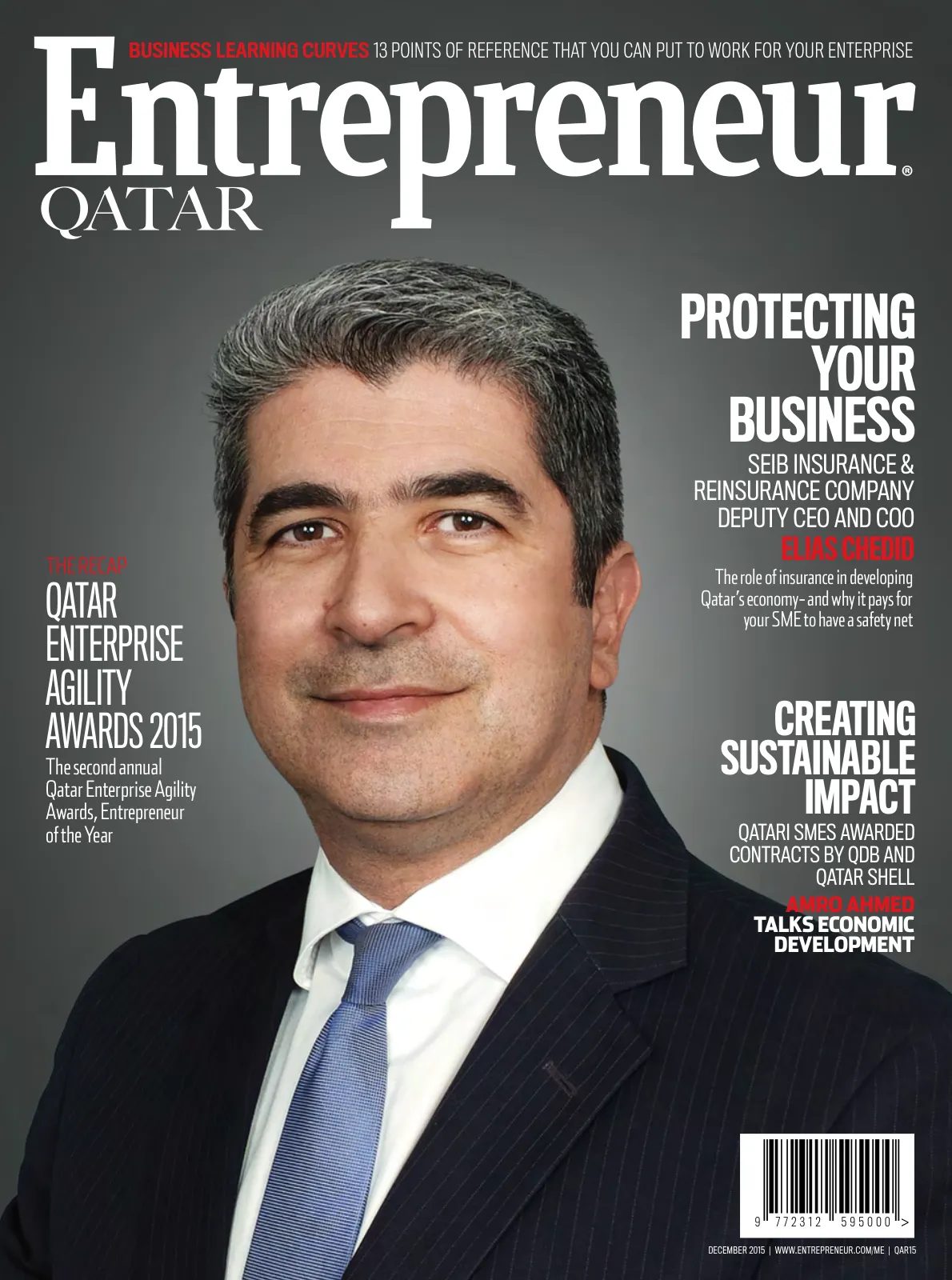
Entrepreneur Qatar, December 2015
Page 1
Business learning curves 13 points of reference that you can put to work for your enterprise
The second annual
Qatar Enterprise Agility
Awards, Entrepreneur
of the Year
qatar
Enterprise
Agility
Awards 2015
The Recap
creating
sustainable
impact
Qatari SMEs awarded
contracts by QDB and
Qatar Shell
Amro Ahmed
talks economic
development
Protecting
your
business
Seib Insurance &
Reinsurance Company
Deputy CEO and COO
Elias Chedid
The role of insurance in developing
Qatar’s economy- and why it pays for
your SME to have a safety net
december 2015 | www.entrepreneur.com/me | QAR15
9
7 7 2 3 1 2
5 9 5 0 0 0 >
Page 2
Page 3
december 2015 Entrepreneur
3
CONTENTS
december 2015
22
The Recap
Enterprise Agility
Achievers 2015
The second annual Qatar
Enterprise Agility Awards,
Entrepreneur of the Year
staged in association with
Doha Bank
72
‘TREPONOMICS:
PRO
The Diderot effect
Olympian and entrepreneur
James Clear talks about the
vicious cycle that ensues
when you spend a bit, then
spend a bit more, and then
spend even more.
54
SKILLSET
Innovation happens
outside of the classroom
Three things entrepreneurs
can teach MBAs, and
guess what? It all involves
hands-on experience in the
market.
38
SKILLSET
Promoting SMEs as key
drivers of innovation and
engines for global trade
and growth
Marc Proksch analyzes
some external and internal
factors to consider for your
company’s success.
14
Protecting your
business
Seib Insurance & Reinsurance
Company Deputy CEO and
COO Elias Chedid
The role of insurance in
developing Qatar’s economy-
and why it pays for your SME
to have a safety net
16
innovator:
The value of
production in creating
sustainable impact
Qatari SMEs awarded
contracts by QDB and Qatar
Shell
Amro Ahmed talks economic
development
16
Amro Ahmed,
Qatar Local Content
and SME Manager,
Qatar Shell
22 Enterprise Agility Awards: Seib Insurance & Reinsurance accepting
the Insurance Innovation award
Page 4
Entrepreneur december 2015
4
CONTENTS
december 2015
Enterprise Agility
Forum 2015
30
70
‘TREPONOMICS:
ESQUIRE GUY
The compliment
sandwich
Ross McCammon lays
down the law: you must
soften a rejection with a
positive message, and this
is how you do it (right).
42
MARKETING
The recipe for a viral
marketing campaign
Bayt.com’s Lama Ataya
explains how having a piece
of content go viral is the
closest thing to the Internet’s
version of winning the
lottery.
84
MONEY:
ASK THE MONEY GUY
Critical points to note for
continued access to capital
Dr. Abdelhakim Hammach, the
Managing Director of Riyadh
Valley Company, discusses
how to overcome fundraising
challenges for your startup.
76
START IT UP:
Q + A
Moving pretty darn quick
CamelShip co-founders Sari
Issa and Fares Nimri came
up with their idea after they
noticed a gap they could
bridge in what they describe
as the “e-commerce space.”
78
START UP FINANCE
More money means more
opportunity
Sarah Appleton’s startup,
Mini Exchange, got funded in
Dubai and now she is using
those funds to scale the
business.
82
START UP FINANCE
Capital injections for two
Middle East startups
The founders of Carpool Arabia
and TaskSpotting share their
tips on getting funded, and what
they’ll be doing with their new
found funds.
12
EDITOR’S NOTE
By Fida Z. Chaaban
68
CULTURE:
LIFE
Business book rundown
Amal Chaaban reviews a few
business books for you before
you hit the bestseller aisle.
It’s true that not all executive
material is created equally.
46
LIFE
Health conscious startup
Raw ME
Startup founder Layla Al-Dorani
wants you to feel better… and
that starts with nutrition.
67 Startup Weekend Dubai runs a 54-hour educational
experience for ‘treps
Page 5
Page 6
Entrepreneur december 2015
6
CONTENTS
december 2015
U.K.-based entrepreneur
Roja Dove crafts haute
fragrance for the MENA
bespoke client
60
60
CULTURE:
TRAPPINGS
‘Trep gear
The executive selection for
the entrepreneur on your
list that has everything.
Okay, maybe for a little
self-reward as well.
50
DESIGN
Business is booming
A discourse on design
with entrepreneur Hazem
Aljesr. The Cities founder
makes MENA’s creatives
a priority with his
enterprise.
58
TRAVEL
At your beck and call
The St. Regis Abu Dhabi
is always at the ready for
your visit to UAE’s capital.
62
TECH
SHINY
#TamTalksTech
Gadgets and doodads
that you might’ve missed
out on, sourced by a tech
aficionado. Yes, it’s okay
to want them all… and no,
it’s not our fault.
90
WEBSITE TO WATCH
Finance goes digi
Fintech companies are
transforming the banking
experience by driving
the sector into the next
generation of banking.
50 Cities Store Dubai
62 #TamTalksTech: The new iPad Pro
Page 7
Page 8
Entrepreneur december 2015
8
SUBSCRIBE
Contact subscriptions@bncpublishing.net to receive
Entrepreneur Middle East every issue
EDITOR IN CHIEF Fida Z. Chaaban editor@bncpublishing.net
MANAGING DIRECTOR Walid Zok walid@bncpublishing.net
DIRECTOR Rabih Najm rabih@bncpublishing.net
DIRECTOR Wissam Younane wissam@bncpublishing.net
PUBLISHER Nehme Abouzeid
MANAGING EDITOR Aby Sam Thomas
CREATIVE LEAD Odette Kahwagi
ONLINE LIAISON Kareem Chehayeb
COLUMNIST Pamella de Leon
COLUMNIST Tamara Clarke
COLUMNIST Shoug Al Nafisi
PO Box 502511 Dubai, United Arab Emirates
P +971 4 4200 506 | F +971 4 4200 196
For all commercial enquiries related to
Entrepreneur Middle East contact
sales@bncpublishing.net
All rights reserved © 2015.
Opinions expressed are solely those of the contributors.
Entrepreneur Middle East and all subsidiary publications in
the MENA region are officially licensed exclusively to BNC
Publishing in the MENA region by Entrepreneur Media Inc.
No part of this magazine may be reproduced or transmitted
in any form or by any means without written permission of
the publisher.
www.entrepreneur.com/me
Access fresh content daily on our website!
MIDDLE EAST
Printed by Raidy Emirates Printing Group LLC
www.raidy.com
EntMagazineME
@EntMagazineME | @Fida
Entrepreneur-me
EntrepreneurMiddleEast
EntMagazineME
EntMagazineME
EntMagazineME
Images used in Entrepreneur Middle East are credited when necessary. Attributed use of
copyrighted images with permission. All images not credited otherwise Shutterstock.
Sarah Appleton
Lama Ataya
Amal Chaaban
James Clear
Ross McCammon
Dr. Abdelhakim Hammach
Sean McKeon
Marc Proksch
Soukaina Rachidi
Alexander Rauser
May Rostom
Mark Sephton
Erika Widen
CONTRIBUTING WRITERS
In addition to our print edition, we’re bringing you all sorts of industry news
on our web mediums. Joining us online means getting relevant business and
startup content in real-time, so you’re hearing about the latest developments
as soon as we do. We’re looking forward to interacting with our readers on
all of our social media and web platforms- like any thriving business, we’re
looking to give and take. #TrepTalkME is already happening on all of our digi
platforms, and all good conversations go both ways. See you on the web!
Page 9
Page 10
Entrepreneur december 2015
10
L
ately, probably due to the
large number of events En-
trepreneur Middle East par-
ticipated in this year, I’ve
been asked a lot about my
moderating or speaking engagements.
This fall alone, I took part (alongside
many others from our hyperactive
entrepreneurial ecosystem) in more
events than I can list here, and they
all had to do with entrepreneurship
and leadership.
On November 20, I had the great
pleasure of moderating for one of
MENA’s biggest ecosystem heroes,
Ronaldo Mouchawar, the founder and
CEO of souq.com at Endeavor Jor-
dan’s DealMakers 2015. (As an aside,
it was a terrific event and the premise
is that it connects worthwhile En-
deavor Jordan entrepreneurs with
potential investors for “speed dating”
sessions- they pitch hard, and then
they move onto the next table.) After
the session, I was asked if I was
“paid” to moderate. The question
actually was posed thus: “So why do
you do this, anyway? You’re always
speaking… Are they paying you?
Like, all the events you speak at, do
they pay you to do this?” No, no one
is paying me. (Full disclosure: there
are non-monetary stipulations when
I moderate or speak at an event- we
ask that Entrepreneur Middle East is
partnered in some official capacity,
and that our logo is present.)
So, the reason that both Aby Sam
Thomas (our Managing Editor) and I
speak or moderate at different events
across the region is because we don’t
see ourselves as a media outlet. We
see ourselves as part and parcel of
the entrepreneurial ecosystem in this
region. During these types of conver-
sations, I often remind people that we
too stage events, and how can we ex-
pect the ecosystem’s pillars to come
out and take time out of their sched-
ules to speak to our entrepreneurs,
if we aren’t doing that very same
thing? Yes, it does take a tremendous
amount of preparation, and yes, it
means we often work long hours to
make up for the time that we spend
at events as speakers (especially
when we have to travel for an event).
But that is what it takes to work at
this magazine, because we don’t see
ourselves as just a magazine. If we
did, we would not have, from day
one, been actively engaged on the
ground with entrepreneurs and the
very significant people who facilitate
entrepreneurship in this region- be
it through programs, mentorship
or funding. If we did see ourselves
as just a magazine, we wouldn’t be
tweeting with our startups night
and day, and we wouldn’t be heavily
engaged with entities like Endeavor.
To work at this magazine, you have
to believe in what we’re doing, and
that means that you are committed to
being more than just a magazine. You
are committed to the ecosystem, all
the way.
I think that our Director, Wissam
Younane, summed it up nicely during
his address at our 2015 Enterprise
Agility Awards in Dubai when he,
inspired by H.H. Sheikh Mohammed
bin Rashid Al Maktoum’s com-
mentary on the Arab world, said:
“Entrepreneurship isn’t just on our
agenda, it is our agenda.” And like
you, entrepreneurs, that means we
have a single-minded focus on doing
our part for the ecosystem, and keep-
ing the collective give-and-get energy
going.
I’ll see you all at the next event!
Fida Z. Chaaban
Editor in Chief
@fida | @fidazchaaban
editor@bncpublishing.net
EDITOR’S NOTE
Check out the full coverage of the 2015 Enterprise Agility Forum
presented by du in this edition and on Twitter and Instagram by visiting
the hashtag #AgilityForum
You get what you give
Ecosystem
karma
Page 11
Page 12
Entrepreneur december 2015
12
Chedid’s response is indica-
tive of the reason why Seib
won the Insurance Innovation
award at Entrepreneur Middle
East’s 2015 Qatar Enterprise
Agility Awards presented by
Doha Bank- Seib’s focus on
working proactively with its
customers to not just achieve
their insurance objectives,
but also to promote their
long-term growth and profit-
ability, is what has caused the
company to stand out in its
sector. “We have a passion for
excellence, and we endeavor
to deliver the highest stand-
ards of service, value and
integrity at all times,” Chedid
says. “The joy of creating
a customer experience and
maintain that relationship
over the years is a reflection of
Seib values and culture that
promotes innovation in every
aspect of the sense. Innovation
is not only reflected through
technology- it is also in under-
writing processes, in insurance
solutions to complex risks, in
scheme designs, in building
a motivated team. And most
importantly, innovation is
reflected in the art of customer
communication.”
With such a forward-think-
ing approach to doing busi-
ness, Seib has been making a
concerted effort to participat-
ing in the growth of Qatar and
the realization of its National
Vision 2030. Seib proudly de-
clares itself to be a Qatari na-
tional insurance company- its
very name is a reference to the
role of the seib in the pearl-
diving heritage of the country,
wherein the seib would hold
on to the ropes supporting
the divers as they scoured
the depths of the sea for their
wares. The seib was essential-
ly thus the diver’s lifeline, and
according to Chedid, that’s the
same principle his company
uses when dealing with its
clients and their insurance
requirements. “Our business
is a cycle of value creation,
and our name reflects that
reality,” he explains. “Seib is a
customer-centric organization.
It leads its service offering
through a team motivated by a
passion for excellence, empow-
ered by the entrepreneurial
spirit that is a reflection of the
organization’s senior leader-
ship, mainly, our Chairman
H.E. Sheikh Jabor Ben Youssef
Jassim Al Thani, and our CEO
Farid Chedid. Our team mem-
bers are a source of motivation
by themselves; they create it
with every moment spent on
creating achievements, and
transforming obstacles to suc-
cesses.”
It’s important to note here
that while Seib places a lot
of importance on its bottom
line, it is not the only thing
that governs its progress and
development in Qatar. “Our
short-term and long-term
goals coincide in continuing to
service our clients at the high-
est service standards possible
through transparency and
integrity to maintain a profit-
able growth, while focusing on
the Qatar National Vision for
2030 by being a proactive par-
ticipant in the socio-economic
growth of the country,” Chedid
explains. “This requires creat-
ing success stories for the
insurance industry, while be-
ing an active member in the >>>
The role of insurance in developing Qatar’s economy- and why it
pays for your SME to have a safety net
innovator
By Aby Sam Thomas
I
t may have been established only in 2009, but Seib Insurance
& Reinsurance Company has seen its Qatar-based business
grow at a rapid rate in the last couple of years, with the insur-
ance provider now being ranked among the top institutions of
its kind in the country. When asked what was the formula that
caused Seib to rise above its peers in the industry, the company’s
Deputy CEO and COO, Elias Chedid, replies, “Nothing could have
lifted Seib into its exceptional market presence more than superior
customer service, a highly qualified team of insurance experts, and a
determined focus to create a highly satisfied customer partnership.”
Seib Insurance & Reinsurance Company
Deputy CEO and COO Elias Chedid
Protecting
your
business
Page 13
december 2015 Entrepreneur
13
Elias Chedid, CEO and COO,
Seib Insurance & Reinsurance
Company Deputy
Page 14
Entrepreneur december 2015
14
development of local talent,
either directly within Seib,
or by being active in CSR,
supporting initiatives through
organizations such as Qatar
Finance & Business Academy
(QFBA), INJAZ Qatar and oth-
ers. In addition to the support
extended to Qatari individuals
and institutions, Seib is also
an active member in the expat
communities’ social programs,
thereby complementing the
socio-economic cycle to in-
clude expat residents.”
Seib’s efforts in improving
its offerings and scaling up
its business are particularly
noteworthy when considering
the current state of Qatar’s
insurance market. According
to an October 2015 report by
global credit rating agency
Moody’s, Qatar has the fastest
growing insurance market in
the GCC, with a compound
annual growth rate of 20.7%
between 2006 and 2014. Hav-
ing said that, the country has a
rather low insurance pen-
etration rate at just 1% of its
GDP- but even so, the report
marked Qatar out to be the
third largest insurance market
in the GCC, with its premiums
totaling approximately US$2.2
billion. This essentially means
that there’s a lot of growth
potential for this sector in
Qatar, and companies like Seib
are in a prime position to take
advantage of this situation,
and capitalize on it as well.
“A growing economy,
matched with a growing
population, marked Qatar’s
growth charts over the past
few years,” Chedid says. “Such
indicators promoted promis-
ing potential for the insur-
ance industry. Accordingly,
insurance penetration was
initially a reflection of the
premium growth generated
from large and mega projects.
As we progress into the com-
ing years, a balance would be
created by other segments,
such as retail and SME. Those
would generate the premium
volume needed to balance
insurance penetration against
large corporate elements. The
driving factors for continuous
growth are primarily driven by
regulatory measures, repre-
sented by mandatory programs
such as health insurance. If
we consider health insurance
alone, we estimate that it may
have a positive impact of 40%
on insurance penetration.”
Chedid notes that the role
of the insurance industry in
an economy is dependent on
several national factors, which
differ from one country to the
other, span across a num-
ber of sectors, and are also
reciprocal to the local culture.
“One of the measurement
indicators on its impact on
the local economy is insur-
ance penetration to GDP,
which at the beginning of the
year did not cross 0.55% in
Qatar compared to 1.4% for
the MENA region,” Chedid
explains. “However, on the
other side, insurers do not
operate in vacuum. We cannot
undermine the fact that insur-
ance is stimuli to other sectors
and a facilitator to business
transactions, whether retail
or wholesale, in addition to its
role in the cost of living pro-
tection it provides to individu-
als and families. In terms of
risk reduction and mitigation,
insurance acts as an extended
reserve capital to businesses,
regardless of size. As for de-
velopment and optimization of
insurance role in an economy,
this is a dual role for govern-
ments and private sectors.”
In terms of Qatar though,
Chedid considers its current
shift towards expanding the
role of the private insurance
sector in the country to be a
positive one, with this being
implemented through regula-
tory changes at both operating
and risk management levels.
“We see that the robust regu-
latory environment under the
Qatar Financial Centre (QFC)
is being capitalized upon to
expand the regulatory rules
platform in Qatar, under the
umbrella of Qatar Central
Bank (QCB),” he says. “On the
other hand, implementation of
mandatory insurance pro-
grams through private insurers
establishes for an important
part of risk mitigation in
sectors such as healthcare.
Nevertheless, insurance is a
contractual reinstatement
or recovery guarantee to
individuals, businesses and
financiers, whether in their
asset protection, transaction
or contractual obligations.
Accordingly, it goes without
saying that capital protection
for a startup’s or a small busi-
ness’ needs may seek solutions
though insurance programs.
Seib has been active in this
innovator
“Our short-term and long-term
goals coincide in continuing to
service our clients at the highest
service standards possible through
transparency and integrity to
maintain a profitable growth, while
focusing on the Qatar National
Vision for 2030 by being a proactive
participant in the socio-economic
growth of the country.”
Seib Group
Page 15
december 2015 Entrepreneur
15
segment, and will continue to
do so.”
Seib currently services cli-
ents from a variety of sectors,
including construction, bank-
ing, transportation, healthcare,
education, hospitality, sports
and more. Chedid claims
that the company has writ-
ten major programs, “some of
which are among the largest in
the world.” Some of its major
clients require global health
insurance programs, which
leads to Seib servicing them
in remote parts of the globe,
while other customers require
large-scale directors and of-
ficers (D&O) and decennial
liability programs, with the
company underwriting such
complex programs to protect
both Qatari and multinational
institutions. But this is not to
say that Seib has overlooked
the SME sector- on the con-
trary, Chedid says the company
has several offerings catered
to this particular market.
“Indeed, Seib has products to
protect small as well as large
company assets and liabilities;
those solutions have been in
the market by Seib for a few
years, and we continue to
update our offering based on
market needs,” he says. “We
have specific SME products,
such as the office protection
Maktabi scheme, small groups’
health insurance, tailor-made
employee benefits schemes,
and others. Some of those may
be very similar in its aspects to
those of large corporates. The
risk exposure in large organi-
zations necessitates a different
underwriting structure and
solutions than SMEs. Large
risks require larger capital ca-
pacity and allocation, yet both
require the same underwriting
discipline, from an insurers
perspective.”
But given the cash crunch
that most startups and SMEs
in this region often face, can
one make a feasible argument
for why they should invest in a
good insurance scheme? Che-
did rises up to the challenge,
and is emphatic in stressing
why insurance is a must for
small businesses. “You want
to be profitable, then you have
got to be credible and visible,”
he says. “Do not eliminate that
opportunity by petty savings
on insurance premiums. The
cost of risk reduction through
insurance is far lower than the
risk of financial loss without
insurance. To entrepreneurs,
I say, we understand the pas-
sion to thrive in what you do,
because Seib has been there,
has seen it and is still living it.
Protect your jewel. Insure that
you get the best chain to hold
it. We understand the effort,
time and sweat required to
build an organization to make
it stand out among the crowd
and succeed. Our team at Seib
has been assisting startups and
SMEs to insure them and help
them stay visible, credible and
profitable.”
Seib Insurance & Reinsurance accepting
the Insurance Innovation award
Page 16
Entrepreneur december 2015
16
The successful SMEs will be
awarded with contracts this
month to become part of the
supply chain for Pearl GTL, the
world’s largest gas to liquids
plant delivered by Qatar
Petroleum and Qatar Shell. As
part of a nationwide strategy
to support Qatari SMEs, Qatar
Shell partnered with QDB to
promote and accelerate the
development of the private
sector in Qatar.
“Through its support of local
SMEs, Qatar Shell aims to
contribute significantly to the
economic pillar of the Qatar
National Vision 2030 (QNV),
while helping SMEs raise their
operating standards in order
to fulfill global requirements,”
says Amro Ahmed, Qatar Local
Content and SME Manager of
Qatar Shell. “We believe that
by supporting local SMEs, we
are actively contributing to the
Qatar National Vision 2030.
Localizing elements of the
national supply chain is one of
the most important and effec-
tive methods of achieving this,
as the private sector is of in-
valuable significance to Qatar’s
growing population and econo-
my. Also, we are confident in
the quality and capabilities of
local suppliers currently in the
market place and believe that
providing them with oppor-
tunities makes good business
sense and can add value to our
operations.”
Ahmed says that by work-
ing with and supporting local
companies, Qatar Shell is
ensuring its business continu-
ity through the development
of a robust supply chain, both
strengthened and streamlined,
while also reducing risks. For
instance, the operation of
the Pearl GTL plant remains
steady with a minimum down-
time due to the shorter deliv-
ery timings of locally manufac-
tured goods and services that
replace imported ones. Ahmed
strongly believes SMEs are key
to fostering a robust private
sector that will reduce the
burden on the public sector
employment and help diver-
sify Qatar’s economy. “In his
foreword of the Qatar National
Vision, His Highness the Emir
Sheikh Tamim bin Hamad Al
Thani, says Qatar must invest
in world class infrastructure to
create a dynamic and more di-
versified economy in which the
private sector plays a promi-
nent role. Therefore, making
business opportunities >>>
innovator
Amro Ahmed talks economic development
By Erika Widen
E
arlier this year, more than 150 Qatari SMEs attended
the third annual Qatari SME Business Opportunities
Workshop, where more than 60 local SMEs showed
their interest to participate and compete. As a result,
more than 30 local SMEs were shortlisted to tender for
seven specific business opportunities offered by Qatar Development
Bank (QDB) and Qatar Shell– collectively worth an estimated
aggregate value of more than QR15 million.
Qatari SMEs awarded contracts
by QDB and Qatar Shell
The value of production in
creating
sustainable
impact
Qatar Shell Pearl GTL,
the largest GTL plant in the world
qatar shell pearl image © www.shell.com.qa
Page 17
december 2015 Entrepreneur
17
december 2015 Entrepreneur
17
Amro Ahmed, Qatar
Local Content and SME
Manager, Qatar Shell
Page 18
Entrepreneur december 2015
18
available to the local private
sector is a strategic decision
for Qatar Shell, and one that
directly contributes to the
economic pillar of the Qatar
National Vision,” reiterates
Ahmed. Specifically, the initia-
tive is about localizing Qatar’s
supply chain to help diversify
the Qatari economy and reduce
the reliance on international
trade and employment.
“We are proud to see a
significant increase in the
number of Qatari SMEs and
entrepreneurs who are show-
ing interest in joining Qatar
Shell’s supply chain, largely
due to the successful stories
of the awarded SMEs, since
the launch of the initiative in
2013,” he adds. In addition to
this, Qatar Shell and QDB pro-
vide Qatari SMEs with invalu-
able knowledge and expertise,
resources, networking capa-
bilities, associations, mentor-
ing, support and access to
national and regional markets.
In other words, SMEs have
the potential to grow beyond
national success and repatri-
ate profits back into the Qatari
economy. In 2013, Qatar Shell
signed an agreement with QDB
to provide Qatari SMEs access
to business opportunities at
the Pearl GTL. More than 100
local SMEs and entrepreneurs
participated in the first work-
shop where attendees were
also briefed on Qatar Shell’s
tendering process, the chal-
lenges and opportunities in the
SME sector, and the financial
support made available to
them by QDB. “Following the
launch of the first Qatari SME
Business Opportunities Work-
shop, three local SMEs were
awarded with contracts; and in
2014 five new local companies
were added to Qatar Shell’s
supply chain,” adds Ahmed.
By way of example, Ahmed
illustrates the following as a
quick update of one of 2013
business opportunities. Qatar
Industrial Equipment (QIE),
winners of Personal Protective
Equipment (PPE) business op-
portunity in 2013 received ac-
creditation for their own safety
standards by applying OHSAS
18001 standards, followed by
international accreditation for
product quality and design in
2015– after complying with
Pearl GTL’s safety standards
in 2014. As a result of these
achievements, QIE started de-
livering to Pearl GTL and also
raised their profile to a level
that brought interest from
prospective companies locally
and regionally, allowing their
expansion by way of a new fac-
tory in Sharjah, United Arab
Emirates, and a sales office in
Saudi Arabia. “Now in its third
year, we have increased the
number of the business oppor-
tunities to seven, again due to
the significant increase in the
number of Qatari SMEs and
entrepreneurs demonstrating
their interest,” says Ahmed.
The successfully awarded local
companies are given between
12 and 18 months, if needed, in
which to build their capacity
to handle the contracts.
It’s also worth noting that
this year Qatar Shell and QDB
won the Social Development
Center’s Reyada Outstand-
ing Entrepreneurial Sup-
port Award for their role in
developing Qatari entrepre-
neurs and SMEs. “This award
is a clear demonstration of
this successful partnership in
developing Qatar’s economy
and private sector, as well as
delivering sustainable contri-
butions to positively impact
Qatar.” Qatar Shell is wholly
committed to supporting the
QNV 2030 in each of its four
pillars, social, human, envi-
ronmental and economic, by
working with Qatari partners
to create and deliver sustain-
innovator
“we have increased the
number of the business
opportunities to seven,
again due to the sig-
nificant increase in the
number of Qatari SMEs
and entrepreneurs
demonstrating their
interest.”
www. shell.com.qa
Page 19
december 2015 Entrepreneur
19
Lara Koujou, Social Investment Manager at Qatar Shell seen here as part of a panel discussion around the subject of Women & ICT: Skillbuilding, Training and Trends, and the Role
of Social Media at the 7th Arab International Women’s Forum (AIWF) in Doha, Qatar.
able contributions to posi-
tively impact Qatari society.
As the largest international
investor in Qatar, Qatar Shell
works in partnership with
Qatar Petroleum to develop
the country’s energy indus-
try providing a significant
contribution to the economic
pillar of the QNV 2030.
“Through our Corporate
Social Responsibility (CSR)
programs we seek to go
beyond philanthropic dona-
tions, to contribute strategi-
cally with our partners to
the QNV 2030 in ways that
generate measurable social
impact and link to our core
business strengths. We
therefore look for opportuni-
ties to distinctively contrib-
ute our innovation or other
areas of expertise such as
project management skills
in addition to any financial
support.”
The company’s programs
include The Qatar Shell
Research Technology Centre,
which provides research and
innovative solutions to en-
ergy and environment chal-
lenges faced by Qatar. Addi-
tionally, through TAFAWOQ,
Enterprise Challenge Qatar
program, university partner-
ships and Road Safety initia-
tive, Qatar Shell is contrib-
uting to the development of
a knowledge-based society,
thus positively influence the
country. The social develop-
ment pillar of the QNV203
emphasizes the importance
of a good quality of life, social
support and protection for
all of Qatar’s citizens. Qatar
Shell therefore supports this
pillar through its Road Safety
and KOORA TIME initia-
tives. “Finally, as a long-term
investor, Qatar Shell seeks
to create a positive legacy– a
contribution to the Qatar
National Vision 2030 that
we and our partners can be
proud of.” Qatar Shell and
QDB invest a great deal of
time, energy and effort into
supporting the SME sector,
which they have identified
as personifying a crucial
element in Qatar’s future
success. “In addition to the
advisory support and finan-
cial incentives provided by
QDB, Qatar Shell provides >>>
1. Manufacturing Safety
boards and electrical labels
Qatar Shell requires a local supplier
to manufacture safety signs for
onshore and offshore facilities for
its Pearl GTL plant.
2. Services Cafeteria and
catering for staff and events
Qatar Shell wishes to enhance its
staff cafeteria and food services.
The scope requires opening a
cafeteria that will provide food
and beverage for more than 700
employees based in the Doha Shell
office.
3. Services Custody flow
meter calibration
In order to ensure accuracy, Qatar
Shell requires the maintenance of
water, ultrasonic gas and ultrasonic
liquid meters at the Pearl GTL
plant.
4. Manufacturing Stud bolts
Qatar Shell requires an SME to
manufacture stud bolts in Qatar
for the Pearl GTL plant.
5. Onsite technical support
Welding inspectors
Qatar Shell is offering a business
opportunity related to welding
inspection services.
6. Manufacturing
and maintenance Fire
extinguishers
Qatar Shell is offering a contract
for the local manufacturing,
inspection and maintenance of fire
extinguishers of various sizes.
7. Social media management
Social media contract
Qatar Shell launched its Twitter
account in late October 2013,
and its Instagram account in May
2015 and is offering a contract for
management of its social media
platforms.
Opportunities offered by Qatar Shell to SMEs in 2015
Teaming up with SMEs!
Page 20
Entrepreneur december 2015
20
innovator
Qatar Shell and Bedaya recently announced 22 university
semifinalists for the 2015 Enterprise Challenge Qatar. It is
an annual competition which encourages the entrepreneurial
spirit among the youth in Qatar. The successful teams from
each of the 13 participating universities will compete on
an entrepreneurship computer simulation, which seeks to
evaluate the teams’ performance on running their business
in a competitive marketplace over a three-year period. In
addition, the six top teams with the highest net profit scores
will present their sustainable business pitches to a panel of
judges to select three winning teams.
The 2014 Enterprise Challenge Qatar received special
praise and recognition during the U.K. Mentor of the Year
Awards hosted by HRH The Prince of Wales at Sandringham
Palace in the United Kingdom. Earlier this year, Qatar Shell
and Bedaya also won Social Development Center’s Reyada
‘Outstanding Entrepreneurial Support’ Award for their role in
supporting Qatari entrepreneurs and SMEs including through
the Enterprise Challenge Qatar. The Enterprise Challenge
program was originally created by Mosaic, a U.K.-based
not-for-profit organization established by HRH The Prince of
Wales in 2007, with a range of mentoring programs aimed at
fostering opportunities for young people.
| in pictures |
Enterprise Challenge Qatar 2015
the awarded local companies
with a period of 18 months, if
needed to build their capac-
ity to handle the contract
awarded to them.”
In addition, Qatar Shell
provides an on-going support
and assessment to ensure
the company will provide the
required quality services.
“Also, a large part of winning
Shell’s business is the ability
to adhere to our technical
and Health, Safety, Security,
and Environment (HSSE)
standards. It is therefore of
the utmost importance that
every one of our suppliers and
contractors is as committed to
safety as we are at Shell– en-
suring that absolutely nobody
comes to harm as a result of
our business.” Ahmed further
adds that to see the evolution-
ary process of SMBs flourish-
ing with their help is extreme-
ly rewarding: “This initiative
is more than just a question of
financial gain and the value of
tenders; it’s about the value of
production and the sustain-
able impact it creates.”
With these resources, Shell partnered
with Qatar Petroleum to build one
of the world’s largest, most complex
and challenging energy projects
In fact, it's the largest
GTL PLANT
in the world**
At the peak of construction,
workers were deployed
52,000
man-hours to design
and build PEARL GTL
Overall, it has taken the team
500million
of CONCRETE
was poured
To build this, a total of
That's enough to construct
2 Burj Khalifas*
(the world’s tallest building)
750,000m³
of R&D
innovation
YEARS
40
Pearl GTL uses technology that
is a culmination of
Pearl GTL draws gas from Qatar’s
North Field, estimated to hold
cubic feet of gas
of the
world’s
total***
900 trillion
That’s an estimated
Built in partnership with Qatar Petroleum, the Pearl Gas to Liquids (GTL) is
the world’s largest GTL plant and one of the world’s largest, most complex and
challenging energy projects ever commissioned.
Page 21
Page 22
Entrepreneur december 2015
22
ECOSYSTEM ALLIES
SILVER ALLY
GOLD ALLY
GOLD ALLY
a production by
in association with
PLATINUM ALLY
PLATINUM ALLY
QATAR
Enterprise
Agility
Awards 2015
Page 23
december 2015 Entrepreneur
23
O
n the occasion of the
second annual Qatar En-
terprise Agility Awards,
Entrepreneur of the Year pre-
sented by du, BNC Publishing as
part of the Entrepreneur MENA
franchise, awarded businesses
and individuals across multiple
categories on November 8,
2015 at The Ritz-Carlton Doha
in Qatar. The relevant Enter-
prise Agility Achievers have
established themselves as clear
industry innovators who have
made significant contributions
to both the Qatari and the Mid-
dle East business arena, and set
the benchmark for corporations
operating across the region.
A total of 20 awards were pre-
sented, with all of the winners
having set themselves apart
from their peers in the region
by showcasing a commitment
to excellence and thereby rais-
ing the bar of their respective
industries. Speaking on behalf
of Entrepreneur, Wissam You-
nane, Director, BNC Publish-
ing, felicitated the winners by
saying, “Being an Enterprise
Agility Achiever means that
your methods, your strategies
and most of all, your execu-
tion sets a standard for all the
other entities operating in your
sector. You are the business
trendsetters; you are the bar
that companies strive to reach.
It is our mission at Entrepre-
neur to highlight these excep-
tional achievements. Those who
want to be a proactive part of
the Qatari economy can strive
to emulate your demonstrated
abilities.”
Organized by Entrepreneur
MENA, the 2015 Qatar Enter-
prise Agility Awards recognized
and honored enterprise leaders
and individuals who have
distinguished themselves and
shown sector significance and
outstanding business conduct
across a variety of industries
that are key drivers of respec-
tive Middle East’s economies.
On behalf of the Qatar Chamber
of Commerce & Industry, Vice
Chairman Muhammed Ahmed
Bin Towar Al Kuwari presented
the awards to the 2015 Enter-
prise Agility Achievers. “Some
of the companies here with us
are from the original Qatari
entrepreneurial ecosystem, and
some are the new pillars upon
which tomorrow’s economic
drive rests- these junior achiev-
ers, our Qatari startups here
with us tonight, and the enti-
ties that make their steps for-
ward possible,” Younane said.
“Startups, we see you, and we
recognize your work. In a few
years, your startup award may
become an even larger distinc-
tion, and as part of the entre-
preneurial ecosystem we will be
waiting and watching, and yes,
supporting your growth.”
The Enterprise Agility
Awards, Entrepreneur of the
Year seeks to acknowledge agil-
ity across a variety of industries
including retail, healthcare,
construction, hospitality,
aviation, education, banking,
and energy, amongst other key
drivers of the Middle East’s
economy. “BNC Publishing, via
our Entrepreneur of the Year
awards, and with the support
of the respected Qatar Chamber
of Commerce, seeks to continue
to celebrate you, the business-
people who inject vibrancy
and drive into this economy,”
Younane added. “I extend my
sincere appreciation to our
partners for your ongoing
support, and I salute tonight’s
Enterprise Agility Achievers.
Shukran Qatar.” >>>
Wissam Younane
addressing the
assembly on behalf
of BNC Publishing
The winners of the 2015 Qatar Enterprise Agility Awards
december 2015 Entrepreneur
23
Page 24
Entrepreneur december 2015
24
Enterprise Agility
Awards 2015
Contribution to Business Muhammed Ahmed Bin Towar Al Kuwari
Retail Achievement Fifty One East
Hospitality Innovation H.E. Sheikh Faisal Bin Qassim Al Thani
Diversified Portfolio Jaidah Group
SME Banking Innovation Qatar Development Bank
Retail Banking Innovation Qatar Islamic Bank
Investment Banking Innovation QInvest
Islamic Banking Innovation Qatar International Islamic Bank
Education Innovation HEC Paris in Qatar
Media Innovation Dar Al-Sharq
Insurance Innovation SEIB Insurance & Reinsurance Company
Real Estate Innovation Alfardan Properties
Energy Innovation Kahramaa
Logistics Innovation Expeditors International
Telecommunications Innovation Ooredoo Qatar
Human Capital Development Bedaya
Social Entrepreneurship Silatech
Entrepreneurial Ecosystem Development Qatar Business Incubation Center
Mobile App of the Year Evently
Startup of the Year I Love Qatar Network
Entrepreneur december 2015
24
Ooredoo Qatar
accepting the
Telecommunications
Innovation award
Dar Al Sharq
accepting the Media
Innovation award
Muhammed Bin Ahmed
Bin Towar Al Kuwari,
Vice Chairman, Qatar
Chamber of Commerce
and Industry, accepting
the Contribution to
Business award
Page 25
december 2015 Entrepreneur
25
december 2015 Entrepreneur
25
Stephen Marney,
Master of
Ceremonies,
addressing the
assembly
Alfardan Properties
accepting the Real Estate
Innovation award
Jaidah Group
accepting the
Diversified
Portfolio award
Evently accepting the
Mobile App of the Year
award
Qatar International
Islamic Bank (QIIB)
accepting the
Islamic Banking
Innovation award
Page 26
Entrepreneur december 2015
26
Enterprise Agility
Awards 2015
Entrepreneur december 2015
26
Expeditors
International accepting
the Logistics
Innovation award
Seib Insurance & Reinsurance accepting
the Insurance Innovation award
Fifty One East
accepting the Retail
Innovation award
I Love Qatar accepting
the Startup of the Year
award
QInvest accepting the Investment
Banking Innovation award
Entrepreneur
Qatar
Editor-in-Chief
Fida Chaaban
Kahramaa accepting
the Energy Innovation
award
Page 27
december 2015 Entrepreneur
27
27
december 2015 Entrepreneur
Qatar Business
Incubation Center
QBIC accepting
the Entrepreneurial
Ecosystem
Development
award
Qatar Development
Bank (QDB) accepting
the SME Banking
Innovation award
Qatar Islamic Bank
(QIB) accepting
the Retail Banking
Innovation award
Muhammed Bin Ahmed
Bin Towar Al Kuwari,
Vice Chairman, Qatar
Chamber of Commerce
and Industry, addressing
the assembly
H.E. Sheikh Faisal
Bin Qassim Al
Thani, Hospitality
Innovation,
accepted on his
behalf
Bedaya Center for Entrepreneurship and Career Development accepting
the Human Capital Development award
HEC Paris in Qatar
accepting the Education
Innovation award
Silatech accepting the Social Entrepreneurship award
Page 28
Entrepreneur december 2015
28
T
he I Love Qatar network
kind of just happened,”
says Khalifa Saleh Al
Haroon, as he remem-
bers the origins of his company,
which won the Startup of the
Year title at the 2015 Qatar
Enterprise Agility Awards.
“There was no master plan in
the beginning. However, as I saw
the potential of what I had, it
evolved into a great media chan-
nel. My sights grew to online,
content creation, either building
or acquiring websites within my
network, or even expanding into
video content and radio.” With
the I Love Qatar network today
encompassing websites like Qa-
tar News, Qatar Events, Dine Out
Doha, and YouTube shows like
QTips, Mr. Q Visits and Karak
Time, the charismatic Al Haroon
–a digital influencer in his own
right- today heads an online
business that enjoys the status of
being one of the country’s most
popular homegrown brands.
But starting up I Love Qatar
was a much less glamorous
affair- Al Haroon admits chal-
lenges were aplenty when he,
at the time in his early 20s,
was setting up the enterprise in
2008. “I built the first version
of ILoveQatar.net on my own,
learning as I went along– in
a tiny room behind my Dad’s
home. Sadly, whether you are a
traditional business or not, you
still have the same requirements
from the Ministry of Economy
and Commerce, and the Ministry
of Business and Trade.” The
founder explains that he had to
come up with QR200,000 of
capital and get a physical office
space, “even though I didn’t
need it, and [I also had to] pay
for licenses, which I wasn’t sure
I needed either. However, doing
that made my website one of the
first legally operating websites
in the country.” Al Haroon also
recalls going to several banks
and governmental institutions to
inquire for support and funding.
“Sadly, it was hard for them to
wrap their head around a busi-
ness that didn’t sell anything
and just generated revenue off
advertising.” However, Al Haroon
underlines that with I Love Qa-
tar, it was never his goal to just
make money off the enterprise.
“I knew that to generate revenue
off the site, I would need to come
up with a plan for expansion and
reach a critical mass; since grow-
ing a brand takes time, many
investors didn’t want to wait,”
he remembers. “I am glad that I
didn’t take any investment now
though, [because] some of the
same institutions I asked years
ago now ask me for support.”
In light of a promising future
for entrepreneurs, Al Haroon be-
lieves that SMEs are crucial for
any sustainable economy, since,
around the world, SMEs con-
tribute to employment growth
at a higher rate than even bigger
organizations. “Globally SMEs
contribute to anywhere between
50% to 80% of the workforce.
Qatar is investing heavily in a
knowledge-based economy; we
want people to be independent
and to reach for the stars. To
do so, SMEs are most definitely
needed.” He also adds how small-
er businesses take risks, promote
competition, and contribute to
society at a micro-level. “There
are loads of organizations that
have been set up to educate and
inspire young entrepreneurs, and
we see special competitions that
try to kick start projects in the
country, so, the entrepreneurship
energy is in the air.” But, he does
acknowledge the difficulty of
accessing commercial spaces in
Qatar in addition to the high cost
of rent. “Setting up a business
can be costly and confusing, and
honestly, doing business in Qatar
isn’t very easy.”
For instance, setting up a res-
taurant is difficult, such as find-
ing a good location and decent
lease, adding to the difficulties
to acquire high-quality ingredi-
ents and the difficulties faced to
import goods. “Want to set up an
online business? Payment gate-
ways are expensive, many banks
don’t allow customers to use
debit cards online, leaving credit
cards as the only option, and only
a small percentage of the popula-
tion have one.” Al Haroon agrees
that these challenges can be met
as long as smaller businesses
demonstrate that there is a need
for change, and then things
will happen. “You can’t fight
progress. Of course, this is just
based on my opinion and obser-
vations.” The young entrepreneur
strongly believes that the coun-
try’s National Vision 2030 is
what helped enable his ventures
to exist. “I believe my projects
touch upon all the pillars of the
2030 vision; they are economic,
social, environment and human
development.” In addition, he
highlights how when he invests
in either projects or businesses,
he always asks the person he
will partner with to invest at
least 10% of the overall profit to
support charitable causes or the
community. “I’m proud to give
back to the country that’s given
me so much,” he says.
So what’s Al Haroon’s advice
for those interested in getting
into the world of startups? First,
he says that focus is needed: pick
a niche, select a demographic,
and provide a solution or product
that fills a need. Secondly,
ensure one’s business is scalable.
In other words, Qatari ‘treps
should ask themselves: can your
business grow outside of Doha,
the Gulf region and the Mid-
dle East? But before doing so,
decide if growing your business
is something you want to do.
“I know some people who set
up a couple of restaurants and
are happy with the income they
generate,” Al Haroon says. “This
brings me to the third point– do
what makes you happy. We’re
constantly told what to do, what
to say and how to think from the
moment we’re born to when we
get our first job. Most entrepre-
neurs realize that they don’t have
to do what they don’t want to do,
and that thinking leads to some
of the world’s best innovations.”
Entrepreneur december 2015
28
Startup of the Year
I Love Qatar
Founder and CEO Khalifa Saleh Al Haroon
Enterprise Agility
Awards 2015
Page 29
Page 30
Entrepreneur december 2015
30
E
ntrepreneurs and entrepreneurial
ecosystem pillars came together
at the Westin Mina Al Seyahi in
Dubai, UAE on November 22, 2015
for the second annual Enterprise Agility
Forum presented by du, which featured
some of the region’s most prominent lead-
ers sharing their insights with the 200
attendees of the half-day conference.
The Enterprise Agility Forum, the fifth
event staged under the Entrepreneur
Industry Intel banner, began with open-
ing remarks by Entrepreneur Middle East
Editor-in-Chief Fida Chaaban, and was co-
moderated by her and Entrepreneur Middle
East Managing Editor Aby Sam Thomas.
Chaaban addressed the assembly first by
discussing the importance of pulling in
the outliers of MENA’s entrepreneurial
ecosystem, and encouraging the forum’s
attendees to be as interactive as possible in
the half-day knowledge-exchange, not just
through networking, but also with real-
time social media.
Two fireside chat format conversations,
the voices of entrepreneurship, were held
to respectively deeper explore investments
and business models. The first of these
took place with Ramez Mohamed, CEO of
Flat6Labs, who pointed out the importance
of entrepreneurs really having an accurate
idea of their local competition, and on
startups structuring business models that
have the potential to scale across the region
and beyond. The second fireside chat took
place with Sonia Weymuller, co-founder
of VentureSouq. Weymuller, who spoke
on angel investing in the region, explained
what entrepreneurs need to know when
trying to capitalize on this particular fund-
ing opportunity. Both fireside chats were
followed by question and answer segments
with the audience.
The first of the Talking Series brought
forward ideas under the title of Size
Doesn’t Matter: Your small enterprise can
operate like a multinational, which had
as its panelists Chris Bartlett, General
The Entrepreneurial
Continuum in Perspective
Industry Intel event
An
Enterprise Agility
Forum 2015
Entrepreneur december 2015
30
Page 31
december 2015 Entrepreneur
31
Manager, Small, Midmarket Solutions
and Partners, Middle East and Africa
for the Microsoft Corporation, Talal El-
Khalil, General Manager and Senior Vice
President, PepsiCo MENA, Frida Kleimert
Knibbs, Head of Channel and Commercial
Sales for Cisco UAE, and Jose Valles, Vice
President- Enterprise, Commerce, New
Business and Innovation, du. The second
discussion for the day brought forward
tenets of CSR versus social entrepreneur-
ship, and how even startups can undertake
sustainable initiatives. Under the title
of Seeing the Bigger Picture: CSR, social
enterprise and your business, the panel
was headlined by Lina Hourani, Director
of Al Ahli Holding Group CSR division,
Loulou Khazen Baz, founder and CEO of
Nabbesh, Joshua Rajkumar, co-founder and
Chief Operating Officer, The Sustainability
Platform, and Soushiant Zanganehpour,
founder and Director, Tribeca Impact Part-
ners. The third and final panel of the event
revolved around financial literary, funding
and strategic steps toward seeking capital
injections under the title of Calculating
Trajectory: Capital injection routes to (vi-
ably) scale your enterprise with panelists
Marwan Mohammed Al-Suwaidi, Director
of Finance, Khalifa Fund for Enterprise
Development, Sam Quawasmi, co-founder
and Managing Director, Eureeca, and Essa
Ali Bin Salem Al Zaabi, Senior Vice Presi-
dent of Support Services, Dubai Chamber
of Commerce and Industry.
The 2015 Enterprise Agility Forum pre-
sented by du was conducted with the sup-
port of the Dubai Chamber of Commerce
and Industry and Tejar Dubai, together
with Platinum Allies Egyptian Steel, EPG
Hotels & Resorts, AxiTrader, Gold Allies
Medeor Hospital and Skyline University
College, Silver Ally Select Property Group,
and Ecosystem Allies Wamda, MEC, and
The Venture. >>>
december 2015 Entrepreneur
31
PLATINUM ALLY
ECOSYSTEM ALLIES
SILVER ALLY
GOLD ALLY
GOLD ALLY
PLATINUM ALLY
PLATINUM ALLY
SUPPORTED BY
Page 32
Entrepreneur december 2015
32
I
n the past, small compa-
nies used to try to emulate
the business practices
of corporate giants like
Virgin, Google, and Ap-
ple. Nowadays, the tables
have turned. More and more
entrepreneurs are looking
to one another for inspira-
tion, and they’re not the only
ones. According to many of
the panelists at Entrepreneur
Middle East’s 2015 Enterprise
Agility Forum presented by
du, an increasing number of
multinational corporations are
trying to learn how startups are
driving innovation, promoting
happier workplaces and inte-
grating CSR efforts into their
business models. Throughout
the event, it was interesting to
see how one question seemed
to be posed over and over again.
What is the question, you ask?
What should a startup avoid
when… Or in other words,
what are multinationals doing
wrong or inefficiently and how
can startups do it faster and
better? With that in mind, I
have identified some things
that startups need to avoid
if you want your business
to maintain an edge on big
corporations, and a few other
salient points gleaned from the
speakers at the second annual
edition of the Enterprise Agility
Forum.
1. Don’t think that size
and impact are directly
proportionate
Can a startup be like a multina-
tional? Absolutely. In fact, be-
ing a startup in the Conceptual
Age is ideal, because they are
agile in almost every respect.
One of the biggest drawbacks
of being a multinational is
bureaucracy and endless red
tape. Usually in a MNC, by the
time a decision on anything
has gone through the appropri-
ate channels to be approved
by the necessary people, it has
already become irrelevant.
However, in a startup, this isn’t
the case. Not only does the lean
structure of a startup allow
entrepreneurs to be “closer” to
their customers, it also allows
them to be more aware and
responsive to sudden changes
in consumer behavior. This
thus allows entrepreneurs to
continuously engage in an on-
going cycle of idea adaption and
implementation, which is key
when it comes to promoting in-
novation, growth and customer
satisfaction.
The size of a startup is not the
only thing that allows a startup
to be “closer” to its customer.
Internet, smartphones and
other technologies have also al-
lowed startups to scale globally
and compete with established
international brands in ways
that were never possible before.
In the age of the Internet, the
size of a company no longer
defines its impact; a fact that
has got both startups and
MNCs thinking about how they
conduct business. And this is
precisely why corporate execu-
tives like Talal El-Khalil, the
General Manager and Senior
Vice President of PepsiCo in the
MENA region, are looking to
operate their enterprises more
like SMEs.
2. Don’t underestimate
the power of your
startup’s “personality”
One of the greatest things
about being an entrepreneur is
the creative license that comes
with the position. In fact, the
unique narratives, presenta-
tion and customer service of
startups are the very things
that make them stand out in a
crowded business ecosystem. In
a digital world where consum-
ers are constantly bombarded
with information, a business’
personality often becomes the
only determining factor when
a consumer has to choose
between two similar products
or services, thereby making the
preservation of a company’s
persona and ethos a key part of
its survival.
So, what does a startup’s
personality entail? It includes
everything from why you
started your business, to how
you source your materials, to
who your partners are, to how
you bring value to your custom-
ers and the market. As the
old saying goes, show me who
your friends are and I’ll show
you who you are. This goes
for people and businesses. For
Frida Kleimert-Knibbs, Head of
Channel and Commercial Sales
for Cisco in the UAE, choosing
your partners and maintaining
positive business relation-
ships is vital when it comes
to reaffirming your business’
personality and promoting your
strategic growth. Ultimately,
entrepreneurs should always
.
Business
learning curves
13 points of reference that you can put to work
for your enterprise By Soukaina Rachidi
Enterprise Agility
Forum 2015
The Entrepreneurial Continuum in Perspective
Industry Intel event
An
Ramez Mohamed, CEO, Flat6Labs
@ramezm
Fida Chaaban, Editor-in-Chief,
Entrepreneur Middle East
@fida
Christopher Bartlett, General Manager,
Small, Midmarket Solutions and Partners,
Middle East and Africa, Microsoft
Corporation
Page 33
december 2015 Entrepreneur
33
strive to establish a startup
with a strong personality and
culture of sustainable and ethi-
cal business practices that can
grow with the company.
3. Don’t underestimate
the value of your team
In a world where customers
are overwhelmed by choice, a
startup’s personality is often
the only thing that sets it apart
from the rest. So, how can you
create a startup personality
that will attract customers to
your product or service? Make
sure you have a great team.
According to Ramez Mohamed,
the CEO of Flat6Labs, your
team is the most important
aspect of your startup. Why is
that? Because consumers don’t
want to deal with faceless con-
glomerates anymore. We live in
an age where we are bombarded
on a daily basis with informa-
tion, which makes it difficult to
create a meaningful connec-
tion with anyone, let alone a
company. Subsequently, unless
your startup and your team can
leave a lasting impression on
consumers, they simply won’t
survive.
In addition to bringing valu-
able skill sets to the table, team
members also need to add
value through their ethics and
personality. After all, what’s the
point of having a brilliant coder
or accountant, if they can’t
think creatively or they don’t
value the importance of social
responsibility? To survive in
the current startup ecosystem,
hiring a team of “generalists”
is way more important than
hiring a team of specialists.
You want to hire the engineer
who is also a painter or the
interior designer who is also a
math professor, because they
represent the versatility and
the ingenuity that successful
startups thrive on. While most
people measure ROI in financial
terms, I believe that, in the fu-
ture, it will be measured by the
“return” that the “right” people
bring to your team. So, make
sure you choose team mem-
bers who will bring the best
financial, ethical and creative
“dividends” for your company.
4. Don’t think you’re too
small to make a difference
When most people think about
CSR, they usually think about
big companies, which makes
sense because the C in CSR
does stand for corporate. While
this acronym has come to be
the blanket term used by the
business community to refer to
all the goodwill exercises ex-
ecuted by companies, I believe
that it needs to be amended.
My biggest grievance with the C
in CSR is that it doesn’t reflect
the amazing social impact that
countless SMEs are having
across the globe. Once upon a
time, unless you were a charity,
NGO or MNC, implementing a
social program didn’t seem fi-
nancially feasible or necessary.
However, a new generation
of entrepreneurs and corpo-
rate executives are changing
that perception. The founder
and CEO of Nabbesh, Loulou
Khazen Baz, recently launched
Fursati with Qatar-based NGO
Silatech. Fursati is a campaign
to connect Palestinian youth
with dedicated freelance op-
portunities online. Not only
is Fursati allowing Khazen
Baz to leverage her company’s
marketplace, it’s also benefiting
the disenfranchised Palestinian
youth in Gaza and West Bank:
a perfect example of the mutu-
ally beneficial relationships
that businesses are capable of
establishing, if they are willing
to do so.
5. Teaming up is beneficial
for everyone- your
business and their
business
Many people believe that
corporate success must come
at the expense of communities
or the environment, but this is
simply not true. In fact, many
corporate executives, like Lina
Hourani, the Director of Al Ahli
Holding Group’s CSR division,
are trying to play an active role
in counteracting this mentality.
The Global Business Opportu-
nities program, a program that
helps Al Ahli Group identify
business opportunities and
develop entrepreneurs, is yet
another great example of how
the attitude towards social
responsibility is changing in
the corporate world. CSR (or
Business Social Responsibility
as I would like it be referred to
henceforth) should be the mo-
dus operandi of every business,
no matter what the size. Luck-
ily for us, just like production
and revenue, social respon-
sibility is also scalable. With
that in mind, I believe that it
is our responsibility to start
nurturing cultures of “scalable
compassion” in our business
ecosystems.
6. Don’t be afraid to
introduce new cultures of
thinking
If you were to ask an entrepre-
neur in the MENA region today
what their two biggest fears
were, they would probably say
the inability to find funding,
and the difficulty in getting
people to adopt their service
or product. Unfortunately,
skepticism, as I have discussed
before, is rampant in Arab
culture. For some reason, Arab
consumers have an inher-
ent distrust of “homegrown”
solutions to pressing regional
problems. Consequently, Arab
entrepreneurs with innovative
ideas often struggle to survive
in MENA markets. >>>
Essa Ali Bin Salem Al Zaabi, Senior Vice
President of Support Services, Dubai
Chamber of Commerce and Industry
@EssaAlzaabi
Joshua Rajkumar, Chief Operating Officer,
The Sustainability Platform
@joshrajkumar
Sam Quawasmi, Managing Director and
co-founder, Eureeca
@eureecasam
Talal El-Khalil, General Manager and Senior
Vice President, PepsiCo MENA
@talalelkhalil
Lina Hourani, Director of Al Ahli Holding
Group CSR division
@CSRalahligroup
Page 34
Entrepreneur december 2015
34
Enterprise Agility
Forum 2015
The Entrepreneurial Continuum in Perspective
Industry Intel event
An
Entrepreneur december 2015
34
Page 35
december 2015 Entrepreneur
35
However, there’s an important
element of idea and process
innovation that entrepreneurs
often overlook. You can’t in-
troduce new ideas to consum-
ers without creating a culture
around them. Consumers
have to understand why your
idea is important and how
it adds value to their lives.
For instance, by consistently
creating quality blog content
and interacting with their
audience, not only can entre-
preneurs establish a “culture
of need” around their product
or service, they can also build
a loyal following for it.
But before we can start to
chip away at the culture of
skepticism that negatively
impacts entrepreneurship
in the Arab world, we also
have to focus on nurturing
more resilient entrepreneurs.
According to Essa Ali Bin
Salem Al Zaabi, Senior Vice
President of Support Services
at the Dubai Chamber of Com-
merce and Industry, SMEs
represent 95% of the Dubai
Chamber’s members. However,
do they make up 95% of the
force that is driving Dubai’s
economy? Probably not. If
Arab countries, like the UAE,
want to promote a culture
that produces and accepts
entrepreneurship, we have to
start teaching our communi-
ties about the importance of
the ecosystem.
7. Build an entrepreneur-
ial culture into existing
learning framework
If we want to nurture an
entrepreneurial culture in
a country, then Marwan
Mohammed Al Suwaidi, the
Director of Finance at the
Khalifa Fund for Enterprise
Development, believes that
courses on entrepreneurship
must be integrated into the
UAE’s educational system. In
order to promote meaning-
ful and long-lasting change in
the MENA region, both our
citizens and entrepreneurs
need to learn how to promote
cultures of change to adapt to
the ever-evolving demands of
the Conceptual Age.
8. Be a trendsetter in
the entrepreneurial
ecosystem
While it is undeniable that the
global startup ecosystem is
becoming more and more com-
petitive by the day, entrepre-
neurs should always resist the
urge to jump on the “popular-
ity bandwagon” to make a liv-
ing. Regrettably, the business
ecosystem in the Arab world is
greatly affected by “entrepre-
neurial group think.” In other
words, if somebody opened a
gourmet hot dog shop today
that took off, five or six similar
shops are soon seen to surface
in the following months.
Another example of a “sexy”
entrepreneurial trend that’s
taken off recently is “so-
cial enterprise.” Soushiant
Zanganehpour, founder and
Director of Tribeca Impact
Partners, dislikes the term,
because he feels that it is often
misused or overused by many
startups. Think about it, why
does this category even exist?
Although it means well, it does
unintentionally perpetuate the
idea that only a certain kind
of business can have a positive
impact on society. At the end
of the day, a social enterprise
is a business just like any
other. Perhaps it is time for
us to retire this category from
our “entrepreneurial lexicon”
and make BSR, leadership
and responsible governance
the ethos of all businesses. By
replacing the label of “social
enterprise” with “impact-driv-
en,” we can encourage more
startups and corporations in
the MENA region to engage in
business and social activities
that benefit local and global
communities and work forces.
9. Don’t expand for the
sake of expanding
Almost every entrepreneur
starts a business with the goal
of growing. That being said,
a startup’s growth should
never be haphazard or without
cause. According to Joshua
Rajkumar, co-founder and
Chief Operating Officer of The
Sustainability Platform, it is
important for a business to
manage its growth and to make
sure that it is not expanding
for the sake of expanding. It
is also vital for a startup to
understand their product or
service and their existing and
desired customer base, so they
can define what growth means
for them. For some startups,
growth might take on a more
local character. For others, it
might be more international.
Regardless of how or where
a startup grows, it is crucial
for an entrepreneur to set the
scope and their long-term ob-
jectives, so they can plan their
budget and future fundraising
rounds accordingly.
10. You can leverage
technology to take your
business regional (or
global)
Chris Bartlett, the General
Manager of Small, Midmarket
Solutions and Partners of the
Microsoft Corporation in the
MENA region, strongly >>>
Jose Valles, Vice President Enterprise,
Commerce. New Business and
Innovation, du
@josevalles49
Sonia Weymuller, co-founder,
VentureSouq
@VentureSouq
Marwan Mohammed Al Suwaidi,
Director of Finance, Khalifa Fund for
Enterprise Development
Aby Sam Thomas, Managing Editor, Entrepreneur Middle East
@thisisaby
Page 36
Entrepreneur december 2015
36
believes that technology has
played a key role in allowing
business to scale and operate in
new markets. So now, startups
no longer need to have the
resources of a MNC to oper-
ate like one. Having said that,
it is necessary for a startup
to manage all aspects of their
company’s growth as they scale.
Not only do entrepreneurs have
to be able to scale their busi-
ness activity, they also have to
be able to scale all of the talent,
communications and resources
needed to keep their operations
running smoothly.
11. Capitalize on your small
size as it is correlated
with agility
Drawing on his experience
as long-term executive in
the product and develop-
ment business, Jose Valles,
Vice President- Enterprise,
Commerce, New Business and
Innovation at du, believes that
one of the greatest advantages
that a startup has over a larger
corporation is its ability to
take and implement decisions
quickly. So, if you’re a startup
and you’re considering expan-
sion, make sure you keep two
things in mind. Firstly, you
shouldn’t expand just because
you think you should- expand
when the right opportunity pre-
sents itself. Secondly, whether
you’re expanding into another
neighborhood, district, city or
country, make sure that you can
effectively scale your decision-
making process, so you can
maintain the quality and agility
of your business.
12. Don’t put all your
financial eggs in one
basket
Once upon a time, there was
only one way that people fi-
nanced an entrepreneurial ven-
ture: a bank loan. Nowadays,
young entrepreneurs are look-
ing for new ways to fund their
startups, and one reason is that
many founders already have
student loans, car loans and
more, and they just can’t bear
the thought of taking on one
more loan. Consequently, more
and more young entrepreneurs
are seeking investments from
family members and friends.
Some are even turning to online
crowdfunding platforms to
campaign for money. Personal-
ly, I think that crowdfunding is
a very interesting way to raise
money because such platforms
encourage entrepreneurs to
do several things. Firstly, the
campaign profiles and videos
introduce entrepreneurs to the
pitching process and allows
them to hone their skills in
that. Secondly, giving perks
to campaign investors allows
entrepreneurs to build a com-
munity of loyal brand ambassa-
dors and get valuable feedback
on their product or service.
Last but not least, crowdfund-
ing allows first-time entrepre-
neurs to build credibility, by
allowing them to show future
investors how they have raised,
handled, and spent money in
the past. According to Sam
Quwasmi, Managing Director
and co-founder of Dubai-based
crowdinvesting platform Euree-
ca, equity crowdfunding is com-
monly misunderstood by many
entrepreneurs, but it can be a
very valuable way to raise funds
for a startup. If you’re confident
in your startup idea, you know
how much equity you’re willing
to give up and you’re looking
to build a community of truly
“invested” brand ambassadors,
equity crowdfunding might just
be the thing for you.
13. Remember, potential
investors are looking for
a few key markers
Regardless of who you’re pitch-
ing or what fundraising stage
you’re in, there are three things
you need to show any potential
investor, says Sonia Weymul-
ler, co-founder of VentureSouq.
You must be able to show them
your past spending, a complete
understanding of your future
expenditures, and a thorough
understanding of your current
competition. If you can do that,
the last thing you have to do is
to make sure that your startup’s
valuation isn’t unreasonably
high. High valuations can scare
away potential investors, thus
jeopardizing future funding
prospects, and that’s a definite
no-no for any venture looking
to scale up.
Frida Kleimert Knibbs, Head of Channel
and Commercial Sales, Cisco UAE
@FridaKleimert
Soushiant Zanganehpour, founder and
Director, Tribeca Impact Partners
@soushiant
Loulou Khazen Baz, founder and
CEO, Nabbesh
@loulsk
Enterprise Agility
Forum 2015
The Entrepreneurial Continuum in Perspective
Industry Intel event
An
Page 37
Move your career upward with HEC Paris’
unique range of international Degree Programs
(Executive MBA and Specialized Master in
Strategic Business Unit Management),
Open-Enrolment and Custom Programs for executives
and companies in Qatar and the region.
Contact:
info@hec-q.qf.org.qa
+974 4454 0161
www.exed.hec.edu/hec-qatar
BUSINESS
SCHOOL
WORLDWIDE
FOR
EXECUTIVE
EDUCATION
FINANCIAL TIMES
2015
RANKING
2
Page 38
Entrepreneur december 2015
38
Promoting SMEs as key drivers
of innovation and engines for global
trade and growth
Some external and internal factors to consider
for your company’s success By Marc Proksch
TREPONOMICS
ETHICS | ESQUIRE GUY | SKILLSET | MARKETING | PRO
Marc Proksch (third from right) speaking on an SME innovation panel
at Global Trade Development Week in Dubai, UAE
I
nnovation has a wide range
of meanings, and it is not
necessarily linked to high
technology. In the case of
SMEs, innovation may re-
quire changes in organiza-
tional structure and culture
and refer to changes in
process and management and
the kind of services rendered
rather than to new products.
It also relates to improving
efficiencies in supply chains,
marketing and advertising, and
business operation models.
Innovation, as a concept, also
applies to social entrepreneur-
ship and responsible business
practices.
Innovations for existing
SMEs are usually incremental
rather than radical. Radical
innovations are pushed by new
startups commercializing new
ideas. It’s important to remem-
ber that innovation rarely
occurs in isolation; it’s a highly
interactive process of collabo-
ration across a growing and
diverse network of stakehold-
ers, institutions, and users.
Why is a strategy for innova-
tion needed? Simply because
it allows SMEs to optimize
strengths and minimize weak-
nesses relative to competitors.
A single set of recommenda-
tions is not appropriate for all
SMEs, as anyone will attest,
because their attributes and
environments vary consider-
ably but there is a wide range
of innovation options that can
serve different purposes at dif-
ferent times.
While no one option is
right for all SMEs, innova-
tion in products, processes, or
services of varying type and
degree can be appropriate for
different SMEs in different
industry sectors or product
lifecycle stages. An important
set of innovations relates to
services SMEs can provide in
addition to the product they
deliver (e.g. maintenance and
provision of spare parts).
Six questions that help
to address the SME
innovation conundrum
1. What type of climate is
needed for innovation to
happen?
There’s a tremendous need for
an entrepreneurial spirit and
mentality based on risk-taking,
coupled with an enabling
environment. It’s important
to remember that not every
culture is innovation-minded.
2. Where is your country’s
competitive advantage?
Countries need to determine
where they have competi-
tive advantages. Innovation
needs to be focused in certain
sectors, including services.
The main drivers are spread
of private sector driven global
value chains (GVCs) and gov-
ernment-driven foreign trade
agreements, such as Trans-
Pacific Partnership (TPP).
Supplier SMEs may need to
undertake innovation as their
customer Transportation net-
work companies (TNCs) inno-
vate and adopt new standards
and product specifications.
3. What constitutes an
enabling environment?
One that has a high ranking
on ease of doing business,
high level of education and
skills development, available
finance in the form of venture
capital, government policies
that support innovation
and entrepreneurship and
champion the free flow of
information and ideas, etc.
Also, a market economy
environment characterized by
a high level of competition/
rivalry. A proper competition
policy must be in place for
SMEs to thrive. >>>
Page 39
Page 40
Entrepreneur december 2015
40
Qatar Science and Technology Park
4. What types of frame-
works and schemas should
be in place?
Countries need to possess
the necessary infrastructure
to promote innovation-based
SMEs. Provision of business
services is also important.
Business development services
help effective access to laws
(national and FTAs), account-
ing, taxation, regulations,
market intelligence, training,
business development, finan-
cial sources etc.
5. Is your country’s
established policy set up
to foster SME growth?
Possible policy options include
establishment of high tech-
nology zones and incubator
programs, strengthening of
national and subnational in-
novation systems, investment
promotion agencies’ strategies
towards attracting high tech-
nology foreign direct invest-
ment (FDI); strengthening le-
gal and regulatory framework,
including intellectual property
regulations and competition/
anti-monopoly laws. Sectors
where barriers to entry are
low are more competitive, and
therefore more innovative.
6. Is the establishment
synergistic?
National Innovation System
(NIS) refers to the complex
and interactive web of knowl-
edge flows and relationships
among industry, government
and academia and making
them work systematically to
sustain innovation and science
and technology development
efforts. The innovative perfor-
mance of a country depends
to a large extent on how these
NIS actors relate to each other
as elements of a collective
system of knowledge and tech-
nology creation and use.
Is your SME committed in the
right way? Innovative SMEs
are aware of the capacities
of the competition, and they
have a good understanding of
market needs. However, this
requires investment of scarce
resources, and this also refers
to investment in employee
skills and training. SMEs are
flexible, so the capacity for
innovation rests with product
customization, customer in-
timacy, and exploiting market
niches. They do not depend on
scale. Linking SMEs to high
technology FDI is next step.
This requires strengthening
SME capacity in terms opera-
tions, management, financing
and meeting standards through
accessing, adopting and
adapting suitable technolo-
gies. Technology refers both
to hardware (physical assets)
and software (knowledge and
skills). SMEs that engage in
R&D have higher chance to be
innovative.
Creative adaptation of
technologies for
new uses
The creation of dedicated ar-
eas, like Science and Technol-
ogy Industrial Parks (STIPs)
is an indicator of an enabling
environment for business
growth and inception. Good
examples from Asia are China’s
SPARK and TORCH programs.
The TORCH Program created
Innovation Clusters by creat-
ing national STIPs, Software
Parks, and Productivity Pro-
motion Centers. In this region,
the Qatar Science and Tech-
nology Park is a good example.
Another key part of China’s
cluster strategy was collabo-
ration between research and
business, as well as between
large enterprises and tech-
based small and medium en-
terprises. It did so by building
a national network of a 1,000+
Productivity Promotion Cent-
ers. They provide consulting,
promotion, product testing,
hiring, training and incubation
services to startups.
While the Innovation Clus-
ters designated specific areas
of the countries where high
tech was to occur, it’s the
Technology Business Incuba-
tors (TBIs) located inside these
clusters where the startup
companies physically reside.
Much like incubators world-
wide, they provide startups
with office space, free rent,
access to university technol-
ogy transfer, etc. By 2011, there
were a total of 1034 Tech-
nology Business Incubators
across China, including 336 as
TREPONOMICS
ETHICS | ESQUIRE GUY | SKILLSET | MARKETING | PRO
Page 41
december 2015 Entrepreneur
41
Marc Proksch has Master’s
Degrees from the Free University
of Amsterdam in political science,
international relations and from
the London School of Economics
in international political economy.
After working in the private sector
in the U.K. as a research analyst
at a management consultancy,
he joined the United Nations in
1990 in the Economic and Social
Commission for Asia and the
Pacific (ESCAP) in Bangkok. From
2000 until 2010, Proksch worked
in ESCAP’s Trade Policy Section of
the Trade and Investment Division.
Proksch is currently Chief of the
Business and Development Sec-
tion in the Trade and Investment
Division and manages the work
of the Section in the areas of
development of SMEs, promotion
and facilitation of investment for
development, and the promotion
of responsible business practices.
Nissan’s 2016 eighth gen Maxima
‘Treps choice
For those who are seeking both an interesting and a high
performance road experience, you’ll probably want to pay close
attention to the eighth generation Nissan Maxima. The 2016
edition, amped up and sportier than ever, looks good, feels good,
and yes, is even a pretty peaceful ride for your traffic-heavy
commutes to and from the office. How can sitting in traffic be
made peaceful? The Active Noise Cancellation System keeps
the cabin comfortably insulated from the road rush, and setting
a positive mood is made easier when you choose the vehicle’s
ambient lighting option, paired with upgraded premium leather
seating with diamond-quilted inserts. You’re sitting pretty,
feeling good, and now it’s time to put that 2016 Maxima’s 300
horsepower to work- that’s 85.7 horsepower/liter, to be precise.
Get the most bang for your buck with its 3.5-liter VQ-series V6
engine, and performance-oriented Xtronic transmission that’s all
about stronger acceleration. For those who like to feel in control,
you’ll appreciate the brand new D-Step shifting logic. Start your
engines, ‘treps! www.nissan-me.com
Huawei headquarters
National Incubators, hosting
nearly 60,000 companies.
(20% of the National Incuba-
tors were privately-run and
their percentage is steadily
increasing.) In recent years,
Business Incubators have
developed into diverse models.
For example, the Ministry of
Education and the Ministry
of Science and Technology
teamed up to put 45 incuba-
tors in universities. There are
close to 100 specialized incu-
bators for companies founded
by returned overseas Chinese
scientists and engineers. There
are a dozen sector-specific
incubators (a Biomedicine
Incubator in Shanghai, An
Advanced Material Incubator
in Beijing, a Marine Technol-
ogy Incubator in Tianjin, etc.)
These incubators are mostly
clustered in the eastern coastal
regions, and disproportionate-
ly target TMT (Technology Me-
dia and Telecom) and Biotech.
Some of the startups coming
out of these incubators have
become large international
companies including Lenovo,
Huawei, and Suntech Power.
A few focus areas for SMEs
to be innovative
There is a need for supply
chain management, access to
technology, investment in R&D,
and financial management,
including working capital re-
quirements. Execute analysis of
your SME market potential and
the existing competitors. SMEs
should also consider branding,
as it’s very important. Adop-
tion of RBC is also a priority.
Clustering may help overcome
R&D, marketing, information
and financial bottlenecks by
pooling resources and access to
business development services.
The weakest link in an SME’s
chain is often access to finance.
It often starts with SME
capacity to prepare solid busi-
ness plans, but here, online
opportunities for funding exist,
such as crowding and equity
crowdfunding. Support can
also be gained through seed
funding (such as InnoFund)
and venture guide funds to as-
sist and guide VC firms.
Page 42
Entrepreneur december 2015
42
TREPONOMICS
ETHICS | ESQUIRE GUY | SKILLSET | MARKETING | PRO
image stills © youtube
By Lama Ataya
Spreading
the news
The recipe for a viral marketing campaign
T
he Internet is a giant blank marketing canvas for
brands savvy enough to cut through the noise and find
new ways to get consumers to listen up and join the
conversation. And while coveted by all, viral content is
no easy feat. In fact, while highly sharable content can
give your business a lift, creating a viral video, on the other hand,
is far from easy. Having a piece of content go viral is the closest
description to some sort of Internet version of the lottery; it’s
extremely difficult to achieve and very hard to replicate.
The new frontier of marketing is in
creating branded content that isn’t
designed to be overtly promotional, but
instead can stand on its own merits. A
successful branding campaign needs to
carry and communicate the brand’s core
values and, as such, has exponential
marketing impact. When creating content,
it’s vital to always keep your brand
purpose and consumer needs top-of-
mind. Social listening helps to inform
the future, but is less useful as a way to
measure an existing program.
What makes content go viral? Of all
the millions of videos posted online
every day, how do some videos or
other pieces of content rise above
the fray? In other words, what makes
a video or ad or any type of content
go viral? Look at every successful
campaign and you will find that there
are four important characteristics
associated with viral content.
1. Choose informative and
inspiring content
People are always searching for new
information and better ways to do
things. If your content is interesting
and informative enough, it is also
highly sharable; and if you want to
get people’s attention, contribute
something worthy of their time and
emotional investment. A great way
to get the viral edge you want is
to look for stories that can inspire
your readership. Audiences love an
inspirational story, and the more
inspirational it is, the more your
audience will want to share it with
others.
2. Opt for quantity vs. quality
Yes, they both matter, but quality
content doesn’t necessarily imply
expensive production. So it’s OK if
you don’t allocate a huge budget to
produce your content- some of the
most popular videos online were
filmed with a personal camera at
home. What distinguishes many of the
most successful channels on YouTube,
for instance, is that they upload new
videos regularly, which keeps their
audience interested and engaged.
Think of it like a friendship- you’ll be
much more engaged if you’re talking
every day, not just once every six
months.
3. Make your content timely
If you want your content to make
the jump to virality, it might be time
to brush up on your current events.
By hooking into an existing Internet
theme or popular topic, you increase
the odds your content will be viewed
and shared by those already interested
in the topic. This can be anything
from a current world event, to a pop
culture topic dominating the news. If
you speak the same language as your
audience and present interest in the
same topics, they’ll be more likely to
share your content.
4. Make your content engaging
One of the keys to virality is
engagement. Engaging with an
audience leads to interest, repeated
visits and ultimately, conversions.
Adding an engagement portion to
your videos, like answering viewer
questions, can give your content a
boost and make it more sharable.
After all, everyone likes to be heard!
How we went viral with our
#WhatsYourStory campaign
To celebrate our many successes and
the successes of people we supported,
Page 43
december 2015 Entrepreneur
43
Bayt.com decided to highlight
inspiring and successful stories of
various professionals from across
the Middle East. We wanted to
spread the positive message of how
dedication and hard work go a long
way. This idea of sharing a message
of passion, dedication and hard
work culminated in two videos that
went viral straight away. One of the
videos was by Jordanian band Tarab
3al 7atab, and the other by Kuwaiti
rappers Sons of Yusuf.
Entitled What’s Your Story?, the
campaign was simple: as a career site,
we knew that having a successful
career was all about hard work,
passion and creativity. We knew we
were going to invest in a project that
was the first of its kind in the region,
and we would settle for nothing less
than virality. So the question was:
how should we share this idea and
make a difference while engaging
audiences across the Arab world?
We decided very early on in the
campaign process that we cared
more about acting as a publisher
to build a strong affinity message
aligned with Bayt.com’s core values
of being a Middle Eastern company
focused on empowering people to
lead better lives. We focused on
creating content consistent with
our brand story, while ensuring that
the content is also entertaining and
inspiring in its own right in order to
enhance brand status without ever
mentioning any of our products.
The #WhatsYourStory campaign
was created in-house and utilized a
wide array of channels to reach the
audiences we were targeting.
1. Print advertising
We highlighted success stories from
people around the region, with
different ideas used depending on the
target audience of the publication,
highlighting the nature of personal
success. >>>
Three lessons from the #WhatsYourStory campaign
Create a content plan that outlines every
tweet, Facebook update, and Instagram post.
Make sure you know what you’re launching,
and when. Create reply templates for all
your community managers so they know
how to engage before the campaign is
launched. Create a publishing schedule so
you can see what content is going live, and
when. The key is to plan your marketing
according to your content and KPIs.
Lesson one
Tie your brand to an
emotional message
If strong emotional
activation is the key to
viral success, how can
brands best craft highly
emotional messages
with their content? First,
think carefully about how
your company, product
or service is related to a
topic or topics that taps
into deep-seated human
emotions within your
target audience. The goal
is to find the link to an
issue that plagues your
consumers and relates
directly to your brand
or product. At the same
time, you must make sure
that the topic you choose
also positively reflects
the position of your
brand. Using the example
of #WhatsYourStory
campaign, it is clear that
its viral success was the
result of its ability to
tap into an emotional
connection to work
and self-actualization.
We created a positive
emotional reaction by
inspiring success through
their campaign. Their
content delivered the
message: “Each one of us
has a story to share and all
stories are worth sharing
and telling- let us help you
share your story.”
Lesson two
Take into account
the public good
Consider that one of the
best ways to create an
emotionally compelling
piece of viral content that
also works well with your
brand is to tie your brand
to a message for the
public good. Brainstorm
how your brand might be
able to create content that
does a public good or that
creates awareness, but at
the same time activates
strong emotional drivers.
In our campaign, Bayt com
not only made sure to
share stories of successful
people who were able to
realize their dreams, but
also encouraged everyone
else to dream and work
and find their passion.
Lesson three
Target the people
who will share your
content
Companies are already
placing ads on the pages
of Facebook users and are
reaching out to Twitter
and Instagram users who
have a large following
base. Brands have to
recognize that the ability
to find these archetypal
sharers online is just as
important as the ability
to traditionally reach
certain demographic
groups. Before and during
the #WhatsYourStory
campaign, Bayt.com
reached out to dozens
of online influencers and
shared their stories. TV
personalities, social media
gurus, YouTube celebrities,
etc. were all contacted to
help the brand spread its
message throughout the
campaign.
Page 44
Entrepreneur december 2015
44
TREPONOMICS
ETHICS | ESQUIRE GUY | SKILLSET | MARKETING | PRO
infographic © bayt.com
A young entrepreneur in
a warehouse can’t find
the right people
He realizes that millions
of people can’t find a job
Decides to create Bayt.com
so employers and job
seekers can connect
Convinces his sister and
his friend to head sales
and marketing
Finds a tech guru and
gets website started
Raises $1.5 million
from a friend’s father
October, 2000
Bayt.com goes live
for all!
The Middle East isn’t
online yet... Bayt.com
launches TV ad campaign
First check!
(From co-founder’s
father, but still a check)
December 2000
Bayt.com has first
15,000 members
2000-2002
Bayt.com opens 9 offices
in the Middle East
June 2002
Hello, profitability! More
than $100,000 a month
in revenue
November 2005
Bayt.com has
1 million members
May 2008
Launch of first ever Middle
East Virtual Job Fair, attracting
31,000 visitors
October 2010
Launch of Talentera, a
corporate recruitment
solution
January 2011
Bayt.com crowned as one
of top 10 companies to
work for in MENA
March 2012
Bayt.com relaunches
with whole new design
April 2012
Bayt.com goes social
with Bayt.com People
October 2015
22 million members and
growing strong...
#1 career site in the
Middle East
October 2014
Listed in top 28 Global
Growth companies by
World Economic forum
December 2014
Creation of the
Bayt.com mobile app,
entering into the
wireless era
Bayt.com
Find Your Job
Onlineً
مرحبا
1
2
3
22m
TOP
28
January, 2000
EUREKA!
December 2002
Bayt.com accepts award for
the "Best Recruitment Site
in the Arab World"
(Rabea)
(Mona)
(Dany)
(Akram)
Bayt.com/WhatsYourStory
#WhatsYourStory
What’s Your Story? Here’s Ours.
The Story of Bayt.com
Page 45
december 2015 Entrepreneur
45
Lama Ataya heads the Marketing department at
Bayt.com and within that role is also responsible
for communications, content, community experi-
ence, and corporate social responsibility.
Entitled What’s Your Story?, the campaign
was simple: as a career site, we knew that
having a successful career was all about
hard work, passion and creativity. We
knew we were going to invest in a project
that was the first of its kind in the
region, and we would settle for nothing
less than virality.
image stills © youtube
2. Music videos
Two songs, one by Jordanian band
and Arabs Got Talent semi-finalists
Tarab 3al 7atab, and the other by
Kuwaiti rappers Sons of Yusuf, were
created for this campaign. Both songs
highlighted the personal stories of
the singers and their own feelings
towards work and “writing their own
story.”
3. Social media
We engaged with many successful
people to get their stories and share
them on our social media accounts.
We also hosted a very successful
tweet-up with Tarab 3al 7atab, which
resulted in two trending hashtags
relating to the campaign. The
campaign ran from September 2015
to December 2015 and resulted in
over four million video impressions
across all channels and two trending
hashtags (#WhatsYourStory /
).
Six tips for companies who want to
create viral content
1. Think “Branded
Entertainment”
Going viral is not about being
promotional; it’s about creating a
campaign that stands on its own and
that people would like, share and
enjoy, regardless of the brand.
2. Establish your brand
characteristics
Is your brand funny? Cool? Serious?
Helpful? You need to establish your
brand values and characteristics in
order to create winning content that
still resonates well with your brand
and audience.
3. Determine your content
marketing goals and KPIs
Never create content for the sake
of creating content. You must
understand what you want your
content to solve. Your content must
have measurable key performance
indicators (KPIs) that you can use to
track your success. KPIs can include
traffic, sales leads, convert leads into
customers, etc.
4. Involve your community in
your content
Interact with your community by
featuring their content and featuring
them in your content. Get success
stories from them and highlight
them. The secret is to treat them as
partners, as opposed to fans or users.
5. Plan it all out during the
entire campaign
Create a content plan that outlines
every tweet, Facebook update, and
Instagram post. Make sure you know
what you’re launching, and when.
Create reply templates for all your
community managers so they know
how to engage before the campaign
is launched. Create a publishing
schedule so you can see what content
is going live, and when. The key is to
plan your marketing according to your
content and KPIs.
6. Measure and tweak
Measure your efforts to see what was
successful and to quickly change and
tweak to make things even better.
This will help you both during
the campaign, as well as after the
campaign is over.
The new frontier of marketing
is in creating branded content
that isn’t designed to be overtly
promotional, but instead can stand
on its own merits. A successful
branding campaign needs to carry
and communicate the brand’s core
values and, as such, has exponential
marketing impact. When creating
content, it’s vital to always keep your
brand purpose and consumer needs
top-of-mind. Social listening helps to
inform the future, but is less useful as
a way to measure an existing program.
In our campaign, we went ahead with
this very-new form of marketing
because we know that branded
content is exploding– fueled by
technology, an ever-increasing
number of channels in the media
landscape, and some fundamental
changes in consumer behavior. And
as brands are entering a new era
of marketing that is much more
ambiguous, subtle, and not nearly as
intrusive as it has been in the past,
there is ample opportunity for those
who understand that viral content
is a byproduct of engaging with the
audience, touching their hearts, and
contributing tangibly to their world.
Page 46
Entrepreneur december 2015
46
Raw ME is 100% Qatari-
owned, and it was registered
in 2010 but began opera-
tions in 2012. The company
was financed through
personal investment and
revenue generated from the
business. “We grew organi-
cally, from starting in our
small shop in Barwa Village
of 80 sq. m. to designing
and building a state of the
art production kitchen in an
industrial area of 550 sq.
m. The team began with two
people, including myself,
who was producing, packag-
ing and delivering. Jump to
today, and we are now 12
and continue to grow.”
Al-Dorani says
that while
cold pressed
juices are a
growing trend
concept, it’s
still relatively
new for Qatar.
The production
and proce-
dure of cold
pressing is the
slow process
of extracting
nutrient dense
juice from
fresh produce
using extreme
pressure ex-
erted through a
hydraulic press.
As a result,
“cold” is used
to describe the
hydraulic press
technology
that minimizes
oxygen and heat so little oxi-
dation occurs during extrac-
tion. “This method produces
the longest, lasting, highest
quality unpasteurized juice,
rich in color, flavor and nu-
trients. It’s as close as you’ll
get to what Mother Nature
intended.”
Raw ME is a plant-based
food and beverage organiza-
tion, which offers Qatar’s
first premium cold-pressed
juices, nutritional detox
cleanses, corporate fruit
baskets, and bulk juice ser-
vices to hotels and custom-
ized services for events. “We
handcraft and deliver high
quality fresh products made
naturally from only fruits,
vegetables, nuts, and seeds.
Eating clean is a life-chang-
ing event that will not only
make you feel better in the
short-term, but over time
will have a drastic impact
on your overall health.”
Al-Dorani also underlines
the importance of Raw ME’s
cold unpasteurized process
in which their products are
created. “We make sure tem-
peratures stay below 46°C to
preserve the integrity of the
fruits and veggies, and main-
tain the vitamins, minerals
and enzymes they have to
offer. [Our products] are free
from additives, chemicals,
added sugar, artificial flavors
or colors.”
Since Raw ME was
launched, Al-Dorani adds
that their vision is to create
honest products in which
their customers can trust
and be a positive value to
their clients’ lives. At pre-
sent, their health conscious
clients are 40% Qataris
to 60% expats. “As people
strive to improve their life-
style through exercise and
diet, there will always be a
need for healthy, conveni-
ent and accessible products.
Raw ME offers just that.
We are the only company in
Qatar that produces bot-
tled cold pressed juices and
vegetable blends.”
And, like most startups in
Qatar and elsewhere, Raw
ME has also encountered
some challenges. “We suf-
fered from the same chal-
lenges that most people
business unusual | LIFE | TRAVEL | DESIGN | TRAPPINGS
CULTURE
Founder Layla Al-Dorani wants you to feel better
and that starts with nutrition
By Erika Widen
Health conscious startup
Raw ME
L
iving in Qatar for the past eight years, I discov-
ered the lifestyle and eating habits in our com-
munity were unhealthy. I also recognized the
gap in the market when it came to readymade
healthy products and that is how the concept
of Raw Middle East (ME) was born,” says Layla Al-
Dorani, Founder and CEO of Raw ME.
Layla Al-Dorani
Page 47
december 2015 Entrepreneur
47
face in Qatar when it came
to launching our com-
pany,” adds Al-Dorani. For
instance, sourcing equip-
ment, finding quality staff
members, renting affordable
commercial space, raising
capital, but most impor-
tantly introducing a new
concept that was foreign to
government regulators in
the country. However, those
challenges were overcome
through creative solutions.
“If a client asks for some-
thing, we do our best to meet
their specific needs. Regard-
less of the struggles, Raw ME
has to endure to make sure
the delivery happens.” On
a positive note, Qatar has a
lot of business opportuni-
ties, despite the fact that is
it a tough market to enter.
“The government laws are
complex and rigid, and the
country’s environment offers
limited resources. Examples
of barriers include online
sales, municipality under-
standing innovative busi-
ness models, deliveries and
mailing system, payments
online, available retail space,
inflated prices, and staff
hire.”
For this reason, Al-Dorani
advises young Qataris who
are eager to become en-
trepreneurs to understand
thoroughly all the require-
ments and limitations from
the government. “A great
idea takes much understand-
ing of the government regu-
lations on what is and isn’t
permitted, because you will
run into many roadblocks
that could directly affect the
success of your young busi-
ness. These obstacles, many
times, will have nothing to
do directly with your busi-
ness, but must be addressed
in order to proceed with
your daily operations.”
Al-Dorani adds how today
they are proud to be Qatar’s
leading healthy brand, and
supporting the country’s
National Vision 2030 for a
brighter and healthier fu-
ture, and “also, becoming a
leader in a sector other than
energy.” As a result of Raw
ME success including win-
ning local entrepreneurship
awards, they have received
several inquiries to expand
outside of Qatar. In addition,
the organization has also
developed five flavored raw
healthy meals and snacks,
which will be unveiled soon.
“As we succeed covering the
local market, we look into
franchising our brand in the
near future.”
2011 Second place Al Fikra
Professional Business Plan
Competition
2012 Best Qatar
Entrepreneurship Business
Plan award at the Bedaya
and Silatech Launch
2013 Top 50 startups and
semifinalists in MIT MENA
Business Plan Competition
and the only country
representative
2014 Bedaya Recognition
Award 2014 of successfully
completing the Al Ta3amel
program
2015 First place Entrepreneur
Achiever Award Reyada
Competition Social
Development Center
RAW ME GETS RECOGNIZED!
“there will always be a
need for healthy, con-
venient and accessible
products. RAW ME offers
just that. We are the
only company in Qatar
that produces bottled
cold pressed juices and
vegetable blends.”
Raw ME’s
Gabe
Glennon
Page 48
Entrepreneur december 2015
48
Four productivity hacks to power through Q4
By Shoug Al Nafisi
Rewire that engine!
business unusual | LIFE | TRAVEL | DESIGN | TRAPPINGS
CULTURE
TREP TALK ME
THE BUSINESS
Vaniday UAE
THE ‘TREP
Co-founder Vera Futorjanski
Q What makes Vaniday stand
out among its regional and
local competition?
A “The market of online
beauty and/or wellness is
very fragmented, and we
can now see a few small
players entering the market,
which demonstrates the
potential growth of the sector.
However, there are no major
global players offering the
vast choice of beauty and
wellness services that Vaniday
offers. We are not limited
to a country, a continent
or a particular service, but
depending on the needs of
each market, we offer a wide
choice of specialized services
in this sector and aim to reach
customers all around the
world, forging a reputation as
the go-to online platform for
the beauty sector.”
www.vaniday.ae
C
alling on a higher power to make it through
until the end of the year? ‘Treps, these four
hacks will make this leg of the all-important
last quarter a breeze. Get cracking!
1. Set the scene Ever
wonder how people read
at cafés? Knowing that it’s
become quite difficult to
focus at will, cafés con-
tinue to be the default spot
for quick meetings or even
weekend reads. Other than
good coffee, they house an
ambience that allows you
to focus in whichever way
you like. Ambient sound (or
white noise) is an effective
tool for cultivating creativity,
and might also just be your
key to getting things done,
double-time! I like making
my own sound with Noisli.
2. Go outside-in The mul-
tisensory experience of the
outdoors is considered quite
impactful when it comes to
creativity, productivity, and
happiness. If you can’t spend
much time outdoors, work-
ing from areas with natural
light and windows facing
natural elements can actu-
ally go a long way. It’s proven
that introducing greenery
into your work environment
can also improve your mood,
and your output.
3. Take down the com-
petition Simply put,
distractions kill your vibe.
You can get more done in
less time and with less effort
put into trying to refocus.
One proven way is to cre-
ate a routine of turning off
alerts as soon as you get to
your office, and until you get
done what you’ve come to do
(emergencies are just that–
don’t count on unlikely
circumstances). Other hacks
include scheduling time to
check emails, and declutter-
ing your virtual and physical
workspace.
4. Put the pedal to the
metal High performance
requires training mentally,
physically and emotionally.
Other than relaxation and
destressing, meditation
teaches the discipline to
focus attention and energy
where it’s needed. Physical
exercise will enhance that
ability and take it even
further. Find the right
exercise routine to commit
to, and hit some milestones.
You’ll want to keep fueling
the fire!
Page 49
Just add your touch
New milk froth butt on to personalise your recipe.
Discover how easy it is to create your personal coff ee specialties
at the touch of a butt on on www.nespresso.com
Page 50
Entrepreneur december 2015
50
Cities founder makes MENA’s creatives
a priority By Aby Sam Thomas
A discourse on design
with entrepreneur Hazem Aljesr
Business is booming
business unusual | LIFE | TRAVEL | DESIGN | TRAPPINGS
CULTURE
Cities Store, Dubai
Cities Store, Dubai
F
or an entrepreneur,
being able to follow
one’s passion is an ex-
citing proposition by
itself, but what makes
the experience feel a lot more
exhilarating is when one is able
to capitalize on that interest
by filling a gap in the mar-
ket. That’s why Hazem Aljesr
considers himself to be lucky
with the enterprise he set up
in 2008, the Cities Design, Art
& Lifestyle Store.
Born in Lebanon and then
raised in Saudi Arabia, Aljesr
went to the U.S. and then the
U.K. for his higher education,
and on his return to the King-
dom in 2006, he, along with
two other co-founders, set
up a graphic design company
called Zoom Creative. Follow-
ing that company’s success, he
then launched Cities with its
first location in Riyadh- ac-
cording to Aljesr, the store
was set up to address a very
particular need he saw in the
market. “When I returned to
Riyadh, I saw that there wasn’t
a lot of variety available in
terms of design and interior
décor; it was very centered
on traditional and classic
styles,” Aljesr remembers. “So
I created a store that I would
want to shop at. We took the
name Cities, because we want
people to feel that they can
shop [from] all the cities of the
world from one place. As such,
Cities focuses on encouraging
a new approach to design and
interior décor; it’s a fusion
of styles, quite eclectic and
unique.”
Aljesr’s first store for Cities
in Riyadh attracted a lot of
attention, following which
he moved on to a dedicated
space at Harvey Nichols in the
city, and now, he’s back to his
standalone roots with a larger,
freestanding store in the Saudi
capital. “It’s in a very popu-
lar shopping location, and I
think that the location and our
existing reputation will help us
to succeed and continue to ex-
Page 51
december 2015 Entrepreneur
51
1. Do your research
“Having a good idea isn’t enough,
you have to make sure that there
is room for it in the market, that
it is viable, that you can create
it from a financial standpoint,
and it has a reasonable chance of
success.”
2. Focus on human capital
“Surround yourself with a strong
team that you can depend on and
then delegate. Don’t get bogged
down trying to micromanage all
the tiny details by yourself, and
don’t be afraid to ask for help.”
3. Remain steadfast in the
face of adversity
“When things get tough, trust
yourself and believe in yourself.
Don’t listen solely to the negative
critics, but don’t surround
yourself with sycophants either.
Be realistic and take logical risks.”
4. The more you know,
the more likely you are
to succeed
“Never stop learning,
researching, exploring,
innovating and expanding. The
world is changing so quickly;
your business has to change
along with it. Be adaptable and
keep an open mind to changes.”
5. Don’t forget your
supporters
“Show your team and your
customers that you value
them. Your business won’t
succeed without hard-working
employees who feel invested
in their jobs, and it won’t
succeed if you don’t show your
customers that you appreciate
them. Listen to your employees
and listen to your customers.
Address their concerns, and use
their input to keep improving.”
Tips for ‘treps
Hazem Aljesr’s five points of advice for an
enterprise that stays the course
“We look for items that are
unique, well-crafted, and fit
with our concept. When we find
a designer that we like whose
work does well, we want to
build on that, especially if it’s
a designer who does bring new
items with some regularity. We
make contact with individuals,
design firms, art galleries, and
small independent artists.”
“In some areas, it’s developing very
well; while in other areas, there is
still a lot of progress to be made.
There are also many barriers to be
surmounted. For example, in Lebanon,
many designers complain about having
to alter their manufacturing process
or material selection, because the
technology and resources cannot
be gotten to help them create the
designs they have envisioned. In other
areas, it’s a matter of educating the
public and helping them understand
why design matters.”
Hazem Aljesr,
Owner and
Managing
Director, Cities
pand,” he says. “We also have
a strong presence on social
media, and we are always in-
volving the Cities name in new
ideas and initiatives to further
extend our influence and gain
more interest. We have moved
slowly and steadily upwards,
and I feel that we are aimed
at continuing along that path.
Hopefully, we will be able to
open up additional Cities loca-
tions in the near future.”
Aljesr has already made
some headway on his expan-
sion plans for Cities- it opened
its first Dubai outlet in 2014,
and Aljesr reveals that the
company is set to open a new
store in the Emirate at Dubai
Mall in February 2016. Abu
Dhabi is also on the cards,
as is the rest of the Middle
East- but for now, Aljesr wants
to focus his efforts on Cities’
existing outlets. “If we have
a few Cities’ locations in the
region that are doing very well,
we can continue to build our
name and brand, and have a
solid foundation to branch
out from,” he explains. “We’ve
looked at other locations in
the Middle East, but so much
is dependent on the response
to the growing design sec-
tor in the region. We want to
encourage that, but the result
must be financially viable for
us as well. With time, as things
continue to change, more
areas may become possible for
regional expansion, but right
now, it’s really a game of wait
and see.”
But given that the design sec-
tor in the region is –arguably-
a rather crowded space, how
has Cities managed to break
through and make its pres-
ence felt? “Well, I think the
Cities concept sets us apart in
a number of respects, but what
really seems to make an impact
is our store display,” Aljesr
replies. “We work really hard
to create a store display that
makes an impression and also
offers inspiration, and we focus
on combining diverse items to
show our customers how these
pieces can be used in their own
space. So, even though they
might be unfamiliar with some
of the brands and designers,
the dynamic displays draw
them in. We also change the
store display quite regularly,
usually about once a month, so
with every visit, customers feel
like it’s a new store.”
As the owner and Managing
Director of Cities, Aljesr has
made his passion for design an
integral part of how the store
involves itself with the creative
space of the region. Besides
participating in several fairs
and exhibitions to showcase
its extensive inventory, Cities
has also sponsored many art-
and design-related events in
the region. At the same time,
Aljesr claims that Cities’ in-
store presentations also act as
a source of inspiration and a
resource for people interested
in this sector, while also pro-
viding a platform for up-and-
coming artists and designers
to share their creations. “We
have undertaken all of these
initiatives not just because we
want to stand out, but also be-
cause our goal is to encourage
all forms of creativity in the
region,” Aljesr says. “We want
art and design in the region to
succeed and grow, [and] so >>>
Page 52
Entrepreneur december 2015
52
business unusual | LIFE | TRAVEL | DESIGN | TRAPPINGS
CULTURE
“We work really hard to create a
store display that makes an impres-
sion and also offers inspiration,
and we focus on combining diverse
items to show our customers how
these pieces can be used in their own
space. So, even though they might be
unfamiliar with some of the brands
and designers, the dynamic displays
draw them in. We also change the
store display quite regularly, usu-
ally about once a month, so with
every visit, customers feel like it’s a
new store.”
“We also have a strong presence
on social media, and we are always
involving the Cities name in new
ideas and initiatives to further
extend our influence and gain more
interest. We have moved slowly and
steadily upwards, and I feel that we
are aimed at continuing along that
path. Hopefully, we will be able to
open up additional Cities locations
in the near future.”
“Undo, Move,
Construct, Repeat”
by Nayef Francis at
Cities Dubai
Cities Store, Dubai
many of our efforts are aimed
at encouraging individuals and
enterprises in order to help
them succeed.”
Aljesr’s work to encourage
and scale up this domain is
particularly noteworthy given
the disjointed nature of the
sector here. “The design scene
in MENA is quite variable,” he
explains. “In some areas, it’s
developing very well; while in
other areas, there is still a lot
of progress to be made. There
are also many barriers to be
surmounted. For example,
in Lebanon, many designers
complain about having to alter
their manufacturing process
or material selection, because
the technology and resources
cannot be gotten to help them
create the designs they have
envisioned. In other areas, it’s
a matter of educating the pub-
lic and helping them under-
stand why design matters.”
But that’s not to say that
Aljesr’s outlook for this sector
is all dry and dreary. “What
is really wonderful is that I’ve
noticed is the deep level of
support that exists in so many
areas in the region,” he says.
“There is a lot of camaraderie,
and designers are very sup-
portive and encouraging of
one another, and many cities
throughout the region are be-
coming more focused on design
and taking steps to bring it
to the forefront. We’ve seen a
huge increase in involvement
and in the number of initia-
tives and events that are being
created to encourage design,
especially for the younger gen-
erations. That is very reassur-
ing, and we’re glad to be a part
of all of this at such an exciting
time.”
Aljesr points out that Cities
also features a lot of Mid-
dle East names as part of its
repertoire. “A number of the
designers whose works are on
display [at Cities] are from the
region,” he notes. “We carry a
large selection of items from
Orient 499, a Lebanese-based
atelier, and of course from
Nada Debs. We are also very
excited to carry the Wisada
floor cushions created by Saudi
designer Ayah Al Bitar. We
also carry items from Lebanese
designer Georges Amatoury,
both from his design collection
and from his Ardeco Gallery,
Corinne Martin, who creates
paintings that are influenced
by Middle East popular culture
items from the past done in a
pop art style, and of course,
Khaled El Mays, Nayef Francis,
and Hawini. We recently held
an installation of works by
Nayef Francis at our Dubai
location, and Khaled El Mays
and Hawini designs are avail-
able at Cities and have also
been featured in our exhibits
for Design Days Dubai 2014
and at the Beirut Art Fair in
September of this year.”
But this is not to say that
it’s an easy task picking the
designers whose works are
featured at Cities- Aljesr
makes it clear that there’s a
lot of research happening in
the background to find the
creations of such talents. “It
takes a lot of work to stay
abreast of everything that is
going on, because there are so
many designers creating, and
they have a lot of pressure to
produce new pieces to remain
Page 53
december 2015 Entrepreneur
53
“It’s definitely not a job for
one person! Making the initial
decision and investing was
the easy part. It was really
the little things that caused
the greatest difficulties. The
paperwork, the waiting for
approval for things, the lack
of set deadlines for things to
occur to move the process
forward; those things were
frustrating, because there
was a lot of uncertainty, and
it made the planning process
difficult to adhere to because
there were so many factors
that were reliant on other
entities.
We succeeded with patience
and perseverance. Some
things that surprised me
were the cultural issues that
caused a bit of frustration.
Even though I’m Saudi, I’ve
spent a lot of time abroad,
and I found it somewhat
problematic at first dealing
with the approach to business.
The Americans and the Brits
are all about taking initiative;
they don’t wait for you to map
out the steps of how you want
something done. You say, ‘Do
this,’ and they figure out the
best way to do it, and get it
done. But here, there is a lot
of deference given. It’s nice,
but you have to be very explicit
in how you want things done,
and I found that difference
in attitude to be a bit of an
adjustment for me.
I think that starting with the
Saudi market has made things
easier for me now. I learned
a lot from the experience,
and I got a good solid team
in place, and together we
figured out how to surmount
the difficulties. So, starting
in Dubai, there weren’t really
any surprises. I’ve learned
how the process works, and
now I think we are ready for
just about anything. The
differences [between the two
markets are] in some ways
are vast, in others, minimal. In
the Riyadh market, they know
us now so they know what to
expect. Our job is to meet that
standard, but also we have a
lot of pressure to continually
have something new to share.
There is a deeper desire for
novelty; what’s new that can’t
be found anywhere else. In
comparison, in Dubai, there
has been more exposure to the
design sector, so the tastes are
sometimes a bit more daring;
people are more drawn to truly
unusual and innovative items.
They are also just learning
about Cities, so we are trying
to make a strong impression.”
Starting up in Saudi Arabia
According to Hazem Aljesr, the challenges of setting up
shop in the Kingdom prep you for the rest of the GCC
“We’ve looked at other locations
in the Middle East, but so much
is dependent on the response to
the growing design sector in the
region. We want to encourage that,
but the result must be financially
viable for us as well. With time, as
things continue to change, more
areas may become possible for re-
gional expansion, but right now, it’s
really a game of wait and see.”
Cities Store,
Riyadh
Cities Store,
Dubai
relevant in the market,” he
explains. “We look for items
that are unique, well-crafted,
and fit with our concept. When
we find a designer that we like
whose work does well, we want
to build on that, especially if
it’s a designer who does bring
new items with some regular-
ity. We make contact with
individuals, design firms, art
galleries, and small independ-
ent artists. We also rely on
design companies which offer
pieces from a number of dif-
ferent designers all under one
company name; they may have
dedicated designers or col-
laborate on specific items with
designers who aren’t affiliated
with any specific company.
This affords us a varied base to
draw upon, but we are always
on the lookout for new names
and new creations. Some of
our most successful pieces
were discovered by chance, so
we try to keep our eyes and
minds open to many different
sources.”
And this is the approach
Aljesr wants to continue us-
ing as Cities compounds its
presence and plans for further
growth in this sector. “It’s not
an easy area to maintain a
presence in; it requires exten-
sive investment, and it’s a slow
path to turn it all around,” he
says. “Building a brand and a
concept takes time; you have
to grow your customer base,
and maintain it by constantly
sharing something new. It
often feels like two steps
forward, one step back. Right
now, the progress is incremen-
tal, but we are already seeing
signs that we will continue to
benefit from our vision.” Aljesr
also has hopes to expand Cities
beyond the Middle East region.
“My desire is to bring Cities to
the people,” he says. “I think
that we have a unique concept,
and we are evolving and grow-
ing. Cities’ concept and its
focus on encouraging self-ex-
pression and variety in design
and décor are very relevant,
and it’s also an approach that
holds appeal on a global level
as well.” Aljesr admits that he
has his eyes on entering the
European market, but adds
that he is in no hurry to do so
either. “I think that the Cities
concept would fit well with the
European lifestyle, but first,
we have a lot of work to do to
strengthen the name and bet-
ter define ourselves. Right now,
Cities speaks to a customer
base that either identifies with
our mindset and philosophy or
is inspired by it. So, I think the
appeal is great. However, the
European market is vast, so we
would need to find some niche
to fill in order to succeed there.
Hopefully, the way will become
clearer as we continue to grow
and progress.”
Page 54
Entrepreneur december 2015
54
TREPONOMICS
ETHICS | ESQUIRE GUY | SKILLSET | MARKETING | PRO
A
cross the Middle East and beyond, today’s young entrepre-
neurs are opting out of expensive business school degrees and
choosing careers in startups. For many considering the two
options, the advantages of a traditional MBA are clear: the
brand of a university, higher average salaries, and access to a network
of future corporate leaders. You might ask then, where’s the problem?
In my opinion, the benefits of business school are not immediately use-
ful to an entrepreneur working to get his or her business off the ground.
Instead of molding startups to fit corporate jargon, entrepreneurs must
be flexible, resourceful, and decisive each and every day.
Three things entrepreneurs can teach MBAs
By Sean McKeon
Innovation happens outside
of the classroom
mark zuckerberg image © bangkok happiness / shutterstock
Mark Zuckerberg
With this in mind, here are
three things entrepreneurs
can teach MBAs:
1. Innovation happens out-
side of the classroom
Startup ecosystems, both
inside and outside of the
Middle East, are formed
by creative entrepreneurs,
investors and innovators.
For startups, meetings and
idea exchanges often hap-
pen spontaneously through
personal connections and
shared interests. Course cur-
riculums and reading lists
may be valuable for academ-
ics, but these resources do
little to attract customers
and grow revenues. Bill
Gates and Mark Zuckerberg
famously went so far as to
drop out university and
pursue their ideas full time,
but we should not forget
that Microsoft and Facebook
are exceptions. Universities
play a role in creating suc-
cessful startup hubs- look no
further than San Francisco
where Stanford and Berkeley
provide extensive support
for rising entrepreneurs. But
college campuses are merely
one part in the larger ecosys-
tem that brings together
innovators from all back-
grounds. We must remember
that disruptive products and
services are created far from
the formalities of university
lecture halls.
2. Formulas and frame-
works do not apply to
startups
The corporate world is full of
pre-determined hierarchies,
often created to manage
the sheer size of many
companies. Roles are clearly
defined and newly-minted
MBAs are thrown into jobs
that perfectly match busi-
ness school formulas and
frameworks. For startup
founders and employees,
daily challenges are less
predictable and not as easily
delegated. Instead, >>>
Page 55
Page 56
Entrepreneur december 2015
56
entrepreneurs are forced
to be Jacks and Jills of all
trades. This growing reality
is even changing the way
many business schools teach
future graduates. As one
example, the University of
Oxford has incorporated a
mandatory Entrepreneur-
ship Project into its MBA
course, giving students a
brief taste of startup life.
Oxford, like many business
schools, is recognizing the
need for new graduates who
can walk the entrepreneur
walk instead of just talking
the corporate talk. As larger
numbers of MBA graduates
choose startups and technol-
ogy careers after business
school, an entrepreneurial
mindset is quickly becoming
an essential factor for suc-
cess.
3. Resiliency is the key to
success
Research from Wamda
shows MENA entrepreneurs
often lack necessary skills
for strategic planning,
financial literacy, and busi-
ness development. This gap
in fundamentals is typi-
cally filled through trusted
relationships with investors
and advisors in the local
ecosystem- but even this
mentorship is not enough to
create a successful business.
Many startups fail despite
relationships with successful
VCs or angel investors, often
leaving founders to ask:
why? To answer this ques-
tion, Angela Lee Duckworth,
in her popular TED Talk,
identified the importance
of grit. At a basic level, she
defines grit as the ability
to sustain interest and ef-
fort toward very long-term
goals. For entrepreneurs this
concept isn’t anything new-
one’s daily life as a founder
requires immediate sacrifice
with the hope of future suc-
cess. Fortunately for many
MBAs, the corporate world
provides a protective barrier
from the all-too-real fear
of failure faced by startups.
However, this same protec-
tion creates a challenge
for business graduates
who become first-time
founders. Business school
degree or not, entrepreneurs
who possess high levels of
determination will succeed
despite the daily challenges
of startup life.
This is not to say that busi-
ness school can’t provide
a valuable foundation for
would-be entrepreneurs.
Several startup unicorns,
including Warby Parker and
Cloudfare, have MBA found-
ers calling the shots. It’s no
secret that graduates of top
business schools often find
investors and advisors in
their school’s alumni base.
But a deeper look at suc-
cessful startups proves that
true learning comes through
doing and persisting despite
unexpected challenges.
Business school can’t teach
you about the struggles of
bootstrapping a business;
it can’t prepare you for the
sleepless nights and the
pressure to be successful.
For examples of resilience
in practice, look no further
than Cairo, Amman, and
Dubai, where entrepreneurs
overcome extreme challenges
each day. In the future, MBA
graduates will be looking
more and more towards
entrepreneurs in these cities
for an education in starting a
successful business.
THE BUSINESS
Jim Will Fix It
THE ‘TREP
Co-founder Colin Thomas
Q What were the biggest
lessons from your endeavors?
A “Don’t activate until your
research is as solid as it can
be- we spent six months in
daily research to prove our
business model would work. If
you are underfunded, rework
your idea (and not your sales
projections) to sit comfortably
within your budget with
double the contingency you
thought you needed. Employ
an accountant from day
one. This is advice we were
given before we set up, and
we ignored it as we thought
our money was better spent
elsewhere. As a result, we had
more sleepless nights than
were necessary and lacked a
clear picture of our financial
position. We soon rectified our
mistake.” www.jimwillfixit.ae
TREP TALK ME
Sean McKeon
is a recent MBA
graduate from
the University
of Oxford and
a passionate
supporter of
entrepreneur-
ship in emerging
markets. Talk to
him on Twitter @fseanmckeon.
bill gates image © frederic legrand / shutterstock
Bill Gates
Jim Will Fix It co-founders
Colin Thomas and Daniel Garner
TREPONOMICS
ETHICS | ESQUIRE GUY | SKILLSET | MARKETING | PRO
Page 57
800-744
www.parisgallery.com
www.luxuryclub.com
*Terms and conditions apply.
THIS RED SEASON
2 ALFA ROMEO MITOs
WIN
Red Season is here and this time you get a chance
to WIN 2 Alfa Romeo MiTo cars for every AED 500
you shop for at any Paris Gallery or Watch Gallery store*.
December 1 - 31, 2015
Page 58
Entrepreneur december 2015
58
The St. Regis Abu Dhabi is always at the ready
for your visit to UAE’s capital
At your beck
and call
“
business unusual | LIFE | TRAVEL | DESIGN | TRAPPINGS
CULTURE
GM
Moustafa
Sakr
The St. Regis
Abu Dhabi
The St. Regis
Bar - Library
The Al Hosen Suite
Bedroom
W
hatever the
business
traveller
wants, they
get. There is
no standard business travel-
ler, so equally, there should
be no standard amenities,”
says the General Manager of
one of the UAE’s finest hotels,
The St. Regis Abu Dhabi.
Moustafa Sakr adds that
the property’s “percentage
of business [clientele] does
fluctuate depending on the
season and what’s going on
in town, however, year-round
they make up 40-50% of
our guests,” giving the hotel
ample experience in a variety
of business visitor needs, and
catering to what are often
specialized accommodation
desires. “The success of the
St. Regis brand is a result of
our commitment to deliver-
ing an unrivalled setting and
bespoke service to each and
every guest, from arrival to
departure. We need to be true
to the St. Regis legacy and to
our core values that provide
the framework for everything
we do. Most importantly, we
need to understand luxury.
Luxury should never be in-
timidating– it should be
welcoming, warm, discreet,
and timeless.”
In addition to putting into
place the art of anticipating
guest requests and adapting
to specific requirements, Sakr
says that at The St.
Regis Abu Dhabi the
top-of-mind constant
question is always,
“What does the cus-
tomer want?” And if
you’re the customer
who is already a global
St. Regis patron,
then you’ll find those
hallmark hospitality
values in place here,
too. “If I compare The
St. Regis Abu Dhabi to
the original St. Regis
New York, we share
a lot through the St.
Regis legacy. Our ser-
vice culture, which is
at the heart of the St.
Regis brand, and core
values are the same.
We have a shared
history and shared brand
rituals, and you’ll see that the
language we use is similar,”
he explains. In terms of how
the brand’s resort culture
has translated, Sakr says that
the St. Regis Saadiyat Island
really upholds the company’s
ethos in that regard as well,
adding that outside of MENA,
The St. Regis Bali is a haven
of tranquillity. It just might
be time to check in!
Page 59
december 2015 Entrepreneur
59
RECOMMENDED BY THE GM
The Club Lounge
images courtesy St. Regis abu dhabi
The Al Manhal Suite Entrance Hall
The Crystal Lounge
EXEC STAY “As a luxury city
property we have the high-speed
Wi-Fi and technology facilities
that one would expect, but our
approach is to adapt to the needs
of the individual business traveller.
Empowering our butlers to be one
step ahead, and to be able to an-
ticipate and exceed an individual’s
expectations is central to our ap-
proach. All [of] our guests receive
personalized butler service– so
their butler is their personal
concierge. Beyond our butler team,
every one of our staff -including
me- is responsible for personal-
izing a guest’s experience.”
CONFERENCE CAPABILITIES
“Meetings and conferences are
an important part of our business
operation. As a new hotel, we have
great technology available to en-
sure each is a seamless event. The
hotel features a grand ballroom, Al
Muhaif, which, depending on the
meeting style, can accommodate
up to 1,000 people. We have quite
a big number of large conferences,
and we have a team of dedicated
event specialists to handle every
imaginable detail. We also employ
in-house IT specialists and A/V
technicians to ensure everything
runs smoothly. In addition, we
partner with an A/V specialist
company as required. We also
have five more boardrooms of var-
ious sizes, and we have two library
spaces that are regularly used as a
Majlis. I believe the key to success
in the Middle East is privacy, and
often a Majlis cannot be enforced
by the hotel operator as it’s where
our guests feel comfortable. With
this in mind, we will create a Majlis
wherever the guest needs it- and
often this means creating a Majlis
in one of our top suites.”
CONNECTIVITY “The other thing
that have proven to really appeal
to our business travelers is our
Starwood WhatsApp service:
‘Let’s Chat.’ It allows our guests
to message their butler via What-
sApp, and our policy is to respond
within 60 seconds. It’s great
seeing the different ways guests
make use of this service; the other
day I saw one of our butlers in
the gym taking an in-room dining
order from a guest training. They
had sent for the butler to take the
order via What-
sApp so their
meal would be
ready when they
finished working
out- that’s what
we’re there for.”
MUNCH “As the
General Manager
of a St. Regis,
I guess most
people would ex-
pect me to select
a fine dining op-
tion, but my per-
sonal favourite
is Cabana Beach
Bar & Grill. It’s
located right
on the beach
at our Nation
Riviera Beach
Club. They do a
fantastic quinoa
salad with seared
salmon, plenty of avocado, fennel
and roasted peppers.”
DOWNTIME “Being [situated]
on the Corniche, we have a great
city location but we also provide
lots of options when it’s time
to relax– we have our fabulous
Nation Riviera Beach Club, great
restaurants and bars, and our
3,200 sq. m. multi-award winning
Remede Spa.”
Page 60
Entrepreneur december 2015
60
business unusual | LIFE | TRAVEL | DESIGN | TRAPPINGS
CULTURE
Tom Ford
U.K.-based entrepreneur crafts haute fragrance
for the MENA bespoke client By Fida Chaaban
The legacy of Roja Dove
Roja Dove in
Dubai, UAE
during his Middle
East fall tour
B
efore you sit down with
the elegant and well-
spoken Roja Dove, think
about where you might
have seen his highly
sought after creations.
Just prior to his recent
Middle East tour, I had the pleasure
of experiencing a fine Roja Dove scent
at one of the best hotels in the GCC
during my stay there for a conference:
the Rosewood Abu Dhabi’s executive
suite was fitted out with ancillaries
like the Roja Dove Vetiver Shower
Gel, the Body Milk, and the Bar Soap.
I’d also seen Dove’s collected works
at Paris Gallery, as part of an ornate
instillation. This month, just in time
for holiday shopping, saw the House
launch a dedicated Roja Dove boutique
at No. 51 Burlington Arcade in London,
England, while here in the Middle East,
his products are available at the best
retailers region-wide.
What you can count on during a
conversation with this entrepreneur
is an interesting analysis of the luxury
consumer and the luxury industry as
a whole. Over the course of his career
and the now-global growth of his
eponymous venture, Dove has worked
with the best and brightest of luxury
and then taken that considerable
sector expertise and put it to very
Page 61
december 2015 Entrepreneur
61
Editor’s pick
Holiday gifting by Roja Dove
Roja Dove’s sublime selection comes
outfitted for the luxury fan. The bottles,
crystal presented with etched typog-
raphy in an original font developed for
the brand, are embellished with gold
screen-printed accents (a delicate pro-
cess that takes three days to complete).
Once you get past the collection’s
pristine packing, you’ll be captivated by
the arresting fragrance.
FOR HIM Roja Dove Danger Pour
Homme with notes of lavender, vetiver,
and musk
FOR HER Roja Dove Innuendo with
notes of jasmine, sandalwood, and rose
Warming it up right
MISSONI AW15
Gents, you can pull off prints…
but only when and if they are
executed properly. Better fashion
Houses like Missoni are ready
to get you (well) dressed and
ready for winter in the Middle
East. It’s chilly in the evenings,
and the AW15 collection can be
the solution you’ve been looking
for when running from the office
straight to the office holiday
bash. Wardrobe investments
are just that, you want to be
sure that your pieces aren’t the
one-off wear: this collection,
an interesting deviation from
Missoni’s famed zigzags, can
carry you right into next spring.
www.boutiqueone.com/Missoni
Missoni AW15
Missoni AW15
Missoni AW15
good use- for his own legacy brand.
“Whether I’m in Dubai or Paris or
New York, the selection of fragrance
was more or less the same, and there
was no choice. I think at this moment
in time, there’s a huge backlash in
the industry. I think many of the big
brands are suddenly starting to be seen
as very ordinary because they are so
readily available, and I think that the
Internet has altered retail globally and
those products are sold [online] very
much based on price. We have a new
wave occurring in perfumery and now,
without question, we’re starting to
see creativity [injected] back into the
equation, so you have a lot of smaller
brands -and that doesn’t mean they are
good- but it does mean there is choice.
When I made the decision to launch
commercial perfumery, in addition
to my bespoke, it was due to seeing
the plethora of clients who demanded
something different.”
Echoing the opinion of many luxury
sector professionals, Dove agrees that
being everywhere and catering to
everyone isn’t a luxury sentiment. So
those seeking a personal expression
of taste gravitate to Dove’s work, and
they’re willing to spend to convey their
preferences, be it through a bespoke
fragrance, a good tailored suit or the
latest high-end vehicle made to client
specifications. “I have two distinct
client types; they aren’t mutually
exclusive but primarily it is two
demographic segments: first, an ultra-
rich consumer who understands what
quality is and who really is looking for
something very unusual and driven
by legitimacy and authenticity. My
second client segment, who I absolutely
adore, isn’t necessarily very wealthy,
and maybe just love what I make, and
have to bust the bank a bit to buy my
perfumes.”
Part of this entrepreneur’s strategy is
the taste education of clients via direct
training of his sales staff- and that in
itself is quite rare. Master perfumers
generally don’t travel country to
country explaining the motivations
behind note selection or composition-
instead, a rather impersonal
product knowledge kit is sent out
to those consumer-facing brand
representatives. If you think about
companies across sectors, whenever
the founder is directly engaged in the
training and promotion of respective
products and services, it is often one of
the most effective methods of market
penetration. And perhaps, Roja Dove’s
hands-on approach to his conveying the
deep sentiment behind his business,
and the exacting developmental process
behind his collections, is something
most entrepreneurs need to put to
work, regardless of what type of client
you are aiming to onboard.
www.rojadove.com
Page 62
Entrepreneur december 2015
62
Samsung Gear
S2 Sport
Samsung Gear
S2 Classic
TECH SHINY | WEBSITE TO WATCH | GEEK | MOBILE TECH | ONLINE ‘TREP | THE FIX
#TAMTALKSTECH
Techies come with different interests and the gifts you choose for them should be just as varied. As the festive
season approaches, we’ve curated a list of must-have items for the geek in your life.
For the power player
Samsung Gear S2
Samsung rounded out its
smartwatch with a new circular
design and rotating bezel fea-
turing Home and Back buttons-
features that make the Gear
S2 stand out from the pack.
Apps are optimized for the 1.2
inch circular screen, and can be
viewed in stunning clarity as
the device boasts 360 x 360
resolution. Gear S2 allows you
to stay connected at a glance
with calendar, email, news and
text notifications, all delivered
directly to your wrist. It’s outfit-
ted for fitness monitoring too,
and comes with NFC technology
enabling mobile payments (so
you can head out sans wallet).
Gear S2 comes in two good-
looking formats: the Sport and
the Classic, which includes a
leather band. So, whatever your
power player’s style, there’s
a watch face and band to suit
their tastes. Don’t worry about
wrapping this one up- it comes
attractively packaged.
Samsung Gear S2
Sport
image credit samsung
Page 63
december 2015 Entrepreneur
63
For the gadget aficionado
iPad Pro
iPad Pro is the largest, most powerful
iPad made to date- and this alone
makes it an ideal gift for the gadget-
lover in your life. It has a whopping
12.9 inch retina display with 5.6 million
pixels and runs the new 64 bit A9X
chip (rivaling the performance of most
PCs). It’s thin, light-weight, and offers
up to 10 hours of battery life. The iPad
Pro enables creativity by supporting
Apple’s new Smart Keyboard and Apple
Pencil, the accessory that makes draw-
ing and sketching by hand possible on
the device, and it also features a built-in
lightning connector for easy pairing and
charging. Available in 32GB with Wi-Fi
and a Wi-Fi + Cellular 128GB version,
the iPad Pro is currently on the market
in three handsome metallic finishes:
Silver, Gold, and Space Gray.
For the nature lover
Parrot Flower Power
Whether you’ve got a green thumb or not,
Parrot makes it easy to care for your house
plants with Flower Power. (Yep, there’s actually
an app for that.) Flower Power consists of a
sensor that measures the four crucial elements
of plant growth. Through the app you can stay
up-to-date regarding soil moisture, fertilizer,
ambient temperature, and even light intensity.
The app will even send notifications to your
phone or tablet letting you know exactly what
the plant needs. Do you know someone in need
of a smart gardening assistant? Parrot Flower
Power could be it.
The new 12.9 inch
retina display iPad Pro
Parrot Flower Power
iPad Pro
image credit apple, parrot
Page 64
Entrepreneur december 2015
64
For the fitness fanatic
Ebikes Stealth B-52
FUJIFILM X-T10 50 mm
Stealth B-52 electric bike
#TAMTALKSTECH
Tamara Clarke, a former software
development professional, is the tech
and lifestyle enthusiast behind The
Global Gazette, one of the most active
blogs in the Middle East. The Global
Gazette has been welcomed and lauded
by some of the most influential tech
brands in the region. Clarke’s goal is
to inform about technology and how it
supports our lifestyles. See her work
both in print regional publications and
online on her blog where she discusses
everything from how a new gadget
improves day-to-day life to how to
coordinate your smartphone accessories.
Visit www.theglobalgazette.com and talk
to her on Twitter @GlobalGazette.
For the shutterbug
FUJIFILM X-T10
TECH SHINY | WEBSITE TO WATCH | GEEK | MOBILE TECH | ONLINE ‘TREP | THE FIX
image credit fujifilm, ebikes
EBikes UAE, the region’s
first electric bike specialist,
is offering a new ecofriendly,
fun and totally tech-ed out
mode of transportation.
The company has joined the
ranks of other IoT pioneers
by offering bicycles with a
digital component. Impress
the fitness fan on your list
with a Stealth B-52 electric
bike. It’s a hybrid vehicle
that blends traditional
pedal power with 5.2KW
of pure electric thrust
thanks to an advanced
lithium rechargeable battery
that requires only two
hours to recharge using
a standard output. It also
has a Brushless DC motor,
an advanced nine-speed
sequential gearbox and
Magura hydraulic disc
brakes. Perhaps its most
notable feature is the DC-1
Stealth Monitoring System
and display: it’s multilingual
and provides you with
everything from ongoing
range calculations based
on real-time data to low
battery alerts. With the push
of a button, riders have a
choice of throttle maps and
a plethora of other details
to ensure a smooth tech-
enabled ride.
The shutterbug in your life
can shoot like a pro with the
new FUJIFILM X-T10. It has
a compact, light body with
a retro feel that makes it
easy to handle. X-T10 can be
outfitted with any of the 18
FUJINON interchangeable
lenses for X series cameras.
It features a 16 MP sensor
and built-in Wi-Fi allowing
for immediate photo sharing.
X-T10 is also equipped with
a new AF system that offers
both the conventional 49-point
Single Point mode plus Zone
and Wide modes that track
subject movement across a
wider area, greatly improving
your ability to capture moving
subjects. Not up for manual
shooting? No worries. X-T10
has Advanced SR Auto mode
which automatically selects
the optimal shooting settings
from 58 presets. This could
very well be the smartest gift
you’ve ever given.
Page 65
Page 66
Page 67
december 2015 Entrepreneur
67
in pictures
Startup Weekend Dubai runs a 54-hour
educational experience for ‘treps
Ready, set, go!
Aya Sadder, Lead Organizer, Startup Weekend Dubai
Third place
winner
Wa9faat.com
Second place winner Fitness Buddies
First place
winner
MyCars
MEET THE JUDGES
Joshua Rajkumar
Co-founder, The Sustainability Platform
Chantalle Dumonceaux
Co-founder, WOMENA
Muhammed Mekki
Founding Partner, AstroLabs
Hervé Collignon
Founder, HOOKS Strategy & Innovation
Emad Ghanem
Regional Manager Middle East and Gulf
Region, SOTI Inc.
Images by Backer Jamous
S
tartup Weekend
Dubai 2015, a
54-hour annual
event, was staged at
AstroLabs head-
quarters in Jumeirah Lake
Towers from November
19-21. Organized in over
150 countries, more than
250 cities ran the Startup
Weekend Global Startup
Battle simultaneously last
month. In the UAE alone,
103 entrants took part and
44 of those entrepreneurs
even rose to the challenge
of a 60-second warm up
pitch on day one. Supported
by Platinum partner SOTI,
Gold partners AstroLabs,
Bird & Bird, SnappCard and
Uber, and Silver partners
Carpool Arabia, Flat6Labs,
DotShabaka, Stationary
Inc., The Sustainability
Platform, Vaniday, Ven-
tureFin, and WOMENA, the
event’s “overall objective
is to teach entrepreneurs
the basics of how to get
their business off of the
ground through a structured
process. It exposes them
to mentors and facilitators
who volunteer their time
throughout the weekend to
help the startups achieve
the best possible results
in an educational environ-
ment,” explains Aya Sadder,
Lead Organizer, Startup
Weekend Dubai. The first
place winner, MyCars, is a
model that allows users to
find cars to rent in differ-
ent cities and included
team members Ben Pullen,
Benjamin de Terssac, Finney
Thomas, Heloise Andrade,
and Zahed Mirza. Sec-
ond place winner Fitness
Buddies, a model based on
matching users with other
users for workouts, was
made up of team members
Amit Vaghasiya, Darreen Al-
hiyari, Hina Gulzar, Jiahao
Liu, Richard Humberstone,
and Andrew Broekel-
mann. Third place win-
ner Wa9faat.com, created
by Ahmed AbuSaad and
Abdulhadi Hafez, facilitates
access to Arabic recipes via
referral. The B2B prizewin-
ner of the event, VVIP, was
made of up team members
Andrey Simeonov, Danni
Lu, Saber Ghaith, and Sajad
Ahmed.
StartupWeekendDubai
Page 68
Entrepreneur december 2015
68
READ BETWEEN
THE LINES
BUSINESS BOOK RUNDOWN
By Amal Chaaban
J
ust because an author demonstrates great sales doesn’t mean their
business advice is applicable in the boardroom or even good for
practical application otherwise. Our reviewer takes a look at some
of the titles getting hype recently and gives you the executive summary.
Before you hit the business bestseller aisle, read these reviews to see
which of these known books are actually worth your while.
How to Stand Out
Dr. Rob Yeung
CULTURE
business unusual | LIFE | TRAVEL | DESIGN | TRAPPINGS
The Daily Edge
David Horsager
In a world where people strive
to be more than ordinary in
everything they do, how do you
stand out? How do you make
yourself the most memorable
person with the most salient
pitch out there? What tools
do you use that you already
have, and what tools can you
develop further? Dr. Yeung has
executed a study of how people
stand out, then written a book
that can assist even the shyest
wallflower in getting noticed.
There are tasks and ideas that
push you out of your comfort
zone, which include not telling
people who are anxious to calm
down. Using separate chapters,
How to Stand Out breaks down
different methods that can
be applied depending on your
persona. This is an excellent
book for entrepreneurs trying
to shed light on a new venture,
people in consumer-facing
positions like sales, and pretty
much anyone who is looking for
a confidence boost to get to the
next goal level.
Imagine a typical day in your office
or one of the multitude of offices
around you. Examine that day. Are
you efficient? Are you getting the
things done you need to do to make an
impact? If your answer is sometimes,
no or maybe, then you need this book.
David Horsager has written a how-to
guide on streamlining your efficiency
in the office, and to aid you in achiev-
ing things daily that actually do have
an impact on your overall position. At
its most basic, The Daily Edge is about
workflow and productivity but if you
take the time to go deeper and really
implement the truly practical hints on
a regular basis, you will see a change.
Horsager even provides the web ad-
dresses for various YouTube videos to
help you implement his concepts. Use
this book when you need a reworking
of your time management to increase
efficiency and get things done (despite
distractions).
Page 69
december 2015 Entrepreneur
69
5 Gears: How to Be Present and Productive When There is Never
Enough Time
Jeremie Kubicek & Steve Cockram
The Negotiation Book: Your Definitive Guide to Successful Negotiating
Steve Gates
In a world full of constant distractions
and time-consuming tasks, the
authors believe we are experiencing
not only technological advances but
cultural upheaval. They have taken
the view that as humankind grow
busier, our abilities to have meaningful
relationships (business and personal)
have broken down somewhat. 5 Gears
asks the reader to do some very difficult
self-examination on many critical
levels based on the premise that having
hard skills and a good IQ are no longer
enough to be successful. On some levels
they are correct, however the reader
will only get the absolute most out
of this book if they are as honest as
possible in the self-assessments. This
is an excellent resource if you feel like
you are not able to be both present
and productive, due to the feeling of
overwhelming busyness.
There is perhaps no more impor-
tant skill in business than the art of
negotiation. A good negotiator can
sculpt favourable deals, advantageous
employment contracts, or even diffuse
difficult situations using finely-honed
skills. Steve Gates has released a sec-
ond edition of his book, updated for
a world that has changed in expecta-
tions but still wants the best bottom
line for their dollar. He does this by
explaining how negotiation is both an
art and a science that when practiced
correctly, can get the most out of a
situation be it for a finite contract or
an ongoing long-term partnership.
Your Definitive Guide to Successful
Negotiating uses the term “Complete
Skilled Negotiator” instead of just
“Successful Negotiator” in referring
to someone who has both the abilities
and the approach. Everyone can pick
this book up as it will prove useful in
both professional and personal situ-
ations- after all, we will all have to
wrangle terms at some point.
SMEs are once again the
focal point at another
upcoming MENA event,
and for good reason. The
Sharakah Forum in Muscat,
Oman will take place from
December 14-15 at the Al
Bandar Hotel, Shangri La
Barr Al Jissah Resort and
Spa. Sharakah, incorporated
back in 1998 by a royal
decree to support SMEs,
have chosen to title this
year’s forum as The Role
of Media in Supporting
SME Development. From
broadcast to digital, the
program will host an
array of media-related
discussions. Some of the
panelists include CNN
Emerging Markets Producer,
Vicky Brown, LinkedIn Head
of MENA Growth Markets,
Ghassan Talhouk, and
Entrepreneur Middle East
Managing Editor, Aby Sam
Thomas. Registration is
now open.
forum.sharakah.om
Oman’s Sharakah Forum to
focus on the role of media in
supporting SMEs
Muscat, Oman
muscat image © Philip Lange / shutterstock
Page 70
Entrepreneur december 2015
70
The Esquire Guy on softening a rejection
with a positive message
By Ross McCammon
The compliment
sandwich
TREPONOMICS
ETHICS | ESQUIRE GUY | SKILLSET | MARKETING | PRO
No always means more
than no. When you reject a
request, you’re also rejecting
the requester.
Triangulate. Take the pressure
off you and your employee
and place your rejection in
the context of what’s right
for the company.
Every rejection should be
accompanied by “empathic
assertion.” Establish a
connection, then say no.
For example …
Do this: “Melinda! It sounds
like you’ve thought a lot
about this. Your points are
valid, but I just can’t see
your vision right now. So I’m
afraid the answer is no.”
Not this: “Melinda! No.”
“Nah” is a little flip.
“No way” is a little casual.
“Negative!” is a little much.
“I Can’t Go For That (No
Can Do)” is a Hall and Oates
song.
Saying no is most effective
when you offer up an
alternative way forward.
Saying no is least effective
when you preface it with,
“Are you kidding?”
Saying no is really confusing
when you nod your head.
KEY TECHNICAL MATTERS
A
straight no makes you cal-
lous. Saying a lot of things
that aren’t no but add up to
no makes you squirrelly. Saying yes
when you’re thinking no makes you
a liar. Any of those is a bad idea. The
right way to say no is to combine all
three approaches into a kind of super
no- a negative accompanied by a
whole bunch of positives.
FIRST, A LITTLE EMPATHY
A no means more than just a rejec-
tion of a request; it means a rejection
of the requester. It means a rejec-
tion of the requester’s belief in the
rightness of his or her cause. (And
disagreements over belief always get
dicey.)
Take one of the most common yes/
no questions in business: the request
for a raise. On the face of it, what
that moment represents for you, the
employer, is an awkward conversa-
tion in your office. But what that
question represents for the employee
is days and days of thought and
anxiety and practicing the question
with a mirror and maybe a couple of
Xanax. The question is just the last
step in a very long process. A quick
no way belittles that process. Which
is why the no should be a minor part
of the answer. Your response should
be commensurate with the effort
it took to ask the question. Your
response should be empathetic.
“You want to make a connection,
then say something positive that val-
ues the person making the request,
then say something empathic, then
say no,” says Dr. Linda D. Tillman, an
Atlanta-based clinical psychologist.
Tillman calls it ‘empathic assertion.’
Here’s how Tillman tells us she
would reject a request for a raise:
“Sam, your work on the McDonald
project was outstanding [POSITIV-
ITY]. I can certainly understand that
you would like more money at this
point in your work with us [EMPA-
THY]. However, we won’t be able to
consider raises for anyone until after
the fiscal year is over [DENIAL].”
A slightly more efficient approach:
“Sam, two words: McDonald project
[POSITIVITY]. I feel you on this
[EMPATHY]. But until next year, I
got nothing to give [DENIAL]. Share
a Twix? [CANDY].”
HOW TO Make a no seem
LIKE A YES
It helps to look at requests -for
a raise or otherwise- as an alter-
nate vision for your business. You
might (or might not) like the look
of that vision. But it’s a vision that
needs to be accepted or rejected. If
you establish that kind of context,
saying no doesn’t seem obstinate;
it seems honest, thoughtful and
responsible. You’re establishing that
you’re both trying to do what’s right
for the company. You’re establish-
ing a principle. And principles are
helpful- not in an abstract way, but
Page 71
december 2015 Entrepreneur
71
NO: A RECENT HISTORY
2001 “I never allowed one
advertisement on the air that I didn’t
like… Image mattered. I was convinced
it was my job.” - Jack Welch
2004 “When an issue comes up,
we don’t say we’re going to study
it for two and a half years. We just
say, ‘Southwest Airlines doesn’t do
that. Maybe somebody else does, but
we don’t.’ It greatly facilitates the
operation of the company.” - Herb
Kelleher
2006 “No.” Mark Zuckerberg to
Viacom’s offer to buy Facebook.
2012 “I don’t know how many times
I have to state to you, Mr. Jay, that I
never let commercial considerations get
in the way.” Rupert Murdoch testifying
before a British parliamentary panel on
phone hacking, after initially refusing
to testify.
2012 “Celebrities who ring up and say,
‘Could we have a freebie? Could we
have an upgrade?’… will pay the same
as everybody else.”
- Sir Richard Branson
Take one of the most common yes/no
questions in business: the request for a
raise. On the face of it, what that moment
represents for you, the employer, is an
awkward conversation in your office.
But what that question represents for
the employee is days and days of thought
and anxiety and practicing the question
with a mirror and maybe a couple of
Xanax. The question is just the last step
in a very long process.
in a practical way. They help you
triangulate a little.
Advocating for the company takes
the pressure off both you and the
person making the request, and
places the pressure on the larger
enterprise. You’re saying, “You might
be right, and I might be making a
mistake, but I don’t see how this is
going to work for the company.”
“If the employee is making a case
for more money, it’s the employee’s
job to create a new vision for the
employer,” says Jim Camp, CEO of
the Camp Negotiation Institute and
author of No: The Only Negotiat-
ing System You Need for Work and
Home. “But if the employer doesn’t
see it, it’s a very easy thing to say,
‘I just don’t see what you see, and I
can’t go in that direction.’”
Because: the company.
WHY PEOPLE DON’T NECESSAR-
ILY WANT TO HEAR YES
When investors ask you for some-
thing, they’re not asking you to
accede, necessarily. They’ve chosen
a path, but if you have a better one,
then they want to hear it.
“No investor should want you to
say, ‘Oh sure, we’ll do whatever you
want,’” says Jared Klett, co-founder
of Blip, which hosts and distributes
web-based TV shows. “If you say, ‘I
hear you, but I really believe this is
the right way,’ nine times out of 10
the investor will respect that, and
they’ll want to invest more. If they
don’t, then you probably don’t want
them as an investor.”
With an investor, no is just part of
a negotiation. It’s their job to test
you. It’s your job to push back. No
one worthy of your partnership -not
an investor, not an employee, not a
co-founder- necessarily wants you
to say yes. They want you to make
things better.
OR YOU COULD JUST GO
WITH NO
Everything so far has assumed that
you value the person making the
request, that all the mitigation and
explanation and empathic asser-
tion is worthwhile because you have
reason to invest in the relationship.
But what if you don’t?
Says Klett: “Everyone -even sub-
ordinates- should be put on a level
playing field. But if they really push
you, then you play the ‘this is how it
is’ card.”
That card, of course, is simply no.
And it’s a powerful card. It’s bleak.
And sometimes it’s necessary.
No is an opportunity here, too. It’s
an opportunity to end things -maybe
even the relationship- but still, it’s
an opportunity. However it’s deliv-
ered, no indicates where you stand
and where the person making the
request stands with you. When you
say no, you equip the other person
with your appraisal. Which is a lot.
Instead of getting what they asked
for, they got something arguably
more valuable: enough information
to know if they should cut out or
stay in. You’re giving them power,
really. Which is all anyone wants.
They might be disappointed by your
answer, but they’re better off than
they were before. No can be a gener-
ous thing.
See this article in its entirety at Entrepreneur.com
Page 72
Entrepreneur december 2015
72
The Diderot effect
Why we want the things we don’t need- and what
to do about it By James Clear
TREPONOMICS
ETHICS | ESQUIRE GUY | SKILLSET | MARKETING | PRO
T
he famous French philosopher Denis Diderot lived nearly his
entire life in poverty, but that all changed in 1765. Diderot was 52
years old and his daughter was about to be married, but he could
not afford to provide a dowry. Despite his lack of wealth, Diderot’s
name was well-known because he was the co-founder and writer of Ency-
clopédie, one of the most comprehensive encyclopedias of the time.
denis diderot image creative commons
French philosopher
Denis Diderot
Like many others, I have fallen vic-
tim to the Diderot Effect. I recently
bought a new car and I ended up
purchasing all sorts of additional
things to go inside it. I bought a tire
pressure gauge, a car charger for
my cell phone, an extra umbrella, a
first aid kit, a pocket knife, a flash-
light, emergency blankets, and
even a seatbelt cutting tool. Allow
me to point out that I owned my
previous car for nearly 10 years
and at no point did I feel that any
of the previously mentioned items
were worth purchasing. And yet,
after getting my shiny new car, I
found myself falling into the same
consumption spiral as Diderot.
When Catherine the Great, the
emperor of Russia, heard of
Diderot’s financial troubles she
offered to buy his library from
him for £1000 GBP, which is ap-
proximately US$50,000 in 2015
dollars. Suddenly, Diderot had
money to spare. Shortly after
this lucky sale, Diderot acquired
a new scarlet robe. That’s when
everything went wrong.
THE DIDEROT EFFECT
Diderot’s scarlet robe was
beautiful. So beautiful, in fact,
that he immediately noticed
how out of place it seemed
when surrounded by the rest
of his common possessions. In
his words, there was “no more
coordination, no more unity,
no more beauty” between his
robe and the rest of his items.
The philosopher soon felt the
urge to buy some new things to
match the beauty of his robe. He
replaced his old rug with a new
one from Damascus. He deco-
rated his home with beautiful
sculptures and a better kitchen
table. He bought a new mirror
to place above the mantle and
his “straw chair was relegated
to the antechamber by a leather
chair.”
These reactive purchases have
become known as the Diderot
Effect. The Diderot Effect states
that obtaining a new posses-
sion often creates a spiral of
consumption which leads you to
acquire more new things. As a
result, we end up buying things
that our previous selves never
needed to feel happy or fulfilled.
Page 73
Page 74
Entrepreneur december 2015
74
TREPONOMICS
ETHICS | ESQUIRE GUY | SKILLSET | MARKETING | PRO
James Clear
writes at
JamesClear.com,
where he uses
behavior science
to share ideas
for mastering
your habits,
improving
your health,
and increasing
your creativity. To get useful ideas on
improving your mental and physical
performance, join his free newsletter
JamesClear.com/newsletter.
To have James speak at your
entrepreneurial event contact him
jamesclear.com/contact.
Diderot’s scarlet robe was beauti-
ful. So beautiful, in fact, that he
immediately noticed how out of
place it seemed when surrounded
by the rest of his common pos-
sessions. In his words, there was
“no more coordination, no more
unity, no more beauty” between his
robe and the rest of his items. The
philosopher soon felt the urge to
buy some new things to match the
beauty of his robe.
Life has a natural tendency to
become filled with more. We are
rarely looking to downgrade,
to simplify, to eliminate, to
reduce. Our natural inclination
is always to accumulate, to add,
to upgrade, and to build upon. In
the words of sociology profes-
sor Juliet Schor, “the pressure
to upgrade our stock of stuff
is relentlessly unidirectional,
always ascending.”
Image Credit: The Overspent American cover Amazon.com
WHY WE WANT THINGS WE
DON’T NEED
Like many others, I have fallen
victim to the Diderot Effect. I
recently bought a new car and I
ended up purchasing all sorts of
additional things to go inside it.
I bought a tire pressure gauge,
a car charger for my cell phone,
an extra umbrella, a first aid
kit, a pocket knife, a flashlight,
emergency blankets, and even a
seatbelt cutting tool.
Allow me to point out that
I owned my previous car for
nearly 10 years and at no point
did I feel that any of the previ-
ously mentioned items were
worth purchasing. And yet,
after getting my shiny new car,
I found myself falling into the
same consumption spiral as
Diderot.
You can spot similar behaviors
in many other areas of life:
• You buy a new dress and now
you have to get shoes and ear-
rings to match.
• You buy a CrossFit member-
ship and soon you’re paying for
foam rollers, knee sleeves, wrist
wraps, and paleo meal plans.
• You buy your kid a new doll
and find yourself purchasing
more accessories than you ever
knew existed for dolls.
• You buy a new couch and
suddenly you’re questioning
the layout of your entire living
room. Those chairs? That
coffee table? That rug? They
all gotta go.
Life has a natural tendency to
become filled with more. We are
rarely looking to downgrade, to
simplify, to eliminate, to reduce.
Our natural inclination is
always to accumulate, to add, to
upgrade, and to build upon. In
the words of sociology professor
Juliet Schor, “the pressure to
upgrade our stock of stuff is re-
lentlessly unidirectional, always
ascending.”
MASTERING THE DIDEROT
EFFECT
The Diderot Effect tells us that
your life is only going to have
more things fighting to get in it,
so you need to understand how
to curate, eliminate, and focus
on the things that matter.
REDUCE EXPOSURE
Nearly every habit is initiated
by a trigger or cue. One of the
quickest ways to reduce the
power of the Diderot Effect
is to avoid the habit triggers
that cause it in the first place.
Unsubscribe from commercial
emails. Meet friends at the park
rather than the mall.
BUY ITEMS THAT FIT YOUR
CURRENT SYSTEM
You don’t have to start from
scratch each time you buy
something new. When you
purchase new clothes, look for
items that work well with your
current wardrobe. When you
upgrade to new electronics, get
things that play nicely with your
current pieces so you can avoid
buying new chargers, adapters,
or cables.
SET SELF-IMPOSED LIMITS
Live a carefully constrained life
by creating limitations for you
to operate within. Juliet Schor
provides a great example with
this quote:
“Imagine the following. A
community group in your town
organizes parents to sign a
pledge agreeing to spend no
more than $50 on athletic shoes
for their children. The staff at
your child’s day-care center
requests a $75 limit on spend-
ing for birthday parties. The
local school board rallies com-
munity support behind a switch
to school uniforms. The PTA
gets 80% of parents to agree to
limit their children’s television
watching to no more than one
hour per day.
Do you wish someone in your
community or at your chil-
dren’s school would take the
lead in these or similar efforts?
I think millions of American
parents do. Television, shoes,
clothes, birthday parties,
athletic uniforms-these are
areas where many parents
feel pressured into allowing
their children to consume at a
level beyond what they think
is best, want to spend, or can
comfortably afford.”
Juliet Schor, The Overspent American
BUY ONE, GIVE ONE
Each time you make a new
purchase, give something away.
Get a new TV? Give your old
one away rather than moving
it to another room. The idea
is to prevent your number of
items from growing. Always be
curating your life to include
only the things that bring you
joy and happiness.
GO ONE MONTH WITHOUT
BUYING SOMETHING NEW
Don’t allow yourself to buy
any new items for one month.
Instead of buying a new
lawn mower, rent one from a
neighbor. Get your new shirt
from the thrift store rather than
the department store. The more
we restrict ourselves, the more
resourceful we become.
LET GO OF WANTING THINGS
There will never be a level
where you will be done
wanting things. There is always
something to upgrade to. Get a
new Honda? You can upgrade
to a Mercedes. Get a new
Mercedes? You can upgrade to
a Bentley. Get a new Bentley?
Have you thought about buying
a private plane? Realize that
wanting is just an option your
mind provides, not an order you
have to follow.
HOW TO OVERCOME THE
CONSUMPTION TENDENCY
Our natural tendency is to con-
sume more, not less. Given this
tendency, I believe that taking
active steps to reduce the flow
of unquestioned consumption
makes our lives better.
Personally, my goal is not to
reduce life to the fewest amount
of things, but to fill it with the
optimal amount of things. I
hope this article will help you
consider how to do the same.
In Diderot’s words, “Let my
example teach you a lesson.
Poverty has its freedoms; opu-
lence has its obstacles.”
Page 75
045561800
www.fitrepublik.com
GET OUT
MORE THAN
YOU PUT IN.
A FitRepublik membership won’t just
get you fit. It’ll get you a free coupon
booklet to spend in our shops, cryotherapy, Nathalie’s Cafe, and even against
more memberships for friends and family. So join now, and reap the rewards.
FITREWARDS
Page 76
Entrepreneur december 2015
76
Startup CamelShip gets your packages delivered
(affordably) By Kareem Chehayeb
Moving pretty
darn quick
IN BRIEF
CamelShip co-founders
Sari Issa and Fares Nimri
Which city in the MENA
region harbors the best
entrepreneurial ecosystem?
“Undoubtedly Dubai. We were
delighted by the talent and
infrastructure of the UAE. We
are thankful for Dubai Silicon
Oasis and DTEC for supporting
startups like CamelShip.”
What advice would you give
to a young and aspiring
entrepreneur hoping to make
it big in the region?
“Find a gap in the market,
and be the first mover in that
market. Make products that
customers want to use. You
should have passion for the
product you’re about to create.”
ecosystem | who’s got VC | Q&A | STARTUP FINANCE
start it up
S
hipping and courier
services in the MENA
region have been on
the up and up for
quite some time now.
Gone are the days
when your parcels
are in courier purgatory, where
you’re unsure whether what-
ever you’re sending will make
it in the next week (or month).
That said, there’s still a hurdle
for the industry: e-commerce.
While the region’s e-commerce
industry is growing, it could
always use an extra push here
and there. For courier busi-
nesses trying to maximize their
customer base in the UAE, this
is where CamelShip comes in.
Former MiddleEat co-
founder, Sari Issa, and former
member of Aramex’s Amman-
based GSO operations team,
Fares Nimri, built CamelShip
after they noticed a gap they
could “bridge” in what they
describe as the “e-commerce
space.” Their solution? An
online platform that makes
“shipping cheaper and easier.”
The duo come from different
educational backgrounds that
equipped each of them with
unique skillsets: CamelShip
CEO Issa holds a BA in Digital
Branding from the University
of the Creative Arts in the U.K.,
and COO Nimri holds an MBA
from Carnegie Mellon.
So how does CamelShip
work? It’s quite simple.
Whether you’re shipping from
Dubai, Abu Dhabi, or Sharjah,
you select the city where you
want to send your package,
select the dimensions, and
then you can access advanta-
geous rates from CamelShip’s
three partners. At the mo-
ment they’re partnered up
with Aramex, SkyNet, and the
UAE’s Parzel Express. Issa and
Nimri describe them as “top-
performing couriers in the e-
commerce sector.” Choose the
courier of your preference, and
you no longer suffer the “pain
of booking low-cost express
delivery.” They also offer daily
discounts for packages heading
out to Europe, India, and Paki-
stan. (Speaking of discounts, if
you live in the UAE, take note
of this offer: you receive 25%
off your first shipment by typ-
ing in “ENT25” as a discount
code.)
The co-founders say that
CamelShip always kept
customers involved during
product development, even at
its earliest stages. They used
their target audience’s feedback
to “optimize the user experi-
ence.” Smart move. Despite
not having any angel inves-
tors, Nimri and Issa applied
what they learned from the
Lean Launchpad course, which
they claim “has tremendously
cut down costs.” Other than
limited capital, they faced some
technical challenges, namely
connecting and integrating the
different APIs of the partnered
courier businesses into their
system. They gave credit to
their development team, calling
them extremely hard-working,
who were able to work around
that obstacle and rise to the
challenge. And how many
people are on staff in total?
CamelShip currently has a
small team of five individuals
who are currently covering all
of the bases.
We can’t have a conversation
about an e-commerce startup
without discussing payments.
The duo confirm that users
can pay with both cash and
credit cards, and also men-
tion that they will be launch-
ing PayPal as a third payment
option very soon. Given that
they’re based in the UAE, and
that 75% of their customers
are expats living in Dubai, I
was curious to know about the
most popular payment method.
Unfortunately, Nimri and Issa
said that they haven’t “noticed
any deviations from the norm
of paying with cash.” I guess
even in the MENA region’s
e-commerce hub, cash is still
king for now. When it comes to
marketing, CamelShip focuses
on “pay-per-click marketing
using search engine marketing.”
They also focus heavily on SEO
(search engine optimization)
and social media. Facebook
is their favorite social media
platform because “of the higher
click-through rate (CTR)” and
because it also “serves as a
customer service platform.”
Going forward, Camel-
Ship hopes to expand to new
markets in the MENA region,
something that the duo is quite
excited about. Considering
that 75% of their users are
Dubai-based expats, with the
remaining 25% comprising of
mostly expats in Abu Dhabi
and Sharjah, I think it’s safe
to say they could be looking
into another GCC country with
a multinational population.
What about mobile and tablet
apps? Negative, but that’s okay
because the duo take into con-
sideration that 80% of their
customers are using CamelShip
from mobile devices. The co-
founders explain, “We strictly
design [our website] respon-
sively for mobile first.”
CamelShip is a full-time pri-
ority for Fares Nimri and Sari
Issa. So even though they won’t
be active in other endeavors
anytime soon, you’ll be sure to
find them at startup events in
the MENA region. Both credit
ArabNet, STEP, and other
conferences as contributors
to their “vision and network-
ing” in the region. See why
it pays to participate in the
entrepreneurial ecosystem?
It’s exposure for your business
both to other entrepreneurs,
and potentially, a place to meet
startup-friendly press.
Page 77
Page 78
Entrepreneur december 2015
78
start it up
More money
means more opportunity
My startup got funded in Dubai, and now I’m scaling the business
L
ike most entrepreneurs, thoughts of how I could scale my
venture was constantly on my mind. How could I grow Mini
Exchange into a business that could expand to other mar-
kets in an innovative way? At the beginning, it was just me
and my agency in London. I would work round the clock -
I still do actually- by signing brands to the site, and working off of
my dining room table. We then got picked up by ArabNet, and were
fortunate enough to be chosen as one of the winners in Beirut just
five months after we launched. The team was getting bigger; we
brought customer service in-house and data analysts for uploading
products, social media, and digital marketing.
By Sarah Appleton
ecosystem | who’s got VC | Q&A | STARTUP FINANCE
Mini Exchange founder Sarah Appleton receiving the E-commerce Agility Achiever Award from the “Green Sheikh” H.H. Abdul Aziz
bin Ali Al Nuaimi at the 2014 Enterprise Agility Awards presented by du
We launched 18 months
ago with just 500 products,
and now have over 30,000
products across 120 product
categories. We have also just
completed our seed round
of funding of US$1.1 million,
which has definitely been
my biggest achievement to
date. This raise will allow us
to achieve our next stage of
growth.
The path
Digital marketing was key
for us. I knew that I wasn’t
very familiar with it, but
that meant I had to learn
fast and also find a team
that wasn’t just an agency
taking a proportion of my
spend. I identified Mini Ex-
change’s priorities: I needed
a team that was driven by
data, that was driven by
analyzing the trends and
the results we were getting,
and acting on these metrics
and then going at it again,
day-on-day, week-on-week.
I found this in an amazing
team with whom I’ve been
working with over the past
12 months, Daphne Digital.
They are solely driven by
numbers, and we have all
of the latest e-commerce
tracking codes in the site
and track every data point.
I highly recommend this to
every startup out there. Get
as much data as you can
from very early on, as it will
prove to be very helpful in
the long run.
The funds
A year into business, we
knew that we needed to raise
money to allow us to jump
to the next stage. We were
outgrowing the dining room
table (quite literally!), and
I needed to bring tech in-
house and hire some other
team members. Fundraising
is not easy, it’s not fun, and
it doesn’t happen overnight!
Here are my tips on fund-
raising that I gleaned from
my raise:
1. Start fundraising early
Fundraising takes longer
than you think, and you
don’t want to get to a stage
where you’re desperate for
cash. Prepare early, take your
time, and don’t panic if it
doesn’t happen in the first
two months.
2. Keep at it
Fundraising is not easy, and
it takes time to prepare for it
in many ways. It takes time
meet potential investors, and
to build good relationships
with potential investors. >>>
Page 79
Page 80
Entrepreneur december 2015
80
www.miniexchange.com
Sarah
Appleton
founded Mini
Exchange
at the start
of 2014.
Previously,
she had a
successful
career in
finance, spending four years at
Deloitte in Mergers & Acquisitions
advisory, first in London and then in
Dubai. After two years in the Gulf,
Appleton left the finance world,
recognizing the potential of the
early-stage e-commerce market
and the Mini Exchange business
model. Appleton and Mini Exchange
have been recipients of many
awards in the last year, including
ArabNet’s Start-Up Demo Award,
a listing as one of the 50 Most
Influential Brits in the UAE, Small
Business CEO of the Year Award
in the Middle East CEO Awards,
and also as finalists in three of the
categories in the Gulf Capital SME
Awards.
Fundraising takes longer than
you think, and you don’t want
to get to a stage where you’re
desperate for cash. Prepare
early, take your time, and don’t
panic if it doesn’t happen in the
first two months.
start it up
ecosystem | who’s got VC | Q&A | STARTUP FINANCE
There are lots of ups and
downs, lots of positive
conversations, and there are
also people that will turn
you down. Don’t get dis-
heartened, and keep going. If
you have a good product, you
will find the right people to
invest in your business.
3. Get a great pitch deck
together
The way you present your
company is key. Investors
want to see that you’ve taken
time to prepare your pitch
deck. Don’t underestimate
the power of first impres-
sions. For the same reason
good design matters for
your product, it matters for
your presentation. Investors
are just as impressionable
as your average consumer.
Properly designed slides
send a signal that you know
how to build and present a
good product.
4. Find the right
investors
There is a lot of money out
there, but in my opinion, it’s
key to find the right money.
By the right money, I’m
referring to the people that
will back your business, and
that will support you. As one
of my lead investors said to
me once, “It’s lonely at the
top; we’re here to help you.”
You need people that recog-
nize that it’s not all smooth
sailing, and that there will
be bumps in the road. Get
the right backers from day
one that will support you,
add value, and understand
your challenges as an entre-
preneur.
5. Be gracious when some-
one says “no”
It can be frustrating to hear
someone say no to your
business- after all you’ve put
everything into making this
venture happen. You’ll prob-
ably hear no more often than
you’ll hear yes throughout
your fundraising process. As
tempting as it is to turn your
back on an investor that
rejects you, you have a lot
more to gain by being gra-
cious. Because this is almost
certainly not the last round
of funding you’re going to
raise, or the last startup
you’re going to launch.
The future
Mini Exchange aims to
become MENA’s number
one online destination for
buying and selling mum and
children focused brands.
We’re already well on the
way to achieving this and
have a very clear direction
ahead. We are aiming to
more than double the num-
ber of products on the site
in the next 12 months, sign
over 100 sellers to the site,
launch our mobile app and
an Arabic version of the site,
and expand our marketing
efforts even further afield.
We have a long and excit-
ing road ahead- as far as I’m
concerned this is just the
beginning. I love my day job,
I love Mini Exchange and all
that we’re trying to create,
and I love being part of the
startup ecosystem in Dubai.
The life of a startup is a fun
and exhilarating one, full of
good moments and challeng-
ing ones as well. Launching
my business was the best de-
cision I ever made, and one I
doubt I’ll ever regret.
Page 81
Page 82
Entrepreneur december 2015
82
Carpool Arabia
www.carpoolarabia.com
This Dubai-based ride-
sharing company announced
in late September that it
had raised US$350,000
in its seed-round invest-
ment, which follows the
initial $70,000 co-founders
Benjamin de Terssac and
Guillaume Arnaud had put
in to get the startup off the
ground in February. French
venture capital firm Kima
Ventures and Dubai-based
media company Mediaquest
have led this new round
of investment, with both
companies claiming to
be impressed by Carpool
Arabia’s business potential,
with the startup having seen
number of users increase by
21% month-on-month since
its launch.
THE PROCESS
When asked about Carpool
Arabia’s methodology when
choosing its investors, de
Terssac candidly admits that
it wasn’t a walk in the park,
saying, “Choosing is maybe
a luxury you have in Silicon
Valley, but here, it’s more
about who is crazy enough to
invest in an early stage tech
venture, rather than buying
another apartment in Dubai
Marina.” According to de
Terssac, the timeline for the
entire process started with
a wait of three days to get
the offer, a month to sign the
term sheet, and then four
more months to get all of the
paperwork in place.
WHAT HAPPENS NEXT
With the funding they have
secured from Mediaquest
and Kima Ventures, de
Terssac says that the stake
will be used to launch the
Carpool Arabia app before
the end of the year, and
also to roll out a marketing
campaign that will advertise
the startup’s services across
Dubai.
1. Don’t be bogged down
by the naysayers. “Never
take a negative answer
personally.”
2. Know your investors.
“Don’t waste your time with
people who have no interest
in investing in your startup.
Just move on to the next
investor.”
3. Keep a realistic vision.
“If you plan to do crowdfund-
ing, don’t over-estimate the
appetite your friends and
family have toward investing
in your startup.”
4. Online pitches can
work. “Don’t listen to people
who tell you never to apply
online to a VC- it actually
works sometimes.”
Tips for MENA
startups when pitching
to investors
Carpool Arabia co-founder
and Chief Driver Benjamin de
Terssac
start it up
ecosystem | who’s got VC | Q&A | STARTUP FINANCE
Capital injections
for two Middle East
startups
Carpool Arabia and TaskSpotting share
their tips on getting funded
D
espite the dry and dreary outlook often
attributed to funding startups in the
MENA startup ecosystem, two regional
enterprises –Carpool Arabia and
TaskSpotting- made headlines recently
when they each secured substantial investments into
growing their businesses. We talked to both startups
to figure out how they went about winning this latest
round of funding, and what one can expect from
them in the future.
Carpool Arabia co-founders Benjamin de Terssac (left)
and Guillaume Arnaud
Page 83
december 2015 Entrepreneur
83
Tips for MENA
startups when pitching
to investors
TaskSpotting co-founder and
CEO Karim Aly
1. Tell a story. “People
(even investors) are hard-
wired to listen to stories.
They can powerfully grab
and hold someone’s at-
tention far better than any
other delivery. Use it to your
advantage.”
2. Keep it incredibly
simple. “Until a six-year-old
(literally) can comprehend the
fundamentals of your busi-
ness model, then you’re not
ready to share it with anyone
outside your team yet.”
3. Slides are the prop,
not the narrative. “A slide
should have less than 10
words on it, use big fonts
and include great visuals.
Don’t rely on the slides to tell
the story, otherwise there’s
no point for you to be in the
room!”
4. Build trust. “Stress your
strengths, acknowledge your
gaps and tell them how you
plan to fill them before they
ask you. This will take you
much further than pretending
that they don’t exist or wait-
ing for someone else to bring
them up.”
TaskSpotting founders left to right Head of Operations Walid Sherif, CEO Karim Aly,
Head of Business Development Dirk Stevens
TaskSpotting
www.taskspottingapp.com
This MENA app which
crowdsources market re-
search announced in early
October that it had closed its
Series A funding round with
an investment of US$1.2
million led by MENA Ven-
ture Investments (MVI) and
a Saudi corporate that hasn’t
been named. Co-founder
Karim Aly, who had boot-
strapped the company to its
launch at ArabNet’s Digital
Summit in 2014, claims to
have a well-aligned, mutu-
ally beneficial relationship
with MVI, with the focus
being on more than just
the money. “As a startup,
there’s no denying that the
money is very valuable, but
if your story is compelling
enough, you’ll find that there
are a lot of people out there
willing to write a check,” he
says. “The thing is, there’s
so much more that a startup
needs in terms of adding
value beyond money. We
were particular about find-
ing a group of investors that
ticked all the conventional
boxes, but that we also had
great chemistry with. We
wanted to find partners who
genuinely shared our vision
and were committed to
helping us build a great com-
pany- and we were fortunate
to find them.”
THE PROCESS
“The whole process was
unusually fast by regional
standards- it took us about
three months from initial
discussions to closing,” Aly
says. “What really helped
close this quickly was that
we had got to know our
investors ahead of any
fundraising efforts. This
meant that we had already
built the trust and rapport
with one another to allow
the formalities of closing
the transaction to be very
streamlined.”
WHAT HAPPENS NEXT
At the moment, Aly says
that TaskSpotting is focused
on growing the business,
and delivering on the plans
they have put in place for
the same. “Right now, it’s
all about scale for us,” he
says. “We are building out
the team, and expanding
into new markets. Naturally,
with rapid scale also comes
a need to manage it with
more efficient and robust
infrastructure, so technology
is another major area we will
be investing in.”
Page 84
Entrepreneur december 2015
84
money ask the money guy | vc viewpoint | your money | ECON
Critical points
to note for
continued access
to capital
How to overcome fundraising challenges
for your startup By Dr. Abdelhakim Hammach
B
y nature, entrepreneurs are very enthusiastic, optimistic,
and risk-taking individuals. However, these same positive
attributes can sometimes lead them blindly to failure, as
many get so captivated by their business model, products,
or services that they fail to see potential risks or limitations to
their potential targeted market.
Entrepreneur december 2015
84
Page 85
december 2015 Entrepreneur
85
Most venture capitalists have cer-
tain investment criteria and invest-
ment strategy that determine which
companies they will include in their
portfolio. These criteria may be
based on the nature of industry, the
company’s products and services,
geographic location, internal rates
of return (IRR), stage of develop-
ment or amount of capital required.
Some entrepreneurs succeed
in attracting the VCs to invest
in their venture; however
they fail to close the deal
during the negotiations. Many
entrepreneurs take on an
adversary attitude during the
negotiations, because they be-
lieve that VCs are out to take
advantage of them.
The key factors that lead to
the collapse of knowledge-
based startups include:
> Inexperience and a weak
management team
> Failure to plan
> Failure to evolve
> Inability to raise funding
These factors are interlinked
and operate in a manner that
generates a vicious cycle,
which ultimately leads to
the failure of the startup.
This article provides a brief
description of the challenges
associated with the last fac-
tor, i.e. fundraising, with an
aim to inform potential en-
trepreneurs and raise their
awareness of such challeng-
es, and help equip them with
key insight to help them plan
for success.
Most venture capitalists
have certain investment
criteria and investment
strategy that determine
which companies they will
include in their portfolio.
These criteria may be based
on the nature of industry,
the company’s products and
services, geographic loca-
tion, internal rates of return
(IRR), stage of develop-
ment or amount of capital
required. While the average
venture capital firm will see
thousands of business plans
per year, it will only consider
a few dozen candidates and
may actually close only six
deals or less per year.
However, most entrepre-
neurs blindly target any VC
firms, without any con-
sideration to the strategic
focus of such firms. This
results in unproductive use
of time, resources, and not
to mention the anxiety and
stress that comes along
with the numerous rejec-
tions. Therefore, to improve
your chances of funding,
you must target the right
investors. For, your com-
pany’s stage of development
will determine the kind of
venture capital investor
you’ll approach, and the
structure of the financing
you’ll receive. Accordingly,
before starting the search for
capital, it’s important to:
1. Identify which stage of
business development and
what type of financing you
require.
2. Take the time to research
the venture capital industry
to match the characteristics
of the proposed investment
with the investment strategy
and criteria of the VC firm.
3. Be prepared before com-
munications or interactions
with any potential investors,
since you will never get a
second chance to make the
first impression.
There are several factors
that can help entrepreneurs
overcome the tough chal-
lenges typically associated
with launching and growing
a successful business. The
most important of these are
also critical for continuous
access to capital, particular-
ity during the early stages of
the firm when it is most vul-
nerable to expenses and lack
of funding. For this reason,
entrepreneurs must prepare
a solid business case and a
strong team before meeting
with potential investors.
Investors will use every op-
portunity of communication
and interaction with you >>>
Page 86
Entrepreneur december 2015
86
Dr. Abdelhakim Hammach is the
Managing Director of Riyadh Valley
Company (RVC). Dr. Hammach is a
senior executive with over 20 years
of leadership and management
experience in R&D, venture capital
investing, and strategy consulting for
global organizations in USA, Europe
and the MENA region. Before his
current role at RVC, he was a senior
strategy consultant with Accenture,
where he advised leading global
organizations in the U.S. and Europe
on issues of growth strategy. Before
joining Accenture, Dr. Hammach was a
Venture Capital Investment Consultant
with Aurora Funds in the North
Carolina’s Research Triangle Park,
USA. Prior to this, Dr. Hammach was
a Principal Scientist with Boehringer
Ingelheim Pharmaceuticals (BIPI) in Connecticut, USA. Dr. Hammach has
served as a judge to the Duke Startup Challenge on many occasions, and he
has also been actively involved in mentoring entrepreneurs both in the U.S.
and in the MENA region. Dr. Hammach served as a Postdoctoral fellow at the
chemistry department of the University of Pennsylvania after having earned a
Ph.D. in Chemistry from the University of Vermont. He also holds a MBA from
Duke University, and a B.S. in Chemistry from the University Moulay Ismail of
Meknes Morocco. He is an inventor with 18 U.S. patents and has coauthored
numerous articles in leading international journals.
money ask the money guy | vc viewpoint | your money | ECON
There are several factors
that can help entrepreneurs
overcome the tough challenges
typically associated with
launching and growing a
successful business. The most
important of these are also
critical for continuous access
to capital, particularity during
the early stages of the firm
when it is most vulnerable to
expenses and lack of funding.
Find a competent attorney
and try to negotiate a
winning deal for both par-
ties. If you are in the fortu-
nate position of having more
than one VC firm interested
in funding you, you will
probably get a better
valuation than if you were
to have only one investor.
The key to your success in the
fundraising process will hinge
on the aforementioned criteria
and how confident you engage
the VCs. You must balance your
confidence with a healthy dose
of realism so as not to appear
as unaware of potential risks to
your new venture.
to evaluate you, your capa-
bilities, and your motiva-
tion. Therefore, if you come
across as unprepared or una-
ware of potential risks and
challenges of your venture,
investors will dismiss you.
Keep in mind that angel in-
vestors or venture capitalist
are considering the follow-
ing criteria when you are
presenting your business
plan to or discussing it with
them:
> Management and its cred-
ibility (leadership, intellec-
tual honesty, vision, motiva-
tion, historical success and
failures, etc.)
> A validated market need
> Compelling strategy (and
preferably with unfair com-
petitive advantage), reason-
able deals details (funds
deployed thus far, use of
funds, valuation, etc.)
The key to your success in
the fundraising process will
hinge on the aforementioned
criteria and how confident
you engage the VCs. You
must balance your confi-
dence with a healthy dose of
realism so as not to appear
as unaware of potential risks
to your new venture. While
passion and dedication will
help you, overselling your
idea by dismissing any chal-
lenging questions will hurt
your efforts. If your VCs are
interested in your business
plan, expect some tough
questions from them. If they
lose interest in you, they will
go easy on you, and there
won’t be a second meeting.
Similarly, if you try to
hide any information or
downplay past business
failures, your potential
investors will learn about
these during the due dili-
gence phase, and they will
not fund you. Past business
failure is not necessarily a
deal killer so long as you are
able to demonstrate that you
have learned from it, and
you now know how to avoid
such failure in the future.
Some entrepreneurs suc-
ceed in attracting the VCs to
invest in their venture; how-
ever they fail to close the
deal during the negotiations.
Many entrepreneurs take on
an adversary attitude during
the negotiations, because
they believe that VCs are out
to take advantage of them. If
you find an investor willing
to invest in you, don’t waste
this unique opportunity,
and understand that VCs are
also required to protect their
interest. Find a competent
attorney and try to negoti-
ate a winning deal for both
parties. If you are in the
fortunate position of having
more than one VC firm in-
terested in funding you, you
will probably get a better
valuation than if you were to
have only one investor. Use
this to develop a better term
sheet from both by using the
BATNA (Better Alternative
To a Non-negotiated Deal)
framework. However, don’t
overplay this to the point
where both firms would walk
away from you.
Page 87
GET YOUR
TICKET NOW!
WWW.RISEUPSUMMIT.COM/TICKETS
Page 88
Entrepreneur december 2015
88
A BETA version of the app
was officially released in
late October, “to check the
functionality of the app
and to have the customers’
feedback.” That was a smart
move by the co-founders, as
they were able to “fix some
bugs and improve the app’s
performance,” and even
tweaked some of the features
based on customer feedback.
Awadallah mentions that
they changed menu options
and added a feature for sav-
ing favorite locations. Have
the customers been satisfied
thus far? So far so good,
with the startup taking con-
structive criticism into con-
sideration. The trio has also
been talking with drivers to
see how the experience has
been on their end. Smart.
Unfortunately for Q-Cab,
in a world where the market
can be reluctant to change,
they still have a few obsta-
cles they need to overcome.
Having initially designed the
app for taxis, they struggled
to convince taxi companies
to get on board. While
Awadallah struggled with
the inefficiency of the exist-
ing companies and having to
talk to various management
levels, the biggest problem
was that “they obviously had
a lack of awareness about
the benefits of the app.” He
also mentions that “the
local market still is con-
siderably small and young
comparing to other markets,”
contrasting it to Qatar’s GCC
neighbor, the UAE, which
he thinks harbors the best
entrepreneurial ecosystem in
the MENA region. That said,
they’ve partnered up with
limousine companies for the
time being. At the moment,
they’re currently teaming
up with the Al-Mahdani
Group’s transportation
department. That said,
those in Qatar who want to
make their taxi experience a
burden-free, fear not; Q-Cab
still want to partner up with
taxi companies, it’ll just take
some time.
The Q-Cab team is also
working hard on the market-
ing front as well, focusing
on their main demographic,
“tourists, visitors and new
arrivals to Qatar.” Makes
sense, as more people are
moving to Qatar with their
families, they could certainly
use their services. “Cur-
rently we are focusing on
marketing through social
media,” says Awadallah, who
also announced that Q-Cab
will have a competition
for users to win a free ride
voucher worth QR50. Also,
expect them networking at
your nearest startup event.
You’ll find them most active
on Facebook and Twitter
where “most of their follow-
ers are active.” He also sees
both social media platforms
as solid tools to create high
levels of user engagement.
You might also see Q-Cab as
a startup event transporta-
tion sponsor, so be sure to
give them a shot.
What’s next for Q-Cab?
The app is currently avail-
able only on Android
platforms, but Awadallah
assures us that he wants to
bring iPhone users into the
mix too. Any talks about
expansion? “At this stage we
are focusing on local market
until we have a sufficient
market share that allows
to expand in the GCC and
MENA regions.”
Despite the limitations for
their service in Qatar’s bud-
ding entrepreneurial ecosys-
Let’s go for a ride!
Qatar-centric Q-Cab hopes to
quell transport inconveniences
start it up
ecosystem | who’s got VC | Q&A | STARTUP FINANCE
By Kareem Chehayeb
Q
-Cab’s three founders, Tariq A. Awadallah,
Nasser A. Hatbeen Al-Yafei, and Ali S.
Muthanna Al Yafei, have all felt the heat in
Doha… no pun intended. It’s certainly a pain to
wait outside in the heat for a cab, and it’s very
annoying for cab drivers to do the same. The trio was
able to get their startup funded and supported by Qatar
Business Incubation Center (QBIC). After receiving a
generous QR100,000 to push their startup forward,
“we went through a lot of market research,” says
Awadallah, who explained how the team went through
app alternatives to make sure that they include features
that would benefit their target audience the most. It’s
like Uber in a way, where Q-Cab takes “20% off each
trip recorded in our platform.”
Q-Cab co-founder Tariq Awadallah
Page 89
december 2015 Entrepreneur
89
tem, Awadallah is positive
about it. “I have joined QBIC
in the first wave, where I
have learned about entre-
preneurship for the first
time,” says the co-founder.
“Since then, incubation
and entrepreneurship have
expanded dramatically,” cit-
ing that QBIC is on its fourth
wave of supporting startups.
Even though he is excited
about Qatar’s prospects, he’s
focusing on Q-Cab for the
time being, but hasn’t ruled
out new entrepreneurial
endeavors in the future.
With all the challenges
Q-Cab is currently facing,
Awadallah offers advice of
persistence and perseverance
for aspiring entrepreneurs:
“I advise them not to let the
discouraging environment
and people around to stop
them following their dreams
or to let it go.” There are
clearly a few obstacles that
the trio and their three other
team members will face, but
they seem more determined
than ever to overcome them.
IN BRIEF
What are some of the
biggest misconceptions
about platforms like
Q-Cab?
“The lack of awareness of the
latest technologies and mar-
ket trends among the resi-
dents in Qatar is our biggest
challenge, where we need
to change their mentality.
Also, the local market still is
considerably small and young
comparing to other markets
such as the U.S., Europe, and
UAE.”
What advice do you have
for a young and aspir-
ing entrepreneur?
“I advise them not to let the
discouraging environment and
people around to stop them
following their dreams or to
let it go.”
Which Middle Eastern
city do you think har-
bors the best entrepre-
neurial ecosystem?
“I think Dubai has the best
ecosystem, where it has an
open market, lots of compa-
nies and investors, and the
most important [aspect] is the
helpful environment which
encourages entrepreneurs to
go forward.”
It took about 10 weeks for Q-Cab to develop a well-established
business plan, which is the duration of the Lean Startup
Program- a training and coaching workshop provided QBIC
for entrepreneurs. One of QBIC’s programs includes the Lean
Startup Program, which provides real-world, hands-on learning
experience on how to successfully start a company. Awadallah
mentions that during the Lean Startup Program he was coached
on how to develop and present an attractive business idea to
QBIC board members and investors. His overall goal was to
grab their attention and persuade them to incubate and invest
in Q-Cab as a startup. “My idea was selected among 15 other
business ideas presented to QBIC. My business requires the
fund, administration office, support and communication with
local authorities and related parties. The same finance policy
is applied to all incubated startup businesses, where it starts
with a QR100,000 for the first three months for each business
team, and then the incubatees can apply for and additional
QR200,000 for each business team, which are interest-free
loans and must be returned within a two-year incubation
contract.” The main challenge, according to the entrepreneur, was
to have solid customer validation paired with valuable feedback
from taxi users and to search for what customers really require.
Based on his experience, he advises entrepreneurs to come up
with ideas which can solve real customer needs, in addition to
providing exactly what the
customer really wants.
“It is important because
the entrepreneurs are the
movers of the economy
who can create new
businesses, opportunities
and jobs.” www.qbic.qa
GET ON BOARD WITH QBIC
QBIC headquarters
Page 90
Entrepreneur december 2015
90
Five fintech startups
to watch
By Alexander Rauser
Finance
goes digi
Alexander Rauser has over
15 years of experience in the
digital media industry with
both a creative and a technical
background. He studied media
engineering in Germany with
a double major in online and
offline media. After heading
the digital division of a Dubai-
based agency for five years, he fulfilled his long
ambition to found Prototype Interactive in 2010, an
interactive agency specializing in digital solutions
for web, mobile and social media. The company is
now considered as one of the top digital agencies in
the country working with international and regional
brands. Talk to him on Twitter at @ARauser.
TECH SHINY | WEBSITE TO WATCH | GEEK | MOBILE TECH | ONLINE ‘TREP | THE FIX
T
raditional financial institu-
tions, out of date systems and
lots of money are at stake with
the revolution in financial
tech. Fintech companies are
transforming the banking experience by
offering easy payment processes, oppor-
tunities to save consumers’ money, ways
to promote financial services such as
investments and planning, and ultimate-
ly by driving the industry into the next
generation of banking.
The financial industry has been so lim-
ited by process and tradition that it has
fallen behind in terms of innovation and
digital development, leaving opportuni-
ties for less-established fintech startup
businesses to seize opportunities in the
marketplace. As a result, huge financial
institutions are being left behind, while
startups that provide helpful, personal-
ized services are driving more and more
users to their apps and/or websites
everyday.
Let’s look at some of the top fintech
startups to watch in 2015 and the ser-
vices each company offers:
1. BillGuard
BillGuard started its journey as a ser-
vice to help users identify hidden fees
charged from their banks. It has since
then grown into a fraud monitor and
spend tracker where users are pushed
warnings to their devices when suspi-
cious activity occurs. So far, BillGuard
has flagged over US$50 million in suspi-
cious transactions for its users.
www.billguard.com
2. Wealthfront
Wealthfront is one of the larger influenc-
ers in the automated financial advisory
space and has $1 billion under the man-
agement of its proprietary algorithms.
Wealthfront’s competition is Betterment,
Personal Capital and Intelligent Portfo-
lios from Charles Schwab. Its success is
attributed to the fact that the company
attracts millennial investors who don’t
buy into some of the more traditional
opinions. Wealthfront just raised an ad-
ditional $64 million in their latest round
of funding. www.wealthfront.com
3. Currency Cloud
This fintech startup is gaining market
share in the international payments
space, an area that is currently 85%
controlled by banks. The London-based
company is popular amongst smaller
businesses due to the agile nature of the
platform: the features are added and
adapted quickly, a feat that traditional
banks are failing to achieve. Currency
Cloud has just received $10 million in
the latest round of funding and almost
acquires half a billion in payments per
month. www.currencycloud.com
4. Square
Square basically did what every fintech
company dreams of. Square removed the
hassle and expense of processing credit
card payments for businesses by creating
a simple, tech-driven answer. Square will
send you a free credit card reader. All
business owners have to do is download
the app and start using it for payments.
How do they make their money? Through
higher transaction fees, but these don’t
seem to turn users away, as they are
more interested in flexibility and free-
dom. Square is valued at $6 billion.
www.squareup.com
5. Venmo
Venmo has revolutionized the digital
wallet world by developing a method
of paying your friends back with an
easy-to-use social app that is free from
transaction fees. The company began as
a startup, but was acquired by online
financial king PayPal in 2013. The com-
pany reports zero revenue, however, it is
helping promote the name of its bigger
partner PayPal, now bringing in $7.9 bil-
lion a year. www.venmo.com
Page 91
SALEH AL HAMAD AL MANA CO. (Exclusive Agent)
Main Showroom: Salwa: Tel: 4428 3333, Al Sadd Showroom: Tel: 4444 1334, Bin Omran Showroom: Tel: 4488 8618
Showroom Timings: 8:00am to 9:00pm (Sat-Thu); 4:00pm to 9:00pm (Fri).
nissanqatar
nissanqatar.com
MAKE A RIDE OUT OF ANY DRIVE.
THE ALL-NEW NISSAN MAXIMA 2016.
FEEL AGAIN.
Starting Price
QR. 120,000
Page 92
OYSTER PERPETUAL DAY-DATE 40