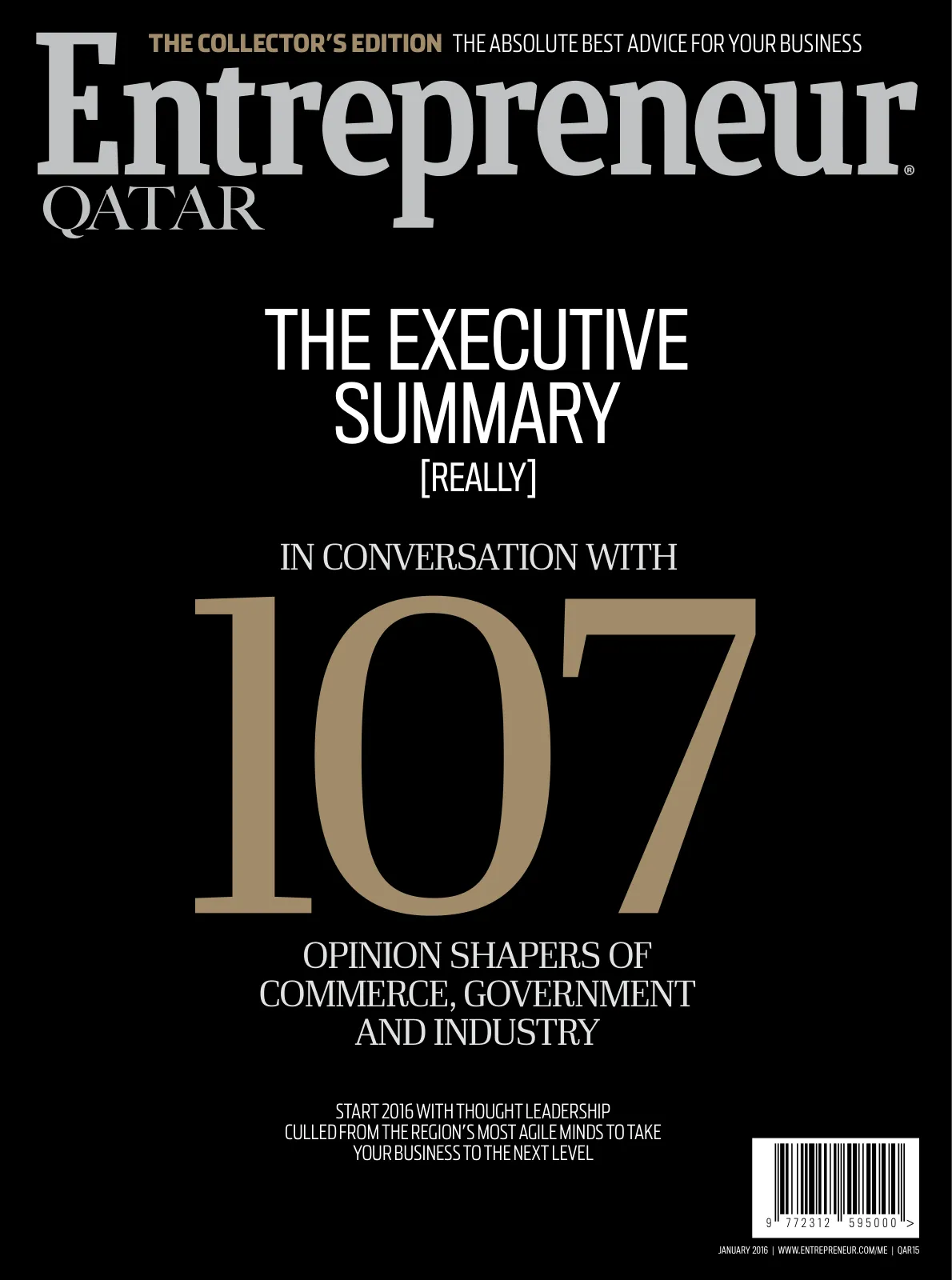
Entrepreneur Qatar, January 2016
Page 1
THE COLLECTOR’S EDITION The absolute best advice for your business
Start 2016 with thought leadership
culled from the region’s most agile minds to take
your business to the next level
107
OPINION SHAPERS OF
COMMERCE, GOVERNMENT
AND INDUSTRY
IN CONVERSATION WITH
THE EXECUTIVE
SUMMARY
[REALLY]
january 2016 | www.entrepreneur.com/me | QAR15
9
7 7 2 3 1 2
5 9 5 0 0 0 >
Page 2
Page 3
january 2016 Entrepreneur
3
CONTENTS
january 2016
33
Dr. R. Seetharaman
22
innovator:
THE EXECUTIVE
SUMMARY (REALLY)
IN CONVERSATION
WITH 107 OPINION
SHAPERS OF
COMMERCE,
GOVERNMENT AND
INDUSTRY
START 2016 WITH
THOUGHT LEADERSHIP
CULLED FROM THE
REGION’S MOST AGILE
MINDS TO TAKE YOUR
BUSINESS TO THE NEXT
LEVEL
• Andre Hattingh
• Dr. Mohammed Al
Zarooni
• Masood Mahmood
• Sami Al Mufleh
• Omar Christidis
• Dr. Fred Moavenzadeh
• Evgeny Kuzin
• Yogesh Mehta
• Ahmed Bin Shafar
• Bader Abdullah
Al-Darwish
• Arya H. Bolurfrushan
• Mohammed Abdul
Rahim Al Fahim
• Wissam Al Mana
• Suhail Algosaibi
• Sobhi Batterjee
• Ali Hashemi
• Loulou Khazen Baz
• Marianna Boguslavsky
• Sunil John
• Jean-Francois Manzoni
• Hazel Jackson
• M. Vasanth Kumar
• Mark Sephton
• Badr Jafar
• Simon Hudson
• James Caan
• Octavia Nasr
• Rahul Dhadphale
• Lama Bazzari
• Zeina El Dana
• Robert Carroll
• Imad Ghandour
• Lovrenc Kessler
• Afiya Khaled
• Arva Ahmed
• John Mullins
• Ali Haidary
• Nasser Sraiya Al-Kaabi
• Maha Abouelenein
• Raouf S. Ghali
• Sharene Lee
• Hassan Al Hazeem
• Dr. Kieran Mervyn
• Jumana Twal
• HRH Prince Khaled Bin
Alwaleed Bin Talal
• William Clay Ford Jr.
• Alexander McNabb
• Tamara Bullock
• Sami Khoreibi
• Jelena Jakovlijevic
Bin Drai
• Samar Nabulsi Abdul
Majeed
• Dana Khairallah
• H.H. Sheikh Maktoum
Bin Hasher Al Maktoum
• Dr. Shamsheer Vayalil
Parambath
• Ali Al Amine
• Dr. Maher Hakim
• Moutaz Al Khayyat
• Ramez Mohamed
• Genny Ghanimeh
• Camilla d’Abo and
Lucy d’Abo
• James Reynolds
• Martin Braddock
• Salina Handa
• H.E. Sheikha Bodour
Bint Sultan Al Qasimi
• Julia A. Stewart
• Clare Woodcraft
• Nisreen Shocair
• H.E. Noura Al Kaabi
• Ronnie Dabbasi
• Rasool Hujair
• Yusuffali M.A.
• HRH Princess Reema
Bint Bandar Al Saud
• Umberto Maria Cini
• Mahir Ali
• Omar Hikal
• Dipesh Depala and
Ayman Fakoussa
• Dany Farha
• Alexander Rauser
• James Dyson
• Nathalie Haddad
• Sahar Madanat
• Khalifa Saleh Al Haroon
• H.E. Sheikh Mohammed
Bin Essa Al-Khalifa
• Dr. S. Thomas Emerson
• Shahriar Khodjasteh
• Ethan Koh
• Roshni Shewakramani
• Dr. R. Seetharaman
• Amir Farha
• Samih Toukan
• Carlos Domingo
• Abed Bibi
• Farhan Al Jarba
• Imad Atwi
• Guy Deslandes
• Haneen Dabain
• Beschir Hussain
• Nickhil Jakatdar
• Rula Galayini
• Juan José de la Torre
• Tony Hchaime
• Ramanathan Hariharan
• Dr. Melodena Stephens
Balakrishnan
• Salma El-Shurafa and
Veronique Ademar
• Hasan Haider
• Dr. Rainer Behne
• Dr. Adnan Chilwan
Page 4
Entrepreneur january 2016
4
CONTENTS
january 2016
16
INNOVATOR:
Full speed ahead
Careem co-founders Mudassir
Sheikha and Magnus Olsson
on surging forward with
growth plans, staying true to
its founding values, and being
awesome.
100
START IT UP:
Q + A
Bringing the best out of the
GCC
Fouz Al-Sabah’s Kuwait-based
Khaleejesque is more than a
magazine, it’s a startup that is
seeing growth year over year.
98
START IT UP:
STARTUP FINANCE
Making your resources last
Owais Dilawer explains four
ways to decrease your venture’s
burn rate- this may come in
handy when potential investors
are checking out your books.
70
TECH:
SHINY
#TamTalksTech
Gadgets and doodads that you
might’ve missed out on, sourced
by a tech aficionado. Yes, it’s
okay to want them all… and no,
it’s not our fault.
72
TECH:
THE FIX
The future is… here
Ten technology trends that
(might) change our world in
2016. From artificially intelligent
everything to algorithmic
personality diagnosis, tech and
the application of that tech, is
changing quicker than you can
imagine.
76
‘TREPONOMICS:
ASK A PRO
Growing pains
Addressing succession planning
in the context of a family
business, and all the reasons why
you might need outside help.
64
‘TREPONOMICS:
MARKETING
Setting your enterprise on a
growth trajectory
Nicola Mendelsohn, Facebook’s
EMEA Vice President, talks
about how the platform can help
your small businesses scale up.
86
CULTURE:
TRAPPINGS
‘Trep gear
The executive selection for the
entrepreneur on your list that
has everything. Okay, maybe for a
little self-reward as well.
82
CULTURE:
LIFE
Business book rundown
Amal Chaaban reviews a few
business books for you before
you hit the bestseller aisle.
It’s true that not all executive
material is created equally.
66
CULTURE:
LIFE
Get focused for the year ahead!
Leap into 2016 with a clear mind,
and that means getting organized
at the most basic level- your
stuff.
12
EDITOR’S NOTE
By Fida Z. Chaaban
16 Mudassir Sheikha and Magnus Olsson, co-founders, Careem
26
William Clay Ford Jr.
Page 5
http://yamaha.com
Share All the Music,
Spread the Joy.
Connect with your music.
And keep your favourite music with you at all times.
Yamaha’s new network features make music
an even more integral part of your lifestyle.
Black
White
• Wireless music streaming via Bluetooth® or AirPlay.
• Passive radiator design provides
remarkably powerful bass output.
• Easy wall mounting, either vertically or horizontally.
• MusicCast app for simple operation.
WX-030 Wireless Streaming Speaker
Living Room
Kitchen
Private Room
a new world of wireless freedom
MusicCast App
Combine various compatible AV devices plus music
from your smartphone, and enjoy music throughout your home.
The same or different music, streamed to various rooms,
all in high-resolution―further expanding the joy of music.
Page 6
Entrepreneur january 2016
6
SUBSCRIBE
Contact subscriptions@bncpublishing.net to receive
Entrepreneur Middle East every issue
EDITOR IN CHIEF Fida Z. Chaaban editor@bncpublishing.net
MANAGING DIRECTOR Walid Zok walid@bncpublishing.net
DIRECTOR Rabih Najm rabih@bncpublishing.net
DIRECTOR Wissam Younane wissam@bncpublishing.net
PUBLISHER Nehme Abouzeid
MANAGING EDITOR Aby Sam Thomas
CREATIVE LEAD Odette Kahwagi
ONLINE LIAISON Kareem Chehayeb
COLUMNIST Pamella de Leon
COLUMNIST Tamara Clarke
COLUMNIST Shoug Al Nafisi
EVENTS LIAISON Mark Anthony Monzon
PO Box 502511 Dubai, United Arab Emirates
P +971 4 4200 506 | F +971 4 4200 196
For all commercial enquiries related to
Entrepreneur Middle East contact
sales@bncpublishing.net
All rights reserved © 2016.
Opinions expressed are solely those of the contributors.
Entrepreneur Middle East and all subsidiary publications in
the MENA region are officially licensed exclusively to BNC
Publishing in the MENA region by Entrepreneur Media Inc.
No part of this magazine may be reproduced or transmitted
in any form or by any means without written permission of
the publisher.
www.entrepreneur.com/me
Access fresh content daily on our website!
MIDDLE EAST
Printed by Raidy Emirates Printing Group LLC
www.raidy.com
EntMagazineME
@EntMagazineME | @Fida
Entrepreneur-me
EntrepreneurMiddleEast
EntMagazineME
EntMagazineME
EntMagazineME
Images used in Entrepreneur Middle East are credited when necessary. Attributed use of
copyrighted images with permission. All images not credited otherwise Shutterstock.
Lama Ataya
Abdulla Barakji
Amal Chaaban
James Clear
Owais Dilawer
Shelina Jokhiya
Ross McCammon
Rani Nasr
Soukaina Rachidi
May Rostom
Yousef ElSammaa
Mark Sephton
Dr. Per Stenius
Erika Widen
CONTRIBUTING WRITERS
In addition to our print edition, we’re bringing you all sorts of industry news
on our web mediums. Joining us online means getting relevant business and
startup content in real-time, so you’re hearing about the latest developments
as soon as we do. We’re looking forward to interacting with our readers on
all of our social media and web platforms- like any thriving business, we’re
looking to give and take. #TrepTalkME is already happening on all of our digi
platforms, and all good conversations go both ways. See you on the web!
Page 7
Page 8
Entrepreneur january 2016
8
EDITOR’S NOTE
E
ntrepreneurs, when I use
the acronym MVP here, I
am not referring to your
Minimum Viable Product,
I’m referring to your Most
Valuable Player. Every company has
a seriously exceptional team member
(at least I hope so). This person can
be distinguished by several stand-out
attributes, some of which are as fol-
lows:
1. Your MVP is deeply and truly
(emotionally) invested in the
company. By this, I mean an emo-
tional allegiance with a solid founda-
tion of loyalty, not a financial invest-
ment. This person stays with you
and your company despite the fact
that better opportunities with more
money and resources are presented.
Your MVP could easily take the job
with less hours and more cash, but
they don’t- because they want to see
your enterprise on the up and up, and
MVPs know that his or her presence
is needed to make that happen.
2. Your MVP is willing to
suffer injustices and still
hangs in there. Let’s be honest, no
working environment is perfect and
while I don’t condone it whatsoever,
things in startups sometimes get
excessively tense and even volatile.
Your MVP might freak out, but they
weather the storm and stand by you
and your company, despite having
been treated poorly in the past.
3. Your MVP is not afraid
to tell it like it is, even if
it will cost them their job.
Honesty and bravery are two things
that money cannot buy. Entrepre-
neurs, you must surround yourself
with people who are determined and
honor-bound to tell you the (ugly)
truth. When you are in a position of
success and power, there is always
the risk that those around you can
become sycophantic and perhaps
even self-serving in that sycophancy.
This sounds Game of Thrones-y, and
maybe it is, but it might be the very
thing that saves you and your com-
pany (each and every time).
If you, as a business owner, don’t
have an MVP, then there’s no time
like the present to remedy that void
since the greatest companies are built
by the greatest people. If you already
have your MVP, make it your absolute
first priority to ensure that they are
treated with the respect, and that you
genuinely protect and preserve that
deep commitment by returning devo-
tion in kind. Quid pro quo.
P.S. As an aside, in our case, I’m fortunate
in the regard that every team member
of Entrepreneur Middle East is truly
exceptional and they are all willing to go
above and beyond the call of duty. To be
honest, if they weren’t, they wouldn’t be
part of my team. I only choose exceptional
people, and I’d rather be short staffed
(which we severely are), than hire a whole
bunch of people who see our company as
just another place to collect a pay check.
Thank you to my team for your tireless
contributions- I hope I can continue to do
your work justice.
Going to great lengths for your team
is in your best interest
Protecting your MVP
Fida Z. Chaaban
Editor in Chief
@fida | @fidazchaaban
editor@bncpublishing.net
Page 9
Terms and Conditions apply. Above prices are based on a low down payment.
Call Us Now: 4455 8709
Cadillac.mannaiautos.com
Opening Hours
Sunday to Thursday 8.30 AM to 8.30 PM
Saturday 9.00 AM - 12.00 PM / 4.00 PM - 7.00 PM
EXCEED EXPECTATIONS. DRIVE A BRAND NEW CADILLAC.
LEASE
N OW
STARTING FROM
QR.2,999 / 24
PER MONTH
MONTHS
L E AS E
N OW
STARTING FROM
QR.1,999 / 24
PER MONTH
MONTHS
2015
ATS
2015
CTS
- SERVICE AND MAINTENANCE FOR 4-YEARS / 100,000 KM
- REGIONAL ROADSIDE ASSISTANCE FOR 4 YEARS*
- COURTESY TRANSPORTATION
- AIRPORT PICK-UP AND DROP
- WARRANTY FOR 4-YEARS / 100,000 KM
*TERMS & CONDITION APPLY
Page 10
Entrepreneur january 2016
10
Since its establishment in
Dubai in 2012, Careem has
seen its business grow at a
rather rapid pace- it today
has a presence in more than
20 cities spread across the
Middle East, and now, Af-
rica and Asia as well. (That
pretty much explains why
Careem was declared the
Fastest Growing Enterprise
at Entrepreneur Middle
East’s 2015 Enterprise Agil-
ity Awards.) In November
last year, Careem secured
a Series C investment of
US$60 million with The
Abraaj Group as the lead
investor- this third round of
funding follows investments
made by other entities like
Al Tayyar Travel Group, STC
Ventures, BECO Capital,
Impulse, Lumia Capital
and Wamda Capital. While
getting Abraaj –which man-
ages $9 billion in assets
around the world- to back
the Careem enterprise is an
achievement by itself, it’s
also worth noting that the
investment is one of the
largest ones of its kind seen
in this region, with Olsson
Careem co-founders Mudassir Sheikha and Magnus Olsson on surging
forward with growth plans, staying true to its founding values, and
being awesome By Aby Sam Thomas
I
n the spirit of full disclosure, I must admit that I walked into my interview
with Careem co-founders Magnus Olsson and Mudassir Sheikha with
a view to somehow rile them up- please note that this was not because
I had a personal vendetta against them, but more because I wanted to
see if I could get them to be anything other than the remarkably consistent
media portrayal of them as being, well, just really likeable personalities. But
barely a few minutes into my conversation with the two entrepreneurs, I
realized that my attempts at rustling them up would be to no avail- I found
Olsson and Sheikha to be, quite simply, just really nice folk, whose pervasive
belief in the notion of being careem –Arabic for generous- governing
how they interact with others around them, and also how they run their
eponymous startup enterprise, the car-booking service, Careem.
Page 11
january 2016 Entrepreneur
11
and Sheikha claiming the
potential magnitude of their
venture justifies the amount
of funding made in the same.
After all, Careem had seen
month-on-month growth of
over 30% in its core mar-
kets in the last three years-
and so when they began
their latest funding round,
the co-founders were clear
on wanting a substantial
investment to further scale
Careem up. “If you look at
our peers in other markets,
they are raising hundreds
and hundreds of millions of
dollars,” Sheikha says. “So,
at that point, we said, let’s
look for an investor that
has that kind of financial
capability to come on board,
write a big check, and also
write even bigger checks in
the future if required, so as
to basically grow into the
massive opportunity that
this [enterprise] presents.
And that’s where Abraaj
came on the map- they are
one of the few people in this
region who can write these
kinds of checks. And not
only can they write the big
checks, they are also quite
connected in the region. So
when we looked at our next
big markets –after Saudi
Arabia, we were looking at
Egypt and Pakistan- and
Abraaj is quite strong in
both of these markets. So
that reinforced the value
that they would bring on
board as an
investor.”
For those of
us watching
the on-demand
industry in the
Middle East,
the sheer size
of Careem’s
latest funding
round (and,
of course, the
value that the
Abraaj name
by itself will
bring to the
brand) has
caused us to
take a renewed
interest in
the company’s rivalry with
fellow car-booking service
Uber, which started opera-
tions in this region in 2013.
It is perhaps ironic then
that Careem has often been
referred to as the Uber of
the Middle East, a descrip-
tion, which, while helpful
in increasing exposure and
awareness, both Sheikha
and Olsson don’t seem to
be entirely comfortable
with. “To be honest, I feel
it undermines a lot of what
we are doing,” Sheikha says.
“This is my personal feeling.
Because if you look at how
we started the business
three years ago- when we
started, we didn’t say, let’s
see what’s happening in the
rest of the world and bring
it to the Middle East. Our
origin was: let’s find a local
problem, and solve that local
problem. That’s where we
started. Since we were con-
sultants [with McKinsey at
that point of time], we were
constantly traveling, [and]
the problem [we settled on
fixing] was transportation.”
Sheikha explains how
Careem started off as a
corporate-focused website
that would allow people to
pre-book vehicles to take
them to their required
destinations- the company
eventually moved to target-
ing the general public with
its service, but even then,
the idea was to do it in a
way that made sense for
this particular region. “So
the whole operating model
that provides this service
is quite different,” Sheikha
declares. “We have call cen-
ters, for example, that not
only support the customer,
but support the captain as
well- because we believe
that to offer a reliable and
accessible service in these
markets, you need that abil-
ity. We realized that maps in
this region are not accurate-
so we actually built our
own maps. We spent a tre-
mendous amount of time in
training and coaching these
captains, who may not be as
sophisticated as they might
be in other markets- people
take them for granted. So
when people say Careem is
the Uber of the Middle East,
it doesn’t recognize how
we started and the whole
mindset that we have of
solving local problems- it
sounds like we’re copying
something, which is not re-
ally what we have done, and
which is not the way that we
operate internally. Because
if we copy someone, then we
don’t think we’ll succeed-
we won’t win. You cannot
do something better than
someone else who came up
INNOVATOR
“If you look at
how we started
the business three
years ago- when we
started, we didn’t
say, let’s see what’s
happening in the
rest of the world
and bring it to the
Middle East. Our
origin was: let’s find
a local problem,
and solve that local
problem.”
Mudassir Sheikha and
Magnus Olsson,
co-founders, Careem
Careem
captains are
tasked with
delivering a
great customer
experience
>>>
Page 12
Entrepreneur january 2016
12
with this thing, right. So we
believe that the reason we
have done so well is because
we have always focused on
solving local problems, and
the way we will win in the
future is again [by] focusing
on solving local problems,
as opposed to trying to see
what others are doing and
copy them for these mar-
kets.”
Careem’s origin story
began when both Olsson
and Sheikha had reached a
point in both their lives and
careers where they felt the
so-called entrepreneurial
itch- while Olsson had, at
the time, just gone through
surgery to fix a brain
aneurysm and was then
looking to “find his purpose
in life,” Sheikha was want-
ing to move away from his
career as a consultant and
do something different and
more “meaningful” instead.
The two then banded to-
gether and decided to focus
on building something that
would solve an actual local
problem. As consultants
who traveled a lot in this
region, Olsson and Sheikha
had seen, firsthand, the dif-
ficulties of getting around in
the cities they were posted
in –problems ranged from
unreliable service times to
chauffeurs (or as Careem
calls them, captains) who
simply didn’t know where
to go- and after quite some
review and consideration
of other potential business
opportunities, the two en-
trepreneurs zeroed in on this
particular issue and how it
could be fixed. It’s interest-
ing to note that the two
co-founders claim to have
not been focusing on just
the business potential when
they thought of Careem-
they were very emphatic on
wanting to create a bigger
impact with whatever it is
that they developed for the
region.
“We wanted to build
an institution,” Olsson
remembers. “We wanted to
build something that can
be big, and something that
can be meaningful. Let’s
create meaning in how we
do things. So that’s why
we said: we wanted to be
careem to our customers, we
wanted to be careem to our
captains, and we wanted to
be careem to our colleagues.
In short, on the customer
side, we wanted to build
an organization that can
deliver really, really awe-
some products and services.
Because we feel there’s not
a lot of such place here, we
wanted to set the bar really
high, and deliver excellence.”
According to Olsson, this
mission statement basically
drives all of what Careem
has done, and continues
to do, in the Middle East.
For instance, with respect
to customers, Careem has
built a sturdy app that is
easy and convenient to
work with- the technology
1. “Solve local problems.”
Focus on solving problems
specific to where you are
located, instead of trying to
copy other enterprises may
be doing in other parts of the
world.
2. “Hire awesome,
awesome, awesome,
awesome people.”
Make your people part of your
business’ journey; make them
part of its success as well.
3. “Stay focused and
agile.”
Keep your eye on building one
profitable business, instead of
dabbling in a variety of them
and losing your focus.
4. “Iterate like crazy.”
Be receptive to customer
feedback, and utilize it to build
a better version of what you
may have originally envisioned.
5. “Do what you do really,
really well.” Deliver
on what you promise your
customers- and exceed their
expectations. If you can do that,
then that’s amazing.
6. “Stay incredibly lean
and bootstrap.”
Not only will it allow you to live
longer before you need capital,
but it forces you to do the right
thing, forces you to focus,
forces you to prioritize.
7. “Find people who
can bring in more than
money.”
When looking for investors,
look for ones who can provide
you with smart money- they
should be as committed to
growing the business as you
are.
8. “When raising funds,
start early.”
Build a relationship with
investors even before you need
the money- this will help you
shape the product and business
you’re building, and this will
give them the opportunity to
see you in action as well.
Careem co-founders offer tips and tricks for those
of you with the entrepreneurial itch
Mudassir Sheikha and Magnus Olsson
Start up like a pro
INNOVATOR
Careem had seen
month-on-month
growth of over 30% in
its core markets in the
last three years- and
so when they began
their latest funding
round, the co-founders
were clear on wanting
a substantial invest-
ment to further scale
Careem up.
Page 13
january 2016 Entrepreneur
13
aspect of it is quite stellar.
Careem has also placed a lot
of importance on providing
excellent customer service-
Olsson says he wanted to
blow people’s minds with
what the company offered
in this respect. “Customer
service in this region is
somewhere between terrible
and non-existing,” he says.
“It’s because people are not
empowered, not trained- it’s
not their fault; it is what it
is. And so we said, we want
to set a completely new bar.”
Careem’s captains are
another factor in how it
has managed to stand out
as a startup enterprise- the
company has invested a lot
in training and educating all
of the captains with them,
and the results are there for
everyone to see. Sheikha says
that given the unfortunate
way this workforce has often
been treated (and regarded)
in this region so far, Careem
made it a priority to impact
their lives in a better man-
ner- and this made sound
business sense as well. “It is
a deeply held passion to help
improve their lives; it’s what
makes it meaningful for us,”
Sheikha explains. “And at
the same time, a happy cap-
tain makes a happy custom-
er. So the thing is it’s very
good for business as well.
These people are, by the way,
the single most important
factor in the quality of ser-
vice you get: the app would
be super amazing, and the
cars will be very, very nice as
well, but if the captain does
not give good service, doesn’t
treat you well, doesn’t open
the door for you, does not
make you comfortable in
the car, then everything else
is immaterial. And if he’s
not happy, then he cannot
deliver amazing service. So
we recognize it is business as
critical as well to make sure
that we look after them and
keep them happy, for them
to deliver the kind of service
that we want delivered to
our customers.”
As for being careem to
their colleagues at Careem,
Olsson and Sheikha say they
wanted whoever worked at
the company to feel empow-
ered, and not see their work
there as being just a job. “At
the end of the day, we need
our people to be part of our
success,” Olsson explains.
“So, at Careem, from day
one, everyone at Careem
has stock options- from the
most senior team to the
most junior person, everyone
has stock options. It is our
way to kind of actually say
everyone here is an owner.
It is one of our core values
as well. So that’s what we
are trying to do. This is the
mission of Careem: it has
always been there with us,
to do something meaningful
and big. Recently, we re-
articulated our mission, and
it is to simplify and improve
the lives of people, and to
build an awesome organiza-
tion that inspires. If we can
inspire our customers, our
captains, our colleagues,
but also outside in our
ecosystem –that’s what we
are quite excited about, get-
ting involved in the broader
ecosystem as well- if Careem
can be something that in-
spires someone to go out and
do something cool, that’s
awesome.” >>>
“From day one,
everyone at Careem
has stock options-
from the most senior
team to the most
junior person... It
is our way to kind
of actually say
everyone here is an
owner.”
Page 14
Entrepreneur january 2016
14
As Olsson and Sheikha told
me about all of the prin-
ciples and goals of Careem,
I couldn’t help but wonder
about the materialistic part
of it all: shouldn’t making
money have been a priority
too when laying out the
company’s ambitions?
“There is a fundamental be-
lief [we have] that if we do
the right thing, then money
is a byproduct,” Sheikha
replies. “The focus is not on
money- the focus is on im-
pacting the lives of people,
and building an awesome or-
ganization that inspires. And
if we get there, other things
will follow- shareholders
will make money, people
here will make money- we’ll
be fine. But let’s not focus on
money. It’s the wrong focus-
it makes you do things that
are short-term, it makes you
do things that are not right.
The focus has to be on doing
the right thing, and taking
a look at the long-term
success of this venture.”
Olsson also points toward
the nature of the industry
they work in: “If you just
look at the economics of the
business, it is a low-margin
business. So, essentially,
you need to have quite a
lot of scale for you to break
even. And that scale will not
happen overnight, but you
need to get there fast. And
so that’s why we are com-
pletely crazy, gung-ho about
growing. So that at some
point we reach a scale where
we can fund ourselves- this
will be great. But until we
get there, we’ll need help
from external investors,
which means that you need
to be both mindful of your
spending, and you need the
support from investors. So
you need to keep them ex-
cited. So, of course, we care
about the path to becoming
self-sustainable, where we
can generate our own means
to go where we want to go.
Once we get there, this will
bring money for the employ-
ees, for the investors, for ev-
eryone- but it’s in that kind
of perspective.” So when
do the co-founders think Ca-
reem will break-even? “The
business plan always had a
multi-year journey to break-
ing even,” Sheikha says.
“In the current [scenario],
we’ll probably need funding
for another couple of years
before the business breaks
even. So it’s still in that
journey to build scale until
this breaks even. So yeah, a
couple more years is what
we expect.”
To give the enterprise its
due, Careem certainly does
not seem to be taking things
slow in its roadmap to
breaking even. Sheikha and
Olsson reveal that further
expansion is on the cards-
this includes increasing
their presence in markets
Careem is already in (cities
like Dubai, Jeddah, Riyadh
and Cairo), and also intro-
ducing its service to smaller
cities in these countries
as well. “We are realizing
there’s an opportunity in the
second-tier cities,” Sheikha
explains. “For example, re-
cently we opened in Mecca,
Medina, Jubail; these are
the next tier cities in Saudi
Arabia. Similarly, there are
some big cities that are still
missing or quite small in our
roadmap- so, for instance,
we are making a big push in
Pakistan; Karachi, Lahore
are on the roadmap. We just
launched in Lahore; we’re in
the process of launching in
Karachi in a big way now.”
Also on Careem’s agenda
is to broaden its offerings
in terms of its services.
“There’s an opportunity
to do more things with
this platform- that
is, we are currently
moving people; we can
start moving things as
well,” he says. “And
while that is not a big
priority at this time, we
recognize that we need
to start learning about
those opportunities
as well. So there’s a
product development
expansion, coming up
with new products and
services that leverage
the infrastructure that’s
already been built.”
Careem has begun
work on this front
already- its potential in
logistics was on show when
it delivered Christmas trees
around Dubai during the
holiday season last year, and
plans are afoot on utilizing
Careem’s fleet of vehicles
and captains to collect cash
payments from customers of
e-commerce enterprises in
the region. The road ahead
for Careem thus looks to be
one filled with a lot of prom-
ise and opportunity- and
with the likes of Sheikha
and Olsson at its helm, this
enterprise seems to be set
for a smooth ride ahead.
INNOVATOR
By the numbers
The Careem timeline
July 2012 Careem is launched by
co-founders Mudassir Sheikha and
Magnus Olsson
September 2013 Careem secures
funding of $1.7 million in a round
led by STC Ventures
December 2014 Careem secures
funding of $10 million in a round
led by Al Tayyar Travel Group and
STC Ventures
January 2015 Careem acquires
Saudi Arabia-based home delivery
service Enwani; its CEO Abdullah
Elyas joins Careem as co-founder
November 2015 Careen secures
funding of $60 million in a round
led by The Abraaj Group
In November last year,
Careem secured a Series
C investment of US$60
million with The Abraaj
Group as the lead investor-
this third round of funding
follows investments made
by other entities like Al
Tayyar Travel Group, STC
Ventures, BECO Capital,
Impulse, Lumia Capital and
Wamda Capital.
Page 15
Page 16
Entrepreneur january 2016
16
innovator
The Under Secretary of the Ministry of State for Youth Affairs
won’t let the country’s entrepreneurs go it alone
H.E. Sheikha al-zain sabah al-naser al-sabah
is fighting the good fight
ADVOCATING
AGILITY
By Fida Chaaban
Entrepreneur november 2015
16
Y
ou have to have skin in the game. The reason that we’re seeing a lot of government
consultants coming to the region and then little-to-no change is because they don’t
have skin in the game. They’re contracted by these governments, they consult, and
then they go home. They aren’t part of the implementation process- and that self-
interest to make sure it happens isn’t there. If you don’t have a vested interest in seeing
this work through, all these recommendations come to nothing.” This is Kuwait’s Under Secretary
of the Ministry of State for Youth Affairs H.E. Sheikha Al-Zain, and she does have skin in the game.
The game she’s talking about –building an entrepreneurial ecosystem- isn’t a spectator sport.
You’re either all about kickstarting Kuwait’s economy –from a grassroots level- or you’re not on her
team, and you never will be. You’ll even become persona non grata, and she won’t be deterred from
calling you out for what she considers your inaction, no matter who you are. “We have the largest
SME fund now in the world; the mandate came out about two years ago. They haven’t done any-
thing yet with it, and that’s the problem. I can sit and draw up strategies and action plans and then
mood board it all and make it look beautiful, but if I don’t action it, then what’s the point?” >>>
“
Page 17
january 2016 Entrepreneur
17
november 2015 Entrepreneur
17
Page 18
Entrepreneur january 2016
18
There is always a question
that hangs in the sidelines for
our readers when we cover a
figure of government who is
also often of a royal bloodline.
I’m sure that same question is
on your mind now: “Did she
interview Al-Zain because she’s
a Sheikha, and they were after
a glitzy, high-profile cover?”
The answer is no. I aggressively
pursued this interview with
H.E. Sheikha Al-Zain Sabah
Al-Naser Al-Sabah because
she’s forthright and outspoken,
genuinely experienced in entre-
preneurship in both personal
and professional capacities,
and because she is currently
(legitimately) working herself
and her team at the Ministry
into a frenzy trying to support
and strengthen the small but
determined Kuwaiti entrepre-
neurial ecosystem. She’s not
big on personal publicity, and
she doesn’t leverage her family
name -quite the opposite, as
you’ll see later- since being a
royal is often a double-edged
sword. Frankly, she’s so busy
advocating for the advancement
and strengthening of youth
potential that at the time of
this interview at the Ministry in
Kuwait City, she dashed into the
room breathless and apologetic
for her lateness. (For those of
you who don’t know – and I
say this from experience- those
born to extreme privilege are al-
most never apologetic, and they
are also almost never breathless
with overwork and/or overex-
tension of resources.) So, when
you read the rest of this feature
interview that was six months
in the making, you’re going to
have to trust me when I say that
being on the cover of Entrepre-
neur Middle East means that
this person has the guts (with
often little or no glory to speak
of), and has captured my atten-
tion because of her actions (not
just talk).
Al-Sabah is a
charismatic
and compelling
speaker (pos-
sibly stem-
ming from her
professional
background as a
broadcast jour-
nalist working
with the likes of
Peter Jennings,
and later as an
entrepreneurial
indie filmmaker and producer)
but I’ve met lots of those, and
speaking doesn’t mean that you
are actually doing something.
What she is doing is called an
“entre-government,” and it’s
a term she coined during a
speaking engagement in Spain
to describe what her Minis-
try does. “The idea is that an
entre-government brings in
creatives, entrepreneurs, people
from the private sector, who
can leverage limited resources
to invigorate and disrupt an
immobile system. Government
systems are built to stagnate,”
says Al-Sabah. Anyone who has
dealt with the bureaucratic red
tape of governments that count
national resources as the base
(and often the sole driver) of
their respective economies has,
with certainty, faced a myriad of
unnecessary blockages, frustra-
tions with archaic and irrele-
vant rules, and has likely stared
a stubborn and myopic public
servant in the face at least once.
After producing content and
scripts for ABC during her time
in the U.S., Al-Sabah came back
to Kuwait and dealt with this
governmental quagmire first-
hand. “I went to the Ministry of
Information to apply for a job in
1997. After years in Boston and
New York, coming home was a
shock. Staying in the Ministry
for a year and a half taught me
what needed to be fixed, what
it was like to be stuck in the
system, how frustrating it was
waiting a week for a stamp on
some document, and seeing all
of the red tape. That on-the-job
training was invaluable,” and it
later helped her devise the Ku-
waiti entre-government schema
that’s now being actioned.
“This Ministry is the perfect
example of the pilot of an entre-
government. Do more with less!
We have budget constraints,
and Kuwait is finally, with the
establishment of this Min-
istry, starting to understand
that youth is the new oil. To
propel the system forward, you
need to inject energy. Nobody
knows how to do it better and
do it with less resources, than
entrepreneurs and people
that have worked in startups,
SMEs, and fresh grads.” The
Ministry of State for Youth Af-
fairs currently employs a team
of 82, but they started off in
one room as a meagre team of
three. “I literally had to sell this
Ministry to people. This is your
service to your country- if you
have something to give, come
give it here. I wanted to infuse
new spirit by bringing in fresh
graduates. Come serve your
country then migrate back to
private sector. I was pitching it
to everyone- that was my hard
sell. The Kuwaiti government is
trying to get people to go to the
private sector, since upwards of
80% are employed in the gov-
ernment. This cradle to grave
mentality is really pervasive
here.” She sees the Ministry as
a full-on startup since it was
established from nothing, and
Minister of Information and
Minister of State for Youth
Affairs H.E. Sheikh Salman
Sabah Al-Salem Al-Homoud
Al-Sabah charged Al-Zain with
recruiting a team, setting out
Ministerial directives and the
path to turning those directives
into tangible successes, and
even finding a physical space
for them to work out of. “We’ve
been in operation for a year and
nine months, and hamdulillah,
Editor-in-Chief Fida Chaaban interviewing Sheikha Al-Zain
at the Ministry for Youth Affairs in Kuwait.
innovator
“The idea is that an entre-
government brings in
creatives, entrepreneurs,
people from the private sector,
who can leverage limited
resources to invigorate and
disrupt an immobile system. “
“What we’re doing
today is starting from
a solid base line of
information. [...] We’re
going to develop a
holistic national
youth policy, and
anyone that wants to
work with youth will
have to abide by this.”
Page 19
january 2016 Entrepreneur
19
we’ve managed to find a loca-
tion, and as much as possible
recruit the best team who were
all willing to leave the private
sector and come to the public
sector to help Kuwait.”
Al-Sabah is shouldering an
immense responsibility to really
deliver on her promises, since
the Ministry of State for Youth
Affairs is the youngest in the
Kuwait government. The Under
Secretary now has to continue
to demonstrate that it is in fact
needed, and more than needed,
it’s actually going to be effective
despite the fact that she has
developed a highly unorthodox
formula, and she’s pretty much
doing everything differently
than anyone in the existing gov-
ernment sectors is even familiar
with. She had to fight for this all
to materialize, and that’s no se-
cret. “I think we’ve gained quite
a lot of traction- young men and
women have joined this Minis-
try from the private sector. The
average age is 25 here and it’s
a startup in every way, shape,
and form. The fact that we have
people that wear our logo, our
badges, to come to work makes
me proud and happy because
it means that they are sold on
our concept. That gives me the
visual that I want- where I see
this mobilized army of people
that are doing all they can to
build this country.” Al-Sabah’s
team “preaches” according to
her, and I was able to verify
that they are in fact supremely
evangelical in their zeal for this
Ministry to work- a lot of this
passion, according to Al-Zain,
was born from the anger and
hopelessness stemming from
the inertia of the intractable
Kuwaiti establishment. A lack
of prospects, a bevy of wasted
young talent, and just seeing
no place for bigger dreams and
innovative thinking -as clichéd
as that might sound- served as a
catalyst, lighting a fire under Al-
Sabah and her millennials.
This same waste of talent and
lack of innovative avenues and
channels of modern industry
hits the Middle East right where
it hurts most: in the pocket-
book. It actually robs the region
of financial leaps forward in
terms of opportunity cost, and
it also makes dangerous and
detrimental alternatives seem
like viable ones. Al-Zain is
determined to stem the flood,
and she says this is exactly why
Kuwait must be proactive in
approach: “ISIS has built the
ultimate brand. The reason they
have penetrated so well with
this brand is the disenfran-
chisement that youth across
the [MENA] region feel. It’s so
glamorous the way ISIS have
marketed this idea.” One step
in her fight against preventing
more onboarding of recruits to
what is now arguably consid-
ered the MENA region’s biggest
problem? A two-tier initiative
that begins with a nationwide
THE NATIONAL YOUTH
SURVEY OF KUWAIT
www.youth.gov.kw
“What we’re doing today is start-
ing from a solid base line of in-
formation. It’s a whole ecosystem
that we need to develop. What’s
more important is now that I’ll
have the data, what am I going to
do with it? We’re going to develop
a holistic national youth policy,
and anyone that wants to work
with youth will have to abide by
this.” What Al-Sabah means by
“holistic” is that all governmental
and nongovernmental entities
that intersect with youth in any
way will be part of this process
to try and meet the myriad spec-
trum of needs of Kuwait young
people. The goal? To give people
with potential avenues to realize
it to the fullest, to address and
improve upon weaknesses, and
to eventually foster an economic
climate that champions vibrancy
and combats economic inertia.
According to Al-Sabah, Kuwaiti
entrepreneurs need development
of “infrastructure, mentorship,
even healthcare. Access is limited.
[The Ministry] bridges relation-
ships; we have a department
called Business Pioneers Rayidat
Al-Aaaml, and their job is to
create this ecosystem. We based
our departments on a lifecycle
approach –it’s very out of the box
for government- we have the pro-
ject sector and the development
sector.” She admits that they have
bitten off more than they can
chew, and says that “the other
Ministries are not doing their
jobs- from health to education
to the Ministry of Islamic Affairs.
If they were, we wouldn’t have
seen recruits going to Daesh.” Al-
Sabah admits that pitching this
concept of her entre-government
was extremely difficult- the
existing government entities
and governmental structuring
elements didn’t “understand it all.
When I pitched it, it wasn’t even
like, ‘What?” It was like, ‘No.’”
“I literally
had to sell
this Ministry
to people.
This is your
service
to your
country- if
you have
something
to give, come
give it here.
I wanted
to infuse
new spirit
by bringing
in fresh
graduates.”
Sheikha Al-Zain Al-Sabah speaking at the 8th MIT Pan Arab Conference in Kuwait. Her Excellency also acted as a judge for the Startup Track competition.
>>>
Page 20
Entrepreneur january 2016
20
innovator
youth survey and followed by
the development of a compre-
hensive youth policy based
on the results of the collected
research. The youth survey
has a six-month timeline of
execution, and the development
of the national youth policy is
slotted to take an additional
six months post data analysis. I
tell Al-Sabah that it sounds like
a very ambitious timeline for
such a large scale undertaking,
but she is emphatic and will not
be deterred: “We don’t have the
luxury of being anything but
ambitious! A lot of people ask if
I have a kamikaze streak in me.
I do, because at this time we
don’t have any other option. We
can’t and won’t move forward
with anything to do with youth,
especially with all of these
factors in play –ISIS, drugs-
without the accurate data and
structure to do so.”
Having worked in the private
sector for over 16 years before
she joined the Ministry, Al-Sa-
bah is used to fast progress and
results, and in that regard, she
has seen some movement al-
ready. “We do have quick wins:
we’ve supported more than 300
youth projects in different cat-
egories from tech, science and
health, to arts and culture. We
have so many projects that re-
volve around entrepreneurship
and incubating and cultivating
talent. We’re on the ground, and
we’re using digital and outreach
efforts nonstop- we will do
anything that we need to do to
make this happen for Kuwait.”
And after being there and seeing
her tenacious campaigning,
hearing her pitch deck, Al-Zain
Al-Sabah sold me on the hard
sell: Kuwait’s entrepreneurs will
no longer have to go it alone.
“Perceptions before the war
and after the war were differ-
ent. Before the war, it was that
you were part of the enclosed
network- you were expected
to finish high school, maybe
college, then get married.” This,
according to Al-Sabah, is what
mindset she was dealing with
when she broke the news to her
family that she’d be pursuing
film school after her success-
ful period as a journalist. This
led to her first entrepreneurial
endeavor, co-founding Eagle
Vision Media Group KSCC, and
served at the company’s helm
as Chairperson and Managing
Director.
Al-Sabah could have been a
socialite, even during her time
as a refugee in London during
the Iraqi-Kuwait war. “I was
in 11th grade at the time, and I
was supposed to start school.
This whole question mark that
everything could just stop in
an instant is what prompted
my need to do something with
myself. I felt helpless and pow-
erless seeing CNN’s coverage of
Kuwait during that period, and
their portrayal of the Kuwaiti
people. It was all so inaccurate.”
For context, as a refugee, like
many others who fled the war in
Kuwait, Al-Sabah wasn’t able to
go to school and since her fam-
ily’s accounts were frozen, she
had to request the Embassy’s
assistance in paying for her
education. Al-Sabah made
herself visible at the Embassy
by volunteering while constantly
haranguing them to put her in
school. Her persistence paid off,
and she finished high school in
London, later attending Boston
University’s School of Journal-
ism.
During her career in New York,
she met one of her personal
goals: structuring the global
narrative about the Middle
East. “When Peter Jennings
would send me a story about
Palestine and Israel and I knew
it didn’t make sense, I was in
the position to tell him it didn’t
make sense and actually write
a script that did.” One of the
most influential broadcasters
in the history of TV, ABC News
headlined by Jennings on World
News Tonight was a program
that shaped global opinions.
After returning to Kuwait,
she decided to pursue film
professionally but wanted to get
formal education in the disci-
pline first. “I went through this
whole arduous process to get
a scholarship for my Master’s.
Even my family was like, ‘Zain,
film? What’s this?’ Journalism
was considered prestigious,
but filmmaking was seen as
frivolous. I got the scholarship
from KU. In Kuwait, one of the
really good things here, was
that they put us through a really
intensive scrutiny process. It
was quite objective, otherwise
they wouldn’t have given it to
me. I went to USC, and got my
film degree.”
Film is a very difficult space
to break into professionally,
and Al-Sabah struggled just like
other entrepreneurs to gather
investors: “I didn’t have a safety
net. There was more at stake
for me- my family name was
at stake both here and abroad.
The fact that my family’s name
came into play- if they knew my
last name, they wouldn’t give
me [an investment], because
they assumed I had [the capi-
tal].” She didn’t, and success-
fully managed to follow through
on her plans to be the story-
teller with accurate narratives
about the Middle East. She first
opened a production company
in Los Angeles with partners,
and later in Kuwait. “We did
some films that made the
rounds at festivals,” with some
being recognized as cultural
contributions.
Next on her agenda was form-
ing an incubator based on a
free and open exchange concept
for youth in cultural endeavors.
It didn’t work. “When you’re
coming in from outside, the wall
was impenetrable” and together
with the creatives, she retreated
further in. While she describes
this as a happy time, she now
reflects on it as one more
reason to fight for this overhaul
of Kuwait’s establishment- so
young people with talent and
potential don’t retreat, and
instead are an active driver of
an economy sorely in need of a
new enterprise injection.
“We have so many
projects that revolve
around entrepreneur-
ship and incubating
and cultivating talent.
We’re on the ground,
and we’re using digital
and outreach efforts
nonstop- we will do
anything that we need
to do to make this hap-
pen for Kuwait.”
PERSISTANCE IN ALL
THINGS PAYS DIVIDENDS
IN RESULTS
GET TO KNOW
AL-ZAIN AL-SABAH
Page 21
Terms and Conditions apply. Above prices are based on a 20% down payment and subject to banks approval.
Call Us Now: 4455 8709
Cadillac.mannaiautos.com
Opening Hours
Sunday to Thursday 8.30 AM to 8.30 PM
Saturday 9.00 AM - 12.00 PM / 4.00 PM - 7.00 PM
OWN IT
TODAY
STARTING FROM
QR.2,999 / 4
PER MONTH
YEARS
EXCEED EXPECTATIONS.
DRIVE A BRAND NEW CADILLAC.
2016 SRX
- SERVICE AND MAINTENANCE FOR 4-YEARS / 100,000 KM
- REGIONAL ROADSIDE ASSISTANCE FOR 4 YEARS*
- COURTESY TRANSPORTATION
- AIRPORT PICK-UP AND DROP
- WARRANTY FOR 4-YEARS / 100,000 KM
*TERMS & CONDITION APPLY
Page 22
Entrepreneur january 2016
22
Start 2016 with
thought leadership culled
from the region’s
most agile minds to take your
business to the next level
107
OPINION SHAPERS OF
COMMERCE, GOVERNMENT
AND INDUSTRY
IN CONVERSATION WITH
THE EXECUTIVE
SUMMARY
[REALLY]
O
ver the past two years, we’ve connected with
some of the most effective and influential
figures of commerce, government and industry
to bring you the absolute best advice for you as an
entrepreneur or an executive, and for your busi-
ness, no matter the sector, no matter the size. From
big companies to microenterprises, there is always
something new that can be put to good use for
growth or even just to streamline existing processes.
Some of these people are in fields far removed
from your own, and all the better as they’re putting
forward tricks of their trades that you may never
otherwise hear about. We tried our best to help you
prepare for 2016 by taking salient lessons from our
collected works, and presenting them in an executive
summary format, with a slight bit of context.
Page 23
january 2016 Entrepreneur
23
“Client referrals are extremely important, particularly for a luxury
brand, and in this region. We even find that we receive referrals from
luxury brands of other sectors such as from the jewellery industry,
luxury hotels or fashion. Maserati owners are part of a very exclusive
group, and members are extremely well-connected amongst each other
and share their product experiences.”
“The consequences for hosting the third
largest non-profit event in the world –
after the Olympics and the FIFA World
Cup– are immense. We are already
seeing a renewed surge in investment
and confidence in UAE businesses as a
whole and Dubai in particular.”
“The emotion we saw
when Dubai was an-
nounced as the winner
of Expo 2020 is ongoing
but it is also beginning
to translate into tangi-
ble results. In the short
term, we will witness
an influx of overseas
investments from the
entire spectrum of busi-
nesses, from SMEs to
multinational corpora-
tions and government
entities. In the medium
term, with the run up to
Expo 2020, we will see
the larger businesses
looking to have a more
established presence,
and in the long-term,
when the Expo has
taken place, we will
have an increase in
FDI from those coun-
tries who have seen for
themselves the incred-
ible benefits of operat-
ing from Dubai. And
those are just the direct
business investments.
Of course we have much
more to look forward to
in terms of travel, tour-
ism and retail, which
in their own right are
immensely beneficial to
the Dubai economy.”
Strategize your direction taking
into consideration both short-term
avenues for business development
and long-term sustainable growth
1
Dr. Mohammed Al Zarooni
Director General, Dubai Airport Freezone
(DAFZA)
Dr. Mohammed
Al Zarooni,
Director General,
Dubai Airport
Freezone
(DAFZA)
“Candidly, our culture is to manage by the relationship
and not by the contract.”
“We are 99% franchised, globally-
virtually no one in the world is 99%
franchised. And so when you are 99%
franchised, your leverage isn’t your
company-operated restaurants- it’s your
partners. We are not known as being
contractual people; rather, we are about
the relationship. My job isn’t to try to
make you fail; it’s to help you be suc-
cessful. So we have systems, processes,
infrastructure, tools… The idea is to
how to make it better. But fundamen-
tally I have to think we are good at it…
We have a core competency in branding,
franchising and upholding standards. So
I happen to think this business model
works best for us, because we take so
much of our resources, and reinvest it in improving tools, systems and
processes. We tend to say that our international partners are of a differ-
ent ilk. Their pristine standards and level of excellence is, for the most
part, of a different ilk, because of the nature of the beast. So we want
[to partner with] someone whose standards are beyond reproach.”
Umberto Maria Cini
Managing Director General Overseas Markets, Maserati
Julia A. Stewart Chairman and CEO, DineEquity, Inc
Remember that word of mouth can be the best (and
worst) type of marketing for your brand- ensure that
your sector peers have enough confidence in your
product or service to refer you to a potential client
When looking for franchisee prospects, opt
for a partner that will address you based on local
needs and client demands (not in a bureaucratic
one-size-fits-all manner)
2
3
Julia A. Stewart, Chairman and
CEO, DineEquity, Inc
Umberto Maria Cini,
Managing Director General
Overseas Markets, Maserati
THE EXECUTIVE SUMMARY
[REALLY]
Page 24
Entrepreneur january 2016
24
“Asking for help is not a sign of weakness,
it is good business. Let your friends and
colleagues know that you’ve started your
own business and would appreciate their
support. You’ll find new business opportu-
nities, a ton of free advice, and maybe an
investor. If you need help from someone in
particular, prepare your ‘asks’ and be spe-
cific. When approaching someone for help,
give them all the information they need to
make a decision. It’s important to think
through what you need as the opportunity
may only come once. You want to ensure
that you do your homework, and that you
are well-prepared. I have never been in a
situation where I went to someone for help
and they haven’t been up to the request;
quality people usually deliver.”
“I don’t want to hear about
anymore cupcake shops or abaya
fashion brands. These glamorous
types of copycat brands are flash
in the pan and generally not well
thought-out. Just because it worked
for someone else for a while doesn’t
mean it will work for you. Although
it may be popular to chase competi-
tion, sometimes the more tradi-
tional, less-exciting endeavors may
be far more profitable and far less
stressful. I myself have been there,
and the businesses I worried most
about were the passion projects. If
you’re going to invest in an existing
business or launch a business your-
self, you need to find an under-ser-
viced market segment. One example
in the Middle East is logistics- there
is always room in emerging markets
for innovative businesses that meet
the logistical needs of all the other
market sectors. Consider stable,
more viable business models over
and above ‘exciting’ ones if you
really want to turn a profit and
survive in an increasingly crowded
enterprise arena.”
You have nothing to lose and
everything to gain by asking
your existing network for help
in promoting your venture
Maha Abouelenein Founder, OC
H.H. Sheikh Maktoum Bin Hasher Al Maktoum
Chairman, Dubai International Holding Company
H.H. Sheikh Maktoum Bin Hasher Al Maktoum,
Chairman, Dubai International Holding Company
6
“With a philosophy rooted in fair-
ness and transparency, Islamic banking
encourages practices that promote the
betterment of the community. To this
end, the entrepreneurial spirit has the
same values that are espoused by Islamic
banks. By providing access to these ethi-
cal financial services, we encourage the
growth of SMEs in the
country that not only
provide valuable jobs,
but have an important impact in creat-
ing a more sustainable economy. DIB in
particular works on a personalized level
with entrepreneurs and small businesses
to understand how we can best support
them and foster growth. With a constant-
ly evolving offering, high finance amounts
and rapid approvals, we offer business
finance solutions that unlock invaluable
opportunities for SMEs.”
Look to Islamic banking for potential capital
injections as they often offer advantageous
packages in their bids to court SMEs
Don’t jump on the bandwagon, just because
someone else had a successful run with a
business idea doesn’t mean your copycat model
is going to do as well
“Don’t choose businesses that everyone else wants to start up because
of the glam factor. Choose the businesses that people don’t find
exciting- these are the ones that are going to last in the market.”
Dr. Adnan Chilwan CEO, Dubai Islamic Bank
“As the engines of the local economy, small businesses
and startups are critical in promoting innovation
and economic growth, and given its importance, we
have invested in developing a unique array of Sharia-
complaint products to meet their needs.”
4
5
Maha Abouelenein, founder, OC
Dr. Adnan Chilwan, CEO,
Dubai Islamic Bank
THE EXECUTIVE SUMMARY
[REALLY]
Page 25
january 2016 Entrepreneur
25
9
10
“While there is an active
M&A ecosystem in the U.S. of
established players acquiring
smaller startups for between
US$20 million and $50 million,
we haven’t seen that emerge
in the region yet. Therefore,
starting a startup in the MENA
region while purely looking at
the exit isn’t feasible as yet, and
startups should be more focused
on growth and sustainability for
now. IPOs, even in a much more
developed ecosystem such as the
U.S., are quite rare occurrences,
and it will take a lot of capital
to build up a startup in order to
reach an IPO exit in the region.”
“You need two things in order to have the prospect of an
acquisition– an existing relationship with your potential
acquirer, and showing the acquirer that buying your
startup makes more sense than doing it themselves.”
Look at your acquisition pros-
pects with a realistic eye,
and don’t fall into the trap of
building to exit
Haneen Dabain Founder, Pricena
“You need to research the market, the
competition, and develop your unique
differentiator before jumping on your idea. Make
sure you have a unique (or better) solution
than what is currently offered. For sure, testing,
failing and iterating is what entrepreneurship is
about, but proper research and planning is also
important to increase your chances of success.”
If you want your idea
to succeed, there
is no substitute for
extensive research and
development
Hasan Haider CEO, Tenmou
8
Beschir Hussain
Co-founder and CEO, hellofood Middle East
“As your organization grows, silos might develop
within your business which could lead to inefficiencies,
miscommunication and loss of trust. If this happens,
you should focus on effectively and skillfully coordi-
nating between various personalities, expertise and
management levels. Concentrate on creating a strong
corporate culture where the business’ vision and
values for the future are deeply embedded. A survey by
McKinsey&Company suggests that those leaders who
create a sense of ownership amongst their frontline
staff fare better during periods of change. Work closely
with other stakeholders to develop a structure to help to
manage decision making too– try to avoid the paralysis
that sets in through too many meetings that have no
outcome except frustration!”
“As an entrepreneur, you will not be able to do eve-
rything yourself if you want to grow and scale your
company. You have to hire people, train them, give them
responsibilities and the opportunity to succeed and fail.
When you start a business, you tend to do everything
yourself in the beginning. You start giving away respon-
sibilities to your employees with the growth of your
venture. What if the venture grows too fast though? If
you have to onboard 20 people in a quite short period
of time rather than five or 10, it becomes hard to define
the transition and the level of control you need to give
away. In these cases, I learnt to be more introspective
and adapt before it is actually required.”
An efficient communication struc-
ture is a basic need for a stream-
lined (and more profitable) business,
and can prevent setbacks IN THE
SHORT-TERM AND IN THE LONG-TERM
An effective delegation schema
together with measured growth is
needed for venture sustainability
Dr. Melodena Stephens Balakrishnan
Professor of Entrepreneurship,
Karlshochschule International University
7
Hasan Haider,
CEO, Tenmou
Beschir
Hussain,
co-founder and
CEO, hellofood
Middle East
THE EXECUTIVE SUMMARY
[REALLY]
Page 26
Entrepreneur january 2016
26
13
“Frustration is very good. Frustration
brings dissatisfaction and in order to
bring any change there has to be a
level of dissatisfaction.”
“As technology quickly evolves, we must push ourselves
to look for new opportunities to solve bigger issues. This
is the next challenge before us. We must find ways that
mobility can improve the human condition.”
“Concept, financing, business plan- they all matter and are a
condition sine qua non for a successful self-created business.
However, what gives us a drive to develop and expand business
is its good reputation on the market.”
Do seek answers to the
status quo issues that
frustrate you- it could lead
to a great business idea,
but research and some type
of in-market knowledge is
essential
“If you do business, you need a skillset. If your
father or mother is a rich person- that’s your
skillset? If you have a great talent and you’re try-
ing to hone it, then that’s your skillset? You can’t
just say I’m 29 years-old and I have to open my
own business. That doesn’t work! What business?
What’s your focus? What do you know? How will
you go about it? What are the dos and don’ts?
What’s your demand-supply situation? What’s
your landscape? How are you going to map it?
What are you going to do? What’s the footprint?
These are all logical questions! I’m so-and-so
and I’ve got so-and-so experience, only then you
say you’ll start to do something on your own.
You have to plan everything- market mapping,
personal mapping. Do you have the talent? Do you
have the skills? Your time only comes when you’re
ready for it. You’ve got to have structure!”
Yogesh Mehta
Co-founder and Managing Director,
Petrochem Middle East
“Choose the right people to work
with and keep them involved
as good reputation comes from
within. YouTube co-founder, Chad
Hurley, as one of the pioneers of
entrepreneurship said last year
in Doha: ‘The right team with a
similar ambition and work ethic
is a key to a successful startup.’
However, such a team will only
follow your business idea if they
are fully engaged in its evolution.”
When seeking to establish your status as an
enterprise leader, begin by maintaining an excellent
internal and external reputation
Don’t just think about how your product or
service fits into the status quo, think about what
isn’t right about the status quo and how your
business can innovatively step up to alleviate that
unsatisfactory condition
12
11
“What if we could move from solving problems created by vehicles, to
vehicles sorting by longstanding societal issues? We are building smart
cars, and they will continue to get smarter, but we also need to build
smart roads, smart parking, smart transportation systems and more,
and we need to connect them all using wireless telecommunication…
To keep traffic moving, we need an integrated transportation network
that uses real-time data to optimize mobility on a massive scale.”
William Clay Ford Jr.
Executive Chairman, Ford Motor Company
Tamara Bullock
Managing Director, Northern Grayling Gulf
William Clay Ford Jr.,
Executive Chairman,
Ford Motor Company
Yogesh Mehta, co-founder and Managing
Director, Petrochem Middle East
THE EXECUTIVE SUMMARY
[REALLY]
Page 27
“Rely on capable people but at the same
time, you need to do your own follow
up. You need to delegate, yes, but the
responsibility of follow up is solely on you.
Never completely depend on anyone but
yourself if you want to succeed.”
14
No matter how good
your team is, always
remember that the onus
rests on you to protect
the business
Bader Abdullah Al-Darwish
Chairman and Managing Director, Darwish Holding
“I have more than 1,200 employees,
and it’s close to a US$3 billion opera-
tion. I love what I do. I have a great
team, and they’re like my family. I
think with time and experience you
learn to trust people who are qualified
to run the business. Give people time,
and then you will see if they deliver
or not. Seeing is believing, and when I
see someone that I’ve designated a job
to delivering on his work, then bigger
responsibilities are given. Our family
started from nothing, and now, where
we are, we continue to modernize and
develop on pace with globalization. I
hate to say we’ve reached the peak- no.
Instead, we need to see any mistakes,
learn from them, and assess the future
of what we’re facing. It’s very easy to
say, ‘We reached the peak- we have
excellent market share and history,’ but
to continue upwards, you must always
do better. We will continue to innovate
internal processes, and bring opera-
tions up to more successful reaches.
Even in corporate governance we have
strong procedures, but something can
always be improved.”
THE EXECUTIVE SUMMARY
[REALLY]
january 2016 Entrepreneur
27
Page 28
Entrepreneur january 2016
28
Ask probing questions to
prevent needless work and cut
right to customer concerns
“Don’t overanalyze everything! Many times you’ll
sit at your cubicle and in your team rooms for days
and weeks brainstorming all possible scenarios
and crafting assumptions, only to find out that
some of these are irrelevant to the context of
your client engagement. Talk to the client, probe,
and most importantly, question heavily before
developing the what-if list.”
16
Imad Atwi Strategy Consultant
15
“CSR is a method of polishing a
company’s image [and] if a new
person joins, they can scratch
any CSR program they don’t
like off the agenda overnight.
There’s no CSR these days, but
there is social business and this
is run by social entrepreneurs.
Social business means creating
a business for the community
that is sustainable. Companies
can develop a separate entity
away from the mother company,
functioning on its own, that
provides services and products
that are low-cost that can help
less fortunate people. I use my
engineers and my architects
-we are a healthcare developer
not just hospital operators-
we design hospitals, we build
them, we equip them, we staff
them, we operate them, and
we own them. So I can use
that organizational knowledge
to develop low-cost hospitals.
These hospitals won’t have
the finishings of Saudi German
Hospital, nor the luxury, just the
minimal needed to concentrate
on healthcare items- that brings
the cost down.”
Reconsider how your
enterprise approaches CSR;
think about developing a social
entrepreneurship arm instead
Sobhi Batterjee
President and CEO, Saudi German Hospital Group
“There is no longer anything called corporate
social responsibility! It’s like saying I’m going to
send a fax- it’s outmoded.”
Sobhi Batterjee,
President and CEO,
Saudi German
Hospital Group
“The demand for venture capital funding in the Middle
East is on the rise as successful startups emerge from
their cocoons and seek greater capital commitments
through sophisticated financing structures. Basically,
this has resulted in expanding opportunities available
to investors and SMEs. As a company founder looking
to secure an advantageous capital injection, you need
to know your term sheet- it’s the initial key document
that sets out the structure of a venture capital transac-
tion. VCs will seek rights that are commensurate with
their level of investment, while the company’s founders
will work to maintain capital flexibility and manage-
ment control and to ensure that the VCs rights are not
too onerous.”
“An important point to note: doing digital marketing
right can actually have some great impact on other
aspects of your online marketing including SEO, PR and
general content marketing. But there is a reason why
every seasoned digital marketer will advise entrepre-
neurs to create a full digital marketing plan across mul-
tiple channels. It’s not just to increase the actual scope,
but to create a round digital offering and avoid putting
all of your eggs in one basket. The result of this is that
the effort that will go into your digital presence will be
far from free and therefore every business should be
prepared to set aside a decent digital marketing budget
to get things going and, by the end of it, there needs to
be a return on the investment either way.”
When entering into an
agreement with a VC, educate
yourself on what your term
sheet should include, and do
seek outside help
18
An effective digital marketing cam-
paign is not free, no matter what you
may have been told. Even the very best
social media presences can only do so
much without an advertising spend
17
Alexander Rauser
Founder and CEO, Prototype Interactive
Ronnie Dabbasi Associate, Afridi & Angell
Alexander Rauser,
CEO, Prototype
Interactive
THE EXECUTIVE SUMMARY
[REALLY]
Page 29
Move your career upward with HEC Paris’
unique range of international Degree Programs
(Executive MBA and Specialized Master in
Strategic Business Unit Management),
Open-Enrolment and Custom Programs for executives
and companies in Qatar and the region.
Contact:
info@hec-q.qf.org.qa
+974 4454 0161
www.exed.hec.edu/hec-qatar
BUSINESS
SCHOOL
WORLDWIDE
FOR
EXECUTIVE
EDUCATION
FINANCIAL TIMES
2015
RANKING
2
Page 30
Entrepreneur january 2016
30
“Any CSR initiative, or social investment as I prefer to call it, should be
considered in the same way as a commercial investment. In other words,
assess where and how you can create most value. If companies engage
around social issues that are relevant for their commercial operations,
they are more likely to stay engaged. For example, a pharmaceutical
company engaged in promoting healthy living is more likely to add
value and stay engaged in the long-term than if it were to promote say
arts and culture where it may have no intrinsic expertise or interest.” 21
“Although many aspiring entrepreneurs may be
highly educated or even experienced in a certain
area, they may not possess all the skills and knowl-
edge necessary to establish and grow a business, and
this is where mentoring and guidance is so impor-
tant. Of course, there are other challenges which face
entrepreneurs, such as access to capital, but without
the right knowledge and support from business-
people who have successfully worked in the region
tackling these challenges, it would be a lot harder to
transform great ideas into meaningful businesses.”
“It is increasingly recognized that mentorship and
guidance are crucial in helping develop entrepreneur-
ial ideas into fully functioning SMEs, providing en-
trepreneurs with access to a close support network to
guide them through the process of achieving business
success. Research conducted by Ernst & Young sug-
gests that 88% of entrepreneurs who have mentors
and the right support systems have been successful
in establishing their businesses, while 50% of those
without the necessary support have failed; therefore
it is imperative that entrepreneurs make use of all
support networks available to them.”
Do seek out mentors to help you
throughout your entrepreneurial
journey- it might BE THE BEST TIME
investment you’ll ever make for
the solvency of your business
“To maximize and succeed at CSR endeavors, no matter how large or
small your business, try to ensure focus. Too much social investment
is done with a ‘spray and pray’ mentality. In other words, companies
and individuals focus on multiple sectors with limited impact rather
than choosing just one issue to concentrate on. Companies that have
multiple sectors in their CSR portfolio deliver less value than those
that choose one specific issue they want to address in order to create
long-term sustainable and systemic change.”
Target your business’ social energies
instead of just tossing cash at the first
cause that comes your way
20
Clare Woodcraft CEO, Emirates Foundation
Clare
Woodcraft,
CEO, Emirates
Foundation
“Does the business truly qualify as a transforma-
tional solution? We look to invest in businesses that
leverage technology to transform an industry. The
business needs to demonstrate that the solution it is
offering is transformational, and it needs to be signif-
icantly better than what is already out there. Incremental improve-
ments do not suffice. This is much more difficult to demonstrate in
the aggregate. If there is a cost saving or gains in reach and efficiency,
these are usually easier to quantify than value propositions. Things
like measurability and convenience are more difficult to quantify, and
we normally suggest that the business at the very least describes the
process improvements that lead to measurability and convenience
improvements and, where possible, price these improvements into
the total transformation gains that the new solution provides.”
Before you decide to launch a new venture,
ask yourself if it is significantly better than
what’s already out there
19
Dany Farha CEO, BECO Capital
Badr Jafar
Managing Director, Crescent Group
Badr Jafar, Managing Director, Crescent Group
THE EXECUTIVE SUMMARY
[REALLY]
Page 31
january 2016 Entrepreneur
31
“Do something that you are passionate about. Success
doesn’t happen overnight– at some point in time you
will face obstacle and setbacks. But if you are pursu-
ing your passion, you will always be able to find the
strength to keep going, because your heart, mind, and
soul are working towards the same goal.”
H.E. Sheikha Bodour Bint Sultan Al Qasimi
Chairperson, Sharjah Investment and
Development Authority (Shurooq).
Founder and CEO, Kalimat Publishing Group
“Valuation is a difficult subject to discuss because
it’s highly subjective. The bottom line is that if your
valuation seems too high in comparison to your past
achievements and future roadmap, you likely won’t get
an investment. Your options are to negotiate down to a
lower valuation, find another investor, or finance your
startup in some other way.”
23
Passion equals perseverance,
and this will serve you in the
long-run when things might seem
bleak for your enterprise
Ensure that you are flexible
with your VALUATION- IT can deter
potential investors
22
Robert Carroll
Venture Capitalist, Oasis500
25
Your business’ client-facing team
members may be your most valuable
sounding board
“It gives my staff members confidence when we
work as a team instead of a boss-employee relation-
ship. I share all new ideas, products and promo-
tions with the team to get their feedback and their
opinion. After all, they are the ones dealing with
customers, and they know what the customers like.”
Samar Nabulsi Abdul Majeed
Co-founder and Managing Director,
Big On Children
“VPS Healthcare is diversified
group with healthcare as our
main stream of portfolio, and my
personal attention is always on
development of the people. To
stay ahead in global economic
environment, challenges are to
develop and retain a professional
team- ultimately striking a per-
fect balance between responsible
business ownership and profes-
sional management. The people
in any business will make the
difference between success and
failure; they are the ones that
add value, drive growth and cre-
ate innovation. Mentoring peo-
ple at VPS Healthcare is regular
affair and part of our culture- we
are a very young organization,
almost eight years-old, and we
have enough examples of people
working with us who have grown
significantly from entry level po-
sition to heading one or multiple
units as a director.”
“I’m personally involved in the selection of senior level
executives, and I’m always approachable to my team.”
24
The bigger you get as an
entrepreneur, the more you
need to eyeball your company’s
employee retention and
development schemas
Dr. Shamsheer Vayalil Parambath
Founder and Managing Director, VPS Healthcare Group
Dr. Shamsheer Vayalil Parambath with H.H. Sheikh Mohammed Bin Rashid Al Maktoum
H.E. Sheikha Bodour
Bint Sultan Al Qasimi
speaking at the
Women in Leadership
Economic Forum
in Dubai, UAE on
November 20, 2014.
THE EXECUTIVE SUMMARY
[REALLY]
Page 32
Entrepreneur january 2016
32
THE EXECUTIVE SUMMARY
[REALLY]
“Our strength makes
us unique, as it
originates from our
businesses heavily
supporting and
supplying each other.”
26
When launching new
ventures within your
group’s portfolio,
think synergistically.
It can generate
revenue by shifting
business back and
forth between
separate entities
operating under one
umbrella
Nasser Sraiya Al-Kaabi
Vice Chairman, Al Sraiya Holding Group
“Many of our business can overlap
in terms of management and staff
as cooperation amongst them is
key to the Group’s success. The five
fields we have expanded into cover
almost everything from hospitality
to construction, consultation, etc.,
and we believe this is what also
makes Al Sraiya a desired partner
in projects and new business plans.
The company’s ethic of complet-
ing our own in-house projects adds
to our strength, and it eliminates
the burdens and complications of
outsourcing. This alone uplifts the
extra effort needed to form networks
when outsourcing suppliers and
contractors, and allows us to invest
that energy, money and effort into
other affecting factors in the Group,
which other companies may not be
able to do.”
Page 33
january 2016 Entrepreneur
33
30
“Traditional corporate culture tends to disregard
the entrepreneurial approach. However, with
the proliferation of new startups and disruptive
innovations, corporations have been forced to
embrace the entrepreneurial approach towards
running and operating their business. An
entrepreneurial approach is not only more agile
and dynamic, but also results in a more lean
operation. By providing a strong level of staff
empowerment, you create a strong sense of
ownership which results in better outcomes for
any endeavor.”
Empower employees enough
so that they think and act like
corporate entrepreneurs
“The performance management process as we know it is
becoming obsolete, and whether you need to review it or
scrap it altogether will depend on a number of factors.
However, what is becoming obvious is that companies
have to embed a new way of managing people. The truth
of the matter is that employees don’t merely want to be
given a rating at the end of the year, but instead crave
regular feedback, understanding, guidance and recogni-
tion. When an ownership driven performance manage-
ment process is paired with managers applying coaching
skills, not only will you accelerate change and growth,
but you’ll also boost employee morale and engagement
which will ultimately result in higher performance. The
way performance is managed has to be redefined and
managers have to be stretched beyond their current
skills so that they don’t just remain evaluators, but they
become success-enablers.”
“The key to successful networking is having a genuine in-
terest in people, and fortunately, in this market you meet
people from a variety of backgrounds and industries.
Networking is a skill in itself and one that does not come
naturally to most people, but one that can reap dividends
in terms of getting a foot through the door in terms of an
all-important meeting with a potential customer or cli-
ent. Once you’ve got that foothold, make the most of it.”
Today’s methods of constant feedback
and encouragement is a much more
effective management tool than
yesterday’s performance evaluations
28
Networking is skill that should be
cultivated, AND IT CAN ACT a stepping stone
for contacts that can prove valuable
in terms of business development and
support when your VENTURE NEEDS IT MOST
Salma El-Shurafa and
Veronique Ademar
Founding Partners, The Pathway Project (TPP)
27
Camilla d’Abo and Lucy d’Abo
Co-founders, DABO & CO
(acquired by Edelman in 2015)
Juan José de la Torre
Senior Executive, IBM MEA
“You have to treat the organization away from your personal whims.
You have to necessarily look at the organization independently to
setting policies, procedures, process, accounting, legal structure- all
these things are required. Only then, a good financial institution
will lend you money. After all, they are not here to take the public’s
money and throw it [away]- they are here to make sure they get
back their money.”
“There are many entrepreneurs who have the vision- they have
the ideas, [but] they are not organized; they are not disci-
plined. No banker will give you money unless they look at the
credit capacity, the repaying capacity, visibly- the bookkeeping
has to be there, financial accounting should be there. If you
are single-entry bookkeeping, how can we lend you money?
So that’s why we have to work with them. From a governance
perspective, we have to set them into the right discipline.”
29
Establishing clear and concise
documentation, governance and best
practices in bookkeeping is a long-term
security blanket, and without it, your
enterprise may lose access to avenues of
funding that you need to scale up
Dr. R. Seetharaman Group CEO, Doha Bank
“One of our top tips for helping SMEs get
noticed is learning to network and learn how to
really work a room.”
Camilla d’Abo
and Lucy d’Abo,
co-founders,
DABO & CO
Dr. R. Seetharaman, Group CEO, Doha Bank
THE EXECUTIVE SUMMARY
[REALLY]
Page 34
Entrepreneur january 2016
34
“The Middle East’s lack of fresh water resources has forced the
region to look at innovative methods to keep its residents cool
especially in the searing heat of summer.”
“Innovation is a long, grueling and unpredictable
process that follows nature’s law of the survival of
the fittest. In this case, the fittest are the innova-
tors who, on the one hand, do have the skills and
stamina to endure the experimental and itera-
tive nature of the process, and on the other hand,
are able to continue to acquire and develop the
resources (capital and people) needed to succeed.”
“As a company enters the scale-up and growth
phases, and as it hopefully succeeds in raising
significant amount of funding to fuel its growth,
it also needs to acquire the talent necessary to
move forward: skilled professionals who have
years of expertise working in product development
organizations in various roles from administration
and sales, to marketing and engineering, HR, etc. In
Silicon Valley today, as in other parts of the world,
you will find plenty of professionals who have
worked for decades in places such as Yahoo!, Goog-
le, Intel, Oracle, and the like. These professionals
have the expertise required to organize the teams
and establish the processes required to scale-up
and grow a startup. Many of them are of Arab
descent and are ready to move back to the Arab
region and work at promising and well-financed
startups, in part due to a strong desire to raise
their children in an Arab or Islamic culture. With
the absence of established organizations in the
Arab world today which develop technology-based
products and services, recruiting and retaining
these experienced professionals is key to building
the innovation ecosystem in the Arab world.”
Dr. Maher Hakim
Associate Professor of Entrepreneurship,
Carnegie Mellon University Qatar
“The importance of district cooling cannot be
underestimated: with populations on the rise
across the GCC and with billions of dollars-
worth of infrastructure underway in all major
cities to support world class events, such as
Dubai Expo 2020 and FIFA World Cup in Doha
in 2022, the need to be more sustainable in our
everyday lives is paramount. The Middle East is
rapidly developing into a major hub for district
cooling globally. Dubai and the UAE in particular
have shown strong signs of recovery in the years
following the economic crisis, thanks to the constant support of the
government and long-term visionary planning. The arrival on the scene
of international heavyweights, such as IDEA which is over 100 years
old, cements the region’s position and allows us as an industry to col-
late information and share our experiences on a global platform.”
Ahmed Bin Shafar
CEO, Emirates Central Cooling Systems Corporation (Empower)
“While the upper management or business development startup per-
sonnel are often based in Dubai, their actual production hubs are based
throughout MENA in their home cities that are much more affordable,
and afford them a multitude of plusses. As Arabs, in our home coun-
tries, we know the talent, we have market access, we know how to do
things there, and we are good at it. We always make use of this as a
good sell to investors when talking about our startups. So, as a founder,
when my development office is in Beirut or in Cairo or Amman, I’m
paying them way cheaper than what I would in Dubai or London or San
Francisco.”
33
Money isn’t the only
thing you need to scale,
you also need the right
human capital
Look to regional challenges, and examine
how your business might fit into the
solution equation
31
From a cost and talent acquisition perspective,
think about home field advantage when setting
up your production and development hub
32
Ramez Mohamed CEO, Flat6Labs
Dr. Maher
Hakim, Associate
Professor of
Entrepreneurship,
Carnegie Mellon
University Qatar
Ramez
Mohamed,
CEO,
Flat6Labs
THE EXECUTIVE SUMMARY
[REALLY]
Page 35
Page 36
Entrepreneur january 2016
36
“With new technologies develop-
ing on a daily basis, and the fleeting
trends of an ever more influential
and younger consumer base, the
need to adapt is stronger than
ever. Adaptability comes easier to
businesses whose decision-makers
are fewer. As an entrepreneur, it is
essential to allow a business to not
only react quickly to new trends,
but to also take calculated risks
in predicting them. Developing an
organizational structure that retains
flexibility in its decision making is
imperative to successfully operat-
ing in an industry as susceptible to
change as the events sector is. Being
‘adapt-friendly’ or preempting your
next strategic move (before you are
forced to make it), can pay real divi-
dends to your long-term game plan
in a competitive market.”
Ensure that the
upper management
of your enterprise
is adaptable so that
your company is
able to shift tactics
when needed
Ali Haidary
Founder and CEO, Sport
& Entertainment Solutions
(SES)
37
35
“More often than not, entrepreneurs
focus on the valuation of their company
before focusing on the other value-
added qualities of the incoming
private equity partner. And here is the
dilemma: The best private equity funds
will be the least willing to overpay for
their investments. Remember, keeping
your eye on the prize doesn’t mean
eyeing the dollar signs. Private equity,
with its focused and experienced fund
managers, remains the best-suited form
of funding, especially in the early stages
of company formation, and the onus
of choosing the right private equity
partner -and consequently ensuring the
partnership success- remains on you as
the entrepreneur.”
“The most difficult client is the one who
thinks she or he has essentially bought
you with their money, and they expect
you to do everything they say without
questioning the logic. When you contra-
dict them -no matter how politely and
tactfully- they are defensive and usually
very stubborn. You can never change their
opinion no matter how wrong you think it
is. The best way to deal with them is to al-
low them to think about your suggestions
and reformulate them in their own words,
giving them the opportunity to claim own-
ership over the idea or concept.”
34
Focus on value-add
more than valuation
Handling demanding (AND OFTEN
ILLOGICAL) clients is part of running
your own business, adjust your
strategies accordingly
Imad Ghandour
Co-founder and Managing
Director, CedarBridge
Octavia Nasr
Founder, Bridges Media Consulting
Opposite page:
H.E. Noura Al Kaabi, CEO, twofour54, and Her
Majesty Queen Rania of Jordan at the Abu Dhabi
Media Summit 2014
Ali Haidary, CEO and founder,
Sport & Entertainment Solutions (SES)
36
You don’t need to have in-house staff for
everything; some work can be outsourced
for savings in time and money
“Outsourcing generic services to freelancers can
mean great cost-savings for startups.”
“There are loads of things that we could
do ourselves, but we don’t because the
opportunity cost of our time is far too
high. The three hours it would take me to
design a business card are better spent
working on product development. One
word of caution though, freelancers need
to be managed as you would manage
brand new employees. Never assume
they will understand something you take
for granted because things are done very
differently in different cultures. Instruc-
tions should be crystal clear and laid
out step by step in a retrievable form if
possible. For instance, we had our video
explainer outsourced. Many screenshots
were used in the video and we had to
specify the exact screenshot we wanted
in which scene and carefully label the
graphic assets so that the outsourc-
ing team could find everything easily to
reduce the number of revisions. In addi-
tion, we would record screencasts with
instructions and feedback for the out-
sourcing team. There are lots of freelanc-
ing websites out there. If you are looking
for freelancers with local knowledge and
skills, Nabbesh. Otherwise, our favorites
are oDesk and Fiverr.”
Sharene Lee Co-founder, Melltoo
Melltoo
co-founders
Morad Irsane
and Sharene Lee
THE EXECUTIVE SUMMARY
[REALLY]
Page 37
january 2016 Entrepreneur
37
H.E. Noura Al Kaabi
CEO, twofour54
38
“As a result of my role and as a result
of twofour54 being such a dynamic and
vibrant company consisting of many
units that attract talent and aspir-
ing youth every day, I am in a position
where I meet fresh faces and talented
enthusiasts of the industry on a regular
basis. We are in a fairly new industry
and because of our newness, I am in-
spired by my colleagues at twofour54 as
well as the talents as mentioned earlier.
Through different initiatives, talent
development tools and internships,
we are enabling young skilled media
professionals to learn from some of the
world’s best producers, directors, de-
velopers and other experts in the indus-
try. As we shift to the digital side of the
industry and e-commerce, following the
global trend that is especially appar-
ent in the Middle East, twofour54 will
continue to support many growth stage
digital businesses by providing invest-
ment funding to game developers.”
Look to fresh faces for new
team recruits, bring them
on board and then invest in
training and development
increase your enterprise’s
human capital worth
january 2016 Entrepreneur
37
THE EXECUTIVE SUMMARY
[REALLY]
Page 38
Entrepreneur january 2016
38
“You have to build a long-term
relationship with digital influ-
encers. You can’t do a one-off.
The number one thing that I
hear from people is that brands
send me press releases asking
me to put it on my site. You are
asking for that blogger to trash
you. A better thing? Give before
you take. Engage the blogger
on different basis, before you
ever consider asking them to do
anything. Your goal is to make
these influencers ambassadors
for your brand, and that will only
happen when they feel that they
have a real relationship with you.
Building relationships include
simple things like inviting them
to events, sending care pack-
ages- but this is not about buying
them. This about continuing to
have dialogue and sharing the
exciting things that you and the
digital influencers are doing
together. Invite them to a private
gathering and they’ll share it as
an exclusive benefit and privilege
because you’ve presented them
with that. It will also strengthen
your relationship. It’s cheap to
broadcast: ‘Hey this guy likes my
brand,’ and it’s definitely not the
right way to do it.”
“Sharing great content that your loyal fans share –user
generated content- is a way of recognizing and thanking
them, and sharing with your network adds credibility.
You’re letting the fans talk to your fanbase, and your
customers are talking to each other about your brand.”
39
Navigating digital influencers
and user-generated content for
your brand is a slippery slope,
and it takes real work
Omar Christidis Founder and CEO, ArabNet
41
“Always take on initiative beyond your job description
and scope of work. Don’t shy away from responsibility.
The more you take on, the more it gives you a chance to
get noticed by upper management. Do as much net-
working as your time allows: within your own company,
your professional network or any other network. Ask
questions, find out how others are doing things, read
up on related topics and be the one people come to for
contacts, ideas and information.”
If you’re trying to carve out a
name for yourself professionally,
you’ll need to become the go-to
person for demonstrated results
and a strong set of contacts
Nisreen Shocair
President, Virgin Megastores MENA
“Running a business is one of the most challenging
things you can do, and you cannot underestimate the
importance of mentorship. It is the most significant
tool any entrepreneur can access- somebody experi-
enced and impartial that you can turn to for advice.
Mentors can be a sounding board for any ideas you may
have, they can provide honest feedback, and they can
inspire you to realize your potential. There is some-
times a school of thought amongst entrepreneurs that
asking for help is a sign of weakness, but it isn’t. Being
aware of your weaknesses is strength in itself, and
having a mentor to guide you can only be a good thing.
When I started my first business over 30 years ago, the
one thing I didn’t have to begin with was a mentor. I
made mistakes, as any entrepreneur does in their early
days, but I wonder whether I could have avoided some
of these if I’d had someone to turn to.”
Do turn to an experienced
entrepreneur as a sounding
board for your ideas as
it can help you address
potential pitfalls early on
40
James Caan
Entrepreneur, author and television
personality
Omar Christidis, CEO, ArabNet, speaking at ArabNet KSA 2013
Nisreen Shocair
President,
Virgin
Megastores
MENA
THE EXECUTIVE SUMMARY
[REALLY]
Page 39
january 2016 Entrepreneur
39
“In the GCC, investment capital is relatively
abundant, although a very small fraction of it is
focused on early-stage companies. The barriers to
company formation in the GCC countries are more
on the legal side of the equation, than the financial
side. For example, in the U.S., an entrepreneur gets
an idea for a new business and forms a team to
pursue it. He/she can incorporate a new stock-
issuing company online for a few hundred dollars
with almost no legal barriers. He/she can then sell
stock in the startup company to venture capitalists
and/or qualified angel investors, and the venture
has the capital resources to launch. In the GCC,
there are substantial legal barriers to this process.
For example, the simple act of incorporating a new
company can take many months and is not certain
of success. Further, the laws typically make no dis-
tinction between a startup company selling a few
shares to qualified investors and a major company
selling many shares to the general public. For ex-
ample, in Qatar a company must be capitalized at a
minimum of QR10,000,000 in order to be allowed
to issue stock. That is a barrier virtually no startup
company can meet. More than entrepreneurship
education is needed to solve this problem. Creat-
ing an environment that is friendlier to business
creation is required.”
Recognize that sometimes the
legal framework just isn’t
on your side, and prepare
to seek out resources and
external assistance that can
help you get your business
off the ground
42
Dr. S. Thomas Emerson
Distinguished Career Professor of
Entrepreneurship and Director of
Executive/Continuing Education, Carnegie
Mellon University in Qatar
Dr. S. Thomas
Emerson,
Distinguished
Career Professor of
Entrepreneurship
and Director of
Executive/Continuing
Education, Carnegie
Mellon University in
Qatar
“The UAE has strongly positioned itself as the Middle East’s
top trading economy, with a fiscal surplus of US$11bn in 2011.
It was able to do so by heavily investing in infrastructures
ranging from transport to tourism, connectivity and critically
ICT, in turn becoming a dynamic hub for global commerce.”
“Boasting one of the fastest growing economies in
the world –the Ministry of Finance and Industry
estimates that the nominal GDP rose by 20.8%
in 2012 to $360 billion, compared with $298
billion in 2011– the UAE not only relies on its rich
resources in hydrocarbon, but have developed and
diversified the local economy to encompass con-
struction, transportation and ICT, as well as be-
coming a central player in international trade. As
a start, building up to Expo 2020 means there’s a
drive for innovation from local and international
investors, increased infrastructure capabilities,
and business expansion to meet consumer demands. The ICT industry
is seeing consumption trends increasing; for example in 1990 internet
penetration in the UAE was 0%, and by 2012, this had increased to
85%, surpassing the United States, South Korea and Japan. Expo 2020
will drive companies to invest more in the Middle East and garner the
rewards of one of the fastest growing ICT market in the world.”
Follow the money: where there is infrastructural
investment, there is windows for your business to
develop new revenue streams within existing models
43
“Who are the other investors in
your business? This shows the
ability of the entrepreneurs to
attract smart money which is par-
ticularly important at the begin-
ning; their criteria when choosing
partners, and how much they
value being around good people. It
also helps me validate my think-
ing about the company discussing
it with other investors I trust and
value.”
It’s not just that you managed to land funding, it’s
also who you managed to land it from that matters
Carlos Domingo
Senior Executive Officer for New Business and Innovation, du
44
Masood Mahmood
CEO, Yah Satellite Communications Company (Yahsat)
Carlos Domingo
Senior Executive Officer
for New Business and
Innovation, du
THE EXECUTIVE SUMMARY
[REALLY]
Page 40
Entrepreneur january 2016
40
Loulou Khazen Baz Founder and CEO, Nabbesh
“Only you can determine what suc-
cess means for you. I’ve met plenty of
people with great jobs that make a lot
of money, but aren’t happy. I’ve also
seen successful corporate profession-
als leave their well-paying jobs to fol-
low their passions (making a bit less
money), but go on to make better and
happier lives. Some even make much
more money following their passions,
but had to stop and take that initial
risk first. For each person, success will not look the same, so ultimately
to monetize your potential you should focus on your true passions, and
from there you can monetize the best life for you!”
Define what success means to you, then plan
your business or career based on that
46
Lama Bazzari Founder, NStyle International
“Launching a business requires
passion, determination and focus
as you turn your dream into real-
ity. You need to keep your eyes
set on the big picture and not
allow the hurdles you will face
along the way to stir you off your
long-term vision- that of turning
your business into a successful
and firmly established entity that
can compete head to head in a
largely competitive marketplace.
You need to lead by example, and
continue to develop and empower
your workforce and breed a posi-
tive work culture.”
Develop and maintain a healthy work culture for your
employees, and for the strength of your business
45
“Online reputation management is
relatively new to most SMEs in the
region, and businesses here have
just come to terms (and budgets)
with hiring agencies, freelancers
or in-house experts as community
managers to develop their social
media strategy and to manage their
day-to-day online presence. While
that is essential, it’s just a com-
ponent of the overall long-term
strategy and the effort it entails to
truly control an online reputation.
When a popular blogger writes a
negative review about your prod-
uct, it’s not by coincidence that it
ranks only third after your website
and Facebook page- it means that
you didn’t do your homework. This
can have adverse implications on
potential clients or prospective
stockholders searching for you
online. Make no mistake, content
can’t be deleted completely but
had you maintained a stronghold
on your search rank, that review
would have barely made it to page
three of Google.”
Dana Khairallah Reputation manager
When it comes to online reputation
management for your company, you should
be proactive not reactive
47
“To understand reputation management – both online
and offline- one has to think of it like insurance: you don’t
think about it when you don’t need it, but you’re really
grateful to have it when you’re in trouble.”
Loulou Khazen
Baz, founder
and CEO,
Nabbesh
“In the tough economic
environment today, sales
departments in the Middle
East are facing immense
challenges stemming from
demands for higher revenue
growth and cost efficiency.
Mature sales structures are
being put to the test every-
where. Large corporations and mid-sized firms
are striving to improve their sales excellence in
order to profit even more from the sales side.
The ideal sales organization may look different
depending on the industry and company, but
a sales optimization always involves five com-
ponents: sales strategy, market approach, sales
structure, margin management, and controlling/
remuneration. The end game, strong sales, needs
direction and implementation before it can really
take off and achieve maximum results.”
“Clientele in the MENA region are like any other
client in the world: they are only satisfied with
superior quality.”
Boost profitability with the right
pricing strategy: your typical
sales rep pays great attention
to the number of closed deals,
but the profitability of orders is
often neglected
If you want to compete
with the best, you’ll need
to focus on the quality of
your product or service
before anything else
Lovrenc Kessler
Managing Director, Simon-Kucher &
Partners Middle East
Dr. Rainer Behne
Chairman, BehneMar Middle East
48
49
“For key accounts, customer-specific pricing
can be systematized, and by restricting the
amount of uncoordinated discounts, you may
see a significant increase in profit margins.”
Dr. Rainer Behne,
Chairman,
BehneMar Middle
East
THE EXECUTIVE SUMMARY
[REALLY]
Page 41
We are brand new!
Discover 100 million reasons to visit us
Following a USD 100 million refurbishment, discover the leading
luxury destination for fine dining and leisure in the UAE.
Experience a new level of excellence with 373 fully refurbished
guest rooms and suites and three brand new restaurants and lounge:
Olea, Noir and Salero Tapas & Bodega.
Meetings
Facade
Room
Olea
Noir
+971 4 341 0000 | reservations.malloftheemirates@kempinski.com | kempinski.com/dubai
Page 42
Entrepreneur january 2016
42
50
“Entrepreneurialism equals
risk! Entrepreneurs are not only
risk tolerant, they embrace risk!
Anyone looking for stability and
normality cannot be an entrepre-
neur- it would be too stressful.
But the rewards are great too.
There is nothing greater than the
feeling of being in charge of your
own destiny!”
High risk often equals
high reward, and to
succeed as a ‘trep you’ll
need to face that fact
Suhail Algosaibi
Founder, Ghazi Algosaibi Holding BSC
51
“Business relationships are just
like friendships, they need to
be in good repair. Keeping good
records can stop them from
fading away. For instance, try to
make a reminder list for meeting,
speaking, or emailing at least one
business contact every day. Time
spent in keeping these relation-
ships strong is never wasted.
Personal relationships remain
extremely important in Saudi
Arabia, and understanding the
culture of business relationships
is essential. Often, the older the
relationship, the better. Young
entrepreneurs should start
building relationships early, and
they should never stop looking
for new ones. Much of our busi-
ness culture rests on relation-
ships. Do not wait until you are
older or in a senior position to
start establishing those impor-
tant ties, and don’t just build re-
lationships with a certain kind of
people or be limited to one area.
Instead, try to develop a rich
mix across sectors. After all, you
never know when a friendship
or relationship will be useful to
both sides.”
Much like personal relationships,
business relationships need TLC. Don’t
allow yourself to put all-important
communications with contacts on the
backburner just because you don’t
see an immediately benefit
Farhan Al Jarba Chairman, Zain KSA
52
53
“How do we retain high quality talent in the region?
Until now, most organizations have used salaries as
their main weapon; however as the prospect of a talent
war brews in the GCC, businesses must also explore
other options to retain human capital. Organizations
who want to attract talent need to be looking creatively
at where to find the right people with the greatest
potential and then offer them attractive packages that
include development opportunities amongst others.
Human resource professionals must therefore think
more strategically about talent retention (assuming we
are employing good quality talent). One aspect many
companies are trying to adopt is that of meaningful
onboarding. This is not just the typical boot-camp
approach, but one where the new employee has a com-
plete understanding of the role on offer, expectations
managed, and a thorough understanding of the leader-
ship’s commitment to the organizational develop-
ment. Employees must have a better understanding of
how their career can and will grow, and how it will be
managed. This should be made explicit to all potential
employees so everyone is clear about what success can
and will look like for them.”
“Attracting people to work in the Gulf is not in
itself a huge issue given tax-free salaries (and
added benefits), but keeping them for sustained
periods is where the real challenge sits.”
Don’t just offer potential
employees a salary, offer
them a clear career path
that will act as an enticing
benefit, and also as a
loyalty-builder
Today’s customer prizes
discretion and security, so the
protection you afford client
information is often what may set
you apart from then competition
Rahul Dhadphale
Regional Director, Executive Education,
London Business School
“Privacy of clients is para-
mount for us. Discretion is
our first priority, in every
respect of our client prefer-
ences, details, and informa-
tion. It is partially what we
are known for.”
Mahir Ali
Operations & Brand
Artistic Director for
the Middle East and
South East Asia, Ascots
& Chapels
Mahir Ali,
Ascots & Chapels
Farhan Al Jarba, Chairman, Zain KSA
THE EXECUTIVE SUMMARY
[REALLY]
Page 43
january 2016 Entrepreneur
43
54
“My main advice to any entrepreneur is to
be patient, be passionate and know your
business inside and out, because when
you present to me I will make sure I try
to outsmart you at your own game- and if
I win it’s over. Because chances are your
competitors will know their business better
than you, and that’s a recipe for disaster.
My worst mistakes in business happened
when I failed to ‘trust, but verify.’ I was too
trusting, and that alone isn’t enough when
you’re heading into new deals- big or small.
Let’s just say that the homework I do before
I do a deal today is now very thorough. It’s
true that you do learn the most from your
mistakes. Another thing that I’ve learned
that impacted me and my businesses most
positively is having patience. I waited two
years before I finally invested in Raimondi
Cranes, which we just closed in 2014. In
line with that, you need to do your home-
work before you make a deal. You need to
know a company inside and out, and you
need to invest in things that matter- com-
panies that have a solid history, but also a
clear vision for the future. There’s a lot of
hype right now about impact investing -do-
ing business that addresses problems and
challenges in the world- and I try to stay
with my core values on that.”
When embarking on new
partnership or deal,
trusting your gut is
important but executing
due diligence is even
more so
HRH Prince Khaled Bin Alwaleed Bin Talal
Chairman, KBW Investments
“When I initially meet
someone, my gut feeling is
very important. If my gut
feeling is negative, for
whatever reason, I’d walk
away happily. I have a list,
when triggered I walk
away, and there isn’t
much that can be done to
change my mind once I’ve
decided. That being said,
due diligence is one of the
most important things
I’ll do before going into
business with anyone- no
matter who they are.
Whether it delays an
investment or not is fine
with me. I’ll only enter
into an investment if my
research comes out good,
and my instincts are
telling me that I can rely
on this person.”
january 2016 Entrepreneur
43
THE EXECUTIVE SUMMARY
[REALLY]
Page 44
Page 45
january 2016 Entrepreneur
45
“Whether you’re an aspiring entrepreneur lacking
the startup capital you need, an early-stage entre-
preneur trying to get your cash-starved venture into
take-off mode, a corporate leader seeking to grow an
established company, or an angel investor, mentor,
or business accelerator or incubator professional
who supports high-potential entrepreneurial ven-
tures, a customer-funded approach offers the most
sure-footed path to starting, financing, or growing
your business or those you support. Too many of
today’s entrepreneurs have come to the belief that
the best way to start and grow a thriving business is
to come up with a great idea, write a great business
plan, raise capital from angels or VCs, flawlessly
execute the plan, and (voila!) get rich! But it hardly
ever happens this way, and the vast majority of suc-
cessful businesses don’t ever raise venture capital.
Instead, at least at the outset, and sometimes for
the entire journey, they get the cash they need
from their customers. They don’t do so because
it’s easier, though. It’s not. They do it in large part
because of the unwelcome drawbacks entailed in
raising capital too early.”
“For most successful companies –today and
always– whether fast-growing or otherwise, the
early funding comes from a much more agreeable
and hospitable source: their customers. Your
funding can too. The vast majority of fast growing
companies never take any venture capital.”
Customer-funding a
business’ growth is an
oft-ignored path that
might work for you
55
John Mullins
Associate Professor of Management
Practice in Marketing and
Entrepreneurship, London Business School
“I tend to take risks that are
well-researched, informed, and
calculated. I’m not as risk-
loving as a lot of other entre-
preneurs in the region because
I believe in the one-step-at-a-
time methodology. I prefer to
invest in small experiments,
limit my exposure, see the re-
sults, and only then take the next step. This might
mean missed opportunities and a lower reward
pool than for bigger risk-takers, but at least I can
sleep relatively peacefully every night!”
Arva Ahmed
Founder, Frying Pan Adventures
Not all risk-taking need be steep
pluges, adopting measured risk might
work for you and for your business
56
Yusuffali M.A., Chairman of Lulu Group, Saifee T. Rupawala, CEO, and Ashraf Ali M.A., Executive
Director at the official launch of LuLu Group’s first hypermarket in Cairo, Egypt in December 2015.
The group’s 119th hypermarket was inaugurated by Khalid Hanafy, Egyptian Minister for Trade in the
presence of Galal El Saeed, Governor of Cairo, Mohamed Abdul Sayed, Advisor to the Prime Minister,
Khalifa Thunaiji, Deputy UAE Ambassador to Egypt and other government and civil officials. The Group
intends to invest US$300 million to launch 10 new hypermarkets over the next two years across Egypt.
“Referrals are our lifeline; our primary source of business comes
from the referrals of happy customers, so we pay lots of attention to
making sure our clients are delighted with the work we do for them.
We have one client who has used us for his homes in Dubai, Riyadh,
Jeddah and London, in addition to his offices. We have done work for
his father and three of his brothers. A few years ago one of the re-
gion’s heads of state had us install identical solutions across many of
his palaces and two of his yachts. This is very common for us. I don’t
have the exact statistics, but I would guess that at least 35% of our
clients have Archimedia systems in more than one home.”
“I opened my first LuLu store in
1990 at the height of the Gulf War,
on airport road in Abu Dhabi. A
few years before or after wasn’t a
risk, but that year it was ex-
tremely so. The expat population
was talking about pulling their
money out and fleeing the region!
I thought to myself that this is my
business, and I have invested so
much in it, and in the community.
I decided to stay and go ahead.”
In the Middle East, socioeconomic and
political challenges will potentially
present themselves, and it’s important
that you protect your investment by
staying the course
57
Yusuffali M.A. CHAIRMAN, EMKE LuLu Group
Each and every client is an opportunity
for repeat business. If they use your
services once, they may do so again,
and along the way if handled well can
become precious advocates for your
enterprise
58
Omar Hikal CEO, Archimedia
THE EXECUTIVE SUMMARY
[REALLY]
Page 46
Entrepreneur january 2016
46
“Dubai and Abu Dhabi in particular have invested billions into
building the ecosystem that a knowledge-economy requires;
improving the quality of education, establishing advanced uni-
versities, setting up free zones and drafting new laws and policies
to attract business. By the time Expo 2020 rolls around, these
seeds that the UAE has planted will have begun to bear fruit. And
one such fruit that is critical for the onward progression of the
knowledge-economy ecosystem is the cultivation of entrepreneur-
ship. Entrepreneurs are the real engines for innovation. They are
the agents for change who can revolutionize the way we live with
just an idea. Where others may just see a risk and limited reward,
entrepreneurs passionately chase their dreams, resulting in new
products, services, and knowledge for everyone to benefit from.
It is only by taking on risk that great reward can be achieved, and
entrepreneurs embrace that. In the run-up to Dubai Expo 2020, I
believe we will begin to see the real bloom of entrepreneurs in the
UAE. They will
be homegrown
dreamers who
have benefited
from the im-
proved educa-
tion, business
laws and sup-
port in the UAE,
as well as for-
eigners drawn to
the opportuni-
ties the Emirates
provide. And I
am confident
that the UAE’s
leadership, in
recognition of
the value of
entrepreneurs,
will amend
the financial
regulations and
business rules to
give these agents
of change every
chance needed
to achieve their
dreams.”
60
Examine your
venture’s IP potential;
the proprietary
tech space is big and
getting bigger
Dr. Fred Moavenzadeh
President, Masdar Institute of Science and Technology
“By the time Expo 2020 is upon us, I predict that
the UAE will be recognized as a major competitive
center for science, technology and innovation. It will
be a marketplace for the intellectual property that
comes out of the country’s research institutions.”
“2009 to 2012 were four difficult years.
As an entrepreneur, as a small business,
this was extremely difficult to manage.
Because, here we were agreeing to crazy
rents in these big malls, having to go
ahead, fit out these stores, put products
in, put people in… You’re adding so much
fixed cost to the business. And it came to a
point where we were losing money. What
we had to do we had to think very carefully
about our position, and the decision was
made that we would keep our five most
profitable stores, and close the other six.
We had to think cost efficiency- cut away
the fat and become more efficient.”
“What it taught us was that sometimes you must sac-
rifice in order to keep going. If we had kept those stores
going, we wouldn’t have been here. Releasing that bur-
den of fixed costs allowed us to invest into the efficiency
of our other retail [outlets] and keep those going, but
also invest into the areas of distribution, which was the
next big thing for us, and also to continue our marketing
efforts. We had to understand that we needed a change
in DNA- we needed a change in our overall strategy to be
able to survive… And we had to think of our people- we
had 40-50 people at the time.”
59
Downsizing during difficult
times isn’t always a negative
thing as it may save your
business for the long-term,
and help it weather economic
boom and bust cycles if
executed strategically with
an end game plan
Shahriar Khodjasteh
Co-founder and CEO, Dubai Desert Extreme (DDE)
Dr. Fred Moavenzadeh
President, Masdar
Institute of Science and
Technology
Shahriar
Khodjasteh,
co-founder
and CEO, DDE
THE EXECUTIVE SUMMARY
[REALLY]
Page 47
january 2016 Entrepreneur
47
“While I don’t think an MBA makes an entrepreneur,
I strongly believe that an MBA gives an aspiring
entrepreneur the conceptual and analytical tools to
better understand how to operate a business.”
“In my own case, I knew what I wanted the most was to succeed in
my father’s business, a company he founded 40 years ago. Work-
ing my way through the ranks, I took over the helm in 1999, when
I was just 26. If anyone asks me if my MBA worth it, my answer is
absolutely, yes. Studying in that environ-
ment not only helped me acquire knowl-
edge and skills in areas that are crucial
for running a business -from marketing
research, strategic business planning, to
business law and organizational culture-
but exposed me to likeminded people,
which for me was a great learning vehicle
and an excellent networking opportunity.
Where do I see my MBA studies helping
me in my current job? Definitely in my
capacity to strategize, to think long-term,
to solve problems more efficiently, and to
be a better manager.”
Do pursue executive education as it
exposes you to business methodology and
valuable contacts that you can leverage
for your enterprise long into the future
61
Hassan Al Hazeem
Managing Director and CEO, Intercoil International
“If you cannot find opportunity in the Middle East
then it’s not the Middle East that has the problem, it’s
your business model. I believe that if countries invest
enough money in the infrastructure (what history has
shown in the last 50 years), the countries that invest
in their infrastructures create a good platform for peo-
ple to come in and do business there. It’s difficult to be
a new player, but there’s always an angle.”
63
There is a multitude of
business opportunities
for entrepreneurs
willing to venture into
sectors aligned with
respective GCC national
infrastructural
enhancements
Raouf S. Ghali
President, Hill International
“When approaching a VC for funding, it’s just as important
that you vet them as they vet you.”
“The fastest way to lose the attention of a VC is to give the impres-
sion that you don’t have a realistic sense of cash flows. For investors
who neither want to nor can be involved in your operations day-to-
day, they have to have absolute confidence that you will not run out
of money before the next funding round.
An acronym the Harvard Business School
professor often uses is CIMITYM- Cash
Is More Important Than Your Mother.
If your accounts dry up early and you
haven’t hit important milestones, not only
can you not make payroll but you’ve lost
any negotiating position in future rounds
of funding. A VC would much rather you
seek out more funding up front than feel
you’re bootstrapping too tightly. This is, of
course, a delicate balance for the entre-
preneur– the more cash raised, the more
equity you relinquish.”
Ali Hashemi Managing Partner, Avicenna Partners
Ample working capital and
managing cash flow responsibly
are two extremely important
factors in a VC’s eyes
62
64
“The biggest lesson I have learned since launching my
own venture is being open to ideas, talking to my team
and most importantly to our clients. Try and translate
that into all aspects of the business. One of my sources
of personal motivation is when I meet customers inside
or outside the store, and hearing positive or even nega-
tive comments. It gets me extremely charged!”
Learning to really listen is
one of the most crucial skills
IN YOUR ENTREPRENEURIAL
CAREER. Keep your ear to the
ground with customers and
team members to maintain
your business edge
Roshni Shewakramani
Founder, Smitten Boutique
Raouf S. Ghali,
President,
Hill International
THE EXECUTIVE SUMMARY
[REALLY]
Page 48
Entrepreneur january 2016
48
“My late father was the agent for Nissan,
he was one of the first to bring vehicles to
the region. Our relationship with Nissan
and Renault is one of [our] major revenue-
streams until today. Between my brothers
and I there is a structure; we basically han-
dle different responsibilities and different
companies within the group. We all enjoy
doing different things, we all like to put our
hands in certain industries and activities.
There’s no rule that I can’t do this because
my brother is. I do most of the business de-
velopment. We’re becoming very selective
in our approach; we try to work with the
best brands in each segment, as opposed
to the most brands. We’ve tried the ‘most
brands’ way, and it doesn’t work. I’m very
proud. There’s so many factors involved
in being a good businessman- ethics,
honesty. It’s a huge responsibility. I spend
a lot of time in the West, and my broth-
ers have too. I think that’s actually a key
to our success. The fact that we have this
cross-cultured approach, we’ve managed to
understand cultures across West-East. It’s
an advantage to us.”
65
Be fluid in your
approach to how
your enterprise’s
hierarchy is
structured, and
have partners
work in areas of
their respective
strengths
Wissam Al Mana Executive Director, Al Mana Group
“The way we operate as a group, the management is very
horizontal, it’s very flat. We don’t have this typical hierarchical
pyramid where you’ve got all these CEOs and vice presidents
and everyone’s reporting. It doesn’t really work.”
Entrepreneur january 2016
48
THE EXECUTIVE SUMMARY
[REALLY]
Page 49
january 2016 Entrepreneur
49
69
Dress to impress…
(your pitch decks, that is)
“When we are presented with a
pitch we assess the level of prepara-
tion and effort that has been put
into the pitch, and this includes the
presentation itself and the research
done in the background.”
Samih Toukan
Chairman, Jabbar Internet Group
“At the beginning stages of launch-
ing Ethan K, when I met customers
who were very brand-conscious
and had a different approach in the
luxury industry, they would often
say that my brand wouldn’t have
an opportunity in the marketplace.
Even many of my university lectur-
ers tried to discourage me at the
start. Fortunately, I felt [my] calling
was greater than their advice. With
my family’s support -which was im-
portant to me- I created Ethan K.”
Not everyone is
going to believe
in your business
at first, but
you’ll need to
preserve and if
need be, tune out
the naysayers
completely
70
Ethan Koh Founder, Ethan K
68
66
67
“There is always
something to do;
we all have an
endless list of
tasks, require-
ments, goals,
and objectives.
What do you do?
Freeze, panic or
become lethargic?
When it comes
to prioritizing, I
look at which endeavor will give me the
greatest return of investment on my time,
money, and energy. Which one launches
me forward towards my purpose and life
vision? Which one plays to my strengths
and harnesses my passion? Which task
will open doors? Don’t be swayed by
instant gratification, instead look at the
end goal. Start with the end in mind. It’s
about managing your energy, and not your
time. Say yes to those things which play
to your strengths and fuel your passions,
and don’t be afraid to say no to everything
else. You are the author of your life.”
“My leadership strategy is very simple:
honest, hard work, attention to detail,
and quality assurance of the end product.
These principles ensure that we continue
to build trust with our esteemed clients.
We, as a group of companies, know that we
can undertake any challenge and succeed
by adhering to these basic principles. Our
motto, ‘We Build Trust,’ in fact, originates
from the vision of the [Al Khayyat] family
many years ago when the business was
first founded in Syria. Throughout the last
30 years, we have maintained this vision,
and aim to fulfill it with our continued
sincere commitment to the requirements
of our clients. UCC continues to carry
forward this legacy.”
Don’t be afraid to say
no to things that don’t
fit into the bigger
picture of your goal
state
A good founding reputation is
a great building block for the
family business, but it needs
to reinforced by the next
generation through excellent
delivery on goods and services
Mark Sephton
Author, entrepreneur and mentor
Moutaz Al Khayyat
CEO, UrbaCon Trading & Contracting
(UCC)
Consider that your business needs to bring
something new to the table or you’ll quickly
find yourself outmatched and outdone in
an increasingly globalized world
“We have to innovate, and we have to shift companies’ philosophies from being
market followers to market leaders. With the right platform, I am confident
that we can put MENA on the world map of product design and innovation.”
“It’s impossible to lead markets
when your products are outdated
or offer the same features as the
imported product. It’s not an
option to copy what the West is
doing anymore, China will do it
faster and better. It’s important
to create a product that people
not only need, but also a product
that they want.”
Sahar Madanat
Entrepreneur and Industrial
Designer
Samih Toukan,
Chairman, Jabbar
Internet Group
Sahar Madanat,
Industrial Designer
THE EXECUTIVE SUMMARY
[REALLY]
Page 50
Entrepreneur january 2016
50
“I am traditionally a pace-setter style of leader, out
in front, hunting for the next big opportunity and
only occasionally looking back to check everyone is
still with me. I recognized five years ago that this is
great when you first build a business, but doesn’t
work as you scale. You need strong people manage-
ment skills, someone who can provide feedback,
[and who is] is available for discussion and sup-
port. That’s when we hired our General Manager. I
continue to play to my strengths, and have learned
to use the ‘multipliers’ practices based on the book
by Liz Wiseman. It provides tools and a framework
for me to set challenges, get the most intelligence
from each team member and hold others accounta-
ble. It’s also freed me from doing all the thinking by
shifting the responsibility to others who are more
capable. Having the right people on the team and
learning to let go of operations are two game chang-
ing approaches that have enabled me to play to my
strengths and allowed the business to grow.”
Leading often means
being able to delegate,
and to be comfortable
delegating tasks both
big and small, you’ll
need the right team on
board
71
Hazel Jackson
co-founder and Chief Executive, biz-group
Hazel Jackson,
co-founder and Chief
Executive, biz-group
“In a prospective employee, I look
for a team player. Will they fit into
the company culture and help
others by combining strengths?
Do they respect all levels and
believe everyone can bring value
to the organization and them?”
“Brands are now faced with the
question of who to approach
that can properly represent their
online and offline aims. Who is
the most suitable individual for
the role, and do they truly reflect
the brand ethos? It’s a crucial
decision that can either propel
a brand to infinite stardom, or
adversely banish it to the deep-
est depths of Internet oblivion.
There are the numerous celebri-
ties who promote health and
exercise brands, caught on camera
by lurking paparazzi as they walk
to the park cigarette prominently
in hand. Or the supermodels
that support PETA, yet they’re
photographed sporting fur on an
evening out. Clearly, brands need
to do their homework before they
opt for the influencer strategy, es-
pecially since the bigger the reach,
the costlier the alliance can get.
“Is the individual suitable for the brand? Does the influencer have the
necessary attributes that best highlight the message of the brand? These
are crucial considerations in the process of setting out niche luxury
marketing. As highlighted before, a bad fit could cause irreversible
damage to the stature of a brand when an ambassador or friend of the
brand is publicly seen flouting the guidelines and calling into question
brand credibility. It is all too easy to engage an ambassador for a fee, but
is he or she someone who is true to your brand image?”
Dipesh Depala and Ayman Fakoussa
Co-founders, The Qode
Not all influencers are created equally.
Choose the face of your enterprise wisely
by confirming that both online and offline
personas are cohesive with the image you
want to cultivate for the brand
72
“Work culture is going to be your
business’ most important asset.
I believe people are inspired to
give their best at work only when
they believe in what they are
doing. In addition, a company
that values employee opinions,
and that offers avenues for
continued learning will motivate
its staff to push themselves to
their full potential. This is a win-
win situation; employees grow
personally and professionally
while the company benefits from
a diversity of perspectives and
ideas.”
Nickhil Jakatdar Founder and CEO, Vuclip
“When some people think of an entrepreneur, they
think of someone who has found a gap in the market
which they are able to exploit– a quick fix to make
a fast buck. But that’s not enough for enduring
success. You need to make sure that your product
is different and better than anything else out there.
People want value for money and will pay a premium if they can see
that they’re getting a superior design that will last. Long-term success
requires something that’s genuinely different and better.”
James Dyson Founder, Dyson
73
It’s not enough to find a market niche, your offering
within that niche must demonstrate superiority to really
convince customers that it is worth it
There is (almost) always a great return on investment
when you cultivate an exceptional corporate culture
74
THE EXECUTIVE SUMMARY
[REALLY]
Page 51
january 2016 Entrepreneur
51
“What I would like to see more of
in Bahrain is more people think-
ing bigger, beyond our borders.
You don’t need to grow that much
in scale to serve all of Bahrain. I’d
like entrepreneurs to consider how
they will take their businesses out-
ward- a lot of people are pleased
and content with the success
here, but it’s important to think
about having a regional impact and
perhaps even a global impact. For
entrepreneurship to truly flourish,
it needs the right environment in
which all stakeholders are actively
involved. We need to continue to
promote entrepreneurial culture as
a viable career option, especially
amongst youth. We need to start
recognizing businesses and pro-
mote this more to create the next
generation because success breeds
success. We need to highlight the
successes to motivate the next
generation, and it’s about giving
people the desire to grow.”
76
Create a business model that
can be viable in more than
one country so that your
alternatives to scale become
endless
H.E. Sheikh Mohammed Bin Essa Al-Khalifa
Chairman and Acting Chief Executive, Tamkeen of the Kingdom
of Bahrain
77
“In order to build an email subscriber base, you
will need to offer something of value on your web-
site as a fair exchange for a new subscriber’s email
address. Few if anyone, will give up their email to
be added to a newsletter, but many will happily
exchange their email to download a premium piece
of content such as an e-book, a cheat sheet or an
educational course on a topic that’s relevant and
interesting to them. To get more subscribers, offer
more content like this. A simple cheat sheet or
resource guide promoted in your website’s sidebar
and on pop-up forms will do well, but by far the
best strategy I’ve found for growing an email list is
the content upgrade. If your content marketing is
to be a success then you must plan your content to
fill the wants and needs of your audience, not your
own. This is an important point. Business own-
ers and marketers all too often bend their content
to their own thinking. If you do the same, your
content marketing will fail. Before you begin your
content marketing program, get very clear on who
you are talking to
with your content
by developing au-
dience personas.
Most businesses
will have at least
one audience per-
sona, but others
will have several.
For example, a
nursery school
will have all these
audience perso-
nas: children, parents, teachers and local authori-
ties. Content for each of these personas would be
very different. Develop your audience personas by
asking a few key questions of your audience. Firstly,
who is your reader? What information does this
person need? What does this person care about?”
“Well-crafted permission based email
marketing can allow you to develop
one-to-one relationships en masse like
no other marketing channel can. Step
one is to acquire subscribers, then over
time through anticipated, personal and
relevant emails, you can turn those
subscribers into passionate buyers.”
Converting subscribers
to customers is possible,
but only if and when
you allocate proper
resources to your email
marketing by investing in
your web presence
James Reynolds Founder, Veravo
James
Reynolds,
founder,
Veravo
H.E. Sheikh Mohammed Bin Essa Al-Khalifa, Chairman and Acting Chief Executive, Tamkeen
“While most of us dedicate a
lot of importance and commit-
ment to our work quality and the
life cycle of projects that we are
associated with, we often fail to
realize that our own quality of
life and life expectancy are being
compromised in the process. All
work and no play will lead to
boredom, potentially poor health
and possibly even early retire-
ment. Like our triple constraint
triangle of project management
that consists of time, cost, and
quality, in broader terms it holds
good for our personal life scenario
as well. The negative effects of
triple constraints in our personal
life can be positively addressed by
adopting and implementing one
more triangle consisting of three
attributes: balanced food habits,
physical activity, and finally time
management.”
M. Vasanth Kumar Group CEO, AL Malki Holdings
If you don’t prioritize your health and
work-life balance, it will catch up with you
75
THE EXECUTIVE SUMMARY
[REALLY]
Page 52
Entrepreneur january 2016
52
Genny
Ghanimeh
Founder and
CEO, Pi Slice
78
Focus on developing skillset of
your human capital, especially
those in the first lines of
contact and positions that are
consumer-facing
“In our company, we employee more than 70 nationalities. They all
come from different cultures and corporations. They learn positive
and negative things, and take that with them. Because the luxury
industry is so dynamic and ever-changing, the human resources
stability is not there yet. Since 2006, we have tried to change the
Paris Gallery corporate culture. One part of our culture is that you
own the business, you are accountable. You treat your areas of
responsibility as your own, and whatever you feel is appropriate
to do must be done. A big proportion of our junior managers and
managers take decisions that aren’t in line with the brand because
they are empowered to put the client first.”
“Instead of spreading your time and energy across a few dimen-
sions, select one skill that is of significant importance to you, and
where you feel that improving on this dimension will deliver a very
high return on investment. Read about this practice or behavior.
Make notes and then regularly review your notes. Phrase your goal
positively instead of negatively, as in ‘I will stop X behavior’, and
break it down into small, manageable components.”
Mohammed Abdul Rahim Al Fahim
Group CEO, Paris Gallery Group of Companies
Jean-Francois Manzoni
Professor of Management Practice, INSEAD
“Our leadership wants this country to become the
center of luxury retail worldwide- the center of luxury
retail, which will happen very soon. We, and our
colleagues in the industry, are participating, together
with the shopping malls, we are working to improve
retail through selection, service level and more.”
“Raising capital,
managing revenue
and profit, getting
clients to pay on
time– these are
essentials that you
won’t learn as an
employee. Whatever
you do, whether it’s
taking a course, find-
ing a mentor or self-
educating by reading
up on the topic, make
sure that you have
the basics down as
early as you can to
save yourself from making costly mistakes. I was for-
tunate to have seasoned CFOs and CEOs among my
friends and family. Their advice and guidance during
those first few years of my company’s formation were
central to teaching me how to set up and manage my
agency’s finances.”
“Unless you develop financial skills
specific to managing your business, you’ll
have a hard time staying afloat.”
Make your financial literacy
skills a priority to encourage
your venture’s solvency
81
Jumana Twal
Founder and CEO, Bidaya Corporate
Communications
“Being able to mine and dissect
customer data effectively is now
a prerequisite. Transforming this
insight into a practical strategy
is equally as critical. This means
using information to build an ac-
curate picture of customer preferences and behaviors,
and tailoring the customer experience to fit. Custom-
ers also expect a service experience that is above
and beyond the rewards on offer. Using data to gauge
customer communication preferences and navigat-
ing these channels effectively can strengthen brand-
customer relations and inspire long-term loyalty.
For some, this means engaging in instant and cross-
platform interactions; for others, it means keeping
your distance. You need to be able to recognize these
nuances and tailor your program accordingly.”
Wield consumer data to tailor
communication campaigns,
and adjust as needed
80
To become a more effective entrepreneur,
project manage your weaknesses the same way
you would project manage hiccups at the office
79
Guy Deslandes
e-Commerce Sales Director,
Collinson Latitude
Mohammed Abdul
Rahim Al Fahim,
Group CEO,
Paris Gallery Group
of Companies
THE EXECUTIVE SUMMARY
[REALLY]
Page 53
january 2016 Entrepreneur
53
january 2016 Entrepreneur
53
82
“If I’m going to put my name to
something, I really feel that it
has to be something that deliv-
ers on the proposition. When
I look back at my career, what
really interests me is providing
opportunities for other people.
And particularly back home,
the retail industry provides a
lot of job opportunities, so the
more that I dive into that, the
more retail ventures that I dive
into, I end up being able to cre-
ate more jobs and that interests
me and fascinates me which is
where the social enterprise Alf
Khair came about. The vehicle
seems to be fashion and retail,
and I find that intriguing.”
Only make business
decisions that are
fully in line with
your life principles,
and leverage
commercial wins for
social good
HRH Princess Reema
Bint Bandar Al Saud
President and Founder,
Baraboux
THE EXECUTIVE SUMMARY
[REALLY]
Page 54
Entrepreneur january 2016
54
“When you’re a startup, it means you have to
engage with your suppliers, give them the vision
of where you want to go, and how you can help
them to start and grow along with you. One of the
things that we used to always talk to our vendors
about was that most of them were only servicing
the European and U.S. markets- they never had had
exposure in the Middle East. So we would intro-
duce the Middle Eastern market, and tell them how
emerging it is, how important it is for them to have
an account here, to start off business with us.”
Learn to leverage your position
to court international attention
and business as an entrepreneur
operating in an emerging market
85
Ramanathan Hariharan
CEO, Max
“In todays’ rapidly-changing business environment, effective leader-
ship requires attitudes and behaviors which characterize the leader
and their ability to relate to people (or stakeholders if you want to use
corporate terminology) at all levels. It’s not just the learning, it’s the
application of that learning that really matters! I have been fortunate
to work with some inspiring and ultimately very successful leaders
and, yes, most of them have possessed a high level of self-awareness
and understanding of how they prefer to work and behave at work.
However, I have not yet worked with one who hasn’t been able to learn
how to modify a behavior or two at times, to enable them to continue
with their own successful careers. We are all able to learn new methods
and skills to be more effective leaders, but the trick is applying these
learnings and being prepared to step outside our own self-transcribed
comfort zones. The principles and application of Emotional Intelligence
that can assist in dealing more effectively in areas such as conflict
management, relationship management, empathy and understanding of
others and supporting organizations and individuals through periods of
rapid change and development.”
Do consider executive coaching for
personal skillset enhancement, and the
impact it could have on your emotional
intelligence quotient together with its
application to your management style
84
Martin Braddock
Associate Director, Performance Development Services
“Good leadership demands emotional strengths and behavioral
characteristics, and being prepared to apply these to your business
life. Emotional intelligence is essential for your personal growth in
tandem with the growth of your enterprise.”
Ramanathan Hariharan, CEO, Max
“Know the risk involved.
An entrepreneur should be
passionate, optimistic, and
hopeful for the future, how-
ever, an entrepreneur should
also be realistic. They should
understand that there’s a
major risk involved for both
you and them.”
Don’t underestimate or
downplay the risk both you and
your investors are taking when
launching a new venture
86
Abed Bibi Co-founder, YouGotAGift.com
Partner, HoneyBee Tech Ventures
“Social ventures don’t have the same flexibility identity structure on
leveraging capital the same way as regular startup ventures do.”
“Typically, a regular startup would turn to the following channels of
capital: network investments, banking, equity debt, convertible debt,
crowdfunding etc., with a relatively straightforward process for fund-
ing channels that are revenue options models. To access the previously
mentioned capital streams, social ventures have to do several things
including intensive market research to prove the need and execution
capabilities. But funding roadblocks might arise, and for that social
ventures look into the following three op-
tions: leveraging partnerships, philanthropy
organizations, and the multitude of social
cause competitions and funds. Regarding
revenue sharing partnerships, it involves so-
cial entrepreneurs thinking innovatively and
identifying partners who can bring econom-
ic value both parties. The partner may share
intellectual value or property, which adds
value to the venture in a completely unique
way. The beauty of this avenue is that it is a
win-win situation for both parties involved.”
Social entrepreneurs need to run the ongoing
search for funding differently, but that doesn’t
mean that the capital isn’t there
83
Genny Ghanimeh Founder and CEO, Pi Slice
Genny
Ghanimeh
Founder
and CEO,
Pi Slice
THE EXECUTIVE SUMMARY
[REALLY]
Page 55
january 2016 Entrepreneur
55
89
“I am originally Jordanian,
but I have always felt that it
was a smart move to set up my
professional career in Dubai
over 20 years ago. Back then,
Dubai was only a project in the
making and professionals didn’t
want to risk it- they’re feared
investing in a project that wasn’t
matured as yet. My educational
background as a civil engineer
with a Master’s degree in
Business Management gave
me the completed vision of my
current endeavor, Out of Home
(OOH). I was able to create and
manage both the commercial
and management knowledge
in addition to the technical
side. OOH media is more than
just a medium- I consider it
a beautification project that
enhances the city. With all
the technological innovations
Expo2020 will bring us, I am
looking forward to see where it
will take us in terms of OOH. I
have seen all of the ambitious
projects become a tangible
reality, and I assure that the
leaders of this nation could not
have done it without its people.
So ‘connecting minds, creating
future’ is something that has
been already done with the
country’s operational ethos, and
now in light of the Expo winning
bid, we go global.”
“Without exception, the biggest hurdle I come across when it
comes to high performance is the self-defeating thought of: ‘It can’t
be done.’”
“When you have such a big mechanism operating by your
side as one nation filled with intelligence, ethics and mutual
respect, as an entrepreneur, faith gives you the power and
strength to go big -beyond and above your opportunities-
and this is when innovation and creativity really kick in.”
Think on national opportunities,
and how your enterprise can
capitalize on your country’s
direction and market demand
Sami Al Mufleh Founder and CEO, Hills Advertising
Tony Hchaime Wellness coach
90 Don’t give in to self-defeating narratives
Sami Al Mufleh, CEO, Hills
Advertising, with HRH Princess
Dina Mired, Director General, King
Hussein Cancer Foundation
“With the oil-based step-change transfor-
mations of the Middle East’s economies and
associated changes in lifestyles, individuals’
once-natural appetite for risk-taking (such as
seafaring and desert caravans) and spotting
of opportunities appears to have faded in line
with expanding oil production.”
“The notion of entrepreneurial cognition considers how
we develop the skills of these leaders and whether we
can actually teach the skill of spotting opportunities and
understanding the innovation pipeline from end to end.
In contrast to areas such as Silicon Valley, where risk is
applauded and failure is celebrated as learning, the Mid-
dle East approaches business development with much
more caution. When we are considering what makes a
great entrepreneur, it’s best to look at the roles innova-
tion and leadership play. Certain personality character-
istics are commonly associated with the entrepreneur:
perseverance, resilience, patience, curiosity and a crav-
ing for knowledge. There’s a host of literature around
this subject matter and, in the context of a successful
entrepreneur, creativity and being an innate risk-taker
are often core traits. It is the very spotting of opportuni-
ties (and the ability to structure their exploitation effec-
tively and efficiently) that sets entrepreneurs apart.”
A healthy entrepreneurial
ecosystem requires that
society as a whole promotes
bravery and even an
adventurous type of mindset
in business
87
Dr. Kieran Mervyn
Professor, University of Roehampton
88
“We live in a different environment [now], where mo-
bile is becoming dominant. It’s really personal and it’s
so powerful that it has the potential to change a lot of
our habits and enhance a lot of our experiences.”
Think mobile first for your enterprise’s
online presence, and allocate your
resources accordingly
Rasool Hujair
CEO, Majid Al Futtaim Finance
Rasool Hujair,
CEO, Majid Al
Futtaim Finance
THE EXECUTIVE SUMMARY
[REALLY]
Page 56
Entrepreneur january 2016
56
Not all VCs are created equal-
find the one that cares about
your industry, not just the one
who has the cash
91
Arya H. Bolurfrushan
CEO, Bolurfrushan International Group
Co-founder Emerge Ventures
“I believe in this region, and in its innovation potential.
The Middle East, and the UAE in particular, is in the
second inning of mini technology boom, and we expect
this to continue as locally based companies continue to
bring their new ideas to life. Hopefully, we can help.”
“To innovate on a global scale
you need a relatively level playing
field; basically you need the in-
frastructure to educate, develop,
integrate and roll out ideas. The
Middle East is still developing
the ecosystem for the virtuous
cycle of innovation to take hold
but global trends makes this
inevitable; it’s just a matter of
time. There is a boom on the
horizon for the Middle East and
it is this changing landscape that
makes investing in this region
so exciting. A large part of the
role of venture capital is to fuel
innovation and mass adoption.
This fuel comes in the form of
capital, structure, access and expertise. Each of these factors plays
a critically important role in aiding startups and entrepreneurs–
the expertise is just as important as the capital that a VC can
provide. When I first started investing, it was something that I did
on my own, as a kind of hobby. I ended up investing in 27 startups.
I learned a lot about various sectors and regions but more impor-
tantly the common pitfalls, the founder’s dilemma and the life of
a company after the investing honeymoon period. Now that this
interest has pivoted into an institution, it has taken on a whole
new meaning. We are investing in the structural building blocks of
the technology industry and look at VC as a way to build upon the
talent and resources in the region.”
“I would advise any entrepre-
neur, whatever their passion
or specific industry, to just go
for it. It can be easy to make
excuses, but there will always
be a reason not to do some-
thing– if you are waiting for the
right time, you will wait forever.
There is definitely a certain
amount of risk-taking in being
an entrepreneur– starting your
own business is hard, chal-
lenging and uncertain, but it
also offers huge rewards which
outweighs the fear of taking a
chance.”
Jelena Jakovlijevic Bin Drai Serial entrepreneur
92
Waiting for the opportune time to start your business
means that you might never start
“Payment solutions for SMEs are fast evolving
to meet the needs of your business, so explore
your options and make these solutions work for
you. From simple things like choosing your busi-
ness payment card to enlisting the help of an
efficient online management system– you can
increase productivity, streamline your financial
processes, and keep your mind focused on the
big opportunities ahead.”
“Whether you’re a small business, entrepreneur,
independent contractor or sole proprietor, operational
efficiency is increasingly critical for you to remain
competitive and to drive real growth beyond cycles.
Financial processes such as payment management are
a critical component of running your business and you
need control, convenience and cost-savings. Payment
management is designed to enhance the efficiency of
small businesses processes and improve your bottom
line, better manage your cash flow and help growth–
not just with startups, but for those who need to grow
to the next stage.”
Establishing internal
payment systems and
regulatory framework
benefits your business
in more ways than just
bookkeeping
93
Andre Hattingh
Head of Commercial Products CEME, Visa
94
“Carry out full legal, financing and environmental due
diligence when evaluating any opportunity and before
making any business decision.”
Before you do anything
with your business, make
sure that you’ve (seriously)
done the homework
H.E. Sheikh Faisal Bin Qassim Al Thani
Chairman, Al Faisal Holding
THE EXECUTIVE SUMMARY
[REALLY]
Page 57
95
“As an entrepreneur, no one will be
better at telling your story than you.
In our overly-messaged society, it is
important to ensure that your master
narrative is carefully crafted to not
only appeal to all stakeholders but
is also memorable, to the point and
interesting. A successful master narra-
tive should answer a few fundamental
questions like what is your back story?
What challenges do you face? What are
the stakes? What is the pay off? And
finally, what is the future promise?”
Learn how to tell
the story of your
business with
interesting lessons
that you have
learned from both
positive and negative
experiences
Sunil John
CEO, ASDA’A Burson-Marsteller
“Adding the human element
to the story will help set
your story apart from
your competitors. Don’t be
afraid to talk about your
failures and the lessons you
have learned. The most
successful entrepreneurs
have made mistakes and
learnt from them– that is
what makes you different.”
january 2016 Entrepreneur
57
THE EXECUTIVE SUMMARY
[REALLY]
Page 58
Entrepreneur january 2016
58
“It’s critical when starting a business that
you get the right people around you to help
make the company a success.”
“I am fortunate that my co-found-
ers are old friends of mine. Erik
Voldner is the Executive Director
for Operations, and responsible for
overseeing the company’s opera-
tions and business development
activities. And Sander Trestain is
the Executive Director for Projects
and oversees the construction,
commercial contract negotiation,
project management and contract
tendering. One difficulty in our
partnership is that we have quite different risk tolerances.
My approach to winning new business and growing the
firm is quite aggressive, whilst their approaches are more
studied. This works well for the business because we bal-
ance each other out and take a more measured approach!
We all have a passion to succeed; we work hard and have
a high tolerance threshold– a must when starting a busi-
ness! Also, we have a compelling mix of engineering and
old energy skills, perfect for pioneering change in the
energy sector.”
Sami Khoreibi Founder and CEO, Environmena
“Content made for your
consumers to share is
your ultimate goal. You
want people talking
about you, offering your
insights and experience
on to others, thereby
giving you their effective
endorsement. Remem-
ber how hard PRs used
to try for endorsement
in the good old days?
Well, you’re still aiming
for it, but in the form of
sharing. If your content
isn’t shareable, it’s back
to the drawing board.
The one question you
need to ask when you’re reviewing any proposed content
offering: “why would I share this?”
Content creation for your
business is a multifaceted chal-
lenge that should center around
organic shareability value
Play to co-founder strengths
and ensure that division of labor
maximizes each person’s skillset
and personality
96
97
Alexander McNabb Author and consultant
“I think Dubai of the best cities for the high-end
hospitality business. It’s such a nice city; you have
so many different nationalities, a beautiful crowd.
Very good clients who like to go out to good places
to get good service, good food, get a good product.
That’s exactly what we’re bringing to them.”
“In a challenging arena like hospitality there are many factors
that influence success, but the most important thing is synergy.
You have to be the right
person to open the right
venue. We knew the market,
from visiting and from living
here in Dubai. You have
to exactly know what you
want to deliver about the
project. When you know
what you want to give to the
people and what you like
yourself, and you’re proud
and passionate about it.
It’s simple. We find Dubai
is very attractive. I came
here six years ago, and I
used to stay in Abu Dhabi.
We first came here for the
investments and properties,
and then we turned to the
F&B business.”
Focus on the markets that
suit your arena of business
best, and don’t stray into
products and services
that you aren’t personally
acclimated to
98
Evgeny Kuzin Co-founder, Bulldozer Group
No matter how good your
profits look, never allow
complacency to set in
99
“It’s been over 11 years and there are many
lessons I have learnt from my business
endeavors but one of the main ones is that
I believe you can never sit back and say.
‘That’s it! I have made it!’ You always have
to be on top of things; and continuously ed-
ucate yourself, your team and develop your
offerings; the market is always changing
and you have to be ready to change with it.”
Nathalie Haddad
Founder and Managing Director,
Right Bite
Evgeny
Kuzin ,
co-founder,
Bulldozer
Group
THE EXECUTIVE SUMMARY
[REALLY]
Page 59
january 2016 Entrepreneur
59
“When looking to invest in a
startup, the first thing we do
is build a capitalization table,
which shows the different
funding rounds that have been
raised by the business, the
investment and the number
of shares (with percentages)
owned by each shareholder.
Once the historical cap table
is built, and you’ve reached
the current shareholding, you
need to insert the new funds required and provide
an assumption for the valuation. This should help
generate a price per share for investors. Once we have
established a working model, we would then make
an assumption on the number and sizes of the future
rounds required (since we invest early, there is likely
to be a further two or three rounds of funding). The
future rounds, if all goes well, will be done at higher
valuations, but will also dilute all shareholders includ-
ing the investor. When we invest, we assume that we
would at least participate on a pro-rata basis (meaning
we would invest the required amount that will keep
our shareholding at the same level).”
People may not understand your
idea initially, but once you’ve
demonstrated traction you’ll find
it much easier to pitch for funds
and generate support
100
“As a rule of thumb, entrepreneurs should give up
anywhere between 15% and 33% in the earlier
rounds of funding- 15% is just enough to give inves-
tors skin in the game, and 33% can indicate that the
entrepreneur is not that excited about his or her busi-
ness because they’re giving up a significant chunk.”
“I knew that to generate revenue
off of my website, I would need
to come up with a plan for
expansion and reach a critical
mass. Since growing a brand
takes time, many investors
didn’t want to wait… I am glad
that I didn’t take any invest-
ment now though, some of the
same institutions I asked years
ago now ask me for support.
Sadly, it was hard for them to
wrap their head around a busi-
ness that didn’t sell anything
and just generated revenue off
advertising.”
Khalifa Saleh Al Haroon
Founder and CEO, Haroon United Group (HUG)
Khalifa Saleh Al Haroon, founder and CEO, Haroon United Group (HUG)
“Crowdinvesting shows credibility and confidence on the entrepreneur’s
behalf about the potential of the company.”
Do consider crowd-investing as a viable funding
route for your venture
101
Rula Galayini Founder, Rula Galayini
“Over-deliver, and then over-deliver some more.
I’ve seen this the hard way: doing only what you’ve
quoted/agreed upon/promised is just not enough to
keep clients happy. You need to go the extra mile if you
want to convert those clients into return clients, and
if you want to build your business by positive word
of mouth. Once I started exceeding client expecta-
tions, I noticed immediate results- from being asked to
quote on extra services to being recommended to their
connections. In the first year of running your own
business, make sure your focus is on putting in the
extra time and effort to deliver phenomenal work and
offering terrific service to your clients.”
Marianna Boguslavsky
Founder, Boguslavsky & Co.
Amir Farha Co-founder, BECO Capital
In today’s hyper competitive
market, your clients need to be dazzled,
not just serviced
Strategically consider the
equity percentage you’re
giving up- too much or
too little gives potential
investors food for thought
102
103
“Crowdfunding involves accepting donations for an idea, but then
not necessarily being accountable for it where as I wanted the
message that I had a clear business plan and was dedicated to the
growth of my business. Accepting to be held accountable gives
investors confidence. Likewise, by giving investors a share of the
company through crowdinvesting, you gain mutual interest and
they become dedicated to facilitating or accelerating the growth of
the business. Investors see it as good way to
become part of an interesting concept with
a minimum investment capital. They gain an
emotional sense of ownership that is both
motivating to them, and productive to the
entrepreneur. There is also an aspect of giv-
ing back to the local economy that is quite
noble. Typically, investments were poured
into telecom and service industries, but
slowly unconventional industries are being
considered, providing solutions to entrepre-
neurs from diverse backgrounds.”
Rula Galayini,
founder,
Rula Galayini
THE EXECUTIVE SUMMARY
[REALLY]
Page 60
Entrepreneur january 2016
60
Demonstrate your dedication
as an entrepreneur to generate
investor interest and inspire
investor confidence
104
Simon Hudson Founder and CEO, Brndstr
“I have heard investors say that they need
a 100% focus on an idea to consider putting
the cash in, and I can see why.”
“Never lose sight of what your clients are
coming in for.”
Salina Handa
Founder, SensAsia Urban Spa
105
Some of the most stable
business models in the world
rely on only one question when
formulating new offerings:
what does my customer want?
Simon Hudson, founder
and CEO, Brndstr
106
Your success as a ‘trep
doesn’t need to be measured
by profits, the learning curve
is valuable, too
Afiya Khaled
Founder, Afiya Khaled Makeup Artistry
Despite the fact that
you might face many
competitors with similar
offerings in the market,
good quality and service
can help to determine
a positive outcome for
your business
107
Ali Al Amine
Managing Director, FitRepublik
Ali Al Amine,
Managing Director,
FitRepublik
THE EXECUTIVE SUMMARY
[REALLY]
“My US$1.6m seed raise did not
just take a month or even a year- I
have been in training for most of
my life. In my case, since the age
of 15 I was always crafting an idea,
trying to start a business, and
become the next Richard Branson.
Taking the mistakes on board and
learning along the way, I was able
to achieve a major pivot in my
career and successfully raise the
seed capital I needed. To generate
investor interest, having a proto-
type is key. Without this concept
and proof that what you are want-
ing to build will work, it’s hard to
find someone who will truly get
what you are doing, and who will
believe in it. Also there needs to
be evidence of financial commit-
ment from your side. For myself,
other than the lifetime of dedica-
tion and money spent on tweaking
my skills, I also invested through
partners and personal savings
over $120,000 into Brndstr be-
fore any seed funding was raised.
Not only did this show that I was
serious about taking my company
forward, it also reduced the risk
for our investors in turn giving
them more confidence.”
“The most challenging -but exciting- aspect of
entrepreneurship is the uncertainty. It can be very
nerve-wracking going to bed not knowing if your
hard work will pay off. However, I find it very ex-
citing because eventually, regardless of the result
of every project, there is a lesson to be learned.”
“The barrier to entry to entrepreneurship is
much easier in this part of the world, because all
the foundations are all laid down in place. The
economy is also a rich one, and so that also helps
a lot. At the end of the day, this is a generous
market, and more importantly, there is a fight for
quality. The consumer in Dubai is a consumer that
seeks quality. I think when we compare ourselves
to quality service providers, I think there is an
opportunity for us to share the market and coexist
in a healthy manner.”
Page 61
january 2016 Entrepreneur
61
Page 62
Page 63
Page 64
Entrepreneur january 2016
64
How Facebook can help small businesses scale up
Nicola Mendelsohn
Vice President, EMEA, Facebook
By Aby Sam Thomas
Setting your enterprise on
a growth trajectory
TREPONOMICS
ETHICS | ESQUIRE GUY | SKILLSET | MARKETING | PRO
Nicola Mendohlson, Vice President, Facebook EMEA speaking at ‘Video Unplugged’ event in UAE
F
or someone who
was declared by
The Telegraph as
“the most power-
ful British woman
in the tech industry,” Nicola
Mendelsohn seems to be ab-
solutely at ease with the title
conferred upon her by the
U.K. newspaper for her role
as Facebook’s Vice President
for the Europe, Middle East
and Africa regions. Her calm,
easygoing demeanor made
it easy for me to talk with
her when she paid a visit
to Dubai in November last
year, which was also when
Facebook announced that it
had more than 100 million
people accessing the social
network through mobile
devices in the MENA region.
According to Mendelsohn,
these figures are a reflection
of the changing nature of not
just the audience Facebook
caters to, but also Facebook
as a platform as well. “I
think it’s [been] two and a
half years since I have joined
[Facebook], and I think the
biggest change I’ve seen in
this period is that Face-
book is [now] a mobile-first
company, without question,”
she says. “I also think the
Middle East is a mobile-
first region. The adoption
of technologies across all
the different countries here
is really significant: the
adoption of smartphones [is
growing], people are coming
on through feature phones as
well, so people are consum-
ing a lot of content. And I
think the biggest difference
we see here is the love of
video- video has exploded on
mobile! And a huge number
of people in this region are
consuming video, and really
enjoying video on mobile as
well. So I think if you are
a business and you want
to connect to people in an
engaging way, the way to
do that is through video on
mobile. There is no question.
And we are seeing more and
more people doing that, more
and more businesses.”
Mendelsohn is not exag-
gerating when she says video
has exploded on Facebook-
the company has stated more
than eight billion videos are
being generated on the social
network every day, with
more than 500 million peo-
ple watching these videos on
a daily basis. The MENA re-
gion, in particular, has been
an early adopter in terms of
video content on Facebook-
not only is the audience here
receptive to it, Mendelsohn
notes that MENA businesses,
regardless of whether they
are multinational corporates
or startup enterprises, have
been setting benchmarks
of sorts for the rest of the
world by creating compelling
and creative video content
to market themselves on
Facebook. The younger com-
panies are the ones that are
standing out in this realm
though- Facebook’s leveling
of the playing field in terms
of access to its advertising
tools means that businesses
now have equal opportu-
nities to make the social
network work for them. “I
come from a family of small
business owners, and if my
grandparents and my parents
were told that one day they
could use the same tools as
the world’s biggest advertis-
ers, I think they would never
have believed it- and yet that
is absolutely true today,”
Mendelsohn says. “All the
tools that exist are virtually
the same, [no matter] if you
are one of the world’s biggest
advertisers, or if you are
just starting up… Actually, I
think that some of the most
innovative and most entre-
preneurial of our advertisers
are small business owners,
and that is definitely true in
this region as well, where we
see people looking to connect
with the people that matter
to them. They are using In-
stagram extensively -Insta-
gram here has really taken off
with small business owners
as well- but they are using
Instagram plus Facebook,
and they are connecting to
people through Messenger
and WhatsApp as well. So
they are using a whole suite
of [tools] in ways that we are
not even [using]- they are
ahead of us sometimes. And
that’s the thing to say [to
other businesses], is to test
and learn.”
Mendelsohn uses the exam-
ple of the UAE-based startup
Mini Exchange (winner of the
E-Commerce Agility Achiever
title at Entrepreneur Middle
East’s 2014 Enterprise Agil-
ity Awards) to illustrate her
point. This online retailer
catered toward parents and
kids launched in 2014 with
a portfolio of just over 500
products, and it today offers
more than 30,000 products
from 250 brands around the
globe. Its growth curve has
been remarkable, to say the
least- the company recently
completed a seed round
funding of US$1.1 million,
and Mendelsohn says that
Mini Exchange founder Sa-
rah Appleton has attributed
20% of her revenues as hav-
ing come through advertising
on Facebook, with online
sales being driven through its
Page 65
january 2016 Entrepreneur
65
Making an impact
Nicola Mendelsohn’s tips
for small businesses
marketing on Facebook
1. List your goals, and make
them measurable
“Know what you are trying to
achieve. Be really clear about your
objectives, because if not, you won’t
know what to measure afterward.”
2. Know who it is you want
to reach, and strategize for
that specific market
“Be very clear about who your
target audience is. Think about
the target audience and their
newsfeeds, and how you can stop
them in their tracks. What will be
the creative, message, offer or
thinking that will really stop them
and get them [interested]?”
3. Experiment…
and then experiment
some more
“Just because you don’t get it right
the first time, that doesn’t mean
you have done it completely wrong.
Go back, try again, and I promise
you that you’ll see really strong
results- so, just go for it.”
“the Middle East is a mobile-
first region. The adoption of
technologies across all
the different countries here
is really significant:
the adoption of smartphones
[is growing], people are
coming on through feature
phones as well, so people are
consuming a lot of content.”
Nicola Mendohlson, Vice President, Facebook EMEA speaking at ‘Video Unplugged’ event in UAE
custom audiences and looka-
like audiences tools to reach
parents across the MENA
region. This is just one ex-
ample though, and Mendel-
sohn notes the availability
of several other such stories
to take inspiration from. “I
think that if you are a busi-
ness owner, and you are very
clear on what your business
is, and you’re very clear on
the sorts of people you want
to target, then Facebook and
Instagram are a fantastic way
to do that,” she says. “And
what we can make is that
Facebook and Instagram are
the best mobile platforms
to connect businesses with
people, and they are the
best way to go and advertise
products as well.” But this
isn’t to say that one should
approach marketing on Face-
book and Instagram as being
one and the same- Mendel-
sohn strongly advises against
a one-size-fits-all mental-
ity for this matter. “I think
Facebook is a place that you
come to be connected with
your family, your friends,
the businesses- you come to
Facebook to discover,” she
explains. “Instagram is born
visual, and it’s born visual
mobile- so it’s often a place
you come to be inspired. And
there is a difference between
discovery and inspiration.
On Instagram, you might fol-
low people you don’t know-
you might have celebrities,
channels, entertainment.
On Facebook, you’re not as
likely to do that. So there is a
difference. But the beauty is
they can also work together
really well. So we’ve seen
lots of cases where you
might start on Instagram and
then follow the retargeting
through on Facebook, or vice
versa, for different reasons,
depending on what it is that
you are trying to achieve.”
Mendelsohn stresses on
the need for businesses to
be clear with what they
are trying to achieve with
their marketing efforts on
Facebook- because that es-
sentially spells out how they
should go about the same,
and thereby bettering their
chances at reaching their de-
sired consumers. “You know
your business better than an-
ybody,” she says. “You know
your consumers better than
anybody. With that knowl-
edge and with that insight,
I think you can do extraor-
dinary things, because you
can go out and target your
audiences, in a way that in
the past, it would have just
been whoever was passing
you on the streets of Dubai-
now, you can target similar
sets of people anywhere in
the world, and I think that’s
a fantastic opportunity. So
I think the message is -and
what I have learned from the
world of tech is- to test and
learn. Test and learn- and
learn also when it doesn’t
go right, because it doesn’t
always go right. I’m not say-
ing that everything’s perfect-
sometimes you might get the
targeting wrong, sometimes
you might get the creative
wrong. But the important
thing to do is to make sure
you go back, evaluate, build
on and double down on the
successes- because that’s
what really matters.” Being
innovative is of the essence,
of course, and the relatively
young nature of Facebook as
a platform allows for such
experimentation to happen
in a big way. “A big idea, told
well, told simply, and told
in a creative way is one that
will just emote with you and
also draw you in as well,”
Mendelsohn explains. “So
that’s what I would say [to
businesses]: be true to your
product, be true to your in-
stincts, and also be creative
in how you tell your stories.
You want to stop people- you
want to stop their thumbs
in their tracks as they are
scrolling through, and ar-
resting imagery and arresting
videos are the things that
will grab people’s attention.
And they will also make sure
that your business is the one
that they stop on, dwell on,
and hopefully go and buy
from as well.”
Page 66
Entrepreneur january 2016
66
CULTURE
business unusual | LIFE | TRAVEL | DESIGN | TRAPPINGS
INFOGRAPHics © bayt.com
I
t is that time of the year again. The time to not just eat, drink and be
merry, but also to make New Year’s resolutions. A very popular New
Year resolution professionals make in the Middle East is to achieve
a better work-life balance. According to a regional poll by Bayt.com
on the top New Year resolutions among professionals in the Middle East,
12.8% said they want to spend more time with family and friends; 11.8%
said they want to work out more; 9.2% said they want to take more
vacations; and 5.6% said they want to meet new people.
>>>
Tip the scales in
your favor IN 2016
Achieve work-life balance
as an entrepreneur
By Suhail Al-Masri
Our poll on work-life balance has revealed
that the ability to maintain a decent
work-life balance is key to achieving
personal happiness and job satisfaction in
the region. While 56.7% of professionals
agree that they have achieved a good
work-life balance, 43.3% claim they have
not. The same poll shows that 26.9% of
respondents feel the area most affected
due to work-life imbalance is their mental
health. For 15.6% of them, the imbalance
is felt to hinder their professional and
personal growth, and for 7.8% the
imbalance deters performance on the job.
Only 12.8% of professionals polled agree
that what they like most about their job is
the level of work-life balance achieved.
For many entrepreneurs, creating a
work-life balance is nearly impossible.
Entrepreneurs generally struggle with
managing their working hours, spending
quality time with loved ones and
personally-fulfilling activities, and at the
same time, getting enough sleep, healthy
meals and exercise. With the odds stacked
against them, how can entrepreneurs
achieve the dream of work-life balance?
Here are just a few tips to help even the
busiest of entrepreneurs strike a balance
between personal and professional life.
1. Be clear about your priorities
Take some time to revisit your values and
priorities, and understand what really
matters to you most. Is it money, and if
so, how much do you really want or need?
Is it time with family and friends? Is it
freedom to pursue hobbies and interests?
Is it accelerated professional growth and
recognition? Once you have come to grips
with what you truly value most, you can
seek to focus on that area and accept
changes, even compromises in others, as
you minimize distractions in search of
a better balance. According to our poll,
Page 67
january 2016 Entrepreneur
67
january 2016 Entrepreneur
67
Page 68
Entrepreneur january 2016
68
CULTURE
business unusual | LIFE | TRAVEL | DESIGN | TRAPPINGS
Suhail Al-Masri is the VP of Sales at Bayt.com. Al-Masri has more than 20 years of experience in sales leadership, consultative sales, account manage-
ment, marketing management, and operations management. His mission at Bayt.com goes in line with the company’s mission to empower people with
the tools and knowledge to build their lifestyles of choice.
64.8% of respondents would agree to an
income cut if it would allow them more
free time. The poll shows that 14.8% feel
better prioritization of home and work
tasks is key to achieving a better work-life
balance.
2. Set SMART goals
As per the same poll cited above,
63.2% of professionals admit that they
usually work outside of regular work
hours, and 27.8% admit that they do
it out of necessity. Often, this is due
to poor planning and lack of clarity on
what constitutes success on a task or
project. Without SMART goals, you
are invariably setting yourself up to an
unhappy scenario. Unless you understand
where the goalposts in life are, you are
almost sure to miss them every time. Ask
yourself in your professional and in your
personal life at very regular intervals
where you are planning to go and how
soon you need to get there to have a very
clear vision of success and then plan a
clear path to get there. Without careful
planning and a sound vision and measure
of success, you may exert more effort than
needed in some areas of your life at the
expense of others you value equally or
more.
3. Optimize your productivity
22.2% of respondents in the work-
life balance poll believe that greater
productivity is most needed to achieve a
better work-life balance. Think of all
the time you can free up to do other
things if you improve your productivity
levels through that much extra effort,
focus, efficiency, or learning. The most
ambitious and successful entrepreneurs
are lifelong learners committed to always
being ahead of the curve in the learning
it requires to achieve leadership in their
domain.
4. Get organized
Poor organization could lead to your work
hours bleeding into your personal time
and to that constant feeling of panic and
confusion. Get organized to regain control
over your life. Start the year with a clear
vision and an annual plan for both your
personal and professional life. Clear your
mental and physical spaces and make
room for the new by relieving yourself
of clutter and thoughts and habits that
have not served you well in the past. To-
do lists are a great tool to help you both
organize and prioritize your daily tasks.
Keep your lists realistic; if you find that
you have too many things to do and too
little time, you need to either prioritize or
schedule to do them later.
5. Choose a healthy lifestyle
Bayt.com’s work satisfaction poll
shows that 39.3% of professionals are
occasionally affected by work-related
stress, and as many as 34.8% indicate
work stress affects them most of the time.
This may be correlated to the fact that
46.7% of professionals admit that they
don’t spend enough time with their family
and friends and 57 % say they don’t
spend enough time exercising. Work-
related stress can eat away into not only
your productivity, but also your personal
and family time. Often, managing work-
related stress is largely about managing
expectations. Ask yourself: is there an
easier and faster way to complete your
more stressful tasks? Or perhaps there
is no easier way, in which case you need
to ask for help. Work-life balance begins
with managing stress by committing to
a healthier lifestyle that includes better
time management, better eating habits,
regular exercise and a generous time
allocation to activities that make one feel
truly satisfied, fulfilled and happy.
6. Celebrate your weekend
The weekend is yours. And just as you set
a daily planner for tasks at work, make
sure you do the same for your weekend
and time off work. Schedule activities
with family and friends, take the kids on a
weekend trip, go camping, hiking, biking;
just make sure you do allot a couple of
hours solely for your personal well-being.
Indulge in a spa session, a soul feeding
mini-retreat, a long walk or any other
activity that makes you relax and unwind.
You’ve worked hard all year to make ends
meet and you absolutely deserve it! No
matter how much you love your business,
remember, you are working to live; not
living to work. 33% of professionals
believe a better work-life balance would
cause them to feel more fulfilled overall,
as per a recent poll by we executed on
happiness and personal fulfillment in the
Middle East.
Page 69
Page 70
Entrepreneur january 2016
70
Surface Pro 4
TECH SHINY | WEBSITE TO WATCH | GEEK | MOBILE TECH | ONLINE ‘TREP | THE FIX
Welcome to the new year! It’s a great time to tune up your tech, and opt productivity boosters- be it at work or at play.
Be on beat
Daman and Sony launch ActiveBeats
Get it done
Microsoft unveils Surface Pro 4
If getting fit is at the top of
your list of resolutions, Daman
and Sony Music Middle East
may be able to help you suc-
ceed. The companies joined
forces to create ActiveBeats by
Daman, a mobile application
that uses the power of music to
make physical activity more en-
joyable. While listening to music
during exercise is certainly not a
new concept, ActiveBeats does
give it an interesting twist: the
app contains music overlaid
with fitness instruction allowing
you to get the latest hits and exercise tips while you’re
training. You can choose from dozens of songs, including
Arabic music, with three different levels of intensity. The
tips, available in both English and Arabic, could be the mo-
tivation you need to bang out that last rep or two. Active-
Beats can be downloaded for free from the App Store and
Google Play for iOS and Android powered mobile phones
respectively. Get downloading and hit the gym!
Surface Pro 4, dubbed the tablet
that can replace your laptop, is
thinner, lighter and faster. At
only 8.4 mm thin, it features a
12.3-inch PixelSense Display and
6th Generation Intel Core m, Core
i5, or Core i7 processor which
enables you to get more done
on the go. With up to nine hours
of battery life and a redesigned
cover featuring a mechanical
keyboard with optimal key spac-
ing to quickly take the device
from tablet to laptop, it’s made
to facilitate your productivity.
The Surface Pro 4 Type Cover
also comes with an optional
fingerprint scanner bringing you
the convenience of Windows
Hello. Microsoft also improved
Surface Pen which now features
1,024 levels of pressure sensitiv-
ity, so you can write, draw and
mark documents with precision
ink on one end and an eraser on
the other. Whether you prefer to
write by hand or type, you can
get it all done with Surface Pro 4.
Page 71
january 2016 Entrepreneur
71
The Sony
BRAVIA™
X9400C
Series 4K LCD
Android TV
Use protection
WD releases new operating system
Keep connected
Microsoft Office 2016
#TAMTALKSTECH Tamara Clarke, a former software development professional, is the tech and lifestyle enthusiast behind The Global Gazette,
one of the most active blogs in the Middle East. The Global Gazette has been welcomed and lauded by some of the most influential tech brands
in the region. Clarke’s goal is to inform about technology and how it supports our lifestyles. See her work both in print regional publications
and online on her blog where she discusses everything from how a new gadget improves day-to-day life to how to coordinate your smartphone
accessories. Visit www.theglobalgazette.com and talk to her on Twitter @GlobalGazette.
WD My Cloud OS 3
Office 2016 delivers new versions of
the Office desktop apps for Windows,
including Word, PowerPoint, Excel,
Outlook, OneNote, Project, Visio and
Access. By subscribing to Office 365,
you can get always-up-to-date, fully
installed apps for use across all of your
other devices too. That’s any device
-whether powered by Windows, iOS
or Android- you can start work on one
and finish on another. This move by
Microsoft adds mobility to any work
environment and enables teams to work
together more seamlessly. Combined
with services, such as OneDrive online
storage, Skype for Business, Delve and
Yammer, Office 2016 has the power to
push your business forward.
WD My Cloud OS 3 is the new,
redesigned operating system
that powers WD personal stor-
age devices. It features an intu-
itive user interface, automatic
file synching, backup and a
streamlined photo gallery you
can view on any PC, Mac, iOS
or Android device. Through
two new services, you have
more control and privacy over
your personal data. MyCloud.
com provides global access to
My Cloud via a web browser
and enables file collaboration
and comprehensive access
management. WD Sync is the
feature that synchs data across
devices to backup media files
on your smartphone and it also
enables support for Chrome-
book and Chromecast. In addi-
tion to new software upgrades,
WD has also introduced a new
version of My Cloud Mirror
personal cloud storage devices,
featuring two hard drives
set to Mirror Mode (RAID 1),
ensuring content is stored on
one drive and automatically
duplicated to a second drive.
My Cloud Mirror personal
cloud storage includes the new
features announced for My
Cloud OS 3 and an improved
processor and 512 MB RAM
for faster file transfers and
application support.
Page 72
Entrepreneur january 2016
72
TECH SHINY | WEBSITE TO WATCH | GEEK | MOBILE TECH | ONLINE ‘TREP | THE FIX
The future is…
here
Ten technology trends that (might) change our
world in 2016 By Rani Nasr
I
f you ask Google, “When will the singularity happen?” then you will get this answer:
“[Ray] Kurzweil estimates that the singularity will happen in the year 2045. But
that’s not all. The singularity, which is to say a humanity which has merged with
technology, will turn its own intelligence into pure energy and saturate the universe
at, or beyond, the speed of light.”
The F015 Luxury in Motion autonomous drive concept
car by Mercedes-Benz unvelied at the 2015 International
Consumer Electronics Show
Entrepreneur january 2016
72
Page 73
january 2016 Entrepreneur
73
Microsoft’s PowerApp, a platform
that allows users to create their
own application without any prior
knowledge of coding
microsoft powerapp image © microsoft | Her movie poster image courtesy Italia Film
>>>
It sounds like something
out of an Isaac Asimov sci-fi
story, but if we take a look
at the emerging trends of
today and the speed at which
they are evolving, we would
realize that the speed of
that advancement towards a
humanity merged with tech is
increasing at an exponential
rate. There’s lots of hype go-
ing around tech circles about
robots taking human jobs
and self-driving cars making
driving the horseback riding
of the future, but it doesn’t
just end there. The beautiful
(and perhaps even intimidat-
ing) spectrum of technology is
still unfolding, and 2016 is a
crucial turning point on many
levels. Here’s a forecast on
what we think will happen in
the coming 12 months:
1. ALGORITHMIC
PERSONALITY DIAGNOSIS
Social feeds have already
shifted the concept of per-
sonal branding into what
people share online, and how
people interact in a virtual
space. This diagnosis will be
taking it one step further by
having a computer program
use an automated algorithmic
personality detection function
to determine your character
based on your curated online
persona, subsequently fitting
you into one of its pre-
defined categories. If you’re a
StumbleUpon user (like me),
you’re already familiar with
the StumbleDNA concept
which determines your digital
footprint based on the stuff
you like and suggests related
things. Facebook and YouTube
already use similar algo-
rithms, but StumbleDNA has
a beautiful visual interpreta-
tion that really puts things in
perspective for the platform’s
user base. According to the
Harvard Business Review,
2016 will be the year that
these algorithms will spread
out to be used by insurance
companies, banks and other
financial institutions, and
your potential employers to
determine the type of person
they’re investing valuable
time and money in. We’re not
as unique as one might think,
and computers have already
figured us out.
2. ARTIFICIALLY INTELLIGENT
EVERYTHING
Though controversial, the rule
is pretty simple: if there’s a
human that can do it, there’s
an AI that can do it better.
We’ve seen IBM’s Watson
beat the best human contes-
tant on trivia show Jeopardy,
and on a more serious note,
it’s aiding thousands of doc-
tors today in research and
diagnosis. At the time of
writing, researchers at the
Massachusetts Institute of
Technology, New York Uni-
versity, and the University of
Toronto, reported a new type
of visual machine learning in
the journal Science in which
“a computer vision program
outperformed a group of
humans” when trying to iden-
tify handwritten characters
based on a single example.
The achievements that are
happening in neural network
technologies in speech detec-
tion, image recognition, and
even art creation, are bringing
machines closer to rivaling
and potentially surpassing
human capabilities. In fact,
almost every industry in
the world is witnessing an
exponential rise in artificial
intelligence within its core
processes: customer service,
finance, transportation, toys,
aviation, news, and more- not
to mention Siri, Cortana,
Google Now, and the rise of
the artificially intelligent
personal assistant. Let’s hope
they won’t run away and de-
cide to form a singularity like
in Spike Jonze’s blockbuster
movie Her.
3. EVERYONE IS A
PROGRAMMER
Just last month, Microsoft
launched PowerApp, a
platform that allows users to
create their own application
for iOS, Android or Windows
without any prior knowledge
of coding. Although Micro-
soft did not introduce this
concept, they sure did bring
app building possibilities to
the fingertips of many more
individuals and SMEs just
because of the giant that
Microsoft is. The Microsoft
blog shared that according to
Gartner, “through 2017, the
market demand for mobile
app development services will
grow at least five times faster
than internal IT organization
capacity to deliver them.”
Services similar to PowerApp
are to programming what
Instagram is to photography,
giving the average person a
user-friendly and accessible
solution.
4. BACKDOORS AND SECURITY
DEBATES
Backdoors are sets of code
that enable manufacturers
upgrade our devices and
services without our direct
interference. However, these
backdoors can also allow
unwanted intruders into our
personal data. Given the vari-
ous situations of political and
civil unrest around the globe,
and that many of these move-
ments are digitally-enabled,
controversy is rising on the
ethical ownership of people’s
personal data. Should govern-
ments or corporations be
allowed to access your data
just because you belong to
a group that may be viewed
as a threat? Add that to our
first point on this list and
we’re onto something really
intrusive, and potentially
dangerous.
5. AUTONOMOUS ROBOTS
Autonomous robots are
intelligent machines that can
perform tasks without human
interference or assistance.
Amsterdam has already set
loose a robot in their airport
that helps lost travelers find
their gates. Self-driving cars
and drones also fit into this
category. Amazon will be
Page 74
Entrepreneur january 2016
74
TECH SHINY | WEBSITE TO WATCH | GEEK | MOBILE TECH | ONLINE ‘TREP | THE FIX
The world’s first 3D printed office was announced in 2015 by the Emirate of Dubai.
According to a statement released by the UAE National Innovation Committee, the one-
story prototype building will have approximately 2000 sq. ft. of floor space, and will be
printed layer by layer by a 20-foot tall 3D printer.
Switzerland-based Flyability won the US$1 million grant in the international category of
the 2015 Drones for Good Award staged in Dubai, UAE.
Nissan and
NASA partner
for autonomous
drive vehicles
launching their drone delivery
service, Mercedes will be
launching their self-driving
cars, and the whole world will
be tinkering with DIY autono-
mous bots. We’re not going to
dig into the military applica-
tion of autonomous robots,
but one should note that this
could be where these robots
are really exploitable in terms
of their full potential.
6. DRONES
In addition to drone delivery
services, riot-control drones,
drone video shooting, agricul-
tural drones and lots of other
applications, programmable
drones are taking online
markets by storm. Drones are
low-cost, readily accessible
and they can be programmed
to do pretty much anything.
Airspace will look a bit dif-
ferent in 2016, and we should
get used to looking up at a
drone looking back down at
us. The industry will need
some new legislations to reg-
ulate airspace safety, privacy
and personal security.
7. QUANTUM COMPUTING
Google and NASA just an-
nounced that their quantum
computer really works and
that it’s 100 million times
faster than our normal com-
puter- while there are some
naysayers who have poked
holes in this claim, the general
consensus seems to agree with
the staggering announcement.
The implications of this, if it
is indeed true,
are still far
beyond hu-
man imagina-
tion. We can’t
even begin to
understand
what this
will mean for
the future,
but let’s just
imagine a sce-
nario where a
self-improving
AI is dwelling
in these pro-
cessors and
mimicking human behavior. I
would recommend a viewing
of Johnny Depp’s Transcen-
dence or the underrated Ex
Machina to explore the realm
of such a future.
8. AMPLIFIED KNOWLEDGE
We already live in a world
where all information is ac-
cessible to everyone at the
edge of our hyper-connected
fingertips. Many discussions
these days end with someone
saying that they will Google
the topic under debate. We
act as nodes in different
networks of knowledge just
by being present online, and
channeling the information
that interest us. To take
this further, scientists at
University of Southern Cali-
fornia have been developing
a cognitive neural prosthesis
that works like a mental exo-
skeleton that enhances and
restores memory functions.
This implies that Kurzweil’s
vision of merging a digital
processing core with our
organic prefrontal cortex to
augment how we process
knowledge and connect with
each other is not just the stuff
that science fiction dreams
are made of.
9. PROSTHETICS AND BCIS
Brain-computer interfaces
(BCIs) or brain-machine in-
terfaces have progressed
significantly in recent years.
Some BCIs aim to restore
mobility to people who are
paralyzed by spinal cord
injury, stroke or brain disease,
while others aim to restore
senses like sight or hearing. In
2015, we witnessed the birth
of brain-controlled robotic
prosthetics, and not just with
humans. Even chimps could
be trained to remote control
robotic arms using only the
power of thought. The next
year will bring a lot more
amazing achievements in
this domain, especially in the
fields of medicine.
10. GREEN ENERGY
REVOLUTION
Bill Gates, Mark Zuckerberg,
Richard Branson, Elon Musk,
and a bunch of other tech in-
dustry billionaires just formed
the Breakthrough Energy
Coalition to invest and sup-
port green energy innovation.
When names that shaped our
world as we know it stand to-
gether, it is safe to say that it
will have a huge global impact.
This revolution set its base in
2015 with Musk introducing
the Tesla Powerwall, a low-
cost high-efficiency storage
battery that will help us move
one step towards disconnect-
ing from main electric grids
and go self-sustainable. The
application of the Powerwall
in developing countries
will be life-changing on the
scale of millions. The best
part about this is that Musk
extended Tesla’s open source
policy for the Powerwall for
any company in the world to
produce a similar product or
take this innovation forward.
When the transistor was
invented in 1947, it changed
the entire world and the
evolutionary flow of all tech-
nologies around it. With the
current speed at which tech-
nology is evolving, there’s no
way of accurately predicting
what’s to come. Admittedly,
my ten-point list is just my
forecast based on what I’ve
researched and what develop-
ments I’ve been following,
and not a detailed report on
what to expect in 2016. But
I do hope that the modern
equivalent of a transistor will
be discovered this upcoming
year, and knock my expecta-
tions out of the ballpark.
Page 75
Your Gateway
to the World of
Entrepreneurship
Take your business ideas to promising new heights and develop
your skills to become a successful entrepreneur in Dubai.
Tejar Dubai is an initiative by Dubai Chamber which aims at
qualifying and enabling creative Emirati youth to enter the world of
entrepreneurship through three key pillars: assess, assist and
attain. This program aims to raise competitiveness of national small
and medium enterprises (SME) in Dubai.
tejardubai.ae
π«é°ùàdGh äÉeƒ∏©ŸG ø`e ójõŸ
:≈`∏Y Éfƒ``©HÉ`J
@TejarDubai
Initiative by
Page 76
Entrepreneur january 2016
76
TREPONOMICS
ETHICS | ESQUIRE GUY | SKILLSET | MARKETING | PRO
T
he subject of family owned business is important globally, and in particular, in
the Middle East, where it is further exacerbated by the fact that many of these
types of businesses are first or second generation family-owned companies.
In these first and second gen entities, topics like succession planning are still
pretty new, and in some cases have not yet received significant attention. Succession
planning is actually a difficult topic- not only is it about securing succession on the
highest level of leadership, it applies across the organization on multiple levels. In
addition, succession planning by its very nature requires an extremely proactive and
forward looking mindset. It is about ensuring that there is a solid pipeline of talent in
the company that can address the needs for filling critical positions.
By Dr. Per Stenius
Addressing succession planning in the context
of a family business
Why you might need outside help
Growing pains
In the GCC, succession plan-
ning is extremely relevant,
with many studies reporting
that family businesses often
fail before the third gen-
eration. (I’m also sure that
these statistics apply more
generally, not only within the
GCC.) Similar challenges can
be observed for example in
South Korea, where family-
owned businesses have a
large role, and also in Iran,
where the economy is devel-
oping rapidly. The challenge
faced by the second and third
generation are substantially
different from that faced by
the first generation (often a
single founder), and thus,
this is perhaps not that
surprising. Also, given that
the first generation is often
highly entrepreneurial, they
often tend to “forget” about
succession planning until the
last moment. This makes the
task even harder.
When considering succes-
sion planning, one has to
deal with the organizational
structure and demograph-
ics, and also many core
processes such as governance,
communications and avail-
ability of critical information,
decision making routines
and documentation, and
human resources and human
resource development, in-
cluding areas like recruiting,
talent development and re-
tention. Building an in-depth
understanding of the roles
and responsibilities of the
company, and the key posi-
tions which act as connection
points (points where a lot of
communication or decision
paths come together) is key.
Given all this, the amount of
fact-based analytics that goes
with succession planning may
surprise many managers who
have not dealt with the topic
before.
The family business:
challenges vs. strengths
Family owned businesses
have many strengths, such
as their ability to look at the
long-term development of the
company and having aligned
interests between manage-
ment and owner, especially in
the case of “owner-operator”
structures. However, there
are also many challenging
issues, such as how to objec-
tively evaluate performance
and capabilities, and how to
best ensure talent develop-
ment within the family. In
some cases, families -despite
having a common base to
build on- have difficulties
with open discussion within
the family members. It’s very
hard to disconnect emotions
and to be fact-based and
objective in a family setting.
So having some external im-
partial support can be quite
helpful.
The first thing to realize
about succession planning
is that it is not a “project;”
rather, it is a way of managing
the company professionally.
As I mentioned earlier, this is
also not only about the suc-
cession at the top, the same
issues appear across the com-
pany at all levels. So having
adequate processes in place is
necessary for all companies,
not only family-owned busi-
nesses. However, given the
generation-by-generation
Page 77
january 2016 Entrepreneur
77
Question: There are many reasons decision makers may wish to establish a Succes-
sion Planning program in an organization. For each reason listed in the left column
below, please circle a response code in the right column indicating how important
you believe that reason to be for your organization. Use the following scale: 1 �
Not at all important; 2 �Not important; 3 �Somewhat important; 4 �Important;
5 �Very important.
Reason
N
Mean
SD
1
Contribute to implementing the organization’s
Strategic Business Plans
16
4.38
1.15
2
Cope with effects of downsizing or other staff
reductions
15
2.07
0.96
3
Cope with the effects of voluntary separation
programs—such as early retirement offers and
employee buyouts
15
2.13
0.99
4
Help individuals realize their career plans within the
organization
16
3.69
1.01
5
Improve employee morale
15
3.13
1.06
6
Improve employees’ ability to respond to changing
environmental demands
15
3.07
1.16
7
Reduce headcount to essential workers only
15
1.60
0.74
8
Increase the talent pool of promotable employees
16
4.56
0.63
9
Identify ‘‘replacement needs’’ as a means of targeting
necessary training, employee education, and
employee development
16
4.25
0.68
10
Decide what workers can be terminated without
damage to the organization
15
2.07
1.43
11
Encourage the advancement of diverse groups—
such as minorities or women—in future jobs within
the organization
16
3.81
1.33
12
Provide increased opportunities for ‘‘high potential’’
workers
16
4.31
0.87
13
Untap the potential for intellectual capital in the
organization
14
4.07
0.92
Source: William J. Rothwell, Jin Gu Lee, and Hong Min Kim, Results of a 2009 Survey on Succession Planning and Management
Practices. Unpublished survey results (University Park, Pa.: The Pennsylvania State University, 2009).
Reasons for Succession Planning and Management Programs
reasons for succession planning and management programs © Wlliam J. Rothwell’s Effective Succession Planning: Ensuring Leadership Continuity and Building Talent from Within.
>>>
characteristics of a family-
owned business, choosing
the right kind of support is
even more critical. Typically,
succession planning issues
appear across generations,
and it’s useful if the partner
helping in these matters has
the status of a trusted advi-
sor, with trust that spans
across multiple generations
of the family members. In
short, choosing a partner that
can build trust, and that can
help both with the succession
planning itself, but also re-
lated key issues such as talent
and career planning, skills
development, governance,
communications, and role
definition is important.
As you can see from this, to
be able to effectively manage
and guide in succession plan-
ning, an external party must
have a broad set of skills.
These skills are partly related
to the topic of succession
planning, but having a broad
understanding of strategy and
operations, and what these
functions require both from
top and middle management,
and the board, is powerful. In
addition, having experience in
governance, including topics
such as board evaluation and
development, is helpful. On
the soft side, working with
family companies requires
both communication and
collaboration skills, and in
particular, good listening
skills, since building trust
across generations requires a
lot of attention and patience.
This is not a simple task, and
certainly just being a good
listener is not enough. Many
times the external party must
step up and help in resolving
conflicts and Gordian knots,
and in addition, there are
moments where direct and
honest (and sometimes quite
tough) feedback must be
shared.
Ensuring the solvency of
a family business
Note that succession planning
is not about just sending the
Page 78
Entrepreneur january 2016
78
TREPONOMICS
ETHICS | ESQUIRE GUY | SKILLSET | MARKETING | PRO
Column 1
What is the prediction?
Column 2
Do you
believe the
prediction
is true?
Column 3
What does the
prediction
mean in your
organization?
Column 4
How much impact
will that prediction
have in your
organization?
Column 5
What actions should
your organization
take to address the
prediction?
Succession planning and
management will:
Yes
�
No
�
1
Prompt efforts by decision
makers to find a flexible range
of strategies to address organi-
zational talent needs.
□
□
2
Lead to integrated retention
policies and procedures that
seek the early identification of
high-potential talent, efforts to
retain that talent, and efforts to
retain older high-potential
workers.
□
□
Exhibit 16-1. Worksheet to Structure Your Thinking About Predictions for Succession Planning and
Management in the Future
Directions: Use this worksheet to structure your thinking about possible predictions that may influence SP&M programs in
the future. For each prediction listed in Column 1 below, indicate in Column 2 whether you believe that the prediction is
true. Then describe under Column 3 what you believe the prediction means in your organization and under Column 4 how
much impact that prediction will have in your organization. Finally, under Column 5, offer suggestions about what your
organization should do about the prediction. There are no ‘‘right’’ or ‘‘wrong’’ approaches to addressing these predictions.
Instead, use this worksheet to do some brainstorming about predictions affecting SP&M in your organization in the future.
Add paper if necessary.
Worksheet to structure your thinking about predictions for succession planning
and management in the future
worksheet © Wlliam J. Rothwell’s Effective Succession Planning: Ensuring Leadership Continuity and Building Talent from Within.
second and third generation
to the top schools. It’s about
careful career planning and
skill development, and more
importantly, it is about
making sure that the core
processes in the company,
including governance, com-
munications and decision
making, are such that they
support succession planning.
Key areas that often are in
the center of this are intra-
company communication
routines, decision-making
processes, documentation,
and sharing of information.
The task of an external party
helping a family-owned busi-
ness in succession planning is
to take a big picture view on
all of this, provide a frame-
work that helps everyone
to see the relevance of the
many parts of the puzzle, and
build momentum for concrete
changes and improvements
step-by-step so that the fam-
ily owned business prospers
and develops. Again, being
able to address strategy and
financial issues is part of
this– succession planning is
much more than strictly an
HR topic.
While the family members
share a natural bond, it is key
to understand that sometimes
this is also a critical limita-
tion. Younger generations
may find it difficult to raise
certain issues or desires
with their elders, and older
generations may either be
too lenient or too critical
of them in turn. Issues like
these are highlighted in the
family setting more than in
“regular” corporate environ-
ments, where there is less of
an emotional connection. So
ensuring open communica-
tion, trust, and taking a fact-
based analytical approach
to the topic of succession
planning is what an external
party can provide. Of course,
in addition to this, given the
complexity and breadth of
the topic, an external party
also needs to bring in-depth
expertise and experience from
having done this type of work
at multiple occasions.
Dealing with external
parties for your fam-
ily’s business
All in all, for family-owned
companies, if they can find
an external party that they
feel provides the trust and
long-term perspective the
family itself has, I think it
can be very beneficial to
have that external impartial
body of brains, ears, and
mouths be a part of the
process. Trust is very, very
important. At Reddal, we do
not consider ourselves con-
sultants- we put very strict
limitations on the way we
work. For example, once
we engage with a company,
we will never engage with a
competitor– not now, not in
the future. In addition, we
refrain strictly from taking
a position on an individual
person’s performance. We
do address issues with team
performance and succes-
sion, but we stay away from
individual performance
evaluation. The reason is
simple: you need to have
100% trust with all members
in the process, and you need
to have the sense of long-
term engagement. We have
found that this approach
is even more important in
family-owned businesses,
where trust is so critical.
At the same time, we feel
very privileged to work with
family-owned companies
around the world, and in
particular in the Middle East.
It is a very interesting task
to work across generations,
helping the family to estab-
lish a management model
that is robust and lasts across
generations. Also, the true
commitment to long-term
development that is intrinsic
in most family-owned busi-
nesses is very inspiring.
That being said, sometimes
families have difficulties
in setting a direction, and
during certain periods their
decision making may fluctu-
ate considerably, so there are
certainly challenges when
working with family-owned
companies.
Corporate governance,
growing pains, and your
family business
Instilling corporate gover-
nance into the business model
is more of a mandatory thing,
rather than just a benefit.
Without proper governance,
a company (be it family-
owned or not) can simply not
survive. This is even more
critical today, when busi-
nesses have to deal with very
complex issues almost from
the start, and often, these is-
sues are global in nature. For
a family-owned business, this
is even more critical, since
just like every company, they
need to secure the best pos-
sible talent in every position.
This puts a lot of pressure on
family members, and coming
up with the appropriate roles,
responsibilities and career
paths. In addition, questions
frequently come up such as:
1) What is the role of the
Page 79
january 2016 Entrepreneur
79
Singapore
Malta
Turkey
Middle East
Canada
Switzerland
South Korea
Hong Kong
Mexico
Austria
India
Sweden
Germany
Ireland
Taiwan
Belgium
UK
Brazil
Finland
Australia
Denmark
France
Romania
USA
Italy
South Africa
Russia
Greece
Western Europe: -37%
Eastern Europe: -75%
North America: -46%
Latin America: -48%
Middle East/Africa: -45%
Asia Pacific: -26%
BRIC: -51%
NET agreement
34%
19%
8%
3%
-14%
-19%
-24%
-26%
-32%
-36%
-38%
-38%
-39%
-42%
-47%
-49%
-54%
-56%
-58%
-62%
-62%
-66%
-71%
-71%
-72%
-77%
-78%
-97%
Family businesses feel negatively about government’s role in helping
them in the current climate. Again, differences by market
Net agreement that your government is doing what it can to help businesses survive
and develop their activities in the current economic climate*
*NET agreement = proportion of those agreeing and subtracting the proportion of those disagreeing
Source: PwC Family Business Survey 2012
THE RECOMMENDED READ
“A book that goes into the de-
tails of succession planning, and
that I myself at times refer to,
is William J. Rothwell’s Effective
Succession Planning: Ensuring
Leadership Continuity and Build-
ing Talent from Within. There
are of course many books on
this topic, but this one is quite
comprehensive, and can help
when family business leadership
is considering the many aspects
of succession planning.”
Contingency planning
Approximately 70% of American
organizations and one-third of
the U.S. companies listed Stan-
dard & Poor’s 500 (S&P 500)
fall under the family business
category. The 2012 PwC Global
Family Business Survey found
an even higher number in the
Middle East, putting the number
at 80% of regional businesses
being run or controlled by fami-
lies. In the West, in particular
after dramatic events such
as 9/11, succession planning
is nowadays considered tightly
integral to overall corporate
leadership and risk management.
Large corporations have plans in
place for large-scale transitions
where they may be required to
move the location of their head-
quarters to another continent,
and to replace large parts of their
top management on a very short
notice.
Dr. Per Stenius, CEO and Client
Director at Reddal, has a diverse
background in science, top
management consulting, venture
capital, startups, and operative
management. Dr. Stenius serves
as an Adjunct Professor at Seoul
School of Integrated Sciences &
Technologies, and as a lecturer at
Yonsei University in South Korea.
He has published well over 20
articles in leading journals for busi-
ness and science.
chart © 2012 PwC Global Family Business Survey
family?
2) What limitations are im-
posed on the family members
in relation to the company
management?
The growing pains that
are usually associated with
from the first generation
“entrepreneurial” style to
proper professional grade
succession planning require
a major change in mindset.
Sometimes this is only pos-
sible in conjunction with
the actual generation shift.
However, it is much better
if succession planning and
governance are already ad-
dressed within the time of the
first generation. This way, the
process is smoother and has
a better likelihood of success,
which includes preserving
good relationships across the
family members throughout
the process.
Succession planning, just
like everything else in a
company, is something that
develops over time. For every
iteration, new improvements
can be identified. I mentioned
earlier that it is not a project;
rather, it is a way of managing
professionally and it also ties
into proper risk management.
Moreover, it is also
something where continuous
development applies. So this
topic is something that should
be part of daily management,
it should be systematically
applied, and there should be
continuous development in
iterative cycles. In short, it
is an intrinsic core element
of modern professional
management, and key for all
companies who look for long-
term success.
Page 80
Entrepreneur january 2016
80
in pictures
240 speakers and 110 investors came together in Cairo
for the event that saw 4000+ attendees
RiseUp Summit 2015
Christopher Schroeder, author, Startup Rising, Hala Fadel, founder, MIT EF Pan-Arab, Ahmed El Alfi,
founder and Partner, Sawari Ventures, and Dave McClure, VC and Founding Partner, 500 Startups
Henri Asseily,
Managing
Partner, Leap
Ventures
The audience at the talks stage for
RiseUp Summit 2015
RiseUp
Summit 2015
Con O’Donnell,
co-founder,
RiseUp Summit
Mike Butcher, Editor at Large, TechCrunch
Ali Faramawy,
President,
Microsoft MEA
images MO4 NETWORK
A
total of 140 sessions
featuring 240
local, regional
and international
speakers were conducted at
the third edition of the RiseUp
Summit in Egypt, which took
place in Cairo from December
12-13, 2015. The two-day
conference, which had the
likes of 500 Startups’ Dave
McClure, Y Combinator’s Jared
Friedman, The Abraaj Group’s
Walid Bakr, Sawari Ventures’
Ahmed Alfi, Flat6Labs’ Ramez
Mohamed, Leap Ventures’
Henri Asseily and others in
attendance, saw more than
4,000 people attend the
various workshops, panel
discussions and pitching
events held under the RiseUp
banner at The GrEEK Campus
and other locations in the
Egyptian capital. One of the
highlights of the event was its
installment of the international
Get in the Ring competition,
which has startups face off
against each other in a boxing
ring, in front of a jury and
audience of potential investors.
While fashion-centric social
network Slickr was declared
the winner of the contest in
the Lightweight category, solar
power provider SolarizEgypt
won the coveted honor in the
Middleweight battle. The event
also saw many companies make
key announcements of note to
the region’s entrepreneurial
ecosystem- PayFort, for
instance, launched a new
online payment gateway
product called START catered
toward startups.
www.riseupsummit.com
Page 81
Page 82
Entrepreneur january 2016
82
READ BETWEEN THE LINES
BUSINESS BOOK RUNDOWN
By Amal Chaaban
J
ust because an author demonstrates great sales doesn’t mean their
business advice is applicable in the boardroom, or even good for
practical application otherwise. Our reviewer takes a look at some
of the titles getting hype recently and gives you the executive summary.
Before you hit the business bestseller aisle, read these reviews to see which
of these known books are actually worth your while.
InsightOut
Dr. Tina Seelig
CULTURE
business unusual | LIFE | TRAVEL | DESIGN | TRAPPINGS
The New Rules of Marketing and PR
David Meerman Scott
In the world of business today,
innovation is a key player in the suc-
cess or failure of any company. It’s
no longer enough to just have ideas,
those ideas must be brought to life
through action. Dr. Tina Seelig, a fan
of innovation and entrepreneurial
spirit, demonstrates this well in her
latest book InsightOut. Readers, you
might remember her from inGenius,
reviewed in August of last year,
when she discussed creativity and
imagination as underutilized and/
or stifled arenas in the corporate
world. In addition to expressing her
belief about how important it is to
teach our youth to be entrepreneurs,
she also feels that anyone can be
taught to bring even their wildest
ideas to life with the right tools.
Each chapter has real life examples
and projects that the reader can
do to apply all of the theories and
tools she presents. At the outset,
she states that her “goal in this
book is to bring together what we
know about creativity with what
we know about entrepreneurship,”
and she succeeds in doing so. Busi-
nesses who are looking for a way to
release all of the creativity they feel
is locked up in their human capital
should pick this one up and share it
with upper management.
Marketing was formally a far simpler task
than it is in today’s connected world- not too
long ago, it was along the lines of thinking up
a catchy slogan, designing an eye-catching ad,
filming a memorable commercial. If your busi-
ness did any of those well, you had it made.
Who doesn’t remember the catchy slogans of
the 80’s soda wars? Today’s keyed-in, con-
nected generation, that’s who. The current
marketing climate has become a mix of all
of the above with the element of the excep-
tional use of social media thrown into the
already-demanding mix. Entrepreneurs can’t
just throw ad money at a campaign anymore;
instead companies must also use social media
to bring a brand to life. Enter author David
Meerman Scott, an early pioneer in the use of
social media marketing tactics. If there is only
one book out there that marketing depart-
ments have on the must-read list, The New
Rules of Marketing and PR is it. With a prov-
en track record of using social media to great
benefit, he shares what he knows in this book.
For those wading into social media space, give
this a read and pass it along to your in-house
head of comms for maximum benefit.
Page 83
january 2016 Entrepreneur
83
The Business Romantic: Give Everything, Quantify Nothing, and
Create Something Greater Than Yourself
Tim Leberecht
The Heart Led Leader: How Living and Leading from the Heart Will
Change Your Organization and Your Life
Tommy Spaulding
Four ways to make friends
at the office By May Rostom
S
ometimes making
friends at the office
can be a daunting
task. We’ve all had
our turns being
the new kid on the block,
and it can add to the stress
of learning the ropes at a
fresh post. Here are a few
simple tips that I use to get
better acquainted with new
colleagues:
1. Introduce yourself
(properly) Not in a “Hello, my
name is Khan” sort of way, but
more like a little intro about
yourself: where you come
from, your previous jobs, likes,
dislikes, and include something
to lighten things up.
2. Always avoid politics,
religion, inter-office
romances, and gossip
When it comes to a new
workplace, you never know
who’s fanning old rivalry
flames, who’s dating who, and
who stands for what. Saying
something wrong can leave a
very bad impression that will
take time and energy to wipe
clean. Keep your office topics
generic, and make sure you
stay on the positive side.
3. Get to know your
colleagues better
Talking with your colleagues
will probably tell you a lot
about what they like and what
they don’t like. Try to find
common interests that you
can share, and make sure you
expand that.
4. Meet them outside of
the office
Meeting co-workers outside of
the office will bring you closer.
Suggest going out for drinks
after work or grabbing a quick
bite at a nearby restaurant.
If your offer isn’t taken up,
wait for them to approach you
next.
Good rules of thumb?
Always listen more than
you talk, and don’t force
friendships that aren’t there.
You don’t need to be best
buds with every single person
in the office, that’s not what
this is about. You do need to
be a positive team player, and
being on the chummier side
helps that along.
When you think of business, is your
first thought of how romantic it can be
or how you can apply the principles of
romance to your business career? No?
I thought not. Tim Leberecht feels that
in a world that has become mistrustful
of capitalism and everything that comes
with it, the application of romantic
thinking may help both consumers and
producers of products re-evaluate those
negative associations. This author
hopes that The Business Romantic’s
strategy will not only change how
people feel about business, it will spill
over into other areas of their lives and
change that, too. Leberecht offers what
he calls the “Rules of Enchantment”
that show the value of thinking
romantically. On the surface, this book
certainly is not your average business
book, as it seems to target people
wish to be successful and really have
passion for what they do. For tactics
and pathways to improve both your
personal and professional lives, check
this read out.
The basic premise of this book is quite
simple: leaders who live and lead with
their hearts in conjunction with applica-
tion skills are more successful. Authentic-
ity is key, as are qualities such as humil-
ity, empathy and love. Businesses can no
longer run with just capable leaders, they
must have leaders who live by the phi-
losophies they espouse. It all sounds very
simple, but as the reader winds their way
through The Heart Led Leader, they will
begin to appreciate the complexity behind
this author’s work. Spaulding, address-
ing an audience of the truly-dedicated,
encourages self-analysis, learning and ap-
plication. The author puts forward ideas
to changing the culture of how you do
business, and posits that you’ll be able to
succeed using the principles he sets out.
To be connected, one must not only lead,
they must feel, and that is what The Heart
Led Leader wants to help you achieve.
Page 84
Entrepreneur january 2016
84
business unusual | LIFE | TRAVEL | DESIGN | TRAPPINGS
CULTURE
By Shelina Jokhiya
Leap into 2016 with a clear mind
Get focused for the
year ahead!
Shelina Jokhiya is the founder of UAE-based startup Decluttr Me.
DeCluttr Me has recently become the first international
accredited member of the Association of Professional Declutters
and Organizers U.K. (APDO).
TREP TALK ME
THE BUSINESS
Afterschool.ae
THE ‘TREP
Founder and CEO Joanna
Santillan
Q What’s one thing you make
sure you do for your company
to run efficiently?
A “I don’t believe in micro-
management. Yes, you have
to be aware of what’s going
on in every department and
make decisions for the team.
But one thing that works for
Afterschool.ae is that we give
responsibility and ownership to
the people in the team. When
the team is happy and they are
encouraged to perform, the
company will inevitably grow.
It is very important for all the
team members to be aligned
with the vision of the company,
and have the same passion
towards reaching the goals. I
look for passion, hard work,
sincerity, and most importantly,
patience in my team members.
You need to be very patient with
providers and parents and guide
them to use the platform, which
can be difficult sometimes,
but you have to do it! I like to
motivate the team by listening
to every person’s suggestions
and see how best we can work
it. I motivate them to think of
Afterschool.ae as their own.”
www.afterschool.ae
H
ow often do you
wake up and start
thinking about the
not-so-positive
events that hap-
pened over the past week?
Maybe you wake up with old
regrets and leftover guilt,
mulling on negative emo-
tions? The crush of your
pending daily tasks (possibly
even past due), long-term
projects, reminders for your
family, paying bills or even
your business goals and aspi-
rations- all of these can lead
to a flood of wasted time and
energy.
If such
thoughts are
cluttering
your mind
before you
even get out
of bed, how
can you fo-
cus on being
the best at
what you do? Imagine if you
were able to clear that clutter
out of your mind’s eye to cre-
ate a stress-free, emotionally-
calm environment around
you. The results would be
astounding. To enable you
to start to clear your mind
space, here are some tips I
have picked up over the years
to relieve stress, increase my
productivity, and make me
more organized in my head:
START WITH A LIST
Write down everything in
your head as a to-do list
in a digital notebook or a
diary; whatever method
works best for you. I use an
electronic to-do list called
TickTick which I can access
on my computer and also on
my phone at any time. I often
write lists of items that are
next on my to-do agenda,
projects or maybe something
for the future, and of course,
my shopping list.
PROJECT MANAGE
Create a to-do list for each
project. There are steps you
have to go through to reach
the end goal of the project, so
set them out individually and
conquer one task at a time.
It’s much better setting items
out instead of keeping them
in your head.
FOCUS ON ONE THING (ONLY)
Stop multitasking. We end
up wasting time skipping be-
tween different tasks. Do one
thing well, finish it to your
satisfaction, and then move
onto the next task.
REVIEW AND REORDER
Every week, review your cal-
endar, inbox and to-do list. I
set aside time in my calendar
each week to spend solely on
reviewing my administrative
life, filing documents in their
folders, trashing items that
need to trashed, and setting
new reminders and re-prior-
itizing tasks at hand.
JOT DOWN IDEAS
Put down any random
thoughts into a notebook. I
use Evernote, but you can
also use the Microsoft version
called OneNote, or even an
old-school notebook.
TAKE IT DAY BY DAY
Focus on important, essential
items to complete each day.
Don’t have daily musts; they
will only stress you out.
WORK OFF THAT STEAM
Exercise. There are always
articles about exercising and
how it can help to increase
the oxygen into your blood
cells, which then goes to your
brain and makes you more
productive. I’m no advocate
for physical activity, but I do
find this to be true. I go for
walks, even if it is around a
mall, to clear my head.
TAKE A STEP BACK
Calm down. If you don’t finish
it today, you can do it tomor-
row. It will not be the end of
the world.
Don’t overcomplicate
simplifying your life. Start
with the first step and then
the next step, and next, until
gradually you’ll get used to a
new, decluttered methodol-
ogy, and later, you’ll find it
becomes habit.
Page 85
045561800
www.fitrepublik.com
GET OUT
MORE THAN
YOU PUT IN.
A FitRepublik membership won’t just
get you fit. It’ll get you a free coupon
booklet to spend in our shops, cryotherapy, Nathalie’s Cafe, and even against
more memberships for friends and family. So join now, and reap the rewards.
FITREWARDS
03 MONTHS GET AED500
06 MONTHS GET AED850
12 MONTHS GET AED1200
Page 86
Entrepreneur january 2016
86
images © bremont
business unusual | LIFE | TRAVEL | DESIGN | TRAPPINGS
CULTURE
F
rom better goods to boardroom wardrobe bests, each
issue we choose a few items that make the approved
executive selection list. In this issue, we present the
Givenchy RTW SS16 men’s collection, the right way to
wear a great timepiece, and our suggestions for the relaxed
gentleman’s wardrobe.
‘Trep trimmings
The executive
selection
In a collaborative effort
with prestige automotive
company Jaguar,
Bremont has released
the Bremont Jaguar MKI
and Bremont Jaguar
MKII. Presented here,
the Bremont Jaguar MKI
with brown and black
calf skin leather straps.
Masterclass
Bremont and Jaguar
teach you a thing or two
For those of you who appreci-
ate solid engineering, smooth
lines, and an altogether
supremely-crafted timepiece,
British watchmaker Bre-
mont might have just what
you’ve been looking for. In
a collaborative effort with
prestige automotive company
Jaguar, Bremont has released
the Bremont Jaguar MKI
and Bremont Jaguar MKII.
The watches are a nod to the
carmaker’s six ‘continuation’
lightweight E-Type sports rac-
ing cars, and just to give you a
bit of contextual background,
the 1961 E-Type was famously
referred to by Enzo Ferrari
as the “most beautiful” car.
Perhaps then, there is no ve-
hicle more suited to act as the
inspiration behind watches
meant to be both worn and
collected. Some of the finer
details include the rotors of
the watches taking on the
look of the E-Type’s steering
wheel, the calf skin leather
straps with stainless steel pin
buckle, and water resistance
up to 100 meters. Time is
ticking! www.bremont.com
Page 87
january 2016 Entrepreneur
87
images © givenchy, Façonnable
Givenchy RTW SS16
Givenchy
RTW SS16
Givenchy
RTW SS16
Givenchy
RTW SS16
Relaxation never
looked so good
Editor’s pick
One coat to rule them all
Façonnable SS16
Flawless, yet again
Givenchy RTW SS16
Ricardo Tisci at the helm of the
Givenchy House can only mean
one thing: absolute perfection
of form meeting function. The
Givenchy SS16 RTW men’s
collection is a crossroads of
just that thanks to the creative
leadership of the brand’s glob-
ally renowned designer. Tisci
is living up to his reputation
since the latest range to be pre-
sented by the hallmark fashion
House exceeds all expecta-
tions. Pristine cuts paired with
superior fabrics are typical
of Givenchy, but this season
you’re able to find colors like
olive and graphic design motifs
in interesting themes.
www.givenchy.com
After taking a gander at
Givenchy SS16 ready-to-
wear lineup, you’ll find more
than one clothing mainstay
of note, but in our opinion,
this season’s standout piece
is the supremely attractive
overcoat. With the best fit
and a comfortably clean
cut, this snap button coat
in darker hues is a wardrobe
investment that pays for
itself. Elegantly accented at
the just-wide-enough cuffs
and the broad lapels, it’s
roomy enough to wear over
your best suit without feeling
constricted, and drapes in
exactly the right way over
the shoulders. While spring
is a great time to sport this
number, we expect that
you’ll be taking it out to wear
again in the fall.
Façonnable SS16
A new year means it’s time to update
your wardrobe, and that includes
your off-the-clock staples. The SS16
collection by the experts at Façon-
nable can help you out in that regard.
Debuted under the apt theme of
Mediterranean Journey, the range
of fine linen, airy cotton and jersey
is presented in shades of French
Riviera-inspired blues, crisp boating
whites, and anchor-worthy navy. Re-
gatta time, anyone? www.faconnable.com
Page 88
Entrepreneur january 2016
88
INDIAN
INNOVATOR
Awards
2015
ECOSYSTEM ALLIES
GOLD ALLY
PLATINUM ALLY
SUPPORTED BY
A PRODUCTION BY
Entrepreneur january 2016
88
Page 89
january 2016 Entrepreneur
89
Wissam Younane
addressing the
assembly on behalf
of BNC Publishing
The winners of the 2015 Indian
Innovator Awards
january 2016 Entrepreneur
89
O
n the occasion of the
second annual Indian
Innovator Awards,
Entrepreneur of the
Year, BNC Publishing as part
of the Entrepreneur MENA
franchise, awarded individuals
across multiple categories on
December 7, 2015 at Jumeirah
Golf Estates in Dubai, UAE.
The relevant award winners
have established themselves
as clear industry innovators
who have made significant
contributions to Middle East
business arena, and set the
benchmark for corporations
operating across the region.
A total of 19 awards were
presented, with all of the
winners having set themselves
apart from their peers in the
region by showcasing a com-
mitment to excellence and
thereby raising the bar of their
respective industries. Speak-
ing on behalf of Entrepreneur,
Wissam Younane, Director,
BNC Publishing, began by
thanking the evening’s Guest
of Honor, Consul General of
India Anurag Bhushan, for his
support. Younane followed his
initial greeting by welcoming
award winning Indian singer
K. S. Chithra together with
Indian actress Saritha to the
event as esteemed guests of
the awards.
Organized by Entrepreneur
MENA, the 2015 Indian In-
novator Awards recognized
and honored enterprise lead-
ers and individuals who have
distinguished themselves and
shown sector significance
and outstanding business
conduct across a variety of
industries that are key drivers
of respective Middle East’s
economies. On behalf of the
Indian Consulate, the Consul
General of India, Anurag
Bhushan presented the awards
to the 2015 Indian Innovator
award winners. The Consul
General also discussed the
increasing enterprise strength
of the award winners, and the
importance of the Indian busi-
ness community to the UAE as
a whole, lauding the power-
ful and warm relationship
between the UAE and India.
The Indian Innovator
Awards, Entrepreneur of the
Year, seeks to acknowledge
agility across a variety of
industries including luxury,
healthcare, construction, hos-
pitality, education, banking,
and communications, amongst
other key drivers of the Middle
East’s economy. In closing,
Younane congratulated the
award winners and thanked
them for their continued sup-
port of Entrepreneur opera-
tions in MENA, counting them
as some of “our most valued
friends of the brand,” and
promising to maintain the
relationships for many years
to come. >>>
Page 90
Entrepreneur january 2016
90
indian innovator
Awards 2015
K. Rajaram accepting
the Thought
Leadership award
Dr. Shamsheer Valayil,
Healthcare Innovation award,
accepted on his behalf
Ashish Mehta accepting the
Legal Innovation award
RESPONSIBLE LEADERSHIP DAWOOD BIN OZAIR
THOUGHT LEADERSHIP K. RAJARAM
EDUCATION INNOVATION THUMBAY MOIDEEN
CONTRIBUTION TO BUSINESS DILIP RAHULAN
ENTREPRENEURIAL ECOSYSTEM DEVELOPMENT YOGESH MEHTA
COMMUNICATIONS INNOVATION DIPESH DEPALA
LUXURY ENTREPRENEUR OF THE YEAR ROSEMIN MANJI
MARKET SPECIALIZATION INNOVATION GAURAV SINHA
INDUSTRIAL INNOVATION BHARAT BHATIA
SUPPLY INNOVATION RIAZ KHIMANI
LOGISTICS INNOVATION ABHISHEK SHAH
CONSTRUCTION INNOVATION FAIZAL KOTTIKOLLON
FASTEST GROWTH KAUSHIK SONI
SUSTAINABILITY INNOVATION DHILIP KUMAR
REAL ESTATE INNOVATION RIZWAN SAJAN
HEALTHCARE INNOVATION DR. SHAMSHEER VAYALIL
LEGAL INNOVATION ASHISH MEHTA
FINANCE INNOVATION RAJEEV KAKAR
BANKING INNOVATION DR. ADNAN CHILWAN
Entrepreneur january 2016
90
Page 91
january 2016 Entrepreneur
91
Rajeev Kakar, Finance
Innovation award, accepted
on his behalf
Gaurav Sinha accepting the Market
Specialization Innovation award
Dr. Adnan Chilwan
accepting the Banking
Innovation award
Kaushik Soni accepting
the Fastest Growing
Enterprise award
Yogesh Mehta accepting the Entrepreneurial
Ecosystem Development award
Stephen Marney, Master
of Ceremonies
january 2016 Entrepreneur
91
Page 92
Entrepreneur january 2016
92
indian innovator
Awards 2015
Rizwan Sajan accepting the Real Estate
Innovation award
Faizal Kottikollon accepting
the Construction Innovation award
Dawood Bin Ozair accepting the Responsible Leadership award
Riaz Khimani accepting the Supply Innovation award
Thumbay Moideen, Education Innovation award, accepted on his behalf
Entrepreneur january 2016
92
Page 93
january 2016 Entrepreneur
93
Dhilip Kumar accepting
the Sustainability
Innovation award
Abhishek Shah
accepting the Logistics
Innovation award
Bharat Bhatia
accepting the Industrial
Innovation award
Rosemin Manji
accepting the Luxury
Entrepreneur of the
Year award
Indian actress Saritha, Entrepreneur Middle East Managing Editor Aby Sam
Thomas, and award-winning Indian singer K. S. Chithra
Dipesh Depala accepting
the Communications
Innovation award
Consul General of India, Anurag Bhushan, addressing the assembly
Dilip Rahulan accepting the
Contribution to Business award
january 2016 Entrepreneur
93
Page 94
Page 95
Page 96
Entrepreneur january 2016
96
A
s an entrepreneur, you’re faced with constant opportunities for different
events taking place all year in the entrepreneurship ecosystem. These
events differ from small competitions and group mentorship sessions, to
bigger scale events like summits and forums. It’s hard to decide on which
ones to attend and which not to, and it’s even harder to know how to prepare for
these events and what to expect, especially as a freshman entrepreneur.
By Yousef ElSammaa
CULTURE
business unusual | LIFE | TRAVEL | DESIGN | TRAPPINGS
(You don’t have to be everywhere all of the time)
Prepare for your next big opportunity
as a freshman entrepreneur
Yousef ElSammaa is the co-founder and CEO of ElWafeyat, a company that offers a digital alternative in the Middle East for obituaries, condolences
and funeral services. ElWafeyat has been through Flat6Labs in Cairo and 500 Startups in Silicon Valley, gaining a lot of exposure and experience in
the process. Yousef is also one of the co-founders of The Hit, the first product innovation competition show at the American University in Cairo.
Here are some key points
to help you get on the right
track:
Don’t attend every event
just for FOMO’s sake
A lot of entrepreneurs go
down that path and think
it’s mandatory to be pres-
ent in every event to show
that you’re still surviving or
because of a fear of missing
an important opportunity.
It takes some time to realize
this, but investors are more
likely to feel more trusting of
you if they know you spend
your time working on your
company and less time being
distracted by social events.
The key here is knowing how
to balance; try to pick the
events that you know certain
key people will be attending
or that meet the right stage
of your company. Usually it’s
better to aim for the bigger
events that happen once
a year and bring in all the
important stakeholders in-
volved all at one place. This
should save you a lot of time
and effort.
Define your needs
It’s very important to first
decide what you want to get
out of each event. What are
you looking for? Investors?
New partners? Networking
opportunities? You’ll be
much more efficient and
you’ll make the best of each
opportunity if you know
exactly what you’re looking
for.
Do your research
Once you’ve identified
what you’re looking for, it’s
important to find out all
that you can about who you
want to talk to, and why?
In these big events, people
rarely have time to talk to
everyone. If you know who
Page 97
january 2016 Entrepreneur
97
THE BUSINESS
SugarMoo
THE ‘TREP
Co-founder Raki Phillips
Q What are your top three
tips for MENA entrepreneur
looking to start a business?
A “First, take your time with
your business plan. Develop
a concept and work on it
over and over until you feel
it’s perfect, then work on it
some more. Your business
plan has to have a solid core
and defined purpose, yet
fluid enough to adapt to the
several changes it may need
to become a viable business.
Also, get good legal advice,
as it’s so important to
have that tightly buttoned-
up. Secondly, review the
financials! Make sure you
are well-funded and your
business plan makes sense
financially. Raising capital
can be much easier with a
solid financial model. Have
a buffer in your working
capital, as you will be hit
with expenses you are not
prepared for. And finally, hire
the right team [as] they will
get you to your goal faster.
I always believed in hiring
people that are better than
you! They will only drive you
to elevate yourself to the
next level. If someone is not
working out, then don’t let
them hold you back. Make
sure you surround yourself
with a team that has one
vision and endless passion.”
www.sugarmoo.com
TREP TALK ME
SugarMoo co-founders Raki Phillips and Jawad Yehia
investors are more
likely to feel more
trusting of you if they
know you spend your
time working on your
company and less time
being distracted by
social events. The key
here is knowing how
to balance.
and what you’re looking for,
it’s easier to find someone
who can make a good intro
or schedule yourself to be
at the right time, place and
mind set to grab the right
opportunity. Create your
own chances and don’t wait
for them to happen.
Try to be on stage
If there’s a chance for you
to be pitching or talking on
stage, there’s a bigger chance
you’ll get more exposure
faster and maybe the right
person will come looking for
you instead. If that’s not an
option for you, then try to
get involved as much as pos-
sible, attend sessions, rent a
booth, join workshops. Don’t
just stand there, be there!
Don’t miss the big
opportunities by thinking
small
A lot of people think that
these events are a waste
of time. I can say from a
personal experience that
the right events aren’t. Our
company was able to suc-
cessfully raise its first big
round from a single day at
RiseUp in Egypt. It took us
one opportunity to pitch at
the right panel and we were
able to set the first stone
that was just the beginning
to a series of other rounds,
and it all started on that day.
Lesson learned: all it takes
is one right opportunity to
change the course of your
journey, so don’t miss it.
Learn more about your
audience
I’ve seen first hand a lot of
people pitch to big investors
at these big events. They
think that if they just talk
about their idea, investors
will be swept off their feet
and throw in their money.
It’s safe to say that this
never happens. If you get the
chance to talk, start with
the important numbers, lead
with your traction, show
them you’re building some-
thing successful and they’ll
want to hear more about the
idea behind it.
Think different
You might fail at reaching
the right investors at an
event, but there might be an
even better chance for you
to find the right partner or
grow your customer base.
These events are a good
chance for you to market
your company to potential
customers, employees or
partners. Make the best out
of that opportunity, talk to
as many people as possible!
As an entrepreneur you
should know by now that
there’s no right formula to
building a successful busi-
ness. What worked for some
might not necessarily work
for others. The right events
will help you knock on more
than one door at once and
with good planning and
preparation, you might open
the right one that was meant
just for you. Start network-
ing and getting your busi-
ness the attention it needs
to get to the next level!
Page 98
Entrepreneur january 2016
98
start it up
Making
your resources last
Four ways to decrease your venture’s burn rate
A
company’s burn rate describes how fast a venture is going through its
funds, giving decision-makers and investors a better understanding of an
organization’s fundraising needs. A high burn rate is usually a red flag,
as those companies are often unable to sustain themselves for very long
after financing rounds. Out of all of the elements that compose a company’s burn
rate, there are four primary factors to consider. An entrepreneur who can manage
these factors effectively will significantly decrease the venture capital burn rate,
and demonstrate better business acumen.
By Owais Dilawer
ecosystem | who’s got VC | Q&A | STARTUP FINANCE
Entrepreneur january 2016
98
Page 99
january 2016 Entrepreneur
99
Owais Dilawer is a Managing Partner at Spear Alliance Consulting. He has more than 10 years of experience in consulting across the Kingdom of
Saudi Arabia and Europe. He has strong experience in startups, corporate strategy and process optimization, business/financial analysis as well
as due diligence. He is also the investor and founder of three startups that are operating in the Middle East region.
1. Customer acquisition
costs
Operating costs have a
significant impact on the
success of a new venture,
but many startups place too
much emphasis on aspects
like minimizing office space
and labor expenses, and not
enough on the costs that are
really relevant.
For startups, some of the
most important components
of operating expenses are
customer acquisition costs
(CAC). CAC figures encom-
pass all of the expenses
associated with attracting,
engaging, and retaining cli-
entele, including:
> Advertising and marketing
campaign costs
> Wages for sales and mar-
keting staff
> Marketing and sales
software, such as market
analytic programs and e-
commerce platforms
> Professional marketing
and sales services, such as
designing and consulting
The closer the CAC is to the
ROI a customer provides, the
less valuable each patron be-
comes. If the cost of acquir-
ing new customers surpasses
the customer rate of return,
then the company will not
survive.
Ultimately, it’s about
more than simply lowering
customer acquisition costs.
Startups must work to make
customer acquisition more
efficient to maximize the
funds that go toward this
vital task. By eliminating
waste and ineffective sales
approaches, organizations
can reduce and sharpen the
sales cycle. This increases
profits and slows the burn
rate by replenishing spend-
ing with revenue. Those
extra funds also allow
companies to grow faster
by increasing the amount
allocated to CAC, creating a
self-perpetuating cycle.
2. Investment in capital
assets
Capital expenditures are
necessary for any venture
to acquire or upgrade assets
such as buildings, vehicles,
equipment, and other prop-
erty that are essential to the
operation of the organiza-
tion. Other times, ven-
tures use funds to increase
production capacity, provide
new products or services, or
bolster supply in anticipa-
tion of increased demand.
Those costs are unavoidable,
and often less controllable
than operating costs.
However, “less control-
lable” does not mean
uncontrollable. While some
of these expenses may be dif-
ficult to negotiate, decision
makers can save a consid-
erable amount of money
by examining whether the
expenditures need to happen
in the first place. By analyz-
ing the need for and benefits
of the purchase or upgrade,
companies may find ways to
increase the performance of
their existing assets, or dis-
cover lower-cost solutions.
3. Gross burn vs. net
burn
When experts talk about
burn rates, they’re actually
discussing two different
numbers. The first is the
gross burn rate, which is
the total amount a company
spends within a given time
period. The second is the net
burn rate, which subtracts
collected revenues from the
gross burn figure. This tells
you how long a firm’s capital
will last. For example, if
expenses equal US$100,000
per month and the company
receives $50,000 in revenue
each month, then the gross
burn rate is $100,000
and the net burn rate is
$50,000. With a million
dollars in the bank, it will
take 20 months for a firm to
exhaust its capital with no
revenue coming in.
While both of these figures
are important for tell-
ing different sides of the
story, comparing the two
is particularly helpful for
determining how vulner-
able a company is to revenue
fluctuations. Big differences
between the gross and net
burn rates can mean that
an organization’s current
operational strategy is not
sustainable. This is especial-
ly true for companies that
find themselves with only a
few customers who make up
the bulk of their earnings,
or for companies who rely
on the business of startups
and other less-than-stable
organizations.
However, a high gross
burn rate does not always
mean trouble. If this spend-
ing relates to growth and
development, the gross burn
rate can actually signify
a calculated risk strategy
that can yield high returns
if the company manages
to increase the value of its
products and services while
also broadening its reach.
4. Competition
Companies that are fighting
for customers will need
to burn more capital to
establish and expand their
market share. However,
businesses that can work
within a specific niche
will oust much of their
competition, decreasing the
rate of those expenditures.
The key is for companies
to focus on areas of the
industry in which they have
a competitive advantage.
For example, accounting
software startups may decide
to specialize in healthcare,
construction, or government
sectors. Customers in those
industries will likely be
more interested in working
with businesses that have
knowledge and insight
into their particular trade,
eliminating competing
companies that can’t offer
the same expertise. In other
cases, a company can focus
on a single aspect of their
offerings -such as price
savings or an innovative
approach to an age-old
issue- to become the leaders
of a completely new branch
within their targeted market.
Being choosy about verticals
helps startup organizations
penetrate the market easier
and decreases marketing
costs, leading to lower burn
rates.
Page 100
Entrepreneur january 2016
100
Bringing the best out
of the GCC
Fouz Al-Sabah’s Khaleejesque is more than
a magazine By Kareem Chehayeb
They’re also working hard on
their webstore; Fouz promises
to bring in a “more interactive
online marketplace” in early
2016. The co-founder also told
us to keep our eyes peeled for
a sister venture called the
Crowd Creative House, which
she describes as “an independ-
ent content agency.”
Left to right: Fouz Al-Sabah, co-founder and Creative Director, Lucy Moore, Managing Editor, Xeina Al-Musallam, Project Manager,
and Zahraa Hamadi, Graphic Designer
start it up
ecosystem | who’s got VC | Q&A | STARTUP FINANCE
W
hen Fouz
and Noufa
Al-Sabah
started
blogging as
students at the American
University of Kuwait, they
probably didn’t expect
that they would establish a
publication that has a wide
readership outside of the
country. “Noufa and I want-
ed to work on a project after
graduation that highlights
inspiring people, places and
stories in Kuwait,” Fouz says,
but they soon wanted to take
things up a notch and look at
other countries in the GCC.
Keep in mind that this was
back in 2009, before the
proliferation of social media
platforms.
Developing Khaleejesque
proved to be a huge learn-
ing experience for Fouz and
Noufa for many different
reasons. They first spent a
three-month period start-
ing in March 2009 where
they gathered “like-minded
members and writers from
across the Arab Gulf,” before
launching khaleejesque.com
on June 1 later that year.
Then came a curveball: Fouz
temporarily moving to Lon-
don to earn her Masters in
Cultural Creative Industries
at King’s College. They man-
aged however to overcome
the obstacles they had,
and they now have a team
of seven in their Kuwait
headquarters, as well as a
“freelance network of over
70 writers” and others from
across the GCC.
Reader and user feedback
is always a priority for Fouz
and co., allowing them to
expand beyond a website;
they “formally created
Khaleejesque Media Est. in
2011,” which took the brand
to print publishing and
“other creative ventures.”
That said, keeping the web-
site in top shape is still high
on the agenda. Fouz explains,
“our main priority is to
always have the website be a
strong first impression of the
Khaleejesque experience.”
All in all, developing the
brand was not capital-
intensive, even without
angel investors; yes, this is
another successful boot-
strapped venture! That said,
Fouz doesn’t rule out exter-
nal funding in the not too
distant future. And ROI? “I
can safely say we’ve reached
a point where we achieved a
higher ROI than we initially
predicted when we offi-
cially started.” That’s quite
impressive given the costs
they have had to should to
keep the ball rolling. Apart
from rent, printing, and dis-
tribution, co-founder Fouz
believes that the team is the
most pivotal investment of
them all, explaining that
“their skills and knowledge
determine the quality of
everything we produce.”
A quality team definitely
pays off, and Fouz justifies
that with the positive feed-
back that they’ve received,
even after they took a huge
leap into becoming a larger
media group. They were able
to keep many loyal readers
who she says have been with
the publication from the
start, and they have “also
been seeing an increasing
interest from international
readers.” Her main take-
away from all this? “More
representation is needed to
show a glimpse of life in the
Arab Gulf.” At this point in
time, their largest readership
comes from their native
Kuwait, followed by the UAE
and KSA.
You’d think that with that
kind of user interaction
and readership, marketing
wouldn’t be as important.
Wrong. Even though
Khaleejesque as a print
magazine is a “marketing
channel” itself, the team
supplements it with other
tools. Along with a dynamic
website, they also use their
online newsletter to keep
readers informed of what’s
happening under the
Khaleejesque brand banner.
Social media is also very im-
Page 101
january 2016 Entrepreneur
101
www. khaleejesque.com
“I can safely say we’ve
reached a point where we
achieved a higher ROI than
we initially predicted when
we officially started.”
Khaleejesque 2015 editions
>>>
portant. Fouz is always keep-
ing tabs with which plat-
forms are trending. “Most
recently, Snapchat has been
a hot spot, and despite
Instagram usage declining
regionally, our following has
grown by more than 15% in
less than a year.” There are
also some other components
in the Khaleejesque mar-
keting strategy, including
partnering up with events in
Kuwait and the GCC, as well
as “sending complimentary
print issues to a VIP list,
embassies and hotels.” You
can find some of their issues
at the VIP lounges in Qatar’s
Hamad International Airport
and at Dubai International
Airport in the UAE. They’ve
also partnered up with Ku-
wait Airways, where you can
find the magazine’s latest
issue on all their flights.
Fouz Al-Sabah describes
herself as a “curious ob-
server who is fascinated by
creativity and innovation in
all its forms.” That definitely
applies to how she has ap-
proached Khaleejesque
from day one. A notable
example of this under the
Khaleejesque brand is their
subscription boxes called the
il.box. Fouz explains that she
was inspired by the “sub-
scription box trend” that
many American publications
were trying, and decided to
have a go at that herself. Of
course, it had a local twist to
it. “We make sure to feature
a collection of exciting
regional businesses as well
as exclusive collaborations,
limited edition pieces and
innovative Khaleeji-inspired
products.” It’s a luxury ser-
vice, so some readers have
voiced complaints about
how expensive it is. There
are also challenges with
“locating vendors, produc-
tion constraints, and ship-
ping issues.” However, the
Khaleejesque team still sees
the potential in the il.box,
and is confident that more
and more readers will find it
to be a worthy investment.
They’ve also entered the
realm of e-commerce with
a Khaleejesque webstore.
Why? “We could feature
so many local and regional
product designers yet rarely
had easy access to their
items,” says Fouz, highlight-
ing the importance of adding
new dimensions in the
“Khaleejesque experience”
and promoting designers
in Kuwait and the rest of
the GCC who get the atten-
tion she thinks they truly
deserve. What about pay-
ment? Here’s a surprise: no
COD. “We’ve strictly chosen
to stick to debit and credit
card payments,” says Fouz,
who hopes that this will
drive more readers to move
towards more efficient and
effective forms of online pay-
ment. To my surprise, they
haven’t faced any complaints
with that. The co-founder
credits that to the younger
generation who are “much
more tech-savvy and eager
to shop online.” It also only
took one day to “install the
API to start receiving orders
online”, which she describes
as a “huge improvement in
the e-commerce market in
Kuwait.”
The folks at Khaleejesque
will be tackling m-commerce
next, but in addition to that,
the team is also working on
adding Arabic content to
their enterprise. Not only
does that give tribute to the
GCC’s native language, but
it will certainly also expand
their readership across the
region. They’re also working
Page 102
Entrepreneur january 2016
102
start it up
ecosystem | who’s got VC | Q&A | STARTUP FINANCE
You’d think that with that kind of
user interaction and readership,
marketing wouldn’t be as important.
Wrong. Even though Khaleejesque as
a print magazine is a “marketing chan-
nel” itself, the team supplements
it with other tools. Along with a
dynamic website, they also use their
online newsletter to keep readers
informed of what’s happening under
the Khaleejesque brand banner.
Khaleejesque headquarters
The truth about entrepreneurship
By Abdulla Barakji
life’s a pitch book cover © penguin australia
hard on their webstore; Fouz
promises to bring in a “more
interactive online market-
place” in early 2016. The co-
founder also told us to keep
our eyes peeled for a sister
venture called the Crowd
Creative House, which she
describes as “an independent
content agency.” And for the
future? “Long-term plans
includes our own product
line, video channel, and
many other surprises.” As I
said before, keep your eyes
peeled.
I decided to take a step
back from the exciting things
happening at Khaleejesque
and asked Fouz Al-Sabah to
tell me what’s been happen-
ing in Kuwait’s startup scene
as a whole. “There have been
many developments from
the public sector,” says Fouz,
who mentions the new Min-
istry of Youth in addition to
the National Fund for SME
Development. The private
sector in Kuwait has also
played its part, launching
“numerous startup incuba-
tors” over the past couple
of years. So what’s holding
Kuwait back from booming
like some of their other GCC
counterparts? Fouz claims
that Kuwait is “lacking the
foundation and structure
to build a solid and stable
entrepreneurial ecosystem.”
That said, she believes that
Kuwait is working hard on
creating a sustainable entre-
preneurial ecosystem that
will “allow entrepreneurs to
reach their full potential.”
She stays hopeful with local
success stories, including
Basil Al-Salem, who owns
Gastronomica ME, launching
more than five restaurants in
Kuwait. Fouz describes him
as an “inspiring entrepre-
neur” who many young GCC
entrepreneurs can learn from
when it comes to turning
“a local concept into a suc-
cessful brand with the right
amount of creativity, dedica-
tion, and passion.”
Before wrapping things up,
I noticed that Fouz didn’t
mention any hardships with
maintaining a print publica-
tion in a digital and paper-
less age. “I see it as a filtering
process more than anything
else,” says Fouz. “The quality
publications are surviving
and are more influential than
ever before.”
S
uccess is neither quick,
nor easy. It takes years
of dedication and con-
tinuous failure until one day
you come up with the perfect
formula. Learning from oth-
ers’ mistakes is good, but it’s
not the best teacher. If you
want to do something right,
keep making mistakes and
learn from them; after all,
what works for others might
not work for you.
If you want to be an
entrepreneur just because
it’s trendy, you’re on the
wrong boat; leave– fast.
Entrepreneurship isn’t just
about coming up with an
idea; it’s about implementing
it. Entrepreneurs are ones
who take unusual risks and
never give up. You sit count-
less days and nights to put
together a business plan, and
go through a rollercoaster of
emotions thinking you made
a mistake. Then you find
yourself a co-founder and
after all the road bumps you
go through, you’re ready to
launch. You might think this
doesn’t seem so bad; well
this is merely just the very
beginning.
From that point onwards,
you have to work ten times
harder and make sure your
business survives. You have
to do whatever it takes,
even if that means giving up
sleep. I often say that one
of the secrets to success is
keeping yourself motivated.
Personally, I enjoy watching
motivational segments on
YouTube. One of the videos
I’ve watched talks about why
you should probably give up
sleep if you want to become
successful. The reason was
simple: you might miss the
opportunity for your dream
to become a reality.
I am not an entrepreneur
who has launched multiple
ventures, but I still work
day and night on new ideas
because I know that deep
down, I want to launch a
venture of my own. The
difference is that I didn’t
know those harsh realities
when I first started, and I
had to learn the hard way.
Aside from the long hours of
commitment to your startup,
here are a few tips:
• Read a lot of books. You
might want to start with
Life’s A Pitch by Philip Delves
Broughton.
• Don’t let money be your
main driver; you’ll have to
give that up too for some
time.
• Don’t quit your job too
early- wait until you’ve thor-
oughly planned it.
• Keep learning new things.
• Don’t allow people to let
you down.
There was this one time I
was having a conversation
about success, and the
person I was talking to said,
“If you own a restaurant and
the dishwasher breaks, you
better put on a pair of gloves
and start washing those
dishes.” Involve yourself in
every aspect of your business
and have patience– success
will then follow. If you’re not
strong enough to face the
challenges of entrepreneur-
Page 103
january 2016 Entrepreneur
103
Get in the Ring KSA edition
It’s game time!
First place winners
Vanoman and Myndplay
Lightweight battle Fix
Tag vs. Vanoman
The 2014 GITR KSA winner, Sawerly, addressing the audience
MEET THE JURY
Christos Mastoras
Founder and Managing Partner, Iliad Partners, and GlamBox co-founder
Dr. Mohammed Fitaihi
Chairman, Oqal Western Province, and CEO and founder, Baby Fitaihi
Riyadh Alruwais
Partner, STC Ventures
Thamer M. Elrayes
Director of Digital Innovation, STC
GITR KSA
in pictures
G
et in the Ring (GITR)
Saudi Arabia, an event
hosted by STC and its
new startup incubator/
accelerator InspireU,
was staged in Riyadh, KSA, on
December 7, 2015. A total of 20
startups were chosen to “bat-
tle” for a position on the final
stage that same evening. Four
startups were selected from
the original 20, and then were
matched two by two to compete
for the top spots. The “light-
weight battle” finalists were
Vanoman vs. Fix Tag, with the
former taking the winning slot,
while the “middleweight battle”
finalists were Myndplay vs. Ma-
harah, with the former taking
the winning slot. Represented
by Fadi Almaghrbi, Vanoman is
an online platform for transpor-
tation bookings, while Mynd-
play, represented by Tre Azam,
is an enterprise that works with
“neurofeedback technology and
acts as a research and media
company.” The 2014 winner of
GITR KSA, Sawerly, spoke to
300 audience members as the
keynote welcome discussing
the entrepreneurial ecosystem
in Saudi. A global nonprofit
organization, GITR currently
stages over 130 events per year
across 80 countries, and began
in 2012 with only 12 events. By
leveraging GITR’s 100 global
partners, the Foundation aims
to support startup success both
here in the MENA region, and
on an international level as well.
The KSA finalists will represent
Saudi Arabia in the regional
GITR event, scheduled to take
place in February 2016.
www.getinthering.co
Page 104
Entrepreneur january 2016
104
W
ho doesn’t look
forward to their
next holiday? You’re
probably thinking
about your next
trip as you read this. That said, you
probably aren’t thinking about the
hassle of preparations; after all, it’s
a lot more than just booking plane
tickets. Do endless tabs on your
web browser of hotels, a long list of
things to do, and little to no time to
figure things out ring a bell? Two
Dubai-based ‘treps, co-founder and
Managing Director Digvijay Pratap
and co-founder and CEO Geet Bhalla,
are trying to put an end to the incon-
venience with HolidayME. “We were
convinced that the market needed a
simplified platform to plan and book a
holiday experience with a few simple
clicks,” explain the co-founders. Self-
proclaimed avid travelers Pratap and
Bhalla make a solid team with their
different skillsets: Pratap holds a
Master’s degree in Computer Applica-
tions, and has worked as a software
engineer for various businesses in dif-
ferent industries, from hospitality to
e-commerce, while Bhalla has spent
the last 15 years in finance and bank-
ing technology.
What makes HolidayME stand out
from its competitors? Everything is in
the customers’ hands. Sure, you can
book flights and hotels through other
platforms, and maybe even have a
bunch of packages to choose from, but
HolidayME lets you customize. The
co-founders
proudly claim
that Holi-
dayME con-
tains a “wide
inventory of
over 1,000,000
hotels, 8,000
sightseeing
activities and
airport pick-up
and drop facil-
ity across 300
cities globally.”
A small team
of “five people
out of a small
garage sitting
across from
each other,
brainstorming
and exchanging
ideas” eventu-
ally turned into
a multinational
venture with
offices in the
UAE, India, Saudi Arabia, and a team
consisting of more than 85 people.
The co-founders’ approach to Holi-
dayME focuses on the technological
aspects: “right from the onset, we
wanted to create proprietary technol-
ogy and IP.” In terms of marketing,
the co-founders “have already started
with online campaigns through paid
search, display and social channels,”
and they kicked off above the line
(ATL) advertising campaigns in
March 2015. Social media channels
play a huge role in their marketing
campaign- HolidayME can be reached
on various platforms, with the co-
founders mentioning Facebook, Twit-
ter, and Pinterest in particular. That
said, they both believe that Facebook
“from a business perspective” is their
favorite platform, noting it for its ad-
min access to detailed analytics, plus
its high regional user base.
So how have folks received
HolidayME so far? The co-founders
are quite pleased with what they’re
seeing- what they’re happiest about
isn’t just website engagement,
but “it’s particularly reassuring
to notice so many users using the
customization option to build their
itinerary and make a booking.” Most
popular holiday destinations thus
far on the portal? “We are getting
major queries for European and
Asian markets, including the popular
touristic destinations like London,
Paris, Amsterdam, Thailand, Turkey,
HolidayME
The startups
Co-founders Digvijay Pratap
and Geet Bhalla
The co-founders’ approach to HolidayME
focuses on the technological aspects:
“right from the onset, we wanted to
create proprietary technology and IP.”
In terms of marketing, the co-founders
“have already started with online
campaigns through paid search, display
and social channels.”
HolidayME contains a “wide
inventory of over 1,000,000
hotels, 8,000 sightseeing activities
and airport pick-up and drop
facility across 300 cities globally.”
start it up
ecosystem | who’s got VC | Q&A | STARTUP FINANCE
Page 105
january 2016 Entrepreneur
105
A
t first, Tripzzle
sounds like just
another book-
ing website,
but turns out
it’s more than just that:
the web portal “provides
travelers with highly accu-
rate travel destination and
hotel recommendations
based on their passions
and interests when they
seek ideas about where to
go and where to stay.” In a
saturated market, provid-
ing recommendations
based on consumer tastes
is a huge bonus, which
could foster them long-
term success. How does it
work? Akkad and his team
designed and structured a
ranking algorithm that he
claims “is both intuitive
and scientific to pinpoint
various tourism destina-
tions around the world that
match travelers predefined
criteria.”
They “combined various
databases like hotels, cit-
ies, passions and interests,
weather information, aver-
age room prices, and so on.
Then we needed to come
up with a smart algorithm
to rank more than 160,000
hotels based on a complex
criteria, and return no
more than a 100% almost
handpicked hotels- all that
should be super easy to
use, and super instant.” It
looks like that they’ve cre-
ated a visually simplistic
(yet rich) online database.
The numbers so far are
great in terms of interested
people and conversion
rates at 12% to 15%, where
looking up hotel details
for booking is considered
a successful conversion.”
Launched in August 2014,
digital marketing and
promotion were significant
in luring in visitors and
growing the user base.
Marketing strategy is
critical when trying to
penetrate a saturated
market, so how is this
startup approaching the
game? Tripzzle is using
social media to generate
interest and user base by
“mainly targeting travelers
looking for inspiration,
which is considerably
an easy target, but very
expensive to attract hence
the competition. Social
media -especially Twitter-
was a great help in directly
reaching out to people
seeking travel ideas and
hotel recommendations,”
says Akkad, crediting Twit-
ter for providing 20% of
Tripzzle’s overall traffic.
They’re not stopping at
Twitter though; they’re
working on a Facebook
strategy and taking advan-
tage of some of the tools it
provides that can help gen-
erate users, like benefitting
“from the power of their
Graph API and friend con-
nections, which, in turn,
means more personalized
recommendations.” The
team is hard at work and
recently “introduced a map
to visualize hotel destina-
tions. We’re also silently
updating the logic behind
our ranking mechanism.
More exciting features are
in the plan,” says Akkad,
confirming that they’re
currently working on both
mobile and tablet apps that
should be available soon.
www.tripzzle.com
and Egypt. There is also a great
demand for Dubai packages.” Next up
for the startup is growth, and they’re
currently focusing their energies on
targeting Middle Eastern markets,
specifically the GCC and Egypt, and
plan to launch an Arabic website in
the near future. When asked about
targeting India, where they currently
have some presence, they admit that
the Indian market is something they
aren’t interested in at this point in
time, and that they simply “drive
[their] technology development from
our office based in India.” Travel buffs
who want to use HolidayME via their
mobile device can expect an app later
this year, and both Pratap and Bhalla
recognize the skyrocketing amount of
mobile internet usage in the region.
For now, with funding secured, the
main concern for these ‘treps will
be to continue to onboard users,
and actually get them to use their
services, not just browse around.
Maybe it’s time to take a trip!
www.holidayme.com
Tripzzle
Founder Ghaith Akkad
Ghaith
Akkad,
Founder,
Tripzzle
Akkad and his team designed and
structured a ranking algorithm
that he claims “is both intuitive
and scientific to pinpoint
various tourism destinations
around the world that match
travelers predefined criteria.”
holiday me website | tripzzle website
Turning travel
into profit
Roarin’
roadshow
Page 106
Entrepreneur january 2016
106
start it up
ecosystem | who’s got VC | Q&A | STARTUP FINANCE
ArabiaWeather’s capital boost means
more forecasts By Kareem Chehayeb
for entrepreneurs
Mohammed Al-Shaker
and Yousef Wadi
Clear skies
ahead
ArabiaWeather co-founders Mohammed
Al-Shaker and Yousef Wadi
ArabiaWeather today
INFOGRAPHIC BY ENDEAVOR JORDAN
A
rabiaWeather’s
founders, Moham-
med Al-Shaker and
Yousef Wadi, must
have been more than happy
to announce receiving a
hefty US$5 million in funds
in November 2015- given
that it comes close on the
heels of the $2.1 million they
raised earlier in the year.
The Series A funding came
from Badia Impact Fund and
Wamda Capital, as well as
DASH Ventures and Jordan’s
Jabbar Internet Group, with
ArabiaWeather planning
to use the capital “to make
strategic investments in ex-
panding its weather offering
for businesses and consum-
ers in the Middle East.”
After starting in their native
Jordan in 2006, Arabi-
aWeather now provides its
weather information servic-
es across the MENA region,
and have partnered with var-
ious businesses, including
Arab TV channels, airports,
airline companies. An im-
pressive 35 million consum-
ers in the region currently
make use of ArabiaWeather’s
weather forecasts and
related information, which
are obtained through its
website and mobile app. The
founders are also part of the
Endeavor Jordan network,
which currently supports
26 high-impact Jordanian
entrepreneurs representing
18 different companies.
www.arabiaweather.com
Page 107
SALEH AL HAMAD AL MANA CO. (Exclusive Agent)
Main Showroom: Salwa: Tel: 4428 3333, Al Sadd Showroom: Tel: 4444 1334, Bin Omran Showroom: Tel: 4488 8618
Showroom Timings: 8:00am to 9:00pm (Sat-Thu); 4:00pm to 9:00pm (Fri).
nissanqatar
nissanqatar.com
MAKE A RIDE OUT OF ANY DRIVE.
THE ALL-NEW NISSAN MAXIMA 2016.
FEEL AGAIN.
Starting Price
QR. 120,000
Page 108
OYSTER PERPETUAL YACHT-MASTER 40