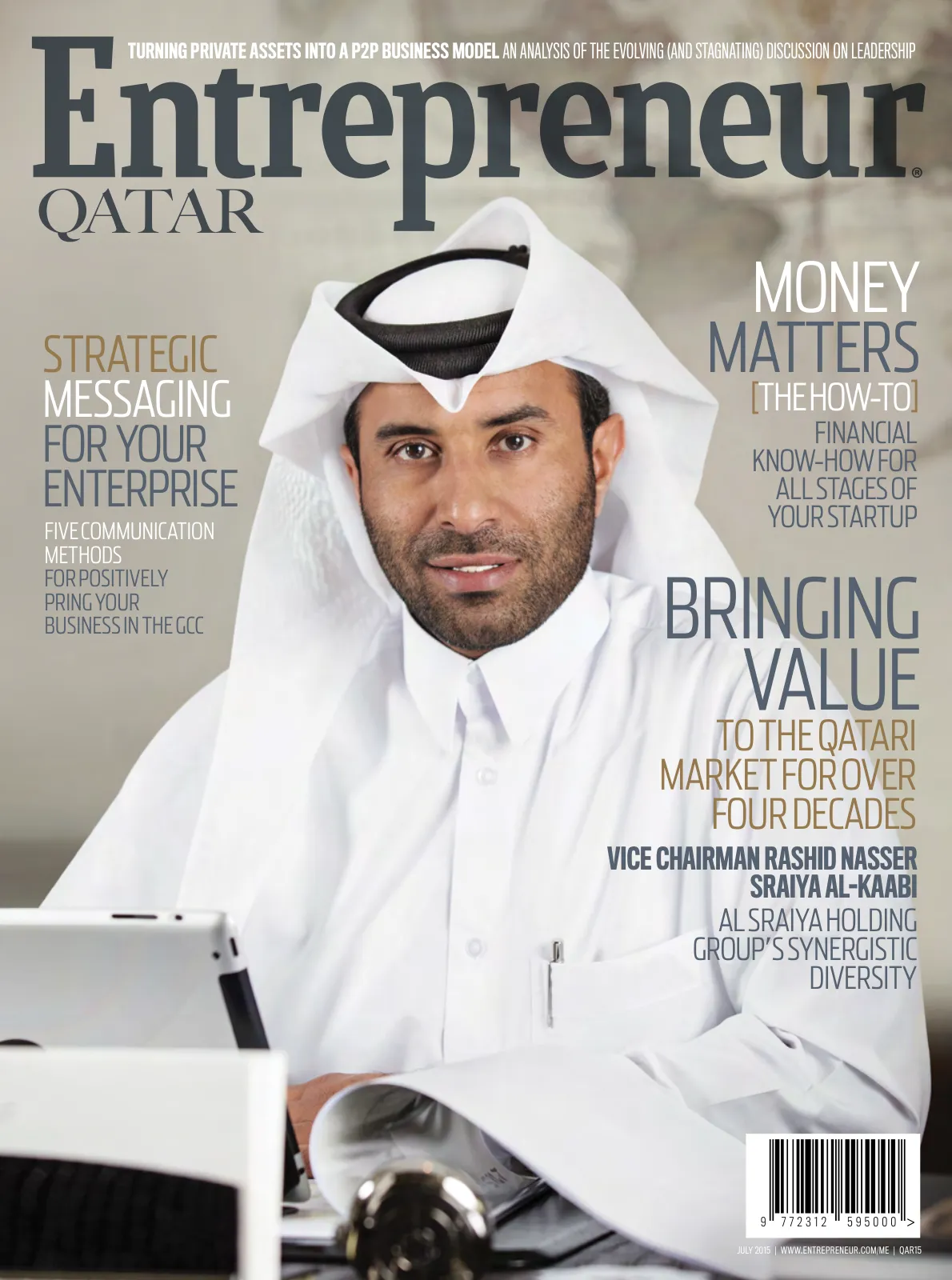
Entrepreneur Qatar, July 2015
Page 1
JULY 2015 | www.entrepreneur.com/me | QAR15
Turning private assets into a P2P business model An analysis of the evolving (and stagnating) discussion on leadership
9
7 7 2 3 1 2
5 9 5 0 0 0 >
to the Qatari
market for over
four decades
Bringing
value
Al Sraiya Holding
Group’s synergistic
diversity
Vice Chairman Rashid Nasser
Sraiya Al-Kaabi
Financial
know-how for
all stages of
your startup
[The how-to]
Money
matters
Strategic
messaging
for your
enterprise
Five communication
methods
for positively
PRing your
business in the GCC
Page 2
Page 3
july 2015 Entrepreneur
3
CONTENTS
JULY 2015
28
Financial know-how for all
stages of your startup
20
The President
and CEO of Hill
International
innovates like an
entrepreneur
22
Bringing value to
the Qatari market
for over four
decades
Vice Chairman Rashid
Nasser Sraiya Al-Kaabi
Al Sraiya Holding Group’s
synergistic diversity
28
Money matters
The how-to
Financial know-how for all
stages of your startup
STARTING UP: RAISING
SEED CAPITAL
Eight Best Practices to Seek
Funding From Friends,
Family and Fools
GROWTH CURVE:
BUILDING VALUE
Five questions to ask about
your financial model to add
real value to your startup
SCALING UP: GOING
PUBLIC
Six reasons why smart
entrepreneurs think twice
before seeking an IPO
CROWDFUNDING
CHANGE IN THE MENA
REGION
Narwi mobilizes Islamic
charitable giving to sup-
port micro-entrepreneurs
12
EDITOR’S NOTE
By Fida Z. Chaaban
52
TECH:
SHINY
#TamTalksTech
Gadgets and doodads
that you might’ve missed
out on, sourced by a tech
aficionado. Yes, it’s okay
to want them all… and no,
it’s not our fault.
16
Mastering your KSA
market entry
Chairman of Zain KSA
Farhan Al Jarba talks enter-
prise agility
Advice from a business
veteran
20
INNOVATOR:
Archetypes and actu-
alities
David L. Richter thinks
things through
The President and CEO of
Hill International innovates
like an entrepreneur
Page 4
Entrepreneur july 2015
4
CONTENTS
JULY 2015
27
Henri Asseily,
Manager Partner,
Leap Ventures
40
‘TREPONOMICS:
SKILLSET
Getting connected
Bayt.com’s Lama Ataya
discusses attracting (and
retaining) talent for your
enterprise in 2015- the GCC
is gradually shifting toward
an online HR schema.
46
MARKETING
Strategic messaging for
your enterprise
Loretta Ahmed, the CEO of
Grayling Middle East, Turkey
and Africa, suggests five
communication methods
for positively PRing your
business in the GCC.
68
SKILLSET
The myth of multitasking
Olympian and entrepreneur,
James Clear, outlines the
reasons why doing more
things does not drive faster
(or better) results.
66
ESQUIRE GUY
Keep your enemies close
Ross McCammon talks
about fraternizing with the
competition- business mixing
with pleasure means walking
a fine line.
62
FRANCHISE
Growing your F&B business
Kunal Lahori gives you food
for thought: five questions to
ask before you expand your
hospitality brand. And this
applies to you F&B ‘treps
in case you’re considering
franchising your concepts.
78
START IT UP
Q + A
Classified information
Co-founder Adham Saleh’s
EZHeights aims to outshine
competitors and it’s based on
analysis of where and how
similar business models fall
short.
52 #TamTalksTech:
LG G4
in leather
36 Dr. Karim El Solh,
CEO, Gulf Capital
22
Bringing value
to the Qatari
market for over
four decades
Page 5
Page 6
Entrepreneur july 2015
6
CONTENTS
juLY 2015
Crafting memorable
experiences:
Rosewood Abu Dhabi
58
The executive selection:
Tom Ford
60
image courtesy Rosewood Abu Dhabi
74
YoTable
co-founder
Rashed
Islam
74
STARTUP FINANCE
Table for two?
YoTable wants to be Saudi
Arabia’s F&B dining booking
platform of choice, founded
by Reda Islam, Rashed
Islam, and Mahmoud Elsaid.
70
ECOSYSTEM
Talent search
Upwork can help with your
startup’s staffing needs,
and they’ve got the client
referrals to prove it.
60
CULTURE:
TRAPPINGS
‘Trep gear
The executive selection for
the entrepreneur on your list
that has everything. Okay,
maybe for a little self-reward
as well.
58
TRAVEL
Crafting memorable
experiences
Managing Director of the
Rosewood Abu Dhabi,
Luigi Romaniello makes an
impression on the business
guest.
56
BUSINESS UNUSUAL
Bringing repeat clients to the
table
Coya Dubai masters the guest
list, and their global CEO
Adam Bel Hadj gives F&B
‘treps some tips that they can
apply to their enterprise.
Page 7
Page 8
8
Entrepreneur MARCH 2015
SUBSCRIBE
Contact subscriptions@bncpublishing.net to receive
Entrepreneur Middle East every issue
EDITOR IN CHIEF Fida Z. Chaaban editor@bncpublishing.net
MANAGING DIRECTOR Walid Zok walid@bncpublishing.net
DIRECTOR Rabih Najm rabih@bncpublishing.net
DIRECTOR Wissam Younane wissam@bncpublishing.net
PUBLISHER Nehme Abouzeid
MANAGING EDITOR Aby Sam Thomas
CREATIVE LEAD Odette Kahwagi
ONLINE LIAISON Kareem Chehayeb
COLUMNIST Pamella de Leon
COLUMNIST Tamara Clarke
PO Box 502511 Dubai, United Arab Emirates
P +971 4 4200 506 | F +971 4 4200 196
For all commercial enquiries related to
Entrepreneur Middle East contact
sales@bncpublishing.net
All rights reserved © 2014.
Opinions expressed are solely those
of the contributors.
Entrepreneur Middle East and all subsidiary
publications in the MENA region are officially licensed
exclusively to BNC Publishing in the MENA region
by Entrepreneur Media Inc.
No part of this magazine may be reproduced or
transmitted in any form or by any means without
written permission of the publisher.
www.entrepreneur.com/me
Access fresh content daily on our website!
MIDDLE EAST
Printed by Raidy Emirates Printing Group LLC
www.raidy.com
EntMagazineME
@EntMagazineME | @Fida
Entrepreneur-me
EntrepreneurMiddleEast
EntMagazineME
EntMagazineME
EntMagazineME
Images used in Entrepreneur Middle East are credited when necessary. Attributed use of
copyrighted images with permission. All images not credited otherwise Shutterstock.
Loretta Ahmed
Lama Ataya
Dr. Jamal Boukouray
Amal Chaaban
Tamara Clarke
James Clear
Haneen Dabain
Laura Hamade
Simon Hudson
Suhail Al-Masri
Ross McCammon
Shoug Al Nafisi
May Rostom
Erika Widen
CONTRIBUTING WRITERS
In addition to our print edition, we’re bringing you all sorts of
industry news on our web mediums. Joining us online means getting
relevant business and startup content in real-time, so you’re hearing
about the latest developments as soon as we do. We’re looking
forward to interacting with our readers on all of our social media and
web platforms- like any thriving business, we’re looking to give and
take. #TrepTalkME is already happening on all of our digi platforms,
and all good conversations go both ways. See you on the web!
Page 9
parkinn.com/hotel-dammam
Book now - Rooms starting from 545 SAR
Enjoy a seaside stay in the business and leisure hub of Dammam.
now
p
open
Page 10
Entrepreneur july 2015
10
Spectacular failure
EDITOR’S NOTE
Fida Z. Chaaban
Editor in Chief
@fida
editor@bncpublishing.net
Mismanagement and your bottom line
I
f you haven’t already figured
out that staff retention
methods pay for themselves,
then please keep reading.
For those of you out there
who reward loyal team members
by investing in their training
and paying attention to all of the
different strengths, weaknesses
and needs that your enterprise’s
human capital may demonstrate,
you probably don’t need to go any
further into my note this issue.
The first thing that needs to be
outlined is that leading and man-
aging are not one and the same.
The two do intersect, but one is
logistics-based and the other is not.
If you are great at making sure your
staff is being compensated on time,
and filling out their paperwork in a
timely fashion, then you are an ef-
fective manager. Being a leader is a
whole other ballgame; it means that
you nurture a good staff environ,
you maximize people’s strengths
and you work on improving indi-
vidual weaknesses. Leaders keep
a consistent and even approach to
everything- not just when the mood
strikes you. It means you notice
which of your staff members are
happy to put in the overtime, which
of your staff are developing bet-
ter ways of doing things, and you
reward these acts of diligence and
innovation in kind. It also means
that you listen to their concerns,
and rectify valid complaints swiftly
whenever necessary.
One of the most important qualities
I look for in potential team mem-
bers is a willingness to dedicate
effort. That is more important to
me than a candidate’s existing
skillset, and whatever background
experience he or she may have
in their repertoire. The effort to
learn and adapt is, I find, one of
the key strengths in members of
Entrepreneur’s core team. If I sense
that someone’s got a great portfolio
but an intractable personality, then
they don’t make the cut. I need
flexibility, and I need people who
want to be an active and engaged
part of something greater than
themselves. Like many companies,
I have precious few resources, so I
really need to make certain that I’m
allocating those resources prop-
erly- by choosing the right people,
and then hanging onto them. This
responsibility falls on me and me
alone- I need to ensure that I retain
our most loyal and dedicated team
players, and that I foster growth in
the most senior members, and that
I am grooming the junior members
for more challenging roles going
forward.
I have seen dedicated people,
people with potential and drive,
turned off completely by poor man-
agement. I have had it happen to
me in previous positions. You must
remember that your staff cannot
only count on a salary; they need to
count on stability, encouragement,
potential to grow, and skillset en-
hancement. If you are falling short
on delivering any of these things,
then you are a manager, not a lead-
er. That’s what I consider a spec-
tacular sort of failure- the failure
to secure your enterprise’s human
capital. You can learn from these
unfortunate situations by analyzing
all the things that went wrong, and
then making the necessary adjust-
ments in your corporate structure.
Fix it, move forward, and prevent it
from ever happening again. If you
are the managerial sort, then you
should have no problem applying
this logic, and then you can become
the leader that your business needs
to succeed.
Page 11
Page 12
Entrepreneur july 2015
12
IN THE LOOP
Major League Baseball’s St. Louis Cardinals accused
of hacking Houston Astros player database
Italian neurosurgeon
talks of “head transplant”
Saudi Arabia hones in
on increasing investments
image © www.stlouis.cardinals.mlb.com
T
his story takes sports scandals to a
whole new level. The New York Times
broke the news on June 16 that Justice
Department prosecutors and the FBI have
been investigating the St. Louis Cardinals
staff on accusations that they have hacked
the player database of their rival Major
League Baseball (MLB) team, the Houston
Astros. Why would one of baseball’s biggest
teams do something so reckless and absurd?
Law enforcement figures say this was done
by Cardinals personnel to “wreak havoc”
on the work of Houston Astros’ general
manager Jeff Lehnow, who was previously
the Cardinals scout between 2003 and 2011.
According to the report, the hack was made
possible by Cardinals personnel making use
a master list of passwords used by Luhnow
and other officials during their time at
Cardinals to breach the Astros database. So
what’s the lesson in this for the rest of us?
As security experts have often told us: we
simply shouldn’t use the same passwords
across different sites and services.
K
idney transplants have become
routine, and heart transplants are in-
creasing in prevalence with huge suc-
cess rates. But, there’s a whole new school
of thought coming our way, and some of it
sounds incredible, if not impossible. Valery
Spiridonov, a 30 year-old Russian man who
suffers from Werdnig-Hoffman Disease, has
been in touch with Italian neurosurgeon Dr.
Sergio Canavero, who hopes to perform the
first head transplant by 2017. Spiridonov
believes that this transplant, albeit a risky
one, is his only hope to escape the rare
neuromuscular disease. According to vari-
ous news reports, it looks like the surgical
operation will require a team of 100 and
cost an estimated US$15 million. The risks
appear endless, and many other medical
workers believe that it will also take a while
before Dr. Canavero, who is also Director
of the Turin Advanced Neuromodulation
Group, can perform the surgery he claims
has a 90% chance of success.
I
t’s been a busy month for Saudi
Arabia, which has been focusing
heavily on investment. In mid-June,
the Kingdom opened up its mas-
sive stock market for foreign investors,
making it the last of the G-20 countries
to do so. That said, foreign companies
probably will not be flocking towards
the Kingdom just yet, given the many
restrictions and conditions the country
has in place for their operations. For
example, the only institutions that are
given a thumbs-up must sort out at least
US$5 billion in assets with a five-year
investment record. In addition to that,
individual investors can only own up
to 5% of a company, and total foreign
ownership can’t exceed 49%. But given
that Saudi Arabia is such an attractive
market, it wouldn’t be surprising to see
investors knock on the country’s doors
in the not too distant future.
Saudi Arabia has also continued to
invest heavily in its holy cities of Mecca
and Medinah. What’s been making
headlines around the world is the Abraj
Kudai hotel in Mecca, scheduled for
opening in 2017. The hotel will consist
of 12 towers, and also includes a bus
station, four helipads, and a mall. Five of
the 45 floors will be reserved exclu-
sively for the Saudi royal family. With
the Abraj Kudai hotel expected to have
10,000 rooms, it is also set to become
the world’s largest hotel by room count.
(To put this into perspective, the current
hotel with the largest room count is the
MGM Grand Hotel in Las Vegas, which
boasts of 6,198 rooms.) However, there
have been a few reservations with all
the development going on in Mecca and
Medina- for instance, Irfan Al-Alwai,
the director of the U.K.’s Islamic Herit-
age Research Foundation, is concerned
about the few remaining heritage sites in
the cities, as well as the cities’ accessi-
bility for pilgrims who cannot afford the
luxury properties.
Outside of Saudi Arabia’s borders, top
Saudi officials visited Russia to seal a
memorandum of understanding between
the two countries. Saudi Arabia’s Public
Investment Fund (PIF) and the Russia
Direct Investment Fund (RDIF) have
agreed to jointly invest up to $10 billion
together. At this point, there is no infor-
mation on where the joint investments
will take place, but the Deputy Governor
of the PIF, HRH Prince Saud bin Khalid
Al Saud, has stated that they are looking
for more than monetary gain, explaining
that the PIF’s primary investment goal
is to obtain technology to benefit the
Kingdom’s economy.
Page 13
Page 14
Entrepreneur july 2015
14
innovator
KSA Enterprise Agility Awards: Mr.
Farhan Al Jarba receiving the Lifetime
Achievement award with Riyadh
Chamber of Commerce and Industry,
Vice Chairman of the board of directors,
Mr. Khalid Abdulaziz S. Al-Mukairan
Advice from a business veteran
Mastering your KSA
market entry
Chairman of Zain KSA Farhan Al Jarba talks enterprise agility
T
he Kingdom may have unique aspects, but building a trusted
business reputation rests on things that are universal. First
is quality: focus relentlessly on the quality of your product or
service, every hour of every day. Second is reliability: fulfil every
promise on time and every time. The third is customer focus: be
one step ahead, give your customers or clients solutions before they even
know they have a problem.” On the agenda of most companies at some
point is entering the market of the GCC’s biggest GDP, and the Chairman
of Zain KSA, Saudi national and veteran of the region’s largest market,
has invaluable first-hand experience doing decades of business in the
Kingdom. Recently awarded the distinction of Lifetime Achievement at the
KSA Enterprise Agility Awards staged in Riyadh, Farhan Al Jarba has some
advice for those of you looking to enter (and succeed) in what is arguably
the hardest and most lucrative market in the Middle East.
Your reputation as a young
executive rests on your
character and your competence.
A good character is exhibited
over time; on the other hand,
you can show your competence
from day one.”
“
Businesses often rush to expand
into the Kingdom and find that
they can’t gain a sure foothold
and market share. Some launch
tactics you can use to better
secure business development
include choosing your base
carefully: “Headquarter your
business in the capital Riyadh,
and expand the retail section
starting from Jeddah. Generally,
this is a valid tactic for gaining
foothold and obtaining market
share; however, every business
has its own unique situation,
market forces should be analyzed
thoroughly for a successful
expansion.”
Page 15
july 2015 Entrepreneur
15
“Much of our business culture in Saudi rests
on relationships. Do not wait until you
are older or in a senior position to start
establishing those relationships. Don’t just
build relationships with a certain kind of
people or be limited to one area; try to develop
a rich mix across sectors. After all, you never
know when a friendship or relationship will
be useful to both sides.”
If you’re a young executive trying to
climb the corporate ladder, getting
noticed by the CEO (and possibly even
the Chairman) isn’t as tough as you
might think. Here are Farhan Al Jarba’s
six points of advice for up-and-coming
execs to demonstrate their potential to
their higher-ups:
1. Develop a solid reputation
over time “Your reputation as a young
executive rests on your character and
your competence. A good character is
exhibited over time; on the other hand,
you can show your competence from day
one.”
2. Strive to educate yourself
about the business “Whatever
your job description includes, be hungry
to learn about the wider business, and
seek out new experiences. Successful
future leaders look beyond their own
specific role.”
3. Exhibit a willingness to take
control of a stagnating
situation “Be proactive and continu-
ously strive to make things happen.”
4. Search for ways to innovate,
then communicate your ideas
“Constantly look for improvements and
opportunities for the business. Regard-
less if they are big or small ideas, always
have the confidence to suggest them.”
5. Put an emphasis on
strengthening your network
from the get-go “Much of our busi-
ness culture in Saudi rests on relation-
ships. Do not wait until you are older or
in a senior position to start establishing
those relationships. Don’t just build
relationships with a certain kind of
people or be limited to one area; try to
develop a rich mix across sectors. After
all, you never know when a friendship or
relationship will be useful to both sides.”
6. Look at everything as a two-
way street “Do not just think about
what you can take from a relationship,
but focus on the valuable things that you
possess and can offer to others.”
“Headquarter your business
in the capital Riyadh, and
expand the retail section
starting from Jeddah.
Generally, this is a valid tactic
for gaining foothold and
obtaining market share.”
GET NOTICED BY THE BOSS
Advice for the young executive
Chairman of Zain KSA, Farhan Al Jarba, on the cover
of the June 2015 edition of Entrepreneur Al Arabiya.
Al Jarba discussed the telco’s achievements under his
tenure, and best practices.
Al Jarba also cautions against
biting off more than you can
chew by trying to grow at a
hyperactive rate. “Although
the Kingdom has high business
potential, it is still important
to launch or expand your
business strategically and
carefully.” Slow and steady
wins the race in Saudi, and
before you attempt to take on
a fresh province or city in the
Kingdom, make sure you have
established your reputation
so that your new associates
have credible references
to turn to. Al Jarba’s best
practices include relationship-
building, and he stresses
that this is a long-term effort
and doesn’t just manifest
itself overnight. “Personal
relationships remain extremely
important in the Kingdom,
and understanding the culture
of business relationships is
essential. Often, the older the
relationship, the better. Young
entrepreneurs should start
building relationships early,
and they should never stop
looking for new ones.”
There are also practical
angles that sometimes escape
an entrepreneur trying to
penetrate the Kingdom. Simple
things like strategizing how
to best capture and cater to
your customer are often taken
for granted. Localizing your
offering to the local market
doesn’t just mean developing
a new marketing campaign
in the local slang. It means
knowing your customer
demographics and how you fit
into that demographic: “The
KSA market, with 60% of the
population under 25 years old,
[means that] any consumer-
facing business must think
hard about how to shape
its offers for young Saudis.”
Al Jarba also stresses that
it is essential for people in
business to continue to build
their corporate reputation
by continuously refreshing
your initial exchanges
with associates. “Business
relationships are just like
friendships, they need to be
in good repair. Keeping good
records can stop them from
fading away. For instance, try
to make a reminder list for
meeting, speaking, or emailing
at least one business contact
every day. Time spent in
keeping these relationships
strong is never wasted.”
Page 16
Entrepreneur july 2015
16
Entrepreneur july 2015
16
Page 17
july 2015 Entrepreneur
17
Images by Xtremepics
innovator
Archetypes
and actualities
David L. Richter
thinks things through
The President and CEO of Hill International innovates
like an entrepreneur By Fida Chaaban
“M
y life is an open book. You ask the question, you’ll
get an answer,” says David L. Richter, promising
that anything and everything is up for discussion.
The CEO and President of Hill International is in
the UAE visiting his Dubai head office, and I have
managed to wrangle an hour of his time for this interview. Richter’s
extreme comfort with the press isn’t without good reason: he’s
one of those people who has an annoyingly-flawless track record
(both personal and professional), the on-paper validations proving
a nose-to-the-grindstone type work ethic (not exactly necessary
for a CEO, but highly desirable), and the right mix of wit, charisma
and refinement (not to mention being camera-and-quote-ready) to
make him cover story material for even the least-inspired of writers.
All of these factors converge to make
the archetypal Super CEO; the kind that
simultaneously impresses and irritates
you- why the irritation? Because the
Super CEO is beyond reproach. Because
the Super CEO reminds you why he’s
the CEO and you’re not. And finally
because the Super CEO is that unicorn-
rare combo of humble overachiever and
innovator. So when I sat down to talk
leadership with Hill’s Super CEO, I did
try to get under his skin. I did try, several
times over, to find some shortcoming
or some area that I found questionable.
Spoiler: I didn’t succeed, and perhaps
that’s one of the reasons why Hill
International went from an American
SME of 200 people to a multinational
operating in 50 countries with more
than 5,000 employees.
It is sometimes the case in the world
of business that you find someone who
seems to have been plotting their life
course as an adult since early childhood.
Looking back through their personal and
professional lives, you sort of marvel >>>
Page 18
Entrepreneur july 2015
18
innovator
“I don’t think me taking over
from my dad was a surprise to
the market or anybody inside or
outside the company. I’d been with
the company for 20 years. The last
10 years I was the COO, and my dad
turned 70 last December, and it
was an ideal time for us to work
on a transition.”
hill international website
at what seems to be almost a prescient
type of foresight and intuition- the
decisions they made, the avenues they
pursued, and even the opportunities
they eschewed knit together seamlessly.
It all seems to converge in an uncanny,
and yes, a fortuitous map leading to
success on a grand scale. This is the
case with Richter; he’s got a degree in
civil engineering, another degree in
law that he put to work as a corporate
lawyer with a focus on M&A, and he’s
what one would refer to as a life-long
learner. “I’m still in school- I’m doing a
part-time executive Master’s program
at Oxford. This would be my second
business degree. Education is incredibly
important; I definitely believe it’s not
something you do until you’re 25 and
then stop; it’s something you do your
entire life. My wife is definitely afraid
that I’ll pursue a Ph.D. once the master’s
is done,” he says jokingly. But I don’t
think he’s joking- at 49 years of age,
Richter is that rare sort of business
magnate who is constantly embarking on
some type of enhancement experience,
be it theoretical or practical. He’s
admittedly Type-A, and says that when
he’s in his 70’s he may just go for that
Ph.D. rather than play golf all day.
“The brain is a muscle; the more you
use it, the better you get,” says Richter
by way of agreement that if you don’t
use it, you lose it. His one weakness?
He’s unilingual: “I wish I spoke more
languages; we do business in so many
countries.”
A good deal of that business is in
Middle East nations, and as any
successful enterprise knows, the earlier
you’re established in a market, the
stronger your foothold once that market
emerges. The family business angle
of Hill is well received in these parts,
being such a prevalent model in the
MENA region, and Richter acknowledges
that those structures aren’t without
their own set of challenges. “If a family
business is widely held -second, third
and even fourth generation- you may
have a lot of cousins all with the same
last name and think that because of
that, they can do whatever they want.
Fortunately, for Hill, I do say that we
were a family business because it was
my dad and I, but it really was a very
closely-held company until we went
public in 2006. My dad, my brother
and myself were the only shareholders
in the company, and my brother never
worked in the company.” While Hill isn’t
exactly a family business by the MENA
definition, the company was founded
by Irvin E. Richter in 1976, who is today
its Chairman, and Richter Senior was
succeeded by Richter Junior. Appointed
to the position of President and CEO
on December 31, 2014, Richter Junior
had also served as a member of Hill’s
Board of Directors since 1998. “I don’t
think me taking over from my dad was a
surprise to the market or anybody inside
or outside the company. I’d been with
the company for 20 years. The last 10
years I was the COO, and my dad turned
70 last December, and it was an ideal
time for us to work on a transition.”
The father of four began with the
company as General Counsel, and says
Page 19
july 2015 Entrepreneur
19
“ I joined in 1995, and Hill had about
200 employees and it had found a
really nice niche in the construction
sector, but it just seemed like it
could be so much more; the potential
there with Hill was huge scale-
wise, and really the potential
of the company. We had a great
reputation in the two services we
provided, project management and
construction claims”
that he went to law school with the
intention of using it as a stepping stone
of sorts to a business career. “Back
then, we were a fairly small company. I
joined in 1995, and Hill had about 200
employees and it had found a really
nice niche in the construction sector,
but it just seemed like it could be so
much more; the potential there with
Hill was huge scale-wise, and really
the potential of the company. We had
a great reputation in the two services
we provided, project management
and construction claims,” he explains,
adding that where he saw real window
of opportunity was on the project
management side of the business.
Currently, a majorly lucrative revenue
stream for Hill is wading into the
construction litigation arena. It’s a
sizeable chuck of the company’s work:
25% of Hill’s business today is in
construction claims where they are
involved in disputes on mega-scale
projects. “We come in and we act as
the expert witness for one side or the
other. These claims can be a couple of
millions of dollars or a couple of billions
of dollars.” I lob a comment at Richter
suggesting that as a Canadian, I view
the U.S.-system as lawsuit-happy, so
business must be good. And business is
good- the company’s shareholders are
pleased, the numbers are there, and Hill
is a trusted name on the stand.
Our legal talk turns political, and
Richter says that he’s extremely
interested in how the American
government runs. A staunch Republican
and positively a patriot, I am prompted
to ask Richter point blank: does he have
political ambitions? Indeed he does, and
what follows is an enlightened discussion
on how a flourishing economy and a pro-
entrepreneurial environ can do so much
for any society in general and American
society in particular; unemployment
would drop, opportunity would climb,
and even civil unrest can potentially be
assuaged- an industrious (and cash-
healthy) country is a good foundation for
a contented one. Perhaps this is why so
many of the presidential candidates are
focusing on bringing back the American
dream of yore. At the time of writing,
reality TV persona and businessman
Donald Trump had just announced his
run for presidency, and it occurred to
me that I hadn’t asked Richter which
candidate he was backing in the ever-
increasing line-up. He didn’t tell me who
he was supporting, but he did tell me
who he wasn’t rooting for: “I think what
you are seeing in the very large number
of Republican presidential candidates
and the very small field of Democratic
ones is the realization within both
parties that 2016 is shaping up to be a
very good election year for the GOP. I also
think there are a very good number >>>
Page 20
Entrepreneur july 2015
20
innovator
Fida Chaaban, Editor in Chief
of Entrepreneur Middle East
interviewing David L. Richter
THE EXECUTIVE SUMMARY Leadership training with David L. Richter
“I think what you are seeing in the
very large number of Republican
presidential candidates and the very
small field of Democratic ones is the
realization within both parties that
2016 is shaping up to be a very good
election year for the GOP. I also think
there are a very good number of
highly credible and capable Republican
candidates for the presidency. Donald
Trump is not one of them.”
1. LEADERS ACTIVELY SEEK INFO “I got
asked recently about being an engineer and
a lawyer. I was asked which was better in
terms of being a CEO. The presumption was
that engineering must be better than law,
and I said it was exactly the opposite in my
experience. In engineering school, they teach
you to find the correct answer; in law school,
they teach you to find the correct question-
and that’s much more what being a leader
is about: asking the correct questions of
your people. We have lots of people that are
very smart, they can find the right answer
in a heartbeat. My job is to ask the right
questions to make sure we’re heading in the
right direction.”
2. LEADERS SOURCE GREATNESS “I look
for people that don’t have to be led. One of
my mantras at the company is finding the
right people, giving them the resources they
need to succeed, and basically just getting
out of their way. We’re looking for people
who are self-starters, people that can sell,
do, manage all at the same time. People who
don’t require active oversight by me, because
I don’t want to be a manager, I do really want
to be a leader.”
3. LEADERS ARE ACCESSIBLE “We have
about 5,000 people in our company. Any
one of those people can pick up the phone
and call me, and if they need my help with
something I’m there to provide it. Most of
those people think that time to call the CEO
is never.”
4. LEADERS DON’T ALLOW PROCEDURES
TO INTERFERE WITH INNOVATION “We try
very hard not to create hierarchies, not to
create chains of command, because those
are ways to stop problems from getting
solved. One of my biggest goals in being
a leader within Hill, is that as we grow, we
maintain that small business family-feel to
the company with very little bureaucracy. At
the same time, when we become bigger and
bigger, we have to have some bureaucracy
in place just to make sure that things are
happening correctly- it’s walking a fine line.
If you can create a balance, the results are
fantastic for the organization.”
5. LOCALIZATION DOESN’T IMPACT
LEADERSHIP “I don’t think management
style really changes whether it’s the U.S.,
the Middle East, Australia or Brazil. Business
is really the same: it’s about doing high
quality work for your clients, adding value
to the supply chain, building relationships
is important everywhere. People are people;
different places in the world operate
according to different customs, different
practices, sometimes even different morals.
I don’t think leadership changes. The tone
that we set at the top and that the rules
that govern how we do business -not just
as a public company but long before that-
integrity is one of our core values.”
of highly credible and capable Repub-
lican candidates for the presidency.
Donald Trump is not one of them.”
Unlike many CEOs, Richter doesn’t
view his staff as rank and file, he sees
them as integral components of the
total value add, and what better way to
motivate everyone to keep their eyes
on the prize than to give out shares
of the pie? “Having well-incentivized
employees was very important to us; it
was one of the reasons we went public.
We were able to give our employees
something that was more than just a
raise- hey, we’ll give them equity in
the business and make them feel like
owners. I don’t think we created 5,000
entrepreneurs, but we certainly created
a lot of people that were very vested in
the success of the company overall and
not just the success of their job.” And
as for the notion that being part of a
mammoth corporation is a steady soul-
killer, Richter’s got ideas about that too.
You might not be a ‘trep by the strictest
definition, but that shouldn’t stop you
from thinking like one. “There’s room
for entrepreneurship within companies
that are already established, which is
how I sort of view my role. I think of
myself as an entrepreneur within an
organization. I’m not an entrepreneur
because I didn’t found Hill,” says Richter
“But it’s my job to make sure that Hill
continues to act entrepreneurial by
developing new markets, new services,
and new opportunities.” I think therefore
I am? Maybe that’s how a CEO who isn’t
an entrepreneur, landed on the cover of
Entrepreneur.
Page 21
OHSAS 18001 certified
ISO 9001, 14001 and
130+years of
project experience
LEED Platinum, LEED Gold
and LEED Silver Capability
End to End Integrated Solutions
Pioneering Engineering Construction since 1881
www.drakescull.com
700+
Projects Delivered
For over 130 years, Drake & Scull International PJSC has been shaping skylines and transforming the lifestyle of
communities around the world.
Drake & Scull is an industry leader, with a proven history of delivering more than 700 projects through its General
Contracting, Engineering, Rail, Oil & Gas, Water and Wastewater Treatment and Infrastructure development business
streamlines across the region.
Page 22
Entrepreneur july 2015
22
Entrepreneur july 2015
22
Vice Chairman Rashid Nasser Sraiya Al-Kaabi
Al Sraiya Holding Group’s synergistic diversity
By Erika Widén
“O
perating in other countries besides Qatar can be a goal for the future. However, our
priority is to fuel our energy, ideas and resources into the growth of the State,” says
Rashid Nasser Sraiya Al-Kaabi, the Vice Chairman of the Al Sraiya Holding Group.
Owned by Nasser Sraiya Al-Kaabi, and run and overseen by Rashid, the 100% Qatari com-
pany was established in 1975 as a family-owned business that strived to help develop the
country through its engineering and industrial sector. Today, Al Sraiya Holding Group has
built its core on the idea of innovation, thereby earning its rank as one of the top in Qatar’s
construction field. There are currently a total of 43 organizations working under the Al Srai-
ya umbrella, with Al-Kaabi noting that by offering a range of integrated services that cater to
the infrastructural development of Qatar, the Group has diversified itself through individual
groups of companies. Each of these operate independently and specializes in a particular
field of expertise, including engineering, trading, industrial, hospitality and general services.
innovator
value
Bringing
value
Bringing
to the Qatari
market FOR over
four decades
to the Qatari
market FOR over
four decades
Page 23
july 2015 Entrepreneur
23
ENGINEERING GROUP
AL SRAIYA TRADING & CONTRACTING
BADR CONTRACTING & TRADING
CIRCLE QATAR
ZUBLIN INTERNATIONAL
AL SRAIYA STRABAG
RASHID ENGINEERING
AL SRAIYA ENG. CONSULTANTS
AL MOSANADA FOR PROJECTS DEVELOPMENT
NRK CONTRACTING
STRABAG QATAR
BIN SRAIYA READYMIX & CRUSHERS
DOHA BETON READY MIX
SIMSIMA TILES BLOCKS & INTERLOCK
CLIC QATAR
QATAR WIRE COMPANY
MILLENNIUM HOTEL
COPTHORNE HOTEL
KINGSGATE HOTEL
EDARAT HOSPITALITY LEISURE SERVICE
SIMSIMA ELECTRICAL SHOP & CONTRACTING
MEAC WATER SYSTEMS
GULF & WORLD TRADERS
TAWRID QATAR
SIMSIMA REAL ESTATE & INVESTMENT
SIMSIMA TRADING AND CONTRACTING
NASSER RASHID TRADING AND CONTRACTING
NRK TRANSPORT & GARAGE
PREMIUM CLEANING
PREMIUM RENT-A -CAR
NAYCOM QATAR
ALEPH QATAR
IFP QATAR
HASOOB TECHNOLOGIES
MACRO QATAR
QUALITY RESOURCE HOUSE
FIRST INSURANCE SERVICES
AL SRAIYA CARPENTRY
PINNACLE EVENTS
AMERICAN SERVICE CENTER
INTERNATIONAL SPECIALIZED DENTAL
CENTER
INNOVATION RENEWABLE ENERGY
INDUSTRIAL GROUP
GENERAL SERVICES GROUP
HOSPITALITY GROUP
TRADING GROUP
“We strive for continuous
improvement in quality
standards and customer
service, and we continu-
ously work to remain a role
model in all the fields we
are currently involved in.
The Group works to form
and maintain long-term
relationships of value
with clients and partners
and we also look for joint
ventures and partner-
ships that can benefit the
National Vision 2030.”
“Maintaining companies in a
diversification of fields is an
accomplishment on its own,
allowing us to be the all-in-one
marketplace for customers we
originally strived to become.”
Rashid Nasser
Sraiya Al-Kaabi, Vice
Chairman, Al Sraiya
Holding Group
Al Sraiya Holding Group company list
company list source: The Pioneer - al sraiya holding group internal magazine
>>>
The Group’s main focus at
present is to expand further
within Qatar by becom-
ing further involved in the
projects being designed for
the country’s National Vision
2030. The company’s overall
mission is to provide Qatar
and the Middle East with a
diverse and complete range of
resources for developing its
infrastructure, along with a
myriad of related needs and
services in a professional and
timely manner. “We strive
for continuous improvement
in quality standards and
customer service, and we
continuously work to remain
a role model in all the fields
we are currently involved
in,” Al-Kaabi explains. “The
Group works to form and
maintain long-term relation-
ships of value with clients and
partners, and we also look for
joint ventures and partner-
ships that can benefit the
National Vision 2030.” Al-
Kaabi explains that develop-
ing Qatar’s infrastructure and
preparing for a prosperous
future will contribute toward
the nation’s goal of becom-
ing a Middle East commercial
hub. “Using our wide range of
resources and with our com-
panies supporting each other,
the Group will continue to
expand in its fields of exper-
tise, dominating the market
with its acquisition of Qatar’s
largest projects,” he says.
“Al Sraiya is continuously
becoming involved in distin-
guished projects. It would be
difficult to name only a few.
The success we have achieved
particularly in recent years is
focused on working with large
clients in mainly the con-
struction field.”
“One example is the
proud announcement of Al
Sraiya STRABAG Road &
Infrastructure W.L.L. being
chosen to lead a mega-sewer
project worth QR1.2 billion,”
Al-Kaabi says. “Aimed at
converting the foul-sewer
drainage in the Doha South
Catchment from a pumped
network to a gravity sewer
network, Al Sraiya STRABAG
will be handling the design
and building of the second
and central segment of the
Main Trunk Sewer.”
Another notable example
is the Zueblin project, which
is announcing its commence-
ment of one of Qatar Energy
City’s prominent develop-
ments, the construction of
Parcel H-01 Package 2. The
project is worth QR508 mil-
lion and is expected to be
completed in 29 months, in
adherence with the high-
est standards that comply
with the U.S. Green Building
Council LEED Certification
requirements for energy ef-
ficiency. Green building and
sustainability are thus going
to be an increasing priority
for Al Sraiya in the construc-
tion and engineering fields, as
the structures of the Zueblin
project are to be built with
sustainable criteria in mind.
Al-Kaabi stresses that the
Group has built its reputa-
tion over time and with a
consistent approach to strong
standards across their vast
portfolio. “Maintaining com-
panies in a diversification of
fields is an accomplishment
on its own, allowing us to be
the all-in-one marketplace
for customers we origi-
nally strived to become,” he
explains. Besides providing
building equipment, tools and
machinery, companies under
the Group such as Al Sraiya
Page 24
Entrepreneur july 2015
24
“With a diverse range of re-
sources and connections at hand,
Al Sraiya Holding provides clients
with extensive research, market
knowledge, services tailored to
needs and budgets, competitive
rates in the market, resources,
machinery, consultation, building
equipment and materials as
well as anything else needed to
complete a project from begin-
ning to end, as we provide total
construction solutions.”
innovator
Simsima Interview
17
INTERVIEW
Completed Project
33
Qatar’s growth into a dynamic
modern economy has enabled
Bin Sraiya Readymix to excel in
the highly competitive market.
Operating 5 concrete batching
plants supported by a fleet of 70
transit mixers and 12 concrete
pumps, Bin Sraiya concrete uses
the highest Quality Assurance
standards to provide clients with
only the finest products.
SETTING NEW
STANDARDS
OF QUALITY.
Services include:
• Manufacturing and transport
of readymix concrete
• Pumping of readymix concrete
• Manufacturing and supplying
kerbstones
• Manufacturing and supplying
quary products
Bin Sraiya
Readymix is your
trusted source for
diversified services
and unique quality
products delivered
on time.
THE GROUPS LATEST
NEWS
Al Sraiya Trading &
Contracting to build 3
Governmental schools
Al Sraiya Strabag
awarded QR 1.2 billion
sewer drainage
project
Zueblin awarded QR 508
Million Project for QEC
Final stages of 2 Health
Centers
Zueblin starts new
project in Mountazah
QR 5 Million investment
with QBIC as part of CSR
Residential Development
Project at Lusail City
“many of our business can overlap in terms of
management and staff as cooperation amongst
them is key to the Group’s success. The five fields we
have expanded into cover almost everything from
hospitality to construction, consultation, etc., and
we believe this is what also makes Al Sraiya a desired
partner in projects and new business plans.”
Trading & Contracting, Badr
Contracting & Trading, Sim-
sima Cement Tiles and Block
Factory, Al Sraiya Consulting
& Engineering, Bin Sraiya
Ready Mix, Doha Beton and
Clic Qatar have acted as main
contractors for clients such as
Ashghal, undertaking the con-
struction of towers in Dafna
and Lusail City, New Doha
International Airport (NDIA),
Doha’s New Port, in addition
to buildings for the govern-
ment and other local authori-
ties. Other completed projects
include major landmarks
like the Barwa Commercial
Avenue, Hamad Medical
City, The American School of
Doha, Al Jassim Tower and
G45 building.
The company’s work in
the hospitality domain has
also been seeing a spurt in
growth, and it is also garner-
ing favorable attention. For
example, the Millennium Ho-
tel Doha earned two awards
at the International Hotel
Awards 2015, (a five star
award for the hotel category
for Qatar, and a highly com-
mended award for the hotel
website category for Qatar).
In addition, Edarat, which
supplies waiters, housekeep-
ing and stewarding to the
world’s most recognized
international hotels, restau-
rants, airlines, leisure and
retail companies, recently
hired 75 new employees for
enhanced services. Addi-
tionally, the Group’s Aleph
Printing Press recently
invested QR5 million in its
own machinery and equip-
ment, and Al-Kaabi says that
the sizeable cash injection
will be used to purchase new
large-size printing machines,
automatic finishing machines,
a line of book bindery tools
with gold edging, as well as a
line die cut to enhance print-
ing press services.
When asked about what
he considers as the reasons
behind its market success, Al-
Kaabi says that the Group’s
“strength makes us unique,
as it originates from our busi-
nesses heavily supporting and
supplying each other. In fact,
many of our business can
overlap in terms of manage-
ment and staff as coopera-
tion amongst them is key to
the Group’s success. The five
fields we have expanded into
cover almost everything from
hospitality to construction,
consultation, etc., and we be-
lieve this is what also makes
Al Sraiya a desired partner
in projects and new business
plans.” Besides this, Al-Kaabi
thinks that the company’s
ethic of completing its own
in-house projects adds to its
strength, and eliminates the
burdens and complications
of outsourcing. “This alone
uplifts the extra effort needed
to form networks when
outsourcing suppliers and
contractors, and allows us
to invest that energy, money
and effort into other affecting
Page 25
july 2015 Entrepreneur
25
“You need to be organized and
be able to manage and monitor
all through the organizational
structure, implementing dif-
ferent systems to suit each
company,” he explains. “To
overcome these challenges, it
is important to delegate power
to professional managers, each
responsible for a company, and
dividing the employees under
them for better management.”
Simsima
Clic
www.alsraiyagroup.com | The Pioneer - al sraiya holding group internal magazine
>>>
factors in the Group, which
other companies may not be
able to do.”
With reference to the trials
that Al Sraiya Holding Group
has faced along the years,
Al-Kaabi says that difficul-
ties and challenges usually
arise owing to the number of
employees being managed,
especially when there are a
number of companies to be
considered simultaneously.
“You need to be organized
and be able to manage and
monitor all through the
organizational structure, im-
plementing different systems
to suit each company,” he
explains. “To overcome these
challenges, it is important to
delegate power to profession-
al managers, each responsible
for a company, and dividing
the employees under them
for better management.” He
underlines how this cre-
ates its own challenges, as
these managers then need
to continuously update each
other and work together to
ensure proper flow of work,
particularly since their staff
Page 26
Entrepreneur july 2015
26
innovator
Qatar Business
Incubation Center:
Al Sraiya to invest
QR 5 million in QBIC
by 2022 as part of
its CSR
As part of its CSR
investment plans for
the year, Al Sraiya
Holding Group has
signed a QR 5,000,000
agreement with Qatar
Incubation Center
that is due to last
until 2022.
As the biggest incubator in MENA,
QBIC aims to provide programs
and activities that empower
entrepreneurs, to start and
scale companies by developing
entrepreneurs incubating
companies, investing in companies
as well as connecting people.
Al Sraiya Holding Group is fully
committed to the economic and
social progress in the region by
contributing to the development of
sectors that are fundamental for
the economy.
Therefore, the Group is pleased to
cooperate with QBIC as it believes
in its mission.
“One example is the proud an-
nouncement of Al Sraiya STRABAG
Road & Infrastructure W.L.L. being
chosen to lead a mega-sewer
project worth QR1.2 billion. Aimed
at converting the foul-sewer
drainage in the Doha South Catch-
ment from a pumped network to a
gravity sewer network, Al Sraiya
STRABAG will be handling the
design and building of the second
and central segment of the Main
Trunk Sewer.”
Road development in Al Wakrah
qatar business incubation ceneter source: The Pioneer - al sraiya holding group internal magazine
can overlap each other to
support sister companies.
“Therefore, we have arranged
for regular weekly meetings
for monitoring purposes,” he
explains. “This whole cycle
[of success] relies heavily on
organization.”
As a result of the Al Sraiya
Holding Group’s hard work,
it has become a familiar and
well-known name in the
market, which the manage-
ment believes is necessary
to achieve, and above all,
preserve, as the Qatari market
is already extremely competi-
tive. “However, this does not
mean we do not outsource
occasionally,” Al-Kaabi says.
“We bring value to the market
through 40 years of manage-
ment expertise, accumulated
operational competence, and
added resources such as capi-
tal, corporate staff services,
local market intelligence,
and knowledge.” Thanks to
its years in the industry,
Al Sraiya has been able to
build a reputation as one of
the sturdiest and synergis-
tic holding groups in Qatar.
“With a diverse range of
resources and connections at
hand, Al Sraiya Holding pro-
vides clients with extensive
research, market knowledge,
services tailored to needs and
budgets, competitive rates in
the market, resources, ma-
chinery, consultation, build-
ing equipment
and materials as
well as anything
else needed
to complete a
project from
beginning to end,
as we provide
total construc-
tion solutions,”
Al-Kaabi says.
Al Sraiya’s joint
ventures with
multinational
companies in the
fields of consul-
tancy; engineer-
ing, landscap-
ing and water management
further consolidates The
Group as a major player in the
Qatari economy. “Our future
perspective is focused on con-
tinuing progress in fields we
are already involved in, and
we are always on the lookout
for new opportunities and
partnerships that could guide
us into new fields, further
expanding the Group.”
Page 27
Serenia
[se-ren-ya] n.
Latin; Serenus - meaning calmness & tranquility.
Make
Dubai’s Most Exclusive
Beachfront Residences
your home.
Serenia offers you more than just an address. It offers you
a lifestyle suited to the world's most discerning. A collection
of beachfront penthouses and garden apartments filled
with elegant luxury. Nestled in the iconic crescent of
The Palm Jumeirah, Dubai.
Come, discover Serenity.
It waits for you at www.sereniathepalm.com
Hazel Wong Design | Panoramic 360º Views | Personalised Concierge Service
Luxury Penthouse Collection | The Palm Jumeirah Lifestyle
Developer Name and No. – Palma Homes Real Estate Development L.L.C. (1068) l Project Name & No. – Serenia Residences, The Palm (1641)
Escrow Bank and Account – Emirates NBD (020 48558181 04) l Expected Completion Date – 31st December, 2017 l Service Charge – AED 20 Per Sq. Ft.
800 PALMA
+971 4 452 2202 l palmaholding.com
Page 28
Entrepreneur july 2015
28
Financial know-how for all stages of your startup
[The how-to]
innovator
By Martin Zwilling
W
hen you’re starting up a business, there’s no question that one
needs to be financially literate in order to run the enterprise.
However, it is important to note that the different stages of a
startup require different sets of financial expertise to help it navi-
gate through the journey of the business. This guide will provide
you with the requisite know-how that should help you all through the startup cycle,
starting from the moment you ask for money from your family and friends, to the
point where you decide if you want your company to go public.
Money
matters
Money
matters
Entrepreneur july 2015
28
Page 29
july 2015 Entrepreneur
29
PART 1 STARTING UP
RAISING SEED CAPITAL
Eight Best Practices to Seek Funding From
Friends, Family and Fools
[The how-to]
Money
matters
We all know people who are
good at talking, but never
seem to risk anything or
find time to get started on
the implementation. Every
good entrepreneur needs
to invest skin in the game, to
show credibility and leader-
ship to others. Investors
want to be followers, not
the leaders.
Many first-time entrepre-
neurs find themselves unable
to bootstrap their startups,
and also unable to find
early funding at the venture
capital level or even with
angel investors. Their only
recourse is that first tier
of investors, fondly called
‘Friends, Family and Fools’.
These are the only people
likely to believe in newbies,
with only minimal product
evidence or business experi-
ence.
Yet surprisingly, according
to statistics on the Fund-
able crowdfunding site,
friends and family are the
major funding source for
all entrepreneurs, investing
over US$60 billion in new
ventures last year, almost
triple the amount coming
from venture capital sources.
The average amount per
startup was $23,000, usually
in the form of a convertible
loan, rather than an equity
investment.
Of course, most startups
ultimately need much more
than this amount to scale
the business, but some prior
contribution from friends
and family (as well as your
own sweat equity) is normal-
ly expected as a qualification
before professional investors
will consider entering the
game. Their logic is that if
your family won’t invest in
you, then why should they?
This is confirmation that the
right people are always more
important than the right
product. Here are some key
ways that you can be viewed
as the right people, whether
seeking an investment from
friends and family, fools or
even later from professional
investors:
1. Ask for a specific
amount to meet a spe-
cific milestone.
Shy introverts may be great
technologists, but they won’t
be entrepreneurs until they
learn to nurture relation-
ships with friends and
family, practice their elevator
pitch and respectfully ask for
funding. Waiting for someone
to give you a gift with no
specific objective is likely to
be a long wait.
2. Offer a formal agree-
ment as well as a hand-
shake.
The vehicle of choice is most
often a convertible note,
which is really a loan with
a specified duration and
interest, with an option to
convert it to equity when
professional investors come
in later. Hire an attorney
to make sure the terms are
fair. This shows respect and
professionalism.
3. Let people see your
own investment and com-
mitment.
Friends and family are quick
to differentiate between
a passionate hobby and a
sincere effort to change the
world. Show them that you
have done your homework
with industry experts and
potential customers, and
convince them you are not
asking for charity or a dona-
tion.
4. Build a prototype first
on your own time and
money.
We all know people who are
good at talking, but never
seem to risk anything or find
time to get started on the
implementation. Every good
entrepreneur needs to invest
skin in the game, to show
credibility and leadership to
others. Investors want to be
followers, not the leaders.
5. Don’t ask for more
than your friends or
family can afford to
lose.
In other words, don’t be
greedy, and remember that
you have to live with these
people even if your startup
fails. Ask for the minimum
amount you need to reach a
significant milestone, with
some buffer for the unknown,
rather than the maximum
amount you can possibly
foresee.
6. Communicate the plan
and the risks up front.
Remember that no invest-
ment is a gift, and everyone
who buys in deserves to
hear what you plan to do
with their investment, and
expects regular updates from
you along the way. Be hon-
est with naïve friends and
trusting family members,
since more than 70 percent
of startups fail in the first
five years.
7. Focus on well-connect-
ed friends with relevant
business experience.
A wealthy uncle may seem
like an easy mark, but a less
wealthy friend who has con-
nections and experience with
startups in your domain can
likely help you more than any
amount of money. Remember
that you are looking for
success, not just money to
spend.
8. Tie re-payments to
revenue growth in the
startup.
Rather than set a fixed repay-
ment schedule, tie invest-
ment payoffs to a percentage
of new product revenue, or
a plan to convert the debt
to equity. Use the minimum
viable product concept to
get revenue early, and allow
market and product pivots at
minimal cost.
In any case, avoid the urge to
think of friends and family as
a last funding resort, when
they should always be your
first focus, and maybe the
only one you will ever need.
If you succeed, there is no joy
like sharing the feeling and
the money with people close
to you.
But make sure you do it
right, per the above recom-
mendations, or you may be
the biggest fool. >>>
Page 30
Entrepreneur july 2015
30
PART 2 GROWTH CURVE
BUILDING VALUE
Five questions to ask about your financial
model to add real value to your startup
[The how-to]
Money
matters
If you think that financial
modeling for a new business
is arcane magic, limited in
value to financial wizards
and professional investors,
then you have been listen-
ing to the wrong advisors.
In reality, a simple Excel
spreadsheet model custom-
ized around your assump-
tions can save you hours and
avoid a wasted expense in
validating alternative vendor
and marketing decisions.
The way to start is with
a sample financial model,
freely available from many
sources on the Internet. An-
other alternative is to build
one yourself, starting with a
few formulas to extrapolate
early revenues and expenses
into the five-year projections
normally requested by banks
and investors.
Don’t try to build the “ul-
timate” business model, for
all possible alternatives, in
multiple business domains.
For maximum value with the
least effort, focus on only the
“what ifs” that are the high-
est priority in your mind for
your own startup. In my ex-
perience, the top candidates
will include the following:
1. What if you have to cut
your targeted price?
Pricing is always a tricky is-
sue. Vendor costs are subject
to change, customers are
fickle, competitors come out
of the woodwork and the
economy can take a down-
turn. You need to quickly cal-
culate the long-term impact
on profitability of pricing and
business model changes.
2. What if you need to
change your market size
and volume projections?
The manual calculations to
translate market assump-
tions into costs, volumes,
expenses and net return are
massive. Yet, they can be
done by a simple financial
model in a few milliseconds.
Investors will test your savvy
by asking where your busi-
ness breaks.
3. What if your growth
and scaling projections
are too aggressive?
Most entrepreneurs realize
that doubling their revenue
each year puts them in a pre-
mium category with inves-
tors, so that may be your first
target. But targets need to
be adjusted as the reality of
early returns sets in. Projec-
tions you know to be wrong
won’t help you.
4. What if investors of-
fer you only half, or
double, what you ask
for?
With a financial model, it’s
relatively easy to apply these
amounts to your marketing,
manufacturing and admin-
istrative costs, as well as
business volumes, to predict
the impact. Your credibility
with investors, and your
confidence in any request,
depends on these answers.
5. What if your customer
acquisition cost assump-
tions have to change?
The cost to acquire a cus-
tomer, or traffic to conver-
sion ratios, are critical to
the success of most startups.
This can be projected top
down from market share
assumptions, or bottom up
from actual costs and sales
results.
The time to start building
your model is even before
you incorporate the business
and spend real money on
building products. Just like
planning a long trip with
your car, you need to know
where you are going before
your start, or you probably
won’t get there. If you are not
computer literate, it’s never
too early to find a partner or
learn tackle this critical ele-
ment of every business.
The financial model
obviously has to be built
in concert that the overall
business and pricing model
that you are implementing.
The most common business
models these days include
the subscription model, free-
mium model and ecommerce.
Each has a different set of
variables for sales, revenue
flow, marketing costs and
personnel.
Creating a financial model
is perhaps the only way
for you to see key areas of
strength and weakness in
your business, before the
money is spent and it’s too
late to recover. It’s a great
learning experience and is
not rocket science, so you
can do it yourself. But don’t
hesitate to ask for help from
a professional if you need it.
You may be surprised how
clear the relationship ap-
pears between product pric-
ing, cost and customer count.
You will quickly understand
the old adage that if you lose
money on every customer,
it’s hard to make it up in
volume.
Page 31
july 2015 Entrepreneur
31
PART 3 SCALING UP
GOING PUBLIC
Six reasons why smart entrepreneurs
think twice before seeking an IPO
Every public company has to answer
to thousands of public stockhold-
ers now, rather than just a few
private investors. This is a huge
communication requirement, as well
as a tremendous disadvantage in
flexibility and dealing with competi-
tors. The public is not an easy master
to satisfy.
your management style, and
even your personal life, is sub-
ject to extensive scrutiny by
stock analysts and stockhold-
ers. Violations of integrity and
accepted business practices is
malfeasance and can result in
corporate and personal fines,
and even prison terms.
[The how-to]
Money
matters
See this article in its entirety at Entrepreneur.com
The visibility of Google, Face-
book and a few others con-
tinues to propagate the myth
that the ultimate objective of
every entrepreneur should be
to take their startups public
via an initial public offering
(IPO) at the earliest opportu-
nity. Everyone thinks this is
the route to become the next
billionaire like Mark Zucker-
berg. In reality, this option is
a nightmare that can bump
you out of the driver seat,
dilute your equity and create
a business entity you can’t
control. For financial reasons
alone, an IPO is a statistically
rare phenomenon, happening
just 275 times in 2014, out
of almost 500,000 startups.
Many of these may still fail
spectacularly, such as Web-
van and Pets.com.
As an advisor and mentor to
startups, I try to make sure
entrepreneurs understand
both the pros and cons of
an IPO as an exit strategy.
Facebook, for example, ended
up raising almost $16 billion
through its IPO. It’s hard to
imagine any other investor
mechanism that could have
raised that much money. On
the other hand, Zuckerberg
signed up for a lifetime of
challenges:
1. Large personal and
corporate liability expo-
sures.
As a public company execu-
tive, your management style,
and even your personal life,
is subject to extensive scru-
tiny by stock analysts and
stockholders. Violations of
integrity and accepted busi-
ness practices is malfeasance
and can result in corporate
and personal fines, and even
prison terms.
2. Extensive government
reporting and compli-
ance rules.
To prevent another Enron
scandal, public companies
and their officers are mea-
sured against strict and
growing government rules
for reporting and compli-
ance, popularly known as
Sarbanes-Oxley, or SOX.
Private companies are largely
exempt from these reporting
requirements.
3. Doubling or more of
overhead expenses.
These new reporting and
compliance rules require ex-
pensive new processes, sys-
tems and consultants. When
including lawyers and a chief
compliance officer, many ex-
perts argue that the costs can
quadruple those of a private
company. That extra money
raised better kick-start your
opportunity.
4. All strategy and
operational moves
become public.
Every public company has
to answer to thousands of
public stockholders now,
rather than just a few private
investors. This is a huge
communication requirement,
as well as a tremendous dis-
advantage in flexibility and
dealing with competitors.
The public is not an easy
master to satisfy.
5. Public expectation of
growth every quarter.
The pressures to maintain a
profitable and steep growth
curve, versus reinvesting
returns in new markets,
are very frustrating to
entrepreneurs who get their
satisfaction from the flexibil-
ity of a startup in addressing
new opportunities. Even
perceived weaknesses can
dramatically impact company
valuations.
6. Control moves to
external directors and
the public.
Private companies typically
have an internal board of
friendly owners, unlikely to
be pressured by the media
to consider an unfriendly
tender offer from another
major player in the market.
Even with private equity and
private acquisition transac-
tions, control stays internal
to the principals.
Of course, there are cases
where a new technology or
medical startup needs that
huge financial infusion to
build the infrastructure
needed for real growth,
so the rewards are worth
the risks and costs. In the
long run, building a global
company with the relatively
unlimited public resources is
still only possible by starting
with an initial public offering
and giving up your startup.
For every entrepreneur, I
recommend first a personal
assessment of your goals
and strengths. If you enjoy
the challenges of a startup
and being in charge of your
own destiny, you probably
won’t survive the move to
a public company, and you
certainly won’t enjoy it, even
if it makes you and all your
friends rich. Greed is not an
easy master to satisfy either.
Page 32
Entrepreneur july 2015
32
[The how-to]
Money
matters
Crowdfunding
change in
the MENA region
Narwi mobilizes Islamic charitable giving to
support micro-entrepreneurs
By Aby Sam Thomas
W
ith the MENA region now becoming notoriously known for having the
world’s highest rate of youth unemployment, there has been an increas-
ing drive towards encouraging micro-entrepreneurship as a means by
which this statistic could be overturned. However, this is easier said than done:
while starting (and growing) new businesses has been deemed to be absolutely
necessary for the creation of jobs in the region, micro-entrepreneurs who do start
their own ventures often find it extremely difficult to access the requisite finance
they need for their respective enterprises. But Narwi, a new platform launched by
the Qatar-based Silatech initiative focused on youth employment and enterprise
development, is hoping to turn this scenario around by combining the power of
crowdfunding with the virtue of Islamic charitable giving.
narwi website
Narwi –which, in Arabic,
means “to tell a story,” as well
as “to nourish”- is a non-profit
Islamic crowdfunding platform
that allows donors to support
micro-entrepreneurs of their
choice by establishing a Narwi-
Waqf (Waqf, in Arabic, trans-
lates to “endowment”) with
as little as US$25. Founded
in June 2015, the program
builds on Silatech’s experience
with Kiva, the world’s largest
online micro-lending platform,
through its Kiva Arab Youth
program, which has been able
to raise financing for over
5,000 youth-owned businesses
in a span of just three years.
“Narwi builds on the success
and impact of Kiva Arab Youth,
while expanding on it in several
ways,” says Mohammad Raafi
Hossain, the Narwi Program
Manager at Silatech, as he ex-
plains how the platform works.
“Narwi features projects which
are financed through Shariah-
compliant loan products
provided by Kiva Field Partners
Page 33
july 2015 Entrepreneur
33
[The how-to]
Money
matters
“Narwi is featuring projects
currently from seven MENA
countries, and each of
these countries has its own
distinguishing characteristics
economically. There isn’t one
model that can be applied
across the board. For instance,
fishing is an industry that is
quite widespread in Somalia,
but it would be almost
completely absent in Jordan.
“Once individuals create a
Narwi-Waqf, they select a
micro-entrepreneur of their
choice, and help to finance
their business through their
Narwi-Waqf. Over time, the
Narwi-Waqf is replenished
as the borrower repays the
loan. Donors can either add
more money to their Narwi-
Waqf, or wait until the initial
endowment is fully repaid
before supporting another
micro-entrepreneur.”
Mohammad
Raafi Hossain,
Narwi Program
Manager at
Silatech
throughout the region. Mainly
microfinance institutions, Field
Partners disburse loans to bor-
rowers as they are needed. Pre-
disbursing loans means that
borrowers, when they need
support immediately, don’t
have to wait for their loans to
get funded on the Narwi plat-
form. The Field Partner then
posts the stories and photos of
the borrowers on Narwi, which
then aggregates the donations
for each beneficiary posted
on the site, and backfills the
loans pre-dispersed by Field
Partners.”
So who are these borrow-
ers that benefit from the
Narwi platform? According to
Hossain, the Narwi network
(launch.narwi.org) currently
operates in Yemen, Palestine,
Jordan, Iraq, Lebanon, Egypt
and Somalia, and the micro-
entrepreneurs it supports
operate a variety of businesses-
a showcase of Narwi’s impact
in the region that Silatech
shared with Entrepreneur
included names like Marwah,
who used a loan of $2,250 to
buy cosmetics and renovate
her shop in Jordan; Suheel,
who used a loan of $1,300
to start his own falafel and
humus restaurant in Yemen;
and Ghassan, who used a loan
of $1,000 to buy an electrical
saw for his carpentry workshop
in Somalia. Of course, while
the sheer diversity of busi-
nesses that Narwi supports
is laudable by itself, this also
represents a significant chal-
lenge for the enterprise. “Our
primary concern is that the
micro-entrepreneur succeed
in sustaining their business
and, hopefully, create jobs for
others,” says Hossain. “Narwi
is featuring projects currently
from seven MENA countries,
and each of these countries
has its own distinguishing
characteristics economically.
There isn’t one model that can
be applied across the board.
For instance, fishing is an
industry that is quite wide-
spread in Somalia, but it would
be almost completely absent
in Jordan. The same type of
variety applies to the kinds of
micro-entrepreneurs Narwi
supports, and the criteria they
are judged by when applying
for a loan.”
With this being the scenario,
Hossain notes that Narwi
depends heavily on its Field
Partners to help with achiev-
ing its mission and goals. “As
I mentioned before, Narwi
operates through Kiva
Field Partners, and
the projects listed on
Narwi are all financed
through Shariah-com-
pliant loan products,”
he explains. “These
Field Partners know
their area of opera-
tions, the economic
climate and prospects
for microenterprises,
as well as the types of
entrepreneurs more
likely to succeed in
their country.” Nar-
wi’s use of Shariah-
compliant loan prod-
ucts is particularly
noteworthy, especially
when a survey of
MENA countries by
the International
Finance Corporation found
that most entrepreneurs in the
region indicated a preference
for Shariah-compliant financial
services. However, such prod-
ucts are hard to find. “There
are many microfinance institu-
tions in the MENA region, but
very few who offer Shariah-
compliant loans,” Hossain says.
“This has held us back from
covering a wider area so far.
Depending on how successful
Narwi is in raising capital from
the crowd, it will be interesting
to see whether this catalyzes
financial institutions who see
a benefit in developing more
Islamic microfinance loan
products.”
From a donor’s perspective,
the Narwi platform is a relative-
ly simple one to navigate, and
allows users to create endow-
ments that are permanent >>>
Page 34
Entrepreneur july 2015
34
[The how-to]
Money
matters
Innovative
Narwi is the world’s
first Micro-Waqf platform.
Partnerships
Narwi partners with local,
regional, public and private
organizations to ensure
effective engagement.
Sustainable
The Micro-Waqf mechanism
allows users to sustainably use
a single donation pool
repeatedly.
Ethical
Aligned with Islamic Giving
principles
Young Bashir Al-Haj of Sana’a, Yemen,
worked in a nut shop but wanted to open a
small business of his own. As Bashir ques-
tioned how to finance his dream, a customer
advised him to approach a youth fund for
small business ventures at a local micro-
finance institution. Al-Haj approached the
Youth Fund at Al Amal Microfinance Bank,
which extended him a loan of 200,000
Yemeni riyals (around US$930). Bashir
purchased goods that were in demand in
the market, opened a small spice shop, and
began to grow his business. Having gained
the bank’s confidence after paying back his
loan on time, he qualified for another loan of
70,000 riyals, which he invested in the shop,
improving further his business and income
before paying the loan back on time.
Eventually, the young entrepreneur went
on to obtain a third and fourth loan of
100,000 and 150,000 riyals, respectively, re-
paying these on time as well. “Within seven
years I achieved what I wanted, thanks to
Al Amal Microfinance Bank, which enables
people with limited income to overcome dif-
ficulties and gives them the opportunity to
become business leaders,” says Bashir.
Proof positive
Narwi can effect change
al-amal bank website
and sustainable over the long-
term. “Narwi is a revolving
donations platform, rather
than a lending-based system,”
Hossain notes. “Once individu-
als create a Narwi-Waqf, they
select a micro-entrepreneur
of their choice, and help to
finance their business through
their Narwi-Waqf. Over time,
the Narwi-Waqf is replenished
as the borrower repays the
loan. Donors can either add
more money to their Narwi-
Waqf, or wait until the initial
endowment is fully repaid
before supporting another
micro-entrepreneur.” He also
notes that since Narwi funding
is at below market rates (0%
interest), its Field Partners
are also able to expand their
lending programs to more
marginalized, higher risk and
higher social impact borrow-
ers, such as startup projects,
rural beneficiaries, farmers,
female entrepreneurs and
entrepreneurs operating in
conflict-affected states.
Narwi has also managed to
secure a number of strate-
gic partnerships with sev-
eral leading entities from the
region and globally. Besides
Kiva, these strategic partners
include Qatar National Bank
(QNB), PayPal, AFIF, Qatar
Charity and the International
Office of Migration. Narwi’s
partnership with QNB is
particularly noteworthy for
it has allowed the platform
to accept donations through
credit cards, besides PayPal.
“This is a significant advan-
tage over Kiva Arab Youth,
as PayPal is not accepted in
a number of these countries
[that we have a presence in],”
Hossain says. “Those donating
through credit cards can also
rest assured that Narwi uses
QNB’s industry-strength pay-
ment gateway.” Hossain also
notes that as Narwi features
only projects that have been
financed through Shariah-
complaint loan packages, the
platform is an excellent option
for Muslims who may be frus-
trated with traditional forms of
Islamic charitable giving, but
may not be comfortable with
non-Shariah-compliant finan-
cial models. But that doesn’t
mean the platform is exclusive
to Muslims either. “While
Narwi is an Islamic crowd-
funding platform, we gladly
accept donations from anyone,
regardless of religion,” he says.
“And while we operate in pre-
dominantly Muslim countries,
there is no requirement for our
beneficiaries to be Muslims.”
With Islamic charitable giv-
ing being the driving principle
behind Narwi, the platform is
seeking donors primarily from
the Arab and Muslim diaspora,
GCC nationals and expatriates
as well as nationals in middle
income MENA markets. It also
plans to grow its reach soon-
Hossain reveals that plans are
underway for Narwi to expand
to Morocco and Tunisia, and
possibly to other countries
outside of the MENA region
as well. “The total amount
of Islamic charitable giving
worldwide has been estimated
at over $200 billion annually,
which is huge,” Hossain says.
“However, there are a sizeable
number of young professional
Muslims who are frustrated
with the lack of transparency,
accountability and impact of
traditional forms of giving.
We’re trying to address this
frustration and tap into this
particular market through
Narwi. Our objective is to help
micro-entrepreneurs gain ac-
cess to the finance they need to
start or grow sustainable, job-
creating businesses. Crowd-
funding can be a transparent
and effective way to give do-
nors the power to select whom
their donations will benefit,
and the revolving donations
Narwi-Waqf model provides a
foundation of sustainability.
We’re looking to redirect some
of the charitable potential of
the Islamic world toward sus-
tainable impact that addresses
a pressing socioeconomic
need- the need for jobs.”
Page 35
KUWAIT EDINBURGH LONDON
QUORVUSCOLLECTION.COM
A NEW KIND OF LUXURY FOR PEOPLE WHO
DEMAND COMFORT, AND LOVE GREAT DESIGN
SYMPHONYSTYLEHOTEL .COM
+965 25770000
A PEARL ON
THE ARABIAN SEA
Page 36
Entrepreneur july 2015
36
The Private Equity Pro
Co-founder and CEO, Gulf Capital
Dr. Karim El Solh
Dr. Karim El Solh,
CEO, Gulf Capital
“
“By clarifying the long-term goals and linking
financial rewards to them, PE firms ensure
that the management team is properly aligned
and everyone is working towards the same
goals. Most long-term incentive plans include a
cash (bonus) component and a stock component,
which vests over time.”
[The how-to]
Money
matters
E
ntrepreneurs in the Middle
East face numerous challenges
when launching and growing
a business in the region. One
of the biggest ones is access
to adequate financing to fund growth of
SMEs. For example, in the UAE, SMEs
represent 90% of total businesses, yet
they secured only 4% of total outstand-
ing loans in 2014. This points directly to
the main financing challenge facing SME
sector growth. Private equity firms, with
a greater risk for appetite and strong
returns, could provide an alternative to
bank financing and step in to help plug
the financing gap.” As the co-founder
and CEO of Gulf Capital, Dr. Karim El
Solh can easily give you support for the
argument that your SME needs a good
private equity firm to scale up. Gulf Capi-
tal, one the largest and most agile private
equity (PE) firms in the Middle East, has
been recognized several times via awards
and acknowledgements, and they’re
considered an extremely desirable
partner to have in the enterprise space.
With investment streams across PE, real
estate, credit and mezzanine, the firm
is reportedly managing US$3 billion in
assets. “Bringing a reputed private equity
firm on board can help the entrepreneur
to improve his or her operations, fund
future growth, scale business and maxi-
mize profitability. A partnership between
PE firms and management can be very
beneficial to both parties if structured
properly. By injecting capital and provid-
ing operational support, PE firms can
make a big difference to a company and
help it scale and achieve its profitability
and growth targets. If both parties can
generate an attractive return in the end
by delivering a successful exit, then the
partnership is even more powerful and
worthwhile– that’s what proper align-
ment is all about.”
Here are six reasons why bringing a PE
firm on board can catalyze the growth
and profitability of your business:
1. Partnering with the right
management team “PE firms back
management teams before they back
companies. It is very important that the
right management team is in place to
execute on the ambitious growth plans. If
a management team has a gap or uneven
capabilities, the PE firms can step in and
help strengthen the management team
by sourcing experienced professionals
from their wide network of contacts.
Putting the best and most experienced
team in place will ensure the company
grows at an attractive rate and achieves
its profitability targets. In addition to
the management team, PE firms will
focus closely on the composition of the
board and strive to attract the right mix
of industry, strategy and finance experts
at the board to help guide management
on both strategy and execution. PE
firms prefer to operate at the board level
and empower the management team
to execute their business plan. While
they can help from time to time on a
micro level or on a specific task, such
as securing adequate bank financing,
they prefer to remain involved at the
board level and give the CEO and the
Page 37
july 2015 Entrepreneur
37
Dr. El Solh’s direction for Gulf Capital
has seen the private equity firm execute
some of the region’s most relevant PE
deals. The firm has won numerous
awards including “Best Private Equity
Firm in the Middle East” for four years
running (2011, 2012, 2013 and 2014),
and was named “Firm of the Year” at
this year’s international Private Equity
Awards. Prior to co-founding Gulf Capi-
tal, Dr. El Solh served as the CEO of The
National Investor, an Abu Dhabi-based
institution that transacted numerous
successful PE transactions and was
ranked the number one IPO under-
writer in the Gulf. Dr. El Solh received a
degree in civil engineering from Cornell
University, followed by an MBA from
Georgetown University, and a Doctorate
in Economics from the Institut d’études
politiques de Paris.
Get to know the CEO
Dr. Karim El Solh
[The how-to]
Money
matters
team the free reigns and accountability
to operate and achieve the business
plan. However, they will step in and
intervene if management is facing
difficulties or not executing according
to plans. PE firms are active owners
and focused on execution, growth and
ultimately on delivering a profitable exit,
for themselves and for the management
team. This brings us to the next reason:
proper alignment.”
2. Aligning interests “PE firms will
spend considerable time upfront to draft
a proper business plan and a clear long-
term incentive plan (LTIP) to ensure
that management have clear goals to
strive for and if they achieve them, the
long-term incentive plan will ensure that
they are properly rewarded accordingly.
By clarifying the long-term goals and
linking financial rewards to them, PE
firms ensure that the management team
is properly aligned and everyone is
working towards the same goals. Most
long-term incentive plans include a
cash (bonus) component and a stock
component, which vests over time.
Naturally, management is not allowed
to sell its shares in the company until a
proper exit is secured and both the PE
firm and management are able to sell
to the next buyer at the same time. By
focusing together on the end financial
result, the PE firm and management are
completely aligned and share the same
financial interests.”
3. Why PE firms focus on strategic
or majority stakes “One can
enumerate numerous ways to boost
profitability, margins and returns. All
of these can be meaningless if the PE
firm has no control or influence on the
decision making process in its portfolio
company. The ability to take the right
decisions that lead to revenue expansion,
cost rationalization and operational
efficiencies is decisive to the success of
any PE investment. Many PE firms either
prefer to acquire a majority stake in their
target company to secure control of the
board or will structure their investment
in such a manner that they are able to
effectively influence the company and
guide it in the right direction. Without a
strategic or influential stake, PE firms are
not able to step in and make a difference
in their portfolio companies when
required. The debate is not whether
PE firms should acquire minority or
majority stakes but on how to secure the
requisite amount of influence to be able
to effectively guide management teams,
and intervene if necessary. If structured
properly, a minority strategic investment
can give a PE firm the same governance
and rights as a controlling majority
stake.”
4. Capital injections and financial
support “The growth of companies
is often limited by severed financial
constraints. In order to further their
growth potential, a capital injection
is often needed to continue expansion
plans. PE firms are in a position to
provide such financial support through
a capital increase, whether straight
equity purchase or a convertible loan
structure. The size of the capital increase
will depend on the business plan of the
company and its long-term financing
needs. PE firms can also be instrumental
in leveraging their banking relationships
to ensure portfolio companies secure
adequate loan financing at a reasonable
rate. PE firms, especially the larger,
more reputed ones, can give portfolio
companies instant credibility when
approaching banks for financing.”
5. Revenue expansion- product
and geographic diversification
“Many businesses find themselves highly
concentrated within a restricted number
of products, clients and geographies,
which increases their exposure to market
swings and risks. In order to diversify
and strengthen operations, PE firms
help their portfolio companies expand
into new attractive product lines and
fast-growing new geographies, thus
diversifying and widening the revenue
base. The ultimate objective is to
transform a portfolio company from a
small local player into a regional market
leader with a broad portfolio of products
and services. Not only does this increase
overall profitability, but it also increases
the appeal of the portfolio company
to strategic or financial buyers. At the
end of the day, PE firms not only need
to support and grow their portfolio
companies but they also need to secure
a liquidity event, be it a trade sale,
financial sale or an IPO. A larger, more
regional company is much more likely to
get sold or go public than a small local
player.”
6. Operational improvements
and the focus on profitability
“PE firms are active owners and are
very focused on maximizing both the
efficiency and profitability of portfolio
companies. Cost control and margin
enhancements are recurrent themes
and PE firms are very focused on
achieving operational and profitability
KPIs (that they track on a monthly or
quarterly basis). PE firms often bring in
outside experts to assist management
in restructuring and optimizing their
operations. Benchmarking of global
players and bringing in best in class
practices are part of this operational
improvement process. Many founders
of businesses welcome this assistance
as they need help to improve their
companies and take them to the next
level. Growing both the top line and
the bottom line of portfolio companies
are key for PE firms to achieve their
investment target returns and they
use all of the arsenal at their disposal
to bring about change and maximize
profitability for themselves and other
shareholders, including management.
For example, Gulf Capital, an active
hands-on private equity firm with a
wide portfolio of companies across the
GCC, has more than doubled its portfolio
companies’ revenues and more than
tripled their EBITDA profitability. At the
end of the day, portfolio companies are
sold at a multiple of their profitability
and PE firms are very focused on
these profitability figures and on their
own, and the management’s, ultimate
returns.”
Page 38
facebook.com/VolkswagenDubai
German engineering for everyone.
Seasonal deals
worth celebrating.
*Terms & Conditions apply.
Al Nabooda Automobiles LLC (Dealer for Dubai and Northern Emirates)
Dubai, Tel: 04-7053333, Deira, Tel: 04-2662954, Sharjah, Tel: 06-5125555,
Fujairah, Tel: 09-2025444. www.nabooda-auto.com
This season, Volkswagen is offering unforgettable deals on a variety of vehicles.
And with innovative German engineering now even more affordable, those are
savings worth celebrating.
Passat.
AED 71,800*
Starting
from
Tiguan.
AED 83,500*
Starting
from
Page 39
www.volkswagen-dubai.com
277818
3430
Save up to
AED 40,000*
Volkswagen CC.
AED 102,700*
Starting
from
Touareg.
AED 152,500*
Starting
from
Page 40
Entrepreneur july 2015
40
TREPONOMICS
ETHICS | ESQUIRE GUY | SKILLSET | MARKETING | PRO
infographics © bayt.com
TREPONOMICS
ETHICS | ESQUIRE GUY | SKILLSET | MARKETING | PRO
Attract
(and retain)
talent
for your
enterprise
IN 2015
The GCC is gradually shifting toward
an online HR schema By Lama Ataya
55% of professionals in the
region feel they’re more likely
to be hired if they are active
online, as revealed in the
Bayt.com Social Recruiting
in the Middle East and North
Africa poll, October 2014.
With a young, educated
population entering the labor
force in large numbers each
year, creating a sufficient
number of well-paying jobs is
a critical challenge to support
sustained and inclusive growth
in the GCC. But as national
talent are still primarily
attracted to jobs in the public
sector -mainly due to higher
wages and other benefits-
policymakers and private
companies will need to devise
new strategies to attract and
retain the new labor market
entrants.
U
nemployment is one of the biggest
challenges in the Gulf Cooperation Council
(GCC). Despite efforts undertaken by GCC
governments to increase employment
among nationals, analysis reveals that
unemployment among local talent remains high.
According to the Bayt.com Nationalization in the
GCC poll, April 2015, 42.3% of GCC residents believe
that local talent remains unemployed; another 24.6%
think that finding and hiring local talent is difficult
when compared to hiring expatriate talent. Although
this problem has been somewhat curtailed due to
the GCC’s provision of welfare that rely heavily on oil
revenues, oil-dependent welfare is a source of income
that will likely prove unsustainable in the long run.
GCC policymakers need to shift more of their national
talent away from welfare and government jobs and
into fast-growing new industries outside of oil.
Page 41
july 2015 Entrepreneur
41
Traditionally, professionals in the
GCC were recruited through head-
hunting agencies, newspaper ads
or referrals. These methods have
proved to be expensive and not
very effective. Fortunately, the
recruitment landscape is chang-
ing for the better. And where
once online recruitment was used
primarily to recruit entry-level
and mid-level professionals, it is
now a major platform to source
and hire senior talent as well.
What you need to know
about local talent
in the GCC
The governments of many
countries in the GCC have
introduced localization
policies for the private
sector. According to a poll
conducted by Bayt.com
on How Successful Are
Nationalization Efforts in
the GCC?, May 2013, 52% of
respondents say that their
company has a firm policy for
hiring nationals; half of them
believe these policies are
effective. Localization policies
stipulate what percentage of a
company’s workforce should
be local talent. Nitaqat,
in particular, is a program
designed by the Saudi
Ministry of Labor to boost
the employment of nationals
and fight unemployment.
Under the program, private
firms are classified into
Premium, Green, Yellow and
Red categories, based on their
percentage of Saudization.
The program sets penalties
and incentives for companies,
based on the category they fall
under. Companies with high
Saudization rates will fall
under the Premium or Green
categories, while those who
fail to achieve the required
rates will be included in the
Yellow and Red categories.
Nitaqat ensures that
Saudization rates are based
on the actual performance
of private businesses, and
takes into consideration the
sector as well as the size of
workforce for each company.
Apart from the Saudization
of labor, the Nitaqat program
also aims to fulfill other
short-term and long-term
objectives, such as facilitating
the employment of women,
specifying minimum wage, the
protection of employee rights,
etc.
Here are some things you
might want to keep in mind
during the hiring process of
local talent in the GCC:
1. Understand the Labor Law
and track it. It’s important
that you have your ear close to
the ground when it comes to
governmental labor policies.
Keep track of them through
government websites as often
as possible.
2. Define your company
and set a clear talent
development plan. Before
hiring, there are several
things that are essential to
ensuring that your hires are
strategic. Start by defining
your company mission, vision
and goals, set a business
development strategy, and put
in place a talent development
plan. These will help potential
candidates understand the
company background and
assess whether they will be the
right person for the job. There
cannot be enough stressing
on the importance of drafting
clear job descriptions and
requirements for candidates.
This will help your recruiters
get started on finding you the
right candidates.
3. Use the right resource
to find local talent. Online
recruitment has revolutionized
the recruitment landscape.
According to the Bayt.com
Recruitment Practices in
Middle East and North Africa
poll, May 2015, 89.3% of
employers believe that their
company’s recruitment
would benefit from having a
career site on their corporate
website; 20.3% prefer posting
vacancies on a website
accessible to millions of
people; and 12.5% say that >>>
Page 42
Entrepreneur july 2015
42
TREPONOMICS
ETHICS | ESQUIRE GUY | SKILLSET | MARKETING | PRO
Today, there are more than 135
million individuals using the
internet in the Arab world (The
Arab World Online, May 2014).
Similarly, 51% of employers who
took part in the Hiring Manage-
ment in the MENA poll by Bayt.com,
August 2012, say they hire senior
executive talent online.
Localization policies stipulate
what percentage of a company’s
workforce should be local
talent. Nitaqat, in particular, is a
program designed by the Saudi
Ministry of Labor to boost the
employment of nationals and
fight unemployment. Under the
program, private firms are clas-
sified into Premium, Green, Yellow
and Red categories, based on their
percentage of Saudization. The
program sets penalties and incen-
tives for companies, based on the
category they fall under.
infographics © bayt.com
engaging with specialists on
professional networks is the
preferred method. Only 4.8%
say that using traditional
recruitment companies is the
easiest way to hire top talent
in the region.
4. Retention of top talent.
Finally, once you have
screened and hired the best
local talent, you need to focus
on staff retention. In order
to emphasize on retention,
company leaders need to work
hard on communicating that
their company is a good one
to work with. Regular training
programs, opportunities
for employee recognition,
and company activities can
help keep morale high. GCC
employers should also be
aware of the salary scales
in their industry, as well as
the salaries offered in the
public sector, to ensure that
their compensation programs
remain competitive.
Where local talent is, and
where you need to be
Traditionally, professionals
in the GCC were recruited
through headhunting agencies,
newspaper ads or referrals.
These methods have proved
to be expensive and not very
effective. Fortunately, the
recruitment landscape is
changing for the better. And
where once online recruitment
was used primarily to recruit
entry-level and mid-level
professionals, it is now a
major platform to source and
hire senior talent as well. In
reality, GCC professionals
and jobseekers these days are
web-savvy and active Internet
users, and as an employer,
you must realize that if you
want to win in the recruitment
arena and hire the best talents,
you will have to move where
those talents are and embrace
online recruitment. Leading
job sites, such as Bayt.com,
serve as a highly effective
online medium for posting jobs
and finding the best recruits.
Bayt.com has over 20.5 million
job seekers registered on its
website, ranging from interns
and entry-level professionals
to team leaders, middle
managers and C-suites.
Why you need to recruit
GCC talent online
1. High opportunity cost.
Today, there are more than
135 million individuals using
the internet in the Arab world
(The Arab World Online,
May 2014). Similarly, 51% of
employers who took part in
the Hiring Management in
the MENA poll by Bayt.com,
August 2012, say they hire
senior executive talent online.
With more than 20 million
registered professionals,
Bayt.com serves as a highly
effective online intermediary
for employers in the GCC and
across the region. The sheer
size of the Bayt.com database
means that the opportunity
cost of not being online is
huge, specifically given the
volume and momentum of
recruitment activity that
takes place on the website
every day, at every end of the
career spectrum and across all
industries.
Page 43
july 2015 Entrepreneur
43
Lama Ataya heads the Marketing de-
partment at Bayt.com and within that
role is also responsible for communica-
tions, content, community experience,
and corporate social responsibility.
Being online means the recruiter
has a better idea of a candidate’s
personality, achievements, knowl-
edge and hands-on experience. In
many cases, highly established ex-
ecutives have their own blogs and
many of them are on social media.
These online activities can assist
companies in gauging potential
candidates while simultaneously
avoiding the costs of hiring the
wrong person.
professional networking forums
are the new frontier in online
recruitment and a top choice for
identifying leaders in their area of
expertise, especially at the senior
end of the spectrum. This could be
attributed to the fact that 81% of
professionals feel that online plat-
forms are a good way for employers
and candidates to engage together
through industry-related com-
ments, discussions and questions.
2. Senior talents believe
in the power of the web.
55% of professionals in the
region feel they’re more likely
to be hired if they are active
online, as revealed in the
Bayt.com Social Recruiting
in the Middle East and
North Africa poll, October
2014. Being online means
the recruiter has a better idea
of a candidate’s personality,
achievements, knowledge
and hands-on experience. In
many cases, highly established
executives have their own
blogs and many of them are
on social media. These online
activities can assist companies
in gauging potential candidates
while simultaneously avoiding
the costs of hiring the wrong
person. Evaluating their actual
work will also prove to be an
accurate assessment approach.
Sourcing becomes easier as
almost everyone becomes
‘findable’ on the internet.
Bayt.com Public Profiles, for
example, are a great way for
employers to know more about
a candidate, well beyond the
limits of a traditional CV.
3. HR departments are
budget-driven by nature.
Time is money, and today’s
budget conscious HR
departments are anxious
to save both. The Bayt.com
Skills and Hiring Trends
in the MENA poll, January
2015, reveals that 48% of
companies in the MENA
region take quite a long time
to fill an open vacancy in
their company– between
one and three months. The
Internet has emerged not only
as a faster, easier and more
effective way to source and
screen top talent, but also as
an efficient tool to manage
the entire hiring process.
With amazing technologies
available in the market today,
companies can search through
millions of CVs and promptly
narrow them down to the
exact candidates required. The
Bayt.com CV Search and Job
Postings are only examples
of the wellspring of services
that help employers find the
perfect match for their job
vacancies. With the possibility
to filter CVs using very
specific criteria, such as years
of experience, nationality,
location and industry, the
chances of finding the right
candidate becomes much
higher.
4. Top executives engage in
daily online conversations.
Professional networking
forums are the new frontier in
online recruitment and a top
choice for identifying leaders
in their area of expertise,
especially at the senior end
of the spectrum. This could
be attributed to the fact that
81% of professionals feel
that online platforms, such
as Bayt.com Specialties, are a
good way for employers and
candidates to engage together
through industry-related
comments, discussions and
questions, according to the
Bayt.com Social Recruiting
in the Middle East and
North Africa poll. Bayt.com
Specialties invites specialists
from all over the world to
come together and engage in
industry-related discussions.
Specialists with the best
content are endorsed by their
peers and get badges and ranks
on their CV. The platform
has proven to be a great tool
for companies to pick the
best among top executives in
their industry. This indirect
approach to hiring, which
relies on networking and
relationship building, is
necessary to get to know a
candidate before hiring them.
Page 44
Entrepreneur july 2015
44
Turning private assets
into a P2P business model
T
his story is about one of the oldest and longest joint ventures
ever known in management history, one of the strangest unions
between a human-centered concept and a virtual chameleon.
Leader and leadership: two iconic notions that became over the
years, if not centuries, synonymous to everything and nothing around
the world. Not only there is no unanimous consensus among scholars,
professors, personal development trainers, management gurus, and
leadership party-planners on what leadership assets stand for, we now
have to deal with a whole new challenge, agreeing on the blood type
of another heir apparent called LIDA (Leadership in the Digital Age).
While the divorce has not been announced yet, it’s only a matter of
time before the breakup and split-up become officially public.
TREPONOMICS
ETHICS | ESQUIRE GUY | SKILLSET | MARKETING | PRO
An analysis of the evolving (and stagnating) discussion
on leadership By Dr. Jamal Boukouray
If spending countless hours
of hermeneutics explaining
the different roles each clan
(leaders vs. managers) has
to play in the day-to-day
management is already a
mind-consuming ritual, wait
till you run into chapters
dedicated to the newly
coined and elected board
members of this heteroge-
neous and artificial union
called LIDA (Leadership 2.0,
3.0, 4.0, dLeader, eLeader,
vLeader). Despite the novel
factor in the above listed
replicas, it doesn’t really take
many years of R&D to realize
that this merger between two
decayed concepts is bound
to fail. Recycling vintage
leadership styles, concepts
and obsolete frameworks is
completely inadequate for
our digitized culture, and is
not compatible with open
source ideology, which is
disruptive and contagious by
its very nature.
While the first theories of
leadership were concerned
with the divine status of
leadership, its innate vs.
acquired nature, modern
corporations are nowadays
mostly concerned with com-
petitiveness, mass-produc-
tion, crowd-consumption,
global reach and continuous
community presence: similar
ideals, but different business
models and customs.
To compensate the shortage
of “leading managers” or
“management leaders” that
could curb social, economic,
digital literacy and human
rights around the world,
many digital tycoons, en-
trepreneurs and shareware-
conscious advocates are
taking the information and
communication technology
(ICT) revolution to new ter-
ritories, where the leader
is neither the heliocentric
point of gravity, nor the
highest ranked officer on
the corporate pinnacle.
There are at least three main
demerging factors driving
the neo-leadership wave.
The first driving force is the
emergence of community dy-
namics as an essential con-
stituent of conducting busi-
ness. It is no longer a matter
of autonomous and separated
corporations serving a whole
range of products or services
to disconnected or dislocated
prospects, consumer-citizens
or audiences.
The second factor driving
this new wave is related to
the dilution of individual
attributes from the leader
notion into a more societal
model. Open source ideol-
ogy and the tech knowledge
culture of sharing is built
on chain-value creation
and common production
of content. In opposite to
mainstream leadership
theories, the new leader
is no longer the majority
shareholder of leadership as-
sets. The emerging trends in
community-oriented revolve
around cooperative thinking
whereas trait-based models
are focused on the character.
In other words, what used to
be private assets or qualities
attributed to role models are
becoming publicly traded as-
sets, and to a certain extent,
socially responsible business
models.
Page 45
july 2015 Entrepreneur
45
Jamal Boukouray,
Ph.D is the
Senior Professor,
Management
of Innovation,
Complexity &
Organizational
Change at
ESCA Ecole de
Management in
Morocco.
Stop thinking of leadership as
this big bash, a boot camp with
brain-catering toys. There is
already enough confusion over
what leadership is all about,
let alone the troubling bond
between business leadership,
party-planners and the leadership
business in the numeric era.
Individual actors of change
are increasingly scarce or
visible within the new open
source culture, as the new
breed of social innovators are
kicking out classic models
of leadership from lateral
organizations and structures.
Peer-to-peer (P2P) collabo-
rators, innovators and entre-
preneurs are leveraging their
expertise in crowd-sourcing,
crowdfunding and com-
munity management skills
into a new form of complex
adaptive business models
where the community’s value
creation is the cornerstone of
collaborative thinking.
By flattening vertical
management scaffoldings and
breaking the last pyramids,
we are finally starting to
see different horizons. It is
now possible for complex
adaptive organizations to
be leaderless, orchestras
without conductors, bees
without a dancing queen.
Social networks and digital
media are rich with P2P ap-
plications, products, services
and community-oriented
business models (mutual
hardware, shared software,
shared sources of knowl-
edge). From bike sharing to
Uber cars, there are so many
thriving business models to
choose from.
If the web was the tipping
point, stepping up from
the Information Age to the
Knowledge-Sharing Era is
our first entry ticket into
communitism id est, a new
participative era that is nei-
ther socialist or communist,
but simply community-
oriented. Complex adaptive
systems are prone to thrive
where Marxist-Leninist revo-
lutions failed to succeed. In
the rising new world order
of voice, video and big data,
social innovation leaders are
more likely to keep on affect-
ing our growing ease with
the virtually real. Internet
penetration around the
world is already substantial
in many parts of the world,
let alone social network sites.
Whether you are at home, at
the office or on the way home
on the train, staying connect-
ed is a top priority among all
the hierarchical needs iden-
tified by Maslow. Leading
from inside or outside, from
the smartphone or from the
desktop, from the boardroom
or from the sewing desk, in
person or via WikiLeaks, we
have never been this close or
accessible to all voices as we
are nowadays.
It’s time to break away
from the linear thinking and
determinist frameworks,
which are being increasingly
commoditized through imita-
tion games by motivational
speakers and coaching fran-
chises. The redundant and
overused dichotomy between
leadership and management
is neither conducive nor
relevant. Here are some tips
and tipping points on how to
separate the wheat from the
chaff:
Rule 1 Think of corporations
as a network provider that
must stay tuned to its evolv-
ing and adaptive ecosystem.
Rule 2 The leader as a
majority shareholder of
leadership is no longer a vi-
able or suitable concept for
collaborative economies and
P2P-oriented organizations.
Rule 3 Leadership in the
digital age is a not about
being a tweetmaster or a
great blogsmith; it’s about
corporate responsibility and
sustainable development.
Mission statements must be
not be geared towards us at
the HQ but toward the oth-
ers: inbound-outbound glo-
cal communities, sharehold-
ers, stakeholders, personnel,
collaborators and potential
markets.
Rule 4 Stop thinking of
leadership as this big bash,
a boot camp with brain-
catering toys. There is al-
ready enough confusion over
what leadership is all about,
let alone the troubling bond
between business leader-
ship, party-planners and the
leadership business in the
numeric era.
Rule 5 Leadership is not an
imitation game or a cloning
contest. It is no longer a
set of ethical, semantic or
semiotic attributes attached
to a human canvass or a solo
performer; it is a public asset
highly valued in what be-
comes part of the corporate
culture. The lexical semantic
traits that use to define
‘Great Men’ are increasingly
embedded in value-added
propositions or virtuous
circles that are fundamental
features and constituents of
mission statements. Brand-
builders and big players alike
have become the biggest
storytellers and recyclers of
the mythological traits.
Rule 6 There is no need
to buy augmented reality
glasses from Magic Leap to
see leadership in 3D, as lead-
ership has been fragmented
into smaller neutrons
that cannot be assembled
manually or downloaded
through new upgrades. In
other words, let us not waste
time on 2.0 and 3.0 acting
studios.
Rule 7 Next generation ap-
plications and robotic break-
throughs might possibly
accomplish mind-blowing
tasks faster than any smart
human, such as answering
questions in hundreds of
languages around the clock
to so many enquiring minds
on remote-placed handsets.
Furthermore, by leveraging
leader-sharing power and
know-how into some kind
of open source leader-ware,
neo-self-help community-
oriented generation are
poised to play a decisive role
in turning P2P relations,
brain-to-brain-computer as-
sisted communications and
other new discoveries into
expandable living-learning-
ecosystems.
Rule 8 Let us remember
that current trends in social
innovation leadership are
unlikely to soften or stop the
ongoing disenfranchisement
of leadership processes,
applications and metamor-
phosis, as huge number of
care-and-share initiatives,
corporations and kick-
starters are already swayed
by the new way of combining
social with the fortune.
Leadership in the digital age
is like wireless clouds. While
we don’t care about the
location of the base stations,
or the closest leadership
antenna, we care about the
spectrum bandwidth. As
long as we are within reach,
very few mobile citizens of
cyberia will ever look at the
skies above Manhattan to see
where the microwaves are
hanging. Wherever G4 or LTE
goes, interconnected users
must be within reach. Mod-
ern LTE standards should ap-
ply to modern corporations if
they wish to stay connected
to their online and offline
communities.
Page 46
Entrepreneur july 2015
46
Strategic
messaging for your
enterprise
TREPONOMICS
ETHICS | ESQUIRE GUY | SKILLSET | MARKETING | PRO
Five communication methods for positively
PRing your business in the GCC
T
o come up with five communication methods to PR your
business in the GCC is an interesting proposition. What
does PR mean anyway these days? I don’t think any
agency is delivering conventional PR campaigns anymore–
and those that are will soon be wondering what on earth they
were doing when life passed them by. Whether we look at PR,
advertising, CRM, CSR, brand development or government re-
lations, today’s reality is that none of the marketing disciplines
of old exist in the siloed way that they did in the past.
By Loretta Ahmed
They may not care less about your product
or your story. People are time-precious
now. They know what they need and when
they need it. For you to cut through the
marketing noise around them you better
make sure your message is relevant to them.
Every client we work with today is
thinking differently. It might start out
as PR, but the end result is an inte-
grated campaign that starts and ends
with the customer at its heart. For the
sake of simplicity (and to answer the
question set) let’s call it PR.
1. Determine who you want to
reach, and get to know them
well.
To decide how best to PR your business
in this region, the golden rule is to
know your audience– and I mean really
know them. Read what they read,
follow who they follow, and listen.
Listen hard. Only when you know how,
when and where to engage with them,
you can plan out a campaign that will
reach them and interest them.
Page 47
july 2015 Entrepreneur
47
Loretta Ahmed is the
CEO of Grayling Middle
East, Turkey and Africa.
She has been at the
forefront of Grayling’s
expansion in the
Middle East and Africa
regions. With over 20
years of experience of
guiding clients through
transformational times,
she leads a team of over 70 staff with offices
in Dubai, Doha, Muscat and Istanbul. She sits
on the global board of Grayling, an international
PR network, and represents clients in virtually
every market sector.
Former Verizon executive, Erik Hug-
gers, has been appointed as presi-
dent and CEO of online music video
distributor Vevo. Huggers, who has
20 years of digital media experience
under his belt was previously a senior
VP at Verizon, and led an unfortunate
attempt at launching an Internet TV
service saved only through Verizon’s
acquisition of OnCue. Prior to his
stint at Verizon, Huggers was head-
ing BBC’s Future & Technology divi-
sion for the BBC iPlayer online video
service (Variety). In his new role, the
20-year digital media veteran will be
focusing on the Vevo’s growth and in-
novation. Considered YouTube’s big-
gest content partner, Vevo is majority
owned by Sony Music Entertainment
and Universal Music Group, with
minority stakes from Google and Abu
Dhabi Media. While Vevo can dem-
onstrate its own viewership (Re/code
reporting 11 billion views per month),
they also point out that the service’s
traffic is dependent on Google’s You-
Tube for the majority of visitors.
Watch me go!
Erik Huggers joins Vevo
vevo youtube page
know your audience inside out, make
sure your message is relevant to them,
don’t just shout marketing-speak at
them- have a conversation and make it
as personal as you can, say sorry when
you get it wrong, and reward your loyal
advocates. If you follow these four
rules and keep them at the heart of your
campaigns. you will build brand resil-
ience and this is the real gold dust.
you know your audience, they like
you and they are engaging with you
and they’re just really starting to
buy into your brand. Now you have to
retain them. Tell them original sto-
ries, make content really useful for
their needs. Say sorry when you make
a mistake. Say thank you when they
become a regular customer or refer
you to their friends. (Never forget to
say thank you. It means a lot.)
2. Determine the message you
want to send, and structure it
with relevance in mind.
What is it you need to reach them with
exactly? Well, that really depends on
what they want to hear. Remember
this bit. It’s not what you want to tell
them. They may not care less about
your product or your story. People are
time-conscious now. They know what
they need and when they need it. For
you to cut through the marketing noise
around them, you better make sure
your message is relevant to them.
3. Fine-tune your delivery
so it isn’t perceived as a
generalized broadcast.
So you know your audience, you’ve got
a message they want to hear and now
you need to have a conversation. This
is the tricky bit. It’s where you can
no longer treat your audience like a
homogenous mass. That’s a real no-no,
and it will have them unfriending you
before you can say ‘listen up’ and get
personal. You’ve got to make them feel
like this is real one-to-one stuff –an
authentic ‘Hey, I’m talking to you’
conversation– the kind of chat that
makes your audience actually like you
and want to hang out with you.
4. Keep the engaged users
on board by injecting fresh
elements.
Now it gets really interesting; you know
your audience, they like you and they
are engaging with you and they’re just
really starting to buy into your brand.
Now you have to retain them. Tell them
original stories, make content really
useful for their needs. Say sorry when
you make a mistake. Say thank you
when they become a regular customer
or refer you to their friends. (Never
forget to say thank you. It means a lot.)
It means you’re listening. Oh wait,
that’s where we started out- it’s the bit
that should never stop.
So to recap: know your audience
inside out, make sure your message is
relevant to them, don’t just shout mar-
keting-speak at them- have a conver-
sation and make it as personal as you
can, say sorry when you get it wrong,
and reward your loyal advocates.
If you follow these four rules and keep
them at the heart of your campaigns.
you will build brand resilience and this
is the real gold dust. Brand resilience
is when customers or fans really trust
you. They want you in their lives, they
forgive you, and they tell their friends
about you. This is what turns consum-
ers into advocates and then they tell
your story to the world. Well, their
world anyway.
Today’s reality is that every citizen is
a global citizen. Every post, tweet and
conversation happening in Dubai or
Shanghai now can be shared in Sydney,
Sheffield and Seattle in seconds. It’s
what makes marketeers tremble at the
knees. It makes us all content plan-
ners– the marketing discipline, the
platform, the messenger all have to be
agnostic. Start with a clean sheet of
paper and put your customer at the
center. The rest is easy and the mar-
keting dollars can be spent far more
creatively (and economically) than ever
before. There has never been a better
time to be a communicator.
Page 48
Page 49
Page 50
Entrepreneur july 2015
50
I
t has been almost two years since I started working on my startup pricena.com,
a price comparison site in UAE, Saudi Arabia and Egypt that allows consumers
to compare prices of anything sold online, from phones and tablets to furniture
and baby products. Throughout these two years, I had to make some tough
decisions and faced several challenges in building the product, finding resources,
marketing and growing the business. I must say it has been, more than anything,
a rich learning experience. I wanted to share with you a few valuable lessons (and
examples) that can be a somewhat practical guide for other entrepreneurs in the
idea, launch or growth stage of their respective ventures.
Seven guidelines for choosing, launching and
growing your online startup
Build a better
business
By Haneen Dabain
[The How-To]
Growth hacking is a technique
that uses non-traditional
marketing channels and
methods to gain exposure
for your startup. Paid online/
offline marketing, social media
presence and even search
engine optimization (SEO),
are nowadays considered
traditional. Beyond these,
think how you can gain access
to your target audience. This
can be through designing
partnerships with other
companies that your product
can complement their offering.
TECH SHINY | WEBSITE TO WATCH | GEEK | MOBILE TECH | ONLINE ‘TREP | THE FIX
1. Research and plan well
before your launch.
I see many instances where
entrepreneurs start their idea
by building a website, and
then soon realizing that the
business needs much more
work than estimated, or that
it is not commercially viable.
You need to become an expert
in the field of your business
by researching the market, the
competitors and the require-
ments to build a sustain-
able business. Develop your
business case to estimate the
size of the business you are
launching, and the amount of
money you need. Talk to target
customers to understand if
your idea would be something
useful for them, even before
you start building it.
2. Build the right
founding team. It is very
hard to employ motivated
people to work for you without
them having an equity stake
in the company, especially at
the founding stage. If you are a
tech company, find your CTO
and give him/her equity in
the business. The same rule
applies if you are in fashion,
food and beverage, or any type
of business- you will need to
have industry experts as co-
founders. At pricena.com, the
founders have a mix of techni-
cal and business/e-commerce
backgrounds, which made it
much easier for us to build,
launch and grow the product.
3. Launch something
different and
communicate it clearly on
your website. Your idea has
to have a unique differentia-
tor, something that will attract
your target audience and make
them use your product. To
stand out, your solution needs
to be either unique or much
better than the competition.
Make sure that your minimum
viable product (the launch or
beta version of your full solu-
tion) has that unique factor
in it. If you choose not to have
that in your first iteration,
then your launch doesn’t fully
test your idea. Take some time
to decide what you must have
in your launch, and what you
can postpone for later. That
unique proposition should also
be highlighted clearly on your
website. When we launched
pricena.com, we made sure
there are enough stores to
compare prices from on the
site, and also clearly highlight-
ed its price comparison and
price history features.
Page 51
july 2015 Entrepreneur
51
Haneen Dabain is the founder of
pricena.com, a price comparison
site in the Middle East that features
thousands of products from dozens
of online shops, all in one place.
To enable you to do your job
properly, you need to be familiar
with the various online tools
available out there.
Use Asana.com for project and
task management. For hiring
freelancers, you can use Upwork.
com. For team communication, try
Slack.com, a new and efficient way
to handle team communication
without email.
Pricena app
infographic by haneen dabain
.
4. Prioritize to efficiently
use your resources. In your
startup, you’ll typically have
hundreds of ideas, features, or
enhancements that you would
like to implement. Setting
priorities in terms of which of
these projects you need to start
is very important, as there are
limited resources to execute
them. The prioritization
should always relate to the im-
pact or benefit of that project,
in addition to how easy it is to
implement. At pricena.com, we
prioritize projects that directly
boost our value proposition,
by enhancing the customer
experience for example, or
adding more stores to compare
prices from.
5. Focus on one main
offering. Don’t spread your-
self thin. Many entrepreneurs
start thinking of expanding
their idea to new services or
lines of business, before prov-
ing their main business model.
Such a lack of focus can reduce
the effort you put in your
main idea, and can thus kill a
startup. At pricena.com, we
had many options of expand-
ing the reach of our website,
whether to new services or to
new countries. However, for a
long time we remained focused
on our main business model
of local online shopping price
comparison in the UAE. Once
the model was proven to be
successful with consumers
and online stores, we started
expanding the site to other
countries, and add many new
features such as the ability to
compare prices with interna-
tional websites.
6. Explore “growth
hacking” methods. Growth
hacking is a technique that
uses non-traditional market-
ing channels and methods to
gain exposure for your startup.
Paid online/offline market-
ing, social media presence and
even search engine optimiza-
tion (SEO), are nowadays
considered traditional. Beyond
these, think how you can gain
access to your target audience.
This can be through design-
ing partnerships with other
companies that your product
can complement their offering.
At pricena.com, we offer price
information/reviews to other
news websites, which exposes
our solution to their audience.
Other growth hacking methods
can include designing viral
videos, or offering users some
freebies if they invite a friend
to try the product.
7. Use productivity
solutions to help you do
your work. The first thing
you will notice as a founder
is that you will need to wear
multiple hats at the same time.
On pricena.com, I have worked
on multiple areas in my busi-
ness, from technical tasks like
web development and product
management to business de-
velopment and managing client
relationships. To enable you
to do your job properly, you
need to be familiar with the
various online tools available
out there. Use Asana.com for
project and task management.
For hiring freelancers, you can
use Upwork.com. For team
communication, try Slackicom,
a new and efficient way to
handle team communication
without email.
I hope that you find these
guidelines practical enough to
help you in your new venture.
Remember that opportuni-
ties in our part of the world
are within reach, provided
you build a great product that
solves a problem. This region
is still nascent, and like all
emerging markets, there is
room for entrepreneurs to
adopt and tailor ideas from
outside, or start something
totally new. Find an idea that
resonates with your interests
and relates to your experience.
Whether it succeeds or fails, it
definitely makes your journey
much more enjoyable and
rewarding.
Page 52
Entrepreneur july 2015
52
TECH SHINY | WEBSITE TO WATCH | GEEK | MOBILE TECH | ONLINE ‘TREP | THE FIX
#TAMTALKSTECH
Samsung Galaxy S6
in Topaz
Samsung Galaxy Tab A
LG G4 in leather
From smartphones to storage to sound, this edition’s tech picks have upped the ante in specs and design-savvy. It may be time for an upgrade!
Living the good life LG G4 in leather
LG’s handsome G4 is packed with a
professional-grade camera, 32 GB
internal memory and a Qualcomm
Snapdragon 808 processor all
properly packaged… in leather. Yes,
you read that right: vegetable dyed,
100% pure grain leather is just one
of the finishes you can choose for
this device. G4 is the first smart-
phone to use LG Display’s new 5.5
inch IPS Quantum Display technol-
ogy which offers 20% greater
color reproduction. The 16 MP rear
camera features a wide F1.8 aper-
ture lens allowing 80% more light
to reach the sensor to improve the
quality of photographs taken
in low light situations. Manual
Mode allows experienced pho-
tographers greater creativity to
control focus, shutter speed, ISO
exposure and the ability to save
photos in RAW mode. LG rounds
out the enhancements with an 8
MP front-facing camera and Ges-
ture Interval Shot which takes
four shots two seconds apart,
increasing the chance to capture
the perfect moment. With all of
the photographic enhancements
and luxe finishing, the LG G4 is a
smart (and good-looking) choice.
Interstellar Samsung Galaxy Tab A
Samsung shoots for the stars
with the release of the new
Galaxy Tab A. Packed with
stellar features that the whole
family can enjoy, it’s available
in two screen sizes (8 inch and
9.7 inch), and runs the latest
Android 5.0 Lollipop software
featuring a 5 MP auto-focus
rear camera with a 2 MP front
facing camera. The 9.7 inch
version is equipped with an
optional S-Pen that has been
upgraded with enhanced pres-
sure sensitivity for a better
handwriting experience. S-Pen
functionality is just as ideal
for use during playtime as it
is in the boardroom: children
can enjoy a highly interactive
experience with animated
characters that respond to
touch. Kid Mode, one of three
built-in Parental Controls,
includes activity monitoring
and playtime restrictions.
Page 53
july 2015 Entrepreneur
53
#TAMTALKSTECH
Tamara Clarke, a former software
development professional, is
the tech and lifestyle enthusiast
behind The Global Gazette, one
of the most active blogs in the
Middle East. The Global Gazette
has been welcomed and lauded
by some of the most influential
tech brands in the region. Clarke’s
goal is to inform about technology
and how it supports our lifestyles.
See her work both in print
regional publications and online
on her blog where she discusses
everything from how a new gadget
improves day-to-day life to how
to coordinate your smartphone
accessories.
Visit www.theglobalgazette.com
and talk to her on Twitter
@GlobalGazette.
Shifting perspectives ASUS Transformer Book Series
Turn it up Bose SoundLink Color
ASUS has expanded its
Transformer Book Series to
include two new comput-
ers: Transformer Book Flip
TP200 and Transformer
Book T100HA. TP200 fea-
tures an 11.6 inch form factor,
eight-hour battery life, and
360-degree hinge functional-
ity for the touchscreen. It’s
ideal for use in keyboard
mode but easily transforms
into a tablet. T100HA has a
thinner, lighter aluminum-
clad design and weighs just
580 grams. Under the hood,
it features quad-core Intel
Atom ‘Cherry Trail’ proces-
sors, up to 4 GB RAM and
the latest reversible USB 3.1
Type-C port. It also doubles
the battery life of TP200 by
giving you up to 14 hours of
use. Both devices come pre-
installed with Windows
10 which includes
Cortana.
SoundLink Color, a Bluetooth
speaker that allows you to
play your music everywhere
you go by Bose, pairs easily
with your smartphone or tab-
let and has a wireless range
of about 30 feet. Known for
high-quality audio, they’ve
upped the volume up on style
with this sleek, new, portable
device that’s available in five
fun colors- blue, mint, red,
black and white. SoundLink
Color features a recharge-
able lithium-ion battery and
gives you up to eight hours
of playing time. The speaker
remembers eight of the most
recently paired devices which
makes reconnecting simple,
and when it comes to pairing,
the device features voice
prompts to guide you through
the process.
As the need for external storage
grows, SanDisk Corporation, a global
leader in flash storage solutions, understands
that the products must keep up too. The company has
released two new USB 3.0 flash drives; the 128GB SanDisk
Ultra Fit which is the world’s smallest USB 3.0 and the
256GB SanDisk Ultra, the company’s highest capacity USB
flash drive to-date. Both deliver speeds up to ten times faster
than a standard USB 2.0, which lets you save your favorite
photos, videos and music in a flash.
Save it
SanDisk improves
flash storage
Bose SoundLink Color
ASUS Transformer Book Series
Page 54
The “Emerald Palace Kempinski Hotel Palm Jumeirah” is developed by and the Hotel Units are sold by Sunrise Properties Limited, companies independent from the Kempinski group,
and the “Kempinski” name is used by the developer under a license from Kempinski Hotels SA. The role of the Kempinski group is limited to the management of the hotel.
Page 55
Page 56
Entrepreneur july 2015
56
franchise
Five questions to ask before you expand your
hospitality brand By Kunal Lahori
Growing your F&B business
To be able to create the footprint
that we want in this region, our
plans were to have five outlets
within the first year of opera-
tions. Before we opened the first
location in DIFC, we had identified
the spaces, the locations, and
how each area would be received
and when we would open them.
The team, infrastructure and
resources were setup in a way to
enable growth.
EL Sur
Prêt To Go
W
hen deciding on
expansion plans,
there are numerous
factors to consider. Among
the most important factors
to take into consideration
when plotting your next out-
let? Location, brand position
in the market, projections
on profit, and many others.
One area that I would study
before executing expansion
plans is the relationship
between demographic and
location. Your marketing also
has a huge role to play, so the
ability to provide exciting ac-
tivations is a crucial factor.
Our plans for Prêt To Go
have had no diversion, and
we are set to penetrate
every business community in
Dubai. We have a very profit-
able investment, and we can
now focus on the phase two
of the expansion plans which
will be announced towards
the end of this year. From
an entrepreneurial point of
view, if you make that first
business plan, you have to
follow it. Don’t react to the
market once you’ve com-
pleted one element; follow
the entire plan to complete
your vision. Here are the five
questions I would ask before
opening a second outlet, a
third, or even franchising my
F&B concepts.
1. Is the location
advantageous in more
ways than one? For Prêt To
Go, the idea has always been
to cater to professionals who
are on the move and face
time constraints, therefore
all expansions are in office
clusters and free zones with
large working communities.
Specifically for our second
branch, I chose JAFZA since
I have been working there for
over 14 years, and this was
more a natural realization.
The fact that JAFZA has 200
of the world’s top Fortune
500 companies, but no F&B
outlets providing healthy
meals certainly gave us
an edge. Our location in
JAFZA is the perfect balance
between wholesome natural
Page 57
july 2015 Entrepreneur
57
Kunal Lahori, the founder of Prêt To
Go, is a passionate leader, boasting
a long track record of success-
ful management across a variety
of business industries. Lahori is
continually searching for a variety of
avenues to explore within the accel-
erating market. Apart from a notable
interest in managing large scale
industrial, commercial and retail real
estate portfolios, his serious passion
is food, hence having launched two
well-received F&B concepts in Dubai:
El Sur and Prêt To Go. Following
the successful launch in the DIFC,
Prêt To Go opened in JAFZA, with
another three UAE outlets set to
open by the end of summer.
Prêt To Go
food in an accessible fast-
paced environment. No other
F&B offering was filling the
void for healthy and natural
food, so I did. The next
location we plan to open
is in Dubai Media City this
month.
2. Is the brand’s direction
in line with consumer
needs? This is regarding
my suggestion of studying
the correlation between the
demographic and location.
Consumers are looking for
options; we have over 55
items on the menu and
we change them regularly.
In our menu, you can
find options free of dairy
and gluten, along with
alternatives like raw, vegan
and other nutrition-specific
requirements. We’re not
limited by cuisines- we have
American, Italian, Thai,
British, Arabic and Indian
dishes on the menu which
are constantly evolving;
our menu couldn’t be more
in line with discerning
consumers! What’s more
is that we provide a neatly
packaged meal, which you
can have at your desk or
at our brilliantly designed
stores. You can look to Prêt
To Go for everyday lunch
ideas and eating well. We
aim to prompt a healthy
standard of living and our
entire menu reflects this. We
are filling the gap for people
looking for a healthy lifestyle
without the luxury of time.
3. Is it the right time to
expand? Gauging the right
time for outlet expansions
is a very difficult element
to consider. As much as
you want to capitalize on
the hype around the first
outlet’s launch by tweaking
your plan to accommodate
consumer response, it’s
always best to stick to your
original strategy. We always
planned to be five outlets
strong by end of summer
2015- we knew exactly what
the market is like in Dubai,
having been in the region
for three decades. To be
able to create the footprint
that we want in this region,
our plans were to have five
outlets within the first year
of operations. Before we
opened the first location
in DIFC, we had identified
the spaces, the locations,
and how each area would
be received and when we
would open them. The team,
infrastructure and resources
were setup in a way to
enable growth.
4. Should you franchise
your brand? Franchise is
something I am interested
in, and I would definitely
consider. Deciding to
franchise is almost a
personal decision- you
need to determine what
qualities you would look for
in a partnership and how
much brand regulations
you’ll need those partners to
adhere to. If the right sort of
people approached us, like-
minded people, we would
give serious consideration
to franchising and joint
ventures. I am very involved
in the business, the menu
variety, the design, the
consumers, the look and feel,
its language and approach
to consumers, its focus on
health; I live and breathe
my F&B ventures. For me,
I’m involved all the way and
trust that anybody else who
would take it on shares the
same opinion. Prêt To Go
has heart and soul, and I
believe that it’s due to the
team who have been there
from the beginning. It’s
very important for us to
have like-minded partners
on board and share our
passions.
5. Is your brand identity
intact? Deciding on
expansions, finding a
location, deciding to
franchise and many other
business questions can be
simplified if your brand
identity and vision is solid.
Finding a locale, for example,
is all about knowing your
brand and your vision- there
are too many brands in
this region that don’t have
identities and just want to
be in a mall. Their business
aim identities are often
confused; entrepreneurs and
businesspeople are trying to
check too many boxes and
offering too many services.
I knew my concept from the
beginning, and I haven’t
steered away from that. As
a result, deciding on new
locations is easy since we
know who we are, and what
we offer, and where we can
best find our target clients.
Overall, I believe key fac-
tors to entrepreneurial skills
are also a lot about achieving
the perfect balance between
passion and pragmatism,
especially with regard to
the vision you have for your
brand. I love food and I love
focusing on F&B ventures,
but the reality is I also have
to keep my business head
on at all times; I can’t let
my passion overwhelm the
business mind. Don’t be
overwhelmed with trying to
complete too many projects,
know your identity, know the
brand you want to launch,
the market you are launch-
ing in and know your vision.
Business is about planning
and committing to a concept
you believe in.
Page 58
Entrepreneur july 2015
58
Managing Director Luigi Romaniello makes
an impression on the business guest
Crafting memorable
experiences
“
Rosewood
Abu Dhabi Hotel
business unusual | LIFE | TRAVEL | DESIGN | TRAPPINGS
CULTURE
Lailaq
Executive Suite
Living Room
Rosewood Abu Dhabi
A
Rosewood guest
is educated, well-
travelled, refined,
yet looks for un-
derstated elegance.
We want to give our guests
the best there is; however,
keeping it residential and
timeless. We want our prop-
erty to resemble their home
with a curated art collection
-currently 180 artworks- as
well as a design that captures
the senses.” That design, as
detailed by the property’s
Managing Director Luigi
Romaniello, includes a lobby
bordered with flowing water
that at once calms and
captures guests on arrival,
the front desk background of
a glass instillation by Lasvit
-an award-winning Czech
company founded by entre-
preneur Leon Jakimič- titled
The Reed Wall (“It’s our most
photographed location!”),
and plush, contemporary fit-
tings that incorporate Middle
Eastern subtleties throughout
the hotel interiors. Another
notable design feature? “The
ceiling features a Lasvit chan-
delier called E=mc2 which
is a geometric structured
design.” Romaniello, who first
joined the hospitality group
in 1999, prepared for the offi-
cial opening of the Rosewood
Abu Dhabi for a full two years
before the property began
welcoming guests in May
2013. “With Rosewood Hotels
& Resorts, each property is
unique and true to our ‘A
Sense of Place’ tagline. We
want to incorporate the local
resources into each prop-
erty, make them unique and
memorable.”
And it is memorable- not
only for the interiors, but
for the service level that
is extended to every guest,
regardless of room category.
“Guests know it’s a Rosewood
property by the service they
receive and the care and en-
gagement of the associates,”
explains the MD, who worked
his way up the ranks having
started as Resident Manager
at the company’s U.S. Virgin
Islands property. “I believe
guests choose Rosewood Abu
Dhabi because of the location,
as the brand is still not that
known in the GCC. Guests
still don’t know exactly what
to expect at a Rosewood prop-
erty and that curiosity also
becomes a reason to book.
However, the main reason
behind the fantastic word-of-
mouth- feedback as well as
the high recommendations is
our associates. They are the
reason guests come back; it’s
their passion and personality
that captivates the guests.
I’m super proud of the team
we have at Rosewood Abu
Dhabi, and every day I receive
a guest’s comment, email, or
read a TripAdvisor review
that mentions our associates
and the little things they do
for the guests and how they
made a difference or created a
memorable experience.”
Page 59
july 2015 Entrepreneur
59
RECOMMENDED BY THE MD
The Club Lounge
images courtesy Rosewood Abu Dhabi
La Cava Cigar Room
july 2015 Entrepreneur
59
MD Luigi
Romaniello
EXEC STAY “The Royal Suite
has the office and we have also
added a private gym overlooking
Al Maryah Island. It keeps the resi-
dential feel of the resort and it’s
perfect for the guests who want
to be discreet and more private.
The suite can also be closed off so
the guest can have a meeting or
presentation in the suite without
the guests having access to the
bedroom area. All our guests,
independent of the room category
booked, have a butler at their
disposal. Rosewood Abu Dhabi
butlers are not your normal white
glove butlers- they’re more lifestyle
in the approach given. The butler
can be the personal assistant to
the business traveller, receive a
handover from the guests’ PA re-
garding their agenda in Abu Dhabi
and the daily tasks that need to be
handled. From unpacking at arrival
to polishing the shoes at the end
of each day, and arranging for
transportation for each meeting,
to making sure your gadgets are
charged and ready for the next
day, our butlers are really the best
assets we can offer our guests.”
CONFERENCE CAPABILITIES
“We have eight meeting spaces
including two ballrooms and four
boardrooms all located on the first
floor of the property and with a
separate lobby. Our ballroom has
natural light and overlooks the Abu
Dhabi Global Market Square. Our
most requested boardroom and
also my favorite is Lailaq; it has
keeps within the residential feel
of the hotel and displays shelves
with books and design items.
It has a Majlis within the room
where guests can enjoy their cof-
fee breaks and network. Our four
boardrooms are equipped with 80
inch TVs which are perfect for pre-
sentations as it showcases them
clearly, and the boardroom table is
equipped with built-in cable port
boxes so the speaker doesn’t have
to be in just one specific location
of the table, and laptops can easily
be charged and connected to the
main TV- this feature keeps the
room clean of cables. Of course
the lights in the spaces can be
dimmed accordingly to guest’s
preferences, and an events butler
is always on call for anything the
host might need.”
TECH “We have guests that are
more independent and prefer to
handle everything themselves. For
this reason and to ease the guests’
stay, we have an iPad Mini in each
room. Each iPad has the Rose-
wood Abu Dhabi application as
well as the room controls system.
With the app, guests can browse
the hotel information and dining
collection as well as events and
landmarks in Abu Dhabi. The app
also allows the guests to request
any item or service needed includ-
ing valet to prepare the car at the
entrance. It even has the option
to send postcard to your friends,
family or colleagues. The room
controls allow our guests to sit in
bed and control everything from
the iPad: lighting, AC, curtains,
sheers and TV. Guests can also or-
der in room dining directly without
moving from the comfort of bed.”
MUNCH “I’m really spoilt for
choice so it’s hard to pick a favor-
ite! At Rosewood Abu Dhabi we
have an authentic dining collection
of five restaurants: Catalan, the
only Catalonian restaurant in the
UAE headed by Chef Francisco
Sanabria, Spice Mela, our Indian
gem very popular within the expat
community, Aqua, our all-day
dining restaurant serving Mediter-
ranean cuisine, Sambusek, the
Lebanese restaurant offering a
true Levantine experience, and
our latest addition, Dai Pai Dong,
the Chinese restaurant who has
caused a swirl in town! I would say
Spice Mela for a business dinner or
to host guests due to its authentic
Indian flavors and gorgeous views
over the Abu Dhabi waterfront. As
the restaurant only fits 40 people,
it is intimate and the Chef Sid-
dharth’s dishes are simply divine!
My favorite being the Black Pepper
Chicken Tikka- the aroma when
it comes to the table is mouth-
watering and you just want to dig
right into it.”
Page 60
Entrepreneur july 2015
60
business unusual | LIFE | TRAVEL | DESIGN | TRAPPINGS
CULTURE
‘Trep trimmings
The executive
selection
F
rom better goods to boardroom wardrobe bests, each issue
we choose a few items that make the approved executive
selection list. In this issue, we present the Tom Ford men’s
range, and a quick study guide of fragrance for the man who
likes to make the educated purchase.
product images credit tom ford | tom ford image © s_bukley / shutterstock
Tom Ford grooming gear
Smooth operator
One undisputable fact? Global
fashion designer Tom Ford is bet-
ter groomed (and better dressed)
than most entrepreneurs. Another
undisputable fact? He’s got his own
product lines making his grooming
routine just that much easier. Let’s
start with a clean canvas: a small
amount of the Tom Ford Purifying
Face Cleanser will do the trick. On a
wet face, gently apply the gel prod-
uct and cleanse for approximately
30 seconds, and rinse well. This can
be done in or out of the shower, but
hot water is not recommended in
either case. Feeling like your skin
is dull and/or tired looking? Once
you’ve cleansed and dried your
face and shave area, apply a thin,
even layer of the Tom Ford Skin
Revitalizing Concentrate and let it
dry for about 15 seconds. Follow up
with the Tom Ford Oil-Free Daily
Moisturizer, also in a thin, even
layer. Incorporating a daily cleanse
and moisturize routine will make
for a better shave- it will keep your
skin hydrated and fresh, and it will
also help to prevent ingrown hairs
and shaving nicks. For those of you
battling late office nights, we sug-
gest the Tom Ford Anti-Fatigue Eye
Treatment. Apply sparingly around
the orbital bone, morning and night,
for best results in treating dark
circles and fine lines.
Tom Ford
Page 61
july 2015 Entrepreneur
61
What is the difference between a
spray and a splash?
If your fragrance is called a splash, it means
it does not come with an atomizer. Basi-
cally, it’s packaged in a glass bottle with a
screw-top, and you apply it by putting a few
drops in your hands and “splashing” it on
the shave area and throat. A spray is exactly
what it sounds like: a bottle with an atom-
izer that you spray onto the skin.
What does layering mean?
The term “layering” is used by beauty
industry pros to explain using ancillary
products in a particular scent range. In brief,
it means using your fragrance’s matching
body wash or bar of soap, for example. Why
layer? To ensure a long-wearing scent and
to prevent conflicting scent combinations.
What is a lotion?
Typically used in the context of “aftershave
lotion,” it is the beauty industry term to
describe the liquid format of an aftershave.
It is not a creamy-textured product; it is
the “juice” format of a fragrance used for
post-shave purposes. Usually sold in splash
format (as mentioned earlier), aftershave
lotion is becoming increasingly hard to find
with many brands opting instead to create
milky-textured post-shave products.
What is the difference between
Eau de Toilette and Eau de
Parfum?
Men’s fragrances can be found in both
formats, and these terms refer to the con-
centration of essential oils in a fragrance.
Eau de Toilette has a staying power of
approximately six to eight hours, depend-
ing on the quality. Eau de Parfum lasts for
roughly eight to 10 hours, again relative to
production quality.
Pro tip Timing is everything. Opt for sev-
eral scents that appeal to you, and alternate
for different occasions. Your scent for the
club is perhaps not a fragrance appropriate
for the boardroom.
The dictionary
Fragrance explained
The operative word for Tom
Ford Noir Extreme seems to be
“magnetic.” For a fragrance that
has notes of saffron, cardamom
and nutmeg, you’d expect
spice all way- not so with Noir
Extreme. Instead, citrus notes
offset and compliment the trio,
and an accord that includes
sandalwood and vanilla makes it
pleasantly… manly.
Editor’s pick
Tom Ford Noir Extreme
Incorporating a
daily cleanse and
moisturize routine
will make for a
better shave- it
will keep your skin
hydrated and fresh,
and it will also help
to prevent ingrown
hairs and shaving
nicks.
Page 62
Entrepreneur july 2015
62
business unusual | LIFE | TRAVEL | DESIGN | TRAPPINGS
CULTURE
Coya Dubai Private
Members’ Club
Bringing
repeat clients
to the table
Coya Dubai masters the guest list
The home away from home at
Coya Dubai comes with a dedi-
cated reservations number,
priority seating and booking ar-
rangements, and finally, access
to the private dining lounge with
up to three guests. The member-
ship fee is yearly, and the initial
guests that were invited to join
included Coya’s U.K. members.
C
ompanies need
to find routes of
innovation when
competition is
fierce. Enterprises
looking to set apart their
service and product offerings
have to bring something to
the table that isn’t readily
available- if they’re going
to gain market share. The
F&B industry demands that,
and sometimes it just isn’t
enough to put forward inno-
vative cuisine and interesting
interiors. Coya Dubai, with
a well-received Peruvian-
inspired menu and an eye-
catching design schema, has
both factors working in their
favor, but they’ve upped the
ante with their privé mem-
bers-only dining room. CEO
of Coya Worldwide, Adam
Bel Hadj, says that the Dubai
outlet’s Private Members’
Club is more about foster-
ing a loyal, repeat clientele
who appreciate service and
personalization, and less
about the glam factor that
the word “private” suggests.
“The program was initiated
in London as we felt that
there was a gap in the market
to offer a bespoke experience
between the old-fashioned
clubs and the commercial
clubs. We were after the fun
and classy crowd that seeks
quality rather than quantity,
and that simply wanted to
belong to a place that could
provide a truly personalized
experience where they are
completely at ease but still
catered to with an elevated
standard of service,” explains
the CEO.
That elevated standard
of service at Coya Dubai,
Private Members’ Club in-
cluded, is also about creating
a backbone for the business.
Sustainability is a huge issue
for hospitality ventures, and
freshly-launched outlets
need to ensure that they
aren’t the new and hot venue
that becomes a short-term
fad. “Repeat guest ratio is a
core focus towards longev-
ity for many restaurant
businesses. Dubai residents
appreciate the attention to
detail and service we provide
in the members lounge. The
private bar, music, culture
and art are all part of the
intrigue that affords us the
opportunity to welcome the
guests back time and time
again. We have much to offer
at Coya with three totally
different areas of which the
member’s lounge is a part
of, so guests can continue to
return and have a completely
different experience every
Page 63
july 2015 Entrepreneur
63
Adam Bel Hadj, CEO, Coya Worldwide
Five tips for F&B ‘treps
Coya Dubai Private
Members’ Club
Antonio Seguí at Opera Gallery, March 2015-1
time and when they wish,”
says Bel Hadj. He adds that
they didn’t set out to create a
niche environment, as inclu-
sivity is another key for hos-
pitality ventures that hope to
stay the course. “We created
and rolled out a concept that
was both classy and fun,
a social environment with
great service, cuisine, music,
culture and art. People thrive
and appreciate this kind
of atmosphere, which later
carries on word of
mouth.”
And as leaders
across industries
agree, one of the
most basic rules
of business is that
positive word of
mouth can send you
droves of clients no
matter your sector,
while negative word
of mouth can see
you shuttering your
doors in under six
months. “Word of
mouth also played a
role [in onboarding
members], and now
we are approached
for membership
applications versus
us selling the idea. It was
also never our aim to ‘sell,’
but [instead] invite those
we felt would appreciate and
understand the Coya vision
and simply treat us like a
home away from home.”
The home away from home
at Coya Dubai comes with
a dedicated reservations
number, priority seating and
booking arrangements, and
finally, access to the private
dining lounge with up to
three guests. The member-
ship fee is yearly, and the
initial guests that were in-
vited to join included Coya’s
U.K. members who were
already familiar with the
program. Clients of Coya’s
London location may find
things slightly different here,
as the brand did localize for
the market- another strategy
that businesses, irrespective
of sector, need to remember
to put in place. “We have
made some adaptations to
each of our local markets
with the products that we
offer and what is available
for the client. For example, in
Dubai we have tweaked the
menu slightly to ensure that
the ingredients we use are
of the freshest quality and
more fittingly suit the palate
of the region. It is important
to us that all aspects of the
concept are present in all
locations worldwide- at the
best level we are able to offer
them to our clients.”
1. Be the brand, and
study your market
“Most importantly, make sure
that you are always driven by
passion. When you are driven
by passion, you manage to
overcome all odds to make
things happen. We were lucky
enough in Coya Dubai to be
backed by so much genuine
passion and continue to oper-
ate with this core driver. Be-
lieve in the concept, innovate,
do your due diligence and test
all scenarios. Get inspired and
innovate. Whether it is for the
concept or for your manage-
ment style, always bring
added value to everything that
you do. Research, develop and
find inspiration in everything
that you do- to continue
to bring fresh, noteworthy
ideas that develop you as an
individual.”
2. Determine the most
advantageous location
for your enterprise
“It is important to focus on a
location that will benefit the
brand. Should you wish to
venture into F&B, focus on
making yours a destination
restaurant.”
3. Make HR a priority,
not an afterthought
“Look after your staff and
treat them with respect as
they are your biggest asset
and represent your brand.
Never forget that it is the
team and the people behind
each business that make it
work. Make sure you find the
right kind of passionate and
committed people. Operate
and treat them with respect
and gain their trust. Trust
them in return- as no success-
ful business operates without
complete trust.”
4. Know the system
and know who to talk
to for help “Be prepared
to face many hurdles with
bureaucracy, but make sure
you have a network of people
around you who you can go to
for information and assistance
when needed.”
5. Master communicat-
ing with your client
base “Work with your time
to evolve and adapt; the cli-
entele today is different from
10 years ago and is continuing
to evolve rapidly. They now
have access to platforms like
social media and other rel-
evant technology. This makes
communication easier. It is
important to keep up with this
progressive market and main-
tain your communication with
the client in all forms- through
technology and face-to-face.”
Creating client
experiences
Hospitality brands
now need to create
experiences to
really leave a lasting
impression. Coya Dubai’s
Private Members’ Club
weaves cultural aspects
into their business model
by introducing concept-
appropriate art and
music to the venue. In
tandem with an exhibit
at Opera Gallery in
Dubai, Argentinian artist
Antonio Seguí’s works were showcased in the private dining
lounge, allowing members a personal moment to admire the
globally renowned paintings. “As part of our multi-dimensional
concept, we also touch on all the senses, which is unique. The
art, music and culture, and genuine hospitality are what shapes
the Coya mission to cater to not only the prestige client, but
introduce all clients to a truly new and different experience.”
Page 64
Page 65
Page 66
Entrepreneur july 2015
66
The Esquire Guy on fraternizing
with the competition By Ross McCammon
Keep your enemies close
TREPONOMICS
ETHICS | ESQUIRE GUY | SKILLSET | MARKETING | PRO
A Garden of Vagueries
(Or, possible answers to indiscreet questions
about your business)
> “You never know.”
> “Hard to say.”
> “I was asking myself the same question the other day. You have an answer?”
> “It depends on so many factors.”
> “Always an option.”
> “You gotta do what you gotta do.”
> “What led to you wondering about that?”
> “But don’t you think that’s only part of the story?”
> “Have I shown you my cooling bin agitator?”
> “We do what we can.”
You meet and hit it off. Pretty
soon you’re golfing together,
talking innocuously about
drum roasters and Agtron
readings (as coffee guys do),
and everything is going well.
You’re competitors, but you
like each other well enough.
You’re not close friends,
but you are close peers.
Might be a friendship, might
not be; it’s hard to say, since
competition-related politics
are inherently involved.
H
ere’s a scenario: you run a coffee
place. At the coffee place, you
roast coffee beans and you sell
coffee. One day your roaster breaks
down. You call up the guy down the
street at Most Roast -or Bean There
Done That, Funky Brewsters, RÖST,
take your pick- and ask if you can lease
some time with his roaster. He says
yes- a very generous move, on the face
of it.
You meet and hit it off. Pretty soon
you’re golfing together, talking in-
nocuously about drum roasters and
Agtron readings (as coffee guys do),
and everything is going well. You’re
competitors, but you like each other
well enough. You’re not close friends,
but you are close peers. Might be a
friendship, might not be; it’s hard to
say, since competition-related politics
are inherently involved. So one day
you’re hanging out and he says, “I’ve
been thinking that we’re at the dawn
of a medium-roast era. Considering
changing everything up. You?”
Is this a friendly question to pass the
time? Is he bouncing an idea off you
to see how you’ll react? Is he planting
a seed to make you think that it might
be the dawn of a medium-roast era but
he’s actually trying to sabotage your
business by getting you to spend money
on a bad idea? Is he out to get you? Is
he just a sneaky bastard, and is this
whole thing just a charade?
(For the record, medium roast is under-
rated, and his is not an invalid notion.)
You have three choices when it comes
to socializing with competitors. You
can avoid them socially (weak). You
can socialize with them as if they aren’t
your competitors (perilous). Or you can
do The Dance of the Two Competitors.
Sometimes it’s awkward. Sometimes
it’s not. Occasionally, it’s really awk-
ward; it involves giving up some infor-
mation about yourself and your work
but protecting proprietary information
at the same time.
The key to The Dance, like the key to
actual dancing (although you should
not take tips from us on actual danc-
ing), is to relax and be generous and not
look like you’re trying to take control.
You should, from time to time, give up
some information- things that expose
you just slightly. You’re saying that you
can afford to be open. You’re secure
enough that you don’t need to keep eve-
rything close to the vest. This is power.
And it’s potentially lucrative. “If
you’re hanging out with another entre-
preneur, there’s a chance they’re highly
motivated [and] passionate,” notes Jim
Taylor, a San Francisco-based psy-
chologist who specializes in business
and corporate performance. “They can
be a source [for] bouncing ideas off one
another. There can be mutual benefit.”
The mutual benefit is information. It’s
a barter.
But what if you’re sensing some barely
concealed competitiveness from the
other side? A wee bit of espionage?
What if the other person seems like a
bit of a snake? In this case, you should
not dance. You should engage in anoth-
er metaphor entirely. What you need is
the forceful elegance of the martial art
of Wing Chun. (Wing Chun is not to be
Page 67
july 2015 Entrepreneur
67
> Always accept an invitation to socialize with a competitor.
> When speaking about your business with a competitor, you
should give up 2% more information than you are naturally inclined
to give up.
> But platitudes are fine in a pinch.
> Don’t approach a social occasion as an intelligence-gathering
mission.
> But do assume that the other party is approaching it that way.
> Don’t hang out too long.
> Don’t drink too much.
> Don’t act offended if they cause offense.
> Don’t act too friendly if they seem to come in peace.
> When dealing with a friendly competitor, you should engage in
a kind of dance, a mutually beneficial partnership that symbolizes
a strong relationship, even if both parties are wary of one another.
> When dealing with a not-so-friendly competitor, you should
engage in a social version of Wing Chun, a Chinese martial art that
involves keeping your competitor close and expending as little
energy as possible, even as you block and parry.
> In both cases, you should always have fun.
> In no case should you Wang Chung.
KEY TECHNICAL MATTERS
“You have to recognize that the
competition is just a quick game,
a couple months long, designed
to help everyone. All those
relationships you form during the
competition, whether you win or
lose, are going to continue, and it’s
in your interest to not piss people
off or ruin relationships while
you’re in the competition, because
you never know.”
confused with Wang Chung, the ‘80s
new-wave band. In Wang Chung, all
that’s required is for everybody to have
fun tonight and also to Wang Chung
tonight. Which is not a bad approach
to life and business generally but not
entirely relevant in this case.)
Back to Wing Chun. Think of Bruce
Lee when he’s fighting in a kung fu
movie. Think of how close he is to his
counterpart, and how little his body
moves. Every strike is efficient. A hit
and a block look like the same thing. It’s
almost as though he’s facilitating his
counterpart’s moves while deflecting
them. It’s an oddly mesmerizing tech-
nique; it conserves energy and time,
and prevents the exhaustion that comes
from flailing about and trying to knock
down everything in your path.
This is the kind of thing you’re doing
when you’re socializing with a com-
petitor who you have reason not to
trust. You’re exposing a little, but you
are protecting yourself, too. And oc-
casionally you are getting in your own
hit (highly concealed, of course). But
in this, even when you feel somewhat
under attack, it is still better to give too
much than to protect too much.
Because if you’re not giving anything,
you’re saying more about your business
than you think you are. You’re saying
that you don’t think you are in a strong
enough position to be candid, and
you’re saying that you don’t trust your
competitor. This is weakness.
“When I have a client who’s an entre-
preneur, and he’s got some very strong
feelings about a competitor, that says
more about my client than about the
competitor,” Taylor says. “The client
will often see that person as a threat,
often at a very personal level. So I will
explore: why are you so threatened by
this person? Is it that their product
might be better?”
The competitor is a threat who
shouldn’t be treated like a threat. We
spoke with Ted Gonder, co-founder and
CEO of Moneythink, a Chicago-based
nonprofit that places college volunteers
in high schools to provide financial
mentoring. Moneythink was one of five
companies to win a $100,000 prize at
the 2013 MassChallenge accelerator
and competition, which is an immer-
sion course in socializing with the com-
petition. Gonder learned that the key
was balance- to make sure that neither
the socializing nor the competing took
the lead.
“You have to be in the game but not
of the game,” he explains. “You have to
recognize that the competition is just
a quick game, a couple months long,
designed to help everyone. All those
relationships you form during the
competition, whether you win or lose,
are going to continue, and it’s in your
interest to not piss people off or ruin
relationships while you’re in the com-
petition, because you never know.”
What he means is: You never know
when you might need the person more
than you do now. A competitor isn’t an
enemy to keep close to you. A com-
petitor is a peer to learn from- even if
he or she views you as the enemy. By
being slightly less discreet than what
feels natural, by seeing a threat as an
opportunity, by deftly deflecting an
attack, you turn an awkward, poten-
tially fraught situation into a social and
professional advantage.
See this article in its entirety at Entrepreneur.com
Page 68
Entrepreneur july 2015
68
The myth of
multitasking
T
he word priority didn’t always mean what it does
today. In his bestselling book, Essentialism, Greg
McKeown explains the surprising history of the word
and how its meaning has shifted over time.
By James Clear
While I firmly believe everyone has
worth and value, I think we’re kidding
ourselves if we believe being busy is
what drives meaning in our lives. In my
experience, meaning is derived from
contributing something of value to
your corner of the universe. And the
more I study people who are able to do
that, people who are masters of their
craft, the more I notice that they have
one thing in common.
The power of choosing one priority
is that it naturally guides your
behavior by forcing you to organize
your life around that responsibility.
Your priority becomes an anchor
task, the mainstay that holds the
rest of your day in place. If things
get crazy, there is no debate about
what to do or not to do. You have
already decided what is urgent and
what is important.
Why having fewer priorities leads to better work
TREPONOMICS
ETHICS | ESQUIRE GUY | SKILLSET | MARKETING | PRO
1 IBM Operating System/360 Concepts and Facilities by Witt and Ward. IBM Systems Reference Library. File Number: S360-36
“The word priority came into the
English language in the 1400s. It was
singular. It meant the very first or prior
thing. It stayed singular for the next
500 years.
Only in the 1900s did we pluralize the
term and start talking about priorities.
Illogically, we reasoned that by chang-
ing the word we could bend reality.
Somehow we would now be able to
have multiple ‘first’ things. People and
companies routinely try to do just that.
One leader told me of this experience in
a company that talked of ‘Pri-1, Pri-2,
Pri-3, Pri-4, and Pri-5.’ This gave the
impression of many things being the
priority but actually meant nothing
was.” –Greg McKeown, Essentialism.
THE MYTH OF MULTITASKING
Yes, we are capable of doing two things
at the same time. It is possible, for
example, to watch TV while cooking
dinner or to answer an email while
talking on the phone.
What is impossible, however, is con-
centrating on two tasks at once. Multi-
tasking forces your brain to switch back
and forth very quickly from one task to
another.
This wouldn’t be a big deal if the hu-
man brain could transition seamlessly
from one job to the next, but it can’t.
Multitasking forces you to pay a mental
price each time you interrupt one task
and jump to another. In psychological
terms, this mental price is called the
switching cost. Switching cost is the
disruption in performance that we ex-
perience when we switch our attention
from one task to another. A 2003 study
published in the International Journal
of Information Management, Reducing
the Effect of Email Interruption on Em-
ployees found that the typical person
checks email once every five minutes
and that, on average, it takes 64 sec-
onds to resume the previous task after
checking your email. In other words,
because of email alone, we typically
waste one out of every six minutes.
While we’re on the subject, the word
multitasking first appeared in 1965
IBM report talking about the capabili-
ties of its latest computer. 1
Page 69
july 2015 Entrepreneur
69
James Clear writes
at JamesClear com,
where he uses
behavior science
to share ideas for
mastering your habits,
improving your health,
and increasing your
creativity. To get useful
ideas on improving your mental and physical
performance, join his free newsletter
JamesClear.com/newsletter. To have James
speak at your entrepreneurial event contact
him jamesclear.com/contact.
.
A 2003 study published in the
International Journal of Information
Management, Reducing the Effect
of Email Interruption on Employees
found that the typical person checks
email once every five minutes and
that, on average, it takes 64 seconds
to resume the previous task after
checking your email. In other words,
because of email alone, we typically
waste one out of every six minutes.
That’s right; it wasn’t until the 1960s
that anyone could even claim to be good
at multitasking. Today, people wear
the word like a badge of honor as if it
is better to be busy with all the things
than to be great at one thing.
FINDING YOUR ANCHOR TASK
Doing more things does not drive faster
or better results. Doing better things
drives better results. Even more accu-
rately, doing one thing as best you can
drives better results.
MASTERY REQUIRES FOCUS AND
CONSISTENCY
I haven’t mastered the art of focus and
concentration yet, but I’m working on
it. One of the major improvements I’ve
made recently is to assign one (and only
one) priority to each workday. Although
I plan to complete other tasks during
the day, my priority task is the one non-
negotiable thing that must get done.
Here’s what my current weekly sched-
ule looks like:
• Monday Write article.
• Tuesday Send two emails: one for
networking, one for partnerships.
• Wednesday Write article.
• Thursday Write article.
• Friday Complete weekly review.
• Saturday OFF
• Sunday OFF
The power of choosing one priority is
that it naturally guides your behav-
ior by forcing you to organize your
life around that responsibility. Your
priority becomes an anchor task, the
mainstay that holds the rest of your
day in place. If things get crazy, there
is no debate about what to do or not to
do. You have already decided what is
urgent and what is important.
SAYING NO TO BEING BUSY
As a society, we’ve fallen into a trap of
busyness and overwork. In many ways,
we have mistaken all this activity to be
something meaningful. The underlying
thought seems to be, “Look how busy I
am? If I’m doing all this work, I must
be doing something important.” And,
by extension, “I must be important
because I’m so busy.”
While I firmly believe everyone has
worth and value, I think we’re kid-
ding ourselves if we believe being busy
is what drives meaning in our lives.
In my experience, meaning is derived
from contributing something of value
to your corner of the universe. And
the more I study people who are able
to do that, people who are masters of
their craft, the more I notice that they
have one thing in common. The people
who do the most valuable work have
a remarkable willingness to say no to
distractions and focus on their one
thing. I think we need to say no to being
busy and say yes to being committed to
our craft. What do you want to master?
What is the one priority that anchors
your life or work each day?
If you commit to nothing, you’ll be
distracted by everything.
Page 70
Entrepreneur july 2015
70
ecosystem | who’s got VC | Q&A | STARTUP FINANCE
start it up
By Aby Sam Thomas
Upwork can help with your startup’s staffing needs
Talent search
“We’ve seen an increase in both client
registrations and job posts by more
than 15% in 2014, and I believe this
is only the start. Cumulatively, we
have over 35,000 clients registered,
with 75% of their spend [being] on
technology, which clearly highlights
the talent gap they are facing.”
Enhancing Access, Assessing the Funding Landscape for MENA’s Startups, October 2014,
Wamda Research Lab in association with Endeavor Insight
october 2014 report by wamda research lab © wamda | www.upwork.com
1 Enhancing Access: Assessing the Funding Landscape for MENA’s Startups, October 2014, Wamda Research Lab in association with Endeavor Insight.
56%
44%
33%
22%
16%
6%
3%
2%
6%
Base: N=64
Strategic
planning &
decision
making
Business
development
General
management
Training
employees
Financial
literacy
Dealing with
investors
Soft
skills
General
education
Other
Funders point to entrepreneurs needing better strategic
planning and financial literacy skills.
Figure 16:
WHAT SKILLS ARE ENTREPRENEURS LACKING?
FIFTY-SIX PERCENT OF FUNDERS POINTED TO STRATEGIC PLANNING AND DECISION
MAKING WITH 44% CITING FINANCIAL LITERACY FOLLOWED BY ONE-THIRD
SELECTING BUSINESS DEVELOPMENT AS SKILLS LACKING IN ENTREPRENEURS.
The demands for these skills could be partially offset by entrepreneurs
hiring employees with proficiency in these areas. However, when discussing
the challenges to building their teams, 70% of the equity-funded
entrepreneurs said that finding the right talent was a challenge to building
their teams, slightly higher than the 63% of the entire sample (equity and
non-equity funded entrepreneurs) who indicated the same challenge.
I
f you thought setting up a com-
pany was hard work, wait till
you try to find people to work
for it after you’ve gotten it off
the ground. While convincing
people to work at a startup has never
been an easy proposition, finding the
right talent to work for your business
can also be a rather tough endeavor-
this is particularly true for the Mid-
dle East’s entrepreneurial ecosystem,
with 63% of the 254 MENA-based
startups surveyed for an October
2014 report by Wamda Research Lab1
noting that they do face an uphill
battle when staffing their respective
enterprises. This can be attributed to
a variety of factors- these can range
from the expensive nature of the
costs involved in hiring full-time per-
sonnel, to the sheer difficulty of find-
ing people in the Middle East with
the requisite skills that one needs. It
is in such a scenario that the utility
of Upwork –which bills itself as “the
world’s largest freelance talent mar-
ketplace”- makes its presence felt.
As an online platform that allows
for businesses and freelancers to
connect and collaborate, Upwork
provides startups (or businesses of
any size, for that matter) with access
to a virtual database listing inde-
pendent professionals from around
the world, skilled in a variety of
disciplines. Regardless of whether
you’re looking for a web developer to
quickly whip up a website for your
business, or an illustrator to create
an eye-catching logo for your brand,
Upwork can help you find the right
person to do the job on its global
platform. “There are many benefits
of online work for businesses, but
the most profound advantage is the
boundary-less access it provides
to the very best talent across a
plethora of in-demand skills,” says
Muhammed Osman Khan, Upwork’s
Country Manager for the UAE.
“Companies can quickly find team
members with a particular qualifica-
tion, specialization or prior experi-
ence that are missing in the company
or regionally unavailable, [or] too
expensive, or not available in the
desired time period. Companies are
able to expand their existing organi-
zations to a hybrid network of glob-
ally distributed experts, as quickly
and efficiently as possible.”
And companies in the Middle East
are indeed sitting up and taking note
of the advantages that Upwork’s
pool of freelance talent provides for
their respective businesses- Khan
reveals that organizations in the UAE
have been particularly active on the
platform. “When it comes to Upwork,
the UAE ranks fifth globally in terms
of its online talent hiring spend,
with companies spending AED89.9
million in 2014 on our workplaces,”
he says. “We’ve seen an increase
in both client registrations and job
posts by more than 15% in 2014,
and I believe this is only the start.
Page 71
july 2015 Entrepreneur
71
Muhammad
Osman Khan,
UAE Country
Manager,
Upwork
Cumulatively, we have over 35,000
clients registered, with 75% of their
spend [being] on technology, which
clearly highlights the talent gap
they are facing.” For startups, SMEs
and other companies in the region’s
entrepreneurial space, the Upwork
platform can be particularly alluring
given how it is particularly advanta-
geous on factors like speed and cost.
“In the traditional labor market, it
can take months to fill a job,” Khan
explains. “Yet on Upwork, the aver-
age time to hire a skilled professional
is three days, with 25% of all jobs
filled within 24 hours. Starting a
project within days, not weeks, gives
your company a clear competitive
advantage.” In addition, Khan notes
that there are no barriers to entry to
Upwork- this means that businesses
can register and source talent on the
marketplace for free.
Emirati publishing house Sail
Publishing is one such company that
made use of Upwork’s platform for
its staffing needs. “Being a publishing
house for a couple of online maga-
zines, a print magazine, and ebooks,
we have many requirements for dif-
ferent design expertise and some-
times technical expertise [as well],”
says Iman Ben Chaibah, CEO, Sail
Publishing. “And as a small business,
hiring resources can become difficult
with a low cash flow. So Upwork
came to the rescue with so many
design and technical requirements
we had along the way, from design-
ing business cards and roll-ups, to
technical issues with the website, to
designing print layout for the print
magazine. Upwork provided a num-
ber of qualified candidates, and I got
to review their portfolio of work and
talk with them before I contract any
of them. The average cost of those
jobs was amazingly low that it didn’t
affect our budgets.” >>>
Page 72
Entrepreneur july 2015
72
“Yes, if you know
exactly what you
are looking for
and you have
the expertise to
spot and review
the right people,
Upwork could be the answer in mainly
two cases: lack of local talent, or need
for talent on demand, what I like to
call cloud talent. On the other hand,
I wouldn’t recommend companies to
go out looking for people, just based
on their advertised skills. Hiring is
-and must be- always difficult and
time consuming. It’s a complicated
process, it involves people, thus can’t be
completely systematically automated.
What Upwork solves is not finding
talent for you, but opening a gateway
to a broader pool of talent, outside your
local proximity. Like with any tool, if
used well, it can be very efficient.”
Iraklis Alexopoulos, CTO, Souqalmal.com
“I will stress my point
about the decision to
hire and doing your
due diligence. Though
Upwork does provide a
rating/feedback scale you
can view, what may be
an amazing experience
for someone else, may
not meet your standards.
So interview multiple
people, set up tests, milestone projects, and if
you still don’t find someone, look elsewhere.”
Kunal Kapoor, CEO, The Luxury Closet
“Definitely; I always
recommend it! It takes
out much of the burden
from operational cost.
You just need to make
sure you do your due
diligence in reviewing
different freelancers before you choose one.”
Iman Ben Chaibah, CEO, Sail Publishing
ecosystem | who’s got VC | Q&A | STARTUP FINANCE
start it up
what it does succeed to deliver is to
provide you with the right screen-
ing tools, to make sure you end up
working with the right people. And
also, it provides both parties –both
employer and contractor- with
tools to monitor the work progress
efficiently and on time.
Would you encourage fellow startups or entrepreneurs in the
Middle East looking to grow and/or develop their businesses to use
Upwork? What factors should enterprises take into consideration
when making this decision?
The client referral
Should you use Upwork for your enterprise’s needs?
But this is not to say that startups
and SMEs should think of work-
ing with Upwork’s freelancers as a
freewheeling joy ride either- on the
contrary, the required due diligence
needs to be done as with any hiring
process. Iraklis Alexopoulos, CTO,
Souqalmal.com, who used Upwork
to find technology specialists to help
with his company’s web develop-
ment needs, says that one is assured
of a good experience with Upwork
provided one makes the effort to find
the right freelancer for the job at
hand. “The platform can’t guarantee
it will be easy to work with some-
one,” Alexopoulos says. “But what it
does succeed to deliver is to provide
you with the right screening tools, to
make sure you end up working with
the right people. And also, it provides
both parties –both employer and
contractor- with tools to monitor the
work progress efficiently and on time.
So, eventually the working experi-
ence can be very seamless.”
Kunal Kapoor, CEO, The Luxury
Closet, agrees with Alexopoulos on
this point. According to Kapoor, who
utilized Upwork to find expertise
not available locally, as well as to
fill part-time roles at his enterprise
quickly, employers making use of
the platform’s freelancers would be
wise to brush up on their manage-
rial skills before going down this
road. “It really depends on your
experience managing an outsourc-
ing team, and the communication
skills of the person you are working
with,” Kapoor says. “It is possible to
be so well coordinated that there is
further benefit to having the resource
in-house. However, in reality, the
freelancers come in a spectrum from
[those who are] amazingly com-
municative and efficient, to those
that require a lot of supervision and
explanation. At the end of the day, it’s
like hiring a full-time team member- it
really is your choice who to hire.”
While the amount of freelance talent
that Upwork has available for hire
can seem daunting for prospective
employers, it is also precisely this
factor that makes the platform a valu-
able one for entrepreneurs looking
to find the best professionals to do a
job. “The growing appetite for hiring
online freelancers boils down to a
talent crunch,” Osman says. “We are
looking at a future where companies
from the region will be innovating for
consumer demands globally; one of
the reasons for this will be access to
the right talent at the right time. Since
Upwork is a free freelance talent mar-
ketplace, talent from all over the world
can register and apply for jobs. If you
have a skill, you can find a job for it;
however, you are competing in a talent
pool comprising of 180+ countries.
Increasing competition means free-
lancers have to continuously upgrade
their skills, and produce quality work
to keep succeeding.”
According to Osman, this is a model
that makes for a win-win situation,
not just for Upwork’s freelancers, but
also for the businesses hiring them.
This is especially true for entrepre-
neurial ventures in the Middle East,
with Osman pointing to the UAE’s
ecosystem as an example. “With 60%
of the UAE economy made up of SMEs
and with a rapidly expanding pool of
entrepreneurs, tech and startup com-
panies in the region, a growing number
of businesses in the UAE have already
started to benefit immensely from the
access to global talent garnered by
Upwork,” he says. “We are empower-
ing these organizations to adopt a
hybrid work model that enables them
to access globally distributed freelance
talent, being able to scale their com-
panies much faster, and often, more
cost-effectively [as well].”
Page 73
Burjeel’s
–
–
–
–
–
–
Page 74
Entrepreneur july 2015
74
ecosystem | who’s got VC | Q&A | STARTUP FINANCE
start it up
By Kareem Chehayeb
YoTable wants to be Saudi Arabia’s F&B
booking platform of choice
Table for two?
“We are not currently includ-
ing as many casual dining venues
on YoTable, as the majority of
these do not usually offer
reservations.” Going forward,
it looks like the co-founders
will be talking to international
hotel groups that have their
own in-house restaurants,
simply because “they totally
understand the system, as they
already offer online room
reservation”
given their other entrepre-
neurial endeavors and their many
years of experience, it’s safe to
assume that they’d have the skills
to bootstrap their enterprise
off the ground. Regarding ROI,
they simply aren’t focusing on it,
explaining that they are still in
YoTable’s “launch phase and are
currently offering free trials”
to bring in more users and res-
taurants on the platform.
Co-founder
Rashed Islam
A
s the MENA region’s
F&B industry con-
tinues to soar, most
entrepreneurs view this as
an opportunity to open up
their own F&B business. But
Reda Islam, Rashed Islam,
and Mahmoud Elsaid were
inspired to partake in this
growth a little differently.
Having found the process of
booking a table at a restau-
rant through the telephone
frustrating (which can be
due to everything from un-
answered calls to voicemail
responses), the three got
together to develop YoTable,
an online restaurant-booking
platform that they believe is
a lot more efficient.
Developing YoTable was
based on what the co-
founders call “technology
product development,” rely-
ing heavily on user feedback
and trial-and-error. For-
tunately, the co-founders
also had the “resources and
network” of the businesses
they were already a part of-
for instance, Rashed Islam
owns restaurant review site
JeddahFood.com, Reda Islam
has 25 years of experience in
IT, and Mahmoud Elsaid has
managed three businesses in
the tech sector in the Mid-
dle East and Europe. When
asked about how expensive
starting up YoTable was, the
co-founders simply respond,
“As [with] any business,
setting up a company is
capital intensive.” The trio
claim to have not brought in
any angel investors, choos-
ing instead to self-fund their
venture. This shouldn’t come
as a surprise though- given
their other entrepreneurial
endeavors and their many
years of experience, it’s safe
to assume that they’d
have the skills to
bootstrap their enter-
prise off the ground.
Regarding ROI, they
simply aren’t focusing
on it, explaining that
they are still in YoTa-
ble’s “launch phase
and are currently
offering free trials” to
bring in more users
and restaurants on
the platform. Once
YoTable is more
comfortably settled
in the market, they’ll
probably look more
into it, given the costs
they will have to bear
then in IT and development,
platform enhancement, sales
and marketing.
So far, it looks like YoTable
has been well received in
its native Jeddah. Most
of the restaurants that
have approached YoTable
are “popular fine dining”
establishments, which the
co-founders say is their main
focus, as these outlets al-
most always require a book-
ing. “We are not currently
including as many casual
dining venues on YoTable, as
the majority of these do not
usually offer reservations.”
Going forward, it looks
like the co-founders will
be talking to international
hotel groups that have their
own in-house restaurants,
simply because “they totally
understand the system, as
they already offer online
room reservation,” and so,
connecting their restaurants
Page 75
july 2015 Entrepreneur
75
“Social media is essential in
this day and age, more so as
our audience is online,” also
adding that it’s been a great
platform to receive customer
feedback. You can find YoTable
on Twitter, Facebook, and Ins-
tagram, but the co-founders
admit that they’ve been focus-
ing on the latter two.
Co-founder
Mahmoud Elsaid
to a booking platform like
YoTable would be easy and
virtually problem-free.
That said, it’s not going to
be an easy ride for YoTable
going forward, given that
there’s been an increase in
online booking platforms
in the region. How are the
co-founders going to handle
their competition? Long
story short, the folks from
YoTable want to make it
more than just an online
booking platform. “We try
to differentiate ourselves by
focusing on more than just
the booking, offering more
choices to the diner,” with
users being given the oppor-
tunity to book restaurant of-
fers and special events, such
as buffets, with details like
price per person included.
The co-founders claim that
“diners have been particu-
larly interested
in such offers,”
giving them the
green light to
keep things in
top gear in that
department.
They’ve also
worked hard on
marketing their
platform. Social
media plays a huge role in
their marketing strategy.
“Social media is essential
in this day and age, more so
as our audience is online,”
also adding that it’s been
a great platform to receive
customer feedback. You can
find YoTable on Twitter, Fa-
cebook, and Instagram, but
the co-founders admit that
they’ve been focusing on the
latter two; in terms of other
platforms, they mention >>>
Page 76
Entrepreneur july 2015
76
ecosystem | who’s got VC | Q&A | STARTUP FINANCE
start it up
The trio gave a shout-out
to Saudi ‘treps in the F&B
industry, and boast about
having many successful local
F&B businesses on YoTable.
“It is great to see so many
local businesses start from
scratch, without having to go
down the franchise route.”
trying out Snapchat and
Periscope, but not finding
them to be suitable fits. They
believe that Instagram is the
most effective platform for
them simply because of its
“reach” factor. “If we post a
photo, and our followers log
on, they will see it in their
feed, and this is in contrast
to Facebook, where your
followers don’t see what
you post most of the time,
even though they have ‘liked’
your page.” Having to pay for
better reach despite having
many followers is a concept
that they claim makes no
sense, but given that “this is
likely to happen to all social
media platforms eventually,”
they admit that they have
to prepare to splash cash on
these channels all the same.
Outside of social media,
YoTable has a blog on their
website, which could play a
positive role in bringing in
more users. The co-founders
believe that having a blog
is important for a busi-
ness, since “not only does
it deepen the relationship
with our users, but if we
want to write about excit-
ing news on the food scene,
the blog is the best place to
do so.” It also helps them
generate more content for
social media accounts. We,
as consumers, can expect to
see some restaurant reviews,
articles on F&B, and even
recipes on the blog in the
near future.
While they currently only
operate in Jeddah, there are
other cities in Saudi Arabia
that you can see on the
portal. The trio didn’t reveal
too much information, but
they’ve been focusing heav-
ily on expanding in Saudi
Arabia’s growing market.
They are also almost ready
to launch YoTable’s iOS
and Android mobile apps
(sorry, BlackBerry users).
What about e-commerce
and m-commerce? It hasn’t
been top priority, but it is
something they have taken
into consideration. “At pre-
sent, the most likely way we
would see ourselves incor-
porating payments would be
for diners to pay for a fixed
price luxury dining events
like a ‘Friday Brunch’ or
fixed price set menu,” they
say, adding that they wanted
to avoid what they describe
as “coupon territory.”
The future does look bright
for YoTable, who even feel
more optimistic about the
Kingdom’s F&B industry.
The trio gave a shout-out
to Saudi ‘treps in the F&B
industry, and boast about
having many successful local
F&B businesses on YoTable.
“It is great to see so many
local businesses start from
scratch, without having to go
down the franchise route.”
Each co-founder gave a dif-
ferent answer when asked
about their favorite restau-
rant. While Rashed’s favorite
is a small Japanese restau-
rant called the Wakame
Lounge, Reda’s favorite is the
Leyalty Group’s Chinese fine
dining establishment called
Toki, and Mahmoud’s is a
Lebanese restaurant called
Shababik. One thing they all
have in common, though, is
that you can book a table at
all three restaurants through
YoTable the next time you’re
visiting the Kingdom.
Page 77
RESERVATIONS 02 672 4000 | 02 588 9840
1025 Sheikh Zayed the 1st (Electra/7th) Street, Al Markaziyah District, Abu Dhabi, UAE
T +971 2 672 4000 | F +971 2 672 0001 | E info@royalrosehotel.com
A 3 – course set menu – from a
selection of 5 - offers
international specialties in the
plush ambience of this elegant
restaurant
www.royalrosehotel.com
A Member of City Seasons Group of Hotels
AED 119 NET
an authentic Iftar Buffet with
traditional recipes, live cooking
stations, and a sea of desserts
offered with warm hospitality
For private Group Iftar at Printania restaurant, A special rate of AED 130 per person.
Further discount applies if booked one week in advance- up to 20 % off.
AED 170 NET
Every day after sunset
Group discount applies
AED 150 net if booked one week in advance
break your fast differently
Every day Iftar time
Ahlan Ramadan
A 3 – course set menu – from a
selection of 5 - offers
international specialties in the
plush ambience of this elegant
restaurant
AED 119 NET
an authentic Iftar Buffet with
traditional recipes, live cooking
stations, and a sea of desserts
offered with warm hospitality
For private Group Iftar at Printania restaurant, A special rate of AED 130 per person.
Further discount applies if booked one week in advance- up to 20 % off.
AED 170 NET
Every day after sunset
Group discount applies
AED 150 net if booked one week in advance
break your fast differently
Every day Iftar time
Ahlan Ramadan
Page 78
Adham Saleh’s EZHeights aims
to outshine competitors By Kareem Chehayeb
Classified
information
I
f a market or industry has room for improvement, and nobody seems
to take notice, then sometimes it’s best for an entrepreneur to rise
to the occasion and initiate change in that sector. That seems to
have been the case behind the UAE-based Adham Saleh’s launch of
his online classifieds platform, EZHeights. Born and raised in the UAE,
Saleh holds two Masters degrees from the University of Manchester in
business and pharmaceutical studies. While he did have a brief foray into
corporate life as a marketing manager for GlaxoSmithKline, Saleh claims
he always had a passion for entrepreneurship, especially e-commerce.
Having already experienced starting up an enterprise during his
university years, an “events management and promotions company” that
he later sold, he thought it was time to take on a new endeavor once again
after he’d identified what he considered a gap in the market.
EZHeights’ Managing Director
“wanted to create a high quality, one
stop shop for consumers residing
in the UAE and consumers moving to
the UAE, to help them find and sell
their products quickly and effi-
ciently.” Developing EZHeights was
rather capital-intensive, according
to Saleh, who said that it is a “big
website” and therefore “required a
lot of time to develop.”
Adham Saleh,
Managing Director,
EZHeights
http://www.ezheights.com/
ecosystem | who’s got VC | Q&A | STARTUP FINANCE
start it up
This is where EZHeights comes in,
a classifieds website that, accord-
ing to Saleh, focuses on “quality
over quantity.” Stressing on its
user-friendly interface, EZHeights’
Managing Director “wanted to cre-
ate a high quality, one stop shop for
consumers residing in the UAE and
consumers moving to the UAE, to
help them find and sell their prod-
ucts quickly and efficiently.” Devel-
oping EZHeights was rather capital-
intensive, according to Saleh, who
said that it is a “big website” and
therefore “required a lot of time to
develop.” While Saleh said that there
were many different costs that added
up, he specifically noted that much
of the costs come from maintaining
and improving EZHeights’ servers, in
addition to staff costs. Despite being
relatively new, EZHeights has a staff
of 60 people. “We currently have a
team 40 IT people, in addition to 20
more staff in various areas such as
sales, marketing, legal, accountancy,
HR and PR.”
Despite all these costs, Saleh was
precise and patient while developing
EZHeights, focusing heavily on re-
search and analysis on the website’s
target audience in the UAE. The
team specifically looked into the
most popular topic searches in the
country to arrange the platform’s
categories, and also looked into
consumer tastes and preferences to
make sure EZHeights will be a plat-
form that can almost guarantee an
optimal user experience in the UAE.
Now it’s just a matter of bringing us-
Page 79
july 2015 Entrepreneur
79
The first standout feature is the
website’s manual approval process,
which Saleh says will help them
“control the quality of ads posted”
by making sure that the ad includes
a thorough description, a high-res-
olution picture, among other things.
EZHeights’ second standout feature,
according to Saleh, is its “emphasis
directly on the owner,” which is
especially useful in the properties
and motors sections.
The EZHeights marketing strategy
is “mainly focusing on below
the line marketing strategies
complemented by a strong digital
and social media plan,” adding
that the only above the line
effort being made is through
radio advertising.
ers on board. The EZHeights market-
ing strategy is “mainly focusing on
below the line marketing strategies
complemented by a strong digital
and social media plan,” adding that
the only above the line effort being
made is through radio advertising.
What about social media? “Not hav-
ing a social media plan is like going
into battle without a helmet,” says
Saleh, stressing on the importance
of businesses today, especially ones
“driven by the Internet,” to make the
most out of social media.
With all that said, things get inter-
esting once we identify the hefty
competition in the UAE’s classifieds
market. After asking about how
EZHeights will stand out from the
crowd, Saleh mentioned two factors.
He first reiterated the gap that he
discovered in the market for what he
describes as “a premium classifieds
website that provides high quality
and reliable ads to consumers.” He
then reveals what he considers to be
EZHeights’ three standout features,
in addition to two new ones that will
be available soon. The first feature
is the website’s manual approval
process, which Saleh says will help
them “control the quality of ads
posted” by making sure that the ad
includes a thorough description, a
high-resolution picture, among other
things. EZHeights’ second standout
feature, according to Saleh, is its
“emphasis directly on the owner,”
which is especially useful in the
properties and motors sections. He
claims that owners can sell from
these categories “properties directly
if they are not interested in work-
ing with a third party.” Finally, real
estate agents will definitely enjoy
EZHeights’ “schedule a viewing”
feature. Saleh says that “buyers
can fill in a quick form adding the
day and time they want to view the
property,” thereby saving time for
both the potential buyer and the
agent.
And the portal’s two upcoming
features? Job listings and auctions.
Saleh says that EZHeights’ job list-
ing section will have a simple but
thorough filtering system to help
employers find candidates “using a
virtual CV to help with the filtering
process.” He didn’t say much about
the latter, but a local eBay-like auc-
tioning platform could be a big hit in
the UAE.
Page 80
Entrepreneur july 2015
80
IN THE LOOP
Google is leading the next stage of
wearable tech
Jean machine
travis kalanick image the commons
First baby born after restoration
of frozen ovarian tissue
Uber covers more ground in Riyadh
Teaming up
Travis Kalanick,
co-founder and
CEO of Uber
G
iving hope to young
cancer victims and
survivors, a woman
has given birth to a baby boy
after doctors restored her
fertility using frozen ovary
tissue preserved when she
was still a child. How is this
possible? The woman (who
wishes to remain anony-
mous) was diagnosed with
sickle cell anemia as a child,
prompting a move from the
Republic of Congo to Belgium
to seek treatment. Doctors
proposed a bone marrow
transplant, and she then
needed chemotherapy so that
her body wouldn’t reject the
foreign tissue (BBC). Since
chemotherapy can impede
ovarian function, her right
ovary and tissue fragments
were surgically removed at
the age of 14. The patient had
not yet began menstruating,
so doctors decided to freeze
(or ‘cryopreserve’) her ovar-
ian tissue to hopefully revive
her fertility later on- which
it did, according to a study
published in Human Repro-
duction. When she wanted to
have a child, doctors grafted
ovarian fragments onto her
remaining ovary and later
on, she became pregnant
naturally at the age of 27. The
procedure’s success could
help other survivors who
have undergone the process
of tissue cryopreservation,
thereby preserving their
fertility.
F
rom Google Glass, to
smartwatches and even
“smart” workout clothes
that could measure muscle
activity in real-time, we’re
now familiar with the array
of wearable tech. Joining the
ever-increasing list is Google’s
Advanced Technology and Pro-
jects (ATAP)’s Project Jacquard.
The project’s goal is to turn
products to interactive devices
using touch-sensitive fabrics.
Partnering with Levi Strauss
& Co., ATAP is taking its first
step of using the technology in
a clothing application. Created
with the purpose of being able
to access a phone and maintain
eye contact, the wearer would
be able to control nearby devic-
es with simple gestures such as
tapping or swiping. According
to Project Jacquard’s website,
they use new conductive yarns
consisting of metallic alloys
with natural and synthetic
yarns, making it strong to be
woven on any industrial loom.
These yarns can be woven at
specific parts on the fabric, or
as large sensor grids in larger
interactive areas. Jacquard
considers this development a
“blank canvas” for the fashion
industry- designers can use this
like any other fabric but with
the advantage of better func-
tionality and developers can
connect apps to clothing using
Jacquard, opening a whole new
world with the platform. An-
other ATAP project is a smart
contact lens with a microchip
that diabetics can use to read
blood sugar levels through their
tears. Whether you like it or
not, the future is here.
U
ber’s popularity keeps on growing in
the MENA region, with the company
now expanding its sharing economy
fleet in the capital of Saudi Arabia. The
transportation network company an-
nounced in June its partnership with
Riyadh’s London Cab, owned by Ujra Hold-
ing, which will give Uber users in the city
a fourth transportation service option, in
addition to its existing offerings of UberX,
UberBlack, and UberLux. “As the global
leader in urban transportation, it is part
of our continuing mission to change the
way people work, live and move around,”
said Uber’s KSA General Manager Majed
Abukhater. “The Kingdom has proven to
be a big fan of our service, and the part-
nership represents yet another conveni-
ent and affordable option for residents to
seamless move from point A to B.” Adding
to Uber’s growth in the Kingdom is the
launch of its services in Dammam, which
makes it the third city after Riyadh and
Jeddah that it operates in.
Page 81
july 2015 Entrepreneur
81
Page 82
Entrepreneur july 2015
82
Aramex announced in June a logistical
partnership with The Happy Box, which is yet
another CSR initiative taken up by the logistics
and transportation giant. The Happy Box is a
children’s educational brand that creates tailor-
made educational toys and activities based
on a child’s gender and age, which are then
mailed to the family’s doorstep on a monthly
basis. While their packages have so far been
accessible across the UAE, this new partner-
ship with Aramex has expanded their reach,
making their services available internationally.
Besides The Happy Box, Kuwaiti entrepreneur
Raed Arrar’s Salatcard, a gadget that counts
prayer sets or rakat, has also received support
from Aramex. This interesting device aims to
help children memorize different prayer rou-
tines, while also assisting the elderly affected
by Alzheimer’s to keep track of theirs as well.
With Aramex handling its logistic and shipping
burdens, Arrar’s product outreach has now
extended well beyond Kuwait’s borders.
Aramex, which was established in Amman
but later settled in Dubai in 1985, has made
“giving back” to the entrepreneurial com-
munity one of their key concerns, citing their
“entrepreneurial roots” as their reason for the
same. With Aramex being an international
leader in their industry, often acquiring smaller
courier services abroad, and having partnered
with PayPal in 2012, they’ve decided to focus
on CSR, specifically with environmental sus-
tainability and small businesses.
www.thehappybox.ae
Aramex teams up with
The Happy Box
Power to the people
W
hether at a conference or working late from home, how is
that eureka moment very much the same? It’s the con-
ditioning. Being in the moment when you’re completely
immersed in your thoughts, and letting go of “if and then” clauses, is
the key to directing your sensory potential. You’ll want to train your
hunting eye if you want to find anything. Then, it’s all about where
you choose to look. Here are five places that I have found can give
you a burst of inspiration… especially when you’ve hit a dry spell.
Break free from
monotony
By Shoug Al Nafisi
Five places to search for fresh inspiration
The Happy Box
business unusual | LIFE | TRAVEL | DESIGN | TRAPPINGS
CULTURE
1. Get connected The web is the easiest
to access. Take the time to read up on all
topics of interest, and pause at whatever
grabs your attention, be it written, visual,
or auditory. Then, make use of that by
looking for a pattern across the items you
choose to look at. Once you’re accustomed
to spotting connections, you’ll inevitably
discover a link which may be the thread to
pull for a new your new idea.
2. Make a change If it isn’t something
new that you’re looking for, your easiest
alternative is to invent, improve or
reintroduce solutions. Matters that stir
up emotions of any kind are usually where
you’ll find the opportunity for beneficial
change.
3. Get uncomfortable Don’t just think
“outside the box,” instead try scrapping
the box all together and starting over. The
niche of new ideas is where every one has
already been, and where none have looked.
Going to busy spots gives you the chance
to listen in on conversations, engage
with different people, and learn new info.
Gaining perspective in that sense enriches
your scope of thought.
4. Walk on the wild side Practicing
creativity gives you the opportunity to
think without limits. Since being realistic
isn’t much help, cultivate the habit of
“time off” and practice bending the rules
when it comes to art, writing, music
and other fields of creative practice.
It broadens your scope, and acts as a
therapeutic release so that stress isn’t
blocking creativity.
5. Retreat You know where good
ideas come from? Partly from lost
opportunities. Retrace your moves, re-
evaluate your thought train, and look at
where you could’ve gone but had chosen
not to. A Steven Johnson favorite of
mine sums it all up: “Chance favors the
connected mind.”
Page 83
Page 84