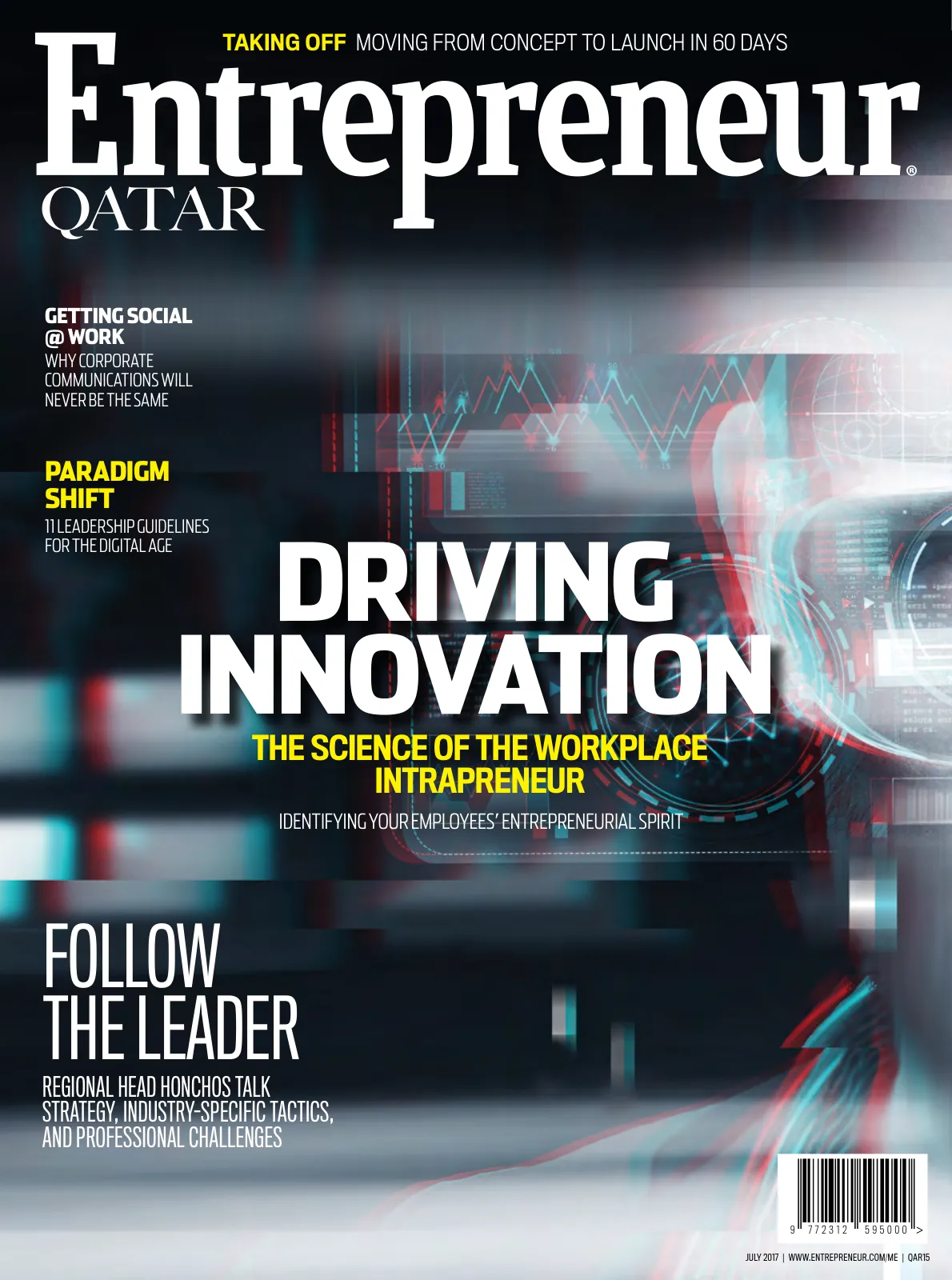
Entrepreneur Qatar, July 2017
Page 1
Driving
innovation
Identifying your employees’ entrepreneurial spirit
The science of the workplace
intrapreneur
Taking off Moving from concept to launch in 60 days
11 leadership guidelines
for the digital age
Paradigm
shift
Why corporate
communications will
never be the same
Getting social
@ work
Regional head honchos talk
strategy, industry-specific tactics,
and professional challenges
FOLLOW
THE LEADER
JULY 2017 | www.entrepreneur.com/me | QAR15
9
7 7 2 3 1 2
5 9 5 0 0 0 >
Page 2
Page 3
july 2017 Entrepreneur
3
CONTENTS
july 2017
16 How you can go about identifying your employees’ entrepreneurial spirit
26
Farid Chedid,
Chairman and CEO,
Chedid Capital Holding
20
INNOVATOR:
FOLLOW THE LEADER
Enterprise head honchos
talk strategy, industry-
specific tactics, and
professional challenges
Insights and inspiration from
15 business leaders impacting
the MENA market today.
16
TREPONOMICS:
PRO
Driving innovation
The science of the
workplace intrapreneur:
Tanvir Haque on how you
can go about identifying
your employees’
entrepreneurial spirit.
42
INNOVATOR:
Disruptive diagnosis
Ziad Makhzoumi
This seasoned businessman’s
new project is all set to make
waves in the healthcare
sector.
48
‘TREPONOMICS:
PRO
Paradigm shift
Liri Andersson, founder, this
fluid world, and Ludo Van
der Heyden, Professor of
Corporate Governance and
Technology and Operations
Management at INSEAD,
offer 11 leadership guidelines
for the digital age.
80
MONEY:
ECON
Setting the stage [to scale
your business]
Samy Elsheikh, legal
associate in SME Law,
offers a primer on what a
seed funding round entails
for a startup.
50
TECH:
SHINY
#TamTalksTech
Gadgets and doodads
that you might’ve missed
out on, sourced by a tech
aficionado. Yes, it’s okay to
want them all… and no, it’s
not our fault.
Page 4
Page 5
Page 6
Entrepreneur july 2017
6
CONTENTS
july 2017
74
START IT UP:
ECOSYSTEM
A helping hand
Dubai’s new culinary
incubator Kitchen Nation
wants to help F&B startups
stand on their own feet.
70
TECH:
GEEK
Going deep on food tech
Freedom Pizza founder Ian
Ohan takes a look at digital
disruption in the F&B
industry.
54
‘TREPONOMICS:
ESQUIRE GUY
Making working together
work
The Esquire Guy on what
goes into building a perfect
collaboration.
44
‘TREPONOMICS:
PRO
Finding the right hires
Talentera General Manager
Muhammad Younas
explains seven reasons why
a career portal solution
needs to be a company’s top
priority.
58
CULTURE:
LIFE
A one-page leadership
textbook
Business coach Murtaza
Manji dissects Elon Musk’s
leadership style from the
entrepreneur’s recent email
to his staff.
56
CULTURE:
LIFE
The power of delayed
gratification
James Clear writes on the
one quality that people are
more likely to succeed with.
58 Elon Musk speaking alongside Irish Taoiseach (Prime Minister)
Enda Kenny at The Summit
elon musk image © Dan Taylor / Heisenberg Media
22
Elie Khouri, CEO,
OMG MENA
Page 7
British Engineering.
Tested Beyond Endurance.
When the
conditions
are
unpredictable
you need
a watch
that isn’t.
900 feet below sea level is no place to
find out that your watch won’t function
at 900 below sea level.
That’s why every Bremont watch is
ruthlessly engineered to be fit for
purpose. However extreme that
purpose might be.
Anywhere you can go, a Bremont
can go too. And usually further.
Your Bremont is probably tougher
than you are.
The new Supermarine Type 300 has
been hand-built and tested on British
shores, at our headquarters in
Henley-on-Thames.
Sure, it has its limits, but you’re
unlikely to ever find them.
ers in
you’re
m.
Available at
Page 8
Entrepreneur july 2017
8
CONTENTS
july 2017
60
START IT UP:
STARTUP FINANCE
“We got funded!”
A low-down on how HR
technology company Bayzat
and hospitality startup
blueground clinched their
latest fundraising wins.
52
CULTURE:
TRAPPINGS
‘Trep gear
The executive selection for
the entrepreneur on your
list that has everything.
Okay, maybe for a little
self-reward as well.
82
CULTURE:
LIFE
Getting social @ work
Ema Linaker, Director
of Digital at Edelman
MEA, on why corporate
communications will never
be the same again after
social media.
57
IN THE LOOP
Careem crosses US$1 billion
in valuation
The MENA-based ride-
hailing app has raised
US$150 million to close
its Series E round of $500
million.
78
START IT UP:
Q&A
No more excuses
UAE-based Flexible fitness
marketplace FittPass wants
to get the region moving
(and saving).
50 Lenovo Legion Y720 Laptop in UHD
64
Jason Atherton,
founder of the
Social Company, a
restaurant group
that includes Marina
Social restaurant in
Dubai Marina
74 Culinary incubator Kitchen Nation wants to help F&B startups
stand on their own feet
Page 9
Page 10
Entrepreneur july 2017
10
SUBSCRIBE
Contact subscriptions@bncpublishing.net to receive
Entrepreneur Middle East every issue
EDITOR IN CHIEF Aby Sam Thomas editor@bncpublishing.net
CEO Wissam Younane wissam@bncpublishing.net
MANAGING DIRECTOR Walid Zok walid@bncpublishing.net
DIRECTOR Rabih Najm rabih@bncpublishing.net
CREATIVE LEAD Odette Kahwagi
MANAGING EDITOR Tamara Pupic
STARTUPS SECTION EDITOR Pamella de Leon
COLUMNIST Sindhu Hariharan
COLUMNIST Tamara Clarke
COLUMNIST Shoug Al Nafisi
COLUMNIST Erika Widen
EVENTS LIAISON Mark Anthony Monzon
PO Box 502511 Dubai, United Arab Emirates
P +971 4 4200 506 | F +971 4 4200 196
For all commercial enquiries related to
Entrepreneur Middle East contact
sales@bncpublishing.net
All rights reserved © 2016.
Opinions expressed are solely those of the contributors.
Entrepreneur Middle East and all subsidiary
publications in the MENA region are officially licensed
exclusively to BNC Publishing in the MENA region by
Entrepreneur Media Inc.
No part of this magazine may be reproduced or
transmitted in any form or by any means without written
permission of the publisher.
Images used in Entrepreneur Middle East are credited when necessary. Attributed use of
copyrighted images with permission. All images not credited otherwise Shutterstock.
Liri Andersson
Fida Chaaban
James Clear
Samy Elsheikh
Imad Hammad
Ema Linaker
Ali Malik
Alex Malouf
Murtaza Manji
Ross McCammon
Ian Ohan
Ludo Van Der Heyden
Muhammad Younas
CONTRIBUTING WRITERS
MIDDLE EAST
Printed by Raidy Emirates Printing Group LLC
www.raidy.com
www.entrepreneur.com/me
Access fresh content daily on our website!
MIDDLE EAST
EntMagazineME
@EntMagazineME
Entrepreneur-me
EntrepreneurMiddleEast
EntMagazineME
EntMagazineME
EntMagazineME
In addition to our print edition, we’re bringing
you all sorts of industry news on our web
mediums. Joining us online means getting
relevant business and startup content in
real-time, so you’re hearing about the latest
developments as soon as we do. We’re looking
forward to interacting with our readers on all of
our social media and web platforms- like any
thriving business, we’re looking to give and take.
#TrepTalkME is already happening on all of our
digi platforms, and all good conversations go
both ways. See you on the web!
Page 11
ACHIEVEMENT
Page 12
Entrepreneur july 2017
12
EDITOR’S NOTE
Take care of your brand
Your business needs to be prepared
to handle a crisis
Aby Sam Thomas
Editor in Chief
@thisisaby
aby@bncpublishing.net
E
arlier this week, I came
across a controversy play-
ing out on the official Ins-
tagram page of an influen-
tial Dubai-based company,
wherein a horde of social media
users were accusing it of apparently
ripping off a F&B concept built by
a homegrown local F&B startup.
As I went through the comments, I
found out that the crux of the issue
was that the latter company had
spent two years planning, refining
and launching its concept, only to
have the aforementioned conglom-
erate later come along, essentially
copy the idea, and then announce it
as its latest new enterprise- yeah,
you should now be able to see why
there was so much outrage in re-
sponse to that particular Instagram
post.
At the time of writing this note,
it has been four days since the
controversial Instagram post came
out, and there were now a flood of
comments on it- but I couldn’t see
a response from the company who
had posted it in the first place. Now,
this is the part I found perplex-
ing- after all, the whole point of
a company having a social media
presence is to allow for interac-
tion with its customers, and this
is especially important when they
are complaining about something
or the other. Of course, the ideal
scenario would be to have replies
to such comments happen instan-
taneously, but the fact that, in the
aforementioned case, it’s been four
days and the original poster has yet
to make a response doesn’t bode
well for its brand perception in the
market at large. At the moment,
this radio silence can be perceived
as everything from sheer laziness
to utter callousness-all of which
are characteristics that your brand
should definitely not want to be as-
sociated with.
But such a concern seems to elude
most brands, big and small, in this
region- there seems to be a tenden-
cy wherein companies here, when
faced with a crisis or complaint
on social media, prefer to, kind of,
stick their heads in the sand, and,
sort of, wish the problem away. It’s
a pity that this continues to be a
norm of sorts, as I believe that the
smarter (and perhaps easier) route
to take in these kind of situations
is to start by simply acknowledg-
ing the issue- you don’t even need
to agree with the complaint, just
show that you are a brand that
is, at the very least, attentive and
listening. Once you have done this,
take the time out to get your people
together, and decide your position
on the matter of dispute. Putting
this together might take a while,
and that’s perfectly okay- as long as
you have recognized the issue in the
first place. Just don’t go the silent
treatment route- it doesn’t do your
brand any favors at all.
At the same time, this particular
issue has also brought to the fore
the relatively unaddressed topic
of the importance of startups and
SMEs protecting their intellectual
property- if you are building a busi-
ness of your own, rest assured
that it’s worth the effort to have
complete ownership of all your IP
assets in writing. At the same time,
make sure you have a plan in place
in terms of your recourse if your
IP has been compromised- don’t
simply bet on appealing to the
goodwill of people, instead have a
strategy crafted and in place, should
such a situation arise. Taking the
time out to do this in the initial
stages of your business may seem
unnecessary or unwarranted- but
then again, it is always better to be
safe rather than sorry. If you want
to stack the cards in your business’
favor, start with the basics- after
all, some of the world’s most re-
markable entrepreneurs succeeded
due to foresight, plain and simple.
Page 13
Page 14
Page 15
Page 16
Driving
innovation
Identifying your employees’ entrepreneurial spirit
The science of the workplace
intrapreneur
By Tanvir Haque
Entrepreneur july 2017
16
ETHICS | ESQUIRE GUY | SKILLSET | MARKETING | PRO
TREPONOMICS
Page 17
july 2017 Entrepreneur
17
W
hen you hear the
word entrepreneur,
what springs to
mind? The likes of
Richard Branson,
the late Steve Jobs,
or even Mark Zuck-
erberg may pop
into your head. We tend to think
of entrepreneurs as global busi-
ness founders and leaders: those
with the big ideas, innovations and
companies. Yet, the entrepreneurial
spirit need not be confined to the
CEO’s office. In reality, some of your
employees may already be display-
ing the entrepreneurial behavior
necessary for running a company
and being a leader.
While some bosses might see this
as a threat, it’s something you have
a duty to encourage. What’s more,
if you’re able to tap into these traits
and help cultivate them, it could
bring exciting advances for your
enterprise.
Spotting and nurturing
workplace intrapreneurs
So how can these individuals help
you to enhance your business? It’s
not a question of creating entre-
preneurs within your company;
instead, it’s about recognizing those
who are already displaying the
traits. Within a workplace, these
people are sometimes known as “in-
trapreneurs” –entrepreneurs work-
ing within a company– and you can
use them to benefit your business.
This idea was well captured
in a 2012 study The Effect Of
Intrapreneurship On Corporate
Performance, which researched the
impact that these individuals had
on the success of the business as a
whole. The study found some strik-
ing results, concluding that there
was a positive relationship between
the performance of the company
and the number of intrapreneurial
individuals within it.
Yes: the more entrepreneurial
talent there is in a business, the
greater the success of the overall
enterprise. People displaying en-
trepreneurial talent, even within
your company, can help to drive it
forward.
So, how can you aid this process?
Well, your first challenge as an
employer is identifying the intra-
preneurs so you can support and
nurture them effectively. While
entrepreneurial values are by no
means restricted to a certain demo-
graphic, research suggests a peak in
the 35-44 age group, perhaps the
age that workers reach their full in-
novation potential.
Still, the millennial generation
must not be overlooked. While often
stereotyped as the startup genera-
tion, two-thirds of millennials say
they actually prefer the stability
of full-time work to the freelance
lifestyle. This in itself presents an
interesting opportunity for business
owners to capitalize on young talent
in the workplace. Nurturing these
individuals when they enter your
workforce could not only persuade
them to stay, but also help them to
help you grow your business.
The stats are one thing, but what
really makes someone an effective
intrapreneur is the way they behave.
According to one entrepreneurship
expert, the distinguished manage-
ment scholar Dr. Randall Schuler,
there are ten key behaviors which
separate high-level entrepreneurial
workers from the rest:
1. Have a creative mind
Innovation stems from creativity.
Without it, there can be no forward
movement in the company. Schuler
dubbed this trait “highly creative
and innovative behavior,” the idea
being that entrepreneurial people
have a will to change the status quo
and also that they notice opportuni-
ties in the market.
2. Focus on the future
It’s fine being creative and innova-
tive, but if a creative person lacks
focus, their talent will be wasted.
Having a “very long-term focused”
personality ensures that their in-
novative tendencies continue over
time rather than being a fleeting
fancy: they are able to identify what
adds value and what diminishes it.
3. Be a team player
Of course, when working in a busi-
ness, teamwork is essential. It’s
being able to realize that sometimes
others have to take control that
makes these individuals integral to
the business. According to Schuler,
an entrepreneur ought to have a
sense of “highly co-operative, inde-
pendent behavior.”
4. Be a risk taker
In this world, you get nowhere
unless you’re willing to take risks.
Entrepreneurial individuals must be
“very high-risk taking” if they are
to make a real difference within a
business. The good thing is that this
behavioral trait is usually easy to
identify among employees.
5. Get results
While those who lack entrepre-
neurial spirit tend to be focused
on the process of work, you’ll find
that innovative members of your
team show a “very high concern for
results.” This is a necessary part of
being a leader, even within a work-
place scenario.
6. Take responsibility
It’s uncommon to see a successful
entrepreneur shirking their respon-
sibilities. Indeed, the innate “high
preference to assume responsibil-
ity” is likely something you will see
in a worker entrepreneur as well.
They take pride in owning both
their successes and their mistakes.
7. Roll with the punches
The business landscape is always
changing and both leaders and their
team need to be ready to adapt. Per-
haps that’s why Schuler noted that
high entrepreneurial workers are
“very flexible to change.” They can
adapt to any given scenario.
8. Weather the storm
In the same vein, business can
be highly unpredictable. Workers
who are entrepreneurial are “very
tolerant of ambiguity and unpre-
when working in a business, teamwork
is essential. It’s being able to realize
that sometimes others have to take
control that makes these individuals
integral to the business.
ETHICS | ESQUIRE GUY | SKILLSET | MARKETING | PRO TREPONOMICS
Page 18
Entrepreneur july 2017
18
dictability,” and thus can deal with
high-pressure situations.
9. Be a planner
Sometimes, planning your next
move is just as important as imple-
menting it. Rushing head first into a
new endeavor may seem courageous
but could lead to problems down
the line. According to Schuler, en-
trepreneurial people tend to have a
“very high task orientation.”
10. Be effective
Finally, according to Schuler’s
research, these individuals must
also have a “focus on effectiveness.”
Whereas those who are less likely to
be entrepreneurs tend to center on
efficiency, natural-born leaders are
solely concerned with how effective
each activity is.
The science of the workplace
intrapreneur
As a business leader, you should be
actively looking to identify these
behaviors in your staff. To help you
keep an eye out for entrepreneurial
values and traits, there are some
scientific scales you can use to help
assess your employees. There are
even a few online tools that are
available to help you in the process-
here are three such options:
1. The BP10 tool by Gallup
If you want something that’s easily
accessible and measurable, Gallup
offers a handy tool for a small fee.
The Builder Profile 10 (formerly
known as the Gallup Entrepreneur-
ial Strengths Finder) seeks to iden-
tify ten separate talents among your
workforce and, in turn, to identify
their entrepreneurial strengths.
Once you’ve bought the pack-
age, your employees simply take
a 30-minute online assessment,
which requires them to answer
questions about their work style.
At the end of the assessment, they
will be provided with an evaluation
of their skill set. The custom report
will help both you and your em-
ployee gain a deeper understanding
of how they can progress.
2. Entrepreneurial competency
by Ventureprise
On the other hand, if you would
rather not pay for a full evaluation,
Ventureprise have a competency
measure you can use online. Their
document describes a measure for
entrepreneurial talents and helps
you identify quickly and easily
where your employees fall on the
entrepreneurial spectrum.
The aim of the document is to of-
fer useful resources regarding “typi-
cal entrepreneurial competencies”
which you can use in your current
business. By concisely describing
both “entrepreneurial traits” and
“entrepreneurial motives,” the Ven-
tureprise measure offers a rounded
view of innovative talent.
3. Business Development Bank
of Canada
Finally, the Business Develop-
ment Bank of Canada uses a quick
self-assessment test which seeks
to identify these values within in-
dividuals. Users are presented with
50 statements and must determine
to what degree they agree with each
of them.
This survey-based model is es-
sentially an in-depth aptitude test,
which helps both you and your em-
ployees to identify their strengths
and weaknesses. Once these traits
are clear, training and development
measures can be taken to enhance
them.
Creating an environment of
empowerment
In the end, as a business leader, it
is your actions that are responsible
for creating an environment of
empowerment. As a leader of a com-
pany it is your job to identify the
entrepreneurial talent within your
workforce, and nurture and grow
that talent. What’s more you should
learn to utilize that talent to drive
innovation and enterprise growth.
But how can you cultivate this
kind of environment? It could sim-
ply be a case of adapting your lead-
ership style. Research shows that
leadership based on relationships
helps increase the entrepreneurial
spirit of the company, whereas a
task-oriented leadership style has
the opposite effect. By engaging
more with your staff, rather than
simply issuing commands, you can
help boost their potential.
If you lead by example, your em-
ployees will follow suit and together
you will drive the company forward.
By taking on board these lessons,
you have the power to enhance
your enterprise while at the same
time keeping your staff engaged and
proactive.
Tanvir Haque is currently the Chief Commercial Officer at Lifecare International, and he is the founder and Non-Executive Director of Freshstone
Consulting. He thrives on developing customer-centric business relationships, and as such, he is currently focused on revolutionizing Lifecare’s
customer experience and driving the company’s digital transformation plans– all with the aim of unlocking Lifecare’s full technology potential.
With a career spanning back more than 20 years, Tanvir’s experience has been gathered in professional services, banking, and telecommunications,
having worked with PwC in Sydney, Andersen in Sydney and London, and Standard Chartered Bank in London. He relocated to Dubai in 2008 and spent a number
of years advising and consulting international businesses on how to drive growth before joining Lifecare in 2015.
Tanvir graduated with a Bachelor of Commerce degree from the Australian National University in his home town of Canberra and is a qualified Chartered Accountant
and a member of Chartered Accountants Australia and New Zealand.
ETHICS | ESQUIRE GUY | SKILLSET | MARKETING | PRO
TREPONOMICS
www.gallupstrengthscenter.com
Page 19
july 2017 Entrepreneur
19
93
% of adults
think they
possess at
least some
entrepreneurial qualities,
according to a study from
University of Phoenix, analyz-
ing responses from 1,000
working U.S. adults. Addition-
ally, more than half say their
organization allows them to
think like an entrepreneur.
Employees who think like
entrepreneurs, or “intrapre-
neurs,” are more motivated,
take ownership of their work,
and possess excellent creative
problem-solving abilities.
Here are some ways to fos-
ter an intrapreneurial mindset
among employees:
1. Empower employees
Employee empowerment was
found to have a direct effect
on job performance, and an
indirect effect on satisfac-
tion and innovativeness, in a
study published in the Public
Administration Review in April
2013.
Drive innovative thought by
empowering employees to
make decisions, take charge
of projects, and solve prob-
lems. Give them the resources
and training they need, then
set them free, letting them
know the team believes in
their capabilities.
2. Prioritize employee
relationships
After surveying 200,000
employees at more than
500 organizations last year,
TINYpulse found peers and
camaraderie were the top
motivator for employees who
go the extra mile at work.
Sometimes the best ideas
spark when least expected,
such as during a good conver-
sation or enjoyable interac-
tion. Even when the team is
running low on ideas, having
positive working relationships
with one another will be the
fuel they need to persist.
Help the team cultivate these
strong relationships.
Schedule after-work activi-
ties in which employees can
participate and get to know
one another better. Exercise
together, share meals, and
play games to enhance team
bonding.
3. Encourage employees
to step outside the scope
of their work
The University of Phoenix
study found a key issue
blocking innovation: 47% of
employees said they’re not
encouraged to step outside
their scope of work. When
employees spend their time
doing the same tasks day
after day, they become stuck
in routine thought.
Encourage involvement in
projects outside day-to-day
tasks- in fact, 24% of employ-
ees surveyed said this would
help boost creative thought.
Allow them to job shadow
someone in another depart-
ment, or help a team member
with something new.
4. Host productive brain-
storming sessions
A quarter of workers in the
University of Phoenix survey
suggested having brainstorm-
ing sessions to address
organizational challenges and
sharing the company vision
and goals with all employees
to encourage creative thinking.
Meet with employees regu-
larly to brainstorm new ideas
and ensure strategies are
aligned with organizational
goals. Use an app like amaze-
meet to design compelling
meetings with a clear pur-
pose.
5. Emphasize individuality
over conventionality
Environment has big impact
on innovative thought. In fact,
a 2013 University of Min-
nesota study shows physical
order produces conventional
thought. Participants in the
study made healthier and
more generous choices when
in a clean room than when
they were in a disorderly
room.
But, the disorderly room en-
couraged breaking convention
and tradition- a key compo-
nent in innovative thinking.
Not everyone is inspired by
the same environment, so
not all work spaces should
look the same. They should
cater to the individual. Allow
employees to express their
individuality by decorating
their workspace in a way that
inspires them.
6. Allow ideas time to
incubate
Creative thinking develops
in an incubation process,
during which unconscious
thought takes over, according
to a study published in the
Frontiers of Human Neurosci-
ence in April 2014. That’s why
concentrating so hard on solv-
ing a problem rarely produces
an answer.
But, when employees are al-
lowed to let go and come back
to a problem, they have time
to let the idea incubate and
produce the needed solution.
Sometimes, the most inno-
vative ideas take time. Allow
employees to step away and
take focus off complicated
challenges and issues when
they hit a roadblock. Then,
unexpectedly, the right an-
swer may come to them.
Six steps for converting
employees into intrapreneurs
ETHICS | ESQUIRE GUY | SKILLSET | MARKETING | PRO TREPONOMICS
See this article in its entirety on Entrepreneur.com
By Heather R. Huhman
Page 20
Entrepreneur july 2017
20
FOLLOW
THE LEADER
Insights and inspiration from 15 business leaders
impacting the MENA market today
Enterprise head honchos talk strategy,
industry-specific tactics, and professional challenges
Brought to you by
Adeeb Ahamed
Ahmed El Alfi
Farid Chedid
Shailesh Dash
Ahmed Abou Hashima
Hazel Jackson
Elie Khouri
H.H. Sheikh Saeed Obaid Al Maktoum
Thumbay Moideen
Dr. Reem Osman
H.E. Shamsa Saleh
Osman Sultan
Dr. Karim El Solh
Shamsheer Vayalil
Essa Al Zaabi
Page 21
july 2017 Entrepreneur
21
B
ack in 1990,
Ahmed El
Alfi founded
Hybrid Capital
Partners, a
private invest-
ment partner-
ship, which funded, grew,
and exited several successful
companies. Two decades later,
he decided to further help in
transforming Egyptian and
other MENA economies by
funding technology-based
companies, and that led to the
establishment of Sawari Ven-
tures, a Cairo-based venture
capital firm. Over the years,
Sawari Ventures has made 10
investments with an average
ticket size of US$ 300,000. In
addition, El Alfi is the founder
of The GrEEK Campus, a
technology and innovation
park located on the former
American University of Cairo
(AUC) campus- at present, 115
startups have made it their
permanent base. The early
days of these two initiatives
were marked with the Arab
Spring, a series of protests
and demonstrations across
the region, and especially in
Egypt, in 2011 and 2013. That
period, El Alfi says, was filled
with some of the most dif-
ficult situations he has had to
navigate in his entire career.
“The most challenging times
started in January 2011, and
included the subsequent
unrest that lasted for a few
years,” El Alfi explains. “The
most important thing dur-
ing that period was to look
out for the key people in my
organization because then
they did the same thing and
looked out for other people.
In crisis, the most important
thing is taking care of your
people, which involves show-
ing them and having them
buy into the path through the
problem, and making sure
to be aware of their issues,
both individual and business-
related. At that time, I had a
team of 10 people, in addition
to our portfolio companies,
which we always consider as
a part of the team as well. I
will never forget what my late
father used to say, and that is
that you need to deserve the
people whom you lead.”
Being an entrepreneur, El
Alfi knew how to handle dys-
functionalities in the market,
and post the Arab Spring, he
became even more inspired to
support young MENA entre-
preneurs and proved instru-
mental in setting up Sawari
Ventures’ next initiative:
Flat6Labs Startup Accelera-
tor. Functioning as a hybrid
model combining a startup
accelerator and a VC fund,
thus providing both seed and
early/growth stage invest-
ments, Flat6Labs now has of-
fices in Cairo, Jeddah, Beirut,
Tunisia and Abu Dhabi. “We
are currently in five countries
and we are looking to expand,
maybe to add an additional
location in some of the coun-
tries we are in and to expand
into other countries,” El Alfi
says. “I hope that by the end
of this year we will have
Morocco off the ground,
and a second location in
one of the countries we
are already present in. We
are also looking at Kuwait
and Jordan. In 2018, we
will start looking to expand
outside of the Arab world.”
After a few years of
witnessing the growth of
the MENA startup scene,
El Alfi explains that two
important changes, both
presently occurring, will
enable it to evolve into a
more mature entrepreneurial
ecosystem. “Firstly, recogni-
tion by the traditional busi-
ness community that startups
can become legitimate players
in the marketplace in the
MENA region,” he says. “That
same perception is happening
among talented personnel,
since now you see senior
and highly-qualified people
leave big corporate jobs to
join startups. Both of those
are leading to better funding
for startups. So, I think that
everything is converging right
now. In the future, we are go-
ing to see more foreign funds
investing, as well as more lo-
cal funds being formed, higher
valuations and more high
profile successful companies,
and hopefully more startups.”
Flat6Labs, on average,
receives 300 to 500 applica-
tions per cycle per location.
The applications are evalu-
ated on the basis of the teams’
abilities, the novelty of their
ideas, potential for scaling,
and the Flat6Labs team’s fit
with the startup management.
The accelerator is known for
its founder-friendly terms,
taking 10-15% equity in com-
panies against seed funding
offered, board representation,
and some basic minority
protection rights. To date,
Flat6Labs has invested in
113 companies across Cairo,
Jeddah and Abu Dhabi. “The
quality of the applications
that we are getting has im-
proved and the qualifications
of the applicants are higher,”
El Alfi says. “I like to think
that Flat6Labs and other pro-
grams are having a substantial
impact in all the countries
where we operate. We have
had applications coming
from 70 different countries,
so people relocating from
India, Russia or Italy to start a
company at Flat6Labs. This is
because the UAE is perceived
as a good place to start up a
company. We have also fund-
ed a few companies started by
young Emiratis and we want
to encourage that. We have
just finished an innovation
and ideation training program
for the Emirati youth. I was
pleasantly surprised by the
size of the turnout and the
quality of the young people
who came. We should be
doing that on a regular basis
throughout the various emir-
ates, not just in Abu Dhabi.”
As for the future, El Alfi
is keeping an eye on social
entrepreneurs. “I continue to
appreciate entrepreneurs who
solve social problems because
they improve the conditions
in the market for every-
body,” he concludes. “Social
problems are so deep in our
region that it should be easy
to attack one small section of
it, but they should make sure
that they get funding for the
problem they are solving and
they should be very efficient
in their use of capital.”
Ahmed El Alfi
“
Founder and Chairman
Sawari Ventures
“the most important thing is taking care
of your people, which involves showing
them and having them buy into the path
through the problem, and making sure to
be aware of their issues, both individual
and business-related.”
Ahmed El Alfi,
founder and
Chairman,
Sawari Ventures
IMAGE COURTESY: swari ventures
Enterprise head honchos talk
strategy, industry-specific tactics,
and professional challenges
FOLLOW
THE LEADER
Page 22
Entrepreneur july 2017
22
Elie Khouri, CEO,
OMG MENA
Page 23
T
he first thing
is to have a
sense of pur-
pose and stay
true to it,”
says Khouri
when asked
about how he goes about his
role as the CEO of Omnicom
Media Group MENA. It’s no
secret that the advertising
industry is going through
somewhat of a rough patch at
the moment, but that’s what
makes Khouri’s stewardship
of his company in these chal-
lenging times particularly
noteworthy- here’s a media
exec who’s well-versed with
the changes happening in his
sector, and he is making sure
that his firm –a pioneering
marketing services group in
its own right- is in tune with
the trends that are manifest-
ing themselves in the MENA
locale. That’d explain Khou-
ri’s insistence on having “a
sense of purpose” when lead-
ing an enterprise- it looks to
be something that’s govern-
ing his own leadership strat-
egy. “This single-mindedness
is critical, because it acts
as your North Star in the
middle of a storm,” Khouri
explains. “When everything
else around you causes tur-
bulence and requires agility,
this consistency ensures
you don’t lose your sense of
direction.”
It is this kind of foresight
and vision that has led
Khouri to be recognized as
one of the MENA region’s
foremost marketing mavens,
sitting at the helm of a com-
pany that has four market
leading agencies under its
belt (OMD, PHD, Resolution,
Hearts and Science), more
than 20 offices across the
region, and over 600 people
as its employees. Given the
number of years he has been
a part of this industry in
the region, Khouri has had a
first-hand view of the evolu-
tion of the marketing func-
tion, which has today moved
beyond the 4P’s as laid out
by Philip Kotler, a.k.a. the
Father of Modern Marketing.
“Any marketing student will
remember Philip Kotler’s
4P’s (Product, Place, Price,
and Promotion)- they still
apply, of course, and other
P’s have been added to mod-
ernize the thinking,” Khouri
says. “The most significant
of them is People, because
brands have now embraced
a more customer-centric
view of their marketing, even
working with the notion of
Customer Lifetime Value
(CLV). With digital media in
general and social media in
particular, marketing is less
and less campaign-based,
and more and more ‘always
on.’ With addressable media,
we are also getting closer to
individuals, so we can make
better predictions of the
net profit attributed to the
entire future relationship
with a customer. This CLV
concept projects a company
or marketer beyond simple
quarterly profits, and pushes
them to take a much more
long-term view of their
customer relationship. This
leads to much more mean-
ingful investment decisions.”
Strategies like these are
becoming increasingly
popular in a landscape where
enterprises big and small are
looking to get more bang for
their buck, and Khouri be-
lieves this has had an impact
on how marketing is being
perceived as well. “There
are signs that the market-
ing role is becoming even
more connected to business
performance, and revenue
in particular,” he says. “The
more a business turns digital,
the more the contribution of
marketing can be measured.
This means the profile and
background of marketers
will change further still, and
focus even more on science.
Millennials are a key driver
of this evolution, and their
growing presence in market-
ing roles will further push
this digital thinking forward.
What is interesting also is
that we’ve evolved from the
khouri
elie
CEO, Omnicom Media Group MENA
“a business leader who thinks
and acts with agility and
embraces innovation, rather
than ignoring or resisting
it, will run a business like an
entrepreneur. This also requires
intuition and fearlessness. None
of this is dictated or limited by
the size of the company, just the
management style.”
“Innovation, like creativity
or disruption, features
in every conversation,”
Khouri explains. “It may
mean slightly different
things depending on the
industry you’re in, but
ultimately, the notion
remains the same, and we
can’t get enough of it.”
“
Enterprise head honchos talk
strategy, industry-specific tactics,
and professional challenges
FOLLOW
THE LEADER
Page 24
Entrepreneur july 2017
24
functional focus of a product
or service (it washes whiter,
it goes faster, etc.) to a much
more emotional relation-
ship between consumers
and brands. The product
experience has widened sig-
nificantly, and considerations
like social behavior, attitude
and retail experience are sig-
nificant contributors to pref-
erence and loyalty. To stand
out, a brand must consider
these changing consumer
expectations. These trends
play in the hands of smaller
organizations, that are often
younger, more digital and
more agile than large busi-
nesses. Data is size-agnostic
and can be very democratic
in that it’s everywhere; you
just need to know where to
look and how to use it.”
Given this context, it’s
easy to see that innovation
is the need of the hour for
this industry, and that’s why
Khouri has been encouraging
an entrepreneurial kind of
mentality within his orga-
nization- it’s an essential
component for the business’
sustainability, he says. “In-
novation, like creativity or
disruption, features in every
conversation,” Khouri ex-
plains. “It may mean slightly
different things depending
on the industry you’re in,
but ultimately, the notion re-
mains the same, and we can’t
get enough of it. We must
constantly and consistently
endeavor to improve and
enhance the way we operate,
the products we create, or
the processes we use. Our
clients or consumers expect
it, and failure to deliver will
result in loss of market share,
both in terms of volume and
value- not exactly an appeal-
ing prospect, so no, compla-
cency is not the way forward.
Entrepreneurialism is indeed
rooted in this spirit of doing
something different or better,
because that’s where the
opportunity lies and yes, we
have embraced that approach
internally. We’ve created
smaller units within our
agencies that run like small
enterprises. We’re training
our team leaders to think and
work like entrepreneurs. The
result is the agility of a small
enterprise, and the resources
of a large organization. This
is literally the best of both
worlds. Yes, a business leader
who thinks and acts with
agility and embraces innova-
tion, rather than ignoring or
resisting it, will run a busi-
ness like an entrepreneur.
This also requires intuition
and fearlessness. None of this
is dictated or limited by the
size of the company, just the
management style.”
So, what is Khouri’s leader-
ship mantra at OMG MENA?
“Our mantra is simple, and
can be summarized in four
P’s,” he replies. “It starts
with our Purpose, our mis-
sion, if you will. It is to build
our clients’ business by
Q From your personal
perspective, what are some
of the main considerations
that entrepreneurs should
keep in mind when starting
up a business in the MENA
region?
A “In my 28 years here, I
have never stopped being
fascinated by the energy of
this place. Nothing’s impos-
sible, nothing’s too big.
The region’s business and
consumer confidence often
top the global charts. Our
can-do attitude is the envy
of other countries because
it liberates the energy and
achieves results. This is a
potent formula for business
and one that others em-
brace more and more.
What’s more, there is also
a strong resilience when
conditions turn sour. We
bounce back faster and
faster each time. This is
important for entrepreneurs,
because it’s never plain sail-
ing and the ability, actually
the agility, to pivot is an
essential aspect of effective
leaders. Contingency plans,
alternative routes, backup
solutions are all essential
elements that entrepreneurs
must consider when they
launch their business as
nothing is set in stone.
Talent is an essential
without a measure of failure.
This agility resides in the
leadership, but also the
team around it. Entrepre-
neurs need to lean on the
right talent, be it a team or
a network of contacts, to
be able to fully execute the
vision, no matter what the
conditions are. Finding the
optimal mix between skills,
experience, chemistry, val-
ues and passion isn’t easy,
of course, but it’s a critical
factor of success.
Talent is an essential
resource; funds are obvi-
ously another. To raise funds
smartly, entrepreneurs need
to create demonstrable and
tangible value to investors
or shareholders. They also
need to be clear about their
need to grow their business,
as this provides investors
with the confidence that the
business is competently and
judiciously managed.
One last thing, and I
speak from experience,
entrepreneurs need to seek
out a mentor, someone who
brings composure, impartial
and independent advice, as
well as contacts to the table.
This type of trustworthy
and long-term support is
invaluable and yet often
disregarded. Mentors also
empower and strengthen
their entrepreneurs’
personal growth focusing
on their sense of purpose,
decision-making, emotional
intelligence, creativity and
motivation, among other
things.”
Ask the exec
Elie Khouri, CEO, Omnicom Media Group MENA
“The more a business turns digital,
the more the contribution of marketing
can be measured. This means the profile
and background of marketers will
change further still, and focus even
more on science. Millennials are a key
driver of this evolution, and their
growing presence in marketing roles
will further push this digital thinking
forward.”
www. omnicommediagroupmena.com
Enterprise head honchos talk
strategy, industry-specific tactics,
and professional challenges
FOLLOW
THE LEADER
Page 25
july 2017 Entrepreneur
25
engaging, entertaining and
empowering consumers to
make smarter choices. The
second is People, without
whom none of this would
be possible. We attract,
nurture and retain amazing
people, providing them with
a stimulating environment
that fosters creativity and
entrepreneurship. They
deliver the third P: Product.
We apply rigor in everything
we do. We invest in tech,
data, content and everything
in between to make us more
effective. When the three P’s
are done right, we get the
last one, Profit, an obliga-
tion we have towards all our
stakeholders. To achieve this,
we stay true to our values,
which guide our thinking,
behavior and recruitment.
The first is caring, as we take
great pride in responsibly
developing compassionate
and nurturing relationships
with our employees, clients
and partners. The second is
pioneering, to stay ahead of
the curve. We’re innovative
and constantly searching for
ideas that fuel success for
our brands and people. We’re
also conscious about main-
taining high levels of humil-
ity, our third value. We seek
and provide honest feedback,
learn from both mistakes and
successes in equal measure
and never underestimate our
competitors. Lastly, agility.
We aim to always be curious
and insightful. Reinventing,
reacting and responding is
the only way to truly add
value.”
Enterprise head honchos talk
strategy, industry-specific
tactics, and professional
FOLLOW
THE LEADER
1. Surround yourself with
people that are smarter than
you “Seek people who offer a
different perspective, as it helps
you paint a sharper picture,
shed more light on situations
and reduce risk. Don’t be afraid
of being challenged and pushed,
that’s how you achieve greater
things.”
2. Be generous “Today’s
leaders must be caring,
putting the interests of their
staff first. People at the top
of an organization need to
be genuine, generous and
selfless to earn and justify their
employees’ trust. This can be
done in several ways, including
giving people access and time,
paying attention to their needs
and feelings, and improving
their welfare at work.”
3. Your people must get
more than what they give
“More than just a salary,
people’s compensation for
their work today includes
self-actualization and purpose.
Beyond the transaction of salary
for time and effort, you want
emotionally engaged employees
who, to truly feel connected,
must get back from work at
least as much as they put in.”
4. Remain agile and adapt
to change quickly “The fast-
changing environment in which
we live calls for agile, rather
than just adaptable, leaders.
Speed is a key consideration
because fast is better than
perfect. If time to market was
once measured in years, it is
now set in terms of weeks.
Be decisive, think and act
confidently and effectively,
pivoting when changing
conditions require a new
direction.”
5. Stay ahead of the game
by investing in the future
“When everything around
you is changing at breakneck
speed, you need to be able to
make smart bets on the future.
Some of these will require a
leap of faith. Being innovative,
a pioneer, necessitates a fair
amount of gut but the rewards
of being ahead of the curve are
huge.”
Take the lead
Elie Khouri,
CEO, OMG MENA
ELIE KHOURI’s tips for entrepreneurs fronting their enterprises
Page 26
Entrepreneur july 2017
26
A
year after cel-
ebrating the first
decade in business
for Chedid Capital
Holding, a Dubai-
headquartered solutions
provider in the insurance
and reinsurance industry,
and nearly two decades
since founding Chedid Re,
an insurance provider and
a registered Lloyd’s broker,
Farid Chedid, the Group’s
Chairman and CEO, be-
lieves that his enterprise’s
strength is in its ability to
cater to the changing needs
of clients, businesses and
markets in which they oper-
ate. This agility has been
demonstrated on numerous
occasions by forming and
successfully developing
separate strategic business
subsidiaries, including
Chedid & Associates, an
authorized insurance broker,
as well as Chedid Corporate
Solutions, a consultancy ser-
vice provider that caters for
growth-focused companies.
Furthermore, Chedid is the
Chairman and CEO of Chedid
Insurance Brokers network,
which has offices in Lebanon,
Saudi Arabia, and other
countries in the region. “We
managed to institutionalize
our first company, Chedid
Re, and lead it to become
one of the top 20 reinsur-
ance brokerage groups in
the world, and the only Arab
company to be registered as
a Lloyd’s broker,” he says.
“The second achievement
is that we have created
and reinforced our direct
brokerage business, Chedid
Insurance Brokers, by es-
tablishing one of the biggest
networks in the Middle East,
Africa and some parts of
Europe, through startups or
acquisitions. All of this has
been done by implementing
the vision of our holding
company which rests upon
the pillars of transparency,
corporate governance, and
customer service. Last but
not least, because we care
to have the best team, and
we always hunt for the best
people, we have established
the Chedid Academy, which
is aimed at training our peo-
ple to be experts in the field.
However, we also train the
people holding key positions
at our clients’ companies
which is our contribution to
the insurance industry and
to the markets we proudly
operate in.”
Yet, the decade-long en-
trepreneurial journey was
not smooth sailing. Chedid
recalls the biggest business
crisis the group experienced.
“It was back in 2006, just
two years after we had
established the holding
company in Lebanon,” he
says. “The war in Lebanon
started, with the Israeli army
bombarding the south of the
country as well as its capital
Beirut. The airport was
closed. The team abroad was
cut from the headquarters.
We immediately decided to
move the headquarters to
another region and to have
the rest of the team move
to Cyprus, where we had an
operation unit, and to Dubai.
Our operations started to
recover, the team adapted
themselves to the new
reality, and soon enough the
business was back to usual.
From that day, I promised to
myself and to my team that
nothing in the world would
ever stop our long journey.
This has made me go to new
places, new markets and
new continents to secure
my business and the income
of the employees working
for me. The first of the two
pieces of advice I would give
to myself and to others who
wish to hear it is to always
be ready for the worst and to
plan ahead of time to adapt
to any potential crisis. We
are a group that sells risk
coverage to individuals,
companies, governments, but
mastering risk management
is key for any CEO, especially
during challenging times.
The second advice is to sur-
round yourself with the best
people, meaning the best in
terms of knowledge but also
in terms of integrity because,
in crisis times, the best will
fight to save the boat.”
Today, the group’s three
strategic business units,
Chedid says, are all going
from strength to strength.
Farid Chedid
“
Chairman and CEO, Chedid Capital Holding
Farid Chedid,
Chairman and CEO,
Chedid Capital
Holding
“we have established the Chedid Academy
which is aimed at training our people to be
experts in the field. However, we also train
the people holding key positions at our
clients’ companies which is our contribution
to the insurance industry and to the
markets we proudly operate in.”
IMAGE COURTESY: chedid capital holding
Enterprise head honchos talk
strategy, industry-specific tactics,
and professional challenges
FOLLOW
THE LEADER
Page 27
july 2017 Entrepreneur
27
“The largest is reinsurance
broking, with business ema-
nating from over 45 coun-
tries in three continents.
We are a market leader in
our markets. Since 2010,
our second strategic unit
has been insurance broking,
Chedid Insurance Brokers,
which offers its services in
five countries, and is expect-
ed to increase this number
to 10 countries before the
end of the year. In the same
line of business, we acquired
City Brokers, via a joint
venture with IBL, an insur-
ance broker in the Mauritius
Islands. With City Brokers
we are developing our pres-
ence in East Africa. The
third is insurance risk carry-
ing, that is today operating
in one country.” Given the
number of years he has been
a part of the MENA business
arena, Chedid is confident
that the GCC/MENA region
is rich in business oppor-
tunities. “The Gulf region
is rich, stable, and strong.
The potential is amazing,”
he says. “Gulf countries are
implementing high levels of
corporate governance, more
and more transparency and
international management
standards. Any company or
a group that wants to grow
has to be present in the
Gulf region. Furthermore,
the Levant region is also es-
sential to our business since
Lebanon and Jordan have
always played a key role in
the insurance services busi-
ness. Also, the North African
market is today, besides its
national needs, a hub to
the African market since
any group that is looking to
expand into Africa has to
pass by North Africa. Today,
Morocco is the main gate.
So, given all of this, you can
easily understand why today
we are present in the Gulf,
Levant and North Africa.”
For all those wishing to fol-
low in his footsteps, Chedid
advises to first get familiar
with local customs and
culture. “Any entrepreneur
willing to start up a business
and be successful in the
MENA region, or anywhere
outside of their country,
should first understand the
culture of that new country,
the people of that country,
their different traditions,
and to try to adapt their
strategic business tools to
the new countries’ realities,”
he says. “You cannot offend
a country and do business
in it. You need to adapt
and hire people from that
country because, at the end
of the day, you are definitely
partnering with the coun-
try’s values. In the MENA
region, which is, as I already
said, a vast, rich and amaz-
ing region, creating oppor-
tunities is always possible.
Technology is advancing and
can always be a great source
of income for new entrepre-
neurs. Therefore, one of the
fields we always encourage
new entrepreneurs to begin
with in this region is tech-
nology, and to specifically
think of how to adapt this
technology to the traditional
or actual business. I can give
you an example, which is
that we want to encourage
and invite every entrepre-
neur or company to sell me
the best innovative technol-
ogy solution for my business.
Since we are present in the
whole MENA region, they
will certainly grow with us.”
However, Chedid again
highlights the importance
of hiring and retaining the
best people, building a
strong company culture, and
imposing strict corporate
governance rules, including
adherence to the highest
transparency standards, to
guarantee the serenity of
the group and to protect the
interests of their investors.
“The strategy and processes
that we follow are very pre-
cise and holistic. I make sure
they are ambitious,” he says.
“At our beginning, we were
facing difficulties with find-
ing and hiring good people
because good people tend to
find jobs in big, reputable
companies or groups. When
I started, I was alone, but I
worked hard, fought hard to
become number one, which
led to our competitors, sup-
pliers, and partners starting
to look at us in a different
way. So, I started interview-
ing the good people, of which
some decided to join me
and are still with us. Today,
they are the foundation of
the group and I can say that
they were like me, hungry for
success and eager to build
a career. Others started
with me but maybe couldn’t
handle the pressure and
decided to continue their
career elsewhere. So, with
time, hiring good people has
become easier, and I can say
that we are today considered
the ‘employer of choice’ in
the insurance industry.”
Q What’s your strategy for
making your brand, VPS
Healthcare, stand out when
compared to its competitors
in the market?
A “My concept is simple yet
effective. At the core are three
main features. First, to provide
cost-effective yet specialized
and superior quality healthcare
services, complemented by
personalized care and individual
attention to each patient with
an unparalleled passion and
commitment to serve the
medical needs of the growing
population. Second, establish-
ing a comprehensive healthcare
network to enable a sustainable
referral system. And, third, to
have a strong CSR program to
give our thanks back to those
in the community who require
some additional help in their
lives. There are competitors
in almost every market, and
healthcare is not an exception.
Most of the competition has
been with the public sector
and other private providers
who have been in the market
for decades. Competition, to
us, is a challenge to make us
stronger.”
Ask the exec
Dr. Shamsheer Vayalil, Managing Director, VPS Healthcare
Faisal Al Bannai,
CEO, DarkMatte
“we have created and reinforced our direct
brokerage business, Chedid Insurance Brokers,
by establishing one of the biggest networks
in the Middle East, Africa and some parts of
Europe, through startups or acquisitions.
All of this has been done by implementing the
vision of our holding company which rests
upon the pillars of transparency, corporate
governance, and customer service.”
IMAGE COURTESY: vps healthcare
Dr. Shamsheer
Vayalil, Managing
Director,
VPS Healthcare
Enterprise head honchos talk
strategy, industry-specific tactics,
and professional challenges
FOLLOW
THE LEADER
Page 28
Entrepreneur july 2017
28
N
ow that the UAE
is synonymous
with women’s em-
powerment in the
Gulf region and
beyond, it is of no surprise
that the world’s leading policy
makers choose to take part in
the Arab Women Leadership
Forum and the Global Wom-
en’s Forum Dubai, the flagship
conferences organized by
Dubai Women Establishment
(DWE) to discuss how to
foster women’s leadership
around the globe. However,
DWE CEO H.E. Shamsa Saleh
recalls that, only a decade ago,
she had to dispel many nega-
tive stereotypes about Arab
women in countries around
the world. “The Arab Women
Leadership Forum and the
Global Women’s Forum Dubai
are our projects with interna-
tional impact,” she says. “We
used to have our local forums,
but with these conferences,
we have brought about a new
perspective, and we have
succeeded in exchanging our
best practices with other
parts of the world. The most
important thing is that we
have managed to change the
perception of Arab women
internationally. I can recall
that, when in 2007, I attended
a forum in France, everybody
I met there thought that we
were still much behind the
world, and that we were
not even educated, or that
we weren’t allowed to drive
here, and so on. I realized
that we had to bring them to
Dubai and show them how
women had progressed here.
Furthermore, over the years,
the forum has opened many
business opportunities for
women. We are now exploring
how to bring more of these
kinds of events from different
parts of the world. In the next
few months, we will announce
these new initiatives.”
DWE was formed in 2006
under Law No. (24) by His
Highness Sheikh Mohammed
Bin Rashid Al Maktoum,
the UAE Vice President and
Prime Minister, and Ruler
of Dubai. Headed by H.H.
Sheikha Manal Bint Moham-
med Bin Rashid Al Maktoum,
President of the UAE Gender
Balance Council and wife of
H.H. Sheikh Mansour bin
Zayed Al Nahyan, Deputy
Prime Minister and Minister
of Presidential Affairs of the
UAE, DWE aims to encourage
and facilitate the participa-
tion of Emirati women in
the workforce and society.
One of the organization’s
many initiatives, the Arab
Women Leadership Forum
aims to particularly ensure
that Emirati women pursue
an aggressive growth agenda
that positively impacts the
UAE economy as well as the
overall GCC region. Yet, H.E.
Saleh points out that the
success of DWE and the Arab
Women Leadership Forum is
just a part of the country’s
lasting results. “Today, the
region is stronger than at any
time before when it comes to
women’s empowerment and
engagement in the economy,
but also in fulfilling the gen-
der gap in all aspects of life,
not only in the economy,” she
says. “In the UAE specifically,
about 46% of all public and
private positions, and 66% of
all government positions, are
occupied by women. This is a
good indication that women
are participating in the
economy. The second thing is
about today’s results when it
comes to women’s participa-
tion in higher positions, such
as at a ministerial level, since
we now have 27.5% women
serving as ministers in the
UAE Cabinet and 20% in the
Federal Cabinet, which is one
of the highest scores globally.
I’d like to add that women’s
participation is a must, not
only for the sake of women
themselves, but for the sake
of society and the economy.
Every economy needs women
to participate. It has been
proven that when women
participate on a board, the
efficiency, effectiveness, and
profitability of that board is
much higher because of the
diversity of ideas, different
decision-making, and so on.
I’m proud to say that the
UAE was the second globally,
after Norway, and the first
regionally to adopt a decree
on women’s participation on
boards. Our goal is to achieve
20% of women’s participa-
tion on boards by 2020. For
that, we have a special pro-
gram to educate and qualify
women to be successful board
members.”
DWE’s mandate includes ex-
tensive research into identify-
ing and quantifying the status
of women in the workforce of
Dubai, as well as initiatives
towards women’s further
development opportunities.
Last year, coinciding with
its 10th anniversary, DWE
adopted a new strategic plan
for 2017-2021 which is built
on four key pillars, namely
Catalyst for Change, Research
and Knowledge Hub, Repre-
sentation and Strategic Part-
nerships, and Development
and Capacity Building. “When
we established DWE, we first
started with researching,
testing and evaluating what
were the needs and require-
ments of women in this
region,” H.E. Saleh says. “One
of the most important things
was helping them to achieve a
work-life balance. We realized
that we had to start with this
since many women had been
struggling to manage their
private and professional lives,
and after that, we started
our other empowerment
and leadership development
programs. The reason is that
women can advance in their
careers only when they can
first take care of their homes
and families. To help them
with this, we have introduced
many projects, such as the
National Child Care Centres
Project. Today, we have 14
nurseries across Dubai Gov-
ernment entities serving more
than 1,000 women. For me,
it has never been about the
H.E. Shamsa Saleh
“
CEO, Dubai Women Establishment
Secretary General, UAE Gender Balance Council
IMAGE COURTESY: dubai women establishment
“Today, the region is stronger than
at any time before when it comes to
women’s empowerment and engagement
in the economy, but also in fulfilling
the gender gap in all aspects of life, not
only in the economy.”
H.E. Shamsa Saleh,
CEO, Dubai Women
Establishment and
Secretary General, UAE
Gender Balance Council
Enterprise head honchos talk
strategy, industry-specific tactics,
and professional challenges
FOLLOW
THE LEADER
Page 29
july 2017 Entrepreneur
29
type of project that we are
doing, but about the impact
it makes on women and how
we help them contribute to
the economy more easily.
This project is now being
implemented at the national
and GCC level. This is a mo-
ment of pride for us.”
Another achievement, H.E.
Saleh says, is the UAE’s
adoption of Decree No. 14 of
2017 on maternity and child-
care leave for female employ-
ees of the Dubai Government.
Starting from March 1, 2017,
the Decree entitles any full-
time or part-time female
employee in a permanent
position to 90 days of ma-
ternity leave from the date
of delivery. Furthermore, the
new legislation has provided
working mothers two hours
off a day for breastfeeding,
as well as sick leave for cases
of miscarriage or abortion,
while mothers of children
with special needs are now
entitled to special care paid
leave. Regarding fulfilling
gender gap, H.E. Saleh be-
lieves that more can still be
done in certain parts of the
UAE’s economy. “We need to
establish new incentives in
certain sectors to encourage
them to include more wom-
en,” she says. “Also, I think
our next major effort will be
for all of this to be applied
at the regional level. The
UAE will position itself as a
reference for good practices
when it comes to empowering
women. I can say that in the
UAE we have reached a stage
that we can say that we are
now fine, but our neighboring
countries will have an impact
on us, so we need to share
our best practices with them
as well.”
H.E. Saleh began her career
with DWE in 2008, rising
to the position of Director
of Strategic Development
and Corporate Development,
followed by Chief Executive
Officer in 2011. She is also
the Secretary General of the
UAE Gender Balance Council.
Other DWE’s projects devel-
oped under her leadership
are the Global Women’s Fo-
rum Dubai, Women in Boards
Initiative, Women Leadership
Exchange Program, and Emir-
ates Leaders Gathering. Prior
to joining DWE, she served
as an executive at the Dubai
International Financial Ex-
change and TECOM. Having
spent one and a half decades
in leadership positions,
her approach is to be goal-
oriented. “I think that we
need to work on changing the
Faisal Al Bannai,
CEO, DarkMatte
IMAGEs COURTESY: dubai women establishment | step conference / du
H.E. Shamsa Saleh
speaking at the
Global Women Forum
Dubai 2016
perceptions about women’s
performance in leadership
positions,” she says. “Women
leaders need to do this them-
selves by showing evidence
of their success. We are a
society that leads by example,
so when we see our female
ministers demonstrating
outstanding performance, we
follow in their footsteps. So,
I think that every leadership
should be results-oriented
and evidence-based. This
should transpire down to
middle and lower manage-
ment. This is really impor-
tant. They need to know that
they are a part of the team, of
one family, working towards
the same goal. As soon as I
achieve something, my staff
will adopt that mentality.
This is the main vibe in our
society.”
Despite her many roles, this
mother of three has set a new
goal to herself- pursuing a
PhD degree on women leader-
ship in the GCC. “I set objec-
tives for myself at a family
level, work level, and even at
my leisure level,” she says,
as she shares her personal
success strategy. “I always
need to set certain objectives.
Otherwise, I will not work in
a systematic way. However,
as soon as you have set clear
objectives for yourself, you
have to measure them. I will
never introduce a new project
without a plan on how we
will measure our impact. This
applies to all areas of my life,
even for my kids.”
Q Over the course of your
career, what factors do you
think contribute to making
a CEO a great leader?
A “In this day and age, three
things come to mind– fore-
sight, flexibility and adaptabil-
ity. In the relatively short span
of time that I have been in this
position, the winds of change
have blown in several
directions. The internet
culture has undergone
a transformation, and
we have had to adapt
by offering a host of
new products and
services to ensure that
we stay ahead of the
game. As an example,
we are venturing into
cloud-based and
machine-to- machine
services in order to
keep abreast of the
Internet of Things.
With all these develop-
ments, and seemingly
overnight changes in
technology, one cannot have a
pre-disposed mindset, if they
are to lead a team the size of
du successfully. In addition, a
leader has to be just that– a
team player and a positive
influence who dispenses con-
structive advice and guides his
team. A great business leader
has to have a familial character
amongst his staff.”
Ask the exec Osman Sultan, CEO, du
Osman Sultan,
CEO, du
Enterprise head honchos talk
strategy, industry-specific tactics,
and professional challenges
FOLLOW
THE LEADER
Page 30
Entrepreneur july 2017
30
H
aving
deployed
over half
a billion
dirhams in
technol-
ogy and
e-commerce investments
across the GCC, Gulf Capital
is one enterprise that is
making no secret of its con-
certed focus on the region’s
digital economy- according
to co-founder and CEO Dr.
Karim El Solh, this is the
sector where we can expect
to see a number of success
stories very soon, and well,
he and his firm want to be a
part of these tales when they
are told. “The technology
scene is rapidly evolving in
the GCC, and we are see-
ing the rise of a number of
regional players that are
becoming market leaders,
both on the regional and
global fronts,” Dr. El Solh
says. “Gulf Capital is actively
backing these market lead-
ers, and investing in them,
helping them graduate to
the next level… We forecast
a substantial increase in
technology investments in
the GCC, and significant
returns to be generated in
the near future for the early
backers of these technology
companies.”
And some of these results are
already showing: Gulf Capi-
tal’s current investments in
this space include Destina-
tions of the World, which
Dr. El Solh notes has become
“one of the largest online
accommodation wholesal-
ers in the world,” with its
footprint today extending all
the way from North America
to the Asia Pacific region.
Besides Destinations of the
World, Gulf Capital has also
invested in Sporter.com, a
sport-based products and
supplements marketplace,
and Emirates Auction, which
has been deemed one of the
largest online auction site
in the GCC region. If these
investments are any indica-
tion, then it’s clear that
Gulf Capital is betting big
on the region’s e-commerce
sector, which, according to
Dr. El Solh, is poised for
major growth. “The digital
economy is having a trans-
formational impact on our
lives and economies, and
e-commerce is at the heart
of it,” he says. “It is perhaps
the top mega trend that will
have a profound impact on
every business in the GCC in
the coming years. According
to Boston Consulting Group,
the digital economy, which
contributed US$2.3 trillion
to GDP in the G-20 in 2010
and is estimated at more
than $4 trillion in 2016,
is growing at 10% a year;
significantly faster than the
global economy as a whole.
Regional e-commerce is
still small when compared
to world averages, but this
is set to change. At the
moment, the share of e-
commerce in the GDP of the
Middle East and North Africa
region is at the bottom of
the world list, with the eGDP
representing 0.71%, against
a global average of 3.11%,
according to a research
conducted by e-commerce
Foundation. So, however
you look at it, there is only
upside from here, and the
regional e-commerce growth
potential is huge.”
Dr. El Solh says that Gulf
Capital is currently managing
over AED13 billion in assets
across various alternative
asset classes, with its largest
two divisions being private
equity and real estate. “On
the private equity side, we
raised and closed in 2015 the
largest GCC-focused private
equity fund, the $750 mil-
lion GC Equity Partners
III,” he notes. “Over the last
decade, Gulf Capital has
been one of the most active
private equity firms in the
Middle East.” As for its real
estate division, Gulf Related,
a partnership with the US-
based Related Companies,
has been able to raise $1 bil-
lion over the last two years
to fund the launch of the Al
Maryah Central Shopping
Mall in Abu Dhabi, which
looks all set to become “the
leading shopping, dining and
entertainment destination”
in the UAE capital. “One of
our smaller yet faster grow-
ing divisions is our private
debt division, which success-
fully closed its second pri-
vate debt fund in December,
which was oversubscribed
and closed at $250.5 mil-
lion,” Dr. El Solh adds. “With
over 10 investment vehicles
launched to date across as-
set classes, Gulf Capital has
Dr. Karim El Solh
“
Co-founder and CEO, Gulf Capital
“With over 10 investment vehicles
launched to date across asset
classes, Gulf Capital has become
today one of the largest and
most diversified alternative asset
managers in the Middle East.”
1. Know the industry
you’re starting up in “Pick
the right sector in the right
country- these are probably
the most important decisions
you can make.”
2. Figure out your product
“Launch an innovative offer-
ing/product that is needed
and that can sell itself. If it is
too hard to sell and no one
cares to try it, it is simply not
meant to be.”
3. Build your team “Pick
your right partners that you
enjoy doing business with
and who complement your
skillsets.”
4. Focus on the big
picture “Launching a busi-
ness is a marathon and not
a sprint– you will encounter
many obstacles but should
never lose sight of the end
goal.”
5. Give back to the eco-
system “And finally, when
you make it, pay it forward
and mentor other aspiring
entrepreneurs. Entrepreneurs
in our region need all the help
and support they can get.”
Take the lead
dr. karim el solh’s tips for entrepreneurs fronting
their enterprises
Enterprise head honchos talk
strategy, industry-specific tactics,
and professional challenges
FOLLOW
THE LEADER
Page 31
july 2017 Entrepreneur
31
become today one of the
largest and most diver-
sified alternative asset
managers in the Middle
East.” So, what has been
Gulf Capital’s secret
sauce? “In our invest-
ment strategy, we are
very focused on picking
the right sectors to
invest in, as we believe
the choice of the sector
has a huge outcome on
the ultimate success of
an investment,” Dr. El
Solh replies. “We also
ensure that we have the
right management team
in place to execute the
growth strategy of each
portfolio company. Last
but not least, we ensure
that our portfolio
companies have access
to enough financing and
liquidity, so they can
execute their growth
strategies.”
Of course, following
this model means that
Dr. El Solh and his team
at Gulf Capital have to
be sure that their port-
folio companies have
the right people leading
them. “We look for
CEOs in our portfolio
companies who have
deep experience, hunger
to grow the business
and tenacity to survive
obstacles- and there
will be many of them,”
Dr. El Solh notes. “But
we also look for CEOs
who have the wisdom to
realize when the com-
pany is not going in the
right direction, and who
have the courage to step
in and lead so that the
company is put back on
the right growth path.
Once we find the right
CEO, we empower him
or her, and ensure they
have all the required
funding and support, so
that they can execute on
their growth mission.”
It’s easy to see here that
this methodology ties
in with Gulf Capital’s
motto, “Partners in
Growth,” which is es-
sentially the mantra
that governs all of the
company’s different
relationships and in-
teractions. “We partner
with our management
teams to grow our port-
folio companies, partner
with our fund investors
and grow our assets
under management, and
partner with our share-
holders to grow our
original capital,” Dr. El
Solh says. “We are very
aligned at Gulf Capital,
and we are very focused
on delivering growth to
all of our stakeholders.”
Q According to you, what
are some of the opportuni-
ties that you see available
in the market today for en-
trepreneurs in the Middle
East? Is now a good time
to start a business in the
MENA region?
A “While certain traditional in-
dustries such as construction
and energy are going through
a slow period, there are certain
sectors in the new economy
that are growing very fast and
have a bright future. Our strat-
egy at Gulf Capital is to follow
the consumer in the Gulf. We
have one of the youngest and
fastest growing populations
in the world with a very high
GDP per capita. As such, we
are focused on investing in
food and beverages, FMCG,
healthcare, education, e-
commerce and logistics. These
are all promising industries,
and I would encourage entre-
preneurs to start businesses in
these sectors.”
Ask the exec
Dr. Karim El Solh, Co-founder and CEO, Gulf Capital
Faisal Al Bannai,
CEO, DarkMatte
IMAGE COURTESY: gulf capital
“In our investment strategy, we are very
focused on picking the right sectors to
invest in, as we believe the choice of the
sector has a huge outcome on the ulti-
mate success of an investment. We also
ensure that we have the right manage-
ment team in place to execute the growth
strategy of each portfolio company.”
“We partner with
our management
teams to grow our
portfolio companies,
partner with our
fund investors and
grow our assets
under management,
and partner with
our shareholders
to grow our original
capital.”
Dr. Karim El Solh,
co-founder and CEO,
Gulf Capital
Enterprise head honchos talk
strategy, industry-specific tactics,
and professional challenges
FOLLOW
THE LEADER
Page 32
Entrepreneur july 2017
32
A
l Masah Capi-
tal founder and
CEO Shailesh
Dash had more
than 15 years
of experience
working in industries like
corporate finance, manu-
facturing companies and
private equity before he set
up his own alternative asset
management and advisory
firm- this could be one of the
reasons that explain how this
relatively young enterprise
managed to attract more
than US$1 billion in funds
since its inception in 2010.
With operations in Dubai,
Abu Dhabi and Singapore,
Al Masah Capital has
structured its private equity
portfolios into four main sec-
tors –education, healthcare,
logistics, and F&B- all of
which have been chosen on
account of them being rather
strong sectors, driven by
consumer demand for such
services.
“Our business model is
based on the investor’s
needs,” Dash explains. “It is
one of the primary reasons
why we are where we are,
and why we are successful
today.”
As someone who sits at
the helm of an enterprise
that is concerned with help-
ing other companies raise
capital and scale up, Dash
is quite clear on the most
important element for build-
ing a successful business,
and it’s safe to say that he
has used the same principle
at Al Masah Capital as well.
“We are in the services
industry,” he says. “In this
business, the most crucial
part is your team. People are
a huge asset, and one of my
main functions is to hire the
right kind of people, form
a business strategy, put in
the place the right corporate
governance structures, and
then let the team do their
work of growing the busi-
ness.” As per Dash, CEOs
who are keen on boosting
their respective businesses
should be very clear about
the kind of teams they have
onboard their enterprises.
“The critical thing is to sur-
round yourself with exciting
people who have new ideas-
people who are ambitious,
people who are hungry to
achieve something in life.
And you must give them a
reason and strategy, which
are important, along with the
Shailesh Dash
Founder and CEO, Al Masah Capital
Shailesh Dash,
founder and CEO,
Al Masah Capital
“People are a huge asset, and one
of my main functions is to hire the
right kind of people, form a business
strategy, put in the place the right
corporate governance structures,
and then let the team do their work
of growing the business.”
Q Given the number of
years you have been a
part of the MENA busi-
ness arena, what are your
thoughts on the region
as a place to do business
today? What, according
to you, are some of the
main considerations that
entrepreneurs should
keep when starting up
a business in the MENA
region?
A “I think it is a very exciting
time to do business in the
region. We are very optimis-
tic. The world is changing
every day, and that again
is a very positive outlook. I
also think that there is an
opportunity with people like
us, with the skillset that we
have, to make a difference
to the region. Before start-
ing up a business, it is very
important to know the laws
of the land and to have the
right partner. Also, it’s equal-
ly important to have done
a proper feasibility study
about the business you want
to do so as to ascertain the
demand for the same in the
local market, identify the
gaps, do the right strategy,
have the correct implemen-
tation plan and to have the
right funding available for
your business.”
Ask the exec
Shailesh Dash
IMAGE COURTESY: al masah capital
Enterprise head honchos talk
strategy, industry-specific tactics,
and professional challenges
FOLLOW
THE LEADER
Page 33
july 2017 Entrepreneur
33
freedom to deliver- this is
critical to any business, and
I try to follow that path as
much as possible too.”
At this point, I ask Dash
about the factors one should
look out for when hiring
people for growing entrepre-
neurial ventures. “You need
to be able to identify the
right person who would want
to be a creator rather than
just an employee,” he says.
“You need to find people
who are trying to achieve
something in life, who are
bored of doing routine work
in large organizations, who
have an entrepreneurial
zeal.” But once you have got
this kind of people on board,
Dash notes the importance
of managing them the right
way as well- this is essential
if you want to create a
long-lasting company. “It
is important to give people
the independence to achieve
their goals, as well as have
the right corporate gover-
nance structures in place to
make achieved goals sustain-
able.”
T
he World Economic
Forum’s Annual Meet-
ing in January 2017 at
Davos saw the forum launch
a South Asian Regional
Strategy Group (RSG), an
invitation-only flagship
group tasked with pushing
forward public–private
cooperation on a global scale,
and one of the members
inducted into this body
was the UAE’s own Adeeb
Ahamed, Managing Director
of LuLu Financial Group and
Twenty14 Holdings. Com-
prising of senior government
officials, business leaders,
academics, and other experts
from the increasingly influ-
ential South Asian region,
the RSG is expected to
provide strategic guidance on
the WEF’s regional agenda,
and is the highest-level
decision-making body for
the WEF’s activities in the
region. Ahmed’s inclusion
is yet another instance of
this entrepreneur’s business
acumen standing out from
his peers in the region- he
has been, after all, spear-
heading the growth of the
well-established LuLu Group
into a host of new sectors.
Under his leadership, LuLu
Financial Group today is a
global non-banking finan-
cial institution with 132
branches around the world
and over 1,500 employees
onboard the enterprise. At
the same time, Ahamed is
also the managing director of
Twenty14 Holdings, the hos-
pitality investment arm of
Lulu Group, which, since its
founding in 2014, has man-
aged to acquire more than
US$650 million worth of
assets worldwide. Besides its
first five-star hotel in Dubai
managed by the Steigenberg-
er Hotel Group, the projects
under its banner include The
Great Scotland Yard Hotel in
London (the redevelopment
of a historic landmark into
a luxury boutique hotel),
Sheraton Oman in Muscat,
as well as hospitality proper-
ties in the Indian cities of
Cochin and Bengaluru. And
in case you’re wondering
what’s fueling the growth of
both of these enterprises,
the answer can be found in a
statement Ahamed has him-
self put out: “We believe that
our continued success can be
maintained by encouraging
a strong corporate culture
based on teamwork, com-
munication, professionalism
and business ethics. Our
values, vision and mission
motivate us to reinforce
the foundation of trust, on
which we thrive. Our com-
mitment to effectively invest
in our resources to improve,
motivate, develop skills and
efficiency makes us hands-
on, caring professionals who
go the extra mile to fulfill our
corporate mission and meet
high personal standards.”
Adeeb Ahamed
Managing Director,
LuLu Financial Group and Twenty14 Holdings
“Our commitment to effectively invest
in our resources to improve, motivate,
develop skills and efficiency makes
us hands-on, caring professionals
who go the extra mile to fulfill our
corporate mission and meet high
personal standards.”
“The critical thing
is to surround
yourself with
exciting people who
have new ideas-
people who are
ambitious, people
who are hungry to
achieve something
in life.”
IMAGE COURTESY: adeeb ahamed
Adeeb Ahamed,
Managing Director,
LuLu Financial Group
and Twenty14 Holdings
Enterprise head honchos talk
strategy, industry-specific tactics,
and professional challenges
FOLLOW
THE LEADER
Page 34
Ask the exec
of the curve
ahead
What are the factors that count for successful leadership in today’s business world?
We chatted with enterprise head honchos in the MENA region to learn how they managed turning
their driven personalities, high-risk tolerance, and strong work ethic into a competitive
advantage- and yes, the rest of us would be wise to follow suit.
MENA enterprise leaders on building businesses that last
Entrepreneur july 2017
34
Enterprise head honchos talk
strategy, industry-specific tactics,
and professional challenges
FOLLOW
THE LEADER
Page 35
july 2017 Entrepreneur
35
Q Over the course of your
career, what factors do you
think contribute to making
a CEO/President/etc. a
great leader for an organi-
zation?
A “Part of the Saudi Ger-
man Hospitals Group, one of
the largest private hospital
groups in the Middle East,
Saudi German Hospital
Dubai started in March 2012
as the sixth tertiary care hos-
pital within the Group. It is
now considered as one of the
major tertiary care hospitals
in the UAE. To achieve this,
I keep myself motivated by
loving my job and by main-
taining a positive attitude
among my team members to
strive towards the goal of the
company. I focus on continu-
ous learning whether in my
personal life, or day-to-day
operations at work. Due to
me learning from mistakes,
my management style has
changed over the years as I
gained more experience and
more maturity. However, I
always ensure to have the
same passion, to put in a
high level of hard work and to
ensure clear communication
to explain my vision to my
team so that we all are work-
ing on the same goal together
and sharing knowledge and
expertise.
It goes without saying that
both established companies
and startups have unique
challenges. If an established
company is in a known
industry, they will have a
very difficult time overcom-
ing current perceptions,
maintaining growth, profit-
ability and their brand in the
market, whereas a startup
has to find people willing to
join a still unknown com-
pany. The longer the business
takes to become established,
the higher the financial risk
becomes. Either way, a good
marketing strategy is key to
achieving the goals.
To become a good leader,
you need to lead by example
and apply a dynamic manage-
ment style with a touch of in-
novation. As a CEO, I always
make sure to inspire my team
to focus on the company’s
future goals and I always ap-
preciate them for their hard
work, not just to uplift their
spirits, but because I believe
that your business and your
employees are a reflection of
1. Maintain high levels of
communication “Always
have open communication
with everyone, from high level
to junior level staff.”
2. Focus on innovation
“You need to keep on
innovating to adapt to market
changes when needed.”
3. Work with passion
“Make sure to always maintain
the passion in your job.”
4. Set a good example “As
a good leader, always set a
good example to the staff and,
as a result, their commitment
will come naturally.”
5. Be confident “Be
confident enough to set a
goal, but stay calm and you
will keep your team feeling the
same.”
Dr. Reem Osman CEO, Saudi German Hospital Dubai
Q When faced with hurdles
or failures in your profes-
sional life, what helped you
get past these challenges
and move ahead?
A “In the beginning, I was
lucky. I had a very supportive
family. I failed quite a bit in
a few small businesses at the
beginning, and every time
I failed, they were there for
me. They were like, ‘Don’t
stop, do something else,
make it better.’ So I always
had support. And this is the best feeling, I think, you can have
as an entrepreneur- having someone behind you, having your
back. If you fall, someone will pick you up… The satisfaction
one can get out of this is one of the best feelings you can have,
and if I can, in some way, help even 1% of the community with
something like this, I’ll be more than happy.”
1. Don’t be afraid of failure
“People here don’t want to
fail. They are happy where
they are with their jobs, and
not fail [by starting something
new]. But the first thing about
being an entrepreneur is that
you have to fail to succeed.
Don’t be afraid of failing once,
twice, three times… Failure
is something you can learn
from.”
2. Look before you leap
“Take risks, yes, but take
calculated risks. Because
having smaller leaps [in terms
of risk] will have lower costs,
should you fail.”
3. Be ready for the stress
“Look into ways by which
you can manage your stress.
Being an entrepreneur is
a 24-hour job- it’s not like
you go to your job, do your
work, at 5, you’re home, and
you forget about it. With
entrepreneurship, you are
involved 24 hours.”
4. Remember to keep
learning “Always surround
yourself with people you can
learn from. There’s no one
that knows everything, so
surround yourself with people
you can get knowledge from…
Always grow yourself.”
Take the lead
H.H. Sheikh Saeed Obaid Al Maktoum’s tips for
entrepreneurs fronting their enterprises
H.H. Sheikh Saeed Obaid Al Maktoum
Chairman, AJSM Investments
APRIL 2016 | ENTREPRENEUR.COM/ME | UAE AED20
SEEING YOUR ENTERPRISE THROUGH TO GROWTH AND MATURITY THE FIVE STAGES OF THE BUSINESS LIFECYCLE
BUILDING
MOMENTUM
HH SHEIKH SAEED
OBAID AL MAKTOUM
THE CHAIRMAN OF AJSM
INVESTMENTS GETS
BEHIND ENTREPRENEURSHIP
IN THE UAE
HISHAM SAMAWI
TALKS ENTERPRISE
PROFICIENCY,
PROFITS, AND
PROGRESSING AS
A BRAND
LEARNING
THE ROPES
PRACTICAL TIPS FOR
ENTREPRENEURS WHO WANT
TO OWN THEIR MESSAGING
THE PRO’S
GUIDE
TO PUBLIC
SPEAKING
BUILDING
MOMENTUM
HH SHEIKH SAEED
OBAID AL MAKTOUM
Take the lead
Dr. Reem Osman’s tips for
entrepreneurs fronting
their enterprises
IMAGE COURTESY: sgh dubai
Dr. Reem Osman,
CEO, SGH Dubai
Enterprise head honchos talk
strategy, industry-specific tactics,
and professional challenges
FOLLOW
THE LEADER
Page 36
Entrepreneur july 2017
36
Q What was the most
memorable moment in your
business’ lifecycle? In terms
of leaving a legacy, what do
you hope to be remembered
for as a leader of business in
the Middle East?
A “Every moment as the
Founder President of
Thumbay Group has been
memorable, and is deeply
cherished. Every milestone
that Thumbay Group has
surpassed, every success that
we’ve achieved, each award/
recognition that has come
our way have all left deep
imprints in me. One mo-
ment that stands out: when
I decided to set up a medical
university in the Emirate of
Ajman, which marked the
turning point in my career.
That decisive moment laid
the foundation of Thumbay
Group in the UAE.
To be a great business
leader, one has to live up
to the highest standards of
professionalism, in addition
to setting the organization’s
vision. A great leader dreams
big for his organization’s
growth and success. He/She
must also have the wisdom
and experience to take risks,
and the patience to remain-
ing optimistic at all times.
The leader must learn to
trust his/her team members,
in turn earning their trust
and confidence. To ensure
that my organization runs
smoothly, I lead my team
from the front, and work to
infuse dedication, discipline
and hard work at all levels of
the organization. My role as
a leader requires me to facili-
tate, and to empower people.
I attribute my accomplish-
ments to God’s grace, the
government’s support, and
to my team. Looking back, I
realize that a man’s success
should be measured by the
number of lives he touches;
the amount of respect he
earns, not just in society but
also in the eyes of his chil-
dren and his subordinates.
Success is not just about
professional accomplish-
ments. My family, friends
and team members should
genuinely say that I was a
good man with a kind heart
for others. I’d be happy if
this were to happen.”
Thumbay Moideen
Founder President, Thumbay Group
1. Be transparent
“Maintaining ethicality and
transparency in operations
is, according to me, one of
the most important steps
to building a successful
and sustainable business.”
2. Think big
“An entrepreneur has to
dream big, and shouldn’t
shy away from taking
risks. He/she has to plan
ahead and be optimistic at
all times.”
3. Stay focused
“Work should be delegated
sensibly and without
inhibitions. It is also crucial
for the entrepreneur to
stay focused, and be
patient.”
Take the lead
Thumbay Moideen’s tips for
entrepreneurs fronting
their enterprises
Akram Moideen Thumbay, Thumbay Moideen
and Akbar Moideen Thumbay
“As the driving force of
the company, I constantly
make sure that we
keep up with the latest
trends, as well as plan
ahead. Acting as the
facilitator for my team,
I oversee all day-to-day
operations, and at the
same time, resolving
problems and ushering in
change.”
IMAGEs COURTESY: thumbay group
Enterprise head honchos talk
strategy, industry-specific tactics,
and professional challenges
FOLLOW
THE LEADER
Page 37
july 2017 Entrepreneur
37
“To ensure that my
organization runs
smoothly, I lead my
team from the front,
and work to infuse
dedication, discipline and
hard work at all levels
of the organization. My
role as a leader requires
me to facilitate, and to
empower people.”
Thumbay Moideen,
Founder President,
Thumbay Group
Enterprise head honchos talk
strategy, industry-specific tactics,
and professional challenges
FOLLOW
THE LEADER
Page 38
Entrepreneur july 2017
38
Q From a personal stand-
point, what is the mantra or
strategy you use for leading
your company? Also, how
has your management style
changed over the years in
which you have been in this
position?
A “During my first 15 years
at Biz Group, I don’t think
I had a leadership mantra.
As the founder, it was about
finding really great people
and inspiring them to help
grow the business together.
As we grew beyond 25
people, I needed to develop
a leadership style, one that
enables an entrepreneur to
micromanage less and chal-
lenge other people to think
more. I found Multipliers,
by Liz Wiseman, to be the
perfect framework to help
entrepreneurs make the shift
from having all the ideas
to holding others account-
able for great work. It is a
conscious battle to lead like
a multiplier and one I still
need to work on every day.
But the results are always
worth it: unleashing talent
to do the best work of their
career in an environment
that is engaging. I strive to
keep growing and developing
our people by giving them
stretch challenges whilst
equipping them with the
tools and training they need
to keep moving forwards.
The cycles of business are
moving much faster now;
this and the rise in millen-
nial talent means feedback
cycles on performance con-
versations need to change.
The annual or biannual
appraisal is no longer suf-
ficient. All employees require
constant feedback to stay on
top of the business needs.
So, we’ve shifted our struc-
ture to incorporate frequent
check-ins between employ-
ees and their line managers.
This gives everyone the op-
portunity to understand how
they’re performing in the
present moment, and the op-
portunity to feedback on the
business and the leadership
team. A frequent check-in
might only be 15 minutes in
our stand-up meeting room,
every two weeks, but it’s
helping connect managers
and ‘Biz-ers’ in a dynamic
way that meets today’s busi-
ness pace.”
1. Invest in your people
“Take the time to nurture
them, support them and
develop them. Hire people
that you can see will develop
into great leaders, and then
help them get there.”
2. Create a culture based
on trust “Don’t hire people
you don’t trust. Give people
space to do their jobs
and don’t second guess
them. With autonomy and
accountability comes great
work.”
3. Give your team the
freedom to innovate,
and a safe place to fail
“Encourage your people to
challenge the way things have
‘always been done’, celebrate
new ideas, and expect there
to be failure along the way.”
4. Hire based on your
values “CVs will tell you
about skills, and an interview
should tell you if someone
aligns with your company
values. Find people who
believe what you believe in,
who want to move in the
same direction as you and
your company.”
5. Keep future focused for
your employees “Always
look to keep your people
engaged by pushing them out
of their comfort zones, give
them stretch challenges but
offer them the support they
need to achieve these tough
goals.”
Take the lead
Hazel Jackson’s tips for entrepreneurs fronting
their enterprises
Hazel Jackson CEO, Biz Group
images courtesy: biz group
“I strive to keep
growing and
developing our
people by giving
them stretch
challenges whilst
equipping them
with the tools
and training
they need to keep
moving forwards.”
Hazel Jackson,
CEO, Biz Group
Enterprise head honchos talk
strategy, industry-specific tactics,
and professional challenges
FOLLOW
THE LEADER
Page 39
july 2017 Entrepreneur
39
Enterprise head honchos talk
strategy, industry-specific tactics,
and professional challenges
FOLLOW
THE LEADER
image courtesy: ahmed about hashima
Q How has your leadership
approach contributed to
the realization of your com-
pany’s goals? Also, what are
some of the challenges you
currently face with respect
to running your business?
A “After January 2011, I took
a calculated risk and pumped
a US$1 billion investment
into Egyptian Steel, which
eventually paid off. By the
end of 2017, Egyptian Steel
and its subsidiaries will be
producing 20%-25% of
Egypt’s steel supply. So, my
only competition is who I
was yesterday. I never com-
pare myself to others. My
ambition has no limit, and I
will always work on improv-
ing and expanding until the
group is recognized globally.
Beating my own records is
what keeps me motivated.
Today, as a well-established
business, our biggest chal-
lenge is to not fall into a
comfort zone. No matter how
successful a business is, if it
does not keep the pace with
the ever-changing market
demands, it will eventually
fall. For that reason, I del-
egate much more now than
before. The business has
expanded enormously and it
would never have succeeded
if it had been run with a
‘one-man show’ strategy. I
have a team now that has
been with me for years. I
call my employees the dream
team. They are the group’s
biggest asset. We recruit and
maintain the highest calibers
in every field. I also adopt
an open-door policy. It’s not
difficult to reach me or talk
to me about any problem
in the work place. The best
strategy to lead a team is to
make each and every employ-
ee feel ownership of what
they do. They are not merely
employees, they are a part of
the bigger family, each with
an effective role. The higher
the loyalty you build within
the workplace, the better the
work environment.
For example, the biggest
problem now is the current
devaluation of the Egyptian
pound which has caused
lower purchasing power, but
we will overcome it, as we
have overcome worse prob-
lems in the past. Egyptian
Steel, my first company, had
been established only a few
months before the January
2011 Revolution started. I
believe that was the biggest
challenge any company could
have ever faced. The market
was unstable, the political
and economic scenes were
in turmoil. People called
me crazy for investing more
than US$1 billion in Egypt
after the revolution. But I
believed in the resilience of
the Egyptian economy, and
I had the team that helped
us sail safely through this
storm. Yet, here we are six
years later, with two new
steel plants that are consid-
ered the biggest in the world
in producing green steel, and
with a new sister company
Egyptian Cement, as well as
a project for the full building
materials complex on the
way. Lastly, we have also
started Egyptian Media.”
1. Invest in your team
“Choosing the right talent is
the biggest investment any
businessman could ever make.
The recipe to success cannot
be complete without a properly
qualified team to reach the vi-
sion set for the company.”
2. Always have a vision
“Think 10 years ahead, what
you want, how it can be
reached, and then act upon it.
You can’t let your future be
played by ear.”
3. Understand your compet-
itors, but do not imitate “Do
not compare yourself to others,
and always aim to create a
competitive edge for yourself
instead of imitating someone
else’s success story.”
4. Have a plan, yet remain
flexible “Circumstances do
not always go as planned, the
skill to adjust your sails without
changing your destination is
vital for survival. You might
need to adjust your method,
but do not give up on your
goal.”
5. Protect your reputation
in the market “During rough
times, your positive reputation
will be your only savior. Guard
and keep your reputation, no
matter what it costs you. It is
one of the most valuable intan-
gible assets.”
Take the lead
Ahmed Abou Hashima’s tips for entrepreneurs fronting
their enterprises
Ahmed Abou Hashima
CEO and Chairman, Egyptian Steel, Egyptian Cement,
and Egyptian Media
Ahmed Abou Hashima,
CEO and Chairman,
Egyptian Steel,
Egyptian Cement, and
Egyptian Media
Page 40
Entrepreneur july 2017
40
Q What are the main fac-
tors that you believe helped
make Dubai Chamber a
leading and influential
chamber of commerce in
the MENA region?
A “In just over five decades,
Dubai Chamber has evolved
greatly become one of the
world’s largest member-
ship-based chambers of
commerce with a network
that exceeds 201,000
members. This rapid growth
can be attributed to several
important factors, which
include the strong commit-
ment and vision of Dubai’s
wise leadership and govern-
ment, the Chamber’s pro-
active approach to promot-
ing the Emirate as an open
economy and attractive
trade and investment hub,
as well as its unique posi-
tion as a bridge between
business and government.
Over the years, the Cham-
ber’s mission has remained
the same: to protect and
support the interests of
Dubai’s business commu-
nity. However, our organiza-
tion has expanded its reach
and its activities consider-
ably to meet the needs of a
fast-growing business com-
munity. We have made in-
novation, entrepreneurship,
SMEs, policy advocacy, di-
versification, e-commerce,
sustainability, CSR, and
international expansion a
key part of our strategy and
will continue to facilitate
public-private partnerships
to achieve our vision and
contribute towards Dubai’s
economic growth.”
Essa Al Zaabi
Senior Vice President – Institutional Support Sector,
Dubai Chamber of Commerce and Industry, and General
Coordinator, Tejar Dubai
Enterprise head honchos talk
strategy, industry-specific tactics,
and professional challenges
FOLLOW
THE LEADER
1. Utilize your most valu-
able asset “Communicating
and listening to your team
will help you understand their
strengths and skills, while
establishing transparency
within the organization will
help employees stay focused
on executing your strategy.”
2. Attract the right people
“Recruiting high-quality tal-
ent with the necessary skills
is critical during the early
stages of building a business.
Retaining top talent is easier
said than done, and to do this
effectively, leaders must keep
employees engaged by making
them part of the process, and
providing incentives and recog-
nition for top performers.”
3. Invest in technology and
development “Given the rap-
id pace at which technology is
evolving today, it is absolutely
imperative that startups adopt
new technologies and invest in
developing and training their
employees in order to remain
competitive.”
4. Build and manage
relationships “Beyond your
existing team, establishing
business partnerships that add
value to your organization is
necessary to grow. However,
these are relationships which
need to be managed and lever-
aged to help a business reach
its potential. When forming
partnerships and new relation-
ships, it is all about quality
and value over quantity, and
delivering on your promise is
extremely important when you
are starting out.”
5. Keep innovating
“Remember that innovation is
a gradual process and not an
end goal. It should not just be
a buzzword thrown around an
organization, but actually form
a core part of its strategy and
mantra. Some of the world’s
most innovative companies
allow employees to dedicate a
significant portion of their time
to pursue independent projects,
which has led to greater pro-
ductivity and higher innovation
output.”
Take the lead
Essa Al Zaabi’s tips for entrepreneurs fronting their
enterprises
Essa Al Zaabi,
Senior Vice President
– Institutional Support
Sector, Dubai Chamber
of Commerce and
Industry, and General
Coordinator, Tejar Dubai
images courtesy: dubai chamber of commerce
Page 41
Essa Al Zaabi
Senior Vice President – Institutional Support Sector, Dubai Chamber of Commerce and
Industry, and General Coordinator, Tejar Dubai
Page 42
Entrepreneur july 2017
42
W
hen Ziad
Makhzoumi
tells you that
he is excited
about a new
project, it’s
safe to say
that a similar feeling would arise in
you too- after all, this is someone
whose illustrious career so far (with
perhaps his most noteworthy stints
being at Arabtec and Fakih IVF
Group) has seen him be declared as
everything from “the most admired
CFO in the Middle East” in 2011 to
“CEO of the Year in the Healthcare
Sector” in 2014. So, when Makh-
zoumi talks about his latest role as
the CEO of a new company called
MAP Sciences, one almost auto-
matically wonders what about this
enterprise caught this seasoned
businessman’s eye. As it turns out,
this new company is bringing forth
disruptive technology to the field of
medical diagnostics- MAP Sciences
has developed a testing technique
whereby a single drop of blood from
a patient can be used to provide a
quick and accurate health profile in a
matter of minutes. The way it works
is thus: once the sample is collected
and prepared, it’s placed on a mass
spectrometry reader, which then
sends encrypted data to a digital
database. There, it will be matched
against thousands of other profiles
already on the system, following
which encrypted interpretations and
results will be sent back to the medi-
cal facility. All of this may sound
very complex, but therein lies its
USP: Makhzoumi explains that the
MAP Sciences process is incredibly
fast (results from the tests can be
obtained in a few minutes), it’s a lot
less expensive than the options that
are currently available in the market
(a fraction of the existing costs,
Makhzoumi notes), and it’s also
remarkably efficient (multiple tests
can be done on a single sample)- one
can essentially get detailed reports
with accurate results in a matter of
minutes, which is pretty apt for the
times we live in today.
“The whole concept of the world
is now [about] moving in the fast
lane,” Makhzoumi explains. “We
need to digitize, and we need to
collect data- our system will help
you achieve that. We have the
patents, we have the machines,
and we are ready to put them on
the market.” In terms of a business
model, MAP Sciences currently
plans to lease or sell its machines
that have its patented technology,
and then generate revenue from
its tests, whose scope will include
the detection of blood disorders,
diabetes/pre-diabetes, fertility and
IVF embryo selection, pregnancy
disorders, and cancer. As of now
though, the MAP Sciences team
is looking to raise US$10 million
in funds, which will primarily be
used, as Makhzoumi puts it, “to get
our machines in the market.” The
GCC countries and the US are the
targeted markets for MAP Sciences
to enter in in 2017, with India and
China planned for the year after. The
company’s pitch deck reveals that it
has got short-term, mid-term and
long-term market strategies in place,
and Makhzoumi believes that its
roadmap will involve an exit happen,
probably by 2022, with the CEO
expecting “a very high substantial
valuation” for the company at
that point in time. It is clear that
Makhzoumi’s confidence about MAP
Sciences stems from the technology
it has in place- it is something that
is not hardware-dependent, and
one can certainly expect more tests
to be added to its portfolio very
soon, given the qualified scientific
team the company has on board.
Makhzoumi believes that it’s only a
matter of time for all this to come to
fruition- and he is all set to make it
happen. Stay tuned!
innovator
This seasoned businessman’s new project is all set to make waves
in the healthcare sector
Ziad Makhzoumi CEO, MAP Sciences
diagnostics
Disrupting
IMAGE credits map sciences
Process optimization and efficiency
Substantially decreased diagnostic/detection time
Faster patient treatment cycle
Increased number of patients seen by doctors
Substantial reduction in cost of testing
On initial blood draw sample collection
On repeat blood draw sample collection for
multiple tests
No need for different reagents for different tests
No cost for re-interrogation of the data from
various tests
No physical storage requirements for samples
before and/or after testing
Detailed report with accurate results
Results within minutes
Higher patient satisfaction due to accuracy
and speed of diagnosis
Source: MAP Sciences
A look at the benefits customers can avail
from making use of MAP Sciences’ tech
Understanding the USP
Page 43
Ziad Makhzoumi
The executive summary
Ziad Makhzoumi started
his career in 1981 with Booz
& Co. From 1985 till 2000,
Ziad became the CFO and
CIO of a Luxembourg-
based private holding
company with operations
in North America, Europe,
and the MENA region. Ziad
also assumed executive
and non-executive respon-
sibilities in the group’s
subsidiaries. From the
beginning of 2001 till his
appointment as the CFO
of Arabtec Holding PJSC in
2008, Ziad was involved
in strategic consultancy
and private equity buyouts
and restructuring activi-
ties in Europe, the Middle
East and North America.
Ziad’s most recent project
was the Fakih IVF Group, a
leader in fertility treatment
in the GCC and the MENA
region. He joined them as
their CEO and turned the
business, which started as
one clinic, into the leader
in its sector in the UAE,
accounting for 30% market
share, with revenues
increasing by over 500% in
two years, and net margins
exceeding 50%.
“The whole concept of the
world is now [about] moving
in the fast lane.We need to
digitize, and we need to collect
data- our system will help
you achieve that. We have the
patents, we have the machines,
and we are ready to put them
on the market.”
july 2017 Entrepreneur
43
Page 44
Entrepreneur july 2017
44
I
magine there’s a vacancy in
your company. You devise a
killer job ad, post it to so-
cial media, and send out an
email to all employees in
search of referrals. You’ve
done a terrific job making
the position look attractive,
and have heavily advertised
it through paid mediums. You
kick back and expect a flood
of CVs to appear in your inbox
the next time you hit “refresh.”
You click. Nothing appears.
You click two days later. Still,
nothing is there. This was
definitely not what you were
expecting.
When searching for good
talent, sometimes posting a
vacancy on social media or
relying on referrals is not
enough. With payroll and
human resources being the
top business expense for most
organizations, it is important
to start prioritizing from here
and work your way up. This
article explains seven reasons
why you should invest in a
career portal solution for a
smoother, smarter, and easier
recruitment experience that
can iron out this painful sore
point for your company.
1. It’s the first step
to promoting your
employer brand
When a job seeker is a looking
to explore an opportunity at
your company, the first place
they will look to get more
information is your official
careers website. They aren’t
just looking for a job listing
though. They want to know
you as an employer. They
want to understand the work
culture, the workplace, career
growth opportunities, the
benefits you offer and the kind
of products/services you’re
working on. Without a stellar
career website that is inviting
and welcoming, you’ll see a lot
of candidates taking a pass on
even applying.
We’ve often been advised to
“dress for the job we want,”
because we’re more likely to
achieve what we prepare for.
This applies to hiring quality
talent as well. A good Appli-
cant Tracking System (ATS)
provider will develop a custom
career portal as a seamless
extension of your existing
website. Instead of plainly
listing vacant jobs, a branded
career portal resonates corpo-
rate values, shows a narrative
that reflects the organiza-
tion’s culture, and serves as
an answer to why job-seekers
should apply to the organiza-
tion. With this positive asso-
ciation in place, the chances of
getting good talent to apply for
vacancies skyrocket, and your
organization stands to become
known as a place where people
actively want to pursue a
career. This ultimately leads to
more diverse applications and
a wider talent pool for you to
choose from.
2. Consolidation of
candidate profiles
becomes easy
Companies commonly use
multiple means to source
good candidates when filling a
job vacancy. As a result, they
receive CVs from recruiters,
from candidates directly, as
well as from colleagues of-
fering referrals. Disparate CV
sources can make organization
challenging, and it becomes
easy to lose a good candidate
in the clutter.
With an ATS, all applications
are stored in one place. These
applications can be tagged,
bookmarked, shared and
stored in neat folders for quick
review and even quicker ac-
cess. This consolidation keeps
talent sourcing transparent
and ensures that you keep
close track of relevant profiles.
3. Your time-to-hire and
cost-of-hire is reduced
Let’s discuss the time element
first. Organizations must act
fast to get hold of good talent
because top players don’t
remain in the market for long.
An ATS brings a lot of relief
through process automation.
Business processes that
consist of several forms can be
translated into a streamlined
workflow in an ATS that keeps
everything in order. Some of
these tasks include:
> Creating a job requisition
> Composing a job posting
> Tracking applicants
> Scheduling interviews
> Documentation of feedback
> Acquiring hiring approvals
> In-app communication
ETHICS | ESQUIRE GUY | SKILLSET | MARKETING | PRO
TREPONOMICS
Finding
the right
hires
Seven reasons why a career
portal solution needs to be your
top priority By Muhammad Younas
Muhammad Younas is General Manager at Talentera, the #1 ATS Provider in the Middle East, and a product of Bayt.com. Talentera powers more than 250+ companies’
career portals in the region. Younas can be contacted at younas@talentera.com.
Page 45
july 2017 Entrepreneur
45
The platform allows a quick
overview of the applicants
across the hiring funnel, and
enables users to drill-down on
roadblocks for swift resolu-
tion. Many solutions offer
mobile functionality which
further eases communication
between candidates, recruit-
ers and line managers when
they are on the go. Both these
features help drastically shrink
the hiring cycle and reduce
your company’s time to hire.
A career portal solution can
help you avoid needless back
and forth in sharing require-
ments, tracking referred CVs
and understanding their
performance. The centralized
system also reduces costs by
eliminating data redundancy
and inconsistency across
hiring processes. 73% of
employers say that a bad hire
costs more than keeping the
position vacant. Therefore,
you will benefit by identifying
better job-fits using stand-
ardized processes to choose
applicants, rather than filling
positions in haste, which also
brings us to the next point.
4. You get to focus on
highly relevant talent
A good career portal solution
enhances the candidate’s expe-
rience, which increases con-
versions. Since a sophisticated
solution captures applicant in-
formation in a well-structured
manner, searching for relevant
profiles becomes easy.
Robust search filters can
conveniently be used to reach
a candidate with your required
years of work experience,
educational background or
target industry, since the
portal captures these details
during profile creation. Ad-
vanced searches incorporating
complex search queries and
keyword searches further help
narrow down relevant candi-
dates, which becomes crucial
when databases become large.
Some providers also of-
fer auto-screening, which
screens-out irrelevant profiles
even before they reach your
inbox. Recruiters can set dif-
ferent criteria as screen-out
filters that are used by the
portal to automatically siphon
off irrelevant CVs to a separate
folder to keep your talent pool
clutter-free.
5. You gain efficiency
by enabling better
collaboration in HR
There is a lot of process over-
head in place when it comes to
hiring. A career portal stream-
lines most of these processes,
such as:
Annotations An ATS allows
HR to tag CVs with labels to
keep track of them. They can
also record detailed notes
against profiles, which devel-
ops a knowledge repository
where each user gets the same
view of the candidate upon
viewing the profile.
Communication templates
Rather than switching tabs
between the ATS and a mail
window, top service providers
allow recruiters to communi-
cate with candidates via email
directly from the application
interface saving time and ef-
fort.
Share CVs This feature is
especially helpful when for-
warding the candidate to the
next evaluator or simply when
the HR manager or recruiter
has to delegate their tasks to
someone else.
Task management Enables
users to assign tasks like
reviewing a CV, interviewing
a candidate, verifying budget,
etc. This makes it easy to
maintain track of your tasks,
keeps the process transparent
and the responsibilities clearly
defined.
6. You are able to make
more informed decisions
on candidates
There are relatively few op-
portunities to gain insight into
the candidate’s personality
and ability prior to the in-
terview. However, automated
tests can serve this purpose
well. You can choose from a
list of different psychometric,
behavioral and technical tests
to gauge the strengths and
weaknesses of your candidates
before interviewing them.
Most solutions allow
automated scoring of the
tests, which keeps the results
objective. This quantitative
scoring also enables recruit-
ers to rank candidates on their
test performance, which makes
comparison easier.
You can also create or use
reports like a CV source
breakdown help HR managers
understand the strengths
and weaknesses of their
captured talent pool, while
those on an applicant-stage
breakdown help identify
how close the company is to
closing the position.
www.talentera.com | top image © kwantek
>>>
Page 46
Entrepreneur july 2017
46
templated evaluation forms
for internal assessment of can-
didates. This further helps in
keeping all information in one
place, giving the HR manager a
clear view of everyone’s feed-
back over every candidate.
7. You gain visibility into
the effectiveness of your
hiring processes
Most solutions offer complete
transparency over actions
performed on the portal. Ac-
tivities performed by users are
stored in activity logs, which
makes it easy to keep track of
both applicants’ progress along
with the team’s efficiency.
This transparency also helps
quickly identify bottlenecks in
the hiring process. It enables
managers to check whether a
recruiter or line manager has
been stalling a candidate’s
interview or has been lazy in
processing their information.
Additionally, reports like a
CV source breakdown help
HR managers understand the
strengths and weaknesses of
their captured talent pool,
while those on an applicant-
stage breakdown help identify
how close the company is to
closing the position. These
reports help executive leader-
ship make informed decisions
regarding the kind of talent
they want to attract, whether
their hiring process needs
alterations and most impor-
tantly, whether a career portal
solution was a worthy invest-
ment after all.
It is quite clear that a good
career portal solution adds
more than just a tab on your
website. People, being the
backbone of the company,
mandate that adopting a ca-
reer portal solution be kept
as the number one priority
regardless of the size or age
of the company. However,
it is important to choose a
configurable solution that can
grow as your company grows
to adapt to your changing
requirements.
D
o you often feel like you need to check your
phone once every few minutes, but there’s
nothing in particular you want to use it for? A
US-based software engineer and app develop-
er Dan Kurtz noted such tendencies in people
today, and felt it would be fun to develop an
app “that feels like social media without actu-
ally being social media” for such cravings. “I
wondered how much of my social media use
was due to wanting to know about news and
talk to my friends, and how much of it was
just a craving for something to scroll through,
while I’m waiting for the bus or whatever,” says
Kurtz, explaining his motivation to develop
the new Binky app. Binky, as per Kurtz’s
description on Product Hunt is “an infinite list
of random things to look at.” You can scroll
through the app looking at “binks” (random
images that appear on and then vanish off the
screen) whenever you want something to scroll
through, and while that may sound unexciting,
Kurtz believes it’s just as compelling as real
social media apps, and “way less stressful.”
The app incorporates everything that a social
network has today- and yet does absolutely
nothing. With an Instagram-like look, the app
has a “like” button, lets you scroll endlessly,
swipe left/right, and has a very unique com-
menting feature. One just has to touch random
keys on the keypad, and voila, Binky will write
a comment for you on its own! However, the
best part is that these actions on the app are
of no consequence- all your likes, comments,
and “re-binks” (à la retweets) disappear into
the void, and don’t even get recorded. As The
Atlantic’s profile on Binky reads, the app can
be thought of as a social network platform
“minus the socializing and networking.” Con-
sequently, you won’t come out of a scrolling
session feeling jealous of your friends’ vaca-
tions, nor do you need to feel angry catching
the latest political developments on Twitter.
These features are a reason why the techie
pitches the app as a replacement for “scrolling
through awful news on Twitter, scrolling past
people who are happier than you on Facebook,”
and much more.
Intended as a personal project, it took Kurtz
about a year and a half to develop the app (as
he worked alone on it as a part-time activity),
and not surprisingly, creating the random “con-
tent” of the app was the most time-consuming
part. “Any potential investor with a good sense
of humor is welcome to get in touch, but it’ll
be hard to tear me away from Beyond 12, the
social justice non-profit where I work,” admits
Kurtz, speaking about his vision for Binky.
Kurtz’s current plans for Binky (which is only
available on iOS as of now) includes a version
for Android, and the developer also confesses
to have ideas about some new features, but
wants to keep things flexible observing user
reactions to the app.
However, the app and its satirical premise
seem to have resonated well with its initial
user base. Besides catching on to the sup-
posed meaningless of the modern world that
the app takes a dig on, some people have also
come forward with ideas for what Binky could
be used for. “Someone suggested that it could
be useful for people who are learning English.
Someone else said kids could use it as a sort of
training wheels for social media,” says Kurtz.
While people may see varied purposes for
Binky as it catches on, its aim to do nothing
is likely to be its key appeal. For those of you
still trying to ascertain what Binky intends to
accomplish, it’s best summarized by a line on
the app’s website describing its non-existent
objective: “Do whatever the hell you want in
Binky- no one will ever see it [or care].” No
judgments, no political correctness, and zero
traces in the online world sure seems a wel-
come relief in today’s hyper-connected world.
ETHICS | ESQUIRE GUY | SKILLSET | MARKETING | PRO
TREPONOMICS
The new Binky app wants to satisfy your smartphone browsing
cravings by doing nothing
An anti-social social network
| BUSINESS UNUSUAL |
Dan Kurtz,
creator of Binky App
Binky app
binky app image youtube.com | dan kutz image © binky
Page 47
Wanted
T&Cs apply
www.vz.ae/referral
VZAE
8923
If you know anyone who wants to start up
a business in the UAE, we are looking for them.
Reward
Earn up to AED 2,500 for a successful referral.
Page 48
Entrepreneur july 2017
48
Ten years ago, when we
would ask senior executives
or company directors what
“digital” meant to them, their
response would usually be
something related to social
media. Today, it might be apps,
big data, 3D printing, the cloud
or another current example of
digital technology. All such an-
swers are equally correct– and
equally in error. More impor-
tant than the specific innova-
tions introduced by the digital
revolution is their earth-shak-
ing cumulative impact on
business and on organizations.
There is no border anymore be-
tween the pre- and post-digital
worlds. Digital is business and
business is digital.
Yet, top corporate leaders are
not taking charge of digitaliz-
ing their organizations, as was
made clear to us by a survey we
conducted in 2016 –to which
1,160 managers, executives and
board directors responded–
that developed into a report.
We discovered that most board
members lack the knowledge
and awareness necessary to
lead a digital transformation.
To help top management catch
up, we recently issued a follow-
up report, which presents 11
strategic implications and rec-
ommendations, that we have
summarized below. These are
based on the previous findings,
our combined business and
teaching experiences, and pro-
fessional collaborations with
organizations across multiple
regions and industries.
1. Digitalization
requires an unbiased
understanding of the
external environment
Analog-era frameworks such
as Michael Porter’s “five
forces” will need to be revis-
ited, now that the impact of
digitalization is rapidly replac-
ing traditional physical bar-
riers to entry with intangible
barriers (e.g. relevant purpose,
resonant mission, authenticity
and trust) that no amount of
industry prominence or cash
can overcome.
2. Digitalization may
require a reformulation
of the firm’s mission
The environmental shift caused
by digital may challenge the
very existence of individual
companies, even entire in-
dustries. Boards and execu-
tives will need to question all
pre-existing assumptions about
the firm’s mission and indus-
trial positioning, as well as the
sustainability of its business
models and methods.
3. The meaning and impact
of digital to the firm
must be clearly stated
Digital advantage resides
largely in the opportunity
to customize not only
products and services but
also organizational strategy
and structure. Rather than
searching for a blueprint
to guide them through
digitalization, firms should
define their own digital
road map. Leaders can start
by developing an in-house
dictionary, including entries
for digital and all related
keywords, terms and concepts.
Like any other dictionary, it
will need frequent updates.
4. Digital understanding
and capabilities are
required across the firm
Digitalization may involve a
great many experts, but the
ultimate responsibility for
digital transformation belongs
to all functions within a firm.
Successful change also requires
cooperation from junior con-
tributors all the way up to the
board by linking digital-savvy
millennials, with the business
experience and wisdom of sen-
ior executives and directors.
TREPONOMICS
ETHICS | ESQUIRE GUY | SKILLSET | MARKETING | PRO
Liri Andersson is the founder of this fluid world, a
boutique business and marketing consultancy that
enables Fortune 500 organizations understand,
navigate and commercially exploit the changing
business and marketing environment. www.thisfluidworld.com
Ludo Van der Heyden is the Chaired Professor of Corporate Governance and
a Professor of Technology and Operations Management at INSEAD. He is
the founder of the INSEAD Corporate Governance Initiative, co-director of the
International Directors Program and Value Creation for Owners and Directors,
and lectures on governance, leadership, and business model innovation. www.insead.edu
11 leadership guidelines for the digital age
By Liri Andersson and Ludo Van der Heyden
Paradigm shift
Digital advantage
resides largely in the
opportunity to customize
not only products
and services but also
organizational strategy
and structure. Rather
than searching for a
blueprint to guide them
through digitalization,
firms should define their
own digital road map.
Page 49
july 2017 Entrepreneur
49
L
ook who’s joining the
MENA ecosystem:
Techstars, in partnership
with GINCO, is bringing its
accelerator program to Dubai,
opening this month and set-
ting off in January next year.
After launching accelerators in
New York City, Boston, Seat-
tle, Austin, Chicago, Austin,
Boulder, Kansas City, LA,
Atlanta, Adelaide, Minne-
apolis, London, Tel Aviv, Cape
Town, Toronto and Berlin, the
new Dubai-based accelerator
will be marked as Techstars’
first program set in the MENA
region.
Started in 2006, Techstars
is a worldwide network sup-
porting entrepreneurs through
its accelerator programs
that educates and connects
entrepreneurs, and currently
has 798 active companies on
its portfolio. In 2011, the Tech-
stars Startup Weekend Dubai
welcomed over 500 entrepre-
neurs, making this expansion
an indication to its growing
mentorship-driven accel-
erator program. A few of its
noteworthy mentors includes
entrepreneurs and team
members from SoundCloud,
PwC, SAP, Kickstarter, Ali-
baba Group, Google Ventures,
Twitter, Amazon, Foursquare,
Facebook, Youtube, Wunderl-
ist, Basecamp, and more.
GINCO, a full service general
contracting firm has recently
launched GINCO Investments
to support MENA’s SMEs and
entrepreneurs, particularly
from startups offering solu-
tions in the transportation,
construction, wellness, IoT,
and robotics sector, among
other. And with Dubai’s goal
of fostering a hub for tech
startups and Techstars’ accel-
erator program- it’s a match
that can be beneficial for
entrepreneurs across sectors.
5. Digitalization must be
supported by the firm’s
corporate culture
The digital revolution is
indeed cultural, not merely
technological. As with any
large-scale cultural change,
digitalization will never take
hold unless it is driven by top
executives, under the board’s
leadership.
6. Digitalization demands
a greater level of
collaboration
Business success can be
achieved only through con-
tinuous collaboration and
ongoing conversations between
shareholders, boards, execu-
tives and frontline employees.
In addition, digitalization is
blurring the lines between dif-
ferent industries, heightening
the importance of cross-func-
tional and external collabora-
tion.
7. Digitalization requires
greater engagement with
the public
In the past, customers were
subdominant. We spoke at
them; we marketed to them.
With digital, anyone can create
and monetize value with size,
scope and speed. Just as easily,
consumers can destroy value
by, for example, dismantling
a massive company one tweet
at a time. It has never been
easier or more essential to
co-create with customers
and crowdsource ideas, and
firms that position themselves
as facilitators of customers’
dreams will win in the future.
8. Business strategy in
the digital age becomes a
continuous process
Gone are the days when
companies had the luxury to
think in terms of five-year
strategic plans. With major
business trends shifting
constantly as they are today,
strategy formulation and
execution need to happen
simultaneously and ideally in
a seamless feedback loop.
9. Decision-making
in the digital age is
increasingly data-driven
Compared with the plethora
of advanced predictive and
analytics tools available to
businesses today, the old-
fashioned executive summary
laying out binary choices is a
primitive instrument. In the
absence of big data, what used
to be allowable as an educated
guess will become at best a
stab in the dark.
10. Digitalization
requires firms to enter
uncharted territories
Planning for disruption
entails exploring new
business models and revenue
streams. Organizations will
have to launch ambitious
experiments and quickly take
learnings on board. For their
part, boards and executives
must raise their comfort
level as regards uncertainty,
ambiguity and risk.
11. Digitalization is about
continuous management
of change
In the pre-digital world, a
one-off change management
program could pay dividends
for years if not decades. Not
anymore. Directors and ex-
ecutives must ensure that the
will and ability to continu-
ously change are built into the
very fabric of the organiza-
tion.
The digital revolution, like
every revolution, can be
viewed either as a catastrophe
or as a world of opportunity–
depending on whether your
allegiances lie with the old
order or the new. Optimism
is a prerequisite for survival.
Digital will undoubtedly force
boards and executives to
attain unprecedented levels
of innovation, competence,
effectiveness, leadership and
responsibility– with funda-
mentally positive results for
both firms and society.
It is unlikely that familiar
forms of organizational
leadership will survive the
digital revolution. In order for
boards and executives to fulfil
their roles effectively in the
future, a reshaping, if not a
disruption, of these functions
is necessary.
Techstars, in partnership with GINCO,
is bringing its accelerator program to Dubai
Techstars comes to
the MENA
www.techstars.com
Page 50
Entrepreneur july 2017
50
TECH SHINY | WEBSITE TO WATCH | GEEK | MOBILE TECH | ONLINE ‘TREP | THE FIX
This month’s lineup is dedicated to the gamers among you, featuring everything from powerful laptops
that pack a punch, to keyboards that are designed to up your game. Yes, it’s okay to want them all…
and no, it’s not our fault.
IMAGES COURTESY: lenovo, hp, benq, Qualcomm
Get in the game
Lenovo Legion Y720
The new Lenovo Legion line,
which includes the Y720 and
Y520 laptops, is designed
for the gamer in you. Lenovo
Legion laptops are outfit-
ted with the latest NVIDIA
graphics cards, as well as the
Intel 7th generation i7 Core
processors for the speed
you need to win. With 16 GB
DDR4 memory, you can run
and stream your favorite
games, live chat, and play
music, all at the same time,
without a hitch. The Lenovo
Legion Y720 Laptop also
comes with an anti-glare dis-
play, Thunderbolt 3, currently
the fastest port available on
a PC, and VR-ready NVIDIA
GeForce GTX 1060 graphics
for immersive gameplay.
With an optional red backlit
keyboard, gaming at night
isn’t a problem either. Even
better, the Lenovo Legion
Y720 Laptop comes with the
option of an integrated Xbox
One Wireless receiver, which
supports up to four control-
lers simultaneously for gam-
ing with friends- a way to
get everyone in the game.
Lenovo Legion Y720 Laptop in UHD
Lenovo Legion Y520 Laptop with
Lenovo Y Gaming Headset
Page 51
july 2017 Entrepreneur
51
The OMEN X Compact Desktop
by HP puts powerful gaming
hardware in a small package.
Under the hood, OMEN X can
be outfitted with Intel 7th
gen unlocked Core i7 CPU op-
tions and factory-overclocked
NVIDIA GeForce GTX 1080,
which provides the horse-
power needed for gaming at 4K
resolutions and flawless VR.
The OMEN Command Center
reduces latency and gives you
control over network traffic,
data streaming and updates
occurring in the background.
OMEN X is small enough to
carry, and it comes with a VR
backpack, which makes it easy
to transport. Hot-swappable
batteries enable extended VR
sessions without shutting down
the PC. HP includes four batter-
ies and a charging dock with the
backpack accessory, so that you
can charge two batteries while
using the other two simultane-
ously. Additionally, the batteries
are conveniently placed on the
backpack harness so you never
have to remove the backpack to
swap the batteries. The back-
pack also includes shortened
cables and locking cables with
hooks to hold the VR headset
securely in place. OMEN X is the
ultimate device for gaming on
the go.
#TAMTALKSTECH Tamara Clarke, a former software development professional, is the tech and lifestyle enthusiast behind The Global Gazette, one
of the most active blogs in the Middle East. The Global Gazette has been welcomed and lauded by some of the most influential tech brands in the
region. Clarke’s goal is to inform about technology and how it supports our lifestyles. See her work both in print regional publications and online
on her blog where she discusses everything from how a new gadget improves day-to-day life to how to coordinate your smartphone accessories.
Visit www.theglobalgazette.com and talk to her on Twitter @TamaraClarke.
TECH
SHINY | WEBSITE TO WATCH | GEEK | MOBILE TECH | ONLINE ‘TREP | THE FIX
Tap into this
ZOWIE Celeritas II
Gaming on the go
OMEN X Compact Desktop by HP
Power up
Snapdragon 660 and 630 mobile platforms
BenQ launched its latest
keyboard, the ZOWIE Celeritas
II, catered toward gaming
enthusiasts. This power-packed
peripheral has features like
high-quality iron springs for
pressurized keystrokes, optical
switches to avoid double
key presses, and illuminated
keys that can be adjusted
for brightness. With more
precise pretravel, keys have
less distance to travel before
an action is performed. The
ZOWIE Celeritas II also has
improved durability to meet the
standards required for e-sports.
Best of all, there are no drivers
needed, just plug in and tap
into it.
Move over PCs, because
mobile gaming just got an
upgrade: Qualcomm recently
released the Snapdragon 660
and 630 mobile platforms.
The new chips are designed to
drive advanced photography,
improve connectivity, support
machine learning and enhance
gaming. The Snapdragon
660 Mobile Platform is the
successor to the Snapdragon
653, and features a 20%
improvement in the Qualcomm
Kryo 260 CPU and 30%
improvement in the Qualcomm
Adreno 512 GPU performance,
ensuring a better gaming
and multimedia experience.
The Snapdragon 630, which
succeeds the Snapdragon
625, offers a 30% increase
in the Adreno 508 GPU
performance, as well as a 10%
increase in CPU performance
over its predecessor. Shopping
for a new device? Look under
the hood first, because
Qualcomm chipsets are poised
to help you level up.
Snapdragon 630
and 660
OMEN X Compact Desktop by HP
OMEN X Compact Desktop by HP
ZOWIE Celeritas II
Page 52
Entrepreneur july 2017
52
business unusual | LIFE | TRAVEL | DESIGN | TRAPPINGS
CULTURE
‘Trep trimmings
The executive selection
From better goods to better wardrobe bests, every issue we choose a few items that make
the approved executive selection list. In this issue, we present the Suitsupply Spring/Summer 2017
range, a timepiece with a fan following, an addition to your leather footwear collection,
as well as an essential item for your next jaunt.
THE SPEEDSTER
Omega
Omega fans on Instagram would know
what #SpeedyTuesday is all about: the
hashtag, started by Fratello Watches
founder Robert-Jan Broer, has been
popularized by Speedmaster enthusi-
asts of the 2012 timepiece. It gained
such a following that it inspired the
brand to launch the limited edition
Speedmaster Speedy Tuesday. It was
also the first Omega watch to be of-
ficially sold online through Instagram,
as well as on its website. Fun fact? Its
design, influenced by Omega’s Speed-
master Alaska Project III, an edition
created for NASA in 1978, offers a
reverse panda dial and bright radial
sub-dials.
www.omegawatches.com
Omega
Speedy Tuesday
Omega
Speedy Tuesday
Page 53
july 2017 Entrepreneur
53
IT’S ALL IN THE DETAILS
Barrett
Founded in 1917, Barrett has certainly
earned its name in the handcrafted
footwear scene. Our pick from the Italian
brand’s Spring/Summer 2017 collection
is this pair in Barret’s craftsmanship style
made with soft leather, embellished with
handmade details and a texture effect. It’s
a versatile piece that can be sported with
a formal look, and for your off-the-clock
hours too. www.barrett.it
COOL COMFORT
Suitsupply Spring/Summer 2017
Influenced by Bauhaus, Suitsupply’s SS17
range takes in the German modernist
art school’s approach to design of
stressing on art and industrial design.
With its linen-designed pieces, the line
combines function with aesthetic. It
layers cashmere, cotton and silk in suits,
sweaters and ties, available in a range
of neutral palette of off-whites, grey and
dark navy, suited for a lightweight feel
and structured look. For an ensemble
that can withstand the blazing heat from
meeting to meeting this summer, this
collection is your new go-to.
www.suitsupply.com
Editor’s pick
Billionaire
Behind the Billionaire haute couture brand is
businessman Flavio Briatore, and if there’s
anyone who knows your lifestyle, it’s an
entrepreneur. Featuring an opening with double
zip, coat of arms stitched on the front, and
plenty of room for your documents with its
inside compartment, this leather weekender
made by Italian artisans is prepped for
adventure. (And it works just as well as a
carry-on bag, or even as a heavy duty bag at the
office.)
www.billionairecouture.com
Suitsupply SS17
Suitsupply
SS17
Suitsupply
SS17
Suitsupply
SS17
Billionaire
Sport medium
bag Ronnie
Billionaire
Sport medium
bag Ronnie
images courtesy omega, suitsupply, barrett, billionaire
Page 54
Entrepreneur july 2017
54
TREPONOMICS
ETHICS | ESQUIRE GUY | SKILLSET | MARKETING | PRO
The Esquire Guy on on what goes into building
a perfect collaboration
By Ross McCammon
T
o collaborate with
another person is to
admit weakness. There’s
no way of getting around
it. If you weren’t in a position
of weakness, you wouldn’t need
anyone else’s help. When engaging
in a collaboration, you’re saying, I
don’t know how to do this on my
own. You’re both saying that. You’re
co-failing, really. Which is the best
way to start a partnership. Because
along with vulnerability comes
trust. And trust is everything.
So, then, the first question is: how
do you decide who to collaborate
with?
There are two criteria. You
want a peer, obviously- you can’t
have a true collaboration with
someone who is above or below
you hierarchically. But more
important than a peer, you want
a complement. You need a Jobs to
your Wozniak, a Hall to your Oates,
a rhino to your tickbird. You want
someone who knows as much as
you do, just not about the same
things.
“The fact that I don’t have any
technical background means I’m
not impeded by my knowledge
of what it’s going to take to build
something, so I’m free to just dream
up features and ideas,” says Cyrus
Farudi, founder along with Omri
Cohen of Capsule, a web and mobile
app built for event planning, group
interaction and photo sharing.
“Luckily, my partner, who has a
technical background, has a very
‘yes, it can be done’ attitude. There
have been screaming matches when
I’ve tried to get too involved in
something on the tech side.”
Related: it helps if your
collaborator is a person you don’t
like all that much- or at least is
someone with whom you’re always
on the verge of arguing. Tension can
produce wonderful things. It has to.
“Collaborating is about co-
laboring,” says Nilofer Merchant,
innovation expert, Harvard
Business Review columnist and
author of The New How: Creating
Business Solutions Through
Collaborative Strategy. “It’s not
about hugs. I think people think
about it as this positive thing, but
it’s really about how you solve tough
problems that neither party could
solve on their own.”
If you’ve chosen someone based
only on skills and intelligence, there
KEY TECHNICAL MATTERS
When collaborating, a period of
silence is an important tool for
resetting creativity.
Unless it lasts for more than 30
seconds, in which case it is a
staring contest.
Which is fine as long as your goal
is to innovate new approaches to
staring. Or contests. Or the eyes.
Or the soul. Or inaction.
During a two-person
collaboration, the person taking
notes is slightly less in charge
than the person not taking notes.
Unless those notes strictly involve
doodling.
Especially if the doodling involves
concentric circles symbolizing the
rings of hell.
The best environment for
collaborating is neutral territory: a
conference room, a coffee shop.
The worst environment for
collaborating is non-neutral
territory: your office, your car,
a 4x4 foot area delineated by
masking tape and labeled “The Me
Zone.”
Collaboration is 34% less effective
when done via video conference.
52% less effective when done via
phone.
71% less effective when done via
literally yelling across a divide.
Collaborate is a verb.
Coendeavor is not a verb.
Cothink is also not a verb.
Cocoa is sometimes nice if you’re
collaborating during the winter.
Making
working together
work
Page 55
july 2017 Entrepreneur
55
might be a personality conflict that,
under normal circumstances, could
lead to a standoff. But you’re a
team, so conflict over personalities
would be distracting and frivolous.
Sure, the tension of your differences
might push both of you right up
to the point of failure (the brink
of doom, we’ll call it). But there
are two reasons you’re not likely
to go over the brink of doom: one,
your fate is connected (by the
handcuffs of mutual interest, for
lack of a better metaphor); and two,
because a lot of great ideas happen
right before people fail- a kind of
adrenaline kicks in, which keeps
you from creative inaction (the
abyss of “Man, we got nothin’”).
The point is: collaboration is
harnessed conflict.
Once you have decided who to
collaborate with, you need to meet
with them to get working on what-
ever it is you want done.
A good way to start the meeting
is to say: we know what the goal
is, but we don’t know how to
get there. “You have to have the
difficult conversations first,”
says Jim Moran, co-founder,
president and COO of Yipit, a New
York-based deals aggregator and
recommendation service. “You
have to determine who is better at
what. That transparency will make
everything flow.”
To ensure transparency,
we’ve developed a set of four
proclamations with which every
collaboration should begin:
1. This is why you’re here.
2. This is why I’m here.
3. This is the goal.
4. These are the doughnuts.
(In business texts, you’ll often find
this referred to as the YMGDI, or
the You Me Goal Doughnuts Im-
perative.)
The rest of the collaboration can’t
be codified. It shouldn’t be. A meet-
ing in which two people are collabo-
rating is a secret place defined by
its own rules and rhythms. To offer
up techniques for such interaction
would be to undermine the sacred
bond between two people working
together under a cloak of mystery to
solve an important problem.
Well, actually, there’s this one
technique that intrigues us- as
contrived as it may be. It’s called
“behavioral mirroring.” The
neurologists believe it happens
subconsciously- on dates and
during job interviews, especially.
“It’s nonverbal behavior beneath
people’s awareness, but you can
get skilled at doing it deliberately,”
says Steve Kozlowski, professor
of organizational psychology at
Michigan State University and
editor of the Journal of Applied
Psychology. “You mirror the
subtle behaviors of others during
an interaction. It’s part of the
attraction process. It tends to build
rapport.”
So, if your cohort laughs, you laugh,
too. If your cohort slumps in his
chair, you slump. If your cohort
raises his eyebrows, you raise yours.
If your cohort uses the term cohort,
momentarily disengage behavioral
mirroring because you don’t want
to be the kind of person who throws
around the word cohort.
Now, a few words about credit is
required here. If you’re concerned
that you won’t get specific credit
for your specific ideas, realize that
you won’t get specific blame when
your ideas specifically don’t work
out so well, either. “Sometimes
people ask: If we create something
together, then how do I get
credit?” author Merchant says.
“But with a collaboration, it’s hard
to know either who to praise or
who to blame, and there’s a lot of
leadership work that says you ought
to know who to choke later.”
More important, who would
want to establish individual credit
for something that came out of a
two-person collaboration? That’s
not just a professional issue, that’s
a moral issue. It’s an abuse of the
trust. And when you abuse the
trust inherent in a collaboration,
you’re undermining the unit. You’re
undermining you: you, but better;
you, but smarter; you, but twice as
likely to come up with something
brilliant.
Things you should never say
while collaborating
“Get me a coffee.”
“So on the Idea Scoreboard, I’m
up 8 to 3. Just sayin’.”
“I don’t like you.”
“I don’t trust you.”
“Who are you, anyway?”
“No.”
“No way.”
“Absolutely not.”
“Mmm. No.”
“What part of ‘I am better
than you at this’ do you not
understand?”
“I feel lonely.”
“Skiiiiiiiim. I said skim milk.”
See this article in its entirety at Entrepreneur.com
“with a collaboration, it’s
hard to know either who to
praise or who to blame, and
there’s a lot of leadership
work that says you ought to
know who to choke later.”
Page 56
Entrepreneur july 2017
56
I
n the 1960s, a Stanford profes-
sor named Walter Mischel began
conducting a series of important
psychological studies. During his
experiments, Mischel and his team
tested hundreds of children -most of
them around the ages of four and five
years old- and revealed what is now
believed to be one of the most important
characteristics for success in health,
work, and life. Let’s talk about what
happened, and, more importantly, how
you can use it.
The Marshmallow Experiment
The experiment began by bringing each
child into a private room, sitting them
down in a chair, and placing a marsh-
mallow on the table in front of them.
At this point, the researcher offered a
deal to the child.
The researcher told the child that he
was going to leave the room and that if
the child did not eat the marshmallow
while he was away, then they would be
rewarded with a second marshmallow.
However, if the child decided to eat the
first one before the researcher came
back, then they would not get a second
marshmallow.
So, the choice was simple: one treat
right now, or two treats later.
The researcher left the room for 15
minutes.
As you can imagine, the footage of the
children waiting alone in the room was
rather entertaining. Some kids jumped
up and ate the first marshmallow as
soon as the researcher closed the door.
Others wiggled and bounced and scooted
in their chairs as they tried to restrain
themselves, but eventually gave in to
temptation a few minutes later. And
finally, a few of the children did manage
to wait the entire time.
Published in 1972, this popular study
became known as The Marshmallow
Experiment, but it wasn’t the treat that
made it famous. The interesting part
came years later.
The power of delayed gratification
As the years rolled on, and the children
grew up, the researchers conducted fol-
low up studies and tracked each child’s
progress in a number of areas. What
they found was surprising.
The children who were willing to delay
gratification and waited to receive the
second marshmallow ended up having
higher SAT scores, lower levels of sub-
stance abuse, lower likelihood of obesity,
better responses to stress, better social
skills as reported by their parents, and
generally better scores in a range of
other life measures.
The researchers followed each child for
more than 40 years and over and over
again, the group who waited patiently
for the second marshmallow succeed in
whatever capacity they were measuring.
In other words, this series of experi-
ments proved that the ability to delay
gratification was critical for success in
life.
And if you look around, you’ll see this
playing out everywhere:
• If you delay the gratification of watch-
ing television and get your homework
done now, then you’ll learn more and get
better grades.
• If you delay the gratification of buying
desserts and chips at the store, then
you’ll eat healthier when you get home.
• If you delay the gratification of finish-
ing your workout early and put in a few
more reps, then you’ll be stronger.
• … and countless other examples.
Success usually comes down to choos-
ing the pain of discipline over the ease
of distraction. And that’s exactly what
delayed gratification is all about.
This brings us to an interesting ques-
tion: did some children naturally have
more self-control, and thus were des-
tined for success? Or can you learn to
develop this important trait?
What determines your ability to
delay gratification
Researchers at the University of Roches-
ter decided to replicate The Marshmal-
low Experiment, but with an important
twist.
Before offering the child the marshmal-
low, the researchers split the children
into two groups.
The first group was exposed to a series
of unreliable experiences. For example,
the researcher gave the child a small
box of crayons and promised to bring
a bigger one, but never did. Then the
researcher gave the child a small sticker
and promised to bring a better selection
of stickers, but never did.
Meanwhile, the second group had very
reliable experiences. They were prom-
James Clear writes at jamesclear.com, where he uses behavior science to share ideas for mastering your habits, improving your health,
and increasing your creativity. To get useful ideas on improving your mental and physical performance, join his free newsletter
jamesclear.com/newsletter. To have James speak at your entrepreneurial event contact him jamesclear.com/contact
CULTURE
business unusual | LIFE | TRAVEL | DESIGN | TRAPPINGS
40 years of Stanford research found that people with this one
quality are more likely to succeed By James Clear
The power of delayed
gratification
Page 57
july 2017 Entrepreneur
57
T
he MENA region’s home-
grown ride-hailing app
Careem has gotten yet another
boost: the company announced
in June the second close of its
Series E funding round with
US$150 million, led by HRH
Alwaleed bin Talal’s Kingdom
Holding Company (KHC), a
KSA-based investment compa-
ny, and Daimler AG, a German-
based automotive corporation,
with investors DCM Ventures
and Coatue Management LLC
also joining the round. This
$150 million infusion is on top
of the initial round in December
2016 of $350 million- taking its
valuation over $1 billion, and so-
lidifying the homegrown brand’s
unicorn status.
This latest investment acceler-
ates Careem’s plans of further
growth and expansion, as well
as “driving innovation that can
have a meaningful impact in our
communities,” says Mudassir
Sheikha, co-founder and CEO of
Careem, in a statement regard-
ing the investment. Launched in
2012 and now with operations
in more than 80 cities, Careem
continues to scale rapidly, with
notable milestones of launching
in Palestine and Turkey, doubling
its numbers in Egypt and Paki-
stan, and re-launching in Abu
Dhabi and Kuwait. It has also
integrated with Google Maps
and Digital Barriers, a facial rec-
ognition software enabled book-
ing using Siri, and partnered
with Dubai’s Road and Transport
Authority to support booking a
Dubai taxi with the app.
The Abraaj Group, a previous
investor in Careem, has sold its
stake to KHC. As part of this
round, HRH Prince Alwaleed’s
KHC will gain a seat on Careem’s
board of directors. It has also
backed US-based (and Uber
rival) Lyft, as well as Twitter
and Snap, the company behind
Snapchat, before it went public,
while KSA’s Public Investment
Fund has also invested $3.5 bil-
lion in Uber last year.
Having DCM Ventures and
Coatue on this round makes
it a first for Careem to have
Silicon Valley-based investors
join a round, a sign that more
investors are taking a look at
Middle East startups. The previ-
ous round in December was led
by Japanese tech enterprise
Rakuten and KSA telco Saudi
Telecom Company (STC), with
other investors from previous
rounds including STC Ventures,
Al Tayyar Group, BECO Capital,
El Sewedy Investments, and
Wamda Capital, among others.
ised better crayons and got
them. They were told about
the better stickers and then
they received them.
You can imagine the impact
these experiences had on the
marshmallow test. The chil-
dren in the unreliable group
had no reason to trust that
the researchers would bring
a second marshmallow and
thus they didn’t wait very
long to eat the first one.
Meanwhile, the children in
the second group were train-
ing their brains to see delayed
gratification as a positive.
Every time the researcher
made a promise and then de-
livered on it, the child’s brain
registered two things: one,
waiting for gratification is
worth it, and two, I have the
capability to wait. As a result,
the second group waited an
average of four times longer
than the first group.
In other words, the child’s
ability to delay gratification
and display self-control was
not a predetermined trait,
but rather was impacted by
the experiences and environ-
ment that surrounded them.
In fact, the effects of the
environment were almost in-
stantaneous. Just a few min-
utes of reliable or unreliable
experiences were enough to
push the actions of each child
in one direction or another.
What can you and I learn
from all of this?
How to become better at
delaying gratification
Before we go further, let’s
clear one thing up: for one
reason or another, The
Marshmallow Experiment has
become particularly popular.
You’ll find it mentioned in
nearly every major media
outlet. But these studies are
just one piece of data, a small
insight into the story of suc-
cess. Human behavior (and
life in general) is a lot more
complex than that, so let’s
not pretend that one choice
a four-year-old makes will
determine the rest of his or
her life.
But, the studies above do
make one thing clear. If you
want to succeed at some-
thing, at some point, you will
need to find the ability to be
disciplined and take action,
instead of becoming dis-
tracted and doing what’s easy.
Success in nearly every field
requires you to ignore doing
something easier (delaying
gratification) in favor of do-
ing something harder (doing
the work and putting in your
reps).
But the key takeaway here is
that even if you don’t feel like
you’re good at delaying grati-
fication now, you can train
yourself to become better
simply by making a few small
improvements. In the case of
the children in the study, this
meant being exposed to a reli-
able environment where the
researcher promised some-
thing and then delivered it.
You and I can do the same
thing. We can train our ability
to delay gratification, just like
we can train our muscles in
the gym. And you can do it in
the same way as the child and
the researcher: by promising
something small and then
delivering. Over and over
again until your brain says
that, one, yes, it’s worth it to
wait, and, two, yes, I have the
capability to do this.
www.careem.com
the marshmallow test book cover courtesy Random House
The ride-hailing app has raised US$150 million to close
its Series E round of $500 million
Careem now valued at more
than US$1 billion
Page 58
Entrepreneur july 2017
58
M
ost people I speak
to on a regular
basis know that
I’m a huge Elon
Musk/Tesla/SpaceX fan. I
truly admire the work they’ve
done, and they have undoubt-
edly raised the bar on what
truly is possible when a team
of dedicated and hardworking
people come together. If you
haven’t yet, I strongly recom-
mend you read Elon’s biogra-
phy by Ashlee Vance.
Now, Elon has pushed the
bar higher again- perhaps
the highest it’s ever been in
the automotive industry. No,
not self-driving cars or any
fancy gadgets- those are easy
to change and replace. He’s
demonstrated the irreplace-
able, the highest traits of
leadership: responsibility,
care and empathy. This is an
email he sent to the entire
company a few days after a
report by California-based
worker advocacy group Work-
safe noted that injury rates at
Tesla’s Fremont manufactur-
ing facility were higher than
the industry average in 2014
and 2015:
Elon Musk
Wed 5/31/2017 3:16 PM
To: Everybody;
One more thing I want to say.
No words can express how much
I care about your safety and well-
being. It breaks my heart when
someone is injured building cars
and trying their best to make
Tesla successful.
Going forward, I’ve asked that
every injury be reported directly
to me, without exception. I’m
meeting with the safety team
every week and would like to
meet with every injured person
as soon as they are well, so that I
can understand from them exact-
ly what we need to do to make it
better. I will then go down to the
production line and perform the
same task that they perform.
This is what all managers at
Tesla should do as a matter of
course. At Tesla, we lead from
the front line, not from some
safe and comfortable ivory tower.
Managers must always put their
team’s safety above their own.
If every business leader were
to have this level of concern
for every one of their team,
we would see very different
results- financial, growth,
retention and more. If this
dedication and care is what
team members could expect
from their managers, how
much harder would they be
willing to push themselves?
There are a few key points to
note in Elon’s letter, and each
of them is worth much deeper
examination.
1. “Every injury be re-
ported directly to me,
without exception”
Let’s admit it, as business
owners and managers, we
play favorites. But Elon’s suc-
cess has come from a near-
fanatical fixation on perfec-
tion. No issue is too small to
be addressed if it is harming
the company in any way.
When it comes to our
values, every instance of the
matter is important, not just
the big ones. Initially estab-
lishing company values is an
easy task; when those values
get violated, it’s the response
that makes all the difference.
What are the most impor-
tant values in your business?
How are you safeguarding
them? What is your response
when those values are not
upheld?
2. “I’m meeting with the
safety team every week
and…every injured
person…[to] understand
from them exactly what
we need to do to make it
better”
Nobody knows a task bet-
ter than the person doing it
every single day. The mistake
in many businesses is that
process is created from the
top and pushed down the
chain, whereas the person
actually executing the process
is skipping steps and making
changes, because the pre-
scribed process is not very
efficient.
Getting everyone’s input is
fundamental for several rea-
sons. Firstly, it ensures that
the steps outlined actually
help get the work done faster
and better, because the people
doing the task are bringing
their experience to the table.
Secondly, if there are is-
sues in the process, only the
person working on it would
(courtesy an email from Elon Musk)
By Murtaza Manji
A one-page
leadership textbook
tesla car image and small elon musk image © shutterstock | upper elon musk image © Steve Jurvetson
business unusual | LIFE | TRAVEL | DESIGN | TRAPPINGS
CULTURE
Murtaza Manji is an award-winning business coach and the founder of Kaizen Consulting, the first ActionCOACH firm in the Middle East. In the last six
years, he has worked with over 400 successful CEOs, directors and business owners from over 15 different industries in Dubai and London to achieve higher
profits, greater productivity from their teams, and sustainable growth by creating efficient systems and structures. Find him on Twitter @CoachMRM.
Elon Musk observing an assembly demo at the reopening of the NUMMI plant, now
known as the Tesla Factory (Fremont, California)
SUV Tesla
Model X
Page 59
july 2017 Entrepreneur
59
Alex Malouf is a marketing communications executive who holds
the position of Corporate Communications Manager for the
Arabian Peninsula at Procter & Gamble. A journalist by training,
Alex’s expertise spans communications and media, public
relations and marketing for both multinationals in the energy, technology and
FMCG space as well as several Gulf-based government institutions. Talk to him
on Twitter @alex_malouf.
be able to identify them. Im-
agine a seven-minute process
routinely taking nineteen
minutes to complete because
the software required always
loads slowly- how would
anyone besides the operator
of the program know to bring
that up?
Thirdly, this creates an
environment where people
can constructively criticize an
advised course of action. The
process was set by a senior
manager, it was followed- and
there was a mistake. Now a
junior member of the team
can sit with the CEO and out-
line what went wrong- and
advise what to change to keep
it from happening again. This
kind of openness is worth a
fortune; but ironically, there
is no way to buy and install it
into the company. You need
to build this.
Lastly, and crucially: getting
the team members -from eve-
ry level in the hierarchy- to
be invested in the success of
the company is the best way
to guarantee success. Giving
everyone a share of the profit
or equity in the company is
unrealistic, particularly for
SMEs. Giving everyone own-
ership, on the other hand,
is not only feasible, but also
recommended. People like to
be challenged, to be put to
the test, to be pushed. This
is a brilliant way to develop
leadership within every level
of the organization.
3. “I will then go down
[…] and perform the
same task that they
perform”
Talk is cheap. Walking the
talk is a task only for true
leaders.
This statement is powerful
from multiple aspects. Firstly,
if the process is correct and
an injury was sustained due
to negligence or non-process
reasons, the injured team
members’ reputation for
reliability will be questioned.
This helps ensure that every
person does follow the pro-
cess properly.
Conversely, unless someone
wants to be known for being
the guy whose flawed process
nearly killed a team member
and a CEO, each manager who
signs off on a process would
probably be extra-careful in
carrying out their quality and
control checks. It was always
important to be careful- but
now it’s super important.
From the point of view of an
onlooker, of course, there is
the feeling of safety and se-
curity that such a statement
evokes. To know that the CEO
cares so much about me that
he would risk his own safety
is an extremely comforting
thought.
A semi-related, bonus
fourth: Elon’s vision is un-
wavering, and comes out in
many different ways. Even the
start of the letter reminds the
team why they are doing what
they are doing: to make Tesla
successful. This isn’t about
putting the company above
the wellbeing of any person.
It’s a reminder to each person
as to why they are part of the
organization, and what the
goal of the company is.
Elon Musk is just another
person, and Tesla is just
another company. They didn’t
start with any significant
advantage, but built every
element of their success
through focus, dedication and
hard work. And that is what
creates brilliance.
It’s remarkable what people
will say online, especially
anonymously. Recently, I read
a very long Reddit thread
about a very well publicized
startup based in the Gulf and
its employment practices. I’ve
also been told about a new
app which lets prospective
employees talk to current staff,
and ask them anything, all
anonymously.
We live in a region where
hierarchical structures are
still well entrenched and a
top-down culture is the norm.
The CEO’s word is sometimes
treated as gospel (I know of
one firm whose employees
aren’t even allowed to have so-
cial media accounts, owing to
the instructions from up high).
However, it’s never been easier
for employees to electronically
share their views and thoughts
on their employer, be they
good or bad, on both public
and private channels.
As a result, there are some
basic truths that we all need to
remember. Firstly, employees
are the soul of any organiza-
tion. Employees want to be
heard, they want to share their
views on what works and what
doesn’t work, so that they
can improve their workplace.
Employees who are engaged
more, care more. Their produc-
tivity increases, they believe in
the organization’s mission and
vision, and they give it their all.
Employees who believe in
their employers are also an
organization’s most potent
voice externally. They’ll want
to talk about what they (and
their employer) are doing, and
they’ll look to promote their
work and the work of their
employer. Your people can
be your most potent weapon
when it comes to building a
strong reputation among your
customers, potential employ-
ees and the public.
Here are some suggestions
as to how you can help your
employees find their voice, and
create a culture that people will
want to work in and talk about
positively:
> See employee engage-
ment as a sincere attempt to
improve the organization (and
don’t react defensively when
you hear something you don’t
like).
> Help everyone see the big
picture, and the value of their
individual contributions. Em-
ployees who feel they are part
of the organization are more
likely to speak up as they have
a vested interest in its success.
> Make it safe for employees to
engage and speak up. Reward
those who have the courage to
challenge standard procedures.
> Teach management how
to be exceptional listeners,
and how to best respond to
constructive feedback.
> Teach employees how to
make suggestions even when
they feel uncomfortable, or
when others disagree with
them.
Use your organizational cul-
ture to inspire your employees.
They, in turn, will inspire others
through what they say about
the company, its vision and
leadership. Or, you could stick
to the other status quo, and
see employee morale suffer
due to a lack of engagement.
I’ll wait to hear from you, or,
even better, your employees,
on what course you’ve decided
to take for your organizational
culture and communications.
Seeing the big picture
Why organizational culture (and employee communications)
should matter to you By Alex Malouf
Elon Musk
Page 60
Entrepreneur july 2017
60
BAYZAT www.bayzat.com
UAE-based technology
startup Bayzat has raised
US$3 million in funding
from undisclosed investors,
taking the company’s total
amount of external financ-
ing to $7.5 million in the
last 24 months. As most
MENA businesses (especially
SMEs) continue to rely on
basic Microsoft Office tools
to manage their Human
Resource (HR) tasks, Bayzat
aims to offer a fairly simple
and more efficient alternate
to streamline processes
such as leave management,
payroll, employee record
maintenance etc. Originally
launching as a tech platform
for financial advice and
health insurance in the UAE,
the startup then focused its
offerings on insurance, and
then recently diversified into
automation of HR manage-
ment. Bayzat says recent
UAE government decisions
making employee health
insurance mandatory has
helped the company decide
on its business strategy, and
has led to a spike in business
(the company says it has
seen 350% revenue growth
and grown its workforce
from 12 to over 50 employ-
ees in 2017).
“HR departments spend
over 70% of their time doing
admin work and answering
questions about company
benefits. HRMS [HR man-
agement solutions] like
Bayzat Benefit processes a
bulk of this work, giving HR
more time to focus on other
areas of the business that
can’t be automated,” says
Talal Bayaa, co-founder and
CEO, Bayzat. Elaborating on
the company’s core offering,
he says the motivation to
launch Bayzat came from a
need to give companies and
individuals an opportunity
to understand insurance fine
prints without consulting
their insurer, or HR. “All of
our features are designed
with a mobile audience in
mind, who don’t have time
to read through pages of
policy to find the necessary
info they need to utilize their
insurance,” he adds.
In its endeavor to utilize
technology to disrupt the
way regional companies
manage HR operations,
Bayzat has been supported
by an enviable list of back-
ers. In an earlier funding
round in 2016, regional tech
investor BECO Capital along
with Precinct Partners,
RAED Ventures, Delta Part-
ners Group and WOMENA
invested $3.5 million in
Bayzat. Bayzat also raised
AED3.67 million from a
group of private investors
earlier in 2015. With these
investments, and with the
current financing, Bayzat
believes it is now “better
equipped to handle bur-
geoning demands” for their
insurance and HR software.
“The funding will go towards
innovation and technology,
and to improving [our] cur-
rent products with added
features and uses,” says
Bayaa.
Though the Middle East
has been relatively slow in
adopting cloud-based soft-
ware and other technology
in HR compared to other
regions, HR tech is an area
that has seen considerable
entrepreneurial action with
startups like Compareit4me.
com, Visage, and others
being a few offering similar
services. In a highly com-
petitive space such as this,
it’s safe to say that besides
solving a problem, entre-
preneurs also need to solve
it better than competitors.
Bayzat seems to be cognizant
of this, and says its constant
focus and investment on
R&D is its differentiation
factor. “If we can find a way
to automate any process that
will be seen as a great added
value for policy holders or
HR professionals, we look
into it,” says Bayaa. Since
the launch of its integrated
HRMS solution Bayzat Ben-
efits, Bayzat says it has con-
nected over 12,000 individu-
als in the region with health
insurance, and has registered
over 50,000 monthly visits
from those enquiring about
insurance plans. Among the
list of prominent regional
companies that use Bayzat’s
HR solutions are Deliveroo,
Fetchr, MumzWorld, MacK-
enzie Jones, Propertyfinder.
ae, Bayut, and others.
“We got funded!”
start it up
ecosystem | who’s got VC | Q&A | STARTUP FINANCE
‘TREP TALK
Talal Bayaa, co-founder and
CEO, Bayzat
Based on your track
record of raising funds in
the MENA region, what
would be your three top
tips for the region’s start-
ups to pitch and clinch
funding?
“[Firstly], know the problem
you’re trying to solve bet-
ter than anyone else. This
means understanding the
finer nuances as well as the
strategic trends. You also
need to have an objective
and analytical understanding
of the size and scale of the
problem. [Second], be ready
for rejection. You need to
meet as many potential in-
vestors as possible to enable
you to continuously refine
and improve your pitch.
Most will say no, but that’s
how you improve. If some-
one is not interested, make
sure you ask them a lot of
questions to see what you
can learn from the rejection
- and don’t take it personally.
[Finally], be yourself. Starting
and growing a company
is a monumental task, so
you need to have partners
who have the same values
you do, otherwise, you’ll
just make things harder on
yourself than they already
are. Don’t tell investors only
what they want to hear; the
process should be a healthy
debate so that both parties
can learn from one another
and gauge the chemistry.”
HR tech company Bayzat
and hospitality startup blueground
on their latest fundraising wins
By Sindhu Hariharan
Talal Bayaa,
co-founder and
CEO, Bayzat
Bayzat office
Bayzat office image credit Horton Tech | talal bayaa image credit bayzat
Page 61
july 2017 Entrepreneur
61
BLUEGROUND
www.theblueground.com
As a consultant with a
top-tier consulting firm
for over seven years (and a
frequent business traveler
as a result), blueground co-
founder and CEO Alexandros
Chatzielftheriou lived out of
hotels in Europe, Africa and
Asia, for stretches of 1-12
months at a time for five
years. Based on this experi-
ence, when Chatzielftheriou
decided to turn to entrepre-
neurship, he launched hospi-
tality startup blueground,
that uses technology to con-
nect executives, expats, and
other travelers with fully
furnished apartments for
mid- to long-term stays, and
simultaneously makes it easy
for property owners to rent
their spaces to such custom-
ers. Further, the company
goes beyond being just an
aggregator, and undertakes
interior design, furnishing,
and property management
services to ensure properties
on offer are tastefully deco-
rated as well.
Since its launch in April
2013, blueground has hosted
“thousands of professionals”
globally, making corporate
business trips and reloca-
tions an easy experience,
and counts Coca-Cola, H&M,
Panasonic, Novo Nordisk,
LG and IKEA as some of its
clients. The startup says
more than 400 owners have
trusted them with their
properties, and at the same
time, it has had an enviable
and steady record when it
comes to raising external
funds. The startup closed
pre-seed funding in April
2015, raising approximately
US$260,000 from angel
investors and National Bank
of Greece’s seed fund; raised
a $1.5 million seed round led
by the European fund Ven-
tureFriends in January 2016,
and most recently, in April
2017, raised an additional
$5.8 million in a Series A
funding, again led by Ven-
tureFriends, along with the
participation of Endeavor
Catalyst and Jabbar Internet
group.
Having started operations
in Greece, and now active
in the UAE and Turkey, the
company now plans to ex-
pand operations in Europe,
Middle East and Asia. In
terms of the road ahead for
blueground, Chatzielftheriou
says, “For the next 15-18
months specifically, we have
three key milestones to
deliver on: sustain the same
strong growth momentum,
develop further our product
and technology, and expand
in one more market.” Being a
key global business destina-
tion, the UAE (especially
Dubai) market has been a
logical expansion decision
for the startup. Despite
policy decisions making
Airbnb legal in 2016, the
country’s home-sharing
industry continues to have
stringent regulations, and
nevertheless, Chatzielfthe-
riou strongly believes in the
region’s growth potential.
“Specifically, on the demand
side, Dubai is an important
business hub with a large
number of expats and visit-
ing business professionals.
On the supply side, Dubai’s
developed real estate mar-
ket, and advanced regulatory
framework around residen-
tial property rentals was also
a big plus for our decision
to enter the market,” he
adds. In the nine months
since it has entered the city,
blueground says it has, at
the time of writing, 65 active
units in Dubai.
With respect to the cur-
rent fundraising round,
blueground says its meetings
with multiple angel inves-
tors, family offices, and VC
funds bore fruit as seven
new investors participated
in the round, along with
existing investors. “We
specifically targeted UAE-
based investors, and are very
happy that Jabbar Internet
Group decided to participate
in this round of fundrais-
ing, given their successful
track record in investments
and exits,” Chatzielftheriou
says. “VentureFriends and
Endeavor were particularly
helpful during this process,
as they introduced us to
many investors and, in this
way, made it a lot more ef-
ficient and effective than it
would have been otherwise.”
‘TREP TALK
Alexandros Chatzielftheriou,
co-founder and CEO,
blueground
What is your advice for
entrepreneurs pitching their
startup to investors?
“Pitches are an essential part
of entrepreneurs’ lives. During
my four-year journey building
blueground, I’ve raised three
rounds of venture capital
financing and here are some
of the things I learned. [First],
get ready to hear many “No’s”-
this should not discourage
you. Through this process,
try to get as much feedback
as possible, so that you keep
improving your pitching. Very
often, there is a lack of fit
between the investor’s invest-
ment thesis and your business,
so don’t take the rejection
personal. [Second], talk to as
many investors as possible, but
consciously invest your time to
those that you see a better fit
with and interest in your busi-
ness. [Third], don’t reach out to
investors for investment until
you get substantial traction
either in terms of revenue or
numbers of users (depending
on your business model)…
[Finally], make sure you know
your market size and unit eco-
nomics: the more clarity you
have on these, the more confi-
dence you give to the investors
that you understand the key
drivers of the business. If the
unit economics, for example,
are not there yet, it would be
good to explain how you can
get there.”
Alexandros
Chatzieleftheriou,
co-founder and CEO,
blueground
A blueground
property in Dubai
images courtesy blueground
Page 62
Entrepreneur july 2017
62
T
he startup scene is
bubbling in the region,
and Dubai specifically,
with several
ventures announcing
fundraising from global
players in recent months,
with this enviable list of
enterprises including names
like Careem, Fetchr, The
Luxury Closet, ServiceMarket,
Mumzworld, CarSwitch and
lots more. With this being
the case, it makes sense to
take a closer look into the
key ingredients that led
these startups to success-
how do these cash-strapped
ventures manage to survive
and flourish? And, perhaps
most importantly, where
does one start! As the co-
founders of CarSwitch, a
UAE-based used-car market
place that managed to raise
US$1.3 million in under a
year, we wanted to share
a few of the fundamentals
(proposition, timing, and
relevance) that helped us
get to where we are today. In
a hyper competitive space
(and with limited capital), we
managed to launch CarSwitch
from concept to launch in 60
days- here are the five pillars
that we used to build our
enterprise:
1. People, people, people-
with little cash, what
else do you have?
Committed, driven, and
well-placed co-founders are
the starting point. It’s quite
difficult to afford, or find, the
right people for every task,
and so you need to tag team
the venture with co-founders
that are willing to roll-up
their sleeves and do whatever
it takes to get it done. In our
case, as co-founders, the two
of us did everything from
being actors in CarSwitch’s
homepage video, we handheld
the first 40 cars on the site
from inspection through
to RTA transfer, and even
playing call center roles in the
wee hours of the night when
capacity was short!
2. Launch and iterate
It’s crucial to have an
end-state vision in mind
that delivers the dream
proposition, but unless you’re
Apple, you have to break it
down and launch what you
can as quickly as you can or
risk running out of money.
At CarSwitch, our vision
is to give buyers enough
transparency and trust to
buy a car online sight unseen:
an e-commerce experience
that ties in online feature
and price comparisons, total
cost of ownership lens from
financing to insurance, and
much, much more. It would
probably take a year or two to
build that kind of platform,
and so we broke it down to,
say, let’s start with telling you
everything about the specifics
of the car you’re looking at,
from its condition, to pictures
of every scratch, and take it
from there.
3. Work backwards, and
set firm deadlines
When the vision of CarSwitch
was being drawn on a
whiteboard in Jan 2016, there
was a moment where we took
a step back and declared (to
ourselves) that the website
must go live in March. The
company didn’t exist yet,
there were no customers to
sell cars to, no mechanics to
inspect, no website to host,
heck, the company name
wasn’t even clear yet! But
while the date was arbitrary,
it did put a stick in the
ground for our business- a
non-negotiable deadline that
must be met. The work that
followed pivoted around
the date: we stripped down
our aspirations, and looked
at what was the absolute
minimum required to take
off- and the rest can follow.
This provided the framework
for a MVP (minimum viable
product), and enabled us to
bring something to market in
less than 60 days.
4. Don’t be afraid to
change- listen to your
customers, and adapt
Launching quickly gives
opportunity to hear customer
feedback early, you may
need to devise beta groups
to manage disappointing
early visitors. But remember:
real feedback trumps
conceptual research any day.
CarSwitch, for instance, is
running at least five different
experiments at any given
time- they are controlled,
closely monitored, and rapidly
integrated. We develop
new features and services,
their pricing, and how to
deliver through real-time
learning. It is naturally risky
to operate this way at scale,
but controlling delivery to
accepting smaller groups of
customers can be incredibly
powerful.
5. Keep the end-state
aspiration always in
mind
With many moving pieces,
small teams, and incredible
pressure to deliver, it can be
straining to remain steady
in one direction. Given this
scenario, the importance
of having an end-state
aspiration in mind cannot be
understated. Yes, you have
financial obligations to meet,
but ultimately your customers
determine your success, and
unless you have unwavering
determination to deliver a
proposition that surpasses
their expectations and needs,
the sustainability of your
venture is questionable.
As entrepreneurs, we are
undoubtedly facing some
of the most challenging
experiences of our
professional lives, and
overcoming incredible feats to
deliver innovative experiences
to unsuspecting consumers.
But these efforts undoubtedly
make our lives easier,
more enjoyable, and propel
the economy forward in
surprising ways- and hence,
we need to see more of these
in the region. Onward and
upward, ‘treps!
start it up
ecosystem | who’s got VC | Q&A | STARTUP FINANCE
By Imad Hammad and Ali Malik
From concept to launch in 60 days-
the co-founders of CarSwitch explain how they did it
Taking off
Kitchen Nation,
JLT, Dubai
Imad Hammad and Ali Malik are the co-founders of CarSwitch. Founded in 2016, CarSwitch is a UAE technology platform providing an
innovative customer-centric service that completely reinvents the painful process of buying or selling used cars. CarSwitch offers buyers
and sellers better prices through direct seller-to-buyer deals, complete transparency and peace of mind through a proprietary 200-point
inspection and guaranteed warranty for every car, and a completely hassle-free experience by taking care of every step of the process.
Page 63
july 2017 Entrepreneur
63
advertorial
Life is all about making ends meet. This is
particularly true in case of a common man
with a meagre income to meet his family
expenses. Needless to say, everyone is
engulfed in the vagaries of economy. A good
understanding and practice of interest rates,
demand and supply helps an individual to
nullify the ill effects of the economy.
This article is an attempt to show the
importance and impact of interest rates,
demand and supply and inflation in our daily
lives and in the days to come. Interest rates
are the rates charged for the use of money.
Bank charge interest rates for advancing
loans. Interest rates fluctuate anywhere
and everywhere. Demand and supply are
interdependent in any economy for that
matter. Whilst inflation is the increase in
value of goods and services over time.
Although these two terms/concepts
affect every one, rich or poor, old or
young, males or females, but in this
write-up, the focus is restricted to the
following companies/organizations:
1. Producers/manufacturing companies
2. Stock markets
3. Colleges and Universities
4. Real Estate Holdings
Producers
Producers make products depending on
the demand assessed by them for their
products. All the factors of production used
by these producers are subjected to demand
for and supply and interest rates prevailing
in the market. The financial resources used
by them are also subjected to the interest
rates and inflation tendencies that in
turn again depend in the demand for and
supply of funds in the financial market.
Important factors of production or resources
available to individuals and companies
determine income and expenditure
patterns. Labor, for example employed
need to be remunerated depending on
the demand and supply of labor in the
labor market. Rent for the building used
for business, also is subjected to the
demand for such building and supply of
the same. The raw material they purchase
are available in the market depending on
the demand and supply of the same.
Demand and supply hence dictates the final
price of the products
whereas interest rates
and inflation determine
the availability of the
resources and price
stability of the products.
When producers fix
prices of their products
on the above two
factors of demand and
supply and interest
rates, the consumers
and the general public
are affected as well.
The mantra for a common man is to
keep an eye on the interest rates,
likely to go up or down or anticipate
the likely demand and supply of the
products they plan to buy. Both in
the short term and in the long run.
Stock markets
Stock markets behave on the
announcement of interest rates by the
Central Bank or Federal Bank. The moment
financial markets receive the news that
the interest rates have changed, the stock
prices also react soon. A signal to either
invest or dispose the stocks and shares.
There is an inverse relationship between
bond prices and interest rates. The
demand for and supply of funds directly
depends on the interest rates. Even the
stock prices depend not only on the
interest rates but also on the demand
for and the supply of the same.
The mantra therefore is to wait for
the interest rates to fall to invest
in bonds, and sell when the interest
rates have gone up to book the profits.
With regard to the equities, the same
principle can also be applied.
Colleges and universities
In the existing education industry scenario,
the owners of the colleges and universities
expect more and more students to join
their institutions. In view of the perfect
competition, their revenues in the form
of fees depend on the number of other
colleges and universities existing in the
region. This goes well for students as
well, as they have an opportunity to
join other colleges and universities.
The prospective employees looking for
employment in these colleges, can expect
their jobs and the remuneration on the
basis of the number of candidates are
seeking employment and the number of
vacancies available for the same position.
The mantra for students, is to take up the
programs which have a great demand in
future. This requires understating of the
job market which includes the demand
for and supply of lucrative positions.
Real estate
Investing in real estate has been proven to
be the best way to cushion against inflation
cycles. When planning for future expenses
for example retirement, the financial
lifestyle desired in the retirement years
depends on first, the financial and assets
accumulated over the time. Secondly, how
fast the spending on those funds are during
retirement. In cases where inflation rates
are above 3 % it could be an indicator of
worse things to come and thus concrete
investments should be taken to insulate
against drop in ones purchasing power.
As is in previous decades, there is a high
probability that inflation rate is more
likely to rise over the next several decades
than it is to fall. Some costs for example
education expenses are likely to increase
while others like healthcare expenses
ultimately increase as one advances in
age. Steps should be taken to protect one’s
finances just in case the inflation rate rises
depleting the acquired assets at a faster
rate than had been planned. Investing
in real estate provides the next best
alternative as a buffer against the expected
price shocks. Returns from real estate
have been shown to appreciate over time
when compared to other financial assets.
Conclusion
It can be stated that the interest rates
can make a difference in the borrowing
habits of the human beings, particularly
the common man, whether it is a case
of buying a home or a car or an iPhone.
A good anticipation of the demand and
supply of the major items and the interest
rates likely to follow will enable a common
to thwart the vagaries of the economy.
Inflation as observed is one of the financial
facts of life. Since it is in most cases
difficult to control and predict its impact
in the long term, it is not only important
to recognize and be aware of inflation but
also crucial to take steps in protecting
your finances just in case the inflation rate
rises unpredictably. Investing in property
or real estate provides a hedge against
unanticipated inflation in the long term.
Managing
your personal
finances
By Dr. Mahesh Agnihotri, Associate Professor
and Dr. Wilson Gachiri, Assistant Professor,
Skyline University College, Sharjah
Dr. Mahesh Agnihotri and Dr. Wilson Gachiri
Page 64
Entrepreneur july 2017
64
Jason Atherton
Founder and owner,
The Social Company
(Marina Social, Dubai)
www.thesocialcompany.co.uk
www.marinasocialdubai.com
“Patience is number one
when it comes to becoming
a great chef. You have to be
patient because it takes a
long time. It actually took
me about 20 years before I
could execute it properly.
Second, you have to have
the mindset to look at the
work not as a job, but as
a lifestyle, so you have to
switch the mindset from
calling your job a “job,” and
making it a lifestyle choice
instead. Third, you have
to work hard, because it is
really hard work. You have
to be completely self-minded
and focused on wanting
to become greater at what
you do. And if you have all
of those, follow them, work
very hard, and then there’s
a good chance you can get to
the top… And you do need a
little bit of talent.”
How do you turn a passion
for food into a profitable
business?
“One of the biggest compli-
ments people pay to our
business, and to me as a
chef, is that there are only a
few chefs who can convert
their passion for food into
a business, because nor-
mally, the two don’t go hand
in hand. Chefs go by their
heads, so when, let’s say,
you cook white truffles and
cheese, and the guests go
crazy and it’s amazing, you
end up adding more truf-
fles, but then you look at the
balance, and you realize you
didn’t charge them enough.
The biggest thing I can
advise is never ever sacrifice
the restaurant’s profitability
for your own ego, because
you can be the greatest chef
in the world but end up
losing your business, family,
and homes– all because you
want to chase greatness. You
shouldn’t force greatness.
If you put out your talent,
for sure you’ll shine anyway
which means you shouldn’t
push so hard and put the
business at the back end. I’ve
seen so many chefs do that
in pursuit of being one of the
top chefs on the planet.
Turning a passion for food into a successful business
By Tamara Pupic
the culinary
world
Disrupting
[THE HOW-TO]
Disruptive innovation is a common theme across many, if not all, industry sectors nowadays. As in many other cases,
the culinary world has also witnessed its rules being rewritten, with many chefs from around the world building their own enterprises
to conquer the dining sector. So, how are they going about doing this? We asked some chefs who have embarked
on such entrepreneurial endeavors in the MENA region to tell us their stories.
Jason Atherton,
founder and owner,
The Social Company
Page 65
july 2017 Entrepreneur
65
However, there are some who
are addicted to being over
entrepreneurial. I opened
up around 17 restaurants in
six years, I got to that point
where I knew I had to stop
and train myself to say no.
It was very difficult because
of the success of these
restaurants. Once I opened
Marina Social here in Dubai,
I was offered up to six new
restaurants in just two years.
The thing is, I can only be
in Dubai for so much time,
and if I get greedy, I’ll end up
with five or six restaurants
that are average instead of
having one restaurant that is
great and that will only get
better over the years and not
close up like so many other
restaurants in Dubai.”
How have you gone
about putting a good
team together for your
enterprise?
“If I’m honest, our expansion
is only because we have so
much talent in this company
that if they hadn’t been
given the outlet to put out
their creativity, they would
have left. I wanted to cre-
ate opportunities for them,
hence making ourselves
commercially available was
a natural choice. The first
thing I ask my chefs includ-
ing Tristin Farmer, the Chef
Patron at Marina Social, and
all my other chefs in London
or Sydney, is, ‘Would a non-
foodie enjoy this dish?’ If
they think that people who
just simply want to go out
and have a nice time with
their friends and family
would say, ‘It’s delicious
and looks great,’ and if it is
a profitable dish, then by all
means put it on the menu.
These are the majority of our
diners, and we make sure we
cater to them.
So, you have to be able to
manage risks. For example,
when you are creating a dish
in the kitchen, it is a risk and
a reward. The fancier that
dish becomes, the riskier it
is to put that on the menu.
If it takes a lot of prepara-
tion, will the staff be able
to execute it the same way
and level when you are not
around? Will they be able to
make sure that it’s perfect
every time considering its
cost for patrons? Are you
better off taking off a few ele-
ments away to make it easier
for the staff to execute? It’s
the same thought process
when it comes to entrepre-
neurship in this industry.
However, it’s great to look
at the positive side of what
you do and strength of your
team, but it’s also important
to look at their weaknesses.
I help through my training
courses, and guide them on
what they are struggling
with. I always recommend
spending time with your
team and have them feel
like they are part of a bigger
thing. Being loyal to your
team is just as important as
them being loyal to you. if
you are not creating loyalty,
you will not last very long.
You have to inspire them
to make people believe that
you are a good leader so they
would want to give you their
120%, not just a hundred.”
What are some of the
trends you expect in this
sector in the future?
“Two years ago, the boom
of the takeaway came back
and is big in Dubai, London,
New York, and so on. The
so-called rent-a-chef options
are a great way for a chef to
start. If you get noticed and
show what you can do, then
why not? When it comes to
technology -robots, artificial
intelligence and so on- I can
say that there will always
be some sort of machinery
but you can never replace
a human. You cannot train
a robot. The human palate
and the tongue have so much
sensitivity attached to it that
a robot doesn’t. How can you
train them to know when a
dish is too spicy? It’s never
going to happen as they don’t
also have creative minds.
Food is all about emotions.
We’ve come full circle
on simplicity. People are
starting to understand more
about sustainability. People
are more interested in know-
ing where their vegetables
are grown, what soil is used,
what their fish is being fed.
The next generation of chefs
will need to be more savvy
as diners are becoming more
and more skeptical and
inquisitive of the food they
consume.”
Jason Atherton,
founder and owner,
The Social Company
DO
Create a family atmosphere
with your team.
Work only with people you like
to be around with, because life
is too short.
Maintain a positive attitude
always.
DON’T
...take on debts. Just be careful
to not take on too much debts.
I run my business within the
cash flow.
...over expand. You need to
know when enough is enough
Ignore your gut feelings. Always
trust your instincts
Jason Atherton’s
dos and don’ts
for running a business
‘TREP TALK
IMAGEs COURTESY the social company
Page 66
Entrepreneur july 2017
66
Alexis Couquelet
Partner, The Alleyway Group, and
Group Executive Chef, Couqley
www.thealleyway.org
www.couqley.com
“To climb to the top of the
chef profession, I believe it is
extremely important to have
passion for what you do.
Passion leads to dedication
and devotion, which every
chef should possess to suc-
ceed. A chef must also be cre-
ative to constantly improve
recipes and menus. This is
an integral part of business
that keeps customers coming
back. Business skills and
organizational skills set a
good chef apart from the
pack. Being at the top of the
chef profession requires the
ability to work on multiple
tasks at once, continuously
motivating your team, and
being cost-effective.”
How do you turn a passion
for food into a profitable
business?
“I found my balance, because
I was lucky enough to work
with great partners and
build a fantastic team who
share our common vision.
My personal culinary vision
for Couqley is to transport
customers into a great au-
thentic bistro tucked away
in the tiny streets of Paris.
If you visit Couqley you will
feel this cozy ambience in
our dining room and you
will experience authentic
French cuisine. In my eyes,
Couqley’s authentic experi-
ence sets us apart from being
perceived as commercial.
In addition, I rely on the
following three pillars.
Firstly, noble ingredients
since a chef must always
find the best raw materials
possible. For me, it is not
only important to get a good
deal on the items purchased
for my business, but I must
ensure the best tasting and
the highest quality ingredi-
ents. Secondly, food waste
management. After securing
a consistent supply chain of
high-quality produce, I make
certain to use as much of the
produce in my dishes as pos-
sible. Thirdly, star dishes are
important because a chef’s
creativity is revealed through
the execution and presenta-
tion of a dish. A chef’s busi-
ness acumen will be meas-
ured by the performance of
that dish. At Couqley, one of
my star dishes is the Steak
Frites. It’s a dish I created
many years ago using high
quality beef filet, beautiful
and consistently good French
fries, and it is served in my
special Couqley Sauce. Our
three Couqley restaurants
[Couqley Gemmayze Beirut,
Couqley Blueberry Square
Beirut, and Couqley UAE]
sell more than 55,000 Steak
Frites per year.”
How have you gone
about putting a good
team together for your
enterprise?
“Building a successful team
is not easy. It takes years
of experience managing,
understanding the human
condition, and building
respect between team
members themselves and
with the management.
Couqley is more than just
a restaurant, it is a family.
My success and the success
of chefs around the world
can be attributed to their
teams. Being behind the
scenes in the kitchen is very
different than what we see
on TV these days. There is
so much pressure on the
kitchen during service hours,
and thus time for creativity
is minimal. The kitchen is
the engine of a restaurant,
and the engine never stops.
During down times, however,
I like to challenge my chefs
and let them develop dishes
that they think would be
loved by our diners.”
What are some of the
trends you expect in this
sector in the future?
“I wouldn’t say that tech-
nology has revolutionized
the culinary world (yet),
especially in a full-service
restaurant format. However,
technology has advanced the
restaurant industry and has
made it more efficient. Even
with robots and artificial
intelligence, you still need a
creator, a visionary, to devel-
op the taste and smells and
flavors of a dish, something
technology can’t do (yet).
On that note, technology has
made the execution process
of food (cooking), cheaper
and more efficient, especially
in the fast food and quick
service formats.
We believe a big trend in
the culinary world is the
focus on healthy food con-
cepts, a.k.a. farm-to-table.
We see more restaurants
trying to source organic,
locally grown products to
create healthy menu options.
Another growing trend is
street food, or street-food-
Alexis Couquelet, Partner,
The Alleyway Group,
and Group Executive Chef,
Couqley
“Building a successful team is not easy. It takes years of
experience managing, understanding the human condition,
and building respect between team members themselves
and with the management. Couqley is more than just a
restaurant, it is a family. My success and the success of chefs
around the world can be attributed to their teams.”
Page 67
Roberto Segura
Chef and co-founder,
3 Hospitality (Waka Restaurant
and Craft Café)
www.waka.ae | www.craftcafe.ae
“Personally, I am a detail-
oriented perfectionist, and
it is very important for me
to ensure the process and
respect of the produce that
we use since the quality of
products is always the most
important in the kitchen.”
How do you turn a passion
for food into a profitable
business?
“For me, passion drives a hos-
pitality business, and without
this key factor nothing will go
well, from the kitchen, which
is the heart of the restaurant,
all the way to the front of
house and bar. The second
point is to set your prices
properly, but in order to be
profitable you don’t need to
be expensive. People in the
market are looking for great
quality at an affordable price
and that is exactly what we
offer. Thirdly, you need to
respect the local palate, you
have to understand the city’s
local tastes and what food
makes Dubai a unique culi-
nary destination. As a chef
you sometimes just want to
cook what you like, but here
you have to mix a bit with the
iconic ingredients that people
like in Dubai.
Apart from being one of the
partners, my position in our
restaurants is always to be in-
volved in every single aspect
of the business. Although the
kitchen is my comfort zone,
I can often be seen outside
serving tables, making cock-
tails in the bar or talking to
the guests, because this is
what I love to do.”
How have you gone
about putting a good
team together for your
enterprise?
“When I interview someone
for my team, I barely look at
their CV since I look into the
personality of each individual.
In hospitality, you spend more
time at work than in your
house which means that you
have to have a good relation-
ship with your co-workers
and try to create a “family”
that moves together towards
only one goal- making people
happy with what we have to
offer. My approach is very
simple -in order to prevent
any kind of problems inside
the restaurant- and it is zero
tolerance for gossip. All my
team members know that the
worst thing they can do is to
talk behind someone’s back
since that could be the end of
our relationship at work.
External sabotage or
obstruction will always be
there, and the only way to
combat this is to remain firm
on our values and to maintain
the achieved standard and
consistency in our service
and food. There are many
challenges in the kitchen and
a lot of pressure too. In many
cases when the restaurant is
full, there is always a special
request due to allergies,
intolerance or just a guest’s
preference, but we have a
policy to please everyone and
the kitchen knows it well.”
What are some of the
trends you expect in this
sector in the future?
“When it comes to rent-a-
chef online platforms, I actu-
ally am a part of the team of
Chef Exchange, and I love it. I
really enjoy going and cooking
for a private group of foodies
from time to time. Regarding
technological advancement, I
believe that technology helps
a lot to create standards and
maintain consistency in the
food offering. Waka kitchen
is a laboratory and it is full
of this kind of equipment.
Lastly, I believe that casual
restaurants and industrial
concepts are top trends at the
moment.”
chic. Street food festivals,
night markets, food trucks,
and food halls are becoming
popular and ethnic street
food has exploded on to the
culinary scene. So much of
our daily lives are on the go,
so that trends, such as street
food and healthy street food,
will not be going away any-
time soon.”
Jason Atherton,
founder and owner,
The Social Company
Couqley co-founder
and Managing Director
Ziad Kamel’s dos and
don’ts for running
a business
DO
Have a solid understanding of
the business of restaurants.
Invest enough time to build a
solid, well-trained, and loyal
team.
Know how important a
comprehensive marketing
strategy is for building top-
of-mind brand awareness and
driving customers to your
restaurant.
DON’T
... expect your restaurant
to become successful only
because the food is good.
… expect that hiring a highly-
paid executive chef means
that your kitchen will run
smoothly.
… be impatient, there are
no shortcuts. Building a
successful restaurant brand
requires time, dedication,
sacrifice, and perseverance.
‘TREP TALK
Ziad Kamel,
co-founder and Managing
Director, Couqley
DO
Stick to your roots and values,
but do understand the local
market you operate in.
Always set standards and main-
tain consistency.
Go out of the kitchen from time
to time, there is actually a world
outside!
DON’T
… believe everything people say.
… think you are a super star.
… try to please everyone.
Understand that this market
is so diverse and multicultural,
so just be sure of what you are
doing and do it right. People will
appreciate that.
Roberto Segura’s dos and
don’ts for running a business
‘TREP TALK
Roberto Segura,
Chef and co-founder,
3 Hospitality
Waka Restaurant
IMAGEs COURTESY couquely / 3 hospitality
Page 68
Entrepreneur july 2017
68
Alia Adi
Founder and CEO, Basmaty
www.basmaty.com
Alia Adi is the founder of
Basmaty, an Arabic website
featuring Middle Eastern
recipes. Born and raised in
Switzerland, the Syrian no-
ticed a gap in the market for
online food recipes in Arabic
and launched Basmaty (‘my
smile’ in Arabic) in Damas-
cus in 2011. Her four-strong
team used to produce around
100 Arabic-language cook-
ing videos a month from
their studio in Damascus. In
the civil war causing her to
flee Syria, Adi spent a year
in London, being trained in
video production at YouTube,
before coming to Dubai to
establish her company (for
the second time) at in5. “Hav-
ing to move my business from
Syria to Dubai and learning all
the technical skills related to
video production in order to
keep my business afloat, as I
had lost my team, was really
challenging. Furthermore,
working alone for two years
was a huge struggle for me but
I was determined not to give
up,” she says. Today, Basmaty
has grown into an online food
network that houses cook-
ing content from all over the
region, with one million views
of their YouTube channel per
month and nearly 200,000
subscribers. “Over the past
five years, Basmaty has grown
into one of the leading cook-
ing platforms in Arabic,” Adi
says. “It has recently evolved
into the first online food
network in the region with the
aim of identifying and sup-
porting food talents in MENA.
So not only does Basmaty pro-
duce its own content, but it is
also aggregating content from
food talents, helping them
with more exposure, techni-
cal and creative assistance.
The business model is based
on advertising and sponsor-
ships. I’ve worked with major
brands in creating content
for them to be featured on
Basmaty, and the platform’s
USP is clearly related to the
fact that it is the only online
food network in the region,
offering access to talented
people. As a network, Basmaty
has the potential to grow on a
very large scale by integrating
more and more talent into the
platform.”
How do you turn a passion
for food into a profitable
business?
“You need to have a clear
understanding of the market
in terms of needs and trends
since food is a domain that
is in constant evolution. The
market trends and consumer
needs in the food industry
change regularly due to vari-
ous factors, such as health-
related findings. The challenge
is to be able to predict those
trends and adapt quickly.
Across the MENA region, this
is even more true for the UAE
due to the high exposure of
diverse cuisines and people.
It isn’t always easy to com-
bine both commercial aspect
and culinary vision and they
sometimes find themselves
in contradiction. The way
I addressed this occasional
conflict is through diversify-
ing my content and launch-
ing different channels under
the Basmaty network, each
having a different positioning.
For example, I am sometimes
approached by brands which
don’t necessarily fit within
my culinary vision as a chef,
however, I understand that
my platform needs to cater
to different needs and avoid
missing commercial oppor-
tunities. The best way for me
to balance between the two
was simply to create a new
channel under my network
which aligned perfectly with
my culinary vision without
compromising any commer-
cial viability of my platform.
I launched a channel called
‘Delish by Alia’ which repre-
sents my culinary vision as a
chef and allows me to work
specifically with the brands
that fit within my vision while
at the same time working with
other brands on Basmaty.”
Nadira Benaissa
Founder and Managing Director,
Top Chef Cooking Studio
www.topchefdubai.com
Following her successful
career as a senior real estate
executive in Dubai, Nadira
Benaissa founded Top Chef
Cooking Studio in Dubai in
2012, after spotting a gap
in the market for a cooking
studio that was a bit dif-
ferent; even though many
restaurants and institutions
were offering cooking classes,
she explains. “People have
recently discovered that
cooking could be accessi-
ble to anyone and cooking
classes have become a trend
over the last past 10 years,”
she says. “However, getting
people to know about us
and understand our concept
was not easy at all five years
ago. Top Chef is a family-run
boutique studio business, not
one of those huge concepts
or chains whose main focus
is to make profit. We should
never forget what made us
create this place initially, we
are a passionate team focused
on transmitting knowledge to
others.”
Top Chef offers a range of
tailor-made cooking classes
for adults and children as well
as private culinary functions,
such as fun private parties or
creative corporate events. It
is dealing with a certain type
of competitor that Benaissa
finds most challenging. “Com-
petition is a good thing, it
forces you to be always at the
top and give the best of your-
self,” she says. “The real issue
is the unfair/disloyal competi-
tion. We are not protected at
all against it and it strongly
affects our business. The oth-
er problem we face, especially
here in Dubai, is that people
copy almost all the ideas you
can come up with. Somehow,
it is a good sign since it means
that you are doing something
right and people like it. The
most important is that you
did it first. The first ones
never follow, creative people
will always be inspired.”
the culinary
world
Disrupting
Alia Adi’s dos and don’ts
for running a business
DO
Keep learning and evolving.
Identify collaboration
opportunities that will help
add more value to your
business and increase your
exposure.
Always evaluate feedback
from the market and do the
necessary changes, if needed.
DON’T
… launch a product or service
without a proper market
study.
… get comfortable doing
what you do because the
market needs in the food
sector are in constant change.
… spread yourself too thin by
wanting to do too much at
the same time. Focus!
‘TREP TALK
Alia Adi, founder
and CEO, Basmaty
Nadira
Benaissa
images courtesy basmaty | top chef cooking studio
Page 69
DISCOVER HOW TO ACCELERATE YOUR BUSINESS
Powered by Thomson Reuters, Accelerate SME is the gateway to the
SME ecosystem in MENA; providing access to the resources and solutions
needed to support you at any business stage.
We have joined forces with some of the region’s most powerful financial
and workflow solution providers to service and support your specific needs.
As a member of Accelerate SME you can access a wide range of business
resources including, funding, online community, industry insights, tools
and easy-to-use templates.
ACCELERATE SME
CONTRIBUTE. ENGAGE. GROW.
FIND OUT MORE AT ACCELERATESME.COM
Page 70
Entrepreneur july 2017
70
The food service industry
is one of the largest indus-
tries in the world and, in my
view, one of the least pre-
pared in terms of embracing
technology. It left its doors
wide open, ripe for disrup-
tion. It is in good company–
payments, airlines, hotels,
retailers also failed to see it,
perhaps choosing not to see
the quantum shifts in the way
the world works, fundamen-
tal paradigm shifts, which
in hindsight, are obvious to
those who cared to look. The
ground shook beneath our
feet, and many missed it.
Consumers have always, and
still want, the same thing-
they want great food and great
service, but there’s a new
sheriff in town: convenience,
and their deputy is choice
and speed. People are time
poor. Increasing urbanization,
social media and connectiv-
ity and access have given the
consumer not only a seat at
the table, but they now really
know they are the ones paying
the check. The consumer is
in control, but wants more.
Enter the disruptor, hear-
ing the demands of today’s
consumer and answering with
vigor– hello food technol-
ogy, hello convenience, hello
choice. In business, we say
that the customer is always
right, which has never been
truer than today.
Ten years ago, technology
answered– it allowed people
to order online and also gave
them choice. Enter the food
aggregators. They charge
merchants between 5% and
10% for each transaction
–yes, the industry and
the consumers like this.
For the industry, it’s easy
money, free marketing and
it doesn’t have to worry
about scary technology–
thank you, technology. For
consumers, they get choice
and convenience. Investment
pours into the sector, tech
companies that are worth
billions are born– it’s a win-
win, right?
But more recently, it seems
that people really like deliv-
ery, which makes sense. The
pizza industry as an exam-
ple, has been doing this for
years– but maybe people
want something different than
pizza once in a while. There is
the realization that delivery
is important to consumers
and the tech sector responds
with third-party delivery. This
presents a challenge as the
logistics behind delivery can
be difficult. Companies like
Postmates started cropping up
in the US, then Deliveroo, and
the more recent contender,
Uber Eats and Amazon Prime.
So, we now have a landslide
of consumers taking advan-
tage of all of this new conveni-
ence and choice. It is irrevers-
ible and will only continue to
grow. In the UK, for example,
nearly half of all Brits have
had a food delivery in the past
year. Most food service sec-
tors globally are operating at
an online order/delivery rate
of low to mid-single digits
leaving lots of headroom.
Restaurants of all kinds must
now reconsider their offer-
ing, consumers want to order
online and they want delivery.
It is important to remember
that online orders do not
generally represent market
growth, rather a reallocation
in what and how people are
eating– quite plainly, people
are not eating more.
Unprepared merchants feel
they have no choice but to
use these services– but is this
good for them? The answer
is somewhat of a mixed bag,
and the jury is still out. On
the plus side, restaurants that
do not have access to online
delivery get what the tech
companies sell to merchants
as “incremental business”–
business that you would not
have gotten otherwise. As it
is an extra, businesses need
to be prepared to pay third
parties between 20% to 30%
of the order as a commission
A look at digital disruption
in the F&B industry
Going
deep
on food
tech
The restaurant industry’s
response will begin to
accelerate with broader
depth, commoditizing
food tech, making the
marketplace more
competitive and will place
even greater pressure on
the food tech companies.
By Ian Ohan
www.freedompizza.ae | www.ubereats.com
the culinary
world
Disrupting
Page 71
july 2017 Entrepreneur
71
for the delivery. So, on an order of
say AED100, the delivery company
takes between AED25 to 30 from the
merchant and another AED7 from
the consumer. The other issue with
the notion of incremental business is
that it assumes that an online order
is “new” business to the system,
i.e. business that did not come from
somewhere else. If this were the
case, merchants who are using these
services should be reporting overall
increases in revenues. I don’t know
of any merchants in the UAE who are
saying this. This means that restau-
ranteurs are really experiencing the
macro shift of consumers online, but
are paying handsomely for it– getting
the same or less business that they
were before but paying 20% to 30%
of the revenue to others.
In terms of data, what I find inter-
esting is that if a merchant never col-
lected data from its customers, then it
doesn’t see the value of the data that
the food tech companies are collect-
ing on its behalf– I view this as being
a loss. This means merchants are
becoming increasingly disconnected
from their customers. Consumers are
being aggregated and spread over tech
platforms. The data grab is exacer-
bated by intensifying competition
between, aggressive and well-funded
food aggregators and third-party
delivery companies. Remember, they
are competing amongst themselves for
merchants and customers– the pro-
verbial chicken and egg. The customer
is the prize, the merchants
are the pawns, or put in a
more pedestrian way, the
bait. This is a fundamental
misalignment of interests.
Google any restaurant in
Dubai and see which food
tech company’s banner ad
comes up before the mer-
chant’s own site. To attract
more customers on their
platform, food aggregators
will pressure merchants
to offer discounts or lose
business to their competi-
tors who are also offering
discounts on the platform– a
sort of gladiator type arena
where merchants are pitted
against each other to sway
business in benefit of the
aggregator. Another tactic is visibility
and retargeting services– allowing
merchants to pay to retarget custom-
ers who patronize other merchants
on their platform. In a downward and
sluggish economy, this creates a kill
box for weak merchants, that could
either be seen as a service or a detri-
ment to the industry– discount or
(and) die.
Third-party delivery is facing
increasing regulatory headwinds in
mature markets. The UK very re-
cently ruled that food tech companies
cannot classify delivery drivers as
third-party contractors, making it
mandatory for them to pay additional
required compensation and benefits.
One prominent third-party delivery
company recently shifted to a piece-
meal payment scheme, which was met
with widespread protest from many
of its driving force. The first response
was to increase fees to the consumer,
and shortly after, the company raised
its global merchant fees by a third.
Third-party insurance for drivers and
corporate tax are also of concern to
these players as jurisdictions began to
catch up with the regulatory environ-
ment for this fast-moving industry.
Third party delivery is doubling
down– moving into the real estate
game. In a bold move, they are racing
to establish multi-kitchen delivery
facilities around the world, inviting
multiple merchants and operating as
a delivery hub. This is an innovative
business model with many merits,
however, it is interesting to consider
why a tech company is exposing itself
to the world of bricks and mortar, the
very antithesis of its focused digital
and asset-light strategy. One sugges-
tion is that they are taking on real es-
tate and the associated liabilities in a
bid to stay ahead of their competitors
and grasp at one more rung of the res-
taurant value chain. What is concern-
ing is that they are likely doing this
because they feel they must to protect
their business model, margins and
competitive positioning. It is perhaps
logical that the next step would be
to start to invest in the businesses of
food and beverage tenants– in effect,
become the merchants themselves.
Restaurants of all kinds must now
reconsider their offering, consumers
want to order online and they want
delivery. It is important to remember
that online orders do not generally
represent market growth, rather a
reallocation in what and how people
are eating– quite plainly, people are
not eating more.
the culinary
world
Disrupting
>>>
Page 72
Entrepreneur july 2017
72
Ian Ohan, the entrepreneur who created and founded Freedom Pizza, has more than 25 years’ experience in real estate, investment, hospitality and
technology with 20 of those years in the GCC region. Alongside Freedom Pizza, Ian established Big Dwarf FZE, an e-commerce, food technology company
that continues to develop Freedom Pizza’s much loved digital platform that runs at over 50% online order rate and is growing fast, making it one of the
leading platforms in the market.
So, what’s next? It is in-
formative to look at other
industries that are in more
advanced phases of digital
disruption. In the hotel and
travel sector, it has always
been a love-hate relationship
between the global distribu-
tion systems and the hotel
and travel companies. Very
recently, Hyatt Hotels have
threatened to unilaterally pull
out from Expedia’s platform if
they don’t reconsider their fee
rate increase. It is important
to remember that if you own
the platform, you set all the
rules and the pricing (and
everything else) is pretty
much at your discretion. The
credit card companies know
this very well– their real as-
set is their hi-speed and far
reaching networks that con-
nect payment stakeholders all
over the world and there are
only two of them.
Amazon just acquired Whole
Foods in perhaps one of the
boldest moves to bricks and
mortar, and arguably signals
its comfort with reversing
into the value chain of its
merchant clients. It already
produces goods that it
markets on its own plat-
form. Share prices of other
grocers plummeted on the
news. Amazon also recently
purchased Souq.com in the
region and is in the process of
developing its own global lo-
gistics hub, which will make it
less dependent or more likely
independent of Fedex and
other logistics companies.
One anomaly in the global
food service sector is Domi-
nos Pizza. They started to
invest heavily in technology
over a decade ago. They can
be viewed as the canary in
the coal mine for food tech.
They do not use any of the
third-party service providers,
they own their entire value
chain and they are bucking
the trend of global decreased
unit sales, rather they are
still experiencing double digit
growth. They attribute this to
a number of factors, the most
important of which is their
proprietary technology. They
own their entire value chain.
Their online order rate in the
US is over 50%, and in the
UK, a staggering 80%. Other
players like Panera and Star-
bucks are following suit and
raising their digital game with
proprietary solutions to meet
consumer expectations.
Freedom Pizza took a similar
approach in the region. We
saw the future seven years ago
and established a company
that has and continues to
develop Freedom Pizza’s pro-
prietary online ordering and
digital commerce platform.
50% of Freedom Pizza orders
are online and growing quick-
ly. Freedom also owns and
controls its entire value chain
(including its fleet of 125-de-
livery drivers) allowing it to
stay connected to customers
and serve them better.
Whilst the future is difficult
to predict with certainty,
it would appear that scale,
control of consumer rela-
tionship and nimbleness are
the winning recipe of this
arena. It is also clear that the
current disruptors are not
the final form– they will be
disrupted themselves. For the
gladiators, it might be a game
of winner takes all and in a
game of all or nothing, there
are no holds barred. I offer a
few predictions for those that
care to consider them:
• Food technology will
continue to proliferate at
exponential rates resulting in
a continued and tectonic shift
in consumer behavior.
• Food tech companies will
continue to do whatever is
necessary (including revers-
ing into the restaurant value
chain) to mitigate shrinking
margins and win the war with
their competitors for control
of consumer data and the
consumer relationship.
• There will be many casual-
ties for unprepared merchants
(especially during periods of
economic downturn or slug-
gishness) and merchants who
fail to understand and, more
importantly, adapt quickly to
the new paradigm.
• A new breed of restauran-
teur is arising, building its
own business model around
third-party and proprietary
digital ecosystems.
• The disruptors will be
disrupted by new variations
of their own business models,
new competitors (includ-
ing restaurateurs) and new
technologies.
• There will be material
consolidation and capitula-
tion (by weaker competitors)
in the food tech sector and
vast flows of investment will
continue to pour in and fuel
their efforts to control the
value chain.
• The restaurant industry’s
response will begin to ac-
celerate with broader depth,
commoditizing food tech,
making the marketplace more
competitive and will place
even greater pressure on the
food tech companies.
• Lastly, and of fundamental
importance, at the end of it
all, consumers will continue
to value great food, great
service and convenience from
companies who care about
them and that do more good
than harm.
Amazon just acquired Whole Foods in perhaps one of
the boldest moves to bricks and mortar, and arguably
signals its comfort with reversing into the value chain
of its merchant clients. It already produces goods that
it markets on its own platform.
images © shutterstock
Whole Foods Market
in Saint Paul, Minnesota
the culinary
world
Disrupting
Page 73
Official Travel
and Tourism
Partner
Startup
Movement
Supporter
Investment
Knowledge
Supporter
Event Partners
Co-Located
with
Organised
By
Official Business
Publication
Official Business
Website
Page 74
Entrepreneur july 2017
74
A
s with most busi-
ness ideas, Kitchen
Nation was started
after founder and
CEO Rami Salous
faced a challenge: after pur-
chasing his first food truck
from the US and bringing it to
Dubai, Salous grappled with
the inevitable hurdles of set-
ting up a F&B business in the
UAE- getting permits, finding
a central kitchen, search-
ing for spaces, and so forth.
Salous, whose background
includes leading a construc-
tion and interiors company
and being a partner at various
F&B outlets, has seen first-
hand the struggles faced by
new businesses in this realm,
and he realized that other
up-and-coming concepts face
similar issues, and are often
hindered by a lack of resourc-
es too. It was then that Salous
saw how the concept of F&B
incubators was becoming
prevalent in other parts of the
world, and after realizing its
potential and benefit for the
MENA ecosystem, he set up
Kitchen Nation.
Launched in April 2016,
Kitchen Nation was launched
as a platform to cultivate
ideas and talent through its
services and support sys-
tem, with the aim being to
stand out among the world’s
culinary incubators in its
mission to enable home-
grown concepts. Located in
the Jumeirah Lakes Towers
neighborhood of Dubai, the
incubator provides a shared
space for entrepreneurs to
access a functioning commer-
cial kitchen without having
to set up their own. Without
overhead costs, startups oper-
ating here can thus grow and
develop a new business with
minimal risk. Open to any
prospective F&B entrepreneur
-who can apply after they
attain government require-
ments to work in a kitchen,
an approval from Dubai
Multi Commodities Centre
(DMCC) and a food hygiene
certificate- startups can come
in at various stages of busi-
ness development. It starts
off with an application and
assessment to determine how
Kitchen Nation can support
the startup, whether they
need assistance with a space
for operations, developing the
product, or even the menu.
Its website elaborates that
after application and evalu-
ation, the next stage begins
with orientation with the
workspace, and supporting
startups with developing and
finalizing product develop-
ment, accounting, operations
and marketing. After which,
participants will move on to
the incubation stage, wherein
members will have access to
a HACCP-compliant kitchen
and dining venues, consisting
of multiple ranges, ovens and
grills and 10 prep stations. In
this part, members are given
the opportunity to attend
events, workshops and train-
ing to scale their business.
After which, when startups
complete performance objec-
tives within the incubation
phase, startups can move out
of the Kitchen Nation space
(or continue to rent the space
and other resources), while
still being part of the alumni
community.
The kitchen, as Salous calls
it, is funded independently,
and has four revenue streams:
from dine in and delivery
By Pamella de Leon
Culinary incubator Kitchen Nation wants to help
F&B startups stand on their own feet
A helping hand
startups can come in
at various stages of
business development.
It starts off with
an application and
assessment to
determine how Kitchen
Nation can support the
startup, whether they
need assistance with a
space for operations,
developing the product,
or even the menu.
“One of my favorite things to see in the
incubator is the internal networking
between clients. It’s the community
that Kitchen Nation has brought
together that will best advertise and
sell the concept to others.”
Kitchen Nation
at JLT in Dubai
the culinary
world
Disrupting
Page 75
july 2017 Entrepreneur
75
sales, member consultation
and development, food pro-
duction, and hosting pop-up
events for startups to show-
case their products. Drawing
attention to why startups
should consider joining an
incubator such as Kitchen
Nation, Salous says doing so
would “provide them [with]
the opportunity to test the
market and receive tangible
experience, as well as real
life data to make informed
business decisions. Knowl-
edge is power! An incubator
offers you that without the
long-term commitment and
heavy financial investment.”
Besides consultation in
marketing and sales strategy,
members would be offered
legal, technical and op-
erational support, employee
resources, as well as a res-
taurant, catering service and
grocery shop with products
made exclusively by the in-
cubator’s members. Startups
can choose from a variety
of memberships packages
including both a part-time
and a full-time package, and
a pop-up restaurant option
available for members and
even non-members to rent
the kitchen and dining area
to host an event. Though
Salous admits that they are
“just starting to make its
mark,” Kitchen Nation cur-
rently boasts 15 operational
startups as its members.
Some of which are Fitness
Feedz, Powwer Jars, Smith’s
Catering, Encas, Lealah’s
Lunches, and even Salous’
own F&B concept Rumman
House -where people could
“get real home-cooked food
at their convenience”- which
the founder launched after
establishing Kitchen Nation.
Their biggest challenge so far
had been getting the word
out, which was remedied
with teaming up with a PR
and marketing team, and
Salous’ own construction
company also collaborated
on development, so there
were no further setbacks.
Optimistic about the impact
of the incubator, he says,
“We hope to bring about a
significant change to how
concepts can be brought to
market and new talent can
be nurtured, and still main-
tain a high level of independ-
ence.”
As for what’s ahead, Salous
says they plan to expand
their network and bring in
more concepts to the market,
as well as a “few partner-
ships in the works”- with
the eventual goal of expand-
ing throughout the UAE and
Middle East for aspiring
restaurateurs. As for the
ecosystem itself, Salous
asserts the significance of
platforms such as Kitchen
Nation wherein entrepre-
neurs can get experience in
prototyping their product
and operations. He also sug-
gests that small businesses
should consider cross pro-
motions to build a customer
base, which would also help
their peers. As a culinary in-
cubator, he stresses on how
the community is a great
asset, saying, “One of my
favorite things to see in the
incubator is the internal net-
working between clients. It’s
the community that Kitchen
Nation has brought together
that will best advertise and
sell the concept to others.”
“We hope to bring about a significant
change to how concepts can be
brought to market and new talent
can be nurtured, and still maintain a
high level of independence.”
images courtesy kitchen nation | www.kitchennation.ae
What are your top
three tips for an
entrepreneur to start
an F&B business in
MENA?
“1. Focus on developing a
great product/menu, the
other details are secondary.
2. Budget for the
unexpected. Bad things have
a way of happening when
you’re under prepared.
3. Know your business in
and out. The more you
understand, the better your
choices and decisions will
be.”
What is the biggest
challenge for F&B
entrepreneurs in Dubai
(and the region)?
“I believe Dubai especially
goes out of its way to
provide world-class F&B
operations. It attracts brands
from all over the world. As
great as that is, with all the
big guys competing, small
businesses sometimes get
left out. Kitchen Nation is a
platform they can utilize and
get their chance to shine.”
Rami Salous, founder
and CEO, Kitchen Nation
‘TREP TALK
Rami Salous,
founder and CEO,
Kitchen Nation
Kitchen Nation
at JLT in Dubai
the culinary
world
Disrupting
Page 76
Entrepreneur july 2017
76
A
s a platform
that addresses
the business-
to-business
buying and
selling of
merchandise across Africa,
Morocco-born WaystoCap
is aiming to solve the frag-
mented situation in a market
that is still in the process of
going digital. Besides being
an online marketplace for
products, founder and CEO
Niama El Bassunie asserts
that WaystoCap is also an
“ecosystem offering services
such as insurance to sup-
pliers, financing to buyers
and logistics management
to remove inefficiencies.” El
Bassunie, who previously
worked at PwC in London’s
energy markets team and
for a large energy company
country in South Africa,
admitted she wanted to get a
hands-on approach in the re-
gion, after getting the entre-
preneurial bug while work-
ing on side projects. Her first
forays in the trading sector
consisted of sourcing used
cooking oil (UCO) in Mo-
rocco, Spain and Egypt amid
the Arab Spring revolution.
El Bassunie remembers
that “this first experience
trading internationally got
me excited about the pos-
sibilities offered to a young
first-time entrepreneur, try-
ing to help buyers and sellers
across Europe and Africa.”
On another trading project
between Turkey and Guinea,
besides seeing the drive of
the local entrepreneurial
community, that’s where she
got to work closely with two
bankers, who later became
part of the founding team
of WaystoCap, Mehdi Daoui
(Chief Operating Officer) and
Anis Abeddine (Chief Sales
Officer), which was then fol-
lowed by the entry of Chief
Technology Officer Aziz
Jaouhari Tissafi. Though
they found the existing trad-
ing process exciting enough,
the WaystoCap team saw the
value of “creating a digital
marketplace that would
address all the challenges
we had been facing, and
enable businesses in Africa
to trade faster, cheaper, and
securely.”
Following trips to Silicon
Valley and researching vari-
ous models, the co-founders
saw the potential for build-
ing a trading marketplace in
Africa, and with the aid of
Nic Pantucci, Head of Plat-
form & Growth, launched
WaystoCap in Casablanca,
Morocco in 2015. The
startup’s mission is to
“not only facilitate trade
in Africa, but also to foster
trade,” whereby the company
uses technology to deal with
“the opaque nature of the
financing, insurance, and
payments of trade,” and
then monetize by charging a
commission on a successful
trade. As of writing, El Bas-
sunie notes that thousands
of buyers and suppliers have
signed up on the WaystoCap
platform to either buy or
sell goods, with an “average
order size of US$30,000.”
Working across borders,
the startup works with
strategic partners to ensure
its efficiency, which include
Coface, a trade insurer
company to protect suppliers
against payment defaults, as
well as an undisclosed trade
finance company. WaystoCap
currently targets primar-
ily soft commodities and
agricultural products, as the
team found it’s the most in-
demand in the African mar-
kets they operate in. When
asked about competition
to the services WaystoCap
provide, El Bassunie points
toward the Yellow Pages-
though she notes that it only
enables suppliers and buyers
to merely connect with each
other. This is in contrast to
WaystoCap, which “helps
make the deal happen” with
its competitive prices, and
verified suppliers and buyers
to facilitate financing part-
ners and secure payments.
Developing the venture had
its own barriers, particularly
in getting to, as El Bassunie
says, Marc Andreesen’s
product/market fit ideal, an
issue they countered by con-
tinuous improved product
releases, which would not
only make sense for them,
but also be viable in terms of
user feedback. In this regard,
they have certainly proven
themselves- WaystoCap is
the first Moroccan startup
that graduated from the US-
based accelerator program, Y
Combinator, and it has also
raised a seed round from an
impressive list of investors
including Y Combinator,
Battery Ventures, Soma
Capital, Palm Drive Capital,
Amino Capital, Endure
Capital, Story Ventures,
Lynett Capital, Neon Capital
and 4DX LLC. Though they
An Alibaba for Africa
start it up
ecosystem | who’s got VC | Q&A | STARTUP FINANCE
images courtesy waystocap
By Pamella de Leon
Moroccan startup WaystoCap’s digital platform is enabling Africa’s
businesses to trade better
Niama El Bassunie,
CEO and co-founder,
WaystoCap
“One needs to learn to
build a filtering mechanism,
otherwise you will be pulled
in many directions. And this
just gets better with time,
as one build a more efficient
decision-making process.”
Page 77
july 2017 Entrepreneur
77
wouldn’t disclose the exact
funding amount, El Bassunie
confirms that it is between
TechCrunch’s reported range
of between $2.5 million to
$3 million. Though they pre-
ferred to work with regional
investors, the team took note
of how tech company Ali-
baba (which they consider
their Chinese equivalent)
raised funds from American
investors, and thus saw
the benefit of having US-
based investors, given their
expertise and experience
with tech and online busi-
nesses. El Bassunie counts
the startup’s experience at
Y Combinator as beneficial,
and she encourages her
entrepreneurial peers in the
region who are in incubators
to leverage their time in the
most effective way possible.
She says it’s about having
a growth centric approach,
focusing on their startup’s
messaging, networking and
preparing for investors. Take
every advice you get with a
pinch of salt though, as the
founder says, “One needs
to learn to build a filtering
mechanism, otherwise you
will be pulled in many direc-
tions. And this just gets bet-
ter with time, as one build
a more efficient decision-
making process.”
With regard to the Moroc-
can ecosystem, El Bassunie
says that it is definitely on
the path to growth, with it
seeing the rise of more en-
trepreneurs with noteworthy
startups, although there’s
still a lot that needs to be
improved. “The probability
of success in a startup is,
by default, very low, so we
need to provide all the tools
to increase that probability
of success.” As for Waysto-
Cap itself, having started
operations in Casablanca,
Morocco, and its first West
African subsidiary in Con-
tonou, Benin, with the new
raise, the team is all set to
expand its operations now.
‘TREP TALK
Niama El Bassunie, CEO and
founder, WaystoCap
According to you, what is
missing from the entre-
preneurial ecosystem in
Morocco, and what factors
do you think can contribute
to its improvement?
“[First], fundraising- we need
more early-stage funds and
regional VCs participating in
the ecosystem; not just private
equity firms that look at the
occasional startup opportunity.
We also need a lot more angel
investors with the right investor
mindset. Not the ones who
ask you what the collateral is in
exchange for their investment!
So, there is a lot of work to do
in terms of changing mental-
ity regarding risk and startup
investments. Success stories
will help most with that.
[Secondly], mentorship-
mentors that truly understand
startup concerns and can give
advice; often for advisors to be
at their best, they need to have
a vested interest. So, actually
allowing advisors to start get-
ting advisory shares; which
legally is very complicated in
Morocco.
[Thirdly], the legal framework
is too complex and does not
protect international investor’s
interest. This is why, for a
Moroccan startup to attract
startup funding, it either has to
create an international entity or
struggles to convince serious
international investors to act
locally; the legal framework
also does not really offer the
possibility of investing using
sophisticated financial instru-
ments, warrants, or convertible
securities and notes.
[Fourth], the ability to attract
top talent with employee option
pools. [Finally] recognition-
promoting success stories at a
national level whereby the pub-
lic sector helps in the promotion
of these stories to attract more
talent towards entrepreneur-
ship.”
1. Be prepared to answer
every question that an
investor has (that means
think about what potential
questions you as an investor
might ask).
2. Know your numbers-
from unit economics to
market size; to your user’s
behavior.
3. Understand what your
vision is and why you are
doing it. The what and how
is great, but the why is even
more important. Watch
Simon Simek’s TED talk for
more on that.
4. Make sure that you get
along with your investors;
and often the first meeting will
be able to demonstrate that;
remember these investors are
in for the rest of the life of your
company; and like marriage, it
is important to know that you
are compatible and aligned.
5. Prepare a teaser deck,
as well as a pitch deck that
includes more details.
6. Have a process in place:
build a detailed selection of
which investors you want
to target (either because of
their investment thesis, or if
they have invested in similar
companies in the past in
terms of sector, geography
and others). Try to find an
intro from someone in your
network- as it’s always better
to get an investor’s interest
through an intro. Ask for intros
including why you think the
investor is relevant. And if you
do not have intros, you can use
investor platforms.
7. Be over prepared for
every meeting.
8. Consider applying to an
accelerator or mentorship
program where you will be
able to surround yourself with
experienced entrepreneurs and
investors, they will help you
hone your pitch and focus your
business.
Niama El Bassunie’s tips for startups
pitching to investors
Pitch perfect
Anis Abdeddine, Chief Sales Officer, Niama El Bassunie, CEO, Mehdi Daoui, COO,
and Aziz Jaouhari Tissafi, CTO, at Y Combinator’s Demo Day May 2017
founder and CEO Niama
El Bassunie asserts that
WaystoCap is also an
“ecosystem offering services
such as insurance to
suppliers, financing to buyers
and logistics management to
remove inefficiencies.”
Page 78
Entrepreneur july 2017
78
A
s you read this ar-
ticle, most likely
sprawled on your
couch or slouched
over your lap-
top, you should know that
in today’s digital age, the
very same tech devices can
also help you get moving. If
you are someone (like me)
who doesn’t understand the
need to sign up a long-term
contract with gyms in order
to get fitter, imagine having
an à la carte sort of fitness
model that helps you indulge
in any preferred fitness
activity in your city without
having to commit long-
term? If that excites you,
you’d jump at the merits
of UAE-based fitness tech
startup FittPass. Motivated
by a belief that one of the
biggest barriers to people
adopting a healthier lifestyle
is “the fact that traditional
model of yearly membership
doesn’t work for everyone,”
FittPass has created a pay-
as-you-play flexible model,
providing short-term passes
for various health and fit-
ness activities. To match
today’s dynamic lifestyles
(which find no support
from the current rigid gym
membership packages), the
startup also allows users to
search, compare, review and
buy passes and memberships
online to a host of fitness
facilities across the UAE.
As entrepreneurs who had
a common interest in finding
a perfect fitness regime for
themselves, Faisel Bashir
(the founder and CEO with
a passion for sports and
tech), and Heba El Daleel
(co-founder and CCO,
who is all about market-
ing) started FittPass with
a mission to deliver “flex-
ibility, choice and savings
for the customer,” while
simultaneously taking the
fitness industry online. “It is
normal [for fitness centers]
to offer walk-ins a free trial,
but usually fitness facilities
do not continuously offer
day passes to users with no
limits. With FittPass, users
can go to the same location
or to a different location as
many times as they wish,
[and] are in control, and
have the choice,” notes
Bashir. “[Similarly], if you
run a Google search and look
for pricing, it is extremely
difficult to find the data
online, and usually fitness
facilities prefer to get the
user through the door prior
to sharing the pricing, which
to be honest is quite annoy-
ing when trying to make a
decision.”
It is on the back of this
attractive premise that
FittPass has slowly racked
up a user base of more
than 15,000 subscribers to
date, (and growing) with
the startup considering
its UAE expansion to have
taken shape “quicker than
expected.” The company’s
primary source of revenue
is commission from the
passes/memberships sold,
and they say that in the
last three months, the B2B
segment has also emerged
as a potential winner due
to many corporates taking
care of their staff’s wellness
programs and partnering
with FittPass for the same.
“Once they’re using the gym
a few times a week, naturally
some [users] will consider
taking a membership out.
In that way, it’s a source of
good quality membership
enquiries for the facilities
too,” says Bashir. Offering
six pass types (one-day, five-
day, 30-day etc.) the startup
looks beyond gyms, and
includes packages to health
clubs, pools, group exercises
etc. Similar to the kind of
fitness programs it advo-
cates, the startup focuses
on remaining flexible with
its business model too, and
sensing an increased prefer-
ence for qualified personal
trainers in the region, the
company has added features
to search their platform for
such trainers, and directly
buy packages online, thus
ensuring they become the
go-to destination for sports
and fitness in the UAE.
With the sports and fitness
industry in the MENA region
estimated to be a US$5
billion industry, and as the
preference for boutique fit-
ness studios picks up among
the current consumer, quite
a few global and regional
startups -such as FittPass-
finds themselves to be in
the right place and time to
start and scale their busi-
nesses. “Actually we were
the first ones to launch out
of the MENA region, and
after we went live, almost 14
similar startups launched,”
says Bashir. “But to our good
fortune, we were extremely
aggressive in our acquisition
of partners and building the
relationships we now have
with our partners, and that
is what we believe is our
core differentiator,” he adds.
His ambitions also seem
to be turning into reality
as the startup is currently
edging closer to listing over
100 fitness facilities on its
portal, with around 1,000+
fitness passes made avail-
able for customers to choose
from- a metric that, Bashir
start it up
ecosystem | who’s got VC | Q&A | STARTUP FINANCE
Flexible fitness marketplace FittPass wants to get the region
moving (and saving) By Sindhu Hariharan
No more excuses
IMAGE credits fitpass
FittPass
website
Page 79
july 2017 Entrepreneur
79
says, is growing by 15%
month-on-month. While
this performance may indi-
cate a smooth sailing for the
startup, disrupting the “age-
old gym membership model”
has not come easy for
FittPass. For starters, chang-
ing the mindset of business
owners or managers in the
sector, who see no value in
the industry moving online,
has been the startup’s big-
gest roadblock. “There was a
lot of initial resistance, and
fear of losing control, which
slowly but surely shifted to
become very strong relation-
ships with our partners,”
says Bashir. On the consum-
er side, operating in a sector
where people are expected
to pay for something they
mostly hate doing, comes
with its inherent issues of
demand creation. Marketing
the business as an attrac-
tive and exciting one to
the non-believers is hence
another hurdle FittPass has
had to cross. “Some of the
elements that worked really
well for us was focusing on
social media… by talking
to our target audience and
making sure we have the
right approach, tonality and
information that would be
relevant and adds value [to
them],” says Bashir. “Anoth-
er channel that was impor-
tant for us was PR. This was
key in getting our message
across, to the right people at
the right time.” Even while
tackling such challenges, it’s
important to note that the
fitness marketplace stays
bootstrapped till date, and
says external fundraising has
become a priority only in
recent times. “We are look-
ing to close our pre-Series A
round of $1.2 million by the
end of the year, and we are
about 55% away from our
goal,” notes Bashir, without
revealing any other details.
Given the size of the
fitness-conscious commu-
nity in the region, it’s safe to
say that FittPass has a large
share of the pie still left to
attract, and the startup too
seems to be aware and ac-
cepting of that fact. Among
its key priorities in the
short-term are to increase
the number of both the sub-
scribers and fitness partners
on their platform across the
UAE, and to “continue being
extremely relevant to [their]
consumers,” by listening to
their preferences in terms
of activities like rowing, kite
surfing, diving, and other
sports. “We definitely want
to grow our footprint to oth-
er markets, and our priority
market will be KSA, and we
will be there by Q1 2018,”
says Bashir. Hiring great
talent who “fit the work en-
vironment, and make [them]
a better organization” is also
something that the startup
has its eyes on. As LinkedIn
co-founder Reid Hoffman
once said, a focus on tackling
neglected problems rather
than dramatic problems
helps in scaling a business,
and going by this, FittPass
with its simple but essential
business proposition seems
to be poised for growth. As
for the startup’s own strat-
egy to scale up, Bashir says:
“As we grow, we are keen on
keeping our eye on the ball,
which in our case, is the
consumer and the consumer
experience. Therefore, the
larger we become, the more
complex the customer needs
become, and the more im-
portant the customer experi-
ence becomes.” So, what are
you waiting for? Get moving
with FittPass!
Faisel Bashir, founder and CEO, FittPass and Heba El Daleel, co-founder and CCO, FittPass
Faisel Bashir, founder and CEO, FittPass.com
‘TREP TALK
What are your views on the
MENA entrepreneurship
ecosystem, and specifically
the business environment
in the UAE?
“The MENA entrepreneurship
ecosystem has grown tremen-
dously. It is heartening to see
that people are investing in the
region, both from the region
and internationally, who are
playing an active role in this
market. Government initiatives,
like the in5 incubator, help
startups get off the ground
faster, and in a very cost-
effective manner. Dubai Future
Foundation allows entrepre-
neurs to solve real government
challenges through the use
of innovative technologies,
for example, the Hyper Loop
project. However, there are a
number of challenges currently
facing entrepreneurs: (Firstly),
corporates need to do a lot
more when it comes to work-
ing with startups. [Second],
the banking sector has still not
caught up with the growth and
needs of the startup environ-
ment in the region.”
What are your top three
tips for an entrepreneur to
start a business here in the
MENA region?
“[First], do your research,
but start. There is no better
market to start- competition
is healthy, don’t let it hold you
back, just know your strengths
and persevere. [Second], get
your families’ total support,
because it’s going to be lots
of hard work and late nights.
[Third], if you don’t have the
right partners, no matter how
brilliant your idea is, it won’t
work, because all your partners
bring specific skill sets that
your business cannot do
without. [Finally], when things
go wrong, get up as quickly as
you can, learn and move on.”
What would be your tips
for the region’s aspiring
entrepreneurs pitching for
funds?
“The one thing we have real-
ized is that you don’t need to
raise [money] from the region.
Investors are in every corner of
the world, so we really don’t
have to confine ourselves
to sourcing funds from the
region. Secondly, raising funds
takes anywhere between six to
eight months, so plan accord-
ingly and start your relation-
ship building very early on.”
Page 80
Entrepreneur july 2017
80
D
uring the past three
years, the economic
cycle of the region,
coupled with the influx
of Western educated
college graduates returning to
the Gulf, spurred an enormous
level of attention to startups
and technology, and this in
turn resulted in a venture fo-
cus that has hardly been seen
before. Young and capable
entrepreneurs and seasoned
venture stage investors started
coming together, and they
have looked to combine efforts
to build business and generate
value in the region. Naturally,
these ventures looked to the
US’s thriving venture capital
market for inspiration, and
with that, funding terms like
seed rounds have started
being commonly used in this
region as well. As it is the first
real investment a founder
receives, the seed round is
something that’s extremely
important in the lifecycle of
a business, and for entrepre-
neurs, it pays to know what
it is all about- hence this
primer.
First, we start with the ques-
tion, what is a seed round?
In simple words, this is the
first organized investment
round received into a business
from a third-party investor.
Founders commonly raise seed
round during, or at the end of
the proof-of concept stage of
the business, and it is geared
to obtain funding in order to
be able to launch a product as
a service.
Before the seed round, the
business would have been
funded by the founders and
some of the three F’s: friends,
family and fools. But because
this is an organized invest-
ment by third parties who are
mostly professional investors,
founders should expect the
seed round to be something
different, and have it marked
as a significant change in the
lifecycle of the business.
Founders seeking to raise a
seed round start by applying
for funding with various ven-
ture capitals and angels. This
process commonly involves
many demands, meetings will
include a one or two pages’
teaser about the business and
a well-prepared pitch presen-
tation. This process ends with
an investor or a syndication of
investors offering a term sheet
to the founders setting out
proposed investment terms.
Once a founder receives a
term sheet, it is highly advis-
able that he/she appoints a
legal counsel to help with
the rest of the transaction.
But it is also common to see
seed rounds without found-
ers’ counsel if the investment
amount is small. The term
sheet commonly sets out the
following terms:
> Subscribed shares by the
parties.
> Pre-valuation of the compa-
ny and its authorized capital.
> Distribution of shares
amongst the shareholders.
> Amount of investment in-
jected in the company and the
milestone (if any) set to reach
this agreed investment.
> Agreed liquidation prefer-
ence rights.
> Management of the company.
> Transfer restrictions.
> Employees share option plan
(if applicable).
> Intellectual property (IP)
rights.
> Confidentiality and non-
compete provisions.
> Governing law and the com-
petent jurisdiction.
Once a term sheet is signed,
the founder and the investor
are ethically committed to
negotiate and reach closing on
an investment into the busi-
ness. And with that commit-
ment, the lawyers can proceed
with the drafting of the
definitive agreements, which
comprise of the following:
Subscription agreement
An agreement where all the
parties and the company un-
dertake their representations
and warranties, the allotment
and issuance of subscribed
shares.
Shareholders’ agreement
An agreement to draw the
relationship between the
shareholders and the legal
structure of the company, this
agreement will include more
details on most of the points
agreed on in the term sheet.
IP assignment agreement
This is to ensure that the
founder will assign and
transfer to the company all
the copyrights and IP related
to the project, including but
not limited to (trademarks,
domain names, etc.).
Founders’ agreement
An agreement between the
founder and the company to
ensure his/her commitment to
the company and to avoid any
malpractice by the founder.
This agreement is usually
requested by the investor in
order to protect their invest-
ment.
The above-mentioned
agreements, in principle are
considered the core of any
seed round for a tech startup.
Naturally, some cases vary,
and founders should not be
rigid about variation. Once
the definitive agreements
are negotiated and finalized,
and closing takes place, (i.e.
funds are wired), the process
is perfected by the various
issuance of shares, enactment
of resolutions, appointments
of directors, and putting in
place the new management
structure.
It is important to make sure
here that all parties involved
complete the seed round,
and thus enable the founders
to enter the new chapter in
the life of the business with
strong and well-organized
documents. We always advise
the founders to think about
choosing the right fund need-
ed for the business, and not
necessarily the biggest one,
for the investors to exercise
a proper due diligence on the
business, and make sure that
it is fully understood, from
their side, before taking a de-
cision on funding. After all, it
must be remembered that the
seed round is a very critical
step for a business, as it marks
its graduation from a project
that the founders are passion-
ate about, to a business others
believe in- and yes, it pays to
lay the groundwork right at
this stage.
A primer on what a seed round entails for a startup
Setting the stage
[to scale your business]
money ask the money guy | vc viewpoint | your money | ECON
Samy Elsheikh is a legal associate in SME Law, a boutique law firm specializing in legal and transactional advisory services for small and midsize
enterprises in the GCC. He is a qualified Egyptian lawyer, and prior to joining SME Law, Samy worked in international and top-tier law firms in the
Middle East, specializing in corporate commercial laws, day-to-day commercial advisory work, and M&A. www.smelaw.com
By Samy Elsheikh
Page 81
Make a Difference.
Over the past 4 years, EFICA has become a leading finance
award receiving over 450 applications from around the
world and providing the opportunity for 21 finalists to
present their initiatives at the EFICA gala dinner. This is your
opportunity to showcase your innovative idea and get the
chance to win up to $100,000
Help inspire and encourage others working hard
to make a difference. Apply now at EFICA.com
#EFICA_Awardsf
Page 82
Entrepreneur july 2017
82
I’ve written extensively
over the past several years
about the dominant role video
has assumed in consumer-
facing communications. But is
the same thing happening in
corporate communications?
Are emojis, video stories, and
social conversations taking
over from often-impenetrable
jargon, and if so, what does
this mean for the future of
internal communications-
and, indeed, for the future of
corporate hierarchies?
It’s already well understood
that humans absorb visual
communications much better
than screeds of written direc-
tives. So, it would seem to be
a given that visual and social
media in employee com-
munications could become
a powerful tool to deepen
employee engagement when
implemented carefully.
I believe that, if done
correctly, applying social
media strategies to internal
communications can have a
dramatic and positive effect
on employee engagement and
productivity. Here are four
ways that I see social thinking
bringing corporate commu-
nications out of the dark ages
and into the light.
1. Giving employees a voice
An active social media envi-
ronment inside the company
gives employees a platform
that’s outside the “box” of
their cubicles, teams, and
departments. It offers them
an avenue to celebrate their
organization, express appre-
ciation of a company event,
or share those little random
successes during the day that
make their work reward-
ing. Of course, social media
works in both directions, so
employees also get access to
a new source of engaging and
exciting content to share, as
well as a feedback channel
through which they can voice
their opinions and ideas for
the organization.
2. Creating consumer-
like experiences for
employees It makes sense
to implement consumer-
type strategies for internal
communications– after
all, employees are the
internal consumers of the
organization’s outputs. Every
employee in the organization
contributes something to the
brand’s unique personality,
which those employees
transmit onwards through
their Instagram or Twitter
accounts (think Etihad or du).
They become the customers
and fans of their brand.
Also, there’s an added bonus
for employees in moving
to a more social style of
workplace communication.
Social means connections,
collaboration, and an all-
round deeper engagement
in the microcosm that is
the organization. And that’s
leading naturally to employees
feeling more comfortable
communicating– and doing so
in their own unique style and
tone. It’s actually making a
big contribution to teamwork
and to more-rounded brand
personalities.
3. Visual makes a differ-
ence The transition to more
informal internal communi-
cations has already started,
with collaborative tools like
Slack and Hipchat leading
the charge. But with more
casual communication comes
a greater risk of being misun-
derstood– and that’s where
visual communication comes
in. It’s particularly handy for
applying context and tone to
a message. Trying to explain
something that’s happening
on a screen using written text
can be extremely time con-
suming and is frequently not
terribly effective at articulat-
ing exactly what you’re see-
ing. In this instance, a picture
really is worth a thousand
words. Visual communica-
tions can save a tremendous
amount of time and energy
and get your message across
more accurately.
4. Corporate communica-
tion gets social
Of course, it’s hard to address
any aspect of social commu-
nication without consider-
ing Facebook, and so it’s no
surprise that Facebook at
Work, along with Slack, are
two of the leading contenders
for the corporate communi-
cations crown. Facebook at
Work is a version of the social
network that can be used only
within a company’s internal
IT systems- personal Face-
book accounts are maintained
in separate silos, similarly to
corporate and personal Gmail
accounts. This “corporate”
version looks very much
like the familiar consumer
product, with status up-
dates, shared videos and
articles, and event hosting,
but it’s more about project
updates and brand stories
than holiday photos and cat
memes. Julien Codorniou,
Chief Strategist behind the
Facebook at Work project, has
said that “a more connected
workplace is a more produc-
tive workplace. We want to
do that for everyone in the
company- from the CEO to
the latest new employee at a
retail store.” Slack CEO Stuart
Butterfield is expecting to see
employees connecting with
other employees, customers,
and partners as those employ-
ees are empowered to “bring
their whole selves to work.”
Even the more traditional
messaging platforms like Lync
and Yammer are shifting their
emphasis. Both are embedding
visual language like emojis,
pictures, and video as integral
elements to their platforms.
All the evidence is pointing
to a future of true work-based
social collaboration. One that
blends words and pictures,
stories, and videos to create
a brand ecosystem that oper-
ates just as widely within the
organization as without.
Why corporate communications will never be the same
Getting social
@ work
Ema Linaker is the Director of Digital at Edelman, MEA. She is a digital native who has been working integrated communications for leading brands
and agencies for over 20 years. She has worked at Google, Nuance, Ogilvy & Mather, and prior to her current role at Edelman, she used to head up
Leo Burnett’s team of social, mobile and digital experts, working on multinational brands like McDonalds, Samsung and P&G.
By Ema Linaker
business unusual | LIFE | TRAVEL | DESIGN | TRAPPINGS
CULTURE
Page 83
Page 84