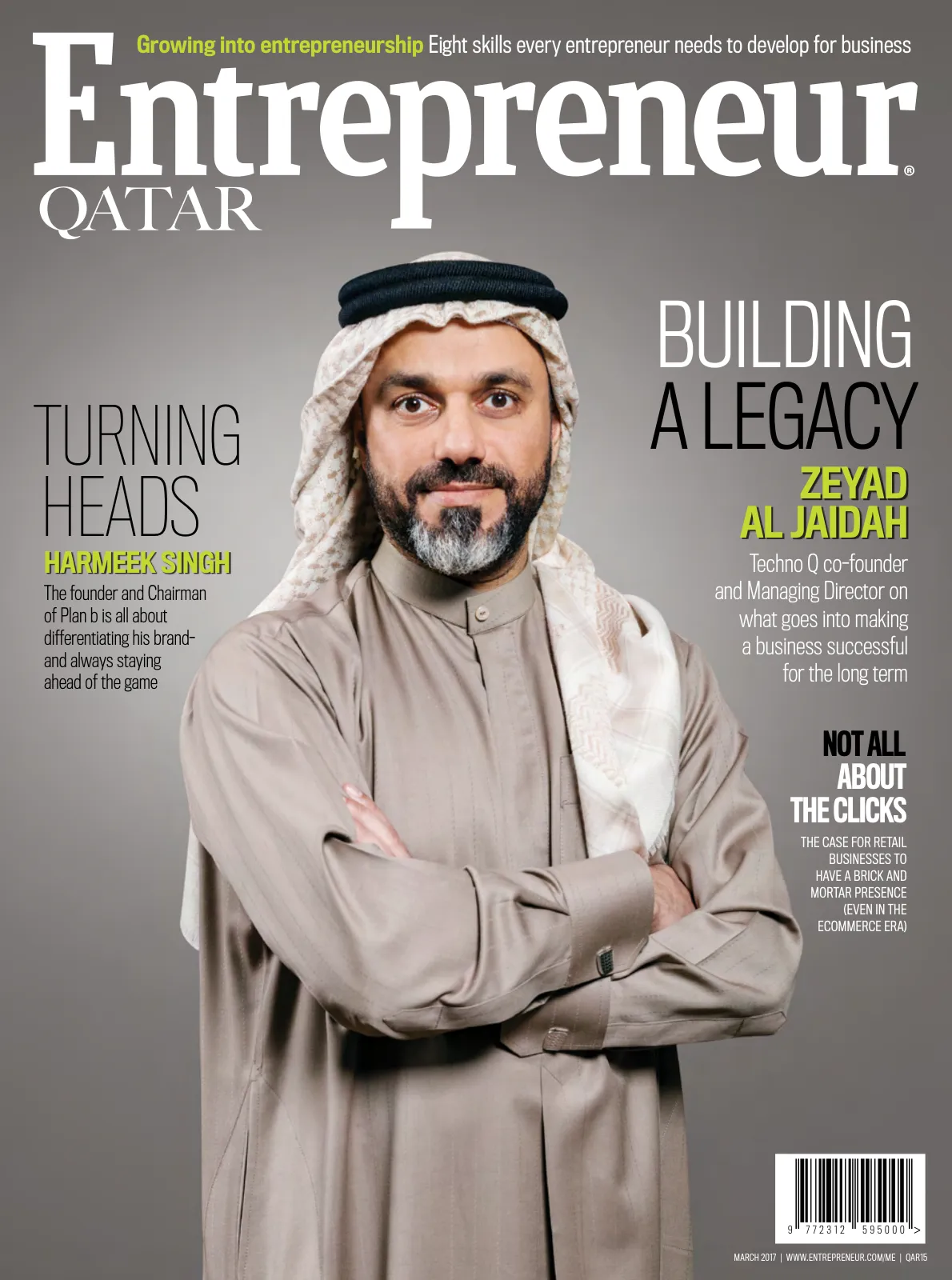
Entrepreneur Qatar, March 2017
Page 1
Growing into entrepreneurship Eight skills every entrepreneur needs to develop for business
heads
Turning
The founder and Chairman
of Plan b is all about
differentiating his brand-
and always staying
ahead of the game
9
7 7 2 3 1 2
5 9 5 0 0 0 >
MARCH 2017 | www.entrepreneur.com/me | QAR15
Techno Q co-founder
and Managing Director on
what goes into making
a business successful
for the long term
Harmeek Singh
a legacy
Building
Zeyad
Al Jaidah
about
the clicks
The case for retail
businesses to
have a brick and
mortar presence
(even in the
ecommerce era)
Not all
Page 2
Page 3
march 2017 Entrepreneur
3
CONTENTS
march 2017
20
INNOVATOR:
Building a legacy
Techno Q co-founder and
Managing Director Zeyad
Al Jaidah on what goes into
making a business successful
for the long term.
24
INNOVATOR:
Turning heads
Plan b founder and
chairman Harmeek Singh
on how he ensures his
enterprise stands out in a
competitive market.
28
INNOVATOR:
Mastering marketing
Nadim Ghrayeb, Regional
Sales and Marketing
Manager, Cadillac Middle
East, on the brand’s
transformation in terms of
its image and ideals.
36
‘TREPONOMICS:
MARKETING
Redefining influencer
marketing
Edelman’s Director of
Digital –MEA Ema Linaker
explains why influencer
marketing in the MENA
region has to grow up in
2017.
32
‘TREPONOMICS:
PRO
The pursuit of happiness
Bayt.com’s Suhail
Al-Masri busts the
myths associated with
keeping your employees
happy at work.
74
START IT UP:
ECOSYSTEM
Turning digital dreams into
reality
Qatar’s Digital Incubation
Center is leaving no stone
unturned in helping
tech entrepreneurs in
the country launch their
startups.
20
52
Industry 4.0 is the reality of manufacturing today- and is here to stay
Zeyad Al Jaidah, co-founder
and Managing Director, Techno Q
Page 4
Page 5
Page 6
Register now at www.qitcom.qa
TOWARDS A
SMART FUTURE
MARCH 6-8, 2017
QNCC
@
Qatar National
Convention Centre
QITCOM is Qatar’s biggest digital event
Timings: March 6 (7pm to 9pm) | March 7-8 (10am to 9pm)
Page 7
Page 8
Register now for FREE entry
THE HOME OF REAL ESTATE INVESTMENT
Cityscape Qatar is the only international real estate investment event in
the State of Qatar. Bringing together investors, developers, homebuyers,
government officials and real estate professionals, there is no better place
to find investors and new business partners. Whether you are a real estate
developer, broker or real estate service provider, Cityscape Qatar provides
a unique opportunity to access the Qatari and regional real estate and
investment community all under one roof.
Official Business Magazine
Official Hotel Partner
Official Arabic
Newspaper
Page 9
13 -15 MARCH 2017
DOHA EXHIBITION AND CONVENTION CENTER, DOHA, QATAR
+971 4 407 2475
info@cityscapeqatar.com
www.cityscapeqatar.com
I WANT TO EXPAND
MY INVESTMENT
PORTFOLIO
Organisers
Official Arabic
Business Magazine
The First and Only Weekly Magazine in Qatar Issued in Arabic
Official Entrepreneurship
Magazine
Page 10
Entrepreneur march 2017
10
28
Nadim Ghrayeb,
Regional Sales
and Marketing
Manager, Cadillac
Middle East
CONTENTS
74 Education Basket wants to guide the MENA region’s youth
in their higher education forays
march 2017
44
CULTURE:
TRAPPINGS
‘Trep gear
The executive selection for
the entrepreneur on your
list that has everything.
Okay, maybe for a little
self-reward as well.
50
CULTURE:
LIFE
Growing into
entrepreneurship
Bizworld UAE CEO Helen
Al Uzaizi lists eight skills
every entrepreneur needs to
develop for business.
78
START IT UP:
Q&A
Bridging the gap
Qatar-based Education
Basket wants to guide the
MENA region’s youth in their
higher education forays.
82
‘TREPONOMICS:
SKILLSET
Identifying potential
Jezreel Bokingo, founder
and MD, The Wingman
on the importance of
prospecting for sales- and
how you might not be doing
enough of it.
60
MONEY:
YOUR MONEY
Put your credit card away
Coplex CEO Zach Ferres on
seven ways you can fund
your startup when VC money
is not an option.
58
FRANCHISE:
Cashing in on the opportunity
Zpizza’s Dubai franchisee
Harsh Pancholia on why
opening a franchise business is
better than starting your own.
48
CULTURE:
LIFE
Not a magic pill
James Clear offers a
beginner’s guide on deliberate
practice to help you achieve
your goals.
16
EDITOR’S NOTE
By Aby Sam Thomas
70
IN PICTURES:
It’s go time!
A look at Facebook MENA’s
#SheMeansBusiness, an
initiative to encourage
female entrepreneurship.
Page 11
Page 12
Entrepreneur march 2017
12
CONTENTS
march 2017
78
David Llorente,
CEO, Narrativa at
48 Forward
65
MONEY:
ECON
Taxing times ahead
Lovrenc Kessler, Managing
Partner of Simon-Kucher’s
office in Dubai says that with
VAT coming soon to the GCC,
companies need to rethink
their pricing strategies.
42
TECH:
SHINY
#TamTalksTech
Gadgets and doodads
that you might’ve missed
out on, sourced by a tech
aficionado. Yes, it’s okay to
want them all… and no, it’s
not our fault.
46
‘TREPONOMICS:
ESQUIRE GUY
Keeping up with the times
Want to understand
millennials? The Esquire
Guy explains why it’s simpler
than you think.
52
TECH:
THE FIX
Industry 4.0 is here
Volker Bischoff, General
Manager, Robert Bosch
Middle East explains why
Industry 4.0 is the reality of
manufacturing today- and is
here to stay.
68
START IT UP:
ECOSYSTEM
Keeping entrepreneurs at
home
A new Endeavor Jordan study
sheds light on migration
trends among Jordan’s
homegrown businesses.
72
‘TREPONOMICS:
PRO
Securing your IP
Fatema Fathnezhad, legal
consultant at Cedar White
Bradley group, explores
the two key documents
every UAE startup needs
to secure their intellectual
property.
54 YaHalla’s Alif
smartphone and
Alpha tablet
68
A scene from the
Endeavor Jordan
event to discuss
business migration
Harmeek Singh,
founder and
Chairman,
Plan b Group
24
Page 13
Page 14
Entrepreneur march 2017
14
SUBSCRIBE
Contact subscriptions@bncpublishing.net to receive
Entrepreneur Middle East every issue
EDITOR IN CHIEF Aby Sam Thomas editor@bncpublishing.net
CEO Wissam Younane wissam@bncpublishing.net
MANAGING DIRECTOR Walid Zok walid@bncpublishing.net
DIRECTOR Rabih Najm rabih@bncpublishing.net
CREATIVE LEAD Odette Kahwagi
SALES DIRECTOR – QATAR Manu Parmar manu@bncpublishing.net
SENIOR JOURNALIST Aparajita Mukherjee
STARTUPS SECTION EDITOR Pamella de Leon
COLUMNIST Sindhu Hariharan
COLUMNIST Tamara Clarke
COLUMNIST Shoug Al Nafisi
COLUMNIST Erika Widen
EVENTS LIAISON Mark Anthony Monzon
PO Box 502511 Dubai, United Arab Emirates
P +971 4 4200 506 | F +971 4 4200 196
For all commercial enquiries related to
Entrepreneur Middle East contact
sales@bncpublishing.net
All rights reserved © 2016.
Opinions expressed are solely those of the contributors.
Entrepreneur Middle East and all subsidiary
publications in the MENA region are officially licensed
exclusively to BNC Publishing in the MENA region by
Entrepreneur Media Inc.
No part of this magazine may be reproduced or
transmitted in any form or by any means without written
permission of the publisher.
Printed by Raidy Emirates Printing Group LLC
www.raidy.com
Images used in Entrepreneur Middle East are credited when necessary. Attributed use of
copyrighted images with permission. All images not credited otherwise Shutterstock.
Suhail Al Masri
Helen Al Uzaizi
Volker Bischoff
Jezreel Bokingo
Fida Chaaban
Matthew Chaban
Tariq Chauhan
James Clear
Fatema Fathnezhad
Zach Ferres
Lovrenc Kessler
Ema Linaker
Ross McCammon
Harsh Pancholia
Aly Rahimtoola
Barbara Soltysinska
Tarek Sultan
Kristin Wong-Ward
CONTRIBUTING WRITERS
www.entrepreneur.com/me
Access fresh content daily on our website!
MIDDLE EAST
EntMagazineME
@EntMagazineME
Entrepreneur-me
EntrepreneurMiddleEast
EntMagazineME
EntMagazineME
EntMagazineME
In addition to our print edition, we’re bringing
you all sorts of industry news on our web
mediums. Joining us online means getting
relevant business and startup content in
real-time, so you’re hearing about the latest
developments as soon as we do. We’re looking
forward to interacting with our readers on all of
our social media and web platforms- like any
thriving business, we’re looking to give and take.
#TrepTalkME is already happening on all of our
digi platforms, and all good conversations go
both ways. See you on the web!
Page 15
BLACK BAY
DARK
BLACK PVD-COATED STAINLESS STEEL CASE
DIAMETER 41 MM
WATERPROOF TO 200 M (660 FT)
IN-HOUSE MOVEMENT
#TUDORWATCH
TUDORWATCH.COM
TUDOR in-house
movement MT5602.
Offering a 70-hour
power reserve and
regulated by a variable
inertia oscillator with
silicon balance spring,
it is certified by
the Swiss Official
Chronometer Testing
Institute (COSC).
Black PVD-coated
stainless steel case.
Directly derived from
the thin film technology
originally developed by
NASA, Physical Vapor
Deposition enables
practically any inorganic
material to be bonded
with metals.
Page 16
Entrepreneur march 2017
16
I
’ve always maintained that be-
ing an entrepreneur or working
for one is not for the faint-
hearted, but I was still taken
aback when a particularly
enterprising friend of mine (who
works at a Dubai-based startup)
confessed to feeling a crushing
sense of frustration at work. As one
of the company’s early recruits, I
remembered him being a passionate
champion of his employers, and yet,
here he was now, looking disillu-
sioned and demotivated. “I’m really
overloaded,” he said to me, as he
complained about his overwhelming
workload. There were just too many
tasks being thrown on his plate for
him to execute, he explained, and
adding to the pain was the fact that
when things invariably fell through
the cracks, he felt himself being at
the receiving end of the blame. “Ev-
erything [that goes wrong] seems
to be my fault,” he said. “I feel sorry
for myself.”
For all of the conversation about
the bravery of entrepreneurs in
building businesses, there isn’t
enough being said about the daring
shown by the people who work for
these upstart founders. After all, the
risk these people take by choosing
to work for a startup (as opposed
to putting their talent to use at a
more established company) is pretty
monumental. More often than not,
these are driven individuals who
are ready to go above and beyond
what they are expected (read as:
paid) to do. I believe that my friend
was one such kind of person, and
so, his work circumstances must
have somehow gone south for him
to be so forlorn and glum. I found
myself giving him a few suggestions
on what he could do to get out of his
misery:
STEP ONE COMMUNICATE
Your work at a startup shouldn’t
come at the cost of your well-being,
physical or emotional. Regardless
of your feelings of loyalty toward
your company, I can assure you
that wallowing in a murky pool of
self-pity is definitely not worth it. If
you have a problem, voice it to your
employers- your bosses are entre-
preneurs, and they have a hundred
different things on their minds all
the time, and so it falls on you to
bring issues to the table.
STEP TWO SET A DEADLINE TO
EXPECT CHANGE
It’s one thing to take your problems
to your employers; it’s another thing
altogether to see solutions come
from them on the same. This, how-
ever, doesn’t mean that you should
have to wait indefinitely for change
to happen- as I told my friend,
doing so will only see you fall back
into despair. In order to avoid that,
set a realistic deadline for expecting
your entrepreneurial bosses to af-
fect change in your startup environ-
ment. If they value you as an em-
ployee, they should make an effort
to help- and I do believe this has to
come from the top. As we have re-
peatedly attested to in Entrepreneur
Middle East: a company is nothing
without its team, and the people at
its top should remember that.
STEP THREE DECISION TIME
If, after all of the above, nothing
changes in your environment once
your personal deadline has rolled
in, then I’d say that it might be
time for you to make a career move.
I can’t say there’s any job worth
being miserable for, and while you
may have signed up to be a part
of the madness that is a requisite
of a startup, it shouldn’t be so
overpowering that you become
dejected and disappointed. Making
the decision to move on from a
company that you invested so much
time and work into is difficult- but
it may be well worth your while.
EDITOR’S NOTE
Aby Sam Thomas
Editor in Chief
@thisisaby
aby@bncpublishing.net
Scaling the startup ladder
Working for an entrepreneur is nearly as hard
as being an entrepreneur
Page 17
FIFTY ONE EAST, DOHA, QATAR +974 4436 1111 LANVIN.COM
Page 18
Entrepreneur march 2017
18
I
n line with the Blockchain Strategy unveiled by
Dubai in October 2016 -a vision to become the
first blockchain-powered city by 2020- Smart
Dubai Office (SDO) and global entrepreneurship
network 1776 are looking for startups that can
transform conventional industries using their
blockchain technology. SDO and 1776 are now
inviting applications from enterprises for the
Blockchain Challenge, a pitch competition to be
held on May 22, 2017 in Dubai. Selecting up to 20
startups from the applications, the finalists of the
Challenge will travel to Dubai to pitch their blockchain
product/solution to investors, business leaders,
and others. Besides monetary rewards, and 1776
membership opportunities for the winning startups,
the competition also offers a chance to receive pitch
training, and networking opportunities for competing
startups. The three winning startups will also work
with the respective Dubai stakeholders to implement
their blockchain solution in the city.
According to the challenge’s official website detailing
the evaluation criteria, the jury panel will judge
startups on parameters including level of innovation
in the use of blockchain, market size, business plans,
team composition, and other skills. The contest has
also laid down a set of requirements that startups
must meet to be eligible to apply, which includes
factors such as scalable products, suitability to
implement in Dubai, and directly impacting the
quality of life in the city, among others. Dubai
government launched its Blockchain Strategy
to support its Smart City ambitions, by turning
paperless and shifting government transactions to
blockchain platform- an online encrypted database-
by 2020. Subsequently, initiatives promoting
blockchain have continued to be a focus for the
UAE. While recently Dubai’s government partnered
with IBM for testing blockchain technology for trade
finance activities, the National Bank of Abu Dhabi
(NBAD) also announced that it integrated global
blockchain startup Ripple’s technology into its
systems. For more information on the deadlines and
details of the Blockchain Challenge, visit the official
website. www.1776.vc/sdo-blockchain-challenge
IN THE LOOP
Calling young innovators
Microsoft launches UAE edition of Imagine Cup 2017
with Emaar Properties
Emerging technologies
Smart Dubai Office and 1776 launch
a hunt for blockchain innovations
A team at the Enterprise
Challenge Qatar
image source: 1776 | imagine cup
Dr. Aisha Bin Bishr, Director General of the Smart Dubai Office with
Evan Burfield, co-founder and CEO of 1776 in December 2016
Samer Abu Ltaif, Regional General Manager, Microsoft Gulf and Veresh Sita, Chief Digital Officer,
Emaar Properties
S
tudent developers, Microsoft is
looking for the next big innova-
tion from the student commu-
nity, and here’s your chance to
show off your best software so-
lution. Microsoft Gulf, in partnership
with Emaar Properties, is hosting the
UAE edition of the Microsoft Imagine
Cup 2017, a large-scale student
competition offering young develop-
ers a chance to “mold the world of
tomorrow” using their creativity and
tech skills. Having debuted in 2003,
the competition holds the status of
being the largest and one of the oldest
technology challenges, and it kicks off
its regional round in April 2017. Like
the Microsoft YouthSpark initiative
(of which Imagine Cup is a part), the
challenge is based on the premise that
many of today’s successful tech plat-
forms began as student projects, and
is designed to “create an avenue for
young entrepreneurs and innovators,
in bringing their ideas to market.”
Imagine Cup selects most promising
ideas/teams in over 100 countries by
conducting local and online editions
of the contest. These selected teams
will then embark on an all-expenses-
paid trip to the World Finals to
compete with global student teams
for a US$100,000 grand cash prize.
Further this year, the contest has de-
cided to not bind itself by categories
and invites “technology solutions of
every type, from every field” that run
on Azure cloud, and “demonstrate
the potential for digital transforma-
tion.” The cash prize for this year’s
regional round will be $15,000 for
first, $10,000 for second, and $7,000
for third place winners.
Speaking about the challenge,
Samer Abu Ltaif, Regional General
Manager, Microsoft Gulf says that Mi-
crosoft is “very proud of the change
that we’re seeing in the UAE,” given
“the number of accelerators head-
ing here, and the number of venture
capitalists that are starting to show
interest,” and he sees the Imagine Cup
as “a golden opportunity” in the cur-
rent climate. With regard to the sup-
port from Emaar, Abu Ltaif says he
considers the group to be a key player
shaping the lives of people in multiple
cities around the globe. “There is a
lot of emphasis on digital transforma-
tion in the context of urbanization
and building cities…[Like Emaar], we
are equally hungry to learn together
and share those values with them,”
he adds.
Emaar, on its part, also regards the
tie-up to be logical, both in terms of
matching of values and objectives
around tech innovations. “We believe
that we are building iconic experi-
ences for people, but we are really
building it for future generations,”
says Veresh Sita, Chief Digital Officer,
Emaar Properties. “We want to focus
on youth, youth development and
youth empowerment. Instead of us,
in a vacuum, trying to figure out what
future generations desire, we see no
better way than to actually use the
youth of today to help us design the
cities of the future,” he explains.
Page 19
On October 22nd 1934, two exhausted airmen landed on a racecourse in Melbourne, surrounded by
cheering crowds. Flying a specially-built De Havilland Comet DH-88, Charles Scott and Tom Campbell
Black set a new record, flying the 11,000 miles from England in just 71 hours. The Bremont DH-88
commemorates their aircraft and their achievement. Containing actual material from the record-breaking
plane, the Bremont DH-88 is available now in a strictly limited edition. But it won’t be available for long.
IN 1934, BRITANNIA DIDN’T JUST RULE THE WAVES
FIFTY ONE EAST | DOHA, QATAR | T: +974 4436 1111
Page 20
Entrepreneur march 2017
20
Building
a legacy
INNOVATOR
By Aparajita Mukherjee
“With the healthcare
sector in GCC
projected to grow at
a compound annual
rate of over 12%, and
exceed US$71 billion
by 2020, we are all
set to maximize the
opportunity at hand.”
“I have every duty to
pass on credit and sav-
ings, where I can, to
my customers. So, in
business, the character
traits of honesty and
integrity come with a
greater premium than
being in a job. These busi-
ness ethics also make
me feel better within.”
Medcare Women &
Children Hospital
>>>
Zeyad Al Jaidah
Techno Q co-founder and Managing Director
on what goes into making a business successful for the long term
I
come from a business fam-
ily, and I always wanted
to be like my father and
grandfather, and continue
their legacy.” That state-
ment by co-founder and
Managing Director Zeyad
Al Jaidah is an indication
of the familial factors that
led to his establishment of
TechnolQ, a 100% Qatari sys-
tems integrator specializing in
audiovisual, building controls,
fire and security systems,
lighting, information technol-
ogy, broadcast and hospitality
management solutions. “We
have been in business from
my father’s side for the past
three generations,” Al Jai-
dah notes. “My grandfather,
Ibrahim Yousuf Jaidah, had a
partnership with his brothers,
and as their kids grew up,
they separated the businesses.
My grandfather, with his sons,
established Ibrahim Yousuf
Jaidah and Sons, which can
still be seen at Souq Waqif,
around 1883. They were com-
modity traders, buying pearls
from here and selling in India;
buying and selling spices from
India here too.”
But Al Jaidah’s journey in
setting up Techno Q wasn’t a
straightforward one- he was
educated in mechanical engi-
neering in the US, after hav-
ing been given a scholarship
by Qatar Petroleum. After
earning his degree in 1994, Al
Jaidah returned to Doha and
immediately started working
with Qatar Petrochemical
Company (QAPCO), as a
trainee mechanical engineer.
“Six months later, I was made
responsible for maintaining
the rotating equipment in
the utility section and three
months down the line, I was
in charge of capital projects in
addition to my original job,”
he says “In 1997, shortly after
starting Techno Q , I sought
a transfer to work with the
Doha Municipality as a drain-
age engineer in the design
division. I stayed there until
2001, when I decided that I
wanted to quit and become
full-time entrepreneur.” It
was while in the US Al Jaidah
met his business partner,
Abdulla Alansari, who was
a year junior to Al Jaidah at
college, though at that stage,
neither was very sure what
business they would want to
pursue when they eventually
returned to Doha.
It was during his time
at QAPCO that Al Jaidah
found his entrepreneurial
spirits come to the fore. “My
brothers had a small gift and
electronic shop, called Target
Centre at Kahraba Street,
which they had bought from
someone and it was not do-
ing well,” he remembers. “It
mostly sold electronic goods
at a very low margin and did
not have a solid business
model behind it. They asked
me to look at reviving the
business and decide what to
do with it.” Coincidentally,
Alansari was also toying with
a similar business idea, and
that is what led to both of
them setting up a shop at
Salwa Street to sell home
theatres. However, that busi-
ness didn’t do so well. “We
failed miserably since we
were targeting a price range of
QAR200,000 to QAR250,000
and in 1994-95, there were
no takers of our product in
Doha,” Al Jaidah says. “We
demonstrated our home
theatres to the then Prime
Minister H.E. Sheikh Hamad
bin Jassim bin Jaber Al Thani,
who wanted an advanced au-
dio system for his new palace.
H.E. Sheikh Jassim liked the
product, but said he did not
want it, and instead, he gave
us the specifications of what
he wanted based on what he
had seen in New York those
days: one single touch screen
to control all the electronic
goods at his home, and a
plasma TV, which was a novel
item in those days. We hadn’t
done anything like this before,
but we were determined to
make the client happy.” This
resulted in him and Alansari
Page 21
“Risk-taking is
one of the most
important traits of
entrepreneurship.
Always think big
and never just look
at local market
dynamics. Make sure
that you can build
something that can
sustain any foreign
competition.”
Zeyad Al Jaidah, co-founder and
Managing Director, Techno Q
Page 22
Entrepreneur march 2017
22
INNOVATOR
“social esteem is
less important to me
compared with the
freedom I have of not
having to answer to
anyone for my work,
which, had I contin-
ued to work for the
government, I would
never have been able
to enjoy.”
Zeyad Al Jaidah, co-founder
and Managing Director, Techno Q
travelling overseas just to un-
derstand the ongoing trends
in consumer electronics by
visiting fairs, and during one
such trip to the US, they were
introduced to Amx, an Ameri-
can company which special-
izes in touch screens, and had
business dealings with Saudi
Arabia.
Recalling how they got the
project off the ground, Al Jai-
dah says, “We did that project
with great difficulty, since
we also had to cater for the
specifications given for H.E.
Sheikh Jassim’s palace by his
interior decorator, who wasn’t
happy with the infra-red re-
ceivers popping out from the
corners of the rooms! [But]
we learnt a lot from that proj-
ect, and in the end, the client
was happy. We learnt how to
offer custom-made solutions
and most of such projects
even today are big ticket,
which suits us financially as
well.” The other project of
pride around the same time
was the audio system for the
under-construction BMW car
showroom, owned by Omar
Al-Fardan, who had just taken
over the BMW agency. “As a
consumer, who heard a robust
sound from our home theatre
system, Al-Fardan wanted it
customized for his car show-
room, again something we had
never done before. These two
early projects taught us how
to evolve to our customer’s
needs.” Narrating his experi-
ence with other big-scale
projects, Al Jaidah says that
it was around the same time
that The Mall on D-Ring road
was also opening and though
Techno Q could not secure
the audio system contract for
the whole shopping mall, they
bagged individual shop con-
tracts. He details, “Abu Issa
was, at that time, building the
anchor store Highland and
they wanted a sound system
for the store. By the time
we completed that, he also
wanted the anti-shoplifting
cameras, which were add-ons
and helped us scale up.”
Speaking about the initial
years, Al Jaidah admits that
it was indeed very challeng-
ing at the outset. When it
comes to the hardships they
endured, he says, “TechnoiQ
began without having any
project references. For
instance, in 2001, when we
went to Darwish Holding,
which was constructing
the Weill Cornell Medical
College (WCMC-Q) in the
Qatar Foundation for the
audio visual system for the
auditorium, and bagged it,
and simultaneously, MidMac,
which was also constructing
the temporary building for
Texas A&M, they said to us,
‘You guys who just run a
speaker shop and have bagged
a QAR11 million project
(referring to the WCMC-Q
project) and have come to us
for another QAR15 million
project– you both must be out
of your minds because you
sure will fail.” (At that stage
of TechnoiQ ’s growth, the
largest project in value terms
that they had completed
was the Ministry of Interior
auditorium for QAR1 million,
on Corniche.) “MidMac did
not give us the job, but to
someone else, who could not
deliver,” Al Jaidah recalls. “So,
they came back to us asking if
we could deliver the project to
their quality standards, and
we agreed.”
Coupled with lack of project
references, a weak balance
sheet did pose a stumbling
block to secure finance from
banks. “We were deemed too
small to get any direct jobs
from the government. Eventu-
ally, of course, we bid for as
big a project as the Qatar
National Convention Center,
which was a whopping QAR90
Page 23
march 2017 Entrepreneur
23
www.technoq.com
INNOVATOR
“Trusting people was
one of the biggest
challenges. I have
learned not to take
things at face value,
always read between
the lines and the
fine print!”
million in project value,”
says Al Jaidah, adding, “But,
in spite of these difficulties,
I have never looked back to
work in the government. I
believe whatever happens
is for the best. When I look
around now and see some of
my friends who continued
to work for the government
earning high salaries and,
culturally, they are held with
greater social esteem than a
businessman will ever be.
But social esteem is less
important to me compared
with the freedom I have of not
having to answer to anyone
for my work, which, had I
continued to work for the gov-
ernment, I would never have
been able to enjoy. Even if
someone is a minister, he will
be answerable for his work,
owe some explanations to his
superiors, which I honestly
don’t have to.”
Al Jaidah’s family and his
forefathers built their busi-
ness reputation on honesty
and integrity, and that’s a
tradition that he is very par-
ticular about continuing. “I
strongly believe in those qual-
ities and think they are the
founding pillars of any suc-
cessful long-term business,”
he states. “A businessman can
easily oversell and overcharge,
duping the customers who are
depending on the expert– that
is me, in this case. Just as I
expect honesty and integrity
from those who are selling to
me, I have the duty to be hon-
est and open about prices, and
avoid over-billing to my cli-
ents. I have every duty to pass
on credit and savings, where
I can, to my customers. So, in
business, the character traits
of honesty and integrity come
with a greater premium than
being in a job. These business
ethics also make me feel bet-
ter within. I grew up hearing
that my father Mohammed
Jaidah was an honest and
ethical businessman. I inher-
ited this legacy from him and
I want to pass on the same
legacy to my children.” As for
challenges and lessons learnt
on his entrepreneurial jour-
ney, Al Jaidah says, “Trusting
people was one of the biggest
challenges. I have learned not
to take things at face value,
always read between the lines
and the fine print! I make sure
you put every single detail in
writing, especially in agree-
ments. The longer one takes
in drafting agreements, the
clearer the relationship will
be in the long term.”
Cutting back to the pres-
ent, Al Jaidah has learned to
delegate. “Sometimes when
you have grown the business,
you have no option but to
delegate,” he says. “Now, I
also have some other busi-
nesses that I own with my
brothers, such as the ones in
the construction sector, and
I just do not have the luxury
of doing everything on my
own. For me, trust now comes
ahead of experience, and I
have developed an eye with a
better judgment of whether I
can safely trust someone. This
comes with experience.” As
for advice to a budding entre-
preneur, Al Jaidah feels that
the most important advice is
that he/she must know the
type of business they are going
pursue inside and out, so that
they do not need to depend on
someone who would run it for
them. “At least not the core of
the business,” he adds. “Sec-
ond, when the time comes
to take the plunge, do not be
afraid to become full-time en-
trepreneur. Risk-taking is one
of the most important traits
of entrepreneurship. Always
think big and never just look
at local market dynamics.
Make sure that you can build
something that can sustain
any foreign competition.” He
cites his own example by say-
ing, “I always benchmarked
the Techno Q product offer-
ings with what was available
in the international markets.
I never execute a project in
Qatar, with the standards
available locally, but rather I
always think that even if an
American company comes
here with a job, they will not
be able to better my quality
and execution standards,
even though the costs could
be more. Since the clients are
paying a lot of money, they
deserve the best-quality prod-
uct.” Continuing with his tips,
Al Jaidah mentions, “Make
sure it’s a long-term business
idea and not something to
make a ‘quick buck.’ Custom-
ers will pick that up, and will
be reluctant to do business
with someone who would
disappear soon.”
Page 24
Entrepreneur march 2017
24
I
t’s easy to see that one
of the attributes that
got Plan b founder and
Chairman Harmeek
Singh to his current
position of business
success is his almost
relentless desire to
make sure he and his enter-
prise always stand out- the
entrepreneur is all about
differentiating his brand and
always staying ahead of the
game. “Turning heads- that’s
what it’s all about,” Singh
explains. “And that’s how we
managed to hyper grow Plan
b in a short amount of time.”
Hyper growth is a good way
to refer to Plan b’s evolu-
tion over the years. After
trying his hand at a slew of
businesses back home in
India, Singh arrived in Dubai
in 2003 with his first job
here being at a media sales
company. He moved on from
the role after 10 months, but
Singh found that his regular
clients were willing to follow
him to whatever he set out
to do next. “This gave me a
small platform to build and
grow a sustainable freelance
business, earning around
AED150,000 per month to
AED200,000 per month
at the time, which gave me
again the capital to plunge
into entrepreneurship,”
he remembers. Officially
launching Plan b Advertis-
ing in 2004, he admits that
it was a Herculean task to
operate every aspect of his
business by himself at the
beginning, and found himself
wearing “multiple hats” for
almost a year before he was
able to hire a small team.
But those tough times have
since paid off- Plan b has
today cemented its place as
one of the UAE’s most well-
known marketing and events
companies, offering a variety
of services including market-
ing campaigns, experiential
events management, brand-
ing services, activations and
launches, visual merchan-
dising, and other projects.
Headquartered in Dubai,
with offices in Abu Dhabi,
India, and London, the Plan
b umbrella today covers eight
companies -Plan b Advertis-
ing (creative and printing),
Plan b Events (marketing,
public events, exhibitions
and in-house production),
SiO2 Events (a boutique
events agency), bSocial (the
group’s PR and social media
wing), bMovies (digital me-
dia, application and technol-
ogy), bCreative (a boutique
creative agency), Next Door
(sports management) and
bDecor (interior design)- and
boasts of a team of more
than 350 experienced multi-
disciplinary professionals.
Given the bustling business,
social and cultural events
space in the UAE, and its
position of a Middle East
trade hub, while it’s true
that event management and
advertising enterprises have
always been recipients of
robust growth, only a few
have managed to carve a
niche for themselves- and
Plan b seems to be one such
company in this space. “Our
main edge is the fact that we
are in control of every aspect
of even the most complex
360 degree campaign, owing
to our in-house capabilities
through the eight group
companies,” notes Singh.
Dr. Azad
Moopen, Founder
Chairman and
Managing
Director, Aster
DM Healthcare
INNOVATOR
Turning
heads
Plan b Founder and Chairman
Harmeek Singh
With eight companies currently under its umbrella,
Plan b is using its in-house expertise to stand out in a competitive market
By Sindhu Hariharan
“Our main edge is the fact that we are
in control of every aspect of even the
most complex 360 degree campaign,
owing to our in-house capabilities
through the eight group companies,”
notes Singh. “This acts as a major
advantage in a very demanding service
industry, and allows us to offer faster
turnaround times to our customers.”
>>>
Page 25
march 2017 Entrepreneur
25
Harmeek Singh,
founder and Chairman,
Plan b Group
Page 26
Entrepreneur march 2017
26
“This acts as a major advan-
tage in a very demanding
service industry, and allows
us to offer faster turnaround
times to our customers.
Also, due to the nature of
our industry, which is very
talent-driven, we make sure
to keep on investing in top
talent and embrace diversity.
We have a very diverse work-
force, which creates a very
stimulating environment,
setting the tone of our com-
pany culture.”
This strategy of having
in-house expertise along a
number of different verticals
also makes sound business
sense, Singh reveals. “Plan b
operates a group of compa-
nies, so our diversification
is balanced upon individual
business units that are re-
sponsible for their own bot-
tom lines. The benefit of
having the expertise across
the group gives us in-house
capability for a lot of product
development and R&D, which
keeps us up to speed with
the rapidly moving trends
and technology, and gives
our customers the benefit
of cost-effectiveness, as we
have minimal layers of mark-
ups with everything falling
supposedly in-house.” As for
the road ahead for the indus-
try at large, Singh believes
experiential campaigns are
the way forward, and from
his enterprise’s perspective,
Plan b has addressed this
early on by investing in its
own development and tech-
nology wing.
It’s important to note
here that Plan b has been
an entirely self-funded enter-
prise so far, with Singh not
having used any external
capital to build the busi-
ness. “I personally feel that
sourcing capital invites loss
of control, and hence chose
to pace my growth based
on my capacity at all times,
rather than raising funds,”
Singh notes. He adds that
despite this decision, the
group today is an entity that
“in fact funds and acquires
successful businesses and
IPs [Intellectual Property].”
Coming from a person who
started right at the bottom,
and bootstrapped his way to
the top in this way, aspiring
entrepreneurs should take
to heart the dictum that
Singh considers as key to his
turnaround story: “Strong
foundations and staying
grounded, both are the key
to everything. While it may
sound metaphorical, it is
very hard to fall when you
have your feet firm on the
ground,” says Singh. “As you
may excel, move, and elevate
into bigger and better things
just make sure you keep
yourself grounded and close
to what you are about.” As
for Plan b itself, Singh has
already laid out a roadmap
for the enterprise that he
hopes to realize in the years
to come. “Strengthening
of our individual verticals,
bringing in a strategy of
consistent improvement
and development across our
offerings, and expansion of
our footprint are our three
main long-term objectives,”
he says. “Based upon the
pace of our growth, we have
received a lot of interest from
entities abroad in a franchise
model, which is something
under consideration at the
moment.”
Today, with a large part of
an entrepreneur’s time being
spent on attempting to influ-
ence and communicate en-
INNOVATOR
One of Plan b’s events
at The Kite Beach
“Strengthening of our individual
verticals, bringing in a strategy of
consistent improvement and devel-
opment across our offerings, and
expansion of our footprint are our
three main long-term objectives.”
Page 27
terprise vision to stakeholders (be it
investors or customers or employees),
one can’t escape learning how to sell.
As a person who started his career in
sales, it’s no wonder then that Singh
has a head start in this aspect, and I
ask him about how significant is the
ability to sell vis-à-vis the product/
idea focus, when it comes to a startup.
Surprisingly, despite his own profes-
sional background, Singh believes
that while “sales are the lifeline of any
business,” the absence of a “product
desire and service excellence” can
cost the business a lot. “Successful
businesses subscribe to the 80:20
rule where you make 80% of your
sales through 20% of your custom-
ers. And that is only possible once
you become your customer’s ‘need’
as opposed to ‘want’, and that in
turn comes with exceptional product
grade and unmatched service quality.”
Singh also walks the talk, and Plan b
has in fact had a pulse on customers’
fingers, and plotted its growth strate-
gies accordingly. “[In the creative
business], you need to be able to
make your customers understand the
type of value you can add, and cater
the needs your competitors won’t.
We invest a lot of time in getting to
know and understand our customers
to develop a long-term relationship,
and build their trust by acting on our
commitments and over deliver on
expectations.”
The importance Singh places on
caring for his customers is reflected
in his attitude towards his employees
as well- here is an entrepreneur who
believes the right work culture plays
an integral role in an enterprise’s
success. This is clearly evident from
Singh’s response to my question about
his personal leadership strategy for
his organization. “I have nurtured a
family, rather than employees, at Plan
b,” Singh says. “Keeping your employ-
ees happy takes more than just a pay-
check; you need to create a positive
culture to inspire your staff. We try to
provide each individual with the drive
they need to perform, by empower-
ing them, welcoming change, fresh
ideas, and by celebrating personal
milestones together as a family. Our
‘event veterans’ still look forward to
come to work every day, and motivate
new staff to perform at their best. Our
company culture is a reflection of our
brand values- and [it] transfers in our
client’s organizations.”
“Keeping your employees
happy takes more than just
a paycheck; you need to cre-
ate a positive culture to
inspire your staff. We try
to provide each individual
with the drive they need
to perform, by empowering
them, welcoming change,
fresh ideas, and by celebrat-
ing personal milestones
together as a family.”
What would you count among the
region’s biggest challenges for
entrepreneurs?
“Well… real entrepreneurs don’t let
any challenges stop them…but if I had
to choose it would be competition…
UAE is a very dynamic and competi-
tive market especially in the lead-up to
EXPO 2020, exceedingly it would be
considered one of the main challenging
factors and should be recognized.”
What are your views on the cur-
rent tough business conditions for
SMEs in the region? What would
be your advice to them to get
through the conditions?
“Macroeconomic conditions are
something
everyone
has to sail
through, and
since 2008,
tidal changes
have become
a mainstay of
general mar-
kets across
the world.
My advice to
SMEs and
upcoming
businesses
would be to hold on to their market
share…while we may not be in control
of the economy on the macro level,
we should be in control of our own
product and service. Downturns can
serve as an opportunity if you look
at the right places. Just ensure that
you’re safeguarding and maintaining
your service levels and delivery expec-
tations, and ride the wave in a steady
manner. Soon enough you will see
yourself riding high out of the low.”
What are your top tips for an
entrepreneur to start and grow a
business here in the MENA region?
“Remain patient, nothing comes easy,
and it takes hard work and determina-
tion to achieve a sustainable business
organization. Shrug off disappoint-
ment, believe in your brand and make
sure you’re making a difference to
something…everyday.”
‘TREP TALK
Harmeek Singh, founder and
Chairman, Plan b
Emaar’s first luxury
sales experiential
lounge in Harrods,
London
Images courtesy plan b
Page 28
Entrepreneur march 2017
28
For a luxury brand as
recognizable and storied as
Cadillac, one would perhaps
assume that its Regional
Sales and Marketing Manager
for the Middle East, Nadim
Ghrayeb, would have a rela-
tively easy job on his hands.
But that does not seem to
be the scenario at all: over
the last two years, Cadillac
has been going through a
self-imposed transforma-
tion in terms of how it is
perceived in the market, and
yes, this shift in direction
has been happening here in
the Middle East as well- and
Ghrayeb has been tasked
with marketing the brand
across the region. “Cadillac
has undergone a big change
in its brand image and the
way it communicates to the
public,” he says. “When you
look at any kind of mate-
rial from the brand, from a
billboard to TV, you can see
Cadillac reflects our way of
thinking: it’s sophisticated,
bold, and optimistic in tone,
and these are our core values
that everything at Cadillac is
shaped around. It is not only
our brand that holds these
values true– we have also
revamped who our brand and
vehicles are aimed at.”
For a luxury brand that has
more than 100 years of histo-
ry behind it (and a presence
in the Middle East for more
than 80 years), Cadillac’s
shift in tone and messaging
is characteristic of its efforts
to stand out and attract
customers in what is an ex-
tremely competitive market
out there. “Today’s Cadillac
drivers are also bold, so-
phisticated and optimistic,”
explains Ghrayeb. “Looking
at the new luxury segment,
our customers are looking
for a global symbol of style,
which represents the inde-
pendently minded. We call
them ‘entrepreneurials.’ They
are not always entrepreneurs
in the literal definition of the
word, but they are successful
people in their respective
fields that share a common
passion and a driven pursuit
to realize their dreams, and
live their aspirations.” And
this thus explains the “Dare
Greatly” theme that governs
Cadillac as a brand today-
but the genius of the motto
is in that it is also reflective
of all of the innovations the
automotive company has
showcased since its estab-
lishment way back in 1902.
“Our history was built on
Onward
and
upward
Dr. Azad
Moopen, Founder
Chairman and
Managing
Director, Aster
DM Healthcare
INNOVATOR
Cadillac Middle East
Regional Sales and Marketing Manager
Nadim Ghrayeb
Cadillac is undergoing a transformation in terms of its image and messaging-
and Ghrayeb wants to show that the brand is living and breathing what it stands for
By Aby Sam Thomas
Cadillac ATS-V sedan
Page 29
march 2017 Entrepreneur
29
daring,” the Cadillac website
proudly declares. “Our future
is too.”
With respect to the Middle
East specifically, Ghrayeb
says that Cadillac enjoys
great brand recall here, and
that factor has given it quite
some momentum in the
market. “Cadillac has been
in the region for a very long
time, with a positive brand
perception, that models like
the Escalade has enabled us
to maintain,” he explains.
“Now with our new brand
direction and fantastic model
line-up that is growing and
diversifying, we are continu-
ing to elevate it. What helps
us in the Middle East is that
the majority of the popula-
tion is young. They are often
ambitious, they share our
brand values and are always
daring to look to the future
and grow. Also with SMEs
on an upward trend, there is
a rich market of self-starters
who look for a brand like
ours to align with.” As for
its portfolio here, Ghrayeb
reveals that every model
in the Cadillac line-up is
available in the region, thus
giving customers here the
luxury of choice. “However,
our main focus is on the re-
cently launched CT6, which
redefines the luxury sedan
segment with advanced tech-
nology and design, and the
XT5, which brings innovative
engineering, craftsmanship
and driving experience to the
crossover segment,” he says.
“We will also look to create
excitement around our per-
formance V-Series vehicles, a
lineup that combines all the
hallmark designs of a Cadil-
lac with exceptional perfor-
mance. The range includes
the CTS-V sedan, with a
supercharged V-8 engine
producing 640HP giving it
“our customers are looking
for a global symbol of
style, which represents
the independently
minded. We call them
‘entrepreneurials.’ They are
not always entrepreneurs
in the literal definition
of the word, but they are
successful people in their
respective fields that
share a common passion and
a driven pursuit to realize
their dreams, and live their
aspirations.”
Nadim Ghrayeb, Regional Sales and Marketing Manager,
Cadillac Middle East
>>>
Images shot at Khazzan X Cadillac, Dubai, UAE | www.khazzan.ae
Page 30
Entrepreneur march 2017
30
a sprint time of 3.7 seconds
from 0-100km/h. Also in
Cadillac’s performance line
up is the ATS-V sedan and
coupe powered by a 3.6LTT
engine producing 460HP
with an acceleration of 3.8
seconds from 0-100km/h.”
But with the Middle East
being a crowded space in
terms of the automotive
market, how does the num-
ber of players in the field
affect Cadillac’s ambitions
for the region? “The market
is very competitive, and I
believe this creates healthy
competition and drives us to
continue working harder to
achieve our goals,” Ghrayeb
replies. “However, other
brands are not our focus; our
customers and giving them
the very best experience
is what we judge ourselves
on. In the luxury market,
customers in the region are
passionate about the prod-
ucts they purchase. They’re
knowledgeable about the
automotive industry and
vehicles. Similar to their
global counterparts, this has
changed the luxury car mar-
ket as car buyers in this re-
gion have high expectations
of brands. What
they appreciate,
in addition to a
high value and
quality vehicle,
is a unique and
share-worthy
experience.
When we sell a
customer a car
now, we sell them a lifestyle,
taking them on a journey
of various experiences that
they identify with, mak-
ing them proud to drive a
Cadillac, as it mirrors their
life and ambitions.” It’s a
tough premise, no doubt, but
Ghrayeb is confident that
the brand can indeed make
it work- after all, daring
greatly is what Cadillac is all
about.
“’Dare Greatly’ is what we live while working on
the Cadillac brand, as a testament to our past
and our vision of the future. As a company that
has always looked to push the boundaries of
what is possible, we are looking to continue this
thinking to drive us to further success.
We have built a platform with Dare Greatly
that celebrates and is led by individual passion
and creativity. For instance, we partnered with
Khazzan to create Khazzan X Cadillac, a multi-
purpose community space based in the center
of Dubai, with an on-site café that hosts eve-
rything from art installations to yoga classes,
from markets to meetings, from guest speakers
to craft classes. Creating a community space is
not traditionally the kind of thing an automaker
would do, but we see it as an innovative way
to address a need we saw and to be a part of
Dubai.
The partnership with Khazzan gives us a space
in the region to allow people to be creative, co-
create and be inspired. We look to strengthen
this message with collaborations with local
artists like Hussain Daghriri: a young Saudi
photographer who travelled across the Southern
Region of Saudi Arabia and documented the
varied culture of that region. His journey was
then exhibited at Khazzan X Cadillac to give
others the opportunity to learn and be inspired
of the great work we have done with Hussain.”
INNOVATOR
Nadim Ghrayeb, Regional Sales and Marketing Manager, Cadillac Middle East
Mastering marketing
Nadim Ghrayeb offers
entrepreneurs five tips
for branding
Nadim Ghrayeb explains the Khazzan X Cadillac community space in Dubai, UAE
Community and collaboration
1. Be daring “This might be
a cliché, but it is true. Always
look to do things differently.
In a world that is becoming
more homogenized, people
are looking for new and dif-
ferent experiences, and this
applies, regardless of whether
they are going to a restaurant
or buying a new car.”
2. Listen to your customer
“This might sound obvious;
however, many companies are
inward looking and change
and update their products
only based on what they
think. It is critical now to
listen to the customer, take
their feedback, and integrate
it into next gen products.”
3. If it’s not broken, don’t
fix it “If you have a product
that is working, don’t change
it or look to branch out a 100
different ways for the sake of
it. By all means, be forward
thinking, but the brand and
products have to evolve with
the customer.”
4. More is less “We often
see a number of brands
advertising looking cluttered
with many messages trying
to be communicated in one
image. Simplicity is key: have
as few messages as possible,
and communicate them pow-
erfully to make it easier for
the customer to understand
your brand.”
5. Having a good product
is not enough “As men-
tioned earlier, just having a
good product is not the only
factor in customers buying
decision. Companies have to
give customers a full experi-
ence in and outside of their
store, continually talking and
listening to the customer
and engaging with them in
an authentic way even when
they leave the store.”
Cadillac CTS-V sedan
Page 31
Page 32
Entrepreneur march 2017
32
O
n average, employ-
ees spend two-
thirds of their day
at work. Being in
the office, among
their colleagues and managers,
is a major part of their life at
large. How happy they feel at
work is, therefore, significant
at the personal and profes-
sional scale.
The concept of “employee hap-
piness” is one of true value to
the corporate world. Not only
are well-established business-
es progressing to maximize
their employees’ satisfaction,
startups and entrepreneurs are
also beginning to view “happi-
ness” as a talent sourcing and
retention trick. And whether
they use flexible hours, top-
notch technology, in-office
game rooms, or infinite snack
supplies, the options to pull in
the crème de la crème of job
candidates and make sure they
are kept happy and productive
are now more diverse than
ever.
The reality is: there is an
increasingly heavy demand on
the employer’s end to cater to
employees’ well-being, health,
and contentment at work. And
while many forward-thinking
startups would jump at the
next opportunity with their
teeth, to make sure their work-
place is as happy as it could
get, it is a good idea to step
back: see what truly makes a
difference for the employee
and what is practically within
the control of the company.
As much as we hate to admit
that personal matters are com-
pletely sealed away while at
work (and vice versa), the re-
ality suggests otherwise. This
is the first myth to recognize
regarding employee happiness.
The line between personal and
professional happiness is actu-
ally blurry.
Bayt.com, the leading job site
in the Middle East, surveyed
professionals from various
industries, career levels, and
locations to understand their
views on happiness and what
influences it. As predicted,
there are many factors that
impact employee happi-
ness that overarch personal,
geographical, socio-cultural,
and professional dimensions.
The Bayt.com Happiness in the
Middle East Survey, January
2017, revealed that more than
half (56%) of respondents are
happy with their lives, at least
to some extent.
The survey findings are very
positive in certain elements,
such as the 83% satisfaction
rate with family relationships.
Total
GCC
Levant
North Africa
KSA
UAE
Kuwait
Qatar
Bahrain
Oman
Lebanon
Jordan
Egypt
Morocco
Algeria
Tunisia
Employment
opportunities
51
54
51
46
54
34
41
49
54
46
59
50
55
General safety and
security
48
47
58
56
51
42
41
55
54
40
52
56
48
Leading a stable
financial life
48
51
44
50
46
42
44
61
54
49
44
48
44
Ability to maintain
healthy personal
relationships
38
38
36
34
27
42
45
41
33
37
37
43
48
Low cost of living
37
37
33
30
28
30
34
32
41
39
39
38
36
Attitude and
behavior of people in
general
32
33
31
34
38
45
40
30
29
34
26
26
29
Clean environment
30
28
41
33
32
21
39
32
29
31
25
30
26
Access to healthcare
facilities
26
26
25
26
35
28
27
27
20
28
26
22
22
Availability of utilities
24
23
26
29
21
36
20
24
21
25
18
25
25
Stability of political
environment
23
24
21
21
18
23
31
23
26
21
21
25
21
Access to Educational
Institutions
18
15
12
18
17
17
20
19
15
19
20
23
19
Opportunities to
socialize
17
15
22
23
22
25
20
28
13
17
19
14
15
Availability of
entertainment
avenues
17
20
22
16
20
21
18
12
23
13
11
15
22
ETHICS | ESQUIRE GUY | SKILLSET | MARKETING | PRO
TREPONOMICS
tables and infographics © bayt.com
The pursuit
of happiness
9
Busting the myths associated with having
happy employees at your enterprise
top 5 important factors that impact happiness
By Suhail Al-Masri
Many companies are beginning
to offer gym subscriptions
or discounts, nutrition
counseling, healthy office
meals, and generally more
attention and care towards
the physical and mental
health of their talent.
Page 33
march 2017 Entrepreneur
33
But there are also a few con-
cerning areas. So, this is the
time to debunk some of the
myths surrounding employee
happiness and hone in on the
factors that truly make a dif-
ference.
MYTH Health and well-
being are personal issues
Although health is a topic that
would normally fall under the
“personal life” category, it is
unwise for businesses and
organizations to completely
ignore it. Take, for example,
physical health and fitness.
Research, such as the Bayt.com
Happiness in the Middle East
Survey, have repeatedly
shown the correlation between
healthiness and happiness. But
even in terms of performance
and productivity, employees
who are physically healthy
are less likely to demonstrate
inconsistent performance or
have health-related productiv-
ity issues. Mental health too
can be of significant impact on
employee productivity, satis-
faction, and overall happiness
at the workplace.
As an employer, you might
still be wondering what your
role is in this matter. Accord-
ing to the Bayt.com Health
and Lifestyle in the Middle
East poll, March 2016, 96%
of polled respondents believe
it is the employer’s responsi-
bility to promote employees’
health and wellness. This can
go beyond the basic health
insurance. Many companies
are beginning to offer gym sub-
scriptions or discounts, nutri-
tion counseling, healthy office
meals, and generally more
attention and care towards the
physical and mental health of
their talent.
MYTH Stress is not work-
related
In addition to the day-to-day
life, many individuals experi-
ence stress from the pressures
and undesirable circumstances
related to work. Stress in the
workplace, if not contained
and coped with, can signifi-
cantly impact employees’ job
satisfaction and performance.
A Bayt.com poll, Stress in the
MENA Workplace, Septem-
ber 2016, showed that 52%
of professionals believe that
workplaces are “more stressful
these days than they were a
few years back.”
Indeed, professionals across
the Middle East and North
Africa (MENA) can experience
stress to varying degrees, and
due to numerous causes. For
instance, 70% of respondents
to the Bayt.com Happiness in
the Middle East Survey cited
the “increasing cost of living”
as the main stress contributor.
This particular factor may be
beyond the direct influence of
employers (although salaries
come into play as discussed in
the next point).
That being said, nearly half of
surveyed employees referred
to “work related issues” as
the main stress contributor
in their lives. These “issues,”
which include work-life bal-
ance, job security, deadlines,
and workload, are all within
the reach and control of com-
panies. Stress is an issue that
businesses, especially those
who are in the startup phase,
must be aware of and compe-
tent to handle.
Employers are encouraged to
engage in candid and frequent
conversations with their
employees. Whether through
surveys, meetings, or casual
chats, the goal is to gauge the
employees’ stress level and
guide them towards a happier
and more balanced state.
MYTH Salaries don’t
influence happiness
Money cannot buy happiness
but money is, without doubt,
a powerful tool. Not only is
it needed for sustenance and
physical well-being, but it is
also frequently a requirement
for quality education,
There Are Many Factors That
Contribute to Workplace Stress
74.8%
of professionals believe that
jobs at their companies are
more demanding than
others.
69.1%
of professionals agree that
there is more pressure at
work this year in comparison
to last year.
31.5%
Agree
26.6%
Disagree
19.5%
Strongly
disagree
15.3%
Neutral
7.1%
Strongly agree
28.2% Low salaries
12.3% Lack of job security
9.7% Workplace environment
9.1% Lack of work-life balance
6.2% Relationship with your manager
5.6% Unchallenging work
5% Relationship with coworkers
4.7% Deadlines
4.7% Company policies
3.9% Nature of work itself
3.2% Work load
7.4% Other
I tend to have frequent arguments with
my managers, coworkers or customers
2015
2016
nearly half of surveyed
employees referred to
“work related issues” as the
main stress contributor in
their lives. These “issues,”
which include work-life
balance, job security,
deadlines, and workload,
are all within the reach and
control of companies.
Employers are encouraged
to engage in candid and
frequent conversations with
their employees. the goal
is to gauge the employees’
stress level and guide them
towards a happier and more
balanced state.
>>>
Page 34
Entrepreneur march 2017
34
Top 2
satisfaction
box
Total
GCC
Levant
North Africa
KSA
UAE
Kuwait
Qatar
Bahrain
Oman
Lebanon
Jordan
Egypt
Morocco
Algeria
Tunisia
Support from
colleagues/ co-
workers
51
55
58
54
59
61
58
47
46
46
47
56
39
Working hours
50
56
59
45
53
57
47
51
50
48
37
53
45
Work-life balance
49
55
49
46
55
45
51
42
44
42
49
55
49
Recognition at
work
46
45
49
39
51
43
40
46
43
44
46
49
54
Freedom to take
decisions at work
46
47
48
42
49
47
43
49
39
45
42
48
51
Support received
from direct/ line
manager
42
43
46
49
51
41
40
40
40
41
41
42
38
Amount of
pressure/ stress
faced at work
39
40
45
41
47
45
38
32
41
35
31
40
41
Remuneration
received
33
38
40
35
39
37
30
25
33
31
24
32
24
Availability of
career
advancement
opportunities
30
30
36
32
43
37
30
30
29
27
26
34
25
Professional life elements that impact happiness
healthcare, investments, en-
tertainment, and many other
essential life aspects. So, we
can say that happiness is not
the immediate outcome of
money, but it is realistically so
in the long-term.
Although millennials, who
will soon make up the major-
ity of the workforce, are now
giving high value to non-
monetary job attributes, such
as opportunities for career
growth and learning on-the-
job, the Bayt.com Millennials
in the Middle East and North
Africa Survey, February 2014,
showed that seeking a higher
salary is still a significant
incentive to join a specific
company or field of work.
What employees often strug-
gle with in our region is the
mismatch between salaries
and cost-of-living. Compa-
nies who are invested in their
employees’ happiness should
truly assess their salary levels
and pay structures against the
region’s cost of living. There
are highly effective tools to
do that, such as the Bayt.com
Salary Search. Using this,
employers can ensure that
they are not undercompensat-
ing or overcompensating their
employees at all times.
38% of those surveyed in
the Bayt.com Middle East and
North Africa Salary Sur-
vey, May 2016, claimed they
had never received a salary
adjustment, despite the ever-
increasing costs of living. It is
not surprising, therefore, that
salaries can easily become a
major source of unhappiness
at work.
MYTH Career growth is
less of a priority
Out of all professional life
elements that impact happi-
ness, the “availability of career
advancement opportuni-
ties” seemed to be the most
neglected item. The Bayt.com
Happiness in the Middle East
Survey reported that only
three in 10 surveyed employees
are satisfied with the career
advancement opportunities at
their current jobs.
If employees feel stuck in
their current position and that
there is no room for them to
grow or advance in their pro-
fessions, it is very unlikely that
they will be happy at work.
Talented employees in most
cases have a clear career map,
with milestones to tick off,
and end-goals to pursue. They
want to have an employer who
listens, supports, and empow-
ers. They want to feel secure
about their career future and
equipped with all the training
and development resources.
A main takeaway here is:
providing opportunities of ca-
reer advancement might be of
higher value to certain employ-
ees. Some may be happier with
a new position, a promotion,
or even a training opportunity,
over a lavish private office for
example. Companies simply
need to listen.
Employee happiness is a very
important topic. There are
numerous factors that could
influence it and, in return, it
can have a significant impact
on productivity and perfor-
mance. Companies are right to
adopt progressive policies and
invest in their employee’s sat-
isfaction. But to successfully
achieve employee happiness,
employers need to define their
corporate culture, assess their
employees’ needs and goals,
and begin implementing their
strategies accordingly.
ETHICS | ESQUIRE GUY | SKILLSET | MARKETING | PRO
TREPONOMICS
Suhail Al-Masri is the VP of Employer Solutions at Bayt.com. Al-Masri has more than 20 years of experience in sales leadership,
consultative sales, account management, marketing management, and operations management. His mission at Bayt.com goes in line with
the company’s mission to empower people with the tools and knowledge to build their lifestyles of choice.
infographics © bayt.com
providing opportunities of
career advancement might
be of higher value to certain
employees. Some may be
happier with a new position,
over a lavish private office
for example. Companies simply
need to listen.
Page 35
Page 36
Entrepreneur march 2017
36
By Ema Linaker
Why influencer marketing in the MENA region
has to grow up in 2017
Think
again
Think you’re
getting the most
from influencers?
TREPONOMICS
ETHICS | ESQUIRE GUY | SKILLSET | MARKETING | PRO
Page 37
march 2017 Entrepreneur
37
T
he huge growth in the use
of social media in the Mid-
dle East presents marketers
with great opportunity to capi-
talize on influencer marketing.
A report from We Are Social
in 2016 highlighted how active
the region is with as much as
75% of the population of Qatar
using social media, 69% of
those in the UAE and 40% in
Saudi Arabia. More generally,
internet usage has grown 17%
year on year -more than 20
million new users and many of
these users are mobile- using
their phones to access both
the internet and social media.
Snapchat usage has leapt from
3% to 12% in just a year, and
YouTube watch times are up
80% year on year- in fact, the
MENA region has the highest
online video viewership after
the United States.
In the wave of widespread
digital adoption comes the rise
of the social media influencer,
with reports suggesting that
as many as 71% of consumers
would be interested in buying
from a brand if endorsed by an
influencer. Beauty bloggers ap-
pear particularly popular, with
63% of consumers influenced
in purchase decisions by them.
According to an article in The
New Yorker, the Middle East is
L’Oreal’s fastest-growing new
market. When my company
indaHash launched its first
campaign in the region for
Dubai Tourism, it took just 48
hours for it to be booked out
and performing. In fact, just
last year, Dubai held its first
ever Social Media Influencers
Summit, highlighting the grow-
ing importance of the medium
in the region.
Influencers in growing
markets like the
Middle East can be
disproportionately
influential, due to the
fact that within a more
conservative culture or
society, they represent
a more independent
voice and distinct
personality which has
greater value juxtaposed to
more mainstream media. In
short, they are more authentic
to their audiences and, as a
result, more entertaining and
relatable. For example, brands
in the region love vlogger Max
of Arabia, as he encapsulates
the crossover between the
expat and Emirati cultures and
maintains his authenticity.
There is also a close-knit and
fast growing community of
“mummy” bloggers and food-
ies in the region. >>>
By Barbara Soltysinska
Cashing in on the opportunity
A
s I’ve noted in a
number of other
articles over the
past year, influ-
ence is becom-
ing a major contributor to
driving sales- which means
that an effective influ-
encer marketing strategy
is essential for any busi-
ness looking to maximize
organic sales. And when I
say “strategy,” I don’t mean
“go out and hire an influ-
encer for a single campaign.”
According to The State of
Influencer Marketing Report,
published in November
2016, only 17% of market-
ers think that pay-per-post
or “flat rate” pricing, sadly
the most widespread form of
influencer compensation, is
effective. Instead, to be ef-
fective, influencer marketing
must be an integral part of
branding; it needs a consist-
ent voice that’s applied over
a sustained period of time
to develop the relationship
of trust that’s essential in
today’s hypercompetitive
marketing environment.
Unfortunately, what I’m
seeing happen in the Mid-
dle East is the distortion
of influencer relationship
marketing by media agencies
and a select few “celebrity”
influencers that view influ-
ence as a purely transaction-
al relationship. This tells me
that the region really has not
yet bought into the power of
influencer marketing, hence
the lack of investment in
terms of time, resources, and
money into an increasingly
important weapon in the
marketing armory. My big-
gest concern, quite frankly, is
that the situation is getting
so bad that we could see a
backlash, with brands get-
ting turned off by unfulfilled
promises based on a false
premise of overnight success,
and as a result, cutting back
on influencer marketing.
This would be a huge shame
because, when done prop-
erly, influencer relationship
marketing delivers a strong,
positive ROI. A considered,
strategic, long-term approach
to influencer relationships
is an essential complement
to any customer-focused
strategy. >>>
Which influencer marketing models have you tried? (Select all that apply)
0%
25%
50%
75%
100%
Pay per post/video
Free product or experiences
CPE (Cost per Engagement)
CPC (Cost per Click)
CPA (Cost per Acquisition)
Other
17%
16%
25%
25%
7%
10%
Which influencer marketing pricing model have you found to be the most effective?
Challenges exist, but there is a business case to be
made for influencers in the Middle East
“the most credible form
of advertising comes
straight from the
people we know and
trust. 83% of online
respondents in 60
countries say they trust
the recommendation of
friends and family.”
chart © The State of Influencer Marketing Report
Page 38
Entrepreneur march 2017
38
Why is influencer
relationship marketing
so important?
What people buy is hugely
influenced by what other
people around them are buy-
ing. There is much research
to show that peer-to-peer
recommendation is the sin-
gle biggest driver of purchase
intent in this region. Accord-
ing to The Nielsen Global
Trust in Advertising Report,
“the most credible form of
advertising comes straight
from the people we know
and trust. 83% of online
respondents in 60 countries
say they trust the recom-
mendation of friends and
family.” And Edelman’s Trust
Barometer for 2016 saw
65% of respondents state
that they rate “a person like
yourself” as a credible or
extremely credible spokes-
person- so why is this clearly
significant insight utterly
ignored by so many brands
here in the Middle East?
There’s a very good, and
very human, reason for
this. While it’s tempting to
think that your message has
a greater chance of getting
through to your audience if
you use as many channels as
possible, that channel usage
is reaching saturation point.
And that’s when people turn
away from traditional mar-
keting channels altogether
and instead ask their friends
to help them choose.
Targeting and, more impor-
tantly, communicating with
consumers has never been
more complex than it is to-
day. We are living in a world
of “content shock” -some-
thing I’ve written about a
number of times before-
where multiple platforms,
sources and screens are con-
stantly vying for attention.
Traditional advertising ap-
proaches are no longer effec-
tive, and clients who think
otherwise in this market are
burying their heads in the
sand. Poorly thought-out
campaigns don’t even regis-
ter on the consumer’s radar,
and ad-blocking technology
is pretty sophisticated and
effective these days.
To communicate to today’s
Middle Eastern customer,
brands must recognize that
all communication has to
come from a place of trust.
Inherent skepticism can only
be overcome through the
professional development
and nurturing of influencer
relationships. It can only be-
come effective and measur-
ably deliver brand awareness
and business impact if brand
managers invest in those
relationships.
>>> In a developing influencer
market, brands don’t neces-
sarily need to do much in this
space to attract attention,
and so, it may be tempting to
blow the budget with top tier
influencers who have some-
thing akin to celebrity status.
But marketers with an eye on
the long-term might be better
to think about a more strate-
gic approach with mid-tier or
“power users” with followings
between 1,000 and 20,000.
In more developed markets
like the US or Western Europe,
it is this tier that enjoys the
highest engagement rates-
between 5-12% with indaHash
campaigns versus an industry
average of just 0.5%. As the
MENA region also matures, it
is likely that its market will fol-
low the same trend. Parenting
bloggers are already seen to
be directly influencing fellow
parents within local businesses
and brands, particularly within
fashion and beauty verticals.
Quality control is also impor-
tant, as there are still only a
handful of “decent” influenc-
ers in the region, so marketers
need to ensure that there is a
moderation layer that ensures
quality without impeding ef-
ficiency. The 100,000+ global
influencers on our platform
are vetted for a good aesthetic
standard, as well as their reach
and engagement rates. As the
brands retain copyright for
content created by influencers,
they are able to reuse it in their
digital marketing and so vastly
increase their ROI. Influencers,
in the main, are not profes-
sional marketers and require
guidance, especially in a newer
market, and so with indaHash,
the influencers are guided on
the appropriate hashtags, crea-
tive and brand messaging to
ensure they adhere to the brief
and to any regulatory require-
ments.
Brand marketers have had
time to embrace their digital
strategy. With a wane in print
advertising opportunities, and
a social engagement opportu-
nity that cannot be ignored, it
makes sense for regional and
international businesses to
embrace influencer marketing.
As in the early days of social
media usage, it is time to move
away from the “spray and
pray” approach, and strategi-
cally apply objectives to the
multitude of online person-
alities that exist. Choosing,
and working carefully with
social media influencers, who
represent the values and vision
of your brand, to deliver mes-
sages, create product aware-
ness and even CSR will lead
to a transparent, measurable
return on investment for GCC
businesses looking to increase
visibility online- translating of
course, to offline footfall and
brand goodwill.
Barbara Soltysinska is the co-founder of indaHash, an international platform for native ad campaigns with influencers, and LifeTube, the biggest
YouTube multichannel network in Central Europe. Barbara’s achievements include being declared the 2016 EY Entrepreneur of the Year in the
“New Business” category for “outstanding contribution to interactive marketing and advertising,” and she also is the first woman to win the
“Man of the Year” title at the MIXX awards IAB, Poland, 2015, one of the most important awards in the interactive sector.
ETHICS | ESQUIRE GUY | SKILLSET | MARKETING | PRO
TREPONOMICS
Playing by the rules means
more and better business
for influencers, so it’s clearly
in their best interests to do
so. That’s especially important
as the cult of the super
influencer emerges.
Page 39
march 2017 Entrepreneur
39
So where should you start?
Here are four avenues to
explore:
1. Invest time in
identifying the right
kind of influencer
When you’re venturing into
new territory, it’s helpful
to start by building a
structure for your strategic
development. At Edelman,
we use a methodology called
Fluency, which guides you
through mapping influencers
against reach, resonance,
and relevance and then plots
them against a specific role
within the communications
mix. By developing this kind
of framework, it becomes a
lot easier to not only create
an approach that works for
your business but also create
metrics that support the
investment in the strategy.
These metrics are crucial.
It is our collective respon-
sibility to really understand
the metrics for success and
ROI with influencers. Deals
should be based on align-
ment and exposure, as well
as a deep understanding of
the influencer’s audience
and how that audience can
be motivated. Investing in
building a relationship with
an influencer that’s not a
good match for your brand
is simply throwing money
away– a strong foundation of
research and data is key.
2. Take contracts and
compliance seriously
Exercising control over
influencers is a controversial
topic. We need as an indus-
try to agree on ways of work-
ing and ethical guidelines
that protect our clients from
non-compliant influencers.
Conversely, influencers need
to protect their own position
and reputation by ensur-
ing that they are working
with ethical brands that
understand the paramount
importance of creating
transparent, authentic, and
meaningful relationships.
The risk to the industry is
enormous if we don’t get this
right, particularly if adver-
tisers and brands feel that
the industry is behaving in
a less-than-ethical fashion.
It is essential that every-
one -brands, digital agen-
cies, public relations firms,
and influencer marketing
companies- toe the line.
Playing by the rules means
more and better business for
influencers, so it’s clearly in
their best interests to do so.
That’s especially important
as the cult of the super influ-
encer emerges.
Who’s going to defend
the interests of the digital
influencers? We often talk
about the importance of
legal contracts that protect
brands when dealing with
influencers. The argument
often made is that brands
must demand full control,
and be contractually clear
that the influencer was
hired to promote a positive
image about the product. It
sounds good at first glance,
but as someone who has
been working in the digital
marketing arena for years, I
would ask: who’s protecting
the influencers?
I’ve worked with digital
influencers since the birth of
this sector. While at the Hol-
lywood production company
that made Despicable Me,
we hired a wacky YouTuber
in Hawaii named Ryan Higa.
He came up with a slapstick
skit incorporating Dave, one
of the Minions. Tweens were
obsessed with Higa, and his
video got hundreds of thou-
sands of views on its first
day- big numbers for 2010.
The film grossed US$450
million globally. Having
run a major brand’s digital-
marketing division, I am
well aware of what brands
are looking for -and worried
about- when they hitch their
reputation to an individual
whose job is to grab eyeballs.
Now I’m based in Dubai,
and I run a company that
represents influencers and
unites them with appropri-
ate brands. What has struck
me is that, especially in this
region, influencers are often
poorly utilized. >>>
By Kristin Wong-Ward
It’s a two-way street
It’s not just the brands- influencers need to
protect themselves too
www.instagram.com
>>>
Page 40
Entrepreneur march 2017
40
3. The rise (and rise) of
the super influencer
We are already seeing
networks like Telfaz11 and
other super influencers
starting to monetize their
brands in new and exciting
ways. Names like Fahad
Albutairi, Charles Elachi,
Chaker Khazaal, Kim
Ghattas, Tima Shomali,
and Karl Sharro are fast
becoming the PewDiePies of
the Arab world.
According to Kevin King’s
Global Digital Trends Re-
ports 2017, many influencers
will recognize money-making
opportunities and establish
brands of their own in the
coming year. While some
influencers will use their
personality to create their
own brand and publishing
ecosystem, others will pur-
sue ventures that might be
anything from clothing and
makeup lines to technology
ventures and apps to social-
and cause-based businesses.
Some influencers might
even use their community to
crowdfund projects.
With this increase in
exposure and visibility, we
anticipate agencies and
publishers will look to “ac-
quire” influencers to act as
umbrella or inclusive media
brands. Companies to watch
in this area include Hearst,
Mic, Vox, and Complex.
4. Instagram and
Snapchat are
essentially TV for
millennials today
Instagram and Snapchat
are now so ubiquitous
among millennials in the
Middle East that some
influencer channels on these
platforms are more powerful
than traditional radio
and television channels.
So watching where the
influencers you identify as
a match for your branding
and marketing decide
to establish their brand
communities will be telling
for the future of the market
in the Middle East. You need
to be where your customers
are, and if your customers
are already congregating
on one or the other, that’s
where the meaningful
dialogue will take place.
Instagram is clearly
targeting Snapchat’s
functionality and customer
base, a strategy that
appears to be working if
the 2016 growth numbers
are anything to go by. But
Snapchat now has regional
representation, so we
can expect to see further
development and different
types of influencers making
the most of that platform’s
Spectacles and different
storytelling formats like
circular video.
This year, we expect to
see more brands provide
their communities with
direct and unique ways
to interact with both the
brand and its influencers.
No matter which platform
your influencers choose,
the brands that find
success with influencer
marketing in 2017 will do
so by creating meaningful
experiences for their
audiences- experiences that
are interactive, tangible, and
seamlessly engaging for your
community.
>>> Brands tend to forget
that an influencer herself
is, well, a brand. She is run-
ning a business, spending
heaps of time and effort
crafting a content strategy
that attracts the thousands
(or millions) of followers
that make her so appeal-
ing to companies. I help the
influencer grow that audi-
ence and make it more loyal
and engaged. I do that by
protecting influencers.
Protecting them from
what? Advertisers. The
money is tempting, but a
single paid post that pro-
motes the wrong brand to
the wrong audience will cost
an influencer thousands of
followers and unquantifiable
engagement and goodwill.
And even if the brand is a
good fit, strict corporate
rules about “messaging”
leave influencers sounding
contrived. The audience
notices, and no one wins.
Some brands understand
this better than others. In
less-developed markets,
many brands don’t under-
stand that social media is
not a platform for traditional
advertising. Influencers are
not anonymous commer-
cial actors or glossy print
models who happen to have
followers- they’re individu-
als with unique stories who
have a relationship with
their fans. That’s why
influencers are so power-
ful to begin with. Abuse
that relationship, and it will
disappear.
Contracts are critical.
They force a meeting of the
minds between brands and
influencers. Negotiating the
contract allows both parties
to discuss issues that may
arise down the line, to every-
one’s benefit. But brands
need to do their homework.
Just because they hold the
money doesn’t mean they
can call all the shots- or even
that they should want to.
As for influencers, they too
must do their homework. I
tell my clients: understand
the terms of engagement
and how the brand is enti-
tled to use your work. Study
the fine print. Make sure
their brand truly furthers
your brand.
No deal is worth sacrificing
your brand. That’s a lesson
that applies to my clients
as well as to the companies
that seek their influence.
ETHICS | ESQUIRE GUY | SKILLSET | MARKETING | PRO
TREPONOMICS
Ema Linaker is the Director of Digital at Edelman, MEA. She is a digital native who has been working integrated communications for leading
brands and agencies for over 20 years. She has worked at Google, Nuance, Ogilvy & Mather, and prior to her current role at Edelman, she used to
head up Leo Burnett’s team of social, mobile and digital experts, working on multinational brands like McDonalds, Samsung and P&G.
Kristin Wong-Ward is the founder of Rose & Pacific, an
influencer agency based in Dubai. R&P works with digital
influencers to help them build their businesses, expand
their platforms, and increase revenue through partnerships.
Kristin also produces television and digital content. Before
moving to Dubai, Kristin was a feature film and television executive in Los
Angeles, California. She contributed to the story development, production,
and marketing departments of one of the most successful film companies
in Hollywood and built its digital division. She worked on films including
Despicable Me, Hop, The Lorax, and Despicable Me 2, which have earned
more than US$2 billion globally. Previously, Kristin worked at an A-list
talent management firm, packaging and producing film and TV projects for
all the major studios and production companies.
Investing in building a
relationship with an
influencer that’s not a good
match for your brand is
simply throwing money away.
Page 41
Leadership forums
HUMAN CAPITAL
FORUM MENA
April 30th - May 1st, 2017
Sofitel The Palm Dubai, UAE
humanassetsmideast.com
+971 44 55 79 26
Through engaging sessions led by experts from:
Culture and engagement
Flexibility and innovation
Change management
Data and analytics
HR optimisation
The future of learning
Google
SHUAA Capital
Mobily
Jordan Dubai Islamic Bank (JDIB)
Abu Dhabi Commercial Bank
Jumeirah Group
Emirates Nuclear Energy Corporation
(ENEC)
Discover the latest in:
Leadership and development
Inclusive leadership
Influencing without authority
& more
Al Ahli Bank of Kuwait
Etihad Airways
Du Telecom
INSEAD
& more
humanassetsmideast.com
Use the code
HCF17ENTR
when registering.
SAVE
25%
MIDDLE�EAST
Find out what it takes to
lead in tough times
Page 42
Entrepreneur march 2017
42
LG’s eye-catching Hub
Robot takes the concept
of the smart home to the
next level. By connecting to
other smart appliances in
the home, the Hub Robot
uses Amazon Alexa’s voice
recognition technology to
complete household tasks
such as turning on the air
conditioner or changing
a dryer cycle with simple
verbal commands. The Hub
Robot features an interactive
display that can show you
everything from images of
contents inside of the refrig-
erator to recipes with step-
by-step audio instructions.
Additionally, the Hub Robot
offers conveniences such as
the ability to play music, set
alarms, create reminders and
provide weather and traffic
updates. It’s not just for
tedious functions though,
LG’s Hub Robot can interact
with the entire family in a
variety of different ways. It
can move and swivel in place,
as well as express emotions
by showing a facial expres-
sion on its display. It can also
respond to you using body
language, such as nodding
its head when answering
simple questions, and is
always aware of activities
inside the home, such as
when family members leave,
come home and go to bed.
And because the Hub Robot
is able to distinguish differ-
ent family members’ faces
with its camera, it can be
programmed with a differ-
ent greeting for each family
member. Hub Robot makes
home and family manage-
ment a breeze.
Sennheiser
GSP 350
TECH SHINY | WEBSITE TO WATCH | GEEK | MOBILE TECH | ONLINE ‘TREP | THE FIX
This month’s tech line-up features products that are all about making your home lives easier and smarter-
and make you look better as well. It’s okay to want them all… and no, it’s not our fault.
The hub spot
LG launches personal robots
LG’s
Hub Robot
Page 43
march 2017 Entrepreneur
43
Dyson blows away the
competition with the
introduction of its new
Supersonic hair dryer. The
Supersonic uses fast but
focused airflow to dry hair
quickly and carefully. It’s
engineered to fit comfortably
in your hand, run more
quietly and protect hair from
extreme heat damage. The
Dyson Supersonic hair dryer
is powered by its patented
V9 digital motor, which is
up to eight times faster and
half the weight of other hair
dryer motors. In addition,
the motor is small enough to
be positioned in the handle
rather than the head for a
more ergonomic design. The
Dyson Supersonic hair dryer
has intelligent heat control,
helping to ensure hair
isn’t exposed to excessive
temperatures. A glass bead
thermistor measures the
temperature 20 times a
second and transmits this
data to the microprocessor,
which controls the heating
element. The volume of the
air drawn into the motor
is amplified by three due
to Dyson’s Air Multiplier
technology, producing a high
pressure, high velocity jet
air stream. Supersonic gives
more flexibility of control
than ever before with four
heat settings, three airflow
settings and a cold shot too.
The dryer is complete with
two magnetic attachments,
a smoothing nozzle and
diffuser, to ensure healthy,
good-looking hair.
Doing chores just got better
with the LG TWINWash
washing machine. A first of
its kind, TWINWash allows
you to do two loads of
laundry at the same time. It
has two completely separate
washing compartments; the
main one on top that is large
enough to accommodate
loads up to 19 kg, and a
smaller one on the bottom
that handles loads up to
3.5 kg. The powerful main
washing machine handles
the bulk of laundry, while
the mini washer can be set
to a different cycle
to handle smaller
loads. TWINWash
features innovative
suspension, six-
motion DD technology,
TurboWash, which
reduces wash time
by up to 30 minutes,
and –wait for it- can also
be managed using your
smartphone. Thanks to its
SmartThinQ application, you
can remotely troubleshoot
problems, monitor and
control the washer from
anywhere, anytime.
TWINWash works hard so
you don’t have to and, well,
it looks good doing it. The
all-in-one machine is striking
in stainless silver with
chrome trim and black tint-
a surefire way to upgrade
your life and home decor.
#TAMTALKSTECH Tamara Clarke, a former software development professional, is the tech and lifestyle enthusiast behind The Global
Gazette, one of the most active blogs in the Middle East. The Global Gazette has been welcomed and lauded by some of the most
influential tech brands in the region. Clarke’s goal is to inform about technology and how it supports our lifestyles. See her work both in
print regional publications and online on her blog where she discusses everything from how a new gadget improves day-to-day life to
how to coordinate your smartphone accessories. Visit www.theglobalgazette.com and talk to her on Twitter @TamaraClarke.
TECH
SHINY | WEBSITE TO WATCH | GEEK | MOBILE TECH | ONLINE ‘TREP | THE FIX
Blown away
Dyson Supersonic Hair Dryer
Dyson Supersonic
hair dryer
IMAGES COURTESY: LG, dyson
LG TWINWash
washing machine
Double down
LG introduces TWINWash
Page 44
Entrepreneur march 2017
44
THE SINGLE-BUTTON
“The single-button suit jacket,
in my opinion, is changing the
game. Once seen as the casual
man’s go-to for those ‘fancy’
events, the one-button is now
gaining popularity at black tie
and formal events. I love the
one-button suit because it gives
you the deeper [lapel] to show
off a killer shirt and tie combo
or vest.”
THE DOUBLE-BUTTON
“The double-button suit, will
probably be in every man’s
wardrobe. It’s classical, yet
powerful. It’s the jacket for
every working day. It shows off
just enough tie and shirt.”
THE TRIPLE-BUTTON
“It has come and gone out of
the fashion world, but it’s a
great suit for the taller man,
showing less [lapel] in the
jacket.”
THE DOUBLE-BREASTED
“The double-breasted jacket
was predominantly worn by the
more political, and conserva-
tive man. It shows off sophis-
tication. For that reason, the
double-breasted jacket should
be worn at ceremonies, gradua-
tion events, and ball parties.”
images courtesy Suit Up Dubai, boxknocks
business unusual | LIFE | TRAVEL | DESIGN | TRAPPINGS
CULTURE
‘Trep trimmings
The executive selection
TAILOR TIME
JOHN DOUGLAS, CO-FOUNDER, SUIT UP DUBAI, ON FINDING THE RIGHT SUIT FOR YOU
Fuelled by fondness for
tailored clothing and tired
of facing the common task
of trying to find well-cut
suits in Dubai, John Douglas
and Ryan Smith launched
Suit Up Dubai in December
2016. With backgrounds in
operations and sales, plus a
keen eye for detail and high
level of customer care, the
duo tested free tailor-made
clothing services to family
and friends. The startup
currently offers affordable,
quality tailormade fitting
services in Dubai and Abu
Dhabi -including choices
of fabric and bespoke
measurements- in the
comfort of your home or
workplace. (They’ll even
head to the gym -as the
startup had once done- all
without a shop front.)
“Everyone’s tastes are
different,” says Douglas, on
choosing a suitable suit.
He likens choosing a fabric
to varying an individual’s
personality. “It’s not a secret
that when you feel confident
in what you’re wearing,
you have an increased
level of confidence,” he
adds, explaining that the
wearer should go with what
makes him comfortable.
For those unaccustomed
to wearing suits, the duo
recommends a grey or navy
suit- subtle in style, but with
distinguishing details such
as button holes a different
color, leaving the last sleeve
button undone to show your
tailored suit as off-the-
shelve don’t have working
sleeve buttons. And if you’re
into tailored suits and brave
in peculiar touches, the duo
suggest it’s time to take out
the checker suits, or mix it
up with a different colored
trousers, jackets or waist
coats.
www.suitupdubai.com
From better goods to better wardrobe bests, every issue, we choose a few items that make
the approved executive selection list. In this issue, we present the dos and don’ts to selecting and
wearing a suit, and a cool accessory to round out your look.
BUTTON UP!
Page 45
march 2017 Entrepreneur
45
Feather
Lapel Pin,
BOXknocks
HOW TO TELL IF YOUR SUIT FITS WELL
SHOULDERS “The shoulder
seam should finish flush, with
the end of the shoulder. No
kink, over halls or wrinkles. The
seam on top of the shoulder
should be the same length as
the bone under it.”
MID-SECTION “Chest, waist and
hip should always show some
shape, regardless of yours, the
breast should follow your body
with no gaps or kinks when
closed and when open, we
don’t want too much space that
your jacket flaps around when
walking.”
ARMS “The arm length should
show some cuff without having
to constantly pull your shirt
cuff down and the arm hole
(literally the hole your arm
fits through), should be high
enough to show a separation
from your chest to your arm.”
TROUSERS “The waist should
be the perfect measurement
allowing you to wear your
trousers with no need for a
belt, regardless of fit style
always watch out for the kinks
at the bottom around your
ankle when your trousers are
too long.”
KNOW YOUR KNOTS “This
can be a key factor in the way
your suit will look. It’s the
small details at times that
make a big difference. If you
don’t know how to tie them,
there are thousands of videos
on YouTube on how to tie new
knots.”
FABRIC FIT FOR PURPOSE
“Always ask, ‘What is your suit
made up of?’ Always ask your
tailor or check the label in the
shop. Some fabrics hold heat
more than others and in Dubai,
with the summer coming up,
that could be problem if you
have the wrong sort of fabric.
Likewise, if you travel to other
countries, a lightweight suit
may not be the best for the
colder conditions.”
THAT ONE FACTOR THAT REALLY MATTERS
Execs, to make a lasting
impression, the Suit Up Dubai
founders emphasize that
the most important factor
in wearing a perfect fitting
suit is the fit type, even more
important than style and
color. “Slim fit, body fit or
classic fit, it’s the fitting of a
suit that really does show the
difference between one suit
to another. Off-the-shelf is
usually the easiest option for
most of us with no time to get
to a tailor, but off-the-shelve
is created using an average
based on neck size. Let’s be
honest, there aren’t many of
us that have the ‘average body’
that would allow off-the-shelf
to fit perfectly. A suit that’s
not perfectly fitted makes even
the most beautiful colored
suits look bad, if you’re a
muscular guy then show off
your shape, if you don’t have
the shape, we can help to
create more shape [to make
you] look slimmer or for the
gentleman the classic fit.”
Simon Baker
for Givenchy
Gentlemen Only
Absolute
Editor’s pick
BOXKNOCKS
As an entrepreneur himself,
BOXknocks founder Tareq
Samara knows the significance
of making an impact in the
boardroom. The UAE-based
startup offers a range of men’s
accessories, and this feather
lapel pin is a dandy touch your
ensemble. With its distinctive
texture, it’s a nice piece to
round out your look.
www.boxknocks.com
Page 46
Entrepreneur march 2017
46
TREPONOMICS
ETHICS | ESQUIRE GUY | SKILLSET | MARKETING | PRO
Keeping up with the times
If you’ve been a part of
the workforce for more than
15 years, you’ve probably
heard some of the following
complaints:
• Millennials are disloyal!
• Millennials won’t work
long hours!
• Millennials feel entitled!
• And they’re narcissistic!
And if you were stand-
ing anywhere near me on a
subway platform during the
morning commute, there’s a
chance I was the one saying
those things. I have rolled
my eyes at millennials who
have had five jobs before the
age of 28. I have wondered
why anyone that young cares
about work-life balance.
(When I was 23, my idea of
a healthy work-life balance
meant I didn’t fall over while
walking to my desk due to
lack of sleep and the 20
or 30 cigarettes I smoked
the night before.) And, yes,
I have been dismayed by
millennials’ nonstop social
media action at work.
But I’ve recently started
questioning this attitude
(OK, my attitude). Perhaps
it was how impressed I’ve
been with the young workers
I’ve shared an office with.
Or, it’s being old enough now
to realize that narcissism
does not have an age limit.
So I took a look at the data,
and the data had an attitude
about me, too. It said I’ve
been a raging idiot.
Sure, millennials switch
jobs more than any other
generation, and more than
half say they’re looking for
a new job- but their median
income, adjusted for infla-
tion, is about US$2,000 less
than the boomer generation
made in 1980, with less sta-
ble avenues up. And recent
court decisions have said
that “paying dues” in the
form of working long hours
is illegal. And according to
CNBC’s recent All-America
Economic Survey, 18% of
millennials regard work-life
balance as most important in
an employer, whereas 19% of
the general public feels the
same way.
The above facts suggest
that most negative assump-
tions about millennials are
wrong. But unfair bias by
older workers has happened
ever since people started
working in large offices
together. As Google’s head
of human resources, Laszlo
Bock, recently told The New
York Times: “What we’ve
seen is that every single
generation enters the work-
force and feels like they’re a
unique generation, and the
generation that’s one or two
ahead of them looks back
and says, ‘Who are these
weird, strange kids coming
into the workforce with their
attitudes of entitlement and
not wanting to fit in?’ It’s a
cycle that’s been repeated
every 10 to 15 years for the
past 50 years.”
More research uncovered
the following bits of histori-
cal office dialogue:
Entry-level worker: Yeah, I’ll
be right there. But lemme
Instagram this starfruit.
Older worker: You’re kid-
ding, right?
- Whole Foods, 2016
Entry-level worker: Am I just
gonna be, like, tabulating all
day?
Older worker: Seriously?
- IBM, 1964
Entry-level worker: Is it salt-
P-E-T-E-R or P-E-T-R-E?
Older worker: [Just stares]
- East India Company, 1674
Anyway. Here’s how to
“deal” with millennials:
1. Stop with “millennials.”
2. There you go.
In fact, disregard all gen-
erational differences, says
Christian Brucculeri, CEO
of Snaps, a mobile platform
that creates branded con-
tent. “The same basic prin-
ciples apply to the millennial
generation as to any other
age group,” he says. “Some
people are inspired, excited,
hardworking, humble and
curious. Some are entitled,
unfocused and political. Not
everyone is great!”
Chris Paradysz, co-CEO
and co-founder of PMX, a
digital marketing agency
with clients like Wrangler
and Steve Madden, agrees:
“The millennial generation
is stunningly similar to every
other generation I’ve led
and managed in the past 25
years.”
Though, of course, time has
changed one thing. David
Reid, CEO and co-founder
of EaseCentral, an HR and
benefits platform, says the
only difference between the
new kids and the, um, older
ones is the primary medium
through which they get their
information. For millenni-
als, it’s the mobile internet-
which makes millennials, he
says, “much more socially
diverse and overall more in-
formed about social issues.”
We don’t need to “un-
derstand” millennials. We
need to understand that the
youngest generation is the
least experienced but the
most idealistic. Know why?
Because they’re the youngest
generation, and that’s what
youngest generations do.
Can that be irritating? Of
course.
Is irritation a symptom of
old age? Indeed.
Do I still think work-life
balance is a pipe dream for
unserious people? I do.
Is someone on my lawn? I’ll
go check.
Want to understand millennials? It’s simpler
than you think By Ross McCammon
We don’t need to “understand”
millennials. We need to
understand that the youngest
generation is the least experi-
enced but the most idealistic.
Know why? Because they’re the
youngest generation, and that’s
what youngest generations do.
See this article in its entirety on Entrepreneur.com
Page 47
Page 48
Entrepreneur march 2017
48
I
n some circles, Ben Hogan
is credited with “invent-
ing practice.”
Hogan was one of the
greatest golfers of the
20th century, an accom-
plishment he achieved
through tireless repetition.
He simply loved to practice.
Hogan said, “I couldn’t wait
to get up in the morning so
I could hit balls. I’d be at
the practice tee at the crack
of dawn, hit balls for a few
hours, then take a break and
get right back to it.”
For Hogan, every practice
session had a purpose. He re-
portedly spent years break-
ing down each phase of the
golf swing and testing new
methods for each segment.
The result was near perfec-
tion. He developed one of the
most finely tuned golf swings
in the history of the game.
His precision made him
more like a surgeon than a
golfer. During the 1953 Mas-
ters, for example, Hogan hit
the flagstick on back-to-back
holes. A few days later, he
broke the tournament scor-
ing record.
Hogan methodically broke
the game of golf down into
chunks and figured out how
he could master each sec-
tion. For example, he was
one of the first golfers to as-
sign specific yardages to each
golf club. Then, he studied
each course carefully and
used trees and sand bunkers
as reference points to inform
him about the distance of
each shot.
Hogan finished his career
with nine major champi-
onships- ranking fourth
all-time. During his prime,
other golfers simply attrib-
uted his remarkable success
to “Hogan’s secret.” Today,
experts have a new term for
his rigorous style of improve-
ment: deliberate practice.
What is deliberate
practice?
Deliberate practice refers to
a special type of practice that
is purposeful and systematic.
While regular practice might
include mindless repetitions,
deliberate practice requires
focused attention and is con-
ducted with the specific goal
of improving performance.
When Ben Hogan carefully
reconstructed each step of
his golf swing, he was engag-
ing in deliberate practice.
He wasn’t just taking cuts.
He was finely tuning his
technique.
The greatest challenge
of deliberate practice is to
remain focused. In the begin-
ning, showing up and putting
in your reps is the most
important thing. But after a
while we begin to carelessly
overlook small errors and
miss daily opportunities for
improvement.
This is because the natural
tendency of the human brain
is to transform repeated
behaviors into automatic
habits. For example, when
you first learned to tie your
shoes you had to think
carefully about each step
of the process. Today, after
many repetitions, your brain
can perform this sequence
automatically. The more
we repeat a task, the more
mindless it becomes.
Mindless activity is the
enemy of deliberate practice.
The danger of practicing the
same thing again and again
is that progress becomes as-
sumed. Too often, we assume
we are getting better simply
because we are gaining
experience. In reality, we are
merely reinforcing our cur-
rent habits- not improving
them.
Claiming that improvement
requires attention and effort
sounds logical enough. But
what does deliberate practice
actually look like in the real
world? Let’s talk about that
now.
Examples of deliberate
practice
One of my favorite examples
of deliberate practice is dis-
cussed in Talent is Overrated
by Geoff Colvin. In the book,
Colvin describes how Benja-
min Franklin used deliberate
practice to improve his writ-
ing skills.
When he was a teenager,
Benjamin Franklin was criti-
cized by his father for his
poor writing abilities. Unlike
most teenagers, young Ben
took his father’s advice seri-
ously and vowed to improve
his writing skills.
He began by finding a
publication written by some
of the best authors of his
day. Then, Franklin went
through each article line
by line and wrote down the
meaning of every sentence.
Next, he rewrote each article
in his own words and then
compared his version to
the original. Each time,
“I discovered some of my
faults, and corrected them.”
Eventually, Franklin realized
his vocabulary held him back
from better writing, and so
he focused intensely on that
area.
Deliberate practice always
follows the same pattern:
break the overall process
down into parts, identify
your weaknesses, test new
strategies for each section,
and then integrate your
learning into the overall
process. Here are some more
examples.
1. Cooking Jiro Ono, the
subject of the documentary
By James Clear
The beginner’s guide to
deliberate practice
CULTURE
business unusual | LIFE | TRAVEL | DESIGN | TRAPPINGS
Page 49
march 2017 Entrepreneur
49
James Clear writes at JamesClear.com, where he uses behavior science to share ideas for mastering your habits, improving your health,
and increasing your creativity. To get useful ideas on improving your mental and physical performance, join his free newsletter JamesClear.com/newsletter.
To have James speak at your entrepreneurial event contact him jamesClear.com/contact
Jiro Dreams of Sushi, is a
chef and owner of an award-
winning sushi restaurant in
Tokyo. Jiro has dedicated his
life to perfecting the art of
making sushi and he expects
the same of his apprentices.
Each apprentice must
master one tiny part of the
sushi-making process at a
time- how to wring a towel,
how to use a knife, how to
cut the fish, and so on. One
apprentice trained under Jiro
for ten years before being
allowed to cook the eggs.
Each step of the process is
taught with the utmost care.
2. Martial arts Josh
Waitzkin, author of The Art
of Learning, is a martial
artist who holds several US
national medals and a 2004
world championship. In the
finals of one competition,
he noticed a weakness:
when an opponent illegally
head-butted him in the nose,
Waitzkin flew into a rage.
His emotion caused him
to lose control and forget
his strategy. Afterward,
he specifically sought out
training partners who
would fight dirty so he could
practice remaining calm
and principled in the face
of chaos. “They were giving
me a valuable opportunity
to expand my threshold for
turbulence,” Waitzkin wrote.
“Dirty players were my best
teachers.”
3. Chess Magnus Carlsen
is a chess grandmaster
and one of the highest-
rated players in history.
One distinguishing feature
of great chess players is
their ability to recognize
“chunks,” which are specific
arrangements of pieces on
the board. Some experts
estimate that grandmasters
can identify around
300,000 different chunks.
Interestingly, Carlsen
learned the game by playing
computer chess, which
allowed him to play multiple
games at once. Not only did
this strategy allow him to
learn chunks much faster
than someone playing in-
person games, but also gave
him a chance to make more
mistakes and correct his
weaknesses at an accelerated
pace.
4. Music Many great
musicians recommend
repeating the most
challenging sections of
a song until you master
them. Virtuoso violinist
Nathan Milstein says,
“Practice as much as you
feel you can accomplish with
concentration. Once when I
became concerned because
others around me practiced
all day long, I asked [my
professor] how many hours
I should practice, and he
said, ‘It really doesn’t matter
how long. If you practice
with your fingers, no amount
is enough. If you practice
with your head, two hours is
plenty.’”
5. Basketball Consider
the following example from
Aubrey Daniels, “Player A
shoots 200 practice shots,
Player B shoots 50. The
Player B retrieves his own
shots, dribbles leisurely and
takes several breaks to talk
to friends. Player A has a
colleague who retrieves the
ball after each attempt. The
colleague keeps a record of
shots made. If the shot is
missed the colleague records
whether the miss was short,
long, left or right and the
shooter reviews the results
after every 10 minutes of
practice. To characterize
their hour of practice as
equal would hardly be
accurate. Assuming this
is typical of their practice
routine and they are equally
skilled at the start, which
would you predict would be
the better shooter after only
100 hours of practice?”
The unsung hero of
deliberate practice
Perhaps the greatest dif-
ference between deliberate
practice and simple rep-
etition is this: feedback.
Anyone who has mastered
the art of deliberate practice
-whether they are an athlete
like Ben Hogan or a writer
like Ben Franklin- has devel-
oped methods for receiving
continual feedback on their
performance.
There are many ways to re-
ceive feedback. Let’s discuss
two.
The first effective feedback
system is measurement.
The things we measure are
the things we improve. This
holds true for the number of
pages we read, the number of
push-ups we do, the number
of sales calls we make, and
any other task that is impor-
tant to us. It is only through
measurement that we have
any proof of whether we are
getting better or worse.
The second effective feed-
back system is coaching. One
consistent finding across dis-
ciplines is that coaches are
often essential for sustaining
deliberate practice. In many
cases, it is nearly impossible
to both perform a task and
measure your progress at
the same time. Good coaches
can track your progress,
find small ways to improve,
and hold you accountable to
delivering your best effort
each day.
The promise of
deliberate practice
Humans have a remarkable
capacity to improve their
performance in nearly any
area of life if they train in the
correct way. This is easier
said than done.
Deliberate practice is not
a comfortable activity. It
requires sustained effort and
concentration. The people
who master the art of delib-
erate practice are committed
to being lifelong learners- al-
ways exploring and experi-
menting and refining.
Deliberate practice is not
a magic pill, but if you can
manage to maintain your
focus and commitment, then
the promise of deliberate
practice is quite alluring:
to get the most out of what
you’ve got.
www.jameslcear.com
Page 50
Entrepreneur march 2017
50
CULTURE
business unusual | LIFE | TRAVEL | DESIGN | TRAPPINGS
Helen Al Uzaizi is the CEO of BizWorld UAE and founder of the entrepreneurship education platform for the MENA region, Future Entrepreneurs.
With a 15+ year career in the corporate and startup worlds, Helen directed her passion to the entrepreneurship education field, working to instill
the entrepreneurial mindset in the next generation of leaders.
The entrepreneurial
spirit is not a gift bestowed
on a small percentage of the
population. On the con-
trary, we at BizWorld UAE
believe everyone is born
an entrepreneur- they just
need to develop certain
skills and behaviors at an
early age to truly grow into
truly successful and effec-
tive entrepreneurs. These
behaviors not only define a
successful entrepreneur, but
can also be applied to any
career path, develop leader-
ship capabilities, and shape
individuals who are engaged
in their community. To make
the most of these skills, they
must be nurtured at a young
age to realistically shape
future entrepreneurs. Here
are eight such traits that one
needs to develop for business
(and for life):
1. Learning from failure
and getting back up
Just saying the word “fail-
ure” brings about a creeping
sense of dread, yet it plays an
important role in the entre-
preneurship journey. Failure
can become a self-fulfilling
prophecy; if you fail once, get
stuck in that mindset, and
never try again, then you will
never climb out of the pit.
Or you can choose to look at
failure as a valuable lesson,
an experience where you
learn, move on, and grow. By
developing a resilient con-
stitution, entrepreneurs will
be more likely to overcome
setbacks and have the deter-
mination to get back up and
keep moving forward.
2. Ingenuity, creativity,
and critical thinking
The difference between an
entrepreneur that is just
getting by and one who is
thriving is a creative drive
and an innovative approach
to solving problems. Devel-
oping this skill can start at
early childhood; kids can de-
velop these skills by learning
to experiment and through
activities that allow them to
express themselves creative-
ly. Nurturing ingenuity and
creativity is a fun investment
that can pay off greatly in the
future.
3. Dedication and
commitment to
productivity
Developing a sense of re-
sponsibility to accomplish
tasks will help you in all
stages of life, from finishing
homework at school all the
way through to a profession-
al setting. By starting early
and developing a sense of ac-
countability, you essentially
create a habit and become
addicted to the feeling of ac-
complishment.
4. Curiosity and an
appetite for knowledge
Curiosity can be a great
driving force for entrepre-
neurs. A constant appetite
for learning and knowledge
can put you on a path of
continuous self-development
and growth. Developing this
skill starts at childhood, by
encouraging children to pick
up new hobbies, pursue their
interest, and explore the
world around them.
5. Confidence and
conviction
It takes a lot of confidence to
start a business, and it takes
even greater confidence to
persuade potential clients
and ultimately grow your
business. Believing in your
abilities and your idea is
essential during the entre-
preneurship journey, but this
doesn’t happen overnight.
This skill needs nurturing. It
can be done by encouraging
children to believe in them-
selves and their abilities. It
will help them grow up to be
individuals with conviction
and the ability to communi-
cate their ideas and point of
view to others.
6. Compassion and
emotional intelligence
Empathy is as crucial for
a progressive society as it
is for entrepreneurs work-
ing with a team. This goes
beyond relating to others’
emotions, but working with
others to help accomplish
their goals and aspirations.
Parents can set an example
for their children by showing
them what it means to listen
to others, support those
around them, and why it is
so important to do so.
7. Positivity and optimism
Entrepreneurs are often told
that they need to surround
Eight skills every entrepreneur needs to develop for business
(and for life) By Helen Al Uzaizi
Growing into
entrepreneurship
Children, by learning that
they can make a difference in
their immediate community, will
develop an understanding to the
challenges our society faces.
By participating in activities like
cleanups or food drives, they’ll
continue on this path of commu-
nity engagement in the future.
Page 51
march 2017 Entrepreneur
51
themselves with positive
people, but equally impor-
tant, they need to be positive
to succeed. Having a nega-
tive outlook can drain one’s
energy and alienate people,
hurting personal and profes-
sional prospects. Children
aren’t born pessimistic, it’s a
learned trait, and so is opti-
mism. That’s why optimism
needs to be nurtured at an
early age so they can be posi-
tive about their abilities and
their future prospects.
8. Engaging the
community
Entrepreneurs experience
loneliness, sometimes ampli-
fied by the stress of their
daily lives. The best cure for
loneliness is helping others
because it provides a deep
sense of fulfillment and
belonging to the community.
In addition, by becoming
involved in the community
you gain new perspectives
and further boost your
self-esteem. Children, by
learning that they can make
a difference in their immedi-
ate community, will develop
an understanding to the
challenges our society faces.
By participating in activities
like cleanups or food drives,
they’ll continue on this path
of community engagement in
the future.
Nurturing these skills in
children today can create
more capable and effective
entrepreneurs, leaders, and
responsible citizens. While
the BizWorld programs focus
on the practical aspects of
entrepreneurship, we place
equal emphasis on develop-
ing these skills that help the
entrepreneurial spirit truly
shine.
D
iving into the industry’s self-
driving race, Ford Motors has
invested US$1 billion for the
next five years in Argo AI, an
Artificial Intelligence startup
focused on developing autonomous vehi-
cle technology. Fun fact? The AI startup
was founded by Bryan Salesky, a former
employee from Google’s self-driving
team, and Peter Rander, who previ-
ously headed Uber’s autonomous efforts
up until September 2016. With Ford’s
proficiency in the automotive sector and
Argo AI’s robotics know-how, a team
from the two entities would develop a
virtual driver system for Ford’s autono-
mous vehicle that’s set to be delivered in
2021. The investment essentially means
that Ford is gaining a majority stake in
the startup, though Ford CEO Mark Fields
has expressed how Argo AI will oper-
ate independently, and is incentivizing
employee retention by offering equity in
the startup.
And in the future, Argo AI plans to
license its tech to other companies too.
Quite familiar to those watching the
industry too- if you remember, last year,
Volvo partnered with automotive safety
company Autoliv to develop autonomous
software, and license it in the future too.
That’s not to ignore Tesla’s approach to
updating its software, with Uber looking
for cities to test its self-driving feature,
and Google’s parent company Alphabet
launching new division Waymo to primar-
ily focus on developing its autonomous
vehicle tech. And if we look closer to
home, UAE is taking steps to being a
smart city, further closer to the vision
of His Highness Sheikh Mohammed
bin Rashid Al Maktoum, Vice President
and Prime Minister of UAE and Ruler of
Dubai. In collaboration with firm Ehang,
the Road and Transportation Agency
recently revealed their plans for the
Chinese EHang 184 passenger drone to
launch operations soon. Showcased at
the World Government Summit in Dubai,
the autonomous aerial vehicle was tested
and found capable of carrying a person.
With a lot of players involved, we might
finally be closer to having flying cars and
more, soon.
| THE FIX |
The race is on
Ford invests US$1 billion in autonomous vehicle
technology startup Argo AI
Peter Rander, Argo AI COO, Mark Fields, Ford president and CEO, Bryan Salesky, Argo AI CEO and Raj Nair, Ford EVP
The difference between an
entrepreneur that is just getting
by and one who is thriving is a
creative drive and an innovative
approach to solving problems.
Developing this skill can start at
early childhood.
image courtesy ford motors
Page 52
Entrepreneur march 2017
52
W
hen we think
about the first
industrial
revolution, we
imagine heavy-
weight iron machinery.
As we enter a new era in
industrial manufacturing,
we couldn’t be further away
from that. Smart, intelligent
machines are improving our
lives– both on an industrial
scale and in our homes. It’s
been termed Industry 4.0
and has been gaining atten-
tion on the global stage. But
what does it actually mean
and what are its applica-
tions in everyday life? Here
are four things you may not
know about Industry 4.0:
1. Old machine + rapid con-
nectivity = new benefit
Industrial scale machinery
is a big investment– for
manufacturers to make the
most of their machinery to-
day and optimize efficiency,
connecting machinery to the
internet is the next step. But
in reality, many machines
used in skilled trades or
manufacturing are still not
connected. Investing in all
new machinery doesn’t have
to be the only solution –
actually, lots of old ma-
chinery can be retrofit with
solutions: the sensors, the
software and connections–
to bring them into the new
industrial age. This enables
things such as predictive
maintenance, reducing
downtime while increasing
productivity– an investment
that can pay for itself in just
18 months, versus buying
new machinery.
2. Open standards = open
economy
Bosch is helping to remove
one of the biggest barri-
ers for smaller companies
seeking to enter connected
industry. The company is
seizing the initiative and
presenting a new, open
industry standard it has
developed in-house for the
exchange of data in connect-
ed industry. This will enable
interplay between a wide
variety of partners in the
internet of things (IoT) and
in Industry 4.0. The new
standard will, for instance,
support the quick, easy, and
secure transfer of data from
sensors that SMEs supply
to manufacturers to the
production systems of large
companies. The protocol is
freely available and free of
charge. Letting companies
of all size exchange data
will increase innovation and
competitiveness, as well as
help Industry 4.0 become
more widely established.
This is good news for the
global economy, as well
as here in the UAE, where
there are strategic govern-
ment visions in place to
drive industrial and manu-
facturing development.
3. Automation = new job
opportunities
There’s been a lot of talk
that with the rise in auto-
mation of services as seen in
Industry 4.0, human capital
will pay the price. And while
it means that there may be
a redistribution of work-
force, it paves the way for
new opportunities. Actually,
Industry 4.0 opens the door
to a whole new workforce
in areas such as mechatron-
ics engineering, industrial
mechanics, and electrical
engineering for automation
technology. For the younger
generation, now is the time
to consider choosing STEM
areas of study; the career
possibilities are endless as
Industry 4.0 expands across
all sectors.
4. Connected technology =
ease and efficiency for
consumers
Imagine, you want to buy a
new car– but in this age of
personalization, you want to
make it your own, and give
it the personal touch. Once
you’ve configured the car
of your dreams, the per-
sonalized data is transmit-
ted to the manufacturer’s
information systems. Your
design data is connected
and shared with different
systems, flowing in two
directions– to the manufac-
turing floor and to suppliers,
to ensure parts and materi-
als are ready for produc-
tion. This forms a network
between manufacturer and
supplier. Once connected,
a basic chassis and all the
required materials are given
an ID tag. This tag enables
By Volker Bischoff
It’s not fiction,
it’s not the future-
it’s the reality of
manufacturing today
Industry 4.0
is here
TECH SHINY | WEBSITE TO WATCH | GEEK | MOBILE TECH | ONLINE ‘TREP | THE FIX
Volker Bischoff is General Manager of Robert Bosch Middle East, part of the Bosch Group and a leading global supplier of technology and services.
Bosch offers products and solutions from automotive parts and equipment, drive and control technology and power tools to thermotechnology
and security systems across the region.
Industrial scale machinery
is a big investment– for
manufacturers to make the
most of their machinery to-
day and optimize efficiency,
connecting machinery to the
internet is the next step.
Page 53
march 2017 Entrepreneur
53
the parts to guide them-
selves through the factory–
the products are in the right
place, at the right time, for
maximum efficiency. When
the chassis passes an intel-
ligent station, its ID tag is
scanned. Your design data is
transferred to a cloud server
and interactive communica-
tions platform, which runs
all relevant production line
data in real time; intel-
ligently connecting man,
machine and production.
But this doesn’t mean that
factories will no longer need
human talent; Industry 4.0
technology actively assists
assembly workers. The
technology is fine-tuned
to workers’ individual
capabilities to boost their
efficiencies. Even handheld
tools have smart technology
to connect man and ma-
chine better– making wrong
assembly impossible. Now,
you are eagerly awaiting
your car– you don’t want to
experience a delay. Suppos-
ing one of the machines in
the production line is about
to breakdown? Since it is
part of the Industry 4.0
platform, the data generated
by the machine predicts the
breakdown before it hap-
pens. This means no more
pulling out repair manuals;
workers can use video gog-
gles and augmented reality
to connect in real time and
fix the impending problem
swiftly, meaning little or no
interruption to production.
Everything is in place, even
with last minute changes–
your new car is ready to roll!
Innovations in Industry 4.0
mean better quality services
and products, more effi-
cient use of materials and
improved safety standards.
These innovations are not
the stuff of science fiction;
they are a reality of modern
manufacturing today, re-
gardless of scale and size.
By Tarek Sultan
Tarek Sultan is the Chief Executive Officer and Vice Chairman of Agility, one of the world’s leading
providers of integrated logistics. It is a publicly traded company with more than $4.3 billion in
revenue and more than 22,000 employees in over 500 offices across 100 countries.
D
igital disruption in the logistics industry
is happening in ways big and small.
For a mature company in a mature
industry like ours, this can be either terrifying
or exhilarating. Personally, I am excited about
the potential to close known gaps with our
customers, drive efficiencies, deepen access to
services, and open entirely new markets with
new ways of doing business. Our approach
at Agility is two-fold. First, disrupt ourselves
from within, and simultaneously, invest in the
disrupters.
The certainty of disruption
Change in our industry is inevitable. Here’s a
quick example. Even if you only spend US$10
on an e-commerce platform like Amazon, you
get a digital experience that works simply,
easily, and well. You can buy your product,
track its progress en-route, and manage
returns or concerns, all on a single platform.
However, when it comes to freight forwarding,
shippers can spend anywhere from hundreds
of thousands to millions of dollars on freight
and still have to write emails, make calls, fill
out paperwork, and very often, still not know
with precision where their goods are at any
point in time. It doesn’t add up. It’s neither
coincidental nor surprising that venture
capitalists have quadrupled investments in
freight forwarding startups in the last couple
of years, according to The Wall Street Journal.
Venture capital funding for freight forwarding
companies exceeded $1 billion in 2015, more
than double the amount invested in the five
prior years. Put simply: the industry is ripe for
change.
Partnering with the disrupters
Digital disruption is not just about improving
the business we have today. It’s also about
anticipating new ways of doing business. On
this front, Agility has created a new technol-
ogy venture to invest in disruptive technology
related to logistics. The idea is to look outside
our company at new business models that
we feel that we can either adopt internally or
promote through our business. For example,
we have invested in Cargo X, a platform that
is looking to revolutionize how road freight
is booked in complex markets like Brazil. Our
goal is not just to see it succeed in Brazil, but
to help bring the model to other emerging
markets where we have strong local relation-
ships with regulators, shippers, and transport
suppliers.
Using similar reasoning, we are partner-
ing with Colle Capital, an early-stage venture
capitalist. One of Colle Capital’s portfolio
companies, called Hyliion, has developed a hy-
brid technology for the trucking industry that
reduces fuel consumption and correspond-
ing emissions by a staggering 30%. These
savings are achieved by recycling otherwise
wasted kinetic energy and through a simple
30-minute trailer retrofit. Hyliion has the
potential to disrupt multiple industries, from
supply to oil-and-gas and beyond. Imagine
for a moment the impact of a near-term 30%
reduction in diesel consumption for trucks.
While we believe that this technology will
succeed in its own right, we also believe that
we can accelerate value creation by using the
technology in our own fleets and promoting
the technology with customers around the
world. This philosophy of finding multiple
points of leverage is at the heart of our tech
strategy.
Disruption without distraction
The challenge of being a big company is not
distracting the core business, even as we
invest in the technologies that may change
it forever. There are many cautionary tales
of logistics titans in our industry that spent
hundreds of millions of dollars on transform-
ing their technology platforms and ultimately
failed. Internally, our approach has been meas-
ured change: engage widely, pilot at every
step, and roll out in phases, fixing problems
early and continuously. From our technology
venture perspective, we ring-fence our invest-
ments from the business until it makes sense
timing-wise, geography wise or service-wise
to link them together. In this way, we hope to
reap the benefits of revolution with the rela-
tive ease of evolution.
Closing the gap
How Kuwait-based logistics giant Agility is embracing digital disruption
Agility warehouse
image courtesy agility
Page 54
Entrepreneur march 2017
54
You need to spend only
a few minutes with Bader
Samir Tayeb, the founder
and CEO of YaHalla Global
Technologies LLC, to see the
enthusiasm and excitement
he has for his enterprise,
which the Emirati entre-
preneur hopes and dreams
to become the “leading
technology company of the
region.” As a UAE brand
that has already released a
smartphone (Alif), a tablet
(Alpha), and is now working
on bringing out more such
gadgets into the market, Ya-
Halla’s uniqueness is what
is making it stand out right
now, and Tayeb’s determi-
nation and passion looks to
be what will take the com-
pany further forward on the
road to success.
Armed with a family
business background and
experience in the bank-
ing sector, Tayeb set up
YaHalla to fulfill his own
entrepreneurial ambitions
(“I always wanted to cre-
ate something of my own,
ever since I was a kid,” he
says), and he found him-
self being spurred ahead in
this endeavor by the Smart
City vision of H.H. Sheikh
Mohammed bin Rashid Al
Maktoum, Vice President
and Prime Minister of the
UAE and Ruler of Dubai.
Inspired by Sheikh Moham-
med’s drive to make Dubai
and the UAE a leader in
terms of technology uptake
and application, Tayeb says
that he has followed the
same principle in crafting
and building the gadgets un-
der the YaHalla brand. The
specs for the devices speak
for themselves- as an ex-
ample, Tayeb points toward
the Alif smartphone’s sleek
wood-accented design and
its superior battery prowess,
and as for the Alpha tablet,
its built-in LED projector,
which transforms your small
screen into, well, a large
one, is perhaps its most
prominent feature. And the
reception to YaHalla’s prod-
ucts has been positive as
well, Tayeb says- he show-
cased his company and its
offerings to the world for the
first time at GITEX in Dubai
last year, and the response
he got was very heartening,
he claims. “People didn’t ex-
pect a smartphone brand to
come out of the UAE,” Tayeb
says. “So, the reaction was
good- it was more than what
I expected!”
Right now, Tayeb says he
is in talks with both private
and government entities in
the UAE who are keen on
supporting a homegrown
brand like YaHalla, while
also stepping up the compa-
ny’s marketing endeavors to
make itself better known to
potential customers in the
UAE, the GCC, and beyond.
After all, just in terms of a
brand name, YaHalla is es-
sentially catered toward the
Arabic-speaking user, for
whom the standard “Hello!”
greeting when picking up
the phone is –you guessed
it- “YaHalla!” According to
Tayeb, its marketing and
branding efforts are key to
By Aby Sam Thomas
YaHalla founder and CEO
Bader Samir Tayeb is keen on
making his Emirati tech brand
stand out in the market
Designed
in Dubai
TECH SHINY | WEBSITE TO WATCH | GEEK | MOBILE TECH | ONLINE ‘TREP | THE FIX
Alif smartphone
LTPS AUO (2.5D Arc screen)
Android 6.0 Marshmallow
6000+ mAh Battery Capacity
FHD 1920x1080 pixels
13MP Rear + 5MP Front Camera
with Dual Flash
Corning® Gorilla® Glass 3
5.5 inch Display
GSM / WCDMA / FDD-LTE
Fingerprint Scanner,
Multi-function upto 5 fingers
64 Bit MTK6753 Octa Core
16G (Micro SD card Up to 64GB)
Mali T720
3GB LPDDR3 RAM
Bluetooth 4.0, WiFi Support, GPS
Alpha tablet
DLP 0.3EM Inch DMD panel
Capacitive Touchscreen
Brightness 50 Lumens
1280x800 Resolution
Projection Distance : 20 to 380 CM
8000mAh Battery
8 inches size
Camera : 5 MP
Rear + 2 MP Front
Android 4.4
Processor Speed (max) 1.4GHz
RK3188 Quad-Core
Mali-400MP GPU
32GB, 2 GB RAM
WLAN, Bluetooth, GPS
Page 55
march 2017 Entrepreneur
55
making YaHalla work as a
business- he believes that
if marketed correctly, the
company’s products’ specs
are of such a high grade
that it would easily appeal
to the tech savvy populace
of the UAE and the region.
As for the road ahead,
Tayeb says he is going to
continue with his efforts to
make YaHalla more known
in the mobile devices
market, while continu-
ing with his research and
development efforts on new
products to be launched.
Tayeb is clear that he wants
YaHalla to be the future
leader in this space, and
while it may be a grand
dream given the crowded
nature of the market today,
Tayeb says that it is still
large enough to entertain
such possibilities- statis-
tics portal Statista.com
predicts that “by 2017,
over a third of the world’s
population is projected
to own a smartphone, an
estimated total of almost
2.6 billion smartphone
users in the world.” With
the future holding such
potential, Tayeb feels that
YaHalla can indeed tap into
this market- and from his
perspective, he is keen on
making sure his products
are able to stand up to the
best in the market today.
For the record, YaHalla’s
insistence on adhering
to exacting high quality
standards for its range of
products are indeed getting
it noticed- for instance,
Tayeb was presented with
the Tech Innovation award
at the 2016 Enterprise
Agility Awards staged by
Entrepreneur Middle East.
As for what’s next for the
brand, Tayeb reveals that
besides newer editions
of its existing product
portfolio, YaHalla also
has smartwatches, smart-
glasses, drones, and “more”
in the offing- he’s keeping
his cards close to his chest
as to what “more” exactly
refers to, but once again,
Tayeb’s excitement about
the future is easily palpa-
ble. And we wish him all
the luck for it!
The Dubai Chamber of
Commerce and Industry in
association with the Smart
Dubai Office have launched
the second edition of the
Dubai Smartpreneur compe-
tition. Aiming to transform
Dubai into a Smart City, a
vision in line with that of
H.H. Sheikh Mohammed bin
Rashid Al Maktoum, UAE
Vice-President and Prime
Minister and Ruler of Dubai,
the Smartpreneur challenge
invites entrepreneurs based
in the UAE to contribute
to this digital transforma-
tion with their technology
innovations. H.E. Hisham Al
Shirawi, 2nd Vice-Chairman,
Dubai Chamber, Essa Al
Zaabi, Senior Vice Presi-
dent - Institutional Support
Sector, Dubai Chamber, and
General Coordinator, Tejar
Dubai, launched Smart-
preneur in the presence of
entrepreneurs and other
members of the UAE’s busi-
ness community.
According to a statement
on the launch, those inter-
ested to apply are required
to submit their business
ideas, which must belong to
the following areas covered
under the Smart Dubai
mandate: “smart economy,
smart living, smart mobil-
ity, smart governance,
smart environment, and
smart people.” The ideas
will then go through an
assessment process by a
jury panel, and participants
who qualify will then attend
a two-day workshop on
building relationships, and
developing a full business
plan, in relation to the sector
to which they belong. Cash
prizes worth AED150,000,
and the opportunity to join a
year-long Tejar Dubai entre-
preneurship program await
the top three winners of
the Smartpreneur contest.
The challenge is being held
this year with the support
of Dubai Startup Hub, and
in collaboration with IBM.
For more details about the
competition, check out
www.dubaichamber.com.
Get smart
Dubai Chamber and Smart Dubai Office invite
applications for Smartpreneur 2017
image courtesy yahalla | dubai chamber
Tayeb says he is in talks with
both private and government
entities in the UAE who
are keen on supporting
a homegrown brand like
YaHalla, while also stepping
up the company’s marketing
endeavors to make itself
better known to potential
customers in the UAE, the
GCC, and beyond.
Bader Samir
Tayeb,
founder
and CEO,
YaHalla
A panel discussion
at the Smartpreneur
2017 launch at
Dubai Chamber
H.E. Hisham Al Shirawi,
2nd Vice-Chairman,
Dubai Chamber at the
Smartpreneur 2017 launch
Page 56
Entrepreneur march 2017
56
G
iven the headline of this
piece, before readers
start sending in com-
ments that I am out of
touch with reality, or
that I am living in the 19th
century, let me hereby make
the statement that I love
technology. I embrace it, and
I have been an early adopter
of all things digital. If it has
a LED screen on it, then I
have probably owned it, its
prototype, and I will prob-
ably be first in line to buy its
successor as well. The older
readership might remember
the Apple Newton from 1994
–the forerunner to the iPhone
and iPad- I bet that very few
of you saw one, let alone own
one, but well, I did. This will
therefore make my next com-
ment on the retail landscape
sound quite contradictory
of my feelings on technol-
ogy, but let me say it anyway:
e-commerce or social selling
is not the be-all and end-all of
retailing. While e-commerce,
especially in the MENA region,
is growing exponentially with
every second person wanting
to be a digital entrepreneur,
people should not forget that
the ultimate way to build a
brand is to allow the consumer
or potential customers to see
it, feel it, smell it– quite sim-
ply, to experience it.
E-commerce might afford
numerous benefits such as
cost efficiencies and market
entry in a far quicker man-
ner than traditional retail-
ing channels, but there are
pockets of the economy that
will need -and always depend
on- the brick and mortar retail
stores. Detractors from this
statement will point to tradi-
tional retailing sectors such
as fashion, and point to the
success of Net-a-Porter and
other online fashion sites. To
this, I would concur and state
that these e-commerce portals
are wonderful for established
brands where the consumer
knows what he or she wants,
but what about the up-and-
coming designer that no one
has ever seen? Where does he
or she show off their creativ-
ity, and allow the customer to
discover their talents?
Over the past 12 to 18
months, I have been working
to build my skincare brand,
Herbal Essentials, while
competing with established,
better-funded brands. As a
result, I have been amused
to receive various snippets
of well-meaning advice, all
geared at becoming a digital
entrepreneur: “Launch your
e-commerce platform, and
sell through that, as it will
increase your brand reach and
valuation.” (A note here: peo-
ple here often seem obsessed
about valuations, which don’t
really mean anything to an
entrepreneur whose business
is not for sale. For the record,
though, yes, we at Herbal Es-
sentials are “online,” and we
offer worldwide shipping as
well.)
But the point I wish to make
here is that when it comes to
smaller brands or early-stage
businesses, please do not
forget to allow the customer
(who is the ultimate judge
on whether you will succeed
or fail) the opportunity to
experience your products and
services. For many businesses,
this means giving them the
opportunity to experience the
brand in a live format. I can’t
help think that people seem
to forget that some businesses
–such as fragrances, fashion or
skincare– need the end con-
sumer to feel the texture of the
product, smell the fragrance
note, try on the dress or shirt,
and consult with a retail advi-
Aly Rahimtoola is the founder and CEO of Herbal Essentials, a Dubai-based consumer skincare brand. He is an Endeavor Entrepreneur.
www.herbal-essentials.com
Not all about the clicks
The case for retail businesses to have a brick and mortar
presence (even in the e-commerce era)
By Aly Rahimtoola
ETHICS | ESQUIRE GUY | SKILLSET | MARKETING | PRO
TREPONOMICS
Page 57
march 2017 Entrepreneur
57
sor on how to fix that irritat-
ing skin concern. Until the
digital world can figure out
how to teleport what I call this
real-world experience through
a mobile device or tablet, then
the case for brick and mortar
stores will always exist. E-
commerce isn’t the sole way
for a brand to grow.
Entrepreneurs and startups
need to remember this point,
and then follow a strategy
that compliments how best
they can reach and interact
with their customers. I am
willing to place a large wager
that they would or could
develop a deeper “consumer
relationship” with human
interaction and old fashioned
customer service, than by an
app on their mobile device.
The fact that e-commerce
portals in North America that
have grown into giants with
amazing valuations on the
strength of their digital reach
like Warby Parker, Amazon
and Birchbox to name but a
few, are all opening, or have
opened, physical retail stores
helps to make my point. The
lesson here is that for smaller
brands or newcomers trying
to enter the market, scale, and
develop a loyal customer base,
there is no substitute for a
superb retail experience, and
for people to feel your product
up close and personal.
But don’t get me wrong: if
you know you need to buy a
specific brand or item, and
want to stick to what you
have always purchased, then
e-commerce is wonderfully
useful and a great way to make
repeat sales. Souq, MarkaVIP,
JadoPado and other regional
e-commerce portals are great
businesses (as Noon will be
too), and there is no doubt
established brands will focus
on these portals in the months
and years to come where ef-
ficiencies and rent savings can
be passed on to the consumer.
The potential loser in this
triangle will be the traditional
retail landlords who for many
decades have been dependent
on the same brands opening
stores in multiple locations.
How many malls in the UAE
carry the exact same big name
shops as other malls? With
the advent of e-commerce,
this will change. Smart retail
landlords in the UAE and
GCC, who understand this and
can see the seismic shift in
channel strategy that is about
to happen should seek out
smaller niche brands offering
them discounted or cheaper
rentals to lure them in and
retain footfall and interest
from consumers. A potential
alliance between smaller niche
startup brands supported by
the retail landlords could be
an interesting alternative to
the big brands going online.
The lesson here is that for
smaller brands or new-
comers trying to enter the
market, scale, and develop
a loyal customer base,
there is no substitute for
a superb retail experience,
and for people to feel
your product up close and
personal.
www.herbal-essentials.com
Page 58
Entrepreneur march 2017
58
C
onsidering ventur-
ing into the world
of entrepreneur-
ship by starting a
franchise busi-
ness? There are definitely
advantages to going down
this route when starting up a
business- here are a few that
I realized when I brought
the California-based casual
dining restaurant, zpizza, to
the UAE:
1. With a franchise busi-
ness, you get to enjoy a
support system from the
start Opening zpizza has
been a fantastic, worthwhile
opportunity for me, as it has
allowed me an ideal balance
between being independent
and receiving guidance. With
an abundance of valuable
previous experience, the
franchisor has provided
me with a strong support
system, while allowing me to
run my own business. During
the preparation of opening
zpizza, they shared their vast
knowledge and expertise on
the products. Additionally,
as the business model had
already been set up, I felt
safe in the knowledge of the
available resources.
2. Your risk factor in
launching a franchise
business is considerably
less Although, admittedly,
there are still a number of
risks involved, opening a
new outlet has, on the whole,
been less risky than starting
a business from scratch. I
have been fortunate enough
to begin a project that has
an existing proven business
model, and, as a result of
the power of the internet,
I have had the opportunity
to carry out searches on
zpizza’s background before
signing any contracts. One
great advantage of opening
zpizza, rather than a brand
new business, is that I have
spent less time and invest-
ment in my busi-
ness. Additionally,
before investing,
I was privileged
in that I could
acquire financial
figures from the
franchisors, and,
in turn, I gained
knowledge of what
to expect from the
beginning.
3. You get to research
the business’ viability
before you start it I
have been able to apply my
analytical skills before open-
ing zpizza by carrying out
research on the viability of
the business. One vital piece
of information that fran-
chisees hope to obtain is the
confidence in which the new
investment will succeed.
As a business owner, my
previous experiences have
allowed me the ability to suf-
ficiently network –as well as
use my connections– to open
doors that might not have
been opened beforehand.
4. Franchise businesses
have higher rates of suc-
cess It is a proven concept
that franchises have a higher
rate of success in compari-
son to a startup business. As
a sizeable amount of work
has already been achieved by
the franchisor, high-brand
awareness and recall has
successfully been accom-
plished. As it is my goal to
triumph, I primarily deter-
mined how much I would
have to invest, how much I
was willing to risk, and had
to gain a deep understanding
Cashing in on opportunity
Here’s why opening a franchise business is better
than starting your own By Harsh Pancholia
franchise
Medativ founder
Mohamed Elawad
Holding a Bachelor’s degree in Business Administration from Babson College in Boston, Harsh Pancholia was raised by a family with strong business and
entrepreneurial backgrounds, and is the fifth generation Pancholia Dubai resident. Pancholia founded Arabian International Food in 2015 and after discovering
the UAE’s growing demand for fresh, healthier choices, he decided to open zpizza, the California-based pizza outlet that attracted international interest with its
healthier options and all-natural ingredients.
companies and businesses
are always more willing to
engage with internationally
recognized brands, as fran-
chisees representing an
international brand often
receive more credibility.
Harsh Pancholia,
MD, Arabian
International
Food
A zpizza
outlet in
Dubai
Page 59
march 2017 Entrepreneur
59
of the required initial invest-
ment. Before jumping in with
two feet and making changes
to existing products, it is
essential for me to preserve
the brand. I continually
strive to remain enthusiastic
about zpizza, in the hope
that this shines through
my employees. Recruiting a
great team will ensure suc-
cess for zpizza– by treating
employees with respect,
offering worthwhile training
and challenging staff, they
too will exert their passion
for the brand.
5. You are building a busi-
ness based off a well-
established model zpizza
reaps the rewards of having
been tried and tested. Open-
ing a new outlet has ensured
that the already success-
ful ideas and operational
methods and procedures can
be followed. The franchising
model has given me access to
these systems and proce-
dures, with me only having
to make some tweaks based
on the setup that I have.
Additionally, as brands com-
monly have franchises all
over the world, they benefit
from an internationally rec-
ognized brand name. With
over 100 branches across
two continents –includ-
ing the US, South Korea,
Vietnam, Bahrain and the
UAE– zpizza has the benefit
of an immediately recogniz-
able brand name, with an
established reputation.
6. Business relation-
ships As the franchisor
has previously built strong
establishments, I have been
able to benefit from these
already-in-place relation-
ships. Typically, companies
and businesses are always
more willing to engage with
internationally recognized
brands, as franchisees rep-
resenting an international
brand often receive more
credibility. This, in turn,
makes it easier to initiate
a working relationship for
the supply chain, as well
as helping to gain access to
prime locations.
www.zpizza.com | www.genican.com
F
rom making elabo-
rate shopping lists to
posting notes on the
refrigerator to smartphone
apps, the humble grocery
list has come a long way. A
common theme across this
evolution is the fact that the
activity involves forget-
fulness. To counter this
problem, entrepreneur and
inventor Rob Griffin created
GeniCan, a “smart” trashcan
that scans your trash to
generate grocery lists. Along
with other futuristic smart
home technologies, GeniCan
also made an appearance
at the CES 2017 event in
January at Las Vegas. The
patent pending attachable
device for your trashcan
uses barcode scanners and
voice recognition technology
to help you make shopping
lists based on what you’re
disposing.
The founders, who per-
sonally experienced issues
relating to shopping for their
grocery, knew that there
was a problem to solve, and
also that Internet of Things
(IoT) could solve it. “The
best time to capture those
items for the shopping list
is the second you throw
them away! So obviously,
the best spot for the device
was the garbage can and/or
recycle bin,” founder Griffin
writes in a blog, explaining
the motivation behind Geni-
Can. As a user, you simply
need to scan items before
tossing them into the can,
and the device adds it to an
associated smartphone app.
For items with no/unread-
able barcodes, you state the
item name, and GeniCan
would add that to your
grocery list as well.
If grocery shopping still
sounds like a daunting task,
then worry not, GeniCan can
make it easier. Through a
partnership with Amazon
called the Amazon Dash
Replenishment Service,
GeniCan also arranges to
deliver supplies directly to
your home or office. While
the device only supports
products and barcodes
of the US market in their
current database, and uses
only English for voice recog-
nition, the app allows users
to add descriptions and
images for new items, and
the startup also says that
it will focus on supporting
additional countries.
GeniCan is a smart trashcan that scans your trash
to generate grocery lists
Brainy bins
| geek |
Page 60
Entrepreneur march 2017
60
California might be known
for the Gold Rush of 1849,
but a newfound thirst for
riches has swept across the
globe. Modern-day prospec-
tors are more interested
in finding a mother lode of
venture capital dollars than
they are in panning for shiny
rocks. VC fever is upon us,
as evidenced by the recent
mind-boggling US$68 billion
valuation of unicorn startup
Uber.
The ride-hailing app’s stag-
gering valuation made it the
most valuable startup in the
world, ahead of powerhouses
such as Airbnb, Snap Inc.
and SpaceX. Capitalizing on
the free flow of VC invest-
ment in 2016, Uber took
in $3.5 billion from Saudi
investors, added a $2 billion
leveraged loan, and acquired
a Chinese rival in a $35 bil-
lion mega-merger.
The streets of Silicon Val-
ley, it seems, are paved with
VC gold. But that hasn’t
always been the case. In
the lean times of the Great
Recession (circa 2007) the
idea of venture capital in-
vestment for startups didn’t
have the same luster- boot-
strapping was the name of
the funding game.
Founders spent time sell-
ing rather than pitching
investors for big checks. I
remember hitting my dad
up for help covering my car
payments so I could make
payroll. We maxed credit
cards and waited for that
next customer payment to
come in the mail.
The VC gold rush dramati-
cally changed the narrative,
but this flood of funding has
been a blessing and a curse.
Lessons from the pre-boom
era are worth resurrecting.
The shiny gleam
of easy VC funding
blinds many compa-
nies to reality. You
might not qualify for
or necessarily want
this sort of invest-
ment. Depending on
the company you’ve
created, the stage of
your growth and your
goals, you might not
even attract any VC
interest. Fortunately,
there are other fund-
ing options:
1. The wisdom of crowds
Crowdsourcing has moved
beyond tips for finding the
best restaurants. The JOBS
Act of 2015 threw open the
floodgates of equity crowd-
funding in the US Crowd-
funding platforms such as
SeedInvest, Indiegogo and
Fundable have lowered entry
barriers for people interested
in funding small businesses.
Similar options are available
in the United Arab Emirates
through platforms such as
Aflamnah and Eureeca. This
option can be risky, as many
investors with equity on
your books can quickly bog
down your corporate opera-
tions.
2. Life and debt
Debt is a four-letter word,
but that doesn’t mean you
should strike it from your
vocabulary. One powerful
advantage of debt is that it
can allow you to maintain
your equity. If your busi-
ness is still in the bar napkin
phase, taking out loans
against your personal credit
or business assets might
make sense.
If your business is beyond
that initial startup phase,
there are new options avail-
able such as venture debt.
Unlike a regular loan, ven-
ture debt comes in exchange
for rights to purchase equity.
It can be particularly useful
for startups that don’t yet
have positive cash flow or
assets to serve as collat-
eral. Venture debt can help
lengthen your runway and
give you the time you need to
fully flesh out your plans.
3. Reaping what you sow
Seed funding is similar to
VC, but with fewer catches.
This option typically comes
from an angel investor or
someone in your personal
money ask the money guy | vc viewpoint | your money | ECON
Seven ways to fund your startup on the sly
Put your credit card away
By Zach Ferres
www.eureeca.com | www.grants.gov
Seed funding is similar to
VC, but with fewer catches.
This option typically comes
from an angel investor or
someone in your personal
network.
Page 61
march 2017 Entrepreneur
61
network. A seed investment
transaction involves a cash-
for-equity (or future equity)
exchange, but you don’t need
to pay back the investment
or make any sort of personal
guarantee. It’s a great option
for early ventures that have
a large potential upside. An-
gelList has built a database
of angel investors located
in and interested in Dubai,
offering you thousands of
potential contacts.
4. Survival of the fittest
There are countless pitch
competitions throughout
the world that offer prize
money to promising startups
without taking equity. In
my backyard, the Arizona
Innovation Challenge offers
$250,000 as its gold medal-
definitely nothing to scoff at.
Aside from the obvious
financial benefit, these
contests offer ancillary
advantages, such as the
opportunity to perfect your
pitch, gain feedback from in-
dustry experts and network
with key business contacts.
Dubai’s upcoming STEP 2017
conference includes a pitch
competition with cash prizes
that could provide the thing
your startup needs to surge
from a promising idea to a
growing venture.
5. A grant adventure
The government is literally
giving money away- with
a few provisos. Nonprofits
working in science, technol-
ogy, education and medi-
cine can seek federal grant
money. A quick search of
Grants.gov turns up more
than 1,000 federal grant pro-
grams. The downside? The
applications are typically
onerous and can quickly
become a time suck.
The government won’t
ask for equity in your
startup, but there will still
be strings attached in the
form of compliance reports.
The US-Middle East Part-
nership Initiative offers
grants of up to $150,000
to organizations working to
develop independent media
organizations; expand op-
portunities for women and
youth; and support citizen
efforts to contribute to
positive economic, social
and political empowerment.
Opportunities in the UAE are
fairly plentiful, including the
Khalifa Fund for Enterprise
Development, twofour54 and
the Mohammad bin Rashid
Establishment for Small and
Medium Enterprise Develop-
ment.
6. The old-fashioned way
Bootstrapping might be my
favorite funding method.
You’re essentially selling
your product or service or
using a credit card to grow
your startup. Negotiate bar-
ter or trade deals with other
companies. Employ staff in
exchange for company equity
as opposed to instant cash.
Seek out favorable busi-
ness conditions such as the
fabled free zones of the UAE.
A lot of founders will take
on a side hustle to make
enough money to fund their
venture. A recent survey of
small business owners by
American Express OPEN
found that about 15% were
working a second job to
make ends meet. Potential
investors and lenders will
likely be impressed with
what you manage to accom-
plish through sheer will and
a bit of elbow grease.
7. Accelerate your growth
Startup accelerators and
startup studios are increas-
ing in popularity worldwide.
The number of accelerators
in the US increased by 50%
from 2008 to 2014, ac-
cording to Brookings. These
organizations offer benefits
beyond a cash infusion.
Startup studios and accel-
erators gild their investment
with a blend of services,
product development,
capital, space and mentor-
ship in exchange for equity.
More than 46 accelerators
are spread throughout the
Middle East, according
to a report from Gust and
Fundacity. Entrepreneurs
might want to check out
accelerators with a proven
track record, including in5
Innovation Centre in the
UAE, UK Lebanon Tech Hub
and Flat6Labs in several
MENA countries.
A Midas-like obsession with
VC funding isn’t in your
best interest. Thankfully,
there are plenty of other op-
tions available. Once you’ve
narrowed your focus, build
a plan around your chosen
option- an accelerator will
want to see very different
things from your company
than a local angel invest-
ment syndicate. Go down
too many paths at once, and
you’ll fail to do any of them
well. By carefully weigh-
ing each funding method
and strategically choos-
ing your best bet, you’ll be
positioned to strike gold for
your startup.
Zach Ferres is the CEO of Coplex, a Los Angeles- and Phoenix-based startup studio focused on truly collaborative design and development.
Coplex builds startups and digital products using lean and agile techniques. Follow the company on Twitter @hellocoplex.
Bootstrapping might be my
favorite funding method.
You’re essentially selling
your product or service or
using a credit card to grow
your startup. Negotiate bar-
ter or trade deals with other
companies. Employ staff in
exchange for company equity
as opposed to instant cash.
Page 62
Entrepreneur march 2017
62
W
e are poised at
the end of the
first quarter of a
very challenging
year with a slug-
gish economy
and subdued business senti-
ment. The remaining three
quarters of 2017 will require
us to tighten our belts and
put in a comprehensive and
robust plan to analyze our
key results and identify criti-
cal focus areas.
The most important for
professionals today is to
clearly align their personal
and career goals with certain
milestones. At people-centric
organizations (like EFS), it
is imperative for employees
to look at their work-life
balance to ensure that they
have definitive personal
resolutions, which makes a
qualitative difference to one’s
personal life whilst working
on professional KPIs.
We believe there is great
prospect of growth in 2017,
with the major challenge
being managing costs and
facing fierce competition. As
an industry, we are under a
lot of pressure from clients
to reduce operational costs,
which will require innovation
and skill enhancement.
The key to survival in the
given market conditions is
increasing investments, both
towards employee-centric
initiatives, as well as innova-
tion and technology. The
prudent strategy would be
to perform a balancing act
between maintaining growth,
whilst rationalizing costs by
improving productivity levels
across the board.
In a nutshell, a success-
ful 2017 strategy must be
built upon three critical KPI
indicators i.e. deliverance
on ensuring maximum cli-
ent satisfaction, exercising
prudence in maintaining net
profit margins, and 360-de-
gree sustainability.
To do this, companies
must dedicate consider-
able resources to improve
efficiencies and synergies.
There must be a concerted
effort to expand the scope
and breadth of skills training
and methodologies therein.
Also, companies should make
forays into offering special-
ized services and reduce their
reliance on generic services
that do not have any inno-
vation or value addition to
offer. There is a famous quote
that captures the fundamen-
tal core for business success:
“Turnover is vanity, profit is
sanity and cash is reality.”
The biggest challenge for
the industry in 2017 will
be maintaining cash flow
robustness. To achieve this,
companies must be aggres-
sive and proactive in control-
ling their accounts receiva-
bles situation while retaining
their existing strength in
service organization.
This year, the primary reso-
lution for companies must be
to embark on the pursuit of
excellence. Companies should
facilitate the cross exchange
of knowledge and experi-
ence between colleagues and
management, to benefit every
individual as well as the
company overall.
So, what’s the best way to
achieve success on the pur-
suit of excellence?
There’s no one size fits all
solution and various meth-
ods would be relevant and
applicable to a variety of
situations. However, there
are a couple of time-tested
approaches that are near
universal.
1. Tackling macro
challenges at micro
levels
Breaking down any problem
into a series of interlinked
simple and small goals is an
easy way to build confidence
and momentum to achieve
more difficult and long-
term objectives. Consistent
incremental steps deliver
bigger results than one large
desperate lunge.
2. Remind yourself of
your objectives
It’s easy to get lost in the
grind and shuffle of daily
life. I’ve found that writing
down goals and thinking of
them daily helps to inspire
us to success. The capability
to imagine specific details,
and building personal con-
nections to our goals can
improve our comfort with
the challenges we’re likely to
face on the pursuit of excel-
lence.
3. Think of the future
It helps to have a clear vision
about our long-term goals. If
you can’t think more than a
month ahead, try to stretch
your imagination to one
more month, to create a two-
month plan. The anticipation
and visualization of long-
term objectives is a powerful
motivator that can inspire
us to improve our efforts and
reduce our anxieties.
4. Keep yourself account-
able for your goals
Set constant reminders to
analyze where you are today,
and where you need to be.
It’s vital to make a wish
list, visualize the outcome,
identify the obstacles, and
plan the processes needed to
overcome challenges on the
way.
Success is not an overnight
development, but rather the
culmination of a series of
lessons learned from various
mistakes. The end outcome
is influenced just as much by
skill, as it is by the motiva-
tion and attitude driving the
pursuit of excellence. As for-
mer Indian President Dr. A.
P. J. Abdul Kalam once said:
“A dream is not that which
you see while sleeping; it is
something that does not let
you sleep.”
By Tariq Chauhan
Planning pathways
to progress
Tariq Chauhan is a Harvard Business School alumnus and a professional entrepreneur, with over 26 years of diverse experience in international
banking, technology and asset management, real estate and a track record of building and establishing companies across the GCC, USA, UK and
Asia. Since 2010, Tariq has been at the helm of EFS Facilities Services Group, leading as the Group Chief Executive Officer and as a member of
EFS’ Board of Directors. Tariq has led the evolution of EFS Facilities Services’ business portfolio and spearheaded the company’s expansion into 23
markets across MENA, Turkey and South Asia, and supervised the growth of its workforce to more than 12,000 professionals globally.
ETHICS | ESQUIRE GUY | SKILLSET | MARKETING | PRO
TREPONOMICS
Page 63
Page 64
@opcde
www.opcde.com
Register Now
THE BEST
TECHNICAL
CYBER-SECURITY
SUMMIT OF THE
MIDDLE-EAST
_SPEAKERS INCLUDE:
Maarten Van Horenbeeck
Oleksandr Bazhaniuk
Benjamin Delpy
Wim Remes
and 17 more
EMIRATES TOWERS / DUBAI, UAE
April 26-27, 2017
Organizer
Bronze Sponsor
Silver Sponsor
Location Partner
Gold Sponsor
Media Partner
Page 65
march 2017 Entrepreneur
65
I
n the Gulf Cooperation Council
(GCC), declining oil prices have
forced states to look at other
revenue sources, and have thus put
pressure on businesses and their
margins. The UAE, until now a tax-free
country, announced that value-added
tax (VAT) is to be introduced in 2018,
which as a whole will intensify price
pressure and deteriorate margins, mak-
ing price management more important
than ever.
The findings of Simon-Kucher’s
Global Pricing Study highlight the risks
of sloppy pricing and show that compa-
nies are still investing too little in price
management and pricing tools. How-
ever, those that invest in price man-
agement have more pricing power to
counter price pressure and attain 25%
higher EBITDA margins. An alarming
49% of the companies stated that they
are actively engaged in price wars, and
facing price pressure. Furthermore,
only six out of 10 companies managed
to increase their margins compared to
previous year. This general business
climate shows decision makers in the
region how the introduction of VAT and
a lack of effective price management
pose a risk to profits. So what effects
can businesses expect from the new tax,
and how can they tackle it sustainably?
Impact of VAT on consumers
and businesses
As VAT is a tax on consumption, ex-
cluding essential items, it should not
impact the cost of living to a noticeable
extent. So whilst the overall impact
on consumer demand will be minimal,
for a while large-scale re-pricing will
make buyers more “price aware,” i.e.
more conscious of prices in general.
Unaccustomed to paying any taxes
on their purchases, seeing the VAT
listed will have a psychological impact
on consumers. The good news is that
consumers cannot do much about
VAT enforcement and therefore will
continue to buy the everyday goods that
they need. However, there may be some
short-term changes in buying behavior
for big-ticket items (price-elastic goods
such as cars, fine dining, watches etc.),
with demand brought forward as these
are occasional items and are more
expensive.
Since VAT is borne by the end con-
sumer, most businesses will be able to
maintain tax neutrality. However, VAT
will come with certain legal require-
ments and reporting compliance. This
will impact businesses’ overhead costs,
as they will require more staff (i.e.
compliance, legal, accountants, and IT
professionals), and new IT systems to
incorporate the taxes.
Risks for retailers’ margins
It’s up to retailers to manage the up-
coming VAT to their advantage. That’s
why the impact on businesses is likely
to be twofold: first, since VAT is set
low at 5%, the change in demand for
goods is likely to be minimal. Second,
retailers may be able to use VAT as an
opportunity to improve their margins,
but if mismanaged profitability could
suffer, resulting in price wars.
Some retailers may be tempted to
absorb the VAT in order to maintain
or reduce prices. The danger in this
strategy lies in the increased volume
required to preserve margins. In ad-
dition to reduced margins, trying to
maintain or lower prices could create a
price war scenario, with few winners.
At the same time, increasing prices to
counteract this would lead to losing out
on customers and in effect give rise to
inflationary pressure.
Retailers therefore need to employ
smart pricing strategies such as bun-
dling goods, reviewing pack sizes, and
taking a granular approach to managing
price points. They also must ensure
that communication and promotion
are sharpened during this period of
change and actively sell the value of
their goods. Most importantly, they
should not react with knee-jerk price
cuts when faced with erratic volume
changes.
money
ask the money guy | vc viewpoint | your money | ECON
By Lovrenc Kessler
With VAT coming soon to the GCC, companies need
to rethink pricing strategies
Taxing times ahead
Lovrenc Kessler is Managing Partner of Simon-Kucher’s office in Dubai, responsible for the company’s business in the entire Middle East.
Simon-Kucher & Partners is a global consulting firm with 980 professionals in 33 offices worldwide focusing on TopLine Power®. Founded
in Germany in 1985, the company has more than 30 years of experience providing strategy and marketing consulting and is regarded as the
world’s leading pricing advisor.
>>>
Page 66
Co-hosted by Central Bank of Iraq
Iraq Finance 2017 is an opportunity to exchange, negotiate, challenge, decide, resolve and expand
your financial business interests in Iraq.
Join us at the most imperative, stimulating and game-changing
event on financial industry in Iraq
IRAQ FINANCE 2017
Fourth International Conference & Exhibition
on Finance and banking Services in Iraq
10 – 11 April 2017, Phoenicia Hotel, Beirut
Prof Ali Allawi
H.E. Jabar Ali al-Luaibi
Minister of Oil
H.E. Ali al-Allaq
Governor of the CBI
Former Minister
of Finance
Dr Sami al-Araji
Chairman NIC
Head of the
Reconstruction
Fund
Mustafa al-Hiti
H.E. Dr Salman al-Jumili
Minister of Planning
Attend to:
Get an inside view of Iraq’s financial and banking infrastructure and the major opportunities for invest-
ment and partnership
Become directly or indirectly involved in the modernisation and growth of one of the most profitable
emerging markets today.
Identify projects that require immediate financing and mechanisms for developing specific risk allocations
to suit circumstances on the ground in Iraq.
Organized by SYMEXCO under the patronage of the Central Bank of Iraq
For more information, contact us:
To register, please visit:
Organized by SYMEXCO under the patronage of the Central Bank of Iraq
For more information, contact us:
Ahmed Aljader: +964 (0) 7712658333 ahmed.aljader@symexco.com
Teodora Pantu: +44 (0)7501540344 teodora.pantu@symexco.com
SYMEXCO
www.symexco.com
www.IraqFinanceEvent.com
www.IraqFinanceEvent.com
Page 67
march 2017 Entrepreneur
67
Seven tips to successfully
manage VAT
Companies should use the time before
VAT implementation to analyze their
price positioning more accurately. This
requires managers to take the following
steps:
1. Avoiding general X% price increases
when VAT comes into place, and
instead smartly reworking the entire
price strategy.
2. Starting a systematic price
optimization process, classifying
products by their degree of competition,
price elasticity, marginal return, growth
potential etc. and reviewing price
optimization factors for each category.
Impact simulations, price fine-tuning
(such as new price barriers), price
communication etc. need to be
considered.
3. Thinking innovatively and
implementing intelligent options such
as bundling and modified stock keeping
units (SKUs).
4. Informing and legally “signaling”
general objectives via marketing
activities, and making sure the industry
is consistently heading in the right
direction.
5. Preventing price decreases, as
many contracts refer to net prices and
these will not change. Suppliers and
contractors should be prepared, think
ahead, and develop price adjustment
strategies for their trade partners to
reduce negotiation pressure.
6. Preparing the sales team with
training sessions, explaining
statements, Q&A sessions etc.
7. Acting rather than waiting,
implementing a new price strategy
that incorporates VAT as soon as
possible– ideally starting now and
gradually implementing changes so
that by the time VAT is in place they
can demonstrate price consistency and
create a positive image.
If managers quickly take these tips on
board, they will be thoroughly prepared
to face the market changes that the VAT
introduction will entail.
money
ask the money guy | vc viewpoint | your money | ECON
F
ancy being an entrepreneur in
France? With the launch of the
French Tech Visa, perhaps you
can, as the French is luring in foreign
entrepreneurial talent with it. Part of
the initiative to expand its “Passeport
Talent” scheme launched in 2016,
the French Tech Visa aims to attract
foreign tech talents including startup
founders and employees, talent to
join French startups, and investors
and angel investors. The visa is valid
for four years on a renewable basis,
covering the spouse of the main ap-
plicant to ensure similar labor market
access and no work permit required
for work performed as an employee.
Prospective foreign founders are
sought to apply to the French Tech
Ticket program- a year-round seed
accelerator program for international
entrepreneurs who are looking at
building a startup in Europe, offer-
ing services for startups in various
lifecycles, from being a budding
early-stage startup to a sustainable
one as it provides financial support
and training, to customer acquisition.
Foreign tech talent are sought to join
French startups while foreign tech in-
vestors are invited to launch their VC
firm with an office in France, or work
with a French VC firm. At the mo-
ment, EEA and Switzerland citizens
don’t require a visa to work within
France’s ecosystem. Managed by the
French Ministry for the Economy and
Finance, its partners include the Direc-
tion Générale des Entreprises, the
Ministry of the Interior, the Ministry of
Foreign Affairs and International De-
velopment, the Commissariat général
à l’Investissment, Bpifrance, Business
France, and Caisse des Dêpôts et Con-
sigation- indeed, it’s a key step for the
country’s entrepreneurial ecosystem.
It echoes a sentiment of inclusion in
welcoming foreign talent in UAE too.
Earlier in February, the UAE Cabinet,
presided by His Highness Sheikh
Mohammed bin Rashid Al Maktoum,
UAE Vice President, Prime Minister
and Ruler of Dubai, had approved an
entry visa scheme to attract profes-
sionals to UAE- which, if you’re keep-
ing watch on his Twitter account, was
where it was also discussed. Accord-
ing to a release by the Government
of Dubai, the new system will include
two phases: its first phase includes
tourism, health and educational
visas, while its second phase includes
acquiring talent in health, scientific,
research, technical and cultural fields.
Certainly, there’s more to come for
budding entrepreneurs.
http://visa.lafrenchtech.com/
France offers a visa for entrepreneurs and startups
Allez les entrepreneurs!
| in the loop |
Page 68
Entrepreneur march 2017
68
The Jordanian chapter
of global entrepreneurship
support organization, En-
deavor, has a tricky problem
on its hands when it comes
to developing their pipeline
of startups they want to sup-
port in the country. Despite
its mandate to transform the
Kingdom’s entrepreneurial
ecosystem, Endeavor Jordan
claims to be unable to find
“high-impact entrepreneurs
who lead high-growth, in-
novative businesses that can
create material wealth and
employment in Jordan”- and
the reason for this is because
these founders are either
in the process of relocating
from Jordan, or have already
relocated to markets more
favorable for their business.
Endeavor Jordan conducted
the Jordan Business Migra-
tion Survey in November
2016 among 125 Jordanian
enterprises, and the results
shocked the organization.
When these companies (of
different sizes and from
a variety of sectors) were
asked if they were currently
considering moving their
business out of Jordan, 72%
said that they were. “We
asked entrepreneurs: ‘If you
were to start your business
all over again, would you set
it up in Jordan?’” says Rasha
Manna, Managing Director,
Endeavor Jordan. “Astonish-
ingly, 60% of respondents
said they would not.” Not just
that, 45% of the respondents
also said that they would
consider moving not just their
headquarters, but entire op-
erations as well. With regard
to the study sample, while
125 may not be a number
commensurate to the count
of companies who set out to
launch in Jordan, the griev-
ances are quite common, and
it’s important to note that
almost half of them belong to
the technology sector. That
is why Endeavor Jordan also
hosted an interactive event
post the survey for both
public and private sector
representatives to discuss
solutions.
Speaking about the study
and the event thereafter,
Manna states that the survey
results are perhaps an indica-
tor of Jordanian entrepre-
neurs’ lack of confidence in
“any short-term reversal of
the unfavorable economic and
entrepreneurial situation”
in the country. According to
The World Bank’s research,
Jordan’s economic growth
was observed to be “sub-
dued” in 2016, as regional
instability takes a toll on the
country. Jordan has been
playing a substantial role in
“managing spillovers from
the Syrian crisis,” notes the
World Bank. Moreover, in the
bank’s “ease of doing busi-
ness” ranking -a metric that
ranks economies from 1 to
190 with first place being the
best- Jordan’s recent stand-
ing is at 118, in comparison to
UAE’s 26th rank and Saudi
Arabia’s 94th position. This
perhaps explains the regions
figuring on top of Jordanian
entrepreneurs’ wish list for
migration. When asked where
they would consider relocat-
ing to, 67% of the survey
respondents said they would
prefer to move their business
to the UAE; 24% of respond-
ents (majority of these from
the tech industry) stated that
they would choose to relocate
to the US- a move that may
not be as easy after recent
developments in US around
immigration regulations.
Historically, Jordan is
known for producing strong
tech talent, and most regional
enterprises count a signifi-
cant portion of technical staff
with ties to Jordan. In terms
of entrepreneurial successes
in the region, the acquisition
of Maktoob.com -a company
founded by Jordanian entre-
preneur Samih Toukan- by
Yahoo always features as a key
instance. Subsequently, and
more recently, notable MENA
startups such as Jamalon,
MadfooatCom, CashBasha,
and Kharabeesh have all been
able to start their ventures
from scratch in Jordan,
and gone on to scale their
businesses in the country.
Given this history, Endeavor
Jordan was keen to look at
the key reasons leading to
such migration trends, and
found that 74% of respond-
ents were wanting to access
larger markets. High taxation
(45%), regulatory instability
(40%), and access to fund-
ing (38%) constituted a few
other reasons for enterprises
to look outside Jordan. In
the case of online bookstore
start it up
A new Endeavor Jordan study sheds light on migration
trends among Jordan’s homegrown businesses
By Sindhu Hariharan
ecosystem | who’s got VC | Q&A | STARTUP FINANCE
Keeping entrepreneurs at home
www.endeavorjordan.org
A scene from the Endeavor Jordan event to discuss business migration
Page 69
march 2017 Entrepreneur
69
Jamalon, founded by Jordanian Ala
Alsallal, the founder relocated to
Dubai in 2016, although the startup
maintains operations in Jordan
(where almost 90% of his employ-
ees are based) for “keeping costs
down.” However, Alsallal tells En-
deavor that last year, when Jamalon
set in motion its plans to scale up
and introduce publish-on-demand
capabilities to the Middle East, they
did not find Jordan’s regulatory
environment to be conducive for
the new model. Similarly, Jordan-
based media platform Kharabeesh is
another startup whose co-founders,
along with most of the executive
team, relocated to Dubai this year.
Speaking of the ways to address the
observed trends, Endeavor Jordan’s
Manna says, “Any rectification of
the local entrepreneurial ecosystem
requires the support, collective ef-
forts and long-term commitment of
all relevant stakeholders from the
public and private sectors backed by
a cohesive government strategy that
develops a consistent policy frame-
work.” For instance, inadequate
sources of venture capital in Jordan
results in most ventures relying on
informal funding through family and
friends. Even with tangible devel-
opments in this scenario in recent
years, the risk appetite of the finan-
cial institutions continues to be low.
Hence, Endeavor emphasizes that a
long-term commitment from stake-
holders, a “more holistic approach,”
and public-private joint efforts is
needed to reverse this trend.
However, despite these dominant
trends revealed by the data, it’s im-
portant to note that there is also op-
timism among the nation’s entrepre-
neurs that more success is to come.
Besides success stories to inspire
aspiring entrepreneurs, and a grow-
ing support system, Jordan has also
had global recognition and commen-
dations come its way recently. In a
recent visit to the country, Amazon’s
Jeff Bezos was heard praising the
incentives offered by the Jordanian
economy for ICT ventures, and the
Kingdom’s investment climate in
general. As an entrepreneur who had
a chance to meet Bezos in this visit,
CashBasha co-founder Fouad Jeryes
insists that not all businesses are
the same, and decisions to enter new
markets stems from the needs of
each venture. “For us [CashBasha],
our network, our reach, Jordan is the
only place we would be able to pro-
gress with such momentum in such
short time,” he adds. This optimism
was uncovered in Endeavor’s survey
as well, with over two-thirds of re-
spondents who choose to keep their
business in Jordan saying, “Jordan
is home.” A quarter of the busi-
nesspersons also said that the low
cost of human capital was among
the reasons they remain in Jordan. A
case in point is the startup Mad-
fooatCom, a fintech venture behind
the launch of Jordan’s electronic
payment system eFAWATEER. While
the fact that the company’s major
client is the Central Bank of Jordan
has a lot to do with the startup stay-
ing in Jordan, MadfooatCom founder
and CEO Nasser Saleh says that “the
high quality of financial services and
technology talent,” and a “favorable
ecosystem,” are reasons that keep
them in the country.
On its part, Endeavor Jordan admits
that while it is understandable for
founders and business develop-
ment personnel to be based out of
the larger markets in the region,
their concern lies with the ventures
(such as the 45% of the surveyed
respondents) that wish to relocate
their operations entirely. The or-
ganization says: “with prices rising
in Jordan and the best of the coun-
try’s talent increasingly seeking jobs
abroad, Jordan is fast losing what is
considered its competitive advan-
tage.” And it is to plug this leak that
Endeavor Jordan wants to “act as a
catalyst” for sustainable economic
growth in the region, and wants to
tap into its network of mentors to
help create employment opportu-
nities in the local market. Here’s
wishing the organization all the best
in this endeavor.
Nasser Saleh, founder and CEO,
MadfooatCom
While MadfooatCom currently has
no plans to move out of Jordan,
Saleh says that the startup may
consider moving in the future,
“if current and new investors in
the company demand that we relocate to a more
investment-friendly country.” He adds that the
startup “might consider relocating our headquarters
and keeping part of the operations in Jordan if the
tax system becomes more unfair for our sector,
and if the cost of quality technology resources and
operations becomes higher than other countries.”
Mohammed Asfour, CEO, Kharabeesh
“Our business in the UAE has
been growing much faster than
it has in Jordan, which made the
move a necessity. It has also facili-
tated our expansion into the Saudi
market. However, the company
does not plan to relocate its operations from Jordan,
which will continue to serve as a support office to
Dubai and the KSA.”
Ala Alsallal, founder, Jamalon
“Customs and taxation regulations
for exports, as well as free-zone
regulations, have been so behind
[in Jordan, compared to] other
countries in the region. Given that
95% of Jamalon’s sales are outside
of Jordan, we found Dubai to be a good location for
our print-on-demand, which will shape the future
of the publishing industry in MENA. We would have
loved to have set this up in Jordan.”
Fouad Jeryes, co-founder, CashBasha
“In my view, and to the most sincere of my inten-
tions, Jordan in itself is a startup. That is its prime
advantage. The dynamics of the country present a
hotbed for tech startups to blossom. It’s a resource-
ful environment where most advice, partners, and
support systems are way less than six degrees away
from you. Although KSA might be
the major market to serve, and the
UAE allows for mature products
to seek larger clients, the cost of
setting up shop, recruiting talent
and proving product viability in
Jordan is practical and achievable.
With Jordan being a “spring-board” for companies
and a place where their headquarters are still based,
we mustn’t forget that this part of the world is
sadly fragmented, and Jordan is a small market, but
companies jump to other areas to reach additional
customers. It’s expansion, not desertion.”
“Any rectification of the local
entrepreneurial ecosystem
requires the support, collective
efforts and long-term
commitment of all relevant
stakeholders from the public
and private sectors backed by a
cohesive government strategy
that develops a consistent policy
framework.”
Jordanian entrepreneurs speak
out on Endeavor Jordan’s business
migration survey results
‘TREP TALK
Page 70
Entrepreneur march 2017
70
W
omen’s role in society
has a great impact on the
economy- and indeed, is
an influence of progres-
sion. According to a McKinsey research,
increasing women’s participation in
the workforce in GCC alone would add
US$180 billion or a 7% increase to
the economy in 2025- an optimistic
possibility for the business scene in
the region. In the spirit of encourag-
ing women’s participation in business,
Facebook launched the MENA edition of
its global initiative #SheMeansBusiness
on February 22, 2017 in Dubai, UAE.
The event welcomed attendees, includ-
ing Nicola Mendelsohn, VP EMEA at
Facebook, Clare Woodcraft-Scott, CEO
of Emirates Foundation, with a short
discussion from its partners Francesca
Capobianchi, SMB Community Engage-
ment Program Manager at Facebook,
Dina Sheriff, CEO, Ahead of the Curve,
and Najla Al-Midfa, General Manager
of Sheraa Sharjah. It also featured a
quick panel from a few of the startups
featured on its platform: Mai Medhat,
CEO and co-founder of Eventtus, Iman
Ben Chaibah, founder and CEO of Sail
Publishing, and Sarah Beydoun, founder
of Sarah’s Bag.
#SheMeansBusiness aims to train
women entrepreneurs, women-owned
and women-led businesses to utilize
and leverage Facebook and Instagram
for their business. For its MENA mar-
ket, Facebook has partnered with UAE
initiatives Sheraa Sharjah and Emir-
ates Foundation to build a network of
UAE-based startup incubators, NGOs
and women’s organizations to reach
their goals, says Rasha Kashkoush,
Facebook Corporate Communications of
MENA and Turkey. In Egypt, Facebook
has partnered with Ahead of the Curve
to lead in growing a team of partners
to extend its reach among women in
the region. Using workshops,
training sessions and online
resources, along with its
community to provide sup-
port, it seeks to provide users
insights, skills and network
to scale their business online.
For female entrepreneurs, it’s
certainly an indication of ad-
vancement, and we can’t wait
to see its fruition.
https://shemeansbusiness.fb.com/ae
Facebook MENA launches #SheMeansBusiness to encourage
female entrepreneurship
It’s go time!
in pictures
#SheMeansBusiness
Q&A with Rasha Kashkoush, Facebook
Corporate Communications of MENA and
Turkey
Can you take us through the kind of
events/programs that Facebook will be
running for #SheMeansBusiness in the
MENA region?
“#SheMeansBusiness is an initiative
to help give more women with great
business ideas the opportunity, support
and practical advice they need to turn
these ideas into reality. In the Middle East
and North Africa, #SheMeansBusiness is
partnering with organizations in the UAE
and Egypt to train 10,000 women in one
year. In the UAE, Facebook is working
with Sheraa Sharjah and Emirates
Foundation. These organizations are
building a coalition of other UAE-based
startup incubators, NGOs, and women’s
organizations to further reach that goal.
In Egypt, Ahead of the Curve will take
the lead in building a team of partners to
reach women across the country.”
What would your pitch be to MENA
women to get them to participate
in Facebook’s #SheMeansBusiness
initiative? In other words, what’s in it
for them?
“Training, learning, and community.
#SheMeansBusiness will give more
women with great business ideas the
practical advice they need to turn these
ideas into reality. We’re working with
our partners in the region to provide
advice, knowledge and tools that will
give more women across the MENA the
support they need to continue growing.
Specifically, Facebook and Instagram
are fueling small business growth– it’s
a great way for small and medium
businesses (SMBs) to reach existing
customers and find new ones, simply
because it’s where people are spending
their time. In the Middle East and North
Africa, more than 152 million people
access Facebook every month. Across
the UAE, 74% of people are already
connected to at least one business
in a foreign country; in Egypt and in
Saudi Arabia, the figure is at 63%. For
SMBs, marketing used to be expensive
and difficult, but Facebook Pages
are increasingly becoming a primary
presence for small businesses, used by
more than 65 million small businesses
around the world because they’re free,
easy to use, and they work well on
mobile.”
images courtesy #shemeansbusiness
#SheMeansBusiness women entrepreneurs
Rasha Kashkoush, Facebook Corporate Communications
of MENA and Turkey
Clare Woodcraft-Scott, CEO of Emirates Foundation, Mai Medhat, CEO and co-founder of Eventtus, Iman Ben
Chaibah, founder and CEO of Sail Publishing, and Sarah Beydoun, founder of Sarah’s Bag
Page 71
march 2017 Entrepreneur
71
Hub Zero
City Walk
Dubai, UAE
21-22
March
2017
Bringing your games to the MENA region
www.dgcgames.com
habib.chams@dgcgames.com
Join DGC Games Dubai and meet with the
leading games publishers and VR Innovators.
Book your pass and benefit from early bird
registration fees until 15th of March.
Book
your
stand
now
in
the
exhibition
space & the VR demo area & benefit from early bird
reduced packages.
Page 72
Entrepreneur march 2017
72
W
hen starting a new
business, founders
are usually busy
working on a million
things at once, and dealing
with legal documents is not
the most exciting item on the
to-do list. However, a startup’s
intellectual property is typi-
cally its most important and
valuable asset, and founders
should take steps early on to
protect it.
A quick way to organize the
strategy around your startup’s
intellectual property is to
make a checklist of all of your
initial intellectual property
considerations. This will help
you keep track of each item as
you deal with them. Examples
of concerns that can go on this
checklist include branding,
trade marks, patents, trade
secrets, copyrights, confiden-
tiality, invention assignments,
user-generated content, data
privacy, consumer protections,
etc.
To help simplify the basics
and get you started, we’ve
outlined the two key legal
documents that you need to
have in place to jumpstart the
protection of your startup’s
intellectual property in the
UAE.
1. NON-DISCLOSURE
AGREEMENT
A non-disclosure agreement,
commonly known as an NDA
or a confidentiality agreement,
is one of the best ways to
protect valuable confidential
information and intellectual
property of your business.
Through the use of a non-
disclosure agreement, you can
protect the confidentiality of
secret information that may
be disclosed in, for example,
a financing round, a business
transaction or an employment
relationship. Usually, this is
information that gives your
business a competitive edge
and is not generally known in
the market. Examples of such
information can include ideas
for a new website, financial
data and plans, specific know-
how of a business, sales data
and plans, customer data and
lists, pricing plans, manufac-
turing processes or formulas,
novel invention designs, or
confidential material con-
tained in copyrighted software
programs.
The UAE’s general contract
law, labor law, and unfair
competition law provide for
protection of confidential in-
formation through contractual
relations. As a result, a best
practice for you when looking
to protect your startup’s confi-
dential information is to enter
into contracts with employees
or third parties to obligate the
party receiving confidential
information to keep it a secret.
Types of non-disclosure
agreements
A non-disclosure agreement
can be “one-sided” or “mu-
tual.” A one-sided non-disclo-
sure agreement exists when
only one party is disclosing
confidential information. A
mutual non-disclosure agree-
ment exists when both parties
are exchanging confidential
information.
Key elements of a non-
disclosure agreement
A well drafted non-disclosure
agreement should, among
other points and at the very
least, address the following
five essential components:
1. It should clearly
identify the parties to the
non-disclosure agreement.
When a non-disclosure agree-
ment is signed, a confiden-
tial relationship is created
between the individual or
entity disclosing confidential
information (Discloser) and
the individual or entity receiv-
ing (Receiver) the confidential
information. This relationship
legally binds the Receiver to
keep the information a secret.
2. It should clearly
define what comprises
confidential information.
This helps establish the sub-
ject matter that is being dis-
closed and helps the Receiver
identify what information is
confidential.
3. It should clearly list
exclusions from the
definition of confidential
information.
Exclusions to the definition of
confidential information are
based on generally established
principles of law. A party
receiving such excluded infor-
mation has no obligation to
keep it confidential. For exam-
ple, a common exclusion from
the definition of confidential
information is information
that was disclosed to, created,
or discovered by the Receiver
prior to (or independent of)
any involvement with the
Discloser.
4. It should clearly
define the obligations of
Receiver.
Generally, a Receiver will have
a duty to hold and protect the
secrecy of the confidential
information as if it were their
own confidential information,
and strictly limit the access
TREPONOMICS
ETHICS | ESQUIRE GUY | SKILLSET | MARKETING | PRO
The two key legal documents every UAE startup needs
By Fatema Fathnezhad
Securing your IP
Page 73
march 2017 Entrepreneur
73
to and use of the confidential
information to only situations
that require it. Additionally,
it is common to see language
stating that the Receiver may
not breach the confidential
relationship, induce others to
breach it, or induce others to
acquire the confidential infor-
mation by improper means.
5. It should clearly state
a term during which the
confidential information
will be disclosed.
A non-disclosure agreement
should have a term dur-
ing which the confidential
information will be disclosed.
This term usually depends on
the nature of the transaction
or relationship between the
Discloser and the Receiver.
6. It should clearly state
a time period during which
confidentiality of the
information must be main-
tained.
A non-disclosure agreement
should define a time period
during which the Receiver is
obligated to maintain confi-
dentiality of the information.
2. INTELLECTUAL
PROPERTY ASSIGNMENT
AGREEMENT
An intellectual property as-
signment agreement is one of
the tools that you will need
to ensure that your startup
has complete and clean
ownership of all intellectual
property assets of the busi-
ness in writing. This helps
your startup avoid any costly
issues that could result from,
for example, claims by patent
trolls or competing companies
trying to copy your software
or product offering. What’s
more, intellectual property
assignment agreements are
key to keeping your startup’s
ownership in its intellectual
property portfolio in order.
This can be especially impor-
tant for technology startups,
because it’s often the value of
your intellectual portfolio that
investors and venture capital
firms will be evaluating.
In contrast to international
norms, in the UAE, the assign-
ment to employers of owner-
ship to works created by their
employees during the course
of employment is dependent
on the type of employment
and the intellectual property
rights of concern. A recom-
mended approach to ensure
that any prior or unwritten
agreements to assign intel-
lectual property are clearly
documented is to put in place
a confirmatory assignment be-
tween the parties. A confirma-
tory assignment is a ‘confir-
mation’ of a prior unwritten
assignment of intellectual
property rights between two
or more parties. Despite this
and as mentioned above, the
UAE’s general contract law,
labor law, and unfair competi-
tion law provide for protection
of confidential information
through contractual relations.
As a result, a best practice
to begin with when founding
a startup is to assign all rel-
evant intellectual property to
the company through entering
into an intellectual property
assignment agreement.
Types of intellectual
property assignment
agreements
Intellectual property assign-
ment agreements should not
only cover employee and
contractor works created
during the course of employ-
ment, but also works created
as a result of funding by your
startup, and financial rights
(royalties) in all works. There
are two types of assignment
agreements, a technology as-
signment agreement and an
invention assignment agree-
ment that you can consider
using to build and protect
your startup’s intellectual
property portfolio:
1. Technology assignment
agreement.
This agreement assigns any
intellectual property created
before founding of a startup.
Technology assignment agree-
ments usually come into play
for technology startups, where
a developer may assign or sell
their rights in a software code
to a startup in exchange for
equity or cash.
2. Invention assignment
agreement.
This agreement assigns any
intellectual property rights in
relevant work product created
by employees or contractors of
a startup, after its foundation.
Invention assignment agree-
ments are commonly signed by
not only employees, but also
founders, of a startup. This
ensures that the startup has
clean ownership of all items
in its intellectual property
portfolio.
Key elements of an intel-
lectual property assign-
ment agreement
A well-drafted intellectual
property assignment agree-
ment should, among other
points and at the very least,
address the following four es-
sential components:
1. It should clearly
identify the parties to the
intellectual property
assignment agreement.
By signing an intellectual
property assignment agree-
ment, the party assigning (As-
signor) assigns its ownership
interest in any intellectual
property to the party receiving
it (Assignee).
2. It should clearly
identify and describe the
intellectual property to
be assigned and/or being
transferred and assigned.
This helps exactly detail the
intellectual property being
transferred and assigned.
Depending on the type of in-
tellectual property assignment
agreement being used, the
description of the intellectual
property may also contain in-
formation about any relevant
applications or registrations,
associated ‘goodwill’ (business
reputation), or a description
of assets being transferred.
3. It should clearly define
the obligations of the
parties.
Generally, an Assignor will
have a duty to assign its own-
ership interest to the Assignee.
Depending on the type of in-
tellectual property assignment
agreement that is being used,
the Assignee may also have an
obligation to pay a lump sum
or a specified amount of equity
to the Assignor.
4. It should clearly state
a term during which the
intellectual property
assignment agreement
will be effective.
Depending on the type of in-
tellectual property assignment
agreement being used, the
term can be for a specific date
of transfer and assignment of
already existing or developed
intellectual property, or for as
long as a term of employment
or contractor relationship is
expected to last.
In conclusion, to properly
protect your startup’s intel-
lectual property, you should
consider investing some time
at the early founding stages
in drafting an intellectual
property checklist, and putting
into place well-drafted non-
disclosure agreements and
intellectual property assign-
ment agreements. It may take
some time- but it pays to do it
right. Good luck!
Fatema Fathnezhad works as a legal consultant with Khalid A. Altamimi Advocates & Legal Consultants, a member firm of the Cedar White Bradley
group. She advises startups on a variety of IP protection and commercial matters. Fatema can be reached on fatema.fathnezhad@cwblegal.com.
A non-disclosure agreement
should define a time period
during which the Receiver is
obligated to maintain confi-
dentiality of the information.
Page 74
Entrepreneur march 2017
74
T
he Digital Incuba-
tion Center (DIC)
is a one-stop
shop for digital
entrepreneurs
in Qatar –both Qataris and
non-Qataris– who either
have an idea or an existing
startup. Operating as part
of the Ministry of Trans-
port and Communications
(MOTC), the center offers
two tracks for incubating
entrepreneurs– the Idea
Stage Track, for aspiring en-
trepreneurs, and the Startup
Track, for those who already
have a startup but need
help in scaling up. While
the Ideas Stage Track offers
premises and support for up
to six months and focuses on
idea creation and transform-
ing those ideas into viable,
market-ready products, the
Startup Track is for early
stage startups with the pri-
mary aim of fine-tuning their
business model, housing
them for up to two years.
“Submission for the Idea
Stage Track is open through-
out the year and the commit-
tee judging the applications
is usually composed of the
DIC staff or drawn from the
MOTC,” explains Duha Al-
Buhendi, the acting Digital
Incubation Center Manager.
“But for the Startup Track,
which presupposes that
they already have a product
in hand which needs more
refinement, DIC puts it out
to an external committee
comprising decision-makers
from Qatar’s digital ecosys-
tem.” As for the eligibility
criteria for applicants to
the two tracks, Al-Buhendi
says, “For the Ideas Track,
we look at the innovation
aspect. In addition, we
should be able to foresee
growth in the business idea.”
For the Startup Track, she
adds that DIC assesses and
sharpens the business plan:
what stage is the startup at,
do they have a prototype of
their product, etc.
In 2016, DIC added 11
new startups as part of the
Startup Track and 14 Idea
Stage teams. The 25 teams
were chosen after a rigorous
selection process, with the
judges for the final selection
of the startups including
Turning digital dreams
into reality
Qatar’s Digital Incubation Center is leaving no stone unturned in helping
tech entrepreneurs in the country launching their startups
By Aparajita Mukherjee
ecosystem | who’s got VC | Q&A | STARTUP FINANCE
start it up
DIC winning Tech
Innovation award at
Entrepreneur Qatar’s
2016 Enterprise
Agility Awards
“The objective of DIC has been to provide
the necessary support for new tech startups
to emerge from Qatar. Developing the
technology sector in the country plays a key
role in our transformation towards a smart
society. We believe the youth of Qatar has
the capacity to achieve great success if given
the right support mechanisms, such as these
incubation programs.”
Page 75
march 2017 Entrepreneur
75
Abdulaziz Al Khal from the
Qatar Mobility Innovation
Center, Mahmoud Abdellatif
Khalil from Qatar University,
Najat Abdulraheem from
Ooredoo, Dr. Munir Tag from
the Qatar National Research
Fund and a representative
from the Qatar Development
Bank (QDB). At present, all
these teams are housed in
the DIC facilities and are in
various stages of their prod-
uct development in diverse
fields, such as cyber security,
edutainment, e-commerce,
gaming, digital content and
smart city solutions.
Commenting on DIC’s new
intake, Reem Al-Mansoori,
Assistant Undersecretary-
Digital Society Sector of
MOTC, says, “We are excited
with the new batch that has
joined DIC. The new teams
are working on innova-
tive technologies and much
needed solutions for Qatar.
The objective of DIC has been
to provide the necessary sup-
port for new tech startups to
emerge from Qatar. Develop-
ing the technology sector
in the country plays a key
role in our transformation
towards a smart society. We
believe the youth of Qatar has
the capacity to achieve great
success if given the right
support mechanisms, such as
these incubation programs.”
Even though the center does
not offer direct funding, the
different services that each
startup receives during the
two-year period amounts
to around QAR400,000 in
indirect support, a MOTC
statement has said. In 2017,
applications for the first
intake of entrepreneurs in the
year will be done through the
QITCOM 2017 Entrepreneur
Zone to be held at the Qatar
National Convention Center
between March 6-8, 2017.
Ever since its inception in
2011, DIC has been fine-
tuning its strategy. “The
most important learning has
been that there is nothing
final in our learning curve,”
Al-Buhendi says. “Each of
our startups has unique
challenges, and we, at DIC,
also learn with each of them
and grow in the process.
Over the six years of our
existence, DIC has learnt
that with each startup, we
need to think out of the box,
and not only rely on past
learnings to help them out.”
Secondly, she continues,
partnerships and networking
are the best ways to sup-
port startups. Partnerships
between DIC and different
players in the Qatari ecosys-
tem that can support entre-
preneurship are vital and an
ongoing process which needs
sustenance. DIC is always
looking for ways to initi-
ate new partnerships. “For
instance,” says Al-Buhendi,
“our collaboration with
entities such as the Dubai-
based AstroLabs, a co-work-
ing space for digital entre-
preneurs, has enabled us to
learn how to navigate and
penetrate regional markets–
the different regulatory
requirements and regimes,
the unique challenges of
the different ecosystems.
It is partnerships such as
this that are helping DIC to
develop best practices for
startups in Qatar.” A final
learning for the DIC is the
realization that DIC itself is
also a startup. Describing
what that realization means
for day-to-day functioning,
Al-Buhendi adds, “We need
to retain our youth, since
we will forever be nurtur-
ing young minds and their
ideas for the best develop-
ment of our country. We, at
DIC, will need to be nimble
footed to harness the fast
developments that Qatar is
witnessing, especially in the
run up to the FIFA World
Cup 2022.”
The Qatari entrepreneurial
ecosystem has other play-
ers, such as Qatar Business
Incubation Center (QBIC),
but Al-Buhendi points out
that DIC is only for digital
startups, which is not the
case with QBIC. “We view
them as a partner, a col-
laborator, not a competitor,”
she says. “We realize that if
we can partner better with
QBIC, the overall impact will
be positive in developing
the Qatari entrepreneurial
ecosystem. Together, we can
create a more potent startup
www.motc.gov.qa/en/dic
>>>
“We need to retain our
youth, since we will for-
ever be nurturing young
minds and their ideas for
the best development of
our country. We, at DIC,
will need to be nimble
footed to harness the
fast developments that
Qatar is witnessing, es-
pecially in the run up to
the FIFA World Cup 2022.”
Page 76
Entrepreneur march 2017
76
pipeline, train them together
and share our expertise with
each other. Our outlook with
regard to the Qatar Sci-
ence & Technology Park is
the same.” Looking to the
future, Al-Buhendi explains
that DIC aims to be the best
incubator in Qatar, and then
scale up to become a major
player in the wider region,
building partnerships with
organizations, such as QDB,
QSTP, Microsoft, Supreme
Committee for Delivery &
Legacy, Qatar Exchange,
Ooredoo, Silatech, QBIC and
others.
For both the tracks that DIC
provides, it plays a role when
it comes to commercializing
the entities. Al-Buhendi
speaks about five distinct
and important roles that DIC
has so far played in this do-
main: network building, in-
cluding funding from QDB or
angel investors; assistance in
showcasing their businesses;
help in creating industry
contacts; training and coach-
ing for professional roll-out;
and boosting their marketing
efforts through DIC’s own
social media and PRs. Ziyad
Al-Salloum is the founder of
ZSS, one of the 72 startups
already incubated at the
center. “DIC provides a good
entry point for entrepre-
neurs to the Qatari startup
ecosystem, allowing us to
network with like-minded
people, spreading the word
about the new technologies,
and building relations with
potential clients. This all
has a ripple effect in creat-
ing a more robust ambience
around Qatar’s transi-
tion to a knowledge-based
economy,”Al-Salloum says.
Hashir Abdulla and Moham-
ed Harif, founders of Qeeks,
another DIC success story,
mention that the center
played an important role
in setting up their venture,
right from the process of
pitching the idea to forming
the company and providing
all necessary progressive
guidance, and is still working
closely with Qeeks to make it
ready for the current market.
They add, “DIC helped us
understand that for a prod-
uct to be successful it needs
to have a well-executed
business plan along with the
right marketing strategy.”
With the current low inter-
national hydrocarbon prices
and reduced opportunities,
does Al-Buhendi think more
of the youth of Qatar will
look to entrepreneurship as
a career option? “There is no
denying the fact that oil and
gas prices impact the num-
ber of jobs that are available
in this marketplace,’ she
says. “But this fact alone
cannot determine why the
Qatari youth will be driven
to take up entrepreneurship
as a career option. Other
factors will affect the choice
too. The academic curricula
in the country have changed
to incorporate entrepreneur-
ship so that students are
exposed to the phenomenon
from a young age. Culturally,
within Qatar, the accept-
ability of entrepreneurship
as a career option has gone
up, compared to the 1990s.
There is at least one
entrepreneur in every family,
a member who has started
his or her entrepreneurial
career very young. At the
other end of the spectrum,
we see elderly women start-
ing their home businesses.
Over the past six years, we
have noticed that the type,
variety and the quality of
ideas that come in, as ap-
plicants have significantly
improved.”
ecosystem | who’s got VC | Q&A | STARTUP FINANCE
start it up
Startups showcase
A few of the startups incubated at DIC Qatar
ZSS Founded by Ziyad
Al-Salloum
ZSS is working on
introducing the world’s first
geographical password
solution. This cybersecurity
technology will utilize the
human ability to remember
places as a means to
provide safe access to
different systems. Instead
of writing conventional
passwords that are difficult
to remember, construct,
and maintain, this UK-
patented technology allows
users to pick memorable
places on planet Earth
for which the app will
automatically generate
a one-time, unbreakable
password. “Just imagine
your geographical
password to your bank,
email, or social network is
your summer home or the
lake you visited few years
ago!” says Ziyad.
www.zss.net
Qeeks Founded by
Hashir Abdulla and
Mohamed Harif
Qeeks stands for ‘Qatar
Geeks’. It is a do-it-
yourself mobile app builder
for anyone with basic
computer knowledge to
create, manage and publish
both iOS and Android
apps by themselves, in
English or Arabic. The
portal addresses the
difficulties faced by small
businesses and individuals
in finding the right mobile
app developer, the large
development cost on each
platform and the time
involved in doing so. Qeeks
sports a feature-rich easy-
to-use interface to create
mobile apps for business
profiles, events, bookings
and appointments, with
WordPress site integration.
www.qeeksapp.com
Lagyy Funded by Khalid
Al-Mohannadi
Meaning “find” in Arabic,
the application Lagyy
lists products from
vendors dealing in building
materials, furniture,
lighting and many more.
“This is a new and unique
app and, as far as I know,
such an app is not available
anywhere in the region,”
said Al-Mohannadi, who
is the founder and general
manager of the company.
The app enables local
companies to showcase
their products to those in
search of similar products
and services. There are
a number of categories
ranging from kitchens,
flooring, bathrooms,
lighting, wall coverings and
services related to home
building and smart homes.
www.lagyy.com
“DIC provides a good entry
point for entrepreneurs to
the Qatari startup ecosys-
tem, allowing us to network
with like-minded people,
spreading the word about
the new technologies.”
Ziyad Al-Salloum,
founder, ZSS
Khalid
Al-Mohannadi,
founder, Lagyy
Page 77
Register now for FREE entry
THE HOME OF
REAL ESTATE INVESTMENT
Abu Dhabi National Exhibition Centre, UAE
+971 4 336 5161
info@cityscapeabudhabi.com
www.cityscapeabudhabi.com
I WANT TO
EXPAND MY
INVESTMENT
PORTFOLIO
Cityscape Abu Dhabi, the capital’s largest and most
influential property exhibition is back. Bringing together
investors, developers, government officials and real estate
professionals, there is no better place to find investment
opportunities and new business partners. With hundreds
of developments from Abu Dhabi and overseas being
showcased, Cityscape Abu Dhabi 2017 is the home of real
estate investment.
Organised by
Business Publication
Research Partner
Official Russian Publication
Regional TV News
Partner
Official Arabic
Newspaper
Page 78
Entrepreneur march 2017
78
A
report published
by the Institute
of International
Education re-
vealed that in
2016, the number of Middle
East students travelling to
study to universities in the
United States increased by
almost 5%, when compared
with the previous year.
This is just one indication
of the interest in overseas
higher education showcased
by students in this region,
and with MENA companies
often citing inadequate
skills among talent as major
impediments to business
growth, this trend is a
healthy sign- but it comes
with its own set of hurdles.
After all, it’s rarely (if ever)
an easy task to get into these
schools, and MENA students
need to be prepared and
guided to make the best out
of their learning opportuni-
ties abroad- and that’s what
Education Basket’s found-
ers set out to do with their
enterprise. Started by long-
time friends Jessica Naimé
and Mylène El Fakhry, who
were formerly a journalist
and financial consultant
respectively, the duo picked
Qatar to launch Education
Basket. “Qatar, with its
2030 vision dedicated to
transforming a commod-
ity reliant market into a
knowledge-based economy,
seemed like the perfect place
to kickstart [our] regional
project,” explains El Fakhry.
Launched in Doha in 2013,
Education Basket today
has operations across the
GCC, with offices in Kuwait,
Lebanon and Egypt, and its
founders believe that the
company’s structure today
has “successfully progressed
from a startup to a medium-
sized company.” Explaining
the full suite of services
provided by the education
consultancy, El Fakhry says,
“Academic orientation is at
the core of our business, and
every case is unique, so the
advice we give when it comes
to choosing a major, univer-
sity or country for higher
education is customized
depending on the student’s
current grades, requirements
from the course, career plans
and budget.” Irrespective of
the level of education (un-
dergraduate, post graduate
etc.), the enterprise presents
students with global course
options, in line with their
specifications and creden-
tials.
At a time when every task
is getting automated or be-
ing replaced by technology,
Education Basket counts the
personal and customized
attention offered to students
as being its USP. “We assist
the students throughout the
entire application process
and later on, once an accept-
ance is received, throughout
the visa procedure [for an
overseas institution] and
the hunt for appropriate
accommodation,” adds El
Fakhry. “Finally, we do keep
in touch with our students
to make sure their transi-
tion period goes smoothly
and we receive their attend-
ance records as well as their
grade reports to share with
their parents and sponsors
(at the student’s discre-
tion).” She emphasizes that
the team’s counselors offer
unbiased advice, and they
also “go the extra mile” to
secure scholarships from
various sources. In doing so,
the company has managed
to arrive at a pretty straight-
forward revenue model: “We
are the official representa-
tives for academic institu-
tions in the MENA region,
and are remunerated by
them as a percentage of the
tuition fee for every person
start it up
Education Basket wants to guide the MENA region’s youth
in their higher education forays
By Sindhu Hariharan
ecosystem | who’s got VC | Q&A | STARTUP FINANCE
Bridging the gap
“We are the official
representatives for
academic institutions in
the MENA region, and are
remunerated by them as a
percentage of the tuition
fee for every person we
successfully enroll.”
IMAGE credits education basket
Left to right:
Education Basket
co-founders
Jessica Naimé and
Mylène El Fakhry
Page 79
march 2017 Entrepreneur
79
we successfully enroll.”
Speaking about why the
company picked Qatar for
its inception, El Fakhry is
thankful to Qatar’s emphasis
on becoming an educational
hub, and the government
“allocating its second largest
budget to education.” She
adds that the country’s ini-
tiatives like Education City,
and the World Innovation
Summit for Education under
the umbrella of Qatar Foun-
dation have all helped boost
their business, and “allowed
us to operate profitably since
day one.” As for subsequent
expansion decisions, “the
intrinsic thirst of Lebanese
people for academic ad-
vancement” prompted the
entry into Lebanon, and
the company has now even
centralized their support
functions (finance, mar-
keting, administration) in
Beirut, owing to the city’s
bustling startup ecosystem.
While Kuwaitis’ history of
foraying into foreign edu-
cation led to setting up an
office in Kuwait, Education
Basket is now also venturing
into the region’s largest mar-
ket- Egypt. “We have already
started a due diligence pro-
cess in two new markets, one
in the GCC (for Q4 2017) and
another in North Africa (for
Q2 2018),” adds El Fakhry.
Despite such high ambitions,
the founders have been cau-
tious and selective when it
comes to raising funds for
growth. The decision has
been driven primarily by
“the ability of the partner
[investor]” to help them
expand with their expertise
and network. “After careful
consideration, we decided
to join forces with Eurotech
[in January 2016], a 17-year-
old Kuwait-based corporate
training company with a
very rich network of clients
across the region and of-
fices in Saudi Arabia, Dubai,
Lebanon, Turkey, Malaysia
and London,” says El Fakhry.
Considering the nature of
business, references and
relationships play a key role
in scaling such a venture,
Education Basket has been
quick to realize this. “Our
numbers helped us sign our
first agreements with educa-
tion partners in the United
Kingdom,” says El Fakhry.
“Just like students, partners
who appreciated our work
also referred us to other
institutions, and instead of
us approaching potential
universities for agreements,
we started being approached
by them directly.”
But the business develop-
ment efforts of Education
Basket aren’t limited to
sealing partnerships. The
research and market intel-
ligence team has a huge task
on their hands in staying
updated of the dynamic
regulations in the region’s
education sphere, and hence
constantly screens websites
of the region’s education
Ministries, local newspapers,
and other official announce-
ments for changes. They
also participate in industry
trainings, fairs, and other
activities hosted by universi-
ties and consular services
to achieve this. In fact, as
“After careful consid-
eration, we decided to join
forces with Eurotech [in
January 2016], a 17-year-old
Kuwait-based corporate
training company with a very
rich network of clients
across the region and of-
fices in Saudi Arabia, Dubai,
Lebanon, Turkey, Malaysia
and London.”
image @PamHachem of Education Basket
>>>
Page 80
Entrepreneur march 2017
80
part of the SME’s expansion
strategy for 2017, Education
Basket is also organizing its
first higher education fair
within the next few months,
bringing global universi-
ties and student community
together in Kuwait, Qatar
and Lebanon. Further, look-
ing to leverage the online
medium to develop a loyal
customer base, the company
has developed customized
online content in Arabic
and English, working with
university partners. “We
have allocated an impor-
tant budget for our online
strategy and developed an
interactive web portal where
students can create their
private space to communi-
cate with our team members,
share their files and fol-
low up on their application
process.” And to drive these
activities, Education Basket
claims to be blessed with a
team of “dynamic people,” in
touch with students’ needs
and trends. “The diversity
within our team often allows
students to relate to our
own experiences, but more
importantly, feel confident
about our services,” adds El
Fakhry.
With business fundamentals
working in its favor, Educa-
tion Basket has thus been
successful in providing coun-
seling for over 1500 stu-
dents across the region, and
claims to have placed over
600 of them in institutions
based in the US, Canada,
UK, EU, Russia, UAE, and
other countries. While the
team admits that 2016 has
been a tough year for GCC-
based education businesses,
Education Basket has seen
revenue grow at an average
30% rate since their launch.
As for the future, El Fakhry
notes various external fac-
tors that serve as a positive
influence for their growth
story. An increase in the rec-
ognition of the advantages
of an international educa-
tion experience, coupled
with the improved focus on
human capital development
by the region’s governments,
simplified global mobility,
and access to institutional
financing options for stu-
dents, have all placed the
spotlight on higher educa-
tion, and these are expected
to “have positive outcomes
on the region, if channeled
through a clear plan.” Educa-
tion Basket believes this is
where they come in, and
for those just out of school,
feeling overwhelmed with
the options facing them, the
company has just one thing
to say to you: “Get in touch!”
What are a few key chal-
lenges you anticipate or
already face in scaling up
your business?
“[First], protectionist regula-
tions governing “for-profit”
educational businesses, and
[second], optimizing existing
resources to fulfill ambitious
projects.”
In your experience of run-
ning Education Basket,
what are a few preferred
vocations or courses that
are in top demand today
among MENA’s youth?
“Medicine, engineering
and law degrees are still
very popular amongst high
school students looking into
education abroad. However,
with the GCC’s different
visions to be implemented
in the coming decades, the
trend is about to change.
Some Gulf nations are try-
ing to shift towards more
service-oriented economies,
and humanities as well as
social sciences are starting
to trend amongst master
students. Students tend to
look for education excellence
when they invest in higher
education abroad. The
outcome would be obtaining
a degree from a recognized
institution across the region
in order to land a job when
they come back. For others,
studying abroad sometimes
could be seeking a new ad-
venture, opening up to other
cultures and experience new
ways of life. Finally, others
seek more affordable univer-
sity options abroad.”
What are your top five
tips for an entrepreneur to
start a business in MENA?
“[Firstly], data is key but not
visible to the naked eye, be
ready to dig for it. [Second],
cut costs on everything
except salaries and legal
advice. [Third], gut feeling
and ambition are useless
without a solid business
plan. [Fourth], when hiring,
think: trust, competence
and resourcefulness (in that
order). [Finally], make sure
the expectations of your
investor(s) are aligned with
the nature and pace of your
business model.”
Mylène El Fakhry, co-founder and Executive Director,
Education Basket
‘TREP TALK
start it up
ecosystem | who’s got VC | Q&A | STARTUP FINANCE
“We have allocated an impor-
tant budget for our online
strategy and developed an
interactive web portal where
students can create their
private space to communicate
with our team members”
Education Basket team at an event
Page 81
District Cooling
Conventional Cooling
Qatar Cool’s Environmental Impact in 2016:
= 28,000
271 million kWh = 9,000
Reduction in energy consumption
Off the road
Taking
= 150,785tons of
A Better Way to Cool Your Environment
qatarcool.com
Benefits of District Cooling
10% Reduction in Construction Costs
20% Reduction in Maintenance Costs
60% Reduction in Power Demand
H
Page 82
Entrepreneur march 2017
82
W
hen it comes to sales,
concentrating on closing
a deal with a current
client is not enough. You
have to think long-term
to be successful in this competitive
industry, and being able to tap
into a steady stream of customers
interested in your services is the best
way to keep your numbers up.
The secret lies in properly identi-
fying potential clients, an essential
process known as prospecting. Skip-
ping it would be akin to looking for
an object in a pitch-black room, and
prospecting half-heartedly wouldn’t
be any better. But do it right, and you
might just be rewarded with consist-
ent sales.
It takes a lot of time and effort to
create a pipeline with enough good
prospects to see you through quarter
after quarter. You have to capture
your prospects’ attention, keep them
interested, and make them want
what you’re offering. To accomplish
that, you have to nurture your rela-
tionship with your prospects, and
this requires a massive amount of
patience.
Sadly, a lot of sellers don’t pros-
pect enough, or don’t do it properly.
Either they don’t understand how to
do it, or they just don’t view it as an
important step. This is understand-
able: prospecting involves communi-
cating to strangers, and it comes with
a high possibility of getting rejected.
But just because it’s not enjoyable
doesn’t mean you should stop giving
it your best.
Here’s what you can do to make
prospecting easier:
1. Know your target market
Once you have your list of prospects,
zoom in on the people or companies
whom you think can benefit most
from your services. Study your past
sales to create a profile of your ideal
customer and check your database
for people who fit your template.
This way, the time and effort you
spend prospecting is maximized.
2. Prospect regularly
Let’s be realistic: your chances of
getting a customer immediately after
just a single cold call are just a bit
higher than your chances of win-
ning the lottery. You can, however,
drastically improve your chances by
offering your services to more people,
and the easiest way to do that is
to dedicate regular hours each day
solely for finding new prospects and
for following up on existing leads.
It’s not the most fun activity, but it’s
necessary if you want a steady stream
of customers coming in.
3. Fine-tune your sales pitch
Don’t just talk about what you do
and how awesome your services are.
Know your prospects’ specific needs,
and communicate how you can cater
to these. Being able to offer tangible
benefits to your customers show that
you genuinely value your clients and
don’t just see them as cash cows.
4. Switch up your tactics
Think out of the box and don’t just
rely on usual methods like emailing
and networking. Take your game to
business development agencies: they
are experts in their field and they
save you time, money and energy,
providing you fertile grounds for
expanding your reach. There are so
many ways you can make people
aware about what you’re offering, at
reasonable cost- you just have to use
them to your advantage.
5. Utilize your existing
customers
Take care of your customers: re-
member their birthdays, send them
invites to exclusive events, and get
feedback from them. Word of mouth
will always be one of the best forms
of advertising, and happy customers
telling other people how pleased they
are with your services is an effec-
tive method of increasing awareness
of your brand. Also, once you’ve
closed a sale, don’t hesitate to ask
your client if they know anyone else
who might need your services. Who
knows, your next client might just be
closer than you think!
Prospecting is the crucial sales tactic that you might not be
doing enough of By Jezreel Bokingo
Identifying potential
Jezreel Bokingo is the founder and Managing Director of The Wingman, a business development agency. A business opportunity creator,
strategist and a creative, he is passionate in business development, relationship management, demand generation, sales strategy and event
management that help global entrepreneurs win new business and expand in the Middle East, North Africa and South Asia. He has worked
with blue chip clients that include Emirates, Jumeirah International Group, Majid Al Futaim, Nasdaq Dubai, AXA Insurance and Chalhoub
Group, just to name a few. www.wingmandubai.com
ETHICS | ESQUIRE GUY | SKILLSET | MARKETING | PRO
TREPONOMICS
Take your game to business development
agencies: they are experts in their field
and they save you time, money and energy,
providing you fertile grounds for
expanding your reach.
Page 83
14th Edition
8 - 11 MAY 2017
DOHA EXHIBITION &
CONVENTION CENTER - DECC
Concurrent with:
+974 44 329900
rawad.sleem@ifpqatar.com
BOOK
YOUR
SPACE
NOW!
14th Edition
6th Edition
QATAR’S
UNIQUE
CONSTRUCTION
ARENA
Construction, Material & Equipment
Platinum
Sponsors:
Accessibility
Partner:
Standards
Sponsor:
Licensed By:
Economic
Zone Partner:
Official Branding
Sponsor:
Associate
Sponsor:
Silver
Sponsors:
Official
Carrier:
Page 84
OYSTER PERPETUAL AIR-KING
THE AIR-KING
A tribute to the golden age of aviation in the 1930s, featuring a
prominent minute scale for navigational time-readings.
It doesn’t just tell time. It tells history.