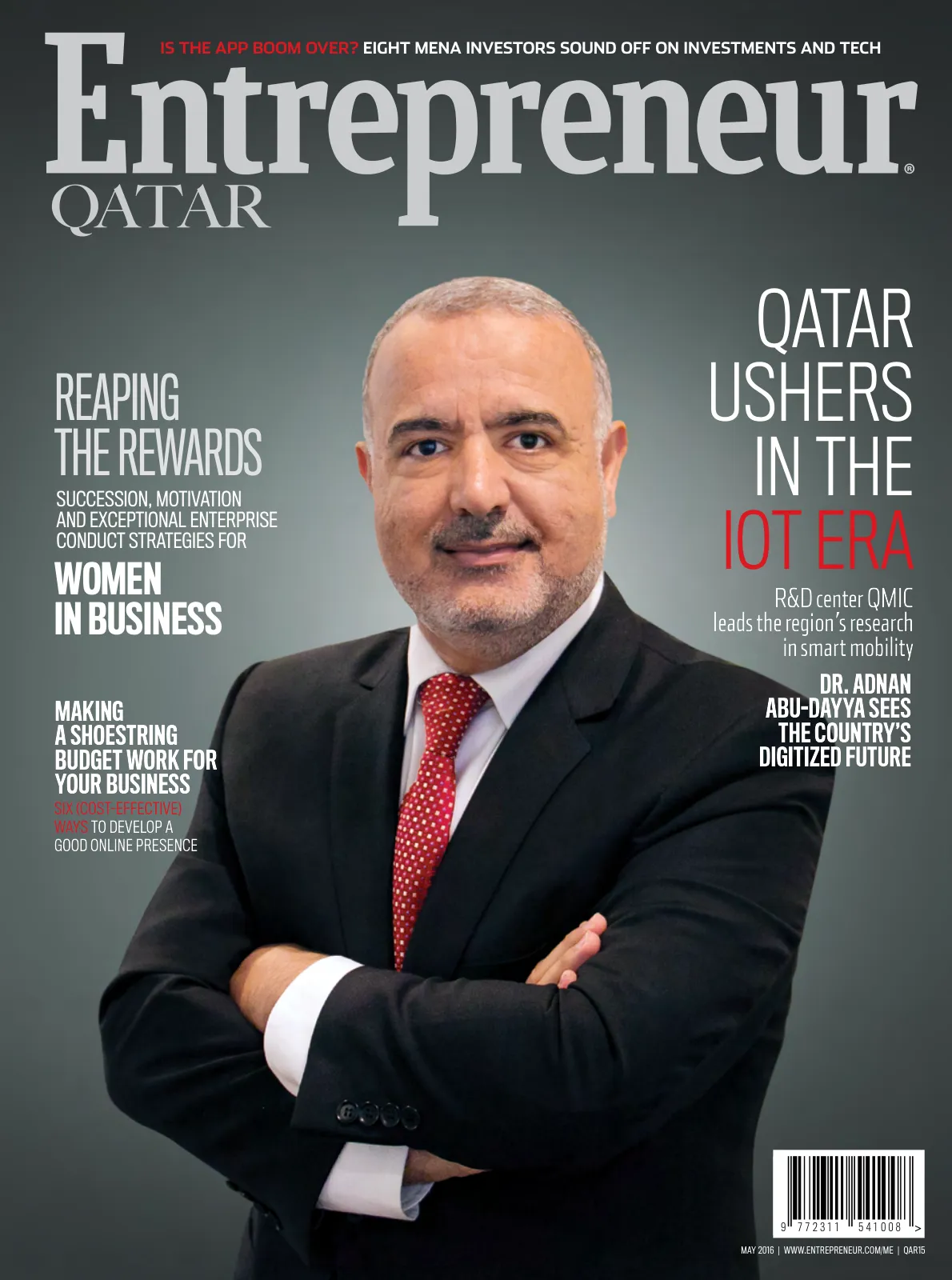
Entrepreneur Qatar, May 2016
Page 1
9
7 7 2 3 1 1
5 4 1 0 0 8
>
Is the app boom over? Eight MENA investors sound off on investments and tech
Reaping
the rewards
Women
in business
Succession, motivation
and exceptional enterprise
conduct strategies for
Six (cost-effective)
ways to develop a
good online presence
Making
a shoestring
budget work for
your business
Qatar
ushers
in the
IoT era
R&D center QMIC
leads the region’s research
in smart mobility
Dr. Adnan
Abu-Dayya sees
the country’s
digitized future
may 2016 | www.entrepreneur.com/me | QAR15
Page 2
Page 3
may 2016 Entrepreneur
3
CONTENTS
may 2016
H.H. Sheikha Latifa bint Mohammed bin Rashid Al Maktoum
12 Launch of QMIC’s Labeeb IoT platform
Hala Fadel
Huda Al Lawati
Iman Ben Chaibah
Amy Cole
Deborah Nicodemus
Butheina Kazim
Sonia Weymuller
Ambareen Musa
Tanaz Dizadji
Sara Mohammadi
Nida Sumar
Amelia Gundersen-Herman
Nicola Cuoco
Christina Ganim
Loulou Khazen Baz
Samantha Hamilton-
Rushforth
Kristine Lasam
Yamna Naveed Khan
Shereen Salah Ahmed
12
INNOVATOR:
Qatar ushers in
the IoT era
R&D center QMIC leads
the region’s research in
smart mobility
Dr. Adnan Abu-Dayya
sees the country’s
digitized future
66
TECH:
MOBILE TECH
The investor’s
viewpoint
We asked eight Middle
East investors to give us
their views on whether
startups in the app
space still have a chance
to make it.
H.H. Sheikha Latifa bint
Mohammed bin Rashid Al
Maktoum
H.E. Sheikha Al-Zain Sabah
Al-Naser Al-Sabah
H.E. Dr. Sheikha Aisha bin
Faleh bint Nasser Al-Thani
Noor Sweid
20
INNOVATOR:
Reaping the rewards
The region’s who’s who
Succession, motivation,
and exceptional enterprise
conduct strategies for
women in business
22
H.H. Sheikha Latifa bint Mohammed bin Rashid Al Maktoum
IN BUSI
Page 4
Entrepreneur may 2016
4
CONTENTS
may 2016
27
Henri Asseily,
Manager Partner,
Leap Ventures
72
Reed Hastings,
CEO and
co-founder,
Netflix
69 Tammer Qaddumi, Founding Partner,
VentureSouq
76 Lenovo’s
new ThinkPad
Yoga X1
90
MONEY:
ASK THE MONEY GUY
Exit strategies for SMEs
The importance of exit
readiness and a well-
designed sales process laid
out for you by an industry
pro.
87
VC VIEWPOINT
Get ready, get set, go!
Five tips for entrepreneurs
embarking on a Series A
raise, by an entrepreneur
who just closed his
startup’s round.
64
PRO
Standardizing your
expectations (successfully)
Owais Dilawer discusses
how entrepreneurs can
effectively manage change
in the workplace, no matter
the size of the enterprise.
58
‘TREPONOMICS:
MARKETING
Making a shoestring
budget work for your
business
Six (cost effective) ways
to develop a good online
presence put forward by
Anna-Liisa Goggs, the co-
founder and COO of C3.
56
SKILLSET
The winning formula
Elie Khouri, CEO of
Omnicom Media Group
MENA, shares insights
on creating the kind of
company people love
working for.
58
MARKETING
Is your loyalty program
ready for glocalization?
Why should loyalty
programs not also show
appreciation of local
needs, customs, and
expectations? Brands
must blend globally
available flagship products
and services with a
carefully curated range of
locally relevant items.
81
ESQUIRE GUY
The Esquire Guy on the
art of how to get out of
doing anything
Ross McCammon is the
master of not giving in-
here he shares his tips
on firmly avoiding doing
things you don’t want to
do.
96
ECOSYSTEM
Immediacy trumps loyalty
If you want to compete
with the bigger players,
your business can’t just
play the “we’re local” card.
14
EDITOR’S NOTE
By Fida Z. Chaaban
Page 5
Page 6
Entrepreneur may 2016
6
SUBSCRIBE
Contact subscriptions@bncpublishing.net to receive
Entrepreneur Middle East every issue
EDITOR IN CHIEF Fida Z. Chaaban editor@bncpublishing.net
MANAGING DIRECTOR Walid Zok walid@bncpublishing.net
DIRECTOR Rabih Najm rabih@bncpublishing.net
DIRECTOR Wissam Younane wissam@bncpublishing.net
CREATIVE LEAD Odette Kahwagi
MANAGING EDITOR Aby Sam Thomas
STARTUPS SECTION EDITOR Pamella de Leon
COLUMNIST Sindhu Hariharan
COLUMNIST Tamara Clarke
COLUMNIST Shoug Al Nafisi
COLUMNIST Erika Widen
EVENTS LIAISON Mark Anthony Monzon
PO Box 502511 Dubai, United Arab Emirates
P +971 4 4200 506 | F +971 4 4200 196
For all commercial enquiries related to
Entrepreneur Middle East contact
sales@bncpublishing.net
All rights reserved © 2016.
Opinions expressed are solely those of the contributors.
Entrepreneur Middle East and all subsidiary
publications in the MENA region are officially licensed
exclusively to BNC Publishing in the MENA region by
Entrepreneur Media Inc.
No part of this magazine may be reproduced or
transmitted in any form or by any means without written
permission of the publisher.
www.entrepreneur.com/me
Access fresh content daily on our website!
MIDDLE EAST
Printed by Raidy Emirates Printing Group LLC
www.raidy.com
EntMagazineME
@EntMagazineME @Fida
Entrepreneur-me
EntrepreneurMiddleEast
EntMagazineME
EntMagazineME
EntMagazineME
Images used in Entrepreneur Middle East are credited when necessary. Attributed use of
copyrighted images with permission. All images not credited otherwise Shutterstock.
Lama Ataya
Abdulla Barakji
Martin Braddock
Amal Chaaban
James Clear
Owais Dilawer
Anna-Liisa Goggs
Amelia Gundersen-Herman
Ashish Joseph
Elie Khouri
Malak Al-Habib
Barry Lalanne
Suhail Al-Masri
Ross McCammon
Rani Nasr
Soukaina Rachidi
Nick Rego
May Rostom
Adib Samara
Tareq Samara
Mohammed Al-Sadiq
Khalil Shadid
Erika Widen
CONTRIBUTING WRITERS
In addition to our print edition, we’re bringing
you all sorts of industry news on our web
mediums. Joining us online means getting
relevant business and startup content in
real-time, so you’re hearing about the latest
developments as soon as we do. We’re looking
forward to interacting with our readers on all of
our social media and web platforms- like any
thriving business, we’re looking to give and take.
#TrepTalkME is already happening on all of our
digi platforms, and all good conversations go
both ways. See you on the web!
Page 7
Page 8
Entrepreneur may 2016
8
EDITOR’S NOTE
Fida Z. Chaaban
Editor in Chief
@fida
editor@bncpublishing.net
Reality check
to the umpteenth
degree
How I learned to stop whining
and start doing (from one of
our #EntMEWomen)
Y
ou might have
noticed the
lineup of hyper
successful women
in this edition.
You might have also noticed
that they all have dual or
triple or even quadruple sets
of professional obligations,
some voluntary and
some not, not to mention
having personal lives and
relationships to maintain.
Most of these women are
far more overextended than
myself, and yet almost all
of them have a better grasp
on work-life balance. I am
constantly shoving my
personal life by the wayside,
neglecting my health, and in
general, making excuses for
not being capable enough to
schedule breaks.
This edition, we have
some of the region’s biggest
achievers, and all of them
come across more calm and
more “stable” than I do
when you encounter them
in real life (I promise). From
H.H. Sheikha Latifa bint Mo-
hammed bin Rashid Al Mak-
toum, during our interview
at Dubai Culture offices, I
learned that it’s okay to stop
trying to execute perfection,
and instead try to execute at
a level that can be consid-
ered great. It was a hard pill
to swallow, but I needed to
hear it. I also learned that
while Her Highness is a self-
professed workaholic, she
slowly schooled herself to
stop taking work home. This
served two purposes; firstly,
she was able to give herself
more creative thinking time
-terribly important in her
sector and position as Vice
Chairman of the Board of
Directors of Dubai Culture
& Arts Authority- and sec-
ondly, she was able
to give herself that
switched-off space
to maintain a good
balance between
professional obliga-
tions (of which
there are many, as
you can imagine),
and her personal life
and ambitions.
I think that my
conversation with
Sheikha Latifa
also proved how
irresponsible I have
been- yes, I do man-
age a huge brand
very responsibly,
but I failed at some-
thing that is abso-
lutely integral for
a successful well-rounded
person: maintaining balance.
Tipping my scales in favor of
irresponsibility included ev-
erything from cancelling my
twice-weekly yoga classes
to scheduling myself in for
10:30 p.m. mentoring ses-
sions, phone calls, and meet-
ings, to not eating all day
due to “pressing” to-do lists.
There is much more to being
successful than running a
company smoothly- there’s
also a measure of how good
you are at staying in charge
of your own life outside of
the professional sphere. I am
not good at staying in charge
of my own life, but after this
edition goes to print, I will
be- and if that means not
working after 7:00 p.m., then
so be it.
Page 9
OFFICIAL TELEVISION OF EMIR CUP 2016
Android
TM, Android TV
TM and other marks are trademarks of Google Inc.
The Android
TM robot is reproduced or modified form work created and shared by Google and used according to terms described in the Creative Commons 3.0 Attribution License.
THE FUTURE OF TELEVISION
Introducing BRAVIA X93D Series with 4K HDR
Welcome to the viewing experience of the future. Sony›s proprietary X1 Chip, a powerful processor
pairs the brilliance of 4K clarity with the brightness, colour and detail of High Dynamic Range
(HDR). So, now you can enjoy the stunning 4K HDR immersive viewing experience, with full android
TV functionality. The future is on, today.
www.sony-mea.com/BRAVIA
Page 10
AL MANA
Al Mana Motors Showroom, Salwa Road,
Doha P.O. Box 491 Doha, Qatar
www.almanagroup.com
www.almanamotors.com.qa
e-mail: oghobrial.aa@almanagroup.com
Tel : +974 44489166 +974 44489002
MOTORS CO.
Head of the worksite!
Ford Trucks offer standard 2 years/unlimited km warranty in Qatar.
Warranty terms substantially contribute to the readily competitive
total cost of ownership of Ford Trucks models.
Ford Trucks
Sharing the load
Page 11
Page 12
Entrepreneur may 2016
12E
ven
before it
was con-
sidered
fashion-
able (and
good
business
sense) to capitalize on the
buzz about the Internet of
Things (IoT), Qatar Mobil-
ity and Innovations Centre
(QMIC) set up shop in the
country in 2009 with an
aim to alter the technology
innovations space in GCC.
Founded at a time when
IoT as a term was hardly
recognized, QMIC, a mobility
systems-oriented R&D cen-
ter built as a partnership be-
tween Qatar University and
Qatar Foundation, focused
on using sensing technolo-
gies (sensors) to collect and
derive insights from data,
and take innovations from
being a theoretical or scien-
tific concept to a marketable
business proposition.
“We are proud of the fact
that since its inception,
QMIC’s activities have been
all about IoT. It is probably
safe to state that QMIC is
one of the oldest IoT start-
ups in the whole region,”
says Dr. Adnan Abu-Dayya,
Executive Director (CEO),
QMIC. Operating from Qa-
tar’s technology hub Qatar
Science and Technology Park
(QSTP), QMIC with its team
of 75 innovators has gone
beyond merely incorporating
IoT in its vision statement,
and has delivered tangible
results, making it a regional
market leader. The organiza-
tion counts four success-
fully commercialized “smart
systems” to its name, tools
that are solving key issues in
transport, environment and
road safety sectors. Masarak
(meaning “Your Path” in
Arabic), a platform providing
integrated services for intel-
ligent transport, telematics
and smart logistics, was
followed by Hawa’ak (“Your
Air”), an environment moni-
toring solution delivering
Qatar ushers in
the IoT era
R&D center QMIC leads the region’s
research in smart mobility
Dr. Adnan Abu-Dayya sees the country’s digitized future
By Sindhu Hariharan
innovator
Launch of
QMIC’s Labeeb
IoT platform
>>>
Page 13
Page 14
Entrepreneur may 2016
14
information on air quality
and weather. Then came
Salamtek (“Your Safety”),
an application that tackles
the grave issue of road safety
in the region, by curbing
distracted driving behavior
and offering basic telematics
services. QMIC developed all
these systems using distrib-
uted sensing technology, a
concept that is still develop-
ing in this part of the world.
With this expertise and
experience to lean on, in
March 2016, QMIC launched
its first locally developed IoT
platform, Labeeb IoT. Labeeb
(“Intelligent”), a product of
a year of QMIC’s core efforts,
is a platform that facilitates
communication between
devices, and translates data
into actionable insights for
industries such as oil & gas,
healthcare, utilities, etc. to
deliver services. According
to Abu-Dayya, the idea be-
hind Labeeb is to enable en-
trepreneurs, researchers and
others, realize the business
potential of IoT and create
local digital businesses in
the process. Besides making
it economical for startups to
deploy IoT-based solutions,
Labeeb also wants to create
and grow a community of
developers and adopters
in the region, by providing
SDKs (software development
kits). With 20 years of global
experience in wireless, tele-
com R&D and related areas,
and seven issued patents,
Abu-Dayya is in agreement
with industry’s positive
outlook for IoT and sees
significant potential for it
in the region, more so, with
the Smart City vision of the
region’s policymakers. That
is also a reason why QMIC
plans to make significant
enhancements and features
to Labeeb throughout 2016.
This, however, hasn’t dis-
suaded interest from the
market.
According to QMIC, inter-
est and enquiries from
startups, tech entrepreneurs
and corporates have been
pouring in since Labeeb’s
launch, and the center is
reaching out to the com-
munity through incuba-
tion organizations, local
universities and research
centers in Qatar. The R&D
house claims that a number
of startups in and outside
Qatar have started using the
current version of Labeeb
and QMIC’s plan is to
initially focus on entrepre-
neurs, university students,
research centers etc. and
then look towards industries
like utilities, smart cities,
and healthcare, among oth-
ers. Owing to the very nature
of all their smart solutions,
QMIC has come to be a key
partner of the Qatar Govern-
ment and various industrial
houses of the nation in their
endeavor to make public
infrastructure smarter and
technologically advanced.
While Qatar Rail partnered
with QMIC back in 2014
for the Masarak platform
for traffic monitoring and
logistics management to
support its mega projects,
Qatar’s Supreme Committee
chose the Hawa’ak system
for deployment at number
of proposed venues for
upcoming FIFA World Cup
in Qatar. QMIC also formed
a Consortium for Salamtek,
which includes key organiza-
tions such as the Ministry
of Municipality and Urban
Planning, Traffic Directorate
of the Ministry of Interior,
Ooredoo Qatar, Qatar Insur-
ance Company, Vodafone
Qatar and others, to speed
the development of such so-
lutions. In support of Qatar’s
Road Safety strategy, QMIC
also announced a digital
strategy for road safety, pre-
senting its range of solutions
to reduce fatalities due to
road mishaps in the country.
Without denying the trans-
formative nature of IoT and
other mobility technologies,
QMIC’s Abu-Dayya shifts
focus on the roadblocks
that need to be cleared to
create a business value out
of the technologies. “Have
solutions and services opti-
mized for local user needs;
understand the business
value and potential return
on investment; optimize the
user experience; establish
the right partnership and
delivery model; and most
importantly, have the local
innovator
“Have solutions and services optimized
for local user needs; understand the
business value and potential return on
investment; optimize the user experience;
establish the right partnership and
delivery model; and most importantly,
have the local know-how and expertise to
cope with a rapidly evolving field.”
QMIC’s office in Qatar
Page 15
may 2016 Entrepreneur
15
know-how and expertise to
cope with a rapidly evolving
field,” he asserts. For him,
GCC figures as the most
suitable area in MENA for
development and deploy-
ment of IoT, supported by
a developing infrastructure
and emergence of mega
projects that rely on digital
systems. With regard to
nuances of running a tech
business, Abu-Dayya be-
lieves that his understanding
of entrepreneurship stands
confirmed with QMIC’s
journey. A primary require-
ment, he says, is to strike a
balance between developing
a marketable solution and
building partnerships in the
process. “Technology-based
businesses require scale,
speed and know-how. Lack-
ing any of these three will
most likely limit the value
and impact any technology-
based venture,” he adds.
He also cites availability of
funding, as a major barrier
for entrepreneurs in the
region, especially in the
early-stage. “Although there
has been progress in the
last few years, I believe key
elements of the ecosystem,
especially the locally estab-
lished technology companies
who can act as an exit chan-
nel for local entrepreneurs
and a strong VC industry,
are either weak or missing.”
As for QMIC, the center has
kept the research work going
on its own revenues (save a
few research grants) since
the time it raised seed fund-
ing from QSTP in its initial
years. However, given its
projects pipeline, the center
is currently keen to explore
strategic investment part-
nerships for growth capital.
Despite all limitations,
QMIC is not anywhere close
to pausing in its research on
futuristic tech. In the long-
term, the center intends to
set up an IoT Smart Living
Lab, to see the technology
through its growth cycle and
emerge as a go-to organiza-
tion for all things IoT. Abu-
Taskeen Properties’ Khalid Al Habsi winning at the Oman Entrepreneurship Awards
Dr. Adnan Abu-Dayya, Executive
Director (CEO), QMIC
On working with QSTP
“We are very proud of the
partnership we have with
the QTSP, and the level of
support they provided to us
especially in the first few
years. Given our intense focus
on technology development
and commercialization of local
R&D effort, we represent a
perfect match with the man-
date of QSTP. Being housed
in a state-of-the-art facility
and close to many technology
enterprises provides a great
level of community and a
chance for collaboration and
interactivity.”
On incubator/accelerator
support for Qatar’s startups
“In Qatar, we have three ac-
celerator programs that have
been quite active in the last
one to two years in supporting
local entrepreneurs. These
include QBIC [Qatar Business
Incubation Center], QSTP, and
the Digital Incubation Center
of the Ministry of Transport
and Communications. Hence,
I believe the early acceleration
phase is now well covered,
although funding challenges
still exist.”
On the evolution of Qatar’s
entrepreneurial ecosystem
“Qatar’s entrepreneurial
ecosystem has grown tremen-
dously in the last few years es-
pecially as we have many dedi-
cated incubation/accelerator
centers including QSTP, QBIC,
and DIC. However, I believe,
the ecosystem that supports
the very important scale-up
phase has not progressed at
the same rate, especially in
relation to technology-based
enterprises. The scale-up and
growth phase requires more
financial support and a more
mature ecosystem.”
Quick takes
Dr. Adnan Abu-Dayya, Executive Director (CEO), QMIC
“Although there has been
progress in the last few years,
I believe key elements of the
ecosystem, especially the
locally established technology
companies who can act as an exit
channel for local entrepreneurs
and a strong VC industry, are
either weak or missing.”
>>>
Page 16
Entrepreneur may 2016
16
Dayya also says that QMIC
is in active discussions with
key Qatari stakeholders to
create a Labeeb IoT con-
sortium. And if this wasn’t
cutting-edge enough for you,
the innovation center’s re-
search may soon bring con-
nected vehicles technology
right here to our backyards,
in the Middle East. At a time
when H.H. Sheikh Moham-
med bin Rashid Al Mak-
toum, Vice President and
Prime Minister of the UAE
and Ruler of Dubai, launches
the Dubai Autonomous
Transportation Strategy and
expects that, by 2030, 25%
of all trips in Dubai will be
driverless, QMIC’s scientists
have already been able to
successfully test in-lab, a
framework for vehicle-to-
vehicle communication
addressing road safety– a
project they have been
involved with since 2011
and now aim to refine. Being
prodded on the reasons for
success of QMIC’s platform-
based approach and its mar-
ket leadership, Abu-Dayya
credits the center’s agility
coupled with technical ex-
pertise and understanding of
local needs to be key drivers.
With two decades of experi-
ence in the field and being
a man of science, it’s not
surprising that Abu-Dayya
is very clear about what the
region’s aspiring entrepre-
neurs need, to scale their
business: “The ingredients
for success in the area of
technology entrepreneurship
are simply hard work, pas-
sion and perseverance, and
to continuously learn from
mistakes or things that do
not work, and pivot in the
right direction.”
Global market intelligence
firm International Data Cor-
poration (IDC) anticipates
the Middle East IoT market
to reach $1.8 billion in 2016
and then increase to $3.2
billion by 2019. Interested
entrepreneurs can sign-up
on the Labeeb IoT website,
and QMIC will mail a free
Labeeb IoT account to
eligible users within a few
days of the request. While
Labeeb’s current focus is
to enable users (startups
or researchers) to develop
and deploy IoT services
easily and economically,
supporting the monetiza-
tion of these services comes
at a later stage. Telecom
operators’ platforms, on the
other hand, tend to focus
on managing connectivity
and provide configuration
support in deploying solu-
tions offered by third party
developers.
Why Labeen IoT? www.labeeb-iot.com
innovator
Nadia Maqbool, founder, 23 Degrees
“We are proud of the
fact that since its
inception, QMIC’s ac-
tivities have been all
about IoT. It is proba-
bly safe to state that
QMIC is one of the
oldest IoT startups
in the whole region.”
QMIC’s office in Qatar
Launch of
QMIC’s Labeeb
IoT platform
Page 17
Page 18
Page 19
Page 20
Entrepreneur may 2016
20
Brought to you by
Reaping
the rewards
Success, motivation, and exceptional
enterprise conduct strategies for
women in business
Page 21
may 2016 Entrepreneur
21
H.H. Sheikha Latifa bint Mohammed
bin Rashid Al Maktoum
H.E. Sheikha Al-Zain Sabah
Al-Naser Al-Sabah
H.E. Dr. Sheikha Aisha bint Faleh
bint Nasser Al-Thani
Noor Sweid
Hala Fadel
Huda Al Lawati
Iman Ben Chaibah
Amy Cole
Deborah Nicodemus
Butheina Kazim
Sonia Weymuller
Ambareen Musa
Tanaz Dizadji
Amelia Gundersen-Herman
Yamna Naveed Khan
Sara Mohammadi
Nida Sumar
Nicola Cuoco
Samantha Hamilton-Rushforth
Christina Ganim
Loulou Khazen Baz
Kristine Lasam
Shereen Salah Ahmed
Page 22
By Fida Chaaban
Entrepreneur may 2016
22
Reaping
the rewards
The MENA region’s
achieving women
Dubai Culture’s Vice Chairman wants MENA’s artists to go global
(and make a good living in the process)
CREATIVE ENTREPRENEURS,
DUBAI CULTURE
IS LOOKING FOR YOU
H.H. Sheikha Latifa bint Mohammed
bin Rashid Al Maktoum
IMAGES: Dubai Culture & Arts Authority
T
he Vice Chairman of the Dubai
Culture & Arts Authority (Dubai
Culture) is many things- some of
which you might not expect. Those
of you who already follow H.H.
Sheikha Latifa bint Mohammed
bin Rashid Al Maktoum on Twitter
(@LatifaMRM) and Instagram (@LatifaMRM1) see
her post a mixture of culture, lifestyle, tech, and a
satisfying dose of entrepreneurship. Her interest in
science is also apparent through her digital sharing,
and so is her sense of humor. (Not to mention a cool
factor- she’s a follower of Neil deGrasse Tyson.) On
social media you’ll also get a pretty accurate idea
of her personality: approachable and accessible,
practical and passionate. Passionate how? Well, the
best way I can explain this is that when you meet
Sheikha Latifa you’ll get the sense that she is a
private person whose vibrancy shows mostly when
she is discussing her work and the many reasons why
she believes wholeheartedly in that work. I can say
that’s when she really comes alive- her smiles are
bigger, her gaze is more intense, and she’s much more
emotive, especially when describing Dubai Culture’s
long-term aims and the potential boons it will afford
Middle East creatives. >>>
Page 23
may 2016 Entrepreneur
23
Reaping
the rewards
The MENA region’s
achieving women
Page 24
Entrepreneur may 2016
24
Reaping
the rewards
The MENA region’s
achieving women
It is hard to imagine a busier
schedule than Sheikha Latifa’s
with her dual capacities as Vice
Chairman and as a member of
the UAE royal family. Both the
former and the latter come with
diverse sets of obligations and
duties. Here’s her take on how
delegating can help you achieve
better results, making work-life
balance a reality, mastering time
management, and maximizing
your much-needed downtime.
JUGGLING WORK-LIFE
BALANCE “It’s a learning curve,
to be honest. I’m a perfectionist,
so I’m curious on how to get the
optimum state of productivity. I
realized over the years that I had
to take my downtime as seriously
as I take my work. It’s absolutely
possible to have a work-life bal-
ance- in fact it’s crucial. There is
no general rule to establishing a
work-life balance and everybody
has a circadian rhythm specific
to them. Each individual should
learn to listen to that rhythm and
work with it, instead of toiling
away all day and not leaving any
time to regenerate and recharge
their energy.”
OWNING TIME MANAGEMENT
“I believe in managing your
energy and not just your time. To
make sure I achieve everything
on my list I reserve specific times
of day for specific activities. For
example, mornings for me, when
you have the most energy and
clarity, are reserved for creativity,
problem-solving and growing
ideas. Once I get that done, I
turn to any pressing issues of
the day or other things that need
to be addressed. I always make
time to think, it is important to
give your mind space to wander
and make necessary connections
and come up with creative ideas
when it’s not bogged down with
the day to day issues; especially
in an industry as creative as the
cultural industry.”
MAKING THE MOST OF
DOWNTIME “I’ve always been
a workaholic, taken my work
on vacations, worked a lot
of weekends, taken my work
home. I stopped taking my work
home -you make a decision to
do it- and then you are able to
manage your time at the office
better. I make sure that I take
my weekends seriously, unless
there is something urgent that
needs to get done I take that
time to recharge. Burnout is very
common among the workforce,
and I believe it should be discour-
aged from the workplace and a
better work-life balance should
be encouraged- that way you
get the best out of yourself and
your team. Besides, to achieve
the ultimate goal of making the
people of Dubai happy, you have
to make sure both yourself and
your teammates -the people who
are actually working towards that
goal- are happy first.”
WIELDING THE POWER OF
DELEGATION “If you seek per-
fection in everything you do, you
might never get there- you might
eventually get there, but not
as fast as you’d hope. For me, I
learned to stop aiming for perfect
and instead I aim for great. I
trust the people I work with; I
know how their minds work and
I feel comfortable delegating to
my team. I delegate a lot, even
if it’s something I want to do on
my own but I just don’t have the
time for, I will delegate it off and
sometimes you get much better
results that way.”
OFF THE CLOCK
ARE YOU MAKING THE MOST OF YOUR TIME?
“It inspires me when I see
people pursuing their
passions, doing what they
love and in turn, excelling
at what they do.”
IMAGES: Dubai Culture & Arts Authority
Sheikha Latifa’s digital pres-
ence is actually how I become
aware of her endeavors; in
her professional capacity as
Vice Chairman, she is driving
a new initiative to not only
shed light on MENA’s creative
entrepreneurs but also to help
them build up the business
side of things. All of these
factors combined were what
prompted me to request an
interview. As you’ll soon see,
the information she shares
is pretty valuable- especially
for the creative entrepreneurs
who are often marginalized
by both the business commu-
nity and the business media.
Makers and craftspeople, in-
dustrial, jewelry and fashion
designers, singers, songwrit-
ers and musicians, painters
and playwrights, you all need
to sit up and pay attention:
Dubai Culture’s Creatopia.ae
is now live and it’s worth the
visit. “Creatopia is the first
of its kind government-em-
powered virtual community
for creatives in every field.
Anyone who has a creative
talent can sign up and set up
a profile- from visual artists,
writers, curators, innovators,
all the way to collectors and
even organizations, whether
in the creative industries or
otherwise. We have some cat-
egories already, but these will
expand as the need arises.
We envisioned Creatopia
to provide something for
everyone in the community,
cultural industry and [the]
business world in general,”
explains Sheikha Latifa.
She is emphatic that entre-
preneurs, often the earliest
adopters of any innovative
tech movement, should be the
early adopters of Creatopia.ae
too. “Creatopia is a constant
work in progress; it is now
still at its growth stage and I
want people to know there’s
a lot more coming. Our plan
is to have it grow to its full
potential by 2020, but its
benefits will be felt as early as
2017,” adding that there are a
number of verticals planned
such as masterclasses and
even an e-commerce element.
Currently, the bulk of Creato-
pians are UAE-based, but “we
hope that the percentage of
people joining from the GCC,
Page 25
may 2016 Entrepreneur
25
Reaping
the rewards
The MENA region’s
achieving women
Artwork by
Amna Jawad at
Sikka Art Fair
>>>
the region and the world will
grow,” as the site is meant for
a global community member-
ship to enhance enterprise
potential for all parties
involved.
Why was Creatopia even
conceptualized? “To provide
creatives with a platform
to showcase their work,
grow their talents, engage
with like-minded people,
and hopefully get recruited
through the portal by dif-
ferent organizations who
need creative services.” The
business development aspect
of the portal is extremely at-
tractive: there will be a type
of tenders section, called Op-
portunities, where projects,
creative jobs, and soliciting
can be shared, a learning tool
section, a discussion board
to facilitate collaborations
and recommendations, and
an e-pay segment is also in
the works. “It’s all about
increasing the ease of doing
business for the cultural in-
dustries. What we’re seeking
to do is even bring together
corporates and creatives- I
think corporates do want to
invest in the sector but they
don’t know where and how,
and they don’t know what
the creatives need. We’ll
provide them guidance in
that way.” Under the vision
of Sheikha Latifa’s father,
H.H. Sheikh Mohammed
bin Rashid Al Maktoum, the
Emirate has become not only
an art and culture hub, it’s
arguably become the place
for entrepreneurs in MENA.
With both of these comple-
mentary identities in mind,
Creatopia will help to bridge
the two communities, and
eventually, lead to stronger
economic prospects for the
creative sectors. “One of our
main drivers is part of the
Dubai Strategic Plan 2021,
announced by my father His
Highness Sheikh Mohammed
bin Rashid Al Maktoum,
UAE Vice President, Prime
Minister and Ruler of Dubai,
is establishing Dubai as a ‘city
of happy, creative and em-
powered people.’ To this end,
a thriving creative industry
where creatives have the right
means to operate and achieve
their goals, is key. This is why
we do what we do every day.”
In the interest of a diversified
and sustainable economy,
together with an appreciation
for societal enrichment via
diverse mainstream exposure
Page 26
Entrepreneur may 2016
26
Reaping
the rewards
The MENA region’s
achieving women
“We have a lot of projects; in the
near future you’ll see news of a
project that we’re working on.
There are many infrastructure
projects that are in progress now-
with the museum sector, education
literature, we’re working with
the libraries, a few very different
pillars. We have a lot in the pipeline.”
to art and culture, Sheikha
Latifa says that inclusiveness
is at the core of Creatopia’s
mandate. She feels that the
dedicated virtual space will
help to call attention to this
sector of startups and estab-
lished artisans alike through
awareness and web portal
power. “It’s all about expo-
sure and access. Once people
sign up to the website and up-
load their work and portfolio,
they will automatically have
an increased viewership. This
is the same whether they are
signing up as an individual
artist or creative or a creative
company. Our ultimate goal is
to make it easier for creatives
to create, learn, connect, grow
and make a living out of their
craft by providing them with
opportunities wherever they
are physically, through the
portal .”
Armed with a Bachelor’s
degree in business manage-
ment and a concentration in
marketing, followed up by an
EMBA at Zayed University,
one would think that Sheikha
Latifa (being who she is
and equipped with the right
education), wouldn’t have
had to work her way up the
corporate ladder. Frankly, I
was quite surprised to hear
otherwise: “You know, most
people aren’t aware of the
fact that when I decided to
join Dubai Culture, I started
at the lowest rung of the
government scale and I had
to work my way up.” Here, I
cannot resist the temptation
and before I can stop myself, I
hear my voice asking her how
that went, since, she is after
all, Her Highness. Laughing
softly and speaking candidly,
Sheikha Latifa says that “it
was actually very normal be-
cause I wasn’t treated like His
Highness’ daughter, which
is exactly what I wanted to
experience. My first day in
the office, I remember I had to
take on a project -which was
the branding of the Author-
ity’s first logo- and I was just
sort of thrown in the deep
end and I learned to swim!
I think it helped me to grow
a lot.” And why, with all the
doors that could have opened
for her, did she choose the
culture sector? “When I made
the decision after graduating
from Zayed University that I
wanted to work, my biggest
supporter was my father
[H.H. Sheikh Mohammed bin
Rashid Al Maktoum]. I first
interned at Dubai Holding,
through the different entities
under Dubai Holding. Once
the authority was set up in
2008, I decided to join it. I’m
interested in creative entre-
preneurship and how to ben-
efit the creative community
in a sustainable way, while
contributing towards [build-
ing] a healthy economy.” An
economy that is healthy and
friendly to entrepreneurship
requires simple processes
and procedures- a reduction
of barriers to entry. Sheikha
Latifa adds that an ongoing
project at Dubai Culture is
taking measures to improve
the licensing aspect to make
it much easier for artists,
galleries and other cultural
“Well done to the women at
the top of the corporate ladder,
and I hope they all spread the
knowledge to women rising
to the top in the workforce.
They have the confidence, the
means, and the skills, maybe
sometimes all they need is
guidance and words of encour-
agement. Everything that we’ve
been doing in the UAE has
always been to encourage eve-
ryone, including women, since
the formation of the Emirates.
Sheikh Zayed [bin Sultan Al
Nahyan], God rest his soul,
and Sheikh Rashid bin Saeed
[Al Maktoum], who worked to-
gether to build this nation, have
always advocated for education
for women - universities have
been set up to provide free edu-
cation for women.”
1. Shed light on existing
women leaders of enterprise
and of government “During
the last decade we’ve seen
more women leaders that are
prominent within both the pub-
lic and private sectors. I believe
that having strong female role
models that have already paved
the way for women in business
is the biggest step towards
seeing more women join the
business community.”
2. Encouraging discourse
and mentorship “The next
step should be mentorship and
setting up platforms -where
women entrepreneurs and
women in the workforce in
general- come together and
share ideas and start discus-
sions. I believe what will really
strengthen women’s participa-
tion and achievement in the
business world is guidance,
mentoring and support from
other women who have already
made it to the top. Opportuni-
ties in Dubai are abundantly
available to women, but this
will help them recognize those
opportunities and make the
best use of them.”
3. Know that your ideas are
valuable and commercially
viable “Everyone in the busi-
ness world has the power to
make a positive contribution to
the economy and to the coun-
try; no matter how small they
think their contributions are,
they all make a difference. In
my line of work, I come across
many young women who either
work in the public or private
sectors or have their own
businesses and the ideas that
they share with me are nothing
short of impressive.”
THE EXECUTIVE SUMMARY
Sheikha Latifa on facilitating women’s inclusion
across sectors and industries
Page 27
may 2016 Entrepreneur
27
Reaping
the rewards
The MENA region’s
achieving women
“When a society
reaches the peak
of progression,
that’s when the
cultural scene
thrives. It’s a huge
sign of progress.”
IMAGES: Dubai Culture & Arts Authority
ventures to navigate legal and
legislative framework thereby
allowing for more cultural
involvement in the entre-
preneurial ecosystem. And
on the subject of legal ease,
for those concerned about
their intellectual property
rights once it’s in the public
domain as part of Creatopia,
Dubai Culture is working on
that too. “The region itself
is working on IP rights, and
being on Creatopia is expo-
sure. Whether it’s placed in
a gallery or on a wall, there’s
always a risk. Looking at it in
a different way, if people are
inspired by your work then
it’s a compliment.”
Finally, touching on the
subject of women in business,
there are a few things that
are immediately clear from
Her Highness’ opinions. To
begin with, Sheikha Latifa
thinks that our collective
mindset has a lot to do with
it- by thinking of fields as
male-dominated, we are
feeding the beast and I can’t
help but agree. The second
point is that she believes in
examining things with an
individualistic approach as
opposed to a gender-based
one. The third salient point is
that she doesn’t find today’s
successful women all that
different from GCC women
of generations past. “His-
torically in the GCC, women
played prominent roles in
society and in the business
world. They were tasked with
transacting business and han-
dling trade as their husbands
-pearl divers- were away for
long stretches, months and
months. It’s ingrained in our
society; it wasn’t a revelation
to us here- it has always been
this way.” Briefly, she reminds
me that today’s female
leaders of enterprise and
government in the GCC are a
natural progression of earlier
times, and mentions UAE
Minister, H.E. Sheikha Lubna
bint Khalid bin Sultan Al
Qasimi, as a woman she found
inspiring growing up. “There
have never been as many op-
portunities as there are now
for women to take advantage
of and pursue their dreams.
Our leadership has worked
tirelessly to provide women
with the best access to educa-
tion and endless opportuni-
ties to join the workforce and
the business world. With all
that in place, every individual
has to put in the work to grab
those opportunities and
achieve their own success.
We strongly believe in the
potential women have, and we
paved the way for them to be-
lieve that they have the ability
and the opportunity to make
a positive contribution. I hope
they can believe in themselves
as much as we do.”
Page 28
Entrepreneur may 2016
28
THE ENTREPRENEURS
By Amelia Gundersen-Herman
Women in business talking women in business
Twelve MENA startup founders discuss
the regional startup ecosystem
Butheina Kazim,
co-founder,
Cinema Akil
Image credit Masam Syed Ali
Reaping
the rewards
The MENA region’s
achieving women
>>>
W
hen we
talk about
women in
business in
the Middle
East, particularly in Dubai, I
always feel being a woman is
more advantageous than dis-
advantageous.” Those are the
words of Sara Mohammadi,
the founder of Tehran-based
Eventbox, and they convey
the majority perspective of
the female entrepreneurs with
whom I spoke through the
course of the STEP Confer-
ence in Dubai in 2016. These
12 women represent 11 com-
panies and range in age from
25 to 39, and the nationalities
include American, British,
Egyptian, Emirati, Filipino,
Iranian, Lebanese, Mauritian,
Pakistani, and Palestinian
citizens. Their companies
have been founded as recently
as February 2016 and as far
back as 2012, with all but
one of the companies having
operations in the UAE. They
also operate in Egypt, Iran,
KSA, Palestine, and the whole
of MENA; some even provide
services outside of the MENA
to Greece and the U.K.
Though the ground on
which they stand on may not
be completely equal yet, all
of the women agreed that
increases in equality were
visible and happening rapidly.
A perfect example of that is
Nida Sumar, founder of the
Dubai-based Keza. She said
that three years ago angel
investors told her, “You’re a
sweet girl, but to do business,
you need to have sharp teeth;
you just leave the business to
us.” Fast forward to now, and
she’s having long meetings
with angel investors and VCs
who are giving her great ad-
vice on how to move forward
with her enterprise. One
angel has already invested in
her company.
The majority of the women
felt they hadn’t faced female
specific barriers in founding
and operating their compa-
nies. However, Samantha
Hamilton-Rushforth, founder
of the Dubai-based BEEM,
said there are times when she
struggles to be taken seri-
ously because she is female.
Hamilton-Rushforth explains
one of these instances as
follows: “Men will come up
to me and say, ‘What do you
do?’ I’ll start explaining what
BEEM is, and they’ll cut over
me halfway through a sen-
tence to say, ‘You know what
you should do?’ If they would
let me finish I could explain
what it is we do, and then
I’d be more than happy to
listen to their advice. I’d love
advice, I’d love to know their
opinion, but [they] don’t
even let me finish my pitch.”
Kristine Lasam, founder of
the Dubai-based Pink En-
tropy, agrees with Hamilton-
Rushforth. “I think we still
have a long way to go,” she
says. “That’s the reality we
must acknowledge, because
it is in the acknowledgement
that we can start making
Page 29
www.zu.ac.ae
Zayed University is the premier national university in the UAE and a regional leader in educational innovation and change.
It is accredited by the Middle States Commission on Higher Education, one of six regional US accreditation bodies. Zayed
University welcomes national and international students and provides them with high-quality education, offered by seasoned
faculty in state-of-the-art campuses, to prepare them to shape the future of the UAE.
Zayed University offers internationally accredited undergraduate and graduate programs in the following colleges:
· College of Arts & Creative Enterprises (recognized as substantially equivalent by NASAD)
· College of Business (Accredited by AACSB)
· College of Communication & Media Sciences (Accredited by ACEJMC)
· College of Education (Accredited by NCATE)
· College of Sustainability & Humanities Sciences
· College of Technological Innovation (Programs accredited by ABET)
Marketing & Entrepreneurship | Film & Video Communications | Converged Media | Environmental Science | Security and Network Technologies
For more information about Zayed University programs and scholarship opportunities, please visit:
Accredited by
Middle States Commission on Higher Education
Zayed_U
ZayedU
ZayedUniversity
ZayedUniversityAE
Your success
is our legacy.
Page 30
Entrepreneur may 2016
30
Reaping
the rewards
The MENA region’s
achieving women
Tips for women in business
(from women in business)
Shereen Salah Ahmed, founder, Akla-Baity
Sara
Mohammadi,
founder,
Eventbox
“There is actually
a pretty big entre-
preneurship commu-
nity in Palestine and
a lot of them are
women. It is kind of
disproportionate to
entrepreneurship
scenes outside of
Palestine.”
changes- really start mak-
ing things that will lead to
genuine long-term change.”
But Lasam admits that there
are also advantages to being
a female entrepreneur in
MENA: “I think women who
say they’ve never gotten away
with good things because
they’re female are either
blind or lying,” she says. “It
opens doors.”
Initiatives to support
women in business in Dubai
are aplenty. Dubai Business
Women Council, for instance,
held a year-long program for
aspiring female entrepre-
neurs, and Yamna Naveed
Khan, founder of the Dubai-
based PerksPlus, was one of
the participants. Given the
existence of such programs,
Khan believes the region is
welcoming female entrepre-
neurs- however, she notes
an issue in terms of their
perception in the ecosystem.
“People associate women
entrepreneurs with beauty,
healthcare, education,” Khan
explains. “[My company] is
a very B2B business, so it
is different from what the
normal or stereotypical [com-
panies that] women entrepre-
neurs start.”
Nabbesh founder Loulou
Khazen Baz is another en-
trepreneur who participated
in a training program only
offered to women. In her case,
it was a two-week executive
leadership training program
in the U.S. run by the State
Department and Goldman
Sachs, and it was only open
to MENA women. Baz also
agrees with the sentiment
that it’s good to be a female
entrepreneur in the Middle
East. “I think being a woman
opens a lot of doors,” she
says, explaining that since
there are more men in the
startup ecosystem, especially
on the investor side, having
a woman’s view can thus be
refreshing and, well, nice.
I asked Butheina Kazim,
founder of Cinema Akil, if
she has experienced any
disadvantages or advantages
as a female entrepreneur in
the MENA. “No, absolutely
not,” she replies. “I never
actually am conscious of that.
I’ve grown up in a way that
has never made me aware,
wary, or conscious of the fact
that I am a woman. I have
always been raised that a
On being a female ‘trep
“[My] most important piece
of advice to any woman is
don’t think about yourself just
as a woman- you are not just
a woman, you are a startup
entrepreneur. That super-
sedes any other identity that
you have… The minute you
put another identity above
that it becomes a limitation
for yourself: limitation in your
own mindset, and in your
own perception of your abili-
ties. If [entrepreneurship] is
what you want to do, think of
yourself first and foremost as
an entrepreneur; not as your
nationality, not your gender,
nothing… Be brave. Go out
there. Talk to people. Reach
out to people on LinkedIn.
Find mentors for yourself.
Where I am today is a result
of just being really auda-
cious and very stubborn. For
my early internships, I was
sending companies 20 faxes
in a week, and they would get
so annoyed that they would
contact me and say, ‘Why
are you sending us so many
faxes?’ I would say, ‘Because
I want to do an internship
with you guys,’ and they
would be like ‘Alright, come
over for an interview; we’re so
fed up with all these faxes.’
So if you want something- go
for it. Don’t be shy. Don’t be
embarrassed. You are totally
entitled to it.”
Sara Mohammadi, founder, Eventbox
On pitching for funds
“I find a lot of girls somehow
feel a bit intimidated, espe-
cially in front of investors.
There is a lack of confidence,
because it is such a male-
dominated ecosystem and
a lot of younger females are
intimidated by the VCs. For
their first round of funding,
they go ‘How do I talk to this
guy? This guy has 50 years
of experience behind him, he
sold his business, and he’s
made a lot of money… Now,
how do I do this?’ Everybody
knows that you’re 26, you
don’t have to be 45. If you’re
26, be 26- you’ve got a great
idea.”
Ambareen Musa, founder and CEO,
souqalmal.com
On scaling up your
business “Hire freelancers…
outsource. A lot of business
owners try to do everything
themselves- it doesn’t work.
It’s not going to scale. The
only way to scale is if you hire
experts in specific fields and
you get them to help you. By
hiring freelancers it helps you
get great people on a rela-
tively affordable rate versus
employing people, getting an
office, getting visas and all
that stuff. So hire freelancers
and outsource.”
Loulou Khazen Baz, founder,
Nabbesh
On motivating oneself
“Keep focused on what it
is you’re trying to do. Your
worst enemy is going to be
yourself throughout this jour-
ney. Be original… Don’t think
of yourself as an extension
of anything; whether it’s a
culture, a place, an environ-
ment or industry... Have the
guts, have the courage and
the belief in what you do.
Think bigger, think within a
planet where you only exist.
That’s where the interesting
stuff happens.”
Butheina Kazim, founder, Cinema Akil
On perseverance
“Don’t be afraid to knock
on doors. If someone says,
‘No,’- no means next… Trust
your intuition. If you’ve done
your homework, trust your
intuition. It is when I don’t
trust my instincts that I get in
trouble.”
Kristine Lasam, founder, Pink Entropy
Page 31
may 2016 Entrepreneur
31
Reaping
the rewards
The MENA region’s
achieving women
Amelia Gundersen-
Herman, Event
Coordinator and
Host, Startup Grind
Dubai
Christina
Ganim and
Nicola Cuoco,
co-founders,
Kenz
“I think people
are interested
in supporting
women led com-
panies. I think
positively. I think
they want to see
more women run-
ning companies,
being the CEO.”
woman can do anything that
a man can do. I don’t like to
frame the conversation about
development or the ability to
achieve around the fact that
I am a woman.” But Kazim
also notes the importance of
conversations on women in
business. “Obviously I think
it’s important, sometimes,”
she explains. “The great
Zaha Hadid, who just passed
away, said that she never
really liked being a prefix by
being a woman architect, but
sometimes, she recognized
the importance of having a
larger conversation around
it- just when it helps people
be able to break their barriers
in whatever barriers they may
have… Any kind of challenge
that we, or I, can have a role
in inspiring or supporting,
then that is always a great
thing, and that is something
I will try to do what I can to
support.” Echoing Kazim’s
words was Tanaz Dizadji,
founder of the Dubai-based
Insydo. “I was treated com-
pletely fairly- which I like,”
Dizadji says, adding that she
felt that Dubai is very ad-
vanced as far as giving roles
to women was concerned,
and has been very happy with
the state of the ecosystem.
The only obstacle she could
think of was specific to the
technology industry. “People
do associate technology here
with male leadership,” she
says. But that is not to say
female founders in the tech
space are not to be found in
the MENA region. Ambareen
Musa, founder of Souqalmal.
com, notes how the reception
to tech-oriented entrepre-
neurs like her has been quite
welcoming. “When I talk to
my investors, one thing they
tell me is their founders who
are female perform a lot bet-
ter than the male founders,”
she reveals.
The co-founders of the
Palestine-based Kenz, Nicola
Cuoco and Christina Ganim,
says their experience working
in this region has also been
without gender barriers.
“There is actually a pretty big
entrepreneurship community
in Palestine and a lot of them
are women,” Cuoco says. “It
is kind of disproportionate
to entrepreneurship scenes
outside of Palestine.” Ganim
adds, “I think people are
interested in supporting
women led companies. I think
positive. I think they want
to see more women running
companies, being the CEO…
I think, from a positive per-
spective, everyone has just
been really supportive.”
But as supportive as the
region might be towards
these women’s roles as
entrepreneurs, it turns out
that they have faced greater
discrimination during their
times in the corporate world.
“In the corporate world,
at some point in my career
there, there were times
when being a woman, I just
wasn’t taken seriously,” Musa
remembers. “Have I ever felt
that outside the region? No… >>>
Page 32
Entrepreneur may 2016
32
Reaping
the rewards
The MENA region’s
achieving women
Samanatha
Hamilton-
Rushforth,
founder, Beem
Tanaz
Dizadji,
founder,
Insydo
Nida
Sumar,
founder,
Keza
Ambareen Musa with the souqalmal.com team after accepting the Woman
Entrepreneur of the Year award at the 2015 Enterprise Agility Awards staged by
Entrepreneur Middle East in Dubai, UAE
“When I talk to my inves-
tors, one thing they tell me
is their founders who are
female perform a lot better
than the male founders.”
[However], as an entrepre-
neur, I’ve had zero hurdles…
I’ve actually been very well
received. But in the corporate
world here, I have felt the
difference of being a woman.”
Musa isn’t the only one that
felt this way- Kazim adds her
experience to the fray. “I did
work in the UAE before, and I
worked in a very misogynistic
environment- in the televi-
sion world,” she says. “I had
situations where I was in
strategy, programming and
development, and whoever I
would talk to (or somebody
high up) would say, ‘Oh, you
know, that’s really nice, but
you should think about being
a presenter on the screen.’”
Mohammadi used to be a
management consultant with
clients in East Asian coun-
tries including Indonesia,
Hong Kong, Singapore and
Vietnam. Speaking about her
experience working in the
region, she says, “I actually
think it’s better to work in
MENA as a woman. Contrary
to what everyone might
think. I felt that I got more
comments about appearances
as a woman in East Asia
than I did here in the Middle
East. Maybe it is a purely
cultural thing. But you know
male colleagues
commenting on my
dress, on the way
I look, or making
comments like ‘Oh,
Middle Eastern
women are really
beautiful,’ in the
middle of a meet-
ing- to me, it has
never happened in
Dubai, Tehran, or
Kuwait, where I’ve
worked.”
On the topic of
men in the ecosys-
tem, Musa notes
the difference in tones when
speaking about them. “The
concept of being a woman
is talked about a lot, and
it’s [done] by the world:
do we need to give [women
entrepreneurs] support, etc…
[But] we’ve never addressed
a male entrepreneur with,
‘Oh, but you’re male, how is
that going?’ But I can tell you
my husband has the same
amount of stress to be home
on time, to spend time with
the kids, and make sure the
kids are okay. But we never
ask them. There is not a sin-
gle panel I’ve been on where
we actually posed the ques-
tion to a male founder ‘How
are you handling personal life
balance?’ Never.”
As for being treated differ-
ently because of her gender,
Dizadji says, “I want to be
treated exactly like a man
would. I would get offended
if anyone treated me, or even
made a reference to me being
a female. I don’t really take
it. I just want to be treated
exactly the same. No special
favors, no negative or barri-
ers- just exactly the same.”
Lasam however felt that
men need to practice more
empathy, as that’s something
that comes more naturally
to women. She talked about
men being more transactional
by nature. In her own recruit-
ment process, she has seen
men negotiate more naturally,
and then she has to use her
own empathy to fairly select
the appropriate candidate.
In terms of gender parity at
the workplace, Baz noted the
importance of a diverse team.
“Having diversity on teams,
especially founding teams,
is very healthy,” she says.
“Don’t be scared of working
with us, we add value.”
But in case they are treated
to belittling comments from
men, how should female
entrepreneurs respond? “If
they look at you in a certain
way, then they’re not the
right partner for you in any
case,” Musa says. “My advice
is to make a joke out of it and
move on. Don’t take things
too seriously, or it will bring
you down and affect your
confidence.” Baz adds, “If it’s
insulting, then say ‘I don’t
appreciate you saying that.
Look, let’s keep it profes-
sional, and not personal.
So if you have a comment
about my work, please go
ahead. If you want to make
a comment about me, this is
not the setup to do it.’ You
should call them out on it.
Don’t be emotional, because
there is always this thing that
women are too emotional,
and I think sometimes men
do it on purpose just to push
your buttons and see how you
break. Don’t break, don’t be
emotional, it’s business at the
end of the day. You need to
have thick skin.”
“When you start trying to
build a business, it is always
seen as ‘her little project’,
and sometimes people don’t >>>
Page 33
may 2016 Entrepreneur
33
Ambareen Musa, founder and CEO,
Souqalmal.com
“If your team is
working long
hours and putting
their efforts in
building your
company alongside
you, appreciate
them and be the
first to promote
communication. I
always have open
discussions with
the team every
few months,
sharing numbers,
plans, successes
and failures.”
Reaping
the rewards
The MENA region’s
achieving women
Page 34
Entrepreneur may 2016
34
Loulou
Khazen Baz,
founder,
Nabbesh
Kristine Lasam, CEO, Pink Entropy
As the Event Coordinator and Host of Startup Grind Dubai, Amelia Gundersen-Herman brings the personal stories of successful founders
and key people in Dubai’s startup ecosystem, to the region’s aspiring entrepreneurs. Gundersen-Herman is also an event manager, presenter
and women’s empowerment advocate.
“The great Zaha Had-
id, who just passed
away, said that she
never really liked
being a prefix by being
a woman architect,
but sometimes, she
recognized the im-
portance of having a
larger conversation
around it.”
Reaping
the rewards
The MENA region’s
achieving women
take you seriously,” Baz
continues. “And then when
it becomes something, obvi-
ously, people change their
minds… So don’t take it
personally. If people bother
you too much, just cut them
out. If people don’t add
value to you, just cut them
off and move on. Surround
yourself with people that
encourage you and that you
want to be like.” However,
there are days that will just
be bad- those days when you
wake up questioning why
you are doing any of this.
Musa’s advice on handling
this was to make it a point to
communicate. “Talk a lot,”
she says. “I have two people
on my team that I trust very
heavily. I talk to them about
what is concerning me. There
are people in your life that
are your rock, and you need
to have that. When I wake up
and I am like, ‘Crap, why am I
doing this?’ my husband will
remind me of everything that
has happened over the last
two years. He’ll say ‘Are you
kidding me? Look at what
you’ve done. It’s okay; move
on.’ And he’ll remind me of
the great things that have
happened and also make me
see perspective. The problem
with entrepreneurs is we
just don’t celebrate success
enough.”
When talking about chal-
lenges of being a female
entrepreneur, work-life
balance is one term that
gets thrown about a lot in
this region, and Shereen
Salah Ahmed, founder of
the Cairo-based Akla-Baity,
agrees that it is a major pain
point here. “They [my family]
don’t like it if someone calls
me at midnight to ask me
about [the business],” she
explains. “I think for many
females, if you are building a
company and you start to be
successful, this means a lot
of responsibilities [added to
the ones you already have].
That’s when the family
interferes and says, ‘Oh, but
you’re the mom, and you’re
the wife, and we love to have
you here.’ If it was the man
who started to be success-
ful, everyone would say, ‘Go
get it, it’s your job.’ But it’s
totally different for [women],
and I don’t think it’s unique
to the Middle East.” But
Musa is insistent on women
in business not allowing
their work to come up on top
in their lives. “Your career
should never tamper with
your personal life matters,”
she says. “Having a baby is
the best thing I’ve ever done
and the best thing I have. My
kids are everything to me…
If I had let [Souqalmal.com]
come in the way, I would
probably not have kids today,
and sooner or later, I would
have regretted that.” Musa
adds that having a family has
also helped her in figuring out
a work-life balance. “Having
a family around me has made
me so much more efficient-
because I have to be. When
I know I have to be home by
6:30, every meeting has to be
done by 6:30, and you just
get it done- you make it hap-
pen. Do not ever change your
personal life plans because of
your job. If you want to have
a kid, just have a kid. If you’re
smart enough to start a busi-
ness, you’re smart enough to
juggle both. Having a child
is for life. Having a business
is not for life.” In Kazim’s
opinion, work-life balance is
a utopian state that everyone
is constantly trying to find,
and one should simply “ac-
cept it. Accept the fact that
you’re always going to have
that challenge. Be open with
your partner or your family in
terms of what you can expect.
You’ll have really busy times
where you’re going to be
apart from each other, and
you have to have a very solid
understanding of each other
and each others’ worlds and
respect that, to allow each
other to flourish… That is
what keeps you as individu-
als, flourishing together, and
[remaining] the interesting
person that you are. So don’t
give that up just because you
feel guilty. Always try to find
a way to make it work.”
Based on the experiences of
these 12 women from around
the world, the MENA re-
gion’s startup community is
impressively gender neutral.
In its effort to balance rep-
resentation of the genders,
the ecosystem has become
welcoming and nurturing
toward females. To the
women with business ideas,
it appears that the MENA is
the place to be, and the time
is now to turn that idea into a
company.
Page 35
Your Gateway
to the World of
Entrepreneurship
Take your business ideas to promising new heights and develop
your skills to become a successful entrepreneur in Dubai.
Tejar Dubai is an initiative by Dubai Chamber which aims at
qualifying and enabling creative Emirati youth to enter the world of
entrepreneurship through three key pillars: assess, assist and
attain. This program aims to raise competitiveness of national small
and medium enterprises (SME) in Dubai.
tejardubai.ae
π«é°ùàdGh äÉeƒ∏©ŸG ø`e ójõŸ
:≈`∏Y Éfƒ``©HÉ`J
@TejarDubai
Initiative by
Page 36
Entrepreneur may 2016
36
Reaping
the rewards
The MENA region’s
achieving women
Amy Cole
Head of Brand Development EMEA, Instagram
Amy Cole,
Head of Brand
Development,
EMEA, Instagram
H
aving spent a
significant bulk of
her career at a few
multinationals, it
must have come as a
surprise to friends, family and
former colleagues when Amy
Cole joined a startup. But that’s
exactly what happened- Cole
is currently the EMEA Head
of Brand Development for
Instagram, and you might even
call her its earliest adopter.
It turns out that all of Cole’s
organic onboarding ended up
coming into play professionally,
as soon as she joined Insta-
gram as the enterprise’s sixth
employee. How did it happen?
Acting as somewhat of a brand
advocate for what was then
a fledgling venture, a friend
of Cole’s facilitated a second
degree introduction after
hearing her give a passionate
user product explanation. “I
met the guys from Instagram,
and all because I was using it
and literally telling everyone
I knew about it! It was very
much a startup at the time,
and I’d always worked at bigger
companies before this, so you
can imagine what the reac-
tion was when I joined.” To
put it in perspective, Cole says
that at that stage, Instagram
wasn’t yet widely known, and
she still did regularly come
into contact with people who
didn’t recognize the brand or
what it did. She did however,
at that time, have friends in
the entrepreneurial ecosystem,
and had already been bitten
by the startup bug at Stanford
University during her MBA.
“At Stanford, I fell in love with
entrepreneurship and startups,
but because I was changing
careers at the time (from engi-
neering to marketing) I thought
I needed to go somewhere big
and actually learn how to do
this function before I could
move to a startup and try to be
the only one doing it.”
But when Cole did join the
startup ecosystem, those that
did know what Instagram was
were excited to see her become
a part of it. At that point in
time, a few companies ahead of
the curve were already actively
using Instagram as a marketing
platform. “Even before I joined
the team in 2011, there were
brands like Nike, Burberry,
Michael Kors, and General
Electric, even, that were using
Instagram to tell their brand
story- because it’s such a natu-
ral platform, it’s such a natural
fit for them to be able to com-
municate.” And why does she
think that is? “I think part of
the reason that Instagram is
amazing for brands to get be-
hind is because it does let you
interact on that human level.
As someone in the community
interacting with the brand, you
feel such a strong connection to
the brands that you’re engaging
with.” According to Instagram’s
latest numbers, there are more
than 400 million active users
with 75% of them outside of
the U.S., and there has been
over 40 billion images shared
through the platform. The
company has compiled an
immense wealth of user-gen-
erated visuals, and Cole says
that internally at Instagram,
the fact that they are helping to
chronicle the world’s history in
pictures since launching in Oc-
tober 2010 is often discussed.
Daily, the platform reports an
average of 3.5 billion likes and
an average of 80 million photos
uploaded per day, and a big
amount of that is companies
-startups and established en-
terprises alike- trying to reach
their audiences.
Keen on supporting women in
entrepreneurship, Cole makes
a pretty good point: “If you
look at the startup landscape,
it does tend to be more male-
dominated, and I think that
goes back to the risk involved,
and that women tend to take
less risks. That number is
really beginning to grow, and
it’s incredible because women
add a different perspective;
they use products differently,
they see opportunities that
men may not because they’re
experiencing life in differ-
Page 37
may 2016 Entrepreneur
37
AMY COLE’S TIPS ON USING
INSTAGRAM FOR BUSINESS
Reaping
the rewards
The MENA region’s
achieving women
“We have a ton of tools that
are coming for small and micro
businesses. There’s a suite of business
tools coming- one will be a business
profile with analytics that will let you
have more information as a business
and more organic insights, the
demographics of who is following
your posts, reach, impressions. We’ve
announced it, and it will be [here]
before 2017. Boosting a post is also
coming, so right in the app, you’ll be
able to promote the post, and more
tools that these digital entrepreneurs
(that are literally manning the account
themselves) can leverage to build their
business.”
1
Assess objectives before
devoting resources to content
creation “With limited time and
resources, focus on actually driving
real business results. Think about your
objectives; what is your challenge? Is
it building awareness? Is it changing
perception? Do people know what to
think about your brand? Really focus
on that objective and use Instagram
to build that connection and tell that
story.”
2
Create content that can go
across multiple mediums
“Obviously startups have to
be smart about how they are using
their assets. So don’t just think about
creating specific content that works
for Instagram; instead, anytime you’re
out, make sure that you are capturing
content that can be used across
all of your platforms, and consider
designing with all of those different
audiences in mind.”
3
Show your startup’s
personality “Especially for
startups, the benefit and
advantage that they have is that they
are so close to their brand story. It’s
authentic and it’s consistent, and
it means so much more to people
when they feel that they have insider
access. Startups and entrepreneurs
can do that so well, keeping in mind
that Instagram is visual and creative.
Ask yourself: how do we show those
visuals in a really interesting and
compelling way?”
GETTING AHEAD AT WORK
1. Lean on the experienced members of your
network for support and help “What I learned very
quickly -and part of why I took the role [at Instagram]- you don’t
need to know everything. You have to start being comfortable
with not knowing everything, but you do need to know who to
go to- who can I reach out to in my network that is an expert in
what I am working on? Who can I go to for support? Who can I
go to for mentorship? Everything else you can figure out along
the way.”
2. Seize opportunities with confidence, and don’t
sell yourself short ”I know for myself, and a lot of time
that translates to others, we don’t always put ourselves forward
for the opportunities that we deserve or that we can take on.
When I went to Instagram, it was one of the scariest things I’ve
ever done because I thought I’m not ready for this, I thought I
didn’t have the skills and wasn’t ready to do the job. Taking that
leap of faith and being able to trust and taking more risks, and
feeling like I do have the capability to do this job, to figure out
what we need to- more women need to take on that level of con-
fidence and we need to do to help enable that to happen.”
3. Ensure that your path of business is both
lucrative and something you’re interested in “I’ve
definitely not followed what you’d call a traditional career path,
but I have been trying to focus on things that are actually of inter-
est to me, things that I’m passionate about, products that I use,
or roles that I think are really interesting and really challenging.”
4. Stick to your startup’s core identity “It can get
really easy, when you’re thinking about scaling and growing, to
try and start designing for the masses. When you try to be every-
thing for everyone, you lose a little bit of who you are. What I love
is that when we kept growing Instagram and designing, we had a
specific point of view and a specific focus on what we wanted to
build as a product. Obviously, we always take cues from the com-
munity and do try to understand what the community wants to
do, but we are really good at staying true to our point of view.”
5. Prioritize your product’s user base “When we talk
about our values at Instagram, community first is our number
one value. It’s always been at the center of everything we’ve
done. Our very first hire was a community manager, and part of
their role is take make sure they understand what’s happening in
the community, connecting with people in the community, and
surfacing these amazing stories.”
Entrepreneur Middle East Editor-in-Chief
Fida Chaaban interviewing Amy Cole at
the Festival of Media in Dubai, UAE
ent ways,” she adds. She is
also an advocate of women
in STEM- Cole started out
as an engineer who put her
Master’s in Engineering from
the University of Michigan to
work at Chrysler in Product
Engineering and in Aerody-
namic Development. “When I
went into engineering, I did it
because I loved math. I went
through engineering school,
which was male-dominated,
and then the auto industry
while I was doing engineering,
which is also male-dominated.
Sephora, when I was there,
was the complete other end of
the spectrum, almost 100%
women. Then when it goes to
technology, it’s omewhat male-
dominated, although we’re
making massive strides in
increasing the ratio of women
to men.” During her time at
Chrysler, she felt that she was
actioning product plans de-
veloped by others, rather than
coming up with her own solu-
tions which ultimately con-
tributed to her shift in career
trajectory. “A lot of the auto
industry is driven by sales and
marketing, so as an engineer
you’re just executing on what
those plans are, and I really
wanted to be part of driving
the business strategy so I went
back to business school. At Se-
phora, when I joined they were
starting to build the business
development function.” She
first joined Instagram as part
of Business Operations, fresh
from Sephora where they were
in the process of formulating
the Business Development
department, experience that
she would later put to work.
“I head up our business for
Europe, Middle East and
Africa. My team is focused on
how we can help brands and
businesses get the best out of
Instagram. We help them un-
derstand who the community
is, what they’re doing, how
brands can participate in that
community, and the different
products and services we have
to best leverage Instagram for
their business.”
Page 38
Entrepreneur may 2016
38
McKinsey Global Insitutue Power of Parity report, September 2015 | table and chart © bayt.com
An open call
to innovators
The Middle East needs more women
entrepreneurs By Lama Ataya
A
lthough the majority of working-age
women in the MENA region are educated,
the majority of them remain outside the
labor force. Far from being a matter of
unpreparedness for the job market, the
unemployment rate among working-age women
in the MENA, now standing at over 40% in some
countries, is a multifaceted problem that needs to
be addressed, sooner rather than later, if we want to
achieve the desired economic outcomes of having
more women in the workplace.
Labor-force participation,
hours worked, and
productivity
Equality in society
Scope for broader action
by the private sector
81
41
25
HIGHLIGHTS
SEPTEMBER 2015
THE POWER OF PARITY:
HOW ADVANCING WOMEN’S
EQUALITY CAN ADD $12 TRILLION
TO GLOBAL GROWTH
Reaping
the rewards
The MENA region’s
achieving women
There are many good reasons
for tackling female workforce
participation as a matter of
priority in the MENA. The
potential economic benefit of
increased women’s employment
is striking. According to recent
estimates, if women’s partici-
pation in labor markets in the
MENA region equaled that of
men’s, the regional GDP could
rise by 47% over the next dec-
ade, and the region could real-
ize US$600 billion in economic
impact annually ($2.7 trillion
by 2025) as mentioned in the
McKinsey Global Institute’s
Power of Parity report pub-
lished in September 2015.
Solving the female unem-
ployment problem
While the Bayt.com Status of
Working Women in the MENA
survey, December 2014, shows
that the top challenge faced by
women in the MENA today is
finding a job (60%), findings
from First Jobs for Young Wom-
en in the MENA: Expectations
and Reality, a white paper
created by Bayt.com, Education
For Employment (EFE), and
YouGov, suggest that there are
tangible steps that govern-
ments, employers and women
themselves can undertake to
increase women’s participa-
tion in the workforce. These
measures include encouraging
entrepreneurship and enhanc-
ing the role of SMEs in attract-
ing and retaining female talent.
Here are some of the recom-
mendations suggested by the
white paper to better facilitate
the economic participation of
women in the MENA region.
1. Enhancing the role of
SMEs
Although SMEs are expected to
comprise a significant portion
of MENA’s job growth, only 7%
of young women looking for a
job indicated that they would
most like to work in a small or
medium company, as compared
to 35% who said they would
rather work for multinationals,
and 26% for the government or
public sector. These preferences
appear to be misaligned with
the proportions of young wom-
en who are actually employed
by each organization type: 23%
of employed women work in
SMEs, versus 22% in multina-
tionals and 17% in government.
To link more women to careers
in SMEs, SMEs can focus
resources on adopting high-pri-
ority policies such
as flexible schedules
or childcare, and
on leveraging the
networks of current
employees for re-
cruitment – all ben-
efits highly desirable
by women, according
to the First Jobs for
Young Women in the
MENA: Expectations
and Reality white
paper.
2. Encouraging
entrepreneurship
According to the
Status of Work-
ing Women in the
MENA survey, about
one-fifth (21%) of working
women in the MENA region
are the sole earning member in
their household, and over half
of them (55%) stated that hav-
ing a successful career is what
makes them feel happy in their
life. The bottom line of entre-
preneurship is that it creates
wealth: wealth for the entrepre-
neur, wealth for the people who
are employed as a result, and
wealth for the local economy.
In the Middle East specifically,
the 2015 Entrepreneurship in
the Middle East survey shows
that more and more people
-including women- want to be
entrepreneurs and are looking
at entrepreneurship options in
their countries. Given a choice,
64% of respondents across the
MENA region would prefer to
have their own business, and
97% know at least one suc-
cessful entrepreneur in their
country of residence.
There is a very significant case
to be made for creating sustain-
able economic growth by en-
couraging a spirit of entrepre-
neurship among women in the
MENA. The Entrepreneurship
in the Social Sector and Arab
Springs survey conducted right
after the Arab Spring by Bayt.
com in partnership with the
Program on Arab Reform and
Democracy at Stanford Univer-
sity’s Center on Democracy, De-
Page 39
may 2016 Entrepreneur
39
Time spent in current industry
(Status of Working Women in the Middle East survey)
Less than a year
1 -2 years
3 -4 years
5 -6 years
7 -8 years
9 -10 years
More than 10 years
16
5
9
13
18
22
16
Although SMEs are expected to
comprise a significant portion
of MENA’s job growth, only 7%
of young women looking for a
job indicated that they would
most like to work in a small or
medium company, as compared to
35% who said they would rather
work for multinationals, and
26% for the government or pub-
lic sector. These preferences
appear to be misaligned with the
proportions of young women
who are actually employed by
each organization type: 23% of
employed women work in SMEs,
versus 22% in multinationals
and 17& in government.
Reaping
the rewards
The MENA region’s
achieving women
GCC
Levant
North Africa
KSA
UAE
Kuwait
Qatar
Bahrain
Oman
Lebanon
Syria
Jordan
Egypt
Morocco
Algeria
Tunisia
Base: Those working
in a mixed gender
environment
96
329
71
93
29*
27*
105
12*
132
199
50
126
80
I feel I receive less pay
than my male
counterparts
53
52
58
55
55
56
30
33
38
27
54
33
29
I feel I receive the same
pay as my male
counterparts
26
31
21
31
28
26
37
67
45
48
36
54
65
I feel I receive more pay
than my male
counterparts
4
3
7
4
-
7
4
-
5
2
2
-
-
Don’t know/ Can’t say
17
14
14
10
17
11
29
-
13
23
8
13
6
Salary compared to male counterparts Status of Working Women in the Middle East survey
velopment, and the Rule of Law,
shows that the Arab Spring
had a positive effect on driving
higher interest in both eco-
nomic and social development.
To encourage entrepreneurship,
governments need to reform the
regulatory framework and lower
the barriers for new company
incorporation and continuing
operations. For young women
in particular, creating entrepre-
neurship programs, providing
proper funding, and stimulating
interest among young women in
entrepreneurial opportunities
could go a long way.
How can you be a successful
female entrepreneur in 2016?
Women have long been per-
ceived as the homemaker, the
childminder, the wife- and have
been expected to place their
careers on the back burner.
Thankfully, these outworn
modes of thinking are slowly
falling by the wayside. More
and more, women are achiev-
ing their professional goals,
and making vital contributions
to the successes of individual
businesses and the overall
economy. Here are a few tips
for overcoming the challenges
facing aspiring female entrepre-
neurs in the Middle East.
1.Set your goals
Start a business that works for
you and fits with your personal
life. There are no rules as to
what a “real” business looks
like. For some businesspeo-
ple, success might mean an
international operation with
hundreds of employees and
annual revenues in the tens of
millions. For others, a small
consulting firm or artisan busi-
ness that pays a healthy salary
and allows generous personal
freedom might be considered
the pinnacle of success. The key
is to take the time early in the
planning process to consider
this question and decide for
yourself what your ideal vision
is for your business and your
personal life.
2. Network
Networking involves actively
cultivating relationships with
people, businesses, community
leaders, and others who present
possible opportunities for your
business. Networking is not the
same thing as sales: rather than
the simple goal of making a sale,
Page 40
Total
Algeria
Bahrain
Egypt
Jordan
Kuwait
Lebanon
Morocco
Oman
Qatar
Saudi
Arabia
Syria
Tunisia
UAE
Base:
4,797
398
59
1,214
293
187
122
169
102
182
1,094
25
125
827
I have tried to start my
own business in the past
but could not do so/ or
failed to do so
20
19
24
22
20
18
9
15
18
19
23
24
17
16
I am currently thinking
of starting my own
business
62
52
64
62
57
63
54
64
61
67
62
40
58
70
I have never thought of
starting my own
business
11
17
8
10
15
13
25
14
10
8
8
32
19
9
Don’t know/ Can’t say
7
13
3
7
8
6
12
7
12
6
8
4
6
6
For some businesspeople, success
might mean an international oper-
ation with hundreds of employees
and annual revenues in the tens
of millions. For others, a small
consulting firm or artisan busi-
ness that pays a healthy salary
and allows generous personal
freedom might be considered the
pinnacle of success. The key is to
take the time early in the planning
process to consider this ques-
tion and decide for yourself what
your ideal vision is for your busi-
ness and your personal life.
First Jobs for Young Women in the Middle East & North Africa
Expectations and Reality
C
C
First Jobs for Young Women in
the Middle East & North Africa:
Expectations and Reality
Attempt to start own business (those currently employed) Entrepreneurship in the MENA survey
Reaping
the rewards
The MENA region’s
achieving women
Lama Ataya heads the Marketing department at Bayt.com and within that role is also responsible for communications, content, community experience,
and corporate social responsibility.
First Jobs for Young Women in the MENA Expectations and Reality white paper by Bayt.com | table © bayt.com
a huge goal of networking is to
inform other businesspeople
and influential people about
what you do in hopes that they
will recommend your business
to their circle of contacts. You
are “networking” every time
you attend an event held by a
local trade association, get to
know other business owners
and community leaders, write a
letter to the editor, participate
in an online discussion group,
or have lunch with another
business owner.
3. Get the right funding
for you
If you need startup or expan-
sion financing, consider sources
other than traditional banks.
One of the concerns most
commonly cited by women
entrepreneurs is difficulty find-
ing startup financing. And it is
little wonder: traditional banks
typically don’t lend money to
new ventures that don’t have
a track record of success or
creditworthiness. Instead of
focusing on conventional banks,
you should instead look for
angel investors, private sector
business incubators, and other
institutions that have a vested
interest in local startups.
4. Join professional groups
Whatever business you are in,
you will find a small group,
association or seasoned mentor
to provide a sounding board
and guide you along the way.
Seek successful, likeminded
people who can provide a sup-
portive environment whether
it is a local art group, profes-
sional networking platform like
Bayt.com Specialties, writer’s
guild, book club, entrepreneurs
association, professional as-
sociation, professional women’s
association, etc. The sooner you
start forging constructive alli-
ances, the greater the potential
benefits and synergies that can
be enjoyed.
5. Find a work-life balance
Even today, the reality is that
women still need to balance
their work and domestic
responsibilities to a far higher
degree than men. This requires
that the ability to manage time
and set priorities be even more
developed. First, be proactive
at work and at home- plan
appointments well in advance,
maintain a long-term budget
plan and schedule of work that
needs to get done, and make
sure the two don’t clash. You
should, however, be aware that
unforeseen circumstances may
arise, so allow for flexibility in
your schedules.
6. Dress the part
People’s first impression, need-
less to say, will often carry a lot
of weight in determining their
perception of you. According to
the Influence of Personal Ap-
pearance on Hiring Decisions
poll, March 2013, 83.4% of re-
spondents believe that there is
a link between appearance and
success. Dressing profession-
ally will help to mark you as a
professional and serious busi-
ness owner. It is not enough to
be good at what you do, to be
passionate and dynamic in your
work, to be a font of innovation
and vision; in order to achieve
professional success, you must
be seen to possess all of these
attributes, and more. Percep-
tion matters in the professional
world.
7. Keep the faith
Entrepreneurship is no easy
feat. Keep in mind that many
women have faced similar
obstacles and made it to the
top. Take pleasure in the work
you do. Have belief in your own
abilities. Keep on improving,
keep on learning. And don’t
expect rewards to fall into your
lap- ask for them, and ask for
them again.
Page 41
Page 42
Entrepreneur may 2016
42
Reaping
the rewards
The MENA region’s
achieving women
Hala Fadel
Managing Partner, Leap Ventures
Founder and Chairperson, MIT Enterprise Forum of the Pan Arab Region
Hala Fadel,
Managing
Partner, Leap
Ventures
H
ala Fadel is easily
one of the most
recognizable faces
in the entrepre-
neurial ecosystem
of the MENA region- and for
good reason. Besides her roles
as a Partner at Leap Ventures
and the founder and Chair of
the MIT Enterprise Forum of
the Pan Arab Region, Fadel’s
presence is almost guaranteed
at pretty much every startup-
centric event worth its salt in
the Middle East, where she can
be seen doing everything from
speaking on entrepreneurial
paradigms to mentoring ‘treps
on their fledgling business
models. Given the sheer scope
of the work that she does for
the MENA startup ecosystem,
one can’t help but ask: what’s
pushing this seemingly indefati-
gable woman to do all that she
does? “My moonshot is to see
a company as big or influential
as Google or Apple start from
the region,” Fadel replies. “I will
stay motivated until I see that
happening, and I will contribute
every drop of sweat towards
that. There is no reason why
it cannot happen- we have the
talent, and the ‘world is flat’ in
the digital era.”
While Fadel’s determined
optimism for the MENA startup
ecosystem is great by itself, it
must be noted here that Fadel
is also putting her money where
her mouth is- her support of the
region’s entrepreneurs is not
just restricted to her appear-
ances at events here. She is one
of the four co-founders of Leap
Ventures (her counterparts in
this enterprise being Hervé Cu-
viliez, Henri Asseily and Noor
Sweid), with the company set
up as a late-stage venture capi-
tal firm for startups in this re-
gion, thereby fulfilling what was
a definite need for the market
here to further evolve and grow.
“There was a consensus among
Leap partners, even before we
started Leap, that in order to
get more exits from the Arab
region, we need more growth
capital, namely US$5-10 million
tickets Series B capital,” Fadel
says. “There was also a consen-
sus that entrepreneurs welcome
professional help on their jour-
ney. We decided to start Leap to
fill both gaps. The Leap team is
my foremost source of learn-
ing, and I think that having four
partners and more is the best
thing for both the partners and
the entrepreneurs. It is a wealth
of knowledge, and the diversity
of the personalities creates a
positive dynamic pushing all of
us forward, all the time. I think
there is, on this team, world-
class knowledge and experience
in every field an entrepreneur
requires in the Middle East,
from technology to digital
marketing, from financing to
business development, from
team-building to strategy.”
The creation of Leap can also
be seen as a reflection of the
development and growth of the
MENA region’s entrepreneurial
ecosystem- Fadel notes three
particular trends that showcase
how the Arab world is today a
lot more receptive to the idea of
its citizens becoming entre-
preneurs. “In MENA, over the
past few years, there has been,
first and foremost, many more
entrepreneurs from many coun-
tries, and not just in Dubai,” she
says. “Egypt, Jordan, Lebanon
and Saudi Arabia have seen
many cohorts of entrepreneurs
emerge, with some of them
creating a bridge to Dubai for
business development and
C-level recruiting. Second, the
quality of the entrepreneurs has
increased significantly, as entre-
preneurship has attracted more
seasoned professionals, but
also because you start seeing
the first wave of entrepreneurs
with previous startup experi-
ence. Last, but not the least,
money [has] started to flow into
Page 43
may 2016 Entrepreneur
43
On what entrepreneurs should
do before starting a business in
the MENA
1. “Work round the clock, and find
solutions to your own problems.”
2. “Attract the best people, and
be ready to give them equity in
your business to retain them.”
3. “Think big, and raise money
accordingly.”
On what makes a good
founding team for a startup
1. “Deep understanding of the
field through experience or hard
work.”
2. “Leadership and ability to at-
tract talent.”
3. “Energy and passion.”
On the disadvantages of being
an entrepreneur
“You are never in a comfort
zone and experience chronic
self-doubt and challenges. But
for real entrepreneurs, that’s the
thrill! The toughest phase as an
entrepreneur, independently of
age, is when you realize you are
wrong and need to take action to
either stop it or fix it. It is very
painful, but part of the journey.
It happens all the time, and still
happens today.”
On work-life balance
“The concept of work-life bal-
ance frames the problem in the
wrong way from the start. In an
entrepreneur’s life, work has a
huge time and mindshare over
your personal life, and recogniz-
ing this imbalance is the best
way to start. It sets expectations
right for everyone. This does not
mean that you cannot have a rich
personal life. It just means that
your presence with your family
is different: there could be times
where you are hugely present,
since as an entrepreneur, you have
flexibility with your schedule, but
there could be also times where
your physical presence is brought
to the minimum because of work.
In today’s world luckily, there are
ways to stay connected with your
family and children while you are
away at work. This imbalance
needs to stay however within
certain boundaries acceptable by
everyone, and I had to learn how
to listen to everyone, and make
sure I am here when they need
me. Your family is the platform
that is the basis for everything.
The stability and warmth of this
platform is key for any entrepre-
neur’s success.”
‘Trep Talk
Hala Fadel on being an entrepreneur
(and actually succeeding at it)
entrepreneurship in a way that
has never been seen before in
the region. [But] we are still far
from optimal levels. As an ex-
ample, the U.K. receives 0.2% of
GDP directly invested into start-
ups, which would translate into
$120 million in direct startup
investments in Lebanon in a
given year, and we are at $40
million this year, despite the
well-known [Lebanese] Central
Bank initiative. This number
would translate into $1.5 billion
direct investment in startups
in Saudi Arabia, and we are not
even close to 10% of that.”
Fadel also notes the need for
people in the region to stop with
the mythical constructs used to
associate with entrepreneurs- a
good dose of realism needs to be
injected in the ecosystem, she
thinks. “The harmful miscon-
ception about entrepreneur-
ship in our region is that an
entrepreneur is some sort of
young genius who has an idea
impossible to understand for
the normal human being,” Fadel
says. “In fact, an entrepreneur
is a business person who solves
an actual business problem, and
the most successful ones have
many years of experience behind
them, and they should be able to
explain their business in simple
words, in less than a minute,
with everybody understand-
ing.” Fadel uses a Leap-funded
enterprise, Saudi Arabia-based
digital entertainment company
Reaping
the rewards
The MENA region’s
achieving women
Dr. Sheikha
Aisha bint
Faleh Al-Thani
Founder and CEO, Al Faleh Group
Dr. Sheikha Aisha bint Faleh bin
Nasser Al-Thani as the cover
interview for the March 2016 edition
of Entrepreneur Qatar
UTURN to make her point. “For
example: What is UTURN?
UTURN is the MBC of the digital
world.” Fadel also notes UTURN
as an example of a startup
that has been able to find a
genuine need in the market, and
capitalize on it: “The MENA
population spends 70% of their
time online, and only 25% on
television, yet 90% of advertis-
ing spend is done on traditional
media (TV and newspapers),
which means advertisers are
not spending their money where
their audience is. UTURN and
Diwanee are two startups lead-
ing the platform agnostic digital
media space, which is due to ex-
plode over the next few years.”
Startup success stories are
always good to hear, especially
in the Middle East, and Fadel
feels that people invested in the
ecosystem need to help each
other out, if more such tales are
to come out of this region. “The
best way to support each other
is to share,” Fadel explains.
“Entrepreneurs in our region
do not share enough and are
too protective of their ideas,
experience and knowledge. They
think that by sharing they could
lose something, whereas, in fact,
everyone wins, because sharing
is viral, and induces others to
share. Sharing will lead every-
one to success, and the more
success stories in the region, the
easier the future path will be for
everyone.”
W
e have no reason what-
soever not to excel,
with all that’s being
given to us.” This statement by Dr.
Sheikha Aisha bint Faleh Al-Thani
perhaps best explains why this
enterprising Qatari woman is a
worthy role model for people not
just in her own country, but in the
GCC and beyond as well. Consider
her credentials for a moment. Yes,
she’s a member of Qatar’s ruling
family. But she’s not just that-
Sheikha Aisha is also the founder
and Chairperson of the Al Faleh
Group, perhaps best known for
its educational institutions under
the Doha Academy umbrella.
Her holding company also has a
presence in other sectors- F&B,
hospitality and healthcare are the
industries currently on its agenda.
But note that Sheikha Aisha
cannot be defined just by her
business interests either- once
again, she’s more than just that.
Sheikha Aisha is also a committed
philanthropist, whose zeal for the
initiatives she associates herself
with in this regard is quite ex-
emplary. One of these ventures is
Reach Out To Asia (ROTA), which
aims to provide basic, quality
education to children across the
Asian continent, and she sits on
the board of directors for this
organization, which was founded
by H.E. Sheikha Al Mayassa bint
Hamad Al-Thani. She is also a
founding member of the board of
patrons (and former Chairperson)
of the World Congress of Muslim
Philanthropists (WCMP), a global
network aimed at advancing the
notion of giving in the Islamic
world. Now, put all of the afore-
mentioned roles together, and
then maybe, one can get an idea
of the sheer scale of the work that
Sheikha Aisha does- and she does
it all quite cheerfully, because,
as she put it so simply, she likes
what she does.
Page 44
Reaping
the rewards
The MENA region’s
achieving women
Deborah Nicodemus
CEO, Moda Operandi
Deborah
Nicodemus,
CEO, Moda
Operandi
Noor Sweid
Managing Partner, Leap Ventures
Board Director, Endeavor UAE
Entrepreneur may 2016
44
W
ho says e-commerce
can’t survive without
all the flash sales and
steep discounts? New
York City-based Moda Operandi
(MO), a luxury fashion portal that
allows fashion fans to pre-order
their favorite collections straight
from the runways, is a best exam-
ple of an e-retailer going beyond
exciting deals. With jewelry, fine
art, and other luxury goods made
available on its site, MO also
has personal stylists for bespoke
services to complete the luxury
shopping experience.
And the powerhouse manage-
ment behind the enterprise?
Besides being co-founded by
Lauren Santo Domingo, a notable
fashion personality in NYC’s
fashion circuit, the business
strategy and operations of MO
are handled by the CEO, Deborah
Nicodemus. Nicodemus’ extensive
executive experience across the
luxury industry includes stints
in managing brands including
Maison Birks, Donna Karan,
Gucci, Prada, Hermès, Ferragamo,
Cartier, Bulgari, Tiffany, and other
famous names.
MO also functions as a platform
for emerging design talents
around the globe and helps them
get more mainstream attention,
and this particular endeavor has
made the brand reach out to the
Middle East as well. After visiting
the UAE for Fashion Forward
Dubai (FFWD) in 2016, MO an-
nounced its support for Middle
Eastern-based jewelry brand
SeeMe. Having launched the re-
gional brand on its global site, MO
has effectively showed its support
for social entrepreneurship as
well, as SeeMe calls itself to be
the only Fair Trade certified brand
in MENA, crafted by women who
have been victims of violence and
experience community exclusion.
Discussing MO’s interest in
MENA’s creative entrepreneurs,
Nicodemus says, “While we have
strong client engagement in the
region, we are now entering the
region in a formal manner making
a long-term commitment includ-
ing a dedicated stylist team, key
merchandising initiatives that
speaks to known client prefer-
ences and heighten services.” The
Middle East today exceeds 15%
of the portal’s total sales, and the
luxury portal enjoys a growing
client base in the region.
Q&A with Deborah
Nicodemus
“Innovative fashion is experi-
mental, using unique textiles and
textures, interesting silhouettes,
construction, and embellishment.
It is the use of technology in
printed design to a labor-intensive
hand painting fabric. The idea is
to continuously innovate through
traditional methods to completely
new concepts of fashion.”
Drawing on your extensive pro-
fessional background, what tips
do you have for entrepreneurs
trying to make it in the already
very competitive luxury sector
in terms of running the actual
enterprise and plans to scale?
“Differentiate- study your business
from a macro and micro perspec-
tive to determine the sweet spot of
differentiation. Then, continue to
innovate even in the midst of your
success; challenge yourself and
your team to deliver beyond expec-
tations. And finally, never accept
second best. The European luxury
industry, which sets the standard
of luxury, is known for their honed
craftsmanship and only the best
will do.”
What are some tips you have
for entrepreneurs in the creative
industries who may have faced
rejection by bigger players like
Moda Operandi?
“Passion! One must love the field
they are committing their life to.
With passion, rejection is simply a
point in time that helps you learn a
new, a better way to perform. And
when you find others with your
same desire to excel, you build a
community of success.”
What are some of the Moda
Operandi criteria when choosing
a new brand? What stage should
the business be in before Moda
Operandi will consider it for
placement?
“Moda’s selection criteria is three
fold; ensure the designer’s collec-
tion has a unique point of view,
impeccable quality and craftsman-
ship and production capabilities
which includes consistency in qual-
ity. We work closely with the new
designers to ensure their quality
and production capabilities meet
the highest of standards for the
ultimate goal is to delight the end
client. So to answer your question,
the stage that a brand is at does
not determine whether or not they
are considered.”
I
f you’re looking to succeed,
keep your eyes and heart open
to opportunities. You’ll miss
opportunities that come to you if
you’re not open to them. Success
is about seizing the opportunities
that present themselves to you.”
This is what Noor Sweid told the
audience during her keynote ad-
dress at the Entrepreneur Middle
East Achieving Women’s Forum
in May last year, and one look
at her impressive career graph
so far makes it clear that this is,
indeed, a woman who has (and
continues to) put into practice
what she preaches. Sweid defi-
nitely seems to have an uncanny
eye for great opportunities- her
work profile reads like that if
someone who has, really, done it
all. She’s worked for big-name
corporates (these include Charles
Schwab and Accenture), she has
facilitated her family business’
(the Dubai-headquartered global
interior contracting company,
Depa) multimillion dollar growth
and eventual US$1 billion IPO,
she’s launched and run her own
business (the ZenYoga chain of
yoga studios in Dubai that she
founded in 2006 and ran until
Page 45
may 2016 Entrepreneur
45
Reaping
the rewards
The MENA region’s
achieving women
Dr. Sheikha Aisha bint Faleh bin
Nasser Al-Thani as the cover
interview for the March 2016 edition
of Entrepreneur Qatar
H.E. Sheikha Al-Zain Sabah
Al-Naser Al-Sabah
Under Secretary of the Ministry of State for Youth Affairs, Kuwait
H.E. Sheikha Al-Zain Sabah Al-Naser Al-Sabah as
the cover interview for the November 2015 edition of
Entrepreneur Middle East
Noor Sweid as the cover interview for the February
2016 edition of Entrepreneur Middle East
its sale in 2014), she’s been
an investor in and mentor for
several startups in the Middle
East ecosystem (besides her own
portfolio of investments, Sweid
is also a member of the Board of
Directors at Endeavor UAE), and
she’s currently a Managing Part-
ner at Leap Ventures, a MENA-
based growth stage venture
capital firm. So yes –if that last
sentence’s length didn’t make it
clear already- Noor Sweid does
seem to have done it all.
On why encouraging entre-
preneurship is good for the
MENA region “It’s always good
to enable people to do things
that they want to do. And that’s
what entrepreneurship is. It’s
enabling people to find some-
thing they enjoy doing, and then
finding a way to use that skill or
that desire to do that particular
activity to create value for other
people, and monetize that value.
That’s what it is. So when you
have a youth population and the
demographics of the region, if
you encourage these people to try
to monetize what it is they can
add value to, that’s a much better
way to engage them as produc-
tive members of society, than
anything else.”
On how established businesses
in the MENA can actually sup-
port the region’s entrepreneurial
ecosystem “I think that corpo-
rates need to start realizing that
if they are going to buy
stuff, pay for stuff and use
services, what are the ones
they can support locally,
that would be just as good
as the ones globally. That
will drive those [local]
businesses to be success-
ful. So that’s what the
ecosystem can do- it can
provide these companies
more opportunities to
sell their products. If you
are in a corporate, and
you know the difference
between a global and local
player in terms of quality,
then hire the local player
and give them insights as
a client. They will be so
much more adaptable and
malleable, and they’ll be happy
to take any feedback on board
and incorporate it. So they can
get you to where you are happy,
and they can [also] learn from
your experiences with a global
player. So if we want to really up
the standards of the local players
-if the corporates are saying they
are not good enough- then that’s
the way to do it, not to turn away
from hiring them, but rather to
hire them and take half an hour
and tell them, this is what the
global [players] do that’s better.”
On the need for startups to have
a corporate culture in place “I
think it’s never too early to start
thinking about corporate culture,
which drives everything later.
So if you want your corporate
culture to be like everything is
always done in a certain way,
then you better do it that way
from the start. Because you’re
the one setting the example.
People will do as you do, they
won’t do as you say. So it’s really
important that we think about
how we would want our company
to ultimately operate.”
On the contention that it’s easi-
er for startups to find funding in
Silicon Valley than in MENA
“I don’t have any answer for
that. Some people could argue
it’s easier; some people could
argue the entrepreneurs [there]
are better. I’m not going to argue
either way!”
H
.E. Sheikha Al-Zain Sabah
Al-Naser Al-Sabah, Ku-
wait’s Under Secretary of
the Ministry of State for Youth
Affairs, likes to call her Ministry
an “entre-government,” a term
she coined up during a speak-
ing engagement in Spain. “The
idea is that an entre-government
brings in creatives, entrepre-
neurs, people from the private
sector, who
can leverage
limited resources
to invigorate and
disrupt an im-
mobile system,”
says Al-Sabah.
“This Ministry
is the perfect
example of the
pilot of an entre-
government. Do
more with less!
We have budget
constraints, and
Kuwait is finally,
with the estab-
lishment of this
Ministry, starting
to understand
that youth is the
new oil. To pro-
pel the system
forward, you
need to inject
energy. Nobody
knows how to
do it better and do it with less
resources, than entrepreneurs
and people that have worked in
startups, SMEs, and fresh grads.”
The Ministry of State for Youth
Affairs currently employs a team
of 82, but they started off in
one room as a meager team of
three. “I literally had to sell this
Ministry to people. This is your
service to your country- if you
have something to give, come
give it here. I wanted to infuse
new spirit by bringing in fresh
graduates. Come serve your
country then migrate back to
private sector. I was pitching it to
everyone- that was my hard sell.
The Kuwaiti government is trying
to get people to go to the private
sector, since upwards of 80%
are employed in the government.
This cradle to grave mentality is
really pervasive here.” She sees
the Ministry as a full-on startup
since it was established from
nothing, and Minister of Infor-
mation and Minister of State for
Youth Affairs H.E. Sheikh Sal-
man Sabah Al-Salem Al-Homoud
Al-Sabah charged Al-Zain with
recruiting a team, setting out
Ministerial directives and the
path to turning those directives
into tangible successes, and even
finding a physical space for them
to work out of. “We’ve been in
operation for a year and nine
months, and hamdulillah, we’ve
managed to find a location, and
as much as possible recruit the
best team who were all willing
to leave the private sector, and
come to the public sector to help
Kuwait.”
Page 46
Entrepreneur may 2016
46
Huda Al Lawati
Huda Al Lawati,
the 2016
Achieving Women
Forum keynote
speaker
Reaping
the rewards
The MENA region’s
achieving women
“Demonstrate your commitment and involvement- be
on top of details and numbers. Nobody wants to
hear a founder or CEO say, ‘I don’t know,’ ‘I have to
look into it,’ or ‘My x or y employee can answer that.’”
A
s someone who
led The Abraaj
Group’s invest-
ments in com-
panies like Kudu
(Saudi Arabia),
Acibadem (Tur-
key), Careem (UAE) and Kuwait
Energy (Kuwait), it’s safe to say
that Huda Al Lawati knows a
thing or two about what makes
a young enterprise poised for
the big leagues. With more than
12 years of experience in the
private equity and finance do-
mains, Al Lawati, who was most
recently a Partner and Chief In-
vestment Officer for the MENA
region at The Abraaj Group,
has worked on several transac-
tions during her time at the
company, gaining experience in
deal execution, structuring and
execution, portfolio manage-
ment and exits across industries
like F&B, retail, insurance, hos-
pitality, healthcare, education,
temporary power, and oil and
gas. Suffice to say, this woman
has seen startup pitches galore,
and Al Lawati knows how to
differentiate between an entre-
preneur who knows their stuff
and someone who, well, doesn’t.
Here are Al Lawati’s tips on how
you, as an entrepreneur, can
make a positive impression on
your stakeholders:
1. Focus on your business
“Stay away from getting-rich-
quick speeches. Demonstrate
your focus on your business, the
service or product, your employ-
ees, even your community, but
not on valuation multiples- val-
uation is a byproduct of a well-
run business and it shouldn’t be
what drives you.”
2. Be a hands-on entrepreneur
“Demonstrate your commitment
and involvement- be on top of
details and numbers. Nobody
wants to hear a founder or CEO
say, ‘I don’t know,’ ‘I have to
look into it,’ or ‘My x or y em-
ployee can answer that.’”
3. You shouldn’t be the one
doing it all
“Have a strong team. Show
collaboration and avoid the one-
man/one-woman show label.”
4. Know who you are
talking to
“Understand your audience.
Don’t go blind with what you
want to say; think about what
they care about and need to
know.”
5. Be clear about the market
you are entering
“Don’t be dismissive about
competition- discuss your
strengths, unique selling points,
why it’s difficult to replicate or
mimic. Where competition and
copycats are inevitable, talk
about market size, potential for
multiplayers- the worst thing
you can do is be dismissive.”
Success mantra
What makes Huda Al Lawati tick
Given all that she has accom-
plished with her work so far, it’s
easy enough to understand why
Huda Al Lawati is seen as an
inspiring female figure for many
in the MENA region- and it’s a
role she takes seriously, given her
participation in noteworthy men-
torship schemes across the region,
which include being a member of
the Young Arab Leaders (YAL)
network as well as being a mentor
under the Cherie Blair Foundation
for Women. When asked to list
factors that she counted as es-
sential for her successful career so
far, Al Lawati replied: “Determina-
tion, focus and commitment, and a
structured approach to everything,
from thinking and brainstorming,
to meetings, to communication,
and to execution.” But did she
have any hurdles along the way?
“Delegation was a challenge
for me. I addressed it by invest-
ing a lot of time in training and
mentoring resources that I could
be comfortable delegating to and
relying on. The key takeaway was
that while it may be faster to do
something yourself than training
someone else in the short-run, in
the long-run that time invested
pays off because they can do it in
the future.”
Page 47
may 2016 Entrepreneur
47
Reaping
the rewards
The MENA region’s
achieving women
Sonia
Weymuller
Iman Ben
Chaibah
Co-founder, VentureSouq
Founder, Sail Publishing
Iman Ben
Chaibah,
founder, Sail
Publishing
“Some would say I am
quite candid as a men-
tor. This is true; I don’t
sugarcoat things. As
an effective mentor,
you need to be hon-
est and pragmatic, but
also inquisitive and
empathetic.”
H
aving known the value of
mentorship throughout
her career, be it during
her time working at places
like Microsoft and Viacom, or
even when she established her
own early-stage equity funding
platform VentureSouq, Sonia
Weymuller today doesn’t hesi-
tate in paying it forward- she’s
a proactive mentor to not just
entrepreneurs, but also to non-
entrepreneurs and students as
well. “This entails a wide spec-
trum of types of guidance,” she
says. “From honest pitch and
investor feedback as well as ac-
cess to industry experience and
relevant contacts, to openly
sharing success and war stories
or contributing to leadership
and confidence building. Some
would say I am quite candid as
a mentor. This is true; I don’t
sugarcoat things. As an effec-
tive mentor, you need to be
honest and pragmatic, but also
inquisitive and empathetic.”
Weymuller recently signed on
to be a mentor for the second
edition of the e7 Daughters of
the Emirates project, and her
enthusiasm for the year-long
program that sees young UAE-
based women coming together
to better their community can
be easily seen. “Mentoring is
an incredibly enriching experi-
ence,” Weymuller explains. “I
was once asked at a conference
what quality I owed my success
to. While other panelists men-
tioned determination, grit and
competitiveness, my answer
was simple: altruism. Listening
and guiding someone through
his or her journey also makes
you humbly reflect on, and
sometimes redefine, your own.
The ability to be present, to
challenge, encourage, motivate
and support is vital especially
in a vibrant entrepreneurial
ecosystem such as ours.”
Weymuller’s approach to
mentorship notwithstanding,
many professional women in
the MENA region often say
that they simply don’t have the
time to spare for mentoring
someone else. But Weymuller
says doing so doesn’t need to
follow a rigid system. “My ap-
proach to mentorship has been
an informal one,” she says. “I
operate with an open-door
policy, and don’t hold ‘office
hours,’ per se. If a mentee has
a question, they email me; if it
warrants a longer conversation
or brainstorm, I will make time
to meet in person or schedule
a Skype session if they are
abroad. The type of mentor-
ship relationship you establish
will also depend on the type of
mentor you represent for that
person– are you an industry,
leadership or connector type
mentor, or all of these com-
bined? The amount of time you
choose to devote to mentoring
is entirely up to you. However,
mentoring is a commitment; it
may not be for everyone. Don’t
do it half-heartedly. If you do
decide to do it though, enjoy
the journey: it’s a priceless
experience!”
S
ince launching Sail
eMagazine in 2010,
Iman Ben Chaibah
has come a long way
in her journey as an
entrepreneur- her portfolio
today includes Sail Publishing,
a digital publishing house for
online magazines and ebooks,
and special print editions. But
that is not to say that this Emi-
rati lady has reached the levels
of startup success as, say, a
Steve Jobs, or a Mark Zucker-
berg- on the contrary, a cursory
glance at her Twitter timeline
(@ImanBenChaibah) would be
enough to understand that this
is an entrepreneur still navi-
gating several challenges with
her growing enterprise. But
while others may have been
tempted to call it quits with
the business, Ben Chaibah has
steadfastly refused to- and the
reason for this can be essen-
tially drawn back to her vision
for Sail. “Being genuinely inter-
ested in the craft of reading and
writing tremendously helped
sustain and preserve Sail as a
vehicle to nurture writers and
original content,” she says.
“And it’s what held it back
from deviating into running
what’s commercial, rather than
what’s intelligent and useful
content for Emirati youth.”
But while the hurdles along
her path may be aplenty, Ben
Chaibah is also getting better
at dealing with them. “One of
the major personal challenges
I keep going through with Sail
is that being a very private
and introverted person, I tend
to not exactly push for the
business in every potential
platform that I attend, and
find it a little difficult to talk
about the amazing success and
growth and value the maga-
zine and the publishing side
has achieved, because it often
feels like talking about myself.
I still work at it with having
the right mentors and support
systems that help me shape my
message in a way that works
with who I am, without feeling
like fraudulent in it. It’s not
easy, and it’s about pushing
myself out of my comfort zone
constantly- which does pay off
every now and then.”
Page 48
Page 49
Page 50
Entrepreneur may 2016
50
innovator
Starting up
an F&B
enterprise
[the how-to]
The ‘trep’s guide to challenges
in hospitality execution
By Malak Al-Habib & Mohamed Al-Sadiq
A
t some point in time, who hasn’t dreamt of
opening up their own place? It’s an extremely
desirable feeling to know that you could
be your own boss and take a small startup
through a challenging road and make it a
Fortune 500 company or, as we are here in
the Middle East, have it traded on Dubai’s
Stock Exchange. But such endeavors shouldn’t be
taken lightly. You might have the best idea in the
world, maybe something that nobody has ever thought
of before, or a new approach to an existing food &
beverage (F&B) concept that hasn’t reached the point
of market saturation yet in the area- however, even
with such great concepts, you will have to walk through
the inevitable road of managing the project through the
pains and sorrows of establishing a startup.
Dubai is one of the most business-friendly cities
and markets in the world, a phrase that we’ve all
undoubtedly heard before. You can establish your
new company in few days (which is true, by the way),
but establishing your company in the Department of
Economic Development (DED) or any available free
zone is only the tip of the iceberg. This article will take
you through some of the project management challenges
entrepreneurs can face when trying to establish a new
F&B business. This piece is tailored more towards
managing the project and establishing the business in
Dubai, as it is based on our experience establishing own
own business, @blend, a newly launched healthy café
located at Palm Jumeirah in Dubai, UAE. We hope that
this will provide hints and tips insightful for those who
are about to start, while at the same time providing
useful reflection for those who are in the middle of the
process or just about to finish.
Page 51
may 2016 Entrepreneur
51
Even if your enterprise is
one of the rare self-fund-
ing cases and not relying
on outside funds, you still
need to develop a feasibil-
ity study for the same. A
strong F&B conceptual
development and feasibility
study should, as a mini-
mum, detail your concept
justification, profit chan-
nels, execution plan, brand
positioning and company
description.
The @blend healthy
cafe in Palm Jumeirah
PART ONE
Planning phase
As an entrepreneur, you
will hear a lot of complaints
from those who will tell you
that nothing goes as per the
plan. Even though this might
be true, you should always
have a plan. A project plan
is the compass that you
will be measuring against
when things get hazy and
foggy down the road. You
will be able to tell if you are
wandering way off from your
target or you are within the
acceptable variation range.
Without a plan, it is very
easy to drift away without
even noticing. Here are a few
things to keep in mind when
establishing a F&B project in
Dubai:
1. Start with a conceptual
development and
feasibility study
Even if your enterprise is
one of the rare self-funding
cases and not relying on
outside funds, you still
need to develop a feasibility
study for the same. A strong
F&B conceptual develop-
ment and feasibility study
should, as a minimum, detail
your concept justification,
profit channels, execution
plan, brand positioning and
company description. On the
monetary side of it, your fea-
sibility study should list your
capital budget (including all
details of rent, construction,
equipment, professional
services, organization devel-
opment and all expenses up
to pre-opening). In addition,
your feasibility study should
list the sales projection,
staff hierarchy, assumptions,
profit & loss calculations and
break-even calculations.
All of the above should be
completed before establish-
ing your company with
DED, signing agreements
for lease and before signing
contracts with contractors
and suppliers. Knowing such
parameters is crucial to
know if your project is worth
pursuing or not. It will also
act as your baseline that you
will be measuring against
during the execution phase
and post-opening.
What all this means is
this: spend some money on
developing your conceptual
development. If you are not
familiar with the F&B market
in Dubai, hire someone
who is. There are several
available F&B consultants
in Dubai who have been in
the market for years, and
have developed hundreds or
more of such conceptual and
feasibility studies. Some of
them, like the one we worked
with (Restaurant Secrets
Inc.) provide comprehensive
services including menu
development, recruitment,
interior design, etc. >>>
Page 52
Entrepreneur may 2016
52
innovator
The @blend
healthy cafe in
Palm Jumeirah
2. A strong PRO is a relief
you’ll value
It’s never a loss to hire a
PRO and business setup
firm. During the execution
phase of your project, unless
you have an army of staff
working for you, you, as an
entrepreneur, don’t want to
spend long hours waiting in
the Department of Residency
and Foreign Affairs to get
a quota to obtain visas for
your newly hired chef or
waiters.
You will probably pay extra
per government-service if
you do it through a business
setup firm. However, it is
worth every penny. You will
be dealing with almost every
government entity in Dubai,
and each one will have its
own requirements and steps.
It is almost guaranteed that
you will not achieve what
you want from the first trip
to the government entity.
This is not due to lack of
efficiency from their side
though- most of the time, it
is the lack of knowledge from
your side of what they need
to accomplish your transac-
tion. Save yourself precious
time and get someone else
who knows what to do take
care of it for you.
3. Get an experienced F&B
interior designer
This applies to all newly
designed restaurants in
Dubai or elsewhere. But what
makes this a particularly
critical decision to make
in Dubai is that this city
is becoming an architects’
Disneyland. Sure, you will
find hundreds of interior
designers who will tell you
that they can build the best
design for you. Well, they
might- but would their
concepts be practical for a
restaurant?
A smart F&B restaurant
designer will account for
the restaurant operations,
attempt to reduce wastage,
maximize utilization of
expensive floor space (es-
pecially in the kitchen), and
will know the exact Dubai
Municipality, Civil Defense
and other government re-
quirements that will impact
the design. For instance, the
municipality mandates that
the preparation/kitchen area
must be 300 sq. ft. or 40%
of the total area, which-
ever is bigger- your designer
should know details like this
and contracting someone
who hasn’t worked in the
sector can backfire when
this knowledge is learned too
late!
It would also be useful to
involve your chef in the de-
sign of your enterprise, right
from the early stages. They
will be able to provide useful
input for running the kitchen
that suits the menu items,
streamlines operations, and
reduces wastage. It will help
the chef and his or her team
to plan ahead, instead of
burdening them with restric-
tions on what they can and
can’t do in the kitchen.
4. Be careful with
the selection of
your suppliers and
contractors
This is an area where you
should definitely spend a
lot of time in. Suppliers will
make or break your project.
Whether they are the fit-out
contractor, the supplier of
kitchen equipment, furni-
ture, point of sales (POS),
etc., their sum constitutes
the integrated final product
which is your restaurant.
Here are some hints of how
to go about your selection
process:
Page 53
may 2016 Entrepreneur
53
You probably need to select
a really good supplier for
kitchen equipment (fridges,
freezers, ovens, etc.), as
these equipment are ma-
jor assets and you want to
minimize the chances of them
malfunctioning while you
are running your restaurant.
However, there are areas
where you can find good low-
cost alternatives for them.
It’s never a loss to hire a
PRO and business setup
firm. During the execution
phase of your project, un-
less you have an army of
staff working for you, you,
as an entrepreneur, don’t
want to spend long hours
waiting in the Department
of Residency and Foreign
Affairs to get a quota to
obtain visas for your newly
hired chef or waiters.
I. Make a pre-qualification
criteria Don’t always
go for the lowest bidder.
Look at the supplier’s or
contactor’s track records,
talk to previous customers,
evaluate their after-sales
services, and then select the
lowest of the pre-qualified
contractors/suppliers.
II. Evaluate what alterative
solutions can lower your
cost You probably need to
select a really good supplier
for kitchen equipment
(fridges, freezers, ovens,
etc.), as these equipment are
major assets and you want
to minimize the chances
of them malfunctioning
while you are running your
restaurant. However, there
are areas where you can find
good low-cost alternatives
for them- for instance,
Salahudin Street in Dubai
can help you source items
like stainless steel tables,
sink basins and kitchen
cupboards for cheap.
III. Utilize IT to reduce your
cost A straightforward
example is the POS
system. A brand new fully-
integrated system might cost
you around AED50,000.
However, there are now
cloud-based POS systems
that you can install on an
ordinary laptop or iPad,
and cost around US$99 per
month only. Always look
out for smarter technical
solutions that may save on
cost and time.
IV. Read the fine print This
is especially important when
dealing with fit-out and
construction contractors.
Always know what is
included and what is not
included in your contract.
Where you can, include
some penalties for late
completion, and always make
allowance in your budget for
at least 15%-20% as future
variations that will show
during the execution phase.
5. It’s never too early to
start the recruitment
process Here’s what no
one will perhaps tell you: it’s
not easy finding qualified
manpower in Dubai. The
options are most likely more
than what you can handle.
A simple Dubizzle ad for
a waiter or assistant cook
will get you hundreds of
submissions, which can lead
to lengthy hours and days
of screening and interviews.
The candidates can either
be not qualified, or not
available to join at your
required time, or require
a higher salary than your
budget- there can be reasons
galore. But this is just the
beginning- once you find the
right candidates, then the
hard work begins.
The visa processing time
takes time, even if you have
a PRO firm processing it
on your company’s behalf
(it would be much longer if
you try to do it yourself).
In many cases, you will find
out that your candidate’s
visit visa is about to expire,
and they have to leave the
country without having their
employment visa issued. And
even after getting the visas,
work permit, medical check,
Emirates ID and Municipal-
ity occupational health card,
you still need to train your
staff. As a result, you really
need to start early to avoid
having your place ready and
you are paying expensive
rent while you don’t have
staff to run the place.
To make this a little less
painful, allocate at least six
months for the recruitment
process. The best way to
select candidates is through
face-to-face interviews. At
the end of the day, F&B is a
hospitality business and you
need to make sure that your
front of the house staff have
the capabilities to work in
hospitality. If you can, hold
a one-day open interviews
session where candidates
can show up with their CVs,
and you can meet them and
discuss with them on the
spot, instead of only going
through e-CVs on a com-
puter screen. >>>
Page 54
Entrepreneur may 2016
54
innovator
Malak Al-Habib and Mohamed Al-Sadiq are the co-founders and co-owners of @blend, a healthy café located at Palm Jumeirah in Dubai, UAE.
While Al-Habib has a background in science and medical facilities management in Saudi Arabia, Al-Sadiq has been working in construction project
management for the past 13 years in Saudi Arabia and holds Project Management Professional and Risk Management Professional certifications
from the Project Management Institute.
Drinks served
at @blend
PART TWO
Startup and execution
phase
We have spent the major-
ity of this article on the
planning phase. But that’s
just reflective of the hard
truth- if you plan right, you
will significantly increase
your chances of success.
That’s Project Management
101. However, the execution
phase is also very important,
and there are certain aspects
that an entrepreneur needs
to pay attention to in order
to avoid problems and fail-
ures of their F&B business
before it begins. Among
those, we have chosen the
following:
I. Know that the free
fit-out duration period
will not be enough Every
landlord and real estate
agent will promise you a
month of rent-free, fit-out
period, but rest assured that
it will not be enough. There
is a lot to do and you need
to allocate enough money
to pay rent while the fit-out
work is ongoing. Here is a
simplified version of the
sequence of events:
a. As soon as you sign the
lease agreement, you will
need to obtain the outlet
drawings in order to modify
them with your construction
details that are specific to
your restaurant.
b. Once the design is final-
ized, it needs to be submit-
ted to the Municipality (or
Trakhees) to obtain the
required approvals to start
the work.
c. The fit-out contractor will
be late. They will mobilize
only few people in the begin-
ning; you need to keep push-
ing them and will probably
need to be in location every
single day more than once.
You can easily be spend-
ing the first month of your
enterprise in the afore-
mentioned first item alone.
So, always be prepared for
this risk and plan it in your
schedule.
II. Be prepared to manage
variations Variations are
inevitable in construction
business. The contractors
know it, and in many cases,
plan for it, so don’t panic
when they send you the
variation orders. Always
go back to the contract
to double-check what is
included and what is not
(note the criticality of the
planning phase!). Negotiate
with contractors and explore
alternatives that can reduce
the price or expedite the
work.
As a basic rule of thumb,
never accept after-the-fact
variation orders. Make this
very clear in the contract.
The contractor must obtain
your approval prior to pro-
ceeding with the work.
III. Obtaining final
approvals will be time-
consuming This is the
frustrating part. Your
fit-out and construction is
complete; all equipment is
installed, but you can’t start
because you are waiting
for the DEWA approval
and the power connection,
Civil Defense approval,
Municipality approval, etc.
This is the time that you are
paying rent to the landlord
while you are not generating
any income- so be sure to
factor this period into the
initial budgeting. In order
to make this process better
for you, make it a point to
talk to the local authorities
and government entities.
Some of them (especially the
ones that require physical
inspections) have express
services for additional fees.
You can weigh the additional
fees against the loss if you
delay the opening.
IV. Marketing, marketing,
and marketing Although
this bulletpoint is
not related to project
management, it’s a point
that’s easy to miss when
opening a new F&B outlet
in Dubai, arguably the hub
of the hospitality industry
in the GCC. The city is full
of restaurants and food
outlets that are opening
on a daily basis. It’s only
strong marketing and PR
work that will allow the
name of your restaurant or
brand to spread through
your prospective consumer
base. Without a strong
marketing and PR strategy,
you will be just another
fish in the market that will
go unnoticed. Given the
criticality of this factor,
it’s worth working with a
PR and media consultant
for three to six months to
spread the word about your
new brand. Work with them
to invite bloggers, media
reviewers, social media
influencers to your outlet to
try out the menu and review
it. Participate in events,
make agreements with social
groups that can feed you
valuable clients, and even
put some money into a grand
opening media event to the
get the place known.
In conclusion, we would
like to emphasize the
importance of careful and
thoughtful planning. Start-
ing a new F&B business in
Dubai can be profitable;
however, entrepreneurs
must be prepared for the
risks and challenges that
they will be facing when
trying to convert the idea in
their heads to an operational
restaurant. Making the
greatest cake in town is one
thing. Building the café that
serves that delectable cake is
totally another thing!
Page 55
Page 56
Entrepreneur may 2016
56
TREPONOMICS
ETHICS | ESQUIRE GUY | SKILLSET | MARKETING | PRO
Creating the kind of company people love
working for By Elie Khouri
The winning
formula
OMD
employees
images: Omnicom Media Group MENA
W
hat really makes a
company a great place
to work at? It’s a tough
question. The typical
example of an awe-
some company might
conjure mental images
of an unconventional
colorful workspaces kitted out with
PlayStations, nap pods, bean bags, lava
lamps and a candy floss machine. As an
entrepreneur, the expenses associated
with such status symbols of “corporate
coolness” is enough to induce fear in
the most calm, but it really shouldn’t.
While having an impressive selection
of gaming consoles may be something a
great employer has, it is not the reason
a company is a great employer. It is a
subtle distinction– but a very important
one to keep in mind.
So what really makes a company a
terrific place to work at? From our
experience of being listed as one of the
top UAE employers over the past
five years, I believe there are two
parts to the winning formula. Firstly,
your company must have a well-com-
municated purpose-driven vision, and
secondly, as the owner of a business,
you must have an authentic relation-
ship with the people who work in your
company.
A. LEAD WITH A PURPOSE BIG
ENOUGH TO INSPIRE
Develop a well-communicated
purpose-driven vision
Do you know why your company does
what it does? How is it contributing to
the greater good of humankind? How
does it positively change the world- or
how is it trying to change the world?
Whether or not you’ve articulated it,
you probably do. The more important
question is, does your entire team know
why you do what you do? As a leader,
it is your responsibility to ensure all
your staff understands the context of
their work and the greater work of the
company.
Literally, at any moment, you should
be able to ask a random member of your
company, why do you do what you do,
and why does our company do what
it does? If you can reach that level of
clarity, you will begin to see passion and
impressive engagement rates at every
level of your company.
Of course, it is key that your com-
pany has a purpose that is big enough
to inspire people to stay committed to
your company. If you don’t, you need to
take some time out to reflect why you
got into the business. Also, you need to
do an internal audit to make sure you
are doing the right things for the right
reasons. I’m not talking about giving
money to a charity at the end of every
year– no, I mean you need to check: are
your books in order? Are you dealing
with partners and suppliers who are
honest and sustainable? If not, spend
some time to get your affairs into order
and be sure to explain to your employ-
ees why you are doing what you are
doing. If they can feel the same sense
of purpose you have to make the world
a better place through your business,
they will be behind you every step of the
way- provided you treat them right.
Page 57
may 2016 Entrepreneur
57
As the CEO of Omnicom Media Group MENA, part of Omnicom Group, a leading
global marketing communications holding company, Elie Khouri heads the
operations of marketing performance companies OMD, PHD, and Resolution, as
well as several specialist entities.
Human Capital Forum
MENA to discuss HR sector
transformation
It’s time for a change
OMD
employees
www.humanassetsmideast.com
B. GIVE PERMISSION TO DISSENT
Invest in nurturing an
authentic relationship with
your team
First things first: banish the word
“employee” from your vocabulary.
Instead replace the term “employ-
ees” with “people who work for you,”
so refer to them as that: people. As
your company grows, you’ll need
the support of other people– be very
careful whom you select to join your
“work family.” My advice is to hire
a person for their attitude– you can
always train for skills. Find people
who are smarter than you and who
have different opinions than you– no
matter how difficult it may be.
And trust me, it will be difficult–
but it all starts with having a genu-
ine and authentic relationship with
your team members. Create space for
people to work on whatever they’re
passionate about. Sometimes having
a very strong vision is what is need-
ed the most from a leader– but that
isn’t always the case. Often what is
required from a leader is the per-
mission to dissent. Give people the
green light to disagree with you, with
each other and with your vision and
purpose. These kind of tough con-
versations will challenge everyone to
become better and will give people a
sense of ownership and purpose in
their role in your company.
Be sure to invest and pursue the
success and development of your
team. Sometimes this may mean let-
ting your star team player leave your
company. While that situation is
far from ideal, you need to remem-
ber that great leaders don’t pursue
personal success but the success of
those around them. Encourage your
people to be the best they can be
and one way or the other, you’ll see
you’ve created the hallmarks of a
great place to work.
It’s worth the effort
Starting a business is one of the
most challenging and demand-
ing things a person can do in life.
Between securing funding, pitching
new business and navigating through
an established competitive land-
scape, most entrepreneurs have little
time or energy to think about creat-
ing a great place to work. But you
should. Case study after case study
has proven that successful startups
are those with an engaged and driven
workforce. Considering the dreary
statistics of success rates of startups,
the odds are truly stacked against
you. So, why not go the extra mile to
be the exception to the rule?
A
t a time when structural
changes in the economy
seem to be forcing MENA
businesses to reassess
operational costs, the
importance of employee productivity and
human resource management are coming
to the forefront. Guided by this changing
economic landscape, the 11th Human
Capital Forum MENA, under the theme
of Leading in the New World of Work will
be held on May 25-26, 2016 in Dubai.
Organized by Naseba, the event expects
participation of over 100 talent acquisition
specialists, businesspersons and other
HR professionals. The agenda includes
keynote addresses on HR strategies, panel
discussions on issues currently impacting
the world of human capital, workshops
and networking sessions. The topics of
discussion all revolve around key human
capital facets such as corporate culture,
employee engagement, lean management,
and also deliberate the future of the HR
sector. Speakers who will be sharing their
insights include Carl Rhodes, CEO, Human
Capital Institute, Michael Lahyani, founder
and CEO, PropertyFinder.ae, Yvonne
Agyei, VP, People Operations, Google
(UK) and Fatma Hussain, Chief Human
Capital Officer, TECOM Group among
others. The forum is also hosting the
MENA HR Excellence Awards to recognize
achievements of both organizations
and individuals in various categories
related to HR function. Sponsors for the
Human Capital Forum MENA are CCM
Consultancy, AFAQ for Leadership and
Development, Al Alhi Bank of Kuwait,
Human Capital Institute, Bayt.com, and
others.
www.humanassetsmideast.com
Page 58
Entrepreneur may 2016
58
M
ost businesses
wouldn’t think
twice about
whether or not
to have a web-
site or a social media pres-
ence, but as an entrepreneur
working on a limited budget,
you may want to think if it’s
worth the trouble or invest-
ment. However, as the world
becomes increasingly inter-
connected, leveraging digital
technologies means creating
business opportunities.
As an accelerator for social
entrepreneurs, the Dubai-
based Consult and Coach for
a Cause (C3) is leading by
example, taking advantage of
existing digital resources to
grow its business and achieve
greater social impact. Work-
ing on a shoestring budget,
C3 couldn’t afford to design
and develop a platform that
manages and tracks mentor-
ing and coaching relation-
ships online. Nonetheless
such a digital environment
was needed (and in a short
time!) to better engage with
its community of social
entrepreneurs, now scattered
across the MENA region.
After extensive market re-
search, rather than reinvent
the wheel, C3 approached
CoachingCloud, an online
coaching and mentoring plat-
form built for communities
of experts and professionals.
CoachingCloud’s founders
were excited to partner with
C3, because supporting C3
meant contributing to its
mission of fostering social
enterprise in this region. C3
also engaged with DW Studio
to redesign the website and
integrate it with Coaching-
Cloud in a seamless way:
the fresher look and feel has
boosted its online reach and
appeal to the young com-
munity of emerging social
entrepreneurs.
Going digital can provide
the spark that is needed to
ignite your business. If you
are moving forward with it,
here are a few tips that will
make the process hassle free:
1. Define your Ws
Your website and social me-
dia pages are the virtual shop
window for your product or
service, where potential cli-
ents will look for information
to make business. Make this
information as clear as possi-
ble. Start from the basics and
keep in mind the 5 Ws rule:
• Who are you? Mission, vi-
sion, values and target. If you
can tick all these boxes, you
can create an identity and
positioning for your com-
pany, with which people can
relate with.
• What do you do or sell? Be
clear in explaining what ser-
vice or product you provide.
Keep the information short,
simple and visible.
• Why do you do it? All
businesses have a purpose,
whether purely commercial
or social. Be transparent and
cohesive on why you are do-
ing it to keep the focus.
• Where do you want to take
your business? Where are
your markets?
• When will you go live?
Websites take time and effort
to develop, so make sure your
launch date is realistic and
in line with the timelines
of your developer, your PR
company, etc.
Once these aspects are clear
in an entrepreneur’s mind,
developing the concept for
the website is a smooth task,
saving you both time and
money during the process.
2. Plan in advance
Creating a website and
social media pages with good
visuals and engaging content
takes time, so planning will
make the process easier.
Research what style your
target segment likes, and get
inspired by websites that
you can use as a reference to
define your own architecture
and design. Define what type
of information and features
you want to include: a digital
catalogue if you are selling
a product? An embedded
blog? A direct link to social
media? Also, create content
(text, images, audio) ahead of
time to ensure that when you
launch, your website already
has good quality content and
well-established social media
feeds.
3. Simplify
If a website is not easy to
navigate and user-friendly, it
won’t retain visitors. In the
digital world, less is more, so
establish key messages, write
short sentences, use catchy
images (not too heavy), keep
features to a minimum and
create a clean look.
4. Partner up
There are many platforms to
create your own website for
free. But why bother having
a website like thousands of
others, with poor perfor-
mance and an unprofessional
look? If you can’t afford an
expensive web design com-
pany, then look into barter
opportunities, or trade ser-
vices or products with them,
or work with freelancers or
young professionals will-
ing to build their portfolio.
Trust in those who know how
to handle the art and help
Six (cost-effective) ways to develop
a good online presence
By Anna-Liisa Goggs
Making a shoestring
budget work
for your business
www.coachingcloud.com/?
Anna-Liisa Goggs is the co-founder and COO of C3 (Consult and Coach for a Cause). Her previous experience as a corporate lawyer has given
her a breadth of understanding of the corporate and legal world, and she is passionate about giving back to the community and leveraging her
background to help social enterprises maximise their business potential.
TREPONOMICS
ETHICS | ESQUIRE GUY | SKILLSET | MARKETING | PRO
Page 59
may 2016 Entrepreneur
59
By Barry Lalanne
Is your loyalty program ready
for glocalization?
Barry Lalanne is
the E-Commerce
Category Manager
at Collinson
Latitude.
| pro |
them grow with you. If your
business needs to man-
age operational processes
online, such as e-commerce
transactions, customer or
community management,
membership schemes or
others, check first if there
are whitelabel platforms out
there already providing what
you need. Don’t reinvent the
wheel, and partner with the
best-in-class providers that
can help scale your business
faster.
5. SEO and social
media
If you are creating a website,
it’s because you want to be
found: so, investing in SEO
(Search Engine Optimiza-
tion) is mandatory. There
are three main aspects to
SEO:
• You need to optimize your
code to make it easy for the
search engine to see what
your page covers
• You need content that the
search engine can read and
is worth linking to
• You need to get customers
to start linking to you (exter-
nal link building)
Having social media pages
is also crucial to connect
with your target audience-
you don’t have to be active
on all platforms, just choose
the right platform for your
business.
6. Leverage your
social mission
If your business has a
positive social impact on
the community, chances
are that service providers
would consider giving you
discounts, or agree to terms
favorable to you: they might
want to contribute to your
social or environmental
mission. Also, positive news
travel well on digital, and in
particular, on social media:
so make sure you prove and
measure your social impact.
W
ith a global
growth rate
of around
20%, online
retail is a
booming sector. International
brands are now able to
sell to the majority of
consumers on the planet,
with their products available
at the touch of a button.
At the same time, smaller
local and/or independent
brands are capitalizing on
the opportunities created
by the very same global
market, using third-party
marketplaces like Amazon and
eBay to trade internationally
without having to invest in a
global logistics network. This
e-commerce explosion has
led many to speculate that
loyalty to individual brands
will take a substantial hit as
consumers are faced with an
unprecedented breadth of
options.
Global, but local:
the perfect blend
The rise of cross-border
e-commerce is both a blessing
and a curse for local brands–
it has become easier to buy
overseas brands in the Gulf,
but equally brands based in
the Middle East now have
good export opportunities.
This blurring of international
boundaries has seen many
brands invest substantial
time, money, and effort to
blend global reach with local
insight and specialisms,
creating a consumer
experience that is at once
universal and market-specific.
This trend towards
glocalization has so far
focused on marketing and
logistics: websites are
translated into local languages
and prices are quoted in the
local currency, while payment
platforms and fulfillment
options take account of local
habits and trends. But why
should loyalty programs not
also show appreciation of
local needs, customs, and
expectations? Brands must
blend globally available
flagship products and services
with a carefully curated range
of locally relevant items.
McDonald’s, for instance, has
pioneered this glocal approach
to inventory, lining up
recognizable global products
alongside local specialties.
Setting the stage for
glocal loyalty
Glocalizing is as important
to loyalty program managers
as it is to any other business
leader. As a brand’s reach
extends internationally, its
membership and demographic
will naturally diversify and
expand, calling for greater
emphasis on localized rewards
and vendor relationships. This
is especially true for airlines,
hotel groups, and other
companies in the travel and
hospitality sectors.
Such brands must explore
how to engage with loyalty
program members in locally
relevant ways, with content
tailored to individual markets
according to local preferences
and regularly updated in line
with customer behavioral
data gleaned from members’
interactions with their online
programs. That might mean
pursuing market-specific
partnerships with local
brands, or tapping into local
cultural events or themes.
Insight is a loyalty program
manager’s North Star.
But local demands don’t
always need to be matched
with local products.
Remember too that the
glocalization of reward store
inventory could mean stocking
up on non-local-origin
products that are en vogue in
a given country– consider, for
example, the strong appetite
in the GCC for British brands.
Insights are invaluable
But achieving a truly
glocalized rewards program is
easier said than done. To do
it efficiently and effectively
requires loyalty program
managers to consolidate
data from a broad range of
sources– from customer
demography to transactional
data to information about
how members interact with
specific offers or program
elements. This kind of
analysis isn’t easy, but the
results are well worth the
effort: cross-border loyalty
programs with a local touch
really do return significant ROI
figures.
When a tourist from the
USA is planning their vacation
to the UAE, could they be
targeted with a UAE rewards
program, instead of irrelevant
products that wouldn’t
be as meaningful? Could
your rewards inventory be
expanded beyond a narrow
selection from one country
or region? Pushing the
boundaries of what’s expected
could have hugely beneficial
results for your program
and for your customer
engagement.
To be sure your loyalty
program is hitting all the
right notes and not being left
behind, a healthy amount
of insight goes a long way–
especially in the new global-
local world we live in.
Page 60
Entrepreneur may 2016
60
Winning the war
Eight ways entrepreneurs can master
negative internal dialogue
By Mark Sephton
When we take responsibility
and cultivate a positive
relationship with ourselves,
we give our mind a chance to
smile. When we’re positive
and in the right frame of
mind, it encourages us to see
the bigger picture and draws
opportunities to us.
CULTURE business unusual | LIFE | TRAVEL | DESIGN | TRAPPINGS
E
verything
we have in
life is based
on deci-
sions we’ve
made and
thoughts
we’ve had
along the
road. Sure, there are fun-
damentals and events over
which we have no control,
but we equally know we are
fundamentally responsible
for our attitude and for the
decisions we make around
life’s events. Every battle is
won and lost in your head.
That’s why we need to work
it out and protect our proac-
tive mindset. What’s your
default mindset? When
things don’t go your way,
do you spiral out of control,
wallow in self-pity, get dazed
and confused, and feel a
sense of paralysis? Or, do
you fortify yourself, see the
obstacle as a challenge to
find a solution and grow big-
ger than the problem?
There is a global emphasis
on physical health. People
work out their bodies to
build muscle, reduce fat,
tone their physiques, and
to improve overall health
and welfare- which is to be
encouraged and applauded.
But, do we work out our
minds and streamline our
thoughts with the same
dedication? When we face
an internal battle, are we
able to resist and overpower
negativity, or do we not have
the substance and strength of
mind to resist the onslaught?
If we have trouble combating
doubt and worry, it might
be because we have a weak
and easily penetrable way
of negative thinking that is
caused by feeding our minds
poor nutritional content.
People are walking around
with these unhealthy thought
processes, constantly over-
powered, pulled, paralyzed
and overcome with stress
and worry, and unable to
resist it by replacing it any-
thing of substance.
Everything in the world is
vying for our attention; it’s
a battlefield of the mind.
If we don’t exercise the
way we think, if we don’t
educate ourselves, if we
don’t know our own value,
how is anybody else going to
recognize it? Here are eight
ways to work out your mind,
find your value and win the
battle:
1. Meditate and/or observe
your spiritual practices
One of the wonderful aspects
of the human condition is
that everything we carry
in our minds and hearts
can be renewed, changed
or altered. For those with
faith, no matter what specific
beliefs or whatever religious
point of view you ascribe to,
it is super reassuring and
powerful to share our chal-
lenges with a force greater
than ourselves. When we
share our concerns, worries
or anxieties with a source
greater than ourselves, it
releases the tension that
builds from thinking you’re
are alone and alleviates that
need you may feel to have all
of the answers every moment
of the day. I find that praying
gives my mind a chance to
decompress and relieve some
of the tension or excitement
I may be feeling. In turn, that
helps my mind feel respected
and nurtured. Meditation
has much the same effect by
sending positive intentions
out into the world and inten-
tionally releasing negativity.
When you meditate and pray,
it’s like giving your mind a
glass of fresh, clear water.
2. Rehearse your daily
affirmations
What we say to ourselves
about ourselves is critical
to our strength of mind.
We’re all only as good as the
thoughts we think, and what
we believe to be true will re-
main reality until something
alters that belief or view-
point. The internal dialogue
we have with ourselves is of-
ten the biggest game-changer
between breakthrough and
utter failure. Self-sabotage is
rife. People shut themselves
down, cut off their own legs,
and try to will themselves to
walk. Write down five daily
truths about yourself. Write
down what you believe is
true of you. For example, an
affirmation that might suit
you is: “I am a woman of in-
fluence and integrity.” Once
you have a list of five daily
Page 61
may 2016 Entrepreneur
61
We’re all only as good as
the thoughts we think, and
what we believe to be true
will remain reality until
something alters that
belief or viewpoint. The
internal dialogue we have
with ourselves is often
the biggest game-changer
between breakthrough
and utter failure.
Mark Sephton is an international personal mentor to entrepreneurs, basing his program on a GPS system with eight key fundamentals. This system
reveals blind spots, efficiencies and deficiencies, and is used to find your “inner sniper” to improve your instinct, producing devastating results in
your own revolution of discovery. It is hard to see the picture when you’re in the frame. Changing the way you think through culture and mindset
shifts and being introduced to game-changing habits helps increase your productivity and skyrocket your personal brand. www.marksephton.com
affirmations, read them over
and over when you wake up
each morning. When you in-
vest in yourself, you become
a good investment in the eyes
of others.
3. Outline your daily
goals
Three- and five-year goals
are fantastic, but the magic
happens when we focus
on immediate wins over
those happening in six to 12
months. One powerful way
to strengthen your mind
is to focus in on the here
and now. When we achieve
milestones on the journey
toward the bigger picture,
we strengthen the core belief
that we are people of power
and creativity. I always joke
that not having goals is like
going to the bowling alley and
rolling a ball without a single
pin to hit. I mean, come on,
how dull and boring would
that be? When I bowl, I like
to obliterate those pins. Our
mind responds positively
when we are consistently
achieving and progressing by
learning new skills or honing
old ones. We must stop seek-
ing to be perfect but instead
seek to progress. When we
progress and can see the clear
intentions of our actions cre-
ate positive results, it grows
and develops our minds and
improves our mental posture.
4. Stop consuming and
start creating
We all have the ability to cre-
ate something. We must stop
consuming all the world puts
in front of us and, instead,
create a life that makes us
feel fulfilled and purposeful.
Often, our biggest fear isn’t
of making mistakes but, actu-
ally, of being insignificant.
This is the gauntlet every
entrepreneur and every
business faces, but when
we become insignificant in
the market place, we lose
business and, eventually,
have no business at all. We
must reinvent, evolve and
innovate. This also is true for
our personal lives- our lives
must have meaning for others
to hear what we’re saying and
understand why we’re saying
it. Humanity wasn’t created
to be spoon-fed, but society
is being dumbed down by
convenience. Our minds are
strengthened and grow when
we bring a piece of who we
are into our businesses and
relationships. When we build
something with our own
hands and imagination, it
shifts the power of respon-
sibility back onto ourselves
and away from other people.
5. Build your courage
muscle
When we step out of our
comfort zone, when we
explore the unknown, when
we become comfortable
with being uncomfortable,
it helps us build our cour-
age muscle. While courage
derives from the word “cour,”
which means only “heart,”
when both our heart and
mind are in tune, that’s
when real courage happens.
Often, we try to prevent fear
from rearing its ugly head
in our lives or allow fear to
dictate our choices. There is
nothing more liberating than
overcoming that fear rather
than allowing it to dictate
our choices. If we want to
strengthen our minds, we
must be willing to engage our
heart and align it with our
mind’s targets. In this way,
we can venture beyond the
comforts of a peaceful life,
and drive forward to surprise
ourselves and create new
belief systems.
6. Take care of your
health
We’ve all experienced the
thrills of what exercise and
rigorous exertion can do
for our mood, thanks to
the release of chemicals in
our body. It helps alleviate
depression and even improve
memory by increasing blood
flow from your heart to your
brain. Equally, exercise helps
you de-stress. A study in
Boulder, Colorado revealed
that even regimented ex-
ercise can help protect you
from anxiety and stress. But,
it’s not just exercise that
impacts your health. Sleep
deprivation results in poor
decision making, which was
one of the causes of the well-
documented Alaskan Exxon
Valdez oil spill in 1989.
Sometimes, it’s hard to make
decisions at all due to lack of
sleep. Finally, nutrition and
feeding our bodies the right
energy and nutrients is es-
sential to keeping our minds
active and strong.
7. Own your joy
We put so much emphasis
on others and even material
things to stimulate happiness
in our lives. Until we take
responsibility for our own
joy and start to own our own
mood and state of mind, we’ll
always feel disappointed.
When we take responsibil-
ity and cultivate a positive
relationship with ourselves,
we give our mind a chance to
smile. When we’re positive
and in the right frame of
mind, it encourages us to see
the bigger picture and draws
opportunities to us. When
you become conscious of
your own happiness, you be-
come a person who attracts
what you want and need.
8. Reflect on both the
good and the bad results
you’ve had
If you’ve read any of my
previous articles, you’ll know
I often talk about the power
of reflection. Reflection
pays your mind the biggest
compliment by allowing it to
rest, reflect and take stock
of the decisions that you’ve
made. This process will
either encourage you to make
more of them or change the
decisions you’ve made that
haven’t opened up into the
positive experience for which
you had hoped. When I re-
flect, I learn powerful lessons
about myself that help me
fortify and strengthen what
works, and it also challenges
my beliefs and behaviors that
haven’t resulted in a positive
outcome.
Basically, every battle is
won and lost in our minds.
The encouraging thing is we
all have the power and op-
portunity to strengthen our
minds and make decisions
which will serve us, nourish
us, and protect us from the
distractions and obstacles
we face daily. Start adopting
some of the practical steps
and take back the power of
your own mind. You can no
longer allow yourself to walk
around with a defeated mind,
feeding it poor nutritional
content and fear and worry.
Your strength of mind needs
to start today.
Page 62
REGISTER
FOR
FREE
REGISTER FOR YOUR FREE EXPO PASS AT
www.terrapinn.com/ecommerceme
31 May – 1 June 2016
Dubai International Convention
and Exhibition Centre, Dubai, UAE
INNOVATION FOR SMEs AND START-UPs
300 exhibitors | 10,000 attendees | 75 free demo presentations
SPONSORS 2016
PLATINUM
GOLD
SILVER
PREMIUM MEDIA PARTNERS
FREE DEMO TOPICS INCLUDE
turn ecommerce into a full revenue
generator | drive online activities leading
to sales growth | build next generation
ecommerce through omnichannel strategies
| utilise search engine marketing to boost
site visit | drive multiple online retailing
channels to drive growth | reach global
consumer business beyond the local
online shoppers | present your product
and solutions online | identify that your
customers are ready for ecommerce |
protect your customer’s data and privacy |
enhance customer experience online
HELPING MIDDLE
EASTERN BUSINESSES
BUILD, ENHANCE & DELIVER
THEIR ECOMMERCE STRATEGY
“Hands on workshops”
“Source new products
and solutions“
“It’s a networking event”
Page 63
may 2016 Entrepreneur
63
IN THE LOOP
ArabNet Digital Summit 2016
in Dubai to focus
on MENA’s digital future
Back to the future
Souq.com founder and CEO Ronaldo Mouchawar speaking
at ArabNet 2015 in Dubai, UAE
Oman Entrepreneur’s Conclave 2015
Oman Entrepreneur’s
Conclave 2016
Orange Jordan launches new accelerator
program for startups
Get connected
On the
lookout
I
n a bid to discover entrepreneurial
talent in Oman, and to create a
platform displaying success stories
of emerging and established Omani
entrepreneurs, Experiment Events,
along with Sharakah and Startup Oman,
is organizing Entrepreneur’s Conclave
2016 over the course of the month of
May in Oman.
Themed Dive into Your Destiny, the
event is structured in the form of a se-
ries of workshops, along with a physical
outdoor activity that will aim to teach
entrepreneurs to push their boundaries
and meet challenges. The third edition
of the conclave has a larger aim of bring-
ing to focus the “most promising young
entrepreneurs of the nation.” Interested
entrepreneurs need to register for the
conclave before April 27 explaining their
business model, and the jury then picks
30 candidates with businesses that have
the potential to help supplement growth
of Oman’s economy, meeting specified
selection criteria.
Divided into three phases (“Learn, Sur-
vive and Grow”) the conclave includes
case-study oriented workshops on
handling operational issues, teamwork,
management, and more on May 6, a div-
ing activity for the entrepreneurs to en-
courage risk-taking on May 7, and then
a training program helping participants
hone their pitching skills on May 14. The
event will conclude with a five-minute
pitch competition for the 30 finalist
entrepreneurs to present their business
idea to a panel including investors and
entrepreneurs on May 30. Besides creat-
ing an opportunity to learn the nuances
of growing and pitching ventures and a
platform to network with the ecosystem,
the event offers OMR10,000 worth of a
media package from SABCO media for
the final winner, who will also represent
the 2017 edition of the conclave as its
brand ambassador.
www.entrepreneursconclave.com
A
platform for digital entrepreneurs to
meet investors and industry leaders, an
exhibition where 70+ technology com-
panies display their latest technologies,
insights from over 90 regional and
international speakers on everything digital, and
networking opportunities with 1,000 + attendees
from the regional and international ecosystem- all
of this will be happening under one roof at the
ArabNet Digital Summit 2016 from May 30-31,
2016 in Dubai.
At a time when businesses across sectors are
feeling the need to reinvent traditional models,
the summit will see participants from technology
companies, publishers and media agencies discuss
challenges and opportunities of the digital era for
the MENA region. Besides 35 panels/talks and
workshops on the future of digital in the region,
the summit is also hosting the fourth Digital
Showcase, which will connect startups with a
working product to investors and potential clients
through one-on-one MatchUp meetings. Speakers
for the talks include Ed Spiegel, Entrepreneur in
Residence / Mentor, 500Startups, Alessandro Piol,
co-founder and Partner, Alpha Prime Ventures, Al-
fonso de Gaetano, Head - Publisher Business Solu-
tions for Emerging Markets, Google, and Kareem
Abdel Aziz, Head - Telecom, Media and Technology
Investments MENA, IFC, among others.
Running in parallel with the summit will be the
ArabNet TechFair, an exhibition featuring over 70
tech companies worldwide displaying their latest
products and services. Investors –hailing from the
MENA to Silicon Valley- are expected to be part
of the summit that promises potential investment
opportunities for tech startups. Additionally, Uber
will be making things easy for select startups by
sponsoring them to the Digital Summit through
the UberPITCH 2016 initiative. Under this cam-
paign, one entrepreneur each will be selected from
12 cities in the region by way of a pitching compe-
tition sponsored by Uber. www.arabnet.me
J
ordanian ‘treps, this is for you. Orange
Jordan, a telecom company providing
integrated communications services
in the Kingdom, has announced the launch
of Business Innovation Growth (BIG), an
accelerator program for growth stage
Jordanian startups and entrepreneurs.
As per details mentioned during a press
conference at the King Hussein Business
Park (KHBP), BIG will focus on support-
ing entrepreneurs through investment
needs, product improvement, customer
development and business support, along
with connecting startups to the network
of Orange Jordan partners such as Oasis
500, RoyaTV, and other strategic partners,
regionally and globally. It will also offer an
avenue to help startups pitch to investors,
as well as connect with team members, co-
founders, investors and strategic partners,
support startups expand to new markets
and customer segments and assist in
the future funding rounds. Through its
partnership with StartupNow.me, it will
also provide a co-working space at KHBP
and offer necessities in basic infrastruc-
ture of setting up a business. Startups
wanting to join BIG will need to not be in
idea stage and should have launched its
product, have attained traction sales, and
be from creative and tech industries with
scalable business models. The program
will be four months long- with a member-
ship fee of JD100, intakes are planned for
November, March and July, and will also
include workshops, mentorship and speak-
ing opportunities at BIG. Its first batch in
November 2015 welcomed judges Roya TV
CEO Fares Sayegh, Oasis 500 CEO Yousef
Hamiddeen, Orange Jordan CEO Jerome
Hennique, Orange Jordan Chief Strategy
Officer Yvan Savinien, and Orange Jordan
Vice President Sami Smeirat.
www.orange.jo/EN/big
Page 64
Entrepreneur may 2016
64
Managing change in the workplace
Standardizing
your expectations
(successfully)
By Owais Dilawer
TREPONOMICS
ETHICS | ESQUIRE GUY | SKILLSET | MARKETING | PRO
E
ffectively controlling
workplace change is
important for any
startup’s success.
Organizations are
changing because the
type of work as well as
the responsibility of
the organization in business policy
is changing. Businesses of all sizes,
in all sectors, are rescheduling and
rearranging their workplaces to
standardize them according to the
work processes at hand.
Regardless of the size of the enter-
prise or the extent of the project,
the success of change manage-
ment is linked with addressing
the apprehensions, concerns and
anticipations of the individuals in-
volved. Organizations are applying
a broad range of changes to their
workspace, starting from a simple
modification to open planning and
lesser scope at a particular loca-
tion, to intricate enterprise-wide
plans that present new forms of
workspaces. These include:
I. The hunt for talent
The growing reliance on a cadre of
main staff members with complex
expertise in problem solving in ad-
dition to other advanced activities
II. Technological advancement
The ability for workers to work al-
most anywhere, inside and outside
the workplace
III. Innovation
The need for businesses to inno-
vate to stay competitive
IV. Distributed workload
The advancement toward less cen-
tralized organizational structures
and work practices
V. Sustainability
The need to lessen the business’s
carbon footprint to reduce energy
expenses as well as to meet the
requirements set by Leadership in
Energy and Environmental Design
The key elements of
workplace change
1. Creating internal
talent
Cultural aspects have a much more
significant effect than the techni-
cal aspects of a particular solution.
Utilizing these experiences when
executing a new program or idea
can be of real help. Majority of
organizations misjudge their need
for internal resources for extensive
change efforts. Usually, the rollout
stage has been decisive due to the
expense of external resources and
the lesser possibility that results
will persist without shifting vital
change skills to the client.
2. Developing a unique
approach
Every organization should develop
its unique approach for manag-
ing change. The “one size fits all”
approach is not practical any more.
This can be a complicated process,
but inevitably the approach will fit
the culture, showing the organiza-
tion’s particular requirements, and
a standard policy can give you a
place to begin.
Page 65
may 2016 Entrepreneur
65
Owais Dilawer is a Managing Partner at Spear Alliance Consulting. He has more than 10 years of experience in consulting across the
Kingdom of Saudi Arabia and Europe. He has strong experience in startups, corporate strategy and process optimization, business/financial
analysis as well as due diligence. He is also the investor and founder of three startups that are operating in the Middle East region.
3. Focusing on results
Measurable results are extremely
important for every success-
ful change project, particularly
in organizations that are already
identified for never arriving at
the execution stage. Even more
important, these results should be
persistent and replicable.
Successfully managing work-
place change
1. Create the message
The initial phase of the change
management process is to recognize
the message that individuals, in-
fluenced by the change, would like
to hear. These take into account
the important business motives for
workplace change, such as reduc-
tion in expenditure, support for
mutually cooperated effort, or fresh
investment in technology. These
should be summarized in under-
standable language so they can be
conversed constantly, via different
media, during the change manage-
ment practice.
During the start, procure the as-
sistance of a senior manager as a
long-term project supporter. Find
the people from within the organi-
zation who have the most influence
on public opinion and make them
project campaigners. Employee
supporters can expand the message.
Talk to them personally, clarify
what you are attempting to accom-
plish and request their assistance.
2. Understanding the attitudes
of staff
The second phase is to utilize dif-
ferent approaches to know the at-
titudes and willingness of workers
towards change. Have meetings and
discussions with representative of
different working groups to help
get individuals invested in the plan.
Carry out a survey of all employees
influenced by the changes to iden-
tify the level of readiness that will
be necessary. These key steps will
offer insights into how you might
modify communication approaches
in accordance with particular
groups. Apply the information you
obtain to improve your “messages.”
3. Convey the message
The third phase involves conveying
to employees the business motives
for change, the advantages and the
required time span. Develop an
overall communication plan to be
rolled out in parallel with phases in
the project. Communication
channels should be kept open
throughout the life of the project.
Utilize various communications
media and modify the media to
owners as well as different stake-
holders.
4. Support the change
Every bit of the communication
on change to this point has to be
reinforced by activities that trans-
form the actual move into a helpful
experience. As individuals enter
new workspaces, there should be
people to help them with queries
and resolve urgent issues or unex-
pected problems needing follow-up.
Instant resolution of these issues
will go a long way towards develop-
ing workers’ support, in addition to
their ability to be productive right
away. Guide managers to assist
workforce in making the best use
of the new space. Support manage-
ment to form fresh working behav-
iors by utilizing new space types
themselves in the regular course of
business. Share principles on the
right attitudes and other aspects of
workplace decorum.
5. Assessing the process
A short while after the process
of change is completed, gather
information from workers about
their contentment level with the
new workspace and experience.
These insights can be of immense
assistance knowing the comfort
level of employees with the change.
This information should be shared
with executives and management of
the company.
6. Handling differing views
Workplace change will be ac-
knowledged in a differing, usually
impulsive manner. A number of
individuals will be made more
uncomfortable as compared to
others and some may think that
they have suffered bigger loss. Pay
attention throughout the process
to every employee; intervene when
you can and directly deal with the
issues. At times, only knowing that
they are being heard can be of great
assistance to employees in accept-
ing change.
7. Communication
Create an understandable and
consistent message regarding
your workplace change according
to what is in it for the business
as well as for workers. Identify
your audience and modify com-
munication approach and media
to targeted departments or jobs.
For instance, creating the mes-
sage that explains better mutual
prospects in the open plan for
those leaving private offices; and
concentrate on better selection
of work location for those moving
from personal workplaces to shared
workspaces. Plan activities such
as meetings and question/answer
sessions about important project
milestones.
Organizational change is aimed at
removing the gap between pilots
and complete execution. Making
use of internal expertise to do this,
the plan merges two objectives:
creating a core workforce of change
leaders and replicating the results
from the testing stage. This stress
on measurable results is among
the main plus points of the change
management. Concentrating on
developing internal expertise for
execution, the plan ascertains that
businesses understand the com-
plete gains of their change manage-
ment program, shifting skills from
individuals within the organization
who have been there previously to
individuals who have not.
Page 66
Entrepreneur may 2016
66
L
ately, in the entrepreneurial and tech-centric media, there’s
been some discussion on whether the app boom days are
over, especially in light of the ever-climbing CAC costs
reported by tech startups. We asked investors based in the
Middle East, from angels to VCs, to talk back and give us
their views on whether startups in the app space still have a chance
to make it (and get looked at seriously for capital).
THE INVESTOR’S
VIEWPOINT
EIGHT MENA INVESTORS TALK SHOP
TECH SHINY | WEBSITE TO WATCH | GEEK | MOBILE TECH | ONLINE ‘TREP | THE FIX
Entrepreneur may 2016
66
THE Q What is your opinion on the idea that the app boom has already
gone through a life and death cycle, and that it’s now an overly optimistic
(and unlikely) area for entrepreneurs to succeed in?
Page 67
may 2016 Entrepreneur
67
“I don’t agree with this
notion. I think mobile apps
continue to grow and the
success is dependent on the
entrepreneur and the busi-
ness idea and the execution
of that idea. Today traf-
fic and transactions have
shifted towards mobile and
continue to do so and entre-
preneurs need to innovate
and differentiate themselves
in order for people to use
their apps.”
Chairman of Jabbar
Internet Group
www.jabbar.com
@SamihToukan
Samih Toukan
Khaled Bin Alwaleed Bin Talal
founding Chairman of KBW Investments
www.kbw-investments.com
@KhaledAlwaleed @KBW_Investments
Prince Khaled
Bin Alwaleed Bin
Talal, Founding
Chairman, KBW
Investments
“When I assess app-based
models for early-stage
investment, I consider track
record, customer base,
their financials to see if
the concept is actually
working or not because
numbers don’t lie, but I don’t
consider the hype of the
app ecosystem dying- that
doesn’t sway my enthusiasm
for the business model.”
“The new ecosystem that
Apple created -and the
likes of Android and
others have followed-
only shows that this area
is still in its upward trend
stage which is clear when
you read about startups
that are app-focused still
being bought by companies
from VCs to the blue chips
for hundreds of millions
of dollars.”
“
Samih
Toukan,
Chairman,
Jabbar
Internet
Group
T
hat’s complete
madness talk.
The new ecosys-
tem that Apple
created -and the
likes of Android
and others have followed- only
shows that this area is still in
its upward trend stage which
is clear when you read about
startups that are app-focused
still being bought by com-
panies from VCs to the blue
chips for hundreds of millions
of dollars. It’s true that maybe
the billion dollar companies
are rare, but that was the case
during the first ‘app boom,’
if you will. There weren’t
many like Lyft, JetSmarter,
Instagram, Snapchat, etc. and
there still aren’t many. Has
the hype slowed down for the
app business? That’s a media
question which I should be
asking you- I can’t answer
that. But business wise, abso-
lutely not. Where else can you
find a business that can, in an
instant, be in the hands of a
billion handsets from iPads to
iPhones to Android devices,
and if you want to include
Windows and BlackBerry for
charity, you’ll have a billion
and five devices.
It’s an amazing business
model that can and only will
get stronger with time the
more people start developing
specific solutions. It’s true
that since inception to maybe
a couple of years back, apps
were generally thought of as
revolutionary and practically
any business with an idea and
an app would get some kind
of funding in various stages
to the extent it would have
nothing much but VCs and
other entities lining up to back
them. Has that slowed down?
I hope so. Is that an indication
that the app business is at its
death cycle? Hell no. It just
means there is smarter money
now. Anyone who would think
the app business is at its death
cycle is out of their minds.
When I assess app-based
models for early-stage invest-
ment, I consider track record,
customer base, their financials
to see if the concept is actu-
ally working or not because
numbers don’t lie, but I don’t
consider the hype of the app
ecosystem dying- that doesn’t
sway my enthusiasm for the
business model. I assess varia-
bles of the actual tech startup,
not media buzz. What’s their
core competency? Are they
solving something? Revolu-
tionizing something? Or are
they just piggybacking an
existing model? It’s a myriad
of factors that can encourage
me to invest.”
Page 68
Entrepreneur may 2016
68
TECH SHINY | WEBSITE TO WATCH | GEEK | MOBILE TECH | ONLINE ‘TREP | THE FIX
Henri Asseily
founding Partner at Leap Ventures www.leap.vc |
@Rikkles @LeapVC
Henri Asseily,
Founding Partner,
Leap Ventures
“
“The app instant success
story is over. No VC will
invest in an app company,
because quite simply, the
app marketplaces are
rigged. Imagine entering
a casino and approaching
the blackjack table. There
are 200 people clamoring
for the seven seats at
the table, all brandishing
wads of money at the
dealer. Assuming you’ve
managed to pay or smooch
your way to the table,
you’ll see the dealer
take the deck, look at the
cards, and distribute them
as he wishes. This is how
app marketplaces work.”
T
he app instant success
story is over. No VC
will invest in an app
company, because
quite simply, the app market-
places are rigged. Imagine en-
tering a casino and approach-
ing the blackjack table. There
are 200 people clamoring for
the seven seats at the table, all
brandishing wads of money at
the dealer. Assuming you’ve
managed to pay or smooch
your way to the table, you’ll
see the dealer take the deck,
look at the cards, and distrib-
ute them as he wishes. This is
how app marketplaces work.
The iTunes Store P&L owner
(and similarly for Android)
is happy to have big pocketed
companies compete with each
other with increasing amounts
of marketing cash while
controlling completely the
visibility, discoverability and
availability of apps. In 2010,
I created a completely free
flashlight app (“Flashlight by
Rik”) because there were only
paying or adware apps provid-
ing such a simple function.
Over the subsequent releases I
added all sorts of features such
as dimming, strobe, manual
control and SOS, and saw my
app steadily grow in popular-
ity, as should be expected.
It was completely free, fast,
efficient and feature full. It had
(and still has) a 5-star average
rating, and at its peak it had
over 4,000 downloads daily.
It was downloaded over 1.5
million times, but about a year
into its life I saw a dramatic
rise in popularity of inferior
paid apps, and my own app
getting crushed down the lad-
der. Then I did a test, spend-
ing US$15,000 in acquiring
downloads just to verify how
expensive the iTunes market-
place had become. I managed
to bring the app up to fifth
place in the utilities rankings,
but that didn’t last. Within
a few days it was back in the
doldrums. This showed me
the extent of the marketplaces
problem: they encourage heavy
marketing spends and control
discoverability in ways that
were unfathomable just a few
years ago. Couple that with
random rejections by app store
staff when ‘reviewing’ apps,
and you understand now why
VCs run away from anything
that has to do with the app
ecosystem.
A VC will never want to see
the invested money go to mar-
keting in a rigged environment,
adding to the already signifi-
cant execution risks of growing
a startup. Now some apps still
do achieve very high popular-
ity despite all the barriers put
against them, but this happens
before VC investment. So then
the question becomes, why
would one want VC money
after achieving breakthrough
popularity? Some such as
Flipagram headed by my co-
founding partner of Shopzilla,
Farhad Mohit, raise massive
cash reserves to secure their
place in the ecosystem. Others
such as the wildly popular
game Pou, by Lebanese Paul
Salameh, stay under the radar
and make their creator lots of
well-earned money. But those
successes are an absolutely
tiny fraction of released apps,
and you’re better off going
to the casino and playing
real blackjack. Or roulette.
After all, those odds are well
known.”
Page 69
may 2016 Entrepreneur
69
“
TECH
SHINY | WEBSITE TO WATCH | GEEK | MOBILE TECH | ONLINE ‘TREP | THE FIX
Tammer Qaddumi
founding Partner at VentureSouq
www.venturesouq.com |
@VentureSouq
Tammer Qaddumi,
founding Partner,
VentureSouq
oversees investments,
strategy, and
operations at WOMENA
www.womena.co
@ChantalleALD
@WOMENA_Co
Chantalle
Dumonceaux
Chantalle Dumonceaux,
co-founder, WOMENA
“People will certainly
continue to use essential
apps, but it probably is safe
to say that the concept of an
‘app boom,’ where business
after app-reliant business
is churned out, is not a
sustainable thing. Over the
past few years, the market
may have fallen into a trap
with the perception that
the app is driving a business
when, in fact, it is everything
else that drives a business.”
“Entrepreneurs are
starting to understand
that it makes more sense to
spend the first US$25,000
or $50,000 building out
operations or marketing,
proving out the business
model, and then testing
what the best distribution
model is.”
“On the upside, investors
now have more user data
for apps and can isolate
apps that have higher
chances of success and
thus allocate funds
more wisely.”
P
eople will certainly con-
tinue to use essential
apps, but it probably is
safe to say that the con-
cept of an ‘app boom,’ where
business after app-reliant
business is churned out, is not
a sustainable thing. Over the
past few years, the market may
have fallen into a trap with the
perception that the app is driv-
ing a business when, in fact, it
is everything else that drives a
business. The app overlays the
fundamental business, facili-
tating distribution, execution
or marketing in an efficient
way. For example, Uber started
off as a text message service,
where you would text your
address and then they’d send
a car to you. In other words,
their success has as much to do
with what happens after you
‘order’ a car, as it does with
the ordering process itself.
Over the past few years, this
plot may have been lost a bit,
resulting in a proliferation of
and investment into apps that
will have a hard time making it
into the ‘essential’ collection.
The market seems to be wising
up to this. So yes, we may be
approaching the end of this
‘app boom.’ Entrepreneurs are
starting to understand that it
makes more sense to spend the
first US$25,000 or $50,000
building out operations or
marketing, proving out the
business model, and then test-
ing what the best distribution
model is. It could be through
a standalone app, but it could
also be through another app
-Facebook or Instagram- or
it could be via direct messag-
ing. In any case, it must be
the underlying business that
drives that decision. The days
of building an app for the sake
of building an app are probably
numbered.”
“It has not gone through
a life and death cycle. The
market is closer to matu-
rity than it was in the past
few years, but there will
always be room for innova-
tion in apps, albeit in a
more crowded market with
exponentially decreased
barriers to entry. Mary
Meeker’s 2012 Internet
Trends report gave a huge
boost in the credibility of
mobile app investment,
and I would say the invest-
ment frenzy spurred by
that report is nearing a
close with more informed
investors reducing alloca-
tion in that direction. On
the upside, investors now
have more user data for
apps and can isolate apps
that have higher chances
of success and thus allo-
cate funds more wisely.”
Page 70
Page 71
may 2016 Entrepreneur
71
TECH
SHINY | WEBSITE TO WATCH | GEEK | MOBILE TECH | ONLINE ‘TREP | THE FIX
“
“
Samih Toukan
Samih Toukan
Walid Tahabsem
founder and CEO of ITG,
and co-founder and board
member of Oasis500
www.oasis500.com |
@wtahabsem
Walid Tahabsem, founder and CEO of ITG,
and co-founder and board member of Oasis500
Amir Farha
co-founder of BECO Capital www.becocapital.com |
@AFarha @BecoCapital
Ramez Mohammed
CEO of Flat6Labs www.flat6labs.com |
@RamezM @Flat6Labs
“As more local services become
digital, the app will likely be the
user’s ideal way of interacting.
In addition, there are many
opportunities to build apps that are
focused on enterprise vs. consumer,
especially as businesses start to
look for more cost-efficient ways
to do things in light of the current
economic downturn.”
Amir Farha,
co-founder,
BECO Capital
Ramez Mohamed, CEO, Flat6Labs
“
I
don’t think that the mobile
apps businesses are witnessing
a death. It’s definitely a much
more crowded market now,
where the mobile app or the
‘app store only’ business models
might be declining because of the
market saturation. However, I think
we are also seeing a new era of how
mobile app businesses are develop-
ing to be an essential channel rather
just an end product, where many
of the startups now think mobile
first and are busy trying to deliver a
smooth cross-platform experience
to their users from day one.”
T
his opinion is exaggerated.
Today there are over three mil-
lion apps available on both the
Android and Apple app stores,
with thousands being launched
on a daily basis. This boom has made it
difficult for entrepreneurs with new apps
to get noticed amongst the large array of
options. Users tend to use up to six apps
on their device on a daily basis, and this
usage is driving app developers to provide
more holistic experiences (an ecosystem
of sorts) through their offering. Entre-
preneurs are trying to get the attention
of the user and keep them on their app,
and today, messaging apps are the first to
provide extra services on their platform
(e.g. booking an Uber, ordering food,
playing games etc). This trend is likely to
continue and apps need to start looking
at plugging into existing app ecosystems
in order to get distribution/drive market
share.
Locally though, there are still plenty
of opportunities to build local apps that
solve for local problems. Apps provide the
most effective medium for users to order
food, request limousines, bank and book
travel services. As more local services be-
come digital, the app will likely be the us-
er’s ideal way of interacting. In addition,
there are many opportunities to build
apps that are focused on enterprise vs.
consumer, especially as businesses start
to look for more cost-efficient ways to do
things in light of the current economic
downturn. So, in summary, think of local
problems that can be solved through the
use of mobile apps, and come up with
unique ways to market your app locally.”
F
rom a technical point of view,
I don’t think apps are busi-
nesses, apps are means of
delivery. Therefore, as long as apps
make sense as a tool of delivery and
access, they will remain available
and remain strong! Entrepreneurs
should stop thinking about apps,
and focus on the business they want
to build and then decide on the best
way to reach their clients. Technol-
ogy changes very fast and no one will
be able to predict how we will be
accessing and interacting with data,
information, and services in the
coming decade.”
Page 72
Entrepreneur may 2016
72
Competition,
VPNs and
the future of
streaming
By Nick Rego, Senior Editor, tbreak
Netflix CEO Reed Hastings
Reed Hastings, co-founder
and CEO, Netflix speaking
at the Netflix event in Paris,
France in April 2016
TECH SHINY | WEBSITE TO WATCH | GEEK | MOBILE TECH | ONLINE ‘TREP | THE FIX
images: netflix
S
itting across
from Reed
Hastings, it’s
hard to imag-
ine that this
man is at the
helm of a com-
pany as massive as Netflix.
Dressed in a crisp blue shirt
and matching jacket, Hast-
ings has a supremely relaxed
vibe about him, but his eyes
give away that his mind is
already preoccupied with
what the company is going
to be doing next. Seated
next to him is Ted Sarandos,
Netflix’s Chief Content Of-
ficer, and within minutes of
talking to both of them, it’s
easy to see just how big of a
vision they have for the com-
pany. From tackling piracy to
launching hit shows simul-
taneously across the globe,
there’s plenty going on at
Netflix to get excited about,
and still so much more they
want to get done.
Netflix has launched in the
region very recently. How
quickly do you see the catalog
growing to offer more
content to subscribers?
SARANDOS We just launched
in January, so some of our
original series had already
been sold to other broad-
casters in the territory. All
of our upcoming originals
and productions will be of-
fered soon, along with local
language options, so right
now we’re expanding as
quickly as we can. We’re re-
ally anxious to produce local
language programming, so
expanding the catalog is one
of our top priorities.
HASTINGS Our first titles
Orange is the New Black and
House of Cards had mixed
broadcasting rights because
at the time we were really
only in the U.S. when we
started those. But the new
and upcoming titles are fully
global, and we want to get
it so that all of our titles are
global.
What are your plans for
markets that aren’t native
English-speaking?
SARANDOS At the moment
we’re in 20 languages, and
we know we need to double
that and cover the world’s
major languages. We’re going
to start expanding with a
few new languages this year,
and we’re hoping to hit more
markets as we expand. When
it comes to dubbing vs.
subtitles, the biggest titles
on Netflix will always get
dubbed, while smaller titles
will feature subtitles.
HASTINGS Often we give con-
sumers both –subtitles and
dubbing– and allow them to
choose whichever they pre-
fer when watching content.
How has consumption changed
from consumers sitting in
front of their TVs at a specific
time to catch their favorite
shows, to simply loading up
an app and watching what they
want, when they want?
HASTINGS On one level
you’re seeing things going
from broadcast to cable
and satellite networks, and
now to Internet networks.
These range from things like
YouTube where you have
pretty low-quality videos
but interesting content, up
to services like Netflix where
you have very high-quality
4K video content. As an
Page 73
may 2016 Entrepreneur
73
Reed Hastings, co-founder
and CEO, Netflix speaking
at the Netflix event in Paris,
France in April 2016
Ted Sarandos, Chief Content Officer,
Netflix speaking at the Netflix event in
Paris, France in April 2016
>>>
example if you look at the
BBC in the U.K., BBC iPlayer
has become a huge success,
and they’ve invested a lot
into the service. Much of
their viewing now is through
iPlayer, so they’re moving
from a linear company to
something that also incorpo-
rates the Internet.
How are you able to keep the
service ad-free?
HASTINGS [laughs] Maybe
we’ll plug some ads into
your stream? But seriously,
when you look at other
ad-supported services, they
tend to be free- such as
YouTube. So for them, it’s
important to service ads to
keep things going. For us,
we’re all about making it a
unique experience and de-
livering great content, while
focusing on keeping things
ad-free.
Who would you say are your
major competitors?
HASTINGS Think about where
you spend the rest of your
time if you’re not watch-
ing Netflix. Some of that
is spent watching DVDs,
some of that is playing
video games, some of that
is killing time on Facebook,
some of that is watching on-
demand and pay-per-view.
We compete so broadly for
relaxation time, and so it
really depends by culture.
With regards to other
streaming services, it’s all
down to the consumers.
People don’t think, “Oh, I
need a streaming service,”
they think about relaxation
and entertainment. Let’s
take the U.S. for example
where the competition is
very developed. Many of
our members are also Hulu
members. Many of our mem-
bers are also Amazon Prime
members, and almost all of
our members subscribe to
cable and satellite TV pack-
ages. People consume from
multiple sources just as they
always have through the
years. That’s why we always
focus on how our service can
become better, because the
competition is so strong.
SARANDOS It’s one of those
things, too, where if you love
Game of Thrones, you’re
going to get HBO Now. If
you love Daredevil, you have
to have Netflix. So it’s not
one of those things where
consumers will only love one
show and cancel everything
else.
Is there any piece of content
that you would love to
have on Netflix that isn’t
currently?
HASTINGS There are shows
I watch on other networks
which are great shows, and
we celebrate them. But it’s
not a question of me going
to Ted [Sarandos] and go-
ing, “How come you didn’t
get that show?” We can’t
have all the content on the
planet- there’s so much
creativity going on that it’s
almost impossible to try and
contain it to one service.
Would you ever think of
showcasing events such as a
talent show?
SARANDOS The more a show is
event-driven, meaning that
everyone has to tune in to a
particular hour to see who
won, we don’t bring a lot
to that simply because our
core definition is on-demand
entertainment whenever
you want it. Traditional
broadcast is built so well
on attracting big audiences
at one time and selling ad-
vertising to them. There are
ways in which shows can be
crafted in the competition
space, in the news space,
that are less driven by the
on-demand ‘must watch it
now’ philosophy, and we’re
more into looking at those
kind of shows today.
Do you think Netflix is
something that brings
competition to markets where
none exists?
HASTINGS I think it does, but
in every market we compete
with piracy too. There’s
always competition in that
way, and there’s no question
that when we enter a terri-
tory, it stirs up the market
Page 74
Entrepreneur may 2016
74
tbreak consists of a team of highly passionate and opinionated editors who are experts in the fields of mobiles, applications and computers components,
and are dedicated to covering the latest tech news and events both regionally and internationally. www.tbreak.com
Netflix event in Paris, France
in April 2016 with Kevin
Spacey and Netflix Chief
Content Officer Ted Sarandos
TECH SHINY | WEBSITE TO WATCH | GEEK | MOBILE TECH | ONLINE ‘TREP | THE FIX
images courtesy netflix
a bit. If you look at Canada
for example, since we en-
tered, other paid companies
have merged to become
stronger, prices have fallen
for services, so it’s great for
consumers in the way that
you’d expect.
SARANDOS We look at the
availability of on-demand
programming from paid
television operators expand
interestingly right about the
time we’re about to enter a
market. So in that way, we’re
pushing a lot of innovation
and the consumer wins ev-
ery time, which is what’s so
great about it.
Given the size of Netflix’s user
base and the amount of data
you collect on viewing habits,
how secure is all of that data?
HASTINGS We think it’s pretty
secure– we work really hard
on that and have never had
a major breach, but things
happen on the Internet that
can surprise you, so we take
it very seriously and work
hard on it, like all other
companies our size.
You recently launched the
next season of Daredevil
simultaneously around the
world – what’s it like behind
the scenes before you flip the
switch and it all goes live?
HASTINGS We actually invited
a lot of tech journalists to
that launch so they could
see just how we do it. We’ve
gotten pretty good at it, and
people often ask if when
we launch a new series if it
will ‘break’ Netflix, but we
have so much at our disposal
that even incredibly popular
series we’re able to handle
quite easily.
Why don’t you publish
numbers such as in how many
views a particular show is
getting?
SARANDOS It’s actually the
opposite- content creators
actually love that we don’t
publish these numbers be-
cause it takes a whole chunk
of anxiety out of the equa-
tion. The idea of publishing
numbers –pitting one show
against another– creates a
scenario that ultimately ends
up deteriorating the quality
of programming. Overnight
ratings have been a big driver
for shows that have to be
increasingly sensational to
chase bigger and bigger audi-
ences to sell more and more
ads, because that is their
business, so it makes sense.
For us, as long as people are
watching our show– regard-
less of when they’re watching
it, it’s equally valuable to us.
HASTINGS And while we don’t
release ratings on a per-
show basis, we release rat-
ings for the company overall
every 90 days in terms of
our membership growth, and
that’s the best feedback on
whether or not the content
is working.
Netflix has become so tightly
woven into the consumer
space- how does it feel to
be shaping and ultimately
recommending what people
should watch?
HASTINGS It’s a great honor
to be so recognized at least
in certain countries– we
still have a long way to go
in other parts of the world.
What we want to do is to
use that influence well, and
provide an incredible catalog
to the entire world. We joke
that someday we want to
produce the best Bollywood
film ever made– if we can
get to that level of cultural
understanding, that will
be a great accomplishment
for us. We want to have the
world’s content creators
excited about producing
content on Netflix, and
support them any way we
can.
What’s your opinion on VPN
usage?
HASTINGS With VPNs, they’re
hard to detect, but it’s not
a huge issue. We know that
people want the content,
and the way we’re solving
it is to make our content as
global as we can by releasing
the new shows worldwide.
Eventually there will be no
incentive to have to use a
VPN at all, and we’re hoping
to reach that level one day.
Page 75
Page 76
Entrepreneur may 2016
76
TECH SHINY | WEBSITE TO WATCH | GEEK | MOBILE TECH | ONLINE ‘TREP | THE FIX
Bend the rules
Lenovo introduces ThinkPad Yoga
EHang 184,
personal
Autonomous
Aerial Vehicle
Lenovo ThinkPad X1 Yoga
Lenovo
ThinkPad X1
Yoga
Lenovo ThinkPad X1 Yoga
images courtesy: lenovo, tp-link, acer
Lenovo combines the best
of both worlds with the
new ThinkPad X1 Yoga.
You can use it as a laptop
or a tablet, and in tent
or stand mode for easy
viewing. It is the world’s
first convertible with a 2K
OLED touchscreen display,
delivering intense colors
and stunning contrast. It’s
also fully connected with
super-fast 4G LTE-A, and
totally convertible with a
retractable keyboard. With
an integrated Stylus Pen and
Lenovo WRITEit software,
you can enjoy writing on it
by hand as well. It weighs
just 2.8 lbs/1.27 kg, making
it the world’s thinnest and
lightest 14-inch two-in-
one business laptop. The
lightweight X1 Yoga features
a Windows 10 Pro operating
system and up to 6th
generation Intel 7-6600U
with vPro, making the X1
Yoga a lightweight with
heavy computing power.
Page 77
may 2016 Entrepreneur
77
Preying on your mind
Acer introduces new range of gaming computers
Make the switch
TP-LINK introduces smart home solutions
Acer Predator 17X
desktop
TP-LINK
New Smart
Plug
#TAMTALKSTECH Tamara Clarke, a former software
development professional, is the tech and lifestyle
enthusiast behind The Global Gazette, one of the most
active blogs in the Middle East. The Global Gazette
has been welcomed and lauded by some of the most
influential tech brands in the region. Clarke’s goal is to inform about
technology and how it supports our lifestyles. See her work both in
print regional publications and online on her blog where she discusses
everything from how a new gadget improves day-to-day life to how to
coordinate your smartphone accessories. Visit www.theglobalgazette.com
and talk to her on Twitter @GlobalGazette.
Acer has expanded its Predator
line of gaming computers to
include the Predator 17X notebook
and Predator G1 desktop. These
gaming PCs are ready for virtual
reality (VR) devices from four
major vendors including Oculus,
HTC Vive, OSVR and StarVR.
But it’s not all fun and games.
The new additions are feature-
rich and packed with powerful
innovations under the hood. The
new Predator 17X, for instance,
is powered by a 6th Generation
Intel Core i7 processor, NVIDIA
GeForce GTX 980 graphics, a 17.3
inch G-SYNC panel and a custom
triple-fan cooling system. With
overclocking, gamers will enjoy
turbo speeds of up to 4.0GHz for
the CPU, up to 1310MHz for the
GPU, and up to 3.7GHz for VRAM.
Fully ready to tackle virtual worlds,
its top-end GPU and the high
performance CPU makes it an ideal
“VR-to-go” platform. For those
who want portability and power,
the perfectly balanced Predator
G1 gaming desktop has a compact
16-liter body and is designed for
gaming at home or on the go. It
supports full size NVIDIA GeForce
GTX graphics (up to Titan X), 6th
Generation Intel Core processors
and up to 64GB DDR4 memory
for smooth gameplay. The new
Predator PCs also include other
must-have gaming features like
Killer DoubleShot Pro, which picks
the fastest network connection
(ethernet or wireless) and sends
all high priority traffic over that
interface, while standard traffic is
sent over the other. This ensures
that your most important traffic
is always delivered over the fast-
est and most reliable link. Acer’s
PredatorSense software can be
used to check and control system
vitals, set up hotkeys and adjust
the customizable “growl lights”
along the G1’s front chassis or
the backlit keyboard on the 17X.
Whatever your flavor, Acer’s got
you covered. Simply take your pick
and get your game on!
TP-LINK’s New Smart Light
Switch and Smart Plug
puts you in control of your
connected home and gives
you access from anywhere,
anytime. The HS110 is a
Smart Plug with Energy
Monitoring that allows you
to plug in your devices or
appliances and control them
remotely. You can activate
and deactivate the power
supply from anywhere,
using your smartphone. The
scheduling function allows
you to set times for turning
your devices on and off
automatically. Similarly, the
away mode helps to deter
break-ins by automatically
turning connected devices
on and off to create the
illusion that the house is
occupied when you are away.
It also provides valuable
insights into your energy
use and helps you find ways
to reduce overall energy
consumption. The HS200
Smart Light Switch offers
many of the same control
features as the HS110 Smart
Plug to include remote
access, programmable
scheduling, and away mode.
However, the Smart Switch
provides the additional
option of turning connected
lights on and off using the
built-in physical switch. This
means that, once installed,
HS200 can completely
replace traditional switches.
If you’re looking for greater
efficiency at home, make the
switch.
Page 78
Entrepreneur may 2016
78
Pocket squares
Accessorizing the executive wardrobe
By Tareq Samara
images © BOXKnocks, BREITLING, VAN LAACK, BURBERRY
business unusual | LIFE | TRAVEL | DESIGN | TRAPPINGS
CULTURE
‘Trep trimmings
The executive
selection
The Forrest
Pocket Square
The Anchor
Pocket Square
The Sea Baby
Blue Pocket
Square
Lanvin
Homme
SS16
F
rom better goods to boardroom wardrobe bests,
each issue we choose a few items that make the
approved executive selection list. In this issue,
we present the SS16 collection by van Laack, a
finely crafted timepiece by Breitling, and a new scent
for your olfactory collection.
LIFE IN THE FAST LANE
BREITLING DOES IT BETTER
Bentley GMT B04
S Carbon Body,
Breitling for Bentley
collection
In many cases, your first im-
pression hinges on how you’re
dressed. Taking pride in your
wardrobe choices is extremely
important in setting the right
introductory tone; whether
you’re heading for the board-
room or to a social event. While
the suit you opt for is extremely
important, another oft-ignored
area of grooming is the acces-
sory. Accessorizing isn’t for
everyone, but I suggest you start
mastering your look by incorpo-
rating a carefully chosen pocket
square. (For those who aren’t
familiar with the term, a pocket
square is worn as an accessory
in the breast pocket of a suit
coat or jacket and is approxi-
mately the size of small napkin
or a handkerchief.)
Pocket squares serve an
aesthetic purpose, and if you’re
wary of prints or patterns
you can begin with a simple
solid-colored choice. White
is minimalistic, elegant, and
understated, and goes well with
most suits. For those that are
interested in using accessories
as a means of self-expression,
a dashing pocket square gets
the message across nicely. A
great way of being bold in your
choice of what is otherwise
fairly standard attire, adding
a pocket square that reflects
your personality is also a way to
reinvent your office and evening
look without breaking the bank.
www.boxknocks.com
When a company has been keeping time since
1884, you can be fairly certain that they’ll only put
forward the absolute best in horological technology.
Such is the case with the Bentley GMT B04 S Car-
bon Body, part of the Breitling for Bentley lineup.
Made available in a 250-piece limited series, the
watch’s innovative casing in deep matte black is ac-
tually used in a few different high speed situations:
motorsport vehicles, racing boats, and aviation.
www.breitling.com
Page 79
may 2016 Entrepreneur
79
The RM 27-02
Lanvin Homme SS16
WEAR IT YOUR WAY
VAN LAACK SS16 IS CUT RIGHT
Created by renowned nose Francis Kurkdjian, Mr. Burberry
is the latest fragrance from the house that boasts of a
number of bestselling scents. Gently masculine with woody
and herbal elements, for this creation Kurkdjian chose a
heart of cedar paired with a base of sandalwood and veti-
ver. The result? Sublime. www.parisgallery.com
EDITOR’S PICK MR. BURBERRY
ON THE CLOCK
VAN LAACK SS16
ON THE CLOCK
VAN LAACK
SS16
OFF THE CLOCK
VAN LAACK SS16
ON THE CLOCK
VAN LAACK SS16
Attire for entrepreneurs by entrepreneurs? Yes in-
deed, as in 2002, van Laack was acquired by Christian
von Daniels, a garment entrepreneur whose success
story has been featured in some of the world’s best
known business publications. Founded in 1881, van
Laack is now celebrating its 135th year anniversary,
with the heritage brand having a presence in over 50
countries worldwide. Headquarted in Mönchengla-
dbach, Germany, van Laack’s beginnings were in fine
shirt-making, and the brand has since extended that
expertise over to suits with great cuts and clean lines.
Great for both on and off the clock wear.
www.vanlaack.com
Page 80
Entrepreneur may 2016
80
By Ross McCammon
The Esquire Guy on the art of how
to get out of doing anything
TREPONOMICS
ETHICS | ESQUIRE GUY | SKILLSET | MARKETING | PRO
HOW TO GET OUT OF EVERYTHING ELSE
In 2008, Ringo Starr released a
video announcement on his website
that he would no longer be signing
autographs or accepting fanmail.
“I am warning you with peace and
love, but I have too much to do,” the
former Beatle said, signing off with
his signature catchphrase, “Peace
and love, peace and love.” Which was
a brilliant move. He used extreme
positivity to express something
deeply negative. He couched blanket
recognition of his fans in a larger
philosophical context. Hence, we
present the The Starr Formula:
state explicitly what you will not be
doing + give brief reason why + wrap
with soothing catchphrase.
When you’re refusing a
favor, make eye contact.
Be accountable. Refusing
a favor involves a certain
level of embarrassment
on the other end. It
amounts to total
rejection- unless you
curb the rejection with
evidence that you’ve
really thought about it.
“What always happens is someone
tries to talk to me about cocktails
incessantly. And the only thing they
want to talk about is what bitters
I’m using, so I try to divert attention
to something else. It’s a win-win,
because we can either talk about
something that I care about, or it can
diffuse the situation.”
S
ix months ago, I decided to
keep all my appointments:
lunches, drinks, dinners,
“coffees,” conference calls.
I didn’t cancel. I didn’t
postpone. I didn’t flake. If I said I was
going to do the thing at a certain time,
I did the thing at the certain time. In
defiance of the Age of Cancellation,
I simply stuck to the original plan. I
stayed in.
It was after the fifth or sixth meeting
that should’ve been canceled or post-
poned that I broke down. A staunch
dedication to your schedule isn’t a
noble effort- it’s a stunt.
Things change. Minds change. Pro-
fessional relationships change. Break-
fast meetings change- from pleasant
abstraction to crushing reality. In
business, flexibility is as important as
follow-through.
My journey had the opposite effect
of what I’d intended. I now believe
more firmly than ever in the right to
get out of meetings and favors. But
it’s important to get out in a way
that suggests that it’s better for all
involved. Because it is.
HOW TO GET OUT OF A MEETING
When you give an excuse for missing
a meeting, the value of your excuse
must be equal to or greater than the
value of the meeting you’re missing.
But you have to use the prism of the
person who invited you to the meet-
ing. You have to guess at what they
think is important. It’s not enough to
say, “I’m going to do this thing instead
of your thing because this thing is
really important.” You have to say,
“I’m going to do this thing instead of
your thing because it’s important for
both of us that I do this other thing.”
Getting out of a meeting is about plac-
ing your flakery in context- and the
context is always The Company.
The key is candor, says Kurt Taylor,
founder and CEO of Wilmington, N.C.-
based Next Glass, which analyzes the
compounds in beer and wine to match
taste buds to flavor profiles. “Sure,
they might find it a little strange that
you didn’t come up with some white
lie to kind of shield their feelings, but
that’s a very short-term view of look-
ing at it.”
Bailing out the right way involves
asking for a blessing. You’re not
just telling people what you think
is important. You’re asking them to
understand it. You’re not asking for
permission, but you are asking for
approval.
HOW TO GET OUT OF DOING
A FAVOR
The first rule of favors is to never
immediately agree to do a favor. You
can say, “I’ll take a look”; “happy to
consider it”; “honored to be asked.”
Page 81
may 2016 Entrepreneur
81
How to get out of meetings
Make sure everyone understands that
you’re not bailing because you’d be better
served by not attending the meeting. You’re
bailing because The Company would be
better served by you not attending the
meeting.
Be candid, honest, authentic. No white lies.
Provide more information than the person
needs.
Don’t tell people what you’ll be doing
instead of the meeting, ask for their
blessing to do it. (But don’t actually ask for
a blessing, unless you’re trying to get out of
a meeting with the Pope.)
How to get out of favors
Never immediately say yes to a favor.
Place your rejection of the favor request in a
larger philosophical context.
Seem accountable through body language,
eye contact especially. Be sympathetic, yet
clear and unwavering.
Repeat, “No,” until incredulous favor
requester leaves your office.
How to get out of awkward conversations
Abruptly switch subjects.
End on a positive note.
Exit in a way that doesn’t seem final. You’re
pressing pause, not stop. (That pause
might last forever, but it’s still a pause.)
Hmmm? Yeah, like that.
“Fight the urge to just answer yes
right away because you’re under
pressure. Or no. Don’t feel like
you need to fill in that gap with
chatter. There’s power in a pause.”
KEY TECHNICAL MATTERS
But never: “Sure.”
“Fight the urge to just answer yes
right away because you’re under pres-
sure. Or no. Don’t feel like you need
to fill in that gap with chatter. There’s
power in a pause,” says Diane Gotts-
man, etiquette expert and founder of
executive leadership company, The
Protocol School of Texas in San An-
tonio. The pause is setting the stage
for a possible getting out. By paus-
ing, you’re saying, I don’t just throw
around favors. Favors matter.
Since the subtext of a favor is more
significant than the favor itself, favor-
refusal demands a response longer
than the request. That response
should be highly specific and deeply
principled.
When you’re refusing a favor, make
eye contact. Be accountable. Refus-
ing a favor involves a certain level of
embarrassment on the other end. It
amounts to total rejection- unless you
curb the rejection with evidence that
you’ve really thought about it.
HOW TO GET OUT OF AN AWKWARD
CONVERSATION
Nobody is better at getting out of
conversations than bartenders.
They’re prisoners of customer chatter.
Bartenders might as well be sitting
behind plateglass with a phone at
their ear and a guard behind them.
“You maybe have 14 to 20 feet to
move away from them,” says Ivy Mix,
co-owner and head bartender at Ley-
enda, a great, great Latin cocktail bar
in Brooklyn. “You have to find a way
to gracefully exit the conversation. I
want to make sure that they continue
to want to come to my bar, even if I
find them to be aggressively boring.”
The key is to exit in a way that doesn’t
seem like an exit. Think of yourself as
a bartender who has other customers
to take care of.
Says Mix: “What always happens
is someone tries to talk to me about
cocktails incessantly. And the only
thing they want to talk about is what
bitters I’m using, so I try to divert
attention to something else. It’s a win-
win, because we can either talk about
something that I care about, or it can
diffuse the situation.” In any case, Mix
says, it stops the “trajectory of their
diatribe.”
Now, if you want to get away from
a conversation altogether, here’s a
template:
1. Express happiness that the conver-
sation occurred.
2. Repeat something the other person
said as a way of paying a small tribute
to their part in the conversation.
3. Be casually frank. Like this: “I have
to see about my friend over there.”
4. End on a positive note.
5. As you walk away, make an innocu-
ous comment, so that the conversa-
tion doesn’t end abruptly. Like this:
“So, I’m glad you read this column.
I appreciate your ‘Some of this is a
little obvious’ comment. You’re right!
Anyway, I have to end it because I’m
almost out of space. You should hit up
Leyenda the next time you’re in New
York. Truly a great bar.” (But don’t
talk to Mix about bitters.)
See this article in its entirety at Entrepreneur.com
Page 82
Entrepreneur may 2016
82
How to stay focused when you get bored working
toward your goals By James Clear
The difference between
professionals and amateurs
CULTURE business unusual | LIFE | TRAVEL | DESIGN | TRAPPINGS
But what about when you’re
bored? What about when the
work isn’t easy? What about when
it feels like nobody is paying
attention or you’re not getting
the results you want? Are you
willing to work through 10 years
of silence? It’s the ability to work
when work isn’t easy that makes
the difference. It’s not the event,
it’s the process.
>>>
W
e all have goals and
dreams, but it can
be difficult to stick
with them. Each
week, I hear from
people who say
things like, “I start
with good inten-
tions, but I can’t seem to maintain
my consistency for a long period of
time.” Or, they will say, “I strug-
gle with mental endurance. I get
started but I can’t seem to follow
through and stay focused for very
long.” Don’t worry. I’m just as guilty
of this as anyone else. For exam-
ple, I’ll start one project, work on
it for a little bit, then lose focus
and try something else. And then
I’ll lose focus on my new goal and
try something else. And on and on.
When everything is said and done,
I’ve stopped and started so many
times that I never really made much
progress. Maybe you have felt this
way too. This problem reminds me
of a lesson I learned while working
out one day…
THE MYTH OF PASSION AND
MOTIVATION
On this particular day in the gym,
there was a coach visiting who had
worked with thousands of athletes
over his long career, including some
nationally-ranked athletes and
Olympians. I had just finished my
workout when I asked him, “What’s
the difference between the best
athletes and everyone else? What
do the really successful people do
that most people don’t?” He briefly
mentioned the things that you
might expect: genetics, luck, and
talent. But then he said something I
wasn’t expecting. “At some point,”
he said, “it comes down to who
can handle the boredom of training
every day and doing the same lifts
over and over and over again.”
That piece of advice surprised me
because it’s a different way of think-
ing about work ethic.
Most of the time people talk about
getting motivated and “amped up”
to work on their goals. Whether it’s
business or sports or art, you will
commonly hear people say things
like, “It all comes down to hav-
ing enough passion.” As a result, I
think many people get depressed
when they lose focus or motivation
because they think that successful
people have some unstoppable pas-
sion and willpower that they seem
to be missing. But that’s exactly the
opposite of what this coach was
saying.
Instead, he was saying that really
successful people feel the same
boredom and the same lack of moti-
vation that everyone else feels. They
don’t have some magic pill that
makes them feel ready and inspired
every day. But the difference is that
the people who stick with their
Page 83
HUMAN CAPITAL
FORUM MENA
May 25-26
Sofitel The Palm Dubai, UAE
humanassetsmideast.com
+971 43 67 13 83
Find out what it takes to lead in
the new world of work
Leadership forums
Discover the latest in:
Through engaging sessions led by experts from:
humanassetsmideast.com
Talent management
Employee engagement
Big data & predictive analytis
& more
Google
TECOM Group
Mubadala
& more
Du Telecom
Mobily
Abu Dhabi Commercial Bank
General Electric
Jumeirah Group
Riverbed
Use the code
‘HCF16ENTR’
when registering
Total rewards strategy
Happiness at work
Training & development
Emotional intelligence
HR optimisation
Workplace culture
SAVE
50%
Page 84
DO YOU HAVE WHAT IT TAKES TO BE CALLED THE BEST?
WWW.ENTREPRENEURSCONCLAVE.COM
MAY 6th & 7th
CASE STUDY & DIVING
MAY 30th
GRAND FINALE
presents
Organizer
In Partnership
Media Partner
Cinema Partner
Creative Partner
Social Media Partner
Regional Media Partner
Powered by
Strategic Partner
Page 85
may 2016 Entrepreneur
85
James Clear writes at JamesClear.com, where he uses behavior science to share ideas for mastering your habits, improving your
health, and increasing your creativity. To get useful ideas on improving your mental and physical performance, join his free newsletter
JamesClear.com/newsletter. To have James speak at your entrepreneurial event contact him jamesclear.com/contact.
‘TREP TALK ME
THE BUSINESS Vendedy
THE ‘TREP Founder and CEO
Christine Souffrant
Q What motivated you to start
Vendedy?
A “The journey of launching
Vendedy started from childhood.
As a daughter of three generations
of Haitian female street vendors,
I grew up understanding that the
way of life for many was selling in
the streets. My mother immigrated
to New York City and did what she
knew best- sell Haitian artwork
in Manhattan. By 1998, she
owned a boutique and it seemed
like our street vending years
were over- until I got to college.
I earned a Bill Gates Scholarship
to Dartmouth and travelled to
over 22 countries- witnessing the
stories of street vendors across
Africa, Asia and the Caribbean. I
became obsessed with the street
vending industry, and when the
earthquake hit Haiti in 2010, I
made it my life goal to transform
it for the better. By 2013, I quit
banking to move to Dubai to study
social entrepreneurship with the
goal of launching a startup post
graduation- little did I know that it
would be Vendedy.”
www.vendedy.com
Most of the time people talk about
getting motivated and “amped up”
to work on their goals. Whether
it’s business or sports or art, you
will commonly hear people say
things like, “It all comes down to
having enough passion.” As a result,
I think many people get depressed
when they lose focus or motivation
because they think that successful
people have some unstoppable
passion and willpower that they
seem to be missing.
CULTURE
business unusual | LIFE | TRAVEL | DESIGN | TRAPPINGS
goals don’t let their emotions de-
termine their actions. Top perform-
ers still find a way to show up, to
work through the boredom, and to
embrace the daily practice that is
required to achieve their goals.
According to him, it’s this ability to
do the work when it’s not easy that
separates the top performers from
everyone else. That’s the difference
between professionals and ama-
teurs.
WORKING WHEN WORK ISN’T EASY
Anyone can work hard when they
feel motivated. When I was an
athlete, I loved going to practice
the week after a big win. Who
wouldn’t? Your coach is happy, your
teammates are pumped up, and you
feel like you can beat anyone. As an
entrepreneur, I love working when
customers are rolling in and things
are going well. Getting results has a
way of propelling you forward.
But what about when you’re
bored? What about when the work
isn’t easy? What about when it
feels like nobody is paying atten-
tion or you’re not getting the results
you want? Are you willing to work
through 10 years of silence? It’s the
ability to work when work isn’t easy
that makes the difference. It’s not
the event, it’s the process.
All too often, we think our goals
are all about the result. We see
success as an event that can be
achieved and completed.
Here are some common examples:
• Many people see health as an
event: “If I just lose 20 pounds, then
I’ll be in shape.”
• Many people see entrepreneurship
as an event: “If we could get our
business featured in The New York
Times, then we’d be set.”
• Many people see art as an event:
“If I could just get my work featured
in a bigger gallery, then I’d have
the credibility I need.”
Those are just a few of the many
ways that we categorize success
as a single event. But if you look
at the people who are consistently
achieving their goals, you start to
realize that it’s not the events or the
results that make them different.
It’s their commitment to the pro-
cess. They fall in love with the daily
practice, not the individual event.
What’s funny, of course, is that
this focus on the process is what
will allow you to enjoy the results
anyway.
• If you want to be a great writer,
then having a best-selling book
is wonderful. But the only way to
reach that result is to fall in love
with the process of writing.
• If you want the world to know
about your business, then it would
be great to be featured in Entre-
preneur. But the only way to reach
that result is to fall in love with the
process of marketing.
• If you want to be in the best shape
of your life, then losing 20 pounds
might be necessary. But the only
way to reach that result is to fall in
love with the process of eating
healthy and exercising consistently.
If you want to become significantly
better at anything, you have to fall
in love with the process of doing it.
You have to fall in love with build-
ing the identity of someone who
does the work, rather than merely
dreaming about the results that
you want. In other words… fall in
love with boredom. Fall in love with
repetition and practice. Fall in love
with the process of what you do and
let the results take care of them-
selves.
Page 86
TopMBA.com/EME
RAISE
Register Today:
TopMBA.com/EME
your GAME
LEAD With AN MBA
Cairo
14th May
Riyadh
16th May
Jeddah
18th May
Abu Dhabi
20th May
Dubai
21st May
At the Fair:
Meet admissions directors face-to-face.
Attend MBA admissions panels.
GMAT workshop presented by GMAC.
Exclusive appointment based CV Clinic by Bayt.
US$ 1.7 million exclusive QS scholarships.
Complimentary QS TopMBA Career Guide.
Business Schools Coming to the Region:
Alliance Manchester, AUD, Cass, Durham,
HEC-Paris, HULT, IE, Ivey, London
BSchool, MIP Politecnico di Milano,
Geneva - Executive program (HEC) and
many more
Page 87
may 2016 Entrepreneur
87
Get ready, get set, go!
Five tips for entrepreneurs embarking on
a Series A raise By Khalil Shadid
money
ask the money guy | vc viewpoint | your money | ECON
Khalil Shadid,
Founder and CEO,
Reserveout
Khalil Shadid Image credit Sandrella Obeid
>>>
A
fter com-
prehensive
meetings
across the
region, and
thinking over
what helped
my startup Reserveout get to
its first close of our Series A
US$4 million, I can honestly
say that fundraising is one of
the hardest and most time-
intensive processes an entre-
preneur will go through. Our
raise, part of the first close
of Series A, is led by regional
venture capital firm Silicon
Badia, with the participation
of existing investors iMena
Group, 500Startups, and
others. We plan on using the
round to expand Reserveout’s
presence with restaurants in
the Middle East and beyond,
and to grow our reach with
consumers in the region
centering in on our iOS and
Android app offerings.
We launched a revamped
version of our website and
our apps in December 2015,
driving record reservations
through the platform, which
grew 120% year-on-year in
2015 and currently growing
25% month-on-month in
2016, with the majority of the
growth coming through mo-
bile apps. Among users of Re-
serveout’s Table Management
System are the Hyatt and
Rotana hotel chains across
the Middle East. Establishing
such partnerships is key in
Reserveout’s growth strategy
as that led to international
growth for Reserveout in In-
dia; we’ve also begun working
with restaurants in Shang-
hai, as part of the round’s
proceeds is for expansion into
growth markets beyond the
Middle East.
Here are my five tips for
entrepreneurs based on my
latest raise:
1. Start early and plan
well. You really need to
start fundraising six to nine
months before you need the
funding, and in some cases,
even earlier. It’s a lengthy
process and sometimes the
tiniest details can drag it on
much longer than antici-
pated. Start with a long list of
potential investors and break
the list down into multiple
categories of importance to
you. You really don’t want
to be sending information
and answering questions to
20 different investors at the
same time. Assess which ones
are seriously interested and
focus on them.
2. Set your own terms
and stick to them
(assuming you are being
realistic). Once you get
a term sheet, that’s where
the fun (and the headaches)
begin, as investors will always
want more rights and guar-
antees than you should give.
They are going to negotiate on
the valuation, even after the
term sheet has been signed.
Investors will often challenge
your business plan and strat-
egy and try to take you down
a path that is not for you. You
need to identify that quickly,
and once again, stick to your
terms and business plan.
3. Fundraising is a full-
time job. When you are fun-
draising, be prepared to have
two full-time jobs and you
need to be great at both of
them- your business literally
depends on it. You still have
to manage and grow your
company as you raise funds,
yet you need to be readily
available to present and up-
date business plans, as well
as produce more granular
reports on the business and
growth. No one will care if
one is affecting the other. The
business can’t suffer and the
money needs to come in.
4. Investors want to
know every little detail
about your business.
This includes everything
from traction to marketing
spend, and much more. They
are becoming your partners,
and they need to know the
good, the bad, and the ugly.
Start with a business plan,
both short-term and long-
term. They will want to know
what your KPIs are, historical
numbers and performance,
growth strategy, product mix,
what type of technologies you
use, why your CAC is higher
than the average, how do you
retain customers, how do you
keep them coming back, and
the list goes on and on. They
also want to understand your
corporate governance and
if you have good processes
in place, what financial and
accounting standards you
use, what your hiring strategy
is, how you retain top tal-
ent, how good the team is,
especially at the top. Going
through all of this data with
a good investor is very eye-
opening in many cases, so
always keep an open mind.
Page 88
16 - 20 OCT OBER 2016
DUBAI WORLD TRADE CENTRE
Launching the Most Global
Startup Movement
Your opportunity to get funding, pitch, meet investors,
find route to market and scale up
GITEX
S T A R T U P
MOVE M E N T
Startup Incubation
Partner
Organised by
Supporting Partners
To book your pod or secure industry partnerships, contact the GITEX STARTUPS team today:
T: +971 4 308 6012 | E: gitexsales@dwtc.com
www.gitex.com
#GITEXTECHWEEK
Page 89
may 2016 Entrepreneur
89
Khalil Shadid is the founder and CEO of Reserveout. Prior to founding
Reserveout, Shadid worked at Cisco systems for eight years. A graduate
of North Carolina State University with a degree in Computer and Electrical
Engineering and a minor in Economics, Shadid actively participates in
MENA’s entrepreneurial ecosystem.
I
n a bid to create success
stories for aspiring Arab
entrepreneurs to emulate,
the MIT Enterprise Forum
(MITEF) Arab Startup Competi-
tion, an event promoting entre-
preneurship in the Arab world,
concluded its ninth edition on
April 14, 2016, awarding nine
winning ideas across its three
tracks, Ideas, Startups and So-
cial Entrepreneurship. 76 teams
from 15 Arab countries partici-
pated in the contest, with the
winning teams picked by a jury
comprising of reputed business
leaders and Arab entrepreneur-
ship ecosystem partners. The
top spot in the event, the first
prize in the Startup Track, went
to Kuwaiti startup, Ghinwa. The
startup bagged US$50,000
for its mobile application that
allows users to perform karaoke
and promotes protection of
Intellectual Property Rights
by using licensed songs from
copyright owners. Egypt’s
Zamen –an app curating news
and offering it in the Arabic
language- came in second, and
Saudi Arabia’s B8ak, an app to
book service providers/handy-
men, was in third place.
Speakers and jury for the
competition included HRH
Prince Saud bin Khalid Al-
Faisal, Deputy Governor of In-
vestment Affairs, SAGIA, HRH
Princess Reema Bint Bandar
Al Saud, founder and CEO,
Alf Khair, Fady Mohammed
Jameel, President, Community
Jameel International, Scott
Gegenheimer, CEO of Zain
Group, Wissam Younane, Direc-
tor of Entrepreneur Middle East,
and others. Representatives of
leading business houses like
Google, Facebook, Oak Invest-
ment Partners, 500Startups
and MBC Group also judged
the youth talent and shared
their insights. MITEF said that
it received 5,967 entrepreneur
applications for this year’s chal-
lenge, a noticeable rise from
4,275 entrepreneurs who ap-
plied last year. The organization
also claims to have witnessed
a record participation of over
16,500 entrepreneurs, up from
12,000 last year. The competi-
tion was accompanied by the
Time to Invest in Arab Youth
and Their Innovations confer-
ence, organized by MIT Technol-
ogy Review Arab Edition. The
event made the case for the
business world to invest in Arab
youth, and also recognized
the efforts of five “innovators
under 35” in the Arab com-
munity. Community Jameel and
the Zain Group partnered for
the event, which was supported
by Economic Cities Authority,
King Abdullah Economic City,
and Huawei.
www.mitarabcompetition.com
Kuwaiti startup Ghinwa takes the prize
MIT Enterprise Forum Arab Startup
Competition 2016
money
ask the money guy | vc viewpoint | your money | ECON
| in pictures |
First prize in the Startup Track with a US$50,000 prize went to Kuwaiti startup Ghinwa,
a mobile app.
5. Find investors that
know your sector and
industry. My biggest chal-
lenge this round was identi-
fying the right investors for
us. Our business model is
different than the tradi-
tional online businesses, as
we are both a B2B and B2C
company, and our require-
ments and growth strategy
are unique. We provide res-
taurants with a full reserva-
tion management platform
that they use to run their
business on, but addition-
ally, we have our online
channels enabling diners to
book the best restaurants
from their mobile or PC.
We weren’t just looking for
money; we needed both the
money and investors who
understand marketplaces,
yet also the importance of
the B2B component. I met
with many investors, and in
many cases, within the first
few minutes, I found that
they don’t have a clear un-
derstanding of our business
model, and were already
trying to change it. We are
lucky to have a group of
investors that understand
our business model well,
and share our passion for
both having the best-in-
class reservation and table
management systems for
restaurants, and creating
the best online restaurant
reservations marketplace.
6. Have your answers
to tough questions
ready with a solid game
plan. Many investors ask
the question of how I have
managed the business so far
without co-founders, and
at what point we’ll bring in
more people at the top. I ac-
tually did have a co-founder
early on, who was a brilliant
developer and technolo-
gist- although Bashar Saleh
and I remain very good
friends, he took a different
path a couple of years ago
that was better for him. I’m
currently in the process of
recruiting senior manage-
ment to lead the company
with me, specifically a COO
and a CMO, and I believe
that having an action plan
as a sole founder helped to
inspire confidence in my
enterprise.
Investors want to put their
funds into businesses that
are built by great teams
executing great ventures.
Sometimes, you need to
really drill deep into it to
find out where there are
exposure or vulnerabilities
(if any), and how they can
help you address the exist-
ing issues to strengthen
the business model. You’ll
need to prepare thoroughly,
and the earlier you begin to
compile the right material
and build all-important re-
lationships, the more ready
you’ll be when the time
comes to raise Series A for
your startup.
Page 90
Entrepreneur may 2016
90
money ask the money guy | vc viewpoint | your money | ECON
The importance of exit readiness and
a well-designed sales process
Exit
strategies
for SMEs
Ashish Joseph is a Manager within Deloitte’s Corporate Finance Advisory team with over ten years of financial advisory experience in the Middle East.
During this time, he has advised a number of clients on valuations, financial feasibilities and mergers and acquisitions advisory. Prior to joining Deloitte,
he worked with KPMG in Kuwait. Ashish has a BBA in Finance from the University of Texas at Austin and holds the CF qualification from the ICAEW.
By Ashish Joseph
T
he decision
to sell one’s
business
typically re-
quires a fair
amount of
deliberation
and does
not materialize overnight.
Having built a business
over time, most owners are
understandably reluctant to
part with their prized asset,
particularly on terms they
deem unfavorable. However,
it is possible for a vendor to
maximize the likelihood of
achieving their price expec-
tations, provided meticulous
planning is undertaken well
in advance.
Business owners should
conduct regular reviews
to determine if their busi-
ness’ objectives are best
met through continued
ownership, new equity, or a
divestment (either partial
or full). These reviews may
reveal critical issues that
could impact value, such
as an impending economic
downturn, changes in tech-
nology, changes in legisla-
tion or consolidation trends
that are prevailing in the
industry. Once the difficult
decision to pursue a divest-
ment has been taken, it is
of paramount importance to
commence an exit readiness
exercise up to 18 months in
advance.
The cornerstone of this
exercise is the preparation
of an exit strategy, which in-
corporates various financial
and strategic elements. This
would include the type of
buyer, existing shortcomings
in the business, capabili-
ties that are most likely to
resonate with the buyer and
the potential impact on other
stakeholders. A seller should
identify the ideal buyer
group for their asset (i.e.
trade vs. financial), and de-
termine which group is more
likely to be aligned with
their ambitions regarding
price, transaction structure
and vision for the business.
For example, the financial
buyer of an owner-managed
business may require the
current owner’s involvement
for the medium term, post
transaction. This may not be
acceptable to a seller looking
to retire. Another example of
misaligned interests would
be that of a trade buyer seek-
ing a controlling stake in an
asset for which the owner
only requires growth capital.
The process of exit readi-
ness also presents an
opportunity for the seller
to thoroughly examine the
Page 91
may 2016 Entrepreneur
91
E
very business owner
eventually exits his or her
business. Some may leave
by choice (e.g. retirement,
acquisition) and other external
factors, while others depart
due to changes in the market
or a change in personal circum-
stances.
As the owner, you are the
champion and set the standards
for your business. Your reaction
to considering an exit strategy
may be, “That’s not something
I need to think about yet. I need
to focus on winning and serving
clients now.” While immediate
business growth and develop-
ment are inevitably filling most of
your “thinking space,” it’s never
too early to start thinking about
your exit strategy.
Of course you have options: you
can choose to let your exit evolve
organically or choose to take
control to influence the outcome.
The following questions can
help you decide if you want to
consider an exit strategy:
1. What do you want for
your business?
What impact is your business
making? Are you are helping
your clients create the changes
they want? How important is this
to you? Perhaps you have even
developed and implemented new
processes, tools or models that
enhance your relationship with
your clients. Who will maintain
the momentum if you exit?
2. What do you want
from your business?
You may have invested time,
money and creative thought in
the startup and growth of your
business, together with funding,
licencing, inspiring and leading.
How can you maximize your
return on the investment?
So what are your options?
1. The organic option
You simply let the business run
its course. But if you do this and
then you are no longer physically
capable of operating your busi-
ness, then it may not be sustain-
able without you. Or, someone
else decides it is time to close the
business, perhaps as a result of
intervention by another entity or
person, such as a bank, investor
or business partner.
2. The proactive option
You could transfer the business
to a family member, a colleague
or another stakeholder to con-
tinue your work. This outcome of
course assumes your identified
successor wants to continue to
operate your business! Perhaps
you could sell the business. How-
ever, there has to be something
to sell. If you are your business
(meaning that when you walk
out the door, income generation
stops), then there really is noth-
ing to sell! Or you can use the
time between now and your exit
to create value in your business
that a buyer will be willing to
pay for (i.e. intellectual property,
product/service models). If a
buyer can step in and operate
your business without you or
integrate your business into
another operation, you could
relinquish ownership profitably
and with the knowledge that
you’ve helped accelerate another
business’ growth.
Determining the future of your
business is your decision. The
time you spend now considering
your exit strategy is time well
spent, for you, your business,
your stakeholders and clients.
Sometimes exploring the op-
tions, which can be numerous
and complex, can be better
evaluated with an executive
coach.
Developing your exit
strategy
How can an executive coach help you plan
a course of action? By Martin Braddock
The advisor will help
determine the ideal
time to approach the
market depending on
the prevailing market
conditions. A seller’s
price expectations
are less likely to be
met during a period of
economic uncertainty,
when a gap in valua-
tion can be challeng-
ing to bridge.
business and determine
if there are certain areas
(e.g. financial reporting
and corporate governance
standards) that need up-
grading. In a similar vein,
the business may have
certain value enhancing
competitive advantages
that would need high-
lighting to an incoming
buyer. Finally, the seller
should consider the im-
plications of a potential
change in ownership on
the business’ various
stakeholders. For exam-
ple, a change in control
may require consent from
lenders and key suppliers.
The guidance of a
professional financial
advisor, who can help the
seller crystallize these
concepts, can be invalu-
able, particularly since
it allows the seller time
to focus on running their
business. The advisor will
also help determine the
ideal time to approach the
market depending on the
prevailing market condi-
tions. A seller’s price ex-
pectations are less likely
to be met during a period
of economic uncertainty,
when a gap in valuation
can be challenging to
bridge.
Once the exit strategy
has been determined, the
seller and their advisors
should work on design-
ing a transaction process
that will culminate in a
liquidity event for the
current owners. Every
process is unique and as
such should be tailored to
suit the requirements of
the vendor. However, all
processes should dem-
onstrate the ability to
generate market appe-
tite for the asset, create
competitive tension and
maintain confidentiality.
Potential buyers should
be ranked according to
their strategic fit with the
business and likelihood of
completing a transaction.
Approaching a group
of the most relevant
investors helps main-
tain confidentiality and
determine the quality of
any subsequent discus-
sions and negotiations.
It is not in the interest of
the vendor to have their
asset widely showcased
since this only increases
the potential for breached
confidentiality and repu-
tational damage. Packag-
ing the business so as to
emphasize its key selling
points will be crucial in
order to generate investor
appetite and justify value
expectations.
Advisors should subse-
quently work alongside
the seller to manage and
drive the negotiation, due
diligence and documen-
tation work streams in
order to bring the trans-
action to a successful
close. In the Middle East
region, it is not uncom-
mon for a sales process
to last between six and
twelve months from the
point of preparation of
the sales documents.
Inadequate planning or a
lack of sound professional
advice would only prove
detrimental to the overall
transaction and the sell-
er’s objectives, therefore
the exit readiness strategy
is critical.
Page 92
Entrepreneur may 2016
92
Save your energy
Taka Solutions wants to spread responsible
consumption using green tech
By Pamella de Leon
Sami AlSayyed at ArabNet Dubai
start it up
ecosystem | who’s got VC | Q&A | STARTUP FINANCE
images: shortpoint
“
Taka Solutions
pitching at
The Venture
2016 by Chivas
in Dubai, UAE
W
e want to use
technol-
ogy to reduce
the world’s
energy consumption
by 20%.” That’s how
Taka Solutions founder
and Managing Director
Charles Blaschke began
his pitch at the regional
round of The Venture, a
global competition staged
by Chivas seeking social
enterprises for a chance
to win a share of a US$1
million fund. The startup
ended up winning the GCC
round, and it will now
represent the region at The
Venture final round in July
in New York. But being
an entrepreneur wasn’t
something that Blaschke
initially set out to do- it
wasn’t until 2010 when he
was working at a tech con-
sulting firm in Abu Dhabi
that while “doing some
calculations, like analyzing
some energy saving on
some buildings, I called
Chris [Burkhardt] in and
I was like, ‘Look at these
savings we could get from
buildings!’” Burkhardt
-who was Blaschke’s room-
mate and now co-founder
and Commercial Director-
used his background in
finance, investments and
economics, while Blaschke
used his engineering and
tech background to build
Taka Solutions: “We
realized there’s a serious
opportunity to save energy
in buildings, and happen
to save a lot of money as
well- so it may be a viable
business model.”
Established in 2013 and
officially launched in 2015,
Blaschke and Burkhardt
are joined by founding
team members Philip
Scholoss and Henry Jeha-
whose experiences ranged
from business to energy
and technology. A small
seed fund from family and
friends in the U.S. helped
cover the initial costs of
launching at approximate-
ly AED100,000. Blaschke
emphasizes that the
business is taking a lean
approach: “We didn’t take
salaries for the longest
time; we still don’t really
take much salary.” After
ideation stage came the
reality of starting a busi-
ness: “I haven’t had a life
in three years, you know?
14-15 hours a day, seven
days a week.” He contin-
ues, “You don’t know what
it means to sacrifice. You
don’t know what it means
to completely almost lose
everything and have noth-
ing… [sic] you essentially
put your life on hold for
that long.” As difficult as
it was, he attributes their
“relentless” work ethic to
the startup’s current state
of stream of projects and
clients: “I think the biggest
reason we are where we
are today, is because of
[the] commitment, ambi-
tion and hard work of the
people of the company.”
Initially, they planned
to get a fresh capital
injection every year, but
within seven months, the
enterprise became profit-
able. Although there’s
been interest from other
parties before, at the time
of writing, Taka is in the
final stages of finalizing an
investment with a partner.
Page 93
may 2016 Entrepreneur
93
THE VENTURE JUDGES TALK BACK
WHY DID YOU VOTE FOR TAKA SOLUTIONS?
Soushiant Zanganehpour
Managing Director, Tribeca
Impact Partners
“The Taka Solu-
tions founders
were charming,
poised and ex-
tremely knowl-
edgeable about
their industry.
They’ve built a solid B2B business
that analyses and saves energy for
large buildings and earns money
on a performance-based revenue
model aligning risk and reward
between them, the customer, and
the planet. What convinced me
that they deserved a chance at the
global finals was their inclination
to evolve towards a B2C product.
The free app they plan to build -if
successfully adopted- can help
everyday individuals understand
their daily energy use at home and
help mitigate unnecessary loss,
which can scale quite exponential
and create massive energy sav-
ings, which are easily quantifiable
and will benefit our planet.”
Yogesh Mehta
CEO, Petrochem Middle East
“Clearly, Taka Solutions were my
favorites as they have a perfect
energy-saving
proposition
complete with
an app, hence a
perfect solution
for the business
customer as
well as the common citizen. A
business idea that also benefits
our society!”
David Freeborn
Managing Director, Pernod
Ricard
“We were absolutely delighted
with the pro-
posal Taka
Solutions
presented to
The Venture
judging panel.
Their business plan has the
capability of positively impacting
both the environment in terms of
energy savings, as well as indi-
vidual consumers. Taka Solutions
were worthy winners, and we
are confident they will positively
represent the Gulf in New York at
The Venture Final in July.”
Fida Chaaban
Editor-in-Chief, Entrepreneur
Middle East
“I think that Taka Solutions had a
great handle on how gamification
in a mobile app can encourage
users to become interested in
topics that may
not garner the
general public’s
attention- in
this case, it’s
sustainability.
Pairing the Taka
Solutions business model with
an engaging app to ultimately
generate a culture of responsible
consumption is, for me, what sets
them apart and got my vote to
send them to The Venture finals
in New York.”
Jeremy Lawrence
Editor-in-Chief, Esquire Middle
East
“Taka Solutions’ pitch was
confident and engaging. They
are bright guys who understand
their field. Their
work to retrofit
buildings with
energy-saving
solutions is
admirable and
also very im-
portant. However, it’s the develop-
ment of a personal app that really
won me over; this technology will
have a direct impact on peoples’
lives in terms of saving them
money and, in a larger sense,
helping reduce the world’s carbon
footprint and reduce demand. This
is scalable, smart, simple, and
potentially game-changing.”
On its business opera-
tions, Taka Solutions has
three basic steps: analyze,
implement and manage,
with an additional rev-
enue stream from consult-
ing. This entails utilizing
technology, “building
information modelling
(BIM) and energy model-
ling” to optimize a build-
ing’s energy efficiency by
installing IoT sensors to
be connected for cloud-
based analytics. Engineers
can analyze, monitor and
predict a building’s real-
time energy and display in
a user-friendly dashboard
or app during its contract.
It’s on a paid-from-
savings business model,
meaning “[the customer]
only pays, if we save [en-
ergy and cost].” Contract
periods are between three
to seven years, “so, we’ll
go in, and we’ll sign a
five-year contract, and
we’ll split the savings
50/50 with the owners.”
Blaschke says that on av-
erage, Taka reduces ener-
gy consumption between
20-40%, but what had
also stirred The Venture
GCC judges’ interests was
its free app- which allows
users see how to lessen
energy consumption at
home with an element of
gamification. As a B2B en-
ergy solutions startup, it’s
a B2C approach “closing
the gap between consum-
ers, buildings, Taka and
the environment.” The
startup is even in discus-
sions with regional utility
companies for an app
testing phase.
For up and coming
‘treps, Blaschke advises
that careful consideration
is needed before launch-
ing a business: “Before
you jump in, really take
a step back and ask
yourself, ‘Are you ready
to sacrifice everything
you know in your life for
this?’ And not just for a
week, a month or a year,
I mean, really for one to
three years, if you had
to give up everything
that you know in being
normal, and go through a
lot of pain -mental, physi-
cal, emotional, health,
relationships- would you
do it? And is it worth it?”
While he doesn’t mean
to sound discouraging,
the founder says, “I think
they need to understand
that this isn’t a walk in a
park, especially if you’re
doing something that
people don’t understand.”
He speaks from experi-
ence, as Blaschke has
been on the receiving end
of being talked down on
as a startup that’s not just
an app or in e-commerce.
On that point, he says
that if your idea really
does solve a problem and
adds value, then don’t
give up, and encourages
to take the support and
resources of initiatives
for the ecosystem such as
TURN8, Impact Hub and
in5, which Blaschke now
wishes they had taken
more advantage of. More-
over, he says, “Don’t be
so proud to give up some
of your company. Don’t
think your valuation is $1
billion because Facebook
had, or ‘I’ve been working
on this thing for three
months, taking half of my
salary, so it’s worth it’-
it’s probably not. Don’t be
afraid to give away 30%
of your company, if there’s
somebody who can help
you and has the money,
and can enable to grow
your business. Take the
damn money; take it early,
seriously.”
Public voting, which will help
determine who receives funding
from The Venture, begins on
May 9, 2016.
www.theventure.com
Page 94
Entrepreneur may 2016
94
CODEBREAKER
ShortPoint makes website revamps a cinch
By Sindhu Hariharan
Sami AlSayyed at ArabNet Dubai
start it up
ecosystem | who’s got VC | Q&A | STARTUP FINANCE
ShortPoint team with investors from Dubai Silicon Oasis (DSO), Dubai Technology
Entrpreneurship Centre and Tjdeed Technology
After starting operations
with US$100,000 from their
incubator partner Dubai
Technology Entrepreneurship
Centre (DTEC) in March 2015
(which by itself was a “very
long and hard” process), the
co-founders then raised
pre-Series A over the course
of a year, following “almost
100 meetings and pitches.”
Ultimately, the startup
raised $370,000 from existing
investor DTEC, and new
patrons Tjdeed Technology in
February 2016.
images: shortpoint
I
f you count
yourself as one
among the code-
challenged and
find it a struggle to
sift through what
appears to be lines
of gibberish to make modi-
fications to your website,
Dubai-based web design
product ShortPoint may be
your answer. Driven by his
passion for web designing,
having helped “hundreds
of people” go live with
their websites since he
was just 16 years old,
ShortPoint’s founder and
CEO Sami AlSayyed felt
that the tedious process
of revamping web pages
needed an intervention.
This led to ShortPoint, a
“cheat code” of sorts for
websites- a tool, which
when added to existing
content management sys-
tems and web platforms,
could renovate them with-
out having to rewrite lines
of code. Compatible with
platforms like SharePoint,
Office 365, Azure Cloud
and others, ShortPoint en-
ables web design features
and components that can
be used by a user with zero
knowledge of coding.
Co-founded by Sami Al-
Sayyed, Anas Nakawa, Ser-
gii Shekhovtsov and Ala
Albatayneh, ShortPoint
is now a team of nine,
supported by a “large”
network of partners and
product evangelists.
Headquartered in Dubai,
with additional offices in
Amman, Jordan and Lviv,
Ukraine, the company’s
current focus is on devel-
oping features that would
supplement the user
experience– a factor they
consider imperative in
emerging cloud platforms.
Having sold the product
to schools, universities,
large corporates, startups
and others, ShortPoint
has been operating a
revenue-generating model
since October 2015 and
even counts over ten
governmental entities
as customers. While the
technology is patent pend-
ing, the team confesses to
have adopted aggressive
sales strategies and selling
the product early on, to
benefit by customer feed-
back. This head-on sales
strategy also seems to have
worked for the upstart:
“[We] did a lot of crash
meetings here in our area-
which means, you drive
in your car, spot a logo for
a company, park and just
dive inside, and show them
your product by force. It
worked many times,” says
AlSayyed.
More relentless than this
is the startup’s fundraising
journey, a textbook lesson
of sorts for entrepreneurs
Page 95
may 2016 Entrepreneur
95
“If it is easy, everybody will do it.
Do not ever give up or stop. The
biggest lessons you will get, is
when you fail and make mistakes.
Try to spot your mistakes, and
think why they happened and
attempt to avoid making the same
mistake again. Identify the user
need then propose a solution.”
ON PRICING
“The rule is ‘90% fair to
customers - 10% profitable to your
company.’ This is what you should
keep in mind while setting the
price for your product or service.”
ON THE RIGHT TIME TO
LAUNCH
“Remember that if you launched a
perfect product, you launched too
late. Your first launch will never
be your final product. In most
cases, you will change it entirely.
Launch as soon as possible to get
feedback. Launch smart, and do
not be afraid of getting noticed or
someone stealing your idea.”
ON STUDYING THE
COMPETITION
“Know your competitors so well
that you even know how much
money they are making. You
should find an opponent, even if
your idea is unique. If there is no
competitor, then ask yourself and
find an answer to this question:
why hasn’t anybody thought about
this before? Your response needs
to be logical and substantial.”
THE ROAD AHEAD
Over the course of this
year, ShortPoint plans to
use the funds from the
latest raise to grow their
team, improve the quality
of the product, open new
distribution channels to
help reach more custom-
ers, and start marketing
campaigns aiming to
reach 500,000 users by
the end of 2016, with 20
Fortune 500 customers.
Sami AlSayyed, Founder and CEO, ShortPoint
LESSON LEARNED
Sami AlSayyed, founder
and CEO, ShortPoint
Sami AlSayyed
at an event
on the importance of
perseverance for build-
ing a company. After
starting operations with
US$100,000 from their
incubator partner Dubai
Technology Entrepreneur-
ship Centre (DTEC) in
March 2015 (which by
itself was a “very long
and hard” process), the
co-founders then raised
pre-Series A over the
course of a year, following
“almost 100 meetings and
pitches.” Ultimately, the
startup raised $370,000
from existing investor
DTEC, and new patrons
Tjdeed Technology in Feb-
ruary 2016. Recounting
the fundraising process,
AlSayyed says that it was
a huge learning experience
that helped them under-
stand that scouting for
investors needs to begin
much earlier than raising
funds. “The process will
take not less than six
months, and you should
start as early as possible,”
he notes.
Making things more
difficult for ShortPoint
was the technical element
of the product. “We are
presenting a very techni-
cal idea, and to make it
even more challenging,
our model is B2B- which
was a challenge for me,
personally, to pitch and
sell.” AlSayyed says. What
helped the startup make
headway in raising funds
was the co-founders’ ac-
ceptance of the fact that
one must keep testing
their pitch and keep it
flexible to accommodate
feedback. “Your audience
should understand eas-
ily what you do and the
problem you are solving
in a very straightforward
and fun way,” AlSayyed
explains. Offering a piece
of advice to entrepreneurs
looking to raise funds,
the resolute entrepreneur
says that it’s also critical
for a startup to do their
own diligence on investors
and focus on those who
have prior investments in
the sector. He considers
the timing to be the key
when it comes to VC mon-
ey: “Do not pitch to VCs
if you are still at the idea
stage or very early stage.
Most VCs want proof
that you are growing; it
means monthly sales, user
acquisition, and a curve to
show a monthly increase.”
Despite the strong com-
petition and crowded web
design market that the
startup is pitted against,
ShortPoint is confident
that the quality of results
it offers and compat-
ibility with numerous
platforms give it an edge.
The startup has set its
sights on reaching a stage
where anyone from any
background will have
no difficulty using their
product and will require
just “a few minutes” to
get acquainted with the
design. “We have the
technology and we know
how to make money out of
it,” AlSayyed says. “The
only remaining part is to
make it user-friendly, and
very comfortable to use.”
Page 96
Entrepreneur may 2016
96
Immediacy
trumps loyalty
If you want to compete with the
bigger players, your business can’t just
play the “we’re local” card
By Adib Samara
start it up
ecosystem | who’s got VC | Q&A | STARTUP FINANCE
The reality today is that small
local businesses now have
access to the same technology
and knowhow as their foreign
counterparts, and in many cases
similar investment capabilities,
and that has evened out the
playing field.
W
ithin the entrepre-
neurial ecosystem,
I have continuously
listened to people
advocating support
for local businesses,
and how it is our duty as
members of the commu-
nity to endorse our fellow
entrepreneurs with their
endeavors. “We need to sup-
port local startups” is often
common rhetoric at these
networking events, and the
general consensus response
seems to be: “We aren’t doing
a good job at it.” I have also
come across entrepreneurs
struggling to grow their
businesses who rage at how
difficult it is to acquire new
customers, and point blame
at the community for con-
sciously choosing not to aid
in their startup’s success.
This claim does resemble
conversations that have been
pervasive in many other
markets, and are now part
of the larger debate that has
emerged within our com-
munity as a result of global-
ization, foreign investment,
the ever-growing community
of entrepreneurs, and the
emergence of local startups.
Although business owners
within the ecosystem may
have incentive to support
local businesses, the reality is
that customers do not.
“Why should we support lo-
cal businesses as opposed to
their foreign counterparts?”
has been the cornerstone
of endless discussions, and
we have seen an increasing
amount of David vs. Goliath
references. There have been a
swarm of articles written on
how small businesses build
local character, strengthen
communities, and keep the
economy fueled by recy-
cling a much larger share
of revenues back into the
local economy. Throughout
history, and more recently
Hollywood, we have seen and
heard of communities that
underwent emotional trans-
formations when replacing
small mom-and-pop shops
with international brands.
Not too long ago, I got
caught in the Uber vs. Ca-
reem conversation, one that
is quite common in the UAE.
I had shared my experience
on social media, and I was
openly supporting one busi-
ness over the other. What I
anticipated to be just another
quickly overlooked rant on-
line, however, turned into a
public forum for others to ex-
press their own experiences
and offer insights on sup-
porting one business over the
other. Within a few hours, I
had also received messages
from both companies regard-
ing my stance.
Ultimately, the rationale for
supporting one over the other
was not a debate about the
local small business vs. the
large foreign counterpart. It
had nothing to do with start-
up vs. multinational, East
vs. West, or Us vs. Them.
The conversation was built
around a group of customers
sharing their experiences
with both brands on an even
playing field. The discussion
covered customer service ex-
periences, habits of using one
brand “just because,” the lack
of awareness of an alterna-
tive, and the convenience of
the services offered by each
business. The conversation
was not about supporting a
local business just because of
its locality.
The reality today is that
small local businesses now
have access to the same tech-
nology and knowhow as their
foreign counterparts, and in
many cases similar invest-
ment capabilities, and that
has evened out the playing
field. As such, the dynamics
of the debate has changed,
too. The real question we
should be asking is: how can
local businesses compete
with their foreign counter-
parts to win over customers?
1. BUILD ON TRUST THROUGH
A PERSONALIZED CUSTOMER
SERVICE SCHEMA
When you deal with larger
businesses, they tend to
have many of their processes
streamlined because of scal-
ability, and customer service
tends to fall within that trap.
Managing customers can be
time and energy consum-
ing, and as the number of
customers increases, many
larger businesses begin to
manage that growth by de-
ploying automated systems.
Generic responses through
SMS or email templates and
rehearsed scripts by detached
customer service agents often
replace the once-appreciated
human touch.
> As a small business, you
have a chance to give per-
sonal attention the way the
bigger players can’t. You can
invest time in servicing your
customers better by letting
them learn more about your
business and your team. Let
your customers know who
you are- sometimes familiar-
ity and a personal touch
Page 97
may 2016 Entrepreneur
97
Adib Samara has a BA in Political Science and a Master’s in International Law and brings a unique combination of multinational and
entrepreneurial experience, having worked across a variety of industries in various capacities. Adib is currently heading Business Development
and Franchising at Laundrybox, a UAE-based startup. He was also on the Advisory Board of The Box Self Storage, Sales Advisor for
SugarMoo Desserts, and Business Development Director at Salmontini Trading, where he established, structured and implemented the sales
and distribution strategies for the brand. Prior to that, he spent his career with Nestlé where he gained solid exposure to various regional
assignments in different senior capacities, including human resources and sales development management.
If a local business wants to
compete in the market, it can no
longer look for that locality in
itself as a competitive advantage.
The playing field has allowed
larger businesses to enter the
market and provide better quality
products and services at more
affordable prices.
Many small businesses believe
that they have leverage over their
foreign counterparts just by
positioning themselves as being
a “local” business. That may only
be the case if the local business
can claim to have a similar or
better offering than its foreign
counterpart.
develops and escalates the
conversation, thereby upping
your tailored service offering.
When customers personally
know the people behind the
business, they enjoy a con-
nection that they would not
otherwise have- one that is
built on trust.
> Empower your customer
service team to build these
connections with customers,
and give them the flexibil-
ity to be more engaged and
hands-on. Be more flexible
in dealing with issues, and
bend the rules if and when
you need to. Don’t be afraid
to change a return policy
or deliver VIP treatment
to a customer when least
expected. When you person-
alize your customer support
processes, you’ll better
understand what specific
customers need and hence
you can tailor your services.
If you can make this work,
your customers will turn into
raving fans and motivated
brand advocates.
2. BECOME AN ACTIVE MEM-
BER OF THE COMMUNITY TO
INCREASE YOUR ENTERPRISE’S
RELEVANCE
If you stop to think about
it, you’ll quickly realize that
many businesses in our
everyday lives are actually
small businesses. According
to the Dubai Chamber of
Commerce, SMEs represent
more than 90% of busi-
nesses within the market.
Yet, many customers are at-
tracted to the big businesses
and the big brand names
without considering their lo-
cal counterpart or the many
SME options available.
> Small businesses are often
overlooked because they are
not top of mind. Customers
don’t know they exist, or
if they do, don’t know the
value of their service and
what it is they actually have
to offer. They just assume
that smaller businesses will
have higher pricing or lower
quality products or services-
this mindset can be beat
by focusing on grassroots
efforts.
> Instead of using conven-
tional channels to market
your business, target your
efforts to the local com-
munity by leveraging on your
understanding of the social
and business culture. Dedi-
cate your focus to winning
the market by rolling up your
sleeves and getting involved
with the community. Build
ties with local influencers,
connect with your peers
through social media, and
impact your community by
giving back and by being
present. Customize services
that celebrate local occasions
and community-specific
events, and be quick at
responding to ad hoc circum-
stances. Use creative means
to build relationships with
your customers so that you
become a part of their every-
day thinking, and they will
spread your message to the
much larger audience within
the market.
3. BEING LOCAL DOESN’T
AUTOMATICALLY MAKE YOU
BETTER, YOU STILL NEED TO
HAVE A DIFFERENTIATOR
Many small businesses be-
lieve that they have leverage
over their foreign counter-
parts just by positioning
themselves as being a “local”
business. They believe that
the “local” element will
engage community support
solely on that basis, and that
will translate into an easier
time onboarding clients.
That may only be the case if
the local business can claim
to have a similar or better
offering than its foreign
counterpart.
> If a local business wants
to compete in the market,
it can no longer look for
that locality in itself as a
competitive advantage. The
playing field has allowed
larger businesses to enter the
market and provide better
quality products and services
at more affordable prices. So
for a local small business to
compete, you need to be able
to meet those standards and
simultaneously try to offer
a product or service that a
larger business doesn’t.
> An example of this USP or
differentiator could mean
offering a cash payment
option when your foreign
competitor only uses credit
cards, or offering a home
delivery or advance booking
service when your foreign
counterpart does not. What-
ever it may be, it is about
understanding your local
user habits and catering to
them in a specific product
or service, ergo creating a
competitive advantage.
We all have a sense of com-
munity and we all want to
see local businesses succeed,
because their successes
somehow translate to our
overall success as a commu-
nity. For those of us within
the entrepreneurial ecosys-
tem, it ignites hope that the
possibilities of this type of
success may exist for all of
us. The reality is that most
customers don’t have that
vested interest, and that gar-
nering their support revolves
around a business’ merit
and convenience. If you want
customers to support local
businesses, you need to be
ready to give them a reason
to- and that’s a responsibility
that we have to shoulder.
Page 98
Entrepreneur may 2016
98
Round up!
Online art marketplace Collectionair closes investment
By Pamella de Leon
start it up
ecosystem | who’s got VC | Q&A | STARTUP FINANCE
www.collectionair.com
Omar J. Sati, Managing
Director, DASH Ventures
I
n an article for Al Arabiya in
April, Sultan Al Qassemi, art
commentator and founder of the
Sharjah-based Burjeel Art Foun-
dation, asserts the value of Arab
art having an online presence:
“If the masses won’t go to the
art, take the art to the masses.” And Col-
lectionair -a curated platform and market-
place for fine art from emerging markets
including the MENA region- is perhaps
close to it, as it has just received funding
support from both twofour54 and DASH
Ventures. twofour54 acquired a stake in
Collectionair for an undisclosed amount,
and the UAE-based startup was previously
part of Flat6Labs’ first cycle in 2015.
Joining Collectionair’s investors is DASH
Ventures, an early-stage VC firm based in
Jordan, with Managing Director Omar J.
Sati saying that evaluation of the online
marketplace and the closing process
took just three months, with everything
finalized at the end of December last
year. Sati also notes the business model
of buying and selling art online has been
proven through Saatchi Art and Artspace’s
acquisitions, with Collectionair’s focus
on sourcing art from MENA and market-
ing efforts from buyers, collectors and
curators from Western markets counting
as an “attractive differentiator.” Another
factor piquing DASH Ventures’ interest
in the enterprise was the founding team,
as Sati says that they balance business
know-how and art expertise. “DASH
Ventures has been exploring the idea of
establishing an art fund to invest in works
of art as an asset class for some time with
a focus on emerging markets and artists.
The idea supports our creative industries
vertical, where we’ve already invested in
projects across the region in the fields of
film, theatre, and the performing arts. So,
Collectionair came at an opportune time.
In fact, DASH’s art fund is still a work in
progress, and we made our first art piece
acquisition last month. We hope to lever-
age the Collectionair platform to sell the
artwork down the line to generate returns,
once we feel the artist or piece has appre-
ciated in value.”
Co-founded by Valerie Konde and Olivier
Varenne, the pair launched Collectionair
after observing that the sector afforded
people limited access, since it’s generally
private and by-invite only. “[People] often
feel intimidated and lost when visiting art
galleries or art fairs, and even more when
asking questions about the artists, the
artwork itself, or even worse, its price,”
explains Konde. Collectionair aims to
change this by opening up access for all to
enjoy art at affordable prices, and hopes to
increase visibility for both upcoming and
established artists. The online platform
invites curators worldwide to showcase
artists’ works through online exhibits, and
allows users to buy, rent and swap pieces
with other members of the site. Collec-
tionair also guides new users interested
in collecting art from the beginning to end
process, while al-
lowing experienced
art collectors a
chance to diversify
their collections.
Konde advises
startups seeking
funding “to do
their homework
and approach in-
vestors who would
be an obvious
right ‘fit’ for their
startups. Make
sure you have built the right team to make
the business succeed before you approach
investors. It is important to keep in mind
that, for early-stage companies, most
investors invest in people first- the team
is absolutely key. Be prepared and already
have a solid and proven business model,
and a minimum of market traction.” After
launching and building their MVP, the co-
founders began testing and iterating the
business model based on user interests.
Having a platform that can be on par with
global players was important to them,
as well as building a sellable brand- and
this is when they decided heavy invest-
ments were required in people, tech, and
marketing aspects of the business. When
choosing investors, Konde noted that as
an early-stage company, they looked at
how well the investors understood their
industry and whether they shared a vi-
sion to get their support as a sounding
board for key decisions. According to the
founders, the capital will go towards team
expansion, developing Collectionair’s base
of art-sourcing partners, forming associa-
tions in sale and supply departments,
and marketing efforts in a bid “to build a
sustainable sales pipeline and prove our
potential for growth.”
Page 99
Page 100
OYSTER PERPETUAL DAY-DATE