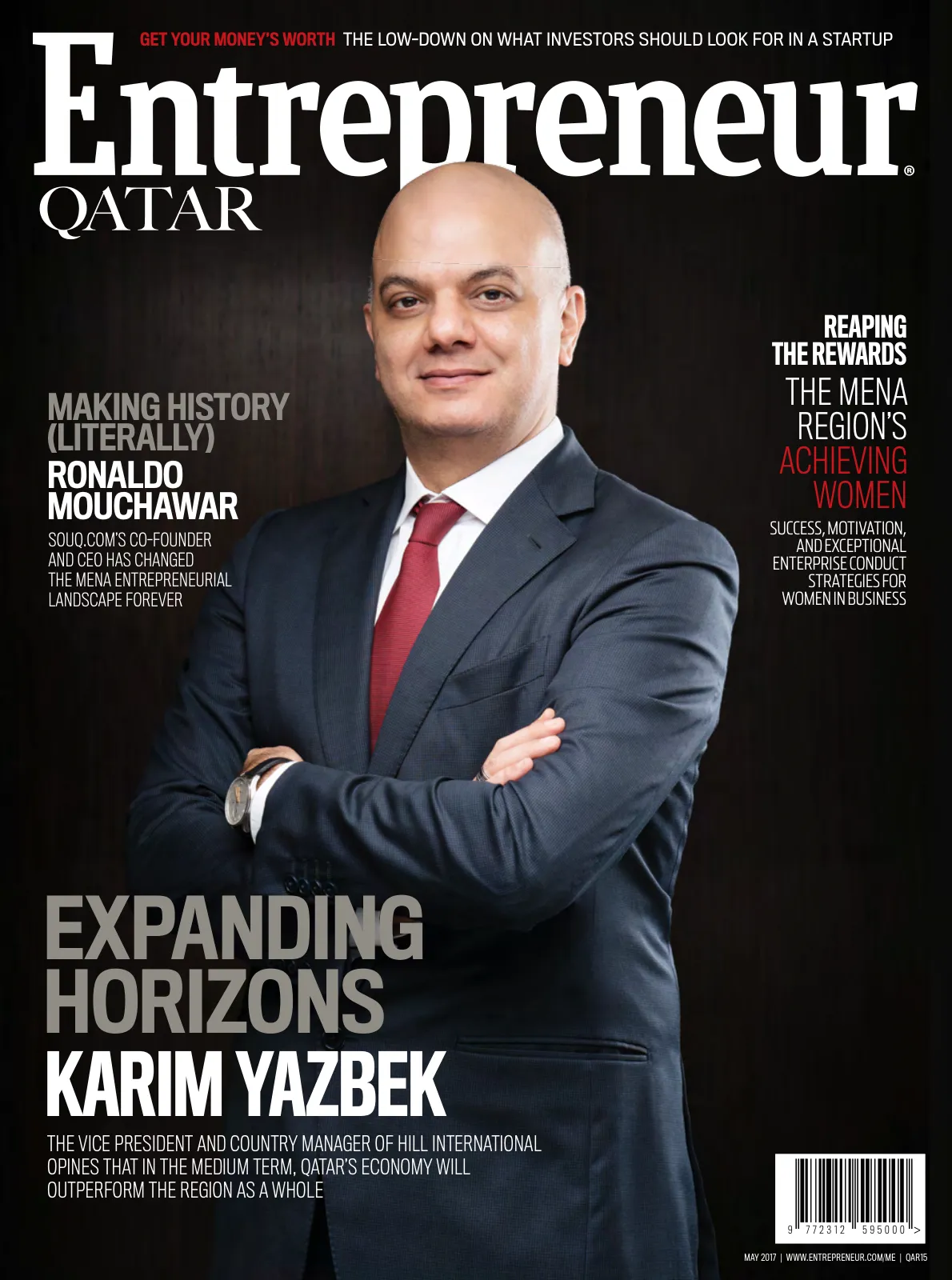
Entrepreneur Qatar, May 2017
Page 1
Get your money’s worth The low-down on what investors should look for in a startup
Reaping
the rewards
The MENA
region’s
achieving
women
Success, motivation,
and exceptional
enterprise conduct
strategies for
women in business
Expanding
horizons
Karim Yazbek
Making history
(literally)
Ronaldo
Mouchawar
The Vice President and Country Manager of Hill International
opines that in the medium term, Qatar’s economy will
outperform the region as a whole
Souq.com’s co-founder
and CEO has changed
the MENA entrepreneurial
landscape forever
9
7 7 2 3 1 2
5 9 5 0 0 0 >
MAY 2017 | www.entrepreneur.com/me | QAR15
Page 2
Page 3
may 2017 Entrepreneur
3
22
Karim Yazbek,
Vice President and
Country Manager,
Hill International
CONTENTS
may 2017
16
INNOVATOR:
Making history
(literally)
Ronaldo Mouchawar
Souq.com’s co-founder
and CEO has changed the
entrepreneurial landscape
in MENA forever.
28
INNOVATOR:
Reaping the rewards
The MENA region’s
achieving women
Success, motivation, and
exceptional enterprise
conduct strategies for
women in business.
22
INNOVATOR:
Expanding horizons
Karim Yazbeck, Vice
President and Country
Manager of Hill
International, opines that in
the medium term, Qatar’s
economy will outperform
the region as a whole.
68
‘TREPONOMICS:
MARKETING
Brands on fleek
Anne-Claude Wenger,
founder and CEO of Alston
& Clayden, offers seven
PR and marketing tips for
luxury startups.
70
MONEY:
YOUR MONEY
Get your money’s worth
Erkki Aaltonen, Execu-
tive Director of startAD
by NYUAD, explains what
investors should look for in
a startup.
64
‘TREPONOMICS:
SKILLSET
Raising the stakes
Cadillac Middle East Man-
aging Director Christian
Soemmer believes that
ensuring a stellar customer
experience is key for a brand
to stand out.
16 Russ Grandinetti, Amazon Senior Vice President, International Consumer
and Ronaldo Mouchawar, CEO and co-Founder, SOUQ.com
Page 4
Sleep Better
- REJEE JEWELLERY - DAMAS - THE WATCH HOUSE - VICEROY - BURJ AL ARAB - WATCHES CORNER
#ThatsMy_Wellbeing
Page 5
WEAR YOUR WELLBEING
SLEEP BRACELETS
Designed to help you sleep better
and wake up feeling refreshed.
The Sleep Bracelet is embedded with our unique
Natural Frequency Technology® which harnesses
beneficial frequencies of the Earth associated
with sleep and channels them to your body.
Discover your wellbeing at
philipstein.com
Natural Frequency
Technology® Inside
Page 6
Entrepreneur may 2017
6
CONTENTS
may 2017
44
innovator:
reaping the rewards
Up the career ladder and
through the glass ceiling
Suha Mardelli Haroun,
Regional Director of
Bayt.com, analyzes ways
to empower the region’s
women to lead.
60
TECH:
ONLINE ‘TREP
Measuring (online) success
Sekari’s Search
Performance Director
Adrian Jennings lists four
elements you need to
consider when setting up
a SEO campaign.
72
START IT UP:
Q&A
Setting standards
The co-founders of Al-Saeb
have built a smartwatch to
safeguard Qatar’s blue-
collar workers.
82
CULTURE:
LIFE
Learning on the job
Ahmed Moor, co-founder
and CEO, liwwa, believes
that building a business
is about growing both the
venture- and yourself.
52
‘TREPONOMICS:
ESQUIRE GUY
Less is more
The Esquire Guy on what
not to do when you are
managing people.
48
TECH:
SHINY
#TamTalksTech
Gadgets and doodads
that you might’ve missed
out on, sourced by a tech
aficionado. Yes, it’s okay
to want them all… and no,
it’s not our fault.
50 Tissot Ballade
Powermatic 80 SI
calibre
68 Seven PR and marketing tips for luxury startups
38
Lama A. Younis,
founder, Hissah
Enrichment Center
Page 7
Page 8
Entrepreneur may 2017
8
30
62
‘TREPONOMICS:
SKILLSET
Starting up smart
Nabbesh.com founder
and CEO Loulou Khazen
Baz, explores how
entrepreneurs can convert
their vision into a viable
product.
50
CULTURE:
TRAPPINGS
‘Trep gear
The executive selection
for the entrepreneur
on your list that has
everything. Okay, maybe
for a little self-reward as
well.
54
CULTURE:
LIFE
The road to smarter choices
James Clear on five common
mental errors that stop you
from making good decisions.
80
START IT UP:
ECOSYSTEM
Off to a flying start
Scout My Car pitches its
way to victory at STEP
Conference 2017.
58
‘TREPONOMICS:
PRO
AI can’t solve all of our
customer service problems
(yet)
Compareit4me.com co-
founder and CEO Jon
Richards, explains why AI
still can’t beat good old-
fashioned human interaction
when it comes to customer
service.
Dr. Amina Al
Rustamani,
Group Chief
Executive Officer,
TECOM Group
CONTENTS
may 2017
74
FRANCHISE
The customer comes first
Hassan Jawad, Divisional
Manager of Costa Coffee
Bahrain, Qatar, Oman and
Saudi Arabia, on making the
brand stand out in Qatar.
76
START IT UP:
Q&A
Democratizing insurance
UAE startup Democrance
makes insurance accessible
for MENA’s low-income
population
66
TECH:
ONLINE ‘TREP
The future of e-commerce
Whoopey.com founder and
CEO Saad Khan lists five
trends to watch out for in
the digital space in 2017.
58 AI can’t solve all of our customer
service problems (yet)
Page 9
BLACK BAY
BRONZE
TUDOR in-house
movement MT5601.
Offering a 70-hour
power reserve and
regulated by a variable
inertia oscillator with
silicon balance spring,
it is certified by
the Swiss Official
Chronometer Testing
Institute (COSC).
Aluminium bronze
alloy case. An aesthetic
reference to historic
ships and other diving
equipment, this
metal guarantees the
development of a subtle
and unique patina to
match its user’s habits.
BRONZE CASE
DIAMETER 43 MM
WATERPROOF TO 200 M (660 FT)
IN-HOUSE MOVEMENT
#TUDORWATCH
TUDORWATCH.COM
Page 10
Entrepreneur may 2017
10
SUBSCRIBE
Contact subscriptions@bncpublishing.net to receive
Entrepreneur Middle East every issue
PO Box 502511 Dubai, United Arab Emirates
P +971 4 4200 506 | F +971 4 4200 196
For all commercial enquiries related to
Entrepreneur Middle East contact
sales@bncpublishing.net
All rights reserved © 2016.
Opinions expressed are solely those of the contributors.
Entrepreneur Middle East and all subsidiary
publications in the MENA region are officially licensed
exclusively to BNC Publishing in the MENA region by
Entrepreneur Media Inc.
No part of this magazine may be reproduced or
transmitted in any form or by any means without written
permission of the publisher.
Printed by Raidy Emirates Printing Group LLC
www.raidy.com
Images used in Entrepreneur Middle East are credited when necessary. Attributed use of
copyrighted images with permission. All images not credited otherwise Shutterstock.
Erkki Aaltonen
Loulou Khazen Baz
Fida Chaaban
James Clear
Suha Mardelli Haroun
Adrian Jennings
Saad Khan
Spencer Lodge
Ross McCammon
Dorothy Mitchell
Aparajita Mukherjee
Ahmed Moor
Jon Richards
John Small
Christian Soemmer
Anne-Claude Wenger
CONTRIBUTING WRITERS
www.entrepreneur.com/me
Access fresh content daily on our website!
MIDDLE EAST
EntMagazineME
@EntMagazineME
Entrepreneur-me
EntrepreneurMiddleEast
EntMagazineME
EntMagazineME
EntMagazineME
In addition to our print edition, we’re bringing
you all sorts of industry news on our web
mediums. Joining us online means getting
relevant business and startup content in
real-time, so you’re hearing about the latest
developments as soon as we do. We’re looking
forward to interacting with our readers on all of
our social media and web platforms- like any
thriving business, we’re looking to give and take.
#TrepTalkME is already happening on all of our
digi platforms, and all good conversations go
both ways. See you on the web!
EDITOR IN CHIEF Aby Sam Thomas editor@bncpublishing.net
CEO Wissam Younane wissam@bncpublishing.net
MANAGING DIRECTOR Walid Zok walid@bncpublishing.net
DIRECTOR Rabih Najm rabih@bncpublishing.net
CREATIVE LEAD Odette Kahwagi
MANAGING EDITOR Tamara Pupic
SALES DIRECTOR Manu Parmar manu@bncpublishing.net
SENIOR JOURNALIST Aparajita Mukherjee
STARTUPS SECTION EDITOR Pamella de Leon
COLUMNIST Sindhu Hariharan
COLUMNIST Tamara Clarke
COLUMNIST Shoug Al Nafisi
COLUMNIST Erika Widen
EVENTS LIAISON Mark Anthony Monzon
Page 11
Page 12
Entrepreneur may 2017
12
O
ne of my favorite
moments from this
year’s edition of STEP
Conference was after
Souq.com co-founder
and CEO Ronaldo Mouchawar’s ap-
pearance on stage, when he stepped
down and walked through what can
perhaps best be described as an
adoring audience. It was a sight to
behold as the affable entrepreneur,
fresh off his company’s acquisition
by Amazon, weaved his way through
the crowd, as they essentially
mobbed him with everything from
heartfelt congratulations, to startup
pitches, to selfie requests.
What stood out to me was the
manner in which Mouchawar re-
acted to all of the attention he was
getting: he calmly posed for every
snapshot, happily shook hands
with everyone, and responded with
ideas, advice and tips for all the
entrepreneurs that approached
him. Mouchawar had no airs about
at him at all, and I was in awe of
his patience and positive attitude.
When I met Mouchawar for the
interview that headlines this issue
of Entrepreneur Middle East, I
commended him on his behavior
at the event, but Mouchawar
didn’t think he had done anything
special- according to him, what he
did was just a matter of him giving
back to the MENA entrepreneurial
ecosystem, and that was something
he needed to do as an entrepreneur
in this region. “Entrepreneurship is
a two-way street,” he told me. “You
have to build knowledge, [and] you
have to share it… People want to
learn- they think you have done
a process that they might have
to go through. There are always
learning pains, there are growing
pains, there are experiences that
you learn [from]. And, I think, as
much as we internally focus on
the company and our customers
(and that has been where we put a
lot of our investment), I think you
need to always be connected to this
ecosystem.”
With an attitude like that, it’s
easy to see why Mouchawar has en-
deared himself to MENA’s entrepre-
neurs, and it’s a premise that others
in this region should take to heart
as well. Be it by speaking at a con-
ference, or hey, by talking to media
outlets like us, Mouchawar is, by
sharing his knowledge and experi-
ence, playing a key role in helping
this ecosystem grow, while educat-
ing and inspiring others to follow
in his footsteps. And yes, there are
benefits for those who engage in
such interactions as well- Moucha-
war claims that he’s lucky that he’s
able to meet a lot of bright people,
and their energy rejuvenates him.
(“I have two passions: continue to
build the business, and continue
to work with entrepreneurs,” he
says.) Mouchawar is aware of the
value of what he does- as a Syrian
hailing from the now-destroyed
city of Aleppo, he knows that his
entrepreneurial journey that led
him to build a company that went
to Amazon, is something that can
provide hope to a lot of people in
this region. And let’s be fair, hope
is something we need to see more
of in the Middle East- let’s take it
upon ourselves to bring it about.
EDITOR’S NOTE
Aby Sam Thomas
Editor in Chief
@thisisaby
aby@bncpublishing.net
Get connected
Entrepreneurship is a two-way street
Page 13
On October 22nd 1934, two exhausted airmen landed on a racecourse in Melbourne, surrounded by
cheering crowds. Flying a specially-built De Havilland Comet DH-88, Charles Scott and Tom Campbell
Black set a new record, flying the 11,000 miles from England in just 71 hours. The Bremont DH-88
commemorates their aircraft and their achievement. Containing actual material from the record-breaking
plane, the Bremont DH-88 is available now in a strictly limited edition. But it won’t be available for long.
IN 1934, BRITANNIA DIDN’T JUST RULE THE WAVES
FIFTY ONE EAST | DOHA, QATAR | T: +974 4436 1111
Page 14
Entrepreneur may 2017
14
Microsoft held the award ceremony for the UAE
Imagine Cup 2017 earlier in April at Armani Hotel
in Dubai, where teams Green Jam, B.A.S.S. and
iBins, swept to victory. Imagine Cup, a global
technology competition that aims to deliver
educational, entrepreneurial and employment
opportunities for youth by acquiring critical
skills, was held under the theme of Smart Cities.
This year, the event was sponsored by Emaar
Properties, with the UAE Ministry of Education
as Education Partner. The competition challenges
entrants (16 years or older or enrolled as a
permanent student) to collaborate in teams and
submit imaginative ideas in the field of technology.
Competitors need to develop the concepts from
scratch and defend their usability and market draw
to a panel of judges. This year, Microsoft’s Azure
cloud platform was a mandatory tool for all the
submitted projects.
Team Green Jam from the American University in
Dubai took first place for their project Green Jam,
which was aimed at accelerating Dubai’s goal of
being one of the world’s most sustainable cities
through a reward system for recycling habits for
UAE citizens. Second prize was won by Team
B.A.S.S, of University of Wollongong for their
project Smart Signal. The project is a smart city
initiative to ease traffic conditions dynamically.
Smart signal can think for itself, and make its own
judgments about what constitutes high traffic.
This means that a signal with heavier traffic
would receive a longer period of staying green
as compared to its counterparts with less traffic.
Team iBins from Dubai Women’s College received
third place for their project iBins, an IOT-based
smart bin solution capable of monitoring the
fill-level at regular intervals to alert the staff ahead
of time, ease maintenance and help maintain a
fresh, clean and hygienic environment. Green Jam,
will now represent UAE at the Imagine Cup MEA
semi-finals in Lebanon this month, after which
the winners will move to the worldwide finals in
Seattle. Team Green Jam received US$15,000
as prize money, while Team B.A.S.S from UOWD
received $10,000 and Team iBins received $7,000
for second and third positions respectively.
IN THE LOOP
“We are the champions!”
Ras Al Khaimah aims to attract investors
with new RAK Economic Zone
RAK in the spotlight
American University In Dubai team bags first
place at Microsoft’s UAE Imagine Cup 2017
images courtesy RAKEZ, microsoft uae
I
n a bid to position Ras Al
Khaimah (RAK) as a world-class
investment decision, the RAK
government has launched the Ras Al
Khaimah Economic Zone (RAKEZ),
a public authority to “oversee,
regulate and consolidate” the op-
erations of its two main free zones-
Ras Al Khaimah Free Trade Zone
(RAK FTZ) and RAK Investment
Authority (RAKIA). Encompassing
around 33 million square metre of
land, and with plans to house over
13,000 companies (those currently
served by RAK FTZ and RAKIA),
RAK expects RAKEZ to emerge as
one of the largest economic zones
in the region. Like its counterparts,
RAKEZ will function to support the
vision of making Ras Al Khaimah
a leading investment destination
for global investors, contribute to
the Emirate’s economic growth,
and make it easier for businesses to
start and scale in RAK.
Launched by HH Sheikh Saud bin
Saqr Al Qasimi, Supreme Council
Member of UAE, and Ruler of Ras
Al Khaimah, in the presence of of-
ficials, businesspeople, and clients,
RAKEZ will offer both existing
clients and prospective investors
a platform from which they can
access local, regional and global
markets, and grant free zone and
non-free zone licenses for compa-
nies operating in diverse sectors.
According to an official statement
on the launch, RAKEZ will provide
“customizable facilities, enhanced
levels of service through five di-
versified and strategically located
zones [RAKEZ Business Zone, Al
Hamra Industrial Zone, Al Ghail In-
dustrial Zone, Al Hulaila Industrial
Zone and RAKEZ Academic Zone]
for all types of business setups,
including startups, entrepreneurs,
SMEs and manufacturers.”
Commenting on the announce-
ment, H.H. Sheikh Ahmed bin Saqr
Al Qasimi, Chairman, RAKEZ, RAK
FTZ and RAKIA, says, “It is our firm
belief that after nearly two decades
of operating independently, the
time is right to leverage the com-
bined resources of RAK FTZ and
RAKIA under one strong, unified
brand.” Ramy Jallad, Group CEO,
RAKEZ, RAK FTZ and RAKIA, adds
that bringing together the two free
zones under the umbrella of RAKEZ
is part of the Emirate’s efforts to
take customer experience to the
next level. The RAK government’s
steps to merge its two primary free
zones commenced last year when
the Board and management teams
were combined. Later, the admin-
istrative functions of both enti-
ties were also brought together to
streamline operations and ensure
service efficiency.
H.H. Sheikh Ahmed bin Saqr Al Qasimi,
Chairman, RAKEZ, RAK FTZ and RAKIA
Team Green Jam, winners of 2017 Microsoft UAE Imagine Cup
Page 15
Page 16
Images courtesy oln | www.oln.net
innovator
“Our model is
very simple; it’s
connecting people
with products
using technology,
and creating better
opportunities for
people around us.”
Ronaldo Mouchawar, co-founder and CEO,
Souq.com
Entrepreneur may 2017
16
Page 17
T
here’s a job
and there’s
passion.
The kind
of passion
that comes
from know-
ing you’re
part of something great, that
you have a decent shot at
making history, that you can
enchant customers and em-
power businesses every day,
and that you can transform
yourself in the process. This
is Souq.com. Welcome.”
This is the message that
greeted me by the door of
Souq’s Dubai offices, and
after my hour-long conversa-
tion with the company’s
co-founder and CEO Ronaldo
Mouchawar, I couldn’t help
but marvel at how aptly
these words described the
singular spirit and ceaseless
drive of this Syrian entre-
preneur. This conversation
with Mouchawar takes place
about a month after news
broke of Souq’s acquisition
by Amazon; a deal whose
value hasn’t yet been pub-
licly disclosed, although
the Financial Times had re-
ported it to have been in the
range of US$650 million. For
the MENA entrepreneurial
ecosystem, this was the exit
that it had long been waiting
for, and at the same time, its
significance for the region at
large cannot be understated
either- it’s worth noting here
that elevating the Arab world
has been a goal that Souq
has been working toward
ever since its 2005 incep-
tion. “We had a mission- we
wanted to connect the Arab
world,” Mouchawar remem-
bers. “We wanted Souq as
a marketplace, as a brand.
We felt we needed one; we
should be able to build it and
break the borders between
the countries [of the region]
as best as we can, at least
economically, for trade.
Something politically could
take ages. With tech, you are
able to do it faster, and just
enable people all over.”
For an e-commerce platform
that today hosts more than
8.4 million products and
enjoys over 45 million visits
a month, Souq started out
as something quite differ-
ent to what it is today. “We
launched Souq as an open
marketplace; [it was] a very
simple listings site till about
2009,” Mouchawar says.
“That’s how the business
was.” Launched as a part of
the Arabic web portal Mak-
toob.com, Souq had a num-
ber of verticals on it which
included everything from
online auctions to real estate
classifieds. Following Mak-
toob’s sale to Yahoo in 2009,
Souq came into its own as
an independent entity, and
that was when it began to
pivot from its original model.
“We felt [that] the bigger pie
was retail,” Mouchawar re-
members. “Retail is 50% of
many economies, especially
with the consumer here [in
this region] and their buying
power. And so we took a very
hard decision that, for us
to be able to meet customer
expectations and grow the
B2C (business-to-consumer)
function, which is the area
we wanted to focus on, we
need to stop many things
that were working at Souq.”
Mouchawar notes that this
was a testy period at the
enterprise- after all, those
facets of Souq that were be-
ing shut down, such as the
online auction and the clas-
sifieds, were fairly significant
generators of both traffic and
revenue. But Mouchawar and
his team stuck to the plan
that they had laid out for
Souq, and began building up
its retail section, with the
primary aim being to ensure
a comfortable shopping
experience for their custom-
ers. “We started this journey
of [finding out] what our
customers want, and how we
can adapt.” >>>
Making
history
(literally)
Souq.com’s co-founder and CEO has changed the MENA
entrepreneurial landscape forever
RONALDO MOUCHAWAR
By Aby Sam Thomas
innovator
images courtesy souq.com
Page 18
Entrepreneur may 2017
18
innovator
Mouchawar recalls this pe-
riod in Souq’s lifecycle to be
a turning point for the com-
pany, but building up and
transforming the website’s
product catalogue was, at the
time, a rather tough process
for everyone involved at the
startup. “It was not easy
when we went through the
transition,” he says. “We
got many calls from sellers
who were unhappy with the
ecosystem changing. But,
you know, we also tried to
explain to them that we
were doing this because we
wanted the customer experi-
ence to improve. We want to
be able to understand pric-
ing, product gaps, categories,
what customers like, how
do you recommend other
products- and you cannot
do this until you structure
your work.” However, this
was just the beginning of
Souq’s transformation into
the Middle East e-commerce
giant it is today- once the
company felt it had improved
the experience of the shop-
per on its website, it then
began to look at improving
whatever happened post-
click, and that resulted in
major investments being
made in payment, logistics,
after-sales and other such
areas of the customer jour-
ney. All of this took time, of
course, and yes, funds too-
by early 2016, Souq had been
able to raise a total of $425
million in two rounds of
funding from investors such
as Tiger Global Management,
Naspers, IFC Venture Capital
Group, and others.
Souq, however, wasn’t done
growing yet, and the com-
pany had begun looking into
all of the available options to
fuel its next phase. Moucha-
war reveals that he and
his team did wonder about
raising another round of
funds, and yes, going public
was also a choice they con-
sidered, but they were also
looking at other enterprises
Souq could perhaps join
hands with, and an align-
ment with Amazon definitely
made sense. “When you do
all the work and get to where
you are, and you look at who
are the potential matches or
fits for Souq, then suddenly,
the list dwindles,” Moucha-
war says, noting the kind of
like-mindedness in terms of
how Amazon and Souq con-
ducted themselves- after all,
there were already plenty of
parallels drawn in the ways
each of the two companies
approached innovation and
customer-centricity to fuel
their respective businesses.
From Amazon’s perspective,
it was looking to enter the
Middle East as part of its
international expansion- and
Souq proved to be the per-
fect vehicle for it to do just
this. In a statement released
by Amazon, its Senior Vice
President, International
Consumer, Russ Grandinetti,
said, “Amazon and Souq.com
share the same DNA– we’re
both driven by customers,
invention, and long-term
thinking. Souq.com pio-
neered e-commerce in the
Middle East, creating a great
shopping experience for
their customers. We’re look-
ing forward to both learning
from and supporting them
with Amazon technology
and global resources. And
together, we’ll work hard to
provide the best possible
service for millions of cus-
tomers in the Middle East.”
The deal is still being closed,
and at the moment, Moucha-
war reveals that discussions
and processes are underway
in learning how best Amazon
can help Souq, and vice-
versa as well.
When Souq’s acquisition
by Amazon was finalized,
it was his family to whom
Mouchawar told the news
to first, following which he
touched base with his team,
investors and shareholders.
“The biggest thing I told the
team was that you should
be very proud, because we
just joined the most innova-
tive company in the world,”
he recalls. “That was kind
of what kept going on in
my head- that, you know,
this journey resulted in
something that, I think, will
take us and the region to a
whole new level.” And it’s
not just the retail sector that
could benefit, Mouchawar
says- the road ahead for
Amazon in the Arab world
could perhaps see, say, the
creation of a Kindle that can
allow for Arabic content, or
an Amazon Prime division
that produces videos catered
toward the population
here. All of this will also
help address the problem
of unemployment that per-
vades the region today- as
Mouchawar put it: “We were
able to create 3,000 jobs…
What could happen in the
next 5-6 years?” As for Souq
itself, Mouchawar thinks the
platform by itself is going to
further evolve and grow- it’s
got a good base and structure
now, sure, but Amazon will
help it to continue to inno-
vate in all sorts of capacities.
“We’ll continue to push that
edge, in terms of things that
we have done, and continue
to do,” he says. “But I think,
overall, customers will see
more choice, that’s very
clear, because we’ll be able
to hopefully tap into the
global supply of Amazon, its
merchant base, and the part-
ners that they work with.
We already work with many
of them in the region, but it
[the acquisition] will put it
on an accelerated path.”
As for the e-commerce
landscape itself, Mouchawar
doesn’t seem to be worried
about competition in the
region, be it with existing
players in the market, or
soon-to-launch entities like
the billion dollar Noon.com-
the Souq CEO believes that
each player will have their
own strategy, and their suc-
cess will ultimately depend
only on how they deploy and
execute it. “I think it’s quite
already a fragmented market,
and there will be many play-
ers,” he says. “You just have
to find what your customer
wants, and build your seg-
ment in that share. I think,
globally, this is what hap-
pens; there is always compe-
tition. On the internet, com-
petition is even more fierce,
because customers don’t
need to travel, so you’re not
protected by distance. It’s
a URL that you change, or
an app that you switch. We
always compete also with
the offline world. For a long
“For a long time, we were
disadvantaged because we
were quite small, but we
depended on technology to
cross that hurdle and bring
together many merchants
to enable to provide an
ecosystem that thrived and
became fueled by itself. And
customers liked it.”
Page 19
time, we were disadvantaged
because we were quite small,
but we depended on technol-
ogy to cross that hurdle, and
bring together many mer-
chants to enable to provide
an ecosystem that thrived
and became fueled by itself.
And customers liked it, it
brought more customers,
more merchants, more
products, and suddenly,
when you look at it and see
a nine million selection [on
the site], and now, you are
bigger than the bigger malls.
So I think we just live with
competition; everyone will
have a strategy; everyone has
customers. We would feel we
know our customers in the
region… Customers come
to this destination, but they
go to other places as well,
and ultimately, there will
be many players. I don’t see
that changing: global players,
local players, niche players,
and horizontal players.”
Mouchawar’s vision for
the future makes it clear
that there’s a lot of work
ahead for the Souq team,
but then again, that’s the
way it has always been at
this homegrown enterprise.
“You know, this came with a
lot of hard work, and I think
that’s the common theme. It
is people who have vision,
people who have the will to
work... Initially, it was never
about finance and rewards;
we didn’t have that any way
to give.” There have been
challenges aplenty- be it
with hiring people during
the early years, or with flash
businesses that seemed to be
a threat to Souq’s standing
in the market- but Moucha-
war and his team persevered.
“At every stage, we faced a
different challenge- every
step, there always was a
solution. Because we’re a
team of builders and innova-
tors; so, you know, we had to
figure out what we need to
do. We have always focused
on our customers, not as
much on our competition,
which, I think, has helped
us to always be ahead of
everyone else.” At this point,
I ask what is it that drives
Mouchawar to do all that he
does- I am curious to know
the source of this entrepre-
neur’s unrelenting enthu-
siasm for what he does. In
response, Mouchawar smiles
and draws my attention back
to the mission that Souq was
founded upon. “Our model is
very simple; it’s connecting
people with products using
technology, and creating
better opportunities for
people around us. I think
the opportunity part of it
always was a huge motivator,
because I have seen how our
team, our people, our sellers,
our customers, have grown
around us.”
On a more macro level, as
a citizen of the Arab world,
Mouchawar is keen on seeing
change come to this region,
and he believes the tech
sector –and entrepreneur-
ship per se- can be key to
realizing this. “If you think
about it, this region needs
these kind of companies and
Ronaldo Mouchawar, co-founder
and CEO, Souq.com
>>>
Page 20
Entrepreneur may 2017
20
innovator
jobs more than other types
of jobs, because, we have
human capital as a main
resource, and getting them
into this type of entrepre-
neurship, tech careers would
do wonders for this region.”
Mouchawar uses the example
of India to illustrate his
point. “If you look at India,
20 years ago, India was a
big outsourcing center using
technology for the West. Fast
forward 10 years, there are a
lot of entrepreneurs [there]
who have learned to scale
with the global players, and
became local entrepreneurs,
and changed, I think, the way
India is perceived globally
as a tech hub. Today, many,
many of the tech companies
are there, local companies
have scaled, [and] some of
them hopefully will go global.
So you see how opportunity
it created. We feel the same
could happen in Egypt, in
Jordan, and other parts of
the Arab world.” Mouchawar
is also hopeful that Souq’s
acquisition by Amazon will
have a knock-on effect for
the region’s entrepreneurial
ecosystem. “This will not
be the first and last global
investment in the region,”
he predicts. “These things
usually propagate, and we’ll
see more of them… I think,
having global players set up
in the region, at this level of
technology, and availing that
stack to so many people in
the region, it will definitely
change the way the region
works. When the Maktoob-
Yahoo deal took place, Souq
was an outcome; that’s where
some of the investment went,
and that initial investment,
that phase was so critical,
when we raised that first
US$5-6 million… But that
came out of one exit, and
now, you know, we’ll have
more to come. A lot of our
investors will invest more,
because they get encouraged,
because [they see] you can
do exits out of this part of
the world.”
But for the entrepreneurs
in the region, Mouchawar
advises against building
a business with the sole
purpose of engineering an
exit. “Before exits, build
businesses that do scale
using tech,” he says. “I think
that’s the key, regardless
of how the exits pan out.”
According to Mouchawar,
the past few years have seen
the ecosystem in this region
develop and grow to such
an extent that it’s become
relatively easier for people to
set up businesses here, but
one should remain prepared
for hurdles that are inherent
to this part of the world. “I
think the challenge will re-
main always that not every-
one can scale,” he says. “You
need to find niches that make
money. Not everyone can be a
huge company, but all can be
successful.” When I broach
the topic of funding in this
region, Mouchawar declares:
“Good ideas get funded.”
He says that while all of us
want to see more startups
get funded, investors need
to be given their time to
spot the ones that they want
to invest in. “It’s upon us
as entrepreneurs to get the
investors to be comfortable
[with us], because it’s their
funds that they are investing.
They need to also see and
understand the entrepreneur,
and be able to trust the eco-
system.” Mouchawar believes
the landscape has changed
quite a lot in this respect,
with a lot of seed money
coming into the ecosystem-
the growth funds are still
lacking, sure, but that’s a
scenario that could change
soon as well. At the end of
the day, Mouchawar says en-
trepreneurs need to stay true
to the goals they lay out for
their enterprises. “You have
to believe in your mission,”
he says. “But sometimes it’s
not the initial idea that you
had that would work out. So
you have to be stubborn, but
flexible in how you execute.”
As for whether the troubles
the Arab world is currently
seeing should be seen as a
deterrent for entrepreneurs,
Mouchawar, who hails from
the now-destroyed Syrian
city of Aleppo, chooses to
remain positive. “It’s pain-
ful, for sure,” he says. “You
want to focus on developing
the region and the human
capital, so all this instability
creates setbacks for a lot of
people, which is very unfor-
tunate, and for me, person-
ally, weights heavily on me,
because I am from Syria…
But we have also learnt that
we have potential in the re-
gion, and we just got to grab
these opportunities, and you
can make a difference. And
the region needs us… We
know the risk of the region,
we are from the region, but,
you know, this is our region.”
And that sense of ownership
for the region is motivation
enough for Mouchawar to
keep plowing ahead- and the
rest of us shouldn’t think
twice about following suit.
“This will not be the first
and last global investment
in the region. These things
usually propagate, and we’ll
see more of them.”
Russ Grandinetti,
Amazon Senior Vice
President, International
Consumer and Ronaldo
Mouchawar, co-founder
and CEO, Souq.com
Page 21
Page 22
“Every client is
unique and requires
different things
from us, and as
Hill International,
we try to fit
the client’s
requirements as
much as possible.”
Karim Yazbek,
Vice President and Country Manager,
Hill International
INNOVATOR
Entrepreneur may 2017
22
Page 23
may 2017 Entrepreneur
23
A
s the Qatar
Country
Manager
of one of
the largest
independent
project man-
agement consultants, Karim
Yazbek, Vice President of Hill
International, has a long and
varied experience in the re-
gion, having served in Dubai,
Bahrain and now, Qatar. This
is his second tenure with
Hill International, which was
interspersed with a stint with
joint venture between Emaar
Properties and a local devel-
oper in Lebanon. Speaking
about his experience profile in
the Levant and the GCC mar-
kets, Yazbek mentions that
post his education at Canada
and the US, “prior to joining
Hill International, I was work-
ing with the family business
in contracting and real estate
development and based in
Lebanon, which was followed
by a tenure with the govern-
ment for three years at the
Council for Development and
Reconstruction, a parastatal
body that is responsible for
planning and infrastructure at
a nationwide scale, reporting
to the Council of Ministers
in the government. Post that,
I joined Hill International in
2006, first in the capacity of
a project director and based
in Dubai. Then I moved to
Bahrain in charge of the
country operations in 2008
and the eastern province of
Saudi Arabia, post which I
moved back to Dubai in 2010
when I was promoted to Vice
President and was placed
in charge of the sales and
marketing in the Middle East,
except Saudi Arabia. My role
was to promote the business
of Hill International through
contacting new clients. At
the end of 2011, I went back
to Lebanon in charge of a real
estate development with a
joint venture between Emaar
Properties and a local Leba-
nese developer, and was the
general manager of that proj-
ect for four and a half years.
After that, I rejoined Hill in
charge of the Qatar operations
in February 2016.”
Yazbek notes that Hill Inter-
national has been present in
Qatar since 2004, and has
been involved in over 40
projects in the country, which
include the Qatar Financial
District, the refurbishment of
the Sheraton Hotel, the Grand
Hyatt Hotel, Mall of Qatar and
the North Gate Mall. “Among
our current commitments, we
are on the National Museum
of Qatar which is designed
by the Pritzker Prize winning
architect Jean Nouvel, and
our 2000-villa contract for
Qatar Development Bank in
Al Wakrah, apart from one of
the largest private residential
developments in Al Waab
area,” Yazbek reveals. “On the
infrastructure side, we are on
the Green Line of the metro
with Qatar Rail as the project
management consultant
(PMC); we are also the project
manager for the Lusail Light
Rail Transit Passenger proj-
ect.” With Qatar being heavily
invested in the infrastructure
around the FIFA World Cup
in 2022, legacy use of the
related projects has been a
matter of great discussion,
and Yazbek feels that each of
the infrastructure projects re-
lated to the games is, in some
way, a good stepping stone
for achieving the roadmap for
the country as laid out in the
Qatar National Vision 2030,
in addition to some other
specialty areas such as the
health services and research
and development (R&D) with
the government’s keenness
to position and project Qatar
as a regional hub for R&D.
Citing one of their projects,
Yazmek mentions, “We are
involved in the Qatar Founda-
tion Research & Development
that is based on Her Highness
Sheikha Moza Bint Nasser’s
vision of investing in hi-tech
laboratories. They also are
looking at options for stadi-
ums that will be dismantled
after the FIFA World Cup
2022 and re-built in develop-
ing countries which will con-
tribute to the legacy use.”
With respect to the region
at large, Hill International has
had a very robust presence in
the Middle East, and has been
involved in projects since
the mid-1990s in the Middle
East, with a bevy of large
projects under its belt- in Abu
Dhabi, the Saadiyat Island;
in Dubai, the Palm Jumeirah;
the infrastructure of Al Ain;
and the Bahrain Financial
Towers and the expansion
Expanding
horizons
Karim Yazbek
the Vice President and Country Manager of Hill International,
in charge of its Qatar operations, opines that in the medium
term, Qatar’s economy will outperform the region as a whole
INNOVATOR
www.hillintl.com
> American School of Doha
> Grand Hyatt Hotel and Villas
> Navigation Tower
> Al Bidda Tower
> West Bay Lagoon Plaza
> Palm Towers
> Silhouette Tower –
Intercontinental Hotel
> Hamad Medical City – 2006
Asian Games Athletes Village
www.hillintl.com/en
The executive summary
A few of Hill International’s
projects in Qatar
By Aparajita Mukherjee
>>>
Page 24
Entrepreneur may 2017
24
of the international airport of Bahrain;
in Kuwait, four state-owned hospitals;
in Saudi Arabia, there are the Ministry
of Housing projects and the Ministry of
Defence. “In Saudi Arabia, we are the
project managers for now may be more
than eight years in the Jabal Ammar de-
velopment in Mecca, and the King Faisal
Financial District in Riyadh; we are also
part of the JV for the metro in Riyadh;
in Oman, the two huge airports are with
us, and a sea resort,” Yazbek notes. Com-
menting on the service offerings of Hill
International in Qatar, Yazbek says, “We
offer all our services in Qatar that can
be grouped under project management
consultancy, and depending on what
the client actually wants from us. Every
client is unique and requires different
things from us, and as Hill International,
we try to fit the client’s requirements
as much as possible. In Qatar, we have
been very successful in offering project
management, construction management,
design management, and less of project
management oversight (PMO), though
we have PMO services too.”
When asked about the company’s
preference for having the government
or the private sector as clients, Yazbek
says, “There are pros and cons to hav-
ing the government as a client and a
private sector company as a client. A
private company is better placed and
more flexible when it comes to faster
decisions and on a fast-track project
with private companies, it is much easier
to manage with regard to processes and
procedures since these companies are
faster in taking decisions. Whether it is
the government or the private sector, the
PMC relies a lot on the client representa-
tives’ decision-making power and their
ability to maneuver though the procure-
ment process changes a lot between the
private and public sectors. The private
sector is more amenable to reviewing
the technical aspects of the proposals
of a project and not purely rely on the
financial aspects which is more likely to
happen with a public sector entity.”
Talking about their current corporate
focus on Qatar, Yazbek says that they are
looking at bidding on more projects in
the country since the corporate philoso-
phy is that “when we start with a client,
it is very rare that we stop midway–
we start with design and carry on the
construction and to delivery, and with
Qatar being the second largest in terms
of revenue generation, it is one of our
priority markets driven by the fact that
its economy will be moving faster than
the other regional economies.” Speaking
about the role that risk management
plays in a construction company, Yazbek
informs that the motto of the company is
that “we are construction risk managers.
In the construction business, risks are
threefold– quality, time and cost. And it
is a difficult balance in that: if we want
to squeeze the time, then we will have
to let go of the quality; if we want very
high quality, the cost will be high, and
so forth. They are all interrelated, and
the major risks that need better care and
management is to take time for the de-
sign, bring in quality contractors, which
makes the prequalification checks very
critical, especially in the context of the
fact that a client will want to reduce the
tenure of the construction period, since
that is a period of negative cash flow for
him. Apart from this, getting the right
budget, setting a realistic timeframe and
robust value engineering exercise are
some other factors that curb construc-
tion risks to a great extent.”
With respect to the distinction between
a Levant country’s construction sector
and that of the GCC, Yazbek opines, “In
a way, the Levant construction market is
very different when compared to the GCC
markets. The main difference is in the
size of the projects and the complexities.
The GCC construction industry is much
more developed and way more profes-
sional compared to the Levant, where
most of the projects were spearheaded by
groups hailing from the GCC countries–
for instance, in my second stretch at
Lebanon, I was with a GCC group, Emaar.
Additionally, the Levant construction
market is more segregated, privately held
and the government is more involved in
the social and physical infrastrcuture
creation. So it, in a way, is a stage behind
than what the GCC markets are currently
going through. Also, the major players
in the Levant area are mainly local play-
ers, whereas in the GCC the players are
of international origin– right from the
design and consultancy point of view and
construction contractors.”
One other factor Yazbek mentions is
the level of affordability with the GCC
INNOVATOR
“we start with design and carry on
the construction and to delivery,
and with Qatar being the second
largest in terms of revenue
generation, it is one of our priority
markets driven by the fact that its
economy will be moving faster than
the other regional economies.”
www.hillintl.com
Page 25
may 2017 Entrepreneur
25
economies, having greater
room on the back of their hy-
drocarbon bounty, compared
with those of the Levant
countries, “In Lebanon, of
late, we do see some Middle
Eastern developers bringing
in international contractors
or signature architects, and
it’s a tough game as well,
since wherever one is, in the
market, one does need to be
competitive. In terms of find-
ing international contractors,
it clearly adds to the cost,
over and above a paucity of
stability, since all the Levant
countries suffer from a lack
of political stability, which is
a great plus in the case of the
GCC countries. Also the Le-
vant area has more competent
local players in the construc-
tion market, which makes
it less of a necessity to get
international companies to
come into the market, though
they do not have a matching
power of the international
players, but it suffices for the
market needs and the size of
the projects that come within
their competence.”
Discussing his Qatar market
outlook in the medium term
and what the local Qatari
clients feel about the role
of a project management
consulting (PMC) company,
Yazbek is of the opinion that
the construction market has
already become very competi-
tive, and some clients prefer
to cut costs, sometimes at
the expense of the quality of
delivery. “At the end of the
day, PMC is a very small per-
centage of the overall project
budget for a client. However,
the impact that it has on the
project as a whole in terms of
the quality, delivery, time and
the budget control is tremen-
dous. If we assume that the
PMC scope would be 2-3% of
the total construction budget
and if you do away with the
PMC, you might save let’s say
20-30% of that, which trans-
lates overall to a measly 0.6%
savings in the total budget.
We try to explain to our
clients that in case you save
on PMC, it will not automati-
cally translate into an overall
saving for the project budget.
However, unfortunately, in
a market as competitive as
Qatar, the clients are less in-
clined to listen to the PMC, so
what we do is to provide very
efficient teams that we call
‘squeezed teams,’ with inbuilt
design review capabilities,
which are partially deployed
on projects, and these multi-
skillset teams manage and
set the project on the right
path. This is a fallout of stiff
competition where the tender
is a very public one, and the
likes of Hill International are
competing with both interna-
tional and big companies, and
at the same time, with smaller
companies. This is anything
but a level playing field.”
What are the kind of
qualities an entrepreneur
must possess?
Vision, leadership, commu-
nication, resilience, and the
ability to manage cash flow.
What can Middle Eastern
governments do to help
SMEs in the region?
Incubators, venture capital-
ists, access to capital and
liquidity, encouragement in
dealing with failure, so cush-
ions need to be given.
What would be your advice
for a budding entrepreneur?
If you believe in your vision,
go for it.
Quick takes
Talking entrepreneurship
with Karim Yazbek,
Vice President and
Country Manager, Hill
International
Karim Yazbek,
Vice President and
Country Manager,
Hill International
Page 26
Entrepreneur may 2017
26
D
espite a historic
energy bounty,
the Gulf Coop-
eration Council
(GCC) countries
are making all-out efforts to
encourage SME growth, so
much so that SMEs are seen
as one of the fastest growing
sectors in the region, accord-
ing to Dr. Ali Hamed Al-Mulla,
Assistant Secretary General
for the Industrial Projects
Sector of the Gulf Organiza-
tion for Industrial Consulting
(GOIC), a pan-Gulf industrial
consulting body. GOIC was
established in 1976, with the
United Arab Emirates (UAE),
Bahrain, Kingdom of Saudi
Arabia (KSA), Oman, Qatar
and Kuwait, while Yemen
joined in 2009. In support of
his belief, Dr. Al-Mulla cites
several initiatives across the
GCC countries, noting “all the
countries have put in place
dedicated centers to assist and
support SMEs to grow. Each
GCC member country has put
in place a regulator to encour-
age growth and development
for these entities- the UAE has
a dedicated council and deter-
mined incentives for SMEs,
Bahrain has set up the Tam-
keen Fund, Kuwait has a na-
tional fund for SME develop-
ment, the KSA has the Public
Authority for Small and Me-
dium Enterprises, and Oman
has established Sharakah for
the development of SMEs.”
GOIC statistics, according to
Dr. Al-Mulla, show that the
number of SMEs currently in
operation within the GCC is
around 16,890 small and me-
dium sized factories– of which
11,288 are small and 2,707 are
medium-sized, approximately
accounting for 82% of the
total number of factories in
the GCC, and employing 45%
of the total industrial sec-
tor manpower. Commenting
on the sectors that the GCC
SMEs belong to, Dr. Al-Mulla
states that although a larger
number of SMEs are venturing
into industrial manufacturing,
they predominantly populate
the e-commerce, technology,
event management, food and
beverages, sports and fit-
ness, healthcare, education,
construction, and the fast food
sectors.
Dr. Al-Mulla is of the opinion
that there are many chal-
lenges that SMEs are facing
within the GCC, particularly
issues relating to infrastruc-
ture development, where it
lacks appropriate research
and development (R&D)
centers, testing centers, and
well-developed infrastructure
facilities for SME businesses
to grow and eventually com-
mercialize. “In addition to
some other pressing problems
that SMEs are struggling with,
such as regulations, export
support and cost of production
or labor, there are also legal
and logistical roadblocks that
have emerged as impediments
for SMEs in the region, such as
high registration fees for busi-
ness and licensing, ownership
structures, and complicated
legal frameworks. Also, the
human capital is not groomed
properly causing a lack of stra-
tegic planning and decision-
making skills at the opera-
tional level. This is testified
by entrepreneurs with limited
ability to present their ideas
clearly,” states Dr. Al-Mulla,
agreeing in part to a premise
that massive hydrocarbon rev-
enues have led to a neglect of
the SME sector earlier. It has
seen reversal in recent times
with the GCC governments’
initiatives, primarily focusing
on SME legislation and mak-
ing it easy for new entrants,
although he states there is
still room for more improve-
ments. As a case in point,
Dr. Al-Mulla cites the case of
Qatar, which has enacted the
Commercial Companies Law
No. 11 of 2015 and eliminated
minimum capital requirements
Qatar needs a defined industrial strategy in sync with Qatar National
Vision 2030 to catalyze SME growth, says Dr. Ali Hamed Al- Mulla,
Assistant Secretary General for Industrial Projects Sector, Gulf
Organization For Industrial Consulting (GOIC)
By Aparajita Mukherjee
Engineering
growth
innovator
Dr. Ali Hamed Al- Mulla,
Assistant Secretary
General for Industrial
Projects Sector, GOIC
www.goic.org.qa
Page 27
may 2017 Entrepreneur
27
for the establishment of lim-
ited liability companies which
gives partners the freedom to
determine their own capital,
thus encouraging SMEs. “The
relaxation of minimum capital
requirement has immensely
helped new entrepreneurs
with innovative ideas and
business models to commence
their startups even with small
capital which was not the
case earlier. Another example
would be the Qatar Business
Incubation Center, which,
since its inception in 2015, has
graduated 247 lean startups
and 56 incubated companies.
Similarly, Qatar Develop-
ment Bank has financed many
greenfield projects initiated by
new local entrepreneurs and
this relaxation in minimum
capital has provided a level
playing field to all newcomers
in the market,” Dr. Al-Mulla
says.
In 2016, GOIC entered into
a partnership with Qatar
University (QU) to collabo-
rate towards promoting the
economic and industrial sector
in Qatar and the GCC. Com-
menting on the reasons behind
this partnership, Dr. Al-Mulla
states that this partnership
has been born out of GOIC’s
understanding that innovation
and human capacity building
are essential for the diversifi-
cation of the GCC’s industrial
sector. He details: “GOIC’s
partnership with QU is a step
in this direction and GOIC is
trying to align the research
initiatives and activities in the
R&D centers with the strategic
interests of the GCC indus-
tries. GOIC is also working on
commercializing and licensing
patents, which were developed
in the GCC-based R&D centers
and have economic value for
the industrial sector. In the
case of QU, GOIC is work-
ing on a couple of initiatives:
one is an industrial invest-
ment opportunities forum to
present investment opportuni-
ties based on the university’s
technical achievements. The
second is a partnership with
the College of Engineering to
design a program that involves
university professors, students
and GOIC experts to assess
a sample of local plants and
provide a practical approach to
eliminating waste and improv-
ing productivity and quality.”
GOIC also has a wide network
of contacts with several GCC
universities, including King
Saud University and King
Abdulla University for Science
and Technology (both in the
Kingdom of Saudi Arabia) for
propelling SME growth there.
When asked about the policy
level recommendations that
a body of GOIC’s stature can
make for faster development
of SMEs in the region, within
their capacity of a consult-
ing institution, Dr. Al-Mulla
believes that gone are the days
when GCC members were only
reliant on hydrocarbon rev-
enue and were not nurturing
other sectors. He points out:
“There has been a consensus
among member states that
the non-hydrocarbon sector,
predominantly led by private
sector and SMEs, is the need
of the day. There have been
many government initiatives
advocating the same change in
policies of the GCC members
states, such as attracting
foreign direct investment
(FDI), privatization initiatives,
incubators and accelerators
for new startups, particularly
for SME manufacturing, subsi-
dized loans for new entrepre-
neurs, and enhancing support
for an ecosystem that can not
only nurture but bring fresh
pool of talent into these sec-
tors that could help diversify
the economy and the gross
domestic product.” Comment-
ing on GOIC’s position on the
regional economies’ diversi-
fication efforts, Dr. Al-Mulla
says: “GOIC is a strong sup-
porter of a diversified robust
economy for the GCC and has
been contributing in holding
many initiatives to acceler-
ate manufacturing activities
in the GCC at very grassroots
level. In particular, in Qatar we
strongly feel that the country
needs a very clear and defined
industrial strategy that is in
conformity with Qatar Na-
tional Vision 2030, a strategy
that expedites the industrial
infrastructure needed to meet
the pace of work and support-
ing legislation to incentivize
and attract FDI in the SME
sector.”
“GOIC is a strong supporter of a diversified
robust economy for the GCC and has been
contributing in holding many initiatives to
accelerate manufacturing activities in
the GCC at very grassroots level.”
GOIC concluding
the industrial
classification
training in Doha
Page 28
Entrepreneur may 2017
28
Reaping
the rewards
Success, motivation, and
exceptional enterprise conduct strategies
for women in business
H.H. Shaikha Hessa bint Khalifa Al Khalifa
H.E. Sheikha Bodour Bint Sultan Al Qasimi
Dr. Raja Al Gurg
Dr. Amina Al Rustamani
Zainab Mohammed
Carla Koffel
Aysha Al Mudahka
Jazia Al Dhanhani
Nathalie Haddad
Joy Ajlouny
Sarah Jones
Lama A. Younis
Sonia Weymuller
Ola Doudin
Lilian Barbosa
Haya Al Ghanim
Amina Ahmadi
Jumana Al Darwish
Mona Tavassoli
Daria Solovieva
Page 29
may 2017 Entrepreneur
29
W
e have to be-
lieve in our-
selves, we
have to be-
lieve in our
skills, we have to find those
skills within ourselves, and
we need to nurture them.
Every one of us has got that
leadership skills inside us,
but how [can you] bring it
to surface? That’s your job.”
This was what Dr. Raja Al
Gurg said during her keynote
address at a forum discuss-
ing gender balance and
diversity in businesses that
was held by Dubai Business
Women Council (DBWC),
United Nations Development
Program and University of
Wollongong in Dubai. With
her speech, she invigorated
the forum’s audience to
champion for gender parity
in UAE’s business sectors for
economic progress, with Dr.
Al Gurg insistent on women
making the most of their
capabilities.
Looking at the many hats
Dr. Al Gurg wears, it is
quite apparent that this
accomplished lady practices
what she preaches. While
Dr. Al Gurg spearheads the
Easa Saleh Al Gurg Group as
its Managing Director, she
also acts as the President
of DBWC. In addition, she
is also Vice Chairperson
and Executive Director of
Dubai Healthcare City, Board
Member of the Dubai Cham-
ber of Commerce and In-
dustry and Dubai Women’s
Association, and also sits on
the Board of Trustees for the
Mohammed Bin Rashid Al
Maktoum Global Initiatives.
Her prowess in the business
arena has seen her industry
acumen being sought after
by various enterprises. She
is a member of the board at
HSBC Bank Middle East, on
the advisory board of Coutts
Bank, a Board Member and
the Head of the Auditing
Committee at the Federal
Customs Authority, and
Chairperson of the Board of
Directors of Al Jalila Foun-
dation. She is also a member
of the Dubai Economic
Council, Arab International
Women’s Forum, National
Advisory Council, and Col-
lege of Business Sciences.
Given that all that she does,
when asked what drives her
forward, Dr. Al Gurg replies:
“My work, my ambitions,
my achievements, and taking
care of all the achievements
throughout the years- not
to deteriorate, but to shoot
up. Because once you stop
somewhere, then you have
the start of your downfall-
that is what I believe.”
It is this goal of spur-
ring women ahead in their
professional lives that Dr.
Al Gurg champions in her
role as the President of
DBWC. Established in 2002
under the Dubai Chamber
of Commerce and Industry,
DBWC is led by the mission
to provide business and
professional women with the
support to make significant
contributions in society,
and dissuade perceptions of
Arab women, whether glob-
ally or influenced through
tradition or culture. Besides
its networking platform to
exchange insights, mem-
bers are offered access to
a variety of conferences,
workshops and forums,
which include personal and
professional development
workshops, as well as op-
portunities to meet business
women and visiting political
dignitaries, among others.
In reference to the benefits
of joining DBWC, Dr. Al
Gurg says that the quality
of training and speakers are
highly beneficial for women
in business- they just need
to grab these opportunities
that are being offered to
them. “We are giving every-
thing on a plate of gold- now
who would like to eat from
it, that’s up to them, and
who wouldn’t, there are so
many people who are really
[trying to] hang [on] to it.”
As someone who has
witnessed (and participated
with her role at DBWC) the
burgeoning growth of roles
of women in leadership,
Dr. Al Gurg attests that the
gender parity in UAE society
is “closing day by day.” She
believes all of this to be the
outcome of the country’s
leadership’s keenness for
women to have their role
in society, and notes that
there’s hardly anything
today that limits a woman’s
ability to achieve, and it is
up to women to make an im-
pact in a leadership capacity.
When asked on what public
and private institutions can
do to facilitate and engage
women in leadership roles,
Dr. Al Gurg says training,
education and providing
flexible hours, and perhaps
even having nurseries in the
workplace, is essential in en-
couraging this trend. While
she says that though there
are different ways in imple-
menting these approaches,
she reiterates that tackling
these challenges, asking for
changes, and pursuing roles
depends on women’s deter-
mination- there are enough
roles spread among UAE’s
society for women, she says,
“but how to take it, what to
benefit from it, that is their
job.”
Reaping
the rewards
The MENA region’s
achieving women
Dr. Raja Al Gurg
President, Dubai Business Women Council,
and Managing Director, Easa Saleh Al Gurg Group
On how senior management
can encourage women in
business
“Senior leaders need to speak
up as sponsors for the skills
of women. An organization’s
leadership needs to take on
a responsibility to better
distribute opportunity in
between men and women,
[thereby] ensuring women can
succeed as equal counterparts,
making positive contributions
to society and the economy.”
On achieving gender parity
“General equality and
diversity should be received
as a means to engagement,
better performance and
innovation. This is not [just] a
nice [element] to have, but an
absolute must-have.”
Quick takes
Dr. Raja Al Gurg
Page 30
Entrepreneur may 2017
30
Reaping
the rewards
The MENA region’s
achieving women
D
r. Amina Al
Rustamani,
Group Chief
Executive Officer
of TECOM Group,
a member of Dubai Holding,
opposes the usual clichés
that women, especially
those living and working in
the UAE, allegedly have to
contend with each day. “I
was exposed to different sec-
tors where I used to be the
only female in the room,”
she says. “The challenges
we often hear about, actu-
ally don’t have anything to
do with the sector or the
culture, but it is all about
believing in yourself and
putting your efforts in to
really move forward. This is
a piece of advice that applies
to both males and females:
enjoy what you do.”
Dr. Al Rustamani is proof
of how important are a cast-
iron belief in oneself and, as
in her case, in one’s country
and its leaders, for achieving
continuous success, both
personally and profession-
ally. It was in 2001 that she
joined TECOM Business
Parks, a part of TECOM
Group, as a project engineer,
and quickly moved up the
ranks, eventually taking con-
trol of this umbrella organi-
zation for many of Dubai’s
free zones. In 2013, she came
at the helm of the whole
TECOM Group, leading its
efforts to play a major role
in the UAE National Agenda
to achieve Vision 2021, and
transform the country into
an innovation-led economy.
The group has spearheaded
the development of 11 busi-
ness communities across
seven industry sectors:
information technology,
design, media, education,
science, wholesale and
manufacturing.
Today, Dr. Al Rustamani
is also a board member of
the National Media Council,
Dubai Media Incorporated,
Dubai Healthcare City Au-
thority (DHCA), Emirates
Central Cooling Systems
Corporation (Empower),
and the Higher Dubai Smart
City Initiative Committee.
Furthermore, she currently
serves as the President and
a member of the Board of
Directors of the Dubai Insti-
tute of Design and Innova-
tion (DIDI), an educational
institution offering the first
bachelor of design degree in
the region. Dr. Al Rustamani
also launched Dubai Whole-
sale City and supported the
launch of Dubai Industrial
Strategy, aiming to elevate
Dubai into a global plat-
form for knowledge-based,
sustainable and innovation-
focused businesses.
More recently, Dr. Al
Rustamani has become the
force behind Dubai’s efforts
to become an innovative
global fashion, design and
business center by being ap-
pointed as the Chairperson
of the Dubai Design and
Fashion Council (DDFC).
In 2013, H.H. Sheikh
Mohammed bin Rashid Al
Maktoum, Vice President
and Prime Minister of the
UAE and Ruler of Dubai,
formed the DDFC, a mem-
ber of the Dubai Creative
Clusters Authority (DCCA),
with a mandate to raise the
profile of Dubai as a regional
and global destination for
design and fashion, develop
local talent, and attract
companies operating in the
fields of design and fashion
to the city. “Every project
has its own challenges and,
to be honest, this sector has
been something completely
different for me,” Dr. Al
Rustamani says. “I see a lot
of opportunities in it, but
at the beginning there were
many things in terms of
regulation and support that
still hadn’t been established.
So, it was more about how
fast we were able to tick
all the boxes than about
challenges and limitations.
Dr. Amina Al Rustamani
Group Chief Executive Officer, TECOM Group
“The challenges we often hear
about, actually don’t have any-
thing to do with the sector or
the culture, but it is all about
believing in yourself and putting
your efforts in to really move
forward. This is a piece of advice
that applies to both males and
females: enjoy what you do.”
Page 31
G
aining a wealth
of experience
at some of the
most reputable
companies in
the UAE, including Smart-
City, Emaar Properties,
and Sharjah Investment
and Development Author-
ity (Shurooq), Jazia Al
Dhanhani joined the Dubai
Design and Fashion Coun-
cil (DDFC) team to raise
the profile of Dubai as a
regional and global desti-
nation for design and fash-
ion. Serving as the CEO,
she’s spearheading several
of DDFC’s key initiatives,
proving that women in
the region are leading the
workforce in many impor-
tant industries.
What skills do today’s
working women need to
get noticed and excel in
the workforce?
“The skills I would say any
woman needs in the work-
place are having confidence
in the capabilities they can
offer, an open mind to help
them overcome and con-
quer any challenges that
they are faced with, and
finally, a curiosity that al-
lows them to continuously
ask questions. Not only
should this help them grow,
but it should allow them to
attain the skills to always
think ahead.”
What are the most com-
mon problems of today’s
working women living in
this region?
“Women in this region are
excelling at building and
joining the workforce, but
I think there is still an inher-
ent fear that their careers
may impact their personal
decisions and lives, and
vice versa. I think one way
of finding and sustaining a
positive work-life balance
is through a strong support
system that encourages
growth in the both personal
and professional aspects of
your life.”
What is your advice for
UAE-based women on
how to achieve their goals
in 2017?
“My key piece of advice
would be to stay focused
and be persistent despite
the constant challenges you
will face. By ensuring you
apply achievable and mea-
surable actions, you will be
able to reach your goals,
pausing to assess your suc-
cesses and learnings along
the way. I would also say
that it’s not always about
the end goal but all the suc-
cesses (or tribulations) that
happen along the way that
will make you stronger.”
Reaping
the rewards
The MENA region’s
achieving women
The fashion community is
growing in a significant way
and the interest in design,
even of the wider society,
is growing, so it is now the
matter of keeping pace with
the potential that we have
here. Many things have hap-
pened in the last four years
and I hope that we will con-
tinue being able to deliver.
It is very exciting, and what
is nice about it is that the
whole fashion community
is interested to be a part of
this. I really appreciate that,
and that is why we are suc-
cessful.”
Dr. Al Rustamani has also
championed the develop-
ment of Dubai Design Dis-
trict (d3), a purpose-built
creative destination for the
region’s design industry.
It is at d3 that we met for
the launch of the DDFC
Membership, a platform to
support UAE-based design-
ers through talent develop-
ment and business support
initiatives. “Designers are
engineered in a different
way,” she says when asked
how resilient local designers
are when facing criticism.
“They love to try something
new and they are not scared
of failure. Design is all about
practice and you can see
that in their nature and how
they deal with things. They
don’t shy away from taking
that risk. What is important
and what we would like to
focus on with this member-
ship program is the support
for their different needs.
Every designer has different
needs, but what I see to be
common for all of them is
the lack of financial and
business skills. We also need
to connect them with the
right networks. So, that will
be our focus from now on.
Of course, for example, some
of them have the talent and
you can see it, but they need
to shape their knowledge
and skills to take them to
the next level.” The DDFC
Membership will enable de-
signers to participate in lo-
cal and international events
and awards, but it will also
support more established
design companies in Dubai
and the region by offering
them access to young talents
across various fields and
segments of design. The rea-
sons for Dr. Al Rustamani’s
work on facilitating this
cooperation are plenty- the
MENA design sector is still
a predominantly import-
oriented industry where lo-
cally produced design goods
and services account for
approximately 35% of the
total market size, according
to the MENA Design Outlook
study, released by DDFC in
collaboration with d3.
When it comes to nurtur-
ing and supporting local
talent, she again states
that gender is of little im-
portance. “I see significant
interest from local female
designers,” she says. “I was
actually surprised because
in our culture you would
expect to find more male
designers. We have a few
very interesting success
stories of male UAE nation-
als as jewelry designers, and
so on. However, I see here
that the interest of female
designers is much higher
than expected. In any case, I
always say that gender does
not matter, it is all about
talent and the right support
for it to develop.”
“I think it is very impor-
tant for women to support
other women, to connect
with them, share the ex-
perience and knowledge,”
she adds. “That is very
important. Each one of us
has a different journey, but
we are all very much blessed
with the support women get
from the government here.
And, you have to earn it. It’s
not that you will get it just
because you are a female.”
Jazia
Al Dhanhani
CEO, Dubai Design and
Fashion Council
“one way of finding
and sustaining a
positive work-life
balance is through
a strong support
system that
encourages growth
in the both personal
and professional
aspects of your life.”
Page 32
Entrepreneur may 2017
32
I
f one were to put
together a list of the
many champions for
youth in the MENA
region, there is abso-
lutely no question that
the UAE’s H.E. Sheikha Bo-
dour Bint Sultan Al Qasimi
would easily find a position
on that compilation. After
all, the Chairperson of Shar-
jah Entrepreneurship Center
(Sheraa) has long been a
vocal proponent for the
UAE’s youth, and has been
initiating programs aplenty
to help enable them to har-
ness their full potential.
“We must always bear in
mind that nothing is more
important to a nation than
its continuity, its next gener-
ation,” Sheikha Bodour says.
“Without the proper invest-
ment in its youth, economic
and social evolution comes
to standstill. It is vital that
we provide our young people
with the means to thrive as
individuals and make the
most effective contributions
to the society. We have the
resources to nurture a highly
talented, highly educated
pool of students and young
entrepreneurs, and my
personal mission is to help
these gifted young people
have the opportunities to re-
alize their potential. Sharjah
and the UAE in general have
made such a dynamic prog-
ress in a short time; we now
play major roles in many
aspects of global affairs. I
have every confidence that
our future will be equally in-
dustrious, and we will have
our youth to thank.”
It is with this mindset to
enable the UAE’s entre-
preneurial youth that led
Sheikha Bodour to establish
Sheraa in 2016. “Sheraa
reflects our faith in the abil-
ity of our youth to make a
difference, and to contribute
positively to the prosper-
ity of our economy and the
development of our society,”
she says. “Sheraa was
conceived with an aim to
harness the entrepreneurial
skills of the region’s youth.
Through my interactions
with young entrepreneurs
over the years, it became
increasingly clear that
they had so much to offer,
especially with regards to
developing the economy of
Sharjah through innovation.
When we felt the need to es-
tablish an institution to ca-
ter to this entrepreneurship
ambition and development,
we wanted to position our-
selves more as incubators
for innovation than just an
entity that supports startups
and SMEs. We wanted to
make successful examples
out of people’s creative
ideas, and support their
business plans, as well as
empower them as strategic
contributors to our exist-
ing economy.” And given
that Sheraa’s first cohort
of entrepreneurs have now
graduated, Sheikha Bodour
is quite hopeful about how
the institution will shape up
in the future. “Ultimately,
Sheraa will be a regional
one-stop institution for
‘all things entrepreneurial,’
especially for students and
individuals who envision a
life as job creators instead
of job seekers,” she says.
“Our community of entre-
preneurs, industry leaders
and innovative youth has the
potential to lead informed
discussions and work closely
with the government on
policies that positively af-
fect SMEs. We also plan to
expand our outreach efforts
to educational institutions,
and collaborate with similar
initiatives across the region
to exchange best practices
and inspire communities, as
they aim towards building
a strong entrepreneurial
ecosystem.”
MARCH 2017 | WWW.ENTREPRENEUR.COM/ME | UAE AED20
PUT YOUR CREDIT CARD AWAY SEVEN WAYS TO FUND YOUR STARTUP ON THE SLY
SHERAA CHAIRPERSON
H.E. SHEIKHA
BODOUR
BINT SULTAN
AL QASIMI
HARNESSING
ENTREPRENEURIAL
POTENTIAL IN
THE UAE
Incubating
innovation
HEADS
TURNING
HARMEEK SINGH
The founder and Chairman
of Plan b is all about
differentiating his brand-
and always staying
ahead of the game
SHOW ME
THE MONEY!
MENA FINTECH STARTUP
NOW MONEY WANTS
TO HELP EVERYONE GET
ACCESS TO BANKING
Reaping
the rewards
The MENA region’s
achieving women
H.E. Sheikha Bodour Bint
Sultan Al Qasimi
Chairperson, Sharjah Entrepreneurship Center (Sheraa)
“We must always bear in mind
that nothing is more important
to a nation than its continuity,
its next generation. Without the
proper investment in its youth,
economic and social evolution
comes to standstill. It is vital that
we provide our young people with
the means to thrive as individuals
and make the most effective
contributions to the society.”
“Ultimately, Sheraa will
be a regional one-stop in-
stitution for ‘all things
entrepreneurial,’ espe-
cially for students and
individuals who envision
a life as job creators
instead of job seekers.”
Page 33
may 2017 Entrepreneur
33
C
reating a stronger
community of fe-
male entrepreneurs
will only make it
easier for more
women to join the fold.”
That’s how Mompreneurs
Middle East founder and
CEO Mona Tavassoli explains
her passion for mentor-
ing businesswomen in the
region, and as the women
entrepreneurship platform’s
mission statement reads,
Tavassoli feels strongly about
empowering women (espe-
cially those juggling business
with motherhood) “to find
balance and success in their
personal and professional
lives.”
A look at some of the initia-
tives she’s involved with will
convince you of her determi-
nation towards this cause.
Among other things, as
founder of the Mompreneurs
network, Tavassoli helps
organize a two-month en-
trepreneurship course called
“Mompreneur Rising,” which
takes women through a busi-
ness set up and scaling pro-
cess. She’s also involved with
the Global Mentoring Walk
in Dubai, a global initiative
by Vital Voices, where they
match mentors and mentees
to walk together, and discuss
challenges and opportunities.
Additionally, through Mom-
preneurs, she enables the
network’s businesswomen
to leverage the group’s social
media platforms to gain ex-
posure for their ventures.
Ask Tavassoli why she be-
lieves strongly in the need to
create a close-knit fraternity
for women, and she draws at-
tention to the challenging life
entrepreneurs lead, and how
it’s tougher out there for the
lady bosses. Not surprisingly,
Tavassoli is a strong advocate
of utilizing mentorship to
change the scenario, and
offers a few pointers on how
you, as an aspiring women
entrepreneur, can get the
best out of such a relation-
ship: “Both parties [mentor
and mentee] need to make
their expectations clear right
from the beginning: how
much time they intend to
dedicate to the mentorship,
how often they will meet,
and what the outcomes of
the mentoring relationship
will be.” She urges mentees
to understand that a men-
tor is neither a coach nor a
problem solver. “You need to
do a lot of homework before
you approach them, you need
to know your questions, be
able to explain your situa-
tion, and how you intend to
go forward, then allow the
mentor to guide you based on
their experience.”
As for Tavassoli’s personal
mentoring style, true to her
advice, she prefers to be a
guide for her mentees, “let-
ting them figure out their
own solutions, and offering
advice” whenever they need
it. “In my opinion, a mentor
needs to encourage their
mentee, and celebrate their
victories, but still be tough
and objective when there
is a decision to be made,”
she says. “I also make sure
to have a mentor, and be a
part of a mastermind group
every year. It makes a huge
difference to our growth
when we surround ourselves
with like-minded women
entrepreneurs, executives
and mentors.”
Mona Tavassoli
Z
ainab Mohammed,
Chief Property Man-
agement and Marketing
Officer at wasl Properties,
a subsidiary of wasl Asset
Management Group, is easily
one of the most prominent
women in Dubai’s property
sector, having worked in the
Emirate’s real estate industry
for more than 14 years. For
her illustrious career, she
has received accolades and
awards, with perhaps one of
the most noteworthy ones
being the recipient of the
Emirates Women Award in
2014, wherein she was rec-
ognized by the Dubai Quality
Group in the Professional
Category under the Leader-
ship criterion. In her role at
wasl Properties, Mohammed
leads more than 150 employ-
ees in more than 10 major
divisions, while also oversee-
ing the operations of the wasl
Call Centre and wasl Owners’
Association Management.
Earlier this year, when
wasl Asset Management
launched the wasl Karama
Bazaar in Dubai, a non-
profit event that allowed
28 Emirati entrepreneurs
to showcase their products
at stalls for free within
wasl buildings at the
Karama Central Market, it
was yet another instance
of Mohammed showcas-
ing wasl’s commitment to
building up Dubai’s social
fabric. “This initiative is
just one element of a com-
prehensive wasl program,
which aims to support the
UAE’s 2017 Year of Giving
initiative,” she said. “This se-
ries of activities will support
the small-to-medium size lo-
cal entrepreneurs that make
such a valuable contribution
to the national economy.”
Zainab Mohammed
Chief Property Management and Marketing Officer,
wasl Properties
Reaping
the rewards
The MENA region’s
achieving women
رائد األعمال
بندر بافقيه
بندر بافقيه
«من يمكنه
اللحاق بأحالم
دبي؟»
المدير التنفيذي إلدارة العقارات
والتسويق في وصل للعقارات
>
1 7 3 0 0 9
7 7 2 3 1 3
9
APRIL 2016 | WWW.ENTREPRENEURALARABIYA.COM
مليـارات دوالر وفنـادق تدخـل المنطقـة ألول مـرة3 مجموعـة لخريـم لألعمـال
الحدث األهم«
في حياتي إطالق
سلسلة «صب واي»
»العالمية
رائد الصناعة
في دولة اإلمارات
حسين النويس
حسين النويس
زينب
محمد زينب
محمد
Founder and CEO, Mompreneurs Middle East
Page 34
Entrepreneur may 2017
34
W
hen it comes
to women
who have
pushed
boundaries
and challenged preconcep-
tions, it is often evident that
shattering glass ceilings has
not been a goal for itself,
but a mere consequence
of their hard work. With a
12-year-long entrepreneurial
journey behind her, Na-
thalie Haddad, founder and
Managing Director of Right
Bite Nutrition and Catering
Services, the mother com-
pany of Right Bite Express
and Nathalie’s Café, explains
that building a holistic
nutrition and healthy cater-
ing company, with nutrition
education at the center of
its operations and business,
has been a gradual process of
her tirelessly responding to
customer needs.
Born in Abu Dhabi, Had-
dad was educated abroad,
obtaining a bachelor of
science in nutrition and
dietetics degree from the
American University of Bei-
rut, Lebanon, and a Master’s
of Science in nutrition from
McGill University, Canada,
before returning to the UAE
in 2001 to start counsel-
ing people on how to make
educated food choices. Right
Bite Nutrition and Catering
Services started as a meal
plan delivery service, but
it has since grown into a
specialized center for expert
nutritional consultation and
bespoke gourmet healthy
meal delivery service. Had-
dad explains that a continu-
ous year-on-year growth in
revenue, customer acquisi-
tion and a high percentage
of customer retention were
some of the parameters that
were indicative of her having
built a scalable business
model.
“Our strategy was based on
organic growth and focusing
on the details in everything
we do,” she says. “The
infrastructure required for
the growth phase of Right
Bite was strongly reliant on
our internal team. It was
about ensuring that all the
team were aligned with our
company values, focusing
on being customer-centric
and providing a high level of
service, from the nutrition
consultations with our dieti-
cian to the food that we pre-
pare and deliver every day,
and to our customer service
and delivery team. In addi-
tion, our infrastructure and
team are being developed in
line with the growth that we
have been experiencing, and
we have been developing the
skill sets accordingly.”
However, Haddad adds
that staying true to the
company’s core values and
beliefs has remained one of
the most important aspects
at Right Bite. “Our vision
is to be a go-to expert team
for all things health and
nutrition-related,” she says.
“Customer satisfaction is
one of the most important
criteria that our business
growth strategy had to sat-
isfy as happy customers who
have achieved their health
goals have been our biggest
advocates. Word of mouth
is the most powerful tool
in our industry.” A pioneer
in the UAE healthy meal
delivery market, Haddad has
developed various programs
to cater for different custom-
ers’ needs, including Renew
You, Balanced Mom Fuel
Up, Selective Plus, Mighty
Lunchables, and Right Bite
Cleanse, and Low-Carb.
Most recently, Right Bite
Express, the company’s
demand delivery service, and
Nathalie’s Coffee & Kitchen,
a coffee and kitchen concept
launched in 2012, were
among 13 food establish-
ments that received Full
Restaurant Certification
by the Dubai Municipality
during the pilot phase of its
Eat Healthy, Live Healthy
Nathalie Haddad
Reaping
the rewards
The MENA region’s
achieving women
Founder and Managing Director, Right Bite Nutrition
and Catering Services
“The biggest challenge was
being clear on the strategy and
focusing on one aspect of the
business rather than diversifying
into different channels or
verticals. Once I was able to
achieve this, everything else fell
into place.”
Page 35
may 2017 Entrepreneur
35
campaign. The two food
outlets are now privileged
to use the municipality’s
Healthy Food Logo on their
menu card. Committed to
health and wellness of her
consumers, Haddad says that
she will continue focusing
on the nutrition consul-
tancy and personalized meal
packages since these have
remained both the company’s
core business and its biggest
strength throughout the
years.
“Transitioning from a
startup to a scaleup is very
much in line with being a
startup again, revisiting the
company strategy, the team,
our offering and systems,
and ensuring that they can
take you to the next level,”
Haddad says. “The biggest
challenge was being clear on
the strategy and focusing on
one aspect of the business
rather than diversifying
into different channels or
verticals. Once I was able to
achieve this, everything else
fell into place.” Her tips for
her peers in the ecosystem?
“My advice to other entre-
preneurs would be to take a
step back from the business,
[and] look at where you want
to be three to five years from
now,” she replies. “There is
no right or wrong answer,
but it depends on what you,
as an entrepreneur, want for
yourself and for your team.
Based on that, make sure
that your team is aligned,
and that you have the right
people to help you to get to
where you want to go.”
Reaping
the rewards
The MENA region’s
achieving women
A
ysha Al Mu-
dahka, CEO of
Qatar Business
Incubation Center
(QBIC), began
her professional life at Qatar
Financial Center, which was,
at that point of time, work-
ing on a new project aimed
at promoting Qatar globally,
as the ultimate upcoming
destination for business
investments. “It was a great
learning experience for me,
and I had the chance to net-
work and connect with busi-
ness leaders and influencers.”
From there, the next destina-
tion was to Wharton Busi-
ness School of the University
of Pennsylvania, in the US
for an executive course that
lasted for a month, followed
by an internship in one of
the largest insurance broker
companies in New York at
the peak of the financial
crisis in 2008. “It was a very
challenging time for me to
be involved in this sector,
and from my experience, I
decided that insurance was
not the path for me,” she
remembers. But the stay in
New York City exposed Al
Mudahka to a number of
startups –this included small
boutiques, small projects
in the field of arts, culture,
social media, e-solutions,
food and beverage– which
inspired her to get more in-
volved in this realm, and she
ended up joining a program at
Carnegie Mellon University
in Qatar (CMUQ), related to
corporate innovation and en-
trepreneurship. “It is at that
stage that I realized my true
calling- to focus on women’s
development in the work-
force, alongside innovation
and entrepreneurship. From
that point, I became more
involved with entrepreneur-
ship. It has been eight years
now that I have been working
in this field, and being part
of its development and really
laying the foundations for
a strong private sector, has
made my career so much
more worthwhile.”
Given her current position
and her career trajectory, it
should come as no surprise
that Al Mudahka is a role
model for many women, and
she doesn’t hesitate from
speaking up for her peers
as well. She sheds light on
a white paper produced by
Education For Employment
in collaboration with Bayt.
com and YouGov entitled,
First Jobs for Young Women
in the Middle East and North
Africa, which says that if
women’s participation in
labor markets in the MENA
equaled that of men’s, the
regional GDP could rise by
47% over the next decade,
and the MENA region alone
could realize US$600 billion
annually in economic impact
(US$2.7 trillion by 2025).
“This shows that there is
actually more of an opportu-
nity for women to start their
own business than to join the
workforce, because the latter
requires 100% commitment,”
Al Mudahka notes. “Unlike
a full-time office job, entre-
preneurship grants women
the opportunity to work
from home, or from a place
of comfort.” She adds that if
we want a smarter economy,
“not merely an economy
trying to play catch-up with
America regarding working
women while America plays
catch-up with Sweden, then
the economy has to reflect
the way we do things here.
It has to be a transformation
taking us towards our own
ideal society, not someone
else’s. The economy is a
function of human interac-
tion and transaction. It is
not separate from culture,
history, religious practice, so-
ciety’s expectations, people’s
behavior. All of that means
that women in the Arabic
world can and should work if
they want to.”
Aysha Al Mudahka
CEO, Qatar Business Incubation Center
Page 36
Entrepreneur may 2017
36
C
aptivating an audi-
ence is a constant
pursuit for any
media business- and
entrepreneur Daria Solovieva
believes that perhaps, the
best way to do so is through
focusing on email newslet-
ters. She points out how our
inboxes are an integral aspect
of how we consume news,
and with the rise of fake news
and diminishing readers’
trust becoming hurdles for
media platforms, it’s now
more essential for curators to
establish trust with readers.
Seeing the opportunity in the
MENA media landscape, Solo-
vieva launched ella, a curated
biweekly newsletter providing
news insights, featured stories
and events in MENA specifi-
cally catered for women.
Though a novel idea for the
MENA region, if you were a
keen news junkie, you would
have heard about theSkimm
and other similar curated
news services. So what makes
ella stands out? The founder
points out as a female-focused
publication, their focus is not
on usual fashion and beauty
tips, but rather to, “speak to
young women directly, deliver
relevant and timely informa-
tion to them and connect
them to other like-minded
women… We’re speaking
to their minds, what they
want to do with their lives.”
Taking in her own 10-year
background as a journalist for
outlets including The Wall
Street Journal in Moscow and
Bloomberg in Dubai, Solo-
vieva says she noticed the lack
of quality content for young
women in particular, and so
her approach with ella was in
consideration of the target au-
dience’s interests. She notes
how the young generation of
women in Middle East, in-
cluding driven women among
the growing expat population,
aren’t accelerating their
career growth as fast as they
should, and that perhaps,
with the requisite information
and inspiration, Solovieva be-
lieves they could be nudged to
move ahead further. It’s with
this mindset that ella has
also started producing offline
events and workshops for
I
’m a Bahraini citizen,
and I firmly believe in
citizenship- what your
country has given to
you, you have to give
back to your country.” That’s
the response we got when we
asked about what drove H.H.
Shaikha Hessa bint Khalifa Al
Khalifa to do all that she does
in her role as the Executive
Director of INJAZ Bahrain,
a non-profit institution that
she founded in 2005. Since
its establishment, INJAZ
Bahrain, which is a part of
the global JA Worldwide
network, has been, for more
than 10 years, building
on its vision “to inspire
a generation of Bahraini
youth to use their natural
talents, inspirations, pas-
sions, and determinations
to become the business
leaders and entrepre-
neurs of tomorrow.” Sure,
it’s a decidedly large un-
dertaking to take on- but
looking at all that INJAZ
Bahrain has accomplished
so far with young people
in Bahrain, it seems fair
to say that Al Khalifa and
her team are very much
in line with the realiza-
tion of that vision. After
all, as Al Khalifa -who’s also a
member of Bahrain’s Supreme
Council for Women, as well
as the Chairperson of Al
Salam Bank’s Board of Direc-
tors- proudly states, INJAZ
Bahrain’s programs, which
has its volunteers educate
students on workforce readi-
ness, financial literacy and
entrepreneurship, have, so far,
reached 108,000 students in
the country- and it’s pretty
certain that this number is
only set to grow in the future.
Given that volunteers teach
INJAZ Bahrain’s programs, Al
Khalifa is extremely cognizant
of their contributions in real-
izing the organization’s vision.
“We tell them they are our
partners in the program,” she
says. “Without the volunteers,
we cannot open a class. So,
our team -we are a team of 10
people working in the orga-
nization- try and outreach to
as many people in the com-
munity as possible to join us,
and support our mission. And
it’s been very good- the board
of directors has been very
effective in releasing their vol-
unteers [from their respective
companies] during working
hours, go to the schools once a
week, and teach our program.”
In terms of future plans for
INJAZ Bahrain, Al Khalifa is
keen on increasing the organi-
zation’s reach in Bahrain. “We
aim to continue to reach as
many students as possible, to
engage as many volunteers as
possible, because the program
has two sides to it,” she ex-
plains. “When the volunteer
teaches the program, the
volunteer gains skills as well;
it’s not only the student. So
both parties are benefiting. If
the volunteer did not take the
program as a young person,
the program itself will en-
hance the volunteer’s commu-
nication, presentation, time
management skills, etc. At the
same time, the students are
gaining a lot of information,
learning how to communicate,
and learning about the global
economy. So the program has
benefits to both the volun-
teers and the students. So
we are trying to get as many
people to volunteer with us,
as many students to join with
us... We want to train a lot of
volunteers, and we want to
train a lot of students.”
H.H. Shaikha Hessa bint
Khalifa Al Khalifa
Executive Director, INJAZ Bahrain
Daria Solovieva
Founder, ella
Reaping
the rewards
The MENA region’s
achieving women
JANUARY 2017 | WWW.ENTREPRENEUR.COM/ME | UAE AED20
Beating the odds Five lessons to take with you on your entrepreneurial journey
H.H. SHAIKHA HESSA
BINT KHALIFA AL KHALIFA
MAKING IT
COUNT
INJAZ BAHRAIN’S EXECUTIVE
DIRECTOR WANTS TO PREP
THE COUNTRY’S YOUTH FOR
THE GLOBAL ECONOMIC
LANDSCAPE
WAEL
FAKHARANY
CAREEM EGYPT’S
MANAGING
DIRECTOR
DRIVEN
BY IMPACT
THE RECAP
INDIAN
INNOVATOR
AWARDS
2016
Page 37
may 2017 Entrepreneur
37
their readers to connect with
like-minded driven people to
further challenge them.
Curating news from print
and online publications, local
and international titles, ella’s
subscribers are primarily
expats, with readers in UAE,
KSA, Egypt and wider MENA
and other regions. Solovieva
describes their readers as
CEOs, managers, and women
who have recently graduated,
transitioning between jobs or
seeking inspiration. It’s early
days, but so far, the feedback
has been positive- Solovieva
says that readers recognize
their “distinct editorial tone,
how we take news content
seriously, but have fun with
it too.” As of last month,
according to Solovieva, their
readership has been growing
“30% month-on-month,”
with a particularly high Insta-
gram engagement rate. Their
offline engagement events
have also been received with
good response- the founder
states how they had 25
people signed up within less
than two days for their latest
workshop on career develop-
ment, all without marketing
investment. On the operations
front, they bypass traditional
website publishing almost
completely, solely focusing on
the newsletter and delivering
content to subscribers twice
a week and unlike traditional
media settings, ella doesn’t
publish on its website first.
Another approach they’ve
decided is directly engaging
in platforms where their
audiences are, which are In-
stagram and Snapchat. “[Ac-
cording to their research],
only 40% of news publica-
tions in the GCC are present
on Instagram,” says Solovieva,
and this, she believes, is a
definite opportunity for them.
The startup leverages this
advantage by tailoring and
producing stories specifically
for those social media chan-
nels, which has proven to be a
smart move as a lot of readers
end up subscribing to the
newsletter after discovering it
on Instagram.
As for her personal motiva-
tion as an entrepreneur,
Solovieva is definitely
purpose-driven. “First, I’d
like to see young women
grow up and see more media
outlets speak to them and
engage them as smart, capable
individuals, not shame them
or tell them what they should
look like,” she says. “There is
a clear demand for smarter
content, and we’re catering to
this global demand that’s not
specific to the Middle East.
Secondly, wherever there is a
considerable market demand
and an engaged, fast-growing
demographic, advertisers
find multiple opportunities
to engage and market to their
target audiences. We’re just
getting started, but what gets
me up in the morning is to see
a profitable, innovative media
company that makes women
a priority and caters to
them every single day across
multiple channels. Women
are fighters, they are half the
world’s population, and they
shouldn’t be an afterthought.”
It’s a common thing for
entrepreneurs to start up a
business to solve a problem
that they personally face,
and that seems to have been
exactly the route Oola Sports
co-founder and CEO Haya Al
Ghanim took when starting
up her venture that offers
women “loose-fitting and not
revealing, yet contemporary
and elegant sportswear.”
According to Al Ghanim, her
company’s activewear line
is for women who are like
her- passionate about staying
healthy, but want to stay true
to their individual values
while doing so.
“It all came from my per-
sonal need,” she remembers.
“I had the desire to enjoy the
great outdoors, while stay-
ing in line with my values
and culture. I love outdoors
sports, and I wanted to be
comfortable while exercising.
Plus, I wanted friends to join
me. If they can’t find the right
clothes to exercise with me,
they don’t even make it for an
outdoor run, for example. The
more I looked into ways to
solve this challenge, the more
I realized how big of a market
it is. That led my partners,
Amina [Ahmadi], Lilian [Bar-
bosa], and I to work together
on finding a solution, and
we decided to launch Oola
to provide more women with
access to outdoor sports by
providing modesty-inspired,
loose-fitting activewear.”
Explaining the name of her
company, Al Ghanim says,
“In Arabic, oola means the
first, the pioneer. We believe
every woman is a pioneer in
her own life, and our brand
reflects this belief. Oola is
a revolutionary brand that
caters to the active woman
who chooses to maintain an
active, healthy lifestyle, while
choosing to maintain her in-
dividual values. Our garments
are made for the pioneer in
you.” And for what
it’s worth, it certainly
does seem like Oola
Sports has been a
pioneer in whatever
it has set out to do
so far. In less than a
year, Oola has grown
to be a brand that has
achieved recognition
in Qatar and the
region, with the first batch of
its activewear collection hav-
ing hit the market in the last
quarter of 2016. “We came
together for a common goal–
gearing up for the launch,
accepting the challenge to be
agile, and quick to act on a
crowdfunding campaign on
Indiegogo with the teaser,
‘Oola Sportswear: Activewear
That’s Got You Covered’ that
was started in the beginning
of October 2016. This experi-
ence reshaped my expecta-
tions of the new hires on the
Oola team, and in the end,
after 30 days on Indiegogo, we
raised a total of US$33,790
from 115 backers. This was
over and much beyond our
expectation of $25,000.”
As for the road ahead, Al
Ghanim has set her sights
high. “The crowdfunding cam-
paign has raised my bar for
new hires,” she says. “Going
forward, for 2017 onwards, we
will be looking for new team
members to join us, only if
they can have the same agility,
responsiveness and selfless
giving of quality work for the
overall betterment of the team
and Oola. Secondly, our goal
for 2017 and onwards is to
not only continue to be good
listeners to our customers’
needs, but also when it’s
time to make decisions, we
would refer to their valuable
insights. That’s our priority,
and a determining factor in
making decisions.”
Lilian Barbosa,
Haya Al Ghanim,
Amina Ahmadi
Co-founders, Oola Sports
Reaping
the rewards
The MENA region’s
achieving women
Page 38
Entrepreneur may 2017
38
F
or three years
in a row, the
UAE ranked first
in the world
for treating
women with
respect, as per a
global social progress index
developed by the World
Economic Forum’s Global
Agenda Council and Harvard
Business School Professor
Michael Porter. Indeed, the
country has made significant
progress towards parity be-
tween men and women, with
one such initiative being the
formation of the UAE Gender
Balance Council in 2015 to
enhance women’s roles as
key partners in building the
country’s future. Then, in
2016, the council adopted
the UAE Gender Balance
Program, with a mandate
to review existing legisla-
tion, propose a new set of
regulations related to gender
balance, and oversee their
implementation. Most re-
cently, the council launched
the Gender Balance Guide:
Good Practices for UAE
Organizations, a compre-
hensive set of guidelines and
concrete actions for UAE
organizations to adopt a
gender-sensitive approach in
their workplace.
The goal behind all of these
efforts is to raise the UAE’s
ranking to one of the top 25
countries in the world for
gender equality by 2021. In
just a few years, the UAE
aims to move up 99 spots in
international rankings made
by the World Economic
Forum (WEF), as it is cur-
rently placed 124th out of
144 countries. The WEF’s
Global Gender Gap Report
of 2016 revealed that the
GCC nations are among the
lowest ranked countries in
the world, with Qatar being
the highest ranked Gulf na-
tion (119th), Kuwait (128th),
Bahrain (131st), Oman
(133rd), and Saudi Arabia
(141st). Yet, the WEF’s 2016
benchmarking exercise,
which measures progress
towards parity between men
and women in four areas
every year -educational
attainment, health and sur-
vival, economic opportunity
and political empowerment-
showed that the region has
closed over 95% of its edu-
cational attainment gender
gap.
Traditionally, the MENA
countries have been popu-
lated by women who value
education highly. Not cut
from the same cloth, the
UAE has gone an extra mile
by breeding a young and
educated female population,
which is also capable of em-
bracing leadership positions.
In enabling women, both
local and expat, to exploit
their economic power, the
UAE has managed to attract
ambitious females from
around the globe who are
driven to better their com-
munities. As a result, the
UAE Gender Balance Council
today presents some inter-
esting statistics- women
constitute 46.6% of the UAE
labor market, with 66% in
the public sector, of whom
30% hold leadership roles.
Furthermore, around 20%
of representatives in the
UAE Federal National Coun-
cil are women, and eight of
the country’s ministers are
women. Looking specifi-
cally at the private sector,
the country has 23,000
registered businesswomen
running investments worth
around US$15 billion. On
the list of achievements,
which is by no means
exhaustive, is also the fact
that the UAE is the first
country in the Arab region
to introduce a mandatory
female presence in corporate
boardrooms, with a target
of 20% by 2020 for listed
companies.
A common thread connect-
ing the seven women I inter-
viewed to capture a snapshot
of on-the-ground experi-
ences of what empowerment
means to women working
in the MENA region today
is that they all, although
being of different origins and
hailing from different con-
tinents, call the UAE home.
Contrary to the generation
of their equally educated
mothers, they have opted
to climb up the corporate
ladder and later hop off the
treadmill to form companies
that are more aligned with
their values, or embarked on
an entrepreneurial journey
from the outset. Lastly, they
all point out to changes –not
challenges– when talking
about how today’s women
ensure their voices are
heard.
Ola Doudin, the founder of
BitOasis, a Dubai-based fin-
tech startup allowing Middle
Eastern users to safely buy
and store bitcoins online,
explains that education has
been a priority for women
in her Jordanian family
Reaping
the rewards
The MENA region’s
achieving women
We ask seven female entrepreneurs in the MENA region
to explain how they are getting their voices heard in the ecosystem
By Tamara Pupic
Exceeding
expectations
Page 39
throughout the generations.
“My mother and my aunts
are all university educated,”
she says. “But, there was no
sort of drive to realize your
potential in terms of going
out into the workplace, get-
ting a job that aligns with
your values and makes you
wake up every morning eager
to work. However, I think
that is not related to women
alone, but that the genera-
tion of my parents in general
valued stability over creating
new businesses that change
the way people live.”
Sonia Weymuller, Founding
Partner of VentureSouq,
a Dubai-based early-stage
equity funding platform, also
grew up among the examples
of strong, educated, and
principled womanhood. “My
Indian grandmother was
the first woman and first
Muslim to head the student
union at her university in
Lucknow, India,” Weymuller
says. “She spent her lifetime
fighting for women’s rights,
which transpired down the
generations. My French
grandmother was involved
in the Resistance and ended
up at the Ravensbrück con-
centration camp. She is an
extremely strong woman.
However, when I look at my
mum’s generation, the idea
of entrepreneurship was not
the first thing to come to
mind. Yet, it has nothing to
do with gender, but the men-
tality. The Indian side of my
family, who are closer to the
Arab culture, thought I was
crazy for wanting to leave
my corporate job to do my
own thing. So, I think it is
more of a generational gap,
than a gender issue.”
Although not uniform,
progress has been steady
across the MENA region, and
this includes the tradition-
ally most conservative Saudi
Arabia. Lama A. Younis, a
Saudi children’s rights activ-
ist and founder of Hissah
Enrichment Center, a Dubai-
based child abuse prevention
and care center, explains
that technological advance-
ments have given rise to
cultural differences among
generations of Saudi women.
“Saudi women have always
been creative, but they have
had to be creative behind
closed doors,” Younis says.
“Now, there has been an
explosion of creativity and
they can showcase it to the
world much more easily. My
mother’s world was smaller,
unplugged, and the women
of her era felt a greater
pressure to assume more
traditional roles, especially
in a collectivist culture like
ours. Their choice of lifestyle
was limited and their lives
were framed by stricter
societal rules, values and
morals. A greater proportion
of women from my genera-
tion are university educated.
We have the
opportunity to
study in the GCC or
abroad. For many,
living abroad, in a
different culture,
has broadened our
perspectives, and
it has opened our
minds to exploring
the many career,
business, and life
choices that are
available to us. We
are risk-takers.
While having
greater freedom is
beneficial it is also
confusing at times
as it challenges our
beliefs. However,
the upside of this
is that it makes
us stronger in our
faith and values.”
While Younis, the
first female criminologist
in the Middle East, decided
to establish the Hissah En-
richment Centre only four
months after obtaining her
PhD in childhood studies
in the UK, both Doudin and
Weymuller gained business
experience in corporations
before venturing out on their
own. As a testament to the
innate leadership skills of
women in the UAE, a report
by Accenture states that
they are more likely than
their male classmates to
aspire to senior leadership
positions, (67% versus
62%, respectively); almost
as likely to have a mentor,
(69% compared to 70%);
or choose an area of study
that they believe offers high
earning potential (42%
versus 37%). According
to Weymuller, joining the
corporate world is a good
starting point for enabling
these skills to develop
further. “Going into the
corporate world is actually
really important because you
learn a lot about yourself,”
she says. “It’s like an MBA.
Reaping
the rewards
The MENA region’s
achieving women
“Going into the corporate world is
actually really important because you
learn a lot about yourself. It’s like
an MBA. A solid corporate experience
to back you up does give you a sort of
credibility in entrepreneurship.”
Sonia Weymuller,
Founding Partner,
VentureSouq
Lama A. Younis,
founder, Hissah
Enrichment Center
>>>
Page 40
Entrepreneur may 2017
40
Reaping
the rewards
The MENA region’s
achieving women
A solid corporate experience
to back you up does give you
a sort of credibility in entre-
preneurship. People work in
different ways, for some it
is more important that you
went to a good school and
had an amazing experience
work-wise, whereas others
do not care whether you are
a college drop out or not.”
Educated at Yale University
and the London School of
Economics, Weymuller
started her career at Micro-
soft, which was followed by
stints at Viacom and Turner
Broadcasting. In 2013, she
co-founded VentureSouq,
which has grown from an
informal investor group of
friends to a network of over
650 people investing more
than $6 million in 13 portfo-
lio companies. “Sadly, there
were no startups recruiting
at universities at that time,
only banking or consulting
companies. I kind of fell
into corporate work because
while I was doing my mas-
ter’s in London, which is an
expensive city for students,
I wanted to make some
money, so I took a contract
job with Microsoft and
joined their Strategy M&A
team which reported directly
to a CFO in Seattle. I was 22,
and it was a sink or swim
situation, but I learned a lot
due to my amazing mentors
who really sat by my side
and walked me through
everything. I liked what I was
doing, although it was very
numbers-driven, but it was
important for me because
it was a base that I needed
in order to understand a lot
of stuff later on. I realized
that, ultimately, I am more a
people person. While I cher-
ished and appreciated the
numbers-driven experience
that I had, I didn’t want to
be stuck behind my laptop.”
BitOasis founder Doudin
quit her job as an IT Associ-
ate at Ernst & Young London
in the aftermath of the 2008
global financial crash, moved
back to Jordan where she
worked on entrepreneurship
initiatives with Fadi Ghan-
dour, Executive Chairman
of Wamda Group, before
establishing her company
in 2014. In hindsight, she
says, joining a corporation
seemed as the only option
for an engineering graduate
she once was. “I studied en-
gineering at the University of
Birmingham. A natural thing
to do was to go to a career
center, which was where I
realized that, for an engineer,
consulting jobs in technol-
ogy were highly paid, and
London was a great place to
start your career, so I ap-
plied to all consulting firms.
Entrepreneurship wasn’t
even a part of the career
center. No one really thought
about entrepreneurship
being a viable career path.
In a corporation, you learn a
lot on the job as a graduate.
During the first year, it was
all new, and I was learning
so much, but in the second
year, once I learned all the
basics, I felt I was just re-
peating everything, but with
twice as much work. That is
when I became aware that
a corporate environment is
very structured and, specifi-
cally in consulting, it doesn’t
encourage you to think out-
side of the box. While I was
considering what to do next,
the whole entrepreneurship
wave started springing up
in Europe and the Middle
East, and then I decided that
if I wanted to start my own
business, it should definitely
be in the Middle East, where
my roots are.”
Analyzing whether cor-
porations promote policies
that encourage higher
achievement by women
is a part of the mandate
of the Pearl Initiative, a
Sharjah-based organiza-
tion fostering a corporate
culture of accountability and
transparency. Its two GCC-
focused reports -Women’s
Careers in the GCC: The CEO
Agenda (2015) and Women’s
Careers in the GCC - Four
Good Practice Case Studies
(2016)- revealed that even
though three quarters of
over 600 surveyed women,
occupying managerial posi-
tions, felt that their families
were supportive of their
education and career, they
were still hampered by
traditional role models. As a
result, the first report stated,
around half of the women
chose to opt out by taking
career breaks, starting their
own businesses, or becoming
self-employed. “We see a
lot of change in the region
in that it is becoming more
a common place for women
to be working, and also to be
working in different types of
roles,” says Carla Koffel, the
Executive Director of The
Pearl Initiative. “However,
a lot of companies here are
at the start of their journey
and some of them haven’t
focused on the issues, such
as flexible working or how
to provide facilities for their
employees’ children, and so
“We see a lot of change in the
region in that it is becoming more
a common place for women to be
working, and also to be working
in different types of roles.”
Carla Koffel,
Executive Director,
The Pearl Initiative
Ola Doudin,
founder,
BitOasis
Page 41
may 2017 Entrepreneur
41
Reaping
the rewards
The MENA region’s
achieving women
on, yet. There is no easy so-
lution to this and each com-
pany needs to identify what
is going to specifically work
for that organization. It de-
pends on what business they
are in and the demographics
of the people who are work-
ing in that organization, and
then what is best suiting for
both the workforce and the
objectives of that organiza-
tion. It also means that quite
a bit of time needs to be
invested into asking these
questions so that something
that is going to work can
be applied. We have also
found that it is important
to, firstly, bring men into the
conversation, and secondly,
to look at middle managers
who have such big impact
on the career development
of women. They often make
decisions about promotions,
they often make decisions
that affect the policies that
apply throughout the organi-
zation, so it has been seen to
be very important.”
In addition, a failure to
translate relevant policies
into action leads to the
same results- women leav-
ing the workplace. A report
conducted by Hopscotch.
ae shows that women seek-
ing to join the workforce
feel the need for support in
terms of flexibility (79%),
competitive pay (58%),
childcare (53%), maternity
leave (49%) and mentorship
and training (46%). One
example of a woman seeking
to strike a balance between
her professional and per-
sonal demands is Jumana
Al Darwish, founder of The
Happy Box, a lifestyle brand,
and The Happy Studio, a
pop-up community space
recently opened in Alserkal
Avenue. The 35-year-old
Jordanian had worked in the
public and nonprofit sectors,
including The Executive Of-
fice (TEO)-Dubai School of
Government, The Executive
Office (TEO)-Mohammed
Bin Rashid Al Maktoum
Foundation (MBRF), and
Dubai Cares, for 10 years be-
fore co-founding The Happy
Box in 2014. “The price of
success when I was working
in the public sector was
family,” she says. “Though I
worked for incredible enti-
ties that granted me flexible
time, I was still very much
away from my family and
suffered greatly from guilt
when I became a mother.
Now, as an entrepreneur, I
have more ownership over
my schedule. However, I
feel that as an entrepreneur
I have neglected myself
greatly. Entrepreneurship
can be an incredibly lonely
journey, and without the
right support from family
and friends, one can end
up losing themselves in the
process. I have to continu-
ously remind myself that I
am human and need time off
to take care of me and that
is okay.”
Sarah Jones, founder of Sp-
rii, a curated online lifestyle
hub for women launched in
Dubai in 2014, started her
career at Deloitte London
which led to an interna-
tional secondment in the
Middle East just a few years
later. “The main challenge
of being a woman in the
finance world is that you are
expected to work extremely
long hours and that is the
norm,” Jones says. “It is easy
when you are 21 or 22, but if
you do want to start a family,
this might be a challenge.
There were [a] few [women],
just one or two, senior
partners at Deloitte when I
worked there. It is virtually
impossible for most women
[to succeed] in those com-
panies because how can you
lead a team of 20, who are all
men and who are all happy
to work till 2 a.m. every day,
when you have a family as
well? They tell you that you
can, but it is just incredibly
hard to gain the respect of
your colleagues because you
are not there [as much as
they are]. That is the chal-
lenge that one faces, and has
to accept in a big corporation
like that. However, my big-
gest reason for wanting to
leave and start my own thing
was the company’s inability
to be agile. They can’t move
quickly. If a junior has got
an idea or even if partners
have got an idea, it has to go
through 17 different levels of
approval. I was buzzing with
ideas every day. They don’t
want that from an assistant
manager. They want people
to come and do their day job,
but I wanted to be able to
think of and implement an
idea on a daily basis.”
A daughter of a Palestinian
refugee, San Francisco-
born Joy Ajlouny is now an
internationally acclaimed
e-commerce veteran.
However, since her early
twenties, Ajlouny has not
shied away from jumping
into the unstable waters of
entrepreneurship headfirst.
A risk-taker by nature,
Ajlouny first opened a fash-
ion store in New York, and
later founded Bonfaire, a US-
based e-commerce discovery
platform for luxury footwear
and accessories, which was
acquired in 2013 by fashion
e-commerce giant Moda
Operandi, owned by LVMH
and Condé Nast. Bringing her
vast experience to the region,
Ajlouny co-founded Fetchr, a
GPS-tracked parcel delivery
app, in Dubai in 2013. >>>
“When I started my
own enterprise, I was
forced to be on the
front line and hence
had to overcome
many of my personal
barriers and fears
to be able to position
and grow my brand.”
Sarah Jones,
founder, Sprii.com
Jumana
Al Darwish,
founder,
The Happy
Box
Page 42
Entrepreneur may 2017
42
Reaping
the rewards
The MENA region’s
achieving women
In her opinion, women
entrepreneurs rarely face
discrimination in the Middle
East. “I find that being a
woman entrepreneur in
the Middle East to be an
advantage actually,” she
says. “When negotiating, a
man on the other side of the
table is not going to confront
you, or be as ego-driven as
he would be with another
man. However, it is about
how you conduct yourself...
The same applies to men.
It works both ways; it’s not
just a woman thing. There is
a way to conduct yourself to
be taken seriously.”
When asked whether
eventually taking the
entrepreneurial route has
empowered them to reach
their potential, Al Darwish,
Weymuller, and Doudin
all agree that the greatest
burden that could be a de-
terrent to success of today’s
women entrepreneurs is,
essentially, inside of them.
“Personally, fear held me
back for many years,” says Al
Darwish. “I was terrified of
being in the frontline. I was
always used to being a foot
soldier, someone behind the
scenes. That had an impact
on my growth professionally.
When I started my own en-
terprise, I was forced to be
on the front line and hence
had to overcome many of my
personal barriers and fears
to be able to position and
grow my brand.” Weymuller
adds, “I think that there is a
fear, which is more prevalent
amongst women, of not
knowing enough, that either
it’s not the right time [to
start a business] because,
for example, they need to
work in a corporation a bit
more before they make the
switch, or because they are
still a bit green and there
is more to learn, and so on.
Yet, you just need to take the
jump because you are never
going to know everything.”
Likewise, Doudin opines
that the lack of self-doubt is
what evidently differentiates
male entrepreneurs from
their female counterparts.
“Men pitch as if they did it
already,” she says. “It is ei-
ther confidence that projects
trust in the other person or
some do it arrogantly, but
either way, it works. There
is a certain way of present-
ing yourself, your body
language, the words and the
tone that you use, that men
have perfected a lot more
than women.”
Pitching to investors is
something Ajlouny knows
well. She is among the 1%
of female entrepreneurs
worldwide that have raised
larger funding amounts from
most prestigious interna-
tional venture capital firms.
Furthermore, she has done
it more than once- in addi-
tion to successfully exiting
Bonfaire, she closed a fund-
ing round for Fetchr, raising
over $11 million in Series
A. Ajlouny hopes that the
success she has seen -and
the work that she has done
to get it- will encourage
more women in the region
to take advantage of the
opportunities accorded to
them, and not turn a blind
eye to them. “When I travel,
I often see women from the
Middle East having a photo
of a wedding dress on their
cell phone, and then when I
congratulate them on getting
married, they often answer:
‘No, not yet, but this will be
my wedding dress,’” Ajlouny
explains. “So, they are not
getting married, and might
not even have a boyfriend at
all, but they have a photo of
their future wedding dress
on their cell phones. Arab
women traditionally get
education, but just to find a
better husband. They don’t
get education to actually
use the learning. Yet, Arab
women have just as much
the brains and the passion to
go after what they believe in.
Again, it is not just an Arab
thing. You are considered a
success story worldwide if
you find a husband and have
children. I think that it is
really important as women
that we accomplish things
for ourselves. You get your
self-esteem and your happi-
ness from the goals that you
have set and accomplished
in your life. It is good to
have a husband and children
too, but you still need some-
thing for yourself. Therefore,
my message to women is
that they can do both. You
can have both, but don’t lose
yourself; don’t lose the es-
sence of who you are.”
“I think that it is really important
as women that we accomplish
things for ourselves. You get your
self-esteem and your happiness
from the goals that you have set
and accomplished in your life.”
Joy Ajlouny,
co-founder, Fetchr
Page 43
Page 44
Entrepreneur may 2017
44
W
e are half of
your workforce,
if not more. We
have the capac-
ity to fill just
about every position in your
company, from technology
and engineering, to marketing
and sales, and all the way to
finance and management. We
are often tasked to juggle nu-
merous roles and responsibili-
ties between our professional
and personal lives. And, as far
as we all know, we are equally
valuable and productive as our
male counterparts.
Yet, research consistently
shows that women in our
region are still significantly
behind when it comes to op-
portunities for career advance-
ment and promotions as well
as several other factors such as
salaries and benefits.
We conducted the Bayt.com
Working Women in the Middle
East and North Africa Survey,
in which the gender gap at the
workplace was still reportedly
wide. Although many com-
panies and startups may not
intentionally adopt discrimi-
natory policies, they often
do not provide their female
employees with the resources
and tools to help them excel
and achieve the business goals
as well as the employees’ own
professional objectives.
Women employees have to
fight their way uphill towards
a promotion or a leadership
role. Indeed, moving up the
career ladder is a competitive
process regardless of gender
and everyone has to work hard
and show true commitment for
it. Nonetheless, there are many
ways to ensure that advance-
ments and promotions as well
as the overall work environ-
ment is free of discrimination
or bias.
Companies that are in-
terested in maximizing the
productivity of their entire
workforce and ensuring
employee satisfaction and
retention must give the same
value and attention to their
female employees, as to their
male counterparts. You can
help your female employees
who possess the drive and the
leadership potential to find
their opportunities in-house,
instead of having to quit their
jobs and search elsewhere.
Adopt an equal
opportunity environment
This is one of the most es-
sential elements to securing
higher productivity, satis-
faction, and even retention
for all employees. Adopting
discrimination-free policies
starts as early as your strategy
for sourcing and hiring talent.
Every company that is truly
interested in finding the best
employees should hire based
on the job requirements, as
well as what is most likely to
improve the performance of
the company in whole. This
means looking at and evaluat-
ing skills and competencies,
relevant work experience, and
past performance. Gender
should play little to no role
when it comes to these essen-
tial objectives.
In the Middle East and North
Africa (MENA) region, the
opinions are nearly split. The
Bayt.com Working Women in
the Middle East and North
Africa Survey revealed that
less than half (47%) of the
respondents feel that job offers
are based on experience and
qualifications and gender plays
no role in the decision. Less
than half (47%) have never
been asked questions that
made them feel discriminated
against as women during a job
interview. But the opposite is
true for the other half.
Even beyond hiring, employ-
ers who seek to help all of their
employees succeed and assume
more leadership roles ought to
remove gender barriers when it
comes to training, promotions,
salary raises, and the day-to-
day matters at work.
Foster your leadership
potential through training
Oftentimes, many female
employees have the potential,
the drive, and the interest
in assuming leadership roles
and working their way up the
career ladder. However, many
are often disadvantaged when
it comes to skills and train-
ing. More than a third (35%)
Up the career ladder
and through the glass ceiling
9
infographics courtesy bayt.com
Empowering women to lead By Suha Mardelli Haroun
Oftentimes, many
female employees
have the potential,
the drive, and the
interest in assuming
leadership roles and
working their way up
the career ladder.
However, many are
often disadvantaged
when it comes to
skills and training.
research consistently shows
that women in our region are
still significantly behind when
it comes to opportunities
for career advancement and
promotions as well as several
other factors such as salaries
and benefits.
Reaping
the rewards
The MENA region’s
achieving women
Page 45
may 2017 Entrepreneur
45
of females who responded to
the Bayt.com Working Women
in the Middle East and North
Africa Survey stated that the
lack of sufficient job training
and coaching is their main
challenge at work.
One of the ways to help
women succeed at work
and pursue their leader-
ship potential is to provide
them with more training and
development opportunities,
some of which can be targeted
for what female employees at
a particular company spe-
cifically need. Whether it is
negotiation skills, manage-
ment skills, or other technical
know-hows that are essential
for higher positions, it is vital
that female employees, at
least, have the opportunity to
learn about and develop these
competencies.
By providing sufficient train-
ing and career development
opportunities, you could also
complete your succession
planning, map out your next
key employees and leaders,
and bolster your retention
strategy.
Accommodate employee
needs
When it comes to the day-
to-day challenges and life
circumstances, women may
be put under more pressure at
work. For instance, pregnancy,
marriage, and child-care are
frequently perceived as barri-
ers for promotions and assum-
ing leadership roles and that
should not be the case. Seven
in 10 women surveyed in the
Bayt.com Working Women in
the Middle East and North
Africa Survey said that their
decision to have children has
affected their career, at least
to some extent. The survey
also showed that only 8% of
women working in the Middle
East are satisfied with their
company’s maternity leave
policy.
Employers should be aware
that many of these life
circumstances are bound to
happen but they should not
interfere with the employee’s
career progression. In fact, it
is the employer’s responsibil-
ity to provide accommoda-
tion for such occurrences,
such as paid maternity leave
and flexible work hours, in
compliance with the labor law,
and in order to enable female
employees to get back on track
and reach their desired career
level.
This process starts by work-
ing collaboratively with em-
ployees, planning leaves and
replacements ahead of time,
opening communication chan-
nels among teams, and offering
more flexibility for working
mothers.
Bring your role models to
the spotlight
Mentorship is one of the
most effective techniques for
professional development and
for encouraging employees to
perform their best and work
their way towards their career
goals. Sometimes, women
may be hesitant to even ask
for a promotion or a leader-
ship position if they do not see
other women leaders who are
empowered and are succeeding
in their roles. >>>
impact of having children on women’s career
treatment of men vs. women at workplace
27%
30%
40%
Not at all
affected
Affected to a large
extent
Affected to some
extent
?
Men and women
treated equally
Recruitment and selection
44
9
34
14
44
10
34
12
64
16
14
6
58
5
23
14
38
8
43
11
50
9
28
12
43
6
40
11
Career progression
Advice and support
Salary
Benefits
Working hours
Training and development
Men treated less
favorably
Women treated
less favorably
Don’t know /
Can’t say
Reaping
the rewards
The MENA region’s
achieving women
Don’t know/
can’t say
4%
Page 46
Entrepreneur may 2017
46
Suha Mardelli Haroun is the Regional Director of Bayt.com, one of the leading job sites in the Middle East with more than 40,000 employers and over
27,500,000 registered job seekers from across the Middle East, North Africa and the globe, representing all industries, nationalities and career levels.
Employers should encourage
their senior female employ-
ees and managers to have
these discussions with other
female employees, see what
their goals and needs are, and
start providing them with the
right tools. Build a culture of
mentorship, pair up employees
based on interest or career
trajectory, and allow them to
share their knowledge and
help each other advance.
In doing so, you are hitting
multiple birds with one stone;
you are identifying your poten-
tial leaders, you are celebrat-
ing your current leaders, you
are enhancing team synergy
and dynamics, you are provid-
ing useful and cost-effective
training opportunities and you
are creating a cohesive and
goal-driven work culture.
Show confidence and
empower
At the end of the day, employ-
ees need to feel trusted to lead
or assume a more challenging
role. Employers need to show
confidence in their female
employees by giving them
more difficult tasks, accepting
their request to work on new
projects, helping them explore
new areas of their jobs, and
enabling them to lead, even if
at a small scale as a start.
For example, assigning your
female employee as a team
leader or a manager for a
specific project will help them
develop more managerial
skills. Ultimately, they will be
more confident and competent
to apply for a higher position.
Otherwise, women who are not
trusted at work may feel dis-
empowered and could perhaps
disengage or seek better work
opportunities elsewhere.
Take Bayt.com as a case
study. The job site has very
strict anti-discrimination
policies to protect applicants
and employees. Applicants are
only recruited based on their
skills. There is no discrimina-
tion based on race, age, color,
gender, religion, or national
origin. As a result, women are
employed at Bayt.com across
all roles and departments,
including technology, market-
ing, human resources, finance,
sales, and leadership. The
top management and execu-
tive board has a very healthy
gender ratio.
The truth is: women have
achieved great progress in
the workplace over the past
decade. The Bayt.com Working
Women in the Middle East and
North Africa Survey showed
that there are several notable
improvements and positive
signs of women empower-
ment and satisfaction at the
workplace. Especially when it
comes to labor laws, working
hours, as well as the recruit-
ment and selection process,
more and more women are on
their way to securing a bal-
anced position with their male
counterparts. Nonetheless, the
survey also points to several
areas, such as salaries and
promotions that women are
still not fully satisfied with.
Progress can be achieved and
the steps are easy to imple-
ment. Young companies and
startups, in particular, have
the leg up in this equation;
more flexibility to challenge
the status quo, to enhance and
encourage female participation
in the workforce, and to be the
industry leaders in welcoming
female leadership and gender
balance to their company
cultures.
various challenges women face in their work environment
One of the ways to help
women succeed at work and
pursue their leadership
potential is to provide them
with more training and
development opportunities,
some of which can be
targeted for what female
employees at a particular
company specifically need.
infographics courtesy bayt.com
Less opportunity for job promotions
Stressful and demanding work environment
Lack / insufficient job training and coaching
Lack of flexible work timings
Lack of job stability / security
Limited opportunities to perform
Lack of benefits (medical, maternity, etc.)
Unsympathetic management style
Pay gap with male counterparts
Discrimination
Heavier workload than male counterparts
Work demanding constant travel
None of the above
Top 5 challenges
Other
challenges
2%
Reaping
the rewards
The MENA region’s
achieving women
Page 47
Page 48
Entrepreneur may 2017
48
Samsung is making quite
a splash with the launch of
the Galaxy S8 and S8+ smart-
phones- both devices are big-
ger and better than ever! The
S8 sports a 5.8-inch Infinity
Display, while the S8+ has a
slightly larger 6.2-inch Infinity
Display. With Corning Gorilla
Glass and smooth, continuous
design, the devices give you a
seamless viewing experience.
The Galaxy S8 and S8+ are
equipped with an 8MP Smart
autofocus front camera and
a 12MP rear camera for tak-
ing the best low light, zoom
and anti-blur photos. They
also include beloved Galaxy
features like IP68 water and
dust resistance, Micro-SD
support up to 256GB, always-
on display and fast wireless
charging. And if that’s not
enough, Samsung has added
new technologies too. For
instance, you can extend the
use of your Galaxy S8 device
using Samsung DeX, a unique
solution that transforms your
smartphone into a desktop
computer. Samsung DeX al-
lows you to easily display and
edit data from your phone.
Need an assistant? Sam-
sung’s new intelligent plat-
form, Bixby, is designed to
help you get more from your
phone. Press the Bixby button
and you’ll be able to conve-
niently scroll through services
and apps using touch, vision
or text commands. Bixby of-
fers personalized help based
on what it learns about
your interests, situation and
location over time. Another
addition is Samsung Pay,
which turns your Galaxy S8
and S8+ into a digital wallet
that can be used instead of
a debit or credit card. With
more than 870 worldwide
banking partnerships, you can
use it just about anywhere.
Last but not the least, the
brand has improved security
as well. The devices are built
on Samsung Knox, a defense-
grade security platform that
allows you to choose from
biometric security options to
secure your device. You can
use facial recognition, the
iris or fingerprint scanner to
unlock your Galaxy. These
are certainly devices that are
living up to their names- and
opening up “a galaxy of op-
portunities.”
TECH SHINY | WEBSITE TO WATCH | GEEK | MOBILE TECH | ONLINE ‘TREP | THE FIX
Gadgets and doodads that you might’ve missed out on, sourced by a tech aficionado. Yes, it’s okay
to want them all… and no, it’s not our fault.
A galaxy of opportunities
Samsung Galaxy S8 and S8+
Phab 2 Pro Fingerprint
LG Levitating
Portable Speaker
Samsung Galaxy S8
Samsung Galaxy S8+
Page 49
may 2017 Entrepreneur
49
The Nikon D7500 features
the high performance
EXPEED 5 image-
processing engine, 4K UHD
video recording and an
updated Nikon DX-format
20.9-megapixel CMOS
sensor. It’s an updated
version of the D500- but is
it worth the upgrade? Well,
the new Nikon DX-format
sensor has a native ISO range
of 100 to 51,200, which
provides minimal noise in low
light situations- making it
literally a snap to take great
photos in the dark. Capture
your subject more precisely
with Auto Focus (AF), Auto
Exposure (AE) and auto
white balance performance
delivered by the 180K-pixel
RGB sensor and 51-point AF
System. With D7500, you’ll
never miss a moving subject
either with a high-speed
continuous capture of up to
50 shots with each burst of
approximately 8 frames-
per-second. D7500 is made
for you to capture and share
with SnapBridge and built-in
Bluetooth and Wi-Fi. All of
these features are packed
into a redesigned camera
body that is lighter and
more compact, so it can go
wherever life takes you.
#TAMTALKSTECH Tamara Clarke, a former software development professional, is the tech and lifestyle enthusiast behind The Global Gazette, one
of the most active blogs in the Middle East. The Global Gazette has been welcomed and lauded by some of the most influential tech brands in the
region. Clarke’s goal is to inform about technology and how it supports our lifestyles. See her work both in print regional publications and online
on her blog where she discusses everything from how a new gadget improves day-to-day life to how to coordinate your smartphone accessories.
Visit www.theglobalgazette.com and talk to her on Twitter @TamaraClarke.
TECH
SHINY | WEBSITE TO WATCH | GEEK | MOBILE TECH | ONLINE ‘TREP | THE FIX
Picture perfect
Nikon D7500
With the Belkin Mixit
Metallic Power Pack
6000, you can now charge
up anywhere. Simply use
the 6-inch micro USB cable
that comes with the device
to charge it up before leaving
home. Then, while you’re
out and about, plug in your
phone or tablet when you
need a boost. It features a
four-light LED battery status
indicator, a huge 6000 mAh
battery and two USB ports.
That means you’ll be able
to power up yourself and
a friend at the same time.
Although the power pack
comes with a cable, you can
upgrade and pair it with the
MIXIT DuraTek USB-C Cable.
It’s encased in DuPont Kevlar
fiber- the same fiber that’s
used to protect firefighters.
The double-braided nylon
fibers form a flexible jacket
that absorbs stress from
bending to avoid breakage
and repels heat just in case
you keep it in the car. The
bonus: they both come in a
variety of coordinating colors.
Power up
Belkin Mixit Metallic Power Pack 6000
IMAGES COURTESY: samsung, nikon, belkin, AIEXPERIMENTS
Nikon D7500
If you find your drawing skills
laughable and your expertise in
this department only extends
to stick people and random
shapes, then perhaps this new
technology from Google is your
shot at redemption. Launched
by Google’s A.I. Experiments -an
open source platform showcasing
creative uses for machine learning-
AutoDraw is a tool which analyzes
and pair your doodles to similar
(and quite accurate) drawings
of professional artists to replace
it and help you draw fast. The
tech behind it is a cool insight to
AI’s capabilities- it utilizes one of
Google’s AI experiment projects
called Quick Draw, which uses
machine learning to analyze and
guess people’s doodles, and get
better as it self-learns too. It’s
pretty straight forward to use:
you can start by doodling your
best attempt of a house or a cake,
then the AutoDraw suggestion
tool would guess what it closely
resembles from your squiggles
and replace your amateur doodle
with a more refined version.
Clearly a nifty and fun tool, it’s
free to use on a phone, tablet or
computer, so doodle away fellow
wannabe artists! And if you’re an
artist yourself, creatives are also
welcomed to submit drawings for
others to use with AutoDraw.
aiexperiments.withgoogle.com/autodraw
Draw like the pros
Google’s AutoDraw can transform
your doodles to art
Page 50
Entrepreneur may 2017
50
BLAST FROM THE PAST
TISSOT
Fresh out of Baselworld 2017,
the famous annual international
watch and jewellery exhibition
staged in Switzerland, Tissot’s
Ballade has caught our eye. With
expertise dating back since 1853,
the Swiss brand has definitely
earned our trust when it comes
to chronometry. The Ballade
pays homage to Tissot’s history
of antimagnetic watches and im-
proves upon the Powermatic 80
automatic movement. Available
for both ladies and gentlemen, it
offers seven styles of black, white,
stainless steel, grey, brown and
yellow gold straps. And if you
look closely enough, there’s that
peculiar Clous de Paris detail on
the bezel, giving off that old-
school vibe, and making it an easy
timepiece to sport at both meet-
ings and social scene gatherings.
www.tissotwatches.com
images courtesy tissot, niod, digel
business unusual | LIFE | TRAVEL | DESIGN | TRAPPINGS
CULTURE
‘Trep trimmings
The executive selection
From better goods to better wardrobe bests, every issue we choose a few items that
make the approved executive selection list. In this issue, we present the Digel SS17 line,
a retro addition for your timepiece lineup, and a worthy pick
from a cool skincare range.
Editor’s pick
NIOD
If your skin often feels tight and in need
of that hydration hit, it’s worth giving
NIOD Hydration Vaccine a try. It protects
the skin’s natural moisturizing factors
against hydration loss, and supports the
production of those same elements within
the skin. After your cleansing and toning
regime (or post shave, for the gents),
apply evenly all over the face day and/or
night, or even between flights for a hydra-
tion pick-me-up. Keep one at home, and
one in your travel essentials to use during
your next business trip or weekend geta-
way, and give your skin that much needed
boost staving off dehydration. Moisturize,
friends, moisturize! www.niod.com
Tissot Ballade
(Lady)
Tissot Ballade
(Gent)
Tissot Ballade
Powermatic 80 SI calibre
Page 51
may 2017 Entrepreneur
51
LINE BY LINE
DIGEL SS17
The summer months are
ahead, but that doesn’t mean
it’s time to slack off. Digel’s
SS2017 line presents a look
that suggests that you mean
business. Bright tones and
minimalistic suits are domi-
nant in this collection, paired
with smart cuffs and clean
edges. And though we’re sure
you want to make an impres-
sion in the boardroom, the
German brand also encourages
its clientele to mix and match,
meaning repurposing your
jacket and trouser combina-
tions to create everyday casual
ensembles. www.digel.de
DIGEL SS17
DIGEL SS17
DIGEL SS17
DIGEL SS17
DIGEL SS17
DIGEL SS17
Page 52
Entrepreneur may 2017
52
TREPONOMICS
ETHICS | ESQUIRE GUY | SKILLSET | MARKETING | PRO
The Esquire Guy on what not to do when
you are managing people
By Ross McCammon
O
f the tools at a manager’s
disposal -meetings, delega-
tion, assistants, fear, the
key to that one closet that
no one else seems to have access
to- restraint is probably the most
underrated. Discretion. Holding
back. Not doing things. There’s a
whole industry set up for how to
actively manage employees. There
are books and websites and “learn-
ing systems” and seminars. What
there aren’t enough of are guides to
being less of a boss. This is gonna
be about that.
My father started out as an ac-
countant at Apple in the ‘80s, then
became CFO of various other tech
companies. (In general, I would sug-
gest that anytime a writer invokes
either of his parents this early in a
story, you should immediately stop
reading that story. In this case, I
humbly ask you to bear with me.)
As you can imagine from some-
one who came up with Steve Jobs
early on, my father’s approach to
managing is as philosophical as it
is practical. 20 or so years ago, he
typed up some thoughts about be-
ing an accountant and about being a
manager, and when I was in college,
he shared them with me.
Many of the items are specific
to his profession, but there are
other more general rules about the
workplace and life. The only one
I remembered until rereading the
document recently was: no touch-
ing. Of employees, of customers, of
vendors, of peers. Anything other
than a handshake is outside the
boundaries of professionalism.
I’ve always loved the “no touch-
ing” rule. At first it seems a little
repressive, fussy and small. But like
all great “don’t” rules, it’s actually
freeing. While it places a limit on a
manager’s behavior, it has the effect
of eliminating all kinds of mixed
messages that can confuse people
and stifle work and creativity.
It suggests that the manager
should be professional and discreet
KEY TECHNICAL MATTERS
Things a manager should never do
No touching. That includes high-
fives, hugs, two-handed forward-
facing shoulder grabs, back rubs,
cheek pinches, noogies and all other
forms of touching, excluding the
handshake.
No berating of an employee in front
of others.
In fact, no berating ever.
Also: no berets. Unless you’re
managing a battalion of Green
Berets. In which case you should also
feel free to openly berate ... sir.
No playful e-mails.
No scornful e-mails.
No e-mails that would someday look
really embarrassing or criminal if read
out loud in a court of law.
No trying to solve personal problems
between two employees. They got in
the mess. They can get themselves
out.
No soliciting employee input on your
own personal problems.
No planning after-work outings
without first asking yourself, “If I
were an employee, would I want to
spend time with my boss outside of
work?”
No pauses for longer than five
seconds.
No employee friend requests on
Facebook.
No employee friend requests in
person.
No threats.
No winking.
No threats of winking.
No compliments about employee’s
style of hair, fit of pants, clarity of
skin, choice of spouse, duration of
restroom visit, etc.
Compliments about cut of jib are fine.
Easy on the thumbs-up.
Less is more
Page 53
may 2017 Entrepreneur
53
and, more important, should never
do anything that might compromise
the professionalism and discretion
of employees. Which is the key to
the whole philosophy of being less
of a boss, really.
My father’s document had other
“don’t” rules:
Don’t fall in love with companies.
People last. Your company may not.
Don’t try to fix problems between
two people. Whenever you try to fix
this kind of problem, you create a
new problem that can be fixed only
by getting out of the way.
Don’t bail people out. They will
learn only that you will bail them
out, and you will end up doing their
job.
Don’t lie. There are things you
cannot tell certain people even if
they ask. But you have a responsi-
bility to tell them that you cannot
tell them.
Don’t be responsible for other peo-
ple’s careers. If these people are in
the organization that reports to you,
you are responsible only for their
jobs, not for their careers.
Don’t take credit. And don’t ever
place blame.
Things a manager should never
do, according to a person who
isn’t my dad
In the interest of doing a little re-
porting that involves someone other
than one’s own father, we called
Claudine Cheever, who is today
the Global Head of Marketing and
Media at Amazon, to find out what’s
on her “don’t” list.
Don’t rely on the same people to
do the same things. “Once someone
performs on something, there’s a
temptation to use that same person
again, but that demotivates the
whole team. Stretch people to do
different things so you have a team
with diverse talents; creatives are
happy when they’re challenged.”
Don’t always listen to the loudest
person in the room. “The person
with the loudest voice isn’t always
the person with the best ideas.”
Don’t assume that only money
makes people happy. “Money is
really important, but recognition
and joy are equally important. Often
times when people quit, it isn’t
because they got offered a job with
more money- that’ll be the rational
alibi- but it’s because they lost con-
nection to the organization.”
Don’t wait for employees to come
to you when they’re unhappy. “You
should know when they’re unhappy
before they’re unhappy.”
And one of the best rules we’ve
ever heard:
Don’t try to have a good meet-
ing. “Sometimes you have to have
a bad meeting to get to greater
creativity, because you’re trying to
create change. Don’t coach people
to always please the client and
always have a good meeting. Don’t
tell them to be good little boys and
girls.”
Some more “don’t” advice from
extremely famous managers
We looked back at the Esquire
archives and found these pithy
nuggets:
Jack Welch: “Don’t linger.”
Carol Bartz: “Don’t work with as-
sholes.”
Richard Branson: “Don’t put out
crap.”
(Another thing a manager should
never do: use the term “pithy nug-
gets.”)
The best part about the “don’t”
approach is that it requires less
time, effort, money, meetings, team-
building exercises, doughnuts, etc.,
than the “do” approach. In fact,
it requires none of those things.
You’re doing without doing any-
thing at all. And in business, there’s
no better deal.
Spot the differences
A bad manager e-mail
Steve! I hope you had a glorious
weekend. Great pair of pants today.
Where’d you get those? Listen,
about that thing we discussed the
other day--the thing where we were
thinking maybe it could be perceived
as money laundering or mail fraud
or that other kind of fraud? Anyway,
I think we should at least explore our
options on that. I’m sorry for yelling
at you the other day, by the way.
Sometimes I get a little hot under
the collar. But at least you know
my boiling point. Best not to push
things that far. How’s the wife?
Enjoyed seeing her at the picnic.
You really traded up from your last
one. Anyhoo, let me know about the
thing. And the pants.
A good manager e-mail
Steve, can you come into my office?
Thanks.
See this article in its entirety at Entrepreneur.com
“Money is really important,
but recognition and joy are
equally important. Often
times when people quit, it isn’t
because they got offered a
job with more money.”
Page 54
Entrepreneur may 2017
54
I
like to think of myself
as a rational person,
but I’m not one. The
good news is it’s not
just me- or you. We are
all irrational.
For a long time, research-
ers and economists believed
that humans made logical,
well-considered decisions.
In recent decades, however,
researchers have uncovered
a wide range of mental errors
that derail our thinking.
Sometimes we make logi-
cal decisions, but there are
many times when we make
emotional, irrational, and
confusing choices.
Psychologists and behavio-
ral researchers love to geek
out about these different
mental mistakes. There are
dozens of them and they all
have fancy names like “mere
exposure effect” or “nar-
rative fallacy.” But I don’t
want to get bogged down in
the scientific jargon today.
Instead, let’s talk about the
mental errors that show
up most frequently in our
lives and break them down
in easy-to-understand
language.
Here are five common
mental errors that sway you
from making good decisions.
1. Survivorship bias
Nearly every popular online
media outlet is filled with
survivorship bias these
days. Anywhere you see
articles with titles like “8
Things Successful People
Do Everyday,” or “The Best
Advice Richard Branson Ever
Received,” or “How LeBron
James Trains in the Off-Sea-
son,” you are seeing survi-
vorship bias in action.
Survivorship bias refers to
our tendency to focus on the
winners in a particular area
and try to learn from them
while completely forgetting
about the losers who are em-
ploying the same strategy.
There might be thousands of
athletes who train in a very
similar way to LeBron James,
but never made it to the
NBA. The problem is nobody
hears about the thousands
of athletes who never made
it to the top. We only hear
from the people who survive.
We mistakenly overvalue the
strategies, tactics, and advice
of one survivor while ignor-
ing the fact that the same
strategies, tactics, and advice
didn’t work for most people.
Another example: “Rich-
ard Branson, Bill Gates, and
Mark Zuckerberg all dropped
out of school and became
billionaires! You don’t need
school to succeed. Entre-
preneurs just need to stop
wasting time in class and get
started.”
It’s entirely possible that
Richard Branson succeeded
in spite of his path and not
because of it. For every Bran-
son, Gates, and Zuckerberg,
there are thousands of other
entrepreneurs with failed
projects, debt-heavy bank
accounts, and half-finished
degrees. Survivorship bias
isn’t merely saying that a
strategy may not work well
for you; it’s also saying that
we don’t really know if the
strategy works well at all.
When the winners are re-
membered and the losers are
forgotten, it becomes very
difficult to say if a particular
strategy leads to success.
2. Loss aversion
Loss aversion refers to
our tendency to strongly
prefer avoiding losses over
acquiring gains. Research
has shown that if someone
gives you US$10 you will
experience a small boost
in satisfaction, but if you
lose $10, you will experi-
ence a dramatically higher
loss in satisfaction. Yes, the
responses are opposite, but
they are not equal in magni-
tude.
Our tendency to avoid
losses causes us to make silly
decisions and change our
behavior simply to keep the
things that we already own.
We are wired to feel protec-
Five common mental errors that stop you
from making good decisions
By James Clear
The road to
smarter choices
CULTURE
business unusual | LIFE | TRAVEL | DESIGN | TRAPPINGS
The survivorship bias
Survivorship bias refers to
our tendency to focus on the
winners in a particular area
and try to learn from them
while completely forgetting
about the losers who are
employing the same strategy.
figures © jamesclear.com
Page 55
may 2017 Entrepreneur
55
tive of the things we own and
that can lead us to overvalue
these items in comparison
with the options.
For example, if you buy a
new pair of shoes it may pro-
vide a small boost in pleas-
ure. However, even if you
never wear the shoes, giving
them away a few months
later might be incredibly
painful. You never use them,
but for some reason you just
can’t stand parting with
them. Loss aversion.
Similarly, you might feel
a small bit of joy when you
breeze through green lights
on your way to work, but
you will get downright angry
when the car in front of
you sits at a green light and
you miss the opportunity to
make it through the inter-
section. Losing out on the
chance to make the light is
far more painful than the
pleasure of hitting the green
light from the beginning.
3. The availability
heuristic
The availability heuristic
refers to a common mistake
that our brains make by
assuming that the examples
which come to mind easily
are also the most important
or prevalent things.
For example, research by
Steven Pinker at Harvard
University has shown that
we are currently living in the
least violent time in his-
tory. There are more people
living in peace right now
than ever before. The rates
of homicide, rape, sexual
assault, and child abuse are
all falling.
Most people are shocked
when they hear these statis-
tics. Some still refuse to be-
lieve them. If this is the most
peaceful time in history, why
are there so many wars go-
ing on right now? Why do I
hear about rape and murder
and crime every day? Why
is everyone talking about so
many acts of terrorism and
destruction?
Welcome to the
availability heuristic.
The answer is that we are
not only living in the most
peaceful time in history, but
also the best reported time
in history. Information on
any disaster or crime is more
widely available than ever
before. A quick search on the
internet will pull up more in-
formation about the terrorist
act of your choice than any
newspaper could have ever
delivered 100 years ago.
The overall percentage of
dangerous events is decreas-
ing, but the likelihood that
you hear about one of them
(or many of them) is increas-
ing. And because these
events are readily available
in our mind, our brains as-
sume that they happen with
greater frequency than they
actually do.
We overvalue and overes-
timate the impact of things
that we can remember and
we undervalue and under-
estimate the prevalence of
the events we hear nothing
about.
4. Anchoring
There is a burger joint
close to my hometown that is
known for gourmet burgers
and cheeses. On the menu,
they very boldly state, “LIM-
IT 6 TYPES OF CHEESE PER
BURGER.”
My first thought: This is
absurd. Who gets six types of
cheese on a burger?
My second thought: Which
six am I going to get?
I didn’t realize how bril-
liant the restaurant owners
were until I learned about
anchoring. You see, normally
I would just pick one type of
cheese on my burger, but
when I read “LIMIT 6 TYPES
OF CHEESE” on the menu,
my mind was anchored at a
much higher number than
usual.
Most people won’t order
six types of cheese, but that
anchor is enough to move
the average up from one
slice to two or three pieces
of cheese and add a couple
extra bucks to each burger.
You walk in planning to get
a normal meal. You walk out
wondering how you paid $14
for a burger and if your date
will let you roll the windows
down on the way home.
This effect has been
replicated in a wide range
of research studies and com-
mercial environments. For
example, business owners
have found that if you say
“Limit 12 per customer”
then people will buy twice as
much product compared to
saying “No limit.”
In one research study, vol-
unteers were asked to guess
the percentage of African
nations in the United Na-
tions. Before they guessed,
however, they had to spin
a wheel that would land on
either the number 10 or the
number 65. When volunteers
landed on 65, the average
guess was around 45%.
When volunteers landed on
10, the average estimate was
around 25%. This 20-digit
swing was simply a result of
anchoring the guess with a
higher or lower number im-
mediately beforehand.
Perhaps the most preva-
lent place you hear about
anchoring is with pricing. If
the price tag on a new watch
is $500, you might consider
it too high for your budget.
However, if you walk into a
store and first see a watch
for $5,000 at the front of
the display, suddenly the
$500 watch around the
corner seems pretty reason-
able. Many of the premium
products that businesses sell
are never expected to sell
many units themselves, but
they serve the very impor-
tant role of anchoring your
mindset and making mid-
range products appear much
cheaper than they would on
their own.
5. Confirmation bias
The grand daddy of them all:
confirmation bias refers to
our tendency to search for
and favor information that
confirms our beliefs while
simultaneously ignoring or
devaluing information that
contradicts our beliefs.
For example, Person A
believes climate change is a
serious issue and they only
search out and read stories
The availability heuristic
James Clear writes at JamesClear.com, where he uses behavior science to share ideas for mastering your habits, improving your
health, and increasing your creativity. To get useful ideas on improving your mental and physical performance, join his free newsletter
JamesClear.com/newsletter. To have James speak at your entrepreneurial event contact him jamesclear.com/contact
>>>
Page 56
Entrepreneur may 2017
56
CULTURE
business unusual | LIFE | TRAVEL | DESIGN | TRAPPINGS
about environmental con-
servation, climate change,
and renewable energy. As a
result, Person A continues
to confirm and support their
current beliefs.
Meanwhile, Person B does
not believe climate change is
a serious issue, and they only
search out and read stories
that discuss how climate
change is a myth, why scien-
tists are incorrect, and how
we are all being fooled. As a
result, Person B continues
to confirm and support their
current beliefs.
Changing your mind is
harder than it looks. The
more you believe you know
something, the more you
filter and ignore all informa-
tion to the contrary.
You can extend this thought
pattern to nearly any topic. If
you just bought a Honda Ac-
cord and you believe it is the
best car on the market, then
you’ll naturally read any
article you come across that
praises the car. Meanwhile,
if another magazine lists
a different car as the best
pick of the year, you simply
dismiss it and assume that
the editors of that particular
magazine got it wrong or
were looking for something
different than what you were
looking for in a car.
It is not natural for us to
formulate a hypothesis and
then test various ways to
prove it false. Instead, it is
far more likely that we will
form one hypothesis, assume
it is true, and only seek out
and believe information that
supports it. Most people
don’t want new informa-
tion, they want validating
information.
Where to go from here
Once you understand some
of these common mental
errors your first response
might be something along
the lines of, “I want to stop
this from happening! How
can I prevent my brain from
doing these things?”
It’s a fair question, but
it’s not quite that simple.
Rather than thinking of these
miscalculations as a signal
of a broken brain, it’s better
to consider them as evidence
that the shortcuts your
brain uses aren’t useful in all
cases. There are many areas
of everyday life where the
mental processes mentioned
above are incredibly useful.
You don’t want to eliminate
these thinking mechanisms.
The problem is that our
brains are so good at per-
forming these functions
-they slip into these patterns
so quickly and effortlessly-
that we end up using them in
situations where they don’t
serve us.
In cases like these, self-
awareness is often one of
our best options. Hopefully
this article will help you spot
these errors next time you
make them.
The confirmation bias
confirmation bias refers to
our tendency to search for
and favor information that
confirms our beliefs while
simultaneously ignoring or
devaluing information that
contradicts our beliefs.
The UAE has proven its
strength across a multitude
of business areas. However,
an area that’s sadly not kept
up to speed with the country’s
dramatic progression is the
customer experience. What this
has created is an opportunity
for businesses to take the lead
and really own a large section
of market share.
A shining example of progres-
sive customer service, and
as a result market share, in
the Emirates is Careem, the
car booking app. Careem has
cleverly identified its top 10%
of clients and makes personal
calls to them every month to
ask their opinion as to how
they might improve their ser-
vice. Out of this, Careem Kids
was born. Customers didn’t
want to have to carry car seats
around with them so Careem
launched this new (and quite
brilliant) service, which has
made lives easier for parents
and increased its offering and
customer base, all in one.
Companies should be rein-
vesting budget into designing
customer experience journeys
and focusing on creating
memorable interactions with
their customers. Overall it is
more cost and time effective
to create a repeat customer,
than to constantly attract
new business. That said, the
touch point that needs the
most focus and can make or
break the customer relation-
ship is the one that’s often not
given enough importance. A
company’s frontline employees
often hold the organization’s
reputation in their hands- over
time, brand reputation really
does come from how custom-
ers are treated.
I’ve prepared a few questions
businesses need to ask if they
want to improve their bot-
tom line through improved
customer service:
1. What is the customer
journey? Know where their
journey starts and create touch
points along the way.
2. Who is your target
audience? Is the type of
person or business you are
hoping to attract the same as
you are currently attracting?
3. What are the right
platforms to use? This is
largely based on where your
customer’s journey starts- is it
the moment they step into your
shop, or is it the moment they
type the name of your service
into Google?
4. What is the right
frequency of engagements?
No one likes getting spammed,
nor do they appreciate five
members of staff assaulting
you with the same questions
one after the other.
5. What is the right
message? Know and
understand your audience
before you approach them.
6. What are the core
interests of your audience?
Find out and capitalize on
them.
7. What is your cost per
acquisition? If you consider
this against your client
retention cost, this will give
you a much better financial
yardstick as to the value of your
customers.
Scale up
Ensuring (really) good customer experiences can
help your business grow in the UAE
Spencer Lodge is the Managing Director of Make It Happen,
an online sales training system that teaches you the tools
you need to break through your barriers, smash through your
sales targets, and achieve the massive success you deserve.
Make-It-Happen.com
By Spencer Lodge
Page 57
may 2017 Entrepreneur
57
Bring your business
to life
Accelerate your business starting from AED 299 down* and get the
latest technology and office devices - laptop, printer, projector and
more – at zero upfront cost.
Get connected today and turn your business ideas to reality!
*T&Cs apply
Page 58
Entrepreneur may 2017
58
Jon Richards is the co-founder and CEO of compareit4me.com, a finance comparison site in the Middle East.
Over the last year or so,
we’ve seen consumer-facing
companies, both international
and local, jump on artificial
intelligence (AI) like it’s an
all-encompassing answer to
every customer service woe
out there. The big draw, pro-
ponents of AI say, is chatbots
and voicebots that are able
to respond to basic queries
without you needing a human
to oversee things.
And on paper, it sounds
great. You create an AI
chatbot for next to noth-
ing, and instead of having to
employ dozens of customer
service agents to interact with
your customers over menial
requests, the bot will handle
the basics for you. This means
that the agents you do employ
can spend their time speaking
to customers requiring more
advanced assistance.
Consumer-facing firms have
bought into AI chatbots in a
big way. These days, if you
interact with a company via
chat through its Facebook
page, or through a live chat
window on its website or
app, the first response will
likely come from a bot, rather
than a human. The responses
started out as placehold-
ers, letting the customer
know that they’re about to
be served, and that their
messages are important to
the business. But as chatbots
have advanced, they’re now
able to respond to a pretty
wide variety of questions and
queries based on pre-deter-
mined keywords. For example,
at compareit4me, we’d be able
to program a chatbot to fetch
information on credit cards
and loans. We’re always field-
ing questions from custom-
ers on things like minimum
salary requirements for this
credit card or that loan. And
from an insurance point of
view, customers constantly
ask if one policy comes with
off-road cover, or if another
policy comes with passenger
cover. It’d be relatively easy to
take the information from our
insurance policy documents,
plug it into a bot, and have
the bot answer these sorts of
queries.
The thing is, in this re-
gion, I’m not convinced that
AI chatbots would help to
improve customer service.
I’ve always said that innova-
tion is great, but innovation
for innovation’s sake isn’t
going to get you far. You need
to consider the market that
you’re operating in, and jump-
ing on the chatbot bandwagon
doesn’t take into account the
nuances of the UAE market.
For example, in the UAE,
businesses have to contend
with the fact that a large
percentage of customers like
to deal in cash. So if you’re
selling something online and
you’re not offering a cash-
on-delivery option, you’re
alienating a lot of people- and
missing out on their business.
And it’s the same thing
with chatbots. We’ve got
real evidence to show that
customers in this region want
interaction with a real human.
They want the trust that
being able to reach some-
one on the phone instantly
provides. When we launched
our insurance comparison
platform a little over a year
ago, the system was largely
designed to be automated and
online. Pretty soon, though, it
became clear that we needed
a call center to guide cus-
tomers through the process.
We invested heavily into a
call center and our conver-
sion rates for insurance sales
jumped by 500%. That’s the
value that real human interac-
tion provides.
Indeed, we’ve seen cases
where a customer has re-
quested cash on delivery by
ticking a box online, but as
soon as they’ve spoken to a
customer service agent on
the phone, they’ve offered
their credit card details to
us– totally voluntarily. That’s
entirely down to having trust
that you’re dealing with a
legitimate company.
A year down the line, and
precisely because we have
well-trained, impartial call
center agents guiding custom-
ers through the car insurance
comparison and purchase pro-
cess, we’ve got repeat clients
happy to insure all of their
cars through us. A recent cus-
tomer used us to buy a policy
for one his cars, and because
we had such good interaction
with him, he proceeded to buy
policies for his eight (!) other
cars through us, too. The cus-
tomer wouldn’t have gotten
such good interaction through
a simple AI chatbot.
That human-to-human inter-
action is especially valuable
when you’re talking financial
products, which often need
explaining to consumers.
There’s a reason why banks
still invest heavily in big
call center to service their
customers– people want the
trust that having another,
in-the-know human on the
other end of a phone provides.
As I heard at a conference
recently, fintech startups
have the answers to consumer
problems, but banks have all
the trust. So to gain that trust
as a fintech startup, you’ve got
to do things more like a bank.
None of this is to say that
there isn’t a place for AI or
chatbots in the Middle East-
ern market. I have no doubt
at all that companies will find
applications for AI that are
suitable for use here. Howev-
er, as things stand, you really
can’t beat good, old-fashioned
human interaction. And that
won’t change for the foresee-
able future.
TREPONOMICS
ETHICS | ESQUIRE GUY | SKILLSET | MARKETING | PRO
While efforts to use artificial intelligence
to drive customer service mean well,
at this point, you still can’t beat good,
old-fashioned human interaction
AI can’t solve all of our customer
service problems (yet)
By Jon Richards
There’s a reason why banks still
invest heavily in big call center
to service their customers–
people want the trust that
having another, in-the-know
human on the other end of a
phone provides.
finTech startups have
the answers to consumer
problems, but banks have
all the trust. So to gain that
trust as a fintech startup,
you’ve got to do things more
like a bank.
Page 59
Page 60
Entrepreneur may 2017
60
The four elements
you need to consider
when setting up
your SEO campaignB
usinesses of all
sizes are now
quite aware of
the benefits
of an effective
SEO strategy,
and they are
keen to employ
the services
of SEO agen-
cies to increase
their rankings in search
engines. However, with many
smaller organizations, where
digital knowledge is often
more limited, little consid-
eration is given to creat-
ing a clear strategy that is
SMART– specific, measura-
ble, achievable, realistic and
time-bound. SEO campaigns
can be difficult to measure
as results take time, and
there are several different
elements to consider when
measuring success. However,
it is worth considering the
following when setting up
goals for your campaign:
rankings, traffic, impres-
sions, and ROI and attribu-
tion. By considering these
elements together, we can
create a clear picture of how
a website is performing in
terms of organic search.
Rankings
Traditionally, search engine
marketers would prioritize
rankings as the number one
measure of SEO success with
high rankings for selected
keywords representing more
traffic to the website. This
was said because the top
10 positions in the search
engine results traditionally
received 95% of the clicks,
and therefore, the traffic.
However, with search
engines evolving all the time,
we can no longer focus solely
on rankings. We see rankings
as a base measure to see how
the campaign is perform-
ing, and, more importantly,
rankings are a check to see if
something has gone drasti-
cally wrong, with big drops
in rankings representing a
problem with the website or
a penalty.
The reason we use rank-
ings this way instead of as a
KPI is that the search engine
results page has changed in
several ways in the last few
years. Firstly, with the Hum-
mingbird Algorithm change
in 2013, Google started
to recognize the seman-
tic relationship between
keywords- for example, in
the past “motor insurance”
and “car insurance” were
completely different key-
words, and these would have
very different search results.
However, this changed in
2013 as Google saw that the
user would consider these
two keywords and prod-
ucts as the same thing, and
therefore, the same websites
should rank for these two
keywords. Knowing this,
there are endless combi-
nations and semantically
similar keywords that could
be ranking, and showing a
report with one or two key-
words ranking doesn’t tell
the whole story.
Secondly, the actual layout
of the page has changed
By Adrian Jennings
Measuring
(online)
success
TECH SHINY | WEBSITE TO WATCH | GEEK | MOBILE TECH | ONLINE ‘TREP | THE FIX
Traffic is an excellent
indicator of the performance
of organic search. If traffic
from organic search goes up
after SEO work has been done
on a website, we can deduce
that these improvements are
working.
Page 61
may 2017 Entrepreneur
61
dramatically over the years.
We have gone from 10 simple
search results (10 blue
links) to maps, images, and
knowledge graphs and these
are constantly changing.
This means that for a given
keyword, a website might
be the first organic result on
the page, but due to several
other types of results, it is
pushed down to below the
fold, and thus does not gain
the traction normally as-
sociated with a high rank-
ing. Therefore, even though
a high ranking is being
reported, we can see that not
much traffic is coming from
this keyword, giving you a
false sense of performance.
Traffic
Traffic is an excellent indica-
tor of the performance of
organic search. If traffic from
organic search goes up after
SEO work has been done on
a website, we can deduce
that these improvements are
working. This can easily be
tracked through analytics,
with traffic being split into
pre-determined channels
within your account. It is
best to compare this on a
year-on-year basis to make
sure seasonality is taken into
account. It is also a good
idea to compare to the previ-
ous month to make sure that
you understand your traffic
patterns- if it has increased
or decreased dramatically,
you can investigate why.
One problem with taking
traffic as a KPI on its own
is that it can be affected by
other factors that are out
of your control from a SEO
point of view. As a brand,
you might see dramatic
increases from organic
search in terms of traffic,
and this is reported as your
SEO campaign working, but
in reality, this might be due
to above-the-line activity
with more people search-
ing for your brand in that
month due to a TV or radio
commercial. Therefore, you
have not gained traffic from
better rankings, but because
of increased interest in your
brand. SEO as a marketing
channel focuses on gaining
traffic from non-branded
keywords (any keyword
that does not contain your
brand). Naturally, your web-
site will rank for your brand
unless there is something
drastically wrong with it.
Analytics however does not
report traffic on keyword
level anymore, as Google
hides this data. It is there-
fore extremely difficult to
accurately report on branded
versus non-branded traf-
fic. For this reason, it is
important to use the Google
Search console to view your
results on a keyword level. If
your SEO campaign is work-
ing, you will be able to track
improvement through clicks,
impressions, click-through
rate, and position. These
terms can be explained as
follows:
> Clicks The number of
times each keyword gener-
ated a click through to your
website
> Impression Every time
your website appeared in
the search results for a given
keyword
> Click-through rate
The ratio of users who click
through to your website who
have seen your results
> Position The average
ranking or position of your
website for a given keyword
Impressions
The number of impressions
is becoming a far more vital
performance indicator for us,
as it merges your visibility
in search engines with the
amount of times your listing
is being presented, thereby
giving you an indication that
you are not only increasing
in rankings, but for the right
key phrases as well, which
have a lot of searches taking
place. Of the information
included in Google Search
Console, impressions are a
clear indication of perfor-
mance on a keyword level.
By saving the data monthly
(Google deletes it after
90 days), we can compare
impressions and track
improvements over time. As
search visibility increases,
impressions should increase
as a result. If we are seeing
an increase in position and
rankings, but impressions
are not increasing with
these improvements, it is
likely that the wrong key-
words have been targeted.
An increase in impression
share should be the result of
increased search visibility,
and using impressions as a
metric should be reflected by
these improvements.
ROI and attribution
When there is an e-com-
merce element and e-com-
merce tracking has been set
up, there is an opportunity
to set up KPI’s based on rev-
enue generated from organic
search. This means that ROI
goals can be set up using
the monthly SEO retainer as
spend. This can be extremely
helpful as it gives the mar-
keting team a clear indica-
tion of performance, which
can be easily justified.
When setting up ROI goals,
it is important to consider
attribution, as it is very rare
that one click equates to
one sale. Users tend to go
through a purchase funnel
with multiple clicks to the
website before making a
purchase. These are general
clicks from different digital
marketing channels. It could
be made up of PPC, social
media, display and organic
search. The default setting
in analytics is assigned to
all the revenue, to the last
click at the time of purchase.
Therefore, your SEO cam-
paign might be leading to
sales, but when the last click
is from a different channel,
this revenue is not reflected
in organic search.
By adopting an attributed
model for e-commerce track-
ing, we can assign a percent-
age of the revenue to each of
the clicks along the users’
click path. This gives you a
better idea of which channels
are performing well and how
they are working together.
The way SEO is measured
has changed from very sim-
ple rankings data, to consid-
ering keyword performance
not only from rankings, but
from increases in impres-
sions and clicks. With the
advance of e-commerce
tracking and attribution
modeling, we have a much
clearer picture of how or-
ganic search works together
with other digital channels,
and should therefore be able
to create much more measur-
able and integrated digital
strategies.
Adrian Jennings is the Search Performance Director at Sekari, a search optimized content agency that focuses on search, content and performance
marketing. Adrian is responsible for leading client strategy across Sekari’s entire client portfolio delivering overall performance across all search,
content, and paid media channels. Adrian’s ten-year SEO career has seen him run complex SEO accounts in the UK, RSA, Nigeria, KSA and the UAE,
with high-profile clients including Royal Bank of Scotland Insurance, Citibank, and Atlantis, The Palm, Dubai Parks & Resorts and Gulf News.
When there is an e-commerce
element and e-commerce
tracking has been set up,
there is an opportunity to
set up KPI’s based on revenue
generated from organic
search. This means that ROI
goals can be set up using the
monthly SEO retainer as spend.
Page 62
Entrepreneur may 2017
62
The recent sale of Souq.com
has certainly increased the
degree of pontification about
the value and potential scale of
technology startups in MENA,
with opinions varying on the
timing and value of the deal. No
one however could deny the sig-
nificance of this deal on boost-
ing (the morale at least) of an
already burgeoning ecosystem,
and giving investors and found-
ers a weapon to add to their
arsenal as they raise funds.
The news will certainly attract
more people to tech entre-
preneurship, but the reality
remains that transforming ideas
into products would require
much more than a stellar
education or a fancy corporate
resume. It requires a mixture of
market readiness, capital, a bit
of luck, and most importantly,
startup experience- something
that a nascent ecosystem is still
in the process of accumulating
and hasn’t yet started assimi-
lating.
While building technology
products has become more af-
fordable due to the various off
the shelf solutions, the truth
remains that building a scalable
and custom solution is going to
require a fairly large invest-
ment. It is much more than
hiring a developer to build a
website or an app.
We’ve had many entrepre-
neurs looking to build products
approach us at Nabbesh, and
we often find ourselves having
to educate these entrepreneurs
about transforming ideas into
products. Our recommendation
to entrepreneurs is always the
same, before you approach us
or any other supplier or even
any potential hire, you need to
think long and hard about what
you’re trying to build and why
and we often ask them to do the
following.
1. Write it down, map it
out and visualize it
When the eureka moment
strikes and your heart is
consumed with passion for an
idea, start by putting together
a wireframe. What is this prod-
uct going to look like? What
features does it have? What is
my customer journey? What
type of operation is required
to support the business? What
is my go-to market strategy,
and the list goes on. Basically
you need to map out how your
product is solving a consumer
problem and what you need to
build to get you there. At this
stage it is highly advisable that
you get some validation from
stakeholders and especially fu-
ture customers. Do not, and we
often stress on that, do not be
scared about sharing your idea
and getting feedback. It is the
only way to highlight potential
gaps before wasting precious
resources (time and money) on
building something irrelevant.
2. Do not expect the
agency/freelancer to
do your work
Once you know what you want
and decide to approach an
agency or a bunch of freelanc-
ers, you need to be clear on
what it is you need. Do not
expect the service providers to
build your product specifica-
tions, work on your copywriting
or add images on your behalf,
and honestly for them to care
beyond the fact that you’re a
client and they are there to
deliver a service for you. Take
control of the outcome right
from the outset by having a
clear idea of what you want or
brace yourself for some nasty
surprises.
3. Set a budget-
and multiply it by 3
If I had a dollar for every time
an entrepreneur tells me “I
want to have impact on a
budget.” Well, don’t we all? But
that is an oxymoron. While I
understand that entrepreneurs
need to be frugal, you need to
prioritize where the money has
to go and there are areas that
require a proper investment to
get the intended results. If you
have a small budget, reduce
your feature set, and build
an MVP instead of trying to
build a spaceship, which won’t
have the necessary fuel to lift
off. It doesn’t have to be this
way- read the book The Lean
Startup.
4. Set a timeframe,
and be realistic
Let’s face it, things take time,
and there is no reason for
entrepreneurs to set unrealistic
expectations and rush the idea
incubation process. Whilst
speed is important no doubt,
there is a difference between
building something fast due
to efficiencies and clarity of
brief versus rushing an agency
or freelancers for the sake of
creating a sense of urgency. You
want speed? Put more planning
and more bodies on the project
and it will move faster.
TREPONOMICS
ETHICS | ESQUIRE GUY | SKILLSET | MARKETING | PRO
Here’s how you convert your vision
into a viable product
By Loulou Khazen Baz
Starting up smart
Loulou Khazen Baz is the founder and CEO of Nabbesh.com, the Middle East’s first online work marketplace which connects businesses with top
quality freelancers from the world’s emerging markets with a focus on the Middle East and North Africa region. Baz founded Nabbesh.com out of
Dubai with the vision to fill the gap between talent demand and supply pockets, as well as to encourage local businesses to hire experts from the
region, creating more job opportunities and therefore a positive economic impact on local communities.
If you have a small budget,
reduce your feature set,
and build an MVP instead of
trying to build a spaceship.
Page 63
may 2017 Entrepreneur
63
T
ake a moment and
describe what comes to
mind when you think of a
modern room. Your brain may
conjure up images of thin, sleek
furniture, and minimalist decor.
Now, instead of thinking about
the room, turn your thoughts
to the modern man or modern
woman. He or she may be
rushing to the next meeting, all
while preparing mental talking
points, answering a text mes-
sage and having a “casual” yet
critical offline conversation with
a co-worker. Is your image of a
modern room supporting the
modern worker?
When designing spaces for
today’s employees, the best
result is human-centered, a
workplace crafted to mentally
excite and engage, physically
comfort and emotionally sup-
port busy workers. Mobile tech-
nologies promised workers the
ability to be productive on the
go. But it’s not enough. Needs
for collaboration, team building
and individual focus are just a
few of the reasons employees
are coming back to the office.
The elevated importance of the
workplace is creating an office
renaissance.
As employees return to the
office, the workspaces of
yesterday won’t meet the needs
of today. The spaces for the
new office need to combine an
updated look with an authentic
employee. Beautiful spaces are
only worth investing in if they
are also productive.
The Steelcase Design Studio
considered the entirety of the
person when putting together
the below tips for modernizing
your workspace. Emotionally,
how people feel in the space,
was considered important along
with employees’ physical health
and people’s ability to focus and
solve problems. With a view
of workers’ holistic well-being,
Steelcase’s team of designers
created six suggestions for how
to update your workplace for
the office renaissance:
1. Democratize the space
Similar to a healthy ecosystem
in nature that is bio-diverse,
create a range of spaces that
support different types of work
that people can choose to work
from, regardless of where they
fit within the organization’s
hierarchy. Large team meet-
ings, small group conversations
and private moments to focus
all support the modern worker’s
needs.
2. Support multiple postures
and movement
Incorporate spaces that allow
people to work in whatever
posture works for them– loung-
ing, standing, perching, walking
or sitting upright.
3. Take cues from nature
More than just adding plants
-which is important– seek vari-
ation over uniformity. Incorpo-
rate naturally complex materi-
als, lots of different shapes,
forms, patterns and textures.
4. Embed performance
The most inviting and inspir-
ing spaces need to help people
make meaningful progress on
their work. Integrate technology
that makes it easier for people
to collaborate, that encourages
movement and makes it easier
to get into focus. Help people
find their favorite places to get
work done and provide a feed-
back loop to the organization
about what spaces work.
5. Add needed privacy
Balance the desire for open-
ness with the human need for
solitude. Create spaces that
support focused work as well
as rejuvenation.
6. Promote personalization
Create spaces that feel bespoke
to the organization and the
individual. Prioritize self-ex-
pression and authenticity over
perfection.
Modernizing the workplace
doesn’t need to feel intimidating
or overwhelming. By keeping
the holistic wellbeing of people
in mind, your workplace can be
at the forefront of the office
renaissance, becoming a place
where everyone wants to be.
Six tips to update your workspace
for the office renaissance
Excite and engage
5. A developer is no
magician
I have developed a lot of sym-
pathy for the developers in our
region. The poor guy/girl is of-
ten expected to work on design,
wireframes, writing product
specs, coding, writing content,
finding images, and unit testing,
while of course falling in love
with the client’s project- but
that just isn’t going to happen.
We must learn to manage our
expectations, as this is the job
of three, or maybe four, people.
Building a product requires UI
experts, product experts (this
is generally the entrepreneur),
multiple developers depending
on whether it is a custom or off
the shelf solution and copywrit-
ers, graphic designers etc.
As more people in the business
world jump into entrepreneur-
ship (and it is a welcome step),
we need to work together on
raising the bar when it comes to
building world-class products
and executing on a well-defined
vision. New entrepreneurs
need to leverage the knowl-
edge of other more established
entrepreneurs who have had a
few battle scars. As an entre-
preneur who’s looking to share
knowledge and learn from the
ecosystem, I hope the afore-
mentioned points will help put
all you wannabe entrepreneurs
on the right track of building
something sustainable for the
long run. Good luck!
John Small is Director of Industrial Design, EMEA, Steelcase, the global leader in the office furniture industry. Small leads the EMEA team
responsible for product design and development as well as the design of Steelcase workspaces across the EMEA region.
the truth remains that
building a scalable
and custom solution is
going to require a fairly
large investment. It is
much more than hiring
a developer to build a
website or an app.
Page 64
Entrepreneur may 2017
64
Christian Soemmer is the Managing Director of Cadillac Middle East.
O
ver the past five to
ten years, the auto-
motive industry has
seen huge interest
across the region. Established
brands in the Middle East
have increased and adapted
the products that they bring
to the market. They’re offer-
ing more technology, luxury,
and modern design than ever
before. It’s not limited to the
old hierarchy of European or
American companies, with
Japanese and Korean counter-
parts also offering exceptional
quality with very competitive
pricing.
What this has caused is
an even more competitive
market, and this is great news
for customers who, as well as
getting an even wider choice
of models to choose from,
now have options offering
better quality and technology,
without necessarily paying
a high price for it. With the
product quality and technol-
ogy gap slowly closing with
the exception to the ultra-
luxury brands, this has caused
further saturation, and an
abundance of choice for the
buyer.
What this all means is that
as automotive manufactur-
ers, we have had to adapt and
change. When we sell a cus-
tomer a car now, we sell them
a lifestyle. At Cadillac, for
example, we take people on
a journey of various experi-
ences that they identify with,
making them proud to drive a
Cadillac as it mirrors their life
and ambitions. This is done
on a global, and a local level.
Customers’ buying deci-
sions no longer depend on the
brand or the vehicle itself,
but the experience they have
outside of the vehicle. Smart
customers will also judge
your brand and your products
based on the experience they
receive. Hence, it’s critical to
provide a seamless, consist-
ent, and premium experi-
ence from the moment they
visit your website, to when
they enter your showroom to
purchase a vehicle, through to
when they take their vehicle
to be serviced.
The ownership experience
is now playing more of a role
than ever in influencing a
person’s decision whether
or not to purchase a vehicle.
Knowing whether or not you
can expect to have a good or
bad experience with a dealer
is becoming just as impor-
tant as ensuring the car itself
meets your needs.
Again, this is where the
battles are won and lost for
many brands. You can see
now across the GCC and
Levant, upgrades and renova-
tions taking place for many
showrooms, elevating the
customer’s perception and
experience. New technologies
are introduced to help the po-
tential buyer see and imagine
the car they are considering,
with drawers and walls filled
with different colors, leathers
and trims for them to com-
bine and choose from.
With more and more brands
competing for the same
customers, keeping them as
customers for life has become
a standard target for many au-
tomakers. One of the biggest
factors to allow this is the
quality of aftersales service:
the industry here has also
changed and adapted. Many
now offer shorter service
times, replacement vehicles
while your vehicle is being
serviced or repaired, and same
day appointments– all in the
interests of providing a better
customer experience that puts
convenience for the customer
first. The stakes are high in a
connected world, where one
dissatisfied customer can tell
the world of their experience
and cause major brand repu-
tation damage.
In the coming years, the
industry will begin to see big
shifts and an even tougher
competition between brands
to capture customer atten-
tion. This is good news for any
car buyer, as they will have
the luxury of choice know-
ing that each brand is vying
to retain them for life, and
hoping to sell them the latest
model to come off the produc-
tion line.
Customer service is not
something that is perfected
overnight, brands have to
continually make sure that
every step and decision taken
is made with the customer
in mind. We all know that
premium vehicles packed
with the latest connectivity
technologies can be (and are
being) manufactured, and so,
the deciding factor is now on
the experience the owner has
outside of the vehicle- not
just in it.
TREPONOMICS
ETHICS | ESQUIRE GUY | SKILLSET | MARKETING | PRO
In today’s competitive market landscape,
ensuring a stellar customer experience is key
for your brand to stand out
Raising the stakes
By Christian Soemmer
Cadillac CT6
at the annual
International
Autoshow 2017
in Chicago
cadillac image © boykov / shutterstock
Brought to you by
Page 65
Page 66
Entrepreneur may 2017
66
F
rom hailing a
cab to ordering
food, from buy-
ing pre-owned
kids’ clothing
to procuring
services online,
we have seen
how cheaper connectivity
and growing penetration of
smartphones can transform
businesses and lives. The
e-commerce market in the
GCC countries is expected
to grow to US$20 billion
(AED73.4 billion) by 2020
from $5.3 billion in 2015, as
online shopping grows in the
region, according to a 2016
report by global consultancy
AT Kearney.
Without doubt, a vari-
ety of ongoing developments
are feeding into the overall
growth of the e-commerce
sector. Businesses are not just
focusing on a digital store
selling some nice-enough
items, but instead they’re
trying to create new markets,
plug the unexplored terrains,
create a shopping experience
that consumers can enjoy as
they browse, provide round-
the-clock services and meet
the overall customer service
expectations at all times-
before, during, and after a
purchase.
As businesses seek ways to
prosper in the transforming e-
commerce landscape, it’s im-
portant to keep a track of all
the recent trends in the sector
so that you can best compete.
Here are five trends that we
at Whoopey.com expect the
e-commerce industry will
experience in the year 2017:
1. Compelling content
A visually alluring website
and an interesting array of
products are not just enough
to stand out among the crowd
in your consumers’ memory.
You require an armory of
compelling content, which is
presented in unique ways that
not only manages to grab the
customer’s attention, but that
also helps in engaging them
and forges an emotional con-
nection with the brand. So,
it’s not just the product and
service descriptions that need
creative content, but also so-
cial media posts, blogs, press
releases, advertisements, and
more.
Interesting content is one of
the major reasons why people
follow brands on social me-
dia, as it helps them by being
informative, educational,
and motivational, which then
reflects significantly on sales
and brand loyalty. As a mar-
keting strategy, too, it’s also
one of the most cost-effective,
efficient, and impactful solu-
tions to generate ROI. That
being said, content should not
be restricted to just the writ-
ten word, in fact, multiple
forms must be targeted to suit
varying consumer preferenc-
es. For example, videos, info-
graphics, tutorials, podcasts,
are some of the interesting
ways to create a stronger con-
nect with the audience.
2. Consumer
fragmentation
turning challenge into
opportunity
Owing to the greater con-
venience digital media brings,
consumers today have access
to more buying opportunities
than ever before. Our smart-
phones, which are an integral
part of our daily “decision-
making” lives, provide us
instant access to a plethora of
retailers where the good and
the bad get sifted by a ruth-
less competition in a matter
of just one swipe.
So, giants find this fragmen-
tation a Herculean challenge
to deal with because niche
boutiques are well positioned
to gain market share. On the
flip side, smaller firms plug
this challenge quite easily as
there are lower barriers to
market entry and growth.
3. Same-day delivery
The evolutionary
“express” era
As the title suggests, the
easiest explanation of this
service is: you can place
an order for a product or a
group of goods and have them
delivered within a 24-hour
time frame on any day of the
week. Why does the concept
have the potential to funda-
mentally revolutionize the
industry?
TECH SHINY | WEBSITE TO WATCH | GEEK | MOBILE TECH | ONLINE ‘TREP | THE FIX
Five trends to watch out for in the digi space in 2017 By Saad Khan
The future of e-commerce
The opportunities
created by various
social media
platforms, the
rise of analytics
studies of devices
and multiple
payment options,
and the challenges
of consumer
fragmentation are
some of the major
trends we expect
to play out in 2017
and beyond.
Page 67
may 2017 Entrepreneur
67
For starters, the introduc-
tion of same-day delivery
will take the online shopping
experience of customers to
a new level of convenience.
Consumers clearly attach
value to the meticulous
integration of convenience
of online retail with the
immediacy of bricks-and-
mortar stores, which same-
day delivery concept brings
in. Reduced delivery time,
improved access to products,
higher convenience, and low-
er prices of online shopping
are some of the key factors
that can be attributed to the
said concept.
Secondly, for online retail-
ers, the option of same-day
delivery helps in increasing
purchase conversion while
limiting cancellations and
consumer switch to a large-
scale and as the fast-tracked
model provides little to no
time-window for consumers
to explore further and have a
subsequent change of heart
on their purchase.
Finally, the model also offers
immense opportunity for
business development and
job creation across logis-
tics providers- who are the
natural partner for same-day
delivery on a broad scale due
to their existing network
strength.
4. Measuring connected
devices
Most often, consumers don’t
stick to a single device when
buying from you. In fact,
they switch between devices,
from the web to mobile to
apps, before turning into
paying customers. Device-
driven analytics not only
provide e-commerce ven-
tures with a deeper insight
into assessing their audi-
ences better, but also assist
in leveraging this informa-
tion to predict subsequent
purchases and personalize
the consumer shopping ex-
perience. So, businesses that
want to gain a competitive
edge and have a more meth-
odological approach to fresh
conversions are now looking
at multiple devices to collect
data and draw consumer
insights.
5. Social e-commerce
Social media is now an
integral part of almost every
consumer’s online habits.
Statistics abound about its
popularity and potential
as a means of driving new
visitors. Perhaps one of the
biggest trends last year was
the inclusion of e-commerce
in social networks, such as
Facebook, Twitter, YouTube,
Instagram and Pinterest.
One of the major reasons
for inclusion of commerce
in social media platforms is
strong internet penetration
across tier-I, tier-II and tier-
III audience, where availabil-
ity of low-cost smartphones
and low rates of data plans
have played a pivotal role in
expanding the markets.
An old marketing adage
says, “Go where your cus-
tomers are!” For e-commerce
ventures, effective social me-
dia engagement represents
real value. These platforms
offer innovative methods
to reach first-time and
new generation customers,
engage and reward existing
customers, and showcase
the best your brand has to
offer. Without doubt, your
social network profiles and
the content you share are
as important as a busi-
ness’ storefront signage and
product displays in today’s
connected era.
But businesses must realize
that leveraging the complete
potential of social media
requires a more focused
approach and a broader un-
derstanding of the medium.
The concept of commerce
using social media tool box,
in many ways, take us back
to the origins of retail, one
where merchants were fa-
miliar with their clients, and
correspondingly shoppers es-
tablished deep relationships
with the merchants they buy
from. This return to small
commerce, with the help of
social platforms, will contin-
ue to play an important role
for both- the networks and
the retail industry. Staying
ahead of the curve, however,
will clearly be defined by
how e-commerce ventures
experiment and innovate to
interact and connect with
their customers.
The opportunities cre-
ated by various social
media platforms, the rise of
analytics studies of devices
and multiple payment op-
tions, and the challenges of
consumer fragmentation are
some of the major trends we
expect to play out in 2017
and beyond. They represent
both big opportunities for
those that move fast, and
enormous risks for those
that fail to address them.
For retailers, our message is
simple: engage, stay focused
and move fast.
Saad Khan is the founder and CEO of Whoopey.com, an online e-commerce portal that offers brands a 360 approach with an end-to-end marketing
and distribution solution. Prior to founding Whoopey.com, Khan led the retail and corporate business at Redington Gulf, managing a portfolio of
more than $250m. His industry accolades include management of leading brands, such as HP, Dell, Apple, Lenovo, Microsoft, Logitech, i-Life, and
Targus. An Indian native residing in the UAE, Khan holds an MBA-International Business & MIS degree from Cardiff Business School, Wales, UK.
Without doubt, your
social network profiles and
the content you share are
as important as a business’
storefront signage and
product displays in today’s
connected era.
for online retailers, the
option of same-day delivery
helps in increasing purchase
conversion while limiting
cancellations and consumer
switch to a large scale and,
as the fast-tracked model
provides little to no time-
window for consumers to
explore further and have a
subsequent change of heart
on their purchase.
Page 68
Entrepreneur may 2017
68
S
o you have the ultimate luxury
product, and are now building a
luxury brand, something beautiful,
sumptuous, inspiring, something
close to your heart. The good news
is that the Middle East is an exceptional
market for luxury. In a shaky global envi-
ronment, luxury retail developments in the
region continue to thrive and expand. The
retail market in the UAE alone has grown
to more than US$35 billion with continued
growth anticipated at more than 5%, and
top consultants like Deloitte continue to
recommend the region, pointing out that
it presents a big opportunity for luxury
brands.
The bad news is that growth in global
luxury retail sales has slowed from 8% to
a more modest forecast of 4%, making a
highly competitive sector even more com-
petitive. Additionally, this is a disrupted
market segment, with social media bringing
the most change. Many tried-and-true ap-
proaches to marketing luxury are no longer
effective, and even the most venerable
luxury brands –the ones that used to dic-
tate fashion to consumers– are scrambling
for fresh ways to interact with customers.
Furthermore, your potential customers are
more sophisticated, with greater confidence
in their own judgment, less brand loyalty,
and ever higher expectations of bespoke
brands that offer real experience, real
knowledge and real storytelling. If you can
provide these things, you can win custom-
ers away from even the gold-standard
luxury brands. Here’s how.
1. Build a powerful narrative
Luxury today is defined by three key ele-
ments: scarcity, exclusivity, and prove-
nance. Your marketing narrative and brand
story must convey all three. The most suc-
cessful luxury brands tend to be very story-
rich and any content you put out must be
imaginative, authoritative and relevant.
Most importantly, it must stir the imagina-
tion and resonate with your target audi-
ence’s dreams and ambitions. Every brand
has stories, so find the most exquisite and
evocative ones and make the most of them
with image- and narrative-rich content
about what makes your brand unique: rare
materials, skilled craftsmanship, authentic
provenance, new technology, creative tal-
ent. Imagination matters.
2. Create exclusivity Luxury brands
thrive on the perception of exclusivity,
constantly reaffirming their position as an
elite, aspirational force. From Swiss master
watchmaker Patek Philippe, to extreme car
manufacturer Koenigsegg, to British-built
Rolls-Royce, exclusivity is a consistent
theme. Rolls-Royce makes no more than
2,000 cars per year, every one bespoke and
hand-finished. Buying into these brands
allows consumers to become part of their
world and feel that they belong to an exclu-
sive club, which is an expression of their
personality and taste. To build exclusivity,
consider inviting select customers to exclu-
sive VIP events, set up an invitation-only
VIP membership or offer exclusive access to
limited run and bespoke products.
3. Employ a sophisticated team
People who regularly buy luxury items or
services are shrewd and sophisticated. They
are connoisseurs. They demand seniority,
experience and expert knowledge. Make
sure your sales people –at every level– are
elegant, well-trained, and intelligent as
well. This includes your PR and marketing
team, who must also be sophisticated to
have insights into the taste and desires of
your target customers.
4. Build community
The main difference between traditional
and internet marketing is the level of
interaction between you and your custom-
ers. Thanks to social media, consumers
are accustomed to interacting with their
favorite brands and with other followers
of their favorite brands, and a good PR and
marketing strategy needs to take this into
consideration, online and off. As a luxury
brand, the internet is the best way to reach
your customers and keep an eye on your
competitors. A strong web presence can be
a much faster (and cost-effective) way to
build community through blog posts featur-
ing ‘ambassador’ customers, social media
interaction, and influencer marketing.
6. Use social media
Luxury brands should not overlook the
impact of social media. Instagram is an
especially powerful tool for this market
segment. Of course, you want to include
TREPONOMICS
ETHICS | ESQUIRE GUY | SKILLSET | MARKETING | PRO
Anne-Claude Wenger is the founder and CEO of Alston & Clayden. Based in Dubai, Anne-Claude Wenger is a marketing and communications
specialist with more than 20 years’ experience in building iconic FMCG, automobile, luxury brands and financial institutions across EMEA and Asia.
She has worked at Procter & Gamble, Swatch AG, and most recently as a Client Services Director at Tag Worldwide London. Prior to this, Anne-
Claude was Head of Investor Relations at HBK Investments Advisory in Geneva, a niche fund of funds focused on HNWIs. She is a mentor of the e7
Daughters of the Emirates entrepreneur program in Dubai. Anne-Claude holds a BA in History of Arts from the University of Geneva, Switzerland.
Seven PR and marketing tips for luxury startups
By Anne-Claude Wenger
Brands on fleek
Page 69
may 2017 Entrepreneur
69
stunning images and content
about your products, but don’t
neglect to vary your content be-
yond obvious self-serving sales
images or your followers will
lose interest and confidence in
what you have to say. If you’re
selling, say, crocodile handbags,
like Ethan K, include mouth-
watering content about art and
sporting events like Art Dubai,
images of the designer’s mood
board and places that inspire
him, as well as images of the
bags and brand ambassadors.
7. Use influencer
marketing
There is nothing that influences
people as much as other people,
and a few select people have
the power to influence millions
or even billions. Look at Kate
Middleton: nearly every dress
she is photographed in sells out
within hours. This has been
nicknamed “The Kate Effect,”
and it’s estimated to contribute
£1 billion to the UK fashion
industry. We have had similar
results for our clients, but the
key to successful influencer
marketing is to choose the right
influencer, using well thought-
out analytics, not just Google,
or ask a famous friend to be a
brand ambassador. The other
key to successful influencer
marketing goes back to my first
point: create superb content
true to your brand narrative.
Work closely with your brand
ambassadors on the content
they post about your brand, and
post complimentary content
on your own accounts and as-
sociated accounts to create a
layered effect and build excite-
ment.
Dorothy Mitchell is a freelance business writer and social media marketing consultant. She
has worked as a writer, researcher, social media manager and business consultant with several
companies, including Fortune 500 companies like LinkedIn, Microsoft, Cisco and PepsiCo, and
startups that’ll soon become big players. She has also ghost written pieces that got published in
Forbes, The Economist, Entrepreneur, Inc., Content Marketing Institute, and dozens more reputable
publications. Connect with her on her website, DorothyMitchell.me or on Twitter @DorothyExpert.
Six simple tips for designing stunning infographics
By Dorothy Mitchell
Visualize it!
Infographics remain one of the best forms of
visual content in the digital world today. They
catch the eye and they can publicize a great deal
of information in a short span of time.
But not all infographics are born equal. You
can’t use a free tool and generate a five-star in-
fographic every time. It takes a great deal of care
and thought to create an infographic that people
are going to respond to. Here are a few tips that
will help you to design stunning infographics:
1. Make the purpose clear
Infographics can allow you to give your readers
a lot of information fast. But you don’t want to
overload them with information. An infographic
should be as specific as possible. Even if the
various facts and figures can apply to multiple
subjects, they should be positioned and placed
in a way that all joins on one point. A clear
purpose will allow you to hit your target audi-
ence and will prevent confusion. It’ll also make it
easier to make more infographics out of limited
resources.
2. Make every part of it clear
You should never have to explain what a part
of your infographic means. Infographics are de-
signed to be consumed in a matter of minutes.
Your point should become clear right from the
headline and with every piece of information
within the infographic. It should be immediately
obvious why you’ve included a certain point.
If you find yourself hesitating or questioning
why something is there, that means it’s too
complicated. Remove it or think about how you
can position it in a way that will make it less
complicated.
3. Make the colors fit in
Colors are an important part of catching some-
one’s eye. The colors you choose will determine
the psychological response you receive. When
choosing your colors, you should first limit your
choices to two at the most, and one of them will
nearly always be black or white. Any more colors
than this can create confusion. You should con-
sider how the colors of your infographic blend
in with the background of your website. This is
one part of designing an infographic that people
frequently forget about.
4. Stop using typography as a crutch
Fancy typography has its place, but it’s often
used incorrectly. Often, typography is used
to highlight a big number, rather than any
real visual design. There’s a big difference
between using a picture and just using an
enlarged font to make a point. Sadly, the
latter is what commonly happens as designer
fatigue sets in. As a result, make sure you’re
always asking whether you’re using typogra-
phy as a crutch.
5. Give it a storyline
Think of an infographic in the same way as
a short story. It should have an introduction,
a middle part, and an end. The first part
of your infographic should state what the
issue or problem is. The middle part should
detail the process by which that problem
or issue is being addressed. And the end
should show what can and should happen
after that issue has been addressed. Here’s
an example: study this one and see how its
storyline quickly grabs the reader’s attention.
You should consider adapting this style to
suit the stated purpose of your infographic,
but the same principle will apply practically
every time.
6. Leverage the infographic for ROI
Once you’ve created your great infographic,
you need to think about where you’re going
to go next. Every infographic should lead into
something else, whether that’s giving some-
thing away or asking people to subscribe to
your email list. Too many companies craft
a fantastic infographic only to have it go
nowhere. You should always think about how
your infographics fit into your overall market-
ing campaign and sales funnel. Once you do
this you’ll soon see that your infographics
become more valuable and they net you a
bigger return on your investment.
Infographics are no silver bullet. They need to
be well-placed and they have to blend into the
rest of the content on your website. Always
have the big picture in mind and you’ll be
designing infographics that give you a huge
return on your investment.
A strong web presence
can be a much faster
(and cost-effective)
way to build community
through blog posts
featuring ‘ambassador’
customers, social
media interaction, and
influencer marketing.
Page 70
Entrepreneur may 2017
70
The key determinant of
funding for angel investors
(or any investor in general) is
to understand if the company
they are interested in is fund-
able or not. The key thing to
remember here is that it is rel-
atively easy to raise money for
a company that is fundable. It
is close to impossible to raise
funding for a company that is
not considered fundable. This
is something important that
investors need to keep in mind
before moving forth on an
investment, because startups
typically need to go through
several funding rounds before
they hit it big or even become
cash flow positive. So it is
critical that investors evaluate
and understand if a startup is
fundable in the eyes of other
potential follow-on inves-
tors. Failing this, the investor
faces the risk of ending up as
the only investor in the next
financing rounds.
So, what should investors
look for in a startup? There
are essentially three focus ar-
eas: the market, the product,
and the team.
THE MARKET
Good investors love mar-
kets that structurally do not
present a hindrance to hyper
growth.
Typically, the overall global
market of the startup you
want to invest in should be
north of US$10 billion, and
have an addressable market
of more than $1 billion on
money ask the money guy | vc viewpoint | your money | ECON
Erkki Aaltonen is the Executive Director of startAD, the innovation and entrepreneurship platform at NYU Abu Dhabi. Erkki has more than 15 years
of diversified rich experience in various investment and corporate development roles at Nokia Ventures, VTT Ventures, KAUST Innovation Fund, and
Shenzhen Leaguer Venture Capital. He is the co-founder of five startups and has carried out close to a 100 funding rounds, mainly pre-seed, seed
stage, some Series A and Series B, and has helped fellow entrepreneurs raise venture capital north of US$100 million.
Get
your money’s
worth
By Erkki Aaltonen
Here’s what investors should look for in a startup
Page 71
may 2017 Entrepreneur
71
entry. This means that own-
ing 10% slice of the address-
able market makes a $100
million revenue company. If
the market is either a niche or
totally new, you can start by
evaluating the total address-
able market at a few hun-
dreds of millions (or zero),
but the expectation has to be
that the startup will quickly
grow because of the competi-
tive advantage, becoming an
undisputed market leader.
When evaluating this par-
ticular focus area, here are a
few red flags you should be
aware of:
Size Some markets are
simply too small to justify
a VC level investment. They
might still be good opportuni-
ties for a lifestyle company,
or an angel-funded feature
that is either sold or reaches
breakeven at relatively small
amount of money of less than
a million dollars.
Competition Some markets
are extremely overcrowded.
Readiness Some markets are
not ready right now.
Risk Some markets require a
Minimum Viable Product that
is too large and too risky for a
startup.
Flexibility Some market
spaces offer tremendous
potential for pivoting whereas
others are too rigid. They only
offer feasibility if the initial
product or go-to-market
angle succeeds.
THE PRODUCT
A quality product at the right
time and place can make or
break a company’s fortune.
Simplicity is key. The basic
rule of thumb is that custom-
ers will initially only buy a
simple product with a sin-
gular value proposition. The
product shows to the team
itself and the investor that
this specific team can actually
build something together, be-
yond mere PowerPoint slides.
It reduces perceived and
actual risk for the investor.
When developing new inno-
vations, startups normally go
through an evolutionary path
from feature, to product, to
company. As an investor you
should not be afraid to look
at startups which only have
a “feature,” as opposed to a
full-fledged product, as long
as they have a realistic evolv-
ing roadmap on how to move
onwards from the initial fea-
ture towards the real product
and the company.
As for red flags, be wary of
a lack of laser focus in the
product, business model or
go-to-market strategy.
THE TEAM
Product and market are far
more important determinants
of a startup’s meteoric suc-
cess than a team; however,
both these features are way
more difficult to measure in
the early days, thus mak-
ing the team an important
qualifier. Without a good and
dedicated team, everything
will go south quite quickly.
Each opportunity is distinct
and calls for a different com-
position and backgrounds for
the ideal team. But desirable
characteristics would be:
Drive The founders must
have sufficient energy and
conviction to carry them
through the ups and downs
they will inevitably face.
Communication Founders
must also be able to com-
municate their drive and en-
thusiasm to their employees
in such a way that it becomes
contagious and part of the
company’s culture.
Agility They must be able to
swiftly execute against the
market opportunity.
Dynamicity The ideal team
composition changes over
time as the company evolves
and fine tunes its direction,
as well as increases the matu-
rity in the given direction.
Nimbleness The market is
competitive; the team must
be able to go-to-market on
a timely manner against the
competition.
There are red flags to con-
sider here as well:
Team structure Team compo-
sition is lacking, for instance,
a product lead is missing or is
not good enough.
Division of equity The equity
pie has not been divided fairly
or is otherwise weird.
Corporate culture Issues
with team culture, for
instance, one independent
cowboy instead of a cohesive
group.
At the end of the day, while
going through a startup’s
investor deck, make it a point
to evaluate if the startup
can present their fundable
company in a form of story
with interesting narrative.
A great plan is one that can
be distilled to a very simple
proposition, without losing
its attractiveness. If a com-
pany’s plan is not simple
enough to be described in
two sentences, it probably is
too complex to be communi-
cated effectively to customers,
employees and shareholders.
Substance is far more im-
portant than images and the
color of the lines.
money
ask the money guy | vc viewpoint | your money | ECON
With study after study
pointing to the importance
of a well-developed seed and
early-stage financial support
for MENA entrepreneurs, the
absence of a mature angel
investor class in the region’s
ecosystem is often raised as
an issue. In order to develop
“a broad, sophisticated class
of investors,” and to guide
those with a keen inter-
est in investing in startups,
early-stage funding platform
VentureSouq and New York
University Abu Dhabi’s
(NYUAD) entrepreneur-
ship program startAD are
back with the third edition
of Angel Rising on May 13,
2017 at NYUAD. Open to all,
the annual symposium hosts
informative sessions on key
topics related to angel invest-
ing, and believes that “the in-
vestor base needs to mature
and evolve in lock step with
entrepreneurs,” for a startup
ecosystem to flourish. Com-
mencing with a welcome by
Ramesh Jagannathan, MD,
startAD at NYU Abu Dhabi,
this year’s agenda features
talks by Omar Christidis,
CEO & Founder, ArabNet,
on state of MENA invest-
ment landscape, the linkages
between fintech and angel
investing explained by Angela
Strange, Partner, Andreessen
Horowitz, a panel discussion
on the investor food chain,
sessions on impact invest-
ing, among others. Vikas
Shah, Visiting Professor of
Entrepreneurship, MIT Sloan
School of Management, Najla
Al-Midfa, General Manager,
Sheraa - Sharjah Entrepre-
neurship Center, Aby Sam
Thomas, Editor in Chief,
Entrepreneur Middle East,
and Sabah Al Binali, Chief
Investment Officer, CEO
Credit, SHUAA Capital, are
a few other speakers set to
share insights at Angel Ris-
ing 2017.
VentureSouq and StartAD to host
Angel Rising 2017 in May
Be in the know
Page 72
Entrepreneur may 2017
72
start it up
ecosystem | who’s got VC | Q&A | STARTUP FINANCE
T
he idea of Al-Saeb
came to us when we
were obtaining our
engineering degrees
in the UK, and there
was a great focus on
the health, safety and
well-being of laborers
who are working on the major
2022 FIFA World Cup projects
by international media outlets,”
says Rashid Al-Mohanadi,
co-founder of Al-Saeb. “The
Middle East has a very harsh
climate and the safety con-
cerns of the project workers
are real. We wanted to show to
the world that we, as Qataris,
are committed and have the
innovative capabilities of
solving any challenge that may
come on the path of achieving
our nation’s vision, and so we
developed Al-Saeb.”
Co-founder Saoud Alkuwari
adds, “Since we are very at-
tached to our culture and histo-
ry, the name [of the company]
was chosen because it is the
name given to the person who
holds the rope of a pearl diver
at sea, and ensures his safety by
pulling him out of water when
he needs to breathe or needs
any other help. We thought
that this name coincided beau-
tifully with the purpose of the
system.”
The co-founders describe
Al-Saeb as a total solution for
construction workers’ health
and safety. “The system con-
sists of a smartwatch, which
is connected through Global
Satellite Mobile to a server
which has our software inbuilt
and the system monitors heart
rate, movements (falling down,
not moving at all, abnormal
movements) and locations,”
Al-Mohanadi explains. “The
system also has a SOS capabil-
ity for the worker to call for
help if he/she needs it. We can
also send a message directly to
the watch, and this is criti-
cal if we need to evacuate the
site. In addition, the system
has labor management capa-
bilities such as attendance and
headcount.” Commenting on
the current status of Al-Saeb,
Al-Mohanadi says, “We have
run several trials of the system
in medium-sized construction
projects, and Al-Saeb will be
used in several other major
projects very soon. The system
has shown that it is instru-
mental in ensuring the safety
of workers and increasing their
productivity, in addition to the
fact that organizations have
to put more focus on people,
as they are the most valuable
resource they have! We have
installed several trial systems
in Qatar as a proof of concept
for the prospective buyers. The
trial units were installed in two
main sectors- construction and
maintenance.”
Prior to actual application,
the system was initially tried
in small-sized construction
projects, and the feedback
that the duo got was positive.
“The monitoring system was
given to the safety officer of the
concerned projects, and the
construction workers felt that
they had a direct connection
to the safety officer,” Alkuwari
notes. “This whole connection
experience made the foreman
very conscious of the workers’
safety, apart from contribut-
ing to increased productiv-
ity by cutting the time that is
required to take attendance
since all that the workers had
to do was take their desig-
nated watch from the charg-
ing panel and they registered
their presence for the day…
This is also very critical when
mustering is in operation.”
Detailing out the trial phase,
Alkuwari continues that out of
all the features of Al-Saeb, the
SOS button has been the most
used, since it gave the work-
ers a chance to call for help
when required, or if they were
not sure what they were doing
was safe or not, thus linking
them directly to the people
in charge of their health and
safety and not through their
work supervisor. “These trials
have helped us fine-tune and
optimize our system, and it has
made us more confident in its
effectiveness on the work site,”
notes Al-Mohanadi, adding
that their pricing is made on a
case-by-case basis, since not all
construction sites are the same.
“The opportunity arises after
a customer purchases Al-Saeb,
and wants to use it on another
site. We can very quickly adjust
the system to the new site
conditions, even though the
system is designed and devel-
oped entirely in Qatar with the
manufacturing facilities located
abroad.”
Setting standards
Rashid Al-Mohanadi and Saoud Alkuwari,
the co-founders of Al-Saeb, have built a smartwatch
to safeguard Qatar’s blue-collar workers
By Aparajita Mukherjee
Rashid
Al-Mohannadi,
co-founder,
Al-Saeb
Page 73
may 2017 Entrepreneur
73
www. al-saeb.com
Detailing out the pricing
mechanism, Alkuwari mentions
that a single watch is priced
at less than QAR350, “but we
are not selling a watch alone.
What we are selling is an entire
solution from the watch to the
connectivity to the server, and
from the server to the different
monitoring options (web app,
mobile and tablet app), so that
this solution can be tailored
entirely to customer require-
ment.” Analyzing their strength
factors, the duo are confident
that it comes from the twin
advantages of having developed
the entire system from start to
finish which enables them to
easily provide all the changes
in-house and the fact that the
system has been designed hori-
zontally, defining which they
say: “We have allowed place for
add-ons and variations depend-
ing on the customer specifica-
tions and site conditions.”
When asked what made
them work in the construction
sector, when they both have a
professional background in the
energy sector, Al-Mohanadi
says that the oil and gas sector
and the construction sector are
very alike in several respects-
both have people doing manual
work in one way or another
and both are associated with
risk. “The main reason why we
chose construction over oil and
gas to start with was because
of the difference between the
two sectors. The willingness
to adopt new technology that
might increase productivity,
reduce loss and mitigate risk
is higher in the construction
sector, compared to the energy
sector. In the oil and gas sector,
new technology adoption takes
more time compared to the
construction sector.” Alkuwari
adds, “The entry requirements
for any electronic equipment
in the oil and gas facilities are
very high, since understand-
ably, these facilities have a
very volatile environment and
require proper anti-spark and
anti-explosion certifications,
which are not very easily ob-
tainable.” Having said that, the
duo is currently developing a
model that is optimized for the
oil and gas and the manufactur-
ing industries with the required
features and certifications.
Speaking about the hurdles
they had to face, Al-Mohanadi
states, “The main challenge
ahead of us was securing fund-
ing, and developing the supply
chain, with the high manufac-
turing and component costs in
the GCC. This left us no option
but to develop an effective and
efficient international sup-
ply chain for our product and
herein comes the role that our
partnership with Qatar Naviga-
tor, a technology startup in the
area of household appliances
and business solutions, played.
This is a local SME with great
experience in similar projects
and technology development
and has been instrumental
in helping us with a model to
work on.”
Analyzing the reasons behind
the plight of technology entre-
preneurs in Qatar, Alkuwari
mentions, “The policies and
frameworks put in place for
accelerating and encouraging
technology entrepreneurship
are still immature in the region
as a whole. This meant that Al-
Saeb was initially self-funded.
We also secured a fund from
Qatar Science and Technol-
ogy Park for developing the
minimal viable product under
the technology accelerator
program, which focuses on both
the technical and the business
development of the venture.
At the end of the program, we
were able to develop a business
plan which focused initially on
the construction sector, and
with further development we
can extend the product to ex-
tend on to other sectors which
require something similar to
our product.”
Commenting on the next stage
of their product development
cycle, Al-Mohanadi says, “The
next stage was to evolve from a
prototype to a working product.
This was mostly self-funded
since most funding programs in
Qatar have very rigid guidelines
and unlike the local programs
that have adapted from similar
programs in tech startup hubs,
such as Silicon Valley, it is a
fact that not everything adapt-
ed from abroad will work here
and I think this poses a chal-
lenge not only on tech startups,
such as us, but everyone who
is aspiring to get funded. Qatar
needs to develop a culture of
entrepreneurship that fits with
the realities here and avoid
copying programs from else-
where abroad since they were
developed for societies where
ground realities are different.”
The duo are now optimistic
since after having developed
the solution to a greater extent,
and winning the Best Smart
Consumer Solution award at
the recently held QITCOM 2017
event, they have received sev-
eral funding offers. Currently,
the startup is finalizing an
agreement with Ooredoo, which
they hope will open channels in
Kuwait and Oman. “However,”
adds Al-Mohanadi, “the most
logical market to address after
Qatar is the UAE, and we are
planning to start marketing our
product in the UAE by this year
end.” Going forward, Alku-
wari and Al-Mohanadi plan to
implement Al-Saeb in several
major projects in Qatar as well
as to develop a newer version
of it, with industry-specific
applications with reference
to healthcare, oil and gas and
infrastructure maintenance.
Saoud
Alkuwari,
co-founder,
Al-Saeb
Page 74
Entrepreneur may 2017
74
“When it comes to coffee,
we believe in putting the cus-
tomer at the heart of everything
we do,” says Hassan Jawad, Divi-
sional Manager of Costa Coffee
– Bahrain, Qatar, Oman and
Saudi Arabia, as he explains the
USP of the coffee brand, which
was launched in Qatar by The
Jawad Business Group in 2003.
“That is why we handcraft ever
cup of coffee, this means that
we are able to tailor each drink
to the exacting needs that our
customers wish, whether that be
an extra flavor, a bit more of our
delicious chocolate dusting, or
trying our new roast– Old Para-
dise St No. 19. Qataris have an
eye for detail and like to be able
to have coffee in the way that is
right for them and our skilled
baristas are able to deliver this
for them. Qatar is a coffee loving
nation, who has a passion for
great tasting coffee. We see that
customers are real connoisseurs
and are looking for something
new and exciting to try in their
usual coffee. We thought Old
Paradise Street would be the
perfect addition to add to their
repertoire with caramel and
almond notes to give a new twist
on their favorite coffee.”
With respect to the Jawad
Business Group’s alliance with
Costa Coffee, Jawad notes that
the partnership came to be
because his company wanted
to join hands with a brand that
had the same qualities that the
Group knows customers love
and value. “Costa has been voted
the UK’s favorite coffee shop
brand for seven years running
now, and is synonymous for
great tasting quality coffee,”
he explains. “Costa is a British
brand with a strong heritage
customers here can relate to,
there are a lot of synergies with
Doha and London- we know
that Qatar is also a nation of
coffee lovers and so we wanted
to partner with a coffee brand
that values the care and quality
taken from every bean roasted
to every cup of coffee served.”
Jawad notes that Costa’s herit-
age is built on the unique Mocha
Italia blend used in the espresso,
which is the base for all of the
core drinks. Detailing out how
Costa prepares the unique and
signature coffee for every cup,
Jawad mentions that every bean
is roasted in Paradise Street, the
Costa roastery in the UK, “but
we grind and handcraft each
coffee locally. We tailor the store
environments to suit the Qatari
customers, ensure the service
style fits the local customer and
select locations that we know
are convenient or well-loved by
all customers – where else in the
world can you enjoy a cool iced
latte overlooking the beautiful
Doha Corniche..!”
Since staffing a key require-
ment in all customer-facing
The customer comes first
Hassan Jawad, Divisional Manager of Costa Coffee Bahrain, Qatar, Oman
and Saudi Arabia, on making the brand stand out in Qatar
By Aparajita Mukherjee
franchise
“We [...] have a strong
training program
and standards on
all aspects of the
customer experience
and coffee-making
process from how
to check the grinder,
extract espresso the
recipe for each drink
and the crockery in
which it is served
so customers get
the same fantastic
experience each and
every time they visit.”
A masterclass session that Costa Coffee organized for the media in Qatar
A masterclass session that Costa Coffee organized for the media in Qatar
Page 75
may 2017 Entrepreneur
75
businesses such as Costa, the
Jawad Business Group puts
a great deal of emphasis on
training. “All our baristas go
through rigorous training be-
fore they serve their first cup of
coffee to a customer. They will
then train up to our Barista
Maestro program learning thor-
ough information about coffee
and how to serve irresistible
coffee at speed that leaves our
customers smiling. We also run
coffee ambassador workshops
to teach our teams how to
be an ambassador of Costa
and run Latte Art workshops
bringing out the artistic skills
of our baristas to customize
drinks to different customers.
We even run masterclasses for
customers for those who want
to learn more about coffee and
the secrets of becoming a great
barista.” Part of being a barista,
Jawad notes, is knowing how
to turn Costa’s great quality
beans into an equally perfect
cup of coffee for each and every
customer, be it in Qatar or
anywhere else in the world.
“We know how Qataris like
to travel and expect the same
high-quality coffee from Costa,
no matter where they are in the
world,” he says. “We, therefore,
have a strong training program
and standards on all aspects
of the customer experience
and coffee-making process
from how to check the grinder,
extract espresso the recipe for
each drink and the crockery in
which it is served so customers
get the same fantastic experi-
ence each and every time they
visit.”
Narrating the Costa Coffee
journey in Qatar and the les-
sons that the Jawad Business
Group has learnt about the way
a business based on customer
satisfaction in Qatar, Jawad
says, “Understanding our
customers’ needs is imperative
and acting on them to delight
customers at every step of their
visit to Costa to ensure that
they have a positive experience.
Whether this means ensuring
stores have softer seating to
give a comfortable environment
that customers want to relax
and enjoy themselves in, greet-
ing our regulars and remember-
ing their favorite drink, to serv-
ing customers at speed when
we know they are in a rush.
Everyone’s needs are different,
and the trick is understanding
each individual customer, and
making sure you leave them
smiling each and every time.”
Comparing Qatar to the other
markets that lie under his su-
pervision, Jawad says, “We see
that across our markets while
all our customers are coffee
lovers, there are some unique
variances, for instance Qatar
and Oman, we see that custom-
ers tend to enjoy our delicious
handcrafted cappuccinos and
lattes as part of their mid-
morning break, while in Saudi
Arabia, our customers have a
preference for an frothy treat
in the evening. However, there
are some universal trends, for
instance, as we move into the
hotter weather, we know that
our customers across markets
are looking for some refreshing
and indulgent iced drinks to
help them cool down.” About
Costa’s Qatar 2017 plans,
Jawad is of the opinion that
they will continue to focus on
the customers and put their
needs first. “We will look to
continue our growth across Qa-
tar to make getting a great cup
of Costa coffee even easier, and
bring new and exciting drinks
to the market. Globally, the
Costa brand plans to double
in size over the next five years,
and we look forward to greeting
new and loyal customers alike
with their favorite handcrafted
drink.”
images courtesy costa qatar
Quality of coffee
“GennaroPelliccia is the Mas-
ter of Coffee for Costa, and is
responsible for safeguarding
the excellent standard of our
coffee across the world. Our
team of experts led by Gen-
naro who verifies the taste
profile of every batch of cof-
fee to make sure it’s true to
the original recipe. Due to his
expert tasting skill, Gennaro’s
tongue was even insured for
£10 million!”
Handcrafted- every coffee,
every time
“We craft our coffee by hand
by skilled baristas who train
long and hard to deliver the
best most personal service to
our customers. Over 4,000
team members, craft one
million cups of coffee per
year at our 25 Costa Barista
Academies around the world
to ensure that the perfect
handcrafted coffee is served
in all our stores.”
Freshness counts
“We only ever use fresh milk
used in all our coffees and
not UHT, as we believe this
give a superior flavor and
texture to our coffees that
customers love.”
The Mocha Italia blend
“Having roasted and ex-
perimented with 112 different
blends, our founders, the
Costa brothers chose Mocha
Italia for its rich and smooth
taste. Mocha Italia proved to
be so good, it’s still the blend
we use today. The recipe is
a closely guarded secret. So
closely guarded in fact that
it wasn’t until recently that it
was written down. All we can
tell you is it’s an irresistible
blend of Arabica and Robusta
coffee beans that gives it
a smooth, round and rich
taste.”
Heritage matters
“Established in 1971, Costa
is a UK brand with over 40
years’ experience in crafting
the perfect cup of coffee, we
believe we have the pas-
sion, skills and dedication to
deliver the best cup of coffee
to all our customer around
the world.”
Hasan Jawad looks into Costa’s key USPs
Standing out
“All our baristas go through
rigorous training before
they serve their first cup
of coffee to a customer.
They will then train up
to our Barista Maestro
program learning thorough
information about coffee.”
A masterclass session that Costa Coffee organized for the media in Qatar
Hassan Jawad, Divisional
Manager of Costa Coffee Bahrain,
Qatar, Oman and Saudi Arabia
Page 76
Entrepreneur may 2017
76
I
n the MENA region (and
perhaps the world over),
ask fintech entrepreneurs
about their startup’s core
business, and chances are
that it’s likely to be around
digital payments, peer-to-
peer lending, or blockchain.
While these fintech business-
es have dominated investor
and funding action for a while
now, one can’t exactly say the
same for innovations happen-
ing in the insurance space.
However, globally, upstarts
are emerging to change this
scenario, and the insurance
industry is seeing increased
collaborations between the
old and new guard. According
to CB Insights data, the annu-
al deal activity in the insur-
ance-technology (insurtech)
space clocked US$1.69 billion
in 2016, with the number of
deals rising 42% on a year-
over-year basis. Not just that,
in a positive sign for aspir-
ing insurtech entrepreneurs,
“two of every three deals in
2016” took place at the early-
stage. Be it through the appli-
cation of artificial intelligence
in insurance, or by facilitating
microinsurance, this new
breed of fintech startups are
beginning to make their pres-
ence felt.
One such entrepreneur
who has entered the MENA
region’s insurance sector
is Michele Grosso, founder
and CEO, Democrance, an
insurtech startup based in the
UAE. Given his passion for
microinsurance (a model fo-
cused on insuring low-income
people) and its impact on
society, Grosso was surprised
to learn that the concept was
“simply not available” in the
region. “When I moved to the
Middle East, I experienced
that first-hand,” he explains.
“And once I realized insur-
ance companies wouldn’t
be able to venture in these
segments by themselves,
because of lack of innova-
tion, technology readiness
and short-term priority, I
had no choice but to do it on
my own!” Stressing on the
problem the startup aims to
solve, Grosso points out that
the low-income population’s
lack of access to basic risk
protection tools, such as so-
cial security, healthcare, and
personal savings, drove him
to float the company. So how
does the startup try to correct
this issue? Grosso explains it
to me from the point of view
of the end-users: “They only
need their mobile phone to
get insured, pay for insurance
and use their policies. Our
technology also helps insur-
ance companies manage those
high numbers of low-premi-
um policies by automatizing
the whole value chain- they
wouldn’t be able to do it with
their current manual and op-
erationally heavy processes.”
With the insurance sector
(like all other industries)
moving towards digitization,
Grosso says Democrance
helps insurers to go digital
nimbly by offering a platform
that does not need any com-
plex integration to their exist-
ing systems, while unlocking
the potential for an entirely
overlooked population of
consumers. Grosso notes that
the number of SIM cards in
the region is more than its
population, and with that
being the case, Democrance
partners with insurance com-
panies on one side, and tel-
ecom operators on the other,
to utilize the mobile phone as
a tool to reach the low- and
middle- income segments,
which can then just use
their mobile phone to “buy,
pay for and use insurance
products.” Having worked for
some of the largest insurance
companies in the world like
AXA and MetLife in France,
Egypt and the UAE, Grosso
left the corporate world to
launch Democrance in 2015,
start it up
ecosystem | who’s got VC | Q&A | STARTUP FINANCE
Democrance makes insurance accessible for MENA’s
low-income population
By Sindhu Hariharan
Democratizing insurance
Democrance helps
insurers to go
digital nimbly by
offering a platform
that does not
need any complex
integration to their
existing systems,
while unlocking the
potential for an
entirely overlooked
population of
consumers.
Left to right: Democrance CTO Damiam Dimmich, COO Alberto Perez, CEO Michele Grosso,
and Lead Software Engineer Aarno Tenhunen
Page 77
may 2017 Entrepreneur
77
and the company is now in
the process of implementing
their first pilot projects in
the UAE, which Gross ex-
pects will bring in their first
revenues. As for building the
core team, Grosso met Alber-
to Pérez and Damian Dim-
mich (Democrance’s Chief
Revenue Officer and Chief
Technology Officer) at the
AstroLabs co-working space
in Dubai, where the two
were working on different
projects and instantly “fell in
love with the idea and pur-
pose” of Democrance. “Their
background and experience
[Perez had previous stints
with telcos in Sub-Saharan
Africa, and Dimmich had
experience in financial tech-
nology] are the perfect fit,”
adds Grosso.
And how do they cre-
ate awareness about their
business proposition among
the target population? “We
leverage on the brand they
already know, and interact
with [them] as customers
or employees (for instance
a telco, remittance house
or taxi company) to market
the products and to create
awareness,” replies Grosso.
Interestingly, in taking up
the role of a strategic partner
for insurance companies and
telcos, Grosso insists that
the model is a win-win for
everyone involved- profit-
able for both the insurer and
the mobile operator, while
protecting the vulnerable
population who need it the
most. Not surprisingly, for
ventures in the insurtech
space, strategic partner-
ships with large corporates
(be it insurance companies
or other industries) are a
critical requirement to scale.
Luckily for these upstarts,
insurance companies too
seem to be realizing the
value in such collaborations.
For instance, Accenture’s
Technology Vision for Insur-
ance 2016 revealed that 44%
of global insurers intend
to “pursue digital initia-
tives with startups from the
insurance industry over the
next two years.”
And it’s a testament to
the quality of Democrance’s
product that the startup has
managed to win the en-
dorsement of the insurance
industry too. LumenLab,
insurance major MetLife’s
Singapore-based innova-
tion center, announced eight
finalists for its inaugural
insurtech pitch program
Collab in February 2017, and
Democrance was one among
the eight global startup fi-
nalists. Collab attracted over
135 applications from 34
countries around the world.
“It is a great experience to
be exposed to the insurtech
ecosystem in Asia and to
learn how startups can
work with one of the largest
insurance companies in the
world,” says Grosso, com-
menting on the Collab expe-
rience. Further, Democrance
is also about to close their
first round of external fund-
ing, with “almost all of it al-
ready subscribed by leading
regional and European angels
and venture capitals.” Grosso
expects this external funding
boost to help the company
fuel its “business develop-
ment efforts, accelerate the
implementation of our first
partnerships, and constantly
upgrade our technology
platform.”
Even with the financial and
partnerships momentum
going in its stride, work-
ing with large established
players in the sector is not
without its hurdles, and
Grosso sheds light on one
such challenge he anticipates
in scaling up Democrance.
“One of the challenges is the
speed and time to market of
our insurance and distribu-
tion partners- at the end of
the day, they’re huge cor-
porates and we are a small
startup, so it is normal that
we work on different time
frames,” he notes. Luckily
for Democrance, the com-
pany’s founder is not alien
to the corporate world, and
understands the nuances of
working with the other side-
www.democrance.com
>>>
Page 78
Entrepreneur may 2017
78
How has your experi-
ence been in building and
growing your company in
the UAE?
“The UAE was the
natural choice for us to
implement a product
targeting emerging
MENA markets and the
emerging consumers of
large corporates from the
region. When compared to
the rest of the region, the
UAE gives you access to
clients, investors, talent and
resources you wouldn’t find
elsewhere. The region holds
so many opportunities and
is unique in so many ways,
I don’t understand why
entrepreneurs would want
to migrate to the West or
try to implement copycats
here from the West!”
What is your opinion
on the startup-funding
scenario in MENA, and
globally for insurance-
technology, and what
would be your advice for
aspiring entrepreneurs
pitching for funds in this
region?
“Insurance technology
startups are raising a
lot of interest among
investors globally. MENA
is catching up, and it may
take a bit longer, but it will
definitely get there too as
the ecosystem develops.
For entrepreneurs in
any industry or region, I
would tell them to remain
committed to their passion,
without worrying too much
about what everyone else
says. Investor interests are
cyclical, but what matters
at the end of the day is to
bring your idea forward and
stay true to your value and
beliefs.”
What are your top three
tips for an entrepreneur
to start a business here in
the MENA region?
“Passion, passion and
passion: passion is an
ever-lasting source of
strength and focus; passion
can guide you through the
difficult times that you’ll
inevitably face during your
journey as an entrepreneur.
Your initial passion will be
there to guide you when
everything and everyone
else will try to distract you!”
a trait that has helped him
grow his startup. “You’d hear
a lot of entrepreneurs criti-
cizing the corporate world,
although most successful
entrepreneurs wouldn’t be
successful in growing their
ventures if it was not for
the skills and tools learnt
in enterprise,” says Grosso.
Admitting that it was quite
a struggle for him to adapt
to the startup life, he notes
how “there’s no down time
as you’re always there trying
to make it happen, whether
working, thinking or wor-
rying about it! There’s also
no rest time either, as you
constantly need to drive your
team, clients, partners and
investors towards your vi-
sion- and that requires a lot
of energy!” He advises entre-
preneurs to be ready to put
in “the mental and physical
efforts required, [which are]
similar to no other corporate
job.”
As industry data and
research points to a huge
potential for insurtech,
quite a few global compa-
nies are working to solve the
same need as Democrance
(such as European players
Microensure and BIMA),
and hence the UAE-based
startup has been smart
enough to focus solely on
the MENA market for now,
which they believe is get-
ting there to be on par with
global insurtech markets.
Grosso says that by stick-
ing to MENA, as one of the
very few insurtech players
in the region, Democrance is
enjoying a lot of visibility as
an early-mover. He adds that
their decision is also guided
by the supportive environ-
ment offered by regulators
in the UAE for new innova-
tions in general, and fintech
in specific. Thus, keeping in
mind that fintech requires a
“longer-term approach” than
other startups, Democrance
has set itself a target to
provide access to basic life
and health insurance to “15
million low-income people
across the MENA region” by
the year 2020- a population
segment in which major-
ity have never been insured
before. Suffice to say the
company’s ambition is
impressive- and its potential
social impact is even more
so, making it a venture to
watch in this region.
Michele Grosso, founder & CEO, Democrance
‘TREP TALK
start it up
ecosystem | who’s got VC | Q&A | STARTUP FINANCE
“One of the challenges
is the speed and time to
market of our insurance and
distribution partners- at the
end of the day, they’re huge
corporates and we are a
small startup, so it is normal
that we work on different
time frames.”
Michele Grosso, founder and CEO,
Democrance
Members of Democrance team
Page 79
Page 80
Entrepreneur may 2017
80
Scout My Car pitches its way to victory at
STEP Conference 2017 By Sindhu Hariharan
Off to a flying start
Used cars marketplace
as a business model is a
crowded one, especially
in the UAE. How have you
differentiated yourself
from your competitors?
“Our partnerships have
been critical in establishing
credibility, targeting
customers, and growing
the business. Our first
partnership was with Careem,
who offer the sellers a
discount on Careem rides,
while their car is in the garage
with us. Since then we have
partnered with several service
apps, such as Helpbit, and
MrUsta, and most recently,
users and customers
of DriveArabia.com and
Carmudi.ae can book a car
inspection direct from the
car listings pages. Both sites
have over two million page
views per month, and we add
value to their services, while
they create awareness and
drive traffic for Scout My Car.”
What are your top tips for
MENA entrepreneurs to
push forward with their
startup in the initial years
of its launch?
“A lot of the key lessons have
been out there for years, but
focus all your efforts on your
mobile presence. Do market
research with customers
and businesses to validate
your idea. Always listen to
customer feedback, and pivot
if necessary, and be your best
marketer.”
‘TREP TALK
Alexander M Kappes, founder
and CEO, Scout My Car
ecosystem | who’s got VC | Q&A | STARTUP FINANCE
start it up
Scout My Car inspection
Scout My Car co-founders
Omar Benseddik and
Alexander M. Kappes with
the STEP 2017 award
images courtesy scout my car
As a serial entrepreneur,
and a tech business execu-
tive for over eight years now,
it’s hardly a surprise that
“launching businesses” is
one of Alexander M. Kappes
primary passions. However,
in September 2016, the entre-
preneur decided to link this
passion with his love for cars
by launching his newest tech
startup, Scout My Car. In a
large used car market such as
that of the UAE, Scout My Car
wants to be a service provider
that helps buyers differentiate
between a reliable used car,
and well, a dodgy one before
purchase.
Just six months into its
launch, guided by positive
user reviews and thanks to
the founder’s smooth pitching
skills, Scout My Car bagged
the Best Growth Stage startup
title at STEP 2017’s pitch
competition, conducted in
partnership with Cadillac
Arabia. Commenting on the
win (it was the startup’s first
time at STEP Conference),
founder and CEO Kappes
says: “The pitch competition
itself was exciting, [and] de-
spite working in tech startups
for over six years, I’ve never
had to pitch in front of a large
audience. But the reaction to
my introduction of Scout My
Car prompted so many smiles
and nodding heads, that it felt
easy from there on.”
The idea for Scout My Car
came to Kappes as a result
of his own bad experience in
buying his first car. “Despite
the car being under warranty,
and serviced exclusively by
the dealership, I ended up
paying almost AED10,000
within my first month to
service the car,” he says. The
experience prompted him to
research more on how the
scenario could have been
avoided, and that’s when he
noticed a real need for “a
transparent and convenient
way” to get used vehicles
inspected before purchase. As
he put his plans in motion to
launch Scout My Car, it took a
chance introduction followed
by just a few meetings to get
co-founder Omar Benseddik
(a graduate straight out of the
American University of Shar-
jah) on board, who, according
to Keppes, stood out “due to
his drive, enthusiasm, and
work ethic.”
Backed by investor Rocket
Internet, the startup says it
has been powering ahead with
“word of mouth” as its key
customer acquisition strategy,
with Kappes noting that posi-
tive user reviews have helped
in service recommendations
and conversions. On the
company’s value proposition
he says: “We help the buyer
understand the true condi-
tion of the car, how it’s been
serviced, what it will cost to
repair any issues and dam-
ages, what the car is worth,
and what we think about
buying this car.” He adds that
the startup’s biggest benefit
is that it “provides context”
to the problems uncovered
helping buyers take the right
decision. And if you are a
seller, you can benefit from
the enterprise too, since
Scout My Car shares results
with sellers as well, and says
that the context they provide
buyers is often useful for the
sellers too. The founder also
believes that the fact that
they arrange for the “inspec-
tion, pick-up and drop-off
of the car, and keep in touch
with our customers through-
out the inspection process
via Whatsapp” is another
key benefit and reasons why
customers choose (and should
choose) Scout My Car.
The experience of pitching
in front of the ecosystem at
STEP, and the ensuing victory
is sure to be a shot in the arm
for the upstart, which is in
the process of preparing for
fund raising, with potential
investors already having
“reached out” to them. “The
fact that Scout My Car caters
to an existing demand, while
a lot of startups are still try-
ing to create a demand, will
hopefully help us in convinc-
ing investors that together
with them, we can build a
great business,” says Kappes.
Page 81
Page 82
Entrepreneur may 2017
82
Building a business is about growing- both
the business and yourself By Ahmed Moor
Learning on the job
business unusual | LIFE | TRAVEL | DESIGN | TRAPPINGS
CULTURE
Ahmed Moor is the co-founder and CEO of liwwa, Inc., a technology-enabled SME lending company. He received a BA from the University of
Pennsylvania and an MPP from Harvard University. He has written for Al Jazeera, The Guardian, The Washington Post, and other publications.
learning, particularly fast
learning, requires both
discipline and skepticism.
There’s no paradox;
you have to be able to
assimilate new lessons
even as you question things
you believed you knew.
W
hen my good
friend and co-
founder Samer
Atiani and I
decided to start
our lending busi-
ness, liwwa, we had a limited
understanding of what kind
of commitment we’d be
making. As people with some
experience, we thought we’d
be able to draw from prior
knowledge gained at work or
school.
But building this company
has been unlike any other
experience. Analogies exist;
it’s kind of like running a
marathon, people say. That
turned out to be partly true.
It’s been more like running
a marathon-length relay
triathlon. Or, it’s like running
a marathon-length relay tri-
athlon as a small child, before
you’ve learned how to ride a
bike or swim.
But you do have two things
going for you: it’s a relay- so
you do it with other people.
And, you’re totally ignorant
of the racecourse, prior
knowledge of which may keep
you from ever crossing the
starting line.
liwwa is still an early-stage
company. After operating for
two years, we’ve underwrit-
ten about 140 loans amount-
ing to roughly US$4 million
in debt in Jordan and the
UAE. Our portfolio accounts
for a very tiny portion of the
market opportunity we’re
targeting. In other words, we
still have a very long way to
go.
Despite that, I feel that I’ve
learned a handful of lessons
about building a business.
Primarily, one has to have a
love of learning, the discipline
to implement new lessons
over time, and the skepticism
required for questioning old
lessons along the way. I’ve
also learned that culture mat-
ters- and so does consistency.
Finally, accountability grows
with a growing business.
When I think back on the
past few years, I have no
problem cataloguing the new
skills and facts I’ve learned
over time. I’ve learned about
diversification, account-
ing, and liquidity and cash
management. I’ve learned
about human resources, the
fair price of office space in
Amman and New York, and
the difference between profit-
ability and favorable unit
economics.
Yet, what underpins all of
these lessons is learning that,
well, learning is a skill. One
simply cannot go from the
idea stage of a company to a
point where that company is
generating real revenue with-
out developing new skills.
Building a business is about
growing- both the business
and yourself. And learning,
particularly fast learning,
requires both discipline
and skepticism. There’s no
paradox; you have to be able
to assimilate new lessons
even as you question things
you believed you knew. It’s a
humbling process.
For example, in our first
board meeting, I remem-
ber telling one of our most
supportive investors, Ali
Al-Husry of DASH Ventures,
that we aimed to experi-
ment with borrower profiles
to generate more informa-
tion on defaults. That would
help us produce more robust
statistical models highlight-
ing the characteristics of non-
performing debt.
It all sounded good, but
then he looked at me and
said, “You want to hand out
$175,000 to strangers to
generate defaults?”
His point was well taken-
our ideal experiment would
blow up the business (at that
early-stage).
I’ve also learned that cul-
ture -the way you talk about
and do things with other peo-
ple- is a powerful technology.
It’s a self-replicating code of
conduct (your values) that
directly impacts your quality
of life and the lives of those
around you. For us at liwwa,
a good culture is based on
mutual respect, transparency,
fairness and individual re-
sponsibility. That all sounds
very good, but it’s hard to
manage in practice. The only
thing that consistently guides
us is our values statement.
So it’s important to get your
values right, and down on
paper.
Finally, I was one of the
people who believed that
starting a business meant
that I’d be independent, and
I still do. Building something
you love with people you
admire is a wonderful way to
spend your time. However, it
is not a way to escape respon-
sibility or attain total free-
dom (whatever that means).
As your business grows, as
you accept investor money,
as you hire people and make
good on your obligation to
provide health insurance and
a positive work environment,
your responsibilities grow.
You pay the price of growth
and professional independ-
ence in a different kind of
currency- responsibility and
accountability to the people
who’ve agreed to join you on
your journey.
And for me, that’s also been
a pretty good thing too.
Page 83
Page 84
OYSTER PERPETUAL DAY-DATE 40
IN 18 CT WHITE GOLD
THE DAY-DATE 40
The international symbol of performance and success, reinterpreted with
a modernised design and a new-generation mechanical movement.
It doesn’t just tell time. It tells history.