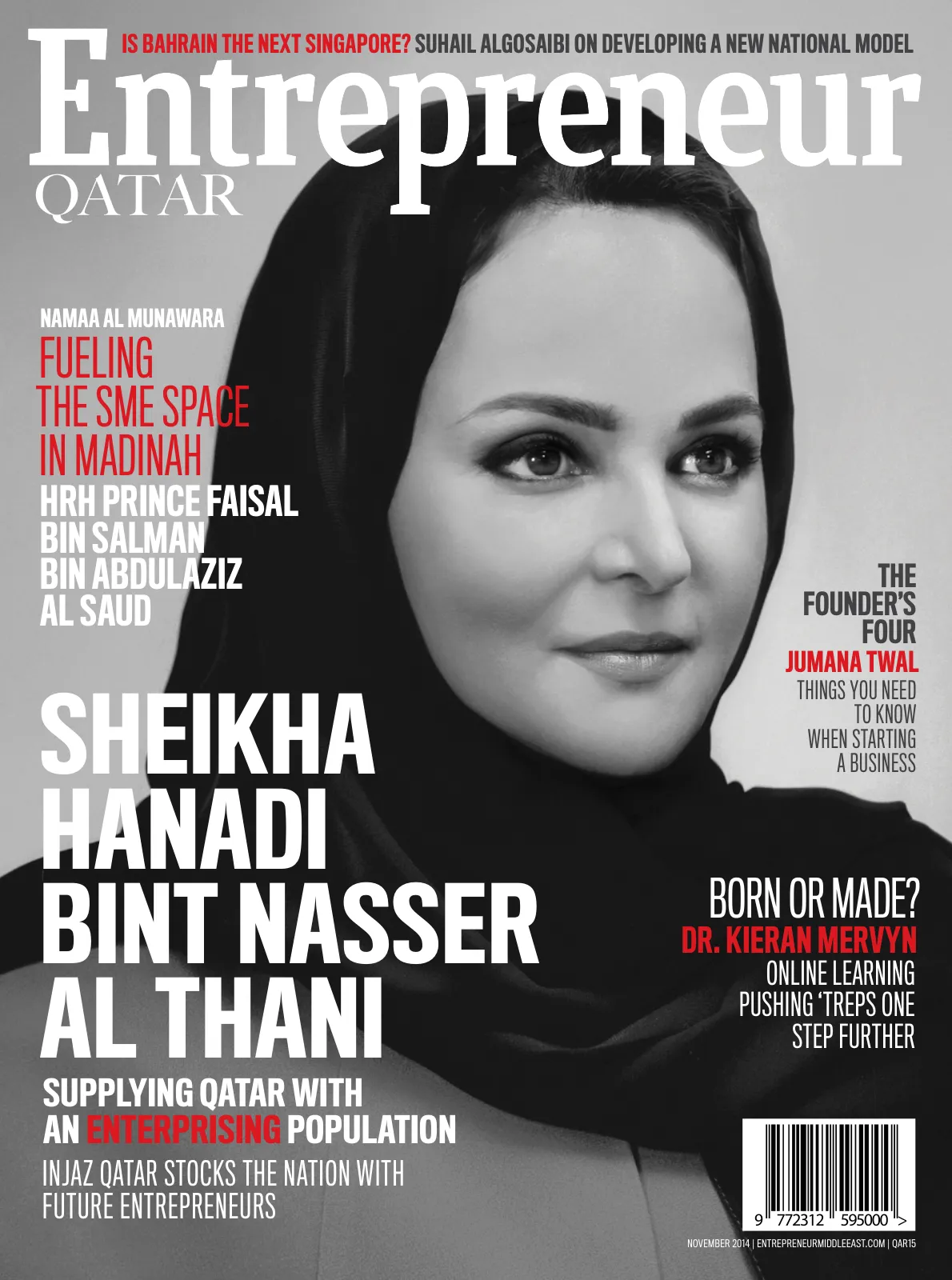
Entrepreneur Qatar, November 2014
Page 1
NOVEMBER 2014 Entrepreneur
1
Online learning
pushing ‘treps one
step further
Dr. Kieran Mervyn
Born or made?
Things you need
to know
when starting
a business
Jumana Twal
The
founder’s
four
HRH Prince Faisal
bin Salman
bin Abdulaziz
Al Saud
Namaa Al Munawara
Fueling
in Madinah
the SME space
Sheikha
Hanadi
bint Nasser
Al Thani
Supplying Qatar with
an enterprising population
INJAZ Qatar stocks the nation with
future entrepreneurs
NOVEMBER 2014 | ENTREPRENEURMIDDLEEAST.COM | QAR15
Is Bahrain the next Singapore? Suhail Algosaibi on developing a new national model
Page 2
Entrepreneur NOVEMBER 2014
2
Page 3
NOVEMBER 2014 Entrepreneur
3
Sheikha Hanadi
bint Nasser Al Thani
speaking on behalf of
INJAZ Qatar
CONTENTS
NOVEMBER 2014
18
18
Sheikha Hanadi
bint Nasser Al Thani
Supplying Qatar with an
enterprising population
INJAZ Qatar stocks
the nation with future
entrepreneurs, and brings
multinationals into the
mix to make certain that
all of their resource bases
are well-covered.
30
Namaa
Al Munawara
Fueling the SME space
in Madinah
HRH Prince Faisal bin
Salman bin Abdulaziz
Al Saud backing
entrepreneurship in
KSA.
26
Why Bahrain should
not follow the
Singapore model
Suhail Algosaibi
Developing nations can
cull the best strategies
of the world, and adapt
them accordingly.
36
‘TREPONOMICS:
SKILLSET
Starting a business?
Entrepreneur Jumana
Twal’s founder four,
and what she wishes
someone told her during
her execution and
launch phase.
48
ESQUIRE GUY
The proper way to
energize a meeting
Ross McCammon on
why you have to show
some enthusiasm,
but not too much
enthusiasm.
52
MARKETING
Native Advertising
Knowing what is, and is
not, a native ad, one of
the fastest growing and
most effective formats
in digital advertising, is
step one to using them
effectively.
Left: HRH Prince Faisal bin Salman bin Abdulaziz Al Saud,
Governor of Madinah, the Kingdom of Saudi Arabia
Page 4
Entrepreneur NOVEMBER 2014
4
CONTENTS
NOVEMBER 2014
Big players in UAE’s
small business
market study evolving
customer lifecycles
62
72
‘TREPONOMICS:
SKILLSET
Are entrepreneurs born
or made?
Dr. Kieran Mervyn, a
professor of leader-
ship at the University
of Roehampton talks
about how online learn-
ing can foster determi-
nation and success.
78
START IT UP:
WACKY IDEA
You ought to be in
pictures!
BlackBox uses social
media to bring online
engagement offline, and
they’re already operat-
ing at a profit!
88
Q + A
Capturing Qatar up close
and personal
Co-founders Razan
Suliman and Mohamed
Abdulla launched Bylens
to satisfy the need for
localized Qatari visual
content, and they’re three
years into their opera-
tions.
56
CULTURE:
LIFE
Business book rundown
Amal Chaaban reviews
a few business books for
you before you hit the
bestseller aisle. It’s true
that not all executive ma-
terial is created equally.
66
TRAPPINGS
‘Trep gear
The executive selection
for the entrepreneur
on your list that has
everything. Okay, maybe
for a little self-reward
as well.
90
LIFE
Cultural coup for
Abu Dhabi
Masterpieces to be
presented at the Louvre
Abu Dhabi, like Leonardo
da Vinci’s La Belle
Ferronnière.
Why Bahrain should
not follow the
Singapore model
BlackBox uses
social media
to bring online
engagement
offline
26
78
Entrepreneur NOVEMBER 2014
4
Page 5
NOVEMBER 2014 Entrepreneur
5
Page 6
Entrepreneur NOVEMBER 2014
6
CONTENTS
NOVEMBER 2014
Parrot brings you
MiniDrones- playful,
connected robots that
are piloted with a
smartphone or tablet
using the FreeFlight 3
application.
Parrot Jumping Sumo
34
75 The reverse
sides of the
Norwegian currency
in pixel motifs.
These designs
were submitted
by Snøhetta
Design, Beauty of
Boundaries.
50
TECH:
WEBSITE TO WATCH
Crowdsourced
online info
The weird (and some-
times wonderful) world
of wikiHow is what
happens when people
run amok on the Inter-
net led by founder Jack
Herrick, who previously
built and sold eHow.
34
SHINY
#TamTalksTech
Gadgets and doodads
that you might’ve
missed out on, sourced
by a tech aficionado.
Yes, it’s okay to want
them all… and no, it’s
not our fault.
40
ONLINE ‘TREP
Mohanad Al-Hattab
This digital influencer
has character (more
than a few), comedic
crowd control, and a
whole lotta marketing
mojo.
74
MONEY:
ASK THE MONEY GUY
Series A score
Telr gets growth funding
boost from some big
players, and founder
Elias Ghanem says it
isn’t about connections.
Page 7
NOVEMBER 2014 Entrepreneur
7
U-2/BL
T E S T E D B E Y O N D E N D U R A N C E
The U-2 BLUE is the latest mechanical timepiece from Bremont.
Engineered for, and tested by the military. For the rest of us.
www.bremont.com
Page 8
Entrepreneur NOVEMBER 2014
8
SUBSCRIBE
Contact subscriptions@bncpublishing.net to receive
Entrepreneur Middle East every issue
EDITOR IN CHIEF Fida Z. Chaaban editor@bncpublishing.net
MANAGING DIRECTOR Walid Zok walid@bncpublishing.net
DIRECTOR Rabih Najm rabih@bncpublishing.net
DIRECTOR Wissam Younane wissam@bncpublishing.net
SALES DIRECTOR Oliver Amos oliver@bncpublishing.net
PUBLISHER Nehme Abouzeid
CREATIVE LEAD Odette Kahwagi
ONLINE LIAISON Kareem Chehayeb
COLUMNIST Pamella de Leon
PO Box 502511 Dubai, United Arab Emirates
P +971 4 4200 506 | F +971 4 4200 196
For all commercial enquiries related to
Entrepreneur Middle East contact
sales@bncpublishing.net
All rights reserved © 2014.
Opinions expressed are solely those
of the contributors.
Entrepreneur Middle East and all subsidiary
publications in the MENA region are officially
licensed exclusively to BNC Publishing in the
MENA region by Entrepreneur.
No part of this magazine may be reproduced or
transmitted in any form or by any means without
written permission of the publisher.
www.entrepreneurmiddleeast.com
WE’RE HEAVILY INVESTED IN OUR WEB PRESENCE
IS DIGITAL
MIDDLE EAST
Printed by Raidy Emirates Printing Group LLC
www.raidy.com
EntMagazineME
@EntMagazineME | @Fida
Entrepreneur-me
EntrepreneurMiddleEast
EntMagazineME
EntMagazineME
EntMagazineME
MIDDLE EAST
Images used in Entrepreneur Middle East are credited when necessary. Attributed use of
copyrighted images with permission. All images not credited otherwise Shutterstock.
Amal Chaaban
Youmna Chagoury
Kareem Chehayeb
Tamara Clarke
James Clear
Suhail Algosaibi
Simon Hudson
Joe Hyrkin
Maria Elena Kassab
Pamella de Leon
Suhail Al-Masri
Ross McCammon
Kieran Mervyn
Shoug Al Nafisi
Octavia Nasr
Rani Nasr
May Rostom
Jason Saltzman
Jumana Twal
Erika Widen
CONTRIBUTING WRITERS
In addition to our print edition, we’re bringing you all sorts of
industry news on our web mediums. Joining us online means getting
relevant business and startup content in real-time, so you’re hearing
about the latest developments as soon as we do. We’re looking
forward to interacting with our readers on all of our social media and
web platforms- like any thriving business, we’re looking to give and
take. #TrepTalkME is already happening on all of our digi platforms,
and all good conversations go both ways. See you on the web!
Page 9
NOVEMBER 2014 Entrepreneur
9
85” of refinement
BeoVision Avant 85
Truly
cinematic
Bang & Olufsen Store
Lagoona Mall, Level 1, West Bay Lagoon, +974 4433 5500,
bang&olufsen@darwishholding.com
GRACE YOUR HOME WITH BEOVISION AVANT 85 TELEVISION.
World’s first 85” UHD 4K TV with motorized wall and floor stand.
Experience iconic Bang & Olufsen sound that unfolds before your very eyes.
Page 10
Entrepreneur NOVEMBER 2014
10
We’ve gotten tons of pictures via Twitter and Instagram, and here are a
few of our favorites. If you see a copy of any edition of Entrepreneur MENA,
tweet an image our way or tag us on Instagram. All of our reader images
end up getting pinned to our Pinterest Show & Tell board. We’re happy to
see our readers interact with us across all mediums- and we talk back!
On ISSUU you can access all of our current and
past issues complimentary, including Entrepreneur
Al Arabiya, our edition for those of you that prefer
Arabic-language publications. If you haven’t yet
visited our ISSUU account, check out
issuu.com/entmagazineme
Business efficacy...
in real-time
It’s not social media if you don’t talk back
FEEDBACK
For logistics industry professionals, BNC Publishing
has released their inaugural issue of B2B industry title
Logistics News ME. The new monthly publication’s
inaugural edition was released in October, and their
second is now hot off the press!
Get connected by joining them on LinkedIn
Welcome to the fold!
BNC Publishing launches Logistics News ME
Logistics News ME
Page 11
NOVEMBER 2014 Entrepreneur
11
Page 12
Entrepreneur NOVEMBER 2014
12
EDITOR’S NOTE
Striving for irrelevance
Being “the best” at everything… and achieving nothing
Fida Z. Chaaban
Editor in Chief
@fida
editor@bncpublishing.net
I
n my time with Entrepreneur
MENA, I’ve been quite fortunate.
On a daily basis, I interact with
some of the region’s hallmark en-
trepreneurs, and also with a slew of
our future business luminaries that
make up the Middle East startup
circuit. Some of those same ‘treps
are being distinguished as Enterprise
Agility Achievers this month- you’ll
be able to see them in print next
issue or by visiting us on our social
media platforms.
Most of these tremendous busi-
nesspeople have one thing in com-
mon: they will point out their area
(or areas) of expertise, and readily
admit that in other areas they know
only the basics. These particular en-
trepreneurs and industry-achievers
will readily share insights about
industry agility and innovative
strategy in a field that they know
well. When these same individuals
are asked about something outside of
their scope, they have no issues with
saying that they’re not well-versed
enough with a subject to opine on it.
This is a strength, not a weakness.
It’s an indication that she or he is
both confident enough to talk about
what they’re good at, and what they
are not good at. Presenting yourself
in an accurate light, and allowing
people to gage what you excel at is
necessary. Why am I talking about
this? Because overreaching is silly
and unattractive in a business con-
text. You know what you are good
at, I know what you are good at, so
presenting yourself as a Jack or Jill
of All Trades just makes me question
your credibility. Be excellent in your
field, and certainly share that with
associates, but do not be the person
who approaches every industry
–from retail to logistics- with a I-
Know-It-All-And-I-Can-Do-It-Better
mentality. It’s detrimental, and it
forces people to question how you
got as far as you did- this is what I
meant by striving for irrelevance.
On the flipside of this, there are
the very relevant individuals and
organizations out there- like those
operating in the social business
space. There are a few startups and
SMEs who need recognition, and
we’ve partnered with The Venture
to help GCC’s social entrepreneurs
potentially qualify for mentorship
(and the much-needed capital injec-
tions) needed to push their social
businesses even further. If you are
a social entrepreneur in the GCC,
you could potentially qualify for a
portion of the global prize pool of
USD$1 million. I’m pleased to share
that I’m a judge for the region’s
leg of the competition, along with
accomplished
entrepreneur
Mr. Yogesh
Mehta. The
successful social
businesses from
the GCC will be
sent to Silicon
Valley, and be
allotted a share
of the prize pool
based on relevant business projec-
tions.
Visit www.TheVenture.com to see
the full set of rules and regulations,
and if you qualify, I look forward to
learning about your social enter-
prise. You have until December 15th,
2014 to submit your entry.
Good luck!
I
Page 13
NOVEMBER 2014 Entrepreneur
13
Page 14
Entrepreneur NOVEMBER 2014
14
Page 15
NOVEMBER 2014 Entrepreneur
15
Page 16
Entrepreneur NOVEMBER 2014
16
Dubai World Islands
moves forward
England planning to sell off
Eurostar stakes
Russian Tennis
Federation
President fined
for remarks
Eurostar
Serena Williams
SERENA WILLIAMS IMAGE © Neale Cousland / SHUTTERSTOCK | EUROSTAR IMAGE © TUNG CHEUNG / SHUTTERSTOCK | dubai world islands image © smirnova irina
in the loop
The World Islands are slowly
coming to life, even though
they aren’t garnering the
huge amount of attention
they had pre-global financial
crisis. Since then, private
contractors bought off 60%
of the islands, and we’ve
seen some development,
though it’s been a little slow.
While Lebanon Island has
turned into a nightlife hub
for private corporate parties
and social events (queue col-
lective groans), all eyes have
been on The Heart of Europe
(THOE) by the Kleindienst
Group, a European real estate
group based in the UAE. On
the project’s website, it ap-
pears that THOE will consist
of six islands: Monaco Island
(its logistics center), Germany
Island, Sweden Island, St
Petersburg Island, Switzer-
land Island, and Europe Main
Island. The whole concept
is basically what you’re
probably thinking; each
island has its own “identity”
based on the country or city
it represents, and features
luxury resorts including
floating villas. The developers
have really gone out of their
way to make sure each island
makes you feel like you’re in
that country, and they go well
beyond architecture and F&B.
They’re bringing in animals
native to those countries,
street artists native to those
countries… they even are
setting up an outdoor climate
control system. Sweden Is-
land has been completed, ac-
cording to developer updates
through their website and
social media platforms.
Britain’s government is hop-
ing to sell off its 40% stake
of the high-speed railway,
the Eurostar. With its debt
crisis worsening, many in
the government are getting
behind the agenda to sell
off public assets. How bad
is their situation? While
the official debt figure is
sitting at £1.3 trillion, if you
include all liabilities into
the equation, we’re looking
at about £4.8 trillion. Con-
servative Party politicians,
including Chancellor of the
Exchequer and Second Lord
of the Treasury and Member
of Parliament, George
Osborne, have been sup-
porting a policy of selling
government assets, hoping
to make £20 billion in asset
sales by 2020. They are
expecting infrastructure and
investment funds, as well
as pension companies, to be
the likeliest bidders for the
Eurostar. That said, Britain
won’t sell off the Eurostar
if no appropriate offers are
tabled. Who owns the rest
of the Eurostar? France has
55% and Belgium owns
the remaining 5%. Both
nations think Britain’s gone
a bit awry, and the Labour
Party and RMT (National
Union of Rail, Maritime,
and Transport Workers)
are in agreement with their
European neighbors. France
hasn’t considered buying
that 40%, but do have a
“last look” privilege that al-
lows them to snatch up the
assets at a 15% premium
if they aren’t pleased. The
Eurostar has been making
high profits as of late; in
2013 it made £18.6 million
in profit of which a sizeable
£7.4 million went to the
U.K., an increase from the
previous year.
Internationally acclaimed American
tennis player Serena Williams is-
sued a response following President
of the Russian Tennis Federation
Shamil Tarpischev’s comments
about her and her sister and tennis
compatriot, Venus Williams. Serena
Williams, an Olympic gold medalist
and winner of 63 World Tennis
Association (WTA) titles, called
the remarks Tarpischev made on a
Russian talk show “extremely sexist
as well as racist.” Tarpischev inter-
jected the show’s host after asking
about the Williams sisters calling
them the “Williams brothers.”
Despite Tarpischev calling it a “little
joke”, the Williams sisters found
evident sexist and racist undertones
in his comment, and they weren’t
alone. Famed Russian tennis player
Maria Sharapova condemned his
comments as well, saying that they
were insulting and unnecessary.
The Williams sisters, Sharapova,
and many other were pleased to
hear that the WTA fined Tarpischev
US$25,000, and was banned
for a year. That’s not all though;
he also holds a position with the
International Olympic Committee,
who may take further action on
these remarks. This hasn’t been the
first upsetting occurrence for either
of the Williams sisters. Just last
March, their family was exposed to
racist slurs after Serena withdrew
from a match against her sister
Venus due to her injury moments
before the game. The Williams
sisters’ father claimed that he and
his family were booed as he walked
off, and were exposed to racist
slurs and threats resembling the
language used during the Jim Crow
era in the United States.
Page 17
NOVEMBER 2014 Entrepreneur
17
At Qatar Financial Centre, we facilitate success. Offering ease of set up, an international legal environment
and access to growth markets, we’ll give your business the perfect platform for the region. Visit qfc.qa
Facilitating success.
GREAT SUCCESS
COMES FROM
GREAT SUPPORT.
Page 18
Entrepreneur NOVEMBER 2014
18
INNOVATOR
Sheikha
Hanadi
bint Nasser
Al Thani
Supplying Qatar with
an enterprising population
INJAZ Qatar stocks the nation with future entrepreneurs
Entrepreneur NOVEMBER 2014
18
By Erika Widén
Page 19
NOVEMBER 2014 Entrepreneur
19
NOVEMBER 2014 Entrepreneur
19
Sheikha Hanadi
bint Nasser Al Thani
speaking on behalf of
INJAZ Qatar
Page 20
Entrepreneur NOVEMBER 2014
20
Sheikha Hanadi mentions,
as in any new initiatives,
how INJAZ Qatar had its
past challenges and is still
at present facing some,
beginning with the set of
challenges of establishing
and registering a non-
governmental organiza-
tion. “Then comes the part
where you seek partners
with the same social calling
and commitment. I must
admit that this was the
easiest part, as we found
partners and sponsors
eager to participate in
funding, and to help in es-
tablishing INJAZ. Through
the commitment and deter-
mination of our founding
partners such as Qatar
Financial Center (QFC),
ExxonMobil, Amwal, Blue
Saloon, HSBC bank, and
Deloitte and Touche, INJAZ
Qatar came into existence.
Since then, more institu-
tions joined our board such
as Ooredoo, Qatar First
Bank, Qatar Petroleum,
and Citibank, and we’re
still looking to increase our
partners.” How does INJAZ
Qatar work together with
the business community,
INNOVATOR
I
NJAZ was, and still is, a unique proposi-
tion. It’s a true private public partnership
to provide a needed service to the youth
of Qatar,” says H.E. Sheikha Hanadi bint
Nasser Al Thani, Board Chair of INJAZ
Qatar. There was a year of preparation and
gaining momentum prior to the establish-
ment of INJAZ Qatar in 2007. An affiliate
of JA Worldwide, they provides hands-on,
experimental learning in financial literacy,
entrepreneurship, and work-readiness
to around 8.3 million students annually.
INJAZ Qatar’s mission is to equip the youth
of Qatar with the skills required to become
successful contributors to Qatar’s economy,
and to prepare tomorrow’s business leaders
and entrepreneurs for the dynamic indus-
tries that they choose to enter.
Sheikha Hanadi
bint Nasser Al Thani
speaking on behalf
of INJAZ Qatar
Page 21
NOVEMBER 2014 Entrepreneur
21
corporate volunteers and
educators in order to
inspire and prepare the
youth to succeed in a global
economy? “Simply, INJAZ
Qatar acts as a bridge. The
model is that we attract
corporate volunteers and
we train them on how to
deliver our programs, after
which they are allocated
to schools to implement
them. We have a focal point
in each school– which is
usually the coordinator.
The sessions range between
five to 12 weeks and the age
group is between 12 to 24
years-old.”
The Sheikha adds that
all INJAZ programs focus
on Junior Achievements’
main three pillars revolving
around financial literacy,
work readiness, and entre-
preneurship. “A good ex-
ample of this would be our
Company Program, which
incorporates the three
pillars.” The Company Pro-
gram offers the students the
knowledge and tools needed
on how to start a company,
manage it, and liquidate it.
“Our programs are tailored
for all age groups; we have
programs for middle school,
high school, and university
students.” As a result of
diversified students, all
programs offered by INJAZ
Qatar are either English
or Arabic, depending on
the school’s preference.
In addition, INJAZ Qatar
prides itself in educating
and guiding individuals
from all ethnicities and
nationalities, as well as
having a strong focus on
the development of the
local Qatari talent. “Our
programs have expanded
to international schools as
well, and the students have
perceived the program very
positively. Our programs
have a great impact on
their future and progress,
and we conduct annual
evaluations that measure
this growth, success, and
the learning impact that
the programs have on their
career choices.” A graduate
herself of Qatar University,
the Sheikha highlights how
relevant it is for students to
be equipped with business
skills and traits, which are
not readily available in
many present-day teaching
materials. “They have to be
curious and determined to
understand how the world
evolves and functions. This
is essential for all the youth
anywhere in the world.
What we provide through
INJAZ, is a glimpse into
the world of business and
success, as well as guid-
ance on issues like time
management, personal
finance, and leadership.”
INJAZ Qatar programs are
being taught in partner-
ship with 34 independent
schools, six private schools
and six universities within
the country. Additionally,
in some high schools, the
programs replace the busi-
ness class prerequisite and
also serve as an extracur-
ricular class and or an
activity. At present, INJAZ
Qatar has started working
with six private schools,
and intends to expand in
the near future.
The duration of the pro-
gram varies between five
to 12 weeks, and operates
on a semester basis. Stu-
dents can register in one
program during the first
semester, and participate
in another program for the
“They have to be
curious and determined
to understand how
the world evolves
and functions. This is
essential for all
the youth anywhere
in the world.”
“What we provide
through INJAZ, is
a glimpse into the
world of business
and success, as
well as guidance
on issues like
time management,
personal finance,
and leadership.”
INJAZ Qatar
Corporate Video
on YouTube
INJAZ TWITTER ACCOUNT © TWITTER.COM | INJAZ QATAR COPORATE VIDEO 2013 YOUTUBE.COM
Page 22
Entrepreneur NOVEMBER 2014
22
INNOVATOR
second semester, with the
exception of the Company
Program, which runs once
a year for a period of five
months. Sheikha Hanadi,
also a founding chairper-
son of Q-Auto, says that
there is no doubt that the
culture of entrepreneurship
in Doha is still new and
therefore is bound to be
confronted with obstacles.
She strongly believes that
the lack of a well-developed
ecosystem -funding, men-
toring, risk culture, legal
and human resources- does
put a mammoth burden on
entrepreneurs in emerg-
ing economies. Adding
to the load would be also
the registration process of
companies in Qatar, and
both the high operating
costs and fixed costs. “This
is where the likes of INJAZ
Qatar, Enterprise Qatar,
and Qatar Business Incuba-
tion Center (QBIC) come in:
to provide entrepreneurs
with the skillset, appropri-
ate finances, and incuba-
tion space to execute their
ideas. We have of course
collaborated with the
aforementioned entities on
several accounts to foster
and nurture this entrepre-
neurial spirit.” Companies
like Boeing have sponsored
their startup program, and
have also offered generous
amounts of money to entre-
preneurs to further develop
their ideas. “Establishing a
culture of risk-taking that
treats failure as a learning
experience is incred-
ibly important. What has
proven very beneficial so
far for these entrepreneurs
are the advisory services
that are offered through our
programs at INJAZ Qatar,”
adds Her Excellency.
“Our programs are designed
to fit within the fast-
growing GCC region. When
it comes to Qatar, our pro-
grams are tailored to foster
the growth of its youth.
We get several volunteers
from the Qatari corporate
business environment,
and via these examples of
Qatari leaders there are
several success stories that
can be told,” continues the
Sheikha. “We take high pre-
cision when designing our
programs to a point where
even our terminology is Qa-
tari specific. We are always
up to date with the latest
research, and we always re-
ceive reports and research
updates from professional
service companies such
as Mckinzey & Co.. They
have conducted research
in the region for INJAZ Al
Arab on youth unemploy-
ment and challenges, and
at INJAZ Qatar we carefully
study these challenges and
work towards finding
solutions for them.” Since
the teachers are corporate
volunteers, INJAZ Qatar
uses experimental learn-
ing methods, and trains
their corporate volunteers
on how to deal with dif-
ferent types of learning
environments and methods
with tools like interactive
and educational games,
icebreakers, teamwork,
and competitions based on
their courses. Afterwards,
corporate volunteers, whom
are viewed by the students
as role models, share their
experience stories of the
corporate working environ-
ment essentially inspiring
students to follow the same
successful road. “We view
this as a practice of great
importance because a regu-
lar teacher is not able to do
the same as most of them
have not worked in the
corporate world, and don’t
know the challenges. Dur-
ing our job shadow day for
example, the corporate vol-
unteers take the students
to their offices for hands on
experience. This has proven
to be an insightful practice
that has led many students
to decide on which career
they would like to pursue.”
One example is the More
than Money financial liter-
ary program- it teaches stu-
dents the basics of personal
finances and banking. Stu-
dents play a certain game in
“INJAZ Qatar acts as a
bridge. The model is that
we attract corporate
volunteers and we
train them on how to
deliver our programs,
after which they are
allocated to schools to
implement them.”
“Our programs are
designed to fit within
the fast-growing GCC
region. When it comes to
Qatar, our programs are
tailored to foster
the growth of its youth.”
INJAZ Qatar Corporate Video
on YouTube
Some current INJAZ Qatar
Board members
Page 23
NOVEMBER 2014 Entrepreneur
23
teams where often they will
be presented with challeng-
es, and will have to make
on-the-spot decisions.
These specially tailored
pressuring exercises help
to prepare the students for
crucial decisions in difficult
real-life scenarios. All of
the INJAZ programs are
tailored to target different
age groups.
“Besides providing the
educational backbone, we
have financially reward-
ing programs thanks to our
generous board of directors
and partners. An example
of these rewarding pro-
grams would be our Com-
pany Program, which has
a competition and a hefty
prize. At INJAZ Qatar, we
provide entrepreneurs with
educational tools and help
them feel the taste of en-
trepreneurship by running
a small business through
the student companies that
they form, and the annual
Mubadara competition that
we conduct every year to
choose the best young com-
pany or entrepreneur. Our
partners such as Boeing,
Enterprise Qatar and QBIC
provide them with financial
support, advisory services
and an incubation space
accordingly.” It’s important
to mention that INJAZ
Qatar doesn’t differentiate
between male and female
entrepreneurs. Notably,
during this year and the
previous one, the winners
of the Company Program
were women. “This year,
we initiated the Start-Up
“At INJAZ Qatar, we provide
entrepreneurs with
educational tools and
help them feel the taste
of entrepreneurship by
running a small business
through the student
companies that they
form, and the annual
Mubadara competition
that we conduct every
year to choose the
best young company or
entrepreneur.”
INJAZ Qatar Corporate Video
on YouTube
2012 Injaz Al Arab
regional competition in Doha
with Qatari team
INJAZ QATAR COPORATE VIDEO 2013 YOUTUBE.COM
Page 24
Entrepreneur NOVEMBER 2014
24
Program and the female
winners are proving to be
entrepreneurs in the mak-
ing- undoubtedly, they’re
on their way to become
successful examples of
Qatari businesswomen.”
INJAZ Qatar has had
tremendous success stories
throughout the years. One
in particular, Fahad Al Mu-
raikhi, attended the Lead-
ership Program in 2008
when he was still in his
Grade 11 year at the Omar
Bin Khattab Independent
Secondary School for Boys.
During the program, Al
Muraikhi was taught about
different types of leaders,
coached on leadership
skills and also took part
in 10 hours of community
service. “Fahad believes
his participation in this
program was vital in giving
him the motivation and
tools which inspired him to
work hard and achieve this
prestigious award. Fahad
was one of the selected few
students who was awarded
in the Gold category, and
was proudly honoured
by the Crown Prince for
his achievements,” says
Sheikha Hanadi.
Her advice to all of the
Gulf nation’s youth, not
just those aspiring to start
a business, is to equip
themselves with knowledge
in order to broaden their
horizons with global expo-
sure, and to build-up their
traits of seeking-success,
endurance, perseverance
and discipline in pursuing
their goals. “Our purpose
is to inspire and prepare
young people to succeed
in the global economy, and
our mission is to channel
the mentorship of Qatar’s
business leaders to help
inspire a culture of entre-
preneurialism and business
innovation among Qatar’s
youth.” Inspiration goes
hand-in-hand with practi-
cal knowledge, and INJAZ
Qatar addresses both the
dream, and the stepping
stones needed to get there.
In brief The goal state of INJAZ Qatar
>> Linking youth with successful role models from
the business sector
>> Enhance youth skillsets and prepare them for
their participation in nation’s economy
>> Introduce students to innovation, critical thinking,
and new enterprise concepts
>> Give corporations the opportunity to shape
the workforce of the future
INNOVATOR
“This year, we initiated the Start-Up Program
and the female winners are proving to be
entrepreneurs in the making- undoubtedly,
they’re on their way to become successful
examples of Qatari businesswomen.”
Start-up
Program Launch
with Boeing
Page 25
NOVEMBER 2014 Entrepreneur
25
World’s 5-star airline.
through a travel experience we’ve gone to great lengths to perfect for
you. From the warm welcome when you arrive, to the state-of-the-art in-flight
entertainment system, to the gourmet dining in the sky, to the exquisite comfort
in your cabin to award-winning service. We believe the secret to unforgettable
flying is simple. It’s all in the detail. qatarairways.com
Our A380. It’s all in the detail.
Glide
FLYING DOHA TO LONDON
FROM 10TH OCTOBER 2014.
Page 26
Entrepreneur NOVEMBER 2014
26
INNOVATOR
Developing nations can cull the best strategies of
the world, and adapt them accordingly
By Suhail Algosaibi
“If I have to choose one word to explain why Singapore succeeded,
it is confidence.” Lee Kuan Yew
L
et’s make something clear from the
very start: Singapore is a success-
ful country and a shining example of
how determination, hard work and tenacity
can literally transform a country from third
world to first in just one generation. I am
a huge fan of Lee Kuan Yew, Singapore’s
founding Prime Minister. He, and the Peo-
ple’s Action Party (PAP), ruled the country
for over 30 years. He stepped down back in
1990 but has remained active in Singapor-
ean politics ever since. The PAP is still very
much in charge, led by his son and current
Prime Minister Lee Hsien Loong.
Bahrain has more in
common with Singapore
than the European
nations. The ideal would
be to develop a hybrid
of the different models,
while keeping happiness
as the ultimate goal.
L
Why Bahrain
should
not follow
the Singapore
model
I read Mr. Yew’s From
Third World to First,
The Singapore Story
during summer vaca-
tion in Germany back in
2012. I could not put
the book down. I think I
read the 700-page book
in less than two weeks. I
underlined several parts
of it, and made notes in
the margins. What I par-
ticularly admire about the
Singapore model is that
even though the odds were
very much against them,
they managed to build
a nation. It was a small
country surrounded by
some hostile countries and
ideologies, with no natural
resources to speak of, and
a racially fragmented and
divided population speak-
ing multiple languages. Yet
they built a nation that
is the envy of the world.
I really admire that. Mr.
Yew and the PAP are not
perfect by any means, but
their track record speaks
for itself. They delivered.
What I particularly liked
about Mr. Yew’s approach
in building the nation
was that it was based on
pragmatism, not ideology-
a notion I share 100%.
For anyone interested in
politics and development,
reading Mr. Lee Kuan
Yew’s book is a must. I
would make it compulsory
for all senior officials.
Page 27
NOVEMBER 2014 Entrepreneur
27
Level and decomposition of Happiness by regions, World Happiness Report 2013
Former Prime Minister
Lee Kuan Yew during
National Day Parade,
Singapore
LEE KUAN YEW IMAGE © JORDAN TAN / SHUTTERSTOCK | CHARTS © WORLD HAPPINESS REPORT 2013
0
1
2
3
4
5
6
7
8
9
10
Sub-Saharan Africa (4.626)
South Asia (4.782)
Middle East & North Africa (4.841)
East Asia (5.017)
Commonwealth
of Independent States (5.403)
Central and Eastern Europe (5.425)
Southeast Asia (5.430)
Latin America & Caribbean (6.652)
Western Europe (6.703)
North America & ANZ (7.133)
World (5.158)
Base country (1.977) + residual
Explained by: GDP per capita
Explained by: social support
Explained by: healthy life expectancy
Explained by: freedom to make
life choices
Explained by: generosity
Explained by: perceptions of corruption
>>>
The Singapore model is
so successful that many
countries have tried to
emulate it, or at least parts
of it. One of those coun-
tries is Bahrain. If fact our
very own Economic Devel-
opment Board (EDB) idea
was taken from Singapore.
A Singaporean was even
considered to run it.
So of course this begs the
question, “Why shouldn’t
Bahrain follow the Singa-
pore model?” The answer
is plain and simple. Sin-
gaporeans aren’t happy. In
the book, the former Prime
Minister acknowledges
that “it will take another
generation before our arts,
culture, and social stan-
dards can match the First
World Infrastructure we
have installed.” One might
argue that the price paid
by everyday Singaporeans
was too high. One might
ask what’s the point of all
this development if it does
not lead to happiness?
I last visited Singapore
this summer. I went with
my wife and children on
family vacation. This was
my third visit, and each
time I’m impressed with
how advanced, clean and
beautiful the country is.
But whenever I visit a
country, I make sure to
speak to the locals; from
taxi drivers to business
people. During the trip
I heard over and over
again how hard, expensive
and competitive life in
Singapore is. I asked a
friend about her thoughts
on whether the PAP could
continue winning elections
in the future. She told
me that “Lee Kuan Yew
ruled with an iron fist,
but he earned the people’s
respect. His son has not
earned it as much as his
father had.” One of course
should not discount the
current Prime Minister’s
vast experience, but it’s
unfortunate that his father
has such a large shadow. It
covers swaths of Asia. The
reason I asked my friend
this question is because
the PAP, though still very
much in control, has been
losing some seats in every
round of general elections.
So there may come a day
when they actually find
themselves out of office.
The numbers
According to the World
Happiness Report 2013,
Singapore is the 30th hap-
piest nation in the world.
That’s not bad by any
means, but hardly stellar
considering how much the
Singapore model is lauded
around the world. (Inci-
dentally, Bahrain ranks
at number 79, right after
Libya and before Monte-
negro). My contention is
that a country should not
pursue development and
growth for their own sake.
Every human being’s ulti-
mate goal is to be happy.
Page 28
Entrepreneur NOVEMBER 2014
28
22
0
1
2
3
4
5
6
7
8
9
10
52. El Salvador (5.809)
51. Poland (5.822)
50. Bolivia (5.857)
49. Ecuador (5.865)
48. Malta (5.964)
47. Guatemala (5.965)
46. Slovakia (5.969)
45. Italy (6.021)
44. Slovenia (6.060)
43. Japan (6.064)
42. Taiwan (6.221)
41. South Korea (6.267)
40. Suriname (6.269)
39. Czech Republic (6.290)
38. Spain (6.322)
37. Uruguay (6.355)
36. Thailand (6.371)
35. Colombia (6.416)
34. Cyprus (6.466)
33. Saudi Arabia (6.480)
32. Kuwait (6.515)
31. Trinidad and Tobago (6.519)
30. Singapore (6.546)
29. Argentina (6.562)
28. Chile (6.587)
27. Qatar (6.666)
26. Germany (6.672)
25. France (6.764)
24. Brazil (6.849)
23. Oman (6.853)
22. United Kingdom (6.883)
21. Belgium (6.967)
20. Venezuela (7.039)
19. Luxembourg (7.054)
18. Ireland (7.076)
17. United States (7.082)
16. Mexico (7.088)
15. Panama (7.143)
14. United Arab Emirates (7.144)
13. New Zealand (7.221)
12. Costa Rica (7.257)
11. Israel (7.301)
10. Australia (7.350)
9. Iceland (7.355)
8. Austria (7.369)
7. Finland (7.389)
6. Canada (7.477 )
5. Sweden (7.480 )
4. Netherlands (7.512)
3. Switzerland (7.650)
2. Norway (7.655)
1. Denmark (7.693)
Base country (1.977) + residual
Explained by: GDP per capita
Explained by: social support
Explained by: healthy life expectancy
Explained by: freedom to make life choices
Explained by: generosity
Explained by: perceptions of corruption
INNOVATOR
Ranking of Happiness, World Happiness Report 2013
The top 10 list have
capitalist economies
with a strong
socialist bent- at
least the European
nations and Canada
do- and they aren’t
driven by ideologies,
instead they are
driven by pragmatism.
So a country’s ultimate
goal should be to make its
citizens happy, and then
develop its long-term plans
based on what would make
that happen.
So which countries got it
right? Let’s look at the top
10 happiest nations:
1. Denmark
2. Norway
3. Switzerland
4. Netherlands
5. Sweden
6. Canada
7. Finland
8. Austria
9. Iceland
10. Australia
A developing country would
do well to analyze these
10 countries, and adapt
certain elements and cre-
ate its own unique model.
I want to emphasize this
point, we cannot copy a
model completely; we have
to develop our own model
based on our own circum-
stances and culture. But
the ultimate goal should
be kept in mind, and we
should constantly ask what
will make the Bahraini
people happy? A cursory
look at the nations in the
list above reveals that they
are all mature democracies
with a strong regard for hu-
man rights. The top 10 list
have capitalist economies
with a strong socialist bent
-at least the European
nations and Canada do-
and they aren’t driven by
ideologies, instead they
are driven by pragmatism.
These countries have good
education systems, but they
do not overeducate their
school children (unlike say
the South Koreans, where
school children routinely
study 12 hours or more a
day).
How other
developed countries
of note scored
Just for fun, let’s look at
how some relevant coun-
tries scored:
> South Korea (41)
> Japan (43)
> Germany (26)
> China (93)
> United States (17)
Interesting, no? It’s also
worth noting that South
Korea has the third highest
suicide rate per 100,000
people in the world. Japan
is number 8. This leads me
to ask if we can consider
their models successful?
Page 29
NOVEMBER 2014 Entrepreneur
29
2.15
2.2
2.25
2.3
2.35
2.4
2.45
1977 1978 1979 1980 1981 1982 1983 1984 1985 1986 1987 1988 1989 1990 1991 1992 1993 1994 1995 1996 1997 1998
Annual data
10 yearly: base = 1977
10 yearly: base = 1978
Linear (Annual data)
Life satistaction in the Netherlands (Eurobarometer)
EDB WEBSITE | CHARTS © WORLD HAPPINESS REPORT 2013
Suhail Ghazi Algosaibi is a
serial entrepreneur, author,
consultant and speaker
based in the Kingdom of
Bahrain. He is the founder
of the DreamBody Centre,
the world’s first and only
23-minute weight loss and
body transformation franchise.
He is also the Founder of Ghazi
Algosaibi Holding BSC (c), and
its two divisions, Safeen Books
and Safeen Properties, and
is Co-Founder and Cof Falak
Consulting WLL. Algosaibi
is passionate about helping
Bahrain and is the Founder
and Chairman of the Bahrain
Foundation for Reconciliation
and Civil Discourse (BFRCD),
a non-profit foundation
born out of the painful 2011
Bahrain crisis, that aims to
promote societal unity and
reconciliation. He is also a
proud member of Entrepreneur
Organization (EO) and Young
Arab Leaders (YAL). Algosaibi
publishes the Transformation
Times newsletter and is the
author of Bahrain’s very
first self-defence book,
The Ultimate Self-Defence
Handbook, How to Defend
Yourself in Bahrain and Abroad.
He is also co-author of the
international self-improvement
book, 101 Great Ways to
Improve Your Life, Volume 2.
Visit SuhailAlgosaibi.com
to learn more.
Happiness should be
the goal
The good thing about
being a developing nation
is that you can emulate
the good in other nations.
We’re the adolescents of
the world, and we can
decide how we want to
grow up, and who we want
to immolate. And I say we
should emulate Denmark,
Norway and Switzerland,
while still keeping the
Singaporean model in
mind. The Singaporean
experience is too valuable
to ignore. What makes it
particularly interesting
and appealing is the speed
in which development was
achieved. The other coun-
tries are mature democra-
cies which developed over
centuries. Bahrain has
more in common with Sin-
gapore than the European
nations. The ideal would
be to develop a hybrid of
the different models, while
keeping happiness as the
ultimate goal.
Can Bahrain achieve
happiness?
Yes, of course it can. Cer-
tainly the odds are against
us when we consider the
MENA region’s instability,
and Bahrain is weather-
ing the worst political and
sectarian crisis in genera-
tions, and our citizens are
unhappy. Despite these
significant hurdles, I think
we can make it. We have
some of the best human
capital around, and despite
the pervasive unhappiness,
Bahrainis of all walks of
life love their country. It’s
just a matter of time until
we overcome the crisis,
and start rebuilding our
nation.
One day we might even
make it to the top 10. I bet
on it!
Page 30
Entrepreneur NOVEMBER 2014
30
INNOVATOR
Below: HRH Prince Faisal bin Salman bin Abdulaziz Al Saud, Governor of Madinah, the Kingdom of Saudi Arabia
Namaa Al Munawara
hopes to fuel
SMEs in Madinah
HRH Prince Faisal bin Salman bin Abdulaziz Al Saud
backing entrepreneurship in KSA
M
any industry leaders
across the Middle East
have been pointing
fingers at Saudi Arabia, tipping
it as the future entrepreneur-
ial hub of the MENA region.
While reasons vary, one of
them is Saudi Arabia’s effort
in creating a more nurtur-
ing environment for SMEs.
One example? Namaa Al
Munawara, a SR1billion
(US$226.5 million) non-profit
organization recently launched
by His Royal Highness Prince
Faisal Bin Salman, Governor of
Madinah. Namaa Al Munawara
is the implementation arm of
the Kingdom’s Al Munawara
Endowment. While the first
thing that comes to mind
when thinking of the Madinah
province is its capital, the holy
city of Medina, Saudi Arabia
is doing its best to rev up
business gears with this latest
initiative. With Namaa Al Mu-
nawara receiving support from
Saudi government agencies
and the private sector, we can
only expect it to make a huge
impact and do exceptionally
well alongside the rest of the
region’s startup accelerators.
How did Namaa Al Munawara
come together, and what are
the goals of this project?
Namaa Al Munawara was
established as a non-profit
organization for providing the
required support to small and
medium enterprises. SMEs,
as a sector, is considered
one of the most vibrant and
important sectors in the
Kingdom. It plays a key role
through its goals of provid-
ing work opportunities and
driving the economy forward,
increasing national commercial
activities, and reinforcing the
spirit of business entrepre-
neurship Kingdom-wide,
given that 90% of the local
companies registered at the
Ministry of Commerce and
Industry are SMEs. Namaa’s
project will provide various
job opportunities for Madinah
residents, stemming from the
fact that encouraging business
entrepreneurship through
supporting SMEs is one of the
key development strategies
in all developing and highly
developed countries.
How has entrepreneurship
changed in Al Madinah in
recent years? It appears
that Saudi Arabia as a whole
is taking immediate action to
nurture startups, SMEs, and
entrepreneurial ventures.
Entrepreneurship requires
individuals who have the
capability to seize opportuni-
ties, evaluate them, analyze
their feasibility, and possible
returns. In Madinah, lots of
various opportunities are
available for everyone. These
require people who have a
sense of initiative and are
proactive, knowing how to se-
riously interact with and delve
into the process of entering
new economic sectors through
an innovative vision and by
providing creative products or
services.
What are some of Namaa Al
Munawara’s projects?
Namaa Al Munawara is the
implementation arm for Waqf
Al Munawara (Al Munawara
Endowment), and it provides
several initiatives for sup-
porting small and medium
enterprises for the men and
women of Madinah. Initiatives
include the Industrial City
initiative for supporting retail
sales, another for support-
ing Madinah-made products,
in addition to manufacturing
Page 31
NOVEMBER 2014 Entrepreneur
31
“Al Madinah aims at strengthening socio-economic
sustainability, given that it falls in line with Saudi Arabia’s
developmental renaissance, under the leadership of the
Custodian of the Two Holy Mosques King Abdullah bin
Abdulaziz and HRH Crown Prince Salman bin Abdulaziz.
Waqf Al Munawara was established to reinforce this
vision of development, with Namaa Al Munawara
being its implementation arm. Namaa will support and
empower the SME sector in Madinah as SMEs are the life
blood of all economies and a vital component and a key
vehicle for improving economic conditions and expanding
job creation. They account for approximately 90% of
the total local companies registered with the Ministry of
Commerce and Industry. Given that implementation is
usually considered one of the most challenging stages,
we will ensure that the citizens of Madinah will feel
Namaa Al Munawara’s positive impact in the first quarter
of next year, through our continuous follow-up, and
dedication to the organization’s activities.”
In Brief
Namaa Al Munawara
20,750 m2 The size of Namaa
Al Munawara’s HQ. There will
be “designated work areas,
sale points, workshops, lecture
halls, interactive showrooms for
Madinah-made products, offices
for Namaa’s success partners
and the Saudi Arabian General
Investment Authority (SAGIA),
and an art gallery to exhibit
Madinah’s heritage and modern
history.”
SR700 million The amount
provided by Saudi Credits and
Savings Bank for the project.
100 The number of sites for
“retail channels” to be delivered
by Al Madinah Municipality within
the next 12 months. The goal is
to increase the number of these
sites to 500 by the year 2020.
HRH Prince Faisal bin Salman bin Abdulaziz Al Saud
Governor of Madinah, the Kingdom of Saudi Arabia
namaa al mounawara facebook page © facebook.com
and creativity labs comprising
fully integrated workplaces
dedicated to the women of
Madinah for nurturing wom-
en’s employment and creative
capabilities, and the One-Stop
Shop, which aims at providing
all the various governmental
and consultancy services that
entrepreneurs may need under
one roof, helping to save time
and effort, among other initia-
tives.
Which government
agencies and private sector
companies have been involved
in supporting Namaa Al
Munawara?
This is one of the leading
projects provided by the
Government of the Custodian
of the Two Holy Mosques to
the people, presented through
non-project organizations to
offer logistic and financial
support, comprehensive
consultancy services through
one platform, and in close
collaboration with several
governmental parties and the
private sector.
What do you think will
make Namaa Al Munawara
more effective than other
startup accelerators in
the Middle East?
There are many factors that
contribute to the emergence of
effective business accelera-
tors in Madinah, including the
current economic develop-
ment and progress, population
growth, the higher Saudi
income per capita, the pres-
ence of a solid technology
infrastructure, in addition to
financial and logistic support
for entrepreneurs in the re-
gion, given that Namaa Al Mu-
nawara is building the largest
entrepreneurship investment
platform in the Middle East.
This will increase the success
rate and success opportunities
for the region’s entrepreneurs,
in addition to the collabora-
tions between the public and
private sector in the region for
enabling small and medium
enterprises to strongly com-
pete in the business arena.
Page 32
Entrepreneur NOVEMBER 2014
32
Page 33
NOVEMBER 2014 Entrepreneur
33
Page 34
Entrepreneur NOVEMBER 2014
34
Samsung and Oculus col-
laborated to create Gear
VR, a new dimension of
mobile devices and its
first virtual reality headset
optimized for use with
Galaxy Note 4. This futur-
istic headgear is built with
soft, lightweight materials,
doesn’t require a battery
and it’s completely wire-
less. Equipped for use in
film, gaming, 360 degree
videos and educational con-
tent, the device allows you
to play and learn in many
different simulated environ-
ments of your choice. Gear
VR has a Super AMOLED
display and advanced sen-
sor technology that makes
the experience inside your
virtual world feel like a
reality.
Get real
Samsung and Oculus Create Galaxy VR
#TAMTALKSTECH
We’ve got a pretty interesting lineup for you this month, tech toy fans. From your own personal drones to some
serious headgear, here are all of the things you want to get. (Okay, here are all of the things we want to get.)
Ashton Kutcher is still
hanging out with Lenovo
product engineers and
now, the products do too-
hang, that is. Yoga Tablet
2 Pro features a smart
kickstand that allows you
to enjoy content in four
ways: Hold, Stand, Tilt
and Hang modes. Named
for its flexibility, the Yoga
tablet modes allow you to
use it anywhere, and it’s
packed with top-of-the-line
entertainment features like
an 8W JBL sound system
with bass subwoofer, and
a built-in projector that
creates a 50-inch home
theatre experience on any
wall. With 32GB of storage,
expandable up to 64GB
via a Micro SD card, you
can conveniently store all
of your multimedia. How’s
that for a new way to enter-
tain at home!
Get acrobatic
Lenovo Introduces Yoga Tablet 2 Pro
Levnovo
Yoga Tablet 2 Pro
Galaxy VR
TECH SHINY | WEBSITE TO WATCH | GEEK | MOBILE TECH | ONLINE ‘TREP | THE FIX
Page 35
NOVEMBER 2014 Entrepreneur
35
Samsung’s new wearable Galaxy S truly
does allow you to rely on your wrist,
instead of your smartphone. It features a
2-inch curved AMOLED display, custom-
izable screen options and changeable
straps not the least of which are blinged
out wristbands by Swarovski. Gear S
connects via 3G, Bluetooth and Wi-Fi al-
lowing you to instantly reply to incoming
messages, notifications and phone calls
forwarded from your smartphone. With
over 1000 apps, Galaxy S is improving on
the wave of wearables that are hitting
the market.
Watcha wearing?
Samsung launches Galaxy S standalone smartwatch
G
oogle announced Android 5.0,
alongside their release of the Nexus
6 smartphone, the Nexus 9 tablet,
and the Nexus Player. The upgraded
operating system (also known as “Lol-
lipop”) has been long anticipated, but just
how sweet is it? Lollipop improves upon
the basics with bold, colorful UI design,
automatic encryption and improved audio,
video and camera capabilities. The most
impressive features? Enabling device shar-
ing, speaking commands, and casting your
favorite entertainment apps to your big
screen with Google Cast support for An-
droid TV devices. If you forget your phone,
you can still call any of your contacts (or
access any of your messages, photos etc.)
by simply logging into another Android
phone running Lollipop. Even if your
screen is off, you can say, “OK Google”
on devices with digital signal processing
support such as Nexus 6 and Nexus 9 to
get quick answers on the go; send a text,
get directions or look up a recipe from
Google- just like that. With innovative and
convenient features, Lollipop could prove
to be quite a treat for tech fans.
Tamara Clarke, a former
software development
professional, is the tech and
lifestyle enthusiast behind
The Global Gazette, one of the
most active blogs in the Middle
East. The Global Gazette has
been welcomed and lauded
by some of the most influential tech brands in the
region. Clarke’s goal is to inform about technology
and how it supports our lifestyles. See her work
both in print regional publications and online on
her blog where she discusses everything from how
a new gadget improves day-to-day life to how to
coordinate your smartphone accessories.
Visit www.theglobalgazette.com and talk to her on
Twitter @GlobalGazette.
#TAMTALKSTECH
Lollipop
is pretty tasty
Android 5.0
has some tantalizing features
Get high
Parrot MiniDrones
Parrot Jumping Sumo
Galaxy S
smartwatch
Parrot Rolling Spider Freeflight
Screen Smartphone
LOLLIPOP ANDROID WEBSITE
Drones have disrupted
serious industries like
security and photography,
but how about owning
your own? Parrot brings
you MiniDrones- playful,
connected robots that are
piloted with a smart-
phone or tablet using the
FreeFlight 3 application.
With two models, the
Rolling Spider and the
Jumping Sumo, you can
choose the one that best
suits your personality and
environment.
An ultra-compact drone,
the Rolling Spider flies
both indoor and outdoor
with terrific agility. It rips
through the air, flips,
and thanks to removable
wheels, rolls from floor
to ceiling. Jumping Sumo
is a more rugged version
that rolls, zigzags, circles
and jumps up to 80 cm in
height and length. With
its embedded camera, the
Jumping Sumo is your
ticket to capturing the
world from above.
Page 36
Entrepreneur NOVEMBER 2014
36
Entrepreneur Jumana Twal’s
founder
four
Starting a business?
Entrepreneur NOVEMBER 2014
36
SPONSORED BY CADILLAC IN THE SPIRIT OF
LINKING SUCCESS WITH POTENTIAL
INDUSTRY
KNOW-HOW
TREPONOMICS
ETHICS | ESQUIRE GUY | SKILLSET | MARKETING | PRO
W
hen I founded Bidaya Corporate
Communications in 2004, I’d already
had a decade’s worth of experience
as Manager and later Director of Corporate
Communications at Fastlink (now Zain), Jordan’s
telecom leader at the time. After running the
nationwide PR operations of one the Kingdom’s
largest private sector companies for over 10
years, starting a PR agency sounded like a
simple transition. What I hadn’t realized was
that there was far more to running a startup
than I’d anticipated. Here are four things that I
wish someone would have told me when I was
launching my business.
Page 37
NOVEMBER 2014 Entrepreneur
37
1. Develop Financial
Skills
You might be the greatest
marketer, technology guru
or innovator of your time,
and that will be instru-
mental when creating
market-worthy products
and services, but unless you
also develop financial skills
specific to managing your
business, you’ll have a hard
time staying afloat. Raising
capital, managing revenue
and profit, getting clients
to pay on time– these are
essentials that you won’t
learn as an employee.
Whatever you do, whether
it’s taking a course, finding
a mentor or self-educating
by reading up on the topic,
make sure that you have the
basics down as early as you
can to save yourself from
making costly mistakes.
I was fortunate to have
seasoned CFOs and CEOs
among my friends and fam-
ily. Their advice and guid-
ance during those first few
years of Bidaya’s formation
were central to teaching me
how to set up and manage
my agency’s finances.
2. Manage like a leader
Entrepreneurs are often
forced to serve multiple
roles when they start out,
acting as employee, manag-
er, and CEO all at once. As
your startup grows, you’ll
have the luxury to delegate
the day-to-day work to your
team, and later on your
team’s management to your
managers. Before you hand
over the reins, however,
ensure that your executive
staff understands your vi-
sion for your management
culture.
I’ve had the pleasure of
working with great manag-
ers in my time, each hailing
from a different school of
thought. By the time I’d de-
cided to go solo, I’d already
had a good idea of the man-
agement style I wanted ap-
plied at Bidaya. PR is a very
demanding industry, often
involving long hours at the
office and tight deadlines.
Using a combination of the
management principles
that I’d enjoyed most as an
employee, I created a flex-
ible and supportive work
environment where my staff
would have the freedom to
grow and feel at home. As
a result, the majority of my
team have been with me for
over five years and to this
day continue to be an inte-
gral part of Bidaya’s future.
3. Hire Smart
Never underestimate the
value of good talent or
the difficulty of finding
them. You can only grow
as an entrepreneur if you
have a strong team back-
ing you and pushing you
forward, which is why it is
paramount that when you
hire, you choose people who
have what it takes to level
up your business. The catch
is, most of these talents are
already taken.
If you can’t afford to
headhunt the best in your
industry, learn to spot po-
tential in junior candidates.
Characteristics that I look
for include self-initiative,
passion for the work, intel-
As your startup grows,
you’ll have the luxury
to delegate the day-to-
day work to your team,
and later on your team’s
management to your
managers. Before you
hand over the reins,
however, ensure that
your executive staff
understands your vision
for your management
culture.
Jumana Twal is the Founder and CEO
of Bidaya Corporate Communications
(BCC), a regional PR, social media
and event management agency
headquartered in Jordan. BCC is
the exclusive Levant PR partner of
Edelman. Since its establishment in
2004, BCC has been helping public
and private sector organizations
from more than 15 different sectors
to address critical communication
challenges, manage brand visibility
and perception, strengthen internal
and external stakeholder relations, and
cultivate a healthy corporate reputation.
Twal is a mentor at Endeavor Jordan; a
Fellow of Aspen Institute’s Middle East
Leadership Initiative (MELI) and the
Vital Voices GROW Fellowship Program
(VV GROW); as well as a member of
the Aspen Global Leadership Network
among others.
ligence, and loyalty. That
last quality is paramount,
as I trust my team with ev-
ery aspect of my business
and they are the engine
that drives its growth. I’m
proud to say that, today,
Bidaya boasts some of the
most talented PR profes-
sionals in the Kingdom and
the region.
4. Defy Conventional
Wisdom
Our culture has tradition-
ally rewarded play-it-safers
who stick to the well-worn
path. Despite increased
regulatory and industry
support for entrepreneur-
ship -a high risk venture
by definition- would-be en-
trepreneurs still face social
criticism when first making
the shift from financially-
secure 9-to-5 employee
to startup owner. Some of
my friends and colleagues
thought I was insane when
I told them that I was
leaving my high-paying
senior position to start a
PR agency at a time when
PR was barely understood
or valued.
No matter how intimidat-
ing it gets, use the uncer-
tainty to fuel your determi-
nation to succeed. At one
point, one of my strongest
drivers was the need to
prove the doubters wrong.
I’m glad that I didn’t let
myself be talked out of
becoming an entrepreneur.
It may not have been the
easiest road to take, but it
was by far one of the most
rewarding.
Page 38
Entrepreneur NOVEMBER 2014
38
I
t was 2007 and John
Maloof was working on
a book about Chicago’s
northwest neighborhoods.
On this particular day, he
was hoping to find a few
pictures from the 1960s
that he could use in the
book. What he ended
up finding was far more
interesting. After purchas-
ing boxes full of negatives
from a local auction house,
Maloof began developing
some of the images. When
they finished processing,
he was stunned. They were
incredible, and there were
tons of them. More than
30,000 in these boxes
alone. Whoever had taken
these pictures was surely
one of the most prolific and
talented American photog-
raphers of the last hundred
years. And yet, when Maloof
looked up the photogra-
pher’s name, he couldn’t
find her work anywhere
else. In fact, after further
searching, Maloof was fairly
certain that nobody had
ever heard of this woman.
Her obituary never even
mentioned that she was a
photographer. She was a
mystery, an unknown artist
with world-class talent.
“The greatest
photographic discovery”
The images discovered
by Maloof were taken by
a woman named Vivian
Maier. For nearly 40 years,
Maier worked as a nanny
for wealthy families in Chi-
cago and New York. During
her many daily errands,
excursions with the family
children, and trips to other
cities around the United
The photographer
nobody knew
Lessons on sharing your gifts with the world
By James Clear
© FINDINGVIVIANMAIER.COM
I
Page 39
NOVEMBER 2014 Entrepreneur
39
TREPONOMICS
ETHICS | ESQUIRE GUY | SKILLSET | MARKETING | PRO
James Clear writes at JamesClear.com, where he
uses behavior science to share ideas for mastering
your habits, improving your health, and increasing
your creativity. To get useful ideas on improving
your mental and physical performance, join his free
newsletter JamesClear.com/newsletter, to have
James speak at your entrepreneurial event contact
him jamesclear.com/contact
See this article in its entirety at Entrepreneur.com
Amazon to open first-ever physical store
Amazon new headquarters
in London
AMAZON HEADQUARTERS IMAGE © DAVID BURROWS / SHUTTERSTOCK
States, Maier took nearly
150,000 photos of the
people and architecture that
surrounded her. Maier’s
work and backstory fasci-
nated Maloof. Eventually,
after processing thousands
of images, he collected
100 of the best photos
and posted them online.
People loved them. Major
newspapers called to run
stories about Maier’s work
and wanted to know how
Maloof discovered the im-
ages. Filmmakers called and
decided to make two docu-
mentaries about the story
including Finding Vivian
Maier. Galleries began to
exhibit her work throughout
the United States, Europe,
and Asia. The uncovering
of Vivian Maier’s images
has been referred to as the
greatest photographic dis-
covery of the 21st century.
The story raises plenty of
questions, not just about
Maier’s past, but also about
our willingness to share our
gifts with the world.
Share your work
We’ll never know the
reasons why Vivian Maier
decided to hide her work
away in boxes. Maybe she
didn’t feel that it was good
enough. Maybe she wanted
to share it, but didn’t know
who to contact. Maybe she
simply loved to create and
wanted to keep her work
private. (The last option
seems unlikely as she did
make a few attempts to pub-
lish her photos.) Regardless
of her reasons, two things
are certain. First, the world
is a better place because she
chose to create something.
And second, you shouldn’t
wait for someone like John
Maloof to share your work
with the world. The story of
Vivian Maier is a wonderful
reminder that we all carry
some brilliance inside of us.
But perhaps it is an even
better reminder that nobody
owes it to you to put your
work out into the world.
How easily could Maier’s
work have been forgotten?
How many other brilliant
artists, creatives, scientists,
and thinkers have their
work hidden in boxes or
tucked away in attics?
What you create vs. what
you share
The world can only benefit
from what it can see. Which
talents are you keeping
tucked away in boxes?
Which ideas are you hesi-
tating to share? We have
a responsibility to share
our work with the world,
to contribute our talents
to this little sliver of the
universe. Choose to share
your brilliance with the
world. Don’t wait for your
John Maloof. Start before
you feel ready.
O
nline-only no more, Amazon is
ready to join the physical world
of brick-and-mortar businesses
that it helped radically disrupt. Amazon.
com plans to open its first-ever physical
store later this year, according to The
Wall Street Journal, citing people familiar
with the plans. The store would open
in New York City, just in time for this
year’s holiday shopping season. The
store would reportedly function as a
“mini-warehouse,” and is to be located
in midtown Manhattan near the Empire
State building. An Amazon spokesperson
told Entrepreneur.com, “We have made
no announcements about a location in
Manhattan.” While Amazon has tried
to push speedy shipping to its limits,
a brick-and-mortar store would allow
for same-day delivery within New York.
Additionally, the store would serve as
a location for returns, exchanges and
online order pickups. The store may
also function as a place to showcase
inventory, such as the Kindle e-reader,
the Fire smartphone or the Fire TV
set-top box. It isn’t the first time that
the company has considered physical
locations. In 2012, the e-commerce giant
reportedly looked into opening a location
in Seattle, but never followed through
on plans. The move comes as other
e-commerce leaders are making similar
transitions. Online clothing company
Bonobos opened its first brick-and-mortar
store in Manhattan in 2012, eye glasses
company Warby Parker followed suit in
2013, and online beauty subscription
service Birchbox did the same earlier this
year. The move to go from online-only to
even a small number of brick-and-mortar
stores isn’t necessarily easy. The cost
of real estate, labor and inventory adds
up, and can fundamentally change a
company’s business model. However,
Amazon has decided that it’s worth a
try- even if it goes against the online-only
system that has guided the company over
the last two decades.
See this article in its entirety at Entrepreneur.com
Page 40
Entrepreneur NOVEMBER 2014
40
S
acha Baron
Cohen is famous
first and foremost
for his character
development and
outrageous tactics. Contro-
versial material peppered
his Ali G, Borat, and Brüno
Gehard personas often
under the guise of jest, and
Cohen later transitioned his
comedic success to more
challenging (and serious)
roles. Had Cohen began his
career in the age of social
media, he may very well
have opted for Instagram
and Vine as his first me-
diums. The MENA region
now has our own hilarious
version of Cohen’s Borat,
and he goes by the name of
“Hassan El Coach”- one of
the many fictitious char-
acters developed by digital
influencer and performing
artist, Mohanad Al-Hattab.
Al-Hattab uses social media
channels to share his work,
and yes, make people laugh.
“I was watching standup
comedy with my father, and
we started talking about the
art of comedy and he men-
tioned Lord Byron’s quote,
‘Always laugh when you
can. It is cheap medicine.’
When I sat down to place
a cover photo for my Face-
book page, I felt that this
quote would be just right.”
A Syrian National, Al-
Hattab was born and raised
in the UAE, and started his
now Insta-famous account
approximately a year ago,
following up with a Vine
account a few months later.
The 24 year-old digital
influencer has impressive
reach. He’s a heavy social
media user, and at the
time this interview took
place in late October, he
was at just under 165,000
Instagram followers from
across the MENA region.
His characters span dialects
and genders, and they
each have their own cult-
like fan-bases with some
crossover between charac-
ters. After completing an
undergraduate degree at
the American University of
Sharjah in Marketing and
Management, Al-Hattab
followed up with a Masters
in Marketing at Brunel Uni-
versity London in England.
Abu Dhabi-based, most
of his videos are filmed at
home, often with the help
of his family who are in
on the jokes. He develops
identities and back stories
for each character, and
periodically releases highly-
anticipated new install-
ments in their individual
sagas. The tech-savvy artist
explains that while there
are people who recognize
the work that goes into each
character and storyline, he
is aware that many people
assume it’s all quite easy. “I
do also believe, that there
is a number of people who
do not comprehend the
thought that goes into my
work. For example, the fact
that I try to diversify my
characters could be per-
ceived as a way of me trying
to gain more followers from
different regions, when in
fact it is simply to chal-
lenge myself as an aspiring
actor. I’ll try a new dialect,
and attempt to create new
storylines and to be that
new person. When I’m try-
ing to explain to people all
the thought that goes into
my work, I try to show it to
them through my commit-
ment to my characters, and
by trying to be as original
as possible in my sketches.
Every single word that has
been said in my Vines are
not derived from any other
source but my head, and I
believe people hopefully no-
tice my hard work through
this process of striving for
originality.” He remains op-
timistic that there are more
people out there who see
the creative process at work
in his videos than there are
casual dismissers, adding
that he thinks that there
“are aspiring actors and
people in the creative fields
who understand that this is
not just a stupid character
that makes them laugh.
They can tell that there is
a whole creative process
behind each character
ranging from their names,
to their mannerisms, to the
way they pronounce certain
words.”
Al-Hattab’s character
“Khaleh Ghusoon” is a
sort of Syrian-hen mother,
while character “Hassan El
Coach” is a comical Egyp-
tian TV-pseudo trainer. A
popular female character
of his named “Rash Rash El
Mozee3a” is Rasha, a catty,
pop culture commenta-
tor opining on the likes of
Chris Brown, Bruno Mars,
and Lady Gaga. Al-Hattab’s
grand dame, Hessa, is an
Emirati middle-aged mom
desperately clinging to her
fleeting youth. Planning to
relocate to Dubai shortly,
Al-Hattab spends con-
siderable time rehearsing
each skit before the final
video airs via his channels,
garnering almost immedi-
ate virality after each new
post. “My personal favorite
character would have to be
‘Ka2eban’, a dramatic girl
who always gets broken
TECH SHINY | WEBSITE TO WATCH | GEEK | MOBILE TECH | ONLINE ‘TREP | THE FIX
Digital influencer
Mohanad Al-Hattab
Character, comedy, and a whole lotta
marketing mojo
Influencers with broad
viewer appeal like
Al-Hattab can pretty much
be vehicles to market
anything, due to his range
of audience and high
penetration rate.
Page 41
NOVEMBER 2014 Entrepreneur
41
up with. In reality, I hate
drama; I almost always
find dramatic situations
and people to be absolutely
hilarious. It’s the ultimate
challenge -and fun- to play
a character that people
laugh at while that char-
acter hurts. It does sound
cruel when you put it this
way, but I like to think that
Ka2eban will grow up and
later look back at herself
and laugh about her imma-
turity along with everybody
else,” he says.
Digital companies in the
know quickly wised up to
Al-Hattab’s reach and influ-
ence, and he has teamed up
with megabrands like Lay’s
potato chips (a division of
PepsiCo) and Chiclets gum
(a Cadbury Adams division)
after resourceful marketing
people happened upon his
videos. He was recently
negotiating to act as an
influencer for a major auto-
motive company’s regional
launch, but as the campaign
goes live late November, Al-
Hattab isn’t able to disclose
more details. What is a digi-
tal influencer? In brief, a
digital influencer can be de-
fined as a social media user
like Al-Hattab who is able
to generate traffic, user dis-
course, and sometimes viral
activity for their content
and the content of others
that they share or re-share
through their chosen me-
diums. Reach, a term often
used to describe both how
far an influencer’s material
travels and its longevity
(except on the ephemeral
mediums like SnapChat), is
key to measuring influencer
capabilities. A good analogy
often used to describe reach
to those outside of digital
arenas is water waves.
Those waves, and the sub-
sequent smaller waves and
ripples, explain the initial
release and the eventual
diffusion of user content on
the Internet. How far that
content goes, and how likely
people are to both engage
with and re-share the influ-
encer’s content makes for
tricky metrics, but it can be
measured using viewer ana-
lytics and the influencer’s
overall audience demo-
graphics. Influencers with
broad viewer appeal like Al-
Hattab can pretty much be
vehicles to market anything,
due to his range of audience
and high penetration rate.
A fashion-oriented digital
influencer might be invited
to be the first to preview
a fall collection, and then
share exclusive images pre-
mass release. A tech-influ-
encer might be given a new
smartphone, and asked to
discuss device features and
maybe perform an online
“unboxing”, a popular tactic
in reviews and promotions.
Who is Al-Hattab open to
working with commercial-
ly? “Any product or service
that is light, fun, and that
has a positive energy would
a perfect collaborative ef-
fort. I want my channels to
be an escape from the real,
harsh world that we live
in, and my characters are
developed to draw a smile
from people. Basically, any
commercials that I am al-
lowed to incorporate into
my videos in a comical form
would be a good match.”
Al-Hattab has yet to really
apply his marketing degrees
to his profile as a digital
influencer, but that hasn’t
stopped clever agencies
from reaching out to him.
He doesn’t have his num-
bers and metrics on-hand,
and instead talks about how
much he loves entertaining
his fan-base. Ultimately,
he says he’d love to pursue
a full-time broadcast and
performing arts career, but
he knows that there is still
some stigma attached to
that particular business in
MENA. “Unfortunately, I
believe that a majority of
the Arab culture look down
on the performing arts. We
are always taught to take
the safe road by becom-
ing doctors or engineers,
because that will certainly
secure good fortune which
will supposedly result in a
happy life. We aren’t open-
ing our minds to finding
new ways of making money,
and new ways of being
happy. That being said,
when I say Arab culture, I
absolutely do not mean to
include all Arabs. >>>
In brief, a digital
influencer can be defined
as a social media user like
Al-Hattab who IS able to
generate traffic, user
discourse, and sometimes
viral activity for their
content and the content
of others that they share
or re-share through
their chosen mediums.
MOHANNAD AL-HATTAB INSTAGRAM © INSTAGRAM.COM
Page 42
Entrepreneur NOVEMBER 2014
42
TECH SHINY | WEBSITE TO WATCH | GEEK | MOBILE TECH | ONLINE ‘TREP | THE FIX
Meticulous
metrics
Vine throws data analytics
for a loop
TECH SHINY | WEBSITE TO WATCH | GEEK | MOBILE TECH | ONLINE ‘TREP | THE FIX
MOHANAD AL-HATTAB VINE ACCOUNT © VINE.CO
Vine, a video-sharing app that lets us-
ers share mini-videos, is getting some
attention for their recently introduced
“Loop Counts”. Vine’s user-generated
six-second videos, also allow for users to
stop and record making different scene
inclusion before releasing their posts
possible. Their “Loop Counts” feature is
reportedly to indicate how many times
people have watched a video in real-time
on Vine, and as embedded content.
With video being essential in digital and
mobile marketing, having a metric sys-
tem is useful to determine advertising
value, and user reach including virality.
Vine user Lele Pons has claimed to be
the first Viner to reach one billion loops,
quite a feat considering how young the
platform itself is- up and running since
January of last year (and acquired by
Twitter in 2012). But how legit is it?
Criticism has surfaced regarding the
reliability of the Loop Counts measure,
since a six-second loop can be watched
many times in one sitting. One possibil-
ity was suggested by AdWeek’s Lauren
Johnson: Bots could potentially be
responsible for the traffic on the posts.
To be fair, Vine has updated their FAQ
page to state that they have “systems
in place” to guarantee Loop Counts
authenticity, and that the Loop Counts
don’t measure popularity and will not
impact the listings on their “Popular
Now” page. Admittedly, it can provide
marketers with useful data since they
can now see how their brands are faring,
yet still lacks details that data analysts
go crazy for- unique viewer metrics such
as interests, devices-used, gender and
location stats, and the like. Loop Counts
is far from perfect, but it’s a good baby
step towards social media analytics.
In other digi news, guess who’s also all
grown up with their monetization plans?
Snapchat, valued near US$10 billion as
of latest funding round, has rolled out
their first advertisement for U.S. users.
The first ever Snapchat ad is a 20-sec-
ond trailer for upcoming horror flick
Ouija. Assuring users that it’s just their
way of “making money”, ads appear
as “Stories” in the “Recent Updates”
section, with users being able to choose
whether or not they want to view the
new additions.
My parents are fully sup-
portive of my love for the
performing arts. I’m sure
that there are many more
Arab parents that have a
similar perspective on life-
just not enough of them.”
A lack of obvious advertis-
ing and product promotion
on Al-Hattab’s part only
increases his credibility
with his audience, since he
so rarely promotes products
and executes campaigns.
Influencers as a general
rule are walking a fine line,
and must strategize care-
fully in terms of contractual
promotions, lest they turn
off and deter their existing
audiences by appearing
too commercial. “I try to
be as subtle as possible
about that aspect. It can be
extremely annoying pushing
an advertisement into an
audience who are visiting
your channel to simply
laugh. So I try to make sure
that I hit two birds with
one stone by making my
audience laugh, and at the
same time incorporating the
brand. For example, in one
of the videos I posted, I did
a Christina Aguilera imper-
sonation to encourage my
followers to go and vote for
me in the Lay’s chips com-
petition.” Like most digital
influencers, Al-Hattab has
his fair share of trolls, and
like most many trolls, they
attack everything from his
appearance to his mascu-
linity- the latter for his
portrayal of female char-
acters. This “generic hate”,
as Al-Hattab refers to it,
actually serves to increase
influencer virality; trolls
in general are acting as de
facto promo vehicles by
visiting mediums and rev-
ving up the discussion on
digital platforms, increasing
the particular channel’s
relevance level. “In terms
of how I deal with them, I
completely do not acknowl-
edge their existence. I never
reply to any hate messages
or comments, and I never
delete them as well.”
His comedic mini-epi-
sodes have the potential
to become full-blown TV
and even movie material,
and perhaps the region will
soon have our own Sacha
Baron Cohen… once the
non-digital content produc-
ers catch on to his onscreen
charisma, and his hyper-
loyal following.
Page 43
NOVEMBER 2014 Entrepreneur
43
UNIVERSITY CITY OF SHARJAH
Scholarships available
+971 6 5441155
admissions@skylineuniversity.ac.ae
INTERNATIONALLY ACCREDITED
PROGRAMS IN THE UAE
WITH EMPHASIS ON
E-Governance
Marketing
Finance
Human Resource Management
Strategic Management
& Leadership
NEW
WITH MAJORS IN
Public Administration
Marketing & Retail Management
Finance
Information Systems
International Business
Travel & Tourism Management
NEW
Page 44
Entrepreneur NOVEMBER 2014
44
F
rom less than 1% of the
world connected to the
Internet back in 1995,
today the number of Inter-
net users around the world
are about to cross the 3
billion user milestone. In the
Arab world, there are more
than 135 million individu-
als using the Internet. This
is coupled with a mobile
penetration rate of around
110% on a regional level,
and more than 71 million
active users of social media
platforms. While Arab In-
ternet users today make up
less than 0.5% of the global
Internet population at best,
they have been growing at a
faster than average rate in
the range of 20% annually.
As such, many aspects of Ar-
abs’ lives have been greatly
impacted. Indeed, with
around 400 million mobile
devices and millions of other
Internet-connected things,
the proliferation of ubiqui-
tous digital connectivity is
creating new opportunities
and challenges for govern-
ments, businesses, and
societies alike. In the Arab
region, Internet connectivity
has transformed the ways
in which millions of people
do business, learn, socialize,
and advance their careers.
To better understand the
Your company must be
digi-friendly
[It’s no longer an option]
Internet, mobile trends and connectivity
in the Arab world By Suhail Al-Masri
TREPONOMICS
ETHICS | ESQUIRE GUY | SKILLSET | MARKETING | PRO
in 2020, it is estimated
that around 20% of the
labor market in the
MENA region will be
related to Internet and
technology industries.
charts © bayt.comv
Page 45
NOVEMBER 2014 Entrepreneur
45
Time Spent Accessing the Internet through Various Devices
While Arab Internet
users today make
up less than 0.5% of
the global Internet
population at best,
they have been
growing at a faster
than average rate
in the range of 20%
annually.
critical changes that the
Internet is spawning and
their impact on businesses
and people at a regional
level, Bayt.com, in coopera-
tion with the Governance
and Innovation Program at
the Mohammed Bin Rashid
School of Government
(MBRSG), conducted their
second edition of a regional
white paper series on the
latest Internet and mobile
usage trends in the Arab
region, released in May
2014. The white paper titled
The Arab World Online
2014: Trends in Internet and
Mobile Usage in the Arab
Region is based on a survey
of nearly 3,000 people from
the 22 Arab countries. It
examines current digital
trends in the Arab world and
focuses on online behaviors,
e-government attitudes,
online news and service
consumption, e-learning as
well as the use of mobile and
social media in the region.
The survey reveals that
the economic impact of
Internet growth in the Arab
region will only increase
going forward. For example,
in 2020, it is estimated that
around 20% of the labor
market in the MENA region
will be related to Internet
and technology industries.
Unlike other mature sectors
in Arab economies, these
fast-growing industries will
provide the majority of the
badly needed new jobs. >>>
Page 46
Entrepreneur NOVEMBER 2014
46
“Mark my word: A combination of airplane and motorcar is coming.
You may smile, but it will come.” Henry Ford, 1940
Fasten your seatbelts for takeoff
Aeromobile’s Flying Roadster
See this article in its entirety at Entrepreneur.com
aeromobile twitter © twitter.com | charts © bayt.com
TECH SHINY | WEBSITE TO WATCH | GEEK | MOBILE TECH | ONLINE ‘TREP | THE FIX
TECH SHINY | WEBSITE TO WATCH | GEEK | MOBILE TECH | ONLINE ‘TREP | THE FIX
Bayt.com has more than
a decade of experience
in collating vital
statistics from around
the Middle East and
North Africa (MENA)
region. Through
conducting regular
MENA-wide surveys,
Bayt.com seeks to
portray an accurate,
current representation
of the opinions, habits,
and attitudes of the
region’s populations.
E
ver been hopelessly sandwiched in bumper-to-bumper traffic
and fantasized about flying far, far away? As in actually
pressing a button that magically releases a glorious pair of
wings from your vehicle, escaping the infuriating gridlock below?
Then hang in there, weary road warriors. The car-plane of your
wildest dreams could finally be here and taking flight soon.
The “first genuine flying car” is now a reality, even if only as a
prototype (The Guardian), and it’s a fully functioning prototype,
one that will eventually even offer autopilot. Beating Tesla’s Elon
Musk, Terrafugia, and even DARPA to the punch, AeroMobil’s
“Flying Roadster,” the AeroMobil 3.0, is slated to make its debut
very soon. The 19-foot-long, steel-framed blue and silver flying
sports car (sorry, kid-toting moms and dads, it’s only a two-
seater, no carpool for you) weighs just 992 pounds, one-quarter
of the weight of a Hummer H3. With a somewhat disappointing
top flight speed of only 124 miles per hour, the single Rotax 912
engine equipped Flying Roadster isn’t exactly a speed demon.
Its top speed on the asphalt is 99 miles per hour. Not bad, we
suppose, for a car that flies. All passengers have to do to extend
the 27-foot wide (in total wingspan) collapsible wings and start
the rear-mounted propeller is press the “transform” button,
according to an article in Wired. Pretty cool, right? For down-
to-Earth road travel, the four-wheeled Transformer-like Flying
Roadster’s long, lightweight carbon-fiber patented wings neatly
tuck away behind its angular, pod-like cabin. Once back to its car
state, the sleek airplane-automobile hybrid is compact enough to
parallel park on a crowded city street. A single steering wheel, also
patented, is used to fly and drive the craft.
once a day. The findings
of the survey reiterate the
Internet’s role as an indis-
pensable part of our lives,
with 53% spending between
three and seven hours daily
online, and 25% spending
over eight hours online per
day. This should serve as a
clue for entities across the
region, from governments to
businesses, to adopt an on-
line presence as an essential
part of their development
strategies.
However, in a region facing
mounting social, political,
economic, and public service
related challenges in terms
of access and quality, the
barriers ahead are immense.
Within most countries in
the region, the digital divide
is still impacting millions
of Arabs who are deprived
of opportunities to access
information, jobs, educa-
tion, and services enabled by
Internet connectivity.
Limited availability of rel-
evant Arabic content online
is another key barrier facing
Arab Internet users.
However, and despite
these challenges, a staggering
94% of respondents agreed
that the Internet has opened
doors to new learning re-
sources, and 79% said it had
increased their involvement
with their communities.
Nearly 61% said they could
not live without the Internet,
with 63% of respondents
using the Internet as a
source for research at least
Suhail Al-Masri is the VP of Sales at
Bayt.com. Al-Masri has more than 20
years of experience in sales leadership,
consultative sales, account manage-
ment, marketing management, and
operations management. His mission
at Bayt.com goes in line with the
company’s mission to empower people
with the tools and knowledge to build
their lifestyles of choice.
Page 47
NOVEMBER 2014 Entrepreneur
47
Put your business in Dubai’s
most prestigious location
Now available in Downtown
Regus offices are ready-to-work and with no set-up costs or long term contracts
offering you total flexibility.
• Fully equipped, just walk in and start work
• Pay only for the space you use
• Terms to suit any size of business
• World class IT and telecoms
• The flexibility to change location at any time
• 10 locations across Dubai and 2000 worldwide
800 73487
regus.ae
Call now and book a free tour
Our business centres in Dubai give you all this and more
Page 48
Entrepreneur NOVEMBER 2014
48
KEY TECHNICAL MATTERS
The Esquire Guy
on the proper way to
energize a meeting
By Ross McCammon
What happens in a
meeting is a micro
thing; the success
of the meeting and
the “energy” of it
are a macro thing.
The context of the
meeting is at least
as important as
how it’s led.
> The first rule of energy when it comes to
meetings is: not too much.
> Also: not too little.
> There’s energy, and then there’s ENERGY!!!
> Energy involves eye contact, nodding, smiling,
emoting, reacting and moving on when things get
bogged down.
> ENERGY!!! involves fist pumping and the
clapping of hands.
> Occasionally it involves jumping up and down on
the conference-room table.
> What you want to go with is the first kind.
Lowercase. One exclamation point, max.
> If you find a helpful energy tip in a management
book, let that tip merely inform your behavior.
Don’t let it dictate your behavior.
> If you find a helpful energy tip in a YouTube
video, let that tip merely inform your behavior
as well.
> If you find a helpful energy tip in a YouTube clip
of Glengarry Glen Ross, do not let that tip inform
your behavior in any way. Especially if the clip
involves Alec Baldwin.
> The leader of a meeting is not a motivational
speaker or a moderator. The leader of a meeting
is a facilitator of discussion ... solutions ... pastries.
> Tip to meeting facilitators: The cake doughnut
is deeply underrated.
TREPONOMICS
ETHICS | ESQUIRE GUY | SKILLSET | MARKETING | PRO
T
he three most important virtues
of meetings are as follows:
punctuality (obviously), order
(represented by the “agenda,” as it’s
sometimes dispiritingly called) and
energy. This is about energy. But not
ENERGY! Energy has come to be syn-
onymous with UP! and HELLO! and
HOW ‘BOUT SOME COFFEE, DAVE?!
... NO?! ... WELL, THEN HOW ABOUT
A CRULLER?! ... NO?! ... WELL, THEN
HOW ABOUT A HIGH-FIVE?!
Now let’s get started. Projecting posi-
tive energy during a meeting is a tricky
thing. Too much, and you come off as a
SpongeBob-like freak. Not enough, and
you come off as a Squidward-like bore.
(Note: If you are over the age of 11, do
not use SpongeBob references in your
meeting communications.)
Positive energy often belies the
seriousness of the task at hand. Se-
riousness can be energizing, too. But
the point is to be neither keyed up nor
grave. The point is to be authentic. To
put it more authentically: “Anytime
you’re trying to do something because
you read it in a management book-
those are the times you look like an
idiot,” says Greg Tseng, co-founder
and CEO of Tagged, a social-discovery
network.
Maybe don’t follow general
guidelines too closely (this column
notwithstanding). Plenty of manage-
ment books address how to motivate
your staff, but as with any instruction
presented in a management book,
you should deviate where necessary.
Otherwise, even if you don’t come off
as an idiot, you’ll probably come off as
slightly out of step. If you’re all smiles
and high-fives, then you’re not going
to seem present in the meeting. You’ll
be in the room, but your attitude will
seem to be somewhere else- perhaps
in a happier, more fun room, but the
wrong room nonetheless.
Super-positive energy ignores
another principle of meetings, and
that is that people don’t like them.
Alexandra Luong, associate professor
and director of graduate studies in
psychology at the University of Min-
nesota Duluth, focuses on emotions
in the workplace. “The research sug-
gests,” Luong indicates, “that people
don’t like meetings.” (Note: Your
tendency to hate meetings is validated
by science.)
This is a little more helpful: “Make
sure the people who are giving you
input know they’re there with you
in the meeting,” Luong says. This is
Page 49
NOVEMBER 2014 Entrepreneur
49
Talking Points
Not enough
Just enough
Too much
Hey.
What are we gonna talk about...
Brilliant.
Let me start by reviewing why we’re here.
No.
What are you talking about?
I was, but now I’m not.
Hi!
Here’s what we have to figure
out...
Brilliant!
Here’s why we’re here.
Can we feel what?
I have no idea what’s going on.
I can get ready.
HOWDY!
Our main topics today are listed vertically in bold!
Subtopics are indented beneath each topic! Yay!
Brrrrrrrrrrilliant!
Can you feel it?
Tell me: Can you feel it?!
Are you ready for this meeting?!
Let’s do this!
sometimes referred to as “presence.”
It involves giving cues that tell people
you’re listening. And there’s nothing
more energizing than having someone’s
eyes focused on you as you’re speaking.
It might be a little intimidating, but
meetings should always be a little
intimidating. Because there’s something
at stake. If someone is speaking in a
meeting, they should be simultaneously
encouraged and challenged. And all you
have to do is lock in to what they’re say-
ing. That creates a momentary friction.
And that kind of friction -more than
some lame attempt at cheerleading-
creates energy.
It involves eye contact. And the
acknowledgment that someone is
speaking. If someone can’t get a word
in (an assistant, say), the others in the
room should be tamped down so that
the person can be heard. When you’re
helping someone out like that, you’re
building trust and establishing parity.
You’re being authoritative and generous
at the same time.
But these are small things. What hap-
pens in a meeting is a micro thing; the
success of the meeting and the “energy”
of it are a macro thing. The context of
the meeting is at least as important as
how it’s led. As we were talking about
meetings to Mark Johnson, CEO of
personalized news-aggregation app Zite,
he said: “Monday meetings go much
better if they’re done after lunch rather
than in the morning, when everyone is
getting through the fact that they’re at
work on a Monday morning instead of
having a lovely weekend. This is a rather
obvious point, but it’s an important
one. Because Johnson is addressing the
context of the meeting, which is a more
important determiner of the kind of
energy a meeting will have than any sort
of approach you’ll employ or pastries
you’ll serve.
A few other contextual approaches
that contribute to good energy:
> Have a tendency to start and end your
meetings on time.
> Have a tendency to be generally
positive. And occasionally extremely
positive. And occasionally not positive
at all.
> Have a tendency to be extremely clear
about what you want people to think
about before the meeting.
> Have a tendency to not hold your
weekly meeting at 8a.m. on Monday
morning or at 5p.m. on Friday after-
noon. (Why do startups always sched-
ule their staff meetings this way?)
Speaking of Friday meetings, which
often are characterized by the drinking
of spirits- the problem with drinking
during an important meeting is twofold.
Alcohol has a tendency to create a sense
of optimism, even when the situation
doesn’t warrant it- a false positive, in
other words. Also, drunk people don’t
make good decisions. Which subverts
the point of the meeting in the first
place. Meetings involving drinking are
for camaraderie only. A worthy goal, but
not a productive approach.
Sure, that sounds lame ...
BUT THERE’S WORK TO BE DONE,
PEOPLE!
See this article in its entirety at Entrepreneur.com
Page 50
Entrepreneur NOVEMBER 2014
50
The weird
world of wikiHow
Crowdsourced online info on just
about everything By Pamella de Leon
(and sometimes
wonderful)
wikiHow founder
Jack Herrick
TECH SHINY | WEBSITE TO WATCH | GEEK | MOBILE TECH | ONLINE ‘TREP | THE FIX
JACK HERRICK IMAGE © CREATIVE COMMONS | WIKIHOW WEBSITE creative commons
T
his is what happens
when people run amok
on the Internet- portals
like wikiHow come to exist,
and they see serious traffic
numbers. Don’t get me wrong;
the concept of wikiHow is
altruistic, and I acknowledge
that “helping everyone on the
planet learn how to do any-
thing” is a very grand mission
statement. They aren’t kidding
about the “learning to do any-
thing” part. After brainstorm-
ing the most random online
searches that I could think
of, I saw tips on everything
from building a computer to
beginner’s yoga to creating
your own origami dinosaur
(pictures and illustrations
included). But what’s the
point of wikiHow, and who has
time to curate and write this
stuff? Describing themselves
as “a community of knowledge
philanthropists”, they rely on
collaborative effort to create
“the world’s most helpful how-
to guides”. As manifestos go,
that’s not so bad.
It makes you wonder who
comes up with these tips?
Since 2005, the founder, Jack
Herrick, who previously built
and sold eHow, is joined by a
“small paid staff of full time
employees” and volunteer
community of writers and edi-
tors around the world. Wiki-
How really do value feedback
and their community– it’s
littered with thumbs up/down
on their mobile site asking
whether it’s been helpful or
not, and the site regularly
features a community mem-
ber’s profile on the sidebar.
Along the way of exploring
the rabbit hole-like website,
I noticed that there’s three
kinds of guides. First the use-
ful instructions, the kind that
you would Google like How To
Prepare For Interview Ques-
tions Thoroughly and How To
Reduce Your Carbon Footprint.
Then there are those that
linger between common sense
and philosophical topics like
How To Maintain A Positive
Attitude, How To Enjoy Dating
and How To Stop Thinking
That Accepting Help Is A Sign
Of Weakness. And finally, the
bat crazy, can’t-believe-some-
one-actually-wrote-this cat-
egory: How To Be Antisocial,
How To Create A Love Altar,
and How To Use A Computer
Mouse– yes, these guides
actually exist. In some ways,
this category can actually be
useful. Miley Cyrus even Ins-
tagrammed a photo when she
went to wikiHow to find out
how to care for her pet pig. I
suppose there’s something for
everyone. There’s also a bunch
of handy ones for ‘treps: How
To Buy Business Attire, How To
Name Your Business, How To
Start A Small Business, How
To Finance Your Business, and
How To Build Your Personal
Brand, among others.
How is it running? WikiHow
founder has taken a different
approach to their business
model. Just like Wikipedia,
wikiHow is a wiki, which
means that anyone can write
or edit a page on the site. It
uses a Creative Commons
License to give its community
the “right to fork”, meaning
users have the freedom to
move its content and software
without the wikiHow staff.
With so much faith in its
community and mission, the
company is running as a hy-
brid organization, “a for-profit
company focused on achieving
a social good”, supported fi-
nancially by “showing optional
advertising” (WikiNews).
And it works, as of June 2014,
it’s the 142nd most popular
website in the world, with 10
language versions and over
40 million people reading
wikiHow per month according
to Google Analytics. You can
love it, hate it, mock it, but
this sharing culture-loving
website is here to stay and has
a special place in our hearts…
and our browsers.
Page 51
NOVEMBER 2014 Entrepreneur
51
Besides being a treasure trove of
how-to guides, it’s also a home
base for ridiculous instructions
that are pretty great conversation
material.
How To Make People Think
You Are Alien
Step 6: Refuse to do something
that will reveal your ‘alien’ self.
How To Be Okay With Having
A Communist Friend
Step 7: Focus on the better things
in your friendship. Don’t just argue
about communism vs. capitalism
all the time. Life is too short for
that.
How To Be A Creepy Person
Step 3: Get a stuffed animal
like a cat or a doll and carry it
everywhere you go, and refer to it
as your “best friend”. Pet it and
say things like, “Good Bessie,
Good Girl,” as well as telling
people not to stare at him/her
because it is shy.
Cringe-worthy wikiHow adventures
I tried it! #TrueStory
This is the Internet
Cray cray wikiHow instructions for you
to try at home
Following our Editor’s instructions,
I let my curiosity take over and
tried out a couple of their how-to
manuals and even documented
a bit on my Twitter feed with
#wikihowadventures.
1. How To Quit Watching TV
This 15-step guide gave tips on
using free time to do something
else, prompting me to read books,
listen to podcasts and watch
documentaries. For the most
part, it worked on letting me wait
out Game of Thrones episodes to
enjoy a documentary called Food,
Inc. instead. They gave practical
pointers until I had to stop at a few
that included, “use the TV timer”,
“keep a TV diary” and “get rid of
and hide TVs.” But most of all, it
was this tip that struck out the
most: “Remember that television is
not a requirement for living.”
2. How To Live Without
A Computer
At one point of this experimental
week, my laptop gave up on me and
I took this opportunity to wikiHow
the way to live without a laptop.
It turns out I can’t because one of
the first step is just not possible:
“Change your job.” The page for it
was adorned with Shutterstock-like
photos throughout the 13-step
guide. Guess what? It had been
read 25,153 times at the time of my
experiment- that is some serious
net action.
3. How To Act Like A Vampire
I’m not sure what was more
surprising: that such a page
exists, that it takes 29 steps (with
pictures!), that it had 124 editors
or that it had 383,522 views.
The guide makes no judgment
call- whether you want to act like
Dracula for a costume party or a
“committed lifestyle choice”, the
editors who have contributed are
fine with both. From giving advice
on finding “vampiric inspiration”,
to tips like “Decide what kind of
vampire you want to be”, “Be
narcissistic” and “Work on your
soul-piercing gaze”, my night was
made.
4. How To Be Popular
I expected this 16-step guide with
matching illustrations to reek of
tips fueled by teenage angst but for
the most part, it echoes celebrating
one’s individuality. It gave tips
such as “Be yourself– for real” and
“Realize that popularity doesn’t
define who you are” and came with
warnings of “You might not have
much time of freedom after you
become popular.”
Page 52
Entrepreneur NOVEMBER 2014
52
Creative agency funds
inspiration getaways for staff
Off
the beaten
path
THINKPARALLAX WEBSITE
TREPONOMICS
ETHICS | ESQUIRE GUY | SKILLSET | MARKETING | PRO
A
nyone with a bit of wanderlust can tell
you that new experiences and locales,
plus the prospect of breaching your
comfort zone, is a great way to ignite creative
juices. It’s always awesome (and let’s admit it,
makes us jealous) when companies support
innovation in unorthodox ways. Southern
California creative agency ThinkPARALLAX is
the latest company to give their 11 employees
a US$1500 travel budget, as well as extra paid
days off, to travel in search for inspiration. The
terms of the “PARALLAXploration” project?
Employees have to choose a destination that
they’ve never been to, and maintain a blog on
their company website chronicling their adven-
tures. They’re not the first to offer vacation-
friendly perks: Netflix, Eventbrite, HubSpot
and Virgin Group lets employees take as much
time off as they want to increase productivity,
TED provides workers with mandatory two-
week summer vacations, Airbnb gives staff
a $2000 travel credit, and SoundCloud has
a global exchange program for employees to
have the opportunity to live and work in other
office branches worldwide for a quarter. Other
companies that have wellness benefits are BTC
Revolutions providing staff with UP Bands
to motivate each other on the platform while
tracking their health, and Buffer which gives
out unlimited free Kindle books to encourage
learning. Talk about perks! By Pamella de Leon
E
very ad is a native ad these days, or so it
seems. But of course, very few advertisements
actually meet the criteria of native
advertising. The term has become so popular that
it’s bandied about to refer to a wide range of digital
ads that aren’t actually native ads.
Native
Advertising
Knowing what is, and is not,
a native ad is step one to using them
effectively By Joe Hyrkin
The trouble with
native
Native ads are one of the
fastest growing and most
effective formats in digital
advertising. Many marketers
are aiming to take advantage
of all kinds of native ads,
but the industry will have
the greatest success when
practitioners understand
the real definition of native
ads versus the common
misperceptions. Many
advertisers now use “native
advertising” as a catch-all
term for anything beyond a
pre-roll or banner ad. The
problem in this approach
is that building an industry
around a buzzword creates
confusion for media buyers,
media creators and adver-
tisers.
Let’s start by clarify-
ing what’s not a native ad.
Native ads are not a new
incarnation of integrated
ads, where a brand message
is woven into the content-
that’s branded content.
Native ads are not content
marketing, such as an article
or how-to video about a
product or service. Nor are
native ads just any generic
form of content run on a
mobile screen. >>>
Page 53
NOVEMBER 2014 Entrepreneur
53
Page 54
Entrepreneur NOVEMBER 2014
54
TREPONOMICS
ETHICS | ESQUIRE GUY | SKILLSET | MARKETING | PRO
Researching
social
phenoms
Twitter and MIT
researchers partner up
Below:
IAB Native Advertising Playbook cover
What’s in a definition?
So what’s a native ad
then? The Interactive
Advertising Bureau (IAB)
has made a valiant effort
to define it, but the six
different types it lists in a
“playbook on native ads”
-from recommendation
widgets to promoted list-
ings- may be feeding the
confusion surrounding the
term. Native ads aren’t a
big bucket of everything
except banners. Rather,
a native ad enhances the
experience of the reader or
viewer. It is also congru-
ent with the experience.
Native ads should engage
viewers and be related to
the consumer’s time on a
web portal or digital page.
Consider fashion
magazines; the full-color
advertisements in them
are beautiful and part of
the reader-experience.
Consumers buy fashion
magazines as much for the
compelling images in the
ads as they do for the edi-
torial content. Consumers
don’t feel they are held
hostage by the ad. Instead,
they expect their favorite,
or yet to be discovered
brands to be fully included
within the pages of the
publication.
Likewise, if a consumer
has spent 15 minutes read-
ing an article about a surf-
board in an online surfing
magazine, there’s a natural
opportunity to deliver an
ad about a surfing-related
product. Ideally, that ad
will have some interactiv-
ity in the form of a means
to buy the product, gain
more information or share
it with friends, family or
interested community
members. That combina-
tion of congruence and ac-
tion makes the ad native.
It encourages consumers
to act on the ad in a way
that’s useful to them, cre-
ates an engagement with
the brand or product and
feels like a thoughtful part
of the reading experience.
How to do native ads
well
Marketers should begin
creating native ads by de-
fining the demographics of
the audience, then building
in the relevance, the con-
tent and the interaction
around that. Remember:
if readers are passionate
about a topic, they often
want more information or
an access point into the
brand or product.
E-commerce is an ef-
fective means of engaging
users in a native ad. Ads
can also include newsletter
sign-ups or requests for
more information about a
product. Ideally, a brand
offers an interaction to
the user that is relevant to
how the user is spending
his or her time with the
content.
When advertisers get
their products in front of
interested people who have
demonstrated a willing-
ness to take action, the
marketer and publisher
both benefit because the
content and the ad deliver
more interaction together.
Think about where the ad
is placed, then what type
of action a brand might
want to drive to best
leverage the environment.
A Vogue ad might have an
opportunity to buy a Louis
Vuitton product, while a
home magazine might offer
the chance to clip some
information about a sofa to
look up later or share with
a spouse or friend.
While native ads are
targeted in some ways,
they can be thought of
as “targeted ads plus
engagement.” But they
also should connect into
the pages on which they
reside. Indeed, a good rule
of thumb is to remember
that native ads must be
relevant to be, ahem,
native.
See this article in its entirety
at Entrepreneur.com
I
f you’re still not conscious of what
you tweet, maybe this will make you
think twice: Twitter is releasing every
published tweet since 2006 to the
Massachusetts Institute of Technology
(MIT) in the next five years. Yes, we
too feel a twinge of privacy betrayal,
but Twitter assures us that it’s all for
the sake of social good. With a US$10
million investment from Twitter, the
Laboratory of Social Machines, headed
by Deb Rob associate professor at MIT
and Twitter’s chief media scientist, will
develop technologies to study social
patterns of the discourse on Twitter,
create tools for new forms of public
communication and social organiza-
tion, and develop new platforms to
“identify, discuss and act on pressing
societal problems.” This isn’t the first
time that analysts have indicated inter-
est in Twitter’s data, there’s also the
Twitter #DataGrants program launched
in February- over 1,300 research
institutions applied to have access to
Twitter’s public and historical data, and
six institutions were selected. In other
tweep news, Twitter is showing that
they’ve got spunk. The micro-blogging
company is suing the U.S. federal
government for restrictions on how
much data the company can disclose.
Twitter states that it is a violation of
the First Amendment when they are
prevented from telling users how often
they receive national security requests
for user data (Wired). This is part of
Twitter’s aim to publish transparency
reports, and eradicate speculation that
the social media platform is dispens-
ing a lot of data that the government
requests.
Page 55
NOVEMBER 2014 Entrepreneur
55
Making it possible for SMEs- everyday!
Rohit Garg is Head of Business
Banking at Mashreq
S
mall and medium enterprises
(SMEs) are the engines of
economic growth in any
emerging economy. For UAE,
with its focus on trade, tourism
and construction, SMEs play a
very vital role in contributing to
the nation’s growth contributing c.
60% to the GDP and 90% to the
employment. As the GDP growth
in UAE continues to chug at a very
healthy rate, the SMEs are growing
fast and so are their needs. Being
the largest private Bank with its
focus on innovation and customer
centricity, Mashreq has been
redesigning its offering around the
customer needs. We have focused
on adding value to the customer’s
business and develop products
and services which are catering
to the specific needs of the SMEs.
The key difference between this
approach and the conventional
approach is that we are not
trying to push corporate or retail
products and platforms on to
SMEs, but developing new offering
to cater to their specific needs.
Getting new customers or
buyers and also new sources of
product/ services or suppliers is
one of the key requirements of
all SMEs. They also face challenges
of adequacy of marketing budgets
as resources are scarce. In order
to help them overcome this
challenge, Mashreq has launched
a new online community for the
SMEs to develop their business
called SME Exchange. Open to all
SMEs, this platform has a wealth of
resources, information and tools
that the SMEs can benefit from.
In addition, the key feature of the
portal is the Marketplace where
SMEs can advertise their product
and services to all the users and
gain new buyers and suppliers.
Since this is an open and free
platform, it helps them overcome
a key business constraint without
any commitment and at no cost.
“At Mashreq, we believe
that customer centricity and
innovation means helping solve
issues that customer face in
their daily business. We listen to
the customer voice and design
services and products around it
thus making it possible for our
clients”.
Another important issue that the
SMEs face is lack of structured
information or expert advice.
Mashreq has sponsored a series
of monthly Academies with
topics of special relevance to
the SMEs where they can get
to participate in these seminars
free. They get access to industry
expert advice, case studies and
information. In addition they also
get a networking opportunity with
both other SMEs and the industry
experts.
Mashreq offers market leading
products and services to benefit
the SMEs like Small Business
Loans, SME credit card, self-
employed personal loans, trade
and working capital products,
merchant overdrafts and business
accounts to name a few. Also,
Mashreq is the only bank in the
region which offers a state of
the art Treasury service which
is 365 days and 24/7 for clients
with foreign exchange needs. This
service is again highly valued and
sought after by SMEs as it benefits
them immensely. All the products
are available in both conventional
as well as Shariah compliant
Islamic variants to give a choice to
the customers.
With a rich DNA of innovation,
Mashreq business Banking has
focused on being a trusted
partner of the SMEs that it
supports. This effort is backed
by our team of well-trained
relationship mangers and
specialists who are distributed
across our branches. This team
is supported by a dedicated call
center and our state of the art
Internet banking platform called
SME Direct. Our endeavor is to
offer innovative banking solutions
that will serve customer’s business
objectives while building a solid
and long-term partnership.
Page 56
Entrepreneur NOVEMBER 2014
56
READ BETWEEN
THE LINES
BUSINESS BOOK RUNDOWN
By Amal Chaaban
J
ust because an author demonstrates great sales doesn’t
mean their business advice is applicable in the boardroom or
even good for practical application otherwise. Our reviewer
takes a look at some of the titles getting hype recently and
gives you the executive summary. Before you hit the business
bestseller aisle, read these reviews to see which of these known
books are actually worth your while.
This Changes Everything, Capitalism vs. the Climate
Naomi Klein
Everything Connects: How to Transform and Lead
in the Age of Creativity, Innovation, and Sustainability
Faisal Hoque with Drake Baer
CULTURE
business unusual | LIFE | TRAVEL | DESIGN | TRAPPINGS
If there is a single line in this book
that sums up what the author thinks
of leadership, it is this: “Leadership is
a way of owning the impact that you
or your organization is going to have
on the world.” It is from this sentence,
found buried in a chapter on structures
of innovation, that one can surmise how
Everything Connects actually reads.
This book leads to understanding the
impact a leader has not just on their own
business, but on everything connected
to that business. As leadership books go,
this one is unusual in that it doesn’t just
trot out the usual tropes about setting
examples, defining goals, and other lofty
advice. It actually provides true framework
to achieve exactly what the authors are
proposing. Pick this one up when you want
to challenge the champions of the old way
of doing things, and perhaps encourage
them to think in new ways.
Journalist, author and activist,
Naomi Klein wears many hats
but with this latest project, she
has taken on perhaps her most
daunting task as yet. A surface
read of this book will have one
thinking that it is yet another
book on climate change and the
ills that capitalism has wrought,
but to get the true meaning and
depth of what Klein is actually
saying, some contemplation is
needed. Klein isn’t just propos-
ing a paradigm shift in the way
business is done, she’s propos-
ing a shift in the way life itself is
lived and considered, and a shift
in what we, as the human race,
value. Instead of pie-in-the-sky
thoughts about an egalitarian
and utopic society, Klein puts
forward real solutions backed
by meticulous research and an
obvious passion. Long-time
readers of Klein know that her
ideas can sometimes be radical,
but even that doesn’t detract
from this read.
Page 57
NOVEMBER 2014 Entrepreneur
57
CULTURE
Dataclysm: Who We Are When We Think No One is Looking
Christian Rudder
Rookie Smarts: Why Learning Beats Knowing in the NEW Game of Work
Liz Wiseman
business unusual | LIFE | TRAVEL | DESIGN | TRAPPINGS
Knowledge is power
Mohammed Bin Rashid Al Maktoum Foundation
Launches Flashes
I
f you’re interested in social
entrepreneurship, non-profits and
CSR initiatives, you might want to
give Flashes a read. Launched by the
Mohammed Bin Rashid Al Maktoum
Foundation (MBRF) and published
in collaboration with Motivate
Publishing, Flashes focuses on social
issues. The inaugural issue’s cover
story Creating a Thirst-Free World
features the UAE Suqia campaign
for clean water worldwide. In his
foreword, MD and Editor-In-Chief
H.E. Jamal Bin Huwaireb discusses
that UAE’s Vision 2021, and the
Foundation’s goals of being a
“knowledge-based highly productive
economy,” and a relentless goal
of supporting entrepreneurial
ventures motivated the magazine’s
conception. The book Flashes of
Thought by His Highness Sheikh
Mohammed bin Rashid Al Maktoum,
Vice President and Prime Minister
of the UAE and Ruler of Dubai, also
inspired the initiative. Other notable
features are Education First, an
interview with Chairman of the Board
of Directors and Director General
of the Knowledge and Human
Development Authority Dr. Abdulla
Karam, elaborating on UAE’s Vision
2021 for an education-centric nation
to put UAE among the top countries,
and AUD Dean and Associate
Professor Catherine Hill’s thoughts
on how Dubai has become a “global
classroom”. www.mbrf.ae
Oracle alum and author Liz Wiseman has
written a terrific book on why some-
times being completely inexperienced in
a position is actually a tremendous asset
(instead of a liability). She starts by telling
her own story at Oracle, and intersperses
later chapters with pertinent examples of
where rookies had what seasoned veterans
in the particular industry didn’t. Further,
she even goes so far as to break down the
types of rookies, and the best assets of
each of these types. A great read, quick
and to the point, Wiseman doesn’t bela-
bour each item, rather she frames it in a
very concise explanation further elabo-
rated upon by charts where necessary. If
all of that wasn’t enough, each chapter
has a useful chapter summary at the end
which readers of this column will know I
love to see in books. Read Rookie Smarts
if you want a new way of looking at hiring
practices to invigorate your company.
Countless tomes have been written on the
false anonymity of the Internet but Chris-
tian Rudder (Founder of the online dating
site OKCupid.com) has taken it to a whole
other level. Bringing the conversation
down to layman’s terms, Rudder discusses
how our every click, our every like and
retweet give companies an idea of who we
are, and where we fit into a marketing de-
mographic. Rudder also exposes the most
well-known secret on the net, people will
behave an entirely different way behind
the perceived anonymity of a keyboard
than they would face-to-face. Some of the
biases he exposes have to do with race,
other with beauty and sexuality, and even
morality biases are addressed- it should
be said that a few of these are downright
disheartening. While these points can
make one look at the human race with a
jaundiced eye, in a world where knowledge
is truly power, one can only assume that
Mr. Rudder has our best interests at heart
with Dataclysm’s exposé.
Page 58
Entrepreneur NOVEMBER 2014
58
Page 59
NOVEMBER 2014 Entrepreneur
59
The executive selection
CULTURE
business unusual | LIFE | TRAVEL | DESIGN | TRAPPINGS
‘Trep trimmings
From better goods to boardroom wardrobe bests, each issue we choose a few items that
make the approved executive selection list. This month? An adventure-ready timepiece
and a tech-lover’s (discreet) carrying case. Get shopping, ‘treps!
EDITOR’S PICK EISENBERG Homme skincare
Breitling Avenger
Blackbird
Hermès Tablet Case
For men on the move, we suggest a
skincare regime that’s going to refresh
and renew. Newly launched at Paris
Gallery, the EISENBERG Homme range
includes a vibrant foaming cleanser,
the Essential Two-in-One, and a
brightening Eye Contour Gel. If your
skin is looking dried out and dull, ap-
ply a thin, even layer of the Essential
Moisturizing Balm with hyaluronic
acid every morning post-cleanse.
An added bonus? Putting a regular
cleanser and moisturizer routine
into place makes shaving that much
easier- hydrated, cleansed skin is sup-
ple meaning your shaving area is less
likely to get nicked and cut during your
morning pre-office prep.
For him
Breitling Avenger Blackbird
Which watch and when? We like
the Breitling Avenger Blackbird,
the newest edition to the Avenger
collection. With a 48 mm black
titanium case, this timepiece is
both sturdy and ergonomic, with
a lightweight military-influenced
fabric strap. Water-resistant
up to 300 meters (1,000 feet),
the Blackbird’s self-winding
movement chronometer is
certified by the Contrôle Officiel
Suisse des Chronomètres (COSC),
the Official Swiss Chronometer
Testing Institute. Desert dunes?
Yes indeed, since the Avenger
Blackbird’s sapphire crystal is
glare-proofed on both sides.
For both
Hermès Tablet Case
For the entrepreneur on your
list that has a discerning eye,
the Hermès tablet case makes a
great gift. Belted in fine leather,
the protective case is available in
subtle black and brown combo.
Another cool detail? Email your
buddies the Hermès magazine…
in an origami format. The Monde
d’Hermès app lets you virtually
fold it into shapes, then share it
via social media or email.
Page 60
Entrepreneur NOVEMBER 2014
60
Catering to
the corporate
client
Ritz-Carlton Dubai’s
Raul Salcido
is all about
business bests
CULTURE
business unusual | LIFE | TRAVEL | DESIGN | TRAPPINGS
The Ritz-Carlton Riyadh lobby
The Ritz Carlton
Dubai Majlis
La Baie Lounge
Pool Deck
Deluxe Room
O
ver two decades of
service with The Ritz-
Carlton is what Raul
Salcido brings to the table. Af-
ter three years with the com-
pany’s San Francisco property,
Salcido relocated to Dubai
to oversee The Ritz-Carlton
Dubai as General Manager in
2012. It’s worth mentioning
that The Ritz-Carlton San
Francisco is a historic prop-
erty at over a century old, and
a frequent part of the city’s
landmark mentions in both
local and international travel
guides.
A graduate of Mexico’s
University of Puebla, with a
Master Certificate in Hospital-
ity Management from Cornell
University, Salcido joined the
Ritz-Carlton team in 1993.
Working his way up through
the company, the GM has
since participated in the
launch of an impressive nine
hallmark properties: “Having
been in the company for 21
years and opened hotels in
different parts of the world
from Chile, Spain to Turkey,
in 2012 I was offered this
challenging role to handle The
Ritz-Carlton, Dubai. With
its multiple projects from
renovation, hotel expansion
to the full repositioning of
the resort within the very
competitive market of Dubai,
it is indeed a unique oppor-
tunity to combine all these
projects in one single setting.”
When discussing business
travel, Salcido says that luxury
properties first and foremost
need to consider “simplicity,
seamless and efficient and
personalized service,” as key
priorities when catering to
the corporate guest. “In my
personal opinion, business
travelers chose to stay here
because of the legendary ser-
vice which The Ritz-Carlton is
known for worldwide. Apart
from that, our hotel offers an
intimate oasis environment
with advance meetings and
conference facilities combined
with its strategic location in
close proximity to Jebel Ali
Free Zone Authority (JAFZA),
Media City, Internet City and
the emerging Jumeirah Lakes
Towers business hub.”
For those of you think-
ing of arranging a dining
experience for your corporate
evenings, Salcido recom-
mends authentic conceptual
palate-pleasers developed by
their Chef de Cuisine. “One of
my personal favorite dining
experiences in the hotel is
Blue Jade, especially with its
Ginger Lotus Sea Bass dish.
What makes this a standout
dish, aside from the wonderful
ingredients, is that Chef Ta
Van, brings the heritage of
this dish all the way from his
grandmother’s original recipe.
I also cannot miss talking
about the apple crosttata,
a dessert from our newest
restaurant, Caravan, this is
just irresistible.” Catering to
the corporate crowd with an
appetite, indeed.
Page 61
NOVEMBER 2014 Entrepreneur
61
GM Raul
Salcido
The Ritz-Carlton Spa
Outdoor Lap Pool
Ballroom
Foyer Area
Blue Jade
Recommended by the GM
EXEC STAY
“For all our business travel-
ers, our dedicated team
from Executive Reservation
Service (ERS) will assist
with not only for their room
booking, but also in arrang-
ing flights, airport and city
transfers, and restaurant
bookings. We recommend
them to experience a stay
at our Club rooms and
suites with special benefits
that include an exclusive
access to The Ritz-Carlton
Club Lounge which offers
the highest personalized
service through an exclu-
sive Club Concierge team
complemented by numerous
culinary presentations,
and unlimited premium
beverages served throughout
the day. In addition to the
seamless service provided in
the Club Lounge, all of our
rooms starting from a Club
Deluxe Room of 50 sqm,
Club Junior Suite of 90 sqm
to Club Executive Suite of
100 sqm are complete with
latest technology including a
high-speed wireless connec-
tion, working station, and a
dedicated tech-savvy team
to assist on any IT related
requirements.”
OPTIONS
“Our Conference Concierge
is a standout business value-
add. Every hotel offers the
latest conference facilities
and technologies but for us,
we do have that dedicated
person to support and assist
with every business traveler’s
needs. The Ritz-Carlton
Dubai has 10 meeting rooms
which can ideally hold high-
powered business meetings
starting with a well-designed
executive boardroom, and it’s
equipped with a TV Screen
and conference call facilities.
The hotel also offers daylight
meeting rooms, ideal as
breakout rooms, as well as
an expansive foyer area that
serves as a networking and
reception space. For more
intimate discussions with
business partners, the hotel
features a well-designed
Majlis. Our grand ballroom is
the perfect venue for massive
awards and conferences.”
CONNECTIVITY
“All the meetings facilities
are fitted out with built-in
speakers, LCD projectors and
screens, high-speed Internet
connection, adjustable light-
ing and temperature control
as well as sound-proof walls.
The indoor conference areas
are accessed by a separate
entrance, helping conference
attendees’ convenient and
quick access to meetings.”
DOWNTIME
“I recommend our business
travelers to just be on the
beach watching the picture
perfect sunset by the Ara-
bian Gulf. Business travelers
bring an important contribu-
tion to the resort’s segment
mix. Thanks to the overall
layout of the resort, these
guests can also enjoy their
time as leisure travelers,
making it possible to balance
both business and leisure
purposes. The Ritz-Carlton
Dubai is an urban oasis
where you can start your
morning enjoying the fantas-
tic views of the Arabian Gulf
and within minutes, you are
ready for your business day
in the city.”
Page 62
Entrepreneur NOVEMBER 2014
62
TREPONOMICS
ETHICS | ESQUIRE GUY | SKILLSET | MARKETING | PRO
Roll with
the punches
Big players in UAE’s small business market study
evolving customer lifecycles By Vikram Chadha
Entrepreneur NOVEMBER 2014
62
A
s a significant contributor to the nation’s
economy –40% in Dubai, and 60% of the
overall UAE economy– the small and medium
business (SMB) market is a highly dynamic one
with unique connectivity needs that must be sup-
ported. While the UAE already presents numerous
opportunities for SMBs to seize, the arrival of Expo
2020 in Dubai is going to further enhance pros-
pects for the nation’s fledgling businesses. This is,
of course, a great outlook for the economies of both
the UAE as a whole and Dubai as an individual
emirate, but it also presents a unique opportunity
for companies to provide services tailored to needs
of SMBs. In order to develop products that will
not only successfully serve them better, but that
will provide you with the competitive edge needed
to succeed, it is essential to understand them and
identify what sets them apart.
Page 63
NOVEMBER 2014 Entrepreneur
63
Understanding the Market
An important starting point in build-
ing unique value propositions is to
begin by segmenting the potential
customer base by identifying their
unique requirements. Each segment
will have different value proposi-
tion needs, as well as individual
financial potential and go-to-market
approaches. It’s important to combine
attitudes and needs with firmograph-
ics and behaviours; this is an area in
which clarity and focus will enable
service-providing companies to be
proactive and responsive, thereby
giving them an edge over their com-
petition.
With segmentation, effective mar-
keting –which is all about recogni-
tion and complete understanding of
not only the target market, but the
environment of potential customers–
is possible. To ensure a successful
marketing strategy that will identify
new clients and customers, you must
look at four points to gain customer
insight:
1. Who are the best customers to
target?
2. What are the target customers’
buying motivations?
3. What are their purchasing or
buying criteria?
4. What are their purchasing or
buying cycles?
Customer First
The focus in today’s rapidly changing
world should be on providing the best
value to SMBs, by designing targeted
propositions. At du, we use a concept
called ‘Customer First’ in order to
address the specific needs of the
SMB market; this puts the customer
at the heart of everything we design,
drawing on insight and inputs directly
from the customer.
Alongside this, we provide our cus-
tomers with as much peace of mind
as possible, by offering them price
transparency and price predictability.
This gives them complete control of
their spending, eliminating bill shock,
allowing for an expected amount to
be allocated into budgets for telecom
and ICT needs. For an SMB, keeping a
tight budget is important, making this
an essential plus point for any service
provider to offer.
Beyond this, we place a strong em-
phasis on the importance of building
and maintaining ongoing relation-
ships. We do this through the creation
of an ecosystem of events, forums,
networking and mentoring sessions.
Not only do these add value and build
a strong rapport, but they provide a
superior level of customer experience
that we can continuously improve on-
our customers are important to us,
and we are constantly innovating in
order to deliver the best to them.
Key Challenges for SMBs
The SMB sector plays an important
role in the UAE’s well-diversified
economy, comprising 95% of small
business and employing 42% of
the nation’s workforce. As a sector,
SMBs contribute 40% to the value
of Dubai’s economy, and 60% to the
UAE’s economy. In simple terms, the
economy grows if SMBs grow. With
the winning of Expo 2020, the UAE
government is now even more focused
on providing more momentum to this
sector by promoting entrepreneurship
and SMB development. >>>
An important starting point in
building unique value propositions
is to begin by segmenting
the potential customer base
by identifying their unique
requirements. Each segment will
have different value proposition
needs, as well as individual
financial potential and go-to-
market approaches
The focus in today’s rapidly changing
world should be on providing the
best value to SMBs, by designing
targeted propositions. At du, we use
a concept called ‘Customer First’ in
order to address the specific needs
of the SMB market; this puts the
customer at the heart of everything
we design, drawing on insight and
inputs directly from the customer.
Page 64
Entrepreneur NOVEMBER 2014
64
There are, however, a unique set of
SMB-specific challenges, such as lim-
ited budgets, a fragmented market, a
wide range of service preferences, and
decision-making processes that vary
from one company to the other. These
are all hurdles that must be overcome,
if the sector is to truly benefit from
outsider support. A good starting
point for success in this instance is to
address the uniqueness of the SMB
market. It’s imperative to give it the
importance it deserves, rather than
treating it as a larger version of the
consumer market, or a smaller version
of the large enterprise market.
Amongst other key factors to con-
sider is the fact that SMB owners
are very busy– they’re raising a new
enterprise baby, so to speak, and are
committed to seeing their venture
grow and succeed. For a third of UAE
SMB owners, travel is a necessity for
their business to succeed, which is
something to definitely consider, as
they will likely lean towards products
that offer them travel-specific ben-
efits. Time is a premium for them,
too; they want convenience, they want
quick services, and they want as little
hassle as possible in getting them.
What SMB owners want, in short, is
real engagement, from partners who
will support and manage their growth,
and who will become part of their
success story. Understanding this and
catering to it has been a key driver of
our successful partnership with SMBs
over the years.
du’s Growth Mantra
For SMB customers, it’s important to
fully emphasize the benefits of your
proposition, so that they can clearly
see the reasons why they should
adopt your solution, but also so that
they can make quick, informed deci-
sions. This is crucial for us, at du, and
we ensure that pricing is transparent,
and that both products and services
are specifically designed to meet the
individual needs of customers. We
have identified several aspects that
are especially important for success.
These are:
a. Familiarity and Consistency
Consistently delivering on the
service parameter that the customer
expects is an easy way to attract
more business. As SMBs become
more familiar and more satisfied
with our offerings and services,
they often come back to ask for
more. It is important for us to be
part of this customer journey, from
initial purchase to cross-selling, and
then to intelligently bundling more
services along the growth path of the
customer.
b. Word of Mouth
The other key aspect we strive
to achieve is powerful customer
references from our clients. Word
of mouth is a powerful medium for
growth, and we encourage our client
base to provide us with feedback
as well as promote our business by
voicing their support.
c. Customer Lifecycle
Management (CLM)
To attract business continuously, we
strive to understand our SMB cus-
tomers and provide them long-term
benefits through a customer lifecycle
management mindset. For example,
we provide the customer with a uni-
fied bill, identity management, and
consistently ensure a good experience.
This enables the growth of their
business, and of ours. A dedicated
qualified retention team is our great-
est asset and that is at the core of our
success.
d. Adopt digital experiences
We clearly see that more and more
SMBs understand the importance of
going digital, and want business ben-
efits from this sphere. In the coming
years, the digital channel will have a
significant role to play in the buying
experience of customers, adding more
services, taking care of their account
digitally, providing after sales service
and also making their payment online.
Our digital initiatives play a big role in
fulfilling these ambitions.
Being a big player in the small busi-
ness market means that you must
consider evolving customer lifecycle
needs. Businesses today need to be
more agile and innovative, both in the
design and delivery of services, and
finding a reliable partner that sup-
ports their vision and business growth
is critical. The future looks promising,
and we are ringing in change at a rapid
pace to empower SMBs with the abil-
ity to make the most of tomorrow’s
opportunities.
The SMB sector plays an
important role in the UAE’s
well-diversified economy,
comprising 95% of small
business and employing 42%
of the nation’s workforce.
As a sector, SMBs contribute
40% to the value of Dubai’s
economy, and 60% to the
UAE’s economy.
TREPONOMICS
ETHICS | ESQUIRE GUY | SKILLSET | MARKETING | PRO
For a third of UAE SMB owners, travel
is a necessity for their business
to succeed, which is something to
definitely consider, as they will
likely lean towards products that
offer them travel-specific benefits.
Vikram Chadha, du
Vice President of
SME Marketing, has
international executive
level experience in
general management,
marketing P&L,
product management,
sales strategy
and management
responsibility, with over 15 years of
telecommunication sector involvement
in Asia, Africa, America and the Middle
East. Given his extensive senior expertise
in international telecommunications
marketing, sales, business development,
product management and customer
experience, Chadha brings with him a wealth
of marketing experience in the consumer,
enterprise and SME segments. He is the
go-to market specialist, with strong channel
expertise and a portfolio that includes the
development of many world first propositions.
He has significant experience in handling
sales operations for direct, indirect and
retail channels across both consumer and
enterprise segments, for both the fixed and
mobile sectors. Chadha’s impressive people
management skills are coupled with the
ability to lead from the front. Throughout his
career, Vikram has been responsible for the
management of large multi-cultural teams in
MTN, Globacom, Reliance, and with du in the
UAE. With areas of expertise including turning
around businesses and the development of
markets/businesses from scratch, Vikram
has a proven track record of incremental
value creation. As a frequent participant and
speaker at telecom events, he is seen as a
thought leader in the mobile industry.
Page 65
NOVEMBER 2014 Entrepreneur
65
Follow us on:
THE PREMIER REAL ESTATE
EVENT IN KUWAIT
7-9 December 2014,
Kuwait International Fairgrounds
KUWAIT
OF INVESTMENT
OPPORTUNITIES
70+
1
1,000s
EXHIBITORS
SUMMIT
REAL ESTATE
Organised by
Cityscape Kuwait 2014 is the premier real estate investment and development
event in the State of Kuwait. Featuring a large scale exhibition, a content driven
conference and other networking events, Cityscape Kuwait brings together key
decision-makers from the public and private sectors, supporting development,
bringing transparency and encouraging collaboration. Whether you are a large
scale real estate developer, a local architect or a private investor, Cityscape Kuwait
is your opportunity to access the Kuwaiti real estate and investment community
like no other event or platform ever has.
Register now for FREE entry!
www.cityscapekuwait.com
+971 4 336 5161
info@cityscapekuwait.com
Page 66
Entrepreneur NOVEMBER 2014
66
CULTURE
business unusual | LIFE | TRAVEL | DESIGN | TRAPPINGS
Fortify your defenses!
Menu musts for
F&B ‘treps
UAE Specialty Food Festival
GCC gets ready to tee off
Doha Golf Club to host
Commercial Bank Qatar Masters
Five immunity boosters for ‘treps By Shoug Al Nafisi
The 2015 Commercial Bank Qatar Masters will
be held at Doha Golf Club, 21 - 24 January
GCC golf fanatics will be pleased to hear that
the Commercial Bank Qatar Masters will be
back for its 18th edition at the Doha Golf
Club. The event, to be held from January
21-24, 2015, will welcome some of golf’s best
and brightest to the Gulf nation. Last year’s
edition marked a record level of attendance
-approximately 20,000 people- and was
screened on international television stations.
We can only expect something greater in
2015. So who’s going to win the Mother of
Pearl Trophy this year? We’ve seen some of
the biggest names compete in past editions,
notably Sergio Garcia, Justin Rose, Henrik
Stenson, and Team Europe’s Ryder Cup
Captain Paul McGinley. qatar-masters.com
The F&B market in UAE is evidently growing
as the Specialty Food Festival returns for
its fifth edition at the Dubai World Centre
from November 9-11. Food imports in the
GCC are expected to double in the next ten
years, and the UAE in particular is predicting
US$8.4 billion in food imports by 2020. This
tradeshow is bringing in some of the finest
producers of organic and luxury food as its
niche audience grows by the year, including
producers from Italy, Belgium, South Korea,
Taiwan, Argentina, and Spain. Open only to
trade and business professionals, the Specialty
Food Festival is being staged alongside Gulfood
Manufacturing, Sweets & Snacks Middle East
(the only MENA exhibition specifically for
sweets and confectionary goods), and SEAFEX,
a dedicated seafood tradeshow for F&B services
and hospitality industries. For those of you
interested in heading out to the industry’s
megaevents, to register for the event you must
have proof of relevant business and trade
status. www.speciality.ae
S
uperhuman strength is out of the question, but what is possible is
preventing the slip that could leave you under the sheets for days.
This means incorporating healthy living strategies into your lifestyle.
No one can afford to stay in for days at a time with a zero productivity
output, so here are five ways to make sure you’re staying on your feet.
S
1. Beat stress
Daily stress, whether from work,
lack of sleep, or anything else, does
result in having a lowered level of
immunity. There are several items
to check off of your list if you want
to put the proper defenses in place.
Eat well, sleep well, move often, and
take a moment to breathe every now
and then.
2. Nutrition
Making a habit out of a well-rounded
and balanced diet is the ideal way
to keep bad eating habits in check.
Antioxidants help your body from
experiencing wear out by putting
metabolic oxidants on an even keel.
Fruits and vegetables that are rich in
color are usually also rich in different
antioxidants. Want to bring out the
big guns? Ginger and garlic have long
been considered as a holistic remedy
for many illnesses due to their
antimicrobial capacities. It wouldn’t
be a bad idea to have them as your
central defense.
3. Savor the sunshine
A low level of vitamin D has been
found to be associated with recurring
seasonal cold and flu. That, and
vitamin D is a topic of interest to
many more researchers who are
finding links to serious illnesses.
Schedule some time outdoors or at
the beach once a week for good sun
exposure. This of course doesn’t
mean that you should forgo covering
up, and using a high SPF for good sun
safety.
4. Maintenance
The best way to monitor the
status on the inside is by having
regular blood work done up, and
the necessary checkups done once
every six months. This way, you’re
ruling out any micronutrient related
weakness, and you’ll be making sure
that your systems are running just
fine. It also puts your mind at ease,
knowing that things are running
smoothly, not to mention alerting
you of possible imbalances in your
system before they can escalate to
becoming a serious issue.
5. Mind the mood
It appears that your mood actually
does play a role! Studies have
shown that feeling down deals your
immunity a blow, so give yourselves
reasons to be positive and upbeat
on a daily basis. It was found that
both laughter and social ties have
the ability to support your immune
system. Treat yourselves to some
time out every now and then. No
one’s complained about that before!
Page 67
NOVEMBER 2014 Entrepreneur
67
Happiness, available at Lulu.
We at Lulu have always been trying to
widen our network, expand our range,
innovate our promotions and improve
our service so that more than 570,000
shoppers who come to our 106 stores
across the region daily, get exactly
what they want,
Happiness!
Ranked as No.1 Hypermarket Chain in the region by PlanetRetail UK.
Page 68
Entrepreneur NOVEMBER 2014
68
FRANCHISE
Delice Confectionary Founder Jalel Ghayaza goes global
By Kareem Chehayeb
Jalel
Ghayaza
Delice Confectionery outlet
Savoring the SME
sweet tooth
I
t took two things to get
Jalel Ghayaza to launch
the now-successful
Delice Confectionery. “To
me it was like a treasure,”
says Ghayaza explaining
that his love of Tunisian
sweets was one factor. The
second reason, according
to the brand’s founder, was
opportunity: “I noticed a
big gap in the market in
UAE, where chocolatier and
sweet shops lacked decent
packaging and quality of
service.” Delice Confection-
ary is now a successful
Dubai-based franchise op-
erating in several countries.
Ghayaza, who has a degree
in Mechanical Engineer-
ing, had worked in the F&B
and Horeca spaces (Iranian
caviar, anyone?) for a while
before starting developing
his own concept back in
2004.
While the founder didn’t
talk much about the
business side of setting
up Delice, he does point
out that it wasn’t an easy
experience. Ghayaza says
that for the first six years,
producing all of Delice’s
products were just four em-
ployees clocking 16 hours
a day, seven days a week.
We assume that his staff
has grown in significant
numbers, now that Delice
has numerous franchises.
Two of Delice’s earliest
franchises are located in
Bahrain and Armenia. Ac-
cording to Ghayaza, both
countries are gateways to
bigger markets, claiming
that Armenia is a “gateway
to Moscow” where he be-
lieves Delice could gain real
brand traction. His choice
of Bahrain reflects wider-
GCC ambitions, calling the
small Gulf state “the gate-
way to KSA.” Saudi Arabia
is on Ghayaza’s priority list
when it comes to regional
expansion, and it’s just a
matter of finding the right
franchisee that will do the
brand justice. “We received
a lot of enquiries, but tak-
ing into consideration the
very upmarket positioning
of our concept, selecting the
right franchisees will be an
important element in the
success of the brand.”
Outside of the Middle
East and Armenia, Delice
has managed to open a
branch at London’s Harrods
last July- impressive to
say the least. Harrods first
approved Delice in Octo-
ber 2013, and have now
positioned the Middle East
brand up in their chocolate
room next to some of the
world’s foremost confec-
tioners. Ghayaza boldly
claims that “the six biggest
Page 69
NOVEMBER 2014 Entrepreneur
69
chocolatiers in the world
are complaining from their
lack of sales” ever since De-
lice set up shop there. The
founder also told us that
as of this month, Delice
will be part of the Har-
rods “Personal Shopping
Lounge”, only accessible to
the high-end department
store’s shoppers who spend
significant (and some-
what obscene) amounts of
money. The entrepreneur’s
plans for growth don’t end
there. We should expect
a Delice Confectionary
branch opening up in CIS-
goldmine Baku, Azerbaijan
this Christmas. Ghayaza
has also hinted that there
are “great opportunities”
in New York, Miami, and
Seoul in the offing, and
that we can expect to hear
more about those branches
in early 2015. Despite hav-
ing numerous franchises
operational, Delice only has
one center of production:
the Dubai Deira City Center
branch. Considering Ghay-
aza’s claims that they’ve
centralized production in
UAE for quality assurance
and control purposes, I
couldn’t help but wonder
if this has been the cause
of many burdens that the
company faces in terms of
logistics. Apparently I’m
wrong; Ghayaza quickly in-
terjects that quality assur-
ance via micromanagement
is part of the brand. “That
is about Delice culture, to
make things happen, to do
things in 24 hours which
others cannot do in two
weeks.” While it seems like
an easy task for neighboring
Bahrain, it seems tedious
and inefficient for their
farther-flung outlets. Then
again I’m contradicted, as
Ghayaza also claims that
orders from Harrods are
delivered a mere 18 hours
after they’ve been placed
from the United Kingdom.
And he’s not worried about
the extra costs either add-
ing that “the freight is not
a burden, as the cost of the
freight is minor to compare
the cost of our luxury
product.”
Delice Confectionary is
one of the few but grow-
ing number of cases of
franchises that are based
in the UAE demonstrat-
ing outward growth. While
Ghayaza says that there
aren’t many brands in the
UAE that franchise glob-
ally as yet, he believes that
“the UAE government and
rulers offered an excellent
atmosphere to the inves-
tors to grow and to expand
in excellent conditions.”
Despite franchising globally
being a highly challenging
experience, Ghayaza says
that it has been a positive
learning journey for him.
He talks about how opening
in Armenia was nothing
like opening at Harrods in
London; while they dealt
with very supportive man-
agement, they also had to
deal with the huge luxury
organization’s internal rules
that he describes as “usu-
ally not flexible.” On the
other hand, Armenia’s
small population meant
that Delice’s target demo-
graphic was a very small
percentage considering the
number of luxury clients
and purchasing power. He
does point out that doing
business with different
cultures dictates different
methodologies and brand
adaptation. Setting cultural
barriers and differences
aside, Ghayaza said that it
was also a challenge to train
the franchisee teams.
Delice’s agenda for now,
according to Ghayaza, is
that he and his team are
directing their energies
on global progression in
the aforementioned Saudi
Arabia, Azerbaijan, Russia,
in addition to the U.S. and
South Korea. That said,
they’re not just sticking
to franchise expansions,
as they do have plans for
further brand develop-
ment; Ghayaza admits that
once Delice Confectionary
reaches “maturity globally”,
there will be further explo-
ration of the brand includ-
ing a “Delice café concept.”
The taste of success is
sweet, and perhaps sooner
than later we’ll be witness-
ing a Middle East launch
of Ghayaza’s homegrown
hospitality outlets.
Delice
Confectionary
selection on
the occasion of
the 42nd UAE
National Day
Above: Delice Confectionary featured in The Times
DELICE ARTICLE IN THE TIMES © THE TIMES WEBSITE
Two of Delice’s earliest
franchises are located
in Bahrain and Armenia.
According to Ghayaza,
both countries are
gateways to bigger
markets, claiming that
Armenia is a “gateway
to Moscow” where he
believes Delice could
gain real brand traction.
Page 70
Entrepreneur NOVEMBER 2014
70
Asteco outlines the key criteria to its
bespoke Sales & Leasing franchise model
An increasingly popular global business model, Asteco is breaking new ground
in the region with the launch of its first-of-a-kind licensing division
Asteco’s newly unveiled franchise model was created to offer
small to mid-sized real estate brokerage companies, independent
realtors and regional entrepreneurs looking to break in to
diversify into the real estate sector access to the expertise of a
30-year old industry leader.
Speaking about the Franchise opportunity, John Stevens,
Managing Director of Asteco said: “Franchising is a successful
business strategy that is used on many industry sectors such
as retail and has a proven track record. This is a first-of-its-kind
opportunity in the region and successful franchisees will benefit
from association with the Asteco brand and have the opportunity
to create a bespoke alliance that will raise professionalism within
the industry.”
So what makes a good Asteco Franchisee and what are the costs
involved when getting started?
What exactly is Franchising?
Technically a Franchise is granted to an individual or firm to
run a business in as assigned territory using another firm’s
proven brand and systems. It is also a partnership between the
Franchisor and the Franchisee which, although underpinned
with a legal agreement, is dependent for its success on the
delivery of the products and services by the Franchisor and the
continuing commitment and motivation of the Franchisee.
What costs are involved in purchasing a Franchise from Asteco?
Costs of acquiring a Franchise are dependent on a large
number of factors including area size, property sales activity,
existing goodwill associated with the brand and office set-up
requirements. It also depends on whether one is buying an
existing operation with agents or setting up a new operation in
a previously unoccupied territory. There is a once-off premium
payable for the Franchise (informed by the aforementioned
factors) – in some cases, we provide partial financing for the
purchase of the Franchise if we feel is it justified. In addition, one
would require working capital to invest in one’s business.
Are there are any other Franchising costs?
There are additional charges for start-up costs (such as shop
fittings and signs), permits, government licences and approvals
from the necessary governing entities and there may also be
charges for ongoing technology. There may also be charges from a
third party supplier. Additional operating charges are agreed and
highlighted in the Franchise agreement.
There are many examples of Franchising working in other types
of business, does it really work in the service sector?
The world of real estate brokerage is becoming ever more complex
as the industry has to embrace new concepts in marketing and
applied technology in a competitive environment. There is also
the increasing burden of regulation, both specific to the property
sector and generally in recruitment and compliance. In light of
these developments, the concept of operating a service sector
business under an established brand becomes even more
compelling.
Page 71
NOVEMBER 2014 Entrepreneur
71
For more information call us on +971 600 54 7773
or email licensing@asteco.com | www.asteco.com
What are the critical success factors for a Franchisee?
In the case of real estate brokerage, it boils down to the right
people and the right office location. Once Asteco delivers their
side of the bargain, the success of the business thereafter will
be down to your motivation, your commitment and your skill
applied consistently to achieve first class results. The relationship
between the Franchisor and Franchisee is also important.
Both side must feel good about this from the outset and it
must genuinely continue to be an ‘I win, you win’ proposition
throughout.
What do I get apart from the brand?
Asteco facilitates backup support and expertise to Franchisees
in addition to the brand. The benefits are numerous and are
classified under the following headings; plug-in access to
additional business activities and resources, unique access to
a sales and leasing portfolio, training facilitation, technology,
marketing, business advice and the ability to be able to refer
business within a large regional network. Full details of these will
be made available to serious prospective members.
Do I need to be a real estate broker?
The UAE residential property market is very competitive, fast
changing environment. An Asteco Franchise may suit an existing
real estate brokerage operator or ambitious employee wishing to
set up their own. Suitably motivated entrepreneurs from outside
the sector will make successful real estate brokers, but in the
early months will be required to commit to recruiting experienced
personnel.
How will you be able to guarantee the Asteco quality and ethics?
Will you periodically carry out physical checks/supervision off
the franchise agencies to make sure they operate along the lines
the brand demands?
Quality and Ethics. This was probably one of the most important
and key considerations we had when initially considering
franchising. Our Franchise agreement, operations manual,
systems, procedures and guidelines are based on over 16 years
of first-hand experience and know-how, designed to promote
quality and reinforce ethical practice at every opportunity. Every
Franchise will enjoy ongoing support through our online portal,
known as “The Grid’ providing access to support guidelines and
policies as well as centralised support. Our franchises will also
benefit from visits from dedicated relationship managers which
help us support the franchisee by providing direction and ensure
all is as it should be on all elements of the franchise, including
branding and of course ethics, of which we fully support RERA’s
ethics code.
What to do next?
The launch of the new licensing services division will allow us to
further propagate the strength of the Asteco brand, image and
reputation through an aligned franchisee network, delivering a
successful tried and tested sales and leasing brokerage model by
trusted and capable partners.
Franchising is becoming an increasingly popular model around
the world, as the only locally established, full service real estate
business offering such a unique and bespoke proposition we
fully expect interest to be high; and we have already received
numerous requests.
Those serious about our Franchising offering should contact our
Director of Franchising on +971 600 54 7773.
Page 72
Entrepreneur NOVEMBER 2014
72
TREPONOMICS
ETHICS | ESQUIRE GUY | SKILLSET | MARKETING | PRO
Are entrepreneurs
born or made?
Online learning can foster determination and success
By Dr. Kieran Mervyn
active and leading as an entrepreneur in the last three years
employment in addition to starting up new business by nationality
Statistical Analysis Images © 2013 GEM UAE Entrepreneurship – An Emirati Perspective by Halah El-Sokari, Constance Van Horne, Zeng-Yu Huang, Mouawiya Al Awad
SPONSORED BY CADILLAC IN THE SPIRIT OF EDUCATING
TOMORROW’S ENTREPRENEURIAL TALENTS
LEADERSHIP
TRAINING
Average
Western
Expatriate
Asian
Expatriate
Arab
Expatriate
Emirati
61.7%
0.0%
35.8%
60.6%
82.5%
UAE
Average
Western
Expatriate
Asian
Expatriate
Arab
Expatriate
Emirati
4.9%
1.6%
0.9%
10.1%
9.3%
P
romoting an entre-
preneurial culture
and supporting small
to medium enterprise
(SME) development is
embedded in government
policies across the Middle
East, with policymakers
recognizing that sustain-
able economic growth and
stability correlates to the
number and diversity of
SMEs. There is no question
there has been success,
with talented business
leaders paving the way such
as Mohamad Bitar, Just
Falafel Founder. In the UAE
alone, Dubizzle.com and
Cobone.com have capital-
ized on the technology-
savvy mindsets of the young
population to create thriv-
ing online businesses. In
addition, Bahrain’s chapter
of the Entrepreneurs’ Orga-
nization (EO) has 37 mem-
bers whose companies gen-
erate more than USD$200
million annually through
their business ventures.
Although compared
with other parts of the
world, lower levels of
early-stage entrepreneurial
activity were reported in
the MENA region in the
“Global Entrepreneurship
Monitor (GEM) 2013 Global
Report”. The Middle East
remains a region ripe with
innovation and emerging
markets and is therefore
poised to produce the next
crop of business leaders.
However, without a long
history of entrepreneurship,
there are few role models
and mentors to help new
ventures. In contrast to
areas such as Silicon Valley,
where risk is applauded
and failure is celebrated
as learning, the Middle
East approaches business
development with much
more caution. That said,
entrepreneurship has been
boosted by popular culture,
and people are increasingly
excited by the notion of
owning and running their
own business, helped by TV
shows like Dragons’ Den.
Culture aside, there is also
a question as to whether
entrepreneurs –no matter
their country of origin and
contextual situations– are
simply born with a natural
gift or whether they have a
skill that is nurtured and
learned through education
and work experience.
While not everyone is
born with the entrepre-
neurial spirit of Mohamad
Bitar, or even of Richard
Branson, when we are con-
sidering what makes a great
entrepreneur, it’s best to
look at the roles innovation
and leadership play. Certain
personality characteristics
are commonly associated
with the entrepreneur:
perseverance, resilience,
patience, curiosity and a
craving for knowledge.
There’s a host of literature
around this subject matter
and, in the context of a
successful entrepreneur,
creativity and being an
innate risk-taker are
often core traits. With
the oil-based step-change
transformations of the
Middle East’s economies
and associated changes
in lifestyles, individuals’
once-natural appetite for
risk-taking (such as seafar-
ing and desert caravans)
and spotting of opportuni-
ties appear to have faded
in line with expanding oil
production. It is the very
spotting of opportunities
(and the ability to structure
their exploitation effectively
and efficiently) that sets
entrepreneurs apart. The
notion of entrepreneurial
cognition considers how we
develop the skills of these
leaders and whether we
can actually teach the skill
of spotting opportunities
and understanding the in-
novation pipeline from end
to end.
Entrepreneurs are ex-
tremely valuable to society.
Those who are starting
their own businesses are
often driven by a quest for
a real sense of purpose that
goes beyond the day-to-day
operations of a business.
While some businesses
magically become suc-
cessful overnight, most
entrepreneurs need to have
developed a range of techni-
cal, managerial, financial,
decision-making and
interpersonal skills in order
to grow their company
and develop. For example,
according to the 2013 GEM
UAE Entrepreneurship– An
Emirati Perspective, 10 out
of every 100 Emiratis can
be considered early-stage
entrepreneurs. Emiratis
have positive attitudes
toward entrepreneurship,
with nearly 80% perceiving
it as a good career choice
Page 73
NOVEMBER 2014 Entrepreneur
73
Abu
Dhabi
Dubai
Ajman
Al
Fujairah
C
alifornia-based Facebook Inc. has
taken the lead in devising a plan
to empower women as part of the
workforce, and Apple soon followed suit.
Both companies have decided to provide
insurance coverage to women who would
like to freeze their eggs. Whether it includes
surrogacy or court fees, Facebook offers
full coverage or US$20,000 in expenses.
The company’s decision sparked a flurry
of debate over whether the initial thought
of recruiting and retaining women profes-
sionals may actually be enticing women
into having to choose between motherhood
and a career. Facebook’s Genevieve Grdina
responded to naysayers by pointing out
other perks for female employees like day-
care, nursing rooms, and “baby cash”. The
alternative of insurance for freezing eggs
is intended to allow families to have some
time until they are ready to have a child.
The American Society of Reproductive
Medicine (ASRM) counsels against count-
ing on freezing eggs as a means of prolong-
ing fertility, but some doctors suggest that
the sooner a woman freezes her eggs, the
greater the chance of reproductive success.
Although maxing out on productivity by in-
vesting in women via such an option seems
effective, there is still a choice to be made:
delaying the possiblility of motherhood for
a potential promotion.
Corporate perk?
Tech companies provide fertility alternatives
for women
By Shoug Al Nafisi
employment in addition to starting up new venture by emirate
Dr. Kieran Mervyn currently
teaches courses in leadership
in the online MBA program at
the University of Roehampton,
London. He is the leader of
the Learning and Leading in a
Dynamic Era module, where
Roehampton Online students
examine skills and best practices
relating to leadership in contem-
porary organizations. He is also
co-director of AM2 Partners Ltd,
a focused team of management
and research consultants.
Ras Al
Khaimah
Sharjah
Umm Al
Quwain
100.0%
100.0%
77.6%
48.3%
70.3%
55.8%
49.2%
and 60% seeing good op-
portunities to start a new
venture in the short term.
However, only 50% of Emi-
ratis believe they have the
necessary skills and knowl-
edge to start a business.
Like leaders, entrepre-
neurs require the skills and
knowledge to be able to
command complex, evolv-
ing and diverse business
environments, and online
learning can be extremely
beneficial in helping them
achieve this goal. Not only
does it allow access to a
range of expertise in the
learning environment; the
online learning experience
also has built-in flexibility
so time-constrained entre-
preneurs can conveniently
shape their learning of
essential new skills around
the daily needs of develop-
ing their companies. While
the acquired skills not only
improve their effectiveness
as business leaders, the
earned degree also enhances
their professional credibility
with customers and inves-
tors alike.
Online programs with
strong international com-
munities allow students
to benefit from the best
practices, perspectives and
unique learning techniques
shared among other pro-
fessionals from various
backgrounds in geographi-
cally diverse regions of the
world. Online Masters of
Business Administration
(MBA) courses can help
build highly competent
entrepreneurs, essentially
closing the gap between
those who are born with
more expressed entrepre-
neurial characteristics and
those who aspire to develop
themselves as successful
business owners.
We’re living in a global
community where e-com-
merce and social media
have opened new, beneficial
channels for the learning
experience. The notions of
perseverance and being able
to deal with obstacles are
critical for entrepreneurs,
and online education allows
students to deconstruct
complex theories, concepts
and frameworks within
carefully managed discus-
sion forums to gather expert
feedback prior to implemen-
tation. This valuable peer
feedback also provides an
important opportunity for
reflection on one’s business
model and tends to spark
innovative approaches to
nurturing ideas for future
development.
Entrepreneurs ultimately
are born with certain core
traits, but it is also true that
those who aspire to own
their own business can do
so by gaining the necessary
knowledge and skills to
allow their entrepreneurial
talents to flourish. Online
learning provides an excel-
lent opportunity for bud-
ding business owners to do
this, and they can learn as
they immediately transform
their ideas into reality.
Page 74
Entrepreneur NOVEMBER 2014
74
money ask the money guy | vc viewpoint | your money
By Kareem Chehayeb
Series A score
Telr gets growth funding boost
IMF add Islamic banking
to the agenda
IMF WEBSITE | TELR WEBSITE
T
elr’s effort to provide
what it considers the
ultimate online payment
solution in the e-commerce
wars has received the financial
support it needs. The company
recently announced Series
A funding from iMena and
Hatcher, investing from the
Middle East and Singapore.
Telr’s vision goes beyond the
Middle East and North Africa.
Founder Elias Ghanem, who
has work experience with
PayPal MENA, PayPal South
East Asia and India, and Visa
Inc., has established a Telr hub
in Singapore, in addition to
one in Dubai. The end goal? An
efficient payment gateway that
is not only multilingual but
also multi-currency, all while
sustaining good cash flow.
Ghanem’s ideal alternative
to COD transcends borders,
hence including South East
Asia and certain emerging
markets in Africa are in Telr’s
scope. Telr has a lot on their
plate, but Ghanem and co. are
confident that they’ll make
a positive impact. While one
may suspect that their pres-
ence in the Middle East won’t
be as prominent as some of
their competitors, it’s impor-
tant to take note of them; after
all, their vision looks like a
sound one in the long run.
Do you believe as
payment solutions
startup founder who had
significant regional and
international connections
that you had more
access to strong capital
injections than others
in the same space? Is that
a reality for most MENA
startups?
Fundraising is a complex art
and science. It takes more
than regional and international
It was bound to happen
sooner or later. The Inter-
national Monetary Fund
(IMF) has finally decided
to eyeball Islamic banking.
The IMF had their first
consultation session with
an international advisory
group comprised of in-
dustry leaders in Islamic
finance to discuss any and
all structural issues that
this growing financial sec-
tor might face. Among the
topics on the table? Deal-
ing with the shortage of
high-quality liquid assets
in Islamic banks. The advi-
sory group that met with
the IMF in Washington
included the Accounting
and Auditing Organization
for Islamic Financial Insti-
tutions (AAOIFI), a GCC-
based entity out of the
island nation Bahrain. The
IMF hopes to encourage
cooperation with Islamic
financial institutions,
as their market share
increases in the Middle
East and Southeast Asia
(most notably Indonesia
for the latter). With a
recent study by Thomson
Reuters revealing that
Islamic banks held US$1.2
trillion in assets at the end
of 2013 (accounting for
about 25% of deposits
in the GCC), it’s safe to
say that Islamic finance
and banking will be vying
for the finance dialogue
forefront in the coming
years.
Page 75
NOVEMBER 2014 Entrepreneur
75
connections to attract serious
investors. What has worked well
for Telr is the combination of a
strong and highly-skilled team; a
very solid and versatile payment
solution adapted to SMEs and
the geographical scope we want
to play in: all emerging markets
across Middle East, Africa and
Southeast Asia. Any company
looking to raise funds must be
truly solving a need in the mar-
ket, have a vision and a strong
execution roadmap driven by a
well-prepared team.
What do you suggest is
needed to generate more
MENA awareness in the
e-commerce space? What
steps can be taken from
government perspective?
Many things are required to raise
the e-commerce awareness, but
let me start by saying that I am
very optimistic as you see more
and more ads on billboards and
newspapers promoting online
merchants. The single most
important factor for e-commerce
growth is the supply: the more
merchants sell their goods
and services online, the more
consumers will get used to
comparing the online offers to
the ones in stores. Which brings
me to the second important
factor for awareness which is
demand: currently few people
can shop online using their credit
card. The population shopping
online must increase beyond the
people with a card, to include
the banking population -through
direct debit from bank account-
and the cash population. We,
at Telr, are working on all these
streams. The third element to in-
crease awareness is to eradicate
Cash On Delivery (COD). At Telr,
we strongly believe that online
goes hand in hand with modern
payment options. COD kills the
growth of e-commerce and has
disappeared from all mature
markets, why not here?
In your opinion, when
do you think we can
expect mass adoption of
e-commerce in MENA?
It is happening every day,
slowly but surely. Mobile adop-
tion, social media ongoing
engagement and connectivity
are enablers to e-commerce. At
Telr, our payments options con-
sider online, mobile and social
media payment solutions so our
merchants can cater to each type
of buyer. The e-commerce revo-
lution has started… it only needs
to be enabled and supported,
and Telr is here for that!
money
ask the money guy | vc viewpoint | your money
Show me
the money
Norway’s new currency takes
an artistic turn
The company recently
announced Series A funding
from iMena and Hatcher,
investing from the Middle
East and Singapore.
Below: The obverse sides of the Norwegian currency will be developed on the basis
of the proposal from The Metric System, Norwegian Living Space.
Above::
The reverse sides
of the Norwegian
currency in
pixel motifs.
These designs
were submitted
by Snøhetta
Design, Beauty of
Boundaries.
N
o, your eyes are fine and these
banknotes aren’t something out
of Minecraft. Actually, it’s the
new Norway currency design, set to
roll out into circulation in 2017. Norg-
es Bank, the central bank of Norway,
released artistic currency motifs by
two Oslo-based design firms, chosen
among proposals from a competition.
The designers were tasked with trying
to depict the ocean in works of art as
homage to the Norwegian national
identity. The front takes a more tradi-
tional approach by presenting depic-
tions of life at sea, designed by The
Metric System and Terje Tønnessen
titled Norwegian Living Space. It’s a
cool contrast to the pixelated colored
seascapes on the back, a series called
Ripple Effects by Enzo Finger. A bit
of trivia? Besides the fact that the
banknotes are a fusion of modern
and traditional art, it has a surprise
element that you’ll notice only if you
look closely- the higher the values of
the banknotes are, the more abstract
the pixelated artworks become.
N
Page 76
Entrepreneur NOVEMBER 2014
76
start it up
Wacky idea | who’s got VC | Q&A | STARTUP FINANCE
Tenacious
Tripzzle
Founder Ghaith Akkad wants to plan
your next vacay By Kareem Chehayeb
“
Tripzzle co-founder
Gaith Akkad
TRIPZZLE TWITTER © TWITTER.COM | TRIPZZLE WEBSITE
I
personally never believed
in the job life,” says
Tripzzle co-founder
Ghaith Akkad. “I believe
that God created us all as
entrepreneurs but due to
some various situations we
just tend to settle down for
a job.” The Syrian ‘trep was
inspired to start Tripzzle af-
ter struggling to find a nice
vacation spot with friends.
“We tried some known
travel booking engines
which typically assume
that travelers know where
they wish to go, that was
not really practical.” Akkad
moved to the UAE just five
years ago, eventually start-
ing Picasso Interactive Lim-
ited, the web design firm
that is behind Tripzzle. He
studied Computer Science
and Software Engineering
back in his native Syria.
At first Tripzzle sounds
like just another booking
website, but turns out it’s
more than just that: It “pro-
vides travelers with highly
accurate travel destination
and hotel recommendations
based on their passions
and interests when they
seek ideas about where to
go and where to stay.” In a
saturated market, providing
recommendations based on
consumer tastes is a huge
bonus, which could foster
them long-term success.
How does it work? Akkad
and his team designed
and structured a ranking
algorithm that he claims “is
both intuitive and scientific
to pinpoint various tourism
destinations around the
world that match travelers
predefined criteria.”
Sounds like a very
technical project, but I
also wanted to explore the
business side of things.
What was setting up
Tripzzle like? Akkad said it
was “challenging but fun”,
admitting that they nearly
abandoned the whole thing
halfway through. Akkad
and his team “combined
various databases like
hotels, cities, passions
and interests, weather
information, average room
prices, and so on. Then we
needed to come up with
a smart algorithm to rank
more than 160,000 hotels
based on a complex criteria,
and return no more than a
100% almost handpicked
hotels- all that should
be super easy to use, and
super instant.” That said,
it looks like that they’ve
created a visually simplistic
(yet rich) online database.
Here’s your daily dose of
motivation, young ‘treps!
Tripzzle seems like a
capital-intensive setup
(and it is). Akkad says that
they haven’t been involved
with any angel investors as
yet, so how’d they do it?
Bootsrapping. Tripzzle’s
team is comprised of five
people active in marketing
and tech spaces, and they
did everything themselves.
“We have all the knowl-
edge and experience to
build such a product from
scratch.” That said, the
folks at Tripzzle aren’t
ruling out getting sup-
port from an investor if it
“gains enough traction.”
Understandable given the
costs needed to maintain
Tripzzle, including “data-
bases, advertising, servers,
and maintenance.” Accord-
ing to Akkad, they’re on
track for ROI. “We’re still
evaluating the idea actu-
ally; the numbers so far are
great in terms of interested
people and conversion rates
at 12% to 15%, where
looking up hotel details
for booking is considered
a successful conversion.”
Launched earlier this year
in August, digital marketing
and promo was appar-
ently significant in luring
in visitors and user base.
“Visitors originally came
from YCombinator News
(HackerNews), Reddit,
and social media- mostly
Twitter,” adds Akkad, later
elaborating how other web-
sites, including the popular
LifeHack.org as well as
Page 77
NOVEMBER 2014 Entrepreneur
77
Co-Founder Ghaith Akkad
says that they haven’t been
involved with any angel
investors as yet, so how’d
they do it? Bootsrapping.
startup portals spread the
word as well. Makes sense.
After all, in the digital age,
why not fortify your social
media and overall web pres-
ence?
Marketing strategy is
critical when trying to pen-
etrate a saturated market,
so how is this startup ap-
proaching the game? Tripz-
zle is using social media to
generate interest and user
base by “mainly targeting
travelers looking for inspi-
ration, which is consider-
ably an easy target, but very
expensive to attract hence
the competition. Social
media -especially Twitter-
was a great help in directly
reaching out to people seek-
ing travel ideas and hotel
recommendations,” said
Akkad, crediting Twitter for
providing 20% of Tripzzle’s
overall traffic. They’re
not stopping at Twitter
though; they’re working
on a Facebook strategy and
taking advantage of some
of the tools it provides that
can help generate users, like
benefitting “from the power
of their Graph API and
friend connections which in
turn means more personal
recommendations.” The
team is hard at work and
recently “introduced a map
to visualize hotel destina-
tions. We’re also silently
updating the logic behind
our ranking mechanism.
More exciting features are
in the plan,” says Akkad
confirming that they’re
currently working on both
mobile and tablet apps that
should be available soon.
What advice he would give
to aspiring ‘treps ? “Learn,
execute, fail, repeat.” Maybe
all this effort will earn him
a holiday in Barcelona next
summer, his favorite vaca-
tion spot.
Page 78
Entrepreneur NOVEMBER 2014
78
By Pamella de Leon
You ought to be
in pictures!
BlackBox uses social media to bring
online engagement offline
By having guests tag a photo
on Twitter or Instagram with
a predetermined hashtag
specifically developed for
your event, you can get a
Polaroid-like printed photo
from the booth.
start it up
Wacky idea | who’s got VC | Q&A | STARTUP FINANCE
I
’ve always been drawn to
Polaroids. The texture of
print images, seeing the
nostalgia-inducing borders,
and hey, almost feeling like
Ansel Adams. It’s making a
comeback; retro is in along
with the (over) sharing
of pictures and of course,
selfies. Finding an open-
ing in the event market,
BlackBox transforms the
usual offline photo booth
experience at events into a
social online experience. By
having guests tag a photo on
Twitter or Instagram with
a predetermined hashtag
specifically developed for
your event, you can get
a Polaroid-like printed
photo from the booth. In
turn, BlackBox generates
advertising value around
a brand’s event as visitors
promote it on their behalf,
and later on provide an ana-
lytics report, allowing them
to further develop their
social media strategy.
Founders George Eid and
Christine Dwairi, also busi-
ness partners at PurpleGlo,
the marketing company
behind BlackBox, had the
idea after seeing Polaroid
photographers in Beirut
streets and thought of com-
bining people’s love for the
Polaroid and the ever-per-
vasive instant gratification
of social media. Coupled
with the duo’s penchant
for all things retro, Mad
Men and its era’s “sense of
design”, the co-founders
try to preserve that “feel
and keep it alive.” Involving
different prototypes and
experimenting with materi-
als, designs and platforms
for software operation, the
idea to inception stage took
approximately four months.
Initially, they built the first
prototype themselves, and
then went to a produc-
tion factory for the final
product. When they started,
they had a specific goal to
enter the market- working
with Red Bull. During their
pitch to Red Bull Lebanon’s
Digital Specialist, they
did a live demo and “a few
minutes into the meeting,
the whole Red Bull office
was posting photos on
Instagram and taking their
Page 79
NOVEMBER 2014 Entrepreneur
79
BlackBox co-founders George
Eid and Christine Dwaire both
graduated from Lebanon’s
Notre Dame University
Louaize in Marketing. The duo
have also founded PurpleGlo,
a marketing company they
launched straight out of
college nearly three years ago.
Take my picture
Prince point Want to have BlackBox present at your event?
The cost ranges from US$1000 to $2500 in Lebanon, and
$1500 to $3000 in Dubai. The cost for the booking depends
on the size and duration of the event.
What you get Unlimited prints for event-goers, a post-
event analytics user report, an onsite BlackBox representative,
and an Internet connection.
photos and putting them
at their desks,” says Eid. It
seemed that Red Bull liked
the idea since BlackBox had
their first event with them
in September of last year.
After launching in Lebanon,
they began expanding re-
gionally to Dubai and Doha,
and then in North America
beginning in Austin and
New York. The co-founders
share management roles
with Eid overseeing the
Lebanese market, and
Dwaire running their opera-
tions in Doha and handling
the Dubai market.
The BlackBox business
model is fairly simple: the
product can be rented to
clients holding events and
brand activations, while
also building a “network
of PR agencies, event
companies as well as digital
and social media ones that
promote our product to
their clients”. This startup
is already in profit mode,
their ROI happened almost
immediately- a major
anomaly in the startup
tech space. “We have been
able to cover all our initial
investment three months
into our operation, and
have been operating in
profit ever since,” adds Eid.
“We’re looking to double
our revenues in the coming
year as part of an expansion
plan that increases our
penetration of the market.”
In terms of finances, the
self-funded startup hasn’t
considered funding rounds
yet, with Eid remarking that
“it might be an option in
the near future as part of
one of our global expansion
plans.”
Of course, every company
has their struggles. For
BlackBox, it’s letting event-
goers know that “The Social
Media Photo Booth” Black-
Box is onsite and ready for
action. So it’s crucial for
event planners to have an
effective marketing strat-
egy that ensures BlackBox
visitors. Other problems
are also weak Internet
connection or non-existent
ones in crowded areas, and
the regular Lebanese power
outages. Photos are only
printed once they have been
posted on Twitter or Insta-
gram with a predetermined
hashtag, so Internet avail-
ability and signal strength
is key to user engagement.
Eid says that their future
plans include a more
interactive experience,
“surrounding BlackBox
with new real-time event
based [on] social media
products”, and releasing an
“unannounced product” in
the market. Besides plans
of becoming more pervasive
regionally, they are also
“flirting with the idea of
franchising” out their
product.
Page 80
Entrepreneur NOVEMBER 2014
80
start it up
Wacky idea | who’s got VC | Q&A | STARTUP FINANCE
Keeping up with
Kuwaiti connection
The startup circuit in Kuwait is up and at ‘em
By Jason Saltzman
Below: Still images from the first ONFIRE Experts Meetup with Jason Saltzman YouTube video.
ONFIRE Experts Meetup organized by Launch On FIRE Business Podcast Initiative in Kuwait.
Khalid alzanki will
stop at nothing when it
comes to tracking down
talent and getting
them on his show. This
is why he gets the
best and brightest
entrepreneurs in the
GCC onboard.
T
onight, I met with ten
founders, ten inves-
tors, and attended
four events in one day. No,
I am not in San Francisco
and, no, I am not in NYC. I
am in Kuwait.
Hello, Middle East! You
may not know me, but I
write for Entrepreneur back
in the U.S. As a matter of
fact, Entrepreneur Media
invested in my co-working
space, AlleyNYC, in NYC.
Aside from running a col-
laborative space for start-
ups, I mentor for Techstars
NYC, I invest in startups,
and I love to write about
startups.
A few months ago, the
U.S. State Department
reached out to me about
representing the United
States Speaker Program, an
initiative to send “experts”
to different parts of the
world in order to inspire
growth in different sectors.
More than 90% of work-
ing Kuwaiti citizens are
employed in the govern-
ment sector. Thousands of
Kuwaiti students study for
business and technology
degrees in the U.S., but re-
turn to find current Kuwaiti
business and economic
regulations a barrier to the
creation of new businesses.
The Government of Kuwait
has announced it will be
working with programs like
this to support young en-
trepreneurs in an effort to
expand the private sector. I
was chosen to go to Kuwait
to essentially help foster
the growth of entrepreneur-
ial communities.
I must admit that, two
months ago, I didn’t even
know startups in Kuwait
existed. One of my goals is
to start a global commu-
nity of startups, so I have
traveled the world -from
Moscow to Iceland- learn-
ing about different startup
ecosystems. What I learned
about Kuwait was shocking.
Not only is there a startup
ecosystem on the rise, but
it was very reminiscent of
the early stage New York
startup ecosystem. What
was most reminiscent was
the powerful traits that the
Kuwaiti startup enthusiasts
and founders shared. It is
these qualities that I believe
are going to propel the
Kuwait startup scene into
the spotlight. Here are some
of the facets of the Kuwait
startup space that you need
to know about:
Passion
I was once told that if
you love what you do, you
never have to “work” a
day in your life. I started
companies that I hated,
but now I love what I do.
I saw this a lot in Kuwait,
but especially in Hind
Al-Nahedh, the founder of
the awesome social media
agency, Social Lobby. Hind
has so much passion that I
Page 81
NOVEMBER 2014 Entrepreneur
81
KW Tech
Meetup
Below:
Letter from the U.S. Department of State for Kuwait mission
launch on fire website
almost wanted to join her
company. Before you know
it, I was Instagramming
and taking selfies like it
was going out of style.
For those of you who do
not know, Instagram and
selfies are the biggest
thing that happened in
Kuwait since they found
oil. Without passion, she
wouldn’t be successful,
and neither will you.
Good-hearted
There are certain people
who I hate dealing with.
They are selfish and do
things only for themselves.
There are other people
who I love dealing with.
They treat everybody
with respect and dignity.
Mohammed Jaffar was
one of those people.
Mohammed founded
Kuwait’s most successful
startup, the food-ordering
service, Talabat. When
Mohammed spoke at the
KW Tech Meetup, he
wasn’t pitching Talabat,
and he wasn’t bragging
about how fast Talabat
grew and how much money
they’re making on a daily
basis. Instead, he talked
about why he felt the
company was successful,
and it was because of
having a good heart and
only working with people
who had what he called a
“clean soul.” If there’s one
lesson to be learned, it’s
that if you do good things
for others, good things will
happen for you.
Accepting
Wherever we went, I was
the one guy who didn’t
speak Arabic. I was an
outsider. At the same time,
nowhere did I ever feel
like one. The community
accepted me. When I met
Neda Aldihany, founder
of the Brilliant Lab
accelerator, it felt like >>>
Page 82
Entrepreneur NOVEMBER 2014
82
start it up
Wacky idea | who’s got VC | Q&A | STARTUP FINANCE
The news coverage
that most startups
scenes benefit from
is not a factor in
Kuwait. I’ve never seen
a TechCrunch article
about any startups
out of Kuwait.
social lobby website | brilliant lab website
Jason Saltzman, after a career in
real estate, became involved in the
tech startup space. A seasoned
entrepreneur with a background
in sales and marketing, Saltzman
founded AlleyNYC, a co-working
space in New York. Through his role
as CEO of AlleyNYC and as a Tech-
Stars mentor, he advises hundreds
of startups, offering real-life practi-
cal application and creative market-
ing advice. Considered a “must
know” in the NYC entrepreneurial
scene, Saltzman is also a member
of the United States Department
Speaker and Specialist Program,
receiving a 2014 grant from the
program to participate in an
entrepreneurship seminar in Kuwait.
He has contributed articles to mass
mediums including Entrepreneur
with whom AlleyNYC has partnered,
and the Wall Street Journal.
I had known him for years.
He even went so far as
to invite me to join his
dewaniya. I had no idea
what to expect and I was
a bit concerned that the
others would not accept an
American into the culture.
Was I ever wrong- I was
treated like family. After
only a few minutes, I felt
the most comfortable I
have ever felt. When you
accept people, they are
more likely to accept you.
Opportunities come after
bonds have been built, and
accepting others is the way
to make that happen.
Open to
new experiences
Many of the Kuwaitis I
encountered have studied
abroad at amazing colleges,
in addition to having
travelled the world. In my
experience, you cannot
meet anyone smarter than
a world traveler. World
travelers that have an
advanced institutional
education are book-smart,
street-smart, and most
importantly, open to new
experiences. In the startup
world, this is a recipe for
success because you are
always going into uncharted
territory. If you’re not open
to new experiences, you
will not get very far as each
new day presents its new
set of experiences. As an
entrepreneur, you need to
be comfortable with being
uncomfortable in order to
succeed.
Persistence
I have started well over
40 businesses, and most
of these businesses
have failed. But failure
in entrepreneurship is
inevitable. The key to
success is what you learn
from failure, and that you
keep trying. In Kuwait, I
saw this loud and clear in
Khalid Alzanki, who hosts
a podcast called Launch
on Fire. Khalid will stop at
nothing when it comes to
tracking down talent and
getting them on his show.
This is why he gets the best
and brightest entrepreneurs
in the GCC onboard.
Kuwait is very secluded.
The news coverage that
most startups scenes
benefit from is not a factor
in Kuwait. I’ve never seen
a TechCrunch article about
any startups out of Kuwait.
During my visit, it felt as if
I got more press than Steve
Jobs and it was all Kuwaiti
press, with next to no out-
side coverage. Even though
there is lack of global cover-
age, events are taking place,
communities are being built
and, relationships are be-
ing made. There’s so many
awesome people to look up
to, and even more people
willing to work together
towards something greater
than themselves.
Kuwait startups are on
the rise. I have seen it with
my own eyes. Watch out,
Middle East, because here
they come!
Page 83
NOVEMBER 2014 Entrepreneur
83
Designing
your startup
digs
Office interiors say a lot
about your company
By Simon Hudson
Simon Hudson
is the CEO and
Founder of
Brndstr.com.
Having recently
closed a large
funding round,
Hudson is well
versed with the
challenges ahead
of any startup. Prior to becoming
an entrepreneur, Hudson worked as
Marketing Director for Trump Towers
in Miami and more recently as a senior
figure at Groupon Middle East. Over
the past two years he has been busy
helping to grow, build and develop the
Dubai startup circuit. As the Founder
of ThinkTank.ae, ex-Chapter Director
for Startupgrind.com, moderator of the
previous Young Arab Leader event, and
a coach at this year’s Dubai Startup
Weekend, in addition to contributing
the monthly entrepreneur column for
newspaper 7days UAE, Hudson is well
positioned to offer help and advice to
any budding entrepreneur.
Brndstr office
interior
Brndstr office interior
Brndstr office
interior
CULTURE
business unusual | LIFE | TRAVEL | DESIGN | TRAPPINGS
A
working environment
is as important as
the idea itself. As the
spearhead for tech startup
Brndstr based here in Dubai,
I wanted to talk office space
this issue. Over the past nine
months I have been giving my
opinions on everything start-
up, from raising the seed to
signing the first deal. Having
just recently moved into our
first “proper” offices, I wanted
to talk about the importance a
workspace has to the success
of your company.
Brndstr has been in operation
just over a year now, and it
wasn’t until last week we col-
lected the keys to our brand
new, super cool, startup-styled
office space. Why wait so
long before getting the of-
fice ready to move in? As an
entrepreneur, it’s common to
follow and in some ways copy
what your inspiration does.
From the look and feel of the
brand to how the product or
service is sold- this too can be
the case for your office space.
When turning that idea into
reality and if you go down the
funding route, getting inves-
tors to believe in the idea- you
need to bring it to life. You’ll
spend time shaping and mold-
ing the look and feel of the
brand, and it’s important to
remember that the working
space your new HQ has needs
to have the same vibe in
order for everyone to truly be
immersed in the experience.
As a tech company, and with
my hometown being London,
I knew I wanted to make
Brndstr feel like you were in a
tech stereotypical office that
would be common to see in
say, New York, London or San
Francisco. We went for the loft
office converted warehouse
approach to give both our
clients and staff the feeling
that they were living the real
tech startup dream by working
for Brndstr.
I personally have had a big
interest in startup cribs for
quite some time, and during
a trip to Silicon Valley early
this year, I was lucky enough
to see the offices of Facebook,
Google, and Twitter. In my
opinion, the reason these guys
are so attractive to work for is
that when you think of them
you hear of the cool perks
and features that come with
the office. The truth is that
when you are getting started,
splashing out on big screens,
nice furnishings and creating
the super cool space cost coin.
It is also not going to make or
break the startup in the early
days- it is merely a bonus and
statement. This is the main
reason it took Brndstr over 15
months to move in and create
the dream space. Our focus
was to prove the idea worked,
and to get clients on board.
Brndstr now has a solid
base of clients including CNN,
MBC, UBER, Sheraton Hotels,
and Infiniti to add to its
portfolio. We have 10 staff,
three iOS apps in the store, a
polished brand, an attractive
website, and we have raised
enough seed funding to build
the office without scraping the
barrel for pennies. For anyone
looking to venture into the
startup world or to founders of
recently launched companies
my advice is plan, imagine,
and take inspiration for your
dream work space. We all love
the idea of a nice desk, a shiny
MacBook and a comfortable
setup- just at first this is not
the main focus. During the in-
cubation period, print massive
logos and quirky branding,
stick them around the office
and make sure that when you
walk the office you know who
you are and what you do. This
will give confidence to both
you and the staff. The ‘real’
HQ will soon come.
Remember: Rome wasn’t
built in a day, and neither was
Google, Facebook or Twitter.
Good luck fellow ‘treps, and
see you next month!
Page 84
Entrepreneur NOVEMBER 2014
84
IN PICTURES
Afkar.me thinks it through
Three regional startups
chosen for incubation and funding
Judging panel Juan Jose del La Torre, Vice President of Digital at Intigral,
Christopher Ellison, General Manager of Strategy, and Andy Oldknow,
General Manager of Sports.
During
the workshop
Below:
Afkar.me winners with Juan Jose del La Torre,
Vice President of Digital at Intigral
A
fter six weeks of ana-
lyzing 150 worldwide
applications, and sub-
sequently shortlisting nine
teams, an intensive two-day
boot camp took place in
Dubai staged by Afkar.me.
Three startups, MedsCon-
nect, mrUsta and Kanari,
were chosen for incubation
and funding after graduation
by the digital idea startup
incubator run by Intigral.
Selected for their distinctive
proposition to challenges
among “healthcare, customer
loyalty and trusted listings”,
the three concepts took part
in the boot camp late last
month. MedsConnect, cur-
rently still in the idea stage,
plans to develop an app
with patients’ personalized
prescribed care plans con-
nected to family and their
medical caregiver. Both of
the other two winners are
already established, and they
are currently at the phase
where growth is needed to
further their businesses. The
second startup, mrUsta, is a
social listings platform that
lets customers find peer-
rated and trust services at
the push of a button, and the
third, Kanari, have developed
a cloud-based platform
for businesses to collect,
track and analyze customer
experience data. The winners
will receive US$20,000
seed fund after graduating
incubation, a business lead
for guidance, office space and
mentorship both from the
incubator and their external
partners. The judging panel
included Juan Jose del La
Torre, Vice President of Digi-
tal at Intigral, Christopher
Ellison, General Manager of
Strategy, and Andy Oldknow,
General Manager of Sports.
Congrats to the winning
concepts!
Page 85
NOVEMBER 2014 Entrepreneur
85
BUSINESS?
SET UP YOUR
IN THE UNITED ARAB EMIRATES
TO
WAREHOUSES
OFFICES
INDUSTRIAL LAND
FLEXI
Quick and Easy Company Set-Up
Less than an Hour Drive from Dubai
Complete, Cost-Effective Packages
Including Licences and Facilities
100% Foreign Ownership
No Taxation
Eligibility for UAE Residence Visa
BUSINESS SET-UP SOLUTIONS
STARTING FROM USD 4,000
RAK FREE TRADE ZONE PROVIDES
RAK Free Trade Zone Authority - Government of Ras Al Khaimah
UAE (Ras Al Khaimah) Tel: +971 7 2041111, (Dubai) Tel: +971 4 7041875, (Abu Dhabi) Tel: +971 2 6994888
Germany (Cologne) - Turkey (Istanbul) - India (Mumbai)
Call +971 7 204 1111 Visit www.rakftz.com Join
/ rakftz
Page 86
Entrepreneur NOVEMBER 2014
86
S
o much to do, so
little time. Sound
familiar? Consumed
with life’s daily hustle,
we’ve now become reliant
on the luxury of being
able to get anything from
food to movies (and even
a car ride) at the push of
a button. Instead of hiring
concierge services or letting
your interns pick up your
dry cleaning, Mashaweer
wants to get to your door
first. Paying your bills or
picking up lunch orders
from restaurants? Done.
Dropping off a visa at the
airport? Sure. Surprise gift
delivery to someone spe-
cial? Check. It began with
an idea- while on a trip to
the U.S., Hani El Sherbini,
co-founder of Mashaweer,
and his brother-in-law and
later co-founder, Ahmed
Shabbara, tried a similar
service and thought it was a
great idea. Time passed and
when it still haven’t caught
on in the UAE, El Sherbini
and Shabbara, decided an
errand service company
was the “perfect business”
for the busy lifestyle of UAE
residents, offering personal
and business errands.
With their idea ignited, they
focused on the nitty-gritty
of the concept. Their devel-
opment and testing stage
involved three main areas:
software and systems, time,
and people. “It was critical
for us to perfect our soft-
ware and systems to create
a platform that is right
for the company and this
type of service,” explains
El Sherbini. It involved
research and testing “till
we get it right” on the best
software and GPS platforms
and tracking systems, as
knowing the real-time loca-
tion of their drivers’ ETA
to the destination was an
essential part of fulfilling
their 90-minute promise,
and to schedule ahead of
time. Time was a major
element they also worked
on to “ensure that every
task, activity and job is
done at the utmost level of
efficiency and consistency.”
Involving a “bit of home-
work on routes and roads in
Dubai, including distances
travelled and time involved”
was also important. How-
ever, the duo found the pro-
cess of finding and training
the right people -especially
drivers- the “most time-
consuming and challenging”
aspect. Their service calls
for licensed drivers who
are extremely familiar with
both Dubai and Sharjah.
This was difficult because
most experienced drivers
are knowledgeable with one
or two areas of the city, but
unfamiliar with the rest.
Their solution? “Over a pe-
riod of three to five months,
we had to undergo an
intensive program to train
all our drivers on every part
of the city!”
Another challenge they’ve
encountered was aware-
ness. Since the concept of
doing errands as a service
was still fairly new to UAE
and the region, “getting the
word out and making sure
people understand what
it is that we do was chal-
lenging”, especially with a
limited marketing budget
that startups have and
the diverse nature of the
market in Dubai. Relying on
friends and family and word
of mouth, they decided it
was the way to go, as well
as utilizing social media
tools to “cost-effectively
get the word out.” With
posts on quotes, funny
comic strips and customer
feedback, it seems that
they’re quite savvy on
Instagram, too. Explaining
that they provide customer
service through their social
media channels, El Sherbini
elaborates, “We aim to
connect with potential
customers as well as build
relationships with our cur-
rent customers. Mashaweer
wants to be perceived as
friendly, approachable, and
trustworthy.”
start it up
Wacky idea | who’s got VC | Q&A | STARTUP FINANCE
Mashaweer masters
your errands By Pamella de Leon
There’s always
a better way
Relying on friends and
family and word of mouth,
they decided it was the
way to go as well as
utilizing social media
tools to “cost-effectively
get the word out.”
The Mashaweer
team
Page 87
NOVEMBER 2014 Entrepreneur
87
But with concierge services
already present in the re-
gion, how is Mashaweer
distinguishing themselves?
“We also have a handful
of concierge companies as
our regular customers. We
differentiate ourselves by
offering a very flexible, non-
rigid approach to customer
service. We listen to our
clients and do our very best
to accommodate any re-
quest. Our goal is to become
perceived as their very own
personal driver whom they
can trust with all their
day-to-day to-do [lists].”
One of the most important
differences as well is that
Mashaweer charge by trip
and not by time, and they
“entertain individual orders
and not through monthly
packages.” Speaking of indi-
vidual orders, in U.S. errand
startups like TaskRabbit,
users can run errands for
others. Has Mashweer
considered this feature?
Although the duo would
“never say never” to the
idea, El Sherbini brings up
the difficulty of “the legality
and formality factor as well
as for safety and security.”
Mashaweer is fully insured
but these factors can “get
quite complicated.” El
Sherbini brings up the se-
lective hiring process that’s
essential for the “consis-
tently efficient and quality
service” they provide. Their
long-term customers know
and trust their drivers and
El Sherbini asserts that just
“like any great business,
our people are our most
important asset, and have
been the driving force to
our success so far.”
WHO’S WHO Co-founder Hani
El Sherbini is a 46-year-old
civil engineering graduate with
a diverse background varying
from project management
to business development, as
well as having an import and
export business dealing with
construction materials and
foodstuffs in the GCC and
African market. Co-founder
44-year-old Ahmed Shabbara
brings on board extensive
experience in logistics
and operations from his
background as an owner of a
leading cargo and transport
company in Egypt.
BOOKING “Placing an order
with Mashaweer is very
simple and our customers can
basically reach us anyway they
like. They can either give us
a call, place their order online
through our website, email us,
send us a post on Facebook,
Twitter- whatever way is most
convenient to them. Once an
order is registered, customers
are sent a confirmation email
with an order number followed
by another email once a pick
up has been made. Later,
they will receive an email once
the order/errand has been
completed.”
WHEN, WHAT, WHY “We are
busiest during the week, but
on weekends we get quite
a lot of deliveries involving
special occasions and birthday
party-related orders. Cheque
collection and bank deposits
are one of the very popular
errands requested by corporate
customers.”
RANDOM REQUESTS “We
have gotten quite a few
random orders that none
seem so strange anymore!
From mums calling because
one of the kids left their PE
kit at home, to a wife wanting
to surprise her husband
who was visiting to Dubai
on a business trip during his
birthday and asked us to fetch
some golf clubs from Al Quoz,
and deliver them to the hotel
where he was staying. We’ve
also had requests to pick up
impounded cars, send them
to the impoundment station
and pick them up again once
the impound time has been
completed!”
HOW IT WORKS “Our business
model is simple; we provide
a service with the sole aim
of saving valuable time and
resources of our target market,
which includes people with
busy lifestyles and corporate
executives. We offer a solution
to help individuals and
companies save time, effort
and resources by being their
very own trusted partner who
can take some of the burden
off their busy schedules at
very competitive rates.”
ROI “We use a simple NPV
[Net Present Value] to
calculate our ROI. Based
on our growth pattern we
estimate that we will break
even beginning of 2015, and
we expect to sustain a double-
digit growth every quarter
thereafter. We have been
operational almost three years
and our growth is amazing on
all levels, number of errands,
customer base and sales
figures. “
CLIENTS “Our user base is
split into individual customers
and corporate clients. Almost
65% of our business comes
from corporate clients and
the remaining comes from
individual customers. 70% of
our total user base is female
while 30% is male.”
Their development and
testing stage involved
three main areas:
software and systems,
time, and people. “It
was critical for us to
perfect our software
and systems to create
a platform that is right
for the company and this
type of service”
Page 88
Entrepreneur NOVEMBER 2014
88
Capturing
Qatar
up close and
personal
B
ylens, a fully Qatari-
themed photo library,
focuses on businesses
that create content for the
Gulf nation’s audience.
Two Qataris, Razan Suli-
man, a fashion and graphic
designer, and Mohamed
Abdulla, a professional
photographer, launched the
stock image company in
2011. “As a graphic designer
I always felt I need genuine,
locally-sourced images that
reflect the Qatari feel and
the real image of a Qatari,
but this was always hard
to find. Looking around in
newspapers and magazines,
I found that people are
using images that looked
Qatari but are not 100%
correct, so I felt there is a
need for a stock imagery
to stock authentic Qatari
pictures,” says CEO and
founder Razan Suliman.
She decided to set up
her own digital business
providing genuinely Qatari
images to organizations and
individuals with the assis-
tance of Mohamed Abdulla,
her co-founder. “I thought
that not being able to find
good pictures was not
due to the lack of neither
creativity nor talent but
rather because of the lack
of the business knowledge.
So, we decided to create
our own stock photography,
which would include a more
Qatari feeling to better
represent the character and
personality of any organiza-
tion. In our case, we were
unsatisfied working for
someone else. We had a
desire to be our own bosses
start it up
Wacky idea | who’s got VC | Q&A | STARTUP FINANCE
Bylens localizes visual content
By Erika Widén
By Erika Widén
“As a graphic designer
I always felt I need
genuine, locally-
sourced images that
reflect the Qatari feel
and the real image of
a Qatari, but this was
always hard to find.”
Bylens stand to promote B2B relationships
B
Page 89
NOVEMBER 2014 Entrepreneur
89
and lead our own company;
we followed our dream and
today we’re the owners of
the first online Qatari stock
images,” says Suliman. She
also works as the Creative
Director of Bylens and ar-
ranges the models, having
first sourced them in Qatar,
and manages the busi-
ness side of things, while
Abdulla focuses solely on
the photography. When
the company was launched
three years ago, they
initially promoted their
service via word of mouth
by contacting all their
friends to expand their
network. “We were looking
for professional networks
everywhere, and we sent
out a huge email campaign
to inform people about us.
We always strive to keep
this database updated. Of
course thanks to social
media, Facebook and Twit-
ter, things started to move
fast,” says Suliman.
Suliman recalls prior to
setting up Bylens how the
greatest worry was the in-
stability of it all. She adds
that “the lack of revenue,
and the uncertainty of how
we will be able to provide
the market needs as well as
build a strong brand name,”
as early concerns. “With
hard work, brainstorming
and persistence, it paid off
and we overcame the fear
we had while starting up.
Thanks to all the surround-
ing people who supported
us, and believed in the
potential our business had.
These supporters were a
key in building our busi-
ness into what it is today.”
The biggest operational
challenge according to
Suliman was finding the
right people to model, and
getting approvals from
different locations for their
shoots, and obtaining sig-
natures for property release
forms. “It was important to
use models who can pass as
Qataris, because even when
a Qatari woman might be
interested in posing for
a stock photo, she would
still need to get permission
from her father and pos-
sibly from her brother and
uncles as well, though the
law does not require her to
do so,” explains Suliman.
“Even if everyone agrees
initially, problems may still
occur down the road, like if
the model decides to wed
and her husband is resent-
ful of her past career, so
we use non-Qataris, [who]
look like nationals.” They
focus on the distribution
and production of stock
images and serves Qatar’s
business network of both
editorial and commercial
clients. “These photos
can be used in brochures,
reports, books, flyers, and
advertisements... It’s used
to fulfil the needs of cre-
ative assignments. They are
produced in studios using a
wide variety of models pos-
ing as professionals- ste-
reotypes, expressing stereo-
typical emotions. Our aim
is to give the correct image
of Qatar and the Qatari
people, which can be the
point of difference between
you and your competitors,”
adds Suliman. The duo did
everything themselves–
from setting up the website
to sourcing the talent. “It’s
this attention to detail that
makes Bylens stand out
from the crowd. When we
first started, there were
some people supporting
us, and others saying we
won’t be able to make it.
Thankfully, things moved in
the right direction. ictQatar
also was a great support
since the very beginning.”
If you’re considering
starting up a business, the
founder encourages young
Qatari entrepreneurs to
take action even if it’s a
small step, as things will
continue to develop and
gain pace. Suliman notes
the importance of clearing
your debt prior to starting
a business, and develop-
ing an idea that meets an
unanswered market gap.
“Check the market, look
at the players and their
services, and after you’ll
identify a problem and
solve it. Network- talk to
anyone and everyone, tell
them about your business
when they ask what you
do. Soon you’ll master
your business pitch, and be
connected to lots of people-
word of mouth is key now
to any business success.”
Regarding the business
expansion plans, Suliman
intends to host images from
all the major photographers
in Qatar, letting them sell
and promote their pictures
on her site in exchange for a
small commission fee.
“We are going to be Qatar’s
answer to Shutterstock. We
are going to be huge.”
Picture perfect Bylens stock selection
www.bylens.qa
> Family life and health
> Qatari men, women, children
> Business
> Qatar National Day
> Ramadan
> Financials
> Qatar sites
> Nature in Qatar
> Ancient crafts and
cultural imagery
“Our aim is to give
the correct image of
Qatar and the Qatari
people, which can be
the point of difference
between you and your
competitors,”
Suliman intends to host
images from all the
major photographers
in Qatar, letting them
sell and promote their
pictures on her site in
exchange for a small
commission fee.
Page 90
Entrepreneur NOVEMBER 2014
90
I
La Belle Ferronnière
Leonardo da Vinci
Milan, Italy, 1495-1499
Wood (noyer)
Fourth Louvre Abu
Dhabi Talking Art
Series Launched
with Discussion on
Leonardo Da Vinci’s
La Belle Ferronnière at
Manarat Al Saadiyat
La Belle Ferronnière: Musée du Louvre, Paintings Department © Musée du Louvre, dist. RMN / Angèle Dequier
Cultural coup
Masterpieces to be presented
at the Louvre Abu Dhabi
CULTURE
business unusual | LIFE | TRAVEL | DESIGN | TRAPPINGS
I
f you fancy seeing a da Vinci or Monet
up close, residents of the UAE won’t
have to go very far. Along with its
own collection, the Louvre Abu Dhabi
has announced that it will also display
approximately 300 artworks on loan
from French institutions by the Masters.
Gathered from establishments such as
Musée du Louvre, Musée d’Orsay et
de l’Orangerie, Centre Pompidou, and
Musée du quai Branly, get your OMG-I-
can’t-believe-it feelings all fired up with
this stellar art-history line up. Some
of the works scheduled to be on show?
Leonardo da Vinci’s La Belle Ferronnière,
famous for influencing Renaissance
artists to adopt naturalism as an oil
painting technique and the mystery
of the woman’s true identity; Claude
Monet’s The Saint-Lazare Station,
an abstract take on then-modern life
focusing on colors and light rather than
machines and passers-by; a Vincent Van
Gogh’s Self Portrait, and Andy Warhol’s
Big Electric Chair, part of his Death and
Disaster interpreted as a commentary
on society’s lack of empathy with regular
death and tragedy. Here’s a bit of trivia:
it will be the first time that Da Vinci’s
La Belle Ferronnière will be exhibited
outside of Europe. Keeping in mind
the incalculable value of the artwork,
and relevance to Louvre Abu Dhabi’s
narrative, the selection was made by
Abu Dhabi Tourism & Culture Authority,
Agence France-Muséums and 13 French
museums and public institutions that
will loan the works. Getting the itch
for a bit of art discourse? Beginning
this month and running until the
27th of May next year, the Louvre Abu
Dhabi: Talking Art Series will host four
panel discussions examining themes
on the Louvre Abu Dhabi’s collection.
Organized at various UAE university
campuses, it’s specifically catered to
students (and art buffs).
www.louvreabudhabi.ae
Page 91
NOVEMBER 2014 Entrepreneur
91
Page 92
NOVEMBER 2014 Entrepreneur
92