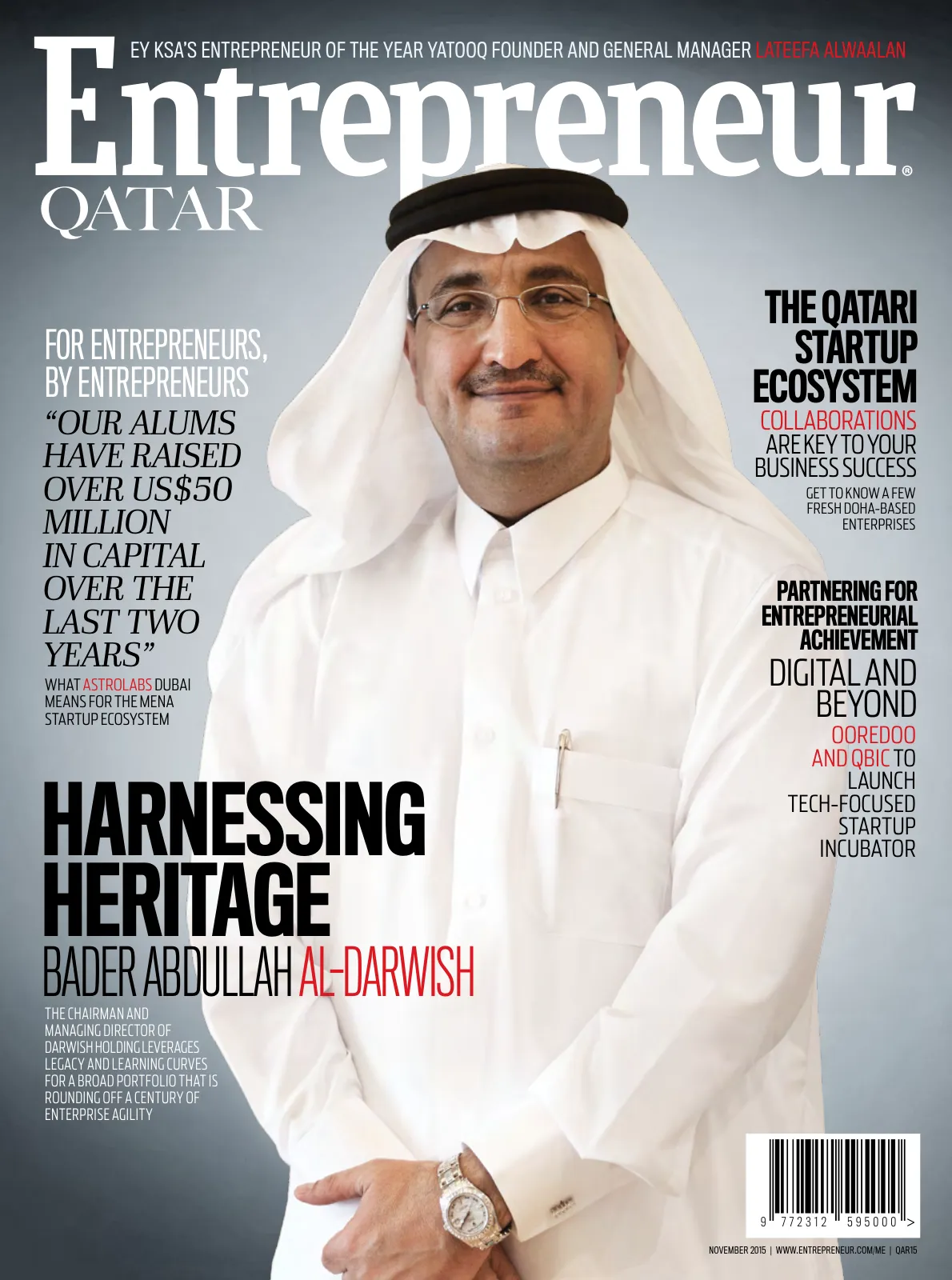
Entrepreneur Qatar, November 2015
Page 1
For entrepreneurs,
by entrepreneurs
What AstroLabs Dubai
means for the MENA
startup ecosystem
“Our alums
have raised
over US$50
million
in capital
over the
last two
years”
Partnering for
entrepreneurial
achievement
Digital and
Beyond
Ooredoo
and QBIC to
launch
tech-focused
startup
incubator
The Chairman and
Managing Director of
Darwish Holding leverages
legacy and learning curves
for a broad portfolio that is
rounding off a century of
enterprise agility
Bader Abdullah Al-Darwish
Harnessing
heritage
November 2015 | www.entrepreneur.com/me | QAR15
9
7 7 2 3 1 2
5 9 5 0 0 0 >
EY KSA’s Entrepreneur of the Year Yatooq Founder and General Manager Lateefa Alwaalan
The Qatari
startup
ecosystem
Collaborations
are key to your
business success
Get to know a few
fresh Doha-based
enterprises
Page 2
Entrepreneur november 2015
2
Page 3
CONTENTS
november 2015
20
Image from the private Al-Darwish
family archives.
30
EY KSA’s Entrepreneur
of the Year
Yatooq founder and
General Manager Lateefa
Alwaalan
34
‘TREPONOMICS:
PRO
Hot spots for budding
entrepreneurs
The top cities in the Middle
East for your business,
according to Bayt.com’s
Suhail Al-Masri.
38
SKILLSET
Thinking ahead
10 things managers should
factor into an innovation
process.
70
SKILLSET
Warren Buffet’s two list
strategy
How to maximize your
focus and master your
priorities, according to
Olympian and entrepreneur,
James Clear.
46
MARKETING
It’s time to get visual
The low-down on Instagram
advertising in the MENA
region.
74
START IT UP:
ECOSYSTEM
For entrepreneurs by
entrepreneurs
A look into what the new
Google for Entrepreneurs-
partnered AstroLabs Tech
Hub in Dubai means for the
MENA startup ecosystem.
24
SPECIAL SECTION
The Qatari startup
ecosystem
Collaborations are key to your
business success, and it’s time
to get to know a few fresh
Doha-based enterprises. Plus:
Ooredoo and QBIC partner to
launch Digital and Beyond!
16
INNOVATORS
Harnessing heritage
Bader Abdullah Al-Darwish
The Chairman and Managing
Director of Darwish Holding
leverages legacy and learning
curves for a broad portfolio
that is rounding off a century
of enterprise agility.
Bader Abdullah Al-Darwish,
Chairman and Managing
Director of Darwish Holding,
in an exclusive interview ahead
of the 2015 Qatar Enterprise
Agility Awards
16
Page 4
CONTENTS
november 2015
92 Jan Nigel Bladen coaches
you through surviving the
investor process
The Qatari startup
ecosystem:
Get to know a few fresh
Doha-based enterprises
24
50 #TamTalksTech:
Lenovo PHAB Plus
92
MONEY:
ASK THE MONEY GUY
Surviving the investor
selection process
A diamond is just a piece
of charcoal that handled
stress exceptionally well-
bluntness, honesty and
transparency are founder
virtues.
52
TECH:
THE FIX
Apple music strikes a chord
Could it be a music biz
trendsetter? After Apple
acquired Beats Electronics
during the summer of 2014,
it took just a few months for
people to speculate about the
companies motives were.
50
SHINY
#TamTalksTech
Gadgets and doodads
that you might’ve missed
out on, sourced by a tech
aficionado. Yes, it’s okay to
want them all… and no, it’s
not our fault.
14
EDITOR’S NOTE
By Fida Z. Chaaban
81
START IT UP:
Q + A
Shipping made easy
Fetchr circumvents
logistical challenges with
GPS-equipped app.
www.apple.com
Entrepreneur november 2015
4
Page 5
Page 6
Entrepreneur november 2015
6
CONTENTS
november 2015
88
START IT UP:
FINANCE
Cash crunch
Three hurdles Arab
entrepreneurs face when
gaining access to capital
(and how to get past
them).
54
CULTURE:
TRAPPINGS
‘Trep gear
The executive selection for
the entrepreneur on your
list that has everything.
Okay, maybe for a little
self-reward as well.
52 Apple Music strikes a chord
55
The Range
Rover Sport
SVR
The Conrad Dubai
41
59
LIFE
Team building time
Then opt for clues,
cryptology, and crime
scenes at either Escape
Quest or Hint Hunt. It
beats a day of golf!
64
LIFE
Five energy wasters
Mark Sephton says that
you need to get these
habits in check… and stop
sputtering at the finish
line.
56
TRAVEL
Meeting the needs of
smart travellers
The Conrad Dubai’s
General Manager, Andreas
Jersabeck, invests time in
the business guest.
Page 7
Page 8
Page 9
Page 10
Entrepreneur november 2015
10
SUBSCRIBE
Contact subscriptions@bncpublishing.net to receive
Entrepreneur Middle East every issue
EDITOR IN CHIEF Fida Z. Chaaban editor@bncpublishing.net
MANAGING DIRECTOR Walid Zok walid@bncpublishing.net
DIRECTOR Rabih Najm rabih@bncpublishing.net
DIRECTOR Wissam Younane wissam@bncpublishing.net
PUBLISHER Nehme Abouzeid
MANAGING EDITOR Aby Sam Thomas
CREATIVE LEAD Odette Kahwagi
ONLINE LIAISON Kareem Chehayeb
COLUMNIST Pamella de Leon
COLUMNIST Tamara Clarke
COLUMNIST Shoug Al Nafisi
PO Box 502511 Dubai, United Arab Emirates
P +971 4 4200 506 | F +971 4 4200 196
For all commercial enquiries related to
Entrepreneur Middle East contact
sales@bncpublishing.net
All rights reserved © 2015.
Opinions expressed are solely those of the contributors.
Entrepreneur Middle East and all subsidiary publications in
the MENA region are officially licensed exclusively to BNC
Publishing in tV MENA region by Entrepreneur Media Inc.
No part of this magazine may be reproduced or transmitted
in any form or by any means without written permission of
the publisher.
www.entrepreneur.com/me
Access fresh content daily on our website!
MIDDLE EAST
Printed by Raidy Emirates Printing Group LLC
www.raidy.com
EntMagazineME
@EntMagazineME | @Fida
Entrepreneur-me
EntrepreneurMiddleEast
EntMagazineME
EntMagazineME
EntMagazineME
Images used in Entrepreneur Middle East are credited when necessary. Attributed use of
copyrighted images with permission. All images not credited otherwise Shutterstock.
Amal Chaaban
Jan Nigel Bladen
James Clear
Lovrenc Kessler
Loulou Khazen-Baz
Ema Linaker
Suhail Al-Masri
Ross McCammon
Phabiola Menon
Soukaina Rachidi
May Rostom
Mark Sephton
Christian Turner
Erika Widen
CONTRIBUTING WRITERS
In addition to our print edition, we’re bringing you all sorts of industry news
on our web mediums. Joining us online means getting relevant business and
startup content in real-time, so you’re hearing about the latest developments
as soon as we do. We’re looking forward to interacting with our readers on
all of our social media and web platforms- like any thriving business, we’re
looking to give and take. #TrepTalkME is already happening on all of our digi
platforms, and all good conversations go both ways. See you on the web!
Page 11
THIS IS NOT
BUSINESS AS USUAL
ALL-NEW JAGUAR XF
THE ART OF PERFORMANCE
There’s nothing usual about the All-New Jaguar XF.
Distinctively Jaguar, its assertive design stands out from the crowd.
An unrivalled combination of steering response, refinement and
performance – this dynamic luxury business saloon delivers both
excitement and efficiency. All enhanced by state-of-the-art
technologies that keep you safe, connected and entertained.
In fact, you’ll find the All-New Jaguar XF is anything but expected.
jaguar-me.com
Page 12
Entrepreneur november 2015
12
I
often find myself acting as
a fixer. For those unfamiliar
with media-speak, the fixer is
the person that connects you
to someone else that might
otherwise be out of your reach. I
introduce people all of the time, and
I help them do business together
and get the ball rolling. I do this
because I find it worth my time,
and also good in a karmic sense. If I
can help two entities or two people
develop a mutually beneficial, fruitful
relationship, I consider it terrific for
everyone involved. I’ve been offered
paid commissions for this, and I have
declined every single time (mainly for
two reasons: because I don’t feel that
favors deserve financial recompense,
and also because I believe in helping
people out as much as I can). Now, I
have been very fortunate as most of
these favors have all come back to me
in spades when I most needed them.
I’m one of the lucky ones who seems
to get back what I give… but that’s
not always the case.
Recently, I noticed someone who
did a great favor for someone else
and then got completely excluded
after the fact. The backstory was that
Person A very much wanted an intro-
duction to Person C. Person B, a close
and personal friend of mine, was hap-
py to make this advantageous intro-
duction between Person A and Person
C, and agreed to act as the fixer.
Person B arranged the meet and greet
at no personal gain to themselves,
and Person A continued to leverage
this meeting for a long time afterward
conveniently forgetting who made
the introduction. The karmic payback
here? Person C reminded Person A
(publicly) of who set this relationship
up to begin with. What this whole
trivial matter indicated to me about
Person A was the following:
1. You lack a moral and ethical
compass, and you are short on
goodwill If you conveniently forget
the people who put you where you
are now, you are both ungrateful and
unethical. “Forgetting” favors makes
you a very undesirable business
acquaintance. This time you “forgot”
who facilitated an introduction. Next
time you’ll maybe “forget” an owed
sum.
2. You suffer from an inflated
ego, and you have a myopic
worldview If you think that you’ve
gotten so big now that you don’t need
to thank people, then perhaps the
public reminder from Person C put
you in check. This behavior is indica-
tive of your shortsighted vision, and
a lack of any actual strategy. Self-
promotion is a double-edged sword,
and you probably need to have some
humility when you decide to go that
route- and that includes remember-
ing favors.
3. You are willing to step
on your early supports to
(socially) climb higher You are
where you are now because your
good-intentioned early supporters
helped you get there. Be careful who
you decide to step on- there’s always
someone like me there to remind Per-
son A that you were only using them
as a gateway to what you see as big-
ger and better things. Oh, and those
bigger and better things? They don’t
come without Person A- as Person C
saw fit to remind you.
For those of you out there who have
helped me out (you know who you
are), I very much appreciate you. I
will always be there when you need
a hand, and I hope I’ve done all of
your support justice by showing you
respect and loyalty.
Fida Z. Chaaban
Editor in Chief
@fida | @fidazchaaban
editor@bncpublishing.net
EDITOR’S NOTE
Post your suggestions with the hashtag on Twitter or Instagram
@EntMagazineME
Do you know a MENA region entrepreneur, startup,
or SME that we should be watching?
#EntMETreps
It puts your whole ethical compass (or lack thereof)
into perspective for me
Thinking of cutting out
your middleman?
Page 13
GREAT SUCCESS
COMES FROM
GREAT SUPPORT.
At Qatar Financial Centre, we facilitate success. Offering ease of set up, an international legal environment
and access to growth markets, we’ll give your business the perfect platform for the region. Visit qfc.qa
Facilitating success.
Kami Rita Sherpa
LOCAL GUIDE
Page 14
Entrepreneur november 2015
14
IN THE LOOP
W
ith much
talk about
develop-
ing and
strength-
ening
SMEs in the MENA region,
we often forget that countries
across the globe have put that
on the top of their priority list
as well. That’s why it comes
as no surprise that Sweden
and the UAE have signed a
memorandum of understand-
ing (MoU) that will lead to
cooperation in R&D endeavors
targeting empowering SMEs
over a three-year period. The
MoU was signed by the UAE
Minister of Economy, H.E. Sul-
tan bin Saeed Al Mansouri, and
Sweden’s Minister of Enterprise
and Innovation, H.E. Mikael
Damberg during GITEX 2015.
The agreement will see SMEs
from both countries gain access
to funding prospects, as well as
discovering new international
market opportunities. We can
also expect UAE government
departments such as the SMEs
Council, the SME Fund, and
the Chamber of Commerce and
Industry to collaborate with
counterparts in Sweden, in-
cluding the Swedish Trade and
Invest Council and Sweden’s
“innovation agency,” known as
Vinnova. Sharing knowledge
and expertise in two very differ-
ent markets will be a huge boost
for both countries trying to
nurture their respective entre-
preneurial ecosystems, and will
help in the removal of obstacles
to SME growth. The two-nation
cooperation also hopes to draw
academic institutions and the
private sector into the core of
the effort to bolster SMEs.
When looking back at the period
of time that we refer to as the
Arab Spring, we often focus on
its problematic aspects, notably
power vacuums and potential
war. However, when it comes to
Tunisia, it’s safe to say that they
seemed to have handled things
pretty well during the transition
period. Five years after 27-year-
old Mohamed Bouazizi immo-
lated himself, Tunisia’s National
Dialogue Quartet, a coalition
consisting of lawyers, human
rights activists, businesspeople,
and leaders of labor unions, was
awarded the 2015 Nobel Peace
Prize for playing a pivotal role in
the country’s transition to a plu-
ralistic democracy. While many
speculated the possibility of a
Tunisian civil war after Zine El
Abidine Ben Ali was overthrown
after two decades in power, the
quartet has managed to defy all
odds. While Tunisia still has its
fair share of struggles, winning
the Nobel Peace Prize is only an
additional morale boost to its
citizens- and a reminder of the
perks of national unity.
Sweden and
UAE partner up
for SMEs
Tunisia National
Dialogue Quartet
awarded 2015
Nobel Peace Prize
Kellogg Company continues to
scoop up international brands to
widen its global market pres-
ence, most notably its acquisi-
tion ofPringles in February 2012
for US$2.7 billion. This time, it
acquired Egypt’s Mass Food Group
in $50 million deal. According
to its website, Mass Food Group,
a family business run by the El
Bahays, was founded 18 years ago.
The company has since expanded
to other markets in the MENA
region, Asia, and Australia with its
Temmy brand, exporting to “over
45 markets.” With such a large
market share, Kellogg claims that
the buyout won’t have an impact
on its annual profit and net earn-
ings this year.
Kellogg Company acquires
Egypt’s Mass Food Group
Under the auspices of The Prime
Minister and Interior Minister,
H.E. Sheikh Abdullah Bin Nasser
Bin Khalifa Al Thani, Qatar
International Boat Show (QIBS)
in its third edition will take place
from November 10-14 at the
Mourjan Marinas in Lusail City.
This edition of QIBS will be
significantly larger than previ-
ous ones, with over 120 brands
from 15 different countries
making their way to showcase
their boats, including Sea Ray,
Princess, Silver Yachts, Sunreef,
Ferreti, and Azimut. Qatari
brands will be there too, indi-
cating Qatar’s growth in their
maritime industry, including Al
Udeid Boats, Balhambar Boats,
Halul Boats, and Nakilat Damen
Shipyards Qatar. Registration is
now open.
Left: Rashid Hamad Al Marri, Nakilat
Damen Shipyards Qatar, Abdulaziz
Al Zeyara, Lusail Director of Strategic
and Organization Planning and
Development, and Essa Al Mannai,
Chairman of QIBS Board of Directors
The MoU was signed by H.E. Sultan bin Saeed Al Mansouri,
UAE Minister of Economy and H.E. Mikael Damberg, Sweden’s
Minister of Enterprise and Innovation
Qatar International Boat Show 2015
Page 15
Page 16
Entrepreneur november 2015
16
“For my business trading is
not a major share, but it’s the
part that I enjoy the most.
Most my business is real estate
and the stock market. We’re
not only in retail, we’re also in
wholesale. We have the biggest
market share for Rolex brand
in the Middle East. The same
applies to most of the luxury
brands we represent. We’ve
got Bosch, Bang & Olufsen…
Even if any large scale retail-
ers open, we have the product
lines to supply every type of
business.” And they do. The
list is long and varied, and
while the silos of the Holding
work synergistically in ways,
the revenue streams are very
different and demonstrate sus-
tained increases. “From 2003
to 2008, we made 40% annual
growth. In 2008, when the
market dropped, we did 20%
growth. Now on average, we’re
making 25% annual growth.”
Some of these relationships are
more than a half-century old,
meaning they outdate Bader
Al-Darwish himself. Darwish
Holding signed with cosmetics
and beauty staple L’Oréal in
1956, and with technology giant
Sony a few years later in 1964
(Bader Al-Darwish was only five
years old at the time)- it now
holds the biggest market share
for the household name. In his
expansive office, you can time
travel back to the founding of
what is now one of the GCC’s
most diversified portfolios, a
who’s who list of some of the
world’s best recognized brands
and most prestigious fashion
Houses. “We are the second
oldest agent of CHANEL in
innovator
The Chairman and Managing Director of Darwish Holding leverages
legacy and learning curves for a broad portfolio that is rounding off
a century of enterprise agility By Fida Chaaban
I
f you see pictures of Bader Al-Darwish, you might get the
impression that this Qatari leader of enterprise is a jovial fellow.
You might also assume that he’s laidback, and young at heart.
He is, in fact, all of those things. The many images of Al-Darwish
do capture those aspects of his personality well, but what they
don’t tell you is that he’s got an eagle-eye on his many businesses
(“Every morning at 7:30 a.m. I examine my updated figures,” a
tally of the sales of the many-tiered conglomerate), he’s hyperactive
in his maintenance of strong corporate relationships (“They are the most
important thing in doing business!”), and that he’s got a frighteningly sharp
memory (off the top of his head, he can tell you what milestones the company
reached and when- in minute detail). There’s another thing that Al-Darwish’s
pictures don’t tell you- he is fiercely for the free market, welcoming competition
with relish. After all, Darwish Holding was there first, and, as he rightfully
points out, it isn’t just a one-sided operation.
Bader Abdullah Al-Darwish
Harnessing
heritage
>>>
Page 17
november 2015 Entrepreneur
17
“My father earned his
respect across the GCC
by keeping his word,
and working hard.
When I took over the
business, I didn’t just
live on that legacy
that my father built as
a base.”
Page 18
Entrepreneur november 2015
18
Work-life
balance is
important-
I try to spend
the weekends
with my
FAMILY, and
I dedicate
vacations
to building
bonds with
them. It’s all
about time
management.”
innovator
Entrepreneur november 2015
18
“
Page 19
november 2015 Entrepreneur
19
the world whom we signed with
in 1954, and the oldest agent of
Rolex in the Middle East- we
signed with them in 1951.” A
current example of company
influence and strength? Despite
the country’s small population,
Darwish Holding’s relationship
with fashion designer Carolina
Herrera is relevant enough
to warrant personal visits by
the elegant designer (together
with her daughter), and just
one month ago, the Herrera
House’s CEO, François Kress,
was welcomed by Al-Darwish
in Doha as well. Another show
of relationship strength?
CHANEL’s co-owner, Gerard
Wertheimer and Rolex’s CEO,
Jean-Frederic Dufour, were
hosted by Al-Darwish recently
in his residence in Doha.
To really understand how deep
Al-Darwish’s enterprise roots
go, you’ll need to know how it
all started. Think about Qatar
back in the 20s –I admired the
family’s present-day achieve-
ments even more after seeing
historic images from that pe-
riod in the Al-Darwish private
archive- and then think what
it was like launching a busi-
ness for Abdullah Al-Darwish
Fakhroo, Bader Al-Darwish’s
late father. As a young man, Al-
Darwish senior, together with
his brothers Jassim and Abdul-
rahman, set out across what is
currently known as the GCC to
trade and stake their claims.
These forays into present-day
Saudi Arabia, Bahrain, UAE, and
other nations (first with wares
like pearls) eventually led to
expanding into contracting, au-
tomobiles, airlines, real estate,
financial trading, and oil and
gas… and along the way nurtur-
ing rich relationships that the
junior Al-Darwish brothers
cultivated into the next genera-
tion, and he assures me that
their children after them will
be following suit. “We’re more
than 100 years old,” explains
Al-Darwish with a measure
of familiar pride tinged with
sadness, gesturing to carefully
preserved images. “Here is my
father, God rest his soul, with
Sheikh Abdullah bin Jassim
[bin Mohammad Al-Thani],
and President Anwar Sadat [of
Egypt]. That’s my father here
with King Fahd bin Abdulaziz
Al Saud and Sheikh Khalifa
bin Hamad Al-Thani in Qatar.”
These are just a few examples of
the Al-Darwish legacy that built
the foundations of the business
that today includes MENA, Eu-
ropean and North American real
estate, stocks and investments,
and a consumer facing side of
retail, in addition to interests in
banking and finance.
Some of these long-term, close
relationships extend into Eu-
rope and Asia, and Al-Darwish’s
memories cross decades of vis-
its to Japan. These images also
reflect the degree of importance
and the personal attention that
these global conglomerates
Abdullah Al-Darwish with King Fahd bin Abdulaziz Al Saud and Sheikh Khalifa bin
Hamad Al-Thani in Qatar
Fifty One East
campaign image
Lagoona Mall in Doha, Qatar
>>>
Page 20
Entrepreneur november 2015
20
shower on Darwish Holding; in
all of the pictures, it’s always
the brand founders or group
CEOs next to the perpetually
pleasant Al-Darwish. To put
this into perspective for you,
it’s not often that the founder of
a company like Sony sets aside
time to entertain a guest, and
back in the 60s and 70s they
almost never made journeys
to places as far-flung as Qatar.
“Here in this picture, it’s worth
mentioning that we signed the
biggest broadcast deal in the
history of Sony with the global
multimedia conglomerate, Al
Jazeera Media Network,” he
says, pointing at a fairly recent
image. Nowadays, it’s a simple
thing to get in and out of Qatar
in the span of 24 hours from
pretty much anywhere, but
back when a young Al-Darwish
was welcoming these leaders
of industry, it was a rare and
difficult thing to journey to the
middle of the desert to a coun-
try that the global community
really didn’t know of. He’s also
hobnobbed with heads of state
across too many countries
to list here, and his de facto
ambassadorial role is perhaps
one reason that Al-Darwish was
honored by the likes of Qatar’s
H.H. Sheikh Hamad Bin Khalifa
Al Thani “the Father Emir”,
UAE’s H.H. Sheikh Mohammed
bin Rashid Al Maktoum, and
even by former Lebanese Presi-
dent Emile Lahoud. In a profes-
sional capacity, Al-Darwish
is officially the Chairman and
Managing Director of Darwish
Holding, but he also sits on the
board of Qatar National Bank,
and he acts as an official Mem-
ber of the Executive
Committee.
In addition to serv-
ing in the afore-
mentioned official
roles, Al-Darwish
has given of his time
for national and
regional interests.
In some of his most
notable roles, he
acted as the Chair-
man of the Committee of the
International Fund for Higher
Education in Iraq, formed
by H.H. Sheikha Mozah bint
Nasser Al Misnad and a Board
Member of the Supreme Educa-
tion Council. But all of these
achievements -businesswise,
in the spirit of patriotism, and
his devotion to philanthropic
interests- haven’t sent Al-
Darwish into complacency. In
fact, it’s just the opposite, and
spending two hours with him is
more than enough to convince
you. “My challenge is to always
maintain this double digit
growth now, and in the future.
The drop in price of oil will not
affect negatively because of the
surplus that governments of
the GCC took into considera-
tion. It will not stop projects
but it may cause some delay and
enforce wiser spending. This
phase might shake some traders
whom i unfortunately refer to
as cowboys who took advantage
and wanted to grow for the
sake of growing. Expanding for
the sake of expanding doesn’t
appeal to us- before we take on
a new brand, we execute due
diligence.” He says that this
filtering process acted as the
great equalizer; in Al-Darwish’s
opinion, it restored the natural
order of things- and the result
was that serious and dedicated
businesses stayed the course,
while fly by night endeavors in
Qatar went out the window.
And regarding the current GCC
conversation of a luxury over-
supply, Al-Darwish says that
like anything, measured growth,
due diligence, and a realistic
evaluation of the respective
market potentials. “The sky is
the limit, and the opportunity
is there- but for those that have
creativity. Do execute feasibil-
ity studies- is there room in
the market for your business?”
There is, he says- and his con-
sistent upward growth is proof
positive for those that need to
see it.
innovator
“My challenge is to
always maintain this
double-digit growth
now, and in the future.”
Bader Abdullah Al-Darwish, Khaled Suleiman Saleh Al-Olayan, H.H. Sheikh Mohammed Bin Rashid Al-Maktoum,
and Abdulaziz Al-Babtain taken at Sheikh Mohammed’s majlis
Image from the private Al-Darwish family archives
Page 21
“As part of our organizational culture, Dar-
wish Holding has placed a major emphasis
on contributing to society, and engaging with
the local community. It’s an ethos that was
instilled by the founder, my late father, Abdul-
lah Al-Darwish. Every division of [the com-
pany] invests time, effort, and resources to
make meaningful contributions across sports,
academic, healthcare and social initiatives.”
As part of Darwish Holding’s core value
system, the group consistently strives to back
activities that positively impact environment,
society, and the nation. Participation in
sports and wellness is key, including the
support of the Qatar Exxon Mobil Open,
the Emir Cup, and the Qatar Total Open. In
terms of academic-centric initiatives, they
provide educational avenues to worthy
candidates via the Abdullah Al Darwish
Scholarships for Weill Cornell Medical
College, and the Abdullah Al Darwish Prize
for Young Researches in Islamic Studies.
Working particularly with children and elderly,
Darwish Holding also donates to local and
international orphanages and nursing homes
including ones in Lebanon and France. In
addition, the company actively supports
community-oriented programs such as
Lagoona Mall’s backing of Autism awareness
in collaboration with IFC, and Shaffalah, the
Sony brand’s work with the Qatar Foundation
for Elderly People Care, amongst others.
Darwish Holding invests
in CSR
Doing business responsibly
means giving back
to your community
“I love what I do. I have a great
team, and they’re like my family.
I think with time and experience
you learn to trust people who are
qualified to run the business. Give
people time, and then you will see
if they deliver or not. Seeing is
believing, and when I see someone
that I’ve designated a job to
delivering on his work, then bigger
responsibilities are given.”
1. GAIN EVERYTHING YOU CAN
FROM MENTORSHIP
“Frankly, when I was very, very
young, I hated touring with my
father doing business. He used
to force me to go- I wanted to be
out playing football. It taught me
discipline, patience, and respect.
Sometimes, I would sit for hours
with my father during when he
was doing business, all over the
Gulf! I was a young adult when
my father passed away in 1986,
and he was 70. That taught me
responsibility early on, I was de-
termined to grow the business and
make it successful- he planted the
seed and all the business needed
at that time was someone to ferti-
lize it and grow it. Through daring
but calculated moves, thank God
we managed to do it.”
2. PROTECT PERSONAL AND
PROFESSIONAL RELATIONSHIPS
“My father and his brothers cre-
ated this business empire. The
secret of success of my father
and both of my uncles rests in
relationships; there is almost
nothing more important than this
for you to succeed. My father had
very strong relationships with
ruling families inside and outside
of Qatar and he earned his respect
across the GCC by keeping his
word, and working hard. When
I took over the business, I didn’t
just live on that legacy that my
father built as a base. My father
said, ‘Son, it’s very hard to build
a name and a reputation, but it’s
very easy to ruin it.’ What I inherit-
ed from his wise experience stayed
with me through everything. This
is why I took over those relation-
ships, and I hope that I could
further strengthen them leading
to excellent relationships with our
partners, our distributors, and our
customers.”
3. CONTINUOUSLY REEVALUATE
THE STATUS QUO
“My grandfather started humbly
over 100 years ago, and now,
where we are, we continue to
modernize and develop on pace
with globalization. I hate to say
we’ve reached the peak- no.
Instead, we need to see any
mistakes, learn from them, and
assess the future of what we’re
facing. It’s very easy to say, ‘We
reached the peak- we have excel-
lent market share and history,’ but
to continue upwards, you must
always do better. We will continue
to innovate internal processes, and
bring operations up to more suc-
cessful reaches. Even in corporate
governance we have strong proce-
dures, but something can always
be improved.”
4. MASTER TIME MANAGEMENT
“To succeed, you must know how
to control time, and make up your
mind quickly so you can take the
next step. If I want to finish busi-
ness, I would give it to someone
who is busy, and who knows
with experience that time is very
important for them. If you give it
to someone who is semi-retired,
it will take him ages to make up
his mind. Busy people who master
time are productive.”
5. TAKING OVER THE FAMILY BIZ
“Try your best to follow your
forefathers’ footsteps, take the
business and grow it- don’t just
be satisfied. To the young GCC
youth: be pragmatic, be realistic,
and forget your ego. Put it aside,
and keep learning. If you make a
mistake, think positive, and learn
what can be done different and
better. Set goals for your business,
but within reason so that you can
achieve. You have to believe in
what you’re doing.”
6. DO YOUR OWN RESEARCH AND
ANALYSIS
“Rely on capable people but at
the same time, you need to do
your own follow up. You need to
delegate, yes, but the responsibil-
ity of follow up is solely on you.
Never completely depend on
anyone but yourself if you want to
succeed.”
Bader Al-Darwish walks the walk
Run your business like a leader,
not a manager
THE EXECUTIVE SUMMARY
Fifty One East
campaign image
Page 22
Entrepreneur november 2015
22
start it up
ecosystem | who’s got VC | Q&A | STARTUP FINANCE
The lucky startups that benefit
from this incubator start with
seed funding from Ooredoo.
QBIC is also willing to splash
cash, allowing the startups
to connect with partners and
affiliates, notably the Social
Development Center and Qatar
Development Bank (QDB).
Setting money aside, the
startups will receive all sorts
of mentoring support from
industry specialists. As for the
workspaces? Top notch. The
251 sq. m. space will be within
QBIC, and be managed by
Ooredoo. Digital and Beyond
will have three zones, designed
specifically for startups. The
first zone will be a collabora-
tion zone that allows startups
to network, share ideas, and
work together; the second zone
comprises of private spaces
for meetings; and lastly, a
community zone: ‘treps need a
break too!
Could this incubator be the
“Silicon Valley” that takes Qa-
tar’s entrepreneurial ecosys-
Ooredoo and QBIC to launch tech-focused
startup incubator By Kareem Chehayeb
S
MEs in Qatar will be happy to hear about
this: Qatari telecom giant Ooredoo has
signed an agreement with the Qatar
Business Incubation Center (QBIC) to
launch an incubator catering to startups
in the booming GCC state, especially in
the tech sector. After announcing the
incubator, called Digital and Beyond, they
also announced a contest, calling on entrepreneurs across
the country to pitch their ideas, with Ooredoo to pick the
most “disruptive” ideas from the submissions.
Partnering
for entrepreneurial
achievement
www.qbic.qa
Empowering entrepreneurs
Aysha Al Mudahka, CEO, QBIC
program, which provides real
world, hands-on, learning ex-
perience on how to successfully
start a business. The 10-week
program is based on a business
model rather than a business
plan, and encourages entrepre-
neurs to develop a prototype,
which needs to be constantly
improved, as opposed to going
big with the final product at
the very beginning. Once the
business idea and prototype is
refined and developed, entre-
preneurs pitch for a chance to
be incubated and supported
financially by QBIC. Once the
startups become incubated,
they receive smart financing,
coaching and mentoring, office
space, and networking oppor-
tunities from within QBIC.
“Qatar Business Incubation
Centre (QBIC) sees Qatar’s
entrepreneurs today as the fu-
ture of Qatari business success
and economic growth,” says Al
Mudahka. “QBIC is here to help
new startups and SMEs in Qa-
tar to achieve solid success. In
an attempt to develop the local
private sector, QBIC is paving
the way for aspiring entrepre-
neurs to realize their ideas and
see them grow.”
As the CEO of Qatar Business
Incubation Center (QBIC), Aysha
Al Mudahka is emphatic on
the importance of homegrown
entrepreneurs in the overall de-
velopment of Qatar as a nation.
“Entrepreneurship underpins the
country’s National Vision 2030,
and by supporting SMEs to grow
and achieve solid success, QBIC
is creating the next generation
of Qatari business leaders,” she
says. “It’s important for Qatar to
support entrepreneurs as per the
National Vision; having a notable
and strong private sector will play
a role in the local, regional and
international market, and thus it
is vital to support entrepreneurs
to successfully kick off with the
facilities at hand.”
QBIC’s flagship Lean Startup
Program is an entrepreneurial
tem to a new level? Looks like
it. With Digital and Beyond,
many young Qatari entrepre-
neurs are going to be keen to
take advantage of the oppor-
tunity it presents. Not only
that, it will also provide more
opportunities for Ooredoo to
expand its ventures as well.
Qatar is already working hard
on improving its entrepreneur-
ial ecosystem, whether it’s by
improving its tech infrastruc-
ture or setting up stronger
educational facilities. One
thing is for sure: we should ex-
pect to see an impressive ROI
in Qatar in the future.
Waleed Al Sayed, Chief Operating Officer, Ooredoo Qatar, Sheikh Saud bin Nasser Al Thani, CEO, Ooredoo Qatar,
Abdulaziz Bin Nasser Al Khalifa, QDB CEO and QBIC Chairman, and Aysha Al Mudahka, QBIC, CEO
Page 23
Page 24
Entrepreneur november 2015
24
EVENTLY
www.evently.qa
“Evently was launched in
March 2014 on an Android
platform,” says Fawaz Mo-
hammed, who founded the
app with Mufeed Ahmed,
Nasser Al Naama and Aisha
Al Naama. “Today, we are
available on Android, iOS,
and Blackberry 10, with more
than 12,000 downloads. We
have covered more than 600
events. and done more than
two dozen event partner-
ships.”
When asked how Evently
was conceived, Nasser Al
Naama explains how Qatar
hosts a large number of global
events, and a great number of
those events lack publicity.
In fact, various companies in
Doha bring prominent speak-
ers and organize free work-
shops every year, which are
often sponsored by the host
company, and the community
isn’t aware of a public event
taking place. “Evently lists all
these events,” Al Naama says.
“What makes Evently unique
is the category of event infor-
mation it offers. While other
websites lists the nightlife
and food events, Evently lists
events in arts and culture,
technology, sports and fit-
ness, conferences, workshops,
entertainment, and more.”
Aisha Al Naama, who is
Nasser’s sibling, highlights
that Evently does not adver-
tise on its app, since they
believe in a smooth user
experience. “We generate
money by listing events on
the featured header in the
app,” she says. “We list events
for free, but to get a space in
the featured header for their
events, the event companies,
their PR companies or the or-
ganizer pay us… As a startup,
we heavily rely on social
media for our marketing as
well as other organizations,
which support events as well
as entrepreneurship.”
By Erika Widen & Kareem Chehayeb
ecosystem | who’s got VC | Q&A | STARTUP FINANCE
start it up
I
f the recent spate of agreements signed between the Qatar Business Incubation
Center (QBIC) and major Qatari and global business entities such as Ooredoo,
Microsoft, Al Jazeera Media Network, etc. are any indication, then it’s safe
to say that the country is making a concerted attempt at boosting the
entrepreneurial ecosystem within its borders. And the results of these efforts
are already starting to show- Qatari startups are sprouting by the dozen, and given
QBIC’s mission to develop Qatari companies valued at QAR100 million, the Middle
East business arena is sitting up and taking note of them as well. Here’s a selection
of the new wave of Qatari enterprises that have caught our eye.
Get to know a few fresh Doha-based enterprises
Collaborations
are key to
your business
success
The Qatari startup
ecosystem
Nasser Al Naama,
co-founder of Qubicle,
Evently, Catlogram
Aisha
Al Naama
Entrepreneur november 2015
24
Page 25
november 2015 Entrepreneur
25
QUBICLE
www.qubicle.me
Qubicle is a web and mobile
design agency that also offers
e-commerce solutions and
digital marketing- and it was
founded by the same team
as that of Evently. “Qubicle
was born when our first app,
Evently, was about to be
incubated at ictQatar,” says
Mufeed Ahmed. “It was dif-
ficult to find a local company
at affordable rates. Outsourc-
ing development of a tech
startup didn’t make sense,
as we needed to be involved
with each aspect of the
product. So, we registered
Qubicle under our incuba-
tion at ictQatar, as to develop
a system with a vision to
help future startups in Qatar
to get development done lo-
cally at affordable rates.”
Nasser Al Naama, co-
founder of Qubicle, adds,
“Like every fast developing
economy, Qatar’s businesses
are going online. This means
there are startups estab-
lished for a couple of years in
various sectors who want to
take their businesses online,
but do not have the technical
skills to develop the prod-
uct.” Al Naama describes
how they are working with
Qatari entrepreneurs in
expanding their fashion and
trading businesses online.
“Since we have the support
and facilities provided by the
Digital Incubation Centre, we
are able to do it at an afford-
able rate, but one that is still
profitable for us.”
In Qatar, there is a vast
divide between idea to execu-
tion when it comes to es-
tablishing a proper website.
“This is because most of the
business ideas young people
come up with today have
a huge side of technology
involvement, and to execute
it, you need a team of devel-
opers and designers, which
is hard to find in Doha.”
Qubicle is thus largely filling
the gap by working closely
with young Qatari entrepre-
neurs who have an idea and
want to take it to the next
level. Qubicle was officially
launched at the beginning
of this year at the ictQatar
Digital Incubation Centre.
“Qubicle was bootstrapped
and self-funded; ictQatar
provided us with all the
facilities in terms of space
and mentoring required. We
are on a two-year incubation
term with ictQatar,” says Al
Naama. >>>
Mufeed Ahmed, co-founder
of Evently, Qubicle,
Catlogram, Doha Tweetups,
and Washnow
Page 26
Entrepreneur november 2015
26
CATLOGRAM
www.catlogram.com
Catlogram, a startup that
is aiming for a November
launch, is an online platform
devoted to designing market-
ing collateral such as flyers,
brochures, catalogs and
posters for businesses. The
motto of Catlogram is “Do it
yourself”- meaning it is easy
to use and industry-specific.
Readers will also find the
team behind Catlogram famil-
iar- they are the same faces
behind Evently and Qubicle.
“Catlogram was selected to
the second wave of QBIC’s
Lean Startup program,”
says Aisha Al Naama. “In
December 2014, Catlogram
was incubated on QBIC’s
famous Demo Day. We also
were given the Public Choice
Award on the same day. We
started with QBIC officially in
April 2015, and have access
to office, mentors, mentor-
ship program and funding.
QBIC is like a big family.”
With regards to the thought
process behind Catlogram,
Mufeed Ahmed says that hav-
ing been a part of the design
industry since 2007, he saw
that people wanted to have
the power to design with-
out having to depend on a
particular design software. “I
came across various entrepre-
neurs, small organizations,
product managers and small
retail owners, depending
heavily on a design or design
agency every time they have
to design a marketing collat-
eral,” he remembers. “Catlo-
gram was born out of this.”
Catlogram’s main design
templates fall under five
specific industries, which
include home-based busi-
nesses, artists, restaurants/
cafés, university student life,
and health coach coordinator.
“Catlogram helps those [five
categories] with our beautiful
templates and super-friendly
user experience to achieve
their marketing and designing
needs in less time without
compromising the quality and
creativity,” Ahmed explains.
“If you take a look at our
startups, it’s all more about
using technology to make
lives and business easy, and
save time. We believe time is
to be spent with friends and
family, and every other pro-
cess related to work or busi-
ness should have an easy way
and can done in less time.”
DOHA TWEETUPS
www.dohatweetups.com
Doha Tweetups is an online
community that regularly
hosts offline events with the
basic purpose of networking
and bringing people together.
During such events, which
are hosted at least once every
month, members of the com-
munity hold three themed
presentations, which have
become known as a showcase
of local talent in the region.
Since its launch in 2010,
more than 300 people have
attended Doha Tweetups
events. “We started as a
community of social media
users, but have grown to a
strong presence in Qatar
where brands, organizations
and even diplomats use us to
connect to the social media
users of the country,” says
Mufeed Ahmed, who, in 2010,
joined the Doha Tweetups
team, founded by Hani Arif
and Bilal Randeree. “My part
was mainly to bring strategic
partners on board and mon-
etize this as a social enter-
prise, which we successfully
are now.”
ecosystem | who’s got VC | Q&A | STARTUP FINANCE
start it up
Catlogram
design
templates
Mufeed Ahmed
Page 27
november 2015 Entrepreneur
27
Last year, Mufeed Ahmed
received a recognition award
for the best mentor by Shell
and Qatar Development Bank,
Chief Executive Officers. He
is heavily involved with the
entrepreneurial ecosystem in
Qatar; mentoring technology
startups and speaking about
entrepreneurship and tech
startups.
WASHNOW
www.washnow.me
Washnow came out of an
idea conceived by Ameer K.
V., a young Indian entrepre-
neur who has been in the
dry-cleaning and laundry
business in Doha for nearly
eight years. Mufeed Ahmed
and Rahid Kader are the
mentors and investors in
the Washnow application.
What is Washnow? “An on-
demand laundry app,” replies
Ameer, founder and Head
of Operations. “It requires
a good technology company
behind it, as well as a strong
dry-cleaning infrastructure to
deliver on time and with good
quality– the three of us came
as a perfect combination.”
Washnow was launched in
August, and it currently has
more than 200 customers. In
the weeks since its launch,
the founding team have been
able to enhance their delivery
time from 72 hours to less
than 48 hours. “Customer
interactions happen everyday,
different versions of Wash-
now are released on the user
app as well as the business
app to make the interactions
and process automated,”
Ameer says. “This wouldn’t
have been possible without
the support of these two tech
entrepreneurs. It’s a build,
measure, learn process.”
Interesting aside though:
Ahmed and Kader –who are
graduates of the 10-week
Lean Startup Program by
QBIC- helped develop the
Washnow app in just 10 days.
At present, Washnow is the
only on-demand laundry ser-
vice in Qatar. “This means big
for expats, because it’s about
saving them the traffic and
parking trouble,” says Ameer.
EGRAB
www.egrab.qa
Shopping for groceries is a
chore that most of us would
like to avoid as much as we
can. But if you happen to be
in Doha, there is an alterna-
tive approach to getting this
task done: by logging on to
egrab.qa. The main mission of
eGrab is to provide the best
delivery experience by using
the available hypermarkets
and limo drivers. “The gro-
ceries come from reputable
hypermarkets in town,” says
eGrab’s founder, Rahid Kader.
“Some of the hypermarkets
are affiliated with eGrab and
with some others we just do
delivery from the hypermar-
ket for an extra fee. At most
times, customers get store
prices, and the majority of
our clients are expatriates.”
Kader was inspired to
start the web platform after
noticing “the pain that both
customers and retailers have”
while working with the retail
industry. Before his experi-
ence in this industry, this
Doha-based ‘trep from India
spent his college years gearing
up to be a physical therapist.
Having said that, eGrab isn’t
Kader’s first venture- he had
previously started a venture
dealing with “retail loss pre-
vention systems integration”
right after moving to Doha in
2008.
At this point, eGrab, de-
veloped with Kader’s Qatari
partner Ali Al Malki, has
already partnered up with
“some A-class hypermarkets,”
meaning that customers
can already enjoy its ser-
vices to deliver groceries to
their homes. It’s an efficient
system, which means that
eGrab’s full-time workforce
is minimal, and they don’t
need to manage inventories.
So with that said, what was
eGrab’s development process
like? “Technically, we had
some challenges in finding
resources at first,” says Kader,
who also notes that eGrab
was mentored by the Qatar
Business Incubation Center
(QBIC). He admits it was hard
to find people who he thought
would be right for the busi-
ness- he needed staff that had
the “startup mindset.” In ad-
dition, most professionals in
Qatar were there on existing
work visas, which made it all
the more difficult to find indi-
viduals ready to work at >>>
Ameer KV,
Founder
and Head of
Operations
of Washnow
Page 28
Entrepreneur november 2015
28
ecosystem | who’s got VC | Q&A | STARTUP FINANCE
start it up
ecosystem | who’s got VC | Q&A | STARTUP FINANCE
start it up
his enterprise. Having said
that, Kader gives credit to
the Internet for helping him
learn new skills, as he had to
multitask his way through a
few hurdles.
Things did eventually
improve after Kader and his
team developed a minimum
viable product, and had
people test it. After receiving
feedback, they tweaked their
product, and now, here they
are! While eGrab has competi-
tion, Rahid Kader is confident
that his service stands out
with its “robust backend en-
gine,” which has been devel-
oped using what he describes
as “the best of algorithms.”
Another sign of better things
to come is that while eGrab
enjoys funding from QBIC,
the founder claims that he is
also “in talks with some great
angel investors.” Marketing is
always important, especially
for a startup, and Kader has
indeed kept that in mind for
his venture. “We have a mar-
keting strategy in place until
our next round of funding
using referral programs, social
media marketing, and in-store
promotions with affiliated
hypermarkets,” he explains,
elaborating the importance
of social media. His favorite
among social media plat-
forms? He prefers Facebook
and Twitter, given their large
user bases.
So what’s next? First of all,
eGrab is going to be kicked
up a notch. The founder is
very excited to announce that
the platform’s users can now
keep “track of their deliveries
in real-time.” With respect
to medium- and long-term
plans, Kader already has his
eyes set on expansion. In fact,
creating a simple platform
that can easily adapt to
other locations is something
he prioritized with eGrab’s
development from the start.
“We can scale across GCC in
less than four weeks,” Kader
claims, adding that it would
take about two months to
settle outside of the GCC.
That said, he reiterates that
expansion is currently only in
the preliminary stages, and it
will not probably happen in
the near future.
I decided to take a small step
back from eGrab, and ask Ra-
hid Kader about Doha and its
startup ecosystem. After all,
he’s not a stranger to Qatar’s
capital, and has been part of
the city for almost a decade.
He credits Qatar’s growth in
this space to the rise of “in-
cubation centers,
startup accelera-
tors” and the like,
with Kader giving
a special mention
to QBIC. With that
optimistic outlook
on Doha’s entre-
preneurial eco-
system, I wasn’t
surprised when
he shared with me
his plans to start
a new venture that he claims
will serve retailer needs. As
for Qatar’s e-commerce and
m-commerce industries,
Kader thinks that the latter
will be adopted faster than
the former. With respect to
e-commerce, he believes that
while it has been a slow adop-
tion process for Qatar’s popu-
lation to begin using debit and
credit cards in online transac-
tions, the trend has been
increasing. That said, even
though m-commerce is still
laying its foundation, many
‘treps and microbusinesses
are now using platforms like
Instagram to sell products.
Kader claims that “Instagram
sales are booming,” and that
“the future is mobile.” He too
believes that mobile is “Web
3.0,” as once described at
ArabNet Beirut 2015.
And Kader’s advice to young
and aspiring entrepreneurs?
“If you have an idea, validate
that idea and never wait to
make it perfect. If it’s perfect,
it’s too late.” Any other busi-
ness advice? “Build your
product according to what a
customer needs.”
Rahid Kader,
Founder, eGrab
Page 29
november 2015 Entrepreneur
29
Mufeed Ahmed, a Qatar-based tech
entrepreneur, and co-founder of
Evently, an events application startup
incubated by the Ministry of Incuba-
tion and Communication Technology
(ictQatar), also has a second startup.
Catlogram, dedicated to design and
develop brochures and catalogs, is in-
cubated and funded by Qatar Business
Incubation Centre (QBIC). Apart from
startups, Ahmed handles strategic
partnerships at Doha Tweetups, a
social enterprise and a powerful media
that is used by organizations, brands
(and recently diplomats) to connect to
the online community within Qatar. In
addition, he also heads Qubicle, a web
and mobile app development company
at the Digital Incubation Centre, MICT
Qatar. Given his many entrepreneurial
endeavors, it should come as no sur-
prise that his passion for technology
and mobile won him and his team
top positions twice at the Startup
Weekend Doha. His team also earned
third place for the Technology Most
Beneficial to Users Award at the QSTP
MIT Medicine Hackathon.
Ahmed advices inspiring entrepre-
neurs to execute and launch an idea, as
he believes an idea without execution
is useless. “Identify and admit the
flaws in your own ability or skills, and
surround yourself with people who
can support your company in those
areas where you lack skills. Don’t try to
run a one-man show in fear of losing
some percentage of your company to
a co-founder. It’s good to have 5% of
a billion dollar company than to have
100% of a company that fails.”
Mufeed Ahmed
Entrepreneur in the spotlight
Mufeed Ahmed,
co-founder of Evently,
Qubicle, Catlogram,
Doha Tweetups, and
Washnow
Page 30
Entrepreneur november 2015
30
innovator
I
f you have not heard
of Lateefa Alwaalan
yet, rest assured that
you’ll be hearing a lot
more about her soon-
especially since she
was recently awarded
the title of Saudi Entrepreneur
of the Year at the 2015 EY
KSA Awards in Riyadh. As the
founder and General Manager
of Yatooq, a startup focused on
Arabic coffee and the products
associated with it, Alwaalan’s
successes help to set the stage in
the Kingdom for women looking
to advance in entrepreneur-
ship, as well as leaps forward in
e-commerce. “It has been such
a humbling experience,” says
Alwaalan, when asked about her
distinction. “It also raises the
bar for me and my team to reach
greater goals. [Being a part of]
the awards ceremony has been
such a rewarding experience; I
met world-renowned entrepre-
neurs that I used to read about
and [about] their companies as
a young girl, like the founders
of Infosys and Aramex. It’s like
being among celebrities- I was
truly humbled to be among such
an inspiring group of achievers.”
The EY Award was presented
to her by Dr. Tawfiq bin Fawzan
Al-Rabee’a, the Saudi Arabian
Minister of Commerce and In-
dustry, known to be a champion
of the entrepreneurial ecosys-
tem and often mentioned by the
Kingdom’s influential youth as a
trailblazer.
Enterprising youth, seeing
Alwaalan’s success, might be
inspired to try their hand at en-
trepreneurship, especially since
Yatooq was a self-funded ven-
ture, with Alwaalan using both
her own resources and bank
loans to get the company off the
ground. Ideation phase began in
2009, and Yatooq was officially
founded two years later. “We
had a long period of research
and development with soft sales
in the beginning,” she remem-
bers. “We launched our first
coffee machine in 2013, and that
is when the real action started,
igniting business growth.” Her
business, focused on the coffee
sector, currently employs 75
people between the local team
and company partners, with
locations mainly in Saudi Arabia
and China. As Yatooq scaled, Al-
waalan was able to increase the
size of her staff, allowing her to
delegate, enhance the startup’s
structure, and subsequently
focus on ensuring work-life bal-
ance, which, she admits, >>>
Lateefa Alwaalan Yatooq Founder and General Manager
EY KSA’s Entrepreneur
of the Year
Page 31
facebook.com/NissanME
/NissanME
nissanpatrol-me.com
THE NEW NISSAN PATROL
CONQUER YOUR LUXURIOUS SIDE
One look is good, but a double take is what we all want in life. Patrol’s premium interior
and refined exterior means you are always the one that others are looking out for.
The Hero of all terrains in life
Stylish New Look | Premium Interior | Advanced Technology
SALEH AL HAMAD AL MANA CO. (Exclusive Agent)
Main Showroom: Salwa: Tel: 4428 3333, Al Sadd Showroom: Tel: 4444 1334, Bin Omran Showroom: Tel: 4488 8618
Showroom Timings: 8:00am to 9:00pm (Sat-Thu); 4:00pm to 9:00pm (Fri).
Page 32
Entrepreneur november 2015
32
Q&A
What are some
stereotypes that you
have dealt with as a
woman in business?
“Well, mostly, women are not
usually seen in trade related
roles. Generally women are
brought up protected and shelled
from the outside world -men
especially- [and are] not used to
taking part in trade related tasks
such as bargaining, networking,
cold-calling, sales, negotiations
with suppliers, customers and
employees, holding professional
meetings, traveling, etc. These
things that an entrepreneur
needs to do on daily basis are
not part of the skillset a women
is used to having. Partaking
in such situations can also be
frowned upon by society; break-
ing this stereotype is a personal
development activity. A woman
must believe in herself, build up
the confidence needed to acquire
these skills and feel comfortable
doing them. Self-confidence
is also important to overcome
resistance from the surrounding
environment.”
What can the media do
to further the growth
of small businesses in
the region?
“In general, regional media
supports a good positive story.
Highlighting local success stories
is key to getting people to say,
‘If they can do it, so can I.’ I think
publications should dedicate
sections for special coverage of
what’s happening in the market,
like the society photo pages.
Coverage should highlight both
the personal and the business
story. The image of an entre-
preneur should be one that is
fathomable and approachable.
Not all businesses become billion
dollar global success; those who
are making multiple millions
yearly are more common. They
create jobs and add value as
well, [so] let’s highlight them.”
TIPS FOR ‘TREPS
1. Learn from your decisions “Take
calculated risks, but make mistakes.
When you do, embrace it as a
learning experience.”
2. Opt for a sector that you are
genuinely interested in “Love what
you do. Passion breeds creativity.”
3. Establish beneficial
relationships “Network with high
achievers.”
4. Put forward only your very
best product or service offering
“Make your product great. Demand
will follow.”
innovator
was a struggle for her at the
outset. “I used to work 12+ hours
every day. Even when I was
traveling for a short break, my
laptop and phone used to be with
me all the time, processing work
on the go. As the business has
grown and the idea [has] proven
itself, I’ve been able to expand
the team, create structure and
delegate. Being an entrepreneur
is synonymous with hard work;
it’s a must if one wants to suc-
ceed. However, I am aware now
of the necessity of having balance
between work and leisure. It’s as
important a skill as hard work,
because nothing is more deadly
to an entrepreneurial spirit
than burnout. Staying healthy,
both physically and mentally, is
as important as achieving your
numbers and hitting your sales
records, because if you keep your
health, you provide sustainability
for your role.”
Having a strong support system
is one of the most important
aspects in an entrepreneur’s
life, and this founder credits
her family and close friends for
their consistent encouragement
and belief in her goal state. “It’s
critical to have [such sup-
port], as a female who wants
to embark into the trade field.
Another source of support
has been Badir, the advance
manufacturing incubator [with]
which I worked with the first
few years.” As for fellow ‘treps
that Alwaalan finds inspiring,
she mentions the Saudi-founded
UTURN Entertainment, created
by Endeavor entrepreneurs and
brothers Kaswara and Soraka Al
Khatib. And to those complaining
about the lack of funding in the
Kingdom’s ecosystem, Alwaalan
disagrees with your opinion.
“I think capital is accessible in
KSA. In general, funding is not
the issue here; it’s talent and
experience that is lacking,” she
says, adding that she considers
Riyadh’s startup space “very ac-
tive, with Khobar and Jeddah to
follow.” Alwaalan also notes that
networking and mentorship are
integral for enterprising women
who want to make a business or a
professional career work well. In
addition to her work at Yatooq,
to promote values of cooperation
and community reliance, she
co-founded a nonprofit initiative
in Saudi, Cella, targeting these
very aspects: “Mentors are cru-
cial, whether you are pursuing
a professional career or as an
entrepreneur. Mentors provide
advice, expertise, and raise the
bar for your achievement. That
is why I emphasize on the power
of networking, and building rela-
tionships with great minds.”
2015 EY KSA Awards:
Abdulaziz Al-Sowailim,
Chairman and CEO of
Ernst & Young MENA,
greets Commerce and
Industry Minister
Dr. Tawfiq Al-Rabiah
Page 33
Page 34
Entrepreneur november 2015
34
Dubai takes the lead in terms of
market willingness to accept new
ideas and innovations (68%),
followed by Abu Dhabi (56%) and
Sharjah (51%). Dubai is also the
top city in terms of the supply of
local talent to employ (52%). Lastly,
Manama takes the lead when it comes
to affordability of taxes and fees
followed by Muscat and Doha (59%,
54% and 53%). The October 2015
Top Cities in the MENA Survey aims
to understand the opinions of people
living in MENA countries about their
city of residence. It aims to assess
the key cities in the region on various
aspects that have direct impact on
the quality of life of its residents,
and to develop an overall index based
on several parameters, including the
standard of living, economic factors,
socio-cultural factors, environment
and labor rights.
2
2
2
2
2
4
2
2
1
2
2
3
4
4
5
5
5
10
15
15
18
18
20
28
77
77
75
74
71
55
Availability of jobs
Availability of affordable housing
Reasonably-priced day to day necessities
Career growth
Competitive salaries
Benefits for working parents
Not at all important
Somewhat not important
Neither important nor unimportant
Somewhat important
Extremely important
Overall importance of the aspects
TREPONOMICS
ETHICS | ESQUIRE GUY | SKILLSET | MARKETING | PRO
charts © bayt.com
TREPONOMICS
ETHICS | ESQUIRE GUY | SKILLSET | MARKETING | PRO
By Suhail Al-Masri
Hot spots for
budding
entrepreneurs
The top cities in the Middle East
for your business
I
f you’re hoping to set up a business, finding the right place to start is a
critical first step. We have identified the top cities in the Middle East that
are hot spots for budding entrepreneurs. Each offers attractive qualities you
should look for in a home base: accessible sources of funding, little taxes,
and a well-educated workforce to ensure you’ll have plenty of promising
job applicants when you’re ready to hire. When it comes to the ease of setting
up a new business, Manama and Dubai get the highest rating (53% and 52%
respectively). Abu Dhabi, Dubai and Manama are the top cities when it comes
to lack of bureaucracy in procedures and paperwork (54%, 52% and 49%).
Sharjah is at 47%. In terms of the ease in finding capital to start a business, half
of Dubai respondents gave their city a positive rating making it the best city in the
region in this aspect, followed by Abu Dhabi (44%) and Manama (42%).
77% of respondents believe that availability of jobs and affordable housing are the most important economic aspects.
The UAE scores best when it comes to the
standard of living, with Dubai at the top
spot followed by Abu Dhabi and Sharjah.
The three Emirates emerge again as top
cities in terms of availability of parks/ com-
munity gardens, with 81% for Dubai, 77%
for Abu Dhabi and 74% for Sharjah. Muscat
also gets a high score (73%). When it comes
to the availability of healthcare facilities,
Abu Dhabi is the best city (82%) followed by
Dubai (77%) and Manama (70%). Dubai takes
the top spot for accessible public trans-
portation, with 84% of its residents giving
it a positive rating; Abu Dhabi follow at 77%.
Page 35
november 2015 Entrepreneur
35
The happiest cities in MENA
Residents of big cities typically earn
higher wages, but are they any happier?
According to the Bayt.com Top Cities in
the Middle East and North Africa Survey
2015, they are. The survey shows that
Abu Dhabi residents are the happiest
in the region about their current city of
residence, with 83% of them stating so.
Manama and Muscat follow closely in
terms of overall happiness, at 79%. On
the other hand, residents of Beirut are
the least happy with only a little over
a quarter of them (26%) stating their
happiness about their city of residence.
The best economies
The economy in the Middle East is
expected to reach a milestone in the
next few months, with four in 10
respondents in the September 2015
Consumer Confidence Index Survey
saying that they foresee their country’s
economy to improve in the next six
months. According to the same survey,
43% expect their financial situation
to improve, while 51% predict better
business conditions. The GCC is home to
the top cities in the region when it comes
to the highest forecasted employment
growth. Leading the way is Dubai and
Riyadh with about half of respondents
expecting a rise in the number of jobs
offered (48% and 47%, respectively).
Dubai is also rated highest in terms of
competitive salaries (43%), followed
by Abu Dhabi, Riyadh and Doha (all at
40%). These statistics are consistent
with results from the August 2015 Middle
East Job Index Survey where the majority
of employers in the region said they will
be hiring for new positions in the next
three to 12 months. For career growth,
Dubai emerges again as the top city with
54% rating it positively. In terms of
affordable housing, Manama takes the top
spot (48%), followed by Muscat (42%)
and Sharjah (40%). Manama (64%),
Riyadh (54%) and Eastern Province
(52%) were rated best when it comes to
reasonably priced day-to-day amenities.
Labor rights enforcement
The Top Cities in the Middle East and
North Africa Survey 2015 measured labor
rights in a city along seven key factors
that affect the lives of its residents.
These factors are not only crucial for
the working population but also have an
indirect impact on the non-working >>>
Overall importance of the aspects
2
2
2
2
2
3
3
2
2
2
2
4
4
4
9
8
9
11
16
15
17
31
36
37
37
34
36
38
57
52
51
49
44
41
38
Availability of natural areas/ natural
landscapes
Availability of family-friendly activities
Availability of relaxation options
Availability of outdoor/ sports activities
Availability of world heritage sites/
preserved old towns
Culture and arts offerings (music, theatre,
visuals arts, literary arts etc.)'
Always has something going on/ the city
that never sleeps
Not at all important
Somewhat not important
Neither important nor unimportant
Somewhat important
Extremely important
•
Almost 6 in 10 respondents find availability of natural areas/ landscapes extremely important.
Overall importance of the aspects
The best cities to live, work and do
business are also those that offer the
best quality of life. Defining the term
‘quality of life’ is not an easy task. In
fact, what constitutes a good quality
of life has occupied philosophers since
Plato and Aristotle, and countless
definitions have been proposed.
Nevertheless, it seems possible to
find some elements on which most
economists and scholars agree.
First of all, ‘quality of life’ is used
to evaluate the overall wellbeing of
individuals and societies. Although
most studies on the quality of life
do take into account indicators of
economic success such as income
per capita, wealth and employment,
they also go beyond those measures
to include the environment, physical
and mental health, education, leisure
time, infrastructure and safety. Also
often included are concepts such as
freedom of expression, human rights,
social belonging and happiness.
Defining ‘quality of life’ as
measurable factor
Page 36
Entrepreneur november 2015
36
population. They have been identified as
follows:
1. End of service benefits
2. Termination rights
3. Vacation allowances
4. Parenthood allowances
5. Wage protection system
6. Health insurance and social security
systems
7. Proactive policy-making
In terms of labor rights, Abu Dhabi scores
best followed by Dubai and Manama. Abu
Dhabi (50%), Dubai (45%) and Muscat
(46%) emerge as the top three cities in
terms of end of service benefits. When it
comes to termination rights, Abu Dhabi
comes first (42%), followed by Dubai,
Muscat and Manama (all at 37%). Dubai
takes the top spot in terms of vacation
allowances with over half of respondents
stating so (54%). This is followed by Abu
Dhabi and Manama (both at 49%). Abu
Dhabi emerges as the best city in terms of
health insurance and social security, with
about three quarters giving it a positive
rating (73%). In terms of proactive policy
making, Abu Dhabi is also rated highest
(46%) followed by Dubai (42%).
Clean air, water and streets
Environmental factors form a set of
important aspects related to comfort and
cleanliness that affect the overall quality
of life in a city. According to the Bayt.
com Top Cities in the Middle East and
North Africa Survey 2015, Dubai was
rated highest in terms of clean streets
and roads with a vast majority stating
so (93%), followed closely by Muscat
(91%) and Abu Dhabi (89%). In terms
of comfortable weather, Amman emerges
best (46%) followed by Muscat and
Abu Dhabi (both 45%). Muscat is rated
the top city in the region when it comes
to clean air, as stated by 75% of its
residents; Abu Dhabi and Dubai follow
(67% and 64%, respectively). Dubai
takes the top spot in terms of beauty of
architecture and buildings, with the vast
majority rating it positively (92%). In
terms of manageable traffic, Abu Dhabi is
rated best (72%), followed by Muscat and
Dubai (69% and 63%, respectively).
The best standards of living
The UAE scores best when it comes to
the standard of living, with Dubai at
the top spot followed by Abu Dhabi and
Sharjah. The three Emirates emerge again
as top cities in terms of availability of
parks/community gardens, with 81% for
Dubai, 77% for Abu Dhabi and 74% for
Sharjah. Muscat also gets a high score
(73%). When it comes to the availability
of healthcare facilities, Abu Dhabi is the
best city (82%) followed by Dubai (77%)
and Manama (70%).
Dubai takes the top spot for accessible
public transportation, with 84%
of its residents giving it a positive
rating; Abu Dhabi follow at 77%.
Dubai and Abu Dhabi are also the top
two cities in terms of the quality of
their public transportation system
TREPONOMICS
ETHICS | ESQUIRE GUY | SKILLSET | MARKETING | PRO
TREPONOMICS
ETHICS | ESQUIRE GUY | SKILLSET | MARKETING | PRO
Feeling of stability and security (85%), availability of healthcare facilities (83%), water/electricity/sewage systems
(83%), quality of education (83%) and quality of available health care facilities (82%), all emerge as the most
important standard of living factors.
1
1
1
2
1
2
1
2
2
1
2
1
1
1
1
1
1
2
2
2
1
2
2
2
2
3
3
4
6
7
6
8
10
11
12
13
11
13
16
24
25
25
35
37
85
83
83
83
82
78
66
65
65
55
49
Feeling of stability and security
Availability of healthcare facilities
Water/ Electricity/ Sewage systems
Quality of education
Quality of available healthcare facilities
Availability of educational institutions
Accessible public transportation system
Quality of accessible public transportation
Child friendliness
Availability of parks/ community gardens
Wide range of entertainment avenues
Not at all important
Somewhat not important
Neither important nor unimportant
Somewhat important
Extremely important
Overall importance of the aspects
charts © bayt.com
Page 37
november 2015 Entrepreneur
37
(89% and 76%, respectively). The same
is true for availability of wide range
of entertainment avenues for which
Dubai received 89% of votes and Abu
Dhabi 84%. In terms of availability of
educational institutions, Beirut is the
leading city, followed by Dubai, Sharjah
and Amman. Abu Dhabi, Sharjah, Muscat
and Dubai are the top cities in terms of
the feeling of stability and security.
Tolerance, culture and politics
The sociocultural factors are forces
within cultures, societies and cities
that affect the thoughts, feelings and
behaviors of individuals who are a part of
them. They include the equal treatment
of both genders; the fair treatment
of all nationalities; a stable political
environment; low crime rates; freedom
of expression; and tolerance to different
cultures and ideas. Dubai and Muscat are
the best cities in terms of equal treatment
of both genders (both 76%) followed
by Abu Dhabi (72%). When it comes
to fair treatment to all nationalities,
Muscat emerges as the best city (67%).
The three Emirates (Abu Dhabi, Dubai
and Sharjah) emerge as top cities in
terms of the stability of their political
environment (83% for Dubai and 79%
for both Abu Dhabi and Sharjah). Muscat
also scores very high, at 82%. In terms of
effective law enforcement, the three UAE
Emirates are on top (85% for Abu Dhabi,
84% for Dubai and 80% for Sharjah).
Manama takes the top spot in terms of
freedom of expression (63%) followed
by Dubai (60%), Abu Dhabi (57%) and
Muscat (55%). Muscat is rated highest
in terms of tolerance to different cultures
and ideas with 79% rating it positively,
followed by Dubai at 74%.
Top cities for doing business
Middle East professionals have repeatedly
manifested an entrepreneurial streak. In
fact, the Millennials in the Middle East
and North Africa Survey, February 2014,
shows that 20% of respondents in MENA
would prefer to have their own business.
Innovation is never easy, though.
Hardship and necessity underpin much
entrepreneurial progress, largely because
the motivation to enter the unknown
in the face of bleak odds simply is not
in abundance when more comfortable
avenues remain to be explored. The Top
Cities in the Middle East and North
Africa Survey 2015 shows that there is
always room in the regional market for
new ideas, products, services and multi-
million dollar success stories– if one
knows where to look.
Suhail Al-Masri is the VP of Sales at Bayt.com.
Al-Masri has more than 20 years of experience in
sales leadership, consultative sales, account manage-
ment, marketing management, and operations man-
agement. His mission at Bayt.com goes in line with
the company’s mission to empower people with the
tools and knowledge to build their lifestyles of choice.
Clean water (87%), followed by clean air (77%) and clean streets (74%) are the most important environmental
factors for respondents in the region.
1
1
1
1
2
2
1
1
1
1
2
3
2
4
3
4
7
13
10
17
21
24
24
34
87
77
74
69
66
48
Clean water
Clean air (Little air pollution)
Clean streets/ roads
Manageable traffic
Comfortable weather
Beauty of architecture and buildings
Not at all important
Somewhat not important
Neither important nor unimportant
Somewhat important
Extremely important
Overall importance of the aspects
Page 38
Entrepreneur november 2015
38
TREPONOMICS
ETHICS | ESQUIRE GUY | SKILLSET | MARKETING | PRO
TREPONOMICS
ETHICS | ESQUIRE GUY | SKILLSET | MARKETING | PRO
1. Pricing and marketing
need to be integrated
from the get-go Successful
companies fully incorporate
marketing and pricing
throughout the innovation
process, from the product
inception to the market
launch. An example of what
not to do: after years of
developing a product, a client
approaches us a week before
the product launch with the
question: “Could you help
me find the right price for my
product?”
2. Make the innovation
process and new product
pricing C-level priorities
The main difference between
companies that succeed
and companies that fail is
essentially how they look at
new products. The successful
ones focus on value, always
looking at their products
from a market or customer
perspective. The CEO sets
the tone in this process and
is closely involved from the
start.
3. Make sure that you
have at least one pricing/
marketing expert in each
new product team This is
a simple rule of thumb that
will help you ensure that
your product doesn’t end
up being over-engineered or
impossible to sell.
4. Allocate a budget
ahead of time to measure
customer value and
willingness to pay You
can’t make something out of
nothing. Even for extremely
long innovation cycles that
take several years, the most
successful companies set
aside the necessary budgets
early on (e.g. life sciences).
5. Every now and then,
take part in product
milestone meetings
We don’t mean a surprise
visit, but one that’s been
announced ahead of time.
Such a visit has an enormous
impact on the team: the CEO
is interested, the project
gains importance, the team
gets attention- everyone gives
their all.
6. Strengthen your
teams by encouraging
them to make decisions
for the company based
on facts and research-
even if it’s hard to
hear “The train has left
the station” is probably the
weakest excuse for pushing
a product that has no future.
Regardless of the phase, if you
figure out that a new product
won’t achieve the profit
targets, then you should kill
the project as quickly as
possible. >>>
10 things managers should factor into an innovation process
By Lovrenc Kessler
M
ost companies fail to successfully position their new products
in the market. This is the result of our Global Pricing Study.
Almost three out of four new products fail to meet their profit
targets. These problems are self-inflicted and thus curable: pricing and
marketing need to be the top priority of the innovation process. By far
the best and often the only way to overcome price pressure is through
new products, as 77% of the participating managers confirm.
Thinking ahead
*Global Pricing Study Simon-Kucher (in cooperation with the Professional Pricing Society (PPS)) conducts the Global Pricing Study every two years. In 2014, approximately 1,600 participants from over
40 countries, among them 39% C-levels from companies of all industries, took part.
Page 39
OHSAS 18001 certified
ISO 9001, 14001 and
130+years of
project experience
LEED Platinum, LEED Gold
and LEED Silver Capability
End to End Integrated Solutions
Pioneering Engineering Construction since 1881
www.drakescull.com
700+
Projects Delivered
For over 130 years, Drake & Scull International PJSC has been shaping skylines and transforming the lifestyle of
communities around the world.
Drake & Scull is an industry leader, with a proven history of delivering more than 700 projects through its General
Contracting, Engineering, Rail, Oil & Gas, Water and Wastewater Treatment and Infrastructure development business
streamlines across the region.
Page 40
Entrepreneur november 2015
40
TREPONOMICS
ETHICS | ESQUIRE GUY | SKILLSET | MARKETING | PRO
TREPONOMICS
ETHICS | ESQUIRE GUY | SKILLSET | MARKETING | PRO
7. Strike unprofitable
projects from your list
Make a strong impression on
your team by setting a good
example. Everyone will know
that you practice what you
preach.
8. For really important
decisions, use two paral-
lel teams An example: the
board of a client always as-
signs two independent teams
with the job of developing a
price strategy for the market
launch of major products.
This approach consistently
provides the client the best
possible results. When you’re
dealing with a multi-million
dollar product, the approach
pays off immediately.
9. Make your teams
share the responsibility
for their decisions and
recommendations Team
members should sign off
personally on all milestone
presentations, business cases
and forecasts. Of course, no
one will be held personally
accountable when things
don’t go as planned, but each
signature will make team
members critically check
interim results, ultimately
improving the overall team
results.
10. Beware of well-
intended, but flawed
incentives Incentives gone
wrong: in one company,
project team members were
given incentives to bring as
many new products to the
market as possible, regardless
of quality. A major mistake!
A
ll speakers come with the common
objectives of conveying their mes-
sages effectively, keeping the audi-
ence engaged, and (hopefully) having their
listeners retain key points. They’re not the
speakers I’d want to hear. You, my speaker,
leave no room for hope or luck, and this is
how you do it.
1. Social outreach You know your
audience
Yes, you probably do the regular homework
and ask about the audience’s demograph-
ics; but you also go the extra mile and you
manage to leave no room for misunder-
standing. You see, the audience comes
in with preconceived ideas, but you’re
already aware of that. Taking that into
consideration, how well you get your mes-
sage across determines your credibility and
effectiveness. The magic? Relating their
interests to your talk, and still managing to
make your point.
2. Network tap You tune in to
their ideas
Leaving no room for loose ends, you
manage to play the field and go back to
your subject very smoothly. It takes your
credibility to another level predicting the
questions your audience may have in mind.
Better yet, you incorporate the questions
asked into your talk, and use them the next
time around. This way you guarantee never
missing out on audience-generated ideas.
Your talk is always richer when you’re one
step ahead.
3. Speak the language You master
your audience’s lingo
It’s key that you set an inviting tone at
the beginning of your talk, getting your
listeners on board for the entire time. One
of the most basic requirements to convey
a message completely is to have the least
amount of distraction possible, the first of
which would be to lose the language bar-
rier. Whether it’s a matter of science, tech,
or any profession, you tailor the words to
be familiar to your audience. That being
said, it’s always appreciated when things
are put in the simplest of terms, leaving
more room to think of the subject at hand.
In other words, your stage is a display of
your credentials, just not a display of your
vocab and mastery of industry jargon.
This article was co-written by Dr. Georg
Tacke, CEO, Simon-Kucher & Partners,
and Lovrenc Kessler, Managing Director of
Simon-Kucher’s office in Dubai.
Lovrenc Kessler is the Managing Direc-
tor of Simon-Kucher & Partners’ Dubai
office and has been with the company
for more than seven years. Prior to join-
ing the Dubai office, Kessler focused
on innovative marketing strategies,
portfolio optimization, converged offer
development and sales excellence.
Fluent in six languages, he has led
numerous international projects on a
top-management level in Germany,
(Eastern) Europe, the Middle East,
Africa, Southeast Asia and Australia.
Kessler advises market leaders in vari-
ous B2C and B2B industries on how
to achieve profitable revenue growth.
He received his Master’s in Business
Administration from the University of
Eichstätt-Ingolstadt, Germany, and an
MSc from the University of Vaasa, Fin-
land, majoring in International Manage-
ment, Finance and Logistics. During his
studies he was a scholar of the German
National Academic Foundation.
A social take on public speaking By Shoug Al Nafisi
Three ways to capture
the audience
You can’t make something out of
nothing. Even for extremely long
innovation cycles that take several
years, the most successful compa-
nies set aside the necessary budgets
early on (e.g. life sciences).
The main difference between com-
panies that succeed and companies
that fail is essentially how they look
at new products. The successful
ones focus on value, always look-
ing at their products from a market
or customer perspective. The CEO
sets the tone in this process and is
closely involved from the start.
Page 41
Page 42
Page 43
Page 44
Entrepreneur november 2015
44
I
n the spirit of recognizing
talent and turning ideas to
concepts, Dubai Internet
City’s tech incubation hub
in5 Center brought together
developers, coders and designers
for the third edition of Decode
Dubai. Held on the 9th and 10th
of October at Media One Hotel,
the 36-hour hackathon, sponsored
by First Gulf Bank, challenged
22 teams to build and develop
banking and financial solutions to
improve the banking experience of
consumers. The 22 teams pitched
web and mobile applications to a
panel of judges including Beehive
CTO Iain McPhail, Precinct
Partners Managing Partner Amjad
Ahmad, PayFort Managing Direc-
tor Omar Soudodi, Telr CEO Sirish
Kumar, HoneyBee Tech Ventures
co-founder Ihsan Jawad, Gulf
Investor Circle Group Partner
Nikolas Fotilas, and FGB Executive
VP and Chief Information Of-
ficer Andrew Murphy. The judges
assessed team entries across a
number of measures including
usability, aesthetics, innovation,
relevance, and market potential.
The first place distinction went
to Transacto, an app to organize
transactions easily and catego-
rize SMSs from bank accounts,
followed by Smart Visit in second
place, an app personalizing cus-
tomer experiences during bank
visits, and in third place, Bridg,
an app enabling users and SMEs
offline cashless payments powered
by Bluetooth. Awarded by FGB,
the winning projects received cash
prizes of AED15,000, AED10,000
and AED5000 respectively.
Decode Dubai is one of DIC’s
initiatives that are, similar to
Drones for Good, HackaMENA
and in5, a step to aligning with
Smart Dubai’s aims in fostering
entrepreneurship through the tech
sector. It’s now up to the teams
to turn the winning concepts into
functioning businesses.
in pictures
22 fintech ideas pitched in 36-hour hackathon
Speaking in code
Page 45
Licensed by the Knowledge and Human Development Authority. The academic qualifications granted by this institution and certified by
the KHDA shall be recognised by the Emirate of Dubai by all public and private entities for all purposes.
t. 04 3678100
admissions@mdx.ac
www.mdx.ac.ae
Start a Postgraduate Course in January 2016
Contact us for more information about our Undergraduate programmes.
• MA International Relations
• MBA (General and other specialisms)
• MA Marketing and Communications
• MA HRM
• Post Graduate Certificate in Higher Education (PGCHE)
Page 46
Entrepreneur november 2015
46
A
s many of you
have already
noticed with
the ads appear-
ing on your In-
stagram feeds,
the image-
centric social network has
begun monetizing its platform
here in the Middle East. Ac-
cording to the latest earnings
call, Instagram’s ad revenues
will make up 5% of Facebook’s
mobile ad revenues this year,
and that share will increase to
14.0% in 2017. This is thanks
in part to the new advertising
API, and the projected revenue
is expected to rocket to $2.8
billion by 2017, leaving even
giants like Twitter and Google
in the rearview mirror in the
U.S. market.
So what does that mean for
advertisers? And why does
it matter? Instagram was a
platform that, for me, was a
bit like Google: you simply dis-
covered it. From the platform’s
launch in 2010, Instagram
relentlessly focused on creat-
ing a user ecosystem where
the individual became part
of the conversation within
a user-friendly experience.
Unlike Facebook, Instagram
has held out: to date, there is
no evidence of an Edge Rank
or algorithm-type function,
which would pre-determine
what users will see. If you
follow someone on Instagram,
you’ll see their posts– without
filtered results. And while
it’s a stream-style feed, like
Twitter, it’s not nearly as fast
moving. Depending on how
many people you follow, you
can easily log in once or twice
a day and catch the posts of
everyone you follow without
missing anything, making it
quite a refreshing, unaltered
experience for the user.
Instagram also makes it so
easy to like a post. Users can
easily double-tap anywhere
on the image while scrolling.
They don’t need to navigate
or maneuver to access the
like button. Furthermore, it’s
super easy to upload images
and engage with others, which
makes the whole experience
ideal for today’s online con-
sumers.
Why is Instagram special?
Part of Instagram’s appeal is
that the visual stories you
are seeing are true reflection
of those you were following
despite the filters. For me, In-
stagram immediately felt more
real and raw, and as such,
the immediacy of Instagram
was so appealing. Each time
I opened the app, I felt like
I was on a personal journey
wherein I had found Instagram
and walked into a secret gar-
den of knowledge and wonder.
In short, what Instagram pro-
vides me, as a user, is a very
unique approach to curating
content –the platform com-
bines beautiful visuals within
a simple format– a formula
that seems to work across the
board!
As a seasoned communica-
tor, I immediately saw the
potential of image-based mar-
keting on Instagram– pictures
literally tell a thousand words,
and we all know the science of
storytelling through visuals.
In today’s hyper connected
world, where we are trying to
capture the attention of an
audience with the attention
span of a goldfish, you have
to stand out, and beautifully
crafted imagery seems to work.
Don’t believe me? Just look at
the incredible momentum that
Instagram has managed to gain
both globally and regionally:
• 300 million global users
• 30 billion photos shared
since 2010 when it first
launched
• 2.5 billion likes daily
• 70 million photos are on
average uploaded per day
• 25 million users across
MENA
Sure, Instagram might share
Facebook’s scale -Facebook
currently has a whopping 1.45
billion users- but it’s still a
seriously formidable platform
to stimulate reach, when
you compare it to Twitter
or Pinterest. Why? Because
Instagram really does deliver
different experiences which
provide deeper engagement
and action. For example, when
I’m using Twitter, I use it for
news delivery, for customer
care, and for connecting with
people who share longer-form
content. This means my frame
of mind when using Twitter is
completely different. I expect
brands to respond quickly to
any questions or concerns, or
I want to use it as a jump-
ing board onto a deeper dive
on moments and news that
brands are sharing.
Pinterest Vs. Instagram
For Pinterest, a user’s intent
TREPONOMICS
ETHICS | ESQUIRE GUY | SKILLSET | MARKETING | PRO
TREPONOMICS
ETHICS | ESQUIRE GUY | SKILLSET | MARKETING | PRO
The low-down on Instagram advertising
It’s time to get
visual
By Ema Linaker
www,emarketer.com
Page 47
november 2015 Entrepreneur
47
tends to be focused on the dis-
covery and curation of other
users’ content. Similar to
Google, users can use Pinterest
to search for specific content
or products or ideas. They can
then create visually appealing
and special boards by pinning
and grouping the content they
discover. Instagram’s move
into search has certainly really
developed the platform to be
similar to this mode but cur-
rently Pinterest has the edge,
for now. And more importantly
for brands, Pinterest users
are predominantly female. In
fact, women account for about
70% of Pinterest users and
are about five times as likely
to use the virtual scrapbook-
ing tool as men, the largest
gender difference of any social
network. Pinterest users also
tend to skew a little bit older,
although the core demographic
is still 18-34 year olds, rep-
resenting 56% of users. Men
and women are more evenly
represented on Instagram;
50% of the platforms users
are outside of the United
States, making for a more
global demographic. This net-
work is also more popular with
the younger crowd- two-thirds
of users are between the ages
of 18 and 34, and popularity
drops a bit with the older part
of this demographic.
How not to Instagram
Unfortunately, with the growth
of Instagram as a marketing
tool, I am starting to see what
we call “stock image based
marketing,” which is really
lazy, and ultimately, not effec-
tive at all. If you take a look
at the data that I’ve seen on
many an Instagram campaign,
you can see that eye-catching,
engaging photography is the
single most important factor in
marketing optimization for any
campaign on this platform.
For example, just check out
what one of the first brands to
embrace beautiful photography
has managed to do. Ben & Jer-
ry’s understood that featuring
mouth-watering images of its
famous ice cream could spread
“ice cream euphoria” around
the world. It has a strong com-
mitment to its brand values,
and it demonstrates this with
its focus on building customer
connections on a global scale.
Ben & Jerry’s is constantly
regramming photos posted
with related hashtags, as well
as focusing on building brand
awareness by promoting new
and unique flavors through
Instagram to generate buzz.
Ben & Jerry’s has also proven
Instagram ads’ effectiveness by
strategically running them us-
ing images of its newest flavors
or other enticing pictures.
After just four ads, Ben &
Jerry’s saw a 20% increase in
followers.
You’ll hear people talk
about the need for authentic,
real-world photos to drive
engagement and they’re right.
You can’t keep doing what
some brands are really guilty
of here in the Middle East,
which is just slapping up any
old marketing nonsense and
hoping “it will do.” It won’t-
the Instagram community is
discerning, and as the social
network’s name suggests, they
go to Instagram to be inspired,
delighted and entertained- in
an instant. Shoddy shortcuts
will not hold up when brands
are competing against the likes
of National Geographic and
some of the world’s best pho-
tographers, humorists, fashion
brands, and the list goes on.
Instagram users refuse to be
bored to tears by dull promo-
tional campaigns or posters–
and they vote with likes and
follows. >>>
Souq.com
Instagram creative
Page 48
Entrepreneur november 2015
48
So what exactly is hap-
pening on Instagram, and
how can you take part?
Well, we know all Instagram
advertisers will be able to use
a full slate of Facebook target-
ing tools (remember that Fa-
cebook now owns Instagram),
including the popular Custom
Audiences feature. This will
be a key drawing card. Why?
Because ads will be hyper-
targeted based on demograph-
ics: age, gender and interests
pulled from Facebook. This
gives advertisers a real advan-
tage over organic posts because
you can really deliver hyper-
bespoke, beautiful content to
a precise target, which means
that the effectiveness of your
creative investment increases
enormously. Further, you can
retarget your contacts with
custom audiences by uploading
your customers email address-
es. This allows for a deeper
connection to the customer
relationship.
Why advertise on
Instagram?
Apart from the reasons already
mentioned, Instagram has
become the de facto place to
reach younger people. Whilst
I was on holiday this summer,
I met a few people under 22
who wanted to keep in touch.
I asked how, assuming they
would ask to connect on Fa-
cebook? Instead, they said to
follow them on Instagram. It is
this both factual and anecdotal
insight that is important for
brands to understand. If you
want to play where millennials
are highly engaged, then Insta-
gram is now a vital part of the
digital ecosystem. Instagram
is unique because the con-
tent allows for much deeper
engagement off the platform
as it ties deeply to the wider
digital ecosystem of brands.
The new functionality allows
for a closer tie in to CRM and
e-commerce and directly ties
delight and participation with
a brand to commercial actions.
What can advertisers
expect?
For the smart brands out there
that base creative work on
data insights, the advertising
on Instagram will have several
different types of carousel
ads with “Shop Now,” “Learn
More” and “Sign Up” but-
tons that link outside the
app, which will be incredibly
insightful. These CTAs for
direct response actions that
open an in-app browser mean
that brands can fully integrate
their social CRM strategy so
it moves Instagram from an
awareness-only touch point
to the end-of-the-purchase-
funnel tool. The end-of-funnel
formats have a really powerful
API to track and measure what
the value a brand’s invest-
ment. Robust measurement
and tracking will allow adver-
tisers total transparency of
the value of the investment on
the platform against their key
metrics, whether that’s aware-
ness uplift, purchase intent or
even actual sales the platform-
which will allow for a really
smart tracking system across
the process, and ultimately, a
powerful performance market-
ing matrix.
Does this mean I
shouldn’t advertise on
Facebook?
In terms of Instagram and
Facebook, I think that both
platforms can coexist together.
Honestly, it really depends
on what your marketing goals
are, what business are you in
and what you want to achieve.
Both platforms provide a way
for marketers to really bond
with people in a meaning-
ful way– by connecting with
the right people. Facebook
and Instagram both have very
strong targeting capabili-
ties, especially because of the
huge prominence on peoples’
mobiles.
What I would recommend to
all brands looking to invest in
Instagram and Facebook is to
measure and ask questions.
For example, and I’m quoting
Sheryl Sandberg here, “track
ROI, if you do a car ad with In-
stagram one month, how many
vehicles were driven off the lot
during the ad’s lifetime?” Ulti-
mately, marketers need to do a
bit of research and learn what
products are best for them at
the right time to drive their
business results.
Only quality content
need apply!
Now that Instagram is opening
up its advertising suite, there
is a lot of pent-up demand.
The rollout of new features
over the next several months
means that by the end of 2015,
TREPONOMICS
ETHICS | ESQUIRE GUY | SKILLSET | MARKETING | PRO
TREPONOMICS
ETHICS | ESQUIRE GUY | SKILLSET | MARKETING | PRO
www.instagram.com
Starbucks MENA
Instagram creative
Page 49
november 2015 Entrepreneur
49
Instagram will have a host of
new ad products for advertis-
ers, large and small. But this
is not the time for marketers
to rest on their respective lau-
rels. Sorry, folks, but mediocre
creative simply won’t work
on Instagram. It needs to feel
authentic, real, and beautiful.
Think of your Instagram
feed as the place to show-
case beautifully crafted print
advertising. You don’t have
to invest in lots of really ex-
pensive equipment to produce
beautiful photographs that
look amazing on Instagram.
And innovation pays off- for
example, check out what Old
Spice is doing– leveraging that
school boy “Create Your Own
Adventure” books passion that
clearly resonates with boys
and men today, judging by the
huge success of Old Spice’s
beautiful campaign. Hats off
to Wieden + Kennedy who
hacked the tagging function
on Instagram to gamify the
platform through a “Choose
Your Own Adventure” social
game for Old Spice, filled with
robots, retro monsters and
meta jokes.
Whatever you do, don’t
publish stock photography-
it’s a huge no-no on Instagram.
It feels fake and worse
than spam. What all Insta-
successful brands do on the
platform is encourage truly
authentic moment sharing.
The challenge for Instagram
now is maintaining that same
high standard for quality,
despite effectively shedding
the training wheels- giving
more advertisers more
freedom, instead of just
guiding a few big-budget
brands to glossy campaigns.
If you happened to pass by the
Burj Al Arab in October, and
wondered why the Instagram
logo was projected onto the
structure, it was part of the
company’s global fifth anniver-
sary celebrations. To commemo-
rate the occasion, Amy Cole,
Head of Brand Development in
EMEA and the seventh member
of the original Instagram team,
visited Dubai for the platform’s
Worldwide Instameet- an event
for the app’s users to meet and
explore new venues together.
According to its release, more
than 40 billion photos have been
posted since its inception and
from the 400 million members
base, over 75% are based out of
the United States, particularly in
the Middle East- and it’s banking
on that. Cole’s visit coincides
with Instagram’s announcement
of facilitating business use of the
platform with more advertis-
ing avenues. Product-wise,
it showed the roll out of new
features for businesses such
as landscape photo and video
capabilities, and video ads that
are up to 30 seconds in length
(twice the typical video length).
If you’re looking for proof that
Instagram has the user base to
drive business objectives, then
check out the number of pictures
posted for the Worldwide
Instameet (hashtag #WWIM12),
and here in Dubai (hashtag
#WWIM12_Burj). The challenge
now rests on businesses to
generate content that won’t turn
off users who are fond of what
was previously a commercial-
free space.
Making businesses #instafamous
Instagram marks fifth birthday with
Worldwide Instameets
The Burj Al Arab in Dubai,
UAE with a projection of
the Instagram logo for the
Worldwide Instameet in
October
Ema Linaker is a digital native who has
been working integrated communica-
tions for leading brands and agencies
for over 20 years. She has worked at
Google, Nuance, Ogilvy & Mather, and
now heads up Leo Burnett’s team
of social, mobile and digital experts
working on multinational brands like
McDonalds, Samsung and P&G.
Page 50
Entrepreneur november 2015
50
Lenovo
PHAB Plus
Apple Watch Hermès
DoubleTour
TECH SHINY | WEBSITE TO WATCH | GEEK | MOBILE TECH | ONLINE ‘TREP | THE FIX
#TAMTALKSTECH
It’s time to take a look at new A/V! For the home there’s the IoT, and a slick new viewing
experience- that allows you to incorporate your device.
Fab find Lenovo PHAB Plus
Lenovo gives new meaning to
the phrase “Go big or go home,”
with the release of PHAB Plus,
the device is designed for…
everyone. The 6.8 inch device is
larger than the average smart-
phone but smaller than a tablet
and includes features like full
HD display, a 13MP rear camera,
5MP front camera and a 3,500
mAh battery that gives you up
to 24 hours of talk time. The
phablet includes 32GB memory
for heavy multimedia users,
it’s powered with a Qualcomm
Snapdragon 615 octa-core chip
with 2GB of memory for the
gamers, and offers a Panorama
Selfie function with dual LED
flash for the image-obsessed.
Still on the fence about how
user-friendly the device is?
PHAB Plus has been optimized
for one-hand usability by
enabling double taps, long press
and shakes to launch functions.
There’s even a one-hand key-
board that shrinks and snaps to
your hand position. With a large
rounded unibody design, and a
host of great features, bigger
really is better.
Hear ye Sony h.ear
High-resolution audio is on
deck at Sony and you can
have it too with the new h.ear
collection. The new range is
available in three formats:
h.ear on headphones, h.ear
in NC noise canceling and
h.ear in in-ear earphones. The
headband style headphones
are a welcome remix of an
old favorite for audiophiles
featuring an in-line remote and
mic to take calls and control
music, a tangle-free cable in
cool coordinating shades, and
a compact folding design that
fits perfectly in its carrying
pouch. Even better than the
specs? h.ear accessories
actually look good. Made with
premium audio components
and finishes, the gadgets are
available in striking colors like
viridian blue, cinnabar red,
charcoal black, lime yellow,
and bordeaux pink. Keeping
with the cool factor, the Sony
Walkman has also undergone
a refreshing redesign too. It’s
not just about music anymore.
With expanded capabilities,
the media player is more com-
pact, contains 128GB memory
with a micro SD card slot and
Sony’s upscaling technology
which enhances compressed
MP3 files to near high res
audio quality. The Walkman
can hold all of your multimedia
files and has built-in AM/FM
radio. When paired, Sony h.ear
headphones and Walkman
combine premium audio with
striking design for your listen-
ing comfort- superior sound
never looked so good.
Sony H.ear
Page 51
november 2015 Entrepreneur
51
Makook, a Dubai-based
technology firm, wants to
simplify and enhance your
life. As people and things
continue to converge on the
IoT, services to facilitate
connectivity must keep up
and that’s where Makook is
useful. The company offers
everything from entertain-
ment to home security,
automation, and energy
management. Makook keeps
your world connected with
its proprietary app that is
available in both Google Play
and the App Store. From the
app, you can stream video,
take an online course, and
take a peek into your home
or anywhere you have home
monitoring devices installed.
Makook aims to bring all
facets of your life to a single,
digital platform with a seam-
lessly connected experience.
Welcome home
Makook delivers IoT to the MENA region
The Sony
BRAVIA™
X9400C
Series 4K LCD
Android TV
#TAMTALKSTECH
A brave new world Sony Bravia meets Android TV
Tamara Clarke, a former software
development professional, is the tech and
lifestyle enthusiast behind The Global Gazette,
one of the most active blogs in the Middle
East. The Global Gazette has been welcomed
and lauded by some of the most influential
tech brands in the region. Clarke’s goal is to
inform about technology and how it supports
our lifestyles. See her work both in print
regional publications and online on her blog
where she discusses everything from how a
new gadget improves day-to-day life to how
to coordinate your smartphone accessories.
Visit www.theglobalgazette.com and talk to
her on Twitter @GlobalGazette.
Sony unveiled the X9000C
Series of BRAVIA 4K LCD
televisions, its thinnest range of
TVs to date with edge-to-edge
viewing. The televisions were
built with a new 4K Processor
X1 which improves clarity, color
accuracy and contrast of HD
and 4K video. The virtually
frameless televisions mount
flush to the wall, featuring TRI-
LUMINOS display for sharper,
expanded color. To give you a
seamlessly integrated experi-
ence with your mobile devices,
the series supports Google’s
latest Android TV operating
system. With built-in Google
Cast, you can easily choose to
watch your favorite content via
your mobile device- cast it to
the big screen! It doesn’t stop
there; you can access Google
Play for apps, movies and more
using your Google ID. One-Flick
Entertainment allows you to ac-
cess content without disrupting
what you’re currently watching.
Perhaps the most coveted
feature of BRAVIA Android
TV is Voice Search, allowing
users to search content across
different services, and enabling
you to command your TV… by
simply talking to it. A TV that
responds when spoken to? Epic.
www.makooksl.com
Page 52
Entrepreneur november 2015
52
TECH SHINY | WEBSITE TO WATCH | GEEK | MOBILE TECH | ONLINE ‘TREP | THE FIX
A
fter Apple acquired
Beats Electronics
during the summer
of 2014, it took just a
few months for people
to speculate about
what Apple’s going
to do with it. Rumors and leaks
about a restructuring of iTunes
swarmed the Internet through-
out the spring of last year, most-
ly due to the fact that former
Beats chief creative officer and
Nine Inch Nails singer Trent
Reznor was going to spearhead
the project. There was also talk
of Apple trying to give Spo-
tify a knockout blow through
a streaming service price war.
That didn’t work though; music
labels weren’t willing to go low-
er than US$9.99 for a streaming
service according to leaks. Apple
Music boasts around 30 million
albums, similar to Spotify that
claims it has “more than 30
million.”
But… don’t let the few simi-
larities fool you. There are more
than enough features here that
separate the two. While both are
similarly priced, Apple Music
doesn’t have a free version with
ads, but they make up for it
by offering users a free three
month trial, as well as a family
plan (for up to six people) for
just US$14.99. This is a little
different than Spotify’s free-
mium model; a free version is
available, but you have to toler-
ate some annoying ads.
Moreover, Apple Music
integrates your existing iTunes
playlist, whether you bought
a digital album or transferred
songs off a CD. Spotify has a
section for your music, but it’s
not integrated into your main
playlist. It’s a separate tab on its
own. Unlike Apple Music how-
ever, Spotify has a stronger so-
cial element to it, allowing you
to see your friend’s playlists for
inspiration. What might be the
winning feature for Apple Music
is its radio feature. Instead of
being a series of playlists of hit
songs, there is a human touch
with DJs hosting several shows,
as well as the playlists being
comprised of songs by some
lesser known bands, or songs by
genre pioneers that have often
been overlooked.
At the end of the day, it’s going
to be up to consumer taste. Ap-
ple’s tendency to be exclusive,
especially when it comes to mo-
bile, might not appeal to those
who use Android or Blackberry
operating systems. Speaking of
Android, where’s Google Music
in all this? We’re keeping our
eyes peeled for what could be
an upgraded version of their
YouTube Music Key feature.
To get better insight on how
this could impact the music in-
dustry, we spoke to Elie Habib,
founder of Anghami. “For us,
the pro in Apple Music is mostly
a validation that streaming is
the way forward,” says Habib,
who says this also shows that
Anghami made the right deci-
sion when setting up a little
over two years ago. Will it be a
hit in the MENA region? Habib
believes that it might take some
time before consumers can
adopt the streaming service
due to a number of factors. The
first one is the most obvious:
the MENA region’s relatively
low credit card ownership and
usage. The second reason Habib
believes Apple Music could take
some time before it becomes a
huge MENA-wide hit also ap-
plies to international markets:
streaming needs to become
“mainstream,” but this requires
a significant “habitual change”
for the average consumer. He
cites that “they have been
always used to filling up an
SD card or an MP3 CD” for a
significantly cheaper cost, and
used websites like YouTube to
listen to their favorite songs
without paying a dime. All in all,
Habib believes that a “hybrid
paid/free model” will be most
successful.
“Apple will grow the pie as
a whole,” Habib adds, pleased
about Apple Music’s impact
thus far, adding that this will
help make the streaming indus-
try blossom. Going forward, he
can imagine streaming services
becoming more niche-based.
For example, if you’re into jazz,
you can subscribe to a service
that gives you access to a nar-
rower library that focuses on
jazz and excludes hip hop… for
a cheaper price than paying for
an entire package. And you can
tell he’s being genuine based on
some of Anghami’s moves that
he’s shared with us: “We have
recently released a redesign
of our app, a new web player,
[and] support for Chromecast
as well as Apple and Android
watches.” The founder also lists
a few other Anghami plans such
as a Pandora radio-esque easy
listening feature, videos, and
a social platform that keeps
listeners connected to their
favorite artists.
Could it be a music biz trendsetter?
Apple music strikes
a chord
By Kareem Chehayeb
What is Anghami?
Anghami, the MENA region’s
legal alternative to pirated
music, was launched publically
on December 30, 2012 after a
beta period that began nearly two
months earlier on November 5.
The mobile app’s co-founders,
Elie Habib and Eddy Maroun, who
were inducted into Endeavor in
October 2013 making them the
12th and 13th Endeavor Lebanon
entrepreneurs, have a division of
labor that sees them play to their
strengths. “I am the techie guy…
I handle the actual product and
operations and I wrote the first
version of Anghami,” says Habib.
Co-founder Maroun “handles the
musical part -which by far is a
more complicated task dealing
with music from artists- and
business development. I focus
on the product, team and growth
strategies.” Like many success-
ful enterprises, the co-founders
credit strong human capital for
their success. Onboarding the
massive 15 million user base of
Anghami was “a team sport,”
says Habib. “We’re just drivers.”
www.anghami.com
www.apple.com
Page 53
Page 54
Entrepreneur november 2015
54
Elias El-indari, the style-
conscious founder of SMF Blog,
trains his expert eye on better
menswear. The 23-year-old digi-
tal influencer and fashion writer
has teamed up with notable
companies in the MENA region
–a range that spans gentlemen’s
timepieces to fine clothiers-
and most recently with Google
Arabia for an interesting digital
exploration trip in Europe. With
impressive engagement across
his digital platforms, the young
professional shares a mixture
of content that includes travel
and lifestyle in addition to his
business unusual | LIFE | TRAVEL | DESIGN | TRAPPINGS
CULTURE
‘Trep trimmings
The executive selection
ELIAS EL-INDARI ON
FASHION, FUNCTION, AND
THE THREE-PIECE SUIT
DRESS THE PART
main focus of fashion. Given his
aforementioned track record,
when it comes to matters of style,
let’s just say that it’d be wise to
follow in El-indari’s footsteps.
“Other than a beautiful hand-
made Italian shoe, a timepiece is
my favorite accessory,” he says.
“Every gentleman should invest
in a timepiece that suits his
lifestyle. Whether it be a sporty,
classic or a vintage watch, it
brings out your true character-
istics.” Other fashion forward
pointers? El-indari says when
you make an investment in an
executive wardrobe, you need to
make an effort to maintain it as
well. “My top tips when it comes
to taking great care of a suit are
to rotate your suits during the
working week,” he says. “Get the
right size, and tailor to measure
whenever possible. Do not dry
clean unless absolutely neces-
sary, hang with care, and use a
steam iron.”
www.smf-blog.com | Smfblog
Entrepreneur november 2015
54
Images by Moez Achour for SMF Blog
Page 55
november 2015 Entrepreneur
55
land rover images © land rover mena
THE ACCESSORY
“A pocket square is a
gentleman’s wardrobe staple
in my opinion. They help
add character to a suit or
smart casual ensemble,
differentiating you from the
rest. Your tie and pocket
square do not always have to
match. Bend the rules a little
and play with contrasting
colors.”
THE THREE-PIECE SUIT
“Personally, I think men
constantly associate a three-
piece suit with a special
occasion such as a wedding
or gala dinner- that prevents
men from taking advantage
of the bold outfit. I highly
encourage gentlemen to
wear a three-piece suit to
the office. Its boldness and
professionalism will help
you to look damn good when
walking through those doors
in the morning.”
WHAT HE’S WEARING
“This Italian-made Dior Homme
three-piece suit is part of the House’s
Winter 2015 menswear collection.
The two-button jacket with a tailored
lapel in grey and a striking Prince of
Wales check guarantees a formal,
elegant look. The suit’s material
of wool and cashmere ensure flex-
ibility and ultimate comfort as you
constantly move around during the
day. The concealed button waistcoat
-a favorite- helps create a clean and
charismatic look. A good briefcase
is an essential accessory, as it helps
keep everything intact, safe and
in the one place for when you’re
on the move. The Dior sunglasses
are perfect for everyday wear with
cutting-edge design for an on-trend
look. When focusing on a suit, you do
not want to draw away any attention
from it with another statement piece,
so a pair of black, simple, clean tassel
loafers is prefect for the three-piece
suit. It’s a little different as it leans
more to an Italian-inspired look, but
different is always good.”
“Maintaining your image is key in
this day and age. Similar to how
people invest in their education,
future and stability, a gentleman
should always invest in an
extensive wardrobe ranging from
smart casual to formal. You can
always tell a gentleman by his
shoes. Ensure that your dress
shoes are always polished, tucked
away in dust bags for protection
when not in use, and get them
resoled once in a while when
needed.”
Land Rover’s all new Range Rover Sport SVR
‘Treps choice
It’s been called “the fastest, most powerful and most dynamically
focused Land Rover ever produced,” and that declaration alone
was enough to make us sit up and take note of the Range Rover
Sport SVR. However, that’s not to say that this vehicle requires
a marketing plug for it to be noticed- from a visual perspective,
this SUV boasts of a distinctively muscular exterior offered in
seven different color palettes, including the exclusive Estoril
Blue shade. Performance-wise, the SVR packs quite a punch:
its 550PS/680Nm 5.0-litre supercharged V8 engine allows the
driver to rev up the Land Rover from 0-100km/h in a matter of
just 4.7 seconds, while also enjoying its superior levels of interior
comfort and handling. Designed, engineered and built in Britain,
the Range Rover Sport SVR is guaranteed to make your driving
experience an exhilarating one- while also giving your profile on
the roads an impeccable boost. www.landrover-me.com
Page 56
Entrepreneur november 2015
56
I
n order to conduct
business and do it suc-
cessfully, you need to
first invest your time in
understanding the cul-
ture and customs of those you
do business with,” maintains
Andreas Jersabeck, General
Manager of the Conrad Dubai.
Jersabeck gives the example
of Japan, where sharing your
business card with a new as-
sociate is a minute ceremony
in itself: “It’s presented in
a particular way, with both
hands and never in a rush;
you must spend time in read-
ing and acknowledging what
you have been given.” Prior
to his current appointment
at the Conrad Dubai, the flag-
ship property of the Conrad
Hotels & Resorts portfolio in
the Middle East, Jersabeck
has, in this region, held posi-
tions in Qatar and Egypt as
well. The Austrian national
has also worked across his
native Europe and in the U.S.,
giving him ample opportunity
to impress corporate clients,
and he’s seen some of the
properties under his tenure
garner awards and accolades,
including the title of Best
Business Hotel in Europe- no
mean feat for a continent that
boasts some of the world’s
finest hotels.
The GM’s impressive 38
years in the hospitality
industry -he joined Hilton
Worldwide in 1975- positions
him high amongst his peers
in terms of anticipating the
needs of a business guest. The
Conrad Dubai’s visitor roster
is “approximately 65%
business-travel related,”
and with that comes
a slew of individual
requests. Jersabeck says
that understanding
tailored one-to-one
service levels is an
absolute priority for
business clientele, and
that the property strives
to “find innovative ways
of meeting the needs
and demands of the
new generation of smart
travellers.” And what
facets does he believe
are of the utmost
importance for the busi-
ness guest? Jersabeck
points out (rightfully)
that “connectivity is the most
essential; without it, busi-
ness travellers would need to
work double as hard to catch
up– everything from trans-
portation to WiFi and open
channels with the hotel staff,
news and tools would fall
under this element.” Besides
being switched-on, the GM
says that prestige properties
need to have an “intuitive”
service operation that goes
the extra mile, and finally,
options for those that need to
de-stress- like superior spa
and recreational facilities.
Conrad Dubai’s Andreas Jersabeck invests
time in the business guest
Meeting the needs of
smart travellers
“
business unusual | LIFE | TRAVEL | DESIGN | TRAPPINGS
CULTURE
General
Manager
Andreas
Jersabeck
Conrad Dubai
exterior
Lobby
The Executive Lounge interior
Page 57
november 2015 Entrepreneur
57
EXEC STAY “Conrad Dubai is
a 555-room property featuring
locally inspired, internationally
designed rooms that start on the
24th floor with breathtaking
views on both sides. Our rooms
and suites range from 46 square
meters to 138 including Deluxe
and Executive rooms, King Bed
and Double Bed Deluxe Suites, Ex-
ecutive Suites and Conrad Suites.
Guests can appreciate views of
the Arabian Gulf or the magical
city of Dubai and the vibrant
Sheikh Zayed Road, while enjoying
amenities such as in-room wire-
less and wired Internet, mini bar,
LED screen television, docking
station for iPad/iPod/iPhone and
3+1 Bose Surround Home Theatre
System. Each room offers a space
to refresh the senses in a spacious
marble bathroom, offering a luxury
rain shower, luxurious toiletries,
and an HDTV in the defogging
mirror.”
CONFERENCE CAPABILITIES
“Conrad Dubai also offers
4,400 square meters of flexible
spaces, including two impressive
ballrooms and several spacious
private rooms, all with natural
light and modern design. The
property also features the only
indoor vehicle elevator in the UAE,
perfect for exclusive weddings and
car launches. All of the meeting
spaces come equipped with WiFi
and state-of-the-art audio-visual
technology. The wide variety of
rooms can also be tailored
to accommodate the specific
needs of our corporate business
travelers. [We’ve had many large
scale conferences], including the
International Prosecutors Confer-
ence which brought hundreds
of high-level prosecutors from
around the world to Conrad Dubai.
Louis Vuitton’s annual meeting
was also held at our property.
The most impressive was the Nu
Skin press conference and product
launch, which brought with it over
18,000 room nights to the city.
It was the biggest conference in
terms of room nights to be held in
Dubai, and the headquarters was
based in our hotel.”
CONNECTIVITY “The Conrad
Concierge app offers greater con-
venience at the touch of a button-
from ordering
in-room dining
to a stress-free
check out. Our
guests have
the ability to
choose from
bespoke bath
amenities,
preselect the
types of pillows
they would like
and ensure
their favorite
newspaper will be delivered the
morning of their stay. It really
transforms the guest experience
giving more personalized freedom
and flexibility.”
MUNCH “If I had to choose one
[outlet] at the Conrad, it would
be Cave, our Parisian bistro and
bar. In addition to its beautiful
aesthetic, it houses more than
550 [beverages] from around the
world. Being a native Austrian, I
have great appreciation for hav-
ing cheese perfectly paired with
not one, but two bottles of local
Austrian [beverages]! Executive
Sous Chef Francesco Dimonte’s
mushroom risotto is his speciality,
and more importantly my favourite
dish. You can find it at our market
inspired restaurant Ballarò.”
DOWNTIME “[To unwind], guests
can relax by the pool, surrounded
by the lush gardens of Purobeach
Urban Oasis located on our sixth
floor terrace. Dubai is full of energy
and people rushing to get from
one place to another, I always find
it amazing how with Purobeach,
you virtually escape the city
without ever leaving. The sur-
roundings are absolutely stunning
and it’s a perfect way to spend an
afternoon.”
RECOMMENDED BY THE GM
The Club Lounge
images courtesy conrad dubai
Al Yasat U-Shape
The Cave private dining
Page 58
Page 59
november 2015 Entrepreneur
59
ESCAPE QUEST
www.escapequest.ae
The concept of the real-life
escape game has been around for
quite some time, popping up in
Japan, Europe, New York and San
Francisco. Escape Quest founder,
Dubai-based Zoe Masey, is a
former accountant who launched
her business about a year ago.
She explains that the team build-
ing activities at her business are
logic-based and nonlinear, as
opposed to linear and narrative-
based games (think murder mys-
teries). So it was with curiosity,
a bit of anxiety and excitement
that the Entrepreneur Middle
East editorial staff entered The
Explorers Library room (one of
the three Escape Quest chal-
lenges).
What went down
With an ominous click of a lock
on the door, our team took in our
surroundings, and gathered as
much clues as we could. We were
given 60 minutes to solve our
way out- our task was to search,
find keys, solve puzzles, open all
of the locks, and try not to give
in and ring the bell to ask for
clues from the game-master via a
suspended screen in The Explor-
ers Library room. After lots of
laughter, passive aggression, and
patience-testing moments, our
teamwork allowed us to unlock
the last barrier with two minutes
to spare. What makes Escape
Quest appealing is the camara-
derie and triumphant feelings of
solving a puzzle. Masey regards
it as one of the best parts of the
experience. The founder says
that from what she observes
going on during the challenges,
communication and strong
listening skills are important
to finding your way out of the
different rooms. So if you want
to get your adrenaline jacked up
with mind-bending challenges,
take a crack at solving the clues
and puzzles to freedom! Our
team was four people, and the
room was spacious enough that
we could all work on different
challenges comfortably.
The business
Though Escape Quest only
opened this year, the startup
claims to be sustaining itself and
is operating profitably now, with
50% bookings over the summer.
The company welcomes everyone
from families to group of friends,
and corporations divided into
groups. For those of you who
want to amp up the challenge,
teams of two to five players can
also compete with each other on
getting out first with two identi-
cal Explorers Library rooms. >>>
business unusual | LIFE | TRAVEL | DESIGN | TRAPPINGS CULTURE
W
e tried out two different (but similar) team build-
ing activities, and we also talked to the founders
behind the concepts to hear about the business side of
things. Skip the same old retreat, and book your team in
for a mentally stimulating and exciting hour!
Then opt for clues, cryptology, and crime scenes
Team building time?
By Pamella de Leon
Page 60
Entrepreneur november 2015
60
HINTHUNT
www.hinthunt.ae
Fresh from our experience at
Escape Quest, we decided to try
our luck at HintHunt as a team
of two. As a brand originally
from London, HintHunt also
has branches in Cape Town,
Paris, Moscow, Vienna, and now
Dubai. Managing Partner Lina El
Sahab explains that HintHunt’s
rooms are narrative-based,
meaning that the hunts involve
a storyline that requires logical
thinking. With encouragement
from our Game Master and
anxiety levels rising, we entered
JM’s Office (one of the two sets
of rooms) to take a crack at
actually solving a
mystery, and finding
our way out of it.
What went
down
With 60 minutes
on the clock, we
searched for clues
and solved puzzles
in hard-to-find
secret spots. Should
you need help, the Game Master
watching via video camera will
lend a helping hand through the
screen placed on the wall inside
the room. Despite our best ef-
forts, though we were two clues
away from solving the mystery
(which is a feat for a team of
two), we couldn’t make it out
on time. If you ever want to test
your detective skills, try your
hand at solving HintHunt’s mys-
teries. El Saheb says that curios-
ity and being able to work well
together is important in solving
the puzzles. Whether you’re a
great detective or a mediocre
one, your team will surely love
the adrenaline rush.
The business
Located at Times Square Centre
in Dubai, HintHunt opened to
the public in June 2014 and
quickly gained popularity with
corporates, families, and even
as a destination for birthday
parties and schoolchildren.
UAE’s HintHunt is actually a
family business- the founders
were encouraged by their father
who set up his own auditing firm
in Dubai in the 70s. Brought
to Dubai by the five El Sahab
siblings, based on research-
ing, they concluded that brand
franchising was the way to go as
developing their own concept
wouldn’t have been as success-
ful. The benefits of a franchise?
Relying on a professional team
with a tried and tested brand
and business methodology.
Bookings can be made online
and are designed for groups of
three to five people.
business unusual | LIFE | TRAVEL | DESIGN | TRAPPINGS
CULTURE
Page 61
Page 62
Entrepreneur november 2015
62
Business, like sports, requires
perseverance. Squash champion
Raneem El Welily says it’s not just
the hours that you put in toward
your goal, but “what you work
on, how well you manage your
weak points, and how you work
on improving them.” Her strategy
seems to be paying off- El Welily
recently topped reigning nine-year
champion Nicol David. The young
Egyptian athlete landed her title
as World No. 1 during the Sep-
tember 2015 PSA (Professional
Squash Association) Women’s
Rankings, officially making her
the first Arab to win the accolade.
El Welily, who was the World No.
2 for eight months, continued a
winning streak at the J.P. Morgan
Tournament of Champions,
Guggenheim Partners Windy
City Open, and the Alexandria
Open. The champion asserts that
it’s just about having the talent,
paired with hard work, discipline,
and hunger to achieve. “Staying
motivated the entire time is really
important,” says El Welily, “so
yes, I always have a practice plan
to follow that I try and be very or-
ganized and disciplined [about].”
She adds, “But getting bored
from the routine is inevitable and
it kills your motivation. So always
know when you need a break,
when you can afford one, and if
not, know what to do to refresh
and energize yourself.”
RANEEM EL WELILY’S TIPS
FOR KEEPING YOUR EYE ON
THE PRIZE
“The key for my success was
four things. First, the help and
support I got from those around
me- thinking you can succeed
on your own is a huge mistake.
Second is listening and learning
when to listen, and when to keep
your ears shut from the crazy
world around you is really difficult
for me. Learn to filter; know for
myself what’s good for me and
what’s not. Third is that everyone
has their own tests and paths to
walk, crawl or even run. Focus on
your test, and think how you can
get to the end of your path. No
matter what you do, never ever
compare [yourself] to
someone else. Finally,
never let arrogance get
inside you. I have to
admit it does get to me
from time to time, but
I’ve learned the hard
way that the moment
you think you know it
or have it all, is the mo-
ment you lose it all.”
business unusual | LIFE | TRAVEL | DESIGN | TRAPPINGS
CULTURE
Egyptian Raneem El Welily dominates the court
Success strategies from a globally
recognized athlete
Daniel Abi Saab
Raneem El Welily
N
ew York City-based ar-
chitect turned Beirut-
based yoga instructor
and entrepreneur,
Danielle Abisaab, launched her
first studio in her flat. After 11
successful years of establishing
her yoga venture, she launched
a new studio designed by her
personally, putting both past
and present career expertise
to work. “Design and execu-
tion [took] two months. I was
fortunate to work with an
amazing and highly professional
contractor who literally gave
me the illusion of working in
New York.” The space maxi-
mizes a basement flat in Bei-
rut’s Achrafieh district where
students can buy membership
cards or pay a per class rate.
Abisaab uses a North Ameri-
can business model and it has
paid off- her ROI happened just
“nine months into operation.”
The approach has garnered her
hundreds of loyal students who
also attend regular workshops
staged by guest instructors,
hosted by Abisaab. Were there
any setbacks? “This studio
came together very easily as the
result of past reflections and
observations.”
UnionSquareYoga
Yoga_Holic
TIPS FOR STRESSED OUT
‘TREPS
“When we recognize that the
stress reaction is a choice, and
we have the power to make a
different choice, stress starts
to dissolve. Stress is a product
of the mind and we can either
empower or kill it completely;
one way to get there is through
meditation.”
1. Take a stretch
Just because you’re in a suit
at the office doesn’t mean
you can’t do a few simple
stretches. “Sitting long hours
in a day can take a big toll on
our health. The first thing to
do is to become aware of your
posture: every time you catch
yourself slouching, crunch-
ing the shoulders to your ears,
hunching over your keyboard,
sticking your head forward
toward your screen, or holding
your phone between your ear
and your shoulder, stop, sit
up, extend the spine, reach
the arms over head and give
yourself a long nice stretch up-
ward. Take side leans alternat-
ing between the right and left
side of your torso. Go back to
whatever you were doing while
maintaining consciousness in
your spine. Repeat this every
time you catch yourself slipping
into poor posture. Yoga is about
expansion and extension, and
your spine is the antenna by
which you receive, assimilate
and redistribute life’s energies.
Make sure to always keep it
upright and spacious.”
2. Take a mental respite
A quick meditation can do won-
ders for a racing mind. “Three
minutes of stillness performed
intermittently throughout the
day will yield great results and
allow you to achieve greater fo-
cus. Giving time to meditation
in a day, helps you manage your
time and schedules in a much
more efficient way.”
Entrepreneur Danielle Abisaab helps you wind
down at the office
Relaxation tips
for ‘treps
Danielle Abissab
Page 63
Page 64
Entrepreneur november 2015
64
A
re you a workaholic
trying to find a way
to keep your energy
up and also find
time to relax? Are
you tired of struggling to keep
it all together, while trying
to squeeze in enough time to
truly enjoy life? Entrepreneurs
at startup businesses are
working longer hours than
ever before. You rise early
and work late into the night.
It consumes your mind and
drains your energy. Time is
finite, the number of hours in a
day is fixed, but your energy is
renewable. If you don’t manage
your energy, your relationships
will suffer, your work
performance will suffer and
your general love for life will
suffer. Being the best requires
us to take a close look at how
we manage our energy because
it is necessary for everything
we do. Even Formula One has
pit stops to refuel and check
the safety and performance
levels of the vehicle.
Just like a race car, people
need pit stops; scheduling
breaks is essential to staying
at your peak potential. If you
don’t manage your energy you
will be unable to function to
your maximum potential, very
much like racing around with
a flat tire. Just because you’re
moving forward does not mean
you’re getting ahead.
Ridding yourself of
energy-wasters
We all have people and
circumstances that are taking
up our energy and leaving us
with little left for the people
and things that really matter.
Your energy is being diluted
by people and things that are
trying to distract you from
your passion and vision. This is
costing you big time.
1. Stop caring what
other people think. It
is important not to measure
yourself by the standards
of other people. This
preoccupation with trying
to please others can quickly
lead to depression, and it is
often an act of futility. The
opinion of strangers shouldn’t
matter. Wanting to please and
take care of others is natural,
but when pleasing others is
based on the fear of rejection
it can become habitual and
unhealthy. You can combat
this destructive habit by
appreciating your inner
strengths. Whatever thoughts
or feelings arise within you,
respond to them with a kinder
outlook and a positive self-
appraisal. Life is not about
pleasing others.
2. Stop worrying about
the competition. Drive
your business forward by
following your purpose. While
it is healthy and even good
business to be aware of your
competitors, that’s not where
your main attention should be
focused. Doing this eventually
will work against your own
ability and potential.
3. Ditch people who are
constantly bringing you
down. Surround yourself
with people who are positive
and fashion an environment
that helps you grow, be
inspired and have the courage
to tap into your own creative
genius. Who you allow to speak
into your life will affect the way
you think, and subsequently,
your behavior and rate of
success. Rid yourself of
people that criticize (not the
constructive feedback types,
the other ones) and speak ill of
you. Pay no attention to these
dream-killers.
4. Stop expending
valuable emotional
energy on old,
unresolved pain. We judge
our pain and believe we are not
entitled to it, because the event
occurred such a longtime ago.
It’s important to acknowledge
the past pain, open the wound
so the healing can begin and
clear the emotional space for
lighter, healthier feelings. You
might need counselling or
just a heart-to-heart with a
trusted friend or mentor. Make
an appointment and let the
healing begin.
5. Stop doubting
and second-guessing
yourself. Take a look
at the root cause of your
dissatisfaction and address
why you invalidate your own
choices. Learn to trust yourself
to make good decisions.
Don’t let the fear of making
a mistake stop you from
gaining new experiences.
Keep a proof journal, where
you record all the instances
from your past when you have
made good choices that have
brought positive outcomes
and happiness. This is your
irrefutable proof that you have
the ability to make forward-
propelling decisions.
What energy wasters do
you need to get rid of? I’d
love to hear about them.
Remember that breaks lead to
breakthroughs.
Mark Sephton is an international
personal mentor to entrepreneurs,
basing his program on a GPS system
with eight key fundamentals. This
system reveals blind spots, efficien-
cies and deficiencies, and is used to
find your “inner sniper” to improve
your instinct, producing devastating
results in your own revolution of
discovery. It is hard to see the picture
when you’re in the frame. Changing
the way you think through culture
and mindset shifts and introduced to
game-changing habits helps increase
your productivity and skyrocket your
personal brand.
www.marksephton.com
Five energy-wasters that you need to get in check
Stop sputtering at
the finish line
By Mark Sephton
business unusual | LIFE | TRAVEL | DESIGN | TRAPPINGS
CULTURE
Page 65
ENTREPRENEUR
4
Page 66
Entrepreneur november 2015
66
TREPONOMICS
ETHICS | ESQUIRE GUY | SKILLSET | MARKETING | PRO
TREPONOMICS
ETHICS | ESQUIRE GUY | SKILLSET | MARKETING | PRO
W
ay upstream
-near the origi-
nal inspiration
for any company,
product, or pro-
ject- founders
quickly realize
that they need a name. Oth-
erwise, how do you tell your
friends what you’re working
on? How do you label a file or
folder? How do you settle on
a subject line for an email to
your scheming partner?
Sometimes the name we talk
about years later -like Face-
book- is there from the begin-
ning, a part of the original idea
itself. But often enough, R&D
begins and a business plan is
agreed upon under a place-
holder. Maybe it’s generic, like
“Travel App,” or overtly beta,
like “Project Atlas,” or casu-
ally personal, like “Jerry and
David’s Guide to the World
Wide Web” (which eventually
changed to Yahoo!). Regard-
less of what it is, the place-
holder is meant to go away.
But as anyone who has been
through the naming wringer
knows, that’s easier said
than done. There are a great
many reasons not to choose a
name. Everyone turns out to
be an expert and a critic, and
they are often at odds with
each other. Each name you
propose is met with rival riffs
and counter suggestions. The
possibilities pile up, heads
swim, the wheels begin to
spin, and before you know it
-as progress is made on all
other fronts- you’re bogged
down picking through loads of
rubbish.
It can be exasperating. Nam-
ing takes more than a creative
mind, a fluent voice, and a
critical eye. Success requires
the right perspective from the
outset and proper procedures
throughout. Here are some
simple steps to help:
1. GIVE IT TIME
While a proper deadline can
be your best friend, good nam-
ing takes time- time to explore
and discover, time to ride a
dark horse, time to support
a big idea. Remember: your
name is a key strategic asset,
not a tactical project task.
The right name will outlast
every business correction and
marketing campaign.
2. RESTRICT ACCESS
Nothing is gained by polling
a crowd. It feels like the right
thing to do, but it’s not. No
two opinions are the same
and inevitably the result is
over-caution and paralysis. Go
ahead and review the assign-
ment with stakeholders, but
review name candidates only
with decision makers. You
don’t really need consensus
anyway. You either need a) the
top dog to pick a bone or b) a
quorum of senior leadership.
3. WORK OUTSIDE IN
Don’t trouble yourself too
much over the brief. Don’t ex-
haust yourself before you get
started. It’s hard to describe
what you can’t yet imagine.
Keep it simple and aim your
team in the right general
direction. Instead commit to
looking at many, many names.
If a name is intriguing, see if
you can retrofit the rationale.
Chances are the gears have
been turning all along.
4. MIX IT UP
You may think you know your
type, but life is full of sur-
prises. Try to break the con-
ventions you see in the names
of your competitors. Look at
your opportunity in new >>>
10 tips for taking on any naming assignment
Trailblazers begin
as outliers
By Christian Turner
Page 67
Page 68
Page 69
november 2015 Entrepreneur
69
and varied ways. Having
a name that clearly cues a
category or suggests a benefit
can be the right or wrong ap-
proach. It really depends.
You’ll feel better about your
just dessert if you first sample
every flavor.
5. FOLLOW YOUR INSTINCTS
Great names don’t grow from
grids. Avoid checking boxes
to pick the winner. Your nose
will lead you, your eyes will
return to any standouts, and
your ears will vibrate to silent
frequencies. Your name sets
the tone. So open yourself up
and do it with feeling. Find
your way in the dark. It can be
illuminating.
6. SEND A SIGNAL
This essentially means: send
a strong signal rather than a
weak message. Whatever the
name –and I repeat, whatever
the name- a great many things
will need to be explained:
products, prices, services,
suites, bundles, specials,
teams, tiers, partnerships, ini-
tiatives, investments, markets,
territories, terms, conditions,
and all the rest. No name can
tell the whole story. The best
you can hope for is a name
that makes an impression, lin-
gers in the mind, and creates
the right kind of expectations
in your audience.
7. EXPECT LOSSES
You have to be willing to
let a good name go. Even
your favorite. Establishing
the viability of each name
candidate on your short list
is the least understood part
of the process- as well as the
part that often has the greatest
impact on the outcome.
Trademark availability alone
can ruin your best-laid plans,
especially if your ambitions
run global in popular sectors
like technology and FMCG.
Add in language checks (so
you don’t put your foot in
your mouth in Turkish, Thai
or Tagalog) and any top-level
domain (TLD) considerations
and the name you grow to love
over the coming years may
well be the name your lawyers
allow you to use today. The key
here is to identify obstacles
that cannot be overcome and,
once you’ve done so, move
along to the next name, all the
wiser, with only a modicum
of fuss.
8. LOOK TO THE FUTURE
There’s not much sense
in calling your company
JustShirts if, tomorrow, you’re
going to add pants to your
repertoire. Again, you’ve got
to get this right. The last thing
you want to change is your
name. Anticipate alterations.
Suspect surprises. Don’t box
yourself in. Everyone worries
about first exposure to a name.
The real test is whether your
name remains pliant and
purposeful to employees and
customers alike when used
for the millionth time. Great
names add wind to the sails.
Weak names eventually act as
a drag that requires extra work
from everyone to overcome.
9. COUNT ON CONTEXT
The name will be more
plausible, not less, in action
in the wild. When you come
right down to it, people are
receptive to new ideas that
enter the world we know. We
understand our surroundings.
The new name fits in simply
because it showed up. Sure,
big launches from top brands
are subject to increased
scrutiny and criticized for a
week, but even those furors
fade quickly. Truthfully, when
your name becomes your
brand -supported visually,
explained verbally, introduced
with a handshake and a
business card, underpinned by
product packaging and mobile
interface- we will all accept it
as we should, as you intended.
10. BE BRAVE
Consider breaking the mold.
The names we celebrate after
the fact are the groundbreak-
ers, trailblazers, and trendset-
ters. Fine enough. That’s easy
to do, to back certified success.
But trailblazers begin as
outliers. Supporting an outlier
among colleagues long before
launch is much harder to do.
Yet that’s what has to hap-
pen. The next big idea needs
a champion. That champion
needs to be passionate and
persuasive. That champion
needs to be you.
TREP TALK ME
THE BUSINESS
The Hundred Wellness Center
THE ‘TREP
Founder Asma Hilal Lootah
Q What were the biggest
lessons from your endeavors?
A “The biggest lesson was
to be patient as everything
takes time. As I am a very
organized person, my biggest
challenge was dealing with
others who are not as
organized, which used to
make me really frustrated.
Being your own boss means
that you need to take care of
everything, such as dealing
with contractors, suppliers
etc., and everyone has their
own agenda, so dealing with
that was very tricky. We
stress over things, but what
we need to remember is that
at the end it gets done. I
learned to be just calm, and
everything eventually worked
out. Sometimes things are
slow– but we need to accept
it, work with it and stress
less. I really learned to have
the patience and not to stress
in the process, but instead I
learned to enjoy it.”
Christian Turner is the Naming Director
EMEA at Siegel+Gale, a global brand
consultancy.
Page 70
Entrepreneur november 2015
70
THE STORY OF MIKE FLINT
Mike Flint was Buffett’s personal airplane
pilot for 10 years. (Flint has also flown four
U.S. Presidents, so I think we can safely say
he is good at his job.) According to Flint, he
was talking about his career priorities with
Buffett when his boss asked the pilot to go
through a three-step exercise. Here’s how
it works:
STEP 1 Buffett started by asking Flint to
write down his top 25 career goals. So,
Flint took some time and wrote them down.
(Note: You could also complete this exercise
with goals for a shorter timeline. For exam-
ple, write down the top 25 things you want
to accomplish this week.)
STEP 2 Then, Buffett asked Flint to review
his list and circle his top five goals. Again,
Flint took some time, made his way through
the list, and eventually decided on his five
most important goals. (Note: If you’re fol-
lowing along at home, pause right now and
do these first two steps before moving on to
Step 3.)
STEP 3 At this point, Flint had two lists.
The five items he had circled were List A
and the 20 items he had not circled were
List B.
Flint confirmed that he would start working
on his top five goals right away. And that’s
when Buffett asked him about the second
list, “And what about the ones you didn’t
circle?”
Flint replied, “Well, the top five are my
primary focus, but the other 20 come in a
close second. They are still important, so
I’ll work on those intermittently as I see fit.
They are not as urgent, but I still plan to
give them a dedicated effort.”
To which Buffett replied, “No. You’ve got
it wrong, Mike. Everything you didn’t circle
just became your Avoid-At-All-Cost list. No
matter what, these things get no attention
from you until you’ve succeeded with your
top five.”
Warren Buffet’s
two-list strategy
How to maximize your focus and master your priorities
By James Clear
TREPONOMICS
ETHICS | ESQUIRE GUY | SKILLSET | MARKETING | PRO
W
ith well over US$50 billion to his name, Warren Buffett
is consistently ranked among the wealthiest people in the
world. Out of all the investors in the 20th century, Buffett
was the most successful. Given his success, it stands to rea-
son that Buffett has an excellent understanding of how to spend his time
each day. From a monetary perspective, you could say that he manages
his time better than anyone else.
And that’s why the story below, which was shared directly from Buf-
fett’s employee to my good friend Scott Dinsmore, caught my attention.
Let’s talk about the simple three-step productivity strategy that Warren
Buffett uses to help his employees determine their priorities and actions.
Every behavior has a cost. Even neutral
behaviors aren’t really neutral. They take
up time, energy, and space that could be put
toward better behaviors or more impor-
tant tasks. We are often spinning in motion
instead of taking action. This is why Buffett’s
strategy is particularly brilliant. Items six
through 25 on your list are things you care
about. They are important to you. It is very
easy to justify spending your time on them.
But when you compare them to your top five
goals, these items are distractions.
“Warren Buffett KU Visit” by Mark Hirschey Buffett © the commons
Buffett speaking to students
from the University of
Kansas School of Business,
May 6, 2005
Page 71
november 2015 Entrepreneur
71
Warren Buffett helped me build
my business- even before I de-
cided to try my hand in entrepre-
neurship. Several years before
I founded my own company,
a colleague gifted me Warren
Buffett’s biography. His ideology
and approach to communication
and management continue to
influence me to this day. While it’s
universally recognized that Buf-
fett has exceptional investment
acumen, his fearlessness and will-
ingness to go against traditional
business norms have inspired me
to build an organization that does
the same. Here are three Buffett
quotes your business should live
by:
1. “There seems to be some
perverse human characteristic
that likes to make easy things
difficult.”
Warren Buffett’s laser focus on
his areas of competence has
been essential to his success. As
he says: “I’m no genius, but I’m
smart in spots, and I stay around
those spots.” It’s very common,
especially
amongst ac-
complished
executives, to
achieve a level
of success then
branch out into
other areas
in an effort to
expand their
businesses.
Though Buf-
fett has made
his fortune in
investing in sev-
eral industries,
he’s remained
focused on
the areas he
knows best.
Put simply, he’s
an expert in identifying the most
basic opportunities that show
long-term potential and execut-
ing on them flawlessly. The best
business owners are great at
determining their area of compe-
tence and focusing on how they
can capitalize on that competitive
advantage, rather than trying to
do everything and solve unneces-
sarily complex problems.
2. “What’s nice about investing
is you don’t have to swing at
every pitch.”
Despite many misconceptions,
Buffett rarely invests, but and
when he does, he is in it for the
long haul. He’s always invested
in companies that have a strong
brand and a personality with
the right leaders driving them
forward. If you want your busi-
ness to succeed, think like Buffett:
big and long-term. Invest in your
brand, hone in on what you’d like
to accomplish and stick with it.
3. “Be greedy when others are
fearful, and be fearful when
others are greedy.”
This quote describes Buffett’s
strategy to a tee- an aggressive
market player when others deem
an investment unworthy. Think
back to the salad oil scandal of
1963 when Anthony “Tino” De
Angelis, a savvy conman from
New Jersey, discovered a way
to exploit an American Express
program that gave business
loans based on collateralized
inventory. Through an elaborate
system of deception, De Angelis
was able to obtain loans on an oil
inventory greater that the total
national holdings combined. While
everyone stood clear of AMEX
stock, Buffett did the opposite.
He visited local businesses and
observed that business owners
were continuing to accept Ameri-
can Express Travelers Cheques
and consumers were still using
them. Contrary to virtually every
investment expert at the time,
Buffett purchased more stock
and established a 5% stake in the
company. It reportedly cost him
$20 million at the time but now
50 years later, it was obviously
incredible foresight.
Whether you aspire to run a
multinational company or your
local mom-and-pop store, this is
an important lesson to apply. In-
novate and solve a problem rather
than following suit with the rest
of the industry. Apply these ideas
to your company’s operations and
you’re bound to see a substantial
improvement. More importantly,
you’ll feel liberated by your abil-
ity to confidently make sound
choices- especially when you’re
going against the grain and doing
what’s best for your business.
See this article in its entirety at Entrepreneur.com
THE POWER OF ELIMINATION
I believe in minimalism and simplicity. I like
getting rid of waste. I think that eliminat-
ing the inessential is one of the best ways
to make life easier, make good habits more
automatic, and make you grateful for what
you do have.
That said, getting rid of wasteful items
and decisions is relatively easy. It’s elimi-
nating things you care about that is dif-
ficult. It is hard to prevent using your time
on things that are easy to rationalize, but
that have little payoff. The tasks that have
the greatest likelihood of derailing your pro-
gress are the ones you care about, but aren’t
truly important.
Every behavior has a cost. Even neutral
behaviors aren’t really neutral. They take
up time, energy, and space that could be put
toward better behaviors or more important
tasks. We are often spinning in motion
instead of taking action.
This is why Buffett’s strategy is particu-
larly brilliant. Items six through 25 on your
list are things you care about. They are
important to you. It is very easy to justify
spending your time on them. But when you
compare them to your top five goals, these
items are distractions. Spending time on
secondary priorities is the reason you have
20 half-finished projects instead of five
completed ones.
Eliminate ruthlessly. Force yourself to
focus. Complete a task or kill it.
The most dangerous distractions are the
ones you love, but that don’t love you back.
Three Warren Buffett quotes your
business should live by
By Jason Richelson
James Clear writes at
JamesClear.com, where he
uses behavior science to
share ideas for mastering
your habits, improving your
health, and increasing your
creativity. To get useful ideas
on improving your mental
and physical performance,
join his free newsletter
JamesClear.com/newsletter.
To have James speak at your entrepreneurial event
contact him jamesclear.com/contact.
Page 72
Page 73
Page 74
Entrepreneur november 2015
74
“We focus on two core areas:
practical education and
community building,” Mekki
explains. “We have started
to make an impact on both
fronts, but there is still so
much more to be done. We
have trained over 150 tech
startups across MENA in the
last two years in our Scaling
Online Startups program
alone, with many more at-
tending our other programs.
Some of our earliest par-
ticipants have gone on to
become the biggest success
stories in the region; for ex-
ample, Careem, Souqalmal,
etc. In aggregate, our alums
have raised over US$50 mil-
lion in capital over the last
two years, and have gener-
ated hundreds of jobs. We
have just started community
building with our coworking
space AstroLabs Dubai, and
W
hile AstroLabs has been in existence for more than two
years now, the October opening of its first coworking space
in Dubai’s Jumeirah Lakes Towers neighborhood marks a
significant point in its growth and evolution. After all, as an
organization that was set up by founding partners Louis Leb-
bos and Muhammed Mekki (perhaps best known for being the co-founders of
e-commerce portal Namshi.com) with a mission “to create a thriving technol-
ogy ecosystem in the MENA region,” AstroLabs’ new hub is aimed at becoming,
as Mekki put it, “a physical home for tech entrepreneurship, starting in Dubai.”
A look into what the new Google for Entrepreneurs-partnered AstroLabs
Tech Hub in Dubai means for the MENA startup ecosystem
By Aby Sam Thomas
For entrepreneurs, by entrepreneurs
“Our alums have raised over
US$50 million in capital
over the last two years”
ecosystem | who’s got VC | Q&A | STARTUP FINANCE
start it up
The AstroLabs Dubai workspace
Page 75
november 2015 Entrepreneur
75
are already seeing the results
emerge. With one acquisi-
tion already (Beneple) and
many companies raising
rounds of financing to grow,
the members of AstroLabs
are on an amazing trajec-
tory.”
Aiding AstroLabs in its
drive to help scale new
online ventures in the MENA
region is another company
that once was (before it
became an Internet gi-
ant whose name became
a de facto verb) a startup
founded in a garage: Google.
Thanks to a partnership with
Google for Entrepreneurs, a
Google-run program aimed
at helping startup com-
munities around the world,
AstroLabs has been able to
offer entrepreneurs in its
program the opportunity to
leverage the global Google
network, and of course, its
many advantages and deep
expertise. “We feel we can
add the most value to aspir-
ing entrepreneurs by acting
as a support network and
giving them access to the
rest of the world,” says David
Grunwald, Senior Partner-
ships Manager EMEA, Goog-
le for Entrepreneurs. “For
example, by being a member
of AstroLabs in Dubai, the
entrepreneurs will be able to
leverage all the advantages of
the Google for Entrepreneurs
community, which includes
access to all Google-run or
our partners’ physical spaces
all over the world includ-
ing Seoul, Silicon Valley,
London, New York, Paris
and Kenya. This will provide
the entrepreneurs a unique
opportunity to explore new
markets, spark new connec-
tions, and even experience
the serendipity of being at
the right place in the right
time. In the sense of easing
the challenges typically
faced by startups, we aim to
provide a regional opportu-
nity out of Dubai and act as
a connection to the rest of
the world, while giving them
access to local and global
Googlers, classes, hangouts,
etc.”
It’s important to note here
that Google for Entrepre-
neurs has been especially
influential in supporting
and encouraging the cause
of entrepreneurship glob-
ally- the entity has been
privy to some amazingly
successful startup communi-
ties in locations around the
world, with Grunwald name
checking places like NUMA
in Paris, France, Dogpatch
Labs in Dublin, Ireland and
Factory in Berlin, Germany.
Given that history and
heritage, Google for Entre-
preneurs’ new partnership
with AstroLabs is especially
exciting for Dubai and the
Middle East- but why Dubai
in the first place? Besides
noting the readiness of the
entrepreneurial ecosystem
here, the substantial pres-
ence Google already has in
the region, and the fact that
they found a great partner
in AstroLabs, Grunwald also
points toward HSBC’s Expat
Explorer 2015 survey for the
answer to that: according
to that particular poll, the
Emirate has been ranked
the second best city in the
world for an expat to start a
business. “Dubai’s startup
scene is growing very fast in
the region, and is attracting
a lot of international talent
to be based here,” Grunwald
says. “Unlike other parts
of the globe where Google
for Entrepreneurs oper-
ates, the issues we identify
in MENA are not related to
the absence of business or
tech talent- this exists in
abundance. If anything, >>>
“We curate a group of the
highest potential founders,
and provide them with the jet
fuel they need to scale up.
We have an engaged mentor
pool with some of the top
practitioners, investors, and
technologists in the region,
who regularly visit the space
to meet with our members.”
“If anything, the region
could benefit from denser
startup clusters, with more
entrepreneur-focused
community spaces. We also
feel that startups should
adopt a more ‘international
first’ outlook, where they
think from day one about
scaling their products
across borders and accessing
foreign markets, whether
elsewhere in the Middle East
or beyond. For both those
reasons, we’re particularly
excited to be partnering with
AstroLabs in Dubai.”
www.astrolabs.com
AstroLabs at Jumeirah Lakes Towers in Dubai
Page 76
Entrepreneur november 2015
76
the region could benefit from
denser startup clusters, with
more entrepreneur-focused
community spaces. We also
feel that startups should
adopt a more ‘international
first’ outlook, where they
think from day one about
scaling their products across
borders and accessing
foreign markets, whether
elsewhere in the Middle East
or beyond. For both those
reasons, we’re particularly
excited to be partnering with
AstroLabs in Dubai.”
“Google began as a startup
in a garage, and it remains a
startup at heart,” Grunwald
adds. “Entrepreneurship is
in our DNA, and we’re com-
mitted to enabling the next
generation of entrepreneurs
to be successful. Through
Google for Entrepreneurs,
we focus on building entre-
preneurship communities
around the world through
partnerships with leading
tech hubs, accelerators and
startup community or-
ganizations, and Google-led
Campus spaces. We believe
that entrepreneurship in the
technology sector can play
an increasingly important
role in opening new eco-
nomic opportunities across
MENA. That is why we
partnered with AstroLabs,
so we can help to provide a
classroom for entrepreneurs,
a support network, access to
local/global mentors, and a
chance to aid entrepreneurs
in creating a community
among themselves.”
The space that AstroLabs
now provides its startups is,
by itself, pretty impressive:
besides the coworking space,
the hub -which already has
41 member startups- also
features a mobile device
development lab designed
and supported by Google for
Entrepreneurs, alongside
dedicated rooms set aside
specifically for training, cod-
ing, meetings, etc., as well as
a café, which is open to the
general public too. Per-
haps it’s a testament to the
nature of the environment
(or maybe even the sense of
community that AstroLabs
seems so intent in instilling
with its startups) that dur-
ing a visit to the AstroLabs
prior to its official launch, it
was easy to spot the sense
of camaraderie that linked
all of the entrepreneurially
minded people in that space.
“We curate a group of the
highest potential found-
ers, and provide them with
the jet fuel they need to
scale up,” Mekki says. “We
have an engaged mentor
pool with some of the top
practitioners, investors, and
technologists in the region,
who regularly visit the space
to meet with our members.
We host AstroLabs Academy
workshops on a regular basis
at the space, in addition to a
range of meetups and events
open to the public.” Me-
kki also draws attention to
AstroLabs’ partnership with
the Dubai Multi Commodi-
ties Centre as being one of
the space’s signature ben-
efits for its members. “We
wanted to be able to address
the biggest challenges facing
startups here in Dubai, and
so we worked on a unique
partnership with the DMCC
ecosystem | who’s got VC | Q&A | STARTUP FINANCE
start it up
www.astrolabs.com
“We have trained over 150
tech startups across MENA
in the last two years in our
Scaling Online Startups
program alone, with many
more attending our other
programs. Some of our
earliest participants have
gone on to become the
biggest success stories in
the region.”
“the entrepreneurs will
be able to leverage all
the advantages of the
Google for Entrepreneurs
community, which includes
access to all Google-run
or our partners’ physical
spaces all over the world
including Seoul, Silicon
Valley, London, New York,
Paris and Kenya.”
“We have an engaged mentor
pool with some of the top
practitioners, investors, and
technologists in the region,
who regularly visit the space to
meet with our members. We host
AstroLabs Academy workshops
on a regular basis at the space,
in addition to a range of meetups
and events open to the public.”
David Grunwald, Senior Partnerships Manager EMEA, Google For Entrepreneurs
HE Mohammed Al Gergawi with Muhammed Mekki touring AstroLabs Dubai
Page 77
november 2015 Entrepreneur
77
Free Zone to make it very
easy for companies to get
registered,” he says. “Our
startups can come from any-
where around the world, and
get set up with a company,
bank account, and residency
immediately. This is a big
draw for our international
entrepreneurs.”
As for the entrepreneurs
who were already part of
the AstroLabs program, the
ones I met were quick to sing
praises of the community
they were a part of. Tarig El-
Sheikh, founder of Beneple,
an HR software management
platform that was acquired
just eight months after its
launch, was one such startup
founder. “As soon as I heard
Muhammed and Louis were
launching AstroLabs, I want-
ed to know how we could
sign up,” El-Sheikh says.
“The timing was opportune,
as we were still in the cus-
tomer discovery and revenue
testing phase at that stage,
and we wanted to avoid high
set up fees one typically
expects when setting up in
Dubai. Above and beyond all
the bells and whistles one
would expect from one of the
leading regional accelerators
in the MENA region –i.e.
access to venture funding,
mentors, good connectiv-
ity, lower set-up costs etc.-
we’ve been really surprised
by -and incredibly excited to
be a part of- the AstroLabs
community. It’s a real com-
munity!” Richard Fitzgerald,
founder of Lovin Dubai, an
online publication aimed at
being “a fresh voice” for the
city, agrees with El-Sheikh,
adding that AstroLabs’
partnership with Google for
Entrepreneurs is also an
indication of how well Dubai
is doing in terms of being an
entrepreneurial ecosystem.
“It just goes to show how
advanced
the region
and the city
is becoming,
there isn’t
much that
you can’t
get here
compared
to London,
New York or
Hong Kong,” he says. “That’s
also what Lovin Dubai is
all about, to showcase the
great opportunities we have
here. For us, as a business,
we want to collaborate with
AstroLabs as much as possi-
ble in our first few years- to
contribute to its growth, as
well as benefiting from its
ecosystem.”
AstroLabs currently of-
fers four different kinds of
membership packages (one
of them, the Moonlighter
Package, seems to have
been designed especially
for the wannabe entre-
preneurs among you), and
startups need to apply to be
a member- Lebbos and >>>
“We believe that
entrepreneurship in the
technology sector can play
an increasingly important
role in opening new
economic opportunities
across MENA.”
The coworking
space at
AstroLabs
Dubai
Page 78
Entrepreneur november 2015
78
Mekki reveal that the space
has received more than 200
applications already, and
it currently has a less than
20% acceptance rate. The
appeal of the space is pretty
obvious, given
the aforemen-
tioned offer-
ings- but one
other detail that
makes AstroLabs
particularly
interesting for
startups is the
fact that it is run
by Lebbos and
Mekki, who are
two entrepre-
neurs that have
gone through
the experience
of setting up an
enterprise in the
MENA region,
and perhaps
more impor-
tantly, making a
success out of it. When asked
how much of contribution
did their experience with
Namshi.com bleed into the
formation of AstroLabs, the
reply is almost instant: “Ba-
sically, a hundred percent,”
Lebbos replies. “We saw the
big gaps [in the ecosystem]
that a lot of people complain
about or talk about- but
then nobody does anything
about it. There are specific
issues in the entrepreneurial
ecosystem of the region that
everyone is suffering from,
but not a lot of people are ac-
tually dedicating their lives
and times to solving them.”
With AstroLabs, Lebbos and
Mekki are thus trying to
better the environment for
startups in the region- and
building a sustainable com-
munity that does just that is
at the top of their agenda.
ecosystem | who’s got VC | Q&A | STARTUP FINANCE
start it up
ecosystem | who’s got VC | Q&A | STARTUP FINANCE
start it up
59 Degrees,
the café at
AstroLabs Dubai
Muhammed Mekki and Louis Lebbos, Founding Partners, AstroLabs
“Unlike other
parts of the
globe where
Google for
Entrepreneurs
operates, the
issues we
identify in
MENA are not
related to
the absence
of business or
tech talent-
this exists in
abundance.”
Page 79
november 2015 Entrepreneur
79
India
17
0.44
17
0.46
30
0.43
10
0.43
Czech
Republic
18
0.44
20
0.45
20
0.48
17
0.38
Mexico
19
0.43
26
0.40
9
0.52
18
0.38
Malaysia
20
0.43
25
0.41
17
0.50
23
0.37
Thailand
21
0.42
30
0.34
8
0.53
14
0.40
Qatar
22
0.42
5
0.54
34
0.41
34
0.30
United
Kingdom
23
0.42
19
0.45
24
0.46
28
0.30
Japan
24
0.41
27
0.39
13
0.50
24
0.36
Vietnam
25
0.41
21
0.45
22
0.47
31
0.32
Saudi
Arabia
26
0.41
7
0.53
35
0.41
36
0.29
China
27
0.41
12
0.50
36
0.41
30
0.33
Philippines
28
0.41
31
0.33
27
0.45
9
0.43
France
29
0.41
32
0.32
14
0.50
13
0.40
Belgium
30
0.40
24
0.42
33
0.42
22
0.38
Ireland
31
0.38
29
0.36
28
0.45
26
0.34
South
Africa
32
0.38
34
0.29
25
0.46
21
0.38
Indonesia
33
0.37
28
0.38
32
0.42
33
0.31
Kuwait
34
0.35
22
0.44
39
0.36
39
0.24
Argentina
35
0.34
38
0.28
31
0.42
29
0.33
Turkey
36
0.34
35
0.29
21
0.47
38
0.25
Egypt
37
0.33
33
0.31
38
0.39
35
0.29
Italy
38
0.33
39
0.20
19
0.48
32
0.31
Country
Expat
Explorer
overall
Rank
Rank
Score
Rank Score
Score
Rank Score
Economics
Experience
Family
Singapore
1
0.56
2
0.59
3
0.61
3
0.48
New
Zealand
2
0.56
16
0.49
1
0.67
2
0.52
Sweden
3
0.52
6
0.53
15
0.50
1
0.54
Bahrain
4
0.51
8
0.52
7
0.57
6
0.46
Germany
5
0.51
3
0.56
12
0.50
5
0.46
Canada
6
0.50
11
0.51
6
0.58
8
0.44
Australia
7
0.49
15
0.49
4
0.59
12
0.40
Taiwan
8
0.48
18
0.46
5
0.58
15
0.39
United Arab
Emirates
9
0.47
4
0.55
18
0.48
16
0.39
Switzerland
10
0.47
1
0.60
26
0.46
25
0.36
Hong Kong
11
0.47
10
0.51
11
0.51
20
0.38
Netherlands
12
0.46
14
0.49
29
0.45
7
0.45
Spain
13
0.46
36
0.29
2
0.62
4
0.47
Oman
14
0.46
9
0.52
10
0.5
27
0.33
Russia
15
0.45
23
0.43
16
0.50
11
0.42
United
States
16
0.45
13
0.49
23
0.46
19
0.38
AstroLabs in Dubai
www.astrolabs.com
“In taking the astrolabe as
inspiration, AstroLabs aspires to
foster a culture of big thinking
and innovative exploration among
startups across the Arab world.”
WHAT AstroLabs is aimed
at enabling technology
entrepreneurship in the MENA
region. Besides its coworking space,
AstroLabs also runs a number of
digital training programs through
AstroLabs Academy.
WHO The co-founders of Namshi.
com, Louis Lebbos and Muhammed
Mekki, are the Founding Partners of
AstroLabs.
WHY “We are the only Google-
partnered Tech hub in MENA, and
are entrepreneur-run. We have
a strategic partnership with the
DMCC Free Zone, which enables
our startups to get up and running
quickly without the usual expenses
associated with setting up a new
company in Dubai. Our space
is focused only on scalable tech
startups, and we are looking for the
best companies from all over the
world.”
WHERE Cluster R, Parkside,
Jumeirah Lakes Towers, Dubai
Plus points
A few of the Google for
Entrepreneurs initiatives startups
at AstroLabs Dubai can take
advantage of:
• Passport Program allows
members to access space over 20
Google for Entrepreneurs partner
tech hubs and campuses globally
• Mobile Device Development
Lab in-house to experiment with
changes to your mobile app and
see them displayed across
multiple screens in real
time
• Link to Google’s Dubai
office with mentorship,
office hours and
educational programming
• Network of Google
for Entrepreneurs
partners to learn from and
collaborate with, amongst
the best startup-facing
organizations in the world.
• Silicon Valley Blackbox
Connect offers a chance to link to
resources, mentors and a network
in the U.S. via a residential program
in Silicon Valley for international
startups
• Invitation to GFE’s Women’s
Demo Day wherein female-
led startups in the Astrolabs
community will be eligible to pitch
Silicon Valley investors in December
at the Googleplex
• Google for Entrepreneurs
Exchange Astrolabs members will
be eligible to apply to the Google for
Entrepreneurs Exchange, a global
immersion
Who’s who
A sampling of the startups that are
currently a part of AstroLabs
• Beneple A simple HR platform
to manage admin and benefits,
thereby providing a digital solution
for business owners to streamline
the entire HR workflow.
www.beneple.com
• Lovin Dubai An online
publication that features everything
from restaurant reviews to recipes,
to launches and events, and other
fun lifestyle content.
www.lovindubai.com
• Exclusive Tables is a mobile app
that allows you to easily make table
reservations at high-end nightclubs,
lounges and restaurants in Dubai,
Barcelona and Ibiza.
www.exclusivetablesapp.com
• ClassDive A mobile app that
allows you to access all of your
fitness workouts in Dubai, by
allowing for you to search, book
and locate fitness workouts in the
city on the go.
www.classdive.com
Expat Overall league table
‘expat overall league’ table © HSBC’s Expat Explorer 2015 report
Page 80
Page 81
november 2015 Entrepreneur
81
So what exactly does the
Fetchr app do? Founder and
CEO Idriss Al Rifai explains
that the app aims to offer
a better alternative to the
delivery process with a tech
solution. By downloading
the app, the user can take a
picture of what needs to be
sent, integrate the GPS to
pinpoint location, and then
set a time for driver pick-up-
all tracked in real-time via
the iOS or Android app. Once
it’s delivered, the sender gets
a notification. >>>
ecosystem | who’s got VC | Q&A | STARTUP FINANCE start it up
Shipping made easy
Fetchr circumvents logistical challenges
with GPS-equipped app By Pamella de Leon
D
ealing with delivery packages is a headache. From sending off
your parcel, to waiting for a courier to actually arrive on time, to
directing the driver to your location- we’ve all had these types of
frustrating moments. First world problem or not, there has to be
an easier way to do this. In a region where directions are a major
hassle since addresses are often too difficult to locate (or in some cases,
may not exist at all), Fetchr has found its window of opportunity. In fact, the
startup has gained such impressive traction that in June of this year, the en-
deavor raised US$11 million in Series A funding. The round was led by New
Enterprise Associates (NEA)- it was the first time the U.S.-based global
venture capital firm invested in a Middle East-based startup. NEA was also
joined by Mobily Ventures, Ben Narasin, Delta Partners Capital Limited,
Dhabi Holdings, and TriplePoint Capital in this venture.
in terms of online marketing,
video content has been work-
ing well for the business.
With a subject such as lo-
gistics –not always the most
marketable sector- Fetchr’s
concept is simplified through
the startup’s videos.
Page 82
Entrepreneur november 2015
82
Al Rifai adds that the startup
is broadening its reach- let-
ting customers receive
packages via the Fetchr
app, regardless of where it’s
coming from: “The pack-
ages would all come to [the]
Fetchr warehouse, and then
be delivered via our app with
the same level of transpar-
ency and predictability.” With
its business model offering
logistics services for B2C, B2B
and P2P deliveries, they’ve
had a great launch so far, and
according to Al Rifai, they are
demonstrating “double digit
growth week on week” as of
September.
Al Rifai and co-founder Joy
Ajlouny got the idea for Fetchr
through an interesting meet-
ing when Al Rifai was pas-
sionately speaking at an event
in Silicon Valley about solving
the logistics problem of no
fixed addresses in MENA and
other emerging markets. The
two entrepreneurs connected
at that event, and they knew
from their similar back-
grounds that they could build
and improve logistical solu-
tions for retailers in emerging
markets through technology.
“[We] come from significant
e-commerce backgrounds, so
we understand what keeps
retailers up at night. From a
top-level point of view, the
development process started
with solving problems that
retailers face everyday.” Dur-
ing the development process,
making the service better,
fast and more transparent
were what Al Rifai called the
“three key dimensions in this
business.”
Currently, the app operates
in UAE, KSA, and Bahrain,
and the enterprise is prepar-
ing to launch in other coun-
tries with customized services
for international shipping,
small businesses, social
commerce, startups, bricks
and clicks, and environment-
controlled deliveries for
businesses in the F&B and
pharmaceutical sectors. With
white-label operations in
other cities, “it allows us to
leverage our technology for
clients who are eager to keep
their direct exposure to their
customer.” What about its
marketing strategy- how is
Fetchr getting the word out?
I noticed that in terms of on-
line marketing, video content
has been working well for
the business. With a subject
such as logistics –not always
the most marketable sector-
Fetchr’s concept is simplified
through the startup’s videos.
The brand concept messag-
ing is clear and easy enough
for an interested layperson to
understand, and potentially
see it as an attractive alterna-
tive to established shipping
methods.
What’s next for the co-
founders? With the funding
received, they have what
Al Rifai calls “an aggressive
expansion plan” to
implement, with KSA at the
top of their list. They also plan
on outsourcing more drivers
for faster delivery. Developing
international logistics
partnerships for global
deliveries via the app is also
in the process, as they already
have existing relationships
with inbound freight and
cargo companies. “We want
to change habits, make
delivery and shipping as easy
as shopping, one tap away
from sending or receiving
anything,” explains Al Rifai.
“Now that we are validated by
some of the most prestigious
investors in Silicon Valley and
in the region, the goal is to
scale and reach more people
in different countries with our
technology.”
ecosystem | who’s got VC | Q&A | STARTUP FINANCE
start it up
“Now that we are validated by
some of the most prestigious
investors in Silicon Valley
and in the region, the goal
is to scale and reach more
people in different countries
with our technology.”
Currently, the app operates in
UAE, KSA, and Bahrain, and the
enterprise is preparing to launch
in other countries with custom-
ized services for international
shipping, small businesses, social
commerce, startups, bricks and
clicks, and environment-con-
trolled deliveries for business-
es in the F&B and pharmaceutical
sectors.
Page 83
november 2015 Entrepreneur
83
IDRISS AL RIFAI Founder and
CEO Al Rifai’s passion lies in im-
proving the MENA retail market
with tech and customer-centric
services. In 2012, he founded
MENA360- the now rebranded
Fetchr. He previously worked
for MarkaVIP and the Boston
Consulting Group.
JOY AJLOUNY Co-founder
and Director of Business
Development & Partnerships,
Joy Ajlouny’s background is
in e-commerce. She founded
Bonfaire, a VC-backed discovery
platform for luxury footwear and
accessories that was acquired in
2013 by Mode Operandi. She has
also acted as a strategic advisor
to fashion startups, VC firms,
and fashion publications.
MEET THE FETCHR
TEAM
IDRISS AL RIFAI
Silicon Valley vs. MENA’s
entrepreneurial ecosystem
“Silicon Valley is an advanced
system that economies around
the world are trying to replicate.
Nobody has managed to replicate
it as the Valley has a unique blend
of attributes: talent, infrastruc-
ture, funding, and access to a
large market and plenty of exits
[through] which money has been
reinjected in the whole ecosystem.
The MENA region is at its infancy
stage. However, we see very en-
couraging signs of development
of the ecosystem; new VCs and
incubators are growing, exits such
as the one from Talabat. Talent is
also scarce especially in technolo-
gy, with Amman and Dubai being
the only hubs for tech. The big-
gest issues I find is still the lack
of an appetite from investors for
VC type of mentality that implies
both risk-taking and agreeing on
not taking control over the com-
pany you are backing. It will need
some time to be fully accepted by
the mainstream investors.”
FETCHR’S TOP TIPS FOR
PERFECTING YOUR INVEST-
MENT PITCH
“Early stage challenges were
plentiful; it’s difficult to raise
money and attract people
when all you have is a Pow-
erPoint deck and your faith
that you can make it happen.
You need to be surrounded by
investors that can help you,
and a team that is moved by
your vision to change things.
There are two lessons that I
found critical. First, always
raise more money than what
you think you need. Money
goes fast, and even if you
sleep on couches and do not
get a salary for a year, you will
always end up spending more
than you thought. Second,
surround yourself with people
that are here for the long run.
Working with Omar Yaghmour
[Fetchr’s General Manager] has
been a blessing, and his dedi-
cation and hard work is one of
the key reasons of why we are
here today.”
1. Start your venture outreach
eight months before you need
investment.
2. Under promise and over
deliver.
3. Seek funds locally and seek
Series A globally.
4. Be ready to have all of your
answers backed by documen-
tation.
Page 84
Entrepreneur november 2015
84
It seems like a straightfor-
ward concept, but I asked
Richards to elaborate some
more about compareit4me’s
services and platform. The
founder says that the plat-
form’s concept is a “win-win
for both consumers and
banks.” For consumers, it’s
a free and useful platform,
and for banks, it gives them
access to what he describes
as “educated users”: these
are the people who have
been doing their homework
and are ready to start talking
and make a decision soon
regarding their finances.
compareit4me.com offers
a wide array of services,
and given that it has been
expanding across the region,
I had to ask if there were
any kind of users that were
the most active. Richards
didn’t specify a type, claim-
ing that the user base is
“extremely diverse.” And the
most popular service of the
platform? “Personal loans is
definitely the greatest per-
centage of users,” claiming
that they account for about
40% of the 45,000 applica-
tions per month. Things are
a tad bit different during the
Ramadan season though,
where he notices a “spike”
in car finance searches. He
also mentions that credit
card-related inquiries tend
to increase during “key”
holiday seasons.
One feature that stood out
to me was the SME data-
base. “We understand all
of the challenges with SME
finance,” says the CEO; after
all, compareit4me is an SME
as well. He says that there
are “lots of SME banking
products” out there, and
that it’s important that they
can help as many different
ecosystem | who’s got VC | Q&A | STARTUP FINANCE
start it up
Take care of your cash
compareit4me.com CEO Jon Richards has all the info you need
I
n a cosmopolitan city like Dubai, it only makes sense that expats from
across the globe could use a hand in sorting out a few things in the
finance department after moving to their new home, starting with open-
ing a bank account in an institution they feel is the best fit for them.
That’s what Jon Richards went through after moving to Dubai in 2011,
and inspired him to eventually start compareit4me.com. After about eight
years working in the digital domain in the U.K., Richards made his way to
Dubai to spearhead propertyfinder.ae’s digital team. When he got here, he
found it hard to make a decision on choosing a bank that was right for him.
“I didn’t know which products were right for me, and there was no way of
comparing finance here back then,” he remembers, noting that back home
in the U.K., people would not make big decisions like that without compar-
ing them to all of the options they had. Because “there wasn’t a great deal
of product information available online,” compareit4me’s CEO realized that
there’s a gap in the market that he could fill- and a site was thus born.
Soushiant
Zanganehpour
By Kareem Chehayeb
With compareit4me’s presence now
almost MENA-wide, it’s safe to say
that the platform has been well
received. The platform’s available
in most GCC states, notably Qatar,
Bahrain, Kuwait, and the UAE. Saudi
Arabia isn’t out of the picture, as
it’s part of an Arabic version of the
platform alongside Lebanon, Egypt,
and (soon) Jordan called amwalak,
which means “your money.”
Things have changed since the
launch of the website. Despite
costing less than US$5000 to
start the business, costs have in-
creased; they have received some
help through an angel investor
since the launch of
compareit4me.com. They first
received a round of investment
in March 2014 from Mulverhill
Associates, run by former Abraaj
Capital director Jonathan Hall.
Jon Richards, CEO,
compareit4me.com
Page 85
november 2015 Entrepreneur
85
“commercial users” as pos-
sible. Sounds like a standout
feature, and speaking of that,
I then asked Jon Richards
about what he thinks makes
the platform better than its
competition (I even had the
audacity to mention a com-
petitor). Despite not making
direct comparisons, Richards
focuses on the specifics of
compareit4me, saying that
it is the only MENA-based
website that is “dedicated
solely to finance and insur-
ance.” He concludes that
keeping their platform nar-
rowed and specific would
give them more credibility
and of course helps them
maximize the platform’s
efficacy.
Developing the online
platform wasn’t easy, but
it wasn’t capital-intensive
either. Richards, alongside
co-founder and COO Samer
Chehab, bootstrapped the
site, and used their indi-
vidual skills and career
backgrounds to minimize
costs. The tasks were divided
among the two: Richards
focused on the website and
marketing, while Chehab
“managed the bank and
media agencies.” According
to the CEO, Chehab’s 10+
years of media sales experi-
ence in the MENA region
was incredibly helpful in this
regard. It’s quite impressive
how the two managed to sort
all this out on their own- the
only mention of a third party
was an unnamed U.K.-based
design agency that “original-
ly developed and designed”
the platform.
Things have changed since
the launch of the website.
Despite costing less than
US$5000 to start the busi-
ness, costs have increased;
they have received some help
through an angel investor
since the launch of com-
pareit4me.com. They first
received a round of invest-
ment in March 2014 from
Mulverhill Associates, run by
former Abraaj Capital Direc-
tor Jonathan Hall. Richards
calls this investment “smart
money,” as this relationship
allowed for them to make use
of networking opportunities
with VCs, as well as account-
ing and legal experts. The
company now has a staff of
18, and Richards expects the
team to hit 24 people by the
end of the year. The develop-
ment team is now in-house
as well. Marketing still
remains to be the company’s
biggest costs, which is a fair
indicator of Richards and
Chehab’s ambition.
With compareit4me’s pres-
ence now almost MENA-
wide, it’s safe to say that
the platform has been well
received. The platform’s
available in most GCC states,
notably Qatar, Bahrain,
Kuwait, and the UAE. Saudi
Arabia isn’t out of the pic-
ture, as it’s part of an Arabic
version of the platform
alongside Lebanon, Egypt,
and (soon) Jordan called Am-
walak, which means “your
money.” After asking Rich-
ards about the reason behind
the decision, he simply said
that it was based on language
preference of the majority of
the audience, and reassured
me that “the services are
www.compareit4me.com
After about eight years working in
the digital domain in the U.K., Richards
made his way to Dubai to spearhead
propertyfinder.ae’s digital team.
When he got here, he found it hard
to make a decision on choosing a bank
that was right for him. “I didn’t know
which products were right for me,
and there was no way of comparing
finance here back then.”
With marketing taking the big-
gest slice of the pie when it
comes to costs, it’s certain that
compareit4me has an interesting
strategy for the same. Richards
claims that it has been “perfor-
mance led” to date, meaning that
they’ve been targeting consum-
ers who are actively looking for
a comparison platform.
>>>
Page 86
Entrepreneur november 2015
86
exactly the same.” Despite
the encouraging reception to
compareit4me.com, the CEO
is more determined than ever
to keep improving its service
both for banks and consum-
ers. For the former, he wants
to keep trust levels at a high,
saying, “If a bank doesn’t get
a positive ROI, they won’t
continue to spend with us,
so we’re committed to that
partnership.” Regarding the
latter, Richards has been wel-
coming and hearing all kinds
of feedback, which appears to
have been mostly positive.
With marketing taking the
biggest slice of the pie when
it comes to costs, it’s certain
that compareit4me has an
interesting strategy for the
same. Richards claims that it
has been “performance led”
to date, meaning that they’ve
been targeting consumers
who are actively looking
for a comparison platform.
However, they want to move
past that to take on consum-
ers who may not be aware
of comparison platforms,
let alone one catered to
their respective country of
residence. Richards says
that despite compareit4me’s
success, the “comparison
industry” in the UAE and
the rest of the Middle East is
still small, so it’s important
to “educate” people about
the benefits of referring to
comparison platforms like
his. Therefore, it’s expected
that social media plays an
important role in their mar-
keting strategy. While also
using LinkedIn and Twit-
ter, Facebook has been the
startup’s primary social me-
dia focus. The CEO describes
the social networking tool
as “amazing,” citing that his
company’s page is almost at
100,000 likes as of October,
and that the team has appre-
ciated all of the feedback and
comments they’ve received
through their page. There’s
also a blog section on their
website that has advice on
effective debt management,
as well as a news section
that keeps people updated
with what’s going on within
the banking industry.
With almost eight coun-
tries already on board,
expansion continues to be
a part of compareit4me’s
future plans. While Richards
and co. want to make their
services available MENA-
wide, they’re also looking at
opportunities in Asia and
Africa. They’re also gearing
up for some more fund-
ing. “We’ve just closed a $3
million round of investment
from STC Ventures, the
VC arm of Saudi Telecom,
[and] Wamda Capital, which
is headed up by Aramex
founder Fadi Ghandour, and
Dubai Silicon Oasis Author-
ity.” Given the success he
has seen with his enterprise,
what tips would Richards
give a young and aspiring
‘trep in the region? “Do not
invest too much money until
you have proof of concept,”
he replies. “You can get a
pretty good site built for
very little money and prove
there’s a market for your
product or service.” That’s
some solid startup finance
management advice right
there, and the rest of us
would be wise to follow it.
despite compareit4me’s suc-
cess, the “comparison indus-
try” in the UAE and the rest of
the Middle East is still small,
so it’s important to “educate”
people about the benefits
of referring to comparison
platforms like his. Therefore,
it’s expected that social media
plays an important role in
their marketing strategy.
ecosystem | who’s got VC | Q&A | STARTUP FINANCE
start it up
“We’ve just closed a $3
million round of investment
from STC Ventures, the VC arm
of Saudi Telecom, [and] Wamda
Capital, which is headed
up by Aramex founder Fadi
Ghandour, and Dubai Silicon
Oasis Authority.”
After about eight years working
in the digital domain in the U.K.,
Richards made his way to Dubai to
spearhead propertyfinder.ae’s
digital team. When he got here,
he found it hard to make a deci-
sion on choosing a bank that was
right for him. “I didn’t know which
products were right for me, and
there was no way of comparing
finance here back then.”
www.compareit4me.com
Samer Chehab,
COO and Jon
Richards, CEO,
compareit4me.com
Page 87
Accredited by JCI, USA
Advanced world-class care for all bone,
joint and spine problems.
MOH License #: RU62091
burjeel hospital llc | po box 7400, abu dhabi, uae
call: +971 2 508 5555 | e-mail: info@burjeel.com | www.burjeel.com
/BurjeelHospital
At Burjeel Hospital, we have a full-fledged team of medical experts who can diagnose, treat and manage all kinds of bone,
joint and ligament problems. From backache and joint pain treatments, to the most advanced hip, knee and joint
replacement surgeries with state-of-the-art technology, our Orthopedic Department will put you back in action.
Meet our team of orthopedic surgeons:
Welcome to the Orthopedic Department - A Center of Excellence at Burjeel Hospital, Abu Dhabi, UAE.
• Dr. Ali Al Suwaidi, Consultant - Orthopedic Surgery
• Dr. Hilali Noordeen, Consultant - Orthopedic Surgery
• Dr. Ammar Yasir Butt, Consultant - Orthopedic Surgery
• Dr. Stefan Moereels, Consultant - Orthopedic Surgery
• Dr. Marie Josee Caron, Consultant - Pediatric Orthopedic Surgery
• Dr. Hans Werner Fuchs, Specialist - Orthopedic Surgery
• Dr. Muthusamy Veerabahu, Specialist - Orthopedic Surgery
• Dr. Pawan Nath, Specialist - Orthopedic Surgery
• Dr. Prabodhan Potdar, Specialist - Orthopedic Surgery
• Treatment of Knee Disorders
• Sports Injury Clinic
• Total Knee Replacement
• Foot and Ankle Disorders
The department of Orthopedics offers the following services:
• Arthroscopic Knee Surgery
• Arthroscopic Shoulder Surgery
• Knee Arthroscopy - Ligament Reconstruction
• Adult and Pediatric Spinal Surgery
• Total Hip Replacement Surgery
• Children’s Spinal Deformity and Injury
• Limb Trauma Surgery
• Scoliosis Surgery
Page 88
Entrepreneur november 2015
88
I
f you ask an entrepreneur
in the Arab world what
their biggest challenge is,
they’ll almost certainly
say that it has to be
with finding funds for their
respective enterprises. This is
curious, especially when you
consider the 2013 Maintain-
ing Momentum in a Complex
World: Global Wealth report
by Boston Consulting Group
that said that 40 out of every
1000 households in the UAE
held a private wealth of at
least US$1 million. According
to the same report, neighbor-
ing GCC countries, Bahrain
and Kuwait, had a 11.5% and
4.9% density of millionaires
respectively, while Qatar
ranked the first in the world
with a millionaire density of
14.3%.
On the other hand, a report
published by Forbes on the
richest people in the world in
2015 revealed that the total
wealth of the 40 Arab billion-
aires on the list, an estimated
$146.1 billion, exceeded the
budgets of Algeria, Morocco,
Jordan, Tunisia, Mauritania,
Yemen, Comoros, Djibouti,
Sudan, Palestine and Somalia
combined. With figures like
these, it’s hard to understand
why Arab entrepreneurs feel
that there is no money in the
region. Why do we feel the
need to look for money in the
U.S.A, Europe or Asia, when
we have plenty of it right here
in MENA region?
Our problem is thus not
a problem of funding- the
problem is gaining access
to the funding that already
exists in the MENA region.
While I cannot speak to
the experience of all Arab
entrepreneurs, I can use my
experience in the UAE startup
ecosystem to illuminate three
of the unfortunate realities
that are interrupting the flow
of capital to entrepreneurs in
the region.
1. THE EVENT APPEARANCE
PARADOX
If you’ve ever attended a
startup conference or net-
working event in the UAE,
you’ve probably noticed that
the people who can invest
in your business are usually
the last to arrive and the first
to leave the event. However,
even if they do remain for a
networking session, they are
usually swarmed by acquaint-
ances from their industry,
to whom they are obliged
to speak to out of social
decorum. By the time these
people are finished with their
social pleasantries, they are
usually answering business
calls and snatching one last
hors d’oeuvre from the buffet
before they dash to their next
business meeting. That being
said, even if you are able to
catch someone who would be
an ideal investor, partner or
mentor, sometimes they’re
just not interested in talking
to you.
So, while these events are
supposed to unite people
who need funds with people
who have funds, it’s ironic
that there is almost no op-
portunity for the former to
network with the latter. As a
result, it might have to fall to
event planners in the region
to give these networking
events more structure to en-
able such interactions to take
place. Perhaps entrepreneurs
and influencers with similar
interests can be assigned to
the same tables, or maybe
their nametags can showcase
the industries they belong to,
so as to encourage conversa-
tions to begin. In addition
to coming up with practical
solutions to this problem,
event organizers also need to
emphasize the need for influ-
encers to spend some portion
of their time mingling with
entrepreneurs, who often
spend exorbitant amounts of
money to register for these
events. Whatever these event
organizers decide to do, they
have to make sure that their
strategy is promoting more
interaction between entrepre-
neurs and influencers.
2. THE CORPORATE-STARTUP
DISCONNECT
One of the most difficult
challenges for an Arab en-
trepreneur to overcome in
this part of the world is the
corporate-startup mentality
disconnect. As it so happens,
many of the angel investors
or venture capitalists in the
MENA region, unfortunately,
have extensive experience in
the corporate world or the
“traditional” business arena.
ecosystem | who’s got VC | Q&A | STARTUP FINANCE
start it up
Cash crunch
Three hurdles Arab entrepreneurs face when gaining access
to capital (and how to get past them)
By Soukaina Rachidi
charts © Maintaining Momentum in a Complex World: Global Wealth report by Boston Consulting Group
Page 89
november 2015 Entrepreneur
89
I say unfortunately, because
there is nothing orthodox
about startups and the way
they function, especially in
the Arab world. In a region
where financial literacy is
limited, innovation is not en-
couraged and social adoption
is problematic, entrepreneurs
have to develop creative busi-
ness models and monetiza-
tion strategies to survive in
nascent startup ecosystems.
So, when Arab entrepre-
neurs are sitting across
from judges in a startup
competition or a pitching
event, who are assessing
their potential success using
corporate benchmarks, it
feels like we are setting them
up for failure. If Arab startup
ecosystems are going to grow,
we need to educate stake-
holders in these ecosystems
about the realities of Arab
entrepreneurship. We need
to educate angel investors,
venture capitalists and people
who manage wealth about the
realities and needs of Arab
entrepreneurs, so that we
can establish a community
of investors who make sound
investment decisions based
on accurate assessments of
Arab startups, their potential
and their target markets.
3. THE INCREDULOUS INVESTOR
Arab entrepreneurs are almost
always battling the pervasive
culture of skepticism that
exists in the Arab world.
Whether they’re pitching for
money, or trying to promote
the social adoption of their
concept, they are always faced
with an incredulous audience.
We complain about the lack
of innovation or ingenuity in
Arab ecosystems- however,
the sad truth is that the entre-
preneurs who tend to receive
funding are also the ones who
are executing proven concepts
from the West. Why is that?
Because they are a safe bet.
For some reason, there seems
to be this prevalent -and
rather inaccurate- belief that
concepts that have succeeded
in the U.S.A and Europe are
more likely to succeed in this
region than new, untested,
homegrown Arab solutions.
If Arab startup ecosystems
are to grow, local angel inves-
tors and venture capital-
ists are going to have more
faith in the ecosystem and
its innovators. If we don’t
help financial influencers in
the region understand Arab
startups and the needs of
their target markets, we will
perpetuate ecosystems that
promote nothing more than a
copy-paste mentality. In order
to unleash the true potential
of Arab entrepreneurs, we
have to promote and invest
in startups that find creative
solutions to local, national
and regional problems. After
all, what’s the point of creat-
ing an Arab Airbnb if there is
no demand for it? We have to
start investing and empower-
ing entrepreneurs who are
creating solutions to address
pressing problems in the Arab
world.
Soukaina Rachidi
works as Melltoo
Marketplace’s
Media Relations
Coordinator,
where she is
responsible for
forging new
partnerships
with like-minded
entrepreneurs in the Dubai startup
scene and promoting Melltoo’s core
values of trust, sustainability and
privacy to the larger UAE community.
With a B.A. in International Relations
from the University of Delaware,
Rachidi is passionate about global
issues and frequently writes
about trending cultural issues and
entrepreneurship.
TREP TALK ME
THE BUSINESS pixelbug
THE ‘TREP Co-founder and CEO
Dany El-Eid
Q What would you say is the
region’s biggest challenge for
entrepreneurs?
A “One of the biggest challenges
for entrepreneurs is most defi-
nitely the massive funding gap
between the seed and Series A
round. There is a dissonance be-
tween what investors claim and
the actual dollars being deployed
in the ecosystem. This definitely
stifles Dubai and the region as a
global contender for innovation.
The startup ecosystem in the
region still has a long way to go
in order to provide entrepreneurs
with the right support systems
and laws that foster risk-taking
and the creativity associated
with starting a business, espe-
cially in the tech industry.”
www.pixelbug.com
Pixelbug’s
founders:
Elie Youssef,
Dany El-Eid
and Denis
Kruger
Page 90
TopMBA.com/EME
Meet the world’s top business schools including:
Durham, George Washington, IE, IIM-Bangalore,
Kellogg-WHU EMBA, London Business School,
Manchester, Toronto Rotman and many more
US$ 1.7M of exclusive scholarships
Admissions seminars and CV clinics
For Masters aspirants, visit QS World Grad School Tour - Dubai 30th November: TopUniversities.com/EME
RAISE
Register Today:
TopMBA.com/EME
your GAME
LEAD With AN MBA
Dubai
21 November
Doha
23 November
Muscat
25 November
Page 91
november 2015 Entrepreneur
91
O
ver the last two years,
more than 800 startups
have pitched across 50
countries at the global seed-
stage startup competition
Seedstars World, as it seeks
out promising startups in
emerging markets worldwide.
With this year’s focus on the
travel and the fintech sectors,
the Switzerland-based startup
contest held its Middle East
regional event, Seedstars Dubai,
at The Cribb in September.
From a pool of 42 participating
teams, 12 finalists were given
six minutes to pitch their
enterprises, and four minutes for
a Q&A session with judges that
included President and CEO of
Innovation 360 Kamal Hassan,
Seedstars World Regional
Manager for CEE/MENA John
Chehaibar, Souqalmal.com
founder Ambareen Musa, and
Choueiri Group Chief Strategy
Officer Patrick Thiriet. Taking
the title of regional winner
was AlemHealth, a cloud-
based system connecting local
hospitals in developing countries
to doctors globally, followed by
first runner-up Boxit, a platform
connecting people who need
extra storage space to store their
items to logistic warehouses,
and second runner-up Unnyhog,
a fast-paced cross-platform
game letting players compete in
real-time from different devices.
AlemHealth will now represent
the UAE in February next year
in the final pitching round to
potentially win the US$500,000
equity prize.
www.seedstarsworld.com
in pictures
Seedstars Dubai 2015 picks finalists for global
competition
For the win!
From top left to bottom right: Innovation 360 President and CEO Kamal Hassan, 1776 co-
founder Evan Burfield, Seedstars World Regional Manager for CEE/MENA John Chehaibar,
Choueiri Group Chief Strategy Officer Patrick Thiriet, and Souqalmal.com founder
Ambareen Musa.
Regional winner AlemHealth founder and CEO Sajjad Kamal
Boxit CEO and
founder Premlal
Pullisserry at
Seedstars Dubai
Seedstars
Dubai
Unnyhog founder
Pavel Ignatov
presenting at
Seedstars Dubai
Igor Ovcharenko, Regional Manager for CEE and MENA
of Seedstars World hosting the event
Page 92
Entrepreneur november 2015
92
money ask the money guy | vc viewpoint | your money | ECON
Surviving the
investor selection
process
A diamond is just a piece of charcoal that handled
stress exceptionally well
Bluntness, honesty and transparency are founder virtues
T
ake the normal approach, and your current chances of being funded by an
investor, private equity or venture capitalist equates to roughly 1%. Understand
the process and put yourself in the investor’s shoes, and you may substantially
increase these odds so that you and your business may survive the investor’s
selection process and secure that needed investment partner.
Appreciating what an investor does and how he screens, filters and selects investment
opportunities will allow you to understand what professional investors do, how they do it,
what type of information they will seek from you, and that will make the difference between
leaving with, or without, a check.
By Jan Nigel Bladen
Entrepreneur november 2015
92
Page 93
november 2015 Entrepreneur
93
There are four basic activi-
ties an investor undertakes
to make a return on invest-
ment for his shareholders:
1. RAISE FUNDS An investor
raises funds from sources
like pension and retire-
ment funds, endowments,
insurance companies, and
high-net-worth individuals
(HNWIs).
2. SOURCE DEALS Investors
identify and find deals, carry
out due diligence (research
and analysis on identified
deals), and close transac-
tions (negotiate and buy) to
purchase shareholdings in
companies the investor likes.
3. MANAGE PORTFOLIO
Investors help improve op-
erations, manage costs, drive
performance and tighten
management in their port-
folio of acquired companies,
with the sole objective of
improving the value of these
companies.
4. EXIT Investors now sell
their shareholdings in an
improved portfolio company
(i.e. they exit the invest-
ment) at a profit.
RAISE FUNDS
The principal investor, or
General Partner as they are
known in the private equity
industry, raise capital by
approaching external third
parties, or Limited Partners,
for capital commitments.
The General Partners may
also contribute some of their
own capital to the Invest-
ment Fund from which fund-
ing will be made available
to invest in your business, if
you are selected as one of the
Investment Fund’s portfolio
companies.
Your investor (the General
Partner or the Fund Man-
ager) will tend to prefer a
small number of external
or Limited Partners, each
contributing a significant
amount to the Fund. This
normally limits the amount
of time, and facilitates the
task of the General Partner,
when having to manage and
report back to his pool of
investors and Limited Part-
ners. Ideally, the Fund would
have a minority of Limited
Partners, each contributing
tens to hundreds of millions
of dollars, depending on
the size and strategy of the
Investment Fund.
While Limited Partners
make a commitment to
provide capital, that capital
is not all provided at once.
Rather, as the General Part-
ner/Fund Manager identifies
and acquires portfolio com-
panies, the General Partner
calls committed capital from
the Limited Partners into
the Investment Fund. In
an investor’s terminology,
Limited Partners’ commit-
ted funds are referred to as
“Committed Capital” and
paid out funds are referred to
as “Contributed Capital.”
To make things a little bit
more complex, many Invest-
ment Funds also refer to
“first close” and “last close.”
First close means when a
certain amount of funding
has been committed, the
Investment Fund can begin
to make investments in Port-
folio Companies, while new
Limited Partners may still
join by committing capital
for a limited time. Final
close means when a second
threshold has been reached
for committed capital, new
Limited Partners may no
longer join the Investment
Fund.
Limited Partners who have
expressed a willingness to
commit to an investment
fund prior to the first close
will often enjoy more favora-
ble terms such as reduced
management fees and co-
investment rights. >>>
In an investor’s terminology,
Limited Partners’ committed
funds are referred to as
“Committed Capital” and paid
out funds are referred to as
“Contributed Capital.”
Page 94
Entrepreneur november 2015
94
SOURCE DEALS
Question: would you, the
reader, invest in a company
that only sold one out of
every 100 leads? Or, like-
wise, would you invest in an
organization that requires
three full-time investment
team members to close one
transaction in one year?
These statistics are, unfor-
tunately, a true reflection of
the private equity indus-
try (see data from Teten
Advisors, Winter 2010 issue
of The Journal of Private
Equity), and they demon-
strate that deal sourcing is
highly inefficient and labor
intensive, despite the fact
that deal origination (find-
ing deals) is fundamental
to a successful investment
fund. (Note: Private Equity
funds that employ a proac-
tive and creative origination
strategy have consistently
higher returns, driven by a
greater volume and qual-
ity of incoming investment
opportunities, but that’s for
another article.) On the flip
side, it does mean that your
average successful inves-
tor is an expert at sifting
through a large truckload of
pebbles to find a couple of
rough diamonds- find that
needle in a haystack.
When an investor carries
out due diligence of com-
panies for potential acqui-
sition, they will consider
elements such as the com-
pany’s product or service,
the company’s strategic fit
within the investor’s portfo-
lio, the company’s strategy,
business model, the senior
management team and their
experience, the industry,
the company’s financial
performance, risk factors,
a valuation and likely exit
options and scenarios for the
company. Due diligence typi-
cally intensifies in phases,
with each phase sifting out
unsuccessful investment
opportunities and narrowing
down on likely investment
opportunities.
If the deal looks promis-
ing and no obvious show
stoppers or red flags are
identified, then the due
diligence team will typically
present the opportunity to
the investment committee of
the investment fund for an
initial funding approval (end
of Phase 5). Final terms of
the deal with be negotiated
with lawyers on both sides
(Phase 6), and the deal will
transact, with funds being
released and equity being
traded.
MANAGE PORTFOLIO
You’ll need to appreciate
several elements to the
relationship between your
portfolio company and the
investor, but be clear about
one thing: your investor
(General Partner or The
Fund Manager) does not
want to be the CEO of your
company, nor does he want
to run the company on a day
to day. He will want to take
board seats, he will encour-
age you to reshuffle senior
management based on skills
and performance, and he
will provide active advice,
support and introductions
in respect of operations,
strategy and financial man-
agement. He will want to
aggressively drive revenue,
sales, operational and finan-
cial efficiencies, optimiz-
ing working capital, push
money ask the money guy | vc viewpoint | your money | ECON
To make things a little bit more
complex, many Investment Funds
also refer to “first close” and
“last close”. First close means
when a certain amount of funding
has been committed, the Invest-
ment Fund can begin to make
investments in Portfolio Compa-
nies, while new Limited Partners
may still join by committing
capital for a limited time.
Page 95
november 2015 Entrepreneur
95
expansion and any other key
factors that will contribute
towards generating a higher
share value in the next three
to five years.
Your investor has pur-
chased shares in your
organization with the sole
intention of selling them
for a substantial profit at a
later date, and some larger
Private Equity funds have
specialized teams whose sole
objective is to improve the
operational and financial
efficiency of the portfolio
companies so as to maximize
resell value. These teams
are commonly good at what
they do but can also be quite
ruthless.
And how involved your
investor is really depends on
how big their investment is
in your portfolio company.
If the investor only own a
small minority stake, they
probably won’t be very
involved, leaving the lead in-
vestors (the one owning the
larger stake) to be most in-
volved. However, if they own
either a sizeable percentage
of the equity or a significant
portion of the entire fund
is invested in the company,
then they will be much more
engaged in improving the
company for a profitable exit
down the line.
Your investor will pro-
duce regular reports on the
performance of portfolio
companies and will share
these with his own investors
(the pension and retirement
funds, endowments, insur-
ance companies, and wealthy
individuals who all invested
in his Fund from which you
got your investment).
EXIT
The end goal for the inves-
tor is to exit their portfolio
companies at a substantial
profit. Typically, the exit
occurs between three and
seven years after the original
investment, but it could
be shorter or take longer
depending on the strategic
circumstances, economic cy-
cles, availability of suitable
buyers and other factors.
Most exits happen as the
result of either a sale or
merger of the portfolio com-
pany (most likely exit), an
initial public offering (only a
small fraction go this way),
a redemption (redemp-
tion rights are almost never
exercised) and eventually a
management buy-out (nor-
mally not possible). While
the investor may do a lot of
the coordination to sell the
firm’s portfolio companies,
they may also retain invest-
ment banks to handle the
execution, especially when
the transactions are large or
complex.
Your next steps
Now that you have a high
level overview of what an
investor does, we’ll take a
look at what your next steps
are. The majority of expe-
rienced investors tend to
overlook business plans and
focus in on the entrepreneur
or business leader and his
story, including any presen-
tation materials, financial
forecasts and an executive
summary. This is logical
since the majority of inves-
tors actually invest in, and
place their bets on, people
and teams rather than busi-
ness projects or business
plans. Therefore, the only
goal of your first submission
(a Business Executive Sum-
mary) to any investor is to
obtain a face-to-face meet-
ing. As such, the content
and layout of your Business
Executive Summary needs
to be well thought out and
structured so as to optimize
your chances of passing the
first hurdle (Phase 1 in the
Typical Investment Process
and Deal Flow diagram)
and meeting your potential
investor.
Keep your initial document
as brief as possible and limit
it to a maximum of two to
four pages. It must be easy
to read. Images and charts
“speak a thousand words,”
so optimize the use of visu-
als where possible. Resist
the temptation to use com-
plex, theoretical, technical or
business jargon. Rather, keep
it simple and comprehensi-
ble using unpretentious lan-
guage. Remember that any
word you have to hunt for
in a thesaurus is probably
the wrong word. Be blunt,
be honest and be transpar-
ent (better a diamond with a
flaw than a pebble without).
Your investor will carry out
substantial due diligence
prior to providing funds, and
so the more upfront you are,
the better the chance you
have in developing a strong
positive relationship, based
on trust.
It’s remarkably simple; in-
vestors review so many deals
that they actually become
experts at filtering invest-
ment and business project
proposals, and a simple
Business Executive Summa-
ry will substantially increase
the chances of you obtain-
ing that initial face-to-face
meeting.
Understand what an inves-
tor does and preempt what
the only goal of your first
submission (a Business Executive
Summary) to any investor is to
obtain a face-to-face meeting. As
such, the content and layout of
your Business Executive Summary
needs to be well thought out
and structured so as to optimize
your chances of passing the first
hurdle (Phase 1 in the Typical
Investment Process and Deal
Flow diagram) and meeting your
potential investor.
The end goal for the investor is
to exit their portfolio com-
panies at a substantial profit.
Typically, the exit occurs
between three and seven years
after the original investment,
but it could be shorter or take
longer depending on the stra-
tegic circumstances, economic
cycles, availability of suitable
buyers and other factors.
>>>
Page 96
Entrepreneur november 2015
96
he wants, save both your
time and their time, and
utilize the saved time to
build a trusted relationship
with your potential future
investors while obtaining
free, experienced advice. At
the end of the day, investors
invest in people, not projects
or business plans. As you
start negotiations, keep in
the back of your mind that
100% of nothing or a small
organization is a lot less
than 20% of a big company.
The investor will want his
slice of the pie and will
expect some sort of control.
Be a realist: no investor
will provide the majority of
your capital in return for
no control and a minority
shareholding.
Once you’ve done all this
and the odds are stacked in
your favor, accept that you
may still not succeed with
the first investor you talk to
for multiple reasons beyond
your control, including
chemistry, personality, ge-
ography, industry, size, and
others. There may simply be
a mismatch between your
business venture and the ap-
proached investor. And then
the investor may also make
the ultimate blunder and
mistake a rough diamond for
a worthless pebble. How-
ever, now is your chance to
learn from every profession-
al investor you talk to for
free, and make use of their
investment knowledge and
experience. Ask the ques-
tions: what went wrong?
What could you do better?
What are the typical risks
and pitfalls that you need
to avoid? Recall that the
assessment is also two ways.
Can you trust this investor?
When all is said and done,
an investor wants a viable
investment with the highest
chances of success (and so
should you), and you need
their investment. Remember
that a diamond is just a piece
of charcoal that handled
stress exceptionally well. Be
a rough diamond and cash
that investor’s check.
Jan Nigel Bladen, the former Program Lead and Executive
Advisor to the Board at Abu Dhabi Global Market (ADGM)
and founding Chief Operating Officer of the Dubai Financial
Services Authority (DFSA), carries a wealth of experience
in corporate leadership in the Middle East. He has been a
resident of the UAE for the last 15 years and has worked
extensively in Egypt, Morocco, Syria, Pakistan, Lebanon,
Jordan, Bahrain, Kuwait, Saudi Arabia, Oman, and Qatar.
Fluent in English, French and Spanish, he has now spent
over 25 years living and working throughout the Middle
East and obtained a Master of Business Administration
(Summa Cum Laude) from Lausanne in 1993.
a. A description of the prob-
lems or challenges, and how
your solutions or products
resolve the issue.
b. A description of the market
for your product or solution,
including distribution and
sales.
c. A description of how your
venture provides the solutions
or products.
d. A description of how
you will make a return on
investment for shareholders,
yourself included.
e. The Management Team and
their relevant experience.
f. List any patents and/or
trademarks and any intel-
lectual property linked to the
product or solution.
g. Highlight the competition
and competitors- why you are
better?
h. Highlight any areas of risk
and how else you may seek
non-financial support from
your investors.
i. What size of funding are
you seeking and what will you
do with these funds?
j. What other sources of funds
have you already secured?
k. If a valuation has already
been calculated, how was it
calculated, and what is the
valuation.
l. Include your projected
financials including revenue,
cost of goods sold, operat-
ing expenses and anticipated
earnings before interest,
taxes, depreciation, and
amortization.
Consider including the following sections in your Business
Executive Summary:
money ask the money guy | vc viewpoint | your money | ECON
how involved your investor
is really depends on how big
their investment is in your
portfolio company. If the
investor only own a small
minority stake, they probably
won’t be very involved, leav-
ing the lead investors (the
one owning the larger stake)
to be most involved.
Keep your initial document as
brief as possible and limit it to
a maximum of two to four pages.
It must be easy to read. Images
and charts “speak a thousand
words,” so optimize the use of
visuals where possible. Resist
the temptation to use complex,
theoretical, technical or busi-
ness jargon. Rather, keep it
simple and comprehensible using
unpretentious language.
Page 97
The Arab-India Economic Forum
(AIEF) supported by the Consulate
General of India – Dubai is the defini-
tive platform to discuss and evaluate
the India opportunity.
It will address the policy framework
and guidelines required to attract in-
vestors, sovereign wealth funds, large
corporate and industries.
Join an elite gathering of senior digni-
taries, government officials and busi-
ness leaders to explore the vast oppor-
tunities that India presents.
The Trillion Dollar Opportunity
Sharing India’s vision for prosperity, innovation and partnership
16 - 17, November, 2015 Dubai, UAE
ENERGIZING INDIA
BUILDING INDIA
DISCOVERING INDIA
EMPOWERING INDIA
SMART INDIA
SPACE AGE INDIA
INAUGURATION & OPENING ADDRESS BY HON’BLE
MINISTER OF FINANCE, MR. ARUN JAITLEY
Organized &
Produced by
Media
Partner
Official
PR Agency
+971 526999935
info@aieforum.com
www.aieforum.com
Strategic Partner
Page 98
Entrepreneur november 2015
98
I
n September, Nabbesh, in
collaboration with Qatar
based Silatech, launched
Fursati, a campaign that
brings jobs directly to the
disenfranchised young Arabs
in Palestine- where youth un-
employment sticks currently
at 40%.
It’s a really simple concept;
utilizing our already estab-
lished virtual jobs market-
place, we are encouraging
employers to do their bit by
posting their briefs fee-free
for jobs that can only be ap-
plied for by our pre-screened,
qualified candidates from
Gaza and the West Bank. We
aren’t just playing matchmak-
er. We are, consciously and
credibly, helping Palestinian
freelancers enter the world of
virtual work via our Gaza and
West Bank based workshops,
facilitated by our local com-
munity manager (you can
monitor how the workshops
are going on the Nabbesh
YouTube channel and via our
social media updates). We
are also responsible to our
employers, and ensure all
candidates are pre-screened,
with appropriate portfolios
and more.
Nabbesh, as a business, isn’t
a social enterprise. There’s an
obvious link, of course, since
Nabbesh is about creating
jobs in the region which, at
a time of high youth Arab
unemployment figures cou-
pled with unrest in certain
nations, carries a certain
responsibility. The Fur-
sati initiative is a perfect fit.
While there has been nothing
to stop freelancers anywhere
registering and bidding for
jobs, and most jobs are avail-
able for freelancers from
anywhere due to the virtual
nature of the briefs, this is a
targeted effort. In collabora-
tion with Silatech, we’re able
to create a solid, measurable
project that makes a direct
difference to the careers, and
let’s not forget, pockets of
talented young people in an
area that needs our help. It’s
not a traditional CSR effort,
instead, we’ve gone the route
of a social venture. Why?
Because social enterprise is a
commitment to a continued
effort in good:
SUSTAINABILITY The whole
idea and perception of
corporate CSR has become
diluted, especially in the UAE.
As important as any effort is,
they are very rarely more than
one-off projects that benefit
a corporate conscience far
more than they ever will those
on the receiving end. You
may generate a PR buzz and
a sense of goodwill amongst
colleagues and stakeholders,
but what’s next? Where is the
long-term benefit? Improving
the quality of life for those
facing circumstantial diffi-
culties is worth significantly
more when you aren’t just
offering a one-time solution.
GENERATE PROFIT Social
enterprise can generate
much-needed profits for your
business in a way that CSR
doesn’t– that coupled with
the sustainability can only be
an all-around win. There are
plentiful funds available for
social entrepreneurs, which
can mitigate your risks, not
to mention heightening the
enthusiasm of your found-
ing team- we all know that
fundraising woes can certainly
curb positive energy!
BUILD AWARENESS Despite
the fact that your startup
model may be newsworthy
and adding value to society,
you just don’t get the at-
tention that your business
deserves. Social enterprise
makes for a feel-good success
story, both for people looking
to help out socially responsi-
ble businesses and for those
participating in alleviating
societal challenges. This leads
to a successful campaign,
which, when conceptualized
intelligently, creates a positive
effect on everyone concerned.
Raising brand awareness -of
both your company and the
cause you’ve chosen to hone
in on- can only lead to posi-
tive things.
Essentially, Nabbesh is
about creating jobs for people
in this region, and by taking
a social enterprise turn with
the Fursati project means
that we can stay true to
the Nabbesh mission state-
ment. We’re developing new
business within the region,
specifically in areas such
as Palestine that are facing
big challenges due to ongo-
ing conflict. We’ve set out to
create a sustainable business
that makes a difference, since
by default, social enterprise
is at our heart and core. As
a founder, it’s exciting and
fulfilling for me to pursue new
partnerships and projects that
will ultimately make a true
difference in people’s lives,
and to act as the facilitator
for local employers to do their
part- on a sustained basis.
Why my startup has taken a turn at social
entrepreneurship By Loulou Khazen Baz
Palestine on the
agenda
Loulou Khazen
Baz is a proud
entrepreneur
and the
founder
and CEO of
Nabbesh.
com, the
Middle East’s
first online marketplace which
specializes in connecting businesses
with freelancers online. Baz started
Nabbesh to help combat the Middle
East’s unemployment crisis, and
Nabbesh successfully helped
freelancers in the Middle East land
over 3000 freelance jobs in its very
first year. Nabbesh allows people
to monetize their potential by
showcasing their skills and visual
portfolios online, connecting them
with freelance job opportunities,
facilitating secure online payments,
and receiving merit-based ratings.
To date, Nabbesh has nearly 40,000
members and boasts job postings in
over 100 cities throughout MENA.
ecosystem | who’s got VC | Q&A | STARTUP FINANCE
start it up
Nabbesh Platform
Why Palestine
youth unemployment rate
of Palestinian youth are between ages 15 and 29
of freelancers are between ages 18 to 34.
With of them having a higher education
businesses
Page 99
LAGOONA MALL
Ground floor, West Bay, +974 4433 5510
Mephisto@darwishholding.com
Autumn/Winter 2015 collection
NOW available!
Page 100