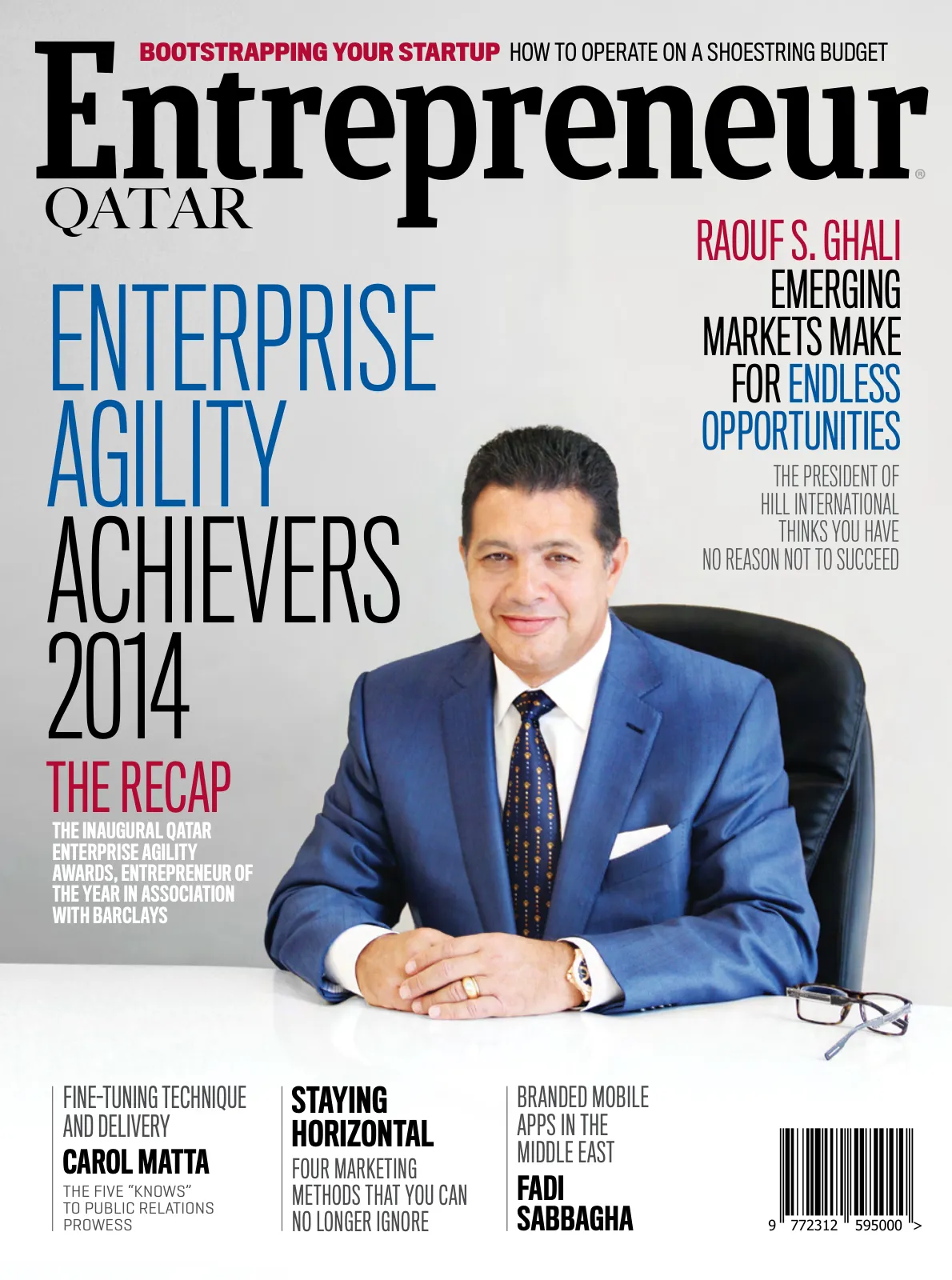
Entrepreneur Qatar, October 2014
Page 1
OCTOBER 2014 Entrepreneur
1
Bootstrapping your startup How to operate on a shoestring budget
OCTOBER 2014 | ENTREPRENEURMIDDLEEAST.COM | QAR15
9
772312
595000 >
Raouf S. Ghali
Emerging
markets make
for endless
opportunities
The President of
Hill International
thinks you have
no reason not to succeed
The inaugural Qatar
Enterprise Agility
Awards, Entrepreneur of
the Year in association
with Barclays
The Recap
Enterprise
Agility
Achievers
2014
The five “knows”
to public relations
prowess
Carol Matta
Fine-tuning technique
and delivery
Four marketing
methods that you can
no longer ignore
staying
horizontal
Branded mobile
apps in the
Middle East
Fadi
Sabbagha
Page 2
Entrepreneur OCTOBER 2014
2
Page 3
OCTOBER 2014 Entrepreneur
3
36 BlackBerry
Passport reignites
tech flame
14
The Recap
Enterprise Agility
Achievers 2014
The first inaugural
Qatar Enterprise Agility
Awards, Entrepreneur of
the Year in association
with Barclays.
24
INNOVATOR
Raouf S. Ghali
Emerging markets make
for endless opportunities,
and the President of Hill
International thinks you
have no reason not to
succeed across the GCC.
36
TECH:
SHINY
#TamTalksTech
Gadgets and doodads
that you might’ve missed
out on, sourced by a tech
aficionado. Yes, it’s okay
to want them all… and
no, it’s not our fault.
38
WEBSITE TO WATCH
Maximizing Mini
Exchange
UAE-based entrepreneur
Sarah Appleton
developed her own
Middle East e-commerce
portal, and she’s gone
on to get the recognition
she deserves.
40
MOBILE TECH
App-tastic brands?
The rise, evolution and
the future of branded
mobile application
marketing in MENA
analyzed for you by
Born Interactive CEO
Fadi Sabbagha.
CONTENTS
OCTOBER 2014
14
QATAR Enterprise Agility
Awards 2014
24 Emerging markets make for endless
opportunities
Page 4
Entrepreneur OCTOBER 2014
4
14
EDITOR’S NOTE
By Fida Z. Chaaban
34
‘TREPONOMICS:
SKILLSET
The MBA debate
Managing Director and
CEO Hassan Al Hazeem
of Intercoil International
poses the question,
“Is management savvy
impacted by executive
education?”
44
ETHICS
Going green in the
workplace
Bayt.com’s research
indicates that the bottom
line isn’t just about
saving money- simple
steps can make all the
cost (and care) difference
contributed by VP Suhail
Al-Masri.
48
ESQUIRE GUY
Drop the device!
Ross McCammon on
why you have to stop
using your phone during
meetings- yes, you really,
really, really have to
stop. Jokes aside, it does
affect how we socialize in
business.
60
MARKETING
It’s all about staying
horizontal
If you aren’t already
taking action on these
four marketing methods,
you’re a decade behind
everybody else.
68
SKILLSET
Five “knows” to public
relations prowess
Carol Matta discusses
her top five tips that she
believes played a huge
role in achieving the
desired outcome for the
corporations and figures
that she’s serviced in the
PR industry.
Five “knows” to public
relations prowess
CONTENTS
OCTOBER 2014
48 The Esquire
Guy on why you
have to stop
using your phone
during meetings
68
Page 5
OCTOBER 2014 Entrepreneur
5
Page 6
Entrepreneur OCTOBER 2014
6
50
CULTURE:
DESIGN
Making it new again
Princess Noura Bint Saud
AlSaud wants you to
repurpose, reclaim and
reconsider. She’s just
launched Riyadh’s Rukun
Gallery as KSA’s newest
art and design destination.
58
LIFE
Business book rundown
Amal Chaaban reviews
a few business books for
you before you hit the
bestseller aisle. It’s true
that not all executive
material is created equally.
54
TRAPPINGS
‘Trep gear
Christian Louboutin helps
you dress for success,
and Etro has us all tied up
with the AW14/15 range.
74
START IT UP:
WACKY IDEA
Founder Tarek Koudsi is
fluent in webspeak
Jordanian startup
Hashdoc could be
your company’s digital
resources hub. It’s an
open knowledge database
that players in the
business field need to
check out.
78
Q + A
Goal-oriented ‘treps
This startup duo is more
passionate ever about
their social networking
tool, and they say Linkagoal
just what entrepreneurs
and aspiring industry
leaders need to achieve
their goals.
80
WACKY IDEA
Sharing is caring
Egypt’s PieRide wants to
reduce traffic by sharing a
ride in any of their
vehicles with
crowdsourced, trained
drivers.
88
Q + A
Eastern promises
Entrepreneur Dana
Habayeb talks about
getting her brand some
attention, both here and
abroad.
84
MONEY:
STARTUP FINANCE
Bootstrapping startups in
Dubai
Melltoo is living the
startup life, and that
means sharing tips on
making dirhams,
dollars and sense count.
Egypt’s PieRide wants
to give you a lift
80
CONTENTS
OCTOBER 2014
Page 7
OCTOBER 2014 Entrepreneur
7
Page 8
Entrepreneur OCTOBER 2014
8
SUBSCRIBE
Contact subscriptions@bncpublishing.net to receive
Entrepreneur Middle East every issue
EDITOR IN CHIEF Fida Z. Chaaban editor@bncpublishing.net
MANAGING DIRECTOR Walid Zok walid@bncpublishing.net
DIRECTOR Rabih Najm rabih@bncpublishing.net
DIRECTOR Wissam Younane wissam@bncpublishing.net
SALES DIRECTOR Oliver Amos oliver@bncpublishing.net
PUBLISHER Nehme Abouzeid
CREATIVE LEAD Odette Kahwagi
ONLINE LIAISON Kareem Chehayeb
COLUMNIST Pamella de Leon
PO Box 502511 Dubai, United Arab Emirates
P +971 4 4200 506 | F +971 4 4200 196
For all commercial enquiries related to
Entrepreneur Middle East contact
sales@bncpublishing.net
All rights reserved © 2014.
Opinions expressed are solely those
of the contributors.
Entrepreneur Middle East and all subsidiary
publications in the MENA region are officially
licensed exclusively to BNC Publishing in the
MENA region by Entrepreneur.
No part of this magazine may be reproduced or
transmitted in any form or by any means without
written permission of the publisher.
www.entrepreneurmiddleeast.com
WE’RE HEAVILY INVESTED IN OUR WEB PRESENCE
In addition to our print edition, we’re bringing you all sorts of
industry news on our web mediums. Joining us online means getting
relevant business and startup content in real-time, so you’re hearing
about the latest developments as soon as we do. We’re looking
forward to interacting with our readers on all of our social media and
web platforms- like any thriving business, we’re looking to give and
take. #TrepTalkME is already happening on all of our digi platforms,
and all good conversations go both ways. See you on the web!
IS DIGITAL
MIDDLE EAST
Printed by Raidy Emirates Printing Group LLC
www.raidy.com
EntMagazineME
@EntMagazineME | @Fida
Entrepreneur-me
EntrepreneurMiddleEast
EntMagazineME
EntMagazineME
EntMagazineME
Images used in Entrepreneur Middle East are credited when necessary. Attributed use of
copyrighted images with permission. All images not credited otherwise Shutterstock.
Sarah Appleton
Mohamed Batterjee
Amal Chaaban
Youmna Chagoury
Kareem Chehayeb
Tamara Clarke
James Clear
Fadi Ghandour
Hassan Al Hazeem
Simon Hudson
Maria Elena Kassab
Sharene Lee
Pamella de Leon
Suhail Al-Masri
Carol Matta
Ross McCammon
CONTRIBUTING WRITERS
Shoug Al Nafisi
Dalal Alrubaishi
Octavia Nasr
Rani Nasr
May Rostom
Erika Widen
Page 9
OCTOBER 2014 Entrepreneur
9
Page 10
Entrepreneur OCTOBER 2014
10
We’ve gotten tons of pictures via Twitter and Instagram, and here are a
few of our favorites. If you see a copy of any edition of Entrepreneur MENA,
tweet an image our way or tag us on Instagram. All of our reader images
end up getting pinned to our Pinterest Show & Tell board. We’re happy to
see our readers interact with us across all mediums- and we talk back!
On ISSUU you can access all of our current and
past issues complimentary, including Entrepreneur
Al Arabiya, our edition for those of you that prefer
Arabic-language publications. If you haven’t yet
visited our ISSUU account, check out
issuu.com/entmagazineme
Business efficacy...
in real-time
It’s not social media if you don’t talk back
FEEDBACK
For hospitality industry professionals, BNC Publishing
has released their inaugural issue of Hotel News ME.
The new monthly publication’s first issue was timed
for launch during the Hotel Show in Dubai, UAE.
They’ve gone social so join them online!
Welcome to the fold!
BNC Publishing launches Hotel News ME
HotelNewsMME @HotelNewsME Hotel News ME
Page 11
OCTOBER 2014 Entrepreneur
11
World’s 5-star airline.
through a travel experience we’ve gone to great lengths to perfect for
you. From the warm welcome when you arrive, to the state-of-the-art in-flight
entertainment system, to the gourmet dining in the sky, to the exquisite comfort
in your cabin to award-winning service. We believe the secret to unforgettable
flying is simple. It’s all in the detail. qatarairways.com
Our A380. It’s all in the detail.
Glide
FLYING DOHA TO LONDON
FROM 10TH OCTOBER 2014.
Page 12
Entrepreneur OCTOBER 2014
12
EDITOR’S NOTE
I
think it’s important to talk about
the relationships businesspeople
maintain, and the underlying
culture of favors that permeates
those same relationships. We all
ask for favors, and if you haven’t yet
had to cross that bridge, you will at
some point or another throughout
your uphill enterprise trek. I know
I have. But when you’re gearing up
to ask someone for a favor, have you
thought about whether or not you’re
really in the position to do so? What
are the prerequisites that you need
under your belt to be able to request
a business favor from an associate?
I would say that the formula is
an easy one to adopt. I applied this
“mantra” to my own professional
and personal conduct years ago, and
it has paid for itself in spades. I am
a big believer in what I like to call
“Internet karma”, and this all ties
into the culture of favors at work in
business globally.
Before you approach a business
associate for a “little” favor, you need
to ask yourself the following ques-
tions. Be honest, now.
1) Have you at some point supported
this person in a business capacity?
2) Have you, of your own accord,
made the initiative to demonstrate
care for that person’s professional
growth?
3) Can you honestly say that you pro-
moted this person’s business agenda,
and made a positive impact on their
business (however small)?
Answering affirmative to those
three questions means that you are
well-positioned to ask for a favor-
even a big favor. This favor could be a
recommendation, an introduction to
a key person, or even an opinion on
your 2015 marketing strategy. You’ve
given of your time or of your re-
sources (or both) to help out this as-
sociate in the past, and the next time
you’re looking for an endorsement or
a boost on your new digi campaign,
you can bet they’ll be on board no
questions asked. If you haven’t taken
the initiative to help out in the past,
why would you think that asking
for something is a good idea? This
is when my theory about Internet
karma enters the equation. I’m active
on a few different digital mediums,
and I often use my personal account
to promote other people’s events and
work (blog posts, videos, and cam-
paigns included), and even gather
information when it is needed by
people I know. Because of that, I have
great Internet karma. When I need
a retweet or help promoting some-
thing, I’ve got tons of tweeps that are
happy to do so of their own free will-
it’s the beauty of reciprocity.
Do I mind
when people
ask me for
favors? Not if
they’ve made a
genuine effort
to support
my current or
previous initia-
tives. The flip
side of this is
that asking me to promote your event
or facilitate an intro probably won’t
go over very well if you’ve never ex-
pressed any interest in my endeavors.
I think I’m like most professionals in
this regard. Using your skillset and
influence to spread around success
is great for your business (and Inter-
net) karma. Give it a try.
“Hey, can you do me a favor?”
Apply reciprocity as a constant, not an anomaly
Fida Z. Chaaban
Editor in Chief
@fida
editor@bncpublishing.net
Page 13
OCTOBER 2014 Entrepreneur
13
www.qatar-weill.cornell.edu
Providing the highest level of education, research and clinical care
Educating tomorrow's doctors today
Weill Cornell Medical College in Qatar has now been
established for more than a decade. Since then we have
developed a cutting-edge biomedical research program
and high-profile community outreach initiatives but the
most important thing we have done is to create doctors.
Students have come to us from across the world and we
have given them an education that is second to none.
They have travelled to New York to learn from
physicians based at our parent campus and they have
been supported every step of the way by our faculty.
Our graduates are now working in hospitals in the
U.S. and Qatar, helping cure patients of a myriad of
diseases. As they progress in their careers, our alumni
will return to Qatar, enriching the knowledge-based
economy, improving the healthcare system, and
passing on their experience to future generations of
doctors.
With dedication and determination, you too could
make a difference and make your mark on the
world.
Page 14
Entrepreneur OCTOBER 2014
14
QATAR
Enterprise
Agility
Awards
2014
THE RECAP
Entrepreneur OCTOBER 2014
14
Dexterity by
Page 15
OCTOBER 2014 Entrepreneur
15
O
n the occasion of the first annual
Qatar Enterprise Agility Awards,
BNC Publishing as part of the
Entrepreneur MENA franchise, awarded
businesses across multiple categories
on September 15th, 2014 at the Grand
Hyatt Doha. The relevant Enterprise
Agility Achievers have established
themselves as clear industry innovators
who have made significant contributions
to the Qatari business arena, and set the
benchmark for corporations operating in
the Gulf Cooperation Council nation.
A keynote address by William Oullin,
Barclays Chairman of Wealth Manage-
ment EMEA and Barclays Bank (Suisse)
SA, and an assembly welcome by Qatar
Chamber of Commerce Vice Chairman
Muhammed Bin Ahmed Bin Towar Al
Kuwari, kicked off the inaugural event.
On behalf of Entrepreneur Qatar, BNC
Publishing Director Wissam Younane
discussed bringing together the na-
tion’s most adroit figures of business
from across the Gulf’s relevant arenas.
“Qatar’s unmatchable financial strength,
paired with a business-minded and
supportive governmental leadership, has
been a stepping stone for each and every
Agility Achiever gathered here,” said
Younane during his dialogue with the
awards guests. “Entrepreneurship in the
Arab world, and especially the historic
Qatari traders of this Gulf state, set an
example for countries in the world that
aspire to economic diversification, and
the incalculable value of a knowledge-
based economy. Together with our Title
Ally Barclays, BNC Publishing via our
Entrepreneur of the Year awards, and
with the support of the respected Qatar
Chamber of Commerce, have collected
the industry intelligence of this great
country in one room.”
In closing, Younane discussed his own
learning curves as an entrepreneur:
“BNC Publishing is my first entrepre-
neurial undertaking, and I can vouch for
the value of mentorship here and now, a
backbone of Entrepreneur MENA publi-
cations and yes, of BNC Publishing,” he
said saluting the evening’s Enterprise
Agility Achievers and thanking commer-
cial partners for their ongoing support.
BNC Publishing Director
Wissam Younane
Page 16
Entrepreneur OCTOBER 2014
16
Islamic Bank of the Year
Qatar Islamic Bank
In 1982, the first Islamic finan-
cial institution and Sharia’-
compliant bank was founded,
known as Qatar Islamic Bank.
The bank’s products and
operations are supervised by a
Sharia’ board, which adheres to
Islamic finance principles. At
present, the bank’s Chairman of
the Board is Sheikh Jassim Bin
Hamad Bin Jassim Bin Jaber Al
Thani. In addition, Qatar Islamic
Bank is known to be one of the
largest Islamic banks in the
MENA region, and follows a vi-
sion to become the world leader
in the sector. As a result, the
bank has a stake in a number of
other Qatari Sharia’-complaint
organisations such as Qinvest,
Al Jazeera Finance, Aqar Real
Estate, and Damaan Islamic
Insurance Company. In addition,
the bank has also reached the
international level by its affiliate
– Qatar Islamic Bank-UK based
in London, AFH based in Leba-
non, AFB in Malaysia, and Qatar
Islamic Bank based in Sudan.
Qatar Islamic Bank’s tagline?
To be a bank of the people and
for the people with an on-going
commitment to enhancing
its levels of customer service
through the adoption of state
of the art banking technologies.
Also, among the bank’s strategy
is tied into the financing of
national infrastructure projects,
major industrial SMEs, and
the trade sector. The bank has
further launched the Aamaly
program in order to serve SMEs.
The Sharia’-complaint bank
has also been internationally
recognized by a number of bod-
ies as the ‘Best Islamic Financial
Institution in Qatar’. In addition
received an ‘A’ rating from
international agencies including
Fitch, Capital Intelligence and
Standard & Poor’s.
Retail Bank of the Year
Doha Bank
Doha bank was incorporated in
1978, and commenced its do-
mestic and international bank-
ing services in Qatar on March
15, 1979. The bank is categorized
as the largest private commer-
cial bank in the State of Qatar,
and considered one of the coun-
try’s leading financial services
company. In addition the bank
has received numerous awards
throughout the years, this year
the bank has been awarded best
bank in Qatar, best retail bank
in Qatar, best trade and finance
domestic provider, best regional
commercial bank, and best
environmental bank. As a result,
Doha Bank has become one of
the key players in the banking
industry in MENA in a relatively
short time frame. In addition,
the bank acknowledges the
quality of human capital as the
major enabler for an organiza-
tion’s sustainable advantage in a
competitive market. Doha Bank
aims at fostering a leadership
mind-set, which encourages
meritocracy as a key forces to
reward performance, thereby
ensuring that the bank is able
to engage and retain high highly
human capital for its long term
success. Simultaneously, the
bank is committed to making
banking work for customers and
clients alike. Through innova-
tive technologies and ingenuity
of its people, the bank provides
individuals and commercial,
corporate and institutional
clients across the nation and
beyond, new and better ways to
manage their financial lives.
Basically, the bank enables
customers to do their banking
and investing whenever, wherev-
er and however they best choose
via an extensive network, and
multiple access channels. Doha
Bank has achieved impressive
results in a short period, aiming
to be recognized as a dynamic,
modern bank with enduring
age-old values. The combined
result of the management’s
foresight, employee dedication
and the high customer response
that lead the bank’s success.
At present, Sheikh Fahad Bin
Mohammad Bin Jabor Al Thani
is the Chairman of the Board.
Logistics Enterprise
Agility Achiever
Gulf Warehousing Co.
Gulf Warehousing Company pro-
vides quality logistics services,
which gives their customers a
competitive advantage in the
Gulf Region and Middle East
markets. The company was
established in 2003, and is
considered the largest one-stop-
shop logistics, and supply chain
service provider in the State of
Qatar. Gulf Warehousing Com-
pany offers warehousing, freight
forwarding, transportation,
international moving, records
management, sport logistics,
asset management, and sup-
ply chain solutions to various
industry verticals. At present,
Sheikh Abdullah bin Fahad bin
Jassem bin Jaber Al-Thani, is
the Chairman of the Board of
Directors. The company’s key
business strategy is to bring
new competitive advantages to
their customers. In addition,
Gulf Warehousing Company
is currently growing as Doha’s
preferred logistics company, and
they aim to become the number
one integrated supply chain pro-
vider, and the most sought after
third Party Logistics Services
Provider in Qatar and the Gulf
Cooperation Council.
QATAR Enterprise Agility
Awards 2014
Gulf Warehousing Co.
Qatar Islamic Bank
Yousef Al Yousef,
Doha Bank
Executive Director
Page 17
OCTOBER 2014 Entrepreneur
17
Insurance Enterprise
Agility Achiever
Doha Insurance Company
Q.S.C
Doha Insurance Company
is registered under Emiri
Decree No. 30 issued on the
second of October 1999, and
listed on the Qatar Exchange.
The company was formed as
there was a need for growth
in the insurance industry,
warranted by the accelerated
economic expansion in Qatar
in addition to laws encouraging
investments. At present, Nawaf
Nasser Bin Khaled Al-Thani is
the Chairman of the Board of
Directors.
In 2006, the company further
established an Islamic Takaful
branch under the brand name of
Doha Takaful, in order to carry
out insurance and reinsurance
activities in accordance with
Islamic Sharia’ principles on a
non-usury basis in all areas of
insurance. 553 members who
are mostly prominent Qatari
businesspeople or prominent
Qatari business entities founded
Doha Insurance. At present,
Doha Insurance has more than
2,000 shareholders. Accord-
ing to their website, the capital
based of the company has
increased to QR180 million in
April 2008, and further raised
to QR234 million through bonus
shares in March 2012.
Real Estate Enterprise
Agility Achiever
Ezdan Holding Group
Ezdan Holding Group dates back
to 1960, when it was founded
as a private company under the
name of Thani Bin Abdullah
Housing Group. In 2007, the
company went through a transi-
tional phase and become known
as Ezdan Real Estate Company,
and became a public joint stock
organization. At present, His
Excellency Khalid Thani A.
Al-Thani is the Chairman. In
addition the company played a
vital role in the State of Qatar in
achieving diverse accomplish-
ments, which include the prepa-
rations for the Asian Games in
2006, as they built residential
complexes in order to serve
the major sporting event. Also,
Ezdan Holding Group contribut-
ed to the success of other sports
events in addition to sponsoring
them as in the case of the Arab
Games in 2011.
Furthermore, Ezdan Holding
Group is appreciated at both lo-
cal and international levels since
they have received multiple
awards in regards to their active
real estate activities. In addi-
tion, real estate experts have
attributed Ezdan Holding Group
for the reduction of inflation
rates within the country as the
company offers many residen-
tial units at affordable prices.
Ezdan Holding Group’s strategy
is mainly based on investment
diversification and the comple-
tion of the mega projects that
will serve the local society and
achieve maximum profitability
for shareholders.
Healthcare Enterprise
Agility Achiever
Hamad Medical
Corporation
In 1979, Hamad Medical Corpo-
ration (HMC) was established
by the Emiri decree, and reports
to the Qatari Supreme Council
of Health. It is the primary non-
profitable public healthcare pro-
vider in the country. For three
decades, HMC has developed
medical facilities by providing
state of the art diagnosis and
treatment of diseases, of which
prior could only be managed
in medical institutions outside
of the Gulf nation. At present,
HMC manages eight specialized
hospitals which include: Hamad
General Hospital, Rumailah
Hospital, Women’s Hospital,
National Center for Cancer Care
and Research, Al Khor Hospi-
tal, Heart Hospital, Al Wakra
Hospital, Cuban Hospital as well
as the national ambulance ser-
vice, home healthcare services
William Oullin, Barclays Chairman
of Wealth Management EMEA and
Barclays Bank (Suisse) SA
Ezdan Holding
Group
Doha Insurance
Page 18
Entrepreneur OCTOBER 2014
18
and the developing residen-
tial services. Facilities under
development include Al Wakra
Hospital, Children’s Hospital,
the new Women’s Hospital, a
Skilled Nursing Facility and
Physical Medicine and Rehabili-
tation. Simultaneously, it is the
first hospital corporation in the
world to achieve accreditation
and reaccreditation of all its fa-
cilities by the Joint Commission
International, and Qatar is the
only country outside of the U.S.
to achieve such accreditation
for all its public hospitals. In ad-
dition, it has achieved the first
accreditation of its kind in the
region for its home healthcare
and ambulance service.
HMC’s ethos is based on three
key pillars: health, education
and research, signifying the
organization’s commitment to
providing high quality health-
care, the training and education
of healthcare professionals, and
research that develops evidence-
based medicine.
Construction Enterprise
Agility Achiever
Drake & Scull
Drake & Scull’s roots date back
over a century ago with the
creation of two companies,
brought to life by forward-
thinking Victorian entrepre-
neurs with inventive minds, a
sheer talent for business and an
extraordinary drive. Drake and
Gorham, electrical engineers,
and Arthur Scull and Son, sani-
tary engineers sought to turn
their visions of technology into a
reality, starting their enterprise
in Bristol in 1881. Both com-
panies were ground-breaking
pioneers of their time and their
paths would eventually cross
in 1964, with the monumen-
tal merger between the two
companies. Drake & Scull would
then become one of the largest
and most successful mechanical,
electrical and facility services
companies in the U.K. In 1966,
Drake & Scull moved to the
Middle East by setting up an of-
fice in Abu Dhabi, UAE, and over
the course of the next 50 years,
became MENA’s leading multi-
discipline general contracting
and engineering services firm.
At present, Drake and Scull is
headed by Chairman Majed Saif
Al Ghurair.
Hospitality Enterprise
Agility Achiever
Katara Hospitality
The genesis of Katara Hospital-
ity can be traced back to 1970,
when the Qatari government
established Qatar National
Hotels Limited to manage the
Gulf Hotel, currently known as
the Doha Marriott, the country’s
very first five star hotel. In 1982,
market the opening of the first
internationally branded hotel,
Sheraton Doha, and in 1993
when an Emiri decree identified
significant growth potential for
Qatar’s tourism industry, a new
entity, Qatar National Hotels
Company took over the assets of
the previous limited company.
2001 marked the opening of
the tallest hotel at the time
The Ritz Carlton. In addition,
Sealine Beach Resort was the
first leisure resort in Qatar,
while Sharq Village and Spa
was the first high end resort in
the country and the Six Senses
Spa, the largest of its kind in the
Gulf region. Currently, Katara
Hospitality owns and manages
more than 6,000 four and five
star hotel rooms in Qatar and in
Europe, Africa and the Far East.
Sheikh Nawaf Bin Jassim Bin
Jabor Al Thani, the Chairman
of the Board of Directors, heads
Katara Hospitality. In addition,
Katara Hospitality is owned by
Qatar Holding LLC (QH), which
was founded by Qatar Invest-
ment Authority (QIA).
Startup of the Year
Girnaas
Giddam, which in Arabic means
‘in front’– is the first locally
produced and recently unveiled
game by a creative studio called
Girnaas, launched by founders
Munera al Dosari, 29, who holds
a Bachelor’s Degree in Elec-
tronics Engineering from the
University of Portsmouth in the
UK; Faraj Abdualla, 24, who has
a Bachelor’s Degree in Electri-
cal and Electronic Engineering
from Bradford University in the
UK; and Fatima al Kuwari, 31,
who has an MBA in Marketing
from the University of Liverpool
in the UK and a Bachelor of
Computer Science from Qatar
University. The company was es-
tablished in 2013 in conjunction
with ictQATAR’s digital incuba-
tion centre, which provides full
support to technology startup
businesses. Since the game’s
release in December of last
year, there have been more than
5,000 downloads on Google
android alone.
Retail Enterprise Agility
Achiever
Fifty One East
Fifty One East, part of Darwish
Holding, is the nation’s premier
better retailer. The award was
received by Daniel Lattouf,
Retail Business Unit Manager of
Darwish Holding, on behalf of
the group. Fifty One East is the
exclusive retailer to many of the
world’s best-known houses and
brands, hallmark names in the
sphere of fashion, cosmetics,
extending to home electronics
and appliances. An extensive
social media presence also sets
Fifty One East apart in the retail
space, with active platforms
including Facebook, Twitter, and
Instagram. The parent company,
Darwish Holding, was founded
in the 1920’s swiftly expanding
to what it is today known as
a diversified business interest
across a spectrum of industries
QATAR Enterprise Agility
Awards 2014
Fifty One East Daniel Lattouf,
Darwish Holding Retail Business
Unit Manager
Drake & Scull International
Katara Hospitality
Hamad Medical Corporation
Girnaas
Page 19
OCTOBER 2014 Entrepreneur
19
including consumer distribution,
investment, retail, real estate,
business services, and technol-
ogy. In addition, the company
manages a portfolio of prominent
companies that offer quality
products and exceptional services
to the people, businesses and
the State of Qatar. At present,
the Chairman, Bader Al Darwish,
heads Darwish Holding.
Information Technology
Enterprise Agility Achiever
BPO+
Business Process Outsourcing+
(BPO+) serves as a solution to
companies, which are struggling
to reduce costs, improve service
standards, efficiency of process-
es, streamline processes as well
as gain access to the state-of-art
technology without investing
huge on manpower, technology
and skills. BPO+ is a business
process-outsourcing organiza-
tion in Qatar. The company exists
as a towering potential in Qatar
by assisting various growing
businesses serve their customers
better at a lot less investment.
In addition, BPO+ is a dedicated
service provider network by uti-
lizing the techniques and expert
professionals. Each of their ser-
vices involves a highly dedicated
and qualified team that assists to
create and recreate long-lasting,
satisfying solutions. The com-
pany has established a leadership
position in the customer service
segment while expanding their
services across industry verticals.
Consequently, BPO+ offers
customized and comprehensive
customer care solutions to the
telecommunications, banking
and financial services, and media
industries.
BPO+ CEO and Managing Director
Dr. Tejinder Singh
Page 20
Entrepreneur OCTOBER 2014
20
Consultancy Enterprise
Agility Achiever
Hill International
The current Chairman and
Chief Executive Officer, Irvin
Richter, founded Hill Interna-
tional in 1976, as he felt that
many owners and contractors
of major construction projects
were spending too much time on
litigation. “I built Hill Interna-
tional on the premise that with
proper planning, well drafted
contracts and constant monitor-
ing, many construction claims
could be avoided. As a result,
Hill became one of the largest
construction claims consulting
firms in the world.” Hill Interna-
tional’s mission is to be the very
best professional services firm
in the world helping our clients
minimize the risks inherent in
the construction process. The
company accomplishes this
objective through a broad range
of project management and
construction claims services
that support their clients during
every phase of a project, from
concept through completion.
Today, the company has 4,400
professionals in 100 offices
worldwide, including extensive
experience, and expertise in
order to assist their clients to
deliver their projects on time,
and within budget.
Social Entrepreneur of
the Year
Ghanim Al Muftah
Ghanim Al Muftah participates
in championing services and
therapies for related dis-
abilities in the region. He also
established the Association of
Ghanim that offers opportuni-
ties to receive wheelchairs
through funding. QR200, 000
has already been raised to help
supply essential equipment to
the ones most in need. In ad-
dition to offering vital equip-
ment, he has written stories
about his life in both Arabic
and English to help inspire his
peers. The book about Ghanim
is an important tool for sharing
his experiences and information
about his life to inspire others
with disabilities, to spread
awareness across the commu-
nity, and to generate conver-
sation and discussion within
the society. Ghanim notes that
strong will and faith in God is
a key inspiration and source of
strength for him, as he writes in
the first words of his book: “My
name is Ghanim, a Qatari child,
born in Doha on May 5th, 2002.
I’m always a winner, let us read
and hear my beautiful story
together.” It took three years for
Ghanim to establish Grissa and
Brady’s Ice Cream, and offers
a selection of tasty treats. The
business seeks to work as a val-
ued member of the community,
to act with social responsibil-
ity, with a commitment to its
pioneering work for SMEs in the
Qatari private sector.
QATAR Enterprise Agility
Awards 2014
Master of Ceremonies
Stephen Marney
Ghanem Al Muftah
Hill International
Page 21
OCTOBER 2014 Entrepreneur
21
Page 22
Entrepreneur OCTOBER 2014
22
Entrepreneur of the Year
Hisham Saleh Al Mana
The Saleh Al Hamad Al Mana
Group of Companies, established
in the 1950s, is one of Qatar’s
most reputable companies. The
group is comprised of more than
ten companies across several
business sectors– automotive,
retail, real estate and invest-
ment, hospitality, FMCG and
F&B. In addition to Qatar, the
group has operations in the GCC
and in Europe. Saleh Al Hamad
Al Mana Company’s automobile
operation is the second largest
player in Qatar with its Nissan,
Infiniti and Renault dealerships.
The founder, the late Saleh Al
Hamad Al Mana, was amongst
the first to introduce, and
develop a wealth of experience
in, the importing and selling
of cars and heavy equipment
in Qatar. Saleh Al Hamad Al
Mana’s sons Hisham, Kamal
and Wissam Al Mana joined the
family business in the 1990s.
Today, under the leadership of
Hisham Al Mana, the company
maintains its distinction as the
supplier of choice in meeting all
automotive requirements in the
market. At present, the company
has a billion dollar turnover, in
addition to 2,000 employees.
Saleh Al Hamad Al Mana was
amongst the first to introduce
and develop a wealth of experi-
ence to import and sell both cars
and heavy equipment in Qatar.
He established a philosophy
based on a strong management
and personal involvement in the
day-to-day activities and opera-
tions of the company.
Equality Enterprise
Achiever
Bothaina Al Ansari
Bothaina Al Ansari has a
Masters degree in Business
Management and HR strategic
planning from Qatar Univer-
sity, as well as a Masters in HR
from the American University
in Cairo. Al Ansari founded and
manages Qatariat, a company
dedicated to assisting Qatari
women advance in the work-
force. Qatariat has three main
entities: the Qatariat Training
and Development, which is
committed to support the Qatari
women who are fervent to push
their education further, develop
their skills as well as acquire
new competencies in order to be
able to achieve great success on
both personal and professional
levels. It aims to identify and
support Qatari women includ-
ing professional and business
owners who wish to or already
contribute to the social and
economic activity through
their significant professional or
entrepreneurial achievements.
Secondy, Qatariat Magazine,
a publication which addresses
businesswomen in particular
and covers all related local and
Arab news including business-
women event, achievements,
social contributions, business
impediments, and future pro-
jects and views. The third entity
is Qatariat Development Con-
sultancy, which represents both
men and women who require
any strategic support to enhance
their business plans and or any
development related issue. As
an entrepreneur and Chairper-
son of Qatariat T&D she further
collaborates with innovative
and best-in-class organizations
to raise the benchmark and
quality of expertise in Qatar. In
addition, she is also the Senior
HR Director of Ooredoo Qatar,
and was voted L’Officiel Qatar’s
most inspirational Arab woman
of the year in 2012.
QATAR Enterprise Agility
Awards 2014
Bothaina Al Ansari
Qatar Chamber Chamber of Commerce and Industry Vice Chairman
Muhammed Bin Ahmed Bin Towar Al Kuwari
Qatar Enterprise Agility
Achievers 2014
Page 23
OCTOBER 2014 Entrepreneur
23
QATAR Enterprise Agility
Awards 2014
BNC Publishing Director
Rabih Najm
BNC Publishing
Sales Director
Oliver Amos
Entrepreneur
Middle East and
Entrepreneur Qatar
Editor in Chief
Fida Chaaban
Page 24
Entrepreneur OCTOBER 2014
24
Emerging
markets make
for ENDLESS
opportunities
innovator
Hill International
President Raouf S. Ghali
thinks you have no
excuse not to succeed
I
f you cannot find opportunity in
the Middle East then it’s not the
Middle East that has the problem,
it’s your business model.” These are
the candid words of Raouf S. Ghali,
President of Hill International’s Project
Management Group. And though he
specializes in the project management
of large-scale developments, his brash
statement refers to businesses from
any vertical in the Gulf Corporation
Council (GCC) region. Having come out
strong on the other side of the 2008
economic downturn, he says, the GCC
is poised for a decade of fast growth.
And if you can’t take advantage of
that, he reckons that there’s something
wrong with your business model.
When it comes to talking GCC
growth, it is difficult to deride Ghali for
his optimism. While an International
Monetary Fund (IMF) report from
May 2014 said that growth is projected
to remain tepid in most countries1,
other bodies have been more confident
about the GCC, seen largely as a stable
foothold in an otherwise increasingly
volatile region. According to a recent
report from the Institute of Inter-
national Finance, growth across the
“Like any market, if you look
at it, from 1995 or 1997 to what
it is in 2014, and just put it on
a curve, you’ll see that the
growth is just tremendous.
Now, within that growth,
there are little spikes and
valleys, and that’s normal
because, like every other
industry in every other
market, things are cyclical.
We’ve seen it go through some
peaks and valleys, but it’s
cyclical.”
Page 25
OCTOBER 2014 Entrepreneur
25
GCC is projected to sit at around 4% in
20142. But that number fails to tell the
whole story. The economies of the Mid-
dle East have diversified as governments
begin to lessen their dependence on
crude oil, leaving underdeveloped verti-
cals enormous holes to fill as the rest of
the business world plays catch-up with
the oil industry.
On the ground, there is a sense
of quiet optimism about the GCC’s
prospects, which is giving businesses
the confidence to make good on their
growth strategies. Admittedly, according
to ICAEW’s Economic Insight for
the Middle East, living standards –
measured by GDP per capita– in the
UAE, Kuwait and Oman have fallen in
real terms, despite “rapid” growth over
the past five years3. This, the report
says, is down to a combination of high
birth rates and immigrants hoping to
take advantage of the opportunities
created by economic expansion. But the
same report also notes that, for the next
decade, economic prospects are more
favorable.
In his position, Hill International’s Ghali
is well placed to see the effects that
these changes are having. He saw the
GCC at its strongest before the economic
downturn of 2008– the end of what
he describes as a “cycle.” He was the
project executive for the Palm Jumeirah
in Dubai when it was built in 2006,
and he carried on operating through
the slower years, waiting for the return
to growth. Now, he currently has 30
ongoing assignments around the world.
The services he provides include cost
control, financial analysis, planning and
scheduling, so he makes it his business
to keep abreast of the pace of the market.
“Like any market, if you look at it, from
1995 or 1997 to what it is in 2014, and
just put it on a curve, you’ll see that the
growth is just tremendous. Now, within
that growth, there are little spikes and
valleys, and that’s normal because, like
every other industry in every other
market, things are cyclical. We’ve seen it
go through some peaks and valleys, but
it’s cyclical.” Obviously, within the GCC,
markets still differ– what might be true
in, say, the UAE won’t necessarily hold
in Saudi Arabia. Ghali acknowledges
this as he gets down to the specifics of
each market. Of the six GCC countries,
he identifies Qatar, Saudi Arabia and
the UAE as the biggest growth markets,
though he adds that he is reasonably
bullish on growth in Oman, which he
describes as a country to watch out for.
Eye on Qatar
According to the ICAEW report, Qatar’s
economy is expected to show the most
dramatic improvements over the next
decade, at least when measured in GDP
per capita. The report notes that, thanks
to the low costs of producing natural
gas, and the fact that the country will
host the 2022 FIFA World Cup, GDP per
capita should double between now and
2025.
Jun-09
Jun-09
Jun-11
Jun-12
Jun-13
40
35
30
25
20
15
10
5
0
GCC
Non-GCC
Private Sector credit is accelerating
(Annual percent change)
PRIVATE SECTOR CREDIT GRAPH Sources National authorities and IMF staff calculations
Aspire Academy
campus, Qatar
1 Regional Economic Outlook Update: Middle East and Central Asia Department, International Monetary Fund
2 http://gulfnews.com/business/economy/iif-forecasts-strong-growth-prospects-for-gcc-countries-1.1328499
3 ICAEW Economic Insight: Middle East Institute of Chartered Accountants in England and Wales
Of the six GCC countries, GHALI
identifies Qatar, Saudi Arabia and
the UAE as the biggest growth
markets, though he adds that he
is reasonably bullish on growth
in Oman, which he describes as a
country to watch out for.
Page 26
Entrepreneur OCTOBER 2014
26
But it’s on the large-scale investment
side that Qatar should shine. Due to its
small population, the country consumes
an almost laughably small amount of its
GDP –a little less than 20%- allowing
more money to be invested. According
to the IMF, Qatar’s gross natural savings
accounted for 59% of GDP in 2013, leav-
ing plenty for the country to invest into
other industries as it shuffles towards an
eventual hydrocarbon-free future. And
in the process, it is industries such as
Ghali’s (large-scale developments), that
have begun to benefit.
While pointing towards the invest-
ments that Qatar is making in culture,
education and sport –“They’re going to
create a position for themselves within
the region, something I don’t think ex-
ists in the Middle East,” he says– Ghali
recognizes that the huge amount of
construction, as well as infrastructure
investments for the FIFA World Cup,
are the main drivers for Qatar’s growth.
“They’re doing it right, they’re looking
for the expansion. I believe that if you
invest enough money in the infrastruc-
ture (what history has shown in the
last 50 years), the countries that invest
in their infrastructures create a good
platform for people to come in and do
business there,” he says. There are other
opportunities in Qatar, too, according to
Ghali. He outlines the medical research
centers, the libraries, and the art gal-
leries as ideal targets for the right busi-
nesses. But perhaps one of the biggest
opportunities (for anyone in Ghali’s line
of work, anyway) lies in environmentally
friendly mass transport. Like every other
GCC country, Ghali says, Qatar is invest-
ing heavily in a railway system, and it
is being developed to green standards–
perhaps more greenly than you would
find in even the United States or Europe.
innovator
The Metro is just one small
part of Qatar’s railway
ambitions, and will simply be
a component in the larger
Qatar Rail Network, which is
set to include long-distance
high-speed links across the
country.
National Convention
Center, Doha
Page 27
OCTOBER 2014 Entrepreneur
27
The economies of the Middle
East have diversified as
governments begin to lessen
their dependence on crude oil,
leaving underdeveloped verticals
enormous holes to fill as the rest
of the business world plays
catch-up with the oil industry.
The project of the moment is the Doha
Metro, a rapid transit system expected
to serve 85 stations across four lines
adding up to 211.9 km of rail. Already,
61 stations are under construction, with
operations slated to begin in 2019. The
Metro is just one small part of Qatar’s
railway ambitions, and will simply be
a component in the larger Qatar Rail
Network, which is set to include long-
distance high-speed links across the
country. Ghali isn’t joking when he says
that there are huge opportunities to be
found in the emirate’s mass transit sec-
tor – after all, there’s a lot of construc-
tion to be done.
Inside the Kingdom
When it comes to the Kingdom of Saudi
Arabia (KSA), things are a little dif-
ferent. As the Gulf’s largest economy,
with a population of around 30 million
according to a 2013 estimate4, the
country has needs that go above and
beyond accommodating growth. Social
issues are felt more sourly in KSA than
they are in other GCC countries, thanks
to wider wealth gaps. This means that,
rather than developing large-scale
mega-projects as tourist attractions, the
Saudi government needs to focus on less
glamorous schemes.
The point is illustrated by the fact
that GDP per capita growth is expected
to be slower in Saudi Arabia than in
other Gulf countries, particularly over
the coming years. The ICAEW report
does note that Saudi’s national savings
amounted to 47.6% of GDP in 2013, but
due to the country’s large population,
this amounts to national savings of just
over US$11,000 per capita. This puts
KSA’s national savings per capita closer
to the United States figure of $9,000,
rather than the Qatar figure of nearly
$55,000. Hence the differences between
the two Gulf markets. This is not to
say that Saudi Arabia is unfriendly to
business. Indeed, according to Ghali, the
drive to provide more affordable housing
is in itself a big opportunity for people
in the development sector. “One of the
plans is to make sure that at least the
housing needs for all the communities
and society sectors are being accommo-
dated, which is creating a big need for
housing,” he says. “It’s a young popula-
tion, there’s a lot of youth in Saudi
Arabia, and they’re getting married, so
there’s a great need for it. I think they’re
accommodating for local needs.”
Last year, the KSA government
launched a new scheme, dubbed “Es-
kan”, to provide housing aid to citizens.
King Abdullah pledged that the country
would build 500,000 homes thanks to
around $67 billion in state funds. The
project may have gotten off to a slow
start, reportedly caused by sluggish
“It’s a captive tourism
and it’s one that is
consistently growing as
people around the world
have the means to come
for their pilgrimage.
There are always high
demands there,”
Saudi’s other main point of
investment for a post-oil future
lies in religious tourism. Given
that the country is home to the
center of the Islamic world,
Mecca, Saudi Arabia plays host
to more than a million visitors
embarking on the Hajj every year.
Oil GDP Pauses in 2013,
Non-Oil GDP Slowing but Steady
(Oil and non-oil real GDP growth, percent)
OIL AND NON-OIL REAL GDP GROWTH GRAPH SOURCES National authorities and IMF staff calculations | king abdullah financial district image courtesy hill international
King Abdulaziz
International Airport,
Saudi Arabia
King Abdullah
Financial District,
Riyadh
4 http://www.cdsi.gov.sa/english/
Page 28
Entrepreneur OCTOBER 2014
28
bureaucracies, but Ghali says that things
are beginning to pick up, at least in some
areas of the country. Of course, Saudi’s
other main point of investment for a
post-oil future lies in religious tour-
ism. Given that the country is home to
the center of the Islamic world, Mecca,
Saudi Arabia plays host to more than a
million visitors embarking on the Hajj
every year. One estimate says that more
than 1.3 million foreign pilgrims from
188 countries arrived for the Hajj last
year5, and the country has been work-
ing hard to better cater for this annual
influx of visitors. Ghali believes that this
presents a large opportunity, as there
are always high demands in the religious
tourism sector.
“It’s a captive tourism and it’s one that
is consistently growing as people around
the world have the means to come for
their pilgrimage. There are always high
demands there,” he says. And, natu-
rally, he says, the Kingdom still has its
fair share of mega-projects, such as the
under-construction Kingdom Tower in
Jeddah, slated to be the tallest tower in
the world with a height of one kilometer.
According to estimates, it is being built
to the tune of around $1.23 billion, and
will be the centerpiece of a larger $20
billion project known as Kingdom City.
Ghali asserts that there are business-
friendly opportunities here, though he
still maintains that the social housing
project forms the biggest platform for
growth in Saudi Arabia.
Penetrating the GCC
Elsewhere in the GCC, there are obvi-
ously other opportunities to seize,
particularly in certain government-
funded segments. For example, Ghali
asserts that railway development is
a strong platform for growth in every
GCC country, and not just in Qatar.
Aside from the inter-country GCC rail
project -to be built at an estimated cost
of $15.4 billion – each council country
is developing its own railway system.
This has already been seen in the UAE
with the Dubai Metro, but the country’s
ambitions don’t stop there; the UAE’s
national railway network, Etihad Rail, is
expected to result in huge opportunities
for contractors and consultants. Indeed,
Ghali notes that the UAE’s build-out of
major infrastructure projects stands it in
good stead for the future. While critics
labeled the UAE’s economy as unstable
in the years following 2008, Ghali reck-
ons that growth simply slowed down,
with the government seeking to beef up
the country’s infrastructure in prepara-
tion for the next wave of growth.
“People say that Dubai stopped.
Yes, the real estate market I think had
innovator
the Kingdom still has its fair share of
mega-projects, such as the under-
construction Kingdom Tower in
Jeddah, slated to be the tallest tower
in the world with a height of one
kilometer. According to estimates, it is
being built to the tune of around $1.23
billion, and will be the centerpiece of
a larger $20 billion project known as
Kingdom City.
“what we’ve seen is, even from
2008 to a year ago, when the real
estate market started coming back,
Dubai continued working on its
infrastructure. The Metro, bridges,
roads- all the infrastructure was
still going on, which I think was a
very wise move because now they’re
ready for the next expansion”
Dubai, UAE
5 http://www.saudiembassy.net/latest_news/news10131302.aspx
Page 29
OCTOBER 2014 Entrepreneur
29
stopped for a while after 2007 or 2008.
But what we’ve seen is, even from 2008
to a year ago, when the real estate market
started coming back, Dubai continued
working on its infrastructure. The Metro,
bridges, roads- all the infrastructure was
still going on, which I think was a very
wise move because now they’re ready for
the next expansion,” he says. The UAE’s
business community is now gearing up
for a period of rapid growth, Ghali says.
What other GCC nation is worth moni-
toring? Ghali labels Oman as a country
to watch, admitting that compared to
the UAE or Qatar, Oman’s growth curve
is nowhere near as sharp. However, he
likens projects in the country to low-risk
investments, describing the country’s
prospects as steady, if not quite as excit-
ing. “It’s a community that is looking for
growth, and continues to look for serving
the community. But they don’t want to
expand and explode the way others do.
They have a very solid tourism industry–
they grow it, but they grow it at a pace
that they’re comfortable with,” he says.
With such opportunity around, it
should be easy to come to terms with
Ghali’s advice that a business model is
flawed if it cannot thrive in the Middle
East. However, there is one elephant in
the room; the big opportunities -from
the Qatar World Cup developments to
the international railway project– are
already being dominated by established
players such as Hill International. The
question remains whether there is
any room left in the market for a new
business. According to Ghali, there is
always room, and it’s that fact that keeps
organizations such as his on their toes.
“It’s difficult to be a new player, but
there’s always an angle,” he asserts.
With that in mind, then, it would
seem like there is no better time to be
involved in the Middle East’s burgeoning
development sector– be it real estate or
critical infrastructure. As Ghali says, it
might not be easy to be enter the market,
but if your business model is right, the
rewards could be enormous.
“[OMAN IS] a community that
is looking for growth, and
continues to look for serving
the community. But they don’t
want to expand and explode the
way others do. They have a very
solid tourism industry– they
grow it, but they grow it at a pace
that they’re comfortable with”
Sourcing local human
capital
According to Hill International Raouf
Ghali the secret to success when it
comes to international expansion is
to hire locally. With a career spanning
several countries and regions, he
explains that, whenever Hill wants to
expand into a new geography, hiring
local talent is the key to success.
This is particularly true when it
comes to project managing large
developments, he says. The need
for fluency in the local language is
fundamental to doing business in a
foreign country. Successful project
management firms hire local people
so that language is not a barrier.
“As project managers, where we’re
dealing with contracts, you’re dealing
with day-to-day site issues, you’re
dealing with moving and managing
risks, it’s always done in the local
language. If you’re in Germany, it has
to be in German, and you have to be
proficient in German. If you go to
France, it’s got to be French. It takes
a long time to create an organization
that works in different countries,” he
explains. Naturally, the same is true
for projects in the Middle East.
Boom and bust
Ghali might be confident that the
GCC is set for a decade or so of rapid
growth, but what happens when the
next economic downturn hits? How
can investors protect themselves
from the possibility that projects
might go under before they’re begun,
as happened in 2008? While he isn’t
comfortable speculating on when
another bust might occur, Ghali does
believe that the GCC has learnt its
lessons from the last one, and that
things might be a little different the
next time around. “Every time we
go through one of those cycles, we
learn from it, the industry learns
from it. We take safeguards. Last
time, everybody was over-leveraged,
and everybody around the industries
allowed that to happen,” he says. “It
may come to a slowdown– I don’t
think anybody keeps on going and
going until it crashes. There are
things that are created during the
growth era, and I doubt that the
same mistakes and the same exact
happenings repeat themselves.”
On business and
politics
While the GCC is considered a
relatively safe haven for business in
the increasingly volatile wider Middle
East, Ghali notes that nowhere is
100% safe from political instability.
Investors may be comfortable
working in the GCC, he says, but
there are very few ways to put in
safeguards against political unrest,
as the large-scale events that really
shape the business landscape are so
difficult to predict. “What happens
in Brazil could affect somewhere
in China; what happens in Cairo
can affect something in Dubai. It’s
become very, very difficult to predict
what one event can really create in
some other location at a very fast
pace. There are knock-on effects
and snowball effects, and they’re
now less controllable than they were
before,” he says. That said, Ghali
notes that the GCC is probably one of
the safest when it comes to worrying
about political issues. However,
he cautions that no one is able to
predict disruptive events.
Muscat
International Airport
OIL AND NON-OIL REAL GDP GROWTH GRAPH SOURCES National authorities and IMF staff calculations | muscat international airport image courtesy hill international
Page 30
Entrepreneur OCTOBER 2014
30
Page 31
OCTOBER 2014 Entrepreneur
31
Page 32
32
Entrepreneur OCTOBER 2014
IN THE LOOP
We don’t hear much from Oman, but the
GCC state right at the southeast corner of
the Arabian Peninsula has taken a crea-
tive approach to going green; they’re in-
vesting in solar-steam generators to help
them extract heavy crude oil. It almost
sounds like an oxymoron, but we tend to
forget that the process of extracting fossil
fuels happens to be very taxing on the en-
vironment. Along with Royal Dutch Shell
and a few other investors, Oman invested
US$53 million on Glasspoint Solar Inc.’s
solar-steam generators. In the interest
of cost efficiency and the well-being of
the environment, this turned out to be
a win-win situation for Muscat. Using
solar power to generate steam rather
than natural gas is expected to reduce an
extraction site’s natural gas consumption
by 80%, and is a much cheaper option
than using gas-powered generators, cost-
ing less than half as much. This looks like
a sound decision for Oman, and it could
be a great decision for other oil producing
states that don’t want to halt produc-
tion, but do want to reduce their negative
impact on the ecosytem.
Solar-steam generators
implemented in Oman
It looks like we’re going to see Al Maktoum
International spread its wings after UAE
Vice President, Prime Minister and Ruler of
Dubai H.H. Sheikh Mohammed Bin Rashid
Al Maktoum, gave the go-ahead for the
first phase of the airport’s expansion. The
US$32 billion expansion is expected to take
between six and eight years, but upon com-
pletion this airport is expected to handle
about 120 million passengers annually. The
airport’s space will widen by over 56 square
kilometers, accommodating two satellite
buildings and 100 Airbus A380 planes.
And that’s just the first phase- by the time
the second and third phases are done, the
airport will be able to accommodate up to
220 million passengers.
Expansion of Dubai’s Al Maktoum
International begins
SOLAR-STEAM GENERATORS IMAGE © GALSSPOINT | AL MAKTOUM INTERNATIONAL IMAGE SOURCE DWC.COM
Hoping to attract additional foreign in-
vestment, Kuwait decided to freeze their
offset scheme, which has received much
criticism from abroad since its inception.
Introduced in 1992, the program requires
large-scale foreign beneficiaries to invest
in Kuwait’s economy. An example of this
would be Kuwait’s military contracts
with the United States; a 2012 U.S.
State Department Investment Climate
statement claims that the offset scheme
was implemented at contracts valued at
US$10.5 million or more. While large
businesses can soften the financial blow
of the offset scheme due to economies
of scale, this doesn’t apply to others. As
a result, Kuwait’s frozen the program
hoping to modify it into something more
acceptable. Minister of Finance H.E. Anas
al-Saleh expects the revised scheme to
be sorted out and implemented in half a
year’s time.
Kuwait suspends offset scheme to attract
foreign investment
What The Hamdan Innovation
Incubator (H21) is a hub letting youths
articulate their concept, incubate, launch
and grow as a business. Set to open
in Q4 of 2014, the 20,000 square ft.
center will be located in Deira Business
Village, Dubai, UAE.
Why To encourage and support early
stage startups by youths through
different services. The goal? To channel
youth creativity and support the
entrepreneurial talent capital of Dubai.
Who Under the patronage of H.H.
Sheikh Hamdan Bin Mohammed Bin
Rashid Al Maktoum, Crown Prince of
Dubai and Chairman of the Executive
Council, in partnership with Dubai
SME, the agency of the Department of
Economic Development (DED).
Hamdan Innovation Incubator (H21)
Emirate of Sharjah to
invest AED30 million in
surveillance
While most keep
their eyes peeled
on investments
going on in
Dubai and Abu
Dhabi, Shar-
jah has been
splashing its cash more often as of late.
Sharjah Police has been working on a
project to keep Sharjah as safe as possible,
appropriately titled ‘Sharjah is a safe city’.
Phase one of the project has recently taken
off beginning with 500 CCTV surveillance
cameras to be installed on major roads.
This phase is expected to take five years
and cost the Emirate AED30 million.
Making sure that they use some top-
notch technology, Sharjah Police signed a
memorandum of understanding with Dell,
who will be involved in upgrading current
surveillance infrastructure and software,
as well as building new ones. So, if you’re
going to speed and violate a traffic law in
Sharjah because “YOLO”, you might as
well just smile and wave at the camera.
Page 33
OCTOBER 2014 Entrepreneur
33
Page 34
Entrepreneur OCTOBER 2014
34
L
ately, I’ve been hearing this ques-
tion often, especially among young,
aspiring entrepreneurs: ‘Is an
MBA worth it?’ While I don’t think an
MBA makes an entrepreneur, I strongly
believe that an MBA gives an aspiring
entrepreneur the conceptual and ana-
lytical tools to better understand how
to operate a business. However, without
endless curiosity, the willingness to be
better and the aspiration to ‘master’
what you are naturally good at, no MBA
or any other formal education will help.
In my own case, I knew what I wanted
the most was to succeed in my father’s
business, a company he founded 40
years ago. Working my way through
the ranks, I took over the helm in 1999,
when I was just 26. If anyone asks me if
my MBA worth it, my answer is abso-
lutely, yes. Studying in that environment
not only helped me acquire knowledge
and skills in areas that are crucial for
running a business -from marketing
research, strategic business planning, to
business law and organizational culture-
but it also exposed me to likeminded
people, which for me was a great learn-
ing vehicle and an excellent networking
opportunity.
Where do I see my MBA studies help-
ing me in my current job? Definitely in
my capacity to strategize, to think long-
term, to solve problems more efficiently
and to be a better manager. Intercoil
has become a leading manufacturer,
retailer and distributor of premium
beds, bedding and bedroom furniture in
the MENA region, with a presence in 23
countries and a team of 400 people. We
have the manufacturing and distribution
rights to premium global brands such
as Simmons. Even though we operate
in a very competitive industry, we have
developed a “Made in the UAE” brand
that instills trust and confidence and
represents the highest manufactur-
ing capabilities of this country. I don’t
believe that without an MBA I would
have had the confidence to accept the
The MBA
The crossroads of
higher learning and
business
Is management savvy impacted
by executive education?
By Hassan Al Hazeem
It all comes back to being an
avid learner with the ability
and interest in learning deeply
and quickly. The moment an
entrepreneur stops learning
is the moment he or she
becomes complacent, and that’s
the beginning of the end.
TREPONOMICS
ETHICS | ESQUIRE GUY | SKILLSET | MARKETING | PRO
Entrepreneur OCTOBER 2014
34
Page 35
OCTOBER 2014 Entrepreneur
35
challenge to take over the family busi-
ness at the age of 26, let alone turn it
around, develop it, and grow it to where
it is today.
Do all entrepreneurs need to have an
MBA to be successful? No, probably
not, but I strongly believe that formal
post-graduate education offered through
reputable institutions will prepare them
for the challenges they will face on their
journey. In addition, it will make them
more open-minded and receptive to
knowledge and managing change, man-
aging people, understanding the basics
and fundamentals of the dynamics of
the business environment. I have been
an active member of the UAE Chapter of
Entrepreneurs Organization since 2004-
another crucial learning experience for
me. We encourage entrepreneurs to be
bold, dare to dream, trust and respect
and above all, never stop learning.
It all comes back to being an avid
learner with the ability and interest
in learning deeply and quickly. vThe
moment an entrepreneur stops learn-
ing is the moment he or she becomes
complacent, and that’s the beginning of
the end. There are many young students
today pursuing their MBA straight after
university. I believe that, in order to
maximize the value of an MBA, it should
be done after having had a substantial
amount of work experience and if pos-
sible, while working. This will enhance
their ability to apply what they learn to
real world situations.
With or without an MBA, business
success and happiness in life can be
achieved only if we love what we do.
Channeling our commitment, dedica-
tion, patience and perseverance towards
achieving our dreams will help us re-
main focused. This is something I picekd
up from my father, who was a visionary
entrepreneur; he had the heart, pas-
sion, and vision and nothing stopped
him from achieving his goals. Life gives
us endless opportunities to learn, and
formal education is part of the mix, but
in the end it is our ability to make the
most of these experiences that will make
the difference.
debate
S
kyline University College (SUC)
has bolstered its BBA and MBA
programs after receiving approval
from the UAE Ministry of Higher Educa-
tion and Scientific Research to add new
courses. The new courses, starting this
fall semester, are Marketing and Retail
Management and Public Administra-
tion Majors for the BBA program. For
their MBA program, a new emphasis on
E-Governance will be included. The new
SUC courses were chosen after the insti-
tution’s stakeholders analyzed outcomes
of a survey conducted with SUC students
and industry experts. A smart move by
SUC, since shifting tech innovations and
evolving consumer trends change every
aspect of business. Time to hit the books!
Booksmart
Business admin programs
on the SUC fall agenda
Hassan Al-Hazeem,
Managing Director
and CEO of Intercoil
International, succeeded
his late father Abbas Ali
AI-Hazeem, the founder
of the UAE-based, family-
owned business in 1999.
Under his leadership,
Intercoil International
has become a leading manufacturer, distributor
and retailer of total sleep solutions in the
MENA region present in 23 countries. Prior to
Intercoil International, Al-Hazeem worked for
the Commercial Bank of Dubai for four years,
acquiring comprehensive experience in finance
and banking, and an in-depth knowledge of the
UAE banking and credit system. Al-Hazeem has
been an active member of the UAE Chapter of
Entrepreneurs Organization (EO) since 2004,
and held the office of EO UAE President for the
FY 2012/2013. He holds a Bachelor of Science
degree in Computer Science from the University
of Missouri-Kansas City, and an MBA degree in
International Business Administration from the
American University in Dubai.
Skyline Universtiy College
main campus
Do all entrepreneurs need to
have an MBA to be successful?
No, probably not, but I strongly
believe that formal post-graduate
education offered through
reputable institutions will
prepare them for the challenges
they will face on their journey.
Page 36
Entrepreneur OCTOBER 2014
36
TECH
SHINY | WEBSITE TO WATCH | GEEK | MOBILE TECH | ONLINE ‘TREP | THE FIX
Dare to be square
Ditching the desktop
Cloud-powered Google
Chromebooks virtual desktops
BlackBerry Passport reignites tech flame
#TAMTALKSTECH
What can make a self-professed Apple fangirl
revert back to her first love? Let’s take a
quick trip down memory lane for context: I
was a BlackBerry Curve girl back in the day.
I loved everything about it, from the full
keyboard to the track ball to its vibrant color
(it was called “Sunset”). At the same time,
the world was being introduced to a new
phenomenon in smartphone technology -the
iPhone 4- and I had been wooed. Apple had
stolen my heart and we remained a happy
couple for many years... until now. After
seeing the Passport’s new swipe-enabled
keyboard that allows for better cursor control
and faster typing, I’m reconsidering my
relationship! The Passport Virtual Assistant
is quite impressive- unlike its counterparts,
this A.I. understands context and fetches
the information you need on command.
Last but not least, BlackBerry Blend lets you
respond to email, BBM or SMS, and access
documents, calendar, contacts and media in
real-time from your Passport on any device.
I really do mean any- BlackBerry Blend works
across operating systems to include Mac OS
X, Windows and Android. BlackBerry is back
and in my opinion, more and more people will
be squaring off.
The Specs
> 4.5 inch screen
> Gorilla Glass 3
> 13 MP rear camera
> 2.2 GHz Snapdragon
800 processor
> 3GB RAM
> 32GB storage
expandable up
to 64GB
> 3450mAh battery
The global launch of the BlackBerry
Porsche Design P’9983 took place in Dubai,
UAE just one week before the Passport
event. The Middle East wasn’t part of the
global release- we were the actual center
of it! The P’9983 is the first QWERTY
Porsche Design smartphone with Black-
Berry 10 OS, and we’re pretty comfortable
saying it’s currently the best looking device
on the market. BB 10 fans, feast your eyes
on this baby.
www.blackberry.com/p9983
Virtual desktops are sweeping the computing
industry and Google is at the forefront. The
company recently announced a partnership
with NVIDIA and VMWARE to use cloud
powered, Google Chromebooks to deliver
high-performance virtual desktops with
superior graphics. So, what does this mean
to you? No more storage and software
restrictions based on your current hardware.
With a virtual desktop, you can go beyond
traditional desktops and access graphics-
intensive applications like AutoCAD through
the power of the cloud. The concept of virtual
desktops has proved to be invaluable to
the design, engineering, architecture, and
medical industries. Break free and make your
desktop a virtual reality.
Dubai does it better
Entrepreneur OCTOBER 2014
36
| GEEK |
Page 37
OCTOBER 2014 Entrepreneur
37
T
he MENA region is a
great market for high
quality, affordable
devices. Major brands are
now competing to bring you
luxury and top-of-the-line
features at budget-friendly
prices. Here’s a quick
roundup of some of the tech
available on the market now
at major retailers.
ASUS “Out of
the darkness”
The ASUS Zenfone series
includes three models -
Zenfone 4, 5 and 6 - each
named for screen size. The
series incorporates beautiful
design, high quality materi-
als, and ZenUI with cool
features like PixelMaster, an
exclusive camera technology
that enables selfie and depth
of field modes. Zenfone is
powered by an Intel Atom
processor which allows fast
web access and seamless
switching between apps.
Zenfone 5 has Corning
Gorilla Glass 3 for incredible
scratch resistance, an 8 MP
rear camera and two addi-
tional PixelMaster features:
Low Light Mode and Time
Rewind. Time Rewind takes
multiple pictures before and
after you push the shutter
button to capture better
action shots while Low Light
Mode significantly increases
camera performance in
poorly-lit conditions. By
merging adjacent pixels,
the camera increases light
sensitivity by up to 400%
and contrast up to 200%,
resulting in clear and bright
low-light shots without the
need for a flash. Ditch dark,
grainy smartphone images
and enjoy the lighter side of
smartphone photography.
Acer “Wave of
the future”
The new Liquid Jade smart-
phone by Acer features a 13
MP rear camera and a 5 inch
Gorilla Glass 3 display with
IPS and Zero Air Gap tech-
nologies. It’s feather light,
weighing only 120 grams
and runs on Android 4.4.
Acer pushed the envelope
by incorporating an innova-
tive curved body design to
complement their much
anticipated wearable device
Liquid Leap. It tracks your
fitness and health stats
including steps, running dis-
tance, calories burned, and
sleep cycle. The touchscreen
smart device also enables
phone, SMS notification
and music control from
the wrist. Liquid Leap is
intended to be sold with the
Liquid Jade smartphone in
certain markets. Wearables
are the wave of the future
and with such an affordable
price tag, Liquid Jade is the
smartphone to take you
there.
Lumia “Image is
everything”
The new Lumia 730, 735
and 830 smartphones offer
industry-leading camera
technology and software in
a slim, colorful package. The
flagship Lumia 830 model
combines PureView camera
with Microsoft services like
Windows Phone 8.1 with
Lumia Denim and OneDrive
which offers 15 GB of free
storage. Powered by a Quad-
core 1.2 GHz Snapdragon
400 processor, Lumia
830 allows you to capture
high-quality images and
videos with a 10 MP camera
including ZEISS optics and
Rich Recording, the world’s
thinnest optical stabilization
system. Lumia 830 is an
eye-catching smartphone.
The aluminum and polycar-
bonate case design looks
and feels good in your hand.
It comes in four fun colors
(orange, green, black and
white) with a host of coordi-
nating accessories. The Lu-
mia 830 is budget-friendly
and image approved.
Budget beauties
Affordable smartphone overview
BeoPlay H6 boasts premium, unfil-
tered sound without any tweaks or
over-emphasized bass. The ergonomic
headphones also feature a daisy-chain
function that allows you to share
music and the ability to move the cord
from ear to ear based on your prefer-
ence. While the sound quality is simple
and straight forward, the design of
these headphones is nothing short of
over-the-top. They are wrapped in the
finest cowhide or lambskin leather,
and finished with carefully colored
metal accents to add visual interest.
Bang & Olufsen recently introduced
three special edition versions of
BeoPlay H6 in sophisticated colors;
Graphite Blush, Bronzed Hazel, and
Blue Stone. The striking new color
combinations are designed for the
stylish, urban music lover. Whatever
your taste in music, BeoPlay H6 is
sure to deliver high quality sound
without compromising your style.
Tamara Clarke, a former
software development
professional, is the tech
and lifestyle enthusiast
behind The Global
Gazette, one of the
most active blogs in
the Middle East. The Global Gazette has been
welcomed and lauded by some of the most
influential tech brands in the region. Clarke’s
goal is to inform about technology and how it
supports our lifestyles. See her work both in
print regional publications and online on her
blog where she discusses everything from how
a new gadget improves day-to-day life to how
to coordinate your smartphone accessories.
Visit www.theglobalgazette.com and talk to
her on Twitter @GlobalGazette.
#TAMTALKSTECH
Bang for
your buck
Bang & Olufsen combines
function and fashion
for sound superiority
ASUS ZenFone
Acer Liquid Jade
Lumia 830 range
Page 38
Entrepreneur OCTOBER 2014
38
M
ini Exchange is the
region’s first online
marketplace for kids’
fashion. Think of a high-
end eBay, but with none of
the hassle, crossed with an
online outlet mall, and you
have Mini Exchange. Mini
Exchange is something that’s
never been done before
in the region; we’ve built
an online marketplace for
parents to buy and sell new
and like-new kids’ clothing,
accessories, fancy dress and
school uniform, and we’ve
also developed a site for
brands and retailers to sell
their end-of-season items.
It’s simple: thousands of
items, all at a discount and
delivered to the doors of
parents with just the click of
a button.
Becoming a ‘trep
So how did it all begin? I
took the plunge and left the
corporate world last year to
focus on founding Mini Ex-
change and then launched the
site in January of this year,
which feels like a lifetime ago
already! Formerly, I worked
in finance and was always
working for other people,
advising inspiring entrepre-
neurs on how to grow and sell
their companies, and secretly
I was always envious when
they left the room. I wanted
to be on the other side of
that table. I’ve also always
loved the consignment world
and got the bug for it during
my university years. Seeing
a similar concept to Mini
Exchange work in other parts
of the world coupled with the
fact that there is nothing like
it in the region really gave me
the confidence to jump ship
and try and make a success
of something I’d always been
very passionate about.
Building blocks
Leaving the security of a cor-
porate job with steady hours
and a comfortable, regular
income was very hard. Now
I can look back and be glad
that I did it, but at the time
I had no idea how it would
work out or what might hap-
pen. I hadn’t had any experi-
ence of setting up my own
business and definitely no ex-
perience of setting up my own
business in the Middle East.
The process was lots of hard
work, not much sleep, lots of
highs and lots of lows. I think
on more than one occasion I
called my family back in the
UK and said, “Right, that’s
it, Mini Exchange isn’t going
to happen.” Perseverance
is definitely key. One of the
biggest challenges of setting
up an e-commerce business
in the Middle East is that
there are still lots of people
here that are apprehensive
about ordering online. When
and where will the item be
delivered? Will my credit
card details be secure online?
These are the common ques-
tions that we get from new
users and although we believe
that the e-commerce market
is set to boom out here, it
does take time to build user
confidence in these areas. Be-
cause e-commerce is still in
the fledgling stage, a lot of the
support services are also still
developing. One example?
Setting up a “payment gate-
way” so that users can safely
input credit card details is
TECH SHINY | WEBSITE TO WATCH | GEEK | MOBILE TECH | ONLINE ‘TREP | THE FIX
I developed my own
Middle East e-commerce portal
By Sarah Appleton
Seeing a similar
concept to Mini
Exchange work in
other parts of
the world coupled
with the fact that
there is nothing
like it in the region
really gave me
the confidence to
jump ship
Page 39
OCTOBER 2014 Entrepreneur
39
very arduous and expensive.
I know that in Europe pro-
cedures like that would have
been a lot easier. I launched
Mini Exchange with my own
capital and some from one
other investor. The upside
of doing this is total control.
We have had interest from
external investors already,
but decided to invest further
ourselves– we think the
initial capital in the business
is allowing us to fully prove
out the demand side of the
business, which will put us in
a better position for our first
external round of funding.
Current events
The response to the site
really has been amazing.
Parents love how easy the
site makes shopping online
and they value how easy the
site makes selling items that
their little ones no longer
fit. In terms of progress to
date, we’ve signed over 20
partnerships with global and
local brands and retailers
and already have over 1,000
items listed on the site from
parents. There are greater
than 4,000 items listed on
the site from the brands or
retailers themselves, which
is really exciting. We foresee
those numbers doubling over
the next six months- parents
can then select from an even
wider range of kid’s fashion
on Mini Exchange. The site
currently has everything from
Gap pajamas to little Dior
dresses, and all of the items
are listed at a discount so
there’s something for every-
one. When the business was
just three months old we won
the ArabNet Beirut StartUp
Demo Competition, and then
went on to be a finalist in the
Seedstars World competi-
tion. We have also just been
nominated for three of the
categories in the Gulf Capital
SME Awards: Start Up of the
Year, Online Business of the
Year, and Innovation of the
Year. To hear that was pretty
amazing, and when I see who
we are up against it’s very
humbling. I’m very proud of
my team and all the users
that support us- we couldn’t
have got this far without
them.
Although the site is
technically already global
with parents being able to
sell and shop from anywhere
in the world, our marketing
efforts are currently focused
on the UAE. The near
term plan is therefore to
spread the word to more
and more people in the
UAE, and then to push the
site into a number of the
neighboring GCC markets.
It’s an exhilarating time.
We think that we really
are on the road to creating
the online marketplace for
children’s fashion in the
region– the place where all
parents come to shop for
their little ones. We have big
plans for the site across the
Middle East, not just in the
UAE, and I’m really looking
forward to the next phase of
Mini Exchange.
Sarah Appleton founded Mini
Exchange at the start of 2014.
Previously, she had a successful
career in finance, spending four
years at Deloitte in Mergers &
Acquisitions advisory, first in
London and then in Dubai. After
two years in the Gulf, Appleton
left the finance world, recognizing
the potential of the early-stage
e-commerce market and the
Mini Exchange business model.
Appleton and Mini Exchange
have been recipients of many
awards in the last year, including
ArabNet’s Start-Up Demo Award,
a listing as one of the 50 Most
Influential Brits in the UAE, Small
Business CEO of the Year Award
in the Middle East CEO Awards,
and most recently as finalists in
three of the categories in the Gulf
Capital SME Awards.
In terms of progress to
date, we’ve signed over
20 partnerships with
global and local brands
and retailers and
already have over 1,000
items listed on the site
from parents.
Setting up a “payment
gateway” so that users
can safely input credit
card details is very
arduous and expensive.
I know that in Europe
procedures like that
would have been a lot
easier.
Page 40
Entrepreneur OCTOBER 2014
40
TECH SHINY | WEBSITE TO WATCH | GEEK | MOBILE TECH | ONLINE ‘TREP | THE FIX
E
ntrepreneur Fadi Sab-
bagha, an interactive
communication special-
ist with over 18 years of
experience in online industry
and digital media, established
Born Interactive (BI) in 1996.
Driving it to become one of
the leading regional New
Media agencies, with core
competencies in web, mobile
and social media, Sabbagha
combines business, market-
ing, and management skills
for application to web design,
development, planning, im-
plementing digital and social
media strategies, online
advertising, e-commerce, and
digital marketing campaigns.
He has extensive expertise in
creative digital communica-
tion and web on platforms
ranging from Web 1.0 to the
latest Web 3.0, mobile apps
and social influence market-
ing. “Throughout the past
two decades, digital media
has evolved from a ‘what’s
this?’ to a ‘good to have’,
ultimately [becoming] a
‘must have’ commodity. We
used to be seen as an out-
of-the-box, selective yet not
very convincing channel, but
then evolved afterwards into
a non-appreciated challenger
to other traditional chan-
nels. Today, digital media is a
fully-sought fancy, must-have
medium. This evolution is
driven mainly by the rapid
penetration and expansion of
the internet and its differ-
ent digital devices like web,
mobile, tablets, social media,
and the like,” explains Sab-
bagha.
A lot of brands are
expanding their
presence to the mobile
platform. When should
a brand create its
own smartphone
application?
A brand should consider hav-
ing a smartphone application
in mainly two cases. First,
when the brand knows that
the penetration of smart-
phones within its targeted
audience is significant, and is
convinced that the experi-
ence and message that needs
to be communicated should
be available at the palm of
their hands and on the move.
Second, when the brand
wishes to ride the wave and
trend of mobile, and wants to
establish its space and usage
share on the mobile channel.
Can you tell us a bit
about the importance of
mobile and m-commerce
in the region?
A little known fact is that the
region has the highest mobile
Internet user penetration
rate in the world and leads
when it comes to smartphone
The Rise, Evolution
and Future
OF Branded Mobile
Application Marketing
in MENA
Born Interactive CEO Fadi Sabbagha
“Branded mobile
applications should
usually offer exclusive
benefits to the user and
added-value in terms of
content and experience.”
SPONSORED BY CADILLAC IN THE SPIRIT OF
LINKING SUCCESS WITH POTENTIAL
INDUSTRY
KNOW-HOW
Page 41
OCTOBER 2014 Entrepreneur
41
adoption with UAE at num-
ber 1 with a 73.6% rate, and
KSA at number 3 with 72.8%
according to Ipsos (2013).
A study conducted by the
European Travel Commission
found that the value of m-
commerce in the Middle East
is estimated to reach US4.9
billion dollars by 2015. In ad-
dition to that, region specific
e-commerce sites are more
popular than the internation-
al ones in KSA, UAE, Jordan,
and Egypt. All these numbers
show us that the region is on
the right track and still has
an amazing potential to excel
and blossom in mobile tech-
nology in the near future.
In a world where every
mobile is loaded with
dozens of different
apps, where only
very few are used on
regular basis, how
does a branded mobile
application shine
between all of the
competition?
Branded mobile applications
should usually offer exclu-
sive benefits to the user and
added-value in terms of con-
tent and experience. Brands
should then adopt integrated
communication strategies
using all the channels that
reach their target audiences,
and make sure they are cross-
promoted when possible.
Users can then choose the
channel (or channels) that
is (or are) most convenient
to them and [suited] to their
particular required use. As
an example, a newspaper
or a TV should promote its
mobile application so that
its audience would use it
when they require to access
their information while on
the move. On top of that, all
apps should have a very well
thought out, active yet non-
intrusive push notification
strategy. The smartphone us-
ers would be solicited to use
the app whenever a relevant
piece of content is shared
with them or a call for action
is required.
What are some
guidelines that a brand
should follow while
conceptualizing their
mobile application?
Mainly a brand should
consider the following during
the planning phase: Make
sure their targeted audience
is smartphone-equipped,
always create a user-centric
experience by thoroughly
going over how the user uses
the application and making
sure the typical user journeys
are simple and flawless. They
should think mobile and use
the native experience that is
offered on the phone consid-
ering user interface, design,
touch-friendly features, GPS,
push notifications etc., and
consider having mobile-
exclusive features when
applicable. Brands should
plan strategically by creating
a roadmap of your features
roll-out, developing and
releasing as you go.
The evolution of mobile
is speeding up at an
overwhelmingly rate,
and we know that ‘no
app at all is better than
a bad app’. How can a
brand keep up with its
mobile presence without
compromising a good
brand image?
Like for any other medium,
start simple and grow as
needed. A brand should set
a mid and long term strategy
or roadmap for their mobile
presence, and execute it in
phases keeping a pipeline
of features for the future.
Simple is beautiful when it
comes to user experience of
“the region has the highest
mobile internet user
penetration rate in the
world and leads when
it comes to smartphone
adoption with UAE at number
1 with a 73.6% rate, and
KSA at number 3 with 72.8%
according to Ipsos (2013).”
“They should think
mobile and use the native
experience that is offered
on the phone considering
user interface, design,
touch-friendly features,
GPS, push notifications etc.”
Page 42
Entrepreneur OCTOBER 2014
42
branded applications. When
answering one core need at a
time then evolving by gradu-
ally adding new features that
would justify new boosts in
the app usage, that would
help avoid any mishaps and
glitches that could jeopardize
the brand image. However,
even when following a defini-
tive roadmap, a brand should
keep a good space for agility
and flexibility as new features
might be required by the
users that are only identified
after launch or created out of
the blue.
Is gamification the
future of mobile or
is that just a passing
craze?
I wouldn’t say that gamifica-
tion is the future of mobile as
much as I would emphasize
its prominent place in the
future of mobile. Gamifica-
tion is a dimension that will
increase user engagement
with the application and the
brand, while spreading its
seed via social competitive-
ness. This encourages users
to keep coming back to use
the application again, which
at the end of the day is trans-
lated into brand awareness
and customer loyalty.
Can you tell us about
some specific cases,
where creating the
mobile application was a
huge challenge, and the
methodology used to
tackle that?
Born Interactive was com-
missioned to design and
develop Panda’s mobile appli-
cation, as this would support
their marketing efforts and
help them re-confirm their
position as the biggest re-
tailer in the region. The main
challenges in developing this
application was the integra-
tion with multiple systems,
some of which were legacy
systems; and the update
frequency of the application,
as products and promotions
had to be created on the go,
prices change on a continu-
ous basis and new products
are added every hour. Panda
is the largest supermarket
chain in Saudi Arabia, and
it operates in most of the
Kingdom’s cities. Giving
the right offers, the right
products and the right prices
for different users in different
cities required a robust infra-
structure and an interfacing
layer that allowed each city
accessed within the applica-
tion to have its own localized
and customized content.
The results were stunning
for Panda, as the mobile ap-
plication complemented the
website and largely increased
the reach of Panda’s promo-
tions and activities, which
help in reducing operational
and printing cost. Today with
almost 700,000 downloads
across platforms, the Panda
mobile application is a main
driver for promotional com-
munication for Panda.
Ever wonder who actually reads your Tweets? Ian Chan, front-
end software engineer at Twitter announced in a Tweet how the
social platform has rolled out its analytics tool dashboard for
everyone. Previously, Twitter analytics were accessible just for
advertisers and verified users, and now the doors are open to all.
You can now see how your tweets perform- a very useful feature
to plot your social media strategy. There’s also the strange
beauty of your organic reach, the number of impressions from
the last 28 days in an interactive chart, and the engagement rate
of how your 140 character messages attracted clicks, retweets,
favorites, and replies. You can get to know your followers’
interests, location, and gender percentages, too. For data geeks
and social media community managers, a CSV file can be
downloaded with all the stats nicely presented. Now, you can see
whether your “Have a good day everyone!” tweet is earning you
cool points on the timeline. Besides this nifty addition, Twitter is
also testing the commercial waters. Available to a few U.S. users
before widespread release, a “Buy” button is available to let
users discover and shop for products directly from a Tweet. The
function is being tested by partnering with CardSpring
(a payments infrastructure company that Twitter has acquired),
@Fancy, @Gumroad, @MusicToday, and @Stripe. Meanwhile,
over at Facebook, a commerce platform is also in the pipes. Let
the games (and shopping) begin!
TECH SHINY | WEBSITE TO WATCH | GEEK | MOBILE TECH | ONLINE ‘TREP | THE FIX
Social media
science
Twitter opens analytics to public
SPONSORED BY CADILLAC IN THE SPIRIT OF
LINKING SUCCESS WITH POTENTIAL
INDUSTRY
KNOW-HOW
Page 43
OCTOBER 2014 Entrepreneur
43
UNIVERSITY CITY OF SHARJAH
Scholarships available
+971 6 5441155
admissions@skylineuniversity.ac.ae
WITH MAJORS IN
WITH EMPHASIS ON
Page 44
Entrepreneur OCTOBER 2014
44
B
eing sustainable isn’t a
choice anymore, it’s a
necessity. In fact, 96% of
respondents in the August 2014
Bayt.com Green Workplaces
in the Middle East and North
Africa poll say it is important
for them to ‘go green’ in their
lifestyle. A further 80% say that
environmental issues concern
them to a large extent. This
overwhelming attitude to going
green must be followed up with
appropriate action. When most
people think about green living,
they usually think about their
homes. If you stop to consider
where you spend most of your
weekdays, however, you would
probably realize that a lot of
your time is actually spent at
the office. Although you might
think that introducing a green
way of thinking could cost your
company money, it is not only
more cost-effective, but can also
provide a better and healthier
workplace for your employees.
Since your workday begins when
you arrive, let’s start with how
you get there. The best case
scenario is to telecommute by
working from home. Today’s
technology, like video confer-
encing, instant messaging and
online seminars, has made this
a reality. However, if your office
can’t be home-based then why
not opt for walking or biking?
Four in 10 professionals in the
Middle East and North Africa
(MENA) region drive to work
daily according to the afore-
mentioned poll. Driving uses up
our energy sources, and causes
pollution and noise. So instead
of driving, consider carpooling
or using public transportation.
Other alternatives are purchas-
ing a hybrid or electric vehicle
or switching from an eight-hour
workday, five days a week to a 10-
hour workday, four days a week.
This will cut your daily commute
time by at least 20% and give
you longer weekends, too.
When it comes to today’s
digital era, paper usage can be
kept to a minimum. And when it
The bottom line isn’t
just about saving money
simple steps can make
all the cost (and care)
difference
GOING GREEN
IN the workplace
By Suhail Al-Masri
TREPONOMICS
ETHICS | ESQUIRE GUY | SKILLSET | MARKETING | PRO
Greening the space in which
you work has almost limitless
possibilities. Start with good
furniture, good lighting, and
good air. Furniture can be
manufactured from recycled
materials as well as recyclable.
Simple recycling measures
can significantly reduce your
waste removal expenses.
Place a paper recycling box
in your office and encourage
your team to use it.
Page 45
OCTOBER 2014 Entrepreneur
45
GOING GREEN IN THE MENA WORKPLACE REPORT BAYT.COM
Page 46
Entrepreneur OCTOBER 2014
46
comes to going green, the green-
est paper is no paper, and one
of the most effective ways to
be eco-friendly in your office is
to reduce waste. Switch from
a fax machine to a fax modem
to send and receive paperless
documents. Use electronic forms
whenever possible, and email
letters and documents to be read
online rather than printed out.
Have staff members take their
laptops to team meetings so that
they aren’t printing reams of
reports. An added bonus? Stor-
ing files on your computer saves
time, money and space. Just
don’t forget to backup, prefer-
ably to an offsite data system.
You can also use compact flash
drives to transport and share
documents easily and efficiently.
If using paper is an absolute
must, then you can invest in a
double sided-printer, with recy-
clable, eco-friendly cartridges.
In the Middle East, 66% of
professionals use the recycle
bin to dispose of used paper at
work, as per the Bayt.com Green
Workplaces in the Middle East
and North Africa poll.
Greening the space in which
you work has almost limitless
possibilities. Start with good
furniture, good lighting, and
good air. Furniture can be manu-
factured from recycled materials
as well as recyclable. Incandes-
cent bulbs can be replaced with
compact fluorescents and there
is an ever-growing selection
of high-end LED desk lamps
that use minuscule amounts
of energy. Not only is natural
daylight a free source of lighting
for the office, it has been proven
to improve worker productiv-
ity and satisfaction. Workspace
air quality is also crucial; good
ventilation and low-VOC paints
and materials (such as furniture
and carpet) will keep employees
happy and healthy. You could
even bring small plants to the
office- indoor plants are natural
air filters, absorbing airborne
pollutants and radiation from
computers while replenishing
oxygen levels.
Conserving energy is really not
that difficult, it just requires
paying attention to detail. For
starters, you could put your
computer on sleep mode when
not in use, or shut it down be-
fore leaving office. This strategy
is followed by 58% of MENA
professionals, and it has helped
their companies save on energy.
Also next time you’re replacing
office computers, remember that
laptops and notebooks use up to
90% less energy than a desktop
PC. Another mental check is
ensuring that all power switches
are off when idle. According to
the Bayt.com Green Workplaces
in the Middle East and North
Africa poll, 71% of professionals
in the MENA say their company
uses energy-efficient lighting in
their office. Recycling is another
way of going green at the office.
Simple recycling measures
can significantly reduce your
waste removal expenses. Place
a paper recycling box in your
office and encourage your team
to use it. Also, certain items
such as mugs, cardboard boxes,
folders, plastic bags, etc. can be
reused, so make sure they are
not thrown away. Re-using items
at work is big: 77% of MENA
professionals re-use items either
sometimes or all the time, as per
the same Bayt.com poll. Pens
and pencils can also be made of
recycled materials, and refillable
pens and markers are preferable
to disposable ones. Use bio-
degradable soaps and recycled
paper or cloth towels in the
bathroom and kitchen, and pro-
vide biodegradable cleaners for
the custodial staff. Buy in bulk
so that shipping and packaging
waste are reduced, and reuse
the shipping boxes. Recycling
printer cartridges is often free,
and recycled replacements are
cheaper than new ones.
Going green is becoming a
way of life in many places. Your
office doesn’t need to be an
exception. Whether you work
in an office, shop or factory, run
your own business or manage a
corporation, taking care of the
environment is easier than you
think. Creating a greener office
can result in a healthier and
more productive place to work,
a lighter ecological footprint,
increased staff morale and good
news for your bottom line. From
switching to non-disposable
kitchen supplies to turning off
lights whenever possible, we
hope these new routines will
help you cut down on waste and
costs.
Use electronic forms
whenever possible, and email
letters and documents to
be read online rather than
printed out.
Suhail Al-Masri is the VP of Sales at
Bayt.com. Al-Masri has more than 20
years of experience in sales leadership,
consultative sales, account manage-
ment, marketing management, and
operations management. His mission
at Bayt.com goes in line with the
company’s mission to empower people
with the tools and knowledge to build
their lifestyles of choice.
TREPONOMICS
ETHICS | ESQUIRE GUY | SKILLSET | MARKETING | PRO
Storing files on your
computer saves time,
money and space.
Just don’t forget to
backup, preferably to
an offsite data system.
Entrepreneur OCTOBER 2014
46
Incandescent bulbs
can be replaced with
compact fluorescents
and there is an ever-
growing selection of
high-end LED desk lamps
that use minUscule
amounts of energy.
Page 47
OCTOBER 2014 Entrepreneur
47
Cloud
Be converted with the
power of the new Cloud
Big
data
Harness advanced analytics
to make Big data pay
Smart
See smart technologies
of the future – now
moBile
Prepare for new real-time
mobile opportunities
download the
giteX app
get Your ViSitor PaSS NoW:
WWW.giteX.Com/ViSPaSS
SaVe uP to aed 40 aNd
get faSt-traCk aCCeSS
to giteX 2014
multiple day
Online discounted:
AED 190
Onsite:
AED 230
Single day
Online discounted:
AED 85
Onsite:
AED 105
Official Country Partner:
Nigeria
re-imagiNiNg
our future
Contact us: for more information, send us an email: gitex@dwtc.com or simply visit www.gitex.com
@gitextechweek
GitexTechnologyWeek
GITEX TECHNOLOGY GROUP
GitexTechWeek
GitexTechWeek
blog.gitex.com
1 2 - 1 6 o C t o B e r 2 0 1 4
d u B a i W o r l d t r a d e C e N t r e
Cloud Confex
Diamond Sponsor
Cloud Confex
Platinum Sponsor
Student Lab In
Association With
Big Data
Diamond Sponsor
Big Data –
Platinum Sponsor
Cloud Confex –
Platinum Sponsor
Digital Strategies Forum
Strategic Sponsor
Industry Briefings Government –
Strategic Sponsor
Official Regional News
Broadcaster
Analytics
Partner
ICT Intelligence &
Advisory Partner
Arabic News
Partner
Official Smart
Car Partner
Gulfcomms
Endorsed By
Page 48
Entrepreneur OCTOBER 2014
48
KEY TECHNICAL MATTERS
The Esquire Guy on
why you have to stop using your phone
during meetings By Ross McCammon
M
ay I check my mobile device during a meeting?
No.
But what if I’m expecting an important call?
No. OK, fine … if you’re the most important person in the room.
Then there won’t be any immediate and overt social repercus-
sions from snagging a look-see. No one will ask you to put the
phone away or stare at your fingers, trying to mind-meld you to
keep you from texting. But you will seem disengaged. And this is
obviously insulting to the other people in the room.
But what if…?
No. OK, maybe … if the baby could come at any time. (I’ve been
there.)
Well, can I just set it down in front of me?
That’s awful.
Oh, like you’ve never done that.
Of course I’ve done it! And I’m ashamed. We all should be
ashamed. About 10 years ago, at the advent of text messaging,
we began to loosen the rules. We began expanding the land-
scape of social situations in which we should be able to check
our device anytime we want -at a meeting, at a movie, at a bar,
at a baptism- and so we do. We decided that the device was
our assistant, our agent, our friend, our personal publicist and
chronicler. And that it was necessary. And so, the device became
an accessory. A crutch. A tool. But who is the tool here, really?
The Psychology
If you want to understand the way mobile devices affect how
we socialize in business, look to a cognitive psychologist. Like,
say, Ira Hyman, a Western Washington University cognitive
psychologist and professor who studies memory, attention,
thinking processes and consciousness. “Whenever people are in
a situation where they’re both trying to track a social interaction
they’re engaged in and track something with their cell phones,
they’re engaged in a divided-attention task,” Hyman says. “What
this means is that they’ll do both these things more poorly than
if they did one of them. There’s always a cost for the person
engaged in this multitasking. It’s going to disrupt their abil-
ity to track the conversation and their ability to use their cell
phone for other tasks.” In fact, a study by researchers from the
University of Essex in the U.K. found that the mere presence of a
cell phone in a social situation can distract the participants and
disrupt the conversation.
Of course. What’s interesting about this is not the psychology-
the psychology is obvious. It’s the etiquette.
But Hyman has something to say about that, too.
The Etiquette
The problem is that we haven’t settled on any rules yet. Hyman
and his colleague Deborah Kirby Forgays conducted a study pub-
lished last year in which they asked people of various ages about
their views on mobile-device use in social situations. As you
might expect, “the youngs” think it’s acceptable to use a mobile
device in more situations than older people do.
“I don’t think either of these is the ‘right answer,’” Hyman
says, as an objective researcher should. “I don’t think our society
has actually settled on a set of expectations yet. The sticki-
ness is in the expectation about how quickly people should get
back to you. So if you send me a text or an email, how soon am
I expected to get back? Your older populations don’t necessar-
ily expect constant, immediate responses. Your younger groups
expect more immediate responses, both for social situations
and, I would imagine, professionally, too.” The younger people
are wrong, Ira!
For Hyman, of course, it’s not so cut and dried. “It’s your social
tool, but it’s your professional tool as well,” he says. “I see peo-
ple using the cell phone as part of the conversation- to pull out
to look things up, check things, share things around the table.
They can be incredibly useful tools in these situations. It’s just
About 10 years ago,
at the advent of
text messaging, we
began to loosen
the rules. We
began expanding
the landscape of
social situations
in which we should
be able to check
our device anytime
we want.
> When attempting to check your
device during a business meeting,
do not check your device during a
business meeting.
> Those who check their devices
may be stared at for longer than is
comfortable for either party.
> No tsking.
> OK, you can tsk.
> If you must check your device,
excuse yourself, clearly stating,
“I must check my device.”
> Saying “Uh-huh… uh-huh…
uh-huh” in an indifferent fashion
while texting does not suggest
engagement in the matter at hand.
> Laughter at some Instagram
pic you just looked at does not
suggest engagement in the matter
at hand.
> FaceTiming with Grandma does
not suggest engagement in the
matter at hand.
> Don’t even put it on the table in
front of you.
> Don’t even think about it.
> Act as if it was never invented.
TREPONOMICS
ETHICS | ESQUIRE GUY | SKILLSET | MARKETING | PRO
Page 49
OCTOBER 2014 Entrepreneur
49
Can You Check It?
that we’re still figuring out the eti-
quette of it. I don’t think it’s settled
at all. And I don’t think [the older]
generation is going to settle it.”
That distraction we feel when we
know (or even just assume) that
someone has tried to reach us but
we haven’t yet responded -a tweet
has not been retweeted, an email
has not been answered, a text has
not been replied to- is what one
of my colleagues at Esquire calls
“social panic.” (He said this to me
over drinks, which is probably why
neither of us was panicking enough
to check our Twitter.) He’s right.
We do panic. But what are we pan-
icking about?
I’ll be generous to the youngs
and say that what we may be doing
when we check our phones in a
meeting is alleviating one distrac-
tion so we can focus on the matter
at hand. But what we -youngs and
olds united together in an awk-
ward coalition- must do is: not be
distracted. This idea that we must
immediately respond -even to
eliminate a distraction so we can
focus better- is shortsighted and
immature. And it undermines a fun-
damental truth about business. And
that is: There’s nothing more fruit-
ful than being in a room. You gotta
get in the room. And once you’re in
it, the person in the room should
be treated as the most important
person in the world. All the people
around a meeting table? They are
your focus. The others can wait. The
device can wait.
Checking your phone is vulgar,
panicky, needy. Those are not
qualities you want to be associated
with. You want to be responsible
and attentive. Aggressive to be sure,
but focused. But not to the peo-
ple way over there. You owe all of
your attention to the people right
in front of you. You don’t want to
miss a word they have to say, and
you don’t want to miss how they
say it. Because what you might be
missing is something good for your
business. And what your distraction
might be telegraphing is: You’re not
worth doing business with.
Don’t check it. Don’t have it out
on the table in front of you. Don’t
even think about it. Stop thinking
about it. That’s better. Once you
stop making it available to you,
the device is no longer a tool. And
neither are you.
See this article in its entirety at Entrepreneur.com
Devices you may consider fiddling with
during a meeting, in descending order of
appropriateness
> Whatever device you happen to be meeting
about, if your meeting involves a device
> Speakerphone, if necessary for meeting
> Wonky stapler
> Tape dispenser
> Watch (at the very end of a meeting)
> Watch (in the middle of a meeting)
That distraction we feel when we
know (or even just assume) that
someone has tried to reach us but
we haven’t yet responded -a tweet
has not been retweeted, an email
has not been answered, a text has
not been replied to- is what one
of my colleagues at Esquire calls
“social panic.”
Page 50
Entrepreneur OCTOBER 2014
50
repurpose, reclaim
and reconsider
Princess
Noura Bint Saud AlSaud
wants you to
Riyadh’s Rukun Gallery is KSA’s newest art and design destination
By Pamella de Leon
R
ukun Gallery wants
you to see how materi-
als are manipulated
and hopefully, “transform our
preconceived notions of the
way they behave.” Sounds
ambitious? Don’t let your
doubt get the best of you just
yet. The gallery, a venture
of KSA’s art aficionado
Princess Noura Bint Saud
AlSaud displays handpicked
contemporary and unique
creations from and by artists
and designers around the
world, along with pieces
from the gallery’s own design
studio Kun. The 26 year-
old Art and Contemporary
Design graduate has always
been a museum and gallery
hopper, and it has influenced
her design style and later, fed
her enthusiasm for relating to
Kun studio pieces have
Islamic influences
integrated with
contemporary design, and
even a commentary on
social networking- a sign
that they’re in tune to
the indications of today’s
social behavior.
The Social Majlis by Kun Studio
CULTURE
business unusual | LIFE | TRAVEL | DESIGN | TRAPPINGS
Page 51
OCTOBER 2014 Entrepreneur
51
different cultures and putting
that to work in her pieces.
Prior to opening, Rukun
participated at the Alkho-
zamah Art of Design exhibi-
tion to launch the gallery
and display selected works
from the region, and also won
third place in the Bandar Al-
Jibreen award. But the gallery
has had their share of hur-
dles. Its opening was delayed
to ensure the space’s specific
atmosphere: clean and spa-
cious, but just as invit-
ing- a statement to Princess
AlSaud’s dedication to the
gallery’s identity. Rukun fo-
cuses on “nurturing personal
experiences” for its visitors,
displaying pieces that have
history to encourage an inter-
active space where creativity
can be discussed, while Kun
ensures it creates functional
design pieces, deeply rooted
in tradition. The gallery of-
ficially opened to the public
earlier this summer in July
at Nujood Center, a central
location and easily accessible.
Social and environmental
aspects of CSR are issues that
Princess AlSaud is enthusi-
astic about too. With both
featured designs and original
pieces, Rukun wishes to “find
a message that the piece can
deliver to take it with them
to whomever decides to pur-
chase it.” Kun studio pieces
have Islamic influences inte-
grated with contemporary de-
sign, and even a commentary
on social networking- a sign
that they’re in tune to the
indications of today’s social
behavior. They’ve let history
and how it’s “been trans-
formed to fit modern life” re-
flect in their “Social Majlis.”
At the same time repurposing
and reclaiming is a theme as
well, a concept not widely
utilized in the Middle East.
How do they plan to market
these global trends to its un-
familiar audience? By show-
ing people the results from
reclaiming furniture, and
most importantly, educating
them of its advantages- not
just transforming old pieces
to something newer, but also
reduce wastage and help
the environment. With any
theme they want to convey,
casual subtlety is their style,
although they do have plans
for more exhibitions catering
In terms of the gallery’s
visuals, Rukun worked with
local branding company
Bold Creative Boutique to
establish their identity.
The art hub and space
avoided the corporate look
and wanted to emphasize
on culture, prompting the
Arabic typography with
some creative license–
which the agency boutique
was able to combine and
convey by creating their
own typeface.
The gallery officially
opened to the public
earlier this summer in
July at Nujood Center,
a central location and
easily accessible.
Kun Studio Design
The Up Balloon Table
by Duffy London
Page 52
Entrepreneur OCTOBER 2014
52
Remember the pressure to perfect
your penmanship? Considered
by some to be pseudo-science,
penmanship supposedly says a lot
about your character. We’ve got
a website that graphologists and
handwriting enthusiasts will enjoy.
Bic, known for their classic ball-
point pen, has launched The Univer-
sal Typeface Experiment. Started in
a bid to promote their Cristal stylus,
a new model with a rubber tip for
touchscreen devices, The Universal
Typeface Experiment wants to unite
the world’s handwriting into a uni-
versal typeface. The website invites
people to contribute their own
handwriting to the experiment or
explore existing contributions. From
the pool of letters, the algorithm
creates the average letter shape.
The interactive website can be a
little confusing to get used to, but
once you get the hang of it, users
can explore by gender, age, country,
handedness (for left/right handed),
and even occupation. Using an app,
people can submit their handwrit-
ing by drawing letters with one fin-
ger. With over 1,721,871 characters
submitted from 146 countries, if
you’re keen to see data on how we
as a global entity write, it’s a fun
experiment and interesting site.
What does
your handwriting
say about you?
Experimental project collects handwriting
for a universal typeface
CULTURE
business unusual | LIFE | TRAVEL | DESIGN | TRAPPINGS
to specific issues.
In terms of the gallery’s
visuals, Rukun worked with
local branding company Bold
Creative Boutique to estab-
lish their identity. The art
hub and space avoided the
corporate look and wanted
to emphasize on culture,
prompting the Arabic typog-
raphy with some creative
license– which the agency
boutique was able to combine
and convey by creating their
own typeface. They’re not
the only company Rukun
has collaborated with. The
gallery has also partnered
with transportation startup
Careem Saudi in a bid to
ensure accessibility for its
visitors, even offering free
rides on the opening day and
a discount code in the works
for future visitors. They will
also be importing finds from
around the world, including
from Lebanese designer Iyad
Naja.
Universal Type
Experiment website
Rukun focuses on
“nurturing personal
experiences” for its
visitors, displaying pieces
that have history to
encourage an interactive
space where creativity
can be discussed.
Above:
The Rainbow Chair
by Kun Studio
Flying Carpet Coffee Table
by Duffy London
Page 53
OCTOBER 2014 Entrepreneur
53
D
uring a supermarket
run, Andrew Hughes
was faced with the
dilemma of carrying his
purchased items without a
bag. Having only his skate-
board and jacket on hand,
he tried to wrap it all in his
hoodie. Dropping every-
thing led to the question
of why his jacket couldn’t
be used a bag. With his
background in engineering
and sustainable design, he
started to work on what
would become Ziptwin.
From the ground up
A Cardiff University
Civil Engineering graduate,
Hughes previously designed
for California skate parks,
focused on building con-
crete skateboard facilities
globally. He’s currently
working with sustainable
architectural company
Pumpkin Architectural
Design, developing sustain-
able villas and residential
architectural projects in
the Gulf. Being the creator
of Ziptwin, Hughes’ main
challenge was designing it
in an aesthetically appealing
way while ensuring comfort
and ease of use. Other
than that, he is also trying
to spread the message of
dual-function, sustainable
fashion. “I was calling in
favors from friends and
family to help out with my
idea from my bedroom late
into the night.” Ziptwin’s
web design, logo, video
promos, and photos were
the fruits of those favors.
He does point out that the
branding is infused with his
personality, calling it “the
aggregate of my life and
passion.”
For a purpose
Ziptwin will be manufac-
tured cotton, fabric and
fleece. Hughes says that
“sustainability hasn’t
penetrated enough into the
fashion industry,” adding
that designers should de-
velop “simple practicalities
into fashion and create dual
purpose which can lead to
savings. Fabric production
also isn’t sustainable and
Ziptwin plans to be one
of the first to use wholly
sustainable cotton and
fabric sources which can
take advantage of reusable
and sustainable production
methods.”
Things to come
Ziptwin is rooted to being
dual purpose and develop-
ing on fusing function and
form as a means of creation
to “hopefully reduce con-
sumers’ wastage.” The feed-
back has been good so far
and Hughes plans to take
the product for fitness, out-
door and lifestyle purposes
as they progress. There’s
also plans on establishing
an online store, and a small
headquarters in Dubai.
Ziptwin’s design
duality
CULTURE
business unusual | LIFE | TRAVEL | DESIGN | TRAPPINGS
If you’re one of those ‘treps that craves
a caffeine fix every morning, then
you’ll definitely enjoy this place. Coffee
trader and collector Khalid Al Mulla
has opened the first coffee museum in
MENA, giving Dubai residents a taste of
regional and international coffee history
and culture. Officially opening to the
public at the end of the month, the mu-
seum is situated at the heart of heritage
neighborhood Al Fahidi, and lets visitors
experience various coffee ceremonies;
Ethiopian, Egyptian and Emirati coffee
traditions. Al Mulla, a partner in Dubai-
based coffee retailer Easternmen &
Co, will also feature his coffee-related
paraphernalia along with antique items
from Yemen, Egypt, Turkey, Syria, parts
of Europe, the U.S. and Japan. The
new museum will also boast a literature
room and a coffee brew bar with the lat-
est brewing technology, adapted from
Italy and Turkey.
“I’m addicted to you”
The Middle East’s first
coffee museum set to open
in Dubai
| LIFE |
Above: Ziptwin crowdfunding campaign
Gulfood, Dubai
Page 54
Entrepreneur OCTOBER 2014
54
The executive
selection
‘Trep trimmings
CULTURE
business unusual | LIFE | TRAVEL | DESIGN | TRAPPINGS
Christian Louboutin
De Sailly Flat Calf Havane
Christian Louboutin
Education Flat Calf Navy
Christian Louboutin
New Orleans Flat Patent
Tissu Moire Black
Christian Louboutin
De Sailly Flat Calf Black
Christian Louboutin
Trepeter Flat Calf Black
Christian Louboutin’s latest selection of fine
footwear will have you two-stepping all the way
up the corporate ladder.
For Him
In the Christian Louboutin FW14
range, handsome calf leather and
subtle accents make for great office
and leisurewear options. Fans of the
classic Oxford will appreciate the
Louboutin Education Flat in black,
brown or our favorite, a surprisingly
suitable navy. For gentlemen in the
market for a standout loafer, the
Louboutin De Sailly Flat in black
or brown may be just the ticket. If
the occasion calls for black tie, opt
for the designer’s New Orleans Flat
Patent Tissu Moire.
Page 55
OCTOBER 2014 Entrepreneur
55
All tied up
Christian Louboutin
Iriza 120 Kid Blush N°4
Christian Louboutin
Fifi 120 Patent Black
Christian Louboutin
Tucsy 120 Patent Nude Gold
Fashion forward entrepreneurs,
we’ve got Etro’s AW14/15 range on
the radar for you. If you’re a boss in
bow tie, you can go bright with their
newest collection. The micro-paisley
seen in Etro’s suits and shirts this
season has also been brought to the
bow tie- try this if you’re wanting to
add a little complexity to your look.
Etro’s ties are wearing thinner in
line with their suits, and geometric
patterns in a slew of basic shades are
getting the executive treatment.
For Her
Office appropriate? Yes, indeed.
The master of all things stiletto has
released his FW14 range and there
are a few options that easily go from
day to night. Black doesn’t have to be
basic- choose the Christian Louboutin
Fifi in patent leather to pair with
higher-end office attire. Looking for a
great pair of neutral heels? Check out
the Iriza 120 Kid Blush N°4. For those
of you who like a little more punch, the
multi-toned Christian Louboutin Tucsy
120 Patent Nude Gold does the trick.
In brief
The 1950’s hardcase briefcase is
back! We like the boxy look with
studded trim and gold hardware.
Etro is aiming for both sturdiness
and good looks by adding the
matching stitched reinforced corners
in fine black statement leather.
Editor’s Pick
Bare it all at the office
Christian Louboutin Beauté,
available exclusively at Christian
Louboutin boutiques globally
as of October 1st, released the
signature shade of the new Nail
Color line mid-September. Rouge
Louboutin, meant to echo the red
of the hallmark Louboutin sole,
was the first of 31 colors in the
Christian Louboutin Beauté nail
lacquer range. Free of Toluene,
Formaldehyde or DBP, the range
is highly-pigmented and long-
wearing. For maximum impact,
first apply the Loubi Primer
followed by your chosen shade
–we like the nudes for the office-
and finish with the Loubi Gloss.
Christian Louboutin
boutique in The Dubai Mall
Page 56
Entrepreneur OCTOBER 2014
56
IN PICTURES
T
he Entrepreneur Organiza-
tion (EO) UAE Chapter’s
annual Welcome Back bash
took place on September 12th at the
Conrad hotel’s Latin-themed IZEL.
We were present and accounted
for at the festive affair organized
by Raging Tiger, EO member Rohan
Mehta’s events-oriented venture.
Following a hearty address by
President Vikram Shroff, the EO
Board of Directors was introduced
to members and to EO Strategic
Partners Abu Dhabi Commercial
Bank (ADCB), McLaren Automo-
tive, and Uluvka Vodka. ADCB was
represented by Head of Wholesale
Banking Howard Gaunt, and Senior
Vice President Head Mid Corpo-
rate Division Bhupesh Sharma.
“McLaren [Automotive] has just
come on board as an EO Strategic
Partner, and we are working closely
with them to learn as much as
possible from them as the new
‘billion dollar startup’,” explained
Shroff. “Throughout the year, the
organization stages various learning
and social events with world-class
speakers, including events for chil-
dren of EO members as well.”
Who’s Who
EO UAE Chapter Board
of Directors
Each year the EO Board of Directors
is selected by the Chapter’s current
president. With a total of 69 member
in the UAE, “the board members plan
and run the activities of the chapter
during the fiscal year on a pro-bono
basis. The current board began July 1st
and will continue in office until June
30th, 2015,” said EO Communication
Chair Nita Maru. “EO Members share a
mutual interest in improving their skills
in operating a business through access
to leading educational programs, to hu-
man and physical resources in support
of their growing firms, and to sharing
and participating with others who have
similar drive, goals and experiences.”
President Vikram Shroff
Integration Chair and President-Elect
Manish Hira
Learning Chair Amir Pishyar
Forum Chair April Cox-Abboud
Membership Co-Chairs Roy Nouhra
and Nima Faqihi
Communication Chair Nita Maru
Finance Chair Raed Siddiqui
Accelerator Chair Bilal Alibhai
Strategic Alliances Sanjay Narang
Celebrating the ‘trep life
EO UAE stages annual opening event
Page 57
OCTOBER 2014 Entrepreneur
57
In recognition of the highly active community of
entrepreneurs, the first annual Middle East Enterprise
Agility Awards: Entrepreneur of the Year presented by
du, will take place on October 13th, 2014 in Dubai, UAE.
Jumeirah Beach Hotel NOVEMBER 4, 2014
Nominate an Enterprise
Agility Achiever
Email awards@bncpublishing.net detailing your candidate’s
name, industry category, and a short description of their
demonstrated business agility
www.EntrepreneurMiddleEast.com
Enterprise
Agility
Awards
2014
Enterprise Agility Gold Ally
ENERGY
STARTUP OF THE YEAR
AVIATION
HEALTHCARE
CONSTRUCTION
HOSPITALITY
RETAIL
EDUCATION
CONSULTANCY
LIFETIME ACHIEVEMENT
RETAIL BANKING
ISLAMIC BANKING
INFORMATION TECHNOLOGY
BANK OF THE YEAR
VENTURE CAPITAL
PRIVATE EQUITY
LOGISTICS
FASTEST GROWING
INSURANCE
REAL ESTATE
OF THE YEAR
Page 58
Entrepreneur OCTOBER 2014
58
READ BETWEEN
THE LINES
BUSINESS BOOK RUNDOWN
By Amal Chaaban
J
ust because an author demonstrates great sales doesn’t
mean their business advice is applicable in the boardroom or
even good for practical application otherwise. Our reviewer
takes a look at some of the titles getting hype recently and
gives you the executive summary. Before you hit the business
bestseller aisle, read these reviews to see which of these known
books are actually worth your while.
The widely repeated “perception is half
the battle” was and is pretty accurate- in
the professional world, perception can
affect how well you fare across the career
board. Using the “science of fascination”,
this author has endeavoured to find out
what makes some things utterly forget-
table and what makes others pop culture
phenoms. In addition, Hogshead applies
the same principles to helping the reader
see how they are perceived by others,
and how to improve that perception
(up to and including “unlearn boring”).
Under all of the examples and humor-
ous writing in How the World Sees You,
there are solid ideas and suggestions that
actually help the reader. Give this book to
the staff member who may not under-
stand that they are regarded as slightly
off-putting.
In each organization, it can be
said that one of the most critical
aspects is who is heading up the
ship. Tomes have been written
and countless seminars staged
on instilling and demonstrating
strong leadership at every level of
the management chain. Authors
Bolman and Deal analyze things
by breaking down different types
of leadership, and the mistakes
and the successes that top dogs
can make. This is not an easy or a
quick read- this reviewer would
venture to say that it is one of
the most in-depth examinations
of the subject available in the
current professional book market.
There are plenty of examples and
figures in How Great Leaders
Think and at times, in order to
apply them to the chapter being
read, the reader may have to take
a minute to go back and examine
the passage followed by the figure.
Gift this book to both leader-
ship trainees and current senior
management.
How Great Leaders Think: The Art of Reframing
Lee G. Bolman & Terrence E. Deal
How the World Sees You: Discover Your Highest Value
Through the Science of Fascination
Sally Hogshead
CULTURE
business unusual | LIFE | TRAVEL | DESIGN | TRAPPINGS
Page 59
OCTOBER 2014 Entrepreneur
59
This is not the typical book one would ask
their staff to read, but it’s worthy of your
time nonetheless. Entrepreneur, comedian
and author Steve Harvey became a success
through sheer hard work, and more
importantly by serious self-examination of
his own life, goals and wants. The valuable
information in Act Like a Success, Think
Like a Success isn’t meted out in platitudes,
nor even in the back story of the author.
It’s transmitted via the tools the Harvey
provides to ensure that they make the
best use of the advice he is sharing. In
this self-help book, there are incredibly
useful tactics for those who feel themselves
floundering in a corporate position that has
left them disenchanted. The reader only
has to be willing to apply his methods for
self-examination to see a result that may be
surprising. This is the book for those of you
that might be better off somewhere else (and
just don’t know it, yet).
In a rapidly evolving world, traditional
solutions may no longer be the best ways to
do things. This is the thought that Shane
Snow is looking to convey in SmartCuts- and
in some ways he succeeds. To be sure, the
author still extols the virtue of hard work, but
he is somewhat adamant that working hard
isn’t necessarily working smart. Using several
examples -this reviewer’s favourite is defi-
nitely in the epilogue- Snow illustrates how
lateral thinking and “hacking the ladder” can
make your success happen sooner. In addi-
tion to advising on lateral thought processes,
Snow is an advocate of mentorship but it is
somewhat unclear if it is a limited style of
mentorship or a full on mentor/student rela-
tionship. The flaw here appears to be that the
author is not taking into account generational
thought differences, and therefore doesn’t
realize that not everyone will be comfortable
applying his advice. A great read for younger
members of the work force.
SmartCuts: How Hackers, Innovators, and Icons
Accelerate Success
Shane Snow
Act Like a Success, Think Like a Success:
Discovering Your Gift and the Way to Life’s Riches
Steve Harvey
Oscar Pistorius hints
at upcoming book
A
midst the notoriety, Oscar Pistorius,
convicted of culpable homicide
in mid-September, is considering
publishing a book. According to reports,
the book will be about his side of what
happened on the night Reeva Steenkamp
was shot at his home, and the stirring
murder trial that followed. Johannesburg-
based attorney Martin Hood told The
Guardian, Judge Thokozile Masipa’s ruling
“sends out a very negative message that
you can kill someone and claim it was
a mistake and get away with it.” The
verdict baffled both her family and the
public at large, and soon after, Pistorius’
manager and agent Peet van Zyl told
the Observer on-record that the athlete
has “discussed” writing his own book.
Speculation is rife that the book could
be financially-motivated, since the six-
time Paralympian’s legal fees may have
substantially depleted his resources. The
book, if Pistorius goes forward with it,
will most likely cause an uproar and be
seen as an effort on Pistorius’ part to
exploit the tragedy for personal gain. It’s
an echo of the O.J. Simpson case, the
football player accused of murdering his
ex-wife Nicole Brown and her friend in
1994. Simpson later published If I Did It,
a book hypothetically describing how he
would have gone about the murder (had
he done it). The Pistorius trial reconvenes
on October 13th for the sentencing.
OCTOBER 2014 Entrepreneur
59
Oscar Pistorius at the athletics
meeting in Milan
OSCAR PISTORIUS IMAGE © MIQU77 / SHUTTERSTOCK
Page 60
Entrepreneur OCTOBER 2014
60
BuzzFeed article © BuzzFeed.com
T
he digital age has been an incuba-
tor for all sorts of effective PR
techniques. Though PR meth-
ods tend to change based on various
consumer and behavioral trends, we’ve
seen one major shift in communicative
PR develop over the past decade: it has
changed horizontally. Compelling your
audience to support your product or
service takes more than just having an
interesting product; they want to know
more about you, your team, and what
goes on behind the scenes. Playing the
mystery card and tossing out seasonal
press releases just doesn’t cut it anymore
in the age of sharing (and oversharing).
Here are four tools and techniques that
wouldn’t have been part of your market-
ing repertoire 10 years ago.
Living the social media life
Social media platforms did exist a dec-
ade ago, but they were a mere fraction
of what they are today and they weren’t
catering to businesses. MySpace was
designed for individuals to make new
friends and then quickly got picked up
by the performing arts community (spe-
cifically those in the music industry),
and Facebook was designed to connect
with friends from school. While MyS-
pace is a thing of the past, Facebook and
Twitter (and more recently Pinterest
and Instagram) are catering to busi-
nesses with enterprise-friendly layouts
and functionality.
Your business has basically come alive
so to speak. Audiences are engaged by
not only reading reviews or facts about
your product or service, they want to
learn about what your corporate culture
is like and who the people are on the
ground. It’s about who is involved in
making the product (and not just the
CEO), what their office spaces look like,
and even what goes on among the staff.
A great example is a BuzzFeed post
about one of their employees mistakenly
sending a global-staff email informing
them he’d be late for work. It resulted in
a hilarious (and super viral) post about
the staff of BuzzFeed worldwide and
their reactions to his glitch. People will
tend to support a product if they can
connect with the real people behind it.
If your team is traveling to a convention
in Muscat or Berlin, people who can’t
attend want to see your team set up the
stands and shut them down. It’s about
as horizontal as it gets.
I wanna watch you do cool stuff
A catchy video ad will always be
important and relevant; if it goes viral
on YouTube or the lesser-utilized (but
extremely important) Vimeo then you’ve
struck Internet gold. But it’s not just
that, regularly updating your videos
on YouTube (or even Facebook) can
maintain and increase your current
following. There are many ways you can
use video to your advantage beyond a
conventional advertisement. The first
thing that comes to mind is official demo
vids. Whether you’re promoting an app,
a phone or even a service, official demo
videos are key. It’s one thing to put out a
really nice image or video ad stating the
different features of your product, but
TREPONOMICS
ETHICS | ESQUIRE GUY | SKILLSET | MARKETING | PRO
It’s all about
staying horizontal
Four marketing methods
that weren’t relevant 10 years ago
(that you can no longer ignore)
By Kareem Chehayeb
Page 61
OCTOBER 2014 Entrepreneur
61
Elixir Youtube acoount Youtube.com | Bayt.com blog Day in the Life
people want to see how it works behind
the fancy editing and the Photoshop
work- you can go beyond that.
I’ll use an example that’s close to
home: Elixir guitar strings. Elixir’s key
selling point is that their strings are
coated with a material that prevents the
strings from rusting in a short period of
time, hence a better tone and longer life.
Their videos on YouTube venture further
than famous Elixir users demoing their
strings. They have videos that teach
people how to restring their guitar and
keep their instruments well-maintained.
Of course, they use Elixir strings and
tape those videos at Elixir workshops
and factories. And yes, the person in the
video discusses their role with Elixir
briefly and mentions which Elixir work-
shop is taking place, but they’re giving
the user –their target audience- so much
added-value with their useful approach
to engaged marketing.
Let me tell you a story…
on my blog
Like social media platforms, blogging
did exist 10 years ago but it was still in
early development stage- and it wasn’t
directed at businesses. Many people
resorted to blogging on MSN Spaces
(now Windows Live Spaces), where they
talked about their traveling experiences
and why Fallout Boy’s Pete Wentz used
the best eyeliner. Businesses at the time
opted for their primary .com or .net
website with all the basic info, and if
people wanted to know more they’d call
the contact phone numbers. That has
obviously changed, and I’m not just talk-
ing about Pete Wentz’ level of relevance.
Many businesses, especially those
that provide a service of some sort, are
incorporating blogging into their official
corporate communication strategies. It
doesn’t have to be related to their prod-
uct; it could be their views on changing
market and consumer trends or their
take on some recent developments in the
industry. An excellent example of this in
the region is Bayt.com, an employment-
oriented platform for the MENA region.
Their blog posts range from tips on using
their portal to advice to help you nail
your job interview. I even read a blog
post about how to boost your staff’s
morale. Our Editor was featured in their
Day in the Life section along with a
multitude of other industry profession-
als- Bayt.com’s work is interesting and it
drives web traffic.
I’d also include research reports and
infographics under this category. Mar-
keting agencies these days may put out
a seasonal infographic about consumer
trends or developments in a particu-
lar market. While this might not be as
directly communicative as one might as-
sume, revealing info from your research
shows that you trust your user base and
that you’re more or less willing to start a
dialogue with them.
I app-solutely agree, count me in!
Businesses developing brand apps is
something that is becoming more perva-
sive. It makes sense as more people are
spending time on their smartphones and
tablets for functions that they’ve previ-
ously executed exclusively on their lap-
tops. Many apps for brands have useful
features like recent updates, interactive
maps to locate a branch, and more. You
can really play with this one, depending
on the type of business you’re in. F&B
brands can have apps that allow you
to order food to your current location
without calling, and perhaps a retailer
can allow users to check the availability
of certain items, to see whether they
are out of stock or not. An interesting
example? The Pampers “Hello Baby
Pregnancy Calendar” mobile app. Giving
consumers more ways of accessing your
product or service is a great way of keep-
ing them coming back for more. Users
looking at their tablets and smartphones
and seeing your company’s logo on a
daily basis will definitely keep them
closer, and perhaps even turn them into
advocates. In our Tech section, read an
overview on the state of mobile apps for
brands with Born Interactive CEO Fadi
Sabbagha.
Their videos on YouTube venture
further than famous Elixir users
demoing their strings. They have
videos that teach people how to
restring their guitar and keep their
instruments well-maintained.
Page 62
Entrepreneur OCTOBER 2014
62
IN PICTURES
S
taged by startup Melltoo
at Dubai’s in5 Innovation
Hub in Knowledge Vil-
lage on September 25, 2014,
#ENTStartupPR was a two and
a half hour crash course on
everything from crafting the right
introductory email to profes-
sional image advice. Entrepreneur
MENA’s Editor in Chief Fida
Chaaban was invited to give an
interactive seminar on the basics
of dealing with regional press,
and how to best choose mediums
to get a message across to a
desired target market. The lively
conversation touched on appro-
priate social media platform use,
industry tactics, and relationship-
formulation strategies. Attendees
live-tweeted highlights of the
evening’s talk, so if you’re inter-
ested visit the hashtag on Twitter
to see the user-generated play
by play. We’ll see you next time,
startups!
#ENTStartupPR
Startups get a crash course
in media relations
PHOTOGRAPHY BY TAMARA CLARKE
Page 63
OCTOBER 2014 Entrepreneur
63
Page 64
Entrepreneur OCTOBER 2014
64
THE SWITCH
A
hmed Hassan, the
founder of Wingsters
in Dubai Marina, says
that he was always inter-
ested in the F&B industry.
“I’m a big foodie, and from a
young age I always had a keen
interest in cooking. I would
spend time with my mother
while she was cooking for the
family. During university, I
learned to cook dishes from
other cuisines and enhanced
my experience, tastes and
palette by travelling and
understanding more about
ingredients.”
After graduating from
Kingston University with a
BA Honors degree in Business
Management and Finance,
Hassan joined HSBC Bank,
later moving to Bloomberg
LP to specialize in Middle
East equities and sales. “I
then moved to a boutique-
trading firm to spearhead
their operations in the MENA
region. During the financial
crisis, I moved to Dubai to
join Thomson Reuters as an
Equity Transactions Manager.
I then took on a challenging
role as Regional Manager for
a German algorithm analysis/
trading solution provider and
was mandated to set up the
regional office and run the
operations.” Hassan, an Iraqi
who spent most of his life in
the U.K., says that despite
his finance career he always
had the urge to open his own
restaurant. Where did the
idea for Wingsters originate
from? “One of my favorite
food items are chicken wings,
so when I moved to Dubai
five years ago I was shocked
when I found out there were
very few places that had it on
the menu,” explains Hassan.
He says the few places that
did offer the finger food on
their menus weren’t doing it
very well, and they certainly
didn’t specialize in the popu-
lar fast food. “I naturally be-
came a huge foodie in Dubai,
exploring different cuisines
in this vibrant city filled
with a diversity of cultures
and tastes. I would follow
good food whether in a five
star fine dining restaurant
or a small hole in the wall. I
became known among friends
and colleagues as the go-to
person to suggest places to
eat for different occasions.
They also kept telling me
Bite-sized business
Ahmed Hassan is winging it as a first time ‘trep in F&B
Wingsters
Dubai Marina
Ahmed
Hassan
Page 65
OCTOBER 2014 Entrepreneur
65
that I should open my own
restaurant. This made me
more serious about looking
into it and I started doing my
research.”
As a child, Hassan says that
he wanted to become a chef,
but with traditional Arab
parents, “the typical doctor,
engineer, and lawyer op-
tions were presented to me.
Luckily, I was able to avoid
those professions and opted
to go down the business and
finance route, as I knew it
would help me later in life to
develop my passion.” With
signature dishes named
after cult characters of the
underworld like Al Capone,
John Dillinger, Don Corleone,
and Lucky Luciano, you’re
able to guess what theme
the brand’s identity is built
around. Clever marketing and
an active social media pres-
ence has helped Wingsters
gain traction. The restaurant
is very active on Instagram,
and while they do have Face-
book and Twitter accounts,
they use both of the latter
mediums primarily as a relay
channels for their Insta-
gram posts. They are heavily
engaged with their online
followers, often reposting
user-generated content. On
their website, Wingsters
has an onsite challenge of
sorts called “The Initiation”.
Guests of Wingsters who
enter as contestants must eat
“eight suicidally spicy wings
in four minutes and then
endure a five-minute after-
burn”. Once you’ve mastered
the heat under the watchful
eye of either Hassan or an on-
shift manager, your picture
is placed on the Wingsters
“mobster wall of fame”. The
menu, a selection of salads,
starters, burgers, desserts,
shakes, and of course wings,
keeps to the overall theme. A
select few items can be per-
sonalized –the burgers have a
slew of add-on options- and
the rating scale for sauce heat
playfully asks, “How much
of a Don are you?” Eat-in,
take out, and delivery options
are all available, and the tag
line, “Say hello to my little
wings” appears to have taken
off since several social media
posts by guests quote it of
their own accord.
As an entrepreneur, Has-
san admits that things are
markedly different than being
in the corporate ranks. “You
have to become your own
support structure, and then
[be a support structure] for
your own employees. You’re
responsible for every small to
large thing that happens. You
work longer hours and give
up your social life.” During
the research and develop-
ment phase of his concept,
Hassan says that persistence
was key. On the ground PRing
of his idea helped Wingsters
become more real to him,
and drove him to push it to
fruition. Some tips for ‘treps
looking at launching an F&B
outlet? “Always make sure
the research of different
elements is done well prior
to conducting them, write
an effective business plan as
you’ll refer back to it to make
sure you’re on track, and
take precautions to safeguard
yourself when dealing with
various contractors.” This
first-time ‘trep didn’t seek
the help of F&B consultants,
and doesn’t find it a misstep:
“I knew what my vision was
and I followed that through.
Although I did ask a lot of
questions wherever I went
to learn as much as I could.”
In terms of guidance, he says
that he has a number of men-
tors with “different special-
ties”, referring to it as an
important part of his growth.
In hindsight, Hassan says
that he wishes he followed
his instincts “and started this
restaurant a long time ago.
As for everything else, it’s a
learning curve and I’m grate-
ful I experienced it, as the
learning and experience I’ve
gained is priceless.” While
Dubai was his first choice to
execute his entrepreneurial
idea, this entrepreneur has
plans for a future venture in
London.
With signature
dishes named after
cult characters of
the underworld
like Al Capone,
John Dillinger, Don
Corleone, and Lucky
Luciano, you’re able
to guess what theme
the brand’s identity
is built around.
Wingsters
exterior
Wingsters
Escobar Burger
Wingsters
Godfather wings
Page 66
Entrepreneur OCTOBER 2014
66
I
t’s a lazy Friday morning
and you’ve been watch-
ing movies in bed all day,
then bam: A friend request
pops up… from your boss!
You keep thinking of all your
previous posts and how
bad it’d be if your boss sees
them, then start to think
how awkward it would be
when you attempt to explain
why you haven’t yet done
the add on Facebook… The
latter beats out the former
and you decide that snub-
bing your superior just isn’t
worth it, so friend request
accepted. This point right
here is basically kissing your
career advancement goodbye.
Here are five reasons why you
shouldn’t cave.
1. IRL/AFK Your boss will
know when you’re online
on Facebook (and pretend-
ing to work). Most of us
spend around two hours on
Facebook during work hours
(admit it, you know you do!),
and the last person that
should know that is definitely
your boss.
2. Necromancy Your “dead
uncle” is active on your Fa-
cebook page. We’ve all pulled
the “dead uncle” card when
calling in absent for work.
Unless the dearly departed
is a character from Twilight
or is the world’s first real
zombie, your boss will not be
happy to see him active and
liking your posts!
3. Crying wolf If you
decide to take a “sickie”, then
you’d better be sick because
posting photos at the beach
instead of sipping on some
hot soup at home will land
you in hot water. If your boss
ever catches you lying (which
is bound to happen), they’ll
never believe you again.
4. Dirty laundry Facebook
is super personal; your boss
will be privy to everything
that’s happening in your life.
From changing your relation-
ship status, to being hung
over on Saturday morning af-
ter last night’s hard partying,
your boss will know every
single detail of your personal
life. At some point you might
even forget that they’re on
your friends list.
5. Self-censorship You
can’t complain about your
job, totally defying the whole
purpose of Facebook in my
opinion. No more posts about
your insane workload, your
boss’ idiosyncrasies, gossip
about your nasty co-worker
or the rampant unprofession-
al conduct of your colleagues.
Don’t even think about
complaining about your sal-
ary, because it will suggest to
your boss that you’re either
a) bad with money or b) dig-
ging for a raise.
If you’re ever caught up in
the dilemma of having to add
your boss on Facebook, sim-
ply redirect them to LinkedIn
explaining how you don’t like
to mix personal and business
lives. It’ll be awkward at first,
but it’s not as bad as having
to explain the drunken bar
star moments captured in
tagged pics. If you, like so
many people, opt for the ac-
ceptance and limited-profile
tactic, remember that your
boss can tell that you’ve re-
stricted their access- that too
is a catch-22. You’re damned
if you do, and damned if you
don’t!
CULTURE
business unusual | LIFE | TRAVEL | DESIGN | TRAPPINGS
Social media is a
double-edged sword
in the workplace
Five (valid) reasons to decline
your boss’ Facebook friend request
By May Rostom
FACEBOOK IMAGE © PIXXART / SHUTTERSTOCK
Your boss will know when
you’re online on Facebook
(and pretending to work).
Most of us spend around two
hours on Facebook during
work hours (admit it, you know
you do!), and the last person
that should know that is
definitely your boss.
If you decide to take a
“sickie”, then you’d better
be sick because posting
photos at the beach
instead of sipping on some
hot soup at home will
land you in hot water.
Page 67
OCTOBER 2014 Entrepreneur
67
I
t is often said that friends
are the family we choose
for ourselves. And while
that may apply to nearly
every aspect of our lives, with
friends providing support,
laughter, and unconditional
love, the ties that bind friends
together can become strained,
and sometimes break, when
confronted with something
we’re all eventually called on
to do: work. It might seem
a good idea at first, working
with our friends– we imagine
the complicity, the fun, the
sweet life we will lead if we
ever hit it big. But reality is
not as utopian as the images
our imagination comes up
with at the start of such a ven-
ture. While some friends make
amazing business partners,
and go on to make millions
that they spend together as
best friends forever, it is not
always the case. Working with
friends, working for friends,
and working as a favor to a
friend can come with pitfalls,
difficulties, huge arguments,
and even tears. Let’s talk
about mixing business and
pleasure.
Friend or foe
When you and your friend
both get accepted to work
in the same place, it starts
off magnificently. Commut-
ing together! Lunch breaks
together! Meshing ideas
together! Fight for one promo-
tion, together! Competitive-
ness has proven efficient in
stimulating creativity and
pushing people to work harder
for their goal, but sometimes
working at the same company
(or even in the same field) as
a person you once considered
closer than a sibling can place
a strain on your friendship as
you compete to one-up each
other. Friendships moved to
the workplace can suffer from
passive-aggressive moves,
boredom of seeing each other
in every facet of your lives,
and the destruction of your
relationship as one of you
tramples the other to get a
project, a promotion, and a
better deal.
Top-to-bottom
approach
When your friend is start-
ing a business or launching
a new endeavor as part of
an existing company, it is
tempting to agree to working
as an employee under their
direction. You think you’ll
be familiar with the way the
boss thinks, you won’t have
to suffer through the anxiety
of making a good impression,
and you’ll bring the positive
elements of your friendship
to work to enhance the entire
experience. But things risk
going sour when you call out
the boss on something as a
friend, but in front of other
employees. It goes sour when
the boss doesn’t treat you as
well as your colleagues for
fear of nepotism accusations.
It goes sour when something
at work affects your personal
relationship, and you start
arguing about it during a com-
mon friend’s dinner. And it
goes sour if the venture fails,
and you’re stuck with your
disgruntled friend-slash-for-
mer-employer-slash-former-
employee (who might even
still owe each other money
and apologies).
Do me a solid
“I don’t know how to say
this…” is a common phrase
you’ll hear when a friend or
a colleague in the same field
as you calls to ask for a favor.
You see, they took on too many
projects and can’t complete
them all, so they need you to
help them out. The only thing
is, it’s for their friend. Working
as a favor for a friend can lead
to new business contacts and
broaden your horizons, but it
can also embitter your friend-
ship when you have to work
for a lower rate. Your friend
agreed to it, and later it gets
tough when you have to tell
your friend to ask their friend
to please pay you because it’s
been a year, and your friend
CULTURE
business unusual | LIFE | TRAVEL | DESIGN | TRAPPINGS
Friends
with(out)
benefits
Working with, for, or as a friendly favor
MIXING BUSINESS WITH PLEASURE
By Maria-Elena Kassab
starts making excuses for their
friend or calls you impatient.
It gets weird when you slip up
and whine to your friend about
how demanding, ridiculous,
and cheap your new client is,
and they take to defending
their other friend and chastis-
ing you.
I’m not saying that working
with friends is a complete dis-
aster every single time. I’m not
saying that you can never work
for a friend, and that favors
for friends are categorically
terrible ideas. I’m just saying
that the benefits of friendship
can sometimes disappear when
work is involved, and that,
sometimes, your friends and
your work life should not mesh.
In any case, if friends are like
your family, think about this:
would you really want to work
for your crazy great uncle or
bring your impossible, whiny
cousin to work with you? No,
you wouldn’t.
Things risk going sour when
you call out the boss on
something as a friend, but in
front of other employees.
It goes sour when the boss
doesn’t treat you as well as
your colleagues for fear of
nepotism accusations
Page 68
Entrepreneur OCTOBER 2014
68
TREPONOMICS
ETHICS | ESQUIRE GUY | SKILLSET | MARKETING | PRO
Fine-tuning
technique and
delivery
Luckily, I found out what my passion was after starting my first
job at a public relations agency almost 10 years ago. It gave me a
rush! Every day was a new day, and everything was so fast-paced
that snoozing really did mean losing. Looking back and looking
at the now, that motto has not changed, it’s actually become
much more relevant for me.
We’re still saddled by the fact that the industries of commu-
nication and public relations (PR) are largely misunderstood by
the majority of people outside of it (and even some inside of it).
The lines between advertising, marketing and PR are somehow
blurry. Once you really get into PR, you’ll realize that you’ve got
it wrong: A PR specialist is an image-shaper and their main task
is to build, maintain, and continually offer appropriate exposure
for the brand (or figure), ensuring flattering publicity across
various mediums available at that particular point in time. It’s
not advertising, and although a lot of people still confuse these
two very different exercises, it’s very important to firmly convey
the two distinct activities of these professions. Consider that
advertising is paying for space with controlled content, and that
PR is offering publicity through earned media. This means that
you influence media figures to cover relevant stories about you,
your brand or an issue, so that the story has more credibility
when read by the public because it was independently verified
W
here do you see yourself in five years? This
is a question that we’ve all been asked over
and over again. I remember getting frus-
trated every time someone asked me that. I didn’t
know what career path to choose; I mean let’s face
it, how can you know what you want if you haven’t
experienced everything? I did know this, though:
to succeed tremendously in any field, passion is the
primary required ingredient. I define passion as
that powerful feeling of enthusiasm that we all have
inside of us driving us forward.
The five “knows” to public
relations prowess By Carol Matta
Page 69
OCTOBER 2014 Entrepreneur
69
by a trusted third party rather than purchased placement.
This leads us to the most important question: How can a
PR practitioner succeed and stay ahead of the game in this
extremely hyper-driven and saturated market?
Here are the top five “know” insights that I’ve gathered
throughout my 10 years of experience that I believe played a
huge role in achieving the desired outcome for the corpora-
tions and figures that I’ve worked with.
1. Know your audience
I cannot begin to explain the amount of emails and informa-
tion media receive on a daily basis- the amount of people they
meet, the number of calls they receive. It’s overwhelming.
The last thing you want is to be that person sending a beauty
editor news about the tallest building in the GCC! This is
automatically a recipe for failure, and wave your credibility
goodbye! Know your contact person in-depth, build a strong
relationship that is not just a one-hit wonder collab. Meet
them often and get to know them; get to know their work;
find out their likes and dislikes, interests etc… This definitely
doesn’t happen overnight, so take as much time as needed
to speak their language. Work towards becoming that top of
the mind kind of person that others want to get in touch with
when opportunity arises. Top-notch interpersonal and com-
munication skills are essential!
2. Know it all
Make time to stay on top of current events and up-to-date
with the industry news, the competition, developments
etc... Read, listen, watch- do whatever you can to become
well-informed. Being a knowledgeable person automatically
makes you an interesting person to speak to, broadens your
web of contacts and connections, and of course will make you
better at your job and much more credible. Remember that
knowledge is an investment, and it pays the best interest.
3. Know what to say
I’m a strong believer in the tremendous power of words.
Words give out energy and a message, acting as catalyst for
a reaction in others. Your choice of words when conveying
a message can either make you or break you. It’s important
to know what to say, how to say it, and when to say it. Time
is one factor that every person in this industry wants more
of; make sure to be straight to the point when pitching or
when sharing content and info. This last point ties into
timeliness- disperse the relevant info at the right time. No one
wants to be that person known for talking just for the sake of
talking with no valuable content to impart! Do share with oth-
ers, but most importantly listen to what they want.
4. Know the digital world
The ever-evolving digital world and the social media space def-
initely plays a huge role in building stronger relationships with
others. It is a win-win tool for journalists, PR professionals,
and influencers. It can be used as a social tool to simply stay in
touch or to share information with others quickly. No matter
what the objective is behind your interactions, it’s important
to get trained on the different pervasive social platforms, use
them very often, and most importantly to be active long-term.
5. Know your creative side
I refuse to start with the phrase, “Think outside the box.” I
don’t believe that there’s a box to begin with; there are no
limits when it comes to creativity and that’s the beauty of
it. Information is constantly coming at us from all sorts of
communication channels. In order to stand out and make an
impact, we have to compete with that massive wave of info
overload and capture people’s attention. This is where creativ-
ity plays a huge role. Coming up with impactful campaigns
or ideas or stories to carry a message is an essential factor
to spark that buzz and leverage awareness. It’s essential for
PR professionals to up their creative game through various
methods- this is where you take matter into your own hands
and seek out new inspiration.
I often think back to Brian Tracy’s thoughts on PR- as one of
the foremost figures in the arena, he’s a great source of know-
how for us all.
“Communication is a skill that you can learn. It’s like riding
a bicycle or typing. If you’re willing to work at it, you can
rapidly improve the quality of every part of your life.”
Carol Matta was born and raised in the UAE and
studied at the American University in Beirut.
Matta kicked off her Communication and PR
career in Dubai over a decade ago, and has
worked at multinational PR firms, handling
various clients ranging from luxury beauty,
consumer goods, technology. In addition,
Matta has consulted corporations and events
management companies on how to best execute
brand-relevant launches. Today, Matta is
behind developing the communication and PR
department for one of the foremost professional international beauty
brands where she is responsible for all communication and PR-related
activities on a local, regional, and international level covering over 10
countries.
Your choice of words when conveying a message can
either make you or break you. It’s important to know
what to say, how to say it, and when to say it. Time is
one factor that every person in this industry wants
more of; make sure to be straight to the point when
pitching or when sharing content and info.
Page 70
Entrepreneur OCTOBER 2014
70
I
have a love-hate relation-
ship with deadlines. Often,
it’s a motivator to get
excellent work done, some-
times it instills the fear that
keeps me up at night- not
finishing on time or worse,
not having anything to
submit at all. It’s a process;
on some days I make my
deadlines… and on some
days I don’t. Nevertheless,
I’ve picked up a few tips on
managing my deadlines.
1. Start right away
Rather than letting the
assignment evolve into a
looming threat, pounce onto
the passion you get when
you have a new project, idea
or client. Oftentimes, we get
so caught up in researching,
brainstorming and mulling
things over that the anxiety
to create something great
builds up. Just start right
away, even if you’re making
small amounts of progress
every day, it’s still progress
and eventually you’ll get
there. Think you’re a creative
who can’t be tied down by
time? Consider what re-
nowned American art direc-
tor (considered the original
Mad Men), George Lois had
to say on the subject: “Show
up, sit down and get it done.”
2. Focus
There’s so much draw to
multi-tasking as a way to do
it all at once, and we try to
do everything all of the time.
As different projects come
in, various tasks pile up and
you try to be on top of it all.
Before you know it, the day
is over and you realize you’ve
only been putting effort into
tasks half-heartedly. Just
look at how Jack Dorsey, CEO
of Square and co-founder of
Twitter juggles working full-
time at both companies– he’d
schedule themes for both
companies everyday such as
management issues on Mon-
days, products on Tuesdays,
and so forth. If you have two
or three projects at a time,
focus on one. When you feel
your motivation burning out,
switch off to another assign-
ment. Instead of focusing
on too many things at once,
block off time out of your day
to work on one project with
intense focus. No distrac-
tions and definitely no social
media!
3. Prioritize
The same way that focus
is integral, prioritizing is
essential too. If you’re just
ticking things off your to-do
list without order, your
important tasks might get
shoved aside. Determine the
urgency of your tasks to fig-
ure out which requires most
priority. Emulate the essence
of Brain Pickings’ Maria
Popova, the “interestingness
hunter-gatherer and curious
mind at large” who reads
through hundreds of things a
day (yes, a day!) to produce
the best content for her blog.
One thing we notice from
her hectic schedule is the
importance of prioritizing her
blocked time for particular
tasks such as researching,
writing, and even meditating.
CULTURE
business unusual | LIFE | TRAVEL | DESIGN | TRAPPINGS
The heat is on!
Five lessons I’ve learnt from meeting
(and missing) deadlines
By Pamella de Leon
Oftentimes, we get so
caught up in researching,
brainstorming and
mulling things over that
the anxiety to create
something great builds
up. Just start right
away, even if you’re
making small amounts of
progress every day
Entrepreneur OCTOBER 2014
70
Page 71
OCTOBER 2014 Entrepreneur
71
4. Set a cushion time
Plans rarely go as smoothly
and according to what you
set out, so it’s always wise to
assign a buffer time in case
plans go awry or you need
more time before or after
a task or the big deadline.
Break down the project into
smaller tasks and before
the cutoff point, schedule a
day or two to give yourself
a breather to review your
project to allow for delays
or last-minute changes. U.S.
President Barack Obama is
a fan of scheduling buffer
time– he sifts through work
late in the evening, so that
he can spend time with fam-
ily the next morning before
heading to the Oval Office to
start his day.
5. Feedback
You don’t have to be the
hero who can do everything
without help. As your work
progresses or if you’re stuck
on a problem, don’t be afraid
to show what you have so far
and ask for help from your
teammates, boss or even cli-
ent. In a 2013 TED talk musi-
cian Amanda Palmer brought
up “the art of asking” and
encourages people to ask for
help to let go of insecurity
and shame. And it’s true, it’s
better to know beforehand
you’re off the wrong foot to
keep yourself on track, rather
than find out at the end that
you’ve gotten it wrong.
There you have it. The strug-
gle is real, but deadlines
are good for motivating us
to keep going. Rather than
spending late nights and
missing social events to catch
up on pending work, start
right away and relish the
thought of how awesome it is
crossing off these projects on
your lengthy to-do list. Before
the deadline, of course.
B
e still, my feline-loving heart. Till
December 14, Russian bank Sberbank
will let the first 30 mortgage customers
choose among 10 breeds of cat, delivered
later to their new home. Yes, cats. The bank
is capitalizing on a Russian superstition
that it’s good luck to let a cat walk into
your new home before you move in. Their
Cat Delivery Service website features a
promotional video of excited clients receiving
their cats. Homeowners should prepare for
their hearts to be broken though, two hours
after they have a chance to enter the new
home property, the cats are returned to
Sberbank according to The Moscow Times.
Sberbank published their second quarter
profits claiming a 13% climb, with consumer
lending 11%. More incentives might be
needed as Russia’s central bank raises their
interest rates, with Sberbank increasing
most mortgage loans to a minimum of 12.5%
(Bloomberg Businessweek).
Russian bank offers a free cat
with mortgage
Caturday? Only in Russia
As your work progresses
or if you’re stuck on a
problem, don’t be afraid
to show what you have so
far and ask for help from
your teammates, boss or
even client.
One mom has had enough of the frustration with her children
constantly ignoring her calls. Sharon Standifird, a mom from
Houston, Texas who previously served in the Gulf War and climbed
Mount Kilimanjaro, created Ignore No More- an app that works
by locking down a kid’s smartphone until they have called their
parents back or contacted an emergency line. No calls to friends,
no checking notifications on Snapchat, no games, until they call the
parent back. Currently available on Android for $1.99, an iPhone
version is presently being developed. We wish parents luck on the
challenge of getting ahold of their children’s devices long enough
to download the app and get it activated. We can’t wait to see what
software whiz kid will cook up to counteract it.
Mom creates Ignore No More app
to force kids to call back
Kids ignoring your calls?
Page 72
Entrepreneur OCTOBER 2014
72
IN THE LOOP
L
arry Ellison, co-founder of Oracle
Corporation, recently announced
that he would be stepping down as
CEO- a role he’s held since the company’s
inception. Ellison will become Execu-
tive Chairman and CTO while his former
role will be shared by Mark Hurd and
Safra Catz. News of the shift rocked the
internet, but this isn’t exactly cause for
mourning since Ellison’s life has all the
elements of a feel-good underdog story.
He was placed with adoptive parents at
nine months-old, dropped out of college
to pursue entrepreneurship and then
reportedly bootstrapped his startup with
US$1,200 of his own money. Despite the
challenges of his early life, his tenacity to
go against the grain helped Ellison shape
Oracle into one of the world’s largest
database and software businesses. The
70 year-old corporate titan ends his
admirable 35-year run listed as Forbes
third wealthiest man in America and the
fifth wealthiest person in the world with a
fortune of $52 billion.
-By Tamara Clarke
Now that Scotland’s referendum
has failed, we can move on to the
next separation movement. Spain’s
autonomous region of Catalonia has
been struggling for succession for
quite some time, recognizing itself as
a separate nationality with Catalan as
its main language. Setting nationalism
aside, Spain’s economic crisis has
given them another reason to secede;
their austerity measures have led to
more riots and instability. President
Artur Mas of the autonomous region
has been pushing for secession since
late 2010. He recently signed a decree
that a referendum will be held on
November 9th to determine the fate
of Catalonia, much like last month’s
Scotland referendum. The decree was
put into place after Catalonian law-
makers voted 106 to 28 to authorize
a referendum. Spanish Prime Minister
Mariano Rajoy’s reponse? It’s illegal.
Spain will do anything not to lose
Catalonia- after all, it contains some
key industrial areas and the tourist-
magnet city of Barcelona.
Catalonia president
sets sights
on secession vote
Billionaire tech tycoon Larry Ellison
steps down as CEO of Oracle
Scientists have discovered water vapor
on a Neptune-sized planet located 124
light years away from Earth. It’s the
first exoplanet outside our solar system
to show signs of water, hinting at the
possibility that we are not alone in the
universe. The term exoplanet, also
referred to as an extrasolar plant, is a
planet that doesn’t orbit around the sun.
Scientists consider Earth as proof that
“life requires the presence of carbon-
based molecules, liquid water and an
energy source” (NASA). Think about
it, if we can discover water vapor on
other planets, we have a stronger lead
on where to search for more possibility
of extraterrestrial life forms. The exolo-
planet HAT-P-11b orbiting in the constel-
lation Cygnus was discovered using a
technique called the transit method.
Exoplanets are analyzed and studied
through light absorbed by the planet’s
star as the planet passes in front of it,
allowing astronomers to conclude the
planet’s characteristics since it can’t be
examined with a telescope.
Life as we know it?
Water vapor discovered on
Neptune-sized planet
Catalonia President
Artur Mas
Larry Ellison
Page 73
OCTOBER 2014 Entrepreneur
73
Now in its 5th year - Cityscape Riyadh continues to influence the Saudi real estate
market proving that it has become the premier platform in attracting great
participation for local and regional real estate developers, consultants, architects,
investors and industry experts to come together and do business.
Register now for FREE entry!
www.cityscaperiyadh.com/rad
+966 2 668 5656
+971 4 336 5161
info@cityscaperiyadh.com
Follow us on:
OF INVESTMENT
OPPORTUNITIES
50%
1,000s
BIGGER
ATTENDEES
5000+
State of
the art new
venue!
The Capital’s Real Estate Event
Riyadh Urban Development and
Real Estate Investment Event
24 – 26 November 2014
Riyadh International Convention &
Exhibition Centre, Saudi Arabia
Gold Sponsor
Organised by
Page 74
Entrepreneur OCTOBER 2014
74
T
he business world
always gets a little
more interesting when
new ingredients are tossed
in the mix. There are two
things that occur to me im-
mediately; first of all there’s
crowdfunding, which has
challenged conventional
means of financing projects
(and lately real estate),
and can taking existing
endeavors to a whole new
level. The second is the
open source movement,
which is likely to have more
drastic implications in the
long run. I chatted with Jor-
danian ‘trep Tarek Koudsi,
founder of Hashdoc, an open
knowledge database that
players in the business and
entrepreneurial fields need
to check out.
“I come from a technical
background,” says Koudsi,
“I grew up in a family of
computer engineers, and
I’ve been hacking code since
I was eight.” The second-
generation techie started
a degree in Information
Systems and Management
from Brigham Young Univer-
sity in Utah, and worked in
multiple sectors for 12 years.
Before Hashdoc, Koudsi
was involved with brokerage
houses, the public sector
and consulting stints with
three of “The Big Four”–he’s
worked with Deloitte, KPMG,
and PrincewaterhouseCoo-
pers- and he realized some-
thing that eventually led to
the creation of his startup.
He noticed that large
consulting companies have
what he calls an “internal
repository of business docu-
mentaries that empowers
their employees. It provides
a boilerplate for deliverables
on the projects that they’re
working on,” noting that
they enhance productivity
and efficacy. But here’s the
catch; Koudsi realized that
tons of money has been
spent on resources that
can easily be found on the
internet for free. “Witness-
ing that over the years made
me wonder why can’t there
be a similar platform that’s
open all over the world,
where freelance consultants
or boutique consulting
houses can benefit from its
[existence],” and according
to Koudsi a “goldmine” of
documents that aren’t within
reach outside of the domi-
nating companies. He im-
mediately clarifies that he’s
“not replacing consultants,”
but claims that “there are a
lot of boilerplates available
on the net that regular mar-
keting officers or enterprise
professionals are not aware
of.” Not aware? In the
internet age? That’s almost
like being unable to solve a
basic math problem with a
calculator right next to you.
He cites two main reasons
for this: the professionals’
lack of skills in advanced
web searching, and that
many (if not most) of these
documents end up in the
“deep web”, making them
difficult to access.
That’s the problem that
inspired Koudsi to create
Hashdoc, and he hopes
it will become a hub of a
knowledge and resources
that can be accessed in a
simple and user-friendly
manner. He describes
Hashdoc’s functionality and
relationship to the current
market eloquently: “We’re
not inventing a new market,
Startup Hashdoc could be your company’s
next digital resources hub
Tarek Koudsi
is fluent
in web speak
By Kareem Chehayeb
“The main difference is
that we have a defined
scope. And our scope is
business/enterprise,
meaning that you
cannot put e-books or
e-magazines for example.”
Tarek Koudsi,
founder of Hashdoc
start it up
Wacky idea | who’s got VC | Q&A | STARTUP FINANCE
Page 75
OCTOBER 2014 Entrepreneur
75
but we’re just tidying up and
organizing an existing one.”
What does that entail? Mak-
ing these resources more
accessible and available to
people who aren’t part of
the large consulting firms.
Hashdoc is targeting three
segments from across the
relevant industries. The first
segment, “consumers”,
are described as “regular
professionals”. An example
of a consumer would be a
marketing officer in a large
enterprise trying to find
resources to help them with
a project. The second seg-
ment, “document publish-
ers”, have two sub-catego-
ries: “those who are solely
in the business of producing
business documents,” and
those that release periodical
or seasonal documents,
but aren’t solely document
publishers. This is especially
common in many marketing
departments that put out
reports about different con-
sumer trends. Koudsi men-
tions that many of these
documents are released
as infographics, which has
been trending on the web
for a while. And finally,
Hashdoc targets freelance
consultants and boutique
consulting houses. He
claims that they benefit by
looking for resources to help
them complete their tasks,
and to promote their own
work, meaning that Hash-
doc can act as somewhat
of a networking resource to
find clients. Having a clear
and relatively narrow target
audience means that unlike
similar platforms, content
will be well-defined and thus
more organized and easily
accessible. This sets them
apart from other websites
that allow users to upload
documents of any form.
“The main difference is that
we have a defined scope.
And our scope is business/
enterprise, meaning that
you cannot put e-books or
e-magazines for example.”
A quick skim of Hashdoc,
and you’ll find all sorts of in-
teresting resources that are
relevant to a number of top-
ics, from social media and
consumer trends to finance,
accounting, and operations
management, mostly in PDF
files but Excel spreadsheets
and PowerPoint slideshows
are on there as well. How
do Koudsi and co. make
sure that Hashdoc’s docu-
ments don’t go beyond their
defined scope? “Technically,
people will be able to upload
whatever kind of document,
but that depends on three
things we use for curation.”
Hashdoc’s staff are always
on the lookout for ill-fits,
and their users being able to
report documents they find
unnecessary or inappropri-
ate. They also have an algo-
rithm that “reads” the docu-
ment being uploaded and
detects the nature of its con-
tent. Despite my interest in
the open-source movement,
I always felt a bit skeptical
about certain aspects of it,
especially the ability of users
to falsely claim ownership of
content or upload without
owner-permission. Koudsi
says that problem was a
“classic issue” and has been
taken into consideration
during their design phase.
“One thing we focused a
lot on is having a claiming
mechanism,” that allows
the document owners to
claim the relevant content,
eventually allowing them to
decide whether they’d like to
remove it or not. The portal
also allows users upload-
ing documents to credit
individuals or organizations
that took part in creating the
work.
“Hashdoc was ‘launched’
in August 2012, but I
wouldn’t even call it a
launch,” says Koudsi, “we
just keep growing and
adding more features.”
There was no official an-
nouncement about Hashdoc
going live, instead “we
just went online with a few
functions.” The founder
says their growth strategy
has been successful thus
far, “breaking records”
with more visitors engag-
ing with its content “on a
“We’re not inventing
a new market, but
we’re just tidying up
and organizing
an existing one.”
Page 76
Entrepreneur OCTOBER 2014
76
weekly basis.” They have
yet to spend any money on
marketing, “capitalizing on
SEO and the virality of our
content.” To my surprise, the
team behind the startup is
minuscule. Alongside Koudsi
are Software Engineer, Rand
Muhtaseb, and Content
Manager and Social Media
Marketing Officer, Rawan
Mehyar. They sometimes
bring in freelancers to help
with routine tasks, but they
have no plans to expand the
team until they secure an-
other round of investments.
Hashdoc’s complexity re-
quired a lot of capital and re-
sources. And Koudsi admits
that they were fortunate
early on: “We had one in-
stitutional investor and one
angel investor [in Silicon Val-
ley] that got on board in De-
cember 2012.” Koudsi also
successfully pitched the idea
of Hashdoc to Oasis 500, a
MENA startup accelerator
program. He eventually
began a strong relationship
with two U.S.-based inves-
tors: angel Investor Amjad
Afanah and VC Namek Zu’bi,
who both understood and
expressed interest in his
concept and its potential. In
hindsight, Koudsi regrets not
injecting more capital and
effort into marketing, saying
that technical improvements
held them back, which was
a tedious task. What about
social media? “Nothing.”
Nothing? “It started with
someone checking out one
of our documents and shar-
ing it on Twitter.” Hashdoc
is not just relevant to the
Middle East, nor is it solely
targeted to this region, and
over “60% of our traffic and
engagements come from the
U.S.,” followed by the U.K.,
Spain, Singapore, India, and
the Philippines.
Going forward, he has
tons of plans in store. “The
product that’s up there right
now is about 50% to 60%
of our vision. We’re eventu-
ally going to allow people to
edit documents, revise them,
request them, and that’s all
on our backlog.” As a self-
proclaimed “pre-revenue
startup”, he’s also been
looking at various options at
monetizing without having
to resort to ads, admitting
he’s a “design freak” and
that advertising ruins the
overall intrinsic value and
experience of the database.
Two of the business models
he’s looking at include the
popular freemium model,
where paying a fee for a
premium version gives users
access to more features,
as well as the marketplace
model, which gives op-
tions for owners to charge
people for their documents.
Nothing is confirmed, as
Koudsi is concerned about
impacting the general ex-
perience of users. He’s also
hoping to convince more
freelance consultants to use
the site, and to upload and
promote their own work.
Does he plan on reeling in
Arabic documents? “We’re
language agnostic. Our
primary language is English,
but we won’t stop anyone
from uploading documents
in other languages,” adds
Koudsi pointing out that
that there are some Spanish,
Italian, German, and even
a selection of Arabic docu-
ments available on the site
already. Does Koudsi speak
the language of the internet?
Hashdoc seems to be fluent,
and that’s probably why this
founder’s open source ideals
are a great fit for the web.
start it up
Wacky idea | who’s got VC | Q&A | STARTUP FINANCE
“It started with someone
checking out one of our
documents and sharing
it on Twitter.” Hashdoc is
not just relevant to the
Middle East, nor is it solely
targeted to this region,
and over “60% of our
traffic and engagements
come from the U.S.”
Page 77
OCTOBER 2014 Entrepreneur
77
Happiness, available at Lulu.
We at Lulu have always been trying to
widen our network, expand our range,
innovate our promotions and improve
our service so that more than 570,000
shoppers who come to our 106 stores
across the region daily, get exactly
what they want,
Happiness!
Ranked as No.1 Hypermarket Chain in the region by PlanetRetail UK.
Page 78
Entrepreneur OCTOBER 2014
78
Startup Linkagoal
uses social networking
to make it happen
By Kareem Chehayeb
think
big
Goal-oriented ‘treps
“C
reate, link, contribute. These three words best encompass
Linkagoal.” This is how the startup’s founder, Mohsin Shafique
and co-founder, Nasir Jamal responded when asked about their
business. This duo is passionate about their social networking tool, and
believes that it is just what entrepreneurs and aspiring industry leaders
need to achieve their goals.
start it up
Wacky idea | who’s got VC | Q&A | STARTUP FINANCE
Page 79
OCTOBER 2014 Entrepreneur
79
So does Linkagoal stand out in the market? As a “goal
based social network” Shafique and Jamal think it does,
claiming that they’ve seen other goal-oriented websites but
nothing in the form of a social media platform, adding that
the USPTO [United States Patent and Trademark Office]
approved their patent. Linkagoal’s team has 20 people,
“with local presence in Silicon Valley, Toronto and Kara-
chi.” In terms of educational background, the co-founders
have the usual startup formula: business and tech degrees.
Shafique earned his Masters degree in Computer Science
from Karachi University, and Jamal holds a MSc in Finan-
cial Management from Middlesex University in London.
How does Linkagoal work? “Firstly, it’s a goal writing plat-
form,” and the goals range in type, but it’s clear that the
most popular ones have to do with forming businesses or
expanding existing ones. “Secondly, it connects people on a
social platform with common goals and aspirations.” This,
in my opinion, is the bread and butter of Linkagoal. It’s the
social networking aspect. Through this aspect of Linkagoal,
aspiring ‘treps can find potential partners, colleagues, and
advisors for their project. For example, a software engineer
trying to start an interesting app could find just the right
guy to handle their finances or marketing. “The third
aspect is My Goal and your accomplishment… something
that someone wants to do today that has been accom-
plished by another user already. Shared experiences help
in achieving goals faster.” Linkagoal’s co-founders have
added guidance and mentorship aspects to their service,
which is not often seen on social networking platforms. I
can imagine this being helpful with all types of goals, and it
is worth delving further into. On the portal, you’ll also find
a few goals that have nothing to do with enterprise like
learning a new language or trying to quit smoking. There
were of course a few funny ones (notably the user with the
goal of making a billion dollars).
Setting up this platform wasn’t easy: “It took us three
and a half years to reach the current design; since there
was no pre-written script, the product kept evolving
through various designs.” The co-founders also mention
struggling to come up with a simple platform with features
that they desired to see in action. Shafique and Jamal also
have a few other
difficulties that
they’ve faced (and
are still facing)-
they’re still trying
to match Linkagoal
with the right mar-
ket, maintain good
cash flow, and make sure that things don’t get too compli-
cated as they grow. Finally, they also sometimes go through
creative blocks when figuring out innovative functions they
can add to keep Linkagoal fresh. The startup was also quite
a financial burden to get off the ground, costing the duo
US$250,000 to “develop and launch” the product, and
product developments are still underway. You can probably
get a good idea of what their balance sheet looks like. Given
the number mentioned regarding spending on R&D, it is no
surprise that 70% of their funds have been allocated for
that purpose. The remaining 30% goes to marketing. “Our
short term social media strategy is SEO, SEM [search en-
gine marketing] and DMM [data management marketing].
We are also very active on Twitter, Facebook, YouTube,
LinkedIn, and Google+.” ROI? They haven’t worked on that
just yet. “Our plan is to solely focus on product develop-
ment, brand awareness and user acquisition right now, and
to implement our revenue model by mid 2015.” They are
projecting “a 10 times return for our investors by 2017.”
Even though Shafique and Jamal already have a ton on
their plate, there is still more to come from Linkagoal.
They’re currently working on a tablet and mobile app for
iOS and Android phones, and they’re expecting a release
by Q4 of this year. Their short and long-term plans are
big- they’re “ambitiously setting our targets as going big-
ger than Facebook in the next five years, building a unified
goal based social networking experience for professionals
and non-professionals, bringing socio-economic balance
in society through online technologies, and entering enter-
prise marketing space by 2016.” They’re also hoping to hit
150,000 registered users by December of this year. These
co-founders are nothing short of goal-oriented!
Nasir
Jamal
Mohsin
Shafique
Page 80
Entrepreneur OCTOBER 2014
80
I
n Cairo, you can choose
to use underserved
public transportation
or get stuck bumper to
bumper in traffic, while
you’re surrounded by one-
passenger cars. According
to a study by World Bank,
passenger cars accumulate
55% of the Greater Cairo
Metropolitan Area roads,
with the average speed
being between 6 to 25
kilometers per hour during
peak periods. Determined
to be the solution to the
unbearable traffic problem,
PieRide is a subscription-
based, door-to-door, ride
sharing service. The startup
provides crowdsourced,
trained drivers with ve-
hicles to shuttle customers
to their daily destinations
with other customers (one
to two commuters max)
within their community,
sharing the ride and travel
costs. It’s cheaper than a
taxi, offers a stress-free
commute, and lessens the
environmental impact of
traffic congestion.
Sounds good, but this
model already seems
familiar; in Egypt there’s
Nile Taxi and Tawseela,
plus Careem and Uber. How
does PieRide plan stand out
among the transportation
startup crowd? Karim El-
mansi, PieRide co-founder
and CEO, points out that
although there’s overlap-
ping of concepts, there are
different elements at work.
Elmansi says that Nile Taxi
is considered a comple-
mentary service rather
than a competitor, and as
for Tawseela, “our model
crowdsources cars and is
a door-to-door [service],
rather than one that might
require meeting points.”
Uber and Careem don’t pool
customers together, so they
don’t offers ride-sharing. So
how does this work? Being
a community-based service,
PieRide matches customers
with people within their
own communities, and
allows users to rate drivers
and passengers, building up
a “trust capital.” Customers
are paired by destina-
tion and “in a way that
minimizes wait time and
maximizes car utilization.”
Most importantly, pas-
sengers can customize their
trip by specifying gender,
nonsmokers, and more. In
terms of drivers, PieRide
takes a leaf out of the UberX
book by contracting drivers
with their own cars to re-
duce cost, and to encourage
employment opportuni-
ties. Potential drivers go
through various stages of
interviews, and training on
defensive driving and com-
munication skills, as well as
being evaluated by previous
customers during their pro-
bation period before their
final hire and car inspec-
tion. Ultimately, both cars
and drivers are subjected to
the rating system.
Egypt’s PieRide wants to reduce traffic
by sharing a ride in style
start it up
Wacky idea | who’s got VC | Q&A | STARTUP FINANCE
By Pamella de Leon
Sharing is caring
Rami Halim, with a background
in business and strategic
consulting, acts as the CFO
whose role is centered on
strategy, finance and business
development.
Three’s company
PieRide co-founders
Karim Elmansi, an MBA
graduate with a background in
technology consulting, currently
heading up the company as
CEO. Elmansi focuses on
operations, technology, and
product development.
Maie Elzeiny, whose
background is in helping social
entrepreneurial ventures
kick off, is the CMO focused
on marketing and customer
acquisition.
Page 81
OCTOBER 2014 Entrepreneur
81
Currently, the co-founders
are talking to various
angel investors to raise
series-A funding. Incubated
in Flat6Labs last year,
PieRide received their seed
funding that supported
the launch of PieRide pilot
phase in September 2013,
in addition to securing
funding from Jordan-based
Oasis500. Their develop-
ment and testing stage
started with accepting
how much they didn’t yet
know, prompting them
to “experiment with the
formula” before settling on
one of their many initial
projections. “We had to
strike a balance between
confidence and the humility
to acknowledge what works
and what doesn’t. We
changed and pivoted many
times over and we made
sure we stop and reflect on
[what we] learn.” PieRide’s
revenue stream comes from
a monthly subscription fee
paid from the beginning. In
just a few months, PieRide
is cash flow positive and
their valuation has in-
creased to six times in less
than a year. It’s reflected in
their market penetration
and feedback too; their
user-base consists of wom-
en and “young affluent”
commuters who are tired of
traffic congestion.
Ten months in, the
reception to the service has
been positive, most notably
on customer satisfaction
scale, quality of drivers,
and user community. There
are interested customers
and drivers looking for jobs
too, quite a feat considering
they’ve been relying on
mostly word-of-mouth.
What’s next for the start-
up? “We are experimenting
with a number of products
that would take advantage
of added efficiency and
pass on the savings to the
client,” explains Elmansi.
PieRide has a “new web
technology” in the works to
make the service easier
and more accessible to
clients, and a mobile app
will be launching soon.
Time to grab a slice of this
pie, Egypt!
“We had to strike a balance
between confidence
and the humility to
acknowledge what works
and what-not.”
OCTOBER 2014 Entrepreneur
81
Page 82
Entrepreneur OCTOBER 2014
82
Entrepreneurs from around the region with a passion for the
real estate industry have a new business opportunity with the
unveiling of a unique franchise model by Asteco, the Middle
East’s largest independent full service real estate company.
The 30-year old industry leader is unlocking access to its three
decades of market expertise for aspiring entrepreneurs as well
as targeting independent realtors and small to mid-sized real
estate brokerage companies looking to boost their business
credentials.
Aimed at companies and individuals eager to diversify their
existing businesses, or launch a start-up in what is undeniably
a highly competitive industry environment, the new Licensing
Services division is the first-of-its-kind in the region.
“The launch of the new licensing services division will allow
us to further propagate the strength of the Asteco brand,
image and reputation through an aligned franchisee network,
delivering a successful tried and tested sales and leasing
brokerage model by trusted and capable partners,” says John
Stevens, Managing Director, Asteco.
“Franchising is becoming an increasingly popular model
around the world, as the only locally established, full service
real estate business offering such a unique and bespoke
proposition we fully expect interest to be high; and we have
already received numerous requests,” he adds.
Established in 1985, Asteco has witnessed incredible growth
in the last three decades, and has built a strong regional
presence with a network of offices in Dubai, Abu Dhabi,
Sharjah, Al Ain, Jordon and Qatar.
Potential brokerage franchisees will be able to take advantage
of a raft of benefits and support services with direct tailored
access to the Asteco brand including setup assistance,
bespoke operating areas, regional brand visibility and
unrivalled access to an enviable sales and leasing portfolio,
predominantly appointed on sole exclusive mandates, that
listed in excess of AED 2.1 billion’ worth of sales properties
and 1.5 million square feet of leasable space in 2013/14.
“What we don’t do is simply provide a gateway to the
market and a database. We have a 30-year pedigree that is
underpinned by a reputation for professionalism at every turn,
and so we will be supporting our franchisees at every level
with 24/7 online marketing support and help in developing an
achievable growth strategy also part of the package,” notes
Stevens.
Asteco targets entrepreneurs
with bespoke sales and leasing
franchise model
Page 83
OCTOBER 2014 Entrepreneur
83
Asteco also expects a high percentage of franchise
applications to come from switched-on Gen Y-ers looking to
get to first base in the real estate industry, and this is where
Asteco’s support network will really come to the fore, as
Stevens explains: “Many of today’s real estate brokers weren’t
even born when Asteco was founded 30 years ago, and many
more have no conception of the UAE real estate sector prior to
freehold sales to expatriates.
“We know our business model works, our record speaks
for itself - over 7,000 units sold in the last few years alone,
generating over AED12.8 billion in revenue.”
As the world of real estate brokerage becomes ever more
complex, with industry professionals required to stay on top of
local market legislation, new marketing concepts and applied
technology, the concept of operating a service sector business
under an established brand becomes even more compelling.
The licensing model also provides partners with a high
value referrals service and access to Asteco’s dedicated
intranet service – the GRID – which contains the latest news,
best practice manuals, brand guidelines and policies and
procedures.
This is backed by exclusive use of industry-leading real estate
software and the company’s CRM platform with additional
support in the form of a telephone helpline and face-to-face
communication.
“We also provide access to our regular Asteco News Roundup
and quarterly/half-year property reports for specific markets,
which are invaluable resources for any real estate professional
looking to gain a competitive edge in the marketplace,” says
Stevens.
“We want our franchisees to be up-and-running from day one
and our tried and tested systems and procedures are the
back-end engine to support customer-facing activity which
encompasses custom-built website capabilities through to our
highly efficient multiple-listing service,” he adds.
The only locally established, full service real estate business
offering a bespoke franchise opportunity, the new licensing
services division is another string to Asteco’s industry bow as
one of the region’s few true industry ‘all-rounders’ delivering
a range of services including asset management, sales,
leasing, valuation & advisory, sales management and owners
association.
According to franchisechatter.com, the success rate for
franchises is 91%, versus typical small businesses at just
42%, but Stevens says that, for Asteco, success also comes
down to an applicant’s personal passion for the business, as
well as several other criteria.
“This is a market-first for Asteco, and moreover for the
industry in the region, and we are looking to develop
franchisees who are equally passionate, service-oriented,
commercially astute and credible professionals; working with
them to grow their own businesses with our brand presence
in what is one of the most dynamic, challenging and fastest
developing markets in the world,” he concludes.
For more information call us on +971 600 54 7773
or email licensing@asteco.com | www.asteco.com
Page 84
Entrepreneur OCTOBER 2014
84
D
ubai is the fastest
growing and most
dynamic city in
MENA today- it’s
rife with opportu-
nities for startups to build
successful businesses, but
it’s an expensive place
to live and an even more
expensive place to execute
your enterprise model. Un-
like Silicon Valley, startups
here don’t have the option
of working out of a garage
or a dorm room. Like
other businesses in Dubai,
startups need to rent office
space before being able
to open a bank account,
get a business license and
in turn get a work visa
to operate legally in the
country. As the co-founders
of Melltoo, a social network
for buyers and sellers in
the UAE, we’ve been there
and done that and we’ve
survived to share our tips
on how to start up in Dubai
for cheap.
Business license
Making use of free zone
options
Unless your startup
physically sells goods in
the UAE, incorporating
in a free zone is the best
option for a business
license. You can opt for a
freelancer’s license but this
has limitations since you
are only allowed one work
visa. Another option is to
apply for a “flexi-desk”
which can subsequently be
upgraded as your startup
grows. in5 Innovation Hub
at Dubai Knowledge Village
(TECOM) is a government-
initiated incubator that
provides subsidized
licensing and workspace
as well as introductions
to mentors and investors.
You can expect to shell out
approximately (and pos-
sibly over) AED8,000 for
license and rent for the first
six months. The drawback
is that there is a rigorous
application process and
startups have to be se-
lected to join the program.
Melltoo is part of the in5
program; in addition to the
cost-savings, in5 has been
a great place to network.
We’ve been introduced to
many important mentors
and investors since being
incubated. The Dubai Tech-
nology Entrepreneurship
Center (DTEC) is scheduled
to open at Dubai Silicon
Oasis in early 2015.
Co-working space here
can be leased for under
12,000 a year, but these
numbers do not include the
various fees that are associ-
ated with completing the
incorporation paperwork,
including employer I.D.
cards, bank letter requests
and others. Interestingly
enough, we discovered that
Unless your startup
physically sells
goods in the UAE,
incorporating in a free
zone is the best option
for a business license.
You can opt for a
freelancer’s license
but this has limitations
since you are only
allowed one work visa.
Bootstrapping startups
in Dubai By Sharene Lee
Making
dirhams,
dollars
and
sense
count
Dubai Technology
Entrepreneurship Center (DTEC)
scheduled to open at Dubai
Silicon Oasis in early 2015
money ask the money guy | vc viewpoint | startup financE | your money
Page 85
OCTOBER 2014 Entrepreneur
85
different branches of the same
bank were asking for different
fees, so definitely shop around.
Office space
Basing your business
somewhere affordable
Co-working spaces are great,
but they aren’t always ideal.
Firstly, they are all situated in
Dubai, so you’ll have a hard
time commuting if you live
in one of the other Emirates.
Due to its popularity, in5 is
crowded and growing your
workspace there is not really
possible, and DETC is yet to
open. There are several other
options, including The Cribb
by i360 in Al Quoz, Impact
Hub in downtown Dubai, and
The Make Business Hub in Al
Soufouh; none of these are
terribly cheap. The Melltoo
team of nine has decided to
keep our expenses super low
by working out of our house in
Ras Al Khaimah (RAK). First
off, rent and living expenses
are generally cheaper outside
of the Emirate of Dubai. In
addition, we installed a porta-
cabin next to our house which
we use for office space. The
porta-cabin is large enough
to house some of our team
members who don’t normally
reside in RAK. Some team
members work remote for
the most part, but come and
do sleepovers every so often.
Working from our living
quarters has had unexpected
benefits. Firstly, there’s no
commute, saving time and
money. Secondly we’re im-
mersed in our startup, and we
are constantly brainstorming
and feeding off one another’s
energy. Lastly, the proximity
of living and working quarters
builds a rapport among team
members- we’re more family
than co-workers. For events
and meetings, we use in5.
Melltoo is part of the in5
program; in addition to the
cost-savings, in5 has been
a great place to network.
We’ve been introduced to
many important mentors
and investors since being
incubated.
Melltoo
interns at in5
Melltoo RAK
porta-cabin office
The porta-cabin is large
enough to house some of
our team members who
don’t normally reside in
RAK. Some team members
work remote for the most
part, but come and do
sleepovers every so often.
Page 86
Entrepreneur OCTOBER 2014
86
Promo materials
Sourcing good quality
supplies for less
As startups, you should be
resourceful and constantly
keep an eye and ear on
what’s happening around
you. In the UAE, the souks
are still a hive of commer-
cial activity and where great
deals on basic things like
t-shirts and business cards
can be found. “Little Ban-
gladesh” in Ajman is a good
place for decent quality
screen-printed t-shirts and
other customized clothing.
We got our first 50 t-shirts
printed up for AED6 a shirt,
a steal compared to AED50
at Virgin Megastore. For
business cards, most print
shops in old neighborhoods
like Bur Dubai and Deira
will give you a good deal.
However, you will be well-
advised to get the graphic
design done elsewhere
because that is not their
strong suit (see the next
section on generic services
for more on how to do this).
This advice applies to other
marketing paraphernalia
too, such as roll-up banners
for events and the basics
like stationery.
In-house vs. freelance
What and when to
outsource
Outsourcing generic
services to freelancers can
mean great cost-savings for
startups. There are loads
of things that we could do
ourselves, but we don’t
because the opportunity
cost of our time is far too
high. The three hours it
would take me to design
a business card are better
spent working on product
development. One word of
caution though, freelanc-
ers need to be managed
as you would manage
brand new employees.
Never assume they will
understand something you
take for granted because
things are done very differ-
ently in different cultures.
Instructions should be
crystal clear and laid out
step by step in a retriev-
able form if possible. For
instance, we had our video
explainer outsourced. Many
screenshots were used in
the video and we had to
specify the exact screenshot
we wanted in which scene
and carefully label the
graphic assets so that the
outsourcing team could find
everything easily to reduce
the number of revisions.
In addition, we would
record screencasts with
instructions and feedback
for the outsourcing team.
There are lots of freelancing
websites out there. If you
are looking for freelancers
with local knowledge and
skills, Nabbesh. Otherwise,
our favorites are oDesk and
Fiverr.
Marketing
Small cities means
captive audiences
As rapidly as the popula-
tion of Dubai is growing,
it’s still a small (and rather
intimate) city. Unlike large
metropolitan areas like
New York or London where
groups of people are hard to
nail down, it isn’t too dif-
ficult to locate your target
audience here. As long as
you know who they are, you
should know where to find
them. If you are targeting
the tech industry, social
media is the first place
to look. This will provide
your first clues to who
your target audience is and
where to find them in the
real world. Because Dubai is
expat-dominated, there ex-
ists many meet-up groups
organized by location and
interests. Once you’ve
found your audience, go out
there and network. Melltoo
was created to be the next-
gen classifieds marketplace,
Facebook for classifieds.
So our audience is easy
to locate, they are people
who are selling their things
using social media. And
whenever we tell someone
in this group about the
Melltoo app, they thank us.
That’s when we know we
have the right target audi-
ence because they have the
need for our product.
Public relations
Telling your story
Again, Dubai is a small
place and the media is a
good way to get your start-
up known quickly. Do not
think that you need a public
relations firm to represent
you in order to get coverage.
All you need is a good story.
You should be able to tell
your own story and if you
can’t, then no one else can.
This is important not only
for PR but for investors
and customers alike. Not
everyone is a good writer,
so find a freelancer to write
up your press release. The
next steps are important,
search for articles about
other startups or compa-
nies similar to yours. Make
a list of the journalists who
money ask the money guy | vc viewpoint | startup financE | your money
Outsourcing generic services
to freelancers can mean
great cost-savings for
startups. There are loads
of things that we could
do ourselves, but we don’t
because the opportunity cost
of our time is far too high.
Melltoo animated video explainer
Melltoo
screen-printed
t-shirts
Page 87
OCTOBER 2014 Entrepreneur
87
wrote these articles. Connect
with them through social me-
dia and write them an email
explaining your story. Tell
them the why of your startup
before you get into the what.
Keep it concise and on-topic;
the point of the email is to get
them interested, not to tell
them your entire story.
Get invited
Startup conferences and
competitions
Startup conferences are an
essential part of learning
from and participating in
the ecosystem. It is also an
effective way to introduce
yourself to potential mentors
and investors. However, they
are not cheap and conference
passes can run anywhere from
hundreds to thousands of
dirhams. In our experience,
asking for a discount usu-
ally works. But even better
is networking to get yourself
invited. The Melltoo team was
invited to the recent ArabNet
conference held at the Palm
Atlantis this past June. A
venture capitalist from Riyadh
paid for our US$1,800 passes
to the conference. We first
met him in Cairo, where we
were finalists at the annual
MITEF Arab Startup Confer-
ence. Incidentally, that was an
all-expense paid trip. Which
brings us to startup competi-
tions- another effective way
to network and meet mentors
and investors.
Human resources
Invest in training and
cultivating your team
Because Dubai is an expensive
place, you have to pay your
employees fairly, and for expe-
rienced employees you need to
pay a premium. Most startups
cannot afford this. One option
is to offer equity to entice
talented people to take a pay
cut to work with you. But not
everyone will go for this. We
chose to go a different way by
hiring and training highly mo-
tivated interns who are willing
to work in exchange for real-
life experience in a startup.
What this means is that you
must offer them real value in
return in the form of training
and experience. Do not rel-
egate your interns to pouring
coffee and making photocop-
ies, you must give them tasks
that provide value for your
startup and that provide a
learning experience for the
intern. Think about something
you are doing that is essential
that you can teach someone
else to do. That’s what your
intern should be doing. The
key here is to recruit the right
people. Existing skills are
not important, attitude and
willingness to learn is what
you should look for. Of course,
if you do a good job training
your interns, they will eventu-
ally become full members of
the team. But as new career
entrants, their expected com-
pensation will still be lower
than someone mid-career or
in senior positions. And if you
did your job right, they will
be as passionate about the
startup as you and money will
become secondary.
Starting up in Dubai is
anything but cheap. But as a
bootstrapping startup, being
resourceful has allowed us to
cut some corners and real-
locate our limited resources to
more valuable uses. In the six
months since we launched the
Melltoo app, we’ve had over
30,000 downloads and we
acquire about 350 new users
daily. All this while working
out of a porta-cabin in true
startup spirit.
One option is to offer equity
to entice talented people to
take a pay cut to work with
you. But not everyone will
go for this. We chose to go a
different way by hiring and
training highly motivated
interns who are willing to
work in exchange for real-
life experience in a startup.
You should be able to tell
your own story and if you
can’t, then no one else can.
This is important not only
for PR but for investors and
customers alike. Not everyone
is a good writer, so find a
freelancer to write up your
press release.
Melltoo at the MITEF
Arab Startup Conference
Page 88
Entrepreneur OCTOBER 2014
88
D
ana Habayeb, a
25-year-old Canadian-
Palestinian, first
launched her brand LEBES
two years ago in Canada.
LEBES is an online-based
brand dedicated to Mus-
lim women’s fashion. “As a
young woman growing up in
Canada, I loved fashion but
was challenged by so much
immodest fashion by Islamic
standards, and not adequate
for a woman that wears the
hijab. Although I did not
wear the hijab until two years
ago, I was a modest dresser. I
thought to myself that there
must be a way to dress fash-
ionably, and modestly at the
same time,” says Habayeb.
Habayeb adds how she saw
a great need for interesting,
young, Islamic clothing in
the Canadian market. “I was
certain my needs were shared
with other women who
wished to dress modestly. In
addition, I was well aware of
fashion trends and had some
experience sewing and creat-
ing my own garments. Many
members of my family are
successful businessmen and
women, which provided me
with the business know-how.
Therefore, I felt like starting a
fashion business –something
I was passionate about- that
could evolve into a career.”
Habayeb, who already
had a BSc joint degree in
Psychology and Health Sci-
ence with an MSc in Health
Science, further advanced
her industry education by
studying Fashion Studies
and Fine Arts. She moved to
Qatar almost a year ago, and
assumed that modest fashion
would be widespread and
easily accessible. “Much to
my surprise, it was just as
hard to find suitable clothing
here. This is when I knew
that I could not focus solely
on Canada, there was need
here as well. I just needed to
pinpoint what the particular
need was,” adds Habayeb.
She says that her husband
encouraged her to join Qatar
Business Incubation Centre’s
(QBIC) 10-week program for
startup businesses. “Attend-
ing this workshop and com-
peting for incubation from
QBIC is what gave LEBES the
push it needed. Not only did
I get to meet many long-time
Qatari residents and get their
feedback and customer vali-
dation, but I also was guided
in the development of LEBES
from a business perspective.
Winning incubation in May
2014 has opened many doors
and gave LEBES the exposure
it needed to move ahead in
Qatar.”
Habayeb highlights the
relevance of customer valida-
tion, as it made her realize
that not only there was a
need for high-end mod-
est fashion, but also a high
demand for turbans. “In the
past three months LEBES
has primarily focused on the
Intention
is everything
Dana Habayeb’s priorities are in the right place
By Erika Widén
start it up
Wacky idea | who’s got VC | Q&A | STARTUP FINANCE
“Attending this workshop and competing for
incubation from QBIC is what gave LEBES the push
it needed. Not only did I get to meet many long-
time Qatari residents and get their feedback
and customer validation, but I also was guided
in the development of LEBES from a business
perspective. Winning incubation in May 2014 has
opened many doors and gave LEBES the exposure
it needed to move ahead in Qatar.”
Page 89
OCTOBER 2014 Entrepreneur
89
development of a turban line
that includes a neckpiece and
matching bag. Many turbans
in the market do not include
the neckpiece, which is an
essential component for
women that wear the hijab
and need to cover their neck.
The neckpiece is detachable
so that the LEBES customer
can mix and match neck-
pieces and turbans or remove
it completely. The matching
bag is an added feature that
not only protects the turban,
but facilitates storage.”
The main challenge faced
according to Habayeb is
production, since Doha has
a huge shortage of tailors,
which make it difficult to
develop the quantities they
need in a timely manner. “We
have temporarily overcome
this challenge by hiring a
number of tailors from differ-
ent companies, however, as
soon as we are able to mass
produce the turbans we may
look at clothing manufactur-
ers abroad.”
LEBES also does custom
made clothing. Habayeb
discusses how she worked
with a customer that was go-
ing on vacation and required
six full outfits, equalling 19
pieces. “We are currently
working on a clothing line for
LEBES that will be unique
in its exclusivity -not many
pieces made- almost as if
the clothing was custom.”
LEBES was re-launched for
the Qatari consumer this
summer, and has been highly
successful. Habayeb and
her husband made an initial
small investment at first,
and today LEBES has already
broken even and is making a
profit. “This summer alone
we have made QR11,000
through Instagram and word
of mouth alone, no publicity
and no marketing. We are re-
ally excited as sales are only
picking up.” Customers can
place orders via WhatsApp
and email, dealing directly
with the young founder.
She advices young Qataris
to start their own business,
calling her own experience
truly exhilarating and com-
pletely worth the effort. “You
learn about people, patience,
and real hard work. Having
your own business forces you
to develop yourself each and
everyday. There is so much
to learn and so much to do,
and the best part is that
because you are working on
something you are passion-
ate about, you don’t feel
burdened by this work you
feel excited and free,” con-
tinues Habayeb. “Just make
sure you start small, really
ask your potential customers
for feedback before you put
a large investment into your
idea. No doubt you will fall
many times, but the distinct
characteristic of entrepre-
neurs is that they are flexible,
and they never give up.”
Habayeb adds how LEBES
goes beyond just being a
product, as she considers
herself a humanitarian at
heart. “I know it will take
some time to get it absolutely
right. I have to think about
where I manufacture, where
the profits go, and even the
fabrics used, but the inten-
tion is there regardless.”
“Many members of my
family are successful
businessmen and
women, which
provided me with the
business know-how.
Therefore, I felt like
starting a fashion
business –something I
was passionate about-
THAT could evolve into
a career.”
The main challenge
faced according to
Habayeb is production,
since Doha has a huge
shortage of tailors,
which make it difficult
to develop the
quantities they need in
a timely manner.
LEBES INSTAGRAM.COM
Page 90
Entrepreneur OCTOBER 2014
90
TECH SHINY | WEBSITE TO WATCH | GEEK | MOBILE TECH | ONLINE ‘TREP | THE FIX
D
evice mania is on the up
and up across MENA. Ac-
cording to a study by PayP-
al released in late 2013, shopping
on mobile is exploding in the re-
gion. Mobile transactions already
represent 10% of e-commerce,
but are predicted to reach close
to 20% of transactions in the
Middle East as the m-commerce
market grows from 1.3 billion to 3
billion by 2015. If you can spend
money using your mobile phone,
shouldn’t you be able to manage
it there as well? RAKBANK thinks
so and they’ve enabled customers
with the launch of MobileCash,
a new service that gives you the
ability to withdraw and send
money to anyone in the UAE
instantly using nothing but your
mobile phone. The service runs
off the RAKBANK Mobile Banking
App platform and works with
over 200 RAKBANK ATMs in the
UAE. Al Hilal Bank has joined
the mobile space too by recently
integrating Snapchat into its cus-
tomer engagement strategy. The
bank plans to use the social media
platform to provide customers
with regular updates and share
information on topics such as
bank facilities, services, staff and
events.
Mobile money
Rad ride
Regional banks warm up to device-oriented
services and marketing
McLaren’s limited edition
650S in MENA
By Tamara Clarke
Automotive fanatics in the region will be
excited to hear about McLaren’s Special
Operations division’s modified limited edition
MSO 650S model. The collector’s vehicle will
be produced and sold on a very limited basis,
after a concept car shown in China earlier this
year made waves. Only 50 will be produced
worldwide, and five of them will be available
in the Middle East. So what makes the MSO
650S model special? The stunner is available
in both Spider or Coupe body style, and in
three different metallic paint finishes: Papaya
Spark, Agrigan Black, and Sarigan Quartz with
palladium-colored, 10-spoke lightweight alloy
wheels. They’re four kilograms lighter than
the standard-fit design, tightly held together
by titanium wheel bolts. Inside the car you’ll
find carbon black leather and Alcantara® all
over. Sounds too good to be true? All you
have to do to claim one of these is splash out
US$355,185 for the Coupe model or $402,531
for the Spider.
RAKBANK Mobile Banking
App screenshots
Al Hilal Bank Snapchat screenshots
Page 91
OCTOBER 2014 Entrepreneur
91
Page 92
OCTOBER 2014 Entrepreneur
92