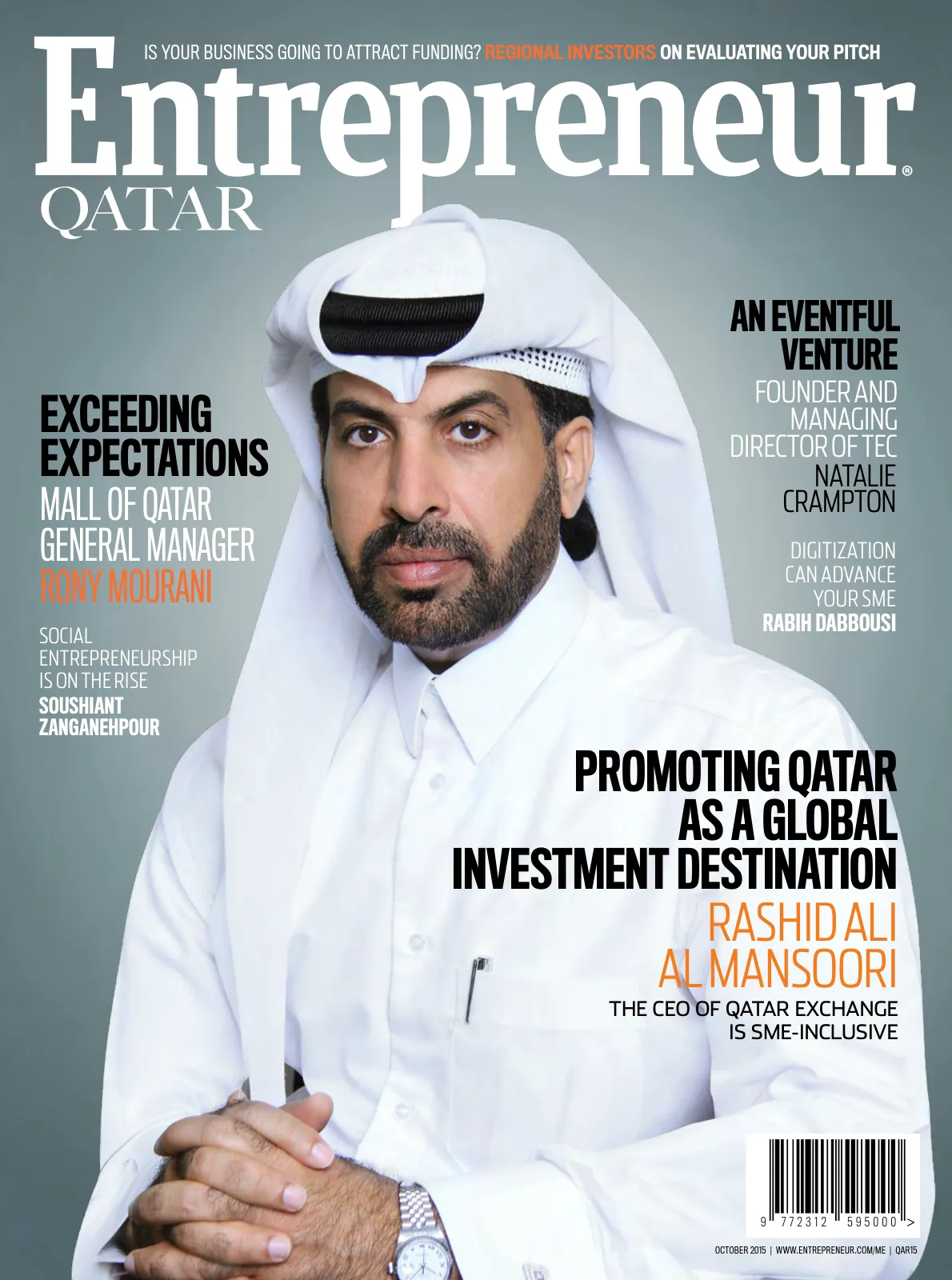
Entrepreneur Qatar, October 2015
Page 1
Is your business going to attract funding? Regional investors on evaluating your pitch
october 2015 | www.entrepreneur.com/me | QAR15
9
7 7 2 3 1 2
5 9 5 0 0 0 >
Social
entrepreneurship
is on the rise
Soushiant
Zanganehpour
Mall of Qatar
General Manager
Rony Mourani
Exceeding
expectations
The CEO of Qatar Exchange
is SME-inclusive
Promoting Qatar
as a global
investment destination
Rashid Ali
Al Mansoori
Digitization
can advance
your SME
Rabih Dabbousi
venture
An eventful
Founder and
Managing
Director of TEC
Natalie
Crampton
Page 2
Page 3
october 2015 Entrepreneur
3
CONTENTS
october 2015
12
Rashid Ali Al Mansoori,
CEO, Qatar Exchange
46
TECH:
SHINY
#TamTalksTech
Gadgets and doodads
that you might’ve missed
out on, sourced by a tech
aficionado. Yes, it’s okay to
want them all… and no, it’s
not our fault.
12
INNOVATOR:
Promoting Qatar as
a global investment
destination
Rashid Ali Al Mansoori
The CEO of Qatar
Exchange is SME-inclusive
18
Exceeding
expectations
Mall of Qatar General
Manager Rony Mourani
32
An eventful
venture
Founder and Managing
Director of TEC Natalie
Crampton
10
EDITOR’S NOTE
By Fida Z. Chaaban
52
TECH:
THE FIX
All keyed up
Rabih Dabbousi, the
General Manager of Cisco
UAE analyzes unlocking
opportunities for
startups and SMBs with
digitization.
38
ONLINE ‘TREP
Game Cooks founders
push regional game
dev even further. The
entrepreneurs have
collaborated with Nicolas
Sehnaoui for the release
of their newest game,
PolyBlast.
18
A rendering of the
Mall of Qatar
Page 4
Entrepreneur october 2015
4
CONTENTS
october 2015
Rony Mourani,
General Manager,
Mall of Qatar
18
46 #TamTalksTech:
Sony Xperia Z5 Premium
Dual
74
‘TREPONOMICS:
PRO
Balancing act
Bayt.com’s Lama Ataya
explains why your employees’
work-life balance should be
your enterprise’s concern.
80
SKILLSET
Your signature style
Olympian and entrepreneur,
James Clear, discusses a
proven, reasonable and totally
unsexy way to become more
successful.
48
MARKETING
Getting social media right
Ema Linaker explores
the pitfalls and the
opportunities of modern
platforms, and why
social media may not
be delivering for your
business.
62
PRO
Unblocking the creative
potential of Arabs
Promoting (innovative)
critical thinking in the
MENA workplace- it can
be done!
78
ESQUIRE GUY
Don’t let the haters win
Ross McCammon dissects
dealing with difficult people,
and yes, you can do better.
90
Soushiant Zanganehpour
judging The Venture 2015 GCC
finals in Dubai
Page 5
DOHA, FIFTY ONE EAST, LAGOONA MALL +974 4436 1111 LANVIN.COM
Page 6
Entrepreneur october 2015
6
CONTENTS
october 2015
Four Seasons Hotel
Riyadh at Kingdom Center
68
97 Sonia Weymuller, co-founder,
VentureSouq
42 Marie Kristine Schmidt, Vice President Brand, Design and Marketing,
Bang & Olufsen.
70
CULTURE:
TRAPPINGS
‘Trep gear
The executive selection for
the entrepreneur on your
list that has everything.
Okay, maybe for a little
self-reward as well.
60
LIFE
Power up and power
down
Mark Sephton wants you
to really tap into your four
primary sources of energy.
64
LIFE
Business book rundown
Amal Chaaban reviews a few
business books for you before
you hit the bestseller aisle.
It’s true that not all executive
material is created equally.
94
MONEY:
YOUR MONEY
Is your business going to
attract the funds you need?
Regional investors in entities
both big and small tell you
what they look for when
evaluating your pitch.
82
START IT UP:
Q + A
All I really need to know…
I didn’t learn in college
Young Lebanese ‘trep Jihad
Kawas puts business over
degrees.
86
ECOSYSTEM
Social entrepreneurship is on
the rise
Soushiant Zanganehpour’s
advice for ‘treps acting as
agents of change.
Page 7
Page 8
8
Entrepreneur MARCH 2015
SUBSCRIBE
Contact subscriptions@bncpublishing.net to receive
Entrepreneur Middle East every issue
EDITOR IN CHIEF Fida Z. Chaaban editor@bncpublishing.net
MANAGING DIRECTOR Walid Zok walid@bncpublishing.net
DIRECTOR Rabih Najm rabih@bncpublishing.net
DIRECTOR Wissam Younane wissam@bncpublishing.net
PUBLISHER Nehme Abouzeid
MANAGING EDITOR Aby Sam Thomas
CREATIVE LEAD Odette Kahwagi
ONLINE LIAISON Kareem Chehayeb
COLUMNIST Pamella de Leon
COLUMNIST Tamara Clarke
COLUMNIST Shoug Al Nafisi
PO Box 502511 Dubai, United Arab Emirates
P +971 4 4200 506 | F +971 4 4200 196
For all commercial enquiries related to
Entrepreneur Middle East contact
sales@bncpublishing.net
All rights reserved © 2015.
Opinions expressed are solely those of the contributors.
Entrepreneur Middle East and all subsidiary publications in
the MENA region are officially licensed exclusively to BNC
Publishing in the MENA region by Entrepreneur Media Inc.
No part of this magazine may be reproduced or transmitted
in any form or by any means without written permission of
the publisher.
www.entrepreneur.com/me
Access fresh content daily on our website!
MIDDLE EAST
Printed by Raidy Emirates Printing Group LLC
www.raidy.com
EntMagazineME
@EntMagazineME | @Fida
Entrepreneur-me
EntrepreneurMiddleEast
EntMagazineME
EntMagazineME
EntMagazineME
Images used in Entrepreneur Middle East are credited when necessary. Attributed use of
copyrighted images with permission. All images not credited otherwise Shutterstock.
Lama Ataya
Amal Chaaban
James Clear
Rabih Dabbousi
Ziad Kamel
Ema Linaker
Ross McCammon
Rani Nasr
Mohammed Nosseir
Benny Parihar
Mitchell Prather
Soukaina Rachidi
May Rostom
Mark Sephton
Kai Stubbe
Erika Widen
CONTRIBUTING WRITERS
In addition to our print edition, we’re bringing you all sorts of industry news
on our web mediums. Joining us online means getting relevant business and
startup content in real-time, so you’re hearing about the latest developments
as soon as we do. We’re looking forward to interacting with our readers on
all of our social media and web platforms- like any thriving business, we’re
looking to give and take. #TrepTalkME is already happening on all of our digi
platforms, and all good conversations go both ways. See you on the web!
Page 9
facebook.com/NissanME
/NissanME
nissanpatrol-me.com
THE NEW NISSAN PATROL
CONQUER YOUR LUXURIOUS SIDE
One look is good, but a double take is what we all want in life. Patrol’s premium interior
and refined exterior means you are always the one that others are looking out for.
The Hero of all terrains in life
Stylish New Look | Premium Interior | Advanced Technology
SALEH AL HAMAD AL MANA CO. (Exclusive Agent)
Main Showroom: Salwa: Tel: 4428 3333, Al Sadd Showroom: Tel: 4444 1334, Bin Omran Showroom: Tel: 4488 8618
Showroom Timings: 8:00am to 9:00pm (Sat-Thu); 4:00pm to 9:00pm (Fri).
Page 10
Entrepreneur october 2015
10
Fida Z. Chaaban
Editor in Chief
@fida | @fidazchaaban
editor@bncpublishing.net
EDITOR’S NOTE
Post your suggestions with the hashtag on Twitter or Instagram
@EntMagazineME
Do you know a MENA region entrepreneur, startup,
or SME that we should be watching?
#EntMETreps
Aspiring entrepreneurs either need to do it better,
or find a different niche
Keepin’ it real
I
f you have been reading the ad-
vice of established founders and
corporate business magnates
that we share each edition, then
you’ll know that one of the first
things they tell wannabe ‘treps to do
when developing an enterprise model
is to solve a problem that exists for a
niche that has no good existing solu-
tion. Already a few times this month,
I’ve been pitched business models
that do what someone else is already
doing (better). If you can improve
upon that existing model, and on-
board users to rival that established
company’s user base, then great. If
you are offering what amounts to the
same service or product offering, do
not present your idea as though this
is a) groundbreaking b) innovative
and c) needed.
This doesn’t apply so much to
say, the F&B industry; just because
another resto has an Italian menu
doesn’t mean a new Italian cuisine
outlet won’t do well and attract
clients. But it really does apply when
you’re launching something that is
pretty much the exact same online
concept as someone else. If you are
thinking of copycatting a concept, it’s
a good idea to import a concept that
the MENA ecosystem doesn’t have
yet. It’s a very bad idea to launch
the exact same online model as an
already established enterprise, and
just slightly tweaking the concept.
How do I define slightly tweaking?
Well, if three lines into your email
pitch, I can name other Middle East-
ern platforms that you are cloning
and I don’t see a huge difference in
the product or service offering, then
you can expect my response to be:
“How do you differ from startup X
who is already operating successfully
here?”
More often than not, a founder
responds by claiming that they are
being “disruptive” (no, you aren’t),
and they are “innovating” (doubtful),
and that they’ll do things differently
(prove it please). I think, as a startup
founder, you may find my opinions
harsh. But if you were a journo cov-
ering startups, you would probably
agree with me, as your inbox would
be flooded with these clones too.
I do want the ecosystem to grow, but
not at the expense of cannibalizing
the user base of entrepreneurial
endeavors who did something before
you, and continue to do it better than
you. If you visit my Instagram ac-
count (@fidazchaaban), you will see
some of the startups that I have used
as a customer, so I’m also speaking
from a consumer point of view. So,
if you see that I’m a customer of a
startup that does the same thing you
do, and did it before you, with very
little deviation from that model, it’s
probably not a good idea to pitch
me for an article the next day. (True
story, by the way.)
Page 11
Page 12
Entrepreneur october 2015
12
innovator
The CEO of Qatar Exchange is SME-inclusive
By Aby Sam Thomas
H
aving started operations in 1997 as Doha Securities Market, Qatar Exchange
(QE) today has more than 40 companies listed on its market, with a total
market capitalization (at the time of writing) of US$168 billion. Given that it is
a fairly young enterprise, QE has certainly got a lot to be proud about its current
status as one of the leading exchanges in the GCC region- but CEO Rashid Ali
Al Mansoori doesn’t seem to be interested in letting the market –which is today the second
largest in the Gulf- rest on its laurels either. “We are focused on making continuous develop-
ment, and making our market attractive for the investors and for the issuers, side by side,” Al
Mansoori says. “We are bringing new products like exchange-traded funds (ETFs), and tools
like margin trading, liquidity providers (LPs), securities lending and borrowing, and so on. We
are also looking for regional and international cooperation with our stock market and inves-
tors- we are promoting our stock exchange as a destination for investment.” >>>
innovator
Promoting Qatar
as a global
investment destination
Rashid Ali Al Mansoori
Entrepreneur october 2015
12
Page 13
october 2015 Entrepreneur
13
october 2015 Entrepreneur
13
Page 14
Entrepreneur october 2015
14
In addition to the above, Al Mansoori
reveals that QE has been working hard
on encouraging more companies to join
its market- and this invite has been
extended to Qatar’s small- and medium-
sized businesses as well, for whom the
QE Venture Market has been created.
With the “main market” at QE catering
to established companies wanting to go
public and satisfying all of the regulatory
requirements to do just that, the QE
Venture Market focuses instead on SMEs,
taking into consideration their limited
track records and their limited resources
when assessing their entries into the
marketplace. While getting listed on the
QE Venture Market will allow SMEs gain
access to finance to grow and develop
their businesses, such a marketplace
also ties into Qatar’s vision of “becoming
a center of excellence and GCC hub for
SMEs,” with the expectation being that
companies that get listed here will develop
the requisite track records that will see
them, eventually, graduate to the main
market at QE.
Al Mansoori notes that SMEs wanting
to enter the market can also make use of
a fund that QE has facilitated for them
with Qatar Development Bank (QDB). As
innovator
www.qe.com.qa
Rashid Ali Al Mansoori, CEO, Qatar Exchange
“We are bringing new products like
exchange-traded funds (ETFs), and
tools like margin trading, liquidity
providers (LPs), securities lending
and borrowing, and so on. We are
also looking for regional and
international cooperation with our
stock market and investors- we are
promoting our stock exchange as a
destination for investment.”
Page 15
october 2015 Entrepreneur
15
per the terms of this subsidy program,
a Qatari company that’s interested in
listing on the QE Venture Market (and
satisfies all of the exchange’s conditions
for the same) can have up to 70% of the
fees that are due to professional listing
advisors covered by QDB, with the SME
thus having to bear only 30% of the
costs involved for such an endeavor. “We
have a pipeline of companies already in
the process with advisors,” Al Mansoori
reveals. “There are already a number of
companies that have applied, and they are
in advanced stages of the process. They
have taken advantage of the fund, they’ve
hired advisors, and from a technical
standpoint, the environment [of the
market] is ready to accept them.” While
Al Mansoori wouldn’t give specifics on
the number of SMEs that are considering
entering the market, he expects the first
of these listings to happen in the first half
of 2016.
But why should Qatari SMEs consider
getting listed in the first place? “I would
say it’s a cheaper way to gain access to
capital and finance,” Al Mansoori replies.
“Also, it’s lower risk for them. Plus, the
advantage is not just in the raising of
capital- getting listed on the market will
also help them find strategic partners;
partners with the necessary experience
to help develop and grow their respective
businesses.” According to the CEO, SMEs
listed on the exchange will also find
market expertise coming to them (instead
of the other way around), and thereby
help in the growth of their business
ventures. The central idea behind QE
Venture Market is therefore to allow
Qatar’s entrepreneurial companies access
to the necessary funds that they need to
develop themselves, and thus ultimately
contribute to the national economy.
“Getting listed on the QE Venture Market
will be a way to grow these SMEs to
become larger companies, and then be
listed in the main market,” he notes.
However, all of this is not to say that it’s
easy to get SMEs interested in getting
listed on the exchange- Al Mansoori
concedes that there are indeed challenges
in doing just that. Some family-owned
SMEs, for instance, are wary of joining
the market because of a lack of awareness
about stock exchanges and how they work.
As a result, QE has made it a priority to
educate companies on what it does. “We
show them examples of family-owned
companies that have used their listing
on the market to increase growth in
their businesses, as well as an increase
in their wealth,” Al Mansoori explains.
“Coming to the market doesn’t mean that
you are losing control of your company,
or losing money either- you’re actually
making money.” Al Mansoori adds that
while a primary advantage of being listed
on a stock exchange is getting access to
finance, that, interestingly enough, isn’t
enough of an
incentive for some
Qatari companies.
“Sometimes we
think we are in
competition with
the banks,” he
explains. “Since
the banks are
providing them
with finance,
there’s no
encouragement for
them to come to
the market.”
Despite the
challenges, Al
Mansoori is
optimistic about
increasing the
participation
of SMEs in the
exchange, and has
high hopes for the
sector as a whole
in Qatar. From
the standpoint of
his organization,
Al Mansoori
says that QE has
been very keen
on building up
the SME sector
in Qatar- and
initiatives in this
regard go beyond
the setting up of
the QE Venture
Market. “We have signed MoUs with
major Qatar universities like Carnegie
Mellon University in Qatar (CMU-Q),
Qatar University, etc. to train their
students, nurture them and do whatever
we can to open their eyes [to the potential
in front of them],” he says. “We are also
doing countrywide training for investors,
and also for young people on how to >>>
“Coming to the market doesn’t mean
that you are losing control of your
company, or losing money either- you’re
actually making money.” Al Mansoori
adds that while a primary advantage
of being listed on a stock exchange
is getting access to finance, that,
interestingly enough, isn’t enough of
an incentive for some Qatari companies.
The Qatar Exchange
“We have signed MoUs with major
Qatar universities like Carnegie
Mellon University in Qatar (CMU-Q),
Qatar University, etc. to train their
students, nurture them and do
whatever we can to open their eyes.
We are also doing countrywide
training for investors, and also for
young people on how to work with
the stock market. “
Page 16
Entrepreneur october 2015
16
work with the stock market. We are
going to schools and universities, and
increasing awareness about the stock
market and how companies can be listed
in it… We are also accepting students
to come and be trained at our stock
exchange.”
The CEO has also been quite vocal
about encouraging entrepreneurship in
Qatar- during a talk in September at
CMU-Q, Al Mansoori urged the students
who had come for his presentation
to start their own businesses, and
become their own bosses. When quizzed
about his statements at CMU-Q, Al
Mansoori admitted to wanting the
young population of not just Qatar,
but the entire GCC region, to think
beyond normal careers and jobs after
they graduate from their colleges. “The
problem in the GCC is that young people
think they’ll finish their school, and then
they go to their jobs- that’s it… They
think, ‘I’m a citizen of this GCC country,
my job is guaranteed after I graduate,
and so I’ll work at a job.’ And I want to
change their perception on this- change
their thoughts on the future. It’s not just
a job that’s in their future, they also have
the option to start their own businesses.”
And there are examples galore of such
businesses, Al Mansoori notes. “Some
blue-chip companies that are now listed
in the markets of Europe and the U.S.
were started by entrepreneurs, students,
out of a garage or somewhere- companies
like Facebook, Microsoft, etc.,” he says.
“So that’s what I am trying to tell them.
Try to think outside of the box- you don’t
need to do just a job. You can do better.
You can choose one of your [existing]
projects, or maybe choose a project that
you can implement after your school,
regardless of what discipline it may be
in: engineering, business, IT, etc… You
can make a difference in your life [and
others’ as well]; you can have a plan
and make things that you can develop…
Create new ideas, create a new way of life
for yourself.” And the payoff for doing
all of this? “You can be one of those
[aforementioned] big companies one
day,” Al Mansoori replies, smiling.
innovator
THE EXECUTIVE SUMMARY Rashid Al Mansoori
Five minutes with
the CEO
“We are also doing countrywide
training for investors, and also
for young people on how to work
with the stock market. We are going
to schools and universities, and
increasing awareness about the
stock market and how companies can
be listed in it… We are also accepting
students to come and be trained at
our stock exchange.”
Rashid Al Mansoori is the current CEO and
board member of Qatar Exchange (QE). He is
also a board member of Qatar Financial Centre
(QFC), the Qatar Finance and Business Academy
(QFBA), and the World Federation of Exchanges
(WFE).
Prior to his role at QE, Al Mansoori served in the
field of financial management at Qatar Petroleum
for five years and worked as IT Director at the
Qatar Investment Authority (QIA), where he was
responsible for establishing the IT department
and managing investment and financial
applications. He also served as IT Director of
Qatar Olympics Committee and was the Head of
Applied Systems at the Ministry of Interior.
Al Mansoori has specialized knowledge and
expertise in the fields of administration, IT and
financial services, not to mention his vigorous role
in the field of sports, where he had headed many
committees in the Qatari Olympic Committee and
served as Chairman and CEO of the Qatar
Equestrian Federation, Vice Chairman of the Qatar
Fencing Federation, and Board a member of Al
Shaqab, member of Qatar Foundation.
Al Mansoori holds a BSc degree in Computer
and Management Sciences.
Rashid Al Mansoori’s tips for
young ‘treps
1. “Start small… start your
enterprises as small as you can.”
2. “Look at realizing your
objectives and goals; don’t
focus on the obstacles.”
3. “It’s okay to make mistakes-
but try not to repeat them.”
The Qatar Exchange
Page 17
Page 18
Entrepreneur october 2015
18
innovator
Entrepreneur october 2015
18
Rony Mourani,
General Manager,
Mall of Qatar
Page 19
october 2015 Entrepreneur
19
I
t is one of the most anticipated developments in Qatar today, and now,
with less than a year to go for its official opening in August 2016, the Mall
of Qatar (MOQ) seems to be all set for a grand launch that befits the spec-
tacular scale of the project. For the uninitiated, here’s how big the MOQ
project is: built on a 500,000 sq.m. plot (that’s like 50 soccer fields, by the
way), the shopping mall will house 450 stores, over 100 restaurants, a 16,000
sq.m. family entertainment area, 19 cinema screens, 7000 parking spaces- one
could probably go on and on about the mall’s sheer magnitude, but the afore-
mentioned numbers should suffice to give you a fair idea of the same. >>>
Qatar gears up for the 2016 reveal of one of the GCC’s
most ambitious projects yet
By Aby Sam Thomas
Mall of Qatar General Manager Rony Mourani
Exceeding
expectations
october 2015 Entrepreneur
19
Page 20
Entrepreneur october 2015
20
But if MOQ’s size by itself
isn’t enough to impress you,
its current leasing status
should cause you to sit up and
take notice. “The mall is now
approximately 90% leased,”
said Rony Mourani, General
Manager, MOQ, during a visit
to Dubai in September. “And
we are looking forward to
reaching full occupancy by
the end of this year.” And the
tenant mix that Mourani and
his team have whipped up
for MOQ is certainly worth
a mention: besides anchor
tenants like Salam Stores and
Carrefour, more than 40 new
brands from the fashion, F&B
and entertainment sectors are
expected to make their first
appearance in the GCC region
at this particular shopping
mall. “The mall is [aimed to
be a] super regional [shopping
center], so it has been planned
and designed to attract all
kinds of customers, starting
from luxury, going down to the
middle market, and then down
to the value and middle-low
sector as well,” Mourani says.
“The mall has capitalized a
lot on closing all the gaps that
exist in the market, so our
first aim is to create such a
signature destination, a super
regional shopping mall that
will enter into the league of the
super regional shopping malls
of the region and that holds
the name of the country.”
But given the number of
malls planned to rise up
in Qatar soon, are there
any concerns about how
MOQ’s future will play out?
Mourani doesn’t seem to be
too worried- on the contrary,
he’s quite confident about the
mall’s prospects, citing their
own market study that was
done prior to its development.
“If you look at the existing
retail offerings in Qatar,
you’ll see that the market
is definitely in need of new
retail space,” he says. “It is
undersupplied at the moment-
the last super regional
shopping mall that opened
in Qatar was in 2006… And
while the population has
grown [significantly] since
then, there have been no new
offerings in the market. So,
definitely, there’s a need. The
challenge, however, is that
this need has been caught by
several developers, and there
are a number of new shopping
malls that are coming to town.
But every single shopping mall
has its own characteristic- you
can’t put them all at the same
level… So if you look at the
15 new shopping malls that
are coming, their sizes vary in
terms of size from 250,000
sq.m. to 500,000 sq.m. of
leasable area. So, eventually,
when you filter all of that,
the market will probably have
three super regional shopping
malls, and the first one will
be MOQ. We’re capitalizing
a lot on being the first of
this league of shopping malls
to open, and we put lots of
hope in capturing a large >>>
innovator
Rony Mourani,
General Manager,
Mall of Qatar
A rendering of the Mall of Qatar
Page 21
Page 22
Entrepreneur october 2015
22
portion of the market share
by introducing a high level of
industry standards, which will
give consumers in Qatar the
shopping center experience
that they really deserve.”
Mourani continually stresses
on the MOQ experience when
talking about the shopping
center’s USP, and he says that
this feeling begins at the very
onset when a consumer is
trying to decide on a mall to
go to. Given its location in the
middle of Doha, MOQ is easily
accessible, be it via road (the
new 12-lane Khalifa Avenue
highway connects straight to
the mall) or via rail (a metro
station is scheduled to open in
2019, and it’s also going to be
close to a GCC Railway station
as well). Once you reach the
mall, the experience starts
from the mall’s impressive
façade, and onward to its
spacious interiors, with its
remarkably high ceilings and
an expansive racetrack design
for the ground. Then there is
the mall’s tenant mix, which
Mourani counts as being
extremely important: “If you
have a building made of gold,
but you don’t have the right
tenants inside it, then the
consumers will [simply] not
visit.” Adding to MOQ’s appeal
is its aim to be perceived
as the country’s ultimate
entertainment destination-
besides the cineplex and a
family entertainment center,
there’s also a special stage area
in the mall’s central ‘oasis,’
designed to bring grandiose
shows of the sort seen in
places like London, New York
and Las Vegas to Qatar.
For Mourani, the impressive
wins that MOQ has been able
to get so far are essentially
fulfilling the mandate that
was laid out to him and his
team when setting out on this
project. “The biggest challenge
we had is that we were handed
over a project that holds the
name of the country,” he
explains. “The name -Mall of
Qatar- gives an indication of
how massive this project is,
and the great responsibility
that has been put on the
shoulders of this project.
So we have a big mission
to deliver, and it must be
delivered at the highest level
possible, and the best possible
level as well.” As the General
Manager for the project, it
does look like Mourani has
certainly been successful with
what he was tasked out to
do- but he is quick to note the
hurdles he had to face along
the way. “There were several
types of challenges,” he says.
“You have design challenges,
as well as the challenges
relating to the infrastructure
you need to make and create
to accommodate such a
massive new development.
There are also the challenges
of the market, of course- the
special characteristics of the
Qatari market, the number
of shopping malls coming
to the market, etc. So, all
of that together formed
huge challenges, but with
the dedicated and highly
professional team that we have
employed, we’ve managed to
go through all these challenges,
and actually deliver. Hopefully,
everybody will be able to see
it next year, when we deliver a
five-star super shopping mall
that will compete with any of
the high league of successful
shopping malls in the region.”
innovator
THE EXECUTIVE SUMMARY
www.mallofqatar.com.qa
MALL OF QATAR
Real estate Over 500,000 sq.m.
of total built up area, of that there
is 256,000 sq.m. of leasable space
on three levels
Outlets 500+ stores
Developer UrbaCon Trading &
Contracting (UCC)
Financer Qatar National Bank NB
(Phase I in excess of a $1.2 billion
investment)
Development team Chapman
Taylor, KEO, Hill International, UCC
Leasing team McArthur +
Company, UCC
Operations Mall of Qatar WL
A rendering of the Mall of Qatar
Page 23
The INSEAD
EMBA gave me
the framework,
network and
leadership skills
to take my
company regional
Anthony Boukather
Co-CEO A.N. Boukather Holding, Lebanon
EMBA Middle East 2013
Add credibility to your credentials.
Since 2010, the INSEAD Global EMBA Middle East section
has been offering experienced executives an intensive
fast-track to the top of their careers via one of the world’s
most prestigious and multicultural academic institutions.
Learn more about the INSEAD Global Executive MBA at www.inseadEMBA.com
Page 24
Entrepreneur october 2015
24
A
re entrepreneurs born or are they taught? This is a question I have asked my-
self frequently during my 12 years of teaching business at universities around
the world. For me, this is an important question. In each of my classes, on the
first day, I conduct an informal survey. The results are that typically half of my
students have the goal of starting their own business right after they graduate,
and the majority, about 80% intend to do so in the next five years. The next question:
Is post secondary the place to be if you want to become an entrepreneur?
innovator
Learning greatness
What are the characteristics
that make a successful entrepreneur?
Entrepreneur october 2015
24
By Juris Ulmanis
Page 25
october 2015 Entrepreneur
25
For me, this question is less
straightforward. The clearest
analogy I have to answer
this is reference the age-old
nature versus nurture debate
to determine if genetic
or environmental factors
have a greater influence
on behavior. So, the actual
question seems to be: are en-
trepreneurs born or are they
taught? If I ask my students,
academic colleagues, and
fellow entrepreneurs, “What
are the characteristics that
make a successful entre-
preneur?” The answers are
consistently the same: clear
vision, drive, energy, risk-
taking, ability to motivate
people, persistence, intellect,
curiosity, listening skills,
energy, passion, excitement,
creativity, and the like. In
my opinion, most of these
aforementioned qualities are
wired in our DNA, and can-
not be taught.
I’ve encountered many young
people having these mostly-
innate traits, they have
great ideas for businesses
and they truly espouse the
entrepreneurial spirit. How-
ever, starting and running a
business also requires some
technical skills – the day-
to-day operation skills, like
budgeting, financing, selling,
marketing- that every entre-
preneur must possess. The
challenge for universities
and professors are to create
an environment to make sure
that young peoples’ entre-
preneurial spirit doesn’t go
to waste, while at the same
time developing
the technical skills
to be a successful
entrepreneur. Un-
certainty, stress,
chaos, change
are de rigeur in
a startup and
students must
learn to deal with
it if they want to
become entre-
preneurs. As my
Experiential Simu-
lations co-founder,
Dr. James Bowen,
has reminded me:
“I have been a se-
rial entrepreneur.
The first few times, I wasn’t
very successful, but the
more I went at it, the better
I became, and now we have
a successful business. I
learned through the process.”
This process contains mil-
lions of variables and these
variables or connecting those
dots can be put together only
through personal experience.
Today, virtually every
institution of higher educa-
tion offers a business degree.
Most business curriculums
are based on the classic U.S.
business education model
developed in the early part of
the 20th century, when the
United States started >>>
New Business Creation (1978–2012):
Volume and Population Bases
Prime Age (25–54)
Number of Startups
Working Age (15–64)
Per 100,000 Prime/Working Age
Number of Startups
500
Kauffman Foundation
400
300
200
100
900
800
700
600
0
0
100,000
200,000
300,000
400,000
500,000
600,000
1978
1979
1980
1981
1982
1983
1984
1985
1986
1987
1988
1989
1990
1991
1992
1993
1994
1995
1996
1997
1998
1999
2000
2001
2002
2003
2004
2005
2006
2007
2008
2009
2010
2011
2012
Figure 2
Rate of New Entrepreneurial Activity, by Age (1996–2013)
Ages 20–34
Ages 35–44
Ages 45–54
Ages 55–64
0.0%
0.1%
0.2%
0.3%
0.4%
0.5%
1996
1997 1998
1999 2000
2001
2002 2003
2004
2005 2006
2007 2008
2009
2010 2011
2012 2013
Source: Robert W. Fairlie, Kauffman Index of Entrepreneurial Activity (2014), using data from Current Population
Survey, US Census Bureau.
Kauffman Foundation
stateofentrepreneurship
2 0 1 5 A D D R E S S
One of the biggest benefits of
going to university is the op-
portunity to build relationships
with school peers who could
one day turn out to be partners,
advisors, or investors. A uni-
versity’s alumni network is also
a great resource for mentors,
people who are quite happy to
give back to their university.
graphs © Ewing Marion Kauffmann Foundation’s State of Entrepreneurship report
Page 26
Entrepreneur october 2015
26
to become industrialized.
Students are taught techni-
cal and functional areas to
manage existing businesses,
to become general managers,
in a standard, safe, stable
environment. This is very
appropriate for a career at an
established company or at a
state institution, but not for
a startup.
According to the latest
Ewing Marion Kauffmann
Foundation’s State of En-
trepreneurship report, there
is more entrepreneurship
education available than ever
before, even starting as early
as elementary school, but the
positive effects are yet to be
confirmed. At Babson Col-
lege in the U.S., 100% of the
students are required to take
entrepreneurship courses,
and 10-15% actually start a
business post graduation. At
the Martin Trust Center for
MIT Entrepreneurship, 70%
of incoming undergraduates
surveyed expresses an inter-
est in entrepreneurship, and
more than 20% expected
to start a company while
still in school. MIT claims
that their entrepreneurial
impact is such that if the
active companies founded
by MIT graduates formed an
independent nation, their
revenues would make that
nation at least the 17th larg-
est economy in the world.
In Europe, I have come
across a couple of very
interesting approaches to
entrepreneurship education.
The first approach is the
Venture Creation Program,
an experiential, action-based
program whereby students,
throughout their university
studies, create real-life ven-
tures as an important part
of their entrepreneurship
education (18 universities
use this methodology).
Another creative approach
is the Eurotech Alliance, a
strategic entrepreneurship
partnership among four
technical universities. The
Technical University of Den-
innovator
Entrepreneurship is about doing
and not about theory. Business
plans are great for businesses
that have past history. Learning
via the case method, or even bet-
ter, through computer simula-
tions and gamification allow you
to develop an entrepreneurial
mindset, make mistakes- in a com-
pressed period of time.
The challenge for universities
and professors are to create an
environment to make sure that
young peoples’ entrepreneurial
spirit doesn’t go to waste, while
at the same time developing the
technical skills to be a success-
ful entrepreneur.
www.eurotech-universities.eu | www.vcplist.com/about-vcps
Page 27
october 2015 Entrepreneur
27
mark, Eindhoven University
of Technology, École Poly-
technique Fédérale de Laus-
anne, and Munich Technical
University conscientiously
work together to exchange
faculty, students, resources,
programs, know-how, to
foster entrepreneurship
and innovation. The results,
according to Marianne
Thellerson, Senior Vice
President Innovation and
Entrepreneurship, Technical
University of Denmark, were
that last year, the Eurotech
Alliance launched 51 viable
startups alone. The aforeme-
tioned universities are the
outliers, but more universi-
ties can play a greater role
to help develop some habits
and skills for up-and-coming
entrepreneurs during their
stay at school.
Some suggestions for
students
1. Take courses only
from those who have
real-life experience.
You wouldn’t want to learn
surgery from a person
who hadn’t successfully
completed many surgeries.
Learning entrepreneurship
from someone who has never
successfully built, managed
and even sold a company
makes about as much sense.
2. Take courses that
ensure learning by doing.
Entrepreneurship is about
doing and not about theory.
Business plans are great
for businesses that have
past history. Learning via
the case method, or even
better, through computer
simulations and gamification
allow you to develop an
entrepreneurial mindset,
make mistakes- in a
compressed period of time.
3. Learn outside of
an educational
institution.
Outside of class, there
are also outstanding
entrepreneurship courses
via Coursera and edX, from
the best entrepreneurship
professors in the world that
focus on many aspects of
entrepreneurship.
4. Network, network,
network and seek good
advisors.
One of the biggest benefits
of going to university is
the opportunity to build
relationships with school
peers who could one day
turn out to be partners,
advisors, or investors. A
university’s alumni network
is also a great resource for
mentors, people who are
quite happy to give back to
their university and to young
people with their contacts,
knowledge and experience.
5. Get an internship
at a startup, not at an
established company.
To become an entrepreneur,
one must be around entre-
preneurs and an entrepre-
neurial environment.
Are entrepreneurs born or
are they taught? My answer
is taught, if you’re willing to
be a proactive student and a
self-taught leader.
Experiential learning advocate Juris
Ulmanis has spent the past decade
teaching entrepreneurship, marketing,
and international business courses
as a professor in universities across
Europe. A former Motorola execu-
tive for 18 years in Europe and the
U.S., Ulmanis left the company to
explore his own entrepreneurial ideas
as a co-founder, including his latest
experimental learning and simulation
company: Experiential Simulations
www.experientialsimulations.com.
In demand as a speaker and media
commentator, Ulmanis trains, con-
sults, and mentors business leaders in
entrepreneurship. The Vice-Chairman
of the European Scout Foundation,
he’s a champion of the organization’s
ability to create creative leaders and
embraces every risk-taking opportuni-
ty to reap the rich rewards of success.
First-Time Entrepreneurs
Serial Entrepreneurs
0.0%
0.50%
1.00%
1.50%
2.00%
2.50%
3.00%
3.50%
4.00%
4.50%
17 19 21 23 25 27 29 31 33 35 37 39 41 43 45 47 49 51 53 55 57 59 61 63 65 67 69 71 73 75 77 79 81 83 85 87 89
Source: Kauffman Firm Survey
Kauffman Foundation
Age Distribution of First-Time and Serial Entrepreneurs
According to the latest Ewing
Marion Kauffmann Foundation’s
State of Entrepreneurship
report, there is more entrepre-
neurship education available
than ever before, even starting
as early as elementary school,
but the positive effects are
yet to be confirmed. At Babson
College in the U.S., 100% of the
students are required to take
entrepreneurship courses, and
10-15% actually start a busi-
ness post graduation.
graph © Ewing Marion Kauffmann Foundation’s State of Entrepreneurship report
Page 28
Entrepreneur october 2015
28
IN THE LOOP
The 2015 INSEAD Global Business Leaders Con-
ference will take place in Abu Dhabi, UAE under
the Patronage of H.E. Sheikh Sultan bin Tahnoon
Al Nahyan, Chairman, Department of Transport.
Staged by INSEAD, the conference will take place
at the Etihad Towers Hotel on October 20, 2015,
and is themed Leading Innovation. The series of
panels and discussions appeal to a wide range of
industries, covering topics such as “the impact
of digital on business and organizations” and
how “companies in mature industries innovate
to remain competitive.” Entrepreneur Qatar
Editor-in-Chief, Fida Chaaban, will be part of a
panel discussing innovation in media. You can
expect to see distinguished speakers including Dr.
Rafic Makki, Chief Strategy Officer, Abu Dhabi
Education Council, as well as Arjen Radder, Chief
Executive Officer, Phillips Middle East & Turkey.
Registration is now open! www.insead.edu
T
he 2015
edition
of the
CFO Strategies
Forum, staged by
Naseba, will take
place in Dubai
on October 25-
26, 2015. The
forum’s ninth
edition will
include discus-
sion panels,
workshops,
and networking
opportunities,
as well as the
MENA CFO
Awards. There
will be 25 speak-
ers, among them
Jassim Alsed-
diqi, CEO, Abu Dhabi Financial
Group, Nabil Mushahwar, EVP,
Finance and Strategic Planning,
Al Hilal Bank (UAE), Rajesh
Pareek, CFO, DIFC (UAE), and
Nauman Mian, CFO, Bayt.com
(UAE). CFOs and finance heads
from across the GCC and MENA
will be attending to network
from various industries, from
real estate and energy to IT and
hospitality. The forum’s spon-
sors and partners include Mi-
crosoft, PwC, VISA, Thomson
Reuters, and Gulf Bank.
www.cfomideast.com
Abu Dhabi to host
the INSEAD Global Business
Leaders Conference
Ninth Annual CFO Strategies Forum
MENA to take place in Dubai
The Qatar Ministry of Infor-
mation and Communications
Technology has announced the
Qatar’s E-commerce Forum
taking place on October 19
at the Ritz Carlton Doha.
The forum couldn’t be more
relevant, given Qatar’s boom-
ing economy, the increasing
number of SMEs,
and an e-commerce
industry that is
growing faster
relative to most
other countries in
the MENA region.
The talks and
discussion panels
will cover a wide
range of topics and
issues that the e-
commerce industry
must tackle in
order to thrive,
including payment
solutions, the shar-
ing economy, and
innovative business
models and startup
funding to fortify e-
commerce enterprises. Among
the speakers and moderators
are Omar Soudodi, Managing
Director of PayFort, Kivanc
Onan, PayPal Head of Middle
East and Turkey, Iyad Kamal,
COO of Aramex, and Ali Al
Maliki of eGrab. Registration is
now open. www.ictqatar.qa
The Qatar E-commerce Forum comes
at a time of sector growth
Jassim Alseddiqi,
Chief Executive Officer,
Abu Dhabi Financial Group
Omar Soudodi,
Managing Director,
PayFort
Page 29
Page 30
Page 31
october 2015 Entrepreneur
31
Under the patronage of H.H.
Sheikh Mohamed bin Zayed
Al Nahyan, Crown Prince
of Abu Dhabi and Deputy
Supreme Commander of
the UAE Armed Forces, and
in collaboration with the
Abu Dhabi Tourism and
Culture Authority, Abu Dhabi
Airports has announced a
bigger and better edition
of the Abu Dhabi Air Expo
next year. Three events are
happening between March
8-10, 2016 during the Abu
Dhabi Aviation and Aerospace
Week: the Abu Dhabi Air
Expo 2016, the Middle East
Aviation Career Conference
& Exhibition, and the Abu
Dhabi Heli Expo 2016. The
fourth edition of the expo
is expected to be larger
than ever, with the number
of exhibitors expected to
increase by 20% compared
to the last edition. The
organizers hope to showcase
the UAE’s growing aviation
and aerospace sector at the
event.
www.abudhabiairexpo.com
Saudi Arabia’s capital is gear-
ing up for the two-day MENA
Private Equity and Venture
Capital Summit, which will
take place from October 25-
26, 2015. The summit is co-
organized by the investment
arm of King Saud University,
the Riyadh Valley Company
(RVC), and international
business networking
mammoths, Naseba. Some
of the topics that will be
discussed during the summit
include the role of the govern-
ment and public sector in
harboring the right ecosystem
for funding startups, and
the different challenges and
opportunities in early stage
funding. There will also be
some businesses pitching
for investment, as well as
networking opportunities
among entrepreneurs, VCs,
and industry leaders. Among
the speakers are the Presi-
dent of King Abdulaziz City
for Science and Technology
(KASCT), HRH Prince Turki
Bin Saud Bin Mohammad Al
Saud, Dr. Khaled Al Saleh,
CEO of the Riyadh Valley
Company, and Fadi Ghandour,
founder of Aramex.
www.menavcsummit.com
After a successful event at
Istanbul in May, smartcon
is making its way to Dubai
this November. Themed
Leadership for a Data Driven
Economy, smartcon 2015
Dubai will take place at
the Jumeirah Beach Hotel
from November 23-24.
The event includes panels
and workshops providing
essential strategic tips for
businesses across different
arena of commerce including
finance, telecommunications,
energy, media, health, tech,
and even the public sector.
Some of the panelists slotted
to make an appearance?
Phil Winters, Customer
Perspective Champion, Data
Whisperer at CIAgenda, Dr.
Michael Wu, Chief Scientist
Innovator of Social Sciences
on SocialMedia, Lithium
Technologies, and Fadi
Ghandour, Aramex Chairman
and Oasis500 founder. The
multiple workshops cover a
wide variety of content from
analytics and data mining
to advanced digital and web
analytics.
www.smartcon.com
Abu Dhabi Airport gets
ready for Abu Dhabi Aviation
and Aerospace Week
Riyadh gears up for the MENA Private
Equity and Venture Capital Summit
smartcon 2015 Dubai to take place
in November
Fadi Ghandour,
founder, Aramex
Air Expo Abu Dhabi
IN THE LOOP
Page 32
Entrepreneur october 2015
32
“TEC’s mission is to ex-
tend the marketing message
through the finest events the
industry has seen that are
meticulously planned and
flawlessly executed. We strive
to be one of the world’s lead-
ing event agencies and have
a 10-year plan in place to
help us meet this objective.”
Crampton recalls the chal-
lenges faced prior to expand-
ing to Doha, such as travelling
back and forth from Dubai in
order to execute projects, not
to mention incurring costs
spending time in the process.
“We were also not able to
meet our service standards
that we had done so well
at developing in Dubai. For
example, clients would often
request meetings at short
notice, which we weren’t able
to accommodate. Not having
an office in Doha also meant
that quality control was much
harder to manage.” Adding
to the fact the initial hurdles
of the municipality permis-
sions and approvals like in
many of the GCC countries.
“Another initial challenge
was the culture. Before we
began operations in Qatar,
I thought the culture would
be the same as the UAE, but
soon realized there are many
subtle differences that impact
projects. This challenge has
been overcome [sic] with
experience and hiring a team
that are familiar with the lo-
cal market.”
On a positive note, Cramp-
ton describes how they were
very fortunate in reference to
their clients in Qatar, which
were initially clients in the
UAE. “This meant that break-
ing into the Qatar market was
not as difficult as it would
have been if we were a start-
up. Over time our reputation
in Qatar grew which helped
us to secure Qatar-based cli-
ents.” Among TEC’s portfolio
of confirmed events within
the next sixth months include
big name hitters from across
sectors and industries, like
HSBC, flydubai, Cisco, Estée
Lauder, Lexus, and OSN.
Crampton believes there are
three key factors that make
TEC stand out in a very
crowded sector and competi-
tive marketplace. First, TEC’s
impressive market reach
as they have experience in
executing events in more
than 15 countries throughout
the Middle East, Russia and
Europe. “A benefit for clients
is that they have to brief and
manage one agency that can
ensure brand consistency
throughout every country.
This is also more cost effec-
tive then recruiting a differ-
ent agency in every location.”
Secondly, delivering excep-
tional client servicing: “We
have worked extremely hard
on setting our client servicing
standards and believe that we
deliver a second-to-none cus-
tomer experience.” The third
An eventful endeavor
Natalie Crampton
Founder and Managing Director of TEC
H
aving an office in Doha was not initially part of our business plan,
however our clients were satisfied with the work we produced
in Dubai and often asked how we could help them in other GCC
countries. Qatar kept cropping up in conversations,” says Natalie
Crampton, founder and Managing Director of TEC. TEC, formerly known as
The Event Company, first opened its doors for business in 2008 in Dubai,
UAE. When Qatar won the 2022 World Cup in 2010, the following year, TEC
expanded operations to Doha. The company delivers diverse projects ranging
from conferences and product launches to large-scale events and exhibitions.
In Qatar, the majority of TEC’s requests are for corporate events including
conferences, seminars and product launches.
“
innovator
By Erika Widén
As a female entrepreneur in the
region, Crampton highlights how
this has not made it more or less
difficult as she is strong willed
by nature. “I was 22 years old when
I started TEC in Dubai, and I would
love to say that I had a watertight
business plan, but that is not the
case. There was no business plan
and no financial projections, just
a lot of passion and determination.”
Crampton describes how they
were very fortunate in reference
to their clients in Qatar, which
were initially clients in the UAE.
“This meant that breaking into the
Qatar market was not as difficult
as it would have been if we were a
startup. Over time our reputation
in Qatar grew which helped us to
secure Qatar-based clients.”
The TEC team
Page 33
october 2015 Entrepreneur
33
strength is supply-based.
TEC keeps their own stock
of props, staging materials,
and even event furniture. In
Dubai, they have a 5000 sq.
ft. warehouse packed full of
furniture, décor and props,
which are transported when
required throughout the re-
gion. “This allows us to have
flexibility on costs and work
within our clients’ budgets
as we have very few third
party suppliers. We also have
smaller warehouse facilities
in Cairo, Doha, and Kuwait.”
In August of this year, TEC
officially rebranded from their
former full title, since their
services gradually evolved
over the years. Initially,
the company was purely a
corporate events agency,
however over time their
clients requested to man-
age their digital campaigns,
PR, and more recently, social
media. “Whilst the name
The Event Company initially
worked very well for us, in
the last couple of years it has
been somewhat limiting. We
were unofficially known by
many of our clients as TEC
so this seemed like the most
natural name to go with.”
With regards to the entrepre-
neurial environment in Qatar,
Crampton believes it is the
land of opportunities, and she
admires and loves the passion
for growth and ambition that
the country has. The MD says
that she has seen clients in
Qatar change over the years,
dramatically becoming more
professional in the ways they
do business. Some examples?
Procurement departments
have been created; thorough
background checks are now
executed, and there is more
thought than ever before
going into the event goals
and objectives, according to
Crampton.
As a female entrepreneur in
the region, Crampton high-
lights how this has not made
it more or less difficult as she
is strong willed by nature.
“I was 22 years old when I
started TEC in Dubai, and I
would love to say that I had
a watertight business plan,
but that is not the case. There
was no business plan and no
financial projections, just a
lot of passion and determi-
nation.” Apart from being
present in the UAE and Qatar,
they also have a small office
in Kuwait, and have plans to
launch in Saudi Arabia soon.
“We have also just opened
our first office outside of the
Middle East in Singapore and
our first two Singaporean
colleagues have both started
in the last month. I am very
excited about what the future
holds for us.”
TIPS FOR ‘TREPS
Natalie Crampton
The founder of this enterprise
encourages you to take work
seriously, and points out that
a productive environment
includes surrounding oneself
with positive and likeminded
people to stay focused. She
admits that when starting a
business, there isn’t much
room for concepts like work-life
balance- all the more reason to
work on something that you’re
extremely passionate about
and let your passion drive
you. “One quote that I always
remember and agree with is:
entrepreneurship is living a
few years of your life like most
people won’t, so that you can
spend the rest of your like most
people can’t.” And how does
this ‘trep bring good energy
into the work place? TEC’s
team is encouraged to try and
achieve work-life balance, and
there are monthly social events
and regular workshops on top-
ics such as coping with stress
in the workplace. “We have
even had massage therapists
visit the office to help destress
the team.”
nitially, the company was purely a
corporate events agency, however
over time their clients requested
to manage their digital campaigns,
PR, and more recently, social
media. “Whilst the name The Event
Company initially worked very well
for us, in the last couple of years
it has been somewhat limiting.
We were unofficially known by
many of our clients as TEC so this
seemed like the most natural name
to go with.”
Nathalie
Crampton
www.the-event-company.com
Page 34
Entrepreneur october 2015
34
Business best
practices for F&B
‘treps
Zomato’s Heino Gehle on
investments, giving F&B outlets
their own apps, and growth
strategies
F
ounded in India in 2008, and subsequently
launching in the UAE in 2012, Zomato, the
restaurant discovery platform now present in 22
countries, is keen for more. Offering online and
mobile service with user-submitted reviews and
ratings, menus and photos, the platform recently raised a
substantial US$60 million in a recent round of funding.
The funds were raised in September, led by Singapore
investment company Temasek with participation from
existing investor Vy Capital. With a total of eight rounds of
funding throughout the years, including previous investors
Info Edge, Sequoia India and Vy Capital, Zomato’s latest
round clocks in at a total of $225 million. Zomato UAE
Country Manager and Middle East and Africa Regional
Director, Heino Gehle, says that the investment will be de-
voted to growing the business’ verticals: “We easily have 24
months of runway with the latest round of funding.” Gehle,
whose background ranges from marketing and advertis-
ing, to business development and operations, handles the
MENA region’s operations. The recent investment round
coincides with the launch of Zomato’s new feature called
Zomato Whitelabel, which is a platform for businesses to
create and manage their own iOS and Android apps- even
with little to no technical skills.
“It’s not really about
build-versus-buy for
us; it’s about hitting
the ground running
with the right team. We
enter markets as soon
as we see a product-
market fit and have
a team that can make
things happen quickly.”
“We are constantly
working to disrupt
the restaurant indus-
try through product
innovation, with the
aim of becoming the lo-
cal go-to restaurant
service in every market
we’re in.”
Heino Gehle,
Zomato Regional
Director
After realizing that many
F&B ventures lack a digital
presence (or the technical
in-house team to execute
digital assets), Zomato’s team
developed Whitelabel with
features such as targeted push
notifications, analytics and
menu management to keep
consumers informed. From a
consumer’s view, it’s a conve-
nient way to know more about
an F&B outlet, while from a
merchant’s perspective, it’s a
strong brand-awareness tool.
Whitelabel apps will work on
a subscription based model of
$200 per month per location,
as well as a levying a service
fee per transaction. Besides
Whitelabel, Zomato has four
other revenue streams. The
first is via hyperlocal advertis-
ing with differing rates per
area and category, and Zomato
for Business generates rev-
enue by allowing businesses
to pay a subscription fee to
get placement on Zomato’s
listings, in addition to sharing
deals, special menus, promos
and events. Another revenue
stream is through Zomato
Cashless payments in Dubai
for diners to eat and pay
without a physical bill and
settle it later with a card, and
through the Online Ordering
service present in 14 cities
including UAE and India.
Zomato charges these outlets
a commission to facilitate user
transactions.
As a platform present in
multiple countries, Gehle
says that while Zomato’s core
is similar across countries,
the product is localized and
adapts to each market by
adding features based on
user search behavior. Gehle
cites the example of how
Page 35
october 2015 Entrepreneur
35
in Dubai, Zomato features
restaurants serving shisha,
while in London, it highlights
hotel rooftops. In markets like
Turkey, Indonesia, Chile, Por-
tugal, Brazil, Czech Republic,
Slovakia, Poland and Italy,
Zomato is available in the
local language of prevalence.
Differences in markets also
triggered the team to build
certain features: in Europe,
since establishments often
post daily menus outside of
venues, they can use Zomato
for Business to upload their
daily new menus and regular
ongoing menus. Similarly,
Cashless payments was rolled
out in Dubai first, compared
to other cities where credit
card payments were less
prevalent, and there was yet
to be a two-step authentica-
tion process, making it a good
market to pilot Zomato Cash-
less. The product is definitely
a F&B game-changer, and
how it’s tweaked to cater to
the needs of each market is
what matters. “If you build a
product that people find value
in, they will come back to use
it,” says Gehle.
Localizing the product for
the market has had its dif-
ficulties- consumers will only
find value if there’s in-depth
information on restaurants,
while F&B owners only find
value if there’s enough cus-
tomers. Zomato’s solution?
“By providing a rock solid
content platform which pro-
vided all possible information
for more than 95% of restau-
rants across cities in the re-
gion.” A main concern for the
Regional Director is attracting
and retaining the right people
who are passionate about the
product. This is essential as
the company’s strategy on
acquisitions, which, Gehle
says, is, “It’s not really about
build-versus-buy for us; it’s
about hitting the ground run-
ning with the right team. We
enter markets as soon as we
see a product-market fit and
have a team that can make
things happen quickly.”
How has Zomato evolved in
the Middle East? Other than
the UAE, the site also covers
Qatar and Lebanon, with
350,000 monthly visits on
all platforms and over 70%
traffic originating from mobile
devices in Lebanon. On the
product side, it has grown
from a platform to discover
restaurants, to allowing users
to place orders online, book
a ride and even pay using the
Cashless feature on the app.
With more than 250 team
members in the UAE, and
another 200 to be hired in
the Middle East over the next
few months, Gehle regards
the UAE as one of their most
profitable markets. Besides an
emphasis on local and global
expansion, a table manage-
ment app called Zomato Book,
a point of sale system app
called Zomato Base and real-
time consumer-merchant in-
teraction are in the works. On
a final note, Gehle says, “We
are constantly working to dis-
rupt the restaurant industry
through product innovation,
with the aim of becoming the
local go-to restaurant service
in every market we’re in.”
Business best
practices for F&B
‘treps
IMPORTING A DIGITAL
BUSINESS FROM INDIA TO
MENA
Heino Gehle
The product is definitely
a F&B game-changer, and
how it’s tweaked to
cater to the needs of
each market is what
matters. “If you build a
product that people find
value in, they will come
back to use it.”
“When you start building some-
thing for the right reasons, you
have identified a gap that you
want to bridge or have figured
an even more efficient way of
doing something that already
exists. If you can do this with
focus and build a good team
around your idea that shares your
vision, that’s half the battle won.
I think it’s important to jump and
learn to swim when it comes to
international market entry. One
of the things that worked very
well for us is that we have built
an incredible team; our people are
extremely passionate about the
product and believe in what we’re
building. It’s also important to
have a strong foundation in place
as well as adapt to local needs and
preferences.”
AGILE PRODUCT OFFERING
“We’ve never been compla-
cent about our product, and
are constantly tweaking our
product based on feedback
from our users across loca-
tions. We believe in real-time
engagement with our user
base- in listening to and fixing
issues in real-time.“
CONVERTING USERS TO
LOYAL COMMUNITY
MEMBERS “Identifying one’s
customers’ needs and adapt-
ing offerings to suit each of
their needs has always been
our main focus. Customer
satisfaction correlates to cus-
tomer loyalty. A strong social
media presence and active
interaction and engagement
with users and restauranteurs
over the years has helped us
achieve customer loyalty and
brand recall.”
MARKETING METHODS
“Listening to users is
always helpful because if
they find a product useful,
they spread the word
among their friends and
social circles. Though our
medium is primarily online,
our marketing is a mix of
both online and offline.
Our online marketing
encompasses search engine
marketing, and our social
media channels are a great
way for us to connect with
our users. As for offline,
we tie up with restaurants
for below the line (BTL)
advertising, especially in
new markets. We also
engage proactively with
our community of foodies
through meetups in all our
markets in order to connect
with users in an offline
setting.”
Page 36
Page 37
Page 38
Entrepreneur october 2015
38
Initially, Game Cooks was
founded with the main objec-
tive of building games that
have culturally relevant plots
and elements that users from
this region could relate to.
The co-founders’ first game
Run For Peace, did just that,
clocking close to two million
downloads within a only few
months of release. Following
their coup with Run For Peace,
Game Cooks expanded to
target the international market
with a future vision of making
Lebanon a major player in the
global mobile gaming market.
“We are currently getting
ready to launch the interna-
tional version of PolyBlast.
The revenue model is designed
bring in profits from two main
channels: in-game ad system
and in-app purchases. In
PolyBlast, the in-app purchase
is a Premium Pack, which once
purchased provides the player
with three additional challeng-
ing worlds as well as World
X for the extreme PolyBlast
experience,” explained the
founders.
TECH SHINY | WEBSITE TO WATCH | GEEK | MOBILE TECH | ONLINE ‘TREP | THE FIX
Game Cooks founders push regional game dev even further
Entrepreneurs Lebnan
and Arz Nader
get you downloading
By Rani Nasr
Nerds by Game Cooks
“The gaming industry has huge
potential. Leisure time is grow-
ing every year and technology
is making possible things we
only dreamt of a few years ago.
There is a kid hiding inside each
and every one of us, and gaming
is one of the tools that would
allow us to unleash this inner
imagination.”
B
ack in 2011, there wasn’t much of a local gaming scene in the
Middle East. Most users were only playing international titles,
which ranked at the top of the regional app store charts. Lebnan
and Arz Nader, two hardcore gamers, saw an opportunity and
decided to test out people’s reactions in the region to localized content.
They released Birdy Nam Nam, which began as an after-hours project,
and were thrilled to see it exceed a quarter million downloads in just one
week. Shortly after, the Nader brothers officially founded Game Cooks
in 2012. With an impressive portfolio of 14 games available on the iOS
and Google Play to date, the founders are getting ready to launch their
newest release, PolyBlast, on the international market with three other
games in the pipeline that are still “cooking.”
Game Cooks co-founder
Arz Nader
Page 39
october 2015 Entrepreneur
39
PolyBlast by Game Cooks
Escape from Paradise by Game Cooks
Scarb it by Game Cooks
After each testing round, the
game is optimized until the
best final version of the game
is realized. Their secret ingre-
dient on how to keep the users
coming back for more? Quali-
ties of addictiveness.
“We are currently getting
ready to launch the
international version of
PolyBlast. The revenue model
is designed bring in profits
from two main channels:
in-game ad system and in-app
purchases.”
An all-new old school gaming
experience
PolyBlast by Game Cooks
PolyBlast, Game Cooks’ latest
release, is a challenging arcade
game with a puzzle twist that
requires you to blast targets
and navigate moving shapes
out of your path before they
reach the bottom of your
screen. The game, with solo
and multiplayer modes, might
sound simple, but it’s far from
easy as it requires speed,
precision and some calcu-
lated planning. You might find
yourself running out of blasts
before you’ve had a chance to
eliminate all obstacles from
the screen. In solo mode, you
have access to three themed
(and increasingly challenging)
worlds. If you’re up for the
impossible challenge, unlock
the premium pack to access
three additional worlds– level
hard and the ultimate World
X to kick things into an even
higher gear. The premium pack
also removes all ads from the
game. As for the multiplayer
mode, players are up for a
treat. It adds a challenge factor
to the game and allows you
to take on an opponent on
the same device in a PolyBlast
split-screen competition. May
the person with the most
blasts win.
Committed to gaming to the
core, the founders’ brain-
storming sessions start in
their very own game room.
They run a competition to see
who comes up with the best
out-of-this-world idea, and
end up with some outrageous
concepts. They then proceed
to shape up those ideas into
full-blown games. They also
rely on market research to see
what gamers are playing, but
gaming standards come before
onboarding users: “One thing
is for sure, Game Cooks will
never create a game that we
would not play ourselves just
because it is the next trend.”
For PolyBlast,
the shared pas-
sion for gaming
brought Game
Cooks and the
former Minister
of Telecom-
munications of
Lebanon, Nico-
las Sehnaoui,
together in
an entrepre-
neurial respect.
Sehnaoui, an
avid gamer and self-declared
geek, had an idea in mind for
a game. Together with Game
Cooks, the idea was taken from
conceptual stage to actual
development, subsequently
publishing a classic entry in
mobile gaming. “The gaming
industry has huge potential.
Leisure time is growing every
year and technology is making
possible things we only dreamt
of a few years ago. There is
a kid hiding inside each and
every one of us, and gaming
is one of the tools that would
allow us to unleash this inner
imagination,” says Sehnaoui.
“It all started with a rough
idea which I threw in the field
of the amazing Game Cooks
team. Their skilled members
did their magic and brought
it back to me a much more
evolved version which was
further enriched through
common brainstorming and
numerous iterations. I think
the idea of using your pad as
two-player field game is a great
feature and one of my personal
favorites- it reminded me of
the very basic yet extremely
fun pong games of the early
80s.”
Before launching a game,
the company conducts several
rounds of testing, with testers
broken down into Game >>>
Page 40
Entrepreneur october 2015
40
TECH SHINY | WEBSITE TO WATCH | GEEK | MOBILE TECH | ONLINE ‘TREP | THE FIX
“It all started with a rough idea
which I threw in the field of the
amazing Game Cooks team. Their
skilled members did their magic
and brought it back to me a much
more evolved version which was
further enriched through common
brainstorming and numerous
iterations. I think the idea of using
your pad as two-player field game
is a great feature and one of my
personal favorites- it reminded me
of the very basic yet extremely fun
pong games of the early 80s.”
Scrab it by Game Cooks
Cubama by Game Cooks
Captain Oil by Game Cooks
www.itunes.com
Cooks team members, Game
Cooks friends, Game Cooks
community of fans, and people
from the gaming industry
that are willing to help out.
There are numerous elements
to focus on in including game
progression and difficulty
levels. Functionalities (are
there any bugs that come up?),
ease of use and understanding,
and game navigation are also
analyzed and assessed. After
each testing round, the game is
optimized until the best final
version of the game is realized.
Their secret ingredient on
how to keep the users coming
back for more? Qualities of
addictiveness. Using PolyBlast
as an example, its gameplay
is simple– tap to shoot at the
moving obstacles to remove
descending geometrical shapes
before they reach the bottom
of your screen. The player has
three blasting points to shoot
from and a limited number of
blasts. What makes the game
so addictive is, simply put, its
gameplay. The addictiveness
factor comes from the speed
at which the game progresses.
When you first start, the game
feels easy; after completing the
first few levels the player has
the, “I’ve got this” kind of feel-
ing. It’s only when the speed
and difficulty level picks up
does the player realizes what
they are up against! This is
where the fun really starts, and
where the user gets hooked!
Now that PolyBlast has
launched successfully with
an upcoming international
release, Game Cooks are wrap-
ping up their next endeavor:
BackTrip. Slotted for release in
Q4 of 2015, the Lebanon-based
outfit also mentioned two
more games scheduled for Q4
2015 and Q1 2016.
Page 41
october 2015 Entrepreneur
41
Nicolas Sehnaoui talks digi, development,
and Lebanese ‘treps
“Make it happen”
Nicolas Sehnaoui
With a reputation for being a big
fan of graphic novels, science fic-
tion, technology, and pretty much
anything geeky, Nicolas Sehnaoui
isn’t a far-fetched fit as gaming
development collaborator and
investor. What doesn’t really fit
into the equation is that Sehnaoui
is also the former Lebanese
Minister of Telecommunications.
Known to communicate heavily
with the public via social media,
staging meet and greets with
the Lebanese digital community,
and now, an investor in Leba-
non’s entrepreneurial ecosystem,
Sehnaoui wants you to believe
in the country’s potential. “The
future of Lebanon resides in the
minds and hearts of young tech
entrepreneurs. Through my mod-
est yet personally enriching expe-
rience on Twitter, I got the chance
to discover an amazing Lebanese
geek community that is fun,
creative, and open-minded,” says
Sehnaoui. He is adamant that
there’s an abundance of talent
ripe for the picking in the MENA
gaming arena in specific, citing
the proliferation of creativity in
ideation, design and animation, as
well as the “exposure to numer-
ous cultures and languages, high
percentage of youth, and rapid
growth of internet users on a
worldwide level,” that he says are
all factors that contribute to suc-
cess of ventures like Game Cooks.
Sehanoui has invested in a
few Lebanese startups that
he considers sound business
models, and he is also involved
in an ongoing project in tech and
media sectors that he declines to
elaborate on until it matures.
“I have invested seed money into
a few very promising startups in
Lebanon, and I strongly believe
some of them will be close to the
unicorn level.” During his tenure
at the Ministry, Sehanoui says
that he and his team worked
toward Lebanese infrastructure
enhancements to reduce brain
drain- improvements to the
existing systems would anchor
entrepreneurs in the country in-
stead of having them set up shop
elsewhere. “When I was at the
helm of the Ministry of Telecoms,
my team and I did our best to
upgrade the infrastructure so that
they can function out of Lebanon.
We also geared our efforts at
strengthening the ecosystem
and launched many initiatives
mostly in collaboration with the
Central Bank; the most important
one being the launch of Circular
331 that allocates up to US$400
million of equity financing to
Lebanese startups. Furthermore,
we launched Beirut Digital Dis-
trict, an urbanized hub that aims
to become an all-inclusive zone
dedicated to growing the digital
industry in Lebanon through
cutting edge infrastructure and
services for startups.” Sehnaoui
grew up in a household that
exposed him to sci-fi –his father
was a fan and constantly brought
home new books- and later he
delved into comics, gaming, and
feature film. “[It] goes back to the
70s, since the early age of Marvel
and DC comics, as well as the
Galactica and Star Trek original TV
series. I used to have vivid dreams
of the X-Men and the Fantastic
Four, and you’d find stickers of
them all around my room.”
Sehnaoui made for an unor-
thodox Minister, since unlike his
contemporaries, he actually talked
to his audience rather than at
them. It was what got the digital
scene’s attention, and he’s now a
regular fixture on the tech circuit.
His advice for those ‘treps foray-
ing into tech? “Believe in yourself.
Cultivate your creativity. Imagine
the future. Make it happen. Expo-
nential technologies are crushing
time and space. Always remem-
ber, when you get there, you’ll be
one of the few people who are
actually changing our world and
humanity for the better.”
Page 42
Entrepreneur october 2015
42
TECH SHINY | WEBSITE TO WATCH | GEEK | MOBILE TECH | ONLINE ‘TREP | THE FIX
Bang & Olufsen’s 90th
anniversary ushers in continued
brand allure and appeal
Marie Kristine Schmidt
Setting
new
standards
for the
future of
sound
By Aby Sam Thomas
Entrepreneur october 2015
42
Page 43
october 2015 Entrepreneur
43
october 2015 Entrepreneur
43
BeoLab 18 speakers
BeoLink Multiroom
>>>
O
ne of the first
things that
one sees after
entering The
Farm, Bang &
Olufsen’s head-
quarters in
Struer, Denmark, is an imposing
concrete space, bare except for
a black grand piano standing by
a wall, on which is written (in
capitalized aluminum letters, no
less): “Bang & Olufsen exists to
move you with enduring magical
experiences.” As far as company
mottos go, this one may seem a
tad pretentious- but given that
it is a premium brand, globally
known for its innovative tech-
nology products that boast of a
stunning design aesthetic, let’s
just say that Bang & Olufsen –
which, incidentally, is celebrat-
ing its 90th anniversary this
year- has earned the right to be
as grandiose with its statements
as it wishes to be.
For a company that was
launched way back in 1925,
Bang & Olufsen’s continued al-
lure and appeal in this day and
age is testament to its inventive
approach to design and technol-
ogy, with the former being not
just a cursory add-on, but an
integral part of the develop-
ment process for its products.
“We are truly a design-driven
company,” says Marie Kristine
Schmidt, Vice President Brand,
Design and Marketing, Bang &
Olufsen. “And being design-
driven is not [just] about indus-
trial design. Being design-driven
is our whole approach- it’s our
culture, it’s the way we tackle
challenges, and it’s the way that
we look at things from different
angles. So when we talk about
design, we talk about the way it
looks, the way it feels, the way
it works, the way it sounds- it’s
the total user experience.”
It is this insistence on ensur-
ing a stellar user experience
that has set Bang & Olufsen
apart in a crowded market are-
na, with an expansive customer
base that, at one point in time,
included Apple co-founders
Steve Jobs and Steve Wozniak.
“Bang & Olufsen is a brand for
which we have quite loyal cus-
tomers, and once people start to
buy into the brand, they, kind
of, like, stay,” Schmidt says.
So what does Bang & Olufsen
do differently to get this kind
of clientele? “Our approach
is, really, to go into people’s
houses, and figure out what are
the pinpoints they face in the
ways that technology integrates
into their lives. That’s where we
start, and those are the chal-
lenges that we try to solve.” But
it’s not just about innovating in
technology- Schmidt notes that
Bang & Olufsen stresses a lot on
the design aspect of products
as well. “I think sometimes, in
this day and age, the conversa-
tion about technology is about
so many other things than the
aesthetics,” she explains. “But
the aesthetics is so important
to who we are, what we look at
and the way we live. This has
also been one of the things that
has been driving us always-
what we do actually makes
people’s homes more beautiful.”
Its line of home entertain-
ment products may be what
Bang & Olufsen is most famous
for, but its work in the luxury
car domain, where it designs
sound systems for automotive
brands like Audi, BMW, Aston
Martin, etc., has also been
pretty noteworthy. There is also
the B&O Play line of products,
which Bang & Olufsen launched
in 2012 to lure in new custom-
ers that were different from its
usual target audience- B&O Play
has products that have a more
contemporary look and feel,
made for “the digital generation
of consumers,” but still featur-
ing the essential ethos of the
Bang & Olufsen brand. Be it
with its mobile speakers or its
high-performance headphones,
Page 44
Entrepreneur october 2015
44
B&O Play has added new
features to their BeoPlay A2
and Beolit 15 Bluetooth speak-
ers. You can now wirelessly
pair two speaks together for
twice the sound. With minimal
audio coding delay and latency,
the omni-directional listen-
ing experience is amplified for
everyone around the speaker.
It’s portable, gives you up to
24 hours of continuous play
time and comes in new natural
colors. Turn up the music!
Bang & Olufsen revs up BeoPlay speakers
TECH SHINY | WEBSITE TO WATCH | GEEK | MOBILE TECH | ONLINE ‘TREP | THE FIX
By Tamara Clarke
BeoPlay H6 headphones
B&O Play has been steadily ris-
ing up on the popularity charts,
a development that, according
to Schmidt, is important for
the company as a whole. “We
are really going out there on
the creative edge [with our
marketing for B&O Play] to try
to attract new customers, who
we can see eventually turn into
Bang & Olufsen customers,” she
explains.
Bang & Olufsen’s customer-
centric approach to doing things
is something it places high on
its marketing agenda- Schmidt
says the company is very keen
on letting its customers know
that it takes care of them. And
this is conveyed in a variety
of ways- one of them being
that whenever Bang & Olufsen
releases any kind of new tech-
nology innovation, there is a
concerted effort by the company
to make sure it is backward
compatible with its older
products or versions as well.
Another detail that sets Bang
& Olufsen apart, according to
Schmidt, is its dealer network,
whose members are the ones
that actually sell the company’s
products. “It’s a partnership
model, and a franchise model,”
she says, when explaining Bang
& Olufsen’s dealer network. “I
think one of the clear advan-
tages [of this approach] is that
we all have a skin in the game.
We work with partners who are
really good retailers, and they
know their markets. They know
their customers, and they can
be close to the customers, so
that’s an obvious advantage. At
the same time, what they get
is an opportunity to get access
to this amazing brand and its
products.”
Given Bang & Olufsen’s
steadfast attention to detail, it
should thus come as no surprise
that the company maintains
a close relationship with the
partners it has in its network. “I
think it’s the right model for us,
because we do want to pursue
this strategy of selling Bang &
Olufsen exclusively through our
dealer network, and we have a
lot of good dealers out there do-
ing a really good job,” Schmidt
says. And yes, Schmidt confirms
that Bang & Olufsen also prunes
the network regularly as well,
because, well, the company
simply doesn’t want bad dealers
to pull down its brand, which
can also hurt its good dealers.
“Our focus is very much that,
instead of spending 80% of
our time on the dealers that are
not performing that well, we
really make an effort on spend-
ing 80% of our time on the
dealers that are doing well and
make them perform better,” she
explains.
This dedication to detail in all
that it does –be it with its prod-
ucts, or with its management
processes- is a good indicator of
how Bang & Olufsen has man-
aged to remain a well-respected
brand that has stood the test of
time. To celebrate its 90th anni-
versary this year, the company
released its Love Affair collec-
tion in March, which featured
some of the brand’s most popu-
lar, iconic products reimagined
in rose gold aluminum. But that
was just the beginning of Bang
& Olufsen’s anniversary cel-
ebrations- Schmidt says there
are bigger announcements on
the way in November, where the
company is apparently going to
launch products that are “really
going to set new standards for
the future of sound.” Schmidt
refused to divulge more details
about what to expect, but she
did say this: “The Love Affair
collection was a tribute to our
first 90 years, and the product
we are coming out with on
our anniversary is a tribute to
the next 90 years.” Given that
declaration, we are keeping our
eyes (and ears) peeled for what
Bang & Olufsen comes out with
next- watch this space!
Page 45
Page 46
Entrepreneur october 2015
46
Sony Xperia Z5 Premium Dual
TECH SHINY | WEBSITE TO WATCH | GEEK | MOBILE TECH | ONLINE ‘TREP | THE FIX
#TAMTALKSTECH
IFA, the global tradeshow for consumer electronics, is where the latest tech products and innovations are presented.
Here’s our curated best in show picks culled from the 56th IFA in Berlin.
The accessory Rolly Keyboard
The IOT LG SmartThinQ
LG SmartThinQ
Sensors
The smartphone Sony Xperia Z5 Premium Dual
LG Rolly Keyboard
Xperia Z5 Premium Dual is the
world’s first 4K smartphone,
boasting of a 5.5 inch 4K
TRILUMINOS display for
mobile. How does this improve
your UX? By allowing you to
view content at four times the
resolution of Full HD. Heavy
consumers of YouTube, Netflix
and entertainment mediums
via their smartphones can
watch vibrant 4K detail on the
Xperia Z5 Premium Dual. Are
you a content creator? You can
capture in 4K too and connect
either wirelessly via DLNA or
with MHL 3.0 to enjoy your
content on a 4K TV. Xperia Z5
Premium Dual features 32GB
internal memory with the capa-
bility to take a 200GB external
microSD card, which allows ex-
tra room for 4K videos, movies,
and images. With a Snapdragon
810 processor and high capac-
ity 3430 mAh battery lasting
for up to two days, Xperia Z5
Premium Dual is a high-perfor-
mance device created for the
AV lovers out there.
LG connects home appliances
to the Internet with its new
SmartThinQ Sensor. The circu-
lar device that can be attached
to any home appliance collects
and communicates data
through the SmartThinQ app.
Attach this device to anything
from your washing machine to
your refrigerator. But what do
you really want to know about
your fridge? How about how
many times the refrigerator
door has been opened or when
a particular food item inside
the refrigerator is about to ex-
pire? SmartThinQ can actually
send expiry notifications. And,
connecting the SmartThingQ
Sensor to other appliances like
an air conditioner allows you to
control the appliance remotely
through the SmartThinQ app.
The SmartThinQ Sensor is a
simple way to bring the Inter-
net of Things into your home.
LG Electronics unveiled Rolly
Keyboard, the industry’s first
solid, rollable, wireless key-
board. Unlike other portable
keyboards, the Rolly folds
along each of its four rows to
create a “stick” that fits easily
into your pocket, briefcase or
bag. Rolly Keyboard features
high-contrast and well-spaced
keys that make typing com-
fortable, and a fold-out mobile
device stand. The board has a
17mm key pitch- just 1mm shy
of the 18mm key pitch found
on most desktop keyboards.
Impact-resistant and made
of durable polycarbonate and
black ABS plastic, it’s powered
by a single AAA battery for
up to three months. LG really
shines with how Bluetooth
functionality is incorporated:
simply unfolding Rolly enables
the auto pairing function to
connect easily to two different
devices at the same time via
Bluetooth 3.0 with the ability
to toggle between the two.
Rolly Keyboard is a new take
on an old staple… a fresh ac-
cessory you can roll with.
Page 47
october 2015 Entrepreneur
47
Apple Watch Hermès
DoubleTour
Apple Watch
Hermès Cuff
Apple Watch
Hermès
DoubleTour
#TAMTALKSTECH
“We look forward to taking the
Obi Worldphone to a global
stage, and use the Middle East
as our launching pad.”
Amit Rupchandani, Managing Director
Obi Worldphone EMEA
Bridging the gap
Obi Worldphone designs
for the EMEA region
Transcending time Apple Watch Hermès
Tamara Clarke, a former software
development professional, is the tech
and lifestyle enthusiast behind The
Global Gazette, one of the most active
blogs in the Middle East. The Global
Gazette has been welcomed and lauded
by some of the most influential tech
brands in the region. Clarke’s goal is
to inform about technology and how it
supports our lifestyles. See her work
both in print regional publications and
online on her blog where she discusses
everything from how a new gadget
improves day-to-day life to how to
coordinate your smartphone accessories.
Visit www.theglobalgazette.com
and talk to her on Twitter
@GlobalGazette.
Apple Watch Hermès, a unique
expression of the Apple Watch,
is outfitted with a stainless
steel bezel and finely stitched
leather. This collaboration of
Apple’s industry-changing
product design and the heritage
craftsmanship of Hermès
is available in three models;
Single Tour, Double Tour and
Cuff. The Single Tour with
the 38 mm stainless steel
case comes in Fauve Barenia
leather, Noir Box leather and
Capucine Swift leather, while
the Single Tour with 42 mm
stainless steel case comes in
Fauve Barenia leather and noir
Box leather. The Double Tour
pairs with the 38 mm stainless
steel case and is available in
fauve Barenia leather and Bleu
Jean, Capucine and Etain Swift
leather. The Cuff pairs with the
42 mm stainless steel case and
is available in Fauve Barenia
leather only. So as not to be
confused with any other variety
of the Apple Watch, each stain-
less steel case features an etch-
ing of the Hermès signature
and includes a customizable
face with three exclusive dial
designs inspired by Clipper,
Cape Cod and Espace Hermès
watches. Apple Watch Hermès
delivers high tech functionality
and style that
transcends
time.
Obi Worldphone, co-founded by
John Sculley, former head of Ap-
ple and Pepsi-Cola, has released
two affordable smartphones: the
SF1 and SJ1.5. SF1 is the compa-
ny’s flagship 4G/LTE smartphone
featuring a raised 5-inch display
made of Corning Gorilla Glass 4, a
13 MP camera with a Sony IMX214
Exmor sensor, Dolby Audio, Qual-
comm Quick Charge 1.0 power
management technology, and
it’s powered by a Qualcomm®
Snapdragon 615 processor in a re-
inforced fiberglass body. The Obi
Worldphone SJ1.5 is a 3G smart-
phone powered by the MediaTek
MT6580 Quad-Core processor
presented in an asymmetrical de-
sign, with a crisp, squared-off top
and a curved bottom. Protected
by scratch-resistant Corning®
Gorilla® Glass 3, the screen, made
from 2.5D curved glass built flush
with the body of the phone, gives
it a seamless feel in the hand.
SJ1.5 offers unique color options,
easy-access dual SIM slots, 16 GB
of internal storage and a card slot
for memory expansion, with front
and rear cameras.
Page 48
Getting
social right
I have spent over three years in the Middle East talking to CEOs, CIOs, VPs of
Marketing, and others about why they need to invest in smart social strategies
for their businesses. Time and again, I think that social media has gotten
a bad reputation in this region for not delivering business impact, because
companies focused on measures of success that frankly do not really drive
business results. Size really doesn’t matter when it comes to communities,
and frequency of content doesn’t matter when no one is listening.
TREPONOMICS
ETHICS | ESQUIRE GUY | SKILLSET | MARKETING | PRO
The pitfalls and the opportunities
By Ema Linaker
Entrepreneur october 2015
48
Page 49
october 2015 Entrepreneur
49
When compared to TV, print
and outdoor media, the ROI on
social media and social media
advertising in particular is much
higher than traditional media.
Further, you can start small
and see what works best for
your brand and your services
and see what sticks. The main
goal is to really drive traffic.
we live in a fast-paced envi-
ronment where people expect
customer service to be delivered
in minutes rather than days. They
go to social channels to talk to
brands and share their points
of view with you in real time.
This shouldn’t be something you
shy away from- in fact, brands
that don’t have a social presence
because they’re scared of what
their customers might say are
missing the point.
Social media marketing is the
art of connecting people to
brands through understand-
ing what motivates people
to connect together, share
experiences and become vocal,
loyal advocates of a brand
that over time delivers what
I call the three magic Rs that
every social marketer tries to
achieve. If you remember one
thing from reading this article
I hope it’s the three magic Rs
of Review, Recommend and
Refer– if your social media is
actively focused on deliver-
ing those three key behaviors,
you will ultimately create
advocacy, loyalty and purchase
behavior over time.
Intimate understanding
of your customer
Social media marketing al-
lows brands and companies to
get really close to the people
they’re trying to sell to. This
means that if you’re smart and
you are closely listening to
what is being said about you
on the social web, either on
your community pages or off of
those owned channels, you can
start to really understand what
makes your particular audi-
ence tick. Further, with the
data available to us through
social channels like Facebook,
we know a lot about what
they like, what they don’t, and
what motivates and matters to
them. If you want to connect
with people here in the Middle
East now, you need to show
that you’re paying attention to
all this information that they
share on social channels, and
apply it to R&D and marketing
communications offline.
Increase brand
recognition through
relevant storytelling
So what are the opportunities
for people wanting to under-
stand the value and signifi-
cance of social media market-
ing? First of all, at a time when
most people have an attention
span less than that of a gold-
fish, social media allows you to
have a creative idea that you
can share in five seconds. Get-
ting your consumers’ attention
is not enough though- what
social media should do is fa-
cilitate a dialogue, which gets
them to share your brand and
company stories. Your con-
sumer is no longer paying any
attention to outdoor or more
traditional media. Remember,
the majority of the population
in the Gulf is below 30 years of
age- this means they live their
lives off Instagram, Snapchat
and BuzzFeed.
Brands on social have
more loyal customers
It goes without saying that if
you start to know more about
a person or individual, then
you start to understand them
better and are more likely to be
loyal to that person. This is the
same case with social media
marketing– if you follow the
principles that you share, you
have a personality and can talk
like a real person to the com-
munity that you are building
and sharing information with,
then they are much more likely
to become loyal fans and cus-
tomers of the brand, and yes,
data indeed backs this up.
You become more
responsive
Whether you like it or not, we
live in a fast-paced environ-
ment where people expect cus-
tomer service to be delivered
in minutes rather than days.
They go to social channels to
talk to brands and share their
points of view with you in real
time. This shouldn’t be some-
thing you shy away from- in
fact, brands that don’t have a
social presence because they’re
scared of what their custom-
ers might say are missing the
point. You have an opportunity
to turn a hater into a lover, and
often all it takes is a simple
acknowledgement of the issue
and to say you’re listening,
and that you’re going to help
them to dampen the fire of
anger. Social CRM is a vital
part of customer care, and
it’s important that you see
the opportunity in managing
angry customers and turning
them into advocates instead.
Social should be a personal
experience that brings positive
relationships to deliver value.
Better SEO
Social content, thanks to its
ability to create movements
and global conversations re-
gardless of race, religion or age,
has started to become highly
indexed by Google and other
search engines. Social content,
and video in particular, is very
important in delivering this for
your brand or business.
Increased inbound
traffic
Without social media, your
inbound traffic is limited to
people already familiar with
your brand, and individuals
searching for keywords you
currently rank for. Every social
media profile you add is an-
other path leading back to your
site, and every piece of content
you syndicate on those profiles
is another opportunity for a
new visitor. The more quality
content you syndicate on so-
cial media, the more inbound
traffic you’ll generate, and
more traffic means more leads
and more conversions.
Social media is great
value
When compared to TV, print
and outdoor media, the ROI on
social media and social media
advertising in particular is
much higher than traditional
media. Further, you can start
small and see what works
best for your brand and your
services and see what sticks.
The main goal is to really drive
traffic. >>>
Page 50
Entrepreneur october 2015
50
TREPONOMICS
ETHICS | ESQUIRE GUY | SKILLSET | MARKETING | PRO
Ema Linaker is a digital native
who has been working integrated
communications for leading brands
and agencies for over 20 years.
She has worked at Google, Nuance,
Ogilvy & Mather, and now heads up
Leo Burnett’s team of social, mobile
and digital experts working on
multinational brands like McDonalds,
Samsung and P&G.
www.buzzfeed.com
When doing social media, it is not
necessary to invest in all of the
major platforms. Pick one that
is right for you and your budget.
With Facebook being a socially
powered advertising platform,
you might want to invest in Snap-
chat or Instagram, which require
less media investment to drive
awareness, reach and impact of
your content.
The outlined points are a few
of the opportunities in social
media marketing and com-
munications- but what about
the potential pitfalls that you
could come across when doing
the same? For me, the biggest
pitfall is not being present on
social media simply because
you can’t understand it, or be-
cause you don’t want to open
up to potential criticism about
your business. But ladies and
gentlemen, let me tell you a se-
cret: people are already talking
about your business on social
media- you just aren’t aware
of it, or are not managing your
social reputation effectively.
Other top pitfalls include:
Diving straight in
Rushing to launch a social
media channel is akin to rush-
ing into a pregnancy. You can’t
get half-pregnant with social
media– you’re either in, or
you’re not, and so it pays off
to invest time in planning it
properly, investing in listening
to what people are saying and
what others are doing before
embarking on launching any
channels. Those that do this
reap the benefits quicker and
more efficiently than those
that don’t.
Focus (or the lack of it)
When doing social media, it is
not necessary to invest in all of
the major platforms. Pick one
that is right for you and your
budget. With Facebook being
a socially powered advertising
platform, you might want to
invest in Snapchat or Insta-
gram, which require less media
investment to drive aware-
ness, reach and impact of your
content.
Quality over quantity
Social media is not a volume
game or business. I spend a lot
of conversations with clients
trying to help them understand
that apart from customer care,
the frequency of engagement
on social platforms should
focus on quality rather than
quantity. No one likes the guy
at the party who doesn’t listen
and has no emotional intel-
ligence to gauge that others are
either bored of his contin-
ued monologue, or that they
haven’t even heard a word he’s
said. Social media marketing
is exactly the same, although
people nowadays are less toler-
ant and patience with what I
call social vomit.
Lack of consistency
Ever had a boss or a friend
whose temperament you could
never forecast? If you have,
then you’ll be acutely aware of
the impact that lack of consist-
ency can have on your mood,
day and life. Brands that aren’t
consistent cause people to lose
interest very quickly.
Interns are not the
solution
Social media marketing is
an art and a science, and it’s
one that is learned through
analysis, reading and educa-
tion. Interns are fantastic for
bringing in fresh ideas and new
perspectives, but they should
not be responsible for posting
and managing communities
online, because that would be
akin to them turning up at a
conference and delivering the
keynote speech.
No analysis
Measurement and analytics
are part and parcel of anyone
who works in the online, con-
nected world in which we live
now. It is simply not accept-
able to not track KPIs, metrics
and results of the work we do.
So be sure to keep a close eye
on your social media analyt-
ics such as Facebook Insights,
LinkedIn Page Statistics and
Iconosquare to help you track
the efficacy of your investment.
There are also tons of third
party social media tracking
tools out there to help you
measure the success of your
social media and gain addi-
tional insights as well.
Page 51
OHSAS 18001 certified
ISO 9001, 14001 and
130+years of
project experience
LEED Platinum, LEED Gold
and LEED Silver Capability
End to End Integrated Solutions
Pioneering Engineering Construction since 1881
www.drakescull.com
700+
Projects Delivered
For over 130 years, Drake & Scull International PJSC has been shaping skylines and transforming the lifestyle of
communities around the world.
Drake & Scull is an industry leader, with a proven history of delivering more than 700 projects through its General
Contracting, Engineering, Rail, Oil & Gas, Water and Wastewater Treatment and Infrastructure development business
streamlines across the region.
Page 52
Entrepreneur october 2015
52
TECH SHINY | WEBSITE TO WATCH | GEEK | MOBILE TECH | ONLINE ‘TREP | THE FIX
Unlocking opportunities
for startups and SMBs with digitization
All keyed up
By Rabih Dabboussi
Technology has changed the way we work and live. Businesses are becoming more efficient, con-
sumers are making better-informed decisions and whole industries are being transformed as the real
impact of technology becomes clear. From healthcare to transport and beyond, the shift to digital
ways of thinking is helping to streamline processes, remove inefficiency and create better experiences
for patients, passengers and the general public alike.
Entrepreneur october 2015
52
Page 53
october 2015 Entrepreneur
53
Rabih Dabboussi is the General
Manager of Cisco UAE.
Dabboussi’s responsibilities
also include driving and forging
close relationships with the
government and ensuring that
Cisco’s business objectives
and goals are closely aligned.
With a key focus around smart
and connected communities,
Dabbousi is helping to drive
Cisco’s Smart City strategy
in the UAE as well as in the
wider Middle East region as
a whole. Along his journey, Dabboussi has achieved several U.S. technology
patents that have helped differentiate Cisco’s products and solutions, and has
lived and worked in the U.S., Europe, Asia and the Middle East. He holds a B.S.
in Computer Science from North Carolina State University.
1. Become a digital company
Digital transformation will en-
able them to innovate faster and
achieve their desired business
outcomes. Digitization should be
across technology (data), people,
and processes. Data analytics will
be an important element to ensure
availability of high quality,
actionable, trusted, and complete
data.
2. Develop a workforce for
the future Your business must
become agile enough to compete
in the IoE era, where employees
must possess an optimal mix of
technical skills, industry knowledge
and business acumen.
3. Integrate IT and OT Com-
panies could improve end-to-end
business efficiency when they
integrate the IT and OT segments
of business. They must begin to
build a culture of communication,
collaboration and coordination
between these teams, strongly
supported by company leadership.
4. Ensure end-to-end cyber
security To help mitigate cyber
security risks, as well as prepare
for future industry developments,
companies need to put a strong
security policy in place and deploy
threat-centric security solutions
that will help them gain visibility
of the assets, protocols, users,
applications and traffic patterns
on the control network to develop
a picture of what is “normal” for
that environment. They need to
classify assets and systems based
upon their value to maintaining
operations and build out defenses
for the critical assets and systems
first. Regularly test, review and
update defenses and policies. Be-
ing “secure” is temporal, as threats
and attack techniques constantly
evolve. Therefore, defenses should
be regularly tested and modified,
as needed.
5. Innovate for growth SMBs
must always look beyond their ho-
rizons for opportunities to innovate
and create growth.
Five steps SMBs should take to ensure both
short- and long-term success
Execute your enterprise’s
IoE strategy
Today, around a billion devices
are connected worldwide–
which is still less than 1% of
the potential total. At Cisco,
we believe that number will
grow to 50 billion by 2020.
From buildings to buses,
energy grids to wildlife, eve-
rything is being connected.
Almost everywhere, oppor-
tunity awaits– not just in
tech-friendly vertical sectors
such as energy and retail, but
also in arts and entertainment,
manufacturing, agriculture
waste management, financial
services, real estate, and edu-
cation, to name a few.
The Internet of Things (IoT),
the networked connection of
devices where we are today,
is the foundation for the next
wave of the Internet of Every-
thing (IoE), which will connect
people, processes, data and
things, creating unprecedented
opportunities. These trends
are introducing a new era of
technology that will trans-
form nearly every industry
including the SMB segment
to change the way we live and
work.
Benefits of digitization
for SMBs
IoT brings networking technol-
ogy to places where it was
once unavailable or impracti-
cal but the challenge for com-
panies is to build the right in-
frastructure. Small businesses
face changing requirements of
scale and data management,
and need standards-based
infrastructure that is highly
secure and interoperable.
The connection of devices,
machines, and things allows
small businesses to dynami-
cally generate, analyze and
communicate intelligence
data, increase operational
efficiencies, and power new
and greatly improved business
models. The IoE is creat-
ing value by lowering costs,
improving employee produc-
tivity, generating new revenue
avenues and enhancing citizen
benefits. For SMBs, the ben-
efits include improvements in
innovation, supply chain and
asset utilization.
To achieve the immense
business benefits afforded by
the IoE, SMBs need a highly
robust and secure network
infrastructure. They need to
converge unrelated networks,
scale to meet increasing traffic
demands, employ advanced
data analytics and inspire a
new class of intelligent appli-
cations to increase productiv-
ity without sacrificing security.
In order for SMBs to develop
business agility, they will need
to deploy solutions to manage
and store data in the cloud and
data center that can improve
productivity and operational
efficiency today, while laying
the foundation for tomor-
row’s IoT opportunities. With
IoT, organizations can expect
new operational efficiencies,
improved safety and security,
distributed intelligence and
control, faster and better deci-
sion making and new business
opportunities and revenue
streams.
The benefits of digitiza-
tion and connectivity will be
enormous -greater efficiency
and economy, better end-user
experiences, greater usage of
assets and clearer views of
the business- but they will be
constrained by a global talent
gap in ICT, unless the global
community takes action to
train and educate more people
in the technical disciplines.
Middle East governments need
to deploy policy and training
programs to help solve the
region’s fastest-growing gap in
networking professionals
Road to success
IoE is not only a great leveler
for businesses –small and
large– but for consumers and
governments alike. It’s a call
to action- to be innovative,
collaborative and ambitious.
Once companies become digi-
tal they have the opportunity
to completely reimagine their
business models to connect
people, process, data and
things across industries, cities
and countries to realize new
economic value.
Ultimately, however, we be-
lieve the IoE will have a much
greater impact on the world
than the Internet did in its first
20 years. We think the pos-
sibilities of the IoE are limited
only by imagination, and it will
prove to be the most signifi-
cant technological revolution
in history.
Page 54
Page 55
Page 56
Entrepreneur october 2015
56
Better now than later
TREPONOMICS
ETHICS | ESQUIRE GUY | SKILLSET | MARKETING | PRO
TREPONOMICS
ETHICS | ESQUIRE GUY | SKILLSET | MARKETING | PRO
I
t’s unsurprising that very few entrepreneurs talk about crisis communications
in their business plans. The focus during those early days is on funding, business
development, branding and marketing– all of the positive activities that help to
establish corporate identity, and its place in the market. But new business own-
ers need to understand the importance of crisis preparedness as a central element
of their business plan. And the earlier this is done, the better it is for your enterprise.
Reputations are built slowly, over time. This means that most startups have yet
to establish important corporate values of trust, transparency and ethical trading,
meaning that a crisis that happens early on poses a grave threat. Unlike large, estab-
lished firms, a startup doesn’t have the reputational collateral that can help them
to recover quickly. And the owners of a new business are particularly vulnerable
to making unwitting mistakes that can come back to haunt them. Small decisions
made early on and in good faith can have far-reaching reputational consequences,
which is why every new business owner needs to sit down from day one (and on a
regular basis) to assess the reputational consequences of decisions made. In short,
they need to look ahead at every step of the way.
How to crisis-proof your business
By Mitchell Prather
One of the most important things
to do if a crisis does happen is to
convene as a management team and
–if possible– source outside help.
Crisis contingency plans can be de-
veloped by external consultancies
that provide a step-by-step guide
to respond in any eventuality. These
plans will tell you who to call, in
what time frame and precisely what
to say (and what not to say).
All of your internal processes
matter- particularly the way in
which you treat your employees.
This means adopting best prac-
tice in areas such as health and
safety, HR and legal matters. It is
in your best interests to put in
place anti-discrimination poli-
cies pertaining to sex, sexuality,
race, age and any other areas of
potential contention or conflict.
>>>
1. Supply chain
One of the most important
things for new businesses
to consider is whether or
not their suppliers operate
ethically. From the first day
of operation, business owners
need to be in a position to
state that they source their
materials/ingredients/
supplies from trusted sources
that operate responsibly.
That means considering the
impact that the supply chain
has on the environment,
communities and individuals
manufacturing or producing
the things you are buying.
There may be a compromise
to be made– the trusted
supplier may be more
expensive. Think about the
true value of reputation and
whether or not your brand
can afford to source from
a supplier whose business
harms the environment or
enslaves factory workers.
2. Identify
stakeholders
One of the best ways to build
a responsible business is
to identify each and every
touchpoint. You and your
team should sit down and
identify every individual
person, group of people,
special interest group and
other organizations that your
company and its products and
services impact– even if it is
indirectly. This process does
not need to be complicated
or laborious; it can be as easy
as creating a spreadsheet of
stakeholders and the way in
which your business touches
them, alongside any potential
areas of risk. This will help
those making decisions
to make them with all
stakeholders in mind, and by
default reduces the chances
of making mistakes. Such an
approach also gives you and
your team confidence that
you are operating responsibly
and doing all the right things.
Page 57
With our exceptional services, we succeed
Because you deserve “Priority Banking”
Be part of our program, because you deserve more than the traditional services.
Our Priority Banking provides you with products and services designed especially to fit
your financial needs.
In addition, you will receive a variety of benefits including:
• Financial consultations and solutions
• Dedicated Relationship Officer
• Dedicated lounges in branches
• Reduced and free financial service fees
• Credit Cards tailored to your needs
For more information please call 8001240006 or visit your nearest branch
Page 58
Entrepreneur october 2015
58
TREPONOMICS
ETHICS | ESQUIRE GUY | SKILLSET | MARKETING | PRO
TREPONOMICS
ETHICS | ESQUIRE GUY | SKILLSET | MARKETING | PRO
One of the most important things
for new businesses to consider
is whether or not their suppliers
operate ethically. From the first
day of operation, business owners
need to be in a position to state
that they source their materials/
ingredients/supplies from trusted
sources that operate responsibly.
That means considering the impact
that the supply chain has on the
environment, communities and indi-
viduals manufacturing or produc-
ing the things you are buying.
One of the best ways to build a
responsible business is to iden-
tify each and every touchpoint.
You and your team should sit
down and identify every individual
person, group of people, special
interest group and other organi-
zations that your company and its
products and services impact–
even if it is indirectly.
3. Internal
communications
All of your internal processes
matter- particularly the
way in which you treat your
employees. This means
adopting best practice in areas
such as health and safety, HR
and legal matters. It is in your
best interests to put in place
anti-discrimination policies
pertaining to sex, sexuality,
race, age and any other areas
of potential contention or
conflict. Happy employees
are strong ambassadors, and
on the flip side, badly treated
workers are a reputational
crisis in the making. So think
about putting in place simple
systems such as regular
reviews, an open-door policy,
confidentiality guarantees,
newsletters and an intranet.
A comprehensive internal
communications platform will
take time, but the important
thing is that it will lay the
foundations to communicate
openly and effectively from
day one.
4. Digital media
The management team
of a new business
should immediately be
discussing how it intends
to communicate with
its stakeholders through
social media. The rise
of Facebook and Twitter
present businesses with
opportunities to promote
a positive reputational
image to stakeholders; but
it’s incredibly important
to realize that it’s a two-
way street. Consumers,
competitors, special interest
groups and other stakeholders
have the ability to post things
about your firm, and you
have absolutely no way of
preventing it. This is why all
communications via social
media need to be strictly
on message, by adhering
to corporate guidelines
on ethics, discrimination,
political comment– all
areas of potential conflict.
Guidelines on social media
output should form part
of the company’s rule
and regulations and also
be included in employee
contracts.
5. Act swiftly (but
carefully)
One of the most
important things to do
if a crisis does happen
is to convene as a
management team and
–if possible– source
outside help. Crisis
contingency plans
can be developed by
external consultancies
that provide a step-by-
step guide to respond in
any eventuality. These
plans will tell you who
to call, in what time
frame and precisely
what to say (and what
not to say). These are
the gold-standards in
crisis planning. But,
these are expensive and
by their very nature,
reactionary.
It is our experience
as a growing business
that the best way to
deal with a crisis is to
do everything in our
power to make sure it
doesn’t happen. We
make sure that we work
with organizations that
operate ethically, we
apply international best
practices in everything we
do internally and externally.
As a communications
consultancy, we know how
important it is to ring-
fence our reputation– crisis
awareness and prevention
is a priority and has been
since the day we opened our
doors. It should feature in
every entrepreneur’s business
plan.
Mitchell
Prather is the
Managing
Director of
Djembe Com-
munications.
He brings over
25 years of
international
financial and
corporate communications experience
gained in Asia, Africa, Europe, North
America and the Middle East. He
joined Djembe from Grayling, where
he headed the agency’s African and
Middle East operations. Previously,
Prather worked at Mubadala Develop-
ment Company, where he managed
all communications related to M&A
deals and international financing
activities. He was also the lead of
corporate communication require-
ments of key portfolio company as-
sets and employee engagement. Prior
to joining Mubadala, Prather served
as Joint Managing Director of Golin
Harris where he co-led a 28-strong
pan-GCC corporate communications
consultancy.
Page 59
ENTREPRENEUR
4
Page 60
Entrepreneur october 2015
60
Mark Sephton
is an interna-
tional personal
mentor to
entrepreneurs,
basing his
program on a
GPS system
with eight key
fundamentals.
This system
reveals blind
spots, efficien-
cies and deficiencies, and is used to
find your “inner sniper” to improve
your instinct, producing devastating
results in your own revolution of
discovery. It is hard to see the picture
when you’re in the frame. Changing
the way you think through culture
and mindset shifts and introduced to
game-changing habits helps increase
your productivity and skyrocket your
personal brand.
www.marksephton.com
Tapping into your four primary sources of energy
Power up and power
down
By Mark Sephton
business unusual | LIFE | TRAVEL | DESIGN | TRAPPINGS
CULTURE
‘Trep talk ME
THE BUSINESS
The Gift Concierge
THE ‘TREP
Founder Christianna Tsiterou
Q How do you manage your
time?
A “Time management is prob-
ably one of my strongest traits
and also something I look for
in the people I work with. A
to-do list from the night before
helps me plan my day, divided
between the tasks that definitely
need to be completed during the
day and the ones that can be
moved over to the next if neces-
sary. Secondly, I don’t interrupt
to read emails. While I do check
my emails throughout the day,
I will not interrupt a specific
task to check my inbox. Thirdly,
I avoid unnecessary meetings,
and when I do have meetings I
try to group them, both in terms
of location and timings so as not
to split the productive hours of
the day. And finally, unless there
is a specific project at hand
that requires it, I don’t work
weekends. Work-life balance is
extremely important to me.”
www.thegiftconcierge.ae
W
hen we manage
our energy well,
we boost our
motivation,
performance,
creativity and even our memory.
I think often as entrepreneurs we
feel overwhelmed by the need to
“go all in,” never slowing down
or exhibiting weakness. Yes, it is
up to you to keep the momentum
going, to be focused 100% of the
time and motivate your team, but
you should never feel guilty for
taking breaks.
One of the reasons I practice
scheduling my energy and allow
myself downtime is to avoid
burning out. When I then commit
to a client, I have enough energy
to fully mentor and motivate
them to become their best selves.
Manage your energy by getting
enough rest and exercise and by
avoiding energy depleting people.
Focus your attention on things
you have a passion for and that
align with your purpose.
In my opinion, your energy
can be broken down into four
different elements:
1. Physical energy Inadequate
nutrition, exercise, sleep and rest
diminish your basic energy levels.
You will have trouble managing
your emotions and focusing your
attention. Physical energy is the
fundamental source of fuel in your
life. It’s imperative that you eat
right, get enough rest and exercise
regularly.
• Nutrition Keep your glucose
levels fairly stable by working out
a meal plan that fits your daily
schedule and performance goals.
• Fitness Exercise increases the
supply of oxygen in your blood
stream at any given time. Going
to the gym creates a cornerstone
habit, a habit you can build any
other habit around. After you
have a consistent fitness habit,
you are basically ready to tackle
any other challenge. Exercise also
releases endorphins which in
itself is an energy and mood-
booster.
• Sleep Go to sleep and wake
up consistently at the same
time. Research shows that your
performance will strongly atrophy
with even slight sleep deprivation.
Not getting enough sleep disturbs
your cognitive function, quite
simply it makes you process less
and process worse.
2. Emotional energy If you
are able to take control of your
emotions, you can improve the
quality of your energy, regardless
of the external pressures you’re
facing. Emotional energy has a
specific feel. It’s a sense of being
up, happy, forward looking,
resilient, feeling hopeful and
creative. Emotional energy means
you can ride out any storm,
take on challenges and maintain
courage throughout.
• Build relationships
Relationships are key for social
health, they do your heart good.
Embrace the spirit of community,
build a network and culture that
looks at supporting, uplifting and
blessing those around you.
• Establish a great reputation
Your reputation is the best and
most valued commodity you have
as a business owner. You won’t
function well on empty fumes and
you’ll harm our reputation when
you push yourself beyond what is
healthy.
• Express gratitude and
appreciation to others Holding
gratitude in your heart does
amazing things, most profound
is that it multiplies. Nurturing a
heart of gratitude demonstrates
appreciation of what is good right
now in your life.
3. Mental energy Mental
energy is your ability to
concentrate, analyze and be
creative.
• Your mental energy is essential
to direct your focus to the
activities most important to you.
For example, each night before
you go to bed, identify the most
important challenge for the next
day and make it your first priority
when you wake up.
• Your mental energy can be
zapped by excessive worry,
negative thinking and racing
thoughts, leading to an inability
to concentrate and focus.
Underutilizing your mental energy
by watching an excessive amount
of television or sticking to rigid
routines can result in a “don’t
care” attitude and demotivation.
• The mental aspect of your
energy will determine how
effectively you use your physical
capacity of energy. A commitment
to learning new things every day
is one of the best ways to keep
your mental energies sharp.
• Focus systematically on
activities that have the most long-
term leverage. Research shows
that unless people intentionally
schedule time for more
challenging work, they tend not to
get to it at all or rush through it at
the last minute.
4. Spiritual energy Finding
the “why” of your life and finding
your purpose: entrepreneurs
especially need to focus on this
often overlooked spectrum.
• You need to align your values
and goals with a purpose beyond
your immediate self-interest.
You must immerse yourself
completely in the mission you
have undertaken, whether that
be founding a business, managing
an existing business or caring for
your family.
• Be aware of what you want
because indecision is the enemy.
You need to empower yourself
to make the right choices to
showcase your passion and skills.
• Create and protect time to
think and invest in you. You must
stay centered and focused on
your mission statement, and on
understanding your key reasons
for being here.
Page 61
Page 62
Entrepreneur october 2015
62
TREPONOMICS
ETHICS | ESQUIRE GUY | SKILLSET | MARKETING | PRO
TREPONOMICS
ETHICS | ESQUIRE GUY | SKILLSET | MARKETING | PRO
Promoting (innovative) critical thinking in the MENA workplace
Unblocking the creative
potential of Arabs
By Mohammed Nosseir
A
t any given moment in a company’s business lifecycle, the number
of ideas it has is significantly higher than what it actually develops
and ultimately applies. Implementing innovative ideas -recognized as
one of the most valuable assets of any business- is often a very real
challenge for companies. Therefore, they need to adopt a new approach that
encourages employees to practice critical thinking on a large scale, supporting
the conception of more creative ideas.
A person’s initial thoughts, which eventually grow into mature concepts, are
generally influenced by their personality, the company’s internal organizational
structures, and their external environment. The Arab world’s well-known
conservatism and its adherence to traditional cultural traits places limitations
on this freedom of creativity. The few Arab youths who manage to break away
from the traditional framework and come up with sensible, productive ideas
are often labeled as ‘Westernized.’
Employees may possess the
requisite qualities to excel in their
respective jobs and climb up the
corporate ladder– while lacking
the crucial ability to come up with
constructive ideas or to recognize
them for what they are. This keeps
many companies from tapping
their employees’ true creative
potential. Instead of creating a
work environment that constricts
employees to completing a specific
number of set tasks, their jobs
should help them to hone all their
talents to the maximum.
Making it happen in your
enterprise
1. Developing a schema of
barrier-free exchange
Generally speaking, knowledge
is essential for developing
good ideas‒ it provides the
raw material. Moreover, a wide
range of thoughts is certainly an
added value. However, people
with limited access to knowl-
edge, who are passionately
creative, also manage to develop
ingenious ideas. Thus, it is
highly advisable for companies
to share their knowledge across
functional departments and
support a barrier-free exchange
of ideas among as many em-
ployees as possible.
2. Making note of ideas
to be implemented in the
long-term
How a company deals with its
employees’ ideas is a reflection
of its resilience and demon-
strates its enthusiasm and
drive. Unfortunately, many
companies tend to adopt only
the ideas they perceive as
immediately advantageous
and completely disregard all
others. But this is a mistake.
Ideas deemed irrelevant today
could very well turn out to be
valuable and effective in time.
Therefore no idea should ever
be belittled or disregarded com-
pletely, but instead set aside for
possible future review.
3. Minimize bureaucracy
in your company
Managers who assess fresh ide-
as using their personal frames
of judgment are often the cause
of innovation bottlenecks. This
process hampers employees’
ability to think outside the box.
Creativity is stifled if people
fear that their ideas might be
rejected by their superiors,
perhaps even unfavorably af-
fecting the evaluation of their
professional performance. To
maximize the development
of useful innovative ideas,
companies need to bypass these
organizational blockages.
4. Be democratic, not
autocratic
Ideas are the explicit outcome
of critical thinking. Thus, com-
panies need to create a thinking
environment that supports and
encourages the emergence of
valuable ideas. Critical thinking
should not be the exclusive
domain of upper management.
Instead certain decision-making
processes should be open to all
levels of company employees.
Page 63
october 2015 Entrepreneur
63
Trying to figure out your career path?
Non-profit organization INJAZ Al-Arab
has announced its “Expand Your Hori-
zon” initiative with key corporate part-
ners to help address youth unemploy-
ment in MENA. The project will present
jobseekers with prospective roles in the
private sector, mainly in five industries
such as aviation through a partnership
with Boeing, hospitality through Mar-
riott International, media through MBC
Hope, logistics through Aramex, and en-
trepreneurship through Wamda. Besides
offering employment and internship
opportunities, the project’s website will
also impart practical tips and know-how
on developing a resume, interviewing
and other career-related skills. The pro-
ject is also supported by Hill+Knowlton
Strategies, YouGov and Bayt.
www.eyh-injaz.org
Mohammed
Nosseir is
a Senior
Marketing
Advisor with
Simon-
Kucher &
Partners,
Middle East.
INJAZ Al-Arab teams up with
corporations to combat Arab
youth unemployment
From left to right: Ibrahim Tadros, Head of Business Development & Strategy, Wamda, David Leman, Chief Human
Resources officer for Middle East and Africa, Marriott International, Bernard J. Dunn, Vice President Boeing
International, President, Boeing Middle East, Boeing, Mazen Hayek, Official Spokesperson of MBC Group, Akef
Aqrabawi, Chief Executive Officer, INJAZ Al-Arab, Raji Hatter, Chief Sustainability and Compliance Officer, Aramex,
Tamer Zumot, Project Management and Execution Manager, INJAZ Al-Arab.
Creativity is stifled if people fear
that their ideas might be rejected
by their superiors, perhaps
even unfavorably affecting the
evaluation of their professional
performance. To maximize the
development of useful innovative
ideas, companies need to bypass
these organizational blockages.
5. Don’t set unbreachable
parameters of work
Unfortunately, companies
also tend to impose further
restraints on their employees
with job descriptions that play
a key role in the development
of their careers. Employees may
possess the requisite quali-
ties to excel in their respective
jobs and climb up the cor-
porate ladder– while lacking
the crucial ability to come up
with constructive ideas or to
recognize them for what they
are. This keeps many companies
from tapping their employees’
true creative potential. Instead
of creating a work environment
that constricts employees to
completing a specific number of
set tasks, their jobs should help
them to hone all their talents to
the maximum.
To benefit from the cumula-
tive input of their workforce,
companies need to establish a
permeable structure that allows
ideas to flow across depart-
ments and functions– without
the limitations of a traditional
hierarchy. Employees need to be
encouraged to step across the
boundaries of their functional
responsibilities and produce
ideas that are beneficial to the
company, even if these ideas
have no connection to their
particular field of expertise.
One could even say it would
be advisable for companies to
make their management and
other personnel engage in two
separate lives! The first, their
standard work-life in which
daily tasks are dealt with. And
the second, a fantasy life, in
which employees are able to
freely express their creativity.
Such an approach would cer-
tainly reflect positively on the
work reality.
One easy way to address
these innovation roadblocks?
In practical terms, a company
could set up an intranet that al-
lows employees to contribute to
and discuss ideas anonymously.
This would prevent superiors
from filtering ideas, help avoid
accusations of interference with
other disciplines, and prevent
the misuse of employee ideas
as career assessment tools.
Instead it would provide a
common platform for maximum
potential creativity. Meanwhile,
company management could
work on transforming feasible
ideas into projects and reward-
ing the vendor of the idea,
setting aside the others to serve
as food for thought for future
developments.
Page 64
Entrepreneur october 2015
64
READ BETWEEN
THE LINES
BUSINESS BOOK RUNDOWN
By Amal Chaaban
Love Your Job
Kerry Hannon
CULTURE
business unusual | LIFE | TRAVEL | DESIGN | TRAPPINGS
Mindfulness Pocketbook: Little Exercises for a Calmer Life
Gill Hasson
According to Hannon, no less
than half of the workforce is dis-
satisfied with their positions in
the work world, with only 15%
report being very satisfied. These
statistics are a sobering reminder
to managers that in addition to
managing the workplace, you
need to be the facilitator for your
staff to find career satisfaction.
Love Your Job helps them help
themselves become satisfied,
happy and passionate about their
work. Each chapter of this book
covers a different arena including
mapping out a future, consider-
ing serious self-assessment and
reflection, making an attitude
adjustment when necessary, and
of course, blueprinting a dream
job. In order to do all of these
things, a great deal of self-hon-
esty is required (there’s even a
chapter asking if you are in it just
for the money). Hannon’s book
is a valuable tool for those who
are dissatisfied in their work-
place and not sure why. Senior
management and ‘treps can use
it to help stagnant employees get
motivated and productive again.
At first glance, this is not in the realm
of the average business read; it’s more
likely judged to be a self-help book…
until you dive in and start really read-
ing it. Individuals with busy lives: the
Mindfulness Pocketbook is a valu-
able tool with advice and exercises
that will help you not only in your
personal life, but your business one as
well. Full of tools for relationship and
self-management, it provides a path
that enables the reader to be more
present in the moment. An exception-
ally important section in this book is
Listening instead of Hearing, meant
to assist the reader hear not just what
is being said, but what isn’t. (Hasson
also puts forward some great thoughts
here on body language.) If you want
to be more present, more attuned to
others, and higher in EQ, check this
one out.
J
ust because an author demonstrates great sales doesn’t
mean their business advice is applicable in the board-
room or even good for practical application otherwise.
Our reviewer takes a look at some of the titles getting
hype recently and gives you the executive summary. Be-
fore you hit the business bestseller aisle, read these reviews to
see which of these known books are actually worth your while.
Page 65
october 2015 Entrepreneur
65
The Gift of Time
Gail Thomas
Jolt: Shake Up Your Thinking and Upgrade Your Impact for
Extraordinary Success
Richard Tyler
Selfie app Frontback says goodbye and then comes back again
The resurrection
A
week after Front-
back announced
its shut down, it
turned out that the
selfie app wasn’t
going anywhere after all.
After two years of gain-
ing over two million users,
founder Fredd Della Faille
announced in a blog post
in August that the app will
be closing down, explaining
that they “couldn’t reach
critical numbers that would
make Frontback sustain-
able social network.” It
goes to show that every
app need a strong selling
point to attract and sustain
users. However, in a follow-
up blog post on Frontback’s
website a week later, the
team announced that an
agreement has been signed
with a mysterious “part-
ner.” No name or details
were given on what kind of
agreement it was, but the
partner is supposedly “fully
committed” to making
Frontback better. The blog
post ended with an open
call to its community to
give their own suggestions
on improving the app.
The app’s concept is
simple: you take a picture
from the front camera,
and then do the same with
your back camera. The final
image, which can be shared
to other social networks, is
split into two perspectives.
The app proved to be well-
liked, with fans such as
Ashton Kutcher and Twit-
ter’s Jack Dorsey. Accord-
ing to TechCrunch, it raised
“nearly US$4 million” with
an array of investors such
as Reddit’s Alexis Ohanian,
Lerer Ventures, Michael
Arrington, and Quora’s
co-founder Charlie Cheever
among others, after pass-
ing up on Twitter’s acquisi-
tion offer.
If someone came and surveyed you asking
what the most valuable thing you could
have more of is, what would you answer?
Money? Gold? Stocks? Land? Or time?
Time is the most underrated valuable
commodity out there. Via The Gift of Time,
author Gail Thomas aims to show you how
one key item can both give you back valu-
able time to pursue new paths to grow your
business, and to make your staff grow and
expand in their roles. That key? The power
of delegation. In a carefully laid out and
methodical manner, Thomas expands on
the mantra of delegation in four forms with
some great explanations on how it works,
why it works, and the results you will likely
see from applying her strategies. Delegation
is never easy (and that is mentioned a few
times), but the author is of the opinion that
it’s critical to organizational success. The
tone is crisp and well-paced for the topic,
and this reviewer recommends it for some-
one who needs to learn to lighten their own
load while streamlining operations.
Complacency is the enemy of progress;
that’s the premise of this book. When a
person becomes complacent, moves into a
safe zone and no longer strives to change
and improve, they become stagnant.
Richard Tyler is here to Jolt you out of
your complacency, and in doing so, you
will likely see your on-the-job perfor-
mance enhanced and as a consequence
your business will improve. The genuine
difficulty here comes not from the writer
or the content, it’ll come from you doing
what the author asks in order to remove
yourself out of the established comfort
zone- it can be an incredibly uncomfort-
able process. There are no two ways about
it. If you feel like you are in a rut and crave
a change, this is the book for you, but be
warned, some of the exercises in this book
will cause some difficult moments of self-
reflection and you may not like what you
see. Tyler, an enthusiastic advocate of self-
improvement, draws on many anecdotes
from his own life to illustrate his point-
it’s this enthusiasm that helps smooth out
the bumpy road of self-improvement.
Page 66
Entrepreneur october 2015
66
IN THE LOOP
ISIS calls for the return
of the gold standard
Lebanon’s garbage crisis
sparks uprising
Trash piling up
on the streets of
Lebanon
Demonstrations against
the government
images by kareem chehayeb
L
ebanon is a country
that faces a plethora
of problems, from
the lack of 24-hour
electricity and decent
infrastructure, to the ongoing
refugee crisis, to a parliament
that’s extended its term twice
and no president in office. One
would think that an uprising
to sort out the country’s many
social, political, and economic
problems has been overdue
for years. That said, a problem
that impacted the vast major-
ity of Lebanese, irrespective of
their sect, political ideology, or
socioeconomic class sparked the
“You Stink” protests: garbage.
Beirut’s waste management has
been handled by Sukleen, a pri-
vate corporation, for almost two
decades. The way they landed
that huge responsibility was iffy
to say the least. Waste manage-
ment is a municipal responsi-
bility; however, that portion of
funds was taken and given to
Sukleen. What was a bottom-
up decision became top-down.
Moreover, Sukleen’s plan was
relatively financially inefficient.
The amount of money it requires
to treat a ton of solid waste (per
ton) is higher than that of many
other countries. Politicians from
across the political spectrum
have also accused of it being
corrupt, some even referring
to it as “mafia-like.” One of the
accusations? That Sukleen sells
recyclables for extra revenue.
The final straw proved to be
the Naameh landfill; it was
reaching capacity limits, and
was first closed for a short
period in late January. Gar-
bage piled up on the streets of
Beirut. Despite pressure from
the residents of Naameh, it was
eventually reopened, with the
government promising to work
on an alternative. None of that
happened. The landfill was
closed again a few months ago
in July, and Naameh’s residents
are more adamant than ever
to keep it closed permanently,
with many complaining about
the health issues it has caused
over the years. As the garbage
piled up on Beirut’s streets,
makeshift solutions were imple-
mented- some narrow streets
were completely blocked by the
garbage piles, and people could
been seen wearing masks due to
public health concerns. To make
matters worse, many people
started burning garbage. And
that’s how a few Lebanese activ-
ists and concerned citizens got
together and started the move-
ment dubbed “You Stink.” After
a few small protests in late July,
tens of thousands began joining
them, hitting a high of 250,000
on August 29. The protesters
demanded a legal, economi-
cally inefficient solution to the
garbage crisis that is environ-
mentally friendly and safe for all
Lebanese citizens.
Things got a tad bit more com-
plicated: with police respond-
ing brutally and attacking the
mostly peaceful protesters, and
even arresting minors in several
cases, the movement quickly
turned into one that wanted
to restore the rule of law, and
demanded accountability for the
corrupt politicians and individ-
uals in the Lebanese police and
security apparatus. While Envi-
ronment Minister Mohammad
Machnouk refused to step down
from his position, he stepped
down from heading the waste
management committee and was
replaced by current Labor Min-
ister and former Environment
Minister, Akram Shehayeb. The
new waste management plan in-
volves a management transition
from Sukleen to municipalities;
however, it involves temporarily
reopening the Naameh landfill,
as well as the permanent reo-
pening of several others, notably
in the Beirut neighborhood of
Burj Hammoud and in the Akkar
district of Northern Lebanon,
arguably one of the poorest
areas in Lebanon. Its residents
have both protested heavily
against opening landfills there,
and the You Stink movement
has supported them as well.
At this point, everyone thinks
that Lebanon could use a reboot.
Being a semi-democracy where
citizens elect a parliament,
and the parliament elects a
president and prime minister, it
seems that the most viable solu-
tion is to have parliamentary
election and a new set of fresh
faces as 128 MPs who could
solve Lebanon’s most pressing
issues. No progress has been
made thus far, and with Leba-
non experiencing its first rain
shower since last winter, con-
cerns have been voiced about a
possible cholera outbreak.
E
ven though the Islamic State in Iraq and
Syria (ISIS), simply known as the Islamic
State (IS) today, may not be a United
Nations member state, it’s certainly is trying
to function as one. One important aspect of a
state? Currency. Of course, the Islamic State is
not opting for the global monetary system of
using fiat money, claiming that it is blasphe-
mous and doomed to failure. They’ve brought
back the golden dinar, as well as the silver dir-
ham and copper fils. The news was announced
during a one-hour video via Al-Hayat Media
Center, the Islamic State’s media arm.
They claim that a single gold dinar coin
(which is 21-carat and weighs over four grams)
would be worth US$139. Now, before your
neighborhood Ron Paul supporter or self-
proclaimed Austrian economist gets too ex-
cited, the IS hasn’t implemented the currency
just yet. It still pays its gunmen and trades in
American dollars, while local business in its
controlled territories trade in their respective
currencies. Also, IS continues to collect taxes
in local currencies as well.
Overall, it sounds like another propaganda
campaign about life in the so-called IS. While
it’s frightening that they raise capital on their
own without relying on donations like Al
Qaeda and other terrorist organizations, it isn’t
for certain that they will implement a universal
currency of this nature in their territories,
especially as they’re all contested grounds at
this point.
Page 67
Feel like royalty!
Win a Gianfranco Ferré diamond watch.
Spend AED 500 or more on watches, accessories, sunglasses
or leather goods at Paris Gallery or Watch Gallery stores
and stand a chance to win a diamond watch.
October 1 - 31, 2015
800-744
www.parisgallery.com
www.luxuryclub.com
Offer valid in UAE and Bahrain.
Terms and conditions apply
Image on ad is only for illustration purposes.
Actual prizes may vary.
Page 68
Entrepreneur october 2015
68
General Manager Rolf Lippuner
crafts superior stays in the Kingdom
Leveraging
expertise
“
business unusual | LIFE | TRAVEL | DESIGN | TRAPPINGS
CULTURE
General
Manager
Rolf
Lippuner
Kingdom Tower
Superior Suite
B
usiness travellers
account for the
largest percentage
of our guests and
years of experi-
ence have made us experts
in anticipating and fulfilling
their unique needs,” says
Rolf Lippuner, the newly-
appointed General Manager
of the Four Seasons Hotel
Riyadh at Kingdom Center.
The opulent property is situ-
ated pretty advantageously
-near the city’s commercial
hub and close to the Kingdom
of Saudi Arabia’s diplomatic
quarter- and regularly acts as
the home away from home for
visiting businesspeople and
dignitaries alike. “We’ve had
several large-scale confer-
ences this year such as HP
World 2015, the Economic
Forum for the Embassy of the
Republic of Korea, and the
Riyadh Travel Fair Exhibi-
tion, among others. One very
notable conference that we
are proud to host every year
is the Global Competitiveness
Forum, organized by the Sau-
di Arabian General Invest-
ment Authority (SAGIA). This
yearly three-day forum of ac-
tivities is the only event of its
kind in the Kingdom, and it’s
attended by top private and
public sector leaders, inter-
national political leaders, the
heads of NGOs, and selected
intellectuals and individuals
who share a common interest
in global competitiveness.”
The property’s whopping
80% ratio of business clients
means that the hotel special-
izes in corporate needs, and
one way they demonstrate
that is through their Execu-
tive Business Package devel-
oped exclusively for those on
business visits. “The Execu-
tive Business Package offers
remarkable value to business
travellers visiting the
city; it includes luxuri-
ous accommodations,
complimentary daily
breakfast for up to
two guests, SR300
dinner credit per
night, laundry service
for two items per day,
one round-trip airport
transfer per stay,
and complimentary
premium high-speed
Internet access. All
of these inclusions
promise a heightened
level of comfort and
consideration sought
out by business travel-
lers.” Having worked
previously at the Four
Seasons Washington,
D.C., Lippuner has suitably
moved from one property
hosting a bevy of interna-
tional business travellers
and political dignitaries, to
another property with the
same main type of clientele.
“Frankly, there is little in the
change from Washington D.C.
to Riyadh. Many may find
this response incredible, but
it’s intrinsically true. Yes,
there is a cultural change
and adaptation that one does
need to go through, but this is
not dissimilar to any change
of country or city that I have
experienced, in the many
moves I have made. In fact,
D.C. was an incredible train-
ing ground for me considering
the magnitude of Middle
Eastern guests that frequent
it, [and] interestingly enough
many of them Saudi.”
Page 69
october 2015 Entrepreneur
69
RECOMMENDED BY THE GM
The Club Lounge
images courtesy four seasons hotel riyadh
The Kingdom Suite
The Kingdom Ballroom
EXEC STAY “Our Presidential and
Royal Suites, located between the
38th to 46th floors, feature spec-
tacular views of the capital, and
comprise sleek, spacious comfort
perfect for CEOs and presidents.
Outstanding features include gen-
erous living rooms, dining areas,
private offices and separate King
bedrooms. To ensure that we re-
main in-step with the ever evolving
needs of our guests, we strive to
understand how our guests spend
their time, and we then tailor our
service approach to their individual
needs. We do this by offering con-
venient, time-saving services such
as our one-hour pressing, 24-hour
room service, in-room technology,
and house cars equipped with
wireless internet access.”
CONFERENCE CAPABILITIES
“The meeting conference rooms
and facilities at Four Seasons
Hotel Riyadh are the best in the
city, and our recent win at the
Middle East Hotel Awards 2015
for Best Conference and Banquet
Facilities proves just that. With
four separate meeting rooms
with foyers for each, we have the
requirements and technology
available for all types of meetings
from small to big scale. Our hotel’s
business center also provides two
boardrooms for more intimate
meetings of eight to 10 people,
private workstations, laptop and
desktop computers, printers, scan-
ners, hi-speed email and Internet
access and translation services.”
CONNECTIVITY “One of my favor-
ite perks which has also been very
appealing to our business guests
is the luxurious and convenient
travel experience with the hotel’s
limousine fleet offering compli-
mentary Wi-Fi en route. Whether
heading to or from the airport,
to a corporate event or business
meeting, busy executives on a
packed schedule are able to stay
connected and be productive all
through their commute. Advanced
audio-visual and lighting technolo-
gy is the standard throughout [the
hotel], with expert, friendly sup-
port from our own highly trained
technicians, and the latest in
high-tech audiovisual equipment is
always available for impactful pre-
sentations. Our state-of-the-art
equipment include items such as
teleconferencing, LCD projectors,
plasma TVs, screens, flipcharts,
easels and marker boards, and
wired or wireless internet access in
meeting rooms.”
MUNCH “It’s hard for a GM to
absolutely single out one specific
outlet in a grand hotel, where there
are so many incredible options,
but -and there is always a but- the
pasta in ROSSO is exceptional.
Fettuccine Alfredo with mush-
rooms and Bresola… Bellisimo!
Beyond that, our Friday brunch is
a gastronomic fantasy world and a
must. Seriously.”
DOWNTIME “For guests who
would like to explore the city, and
are looking for ways to immerse
themselves in the local culture, we
have developed with the hotel’s
concierge team, tailor-made
cultural packages that will deftly
work around their business com-
mitments and schedule, to allow
them to experience a historical
site, visit an art gallery or discover
an unknown side of Riyadh city.
For a few hours of downtime in a
business traveler’s hectic schedule,
I’d suggest a dining experience at
one of our elegant dining venues
such as Elements restaurant
offering international cuisine with
an Arabesque and Asian twist,
or ROSSO, our authentic Italian
venue or The Grill restaurant
which specializes in grilled cuisine
offering the best steaks in town.
Stressed executives can also burn
off steam at the hotel’s fitness
center, racquetball, squash or ten-
nis courts, or pursue other relaxing
activities at our newly refurbished
men’s-only Spa and Wellness
Centre.”
Page 70
Entrepreneur october 2015
70
business unusual | LIFE | TRAVEL | DESIGN | TRAPPINGS
CULTURE
‘Trep trimmings
The executive
selection
Dr. Apa wants to help you make a great first impression
From one ‘trep to another
Dr. Michael Apa
“Dubai is fairly new to wealth and
economic growth, with that comes
the desire for luxury items. You’ve
seen in Dubai how they have
gotten every major designer, res-
taurant, jeweler etc. to carry their
lines or open to service the grow-
ing demand for it. Good cosmetic
dentistry falls into that category
as well. Ten years ago, most who
could afford it would probably
tell you they would travel to
obtain those services. I’ve been
coming to Dubai for the past eight
years and [I’ve] seen the growing
demand for more and more people
wanting these services, wanting to
fit it into their daily routines and
not necessarily wanting to travel
for it,” explains Dr. Michael Apa,
discussing why he has decided to
do business in the Middle East.
As a New York-based entrepre-
neur newly bringing his enter-
prise to the UAE, he’s no stranger
to boardroom pressures. The
U.S.-accredited dentist built his
client base and portfolio before
exploring his entrepreneurial
aspirations, and he is now a
known commentator on aesthetic
and restorative dentistry. In ad-
dition to Dr. Apa’s reputation as
a dental authority, he’s
also credited with hav-
ing established the first
undergraduate aesthetics
program at the New York
University (NYU) College
of Dentistry. With all
this under his belt, it’s
pretty safe to say that Dr.
Apa knows a thing or two
about making a good first
impression, and how a healthy
smile can impact your business
on a daily basis… by helping you
come across as confident and
capable. Research indicates that
perceived attractiveness and
exuding confidence position you
advantageously in negotiations,
so an investment in dental health
and wellness pays for itself. “A
healthy smile says a lot about how
you take care of yourself inside
and out. Having great style, being
fit, attractive, and having a great
smile are all part of creating that
successful first impression. I
believe that it partially has to do
with how you are being perceived,
but also how confidently you
carry yourself when you’re feeling
good about the way you look.”
www.apaaesthetic.ae
As a medical professional, how
do you define a healthy smile?
“Visually a healthy smile is white
and pink...85% white [to] 15%
pink. From the general public’s
view, they think of healthy teeth
as white teeth -it’s not always the
case- and pink gums as healthy
gums are also not always the
case. I say 85/15 because in an
‘aesthetically healthy’ smile, you
show a little gum. In health, we
think of pink and the rest, for
teeth, in health we think of white.
Gums can overpower a smile
when someone has a ‘gummy
smile’, it doesn’t necessarily mean
it’s unhealthy, or they may have
pigmented gums, dark spots,
which also aren’t unhealthy. Teeth
can be stained from antibiotics
or genetics, also doesn’t mean
they’re unhealthy. It’s more the
public perception of what is aes-
thetically pleasing as healthy.”
In your opinion, what are the
implications of a great, healthy
smile on doing business?
“There’s an obvious component
of self confidence and how you
carry yourself when you’re feeling
confident, but from other people’s
perspective, there is a compo-
nent of health and beauty. People
will gravitate towards those who
present well- whether it’s having
a great style, a great look, or a
great smile. It makes a difference
in creating and building relation-
ships.”
What options does your business
offer for dental enhancements?
“We are a full service clinic
with a strong accent on cosmet-
ics, so implants, gum surgeries,
crowns, veneers, porcelain fillings,
whitening etc., but we emphasize
looking at the mouth as a whole
understanding why the problems
are occurring and coming up with
a treatment plan that addresses
the cause and the fix. Most typi-
cally we can do this with veneers,
crowns or Invisalign; or a combi-
nation. Every patient is different
and is treated that way.”
Page 71
october 2015 Entrepreneur
71
A fine timepiece does
more than keep time, it
can bring an air of dignity
and élan to the classic
executive wardrobe.
Such is the case with
the Glashütte Original
PanoMaticLunar. The
watch boasts crafts-
manship in the honored
watchmaking traditions
of Pforzheim, Germany,
42-hour power reserve,
and automatic move-
ment propelled by the
Calibre 90-02.
www.glashuette-original.com
Editor’s pick
Glashütte
Original
PanoMaticLunar
Shoes make the man
Light it up
Jump in feet first
OFF THE CLOCK
To Boot New York
ON THE CLOCK
Doucal’s
OFF THE CLOCK
To Boot New York
Beautify your space and experience
the light diffusion of Jo Malone’s
latest creation: the Mimosa & Carda-
mom Collection 200g Home Candle.
The scent, developed by Master
Perfumer Marie Salamagne, has a
base note of Tonka Bean and a layer
of sandalwood. Simply… delightful.
www.jomalone-me.com
shoes Image Credit Bloomingdale’s Dubai
PanoMaticLunar
in polished red
gold with matte
black dial
PanoMaticLunar
in dark blue with
polished, satin-
brushed stainless
steel case
You can judge a man by his shoes… so thinking feet
first is completely okay in our books!
For your hours on the clock, invest in a quality
classic black shoe. We like Doucal’s of Italy for their
handmade better leathers selection that fit comfort-
ably. (Remember: there’s no point wearing a good
suit with bad footwear.) www.doucals.com
When you’re off the clock, look for strong wear and
tear in basic blacks and browns- you’ll want to
check out To Boot New York. They’ve got a variety
of styles and shades that last, and they only get bet-
ter looking with age. www.toboot.com
Page 72
Page 73
october 2015 Entrepreneur
73
IN THE LOOP
National Geographic sells majority
stake to 21st Century Fox
Beatles’ album cover designer
Sir Peter Blake’s app remixes art
From camouflage
to augmented reality
News Corporation building in New York
Dazzlie it app
Sir Peter Blake
channel.nationalgeographic.com/
A
fter 127 years of its
establishment as
a nonprofit (since
1888), the National
Geographic Society
has sold a majority stake to 21st
Century Fox at a deal worth
US$725 million. As expected,
this means that the National
Geographic Society has restruc-
tured the entire organization as
well.
National Geographic revealed
all the details in a press release.
Despite now owning only 27% of
the organization (as opposed to
Fox’s 73%), the board of direc-
tors will have equal representa-
tion of the two parties. They also
announced that the chair of the
board of directors would change
on a yearly basis, starting with
current National Geographic
Society CEO and President Gary
Knell. What they described as
an “expanded joint venture” will
now be called National Geo-
graphic Partners, comprising of
its television channels, maga-
zines, as well as other media
platforms and businesses. Its
CEO? Declan Moore, who is cur-
rently the society’s Chief Media
Officer, and is described in the
press release as a “20-year vet-
eran” of the National Geographic
Society.
CEO and President Gary Knell
claims that this joint venture will
increase its endowment to al-
most US$1 billion, allowing them
to invest almost twice as much
into scientific research. After all,
the National Geographic Society
has won prestigious awards for
supporting scientific research
in various fields, from biology
to astronomy, and geology to
archaeology. But let’s be honest
here; the big concern is Rupert
Murdoch. Could for-profit status
eliminate National Geographic’s
authenticity and integrity, let
alone when a climate change
denier owns 73% of it? Many
think so, even though his son,
current 21st Century Fox CEO
James Murdoch claims to have
convinced his father to believe in
climate change back in 2007.
Fox aside, the different branch-
es under the National Geographic
Society haven’t been doing too
well, with a Washington Post
story revealing National Geo-
graphic Editor-in-Chief Susan
Goldberg has been butting heads
with Courteney Monroe, CEO of
the National Geographic Chan-
nel. It seems that the magazine
thinks that the television chan-
nel leans towards more “sen-
sationalist” content. Perhaps a
unified media organization could
do the trick. The society’s CEO
Gary Knell believes that it would
help keep National Geographic’s
media outlets consistent with
one another. And editorial
changes for the magazine? Knell
says there won’t be a “turn in a
direction that is different from
the National Geographic herit-
age.” Finally, he claims that the
National Geographic Society
under the new structure will
remain nonprofit.
Many will be pleased to hear
about the additional capital
that can be used to finance
scientific research, and perhaps
a unified media body wil lead
to more hard science and less
TV entertainment. Whatever
happens, it’s not surprising to
know that National Geographic’s
generations of fans are
concerned. After 127 years, one
could understand the reluctance
to change, especially when you’re
pairing National Geographic with
Fox, who many would call the
antonym of science.
A
s a technique that was first seen dur-
ing World War I, dazzle painting refers
to the use of irregular patterns and
contrasting
colors on ships,
which makes
it difficult for
enemies to
target them on
sea. But dazzle
painting soon
found interest
outside of war-
zones as well-
it made its
presence felt in the vorticism art movement,
with the method influencing people like Sir
Peter Blake, the pop culture artist behind the
iconic cover of The Beatles’ album, Sgt Pep-
per’s Lonely Hearts Club Band.
And Sir Blake continues to be a fan of daz-
zle painting to this day- earlier this year, Sir
Blake let loose a riot of colors on Snowdrop,
a passenger ferry in Mersey, England, as
part of a commissioned project called Dazzle
Ships. Sir Blake also released an app called
Dazzle It, which allows users to merge his
Everybody Razzle Dazzle design for Snowdrop
with their own photos and designs. Images
can then be applied to a 3D model setting
to let users see how it would look in real life,
such as on a ship and even a rubber duck,
with an augmented reality scene.
Commissioned by 14-18 NOW –a cultural
program across the U.K. to mark the cente-
nary of the First World War- and Bloomb-
erg Philanthropies, the app has been built
by Blake with the hope that it will give an
indication of how early 20th century artists
engaged in the World Wars. Other art com-
missions that would be included in the app
are Chromatique à Double Fréquence pour
l’Edmund Gardner Ship by Carlos Cruz-Diez,
and Dazzle Ship London by Tobias Rehberger.
The Dazzle It app can be downloaded for iOS
and Android devices from the iTunes and
Google Play stores.
Page 74
Entrepreneur october 2015
74
TREPONOMICS
ETHICS | ESQUIRE GUY | SKILLSET | MARKETING | PRO
infographics © bayt.com
TREPONOMICS
ETHICS | ESQUIRE GUY | SKILLSET | MARKETING | PRO
Balancing
act
Work-life balance
should be your
enterprise’s concern
By Lama Ataya
F
ar from being a luxury, the notion of achieving
a good work-life balance has become a key goal
for professionals in the Middle East and North
Africa (MENA) region. A Bayt.com survey
about employee motivation in the Middle East,
released in January 2013, has actually shown that 91%
of working professionals in the MENA consider work-
life balance a vital factor which directly affects their
motivation levels at work. A good work-life balance was
also identified as one of the top motivators at work in a
Bayt.com poll on learning in the MENA workplace.
In spite of the increasing im-
portance of achieving work-life
balance for millions of profes-
sionals across the Middle East,
less than one third of working
respondents in the region be-
lieve that their company shows
an interest in the well-being of
its employees, according to
Bayt.com’s survey on job satis-
faction in the MENA, released in
April 2015. The poll we execut-
ed on personal fulfillment in the
MENA shows that the majority
of MENA professionals struggle
to achieve an acceptable balance
between work and family life.
Only 33% consider themselves
fulfilled in both their personal
and professional lives, while
33% say that a better work-life
balance would cause them to
feel more fulfilled overall.
Happy employees =
successful company
Numerous benefits of achiev-
ing work-life balance have been
documented in physical and
mental health, as well as de-
creased stress, increased produc-
tivity, and better relationships.
If you’re not completely sold
on work-life balance, these five
reasons may change your mind:
1. Improved hiring and reten-
tion of talent Work-life
initiatives give organizations
a human face that allows
prospective employees to
distinguish one employer from
another. To attract employees
and hold on to them, forward-
thinking companies are letting
their employees know that they
are just as concerned about
their employees lives outside
work and about helping them to
manage their work and personal
commitments and aspirations.
Actually, being perceived as
an employer of choice because
of work-life balance policies
can provide a competitive edge
for attracting and retaining
talent. Working at Bayt.com,
for example, isn’t just about
having a job. Every day, our
employees come in to the office
knowing that everything we do
will change the life of others.
Working for a purpose is a great
positioning strategy if you want
to attract top talent. Actually,
five in 10 professionals in the
MENA would want to work in
a place where they feel their
work is part of a greater pur-
pose, as shown in the poll on
employer branding.
2. Reduced stress The No-
vember 2012 poll on Work
Satisfaction in the MENA
shows that 39.3% of MENA
professionals are occasionally
affected by job-related stress,
and as many as 34.8% are
affected by job stress most of
the time. This may be cor-
related to the fact that 46.7%
of them admit that they don’t
spend enough time with their
family and friends, while 57%
say they don’t spend enough
time exercising. Work-related
stress can eat away into not
only productivity at work, but
also personal and family time.
Often, managing work-related
stress is largely about manag-
ing expectations. Ask yourself:
is there an easier and faster way
for employees to complete more
stressful tasks? Or perhaps
there is no easier way; in which
case you might step in to help.
For instance, the workday at
Bayt.com doesn’t begin until 9
a.m., so parents can stress less
about their daily errands and
take their children to school
in the morning, and those who
need extra sleep can get it. Also,
everyone is encouraged to take
a full hour for lunch and short
breaks throughout the day.
3. Increased productivity
and productivity 22.2% of
professionals polled in the
February 2012 poll on Work-life
Balance in the MENA believe
that greater productivity in
the workplace is most needed
to achieve a better work-life
balance, and vice versa. On
the other hand, being creative
requires exposure to new ideas
and people. If an employee
sits at a desk for hours on end,
they’re not reading books, hav-
ing conversations, and engaging
in non-work activities that can
fuel idea generation. Without a
steady stream of fresh thinking,
businesses become stale and
stagnant.
4. Reduced absenteeism and
health costs Employees today
are generally more stressed
which reduces performance
levels. Absenteeism due to
family commitments and stress
could be a major reason for low
performance levels. Work-life
balance initiatives improves
employee performance by
reducing absenteeism, lateness,
healthcare and sick-leave, and
hence their related costs. It’s a
simple fact: people who are free
of worry about what is going on
at home can be more produc-
tive at work.
5. Improved staff morale and
engagement A sustainable
work-life balance helps employ-
ees lead a healthier and more
balanced life by allowing them
to better concentrate at work,
improving the work environ-
Page 75
october 2015 Entrepreneur
75
ment by increasing employee
motivation, engagement, and job
satisfaction.
According to our poll on Work-
life Balance in the MENA, 56.7%
of professional respondents
agree that they have achieved a
good work-life balance. A little
more than a quarter of respond-
ents (26.9%) feel the area most
affected by a lack in work-life
balance is their mental health
and happiness. 15.6% say an im-
balance hinders professional and
personal growth, and for 7.8%,
it deters performance on the
job. Only 12.8% of professionals
polled agree that what they like
most about their job is the level
of work-life balance achieved.
The good news is that nine in 10
professionals feel that work-life
balance is very much attainable.
Make work-life balance more
attainable for your staff
Here are some tips to make the
process of achieving work-life
balance more attainable and
realistic for your company:
A. Set the example Management
support for work-life balance is
critical, and it must come from
the top. Too often, the percep-
tion that hard work is the only
way to rise in a company keeps
employees at the grindstone,
working themselves into illness.
Top executives can set examples
of good work-life balances and
make it known that the same is
expected from rank-and-file em-
ployees. The Bayt.com Work-life
Balance in the MENA poll shows
that 89.3% of professionals in
the region believe that balancing
work and life is actually possible.
B. Use employee surveys
Surveys of employees’ work-
life issues can help a company
understand workers’ needs and
design appropriate policies to
meet them.
C. Set priorities for all work
When priorities are unclear,
employees tend to overwork be-
cause they think that everything
must get done at once. Setting
priorities allows employees to
schedule tasks over a reasonable
period of time. Results from the
Work-life Balance in the MENA
poll indicate that 35.4% of
professionals in the MENA very
often end up working outside
work hours by choice, while
27.8% professionals admit that
they work outside work hours
due to necessity. If the overtime
is chronic, talk to your team and
suggest an alternate solution
they would be happy with; if it’s
a seasonal or temporary issue,
you may want to ensure that
their efforts are not going to be
in the least bit unnoticed, unap-
preciated or unrewarded.
D. Train line managers to
recognize signs of overwork
Supervisors can spot increas-
ing error rates, absenteeism and
signs of stress-related burnout
more easily than anyone else in
the organization. Employees who
show these signs of a poor
work-life balance can be >>>
Page 76
Entrepreneur october 2015
76
Lama Ataya heads the Marketing de-
partment at Bayt.com and within that
role is also responsible for communica-
tions, content, community experience,
and corporate social responsibility.
TREPONOMICS
ETHICS | ESQUIRE GUY | SKILLSET | MARKETING | PRO
TREPONOMICS
ETHICS | ESQUIRE GUY | SKILLSET | MARKETING | PRO
referred to employee-assistance
programs.
E. Organize seminars on
work-life balance Such
seminars can help employees
understand the importance of a
good work-life balance and find
ways to achieve it. They teach
employees how to better man-
age their workloads, eliminate
unproductive work habits, get
sufficient exercise and negotiate
more flexible work conditions
that meet their needs.
F. Use flexible work arrange-
ments Achieving a good work-
life balance for your employees
could be as simple as altering
work arrangements by includ-
ing flexible hours, part-time,
sabbaticals for long-serving
personnel, and extended leave
periods for new parents. 22.7%
of respondents in the Work-life
Balance in the MENA poll said a
flextime arrangement with same
total hours would be most ap-
pealing to them at work. Com-
panies should identify which
jobs lend themselves to flexible
work scheduling and implement
formal policies for coordinating
flexible schedules.
G. Promote telecommuting
Telecommuting is a way for
employees to work from home.
It cuts down on stress and
unproductive time due to a
commute. Telecommuting can
be a good option in some cases,
and was favored by 10.4% of
respondents in the previously
cited poll.
H. Encourage the use of
vacation and sick-leave time
Another good practice is to
advise employees to use their
vacation and sick-leave benefits
whenever signs of burnout
or illness arise. Sponsoring
employees’ family-oriented
activities is another way to
combine work and life. Sporting
events, excursions to amuse-
ment parks, fishing trips and
other family-oriented jaunts
are good opportunities to
help employees strike a better
work-life balance. Whether
it is to spend more time with
family and friends or on sports
and learning pursuits, a good
work-life balance has been
repeatedly identified as the top
motivating factor at work in the
MENA in the Bayt.com survey
on employee motivation.
I. Adopt a formal leave policy
for special cases A formal
policy for employees with
dependents recognizes and
encourages the need to care for
sick children or elderly parents.
Moreover, some companies al-
low employees to take leave for
community service. These firms
recognize that employees obtain
life satisfaction from projects
or work outside of their regular
jobs.
J. Limit how often employ-
ees take work home The line
between work and home lives
tends to blur when employees
regularly take work home. This
practice should be monitored
by management personnel,
who should also develop plans
for making sure that work gets
done at the office instead of
at home. In light of the above,
achieving a good work-life
balance could be as simple as
altering working arrangements
to enable more flexibility. The
Bayt.com survey on employee
motivation shows that an
overwhelming 98% of working
professionals in the Middle East
consider work-life balance a vi-
tal factor which directly affects
their motivation levels at work.
Across the region, only 18% of
professionals said that their
employers provide them with
all the support they need to
achieve a better work-life bal-
ance. Companies that encourage
a healthy lifestyle and accom-
modate for different priorities
on a year-round basis are more
likely to expect improved moti-
vation and loyalty levels among
their employees.
k. Encourage a healthy
lifestyle The Work Satisfac-
tion in the MENA poll shows
that 39% of MENA profession-
als are occasionally affected
by job-related stress, and as
many as 35% indicate stress
at work affects them most of
the time. Work-related stress
can eat away into not only your
productivity at work, but also
your personal and family time.
Achieving work-life balance
begins with managing stress
by committing to a healthier
lifestyle that includes better
time management, better eating
habits, regular exercise, and a
generous time allocation to ac-
tivities that make you feel truly
satisfied, fulfilled and happy.
Achieving work-life balance is
not just a one-off exercise, but
a long-term commitment to op-
erating your business in a way
that respects your employees’
responsibilities outside work.
Policies designed to help you
achieve this need to be tailored
to your business and your
employees. In fact, drawing up
an organization-wide policy
on flexible working and other
work-life balancing measures
can have a positive impact on
management by underlining
the circumstances in which a
request for flexible working will
be considered and approved.
This saves management time,
and means that inconsistencies
in management decisions are
removed. It also helps employ-
ees by explaining their rights.
Page 77
Page 78
Entrepreneur october 2015
78
The Esquire Guy on dealing with
difficult people By Ross McCammon
Don’t let the haters win
TREPONOMICS
ETHICS | ESQUIRE GUY | SKILLSET | MARKETING | PRO
Fight the urge to fight-
verbally or physically.
Psychologically is fine.
When talking to someone you
can’t stand, never use the
phrase, “I have to be honest.”
What follows won’t be pretty,
and honesty isn’t necessarily
the right approach.
Make a list of the things you
don’t like about the person.
Cross off the things that are
minor nuisances.
If there are more than five
things still on the list, you
may, in fact, be dealing with
a jerk.
If there are more than 10
things still on the list, you
may, in fact, be dealing with a
sociopath.
To determine if the person you
can’t stand is your enemy, say
the person’s name out loud. If
you are squinting and shaking
your fist, the person is your
enemy.
If you are squinting, shaking
your fist and sneering, then
the person is your archenemy.
If you are squinting, shaking
your first, sneering and
stroking a white cat, then you
are an evil genius in a James
Bond movie, and you need to
relax.
KEY TECHNICAL MATTERS
The problem with any kind of talk-
ing in a professional environment is
that you’re giving up your position.
And when you act indignant, your
position is revealed to be a swamp
of weakness and bad temper. An
overt response is almost always a
mistake. You might be in a swamp of
indignation, but you don’t want to
reveal that.
C
an you believe this guy? Never
acknowledges your presence.
Interrupts you in meetings.
Yawns in your face. Mocks your
wardrobe. Smacks his gum. Talks to
you like you’re eight years old. Keeps
asking to borrow two dollars even
though the Cheez-It packs in the
vending machine are only 95 cents.
Never pays you back. Slaps you on
the back while you’re drinking cof-
fee. Exists on the earth. Haunts your
dreams.
You gonna respond to all that of-
fense? Of course you are. But you’re
not going to reveal that you can’t
stand the guy. You’re not going to
act annoyed. Acting annoyed or put
upon or beleaguered suggests that
you have lost some control, that
you’ve been thrown off your game.
In business, restraint is the only
means of disarming the jerk.
(That and, you know, firing, ending
your partnership with or having the
jerk arrested for stealing your money
and slapping you all the time. But
for the purposes of this column, let’s
assume your counterpart must, for
professional reasons, remain in your
universe.)
Staying Clean When Things
Get Dirty
Etiquette is about taking the high
road. But when dealing with some-
one you can’t stand, it’s not enough
to take the high road. You want to
be in a car on that high road. Better
yet, a large truck. Windows up. Both
hands on the wheel. You want to
stay clean. You don’t want to provide
the other party with any evidence
that you can be a jerk yourself. If the
person’s behavior is actually sinister,
then you’re only falling into their
trap. And there’s a lot at stake when
you fight jerkiness with jerkiness.
Remember that you might be in
the truck, but (and this metaphor
is about to get a lot more strained)
you’re pulling a trailer that is your
business and your reputation. Big
trailer. Huge. With fragile cargo.
“For me, it’s the 10-second rule-
it’s not doing anything on the spot,”
says Gianna Provenzano, CEO of
Gianna and Company, a Los Angeles-
based wedding-and-event-planning
business. “Once you say something,
you can’t pull it back in. It’s about
picking your fights.”
Ten seconds at a minimum. We’d
suggest 20, even 30. A minute.
Maybe an hour. In business, 80%
of responding appropriately is not
responding at all. What we’re talking
about is underreacting.
The problem with any kind of talk-
ing in a professional environment is
that you’re giving up your position.
Page 79
october 2015 Entrepreneur
79
You’re not smiling. You’re not
frowning. You’re nonplussed.
The series of questions implied by
your furrowed brow is: What’s
wrong with you? Why would you
behave in such a manner? Where
does one find such a tiny sailor
outfit? Bewilderment is under-
rated. It places the onus on the
offender to answer a question,
without you having to ask it.
The Jerk Spectrum
Smartass
Wiseacre
(only if you woke
up in the 1930s)
Yob
Gobshite
Schmuck
Run!
Major response
necessary
Minimal response
necessary
Schmuck
Archenemy
Windbag
Boor
Son of a gun
Twit
Cretin
Enemy
Pushy printer-
ink salesman
MOST TOLERABLE
LEAST TOLERABLE
THE JERK
SPECTRUM
And when you act indignant, your
position is revealed to be a swamp of
weakness and bad temper. An overt
response is almost always a mistake.
You might be in a swamp of indigna-
tion, but you don’t want to reveal
that.
You’re going to regret doing battle.
And you’re going to regret it because
a battle can happen only when
someone gets to win. But there’s no
winning among associates. As Tom
Junod, my colleague and longtime
Esquire writer, said in his 2011 essay
A Philosophy of Fighting: “Anyone
can win ... if they’re willing to win
at the cost of love and respect. The
question is who can abstain from
winning, who can resist the tempta-
tion of winning.”
Winning is what businesses do.
Navigating is what businesspeople
do. An interpersonal issue is never
conquered; it’s traversed.
Now What?
If the first thing to do is shut up,
the second thing to do is think of a
few things that might be causing the
other person to behave in a way that
you can’t stand. Maybe they lost a
lot of money at the dog track. Maybe
their father never said, “I love you.”
Maybe their underpants are literally,
somehow, in defiance of the laws of
physics, in some sort of wad. This
will cut through your outrage and
recalibrate you back to the sympa-
thetic human being you are. And
once you’re recalibrated, you should
do this: stare.
Look bewildered. Say, “Huh.”
Bemused is the reaction you’re
going for. Say “Huh” the same way
you would say it if you were walking
down the street and saw a chihua-
hua walking on its hind legs while
wearing a sailor suit.
You know, “Huh.” You’re not smil-
ing. You’re not frowning. You’re
nonplussed. The series of questions
implied by your furrowed brow
is: What’s wrong with you? Why
would you behave in such a man-
ner? Where does one find such a
tiny sailor outfit? Bewilderment is
underrated. It places the onus on
the offender to answer a question,
without you having to ask it.
It’s about breaking the expectation
of the offending party, according to
Elisa Camahort Page, co-founder and
COO of BlogHer, a women-focused
cross-platform media network: “It’s
all about ‘hands, as Seinfeld would
say. If you can’t have the upper
hand, you at least have the equal
hand. It’s very psychological. You’re
trying to disarm their usual pattern.”
Is it passive-aggressive? Of course
it is. But in the relatively dignified
environment of business, this is the
only kind of aggressiveness available
to you. So employ it.
It’s an elegant thing, disrupting
the jerk. The offender has pushed
things to a state of imbalance. Your
subtly expressed bewilderment will
recalibrate the situation. And the
calibration is exclusively in your
favor. You’ll be in an advantageous
position: free to go about your busi-
ness.
See this article in its entirety at Entrepreneur.com
Page 80
Entrepreneur october 2015
80
The habit creep
The proven, reasonable and totally unsexy way
to become more successful
By James Clear
TREPONOMICS
ETHICS | ESQUIRE GUY | SKILLSET | MARKETING | PRO
T
here is a common phenomenon in the world of personal
finance called “lifestyle creep.” It describes our tendency
to buy bigger, better, and nicer things as our income rises.
For example, say that you receive a promotion at work and
suddenly you have 10% more of income each year. Rather than
save the extra money and continue living as normal, you’re more
likely to upgrade to a bigger TV or stay at better hotels or buy de-
signer clothes. Your normal lifestyle will creep up slowly and goods
that were once seen as a luxury will gradually become a necessity.
What was once out of reach will become your new normal.
Changing human behavior is often consid-
ered to be one of the hardest things to do
in business and in life. Yet, lifestyle creep
describes a very reliable way that human
behavior changes over the long-term.
What if we adapted this concept to the rest
of our lives?
Changing your normal
Let’s list some typical financial goals:
• I want to own designer jeans.
• I want to have a bigger house.
• I want to drive a faster car.
Here’s the interesting thing, these big goals
naturally happen as a side effect when we
have the means to make them happen.
When our purchasing power goes up, our
purchases tend to go up too. That’s lifestyle
creep. What if similar side effects could
happen in other areas of life?
Consider these goals:
• I want to add 10 pounds of muscle.
• I want to find a partner and get married.
• I want to earn 20% more per year.
• I want to get a higher score on my test.
• I want to own a successful business.
What if we trusted that adding more muscle
or earning more money or getting better
grades would come as a natural side effect
of improving our normal routines? In other
words, as our normal habits improved, so
would our results.
This idea of slightly adjusting your habits
until behaviors and results that were once
out of reach become your new normal is a
concept I like to call “habit creep.”
How to practice habit creep
If you buy more things than your bank ac-
count can sustain, that’s not lifestyle creep.
That’s called debt. Similarly, if you adopt a
bunch of new behaviors you can’t sustain,
that’s not habit creep. In other words, the
key is to avoid the trap of trying to grow
too fast. Lifestyle creep happens so slowly
that it is almost imperceptible. Habit creep
should be the same way. Your goal is to
nudge your behaviors along in very small
ways.
In my experience, there are two primary
ways to change long-term behaviors and
improve performance for good.
1. Increase your performance by a little
bit each day. (Most people take this to the
extreme.)
2. Change your environment to remove
small distractions and barriers. (Most peo-
ple never think about this.)
Increasing your performance You have
a normal way of living. For example, your
current level of physical fitness is generally
a reflection of how much activity you get on
a normal day. Let’s say that your standard
day requires you walk 8,000 steps. If you
want to get in better shape, the standard
approach would be to start training for a
Page 81
october 2015 Entrepreneur
81
THE BUSINESS Leap Ventures
THE ‘TREP Managing Director,
Henri Asseily
Q Why did Leap Ventures come
to be?
A “Leap Ventures came about
because each one of us partners
independently arrived at the
conclusion that if we wanted
to take our personal portfolio
investments to the next level,
and ultimately to a good exit, we
had to attract significantly more
capital to the region. There was
just no follow up money to Hala
Fadel’s and my US$1-2 million
angel investing rounds. Series
A was capping at $2 million in
extreme cases, and sometimes
barely $500,000. Our third part-
ner Hervé Cuviliez had founded
Diwanee and was looking for his
next round of at least $6 million
and just couldn’t find it. He’d
already raised a total of over $6
million and there was no one
to step to the plate for the next
round, so he chose to create the
biggest exit of 2014 in MENA and
sold the company to Webedia.
That’s when we decided to take
matters into our own hands. We
rounded out our partner team
with Noor Sweid who had just
IPO-ed her family business in
the UAE, and in the spirit of
entrepreneurship launched Leap
Ventures, the first growth stage
VC in MENA whose mission is to
help the startups in that critical
Series B expansion.” www.leap.vc
James Clear writes at
JamesClear.com, where he
uses behavior science to
share ideas for mastering
your habits, improving
your health, and increasing
your creativity. To get
useful ideas on improving
your mental and physical
performance, join his free
newsletter JamesClear.com/newsletter. To have
James speak at your entrepreneurial event contact
him jamesclear.com/contact.
‘Trep talk ME
Henri Asseily speaking
at the eighth MIT
Pan Arab Startup
Conference in Kuwait in
May 2015
race or exercise more. But
the habit creep approach
would be to add a very
small amount to your
standard behavior. Say,
8,100 steps per day rather
than 8,000 steps. You can
apply this logic to nearly
any area of life. You have
a normal amount of sales
calls you make at work
each day, a normal amount
of ‘Thank You’ notes you
write each year, a normal
amount of books you read
each month. If you want to
become more successful,
more grateful, or more
intelligent, then you can
use the idea of habit creep
to slowly improve those
areas simply by improving
the way you live your
normal day.
Changing your
environment
There are all sorts of things we do each
day that are a response to the environment
we live in. We eat cookies because they
are on the counter. We pick up our phones
because someone sends us a text. We turn
on TV because it’s the first thing we look
at when we sit on the couch. If you change
your environment in small ways (hide the
cookies in the pantry, leave the phone in
another room while you work, place the TV
inside a cabinet), then your actions change
as well. Imagine if you made one positive
environment change each week. Where
would your life creep to by the end of the
year?
Changing your normal
The results you enjoy on your best day are
typically a reflection of how you spend your
normal day.
Everyone gets obsessed with achieving
their very best day- pulling the best score
on their test, running their fastest race ever,
making the most sales in the department.
I say forget that stuff. Just improve your
normal day and the results will take care of
themselves. We naturally make long-term
changes in our lives by slowly and slightly
adjusting our normal everyday habits and
behaviors.
Page 82
Entrepreneur october 2015
82
All I really need to know...
I didn’t learn in college
ecosystem | who’s got VC | Q&A | STARTUP FINANCE
start it up
18-year-old Lebanese ‘trep Jihad Kawas puts business over degrees
By Kareem Chehayeb
The popularity of fellowships
has soared in recent years, with
many young professionals seeing
it as a step up from internships,
in terms of personal skill
development, as well as the
fact that most internships don’t
include any kind of financial
compensation.
Founder
Jihad
Kawas
Jihad Kawas launched
Saily alongside his friend and
programming mentor, Dani
Arnaout. Kawas put his high
school classes on the back-
burner, and focused on de-
veloping his app: “During my
work on Saily, I started skip-
ping high school every month
to travel to San Francisco
and learn from great people.”
He used these networking
opportunities not only to get
valuable words of advice from
his tech heroes, but also met
someone who later became an
investor, Will Bunker, founder
and partner of San Francisco-
based accelerators GrowthX.
Saily currently has a user
base, but it didn’t come
from Kawas’ native Lebanon.
During a private Saily BETA
launch, “out of nowhere, a guy
in Austin, Texas, lists 12 items
and shares all of them on
social media.” Kawas says he
was shocked given that there
was nobody in his area, let
alone country, that used the
application. But to his sur-
prise “50 people from Austin
joined Saily” just a week later,
and suddenly an active mar-
ketplace community started to
grow. Kawas and co. thanked
the man from Austin by send-
ing him a US$50 iTunes gift
card. Six months later, “we
grew from 0 to 800 new users
everyday.”
With Kawas moving to San
Francisco soon, he’ll still be
running and managing Saily,
not to mention the fact that
he’s the first Thiel Fellow
from the MENA region. And
what better than a fellow-
T
his young Lebanese ‘trep should have been on his way to college with
his classmates, but he’s opting for a Thiel Fellowship instead. Jihad
Kawas has been focusing on his entrepreneurial ambitions ever since
he started learning how to program and develop apps and websites
at the young age of 14. “I started programming at age 14, started
building apps and websites for fun and money, but mostly fun,” says Kawas,
who later explains how school didn’t play a major role in the development and
growth of his skillset. Those who attended Lebanon’s several TEDxTalk events
may have seen him once (or twice) talking about how he managed to build his
skills and make progress on his entrepreneurial ambitions without fully com-
mitting to school. “I had my first TEDxTalk about that in 2012,” Kawas says,
who was just 15 years old at the time. Kawas’ big break came just one year later
after he was inspired by the sharing economy concept, which he gives credit to
Airbnb founder, Brian Chesky. Kawas says he is “a second-hand freak”, and was
thus inspired to start Saily, a “local second-hand marketplace app.”
Page 83
october 2015 Entrepreneur
83
>>>
Kawas believes that several
factors have prevented fellow-
ships from kicking off in the
MENA region. The first of four
primary reasons, he cites the
“lack of powerful visionaries
who want to disrupt education
or any other sector.”
Those who attended Lebanon’s
several TEDxTalk events may
have seen him once (or twice)
talking about how he managed to
build his skills and make pro-
gress on his entrepreneurial
ambitions without fully commit-
ting to school. “I had my first
TEDxTalk about that in 2012,” Ka-
was says, who was just 15 years
old at the time.
ship whose founder, Peter
Thiel, believes that college
can “discourage young people
from doing something new”?
Kawas was one of 20 new
fellows that were “selected
from a record number of
2,800 applicants.” That kind
of selectivity definitely has its
rewards; Kawas will receive
US$100,000 and work along-
side the foundation’s mentors
who have a variety of career
backgrounds, from investors
and entrepreneurs to scien-
tists and developers. There is
one standout factor to being
a fellow at the Thiel Founda-
tion: you can’t be enrolled in
college during the two-year
period of the fellowship.
The popularity of fellow-
ships has soared in recent
years, with many young pro-
fessionals seeing it as a step
up from internships, in terms
of personal skill development,
as well as the fact that most
internships don’t include any
kind of financial compensa-
tion. “I guess it’s a case by
case evaluation when it comes
to importance of fellowships,”
admits Kawas, who later cites
his reasons why MENA-based
entrepreneurs should have a
go at being a Thiel fellow, in-
cluding the financial boost for
your business, the network-
ing opportunities in Silicon
Valley and being surrounded
by other Thiel fellows who
are also young and aspiring
entrepreneurs. With all the
development and invest-
ment going on in MENA’s
tech scene, why aren’t these
types of fellowships pop-
ping up here? Wouldn’t they
be helpful in improving the
entrepreneurial ecosystem on
a region-wide scale? Kawas
believes that several factors
have prevented fellowships
from kicking off in the MENA
region. The first of four
primary reasons, he cites the
“lack of powerful visionaries
who want to disrupt educa-
tion or any other sector.” The
following three reasons have
to do with what he believes
are bad habits in the MENA
entrepreneurial scene, from
its reluctance to change, its
limitation to a regional audi-
ence (rather than a global
one), and what he claims is
its tendency to develop some-
thing only once it has been
proven in markets outside of
the region.
Despite the regional set-
backs, Jihad Kawas has high
hopes for the entrepreneurial
scene in his native Lebanon.
“I love Beirut,” says Kawas,
“even though I’ve been in-
dulged [sic] in the San Fran-
cisco ecosystem now, I always
feel Beirut is getting better
every time I come.” He later
elaborates on how there is
“more action” and “less talk,”
which has led to “more start-
ups, more accelerators,” and
ultimately, “more money.”
While he is optimistic, Kawas
still thinks that VCs have a
long way to go in Lebanon,
adding that “most of them
still operate with a real estate
mentality.” And his advice
to young entrepreneurs like
himself? “Don’t compromise
on your dreams, and be very
picky when it comes to taking
advice. Only take the advice
of people who have done
something significant, who
believe in you, and share your
vision.”
Page 84
myOffice Business Centers for all of your startup needs!
yOffice was founded in Dubai (2010)
by a group of strategic investors
drawing of their experience in fit-out and
design, property management, company
formation, Legal, serviced offices and hotel
management. The first center opened was
in Boulevard Plaza Tower, Downtown Dubai
and quickly became sold out and doubled
the size within six months.
The company offers a high end, luxury
solution in the Serviced Office or Business
Centre market to startup companies, SMEs
and international corporate branches,
along with telephone answering, reception
services, meeting room facilities, concierge
services and company set-up consultancy
and incorporation.
Their vision for SMEs and startups? myOf-
fice brings the boutique hotel ethos and
the luxury lifestyle management of London
and New York to the serviced office sector in
Dubai and the emerging markets. They are
unique, in that they offer prestigiously locat-
ed, high-end office solutions that integrates
into the customers business and personal
needs. Offering an array of office solutions,
business services, company incorporation
and concierge support.
The growth plan was to initially open five
centers in five years and achieve the return
on investment set out by the shareholders.
Through strategic partners and investment
groups, the brand value of myOffice will be
solidified, and the mission is to be known
for aggressive growth, business competence
and intelligent leadership.
Elegant serviced office spaces
myOffice offer a variety of office con-
figurations to suit each and every aspect
of business requirements, ranging from
one-person executive suites to larger 20+
person spaces. The inspiring and modern
offices, cube offices, hot desk facilities and
individual workspaces are offered through
a spectrum of tailored monthly and yearly
packages.
What customers can expect:
• Fully-furnished and serviced offices with
elegant ergonomically designed furniture to
ensure a comfortable stay.
• Friendly, multilingual reception staff are
your reception, offering an outstanding meet
and greet service to all clients and their
guests establishing a professional and clear
message to the customer.
• They take care of all of phone calls,
mail management and provide vital
administrative support, allowing you to
focus on your business.
• Meeting and conference room facilities
with coffee break and lunch services
on call.
• Access to myOffice’s stylish and modern
lounge and break out areas.
• Complimentary tea, coffee and water and
access to myCafe, or the myOffice Honesty
Bar providing snacks and drinks on demand.
• Every myOffice Business Centre provides
24-hour security and personal access
control.
Business set-up and company
formation
Creating a new business or branching out
to a new country is always an exciting yet
often daunting venture. myOffice licensing
department have a dedicated team of
professionals on hand to advise, consult
and point you in the right direction. myOffice
handle all aspects of getting a trade license
to legally operate in Dubai, from the initial
name and activity approval to license
issuance and visa processing.
Page 85
• Premium and prestigious office Location
• Flexible monthly payment schemes for
any sized business, starting at AED 2,250
per month.
• Elegant, high-end design office
furnishings
• State-of-the-art lounge areas and
meeting room facilities.
• A wide range of Business set-up and
Sponsorship services
• Virtual Offices and Individual Work place
solutions
• Phone answering, address and mail
management and services
• Outstanding meet and greet and
concierge services
www.myoffice.ae | sales@myoffice.ae | 800-myOffice
Why choose myOffice?
myOffice corporate sponsorship
The UAE Commercial Companies Law states
that the local partner must hold a minimum
ownership of 51%. At myOffice rather than
an individual Emirati being represented as
a sponsor or 51% in an LLC or as an agent
in a Professional License, they have set up
a Nominee Corporate Sponsor to protect
the expatriates (your) interests. The 51%
shareholding will fall under this UAE entity,
myOffice LLC, rather than an individual and
the control of the Nominee entity - myOffice
LLC, rests with myOffice, through a complete
Power of Attorney. They even have the ability
to remove one or both of the myOffice spon-
sors if need be.
A further benefit of having a corporate
shareholder is succession planning. Com-
panies often worry about coming into the
market and selecting a local partner who
may leave the UAE, change his mind, or at
worst case, pass away during the course
of the year leaving the company and it’s
shareholders hanging or in the hands of one
of their next of kin. With a corporate entity,
the contractual terms remain in place so
it gives more stability to the arrangement
than having an individual national being the
sponsor.
Additionally since you are entering into
a nominee agreement and you now have
a company as a sponsor, the terms of this
agreement will in any event of a dispute re-
main in place. Nominee or side agreements
with individuals are not congruent with the
UAE companies law and therefore cannot be
notarised in court.
With over 10 years of incorporation
experience the dedicated PROs will deliver
a stress-free, timely issuance of your trade
license in days. This coupled with monthly
payments for license and sponsor services
enables startups to utilize the cash within
their business more effectively.
Other workspace and office solutions
myOffice additional office solutions offers a
variety of alternative office shared space op-
tions, phone answering and mail manage-
ment Services. Each of these is custom-built
to optimize your company potential, how big
or small or even when you are not present
in the country. Run by an outstanding team
with excellent organization and communi-
cative skills, these services position any
company formidably.
Hot desk, cube offices and shared
spaces
The inspiring and scenic co-working spaces
offered across the various locations, pro-
vide the customer with an efficient priced
workspace and an opportunity to network
with different members of the business
community.
Features of these are:
• Clients have the opportunity to operate
within creative and dynamic work environ-
ments
• Prestigious and accessible locations
• State-of-the-art designed facilities, break
out areas, and access meeting rooms for
seminars, workshops and or events
• Complimentary beverages and refresh-
ments, and unlimited Wi-Fi access
• Prices start at AED 2250 per month
Phone answering, address and mail
management (PAMM) services
The Phone Answering and Mail Management
(PAMM) services offer a dedicated local
phone number operated and answered in
the name of your company by multilingual
staff, at a prestigious business address that
represents the caliber of your business.
Often the address alone can stand your
business in the right eyes of your customer.
Mail management services include:
• P.O. Box number
• Mail received and parcels signed for and
communicated online to the customer
• Multiple business addresses can be used
Call management
• Your own dedicated business telephone
number by friendly and multilingual recep-
tion staff
• Call answering, screening and forwarding
in the name of your company
• Message service and voicemail
• Fax to email service
Business Packages
Various packages can be chosen clubbing
many of the services together as needed.
An example of the PAMM Premier package
is below:
The Premier Package
• Dedicated front desk staff to meet and
greet all clients and guests
• Use of the prestigious correspondence
address
• Post received and parcels signed for and
stored (if necessary)
• Dedicated business telephone number
• Call answering, screening, and forwarding
in the name of your company
• Message service and Voicemail
• Fax to Email service
• Concierge Services – need a hotel, flight
of rental car booked - the Centre Staff can
assist with a list of complimentary services.
• Five days a month all-day access to the
Internet café and its facilities
• Eight hours of meeting and conference
room facilities
• 100 sheets of printing or photocopying
paper
Page 86
A premier investor platform introducing global investment opportunities to over 200
MENA based Private Equity and Venture Capital investors.
Industry leaders at the summIt
BusIness cases
oNE-to-oNE MEEtiNgs
ElEVAtor PitCh
NEtworkiNg
PANEl DisCussioNs
OctOBer 25th - 26th 2015
Riyadh, Kingdom of Saudi Arabia
www.menavcsummit.com
MENA
Private Equity &
Venture Capital Summit
Organisers
HRH PRINCE TURKI
BIN SAUD BIN
MOHAMMAD AL SAUD
President of King
abdulaziz City
for science and
Technology (KaCsT)
HE ABDULLAH ALI AL
MARwANIM
assistant Deputy of
Planning, Ministry of
economy and
Planning
HE DR. TARIq ABDULLAH
AL NAEEM
Deputy Minister of
internal Commerce,
Ministry of Commerce
and industry
DR. BADRAN AL
OMAR
rector, King saud
University and
Chairman of
riyadh Valley
Company
HE DR. ABDULRAHMAN
M. AL-IBRAHIM
governor of saline Water
Conversion Corporation
(sWCC) and Chairman of the
Board of Water and electricity
Co. (WeC)
DR. KHALID AL
SALEH
CeO, riyadh Valley
Company
contact mohammed al masri +971 4455 7954 mohammed@naseba.com
Page 87
october 2015 Entrepreneur
87
ecosystem | who’s got VC | Q&A | STARTUP FINANCE
Redefining norms
isn’t easy
How to keep your entrepreneurial dream alive in the Arab world
By Soukaina Rachidi
start it up
Infinia Managing
Director
Prashant Khattar
Young Arab entrepreneurs
have to understand that it’s
not enough to introduce a new
idea, and that they have to be
willing to create a culture
around their products, which
will promote their values
while also promoting the sus-
tainability of the business.
1. Share ideas with
people you know will be
supportive
When you have an “aha!”
moment as an entrepreneur,
it’s very easy to get overzeal-
ous and start telling every
person you meet about your
new idea. While it’s tempt-
ing to share your startup idea
with everyone under the sun,
doing so in the idea stage and
in an Arab context can be
dangerous. Many Arab com-
munities dislike the uncon-
ventional lifestyle and uncer-
tainty that comes with being
an entrepreneur, so they often
discourage Arab youth from
pursuing the startup route.
This general lack of commu-
nity support makes it >>>
W
hile entrepreneurship isn’t supposed to be easy, the cul-
ture of where a startup ecosystem is located has a great
impact on how easy or difficult it is for a startup enter-
prise to survive. In the Arab world, there are various other
factors that impact the entrepreneurial spirit of Arab
youth, which often have nothing to do with the lack of venture capital-
ists, human capital or infrastructure. In fact, many of the obstacles that
young Arab entrepreneurs face when they are trying to start their own
ventures are cultural ones that stem from their nuclear family or the
surrounding community. Entrepreneurship is all about disrupting so-
cial, economic and cultural norms, so naturally many Arab youth face
resistance from their communities, because they are ruffling all kinds
of feathers. In communities that thrive on collective values and family
cohesion, working “outside of the lines” isn’t just a business risk; it’s a
social one. So, how can Arab entrepreneurs stay motivated while they
pursue their entrepreneurial dreams?
Page 88
Entrepreneur october 2015
88
ecosystem | who’s got VC | Q&A | STARTUP FINANCE
start it up
Soukaina Rachidi works as Melltoo
Marketplace’s Media Relations
Coordinator, where she is responsible
for forging new partnerships with
like-minded entrepreneurs in the
Dubai startup scene and promoting
Melltoo’s core values of trust,
sustainability and privacy to the
larger UAE community. With a B.A.
in International Relations from the
University of Delaware, Rachidi is
passionate about global issues and
frequently writes about trending
cultural issues and entrepreneurship.
if young entrepreneurs want
to survive in the startup
world, they have to learn how
to get past the negativity that’s
thrown at them. That being said,
young Arab entrepreneurs also
have to discern the difference
between constructive criticism
and empty criticism.
in most parts of the Arab world,
research and statistics relating
to business and entrepreneurship
that are conducted by national
institutions or government enti-
ties are often difficult to find.
However, even when such infor-
mation is available, it’s not always
easy to corroborate it with the
reality on the ground, thus mak-
ing it unreliable.
necessary for Arab entrepre-
neurs to establish diverse
support networks to draw
strength and motivation from,
which will ultimately help
them survive in the region’s
new developing ecosystem.
While finding and gaining the
support of mentors and other
startups isn’t always easy,
young entrepreneurs should
try to reach out to groups, as-
sociations or individuals, so
they can find group of formal
and informal supporters. By
connecting with other start-
ups, young entrepreneurs can
crowd-source data, advice
and resources, so they can
stay motivated on their entre-
preneurial journey and learn
how other startup founders
are navigating the turbulent
seas of social disapproval.
2. Trust your research
and instinct
Unfortunately, in most parts
of the Arab world, research
and statistics relating to
business and entrepreneur-
ship that are conducted
by national institutions or
government entities are often
difficult to find. However,
even when such information
is available, it’s not always
easy to corroborate it with
the reality on the ground,
thus making it unreliable. On
the other hand, the infor-
mation that is more readily
available to startups usually
comes from international
organizations, which don’t
always fully understand the
social and economic dynam-
ics of the Arab country in
question. This situation
thus ends up forcing many
young Arab entrepreneurs to
conduct their own primary
research. While this isn’t nec-
essarily a bad thing, it isn’t
always easy to find, access or
calculate the numbers needed
to justify a new startup idea,
and subsequently, this makes
it much harder for young
entrepreneurs to pitch their
ideas to investors and venture
capitalists that are already
skeptical of their capabilities.
After conducting their
research and collecting the
necessary data, Arab entre-
preneurs should just trust
their gut and take the pro-
verbial leap. When it comes
to marketing an innovative
service or product, even if
young Arab entrepreneurs
don’t have exact numbers,
they should demonstrate
one of the following things.
They should be able to show
how their target audience is
similar to another country’s
population, where a similar
product or idea has been
successful. Alternatively,
they have to show how they
can create a need for their
product or service, or how
they can exploit a current gap
in the market. Lastly, they
should be able to use demo-
graphic or economic statistics
to prove how their product is
a natural fit for their target
market. At the end of the day,
no matter what information a
young Arab entrepreneur has,
if they can use it creatively
and trust their instincts,
they will have a much better
chance of weathering the crit-
icism they receive from their
communities and potential
investors.
3. Understand that
redefining norms isn’t
easy
When people refer to the
Arab world, sometimes they
forget how different the
social, economic and cultural
norms are in North Africa,
the Levant, the Gulf and
parts of the Horn of Africa. If
young Arab entrepreneurs are
able to navigate the socio-
economic obstacles that
challenge entrepreneurial in-
novation in their ecosystems,
they also have to be willing to
accept and understand that
challenging cultural norms
and values isn’t easy, espe-
cially when you are introduc-
ing “foreign” values. Young
Arab entrepreneurs have
to understand that it’s not
enough to introduce a new
idea, and that they have to
be willing to create a culture
around their products, which
will promote their values
while also promoting the sus-
tainability of the business.
Young entrepreneurs have
to accept that they will hear
one of two things when they
propose a new startup idea.
Either they will hear that
there’s no market for their
idea, or that people won’t buy
it- but if young entrepreneurs
want to survive in the startup
world, they have to learn
how to get past the negativity
that’s thrown at them. That
being said, young Arab entre-
preneurs also have to discern
the difference between con-
structive criticism and empty
criticism. Like empty calories,
empty criticism adds no
value, and it is harmful and
demoralizing for a startup’s
health and momentum.
Unfortunately, many Arab
communities, especially older
generations, offer aspiring
youth plenty of unsolicited
and demoralizing “advice,”
which means that many
young people stop dreaming
even before they have had the
chance to start. So, if young
Arab entrepreneurs want to
succeed in the startup world,
they need to persevere and
master the art of filtering
constructive criticism, while
also learning how to respect-
fully agree to disagree.
Page 89
Page 90
Entrepreneur october 2015
90
ecosystem | who’s got VC | Q&A | STARTUP FINANCE
start it up
Social
entrepreneurship
is on the rise
Soushiant Zanganehpour’s advice for ‘treps acting
as agents of change
I
n the future, we expect the fundamental values of social entrepreneur-
ship to become incorporated into mainstream business practice. The
implications of this for large businesses and brands will vary; some may
see it as a threat while others will see this as an opportunity to reinvent
themselves- to redefine purpose, responsibility and expectations in
order to build loyalty with a new emerging consumer demographic.” This is
Soushiant Zanganehpour talking, and as one of the MENA region’s experts of
social enterprise, would-be founders should take note. His mission? To help
impact-driven entrepreneurs survive and grow past the startup phase, in
addition to advising mission-driven foundations and multinationals to build
products and programs that integrate financial growth with social impact
and help these companies measure and communicate outcomes.
“
“given how nascent the field is, op-
portunities to earn similar financial
returns to more developed fields
such as finance and consulting are
still rare, but this will change as
more market based solutions begin
to scale and the field attracts the
attention of more investors, gov-
ernments and big business who will
come to support its growth.”
Soushiant
Zanganehpour
Zanganehpour, in his capacity
as a judge for The Venture, a
global social enterprise ini-
tiative looking to fund social
entrepreneurs, says that when
pitching to investors, found-
ers should be able to support
their claims. “The top things
I would focus on are answer-
ing the following: what is the
pain you are solving? What
proof do you have that the
pain is real? How is your solu-
tion functionally better than
alternatives? What benefits
does it provide users? How
is your solution economically
sound and economically more
efficient than all alternatives?
Why are you the entrepre-
neur to solve it? In other
words, what makes you tick?”
Previously, as the Strategy
and Operations Manager of
the Skoll Centre for Social
Entrepreneurship based out
of the University of Ox-
ford’s Saïd Business School,
Zanganehpour led the Skoll
Social Venture Fund invest-
ing in social venture startups
across the globe. With nearly
a decade of experience in en-
trepreneurship, management
and strategy consulting and
policy across three continents,
he is a recognized voice in the
sector, and has been pub-
lished in the areas of social
entrepreneurship, venture
philanthropy, and business
sustainability. “Social entre-
preneurship is on the verge of
hitting a tipping point. There
are many factors contribut-
ing to this including the rise
of Generation Y (millenni-
als). This generation is a new,
connected, socially-conscious,
energized global cohort who
finds this concept very ap-
pealing. This is demonstrated
by the products they buy, and
by the companies they seek to
work for,” says Zanganehpour,
discussing the ever-increasing
global number of social enter-
prises.
Over the past four years
Soushiant has executed
diligence on many impact-
oriented entrepreneurs and
businesses, acted as a judge on
multiple global impact venture
award competitions, and men-
tored several social venture
startups through their growth
phase. Currently an adjunct
lecturer at Sciences Po in
Paris, France, teaching social
entrepreneurship and impact
investing at the Master’s level,
Zanganehpour works closely
with budding ‘treps both in
a formal institutional setting
and in a mentorships capacity.
Why does social entrepre-
neurship seem to attract so
many young professionals?
“It isn’t just a trendy place for
millennials to park themselves
Page 91
october 2015 Entrepreneur
91
“It’s about anticipating where criti-
cism could come and what compel-
ling arguments and information to
use when and in what sequence so
you are one step ahead. Doing so
helps you convert skeptics into
champions and evangelists. The op-
posite of pitching is a robotic linear
top 10 list of boiler point pieces
of information you communicate to
people about your idea.”
“Social entrepreneurship is on
the verge of hitting a tipping point.
There are many factors contribut-
ing to this including the rise of
Generation Y (millennials). This
generation is a new, connected, so-
cially-conscious, energized global
cohort who finds this concept very
appealing. This is demonstrated by
the products they buy, and by the
companies they seek to work for”
Soushiant
Zanganehpour
judging The
Venture 2015 GCC
finals in Dubai
www.biocarbonengineering.com
for a few years before they
figure out their career. The
field affords this new genera-
tion the independence they’re
looking for to experiment
with new approaches to busi-
ness and social development
and the freedom to integrate
values that are important to
them, making it an ideal way
of building a future career.
Naturally, given how nascent
the field is, opportunities to
earn similar financial returns
to more developed fields such
as finance and consulting are
still rare, but this will change
as more market based solu-
tions begin to scale and the
field attracts the attention of
more investors, governments
and big business who will
come to support its growth.”
Q&A with Soushiant
Zanganehpour
What do entrepreneurs
entering The Venture
stand to learn from the
pitch process?
“Candidates entering The Ven-
ture competition this year have
much to gain from preparing for
the official pitch and presenta-
tion process. Externally, they
will have to produce a narrative
of their business or innovation
that is compelling and makes
logical sense to a group of peo-
ple who may or may not know
anything about their industry,
sector, or problem area focus.
This means they will have to
be prepared to educate a lay
audience or get granular about
their projections and operations
with a group of experts. The
art of pitching, in essence is the
art of empathizing and gauging
the level of education someone
has about your particular idea/
venture, realizing the gap you
need to fill and how your pitch
will get them from where they
are to a much more informed,
excited and optimistic position.
Pitching is about convinc-
ing people about the benefits
of your innovation, not its
features. It’s about anticipating
where criticism could come and
what compelling arguments and
information to use when and in
what sequence so you are one
step ahead. Doing so helps you
convert skeptics into champions
and evangelists. The opposite
of pitching is a robotic linear
top 10 list of boiler point pieces
of information you communi-
cate to people about your idea.
Internally, the pressure of the
process that the entrepreneurs
will go through will really force
them to cut the fat from their
narratives and make their
points compelling and defen-
sible. This will be a source of
clarification internally about
aspects of the business that
are still undergoing refine-
ment. When entrepreneurs
have to defend their ideas in
front of people who may not
know much about their venture
or put themselves in other
people’s shoes, they will realize
what parts of the business nar-
rative still are fuzzy and need
further clarification, and what
parts are solid. Whether the
entrepreneur walks away with
the final prize is irrelevant; the
skills they will learn through
this process will pay dividends
in many future personal and
professional endeavors for
years to come. They will also
see a direct benefit from the
process by enhancing their
communication skills internally
and externally.”
What social enterprise
do you think is doing
great things? Why is this
a sound business model?
“One of my favorite social
ventures in the world -full dis-
closure: I am on their advisory
board- is BioCarbon Engineer-
ing. They have an audacious
plan to reverse the course of
deforestation by using indus-
trial scale technologies to refor-
est the world! The destruction
of global forests from lumber,
mining, agriculture, and urban
expansion destroys 26 billion
trees each year. Our combined
global reforestation efforts
only replant approximately 15
billion trees each year. So, each
year we run a deficit of nearly
11 billion trees. The team at
BioCarbon are going to reverse
this deficit by using drones, a
proprietary 3D mapping tech-
nology, a paintball style shoot-
ing device, and pre-germinated
seeds to replant 1 billion trees
per year with approximately 50
drones. Their precision planting
process significantly reduces
manpower and costs of replant-
ing, increasing the efficiency
and likelihood of reversing this
trend so we can enjoy healthy
forests globally.
I believe their business model
is sound because they have a
very granular understanding
of the problem at hand and
its magnitude globally, and
their innovation and solution is
rooted in technology that can
scale to address the magnitude
of the problem globally. Also,
the innovation is much more
efficient than existing solutions
and much less costly to scale.
Finally, they are hedging their
business risks by having multi-
ple revenue streams to benefit
from, increasing their odds of
survival through the critical
and unpredictable early start-
up years. Oh, and the team
is really religiously dedicated
to the problem of eradicating
deforestation and passionate
about finding the most fitting
solution to it, not just their first
clever approach using drones.”
Page 92
Brand of Analytics Center
smartconglobal
smartcon global
+90 212 217 63 88
Leaders of Business & Technology
are meeting at the
smartest conference of the Region!
World class content from international thought leaders, practical case studies
and business applications, expert opinions and best practices
will inspire and equip you with ideas to define smarter strategies for your business.
• New Era of Leadership: Smarter Decisions Driven By Data
• Role and Opportunities for Government in Data Driven Economy
• New Big Data Ecosystem and Efficiency Opportunities
• Digital Marketing “Doing More with Less”
• Digital Transformation and Data Revolution
• Business Applications of Big Data and IoT
• Industrial Revolution with Use of Internet of Things (IoT)
• Regional Growth and Start-up Ecosystem
www.smartcon.com
info@smartcon.com
Dr. Alex
Sandy
Pentland
Amr
Awadallah
Andrew
Pinder
Co-creator - MIT Media Lab & Co-leader for
Big Data Initiative - World Economic Forum
Co-Founder & CTO - Cloudera
Chairman roles in Market Operator Services Ltd (MOSL) & Digital
Mobile Spectrum Ltd (at800) & E-Envoy to UK Prime Minister
Fadi
Ghandour
Chairman - Aramex & Founder - Oasis500
Joe
Weinman
Senior Vice President - Telx
Chief Scientist Innovator of Social Sciences on Social Media -
Lithium Technologies
Ayesha
Khanna
CEO & Co-Founder - The Keys Academy & Director -
Future Cities Group at the London School of Economics
Yousef
Tuqan
Chief Innovation Officer at Leo Burnett MENA
Dr. Michael
Wu
DUBAI 2015
23-24
November
DUBAI
JUMEIRAH
Beach Hotel
Page 93
october 2015 Entrepreneur
93
ecosystem | who’s got VC | Q&A | STARTUP FINANCE start it up
“If brands and
businesses want to
attract top talent into
their workforces, they’ll
need to do more than
simply provide a pay
cheque. There’s a very
real demand for change
and for larger, more
traditional organizations
to bring smaller social
enterprises and startups
into their supply chains,
as well as giving their
employees opportunities
to create shared value in
society.”
73% The percentage
of young professionals
surveyed that said they
wanted a job that allows
them to make a direct
positive impact on the
local community.
70% The percentage
of young professionals
surveyed that said
they’re seeking to start
their own business in
the next 5-10 years.
The recap: The Venture 2014 GCC winner Sahar Wahbeh
By the numbers
#WinTheRightWay
Dumyé founder Sahar
Wahbeh’s pitch at the Gulf
finals of The Venture 2015
in Dubai, UAE
Sahar Wahbeh, founder of Dumyé
and The Venture 2014 Gulf win-
ner, came away with a lot from
her experience. The Dubai-based
entrepreneur successfully pitched
for the judges in last year’s
competition, and represented
the GCC at the U.S. grand finale
of the social enterprise competi-
tion. “I believe through design,
we have the power to shape our
world for the better,” said the
founder during her winning pitch.
It’s a compassionate statement,
and after beating out numerous
applications, rising along with
the top five finalists, what made
Dumyé stand out in the sea of so-
cial ventures? To begin with, the
inspiration for the startup is one
of the most heartwarming aspects
of Dumyé: her daughter. After
searching for a doll to give as a
gift to her daughter, Wahbeh, dis-
appointed by the ones she found
in the market, decided to create
her own. This wasn’t enough for
Wahbeh to “shift careers” though,
until she realized that this could
be her way to not only share her
life values with her daughter, but
also “actually live it.”
Wahbeh wanted her daughter to
respect the environment, so the
dolls are “made with a mixture of
organic, sustainable and mostly
natural materials,” says Wahbeh.
“I need her to have compassion
for others, which is why we com-
mission an NGO [Pardada Pardadi
Educational Society founded
by Virendra Singh] in one of
the poorest states of India to
handle elements of our produc-
tion.” This approach empowers
women in their community to be
self-sufficient, and the NGO uses
their proceeds to educate the next
generation of girls. Wahbeh also
wanted to inspire generosity in
her daughter, and so, every doll
that Dumyé sells
results in another
doll gifted to an
orphan through
an art workshop,
allowing the
children to create
a meaningful
doll of their own.
Now, while it
may have started
out as a lesson
for her daughter,
Dumyé is now a successful social
enterprise that boasts a presence
in more than 20 countries, and
they have worked with hundreds
of orphans in the Middle East,
currently looking to expand its
‘giving program’ into Africa and
India.
“Unfortunately we didn’t win
the global final of The Venture
but there have been many memo-
rable moments along the way
and valuable input from all those
involved in the program. I am
eternally grateful to The Venture
for this and for supporting social
entrepreneurs as we truly try to
#WinTheRightWay.”
www.dumye.com
The Venture is a new global social enterprise initiative searching for extraordinary startups and new ideas that use
business to create positive change. If you have a GCC-based social enterprise or have an idea for a social enterprise,
enter The Venture to potentially win your share of US$1 million. www.theventure.com/gulf
Page 94
Entrepreneur october 2015
94
money ask the money guy | vc viewpoint | your money | ECON
Regional investors in entities both big
and small tell you what they look for when
evaluating your pitch
Entrepreneur october 2015
94
W
hen evaluating a pitch, here are what some of the MENA region’s
investors look for in your business model, and what might sway them
in your favor. Some of these investors look at early-stage and even
ideation, others in this list only consider large-scale models. At the
core of the matter is that a pitch is a pitch, and you’ll notice that these investors
all mention a few essential points… like how much drive and motivation you and
your co-founders have to make your business work. Does your enterprise have
what (and who) it takes to secure funds?
Is your
business going
to attract
THE funds you
need?
Page 95
october 2015 Entrepreneur
95
“
Nina Curley,
Managing Director,
Flat6Labs Abu Dhabi
Nina Curley
www.flat6labs.com |
@9aa @Flat6LabsAD
Managing Director of Flat6Labs Abu Dhabi
a good team will dedicate itself to
finding product-market fit at all costs,
building an iterative process of continual
reassessment into its company DNA, and
will have an open approach to cultivating
mentorship and seeking advice. We look
for founders that are open to feedback
(in other words, coachable), who will take
input and continue to evolve their mindset,
instead of thinking that they already
know everything there is to know about
developing their idea.
C
hoosing the companies that we
take at Flat6Labs Abu Dhabi is
one part science and one part art-
there’s no hard algorithm that we
go by. There are some rules that
we follow, but there are also exceptions to
every rule. However, the basics are pretty
simple; if you have the right ingredients
and attitude, accelerators and mentors alike
will open their doors. Here are some of the
elements that we focus on:
1. A coachable team It’s very difficult
to tell at an early stage who will succeed
and who won’t, and 80-90% of startups
will fail. However, a good team will dedicate
itself to finding product-market fit at all
costs, building an iterative process of con-
tinual reassessment into its company DNA,
and will have an open approach to culti-
vating mentorship and seeking advice. We
look for founders that are open to feedback
(in other words, coachable), who will take
input and continue to evolve their mindset,
instead of thinking that they already know
everything there is to know about develop-
ing their idea. Founders with a flexible, agile
mindset are better equipped to look at data
objectively and focus on developing good
processes rather than focus exclusively on
reaching a specific goal. In life, this is an es-
sential skill; the goal itself may evolve, and
being able to see and adapt to that reality
enables flow towards success.
2. An experienced team Hand-in-
hand with coachability comes experience
(although the two aren’t always synony-
mous). The more experienced the founder,
they more “battle-tested” they are, and thus
often have more tools in their toolkit for
overcoming obstacles. That doesn’t mean
that a completely green founder won’t be
appealing, with the right idea and approach,
but in general, experience often leads to a
more mature approach to finding product-
market fit and handling challenges.
3. Market knowledge At Flat6Labs
Abu Dhabi, we’re a fully global program.
We attract entrepreneurs from around the
world and enable them to set up in the UAE
and then expand, either into the Middle
East or other global markets. We often
have applicants who have launched their
products in other markets and are now
interested in heading to the Middle East,
because they see a specific market opportu-
nity. Sometimes, however, applicants with
very interesting ideas have done little to no
market research, and could just as well be
applying to an accelerator in Siberia. If a
founding team can’t construct a convincing
argument for why its product will suit the
Middle East, or expresses that they expect
Flat6Labs to basically do that market as-
sessment for them, it’s usually a guaranteed
no-go.
4. A compelling, scalable idea In
line with the market knowledge point I
outlined, we look for ideas that are not only
compelling and suitable to the market, but
also scalable. If a team is looking to enter
the UAE and only focus on the UAE alone,
with no aspiration to scale into any other
market, it could be a fantastic business, but
it’s a less compelling proposition for us. We
like to take on founders who can think at
scale, and want to solve the world’s larger
problems. >>>
Page 96
Having just one female director on
the board cuts a company’s risk of
bankruptcy by 20%.
Protect your company. Hire a woman.
www.wilforum.com
#makingchangehappen
Leadership series by
Page 97
october 2015 Entrepreneur
97
money
ask the money guy | vc viewpoint | your money | ECON
Sonia Weymuller
Samih Toukan
investment terms: Is the ROI potential high
enough to offset risk sufficiently? This usually
means a multiple of at least 10x in five years.
Preparation: Are the financials well-thought
through? Do the founders understand
their own business? Are they punctual and
professional?”
Chantalle Dumonceaux
www.womena.co |
@ChantalleALD @WOMENA_Co
www.venturesouq.com
oversees investments, strategy, and operations at WOMENA
co-founder of VentureSouq
“The more experienced the founder, they more
“battle-tested” they are, and thus often have more
tools in their toolkit for overcoming obstacles.
That doesn’t mean that a completely green founder
won’t be appealing, with the right idea and approach,
but in general, experience often leads to a more
mature approach to finding product-market fit”
Chantalle Dumonceaux,
co-founder, WOMENA
Sonia Weymuller,
co-founder,
VentureSouq
“T
he right fit: sometimes we don’t
choose an investment not because we
disqualified the company based on
any of the points I mention here, but simply
because it isn’t right for us. I may have a
particular passion for consumer apps, and
you are a green tech company. Don’t take
it personally. Keep your feelers out there.
Make yourself as visible as possible so in-
vestors can find you. Here are some things I
look for in a startup’s pitch:
1. A strong team. Are you able to see
this through to completion? Are you truly
passionate about it? Is the founding team
balanced?
2. A large and growing market. Are
the market conditions favorable to a strong
team’s success if they execute well?
3. Customer validation. Do the cus-
tomers in this market want what you are
planning to provide?
4. Competitive advantages. If they
want it, do they want it from you? Can you
provide it better than others in order to
have a strong foothold in the market?
5. Investment terms. Is the ROI poten-
tial high enough to offset risk sufficiently?
This usually means a multiple of at least
10x in five years.
6. Preparation. Are the financials
well-thought through? Do the founders
understand their own business? Are they
punctual and professional?”
“1. The product. Am I
convinced the product solves
a problem? Can the product
be monetized? What are the
strengths/weaknesses to
consider? What is the plan to
scale?
2. The market. Is there a
market for the product, if so,
how big is it? What is the com-
petitive landscape? How is this
product offering different? What
is their competitive advantage?
3. The team. Does the team
have the adequate experi-
ence, expertise and passion to
drive the company forward- do
they knock our socks off? Do
they understand the potential
challenges associated with the
business model? Do they have
the vision to pivot when neces-
sary to adapt to changing market
conditions?
4. The financials. Do the
financials demonstrate a viable
revenue model in the long-term?
Are the projections and assump-
tions made realistic ones? Does
the team fully grasp their finan-
cial model and forecast?
5. Contribution. Can Ven-
tureSouq support the business
outside of capital injection via
its own expertise and network,
and if so, how? Who are the
other stakeholders with a vested
interest in the company (advi-
sors, investors)?”
5. Traction At Flat6Labs Abu Dhabi, we
haven’t, to date, taken on truly idea-phase
companies. We look for companies that
already have a bit of traction -in the UAE
or their market of origin- and have healthy
momentum. If we sense that a company has
been growing extremely slowly or has been
running for a few years with very little trac-
tion, it can be a red flag. Most appealing are
companies that have launched in another
market, achieved some quick, early traction,
and are now looking to set up in the Middle
East.
6. Good culture Last but certainly not
least, culture and attitude are everything. A
founding team could have all of the above -a
killer idea with fantastic traction, an experi-
enced team, and excellent market research-
but if the team seems very demanding, ar-
rogant, or unresponsive, a bad attitude can
transform the equation. When teams ask to
work either from another market entirely,
that’s also a deal-breaker; we only take on
teams that have a deep interest in building
a community and cultivating connections
with mentors and each other. Honesty is
also absolutely crucial; any founder who
seems to be exaggerating their status is not
one we can take into our culture, where we
value transparency, honesty, and humility.
We look for founding teams that are respon-
sive, polite, passionate, diligent, and honest,
as those are the truly critical cultural
factors that enable continual learning and
eventual success.”
Page 98
Entrepreneur october 2015
98
franchise
Five signs it’s time to expand your business
By Benny Parihar & Kai Stubbe
Assessing your market
opportunity
Co-founders of CRYO in the Middle East,
Kai Stubbe and Benny Parihar
A
s the co-founders of
CRYO in the Middle
East, we opened our
first facility in Dubai
in 2013, and recently just
launched a new CRYO outlet
at FitRepublik in Dubai Sports
City. Our second facility in the
UAE opened in October 2014.
We’ve also branched out into
Lebanon, and we did so when
we felt that it was time to get
bigger. Later this year, we plan
on an Abu Dhabi outlet, as we
see great potential there. Here
are some of the other fac-
tors we considered before we
started executing our expan-
sion plans:
1. The industry and mar-
ket are growing If your
industry is growing, your busi-
ness is more likely to do so as
well. Cryotherapy is one of the
fastest growing concepts in a
US$265 billion beauty indus-
try, and this is where we saw
the opportunity in launching
and growing CRYO, the world’s
leading cryotherapy retail
concept. Cryotherapy’s huge
demand continues to grow
among celebrities and athletes
in the United States since
2010. Our market analysis in
2010-2012 saw great fragmen-
tation; about 25 family-owned
cryotherapy clinics were
operational without one single
brand established in the mar-
ket place. We found Dubai to
be an ideal location to launch
the brand, test the concept
and establish a business model
that would be strong enough
to be replicated on an interna-
tional level.
2. You have operational
systems in place The qual-
ity of the services being offered
should never be compromised,
and should always be consist-
ent. It was important to us
that we used the highest qual-
ity equipment that would give
us the reputation of excellence
and reliability we strive to
achieve. To improve access to
cryotherapy, we set up our own
service company called CRYO-
Services. As well as servicing
our own businesses, CRYO-
Services maintains CRYO
chambers in private houses,
hospitals, the F&B sector, as
well as industrial companies.
The sister company is run by
European experts with a very
impressive international track
record. After three months in
business, CRYO-services broke
even, and after 12 months,
CRYO-Services has over 15
employees including engineers
and technicians, has two tank
trucks and services over 40
customers. The solid base we
achieved with our different
service offerings facilitated the
replication of our services to
other locations and conse-
quently our rapid expansion.
3. Customers are seeking
you out When you notice
your customers’ needs are
outgrowing your offering, it’s
time to re-consider how you
can meet the demand. We
opened the first location for
CRYO in Jumeirah Emirates
Towers in 2013, and we soon
saw the need to expand with
the opening of a new facility, at
Dubai Ladies Club. The privacy
and comfort offered by Dubai
Ladies Club is just what our
female customers needed, and
the new location became much
more accessible to a large por-
tion of our clientele. At the be-
ginning of 2015, we partnered
with Jordanian businessman
and former mayor of Amman,
Omar Maani. This partner-
ship facilitated our growth,
enabled key hires, and drove
our investment in branding
and marketing.
4. Your business
has been consist-
ently profitable
It’s imperative for
the business to have
a proper financial
foundation before
considering growth. If
you can achieve that
and see continuous
positive cash flow
results you can look at
taking the next step. Follow-
ing the success of our Dubai
branches, we opened the first
CRYO franchise location in
Beirut in August 2015, which
currently has two-digit growth
rates. After optimizing the
business model and learning
from 24 months of operations,
we have also expanded to the
North American market sign-
ing a partnership agreement
with a leading gym chain in
the United States. This will
allow gym goers to have a 360
customer experience includ-
ing workout, recovery and
nutrition. The first location
for CRYO US is expected to
open by the end of October
this year.
5. You have a clear vision
of growth, and a plan
Above all, it’s most important
to believe in your business,
your selling point and your
growth potential. If you don’t,
chances are your partners,
customers, buyers etc. will
not either. The developments
we’ve made with CRYO just
two years after the open-
ing have been outstanding
and we can honestly say that
the brand is now in a strong
position to become the market
leader in the industry.
Seeing the GCC as our home
turf, we are now looking
for the right partner with
an extensive network in the
hospitality and retail industry
to support us with scaling the
concept locally. We expect to
have 15 locations in the GCC
by the end of 2016 and proxi-
mately 40 CRYO centers in
GCC by the end of 2017.
Page 99
Page 100
OYSTER PERPETUAL DAY-DATE