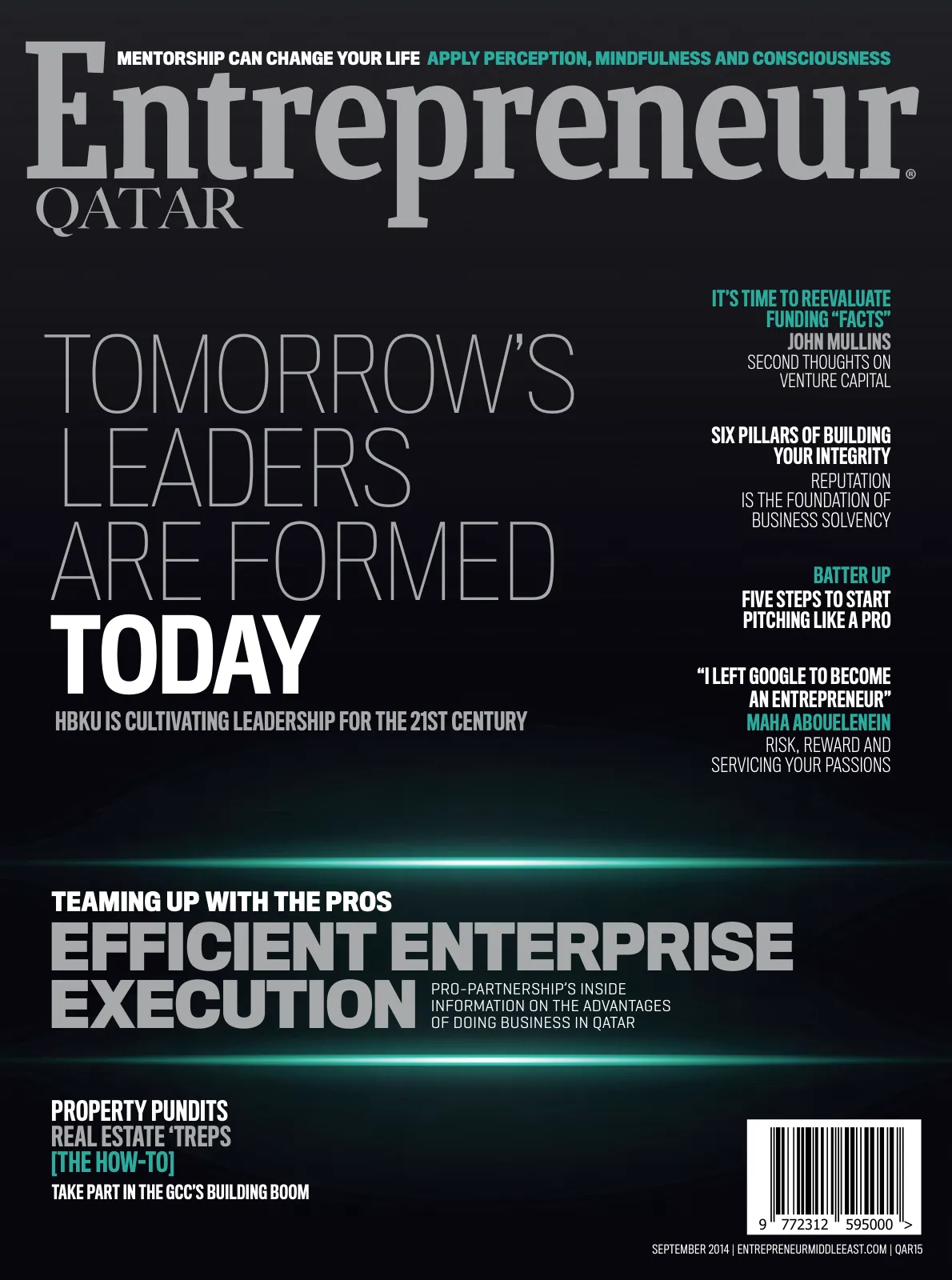
Entrepreneur Qatar, September 2014
Page 1
september 2014 Entrepreneur
1
Efficient enterprise
execution
Teaming up with the pros
PRO-Partnership’s inside
information on the advantages
of doing business in Qatar
Mentorship can change your life Apply perception, mindfulness and consciousness
Second thoughts on
venture capital
It’s time to reevaluate
funding “facts”
John Mullins
Six pillars of building
your integrity
Reputation
is the foundation of
business solvency
“I left Google to become
an entrepreneur”
Maha Abouelenein
Risk, reward and
servicing your passions
Five steps to start
pitching like a pro
Batter up
Take part in the GCC’s building boom
Property pundits
Real estate ‘treps
[The How-To]
SEPTEMBER 2014 | ENTREPRENEURMIDDLEEAST.COM | QAR15
9
772312
595000 >
HBKU is cultivating leadership for the 21st century
Tomorrow’s
leaders
are formed
today
Page 2
Entrepreneur september 2014
2
Page 3
september 2014 Entrepreneur
3
14 PRO-Partnership on
the advantages of doing
business in Qatar
30 Sony slims
down portable data
storage
CONTENTS
SEPTEMBER 2014
14
Innovators:
Teaming up with
the pros
For efficient enterprise
execution, get to know
PRO-Partnership
They’ve got the inside
information on the
advantages of doing
business in Qatar, and
how you can start your
business there with
minimal fuss.
20
Tomorrow’s leaders
are formed today
Cultivating leadership for
the 21st century
Evaluating the
competitiveness of
economies worldwide,
knowledge is not merely
the means toward
abstract economic ends,
but crucial for success
in an increasingly global
marketplace.
30
TECH:
SHINY
#TamTalksTech
Gadgets and doodads
that you might’ve
missed out on, sourced
by a tech aficionado.
Yes, it’s okay to want
them all… and no, it’s
not our fault.
31
ONLINE ‘TREP
Virality personified
Nicki Minaj is one heck
of a self-promoter.
She’s neck and neck
with Miley Cyrus, and
they both have a killer
social media presence,
but they come with an
R rating.
86
THE FIX
Your SME has its head
in the clouds
Cloud computing
services are your new
best friend, and getting
served locally is better
than internationally.
We talk to du’s CCO to
find out why.
66 Real estate
entrepreneurs: The how-to
Page 4
Entrepreneur september 2014
4
CONTENTS
SEPTEMBER 2014
CONTENTS
SEPTEMBER 2014
12
EDITOR’S NOTE
By Fida Z. Chaaban
34
‘TREPONOMICS:
ESQUIRE GUY
The politics of asking for
favors
Ross McCammon
tells you what the
best way to go about
asking for a little back
scratching is, and how
to avoid any unintended
consequences.
36
SKILLSET
From Messi to Mickey
Entrepreneur Ali
Haidary discusses the
marriage between sports
and entertainment, and
what’s he’s gleaned on
his upward climb.
40
ETHICS
CSR, ethics and integrity
in the Middle East
enterprise space
Bayt.com’s research
indicates that laying
the foundations for
a sustainable future
requires all this and
more. See what VP
Suhail Al-Masri has to
say about the matter.
44
SKILLSET
Stop procrastinating
Olympian and author
James Clear has a nifty
trick for you to kick
the procrastination
habit, and it’s literally
a two-minute exercise.
Try it now and see what
happens.
48
ASK A PRO
Reputation is the
foundation of business
solvency
Mark Sephton tackles
the six pillars of building
your integrity. Start by
doing the smallest of
small things right, and
the rest is easy.
64
MARKETING
PR-media relationships
Doing a few things
differently will help
Youmna Chagoury help
you get your clients the
press coverage that they
deserve.
36 Entrepreneur play by their own rules:
From Messi to Mickey
64 The ties that bind:
PR-media relationships
Page 5
september 2014 Entrepreneur
5
Distinguished Style Acquired
Page 6
Entrepreneur september 2014
6
29
CULTURE:
LIFE
Health and welfare pays
for itself
Investing in the
wellness of your staff
increases staff morale
and productivity, and
guess what? Emotional
contagion rules dictates
that good feelings
spread in the office.
28
TRAVEL
Eating on the fly
Always on the move?
Shoug Al Nafisi discusses
nutrition for terminal-
weary ‘treps, and gives
you some easy to follow
guidelines for travel
meal-planning.
32
TRAPPINGS
‘Trep gear
May Rostom helps you
dress for success. For the
corporate overachiever
on your list (or even
a little self-reward),
get the new range by
Porsche Design for her or
Chanel’s new fragrance
for him.
52
DESIGN
Entrepreneur Marianna
Boguslavsky talks about
how finding the right
help to re-interpret her
company’s visual identity
made all the difference.
80
START IT UP:
WACKY IDEA
I just wanna feel real love
KSA social networking
app Feelit wants to help
you express yourself, and
they’re gaining ground
pretty quickly!
78
Q + A
PayTabs is e-commerce
for all
Abdulaziz Aljouf enters
the competition for
MENA’s optimal online
payment solution.
82
MONEY:
VC VIEWPOINT
Second thoughts on
venture capital
John Mullins, Associate
Professor of Management
Practice in Marketing
and Entrepreneurship at
London Business School,
wants you to reconsider
the established ideas
about VC.
88
Q + A
Grab the bull by the horns
Qgrabs.com is Doha’s
online deals platform,
and these Qatar-based
entrepreneurs believe in
the customer coming first.
53 Apple is going on a fashion-recruitment spree
80 KSA social networking app Feelit
wants to help you express yourself
82 John Mullins:
Second thoughts on
venture capital
CONTENTS
SEPTEMBER 2014
CONTENTS
SEPTEMBER 2014
Page 7
september 2014 Entrepreneur
7
Page 8
Entrepreneur september 2014
8
SUBSCRIBE
Contact subscriptions@bncpublishing.net to receive
Entrepreneur Middle East every issue
EDITOR IN CHIEF Fida Z. Chaaban editor@bncpublishing.net
MANAGING DIRECTOR Walid Zok walid@bncpublishing.net
DIRECTOR Rabih Najm rabih@bncpublishing.net
DIRECTOR Wissam Younane wissam@bncpublishing.net
SALES DIRECTOR Oliver Amos oliver@bncpublishing.net
PUBLISHER Nehme Abouzeid
CREATIVE LEAD Odette Kahwagi
ONLINE LIAISON Kareem Chehayeb
COLUMNIST Pamella de Leon
WEB DIRECTOR Haydar Mtayrek
Maha Abouelenein
Scott Brueggeman
Amal Chaaban
Youmna Chagoury
Kareem Chehayeb
Tamara Clarke
James Clear
Catherine Clifford
Brent Frei
Ali Haidary
Brenton Hayden
Simon Hudson
Ameena Hussain
Maria Elena Kassab
AJ Kumar
M. Vasanth Kumar
Pamella de Leon
Nita Maru
CONTRIBUTING WRITERS
PO Box 502511 Dubai, United Arab Emirates
P +971 4 4200 506 | F +971 4 4200 196
For all commercial enquiries related to
Entrepreneur Middle East contact
sales@bncpublishing.net
All rights reserved © 2014.
Opinions expressed are solely those
of the contributors.
Entrepreneur Middle East and all subsidiary
publications in the MENA region are officially
licensed exclusively to BNC Publishing in the
MENA region by Entrepreneur.
No part of this magazine may be reproduced or
transmitted in any form or by any means without
written permission of the publisher.
www.entrepreneurmiddleeast.com
WE’RE HEAVILY INVESTED IN OUR WEB PRESENCE
In addition to our print edition, we’re bringing you all sorts of
industry news on our web mediums. Joining us online means getting
relevant business and startup content in real-time, so you’re hearing
about the latest developments as soon as we do. We’re looking
forward to interacting with our readers on all of our social media and
web platforms- like any thriving business, we’re looking to give and
take. #TrepTalkME is already happening on all of our digi platforms,
and all good conversations go both ways. See you on the web!
IS DIGITAL
MIDDLE EAST
Printed by Raidy Emirates Printing Group LLC
www.raidy.com
EntMagazineME
@EntMagazineME | @Fida
Entrepreneur-me
EntrepreneurMiddleEast
EntMagazineME
EntMagazineME
EntMagazineME
In-house photography Mohammad Sajjad. Images used in Entrepreneur Middle East
are credited when necessary. Attributed use of copyrighted images with permission.
All images not credited otherwise Shutterstock.
Suhail Al-Masri
Ross McCammon
Shoug Al Nafisi
Octavia Nasr
Rani Nasr
May Rostom
Mark Sephton
Juris Ulmanis
Erika Widen
Page 9
september 2014 Entrepreneur
9
Store
Lagoona Mall, Level 1
West Bay area, 44335511
bose@darwishholding.com
Also available at
Fifty One East
Lagoona Mall, Al Maha Center, City Center Doha
Virgin Megastore Villaggio & Landmark, 4436 1111
Page 10
Entrepreneur september 2014
10
FEEDBACK
We’ve gotten tons of pictures via Twitter and Instagram, and here are a
few of our favorites. If you see a copy of any edition of Entrepreneur MENA,
tweet an image our way or tag us on Instagram. All of our reader images
end up getting pinned to our Pinterest Show & Tell board. We’re happy to
see our readers interact with us across all mediums- and we talk back!
On ISSUU you can access all of our current and
past issues complimentary, including Entrepreneur
Al Arabiya, our edition for those of you that prefer
Arabic-language publications. If you haven’t yet
visited our ISSUU account, check out
issuu.com/entmagazineme
Business efficacy...
in real-time
It’s not social media if you don’t talk back
Sharing
economy?
Yes,
and it’s
fully
organic!
Page 11
september 2014 Entrepreneur
11
Hamad bin Khalifa University (HBKU), a member
of Qatar Foundation for Education, Science and
Community Development (QF), is an emerging
research university, building its foundation upon
innovative and unique collaborations with local
and international partners.
Located within Education City, HBKU seeks
to provide unparalleled opportunities where
inquiry and discovery are integral to teaching
and learning at all levels, combining the
riches of the Arab culture with international
perspectives. It will deliver an array of research
education Masters and Doctoral programs
through its interdisciplinary graduate colleges.
HBKU will also offer graduate research
degree programs in affiliation with its partners
which include branch campuses of some
of the world’s leading universities: Virginia
Commonwealth University, Weill Cornell
Medical College, Texas A&M University,
Carnegie Mellon University, Georgetown
University, Northwestern University, HEC
Paris, and University College London. It will
build upon the strengths and synergies of
its partners and proactively reach out to
and welcome new partners worldwide to
collaborate in research and teaching.
HBKU is committed to its part in achieving
Qatar National Vision 2030 by building
and cultivating human capacity through
an enriching academic experience that
extends beyond the classroom. Students will
be given a unique platform to enrich their
education by integrating their curriculum with
society through interdisciplinary research.
By providing students with the best higher
education opportunities possible, graduates
will shape a better future for themselves and
the world.
an emerging
research university
www.hbku.edu.qa
Page 12
Entrepreneur september 2014
12
EDITOR’S NOTE
D
id your mind automatically see
Clear and Present Danger? I
did mean prescient, and I’ll get
to the popular film title a bit later.
It is a very necessary part of any
budding enterprise that you at least
try to predict future weaknesses
and plan ahead. Yes, you’ve done so
financially, and yes, you’ve probably
laid out a staffing plan for when
you decide to expand. But have you
thought ahead in terms of reputa-
tion management, digital penetra-
tion or legal liabilities? These areas
(and more) often go unnoticed by
fresh entrepreneurs, only for an
early misstep to come back and
haunt them later. An integral part
of being “ahead of the game” really
means being ahead of the game.
Things like belatedly building a
website or putting off your brand’s
foray into social media for another
six months- these are ways to cre-
ate more work for later, and that
often means it will cost you more
as well. The longer you delay to ad-
dress a potential exploitable Achil-
les Heel, the more intensive the
reparative work becomes when that
flaw finally surfaces. If you’re con-
sidering this from an unexplored
avenues perspective, it’s a clear cut
case of opportunity cost. “If I had
done this two years ago, we’d be
much better off now.” Yes, indeed.
We’ve been fortunate to have
some amazing entrepreneurs opine
in the MENA editions of this pub-
lication. A few of them have dis-
cussed preventative measures, and
a few have mentioned an instance
describing an early lack of foresight
costing them a lot financially once
they’d reached their goal state
and realized what was missing.
It’s pretty great to hear, especially
since it can prevent scores of busi-
nesspeople from overlooking those
same details. I do actually put these
measures to work- it’s not all talk.
I’ve stressed on the importance of
a clean digital footprint time and
time again, and this is something
I heavily monitor for my own
personal social media accounts, the
magazine’s, and even members of
our board. I do try and “predict”
things that could potentially act as
a future liability, and I try to nip
these things in the bud before they
can take on a life of their own and
cause havoc.
If you have a hindsight-is-20/20
type story or you have ideas on be-
ing market and industry-prescient,
please do write
to me. I’d love to
share your ideas
with the region’s
entrepreneurs.
As an aside, for
those of you who
processed my title
as the blockbuster
film title, it’s a sort
of “Typoglycemia”-
that’s an internet hybrid buzzword
(not a clinical term) used to explain
your brain making the necessary
jumps to facilitate the understand-
ing of language. Even editors need
to have some fun.
Clear and prescient danger
The pervasiveness of prevention-themed advice is not a coincidence
Fida Z. Chaaban
Editor in Chief
@fida
editor@bncpublishing.net
Page 13
september 2014 Entrepreneur
13
UNIVERSITY CITY OF SHARJAH
Scholarships available
+971 6 5441155
admissions@skylineuniversity.ac.ae
WITH MAJORS IN
WITH EMPHASIS ON
Page 14
Entrepreneur september 2014
14
INNOVATORS
PRO-Partnership on the advantages of
doing business in Qatar
Teaming up with
the pros for
efficient enterprise
execution
By Erika Widén
Page 15
september 2014 Entrepreneur
15
Page 16
Entrepreneur september 2014
16
INNOVATORS
P
RO-Partnership was
established in Qatar in
2010 with the express
intent of providing
corporate partnerships
to foreign investors who wish
to start or expand their busi-
ness in Doha. Jane Ashford,
director of PRO-Partnership
says that, “as one of the fast-
est growing economies in the
world and as a country striv-
ing hard to realize economic
diversification, it was very
important for PRO-Partner-
ship to offer opportunities to
foreign investors. In this way,
our clients can contribute
towards the expansion of
Qatar’s economic base and
help to develop a strong
private sector.” Ashford
further underlines how PRO-
Partnership supports the
National Vision 2030. “With
Qatar encouraging the use of
investment in different sec-
tors, PRO-Partnership assists
foreign entities to establish
in a range of industries’ such
as real estate, education,
finance and construction.
PRO-Partnership is 100%
Qatari owned, allowing us
to become the local share-
holder in a corporate capacity
protecting the investments of
foreign entities establishing a
legal presence in Qatar.”
Another reason to head to
Doha? Qatar was also one of
the world’s fastest growing
economies during the global
economic crisis. “From 2008
to 2012 real GDP growth was
12%, compared to China’s
at 9%. Growth in Qatar is
estimated at over 6% in
2014. In contrast, the IMF
is forecasting world growth
for 2014 at 3.6%,” says
Ashford, citing the UK Trade
& Investment (UKTI) 2014.
Qatar’s economic growth is
due to a number of different
factors including the landing
of the rights to host World
Cup 2022; the implementa-
tion of the National Vision
2030; the plans to build a
metro system in Doha and a
national and international
rail network by 2016; and
the rapid population growth.
“Qatar has significant oil and
gas reserves, estimated to
be 60 and 160 year respec-
tively. Energy production per
head dwarfs the other Gulf
countries. Most of Qatar’s
major energy projects are
now up and running and the
government is using the rev-
enue generated to diversify
its economy,” adds Ashford.
However, when it comes to
establishing a business in
Doha, the most common
method available to foreign
investors is to operate under
a Limited Liability Company
(LLC). According to Ashford
the company must have one
or more local Qatari partners
possessing a minimum of
51% of the shareholding.
“The main challenges facing
foreign investors include
[aspects like] sourcing the
right local partner, obtaining
a minimum share capital of
QR200, 000 and overcom-
ing the bureaucratic process
which involves procuring
a number of licenses and
visas as part of the set-up.
Certain sector groups will
also be required to obtain
special licences, for example
if you are engineers you will
be required to register the
company with Urban Plan-
ning, and obtain an engineer-
ing licence.” In addition, one
of the requirements for all
LLCs is that they must have
a registered office. “Finding
the right size office space,
in the right location, at the
right price can also be chal-
lenging. Engineering offices
will be required to have a
minimum size office of 200
square meters.” Ashford says
that it’s imperative to speak
to the right contacts who are
aware of the system and how
it works. “Businesses should
get good legal advice, to en-
sure that the business is set
up correctly and in the best
manner.” In the UAE, setting
up a LLC, Branch Office or
Trade Representative Office
is very similar to Qatar, but
Ashford points out some dif-
ferences in the options avail-
able to a foreign investor. For
instance, the UAE offers the
option of setting up within a
free trade zone. Setting up as
a free zone entity allows the
investor to own the business
100% without the need of
a local Sponsor or National
Service Agent. There are
numerous free zones in the
UAE, and they are centred on
business industry catego-
ries. “The key restriction
of a free zone entity is that
it is principally permitted
to conduct business solely
within its relevant free zone
and is limited to performing
“PRO-Partnership is
100% Qatari owned
and is able to act
as the local 51%
shareholder to many
foreign companies
eager to set up within
the state of Qatar.”
“We as the management
team consider ourselves
to be extremely
lucky with our local
PRO-Partnership
shareholders in the UAE
and Qatar. Without these
amazing, influential
partners we would not
be able to run such a
successful business.”
Page 17
september 2014 Entrepreneur
17
solely those activities speci-
fied in its license. Unlike the
UAE, the option of setting up
within a free zone in Qatar
is not readily available for
foreign investors,” explains
Ashford. Another key differ-
ence is that in the UAE there
is the option of setting up
under a professional service
license. Basically, profes-
sional business is defined
as “work based on investing
mental talents and acquired
information.” A Professional
Licence/Civil Company is a
business for professionals
in recognized fields such as
doctors, lawyers, engineers
and accountants. A Civil
Company can only practice
professional business, and
is 100% owned by profes-
sional partners. “This option
does not apply when starting
a business in Qatar. Lastly,
if you’re setting up an LLC
in Qatar you’ll be required
to deposit share capital of
QR200,000- this is not a
requirement in the UAE.”
Billions of dollars are flood-
ing into Qatar as a result of
the World Cup 2022 and the
country’s National Vision
2030- many projects will be
implemented within the next
five years. The main sectors
that PRO-Partnership has
witnessed a huge increase
of interest to invest in Doha
include construction and
infrastructure companies,
security and safety organiza-
tions, and sporting and media
companies. “Companies who
undertake infrastructure-
related projects are often
strongly supported by the
Qatari government,” adds
Ashford. In fact, as Qatar
possesses one of the largest
natural gas reserves in the
world, and this coupled with
recent legal liberalization,
economic diversification, and
a burgeoning economy simply
means that there are ample
opportunities for invest-
ment within many sectors.
“Foreign investors can be
reassured that Qatar not only
offers economic stability but
also a fast-growing and mod-
ern economy. Individuals can
benefit from high personal
wealth.” Adding to how tiny
the Emirate also offers a wide
range of incentives to foreign
investors such as attractive
rental rates, exemptions on
customs duties on imported
machinery, equipment and
spare parts for industrial
projects, not to mention sub-
sidized or nominal rates for
gas, electricity and water.
“In addition, the government
may provide tax exemptions
on corporate tax for pre-
determined periods. Other
personal benefits include tax
free salaries, excellent medi-
cal and educational facili-
ties and personal residency
support.” As previously
mentioned, PRO-Partnership
is 100% Qatari owned and is
able to act as the local 51%
shareholder to many foreign
“The main challenges
facing foreign
investors include
[aspects like] sourcing
the right local
partner, obtaining
a minimum share
capital of QR200, 000
and overcoming the
bureaucratic process
which involves
procuring a number of
licenses and visas as
part of the set-up.”
“From 2008 to 2012 real GDP
growth was 12%, compared to
China’s at 9%. Growth in Qatar is
estimated at over 6% in 2014.
In contrast, the IMF is
forecasting world growth for
2014 at 3.6%”
“Foreign investors
can be reassured
that Qatar not only
offers economic
stability but also
a fast-growing and
modern economy.”
Page 18
Entrepreneur september 2014
18
companies eager to set up
within the state of Qatar.
However, the management
of the company is British
with full power of attorney
to manage the company on a
day-to-day basis.
“This business model has
been reflected in our Abu
Dhabi and Dubai offices,
whereby PRO-Partnership is
100% Emirati owned also al-
lowing us to become the 51%
shareholder for foreign enti-
ties in the UAE,” continues
Ashford, “We as the manage-
ment team consider ourselves
to be extremely lucky with
our local PRO-Partnership
shareholders in the UAE
and Qatar. Without these
amazing, influential partners
we would not be able to run
such a successful business.”
As a rule, QR200,000 is the
requirement as a minimum
share capital only in Qatar. In
Abu Dhabi and Dubai it is not
obligatory to deposit a share
capital, unless if the estab-
lishment is a Foreign Branch
or Representative Office in
the UAE, then AED50,000
must be deposited. “In Qatar,
the funds must be depos-
ited in a bank of the foreign
investor’s choice, and can be
removed once the company
is established. It is therefore
only necessary to retain the
full amount of QR200,000
in the bank for period of
around two weeks or less,”
explains Ashford. Do newly
established businesses in
Qatar generate profit faster
than in any other parts of the
GCC? “It’s not easy to make a
quick profit anywhere in the
GCC, you have to work hard
to establish the business,
increase relationships within
the community, and gain a
good corporate reputation.
However given time, with
a strong market presence
and growing client base,
companies in the UAE and
Qatar are rewarded with high
profit margins.” Ashford says
that among the main factors
which prevent a quick profit
are the rising and already-
expensive rents within Doha
for both business and private
residence, the high level of
bureaucracy, the set up costs
for any organization first
coming to the country, and
that price rather than quality,
is often the most important
factor in the buying decision.
In addition to how the market
is not well-regulated, espe-
cially regarding environmen-
tal matters. There are also
often delays in payment, and
the Qatari Riyal is tied to the
U.S. dollar. In other words,
when the dollar exchange rate
is strong, Qatar becomes an
expensive market for some
countries.
Nonetheless, most of
PRO-Partnership clients
are already well-established
companies seeking to expand
globally. “We have, however,
helped some small SMEs
and startups. We are very
proud to be able to help a
wide range of companies and
our start-ups are now run-
ning professional, profitable
businesses.” She further
reiterates how they like to
assist their clients wherever
possible in both the startup
process as well as in an ongo-
“We have a number of
companies from Australia,
America, South Africa,
as well as an increasing
number from Far East Asia.”
“The government may provide tax exemptions on
corporate tax for pre-determined periods. Other
personal benefits include tax free salaries,
excellent medical and educational facilities and
personal residency support.”
Page 19
september 2014 Entrepreneur
19
ing working relationship.
“We can often help empower
clients with information
and trends in their specific
industry as well as connect
them with vital contacts for
new business. We can also
help to facilitate companies
with their HR requirements.
Obtaining visas for certain
nationalities can often be a
challenge.” Although PRO-
Partnership is witnessing
more companies from all
different parts of the world,
most of their clients are from
Europe, other GCC countries,
and South Asia. “We also
have a number of companies
from Australia, America,
South Africa, as well as an
increasing number from Far
East Asia. English is widely
spoken and is the main
business language. This,
therefore, encourages English
speaking nations to set up
business in Qatar.” Also, in
order set up an organiza-
tion in Qatar, the business is
required to have a suitable
office space prior to obtaining
the trade license. “We have
our own real estate team,
PRO-Property, who offer
our clients the best possible
solution for their commercial
property requirements. We
are able to advise companies
on the best option available
to them depending on the
size of the company, the com-
pany budget as well as the
timeframe in which they wish
to set up and start trading.”
Initially, many companies
prefer to go into a fully-
serviced business centre as
they usually have a small
team on the ground. Business
centers offer a number of ser-
vices that cater to startups in
Qatar and the UAE, including
administrative staff, meet-
ing rooms and a dedicated
P.O. Box number. “PRO-Prop-
erty has the local knowledge
on the availability of business
centres in Qatar as well as
which ones offer the best
value for our clients’ needs.
After full establishment,
most companies move into
bigger office space, assisted
by our team of experts,” adds
Ashford. In reference to the
time frame prior to establish-
ing a business in Qatar, it’s
approximately less than six
months. According to PRO-
Partnership, the exact time
is much dependent on the
client and the time taken for
their company’s documents
to be notarized, attested, and
legalized. In addition, it’s also
dependent on the approval
time for the articles of asso-
ciation and other agreements.
“From the very beginning,
generally speaking it will take
a company one to two months
to receive their commercial
registration and another two
to three months to complete
all of the processes including
obtaining an office for their
trade license approval and for
the general manager to have
his/her residency permit,”
says Ashford. On a positive
note, in the UAE, such as in
Abu Dhabi, the time frame is
reduced on an average to two
months from start to finish.
“PRO-Partnership has
recently expanded into both
Dubai and the UAE. We took
the decision to move into the
UAE market after some of
our current clients in Qatar
specifically requested the
services of PRO-Partnership
to assist them in starting
up in the UAE. For many
international companies,
it is practical to have one
local partner throughout the
region,” and that one partner
might as well be a pro. It
certainly cuts through some
of the red tape a lot quicker.
INNOVATORS
“Qatar has significant
oil and gas reserves,
estimated to be 60 and 160
year respectively. Energy
production per head
dwarfs the other Gulf
countries.”
“Companies who undertake
infrastructure-related
projects are often
strongly supported by
the Qatari government”
• Depending on the type of
business and the products
or services they offer.
The requirements differ
between a Limited Liability
Company (LLC), a Trade
Representative Office and a
Branch Office.
• All three types of busi-
ness need a commercial
registration as well as an
immigration card, and a
suitable office space prior
to obtaining a trade license.
• Only an LLC will have
articles of association
and will be required to
deposit a share capital of
QR 200,000.
• All foreign entities must
have their foreign docu-
ments notarized, attested
and legalized, to enable it,
to set up and start trading
in Qatar.
• Qatar has the highest
Gross Domestic Product
(GDP) per head in the
world. It ranks 13th in the
Global Competitiveness
Index, the highest in the
Gulf Cooperation Council
(GCC) region. The Global
Competitiveness Report
2013 – 2014
• Currently, business in
Qatar is less competitive
than the UAE and more
money is being invested
in certain industries. In
addition, networks for new
business may be more
easily accessible in Qatar.
• Although the UAE still of-
fers a lot of opportunities,
certain sector groups are
more competitive and have
a saturated market, making
it more difficult for new
foreign entities to get their
foot in the door.
What is required to start
a business in Qatar?
Advantages of investing
in Qatar over the UAE
Guidelines by PRO-Partnership
PRO-Partnership makes the case
Page 20
Entrepreneur september 2014
20
K
nowledge is, and will
increasingly become, a
catalyst for economic
growth worldwide. Evalu-
ating the competitiveness
of economies worldwide,
knowledge is not merely the
means toward abstract economic
ends, but crucial for success in
an increasingly global market-
place.
Giving tomorrow’s leaders the
entrepreneurial skills they need
to succeed in business takes
place long before they enter the
workforce, and it’s vital that this
learning experience should not
be restricted to the classroom.
Students need to be encouraged
to engage in cross-disciplinary
study, and they also need to gain
practical experience away from
their studies in a way that offers
them the chance to apply what
they’ve learned and to further
develop their skills.
Hamad bin Khalifa University
(HBKU) is a testament to this
transformation of thinking.
An emerging graduate-level
research university, HBKU uti-
lizes its strategic partnerships to
present students with collabora-
tive education opportunities,
developed from the specialties
of its branch campus partners in
Doha’s Education City. Com-
mitted to Qatar National Vision
2030, HBKU, and the larger
Education City community
within which it is embedded, are
meeting the educational needs
of a wide variety of developing
leaders. By cultivating a commu-
nity wherein some of the world’s
leading universities are housed,
students of HBKU and its inter-
national partner universities are
able to seize the opportunity to
learn in a uniquely collaborative
and diverse environment.
HBKU realizes the need to
challenge and customize con-
temporary education systems.
Learning can no longer only
refine the mind, but must serve
to nourish the whole person, ne-
cessitating learning both inside
and outside of the classroom.
Only then are students likely to
attain the knowledge that allows
them to envision and design
their futures, and form the en-
trepreneurial mindset that ena-
bles them to identify prospects
and mitigate challenges.
Witnessing the emergence of
knowledge driven-economies
around the region and across the
globe, HBKU is devoted to train-
ing its students in critical and
creative thinking, enabling them
to understand and overcome
issues facing current and future
generations, while instilling a
collaborative work ethic bol-
stered by their unique leader-
ship preparation programs.
Fostering Personal
Growth for Progress
Partnering with Maersk Oil
Qatar, Qatar University and Red
Rock International, HBKU es-
tablished the EBDA Leadership
Program to address the growing
need to foster leadership skills
during university years. EBDA, a
motivational Arabic word mean-
ing “beginning”, serves to inspire
critical thinking, and prepare
university students in Qatar for
assuming leadership roles.
At the heart of EBDA is the
belief that leadership requires
familiarity with a wide range
of conflicting perspectives and
exposure to practical chal-
lenges. HBKU is convinced that
experiential learning succeeds
in inspiring today’s students
to go on to develop tomorrow’s
high-impact projects. EBDA
initiatives such as Leader-
Shape (- a weeklong leadership
program -), and the Maersk
Oil & HBKU Desert Leadership
Challenge ( - an entrepreneurial,
hands-on competition), provide
opportunities for participants to
begin building this foundation of
leadership fluency early in their
university careers.
EBDA Leadership Program
participants will engage in a
variety of rewarding initiatives.
Among the latest opportunities
for leadership development are
We Are Leaders @ Kilimanjaro
(WALK), a challenging climb
for charity of Tanzania’s highest
mountain, and Outward Bound
Oman, an outdoor, confidence-
building project designed to
foster personal growth.
EBDA also encompasses
established initiatives, includ-
ing CULTIVATE, a three-year
series dedicated to leadership
development; graduates of which
are eligible for a certificate in
leadership development. Ad-
ditionally, Not Your Average
Spring Break, an annual service-
learning trip, exposes students
to international experience and
the social issues of international
communities.
Initiatives under the EBDA
umbrella are targeted for
students to develop crucial
skills not taught in a univer-
TREPONOMICS
ETHICS | ESQUIRE GUY | SKILLSET | MARKETING | PRO
Cultivating leadership
for the 21st century
HBKU: Educating for a Knowledge-Driven Economy By Ameena Hussain
EBDA initiative
CULTIVATE,
a three-year
series dedicated
to leadership
development
Page 21
september 2014 Entrepreneur
21
sity classroom that are vital for
becoming a successful leader;
characteristics that employers
seek in graduates. Resiliency,
self-reliance and confidence,
time management and ability
to identify and achieve long-
term goals are further devel-
oped throughout participation
in these programs. The core
outcome of the EBDA program
is to create critical thinkers,
effective communicators, and
self-motivated individuals who
are ready for entering the global
workforce, and prepared to
contribute to it.
In addition to the extensive
experiences offered by EBDA,
a student steering committee
of current HBKU and partner
university students has the
opportunity to organize these
activities. This group is known
as the Leadership Council, and
in the future the group will
ensure the EBDA programs
allow student participants and
planners to reach their utmost
potential.
Learning for
the Real World
Knowledge and capabilities,
attained through leadership
opportunities at HBKU, have al-
ready empowered many students
at Education City to impact and
inspire their colleagues through
a variety of organizational,
educational, commercial and
charitable endeavors to benefit
communities worldwide.
Among more than 260 former
participants in HBKU leadership
programs, Atul Menon is a rising
Senior at Georgetown Univer-
sity School of Foreign Service
in Qatar and was one of three
recipients worldwide of the
Palmer Award, which recognizes
change-agents for global im-
provement. As part of the Qatar
National Research Fund, Atul
strives to develop a financial
curriculum that leads migrant
workers to heighten their under-
standing of and ability in saving
and investment.
Maryam Bu-Sharam, who
partook in Outward Bound
Oman, and currently studies at
Texas A&M University at Qatar,
keenly noted: “I was able to
realize there’s no limit to our
capabilities and the only way
for you to unlock your potential
is by pushing yourself and not
giving up.”
Virginia Commonwealth
University in Qatar student,
Asma Hosna, has embraced and
encouraged others to partake in
these leadership development
initiatives presented by HBKU,
saying: “This amazing experi-
ence and platform gave me space
to grow as a leader. It helped me
get out of my comfort zone and
have a better understanding of
community and importance of
teamwork.”
These individuals are not alone
in exemplifying the benefits of
HBKU’s EBDA program. When
surveyed, 90% percent of those
students involved in HBKU’s
leadership initiatives in the
academic year 2013-2014 stated
they felt more confident not only
in their ability to lead, but in
their aptitude to take initiative
and responsibility in group set-
tings. More than 85% percent
of student participants felt that
they now better understand the
interdisciplinary nature of lead-
ership, and have a firmer grasp
on understanding individual and
cultural differences – in addition
to an increased ability to recog-
nize universal similarities.
Students such as Maryam and
Asma speak to the vitality of the
kind of holistic learning HBKU
understands is needed to create
global leaders. Critical and crea-
tive thinking, determined and
steadfast commitment; pragmat-
ic and practical engagement are
pillars of continuous personal
growth, successful careers and
persistent progress.
Preparing for Tomorrow
The leaders of tomorrow will
undoubtedly confront a world
filled with complex and inter-
connected global issues. While
this can yield an abundance of
opportunities, its complexity is
likely to prompt challenges. As
the world is dynamic, knowledge
of it cannot remain static. Lead-
ers, who ought to be insightful
and skilled, must be trained
both to think and to act anew.
This is especially relevant in
the Middle East, where one of
the world’s most diverse popula-
tions is in need of leaders who
are able to work across differ-
ences towards a greater shared
mission. HBKU, inspired by the
Qatar National Vision 2030,
rendered the promotion of these
values an utmost priority in its
future entrepreneurs and rising
leaders.
HBKU will continue to enlarge
the horizon of possibilities for
all higher education students,
in order that they may employ
their knowledge, skills and
imagination to contribute to
improving global scenarios.
As the dynamic structure of
international affairs continues
to change, individuals must
recognize their own potential,
and that of others, to provide
leadership to sustain progress
that developing and established
nations across the globe neces-
sitate. Tomorrow’s leaders are
formed today.
Maersk Oil & HBKU
Desert Leadership
Challenge
Ameena Hussain
is the Director of
Student Life at
Hamad bin Khal-
ifa University. In
her role, Ameena
oversees student
engagement
programs
and the operations of the Student
Center. Prior to this, Ameena was
the Assistant Director for Campus
Life leading the programmatic efforts
at the Student Center. Since joining
the Education Division of Qatar
Foundation in 2006, where she
was one of the original members,
Ameena has assumed a number of
positions. She started as a Student
Activities Officer and then became
a Campus Life Coordinator. Before
Qatar Foundation, Ameena’s roles
included working in the Supreme
Education Council as an English
Department Coordinator and at
Maersk Oil as a Senior HR Special-
ist. Ameena is a graduate of Qatar
University with a Bachelor’s degree
in the English Language and holds a
certificate in Human Resources from
the Chartered Institute for Personnel
Development of the UK. Currently,
Ameena is pursuing her Doctoral
degree in Education at the University
of Southern California.
Page 22
Entrepreneur september 2014
22
Page 23
september 2014 Entrepreneur
23
Page 24
Entrepreneur september 2014
24
B
aroness Sayeeda Hussain Warsi made headlines after resigning from
the British government due to their policy on Israel’s latest assault on
Gaza, Operation Defensive Edge. In her letter, the Baroness claimed
that the British government led by Prime Minister David Cameron, took an
approach that she describes as “morally indefensible” and lamented that the
U.K.’s stance on Gaza would have “a long-term detrimental impact on our
reputation internationally and
domestically.” The former Con-
servative Party minister, also the
first Muslim to serve in cabinet,
made her resignation publically
known on Twitter, and even gave
her followers access to read the
official resignation letter that
she’d sent to the Prime Minister.
Prime Minister Cameron’s letter
in response to Warsi’s was noth-
ing out of the ordinary; he com-
mended her for her government
and Conservative Party achieve-
ments, and reiterated his posi-
tion on the conflict. With public
opinion shifting significantly in
Britain’s political mainstream on
the Palestine-Israel conflict, will
we see more politicians take a
decisive stand?
IN THE LOOP
Sanctions imposed on
the Russian Federation
T
he popular uprising in Ukraine that led to a
change in government and Russia’s annexation
of Crimea were the center of attention, but the
unrest didn’t stop there. In response to Russia’s
military intervention and support of pro-Russia
separatists, both the U.S. and the European Union
(EU) have implemented economic sanctions on the
BRICS country. The sanctions included blacklist-
ing Russian political and military officials, industry
leaders, and pro-Russia Ukrainian officials and
members of the annexed Republic of Crimea gov-
ernment. Russia responded by blacklisting Ameri-
can and Canadian politicians, notably John McCain,
John Boehner, and Harry Reid. Chechnya, part of
the Russian Federation, blacklisted U.S. President
Barack Obama, President José Manuel Barroso of
the European Commission, President Herman Van
Rompuy of the European Council, and even Baron-
ess Catherine Ashton, either to add further insult
to injury or for sheer entertainment (public opinion
suggests a bit of both). Sanctions are tightening
up from both ends though; the EU’s new round of
sanctions directly target state arms, energy, and
financial sectors, and those on the initial blacklist
are subject to travel bans and asset freezes in the
West. In response, Russia banned many agricultural
and food products from entry into the country. Has
this response made an impact? So far, Germany’s
exports to Russia fell by 15.5%. The next logical
question is whether or not the sanctions will affect
the Middle East? The UAE has reiterated develop-
ing strong economic ties with Russia; Economy
Minister H.E. Sultan bin Saeed al Monsoori claimed
that sanctions won’t impact the relationship unless
the UN decides to take action. And Qatar? As a
Russian rival for the natural gas market, the Gulf
nation might soon find the EU knocking on their
doors in the near future.
T
hings aren’t looking good for
South America’s “number
three” economy, which has
defaulted its debts for a second
time in 13 years. Its previous default
back in 2001 is considered to be the
root of this current financial bind.
Standard & Poor’s demoted Argen-
tina’s foreign currency credit rating
to “selective default” as Argentina
struggles to pay back bondholders.
How did Argentina get to defaulting
for a second time since their last
crisis? The country had a difficult
time paying back the interest of the
money they borrowed (approxi-
mately US$132 billion), so they
asked bondholders who could help
them out by trading their bonds for
cheaper ones. That didn’t go well,
primarily because a group of hedge
funds weren’t fond of this idea and
took it to court, wanting Argentina
to pay the original interest. The
court ruled in their favor, though it
took a good 13 months to do so, and
the interest valued at $539 million
was owed by June. With Argen-
tina entering a recession this year,
inflation as a result of the default
is a cause of concern: it may end
up deepening the dip even further.
Drastic measures are needed by the
beleaguered Argentinian govern-
ment to sort this mess out the
second time around.
Argentina
defaults again
Baroness Warsi calls it
quits over U.K. policy on Gaza
Above: Viral tweet by Russian Deputy
Prime Minister Dmitry Rogozin
baroness warsi letter source twitter.com | Russian Deputy Prime Minister Dmitry rogozin twitter account source twitter.com
Page 25
september 2014 Entrepreneur
25
Ebola outbreak
in West Africa sparks
international scare
ebola sign image source © Sergey Uryadnikov / shutterstock
T
he 2014 Ebola virus
outbreak has been making
headlines in the news as of
late, and for good reason. While
Ebola isn’t the most contagious
virus out there, there is no
confirmed cure and has a very
high fatality rate- according
to the World Health Organiza-
tion (WHO), 25-90% of Ebola
victims die, depending on the
strain of the virus itself. The
last Ebola outbreak took place in
Zaire (present day Democratic
Republic of Congo) in 1976,
killing 280, which is about 88%
of those infected. This outbreak
started and is at its worst in
Western Africa, notably Guinea,
Liberia, and Sierra Leone. That
being said, Nigeria has been on
the receiving end of many cases
in recent weeks. On August 22,
2014, WHO confirmed among
the countries most impacted
(Guinea, Sierra Leone, Liberia,
and Nigeria), there have been
a total of 2,615 cases and 1,427
deaths since the beginning of the
outbreak, although not all are
laboratory confirmed. So how
did things escalate? While Libe-
ria has dealt with the most casu-
alties, the origin of the outbreak
came from neighboring Guinea
back in December 2013. After a
team of local and international
medical experts investigated the
situation, they concluded that
“Patient Zero” was a two year-
old girl in Guinea who died after
experiencing high fever, vomit-
ing, and other symptoms of the
virus. She most likely contracted
the disease from an infected
fruit bat- scientists consider it
to be a natural reservoir for the
virus. WHO said that while it’s
possible that the virus could
potentially be transmitted
through animals like gorillas
and pigs that have eaten fruit
dropped by infected bats, thus
far the only confirmed infections
are fruit bats. The likelihood of
coming into contact with a fruit
bat is quite high in Guinea, given
that several popular traditional
dishes include bat meat.
Since Nigeria doesn’t share
a border with the other three
countries, it’s speculated that
crowded public spaces like air-
ports seem to be the catalyst for
the spread of viral diseases. Ni-
geria’s first case wasn’t reported
until late July, after an official
from the Liberian Ministry of
Finance flew to Lagos and died
after his arrival. The Nigerian
government responded by quar-
antining the hospital and the
doctors and nurses who were
treating the official, but two of
the health workers succumbed
to the virus. The increasing
number of cases and failure
to contain the virus sparked
international efforts to halt the
spreading of the virus, espe-
cially with various suspected
cases taking place not only in
bordering countries like Benin
and Chad, but also Spain and
India. The international effort
in collaboration with various
governments in Africa spanned
everything from financial dona-
tions and health workers from
international organizations to
local and regional taskforces.
Something did backfire though.
The influx of international
health workers increases the
spread of the Ebola virus. While
preventative and cautionary
measures were obviously taken,
nothing is 100% guaranteed.
In late August, WHO confirmed
that over 120 health work-
ers have died from Ebola out
of a total of the reported 240
that contracted the disease.
A particular incident that has
made headlines is 29 year-old
volunteer nurse William Pooley
from the UK. After contract-
ing the virus in Sierra Leone,
Britain’s Royal Air Force (RAF)
sent him back to London where
he is currently being treated. As
a result, the UK is taking a much
more cautious and measured ap-
proach to the potential (but very
unlikely) spread of the Ebola
virus there. Before a British Air-
ways flight took off from London
to Aberdeen, an ill 10 year-old
Nigerian girl perpetuated a
two-hour delay, as medics in
chemical suits boarded the plane
to examine her. The child was
sent to the hospital, but was not
infected with the Ebola virus.
What about us in the Middle
East? Should we worry? So
far, governments in MENA have
been active in handling potential
Ebola threats. Mauritania in
Northern Africa has banned the
entry of citizens from countries
that have been hit by the Ebola
virus, as well as fortified health
control and inspections by its
borders along Mali and Senegal.
Saudi Arabia’s government has
also banned citizens from Li-
beria, Guinea, and Sierra Leone
from acquiring pilgrimage visas,
in fear of the spread of the virus
in the heavily populated holy
sites of Mecca and Medina. A
Saudi businessman who fell ill
with symptoms similar to that
of the Ebola virus passed away
at a Jeddah hospital, although
he tested negative. In August,
UAE’s Emirates Airlines was the
first carrier to suspend its flights
to and from Guinea. Another
UAE occurence is that of a Nige-
rian woman transitioning flights
at Abu Dhabi airport who passed
away after feeling ill. Medics
found signs of the Ebola virus,
and treated her based on that
possibility. Emirates officials
soon reported that she was on
her way to India for treatment of
advanced metastatic cancer.
Page 26
Entrepreneur september 2014
26
E
ight armed men at-
tacked a convoy that be-
longed to the Saudi Ara-
bian embassy on its way to Le
Bourget airport. Carrying AK-
47 rifles, the gunmen drove by
in two separate vehicles and
forced the driver of one of the
cars to stop. They hijacked
the vehicle with the driver
and two other men inside.
While they let all three go,
they bagged US$330,000 and
official embassy documents
that were in the vehicle, ac-
cording to Rocco Contento of
the police union. Contento
believes that the armed men
were well-trained, and could
have been “commandos from
eastern Europe.” The hijacked
vehicle was eventually found,
but it was unoccupied.
This isn’t the first time a
Saudi official has been robbed
in France. Just over a year ago
in July 2013, armed robbers
disguised as officers in mock-
up police cars forced a Saudi
official to pull over on his way
to Le Bourget airport. After
“inspecting” the car, they
drove off with $30,000. So
if France is a risk for Saudis
(and ultimately GCC tourists),
where to? London, of course.
In fact, the office for national
statistics (ONS), Britain’s
national service for statistics,
concluded that increased
visits from tourists from
Saudi Arabia and the UAE has
skyrocketed between October
2012 and September 2013,
with a total of 260,000 visits.
We don’t expect the English
to welcome tons of Middle
East tourists next summer,
since there is one slight prob-
lem with designating London
as a safe haven for tourists
from the GCC. Three Emirati
sisters were brutally attacked
at London’s Cumberland
Hotel on a Sunday morning
earlier this year, and suffered
serious injuries in addition
to getting robbed. The sister
with the most serious injuries
suffered life-threatening head
injuries and lost her left eye.
The attacker stole $2000
worth of property and with-
drew approximately $5000
using the victims’ ATM cards.
A week later, a poll by the
Al-Roeya newspaper in the
UAE showed that 76.5%
percent of Emirati citizens
no longer consider Britain a
travel destination. The same
poll showed that they prefer
Germany, Singapore, Malay-
sia, and Switzerland- France
didn’t appear at all on the list.
GUNMEN ATTACK SAUDI
ARABIAN ROYAL’S
CONVOY IN FRANCE
T
he sixth Euromoney
Kuwait Conference
will take place this
month on September 9th,
2014 at the JW Marriot.
This year’s event will em-
phasize on current develop-
ments underway in the Gulf
nation’s financial sector.
This edition’s theme, “New
Dynamics of Finance and
Investment”, will see Kuwait
Minister of Finance, H.E.
Mr. Anas Al Saleh, and Gov-
ernor of the Central Bank of
Kuwait, H.E. Dr. Mohammed
Al-Hashel opening up the
event with keynote speech-
es. With the region going
through massive changes, it
seems like an ideal time to
have debates and strategic
discussions about the chal-
lenges and opportunities
Kuwait’s financial sector
faces in the future. An ex-
pected attendance of about
350 people from an array of
professional backgrounds,
ranging from policymakers
to finance professionals,
promises that this year’s Eu-
romoney Kuwait Conference
will be a productive one.
It will be interesting to see
what road Kuwait’s banking
and financial sectors decide
to take, and whether other
GCC nation states will fol-
low suit.
Kuwait looks to inspire further
developments in its financial sector
with the sixth annual euromoney
kuwait conference
IN THE LOOP
Richard Banks,
Director of
Emerging Markets
at Euromoney
Conferences
Entrepreneur september 2014
26
Page 27
september 2014 Entrepreneur
27
W
hat a turnaround it has been for
Iraq’s aviation sector. Over the
past year, most of the talk on Iraq
revolved around investing in aviation; the
idea was to encourage more flights and to
diversify carriers. Things have been thrown
for a loop recently with ISIS, now simply
known as the Islamic State (IS), and their
expanded military operations. The barrage
of strategized attacks allowed militants to
take over Mosul, Iraq’s second largest city,
and since the Iraqi military failed to contain
them, the effort has been led by Kurdish
Peshmerga forces based in Erbil. It could
be back to square one for Iraq’s aviation
industry since the international community
is taking action. Many airlines are beginning
to divert their flights from Iraqi airspace,
and have suspended direct flights to Iraq.
Early last month, the Federal Aviation
Administration (FAA) banned American
carriers from flying over Iraqi airspace soon
after the U.S. government launched its first
round of airstrikes on the IS. With major
international American carriers like United
Airlines increasing overnight direct flights
to various major cities in the GCC, we‘ll be
seeing less American carriers in Iraqi skies.
The FAA has put a few exceptions in place;
the pilot can get prior FAA permission to
cross Iraqi airspace or can do so if the plane
needs to do so in the event of an emergency.
In late July, Dubai’s Emirates Airlines an-
nounced that they will reroute flights to
avoid flying over Iraqi airspace, clarifying
that this decision was sparked by the rising
security concerns in Iraq and the Malaysian
Airlines Flight MH17 tragedy- the flight was
shot down over Ukrainian airspace, killing
all 298 passengers and crew. Abu Dhabi’s
Etihad waited a little longer before decid-
ing to reroute their flights, and other major
carriers such as Qatar Airways, Air France,
KLM, and Virgin Atlantic have followed
suit. Lufthansa has done the same, which
means that its subsidiaries will fall in line,
so we’re talking Swiss, Lufthansa Cargo, and
Austrian Airlines. Some airlines have also
taken somewhat different and more targeted
approaches. Most have flights to Erbil, which
isn’t far off from where the clashes are tak-
ing place. Lufthansa and Austrian Airlines
have halted flights to Erbil, and so have Eti-
had and Emirates, but both carriers are still
offering flights to Basra and Baghdad. While
Qatar Airways have done the same, they’ve
temporarily halted their flights to Baghdad
and Sulaymaniyah. Turkish Airlines is an
interesting case; they’ve been sending many
flights to Erbil from airports both in Istanbul
and Antalya, after stopping their flights to
Erbil in early August, they reconsidered their
decision 24 hours later deciding to modify
flight times instead. It all sounds bad, but
apart from the lack of people flying into
Iraq and spending money there, how is this
negatively affecting the Iraqi aviation indus-
try? Flying through international airspace
requires paying overflight fees, even without
landing or taking off in that space; Iraq could
lose a source of funds that way. The current
situation suggests that Iraq can benefit from
planes needing to land in Iraq midflight due
to an emergency, but that looks less and less
likely as more carriers divert their routes to
avoid conflict zones altogether. What are the
alternatives? Some carriers are opting for
Iran, including Australia’s Qantas. Emirates
have followed suit, most notably with their
London-Dubai flights. While Iran is still
under U.S.-led sanctions, even American
airlines can pay overflight fees, though some
airlines such as Delta consider Iran a no-fly
zone. With Western diplomatic relations
improving with Iran, (and some sanction-
relief), it might be the logical choice for
more aircraft carriers. After all, if the flights
are significantly rerouted, extra fuel costs
trickle down into increases in passenger
ticket costs. Iraq and Ukraine both take up
relatively large fractions of their airspace
corridors, it wouldn’t be surprising if lob-
byists from the private aviation sector begin
urging governments to focus on relieving any
Iranian airspace restrictions for cost-effec-
tive reroutes.
IRAQI
SECURITY
CRISIS
HANDICAPS
AVIATION
INDUSTRY
Qatar Science and Technology Park (QTSP) hosts the 31st Interna-
tional Association of Science Parks (IASP) World Conference this
October. This year’s conference, staged in the Middle East for the
first time, is star-studded and bound to be one of the best tech
events of the year. The IASP 2014 Doha Organizing Committee
has confirmed YouTube co-founder, Chad Hurley, as the opening
ceremony guest speaker. Hurley is expected to be nothing short
of sensational as he shares his experiences building one of the
world’s most polarizing internet platforms. The event will take
place from October 19-22 at the Qatar National Convention Center,
held under the theme “Where Technology Goes to Work” as part
of the Qatar National Vision 2030.
Youtube co-founder Chad Hurley
to speak at iasp Doha
IMAGE SOURCE © QATAR AIRWAYS
Page 28
Entrepreneur september 2014
28
help you stick to the right
choices. Knowing your need of
greens for the day, you ask for
a salad first (dressing on the
side). Then, keeping in mind
your choice of protein, aim
to stick to that. Having your
meal in mind before looking at
the menu will definitely help
fight temptation to stray.
Empty the mini bar
There is almost always a
convenience store nearby
where you can stock up on
munchies. Ask the hotel to
empty your mini bar, and use
the now empty fridge to store
your chosen foods. My travel
favorite would be nutrient-
rich yogurt- it curbs a craving,
and keeps you on your game
a little longer. Quick and easy
snacks include high-fiber
cereal with non-fat or low-
fat milk, and unsalted nuts.
Make it a habit to have them
around, and let these healthy
options be the first thing that
come to mind when you start
running low on energy.
Whether you’re flying for
business or pleasure, travel
is stressful. Your body needs
the right nutrients to win the
fight to stay up and running.
To master frequent flying,
fuel-up well by maintaining
your precious energy levels
via staying hydrated, a nutri-
tious diet, and restful sleep.
See you in the air!
Drink up
Being literally “on the fly”,
your body requires that you
be in optimum shape to battle
off stress-related blows. Fly-
ing causes dehydration and
results in water-retention.
You don’t want heaviness
and fatigue holding you back
when you’ve made the effort
to seal the deal abroad. Aim
for the average two liters of
water, and cut down on the
usual suspects: coffee, tea,
and alcohol.
The in-betweens
What you don’t want to do is
get to the point of being hun-
gry and settling for the first
thing you find, whether on the
plane, at the airport or a res-
taurant. To keep your appetite
in check, always have satisfy-
ing snacks within reach. You
may opt for scheduling your
snack between meals and
packing light– a low fat and
low sugar protein bar does
a great job of replenishing
the essentials while promot-
ing your satiety for longer
stretches of time.
Plan ahead
Most airlines give you the op-
tion of pre-selecting your in-
flight meal. In such cases, the
choice of a low calorie meal
would be perfect. If you’ve
landed and you’re heading to
a restaurant, then a plan will
Nutrition for
terminal-weary ‘treps
On the fly
H
opping on a plane and travelling to get
the job done has undoubtedly become the
norm. While it’s true that travel has be-
come a great deal easier, there definitely is a toll
paid when it comes to your well-being. To keep
you at your prime, here are four easy health tips
for the terminal-to-terminal ‘treps.
By Shoug Al Nafisi
If you haven’t yet opted to try out flydubai’s Business Class
routes, now might be the time to start since the Dubai-
based carrier has just launched their lounge dedicated
to business guests at Dubai International’s Terminal 2.
Currently offering Business Class on flights to 52 of their
77 destinations, many execs are opting for the carrier given
the wide range of flight timings available. Operational since
2009, the airline launched their special business segment
in October of last year with priority check-in service and a
24-hour dedicated BusinessTeam to address guest needs.
The two-level Business Class lounge offers round the clock
food and beverage, as well as complimentary WiFi. In terms
of pre-flight shopping, the newly-refurbished Terminal 2
has a broadened Duty Free area -it’s bigger with a better
selection- and now has more F&B options. The best part?
There are now self check-in counters for those of you who
want to make it in and out even faster.
Loungin’ around
flydubai competes for
the business travel segment
CULTURE
business unusual | LIFE | TRAVEL | DESIGN | TRAPPINGS
Page 29
september 2014 Entrepreneur
29
I
t looks like maintaining a
high staff morale isn’t as
complicated as one might
initially think. A recent survey,
Working Well: A Global Survey of
Health Promotion and Workplace
Wellness Strategies, shows that
employees put their physical and
emotional wellbeing before ev-
erything, and that impacts their
productivity at the office. The
survey by Xerox’s Buck Con-
sultants may sound as though
it’s pointing out the obvious,
but it looks like businesses have
only just started to take action.
According to Buck Consultants’
Dave Ratcliffe, employers used
to only focus on “basic health
promotion activities,” but are
now looking at health in a more
“holistic” sense. Basically,
providing a medical insurance
plan isn’t going to cut it, even
though rising healthcare costs
have been the primary cause for
a good staff wellness programs,
especially in the United States.
Multinational corporations
have noticed this too; they have
to make sure their wellness
programs are appropriate for the
different cultural backgrounds
of their employees, and have
to make sure they comply with
the laws they must adhere to.
Despite this, they have worked
towards globalizing wellness
programs, with a growth from
34-56% in the past seven years
among multinational corpora-
tions.
One interesting finding from
the study is that the number
one component of wellness pro-
grams on a global scale tends to
relate to paid off days and work
arrangements that are flexible,
followed by Employee Assis-
tance Programs. This has proven
to be successful in the United
States, Canada, Australia, and
Africa. Asia and the Middle East
have been working towards
better wellness programs with
components such as the ones
mentioned above, citing work-
ers’ safety as a priority.
While making sure that em-
ployees don’t suffer from anxi-
ety, and maintaining a healthy
lifestyle with adequate sleep and
a nutritious diet are elements in
wellness programs, it also goes
beyond that. The survey also
says that there is a communica-
tion segment; wellness emails to
employees are becoming more
popular, especially personalized
ones, and has proven to reduce
sick days. Some businesses have
even gone as far as sending out
wellness messages to the homes
of their employees, taking into
consideration the impact of
household environments on
health. Happier, healthier em-
ployees do produce more, and
do in fact cost you less in the
long run.
CULTURE
business unusual | LIFE | TRAVEL | DESIGN | TRAPPINGS
Investing in the wellness of your staff increases
staff morale and productivity
Health and welfare
pays for itself
© XEROX CORPORATION. ALL RIGHTS RESERVED. XEROX ® AND XEROX AND DESIGN ® ARE TRADEMARKS OF XEROX CORPORATION IN THE UNITED STATES AND/OR OTHER COUNTRIES. BR10974.
Page 30
Entrepreneur september 2014
30
Turn me on
The next wave of home automation
Dornbracht is working to make your home just as smart
as you are- if not smarter. The company recently launched
SMART WATER to automate water usage in the kitchen
and bathroom through a system of one-touch, smart
controls. eUnit, for the kitchen, automates tasks like
dispensing water, temperature and plug operations while
Sensory Sky improves shower experience with features
like fog, light and fragrance. For Dornbracht, intelligent
technology in the kitchen and bathroom is just the
beginning: they’re currently testing a Smart Home app that
will allow you to pre-set water temperature, run times and
turn water functions on and off. Imagine that- we could
all live like James Bond. Are you ready for the future? The
Internet of Things is already here, and it’s going to be part
and parcel of your entire home.
TECH
SHINY | WEBSITE TO WATCH | GEEK | MOBILE TECH | ONLINE ‘TREP | THE FIX
#TAMTALKSTECH
Entrepreneur september 2014
30
Page 31
september 2014 Entrepreneur
31
Both performing artists demonstrate
extremely high virality, but brands
looking to take advantage of celebrity
reach need to tread carefully here as
both stars post controversial material,
including partial nudity. Cyrus and
Minaj demonstrate similar engagement
levels, and both are very active across
several social media platforms.
19.6 million Vevo-certified Minaj
24 hour views Anaconda August 2014
19.3 million Vevo-certified Cyrus
24 hour views Wrecking Ball
September 2013
7,671,851 Minaj Instagram followers
as of late-August 2014
11,741,019 Cyrus Instagram followers
as of late-August 2014
313,000+ Likes on first Instagram
post of Anaconda teaser by Minaj as
of late-August 2014
550,000+ Likes on Instagram post
of Anaconda teaser spoof by Cyrus
as of late-August 2014
30,300+ Comments on first
Instagram post of Anaconda teaser
by Minaj as of late-August 2014
25,500+ Comments on Instagram
post of Anaconda spoof by Cyrus as
of late-August 2014
17,933,958 Minaj Twitter followers
as of late August 2014
18,373,704 Cyrus Twitter followers
as of late August 2014
Sony Slims Down
Portable Data Storage
personified
Virality
Nicki Minaj’s NSFW Anaconda
breaks YouTube record
I
n late July of this year, rapper/singer/
songwriter Nicki Minaj’s headline-
making album artwork for Anaconda
was released. Not only did it prompt
op-eds globally debating how-much-is-
too-much, it also provoked a number of
people to opine on the White vs. Black
sexuality bias. Minaj hit back at crit-
ics with images of famous models in
thong-similar poses, pointing out that
these images didn’t cause what some
considered commentary that smacked
of “slut-shaming” and misogyny. Minaj
released the highly anticipated video
on August 20th, and within 24 hours
broke the Vevo-certified YouTube
record for the most views in one day.
The record was previously held by
former Disney star Miley Cyrus for her
hit song Wrecking Ball. For those of you who haven’t yet watched the video
or heard Anaconda, it samples Sir-Mix-a-Lot’s 1992 Baby Got Back, and
features a cameo with Minaj’s fellow Young Money rapper Drake.
Tamara Clarke, a former software development professional,
is the tech and lifestyle enthusiast behind The Global Gazette,
one of the most active blogs in the Middle East. The Global
Gazette has been welcomed and lauded by some of the most
influential tech brands in the region. Clarke’s goal is to inform
about technology and how it supports
our lifestyles. See her work both in print
regional publications and online on her
blog where she discusses everything
from how a new gadget improves
day-to-day life to how to coordinate
your smartphone accessories.
Visit www.theglobalgazette.com and
talk to her on Twitter @GlobalGazette.
TECH
SHINY | WEBSITE TO WATCH | GEEK | MOBILE TECH | ONLINE ‘TREP | THE FIX
Between images, videos, music and personal
files, you have tons of data worth keeping. Por-
table data solutions extend your personal stor-
age capacity and Sony offers big volume in the
world’s slimmest external hard drive. The HD-
S1A, a 1TB portable HDD, protects and stores
massive amounts of data, offers USB 3.0 for
faster data transfer and features Password Pro-
tection Manager to ensure privacy. Weighing in
at 155g and only 8.7mm thick, the device easily
fits into your pocket or laptop sleeve. But don’t
be fooled, the slender case didn’t compromise
design. Available in black and silver aluminum
with Sony’s diamond-cut logo, the HD-S1A
backs you up with good looks.
Nicki Minaj
vs. Miley Cyrus
Virality by the numbers
| SHINY |
#TAMTALKSTECH
Below:
Nicki Minaj at
the FOX Winter
TCA All-Star
Party 2013,
Pasadena, USA
NICKI MINAJ IMAGE © S. BUCKLEY / SHUTTERSTOCK
Page 32
Entrepreneur september 2014
32
A
s obvious as it may
seem: sweatpants and
polo shirts aren’t exactly
considered “office attire”, some
people make eyebrow-raising
mistakes when picking out their
outfits every morning to work.
Startups, hoodies are okay… in
private. When you’re pitching
your business, you really do need
to dress the part.
Whether you’re on the hunt
for a new job, a promotion or
even a little raise, looking your
best can go a long way. Leaving a
good impression will boost your
chances and is considered an in-
tegral part of climbing the career
ladder. Investing in a fine shirt,
a properly tailored suit or even a
good cashmere scarf will not be
overlooked. Here are five tips to
help you revamp your wardrobe:
1. Quality over quantity
Up to a certain point, price
really does affect quality. Make
sure you buy less items- opt
instead for better-grade pieces.
Always aim for durable fabrics
like cotton, wool, linen, and silk,
and avoid synthetic fabrics like
polyester which wear off more
quickly, and have an unflattering
“sheen” to them.
2. Maintain your wardrobe
Read the labels before washing
your newly purchased goods.
Taking good care of your clothes
will save you money on not
having to buy replacements. A
good drycleaner can do wonders,
but try them with one piece first
before giving them the lot.
3. Be trend-oblivious
When you’re investing in new
office-appropriate attire, forget
about fashion. Classics and
solid staple items in neutral
shades always hit the spot when
it comes to business dress. It’s
better to have three good white
shirts than one terrific red one.
4. Seasonal shifts
Buy items that you can wear all
year long. Light cardigans, loose
nice-quality scarves, button-
down shirts, and medium-
weight suits are all-year invest-
ments so don’t be afraid to
splurge on these.
5. Find the right fit
It doesn’t matter how expensive
your new suit if it looks sloppy.
What matters more is does it fit
you? Always ask the specialists
on-hand for help when it comes
to picking a suitable garment
fit. If (like most people) you’re
disproportionate, find a good
tailor to adjust measurements
to fit. A second important rule
of thumb? The people who work
in these better boutiques are
trained to know what type of cut
and form is best for your height,
weight and frame. Don’t ignore
recommendations from experts
when it comes to tailoring and
fabrics.
Dress as you want
to be perceived:
professional,
serious, and
confident. Tons
of human re-
source studies
reinforce the
idea that your
appearance can
really make or
break the tone
of your first
impression.
Besides, who
doesn’t want to
look their best?
EDITOR’S PICK
Porsche Design
has it
in the bag
CULTURE
business unusual | LIFE | TRAVEL | DESIGN | TRAPPINGS
Porsche Design CosmoBag
Porsche Design
CosmoBag
IMAGES © PORSCHE DESIGN
Dressing the part
Five wardrobe
tips for business-buys
By May Rostom
Porsche Design is upping the ante with their new range
of women’s fine leather handbags. The introductory
CosmoBag, released in all Porsche Design stores in
June of this year, is available in two sizes –we think
bigger is better- and four colors. The CosmoBag’s
leather options include durable Saffiano leather or a
combination of smooth-finish leather and roughened
calfskin. Are you a finishings fan? The CosmoBag’s
fittings were developed in Florence, Italy, and are
available in either silver or gold. We expect nothing less
from PD. In case you’re wondering, the “face” of the
CosmoBag is none other than Gucci-
campaign hall of famer Nadja Bender.
La vita è bella!
Page 33
september 2014 Entrepreneur
33
Exert your independence
Bleu de Chanel EDP for him
For your consideration, sir
Bleu de Chanel goes all the way
CULTURE
business unusual | LIFE | TRAVEL | DESIGN | TRAPPINGS
IMAGES © chanel
If you’re already a connoisseur of the House’s
fragrances, then Jacques Polges and the Chanel
Fragrance Laboratory team have done you a
great service. Launching this month, Bleu de
Chanel Eau de Parfum for him reinterprets the
2010 Bleu de Chanel Eau de Toilette. The face of
both editions is French actor Gaspard Ulliel,
best-known for his starring roles as young
Hannibal Lecter in Hannibal Rising, and this
year’s Saint Laurent playing Yves Saint Laurent
himself in the biographical drama.
Soap vs. shower gel? Men who prefer a fine bar
of soap will opt for Bleu’s newest ancillary, and
if you’re more of a shower gel fan, you have that
option as well. The Chanel Bleu bodycare range
includes both deodorant stick and deodorant spray,
and both after shave lotion and after shave balm.
The former is refreshing, while the latter offers
more reparative properties to address hydration
and shaving irritation. If you’re on the move, the
Bleu de Chanel EDT travel spray is flight-friendly in
20ml, and comes with two refills.
september 2014 Entrepreneur
33
Page 34
Entrepreneur september 2014
34
KEY TECHNICAL MATTERS
The Esquire Guy breaks
down the politics of favors
By Ross McCammon
W
hether or not you do the favor
isn’t the important thing. What’s
important is how you say yes or
no. And how you should say yes or no is:
moralistically. You run the risk of seem-
ing uptight and condescending and a little
preachy, but moralistic you must be.
It doesn’t matter how big it is –from
“Will you have an informational interview
with my niece?” to “Will you hire my
niece?” to “Will you not fire my niece?” to
“Can you please not press charges against
my niece?”- every request for a favor
comes bundled with implicit points.
Such as:
You have power where I do not.
I will repay this favor at a later date.
I have faith in you.
You are The Man or The Woman.
Also, pleeeeeease?
There are so many unspoken issues that
the process can feel smarmy. So when
you’re asked for a favor, it’s important to
get a few things out on the table, to take
the request head-on, speak what is usually
unspoken, shine a little light on the quid
pro quo of it all.
You could say, “Sure,” of course, but then
all you’re doing is acceding. Which is a
wasted opportunity. Note the differences
between these two answers:
Option 1: “Sure.”
Option 2: “Sure, Dave. You’ve been a good
friend to my business over the years. I’m
happy to do this. I know you’d do the same
for me.”
What you’ve done with the second
option is definitively answer the ques-
tion, exhibit magnanimity, tack enthu-
siasm onto agreement and de-smarmify
the implicit promise of reciprocation by
simply acknowledging it out in the open,
transforming a favor’s unspoken IOU to
YDOMAIJWTTTOTNHMBTRI (You Don’t
Owe Me Anything I Just Want to Take This
Opportunity to Note How Mutually Benefi-
cial This Relationship Is).
You’ve also established that you’re
thoughtful about the promises you make-
that when it involves your business, you’re
not going to agree to just anything. You’ve
effected another kind of transformation,
as well: You’ve transformed a request that
seems personal into something profession-
al, because you’ve refocused things on your
company, the moral center around which
the whole thing should be revolving.
“It’s more respectable to say no if you
highlight that it’s not about the person
you’re declining, but rather that you’re
trying to maintain your commitment to
another set of people,” says Adam Grant,
professor of management at the Wharton
School of the University of Pennsylvania
and author of Give and Take: Why Helping
Others Drives Our Success.
when you’re asked
for a favor, it’s
important to get a
few things out on
the table, to take
the request head-
on, speak what is
usually unspoken,
shine a little light
on the quid pro
quo of it all.
> When presented with a request
for a favor, ask yourself: Will this
be good for my business?
> If the answer is no, do not do
the favor.
> But explain why you’re not
doing the favor.
> Then suffer through the
inevitable awkwardness that
results from your refusal.
> A favor requested by a
professional superior is not, in
fact, a favor. It is a demand.
> A request for free products is
not a favor.
> It is a request for free
products.
> The rate of favor requests you
field will increase proportionally
along with your business
success.
> The rate of disappointing
people will, too.
> The best way to say yes to a
favor is: “Of course!” followed
by a much less enthusiastic
justification for saying yes.
It’s a buzzkill, but it’s important.
> Favors requested over the
phone are to be considered
more thoughtfully than those
requested over email.
> Favors requested over email
are to be considered more
thoughtfully than those
requested over Twitter.
> Favors requested via
congressional subpoena are to
be looked over by a lawyer.
TREPONOMICS
ETHICS | ESQUIRE GUY | SKILLSET | MARKETING | PRO
Page 35
september 2014 Entrepreneur
35
The beauty of this approach is that
you’re not the one doing or not doing
the favor. Your company is doing or not
doing the favor. You’ve made clear that
if the favor is not right for the company,
then the favor won’t get done. It’s all
about the company.
A Few Words on the Various
Characters Involved
Grant divides the parties into three
types:
1. Takers “will do a favor when they
think they can get a larger one back or
when they are trying to impress someone
powerful or influential.”
2. Matchers “believe it’s important to
trade favors evenly, so their favors come
to either reciprocate one given in the
past or perhaps to earn an equal one in
the future.”
3. Givers “do favors, for the most part,
without strings attached and are willing
to offer them, usually to people they
don’t feel they owe anything to.”
It’s always bewildering when you come
across a taker. What are these people
thinking? They’re conspicuous. They’re
bad actors. And they’re annoying.
They’re like Sofia Coppola in The Godfa-
ther Part III. The way to deal with a taker
is the same way you deal with any favor:
You acknowledge the request, say yes or
no (depending on what’s good for your
company) and explain the reasons you’re
saying yes or no. Easy.
Why You Really Should Say No
From Time to Time
The primary reason to say no to a re-
quest is, of course, that saying yes just
doesn’t feel right. You’d be compromis-
ing your principles or your company’s
mission, or you’re just not able to provide
the kind of help the requester is looking
for.
But there’s another reason to say no. In
his research, Grant uncovered that givers
tend to finish last: “By going out of their
way to do favors for everyone without
expecting anything in return, they end
up sacrificing their time and energy and
resources for others.”
If You Will Allow Us to Undermind
That Last Point
But givers tend to finish first, too. Grant
concludes that givers who act selflessly
are “asking for trouble,” yet givers who
act with clear conditions -“I am going to
be clear about who I help, how I help and
when I help”- become more energized,
rather than distracted.
“When people follow this setting of
boundaries around the who, the how and
the when, givers end up outperforming
matchers and takers because they build
deeper and broader networks,” Grant
says. “People feel this wasn’t just a trans-
action or a self-serving exchange, but
there’s some real goodwill. Givers end up
benefiting from a lot more reciprocity.”
Favors are opportunities to do good (even
when you say no), to build relationships
(even when you say no) and to remind
those in your professional universe what
kind of business you run (even when you
say no). And the kind of business you
run is one that requires a payment for
this kind of service: not money, not some
unspoken IOU, not even a cup of coffee,
but respect.
See this article in its entirety at Entrepreneur.com
Should You Do That Favor?
ALWAYS
SOMETIMES
NEVER
Can you recommend a good
graphic designer?
A few minutes of your time?
Hold this door for me?
Mind if I visit your operation?
May I pick your brain?
(Asked by someone you know.)
Can you write me a letter of
recommendation?
A meal?
Hold this sack of money for me?
Mind if I look around a little?
May I pick your brain? (Asked by
someone you don’t know.)
“Just say I worked for you once, and I was great.
Cool?”
A meal-length amount of time, without the meal?
Hold this gun for me?
Mind if I look around a little without you accompanying me?
May I pick your brain? (Asked by someone you don’t know
who is holding a thin metallic rod.)
Page 36
Entrepreneur september 2014
36
Entrepreneurs
play by their own
rules
From Messi to Mickey
In my business, sports and entertainment
industries go hand-in-hand
T
oday’s sporting events
welcome people of all
ages and backgrounds
seeking more than just their
share of action on the pitch.
Crowds at the biggest sporting
events are placing more value in
the entertainment and pleasure
they offer off the pitch, and
businesses are quickly respond-
ing to this.
Gone are the days of stadiums
filled with statistic-obsessed
teenagers and fans dressed
head-to-toe in sportswear. Event
organizers in the region are rap-
idly revamping their entertain-
ment offerings at events in a bid
not only to grow audiences, but
to enhance the overall experi-
ence. Sponsors are spending
as much on their activation
budgets as they are on acquir-
ing the event rights in the first
place. The commercial dynam-
ics of sport and entertainment
are more intertwined than ever
before.
The industry is developing
entertainment-driven strate-
gies around its major sporting
events on a global scale that is
far superior than it was a decade
or two ago. Think Shakira at the
2010 World Cup, cheerleaders at
IPL Cricket, Janet Jackson and
Justin Timberlake at the Super
Bowl, and Hollywood A-listers
sitting courtside at the NBA– it
is now impossible to keep the
worlds of sport and entertain-
ment apart. People are buying
tickets to today’s events expect-
ing to be entertained and, with
this in mind, the responsibility
of sports entities is evolving. It
is no longer enough to win on
the court or on the pitch, but
the need is ever greater to enter-
Developing an organizational
structure that retains
flexibility in its decision making
is imperative to successfully
operate in an industry as
susceptible to change as the
events sector is.
By Ali Haidary
TREPONOMICS
ETHICS | ESQUIRE GUY | SKILLSET | MARKETING | PRO
Page 37
september 2014 Entrepreneur
37
tain off it as well. And entre-
preneurs in these industries can
often enjoy the benefits of having
the upper hand over their larger,
hierarchy-driven rivals in other
industries.
Promote adaptability
With new technologies devel-
oping on a daily basis, and the
fleeting trends of an ever more
influential and younger con-
sumer base, the need to adapt
is stronger than ever. Adapt-
ability comes easier to busi-
nesses whose decision-makers
are fewer. As an entrepreneur, it
is essential to allow a business
to not only react quickly to new
trends, but to also take calcu-
lated risks in predicting them.
Developing an organizational
structure that retains flexibility
in its decision making is impera-
tive to successfully operate in
an industry as susceptible to
change as the events sector
is. Being adapt-friendly or
pre-empting your next strategic
move (before you are forced to
make it), can pay real dividends
to your long-term game plan in
sport and entertainment.
Pursue your passions
On a personal level, I remember
vividly my first ever football
match. It was on a cool Sep-
tember afternoon at Highbury
watching Liverpool beat Arsenal
2-0. The experience left an
indelible mark and I was forever
hooked. I recall just as vividly
my first ever “live event”, a
Disney On Ice show a year
earlier at London’s Wembley
Arena. I sat in wonder and awe
by my father’s side as I watched
Mickey, Minnie and all the
Disney characters that I adored
skating before my very eyes. The
flame was lit and has been burn-
ing ever since. It is these same
memories that I had wanted to
bring to the Middle East so that
future generations can experi-
ence what I did all those years
ago and develop new memories
of their own. After recogniz-
ing that the GCC was missing
authentic, high-quality family
friendly content, we signed a
pioneering five-year exclusive
agreement with Feld Entertain-
ment, the world’s largest pro-
ducers of family entertainment.
This move was only possible as a
result of our business structure,
which enabled us to act quickly
and seize the opportunity ahead
of more recognized and larger
competition.
Last year, we officially re-
branded from Sport Solutions to
SES, as the potential in the en-
tertainment sector became more
apparent. We saw scope for a
business that bridged sport and
entertainment, and the mutual
Adaptability comes easier
to businesses whose
decision-makers are
fewer. As an entrepreneur,
it is essential to allow a
business to not only react
quickly to new trends, but
to also take calculated
risks in predicting them.
Images courtesy Sport & Entertainment Solutions (SES)
September 10-13, 2014,
Disney On Ice Rockin’ Ever
After will take place at
the Dubai World Trade Centre
Page 38
Entrepreneur september 2014
38
synergies operating across both
sectors. Ten years after taking a
pioneering role in the growth of
sports marketing in the region,
we have led the industry yet
again with the incorporation of
entertainment in our ever grow-
ing and varied portfolio.
Know your game
Working with companies,
brands and athletes that you
are passionate about encour-
ages success from within. As a
professional marketeer and life-
long sports fan, it was a natural
transition to start a sports
marketing agency, and it is this
thorough knowledge based on
a long standing passion that
has been my driving force ever
since. Without a deep and solid
understanding of the sector,
we would not have been able to
accomplish some of our biggest
milestones, including negotiat-
ing Etisalat’s ground-breaking
sponsorship deal with Spanish
Football giants FC Barcelona
and Cristiano Ronaldo’s unique
brand endorsement agreements
with Mobily and KFC.
The outlook for sports and en-
tertainment in the GCC is excep-
tionally strong, with pioneering,
world-class infrastructure and
talent-driven initiatives placing
the United Arab Emirates and
Qatar in particular, firmly on the
world map with Expo 2020 and
FIFA World Cup 2022. Fuelled
by a growing economy and un-
derpinned by an unrivalled des-
tination proposition, the region
offers some of the most exciting
business climates to operate in.
Rather like the athletes that we
work with, you have to know
your game, live and breathe it in
order to succeed at it. You can
rest assured that challenges and
hurdles will present themselves
along the way, but with the right
motivation and commitment,
the hard work pays off.
As an entrepreneur, playing
the game is made that much
easier when you play by your
own rules.
Ali Haidary is the Founder and CEO
of Sport & Entertainment Solutions
(SES). SES was established in 2005
and has since played a leading role in
the sports events and sponsorship
sector in the Middle East. Bilingual
in Arabic and English, Haidary has
a Master’s degree in Marketing
Management from the University of
Manchester. In his capacity as CEO,
Haidary brokered the partnership
between Etisalat and FC Barcelona, in
addition to securing several regional
brand endorsement deals for both
Lionel Messi and Cristiano Ronaldo.
In 2013 Haidary steered SES in a
new direction, partnering with FELD
Entertainment to become the exclusive
promoter of Disney On Ice and Disney
Live events in the Middle East.
Fuelled by a growing
economy and underpinned
by an unrivalled
destination proposition,
the region offers some of
the most exciting business
climates to operate in.
Images courtesy Sport & Entertainment Solutions (SES)
TREPONOMICS
ETHICS | ESQUIRE GUY | SKILLSET | MARKETING | PRO
Page 39
september 2014 Entrepreneur
39
In recognition of the highly active community of
entrepreneurs, the first annual Middle East Enterprise
Agility Awards: Entrepreneur of the Year presented by
du, will take place on October 13th, 2014 in Dubai, UAE.
Jumeirah Beach Hotel October 13, 2014
Nominate an Enterprise
Agility Achiever
Email awards@bncpublishing detailing your candidate’s
name, industry category, and a short description of their
demonstrated business agility
www.EntrepreneurMiddleEast.com
Enterprise
Agility
Awards
2014
Enterprise Agility Gold Ally
ENERGY
STARTUP OF THE YEAR
AVIATION
HEALTHCARE
CONSTRUCTION
HOSPITALITY
RETAIL
EDUCATION
CONSULTANCY
LIFETIME ACHIEVEMENT
RETAIL BANKING
ISLAMIC BANKING
INFORMATION TECHNOLOGY
BANK OF THE YEAR
VENTURE CAPITAL
PRIVATE EQUITY
LOGISTICS
FASTEST GROWING
INSURANCE
REAL ESTATE
OF THE YEAR
Page 40
Entrepreneur september 2014
40
I
n recent years, corporate
social responsibility (CSR),
has gained prominence and
support from companies in the
Middle East and wider society.
Organizations no longer see
themselves solely as profit-mak-
ing machines, but as contribut-
ing and conscientious members
of the community as a whole.
Adoption of CSR practices in
the Middle East region has
improved significantly over the
past decade and is currently at
an all-time high. One clear sign
that CSR in the region is gaining
momentum is the fact that the
majority (66.9%) of respond-
ents in Bayt.com’s Corporate
Social Responsibility: Is Your
Company Making an Impact?
poll, August 2013, claim that
their companies do engage in
CSR activities. Another 74.7%
also claims that their companies
actively motivate employees
to participate in CSR activi-
ties. With stakeholders across
the spectrum (governments,
corporations, employees, and
not-for-profits) realizing the
importance of CSR, adoption
can only go in one direction from
here: forward.
According to the Bayt.com
Corporate Social Responsibility
in the Middle and North Africa
poll, August 2013, 95% of polled
professionals in the region
feel it’s important that their
company is socially responsible.
This is just one more reason why
businesses should be widen-
ing out their CSR strategies to
include the long-term impact
of business decisions on their
communities. For professionals
in the Middle East, the three
main benefits of adopting a CSR
strategy are considered to be an
enhanced corporate reputation
(28.5%), improved relation-
ships with the community and
stakeholders (10.4%), and
strengthened employee com-
mitment (9.9%). According to
64.7% of respondents, compa-
nies that engage in CSR do make
an impact. In fact, an over-
whelming 94.3% of respond-
ents feel that corporate CSR
strategies can directly contrib-
ute to business success. In light
of these opinions, corporations
can no longer afford to take CSR
lightly, since their reputation as
an employer and that as a prod-
uct/service provider is being
cultivated as much through their
social actions as through their
business decisions.
Indeed, in today’s media-driv-
en society, image is everything.
There’s no business disaster
worse than making socially irre-
sponsible decisions that damage
a company’s reputation and
revenue. According to the
Bayt.com What Makes a Compa-
ny an Attractive Place to Work?
poll, February 2014, seven out
of 10 professionals in the Middle
East wouldn’t work for a com-
pany they aren’t proud of.
CSR
ETHICS AND INTEGRITY IN
THE MIDDLE EAST ENTERPRISE
SPACE
Laying the foundations for a sustainable future
requires all this and more By Suhail Al-Masri
TREPONOMICS
ETHICS | ESQUIRE GUY | SKILLSET | MARKETING | PRO
Page 41
september 2014 Entrepreneur
41
HOW CSR IS MAKING AN IMPACT IN THE MIDDLE EAST AND NORTH AFRICA REPORT BAYT.COM
Page 42
Entrepreneur september 2014
42
Similarly, 98% of respondents
in the Bayt.com Values, Ethics
and Integrity in the MENA
Workplace poll, June 2014,
believe that it is important for
their company to have sound
ethics and integrity. If some
companies in the Middle East
still think that business is solely
about profit maximization and
the survival of the fittest, then
they are wrong. Business is
about solving problems, and
doing so in a way that drives
sustainability. And perhaps the
most profound area of intel-
lectual change going on at the
moment is in the broadening out
of the concept of sustainability
to include the sustainability of a
business itself.
For CSR initiatives to result in
a truly sustainable future there
needs to be more coordination
between MENA governments
and corporations, where govern-
ments would put together the
necessary regulatory framework
and engage all stakeholders,
while corporations would move
from purely philanthropic ac-
tivities to sustainable programs
addressing development chal-
lenges. In other words, national
governments need to legalize
and formalize CSR through regu-
lations while simultaneously
engaging corporations to ensure
a quick and smooth adoption of
such regulations. Both local and
multinational companies need to
adopt a localized CSR approach
by proactively identifying issues
and working with local com-
munities and governments to
solve them. No words convey
the importance of sustainable
development for the MENA re-
gion’s long-term prosperity and
stability. Governments, private
companies and civil society
organizations will need to coor-
dinate and commit themselves
to sustainable development if
the MENA region is to achieve
its environmental, economic and
social potential. Transparency
and a just and ethical approach
to doing business are critical
for the Middle East. Creating an
environment that encourages
ethical practices and upholds
strong values is imperative in
attracting top talent, who seek
work at organizations that are
in line with their own ethical
values and moral drivers. In
fact, the majority of respond-
ents (76.8%) in the Bayt.com
Corporate Social Responsibility
in the Middle and North Africa
poll, say that working for a
socially-responsible company
is very important to them, with
89.8% stating that they believe
the corporate sector has a moral
responsibility to do CSR work.
With this in mind, companies
across the MENA should in-
creasingly work towards adopt-
ing more policies that actively
nurture an ethical, integrity-
driven workplace– one in which
sustainability, transparency and
respect for values is vital.
Suhail Al-Masri is the VP of Sales at
Bayt.com. Al-Masri has more than 20
years of experience in sales leadership,
consultative sales, account manage-
ment, marketing management, and
operations management. His mission
at Bayt.com goes in line with the
company’s mission to empower people
with the tools and knowledge to build
their lifestyles of choice.
Governments, private companies
and civil society organizations
will need to coordinate
and commit themselves to
sustainable development if the
MENA region is to achieve its
environmental, economic and
social potential.
BAYT.COM’S SEVEN RULES TO ATTRACT AWESOME TALENT REPORT BAYT.COM
TREPONOMICS
ETHICS | ESQUIRE GUY | SKILLSET | MARKETING | PRO
Page 43
september 2014 Entrepreneur
43
Page 44
Entrepreneur september 2014
44
I
’ve been following a simple rule that is
helping me crush procrastination and
making it easier for me to stick to good
habits at the same time. I want to share it
with you so that you can try it out and see
how it works in your life. The best part? It’s
a simple strategy that couldn’t be easier to
use. Here’s what you need to know.
HOW TO STOP PROCRASTINATING WITH
THE TWO–MINUTE RULE
I call this little strategy the “Two–Minute
Rule” and the goal is to make it easier for
you to get started on the things you should
be doing. Most of the tasks that you procras-
tinate on aren’t actually difficult to do —you
have the talent and skills to accomplish
them- you just avoid starting them for one
reason or another. The Two–Minute Rule
overcomes procrastination and laziness by
making it so easy to start taking action that
you can’t say no. This is a two-part theory.
PART ONE If it takes less than two minutes,
do it now.
Part one comes from David Allen’s bestsell-
ing book, Getting Things Done. It’s surpris-
ing how many things we put off that we
could get done in two minutes or less. For
example, washing your dishes immediately
after your meal, tossing the laundry in the
washing machine, taking out the garbage,
cleaning up clutter, sending that email, and
so on. If a task takes less than two minutes
to complete, then follow the rule and do it
right now.
PART TWO When you start a new habit, it
should take less than two minutes.
Can all of your goals be accomplished in less
than two minutes? Obviously not. But, every
goal can be started in two minutes or less.
And that’s the purpose behind this little
rule. It might sound like this strategy is too
basic for your grand life goals, but I beg to
differ. It works for any goal because of one
simple reason: the physics of real life.
THE PHYSICS OF REAL LIFE
As Sir Isaac Newton demonstrated long ago,
objects at rest tend to stay at rest and ob-
jects in motion tend to stay in motion. This
is just as true for humans as it is for falling
apples. The Two–Minute Rule works for big
goals as well as small goals because of the
inertia of life. Once you start doing some-
thing, it’s easier to continue doing it. I love
the Two–Minute Rule because it embraces
the idea that all sorts of good things happen
once you get started.
> Want to become a better writer? Just write
one sentence (Two–Minute Rule), and you’ll
often find yourself writing for an hour.
> Want to eat healthier? Just eat one piece
of fruit (Two–Minute Rule), and you’ll often
find yourself inspired to make a healthy
salad as well.
> Want to make reading a habit? Just read
the first page of a new book (Two–Minute
Rule), and before you know it, the first three
chapters have flown by.
> Want to run three times a week? Every
Monday, Wednesday, and Friday, just get
your running shoes on and get out the door
(Two–Minute Rule), and you’ll end up put-
ting mileage on your legs instead of popcorn
in your stomach.
The most important part of any new habit
is getting started— not just the first time,
but each time. It’s not about performance,
it’s about consistently taking action. In
many ways, getting started is more impor-
tant than succeeding. This is especially true
in the beginning because there will be plenty
of time to improve your performance later
on. The Two–Minute Rule isn’t about the
results you achieve, but rather about the
process of actually doing the work. It works
really well for people who believe that the
system is more important than the goal. The
focus is on taking action and letting things
flow from there.
TRY IT NOW
I can’t guarantee whether or not the Two–
Minute Rule will work for you. But, I can
guarantee that it will never work if you
never try it. The problem with most articles
you read, podcasts you listen to or videos
you watch is that you consume the informa-
tion but never put it into practice. I want
this article to be different. I want you to
actually use this information, right now.
What’s something you can do that will take
you less than two minutes? Do it right now.
Anyone can spare the next 120 seconds. Use
this time to get one thing done. Go.
Using the
two-minute
rule
James Clear writes at
JamesClear.com, where he
uses behavior science to
share ideas for mastering
your habits, improving your
health, and increasing your
creativity. To get useful ideas
on improving your mental and
physical performance, join
his free newsletter JamesClear.com/newsletter, to
have James speak at your entrepreneurial event
contact him jamesclear.com/contact
S
cience is looking for
keys to solve the
obesity epidemic.
The psychology of choice,
cravings, and metabolism,
among other appetite
factors has been the focus of
extensive research recently.
Some of the most recent
studies have shown that
microbes found in the gut
do indeed have an effect on
human food choices and
cravings, as per researchers
at UC San Francisco, Arizona
State University, and the
University of New Mexico.
It appears that those gut
microbes, outnumbering our
own cells, have preferences
and aim to entice our bodies
into feeding their needs.
The mechanism remains
unclear; however, microbes
were found to release
signals that affect both our
physiological and behavioral
responses. Fortunately,
research has also shown
that the microbial population
changes depending on our
diets, giving rise to the
theory of altering those
released signals that either
promote or impede obesity.
The tables have turned:
Previous studies have shown
behavioral changes related to
microbial releases including
Lactobacillus casei and its
link to feeling good.
Micro manipulation, macro effects?
A version of this article was first published on JamesClear.com
TREPONOMICS
ETHICS | ESQUIRE GUY | SKILLSET | MARKETING | PRO
Page 45
september 2014 Entrepreneur
45
Page 46
Entrepreneur september 2014
46
T
he media and movies
are filled with mis-
conceptions of what
it takes to be a suc-
cessful entrepreneur.
Creating legends and
impossible ideals might make
for good stories, but the truth
is less farfetched and more
achievable to those willing to
put these strategies in action.
Here I offer four common
myths about entrepreneur-
ship and the reality of how to
succeed.
Myth 1. Luck
Successful entrepreneurs
are lucky.
Reality Successful
entrepreneurs are actively
present.
While the myth makes for a
good line at a cocktail party
or conference, the idea of
luck or even “being at the
right place at the right time”
simply doesn’t stand up to
scrutiny. It discounts all the
hard work, planning, and
even strategic socializing
that goes into creating that
“lucky moment” when it
all comes together. One of
the best bosses I had at
Motorola taught me the idea
of showing up. He would fly
from Chicago to Berlin just
so he could meet face-to-face
with a customer for lunch.
He encouraged me to do the
same: show up for lunches,
meetings, conferences
in person. He told me to
show my face, get involved,
be active, ask questions, and
to follow-up. Many people
don’t want to go to all of
this trouble. They think they
don’t have time, it’s hard, it’s
not worth it. Their lack of
initiative, their unwillingness
to put in the hard work,
is the difference between
success and failure. Here’s
another way to look at this
from the world of sports: The
best training comes when you
least want to do it. When it’s
cold, when you’re tired, when
it’s raining… there can be
tons of reasons not to train
each day. When it comes time
for race day, this is where the
commitment to train shows
up. Is the winner lucky? No.
The winner is the person
who consistently trained and
showed up. Neglect adds up
over time and it becomes a
behavior. On the other hand
if you show up, consistently
over time, things will happen.
Invitations and opportunities
and people who can advance
your career will come to
you as if by magic. In other
words: you make your own
luck. Entrepreneurs do not
stand around “waiting for
Godot.” Entrepreneurs make
things happen.
Myth 2. Birthright
Entrepreneurs are born.
Reality Entrepreneurship
is a skill that must be
developed by doing.
Starting and running a busi-
ness requires skills that a
person can only develop in
the real world. Everything
from dealing with many
different types of people to
handling the constant un-
certainty that so often comes
with a startup. Although
this is hard to achieve in a
classroom setting, there are
new methods of employing
simulations with unpredict-
able variables serve to mimic
real-world decisions and
their consequences. Certainly
there are dynamic programs
like that of Bill Aulet, who is
the managing director of the
Martin Trust Center for MIT
Entrepreneurship, a research
and teaching program. But
not everyone can or wants to
attend MIT to learn how to
be an entrepreneur. Accord-
ing to the The Kauffman
Foundation for Entrepre-
Myths about
entrepreneurship
Enterprise go-getters don’t ascribe to platitudes
By Juris Ulmanis
SPONSORED BY CADILLAC IN THE SPIRIT OF
LINKING SUCCESS WITH POTENTIAL
INDUSTRY
KNOW-HOW
TREPONOMICS
ETHICS | ESQUIRE GUY | SKILLSET | MARKETING | PRO
Page 47
september 2014 Entrepreneur
47
neurship, simply earning an
MBA isn’t a straight-line on
the path to becoming a ‘trep.
Sadly, most MBA programs
teach students to be manag-
ers, not entrepreneurs.
There is a big difference. It’s
a mindset that comes from
solving real-world problems
with real-world hurdles
that requires responding in
real-time. In the real-world,
MBA credentials don’t help
you; credibility and a great
track record does. So many
potential entrepreneurs think
all they have to do is write
the perfect business plan. It’s
something static, something
they may have been taught to
do in school. They are under
the impression that the
perfect plan, written in the
vacuum of a college course,
is all they need for success.
So they write and then make
one pitch after another, they
develop Powerpoint presen-
tations, they hope to “win
the lottery”. It’s fairly easy
to make a great presenta-
tion -that can be learned and
practiced. The key is having a
prototype, and even better, a
first paying customer. Nobody
buys Powerpoint slide, and
nobody funds a plan that
hasn’t been tested.
Myth 3. Riches
It takes a lot of money to
launch a startup; venture
capitalists will fund it.
Reality According to recent
Babson College statistics, a
typical start-up only requires
about $65,000 to get going.
Entrepreneur and author
Eric Ries advocates the idea
of creating a “Lean Startup”,
which essentially means
eliminating waste and being
efficient with resources, one
of those of course, being
money. Successful entrepre-
neurs, who don’t buy into
this myth of needing plenty
of capital, design their busi-
nesses to work with little
cash. They rent instead of
buying. They borrow instead
of paying for things. They
work on barter, they factor,
they do vendor financing,
they lease equipment. And
they turn fixed costs into
variable costs by paying peo-
ple commissions instead of
salaries. They discover what
can be had for free, like social
media marketing and open
source coding. They create
virtual teams of the best tal-
ents around the world, rather
than pay for office space and
moving expenses. The myth
that venture capitalists are a
good place to go for startup
money is pervasive, but isn’t
reality unless you’re plan-
ning to start a computer or
biotech company, and even
then it’s not a sure thing.
VCs only fund about 3,000
companies a year, and only a
quart of those are in the seed
or startup stage. Computer
hardware and software, semi-
conductors, communication,
and biotechnology account
for 81% of all venture capital
dollars, and 72% of the com-
panies that got venture capi-
tal money over the past 15
or so years. In fact, the odds
that a startup will get venture
capital funds are about 1 in
4,000. That’s worse than the
odds that you will die from a
fall in the shower. The other
problem is that the moment
you take someone else’s mon-
ey, you have lost some control
of the company. When you
vote it is not democratic,
either everyone want to do it
or everyone does not want to
do it- it’s as simple as that.
Too much money is worse
than too little, because when
all you have is a little money,
you’re more inclined to work
hard. You suffer, and you
think smarter.
Myth 4. Proprietary
“I have to keep my great idea
secret.”
Reality Ideas are worthless
without implementation, and
you cannot implement an
idea without sharing it and
testing it.
A student may have an idea,
but without the network, the
resources, and the exper-
tise to implement that idea,
it’s worthless. It becomes a
catch-22. It’s the model that
makes the startup success-
ful, not the idea. There were
plenty of search engines
around before Google. Who
would have thought that
Twitter would be a success
when consumers already had
email and sms and even RSS
feeds? It is very rare that an
idea can be stolen because
each of us has our own
personal “ecosystem” with
contacts, information, and
networks. When we starts
speaking to people, the ideas,
and thoughts, and contacts
multiply, and it becomes a
kind of “connecting the dots”
methodology that no one else
has. Entrepreneurs are con-
tinuously curious. Where do
great ideas come from? The
best ideas originate from per-
sonal experience as simple as
a visit to the store. Why is it
that I have to place all of my
grocery items in a shopping
cart, and take them out at
the checkout and then place
them in my bags to haul them
in my car? There must be an
easier way. When a solution
to a problem emerges into
what might be a marketable
idea, then it’s time, as serial-
entrepreneur Steve Blank
says, to “get out of the build-
ing.” Speak to people -men-
tors, friends, experts- and ask
them what they think. This
is where business models are
formed.
Sometimes people do not
know what they want. Who
would have thought anyone
needed Twitter? An idea
plus implementation equals
opportunity, and there are
opportunities everywhere.
Wherever there is change,
there is opportunity. If we
know that the population
is getting older and people
are living longer– there are
thousands of opportunities
for products and services
(robotics, medicine, exercise,
education, entertainment).
If we know that we need to
protect the environment then
there are “green homes”,
healthier food with less addi-
tives, clothing that sheds soil
and perspiration and needs
less laundering. An oppor-
tunity is a favorable set of
circumstances that creates a
need for a new product, skill,
or service. There’s no magic,
only thoughtful action.
Experiential learning advocate
Juris Ulmanis has spent
the past decade teaching
entrepreneurship, marketing, and
international business courses
as a professor in universities
across Europe. A former
Motorola executive for 18 years
in Europe and the U.S., Ulmanis
left the company to explore
his own entrepreneurial ideas
as a co-founder, including his
latest experimental learning and
simulation company:
Experiential Simulations
www.experientialsimulations.com.
In demand as a speaker
and media commentator,
Ulmanis trains, consults, and
mentors business leaders in
entrepreneurship. The Vice-
Chairman of the European Scout
Foundation, he’s a champion of
the organization’s ability to create
creative leaders and embraces
every risk-taking opportunity to
reap the rich rewards of success.
The myth that venture
capitalists are a good
place to go for startup
money is pervasive, but
isn’t reality unless
you’re planning to start
a computer or biotech
company, and even then
it’s not a sure thing.
Page 48
Entrepreneur september 2014
48
Reputation is
the foundation of
business solvency
SIX PILLARS OF BUILDING
YOUR INTEGRITY By Mark Sephton
It’s only right and timely to focus on
how we can become a person of integ-
rity, and it may well be the difference
between your pitch for business and a
competitor’s pitch. It goes even beyond
that- we need to be at peace with our-
selves by living a life of high reputation
and integrity as our success depends on
it personally as well. People’s percep-
tion is often their reality, and you’d
want them to have your good intentions
at the forefront of their thoughts.
Fostering your integrity, and ensuring
that we are all continually working on
TREPONOMICS
ETHICS | ESQUIRE GUY | SKILLSET | MARKETING | PRO
T
he most important asset in any company or business
is their reputation; it’s an accepted truth. Within the
depths of any incredible reputation lies integrity. I define
integrity in a simplified way: it’s basically what you do when
nobody else is watching. It’s a scary thought! Would any of us
be comfortable having a DVD of our own thoughts and actions
when no human eyes were upon us played back over a cinema
screen? Probably not. We’ve all seen corrupt deals, and been
dismayed by peoples half-truths and lies in a world crying out
for truth. At its most basic, it’s about needing people to follow
through with what they commit to delivering.
Page 49
september 2014 Entrepreneur
49
our characters and the way
we’re perceived, is an in-
vestment that will pay for
itself. With all this in mind
I want to share six pillars
to building the foundation
of a solvent and successful
business.
1. KEEPING YOUR WORD
If you want to establish
your reputation you must
deliver on your promises!
This is a basic require-
ment. To get ahead, you
often need to over-deliver
on what you’ve committed
to and do it with pleasure.
It means if you commit
to delivering a piece of
work for another firm or
providing a benefit to your
employee in the way you
said you that were going
to, then you must. Without
excuses and without a
change of conditions, let
your yes be yes and your
no be no. The latter is also
related to keeping to your
convictions: be decisive
in your decision making,
don’t sit on the fence. If
you aren’t sure, then don’t
give your word. Think
before you make your per-
sonal guarantees. Nothing
destroys trust and loyalty
as much as failing to keep
your promises.
2. SHOWING UP
Similar to keeping your
promises is showing up.
Often, when we make com-
mitments we are making a
decision based on how we
feel with no forethought.
When you tell your child
you are going to be at
their theatre recital or
football game, you better
be there with bells on. If
you agree to go to a party
on Saturday evening, when
Saturday afternoon comes
around you’re feeling tired
from chasing the kids and
playing 18 rounds of golf on
the local golf course, you
cannot just balk on your
word. Yes, your energy is
somewhat depleted, and
you now change your deci-
sion and decline going to
the party. That evening, the
host of the party expects
you, but you never turn up.
It seems insignificant to
you, but this is a common
scenario and it frustrates
me how many people
change their minds paying
no regard to how it may
affect someone else. Just
being there says a lot about
you and who you are, and
at the same time, a lot is
said when you commit to
an engagement and have
a change of heart because
“you feel tired”.
3. BEING KEMPT
Keep your person and your
environment clean and
organized. Our surround-
ings and the way we come
across speaks volumes
about our integrity that
we have not only toward
other people, but also to
ourselves. Are we com-
mendable stewards of
the people, resources and
talents we have under our
own jurisdiction? Your en-
vironment will leave clues
to the level of integrity that
you adhere to as a general
rule. You can’t afford to
be messy, unprepared and
scruffy. We are all being
watched, the entire world
is a spectator, not just
our business associates.
Whenever I go into a new
town and want to find a
place to eat, the first place
I go is the washroom. If a
restaurant can’t keep that
area clean, they certainly
won’t be much better off in
the kitchen. First impres-
sions matter, and taking
pride in the presentation
of both yourself and your
environment is of para-
mount importance when
reputation-building.
4. MAINTAINING FOCUS
This world is full of distrac-
tions, temptations and
opportunities. We have so
much “screaming” for our
attention. The ability to
stay focused despite the
onslaught and perpetual
distractions will certainly
test our integrity muscle.
When someone pays you to
do a job you owe it to them
to put your all into it. It’s a
question of your character,
staying focused is a chal-
lenge for each of us. When
we consider the “why”
and fully understand our
motivations and the reason
for why we do something it
equips us to stay focused,
staying focused draws
admirers, every person who
is admired has strong levels
of integrity.
5. CHOOSING INFLUENCERS
Be influenced by posi-
tive people; this world is
rife with negative forces.
What we consider “news
programs” no longer report
on news, they report more
on negativity to generate
ratings. We must surround
ourselves with people with
high integrity, solid char-
acter, positive attitude and
that are highly-respected
in their fields of work. It’s
not just people who can
influence you- it’s what you
read, it’s what you watch,
it permeates the air where
you hang out, and it’s in the
environment that you open
yourself up to. Be mindful
of who you allow to disperse
information and ideas into
your life, and open up to
those you admire and who
already deliver a high stan-
dard of reputation in line
with your own passions and
skillset.
6. TAKING RESPONSIBILITY
It’s vital that when we make
a mistake we are quick to
put our hands up and say, “I
got that wrong.” Do apolo-
gize with a simple, “I’m sor-
ry” and then work tirelessly
to prove your remorse.
Words can be powerful
and they can also be cheap,
back up your apology with
action. It’s refreshing when
you have the guts to take
responsibility for your ac-
tions. We all make mistakes,
some are genuine while oth-
ers are sadly premeditated.
We can all smell BS, so quit
fabricating the truth. Liars
are often insecure and seek
baseless approval from
outside factors, whereas the
pursuit of solid integrity
starts when you seek high
standards from yourself.
Mark Sephton is an inter-
national personal mentor to
entrepreneurs, basing his
program on a GPS system
with eight key fundamen-
tals. This system reveals
blind spots, efficiencies and
deficiencies, and is used to
find your “inner sniper” to
improve your instinct, pro-
ducing devastating results
in your own revolution of
discovery. It is hard to see the picture when you’re in the frame. Chang-
ing the way you think through culture and mindset shifts and introduced
to game-changing habits helps increase your productivity and skyrocket
your personal brand. www.marksephton.com
See Mark Sephton speaking about this topic
in a video on our website
www.entrepreneurmiddleeast.com
Our surroundings and
the way we come across
speaks volumes about our
integrity that we have not
only toward other people,
but also to ourselves.
We have so much “screaming”
for our attention. The ability
to stay focused despite the
onslaught and perpetual
distractions will certainly
test our integrity muscle.
Page 50
Entrepreneur september 2014
50
READ BETWEEN
THE LINES
BUSINESS BOOK RUNDOWN
By Amal Chaaban
J
ust because an author demonstrates great sales doesn’t mean their
business advice is applicable in the boardroom or even good for practical
application otherwise. Our reviewer takes a look at some of the titles getting
hype recently and gives you the executive summary. Before you hit the business
bestseller aisle, read these reviews to see which of these known books are
actually worth your while.
Every year, millions of people around
the world compete for venture capital or
angel investment funds to start up their
businesses. In The Customer-Funded
Business, John Mullins offer up a better
way. Using his many years of experi-
ence both in the business world and
in academia, he provides five different
customer-funded models of business,
complete with anecdotes and supporting
examples. While the book eases into the
case for customer-funded businesses,
once it gets going, it is a fairly fast-paced
read. Each model is expanded upon in
its own chapter, and perhaps the best thing
about this read is that it’s not written like
some stuffy textbook dusted off 20 years ago
and made new, instead the ideas are fresh,
insightful, and very tech-relevant. Each
chapter has pull quotes that highlight key
statements, and questions are posed that
entrepreneurs will benefit from asking. No
matter what sort of business you’re actu-
ally contemplating starting, this is a book
you want to read. In our Money section, see
an exclusive article by Mullins about the
“established” VC ideas… and why you might
need to reconsider what you think you know.
When Jim Clifton opines about
issues like identifying entrepre-
neurs, the business and politi-
cal world should sit up and take
notice. Chairman of the highly
successful Gallup, Clifton has
extensive insight into what makes
a business and by extension an
economy, tick. Entrepreneurial
StrengthsFinder can be consid-
ered a learning and measuring
tool; in addition to the book, there
is a website where the reader
answers a series of questions and
is then provided a report on their
personal strengths. The book pro-
vides a more thorough explanation
of each of the 10 main factors in
successful entrepreneurs, and
gives ample advice on how to
utilize the factors to your best
advantage. This reviewer took that
test and found it almost complete-
ly on the mark in indentifying my
strengths (creativity) and weak-
nesses (caring about profit). Dr.
Badal also provides insight on how
Gallup reached their findings and
what implications they may have
in the workplace. In my opinion,
the only flaw in this highly useful
book is that innovation seems to
be given the short end of the stick
over entrepreneurial drive.
Entrepreneurial StrengthsFinder
Jim Clifton and Sangeeta Bharadwaj Badal
The Customer-Funded Business
John Mullins
CULTURE
business unusual | LIFE | TRAVEL | DESIGN | TRAPPINGS
Page 51
september 2014 Entrepreneur
51
One could potentially accuse the author
of hyperbole for calling Intel “the world’s
most important company” if one was
ignorant of just how many things in our
daily lives use Intel electronics. Malone,
a long-time writer covering Silicon
Valley, has taken us back to the begin-
nings of how Intel was formed, with an
in-depth look at the main players and
their distinct personalities. With some
of their employees likening the three to a
dysfunctional family, readers are afforded
a close look at how even the most dysfunc-
tional of partnerships can form a company
that today’s technology literally could
not function without. The Intel Trinity is
extremely interesting, so well-written that
the narrative is movie-like. One note, tech
terms are liberally used throughout the
book, so this reviewer recommends that
laypeople go to the handy tutorial of terms
appendix before you dive into this one.
This reviewer has long wondered why
people who are second-in-command
(for lack of a better term) get so little
appreciation and recognition in the busi-
ness world, because the reality is that
no matter how stellar the head honcho
is they can’t do everything. Along comes
Consiglieri to set that to rest. Having
been both the man at the top and the
second in command, Hytner expands
on the critical role(s) that the second
in command play in any organiza-
tion. The author comes across as truly
indignant that people so easily discount
and underestimate the importance
of the second, and uses the term
“Consiglieri” to great effect as a way
to group the many types of seconds
out there. One of the standout things
about this book is the great number of
examples demonstrating how seconds
really do influence the running and
direction of any business, across many
industries. This is a great read for
people who understand the functional
day to day work of a second, but (like
most) underestimate the importance
of the ship’s under-captain.
Consiglieri
Leading From the Shadows
Richard Hytner
The Intel Trinity
How Robert Noyce, Gordon Moore, and Andy Grove
Built the World’s Most Important Company
Michael S. Malone
“SHOW ME SOME
I.D., PLEASE”
SUC RESEARCH RECOGNIZED
S
harjah’s Skyline University College (SUC) earned
accolades for its scientific research, winning
the award for “Best Scientific Research” at ID
World Abu Dhabi 2014, also nailing second place in
”Best Research in Advanced ID Systems”. Money
prizes were awarded with SUC winning AED75,000.
First place winners, New York University Abu Dhabi,
were awarded AED100,000. Other participants that
won awards at the event included Al Hilal Bank and
the Abu Dhabi Judicial Department. Comprising of
Dr. Riktesh Srivastava, Dr. Deepak Kalra, and Mr.
Firoj Kumar Rauta, SUC’s team’s research was on a
“Blueprint for Improving University Services in the
UAE using Emirates I.D. Card”.
Dr. Riktesh Srivastava, Dr. Deepak Kalra,
Nitin Anand, and Firoj Kumar Rauta
Page 52
Entrepreneur september 2014
52
I
launched my own busi-
ness, MB Consultancy, a
digital marketing agency in
Cape Town, South Africa
three years ago. Like many
startups, I did little consid-
eration of the actual brand
identity. I didn’t properly
understand how to formulate
the company’s essence, title
or name, logo development,
font choices, and finally,
the positioning. But as the
company grew -I opened an
office in the UAE at the begin-
ning of this year- so did the
need for a rebrand to reflect
the personalized nature of my
agency. Instead of hiring my
sister to design another logo
(rookie mistake), I decided
to invest in a professional
branding agency that special-
izes in startups and SMEs,
JPd. JPd is a UAE-based
boutique agency spearheaded
by international branding
specialist James Pass, whose
agency is making best prac-
tices in branding available for
passionate entrepreneurs and
startups.
I approached JPd having
already decided on the new
company name (Boguslavsky
& Co) as I wanted to use
my surname to reflect the
personalized nature of the
agency. It was also important
to leverage my digital strategy
experience and skills as it’s
vital to the work I do with
my clients. I added the suffix
“& Co” as I wanted to show
it’s not a one-woman show-
I work with quality team
members that add consider-
able worth to my company.
In terms of positioning, I
wanted to make it clear where
our skills, knowledge and
expertise lay.
So what does a rebrand-
ing experience entail? The
process kicked off with a
face-to-face meeting with
JPd. The purpose was to
establish an understanding of
my business objectives, goals,
and current standing in the
market. Through an in-depth
interview process, which took
me through questions that I
hadn’t before considered, I
really thought about the core
essence of my agency and
our personalized approach.
Not long after, JPd came back
I rebranded my startup
The right conceptual development
makes all the difference By Marianna Boguslavsky
In terms of
positioning, I wanted
to make it clear where
our skills, knowledge
and expertise lay.
Entrepreneur september 2014
52
CULTURE
business unusual | LIFE | TRAVEL | DESIGN | TRAPPINGS
Page 53
september 2014 Entrepreneur
53
with their first presentation;
the detailed understanding
of my business, and a com-
prehensive analysis of my
competitors and their cur-
rent brand positioning, blew
me away. I was surprised to
realize that so many digital
agencies tend to use same
colors and the same wording
and verbal tone. Luckily,
JPd and I were on the same
page- it was important that
I differentiate my business
from the rest. Our follow-up
presentation was the one
I was most excited about
as it involved my new logo,
and the creative ways it can
work with my name. I mean
how much can you really do
with a logo for a company
called Boguslavsky & Co?
Apparently quite a bit.
Adding to my excitement
was the overall look and
feel that complimented the
logo and brand positioning,
giving me added creative
tools such as typography,
shade palette, and graphic
layouts. Ultimately, from the
in-depth immersion in the
process to their phenomenal
creativity I was incredibly
pleased with the results. I
realized that branding is the
first step to launching your
business if you want to do it
properly.
All in all, the rebrand-
ing experience was a much
needed and fascinating
process- it has resulted in
a new brand that I am very
proud to call my own.
Marianna Boguslavsky was born in
Latvia, studied in South Africa and
the U.S., and kicked off her marketing
career in London, U.K. She has worked
in the digital marketing industry in
Cape Town, South Africa and Dubai,
UAE and is currently running her own
digital strategy agency based in the
UAE, Boguslavsky & Co. Boguslavsky
has had the opportunity to work in a variety of industries in London,
Cape Town & Dubai, ranging from publishing, property, search,
e-commerce, retail, automotive, and fundraising. She has worked for
corporations, startups, and NGOs, with her work experience span-
ning over eight years and three continents.
I was surprised to
realize that so many
digital agencies tend
to use same colors
and the same wording
and verbal tone
I
n the tech world, the latest
“must-have” is a fashion
executive. This time, it’s Yves
Saint Laurent’s Europe President
and Retail Head Catherine
Monier, reportedly nabbed by
none other than one of the
biggest players in the game. Yes,
it’s Apple who snapped Monier
up, and 9to5Mac reported that
former YSL CEO and current
Vice President at Apple, Paul
Deneve played a part in the
hire. This phenomenon isn’t
an anomaly either: Burberry
CEO Angela Ahrendts has been
appointed as Apple’s Senior Vice
President of Retail and Online
Stores position, and previous
Burberry Social Media Marketing
Head Musa Tariq is Apple’s new
Digital Marketing Director. Other
lesser-known fashion execs
within Apple’s ranks? J Crew
Group Inc’s CEO Mickey Drexler
(famous for his minimalistic
approach to Gap stores and later
on inspiring Jobs), still serves
as an Apple board member.
Even Jobs successor Tim Cook
dabbles in the retail space- he’s
a director at Nike Inc. The
timing could not have been
more perfect (pun intended), in
an interview at D11 conference
in May, Cook said that he finds
wearable tech “profoundly
interesting” (CNET). With Apple
gearing up to launch their
fashion and fitness wearable
gadget, these retail vets might
be just what they need: Big
fashion House players with
top-notch expertise in retailing
personal products. We’re taking
all these new recruits as a sign
that Apple is prepping for a
trendsetting game-changer.
Design does
matter
The tech world, led by Apple, is going
on a fashion-recruitment spree
Apple headquarters, Cuperino, CA, USA
Apple headquarters image © joe ravi / shutterstock | yves saint laurent image source © ysl.com
Page 54
Entrepreneur september 2014
54
T
he tough reality is, no matter how
great your site is, chances are slim
that a customer will randomly hap-
pen on to your site. So it’s imperative that
you use a variety of strategies to get your
website noticed by the nearly 2.5 billion
people who now surf the web. They make
up over one-third of the planet’s popula-
tion. Here are six easy ways to generate
website traffic.
1. THE FINE PRINT
Winning visitors becomes a matter of
creative, persistent marketing. The good
news is that it’s still the little things that
will bring plenty of traffic your way. There
are fundamental steps that too many
businesses neglect. For instance? You
should always put your URL and a reason
to visit your website on all printed matter,
including your business cards. You should
also mention what people will get when
they visit your site, such as a newsletter
or a list of some type of content that will
pique their interest. That substantially
increases visitors, and eventually visitors
become customers and/or subscribers.
2. CREATE AN EMAIL SIGNATURE
An email signature is also an especially
powerful and absolutely free tool. Create
a signature with a link to your website in
it and have it automatically attached to
every one of your outgoing emails. It takes
only a few seconds to create an email
signature, and it may bring in visitors to
your site every day. Ensure that the URL
is hyperlinked, and while this may seem
like a no-brainer, you’d be surprised to
see how many signatures aren’t web-
ready.
3. NETWORK IN ONLINE DISCUSSION
GROUPS
Another low-cost traffic builder is
online discussion groups and chats.
Where appropriate, give out your URL.
Look for places in which you can join
in discussions on topics that relate to
what you sell, but don’t be a salesman.
Be knowledgeable, show your expertise,
provide helpful solutions, and point out
great articles on the topic. Eventually,
people will read your profile or ask how
you know so much and then you can
mention that you work in the industry.
Make people want to come to you, visit
your site, and buy. That’s what inbound
marketing is all about. You put yourself
out there, and people come to you, rather
than the old-school advertising approach
of chasing down customers and hitting
them over the head with your advertising
messages.
4. MARKET YOUR BLOG ACROSS
SOCIAL NETWORKS
Similar advice is true for social network-
ing sites like Facebook, Twitter and
Google+. You’ll want to create a profile
for your business, get active in the groups
that cater to your web audience, and
befriend other likeminded businesses
and people. Like any community-oriented
activity online, you don’t want to cross
the line into spam. Only “friend” people
when it makes sense. And keep your
profiles updated. If you’ll be participating
in real-world events with your business,
put that in the “events” section on your
Facebook page, for example. If you’ve
updated a section of your site or added a
new product or service, broadcast that on
your Twitter feed to instantly alert your
audience. Facebook, Instagram, Twitter,
Google+, Pinterest and other social media
platforms are ideal ways to draw traffic to
your website with links and content that
tie into your site.
5. IDENTIFY ONLINE MARKETPLACES
Another big-time traffic builder for any
retail website is posting items for sale on
the major auction and marketplace sites,
such as eBay, Yahoo! and Amazon. Those
sites let you identify yourself to viewers,
and a few dollars spent on highlighting
your items on those sites may just bring
in lots of traffic from surfers seeking more
information. Many small retailers say that
their entire advertising budget consists
of less than US$100 monthly spent on
eBay, but they’re nonetheless seeing traf-
fic counts above 500 daily, with most of
those viewers coming via eBay. Even if
you sell those specific goods at no profit,
the traffic increase your site may experi-
ence could well justify your efforts by
leading to additional or future sales.
6. OFFER FREE MONTHLY EMAIL
NEWSLETTERS
For many businesses, good old email may
be the surest and certainly the cheap-
est tool for building traffic. And it gets
results: customized email can generate
response rates upward of 6%.
A good way to get folks to opt in to your
email list, which, of course, they’ll have
the option of opting out of, is to offer a
free monthly email newsletter. Effective
newsletters usually mix news about
trends in your field with tips and updates
on sales or special pricing. Whatever
you do, keep it short. Create interesting
lists, give them tidbits, factoids, trivia, or
anything they can digest quickly. People
don’t even want to bother scrolling down,
TECH
SHINY | WEBSITE TO WATCH | GEEK | MOBILE TECH | ONLINE ‘TREP | THE FIX
The how-to
Start
with the
internet
basics
Six easy ways to lure
in web traffic
Page 55
september 2014 Entrepreneur
55
Gamers report hearing sound
effects post-play
NOT SUCH A GOOD
GAME AFTER ALL
“Go, go, go!” You’ll hear that
and more during a session of
zombie-slaying- all normal
elements of any video game.
But for some gamers, when
it’s back to the real world, the
sounds linger. According to
new research published in the
International Journal of
Cyber Behavior, Psychology
and Learning, an alarming 12%
of gamers experience Game
Transfer Phenomena (GTP).
A widely discussed symptom
of GTP? Hearing game sound
effects from video games even
after you’re done playing.
The Guardian reported that
researchers from Nottingham
Trent University’s International
Gaming Research Unit
compiled “anecdotal evidence”
from more than 12,000 gamers
(via online forums) complaining
of auditory residuals. What
do they hear? Sword slashes,
beeps, bullets, explosions,
screams and more. One gamer
even reported hearing constant
whispering of “dead” for a
few days post-play. Cases
are apparently triggered by
“real-world cues that relate
to in-game situations”, and
a common factor for gamers
experiencing GTP is the long
periods of time that they’ve
been gaming. As the data is
drawn from players conversing
with their peers, there’s
likelihood for exaggeration,
although lead psychologist
Angelica Ortiz de Gortari claims
that the new study will back up
prior GTP research.
de Gortari also said that
sounds in video games can
have long-lasting effects on
how players respond in real life.
With this year’s International
Dota 2 tourney having the prize
pool increase from US$1 million
in its first year to this year’s
$10.9 million, and a South
Korean university deciding
to accept gamers as student
athletes (Gizmodo), delving
into the consequences of
long-term gaming behaviors is
a relevant issue to explore.
| geek |
so give them as much as you can in the preview screen with
a little more below the line. The sides and corners are for
promoting your products and services. Another key? Include
hyperlinks so interested readers can, with a single click,
go directly to your site and find out more about a topic of
interest. And, if you provide great content, add “forward to a
friend” so they can spread the word about your business.
Always think viral with online marketing. Whether you’re
emailing a newsletter or using Facebook or Twitter, you
want to encourage others to spread the word, since word-
of-mouth marketing is the best possible means of no-cost
marketing. It is also how you use the power of social media
to grow your following.
See this article in its entirety at Entrepreneur.com
Point and shoot just got
better with ultra wide-angle
camera lenses. Why go wide?
To capture more, of course!
Ultra wide-angle lenses allow
you to include more of your
scene in a single frame. A
lesser known benefit is how
super wide lenses draw more
attention to a photo’s focal
point with increased depth of
field. Canon has introduced
two new high performance,
wide-angle zoom lenses
to the EF range: the EF 16-
35mm f/4L IS USM and the
EF-S 10-18mm f/4.5-5.6 IS
STM. The EF 16-35mm f/4L
IS USM, designed for experts
and enthusiasts, provides
greater versatility for profes-
sionals who regularly capture
wide-angle perspectives such
as landscape or architecture
photographers, and it’s also
the first ultra-wide L series
lens to feature Canon’s
signature optical Image Sta-
bilizer technology. Rounding
out the consumer side is the
EF-S 10-18mm f/4.5-5.6 IS
STM lens, offering a wide-
angle zoom in a lightweight,
compact body for easy
travel. The next time you
want to capture a brilliant
cityscape or the entire family
in a group shot, remember,
there’s a lens for that.
Go wide or go home!
PHOTOGS, WIDTH IS THE “IN” THING
FOR PRO AND AMATEUR SHOTS
Canon caters to both segments
with new lens editions
By Tamara Clarke
Canon
EF 16-35mm f/4L IS USM wide-angle zoom lens
| SHINY |
Page 56
Entrepreneur september 2014
56
G
oogle is the ultimate dream place to work. Voted the top
company to work at five years in a row by Forbes, Google’s
name is enough to make anyone in the room turn around
and listen. The perks, the technology, the spirit of innovation-
it’s the job you always dream of landing. And I was lucky enough
to work there. I accepted the job the morning of January 25,
2011, the day the uprising in Egypt began. Of course at the time
I had no idea how this would impact me. The internet in the
Middle East took center stage. The “Arab Spring” emerged and
with it came an unleashing of freedom- press freedom, internet
freedom, and freedom of expression that had never before been
witnessed. The web became a powerful force for change and it’s
hard to imagine what the region was like before this historical
moment in our tech-driven lives. The internet was not just a
catalyst for movement, it was a liberating force that unleashed
a generation. Through my role at Google I was part of a team
that launched some of their largest brands for the first time in
the MENA region: YouTube, Google Maps, and Street View to
name a few. But after three and a half years at the tech giant, it
was time to say goodbye. Why? Because I had a deeper calling
and realized it was time to move on. It was time to go back to
my core values and devote my energy to what I believed in. And
I encourage you to do the same. Become an entrepreneur. The
MENA region presents an oasis of opportunities for entrepre-
neurs, and the marketplace here is thriving like never before.
Our future has never looked brighter, and for proof of that you
only need to look to the youth demographics in the region.
Being an entrepreneur, I see opportunities in MENA everywhere;
THE SWITCH
Maha Abouelenein
Risk, reward and how to service your passions properly
“I quit Google to become
an entrepreneur”
Page 57
september 2014 Entrepreneur
57
in the media industry there has been
a marked shift among journalists,
advertising, blogs and even the tradi-
tional work of the “daily” sector,
that of the newspaper. The web has
also affected how we do business,
beginning with the methods we
employ to communicate and engage
with customers, build brands,
manage reputations, and vie for the
all-important share of voice and con-
sumer attention. And let’s not forget
the impact on society, knowledge and
culture; there is a huge demand for
Arabic content, not just in entertain-
ment, but in education, the arts and
across the sciences. Entrepreneurs
have a huge opportunity to leverage
this and to use this gaping need to
their advantage by impacting social
norms and advancing cross-cultural
understanding.
Along the way, I learned a few things
that I want to share with you as you
leave behind the corporate world -to
proudly be an entrepreneur changing
the world- one idea and one passion
at a time.
Be the architect of success
Believe in yourself, you don’t need
a name like Google to feel secure.
Trust yourself. Leaving a job with
fixed income, health insurance and
benefits can be scary, but being the
sole architect of something, and
going on the journey is far more
rewarding and can reap benefits
that go beyond the financials. Don’t
push your dreams aside. Become the
world’s leading expert in what you
believe in. Prove that to yourself.
Compete with yourself. You must
believe in order to achieve.
Reevaluate risk and reward
Taking risks is part of growth and
it can lead to success. While most
people know the former to be true,
they forget to acknowledge that
failing is also part of success. If
you take a risk and it doesn’t work,
learn from it and move on. Don’t
be afraid to take risks and try new
things, and this involves leaving your
comfort zone and pushing yourself.
You’ll be amazed at what you can
do if you challenge yourself. This
isn’t to say your risks shouldn’t be
calculated, think them through since
taking them at the right time and
place is vital to the outcome. Always
take risks where you are betting on
yourself, thus automatically stacking
the odds in your favor.
Passion is a type of currency
If you are passionate about
something pursue it. My father was
fond of telling me that “if you’re
passionate, hard work always pays
off.” It might not pay off immediately,
but it garners a return on energy
investment. Being passionate about
something is not about injecting
emotion into your work, it ties back
to your personal values. For example,
I’m passionate about helping people
and adding value. If I’m not adding
value or creating value, I feel that I’m
not properly servicing my passion.
I can’t say at what point I became
passionate about communications,
but now I can’t see myself doing
anything else. I love examining
campaigns, analyzing strategies,
and building knock out narratives- I
thrive on it! Work hard at servicing
your own passion, and give 110%.
Get ultra-educated across
disciplines
As the daughter of an educator, it
was clear to me at an early age that
learning doesn’t stop when you’ve
earned one degree or two or even
a post-doctoral. I have become,
in essence, a life-long learner. I’m
always hungry for fresh knowledge
and to absorb the intricacies of
how things work. You’re never
too old or too smart to learn, and
the best entrepreneurs will vouch
that educational opportunities are
everywhere. I learn from people that
I interact with, everyone from my
employees and my clients, to my
friends and my mentors. I also invest
in reading- gleaning as much as I can
to learn from what’s out there. Find
a few blogs or authors that you love
to follow and read on your morning
commute or during downtime in
airports. Improve your ground game
by learning when you can. Fill your
white space with the abundance of
learning that is out there and go grab
it! And guess what- learning is free.
Bonus!
Ask your network for
assistance
Asking for help is not a sign of
weakness, it is good business.
Let your friends and colleagues
know that you’ve started your own
business and would appreciate their
support. You’ll find new business
opportunities, free advice and maybe
an investor. If you need help from
someone in particular, prepare
your ‘asks’ and be specific. When
approaching someone for help, give
them all the information they need
to make a decision. It’s important
to think through what you need
as the opportunity may only come
once. You want to ensure that you
do your homework and that you are
well-prepared. I have never been in
a situation where I went to someone
for help and they haven’t been up to
the request; quality people usually
deliver.
As you take off on your wild ride
as an entrepreneur, don’t think of
it as losing something or leaving
something behind. Shift perspectives
and think of it as making space for
something new that will inspire you
and broaden the current limitations
of your imagination. Pursue your
ambitions, be persistent, and suc-
cess will follow.
I want your feedback and to hear
about your journey as an entrepre-
neur. I know I can learn something
from you so please reach out to me at
@mahagaber on Twitter. I will sign
off with my personal mantra (which I
usually write on emails to my team).
Stay low, keep moving.
Maha Abouelenein
Find a few blogs or authors
that you love to follow and
read on your morning commute
or during downtime in airports.
Improve your ground game by
learning when you can. Fill your
white space with the abundance
of learning that is out there
and go grab it! And guess what-
learning is free.
Asking for help is not a
sign of weakness, it is good
business. Let your friends and
colleagues know that you’ve
started your own business
and would appreciate their
support. You’ll find new
business opportunities, free
advice and maybe an investor.
Page 58
Entrepreneur september 2014
58
F
ew young businesses have
piles of cash for mar-
keting, but I’ll take the
challenge of thinking hard
about where to spend marketing
dollars any day. One way we’ve
had success is with tightly run,
highly measured pay-per-click
(PPC) programs. PPC can be
extremely effective for small
budgets, but it needs to be done
correctly to maximize your
investment.
Before you start a PPC
campaign, figure out what a
customer is worth to your busi-
ness, and what you are willing to
spend to get that customer. For
example: “A customer is worth
about US$100 to my business,
so I am willing to spend $50
to get that customer.” Since no
business can convert every lead,
use a formula based on a conver-
sion rate to determine what
you can pay for leads. In this
example, if you can convert 1 in
10 leads into paying customers,
you’d pay $5 per lead. With this
simple formula as a guide, here’s
why PPC plus analytics can be a
successful marketing vehicle for
entrepreneurs.
PPC works with small
budgets
Author and entrepreneur Seth
Godin said that “the big mistake
[that marketers make] is think-
ing that their job is to spend
money to get attention. If they
think that that is what their job
is, they will never ever succeed
in marketing.” There is no direct
correlation between budget and
results. If you get a big infusion
of cash and you can triple your
PPC budget, it won’t necessarily
triple the volume of same qual-
ity of leads.
> Targeting You can use PPC to
target visitors at all stages of the
buying funnel. Start by focusing
on the key words people type in
when they are ready to buy. The
lower in the funnel, the higher
conversion rate you should
expect. When you add geogra-
phy, time and language, you have
a surefire way to pinpoint your
most qualified customer.
> Matching Avoid broad match-
ing or you’ll be paying for
unqualified clicks that will just
drain your budget. Start with a
modified broad match to get
higher relevance. Since PPC
is an auction format, price is
driven by demand/value. You
can’t overspend when it’s self-
serve. To avoid losing money on
irrelevant clicks, focus on phrase
or exact match keywords.
Test a variety of
messages
The days of committing to ‘one
version’ with print brochures
are long gone. PPC is a great way
to test content and combina-
tions of words and messages.
Design tests to measure if you’re
increasing relevance of keywords
to ad copy to landing pages.
Think whether the promise from
the ad is delivered consist-
ently on the landing page and
in the headline and body copy.
We’ve found rearranging copy
in a headline or changing the
description line from prose to
a customer quote can increase
click-through rates by 8% or
more.
Test a variety of
markets
If an ad is working in a certain
market, test the same copy in
another market, but remember
that there are subtle nuances in
each language. For example, the
French word for “management”
(gestion) implies “financial”
management, so we’ve added
extra descriptors in our ad copy
to ensure we’re not paying for
clicks from French visitors
looking to get a handle on their
personal finances. It’s a good
idea to have trusted individuals
who know the native language
review your copy and not only
rely on Google Translate.
Tests quickly point to
the right direction
More often than not, the sim-
plest, briefest version of your
page will be the most effective.
Always start with some basic
best practices, create your hy-
pothesis and then test every-
thing- headline, buttons, video,
CTA placement and so on. It’s
a surefire way to validate what
you’ve learned. Give your tests
enough time to reach a conclu-
sion, then build a new test based
on your findings. Keep at it even
when you think you’ve nailed
the perfectly performing cam-
paign and you’re exceeding your
expectations.
Numbers trump opinion
and emotion
When funds are tight and every
lead counts, using data instead
of your opinion to make deci-
sions is a lifesaver. Use Google
AdWords and Bing Ads, along
with some sophisticated tools
like GA Content Experiments
and Optimizely combined with
your own analysis, to measure
which market segments are the
most valuable. Double down on
those and turn off those that
are underperforming. Marketing
on a small budget might seem a
tough row to hoe, but there are
ways to get results. A carefully
planned, highly detailed PPC
and metrics program can gener-
ate the results your company
needs without spending an arm
and a leg. As businessman and
author Jack Welch once said,
“An organization’s ability to
learn, and translate that learn-
ing into action rapidly, is the ul-
timate competitive advantage.”
See this article in its entirety at Entrepreneur.com
Divvying up your
resources
Making online ads work for small budgets
By Brent Frei
TECH
SHINY | WEBSITE TO WATCH | GEEK | MOBILE TECH | ONLINE ‘TREP | THE FIX
If an ad is working in a certain
market, test the same copy in
another market, but remember
that there are subtle nuances in
each language.
Page 59
september 2014 Entrepreneur
59
What is PPC?
Through programs such as Google
AdWords and Facebook Ads, marketers
specify an amount they’re willing to pay
for each visitor who clicks through to
their sites. They also indicate whether
they want their ads to appear in
search engine results or content blocks
embedded within websites, or both. It’s
an auction-style system through which
the advertiser that bids the most for
a targeted keyword receives the most
exposure. Although PPC advertising
may sound simple, plenty of novices
have created campaigns that generate
little click-through action because they
target the wrong keywords or lack a
compelling message.
Do use negative keywords, too.
PPC marketers often fail to use negative
keywords, which allow you to specify
where your ad should not appear. For
example, in our “show ideas” and “baby
shower gift ideas” example, the words
“baby” and “gift” could be designated
as negative keywords to help eliminate
such irrelevant ad placements.
Do separate search and
content ad placements. Search
network placement refers to PPC ads
that appear in search query results,
while content network placement
means websites that display PPC ads
as blocks within their pages. Most
new PPC marketers select both the
search and content networks when
they set up their first campaigns, and
they usually use the same keywords,
ad content and payment amount for
each click. But the specific queries
and websites that trigger your content
network placements can be significantly
different than what yields results on
the search network. Running the same
ads on both networks, therefore, could
cost you money in terms of irrelevant
placements. Although customizing
takes more time and effort, it’s far
more efficient to tailor your keywords,
ad copy and keyword bids for each
network.
Do efficiently target ad
campaigns. Many advertisers aren’t
precise enough in targeting their
campaigns. To increase efficiency, take
advantage of features in PPC accounts
that allow you to specify who sees the
ads. Consider geography and timing
when targeting your campaigns:
> Multiple countries If you plan to
advertise in several countries, set up an
ad group for each. Otherwise, limit your
ad to national placements only- going
across the GCC is beneficial for many
products and services.
> Time of day If your ads generate the
most conversions during a particular
time of day, set them up to run only
during those time periods.
Do match landing pages
to ads. Sending a visitor from your
PPC ad to an irrelevant landing page not
only disrupts the sales process, but can
also result in the assessment of lower
ad quality scores. That means you’ll
pay more for each click and receive less
exposure than advertisers with higher
scores. To avoid low relevance ad and
landing page pairings, decrease the
number of keywords. That will help
make your landing pages as relevant as
possible.
Do track your return on
investment. To effectively manage
PPC campaigns and improve your ROI,
you need to know exactly which clicks
are resulting in sales. To generate this
data for free, tie your PPC account to
Google Analytics to track which ads
led visitors to your page and which
visits resulted in sales. Without this
information, you can’t adjust your
keyword bids or eliminate less effective
ads and keywords.
See this article in its entirety at Entrepreneur.com
Click
here!
PPC in brief
BlackBerry is expected to
release the much anticipated
Passport smartphone this
fall in the GCC, possibly
even this month. While
cyberspace is abuzz with
speculation about the
device, the square shape
is what’s setting most
tongues wagging. Designers
and laypeople alike are
all debating the square
aesthetic in this age of
rectangle smartphones.
According to a leaked list
of specs, the BlackBerry
Passport will feature a
4.5-inch screen with a
resolution of 1440x1440
pixels (453ppi), which will be
protected by Gorilla Glass 3.
The device, supposedly
powered by quad-core
2.2GHz Snapdragon 800
with the Adreno 330
450MHz GPU, is also
expected to come with
3GB of RAM and 32GB of
storage and a microSD card
slot that is expandable up
to 64GB. Other key features
of the device include a 13
megapixel rear camera with
Optical Image Stabilization
(OIS) and a 3450mAh
battery. The Passport has
a condensed QWERTY
keyboard featuring three
rows of alphabet-only keys.
The tech company is hoping
to simultaneously lure back
their once formidable army
of enterprise customers with
the Passport, and square
away the smartphone
market.
Squaring off
BlackBerry Passport gets design
dialogue going By Tamara Clarke
Tips for PPC newbies
By AJ Kumar
BLACKBERRY PASSPORT IMAGES © BLACKBERRY
Page 60
Entrepreneur september 2014
60
Six points promoting balance for your professional
and personal successes
I
t was a hot summer night, and I was dressed up
in what I can say was the most ridiculous outfit
I ever put on: a suit, a tie, a clean-cut shave, and
a fake smile. After a long day of slaving away at my
job with a corporate giant, an evening social event
for work was the cherry on top of the misery cream.
That night, however, would change everything about
me- it was the night I met my mentor. You meet a
lot of people that teach you lessons about things in
life, and it’s plausible to say that you can learn some-
thing new from every person that ever crosses your
path. So what gives a mentor that title? What sets
them apart from the pack?
MENTORSHIP
CAN CHANGE
YOUR LIFE
Learn to apply perception,
mindfulness and consciousness
By Rani Nasr
A mentor will go way out of
their way not only to pass
along wisdom and tutelage, but
also to sculpt you into the best
possible version of yourself.
The night that I met my Master
Splinter, I looked sharp, confi-
dent and energetic- dare I say
maybe even happy to be there?
I wasn’t, and my mind was a
vagabond lost in space-time
searching for soil to root. My
creative juices were long gone
with doodles on college tables.
I was doing alright career-wise,
but I couldn’t recognize the
person in anymore, and I felt
like a monkey in a penguin suit.
I had only two forms of self-
expression: the professional
voice and the lashing-out voice.
My perception of the world
was square, and my connection
with a bigger picture was only
SPONSORED BY CADILLAC IN THE SPIRIT OF
LINKING SUCCESS WITH POTENTIAL
INDUSTRY
KNOW-HOW
Entrepreneur september 2014
60
Page 61
september 2014 Entrepreneur
61
CULTURE
business unusual | LIFE | TRAVEL | DESIGN | TRAPPINGS
joke material. That is where my mentor
came in, but she didn’t teach me lessons
about life and all that poetic internet
blabber, she taught me how to learn. The
oft-repeated (and somewhat clichéd)
adage, “Give a man a fish and you feed
him for a day. Teach a man how to fish
and you feed him for a lifetime,” is true.
Here’s how I was taught how to fish by
my mentor in six simple points:
1. CHOOSE YOUR CONDITIONS
Each plant needs the right soil condi-
tions to blossom. This also applies to
us, running around in corporate offices
chasing our paper dreams. We’ll never
succeed in an environment not suitable
to what we inherently are as people. A
fish will never climb a tree, just like a
monkey will never swim around the deep
ocean floor. So I did myself a favour, and
got myself new soil. When my position
ceased to be rewarding and challenge
me, I looked elsewhere, and my new
stomping grounds give me inspiration
and room to grow.
2. ONCE ROOTED, START CREATING
We live in a consumerist culture, handed
everything (including information) on a
silver platter. The lesson I learned here
was to treat creation like lust (I still
didn’t know what love was), and work
instinctually on creating what reflects
me, on whatever canvas that life and
work presented. Whether it be a tweet,
an article, a melody or even a napkin at
a bar. Just keep constantly creating with
lust-like drive and abandon.
3. BE THE CENTER
I’m not the people in my life, I’m me.
Blame tech advancement for connecting
us to 1000 times our natural socializing
capacity, inevitably leading us to cross
paths with so many humans we care
about (and many that we don’t). This
can over-consume our emotions, and
leave our productive energy tapped dry.
What my mentor taught me was to cre-
ate a mindmap centered around me -be-
cause I’m the center of my life- in which
I map all of my human connections
dividing them into circles of priorities.
Focus your energy on whoever you can
and should, and address the rest with
the appropriate energy that you can af-
ford for their particular position in your
universe. This sounds philosophical, but
it’s really quite practical. Contrary to
popular belief, the human brain is a very
limited machine, so we have to optimize
its energy consumption for maximum
performance.
4. CONVEY IDEAS
Express yourself, but do so productively.
Self-expression is art, and we tend to
overuse that luxury for ego-boosting
purposes. We all feel better imposing
our opinions on others. We all feel better
when we tweet our meal or a political
statement. We all love to win arguments,
but as I stated before we’re limited in
the amount of energy we can expend.
My mentor pinpointed the obvious fact
that energy spent on winning a useless
argument could have been channeled
into doing something with a higher
purpose, reflecting my true self instead
of myself in defiance. Once we base our
self-expression on productive purposes,
things will fall like a jigsaw puzzle right
into place.
5. PERSPECTIVE IS EVERYTHING
There is always a bigger picture... and
smaller pictures. We are made of cells
that are made of molecules that are
made of atoms that are made of particles
and so on. Everything is a branch of a
branch of a branch. Determine your po-
sition on the tree of life, the professional
tree, the family tree, whatever tree you
feel like climbing, and contemplate the
bigger picture because that’s where
we’re headed. Learn from the smaller
picture, because that’s the ground we’re
standing on- a lesson I personally found
fascinating. When we observe the bigger
picture we can see how we’re all con-
nected, and how every little action we
take has a ripple effect on everything and
everyone around us. Here’s where I can
apply my previous lessons: If you express
yourself productively through the proper
channels, good things happen. Cause and
effect spreads out over a huge network of
connections, making the good stuff that
you produce find their way back to you
in different and beneficial forms.
Blame tech advancement for
connecting us to 1000 times our
natural socializing capacity,
inevitably leading us to cross
paths with so many humans we
care about (and many that we
don’t). This can over-consume
our emotions, and leave our
productive energy tapped dry.
What my mentor taught me
was to create a mindmap
centered around me -because
I’m the center of my life- in
which I map all of my human
connections dividing them into
circles of priorities.
Determine your position on
the tree of life, the
professional tree, the family
tree, whatever tree you feel
like climbing, and contemplate
the bigger picture because
that’s where we’re headed.
Entrepreneur
61
Page 62
Entrepreneur september 2014
62
If you’re looking for a job and you love
startups, this might be the place for you.
Founded by Pierre-Alain Masson, Jobooh
is a website platforms that helps jobseek-
ers find employment opportunities in
the startup space, and helps startups
find skilled team members with a knack
for tech life. With the aim of trying to
close the gap between potential job
seekers and startups, Jobooh is a free
web platform, but users have the option
to “boost” their accounts by upgrading,
accompanied by a blog pertaining to tips
on working in startups. Jobooh says
that their user base is in 50 countries;
UAE joins the list with ae.jobooh.com
specifically catered to Arab startups, and
are currently seeking out up and coming
entrepreneurs to raise awareness about
Jobooh in the GCC.
Web Portal Jobooh
is dedicated to
Startup Employment
Opportunities and
Recruitment
Startup
job-seekers
in the GCC
get new digs
CULTURE
business unusual | LIFE | TRAVEL | DESIGN | TRAPPINGS
6. CONNECT WITH
THE COLLECTIVE MIND
The most important lesson of all can
be summed up in one tiny observa-
tion of nature: A single ant seems
to walk in arbitrary directions, and
ostensibly understands nothing of
its surroundings. If we observe a
colony of ants, it’s a perfectly tuned
hierarchical machine where every
ant plays a definitive role that helps
keep the machine rolling with tight
group maintenance, achieving what
seems impossible for a single ant.
We can achieve anything with the
power of a synergetic collective
mind. This lesson applies to every
aspect of life, professional, social
and even as a species in general;
think as a collective for we’re lim-
ited as individuals.
By opening my eyes on these six
points of focus, my mentor didn’t
need to teach me lessons anymore.
Whenever I’m in doubt or lost or at
a crossroads in life, I go over these
points helping to balance all aspects
of my life and career. It’s worth
mentioning that my mentor was a
yogi and these points map to the
points of balance or chakras of the
Kundalini energy, which might have
been pure coincidence or an act of
deliberate wisdom, but does it really
matter? I am now who I want to be
when I grow up. That achievement is
not measured by money or business
cards or LinkedIn connections… it
is measured with perception, mind-
fulness and consciousness.
Rani Nasr is a Digital Planner with Born
Interactive, an independent new media
agency dedicated to offering creative,
innovative, state-of-the-art digital and
interactive communication solutions
and experiences. Active on the digital
marketing frontier for 18 years, Born
Interactive works with multi-industry and
multi-national clients of all sizes, to meet
the evolving needs of local, regional, and
global institutional and corporate clients.
SPONSORED BY CADILLAC IN THE SPIRIT OF
LINKING SUCCESS WITH POTENTIAL
INDUSTRY
KNOW-HOW
Page 63
september 2014 Entrepreneur
63
Happiness, available at Lulu.
We at Lulu have always been trying to
widen our network, expand our range,
innovate our promotions and improve
our service so that more than 570,000
shoppers who come to our 106 stores
across the region daily, get exactly
what they want,
Happiness!
Ranked as No.1 Hypermarket Chain in the region by PlanetRetail UK.
Page 64
Entrepreneur september 2014
64
Doing a few things differently
will help me help you
W
hether we like it or not, PR agencies
need editors and vice versa. The former
need to promote their client develop-
ments, and the latter need new material every
month or week or even day (depending on the
frequency of the medium). It can be a cynical,
unpleasant and hypocritical relationship, but I
know that it doesn’t have to be that way since
I’ve liaised with some real PR pros. As someone
who has worked for several years at one end of
the spectrum, I’m sad to say that more often
than not, work got done under stress and feelings
of animosity –yes, animosity- towards an agency
that simply could not understand how to help
me help them.
Here are some issues that
I’ve personally come across
as an editor. If these things
were attended to properly, it
would strengthen media-
agency collaborations and be
an all-around better situa-
tion for everyone involved-
your clients included.
1. RESEARCH
A. TARGETING
“Dear Sir/Madam” You
should know whether I’m a
sir or a madam. My name is
in the email address. If my
name causes gender-confu-
sion, just address me by my
name and drop the saluta-
tion. The template emails
you send are degrading- if
we’re making an effort to
have a relationship with you,
then you should address us
properly the same way that
we address you. This just
shows that you regularly go
on an email-sending spree
with little to no regard who
you’re contacting, hop-
ing someone at the other
end will pick it up. Under
targeting errors, you can add
pitching me a story when
two months prior I covered
that very same thing. If you
don’t know that I’ve written
an 850-word piece about
your client not 60 days ago,
then you aren’t in the loop.
Most often I reply to these
emails like this: “Perhaps
you missed the coverage of X
that I did last month. Here is
the link X.”
B. RELEVANCE
“Dear Partner, We’d like
to invite you to the launch
of [insert fast-food brand]
34th branch grand opening!”
That’s great for you guys,
but I’m a fashion editor and
that’s not a fashion show. I
don’t understand why I’m
invited or how you’d expect
me to write about your new
F&B venture. You’re not
supposed to contact every
single editor in your country
TREPONOMICS
ETHICS | ESQUIRE GUY | SKILLSET | MARKETING | PRO
THE TIES
THAT BIND
PR-media relationships
By Youmna Chagoury
Entrepreneur september 2014
64
Page 65
september 2014 Entrepreneur
65
regardless of their audience
and medium. We write for
our readers and generally
stick to our outlet’s iden-
tity and aims, whether you
acknowledge that or not.
Trying your luck randomly
is annoying, and you’re
wasting your time and ours.
When we need information
regarding a certain product,
we research to find out
which agency is handling
that particular company’s
PR. We don’t send requests
to every single contact that
we have, and it makes sense
for you to do the same.
C. CONTACTS
“I’m sorry, who are you?
Which newspaper?” I’m
the person you sent nine
emails to yesterday, and
I’m not with a newspaper.
Of course, all of the emails
are addressed Sir/Madam
and of course, most of them
weren’t suitable for my au-
dience, but I do expect you
to know (even vaguely) who
you’ve contacted. Your atti-
tude and randomness make
me not want to work with
you- even when I’m dying
to get that interview. Editor
instincts are usually right;
when we have an immediate
inkling that you’re unpro-
fessional and that working
long-term with you will
be painful, it’s usually not
worth our time and effort.
2. INFORMATION
EXCHANGE
I’ve personally seen it thou-
sands of times –literally-
and I’ve heard colleagues
complain about it for years.
I don’t know how many
times we’re supposed to ask:
Please, for the love of eve-
rything dear to your heart,
send us a press release
with enough information
and relevant visuals. Don’t
waste our time downloading
and reading a file that only
contains the name of the
product and the company
launching it, alongside a few
quotes by “famous” people
(who are these people?!).
We need options of both
portrait and landscape visu-
als in high resolution; we
need contact information
should we decide to proceed
with an interview. Editors
receive hundreds of press
releases daily and believe
me, we usually choose to
deal with the agencies that
acknowledge and respect
basic rules of information
exchange. The other extreme
is just as irritating: a dozen
update releases are not
needed. Overkill can also
come in the form of interest-
ing information buried
under layers of unnecessary
facts and figures- unfortu-
nately it will probably stay
buried.
3. DERELICTION
OF DUTY
When we ask for certain
information and you take a
week to respond, that slot
is going to someone else
who delivered quickly and
efficiently. What you can
do is send an acknowledge-
ment letting us know that
you’re working on procuring
the material. Your sched-
ule is busy and so is ours.
When we send a press query
and you simply ignore us,
and then contact us for
something else two months
later, there’s a good chance
we won’t follow up either.
You’re supposed to answer
your emails, and you think-
ing our initial offer wasn’t
interesting enough doesn’t
give you the right to not
do your job. This is about
building a relationship with
people in the media- it’s a
mutually beneficial thing
because once I’ve worked
with you successfully for
one media outlet, chances
are I will contact you when
I’m at my next. As an aside,
when you send us an email
interview, give it the once
over. Correct basic gram-
mar and spelling mistakes
since we won’t bother using
something like this: “We r
intrested in making z city,
a better place”- it’s just not
acceptable. When we tell
you our deadline is on the
20th of the month, do not
send us material late and
expect it to go live since you
flubbed our deadline and it’s
a trickle-down effect. We
will not push our deadline
for you and risk our busi-
ness and let down loyal
readers who expect us to be
consistent.
Your schedule is busy and
so is ours. When we send
a press query and you
simply ignore us, and then
contact us for something
else two months later,
there’s a good chance we
won’t follow up either.
september 2014 Entrepreneur
65
Page 66
Entrepreneur september 2014
66
Downtown Dubai Image courtesy Emaar
Take your first
steps forward, it’s
time to take part
in the GCC building
boom
Property
PUNDITS
Real estate
entrepreneurs
[THE HOW-TO]
Entrepreneur september 2014
66
Page 67
september 2014 Entrepreneur
67
Crowdfunding has fundamen-
tally disrupted the way that
artists fund their creative proj-
ects and startups get capital
to grow. Now, it’s changing the
way buildings are purchased.
The Middle East has yet to
catch up to this new startup
wave, but it’s in the cards.
Someone’s just got to figure
out how to adapt these models
to the MENA region.
North American investors are
eagerly backing a variety of
new real estate crowdfunding
platforms, all of which aim to
bring greater transparency,
efficiency and access to the
industry. In late March of this
year, Beverly Hills, California-
based Realty Mogul announced
a US$9 million funding round
led by Canaan Partners, the
same venture capital firm that
has invested in peer-to-peer
lending platform Lending Club
and dating site Match.com.
In the same week, Palo Alto,
California-based RealCrowd
said it secured $1.6 million in
a seed round from investors at
Y Combinator, the Data Col-
lective and a mix of real-estate
developers. In mid-March,
Atlanta-based Groundfloor
announced it raised $300,000
from American Underground,
Bandwidth Labs and a couple
of angel investors in the region.
For the real estate market,
internet-based transactions
represent a huge innovation.
Historically, for a real estate
deal to close, lawyers would
have to ship documents back
and forth, says David Drake,
chairman of VictoriaGlobal.
co, a communications platform
specializing in institutional
investing and crowdfinancing.
Not only is that slow, but it can
also add up to tens of thou-
sands of dollars in legal fees.
Crowdfunding online sidesteps
all of that, Drake says.
Real estate crowdfunding puts
more deals in front of more
potential investors. “We have
clients that say, ‘We would
have never ever found these
investors without crowdfund-
ing. Because we would never
have known who to call- in
London! We have no idea who
to call back in New York,’” says
Drake. “You are expanding
communication through the
internet.”
Another reason venture
capital dollars are flowing
into real estate crowdfunding
startups now: the public has
warmed to the idea of making
investments online. What was
once a new concept has taken
off in a big way these last few
years, with the Securities and
Exchange Commission even
making regulatory changes to
expand crowdfunding’s po-
tential. “People, over the past
five years, have become more
and more comfortable with the
fact that they can participate
in these crowdfunding sites,”
says Hrach Simonian, a
partner at Canaan Partners,
the venture capital firm that
recently invested in Realty
Mogul.
See this article in its entirety at Entrepreneur.com
Y
ou may not have the formal business
training acquired through in-market
experience, but the basics can be learned
quickly enough. Focusing on these essential
elements gives you a pretty good idea of where to
go, and how to get there by wading into property
investments with your awareness directed at
caveats and potential hazard scenarios. If you’ve
had in-market experience from being part of
a corporation in real estate, use this guide as
a refresher since you’re ostensibly working
with way less capital and reduced legal clout
than the company you left when you joined the
entrepreneurial ranks. Property can make you
money- even if you only want to make partial
investments and not become a full-fledged part
of the industry.
> Market indicator tips
> Cautionary circumstances
> Legal logistics
> Trends in property value
> Real estate startups
> Crowdfunding land
ownership
> Construction consistency
Venture capital, property, and how
they’re making money
Real estate is crowdfunding’s
next hot frontier
By Catherine Clifford
Page 68
Entrepreneur september 2014
68
Company Realty Mogul
Headquarters Beverly
Hills, California
Money raised $10.1 million
www.realtymogul.com
With Realty Mogul, ac-
credited investors pool their
resources and buy shares of
investment properties. Ac-
credited investors have to be
making at least $200,000
a year or have net worth of
more than $1 million, accord-
ing to the SEC. Eligible inves-
tors browse through real
estate investment options
online and track their various
investments with a Realty
Mogul dashboard. As of
April, almost $15 million has
been invested on Realty Mo-
gul in 58 properties through
14 states. Investing with Re-
alty Mogul is an alternative
to investing through what
are called REITs, or real es-
tate investment trusts. REITs
are also pooled real estate
investments. Some REITs
are publicly traded, meaning
fluctuations on Wall Street
affect the value of an inves-
tor’s holding. The difference
between buying a portion of
a REIT and investing with the
Realty Mogul crowdfunding
platform is that an investor
knows exactly which build-
ings he or she is investing in.
This means that an investor
has more control in his or her
real estate investment deci-
sions. Typical investments on
Realty Mogul are apartment
buildings, office buildings,
retail shopping centers, self-
storage facilities and pools
of single family homes. An
investor with Realty Mogul
purchases a portion of an
LLC managed by Realty
Mogul or a portion of a real
estate-backed loan owned by
Realty Mogul. Another rea-
son an investor would want
to invest in real estate with
Realty Mogul as opposed to
through a REIT is because of
a U.S. tax benefit. In a REIT,
any deduction in assets is
absorbed by the REIT. With
a Realty Mogul investment,
an individual investor is
eligible to claim real estate
depreciations on his or her
taxes, decreasing the bill to
the government, points out
Simonian of Canaan Part-
ners. Canaan Partners likes
the idea of niche crowdfund-
ing startups, having invested
in Realty Mogul as well as
Circle Up, a crowdfunding
platform that helps con-
sumer product entrepreneurs
raise money to grow their
businesses. Entrepreneurs
running niche crowdfund-
ing sites become treasure
troves of information on the
players in the space, which
Canaan Partners considers
beneficial. “You can really
build knowledge and you can
use the data to predict better
performing assets over bad
ones,” says Simonian. “You
can get smarter and better
at predicting defaults, things
that go belly-up.”
How it makes money
Realty Mogul charges a 1% to
2% annual fee for administra-
tive services such as reporting,
cash flow distributions and tax
documentation.
Company RealCrowd
Headquarters Palo
Alto, California
Money raised $1.6 million
www.realcrowd.com
RealCrowd gives accredited
investors access to the sort
of investment options that
are typically only available to
real estate managing compa-
nies in the United States. On
the company’s FAQ page, the
one-word summary of why
investors would need to use
RealCrowd is “access.” These
are deals that, without the
internet services provided
by real estate crowdfund-
ing, most investors would
very likely never know about.
That access is exactly the
appeal to the investors who
are backing RealCrowd.
“There’s the potential for
great returns, sure, but
ultimately it’s new access
to a new investment that
makes up a section of a
healthy, diverse portfolio,”
says Alexis Ohanian, the
co-founder of reddit and an
investor in RealCrowd. The
number of real estate-based
crowdfunding platforms has
accelerated in recent years
It’s the real
deal, yo
Three freshly-funded real estate
crowdfunding startups
Property
PUNDITS
Real estate entrepreneurs
Page 69
september 2014 Entrepreneur
69
because of the development
in technology and increased
public acceptance, but also
because of recent regulatory
changes, says RealCrowd
co-founder Adam Hooper. In
September, the SEC formally
lifted the decades-long ban
on general solicitation.
Prior to the rule change,
an entrepreneur could not
try to raise money from an
investor that he or she didn’t
have an existing relationship
with. “Investment opportu-
nities were held within this
bubble of investors, these
small networks of inves-
tors, and nobody outside
of that network could ever
participate,” says Hooper.
With entrepreneurs now able
to publicize their efforts to
raise money, there has been
a “massive reallocation of
how people can access these
opportunities,” he says.
Properties on the RealCrowd
platform are geographically
diverse, running from San
Francisco to D.C. to Arizona
and Alabama, says Hooper.
“It really opens up access
to people who would never
even have the ability to really
even know that these offers
even existed.” Real estate
investments on RealCrowd
are generally worth more
than $10 million and are
office buildings or apart-
ment portfolio complexes.
When the SEC finalizes
rules for equity crowdfund-
ing among non-accredited
investors, demand for sites
like RealCrowd is expected
to increase. “As we see
more legislation to open up
crowd-investing to a larger
market, there could come
a time when citizens aren’t
just figuratively invested in
their communities, but liter-
ally as well,” says Ohanian.
How it makes money
Real estate managing compa-
nies pay a fee to RealCrowd
when they are connected with
investors. Investors pay nothing
to RealCrowd.
Company Groundfloor
Headquarters Raleigh,
North Carolina
Money raised $300,000
www.groundfloor.us
Groundfloor bills itself as
a “peer-to-peer real estate
lending marketplace.” Unlike
the previous two real estate
crowdfunding startups,
non-accredited investors can
participate on the platform.
While investments on
RealtyMogul and RealCrowd
start at $5,000, invest-
ments with Groundfloor
start at $100. Until the SEC
finalizes and formalizes the
rules for equity crowdfund-
ing, only accredited investors
can participate in real-estate
crowdfunding across state
borders. That said, a handful
of states, including Georgia,
have passed laws legalizing
equity crowdfunding inside
their state. As such, Ground-
floor solicits investments
from all Georgia residents.
“Our investments are open
to participation by everyone
regardless of wealth or
income,” says Brian Dally,
the co-founder and CEO of
Groundfloor. “We believe
financial opportunity should
be equal and open to all.
While there is nothing wrong
with connecting wealthy
investors with more op-
portunities for their money,
that’s not what gets us up in
the morning. We see more
challenge, more good to be
created in the world and
more market opportunity
creating a true mass market
product available to all.”
The first two properties that
Groundfloor funded were an
$82,000 single-family home
fix-and-flip renovation and a
$440,000 new construction
of four townhome units for
sale in the Atlanta suburb.
How it makes money
Groundfloor earns money
from borrowers who pay fees
based on the amount of money
raised.
Page 70
Entrepreneur september 2014
70
Most landlords and real estate
investors know that owning
rental property offers one
of the best opportunities to
build a steady stream of cash
flow and capture long-term
appreciation. The big question
is how to go from deciding to
purchase a rental property
to actually renting your unit
and managing the day-to-day
activities of being a landlord.
Here are some important steps
that will help make the process
run more smoothly and protect
your long-term interests:
1. Find tenants or meet
the current ones If your
property already has tenants,
take the time to meet them
personally. Talk to them about
how they like living in the unit
and find out if there are any
outstanding issues they’d like
resolved. Review their exist-
ing lease, but remember that
you’re bound by the terms of
the current agreement. You
can’t make any changes in
rental rates or terms until the
lease expires. If you need to
find tenants for your prop-
erty, stick to the basics when
advertising- print ads, online
sources, signs, flyers and bul-
letin boards. Determine your
target market and advertise
accordingly. For instance, if
you post your ad around col-
leges or universities, you’ll
likely attract mostly college
students. Highlight features
that’ll appeal to likely ap-
plicants based on where your
unit is located. For example, if
you’re renting a family flat in a
location with a lot of families,
you might want to highlight
the proximity or reputations
of nearby schools or parks. Be
sure to avoid violating housing
laws- consult a professional if
you are having difficulty deter-
mining the legalities.
2. Screen potential
tenants Once you’ve found
a potential tenant, don’t make
the mistake of skipping the
screening stage. Performing a
thorough check of each quali-
fied applicant’s history is criti-
cal to securing reliable tenants
who’ll take care of your prop-
erty and pay the rent in the
agreed-upon timeframe. Over-
looking this step puts your
investment at risk and poten-
tially could result in countless
headaches and costs down the
road. Screen potential tenants
for criminal and credit issues,
as well as employment and
rental history. Do ask for char-
acter references, and do your
homework.
3. Know your rights,
and your tenant rights
Protect your investment and
your sanity by studying up on
what the rules are in terms
of property. This point is
especially important. Whether
you’re renting your unit to
a family member (which, by
the way, isn’t usually a good
idea), a friend of a friend, or
a person who passed your
screening with flying colors,
have your tenant sign a lease
that satisifies all of the legal
parameters for both parties.
Some things to discuss with
your tenant are acceptable
forms of payment, potential
damage fees and fines, and
who is responsible for what in
terms of renovations and re-
pairs. Avoid oral agreements at
all costs. You should also spell
out your policies on guests,
noise and things like tech
installations, for instance. In
the Middle East, people often
don’t discuss pet and smoking
policies- if either of these con-
cern you, make sure to address
them upfront. Ensure that
your terms are agreed to and
signed by your tenant. There
are many important rules you
want your tenant to follow, so
be sure to share those with any
new tenants.
4. Manage the day-to-
day issues Managing your
property daily by yourself can
easily turn into a full-time
job. How involved you are in
the day-to-day operations will
depend on how much time you
have, how handy you are and
how close in proximity you
are to your rental property. An
alternative is hiring a property
manager to take care of some
or all of the day-to-day issues.
Property managers can be full
service or help with issues
ranging from finding and
screening tenants to handling
a pipe burst in the middle
of the night. They also can
take care of the landscaping,
collecting rent and sending
appropriate notices. The cost
will eat into your profits, but
could save you time, hassle
and aggravation.
Master the rental process from advertising your property
to lease renewal By Scott Brueggeman
pay attention to the details
Landlord basics
Property
PUNDITS
Real estate entrepreneurs
Page 71
september 2014 Entrepreneur
71
Establishing an offshore
company can significantly
change things
5. Handle renewals and
evictions Renewals are
the easiest way to maintain
a steady income flow from
your rental property. The cost
of searching for and signing
new tenants significantly out-
weighs most costs you might
incur to keep good tenants.
With this in mind, consider
replacing worn carpets or ap-
pliances and applying a fresh
coat of paint to keep a good
tenant happy at renewal time.
A small increase in rent might
be easier for tenants to accept
if they feel they’re getting
something in return, like a
new fridge or refurbishment.
Evictions are tricky, and the
rules for evicting a tenant are
a minefield. If you’re unsure
of how to get rid of a tenant
who won’t leave, seek legal
advice immediately. Along the
way, you should keep good
records so you have evidence
of your claim and send the
required notices on time.
Eviction proceedings can be
time-consuming and expen-
sive, which is why you should
screen your tenants carefully
and work to hold on to good
ones. Being a landlord requires
work. It can be rewarding and
profitable, as well as exhaust-
ing and frustrating at the same
time. By following the steps
outlined above, you’ll have an
even greater chance of being
successful.
See this article in its entirety at Entrepreneur.com
From what began as a fledgling real estate
industry way back in the early part of this century,
the emirate of Dubai had definitely grown in
leaps and bounds through the years, with its
rapid growth halted only by the crippling global
financial crisis. And although the scars left by
the property crash remain visible today, late in
2012, the Dubai property market began its slow
but sure movement into recovery, with the pace
rapidly increasing in the second half of 2013 and
continuing well into early 2014.
From this standpoint, we can see that Dubai
remains a top contender when it comes to real
estate investment. But how, exactly, does one
get to own property in Dubai and are there any
inheritance issues in this jurisdiction?
Dubai
Real Estate
Legal ins
and outs of
ownership
By Nita Maru
Page 72
Entrepreneur september 2014
72
Freehold vs. leasehold
In Dubai, property ownership is pretty
straightforward, any person, whether a
UAE national or an expat, and whether
based overseas or currently residing in
Dubai, can buy property designated as
freehold in the Dubai property market.
These specific designated areas are set
by H.H. Sheikh Mohammed bin Rashid
Al Maktoum, and interested buyers
are “not required to hold any type of
residency or similar permit in order to
purchase property.” When you buy a
freehold property, you buy the asset as
such which thus implies absolute own-
ership of the property asset. Examples of
freehold property are those develop-
ments in Dubailand, Emirates Living,
Jumeirah Golf Estates, Palm Jumeirah,
Dubai Marina, Jumeirah Lakes Towers,
The Greens, and many others. There
are also parts of the city where there
are only specific properties which are
designated freehold.
On the other hand, leasehold basically
means that you are buying the leasehold
rights which are renewable after a
period of, say, 30 years to 99 years. In
this scenario, the leasehold contract is
your asset, and in cases of leasehold, the
landlord still has the legal obligation to
maintain areas designated as common
property (in the case of a community),
and developers cannot just charge a
community fee and then disappear
one day. Areas with leasehold property
abound in Dubai, key among which
are the Dubai International Financial
Centre, Business Bay, Deira, and many
others.
In either case, whether a property is
freehold or on leasehold, the developer
may allow for (or the law itself as in the
case of the Strata Law) the formation of
an association of lease-
hold or freehold owners
to administer or manage
the development and
address all maintenance,
security and other key
issues. Whether you are
a freehold or leasehold
owner, there are stream-
lined procedures and
legal documents required
to ensure you have full
legal ownership of the
property or leasehold
contract.
Some inheritance
problems of property
ownership
Disputes, misunderstandings and dis-
agreements are part and parcel of life,
more so when it comes to property own-
ership, especially in relation to matters
of inheritance. In the UAE, inheritance
for Muslim nationals is guided by Sharia
laws, while the law of the deceased’s
home country can be applied for non-
Muslim expatriates. However, there
are many uncertainties regarding real
estate inheritance issues. Unlike other
jurisdictions, the UAE does not practice
‘right of survivorship’ (property passing
on to surviving joint owner upon death
of the other, as would be the case in
Commonwealth jurisdictions), and the
local courts will need to make the final
decisions.
Matters of inheritance coming before
the Dubai courts are heard by one or
more judges, and juries are not used.
Furthermore, unlike in some Western
jurisdictions, there is no system of
precedent in Dubai or in the UAE. Here
in Dubai, a property owner’s best legal
recourse in avoiding the abovemen-
tioned complications would be through
succession planning and/or by setting
up an offshore company. The UAE is one
of the best jurisdictions in the world
for incorporating an offshore company
because it is a tax-free business terri-
tory, and has strict policies on privacy
and confidentiality. The UAE does not
any person, whether a UAE
national or an expat, and
whether based overseas or
currently residing in Dubai,
can buy property designated
as freehold in the Dubai
property market
Matters of inheritance coming
before the Dubai courts are
heard by one or more judges,
and juries are not used.
Furthermore, unlike in some
Western jurisdictions, there
is no system of precedent in
Dubai or in the UAE
Property
PUNDITS
Real estate entrepreneurs
Freehold villa community, Villa Lantana,
located next to Umm Sequim Road in
Al Barsha South was recently announced by
TECOM Investments. Construction is currently
underway with project completion set
Page 73
september 2014 Entrepreneur
73
have agreements concerning mandatory
exchange of information about its off-
shore companies which are also exempt
from paying corporate taxes. Many
international corporations as well as
expatriate entrepreneurs feel secure,
comfortable and confident about estab-
lishing offshore companies in the UAE.
An offshore company can act as an
intermediary or holding company for
private wealth or business interests.
It is not mandatory for an offshore
company to have a physical office, and
neither is the physical presence of
all shareholders required during its
incorporation. There is no obligation to
maintain records or books, and there
is no public record of the sharehold-
ers or directors, which ensures full
confidentiality. And finally, it provides
a legal framework for the safety and
security of joint, multiple, or diverse
investments. But most importantly for
expatriates, the structure of an offshore
company located outside the UAE al-
lows full private ownership of assets
including property located in the UAE
(including Dubai, subject to additional
structuring). This ensures appropriate
passage, in the event of death.
Offshore companies
and Sharia
Property owned by an offshore com-
pany outside the UAE is not subject
to Sharia law for the distribution of
assets after death, because technically,
a company cannot die, even when an
individual shareholder does. Property
and assets owned by individuals are
subject to probate and may be con-
tested. Assets which are legally owned
by a company need not be subject
to probate and are less likely to be
contested. As a result, assets can pass
outside probate or an unfavourable
legal jurisdiction without the delay and
cost usually associated with winding up
an estate after an individual has passed
away. Once an offshore company has
been established, assets, including real
estate, can be transferred from an indi-
vidual to the company. The procedure
will vary depending on the nature of
the assets. The process of setting up
an offshore company and the transfer
of assets should be handled by experts,
who can advise in the round, to avoid
complications and to ensure a success-
ful outcome. Transferring the titles of
assets to an offshore company means
that the original owner no longer vis-
ibly controls these assets, and they
cannot be seized in cases of insolvency,
taxation, marital proceedings or profes-
sional negligence.
Once an offshore company has been
established, property title deeds can be
transferred from an individual to the
company –for a small fee- as long as
the beneficiaries remain the same with-
out additions or deletions in the list of
owners. The process of setting up an
offshore company must be directed by
experts to avoid complications, but it is
achieved quickly. Ultimately, when you
are faced with an actual property prob-
lem identified to be a contentious issue,
there is nothing like having a qualified
legal professional on hand to advise you
in identifying what would be your best
legal recourse.
Nita Maru, British
qualified solicitor
and Managing
Partner of TWS
Legal Consultants,
has over 16 years
of experience at
senior positions
held in London and
the UAE. Nita has a
British law degree,
and is a member
of The Law Society of England and Wales. She also
holds a full Legal Consultancy license from the Gov-
ernment of Dubai Legal Affairs Department and is a
registered lawyer with the DIFC Courts. Nita is also
an active member of the Entrepreneurs Organization
(EO) in Dubai. She is well-known for her personal yet
professional approach to resolving ‘real problems
faced by real people’. www.twslegal.ae
If you are someone who has given up on
the dream of real estate investment, before
even giving it a serious look, consider that
construction and development is on the rise.
More than ever, entrepreneurs are moving
into real estate. Whether you’ll be making
your first buy or maximizing your portfolio’s
earning potential by outsourcing the hassle
of property management, and let an out-of-
sight, out-of-mind real estate investment
pay dividends, it’s time to take advantage of
this market.
One sound piece of advice? Don’t miss the
lucrative “bottom bounce”. The best time to
purchase stock is when it has bottomed out
and is rebounding upwards; I like to call this
the “bottom bounce.” After the market lows
we’ve witnessed, things improved quickly
and dramatically. With housing prices rising
steadily this year, it’s an ideal time to invest
in a rental property, both from a personal
finance perspective and from a smart busi-
ness investment one. Keep in mind, the ear-
lier you act, the more money you will accrue.
It’s pretty clear that rental prices are soar-
ing, even with regulation. With demand
driving up costs, rental prices are moving up.
This spike in demand is highly beneficial for
property investors who will see their invest-
ments appreciate, as well as earning steady
monthly returns. It doesn’t have to be a
headache anymore, you can be a stress-free
landlord. With technology-based solutions
and the rise of service-oriented businesses,
the bulk of the work takes a fraction of the
time and energy. There are two options: You
can either offload this entirely to a reputable
property manager or you can do it alone, us-
ing apps and online software to market your
properties, collect rent and analyze your
investments.
It’s time to make your move! I’ve seen
first-hand how the wealth from income
properties can transform lives, families and
futures.
See this article in its entirety at Entrepreneur.com
Real estate can make you money
Start small but
start now
By Brenton Hayden
Property owned by an offshore
company outside the UAE is not
subject to Sharia law for
the distribution of assets after
death, because technically,
a company cannot die, even when
an individual shareholder does
the structure of an offshore
company located outside
the UAE allows full private
ownership of assets including
property located in the UAE
(including Dubai, subject to
additional structuring). This
ensures appropriate passage,
in the event of death
Page 74
Entrepreneur september 2014
74
Without the right
planning and
management, costs
can quickly spiral out
of control, delays
can build, and the
business soon finds
itself headed for
serious trouble.
T
he construction
industry is certainly
not for the faint of
heart. Due to the client pre-
ferred procurement model
to appoint contractors on
lump sum contracts, and
in arrangements where the
client appoints and pays
the consultant to oversee
contractor-performance,
the dice is heavily loaded
against the contractor
thereby exposing contractor
to all kinds of risks. In the
latter example, there are of-
ten lopsided contract claus-
es that can be effectively
used against the interests
of the contractor- exposing
them to all sorts of legal
issues. To effectively man-
age and safely mitigate risk,
contractors require high
levels of experience, expert
knowledge in handling
contractual issues, and
problem-solving skills at all
levels within the company.
This large amount of risk,
together with low industry
margins is undoubtedly a
major reason why construc-
tion industry has one of the
highest failure rates.
Industry statistics say
that over 80% of contrac-
tors fail within the first two
years of entry, and there
is no guarantee that even
established entities will not
fail. In addition to external
factors, there are internal
factors that may perpetu-
ate failure. A few of these
internal problems? Poor
business practices, undisci-
plined lust for growth, weak
management, poor execu-
tion, inadequate funding,
inability to keep overhead
expenses low, lack of sound
accounting practices, mov-
ing into new geographic
areas without doing proper
due-diligence studies, lack
of local market knowledge,
failure to secure support
from established local
companies for joint venture
operations… the list is end-
less. Construction projects
are usually complex, hence
they require a broad range
of highly skilled and expe-
By M. Vasanth Kumar
Property
PUNDITS
Real estate entrepreneurs
Stacking
the construction
industry odds
in your favor
Communication, cost control, and careful planning
Entrepreneur september 2014
74
Page 75
september 2014 Entrepreneur
75
rienced resources. Without
the right planning and man-
agement, costs can quickly
spiral out of control, delays
can build, and the business
soon finds itself headed for
serious trouble.
With so many contractors
bidding for one project, and
the client often choosing
the lowest bidder -mean-
ing projects are booked by
contractors with razor-thin
margins- even a slight error
in scope management, cost
estimation or scheduling
can take a project from
profitable to being an
exercise in financial loss.
It’s not only the accounting
staff that should be aware
of cost, every project team
member should also know
the importance of financial
factors, and how it can
make a project a resounding
success or a big failure. It’s
never too late for engineers
to understand the impor-
tance of cost, and this falls
to senior management to
keep them in the loop. Proj-
ect managers should insist
upon (and obtain) detailed
and accurate interim proj-
ect financial reports from
commercial and accounts
department on a monthly
basis, and such reports
should be studied in detail
by the project team. When
things are going awry?
Then the next course of
action is that the required
corrective measures should
be taken on time every
single time- this is nipping
potential issues in the bud
before they become large-
scale problems.
One of the key areas of
weakness amongst con-
struction professionals is a
lack of awareness on good
accounting principles and
policies, particularly relat-
ing to prudent cost moni-
toring and controls. This is
achieved through means of
interim revenue recogni-
tion and expense analysis
in line with International
Accounting Standards
(IAS) or Generally Accepted
Accounting Principles
(GAAP). The recipe for
success in the construction
industry is managing cost,
schedule and risks through
strong project management
processes, good communi-
cation skills, and a stable,
skilled workforce.
A simple rule of thumb to
follow? Remain as vigilant
and careful at every stage of
the project as you are at the
beginning, and the chances
of construction success as
much more likely.
M. Vasanth Kumar
is Group CEO and Board Member
of Al Malki Holdings Qatar
It’s not only the accounting staff that
should be aware of cost, every member
of project team should also know the
importance of financial factors, and
how it can make a project a resounding
success or a big failure.
One of the key
areas of weakness
amongst construction
professionals is a
lack of awareness
on good accounting
principles and
policies, particularly
relating to prudent
cost monitoring and
controls.
Bhomes.com | UAE, Qatar,
Oman, KSA
Bhomes.com’s search engine
autosuggests different com-
munities in an area, helping you
to narrow down your choices.
There’s also an interactive
map to search properties by
indicating the scope of search. It
includes options to buy, rent, sell,
landlords to place a listing and
property management services.
PERKS Short stay rentals are also
available for business travelers
and, if you’re on the lookout for
agents, you can scrutinize their
profiles.
Home sweet home
Five sites for real estate
hunting in GCC
PropertyFinder.ae | UAE,
Qatar, Bahrain
Besides buying and renting
search options, it shows com-
mercial properties, agents
searchable by city/community
and its statistics of properties
worldwide. If you’re swamped,
there’s a call and email button
on search results– when clicked,
it will automatically show their
contact details without leaving
the page. You can also add
keywords such as “pool” and
“parking” to help your search.
PERKS A mortgage calculator is
available on the sidebar as well
as location and contact details of
a property’s agent are shown.
GNProperty.com | UAE
Besides usual specifications in
its search results, GN Property
also shows open house viewing
options, an interactive map with
number of properties in an area
and featured agents’ contact
details on the sidebar. The site
also displays market trends, real
estate and property tips and
news.
PERKS Its mobile site is quite
user-friendly, perfect for users
considering the idea of buy-
ing or renting a property, and
searching on their smartphones.
Lamudi.com | KSA
Featured on TechCrunch and
TNW, Germany’s Lamudi roused
the market last year for col-
laborating with other real estate
service companies such as home
furnishing retailers. Don’t want
to leave the search result page?
No problem, users can receive
email alerts for specified search
specifications as new properties
join the listings, easily click the
right/left button to browse the
property’s pictures, and see con-
tact details by clicking the email/
phone icons – all without leaving
the search result page.
PERKS Lamudi is also available
as an Android app on Google
Play, and there’s a new Jordan-
based site as well.
Page 76
Entrepreneur september 2014
76
OF INVESTMENT
OPPORTUNITIES
250+
110+
1,000s
EXHIBITORS
COUNTRIES
Project
Marketing Sponsor
Foundation Sponsors
Official Mortgage
Provider
Gold Sponsor
International
Strategic Partner
Official Broker
Official Architect
Silver Sponsors
Page 77
september 2014 Entrepreneur
77
21 - 23 September 2014,
Dubai World Trade Centre, UAE
Cityscape Global 2014 is the largest and most influential real
estate investment and development event for emerging
markets globally. Bringing together investors, developers, real
estate professionals and global industry leaders, there is no
better place to find investment opportunities.
THE PRIME LOCATION FOR
REAL ESTATE INVESTMENT
Register now
for FREE entry!
+971 4 336 5161
www.cityscapeglobal.com
cityscapeglobal@informa.com
Follow us on:
Organised by
Regional
Broadcasting
Partner
Official
Online Partner
Property
Registration
Trustee Partner
Supporter
Co-located Conferences
Partner
Official
Business
Publication
International
Broadcasting
Partner
Page 78
Entrepreneur september 2014
78
PAYTABS IS
E-COMMERCE
FOR ALL
T
he region’s
e-commerce indus-
try is growing, and
so is the competition in
finding the best online pay-
ment solution. It has been
a reoccurring theme for
quite some time among en-
trepreneurs in the MENA
region. Abdulaziz Aljouf,
PayTabs Founder, was
inspired after venturing in
online retail. The problem
was that they had a hard
time accepting various
forms of online payments,
despite having an interest
in the products they’re
selling. Basically, Aljouf de-
cided to go ahead and sort
out his own problem.
This Saudi ‘trep has
lots of experience in the
field, as Founder and
CEO of Saletab.com and
Founder and ex-Executive
Director at Aracco Holding
Company. His academic
credentials are quite di-
verse too, with a BA in
Islamic Business from
Jamiat Al-Imam Mohamed
Ibn Saud Al-Islamiah, a BS
in Information Technology
from the University of Ne-
braska at Omaha, an MBA
from New York Institute of
Technology, and a degree
in E-Commerce from the
University of Missouri.
Setting up PayTabs wasn’t
the simplest task out there
for Aljouf, but they were
able to get the support they
needed. PayTabs is funded
by Saudi Aramco’s Wa’ed
program, which funds and
supports entrepreneurs
and SMEs through differ-
ent services. According
to Aljouf, much of the
financial burden came from
the security aspect of the
service, saying “it obvi-
ously required some cost
to establish something as
unique and as safe as this
system with a dual-layered
fraud protection.”
“[PayTabs] is a system
to empower all the small
merchants to dream big,
and to help them achieve
their dreams by solving
their biggest problem-
accepting credit cards
online,” says Aljouf. Like
many other online payment
solutions, PayTabs works
hard at appealing to SMEs
with two premium options.
Abdulaziz Aljouf enters the competition for MENA’s
optimal online payment solution
start it up
Wacky idea | who’s got VC | Q&A | STARTUP FINANCE
By Kareem Chehayeb
“[PayTabs] is a system to
empower all the small
merchants to dream big, and
to help them achieve their
dreams by solving their
biggest problem- accepting
credit cards online”
Page 79
september 2014 Entrepreneur
79
The first is the eCom-
merce API, a plugin that
can be integrated into any
website. The second pre-
mium solution is PayPage,
targeting younger entre-
preneurs and the owners
of the smallest and newest
businesses. Knowing
that many e-merchants
use their social media
platforms to sell their
products, PayPage makes
PayTabs’ online invoicing
services possible without
the e-merchant needing a
website. This means that
you can basically use your
Instagram or Facebook
page as your webstore.
Aljouf believes that more
e-merchants are resorting
to selling their products
on Instagram, Facebook,
Flickr, and Pinterest, and
having a payment solu-
tion to target these rising
trends will be beneficial.
This is especially relevant
in a booming e-commerce
industry in the Middle
East, where PayTabs have
specifically mentioned
Saudi Arabia and the UAE.
What makes both solu-
tions safe and appealing?
Security. While boasting
several features of their
security measures on their
website, PayTabs have
notably partnered up with
CyberSource (acquired by
VISA) to monitor money
fraud in transactions. That
said, PayTabs are still
moving forward, building
on what they’ve already
started. As they encourage
SMEs to do more business
online, Aljouf told us that
they’re currently working
on providing the means,
a “facility” for everyone
to build their own online
stores on PayTabs. In the
near future, Aljouf says
that more languages will
be added to their current
services.
A mobile app is already
in the works, and like
other entrepreneurs in the
Middle East e-commerce
industry, he has kept his
eye out on the rise of m-
commerce. “The time is
near when people would
be using mobile for almost
everything,” he adds, pre-
dicting the dominance of
MENA m-commerce hap-
pening in the near future.
PayPal MENA
www.paypal-mena.com
PayPal and its popular digital
wallet is making headway across
the Middle East, and the folks
at PayPal MENA have been
keeping an eye out on growing
e-commerce markets, particularly
in the UAE, Qatar, and Saudi
Arabia. With PayPal being popu-
lar internationally, and PayPal
MENA palling up with Qatar
National Bank and Aramex, we
can safely assume that consum-
ers in the GCC will be setting up
their digital wallets very soon.
Watch for the continued rise
of m-commerce in the Middle
East- PayPal MENA is on the ball
there as well. All in all, the online
payment platform’s successful
digital wallet looks like it could
be a huge hit in the Middle East,
but only for markets with high
credit and debit card ownership
and usage.
PayFort
www.payfort.com
PayFort is optimistic that their
payment solution will sweep the
Middle East, given the fact they
take into consideration the lack of
credit card ownership in various
markets, notably high-populace
Egypt. Options like PAYatHOME
and PAYatSTORE hope to al-
low merchants to expand its
consumer-base by selling online
without a credit card. PayFort
hopes to make this happen using
alternatives, notably vouchers
that are sent via e-mail or SMS.
The online payment platform’s
focus on the region means that
their payment solutions will
benefit different markets of the
region, whether we’re talking
about Cairo or Dubai. Credit card
ownership regionally isn’t high as
yet, so we predict that PayFort’s
services will also be successful
outside the GCC.
Telr
www.telr.com
Telr’s vision goes beyond the
Middle East and North Africa.
Founder Elias Ghanem, who has
work experience with PayPal
MENA, PayPal South East Asia
and India, and Visa Inc, has es-
tablished a Telr hub in Singapore,
in addition to one in Dubai. The
end goal? An efficient payment
gateway that is not only multi-
lingual but also multi-currency,
all while sustaining good cash
flow. Ghanem’s ideal alterna-
tive to COD transcends borders,
hence including South East Asia
and certain emerging markets in
Africa are in Telr’s scope. Telr has
a lot on their plate, but Ghanem
and co. are confident that they’ll
make a positive impact. While
one may suspect that their pres-
ence in the Middle East won’t be
as prominent as some of their
competitors, it’s important to
take note of them; after all, their
vision looks like a sound one in
the long run.
THE RACE TO ANNIHILATE COD
MENA E-COMMERCE OVERVIEW
Paytabs CEO
Abdulaziz Aljouf
This means that
you can basically
use your Instagram
or Facebook page
as your webstore.
Page 80
Entrepreneur september 2014
80
I
n between IM-ing, Face-
booking, liking pictures on
Instagram and retweeting
your friend’s funny tweets,
though we’re all getting
busier, technology is still com-
ing up with ways to encourage
us to share more information.
The amount of social networks
popping up left and right are
daunting so how is Feelit, a
social app that’s making waves
in KSA, different from other
platforms? “Our mission is to
connect people emotionally
and on a new personal level,”
says Feelit CEO & co-founder
Mohammad AlQadi, adding
how their focus is on “building
an emotional layer that helps
users communicate in a more
honest and sincere way.”
For now, their strategy is
to focus on building the best
social experience for the Middle
East market, improve their
product and expand glob-
ally. In terms of penetrating
MENA’s social media user
base, research statistics are in
their favor. Conducted by the
Mohammed Bin Rashid School
of Government, the Arab Social
Media Report presents a break-
down of 8,400,000 Facebook
users in KSA -topping other
countries for having 49% of
the total number of GCC users-
UAE at 28% with 4,800,000
users and Kuwait following
at 8% with 1,460,000 users.
Twitter statistics indicate
that KSA accounts for 40%
of all tweets in the region,
followed by Egypt at 17% and
Kuwait producing 10%. KSA’s
demographics indicate huge
success of platforms that
encourage sharing, and Feelit
strives to take advantage of
that with their core value of
innovating how people can
connect emotionally in the
region. “Nobody knows Saudi’s
[demographics], better than
Saudis,” said AlQadi, pitching
Feelit at ArabNet Riyadh 2013.
The co-founders were finalists
in the startup competition and
bagged first place.
The startup certainly had
their fair share of ups and
downs. Feelit initially started
as an app that helps users
manage everyday emotions
by being suggested user-
generated content of images/
videos/music that “would help
them deal with whatever feel-
ing they have.” After testing
and launching, “we realized
[we] weren’t providing great
value, and therefore haven’t
gained much momentum. So
we decided to pivot.” Their
approach on Feelit 2.0 proved
to be effective and gained
more momentum than their
previous version. Designed to
be more social-oriented, Feelit
is now focused on the mission
of letting users express their
genuine feelings within a
supportive community. With
a timeline to follow user emo-
tional states, people can tag
posts and pictures with their
current feelings in addition to
an explore feature to see the
trending “bubbles” of emo-
tions- that shrinks depending
on the amount of users having
similar feelings. “Feelit became
a place for everyone to express
their feelings, because even if
we have different political and
religious views, we all share
and understand human feel-
ings.”
Calling themselves a family,
the startup has four co-found-
ers: CTO and manager of tech-
nical aspects AlBara’ Hakami is
a software engineering gradu-
ate, Omar AlEisa, studying
software engineering at King
Fahd University of Petroleum
and Minerals (KFUPM), is the
UI/UX designer responsible for
making the app aesthetically
attractive; Mohammad AlQadi,
a former business school stu-
dent who left KFUPM last year,
is the CEO focused on product
management and marketing,
and Dima AlOthaimeen, a
Computer Science grad from
Al-Iman University, is currently
not directly involved with Feelit
but helps with marketing.
Mentorship is also an attribute
to the app’s success- Mustafa
Ahmed, being an entrepreneur
himself and co-founder of
Saletab.com, one of the early
KSA ecommerce platforms,
has given them “valuable
advice [that] has always come
in handy.” Though the devel-
opment stage was efficient
and the testing stage was
I
KSA social networking app Feelit wants to help you express yourself
I just wanna
feel real love
start it up
Wacky idea | who’s got VC | Q&A | STARTUP FINANCE
Designed to be more
social-oriented, Feelit
is now focused on
the mission of letting
users express their
genuine feelings within a
supportive community.
By Pamella de Leon
Page 81
september 2014 Entrepreneur
81
inclined towards usability and
design, AlQadi discussed the
struggle to raise interest from
investors in the KSA market;
Feelit is self-funded by the co-
founders. “Saudi tech startups
have a hard time finding the
right investors, because the
infrastructure is still not mature
enough to support them. The
venture capital barely exists, so
you’d have to look for sophisti-
cated angels that can add value
to your startup, and they’re not
easy to find.”
In terms of their business mod-
el, Feelit functions on freemium
model with in-app purchases
(IAP). A popular and proven
method of app monetization,
41% of global revenue in 2013
was generated from Asia, while
North America generated 31%
and Europe brought 23% (Disti-
mo). Besides IAP, they are also
building a subscription model
consisting of stickers and vir-
tual goods and “investigating”
additional business models that
“can go beyond the app itself.”
Currently boasting a user base
of 60,000 users, Feelit hasn’t
“spent anything on marketing
yet,” all thanks to “focusing
our energies on social media
channels” and “work[ing] on
sparking a buzz that generated
more sign-ups.” It didn’t hurt
that they had help from Twitter
influencers such as Firas Buqna
(@FMB4), Manal AlSharif (@
manal_alsharif), and Essam
AlZamil (@essamz). Female In-
stagrammers also had a hand in
helping Feelit spread by posting
pictures of Feelit and becoming
their “most effective channel,”
seeing as it was directed to
their target market of young
females. “We’re really thankful
for their support and help,”
says AlQadi mentioning other
notable Instagram influenc-
ers who helped them out like
Shomowkh AlShimmari
(@shomowkh), Arwa Al-Turki
(@arwahomaidan), Loujain
Hathloul (@loujainhathloul),
and Abeer Alwgait
(@abeeralwgait). Whether or
not this platform is for you, this
generation’s need for overshar-
ing and the desire for genuine
self-expression might just make
Feelit the new “in thing”.
After launching in late Sep-
tember 2013, releasing Feelit
2.0 and even getting feedback
from Silicon Valley last year,
the co-founders are currently
raising for their seed round, and
conducting talks with investors
to carry out their growth plans.
In the works is a new version
with features that will “ignite
[their] viral growth engine,” plus
they will be refining current
features and improve usability.
Their other plans include going
forward with subscription, and
exploring new revenue models.
Besides working on gaining
more ground in the MENA
region market, they’re also
building global-friendly features
such as location-based content.
After launching in late
September 2013, releasing
Feelit 2.0 and even getting
feedback from Silicon
Valley last year, the co-
founders are currently
raising for their seed round,
and conducting talks with
investors to carry out their
growth plans.
Page 82
Entrepreneur september 2014
82
M
ore than
two gener-
ations ago,
the venture
capital
community –VCs, busi-
ness angels, incubators,
and others– convinced
the entrepreneurial world
that writing business
plans and raising venture
capital constituted the
twin centerpieces of
entrepreneurial endeavor.
They did so for good
reasons: the sometimes
astonishing returns
they’ve delivered to
their investors, and the
incredibly large and valu-
able companies that their
ecosystem has created. But
the vast majority of fast
growing companies never
take any venture capital.
Consider Claus Mose-
holm, co-founder of
GoViral, a Danish company
created in 2003 to harness
the then-emerging power of
the internet to deliver ad-
vertisers’ video content in
viral fashion, saw no need
for external investment.
Funding his company’s
steady growth with the
proceeds of one successful
viral video campaign after
another, Moseholm and his
partners built GoViral into
a leading digital platform
to host and distribute such
content. In 2011, GoViral
was sold for US$97 million,
having never taken a single
krone or dollar of invest-
ment capital. The business
had been funded and grown
entirely by its customers’
cash.
Why raising early VC
is a bad idea
Too many of today’s entre-
preneurs have come to the
belief that the best way to
start and grow a thriving
business is to come up
with a great “idea”, write a
great business plan, raise
capital from angels or VCs,
flawlessly execute the plan,
and (Voila!) get rich! But
it hardly ever happens this
way, and the vast majority
of successful businesses
don’t ever raise venture
capital. Instead, at least at
the outset, and sometimes
for the entire journey, they
get the cash they need, just
as Moseholm did, from
their customers.
money ask the money guy | vc viewpoint | startup financE | your money
IT’S TIME
TO REEVALUATE
THE “FACTS”
By John Mullins
Second
thoughts
on venture
capital
Putting your
customers at the
forefront of your
thinking can only
pay dividends.
Page 83
september 2014 Entrepreneur
83
Lifecycle stages
Key Drawbacks
Details
The drawbacks of attempting to raise capital too early
Raising funding
Building
the business
Outcomes
A distraction
Advice and support
The stake you and your team
get to keep
Bad odds
Pitching vs. proving merit
The term sheet giveth; the
shareholders’ agreement taketh
away
Raising capital often requires full-time concentration, but so does
starting an entrepreneurial business. One or the other will suffer
when investment capital is sought. Why not raise money later
when the business is less fragile?
Just how good is the “value-added” advice and support that
investors provide?
The further you progress in developing your business before you
raise funding, the lower the risk, as early uncertainties become
more certain. Less risk translates into a higher valuation and a
higher stake for the founding team.
VC today is an all-or-nothing game. Is that the game
you want to play?
Nascent entrepreneurial ideas, however promising, always raise
numerous questions. Proving the merit of your idea (to yourself
and to others), based on accumulated evidence and customer
traction, is much more convincing than using your own wisdom
and charm to pitch its merit.
The terms and conditions attached to venture capital are (for
good reason) somewhat onerous, as investors seek to protect
themselves from downside risk. The further along the path, the
less onerous the terms.
They don’t do so because
it’s easier, though. It’s not.
They do it in large part
because of the unwelcome
drawbacks entailed in rais-
ing capital too early.
But is there an alternative?
Yes, five of them!
What do Michael Dell,
Bill Gates, and Mel and
Patricia Ziegler have in
common? Each of them,
like Moseholm, started
and grew their companies
largely with their custom-
ers’ funds. Here are the five
customer-funded models
through which they and
many others have done it:
> Matchmaker models (for
example, the U.S. compa-
nies Airbnb and DogVacay)
> Pay-in-advance models
(the USA’s Threadless,
India’s Via and Loot)
> Subscription models (In-
dia’s TutorVista, the USA’s
H.Bloom)
> Scarcity models (Spain’s
Zara, France’s vente-privee,
the USA’s Gilt Groupe)
> Service-to-product mod-
els (Denmark’s GoViral,
Puerto Rico’s Rock Solid
Technologies).
In fact, for most suc-
cessful companies –today
and always– whether fast-
growing or otherwise, the
early funding comes from a
much more agreeable and
hospitable source, their
customers. Your funding
can too.
The way forward
Thus far, I’ve focused
largely on the drawbacks of
taking early VC, but there
are material benefits to not
doing so, too. Perhaps the
most important of these to
an aspiring entrepreneur is
freedom. According to Hus-
sein Kanji, founding part-
ner of Hoxton Ventures, “I
wish more entrepreneurs
the vast majority
of successful
businesses don’t
ever raise venture
capital.
Page 84
Entrepreneur september 2014
84
understood the significance
and freedom that cash
generation can bring to
young, fledging businesses.
It puts an entrepreneur
in the driver’s seat. As a
venture capitalist, I dream
of entrepreneurs that are
able to independently
validate their product or
service with the market, lay
down early traction and are
constrained only by capital
to take their companies to
the next level.”
A second benefit is
the consequence of
directing your attention to
customers, rather than to
investors. In the words of
The Darden School’s Saras
Sarasvathy, “Treat your
first customers as your
partners – they are your
earliest investors and your
best salespeople.” Putting
your customers at the
forefront of your thinking
can only pay dividends.
Third, and importantly,
with the cost of building
many kinds of businesses
–including software and
Internet businesses that are
on so many entrepreneurial
agendas today– lower today
than ever, you may not
need very much cash –your
customers’ cash– to cover
your costs. One or more of
the five customer-funded
models may work for you.
Whether you’re an
aspiring entrepreneur
lacking the startup capital
you need, an early-stage
entrepreneur trying to get
your cash-starved venture
into take-off mode, a
corporate leader seeking
to grow an established
company, or an angel
investor, mentor, or
business accelerator or
incubator professional who
supports high-potential
entrepreneurial ventures, a
customer-funded approach
offers the most sure-footed
path to starting, financing,
or growing your business
or those you support. In
the words of Shanghai’s
entrepreneur and angel
investor Bernard Auyang,
“The customer is not just
king, he can be your VC
too!”
money ask the money guy | vc viewpoint | startup financE | your money
John Mullins is Associate
Professor of Management
Practice in Marketing and
Entrepreneurship at London
Business School. His latest
book is The Customer-Funded
Business: Start, Finance, or
Grow Your Company with
Your Customers’ Cash (Wiley,
August 2014), from which
this article has been adapted.
you may not need
very much cash –your
customers’ cash– to
cover your costs. One
or more of the five
customer-funded models
may work for you
Page 85
september 2014 Entrepreneur
85
Page 86
Entrepreneur september 2014
86
O
ver the past six months I
have written about vari-
ous experiences as an
entrepreneur during my jour-
ney as Brndstr Inc.’s CEO and
Founder. With the recent open-
ing of our first international
operations in Istanbul, together
with a solid number of clients
under our wing now, I wanted
to discuss my experience on
what it takes to actually pitch.
From raising your seed to clos-
ing a deal, the wonderful world
of pitching is the backbone to
success. For those of you who
watch Dragons’ Den or are
familiar with Y Combinator
and 500 Startups, being able
to deliver your idea is the door
to startup success.
1. Simplicity The number one
rule is to keep it simple. There
is something called the KISS
effect: Keep It Simple, Stupid.
Now I am not calling anyone
stupid, these four magical let-
ters should be written in front
of you when composing any
pitch. I have previously spoken
about best practices for raising
money and a simple pitch deck
will always win. Some of to-
day’s largest companies raised
their first money on just six
slides. By keeping everything
simple and to the point, you’ll
maintain audience interest
and focus on the areas that
matter. Keep in mind that you
may have lived and visualized
this for many months and what
may seem obvious to you is not
always obvious to an external
audience. This will be the first
time a person has met you and
heard about what you have to
offer, so it’s worth reminding
everyone that first impressions
count. Make your first impres-
sion one to remember.
2. Rehearse My second tip
follows my first suggestion. Be-
fore going to your meeting with
potential investors or clients,
practice on someone you know
who doesn’t have a clue what
you are doing business-wise.
Family and friends are good for
this as they will be honest, and
there is the additional benefit
of the fact that they want you
to do well. Keep a couple of
friends in the dark when start-
ing a new project, and test your
pitch methodology on them.
3. Icebreaker In order to
make a good impression go that
extra mile. Before every meet-
ing, I pen a welcome note to
the person by hand- it’s a per-
sonalized touch that reinforces
the idea that I am grateful for
their time, and that I take my
professional relationships seri-
ously. To lighten things up and
pre-promo my idea, I include
some groovy Brndstr stickers
and swag with the note. Break-
ing the ice with your audiences
can be a simple personalized
gesture that will go a long way
both to make your pitch a
memorable one, and to demon-
strate your ingenuity.
4. Purpose It’s extremely
important to know who you are
meeting with, and understand
why you are there. Whether
it’s to raise money, close a
deal or open a new office, the
bottom line is always the same.
You need to get the person to
understand what you are of-
fering and jump on board your
ship- this requires background
knowledge on your audience.
Research the people, compa-
nies, countries or anything else
you believe might be relevant
to this meeting. Standing in
front of someone armed with
solid facts and knowledge puts
you in a stronger position and
helps you ooze confidence. If
you treat it as a first date you
can’t go wrong- after all you are
hoping to build a relationship
and future together.
5. Care My final point is
about taking pride in your
appearance and in your presen-
tation. There is a saying, “For
business be 10 minutes early,
and for pleasure be 10 minutes
late.” (The latter is to look cool,
I guess.) Make sure you know
where you are going, and give
yourself time to channel calm
and focus before going to pitch.
Prepare your material well and
if you are using a laptop have
all the right connectors- a little
extra foresight goes a long way.
I always take a printed copy,
but present it at the end of the
meeting. The reason for this is
that you don’t want to give the
details away too soon.
As always I can only offer ad-
vice and commentary based on
my personal experience. If you
don’t make a successful first
pitch or even third, keep try-
ing! Today, I’m the CEO of my
own company and I have raised
a large amount of seed fund-
ing, but I’ve made mistakes
along the way. As long as these
mistakes are used as learning
opportunities, you’ll improve
each time. Good luck at your
next pitch, ‘treps. I’ll see you
next edition!
Simon Hudson is the CEO and
Founder of Brndstr.com.
Having recently closed a large
funding round, Hudson is well
versed with the challenges ahead
of any startup. Prior to becoming
an entrepreneur, Hudson worked
as Marketing Director for Trump
Towers in Miami and more recently
as a senior figure at Groupon
Middle East. Over the past two
years he has been busy helping to
grow, build and develop the Dubai
startup circuit. As the Founder of
ThinkTank.ae, ex-Chapter Director
for Startupgrind.com, moderator
of the previous Young Arab
Leader event, and a coach at this
year’s Dubai Startup Weekend,
in addition to contributing the
monthly entrepreneur column for
newspaper 7days UAE, Hudson
is well positioned to offer help
and advice to any budding
entrepreneur.
start it up
Wacky idea | who’s got VC | Q&A | STARTUP FINANCE
By Simon Hudson
Five steps to startup pitching like a pro
Signed, sealed,
delivered
Page 87
september 2014 Entrepreneur
87
F
or the foreseeable future,
cloud computing is the best
solution for both SMEs and
larger-scale business models.
du Chief Commercial Officer
Fahad Al Hassawi discusses
your options, who is opting for
hybrid public-private, and why
a local cloud service is better
than an overseas option.
What’s the current state of cloud
computing? Where do you think
it will go?
Cloud is hot right now, as
increasingly more companies
recognize the benefits and
sustainability cloud-based ser-
vices offer. The next decade of
cloud computing promises new
ways of collaborating anywhere
and everywhere using mobile
devices, so we can expect that
the current uptake of cloud
services will only continue to
grow. Worldwide, the cloud
computing market will grow at
36% compound annual growth
rate (CAGR), to reach a market
value of US$19.5 billion by
2016. Locally, the UAE market
CAGR will grow by 22%, to be
worth AED 1.6 billion by 2019.
Why opt for cloud services?
Increasing digitization means
that more companies are tak-
ing advantage of the cloud, by
shifting their applications there
from traditional on-premises
business models. There are
numerous benefits to be reaped
from the cloud. Decision-mak-
ers in enterprises of all sizes
are being pressed to increase
efficiency while reducing ICT
costs, making cloud services
an ideal option. Cloud services
remove the costs of having
ICT installations on-premises
by employing the capabilities
of a professional provider, al-
lowing companies to leverage
investments made in skills,
technology and resources at
a fraction of the price. Cloud
has five main characteristics
that businesses can benefit
from: on-demand self-service;
ubiquitous network access;
location independent resource
pooling; rapid elasticity, and
Pay Per Use models. These
can fall into three categories,
which customers can choose
from to best suit their needs.
They are Infrastructure as a
Service (IaaS), which provides
data-centre capacity, process-
ing resources and storage;
Platform as a Service (PaaS),
offering an environment for the
development and hosting of
applications, and Software as a
Service (SaaS), which provides
software services hosted from
the cloud. The UAE market has
three main models of cloud
computing that can be used
with each of the above service
categories. These are private,
used exclusively by one orga-
nization and can be managed
either by the organization or by
a third party, either on- or off-
premises services; public, which
is available to the general public
or to a large industry group,
owned by an organization sell-
ing cloud computing– such as
Apple or Google, and, thirdly,
there is the hybrid cloud, which
combines the first two in order
to serve both internal and ex-
ternal customers. This is what
the majority of organizations
find themselves in.
How will SMEs benefit from du’s
cloud services?
We offer some incredible
solutions to our enterprise
customers, no matter what
size their business is. By using
cloud services that are hosted
locally, customers can experi-
ence a faster response than
they would from an overseas
host, for starters. Additionally,
data stored in the cloud stays
in the country, which could be
an organizational or regulatory
compliance matter. Our Man-
aged Services team works on
the principle of ‘easy to choose,
easy to use’ for the UAE’s
SMEs, with packages designed
that are user-friendly and easily
customizable without requiring
any in-depth IT knowledge. For
example, Managed DDoS Pro-
tect is delivered from the cloud
without having the need for any
on-premises hardware or soft-
ware, which makes it very easy
to protect the service without
any changes to our customer’s
network. Both SMEs and large
enterprises use cloud services,
though they have different
needs that have to be satisfied.
Typically, SMEs will use the
public cloud model mentioned
earlier, while large enterprises
tend to use the public or hybrid
cloud model. We’re aware of
the varied needs of the UAE’s
businesses, and our experts can
easily advise the best solution
to best meet all of a company’s
requirements.
Your SME has its head
in the clouds
du talks IT business solutions
Page 88
Entrepreneur september 2014
88
Q
grabs.com evolved
from a simple idea
of connecting busi-
nesses in Doha with con-
sumers in a more exciting
way, consumers that they
may not ordinarily reach
through traditional market-
ing channels. While Doha
is a small place, the rapid
population growth has been
outpacing the development
of efficient marketing chan-
nels. We saw our oppor-
tunity with the daily deal
concept and we ‘grabbed’
it,” explains Maya Chami,
Co-Founder and Managing
Partner of Qgrabs.com
Chami recalls how on
March 2012 they launched
their first deal. “We really
began laying the ground-
work almost a year prior by
introducing businesses to
the concept and developing
a loyal Grabber following
(yes, that’s you reader…
you know you wanna be
one!).” The founders of
Qgrabs.com are long time
residents of Qatar with a
deep understanding of Doha
and its culture: “Our local
Qatari partner is a trusted
friend and has always been
extremely supportive.”
Qgrabs.com is an online
daily deal website; each day
they feature new deals on
different things to either
see, do, eat and purchase
within Doha at incredible
discounts between 50%
to 90% off. Customers can
buy the deal on print out
coupons and then redeem
them at the business.
According to Chami, before
Qgrabs.com there was no
online platform available
to assist businesses to
promote their brands or
generate the footfall they
seek. “For businesses, it’s
a great way to showcase
their offerings and generate
traffic by harnessing the
power of group buying and
social media. If people find
the deal interesting they
can tell their friends about
it, for example simply liking
the deal on our Facebook
page, and slowly the deal
starts generating a buzz.”
One of the key benefits to
businesses adds Chami is
that they can see exactly
how many people are in-
terested in the deal by the
number of vouchers sold.
“The business only pays
commissions on vouchers
sold so they know they are
only paying for customers
who have financially com-
mitted to trying their ser-
vice.” Chami explains that
one of their greatest chal-
lenges prior to launching
Qgrabs.com was awareness.
“Conceptually, educating
businesses and consumers
have been the greatest
hurdles to overcome, how-
ever as this was the first
time in Doha that anything
like this had been launched,
it was easy to understand
why.” Nonetheless, she adds
how by engaging the com-
Qgrabs.com is an online
daily deal website; each
day they feature new
deals on different
things to either see, do,
eat and purchase within
Doha at incredible
discounts between 50%
to 90% off.
“
start it up
Wacky idea | who’s got VC | Q&A | STARTUP FINANCE
Grab the bull
by the horns
Qgrabs.com is Doha’s online deals platform
By Erika Widén
Page 89
september 2014 Entrepreneur
89
munity in Doha and show-
ing them that Qgrabs.com
is about peaking on their
own interest with “I want
it now” type of deals, they
began to generate curiosity
about the concept. “Our
hard work over the course
of many months started to
pay off. Businesses really
appreciated our approach
and professionalism, and
they began to see the mer-
its of the concept and how
it could help grow their
business.”
Qgrabs.com success today
is based on several factors,
one of which is making
good on their promises.
They provide great deals
daily with incredible values
that keep their subscrib-
ers coming back for more.
Furthermore, Qgrabs.com
is certain that the strength
of their customer service
is unparalleled in Qatar.
“We think, hope, and pray
that our subscribers would
agree with that. Also, with
our business done online,
we must take advantage
of online channels for our
marketing. Occasionally,
we sponsor events in Doha,
however, our primary
marketing tool has always
been word of mouth. Trust
us, we are loud! And we
always appreciate your
voices to join,” says Chami
enthusiastically. When it
comes to their targeted
customers, Qgrabs.com
targets everyone. “We like
to keep our deals exciting
and varied so we can at-
tract different customers
as often as possible. One
deal may appeal to a
woman in need of a new
hairstyle while another
may peak the interest of a
man in search of his new
favourite gadget. Currently
their most popular catego-
ries include restaurants,
spas, salons, and products.
“Everybody likes a good
meal and a good pamper-
ing, right? We’re about to
expand on our travel deals
as well.”
Chami believes Qatar
is still in the relatively
early stages of its devel-
opment with unlimited
opportunities for young
entrepreneurs. The Qatari
government is proactive
in establishing entities
focused on providing the
resources to assist entre-
preneurs to succeed in
their ventures, with Enter-
prise Qatar and Qatar De-
velopment Bank (QDB) are
just two examples of such
entities. She advises young
entrepreneurs to find
something that is working
somewhere else and think
about whether that model
can be applied to work in
Doha. “Just make sure its
something you are truly
excited about otherwise it’s
unlikely you will put in the
time or energy needed to
make it a success. You are
also welcome to reach out
to us since we have now
gone through the process-
we are more than happy
to help and play whatever
role we can in contributing
to the development of the
entrepreneurial culture
in Qatar.”
“For businesses, it’s a
great way to showcase
their offerings and
generate traffic by
harnessing the power
of group buying
and social media. If
people find the deal
interesting they can
tell their friends about
it, for example simply
liking the deal on our
Facebook page, and
slowly the deal starts
generating a buzz.”
“The business only pays
commissions on vouchers
sold so they know they
are only paying for
customers who have
financially committed to
trying their service.”
Page 90
Entrepreneur september 2014
90
S
tarted in 2006, the
Cartier Women’s
Initiative Awards
aim to identify, support and
encourage resourceful ideas
by women ‘treps globally.
Developed by Cartier, the
Women’s Forum, McKinsey
& Company and INSEAD, so
far they’ve helped over 120
potential female business-
people and recognized 38
Laureates. Three promising
women from each region are
nominated, and go through
two rounds that include
mentorship and a presenta-
tion of their respective busi-
ness plans for jury evalua-
tion. One Laureate is chosen
per region and receives
US$20,000 of funding, one
year of coaching, networking
opportunities and media
exposure. Who are the three
women representing the
MENA region this year?
Hailing from UAE is May
Habib, Founder and CEO
of Qodoba, a tech company
using “proprietary software”
to enhance “localization
and translation.” With lack
of quality Arabic content
online, the company has
shaken up the overlooked
industry, raising $1.5m in
Series A funding. Next up is
Mariam Hazem, Co-Founder
of Reform Studio, which
designs high-quality fashion
products out of plastic
bags. Motivated by the Arab
Spring revolution during
her third year as a design
student, by upcycling the
bags to new products, they
are also reviving traditional
Egyptian craft while reduc-
ing waste. The third entre-
preneur in the running is
Rama Kayyali Jardaneh, who
with her business partner
Lamia Tabaa, used their
backgrounds in TV produc-
tion and documentary film-
making to make an Arabic-
language children’s film The
Animals Around Us.
With a promising audience
waiting for similar content,
and a lack of engaging Arabic
language content for chil-
dren, Little Thinking Minds
was started, offering varied
content and an alternative
educational experience for
kids. Last year, the Laureate
for MENA was Sima Najjar
who founded Ekeif.com in
Jordan, a website producing
how-to videos for the Arab
speaker. The official an-
nouncement of the six suc-
cessful Laureates will take
place on October 16th. We’re
rooting for you, ladies!
-by Pamella de Leon
The three women representing MENA at
the Cartier Women’s Initiative Awards 2014
On the up and up
Stanford University profes-
sor Maryam Mirzakhani has
become the first woman to nab
the prestigious Fields Medal in
mathematics since its establish-
ment in 1936, an award that’s
considered to be the Nobel
Prize of mathematics. It’s also
a reflection of the desperate
state of gender inequality,
despite the slowly improving
odds in academics departments
globally. The Iranian-born
mathematician is recognized for
her “sophisticated and highly
original contributions” in ge-
ometry and dynamical systems,
“particularly in understanding
the symmetry of curved sur-
faces”, including spheres and
hyperbolic objects. (Stanford
News). The University’s press
department explained that
although her work is regarded
as pure math and theoretical, it
has implications for physics and
quantum field theory. Her work
is considered original for how
“she puts together disparate
pieces,” according to a fellow
Stanford professor who has col-
laborated with Mirzakhani in the
past. As much celebration and
recognition that should follow
the prestigious feat, ladies it’s
a nudge to achieve more firsts.
Time to kick it up a notch!
Bazinga!
Iranian Maryam
Mirzakhani first woman
awarded the Fields
Medal for mathematics
INNOVATORS
Page 91
september 2014 Entrepreneur
91
Page 92
september 2014 Entrepreneur
92