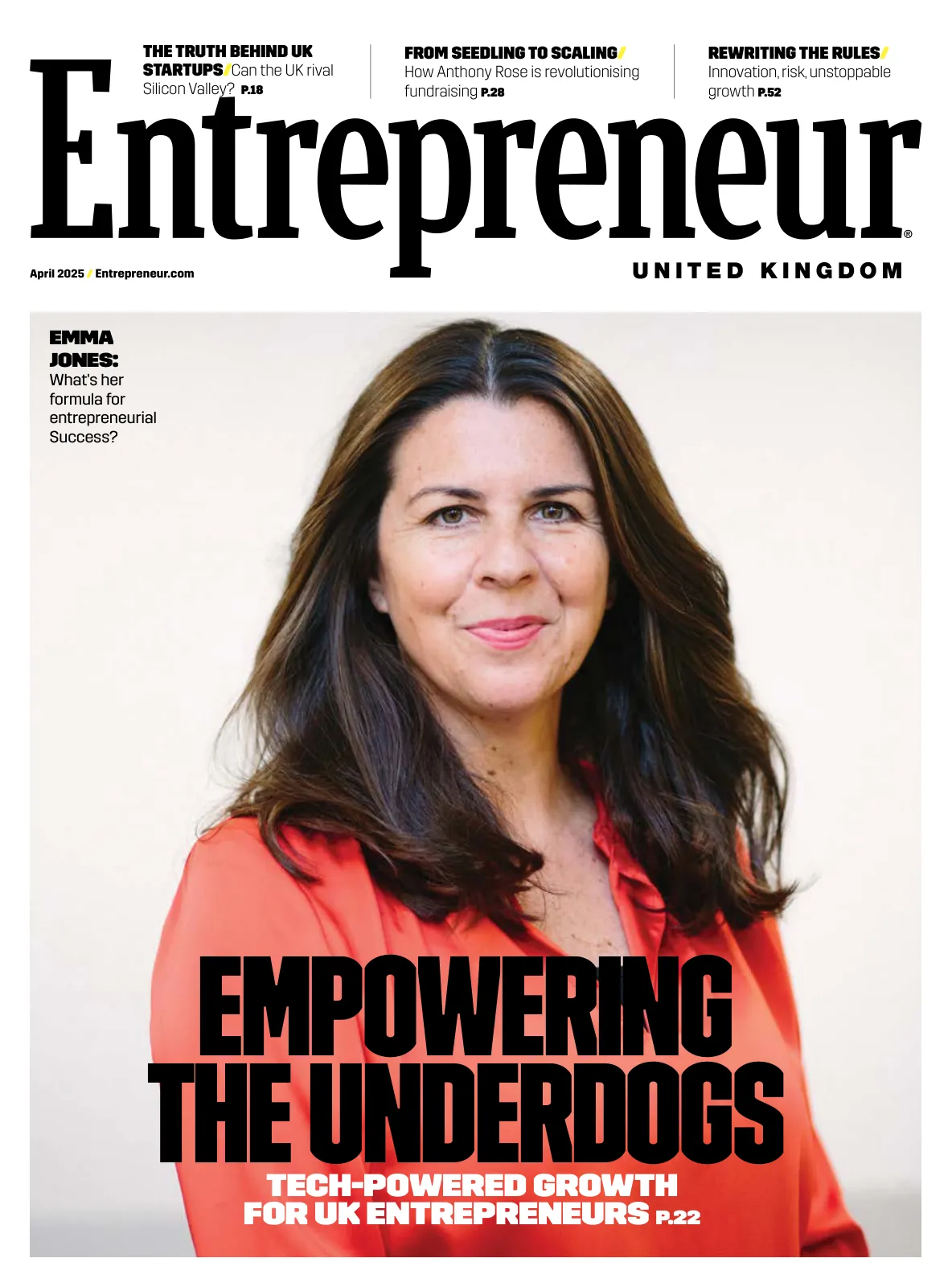
Entrepreneur UK, April 2025
Page 1
TECH-POWERED GROWTH
FOR UK ENTREPRENEURS P.22
REWRITING THE RULES/
Innovation, risk, unstoppable
growth P.52
THE TRUTH BEHIND UK
STARTUPS/Can the UK rival
Silicon Valley? P.18
FROM SEEDLING TO SCALING/
How Anthony Rose is revolutionising
fundraising P.28
April 2025 / Entrepreneur.com
EMPOWERING
THE UNDERDOGS
EMMA
JONES:
What's her
formula for
entrepreneurial
Success?
Page 2
BOLD
FOR THE
BOLD
UNITED KINGDOM
Page 3
Contents/April 2025
P.22
EMPOWERING
THE
UNDERDOGS
EMMA JONES
POWERING UP SME GROWTH
FEATURES
3
April 2025 / ENTREPRENEUR.COM /
↓ Emma Jones at the
Enterprise Nation Tech
Hub Event, connecting
innovators and
entrepreneurs to shape
the future of business:
Bethany Lavin Photography
Page 4
DOWNLOAD
YOUR DIGITAL
EDITION
HERE
UNITED KINGDOM
Out now in the UK
Page 5
5
April 2025 / ENTREPRENEUR.COM /
42 Lead, Learn, Scale
Education reshaping the path to
success
44 The Startup Sitters
Enhancing childcare for modern parents
46 How to…
Build boardroom confidence
47 Reinventing a Classic
The rise of real ingredients
50 Blinded by Competition
Shift your focus beyond comparison
‘TREPONOMICS
IN THE LOOP
Contents/April 2025
18 The Truth Behind UK
Startups
From skepticism to global
dominance
28 From Seedling to Scaling
Changing the game for startups
34 Can Grief Spark
Innovation?
Streamlining bereavement admin
BUSINESS
UNUSUAL
STARTUP
SPOTLIGHT
36 Adopting an Elite
Sports Approach
Prioritising health for business
success
38 Diversity in
Entrepreneurship
How it impacts your business
40 Regulation Whiplash
Staying ahead of regulations
8 Cash is Queen
Empowering women to master wealth
11 Investing in Change
Merging mission and margin
14 The Sky’s The Limit
Redefining the rules of play
↑ Jem Stein, founder,
Daring Capital p.11
FEATURES EDITOR Patricia Cullen
patricia.cullen@bncb2b.com
CEO Wissam Younane
wissam@bncpublishing.net
MANAGING DIRECTOR Rabih Najm
rabih@bncpublishing.net
ART DIRECTOR Simona El Khoury
EDITORIAL TEAM
Tamara Pupic,
Aalia Mehreen Ahmed
MEDIA SALES MANAGER
Olha Kovalova olha.kovalova@bncb2b.com
GENERAL MANAGER
Daniel Malins daniel@bncb2b.com
REGIONAL DIRECTOR
Andy B. andy@bncb2b.com
CONTRIBUTING WRITERS
Jack Latus, Richard Robinson,
Edward Lewis and Aaron Surtees
SUBSCRIBE
Contact subscriptions@bncb2b.com to receive
Entrepreneur United Kingdom every issue.
COMMERCIAL ENQUIRIES
sales@bncb2b.com
WWW.ENTREPRENEUR.COM/EN-GB
Access fresh content daily on our website
All Rights Reserved 2025. Opinions expressed are solely those of the contributors.
Entrepreneur United Kingdom is officially licensed exclusively to BNC B2B In
United Kingdom by Entrepreneur Media Inc. No part of this magazine may be
reproduced or transmitted in any form or by any means without written permission
of the publisher. Images used in Entrepreneur United Kingdom are credited when
necessary. Attributed use of copyrighted images with permission. All images not
credited otherwise Shutterstock.
20 Wenlock Road, London, N1 7GU
entrepreneurMediaUK
entrepreneurUK
entrepreneurmedia-uk
entrepreneurmedia.uk
Page 6
6 / ENTREPRENEUR.COM / April 2025
Editor’s Note/
REVEALING THE JOURNEYS OF
TRAILBLAZING ENTREPRENEURS
UNCOVERING THE TRUTH BEHIND THE UK STARTUP SCENE, AND SHARING
ACTIONABLE INSIGHTS TO HELP YOU CHALLENGE THE STATUS QUO AND ELEVATE
YOUR BUSINESS.
Entrepreneur United Kingdom
W
elcome to the April issue - no pranks, just
purpose. As always, Entrepreneur UK is focused
on uncovering the truth behind the UK startup
scene, celebrating bold moves, and inspiring you
to think differently about the future of business.
This month, we’re excited to bring you an
inspiring conversation with Emma Jones, the
founder of Enterprise Nation. For years, Emma has been a
driving force behind supporting small businesses in the UK,
and in our chat, she opens up about her journey, her passion
for helping entrepreneurs, and what she sees for the future.
Whether you’re just starting out or looking to scale, her
insights are a must-read for anyone in business.
We also speak with Damian Routley, COO of Founders
Factory, a London based accelerator and venture studio,
about the realities of the UK startup ecosystem. Damian’s
perspective on what it takes to succeed in this fast-paced
and competitive environment is eye-opening, and his
insights into driving innovation at the heart of London’s
startup scene are both practical and inspiring. For anyone
interested in scaling their business, Damian’s experience
with supporting startups is worth paying attention to. We’re
also sharing powerful insights from SeedLegals founder
Anthony Rose, former head of BBC iPlayer, on transforming
the UK funding landscape and paving a clear path for UK
businesses to break into the US market.
But that’s just the beginning – our Rewriting The Rules
feature highlights the journeys of entrepreneurs who dared
to break from tradition, challenge the status quo, and create
businesses that are making waves. Take Ari Last, CEO and
co-founder of Bubble, for example. He revolutionised the
childcare industry by launching a flexible, accessible
platform that addresses the needs of both parents and
childcare providers. Similarly, we hear from Pip Murray,
founder of Pip & Nut, who has redefined nut butter with her
range of sustainable, healthy, and delicious products. Her
journey really shows how passion, purpose, and a clear
mission can take a business to the next level. And there is so
much more….
As always, we’ve also packed this Entrepreneur UK issue
with practical advice to help you elevate your business.
Whether you’re looking for tips on how to build your
board-level confidence or wanting to learn how to promote
intrapreneurship within your organisation through
resources like The Open University, we’ve got you covered.
And of course, we continue to bring you the latest on new
innovations, trends, and strategies that are shaping the
future. From tech disruptions to creative business models,
we’re keeping a pulse on what’s next and how you can
leverage it to stay competitive and grow your business.
Whether you’re just starting out or scaling up, this April
issue is packed with stories that will help you push
boundaries and think outside the box. Thank you for being
part of our community – as we enter into our fourth month
of 2025 we’re excited to continue this journey with you.
And just to keep things interesting... we’ve actually been
running a startup that teaches plants how to code. But don’t
worry – it’s still in its seed stage. Happy April Fools!
Patricia Cullen
Features Editor, Entrepreneur United Kingdom
Page 7
EMPOWERING
THE VISIONARIES
OF THE
UNITED KINGDOM
UNITED KINGDOM
Page 8
8 / ENTREPRENEUR.COM / April 2025
Cash is Queen
Female entrepreneurship is booming, with women leading the charge in business and wealth
management. As they continue to break barriers and seize new opportunities, the game is
changing - fast. by ENTREPRENEUR UK STAFF
F
emale entrepreneurs are driving major change,
yet they still face tough challenges in money
management and business growth. While
women-owned businesses are growing 94%
faster than those run by men, they continue to
battle societal biases and limited access to
funding. So, why aren’t we doing more to
support them?
Alan Hooks, Head of Private Clients at Julius Baer Interna-
tional, the UK based global private banking group, and Sam
Smith, entrepreneur, NED, and former Chief Executive of
finnCap Group Plc, offer insights into the hurdles women face
in managing their wealth and scaling their businesses.
When it comes to managing wealth, both male and female
entrepreneurs face some similar challenges, but Hooks
highlights key differences in how women approach their
finances. “Both men and women face some universal chal-
lenges that all entrepreneurs encounter in managing their
wealth: they can lack confidence, feel they have a shortfall of
knowledge, or do not have sufficient time,” Hooks explains.
However, he stresses that these are manageable hurdles. “None
of these are insurmountable, particularly with the right advisor
to attend to their personal financial affairs,” he adds. The
unique challenge that many female entrepreneurs face,
according to Hooks, is a lack of financial confidence. Histori-
cally, women have not been exposed to investing or financial
education in the same way men have, which often leads to a
feeling of insecurity in managing their wealth. “As women
increasingly generate and hold more wealth, a lack of financial
confidence is one of the principal hurdles they face. They
→ James and Eimear
Maguire, co-founders
of Maguire Law,
continue to run the
company together
despite their divorce.
S/Equality
→ Alan Hooks, Head
of Private Clients at
Julius Baer
International, on how
empowering women
entrepreneurs is key
to shaping the future
Page 9
9
April 2025 / ENTREPRENEUR.COM /
}}
haven’t benefitted from the same
education in, or exposure to, the world
of investing as it hasn’t traditionally
been geared towards them,” Hooks
explains. This lack of exposure often
means that women can feel less
self-assured in their financial decision-
making, which can have significant
implications for their long-term
financial goals.
The issue of time is also an important
factor for female entrepreneurs. “Time
is also a factor here as entrepreneurs’
lives are wholly interwoven with their
businesses, which often means their
personal finances are not their first
priority,” says Hooks. Balancing the
demands of running a business while
managing personal finances can be
overwhelming, and it’s not uncommon
for female entrepreneurs to neglect
their financial well-being due to
competing demands.
Smith expands on some of the
systemic challenges female entrepre-
neurs face, pointing out that the
financial system was never designed
with women in mind. “The system in
which entrepreneurs operate was not
built for women, it was built by men
with connections and education, so as a
female entrepreneur you do not know
where to go, what to do, who to ask for
advice, you’re on the outside,” Smith
reflects. This lack of access to estab-
lished networks and financial commu-
nities can present a significant barrier
for women looking to navigate the
world of wealth management.
One trend that has emerged among
successful female entrepreneurs is their
desire to give back to their communi-
ties, and this is an area where wealth
managers can play an important role.
Hooks explains, “Research suggests that
female entrepreneurs show a strong
interest in giving back to their commu-
nities.” He further highlights how
wealth managers can help bring these
philanthropic goals to life by aligning
them with the client’s financial strategy.
“An advisor will help bring them to life
through opportunities such charitable
or philanthropic endeavors, often
concerning female equality,”he says.
For women who want to support
causes close to their hearts, such as
gender equality or women’s empower-
ment, the role of the wealth manager is
crucial in structuring their finances to
achieve both business growth and
philanthropic success. “However, they
must have a suitably constructed
investment portfolio giving sufficient
“Both men and women
face some universal
chalenges that al
entrepreneurs encounter
in managing their
wealth: they can lack
confidence, feel they
have a shortfal of
knowledge, or do not
have sufficient time”
returns to maintain their financial
backing of these ventures,” Hooks notes.
This dual focus on business success and
social impact is something that requires
careful financial planning and strategic
advice, and wealth managers are in a
unique position to provide this support.
Smith agrees with the importance of
giving back, but she also underscores the
significance of building a lasting legacy.
“There is not one female superscaler who
doesn’t want to give back, to try and
ensure no other women goes through
what they had to, or still lacking in
confidence even though they have built a
£100m turnover business,” Smith shares.
Despite their success, many female
entrepreneurs still face the challenge of
finding purpose in their wealth and
desire to create an impact beyond their
personal gain.
For many, the focus shifts from securing
financial stability to creating a legacy that
supports other underrepresented groups.
“Achieving financial security is one thing,
but building a legacy is very important to
these women – to be able to support
→ Sam Smith,
Entrepreneur and
former CEO of finnCap,
on shattering barriers
and driving gender
equality in business
Page 10
10 / ENTREPRENEUR.COM / April 2025
other underrepresented
segments, not just women,
to succeed,” says Smith.
This desire to support and
uplift others is often a
driving force for female
entrepreneurs, influencing
their business and wealth
management strategies.
Hooks and Smith both
agree that when it comes to
wealth management, there
is no one-size-fits-all
strategy. According to
Hooks, the approach to
managing an entrepreneur’s
wealth should be as unique
as the individual. “The
strategy we would recom-
mend for a successful
entrepreneur would not
look fundamentally
different whether they are
male or female, as we cater
solely to the needs and
objectives of each individu-
al,” he says. It’s all about
understanding the specific
needs and goals of the
client, both professionally
and personally. “Giving the
right advice and building
the most appropriate
strategy for a client means
understanding each part of
their life, from their family,
their lifestyle, and their own
goals, to their business
plans and ambitions.”
For female entrepreneurs,
a holistic approach to
wealth management is
essential. “Their assets can
then be structured appro-
priately to provide enough
for each requirement and
adjusted when necessary,”
says Hooks. This adaptable
approach ensures that both
personal and business-relat-
ed goals are met, allowing
entrepreneurs to focus on
scaling their businesses
without losing sight of their
financial well-being. Smith
also emphasises the
importance of personalised
strategies, particularly for
women who are scaling
their businesses in a world
that was not traditionally
designed for them. “We are
only just starting to get
statistics on how female
entrepreneurs grow their
businesses to superscale.
The trends emerging in this
space are really new.” As
more data becomes
available, the key to success
will be understanding the
factors that contribute to
women’s success in
business, which are often
different from those in
male-dominated spaces.
While there isn’t a particu-
lar sector that female
entrepreneurs are dominat-
ing, Smith points out that
many of these businesses
“provide a different take or
approach or serve a
customer group that wasn’t
previously catered to.”
Smith also highlights the
importance of building a
supportive ecosystem for
female entrepreneurs.
“There is really strong work
being done on growing the
ecosystem for female-led
businesses, which helps to
encourage women to start
and scale businesses, as well
as share their experience
and expertise,” she explains.
This ecosystem is crucial for
fostering a sense of
community and support
among women entrepre-
neurs, and it’s helping to
reshape the future of female
entrepreneurship.
Both Hooks and Smith
emphasise the importance
of financial education and
community support. For
Hooks, the increased
representation of female
advisors in wealth manage-
ment is a positive step
forward. “Ever-increasing
numbers of female
relationship managers,
wealth planners, and
investment advisors mean
that wealthy women are
more readily seeking advice
and benefitting from
expertise regarding their
personal finances,” he says.
This change is helping to
build confidence and knowl-
edge among women,
allowing them to take more
control of their financial
futures. Smith agrees that
financial literacy is key to
empowering women to
manage their wealth. “We
need to be educating
women as a group in
financial literacy from a
young age and talking about
it in a relatable way,” Smith
says. Financial education,
she believes, will empower
women to make informed
decisions about their
businesses and wealth.
“Only then will female
founders become more
confident, more represent-
ed, and likely to inspire
others to do the same,” she
adds.
THE SYSTEM IN WHICH ENTREPRENEURS OPERATE WAS NOT BUILT FOR
WOMEN, IT WAS BUILT BY MEN WITH CONNECTIONS AND EDUCATION, SO AS
A FEMALE ENTREPRENEUR YOU DO NOT KNOW WHERE TO GO, WHAT TO DO,
WHO TO ASK FOR ADVICE, YOU’RE ON THE OUTSIDE”
S/Equality
Page 11
11
April 2025 / ENTREPRENEUR.COM /
S/Impact
Investing in Change
A new wave of entrepreneurs is emerging, focused not just on profitability but on creating social
impact. While these businesses face unique challenges in securing investment, founders are
boldly and creatively striving to balance financial success with societal change.
J
em Stein, founder of
Daring Capital, a
London-based
investment firm
championing social
impact businesses, is
leading the charge in
helping these ventures
navigate the delicate
balance between profit and
purpose. As an investor,
advocate, and passionate
entrepreneur himself, Stein
has seen firsthand the
hurdles that social
entrepreneurs face and the
resilience they
demonstrate to overcome
them. Entrepreneur UK sat
down with him to discuss
what makes these
businesses unique, the
misconceptions investors
hold, and how
entrepreneurs can better
position themselves to
secure the capital they
need to grow their social
ventures.
Impact business barriers
When asked about the main
issues social impact busi-
nesses deal with, Stein
explained, “Social impact
businesses face unique
challenges that conventional
businesses don’t because
they’re working to deliver on
two fronts: financial returns
and meaningful social
impact.” Striking the right
balance between these two }}
→ Jem Stein, founder,
Daring Capital
Page 12
12 / ENTREPRENEUR.COM / April 2025
missions is no small feat. Social impact founders
are constantly juggling their need for funding with
their desire to do good. Investors, on the other
hand, often prioritise one over the other - either
looking for high returns or prioritising a genuine
mission. The difficulty lies in the fact that while
there are many investors who focus on social
impact, not all of them are willing to take the risks
that come with backing businesses that may not fit
the traditional financial models. As Stein points
out, “It’s hard to find investors who will back these
types of businesses (even though there are a lot out
there) so getting initial financing can be challeng-
ing.”
Assessing social impact businesses without
traditional scalability
Social impact businesses often don’t follow the
same growth trajectory as traditional startups.
They might not have the same scalability potential
or be able to attract the kind of rapid growth that
venture capitalists often look for. So how does
Stein assess the potential of these businesses when
scalability is not the primary driver? “There are
huge opportunities for social impact businesses
tackling critical challenges that may not offer
venture-scale potential,” he shares. While these
businesses may not meet the traditional venture
capital model, they still hold immense potential to
dominate niche markets, addressing underappreci-
ated problems with innovative solutions that
require lower capital investments.
Stein argues that success in this field hinges more
on strong leadership than on protected technology
or fast growth. “Ultimately, success in this space is
less about having defensible technology and more
about the founders: their deep expertise, genuine
passion for the problem, and ability to execute
against the odds. It’s this leadership and commit-
ment that turns a focused mission into a sustain-
able, impactful business.”
Misconceptions about social impact businesses
One of the most common misconceptions that
investors have about businesses focused on social
impact is that they are somehow less capable or
more risky than traditional ventures. “The biggest
misconception is that purpose-driven founders are
somehow less capable, more amateurish, or higher
risk than conventional founders. In my experience,
that couldn’t be further from the truth,” Stein
explains. According to him, purpose-driven
founders often bring an extra layer of determina-
tion and dedication to the table. “If anything, these
S/Impact
Page 13
13
April 2025 / ENTREPRENEUR.COM /
founders are often more
committed and resilient
because their connection to
the mission isn’t just
strategic - it’s deeply
personal.” For these
entrepreneurs, their work
goes beyond generating
financial returns; it’s about
having a positive, lasting
impact on the world. This
deeper motivation often
makes them more likely to
weather challenges and
continue pushing forward
to realise their vision.
The right way to pitch a
social impact business
Pitching a business focused
on social impact to
investors accustomed to
high-growth, profit-driven
models can be a daunting
task. Social impact
founders may struggle to
compete with startups that
offer enormous financial
returns and high scalabil-
ity. But Stein believes that
social entrepreneurs
should not try to fit into a
model that doesn’t suit
their business.
“The key for social impact
founders is to find
investors who genuinely
align with their values and
mission,” Stein says.
“Trying to compete directly
with high-growth,
profit-driven startups on
purely financial returns is a
tough game to win.”
Instead, social impact
founders should be upfront
about their dual focus on
returns and societal
impact. By aligning
themselves with investors
who truly understand and
value their mission, they
can form stronger, more
meaningful partnerships.
“Investors who appreciate
that will be the right
partners,” Stein adds.
Alternative funding models
For social impact busi-
nesses that don’t fit neatly
into the traditional venture
capital model, Stein has
found that alternative
funding sources tend to be
more flexible and better
aligned with their needs.
“For social impact
businesses that don’t fit the
traditional VC mould,
angels, syndicates,
foundations, and family
offices tend to be the best
funding sources,” Stein
explains. These funding
sources offer more
flexibility in terms of
expectations and timelines,
allowing for a more
collaborative relationship
between investors and
entrepreneurs. “They offer
more flexibility in their
approach and, crucially,
allow founders to build real
relationships with
investors who believe in
their vision,” Stein says.
Building a relationship
with investors who
understand the long-term
nature of social impact
work is often more
productive than working
with funds that prioritise
short-term financial
returns.
Schemes like SEIS (Seed
Enterprise Investment
Scheme) can also be a
valuable tool in de-risking
investments for social
impact businesses.
“Traditional funds can be
more challenging because
they’re managing other
people’s money and often
have stricter return
expectations, making it
harder for non-traditional
models to fit their thesis,”
Stein adds.
Advice for entrepreneurs
struggling to raise capital
For social impact entrepre-
neurs who are struggling to
raise capital and feel
excluded from traditional
funding routes, Stein has
some grounded advice:
“The first thing I’d say is:
get as far as you can
without raising.” Too often,
early-stage founders expect
to secure large sums of
money before they even
have a product or custom-
ers. However, in today’s
world, there is much that
can be accomplished with
minimal resources.
Stein encourages
founders to focus on
building traction first.
“Instead of following the
VC playbook, which often
doesn’t fit social impact
businesses, focus on
proving traction first. Get
as far as you can, raise a
small amount (£50k),
make progress, then raise
again if needed. Rinse and
repeat.” He also advises
that founders shouldn’t
quit their day jobs too
soon. “If you can build a
business with paying users
and solid revenue on a
small budget, you will find
the funding to grow.
Investors will always back
businesses that demon-
strate real market de-
mand.”
Stein’s insights into social
impact investing highlight
the challenges these
businesses face and how
they can overcome them.
When founders and
investors align on shared
values, social impact
ventures can thrive, even in
a profit-driven market. The
key is choosing the right
partners and staying true
to the mission - because
the world needs businesses
that create lasting, positive
change.
“The biggest misconception is
that purpose-driven founders
are somehow less capable,
more amateurish, or higher risk
than conventional founders. In
my experience, that couldn’t be
further from the truth”
Page 14
The Sky’s the Limit:
Redefining the Rules of Play
A fresh approach to i-Gaming has taken flight, challenging
conventions and reshaping the industry. In an arena long dominated
by tradition, one company’s bold strategy is proving that innovation,
not imitation, is the true path to success. by ENTREPRENEUR UK STAFF
I
n an industry often
characterised by
incremental change and
entrenched conventions,
Spribe has broken the
mould. Founded by
David Natroshvili, the company
blends cutting-edge technologies
with an innovative approach to
game design, reshaping the
gaming landscape. Their flagship
creation, Aviator, reflects this
forward-thinking approach and
has become a benchmark in the
world of gaming innovation.
When traditional slots dominated
the market, Natroshvili and his
team spotted an opportunity to
engage a younger, more
interactive audience. Their
flagship game, Aviator,propelled
Spribe to the forefront of the
industry. But, as Natroshvili
explains, the real challenge wasn’t
just spotting a trend - it was
reshaping the industry’s approach
to gaming and delivering
something that both defied norms
and introduced something entirely
new.
“This insight led us to develop
next-generation games, starting
with Aviator, that combine
elements of skill, excitement, and
social interaction. Our goal was to
bring innovation into an industry
that had become somewhat
stagnant,” he says.
TURNING GAPS INTO GAME-
CHANGING OPPORTUNITIES
The iGaming industry is notorious
for its reliance on timeworn
formats, and traditional slot
machines had long reigned
supreme. Yet, Natroshvili saw a
market ready for disruption. “From
the very beginning, we saw an
opportunity in the iGaming market
that was largely overlooked - an
audience that craved fresh,
interactive, and highly engaging
gameplay,” he says. The market,
dominated by static slot games,
had grown stale. There was little
14 / ENTREPRENEUR.COM / April 2025
B/Innovation
Page 15
15
April 2025 / ENTREPRENEUR.COM /
ahead of trends, continuously push the
boundaries of game design, and
maintain our leadership in the crash
game segment,” Natroshvili asserts.
Spribe’s ability to stay at the cutting
edge of game development has enabled
it to lead the charge in this new category
of i-Games, solidifying its position at the
forefront of the industry.
TURNING CHALLENGES INTO
OPPORTUNITIES
Despite the allure of innovation, the path
to success was not without significant
hurdles. One of the key challenges
Spribe faced was convincing operators
to adopt its new i-Gaming format.
Traditional slots were deeply entrenched,
and convincing operators to move away
from a familiar and profitable format to
something radically different was no
easy task. “One of the biggest
challenges we faced was convincing
operators to adopt a completely new
type of game,” Natroshvili
acknowledges.
Instead of viewing this resistance as a
setback, Spribe embraced the challenge
as an opportunity to educate the market.
They armed themselves with data, case
studies, and trial opportunities, offering
operators a chance to experience the
potential of Aviator firsthand. The results
spoke for themselves: once operators
}}
room for players to interact with
one another or engage with the
game in a meaningful, dynamic
way. As younger, more tech-savvy
generations entered the fold, their
demand for deeper engagement
was undeniable. The question for
Natroshvili was not whether the
industry needed disruption, but
how to provide it.
In this landscape,Aviator was
born. The game combined the
simplicity of classic arcade
mechanics with the complexity of
real-time decision-making and
social interaction. Players could
watch their bets rise on a multiplier,
deciding when to cash out or risk
more. It was a format that allowed
for both skill and luck, giving
players a greater sense of agency
than passive slot machines. The
game’s rapid success
demonstrated a clear demand for
gameplay that blended excitement
with interaction.
FROM START-UP TO INDUSTRY
LEADER
When Spribe first launched, the
company was determined to break
new ground in game design.
However, as Aviator quickly gained
traction, Natroshvili's vision for the
company expanded. What started
as an effort to introduce innovative
game mechanics soon expanded
into a broader mission to redefine
the entire gaming experience using
AI and smart technology “Our
vision expanded from merely
offering unique games to pioneering
an entirely new category of ‘Smart’
games that prioritise social
engagement, fair play, and real-time
excitement,” Natroshvili explains.
The company's commitment to
AI-driven innovation has propelled
Spribe to the forefront of gaming
technology. Today, it is synonymous
with what Natroshvili calls “Smart
games” - games that offer players
not just an experience, but a
chance to be part of a larger social
context. “Our mission is to stay
saw the game’s success in action, the
adoption rate skyrocketed. “Once the
first wave of operators saw its success,
adoption quickly gained momentum,”
says Natroshvili. This ability to pivot
and educate in the face of market
resistance is a hallmark of Spribe’s
approach.
AI, INNOVATION, AND THE SECRET
SAUCE
What is it about Aviator that has made it
so successful? According to Natroshvili,
it’s a combination of several key
factors: simplicity, social interaction,
real-time decision-making, and fairness.
“Aviator’s success can be attributed to
several key factors: simplicity, high
engagement, social elements, and a
fair, provably fair algorithm,” he
explains. The game appeals to a broad
audience by offering a mix of risk,
strategy, and excitement, and it’s this
combination that has made it a hit
across player demographics.
In addition, Spribe has worked
diligently to keep the game fresh.
Regular updates, new features, and
strategic partnerships with operators
ensure that Aviator remains at the
forefront of the market. “To sustain its
momentum, we continuously enhance
the game with new features, maintain
close partnerships with operators, and
Page 16
16 / ENTREPRENEUR.COM / April 2025
invest in marketing strategies that
keep Aviator at the forefront of
players’ minds,” Natroshvili says.
STAYING AHEAD OF THE CURVE
The success of Aviator has
spurred a wave of imitation, with
competitors seeking to replicate
its success. However, Natroshvili
is confident that Spribe's first-
mover advantage, coupled with
ongoing innovation, will keep
Aviator ahead of the competition.
“Aviator remains the market
leader because we prioritise
quality, innovation, and player
experience,” he asserts. By
continually improving the game
and expanding its accessibility,
Spribe ensures that it stays
ahead of the curve.
Despite the growing number of
crash-inspired games, Aviator
remains the benchmark for
quality and innovation, proving
that being the first to market with
a truly novel concept provides
significant long-term advantages.
A ROADMAP FOR FUTURE
INNOVATION
Looking to the future, Spribe is
far from resting on its laurels.
Natroshvili remains focused on
expanding Spribe’s portfolio of
games and leveraging emerging
technologies to enhance the
gaming experience. “We are
always looking at what’s next.
Our focus is on expanding our
portfolio of innovative games
while leveraging new
technologies like AI, blockchain,
and Web3 elements,” he reveals.
These technologies hold
significant promise in shaping the
next wave of iGaming, and
Spribe is positioning itself to be
at the forefront of these
developments.
Mobile-first gaming and social
betting experiences are also high
on Spribe’s agenda, as the
company continues to innovate in
ways that better align with the
evolving demands of today’s
players. “As the industry evolves,
Spribe will remain at the forefront,
ensuring we continue to shape
the future of iGaming with
cutting-edge innovations,” says
Natroshvili. True disruption comes
from more than just identifying
opportunities - it’s about having
the vision and tenacity to reshape
an entire industry.
“Innovation is key, but
execution is everything,” he
concludes. It’s the ability to
deliver on bold ideas, powered
by AI and technology, that will
shape the future across
industries.
OUR VISION EXPANDED
FROM MERELY OFFERING
UNIQUE GAMES TO
PIONEERING AN ENTIRELY
NEW CATEGORY OF ‘SMART’
GAMES THAT PRIORITISE
SOCIAL ENGAGEMENT, FAIR
PLAY, AND REAL-TIME
EXCITEMENT”
“
→ JOSEPH VALENTE
and ANT MIDDLETON,
best selling author of
Military Mindset and
leadership expert.
B/Innovation
Page 17
The voice of
entrepreneurship
around the world
Access fresh content daily on our website
Page 18
18 / ENTREPRENEUR.COM / April 2025
A
midst skepticism about
the UK’s startup
ecosystem, Damian
Routley, Chief Operating
Officer of London based
Founders Factory, a global
startup accelerator and venture
studio, argues that the country’s
entrepreneurial landscape is
thriving. But with rising
challenges and fierce global
competition, can the UK truly
become Europe’s Silicon Valley?
Critics argue that the UK
startup ecosystem still faces
deep systemic challenges, like a
lack of early-stage capital or the
ongoing brain drain of talent to
Silicon Valley. But according to
Routley, the narrative is more
nuanced and filled with
opportunity. In this Entrepreneur
UK interview, Routley unpacks
the strengths and weaknesses
of the UK’s startup scene,
offering valuable insights on the
country’s potential to become a
global leader in tech and
innovation.
WHEN IT COMES TO THE
UK’S ENTREPRENEURIAL
SCENE, THE
CONVERSATION OFTEN
REVOLVES AROUND TWO
MAJOR POINTS: IS THE
UK A REAL COMPETITOR
TO SILICON VALLEY, AND
IS IT TRULY A STARTUP
HUB OF THE FUTURE?
by PATRICIA CULLEN
THE TRUTH
BEHIND UK
STARTUPS
Page 19
19
April 2025 / ENTREPRENEUR.COM /
→ The team
behind
Founders
Factory:
shaping the
future of
startups
The UK’s startup ecosystem: Myths vs. reality
“Criticism of the UK startup ecosystem often overlooks the
facts,” he says. While it’s true that the UK faces its share of
challenges, Routley firmly believes that many critics fail to
acknowledge the significant achievements of the country’s
tech scene. In his view, the UK remains Europe’s premier
startup hub, and there’s little evidence to suggest that this
position will falter anytime soon.
He points out that in 2024, UK startups accounted for
25% of all new ventures in Europe and raised 40% of the
total capital, making it a dominant force in the region. “The
UK attracts more venture capital than any other European
country, with investment levels double that of the next
closest competitor,” Routley explains. “UK funds are also
outperforming their European and even some US counter-
parts.”
Despite concerns over talent leaving for Silicon Valley,
Routley sees a different trend. “We’ve seen the opposite - in-
ternational founders flocking to the UK,” he says. “In our
own portfolio, we’ve seen the likes of ShopCircle, founded by
two stellar Italian entrepreneurs, come to the UK to launch
and scale their company, raising funding from major UK
and US investors.” This influx of international talent is a
testament to the UK’s growing reputation as a launchpad for
high-growth companies. “The UK is a global crossroads - a
first stepping stone for serious capital from Asia and the
Middle East, and a springboard to the US,” he adds.
Moreover, the regulatory framework in the UK plays a
significant role in supporting startups. “You can set up
companies in a fraction of the time compared to Europe,”
Routley highlights. “And unshackling our regulatory
environment from the rest of Europe has made us far more
open to international business. The UK’s lack of AI regula-
tion, for example, has made it attractive compared to
Europe, which faces challenges with the EU AI Act.”
However, Routley acknowledges that while the UK has
made tremendous progress, it’s not without its hurdles. “It
would be naive to ignore the challenges we still face,” he says.
“The UK has a long way to go to sit shoulder to shoulder
with Silicon Valley. But its foundations are solid, and its
outlook is promising.”
What more can the government do for UK startups?
The UK government has set ambitious goals to foster the
next wave of innovation and entrepreneurship. But accord-
ing to Routley, there are a few critical steps that can further
strengthen the ecosystem.
He points out that successful startups rely on three things:
money, talent, and a market. The government can play a
significant role in ensuring these elements are in place.
“First and foremost, we need to incentivize people to take
the risk of building a business, and for investors to back
these businesses,” he says. He advocates for protecting
investment incentives like the Enterprise Investment
”
}}
Page 20
20 / ENTREPRENEUR.COM / April 2025
Scheme (EIS) and the Seed
Enterprise Investment
Scheme (SEIS), which are
vital for early-stage
investors who take on
higher risks. “We should
also look at expanding
R&D credits for critical
industries such as deep
tech, climate, and life
sciences, where the UK can
continue to build on its
global reputation.”
Another area Routley
feels is crucial to the UK’s
future success is talent
retention and attraction.
“We need to ensure the UK
is the first choice for
international skilled
talent,” he emphasises. One
way to achieve this is by
improving access to visas,
including creating more
opportunities for families
of entrepreneurs. He also
stresses the importance of
strengthening entry points
to the UK’s talent ecosys-
tem, like partnerships
between industry and
academic institutions, as
well as programs like
Erasmus and Horizon,
which can help attract
top-tier talent from across
Europe.
Additionally, Routley
underscores the impor-
tance of a thriving market
for startups to grow. He
believes the UK has a huge
opportunity to transform
the public sector through
technology, AI, and data,
creating new avenues for
innovation. “Getting this
right could be pivotal,” he
adds. Finally, Routley
believes the UK must
double down on its efforts
to support scaleups, not
just startups. “We need to
ensure that businesses
don’t leave the UK as they
grow,” he stresses. This
includes focusing on
regions outside of London
and investing in new
clusters where startups can
scale effectively.
Challenges facing UK tech
entrepreneurs
While the UK startup scene
is thriving, it’s not without
its challenges. According to
Routley, access to talent,
capital, and customers
remains a consistent hurdle
for entrepreneurs across
the board.
One issue he highlights is
the diminishing financial
incentives for entrepre-
neurs. “Tax reliefs for
entrepreneurs and
investors have been
reduced, and it’s crucial
that we build on these
rather than throw them
out,” he explains. “The
danger, if we neglect this,
will be a failure to produce
any UK-grown breakout
successes. This, on top of a
worrying trend of high net
worth individuals leaving
the UK for tax reasons,
means the government
ought to think deeply about
how it is ensuring the
funding well doesn’t dry up
for businesses.”
There’s also the broader
issue of global economic
trends. The COVID-19
pandemic led to an initial
surge in funding, but that
was followed by a market
correction in 2022. “Capital
has become scarcer, and it’s
falling into the hands of
fewer companies,” Routley
says. As a result, only
exceptional businesses are
receiving funding, and
many consumer-focused
→ Damian Routley, COO of
Founders Factory, driving
innovation at the heart of
London's startup ecosystem
Page 21
21
April 2025 / ENTREPRENEUR.COM /
companies are struggling.
However, this shift has led
to growing interest in
industries such as deep
tech, climate, and health,
where specialised funds
are emerging to support
those sectors.
But it’s not just capital
that’s a concern. The rapid
proliferation of AI also
brings both opportunities
and challenges. “The
current pace of innovation
means that founders are
under great pressure to
make decisions and
execute faster than ever,”
Routley notes. “On the
other hand, the availabil-
ity of AI to entrepreneurs
has created a much lower
barrier to entry to
building a business. This
makes the market much
more competitive, making
it harder to raise, thus
ushering a new paradigm
of resource allocation.”
Securing follow-on
funding
A common concern
among UK entrepreneurs
is securing follow-on
funding after their initial
investment. While this
remains a challenge for
some, Routley is optimis-
tic about the state of the
funding ecosystem in the
UK.
“I’d actually say that all
the evidence suggests that
our funding raising
ecosystem is firmly back
on track,” he explains.
While there are no
“urgent fixes” required,
Routley stresses that the
UK must continue to
realign incentives for
early-stage investors.
“One of the things we’re
seeing is the deployment
of pension funds into
high-growth businesses,
which is a positive trend,”
he says. This shift is vital
for creating more
sustainable and diverse
funding sources, which
can help foster innovation
and ensure that emerging
companies have access to
the capital they need to
scale. As this trend grows,
it will be important to
keep refining the
framework to maximize
its long-term impact.
Addressing the talent gap
in tech
The UK has seen
substantial investment in
tech startups, but one
area that still requires
attention is talent
retention and the
widening skills gap in
tech fields. Routley
believes that addressing
this issue comes down to
two main factors:
education and migration.
Education, particularly in
STEM subjects, is crucial
to equipping the next
generation of tech talent.
“Cyber security is a great
example of an industry
that’s thriving in the UK
- but where there are as
many unfilled roles as
there are people in the
workforce,” he notes.
“Education starts at a very
early stage, underlining
the importance of both
STEM subjects but also
creative pursuits, the right
balance to foster innova-
tion and the startup
mindset. I’d also like us to
reconfigure the way
academia and industry
come together to make
further education even
more relevant - from
practical degree programs
to apprenticeships and
placements.”
Routley also emphasises
the need to continue
attracting top interna-
tional talent to the UK.
“Visa programs for skilled
workers are critical,” he
says. We can achieve this
by strengthening the
entry points to these
ecosystems, not just
through universities, but
also by supporting
industry hubs, non-prof-
its, and research insti-
tutes. “We need to make
the right landing
programmes for each
industry to ensure that
the UK is top of the list.”
Strengthening the UK’s
global position
As the UK aims to solidify
its position as Europe’s
Silicon Valley, Routley
sees a promising future
for the country’s startup
ecosystem. Founders
Factory, plans to continue
supporting UK startups
and global entrepreneurs
solving real, pressing
problems.
“The UK has a growing
network of industry and
government partners
who are ambitious to
drive innovation and
transform categories and
geographies they’re
operating in,” he explains.
“Nowhere else can
founders engage with this
range of global players,
from Aviva and Rio
Tinto, to governments in
Australia, Singapore, and
beyond. To the ordinary
founder, these types of
organisations are not
only hard to access,
they’re hard to know how
to approach, and I
believe one of the best
things we do is offer
access to these organisa-
tions that might take
years to procure.”
Routley also points to
the growing importance of
building ties with regions
like Asia and the Middle
East. “Building deeper
in-roads with global
partners is key to
sustaining UK innovation.
Many critical industries,
such as deep tech, climate,
and health, require
significant infrastructure
and capital that often
reside in Asia and the
Middle East. Strengthen-
ing ties between UK
startups and these regions
will help retain innovation
and protect intellectual
property while ensuring
UK companies scale on a
global stage.” In the end,
Routley believes the UK
has a generational
opportunity to cement its
place as a global tech
leader, but this won’t
happen by accident. “This
won’t happen by default -
we must continue to
invest in our founders,
refine our policies, and
build a global ecosystem
that ensures UK tech
remains world-class” he
concludes.
The UK’s startup scene
has all the right ingredi-
ents for continued
success, but to maintain
its edge as Europe’s
innovation hub, it will
need more than just
momentum - it will need
bold moves and unwaver-
ing commitment. Will it
rise to the challenge or
risk losing its lead? Only
time will tell.
Page 22
22 / ENTREPRENEUR.COM / April 2025
E
mma Jones, the visionary CEO behind Enterprise Nation, a UK-
based business support network that provides resources, advice,
and networking opportunities for entrepreneurs, has spent years
championing small businesses in the UK. Under her leadership, the
business support network has become a vital resource, offering
entrepreneurs the tools, guidance, and connections they need to
navigate an increasingly unpredictable and digital-first economy.
Let’s meet the woman behind the mission.
With a background that spans both corporate and entrepreneurial
realms, Jones’ journey to founding Enterprise Nation was driven by her
own experiences as a business owner during the dot-com boom. Since
2005, she has built a formidable platform that supports small and
medium-sized enterprises (SMEs) across the UK, empowering them to
scale and innovate in a digital-first world. In a conversation with
Entrepreneur UK, Jones discusses how her vision has evolved,
particularly in response to the rapid acceleration of digital
transformation, and what it will take for SMEs to succeed in the coming
years.
EMPOWERING
THE UNDERDOGS
In a world where every small business
owner is one new app or breakthrough
technology away from skyrocketing -
or stumbling - Emma Jones is here to
make sure they don’t miss the memo.
by PATRICIA CULLEN
Page 23
23
April 2025 / ENTREPRENEUR.COM /
FROM DOT-COM TO DIGITAL TRANSFORMATION
“I started my career at Arthur Andersen and left
to launch a business during the dot-com boom
that I successfully exited within a couple of
years,” Jones recalls. “The experience of starting,
growing, and selling a business gave me the idea
for Enterprise Nation, which was launched in
2005 to support the flourishing number of
start-ups and SMEs.”
Jones’ early entrepreneurial experience was
pivotal, shaping her understanding of the
challenges small businesses face when navigating
the complexities of growth. But it was the
explosive increase in the number of people
starting businesses that spurred Jones on to turn
her vision into a reality. “Fast forward to today,
and the number of people starting up or planning
to start has taken off. Research we did at the
beginning of the year found 47% of UK adults
are now thinking about starting a business over
the next 12 months. That’s 12% more than in
2024,” she notes. The surge in entrepreneurial
ambition is not only a reflection of the economic
climate but also the rise of younger generations,
with Gen Z and millennials spearheading the
charge. “Gen Z and millennials are leading the
→ Simon Daniels,
Director at KBS
Corporate, guides
businesses through
successful mergers
and acquisitions.
}}
“ RESEARCH WE DID
AT THE BEGINNING
OF THE YEAR FOUND
47% OF UK ADULTS
ARE NOW THINKING
ABOUT STARTING A
BUSINESS OVER THE
NEXT 12 MONTHS.
THAT’S 12% MORE
THAN IN 2024”
← EMMA JONES,
founder of
Enterprise
Nation, making it
easier for
entrepreneurs to
grow, thrive, and
make their mark
Page 24
24 / ENTREPRENEUR.COM / April 2025
she says. “The 5.5 million SMEs we
have in the UK now represent 99.8% of
all businesses and will play an
incredibly important role in creating
growth.” Small businesses, as the
backbone of the UK economy, have an
immense opportunity to drive
productivity and innovation - if they
can harness the power of digital tools.
Enterprise Nation has already taken a
leadership role in helping SMEs
embrace technology through initiatives
like Tech Hub, a partnership with
Google, Sage, and Vodafone Business.
“Since its launch in October 2023, Tech
Hub has supported more than 50,000
founders,” Jones reports, emphasising
the tangible impact of these collabora-
tions. The platform is also closely
involved in government initiatives, with
Jones sitting on the Government’s SME
Digital Adoption Taskforce. “We must
collectively deliver a bold, high-aspira-
tion public-private sector strategy that
delivers results,” she urges. “There’s a
window of opportunity, and we must
act fast if we’re going to achieve the
Government’s aspirations to be the
fastest-growing economy in the G7.”
Technology undoubtedly has the power to
transform our economy. The 5.5 milion SMEs
we have in the UK now represent 99.8% of
al businesses and wil play an incredibly
important role in creating growth”
→ Lewis Crompton, CEO and
founder of STARTrading.
“
trend, so expect this trend to keep on
expanding,” Jones adds. With this
influx of new businesses, Enterprise
Nation has adapted its offerings to
meet the specific needs of this new
generation of entrepreneurs. In
response to the demand for digital
expertise and flexibility, the platform
now offers services that cater to the
modern way of working. “Today’s
start-ups are often started as a side
hustle, so people need access to
business support that’s easy to dip in
and out of 24/7,” she explains. “For
example, we now offer 30-minute
daily Lunch & Learns, delivering
expert tips people can tune into in
their lunch hour.”
With digital transformation being
one of the defining features of today’s
business landscape, Jones believes the
role of technology cannot be over-
stated. “Technology undoubtedly has
the power to transform our economy,”
→ The Enterprise
Nation founder with
Nicola Mendelsohn at
#SheMeansBusiness
Page 25
25
April 2025 / ENTREPRENEUR.COM /
”THE COMPANIES
THAT WILL SUCCEED
AND DELIVER THE
MOST BENEFIT ARE
THE ONES THAT
ACTIVELY SHAPE
AND LEVERAGE AI
TO CREATE VALUE
AND REDEFINE
THE MARKET. THEY
WILL LEVERAGE
ENHANCED DATA
PROCESSING TO
BETTER PREDICT
CAPABILITIES THAT
WILL HELP THEM
NAVIGATE WHAT’S
TO COME”
However, despite the progress, significant gaps remain. “Our recent
research for Tech Hub found that with the right support, business
leaders could get three and a half weeks back by adopting technology. It
found that, despite making progress, worrying gaps in knowledge and
uptake remain,” she explains. The path to digital adoption, while critical,
is not always straightforward, and Jones believes that a collaborative
effort from both the public and private sectors is essential to closing
these gaps.
INTERNATIONAL LESSONS: A GLOBAL PERSPECTIVE
Looking beyond the UK, Jones is keen to explore international best
practices in digital adoption. “There are some incredible international
examples like Singapore’s SMEs Go Digital, which supports SMEs to
adopt advanced digital solutions,” she notes. Singapore’s initiative offers
sector-specific digital plans that are integrated into its Industrial
Strategy, recognising that digital solutions can not only increase
productivity but also enhance resilience.
↑ Enterprise Nation’s Ask Ema, Personal Business Assistant
}}
Page 26
26 / ENTREPRENEUR.COM / April 2025
Similarly, New Zealand’s Digital Boost program offers a model
that closely mirrors what Jones and Enterprise Nation have
worked towards in the UK. “New Zealand’s Digital Boost has
been very effective and is almost identical to the approach we
have built over many iterations at Enterprise Nation in the UK
and Ireland,” she explains. The programme’s diagnostic tools
provide businesses with personalised action plans to fast-track
digital adoption, offering a mixture of e-learning, events, and
access to curated advisors.
Looking ahead, Jones is particularly enthusiastic about the
growing role of artificial intelligence (AI) in shaping the future
of SMEs. “We’ll certainly see more businesses consciously
adopting AI to increase efficiencies,” she predicts. “At the
moment, AI is built into many digital applications that small
businesses already use, but in the future, we will see them
building it into their own systems while anticipating and
adapting to technological and market changes.” The next wave
of innovation will see AI not just as a tool but as a key driver of
competitive advantage.
AI will also play a significant role in employee development.
“We’ll also see AI doing the heavy lifting in personalised staff
training, helping businesses to deliver individualised progres-
sion and personal growth coaching that can adapt to diverse
needs,” Jones explains. As businesses increasingly rely on
technology to streamline operations and enhance productivity,
they will need to invest in digital skills training to stay ahead.
In order to help businesses navigate these changes, Jones
outlines five crucial steps for any SME looking to embrace
digital transformation:
1/Start small: Assess your digital readiness by understanding
the existing digital expertise and experience within your
business.
2/Get the right level of support: Seek help to optimise digital
transformation and identify key issues.
3/Work out the tools that will make an impact: Whether it’s
CRM suites, workflow management tools like Trello, or
accounting software like Sage, SMEs should identify the
digital tools that will best suit their needs.
4/Implementation: Focus on improvement rather than
perfection, and fine-tune your strategy as you go.
5/Be open to help along the way: Continually upskill
yourself and your team to stay ahead in a rapidly changing
environment.
ENTERPRISE NATION’S ROLE IN DRIVING DIGITAL TRANSFOR-
MATION
As part of its mission to accelerate the digital journey for small
businesses, Enterprise Nation’s Tech Hub offers a range of
tools designed to make digital adoption as accessible as
possible. “The Digital Starter Kit for small business is a really
good place to start because it helps you plan how you
approach digital adoption and tackle the e-learning elements
of the hub,” Jones explains. The platform’s regular webinars
and personalised action plans allow businesses to progress at
their own pace, providing them with the resources they need
→ Emma Jones
talking part in the FSB
Small Business
Debate
Page 27
27
April 2025 / ENTREPRENEUR.COM /
to stay competitive in an
increasingly digital
world.
Looking to the future,
Enterprise Nation is also
exploring the potential of
AI in its own offerings.
“We are building with AI
ourselves and beta-test-
ing a ‘Personal Business
Assistant’ that fetches
information, support,
and guidance that small
businesses need,” Jones
reveals. The vision for
this tool is ambitious: to
provide every small
business in the UK with a
Personal Business
Assistant that helps them
on their journey, from
identifying contracts they
are eligible to bid for to
connecting them with
finance options at the
right stage of growth.
NAVIGATING ECONOMIC
UNCERTAINTY WITH
TECHNOLOGY
As small businesses face
an uncertain economic
climate, Jones believes
that the key to long-term
success lies in embracing
change and leveraging
technology. “The
companies that will
succeed and deliver the
most benefit are the ones
that actively shape and
leverage AI to create
value and redefine the
market. They will
leverage enhanced data
processing to better
predict capabilities that
will help them navigate
what’s to come. We’ll also
see AI doing the heavy
lifting in personalised
staff training, helping
businesses to deliver
individualised progres-
sion and personal growth
coaching that can adapt
to diverse
needs,”
she asserts. The digital
transformation that
SMEs are undertaking
today will not only help
them weather economic
storms but also position
them for success in an
increasingly tech-driven
global economy.
Jones’ vision for
Enterprise Nation has
evolved with the
changing tides of small
business needs. What
began as a simple
start-up support network
has morphed into a
vibrant hub, helping
entrepreneurs tackle the
complexities of the digital
age. With cutting-edge
programs like the Tech
Hub and powerhouse
partnerships, Enterprise
Nation is redefining the
future of UK entrepre-
neurship.
For Jones, the road
ahead is clear: by
embracing digital tools,
fostering a culture of con-
tinuous learning, and
providing the right
support, UK businesses
can thrive, no matter
what challenges lie
ahead. As she sees it,
“Businesses that invest in
digital tools and
upskilling their staff and
are open to technological
change will be the
winners in the next
decade.” In the face of
ongoing political and
economic upheaval, these
businesses will flourish,
gaining access to flexible
supply chains and
enjoying reduced tech
costs that drive profits.
“What seems like an
investment now, will pay
dividends further down
the line and lead to more
innovative product and
service generation and
offer a strategic foresight
that will help them to
sidestep future shocks.”
↓ Emma Jones at the Enterprise Nation Tech Hub Event, connecting
innovators and entrepreneurs to shape the future of business:
Bethany Lavin Photography
↓ Enterprise
Nation StartUp
Show 2025
Page 28
28 / ENTREPRENEUR.COM / April 2025
B/Disruption
From Seedling to Scaling
A
former head of
BBC iPlayer,
Rose has spent
much of his
career working
on technology-
driven solutions
that challenge
the status quo. However, in his latest
venture, he’s set his sights on a different
challenge: making the process of
startup fundraising more accessible,
efficient, and less stressful.
Anthony Rose is a name that resonates with innovation.by PATRICIA CULLEN
Alongside angel investor Laurent
Laffy, Rose co-founded SeedLegals,
a platform designed to eliminate
the inefficiencies and frustrations
that often accompany legal
paperwork during the fundraising
process. The idea for SeedLegals
sparked one night in Rome, when
Rose and Laffy realised just how
much time and money was wasted
on legal complexities during
funding rounds – and knew they
had to fix it.
AN INNOVATIVE SOLUTION TO A
COMMON PROBLEM
The inspiration for SeedLegals came
from Rose’s own experiences in the
startup world. After leaving the BBC,
he built and sold several startups,
which gave him firsthand insight into
the legal challenges faced by founders.
During this time, he became acutely
aware of the issues that plagued
startup funding rounds, specifically the
inefficiencies and costs of legal
documentation.
→ Anthony Rose,
co-founder of
SeedLegals,
revolutionising
startup fundraising
with innovative
solutions
Page 29
29
April 2025 / ENTREPRENEUR.COM /
The entrepreneur’s
solution? A modern
technology platform that
simplifies and automates
the process of creating legal
documents that are usually
exchanged back and forth
between founders and
lawyers during funding
rounds. By digitizing and
streamlining these
processes, SeedLegals offers
an affordable and faster
alternative to the tradition-
al, lawyer-heavy model.
“We got together and then
fell in love with the idea of
taking the Word documents
that lawyers send back-
wards and forwards and
charge a fortune for, and
make a modern technology
platform a better way of
doing that,” Rose explains.
In doing so, they’ve
transformed a cumbersome,
outdated system into a
sleek, accessible solution,
empowering founders to
focus more on building
their businesses and less on
the paperwork.
COMMON PITFALLS
FOUNDERS FACE DURING
FUNDRAISING
Having experienced the
highs and lows of the
startup world firsthand,
Rose offers invaluable
insights for fellow entrepre-
neurs. One of the biggest
mistakes he sees founders
make during fundraising?
Failing to establish solid
legal agreements from the
very beginning.
“The biggest mistake that
founders make is not
creating founder agree-
ments,” he says emphati-
cally. “Founders get
together, they have an idea,
they think it’s going to be a
party building it, and then
things don’t work out, and
they can’t get funding,
someone has to still pay
their rent, they split up, and
then unless they have a
founder agreement, one of
the founders leaves and
keeps all their shares, and
then the business is
uninvestable.”
For Rose, the lack of a
founder agreement is not
just a small oversight - it’s a
major risk. Without a clear
legal understanding of how
shares are distributed and
what happens if a co-found-
er leaves, the business can
face significant challenges
down the road. “When
starting a business you have
to have a founder agree-
ment that says if you leave
or your co-founder leaves,
they have to give back some
of their shares,” Rose
advises.
Beyond legal agreements,
Rose also stresses that
founders often make the
mistake of focusing too
much on technology and
not enough on customer
demand. “Founders think
that the problem to solve is
to build technology, but the
real problem to solve is to
have people want what
you’ve built,” he points out.
Many founders, he notes,
start hiring teams, building
products, and raising
money without first
validating that there’s a
demand for what they are
offering. Rose recommends
that entrepreneurs test their
product ideas with a simple
prototype before diving into
the fundraising process.
THE SECRET SAUCE:
Having built successful
startups in the past, Rose’s
approach to scaling
SeedLegals and solving tech
problems is rooted in what
he calls “customer-driven
development.” For him, the
key to building scalable
products lies in being as
close to customers as
possible. This means
engaging directly with users,
talking to them about their
pain points, and iterating
based on their feedback.
“Be as close to your
customers as possible,
engage with them, talk to
YOU WANT TO RELENTLESSLY AND RUTHLESSLY LOOK TO ELIMINATE EACH OF
THE REASONS WHY PEOPLE ARE SAYING NO, WHICH OFTEN IS THEY SIMPLY
DON’T UNDERSTAND WHAT YOU’RE DOING. AND THEN YOU HONE THE MESSAGE,
AND YOU WANT TO GET THE LOOP TIME AS SHORT AS POSSIBLE”
→ The SeedLegals team
Page 30
30 / ENTREPRENEUR.COM / April 2025
them, and in the early stages, focus on
building exactly what they need,” Rose
explains. “If the CEO or the founders
can be engaging directly with the
customer, they can then see if people
aren’t buying the product, why they’re
not buying, what they are saying about
the competitors.”
Early-stage development is often
messy and not scalable, but according
to Rose, it’s important to stay hands-on
during these stages. For instance, when
SeedLegals first started, Rose would
personally sit on a beanbag and do
customer calls, even marking up Word
documents or setting up cap tables
himself when the platform didn’t yet
have the functionality to do so. While
this hands-on approach isn’t scalable, it
allowed Rose and his team to fine-tune
the platform based on real-time
customer feedback.
“You want to relentlessly and
ruthlessly look to eliminate each of the
reasons why people are saying no,
which often is they simply don’t
understand what you’re doing,” he
explains. “And then you hone the
message, and you want to get the loop
time as short as possible.”
One of the most significant ways that
SeedLegals is disrupting the startup
ecosystem is by democratising access to
legal documents and fundraising tools.
Traditionally, legal documents and the
process of raising money have been the
domain of those with access to
expensive lawyers or VCs. SeedLegals,
on the other hand, has made these
resources available to all founders,
regardless of their financial background
or technical expertise.
When asked about the value proposi-
tion of SeedLegals, Rose shares his
belief that many entrepreneurs don’t
wake up in the morning thinking about
shareholder agreements or investment
consents. “What they’re looking for is
money in the bank,” he says, adding
that what sets SeedLegals apart is not
just its legal documents but also its
holistic approach to supporting
founders through the fundraising
process. “What they want from the
provider is going to include help and
advice, a billing system that isn’t billing
by the hours, unlimited help and
support, and a platform that’s on 24-7,”
Rose explains.
Through SeedLegals, Rose and his
team aim to provide a solution that
offers not just legal documents, but a
comprehensive platform for startup
fundraising that includes guidance,
customer support, and real-time web
chat for founders.
A REVOLUTIONARY APPROACH TO
FUNDRAISING
Another game-changing product from
SeedLegals is SeedFast, a new way for
founders to raise funds quickly and
efficiently. Rose likens the traditional
funding round process to a slow bus
ride, where everyone has to get on
board before the journey can begin.
SeedFast, on the other hand, is akin to
taking an Uber for each individual
investor, allowing founders to raise
smaller amounts of money from
multiple investors at different times.
“If you think about a funding round
like a bus trip, you’re taking people on a
holiday,” Rose begins, explaining the
old model. “You have to round up
everyone to go on the bus. The bus can
only leave when the last straggler
arrives. And it’s a slow process. What if
instead you could get an Uber for each
person as they come along?”
With SeedFast, investors don’t have to
wait for the entire funding round to be
finalised before contributing their
funds. Instead, founders can take
money from investors as it becomes
available and issue shares at a later
date. This flexibility allows founders to
access the capital they need when they
need it, without the stress and
uncertainty of waiting for a full funding
round to come together.
“Fundraising transforms from ‘I’m
going to get all these people interested
and then have to wait months to get
them all on board’ to ‘every time I find
somebody, I’m going to talk to them
and see if I can take some money from
them and then use that money to grow
my business,’” Rose explains. “And now
70% of all fundraising is no longer in a
funding round, in early stage rounds.
It’s now before the round with SeedFast
or topping up the previous round.”
This new model has transformed the
way UK startups approach fundraising,
making the process faster, less stressful,
and more accessible for a wider range
of founders.
BEYOND THE UK
As SeedLegals gains momentum in the
UK, Rose and his team are setting their
sights on new horizons. “We’ve
launched in the US, which is very
exciting,” Rose shares. “The US is
enormous, eight times the size of the
UK.”
Rose’s vision for SeedLegals goes
beyond transforming the UK startup
landscape; it’s about creating a
seamless pathway for UK businesses
looking to expand into the US. “For
any UK company looking to move to
the US, SeedLegals is now the perfect
bridge,” he concludes. This bold move
not only positions SeedLegals as a
game-changer in the legal tech space
but also as a crucial tool for UK
entrepreneurs aiming to scale
globally.
FOUNDERS THINK THAT THE PROBLEM TO SOLVE IS TO BUILD
TECHNOLOGY, BUT THE REAL PROBLEM TO SOLVE IS TO HAVE
PEOPLE WANT WHAT YOU’VE BUILT”
B/Disruption
Page 31
UNITED KINGDOM
Build your global business network at Global Britain Trade
Expo 2025. Now in its seventh year, GBTE continues to
promote the UK as a global trade and business destination
and welcomes delegates from 36 countries. The event is
designed for those businesses looking grow internationally,
be it setting up overseas, sourcing new suppliers or
exporting to new markets.
29th May 2025, QEII Centre, London, UK
Grow Your
Global Business
Network
Get Involved!
1200+ Delegates
29th May 2025
In Person & Virtual
33+ Expert Speakers
BOOK PASS
EXHIBIT
2025
2025
WWW.GLOBALBRITAINTRADEEXPO.COM
Page 32
32 / ENTREPRENEUR.COM / April 2025
A
s an
entrepreneur,
you know
that
expanding
your business
beyond your home market
is a powerful step toward
long-term success. But
entering international
markets can feel over-
whelming. Whether you’re
looking to export, secure
new suppliers, or build a
global brand, the opportuni-
ties are endless - but you
need the right guidance to
navigate them. The Global
Britain Trade Expo (GBTE)
2025 is the perfect
opportunity to unlock those
global doors.
Scheduled for May 29th,
2025, at the prestigious
Queen Elizabeth II Centre
(QEII) in London, GBTE
2025 will bring together
entrepreneurs, business
leaders, and global industry
experts in one place. In its
seventh year, the event
promises to be a pivotal
moment for anyone serious
about taking their business
global.
Why should you attend
GBTE 2025?
In a world where market
dynamics shift quickly,
entrepreneurs need to stay
ahead of the curve. GBTE
2025 is designed to give you
access to essential insights,
strategies, and people that
will help you scale your
business internationally.
The event caters to both
seasoned exporters and
newcomers looking to take
the first steps into global
markets.
At GBTE 2025, you will have
the chance to:
}Gain actionable insights
from over 33 expert
speakers with deep
experience in international
trade, investment, and
global business expansion.
}Network with 75+
exhibitors showcasing the
latest solutions, products,
and services to support your
international growth.
}Discover trends and
technologies shaping global
markets, and learn how to
tap into those opportunities.
}Expand your reach by
engaging with business
leaders, industry experts,
and entrepreneurs from
over 36 countries, all united
by a shared goal: to make
international trade more
accessible and successful.
Whether you’re looking for
the latest market trends or
simply want to broaden
your professional connec-
tions, GBTE 2025 is
designed to support your
journey to global success.
Keynote speakers you can’t
miss
GBTE 2025 will feature a
stellar lineup of keynote
speakers, each offering
unique expertise to help you
navigate the world of
international trade. Some of
the leading voices include:
}Marco Forgione,
Director General of the
Chartered Institute of
Export & International
Trade: Marco will share
invaluable insights on
export strategies and
navigating the complexities
of international trade
regulations.
}Dr. Craig Brown,
Director of Investment at
the UK Space Agency: Dr.
Brown will explore how the
space industry is reshaping
global commerce and how
your business can capitalise
on emerging opportunities.
}Julie Holt-Jones,
Founder of Space4Sight:
Julie will offer perspectives
on the growing influence of
the space sector in global
trade and how entrepre-
neurs can position their
businesses in this innovative
field.
}Tajinder Kaur Rai,
Notary Public: Tajinder will
discuss the legal consider-
ations in international
trade, focusing on the
importance of documenta-
tion and compliance to
ensure your global transac-
tions are seamless.
}Martin Warner, Founder
Global Britain Trade Expo 2025:
S
Growth
Trade Up, Go Global!
/
Page 33
33
April 2025 / ENTREPRENEUR.COM /
of warpSpeed will share
where AI is today, where it
is heading and how it will
affect us all.
These experts, alongside
many others, will provide
you with actionable
strategies you can imple-
ment right away to expand
your business internation-
ally.
Networking with global
leaders
Networking is at the heart
of GBTE 2025. Whether
you are looking to enter new
markets, source suppliers,
or form strategic partner-
ships, this event provides
the perfect platform to build
meaningful relationships.
With delegates and
exhibitors from across the
world, GBTE 2025 offers a
rare chance to connect with
potential clients, partners,
and investors from over 36
countries.
The event is also sup-
ported by influential
organisations such as the
London Chamber of
Commerce, Made in
Britain, UK Space Agency,
and Entrepreneur UK,
ensuring that you have
access to top-tier network-
ing opportunities. These
collaborations create an
environment that is ideal
for those looking to make
valuable business connec-
tions and expand interna-
tionally.
What’s included with the
VIP delegate package?
The VIP delegate package
offers exclusive access to a
comprehensive event
experience that maximises
your opportunity to learn,
engage, and connect. With
the VIP package, you’ll
receive:
}Full access to all 24
conference sessions, which
cover crucial topics in
international trade,
investment, and business
expansion.
}Admission to the
exhibition zone, where you
can meet with over 75
exhibitors and explore a
range of solutions to
support your global growth.
}Networking lunch and
coffee breaks, giving you
time to interact with
like-minded entrepreneurs
and industry leaders.
}Access to video replays of
all conference sessions for
30 days after the event, so
you can revisit key content
at your convenience.
Whether you’re an
emerging entrepreneur or
an established business
owner, the VIP package
ensures that you get the
most out of GBTE 2025,
providing both the learning
and networking opportuni-
ties needed to help you
grow your business globally.
Special Offer: Save 30%
with Code EM30
If you’re considering
attending GBTE 2025, now
is the perfect time to secure
your spot. As a special offer
for entrepreneurs like you,
we’re offering a 30%
discount on your ticket
purchase when you use the
code EM30 at checkout.
To take advantage of this
limited-time offer, simply
visit the Global Britain
Trade Expo Delegate Pass
page and apply the code
EM30 during registration.
Event Details
}Date and Time: 9:30 AM,
May 29th, 2025
}Location: Queen
Elizabeth II Centre, Broad
Sanctuary, London SW1P
3EE
}Event Booking URL:
https://www.globalbritain-
tradeexpo.com/delegate-
pass
Exhibiting at GBTE 2025
For those looking to
showcase their products
and services to a global
audience, GBTE 2025
provides a unique
opportunity to position
your business in front of
key decision-makers,
buyers, and potential
investors. Exhibiting at
the event will allow you to
gain visibility and connect
with international trade
professionals who can
help take your business to
the next level.
For more information on
exhibiting, please contact
Craig Kelly at craig.
kelly@iconicmediasolu-
tions.co.uk.
Don’t miss out on this
game-changing opportunity
The world of international
trade is full of potential—if
you know where to look.
With expert speakers, exclu-
sive networking, and
cutting-edge strategies to
fuel your international
growth, GBTE 2025 is the
launchpad every entrepre-
neur needs to elevate their
business globally. This isn’t
just another event - it’s your
gateway to new markets,
powerful connections, and
the global success you’ve
been aiming for. Don’t wait
for the future - create it.
We look forward to seeing
you on May 29th, 2025 at
the Queen Elizabeth II
Centre in London. Let’s
make global trade work for
you!
Page 34
34 / ENTREPRENEUR.COM / April 2025
B
Innovation
Can Grief
Spark
Innovation?
Vicky Wilson’s journey to becoming a
successful entrepreneur began with
personal tragedy.
by PATRICIA CULLEN
/
I
n late 2019, Vicky Wilson faced the
loss of her grandmother, an event
that triggered a cascade of frustra-
tions that would ultimately lead to the
creation of Settld, a bereavement
notification service designed to ease
the administrative burden placed on
families after the death of a loved one.
The concept behind Settld grew out of Wilson’s
own painful experience navigating a labyrinth of
service providers during a time of grief.
↑ Vicky Wilson, founder of
bereavement notification
service Settld
“The idea for Settld came
about because my grandma
died, late in 2019. Whilst
we were grieving the loss,
my mum and I found
ourselves contacting the
banks, pension providers,
insurers, utilities. Sitting on
call queues, sending the
same information, then
spending months chasing
delays. It was a miserable
experience,” Wilson recalls.
The frustration of dealing
with the bureaucracy
during a time of personal
loss led Wilson and her
mother to take action. They
launched a petition calling
on service providers to
simplify the process of
closing and transferring
accounts after the death of
a loved one. In just under
two months, over 93,000
families signed the petition,
each sharing their own
stories of similar struggles.
That groundswell of
support gave Wilson the
confidence to leave her job
and commit fully to the idea
of Settld. “That proof point
was enough to prompt me
to quit my day job and
pursue the goal of using
technology to remove all
unnecessary admin around
death. Giving people back
the time and space to focus
on what matters most,” she
explains.
The challenge of an
unregulated industry
While the emotional
motivations behind Settld
were clear, the practical
realities of launching a
business in an industry with
no formal regulations for
bereavement processes
posed significant hurdles.
In the UK, service providers
such as banks, utilities, and
insurers are free to create
their own internal processes
for handling the death of a
customer, which results in a
fragmented and often
frustrating experience for
grieving families.
“Formal regulation for
bereavement processes does
not yet exist in the UK.
Meaning that all enterprise
companies—banks, utilities
etc.—can run with their
own internal structures and
processes,” says Wilson.
When Settld first launched,
Wilson and her team were
forced to create a system
that could navigate the
different notification
channels and processes
used by each service
provider. Building the trust
Page 35
35
April 2025 / ENTREPRENEUR.COM /
of these companies and
bringing them into
partnership was slow and
arduous work. But, as
Wilson explains, the
perseverance paid off: “The
hard work paid off, and
four years later, Settld now
notifies over 1,500 of the
biggest companies in the
UK—from high street
banks to social media
providers.”
Settld’s platform now
allows users to notify
multiple service providers
at once, streamlining the
process of closing ac-
counts, transferring
pensions, and handling
other post-death logistics.
The service has proved
invaluable, not just for its
ease of use but also for the
emotional relief it offers to
families at one of life’s
most difficult times.
Government support in a
challenging economy
Wilson’s path was not
without financial chal-
lenges. The UK’s economic
environment, particularly
during the early stages of
the pandemic, presented
both obstacles and
opportunities. However,
Settld was fortunate
enough to receive signifi-
cant government support
through grant funding.
“We benefited greatly from
winning £283k in
non-dilutive grant funding
from the UK government
in 2020/21. This allowed
us to form a small MVP
team and create an early
product ahead of securing
seed funding,” says Wilson.
This financial boost gave
Settld the breathing room
it needed to build its initial
product and prepare for
future investment. It also
proved to be a vital lifeline
during a period of
uncertainty when many
businesses struggled to
find footing. “Without that
support, we would not
have been able to build the
product as quickly or as
effectively as we did. It
helped us stay agile and
move quickly,” she adds.
Evolving views on product
and distribution
In the early days, Wilson
was focused almost
entirely on the product
itself. Like many first-time
founders, she believed that
having a great product was
the key to business success.
But over time, her
perspective evolved. A
conversation with fellow
entrepreneur Alicia
Navarro helped her see
things in a new light.
“A couple of years after
launching Settld, a
successful entrepreneur
and friend, Alicia Navarro,
said to me, ‘First-time
founders focus on the
product. Second-time
founders focus on distribu-
tion.’ I now understand
and agree,” Wilson reflects.
As Settld grew, Wilson
came to appreciate the
importance of ensuring
that the product reached
users and that they knew
how to use it. “For a startup
to succeed, it’s critical to
immediately address where
the product shows up to
users, and how it shows up.
This is just as important as
building the product itself,”
she says. This shift in
thinking helped Settld
refine its marketing and
outreach efforts, allowing it
to scale more quickly and
reach more families who
could benefit from the
service. Another crucial
lesson for Wilson came
early in her entrepreneurial
journey, courtesy of Tim
Creswick, CEO of Vorboss
and an angel investor in
Settld. Creswick gave
Wilson advice that would
shape her approach to
business for years to come:
“Never sacrifice your
integrity for the easy road
or quick wins.”
Wilson admits that
adhering to this advice
often made the startup
journey more difficult.
“That advice made our
startup journey harder at
times, but it won us the
trust and loyalty of our
team, advisors, sharehold-
ers, clients, users, and
industry,” she says.
The importance of trust
became clear to Wilson as
Settld grew. She credits the
loyalty and dedication of
her network—built on
integrity—with helping the
company overcome
challenges and thrive.
“When people trust you,
they protect and carry the
business forwards in rocky
moments, and will amplify
the celebration of all
highs,” she explains. This
ethos of trust and integrity
has been fundamental to
Settld’s success, particu-
larly as the company
navigated the complexities
of an unregulated industry
and sought to partner with
major service providers.
Looking back on her
entrepreneurial journey,
Wilson offers a simple but
powerful piece of advice
for aspiring female
founders: “You’ve got this
- go for it.”
A COUPLE OF YEARS AFTER LAUNCHING SETTLD, A SUCCESSFUL
ENTREPRENEUR AND FRIEND, ALICIA NAVARRO, SAID TO ME, ‘FIRST-TIME
FOUNDERS FOCUS ON THE PRODUCT. SECOND-TIME FOUNDERS FOCUS
ON DISTRIBUTION.’ I NOW UNDERSTAND AND AGREE”
Page 36
36 / ENTREPRENEUR.COM / April 2025
‘T/Endurance
Adopting an Elite Sports
Mentality to Entrepreneurship
In elite sport, success isn’t just down to the number of goals or tries or points scored.
It’s about everything which happens behind the scenes. by JACK LATUS
T
he preparation, the expertise and teamwork of
those in the background all play a huge part in
creating a winning squad or even in the making of
an individual athlete. Healthcare is built into
daily routines, where nutritional advice, fitness training,
performance monitoring and recovery strategies keep
players healthy, resilient and in peak condition.
The best teams don’t just focus on fixing injuries; ongoing
assessments actively prevent them before they happen,
issues are identified at the slightest twinge and the necessary
boundaries are put in place so that health concerns can be
tracked, monitored and picked up before they become a
wider problem. It’s this proactive approach to creating an
environment where physical and mental health is prioritised
that keeps a team winning without injury or illness, so that
when it comes to lifting the trophies, it’s not just the athlete
standing on the podium but the training staff, fitness
managers, physios and nutritionists too.
This strategy is natural and embedded in the culture of
sport because it delivers results. So why don’t businesses
operate the same way? Despite the evidence that healthier
employees drive better business outcomes, productivity and
financial performance, many organisations still treat health
as a secondary concern, addressed only when problems
arise, rather than a fundamental pillar of success. Employees
are often expected to push through mounting stress, fatigue
and illness until they reach a breaking point or burn out
completely (this is especially true of entrepreneurs and
founders running their own businesses, where ‘hustle
culture’ has become synonymous on social media with
Page 37
37
April 2025 / ENTREPRENEUR.COM /
corporate success and happiness), yet
this reactive strategy isn’t just
ineffective and disruptive, it’s
actually unsustainable.
The reality is that hustle and
success isn’t down to the number of
hours worked, but the strength of the
leader and team, both physically and
mentally. As a former athlete, I know
full well that performance is a
reflection of preparation and to me,
ignoring employee wellbeing is like
sending a team onto the pitch
exhausted and still expecting them to
win. If, as entrepreneurs, we look
after the health of our squad in the
same way that high-performance
sports teams do - with early
intervention, proactive support and a
culture of resilience - we’re already
on the trajectory for success.
This means providing employees
with routine health check-ins and
the resources to stay well rather than
waiting for problems to arise.
Innovations including biometric
health screenings and ergonomic
assessments are providing huge
benefits, but it’s about the smaller
actions too. Ensuring teams get out
from their desks, have adequate
breaks, and, in the era of working
from home, socialising, are all
crucial, especially for mental health.
There are lessons to be learnt around
this latter topic too. At the Paris
2024 Olympics, Team USA took a
dedicated psychological services
provider with them. As the former
team psychologist for the NBA’s
Milwaukee Bucks, Kweku Smith
PhD, was on call 24/7 throughout
the games to tend to athletes’ mental
health whether they were in crisis or
just needed to talk.
This is just one example, but sports
teams at the highest levels across all
disciplines, are all now investing
heavily in psychology, resilience
training and mental conditioning to
ensure their players can handle
pressure, maintain focus and recover
from setbacks. It’s therefore obvious
that businesses should be taking the
same approach, embedding mental
resilience as a standard. This means,
like Team USA, normalising
conversations about stress and
anxiety, providing mental health
resources and creating environments
where employees feel supported in
maintaining a work-life balance,
while also feeling motivated to reach
higher. Echoing Smith, “When we
talk about mental health, people
think of it from an illness standpoint
but they don’t think about it from a
wellness standpoint.”
Statistics already show that
businesses which prioritise employee
health create an environment where
people feel valued and happier which
then leads to stronger teams, better
communication and improved
performance. A study by Oxford
University even found that wellbeing
improvements in a workplace
boosted output by up to 21 per cent,
reflecting the notion that employees
who are well are more engaged, more
creative and more motivated to
contribute, resulting in fewer sick
days and higher engagement.
Importantly for the C-Suite, the
financial case is also undeniable.
With statistics showing that
proactive health strategies can
reduce absenteeism by 20 to 30 per
cent, companies are saving five to six
figure annual cost outlays purely
from performing health evaluations
as standard practice, rather than
emergency measures. The World
Economic Forum and McKinsey
Health Institute also found that
companies that invest in health see
up to 55 per cent higher economic
returns, and perhaps even more
compelling, a hypothetical
“Wellbeing 100” stock portfolio of
the healthiest workplaces has
outperformed major indices like the
S&P 500 and Nasdaq since 2021,
making it clear that wellbeing is not
just a perk, it’s a strategic advantage.
Furthermore, on a broader
economic level, the figures show that
for every £1 the government invests
in employer health incentives, the
return could be £4 to £5 in reduced
public health pressures and higher
tax revenues from a healthier,
working population. With these
results, it’s clear that investing in
workplace health shouldn’t be an
afterthought, but a necessity for
long-term success. Healthier
employees create a self-sustaining
model where businesses thrive, and
in turn reduce strain on public
healthcare services, contribute more
to the economy and create a more
resilient workforce overall. With 2.8
million people out of work in the UK
due to ill health, a thriving workforce
is not just good for business; it’s good
for the economy.
So it’s time for entrepreneurs to
start thinking like elite sports
managers. A winning team isn’t just
about talent, it’s about being in the
best possible position to succeed.
The companies that recognise this
will be the ones that build stronger,
healthier, and more successful
organisations in the years to come.
Jack Latus is CEO of Latus
Group and a former
professional rugby player
for Hull KR and
Harlequins.
www.latusgroup.co.uk
AS A FORMER ATHLETE, I KNOW FULL WELL THAT PERFORMANCE
IS A REFLECTION OF PREPARATION AND TO ME, IGNORING
EMPLOYEE WELLBEING IS LIKE SENDING A TEAM ONTO THE
PITCH EXHAUSTED AND STILL EXPECTING THEM TO WIN”
Page 38
38 / ENTREPRENEUR.COM / April 2025
While the steps needed may be
small, the reality is far from smooth
- overcoming deep-rooted habits
and resistance presents some of the
toughest challenges. Still, as
Samantha points out, businesses
that embrace diversity see huge
benefits- better decision-making,
happier teams, and ultimately, more
success. So, how can we make
diversity a real priority in business?
Samantha has some ideas, and trust
us, it’s not as hard as it might seem.
Let’s dive in and see how we can all
be part of the change.
How can businesses ensure
diversity is woven into every part
of their business?
To be truly inclusive, businesses
must recognise that one shoe does
not fit everyone comfortably. By
understanding the unique chal-
lenges faced by different employee
groups and adapting accordingly is
key. Women, for example, have
different needs than men, so an
Diversity in
Entrepreneurship
Ever wonder how diversity really impacts business?
by ENTREPRENEUR UK STAFF
‘T/Diversity
S
amantha Addy, the founder of the Female Advisory Board
(FAB), the UK’s first all-female peer advisory board, is here to
give us some insight. FAB is all about bringing together women
in business to support one another, share experiences, and
push through the barriers that often hold them back.
In this conversation with Entrepreneur UK, Samantha talks
about why it’s so important for businesses to think beyond just
ticking boxes when it comes to diversity. It’s not just about numbers
— it’s about creating an environment where everyone feels
supported and can thrive. From offering flexible hours to making
simple changes like providing period products, she explains how
small tweaks can make a big difference.
Page 39
39
April 2025 / ENTREPRENEUR.COM /
environment that only
supports one group
alienates the other. Women
often shoulder more
caregiving responsibilities
for children and elderly
parents. Their bodies are
also different, and re-enter-
ing the workforce after
having children can be
challenging. Additionally,
with one in four women
experiencing domestic
violence, there will be many
employees dealing with
these personal issues at
work.
Creating a more diverse
and inclusive workforce
happens naturally when
you listen to employees’
needs. Simple measures like
scheduling board meetings
around school drop-off
times, providing period
products in restrooms,
offering flexible work
options, and implementing
wellbeing policies can make
a significant impact.
Research shows that diverse
management teams see 19%
higher revenue, as varied
perspectives enhance
decision-making and better
connect with a broader
customer base. Without
diversity, businesses
struggle to understand and
cater to diverse audiences.
What challenges do
businesses face when
creating a more inclusive
business model?
One of the biggest
challenges businesses face
when creating a more
inclusive business model is
changing deeply ingrained
traditional practices,
especially in more
established organisations.
Unpicking these practices
and shifting the entire
culture can be difficult,
particularly when there is
resistance to change. The
debate around remote
working post-Covid also
complicates the issue, as
some companies struggle
with trust and managing
employees outside of
traditional office
environments. Resistance
to change can be
exacerbated by unconscious
biases, communication
barriers, and concerns
about tokenism.
Additionally, businesses
often struggle with
inequitable career
advancement, especially for
women who may not feel
they meet every
qualification on a job
listing, unlike men who
tend to apply with fewer
qualifications; resulting in
limited opportunities for
underrepresented groups.
Cultural integration and the
balancing of diverse
perspectives within a
workplace can be a
challenging process,
especially if businesses fail
to provide proper support
or foster an inclusive
environment.
Despite these challenges,
businesses that embrace
diversity from the top down
ultimately benefit from
higher employee
satisfaction, better
retention, and greater
interest from top talent. A
commitment to inclusivity
creates a healthier
workplace and positively
impacts the bottom line.
What can be done to
facilitate more diversity in
business in the UK?
To facilitate more diversity
in business in the UK,
change needs to begin
within organisations
themselves. Businesses
must first understand the
barriers that prevent
diversity and take
meaningful steps to address
them. This includes
implementing inclusive
hiring practices, offering
equitable career
advancement
opportunities, and ensuring
that workplace cultures are
supportive of all employees,
regardless of background.
By identifying and
addressing these obstacles,
businesses can create a
more inclusive
environment that welcomes
a diverse range of talent.
However, progress
towards diversity cannot
rely solely on individual
businesses. A wider societal
shift is also necessary to
foster greater diversity
across all sectors. There is
currently a growing issue of
DEI fatigue, with many
feeling overwhelmed by the
magnitude of the challenge
and discouraged by
negative rhetoric from
high-profile figures.
Discouragement often
leads to apathy, with some
asking, “Why should I care
if it doesn’t directly affect
me?” In reality, diversity
impacts everyone,
including men who want to
see change for their
partners, family, and
friends. Without collective
action, the gap in gender
equality will continue to
widen.
Although the scale of
change may seem daunting,
businesses, investors, and
governments must not be
deterred. The rhetoric
surrounding diversity can
be discouraging, but that
should not stop businesses
from making impactful
changes within their reach.
It is critical for these
stakeholders to hold
themselves accountable
and actively work toward
meaningful DEI outcomes.
In doing so, they can help
drive systemic change and
inspire others to take
action. While wider societal
change is important, it is
the responsibility of
businesses to take tangible
steps toward creating a
more inclusive and diverse
workforce.
“BUSINESSES THAT EMBRACE
DIVERSITY FROM THE TOP DOWN
ULTIMATELY BENEFIT FROM HIGHER
EMPLOYEE SATISFACTION, BETTER
RETENTION, AND GREATER INTEREST
FROM TOP TALENT. A COMMITMENT TO
INCLUSIVITY CREATES A HEALTHIER
WORKPLACE AND POSITIVELY
IMPACTS THE BOTTOM LINE”
Page 40
40 / ENTREPRENEUR.COM / April 2025
R
egulation has always been a moving target, but in 2025,
businesses are experiencing something far more chaotic:
regulation whiplash. One moment, companies are scrambling
to comply with new AI laws; the next, they’re blindsided by
shifting trade sanctions, White House executive orders, or a
fresh wave of financial oversight. Just as they get a handle
on one set of rules, the goalposts move again. Rapid
regulatory churn is expensive, time-consuming, and actively
damaging businesses’ ability to innovate. Instead of focusing on
growth, leadership teams are constantly firefighting compliance
crises. Since ignoring regulation isn’t an option, reducing the burden
is now a critical need.
‘T/Regulation
Regulation Whiplash
is Breaking
Businesses
by RICHARD ROBINSON
Here’s how they can keep up
THE AI GOVERNANCE
ROLLERCOASTER
Before the EU AI Act is even
fully implemented, President
Trump has signaled a sharp
rejection of risk-based rules,
rescinding existing U.S. policy
on Day 1 in office. The U.K.
will end up taking a third
way, while U.S. states and
mid-sized markets from
Australia to Asia will follow
their own approaches,
creating a fragmented,
unpredictable legal
landscape. For businesses
operating across multiple
jurisdictions, this is a
nightmare. Do they design AI
systems that meet the EU’s
strict compliance
requirements, only to be
outpaced by more lightly
regulated competitors in the
US? Do they create different
models for different markets?
And what happens when
(inevitably) one country
tightens its rules again?
Regulated industries in the
firing line
Beyond AI, firms in regulated
industries are facing a perfect
storm of scrutiny. Compliance
teams at financial firms are
scrambling to interpret the
latest rulings and
requirements from the SEC.
Everyone who receives grant
funding or holds contracts
with the U.S. Federal
Government is finding their
diversity and sustainability
policies under attack. But in
many other countries new
supply chain due diligence
laws are making companies
responsible for ethical
sourcing and limiting
emissions. In the EU, the
Corporate Sustainability
Reporting Directive (CSRD)
is dramatically increasing the
level of detail required for
ESG disclosures. When it
→ Richard Robinson,
CEO of Robin AI
Page 41
41
April 2025 / ENTREPRENEUR.COM /
comes to tech firms, the US is taking
an increasingly interventionist
approach to antitrust, and the EU’s
Digital Markets Act is forcing major
changes in how digital platforms
operate.
At the same time, the rules around data
privacy continue to evolve. The
patchwork of global data protection
laws – from GDPR in the EU to
state-level laws in the US and new
frameworks emerging in Asia – means
businesses must navigate a legal
minefield to avoid hefty fines and
reputational damage.
THE RISE OF DIGITAL RESILIENCE
MANDATES
In January, the EU’s Digital
Operational Resilience Act (DORA)
came into force, introducing strict
cybersecurity and operational
resilience requirements for financial
institutions and their third-party
service providers. The problem is,
many companies are still unclear on
what compliance actually requires.
DORA is designed to protect against
systemic cyber risks, ensuring financial
firms can withstand digital disruptions.
But with such broad requirements,
businesses are left with the bill of
determining what does ‘good’ actually
look like?
WHY EARLY-STAGE BUSINESSES NEED
TO EMBED COMPLIANCE FROM DAY
ONE
For startups and scaleups, building
compliance into the business model
from the beginning can future-proof
against legal pitfalls that could derail
growth. Last year’s SEC fines handed
down to four vendors over the
Sunburst cyberattack disclosures are a
stark reminder of the high stakes for
companies navigating cybersecurity
incidents.
The technical fixes for a data breach
are merely the first of many legal and
reputational steps that need to be
taken. Regulators and customers are
typically owed information about what
occurred: and they need that
information delivered with speed and
accuracy. Imagine being able to check
legal obligations across thousands or
millions of contracts and dozens of
regulatory frameworks within minutes
— allowing you to prioritize same-day
responses to those who need them.
That’s the sort of compliance advantage
that AI use can confer to companies of
any size.
THE FINANCIAL COST OF
NON-COMPLIANCE
For early-stage businesses especially,
missing a key regulatory shift can be
catastrophic. Unlike established
enterprises with deep legal teams and
crisis management budgets, startups
can’t afford massive fines or
reputational damage. Take the ICO’s
(Information Commissioner’s Office)
multimillion-pound fines against
businesses that mishandled customer
data — they’re a stark reminder that
even small compliance missteps can
have severe financial consequences.
Beyond fines, startups that fail to
comply with regulations risk losing the
trust of customers, investors, and
partners. Publicly traded companies
may have greater financial buffers, but
risk seeing their stock prices plummet
when regulatory breaches are exposed.
Just look at the EU’s record-breaking
fines against major tech firms for
GDPR violations: these penalties not
only cost billions but also led to
long-term reputational harm and
operational restrictions.
HOW BUSINESSES CAN FIGHT BACK
So, how do businesses escape this cycle
of regulatory chaos? They need to stop
firefighting and start future-proofing.
1/Embrace automation and AI for compli-
ance: AI-powered compliance tools
can help businesses dynamically
manage evolving regulations, and
respond efficiently when risks are
flagged, or breaches occur. Legal teams
are increasingly using AI to monitor
legislative changes, flag risks, and
streamline reporting obligations. AI
can even help you prioritise notifica-
tion and reputation repair plans in the
event of data breaches. For example at
Robin AI, we recently helped an
American biotech company to
complete a data breach response.
Humans working alone would have
taken a month to get the job done, but
humans amplified by AI got it done in
3 days, saving the company over $2
million.
2/Build flexible compliance systems:
Companies need adaptive frameworks
that allow them to respond quickly to
new regulations without overhauling
entire operations. This means modular
compliance strategies that can be
adjusted as laws change, rather than
rigid policies that become outdated
overnight.
3/Take a proactive approach: Too many
businesses wait until regulation lands
before reacting. Large organisations
can afford to lobby before rules are set
in stone, but smaller organizations
which don’t have those resources can
use AI to demonstrate compliance in
advance of regulatory deadlines. Case
in point: you need a tool that can
extract unstructured data from
hundreds of documents, and turn it
into structured data that demonstrates
compliance.
4/Collaborate: No business can navigate
this alone. Industry-wide collaboration
can help companies share insights,
pool resources, and create best
practices that keep them ahead of the
curve.
Regulation whiplash isn’t going away.
If anything, it’s only going to accelerate
as geopolitical tensions, political
turnover, and technological disruption
continue to shape new laws at a
breakneck pace. The businesses that
succeed won’t be the ones scrambling
to react every time the rules change.
They’ll be the ones that build resilience
into their systems, anticipate change
before it happens, and leverage
technology to stay ahead.
Richard Robinson is the CEO of Robin AI,
a company specialising in AI-driven
solutions for legal and compliance
industries. With a background in
technology and business leadership,
Richard is passionate about transforming
how businesses leverage AI to streamline
operations and improve efficiency.
https://www.robinai.com/
Page 42
42 / ENTREPRENEUR.COM / April 2025
J
ulian Hall, founder of
Ultra Education and
entrepreneur in
residence at The Open
University, is a passionate
advocate for empowering
young entrepreneurs and
supporting small
businesses. As part of The
Open University’s
Intrapreneurship Series of
webinars, Julian joined a
panel of experts, including
thought leaders from Grant
Thornton, Barclays, and
Capgemini, to discuss how to
drive innovation within
organisations. During the
session, Hall shared his
insights on how businesses
can foster a culture of
intrapreneurship, which
enables internal innovation
and empowers employees to
act like entrepreneurs.
“Intrapreneurship is about
empowering individuals
within an organisation to
think and act like
entrepreneurs,” he explained,
emphasising the value of
giving employees the tools,
support, and freedom to
innovate.
Building on this idea, Hall
highlighted initiatives like the
Open Business Creators and
the Business Export Exchange
Programme, which are crucial
resources for businesses
looking to scale and introduce
intrapreneurialism. These
programmes offer support,
education, mentorship, and
funding, helping businesses
reach their potential. For
small businesses starting out,
these initiatives can serve as
catalysts for growth, offering
the necessary resources to
elevate their ventures. “These
programmes provide not just
the tools for growth, but also
the opportunity to connect
with experts who can help
shape your journey,” Hall
notes. By making this kind of
support accessible to more
people, businesses are
empowered to take the next
step in their development.
Open Business Creators, a
growing entrepreneurial
learning community, is
designed specifically to
support those aspiring to start
or expand their business. “It
Lead, Learn, Scale
provides support and
funding for young
entrepreneurs who’ve
got an idea, but they’re
not sure what to do
next,” Hall explains. By
providing guidance and
access to a strong
support network, this
programme helps
entrepreneurs move
their ideas forward. The
programme’s integration
with The Open
University ensures
entrepreneurs receive a
wealth of practical
knowledge and
academic expertise,
crucial for building a
successful business.
“Because it’s connected
with The Open
University, there’s a
tonne of support that
comes with it,” Hall
notes, highlighting the
value of continuous
learning in entrepre-
neurship. Open Business
Creators nurtures a
dynamic approach to
entrepreneurship that
emphasises both formal
education and practical
experience. This
approach, Hall believes,
helps create more
resilient and adaptable
entrepreneurs, better
equipped to navigate the
challenges they will face
as they grow their
businesses.
In addition, the
Business Export
Exchange Programme
offers invaluable support
for businesses looking to
expand internationally.
“I think part of surviving
is looking further as a
way to stay above the
curve and to look
around those corners,”
↓ Julian Hall, founder of Ultra Education and entrepreneur in residence
at The Open University
S
Scaling
/
Insights from Julian Hall, founder of Ultra Education
and entrepreneur in residence at The Open University.
by ENTREPRENEUR UK STAFF
Page 43
43
April 2025 / ENTREPRENEUR.COM /
Hall says, stressing the
importance of strategic
foresight in staying
competitive. For small
businesses, breaking into
international markets can
seem intimidating.
However, this programme,
in partnership with TIN
Ventures and underpinned
by an Open University
MBA, equips entrepre-
neurs with the tools,
resources, and networks
needed to navigate global
markets. “The Business
Export Exchange Pro-
gramme offers a hands-on
experience that prepares
businesses for long-term
growth,”Hall points out. It
gives them the confidence
to bring their ideas,
products, and services to
international customers,
enhancing their competi-
tiveness in a rapidly
evolving global economy.
For small businesses with
limited resources, access to
international markets can
be a game-changer,
allowing them to expand
and diversify their
operations. “You can see
how competition is heating
up,” Hall says. “It’s not just
about competition in your
industry; it’s also about
competition for funding,
competition for consumer
attention, competition for
market share.” In a rapidly
changing global economy,
staying relevant means
constantly innovating and
expanding. The Business
Export Exchange Pro-
gramme offers small
businesses a chance to
scale beyond their
domestic market, prepar-
ing them for long-term
growth. “There’s always
going to be a competitor in
your industry that is
improving,” he warns,
“businesses that remain
hesitant to innovate could
quickly find themselves left
behind.”
Hall also highlights the
need for businesses to
foster innovation through
intrapreneurship. “When
we look at what’s happen-
ing with AI and automa-
tion, even though the
technology is different, the
disruption is the same. The
employees, the people who
work for the company, are
often in touch with these
technological changes,” he
explains. By empowering
employees to think like
entrepreneurs, businesses
can tap into the creativity
and technological aware-
ness that exist within their
teams. “Some of them are
early adopters themselves,
and they can see how these
new ideas and technologies
can be implemented into
the business that they work
for,” Hall adds. This, he
argues, is crucial for small
businesses, where
innovation often comes
from within rather than
top-down management.
Encouraging employees to
contribute ideas and create
an environment where
innovation is part of the
company culture is a key
factor for success. “The
most valuable employees
are often those who are
already thinking ahead,”
Hall says, “and by giving
them the space to innovate,
you can create new
opportunities for growth.”
Intrapreneurship is not
just about creating new
products or services; it’s
about fostering a culture
where employees feel
encouraged to innovate
and contribute ideas. “If
you create a job description
for an employee today, that
job isn’t going to stay the
same,” Hall warns. “Things
are moving too quickly. You
need to invest in your staff
and in their learning.”
Education, Julian insists,
plays a critical role in
fostering intrapreneurial-
ism. Small businesses, even
with limited budgets, can
adopt this mindset by
creating an environment
where continuous learning
and improvement are
valued. “Investing in
education is investing in
the future of your busi-
ness,” he says, encouraging
business owners to think
long-term about their
workforce’s development.
Hall also points out that
The Open University offers
various opportunities for
businesses to upskill their
workforce, including online
courses that enable
employees to stay ahead of
industry trends. “Being
able to work online and
study remotely is a real
practical option,” he says,
highlighting the flexibility
and accessibility of
education. Encouraging
employees to think
creatively and providing
them with the tools to
experiment are essential to
building an innovative,
intrapreneurial culture.
“It’s not just about getting a
degree; it’s about continu-
ous learning and adapting
to change,” Hall adds.
“Education for your
employees, for the
organisation, is super
important to stay relevant.
It is a lifelong pursuit,” Hall
stresses. For small
businesses, adopting this
mindset and investing in
people is key to navigating
the challenges ahead.
Through programmes like
Open Business Creators
and the Business Export
Exchange Programme,
businesses gain access to
valuable resources,
funding, and networks that
can help them thrive in an
increasingly competitive
world. “These programmes
give businesses the tools
they need to innovate,
grow, and scale,” Hall
concludes.
Ultimately, Hall’s
message to business
owners is clear: invest in
your people and empower
them to innovate. “Foster-
ing a culture of continuous
learning, embracing
intrapreneurship, and
investing in your team can
better prepare businesses
for the challenges ahead,”
he concludes. By embrac-
ing this approach,
businesses can stay ahead
of the curve, adapt to
change, and continue to
grow. As Jeff Bezos puts it,
it’s about “seeing around
corners” – anticipating the
future and positioning your
business for long-term
success.
The Open University works
with over 2,700 employers to
provide work-based
education through a variety
of programmes, including
undergraduate and
postgraduate degrees,
apprenticeships, short
courses, and free learning
through OpenLearn. These
collaborations offer
businesses access to a wealth
of educational resources that
can support their growth
and development.
Page 44
44 / ENTREPRENEUR.COM / April 2025
S/Pioneering
C
hildcare is an issue many parents struggle with, but for
Ari Last, the experience became a personal mission. The
CEO and co-founder of Bubble, the UK’s largest childcare
app, Last’s journey to solving this widespread issue
began in the chaos of family life.
knew nothing about her other
than that she had come recom-
mended by other parents we
trusted,” Last recalls.
The experience intrigued him. “I
found it really interesting how
personal recommendation in this
space was almost entirely driving
our decision-making - and that’s
something you can digitize.”
Thus, the concept for Bubble
was born: an app that connects
parents with trusted sitters based
on social networks, allowing them
to find childcare through friends,
family, and colleagues. “We built
Bubble’s app on top of a social
network, connecting parents to
the sitters trusted by their friends,
family, and colleagues,” explains
Last. “We were approaching this
problem and the issue of ‘trust’ in
a completely different way than
the traditional sector had done
before, and it was giving parents
the validation and trust markers
they ultimately needed when
choosing their childcare.”
With more than 350,000 users
and 5 million hours of childcare
processed, Bubble’s rapid growth
is a testament to its appeal. “From
the get-go, we’ve been really
obsessive about our product and
ensuring it delivers for our
customers: both parents and
sitters. In our business, the
customer experience is binary: it’s
either exceptional or not good
enough,” Last notes. “That forces
us to be laser-focused on building
a service that truly delivers value.
Our growth has been largely
organic to date, which is testa-
ment to this.”
The timing was right for a
flexible childcare solution. As the
nature of work continues to
→ Ari Last, CEO and
co-founder of
Bubble, the UK's
largest childcare app
The Startup Sitters
I
have three young kids, and it wasn’t long after my first that I realised how childcare
was the bane of my life, and of most other parents I knew,” says Last. “In a world of
consumer apps where booking anything on demand was becoming easy and
ubiquitous, I felt aggrieved at how little was out there when it came to solving what
was without a doubt our biggest daily problem. It’s as if parents had been left behind
by tech.”
Indeed, Last’s frustration is a sentiment that resonates with millions of parents
around the world. With a system often reliant on personal recommendations, finding
reliable and flexible childcare had long been a challenge that left parents with few
solutions. But what was a personal struggle for Last would eventually fuel his
entrepreneurial drive.
The idea for Bubble was sparked one evening when Last and his wife, while abroad,
faced a common dilemma: they didn’t have a sitter and were about to cancel their
plans. “My sister-in-law said she knew someone locally - a sister of someone at her
work - who might be able to help. Within half an hour, this lady was at our door. We
Page 45
45
April 2025 / ENTREPRENEUR.COM /
evolve, Bubble found itself
uniquely positioned to
help families manage their
childcare needs, especially
with the rise of hybrid
work and unpredictable
schedules. “The way
parents use childcare has
definitely shifted with the
rise of flexible work,” Last
says. “With hybrid working
now the new normal, we’ve
seen changes in how and
when childcare is needed.
In particular, on-demand
childcare has grown in
popularity, and we do
more daytime bookings
now than evenings.”
For parents working
from home or dealing with
the unexpected, flexibility
has become a priority. “It’s
not unusual for parents to
book a sitter for a specific
window to cover an
important meeting they’re
taking from home,” Last
explains. “Or, when they
get the dreaded call from
their child’s nursery that
they’re sick and need to be
picked up, they might
quickly arrange same-day
care so they can focus
while working from home.”
For these moments,
Bubble offers the ability to
book care in as little as 30
minutes, an essential
feature for modern parents
navigating their daily lives.
As the demand for
flexible childcare grows,
Bubble has expanded to
offer a wider range of
services. “We’ve also
expanded our services in
response to the needs we
see from families, whether
that’s offering nannies for
longer-term support or
access to backup childcare
to working parents
through partnerships with
their employers,” Last
shares. The company has
even launched pet care to
cater to busy families, an
example of how Bubble
continues to listen to its
users and adapt to their
needs.
Maintaining trust is key
for a platform that revolves
around childcare. Ensur-
ing the safety of the
children and peace of
mind for parents is
paramount. Bubble’s
vetting process is strin-
gent, with multiple layers
of verification. “Thousands
of sitters sign up to Bubble
every month, with only
one in four getting
approved on the platform,”
says Last. “Our verification
process has multiple steps,
including identity checks,
background checks, and
references too. We also
allow sitters to bolster
their verifications with
things like enhanced DBS
verification, interviews,
and video profiles.”
In addition to these
checks, the app’s social
network-based validation
ensures that parents can
see reviews from other
families and connect with
those who’ve used a sitter
before. “Parents can read
reviews of each sitter, chat
to the parents who’ve used
them before and see the
sitters their friends know,
use and trust,” Last
explains.
But what truly sets
Bubble apart from
traditional childcare
services is the level of
control it offers parents.
Unlike on-demand
services like Uber, where
customers push a button
and hope for the best,
Bubble allows parents to
choose their sitters by
seeing a range of options
and making an informed
decision. “You don’t push a
button on Bubble and get
a sitter. You get to see great
options, engage with them
and make an informed
choice about who you want
to book,” says Last.
“Parents want that control
because, as mums and
dads, we are always best
placed to decide who is
right to look after our
kids.”
Looking ahead, Last sees
massive potential for
Bubble to scale globally,
particularly as the
childcare crisis continues
to worsen. “Childcare is a
massive and growing
problem, not just in the
UK but the world over.
Recruitment in the sector
is on its knees, and costs
WE WERE APPROACHING THIS PROBLEM AND THE ISSUE OF ‘TRUST’ IN A
COMPLETELY DIFFERENT WAY THAN THE TRADITIONAL SECTOR HAD DONE
BEFORE, AND IT WAS GIVING PARENTS THE VALIDATION AND TRUST MARK-
ERS THEY ULTIMATELY NEEDED WHEN CHOOSING THEIR CHILDCARE”
are becoming increasingly
unaffordable for families,” he
says. “We can help here and
are just scratching the
surface in terms of what we
can do. Needless to say, we’re
hugely motivated to solve a
problem that, as parents
ourselves, is so close to our
hearts.”
Already, Bubble has
garnered impressive
partnerships with compa-
nies like Uber and attracted
a celebrity fan base, but for
Last, it’s the product that
speaks for itself. “Ultimately
it’s testament to the product
we’ve built: trusted, brilliant
childcare that’s genuinely on
demand and really works,”
he says. “You need a great
service to sign up these great
partners, and you also need
a brand that’s committed to
decency, quality, and doing
the right thing.”
Bubble’s journey from an
app born out of necessity to
a rapidly growing solution in
the childcare space high-
lights the power of under-
standing consumer pain
points and leveraging
technology to offer real
value. With flexible work
becoming the norm and
childcare needs growing
more complex, Bubble’s
approach is both timely and
essential.
For Last, however, it’s not
just about business success
- it’s about solving a problem
close to his heart. “We’ve got
such a long way to go in
terms of awareness of what
we do, but also in terms of
the value our product can
deliver,” he says. “We’re just
scratching the surface, and
we’re hugely motivated to
solve a problem that affects
so many parents around the
world.”
Page 46
46 / ENTREPRENEUR.COM / April 2025
S
How to
/
Master
Boardroom
Confidence
by AARON SURTEES
C
onfidence is a key trait of any effective CEO and,
indeed, at any level of leadership. CEOs who
exhibit confidence instil trust among their team
members and, when employees see that their
leader is self-assured, they are more likely to follow their
guidance and believe in the decisions made. Leaders with
high levels of confidence are more willing to make bold,
well-informed decisions. Confident leaders are also more
likely to encourage creative solutions to problems, knowing
that even if mistakes are made, they can learn from them.
This open-minded approach to problem-solving promotes
innovation within the team.
Confidence can be contagious. When leaders are confident,
their team is more likely to feel motivated and optimistic
about their own abilities, improving overall team perfor-
mance. Also, CEOs who are confident in their actions,
speech, and decisions tend to have a stronger leadership
presence. This not only helps them stand out but also
positions them as authority figures who others naturally
look to for direction. In short, achieving boardroom-level
confidence as a CEO is crucial for effective leadership and
decision-making.
Let’s take a closer look at five tips to help to build that
confidence, rooted in the science of hypnotherapy and
tapping into the power of the subconscious mind. Hypno-
therapy has been scientifically proven to help boost
confidence, as well as to reduce adrenaline and cortisol
levels in a way that focuses and channels energies produc-
tively rather than destructively.
1/Visualise Success - It is crucial to take time to visualise
positive outcomes for your meetings and presentations, with
the power of visualisation used to great effect by business
leaders, athletes and top performers the world over.
Repeatedly listening to positive affirmations, suggestions
and visualisation anchors can add depth to your visualisa-
tions, boost your self-belief and reduce anxiety, aligning
your mindset for success.
2/Practice Emotional Intelligence - Be aware of your own
emotions and those of others. Cultivating emotional
intelligence will enhance your interpersonal skills, allowing
you to connect better with your board and stakeholders,
leading to greater confidence in interactions.
3/Know Your Facts and Prepare Thoroughly - Familiarise
yourself with key performance indicators (KPIs), market
trends, and industry insights. Having a deep understanding
of your company’s financials and operational metrics
enables you to make informed decisions and present
compelling arguments in board meetings. Knowledge is
power. Invest time in understanding your industry, market
trends, and your company’s operations.
4/Embrace a Growth Mindset - Understand that challenges
and setbacks are opportunities for growth. I always suggest
treating failures as learning experiences, which will help you
build resilience and confidence in your decisions.
5/Leverage Your Team - Focus on surrounding yourself with
a skilled and diverse team. Confidence grows when you
know you have the support and expertise of others. Actively
seek input and foster collaborative problem-solving.
Remember, a confident CEO contributes to a positive work
environment by setting the tone for open communication,
collaboration, and mutual respect. This helps to foster a
culture where employees feel empowered to contribute their
ideas and feed back to those in management positions. By
internalising these tips, CEOs can enhance their confidence
and overall effectiveness both in and outside the workplace.
Repeating these actions and thoughts until they become
habit will establish new, hard-wired patterns that become
the new norm. As a result, neural pathways are reset and
new, powerful levels of confidence are unlocked.
Aaron Surtees is a mindset specialist, clinical
hypnotherapist and author of Subconsciously:
Powerful Stories of Lives Changed through
Hypnotherapy and How You Can Do the Same, out
now. subconsciously.com
Page 47
47
April 2025 / ENTREPRENEUR.COM /
S
Breakthrough
/
The Secret Ingredient to
Reinventing a Classic
A
marathon runner
herself, Pip’s journey
from a frustrated
consumer to a
successful
entrepreneur is one
that showcases the
power of passion,
persistence, and a genuine
commitment to quality.
“I started Pip & Nut
because the nut butters
available at the time simply
didn’t meet my standards,”
Pip says. As someone who
regularly ran marathons, she
relied on nut butter as her
go-to post-run fuel. However,
when she went to buy it, she
was disappointed by what she
found. “Every product I
found was packed with palm
oil and heavily processed
ingredients. I knew people
deserved something better.”
Being a self-professed foodie,
Pip saw an opportunity to
change the game.
For her, the mission was
clear: create a brand built on
real, natural ingredients—
nothing fake, nothing
unnecessary—and make sure
it tasted amazing. What
began as a personal
quest for a healthier,
more wholesome
product soon evolved
into a business idea that
would go on to disrupt
the nut butter market.
Turning a dream into
reality
While the idea was
there, translating it into
a business wasn’t
without its challenges.
“Having the idea was
one thing, but turning it
into reality was
another,” Pip admits.
“The beauty of the food
and drink industry is
that you can start small,
which makes the leap
feel less daunting.” With
that in mind, Pip
bought a blender,
gathered some nuts, and
began developing her
recipes.
In a world where the food industry is dominated by heavily processed
options, Pip Murray, the founder of Pip & Nut, saw an opportunity to offer
something real, something natural. by PATRICIA CULLEN
}}
→ Pip Murray,
founder of Pip & Nut,
on a mission to
redefine nut butter
Page 48
48 / ENTREPRENEUR.COM / April 2025
S
Breakthrough
/
The next step involved getting the
recipes out into the world. “I took
those recipes to markets, and the
more I put myself out there, the
easier the next step became.” This
hands-on approach was crucial in
not only perfecting the product but
also learning what customers
wanted. As the feedback rolled in,
Pip found herself refining her
branding and scouting factories,
taking one step at a time as the
business grew organically.
What made this journey even more
exciting for Pip was the timing. “One
thing that gave me the confidence to
pursue this venture was the wave of
emerging brands, many started by
people without traditional food and
drink backgrounds,” she says. This
surge in wholesome, health-
conscious offerings gaining traction
in supermarkets signaled a
movement Pip could be a part of.
“The rise of natural, healthier
products in supermarkets signaled
an exciting movement, and I realised
the path ahead was already being
paved, which gave me the
reassurance to move forward with
Pip & Nut.”
No entrepreneurial journey is
without its hurdles, and for Pip, one
early mistake stands out. “Looking
back on some of our past failed
innovations, such as the almond milk
we launched in 2017, I’ve learned a
valuable lesson: never rush the
innovation process.” While this
misstep could have been
disheartening, it was, in fact, a
critical learning experience for her
and her team. “It’s crucial to gather
as much consumer feedback as
possible throughout the journey to
ensure the product truly resonates
with your target audience and is
truly consumer-driven. It’s the only
way we now develop products!”
This lesson on the importance of
slowing down and focusing on what
the consumer truly needs shaped the
way Pip & Nut developed products
going forward. It wasn’t just about
creating something that looked good
on paper—it had to be something
that customers genuinely wanted
and would use regularly.
Balancing sustainability and profit-
ability
As a startup with big dreams, Pip &
Nut knew it was crucial to balance
profitability with sustainability.
“Ensuring sustainability is a core
priority in your business plan, not just
an afterthought, is essential,” Pip says.
At Pip & Nut, sustainability isn’t just
a buzzword; it’s one of the company’s
guiding principles. “We’ve made it a
central focus by dedicating one of the
four pillars of our strategic plan to
sustainability.”
For Pip, sustainability goes beyond
just meeting certain environmental
standards—it’s about embedding it
into every aspect of the business.
“Every team member is incentivized
with bonuses tied to our sustainability
goals, which reinforces to both our
team and investors how crucial
sustainability is to our mission.” Pip
adds, “Sustainability isn’t just a
checkbox for us—it’s embedded into
the very design of our products and
projects. From the earliest stages of
development, we integrate
sustainability alongside other key
objectives.” This focus ensures that
when a product is developed, it meets
both sustainability and profitability
targets. If it doesn’t, it simply won’t
launch.
THE RISE OF NATURAL, HEALTHIER PRODUCTS IN SUPERMARKETS
SIGNALED AN EXCITING MOVEMENT, AND I REALIZED THE PATH
AHEAD WAS ALREADY BEING PAVED, WHICH GAVE ME THE
REASSURANCE TO MOVE FORWARD WITH PIP & NUT”
Page 49
49
April 2025 / ENTREPRENEUR.COM /
Marketing strategies that
matter
Building a brand is no
easy feat, but Pip & Nut
quickly gained traction
thanks to some smart
marketing strategies. “In
the early years, our brand
partnerships and event
activations with lifestyle
giants like Nike,
Lululemon, and Sweaty
Betty were key to reaching
our target audience,” Pip
reflects. These
partnerships helped
introduce the brand to an
engaged audience and
provided the perfect
setting for in-person
brand activations.
“We brought our iconic
toast bar to everything
from runs to yoga events,
serving up the perfect slice
of sourdough topped with
our nut butter,” she
continues. These events
didn’t just introduce Pip &
Nut at the ideal time—
post-workout—they were
also highly
Instagrammable,
amplifying the brand’s
reach as attendees shared
their experiences on social
media.
As the company scaled,
Pip & Nut continued to
find new ways to connect
with a broader audience.
“As we’ve scaled, we’ve
struck a balance between
smaller marketing tactics
and larger brand
initiatives like national
advertising.” One of the
company’s most playful
campaigns, for example,
featured giant squirrels
flying across billboards
toward jars of Pip & Nut.
“It was a disruptive
campaign that was
impossible to miss,” she
says, highlighting the
importance of standing
out in a crowded
marketplace. Pip’s advice
for entrepreneurs looking
to scale sustainably is
simple but powerful:
consistency is key. “When
it comes to brand building,
remember that even if
you’re tired of the creative
and messaging you’ve put
out, your consumers have
barely seen it.” This
highlights the importance
of persistence and
repetition in marketing.
“Don’t hesitate to repeat
campaigns to fully
maximize your investment
and ensure your message
resonates,” she adds.
Looking to the future:
As for the future, Pip has a
clear vision for where she
wants Pip & Nut to be in
five years. “Our mission is
simple: to put the nut back
into nutrition,” she says.
The company wants to
make nuts a staple in every
household, highlighting
their nutritional benefits.
“Nuts are often
underrated, yet they’re an
incredible natural source
of protein, fiber, and
healthy fats—essential for
a balanced diet.”
Pip & Nut’s strategy
moving forward is to
continue creating natural,
delicious products that
make it easy to incorporate
nuts into daily routines.
“Whether that’s spreading
our nut butter on toast at
breakfast or grabbing one
of our peanut butter-
stuffed oat bars as a
snack,” Pip says, “we want
people to share our
obsession with nuts and
make them a key part of
their everyday diets.”
From a passion for
natural food to the
creation of a market-
leading brand, Pip
Murray’s journey with Pip
& Nut is a testament to
the power of perseverance,
innovation, and staying
true to your values. As she
continues to grow her
brand, Pip remains
focused on creating
products that not only
taste great but also
contribute to a healthier,
more sustainable future
for consumers everywhere.
For aspiring
entrepreneurs, Pip’s story
serves as a powerful
reminder: start small, stay
true to your mission, and
always listen to your
customers. The rest will
follow.
SUSTAINABILITY
ISN’T JUST A
CHECKBOX
FOR US—IT’S
EMBEDDED
INTO THE VERY
DESIGN OF OUR
PRODUCTS AND
PROJECTS. FROM
THE EARLIEST
STAGES OF
DEVELOPMENT,
WE INTEGRATE
SUSTAINABILITY
ALONGSIDE
OTHER KEY
OBJECTIVES”
“
↑ A selection of Pip & Nut products, showcasing their range of natural nut
butters and snacks startup.
Page 50
50 / ENTREPRENEUR.COM / April 2025
S
Competition
Is Competition Blinding Us to
Bigger Opportunities?by EDWARD LEWIS
/
I
t’s hard being an entrepreneur. One day
you’re wearing the marketing hat. The
next, you’re handling sales, customer
service, business administration, and
dozens of other roles all at once.
There’s a reason that around half of all
businesses fail within the first five years
– it’s tough, particularly in the current
economic environment, and with a range of legisla-
tion, technologies and changing consumer habits to
keep on top of. But what if we’re making it even
harder on ourselves?
I
n business, we’re taught that if you work hard, you
will reap the rewards.
From the very moment we begin working, there is
a focus on individual contributions. Think back to
your first performance review – how did you measure
up to your peers? What were your wins, and standout
moments? These appraisals shape us early on, reinforc-
ing the idea that success is personal, and rivalry is
necessary.
It’s hard to shake that mindset, and so when it comes
to taking the entrepreneurial leap, the fixation on
competition continues, extending outwards. Instead of
other employees, it’s other firms and freelancers that
you must usurp.
This is ultimately how competition manifests itself in
many industries. We’re taught that we have to outshine,
outperform, and win, so rivalries run deep. But over
time, I have come to question whether this culture
serves or limits us.
Consider the sheer complexity of modern challenges:
sustainability, supply chain resilience and tech
advancements; cybersecurity breaches, cross-border
disputes and rapidly evolving regulations. Each of these
require not just the right skills, but also the right blend
of perspectives, expertise and resources that one
individual or business may not always have.
It’s natural to feel protective about our own achieve-
ments in these key areas, but rivalry limits our
potential in so many ways.
Think about it. We see another company in our sector
– a competitor. We see that they face the same chal-
lenge as us. But we each go about navigating tiresome
hurdles individually, shut away from others in the fear
that sharing our approaches, experiences and knowl-
edge will be a self-defeating ritual, allowing the
competition to get a head start.
By prioritising competition above all else, we drive
wedges and create silos, hindering our ability to
address difficult challenges in the best possible way. We
also limit our own access to fresh ideas and alternative
perspectives, allowing stagnation and stifled innovation
to creep in.
All too often, businesses that refuse to collaborate
often restrict their access to new audiences, markets
and distribution channels. Partnerships can offer
exposure to untapped customer bases. And those
Page 51
51
April 2025 / ENTREPRENEUR.COM /
customers themselves
want to see businesses
working together with
others.
Indeed, In today’s
economy, consumers and
stakeholders value
collaboration, ethical
partnerships, and a sense
of community. A brand
that isolates itself may
appear outdated, overly
aggressive or out of touch
with modern business
values.
True innovation comes
from sharing the stage, not
dominating it
These outcomes are good
for nobody. We need to
change our mindset.
Imagine if we could set
rivalry aside? What if we
could reach out to a
“competitor” to tackle a
problem together, knowing
that both of us – and all
our clients – would
benefit?
Many companies in
highly competitive
industries have found ways
to strike a healthy balance
between competition and
meaningful collaboration.
In healthcare, we now
see partnerships like Pfizer
and BioNTech’s collabora-
tion on the COVID-19
vaccine – a joint effort that
pushed the limits of what
was possible in record
time. This wasn’t just a
business strategy; it was a
recognition that tackling
complex, urgent challenges
sometimes means setting
rivalry aside.
In tech, look at IBM,
Google, and Microsoft – all
historically fierce competi-
tors. They’ve come
together to develop
open-source frameworks,
like Kubernetes, which
now powers much of the
internet. They understood
that by creating a shared
infrastructure, they could
all build better, more
reliable solutions for their
clients while still compet-
ing in other areas.
Even in finance, where
risk and competition
define the field, firms have
aligned on anti-fraud
standards, sharing
information to generate
intelligence which
collectively reduces
financial crime. No single
institution could achieve
this on its own; collabora-
tion became essential to
tackling an industry-wide
challenge.
Personally, I’ve seen the
value in collaborating with
competitors firsthand.
Just a few years back, I
found myself working on a
high-stakes cybercrime
case alongside a team from
another firm. Traditionally,
we would’ve been rivals.
But the case’s complexity
required specialised
expertise in multiple areas,
and neither firm had it all.
By trading insights,
sharing resources, and
aligning on strategy, we
achieved a result that
neither of us could’ve
delivered alone. The client
was thrilled, and both
firms walked away
stronger, having gained
more from the partnership
than we would have in
isolation.
Thinking differently, from
“what’s mine” to “what’s
possible”
If collaboration allows us
to open the door to results
that exceed anything we
could have achieved alone,
should we really be
consistently slamming
them shut without a second
thought?
2025 will be a year in
which many businesses
really think about change
and focus on new opportu-
nities. As entrepreneurs,
maybe it’s time to consider
whether this culture of
competition is helping us or
holding us back. Are insights
really the competitive secrets
that we think they are, or
could instead sharing them
in a strategic manner open
new doors that we previ-
ously hadn’t thought about
approaching?
This doesn’t mean
abandoning competition.
Far from it. Healthy compe-
tition is still vital – it pushes
us to innovate and deliver
excellence. Instead, it’s
about recognising that the
best outcomes often come
from pooling our strengths
rather than protecting
them.
This requires a major
mindset shift, from “what’s
mine” to “what’s possible”. A
colleague of mine once
described this as “compet-
ing without fear”. By that,
he meant knowing your
strengths so well that you
don’t see collaboration as a
threat. Instead, it becomes
an amplifier.
This is not an easy step to
take. Entrepreneurs work
hard, the habits of rivalry
are ingrained, and those
habits have rewarded us in
many ways. But the world
is changing, and our
approach needs to evolve
with it.
Today, true breakthroughs
happen when companies,
startups and individuals
work together. By collabo-
rating, we facilitate
knowledge-sharing,
cross-industry creativity,
and new product develop-
ment. The real challenge is
not just changing how we
work. It’s rethinking how
we see ourselves and what
success looks like. So, are
we ready for that?
Edward Lewis
co-founded and
leads CyXcel as
CEO, bringing
over 20 years of
hands-on experience at the
intersection of law and
cybersecurity. Beyond
CyXcel, Edward serves as
Director of the Cyber
Monitoring Centre, a
non-profit focused on
improving national resilience
against the impacts of
systemic cyber risk.
Recognised by Legal 500 as
“brilliant, commercial, and a
tough negotiator,” Edward’s
influence extends beyond the
boardroom as he works to
shape a safer, more secure
digital future for all.
www.cyxcel.com
INDEED, IN TODAY’S ECONOMY, CONSUMERS AND STAKEHOLDERS
VALUE COLLABORATION, ETHICAL PARTNERSHIPS, AND A SENSE OF
COMMUNITY.
Page 52
52 / ENTREPRENEUR.COM / April 2025
K
unal Trehan, Auria Heanley, and Karl Neale each have their own
unique story, but what ties them together is their ability to break
away from the usual path and create something truly their own.
They didn’t follow the traditional route to success. Instead, they
questioned the norm, took risks, and forged their own paths.
Their journeys show that success isn’t about sticking to the
rules—it’s about rewriting them and doing things your own way.
Rewriting the Rules
KUNAL TREHAN: FROM REDUNDANCY TO RENOWNED INTERIOR DESIGNER
Kunal Trehan’s journey into the world of luxury interior design wasn’t born from a
traditional path or a lifelong dream to create opulent spaces. Instead, it was the result
of a pivotal moment in his life - a moment that many entrepreneurs face, where
adversity turns into opportunity. After being made redundant during the 2008
financial crisis, Trehan found himself at a crossroads, but failure was simply not an
option.
S/Reinvented
Three entrepreneurs share how they broke away from
traditional paths, challenged the status quo, and built successful
businesses by forging their own way. by PATRICIA CULLEN
“The short answer? I needed to
earn an income, and failure
was not an option,” Trehan
admits. “Being made
redundant during the 2008
financial crisis forced me to
reassess everything. I knew I
had to make this work, and I
was determined not to let
circumstances define my
future.”
Trehanl’s background in
recruitment-specifically, his
work in launching a healthcare
division within an engineering
firm - taught him the resilience
and adaptability needed to
thrive in saturated markets.
This experience laid the
groundwork for his transition
into the interior design world,
where he knew he had to stand
out. “I pushed boundaries to
offer my prospective clients
something unique, something
that wasn’t readily available.
My market share may have
been smaller, but that
exclusivity became the key to
my success.”
Today, as the founder of
Touched Interiors, Trehanl’s
work is synonymous with
luxury, functionality, and
cutting-edge design. His
designs are featured in
high-end residential and
commercial spaces across the
UK, and his use of technology,
like virtual reality, has made
him a forward-thinking leader
in the field.
REINVENTION AT 50
For Auria Heanley, her
entrepreneurial journey began
at a life-defining moment when
she was turning 50. At that
time, she felt that her career
had plateaued. Yet, a new
opportunity came into her life
that would change everything
- an opportunity to co-found
Oriel Partners with Olivia, her
future business partner.
Page 53
53
April 2025 / ENTREPRENEUR.COM /
“I was turning 50, and it
was a real turning point
for me,” Heanley reflects.
“I wasn’t challenged where
I was working and could
see myself drifting into
semi-retirement. However,
an opportunity presented
itself, and life took a very
different turn!”
Having already built an
extensive career in
recruitment, moving from
corporate giants to
boutique firms, Heanley
brought with her a wealth
of knowledge and a clear
vision of what it would
take to succeed in the
world of business. “My
whole career has shaped
my approach to
entrepreneurship,” she
explains. “I was lucky to
have an extensive and
successful recruitment
career behind me. Starting
in a big corporate and
then moving to smaller
boutique businesses,
working across all areas of
the business from
consultant to senior
management, this gave me
a real depth of experience.”
Heanley’s advice to
aspiring entrepreneurs is
practical yet profound.
“Pick a business in which
you know well and have
experience in, make sure
you have enough financial
investment behind you for
all your business start-up
costs and salaries for 6+
months, have a clear vision
and viable business plan,
and if you are going into
business with someone,
make sure that their
values and vision align
with yours.” Her approach
to business is shaped by
her deep passion for what
she does, her resilience in
the face of challenges, and
her ability to make quick,
informed decisions. “Being
extremely passionate
about what I do and
resilient has been
invaluable, as well as being
a quick decision-maker
and happy to take
calculated risks,” she adds.
ENGINEERING THE
FRAGRANCE REVOLUTION
Karl Neale’s story is an
example of how
challenging conventional
industries can lead to
major breakthroughs. An
engineer by training and a
personal fragrance expert
by passion, Neale saw an
opportunity to
revolutionise the perfume
industry, which he felt was
overly reliant on
marketing and branding
to justify high prices for
low-cost products. Rather
than follow the traditional
route of becoming a
trained perfumer, Neale
applied his engineering
mindset to fragrance
development, focusing on
efficiency, formulation,
and cutting unnecessary
costs while still delivering
a premium product.
“I’ve always been someone
who questions why things
→ Kunal Trehan is
an interior designer
and founder of
Touched Interiors
}}
Page 54
54 / ENTREPRENEUR.COM / April 2025
are done a certain way,” Neale
says. “When I started looking
into the fragrance industry, I
noticed how heavily
marketing and branding
dictated pricing. A bottle of
perfume that costs pennies to
produce was being sold for
hundreds, purely because of
the name on the label. That
realisation pushed me to
explore how I could apply my
engineering mindset to
fragrance - focusing on
efficiency, formulation, and
cutting out unnecessary costs
while still delivering a
premium product.”
Neale’s engineering
background trained him to
approach problems
analytically and creatively.
“Engineering trained me to
work within strict parameters
while still finding creative
solutions. Aircraft
maintenance isn’t just about
following manuals - it’s about
diagnosing problems,
understanding systems, and
making things work under
pressure. That ability to
troubleshoot and adapt
directly translates into
business.”
By approaching fragrance
formulation scientifically,
Neale created Rebel Aromas,
a company focused on
producing high-quality
perfumes at a fraction of the
typical cost. “Instead of
relying on the same expensive
bottling and distribution
methods, I looked for
alternative solutions that kept
costs down without
compromising on quality,”he
explains. “I built Rebel
Aromas from the ground up,
applying the precision of
engineering to an industry
that often relies on perception
rather than performance.”
Neale’s advice to other
entrepreneurs challenges
them to think outside the box
and embrace their unique
perspectives. “Don’t assume
you need to follow the same
route as everyone else to
succeed. Expertise isn’t just
about where you studied or
how long you’ve been in an
industry - it’s about how you
think and the skills you bring
to the table. If you have a
different way of approaching
a problem, that’s an
advantage, not a
disadvantage.”
Neale’s approach to
disrupting the fragrance
industry is rooted in
experimentation and a focus
on solving real problems.
“Learn everything you can
about the industry you want
to disrupt, but don’t feel
confined by how things have
EXPERTISE ISN’T JUST
ABOUT WHERE YOU
STUDIED OR HOW LONG
YOU’VE BEEN IN AN
INDUSTRY—IT’S ABOUT
HOW YOU THINK AND THE
SKILLS YOU BRING TO
THE TABLE. IF YOU HAVE
A DIFFERENT WAY OF
APPROACHING A PROBLEM,
THAT’S AN ADVANTAGE,
NOT A DISADVANTAGE”
“
S/Reinvented
→ Auria
Heanley,
co-founder of
Oriel Partners
Page 55
55
April 2025 / ENTREPRENEUR.COM /
always been done. Some of
the biggest breakthroughs
come from people outside
the industry who bring
fresh perspectives. Be
willing to experiment, fail,
and adapt. Most
importantly, stay focused
on solving a real problem
rather than just fitting into
an existing system. If your
idea challenges the norm,
you’re probably onto
something worth
pursuing.”
COMMON THREADS
What unites Trehan,
Heanley and Neale is their
ability to think beyond
traditional frameworks,
innovate, and take
calculated risks. Each of
them, in their own way,
has questioned how things
are done in their respective
industries and used their
unique skill sets to disrupt
the status quo.
For Trehan, his
background in law and
recruitment gave him the
foundation to build a
brand that thrives on
exclusivity and
personalised design. For
Heanley, her extensive
experience in recruitment
and her willingness to
reinvent herself at 50
helped her co-found a
business that emphasises
integrity and a personal
approach. For Neale, his
engineering background
gave him the tools to
challenge an industry that
often prioritised brand
over quality, leading to the
creation of a more efficient
and cost-effective
approach to perfume
production.
All three entrepreneurs
offer valuable lessons to
anyone looking to break
free from traditional
career paths: Stay
grounded in your values,
BEING EXTREMELY PASSIONATE ABOUT WHAT I DO
AND RESILIENT HAS BEEN INVALUABLE, AS WELL
AS BEING A QUICK DECISION-MAKER AND HAPPY TO
TAKE CALCULATED RISKS”
“
don’t be afraid to
experiment, and always
be ready to adapt to new
challenges. As the
entrepreneurs look
toward the future, they
are all committed to
growing their businesses
and making an impact
in their respective
industries. Trehan
continues to push the
boundaries of design,
embracing new
technology to create
innovative, immersive
spaces. Heanley remains
focused on growing
Oriel Partners, always
adapting to new
challenges in the
recruitment industry.
Neale, meanwhile, is
dedicated to further
revolutionising the
fragrance industry with
Rebel Aromas by
refining his formulas
and expanding his
market.
Their journeys prove
that entrepreneurial
success doesn’t follow a
prescribed path. Instead,
it’s about reinvention,
leveraging your unique
background and skills,
and having the resilience
to continue evolving. As
they each move forward,
they continue to defy
expectations and pave
the way for future
entrepreneurs to do the
same.
→ Karl Neale is an
engineer, personal
fragrance expert
and developer, and
the Founder of
Rebel Aromas
Page 56
56 / ENTREPRENEUR.COM / April 2025
One Year On! What I’ve Learnt
Taking The Reins and Scaling
My Business for Growth!
S
Reflection
/
W
hen John Wegman took over as CEO of Customs Support Group,
they were already the largest independent customs broker in
Europe – with 1,700 specialists working across 100 offices in 14
countries to support clients looking to efficiently export and import
goods, while achieving compliance, mitigating risks and saving
costs through tailored customs strategies.
Yet having made more
than 40 acquisitions in
less than three years,
there was a need to fully
integrate the businesses
around a shared mission,
focusing on culture and
innovation to create a
unified customs offer
while continuing their
growth trajectory.
It may have been a
daunting task for some,
but seasoned organic
growth and digitalisation
expert John was felt more
than qualified for the job,
having a wealth of
experience in interna-
tional trade and logistics.
Before joining Customs
Support, held executive
positions with various
companies, including
serving as VP & Manag-
ing Director CEE at Iron
Mountain, as well as
recently completing a
technology degree at
ETH in Zürich.
To mark a year in the
role, John reflects on the
three biggest pieces of
advice he’d share with
leaders in similar
positions: establish a
company-wide culture;
use artificial intelligence
to add value to the ‘real
intelligence’ of your team;
and encourage staff to
sing their own praises.
↑ John Wegman, CEO of Customs Support
Page 57
57
April 2025 / ENTREPRENEUR.COM /
Commonality and culture
“It was a challenging time
to take over the business”
John reflects. “Because we
had the after effects of
Brexit and Covid, as well as
the war in Ukraine and the
Red sea crisis. At the same
time, the company had
grown substantially, so we
wanted to get a great
structure in place to be able
to continue the momentum
of growing the business
organically, alongside the
M&A work which had been
done.”
“The challenge was figuring
out the commonalities
across almost 100 sites in
Europe, all of which had
different histories, cultures
and workloads. We wanted
to take all of the pieces and
make the sum greater than
the parts, identifying
common threads and
building upon those – rath-
er than just putting up a
poster on the wall and
saying ‘this is who we are
and these are our values’.”
So how did John go about
taking on this task?
“Like any big task, you
break it down into parts. I
think the most important
thing is to listen, so I made
a deal with myself that I
would spend the first three
or four months doing
exactly that. I made sure I
was asking the right
questions, and if you do this
and listen carefully then
you can start taking steps
towards a unified culture,
and bring everyone along
on that journey.
Blended knowledge
“Customers have responded
really positively to the steps
we’ve taken to integrate and
consolidate – and appreci-
ate that we are large enough
to work at scale while
retaining our independence
and agility, which allows us
to make investments in
areas like digitalisation,”
John explains.
“We have more than 50
customs digitalisation
specialists, who have a mix
of IT expertise and
knowledge about customs.
And we’ve also implement-
ed artificial intelligence
which collates all the
documentation a customs
delegate receives – effec-
tively crunching down the
two hours of admin time
which was previously spent
copying and pasting that
information into a useable
format, into a minute or
two. The declarant can then
check that there are no
issues, and proceed with
their value-added work.
“That’s how we are
combining real intelligence
with artificial intelligence;
the team are really excited
about it, and our customers
like it too because it frees
up the brain power of our
teams to really help them
address the issues they
have, as well as flagging up
any compliance issues
automatically. This is the
kind of area where an AI
layer can add a lot of value
to the incredible amount of
knowledge our team has.”
Singing their praises
John has also encouraged a
culture of congratulating
themselves on their success
stories, and recognising the
importance of the work
they do – which can see
them, for example, enabling
customers to transport
kidney dialysis machines to
patients in need.
“So many times over the
past year, I’ve sat and talked
to team members and
they’ve told me about
something amazing they’ve
done. When I ask them if
they realise how important
it is, they simply say ‘it’s my
job’. So, my mission has
been to get people talking
with more pride about what
they are doing, sharing
important and exciting
news both internally and
with our customers.
“The customers I have
visited have told me how
awesome the teams are,
solving ridiculously
complex problems without
even breaking a sweat, but
they often don’t know the
full extent of what we are
able to deliver.”
John continues: “If
something goes wrong for
customers there are so
many risks – from massive
fines to reputational
damage – so we want to
elevate customs from an
unnoticed piece of compli-
ance work, to being
recognised for the value it
has for customers across the
entire supply chain. We
want to make sure people
keep their heads up, to look
around and see all of the
fantastic things we are
doing! We are market
leaders but we need to
behave like leaders.”
Final thoughts
And does John have any
advice specifically for UK
businesses looking to begin
importing or exporting?
“Talk to somebody who is
knowledgeable in customs,
whether that’s us or one of
our competitors! It can take
up to three years for a
problem to be flagged up by
authorities, and in the
meantime the company
may unknowingly continue
doing the same thing
incorrectly, which com-
pounds the issue.
“There have been lots of
legislation changes and the
UK market has become so
complex that sometimes
companies would rather not
trade, than do so and make
a mistake. But if you talk to
an expert, then they can
normally provide solutions
for any issues you foresee,
and also forewarn you of
any other problems you
may not have even consid-
ered.”
www.customssupport.co.uk
I think the most important thing is to
listen, so I made a deal with myself that
I would spend the first three or four
months doing exactly that. I made sure
I was asking the right questions, and if
you do this and listen carefully then you
can start taking steps towards a unified
culture, and bring everyone along on
that journey”
“
Page 58
58 / ENTREPRENEUR.COM / April 2025
From £5k to £1.5m
B
illy Finnie’s
approach
to building
Mobility
Scotland
has been
anything
but conventional. Instead of
focusing on aggressive sales
tactics, Finnie built his
business around one central
principle: customer care.
Starting with just £5,000 in
revenue, Mobility Scotland is
now on track to hit £1.5
million in revenue - a
remarkable feat in an
industry often criticised for
pushy sales tactics and
inflated pricing. For Finnie,
success began with a focus
on the customer. “Above all
else, it has been our
unwavering commitment to
customer-first service,” he
says. “From day one, we
focused on providing
mobility solutions that
genuinely meet people’s
needs rather than chasing
aggressive sales targets.” This
shift in focus has helped the
company build a reputation
based on trust, which is vital
in an industry serving
vulnerable people.
With a background in sales
and business development,
Finnie noticed a gap in the
mobility retail market.
“There was a real lack of
transparency, a lack of
customer care in mobility
retail,” he says. This
observation led him to
partner with reputable global
manufacturers, such as
Handicare, Recliners, and
Alpine, in order to offer
solutions tailored to
individual needs. The
emphasis on service, not
sales, became the bedrock of
Mobility Scotland’s success.
One of the key differences in
Mobility Scotland’s approach
is its consultative sales
model. “We will never sell a
product unless it genuinely
meets our customers’ needs,”
Finnie explains. Rather than
pushing customers to
purchase, the company
begins every interaction with
a thorough needs analysis,
ensuring that the solutions
provided are a true fit. For
Finnie, it’s not about volume;
it’s about doing what’s right
for the customer. These
principles have led to
customer loyalty and
word-of-mouth recommen-
dations, but Mobility
Scotland is not without its
challenges. The mobility
sector is often criticised for
aggressive sales tactics and
products that don’t always
meet the customer’s needs.
“The mobility industry has a
reputation for pushy sales
techniques, over-inflated
pricing, and mis-sold
products,” Finnie admits. His
company, however, has
remained committed to
doing things differently.
Another key aspect of
Mobility Scotland’s ethos is
its partnership with MND
Scotland. Since 2021, the
company has been providing
mobility solutions to people
living with motor neurone
disease (MND), helping
them maintain independence
and comfort. “Knowing we’re
playing a small part in
allowing people to maintain
their independence is hugely
rewarding,” Finnie reflects.
This partnership further
illustrates the company’s
commitment to its values of
care and integrity.
Looking ahead, Finnie is
focused on sustainable
growth as Mobility Scotland
expands into the East and
North of Scotland. “There is
a lack of trusted providers,
and that’s where we see
potential,” he says. But
expansion, for Finnie, isn’t
just about revenue — it’s
about making sure the
company’s core values
remain intact. As the
business grows, so does the
team, with plans to increase
its size from 10 to 15 people
in order to maintain high
levels of personalised service.
Finnie is clear that success
is not about growth at any
cost. “Growth isn’t just about
increasing revenue,” he says.
“It’s about making sure we
have the right team and
infrastructure to maintain
our high standards.” As the
company targets £3 million
in turnover, Finnie is focused
on ensuring that Mobility
Scotland continues to grow
ethically, without compro-
mising its customer-first
ethos. For entrepreneurs,
Finnie’s journey offers some
key takeaways: challenge the
norms, put people before
profits, and build a business
on trust and integrity.
Mobility Scotland’s success
isn’t just about the products
it sells; it’s about creating
meaningful, customer-
focused solutions that build
long-term relationships.
The power of customer-first entrepreneurship by ENTREPRENEUR UK STAFF
S
Ethics
/
Page 59
YOUR ENTREPRENEURIAL JOURNEY STARTS HERE
FOLLOW ENTREPRENEUR UNITED KINGDOM
ON SOCIAL MEDIA
entrepreneurMediaUK
entrepreneurUK
entrepreneurmedia-uk
entrepreneurmedia.uk
UNITED KINGDOM
Page 60