Entrepreneur UK, December 2024
Page 1
HIDDEN STRENGTHS OF
DYSLEXIC THINKING/ Made
By Dyslexia CEO Kate Griggs P.64
SCALING BORDERS/ Key
strategies for entrepreneurs
to thrive P.8
SECRETS TO BUSINESS
GROWTH/ Insights from industry
leaders P.28
December 2024 / Entrepreneur.com
UNITED KINGDOM
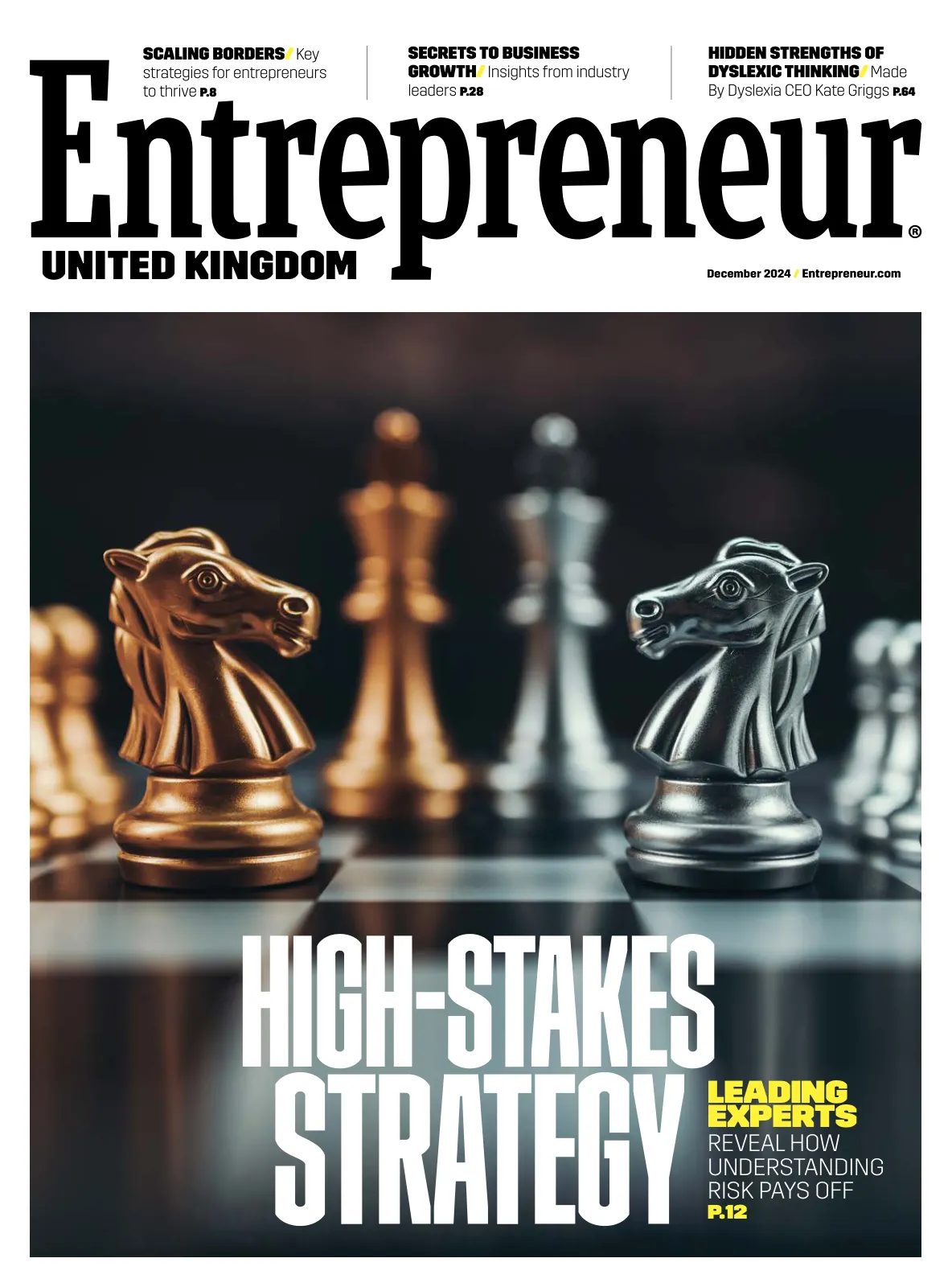
HIGH-STAKES
STRATEGY
LEADING
EXPERTS
REVEAL HOW
UNDERSTANDING
RISK PAYS OFF
P.12
Page 2
BOLD
FOR THE
BOLD
UNITED KINGDOM
Page 3
Contents/December 2024
P.12
High
Stakes
Strategy
Industry leaders explore
how strategic risk-taking
can drive innovation and
resilience in uncertain
times
FEATURES
→ ROB MOORE
champions the idea
that embracing risk
can lead to personal
and financial
growth.
3
December 2024 / ENTREPRENEUR.COM /
Page 4
DOWNLOAD
YOUR DIGITAL
EDITION
HERE
UNITED KINGDOM
Out now in the UK
Page 5
5
December 2024 / ENTREPRENEUR.COM /
39 Empowering Employees
Encouraging side hustles boosts
autonomy, creativity, motivation and
collaboration.
42 Embracing Failure
JOSH WHITE reveals why embracing
failure can lead to unexpected
breakthroughs.
44 Driving Innovation
AUAR, a London-based construction
tech startup, revolutionises sustainable
housing with innovative robotic
solutions.
‘TREPONOMICS
IN THE LOOP
Contents/December 2024
8 Scaling Borders
Professor VERONIEK COLLEWAERT
warns UK founders: scale smartly,
or risk costly setbacks
18 Breaking the Silence
KATY WIGDAHL, CEO of
Speechmatics, is transforming
voice technology for greater
inclusivity
22 Challenging the Norm
DAVID BEECH’S bold restructure
of Knights drives legal industry
innovation.
BUSINESS
UNUSUAL
STARTUP
SPOTLIGHT
FEATURES EDITOR Patricia Cullen
patricia.cullen@bncb2b.com
CEO Wissam Younane
wissam@bncpublishing.net
MANAGING DIRECTOR Rabih Najm
rabih@bncpublishing.net
ART DIRECTOR Simona El Khoury
EDITORIAL TEAM
Tamara Pupic,
Aalia Mehreen Ahmed
MEDIA SALES MANAGER
Olha Kovalova olha.kovalova@bncb2b.com
REGIONAL DIRECTOR
Andy B. andy@bncb2b.com
CONTRIBUTING WRITERS
Kate Griggs, Fiona Ross, Greg Gormely,
Felizitas Lichtenberg, Bryn Thompson, Sam Kelly
SUBSCRIBE
Contact subscriptions@bncb2b.com to receive
Entrepreneur United Kingdom every issue.
COMMERCIAL ENQUIRIES
sales@bncb2b.com
WWW.ENTREPRENEUR.COM/EN-GB
Access fresh content daily on our website
All Rights Reserved 2024. Opinions expressed are solely those of the contributors.
Entrepreneur United Kingdom is officially licensed exclusively to BNC B2B In
United Kingdom by Entrepreneur Media Inc. No part of this magazine may be
reproduced or transmitted in any form or by any means without written permission
of the publisher. Images used in Entrepreneur United Kingdom are credited when
necessary. Attributed use of copyrighted images with permission. All images not
credited otherwise Shutterstock.
20 Wenlock Road, London, N1 7GU
entrepreneurMediaUK
entrepreneurUK
entrepreneurmedia-uk
entrepreneurmedia.uk
UNITED KINGDOM
28 The Secret Sauce
Industry leaders share essential
strategies for successful
growth, emphasising
community engagement, talent
development and adaptability
64 The Hidden Strengths
of Dyslexic Thinking in
Business
KATE GRIGGS of Made By Dyslexia
discusses how leaders can harness
Dyslexic Thinking skills to drive
success.
→ GILLES RETSIN, and
MOLLIE CLAYPOOL
co-founders of AUAR,
are pioneering
sustainable architecture
Page 6
6 / ENTREPRENEUR.COM / December 2024
Editor’s Note/
INSIGHTS AND STRATEGIES FOR BOLD,
RESILIENT BUSINESS LEADERSHIP
Entrepreneur United Kingdom
W
elcome to this month’s issue of Entrepreneur UK,
where we dive headfirst into one of the most
defining aspects of business success: mastering
risk. The cover story for this December issue
explores why embracing risk isn’t just a daring
move but an essential skill in today’s
entrepreneurial landscape. We have exclusive
insights from Dr. David Hillson, renowned globally as the
‘Risk Doctor,’ and Rob Moore, famously known as the
‘Disruptive Entrepreneur,’ both of whom shed light on
navigating uncertainty with purpose. Mariam Crichton, a
non-executive director at the Institute of Risk Management,
also joins the conversation, providing a balanced view on
assessing and handling business risk with both caution and
confidence. In another informative piece, we highlight the
wisdom of Veroniek Collewaert, founder of The Scale-Up
Institute, who offers British entrepreneurs essential
strategies for expanding across Europe. Her expert guidance
comes at a crucial time as UK businesses increasingly seek
opportunities beyond national borders.
This month, we’re also proud to feature perspectives on
neurodiverse talent and the unique qualities it brings to
the table. Kate Griggs, a vocal advocate for dyslexic
thinking, unveils the often-hidden strengths that dyslexic
individuals can offer in a business setting, while Felizitas
Lichtenberg provides invaluable insights into creating
inclusive recruitment practices that support neurodiverse
candidates.
But that’s not all! We’ve gathered advice from some of the
top minds in industry leadership on fostering a growth
mindset. Damian Skendrovic, CEO of VeUP, shares
insights on scaling startups, and Toby Harper, founder and
CEO of Birmingham-based Harper James, offers his
expertise on developing resilient businesses. This month,
we also hear from dynamic founders of high-growth
companies like Allica Bank and THIS, who reveal their top
strategies for driving momentum and achieving
sustainable growth.
We also tackle some of the most pressing challenges
facing businesses today. With rising concerns about
employee burnout, we’ve gathered essential advice on
keeping your teams energised and retaining top talent in
an increasingly competitive market. We explore how
encouraging employee side hustles can add fresh creativity
and depth to your business, and we debunk the myth that
failure marks the end of the journey—demonstrating
instead how it can be a stepping stone to growth.
At Entrepreneur UK we’re dedicated to delivering
practical insights, compelling stories, and forward-
thinking strategies designed to inspire fresh ideas and
empower readers with the tools needed to turn ambition
into achievement. The December issue celebrates risk-
takers, innovators, and leaders who are defining the future.
We hope that their journeys and insights inspire you to
take bold steps toward your own entrepreneurial dreams.
As the holiday season approaches, I want to wish you a
Merry Christmas and a New Year filled with exciting
opportunities, growth, and success.
Happy reading!
Patricia Cullen
Features Editor, Entrepreneur United Kingdom
Page 7
Page 8
Scaling Borders
Veroniek Collewaert, founder of The Scale-Up Institute, shares her tips for British
entrepreneurs. by PATRICIA CULLEN
→ VERONIEK
COLLEWAERT, an
academic and
professor of
entrepreneurship at
Vlerick Business
School, inspires
future innovators
As the effects of Brexit continue to ripple through the business landscape, UK entrepreneurs are increasingly turning
their gaze towards Europe in search of growth opportunities. Yet, the journey across the Channel comes with its own
set of challenges.
8 / ENTREPRENEUR.COM / December 2024
Page 9
9
December 2024 / ENTREPRENEUR.COM /
I
n a revealing
discussion with
Entrepreneur UK,
Veroniek Collewaert, a
professor at Vlerick
Business School and
founder of The Scale-Up
Institute, warns that the
temptation to scale
prematurely can be a costly
mistake.
“One of the worst things
you can do is start scaling
when you actually haven't yet
figured out the core of your
business model….if you're
still struggling with some of
those life existential
questions, you run the risk
that you're going to copy
paste the errors rather than
the successes.” she cautions.
This sentiment underscores
a crucial lesson for founders:
understanding all your
business's foundations is
essential before venturing
into new markets. One of the
most critical mistakes
founders make is attempting
to scale before solidifying
their primary business
framework. “You need to nail
the core of your business
model before scaling,”
Collewaert warns. It also
emphasises the need for
a clear understanding of
customer needs and unit
economics.
UNDERSTANDING THE
CHALLENGES
Collewaert highlights
that while challenges
such as talent
acquisition and funding
are shared across
Europe, UK based
entrepreneurs face
specific difficulties
related to market
access.
“In the UK, market
access has been the top
challenge for the last
three years,” she notes,
stressing the need for
entrepreneurs to adapt
to a more fragmented
European landscape.
This fragmentation
means that UK founders
must approach the
European market with a
fresh mindset.
Collewaert’s insights
offer UK entrepreneurs a
roadmap for navigating
the complexities of
scaling across Europe,
emphasising the
importance of a tailored
approach to market
entry. By adopting a
mindset of
experimentation and
localised research,
founders can better
understand customer
needs and cultural
nuances, enhancing their
chances of success in
diverse markets.
“Even though you're
scaling, when you want
to enter a new market,
EXPERIMENTATION AND
RESEARCH ARE KEY. YOU
HAVE TO ASK: ARE
THOSE CUSTOMERS THE
SAME AS WE HAVE BACK
HOME?”
“
}}
Page 10
10 / ENTREPRENEUR.COM / December 2024
B/Growth
you need to put your startup hats
on again,” she advises.
“Experimentation and research are
key. You have to ask: Are those
customers the same as we have
back home? Do we need to adapt
our messaging?”
Collewaert emphasises the role of
government agencies in facilitating
international partnerships.
“Departments like the one for
international trade in the UK have a
huge responsibility,” she says. “They
need to ensure that UK firms can
swiftly establish partnerships with
companies in mainland Europe.” UK
entrepreneurs should tap into these
resources to navigate the
complexities of scaling abroad.
FUNDING BEYOND VENTURE CAPITAL
When it comes to funding,
Collewaert points out a common
misconception among
entrepreneurs: “It's not all about
venture capital and private equity.
There are plenty of other funding
options out there, like debt.” By
broadening their understanding of
funding sources, UK founders can
better position themselves for
growth.
Talent acquisition is another area of
concern. “We really struggle to place
students in the UK because of visa
issues,” Collewaert explains, noting
that awareness of initiatives like the
Scale-Up Visa launched last year is
crucial. “There needs to be way
more activity in terms of ensuring
that both talent and scale-ups know
about this visa. If not, it's not going
to be used.”
Collewaert points to UK companies
like Revolut as exemplary models of
successful scaling. “Revolut had a
global mindset from the beginning
THE MORE YOU CAN
REPLICATE YOUR BUSINESS
MODEL IN DIFFERENT
MARKETS, THE EASIER IT IS
TO SCALE.”
“
→ JOSEPH VALENTE
and ANT MIDDLETON,
best selling author of
Military Mindset and
leadership expert.
→ Veroniek Collewaert,
director of the
European Scaleup
Institute, champions
innovation and growth
for Europe’s next
generation of
businesses
Page 11
11
December 2024 / ENTREPRENEUR.COM /
IF YOU’RE STILL STRUGGLING WITH THE
FUNDAMENTALS, YOU RISK COPYING YOUR ERRORS
INSTEAD OF YOUR SUCCESSES.”
and leverages economies
of scale,” she states. Their
ability to add new features
quickly—such as
subscription services and
cryptocurrency options—
illustrates the importance of
adaptability in a competitive
landscape. “The more you
can replicate your business
model in different markets,
the easier it is to scale,” she
adds.
In the wake of Brexit, UK
entrepreneurs may be
hesitant about their
international prospects.
However, Collewaert
remains optimistic about
the funding opportunities
still available within the UK.
“I see a lot of mainland
European scale-ups
wanting to move to the UK
because of the robust VC
landscape,” she states,
suggesting that UK
founders might still find
fertile ground at home.
A UNIFIED APPROACH TO
SCALING
Looking ahead, Collewaert
identifies key areas for UK
scale-ups to explore: “The
Green Deal in Europe
presents opportunities for
clean tech and energy-
related innovations.
Additionally, there’s a
growing demand for remote
healthcare solutions.”
Collewaert's insights reveal
that while UK entrepreneurs
face distinct challenges
when scaling in Europe,
understanding the
landscape, leveraging
available resources, and
focusing on solid business
practices can pave the way
for success.
“Despite the political
barriers, scaling is
something that isn’t
restricted by borders,” she
concludes. “We need to
foster collaboration to help
companies grow, no matter
where they are based.”
In a climate of uncertainty,
these insights offer a crucial
roadmap for UK
entrepreneurs seeking to
thrive in the competitive
European market. By
adopting these strategies,
they can better position
themselves for successful
expansion, turning
challenges into
opportunities for growth
across the continent.
“
Page 12
12 / ENTREPRENEUR.COM / December 2024
HIGH-STAKES
STRATEGY
Page 13
13
December 2024 / ENTREPRENEUR.COM /
A
s we approach 2025, the
spectre of risk looms large for
entrepreneurs, influencing
decisions and shaping
strategies across industries.
Yet, rather than viewing risk
solely as a threat, it can be reframed as
a catalyst for innovation and growth.
Entrepreneur UK talks with prominent
figures such as Rob Moore, founder of
Progressive Property and host of the
Disruptive Entrepreneur podcast; Dr.
David Hillson, known as the Risk
Doctor; and Mariam Crichton, a non-
executive director at the Institute of
Risk Management (IRM), to explore
effective strategies for managing risk.
Their perspectives illuminate how
adept risk management not only
fortifies businesses against
uncertainty but also positions them
to thrive amid it. In an age where
adaptability is paramount,
understanding risk may well be the
distinguishing factor in the
entrepreneurial journey.
“IF YOU DON’T
RISK ANYTHING,
YOU RISK
EVERYTHING
→ ROB MOORE
champions the idea
that embracing risk
can lead to personal
and financial
growth.
ROB MOORE, DR. DAVID HILLSON, AND MARIAM CRICHTON
EXAMINE HOW ENTREPRENEURS CAN LEVERAGE RISK
AS A DRIVER OF INNOVATION, STRESSING THE NEED FOR
CALCULATED DECISION-MAKING AND STRONG GOVERNANCE
IN A CHANGING BUSINESS ENVIRONMENT.
THE HIDDEN COSTS OF INACTION
Rob Moore, a self-made multimillion-
aire entrepreneur and author, offers
insights into property investing and
financial education. His journey serves
as a compelling reflection on risk,
illustrating how embracing it can
unlock pathways to wealth and
personal growth.
“The biggest risk I took that failed for
eight years was traditional education.
Instead of starting my own business at
age 18, I went to university and did a
degree in architecture which I’ve done
nothing with, and it got me well on the
way to £50,000 of consumer debt,” he
shares.
Moore emphasises that the risks he
didn’t take—opportunities missed due
to fear or indecision—had a more
profound impact than any failure.
“I perceived them as risky, but I now
know nowhere near as risky as not
starting your own business and not
chasing your dreams,” he says.
His experience serves as a reminder
that the fear of risk can sometimes lead
to inaction, with dire consequences.
“The biggest risks are the risks I haven’t
taken.
This highlights a vital lesson: inaction
can often be the most significant risk of
all. Entrepreneurs must cultivate a }}
”
by PATRICIA CULLEN
”
Page 14
14 / ENTREPRENEUR.COM / December 2024
mindset that encourages
taking calculated risks to
avoid the pitfalls of regret.
CALCULATED RISKS VS.
RECKLESS GAMBLES
Moore further distinguish-
es between calculated risks
and reckless gambles. “The
opposite of a reckless
gamble should be a
calculated risk. A reckless
gamble would be some-
thing you do emotionally
and whimsically, spontane-
ously as opposed to with
research analysis and
strategy. Reckless would be
to do something just
because someone told you
to or just because someone
presented you with an
opportunity.”
He warns against the
allure of quick gains that
come without understand-
ing the underlying factors,
noting that desperation
and copying can lead to
poor decision-making.
Someone may have
invested in Bitcoin for the
price of a pizza, but things
have changed. Instead, he
advocates for a structured
approach to risk manage-
ment.
“A calculated risk
becomes one when you
minimise or de-risk your
loss and protect the
downside.” For instance, in
real estate investments, he
stresses the importance of
having contingency plans.
“If I buy real estate for
development, I make sure
it can still work if I have to
put it back to its original
use.”
For example, when
Richard Branson started
his airline, he de-risked by
having a give-back option
on the aircraft. Instead of
risking potentially
hundreds of millions on
buying the aircraft that he
couldn’t use, he had a
give-back clause such that
if the business didn’t work,
he could at least liquidate
and get most of his
investment back.
“If you can de-risk an
opportunity whereby the
only thing you lose is time
and not money, and in the
pursuit of the investment
or opportunity you were
able to learn, even if you
didn’t earn, this is a good
de-risk”, he adds.
This pragmatic approach
highlights the importance
of evaluating risks against
Page 15
15
December 2024 / ENTREPRENEUR.COM /
potential rewards and
implementing safeguards
that allow for recovery even
when things don’t go as
planned. He goes on to say
that no professional
investor would put all their
money in one class or one
sure bet, and maybe it’s
wise for entrepreneurs to
not ‘go all in’ or ‘go big or
go home’.
“High risk, high reward
and highly reckless
behaviour are very close
together,” he adds.
LEARNING FROM
SETBACKS
The unexpected nature of
risk is a common theme in
entrepreneurship.
“The single most
unexpected lesson about
risk is that all things that
challenge you greatly are
unexpected, because if
they were expected they
wouldn’t have challenged
you greatly,” Moore
explains.
The COVID-19
pandemic serves as a
prime example. “You can
plan for everything in
2020 but not the
lockdown; you could
never predict that would
come.”
This unpredictability
underscores the need for
agility in business opera-
tions. Entrepreneurs must
be prepared to pivot and
adapt to unforeseen
challenges. Maintaining
liquidity, being agile, and
having the capacity to
change direction are
essential strategies to
mitigate risk in volatile
environments.
While nothing is risk free,
and Moore reflects that
“the only thing you can
truly plan and prepare for
if you want to minimise
risk, is the thing that you
can’t plan and prepare for,”
the biggest risk is taking no
risk at all.
EMBRACING INNOVATION
THROUGH RISK
Dr. David Hillson further
emphasises the positive
aspects of risk, defining it
as “uncertainty that
matters.” He insists that
not all risks are negative;
some can present signifi-
cant opportunities.
“Entrepreneurs understand
that they need to take }}
“THE BIGGEST
RISKS ARE
THE RISKS I
HAVEN’T
TAKEN”
→ MARIAM CRICHTON is a
dynamic leader serving as
Non-Executive Director at
the Institute of Risk
Management and Chair of
the Institute of Operational
Risk Enterprises
Page 16
16 / ENTREPRENEUR.COM / December 2024
→ DR. DAVID HILLSON,
widely known as "The Risk
Doctor," is a prominent
expert in risk management
with over 35 years of
consulting experience
across various sectors
worldwide.
Page 17
17
December 2024 / ENTREPRENEUR.COM /
risks in order to innovate, be creative, and ensure
they are competitive—especially in the startup
phase,” he notes.
Hillson advocates for an integrated approach to
risk management, encouraging businesses to
minimise threats while maximising opportunities.
“The goal is to minimise threats, maximise opportu-
nities, and optimise performance.” This dual
approach is vital for startups, which often need to
balance rapid growth with effective risk manage-
ment practices.
He advises startups to conduct a structured
vulnerability assessment to understand areas of
potential weakness in the business, then ensure that
key assets, resources and IP are protected. He also
advises to simultaneously conduct a Strengths,
Weaknesses, Opportunities, and Threats (SWOT)
Analysis to compare competitor strengths and
weaknesses with your own, then design product
development and marketing strategies to maximise
relative performance.
“During rapid growth phases, use an agile
approach to identifying and managing risk,
ensuring that the pace of the risk process matches
the pace of growth. Higher risk clockspeed is the
goal.”
“EFFECTIVE MANAGEMENT
OF RISK SHOULD BE SECOND-
NATURE, BUILT INTO ALL
ASPECTS OF THE BUSINESS
FROM TOP TO BOTTOM,
INFORMING ALL DECISIONS AND
FOCUSING EFFORT IN ORDER TO
BE EFFICIENT, EFFECTIVE AND
EFFICACIOUS”
Hillson advocates integrating risk management
into core business operations. He believes
organisations should foster a culture where all
employees, from executives to front-line staff,
make risk considerations second nature, enhanc-
ing efficiency and agility in navigating challenges.
SUSTAINABLE GROWTH AND GOOD GOVERNANCE
Mariam Crichton echoes this sentiment, emphasis-
ing that rapid growth is not always a positive
indicator.
“It needs to be good sustainable growth that will
last,” she advises. Today’s businesses must consider
a variety of factors beyond just financial metrics.
The environmental impact, societal implications,
and geopolitical risks are increasingly important in
evaluating the overall health of a business model.
“Good governance is critical,” Crichton continues.
“Access to up-to-date information is essential for
making the best strategic decisions.” In this
context, businesses that embrace risk while
adhering to sound governance principles are better
positioned to navigate complex challenges.
EMERGING TRENDS IN RISK MANAGEMENT
As the business landscape evolves, So too do the
challenges associated with risk. Crichton points out
that growing environmental, social, and geopoliti-
cal risks pose significant threats. Additionally,
emerging technologies, particularly artificial
intelligence (AI), present both opportunities and
challenges. “Growing cybersecurity threats have the
potential to significantly impact operations and
reputation,” she warns.
Thus, it’s crucial for businesses to remain vigilant
and prepared for changes that can arise from
technological advancements and societal shifts.
“The need for effective operational and enterprise
risk management is more acute than ever,”
Crichton concludes.
RISKY BUSINESS
Understanding and embracing risk is essential for
any entrepreneur aiming for success. As Moore
asserts, “If you don’t risk anything, you risk
everything.” By recognising the value of calculated
risks, learning from setbacks, and maintaining a
proactive approach to innovation, businesses can
thrive amid uncertainty.
Adopting a culture of risk that promotes agile
decision-making and effective governance will not
only lead to improved business models but also
pave the way for sustainable growth. In this
high-stakes game, the winners are those who dare
to take risks while managing them wisely.
Page 18
18 / ENTREPRENEUR.COM / December 2024
I
n the rapidly evolving landscape of
artificial intelligence (AI), voice
technology is becoming an integral part
of how we live and work. From smart
devices to virtual assistants, our
interactions with machines are
increasingly vocal. But for many, the
promise of a truly inclusive voice
technology is still out of reach. Enter Katy
Wigdahl, CEO of Speechmatics, a company
that is on a mission to change that.
Katy Wighdahl is pioneering change in the
AI industry, a field where female leadership
is still lacking. As the CEO of her company,
she has earned a remarkable 5th place in
the 2024 JP Morgan Top 200 Women-
Powered Businesses Report, which
showcases outstanding female
entrepreneurs and their significant
contributions.
BREAKING THE SILENCE
How Katy Wigdahl, CEO of Speechmatics, is leading the charge for inclusivity
by amplifying voices in the tech world. by PATRICIA CULLEN
→ KATY
WIGDAHL,
CEO of
Speechmatics,
leading the
charge in
voice
recognition
technology
Page 19
19
December 2024 / ENTREPRENEUR.COM /
BEING A WOMAN IN TECH, I KNOW WHAT IT’S LIKE TO FEEL LIKE YOUR VOICE
DOESN’T ALWAYS CARRY AS MUCH WEIGHT AS OTHERS”
B
eyond her role in shaping the
future of voice technology,
Wigdahl is a passionate
advocate for inclusivity, striving
to ensure that voices from all back-
grounds are acknowledged and
understood.
“I’m very passionate about ensuring
technology is accessible for everyone,”
Wigdahl says. “There are far too many
systems in place, particularly in tech,
that just weren’t designed with diversity
in mind. Voice technology is no
exception—and we’re here to change
that.”
A LEADER WITH A MISSION
Wigdahl’s rise to the top of Speechmat-
ics comes at a time when the tech
industry is undergoing a reckoning.
Issues around bias, diversity, and
inclusion are front and centre, and
Wigdahl is determined to make a
difference.
“One of the things I feel strongly about
as a female leader in tech is the
importance of representation,” she
explains. “There’s still a lot of work to be
done, and we need more women and
more diversity at every level of this
industry.”
When Wigdahl joined Speechmatics,
she didn’t come from a background in
AI or voice technology, but her passion
for driving growth and innovation
quickly became apparent. She credits }}
“THERE ARE FAR TOO
MANY SYSTEMS IN
PLACE, PARTICULARLY
IN TECH, THAT JUST
WEREN’T DESIGNED WITH
DIVERSITY IN MIND.”
↓ KATY WIGDAHL,
Speechmatics
International
Women’s Day
event, 2024
Page 20
20 / ENTREPRENEUR.COM / December 2024
much of her success to her ability to
see beyond the technology itself and
focus on its potential impact. “I didn’t
need to be a technologist to under-
stand how transformative this
technology could be,” she says. “What
I did need was the vision to scale it
and make sure it was accessible to all.”
Under Wigdahl’s leadership,
Speechmatics has grown into one of
the most inclusive and innovative
companies in the voice recognition
space. Its technology can transcribe
speech in over 48 languages and
dialects, and it has been designed
specifically to overcome the biases
that have long plagued speech
recognition systems.
TACKLING BIAS IN VOICE
TECHNOLOGY
Bias in AI is a major issue, and
speech recognition technology has
historically struggled with under-
standing voices that don’t fit a narrow
“standard” model—often leaving
women, non-native speakers, and
those with regional accents at a
disadvantage. Wigdahl sees this as a
fundamental flaw in how many
systems are built.
“Speech technology that only works
for certain types of voices is unaccept-
able,” Wigdahl says. “We’ve worked
really hard at Speechmatics to build a
system that recognises diverse voices.
It’s not just a nice-to-have—it’s a
necessity. Everyone’s voice matters.”
Her determination to solve this
problem comes not only from a
technical standpoint but also from a
personal understanding of what it
means to feel unheard. “Being a
woman in tech, I know what it’s like
to feel like your voice doesn’t always
carry as much weight as others,”
Wigdahl reflects. “That’s why it’s so
important to me that our technology
amplifies voices that have historically
been marginalised.”
Wigdahl’s commitment to diversity
is reflected in the company’s
products, which are designed to
recognize a wide range of accents and
dialects—something many of the
industry’s bigger players have
struggled to achieve. “We’ve focused
on building models that aren’t
TECH NEEDS
MORE WOMEN,
AND WE NEED
MORE DIVERSE
PERSPECTIVES”
“
→ TERI DRUMMOND (Director of Engineering), LAUREN KING (Chief Marketing
OFFICER), KATY WIGDAHL (CHIEF EXECUTIVE OFFICER), SIAN JOHNSON-JAMES
(Senior People Partner), BENEDETTA CEVOLI (Senior Machine Learning
Engineer) at the Speechmatics Women's Day event, 2024
Page 21
21
December 2024 / ENTREPRENEUR.COM /
biassed towards the most common accents,” she
explains. “We wanted our technology to work just
as well for someone with a strong regional dialect
as it does for someone with a more ‘neutral’
accent.”
THE POWER OF VOICE FOR WOMEN IN BUSINESS
Wigdahl believes that voice technology has the
potential to be a great equaliser, especially for
women in business. She’s passionate about how
this technology can enable better communication,
reduce misunderstandings, and create opportuni-
ties for people whose voices have traditionally
been sidelined.
“For women, especially in leadership positions,
having your voice heard—literally and figurative-
ly—is so important,” Wigdahl says. “Voice
technology can play a big role in levelling the
playing field, whether it’s through more accurate
meeting transcripts or enabling multilingual
teams to communicate seamlessly.”
In her own career, Wigdahl has used her voice to
advocate for change, both within Speechmatics
and in the broader tech industry. She’s a strong
believer in the idea that leadership means creating
space for others to succeed. “As a female leader, I
want to make sure I’m lifting others up and
helping create more opportunities for women and
underrepresented groups in tech. We need to
break down those barriers.”
LEADING WITH EMPATHY AND PURPOSE
Wigdahl’s leadership style is marked by empathy,
collaboration, and a clear sense of purpose. She’s
quick to acknowledge that being a CEO in the AI
space comes with its challenges, particularly
when it comes to balancing the demands of
running a business with the need to ensure
ethical and responsible innovation.
“One of the things I’ve learned is that leadership
is about more than just driving growth,” she says.
“It’s about understanding the impact of what
you’re building. Technology should be used to
improve lives, not create new divides.”
This philosophy has guided Wigdahl’s approach
to leading Speechmatics. She’s committed to
building a company culture where diverse voices
are not only included but celebrated. “I’ve made
it a priority to foster a culture where everyone
feels empowered to speak up and share their
ideas. It’s often those diverse perspectives that
lead to the best innovations.”
“THERE’S STILL A
LOT OF WORK TO BE
DONE, AND WE NEED
MORE WOMEN AND
MORE DIVERSITY AT
EVERY LEVEL OF THIS
INDUSTRY”
INSPIRING THE NEXT GENERATION OF WOMEN IN TECH
As someone who has broken through many barriers herself,
Wigdahl is passionate about encouraging the next genera-
tion of women in tech. She sees mentorship as a critical tool
for helping young women navigate an industry that can
often feel exclusionary.
“I didn’t get to where I am on my own,” Wigdahl says. “I
had incredible mentors who believed in me and pushed me
to keep going, even when things got tough. Now, I see it as
my responsibility to pay that forward and help other women
coming up in tech.”
Her advice to young women looking to enter the industry
is clear: “Don’t let anyone tell you that you don’t belong.
Tech needs more women, and we need more diverse
perspectives. Don’t be afraid to use your voice and take up
space.”
THE FUTURE OF INCLUSIVE TECH
Wigdahl is a leader on a mission—not just to advance the
capabilities of voice technology, but to ensure that this
technology is inclusive, ethical, and available to everyone. As
the CEO of Speechmatics, she’s breaking new ground in AI
and pushing the industry toward a future where all voices
are heard.
Wigdahl’s story is one of resilience, purpose, and the power
of representation. In an industry that still struggles with
diversity, she’s proving that women in tech can not only
thrive but also lead with empathy, integrity, and vision.
“We’re building technology for the future,” Wigdahl says,
“and that future has to be one where everyone is included.”
Page 22
22 / ENTREPRENEUR.COM / December 2024
B/Leadership
Challenging the Norm
Leading the legal revolution by going public- key lessons for entrepreneurs. by PATRICIA CULLEN
I
n 2012, David Beech, CEO
of Knights, made a bold
move that would position
the legal services firm as a
pioneer in a notoriously
traditional industry. Knights
became the first business to
capitalise on deregulation in
the UK legal sector, adopting a
corporate structure instead of the
longstanding partnership model. This
decision was no small feat—it separated
ownership from management and
enabled the company to evolve into the
fast-growing legal powerhouse it is
today.
“We were the first to use deregulation of
the legal sector to adopt a corporate
structure,” Beech explains. “This freed
our professionals to focus on our clients,
delivering premium services with speed,
accessibility, and high levels of commu-
nication.”
For entrepreneurs looking to spot
similar opportunities, the key lesson is
to recognise regulatory shifts as
catalysts for innovation. Whether you’re
in law, finance, healthcare, or technol-
ogy, Beech’s move demonstrates that
when a market transforms, agile
businesses can ride the wave of change.
“Adopting a corporate structure can free
professionals from traditional manage-
ment,” Beech says, pointing to the
immense benefits this brings in terms of
operational efficiency and team
collaboration.
The corporate structure advantage: A
blueprint for entrepreneurs
Knights’ corporate restructuring had a
profound impact on the company’s
service delivery and client relations.
The shift allowed them to scale rapidly,
fostering a culture in which lawyers
work together as a cohesive unit, rather
than competing against one another for
equity or clients—a common dynamic
in traditional law firms. “The fuel
behind our growth has been making
decisions that help our people work
together as one team rather than
competing as individuals,” Beech
emphasises.
In an industry where law firms are grap-
pling with succession challenges and
generational shifts, Knights’ model
offers a compelling alternative.
“Traditional law firms are finding it
increasingly difficult to secure the
investment needed to allow existing
partners to retire,” Beech notes. Many
firms, burdened by financial risk, face
internal conflicts over succession
planning. In contrast, Knights attracts a
new generation of lawyers who want
top-quality work in a modern, collab-
orative environment—without the
financial strain of partnership.
For other entrepreneurs, the takeaway is
clear: restructuring your business model
to foster collaboration and remove
internal barriers can unlock untapped
growth. “Our business is for those who
want to pursue their career in a way that
works for them,” Beech explains. By
creating flexible career paths and
maintaining modern, collaborative
offices across the UK, Knights offers a
forward-thinking alternative that has
proven to be a magnet for top talent.
Going public: A strategic move for
growth
Knights’ decision to go public in 2018
was a turning point. As Beech explains,
“Our public listing provided us with the
profile to accelerate growth through
IMAGE COURTESY KNIGHTS
→ DAVID BEECH,
CEO of Knights,
leads the firm with
a vision to redefine
legal services
beyond London,
leveraging
innovation and
strategic growth to
elevate the brand
in a competitive
market.
Page 23
23
December 2024 / ENTREPRENEUR.COM /
strategic acquisitions and
organic growth.” Since then,
Knights has expanded its
presence to 26 locations
across the UK and achieved
an impressive £150 million
in revenue, solidifying its
position as a leader in the
legal industry.
For entrepreneurs, Knights’
journey underscores the
importance of timing and
positioning. “For a while we
were an outlier,” Beech
admits. “But we are now a
recognised name in our
sector.” By going public,
Knights secured the capital
and visibility needed to
grow rapidly, both by
acquiring complementary
firms and attracting
high-calibre professionals
who see Knights as a safe
alternative to the financial
risks of traditional
partnership.
Moreover, Beech believes
that being a publicly listed
company gives Knights a
significant edge in attract-
ing talent and investment—
an advantage that entrepre-
neurs can replicate by
considering similar moves
in their own industries.
“The modern generation of
partners want quality work
in a modern, collaborative
environment without
financial risk—and they can
find all this at Knights,” he
says.
How Knights is shaping the
legal landscape
Knights is no longer just a
disruptor; it’s an industry
leader that’s setting the pace
for change. “We are
showing what is possible
when a business is freed
from the traditional
partnership model,” Beech
reflects. As more law firms
face financial pressures and
succession challenges, many
are looking to Knights’
model as a potential
solution. “A growing
number of law firms are
looking at how we do
business and concluding
that to grow their business
and solve their succession
problems, they should
become part of our Group,”
Beech explains.
This ripple effect is a lesson
for entrepreneurs looking to
influence their own
markets. By identifying
inefficiencies or pain points
in your industry—such as
the rigid partnership model
in law—you can create
innovative solutions that set
a new standard. “The
market now understands
and trusts our model,”
Beech says, adding that
Knights’ ability to continu-
ously attract top talent and
acquire complementary
firms has cemented its
reputation as a leading legal
services provider.
Looking ahead
As Knights looks to the
future, its goals are
ambitious: the firm aims to
double its revenue over the
next three years through a
combination of organic
growth and strategic
acquisitions. “Traditional
law firms face the dual
headaches of squeezed cash
flow and succession
challenges,” Beech notes.
“We think that applies to
most sectors—people are
often so busy looking
inward that they don’t see
the changes happening
around them.”
For entrepreneurs, Knights’
success story serves as a
reminder to stay attuned to
shifts in your industry and
to embrace change as an
opportunity for growth.
“When those changes
become impossible to
ignore, the solution is clear:
look for a new way of doing
business—and we provide
exactly that,” Beech
concludes.
Knights’ remarkable
transformation from a law
firm pioneer to a publicly
listed industry leader is a
powerful case study for
entrepreneurs. By leverag-
ing regulatory shifts,
adopting a corporate
structure, and embracing
the benefits of public listing,
Knights has not only shaped
its own destiny but also
influenced the future of the
legal industry. For other
entrepreneurs, the lessons
are clear: embrace change,
foster collaboration, and
never be afraid to challenge
the status quo.
THE FUEL BEHIND OUR GROWTH HAS BEEN MAKING
DECISIONS THAT HELP OUR PEOPLE WORK TOGETHER AS
ONE TEAM RATHER THAN COMPETING AS INDIVIDUALS”
Page 24
24 / ENTREPRENEUR.COM / December 2024
The voice of
entrepreneurship
around the world
Access fresh content daily on our website
Page 25
25
December 2024 / ENTREPRENEUR.COM /
Five Daily Strategies to Balance
Entrepreneurship and Wellness
B/Tech
1/APPLE IPAD PRO
“The Apple iPad Pro is a
lifesaver, especially when I’m
travelling between our clinics in
London, Edinburgh, and
Glasgow. It’s perfect for work,
letting me keep track of
appointments and review client
photos, but it’s also my go-to
for entertainment on the move. I
can watch shows, read, or even
get some work done without
carrying a bulky laptop.”
2/APPLE WATCH SERIES 10
“After having my second baby
last year, getting back into
fitness while juggling a busy
schedule has been tough, but
my Apple Watch helps me stay
on track. It’s brilliant for tracking
steps and workouts, and I love
the reminders to stay active,
which keep me motivated even
on hectic days. I can also
compete with my sisters and
friends which is a good
motivator!”
3/BOSE HEADPHONES
“When I’m in the clinic I’m with
clients or the team, so when it
comes to admin or planning for
the growth of the business, it’s
mainly at home, which can be a
bit chaotic at times with
everything going on. The
headphones let me zone into
what I need to do and get it
done, so I can clear the decks
and get back to the family.
They’ve also been a lifesaver for
all the travelling I’ve been doing
between clinics.”
4/DYSON AIRWRAP
“I use the Dyson Airwrap at
home and it’s fantastic. It styles
my hair quickly without the
damage of extreme heat, which
is perfect for when I’m short on
time. Whether I need to smooth,
curl, or add volume, it’s a
versatile tool that helps me feel
polished for the day, even when
everything feels manic. “
5/OURA RING
“I started using the Oura Ring
after struggling with inconsistent
energy levels as I navigated the
juggle of running a business and
raising a family. I need a tool to
help me understand my body
better. The ring’s insights into
my sleep, recovery, and
menstrual cycle helped me
identify patterns, balance my
hormones, and it has really
helped me improve my overall
well-being.”
Fiona Ross, a
former nurse
and founder of
The Aesthetics
Club, oversees a
growing network of clinics in
London and Scotland. With
ambitious plans for
expansion into the US and
UAE, Ross emphasises the
importance of leveraging
technology and innovation to
drive productivity, enhance
well-being, and sustain a
healthy work-life balance.
1
2
3
4
5
According to FIONA ROSS
Page 26
26 / ENTREPRENEUR.COM / December 2024
Inclusive Culture
A look at how to support neurodiverse candidates in the recruitment process. by FELIZITAS LICHTENBERG
“With around 15% of the UK population being
neurodivergent, it is more important than ever that
employers are educated on how best to support
neurodiverse employees in the recruitment process, and
beyond.
UK government figures have revealed that autistic
graduates are twice as likely to be unemployed after 15
months as non-disabled graduates, with only 36% finding
full-time work in this period, highlighting a clear
imbalance during the recruitment stage of the
employment process. Data from the same governmental
review revealed that only 3 in 10 autistic adults are
employed, showing that this issue stretches far beyond
graduates - who in many cases may be new to the
interview process and workplace as a whole - and
emphasises a clear need for employers to place a greater
emphasis on accommodating to neurodiverse candidates.
While neurodivergent candidates face barriers, they also
bring exceptional strengths and perspectives that can
offer immense value to employers. However, conventional
recruitment methods often inadvertently disadvantage
these individuals, as traditional approaches may not align
with their communication styles, thinking patterns or
needs.
Page 27
27
December 2024 / ENTREPRENEUR.COM /
To level the playing field,
businesses should
reevaluate how they
approach recruitment -
from job descriptions to
interviews - ensuring that
neurodivergent candidates
are given the support and
accommodations they need
to succeed. Whilst there are
clear strategies that can be
put in place to achieve this,
the foundation of an
inclusive recruitment
process starts long before a
job opening is advertised, it
begins with creating an
accepting and informed
workplace culture. By
educating all employees,
particularly hiring
managers and HR
professionals, about the
strengths and needs of
neurodivergent individuals,
companies can create an
environment that is more
accepting of differences.
This training should cover
practical tips on how
neurodivergence might
manifest in the workplace,
meaning that all employees
are aware and more
sympathetic to behaviours
that may be symptomatic of
someone with a
neurodiverse condition.
Company-wide education
also helps to dismantle
negative stereotypes and
shift focus to the unique
skills neurodiverse
individuals bring. With a
better understanding of
neurodivergence, employers
can create a hiring process
more conducive to the
success of all employees.
As mentioned,
neurodivergent employees
often bring valuable skills
that enhance team
performance. For instance,
candidates on the autism
spectrum frequently
demonstrate exceptional
attention to detail and
strong problem-solving
abilities, employees with
ADHD can excel in fast-
paced environments where
quick thinking is crucial
and dyslexic individuals
often have a unique ability
to see the “big picture.” By
highlighting these
attributes in both internal
conversations and external
recruitment materials,
businesses can attract
neurodiverse talent and
foster a work environment
that embraces a range of
cognitive styles.
In terms of implementing
changes to the interview
itself, multiple adjustments
can be made to cater to
neurodiverse candidates.
The traditional interview
process is often heavily
reliant on face-to-face,
unstructured conversations,
which can be particularly
challenging for people with
specific conditions. Many
neurodiverse individuals
may struggle with open-
ended questions, reading
social cues or maintaining
eye contact, which can lead
to misjudgments about
their capabilities. To
counteract these issues,
there are small changes that
companies can make which
will make a huge difference
to the candidates’
performance. Providing
interview questions in
advance can allow
candidates to prepare more
thoroughly, reducing
anxiety and ensuring they
can showcase their
strengths. Additionally,
offering alternatives to
in-person interviews, such
as written or video-based
assessments, may provide
neurodivergent candidates
with a format that better
suits their communication
preferences. For example,
conducting interviews in
noisy or busy environments
may be overwhelming for
someone who struggles
with sensory overload,
therefore offering a choice
of interview settings,
including quieter or virtual
spaces, can significantly
improve the experience for
neurodivergent candidates.
Making the recruitment
process more accessible for
neurodiverse candidates is
not just about compliance
or diversity targets, it’s
about creating a more
equitable and innovative
workplace that represents
and values different
perspectives. By fostering
an inclusive culture,
recognising the strengths of
neurodivergent individuals
and making adjustments to
the interview and selection
processes, companies can
begin to tap into a highly
skilled talent pool. For
forward-thinking
employers, investing in
neurodiverse recruitment is
an investment in the future
of work.”
Felizitas is the
Global Head of
Diversity &
Inclusion at
SumUp. With
15 years of proven experience,
Felizitas has expertise in
Diversity and Inclusion, ESG
and Mental. She previously
worked at Vodafone, where she
was Global Diversity and
Inclusion Lead. Felizitas has
an Intercultural background,
with Eurasian roots and
having lived and studied in
Germany, USA, Britain and
France. www.sumup.com
WITH A BETTER UNDERSTANDING OF
NEURODIVERGENCE, EMPLOYERS CAN CREATE
A HIRING PROCESS MORE CONDUCIVE TO THE
SUCCESS OF ALL EMPLOYEES.”
Page 28
28 / ENTREPRENEUR.COM / December 2024
I
n today’s competitive
business landscape,
high growth is often a
combination of great
ideas, flawless
execution, and a deep
commitment to
stakeholders.
Industry leaders—
including Tom Leathes,
CEO and co-founder of
Motorway; Mark
Cuddigan, CEO at THIS;
Anthony Stevens,
operations director at
Sapphire; Michael Baron,
commercial director at
BWS; and Conrad Ford,
chief product and
strategy officer at Allica
Bank, join Chris Gove,
founder of menswear
brand Percival, to share
their unique strategies
for scaling their
businesses.
Despite differing
industries and
challenges, their success
is driven by common
themes: putting people
first, aligning strategy
with market needs, and
prioritising operational
excellence.
The Secret Sauce
Insights from industry leaders on how to unveil the secrets to thriving business
growth. by PATRICIA CULLEN
A
llica Bank, a financial institution
tailored exclusively for established
businesses, has recently been
hailed by The Sunday Times as the
fastest-growing company in the
UK.
In light of this impressive accolade, we
spoke to Conrad Ford, the bank’s Chief
Product Strategy Officer, who offered
his invaluable insights into the factors
driving this remarkable success.
“I always tell my team leaders that
we can’t work ten times harder
when our business is ten times
bigger – mathematically, there
aren’t enough hours in the week!
So you must obsess about finding
and developing the best people –
your greatest achievement as a
leader is to generate talent that
can perform at a level above you,”
he says.
‘T/Strategies
→ CONRAD FORD,
Chief Product &
Strategy Officer at
Allica Bank, is
responsible for
driving product
innovation and
strategic direction
to support the
bank's growth and
customer-focused
solutions.
Page 29
29
December 2024 / ENTREPRENEUR.COM /
STAY MISSION FOCUSED
Mark Cuddigan, CEO of THIS, a company specialising in
plant-based meat alternatives advises entrepreneurs to
“stay focused on your mission, but have some flexibility in
how you achieve it” to achieve high growth.
Cuddigan emphasises the importance of staying true to
core values while adapting to market shifts.
“Fast growth is never a solo effort,” he adds, underscor-
ing the value of building an exceptional, mission-driven
team that shares your passion and strengthens the
business vision.
FOSTER COMMUNITY ENGAGEMENT
Chris Gove, founder of Percival, who achieved over 100%
CAGR over four years, shares a key tip for scaling brand
growth: “Build a loyal community for your brand.” He
emphasises the importance of being “inclusive, not
exclusive,” using values like football, comedy, and
responsible manufacturing to engage a diverse audience
in both the UK and the US.
To strengthen connections with his community, Gove
advocates for transparent marketing. He explains, “We’ve
broken the fourth wall with founder-led marketing,”
allowing direct communication with fans. Additionally,
he highlights the value of in-person experiences, stating,
“Engaging your community through IRL events, such as
football tournaments and comedy nights, is hugely
rewarding and inclusive.”
This community-first approach is further reinforced by
Percival’s crowd-funding model, enabling customers to }}
I ALWAYS TELL MY TEAM
LEADERS THAT WE CAN’T
WORK TEN TIMES HARDER
WHEN OUR BUSINESS
IS TEN TIM ES BIGGER –
MATHEMATICALLY, THERE
AREN’T ENOUGH HOURS
IN THE WEEK!”
“
→ MARK CUDDIGAN,
CEO at THIS, drives
remarkable growth
in the plant-based
food sector,
Page 30
30 / ENTREPRENEUR.COM / December 2024
“own a piece of our
brand,” which helps
solidify their commit-
ment to the company’s
growth. By releasing
limited-edition collec-
tions and partnering with
brands like Umbro and
Champion, Percival
continues to expand its
reach while staying true
to its core values.
CUSTOMER-CENTRIC
INNOVATION: MOTOR-
WAY’S APPROACH
For Tom Leathes of
Motorway, the UK’s
fastest-growing used car
marketplace, the secret to
their growth lies in being
customer-centric from
day one.
Motorway, an online
car-selling platform,
recognised early on that
selling a car is a high-
friction, unenjoyable task
for most people. At the
same time, car dealers
struggled to find the best
stock efficiently. Motor-
way’s mission was to
eliminate these pain
points by creating a
seamless transaction
experience for both car
sellers and dealers.
“Ultimately, the
platform delivers
amazing outcomes to our
consumer car sellers and
dealers buying stock.
Being customer-first is
one of the values we
instilled early on and
ENGAGING YOUR COMMUNITY
THROUGH IRL EVENTS, SUCH
AS FOOTBALL TOURNAMENTS
AND COMEDY NIGHTS, IS
HUGELY REWARDING AND
INCLUSIVE”
“
→ CHRIS GOVE,
founder of Percival
– an innovator in
modern British
menswear
‘T/Strategies
Page 31
31
December 2024 / ENTREPRENEUR.COM /
have never wavered from,”
says Leathes.
By focusing on customer
needs, Motorway has
streamlined the car-sell-
ing process while
delivering superior
outcomes. The key to
their exponential growth,
selling over half a million
cars, lies in scaling their
platform through
technical and product
innovation. Leathes adds:
“As we’ve scaled, we have
had to operationalise our
platform to enable us to
sell more than 1,000 cars
a day, which has involved
a lot of technical and
product innovation.”
Leathes believes that
this relentless focus on
customers, combined with
technological advance-
ment, has allowed
Motorway to not only
support the entire
used-car transaction cycle
but also offer a unique
value proposition. This
has built a strong network
of over 5,000 verified car
dealers and empowered
Motorway to grow
continuously. And while
he’s proud of the 2023
results, Leathes empha-
sises that they are just
getting started.
PEOPLE FIRST: SAP-
PHIRE’S KEY TO SUCCESS
For Anthony Stevens,
operations director at
Sapphire, an employee-
owned contracting and
accounting firm, the key
to their impressive growth
is simple: putting people
first. The results speak for
themselves—turnover
jumped from £361.6m to
£444.6m in the last finan-
cial year. Sapphire’s shift
to employee ownership in
BEING CUSTOMER-FIRST IS ONE OF THE
VALUES WE INSTILLED EARLY ON AND
HAVE NEVER WAVERED FROM.”
“
}}
→ TOM LEATHES, CEO
and co-founder of
Motorway, is
revolutionising car
sales with an
innovative online
platform.
Page 32
32 / ENTREPRENEUR.COM / December 2024
‘T/Strategies
2021 underscores their dedication
to building a positive, empowering
workplace culture.
“I believe the secret to our high
growth lies in our unwavering
commitment to our people—the
heartbeat of our organisation,”
Stevens explains. He argues that a
business’s culture is its most
valuable asset, far outweighing
strategy. “A business with a poor
culture is far harder to recover
from, even if they have the most
compelling strategy. Culture
trumps strategy 10 times over.”
By fostering a culture where the
team feels united, driven, and agile,
Sapphire empowers its employees
to take ownership of their roles and
contribute to the company’s
overarching vision. This, in turn,
has a direct impact on customer
satisfaction. As Stevens points out,
“Having a motivated team is
reflected in our customer interac-
tions and feedback. Our people
invest their energy into our
customers and partners, building
long-lasting relationships based on
trust and mutual benefit.”
Sapphire’s people-first approach
creates a virtuous cycle where
motivated employees lead to
satisfied customers, which in turn
drives growth.
I BELIEVE THE
SECRET TO OUR
HIGH GROWTH
LIES IN OUR
UNWAVERING
COMMITMENT TO
OUR PEOPLE—
THE HEARTBEAT
OF OUR
ORGANISATION.”
“
→ ANTHONY
STEVENS,
Operations Director
at Sapphire, plays a
key role in driving
efficiency and
growth at the
contracting and
accounting firm.
Page 33
33
December 2024 / ENTREPRENEUR.COM /
ALIGNING STRATEGY WITH
MARKET NEEDS: BWS’S GROWTH
PATH
Michael Baron, commercial
director of BWS, a business that
started during the challenging
times of the pandemic, providing
expertise to Small and Medium-
sized Enterprises (SMEs),
attributes their rapid growth
during the first three years—in-
cluding a 156% increase in one
year alone—to a clear understand-
ing of their market and custom-
ers. For Baron, the formula for
success is simple: aligning
strategy with market needs and
lead generation activities.
“Our secret shouldn’t be seen as
a secret; it’s simply understanding
our customers and the market,
and ensuring our strategy aligns
with our lead generation activi-
ties,” Baron shares. He emphasises
that BWS’s mission is to serve
SMEs, and they ensure visibility
in the market by knowing where
to invest their resources and
energy. This targeted approach
has been crucial in helping BWS
secure steady growth.
Another cornerstone of their
success is maintaining high
standards in service delivery.
“Delivery is the heart of business
development, and our best-in-
class service delivery has further
enabled significant growth,” says
Baron. By ensuring that the
quality of their service consistent-
ly meets or exceeds expectations,
BWS has been able to establish a
strong foothold in the market and
build lasting relationships with
their clients.
THE COMMON THREAD: PEOPLE
AND CUSTOMERS FIRST
While the businesses led by
Leathes, Cuddigan, Stevens,
Baron and Ford operate in vastly
different sectors, their growth
strategies share a common
thread: a deep understanding of
the value of people—whether
OUR SECRET
SHOULDN’T
BE SEEN AS
A SECRET;
IT’S SIMPLY
UNDERSTANDING
OUR CUSTOMERS
AND THE
MARKET.”
“
employees, customers, or
partners.
Leathes emphasises that putting
customers at the heart of Motor-
ways innovation has been
instrumental to scaling their
business, while Stevens under-
scores the importance of a
motivated, unified team in
Sapphire’s success. Baron, on the
other hand, credits a sharp focus
on customer needs and aligning
strategy with market realities as
pivotal to BWS’s fast growth.
Whether it’s through customer-
centric technology, empowering
employees, or aligning strategies
with market needs, these leaders
demonstrate that the secret to
high growth is not in a single
breakthrough, but in a sustained
focus on the people who drive
your business forward.
→ MICHAEL BARON,
Commercial
Director at BWS,
leads the
company’s
strategic growth
and commercial
operations.
Page 34
34 / ENTREPRENEUR.COM / December 2024
‘T/Business
O
ur launch date was set:
March 2020. We were
poised to launch Skoot, a
social mobility platform
connecting friends for
shared rides while planting
trees to offset their carbon
footprint. Our ads were
booked, Student Brand Managers
recruited, and merchandise all
printed. Then the world slammed on
the brakes. Lockdown. Social
distancing. Our vision of a world
sharing rides felt not just improbable,
but irresponsible. Our carefully
crafted business plan crumbled in
the face of a global pandemic.
Roadblock To Road Map
How SKOOT pivoted its business for a sustainable future (and five lessons you can
use to do the same!) by GREG GORMELY
G
iving up, however, wasn’t
an option. We had a
powerful idea, had
recruited a talented team,
and had a burning desire to make a
positive impact. We just needed to
adapt. Fast.
This is how we did it, and the
lessons you might find useful to
pivot and evolve your business
towards a more sustainable and
ultimately, more successful future.
LESSON 1/ When the World
Changes, Change With It (and Lean
Into the Problem)
We asked ourselves: What does a
world locked down, bound by social
distancing, need?
The answer: an Errands App
connecting those in need with
those willing to help.
This pivot, fueled by an
Innovation Grant, breathed new
life into Skoot (and gave the Team
purpose) and revealed a vital
lesson: sometimes, the biggest
problems present the most
powerful opportunities for
innovation.
LESSON 2/ Don’t Be Afraid to Dive
Deeper (and Leverage Your Existing
Strengths)
As the world navigated the
pandemic, we doubled down on our
tech. We shifted from a consumer-
focused ride-sharing model to a
B2B approach, supporting
businesses transitioning back to
work with safe and sustainable
commute solutions.
Page 35
35
December 2024 / ENTREPRENEUR.COM /
This pivot taught us to look beyond
our initial offering and leverage our
core strengths (in our case, our
technology and commitment to
sustainability) to meet evolving
market needs.
LESSON 3/ Listen to Your Customers
(They Often Hold the Key to Your Next
Big Idea)
Conversations with our Clients and
Advisors revealed a critical pain
point: measuring and managing
Scope 3 emissions.
We realised our (patented)
technology, designed for ride-sharing,
could be reimagined to track, analyse,
and reduce emissions from employee
commutes and business travel.
Listening to our customers’
challenges unlocked a powerful new
application for our technology and
revealed a massive market
opportunity.
LESSON 4/ Authenticity is Everything
(Let Purpose Be Your Guiding Light)
Our pivot wasn’t just strategic; it was
driven by our genuine desire to make
a positive impact. This authenticity
resonated with customers, investors,
and our team, fueling our growth and
ultimately shaping our identity as a
leading impact business and ESG
consultancy
LESSON 5/ Your Team and Trusted
Advisors Are Crucial (They are your
Greatest Assets)
During challenging times, partners, a
supportive team and trusted advisors
are invaluable. Co-founder Mark
Stringer weathered the storms with
me, along with Ashish Dev-King, our
NED and now Chairman. Ashish
once took us for a long lunch to
reassure and uplift us. It’s essential to
have partners who can walk with you
during tough periods.
As Winston Churchill said, “If you’re
going through hell, keep going.” This
mindset guided us. Our team’s
unwavering commitment and strong
partnerships were our backbone,
while trusted advisors provided the
clarity to navigate uncertainty
Our journey from ride-sharing
platform to ESG impact consultancy
is a testament to the power of
adaptability, innovation, and a
commitment to a vision bigger than
ourselves. We learned that the path
to success is rarely linear. Be open to
change, embrace the unexpected
detours, and never underestimate the
power of a good pivot.
Today, as a top 5% B Corp, we’re
incredibly proud to empower
businesses to measure, manage, and
reduce their environmental impact,
working with companies like Good
Energy, Addison Lee, De Vere Hotels,
Dream International brands like
Amazonico, Bupa to name but a few.
We believe that profitability and
purpose aren’t mutually exclusive;
they’re two sides of the same coin. By
embracing change, leading with your
values, and constantly seeking
innovative solutions, you too can
pivot (or as we like to say, evolve)
your business towards a more
sustainable – and successful –
future.”
Greg left the corporate world
in 2006 to start a consulting
business, helping SMEs grow
through investment and
scaling. In 2014, he
co-founded Bink, an app linking payment
cards to loyalty programs, which has
raised £40M and integrated into Barclays’
app with 12M users. After a motorbike
accident in 2018, Greg launched SKOOT,
originally a carbon-negative ride-sharing
app, later pivoting during COVID to
become SkootEco, an award-winning ESG
platform. As CEO, Greg leads this B-Corp
business, raising over £5M, including
investment from the Low Carbon
Innovation Fund, to help businesses and
individuals take meaningful action for a
greener world. skoot.eco
LISTENING TO OUR CUSTOMERS’ CHALLENGES UNLOCKED
A POWERFUL NEW APPLICATION FOR OUR TECHNOLOGY
AND REVEALED A MASSIVE MARKET OPPORTUNITY.”
Page 36
36 / ENTREPRENEUR.COM / December 2024
THE POWER OF FLEXIBILITY
One way to counteract these pressures is by creating a flexible
work environment. Many companies are now opting for a hybrid
work model, giving employees the flexibility to split their time
between home and the office work. Striking the right balance
between the two is key, and it really depends on the role and the
person’s level of experience. For instance, experienced employees
can often be more productive working from home because they
know how to manage their time and tasks without needing
constant oversight. Plus, when you factor in things like childcare,
school schedules, and the headache of rush-hour traffic, working
from home can make life a lot easier.
Being able to skip the commute means employees can start their
day fresh, which often leads to better focus and more productive
work. That said, those in more collaborative roles or early in their
careers may benefit from face-to-face interactions, mentorship
opportunities, and spontaneous brainstorming, which are harder
to replicate virtually and are better facilitated by an office
environment. In the end, it’s all about flexibility that meets the
needs of both the business and the employees, allowing each to
benefit from the hybrid setup.
I
n today’s fast-paced business world,
the pressures on employees have
never been greater. Contrary to early
predictions that technology would
reduce work hours, we now find
ourselves working harder and longer,
with stress levels at an all-time high.
Innovations like email alone take up an
average of seven hours per week per
employee, and virtual meeting platforms
such as Zoom, Slack, and Teams have
further blurred the boundaries between
work and personal life. As a result, many
employees are experiencing mental health
issues and burnout, which has a direct
impact on productivity and increases the
risk of losing valuable talent.
Keeping Top Talent
How you can tackle employee burnout and retain top talent by BRYN THOMPSON
‘T/Wellness
Page 37
37
December 2024 / ENTREPRENEUR.COM /
FOSTERING A BREAK-FRIENDLY
CULTURE
Continuous work without breaks is a
recipe for burnout. It’s essential for
employees to take regular breaks to
refresh and reset. Companies can
actively encourage this by fostering a
culture, where stepping away from
work for a coffee, a walk, or a proper
lunch is seen as a positive. Simple
gestures like offering free breakfasts,
early Friday finishes, or special
occasions where everyone takes a
break to watch significant events can
make a big difference in employee
well-being.
RECOGNISING AND REWARDING
EFFORT
People are naturally motivated by
incentives and recognition, and
companies that acknowledge this can
boost morale and productivity.
Rewards don’t always need to be
financial. Offering extra time off,
‘duvet days’ for relaxation, or organis-
ing team-building trips can be just as
effective in showing appreciation.
Even simple gestures, like sending a
company-wide email to celebrate an
employee’s achievement, can boost
morale and inspire the wider team,
reinforcing a culture of appreciation
and support.
STRESS MANAGEMENT AND RESIL-
IENCE BUILDING
Stress is a natural part of work life, but
too much of it can lead to mental
health issues. Training employees to
understand and manage stress can
help them develop effective coping
mechanisms. It’s equally important to
foster an environment where seeking
help is not only accepted but encour-
aged. By normalising conversations
around stress, companies can make a
huge difference in creating a healthier,
more resilient workforce.
THE IMPORTANCE OF REGULAR
CHECK-INS
Managers play a crucial role in
identifying and addressing burnout
before it escalates. Regular one-on-
one check-ins provide opportunities to
spot signs of stress early and offer
support. Training managers to
recognise the external pressures
employees may face, and encouraging
open dialogue, builds trust and allows
employees to confide in their line
managers without fear. These regular
check-ins enable early detection and
swift action to prevent bigger issues
down the line, helping to retain
valuable talent and maintain a healthy
work environment.
THE PATH FORWARD
It is imperative for businesses to
create and implement strategies that
enable employees to feel safe,
appreciated, and motivated. The
mutual benefits are clear: employees
who feel valued, supported, and less
stressed are more likely to stay loyal to
the company, reducing attrition and
strengthening the organisation’s
reputation as a great place to work. By
investing in a culture of care and trust,
companies not only protect their
people but also set themselves up for
long-term success.”
Bryn Thompson is an
experienced entrepreneur
and the founder of New
World Selling, a consultancy
dedicated to sales and
leadership training. Having trained over
20,000 sellers and sales leaders across
various industries, Bryn has contributed
billions to bottom lines. With a track
record of driving significant growth—such
as leading the Commercial Training
Division at Pareto from £8 million to £30
million—he now shares fresh insights to
help startups avoid common pitfalls. Bryn
aims to debunk key myths about selling
and share his story on scaling up as an
entrepreneur, while also optimising growth
and profitability for private equity and
venture capital firms.
EMPLOYEES WHO FEEL VALUED, SUPPORTED, AND LESS
STRESSED ARE MORE LIKELY TO STAY LOYAL TO THE
COMPANY, REDUCING ATTRITION AND STRENGTHENING THE
ORGANISATION’S REPUTATION AS A GREAT PLACE TO WORK”
Page 38
EMPOWERING
THE VISIONARIES
OF THE
UNITED KINGDOM
UNITED KINGDOM
Page 39
39
December 2024 / ENTREPRENEUR.COM /
Empowering Employees
The rise of side hustles among employees presents an opportunity for organisations
to enhance creativity and drive innovation by SAM KELLY
Page 40
40 / ENTREPRENEUR.COM / December 2024
S/Innovation
I
n the rapidly evolving landscape of business and
creativity, the traditional lines between work and personal
pursuits have become increasingly blurred with studies
showing the 9 to 5 is no longer attractive (Timewise 2023
– 87% of workers would like flexible hours). One of the
most transformative changes we’ve seen in recent years,
is the rise of the entrepreneurial side hustle to fuel
personal passions, creativity, and learning.
Some leaders may hesitate to support the idea of side hustles,
worrying that they may distract employees from their core
responsibilities or drain energy that should be focused on the
company’s objectives. However, in my experience, the opposite
is true. While client work will always be our absolute priority,
side hustles offer an opportunity for personal growth,
professional development, and an infusion of creativity that
can benefit not only the individual but the entire organisation.
P
ersonal development and a
sense of ownership
One of the most compel-
ling reasons I encourage my team
to have side hustles is the
profound sense of autonomy that
it offers. Side hustles offer an
opportunity for individuals to take
control of a personal project,
fuelling their sense of ownership
and personal development. When
employees have the freedom to
pursue a passion of theirs, it helps
them grow in ways that might not
be possible within the confines of
whatever project they are working
on or role that they are in.
When someone builds some-
thing outside of work—whether
it’s a photography portfolio, or
writing a book, or starting a
community — they learn invalu-
able lessons in leadership,
problem-solving, and accountabil-
ity. For example, Thomas Mullen
from our Atlanta team is a
bestselling author as well as Jodie
Hare in the UK, who also
published books, specifically on
Autism. Side hustles mean that
people are no longer just employ-
ees; they become entrepreneurs,
better equipped to take initiative
and think creatively about their
roles within the company.
Cross-pollination of knowledge
Another important benefit of
encouraging side hustles is the
development of cross-sectional
knowledge and areas of expertise
that employees might not get the
opportunity to explore in their
day-to-day roles. These pursuits
allow people to sharpen skills
outside of their usual work,
making them more well-rounded
and versatile. Yann Moszynski and
Matthieu Berthalult at AKQA
Paris, founded a cycling collective
called Les Rookies, which puts
more people on bikes by showing
a less performance-obsessed side
of the sport, and trying to make it
more inclusive and welcoming.
Similarly, Hugo Veiga, our Global
Page 41
41
December 2024 / ENTREPRENEUR.COM /
Chief Creative Officer is a
pop star in Brazil under
his alter ego Gohu.
Side hustles also allow
employees to engage with
the world in new ways,
giving them a more
expansive and diverse
perspective. This is
especially true for those
working in creative
industries like ours, where
a broader worldview often
translates directly into
better, more innovative
ideas. When people step
outside their usual work
environment, they are
exposed to different
business models, customer
needs, and cultural trends.
Inspiring motivation
Motivation is the engine
that drives productivity,
and creativity is the fuel.
Give employees an outlet
to experiment, innovate,
and engage in creative
problem-solving without
the constraints that
sometimes come with
corporate environments.
When people are excited
about what they’re doing
outside of work, that
enthusiasm often spills
over into their professional
life. They return to the
office with renewed energy
and creativity, ready to
tackle challenges with a
fresh perspective. In
industries like ours, where
creativity is paramount,
this influx of energy can
make all the difference
between good work and
groundbreaking work.
Building a stronger
ecosystem of creativity
Side hustles also have a
unique way of breaking
down traditional work-
place hierarchies and
creating a more inclusive,
transparent culture. When
employees connect over
shared passions—whether
it’s music, tech, fitness, or
food—they build stronger
relationships that
transcend their daily work
tasks. These personal
connections foster a
deeper sense of camarade-
rie and mutual respect,
creating an environment
where people feel more
comfortable sharing ideas,
collaborating, and offering
feedback.
Trust and transparency
Its important for people
to manage their time
wisely. They shouldn’t be
over-working and we have
a commitment to their
well-being. It also
shouldn’t impact their day
job and be free of conflicts
of interest. We support
flexible working hours and
agreements at AKQA but
our employees are open
from the outset. My advice
to anyone trying to do a
side hustle is to be open
about it and don’t try to
pretend it isn’t going on.
Trust is key and that’s why
we put a lot of focus on the
characteristics we look for
when we hire.
In today’s dynamic
business landscape,
supporting employees’ side
hustles is more than just a
perk—it’s a strategic
advantage. At AKQA,
we’ve seen first-hand how
these pursuits foster
personal growth, cross-
pollinate knowledge,
inspire motivation, and
strengthen our creative
ecosystem. While client
work remains our top
THE FUTURE OF WORK IS NOT ABOUT
CONSTRAINING EMPLOYEES’ PASSIONS,
BUT ABOUT CHANNELLING THEM TO
CREATE MUTUAL BENEFIT”
priority, the skills, perspec-
tives, and energy our team
members bring back from
their side projects elevate
the quality of our work and
the vibrancy of our culture.
As business leaders, we have
a unique opportunity to
harness this entrepreneurial
spirit. By creating an
environment that encour-
ages personal projects
alongside professional
responsibilities, we can build
more innovative, adaptable,
and engaged teams. The
future of work is not about
constraining employees’
passions, but about channel-
ling them to create mutual
benefit. I challenge fellow
leaders to consider: How can
you empower your team’s
entrepreneurial spirit to
drive your organisation
forward?
Sam Kelly, is the
Global Chief
Marketing Officer
of AKQA. With a
passion for design
and innovation, Sam is
responsible for brand,
marketing, and public relations
across the family of AKQA
companies. Under Sam’s
leadership, AKQA has
transformed the way clients
think about their brand by
crafting beautiful ideas,
products, and services that
captivate audiences. Working
with esteemed clients like Nike,
Rolls-Royce Motorcars, Netflix,
Volvo, and Google, AKQA has
earned countless awards and
accolades, including 83 Agency
of the Year Awards and the
prestigious Cannes Lions Grand
Prix for Design in 2021 and
2024. Today, AKQA is
recognised as one of the world’s
leading marketing and design
agencies. www.akqa.com
Page 42
42 / ENTREPRENEUR.COM / December 2024
S
Insights
}White’s path has not been
a linear ascent; it has
resembled a roller coaster
filled with ups and downs.
Unlike many successful
entrepreneurs who seem
destined for success from a
young age, White faced a
different reality. “For me, I
don’t think I was ever meant
to be an entrepreneur. So I
probably experienced more
failures than many, just
finding my feet.” Yet he
emphasises that these
setbacks have been invalu-
able, stating, “Every time I’ve
failed, it’s made me a
hundred times stronger.”
}White’s entrepreneurial
journey began at 18 when he
launched an events company
I
n entrepreneurship,
failure is often
seen as an
unwelcome guest.
Yet, for Josh White,
co-founder and
CEO of Cano Water,
failure is a critical
stepping stone to
success. “I still feel like
a failure,” White admits
candidly, reflecting on
his journey. “Embracing
failure is one of the
key components to
success.”
IMAGES COURTESY CANO WATER
Embracing Failure
Josh White, co-founder and CEO of Cano Water, on the unseen benefits of failure in
the path to building a business by PATRICIA CULLEN
/
↓ JOSH WHITE, CEO and
co-founder of Cano
Water, leading the
charge for sustainable
hydration with
recyclable aluminium
packaging.
Page 43
43
December 2024 / ENTREPRENEUR.COM /
called High Frequency. “It
was very successful, but
was a complete failure in
the end,” he reflects. The
company catered to
under-18s, but a sudden
market shift led to its
downfall. “The clubs
across the country
basically banned under-18
events. Overnight, the
company went from
thriving to non-existent,”
he recalls.
}This abrupt end to his
first venture was devastat-
ing. “It was probably one
of the most depressing
times in my childhood. I
actually ended up in
hospital over stress
because of it.” Despite this
turmoil, White recognises
the silver lining. “I’m so
grateful that that hap-
pened. It taught me a lot
about myself and how to
navigate difficult situa-
tions.”
}As he looks back, White
acknowledges the
resilience he gained from
this experience. “It made
me a lot more strong-
willed as a person. When I
started Cano Water, I had
already learned so much
from that failure.” His
journey has taught him
the importance of
humility, especially in
times of success. “I’ve
learned to not let that
cloud the vision of the
business because you can
get so excited about these
things.”
}Today, as he experi-
ences success with Cano
Water—getting pictures
every day of people,
including celebrities,
holding the product—
White remains cautious.
“Who knows, like the
worst thing can happen in
24 hours. You just never
know.” He emphasises the
importance of staying
grounded in a volatile
business landscape,
particularly given the
looming threats of
insolvency in the economy.
}Looking back, White
believes that his past
failures were necessary for
his current success. “The
person I was when I
started Cano Water to the
person I am now is a
completely different
person. The only reason I
am where I am today as
the CEO of Cano Water is
because of the mistakes
that I’ve made and the
learnings that I’ve had
from that.”
}This mindset of learning
from failure is crucial for
any aspiring entrepreneur.
“If you’re not learning,
then I just don’t think that
you’re growing. Sometimes
you have to learn from
your mistakes.” He urges
others to embrace risks
and confront the fears of
failure head-on. “It’s
something that a lot of
people don’t talk about.
It’s embarrassing to fail,
but if you can fight that
internal battle with
yourself and get away from
the embarrassment, that
can be the catalyst to
creating the best company
out there.”
}In a world where the fear
of failure can be paralys-
ing, Josh White’s journey
stands as a testament to
the power of resilience
and growth. He shows us
that failure is not the end
but often the beginning of
something much greater.
IT’S EMBARRASSING TO FAIL, BUT IF YOU CAN FIGHT THAT INTERNAL
BATTLE WITH YOURSELF AND GET AWAY FROM THE EMBARRASSMENT, THAT
CAN BE THE CATALYST TO CREATING THE BEST COMPANY OUT THERE.”
↑ Co-founders of Cano Water, Ariel
Booker and Perry Alexander Fielding
Page 44
44 / ENTREPRENEUR.COM / December 2024
DRIVING INNOVATION
Addressing the pressing challenges of affordability and
sustainability in the construction sector by PATRICIA CULLEN
→ MOLLIE
CLAYPOOL and
GILLES RETSIN,
co-founders of
AUAR, are
pioneering
sustainable
architecture
S
Insights
/
I
n a time when housing
shortages and
sustainability challenges
loom large, Automated
Architecture (AUAR) - a
construction technology
startup co-founded in
2019 by Gilles Retsin and
Mollie Claypool- emerges
from London as a pioneer in
innovative building solutions.
}Revolutionising housing
with automation and
innovation
With over a decade of
collaborative research at
University College London
(UCL) exploring how robotics,
generative design and artificial
intelligence (AI) can radically
transform building practices,
AUAR is more than just
another startup; it is a
mission-driven company
dedicated to reshaping
construction. Combining their
unique expertise in these
advanced technologies, the
company is poised to redefine
the future of housing.
}The genesis of AUAR
Retsin reflects on the
inception of AUAR, saying,
“Mollie has a background as a
systems-thinker and activist,
whereas I really come from
the architecture and technol-
ogy side. We both realised
academia has its limits in
terms of impact, and we had
a real desire to do things in
the real world.” He goes on to
say that himself and Mollie
are mission-driven; believing
automation is the key to
making high-quality,
sustainable housing univer-
sally accessible. This vision
emerged from their years of
collaborative research at
UCL, where they explored
how advanced technolo-
gies could revolutionise
construction.
Initially starting as a
software consultancy,
AUAR soon pivoted
towards product develop-
ment. Retsin explains,
“We looked carefully at
other companies trying to
make a difference in
construction and then
gradually developed our
thesis for AUAR as a
company that can enable
the existing industry to
deliver millions of
sustainable homes
through low-CapEx,
pop-up robotic Micro-
Factories.” This innovative
approach culminated in
the launch of their first
robotic micro-factory in
early 2022.
}Overcoming
challenges
Every startup faces
hurdles, and for AUAR,
the most significant
challenge was securing
funding. The transition
from consultancy to
seeking venture capital
was daunting, especially
as first-time founders
with an academic
background in a slow-
moving industry. Retsin
candidly shares, “As with
most startups, the biggest
challenge is cash: funding
and revenue. We had to
convince investors that
we didn’t require
enormous amounts of
capital to reach our next
milestones and that we
were the perfect team to
execute this.”
Persistence played a
crucial role in their
Page 45
45
December 2024 / ENTREPRENEUR.COM /
success. AUAR secured a £2.6m seed
round led by the deep-tech AI fund
Miles Ahead, alongside notable
partners like ABB’s Robotics &
Automation Ventures and Morgan
Stanley.
Retsin attributes their success to
demonstrating their potential,
stating, “It was really important for
the raise to have the first customers
backing us up – they were the proof
point that our early assumptions
were correct.”
Curveballs are inevitable in any
entrepreneurial journey, but how
leaders respond to them is what truly
defines success. Retsin shares a
poignant moment from AUAR’s early
days:
“Both Mollie and I unexpectedly lost
a parent. We had each other’s back,
and the team also showed up for us.
Very tough experiences like this do
give you some resilience to other
challenges. This also taught us that
we need to handle failures and
setbacks collectively as a team.”
This personal experience fostered
resilience, leading to the develop-
ment of mechanisms to handle
setbacks collectively. Retsin high-
lights a crucial lesson learned: “In
many cases, a setback can actually
leapfrog you forward and turn out
better for you in the long run.”
}Advice for aspiring entrepreneurs
For those considering starting their
own ventures, Retsin offers invalu-
able advice: “You need to want to
solve a problem, have your own
mission and purpose that you truly
believe in.”
He underscores the significance of
uniting employees around the
organisation’s mission and values,
stating, “Be very careful with your
choice of co-founder and early
employees, and make sure you’re all
really aligned on the purpose and
culture of your company.”
He also encourages entrepreneurs to
view their early customers as
collaborators, noting that they
provide invaluable insights essential
for launching and growing the
business.
AUAR’s ambitious vision is to
produce over 100,000 carbon-nega-
tive homes by 2030, generating more
than £1bn in revenue. Their unique
business model, characterised by a
‘No CapEx’ Hardware-as-a-Service,
allows home builders and developers
to leverage AUAR’s platform without
the upfront costs traditionally
associated with construction.
Reflecting on the secrets to success,
Retsin concludes, “Prioritising and
focusing is key. Strategy is ultimately
just about choosing what to prioritise
and focus on. And it can’t be said
enough: in the end everything
depends on your team.”
As AUAR continues to innovate and
expand, they invite entrepreneurs,
investors, and industry stakeholders
to join them in revolutionising the
future of housing. With their unique
blend of technology and social
purpose, AUAR is not just building
homes; they are building a better
future.
BOTH MOLLIE AND I UNEXPECTEDLY LOST A PARENT. WE
HAD EACH OTHER’S BACK, AND THE TEAM ALSO SHOWED UP
FOR US. VERY TOUGH EXPERIENCES LIKE THIS DO GIVE YOU
SOME RESILIENCE TO OTHER CHALLENGES”
→ The AUAR
Multi-Family
House
exemplifies
their
pioneering
approach to
sustainable
architecture.
Page 46
By examining the strategies of success-
ful founders, it becomes clear that
embracing uncertainty, remaining
adaptable, and learning from losses are
not just survival tactics—they are
essential for driving businesses forward.
Entrepreneurs who adopt a growth
mindset not only prepare themselves for
the inevitable setbacks but also foster a
culture that meets uncertainty with
resilience and grace.
In the insights shared by successful
founders, Entrepreneur UK uncovers
In The Loop/
I
n the unpredictable world of entrepreneurship,
resilience has evolved from a mere buzzword into a
critical lifeline.
Startups often rise and fall not just on the strength of
their innovative ideas, but on the unyielding
determination and grit of those at the helm. Like the
Stoic philosophy of premeditatio malorum—anticipating
failure before it strikes—the best entrepreneurs expect
setbacks as part of the job. But what separates those who
fold from those who flourish is something subtler: a growth
mindset.
by PATRICIA CULLEN
/ ENTREPRENEUR.COM / December 2024
46
Cultivating a Growth Mindset:
Strategies for Entrepreneurial Resilience
Page 47
47
December 2024 / ENTREPRENEUR.COM /
practical strategies for
cultivating resilience and
fostering a growth mindset
- both essential for
navigating the challenging
yet rewarding journey of
entrepreneurship.
PREPARE FOR LOSSES
Every entrepreneurial
journey is laden with risks,
underscoring the need for
entrepreneurs to brace
themselves for setbacks
and view them as essential
stepping stones on the
road to success.
Serge Santos, founder
and CEO of the Surrey-
based fintech lending
platform Funding
Alternative Group,
embraced the reality that
↑ SERGE SANTOS, founder
and CEO of Funding
Alternative Group, a
Surrey-based fintech lending
platform focused on
managing risks in the
financial sector.
lending inherently
involves the risk of losing
money.
“This understanding
led me to manage risks
more cautiously and
accept that losses, while
undesirable, are possible
and should not come as a
shock,” he explains. “By
anticipating such
outcomes, stress is
minimised, and
resilience is strength-
ened, allowing for a more
balanced approach to
entrepreneurship.”
This proactive mindset
not only protects the
business but also
cultivates a culture of
adaptability. Entrepre-
neurs who see losses as
an integral part of their
journey tackle challenges
with greater ease,
turning setbacks into
valuable opportunities
for growth.
MANAGE STRESS WITH
SUPPORT
The pressures of
entrepreneurship are
inevitable, but how one
manages them can be the
key difference between
stagnation and success.
Mastering effective stress
management is essential
for maintaining clarity
and focus.
PANIC AT THE TOP LEVELS
IS CONTAGIOUS AND CAN
RUN RAMPANT THROUGH
A BUSINESS.”
“
→ GRAHAM
GOODWIN’S extensive
experience in the
recruitment industry,
particularly
navigating challenges
like the 2008
recession, allows him
to offer valuable
insights and support
to emerging firms in
the field.
Page 48
48 / ENTREPRENEUR.COM / December 2024
Graham Goodwin,
co-founder of Leeds-based
investment firm Jigsaw
Equity, highlights the
often-overlooked chal-
lenges of leadership. With
a successful track record of
building a £40 million
recruitment business and
exiting with an eight-figure
deal, he possesses a keen
understanding of the
resilience required for
success.
“The change in pressure
can be unprecedented, and
you will need to find ways
to manage stress so you
don’t burn out,” he advises.
Goodwin emphasises the
crucial role of support
systems in fostering a
growth mindset. “Mentors
can help, and trusted
family and friends can lend
a sympathetic ear.” He
further advocates for
developing healthy coping
strategies: “Be honest with
yourself and your team, but
retain a sense of calm.
Panic at the top levels is
contagious and can run
rampant through a
business. As a leader, all
eyes will be on you to
provide the strategy and
direction.”
BY STAYING FIXATED ON A CRYSTAL-CLEAR LONG-TERM VISION, YOU
CAN REMEMBER THAT SHORT-TERM PAIN IS EXACTLY THAT—QUICKLY
FORGOTTEN WHILE YOU STAY FOCUSED ON THE LONG-TERM VISION.”
↓ Under DIMA KATS
leadership, Clear Junction
has positioned itself as a
vital link between financial
institutions and underserved
businesses, focusing on
enhancing cross-border
payment solutions.
A CERTAIN LEVEL OF
NAIVETY IS ESSENTIAL—
IT’S THAT OPTIMISTIC
BELIEF THAT DRIVES
INNOVATION AND ALLOWS
YOU TO TAKE BOLD STEPS
WHERE OTHERS MIGHT
HESITATE.”
“
→ Under DAMIAN SKENDROVIC’S
leadership, VeUP aims to expand its
international footprint, particularly in
North America, and continues to build a
strong team of industry experts.
In The Loop/
Page 49
49
December 2024 / ENTREPRENEUR.COM /
By managing stress
effectively, entrepreneurs
can not only preserve their
mental health but also
provide the leadership
necessary to navigate their
businesses through
challenging times.
CULTIVATE
RELATIONSHIPS
In entrepreneurship,
community is essential;
success is seldom a solitary
pursuit. Building strong
relationships is crucial for
fostering resilience.
As Damian Skendrovic,
CEO of VeUP -a company
dedicated to helping
startups scale points out,
resilience is bolstered by
robust connections and a
solid support network. “It is
often difficult to get one’s
head out of the day-to-day
stresses of startup life,” he
notes, “but it is imperative
to take a step back regularly,
reflect, and be kind to
oneself about the positives
and how far you have come.”
Communication also plays
a critical role, he adds.
“Talking through the
successes and failures helps
to stay focused on the
purpose and core motiva-
tions. It can be all too easy
to just focus on the failures,
as they are the things that
cause the most stress and
can wreak havoc on your
mind.”
FOCUS ON THE VISION
As challenges mount,
keeping a steadfast focus
on the broader vision
becomes vital for fostering
resilience and adaptability.
Toby Harper, founder and
CEO of Birmingham-based
commercial law firm
Harper James, which was
shortlisted for Growing
Business of the Year,
emphasises the importance
of maintaining a clear
long-term vision.
“Setbacks, stress, and
everything related are
always short-term pain,” he
asserts, “but by staying
fixated on a crystal clear
long-term vision in such a
way that it consumes your
thoughts, you can remem-
ber that short-term pain is
exactly that, quickly
forgotten while you stay
focused on the long-term
vision.”
EMBRACE A POSITIVE
MINDSET
Optimism is not just a
temperament; it acts as a
crucial catalyst for
innovation, providing
entrepreneurs with the
confidence to forge ahead.
Dima Kats, CEO and
founder of Clear Junction,
a leading global payments
provider based in London,
emphasises the importance
of balance. “Entrepreneur-
ship is often about
venturing into the un-
known, where the risks are
high and the path is
uncharted,” he explains. “A
certain level of naivety is
essential—it’s that
optimistic belief that drives
innovation and allows you
to take bold steps where
others might hesitate.”
However, Kats insists that
this optimism must be
tempered with a disciplined
approach. “It’s crucial to
approach each challenge
with meticulous attention
to detail and a structured
plan,” he advises. “This
combination allows you to
turn risks into opportuni-
ties, navigate setbacks, and
maintain your drive, even
when the odds seem
insurmountable.”
Entrepreneurship is less
about avoiding failure and
more about learning to
navigate it with purpose.
The founders who thrive
are those who see setbacks
not as roadblocks, but as
part of the landscape. A
growth mindset doesn’t just
soften the blow of inevi-
table failures; it turns them
into fuel for future success.
As these entrepreneurs
remind us, the key isn’t to
chase perfection, but to
build resilience in the face
of imperfection. And in an
increasingly volatile world,
that mindset isn’t just
beneficial—it’s essential.
↓ Under TOBY HARPER’S leadership, Harper James has grown significantly, boasting a team of over 120
professionals and supporting more than 4,500 businesses.
Page 50
F
rom mining Bitcoin in 2013 to running one of the UK’s leading Bitcoin
platforms, CoinCorner, Danny Scott’s journey has been fueled by resilience
and a deep belief in cryptocurrency’s potential to reshape global finance.
Scott stands at the cutting edge of the cryptocurrency revolution in the
UK, unveiling insights that offer entrepreneurs a golden opportunity to thrive
in the ever-evolving financial landscape. His entrepreneurial spirit was
ignited during his early days of mining Bitcoin.
The Entrepreneur’s Currency
How the CoinCorner CEO is bridging the gap between cryptocurrency and
mainstream finance, championing cryptocurrency’s future in the UK. by PATRICIA CULLEN
}“My co-founders and I were actually
mining Bitcoin back in 2013/14 until
electricity costs became too expensive,” he
recalled. “By this point, we had learned a lot
about Bitcoin and were confident it would
play a huge role in the future of finance, so we
wanted to find a way to get more involved
within the industry.” Recognising a significant
market gap, Scott noted, “We believed there
was a huge gap in the UK for an easy on-ramp
to Bitcoin, which is where we initially
positioned ourselves.”
In The Loop/
50 / ENTREPRENEUR.COM / December 2024
}However, Scott
emphasised that the
path to widespread
Bitcoin adoption is
fraught with challenges,
particularly in the UK. He
pointed out, “The
categorisation of Bitcoin
(and all cryptocurrencies)
as a ‘restricted mass
market investment’ has
created barriers to entry
for people.” He stressed
the need for a shift in this
classification if Bitcoin is
to become a viable
currency for everyday use.
Additionally, Scott
highlighted the potential
for policy changes,
stating, “We’ve also
noticed Capital Gains Tax
(CGT) breaks on the
spending of Bitcoin for
goods or services are
being considered by
countries to encourage
greater adoption.
Something like this would
also go a long way in the
UK.”
}Scott believes Bitcoin
is already disrupting
traditional financial
systems. “In the first
instance, we’re seeing
investment monies
gravitating towards
Bitcoin as opposed to real
estate, gold, stocks, and
shares,” he explained. He
also noted a notable
trend: “That includes an
→ DANNY SCOTT,
founder and CEO of
CoinCorner, is a key
figure in the
cryptocurrency
industry.
Page 51
increase in customers
selling property to buy
Bitcoin in the last few
years.” Furthermore,
Scott pointed out the
advantages of crypto-
currency in interna-
tional transactions,
stating, “Where
businesses are used to
taking up to five days to
make international
transfers, cryptocurren-
cies are offering an
alternative with almost
instantaneous settle-
ment, and for cheaper.”
}For entrepreneurs
venturing into the
cryptocurrency space,
Scott emphasised the
critical trait of resil-
ience.
}“Over the years, we
have been rejected by
investors, banks,
partner companies, and
even potential new staff
turning down jobs due
to the price dropping
before they were even
due to start!” he shared.
He recounted personal
challenges, revealing, “I
personally have had
bank accounts closed
due to my status of
owning a Bitcoin
company, not to
mention the amount we
have lost as a business
due to the lack of
appetite from banks
and financial compa-
nies.” Despite these
hurdles, Scott remains
optimistic, stating,
“Each time you get
kicked, you have to be
able to pick yourself up
and figure out your next
steps.”
}When it comes to risk
management in the
volatile cryptocurrency
industry, Scott’s
approach is pragmatic.
“We don’t operate the
business on cryptocur-
rency prices, so
volatility doesn’t come
into it for CoinCorner,”
he explained. “We focus
on solving problems for
customers and giving
them the best Bitcoin
experience possible
through the process.”
}As the cryptocur-
rency landscape
continues to evolve,
Scott’s mantra resonates
strongly with aspiring
entrepreneurs: “I treat
every issue as an
opportunity, as it’s likely
that the rest of the
industry is undergoing
the same challenges – at
which point only the
strong will survive.” His
insights not only
highlight the resilience
needed in this dynamic
sector but also provide a
compelling vision for
the future, urging
entrepreneurs to
embrace the opportuni-
ties that lie ahead in the
world of cryptocurrency.
WE BELIEVED
THERE WAS A
HUGE GAP IN THE
UK FOR AN EASY
ON-RAMP TO
BITCOIN, WHICH
IS WHERE
WE INITIALLY
POSITIONED
OURSELVES.”
“
51
December 2024 / ENTREPRENEUR.COM /
Page 52
52 / ENTREPRENEUR.COM / December 2024
Investment Insights for the
Next Generation
Veteran analyst Geoff Robinson reveals young investors’ mistakes and his vision for a
brighter financial future by PATRICIA CULLEN
S
Investment
/
What inspired you to start
TheInvestmentAnalyst.com, and
what gap did you see in the
market?
My motivation to start TheInvest-
mentAnalyst.com stemmed from a
passion for building something
innovative and a recognition of a
significant gap in the investment
market. After thirty years in the
industry, I observed that the market
for recent training had become
increasingly commoditized. This
was partly due to consolidation
between companies and private
equity backing, leading to a focus on
meeting revenue and earnings
before interest and taxes (EBIT)
targets.
The problem is that training is
inherently not scalable because it
requires instructors, and the
number of excellent instructors with
deep market experience is minimal.
As a result, training companies have
tried to commoditise their product
to build scale, often compromising
on the quality of instruction. I saw
this reflected in the quality of
trained analysts entering invest-
ment banks. While these training
companies were reasonably good at
developing first-level thinkers - ana-
lysts who know stuff - they weren’t
as effective at cultivating second-
level thinkers who can derive and
iterate off their base foundation
knowledge to build dynamic
solutions to evolving markets.
It would be valuable to bring my
experience as a managing director
at an investment bank and a #1
ranked analyst back to education.
The goal was to fuse this knowledge
with the best technology available,
creating a platform that’s both
comprehensive and agile enough to
evolve with the rapid pace of today’s
market.
What qualities are essential for
the next generation of analysts
and investors to develop in today’s
rapidly changing market?
In today’s rapidly changing market,
the next generation of analysts and
investors need to develop several
key qualities:
}Ability to exceed market pace: It’s
insufficient to keep up with the mar-
ket. You need to be ahead of the
curve to stand out and develop
views that aren’t in line with
consensus.
}Fearlessness in the face of the
unknown: Don’t be afraid to
experiment and take calculated
risks. If you fail, learn from that
failure and use it to develop
improved opportunities.
}Desire for continuous learning:
Cultivate a habit of continuous
learning. Carving out 15 minutes
several times a week to learn
something new can make an
exponential difference over a year.
}Adaptability: Be ready to evolve
with the market and adjust your
strategies as needed.
}Critical thinking: Develop the
ability to analyse situations from
multiple angles and challenge
conventional wisdom when
necessary.
A
fter thirty years in
the finance world,
Geoff Robinson
saw something
missing in the
investment training
space. Here, he
discusses the pitfalls he sees
in the industry, his advice for
the next generation of
analysts, and how his latest
venture aims to fill a much-
needed gap.
YOU’RE NOT
JUST TRYING TO
MAKE MONEY;
YOU’RE TRYING TO
ARTICULATE WHY
YOU THINK THE
MARKET IS WRONG,
IDENTIFY UPSIDE
POTENTIAL, AND
BALANCE THAT WITH
AN UNDERSTANDING
OF DOWNSIDE RISK”
“
Page 53
53
December 2024 / ENTREPRENEUR.COM /
→ GEOFF ROBINSON,
founder of
TheInvestmentAnalyst.
com, pioneering
insights for the next
generation of investors
Page 54
54 / ENTREPRENEUR.COM / December 2024
}Time management: Learn to balance execution
with continuous learning and development.
These qualities will help analysts and investors
survive and thrive in rapid market changes.
What are young investors’ biggest misconcep-
tions about the industry, and how can we address
them?
One of the young investors’ biggest misconceptions
about the industry is that investing is easy, and
anyone can do it. This couldn’t be further from the
truth. The market comprises intelligent, compe-
tent people, and while talent is normally distrib-
uted, it’s still an efficient and effective market.
You must be exceptionally good, dedicated, and
possibly borderline obsessed with your job to
compete and beat this market. You’re not just
trying to make money; you’re trying to articulate
why you think the market is wrong, identify upside
potential, and balance that with an understanding
of downside risk. This is not an easy exercise.
Moreover, success in this field goes beyond just
having hard technical skills. High emotional
MOST RESUMES LOOK THE
SAME AT FIRST GLANCE.
FOCUS ON WHAT MAKES
YOU UNIQUE. REVIEWING
RESUMES, I OFTEN START
FROM THE BOTTOM, LOOKING
AT EXTRACURRICULAR
ACTIVITIES, TRAVEL
EXPERIENCES, CHARITY WORK,
AND CLUB MEMBERSHIPS”
“
S
Investment
/
Page 55
55
December 2024 / ENTREPRENEUR.COM /
intelligence and solid and
soft skills are essential.
These allow you to have a
closer finger on how the
market operates, which
you can then compare to
your fundamental analysis
to identify actionable
discrepancies.
To address these
misconceptions, we need
to be more transparent
about the industry’s
challenges and complexi-
ties. Education programs
should focus not just on
technical skills but also on
developing emotional
intelligence, critical
thinking, and a realistic
understanding of market
dynamics. We should
encourage aspiring
investors to gain hands-on
experience through
internships or simulated
trading environments to
give them a more accurate
picture of the job.
What advice would you
give young professionals
facing challenges in
entering the investment
field?
Breaking into the invest-
ment field is challenging
due to the high level of
competition. With grade
inflation and so many good
candidates on paper, it’s
difficult for recruiters to
identify the signal from the
noise. Here’s my advice,
based on my own experi-
ence, for standing out:
}Treat job hunting like
beating the market: Just as
you would articulate why
you think the market is
wrong when investing, you
need to articulate why
you’re different and better
than other candidates.
}Differentiate yourself:
Most resumes look the
same at first glance. Focus
on what makes you
unique. Reviewing
resumes, I often start from
the bottom, looking at
extracurricular activities,
travel experiences, charity
work, and club member-
ships. These give me
insight into what makes
you tick and how you differ
from everyone else.
}Highlight your unique
experiences: Don’t just
focus on standard work
experience and academic
records. Emphasise
experiences that showcase
your creativity, problem-
solving skills, or unique
perspective.
}Develop a compelling
personal narrative: Be able
to tell a story about why
you’re passionate about
investing and how your
unique background has
prepared you for this
career. This can make you
more memorable to
potential employers.
}Network effectively:
Build relationships in the
industry through informa-
tional interviews, events,
and alums networks.
Continuous learning is key
in the investment field.
Stay updated on market
trends and demonstrate
your commitment to the
field through self-study,
relevant certifications, or
personal investment
projects. Remember, it’s
often the little details that
set you apart. Don’t be
afraid to let your personal-
ity and unique experiences
shine through in your
application and interviews.
What future trends do you
foresee in the investment
landscape that could
shape new entrepreneur-
ial opportunities?
The most significant trend
shaping the investment
landscape right now is
generative AI. This
technology has dramati-
cally impacted how we’ve
built TheInvestmentAna-
GENERATIVE AI CREATES OPPORTUNITIES TO BE MORE EFFECTIVE AND
PRODUCTIVE, ALLOWING US TO REDIRECT OUR BANDWIDTH INTO AREAS
WHERE AI CAN’T YET ASSIST, PARTICULARLY IN CREATIVITY AND STRATEGIC
THINKING. FOR ENTREPRENEURS, THIS OPENS UP NUMEROUS POSSIBILITIES”
Page 56
56 / ENTREPRENEUR.COM / December 2024
lyst.com, which we’re close
to. We’re at the beginning of
this evolution.
Generative AI creates
opportunities to be more
effective and productive,
allowing us to redirect our
bandwidth into areas where
AI can’t yet assist, particu-
larly in creativity and
strategic thinking. For
entrepreneurs, this opens up
numerous possibilities:
}AI-enhanced analysis
tools: Developing platforms
that leverage AI to spot
patterns and conduct
complex data analysis faster
and more accurately than
humans alone.
THE KEY IS TO
EXPERIMENT,
EVEN WHEN
IT FEELS
UNCOMFORTABLE.
IN A CONTROLLED
ENVIRONMENT,
THERE’S A LIMIT
TO HOW MUCH
DAMAGE YOU CAN
DO BY ASKING
QUESTIONS,
EXPERIMENTING,
AND LEARNING.
}Personalised invest-
ment strategies:
Creating AI-driven
systems that tailor
investment advice to
individual risk profiles
and goals.
}Improved risk manage-
ment: Utilising AI to
predict and mitigate
potential risks in
real-time.
}Automated trading
systems: Developing
more sophisticated
algorithmic trading
platforms that can adapt
to changing market
conditions.
}Educational technol-
ogy: Creating AI-pow-
ered learning platforms
that can provide
personalised financial
education.
}Blockchain and
cryptocurrency
innovations: As these
technologies mature,
there will be opportuni-
ties to create new
financial products and
services.
}Sustainable investing
tools: Developing
platforms that help
investors align their
portfolios with environ-
mental and social goals.
The key is to experi-
ment, even when it feels
uncomfortable. In a
controlled environment,
there’s a limit to how
much damage you can
do by asking questions,
experimenting, and
learning. Entrepreneurs
who can effectively
harness these technolo-
gies while maintaining a
human touch will likely
find significant opportu-
nities in the evolving
investment landscape.
If you could go back and
give your younger self
one piece of advice
S
Investment
/
Page 57
57
December 2024 / ENTREPRENEUR.COM /
about building an investment
analysis career, what would it be,
and why?
If I could give my younger self one
piece of advice about building an
investment analysis career, it would
be to celebrate the little wins. This is
something I think about a lot.
As a younger man, my entire life was
about setting targets, achieving those
targets, beating those targets, and
then immediately looking at the next
target. There were numerous events
during my 20s and 30s where I
should have sat back and felt the
warm glow of success, let that
dopamine run through my veins, and
felt good about what I’d accom-
plished. But I generally didn’t do
that.
I remember when we got ranked
number one for the first time at UBS.
The following morning, I returned to
the office, spoke to my team, said,
“Well done,” and then immediately
started thinking about how we could
do better in the survey we had
already topped. That was so foolish.
We should have taken a couple of
weeks to appreciate and celebrate
what we had achieved as a team.
I’ve changed my approach to
celebrating small wins in recent years.
These days, I actively try to celebrate
even the smallest victories—success-
fully downloading something,
completing an article, or getting a
piece of content out to the platform. I
take a moment to be thankful for
these accomplishments.
If you do this 20-30 times a day, it
makes you feel better as a person. It
also makes you act better towards
yourself and those around you. It
helps maintain motivation and
prevents burnout. It also helps you
maintain perspective and appreciate
the journey, not just the destination.
So that’s my most significant advice to
my younger self: celebrate the little
wins. They don’t have to be big but
celebrate lots of little wins. It will
make your career more enjoyable and
sustainable in the long run.
What specific attributes or mind-
sets differentiate successful
analysts from their peers in the UK
market, and how can aspiring
professionals cultivate these
qualities?
In my experience, successful analysts
in the UK market possess a unique
blend of attributes and mindsets that
set them apart:
}Technical proficiency combined
with strong soft skills: The most
successful analysts I’ve worked with
had a healthy balance between
technical proficiency and excellent
soft skills. They were generally good
human beings with strong sales skills
who could take complex ideas and
convert them into digestible informa-
tion.
}Effective communication: They
were typically easy to talk with and
fun. These soft skills are vital in
building relationships with clients
and colleagues.
}Work ethic and competitive drive:
Successful analysts are often more
practical, hardworking, and simply
better than the rest. They have a
winning mentality and are not easy to
beat.
}Ability to balance hard work with
well-being: While it’s important to
work hard, the most successful
analysts in the long term know how
to balance their drive with self-care
to avoid burnout.
}Adaptability and continuous
learning: They stay ahead of market
trends and consistently seek to
expand their knowledge and skills.
}Critical thinking and unique
insights: They can articulate why
they think the market is wrong and
where upside potential lies while also
understanding the downside risks.
To cultivate these qualities, aspiring
professionals can:
}Focus on developing both technical
skills and soft skills. Take courses in
communication and public speaking
alongside your financial education.
}Practice translating complex
financial concepts into simple,
understandable language.
}Cultivate a strong work ethic and
learn the importance of work-life
balance and self-care.
}Develop a habit of continuous
learning. Stay updated on market
trends, new technologies, and
evolving financial products.
}Practice critical thinking. Don’t just
accept market consensus - learn to
question it and develop your
viewpoints.
}Seek mentorship from successful
analysts in the field.
}Gain diverse experiences—the
broader your perspective, the more
unique insights you can bring to your
analysis.
Remember, becoming a successful
analyst is about more than just
crunching numbers. It’s about
developing a well-rounded skill set to
understand, interpret, and communi-
cate complex financial information
effectively.
WHILE THESE TRAINING COMPANIES WERE REASONABLY GOOD AT DEVELOPING FIRST-LEVEL
THINKERS - ANALYSTS WHO KNOW STUFF - THEY WEREN’T AS EFFECTIVE AT CULTIVATING SECOND-
LEVEL THINKERS WHO CAN DERIVE AND ITERATE OFF THEIR BASE FOUNDATION KNOWLEDGE TO BUILD
DYNAMIC SOLUTIONS TO EVOLVING MARKETS”
Page 58
58 / ENTREPRENEUR.COM / December 2024
Building a Climate-Driven
Startup
Scaling sustainability and navigating challenges in carbon reduction technology
by PATRICIA CULLEN
S
Sustainability
/
B
uffy Price, co-founder and COO of Carbon Re, launched the
company to address the urgent need for climate action through
innovative artificial intelligence (AI) solutions. In this
Entrepreneur UK interview, she shares her motivations, key
strategies for scaling a sustainable startup, and practical advice
for future founders passionate about making a meaningful
impact on the environment.
What inspired you to start
your business?
I was driven to co-found
Carbon Re in late 2020 due
to a deep sense of dread
about the climate
emergency and frustration by
the lack of leadership and
action from global govern-
ments in meeting
their Paris Agreement
commitments.
I have been really lucky to
have great co-founders and
colleagues who are all
motivated to make
Carbon Re profitable, a great
place to work and reduce
industrial carbon emissions
on the gigatonne
scale.
What are the key factors
that contribute to success-
fully scaling a sustainable
startup?
Start with a fantastic
business idea! Carbon Re
has built a unique AI-pow-
ered software product that
enables cement producers to
save on fuel costs and carbon
emissions today - which is
essential if we are going to
hit our 2030 emissions
reductions targets.
}Hire great people. The
advantage of building a
mission-driven company is
that we have been able to
attract incredible talent.
Move with urgency and work
↑ BUFFY PRICE, co-founder and COO, Carbon Re
Page 59
59
December 2024 / ENTREPRENEUR.COM /
hard. This often means
really long days in the
office and working
weekends. Be willing to
roll up your sleeves and
don’t be above doing
anything.
}Always look for ways to
improve. At Carbon Re,
we really value a positive
and constructive
feedback culture to help
us achieve this.
}Have fun and be kind.
We built this company to
extend earth’s life but
ours is still limited. We
want to enjoy it.
How did you secure your
initial funding?
Our academic credibility
was key to our success in
securing our initial
funding and Carbon Re is
a joint spin out of
Cambridge University
and UCL.
My co-founder Dr
Daniel Summerbell
completed his PhD at the
Institute for Manufactur-
ing at Cambridge
University and it was his
research which under-
pins our approach to
carbon reduction in
cement production, and
another co-founder, Dr
Aidan O’Sullivan, is an
Associate Professor of AI
and Energy Systems at
UCL.
How do you handle
failure or setbacks?
Failure and setbacks are
part of the journey and
you can’t be successful
without learning how to
move past them. Keeping
a focus on the company
mission has been
essential motivation for
getting through the
difficult times.
We have also built an
incredible team and
culture at Carbon Re and
when things get tough it
helps to be surrounded
by hardworking and
motivated people who lift
each other up. We are all
in this together.
What advice would you
give to someone
starting their own
sustainable business?
Find people who you
trust and can build the
company with.
It’s really helped me to
have an understanding
and forgiving partner at
home too!
Share your tips for
achieving success…
Carbon Re is still early in
our journey so we remain
humble about our success
so far, but we have
reduced kilotonnes of
carbon emissions already.
}My best tip would be: if
you’ve got a great idea,
don’t give up. It will
inevitably take much
more time and energy
than you can anticipate
to succeed, and there will
be low points but,
whatever happens to your
business long-term, it
will be an experience like
no other and totally
worth it.
IT WILL INEVITABLY TAKE
MUCH MORE TIME AND ENERGY
THAN YOU CAN ANTICIPATE TO
SUCCEED, AND THERE WILL BE
LOW POINTS BUT, WHATEVER
HAPPENS TO YOUR BUSINESS
LONG-TERM, IT WILL BE AN
EXPERIENCE LIKE NO OTHER
AND TOTALLY WORTH IT”
“
Page 60
60 / ENTREPRENEUR.COM / December 2024
A
fter witnessing the waste generated by traditional
pregnancy tests during her In Vitro Fertilisation
(IVF) journey, Lara Solomon, founder of Hoopsy -a
London-based company producing eco-friendly,
non-plastic pregnancy tests- felt driven to take
action against the excessive use of plastic in medical
products. Faced with unexpected challenges, including
gender-based abuse from investors, she has become a
force in sustainable innovation, pushing boundaries
while empowering other women in the process.
What inspired you to start your
business?
“I was inspired to start Hoopsy after
I went through IVF and saw just
how many plastic pregnancy tests
women use. The fact that 90% of
midstream tests are plastic just
horrified me, particularly because
you literally only use the test for five
minutes. I looked into the market
and found that most women prefer
to use a midstream test as it is less
messy and also on average they use
3 each time they test. All this made
me think someone needs to do
something about this, and I can’t
see that anyone else is going to do
anything so I will!”
What unique challenges have you
faced as a female leader and how
did you overcome it?
“As a female leader one of the
biggest challenges I have faced has
been abuse/bullying from male
investors in Hoopsy and male
investors who I turned down. It
was horrendous and totally
unexpected. In regards to oncoming
it, a lot of it is being the bigger
person, telling other female
founders and advisors to be wary of
the people, while being very
particular about who I add to the
cap table going forward.”
What advice would you give to
other women aspiring to enter and
succeed in your industry?
“To succeed in the sustainable
medical device industry I think the
biggest thing is double whatever
time frame you think you achieve
anything in! Sustainable products
still frustratingly take longer for
consumer adoption than regular
Testing the Limits
of Sustainability
From overcoming gender bias to greening the
medical device industry, learn how determination
and innovation fueled Hoopsy’s success
by PATRICIA CULLEN
S
Eco
/
Page 61
61
December 2024 / ENTREPRENEUR.COM /
products and medical devices have a
lot of paperwork.”
What’s a common mistake startups
make in sustainability, and how can
it be avoided?
“I think a common mistake in
sustainability is thinking carbon
offsetting is a fix all, but it is not being
sustainable, the first rule of waste
management is refuse, ie do not use.
Once you take that off the table and
look at each part of the business with
the lens of refuse, reduce, reuse,
repurpose and finally, recycle it will
change what you do. Then with what
is left look at how it can be done more
sustainably.”
How can entrepreneurs effectively
measure the impact of their
sustainability efforts?
Entrepreneur’s can measure the
impact of their sustainability efforts
by first of all making sure that they are
actually being sustainable! Then you
can measure through the business’s
carbon footprint calculation, or a
much simpler way is are you using less
of x than you were last year, because
realistically it is all about moving the
needle. If everyone just did a little bit
each year it would make a huge
difference.
Share your tips for achieving
success
My tips for success are surround
yourself with people that get you, who
you can reach out to when things are
going well or not so well as a support/
cheer squad. Those who understand
the journey. Secondly don’t be afraid
to ask for help/advice, if you don’t ask
you really don’t get!
“Entrepreneurs can measure the
impact of their sustainability efforts by
first of all making sure that they are
actually being sustainable! Then you
can measure through the business’
carbon footprint calculation, or a much
simpler way is to see if you are using
less of a given material than you were
last year, because realistically it is all
about moving the needle. If everyone
just did a little bit each year it would
make a huge difference.”
YOU CAN MEASURE THROUGH THE BUSINESS’S CARBON FOOTPRINT
CALCULATION, OR A MUCH SIMPLER WAY IS ARE YOU USING LESS OF X
THAN YOU WERE LAST YEAR, BECAUSE REALISTICALLY IT IS ALL ABOUT
MOVING THE NEEDLE”
Page 62
62 / ENTREPRENEUR.COM / December 2024
S
Leadership
/
Resilience in Entrepreneurship
Maxine Laceby, co-founder of Absolute Collagen, a Newcastle upon Tyne based
company that specialises in collagen supplements, talks about navigating uncertainty,
embracing life experience, and empowering women through business. by PATRICIA CULLEN
I
n a fast-paced and unpredictable world,
building a business can often feel like
navigating a storm. Maxine Laceby,
founder of Absolute Collagen, knows this
firsthand.
Launching her beauty supplement brand
from her garage, with no formal business
background, she transformed chaos into a
catalyst for growth.
“I was going through a major life shift to
focus on my inner well-being, and this was a
passion project driven by my belief in the
product and desire to empower women,”
she says. Now, as her company flourishes,
Laceby reflects on how purpose, resilience,
and leading from the heart became the
foundations of her success—and offers
valuable lessons for aspiring entrepreneurs.
→ THE ABSOLUTERS: A
community to empower
each and every one to
feel their best
Page 63
63
December 2024 / ENTREPRENEUR.COM /
For Laceby, staying focused during
uncertainty means returning to her
“why.” “When things get chaotic, I
reconnect with the core purpose of
Absolute Collagen and why I put my
heart and soul into starting this
business: empowering women to
embrace their age, their beauty, and
their potential,” she says.
It’s this mission that has guided her
through turbulent times, helping her
prioritise and make decisions that
align with the brand’s values.
From garage to growth
Like many start-ups, the early days
of Absolute Collagen were defined by
hustle and unpredictability. One
notable time Laceby and her small
team were caught off guard by a
surge in demand that could have
easily overwhelmed them.
“The team, which was tiny at the
time, were packing orders from our
garage around the clock, fuelled by
sheer determination!” she recalls.
Instead of seeing this chaotic
situation as a crisis, Laceby turned it
into a learning opportunity, using it
to implement systems that would
allow her business to scale.
This moment underscored the
importance of adaptability and
resilience, traits Laceby sees as vital
for any entrepreneur. “You will face
setbacks, make mistakes, and have
moments where you doubt yourself,”
she admits. “But life is all about
learning, no matter what age you are.
It’s about believing in yourself and
your product, learning from every
experience, and maintaining that
forward momentum.”
Lessons in leadership
The entrepreneurial journey, Laceby
says, is about more than just grit—it’s
about perspective and learning to
take calculated risks.
“It’s easy to get caught up in every
detail and blow things out of
proportion, but this is where you
need a sense of perspective and great
people around you,” she notes. The
ability to step back, assess risks, and
trust both her team and her instincts
has been critical to navigating
challenges as they arise.
For entrepreneurs looking to
develop a resilient mindset, Laceby
emphasises the value of life
experience—particularly for women
over 40. “My advice to aspiring
entrepreneurs, especially women
over 40, is to embrace the power of
your life experience and never under-
estimate your potential,” she says.
Laceby points to Absolute
Collagen’s recent report, “The Only
Way is Up: Feel the Force From
Forty,” which revealed that while 81%
of women in this age group prioritise
personal growth, only 21% feel
supported by the business. Her
advice to aspiring entrepreneurs is to
embrace the power of their
community.
“Believe in yourself, even when
others doubt you,” she encourages. “A
standout memory for me is when I
still didn’t get a call back from my
bank even when my business had a
turnover of £10 million. To this day,
I believe this was fuelled by
stereotypes around my age.” But
these barriers have only
strengthened her resolve.
“Remember, resilience isn’t about
avoiding setbacks, it’s about getting
back up, learning from your
experiences, and continuing to
pursue your vision with passion and
determination.”
Laceby’s journey with Absolute Col-
lagen is a testament to the power of
resilience, intuition, and a clear
sense of purpose—lessons that any
entrepreneur can take to heart,
regardless of their industry or stage
of life.
IT’S EASY TO GET
CAUGHT UP IN
EVERY DETAIL AND
BLOW THINGS OUT
OF PROPORTION,
BUT THIS IS WHERE
YOU NEED A SENSE
OF PERSPECTIVE
AND GREAT PEOPLE
AROUND YOU”
“
→ MAXINE LACEBY,
co-founder of
Absolute Collagen,
empowering women
through business
Page 64
64 / ENTREPRENEUR.COM / December 2024
In The Loop/
What is Dyslexic Thinking?
The dictionary definition of
Dyslexic Thinking is:
‘An approach to
problem-solving, assessing
information, and learning,
often used by people with
dyslexia, that involves pattern
recognition, spatial reasoning,
lateral thinking, and
interpersonal skills.’
Dyslexic brains process
information differently. Our
neural pathways are different
from someone who is not
dyslexic, meaning we literally
think differently. This gives us
a pattern of valuable strengths,
which are called Dyslexic
Thinking skills.
Why companies must embrace this unique cognitive approach. by KATE GRIGGS
The Hidden Strengths of
Dyslexic Thinking in Business
O
nly 1 in 5 Dyslexics believe
their workplace understands
their strengths: how leaders
can better understand
Dyslexic Thinking skills – and
how to leverage them
For decades, Dyslexic
Thinking has been respon-
sible for some of our greatest
inventions and businesses - from the
iPhone to Virgin, DreamWorks to the
aeroplane. Yet this kind of thinking
has rarely been measured or
treasured by traditional workplaces.
In fact, only 1 in 5 dyslexics believe
their workplace understands
Dyslexic Thinking.
But we are now entering the 5th
Industrial Revolution, a world
powered by human intelligence and
machines. AI has learned to
aggregate and recall knowledge
faster and better than humans,
making the skills that AI cannot
replicate, like innovation, lateral
thinking and interpersonal skills,
critical for success. And these skills
are inherent to one particular group
of people... dyslexics.
→ KATE GRIGGS,
founder and CEO of
Made By Dyslexia
has dedicated her
career to shifting the
narrative on Dyslexia
and educating
people on its
strengths
Page 65
65
December 2024 / ENTREPRENEUR.COM /
There are 6 Dyslexic Thinking skills and most
dyslexics are a combination of these, rarely all:
1/ Visualising – interacting with space, senses,
physical ideas and new concepts
2/ Imagining – creating an original piece of work or
giving ideas a new spin
3/ Communicating – crafting and conveying clear
and engaging messages
4/ Reasoning – understanding patterns, evaluating
possibilities and making decisions
5/Connecting – understanding self, connecting,
empathising and influencing others
6/ Exploring – being curious and exploring ideas in a
constant and energetic way
These skills are vital for business success in the 5th
Industrial Revolution. Research from the world’s largest
recruiter, Randstad Enterprise, as featured in Made By
Dyslexia’s Intelligence 5.0 report, finds that Dyslexic
Thinking skills are the most in demand skills in every job,
across all 9 major job sectors, globally TODAY.
Dyslexic Thinking and Entrepreneurship
Dyslexics make great entrepreneurs (40% of them are
dyslexic in fact) and can turbocharge any business. Here’s
how:
1/ We are imaginers and visionaries who see new
possibilities
Our Dyslexic Thinking skills of imagining and
visualising help us to dream and think big. We see what
could be, not what is. This helps us to innovate in ways
that others often couldn’t conceive possible. In the world
of business thinking differently gives you a competitive
edge. Creative thinking comes naturally to dyslexics,
which helps us to spot gaps in the market or solve old
problems in innovative new ways.
2/ We are big-picture thinkers who keep things simple
Dyslexics are brilliant at using their reasoning skills to
see the bigger picture and simplify things. This allows
dyslexics to make connections across complex issues,
subjects and data, which others don’t see. It also helps us
to cut through the noise and take a ‘helicopter view’
rather than getting stuck in the detail.
AI HAS LEARNED TO
AGGREGATE AND RECALL
KNOWLEDGE FASTER AND
BETTER THAN HUMANS,
MAKING THE SKILLS THAT
AI CANNOT REPLICATE,
LIKE INNOVATION,
LATERAL THINKING AND
INTERPERSONAL SKILLS,
CRITICAL FOR SUCCESS”
“
↑ KATE GRIGGS' best-selling book, This Is Dyslexia, published
by Penguin
Page 66
66 / ENTREPRENEUR.COM / December 2024
In The Loop/
OUR DYSLEXIC THINKING SKILLS OF IMAGINING
AND VISUALISING HELP US TO DREAM AND
THINK BIG. WE SEE WHAT COULD BE, NOT WHAT
IS. THIS HELPS US TO INNOVATE IN WAYS THAT
OTHERS OFTEN COULDN’T CONCEIVE POSSIBLE”
“
3/ We embrace failure,
making us super resilient
and persistent
Dyslexics are not afraid
to fail. And they’re good at
bouncing back fast, seeing
their failures as an
opportunity to learn.
Dyslexic thinkers also
naturally have a growth
mindset, a willingness to
just give it a go and see
where it takes you. The
willingness to fail means
we build up a high level of
resilience quickly and
become skilled at finding
workarounds to problems
when we face them.
4/ We are passionate
questioners – we don’t
accept the status quo
Dyslexics are curious and
questioning, using their
Dyslexic Thinking skill of
exploring to build
businesses that are fuelled
by our passion and
curiosity. We love to ask,
‘What if?’ and ‘Why not?’,
and find ways to disrupt
and challenge the status
quo. And when it comes to
customer experience we
are motivated to go the
extra mile.
5/ We are ‘people’ people
– great leaders, team
builders and empathisers
Because of their strong
connecting skills and
heightened emotional
intelligence, dyslexics are
adept at motivating,
leading and inspiring
people. Being aware of our
weaknesses and the need
to focus on our strengths,
we also become expert
delegators. This in turn
builds and empowers great
teams who are all
encouraged to lean into
their strengths.
Empowering Dyslexic
Thinking in every business
Our Intelligence 5.0
report found that as a
result of AI, the type of
intelligence the world
needs has changed.
Entrepreneurs and
organisations need to learn
more about Dyslexic
Thinking skills and
empower them, because
this is exactly the type of
new intelligence needed to
thrive alongside AI.
That’s why we joined
forces with Sir Richard
Branson, a proud Dyslexic
Thinker himself, to launch
the world’s first ‘University
of Dyslexic Thinking’.
Dubbed ‘DyslexicU’ and
housed on Open
University, this innovative
learning platform is for
anyone with a curiosity to
learn more about the skills
so relevant to our new
AI-powered world.
Launching with a course
on entrepreneurs, these
short, one-hour long
courses will eventually
cover a wide range of
professions, helping you to
learn about Dyslexic
Thinking and understand
why and how it
turbo-charges success
across different industries
(and how you can adopt
this thinking too). Because
when organisations
understand Dyslexic
Thinking, they can support
dyslexics and non-dyslexics
alike to thrive, driving
business success in the
process.
Kate Griggs is the founder
and CEO of the global
charity Made By Dyslexia,
host of the Lessons in
Dyslexic Thinking podcast
and the author of This is
Dyslexia - New Edition.
Page 67
YOUR ENTREPRENEURIAL JOURNEY STARTS HERE
FOLLOW ENTREPRENEUR UNITED KINGDOM
ON SOCIAL MEDIA
entrepreneurMediaUK
entrepreneurUK
entrepreneurmedia-uk
entrepreneurmedia.uk
UNITED KINGDOM
Page 68