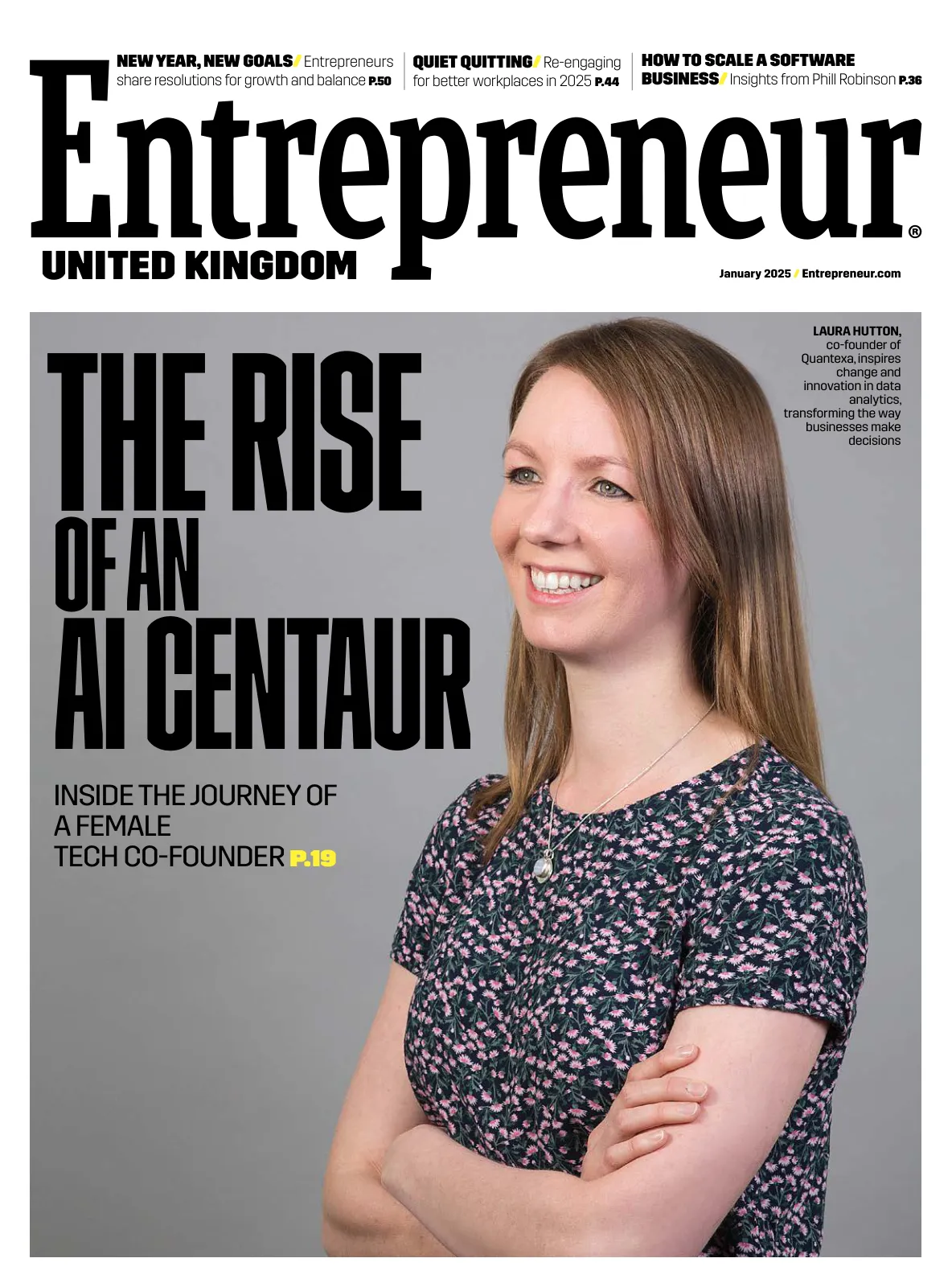
Entrepreneur UK, January 2025
Page 1
HOW TO SCALE A SOFTWARE
BUSINESS/ Insights from Phill Robinson P.36
NEW YEAR, NEW GOALS/ Entrepreneurs
share resolutions for growth and balance P.50
QUIET QUITTING/ Re-engaging
for better workplaces in 2025 P.44
January 2025 / Entrepreneur.com
UNITED KINGDOM
OF AN
AI CENTAUR
THE RISE
INSIDE THE JOURNEY OF
A FEMALE
TECH CO-FOUNDER P.19
LAURA HUTTON,
co-founder of
Quantexa, inspires
change and
innovation in data
analytics,
transforming the way
businesses make
decisions
Page 2
BOLD
FOR THE
BOLD
UNITED KINGDOM
Page 3
Contents/January 2025
P.12
The Rise
of an AI
Centaur
Inside the journey of a
female tech co-founder
FEATURES
→ LAURA HUTTON,
co-founder of
Quantexa, inspires
change and innovation
in data analytics,
transforming the way
businesses make
decisions
3
January 2025 / ENTREPRENEUR.COM /
Page 4
DOWNLOAD
YOUR DIGITAL
EDITION
HERE
UNITED KINGDOM
Out now in the UK
Page 5
5
January 2025 / ENTREPRENEUR.COM /
46 Stirring Success
The Business Show Launchpad
£100K winner on growing a successful
business
62 5 Simple Steps to Secure
Funding
DUNCAN KREEGER, founder at TAB offers
key strategies to attract
investors
‘TREPONOMICS
IN THE LOOP
Contents/January 2025
14 From Recording Studio to
Office Space with Soul
YARON ROSENBLUM reshapes work
with flexible spaces
36 How to Scale a Software
Business
Insights from PHILL ROBINSON, CEO
of Broadwave
40 The Road Less Travelled
Turning slow travel into a scalable,
flight-free experience
BUSINESS
UNUSUAL
STARTUP
SPOTLIGHT
FEATURES EDITOR Patricia Cullen
patricia.cullen@bncb2b.com
CEO Wissam Younane
wissam@bncpublishing.net
MANAGING DIRECTOR Rabih Najm
rabih@bncpublishing.net
ART DIRECTOR Simona El Khoury
EDITORIAL TEAM
Tamara Pupic,
Aalia Mehreen Ahmed
MEDIA SALES MANAGER
Olha Kovalova olha.kovalova@bncb2b.com
REGIONAL DIRECTOR
Andy B. andy@bncb2b.com
CONTRIBUTING WRITERS
Avion Gray, Tim Duggan, Gaia van der Esch,
Dean Richmond, Didier Cossin, Yukie Saito,
Duncan Kreeger, Yana Abramova
SUBSCRIBE
Contact subscriptions@bncb2b.com to receive
Entrepreneur United Kingdom every issue.
COMMERCIAL ENQUIRIES
sales@bncb2b.com
WWW.ENTREPRENEUR.COM/EN-GB
Access fresh content daily on our website
All Rights Reserved 2025. Opinions expressed are solely those of the contributors.
Entrepreneur United Kingdom is officially licensed exclusively to BNC B2B In
United Kingdom by Entrepreneur Media Inc. No part of this magazine may be
reproduced or transmitted in any form or by any means without written permission
of the publisher. Images used in Entrepreneur United Kingdom are credited when
necessary. Attributed use of copyrighted images with permission. All images not
credited otherwise Shutterstock.
20 Wenlock Road, London, N1 7GU
entrepreneurMediaUK
entrepreneurUK
entrepreneurmedia-uk
entrepreneurmedia.uk
UNITED KINGDOM
28 Lessons from Rule-
Breaking Leaders
GAIA VAN DER ESCH on breaking
norms and driving change
30 Will AI Replace Jobs or
Enhance Roles?
AI amplifies your team’s skills—
discover its growth potential
44 Quiet Quitting
Can we put an end to it in
2025?
8 Kickstart Your Business
Entrepreneurs share strategies for
setting goals and staying focused to
drive growth in the New Year
34 What’s in Store for
Business in 2025?
Insights from experts on future
predictions for UK businesses
58 What should business
leaders focus on in 2025?
Expert insights on key priorities in the
year ahead
↑ OREN and YARON ROSENBLUM,
co-founders of Canvas Offices.
Page 6
6 / ENTREPRENEUR.COM / January 2025
Editor’s Note/
WHAT’S AHEAD FOR ENTREPRENEURS
IN 2025?
Entrepreneur United Kingdom
W
elcome to the January 2025 issue of
Entrepreneur UK, and what an issue we’ve lined
up to kickstart the New Year! As we step into a
new year brimming with promise, it’s the perfect
time to reflect on achievements, recalibrate
ambitions, and prepare for the opportunities
ahead. Whether you’re plotting your first venture,
scaling a thriving business, or refining your strategy, this
issue is designed to inspire, challenge, and inform.
Our cover story this month celebrates a major milestone
for one of the UK’s most innovative companies: Quantexa.
Co-founder Laura Hutton shares the journey to Centaur
status—a rare feat marking over $100 million in annual
revenue. From the seeds of an idea to a global data and
analytics powerhouse, Laura’s story offers insights on
resilience, innovation, and the power of co-founding
partnerships.
In a fascinating conversation, we also catch up with the
most connected man in UK tech, Phill Robinson, CEO and
co-founder of Broadwave, for his take on what’s next for the
software industry. As AI, cloud computing, and SaaS
continue to redefine business, Phill’s predictions for the
sector—and advice for entrepreneurs navigating these
waters—are not to be missed.
On the other end of the entrepreneurial spectrum, we
meet Jennie Bayliss, owner of LETTERBOX Cocktails, who
shook up the competition at The Business Show 2024 to
win the Launchpad prize. Her journey from concept to
award-winning brand showcases the creativity and grit
needed to succeed in today’s market.
We’re also bringing you behind the scenes with the
visionary mind behind Canvas Offices. Co-founder Yaron
Rosenblum shares the origin story of these innovative
spaces that have become a hub for scaling businesses and
creative thinkers alike. If you’re looking for inspiration to
rethink your workspace or simply want to understand how a
bold idea takes root, this one’s for you.
But this issue isn’t just about celebrating the big wins—it’s
about equipping you for success in 2025. We’re diving into
the strategies you need to kickstart your year, from goal-
setting techniques to growth hacks tailored to UK founders.
As the landscape evolves, we’re also unpacking the
implications of AI on everything from customer experiences
to hiring practices, ensuring you stay ahead of the curve in a
rapidly changing market.
And, of course, no new year would be complete without
reflecting on the personal side of business. We asked
founders across the UK what their New Year goals are -
answers range from scaling sustainably to empowering
women in male dominated industries. Their insights offer
both a practical roadmap and a motivational boost as we all
gear up for the months ahead.
As always, our mission is to champion your
entrepreneurial journey, celebrate your successes, and
provide the tools to help you tackle challenges head-on.
Whether you’re in tech, retail, services, or something
entirely unique, the stories and strategies in this issue are
for you. Here’s to a year of innovation, growth, and making
your entrepreneurial mark. Let’s make 2025 unforgettable.
Happy New Year!
Patricia Cullen
Features Editor, Entrepreneur United Kingdom
Page 7
EMPOWERING
THE VISIONARIES
OF THE
UNITED KINGDOM
UNITED KINGDOM
Page 8
8 / ENTREPRENEUR.COM / January 2025
In the Loop/
Kickstart Your Business in
January and Hit the Ground
Running
Entrepreneurs share strategies for setting goals, fostering creativity, and staying focused to
drive growth and success in the New Year by ENTREPRENEUR UK STAFF
T
he start of the year
offers a fresh
opportunity to
accelerate your
business, set new
goals, and
overcome
challenges.
January marks a new chapter that
allows business owners and entrepre-
neurs to refocus, refuel, and hit the
ground running. To help you maximize
the potential of the first month of the
year, Entrepreneur UK has gathered
advice from successful entrepreneurs
on how to implement strategies that
ensure growth, creativity, and a strong
foundation for success for 2025.
Set clear, measurable goals and
review them regularly
Emma Parkinson, CEO of International
Energy Products, believes that a
structured goal-setting and review
process is essential to kickstart your
business in January. Parkinson
emphasises that clear, measurable
objectives are critical for driving
productivity, especially in a fast-paced
and competitive global market. She
advises breaking down long-term goals
into smaller, weekly targets for the team
to focus on.
“One crucial step to energise a business
and boost productivity from the year’s
outset is to implement a robust goal
setting and review process. At Interna-
tional Energy Products, we’ve found
that setting clear, measurable objectives
for the quarter, year, and even the next
→ Emma Parkinson,
CEO of International
Energy Products,
leads with a focus on
strategic goal-setting
and agility to drive
business growth in a
competitive global
market
Page 9
9
January 2025 / ENTREPRENEUR.COM /
three years ahead is critical
to navigating an increas-
ingly competitive global
market. We find that then
breaking these down into
weekly targets provides
immense value.”
Consistently evaluating
progress is equally crucial.
Parkinson’s company holds
weekly and monthly
reviews to identify and
address any obstacles that
may arise. She continues,
“Regular reviews – we do
them weekly and monthly
– are equally important.
They allow us to quickly
identify and address any
roadblocks, ensuring we
remain agile in our
fast-paced industry.”
This approach not only
provides clarity for the team
but also helps businesses
maintain momentum,
adapt to changes, and drive
consistent progress.
Whether you’re part of a
well-established company
or a startup, setting and
regularly reviewing clear
goals can be transformative
for business growth.
Allocate time for creative
thinking and problem
solving
James Dooley, a serial
entrepreneur, SEO expert
and investor, stresses the
importance of blocking out
special time for your team
to focus solely on new ideas
and problem-solving.
Dooley advocates for
uninterrupted, creative
thinking time, free from
meetings and emails.
He explains, “If you want to
power up your startup,
block off special time each
week where your team
focuses only on new ideas
and fixing problems. This is
your ‘must-have’ time – no
meetings allowed! Think of
it like giving your brain a
workout room. Just as
athletes need training time,
your team needs quiet time
to think big thoughts. When
the daily rush of emails and
meetings takes over,
creative thinking gets
pushed aside.”
This creative block of time
encourages innovation and
can lead to breakthroughs
SETTING CLEAR, MEASURABLE OBJECTIVES FOR THE QUARTER, YEAR, AND EVEN THE NEXT
THREE YEARS AHEAD IS CRITICAL TO NAVIGATING AN INCREASINGLY COMPETITIVE GLOBAL
MARKET. WE FIND THAT THEN BREAKING THESE DOWN INTO WEEKLY TARGETS PROVIDES
IMMENSE VALUE”
→ James Dooley is an
entrepreneur with
vast experience of
growing multiple
businesses in the UK
}}
Page 10
10 / ENTREPRENEUR.COM / January 2025
in how your business operates and
serves customers. According to Dooley,
this strategy fosters a culture of creative
thinking where new ideas flow
naturally. He elaborates, “Amazing
things happen when people have room
to dream up new solutions. One team
member might figure out a faster way to
help customers. Another might spot a
problem nobody saw before. Here’s the
cool part: When people know they’ll
have time to work on their ideas, they
get excited.”
This practice not only helps the team
think outside the box but also generates
excitement and energy around the
company’s growth. By making creative
thinking a regular part of the routine,
you can cultivate an environment where
innovation thrives.
Focus on brand awareness and
exceptional customer service
Iain McCallister, CEO of MAN
Commercial Protection, brings valuable
advice from over three decades of
experience as a business owner.
McCallister highlights that, for startups,
it’s essential to focus on brand aware-
ness and deliver outstanding service at
every touchpoint of the customer
journey. He encourages entrepreneurs
to put emphasis on marketing efforts
that get the word out and drive traffic to
your business.
He explains, “As a business owner of 31
years, the advice I would give to any
start-up is that it’s imperative to hit the
ground running and achieve growth
from the outset. The principles behind
this are simple; raise brand awareness
through effective marketing and deliver
exceptional service at every point of the
customer journey.”
In addition to raising awareness,
McCallister points out the significance of
monitoring your outcomes and gaining
insights from challenges. Businesses can
improve by identifying areas for growth
and optimising their operations. He
says, “It is also important to track
SET 5 PRIORITY ACTIVITIES WITH 100-DAY MAXIMUM DELIVERY
TIME. MOUNT THOSE PRIORITIES, WITH ASSOCIATED ACTIVITIES AND
RESPONSIBILITIES ON A PAPER CHART ON THE WALL. BUILD A SMALL
TEAM, 6 PERSONS MAX, FOR THE DELIVERY OF THE PRIORITIES”
“
In the Loop/
→ Iain McCallister,
CEO of MAN
Commercial
Protection, shares
insights on leadership
and business growth
Page 11
11
January 2025 / ENTREPRENEUR.COM /
results, learn from setbacks
and surround yourself with
the best knowledge and
talent to propel your
business further.”
This approach helps
start-ups achieve steady
growth and sets them apart
from competitors. Focused
marketing and superior
customer service, combined
with a willingness to learn
from mistakes, can lead to
long-term success.
Prioritise key activities and
stay focused
Kevin Gaskell, former CEO
of Porsche, Lamborghini,
and BMW, advocates for
setting specific, prioritised
activities that have a
100-day delivery time. He
recommends narrowing
down the focus to just five
key activities and building a
small team to execute these
goals with maximum
efficiency.
Gaskell suggests, “Set 5
priority activities with
100-day maximum delivery
time. Mount those priori-
ties, with associated
activities and responsibili-
ties on a paper chart on the
wall. Build a small team, 6
persons max, for the
delivery of the priorities.
Agree within the team that
they have the authority for
change and are accountable
for delivery.”
This method helps
eliminate distractions and
ensures that the team
remains focused on
achieving critical objectives
within a set timeframe.
Gaskell’s technique of
having a visible, count-
down-driven plan promotes
accountability and momen-
tum. He emphasises the
importance of regular
check-ins and addressing
obstacles quickly. He
continues, “Put a counter on
the plan starting at 100 days
and counting down each
day. Hold a 10-minute
stand-up meeting each
Tuesday morning in front of
the chart – the meeting
begins at 9.30 precisely. No
one is allowed to speak for
more than 2 minutes and
only discuss the blocks and
barriers that need to be
removed.”
By sticking to clear
priorities and maintaining
consistent accountability,
you can quickly move the
needle on important
projects and achieve
significant progress in just a
few months.
Measure success and
adjust strategies as needed
Tracking progress and
making adjustments based
on real-time results is
crucial for maintaining
momentum in business. As
businesses progress, it’s easy
to lose sight of original goals
or get caught up in
day-to-day tasks. Therefore,
measuring success and
adapting strategies
accordingly is essential for
long-term growth.
All of the above entrepre-
neurs emphasise the
importance of regularly
reviewing and adjusting
goals, whether it’s setting
weekly targets, conducting
team check-ins, or refining
marketing strategies based
on customer feedback.
Success in business often
involves staying agile and
being willing to pivot when
necessary. Gaskell’s
approach of using a
countdown clock and weekly
team check-ins exemplifies
this principle by ensuring
constant evaluation and
swift action. Parkinson’s
structured reviews also show
the value of staying flexible
and responsive to market
changes.
Kicking off 2025 with a
solid, action-driven plan
can set the tone for success
throughout the year. The
tips shared by Emma
Parkinson, James Dooley,
Iain McCallister, and Kevin
Gaskell provide valuable
insights into how business
owners can harness the
power of goal-setting,
creativity, focus, and
adaptability to drive their
ventures forward.
By implementing struc-
tured objectives, carving
out time for ideation,
prioritising key tasks, and
measuring progress, you’ll
be well on your way to
hitting the ground running
in 2025. With these
strategies in play, your
business is poised not just
to navigate obstacles but to
excel and carve out a
competitive advantage in
the market.
→ Kevin Gaskell,
former CEO of
Porsche, Lamborghini
and BMW, brings
decades of
leadership
experience, driving
business success
and innovation
Page 12
12 / ENTREPRENEUR.COM / January 2025
S/Eco
D
espite making
significant
progress in their
green efforts – with
51% of retailers
now prioritising
sustainable
materials in their
packaging, according to
Deloitte’s 2024 survey
– there’s still significant
room for growth when it
comes to eco-friendly
consumerism, particularly in
terms of improving access
to environmentally friendly
products.
Eco Isn’t Enough:
Why sustainability in retail must be affordable for all
Retailers must make eco-friendly products affordable to all, bridging the gap
between sustainability and cost. BY DEAN RICHMOND
Eco-friendly products and services are
becoming increasingly important, with
75% of young people aged between 12
and 27 valuing sustainable practices
more than brand names, according to
social impact consultancy,
DoSomething. Nevertheless, green
products, services and efforts still tend
to come with a price increase
associated, which can serve as
deterrent or even as a barrier to certain
consumers. Even when this isn’t the
case, it can seem that way to
consumers, with sustainability labels
proven to influence buyers’ price
perception.
Retailers truly looking to increase
their green impact must do more to
challenge these difficulties, not only
lowering prices on sustainable
products wherever possible but also
investing more into consumer
education to show their audiences
that buying green doesn’t have to
mean paying more – at least in the
longer term. It’s vital for the impact
of planet-first practices and
products to be put within reach of
everyday consumers hit hard by the
cost-of-living crisis and inflation in
order for environmental initiatives
to prove successful. This means not
only improving financial
accessibility – but improving access
through clearer understanding too.
The green price tag: who’s really
paying for eco-friendly retail?
Retail is one of the world’s largest
carbon contributors, accounting
for approximately 25% of global
emissions. Most of these emissions
stem from supply chains rather
than in-store running costs,
according to the World Retail
Congress. However, the burden of
going green often still ends on
consumers’ shoulders. This is
particularly the case for sustainably
produced goods, with PwC
confirming that 80% of people will
pay more for ethical products.
The issue is that such price hikes
remain a barrier for many, creating
an imaginary divide in the
population: the virtuous
consumers who can afford green
products and the less green-
focussed consumers who cannot.
The guilt that can accompany
resorting to cheaper yet less
sustainably positioned resources
could even tip those struggling
with the cost of living into further
poverty, which is not something
that a socially conscious retailer
Page 13
13
January 2025 / ENTREPRENEUR.COM /
would want to promote. More than
just a question of economics,
improving access to sustainable
products also becomes a matter of
ethical responsibility.
Beyond the affordability gap, there
is also a division in consumer
understanding, with Bain &
Company revealing that despite 76%
of consumers wanting to prioritise
sustainable living, the majority don’t
know how. People are struggling to
identify what sustainable choices
look like when funds are limited,
concerned that they cannot afford
them. Brands need to step up to
address this, acknowledging that
pricing alone can constitute a form of
accessibility – something that must
become equal for all, especially when
we’re talking about something as
vital as green products. To make
sustainability viable in the long term,
green initiatives must be available
across all income brackets.
Breaking the green ceiling
The financial pressures of green
consumerism already appear to be
taking a toll, with the Sustainable
Consumer report revealing that,
compared to last year, fewer
consumers are adopting eco-friendly
lifestyles due to costs. 61% of those
surveyed cited price as the primary
barrier to adopting a green lifestyle,
with Ipsos confirming that 44% of
UK consumers feel sustainable
products are out of their economic
reach. The research company
likewise reported that 39% of buyers
feel confused about why greener
options tend to cost more.
Whilst retailers can’t always bear
the brunt of additional production
and packaging costs on the
consumer’s behalf, they do have a
duty to be environmentally and
socially responsible. And this means
making sustainable choices
accessible to all. Sustainability
doesn’t have to be expensive. A
socially responsible retailer
understands that a low-cost,
sustainable choice should be just as
accessible as high-cost options and,
when this is not possible, they should
be encouraged to find different ways
in which to offset these costs for the
consumer, such as offering higher-
quality, longer-lasting sustainable
options so consumers don’t have to
buy more.
Take our small-scale, family-owned
business at Pets Corner, for example,
where we have begun to bridge the
divide between in-house practices
and the sustainable practices of our
customers by combining 100%
renewable energy across all our
stores with the best quality products
on the market. Consumers might pay
more initially in some cases, but their
sustainable choices will last much
longer – saving them money in the
long term. In the end, then, it is us
paying for the majority of our
environmental contributions,
through things like green energy,
rather than these costs being
transferred to the consumer by
asking them to repeatedly make
expensive purchases of items that
won’t last long.
Contributing to social accessibility
in small ways like these is really
important to us, as we believe that
commitment to social improvement
is just as important as supporting the
environment. That’s why Pets Corner
goes above and beyond to give back
to both, not only financing the Great
British Litter Survey to clean up our
natural world, but also restoring
local woodlands for the benefit of the
community. This is a clear example
of how retailers can take financial
responsibility for environmental
initiatives, as they support
communities rather than
perpetuating perceived green
inaccessibility for consumers. Not all
green actions need to centre around
the direct sale of sustainable
products, though this can be helpful.
It’s all about making a difference
through all available actions,
including products but also through
other charitable or community-
oriented actions wherever possible,
too.
Balancing green goals with social
good
It’s time we approached green
consumerism from more than just a
marketing angle. Eco-friendly
packaging and green branding
initiatives might attract the attention
of younger, climate-conscious
consumers. But it’s not fair to ask
buyers to pay more for these
products without the long-term
quality to back it up, particularly in
light of the current cost of living.
Likewise, it’s not fair to request this
without explaining the reasons why
there may be higher chargers for
green products and services, and
without showing that as a retailer,
you are also making green efforts and
lifestyle changes of your own.
For more wide-angled impact, we
have to tackle the social side of
sustainability that’s too often
forgotten. In other words, retailers
must balance environmental
responsibility with social impact,
recognising that ESG isn’t just about
sustainability but also people –
supporting green choices in a way
that’s feasible for everyone.
Dean Richmond is the CEO
of Pets Corner, a UK-based
ethical pet care retailer with
over 160 stores. Under his
leadership, the company
focuses on providing high-quality,
natural, and sustainable products for pets
and their owners. petscorner.co.uk
IT’S VITAL FOR THE IMPACT OF PLANET-FIRST PRACTICES AND
PRODUCTS TO BE PUT WITHIN REACH OF EVERYDAY CONSUMERS
HIT HARD BY THE COST-OF-LIVING CRISIS AND INFLATION IN ORDER
FOR ENVIRONMENTAL INITIATIVES TO PROVE SUCCESSFUL”
Page 14
14 / ENTREPRENEUR.COM / January 2025
FROM RECORDING
STUDIO TO
OFFICE SPACE
WITH SOUL
↑ OREN and YARON
ROSENBLUM, co-founders of
Canvas Offices, have reshaped
London's office space landscape
with their vision for flexible,
design-driven workspaces.
YARON ROSENBLUM TURNED A CHILDHOOD
CHICKEN COOP INTO A RECORDING STUDIO.
NOW, WITH CANVAS OFFICES, HE’S RESHAPING
THE FUTURE OF WORK, CREATING FLEXIBLE,
PERSONALISED SPACES ACROSS 16 (AND
COUNTING) PRIME LONDON LOCATIONS TO MEET
THE NEEDS OF MODERN BUSINESS.
by PATRICIA CULLEN
Page 15
15
January 2025 / ENTREPRENEUR.COM /
“After al, the success of a
business is measured by
its financial performance,
so aligning the entire
organisation around
this core focus can
help ensure everyone is
working toward the same
objectives.
Y
aron Rosenblum and his brother Oren
started out with a pretty big idea: to shake
up the concept of workspaces. They wanted
to create more than an office, facilitating an
environment that offers people the freedom
to work in their own way, with a design that
reflects their style, and promotes collabora-
tion. From this vision, Canvas Offices was
born. They’ve crafted dynamic workspaces
that cater to the unique needs of every business, big or
small. The brothers didn’t just build a brand - they
built a movement focused on flexibility, innovation,
and empowering businesses.
Success in business, as Rosenblum has discovered, is
rooted in passion and purpose - two forces that have
driven his entrepreneurial journey from the start. His
fascination with creating personalised spaces began in
his teenage years, shaped by his upbringing in the
countryside alongside his architect mother. It was here
that Rosenblum first transformed an ordinary
structure into something extraordinary - turning a
simple chicken coop into a recording studio. This
marked the beginning of a lifelong passion for
reimagining everyday spaces, showcasing his unique
ability to see potential where others might not.
“When I was 15, we had a derelict chicken coop
outside of our house. I was a musician and my mum
helped me transform it into a recording studio.”
The experience left an indelible mark on Rosenblum,
shaping an understanding of the transformative power
of personalised spaces. “That was the place I started to
play music, and I would continue to create there until I
left home at 21,” he recalls. But the space meant more
than just a spot to jam; it became a part of him. “What
I created there stayed with me — when you design a
space that is bespoke to your needs, you unlock so
much potential and beauty,” the entrepreneur reveals.
His mother’s collaboration in creating this tailored
environment sparked a realisation that would
eventually lead to the founding of Canvas Offices “I’ve
done exactly the same thing on a larger scale. I’ve got
more than 2000 people under our rooftops,” he says.
However, Rosenblum’s path from playing music to
property management was hardly a straight line;
rather, it unfolded through a series of serendipitous
events that eventually led him to realise his passion for
creating personalised spaces could be scaled up. At 27
he moved to the UK and established a music produc-
tion house, where the transformation began. He recalls
one pivotal moment:
“I had a small, empty room, and one day, someone
came to reception looking for a new space. Their vocal
coach had been kicked out of their previous office for
making too much noise, and they needed somewhere
to go. I brought in my builders, I built exactly what
they needed, and they loved it. They stayed there for
more than 10 years.”
This experience marked a turning point for him,
revealing the potential for his approach to extend
beyond the music industry. “With my ability, knowl-
edge and love for creating safe spaces for people to
create, Canvas Offices was born.” Citing “a massive
passion for personalisation” and “truly understanding
what people need in their space and giving it to them”
as differentiators in the market, the company sets itself
apart from competitors. “That really makes us different
from the cookie cutter approach. A lot of our competi-
tors provide a glass box with desks and chairs, and we
don’t do that.”
Rosenblum opens up about the challenges of building
Canvas Offices from scratch, pointing out the tough
challenges of bootstrapping, the balancing act of
wearing multiple hats, and the importance of staying
focused on the bigger picture. He also emphasises how
crucial it is to be passionate, adaptable, and to keep the
company’s culture strong and centre as you grow.
Starting a business from scratch is never an easy feat,
but for Yaron, it was the catalyst for his entrepreneur-
ial journey. “We started with very little,” he reflects,
recounting the early days when he and his brother took
on every role to grow their company, one building at a
time. “It was very meaningful, very purposeful... it
made us very happy,” he adds, speaking to the satisfac-
tion of creating something from the ground up.
Despite the initial excitement, Yaron quickly learned
”
”
}}
Page 16
16 / ENTREPRENEUR.COM / January 2025
one of the hardest lessons
in entrepreneurship:
scaling is tough, especially
when bootstrapping. “It’s
very hard to scale fast
bootstrapping,” he admits,
acknowledging the
challenges of growing a
business without external
funding. “If you want to
scale faster, you need to
understand the mecha-
nisms... especially the
financial side of things.”
Yaron emphasises that
without the right knowl-
edge, growth can be slower,
and businesses often face
roadblocks. Yet, he remains
a strong advocate for
bootstrapping, considering
it essential to his growth. “I
would not change it,
because that was probably
what made me who I am
today.”
As Yaron’s business grew,
so did his understanding of
what it takes to scale. One
key realisation was the
balance between being a
generalist and a specialist.
“When you’re starting a
business, you are a super
generalist,” Yaron says,
highlighting how he and
his brother had to learn
every part of the business
themselves due to financial
constraints. “But the
knowledge and the support
specialists can give you at
scale is so important.” For
Yaron, finding the right
balance between broad
skills and specialised
expertise has been crucial
to long-term success.
Building a team that
shares in the vision is
another vital ingredient.
Despite the challenges, he
views creating a strong,
unified team as one of his
greatest achievements, and
he sees his employees as
partners. “We decided to
do an Enterprise Manage-
ment Incentive (EMI)
scheme, essentially giving
shares in the business and
options in the business to
the employees.” he says,
underscoring the impor-
tance of nurturing a
cohesive company culture.
“We truly see our employ-
ees as partners,” he
explains, further stressing
the value of mutual
investment in the com-
pany’s future.
Reflecting on the early
years of the business, Yaron
wishes he had taken a step
back from the day to day
and focused more on
strategy, acknowledging
that that is “easier said
than done.” The allure of
solving immediate
problems often pulls
entrepreneurs into the
weeds of daily tasks, but
Yaron now believes that
strategic thinking is just as
vital for growth. “You need
to find these quiet spaces
to macro out and see the
bigger picture,” he advises,
acknowledging how easy it
is to get caught up in the
urgency of everyday
operations.
When asked what advice
he would give to a new
entrepreneur, Yaron offers
a few key insights. “You
have to find something
you’re passionate about,”
he stresses, pointing to the
deep satisfaction that
comes from working on
something meaningful. “If
you’re not really, really
passionate about what
you’re doing... you’re going
to end up struggling.”
Passion, he argues, is what
fuels entrepreneurs
through the tough times.
He also highlights the
importance of sharing that
passion with others,
whether they’re employees,
clients, or business
partners. “You need to be
able to sell... articulate
your passion to the people
around you,” Yaron says,
noting that alignment with
others is essential for
success.
As for his own journey,
the entrepreneur credits
his gut instinct for driving
many of his decisions.
“When you calculate
things, sometimes they tell
you different answers... we
do have this gut that we
follow,” he explains,
suggesting that sometimes
↑ Inside a Canvas Office location: a stylish mix of modern design and functionality that creates an
inspiring space for productivity and creativity
Page 17
17
January 2025 / ENTREPRENEUR.COM /
the data doesn’t capture
the full picture. This
instinctive drive is
something that sets
successful entrepreneurs
apart, according to Yaron.
“You have to have [the
guts]... it’s just what sets
you apart,” he says.
Looking ahead, he
reflects on the importance
of balancing agility with
focus in the ever-changing
landscape of entrepreneur-
ship. “You need to always
stay tuned to what’s
happening and be agile...
but don’t lose your focus,”
he cautions, noting the
challenge of adapting to
rapid changes without
compromising the core
vision of the business. In
the fast-paced world of
2025 and beyond, Yaron
believes that maintaining
this balance will be
essential for success.
In a world where the
future of work is still
evolving, there has been a
shift to flexible working,
which is here to stay and a
fixture of modern business.
“It’s about the importance
of utilising time effectively,
whether that be remote or
in the office,” he asserts,
underlining the ongoing
relevance of flexible
working arrangements.
However, he also cautioned
that it’s important to not
lose that human element of
connectivity and culture.
“Energy is the one thing
that, if you are detached
and in different spaces, it’s
very hard to pass on.” His
concern is rooted in the
impact on younger
employees who miss out on
the opportunity to engage
in face-to-face mentoring,
which is crucial for
long-term success. “If
you’re looking at the next 5,
10, 20 years, think about
the generations of people
that didn’t have the
opportunity to spend time
with more senior col-
leagues who can mentor
them for success.”
As we look ahead,
Rosenblum is focused on
what will be crucial for
entrepreneurs to thrive: a
balance of focus and adapt-
ability.
“The speed of change has
never been this fast, and
you need to be adaptable,”
he notes, but warns that
agility alone is not enough.
“Agility combined with
focus is key. “ He also
advocates for what he likes
to call the “Northern Star.”
(A clear and consistent
guiding principle that
aligns with the company’s
ultimate goals—primarily
profits and revenue.)
“After all, the success of a
business is measured by its
financial performance, so
aligning the entire
organisation around this
core focus can help ensure
everyone is working toward
the same objectives.”
Finally, Rosenblum’s
biggest focus for the
coming year is on self-care.
“If I don’t take care of
myself, how can I be
focused on supporting
others?” he asks, acknowl-
edging how easily entre-
preneurs can neglect their
own well-being while
managing growing
companies.
“Maintaining balance for
my next year is important,
taking care of myself and
my wellbeing in order to
be able to continue to
support my employees and
clients.”
From bootstrapping to
scaling, Yaron’s journey
underscores the impor-
tance of self-reflection, the
power of partnership, and
the need for balance in
both personal and
professional life.
“That realy makes us different
from the cookie cutter approach.
A lot of our competitors provide
a glass box with desks and
chairs, and we don’t do that”
↑ With a focus on both form and function, this workspace combines sleek design with practical features
Page 18
18 / ENTREPRENEUR.COM / December 2024
Page 19
19
January 2025 / ENTREPRENEUR.COM /
THE JOURNEY TO
CENTAUR
STATUS
From startup struggles to a multi-billion-dollar
valuation, Quantexa co-founder Laura Hutton shares
the journey of building a successful AI Centaur and
breaking barriers in the tech industry by PATRICIA CULLEN
W
hat does it mean for a technology
company to reach Centaur status?
In an industry driven by rapid growth
and fierce competition, hitting $100
million in annual recurring revenue
(ARR) is a rare and significant
achievement. It marks a company’s
ability to scale, navigate shifting market
demands, and sustain long-term success. But
reaching Centaur status is not just about
numbers—it’s a signal that a company has
managed to thrive amid the uncertainties and
pressures that define the tech world.
→ Laura Hutton,
co-founder of
Quantexa,
inspires change
and innovation in
data analytics,
transforming the
way businesses
make decisions
F
or Laura Hutton, a co-founder of Quantexa,
achieving Centaur status has been a journey defined
by resilience and significant personal sacrifice.
Helping build a business in the male-dominated
tech world while also managing family commitments,
Hutton says, has been a unique challenge. “It was my own
personal headspace that I had to be comfortable with,” she
shares. “I had to make sure I felt I could give what I wanted
to Quantexa while also having the family life I wanted.” She
credits her success to a relentless focus on long-term goals
and the ability to stay adaptable in the face of obstacles.
For Hutton, the path to Centaur status has reinforced her
belief that success is built on persistence and the courage to
forge your own way.
Founded in 2016, Quantexa uses artificial intelligence (AI)
and data analytics to help businesses identify hidden risks }}
Page 20
20 / ENTREPRENEUR.COM / January 2025
I’M VERY AWARE THAT I’M ONE OF
SIX FOUNDERS AND THE OTHER
FIVE ARE MEN. HAD I NOT BEEN
IN A GROUP WITH MEN, WOULD
MY EXPERIENCE HAVE BEEN
QUITE DIFFERENT? I SUSPECT THE
ANSWER IS PROBABLY YES.”
and opportunities.
Reflecting on her early
days as one of the founding
partners, Hutton recalls
the balancing act that every
startup founder faces. “As a
young company, it’s a
delicate balance,” she says.
“How do we stay ahead of
competitors while making
sure we don’t overstretch?
You’re only as good as the
last thing you delivered.”
Quantexa’s inception
stemmed from a recurring
dilemma that many
businesses face: the choice
between buying rigid
off-the-shelf technology or
building solutions
in-house. The partners’
vision was to build a
company that would offer
an alternative, one that
could provide flexibility,
transparency, and
long-term scalability.
“Openness, transparency,
and scalability are key
pillars,” Hutton explains.
“Helping clients become
self-sufficient with our
technology reduces
dependencies on vendors
and lowers costs. Getting
data ready for AI by
unifying it, putting it in
context, and enabling
better decision making.”
The company’s focus on
customer-centric
innovation has been a
crucial element of its
success. “We’ve made sure
the customer is at the
center of our roadmap and
innovation,” she says. “A
mistake some tech
companies make is
building a cool piece of
tech first and then trying to
find a problem to solve.
We’ve gone the other way.”
Hutton believes that this
approach has allowed
Quantexa to develop
solutions that truly meet
the needs of its clients. By
listening closely to
customers and understand-
ing their pain points, the
company has been able to
create meaningful, scalable
solutions that drive lasting
value.
Quantexa’s ability to
scale quickly and move
beyond its original niche of
anti-financial crime also
proved critical in reaching
Centaur status. A feat that’s
even rarer than achieving
unicorn status as the
company did in 2023.
“That was the turning
point,” Hutton says. “It
moved us from being a
financial crime vendor in a
vertical to a horizontal
capability that underpins
better decision-making
across organisations.”
Utilised across more than
100 countries, Quantexa’s
Decision Intelligence
platform helps organisa-
tions across financial
services, technology, media
and telecoms, and the
public sector, operation-
alise data at scale, solving
business challenges and
identifying opportunities
for growth. For Hutton, to
become a co-founder of
→ The Quantexa Team:
Innovators driving
transformative solutions
with data and analytics
Page 21
21
January 2025 / ENTREPRENEUR.COM /
WE’VE MADE SURE THE CUSTOMER IS AT THE CENTER OF OUR ROADMAP AND
INNOVATION. A MISTAKE SOME TECH COMPANIES MAKE IS BUILDING A COOL PIECE OF TECH
FIRST AND THEN TRYING TO FIND A PROBLEM TO SOLVE. WE’VE GONE THE OTHER WAY.”
Quantexa wasn’t an easy one. As someone “relatively newly
married,” the question of whether to start a business while
planning a family was a major concern. “The biggest concern
for me was, is this the right time? I knew we wanted to have a
family,” she reveals. “I think this dilemma stops females from
committing and going for it. And I suspect it also prevents
people from getting funding and getting belief and backing
behind them.” Her experience of co-founding Quantexa also
underscored the gender disparities that persist in the tech
industry. Hutton was one of six co-founders, but the only
woman. “I’m very aware that I’m one of six founders and the
other five are men,” she reflects. “Had I not been in a group
with men, would my experience have been quite different? I
suspect the answer is probably yes.”
The entrepreneurial journey for Hutton and her husband
Jamie, who is also a co- founder, has also been shaped by their
differing approaches to business. “How male entrepreneurs
approach something versus female entrepreneurs is really
quite different,” she notes. Gender inequality in tech, she says,
is not just about opportunities but also about the confidence
gap that often holds women back. Despite these challenges,
Hutton urges women to take the leap into entrepreneurship.
“Yes, you weigh the pros and cons up. You’re obviously taking
a risk-based approach. But my overarching message is to
commit and go for it,” she says. Hutton emphasises that taking
risks and embracing uncertainty are essential components of
entrepreneurial success. She believes that women, in particu-
lar, should trust their instincts and not be afraid to disrupt
industries or break the mold.
The decision to co-found Quantexa was risky. She and her
husband, Jamie Hutton - Quantexa’s CTO - quit their jobs,
went without a salary, and took on a significant mortgage. Yet,
Hutton felt confident in the decision. “What’s the worst that
could happen? It doesn’t work. Let’s imagine a year in, it didn’t }}
Page 22
22 / ENTREPRENEUR.COM / January 2025
work. You can just go and get another
job. But in that year, whatever it
would have been, we would have
learned so much.” In her entrepre-
neurial journey, Hutton has also
learned the value of embracing what
makes her unique. “Our uniqueness
is our superpower,” she reflects. “At a
company level, offering something
unique to the market is a valuable
advantage.” She encourages others to
disrupt the status quo. “Often
companies look at what other compa-
nies are doing and try to emulate it
or try to compete with it. If you’ve got
the right offering and you’re pitching
yourself...being unique, being
disruptive and being willing to be
disruptive will set you apart.”
This theme of uniqueness runs
throughout her career. She recalls the
challenge of entering investment
banking when she was younger and
felt her age and appearance were bar-
riers to being taken seriously. “I
would bring someone along with me
to mimic the people I was presenting
to, so they wouldn’t be intimidated by
a young, blonde, Northern Irish girl
who looked like she was 16.” Despite
this, she quickly proved herself.
“Within five minutes, they’d totally
forgotten about the person I brought
in with me, and they were listening
to me. They were engaging with me.”
Hutton’s ability to overcome these
initial perceptions highlighted the
importance of confidence and
expertise in challenging external
biases. It reinforced her belief that
once people recognise your value,
appearance and background
become secondary to your abilities
and impact.
Now, as Quantexa reaches
Centaur status, Hutton reflects on
her journey as a female entrepre-
neur. “I remember when I was 25, I
was going into investment banking.
I just created a solution that would
identify rogue trading, unauthor-
ised trading in organisations.” For
her, it was a moment of proving
herself, but also learning to
embrace her distinct perspective. “I
believe that being willing to
embrace and celebrate your unique-
ness, and having confidence in it—
whether professionally or person-
ally—is something I only truly
learned in my 30s.”
In addition to her entrepreneurial
journey, Hutton has also seen
firsthand the hurdles that many
other women face in the workforce.
“There’s a lot organisations can do,”
she says when asked about how
businesses can better support
women. “You’ve got to have
supportive processes as people go
off on maternity leave and as they
come back to work, like offer
flexible working.” But she acknowl-
edges that the greatest challenge
may be internal. “For me, it was
more about how I balanced up in
my head, my competing priorities,”
she reflects. Hutton believes that
the mental load of balancing work
and personal life can often be the
hardest part, especially for women
who feel the weight of societal
expectations. She stresses the
importance of self-compassion and
understanding that there is no
one-size-fits-all solution to
managing these pressures.
Navigating those competing
demands required the support of
her team and flexibility in the work-
Page 23
23
January 2025 / ENTREPRENEUR.COM /
place. “I actually think my own headspace was the
biggest barrier I had to overcome, not necessarily what
my organisation could or couldn’t do for me.” However,
she believes that workplace culture does play a crucial
role, noting that most companies are aware of the
importance of a work-life balance and are striving to
improve their approach. “Everybody’s very aware of it
and very cognizant of it, and most good companies are
doing a lot to really make that experience better.”
When it comes to AI and its future, Hutton sees
immense potential but also challenges as organisations
look to adopt these techniques. “There’s a desire to be
able to do it more powerfully, to do it cheaper, and to
make it easier.” But she notes that AI also raises ethical
questions which need to be thought through with the
appropriate governance in place to ensure it is used in
the right way. “The thing that makes people nervous is
the ethical and moral considerations. Are we letting
computers make decisions that really humans should
be making?” Laura sees significant promise and need
in the future of AI, as organisations look to do this
more efficiently and effectively. In particular, its ability
to augment human decision-making, rather than
replace it. “I think people have a unique ability to
process information and read body language and relate
in a way that AI can’t. Maybe with time, but right now
human rationale, feeling, emotion and ethics plays a
very key role in that.”
OFTEN, COMPANIES
LOOK AT WHAT OTHER
COMPANIES ARE DOING
AND TRY TO EMULATE
IT OR TRY TO COMPETE
WITH IT. IF YOU’VE GOT
THE RIGHT OFFERING
AND YOU’RE PITCHING
YOURSELF...BEING UNIQUE,
BEING DISRUPTIVE AND
BEING WILLING TO BE
DISRUPTIVE WILL SET YOU
APART”
For Quantexa, this balance between human intelligence
and AI is key to their success.
“Our platform automatically unifies the internal and the
external data so that that information is fed in a readable,
concise, consistent way so that a person can then make the
decision they want to make.” This seamless integration of
data and human insight is what sets Quantexa apart in the
competitive AI landscape, empowering businesses to make
more informed, confident decisions.
For now, Hutton sees Quantexa continuing to grow and
innovate, making strides in AI
technology while supporting the people who drive the
company forward. As she reflects on her journey, one piece
of advice stands out for her: “Commit and go for it. Don’t
let
‘what ifs’ hold you back.” This mindset has been central to
both her personal and professional growth, and she
believes it’s the kind of bold approach that will continue to
drive Quantexa’s success in the years to come.
↑ Celebrating innovation and leadership as Quantexa reaches
Centaur status, a milestone of resilience and growth
Page 24
24 / ENTREPRENEUR.COM / January 2025
S
Insights
W
hen it comes
to pitching
your startup,
you’ve only
got a few
minutes to
grab an investor’s
attention—on average,
just 3.44 minutes,
according to DocSend.
And believe me, that
window’s getting shorter,
putting more pressure on
founders to make every
second count. One of the
biggest mistakes I see
founders make is saving
the most important
information for the end of
the deck. We need to
understand your concept,
why it’s essential, and why
you’re the best person to
execute it right from the
start. Richard Branson
used to do “a Napkin
Test” test. If you couldn’t
communicate your idea
on something as small as
the napkin, he wouldn’t
be interested — most
good ideas can be pitched
quickly; all the other little
details can follow later.
Here’s everything you
need to know about
putting together the
perfect pitch deck,
because first impressions
are everything when
approaching investors.
RULE #1/ Keep It Simple,
Keep It Short.
The best pitch decks are
straightforward and to
the point. When you’re
putting your slides
together, keep thinking of
the napkin test – try to
communicate your
concept and vision in a
punchy, clear and concise
way. Aim for 10-12 slides
in total. Simplicity
doesn’t just make for a
cleaner presentation; it
also builds trust.
Investors don’t have time
to wade through endless
slides—they want to
know what you’re
pitching and why so they
can make an informed
decision at that moment.
A concise pitch that
communicates your
vision clearly, even if it’s
How To Pull Together The
Perfect Pitch Deck
A guide to creating a clear, concise pitch deck that grabs investors’ attention by focusing on your
vision, the problem you’re solving, and why your team is the right one to lead. by YANA ABRAMOVA
/
mostly bullet points, is far
more effective than one
that’s crammed with
unnecessary detail.
RULE #2/Sell the Vision,
Not Just the MVP.
Many founders focus
heavily on their Minimum
Viable Product (MVP).
While the MVP is
essential, it’s your big
vision that truly captures
attention and drives
interest. Why does your
company exist? What’s the
larger story? Investors
want to feel that they’re
backing someone with
potential, someone
meaningful, someone who
could lead the company
beyond the first launch.
Page 25
25
January 2025 / ENTREPRENEUR.COM /
Keep the jargon minimal
and make the purpose of
your company understand-
able in one or two
sentences—make it
human, relatable, and
compelling. Think of the
phrase: “It does what it
says on the tin.”
RULE #3/ Tell Them Why
You’re the Right Person (or
Team) to Lead This
Company to Success.
Investors invest in people,
not just ideas. What
relevant skills and
hands-on industry
experience do you bring?
How does your company’s
mission resonate with you
personally, and what
drives you to make it a
success? Show, clearly and
concisely, why you or your
team are the right fit to
bring this vision to life.
Here’s a breakdown of the
ideal slides, ensuring each
one serves a purpose in
telling your story:
1/ Title Slide
}Company name and
tagline.
}A visually appealing logo
or brand element.
2/Mission Statement
}A concise statement of
your company’s purpose—
one or two lines everyone
can understand. Aim for
simplicity and clarity here.
Say what it “does on the
tin.”
3/The problem
}Outline the problem
you’re looking to solve,
including relevant data to
back up your claims.
}Explain why this problem
is significant and why it
needs to be addressed.
4/The solution
}Explain how your
product uniquely address-
es the problem.
}Highlight key features
and explain how they
differentiate from those of
competitors.
5/ Why now (optional)
}Describe the timing. Why
is this the perfect time for
your solution?
}Discuss any market
trends, technology
advancements, or regula-
tory changes that make
your venture relevant now.
6/Your product
}Brief overview of your
product with visuals (e.g.,
screenshots or diagrams).
}Highlight any other
features that offer value to
the user/customer.
7/ Market Opportunity
}Show the market size and
growth potential.
}Include Total Address-
able Market (TAM),
Serviceable Addressable
Market (SAM), and
Serviceable Obtainable
Market (SOM).
8/ Team
}Why you’re the right
person to lead this
company to success.
}Introduce your core team
and their relevant
experience.
}Mention key hires or any
advisors who bring
credibility.
9/Initial traction
}Share any key milestones
or metrics you’ve achieved
so far.
}Use graphs or charts to
make data digestible and
easy to skim read.
10/Competitor analysis
}Who are your competi-
tors, and what are their
pros and cons?
}What will you do
differently? How will your
company stand out?
11./Financial projections
(optional) & business
model
}Describe how your
business will generate
revenue.
}Mention pricing
strategies, revenue
streams, and key financial
metrics.
12/ The ask
}Clearly state the amount
of funding you’re seeking.
}Specify how you intend
to use the funds to further
your mission.
Investors want to see
founders who are real,
passionate, and open about
what they’re building. Your
pitch deck should feel like
you—it’s not just about
cramming in info. It’s
about pulling them into
your story, showing them a
vision that gets them
excited and makes them
feel like they’re part of
something big. Find the
sweet spot between giving
enough detail and keeping
it light. Stick with clarity,
keep it short, and be
authentic. You’re not just
pitching a product; you’re
pitching a vision and the
hardworking team behind
it. Nail that, and those 3.44
minutes will work their
magic.
Yana Abramova
is the founder
and General
Partner of
Pretiosum
Ventures [Pretty Awesome
Ventures], a seed fund
investing in companies
breaking new ground to meet
the evolving needs of big
businesses—what she calls the
Future of Businesses. Founded
in 2019 and now on Fund II,
Pretiosum has already
achieved high-profile exits.
Previously, Yana worked in
a $1.5B investment fund and
advised startups expanding
into the UK. She holds an MSc
in Management from
Cambridge University, where
she serves on the Cambridge
Business School Alumni
Board. Fluent in five
languages, Yana has been
recognized by TechCrunch, the
Financial Times, and BBC
Newsnight for her leadership
in tech and was named by
Sifted as one of the few female
solo GPs in Europe and the
UK. pretiosum.vc
THE BEST PITCH DECKS ARE STRAIGHTFORWARD AND TO THE POINT.
WHEN YOU’RE PUTTING YOUR SLIDES TOGETHER, KEEP THINKING OF THE
NAPKIN TEST – TRY TO COMMUNICATE YOUR CONCEPT AND VISION IN A
PUNCHY, CLEAR AND CONCISE WAY”
Page 26
26 / ENTREPRENEUR.COM / January 2025
The voice of
entrepreneurship
around the world
Access fresh content daily on our website
Page 27
27
January 2025 / ENTREPRENEUR.COM /
have become mainstays of
my morning routine. Y
Combinator’s startup podcast,
Your World Within and What
Now with Trevor Noah are a
few that I listen to avidly. I’ve
come to really enjoy the mix
of business mentorship,
personal motivation, comedy
and social commentary that
this lineup provides.
5/TENDING TO MY PLANTS
Gardening is my favourite
hobby and as a result, I’m
now a serial plant owner with
a collection of over 60
houseplants. It sounds like a
lot, and perhaps it is, but I get
tremendous satisfaction from
nurturing them and providing
the ideal environment for them
to grow and thrive. They’re
also therapeutic for me,
providing the serenity I need
to help balance the rigours of
entrepreneurship.
Avion Gray is
the co-founder
and CEO of
Belong, a
fintech
platform aimed at helping
millennials build long-term
wealth through innovative
investment options like the
“Boost loan.”
Five Morning Routines to Boost
Entrepreneurial Success
B/Wellness
1/WAKING UP AT DAWN
I love waking up early and getting
started with my day before the
rest of the ‘working world’
typically comes online. Why?
Because it makes me feel like I’m
winning from the outset and
getting a head start on the day.
Most days I’m tackling my “to-
do” list, sending emails, etc. but
sometimes I’m just thinking/
problem-solving, listening to a
podcast, or meditating. It’s also
the most quiet and peaceful time
of day, when I can hear a pin
drop, and really let the creative,
visionary part of my brain operate,
untethered. I also try to tackle the
toughest, most uncomfortable
tasks on my list during this time,
which often requires immense
discipline. It gives me a deep
sense of accomplishment and a
feeling of “lightness” going into
the day. I was inspired to build
this habit by my late great friend
and mentor, Nick Hungerford,
who was a huge proponent of
doing the hardest things in the
first hour of the day.
2 /TAKING 10 - 15 MINUTES TO
DIGEST THE NEWS AGENDA
As a startup founder, it’s easy to
be engrossed with everything
going on in the business and lose
track of the broader context
within which we operate. For me,
it’s vital to keep a finger on the
pulse of world events and the
social zeitgeist, in order to best
serve our customers and other
key stakeholders. On a typical
day, I’ll pair my breakfast with an
intense period of news gathering,
reading and digesting what’s
happening in the world around
me. Some days, when I have less
time, I have to do this on the go
and I seek out sources that
deliver the news in a format I can
easily and quickly digest.
3/HAVING A PROPER
BREAKFAST
There’s a reason why it’s called
the most important meal of the
day.
For me, it’s never been hard to
make time for a proper breakfast,
as it’s something I really enjoy
and appreciate. This practice has
morphed into me eating the same
thing for weeks on end, until I
start fancying something different,
but always equally satisfying. My
preference goes in waves, and I
love just giving in to it, without
any judgement. I’ve found that
this practice helps me look
forward to mornings and starting
my day on solid footing, while
properly nourishing my body. As
of late, I’ve been enjoying having
a lightly toasted cinnamon bagel
(one-half butter, the other half
cream cheese) and a coffee.
Sometimes I throw in a side of
bacon if I’m feeling daring! It’s
important to give my body the
fuel it needs to start the day and if
I can treat myself while doing so,
it’s a win-win.
4/LISTENING TO MY
FAVOURITE PODCASTS WHILE I
COMMUTE TO WORK
I have amassed a small collection
of podcasts that I love, which
1
2
3
4
5
According to AVION GRAY
Page 28
28 / ENTREPRENEUR.COM / January 2025
Lessons from Rule-Breaking
Leaders
Gaia van der Esch reflects on the challenges of breaking the status quo, drawing on her experiences and
insights from leaders like Christiana Figueres, Becky Sauerbrunn, and Tawakkol Karman, highlighting the
resilience and vulnerability needed to drive meaningful change. by GAIA VAN DER ESCH
C
hallenging the status quo, breaking glass
ceilings, and effectively driving change is a
hard and often ungrateful job. As a female
leader, I’ve been in the position to be the first
to occupy specific roles, to showcase a different
leadership style, to push for certain changes. I
experienced success, but that came with
backlash, loneliness and failures along the way.
Challenging the status quo isn’t easy – but looking at
other leaders who have successfully made ground in
leading change and pushing boundaries can help us learn
how to use our power to do the same.
Always believe change is possible
Negotiations to address climate change are ongoing
following COP29, the 29th Conference of the Parties to
the UN Framework Convention on Climate Change
(UNFCCC), as scientists, activists, and citizens fear
governments may once again fail to agree on the targets
needed to tackle the urgency of the crisis. But this hasn’t
always been the case: in 2015 the climate agreement
reached during COP21 broke the status quo and delivered
truly ambitious targets. It was reached under the
leadership of former UN diplomat Christiana Figueres. As
she took this job, Figueres thought an ambitious
Page 29
29
January 2025 / ENTREPRENEUR.COM /
agreement wasn’t possible in her
lifetime. But what would the world
become if that was really the case? “I
saw all my nightmares about social
justice become reality,” Figueres told
me. “That’s when I decided that not
having an agreement in my lifetime
simply cannot happen”. And that’s
when she started working on herself,
to change her pessimistic mindset
and become what she calls a
“stubborn optimist”. Figueres used
her outrage as a lever for action, not
paralysis, and inspired world leaders
to do the same and deliver results.
Since then, she has advocated for
holding together outrage and
optimism as the key to challenging
the status quo.
Focus on what you can control
Changing the status quo requires
stamina and consistency – while
understanding that not everything
is under our control. Becky
Sauerbrunn, Olympic gold medallist
and until recently Captain of the
U.S. Women’s National Soccer
Team, recently told me that – as a
soccer player, and as a leader –
working on what she can control is
her best chance at maximizing
success. Leaders often invest time
on what they can’t control – for
Sauerbrunn this would be worrying
about the weather forecast ahead of
her next match, or about her
adversary’s fitness level. This drains
energy and concentration from what
is under your control: your physical/
mental health, your strategy, your
character. “I am not particularly
fast, tall or strong compared to
other defenders. It is not my
physical ability that got me where I
am, but my capacity to show-up,
every single day – while reading the
game, understanding our
weaknesses and leveraging our
strengths”, said Sauerbrunn. “It is
this consistency in my mindset, in
training what is under my control,
that has allowed me to develop as a
player, to transform into a leader,
and to get where I am today.”
Own your vulnerabilities and make
them your strength
We all have vulnerabilities. They
make us feel fragile, especially when
we occupy a leadership position –
from which we want to showcase
strength and decisiveness. So, when
people are looking up to us, we hide
them, fearing that others might
uncover them and attack us at our
weakest point. This strategy can
make us even more vulnerable.
Owning your vulnerability is a
better way to go. While speaking to
the iconic designer Diane von
Furstenberg, she shared her “motto”,
as she broke one status quo and
tabu’ after the next: “being in
charge”. “It is first and foremost a
commitment to ourselves”, von
Furstenberg told me. “To own our
imperfections and transform them
into our assets, to own our vulner-
abilities and make them our
strength. It’s not aggressive, but it’s
powerful”.
See backlash and failure as part of
the game
Challenging the status quo invites
resistance as people cling to familiar
ways of life, often out of fear of the
unknown. Tawakkol Karman, a
Yemeni journalist and Nobel Peace
Prize winner, led the 2011 revolution
against the dictatorship in Yemen,
resulting in a push for democracy.
However, soon after, internal power
struggles dragged Yemen into a civil
war. Karman has been in exile since
but sees it as part of the complex
journey needed for change, which
requires wisdom – to see the bigger
picture especially when we seem to
be going backwards, and patience
– to continue pushing forward.
Karman’s motto is to take
responsibility for change on your
shoulders and not be afraid – even
in front of backlash. “It is simply
part of being a change-maker, a
trailblazer, a revolutionary. Change
will come, if you accept backlash
and failure as part of the journey
and continue pushing long enough.”
Challenging the status quo is hard
work, requiring perseverance, focus,
and resilience. But a work that is
always worth doing: if it’s not us
that succeeds, we might still be
opening doors for others to stand on
our shoulders and become the ones
that challenge the status quo and
win.
Gaia van der Esch is a
celebrated executive,
policy expert and author
of Leading Our Way:
How Women are
Re-Defining Leadership, out now.
Through her work and leadership, she
is driving change across the public and
non-profit sectors to help build a more
equitable and sustainable world.
CHALLENGING THE STATUS QUO ISN’T EASY – BUT LOOKING AT
OTHER LEADERS WHO HAVE SUCCESSFULLY MADE GROUND IN
LEADING CHANGE AND PUSHING BOUNDARIES CAN HELP US
LEARN HOW TO USE OUR POWER TO DO THE SAME.”
Page 30
30 / ENTREPRENEUR.COM / January 2025
A
s artificial intelligence (AI)
continues to transform
industries, entrepreneurs
face a pivotal question:
will it replace human jobs,
or enhance the roles
people play in their
businesses? Leading
experts share their insights on
how AI will reshape the workplace,
offering valuable perspectives on
how entrepreneurs can leverage
this technology to empower their
teams and drive growth.
Will AI Replace Human Jobs or
Enhance Human Roles?
AI is here to amplify your team’s skills, not replace them—see how it can drive your
growth! by ENTREPRENEUR UK STAFF
D
ominic Wellington, enterprise
architect at SnapLogic; a
company pioneering AI-led
integration for enterprise,
Khyati Sundaram, CEO of
ethical AI hiring experts platform,
Applied and a LinkedIn Top Voice
in the field of ethical AI; Dr. Leslie
Kanthan CEO and co-founder at
TurinTech, a company that
develops and provides AI
optimisation products and
solutions, and Lauren Murphy,
CEO of data consultancy firm
Friday Initiatives, all agree that AI
will enhance rather than replace
human jobs. They emphasise AI’s
ability to automate tasks, create
new roles, and foster collaboration,
ultimately amplifying human
expertise and driving business
growth.
This optimistic outlook comes at
a time when AI is increasingly
being integrated into various
sectors, from healthcare to finance,
and the fear of job displacement
remains a common concern.
However, experts believe that AI
will not replace human creativity,
emotional intelligence, or strategic
thinking—qualities that are
essential in decision-making and
leadership. Instead, they argue, AI
will serve as a powerful tool,
streamlining routine tasks and
‘T/Technology
Page 31
31
January 2025 / ENTREPRENEUR.COM /
freeing up valuable time
for employees to focus on
higher-level
responsibilities. For
entrepreneurs, this shift
presents an opportunity to
rethink workforce
dynamics, adopt more
efficient workflows, and
foster a more collaborative
environment where
human talent and AI work
hand-in-hand to drive
innovation.
AI’S ROLE IN AUTOMATING
TASKS – BUT NOT REPLAC-
ING PEOPLE
AI will streamline tasks,
but humans will remain
essential in the workplace.
SnapLogic’s Wellington
acknowledges that while
AI can automate specific
tasks within industries, he
emphasises that the
complete replacement of
human workers is unlikely
in most roles. He cites
examples like Klarna,
which claimed to have
replaced 700 employees
with AI, but contrasts this
with the reality that
approximately 80% of AI
projects fail to deliver
tangible benefits. For
Wellington, the truth lies
in a balanced approach,
where AI enhances human
capabilities rather than
completely replacing
them.
“AI is certainly already
capable of automating
certain tasks, but very few
jobs are made up entirely
of such simple tasks,” he
says. “In most jobs, people
perform a variety of
different tasks, and even if
all of them could be
automated, human input
is still going to be required
to coordinate between the
tasks, and importantly,
evaluate the results.”
According to Wellington,
AI’s value lies not in
replacing jobs but in
enhancing them. By
automating specific parts
of a job, AI can make
employees far more
productive. The challenge,
however, is ensuring AI is
implemented thoughtfully.
“By automating discrete
parts of a person’s job,
AI-enabled tools can make
them more productive -
potentially, much more
productive. The key is to
focus on tasks that will
actually deliver business
benefits. A technology-
first approach will almost
certainly fail. Instead,
user-centric design is
required for users to be
able to unlock the full
benefits of AI,” he advises.
AI AS A TOOL FOR ETHICAL
INNOVATION
AI is reshaping industries,
creating new roles rather
than replacing humans.
Applied’s Sundaram offers
a fresh perspective on AI’s
impact, focusing on its
ethical considerations and
job creation potential. She
emphasises AI’s growing
presence across industries,
while reassuring that it’s
unlikely to replace humans
anytime soon.
“AI is playing an
increasing role in all
industries. But we needn’t
fear that AI will replace
humans in the workplace
anytime soon,” Sundaram
states. “This is because
we’re not yet at a place
where AI can or should be
trusted to make decisions
independently. AI models
that aren’t trained,
monitored, and audited
carefully by humans risk
amplifying historic biases.”
For Sundaram, the key to
AI’s future is its
responsible application.
While AI may not replace
jobs, it is certainly opening
up opportunities in new,
evolving roles. “AI has
created ample
opportunities for those
who want to use ethical
models as a tool in new
roles, whilst staying
vigilant and in control at
all times,” she adds. “From
smart-assisted sports
coaches, to tech fashion
designers and metaverse
architects—the possible
list of future AI-enhanced
roles is endless.”
Sundaram goes on to say
that when it comes to
↓ DOMINIC WELLINGTON, Enterprise Architect
at SnapLogic, explores AI's potential to
enhance, not replace, human roles
↓ LAUREN MURPHY, CEO at Friday Initiatives,
emphasises AI's role in enhancing human
expertise and decision-making
}}
Page 32
32 / ENTREPRENEUR.COM / January 2025
making hiring decisions,
the proliferation of
AI-assisted CVs and cover
letters is already leading
many employers, including
the UK Government, Unicef
UK, and HarperCollins, to
switch to fairer and more
accurate skills-based
recruitment processes.
“Skills-based hiring starts
with anonymous
applications that consist of
skills-based questions.
Ethical AI can help hiring
teams make this process
even more efficient and
objective. Then, additional
tests which don’t easily lend
themselves to ChatGPT use
- like cognitive ability tests
and numerical aptitude
tests - can be used to
further filter for top talent.
For candidates, this will
create more opportunities
to demonstrate their skills
in areas they excel in, and
find roles which they will
genuinely be able to thrive
in. For employers, it will
separate out true talent
from tech,” she says.
COLLABORATION IS KEY
AI will transform jobs by
handling routine tasks,
empowering employees to
focus on creativity and
innovation. Dr. Kanthan,
CEO and co-founder of
TurinTech, agrees that AI
will not replace human jobs
but will undoubtedly
transform them. He
imagines AI handling
mundane and labor-
intensive tasks, allowing
workers to concentrate on
more valuable activities like
strategy, creativity, and
innovation.
“Businesses will see AI
take over repetitive and
time-intensive tasks, freeing
up employees to focus on
higher-value work like
strategy, creativity, and
innovation,” Kanthan
explains. “However, the
most effective AI systems
will be those that
collaborate with human
expertise.”
He highlights that
businesses combining AI
with Human Intelligence
(HI) through feedback
loops, collaboration, and
validation achieve far better
results than those relying
solely on AI. He points out
that this collaboration
ensures that AI-driven
outputs are not only aligned
with business goals but also
enriched by human insights
that AI cannot replicate,
such as ethical
considerations, creative
vision, and contextual
understanding. Kanthan
goes on to say that
businesses that integrate AI
into their decision-making
processes need to ensure
that AI outputs are
transparent and validated.
“Customers want to trust
the decisions and
recommendations AI makes
on their behalf, whether it’s
suggesting a new product,
automating a process, or
optimising their experience.
Companies that prioritise
AI accountability and
collaboration will build this
trust while leveraging AI to
create more meaningful
customer interactions.”
ENHANCING EXPERTISE AND
EMPOWERING HUMAN
INSIGHT
AI is key to unlocking
experts’ potential according
to Lauren Murphy. The
IN MOST JOBS, PEOPLE
PERFORM A VARIETY OF
DIFFERENT TASKS, AND
EVEN IF ALL OF THEM
COULD BE AUTOMATED,
HUMAN INPUT IS STILL
GOING TO BE REQUIRED TO
COORDINATE BETWEEN THE
TASKS, AND IMPORTANTLY,
EVALUATE THE RESULTS.”
“
→ DR. LESLIE
KANTHAN, CEO and
co-founder at
TurinTech,
champions
AI-human
collaboration for
transformative
business success
‘T/Technology
Page 33
33
January 2025 / ENTREPRENEUR.COM /
Friday Initiatives’ CEO
echoes the belief that AI
will enhance human roles
rather than replace them.
“AI will continue to
reshape our operations,
and those of our clients,
by maximising the value
of data, automating
complex governance
processes, and driving
innovation across our
services. We envision AI
becoming even more
integral to decision-
making, enabling faster,
more accurate, analysis
while freeing up our
experts to focus on
nuanced legal,
communication, and
strategy questions.”
Murphy explains that
AI excels at handling
repetitive, data-heavy
tasks, allowing experts to
dedicate their time to
complex challenges that
require human insight.
“We firmly believe AI
will enhance rather than
replace human roles. AI
takes on repetitive,
data-heavy tasks,
allowing our experts to
focus on complex issues
requiring human
expertise,” Murphy says.
“The future of governance
and compliance is rooted
in human-AI
collaboration, where
technology complements
and empowers human
insight.”
For Murphy, the
collaboration between AI
and HI is critical to the
future of industries like
governance, compliance,
and beyond. AI’s potential
lies in its ability to
augment human
decision-making, helping
experts navigate complex
scenarios with data-
driven insights while
retaining the need for
human oversight and
judgment. However, she
emphasises the
importance of balancing
AI’s transformative
potential with careful
use.
“Balancing
transformative
capabilities with
responsible
implementation ensures
trustworthy solutions.
With AI, as the old adage
goes - rubbish in, rubbish
out. So we’re focused on
creating trusted data via
dynamic mapping,
getting our clients
fighting fit to make the
most out of AI.”
The consensus from
these industry leaders is
clear: AI is unlikely to
replace human jobs
entirely. Instead, it will
enhance and transform
the roles people play in
various industries.
Whether through
streamlining repetitive
tasks, creating new
ethical positions, or
fostering collaboration
between human expertise
and AI capabilities, the
future of work will
depend on a symbiotic
relationship between
humans and machines.
Far from replacing jobs,
AI has the potential to
create new ones,
particularly in fields
where human judgment,
creativity, and emotional
intelligence remain
irreplaceable.
As AI continues to
evolve, the focus must
remain on ensuring that
technology compliments
human abilities, enabling
professionals to focus on
high-value, creative, and
strategic work. Through
thoughtful
implementation and
ethical considerations, AI
can be harnessed to drive
innovation and
productivity, without
diminishing the
importance of human
oversight. The key will be
in striking the right
balance - embedding AI
into the workplace in a
way that empowers
workers, while
safeguarding the
human-centric aspects of
work that technology
cannot replicate. In this
way, AI has the potential
to enhance efficiency
while fostering a new era
of collaboration, where
technology and human
talent work together, not
against each other. The
big question then is, what
exciting opportunities lie
ahead for businesses that
harness the power of both
humans and AI?
BUSINESSES WILL SEE AI TAKE OVER REPETITIVE
AND TIME-INTENSIVE TASKS, FREEING UP
EMPLOYEES TO FOCUS ON HIGHER-VALUE WORK LIKE
STRATEGY, CREATIVITY, AND INNOVATION.”
“
→ Khyati
Sundaram, CEO at
Applied, advocates
for responsible AI
integration in the
workforce
Page 34
34 / ENTREPRENEUR.COM / January 2025
AI, AI, AI….
As we step into 2025, the
intersection of AI,
purpose-driven
enterprises, and
sector-spanning
innovation is set to shape
the future of
entrepreneurship. For
business leaders and
founders, this shifting
terrain offers
opportunities laced with
complexity. AI has
transitioned from a
buzzword to a core
component of modern
enterprise, enabling
businesses to streamline
operations, deliver
deeply personalised
experiences, and
anticipate market
changes with remarkable
precision. However,
entrepreneurs who fail to
engage with these tools
risk being left behind in
an increasingly tech-
driven world.
Laura Davidson,
co-founder of Tag
Digital, a digital
marketing agency that is
part of Scale Up
Scotland, sees
automation and AI
becoming a key force in
transforming businesses.
“For 2025, automation
and AI will shift from
broad, theoretical
discussions to driving
systematic change with a
clear focus on removing
drudgery and upskilling
teams,” she explains. She
also points out that AI
adoption will be
increasingly
decentralised, with
functional teams taking
more responsibility for
its implementation.
“To deepen
understanding and
ensure meaningful
adoption, we’ll see
companies appointing
AI ambassadors within
each functional team to
add more value and
recognise productivity
gains,” she says.
“Additionally, there will
be a rapid ramp-up in
Large Language Model
(LLM) upskilling,
particularly in
prompting and usage
expertise, driven by
increased daily
interaction and
advancements in
multimedia inputs.”
Data is a valuable
resource, and this year,
B2B businesses will
focus on creating content
to build a year-round,
engaged community of
potential customers, all
aimed at providing
value. Davidson
highlights the value of
data in a privacy-centric
world. “The shift to a
more privacy-centric
world means that the
data companies own will
be potentially more
valuable than the
business itself,” she
predicts.
A SHIFT IN FOCUS
The UK is set for a
turbulent year, with
ongoing economic
pressures creating both
challenges and
opportunities across
sectors. Danny
Campbell, founder of the
architecture firm
HOKO, believes we’re
likely to see significant
shifts in the business
landscape. “First, we
might witness a wave of
A
s the UK braces for another year of
economic challenges and opportunities,
leading founders from diverse industries
offer their visions for what 2025 holds for
business. From the rise of artificial
intelligence (AI) to the growing demand
for purpose-driven businesses, their
insights provide a glimpse into the
evolving market and how entrepreneurs can
adapt to thrive in the coming years.
What’s in Store
for Business in
2025?
Insights from experts on future
predictions for UK businesses in 2025
by PATRICIA CULLEN
In the Loop/
→ Laura Davidson, co-founder of
Tag Digital, on the future of AI and
automation in business
Page 35
35
January 2025 / ENTREPRENEUR.COM /
businesses either leaving
or selling within the UK,
reflecting the ongoing
challenges of operating in
a post-Brexit, high-
inflation environment,” he
warns.
He also expects AI to
dominate the business
scene. “The rise of
AI-backed tech companies
will dominate, though I
predict a tightening of
regulations around what
can genuinely be called AI,
curbing some of the
current hype,” Campbell
adds.
However, beyond the
tech sector, Campbell
emphasises a resurgence
of industries where human
skills remain irreplaceable.
“I expect a renewed focus
on industries that AI
cannot disrupt – roles that
require a human touch,
such as skilled trades and
artisan crafts,” he says.
“There’s an opportunity
here for entrepreneurs to
redefine these sectors,
creating new growth
stories in areas that AI
can’t replicate.”
TO B- (CORP) OR NOT TO B
Equally transformative is
the rise of purpose-led
businesses, a trend that
reflects a broader societal
demand for accountability
and ethics. Today’s
consumers expect more
than just products or
services-they seek
alignment with brands that
reflect their values,
whether that’s
sustainability, inclusivity,
or fair labour practices. For
entrepreneurs, this means
rethinking business models
to ensure that purpose is
not just a marketing
strategy but a genuine,
measurable commitment.
Purpose-led ventures are
not only attracting a loyal
customer base but are
increasingly seen as sound
investments by those
highlighting long-term
value over short-term
profits.
Eilidh Cunningham,
director at the design
company POTR, predicts a
surge in businesses
prioritising purpose and
authenticity in 2025.
“More companies will
pursue B-Corp status,
reflecting a growing
consumer demand for
meaningful connections
with brands that prioritise
sustainability and social
impact,” Cunningham says.
She believes that this shift
will become a key
differentiator as consumers
seek brands they trust and
align with their values.
In addition, Cunningham
sees a move away from
traditional, polished
advertising. “Consumers
are increasingly turning
toward media that feels
raw, real, and relatable -
almost ‘anti-advertising,’”
she explains.
“Entrepreneurs will need to
innovate with low-cost,
authentic ways to reach
their audiences, from
leveraging viral content to
embracing grassroots
campaigns.” She also
foresees a focus on
expanding into new
markets. “A slow domestic
market will push
businesses to seek out new
export markets, though
this comes with challenges
like navigating tariffs and
trading restrictions in key
regions.”
Innovation across
industries is also redefining
how businesses operate,
breaking down silos and
creating unexpected
partnerships. From
technology revolutionising
healthcare to financial
services embracing green
agendas, the opportunities
for cross-sector
collaboration are vast.
Entrepreneurs who can
identify and capitalise on
these synergies will be
well-placed to navigate a
competitive market.
Success in this evolving
environment will demand
adaptability and a
clear-eyed view of what lies
ahead. Entrepreneurs must
remain agile, prepared to
pivot strategies as new
challenges and
opportunities emerge. In a
world where change is the
only constant, those who
embrace innovation and
purpose at their core will
lead the way in shaping the
UK’s next business
chapter.
→ Danny Campbell,
founder of the
architecture firm
HOKO, offers his
prediction for 2025,
focusing on AI and
industry shifts
→ Eilidh
Cunningham,
director at POTR,
discusses the rise
of purpose-driven
businesses
Page 36
How to Scale a Software
Business
Insights from the most connected man in UK tech on scaling a software business,
shaped by decades of industry experience. by PATRICIA CULLEN
→ Phill Robinson, CEO
and co-founder of
Boardwave, leading
the charge to drive
positive change in the
UK tech sector
For nearly four decades, Phill Robinson, CEO and co-founder of Boardwave, a mission-driven organisation dedicated
to driving positive change in the European tech sector, has guided the software industry through its most
transformative eras.
36 / ENTREPRENEUR.COM / January 2025
Page 37
37
January 2025 / ENTREPRENEUR.COM /
F
rom the
fledgling tech
boom of Silicon
Valley to the
boardrooms of
Europe, and
now to fostering the UK’s
next generation of
entrepreneurial leaders, his
career is a masterclass in
adaptation and foresight. In a
landscape where the UK
strives to cement its place as
a global tech hub, Robinson’s
story is both a blueprint and
an inspiration for today’s
ambitious founders.
Early beginnings: A fortune
in timing
Looking back on his career
beginnings, Robinson recalls,
“I was lucky when I left
school and decided to do a
computer science degree.”
This pivotal choice led him to
California in the mid-eighties,
where he worked as a
programmer for Oracle, at a
time when the software
industry was still in its
infancy.
After spending some
time in California, he
returned to the UK to
help US-based software
companies establish a
European presence, a
journey that would
continue to shape his
career. “I helped a
number of US software
firms… there really
wasn’t a local European
software industry back
then.”
As he worked with
some of the biggest
names in the industry,
such as Salesforce, his
passion for technology
grew. “I ended up back
in California as a Chief
Marketing
Officer(CMO)… and then
back to Europe,” he
said, recounting his
years as a CMO at
Salesforce. But after two
decades of working for
American companies,
Robinson had a
realisation: it was time to
branch out on his own.
The transition to
entrepreneurship:
Becoming a CEO
“wasn’t my plan,” he
admits when talking
about his transition into
entrepreneurship. “But
after something like 20
years working for
Americans, I just wanted
to do my own thing.” For
the next 15 years,
Robinson would take on
the CEO role in three
separate ventures, one
was early stage venture
backed and the last two
were private equity (PE)
backed businesses.
His early experiences
were a blend of
successes and setbacks,
with one venture falling
short of expectations.
“The first was a venture-
backed business, but it
wasn’t our biggest
success,” he shared
candidly. However, his
next ventures were more
fruitful, as he helped
build and sell
businesses, including Iris
in the UK, one of the
largest software
companies in the
country. Later, he moved
to the Netherlands to
lead Exact, a
3,000-employee
enterprise software
company. However, as
he navigated the
complexities of
corporate leadership, he
faced personal struggles
too. “At the same time
as that, I got diagnosed
with Parkinson’s,” he
explained. Despite these
challenges, his
SOMEONE COMES ALONG
WITH A HALF-DECENT OFFER,
THEY’RE SCALING THEIR
BUSINESS, AND THEY SELL IT
BECAUSE IT’S A LOT OF
MONEY. BUT ACTUALLY, THE
POTENTIAL OF THAT
BUSINESS HAS NOW GONE
AWAY TO SOMEONE ELSE”
“
}}
↓ PHILL ROBINSON speaking at Boardwave Live – Boardwave’s
annual member event in London
Page 38
38 / ENTREPRENEUR.COM / January 2025
B/Growth
entrepreneurial drive remained
undeterred. “I carried on… but
eventually, I’d come home to the
UK.”
The birth of Boardwave: A social
enterprise for software CEOs
Though officially retired, Robinson's
entrepreneurial spirit didn’t slow
down. “I retired. My wife often
reminds me I'm retired,” he laughs.
What was meant to be a simple
transition into retirement turned into
an entrepreneurial venture that
would become a full-time pursuit:
Boardwave.
“I had this idea at Boardwave, and
it’s turned into a full-time job,” he
said, explaining how the idea was
originally conceived to include a few
CEOs supporting one another. “I
thought it would be a small
programme for a relatively small
number of CEOs to help each
other,” he noted. However,
Boardwave quickly grew beyond
Robinson's expectations. “And
we’ve now got over 1,900 members
across Europe… all of them are
founders or CEOs of software
companies.”
What started as a niche initiative
for executives in the software
industry has blossomed into
something much more significant.
“It’s been hugely more successful
than we anticipated,” Robinson
reflected. With its rapidly expanding
network, Boardwave aims to foster
the development of a vibrant
European software industry. “We are
helping each other re-build the
European software industry…
European software 2.0,” he said,
echoing the vision for a new era of
European software
entrepreneurship.
Boardwave operates as a social
enterprise, with a clear distinction
from traditional for-profit ventures.
“It’s not about making money. It’s
entirely built for the benefit of its
members.” This ethical stance
provides a unique advantage. “It
gives it an interesting position
because it means that you can have
a moral authority and a level of
independence that nobody else
has,” Robinson explains.
The autonomy of Boardwave has
allowed it to avoid the pressures of
profit maximization, which often
compromises values in more
traditional ventures. “We could have
built this with a fund and become a
VC… we didn’t do that,” he said,
explaining the intentional choice to
focus solely on helping CEOs.
Rather than chasing profit,
Boardwave partners with various
organisations to support its
initiatives. “We’ve got 90
organisations in our consortium
now,” Robinson shares. This
diverse coalition includes VC firms,
investors,bankers, lawyers,
consultants, and other
stakeholders, all contributing to the
initiative’s success.
Lessons for aspiring entrepre-
neurs
Robinson’s recent white paper
“How the UK & Europe can lead the
global software industry by 2034”
offers critical insights for today’s
founders. When asked to outline the
key lessons, he emphasises the
importance of being mission-driven.
“At the very beginning… you have
to be mission-driven,” he said. He
also warned that many founders fall
short of their potential by selling too
soon. “Someone comes along with
a half-decent offer, they’re scaling
their business, and they sell it
because it’s a lot of money,” he
explained. “But actually, the
potential of that business has now
gone away to someone else.” This
premature exit often occurs during
the critical scaling phase from
start-up to scale-up, a vulnerable
stage that is often exacerbated by a
lack of support. “The start-up phase
will get a lot of support from
government, local initiatives and tax
incentives, but once you get past
that stage of £10m to £100m,
there's not a lot of help and
support,” he reveals.
According to Robinson, it’s crucial
for founders to remain focused on
their mission and long-term
potential rather than short-term
→ JOSEPH VALENTE
and ANT MIDDLETON,
best selling author of
Military Mindset and
leadership expert.
→ Veroniek Collewaert,
director of the
European Scaleup
Institute, champions
innovation and growth
for Europe’s next
generation of
businesses
↑ The visionary tech leader is
shaping the future of the software
industry
Page 39
39
January 2025 / ENTREPRENEUR.COM /
IT TAKES 10 YEARS IN THE US TO GET TO $100
MILLION IN REVENUE. IN EUROPE, IT TAKES 15. WE
WILL NEVER ATTRACT THE SAME QUALITY OF
INVESTOR… UNLESS YOU CAN SCALE AT THE SAME
RATE AS THEM”
financial gain. For those
starting a software
business, he emphasised
the importance of solving a
universal problem, not just
a local one. “Great software
companies are not
vitamins, they’re
painkillers,” he said. “They
have to solve a problem.”
He argues that many
entrepreneurs fall into the
trap of solving problems
that are unique to their
local markets, limiting their
potential for growth. “If
that’s the case, it’s never
going to be more than a UK
software company,” he
warns.
The challenges of scaling
in Europe
Scaling a software business
in Europe and the UK is
notoriously slow compared
to the US, and Robinson
believes this is one of the
key reasons why we
haven't yet produced
software giants like those in
Silicon Valley. “It takes 10
years in the US to get to
$100 million in revenue. In
Europe, it takes 15,” he
points out.
The slower scaling
process can be attributed to
several key factors. Unlike
the US, which functions as
a unified market with a
common language and
culture, Europe presents a
more complex environment,
with diverse languages and
cultures that create
additional challenges. ”We
have to use technology to
reduce the barriers to
scaling European software
companies across our
continent, in a way similar to
US companies rapidly
growing in their own
market.” This acceleration
couldn’t come soon
enough.
“We will never attract the
same quality of investor…
unless you can scale at the
same rate as them,” he
said, noting the importance
of accelerating growth to
attract both European and
US-based investors.
Fortunately, he's optimistic
about the changing
landscape, as technologies
like cloud and AI are leveling
the playing field in Europe,
allowing software
companies to scale at a
much faster pace.
Building a global software
powerhouse
Despite the challenges,
Robinson remains
optimistic about the future
of European software
companies. “If UK
companies can scale at the
same rate as US
companies, I think that they
have a real opportunity to
be a software superpower.”
His advice for
entrepreneurs is clear:
focus on the mission, solve
global problems, and scale
rapidly. By doing so, UK
software companies can
unlock the potential to
compete on the global
stage.
Scaling a software
business in the UK is
challenging, but Robinson’s
journey shows it’s far from
impossible. With a clear
mission and a focus on
tackling global challenges,
there is a real opportunity
to produce the next tech
giant. The future of
innovation knows no
borders—it’s driven by
ambition, and the country is
well-positioned to lead the
way.
“
Page 40
40 / ENTREPRENEUR.COM / January 2025
THE ROAD LESS TRAVELED
Turning slow travel into a scalable, flight-free experience by PATRICIA CULLEN
B
Sustainability
/
I
n a world dominated by
fast-paced travel and
environmental concerns,
Byway offers a refreshing
alternative—flight-free,
multi-stop trips by land
and sea. With innovative
technology at its core,
Byway is redefining the
travel experience while
staying true to its
sustainable mission.
}What strategies did you
use to sustain Byway’s
growth during the pandem-
ic, and how do you continue
to maintain momentum in
today’s competitive travel
landscape?
Byway was founded in
March 2020 so we had to
initiate growth, rather than
sustain it, during the
pandemic. Initially, there
was a full lockdown, so we
spent that time on customer
discovery and product
research and built a waiting
list of people who wanted to
travel with us when the
lockdown lifted. We were
able to run our first trips
– UK only – in the second
half of 2020, and Europe
later when things opened
up. Initially, we booked
people’s trains and
accommodation separately
as our ABTA bond
application was delayed
because of the various travel
companies in crisis so we
couldn’t offer everything
together in one financially
protected package like we do
now. We were lucky enough
to have had great press and
high demand from the start,
and given how early we were
in Byway’s life and how
much we had to test and
learn, it was actually pretty
helpful to have travel
restrictions limiting demand
to a level we could manage
as we got up and running.
Today, our momentum
continues largely because we
offer such a unique product:
personalised multi-stop
holidays by land and sea,
where the journey is part of
the experience – and there’s
not a flight in sight. This sort
of travel has always been
→ The Gornergrat
Railway, captured
by Joshua Kettle
Page 41
41
January 2025 / ENTREPRENEUR.COM /
magical: so many people
love the slower, more
relaxed pace of train travel
and the possibilities to
stop off and explore. The
interest has continued to
grow over the last few
years as more people look
for rich experiences over
cookie-cutter holidays,
and of course, more
sustainable trips.
However, it can be
prohibitively complex to
organise and book these
wonderful multi-stop trips
across multiple countries
– and that’s where Byway’s
unique routing technology
and expert team comes
into their own. Our
business growth is thanks
to this tech enablement
– this is the first time tech
has powered multi-stop,
multi-modal travel – and
the fact that people simply
love our trips and the
great support that goes
with them (see our 96%
five star reviews!). A large
portion of our growth
comes from repeat
bookings and referrals.
}As an eco-conscious
startup, how do you
balance scalability with
your commitment to
sustainability and
authentic, slower travel
experiences?
Our whole business is
about scaling sustainable
travel – we’re more
sustainable by design, so
as we grow, so does our
impact. There’s no flight
offsetting, as all Byway
holidays are flight-free so
lower carbon; we
prioritise locally-run stays
over chains and local
transport infrastructure
over tourist trains; and we
have a ‘hotspot penalty’
that penalises tourist
hotspots when we plan
trips. On day one, I
founded the company. On
day two, I applied to B
Corp. This was the
company I always wanted
to build. We don’t judge or
flight-shame: many of our
customers also fly, and
we’re happy to offer
one-way trips for people
who want to almost halve
emissions without going
overland both ways (e.g.
for a recent customer who
travelled overland to a
conference in Portugal on
a mini holiday from the
UK, but flew home to get
back in time for work). We
also offer trips to
American travellers
coming to Europe: we
help them explore
overland and enjoy the
wonderful rail network
instead of booking
short-haul flights while
they’re here, but, of
course, they fly at the start
and end.
We see in our data that
once you try this sort of
travel, you’re a convert –
you do it again and you
refer your friends. It’s so
much lovelier than flying!
So anything we can do to
help people take that first
step to try flight free is
really welcome.
}Closing a Series A is a
major milestone—what
key lessons or surprises
came from that fundrais-
ing journey, and how are
you applying them in
Byway’s expansion?
We were warned that in
this funding climate it
would be hard to get
backing for a travel
company but we were
lucky enough to have a lot
of interest from existing
and new investors in an
oversubscribed round.
There were a few tricky
moments as we closed
because we really wanted
to get everyone around
the table and we weren’t
sure we could manage it,
but in the end our
investors were just
fantastic, squeezing up to
make space for each other,
and we could bring in
everyone we wanted. The
experience really brought
home the value of
choosing investors for
their values and
collaborative spirit over
cheque size. Having
investors that have your
back and believe in your
vision makes building the
company such a delight
THIS SORT OF TRAVEL HAS ALWAYS BEEN MAGICAL: SO MANY PEOPLE LOVE
THE SLOWER, MORE RELAXED PACE OF TRAIN TRAVEL AND THE
POSSIBILITIES TO STOP OFF AND EXPLORE. THE INTEREST HAS CONTINUED
TO GROW OVER THE LAST FEW YEARS AS MORE PEOPLE LOOK FOR RICH
EXPERIENCES OVER COOKIE-CUTTER HOLIDAYS”
}}
→ Cat Jones,
CEO and
founder of
Byway, leading
the way in
sustainable
travel
Page 42
42 / ENTREPRENEUR.COM / January 2025
B/Sustainability
and generates an extraordinary
amount of inbound luck. Many of
our investors are also advisors to
our company functional leads, and
to me, and the value of the
challenge and support they provide
can’t be overstated. Asking for help
and listening is not just valuable in
fundraising, but in customer
discovery, team-building and
everything else you can think of.
As my children would say: ‘team
work makes the dream work!’.
}What consumer behavior shifts
have you observed post-Covid,
and how are these shaping
Byway’s product offerings and
growth strategies?
COVID-19 accelerated a lot of the
trends that were already growing
as we started concepting for Byway
in early 2020: the slow food
movement, mindfulness, shop
local, slow fashion... and of course,
sustainability. Byway trips are ‘slow
travel’ holidays where the journey
is part of the experience – they’re
about slowing down to experience
more – and they tap into lots of
these themes. We choose
locally-owned accommodation
over international chains; we help
our travellers lean into a slower
pace, being present and valuing
the time spent exploring and
pausing along the way; we avoid
tourist traps and tourist trails, and
all of our transport is much lower
carbon than flying. 72% of people
this year are considering the
environmental impact of their
travel plans, up from 64% last
year*.
}What advice would you give
entrepreneurs on turning
personal values, like sustainabil-
ity, into a scalable business
proposition in challenging
markets?
It’s not just about having a more
sustainable offering; it actually has
to be a better product experience.
If you can figure out how to create
a loveable experience that’s simply
better than the alternative for your
customers – if you can get to 96%
five star reviews with repeats and
referrals driving your flywheel –
and if at its heart, in its design,
that better product is genuinely
more sustainable, then you’re onto
a winner. If customers choose your
product because they want to,
because they love it, because it’s
really better than the alternative
(not because they ought to, or
should do, or they feel it’s the
responsible thing to do), your
wonderful product and your
customers’ love of it is going to
take care of your growth.
Byway trips are how I’ve always
travelled (I’ve never owned a car)
and now I get to share the joy of
multi-stop trips by land and sea
with all of our customers. As our
brand has evolved, our customer-
facing messaging has shifted from
a focus on what it isn’t (flight free)
IT’S NOT
JUST ABOUT
HAVING A MORE
SUSTAINABLE
OFFERING; IT
ACTUALLY HAS
TO BE A BETTER
PRODUCT
EXPERIENCE”
“
→ The Rhaetian Railway, captured by Xavier von
Erla, showcases the stunning landscapes of the
Swiss Alps as it winds its way through
picturesque valleys and mountain passes
Page 43
43
January 2025 / ENTREPRENEUR.COM /
to what it is (a rich, beautiful
experience). I suggest that other
entrepreneurs with sustainable
products focus on the pull motivators
ahead of the push ones.
}How did you persuade investors to
back a slow-travel startup in a
fast-paced world, and what lessons
can founders take into their own
pitches?
The key for us was our first-of-its-kind
technology paired with our growth,
customer love and fantastic unit
economics. Byway has created the
world’s first 100% flight-free travel tech
that routes holidays based on
enjoyment. In the end, the defensibility
of that technology and the proprietary
data it uses was the core of what got
people excited. Our tech integrates
locally expert place and journey-based
data (over two million miles of it) with
customer insights and data in a smart
dynamic packaging engine that designs
unique multi-stop, personalised trips.
Further developing this tech was a key
part of our pitch. Sustainability is an
accelerant to a macro, general shift in
travel back to the journey and the
experience. It gave the pitch some extra
sparkle, but it wasn’t the core driver of
most of our investors’ decision making.
The biggest lesson I can share is to
remember you’re choosing your
investors at least as much as they’re
choosing you – hopefully more! Be
picky, and do your homework. The
pitch goes over easier when you’re
speaking the same language and you
have a shared thesis. Max Niederhofer,
who sits on our board (GP at
Heartcore, who led our Series A), said
“We felt called to support Byway’s
mission to make tourism both more
fulfilling and sustainable, and believe
that its technology will become a key
pillar for the next generation of online
travel.” I think that just about sums it
up.
→ MICHAEL BARON,
Commercial
Director at BWS,
leads the
company’s
strategic growth
and commercial
operations.
THERE WERE A FEW TRICKY MOMENTS AS WE CLOSED BECAUSE WE REALLY WANTED TO GET
EVERYONE AROUND THE TABLE AND WE WEREN’T SURE WE COULD MANAGE IT, BUT IN THE END
OUR INVESTORS WERE JUST FANTASTIC, SQUEEZING UP TO MAKE SPACE FOR EACH OTHER, AND
WE COULD BRING IN EVERYONE WE WANTED”
→ Bernina Express Photo credit: Byway
Page 44
}The shortlist for 2022 included “vibe
shift” and “Partygate” but was won by
“permacrisis”, a term that sums up an
extended period of instability and
insecurity. However, there was another
finalist for word of the year that I
believe should have taken out the top
spot, mainly due to its ongoing usage
instead of peaking and falling away.
I
n 2022, the Collins Dictionary released its shortlist for
its annual word of the year. The dictionary has been
publishing new editions since 1819, and the tradition for
releasing a list of words that have come to prominence
in the previous 12 months began in 2013. That was the
year that ‘twerking’, ‘Bitcoin’ and ‘Black Friday’ lost out to
‘geek’ and every year it’s a hotly contested prize.
/ ENTREPRENEUR.COM / January 2025
44
Quiet Quitting:
Can We Put An End To It in 2025?
‘T/Culture
Quiet quitting reflects a growing need for balance, transparency, and rethinking workplace
priorities by TIM DUGGAN
Page 45
45
January 2025 / ENTREPRENEUR.COM /
The term is “quiet quitting”, a
phrase that’s now well and
truly entered the lexicon of
workplaces around the world.
Despite its name, it doesn’t
have anything to do with
actually quitting your job, it’s
the philosophy that instead of
leaving, you should just do
the bare minimum of work in
your job.
}It’s also been called
“acting your wage” or
“calibrated contributing”, and
there was something about
quiet quitting that took off in
2022, and hasn’t stopped
since. In fact, Google Trends
shows that interest in the
term has only doubled in the
past 12 months.
}It’s for good reason too, as
no matter which way you look
at it, we are caring less about
work. Research into workers
in 155 countries by Gallup
shows that almost two-thirds
of us are emotionally
detached at work, and only
half of US workers said they
were really satisfied with
their jobs. In the aftermath of
the pandemic, almost 40 per
cent of people said the
importance of work had
diminished for them during
the Covid years according to
the Pew Research Centre.
}This discontent with work
has been rising for years. In
2013, a forum called r/
antiwork began on Reddit as
‘a quiet corner of the internet
to discuss radical leftist ideas
about ending work’, complete
with a tongue-in-cheek
slogan: ‘Unemployment for
all, not just the rich!’ By 2019
it had attracted around
13,000 members, a motley
crew of contributors who
mainly griped about their
work and shared tips on how
to avoid doing it. Then the
pandemic hit in 2020,
upending many people’s
workplaces and forcing them
to rethink their relationship
with work. Over the next two
years the number of users on
the antiwork subreddit
ballooned to over 2.7 million,
an increase of over 20,000
per cent.
}Instead of just hosting
rants about how to not work,
the forum became the focal
point for a movement of
people to discuss how to leave
their jobs, complain about
capitalism, or just feel a sense
of community where they
could share their growing
discontent with work in
general. In other words, this
was ground zero for ‘quiet
quitters’.
}This year new ways of
covertly expressing dissatis-
faction with work have
bubbled to the surface like
‘coffee badging’. This is what
happens when an employee
turns up to the office, swipes
their badge so they are
recorded in the system, and
then they head out for coffee
on the way back to working
from home.
}Yet another new trend
joined the pile in 2024 -
‘quiet cutting’ - to refer to
employers who were
reassigning resources
internally instead of just
firing workforces. Some
experts have said this signals
the shift in workplace power
back to employers.
}All of these trends focus
on blurring the lines of trust
and transparency that exists
in healthy workplaces. Most
of the actions can be seen
as ways of expressing
discontent in indirect
ways, and the message is
finally being heard.
Instead of going away, in
2025 good workplaces
will acknowledge that
the needs of workers
have been neglected for
too long and both sides
need to re-engage on
better ways of working.
}So while it’s not time
to completely quit on
quiet quitting just yet,
next year should see it
evolve into a – hopefully
– healthier way of
communicating between
all levels of an organisa-
tion.
Tim Duggan
is a leading
expert on
work and
careers, and author of new
book Work Backwards:
The Revolutionary
Method to Work Smarter
and Live Better
YET ANOTHER NEW TREND
JOINED THE PILE IN 2024 -
‘QUIET CUTTING’ - TO REFER
TO EMPLOYERS WHO WERE
REASSIGNING RESOURCES
INTERNALLY INSTEAD OF
JUST FIRING WORKFORCES.
SOME EXPERTS HAVE SAID
THIS SIGNALS THE SHIFT IN
WORKPLACE POWER BACK TO
EMPLOYERS”
“
Page 46
Stirring Success:
LETTERBOX Cocktails’ Winning Formula
The Business Show Launchpad £100K winner on growing a successful business
by PATRICIA CULLEN
/ ENTREPRENEUR.COM / January 2025
46
→ JENNIE BAYLISS, owner
of LETTERBOX Cocktails,
leads the way in
innovative drink offerings
Page 47
47
January 2025 / ENTREPRENEUR.COM /
W
inning the
£100K
Launchpad
award at The Business
Show London 2024 was a
great way to end the year.
The prize provides crucial
support for the business,
including £100,000 in
funding, alongside a
wealth of business services
to aid growth.
In 2023, Bayliss acquired
LETTERBOX COCK-
TAILS, but her entrepre-
neurial roots stretch back
to launching a virtual PA
business over a decade
ago. This early venture laid
the groundwork for her
later success, honing her
skills in problem-solving
and self motivation.
Reflecting on this
experience, Bayliss
explains, “I started my first
business 14 years ago. It
was a virtual PA company.
I wanted to create
something I could set up
and manage while still
doing the work myself.”
Despite her diverse
ventures, she describes her
transition into the world of
LETTERBOX COCK-
TAILS as driven by a
desire to find something
that had potential. “I was
initially looking for a
boring business,” Bayliss
says, laughing. “I wanted
something I could create
and sell in the future, and
then I came across
LETTERBOX Cocktails.”
While it certainly wasn’t
the boring project she had
in mind, Bayliss has no
regrets.
Her acquisition of
LETTERBOX Cocktails in
2023 wasn’t planned as a
grand venture. In her own
words, she was looking for
something simple, steady,
and—ironically—“boring.”
Instead, she found a
platform brimming with
untapped potential. Under
her leadership, the brand
BE REALLY CURIOUS. ASK QUESTIONS, LEARN FROM OTHERS, AND
NEVER BE AFRAID TO REACH OUT FOR HELP. IF YOU CAN GET A MENTOR,
YOU SHOULD DEFINITELY TAKE IT. IT CAN HELP YOU AVOID MISTAKES AND
SHAPE YOUR BUSINESS IN A WAY THAT’S MORE SUCCESSFUL”
has grown into a spirited
player in the cocktail
industry, combining the
convenience of ready-to-mix
kits with an ethos of
creativity. Bayliss’s forward-
looking strategy includes a
rebrand, new product
launches, and a move into
the non-alcoholic sector, a
burgeoning market ripe for
innovation. What started as
a side project rapidly evolved
into a business that Bayliss
believes has the potential to
offer something truly
unique. “I thought there was
so much potential in it. If I
can set this up as a business,
we can create something
really amazing,” she reflects.
The entrepreneur acknowl-
edges that one of the
toughest parts of running a
business is isolation and
candidly acknowledges the
frequent reality of tackling
problems alone. “The
hardest part is when you
face a problem, and it’s just
you solving it,” she admits.
“But I’m really good at
problem-solving, so that’s
J
ennie Bayliss spent over a decade building an entrepreneurial
career, culminating in the acquisition of LETTERBOX
Cocktails—a business delivering ready-to-mix cocktail kits to
homes across the UK. Her journey reflects the changing face
of modern entrepreneurship, where innovation meets
everyday convenience.
← An assortment of
LETTERBOX Cocktails,
highlighting their range of
flavors
}}
Page 48
48 / ENTREPRENEUR.COM / January 2025
S/Leader
what keeps me going.”
However, Bayliss points
out that her approach to
overcoming the loneliness
of entrepreneurship has
been through finding
connection, so instead of
retreating, she has leaned
into the power of
networks and community.
“I found support in
networking groups and
other entrepreneurs. It’s
so important to connect
with people who under-
stand the challenges you
face,” she says, emphasis-
ing that the sense of
community and shared
experiences can make a
world of difference. Her
approach highlights an
essential lesson: resilience
and resourcefulness are
cultivated not in isolation
but through collaboration
and shared experiences.
She credits mentors,
peers, and even competi-
tors for helping her
navigate the often-unfor-
giving terrain of business
ownership. Her journey is
also marked by the
lessons she’s learned along
the way. When asked what
surprised her most about
herself, Bayliss shares, “It
takes a lot for me to get
stressed now. I didn’t
think I had that in me
when I was younger, but
I’ve learned that resilience
is essential.”
The rise of non-alcoholic
beverages in the market is
another area Bayliss is
keen to tap into. “There’s
definitely a growing
market for non-alcoholic
drinks. We’ve seen a lot of
interest, especially around
Christmas, where we offer
both alcoholic and
non-alcoholic specials,”
she shares, noting that
demand for non-alcoholic
cocktails has already seen
a positive response. This
forward-thinking
approach is reflected not
only in her interest in
emerging trends like
non-alcoholic beverages
but also in her commit-
ment to continuous
learning and mentorship
to ensure business
growth. Bayliss empha-
sises the importance of
seeking guidance to avoid
common mistakes and to
shape a more successful
business. “Be really
curious. Ask questions,
learn from others, and
never be afraid to reach
out for help,” she says. She
also stresses the impor-
tance of mentorship,
saying, “If you have the
opportunity to find a
mentor, take it. It can help
you avoid mistakes and
shape your business in a
way that’s more success-
ful.”
Looking at the current
landscape of entrepre-
neurship, Bayliss remains
optimistic, focusing on
what’s possible, believing
entrepreneurship should
be taught at school. “It’s
an exciting time. There
are endless opportunities
now,” she says. “I think
schools should focus
more on teaching
entrepreneurship. Every
child should be aspiring
to have their own
WHEN WE WERE YOUNG, THEY’D ASK YOU WHAT YOU WANTED TO BE—DOCTOR, TEACHER, ETC.
NOW, IT’S LIKE, YOU CAN BE ANYTHING. YOU CAN BE A CONTENT CREATOR, AN ONLINE GAMER, OR
A PODCASTER. THERE ARE SO MANY NEW AVENUES TO EXPLORE”
IF YOU CAN GET A MENTOR,
YOU SHOULD DEFINITELY
TAKE IT. IT CAN HELP YOU
AVOID MISTAKES AND
SHAPE YOUR BUSINESS
IN A WAY THAT’S MORE
SUCCESSFUL”
“
↓ A LETTERBOX
Cocktail margarita
delivered to your
doorstep
Page 49
49
January 2025 / ENTREPRENEUR.COM /
business. The possibilities
are endless.” Passionate
about entrepreneurship
education, Bayliss
remembers; “When we
were young, they’d ask you
what you wanted to be - a
doctor, a teacher or a
lawyer. Now, you can be
anything. You can be a
content creator, an online
gamer or a podcaster.
There are so many new
avenues to explore.”
Bayliss is part of a new
wave of entrepreneurs
redefining what it means
to succeed. Her rise from
running a modest virtual
PA service to steering LET-
TERBOX Cocktails
towards national recogni-
tion is a case study in grit
and vision. Securing the
prestigious Business Show
£100K Launchpad award
caps off a transformative
year, giving Bayliss the
financial resources and
strategic support to take
her company to the next
level in 2025. But, as ever
with her story, it is not just
about personal success; it
is a broader reflection of
how small businesses can
adapt, innovate, and thrive
in a shifting economic
landscape.
Winning the Launchpad
award also reinforces
Bayliss’s belief in the value
of seeking support and
guidance. Beyond the
£100,000 funding, the
package provides a vital
network of resources and
mentorship, helping
businesses like LETTER-
BOX Cocktails scale up
with confidence. For
Bayliss, it represents not
just an endorsement of her
vision but an opportunity
to cement the brand’s
position as a market
leader.
Bayliss is also vocal about
a wider mission—to
normalise entrepreneur-
ship as a viable path for
younger generations. She
sees opportunity every-
where, from the growing
creator economy to the rise
of independent businesses
in underserved niches.
This belief fuels her call for
entrepreneurship to be
taught in schools, a
challenge to outdated
notions of career aspira-
tion. Why not, she asks,
encourage children to
dream of becoming
business owners alongside
more traditional profes-
sions?
As LETTERBOX
Cocktails charts its course
for growth, Bayliss’s
broader ambition to shape
a more inclusive and
innovative entrepreneurial
landscape feels strikingly
contemporary. At a time
when economic uncer-
tainty looms, her optimism
and pragmatism stand out.
With fresh funding, bold
ideas, and a clear vision,
Bayliss is proving that with
a strong foundation and a
creative mindset, small
businesses can achieve
something extraordinary.
Looking ahead, Bayliss is
focused on growth for
LETTERBOX Cocktails.
“We’re looking to rebrand,
launch new products, and
build on the support we’ve
received. This year is all
about consolidation—mak-
ing sure we leverage the
help we’ve been given
through the 100K
Launchpad to take the
business to the next level,”
she shares. Bayliss also
sees collaboration as key to
future success. “We’ve
already started working
with influencers and
brands, and we’re open to
more collaborations,” she
says, pointing out that
they’re open to partner-
ships that expand their
reach. “I think there’s so
much potential in
collaborating with
businesses that compli-
ment ours.” As for her
future, with the Business
Show’s £100K Launchpad
prize in hand, Bayliss is
focused on making
LETTERBOX Cocktails a
key player in the cocktail
drinks industry, continuing
to innovate and expand her
business. “We have big
plans this year, and we’re
committed to growing
LETTERBOX Cocktails
into something special,”
she concludes.
Watch this space.
↓ A LETTERBOX Cocktail negroni
Page 50
A
s we begin 2025, many entrepreneurs are setting their sights on fresh
goals and intentions. While business growth remains a focus for many,
there is a growing trend toward personal development, community
empowerment, and resilience. For some, 2025 will be about improving
their health, rediscovering their passions, and empowering others. Here’s
a look at the New Year’s resolutions of six entrepreneurs, each
approaching the coming year with unique perspectives on success,
impact, and balance.
New Year, New Goals
Entrepreneurs outline their 2025 resolutions, focusing on health, purpose, and
personal growth by PATRICIA CULLEN
}A focus on health and
consistency
After years of speaking
with inspiring founders,
entrepreneurs, and
leaders, one entrepreneur,
Daniel Ionescu, founder
of Millennial Masters
podcast and newsletter
has identified four key
pillars that contribute to
success. These pillars,
which are centered on
physical health, mental
sharpness, courage, and
collaboration, will guide
his resolutions for 2025.
For Ionescu, physical
health is the foundation
of success. “Physical
health is everything. Even
just 15 minutes of daily
exercise can build the
consistency that fuels
everything else alongside
a healthier, balanced diet,”
he explains. This simple
but effective approach to
health can help sustain
energy levels and ensure
that you remain produc-
tive in both personal and
professional pursuits.
In addition to physical
health, mental sharpness
and constant learning are
crucial. “A sharp mind
thrives on constant
learning. This year, I’m
committing to reading a
book a week and tuning
my social media con-
sumption to more
educational content like
‘T/Innovation
50 / ENTREPRENEUR.COM / January 2025
Page 51
podcasts and YouTube
videos,” he shares. This
commitment to
self-improvement will
help enhance his
knowledge and stay at
the forefront of his
industry.
Furthermore, Ionescu’s
resolutions revolves
around courage and
risk-taking as he
believes real progress
emerges from facing
challenges head-on.
“Growth happens when
you take bold risks, even
when it’s uncomfort-
able,” he says, acknowl-
edging that success
often requires stepping
out of your comfort
zone.
Ultimately, he plans to
engage with individuals
who share similar values
and aspirations, while
distancing himself from
relationships that don’t
align with his vision.
“Success is rarely a solo
journey. Surrounding
myself with inspiring,
like-minded people
while letting go of
unaligned relationships
is crucial,” he notes. For
this entrepreneur, 2025
is all about living these
principles and embody-
ing his resolutions.
}Purposeful progress
over productivity
In contrast to the focus
on personal growth and
health, Anna Bon,
founder of DeHealth, a
UK-based health tech
company, resolution for
2025 is focused on
aligning every business
decision with a deeper
purpose. This entrepre-
neur has often found
herself measuring
success by the volume of
tasks completed, but she
has decided that in
2025, success will be
measured by the
meaning behind her
work.
“My New Year resolu-
tion is to focus on
purposeful progress
rather than simply
chasing productivity,”
she states. “As entrepre-
neurs, we often measure
success by how much we
accomplish, but this
year, I want to ensure
that every project I
pursue aligns deeply
with my values and
contributes to lasting
change.”
Rather than looking at
the bottom line alone,
Bon is focused on
making sure that her
efforts have a lasting,
positive impact on the
communities and
individuals she serves.
“How can my efforts
improve lives in
meaningful ways? How
do I empower individu-
als and communities to
thrive?” These are the
questions she aims to
ask herself as she
approaches each new
project.
Her shift in focus isn’t
about doing less; it’s
about making every
action intentional. }}
→ DANIEL IONESCU,
entrepreneur and
founder of Millennial
Masters podcast and
newsletter
51
January 2025 / ENTREPRENEUR.COM /
Page 52
52 / ENTREPRENEUR.COM / January 2025
‘T/Innovation
“Whether it’s advancing innovations in
healthcare or driving initiatives that give
back, I want to ensure that the impact of
my work goes beyond metrics and
speaks to the heart of what truly
matters: creating opportunities for
empowerment and well-being,” she
explains.
This resolution is grounded in the belief
that true innovation often arises from
moments of reflection and connection.
“I’ve learned that when you align your
work with a deeper mission, it leads to
more meaningful impact,” she says. Her
hope is that by prioritising purpose over
productivity, others will be inspired to
do the same. “By prioritising purpose, I
hope to inspire others to build busi-
nesses and solutions that leave a legacy
of positive change,” she says.
}Empowering women in a male-domi-
nated industry
For Jacine Rutasikwa, managing
director and co-founder of Matugga
Distillers, a premium spirits company,
her New Year’s resolution is centered on
supporting and empowering women
within the spirits industry. As the first
Black woman to own and lead a
distillery in the UK, Rutasikwa under-
stands the challenges of breaking into
and thriving in a traditionally male-
dominated field. In 2025, she is
determined to empower more women,
particularly those from underrepresent-
ed backgrounds, to follow in her
footsteps.
“My New Year’s resolution is to support
more female entrepreneurs, particularly
in the spirits industry, by sharing my
experiences to inspire the next wave of
changemakers,” she says. Having
succeeded in an industry where women
are still underrepresented, she is eager to
give back by offering mentorship and
resources to other women. The spirits
industry, she notes, thrives on innova-
tion and diversity. Nonetheless,
numerous women struggle to find
guidance and the necessary tools to excel
in the field. “The craft spirits industry
thrives on innovation and diversity, yet
many talented women struggle to find
the mentorship and resources they need
→ ANNA BON, founder
of DeHealth, a
UK-based health tech
company
Page 53
53
January 2025 / ENTREPRENEUR.COM /
AS ENTREPRENEURS,
WE OFTEN MEASURE
SUCCESS BY HOW MUCH
WE ACCOMPLISH, BUT
THIS YEAR, I WANT TO
ENSURE THAT EVERY
PROJECT I PURSUE
ALIGNS DEEPLY WITH
MY VALUES AND
CONTRIBUTES TO
LASTING CHANGE”
“
to succeed,” she says.
This resolution holds
personal significance
for Rutasikwa. “This
resolution is close to my
heart because I know
first-hand how
impactful encourage-
ment and access can
be,” she adds. By
providing guidance and
support to others, she
hopes to foster a more
inclusive and diverse
entrepreneurial
ecosystem in the spirits
industry.
}A strategic focus on
what works
As we begin 2025, a
renewed focus on
strategic growth is at
the core of some
leaders’ approach.
Saravana Kumar, CEO
of Kovai, a technology
company known for its
innovative SaaS
products, shared that
this year he wants to
adopt an ‘inch-wide,
mile-deep’ focus.
“In 2025, we’re refining
our approach to
prioritise depth over
breadth. After analys-
ing the successes of
2024, we’ve decided to
concentrate on scaling
the initiatives that have
delivered proven
results. By doubling
down on these key
areas and dedicating
more resources to
amplify their impact,
we aim to drive
sustainable growth
rather than diverting
energy into untested
ideas.”
This focused strategy
ensures Kovai will
continue building on
what works best for its
business and custom-
ers, reflecting their
commitment to
optimising the
initiatives that drive
real value.
}Valuing generalists
in the workforce
For Dr. Mansoor
Soomro, Innovation
and Enterprise Lead at
Teesside University, the
value of generalists in
organisations has
become his focal point
for 2025. After years of
research, he is eager to
shift the conversation
towards the important
role that generalists—
those with a broad skill
set—play in driving
innovation, adaptabil-
ity, and collaboration
within diverse teams.
“In 2025 I’m reflecting
on the value of
generalists in organisa-
tions—those versatile
contributors often
overshadowed by a
focus on specialists,” he
explains. Generalists
are the individuals who
bring a wide range of
skills and knowledge to
the table, allowing them
to adapt to changing
needs and bridge gaps
between different areas
of expertise.
Soomro believes that in
today’s fast-paced and
“
}}
→ JACINE
RUTASIKWA,
MD, Matugga
Distillers
Page 54
54 / ENTREPRENEUR.COM / January 2025
interconnected world, generalists have a unique
ability to drive innovation and collaboration.
“Generalists are the glue that holds teams together,
adapting to challenges and encouraging cross-func-
tional collaboration,” he notes. “In an increasingly
dynamic and interconnected world, the ability to
understand multiple aspects of a business is an
invaluable asset.”
By advocating for more recognition of generalists,
this entrepreneur hopes to inspire organisations to
foster more adaptable and collaborative teams. “I’m
eager to encourage more conversations about how
generalists can drive innovation, adaptability, and
collaboration in diverse teams,” he says.
}Rediscovering the joy of exercise
After a challenging year of balancing business and
personal life, Olamide Majekodunmi, founder of All
Things Money, an online platform providing young
adults with financial tools, is focusing on rediscover-
GENERALISTS ARE THE GLUE
THAT HOLDS TEAMS TOGETHER,
ADAPTING TO CHALLENGES
AND ENCOURAGING CROSS-
FUNCTIONAL COLLABORATION,”
HE NOTES. “IN AN
INCREASINGLY DYNAMIC AND
INTERCONNECTED WORLD,
THE ABILITY TO UNDERSTAND
MULTIPLE ASPECTS OF A
BUSINESS IS AN INVALUABLE
ASSET”
“
‘T/Innovation
→ SARAVANA KUMAR is
the CEO and founder of
Kovai.co, known for
products like
BizTalk360 and
Document360
→ OLAMIDE
MAJEKODUNMI,
founder, All Things
Money
Page 55
55
January 2025 / ENTREPRENEUR.COM /
ing her love for exercise in
2025. Running a business
often left her little time or
motivation for a regular
fitness routine, but she is
determined to make health
a priority again in the
coming year.
“My New Year’s resolution
for 2025 is to rediscover my
love for exercise after
struggling to maintain a
regular routine this past
year,” she shares. “In 2024,
life and trying to run a
business often got in the
way, and I found myself
skipping the gym or lacking
motivation to go. I know
how much better I feel,
both mentally and physi-
cally, when I’m active, so
next year I’m determined to
make exercise a consistent
and enjoyable part of my
life again.”
Instead of sticking to a fixed
fitness regime, she plans to
explore different types of
exercise to find something
she truly enjoys. “Rather
than forcing myself into a
rigid routine or workouts I
don’t enjoy, I plan to
explore different types of
exercise until I find
something I genuinely look
forward to-whether that’s
swimming or even trying
out a dance class,” she
explains.
She also aims to set
achievable fitness goals to
avoid burnout and build
fitness steadily. “I’ll also
focus on making smaller,
achievable goals to build my
fitness steadily without
burning out,” she says. Her
goal is to make exercise feel
like a rewarding part of her
life, rather than something
she dreads. “By the end of
2025, I want to feel that
exercise is not a chore but
something I do for myself,
for both my body and mind,
which I know in turn will
have a positive impact on
my business too.”
}Supporting loved ones
through tough times
Lastly, for Matthew Smith,
a 10-time serial tech
entrepreneur, investor, and
CEO of UPitch, a network-
ing app that safeguards
your ideas, his New Year’s
resolutions are profoundly
personal, centered on
supporting his wife through
a difficult health battle
while also pushing his own
physical limits. His first
resolution is centered
around helping his wife
publish a book that
chronicles her experience
with a life-threatening
brain tumour.
“One of my resolutions is to
support my wife, who
recently had a brain
tumour, in getting her book
published,” he says. The
book, titled Brainworm – A
Patient with a Sense of
Tumour, tells his wife’s
powerful story, and he is
committed to helping her
share it with the world. “I
want to help her share her
journey, and I’m committed
to making sure her voice is
heard through this book,”
he explains.
Alongside this personal
goal, the entrepreneur is
also focused on a physical
challenge - completing five
consecutive muscle-ups in
the gym. “At age 52, my goal
is to complete 5 consecutive
muscle-ups in the gym,” he
shares. This physical goal is
not just about strength but
about resilience - both in
the gym and in life. For
Smith, 2025 is about
supporting his loved ones
and pushing his own limits.
“Through these two
resolutions, I’m hoping to
strike a balance between
supporting my family and
challenging myself
physically,” he says.
As these entrepreneurs set
their goals for 2025, it’s
clear that their resolutions
go beyond business growth.
Whether it’s prioritising
health, empowering others,
or supporting loved ones
through difficult times,
their resolutions reflect a
more holistic approach to
success. For these founders,
the New Year is not just
about business - it’s about
personal growth, creating
positive change, and
supporting those around
them.
BY THE END OF 2025, I WANT TO FEEL THAT EXERCISE IS NOT A CHORE BUT
SOMETHING I DO FOR MYSELF, FOR BOTH MY BODY AND MIND, WHICH I
KNOW IN TURN WILL HAVE A POSITIVE IMPACT ON MY BUSINESS TOO”
→ MATTHEW SMITH,
serial tech
entrepreneur and
investor and CEO of
UPitch
Page 56
56 / ENTREPRENEUR.COM / January 2025
Navigating the Post-AI Bubble:
Key Strategies for Startups in a Shifting Market
The artificial intelligence (AI) startup landscape is undergoing a major shift, with
many companies facing flat or down rounds. In this quickfire Q&A, Ivan Nikkhoo,
managing partner at Navigate Ventures, shares his thoughts on how AI startups can
navigate the changing landscape, as the excitement of the AI bubble gives way to
more realistic valuations and strategic acquisitions. by PATRICIA CULLEN
S
Technology
/
most readily available in that region. The availability of
capital is attracting the best players, and the top
venture capitalists (VCs) will continue to support
them. These startups will have the best probability of
eventual success. There are other pockets in the
secondary tech ecosystems where brilliant founders
are developing AI enabled platforms addressing big
problems and large markets. They will achieve product
market fit faster and will be able to monetise.
}You’ve suggested that the ‘AI bubble’ may have
already burst. Can you elaborate on the key signs
indicating this shift has occurred and what it means
for current startup valuations?
As with previous cycles, a small number of “leaders”
will emerge attracting the majority of capital and
commanding higher valuations. These companies will
evolve into dominant platforms. Meanwhile a second
tier of “laggards” will establish solid businesses but will
not merit leadership positions. Their valuations will be
at a discount compared to the leaders. Beyond these
groups, many ventures will ultimately fail. Institution-
al capital consistently seeks the most favourable
risk-reward profiles. Companies that become sector
leaders, demonstrate better unit economics and
growth profiles than their smaller, lesser competitors.
This attracts more capital, better talent and creates an
expansion cycle, allowing the leading platform to
acquire and absorb the smaller ones at significantly
lower valuations.
}Many AI startups are facing flat or down rounds.
What strategies should these companies employ to
navigate potential M&A interest and avoid stagna-
tion?
As the “leaders” and platforms begin executing their
strategies, they will actively seek acquisition targets.
}Which firms will thrive, which will be acquired, and how can
entrepreneurs position themselves for long-term success in the
evolving AI market?
There are two parts to this answer. One has to do with funding; the
other, product market fit and commercialisation. Silicon Valley
dominates the number of top AI startups largely because funding is
Page 57
57
January 2025 / ENTREPRENEUR.COM /
For companies that lack
the potential to become
leaders themselves, the
best approach is to
proactively position
themselves as attractive
acquisition candidates.
Timing is critical, once the
leaders complete their
acquisition moves, the
pace of transactions and
valuations will decline
significantly, leaving fewer
opportunities for smaller
players to exit at favour-
able terms.
The first step in position-
ing your company for
acquisition is gaining a
clear understanding of the
sector’s landscape. Start by
identifying key players and
competitors, analysing
how much capital they
have raised, and determin-
ing their key investors.
Next closely track their
M&A activity to under-
stand patterns and
preferences. The key step
is to evaluate your product
line and roadmap to assess
potential strategic
alignment with top
players. This alignment
could take many forms:
geographic expansion,
features and functional-
ities, specific industry
vertical expertise or
converted client base.
Once a strategic fit has
been identified, actively
work to ensure your
company is visible.
Demonstrate how an
acquisition would be
accretive to their business
by clearly articulating how
your offering addresses
their strategic goals. By
positioning yourself as a
valuable and indispens-
able addition to their
platform, you increase the
likelihood of attracting
interest and securing a
successful exit.
}What factors differenti-
ate the high-performing
AI startups poised to
thrive from those likely to
struggle or face acquisi-
tion?
Accelerated path to
product market fit,
repeatable sales model
and large and growing
mode. Additionally the
ability to on-board new
enterprise clients in an
efficient and timely
manner, and providing
world class customer
success are key. For
enterprise SaaS startups,
reaching the first $1M is
often the hardest mile-
stone. Scaling from $1M
to $3M, and then to $6M,
$10M becomes easier, but
it presents its own
challenges. Many founders
underestimate the
complexities of scaling,
often remaining overly
focused on perfecting the
product rather than
addressing evolving
customer needs. This
misalignment can lead to
stagnation in growth,
churn in the existing client
base and a failure to upsell
or expand within current
accounts, all negative
signals for investors and
the market.
}How do you see leading
venture capitalists
reshaping their invest-
ment approaches to
focus on future platform
leaders in the AI sector?
VCs, by nature, focus on
backing winners. This
means they prioritise
supporting companies
they believe have the
potential to become future
platforms while allowing
others to fend for
themselves. Historically
this has led to a concentra-
tion of capital flowing
toward a select few
businesses that demon-
strate the greatest
potential for outsized
returns. The underlying
rationale is all about risk
versus reward. With
limited capital to deploy,
smart investors aim to
maximise returns by
doubling down on their
top-performing portfolio
companies.
}Can you explain why
sustaining high valua-
tions for top-performing
AI startups is crucial for
the broader venture
ecosystem and its
long-term investment
cycles?
Sustaining high valuations
for top-performing AI
startups is crucial for the
broader venture ecosystem
because it fuels innova-
tion, attracts capital and
supports the development
of the ecosystem. In the
short term, the ongoing
hype will sustain high
valuations, enabling
startups to raise additional
capital and attract funding
to new entrants, thereby
creating growth and
strengthening the
ecosystem.
As AI becomes embed-
ded in everyday technolo-
gies and transitions from
being a “disruptive”
technology to “main-
stream,” much like the
Internet did, valuations
will inevitably shift to
being based on tangible
returns rather than hype.
Over time, the ecosystem
will mature, and capital
will flow toward compa-
nies demonstrating
superior product-market
fit, sustainable growth
and strong unit econom-
ics.
}What advice would you
give to emerging
entrepreneurs in AI who
are looking to position
themselves for long-term
success?
AI is a set of tools. Identify
a big problem in an
industry you have a
connection with and
understand well, and use
the latest tools, technol-
ogy, and AI to solve that
problem. This begins by
identifying who are the
potential customers that
will benefit from this
transformation, and if they
are willing and able to
migrate to the new
technology. These
platforms will not be
incremental improve-
ments to existing solu-
tions, rather complete
transformation of how
these enterprises use
technology, more user
friendly, live data,
interactive, and continu-
ous feedback. This will
require significant and
professional education
and customer support and
smooth and frictionless
onboarding. The ideal
scenario is creating an AI
enabled vertical SaaS
overlay platform to solve a
problem in an industry
with a large market. This
allows for a faster path to
product market fit and
monetisation, on-boarding
and consistent growth.
Page 58
58 / ENTREPRENEUR.COM / January 2025
What should business leaders
focus on in 2025?
Expert insights on key priorities for business leaders in the year ahead.
by PATRICIA CULLEN
A
s another year begins, many business
leaders are focusing on their plans for
the months ahead. With the evolving
expectations of employees, customers
and society, organisations must keep
pace if they are to remain competitive. But
in a world with increasing demands and
stretched resources, where should leaders
be turning their attention in 2025? Here,
experienced professionals have identified
four key focus areas to integrate into
business plans this year.
In The Loop/
Page 59
59
January 2025 / ENTREPRENEUR.COM /
PAY AND REWARD
As workplace transparency and
fairness take centre stage, pay and
reward strategies are under
increasing scrutiny. Making the shift
from subjective methods toward
frameworks that promote clarity and
equity will be key to improving
employee trust, retention, and
long-term engagement. For Rameez
Kaleem, founder and CEO of pay
and reward consultancy 3R Strategy,
developing robust and data-driven
frameworks for pay decisions should
be a priority in 2025. This means
moving away from gut-feeling
decisions and towards structured
and fair approaches that can be
clearly communicated to all
employees. To share these pay
frameworks effectively, organisations
should develop clear communication
strategies and train managers to
have open conversations about pay.
“According to our recent report,
while 57% of companies
communicate about pay to some
extent, there’s a significant
opportunity to improve both the
reach and quality of this communica-
tion, to ensure employees
understand how they can progress
their pay and careers,” notes Kaleem.
“Organisations should focus on
building a comprehensive job
architecture that links skills and
contributions to pay. This
transparency in career progression
will be crucial for retention as
employees seek clarity about their
growth potential and pay
progression opportunities,” he adds.
In 2025 and beyond, leaders should
prepare for increased scrutiny of pay
gaps across all demographics,
highlights Kaleem. With the Labour
government hinting at this in its
manifesto, organisations should be
proactive rather than waiting for
new legislation.
PURPOSE AND SUSTAINABILITY
As the demands on modern leaders
grow increasingly complex,
sustainability has become a guiding
principle not just for environmental
practices but for how organisations
manage their people and energy. For
Josefine Campbell, executive coach
and author of 12 Tools for Managing
a Selfish Leader, prudent leaders
must prioritise sustainability in all
facets. “Aligning business goals with
meaningful objectives that can shape
people’s lives in a positive way now
will be essential, reflecting a broader
societal shift toward ethical and
sustainable practices,” she says, but
this is not solely in environmental
terms. This should also include how
they manage people and
organisational energy. “Key focuses
include cultivating resilience within
teams, fostering trust, and ensuring
ORGANISATIONS
SHOULD FOCUS
ON BUILDING A
COMPREHENSIVE
JOB ARCHITECTURE
THAT LINKS SKILLS
AND CONTRIBUTIONS
TO PAY. THIS
TRANSPARENCY
IN CAREER
PROGRESSION
WILL BE CRUCIAL
FOR RETENTION AS
EMPLOYEES SEEK
CLARITY ABOUT
THEIR GROWTH
POTENTIAL AND
PAY PROGRESSION
OPPORTUNITIES”
“
}}
→ RAMEEZ KALEEM,
founder and CEO at
3R Strategy,
specialising in pay
and reward
consultancy
Page 60
60 / ENTREPRENEUR.COM / January 2025
mental agility to navigate
uncertainty.” Leaders can protect this
energy by focusing on employee
engagement and creating
environments where individuals feel
valued and heard. Campbell
concludes that investing in leadership
development to enhance awareness
and agility will be crucial for
sustaining momentum and driving
long-term success.
DIGITAL IMPLEMENTATION
The question of leadership
effectiveness is shifting from defining
goals to mastering execution. Success
in 2025 will hinge not only on what
strategies organisations pursue but
on how they implement them. As
Jeremy Blain, CEO of Performance-
Works and co-author of OpenHR
notes, the leadership question for
2025 has moved from what needs to
be done to how to do it. Strategies
succeed 1 in 3 times, and for Blain,
that failure rate is all about the
implementation. “The more leaders
focus on the how and execution
element, the greater success in
transformational terms as much as
business growth terms we will see,” he
says. To accelerate digital
transformation and increase effective
implementation, leaders need to
focus on unleashing the power and
potential of talent across the
organisation. This includes
empowering individuals with
autonomy and accountability to
implement transformation, as well as
closely integrating the rising wave of
freelance, specialist talent.
“Incorporating these elements gives
the best chance for leaders to protect
short-term success with long-term,
secure and customer-centred growth
for the future,” Blain points out.
ADAPTIVE AND RESILIENT
LEADERSHIP
As the business landscape continues
to evolve, leaders are increasingly
tasked with navigating uncertainty
while fostering innovation and
connection. In this environment,
resilience has emerged as a critical
competency, both for employees and
organisations. Leadership coach and
author of ReThink Resilience Beth
Benatti Kennedy emphasises that
resilience is not just a personal trait
but a strategic priority, vital for
building adaptable and future-ready
teams. “In 2025, business leaders
need to prioritise building a resilient
workforce by modelling resilience and
communicating that resilience as a
business competency is a priority and
not just the flavour of the month,”
argues Benatti Kennedy. Resilience
can be developed with systemic
IN 2025, BUSINESS
LEADERS NEED TO
PRIORITISE BUILDING
A RESILIENT
WORKFORCE
BY MODELLING
RESILIENCE AND
COMMUNICATING
THAT RESILIENCE
AS A BUSINESS
COMPETENCY IS A
PRIORITY AND NOT
JUST THE FLAVOUR OF
THE MONTH”
“
→ Josefine
Campbell, executive
coach and author,
shares her insights
↓ JEREMY BLAIN, CEO of
PerformanceWorks, emphasises the
shift from strategy to execution for
leadership success
In The Loop/
Page 61
61
January 2025 / ENTREPRENEUR.COM /
training that is designed
to appeal to different
learning styles and is part
of a continuous learning
culture.
Resilience is key to
adaptive leadership,
Kennedy says, which will
be crucial to harnessing
diverse perspectives and
fostering connection and
innovation. Being
adaptive means listening
to employees to
understand their
individual drivers and
motivations, which is key
to increasing retention.
Furthermore, in the new
hybrid work environment,
the most successful
companies will avoid rigid
rules and instead focus on
building robust, adaptable
organisations where
individuals can leverage
their skills and knowledge
to make a meaningful
impact. “By focusing on
these areas, leaders can
build organisations that
are resilient and ready to
meet future challenges,”
Kennedy concludes.
As businesses prepare
for the future, the need for
visionary and adaptable
leadership has never been
clearer. The challenges of
2025 will be defined by
rapid technological
advancements, changing
workforce dynamics, and
growing demands for
transparency and fairness.
To succeed, leaders must
shift from traditional
methods of management
to embrace a more
holistic, people-centric
approach that prioritises
resilience, sustainability,
and purposeful growth. At
the core of this
transformation is the
importance of
transparency in
organisational processes,
particularly in areas like
pay and reward. As
employee expectations
evolve, so too must the
systems that underpin
their trust in leadership.
Companies that develop
clear, fair frameworks for
pay decisions and
communicate them
effectively will not only
improve employee
satisfaction but also
position themselves as
leaders in the increasingly
competitive landscape.
Transparency, however,
extends beyond
compensation; it’s about
fostering an open, honest
dialogue between leaders
and employees about
opportunities for growth,
career progression, and
the values that drive the
organisation.
Businesses are
increasingly being called
to align their operations
with broader societal and
environmental goals.
Sustainability is no longer
a fringe issue but a critical
part of how companies
operate, influencing every-
thing from employee
treatment to the
long-term direction of the
business. Leaders must
engage with the
complexities of
sustainability, ensuring it
is integrated into both
corporate culture and
decision-making. This
involves building a
resilient workforce that
can navigate uncertainty,
while fostering a culture of
trust and shared purpose.
In the age of digital
transformation, success
hinges not only on
adopting new technologies
but on executing strategies
effectively. The rapid pace
of change demands
leaders who are not just
strategic thinkers but also
skilled implementers, able
to navigate their teams
through the complexities
of disruption.
Empowering employees
with the autonomy and
resources to drive change,
while fostering diverse
talent across the
organisation, will be key
to staying competitive.
Companies that invest in
developing their
workforce’s skills will be
best positioned for
long-term success.
Finally, as the business
environment becomes
increasingly volatile, adap-
tive leadership will be
crucial for success.
Leaders must embody
resilience, cultivating a
culture that values flexibil-
ity, encourages innovation,
and empowers employees
to thrive in uncertainty.
This approach will help
businesses not only
survive the inevitable
disruptions ahead but also
turn them into
opportunities for growth.
The path ahead may be
complex, but it offers
endless potential for
organisations that are
willing to prioritise
transparency,
sustainability, and
adaptive leadership. The
future belongs to those
who can navigate
uncertainty with purpose,
cultivate strong, resilient
teams, and build
organisations that are as
agile as they are
forward-thinking. Will
your organisation be ready
to embrace these
challenges and lead the
way?
→ BETH BENATTI
Kennedy, leadership
coach, highlights
the importance of
building resilience
as a core business
competency
Page 62
62 / ENTREPRENEUR.COM / January 2025
T
AB is an award-winning prop-tech platform for borrowers, brokers
and investors that addresses the limitations of traditional real
estate through tailored specialist finance and fractional ownership
investments.
With a combined 50 years
of lending experience and
over £550m of written
loans, TAB leverages
innovative AI technology to
provide quick, responsive
financial solutions. By
assessing project potential,
using advanced technology,
mitigating risks, and
crafting compelling
investment narratives, we
have built an impressive
portfolio of loans, made
possible by our innovative
funding solutions.
Securing funding requires
a strategic approach that
goes beyond traditional
models. At TAB, we have
developed diverse funding
5 Simple Steps
to Secure Funding
Duncan Kreeger, founder at TAB offers key strategies to attract
investors, craft compelling proposals, and secure financial
backing for your projects by DUNCAN KREEGER
S
How To
/
sources from institutional
investors including a
£300m funding line from
NatWest, as well as family
offices, high-net-worth
individuals, self-invested
pensions, and retail
investors. This enables us
to provide specialist
finance solutions across all
asset classes.
HERE ARE OUR FIVE
STEPS TO FUNDING:
1/Product: Develop a
balanced product with
considered risk and reward
structures that align the
interests of borrowers, you,
and investors.
}Ensure the financial
model creates value and
incentives for all parties
involved and focus on
creating flexibility in the
product design to cater to
varying borrower needs
while ensuring strong
investor returns.
}Conduct regular market
research to adapt products
to evolving industry trends
and regulatory changes.
}Incorporate ESG
considerations into
product offerings to appeal
to sustainability-conscious
investors.
} Provide clear scenarios
and stress-testing data to
highlight resilience in
various economic
conditions.
2/Expert advisory:
Recognise your limitations
and surround yourself with
skilled advisers.
}Engage advisers with a
proven track record in
similar funding
environments or industries
and leverage their
expertise, contacts, and
Page 63
63
January 2025 / ENTREPRENEUR.COM /
strategic insights to expand your
funding opportunities and develop
comprehensive financial strategies.
}Establish a dedicated advisory
board to provide ongoing strategic
guidance.
}Host regular strategy workshops
with advisers to align on key funding
goals.
3/Data transparency: Prioritise
data accessibility and transparency.
Provide investors with clear,
comprehensive information to build
trust. Start by demonstrating your
capabilities on smaller projects and
systematically building a credible
track record before scaling up.
}Utilise data visualisation tools to
present key metrics in an easily
digestible format.
}Maintain a live dashboard for
investors to track real-time project
updates and performance.
}Publish regular performance
reviews to highlight achievements
and address concerns.
}Offer case studies from completed
projects to highlight practical results
and successful outcomes.
4/Management team: Assemble a
diverse, experienced management
team with complementary skills. A
strong leadership group provides
critical insights, supports strategic
decision-making, and enhances
investor confidence.
}Identify and fill gaps in the team by
recruiting talent with niche
expertise, such as AI or ESG.
}Provide ongoing training to ensure
the team stays ahead of industry
developments.
}Foster a culture of accountability by
defining clear roles and performance
benchmarks.
}Highlight the track record of the
team in marketing materials to
bolster investor trust.
}Build a pipeline of future leaders to
ensure succession planning and
long-term stability.
SET CLEAR DEADLINES AND MAINTAIN PROJECT MOMENTUM. USE
TECHNOLOGY AND PROJECT TRACKING TOOLS TO MONITOR PROGRESS,
ENSURE ACCOUNTABILITY, AND DRIVE INITIATIVES FROM CONCEPTION
TO COMPLETION. REMEMBER, THE OFFER IS JUST THE FIRST STEP”
5/Execution: Set clear deadlines and
maintain project momentum. Use
technology and project tracking tools to
monitor progress, ensure accountability,
and drive initiatives from conception to
completion. Remember, the offer is just the
first step.
}Create a detailed roadmap with specific
milestones to ensure alignment among
all stakeholders.
}Schedule regular progress reviews to
identify potential bottlenecks early
}Develop contingency plans for key risks
to avoid delays or disruptions.
}Use performance metrics to assess the
effectiveness of initiatives and refine
strategies.
}Build post-project reviews into the
process to gather insights and
continually improve execution.
By following these five key steps,
focusing on product design, expert
advisory, data transparency, strong
management, and precise execution, you
can build funding source capacity that
enables a flexible, transparent business
with intelligent financial solutions that
create value for all stakeholders.
“Ensure the financial
model creates value and
incentives for al parties
involved and focus on
creating flexibility in the
product design to cater
to varying borrower
needs while ensuring
strong investor returns”
Page 64
64 / ENTREPRENEUR.COM / January 2025
I
n this complex environment, governance has never been
more critical. Investors are now looking beyond
short-term financial gains; they prioritise alignment
with companies with boards that share a conviction of
values, have a clear long-term vision, and exhibit both the
resilience and agility needed to withstand and respond to
unexpected challenges, transforming these into opportuni-
ties. With heightened selectivity, investors increasingly
focus on boards that excel at mitigating risks while
simultaneously seizing return-seeking potentials of shocks.
Boards that embrace diversity and lateral thinking are
especially well-positioned to identify unconventional
opportunities and drive growth beyond traditional
strategies.
This article explores the essential qualities of investor-
attractive boards — those that foster the ability to sustain
effectiveness in an uncertain world.
THE FOUR PILLARS OF AN INVESTOR-ATTRACTIVE BOARD
Drawing on years of experience and close collaboration
with board leaders, we at IMD’s Global Board Center have
identified four essential pillars critical to a board’s
effectiveness: People, Information, Structures & Processes,
and Group Dynamics. Each of these elements plays a vital
role in strengthening governance and enhancing a board’s
appeal to investors. The accompanying table outlines
diagnostic questions to assess board effectiveness across
each pillar.
Building a board that attracts investors by fostering resilience, diversity, and strategic foresight.
by DIDIER COSSIN AND YUKIE SAITO
The Investor Magnet:
How to Set Up a Board That Attracts Investors
T
oday’s business environ-
ment is marked by
heightened uncertainty,
driven by changing political
landscapes, accelerated
technological advances,
and shifting consumer
expectations. Geopolitical
tensions and economic
fluctuations are reshaping the
corporate world, demanding agility
and foresight. The return of Donald
Trump to the political stage
introduces a new layer of
unpredictability, prompting global
businesses to brace for potential
volatility that could ripple through
markets and induce changes in
industries.
S
Governance
/
Page 65
65
January 2025 / ENTREPRENEUR.COM /
1ST PILLAR – PEOPLE/ The Foundation of
Governance
A diverse and strategically composed board is the
cornerstone of effective governance, bringing together
a range of experiences, perspectives, and approaches
to tackle complex challenges. Despite recognising the
importance of diversity, our recent survey reveals a
gap in practice. The majority of boards rate
themselves as merely “good” or “average” in effectively
leveraging diverse skills, with only 5% considering
themselves highly effective. Moreover, a skills matrix—a
critical tool for identifying talent gaps and aligning with
company strategies—remains underutilized, with nearly
half of surveyed board members reporting they do not
employ it.
In today’s dynamic business environment, investors are
particularly drawn to boards that integrate deep industry
expertise with lateral thinking, fostering innovative and
forward-looking strategies. The ability to creatively
address challenges, anticipate disruptive trends, and
identify unconventional opportunities has become a
defining advantage.
For example, Elon Musk’s acquisition of Twitter (now X)
highlights his strategic decision-making in navigating
complex political and economic landscapes. By leveraging
the platform for strategic political influence, Musk has
aligned narratives with the Trump administration’s
priorities, potentially securing regulatory advantages for
his companies and positioning himself as a key figure in
technological and economic policy. This illustrates how
decisions driven by lateral thinking and boundary-push-
ing ideas can transcend traditional business objectives.
2ND PILLAR - INFORMATION/ Designing Intelligence
Framework
For a board to make well-informed, proactive decisions, it
needs a comprehensive information framework that
strategically structures information flow to monitor risks
and growth opportunities. Leading boards incorporate
INVESTORS ARE NOW
LOOKING BEYOND SHORT-
TERM FINANCIAL GAINS; THEY
PRIORITIZE ALIGNMENT WITH
COMPANIES WITH BOARDS
THAT SHARE A CONVICTION
OF VALUES, HAVE A CLEAR
LONG-TERM VISION, AND
EXHIBIT BOTH THE RESILIENCE
AND AGILITY NEEDED TO
WITHSTAND AND RESPOND
TO UNEXPECTED CHALLENGES,
TRANSFORMING THESE INTO
OPPORTUNITIES”
“
Page 66
66 / ENTREPRENEUR.COM / January 2025
IN A WORLD WHERE STRONG GOVERNANCE IS A KEY PERFORMANCE
DIFFERENTIATOR, BOARDS MUST EVOLVE TO MEET THE HIGH
STANDARDS INVESTORS EXPECT. BY COMMITTING TO EXCELLENCE IN
GOVERNANCE, BUSINESSES CAN BUILD INVESTOR TRUST, MAXIMIZE
PERFORMANCE, AND THRIVE IN AN EVER-EVOLVING MARKET”
“
insights from both
management reports and
independent sources,
helping them to connect
the dots on diverse
developments on the
competitive landscapes,
including geopolitical and
regulatory changes, as well
as technological advances.
Investors value boards
that make forward-looking
decisions rooted in an
effective information
architecture, combining
internal data with external
insights. Our findings from
discussions with board
members consistently
highlight a persistent gap
in the effectiveness of the
information pillar
compared to other
governance areas. Boards
that prioritize relevant,
timely information are
better equipped to align
with investor expectations
for agility and strategic
awareness.
3RD PILLAR - STRUCTURES
AND PROCESSES/ The
Backbone of Governance
The board’s structure—in-
cluding its size,
independence, and
specialized committee
composition—demon-
strates its commitment to
strong governance. Boards
that establish targeted
committees focused on
areas like sustainability,
technology, and
cybersecurity signal their
proactive governance. For
instance, the number of
boards with standalone
science and technology
committees has grown to
17% of S&P 500
companies in 2024, up
from 10% five years ago.
For a board to remain
effective in a fast-paced
environment, its processes
must foster agility. Regular
performance evaluations,
third-party assessments,
and continuous feedback
loops support swift,
informed decision-making,
building investor
confidence in the board’s
adaptability. By
implementing frameworks
for risk management,
scenario planning, and
stakeholder engagement,
boards can focus on
significant issues, align
with strategic goals, and
navigate emerging
challenges effectively.
4TH PILLAR - GROUP
DYNAMICS/ Cultivating
Board Culture
The culture within a board
is often a decisive factor in
governance quality.
Investors are increasingly
attuned to board culture as
it shapes how directors
interact, make decisions,
and respond to challenges.
A board that fosters open
dialogue and constructive
dissent encourages
challenging assumptions,
airing of potential issues,
and leads to a vital
exchange that promotes
quality decision-making.
Investors favour boards
that prioritize these
cultural dynamics,
recognizing the impact on
performance and
governance quality. Boards
with a culture of probing
discussion can better
pinpoint the real issues
when it comes to both risks
and opportunities,
enhancing their ability to
navigate complex
challenges.
The chair is of course
S
Governance
/
Page 67
In today’s dynamic business environment,
investors are particularly drawn to boards
that integrate deep industry expertise
with lateral thinking, fostering innovative
and forward-looking strategies. The
ability to creatively address challenges,
anticipate disruptive trends, and identify
unconventional opportunities has become
a defining advantage”
“
vital to fostering this productive
culture, breeding the right balance of
psychological safety and open
challenge, to ensure accountability
and alignment.
MAKING THE CASE TO INVESTORS
Attracting investors requires more
than just assembling a skilled board;
it demands a compelling
demonstration that governance is
integral to the company’s strategy and
growth. By embracing these four
pillars, boards can position
governance as a strategic asset
essential to the company’s long-term
resilience and success.
In a world where strong governance
is a key performance differentiator,
boards must evolve to meet the high
standards investors expect. By
committing to excellence in
governance, businesses can build
investor trust, maximize
performance, and thrive in an
ever-evolving market.
KEY QUESTIONS TO EVALUATE BOARD
EFFECTIVENESS
1st Pillar/
People
}Do you have confidence in your
fellow board members to guide the
company in the right direction?
}Is each board member genuinely
passionate about the company?
} Are you clear about the role of each
committee?
}Do you understand where the
unique value you contribute lies in
the board?
}Does your board represent a diverse
mix of skills, personalities, and
expertise?
}Do you have a clear understanding
of the role of your board?
}Does your knowledge align with
what is expected of an ideal board
member for the company?
2nd Pillar/
Information
}Are you well-versed in current
competitive, regulatory,
technological, and stakeholder
trends?
}Were you actively involved in
designing your board’s information
architecture, along with other board
members?
}Do you have a thorough
understanding of the business and its
core value drivers?
}Do you have access to information
beyond what management provides?
}Have you established effective
informal channels to gather relevant
information?
3rd Pillar/
Structures and Processes
}How effectively are the following
processes managed on your board?
a. Compliance with regulatory
standards
b. Stakeholder engagement
c. Strategic planning
d. Risk management
e. Performance evaluation
f. CEO succession
g. Audit procedures
h. Onboarding and offboarding
i. Ongoing board education
}Are reporting lines within the board
structure reliable and effective?
}Does your board have the right
committees with the appropriate
expertise in place?
}Do you have a comprehensive
understanding of each process
essential to the board?
4th Pillar/
Group Dynamics
}Does your board culture support
productive meetings and balanced
participation from all members?
}Do you listen to and respectfully
challenge others’ views, while
maintaining positive relationships?
}Is your board energetic?
}Does each board member make a
strong, valuable contribution?
}Do you communicate concisely and
stay focused on relevant points
during discussions?
}Do you feel comfortable addressing
overlooked issues, even when they
relate to the chair’s role?
Didier Cossin,
IMD Professor
of Governance,
and Yukie
Saito, IMD
Senior Research Writer. Didier Cossin is
the author of High Performance Boards:
A Practical Guide to Improving and
Energizing Your Governance, out now,
published by Wiley
67
January 2025 / ENTREPRENEUR.COM /
Page 68
THE RIPPLE EFFECT
Turning a simple idea into clean water for millions worldwide. by PATRICIA CULLEN
B
Ethics
/
→ Duncan and the
One Water team D
uncan Goose’s journey to founding One Water began with a harrowing encounter
with disaster. In 1998, while traveling on a motorcycle, he found himself in the
heart of Hurricane Mitch, one of the deadliest storms in history. The devastation
he witnessed—particularly the widespread lack of access to clean drinking
water—left an indelible mark on him. Struck by the scale of the crisis and its
impact on vulnerable communities, Goose returned to his life in marketing with a
new sense of purpose. In 2005, driven by the desire to make a tangible difference,
he launched One Water, a social enterprise committed to funding clean water projects in the
developing world. What began as a response to tragedy has grown into a movement that
has raised millions of pounds and transformed the lives of millions of people.
68 / ENTREPRENEUR.COM / January 2025
Page 69
S
ince its inception,
One Water has
raised over £30
million, funding initia-
tives that have improved
the lives of more than 5
million people. Despite
facing the complexities of
balancing business
growth with social
impact, Goose’s vision has
remained clear: to ensure
that clean water reaches
those who need it most.
As the company nears its
20th anniversary, Goose
reflects on the broader
evolution of ethical
business and consumer
attitudes toward sustain-
ability. His journey proves
that business can be a
powerful tool for social
change, turning a simple
idea into a global force for
good. One Water’s success
continues to demonstrate
the power of purpose-
driven entrepreneurship
in transforming lives
worldwide.
What inspired you to
launch One Water, and
what challenges did you
face in the early days of
building a brand with
such a strong ethical
mission?
I left an account director
role at a marketing
agency in 1998 to
motorcycle around the
world. During that trip
many things happened,
not least that I was
caught in Hurricane
Mitch in Honduras - a
natural disaster
responsible for killing
20,000 people. I
witnessed the devastating
effects post-event too,
people living in
temporary accommoda-
tion without access to
clean drinking water and
having their livelihoods
destroyed. Having
returned back to my
marketing career role in
2000, I felt that I owed
something back to the
world, but wasn’t quite
sure in what form, or how
to do it. The realisation
came in December 2003
when I saw a photograph
in The Guardian
newspaper of a young girl
sitting next to a
padlocked water tap in
Kibera, Africa’s largest
slum in Nairobi, Kenya.
That photo was taken by
award winning AFP
photo journalist, Marco
Longari. The photo, with
my experience in a
disaster zone, inspired me
to start One Water to
raise funds to help people
across the world gain
access to safe, clean
water. Next year we’re
celebrating our 20th
anniversary and over £30
million raised. It was a
great honour that Marco
and I went back to Kibera
many years later and,
incredibly, we were able
to track down Ann, the
girl who inspired it all.
THE FACT THAT WE’VE NOW CHANGED THE LIVES OF OVER 5 MILLION
PEOPLE IS SOMETHING I NEVER THOUGHT WOULD BE POSSIBLE. FOR
ME - IT’S SIMPLY ABOUT SEEING THOSE NUMBERS TICK UP. EVERY LIFE
IS IMPORTANT AND EVERYDAY WE CHANGE SOMEONE ELSE’S”
→ Duncan Goose is the founder of ethical
hydration brand One Water and The
OneFoundation
69
January 2025 / ENTREPRENEUR.COM /
The challenge is that I really want
to have my cake and eat it. But, in
all seriousness, it’s always a juggle
- trying to balance the needs of the
business to grow as well as donate the
funds we do is tough”
“
Page 70
One Water has made a significant
impact by funding water projects
worldwide. How do you measure the
success of your social mission, and
how do you balance this with the
company’s financial goals?
The brand was called One, because I
set out to change one person’s life, one
day at a time. The fact that we’ve now
changed the lives of over 5 million
people is something I never thought
would be possible. For me - it’s
simply about seeing those numbers
tick up. Every life is important and
every day we change someone else’s.
Along that journey, we also change
the lives of our team and our
customers - some of whom get to see
the impact in person. It’s always a
very humbling experience. The
challenge, as I often explain to the
team when they ask about business
priorities, is that I really want to have
my cake and eat it. This is usually met
by a rolling of the eyes….and then
they get on with it. But, in all
seriousness, it’s always a juggle - try-
ing to balance the needs of the
business to grow as well as donate the
funds we do is tough.
As a business owner, you’ve
witnessed both the growth of the
ethical consumer movement and the
evolution of the bottled water
industry. How do you think consumer
attitudes towards sustainability and
ethical businesses have changed
over the past two decades?
From a consumer perspective, it’s
always a degree of ‘what I say versus
what I do in reality’ and from a trade
perspective it’s always ‘we love the
halo, but we don’t want to pay for it.’
The core of ethical consumers has
always been there - but as Kantar
show’s in their ‘Who Cares, Who
Does’ annual survey - it’s growing. It
continues to grow, except during a
cost of living crisis when it rapidly
declines, but I think consumers are
generally on board of doing good, as
long as we - the producers - make it
simple for them and we don’t overly
penalise them financially. The Co-op
used to do a great bit of research
which showed the growth in ethical
brands by value - given they were the
original pioneers of ‘good’ all the way
back to 1844, it’s been a long journey
- but every generation makes the
world a little bit better.
The ethical bottled water market has
grown increasingly competitive.
What strategies have you employed
to maintain One Water’s position as a
leader in this space, and how do you
differentiate your brand from others?
I don’t think it has become more
competitive to be honest. When we
started out it was us, Belu, Frank
Water, later to be joined by Thirsty
Planet and Life Water. It’s the same
gang today. The strategies and
ownership may have changed but the
mission remains the same for all of us
- to bring clean water to those who
need it most. I admire all of them for
different reasons, they have their
niche to fill and whilst occasionally
there is a bit of healthy competition,
it’s rarely problematic. We are not the
cheapest, but we’re proud of what we
are achieving on the ethics front if
you look under the skin of things.
Looking ahead, what is your vision
for One Water in the next five years,
and are there any exciting new
initiatives or partnerships on the
horizon that you’re particularly
excited about?
Five years from now takes us to 2030
and the end of the SDGs (Sustainable
Development Goals) - I was in Addis
when they were being negotiated and
in New York when they were being
signed. It feels like a good time for
me to bow out and let younger
members of the team take over - we’ve
given away £30 million and changed
over 5 million people’s lives. Even if
that didn’t change in the next 5 years,
I’d be pretty proud of what we’d
achieved. As to partnerships, yes, a
very exciting one is in the pipeline,
but it’s a little way off being made
public. Tune in next year!
As Duncan looks ahead to the future,
he remains committed to ensuring
that the work of One Water continues
to make a meaningful difference.
Even as the ethical consumer
movement grows and the competitive
landscape shifts, the core values of the
company have remained unchanged.
The success of One Water proves that
sustainability and social impact are
no longer niche ideals but essential
aspects of modern business. Duncan’s
legacy will be one of transformation,
not just through the water projects
funded, but by inspiring a new
generation of entrepreneurs to
embrace the power of business as a
force for good.
B
Ethics
/
70 / ENTREPRENEUR.COM / January 2025
→ The One Water
team, united by a
shared mission
to bring clean
water to
communities in
need
Page 71
YOUR ENTREPRENEURIAL JOURNEY STARTS HERE
FOLLOW ENTREPRENEUR UNITED KINGDOM
ON SOCIAL MEDIA
entrepreneurMediaUK
entrepreneurUK
entrepreneurmedia-uk
entrepreneurmedia.uk
UNITED KINGDOM
Page 72