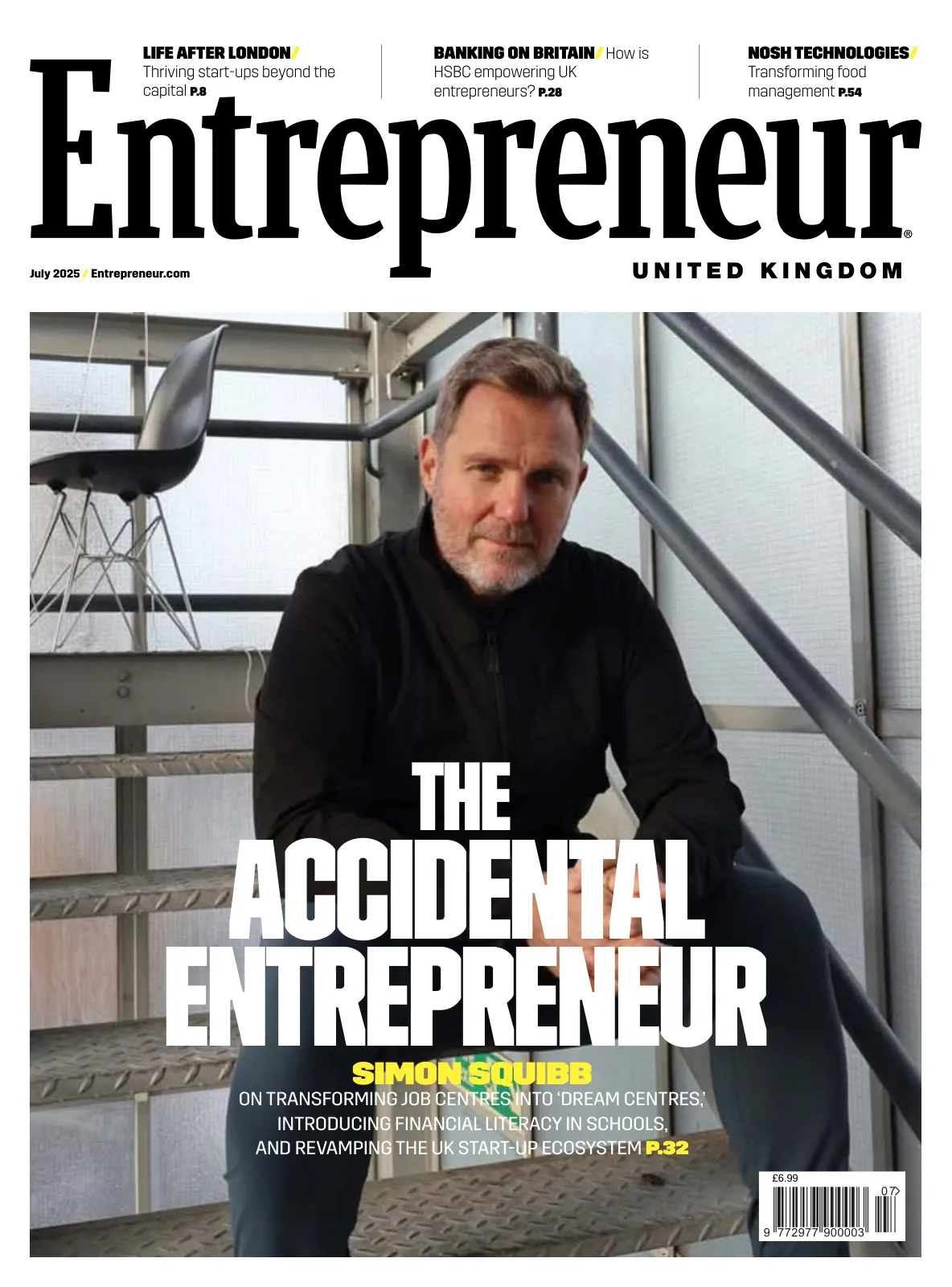
Entrepreneur UK, July 2025
Page 1
SIMON SQUIBB
ON TRANSFORMING JOB CENTRES INTO ‘DREAM CENTRES,’
INTRODUCING FINANCIAL LITERACY IN SCHOOLS,
AND REVAMPING THE UK START-UP ECOSYSTEM P.32
NOSH TECHNOLOGIES/
Transforming food
management P.54
LIFE AFTER LONDON/
Thriving start-ups beyond the
capital P.8
BANKING ON BRITAIN/ How is
HSBC empowering UK
entrepreneurs? P.28
July 2025 / Entrepreneur.com
ACCIDENTAL
ENTREPRENEUR
£6.99
THE
Page 2
BOLD
FOR THE
BOLD
UNITED KINGDOM
Page 3
Contents/July 2025
P.32
THE
ACCIDENTAL
ENTREPRENEUR
Simon Squibb wants to transform job centres
into ‘dream centres,’ boost financial literacy,
and revamp the UK start-up scene
FEATURES
3
July 2025 / ENTREPRENEUR.COM /
↓ Simon Squibb, founder
of HelpBnk, supporting
thousands of start-ups
Page 4
DOWNLOAD
YOUR DIGITAL
EDITION
HERE
UNITED KINGDOM
Out now in the UK
Page 5
5
July 2025 / ENTREPRENEUR.COM /
52 How to…
…make people actually listen when you
speak
54 Byte into Food Waste Tech
Using AI to cut UK food waste
56 Understand the Local Rhythm
The Emirati executive helping British
businesses crack the code
60 How Smart Start-ups Are
Winning in 2025
Focused on discipline over disruption
‘TREPONOMICS
IN THE LOOP
Contents/July 2025
20 After the Win Before the
Wave
InSilicoTrials wins at The AI Summit
London
24 Sharp Instincts in the Age
of AI
Entrepreneur James Caan reveals all
BUSINESS
UNUSUAL
STARTUP
SPOTLIGHT
38 Why Your SME Isn’t
Getting Funded, And How to
Fix It
Navigating tougher lending rules
in 2025
42 Pathos Communications:
Disruptive Influence
Challenging industry norms with
results-driven billing
44 Five Essential Skills For
Building AI-Ready Teams
Essential skills for future success
8 Life After London
Challenging assumptions about where
innovation thrives
14 “We’ve Got to Be Optimistic”
Karim Fatehi OBE, CEO of the London
Chamber of Commerce and Industry,
on business resilience and start-up
survival
FEATURES EDITOR Patricia Cullen
patricia.cullen@bncb2b.com
CEO Wissam Younane
wissam@bncpublishing.net
MANAGING DIRECTOR Rabih Najm
rabih@bncpublishing.net
ART DIRECTOR Simona El Khoury
EDITORIAL TEAM
Tamara Pupic,
Aalia Mehreen Ahmed
MEDIA SALES MANAGER
Olha Kovalova olha.kovalova@bncb2b.com
GENERAL MANAGER
Daniel Malins daniel@bncb2b.com
REGIONAL DIRECTOR
Andy B. andy@bncb2b.com
CONTRIBUTING WRITERS
Omar Hamdi, Kamales Lardi,
Callum Scott, Elliot Kay
SUBSCRIBE
Contact subscriptions@bncb2b.com to receive
Entrepreneur United Kingdom every issue.
COMMERCIAL ENQUIRIES
sales@bncb2b.com
WWW.ENTREPRENEUR.COM/EN-GB
Access fresh content daily on our website
All Rights Reserved 2025. Opinions expressed are solely those of the contributors.
Entrepreneur United Kingdom is officially licensed exclusively to BNC B2B In
United Kingdom by Entrepreneur Media Inc. No part of this magazine may be
reproduced or transmitted in any form or by any means without written permission
of the publisher. Images used in Entrepreneur United Kingdom are credited when
necessary. Attributed use of copyrighted images with permission. All images not
credited otherwise Shutterstock.
20 Wenlock Road, London, N1 7GU
entrepreneurMediaUK
entrepreneurUK
entrepreneurmedia-uk
entrepreneurmedia.uk
→ James Caan
CBE:
Championing
bold thinking in
a fast-moving
tech world
Page 6
6 / ENTREPRENEUR.COM / July 2025
Editor’s Note/
REAL GROWTH HAPPENS WHERE PEOPLE
COME TOGETHER - ONE DREAM AT A TIME
Entrepreneur United Kingdom
E
ntrepreneurship is often portrayed as a straight line
- start here, scale there, and success follows. But for
many, the journey is more like a labyrinth: winding,
unpredictable, and full of unexpected turns.
In this Entrepreneur UK July issue we catch up with
Karim Fatehi MBE, Chief Executive of the London
Chamber of Commerce, where he champions London’s
business community with cautious optimism. The capital
has long been the heartbeat of UK entrepreneurship,
drawing founders with its vibrant ecosystem and vast
opportunities. For many, London remains the centre of
gravity. Yet, as our feature Life After London reveals,
stepping outside the city also offers something incredibly
worthwhile.
Across the country, a growing number of entrepreneurs
are choosing to build their businesses beyond the capital.
These founders aren’t turning their backs on The Big
Smoke; rather, they’re seeking environments that offer a
different kind of opportunity - closer ties to community, a
clearer sense of purpose, and the freedom to innovate
without the constraints of urban congestion and cost. Their
stories remind us that entrepreneurial spirit thrives in many
places here in the UK, not just in a London postcode.
In another feature, James Caan CBE, entrepreneur and
investor, offers sharp insight into a vital element for today’s
founders: judgment. In an era dominated by artificial
intelligence (AI) and data, Caan argues that instinct and
experience remain irreplaceable. For all the hype around
technology, it’s the human ability to read a room, assess risk,
and make bold decisions that still gives leaders their edge.
Meanwhile, Tom Wood, Head of Business Banking at
HSBC, shares how his team supports the next generation of
UK entrepreneurs - not just by providing finance, but also
guidance. It’s a reminder that behind every ambitious
business is a network of support, often working quietly in
the background. This month’s cover feature spotlights
Simon Squibb, the founder and CEO of HelpBnk - a
platform designed to help people start and grow businesses
while being rewarded for supporting others. HelpBnk has
grown into a vital community for over 250,000 members,
and Squibb’s social media channels attract half a billion
views each month. He didn’t want to be an entrepreneur
- he had to be one. From his early days as a teenage gardener
to becoming a leader in community-driven start-up support,
his journey reflects how necessity can evolve into purpose.
Inside, we explore Squibb’s perspectives on disrupting
education, fostering growth, and making entrepreneurship
accessible to all. At the heart of his approach is a simple but
powerful question he asks: ‘What’s your dream, and how can
I help you turn that into a reality?’ Now, that’s what I call
dreamy.
In this July issue of Entrepreneur UK, we explore why so
many businesses struggle to secure funding - and share
practical ways to fix it. We also delve into the often
unspoken reality of loneliness in business and how
community can be a lifeline. Other features include
start-ups tackling food waste, and a deep dive into the art of
building trust before traction - a vital but often overlooked
step in early business growth. Finally, for those with global
ambition, we turn to an expert for clear-eyed advice on
expanding to the UAE.
Entrepreneurship isn’t about ticking boxes or following a
script. It’s about chasing your dream, finding your people,
and embracing every twist along the way. That kind of
journey changes everything.
Hope you enjoy the read!
Patricia Cullen
Features Editor, Entrepreneur United Kingdom
Page 7
EMPOWERING
THE VISIONARIES
OF THE
UNITED KINGDOM
UNITED KINGDOM
Page 8
8 / ENTREPRENEUR.COM / July 2025
Life After London
What’s driving founders to the regions? by PATRICIA CULLEN
S/Beyond
L
ondon is known as the epicentre of UK innovation - a
glittering magnet for entrepreneurs, investors and
talent alike. The city’s sprawling start-up ecosystem
pulses with opportunity: networking events, venture
capital firms, accelerators, and a dense community
of like-minded disruptors. But beneath the surface, a
quiet revolution is unfolding across the North, in cities like
Manchester, where founders are challenging the
assumption that success means being based in the
capital.
Page 9
9
July 2025 / ENTREPRENEUR.COM /
}}
T
he story of these
northern start-ups
is not one of
scarcity or
compromise, but
of strategic choice
and unexpected
advantages. For founders like
Harvey Lowe, co-founder of Arcube,
a travel sector start-up, and Jana
Stella, founder of NeuWave
Technologies - both residents of
Sister, Manchester’s £1.7bn
innovation district - the decision to
build outside London has been
liberating. Sister is fast becoming
one of the UK’s leading innovation
districts, providing a fertile
ecosystem for ambitious start-ups to
thrive beyond the capital.
Lowe explains: “For a lot of
companies, they are located in
London to be closer to other
start-ups, suppliers, clients, etc.
However, operating in London
comes with significantly higher
costs, which can be challenging for
start-ups - especially when a London
base isn’t essential. For us – operat-
ing in the travel sector - being
located in the capital isn’t critical for
reaching customers or prospects as
we often travel to international
events to meet airline companies.”
Manchester offers Arcube benefits
that might be overlooked by a
capital-centric mindset.
“We’re linked very closely with the
university, and are able to tap into
great graduate and higher education
talent pools, which would be harder
to connect to given the expanse of
the ecosystem in London,” Lowe
says. That local connection extends
to suppliers too. “We also see that a
surprising number of our suppliers
are actually based in Manchester,
Leeds and the general North. It’s
great to meet these people in-person
which wouldn’t happen if we were
down South.”
Stella echoes these advantages from
a highly specialised sector. “Our
sector requires a niche skillset (in
wave modelling and oceanography)
where the speciality really lies
outside of London. Being in
Manchester means we can tap into
our technical network easily. We’ve
also really benefitted from local
initiatives for office space and
funding.” Cost efficiency is another
critical factor: “It’s definitely helped
from a cost perspective. Building a
start-up already requires close
monitoring of expenditure, so the
“People assume being outside London means you
have less access to opportunity, capital, and talent.
The reality for us is that we’re less distracted by
the noise, and we can work with a leaner team
without compromising on quality”
→ Harvey
Lowe,
co-founder
of Arcube
funding outside of London stretches
much further.”
Both founders challenge the myth that
location limits access to capital and
opportunity. “People assume being
outside London means you have less
access to opportunity, capital, and
talent. The reality for us is that we’re
less distracted by the noise, and we can
work with a leaner team without
compromising on quality,” Lowe says.
Page 10
10 / ENTREPRENEUR.COM / July 2025
Stella adds, “It’s industry
dependent, but for us it
hasn’t been the case. Sure, a
lot of our investment is
London based, but it’s only a
train ride away. Our
customers are all over the
British coastlines.”
For Lowe, the quality of life
is tangible: “I only have a 25
minute ‘commute’ (walk) to
the office in the morning
given that the city is so
walkable!” Despite
occasional questions about
location - “People outside
the UK sometimes ask if
we’re based in London” - it’s
never really a concern. “We
are two hours away from
London if we have to be
there for a meeting or
event.”
Freedom from the London
bubble is the real prize.
“Building outside the capital
gives us more freedom.
We’re able to make decisions
without being caught up in
the noise or trends that
make up the London scene.
There’s less pressure to
follow what everyone else is
doing,” Lowe says. Minor
inconveniences like “slightly
longer travel times” don’t
slow progress. “We’ve got all
the access to capital, talent,
and opportunity we need.
The trade-off is worth it and
we aren’t looking back.”
Alongside the technical and
operational advantages
championed by Lowe and
Stella, Rachel Morgan-Trim-
mer, founder of Firebird - a
Manchester-based neurodi-
vergent consultancy - high-
lights a more intangible but
equally crucial benefit:
community. “People always
say the North is friendlier
but it really makes an
impact when it comes to
networking, helping other
people out, etc.” For
Morgan-Trimmer, this
warmth isn’t just anecdotal;
it’s an essential pillar for
building a business rooted
in inclusivity and connec-
tion. As a neurodivergent
entrepreneur, she also
appreciates practical
lifestyle differences.
“Travelling about is a bit
easier, partly because it’s less
crowded and city centres are
more concentrated.”
Morgan-Trimmer challenges
BUILDING OUTSIDE THE CAPITAL GIVES US MORE FREEDOM. WE’RE ABLE
TO MAKE DECISIONS WITHOUT BEING CAUGHT UP IN THE NOISE OR TRENDS
THAT MAKE UP THE LONDON SCENE. THERE’S LESS PRESSURE TO FOLLOW
WHAT EVERYONE ELSE IS DOING”
S/Beyond
→ Jana
Stella,
founder of
NeuWave
Technologies
Page 11
11
July 2025 / ENTREPRENEUR.COM /
another pervasive myth
about location and
opportunity. “They think
you ‘have’ to be in London
to get anywhere or do
anything. I actually do a lot
of work in London and it
doesn’t make a difference to
them (or my other clients)
where I’m based. I can do
Manchester to London and
back in a day. I don’t think
there are fewer opportuni-
ties in the North than there
are in London.” On the
question of feeling
underestimated because of
her location, Morgan-Trim-
mer is unequivocal. “No. In
this day and age, I find that
people don’t really care
where you’re based. In fact,
many of my clients don’t
even know until I mention
it!” The freedom this found-
er finds outside London is
both professional and
personal. “I love London,
don’t get me wrong, but
having grown up down
south, I definitely prefer
living and working in
Manchester. I find the
culture here to be friendly,
supportive and a bit more
direct – which obviously is
perfect for a neurodivergent
entrepreneur!”
The new geography of
opportunity
What unites these founders
is a shared rejection of
London as a prerequisite
for innovation. Instead,
they embrace the strategic
advantages of their
location, supported by
strong local ecosystems,
universities, funding
initiatives, and a cultural
vibrancy that’s often
missing from capital life.
Manchester’s Sister
innovation district, backed
by a £1.7bn investment,
exemplifies the regional
drive to build world-class
environments that nurture
start-ups without the
London price tag. It’s a
place where businesses can
tap into highly skilled
talent, access cutting-edge
research, and connect with
suppliers and partners - all
while enjoying a quality of
life that fosters focus and
creativity.
This shift is also supported
by the reality of modern
connectivity. The ability to
travel to London in a matter
of hours, combined with
digital tools that facilitate
remote working and global
outreach, means start-ups
no longer need to choose
between presence and
opportunity.
London remains a
powerhouse - a city of
ideas, capital and un-
matched density - but it’s
no longer the only game in
town. For founders like
Lowe, Stella and Morgan-
Trimmer, Manchester offers
something different: space
to think, room to grow, and
a community that prizes
collaboration over
competition. The shift isn’t
about turning away from
the capital, but expanding
the idea of where
innovation can thrive. As
start-ups flourish beyond
the old postcode boundar-
ies, one thing is becoming
clear: the future of UK
entrepreneurship is not
about choosing between
London and elsewhere -
it’s about making both
work, on your own terms.
While some London
insiders may still view the
capital as the only place for
innovation, the stories of
Lowe, Stella, and
Morgan-Trimmer
highlight a broader truth:
success is no longer about
geography alone, but
about mindset, commu-
nity, and strategic choice.
“Our results speak louder
than our location,” Lowe
adds.
“They think you ‘have’ to be in
London to get anywhere or do
anything. I actualy do a lot of
work in London and it doesn’t
make a difference to them (or my
other clients) where I’m based
→ Rachel
Morgan-Trimmer,
founder of Firebird
”
Page 12
12 / ENTREPRENEUR.COM / July 2025
The power of focus
Rather than spreading thin, Greyparrot doubled down on a
single sector and on one type of technology. “A big early bet
was our approach to hardware. While we do deploy
hardware to gather data, we made a conscious decision not
to build robotic arms or complex recycling plant machinery
ourselves.” Their team built software that works with
existing hardware in recycling plants - from Bollegraaf to
Van Dyk - enabling rapid scale without reinventing
industrial infrastructure. “That choice set us apart. It
allowed us to scale faster, stay agile, and focus on what we
do best: building industry-leading AI models, data
infrastructure, and integrations that work across any plant
setup. We recognised early on that access to large-scale,
high-quality data would be one of the most valuable assets
we could build - and that’s become a core strength.”
Building with partners
Greyparrot’s growth model rests on collaboration. By
partnering with established players the company expanded
from day one - globally. “Greyparrot is an AI and data
software specialist, and we partner with the best in the
business when it comes to plant builders, robotics, and
system integration.” These alliances were strategic
turbochargers. Together with Bollegraaf and Van Dyk,
Greyparrot deployed its systems across 20 countries,
analysing tens of billions of waste objects annually. “Today,
we’re proud to be a global clean tech leader.”
Reframing waste as gold
The world’s fastest-growing consumer goods sector was
generating almost no intelligence, and Druckman turned
that ignorance into opportunity with hard metrics: “In one
Waste Not, Want Tech
I
n the tech world, ‘waste’ rarely makes
the shortlist of blue-chip market
opportunities. But for Mikela Druckman,
co-founder and CEO of Greyparrot, a
clean-tech company using artificial
intelligence (AI) to revolutionise waste
sorting and recycling, the status quo
was a glaring omission. “Depth over
breadth has been hugely important for us.
From day one, we made a deliberate
decision to focus on the waste industry
- an under-digitised sector with massive
environmental and economic impact.” The
bet on waste paid off - and fast. By
focusing tightly on what she calls “deep
domain expertise in waste analytics,”
Greyparrot turned ignorance into insight
and insight into impact.
B/Cleantech
How Greyparrot built a global AI powerhouse in under five years
by ENTREPRENEUR UK STAFF
↑ Mikela Druckman, CEO and co-founder of Greyparrot
Page 13
13
July 2025 / ENTREPRENEUR.COM /
instance, a single
contamination alert from
our system saved a
European facility £47,000
in reprocessing costs and
fines. In another, our AI
identified an aluminium
sorting issue in minutes -
saving £48,000 on a
single batch of material.”
Those case studies became
proof. And with packaging
under regulatory pressure,
Greyparrot’s ability to
trace material flow
upstream - into
manufacturing - unlocked
a new narrative: “We’re
helping brands
understand the
downstream consequences
of their packaging design
decisions… Insights don’t
just enhance recycling -
they directly inform
packaging design, support
regulatory compliance,
and accelerate progress
toward circularity goals.”
Greyparrot’s Deepnest
platform takes consumer
goods companies into
live-feedback mode.
Instead of theoretical
recyclability, they can now
see what happens to
packaging post-
consumption - data that
could prompt rapid design
shifts.
Eyes wide open
When AI meets real-world
complexity, blind spots
reveal themselves.
Greyparrot found wasted
money hiding in
unexpected places: “I was
surprised by the scale of
invisible inefficiencies…
Over the last year alone,
our systems detected and
categorised over 40bn
waste objects into 111
categories, revealing
massive shifts in
quality and
contamination over
the course of a
single day.” Packing
shrink sleeves and
resistant materials
like Tetra Pak -
designed without
recycling in mind -
became tangible
examples of
downstream effects.
“Take Lucozade
bottles - their full
plastic shrink sleeve
meant that they
weren’t being
recognised by
recycling machinery, so
they spent £6m to
redesign more sustainable
products.” With real-time
data, companies can
emerge with 10–20%
recovery gains in a single
shift.
Opportunities in the $3tn
waste sector
Waste’s disruptability is
debated, but Druckman
points to three major
shifts driving this
opportunity:
1/ Smarter hardware
integration, with AI
embedded into the sorting
process.
2/ AI retrofits for legacy
plants, offering high ROI
without new
infrastructure.
3/ Emerging data-driven
compliance, led through
platforms like Deepnest -
connecting material flow
to brand decisions.
“Analysing 15 tonnes of
waste typically takes a
trained staff member
around 375 hours. With
AI, it takes six.” For
entrepreneurs, this
suggests embedding your
tech, retrofitting old
systems, or influencing
upstream incentives -
while leaving physical
assets in place.
The reality check
Greyparrot’s success isn’t a
fairy tale. The company
has survived pandemics,
downturns, and hyper-
cautious fundraising
environments. “One of the
biggest lessons that’s
shaped how we’ve built
Greyparrot is the
importance of resilience
- not just in the
technology, but in the
business itself.” Steady
growth and autonomy in
her team proved that
momentum didn’t rely on
a singular figure. “During
my second maternity
leave, the team not only
kept things running - they
delivered growth in both
headcount and revenue.”
That’s not just good
leadership; it’s a replicable
organisational structure
fit for start-ups scaling
globally.
A circular future fueled by
AI
Looking ahead, Druckman
sees AI as the operating
system for recycling
plants, but the bigger play
lies elsewhere: “AI is
laying the foundation for
circular decision-making.
Data from waste is now
flowing upstream to
inform how products are
designed, tested, and
improved - closing the
loop between packaging
innovation and
recyclability.” Plants are
just the beginning. The
next layer is connecting
recycling feedback to
packaging, design, and
supply chains.
“Entrepreneurs will play a
huge role in scaling this
transformation, and that’s
what we’re doing with
Deepnest.” By rethinking
rubbish, Greyparrot shows
how innovation can
recycle old problems into
new possibilities - a truly
circular success story.
↑ Deepnest platform in packaging R&D lab
Page 14
14 / ENTREPRENEUR.COM / July 2025
S/Resilience
“We’ve Got To Be Optimistic”
The London Chamber of Commerce Chief on business resilience, start-ups and surviving the
storm by PATRICIA CULLEN
I
n the UK capital, somewhere off the corridors of power, Karim Fatehi OBE,
CEO of the London Chamber of Commerce and Industry, is doing what he
does best: advocating for business while carefully navigating the
crosswinds of policy, politics and persistent economic unease.
Caution may underpin the Chamber’s latest message, but it is matched by
a quiet sense of determination. Representing a network of approximately
10,000 businesses — from fledgling start-ups to heavyweight corporates - the
organisation occupies a unique position in the economic landscape. For Fatehi,
the challenges ahead are undeniable. But so too, he insists, are the grounds for
hope.
“We’ve seen through the COVID-19
pandemic and Brexit, and we are
currently navigating the recent
economic shocks,” he says. “London
has always been, and continues to be,
a major global city when it comes to
showcasing resilience.” Yet resilience,
he suggests, is under siege. “Busi-
nesses are feeling the strain — caught
between global economic headwinds
and the ripple effects of domestic
policy, including hikes in national
insurance and tighter employment
regulations. The hospitality sector, for
example, is having to make some
tough decisions on pay, potential
redundancies and the viability of oper-
ating in the long term”
This is not just an impressionistic
concern. “We’ve done a survey with
our members,” he says. “85% of the
businesses are not expecting economic
growth during the current parlia-
ment.” It’s a damning figure. There is,
Fatehi insists, no single silver bullet -
but there are some obvious fixes.
What’s missing, he argues, is sustained
support for growth. “We also need to
ease the tax burden on businesses -
from national insurance to business
rates and beyond.” Despite the
frustrations, the CEO insists the
Chamber remains hopeful - and that
its network plays a critical role in
keeping the ecosystem alive. “Natu-
rally, the Chamber informs and
advocates for SMEs… we’ve got to be
optimistic.”
The organisation takes a broad yet
practical approach, balancing
strategic vision with on-the-ground
support. “Our extensive network
allows us to act in our members’ best
interests and engage directly with
decision-makers.” he says. The
Chamber’s events - including a recent
breakfast roundtable featuring Lord
Johnson, Deputy Chair of the
BUSINESSES ARE FEELING THE STRAIN - CAUGHT BETWEEN
GLOBAL ECONOMIC HEADWINDS AND THE RIPPLE EFFECTS OF
DOMESTIC POLICY, INCLUDING HIKES IN NATIONAL INSURANCE
AND TIGHTER EMPLOYMENT REGULATIONS.
Page 15
15
July 2025 / ENTREPRENEUR.COM /
}}
→ Karim Fatehi OBE,
CEO of the London
Chamber of
Commerce and
Industry, leading
London’s business
community forward
Conservative Party and Andrew Bailey, Governor of the Bank of
England, amongst others - are one way they help businesses
speak directly to policymakers. The focus? “How can the
business effectively manage these additional costs without
hindering the growth?”
Pressed on what businesses are looking for, Fatehi is clear:
“What businesses want is prosperity,” he said. “They’re looking
for an environment that allows them to engage with their
European counterparts with minimal friction - free from
What businesses want is prosperity. They’re
looking for an environment that alows them
to engage with their European counterparts
with minimal friction - free from unnecessary
barriers, so they can grow and thrive.
“
”
Page 16
16 / ENTREPRENEUR.COM / July 2025
unnecessary barriers, so they can grow and thrive.”
His advice to founders navigating trade volatility and
rising costs is clear-eyed and pragmatic. “We’ve seen
the tariffs, which is 10% for all UK exporters…but it
wasn’t 25% like other tariffs.” That thread of
optimism runs through, even as global trade rules
grow ever more uncertain. What drives the Cham-
ber’s forward-looking outlook, he explains, is
London’s enduring role in the global order.
“We are in a very unique position… London
remains the global hub for international trade and a
magnet for businesses worldwide. We need to retain
our position.”
Just this week, Fatehi points out, momentum was
building: “We had the opportunity to see the FTA
between India and the United Kingdom has come to
reality. Also, the U.S. and there are other FTAs on
the horizon.” As he sees it, the task is clear: to help
businesses capitalise on those opportunities.
“It’s crucial for London’s business communities to
seize the opportunity, explore new markets, and
unlock their potential,” he said. “We must identify
the best path forward.”
There’s a realism to his tone, but it is balanced by a
quiet pride in what London’s business community
has achieved. “We must be resilient, we must remain
optimistic, and we must be ready for the challenges
ahead,” he said. “The UK remains steadfast in its
commitment to business, demonstrating unwavering
resilience and adaptability.”
“We must be resilient, we
must remain optimistic,
and we must be ready for
the chalenges ahead. The
UK remains steadfast in its
commitment to business,
demonstrating unwavering
resilience and adaptability”
S/ Resilience
Page 17
The voice of
entrepreneurship
around the world
Access fresh content daily on our website
Page 18
18 / ENTREPRENEUR.COM / July 2025
S
Opportunity
New wave of Tech IPOs should
find their home in London,
says Head of Tech Sector at the London Stock Exchange
by OMAR HAMDI
/
N
vidia had $29m of revenue at IPO, and
Amazon had revenues of $16m at the
time they went public. London has all
the potential to provide companies
with this growth opportunity” says Neil
Shah, Head of Tech Primary Markets at
the London Stock Exchange.
D
espite comprising only 1.4% of
the 503 companies in the S&P
500 index of the largest US-
listed businesses, the ‘Magnifi-
cent 7’ (Apple, Microsoft, Amazon, Nvidia,
Alphabet, Meta, and Tesla) were respon-
sible for over 50% of the index’s total gains
- and over 75% of its earnings growth - in
2024.
“
→ Neil Shah, Head of
Tech Primary Markets
at the London Stock
Exchange
Page 19
19
July 2025 / ENTREPRENEUR.COM /
It’s sometimes hard to believe how
small some of those companies
were when they first went public,
especially when high profile US
IPOs are now reserved for compa-
nies with revenues in the billions,
not millions. “When I started out in
investment banking at Thomas
Weisel Partners in 2009,” continues
Shah, “there were software
companies going public in the US
with about $40 million in revenue.
It is a very different picture today,
that would just be impossible. It
would probably still be impossible
at $400m in revenue. $400m of
revenue a quarter, maybe, but not
annually.”
But it is still possible in London.
This may come as a surprise to the
average Brit who may only come
across the London Stock Exchange
in the evening news summary of
the FTSE 100 with its big banks,
big pharma and miners. The
London Stock Exchange team gets
as excited about early stage growth
companies as they do about
unicorns. Most stock exchanges
have left the messy business of
young, growing scale ups to VCs or
Private Equity. Not so in London.
“AIM turns 30 this year. It is the
world’s most successful growth
market and is run by the London
Stock Exchange. Nominated
advisers closely support companies
not only through the IPO process,
but thereafter. And some of the
work required by a company to go
public could potentially be done at
a tenth of the cost of a US listing.”
“When companies choose to list in
London, they can benefit from a
full-time fundraising team in the
form of the house broker retained
by the company, meaning there is
less of a burden on a company
founder. And as public companies,
they can also attract and incentivise
talent in a liquid, transparent way
that private companies cannot.”
Shah also believes that (along with
a range of high-quality small cap
funds and investors) Venture
Capital Trusts, or VCTs - a unique
British invention that combines
the best of a Silicon Valley VC and
a traditional small cap fund -
offer an attractive alternative to
more fashionable venture funding
sources.
The traditional venture capital
model has fueled household name
successes like Uber, Facebook and
Zoom. But it has also given the
world high profile failures like
WeWork, Theranos and
23andMe. London’s approach,
where sensible valuations,
supportive institutional investors
and quality growth companies
mingle, could be having its
moment.
AIM has supported some
fantastic founder-led companies
such as Craneware which went
public with $15m of revenue in
2007 ($200m today) and
Cerillion, which went public in
2016 with £14m of revenue and a
£22m market cap. Today, it’s
worth over £450m.
Nvidia founder Jensen Huang
took to the stage at London Tech
Week in mid June, saying “The
UK has one of the richest AI
communities anywhere on the
planet... and the third largest AI
capital investment of anywhere in
the world.”If Huang or Bezos
were taking Nvidia or Amazon
public today, they may be looking
to the City, not Wall Street, for
support. “British investors are
really well-travelled. More than a
third of our [London-listed]
companies are international,” says
Shah. “It doesn’t matter where
you’re from, you can be successful
here.”
Omar Hamdi is the
founder of Pathos
Communications
AIM TURNS 30
THIS YEAR. IT IS
THE WORLD’S
MOST SUCCESSFUL
GROWTH
MARKET AND
IS RUN BY THE
LONDON STOCK
EXCHANGE…AND
SOME OF THE
WORK REQUIRED
BY A COMPANY TO
GO PUBLIC COULD
POTENTIALLY BE
DONE AT A TENTH
OF THE COST OF A
US LISTING”
“
Page 20
20 / ENTREPRENEUR.COM / July 2025
W
hen Luca Emili stepped off the stage at The AI
Summit London, clutching the event’s top
innovation prize, it wasn’t just a moment of
recognition - it was a quiet inflection point. For
InSilicoTrials Technologies, the win marked more
than validation; it signalled a shift in how the future
of drug development might be written - not in wet
labs or waiting rooms, but in algorithms,
simulations, and code. “Winning The AI Summit London Package
was a meaningful milestone for us. It confirmed the strength of
the technology we have developed and validated the mission
we are committed to.”
After the Win,
Before the Wave
B/Victory
Fresh off their The AI Summit London win, InSilicoTrials is
turning regulatory-grade AI into the backbone of next-
gen drug development. by ENTREPRENEUR UK STAFF
That mission? To embed safe,
scalable, and regulatory-ready AI into
the heart of clinical trials. Not as an
optional extra, not in a decade’s time
- but now. “Our goal is to bring safe,
scalable, and regulatory-ready AI into
the core of drug development. The
exposure we gained through this
recognition is already opening new
doors.” InSilicoTrials has been
developing regulatory-grade
simulation platforms - once
considered bleeding-edge science
fiction - into practical tools now used
by pharma leaders and regulators.
But Emili is quick to point out: this
isn’t about chasing trends. It’s about
being ahead of them.
“This recognition also arrived at a
very timely moment. The FDA
recently launched Elsa, their first
agency-wide AI platform. It is a
strong signal that computational
methods and artificial intelligence
are now central to regulatory science.”
Where others are racing to adapt to
Elsa, Emili’s clients have already been
using similar tools. “While many in
the industry are just starting to react
to this development, our clients have
been preparing for it for years. They
have used our platform to build
submissions that are already aligned
with what regulators like the FDA are
starting to expect.”
In other words, InSilicoTrials didn’t
pivot to AI and regulation - they built
for it from day one. “They are
generating transparent, validated,
and machine-readable outputs that
speak the same computational
language as these new AI-enabled
review systems.” The message is clear:
the future isn’t catching up to
InSilicoTrials. InSilicoTrials is
helping shape it. “For us, winning this
package was more than an award. It
was a signal that the work we have
been doing is now fully aligned with
where the future of drug development
is headed. We are not adjusting to
this shift. We have helped lead it.”
And the momentum is building.
“Now, with greater visibility and
momentum, we are ready to
accelerate our impact even further.”
→ Luca Emili, CEO,
InSilicoTrials
Technologies
Page 21
21
July 2025 / ENTREPRENEUR.COM /
The AI Summit London
wasn’t just a trophy
moment. It was a rare,
public-facing moment of
proof - an opportunity to
demystify a deeply
technical domain in front
of investors, innovators,
and the broader AI
community. “Presenting
our technology at The AI
Summit London gave us
an exceptional opportunity
to engage with a wide
range of stakeholders.
These included investors
who understand the
long-term vision required
in deep tech and AI
innovators looking for
practical impact. It also
gave us a chance to
demonstrate that
regulatory-grade
simulation is no longer a
concept for the future. It is
already operational, and it
is actively influencing how
clinical trials are being
designed and optimised
today.”
But behind the technical
elegance of Emili’s
platform is a hard-earned
lesson about building in
one of the world’s most
regulated - and risk-
averse- sectors.“One of the
most difficult aspects has
been managing the
balance between rapid
innovation and the
cautious pace of regulatory
acceptance. In healthcare,
especially when working
with something as novel as
AI-driven simulation,
speed alone is not enough.”
Instead, Emili has focused
on building trust through
credibility and
transparency - both in the
product and the ecosystem
surrounding it. “This is
precisely why I chose to
launch and then co-edit
Toward Good Simulation
Practice, an open-access
book published by
Springer Nature that since
March 2024 has been
distributed in more than
44,000 copies. This
project was the result of a
global collaboration that
included experts from the
FDA, the Avicenna
Alliance, and the VPH
Institute. It establishes
clear best practices for
how modeling and
simulation should be used
in regulatory decision-
making.” This dual
mission - building the
tools and the standards
that validate them - sets
InSilicoTrials apart.
Emili’s vision is not just to
innovate within the
system, but to help mature
it. “Our goal was not only
to innovate but also to
actively contribute to the
creation of the standards
that will help this
innovation mature and
gain widespread
acceptance.”
And how did they find
product-market fit in such
a complex space? Not by
guessing, but by building
alongside the people who
would use the tools. “We
reached product-market
fit by staying very close to
the needs of those who
would eventually use our
platform. Rather than
developing in isolation, we
collaborated from the
beginning with
researchers, clinicians,
and regulatory teams. We
focused on building
technology that integrates
easily into existing
workflows and enhances
decision-making without
disrupting what is already
in place.”
For other founders
entering the tricky terrain
of health tech and AI,
Emili offers a sober but
inspiring roadmap. “The
most important advice I
can give is to focus on
building trust. In health
tech, having a powerful
algorithm or a
sophisticated platform is
only part of the equation.
You need to make your
work explainable and
verifiable. It is also critical
to build a team that
understands both the
science and the healthcare
system. This is a
multidisciplinary industry
that demands depth in
many areas.”
And perhaps most
importantly, grit. “Be
ready to commit for the
long term. The path is
complex, but the potential
to create meaningful
change in patient
outcomes and healthcare
efficiency makes the effort
more than worthwhile.” In
a world chasing AI hype
cycles, Emili and
InSilicoTrials stand as
something different: a
company that’s not just
riding the wave, but laying
the tracks beneath it.
↑ InSilicoTrials Dashboard
Page 22
From Pitch to Pit
From Welsh football to American wrestling, Rob Edwards is
building community-first sports ventures that defy convention -
and geography. by ENTREPRENEUR UK STAFF
W
hen Rob Edwards took over a struggling Welsh football club
during COVID-19, many would have questioned the timing
- let alone the location. Six hours away, with no prior
experience in football management, Edwards was flying
blind. Yet five years on, Haverfordwest County AFC has not
only qualified for European competition twice but also built
one of the strongest youth programmes in the country.
Now, the founder of Morley Sports Management is turning his attention across the
Atlantic to breathe new life into Ohio Valley Wrestling, a cult US promotion once
home to the likes of John Cena, a 17-time WWE world champion wrestler and Brock
Lesnar, an American professional wrestler. His mission? To rewrite the rules of
modern sports ownership through community values, clear vision, and relentless
momentum. His biggest challenge?
22 / ENTREPRENEUR.COM / July 2025
B/Revival
“Taking over a football club during a
global pandemic. I live six hours
away. I couldn’t get there, and I’d
never had any experience of running
a football club…. but I knew
instinctively it had potential,”
Edwards recalls. “I knew I was never
going to relocate, so from day one I
had to invest in people. If people
don’t buy into the values, they don’t
stick around very long. But if they
do, you can build something with a
clear vision.”
Building that team has been
central to Edwards’ approach.
“We’ve built the best off-field team I
could have hoped for – people who
are passionate and dedicated and
who’ve completely bought into our
dream. It’s the same now with OVW
in Kentucky. It’s a long way away
again, a lot of passionate people,
but it lacked clear direction. The job
is to empower people, put them in
→ Rob Edwards,
founder of Morley
Sports, owns a
Welsh football club
and a US wrestling
brand
Page 23
23
July 2025 / ENTREPRENEUR.COM /
the opportunity to step in and try to
build something different from the
ground up.”
The same entrepreneurial mindset is
driving Edwards’ latest venture with
OVW. “Because of our experience with
Haverfordwest County AFC in Wales,
we saw a similar opportunity with OVW
in Kentucky. It’s an under-appreciated
asset in the industry in modern times,
but there’s massive potential.”
His advice to aspiring founders?
“Have self-confidence and be open-
minded. When I took over the football
club, I had no background in it, but I
trusted my instincts. I used experience,
common sense, and values that
mattered to me. That’s been the
foundation. We’re trying to build
businesses founded on community
and social impact. With those
fundamentals in place, commercial
success will come. You’ve got to
believe in what you stand for. If you
stay true to your values inside and
outside of business, you can build
something meaningful.”
For Edwards, motivation comes from
the thrill of constant innovation. “I
need stimulation. I’ve never been able
to sit still. I wake up when the sun
comes up and my brain kicks in – I’m
raring to go. I’m impulsive. If I get an
idea in my head, I’m all in. What keeps
the right places, and give them credit
for what they achieve.”
Edwards’ entrepreneurial journey is
marked by pragmatism and steadiness
in the face of challenges. When
setbacks come, he keeps a steady
head. “You need to stay calm and
logical. Not everything goes your way
– and when it doesn’t, the worst thing
you can do is get flustered. I tend not
to get too up or too down. I’ve always
kept that middle ground. If you walked
past me after a major success or a big
loss, you probably wouldn’t notice a
difference. That’s always been my
demeanour.”
Financial backing came largely from
Edwards’ prior career in finance.
“There’s been minimal outside
investment. Most came off the back of
my previous business and my career in
finance. The barrier to entry for Welsh
football isn’t huge, it’s very accessible
– financially and structurally. It gave us
me going is being disruptive, pushing
things forward, coming up with new
ideas and concepts. With both the
football club and OVW, we’re
constantly evolving – and on top of that
we’ve got consultancy work and
partnerships with sporting brands. That
forward momentum is what wakes me
up in the morning. There’s always a
new problem to solve.”
Ultimately, Edwards believes success
hinges on leadership and trust. “Be
confident in your ability – if you’re
leading a business and people don’t
buy into you, it won’t work. People buy
in to people. Investment in people is
100% at the heart of our model. We’re
not always on the ground, so we need
to trust the teams to run with the
vision. But we also lead from the front
– if you want people to dive into the
trenches, you need to be the one
starting the charge. I’m quite
demanding, but only because I hold
myself to that same standard.”
Edwards is a rare breed of
entrepreneur – one who builds across
continents and cultures, grounded in
community values and driven by
relentless momentum. Whether in
Wales or Kentucky, his unconventional
playbook is quietly reshaping what
modern sports ownership can look
like.
You need to stay
calm and logical.
Not everything goes
your way – and
when it doesn’t, the
worst thing you can
do is get flustered.
I tend not to get too
up or too down. I’ve
always kept that
middle ground”
“
Page 24
A
I is no longer the future. It’s the baseline. But while tech
entrepreneurs pivot, scale and scramble for relevance, James
Caan CBE remains focused on something more enduring:
judgement. “The edge that can’t be replicated is judgement -
specifically, commercial instinct based on lived experience,”
he says. “AI can process a million data points, but it still can’t
weigh reputational risk, read a room in a board pitch, or decide
whether a client is bluffing in a negotiation.” It’s the kind of thing you
expect from someone who’s spent decades navigating the peaks
and pitfalls of business - not from a spreadsheet, but from the seat
at the table. And while generative AI and predictive intelligence
dominate headlines, Caan is more interested in how technology
rewires the foundations of business strategy - not just its surface.
→ James Caan
CBE:
Championing
bold thinking in
a fast-moving
tech world
AI isn’t a tool. It’s a test.
“The blind spot is failing to
integrate AI at the strategic level,
not just operationally,” Caan,
British entrepreneur and former
investor on the BBC show
Dragon’s Den, warns. “Too many
founders treat AI as a bolt-on -
automating emails or improving
customer service - instead of
rethinking how AI could
fundamentally reshape their
business model.” The shift is
already happening. “If you’re not
embedding AI into your product
development, commercial
strategy, or market positioning,
you’re behind the curve.” And the
answer? Not just hiring a head of
data science - but raising the bar
on fluency at the top. “Build AI
fluency in your leadership team.
Not everyone needs to code, but
everyone needs to understand
where AI creates value. Create a
roadmap for where automation
or predictive intelligence can
streamline costs or open new
markets. Waiting for a ‘perfect
use case’ is a delay you can’t
afford.”
Conviction beats perfection
So what separates the entrepre-
neurs who adapt from those who
lead? It’s not charm. Or vision.
Or even ingenuity, he argues. It’s
belief. “It’s not charisma or
creativity - it’s strategic convic-
tion,” Caan says. “The ability to
make bold decisions early,
without waiting for perfect
evidence.” And in a world where
certainty is a myth, those who
hesitate fall behind.
“In 2025, with markets moving
fast and signals constantly
shifting, leaders who wait to be
Sharp Instincts
in the Age of AI
Entrepreneur James Caan on judgement, leadership —
and why UK start-ups need more than hype to survive.
by PATRICIA CULLEN
24 / ENTREPRENEUR.COM / July 2025
Page 25
25
July 2025 / ENTREPRENEUR.COM /
Page 26
26 / ENTREPRENEUR.COM / July 2025
100% sure are already too
late.” He cites Deloitte’s
Human Capital Trends:
“Leaders who demonstrate
high decisiveness outper-
form their peers in
innovation-led growth by
34%. That’s a meaningful
margin - and it’s not about
being reckless, but about
being resolute.”
Still, no one does it alone
Caan isn’t pretending
vision alone builds
companies. His obsession
- one he returns to
frequently - is team
building. “Your business is
like a ship embarking on a
journey. Your team
members are your crew. If
they work well together,
know their roles, and
communicate effectively,
they can navigate through
rough seas and reach your
destination.” And the
opposite? “If they’re not
aligned, the ship can easily
veer off course or, worse,
sink.”
That means clarity from
day one. “Ensuring
everyone is pulling in the
same direction is crucial.
In a start-up, you need
everyone aligned with the
company’s vision and goals.
This alignment means that
every decision, every action
taken by the team,
contributes to the larger
objective.” The best
founders, he says, invest in
people as much as
products. “It’s not just
about finding people with
the right skills – they need
to fit in with your com-
pany’s culture too. When
everyone gets along and
shares the same values,
teamwork happens
naturally.”
And, crucially, they make
growth part of the job.
“Always encourage your
team to keep learning and
growing. This shows you
care about their future and
helps them improve their
skills. When people feel
valued and see that you’re
investing in them, they’re
more motivated and loyal.”
Start-ups need capital –
and courage
For all the talk of grit and
instinct, Caan’s focus
eventually returns to what
many UK founders quietly
admit: funding here is
harder. And for scale-ups?
Brutal. “If I could push one
policy lever, it would be
this: double down on
early-stage capital
incentives, especially
through scale-ups,” he says.
“The UK has great
seed-stage support, but we
lose too many high-poten-
tial businesses between
Series A and Series C.”
It’s a familiar point - but
Caan wants sharper action:
“We should look at enhanc-
ing the EIS cap from £1m
to £3m per investor,
extend reliefs to profes-
sional investors, and allow
UK pension funds to direct
a larger portion into
early-stage innovation
- similar to recent reforms
in Australia and Canada.”
The stakes are high.
“Start-ups are already
contributing significantly:
in 2025, UK start-ups are
responsible for 17% of net
new private-sector jobs,
but many are constrained
by capital drag. Smart
policy now would com-
pound long-term returns
↑ According to Cann, a
business draws strength from a
team that moves cohesively
Page 27
27
July 2025 / ENTREPRENEUR.COM /
for the economy - not
just founders.”
Big ideas, small circles
He namechecks
Revolut and BrewDog
as examples of
start-ups who
understood that
culture and autonomy
weren’t extras - they
were engines. “Revolut
placed a strong
emphasis on building
a team that was agile
and innovative,” he
says. “They created
cross-functional teams
that could work
independently on
different projects,
promoting a culture of
autonomy and
accountability.”
Of BrewDog:
“BrewDog’s founders
built a team that
shared their passion
for beer and innova-
tion. They introduced
the ‘Equity for Punks’
programme, which
turned their custom-
ers and employees
into shareholders,
creating a deep sense
of ownership and
loyalty.” Caan’s recipe
for success is
disarmingly simple:
hire for culture, invest
in growth, make space
for ideas - then get out
of the way. “True
innovators don’t
hedge every move.
They make the call,
commit resources, and
create alignment. In
uncertain times, the
decisive get momen-
tum — and momen-
tum beats perfection
every time.”
For all the talk of AI
and capital strategy,
what Caan returns to
- again and again - is
something curiously
human: clarity. In a
world where every-
one’s shouting, it’s
hard to hear what
matters - and clarity of
thought, values, and
action becomes not
just useful, but rare.
And rare things, in
business as in life,
hold value. AI will
keep accelerating,
changing how
companies are built
and scaled. But Caan
sees it less as a silver
bullet, more as a
mirror. It reveals
what’s already strong,
and exposes what’s
weak. In companies
where purpose is
vague or leadership
brittle, automation
won’t save them. In
those with vision,
cohesion and courage,
it becomes a force
multiplier.
Yet what lingers
from a conversation
with Caan isn’t just
strategy or systems.
It’s a kind of seasoned
calm. He’s not seduced
by the flash of
innovation for its own
sake. He’s seen too
many cycles, watched
too many “next big
things” become
footnotes. What lasts,
in his world, is
consistency: founders
who know what they
stand for, teams who
trust each other,
companies built with
longevity in mind.
That’s why his call for
a smarter funding
policy isn’t just about
unlocking cash - it’s
about protecting
momentum. The UK
has no shortage of
ideas or talent. What
it sometimes lacks is
the long-range
thinking to let those
ideas breathe. Scaling,
after all, isn’t just a
phase - it’s a leap. One
that needs more than
seed capital and
slogans.
Still, for all his
credentials, Caan is
not nostalgic. He
speaks the language of
today’s founders
fluently: digital-na-
tive, growth-minded,
globally alert. But his
advice resists trend-
chasing. Instead, it
lands somewhere
quieter - and arguably
more radical. Build
deliberately. Invest in
people. Don’t wait for
the perfect moment.
Use technology, yes -
but don’t forget why
you’re building in the
first place.
Because in the end,
Caan isn’t betting on
AI. He’s betting on
judgment - not the
loudest voice in the
room, but the
steadiest. In an era
defined by velocity, he
offers something
rarer: a framework for
staying clear-headed
when everyone else is
pivoting. And maybe
that’s the new edge
- not just knowing
where the world is
going, but having the
nerve to build
something solid while
it’s still moving.
THE EDGE
THAT CAN’T BE
REPLICATED IS
JUDGEMENT -
SPECIFICALLY,
COMMERCIAL
INSTINCT BASED ON
LIVED EXPERIENCE.
AI CAN PROCESS
A MILLION DATA
POINTS, BUT IT
STILL CAN’T WEIGH
REPUTATIONAL RISK,
READ A ROOM IN A
BOARD PITCH, OR
DECIDE WHETHER A
CLIENT IS BLUFFING
IN A NEGOTIATION”
“
Page 28
28 / ENTREPRENEUR.COM / July 2025
How HSBC is supporting the next generation
of UK entrepreneurs.by PATRICIA CULLEN
BANKING
ON BRITAIN T
he pace of change has never
been as fast as it is right now –
and yet it will never be as slow as
it is today.” Tom Wood, Head of
Business Banking at HSBC UK,
leans forward slightly as he
delivers this line – part observation,
part call to arms. In an economy still
finding its feet after the seismic shocks
of Brexit, Covid-19, and inflation, it’s a
quote that feels particularly apt. For UK
entrepreneurs, uncertainty has
become a constant. But so too has the
need for evolution - in business
models, funding strategies, and the role
of their banking partners.
Page 29
29
July 2025 / ENTREPRENEUR.COM /
A
s the Head
of
Business
Banking
for one of
the world’s
largest financial institu-
tions, Wood is clear-eyed
about the weight of this
moment. “The UK’s
entrepreneurs have been
looking to their banking
partners for guidance
navigating the fast
changing and uncertain
geopolitical environment,”
he says. “To do this, banks
need to have strong
relationships with their
clients built on foundations
of trust and understanding;
both in terms of the
entrepreneur’s business as
well as the broader
economic environment.”
This is not merely
marketing speak. In recent
years, HSBC has sought to
reposition its role in the
entrepreneurial ecosystem
- not just as a lender, but as
a partner. “This is where
HSBC really excels,” Wood
says, “bringing global
insight to local business is
where we come into our
own.”
ADAPTING TO A POST-PAN-
DEMIC LANDSCAPE
Few have emerged from the
pandemic unscathed, and
for small and medium-sized
businesses (SMEs), the
aftershocks continue to
reverberate. “Since the
pandemic, UK SMEs have
endured unprecedented
levels of change; from
navigating the post-pan-
demic recovery to rising
energy costs, inflation and
most recently tariffs,” Wood
says. “At the same time, in
many industries, innova-
tion and technology (such
as AI) has made it easier for
new entrants to enter and
disrupt markets, forcing
entrepreneurs to evolve
their business models to
defend against competitive
threats and meet the
ever-increasing expecta-
tions of their customers.”
It’s a daunting list, but
Wood is quick to praise the
businesses HSBC works
with. “Despite the above,
the UK SMEs that we work
with have shown incredible
resilience through this
period. Support and
guidance through periods
of uncertainty is one of the
key ways that we look to
support SMEs at HSBC.”
LAUNCHING THE HSBC
SMALL BUSINESS GROWTH
PROGRAMME
Resilience alone, however,
isn’t a business strategy.
Recognising the challenges
SMEs face, HSBC recently
launched a new initiative to
provide more structured
support. “That’s why we’ve
recently launched the
HSBC Small Business
Growth Programme – de-
signed to help small
business owners not just
survive but thrive,” says
Wood. “Built in partnership
with Microsoft, WIRED
Consulting and UpSkill
Universe, the programme
will provide business
owners with practical and
engaging tools and
resources on topics that
matter.”
The initiative stems from
what Wood describes as
“countless interactions”
with entrepreneurs across
the country. “My team
interacts with over 75,000
small business owners
every single year,” he says.
“We really do understand
how crucial access to
insight, guidance, and
support is - especially for
founders and entrepreneurs
at the start of their
journeys. That’s exactly why
we created our Small
Business Growth Pro-
gramme; to help early-stage
businesses grow with
confidence, backed by the
right expertise.”
MY TEAM INTERACTS WITH OVER 75,000 SMALL BUSINESS OWNERS
EVERY SINGLE YEAR. WE REALLY DO UNDERSTAND HOW CRUCIAL
ACCESS TO INSIGHT, GUIDANCE, AND SUPPORT IS - ESPECIALLY FOR
FOUNDERS AND ENTREPRENEURS AT THE START OF THEIR JOURNEYS”
→Tom Wood,
Head of
Business
Banking at HSBC
Page 30
30 / ENTREPRENEUR.COM / July 2025
THE FUNDING CHALLENGE - AND WHY
IT’S NOT WHAT YOU THINK
Access to finance remains one of the
most frequently cited challenges
among early-stage businesses — but
according to Wood, the issue is more
nuanced than a simple lack of available
funding. “Access to information,
business networks and role models are
the main themes I hear when speaking
regularly to small business,” he
explains. “Access to finance is of course
another barrier, but the issue here is
more about knowing what is available
and appropriate for a business at their
stage of growth rather than lack of
availability.”
Education, Wood argues, is crucial. “It’s
about matching the right funding
solution with the stage that the
business is at and the founders’
ambitions. Speaking to a bank or other
advisors can help entrepreneurs work
out what is right for them.” That’s why
HSBC is putting boots on the ground,
investing in local expertise. “We have
dedicated Business Specialists on hand
in local communities to help business
owners to better understand their
options and make more confident
decisions.”
REINVENTING THE BANK-ENTREPRE-
NEUR RELATIONSHIP
For a bank with a 160-year history,
innovation can’t just be a slogan - it
must be a structural reality. And HSBC
is keen to demonstrate how it’s
evolving its own approach. “We are
HSBC HAS BEEN AROUND FOR 160 YEARS – THE WORLD HAS CHANGED A LOT IN THAT TIME AND SO
HAVE WE. ONE OF THE KEYS TO OUR SUCCESS AND LONGEVITY HAS BEEN THE ABILITY TO ANTICIPATE,
EVOLVE AND DELIVER, FIRST AND FOREMOST, CLIENT-CENTRIC SOLUTIONS”
Page 31
relaunching our Business
Banking Proposition for UK
SMEs in a big way with the
HSBC Small Business
Growth Programme,” Wood
says. “Alongside this, we are
actively reviewing our
product and proposition
offering, with input from
customers, to ensure the
solutions that we offer meet
the needs of SMEs.” This
includes a diverse range of
funding models tailored to
different stages of business
growth.
“For small businesses with
simple needs, our focus is to
make it easier and quicker
to access our finance
solutions,” says Wood. “For
the more complex growing
business, it’s about how we
adapt some of the solutions
that we already make
available to our corporate or
international clients,
expanding the product
availability and tailoring the
product features to make
them more suitable for the
SME market.”
PRACTICAL SUPPORT - NOT
JUST PRODUCTS
As inflation and rising costs
continue to squeeze
margins, HSBC is also
focused on offering
hands-on help. One
example? Business reviews.
“A key part of our strategy at
HSBC is to provide
entrepreneurs more access
to dedicated specialists on
the ground, in local commu-
nities,” says Wood. “SMEs
can book in for a Business
Review, virtually or in
person, with one of over 100
business specialists in all
regions across the UK.”
These reviews aim to give
founders not just financial
insight, but a clear-headed
understanding of their
options in a volatile
environment. “HSBC’s
Small Business Growth
Programme is packed with
practical tools and resources
to help SMEs to become
more resilient and succeed,”
he adds.
LOOKING AHEAD: SUSTAIN-
ABILITY, FINTECH, AND A
NEW GENERATION OF
ENTREPRENEURS
As start-ups increasingly
build with sustainability
and digital transformation
in mind, the banks that
support them must also
evolve. Wood believes
HSBC is prepared for what’s
coming. “HSBC has been
around for 160 years – the
world has changed a lot in
that time and so have we,”
he says. “One of the keys to
our success and longevity
has been the ability to
anticipate, evolve and
deliver, first and foremost,
client-centric solutions.”
Listening, he says, is more
important than ever.
“Listening to what our
clients are telling us,
understanding where the
market is going and sharing
that insight is key,” Wood
says. “This approach has
served us well in the past
and will no doubt serve us
well in the future, support-
ing the next generation of
UK entrepreneurs.”
In an age of relentless
change, UK entrepreneurs
aren’t short on challenges
- rising costs, technological
disruption, supply chain
uncertainty. What many are
short on is time: time to
think, to plan, to breathe.
For all the talk of agility and
innovation, what often
matters most is something
more grounded - access to
good information, a reliable
sounding board, and people
who actually understand
the pressures of running a
business right now. That’s
the shift Wood wants to see
in the banking world: less
focus on selling products,
more on showing up. If
HSBC’s new direction is to
mean anything, it will be in
how well its teams embed
themselves in real business
communities - not just with
webinars and toolkits, but
with a lived understanding
of what it means to grow a
company when the margins
are tight and the path is
unclear.
There’s no shortage of
ambition in the UK’s small
business sector. But
ambition doesn’t flourish in
a vacuum. It needs
networks, access, encour-
agement - and sometimes
just a conversation that
doesn’t start with a sales
pitch. Of course, banks
alone won’t fix the systemic
issues UK entrepreneurs
face. But they can make the
road a little less lonely
- especially if they remem-
ber that relationships aren’t
built through apps, but
through attention. It’s about
listening before advising.
And in a sector where too
much support arrives too
late, that might be a quiet
kind of progress worth
paying attention to.
In an era where speed is the
only constant, Wood’s
parting message is one of
cautious optimism - and an
invitation. “Banks must
keep up,” he says. “Trying to
be as simple and agile as
possible and focusing on
our customers is one of the
ways that we are doing this
in my team within SME
Business Banking at HSBC.”
In an unpredictable world,
that may be just what the
UK’s entrepreneurs need to
hear.
For the more complex growing business, it’s about how we
adapt some of the solutions that we already make available
to our corporate or international clients, expanding the
product availability and tailoring the product features to
make them more suitable for the SME market.”
“
31
July 2025 / ENTREPRENEUR.COM /
Page 32
32 / ENTREPRENEUR.COM / July 2025
Page 33
33
July 2025 / ENTREPRENEUR.COM /
W
hen Simon Squibb
knocked on a
stranger’s front
door at age 15 and
asked if he could
tidy their garden,
he wasn’t chasing
a dream. He wasn’t pitching
a side hustle or escaping a
corporate grind. He was
homeless, grieving, and
desperate. That unplanned
knock would become the
start of a long
entrepreneurial career — not
driven by strategy, but
survival.
ENTREPRENEUR
THE ACCIDENTAL
How a teenage gardener found
purpose in business and keeps
growing it his way. by PATRICIA CULLEN
“I started a gardening company with no website, no brochure, no sales experience,
having never started a business before in my life,” he recalls. “And the reason that I
started that business isn’t because I wanted to be an entrepreneur, or I even knew
what it was… I just had no choice.”
Squibb, the founder and CEO of HelpBnk - a community-powered startup support
platform with over 250,000 members - is now widely recognised as an entrepre-
neur, investor, author, and energetic advocate for founders who don’t fit the typical
mould. His TikTok-style videos giving away mentorship, equipment and cash to
aspiring business owners rack up millions of views monthly.
But the roots of Squibb’s mission lie far from the glow of internet virality. They’re
grounded in loss, instability, and a deep sense that the UK system isn’t built to help
the people who need it most.
A SYSTEM NOT BUILT FOR SURVIVAL
When Squibb was a teenager, life unravelled quickly. “My father died suddenly when
I was 15 years old. And not long after that, my mum and I had an argument. And
my mum kicked me out of home, which meant I suddenly had to fend for myself
and figure out how to make it in the world.” Despite spending 12 years in school,
Squibb felt wildly unprepared. “It had never been mentioned to me what an
entrepreneur was, or how I could become one… I didn’t know how money worked. I
didn’t know how anything worked. The only thing the school system really taught
me was that one day I was expected to get a job.”
→ Entrepreneur and
educator Simon
Squibb in
conversation
Page 34
34 / ENTREPRENEUR.COM / July 2025
People only regret what they don’t do, not what
they do do… If you don’t try something, you’l
have a regret. And if you do try and it fails,
you’l have a good story”
“
But that wasn’t even an
option. With no national
insurance number and no
fixed address, job
applications were
impossible. “I tried. And I
just couldn’t get a job. So
then I went to social
services. And they told me
just to go back home,
which I couldn’t do either.
So I was stuck, really.”
That’s when something
shifted. “I call this
moment the moment the
entrepreneur muscle woke
up in my brain. For the
first time, I had to use it.
We all have it. But I had to
use it for the first time.”
He spotted a large house
with an unkempt garden.
“Maybe the people with
the nice big house will pay
you to tidy up their
garden,” he thought. “And
so I, through needing it,
not just wanting it, found
the courage to walk up the
path.” The owner said yes.
And a business - albeit
short-lived - was born. “It
went on to fail. But I had
an amazing experience the
next eight months trying
to make a gardening
company work. And that
was my first experience as
an entrepreneur.”
FROM SURVIVAL TO
SIGNIFICANCE
That early necessity-led
venture eventually evolved
into a more deliberate
path. Squibb would go on
to launch and sell multiple
companies, including
Fluid, a creative agency in
Hong Kong that saw
significant success. But it
wasn’t until later that he
found what he now sees as
the real engine of
long-term motivation:
purpose.
“When I was younger, I
didn’t really have one
belief. I just needed to
survive… I think as I’ve
gotten older, I’ve come to
realise that the businesses
that drive me the most are
ones that have purpose,
ones that matter more
than me.” It was at Fluid, a
company based in Hong
Kong, that this lesson
crystallised. “It was going
really well, but people were
leaving and I wondered
why. And then I realised
that it was because the
company was just there to
make money.” So he made
a change. “I wanted to
make it about the thinkers
and the creatives and not
just about making money…
giving them the time to be
creative and making sure
they’re paid well.” For
Squibb, the best businesses
now aren’t necessarily the
biggest - they’re the most
meaningful. “I think the
purpose of life is a life of
purpose.”
PURPOSE VS. CYNICISM
Of course, preaching
purpose in a world
obsessed with monetisa-
tion doesn’t come easy.
“Even now with what I’m
doing, a lot of people judge
me. It’s like, ‘Oh, you’re
just doing it for views,
you’re just doing it for
likes.’ And I’m permanently
defending myself saying
I’m doing it to help people
enjoy their work and give
people more options than
just getting a job.”
That’s one of Squibb’s
loudest critiques of the UK
system: it pushes everyone
toward a narrow version of
success. School. University.
Job. Stability. But there are
so many more possibilities.
His book, What’s Your
Dream?, is a manifesto for
this mindset - an invitation
Page 35
35
July 2025 / ENTREPRENEUR.COM /
I’D LOVE TO MAKE
JOB CENTRES
INTO DREAM
CENTRES.I’D LOVE
TO REDESIGN
THEM AND MAKE
THEM PLACES
WHERE PEOPLE
CAN GO AND
LEARN HOW TO
DO WHAT THEY
LOVE… GIVE
THEM THE TOOLS,
THE FUNDING
AND NETWORK
TO MAKE THAT
HAPPEN”
“
to dream first, strategise later. He says, “People only regret what they don’t
do, not what they do do… If you don’t try something, you’ll have a regret.
And if you do try and it fails, you’ll have a good story.”
ADVICE TO YOUNG FOUNDERS: TAKE RISKS EARLY
Squibb’s advice to UK entrepreneurs varies depending on life stage, but the
message is clear: if you’re young, take the leap now. “If you’re single, and
you’ve got a job, the likelihood is if you quit that job, you could get another
job… you don’t realise how much time you’ve got, how much freedom
you’ve got. So when you’re young, I think you should really just take every
bit of risk you can.”
Cost is the killer, so he recommends keeping living expenses low. “Live at
home if you can while you get your dream off the ground. Give yourself a
solid runway - six to twelve months - with low living costs and some
savings to support the journey.”
For those with more responsibilities? It’s harder but this is no excuse.
“Kids don’t do what you say, they do what you do,” he says. “If you want
them to dream, you have to dream.”
↑ Simon Squibb, founder of HelpBnk, supporting thousands of start-ups
}}
Page 36
36 / ENTREPRENEUR.COM / July 2025
Asked what he would do if he had £500 and no contacts in the
UK today, his answer is unequivocal: social media. “It’s the new
TV. My channel gets half a billion views a month. We haven’t
ever paid for a post, sponsored a post. Everything’s organic.” He
advises putting that £500 into making one great piece of
content - something that informs, entertains or sells. “I’d sell
something in that video to generate the money back… with AI,
it’s getting cheaper.”
THE FUTURE START-UP MAP: OFFLINE AND ONLINE
While London remains the gravity centre of UK entrepreneur-
ship, Squibb thinks smaller towns like Tunbridge Wells are
quietly generating the next wave. “It’s one of the few towns
where the old high street is doing better than the new high
street.”
He recently helped restore a historic water fountain in the area
- not just as a civic act, but as a bet on localism. “I believe we’re
returning to a time when we value genuine connections with
people and communities. I have quite a few friends now in
Tunbridge Wells who are building businesses.” But the real
start-up hub? “These days the best hub is online. I have a
→The entrepreneur Simon Squibb, thinking beyond the usual
platform called HelpBnk.com with 252,000 entrepreneurs
on it… you have to go where the community is.”
Ask Squibb what he’d redesign in the UK’s start-up
ecosystem and his answer is blunt: “I’d love to make job
centres into dream centres.” He believes these spaces have
become lifeless and bureaucratic - not built to inspire, but
to contain. “I’d love to redesign them and make them
places where people can go and learn how to do what they
love… give them the tools, the funding and network to
make that happen.” This vision - of accessible, empowering
spaces for anyone with an idea - sits at the heart of his
platform HelpBnk. It’s designed for the people the
ecosystem usually ignores: the non-technical, non-ven-
ture-backed majority.
“There’s 60–70% of the population that would love to
start their own business but don’t have any funding. They
can’t afford a course. And they don’t have a business that
necessarily people want equity in.”
Whether it’s a dog-walking venture, a bakery, or a flower
business, he believes these “bottom of the pyramid”
start-ups deserve support. “No one’s really servicing that
part of the ecosystem because there’s no money in that
ecosystem… so I’m helping that sector for free.” Everyone
wants to see unicorns and more successful businesses in
the UK, but that means we have to encourage more people,
particularly the younger generation, give them the tools,
the capital and the support to start something. “This could
create a huge difference in the UK long term, creating an
additional sloth of businesses that are investable for the
VC market. The unicorns of the future.”
Winning $1m at the One Billion Summit supercharged
Squibb’s ambitions - especially around education. The
entrepreneur challenges the idea that entrepreneurship is
only for the privileged, has built multi million pound
businesses and asked thousands of people to name their
dream. His own? “My big dream is to fix the education
system, so that schools include business education and
financial literacy for students as young as 4 or 5 years old. I
want to power that up, investing further in HelpBnk.com,
investing in education-related platforms and businesses.”
If he gets his way, future generations won’t need to
stumble into entrepreneurship by accident - they’ll be
taught to dream, build, and believe from the start. And if
you’re young right now? You’re luckier than you know.
Because if Squibb realises even half of his vision, the world
you’ll be starting up in will be fairer, freer, and finally built
with you in mind. Now that’s what I call dreamy.
MY BIG DREAM IS TO FIX THE
EDUCATION SYSTEM, SO THAT
SCHOOLS INCLUDE BUSINESS
EDUCATION AND FINANCIAL
LITERACY FOR STUDENTS
AS YOUNG AS 4 OR 5 YEARS
OLD. I WANT TO POWER THAT
UP, INVESTING FURTHER IN
HELPBNK.COM, INVESTING IN
EDUCATION-RELATED PLATFORMS
AND BUSINESSES”
“
Page 37
37
July 2025 / ENTREPRENEUR.COM /
Page 38
38 / ENTREPRENEUR.COM / July 2025
Why Your SME Isn’t Getting
Funded, And How to Fix It by CALLUM SCOTT
Page 39
39
July 2025 / ENTREPRENEUR.COM /
WHY LENDERS ARE MORE
CAUTIOUS IN 2025
The drop in approval rates is mostly
due to how uncertain the economy
still feels, and because lenders are
being more careful about who they
say yes to. Even though the UK
economy grew by 0.9% in 2024, it’s
still only 3.2% above where it was
before the pandemic, which is one of
the slowest recoveries in the G7
countries. That kind of slow progress
makes lenders nervous, so they’re
looking more closely at each applica-
tion and only backing businesses that
can show they’re stable and low risk.
Adding to the challenge is a big shift
in where Small and medium enter-
prise (SME) lending is actually
coming from. In 2024, 60% of
business lending came from outside
the major high street banks, the
highest level on record. Challenger
banks and specialist lenders are
stepping in to fill the gap, but they’re
also being picky. Even though total
Relying too
much on an
overdraft,
paying
suppliers late,
or filing your
accounts with
Companies
House after the
deadline can all
make lenders
nervous”
“
A
fter a year of high interest rates, stricter lending rules and a
shaky economy, 2025 has made it a lot harder for small
businesses to get the funding they need. According to the
British Business Bank, just 43% of smaller businesses suc-
cessfully secured external finance in Q2 2024, down from 50%
the year before. And even when businesses are referred to
alternative lenders through the UK’s bank referral scheme, only 1
in 20 actually get funding. So it’s no surprise that applying for
finance has become not only more complicated, but much more
competitive.
Page 40
40 / ENTREPRENEUR.COM / July 2025
Funding
/
lending to SMEs hit £62
billion last year, most lenders
are now backing businesses
that can show they’ve got
their finances in good shape,
with solid planning, stability
and a clear ability to repay
what they borrow.
THE RED FLAGS THAT
COULD BE HOLDING YOU
BACK
Even businesses that are
bringing in decent revenue
are getting turned down for
finance, and it’s often
because of small things that
raise red flags. Relying too
much on an overdraft,
paying suppliers late, or
filing your accounts with
Companies House after the
deadline can all make
lenders nervous. These
things signal that the
business might not be
managing its money well,
which makes it harder for
lenders to trust that a loan
will be repaid on time.
Cash flow is still one of the
biggest challenges for SMEs,
and late payments are a
major reason why. A 2023
study found that 27% of
small businesses in the UK
were owed between £5000
and 20,000 in unpaid
invoices, and more than half
said the problem had got
worse over the year. When
you’re waiting on that much
money, it puts a lot of
pressure on your cash flow.
And when lenders see those
kinds of issues, it can make
them question how sustain-
able or stable your business
really is.
WHAT LENDERS ARE
REALLY LOOKING FOR
A lot of SME owners think
that as long as their revenue
is growing, they’ll have no
trouble getting funding. But
in reality, lenders are looking
at the bigger picture. Things
like steady cash flow,
consistent profits and
whether you can realistically
keep up with repayments all
matter more than just how
much money you’re bringing
in.
In 2024, loan approvals
rose by 23% to nearly
45,000, and overdraft
approvals jumped by 47% to
just under 59,000. But that
doesn’t mean it’s suddenly
easier to get finance, it just
shows that more businesses
are applying. Lenders are
still being selective. What
they really want to see is a
business that’s clear about
its numbers, has a solid
plan, and can show how it’ll
repay the money. A steady
cash flow forecast, an
up-to-date balance sheet,
and a clear repayment plan
will go further than fast
In today’s cautious and
competitive lending
environment, ambition
alone isn’t enough
to secure funding.
Lenders want to see
that your business
is financially sharp,
well organised and
has potential to grow,
without being risky”
“
‘T
Page 41
41
July 2025 / ENTREPRENEUR.COM /
growth that hasn’t been
backed up by structure or
strategy. The problem is
often timing. By the time
most SMEs apply, it’s
already too late to fix the
numbers. Getting
lender-ready starts six to
twelve months earlier. You
need to show that you’re
not just making money,
but managing it well.
COMMON MISTAKES
THAT COST BUSINESS-
ES THE LOAN
One of the biggest barriers
is that SMEs aren’t
applying for funding at all.
In 2023, only 3.5% applied
for new or renewed
finance, and just 26%
looked for external advice
about their financial
position. Fear of rejection
or uncertainty about where
to start plays a big role, but
without guidance,
businesses often don’t
realise they’re underpre-
pared until they’re already
in front of a lender. By that
point, it’s usually too late
to fix the gaps.
Even when businesses do
apply, simple mistakes can
hold them back. Outdated
financials, projections that
are too vague to be useful,
or skipping over weak-
nesses in the hope they’ll
go unnoticed can all hurt
your chances. With lenders
being so selective, these
things can quickly lead to
rejection. Underinvest-
ment is another common
issue. 58% of SMEs who
felt they hadn’t invested
enough blamed the high
cost of credit, while 55%
said they couldn’t borrow
at a fair rate. But often, it’s
poor planning and messy
finances that are really
getting in the way.
HOW TO PREPARE FOR
FUNDING
If you want to improve
your chances of getting
funding, the work needs to
start early, ideally six to
twelve months before you
apply. That means cutting
back on overdrafts, paying
suppliers on time, keeping
your books and filings up
to date, and building out
realistic forecasts. It also
helps to look at your
business through a lender’s
eyes. If you wouldn’t lend
to yourself, it’s probably
time to tidy things up or
bring in expert help.
Most importantly, these
habits shouldn’t only kick
in when you’re actively
applying. The businesses
that get a yes in 2025 will
be the ones that already
look strong on paper, not
the ones scrambling to
look organised at the last
minute. Being lender-
ready isn’t something you
tick off once; it’s a way of
running your business.
In today’s cautious and
competitive lending
environment, ambition
alone isn’t enough to
secure funding. Lenders
want to see that your
business is financially
sharp, well organised and
has potential to grow,
without being risky. If you
understand what they’re
looking for, deal with any
red flags early, and build
solid financial habits
ahead of time, you’ll be in
a much stronger position
to stand out and get the
yes you’re aiming for.
Callum Scott is
the founder
and Managing
Director of
Winchester
Corporate Finance. With
over a decade of experience
in the financial sector, he
specialises in supply chain
finance and is known for his
hands-on leadership style.
Under his guidance,
Winchester Corporate
Finance has sourced over
£70m in funding for small
businesses, offering tailored
solutions such as business
loans, asset finance and
invoice finance.
IF YOU WANT TO IMPROVE YOUR CHANCES OF GETTING FUNDING, THE WORK
NEEDS TO START EARLY, IDEALLY SIX TO TWELVE MONTHS BEFORE YOU APPLY.
THAT MEANS CUTTING BACK ON OVERDRAFTS, PAYING SUPPLIERS ON TIME, KEEPING
YOUR BOOKS AND FILINGS UP TO DATE, AND BUILDING OUT REALISTIC FORECASTS”
Page 42
42 / ENTREPRENEUR.COM / July 2025
S/Disruption
→ Omar Hamdi, founder (and
current CEO) of Pathos
Communications
P
ublic relations is a US$107bn industry that rarely questions its own
orthodoxy. Agencies operate on retainer, charge fees upfront, and justify
outcomes later. Results are often measured in the nebulous currency of
“impressions” or “strategic visibility.” Clients—particularly large
corporates—are expected to trust the process. Omar Hamdi does not.
The founder of Pathos Communications, a London-based tech-enabled
public relations (PR) firm, has spent the past six years challenging the
standard model, one invoice at a time. His firm bills clients only after securing
coverage in a publication the client values. It is a commercial inversion of PR’s
prevailing logic. And it is working.
Pathos
communications:
disruptive influence
Omar Hamdi is betting that public relations is overdue for reinvention.
by ENTREPRENEUR UK STAFF
Since launching in 2019,
Pathos has grown to a
staff of 60, representing
20 nationalities, and
now serves more than
5,000 clients across 53
countries. According to
the Financial Times’
FT1000 rankings, it is
currently the fastest-
growing advertising and
marketing company in
the United Kingdom,
and the 33rd fastest-
growing European
company in any sector.
Unlike many of its peers,
Pathos has remained
consistently profitable
and cash-generative. Its
clientele is drawn almost
entirely from the global
majority: small and
medium-sized
enterprises (SMEs).
These account for
roughly 90% of all
Page 43
43
July 2025 / ENTREPRENEUR.COM /
businesses globally and
more than half of
employment, according to
the World Bank. Yet their
presence in mainstream
media is
disproportionately
marginal. “Go to any major
news site’s business
section,” says Hamdi.
“You’ll find political
coverage or stories about
billion-dollar companies.
But where are the SMEs?”
RESULTS, OR NOTHING
Pathos’s wager is simple:
most SMEs will not
commit thousands to
speculative media
exposure, but will gladly
pay for tangible outcomes.
The company’s “pay-on-
results” model depends on
selecting stories that are
almost certain to succeed.
To that end, Pathos has
developed a trove of
first-party data on over
250,000 prospects and
built an internal AI
tool—PathosMind—to
triage, score, and shape
narratives before a human
pitch is made.
“We almost always filter
failures out at the
qualification stage,” Hamdi
explains. “By the time a
client receives a proposal,
we already know it’s
publishable.” At the heart
of the firm’s approach is a
proprietary editorial
framework. In 2022,
Hamdi developed an
internal ontology—a
classification system—of
publishable story types.
“Editors are more
predictable than you
think,” he quips. “There
are only 13 kinds of story.
If you want to know what
they are, apply for a job
and sign an NDA.” While
glib, the underlying
proposition is serious:
media success is neither
mystical nor purely
relational—it is pattern-
driven, and thus
increasingly susceptible to
algorithmic foresight.
PathosMind
operationalises that idea.
THE NEUTRALITY OF
VISIBILITY
Some might question
whether this model
encourages soft or
commercially biased
content. Hamdi rejects
that framing. “There’s no
dichotomy between
substance and style. A
piece on food security in
the Sahel is competing for
attention with a photo of
Kim Kardashian. If your
story isn’t presented well,
no one will read it—
however important it is.”
Pathos’s remit is
deliberately narrow. It
does not traffic in political
campaigns, reputation
laundering or contentious
lobbying. “What we do is
globally uncontroversial,”
Hamdi says. “We’re giving
a voice to entrepreneurs
and growing businesses.
No government—except
perhaps North Korea—
could object to that.”
The company has also
avoided the industry’s
penchant for
credentialism. Hamdi
famously does not read
CVs when hiring. “I look
for ambition, grit,
humility—substance over
style. And that’s not on
paper. It’s instinct. It’s
chemistry. It’s like deciding
whether to talk to someone
in a café or try on a pair of
shoes. The only exception
is our finance team - they
can’t learn on the job since
the margin of error is
zero.” His own background
is suitably eclectic. Before
founding Pathos, Hamdi
presented a BAFTA-
nominated BBC consumer
show, was a columnist, and
a contributor to Radio 2.
He understands the media
not just as a commercial
platform but as a cultural
force—and is now using
that understanding to
rewire its access points.
A NEW VISIBILITY
INFRASTRUCTURE
The firm maintains direct,
commercial relationships
with top-tier publications,
bypassing the gatekeeping
networks that define much
of the PR world. Hamdi
has never joined a PR
trade association or sought
admittance to press clubs.
“I don’t know if we’ve been
excluded,” he says. “I’ve
simply never tried to
enter.”
While other agencies
express scepticism - some
THERE’S NO DICHOTOMY BETWEEN SUBSTANCE AND STYLE.
A PIECE ON FOOD SECURITY IN THE SAHEL IS COMPETING FOR
ATTENTION WITH A PHOTO OF KIM KARDASHIAN. IF YOUR
STORY ISN’T PRESENTED WELL, NO ONE WILL READ IT—
HOWEVER IMPORTANT IT IS”
“
warning publicly against
“no-win, no-fee” media
firms (a sleight against
Pathos, since they are
the only one) - Hamdi
says they often call
privately for help when
their own client
deadlines loom. “It’s no
different from Uber
upsetting taxi drivers or
PayPal rattling banks,”
he notes. “That’s the
price of disruption.”
Pathos’s long-term
ambition is not
acquisition or exit, but
endurance. “How can
you exit a mission this
big?” Hamdi asks. “I
expect my grandchildren
to be collecting
dividends from Pathos.
My work will be done
when media coverage is
as essential—and as
accessible—for small
businesses as having a
website.”
In that vision lies the
firm’s disruptive
strength—and its
greatest risk. Pathos is
not merely streamlining
publicity. It is
reconfiguring who gets
to participate in public
discourse. For now, the
firm remains an outlier.
But if the rest of the PR
industry continues to
charge for potential
rather than proof, it may
soon find itself being
recast.
Page 44
44 / ENTREPRENEUR.COM / July 2025
‘T/Strategy
A
I is developing at a rapid pace and
transforming the way global industries
operate. As companies accelerate
artificial intelligence (AI) adoption in order
to stay competitive and reap its potential
benefits, the urgency for building AI-
Ready capabilities in the organisation is
increasing. The true value of AI-based
solutions depends on the teams who understand,
challenge, embrace and integrate it wisely. In my
new book, Artificial Intelligence For Business, I
highlight the impact of AI on the future of work,
specifically the skills gaps and job displacements,
as well as future essential skills required in global
organisations. For business leaders, building
AI-Ready teams means more than just hiring
technical experts or data scientists. Success in
the AI business landscape means upskilling the
workforce to develop five essential capabilities
that will enable people to thrive.
Five essential skills for
building AI-Ready teamsby KAMALES LARDI
Page 45
45
July 2025 / ENTREPRENEUR.COM /
AI LITERACY AND UNDER-
STANDING
Knowledge and understanding of AI
can seem overwhelming, particularly
to those in non-technical roles who
may struggle with the constant flood
of information about large language
models, Python codes and AI
platform functionalities. While not
everyone needs to have a deep
technical understanding for how to
develop AI-based solutions, they
should understand what AI can do
and where its limitations lie. AI
literacy goes beyond a mere
understanding of AI technologies. It
involves building foundational
understanding of its context and
value, as well as the ability to
question its design and
implementation. AI literacy should
be developed across all teams in an
organisation, including how AI
works, the different types of AI
solutions, how data is used, where
bias can creep in, and what real
world applications look like in the
relevant industry. Building AI
literacy begins with organisational
education and training programs
that offer executive-level
understanding of AI capabilities,
limitations and risks, as well as
industry-specific applications.
Additionally, hands-on experience
and real-world applications are
critical in developing an
understanding AI in a business
context. The aim is to raise the level
of understanding to ensure every AI-
related business decision is made
with awareness and purpose.
CRITICAL THINKING AND DATA
SCEPTICISM
As we increasingly apply AI-based
technologies in our daily business,
the outcomes can be quite
compelling. The potential
productivity gains and scale of
benefit are driving organisations to
implement AI-based solutions
across various business functions.
The outputs of AI tools may appear
clean and professional, but may not
always be rooted in accuracy or
truth. In addition, there may be
hidden biases that could be
detrimental, particularly if the
outputs are used in critical
decision-making processes. AI-ready
teams need to develop critical
thinking skills – the ability to
analyse AI outputs, identify
anomalies or biases, and make
well-informed decisions relating to
its use. As organisations increasingly
use AI-based systems, there is a risk
of over-reliance and trust on its
output, without truly understanding
how the outcomes are derived. This
is where critical thinking becomes
indispensable. Building internal
capabilities in ‘data scepticism’, or
the ability to challenge assumptions,
examine how models are trained,
and identify potential errors,
anomalies or biases in the output, is
critical for organisations. Although a
certain level of technical competency
may be required to deep dive into
the AI-system capabilities, a basic
level of confidence to raise concerns
AI LITERACY
SHOULD BE
DEVELOPED
ACROSS ALL
TEAMS IN AN
ORGANISATION,
INCLUDING HOW
AI WORKS, THE
DIFFERENT TYPES
OF AI SOLUTIONS,
HOW DATA IS
USED, WHERE
BIAS CAN CREEP
IN, AND WHAT
REAL WORLD
APPLICATIONS
LOOK LIKE IN
THE RELEVANT
INDUSTRY”
“
Page 46
46 / ENTREPRENEUR.COM / July 2025
and questions across all teams
interacting with AI solutions and
outputs will be essential for
organisations. Deep technical
training is not required for this.
More importantly, leadership
teams should prioritise building
an organisational culture where
employees are encouraged to
question and analyse AI-
generated insights. For example,
establishing scenario-based
exercises, diverse team discussions
and formalised feedback loops will
help sharpen critical thinking
skills across the organisation.
HUMAN-MACHINE
COLLABORATION
As the capabilities of AI-based
technologies rapidly advance, the
question of whether to replace
human resources with AI is
becoming increasingly dominant
in the global business landscape.
In recent months, we have seen
several global organisations make
headlines as the decision to
replace laid-off workers with AI
and automation takes centre
stage. This includes brands such
as Klarna, UPS, Duolingo, Google
and Salesforce, among many
others. In my experience, the
integration of new technologies
does not automatically mean
replacing people. As we have
observed over decades of
industrial revolution, technology
enables shifts in working
environments, taking over tasks
and pushing human resources to
more complex or different types of
work. Albeit AI development is
significantly more rapid and its
capabilities enable more
sophisticated tasks, the cycle of
shifting work remains the same.
In the AI age, this means creating
new kinds of teams where humans
and intelligent systems collaborate
effectively to deliver cohesive and
sophisticated work at an
accelerated pace. To support this,
companies should focus on role
redesign, process mapping, and
experimentation with AI tools in
real workflows. Encourage
cross-functional collaboration—
between business, tech, and data
teams—to break down silos and
co-create solutions. The key is to
help people see AI as an assistant,
not a threat.
BUILDING
INTERNAL
CAPABILITIES
IN ‘DATA
SCEPTICISM’,
OR THE ABILITY
TO CHALLENGE
ASSUMPTIONS,
EXAMINE HOW
MODELS ARE
TRAINED,
AND IDENTIFY
POTENTIAL
ERRORS,
ANOMALIES
OR BIASES IN
THE OUTPUT, IS
CRITICAL FOR
ORGANISATIONS”
“
‘T/Strategy
Page 47
47
July 2025 / ENTREPRENEUR.COM /
ETHICAL REASONING
AND RESPONSIBLE
INNOVATION
With the rise of AI
application in business comes
a surge of ethical concerns
and risks, including bias, data
privacy and over-reliance of
AI for critical decision
making. To leverage AI-based
technologies effectively,
organisations cannot afford to
overlook these concerns,
particularly considering the
developing regulatory
scrutiny and fragility of
consumer trust. Every team
should receive education and
training on the ethical
concerns and challenges of AI
application in business,
including the ability to
recognise biases in data and
outputs, understanding
explainability requirements,
and making inclusive
decisions. Responsible use of
AI should be a foundational
part of the organisational
culture.
Realistically, this goes
beyond formal training
programs to enable successful
adoption in organisations.
Transparent communication,
open dialogue, best practices
and use cases are needed to
explore potential unintended
consequences and ensure
responsible use is top of mind
for all teams. Ethical
reasoning should not be
designed to slow innovation,
but ensure that it is able to
flourish within the space of
safe and responsible use for
the business.
ADAPTIVE LEARNING AND
GROWTH MINDSET
One of the most foundational
skills for an AI-ready team is
adaptability. Exponential
technologies, particularly AI,
are developing rapidly and
constantly changing. The
most valuable skill in an
AI-ready organisation is not
the knowing everything, but
being curious, open to change
and continuously willing to
learn. Embedding this growth
mindset in how teams work
and collaborate gives
employees permission to
explore new capabilities,
learn quickly from failure,
and experiment with new
tools and solutions within a
safe environment. In the
current AI age, organisations
need to prioritise investments
in microlearning platforms
that are able to encourage
continuous rapid learning,
knowledge sharing and
reward curiosity. Critically,
leadership teams should
model this mindset,
demonstrating the
willingness to evolve and
rethink traditional
assumptions and limitations.
Adaptability will ensure the
organisation does not just
survive the era of AI
transformation, but thrives in
it.
AI-readiness goes beyond
training programs,
certifications and tools
proficiency. It is truly a
team-wide capability that
requires sustainable
investment in people. The
future of work is not only
impacted by the rapid
development of AI, but how
intelligently organisations are
able to prepare the workforce
to embrace it responsibly.
Kamales Lardi is
the author of
Artificial
Intelligence for
Business and a recognised global
keynote speaker on AI
transformation
Page 48
48 / ENTREPRENEUR.COM / July 2025
How Can Businesses Tackle
Loneliness?
While loneliness is a natural part of the human experience, it remains a silent reality for many in
the workplace. Below, five experts share practical ways businesses can tackle loneliness at work
to build resilient, more connected teams and improve employee wellbeing and performance.
by ENTREPRENEUR UK STAFF
‘T/Connection
Build a foundation of trust
For Caroline Taylor, co-author of The Neglected Acts of
Leadership and Managing Director of The Oxford Group,
addressing workplace loneliness should start with building a
strong foundation of trust. “When there is not enough trust
to support open conversations, leaders are left to speculate
about what others might be going through, often missing
the real challenges they face at work,” she says. Trust has the
ideal conditions to develop in an environment where
everyone feels comfortable speaking up with concerns,
asking questions, sharing ideas, and offering alternative
perspectives. Achieving this requires an organisational
culture deeply rooted in psychological safety. “In the
day-to-day reality of leadership, working on psychological
safety is rarely straightforward, but it is key to fostering
trust,” she adds. Taylor points out that in a volatile,
emotionally complex, and at times bewildering world of
work, the case for building trust is both compelling and
rewarding. “It doesn’t just tackle loneliness. In our work
with leaders, we routinely witness improvements in
Page 49
49
July 2025 / ENTREPRENEUR.COM /
wellbeing and performance
when trust is made a
priority.”
Connect with the team
For Archana Mohan, Chief
Operations and Technology
Officer at Navera Investment
Management and author of
The Through Line, the
antidote to workplace
loneliness is connection.
“Our ability to empathise and
understand one another is
declining,” Mohan says.
“People are longing for
genuine connections and a
sense of belonging, yet find
themselves adrift in an ocean
of superficial interactions.”
To counteract this, Mohan
urges leaders to reach out to
their teams. “Connection is a
fundamental human need. It
empowers us, motivates us,
and allows us to flourish. If,
as a leader, you care about
those in your charge, you
must connect with them.
That is how you make your
team members feel valued
and visible in the workplace.”
Leaders who intentionally
reach out to their employees
do more than combat
loneliness; they directly
influence performance and
business success. “To lead
effectively, you need to lead
with care. Because care
creates connection.
Connection fuels
commitment. And
commitment drives results.
It’s in those moments of real
connection that collective
brilliance is unlocked,” she
concludes.
Challenge toxic cultures
Sometimes the root cause of
worrying levels of loneliness
stems from broader cultural
issues. When there is no
commitment to inclusion and
Archana Mohan,
Chief Operations
and Technology
Officer at Navera
Investment
Management
TO LEAD EFFECTIVELY,
YOU NEED TO LEAD WITH
CARE. BECAUSE CARE
CREATES CONNECTION.
CONNECTION FUELS
COMMITMENT. AND
COMMITMENT DRIVES
RESULTS. IT’S IN THOSE
MOMENTS OF REAL
CONNECTION THAT
COLLECTIVE BRILLIANCE
IS UNLOCKED”
“
Caroline Taylor,
Managing
Director of The
Oxford Group and
co-author of The
Neglected Acts
of Leadership
Page 50
50 / ENTREPRENEUR.COM / July 2025
toxic workplace cultures are left unchallenged, people can quickly become isolated and
withdrawn. Faye Allen, Regional Director at Rimkis and author of Building Women,
encourages leaders to confront workplace toxicity. “If discriminatory language, bullying,
harassment, and stereotyping are left unchecked, people will not see the workplace as a
welcoming and safe space,” Allen highlights. In traditionally predominantly male
industries, like construction, many women often find themselves the only woman in the
room, which can further intensify any loneliness experienced. But it’s not just women,
with many men facing isolation in the workplace too, especially where a culture of ‘put
‘T/Connection
up and shut up’ is frequently
seen. Reflected in the high
prevalence of suicide in the
UK construction industry, it
is essential that toxic cultures
are dismantled and all
employees feel valued and
part of the team. “Whether
they work on site or remotely,
full time or part time,
building an inclusive culture
helps to ensure people do not
experience prolonged
loneliness or lack of
connection. When we
prioritise inclusion, everyone
benefits,” Allen concludes.
Provide access to support
services
Leaders often feel under
pressure to know all the
→ Richard Robinson,
CEO of Robin AI
WHETHER THEY
WORK ON SITE OR
REMOTELY, FULL
TIME OR PART
TIME, BUILDING
AN INCLUSIVE
CULTURE HELPS TO
ENSURE PEOPLE DO
NOT EXPERIENCE
PROLONGED
LONELINESS OR LACK
OF CONNECTION.
WHEN WE PRIORITISE
INCLUSION,
EVERYONE BENEFITS”
“
Faye Allen,
Regional Director
at Rimkis
Page 51
51
July 2025 / ENTREPRENEUR.COM /
answers, but it’s okay to be
unsure of what to say to
someone, notes Lesley
Cooper, founder and CEO
of consultancy
WorkingWell. “The most
important thing you can do
for your team is to be
present, listen, and
signpost accessible
support,” she says.
Providing a safe, non-
judgemental space for
employees to discuss
loneliness, things that are
troubling them, and ways
to manage any negative
feelings is crucial. “This
could be with a trusted line
manager or colleague, but
objective support from
professional therapists and
counsellors should also be
accessible to prevent
loneliness from
manifesting into more
serious issues,” she
emphasises.
Importantly, leaders who
notice increased use of
support services should
take proactive steps to
understand the root causes
behind these feelings.
“Doing so can help create a
healthier work
environment and reduce
the likelihood of others
needing similar support in
the future,” Cooper sums
up.
Invest in coaching skills
According to Zana Goic
Petricevic, founder of Bold
Leadership Culture and
author of Leading on the
Edge, the leaders that are
best equipped to help
manage feelings of
loneliness in their teams
are those that are able to
tap into what she calls
their ‘coaching
consciousness’. “In a world
dominated by
technological
advancement, where work
never really stops,
managers learning the
coaching language may be
our last line of defence
against disconnecting and
losing touch with our
humanity. That’s because
the language of coaching
fundamentally shapes how
we show up, for both
ourselves and others,” she
says. For Petricevic,
coaching is a way of truly
seeing and hearing one
another. “To develop your
‘coaching consciousness’,
listen with genuine
curiosity, prioritise deep
connections, and challenge
the ‘normal’ that prevents
these connections. Leaders
may well need to role
model their own
vulnerability to create
space for others to follow
suit,” she explains. “With a
coaching consciousness at
the heart of leadership
skills, leaders can help
people reconnect with
their identity, work, and
purpose,” she says.
Loneliness may be a
quiet presence in the
workplace, but its impact
is anything but small.
Tackling it requires more
than surface-level
gestures—it demands
cultural change, inclusive
leadership, and a genuine
commitment to
connection. When people
feel safe, supported and
heard, workplaces don’t
just function better—they
become places where
people actually want
to be.
Lesley Cooper,
founder and CEO
of consultancy
WorkingWell
Zana Goic
Petricevic,
founder of Bold
Leadership
Culture and
author of Leading
on the Edge
Page 52
52 / ENTREPRENEUR.COM / July 2025
T
he truth is, you
don’t need to be
perfect to have an
impact when you
speak. In fact, you
don’t need to be the
loudest person in
the room, or the
funniest, or even the most
polished. You just need to
be real (while still doing a
great job). That’s what the
best speakers do: they
make people feel
something and are very
real. This is when the
audience doesn’t just hear
you, they remember you
and you have their full
attention. So how do you
build this level of
engagement when you
deliver your next talk or
presentation? In this
article I’ve shared my top
five tips that ensure
people actually listen
when you speak.
1/Say it clearly, not
cleverly
Many people try to pack
too much into a talk. They
over-explain or over-
polish, and the message is
quickly lost. The best
speakers are those that get
to the point and cut the
fluff because simplicity
isn’t a downgrade, it’s a
strength and it sticks. You
don’t need fancy language
to sound smart, you just
need to be understood.
This comes from knowing
your audience’s specific
way of thinking and
speaking. When you are
Make People Actually Listen
When You Speak
S
How to
/
by ELLIOT KAY
L
et’s be honest, public speaking can feel a
little like karaoke night. You want to make
an impact, but part of you is just hoping no
one throws anything at you or boos you off
stage. Or maybe for you public speaking
feels a bit like trying to cook in front of a
crowd. You know the recipe and you’re
hoping that all the ingredients will come
together in harmony, but deep down you’re
wondering if the whole thing’s about to go up in
flames amidst the pressure of everyone
watching.
The best talks feel like
shared experiences.
You’re not there to
lecture, you’re there to
make people feel part
of something, so make
your talk an experience”
“
Page 53
53
July 2025 / ENTREPRENEUR.COM /
able to communicate in this
way and “enter their world”
you can achieve connection
and clarity.
2/Create a moment, not a
monologue
If you’re the only one in the
room who feels involved,
the audience has already
checked out. The best talks
feel like shared experiences.
You’re not there to lecture,
you’re there to make people
feel part of something, so
make your talk an
experience. For example,
you could ask a real,
thought-provoking
question, and make sure to
pause and hear their
answers. You could also
share a powerful or even
funny story. Let people
laugh, let them breathe and
make them think. Even
when you’re the only one
with a mic, it should feel
like a two-way experience
and almost conversational.
3/Let the real you show up
With every speaker I have
seen and worked with, we
have discussed the impor-
tance of being authentic.
Perfection is forgettable,
realness is what people
connect to. That moment
when your voice shakes
when you tell a story that
matters to you. When you
laugh at your own misstep,
drop something or are a little
rough around the edges. It is
in these moments things are
simply, you. Despite people
thinking that it can take
away from your authority, it
actually does the opposite. It
humanises you a little bit
more and those are the
things people remember, so
don’t try to polish yourself
into someone you’re not.
Bring the version of you
that’s honest, real and
relatable - the one that is
human - and then you will
see that’s how people lean in.
4/Use rhythm to hold
attention
Allow me to state the
obvious, but your voice is an
incredibly important tool.
When used correctly it
moves rooms, but when
done poorly it can ruin your
delivery. Flat, one-speed
delivery makes even the
best content fall flat. A good
talk has movement, with
high and lows. It is these
changes that pull in and
move the audience. Let the
important parts slow down,
let the energy rise when the
story gets going, and then
pause where it matters. It
doesn’t need to be perfect, it
needs to land. Just be
present with how it feels for
the room, noticing what
speed and rhythm is
resonating with them, and
speak like you’re really
there.
5/Make sure there’s one
thing they remember
Your audience isn’t going to
take in everything you say,
but they will remember one
key message if you make it
clear. Before you get up to
speak, ask yourself: what’s
the one idea I want people to
carry with them? What’s the
sentence they might repeat
to someone else or quote
months later? If your
message is scattered it won’t
land, but if everything ties
back to one big idea, that’s
what sticks.
It’s clear you don’t have to
be the best speaker in the
room to be the one people
remember. You just have to
care about the people in
front of you and speak like
it matters. Be clear, be
human and build a moment
they can feel and connect
with. Whether you’re
presenting on a large stage
or in a meeting, by
prioritising clarity, creating
a moment, remaining
authentic, building rhythm
and reinforcing your one
central idea, you can speak
with purpose and make it
count.
Elliot Kay is a
renowned
expert in
impactful
leadership
communication. Kay is also
a co-founder of The Speaker
Awards, the premier awards
programme celebrating the
world’s most outstanding
speakers, and The Speaker
Summit, an insightful event
designed to help professional
speakers elevate their
speaking businesses.
Page 54
54 / ENTREPRENEUR.COM / July 2025
S/Sustainability
F
ood waste is often dismissed as an unfortunate
by-product of modern life - but for Somdip Dey, it’s a
problem demanding urgent attention. Drawing on his
academic expertise and personal experience, Dey has
developed Nosh Technologies, an AI-driven startup that
aims to help households, retailers, and councils reduce waste
and rethink how we manage food. It’s an ambitious push to
solve one of the UK’s toughest environmental problems - with
innovation that actually works.
Why did you choose to build
Nosh Technologies from
Colchester – not London – and
how has that shaped your
journey?
While London is often seen as
the epicentre for startups, its
saturated ecosystem makes it
hard for emerging founders to
stand out. Colchester, on the
other hand, offered us the
space, support, and spotlight
→ Somdip Dey,
co-founder and CEO
of Nosh
Technologies,
harnesses AI to
transform how we
tackle food waste
Byte Into Food Waste Tech
From AI to apps, Somdip Dey is cooking up smarter ways to fight food waste across the UK
by PATRICIA CULLEN
Page 55
55
July 2025 / ENTREPRENEUR.COM /
to thrive. I was pursuing
my PhD in Embedded AI
at the University of Essex
when the idea for the nosh
app was born, so staying
local gave us access to
academic talent, research
infrastructure, and
regional funding like the
BBSRC Impact Accelera-
tion Account (IAA) award.
Building in Colchester not
only rooted our innovation
in an underrepresented
region but also allowed us
to represent Essex on
global stages like Tech-
Crunch Disrupt, showcas-
ing that deep tech
innovation doesn’t have to
come from a capital
postcode.
What inspired you to
tackle food waste with
AI?
In 2014, while I was
studying at the University
of Manchester, a family
emergency left me
financially drained. I had
to survive an entire week
on food salvaged from
bins—an experience that
opened my eyes to the
paradox of food waste and
hunger. That same year, I
co-created the world’s first
crowd food-sharing app to
help people redistribute
leftovers and surplus to
others in need. Later,
during the COVID-19
lockdowns in 2020, food
waste within households
spiked again due to
irregular shopping
patterns and perishables
going bad. Combining that
experience with my PhD
research in Embedded AI,
I developed the nosh app
with Suman Saha to help
households and businesses
use AI to manage inven-
tory, cut waste, and live
more sustainably.
From households to
councils and shops, how
are you scaling Nosh’s
impact across the UK?
We started with house-
holds, offering AI-powered
inventory tracking, recipe
suggestions, and carbon
footprint insights. We then
expanded to shops with
our nosh Shop platform—
helping food retailers and
producers sell about-to-
expire inventory and
generate WRAP reports
for regulatory compliance.
This was supported by the
BBSRC IAA fund. More
recently, we partnered
with local councils to pilot
in-app waste collection
features that link house-
holds directly to council
services. Winning the
Innovate UK Unlocking
Potential Award allowed
us to expand further by
launching nosh Aura,
which brings Generative
AI-powered fitness and
meal planning to users—
all through a single app.
Our approach is system-
wide, scalable, and
designed to adapt locally.
What’s the biggest
challenge in building
sustainable tech that
people actually use daily?
Two key challenges come
to mind. First, satisfied
users rarely leave feedback,
but unhappy ones almost
always do—making it hard
to measure silent success.
Yet we deliberately avoid
pestering users for reviews
to preserve a frictionless
experience. Second,
innovating in AI while
maintaining a seamless
user interface is a constant
balancing act. As both an
academic and founder, I
face the tension between
building open-source AI
for fairness and keeping
parts of our tech closed for
monetisation. Navigating
that duality while staying
user-focused is an ongoing
challenge. We use both
human and AI-driven
feedback loops to continu-
ously refine our product
and user experience.
Additionally, this year at
the 2025 AI Summit
London my talk focused
on the debate between
AS BOTH AN ACADEMIC AND FOUNDER, I FACE THE TENSION BETWEEN
BUILDING OPEN-SOURCE AI FOR FAIRNESS AND KEEPING PARTS OF OUR
TECH CLOSED FOR MONETISATION. NAVIGATING THAT DUALITY WHILE
STAYING USER-FOCUSED IS AN ONGOING CHALLENGE”
open-source and closed AI
models such that AI
developers and companies
could better understand
which model to focus on for
their needs.
What’s the one lesson
every founder should learn
early—but usually
doesn’t?
It’s managing finances. Too
many early-stage founders
burn through capital too
quickly without sustainable
planning. I’ve seen this
firsthand through peers in
the Forbes 30 Under 30
and MIT Innovators Under
35 networks that I am part
of. From my own experi-
ence—some hard-earned—I
learned the value of lean
operations. That inspired
me to write “The Frugal
Founder: Thriving in
Entrepreneurship with
Lean Principles”, a practical
guide on how to stretch
startup capital wisely
without sacrificing
innovation. Every founder
should learn to build with
discipline, not just
ambition. Financial
prudence doesn’t stifle
growth—it sustains it.
Page 56
56 / ENTREPRENEUR.COM / July 2025
S
Expansion
/
Understand the Local Rhythm
The Emirati executive helping British businesses crack the code.
by PATRICIA CULLEN
→ Ayman Al Awadhi,
Co-founder and
Group Managing
Director of The
Corporate Group
W
hen British companies look to the United Arab Emirates (UAE), they often see a
mirage — shimmering opportunities, fast growth, tax advantages, a sparkling skyline
of possibility. But, as Ayman Al Awadhi, co-founder and Group Managing Director of
The Corporate Group knows well, behind the ease of setting up a business in the
UAE lies a complex terrain of jurisdictions, legal nuances, and cultural dynamics.
Page 57
57
July 2025 / ENTREPRENEUR.COM /
}}
T
he original vision behind The
Corporate Group was that
Dubai and the UAE are
famous as commercial hubs,”
says Al Awadhi. “There are
many foreign companies eager
to enter this region. We help
them not only establish their
presence in the UAE and GCC but
also guide them through doing
business here.”
The Corporate Group holds notable
credentials, including registration as
an overseas supplier under the UK
Department for Business and Trade
(UKDBT) program. It also serves as
a strategic partner to the Dubai
Department of Economy and
Tourism (DET) for attracting foreign
direct investment (FDI) into Dubai,
as well as to the UAE Ministry of
Foreign Affairs for FDI promotion
across the UAE. What sets The
Corporate Group apart, he explains,
is authenticity. “We operate as an
Emirati entity that understands the
culture and local norms. We bridge
the gap so foreign companies can get
to market quickly and effectively.” In
a region often misunderstood by
outsiders, Al Awadhi has become a
trusted navigator - a cultural
translator and strategic advisor to
international firms, particularly
British businesses looking for not
just a foothold, but staying power.
NAVIGATING THE MARKET
One of the most common
misconceptions UK entrepreneurs
bring, he says, is underestimating the
complexity of the local
environment.“Many believe it’s
simple - that the region is fully
regulated and easy to navigate
without really understanding the
local parameters,” he says. “That’s not
the case. You need to understand
how the environment actually
works.” And that environment is far
from uniform.
“There are over 40 free trade zones
across the UAE. Each city - and even
each mainland jurisdiction - operates
differently,” he says. “It’s a strength in
terms of choice, but also a challenge.
It can be overwhelming if you don’t
know which option suits your
business.” That’s where The
Corporate Group can step in to
provide strategic support.
Asked about overlooked
opportunities, Al Awadhi doesn’t
hesitate: the MICE industry -
meetings, incentives, conferences,
and exhibitions. “Dubai ranks among
the top 10 global destinations for
MICE,” he explains. “Every major
global event or trade show format
exists here. It’s a huge advantage for
British companies because they can
explore the entire business landscape
in just a few days.”
Dubai and Abu Dhabi host more
than 300 major events annually -
providing ideal opportunities for UK
firms to meet regulators, partners,
and customers in one trip. “These are
key moments for market entry,” he
adds. “And beyond trade shows, UK
entrepreneurs should engage with
DUBAI RANKS AMONG THE TOP 10 GLOBAL
DESTINATIONS FOR MICE. EVERY MAJOR
GLOBAL EVENT OR TRADE SHOW FORMAT
EXISTS HERE. IT’S A HUGE ADVANTAGE FOR
BRITISH COMPANIES BECAUSE THEY CAN
EXPLORE THE ENTIRE BUSINESS LANDSCAPE
IN JUST A FEW DAYS”
“
Page 58
58 / ENTREPRENEUR.COM / July 2025
S
Expansion
/
business councils like the
newly rebranded British
Chamber, which has a
presence in both Dubai
and Abu Dhabi,” he adds.
FOLLOW THE SIGNALS
For those tracking the
UAE’s trajectory, Al
Awadhi suggests watching
trending topics in the
ecosystem. “There’s rising
interest in family
businesses, venture
capital, blockchain, and of
course, AI,” he says. “The
market here is hungry for
innovation - and quick to
adopt new technologies.”
He notes that government-
led initiatives often drive
rapid shifts in demand
and regulation. “Things
evolve fast here. If you’re
paying attention, you can
stay ahead.”
Al Awadhi emphasises
that choosing the right
legal structure can make
or break a company’s
success in the UAE. “You
must be clear on your
business purpose.
Whether it’s a holding
company, an import/
export operation, or a local
retail presence - the setup
will differ.” Options range
from free zone companies
and mainland branches to
fully owned subsidiaries,
joint ventures, and
single-owner LLCs. A
newer option, the family
foundation, offers
succession planning and
legacy protection.
“You can even separate
assets and IP into isolated
entities,” he notes. “The
UAE’s legal framework is
designed to enable
flexibility - if you know
how to navigate it.”
FROM INCUBATOR TO
EMPIRE
Al Awadhi has helped a
range of British firms
expand into the Gulf -
from small family
businesses to FTSE 100
giants. One standout:
Rentokil Initial, the pest
control leader. “They came
for market exploration.
Within a year, they were
acquiring companies and
growing fast. Now they
have 150+ employees in
the region.” He’s just as
proud of smaller clients
like MCFT, a UK-based
family business. “I met
them about 10 years ago.
We helped set up in
Dubai, then expanded to
Saudi Arabia. Today, their
Gulf operations
outperform their UK
business.”
A BILATERAL FUTURE
Looking ahead, Al Awadhi
is optimistic about the
UK–UAE relationship.
“It’s always been strong.
But we’re now pushing for
a free trade agreement to
reduce costs, tariffs, and
barriers for UK companies
operating in the region.”
While the final agreement
is still in progress, he’s
hopeful it will soon apply
to the broader GCC. “The
UAE is open - but not for
the unprepared,” he says.
That’s where The
Corporate Group comes
in, helping businesses
navigate the region’s
unique dynamics with
clarity and confidence. “To
succeed here, you must
understand the rhythm,
the structure, and the
strategy.
THE MARKET
HERE IS
HUNGRY FOR
INNOVATION -
AND QUICK TO
ADOPT NEW
TECHNOLOGIES.
THINGS EVOLVE
FAST HERE. IF
YOU’RE PAYING
ATTENTION,
YOU CAN STAY
AHEAD”
“
Quick Tips for UK
Startups in the
UAE
}ATTEND A TRADE SHOW
Visit Dubai during a key
industry conference. It’s the
fastest way to meet
customers, partners, and
regulators in one trip.
}CHOOSE YOUR
JURISDICTION WISELY
Free zones, mainland
entities, and offshore
options all serve different
purposes. Match your
structure to your market
strategy.
}TAP INTO LOCAL
NETWORKS
Engage with the British
Chamber and regional
business groups to stay
informed and build
meaningful relationships.
}WATCH THE TRENDS
AI, family business
succession, blockchain, and
green energy are among the
fastest-moving sectors.
}GET EXPERT SUPPORT
Work with advisors who
understand local laws,
market dynamics, and
cultural nuances —
especially those with UK
market experience.
Page 59
Why the UK’s Tech Start-Ups
Need a Skills Reset
DIGITAL SKILLS GAP
The ‘digital skills gap’ is
costing the UK around
£63bn annually and 75%
of tech firms are struggling
to recruit. The digital skills
gap isn’t just a recruitment
issue - it’s a growth
inhibitor. When one in
three UK tech founders
cite talent shortages as
their biggest challenge, it
reveals a systemic drag on
innovation, product
development, and market
expansion. Closing the
skills gap means more
than filling vacancies; it’s
about unlocking capacity,
speeding up time to
market, and enabling the
next wave of high
growth-potential
companies to scale with
confidence. The TechFirst
programme should be of
particular interest to
start-ups. Start-ups often
can’t compete with big
tech salaries. So, a steady
stream of skilled young
talent will reduce
recruitment and training
costs and will help
start-ups grow sustainably.
THE REALITY OF TECH
ROLES
Most people who work in
tech do not write code.
Initiatives aimed at getting
more people to consider a
career in tech are often
focused on coding – such
as coding clubs and boot
camps. There is very little
emphasis on the wide
range of roles that require
curiosity, collaboration
and creativity, and
absolutely zero coding
ability. Hopefully the
TechFirst programme will
consider the full range of
tech roles, and the skills
needed to be successful in
them.
Only about 10% of the UK
workforce has a computer
science or IT related
degree, according to BCS
and Coding Black Females.
Tech professionals have a
variety of educational
backgrounds, including
STEM, humanities and
arts degrees, and many
have followed non-
university paths into tech,
including apprenticeships
and entry level roles.
DIGITAL
APPRENTICESHIPS
Start-ups often struggle to
make the 12- or 18-month
commitment required to
take on a digital
apprentice. This is a
missed opportunity.
Apprenticeships are a
budget-friendly way to
scale. By creating
opportunities for
early-career professionals,
such as apprenticeships
and other types of entry
roles, it is much easier to
start to turn the dial on
diversity. Diverse teams
are far more likely to make
better decisions, and
Innovate UK found that
73% of start-ups believe
that diversity improves
innovation. According to
Shaw Trust, companies
with above-average
diversity generate 45% of
their revenue from
innovation, compared to
just 26% for those with
below-average diversity.
WHAT WILL ‘AI SKILLS’
LOOK LIKE IN 5 YEARS?
Given the rapid evolution
and advancement of
generative and agentic AI,
it is difficult to predict
exactly what skills humans
will need to work with and
develop AI tools. One
thing is clear: a growth
mindset and a
commitment to life-long
learning is what keeps tech
professionals in jobs.
Fostering this approach in
the next generation is vital,
because while tools and
‘tech skills’ may change,
the ability to learn, adapt
and grow will always be
the most future-proofed
skill we can pass on.
Christina
Lovelock is a
digital leader,
coach and
author of
Careers in Tech, Data and
Digital. She is the Director of
Community at the tech-
consultancy Herd Consulting.
The prime minister has announced a £187m investment in a new TechFirst programme to help
address the UK digital skills gap. It promises that ‘pupils across the country will be given the skills
and tools needed to get the AI-powered jobs of the future’. by CHRISTINA LOVELOCK
‘T/Technology
Page 60
60 / ENTREPRENEUR.COM / July 2025
How Smart Start-ups Are
Winning in 2025
S
Focus
/
I
n a start-up
culture often
defined by speed,
scale, and
spectacle, building
something quietly
effective can feel
radical. But for
founders working in
complex, often
overlooked industries,
the path to real impact
starts not with
disruption - but with
discipline.
“I’m a non-technical
founder,” says Kate
Hofman, CEO and
co-founder of Pesto AI,
an AI-powered platform
designed to help food and
drink businesses
streamline operations,
“and no-code tools like
Lovable and Manus have
blown me away. Not only
has my productivity shot
up, but my technical
understanding has
skyrocketed, because I’ve
got a new way of
interacting with code and
tech tools.”
Her start- up, Pesto AI,
works with food and
drink brands - sectors
often overshadowed in
venture capital circles by
shinier, software-native
→ Kate Hofman, CEO
and co-founder of
Pesto AI
In a tightening market, entrepreneurs who trade fanfare for focus are gaining a clear and lasting
advantage by ENTREPRENEUR UK STAFF
Page 61
61
July 2025 / ENTREPRENEUR.COM /
domains. But it is here, in
the complexity of physical
goods and perishable
logistics, that Hofman sees
the deepest need for real
innovation. “Ultimately it
means we’ll be able to
solve more problems for
our customers by bringing
the right tech into the food
and drink industry.”
This year, that quiet
clarity is paying off. Pesto
AI is expanding, its
platform increasingly
recognised for practical AI
integrations in an industry
where margins are tight
and tech fatigue is real.
But the journey has
required some hard
rewiring - of product
thinking, of leadership
habits, and of personal
belief. “I thought building
a great product would
speak for itself. But with
the pace of AI and its
impact on the software
industry, I’ve totally
reversed my belief,”
Hofman reflects. “Tech
isn’t a moat anymore. In
reality, if you don’t tell the
story clearly, and explain
why your product matters
and the difference it will
make for your customers,
it won’t cut through, no
matter how good it is.”
It’s a refreshingly candid
admission, and one that
few early-stage founders
would volunteer so freely.
But Hofman’s approach is
rooted in deliberate
openness - especially with
her team. She holds
monthly one-to-one
feedback sessions with
each of her co-founders.
It’s a ritual that has
sharpened the company’s
internal culture and
exposed some of her own
blind spots. “One thing I’ve
been working on that’s
come out of those sessions
is to stop my self-doubt,”
she says. “There are so
many challenges you face
as an early stage start-up,
never mind as a female
founder - the last thing I or
my company needs is for
my self-doubt to sabotage
something!”
Many founders balance
self-awareness with
self-doubt, shaped by a
culture that often equates
confidence with
competence - a dynamic
that can be especially
challenging for women in
male-dominated fields.
Hofman chooses
steadiness over certainty,
focusing instead on
continual learning.
“For me, the most
underrated edge UK
founders have right now is
constraint,” she says. “The
economic climate can feel
brutal, and especially for
the food and drink brands
we work with at Pesto AI.
But that pressure forces us
to stay laser-focused on
solving real problems. We
can’t afford fluff! Every
feature we build has to
deliver tangible value. It’s
challenging, but it
sharpens your instincts
and your product.”
This, then, is Hofman’s
vision of a start-up: not a
sugar-rush of launches and
pivots, but a slow-burn
exercise in focus - driven
less by market hype and
more by product-market
empathy. Her lens is
broader than Pesto AI.
Hofman speaks not just as
a founder, but as someone
invested in reshaping the
start-up ecosystem itself
- particularly in the UK.
“I’m excited for the next
decade of the UK start-up
ecosystem,” she says. “I see
the UK becoming a
powerhouse for purpose-
driven high-growth
start-ups, driving
sustainable economic
growth through products
and services that have a
meaningful impact on
businesses, people and
planet.” It’s an aspirational
vision, but not a naïve one.
Hofman is acutely aware of
what’s still missing. “We’ve
got a long way to go to
bring the kind of diversity
of leadership into the
ecosystem that will
ultimately deliver stronger
results and better returns,”
she says. “But I can see the
first shoots of that already
happening.”
In many ways, she is part
of those first shoots: a
female, non-technical
founder building AI
infrastructure for one of
the most legacy-bound
sectors in the economy -
and doing so without the
typical playbook. The fact
that she’s succeeding, on
her own terms, suggests
the ecosystem is beginning
to change.
Hofman’s voice cuts
through the noise. She isn’t
chasing quick wins or
fleeting fame - her focus is
on building something
that lasts. In a start-up
world often obsessed with
haste and hype, her steady,
deliberate approach is a
reminder that real change
often takes time. And it’s
almost always worth the
wait.
I’m excited for the next
decade of the UK start-up
ecosystem. I see the UK
becoming a powerhouse
for purpose-driven high-
growth start-ups, driving
sustainable economic
growth through products
and services that have
a meaningful impact on
businesses, people and
planet”
“
Page 62
62 / ENTREPRENEUR.COM / July 2025
Building Trust Before Traction
S
tarting a
business was
just me,
building a
platform
strong
enough to
compete in the market
without a brand, revenue,
or team,” says James
Rowell, founder of Capture
Expense, a London-based
expense management
platform. The biggest
hurdle, he recalls, was
“establishing credibility.” To
bridge the trust gap, Rowell
“self-certified under Cyber
Essentials and achieved ISO
standards aimed at SMEs,”
a move that helped win over
early customers, who
became vital references.
Despite securing interest
from large clients who
“loved the solution,”
financial backing remained
elusive. “We simply didn’t
look like a ‘safe bet’ as a
small company,” he
explains. “Investing heavily
in marketing would be
wasted without first closing
that credibility gap.” This
realisation prompted a
pivot towards seeking
investment to “accelerate
growth to match the
opportunity.”
Cash flow proved a
further challenge. Software-
as-a-service (SaaS) ventures
“take time to build
momentum,” and although
customers were won,
growth wasn’t fast enough
to fund expansion. “I stayed
extremely lean, reinvesting
everything into develop-
ment and marketing, but
serious scale required
serious cash. Next time, I
would plan for that much
earlier.”
Opportunity came from
early conversations. “I
started advertising very
early, even before the
product was fully built, just
to open conversations with
potential customers.” These
exchanges revealed “what
customers cared about
most, what was missing
from competitors, and how
to shape our sales ap-
proach.” Instead of chasing
every feature, the focus
became “solving the biggest
gaps first” with a product
that was “better, faster, and
easier to use.”
Looking back, Rowell
offers a candid appraisal of
the UK start-up landscape.
“You’ll bootstrap for much
longer than you expect.
Investors typically want to
see real traction before
they’re willing to take a
risk.” For those without an
existing network, joining an
incubator “is worth
considering, but be careful
not to give away too much
equity too early.”
And the essential advice
for new founders? “Pick a
real, painful problem and
solve it properly. Start by
aiming at a small or
specialised market, listen
closely to your customers,
iterate quickly, and only
then think about expand-
ing.” Hindsight, he admits,
shows he “tried to go too
wide too early and spent far
too long without making
meaningful progress.”
Lessons from a leader by ENTREPRENEUR UK STAFF
S
Growth
/
YOU’LL
BOOTSTRAP
FOR MUCH
LONGER
THAN YOU
EXPECT.
INVESTORS
TYPICALLY
WANT TO
SEE REAL
TRACTION
BEFORE
THEY’RE
WILLING
TO TAKE A
RISK”
“
→ James Rowell,
founder of Capture
Expense
Page 63
YOUR ENTREPRENEURIAL JOURNEY STARTS HERE
FOLLOW ENTREPRENEUR UNITED KINGDOM
ON SOCIAL MEDIA
entrepreneurMediaUK
entrepreneurUK
entrepreneurmedia-uk
entrepreneurmedia.uk
UNITED KINGDOM
Page 64