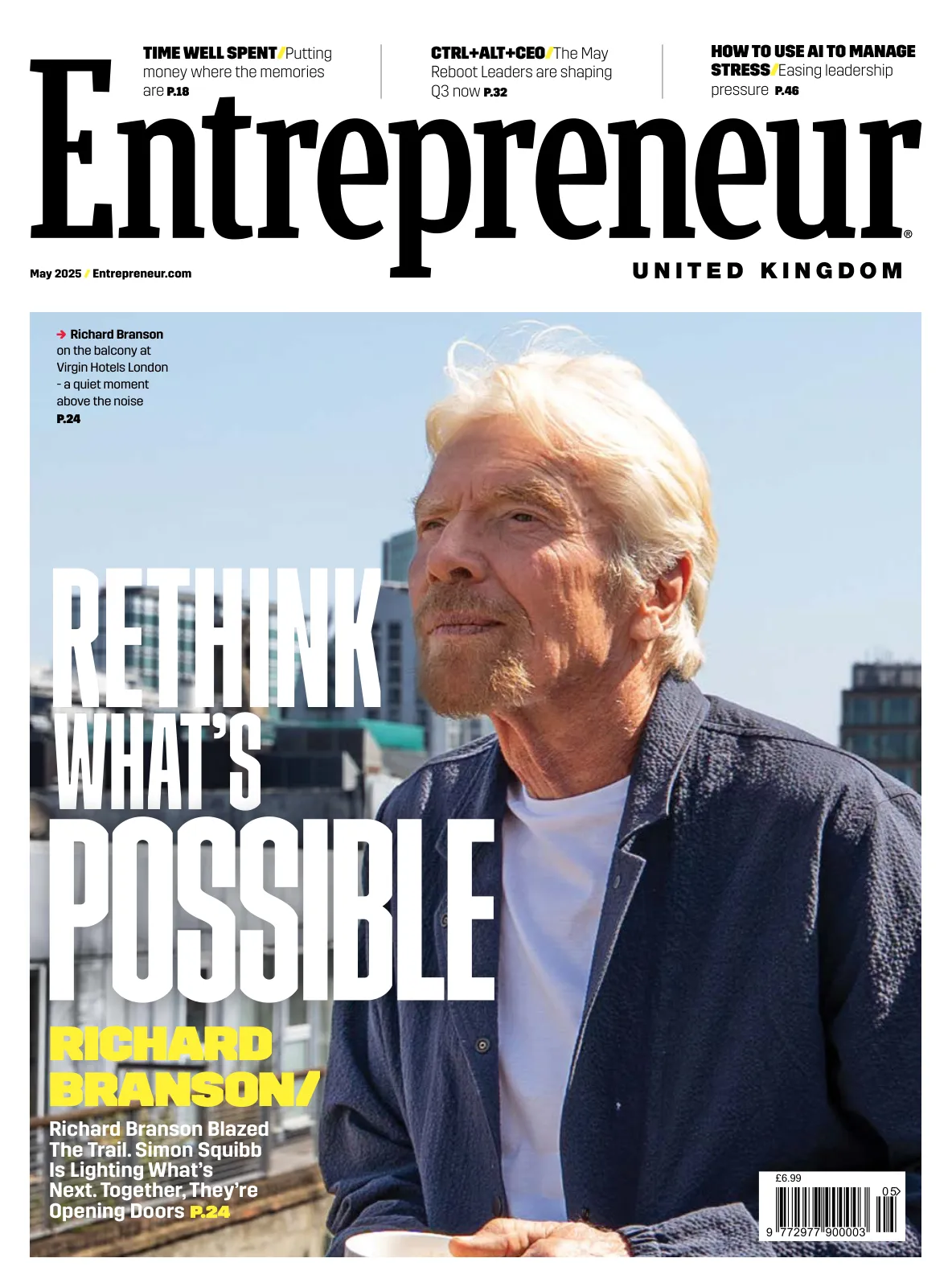
Entrepreneur UK, May 2025
Page 1
HOW TO USE AI TO MANAGE
STRESS/Easing leadership
pressure P.46
TIME WELL SPENT/Putting
money where the memories
are P.18
CTRL+ALT+CEO/The May
Reboot Leaders are shaping
Q3 now P.32
May 2025 / Entrepreneur.com
RICHARD
BRANSON/
WHAT’S
RETHINK
POSSIBLE
→ Richard Branson
on the balcony at
Virgin Hotels London
- a quiet moment
above the noise
P.24
£6.99
Richard Branson Blazed
The Trail. Simon Squibb
Is Lighting What’s
Next. Together, They’re
Opening Doors P.24
Page 2
nominate now
Step into a realm of unparalleled prestige
and distinction at the World-Class Real
Estate Awards Ceremony, hosted in the
heart of London.
| SEPTEMBER 2025
| London , United Kingdom
for sponsorship Enquiries
Olha Kovalova
+44 77 21856188
olha.kovalova@bncb2b.com
www.realestatepillars.com/global/
www.GlobalRELeaders.com
Page 3
Contents/May 2025
P.24
RETHINK
WHAT’S
POSSIBLE
RICHARD BRANSON BLAZED
THE TRAIL. SIMON SQUIBB IS
LIGHTING WHAT’S NEXT
FEATURES
→ Richard Branson
on the balcony of
Virgin Hotels
London, Shoreditch
3
May 2025 / ENTREPRENEUR.COM /
PHOTO CREDIT:HARRY KINNARD
Page 4
DOWNLOAD
YOUR DIGITAL
EDITION
HERE
UNITED KINGDOM
Out now in the UK
Page 5
46 How to….
… use AI to manage stress
48 Why 70% of
Transformations Fail
And how to be in the 30%
‘TREPONOMICS
IN THE LOOP
Contents/May 2025
14 Scaling Secrets
Entrepreneurs tell all
18 Time Well Spent
Experiences that shape the future
32 Ctrl+Alt+CEO: The May
Reboot
The mid-year reset driving
alignment
36 Tapping In
Clean water, bold vision
BUSINESS
UNUSUAL
STARTUP
SPOTLIGHT
40 Five Strategy Lessons
from The White Lotus
Cultural relevance drives growth
42 The Importance of
Prioritising Employee
Engagement
A people-first culture drives
performance
8 Challenger Mode
Cooking up brand growth
12 Summit to Strategy
Catriona Campbell on making
AI work for business
44 Five Elements of a Fail-
Proof Contingency Plan
And why every business needs one
FEATURES EDITOR Patricia Cullen
patricia.cullen@bncb2b.com
CEO Wissam Younane
wissam@bncpublishing.net
MANAGING DIRECTOR Rabih Najm
rabih@bncpublishing.net
ART DIRECTOR Simona El Khoury
EDITORIAL TEAM
Tamara Pupic,
Aalia Mehreen Ahmed
MEDIA SALES MANAGER
Olha Kovalova olha.kovalova@bncb2b.com
GENERAL MANAGER
Daniel Malins daniel@bncb2b.com
REGIONAL DIRECTOR
Andy B. andy@bncb2b.com
CONTRIBUTING WRITERS
Ed Hayes, Sarah Yorston, Michael Bush,
Dr Lisa Turner, Alex Lampe and Omar Hamdi
SUBSCRIBE
Contact subscriptions@bncb2b.com to receive
Entrepreneur United Kingdom every issue.
COMMERCIAL ENQUIRIES
sales@bncb2b.com
WWW.ENTREPRENEUR.COM/EN-GB
Access fresh content daily on our website
All Rights Reserved 2025. Opinions expressed are solely those of the contributors.
Entrepreneur United Kingdom is officially licensed exclusively to BNC B2B In
United Kingdom by Entrepreneur Media Inc. No part of this magazine may be
reproduced or transmitted in any form or by any means without written permission
of the publisher. Images used in Entrepreneur United Kingdom are credited when
necessary. Attributed use of copyrighted images with permission. All images not
credited otherwise Shutterstock.
20 Wenlock Road, London, N1 7GU
entrepreneurMediaUK
entrepreneurUK
entrepreneurmedia-uk
entrepreneurmedia.uk
5
May 2025 / ENTREPRENEUR.COM /
↑ Kateryna Serdiuk, founder of Subjektiv,
drives growth in the art market
Page 6
6 / ENTREPRENEUR.COM / May 2025
Editor’s Note/
DISRUPT, BUILD, LIVE YOUR PASSION
T
his issue starts with a legend. On the cover:
Richard Branson - founder, risk-taker, and
master of the unconventional route. Inside
Virgin Hotel in London-Shoreditch,
surrounded by a new generation of startup
founders, he speaks not from a stage but from
experience. There’s no fanfare - just an open
conversation on what it takes to build something that
lasts. No script, no polish - just Branson recalling
what it meant to knock on hotel doors as a teenager,
tape recorder in hand and building something from
nothing.
He’s joined in conversation by Simon Squibb, - one
who now advocates fiercely for collaboration over
competition, and for reshaping an education system
that so often sidelines creative thinking. In the May
issue of Entrepreneur UK, they reflect not just on
how to start a business, but why it matters - and what
it costs. That theme of purpose runs through
everything in this issue. We turn to the experience
economy, where growth isn’t measured in units sold
but in moments shared. In a post-product world,
people want connection — and James Wallman, CEO
of the World Experience Organization, argues it’s
time to treat experiences not as a niche, but as the
next engine of the UK economy. We also get practical.
In Scaling Secrets, founders share the unseen truths
behind growth - from staying lean to learning when
to let go. Tech and strategy collide in a sharp insight
from Catriona Campbell MBE, AI Client Strategy
Leader at EY and chapter ambassador for the AI
Summit London. Her message? AI works best when
it amplifies human intuition, not replaces it.
Elsewhere, we explore how brands can stay culturally
relevant in a world of short attention spans, why
employee engagement is no longer optional, and
what smart contingency planning really looks like in
2025. And because behind every idea is a person
trying to hold it all together, we look at how AI can be
used not just to automate workflows, but to manage
stress, and we unpack why so many business
transformations fall apart — and how not to be one of
them. These are the kinds of ideas that move things
forward - quietly, steadily, and with impact. Wherever
you are on the journey, we hope this Entrepreneur
UK issue leaves you energised to keep building.
Patricia Cullen
Features Editor, Entrepreneur United Kingdom
Richard Branson and Simon Squibb share their insights, while we explore
the experience economy, scaling secrets, artificial intelligence and building
for the future.
Page 7
EMPOWERING
THE VISIONARIES
OF THE
UNITED KINGDOM
UNITED KINGDOM
Page 8
Challenger Mode
→ David Milner,
Executive Chairman
of Crosta Mollica, at
the helm of the
brand’s next growth
chapter
Why David Milner only bets on brands built to shake up the system
by PATRICIA CULLEN
W
ith a track
record of
turning
challenger
brands into
household
names, David Milner, Executive
Chairman of Crosta Mollica, is no
stranger to transformative
growth. Having previously helped
scale iconic names like Tyrrells,
Lily’s Kitchen, and the St Pierre
Group, Milner’s strategic insight
into brand-building is razor-sharp
- and his current mission is no
exception.
Crosta Mollica, a premium
Italian food brand best known for
its restaurant-style pizzas, is
under his stewardship and
rapidly redefining how
consumers experience authentic
Italian cuisine at home. But
what’s the blueprint behind these
consistent successes? For
Milner, it starts with a very
specific framework.
“I prefer to call them challenger
brands! They all had very similar
characteristics in that they met
my three criteria which I use to
decide whether to invest my time
and my capital in a business,” he
explains.
“Firstly, does it stand out and
have a demonstrable market
advantage over its competitors?
And is it in a category big enough
to have space for it to grow to its
full potential? I see no point in
brands, however unique, if their
category is niche. Secondly, is it
a brand which has the scope to
disrupt the status quo in sectors
historically dominated by giant
companies or own label? Thirdly,
I love brands with international
potential because that opens the
door to global markets and
stellar valuations for the
business.”
This clarity of vision allows
Milner to not only identify high-
potential brands but to build
them with intention from the
inside out. At the heart of this
process is talent and structure.
“Once I am on board, my first
consideration is structure. The
8 / ENTREPRENEUR.COM / May 2025
In the Loop/
Page 9
9
May 2025 / ENTREPRENEUR.COM /
← Crosta Mollica
Stromboli: A
satisfyingly simple
take on a timeless
Italian favorite
in the UK and Europe. We have a
strong customer proposition, arguably
without too much competition, so the
challenge is to grow our share of the
sector and expand that opportunity
with a premium product offering.”
But scaling, especially in the food
and beverage space, comes with its
own set of challenges. The key to
success? Strategic alignment.
“If you are confident that your
product, packaging and messaging
are aligned the challenges thereon in
are to maximise distribution and grow
the proposition synergistically,” he
explains.
It helps that Crosta Mollica operates
in one of the most universally loved
food categories.
“Pizza is the most ubiquitous meal
on the planet, more widely eaten than
any other foodstuff. It symbolises
comfort, community and celebration in
all corners of the world and effortlessly
straddles the divide between luxury
and necessity,” he says. “But I never
take my eye off the Crosta Mollica
product and am constantly looking at
the scope to broaden the proposition
whilst strengthening the core of the
brand. For example, we have recently
added Roast Garlic Stone Baked
Flatbread to the range, and it is an
obvious and complementary
expansion. It has effortlessly joined
PEOPLE IN A
BUSINESS ARE AS
VALUABLE AS
CHESS PIECES AND
MY STRENGTH
COMES FROM
GETTING THIS
STRATEGY RIGHT
AND THEN LETTING
PEOPLE GET ON
AND DELIVER”
“
}}
sooner I can get the right people
doing the right jobs, the sooner the
big picture strategy can start to
take shape,” he says. “This does
not mean I go into a business and
take people out, it is more often the
reverse when I discover good
people possibly in the wrong role or
not being asked to play to their
greatest strengths. People in a
business are as valuable as chess
pieces and my strength comes from
getting this strategy right and then
letting people get on and deliver.”
This people-first mindset was a
key part of his approach when he
was approached to lead Crosta
Mollica.
“I already knew of the company
as a premium retail pizza brand that
delivered an authentic restaurant-
style pizza straight-out-of-the-oven
eating experience,” he shares. “I
quickly discovered it was the only
retail brand made in Italy using the
highest quality ingredients and
methods to produce such an
outstanding product. But what it
didn’t have was decent shelf
presence or widespread consumer
appreciation.”
With the foundation laid, the next
step was messaging and market
presence.
“The next most important task is
getting the right message out there
both in terms of presentation
(branding and packaging) and
profile (editorial and influencing),”
says Milner. “Early on I discovered
a small team of people I trusted to
be able to take my vision and make
it work.”
Now on an ambitious growth
trajectory, Milner has his sights set
on expanding Crosta Mollica’s
market reach without compromising
the integrity that makes the brand
special.
“My priorities are threefold:
expanding our market presence,
deepening customer engagement
with our range of products, and
strengthening operational
scalability,” he says. “We are highly
focused on unlocking new
distribution channels. Despite our
rapid growth, we still have terrific
scope within grocery channels both
Page 10
10 / ENTREPRENEUR.COM / May 2025
the range offering and has been
an immediate success.”
In such a competitive
landscape, staying ahead of
consumer expectations is vital.
“Brand differentiation in a
crowded market comes down
to authenticity and
consistency,” says Milner. “We
craft a clear, compelling brand
voice and visual identity that
stays true across every
touchpoint - from packaging to
social media to retail presence.
We also invest heavily in New
product development (NPD),
not just to follow trends, but to
set them.”
Equally important is the
partnerships with key allies who
drive retail success.
“I also never underestimate
the value of working closely
with retail buyers. They know
their customer best of all and
when we do our job properly,
we not only offer ways to help
them tempt their customers
further but also we give them
confidence they can trust us
and that we are a reliable
partner who can deliver.”
Of course, no market research
beats first-hand experience. For
Milner, that means staying close
to the product’s roots - both
culturally and culinarily.
“I am also a great believer in
getting out and sniffing the air!
In the case of Crosta Mollica,
that is about going to Italy and
travelling around to the different
regions to better understand
the market and then being able
to reflect this through the
business,” he shares. “I have
just returned from such a trip
travelling from Rome to Naples
and lots of places in between—
from restaurants to little Nonna
holes-in-the-wall—trying very
local pizzas and getting
inspiration and ideas for
incorporating in our range. This
level of understanding can’t be
done from behind a desk in
London.”
With all this expertise, Milner
has a clear view on where many
businesses falter when
attempting to scale - and how
they can avoid those pitfalls.
“One of the most common
mistakes businesses make
when scaling is growing too fast
without a solid operational
foundation. It’s easy to chase
top-line growth, but without
scalable systems, the business
can crack under pressure -
leading to supply chain issues,
poor customer experience, or
brand dilution.”
And as tempting as it may be to
expand too quickly or too
broadly, Milner believes that
success depends on staying
true to the brand’s core
promise.
BRAND
DIFFERENTIATION
IN A CROWDED
MARKET COMES
DOWN TO
AUTHENTICITY AND
CONSISTENCY”
“
→ JOSEPH VALENTE
and ANT MIDDLETON,
best selling author of
Military Mindset and
leadership expert.
In the Loop/
Page 11
11
May 2025 / ENTREPRENEUR.COM /
development, to ensure we stay
relevant and ahead of consumer
trends. As we scale, maintaining
the authenticity and quality that
built our loyal customer base is
non-negotiable.”
Milner is passionate about
staying rooted in the mission and
values of the business, and
making sure every new initiative
aligns with their long-term brand
story. “My mantra is to grow fast
- but smart. I always want to build
a business that is not just bigger,
but better at every level.”
In Crosta Mollica, Milner has
found a brand with not only the
right foundations, but also the
soul to make a lasting global
impact. And with his measured,
mission-led approach to growth,
it’s clear that this is just the
beginning of another standout
success story.
WE CRAFT A CLEAR, COMPELLING BRAND
VOICE AND VISUAL IDENTITY THAT STAYS
TRUE ACROSS EVERY TOUCHPOINT - FROM
PACKAGING TO SOCIAL MEDIA TO RETAIL
PRESENCE”
→ From strategy to
shelf: David Milner is
rewriting the premium
playbook with the
Crosta Mollica
Stromboli
“In the rush to expand product lines
or enter new markets, you have to
guard against straying from what
underpins your business,” he
cautions. “Successful innovation
remains at the heart of our product
“
Page 12
12 / ENTREPRENEUR.COM / May 2025
In the Loop/
Summit to Strategy
Catriona Campbell on making AI work for business
by PATRICIA CULLEN
F
or AI, and the more recent
advancements in the field to
be successful,” Campbell
explains, “business has to
align with existing business
objectives and ensure
stakeholder buy-in.” Without this
strategic fit, even the most
promising AI tools risk becoming
expensive distractions. This
grounding in business reality is
what sets Campbell apart from
many AI evangelists. Her vision is
not of a distant future filled with
humanoid assistants and
algorithmic visionaries, but of
pragmatic implementation today
- starting with small, clear wins.
The Entrepreneur’s Edge: Agility
Meets Intelligence
Having advised organisations from
start-ups to global enterprises,
Campbell has seen firsthand the
enthusiasm - and anxiety - that AI
stirs in business leaders. For
entrepreneurs, she says, the biggest
obstacle is not technology, but
comprehension. “The most
common challenge is the lack of
understanding and expertise in AI.
But don’t fear. Entrepreneurs are an
agile lot!”
Agility is indeed the entrepreneur’s
greatest strength. Where corpora-
tions get bogged down in process
and politics, start-ups can experi-
ment. The key, Campbell advises, is
to start small. “They need to invest
in AI education, partnering with AI
experts, and starting with small,
manageable projects to build
confidence and demonstrate value.”
This ‘test and learn’ approach is far
more likely to deliver value than a
top-down AI overhaul. Think: a
retail start-up using machine
learning to optimise inventory, or a
fintech firm deploying natural
language models to handle
customer support.
One of Campbell’s go-to examples is
deceptively modest but powerful: “A
good example is using Microsoft
Co-Pilot to help with marketing
→ Catriona Campbell
MBE: Leading AI
strategy at EY
I
n the gold rush of artificial intelligence (AI), it is easy to
mistake excitement for execution. For many entrepre-
neurs, the promise of AI is a heady one: smarter decisions,
streamlined operations, and innovation at scale. Yet, as
Catriona Campbell MBE - AI Client Strategy Leader at EY
and a chapter ambassador for the AI Summit London -
cautions, success with AI requires far more than enthusi-
asm. Campbell, a veteran in AI strategy and one of the
UK’s most influential women in technology, has spent her career
bridging the gap between cutting-edge innovation and business
impact. Her message to entrepreneurs is deceptively simple: focus
on what matters.
Page 13
13
May 2025 / ENTREPRENEUR.COM /
copy.” In other words, AI
doesn’t need to transform
the core product on day one.
Sometimes, it just needs to
free up the founder’s time.
From Hype to Habit:
Building an AI-Ready
Business
Of course, no AI system can
outperform a flawed
foundation. Data, long the
hidden engine of digital
businesses, becomes
mission-critical in AI.
Campbell offers a clear,
actionable entry point:
“Entrepreneurs may wish to
prioritise data quality in
order to get ready to deploy
AI across their business.
Start by auditing existing
data and establishing
processes for continuous
data improvement.”
This focus on data readiness
- a term often neglected in
headline-grabbing AI
narratives - is key. Clean,
well-structured data not
only improves algorithmic
outcomes but reduces
implementation costs and
risks. Campbell’s emphasis
on business problem-solv-
ing over technological
novelty is echoed in her
strategic guidance:
“I’d ensure a focus on
solving specific business
problems with AI rather
than pursuing AI for its own
sake. Identify areas where
AI can add the most value
and start with projects to
prove the concept before
scaling.” This measured
approach, she suggests, is
what separates gimmicks
from game-changers. “AI’s
potential is vast - but only
when rooted in real needs
and validated by real
results.”
The London AI Summit:
Knowledge, Network, Next
Steps
For entrepreneurs unsure
where to begin—or how to
level up—Campbell offers a
clear directive: attend The
London AI Summit
London. Part showcase, part
think tank, the event brings
together the people, tools,
and insights that matter.
“Entrepreneurs can expect
to gain insights into the
latest AI technologies, best
practices for implementa-
tion, and case studies of
successful AI adoption.
These are a MUST to listen
to!”
Beyond the stage, the
Summit’s real power may lie
in its connections. As
Campbell notes: “Network-
ing with industry leaders
and experts will also provide
valuable knowledge and
potential collaboration
opportunities.” In a
time-starved world, The AI
Summit offers something
rare: curated access to both
knowledge and people who
can accelerate AI journeys.
“It offers unparalleled access
to cutting-edge AI tech.
Where else will you see
everything in one place?”
she asks. “It also offers
practical workshops, and
networking with leading AI
professionals. Saving busy
entrepreneurs valuable
time!”
Think Big, Start Smart
Campbell’s message is not
about chasing the next AI
headline - it’s about
embedding AI where it
counts. For entrepreneurs,
the opportunity is not just
to adopt AI, but to own
their AI strategy. That
means aligning with
business goals, investing in
understanding, and
iterating with intent. In
Campbell’s world, AI is not
magic. It’s method. And for
those who learn to wield it
wisely, it may well become
one of the defining tools of
modern entrepreneurship.
IT OFFERS UNPARALLELED ACCESS TO CUTTING-EDGE AI TECH. WHERE ELSE WILL YOU SEE
EVERYTHING IN ONE PLACE? IT ALSO OFFERS PRACTICAL WORKSHOPS, AND NETWORKING WITH
LEADING AI PROFESSIONALS. SAVING BUSY ENTREPRENEURS VALUABLE TIME!”
Page 14
S
caling a business is one of the most challenging yet exciting feats for
any entrepreneur. It requires a delicate balance between maintaining
quality, building a strong culture, managing operational hurdles, and
adapting to ever-evolving customer needs. To uncover the secrets to
scaling successfully, Entrepreneur UK spoke to three leaders who
have navigated this path: Lauren Chiren, CEO of Women of a Certain
Stage, Richard Robinson, CEO at Robin AI, and Griffin Parry, CEO of
m3ter. Here’s how they scaled their businesses effectively without losing sight
of what made them unique.
Scaling Secrets
14 / ENTREPRENEUR.COM / May 2025
BUILDING THE
FOUNDATION
For Lauren Chiren,
scaling was all about
establishing a repeatable
foundation without
compromising the quality
of service her business
offers. “From the start, I
focused on documenting
systems and processes
that worked - everything
from client onboarding to
delivery standards and
follow-up procedures,”
she explains. By creating
clear, repeatable
processes, Chiren was
able to quickly scale her
operations and train new
team members efficiently,
ensuring consistent
quality even as demand
increased. But growth
doesn’t happen over-
night. Lauren advises
adopting a “lean scaling”
approach, where
businesses grow in stages.
“We tested each new
program or service in a
smaller setting before
rolling it out more
widely,” she shares. This
approach allowed her
team to troubleshoot
potential challenges early
on and maintain high
standards of service,
whether in menopause
education or hygiene
services. As Chiren points
out, “Culture doesn’t
happen by accident—it’s
something you have to
cultivate intentionally.”
Additionally, her team
was guided by values of
integrity, compassion,
and professionalism. This
deep commitment to core
principles helped ensure
that her company’s
growth was not just rapid
but also sustainable.
→ Lauren Chiren,
CEO of Women of
a Certain Stage,
redefines aging
with
empowerment
How UK entrepreneurs are cracking the growth code.
by ENTREPRENEUR UK STAFF
I
Scaling
/
Page 15
PACE OVER SPEED
Richard Robinson of
Robin AI also emphasises
a strategic approach to
scaling, focusing on
maintaining the pace
rather than rushing for
speed. “We preach pace
over speed. We want to
always be moving
forward, but not at any
cost,” he shares. As an AI
company, Robinson has
to balance innovation
with security and
reliability. “We have to
prioritise safety and
security in our AI. We
work hard to use tech
where we can, like
managing a global team
with different legal
obligations depending on
their location.” In
addition to ensuring that
the right technology and
tools are in place,
Robinson takes a
hands-on approach to
Culture
doesn’t
happen by
accident- it’s
something
you have
to cultivate
intentionally”
“
15
May 2025 / ENTREPRENEUR.COM /
→ Richard Robinson, CEO of
Robin AI, actively transforms
the legal tech landscape
culture-building by
maintaining open
communication. “We run
open-plan offices, with
regular all-hands
meetings. I sign-off on all
new hires, and for senior
hires, I interview them
myself.” The hands-on
culture has played a vital
role in ensuring quality
and cohesiveness even as
the company expanded
rapidly. However,
operational challenges did
arise. “We reached a point
where most of our revenue
was coming from the US
but our brand awareness
didn’t reflect that,”
Robinson explains. He
quickly identified that the
solution was showing
up—attending major
events and engaging with
tech and legal communi-
ties to increase visibility in
the US
BEING DELIBERATE:
CULTIVATING CULTURE
AND OPERATIONAL
SYSTEMS
For Griffin Parry, CEO of
m3ter, a London-based
start-up that provides a
metering and pricing
engine for SaaS compa-
nies, maintaining a high
quality of service while
scaling required a
methodical approach. “I
think of building a
company as solving a
series of problems in the
right sequence and at the
right cadence,” he says.
The challenges are seen as
“brain teasers,” and
scaling is about address-
ing each one carefully to
ensure smooth growth. A
major challenge,
according to Parry, is
maintaining culture and
quality as the team grows.
When you’re small, it’s
easy to ensure that every
team member is aligned
with the company’s
mission. However, that
becomes difficult as you
expand. “The answer is to
rely on mechanisms
rather than good
intentions,” he suggests.
Parry emphasises that the
key to successful scaling is
being deliberate about
culture. “You can’t impose
culture, but you can
deliberately cultivate it,”
he notes. At m3ter, they
hired a People Leader
early on, creating systems
and processes that
embedded the company’s
values. These efforts
helped cultivate a strong
company culture that the
entire team could take
ownership of, ensuring
that the company
remained cohesive despite
rapid growth.
Page 16
16 / ENTREPRENEUR.COM / May 2025
CUSTOMER ACQUISITION VS.
RETENTION: STRIKING THE
RIGHT BALANCE
As these entrepreneurs scaled
their businesses, they faced the
challenge of striking a balance
between acquiring new
customers and retaining
existing ones. Parry focuses on
optimising customer satisfac-
tion and retention. “We’re a
recurring revenue business, and
it’s cheaper to keep customers
than win them,” he says. At
m3ter, this focus on retention
has not only resulted in a loyal
customer base but has also led
to product improvements.
Similarly, Robinson believes in a
flexible pricing model that
ensures ongoing customer
satisfaction. “We don’t get
customers complaining about
paying for services they didn’t
use,” he explains. Robinson’s
approach involves working
closely with customers to
develop new features and
continuously improve their
offerings. For example, Robin
AI’s “Robin Reports” feature
was co-developed with the
University of Cambridge to
meet specific needs. Robinson
shares, “We couldn’t have done
that without close relationships
with that customer.”
STRATEGIC EXPANSION:
NARROW FOCUS FOR GREATER
SUCCESS
When it comes to expanding
into new markets, both
Robinson and Parry emphasise
being strategic and deliberate.
Parry advocates for going
“uncomfortably narrow” with
your Ideal Customer Profile
(ICP). “Be very specific about
who you want to sell to and
why you’re the best option for
them,” he advises. It may take
longer in the short term, but it
leads to a stronger, more
engaged customer base in the
I THINK OF
BUILDING A
COMPANY
AS SOLVING
A SERIES OF
PROBLEMS
IN THE RIGHT
SEQUENCE AND
AT THE RIGHT
CADENCE”
“
I
Scaling
/
long run. Robinson also focused
on geographical expansion to the
US where he identified a gap in
brand awareness. His strategy
included attending major events
and building relationships within
legal and tech communities. This
type of “showing up” has helped
Robin AI scale globally.
Lastly, the entrepreneurs also
weighed in on how UK trade
policies have influenced their
ability to expand internationally.
For Chiren, the post-Brexit
landscape posed challenges when
working with global clients.
While UK trade policies
supported exports, navigating
different tax and legal frame-
works added complexity.
Similarly, Parry cited the UK’s
favorable policies around EIS/
SEIS tax breaks and R&D tax
credits as key factors that have
supported m3ter’s growth.
However, Robinson noted that
“Brexit doesn’t make it easy to
expand from the UK to continen-
tal Europe, so European
expansion has taken a bit of a
backseat as we focus on the US
and Asia.”
SCALING SMARTLY FOR
LONG-TERM SUCCESS
The road to scaling a business is
filled with challenges, but these
entrepreneurs demonstrate that
with the right strategies - be it a
focus on repeatable processes, a
commitment to culture,
deliberate expansion, or the
balance of customer acquisition
and retention—you can navigate
those challenges effectively. As
they scale, they remain grounded
in their mission, ensuring that
growth is sustainable, aligned
with values, and focused on the
long-term goal. Scaling isn’t just
about growing fast; it’s about
growing smart. It’s this intelligent
approach that enables entrepre-
neurs to scale their businesses
without compromising quality.
→ Griffin Parry,
CEO of m3ter,
redefines SaaS
billing with
usage-based
pricing
Page 17
AI: FROM INNOVATION
TO INCOME
Transform your AI aspirations
into a profitable reality at
The AI Summit London.
• Dedicated content stage
• Exclusive networking lounge
• Start-up showcase
Discover actionable strategies to improve
your business using AI, then connect with
industry leaders, investors and innovators.
11 - 12 June
Tobacco Dock, London
theaisummit.com
The headline AI event of
Brought to you by
and
Explore the Start-up
& Investor Village
Use code ENTREPRENEUR
to save 15% off your ticket.
Page 18
18 / ENTREPRENEUR.COM / May 2025 TIME
Putting money where the memories are by PATRICIA CULLEN
WELL
SPENT
Page 19
19
May 2025 / ENTREPRENEUR.COM /
O
n a grey Thursday in late February, amid the usual swirl
of policy papers and political speeches, something
quietly radical happened at City Hall. The Mayor of
London unveiled a new 10-year “Growth Plan for
London” - a sprawling, ambitious roadmap for the
capital’s future. But tucked into its core pillars, beneath
the expected language of innovation and
infrastructure, was a phrase that’s long shaped the
city’s soul but rarely its spreadsheets: experiences. For
the first time, a major government-backed plan has
formally recognised the experience economy not as a
side act, but as a starring role in London’s economic
story.
I
t’s the first time a government has
explicitly said the experience
economy is essential for a global
city’s success,” says James Wallman,
CEO and co-founder of the World
Experience Organization, (WXO) a
global platform that connects
innovators and organisations to drive the
experience economy forward. “That’s a
major turning point.”
This shift marks more than just a change
in language. It’s a clear-eyed embrace of
what Londoners, and millions of visitors,
have known instinctively all along: that it is
the city’s culture, events, theatre, music,
food, sport and nightlife that not only
shape its identity but drive its prosperity.
From the roar of the West End to the quiet
charm of Spitalfields to the Swiftie-fuelled
surge that added £300m to the capital,
London’s most powerful export is no longer
just finance or fashion - it’s feeling.
EXPERIENTIALISM: MORE THAN A
BUZZWORD
The stats back it up. The UK’s experience
→ Unconference
board.
PHOTO BY
ANASTASIIA DAVYDOVA
→ Jennifer Crook
accepts the World
Experience Award
for Impact.
PHOTO BY
ANASTASIIA DAVYDOVA
}}
Page 20
20 / ENTREPRENEUR.COM / May 2025
economy is already worth £134b a
year, according to Barclays. In 2023,
17.1m people attended the theatre in
London. For every £1 spent on a
ticket, an extra £1.40 was pumped
into the surrounding economy. Film
tourism is also booming - 70% of UK
visitors now include a screen location
in their travel plans, and even fictional
football clubs have real-world
impacts: since Ted Lasso hit screens,
footfall in Richmond is up by as much
as 20%. We have long been told that
happiness and success could be
bought. Cars, clothes, gadgets - sym-
bols of status stacked on shelves and
Just as materialism underpinned the
consumer revolution in the 1920s, I
believe we’re now seeing the rise of
experientialism - an experience revolution
that wil transform our quality of life”
“
→ James Wallman,
experience
economy expert
and futurist
PHOTO BY ANASTASIIA DAVYDOVA
Page 21
21
May 2025 / ENTREPRENEUR.COM /
in driveways. But today, a quiet
revolution is reshaping that
narrative. It’s not about things
anymore. It’s about experiences.
Wallman calls it “the move from
materialism to experientialism.”
It’s a cultural tipping point - one
that’s changing not just how we
spend, but how we live. “Just as
materialism underpinned the
consumer revolution in the 1920s,
I believe we’re now seeing the rise
of experientialism,” Wallman
explains, “an experience revolution
that will transform our quality of
life.” Cultural attractions, festivals,
music tours, food markets - these
aren’t side shows. They’re serious
business. Feelings, it turns out, are
financially sound.
Experientialism, says Wallman,
is a fundamental shift in values.
Where we once sought identity
and happiness through posses-
sions, we now find them in
moments. “We used to look for
happiness and status in things.
Now we find identity in what we
do, not what we own.” This isn’t
anti-capitalist. It’s what Wallman
calls “consumerism 2.0” - spend-
ing driven by meaning and
“IT IS THE CITY’S
CULTURE, EVENTS,
THEATRE, MUSIC,
FOOD, SPORT AND
NIGHTLIFE THAT NOT
ONLY SHAPE ITS
IDENTITY BUT DRIVE
ITS PROSPERITY”
emotion rather than accumulation.
“If you want to scale, you still need
a business model,” he says. “But
experiences are where you now
create value.” Study after study
shows people derive more lasting
happiness from experiences than
material goods. Why? Because
experiences create memories. They
foster connection, not clutter.
→ James
Wallman, CEO,
the World
Experience
Organization
}}
FROM IDEA TO IMPACT:
THE WORLD EXPERIENCE
ORGANIZATION
Wallman’s path to building a
movement began during a stint
advising the British government.
As a sector specialist in the
experience economy, he found
himself asking a simple question:
why wasn’t anyone connecting
the dots globally? “I said to the
government, we should create a
global organization for the
experience economy. They said it
was a lovely idea - and did
nothing.” So, he did it himself. In
2020, as the pandemic shut down
physical gatherings, Wallman
launched the WXO. Today, the
WXO counts over 1,000 members
in 44 countries - from museum
curators and festival producers to
game designers and wellbeing
architects. Its mission is simple:
to help its members create better
experiences that make people feel
more. “If you think about
someone as just a customer or
employee, you miss the point,”
says Wallman. “They’re a person.
They’re on a journey. We design
for that whole human experience.”
Page 22
22 / ENTREPRENEUR.COM / May 2025
EXPERIENCE SHOULD BE A LINE
ITEM IN YOUR BUDGET. NOT
TUCKED UNDER MARKETING
OR HR. IT’S NOT JUST ABOUT
EXTERNAL CUSTOMER
JOURNEYS OR INTERNAL
CULTURE. IT’S ABOUT
DESIGNING HOW PEOPLE FEEL”
“
Wallman sees experience as a new form of capital - one
measured not in transactions, but in transformations.
“Moments add up to lives,” he says. “If we design better
moments, we design better lives.” This goes beyond branding.
Whether it’s a patient’s path through a hospital, a guest’s stay at
a hotel, or a student’s day in class, the experience - the feeling
- is what lingers. “The most powerful concept is the hero’s
journey,” Wallman explains. “If you see someone not
just as a user, but as a protagonist on a transforma-
tional arc, your whole strategy shifts.” It’s an idea
that’s gaining traction across industries. In retail, it’s
driving immersive flagships. In education, it’s
pushing hands-on learning. In travel, it’s what turns
tourism into storytelling.
A CULTURAL CATALYST
Wallman’s next ambition? To make London
Experience Week, scheduled from Monday, April 28
to Friday, May 2, 2025, the Fashion Week of the
experience economy. “Fashion Week became a
cultural and economic engine - a moment that drove
consumer interest, investment, and creativity,” he
says. “We want to do the same for experiences.” The
idea is to create a platform that not only showcases
innovation, but drives business - a marketplace for
experience-makers to collaborate, commission, and
connect. “It’s not just community anymore - now it’s
about commerce too. We want to make the
connections that lead to more experiences in the
world, and more money for the people creating
them.” Wallman believes the drive for experience is a
response to deeper cultural needs. After years of
burnout, isolation, and economic uncertainty, people
want more than convenience. They want connec-
tion. “People want to feel alive,” he says. “They want
to be moved, challenged, inspired. We’re just
starting to realise how powerful experiences can be
- economically, emotionally, culturally. In the 1920s,
different sectors - fashion, home goods, autos - all
learned from each other and drove a revolution in
living standards. We’re doing that again, but with
time, with emotion. With memory.” Just as Fashion
↑ James Wallman, founder of the World Experience
Organization. PHOTO BY ANASTASIIA DAVYDOVA
↑ Arrivals at the Summit. PHOTO BY ANASTASIIA DAVYDOVA
Page 23
23
May 2025 / ENTREPRENEUR.COM /
Week turned fashion into a global
economic force, London Experience Week
aims to do the same for the experience
economy, fueling innovation, growth, and
shaping the city’s cultural and economic
future.
THE FUTURE OF EXPERIENTIALISM
As the experience economy matures,
Wallman wants to see experiences treated
not as a by-product of other industries,
but as a sector in their own right- — with
their own strategies, standards, and
investment. “Experience should be a line
item in your budget,” he insists. “Not
tucked under marketing or HR. It’s not
just about external customer journeys or
internal culture. It’s about designing how
people feel.” For brands, that means more
than delighting users. It means thinking
in terms of story arcs, emotional
resonance, even personal transformation.
For governments, it means recognising
that culture and creativity aren’t fringe -
they’re infrastructure. In a world that
feels increasingly disconnected, the
experience economy offers a different
kind of promise - one that values how we
spend our time, not just our money. “It’s
about asking better questions. What
→ Garden networking.
PHOTO BY
ANASTASIIA DAVYDOVA
↓ Brad Shelton, Kat
Reinbold and Maya Guice
of BRC Imagination Arts.
PHOTO BY
ANASTASIIA DAVYDOVA
matters? What makes life richer? What do people remember?” he says.
As London positions itself at the centre of this shift - with policies,
festivals, and investment aligning behind experience - Wallman sees
echoes of earlier revolutions. The kind that changed the way we lived,
worked, and imagined the future. “We’re moving from stuff to stories.
From products to presence,” he says. “And if we do it right, the results
won’t just be economic - they’ll be human.”
Page 24
24 / ENTREPRENEUR.COM / May 2025
24 / ENTREPRENEUR.COM / December 2024
Page 25
25
May 2025 / ENTREPRENEUR.COM /
WHAT’S
RETHINK
RICHARD BRANSON
RICHARD BRANSON BLAZED THE TRAIL. SIMON
SQUIBB IS LIGHTING WHAT’S NEXT. TOGETHER,
THEY’RE OPENING DOORS
by PATRICIA CULLEN
I
t’s a sunny day in Shoreditch, London. Cafés spill
onto the pavement, the clatter of laptops and
lattes mingling with the murmur of ideas. Inside
the Virgin Hotel in London, Shoreditch, glass walls
filter the light across the early-stage founders,
who have all received support from Virgin StartUp
to scale their businesses. In the centre, two men
- Richard Branson and Simon Squibb. There’s no
grand stage or teleprompter. Just a few chairs, an
open conversation, and a room filled with people who
have ideas - and, crucially, the courage to pursue
them. As Branson reflects on his own start, his story
serves as a powerful reminder that success often
comes from diving in headfirst.
→ Richard Branson,
always at the
intersection of business
and adventure
POSSIBLE
Page 26
26 / ENTREPRENEUR.COM / May 2025
SOMETIMES YOU NEED TO TALK
AHEAD OF YOURSELF. YOU’VE
GOT TO SAY YOU CAN DO
ANYTHING. AND THEN YOU’VE
JUST GOT TO CATCH UP, CATCH
UP, CATCH UP”
N
ever one for corporate formality, Branson is
reflective. “I loved learning as I went along,” he
says. “I threw myself in at the deep end,
leaving school very young, starting a magazine
and learning on the job - how to sell advertis-
ing, how to sort out distribution and how to
blag my way into interviewing people.” His story, familiar to
many in outline, shows he didn’t just talk the talk - he took a
risk and made it work. “James Baldwin was a famous black
activist and writer. I went to his hotel room and just banged
on his door, uninvited. I was 16 years old.” Branson’s early
audacity could have gone either way. “He opened the door,
and I got a mouthful from him,” the entrepreneur recalls, but
“then he took pity on me and invited me into his room.”
Branson had brought the wrong plug, so he borrowed a
knife, jammed in some matchsticks, and wired the recorder
up by hand. By the time the interview began, Baldwin was
“not a happy man,” Branson chuckles. “I suppose the point is,
the best way of learning anything is just to chuck yourself in
at the deep end.” He pauses, then adds: “Sometimes you need
to talk ahead of yourself. You’ve got to say you can do
anything. And then you’ve just got to catch up, catch up,
catch up.”
S
quibb, founder, investor, and long-time advocate for
entrepreneurial education reform, picks up the thread.
“I left school at 15. My father had just died and my
mum and I had an argument and she told me to get out.” The
realisation that followed hit hard. “When I entered the real
world, I realised everything I’d learned in school was wrong.”
He speaks not just of outdated pedagogy, but of a philosophy
misaligned with reality. “You’re told to sit down and do an
exam on your own, and you’re meant to get the grade by
“
Page 27
27
May 2025 / ENTREPRENEUR.COM /
}}
Page 28
28 / ENTREPRENEUR.COM / May 2025
yourself. I realised that in the real
world, you can’t do it on your own.”
Then, he adds with a smile: “One
plus one equals eleven.” That kind of
logic - rooted in collaboration rather
than competition - shapes Squibb’s
entire outlook. “If you want to do an
exam well, get ten of you to do it.
You’ll get A’s every time.” But it
wasn’t just the content of school that
failed him; it was the culture. “I was
never really quite understood. I
wasn’t getting A’s - I was getting D’s,
especially in English, as I was
dyslexic as well.”
H
is tone shifts as he reflects on
the emotional impact. “It took
me a long time to get brave
enough to ask for help. We are taught
to grin and bear it.” When his
five-year-old started crying going
into school, the teacher said, ‘just
suck it up, it’s part of life.’ Squibb
now homeschools his child, driven by
a desire to reform an education
system that he believes fails to
support, encourage, or inspire
entrepreneurial thinking. Lets be
clear - Squibb isn’t pushing
sentimentality for its own sake. He’s
making a case for emotional literacy
as a business skill. “It took me a few
years to reconnect to who I really
was. I’m quite emotional. I cry at
movies. Somehow I suppressed all
of that.” And then, a pivot into
purpose: “School always made me
feel like I had to fit in or I was going
to get bullied. And now I realise - in
the real world, if you stand out, you
succeed.” Squibb’s argument is
clear: the world doesn’t need more
conformity. It needs more courage.
“That’s why I’m so determined to
upgrade the education system in
this country, and give people access
to some real-world knowledge - like
financial literacy. We can only
succeed if we work together and
help each other.”
B
ranson agrees, though in his
typically understated manner,
bringing the focus back to
wellbeing and alignment. “I know a
→ Simon Squibb
and Sir Richard
Branson launch
the Elevator of
Dreams at Virgin
Hotels London
PHOTO CREDIT: HARRY KINNARD
Page 29
29
May 2025 / ENTREPRENEUR.COM /
lot of us think we don’t have time because we’re so busy,” he
says, “but your body is the number one priority. Looking
after yourself is the number one thing. So getting the
balance right is really important, particularly as you get a
bit older. I get an extra three or four hours at the end of the
day because I’ve kept myself fit and healthy. It means that
in between I’ve got the energy to do all these things. My
body’s feeling fantastic.” Squibb nods, but offers a twist. “I
think that sometimes this balance thing is a bit overplayed.
I include my life in my work. So my son comes with me
everywhere I go. I want my life to be integrated. I don’t
want to separate things out.” His schedule, he admits, is
unconventional. “I exercised this morning but I was also
checking emails and making videos. A cameraman came
with me into the sauna, and we talked about strategy. He
got to sweat it out, I got to sweat it out, and we got to talk
business.” He’s aware it might sound intense - or even privi-
leged, but, he says, “I’ve worked to get to that point where I
integrate the two. So I’m not separating exercise, I’m not
separating family time, I’m not separating my workload.”
He compares it to “living on a wobbly stool.”
W
hen asked about starting a business today - in
2025 - with AI, social unrest and economic
headwinds, Branson keeps it simple: “I would
still do things that I was interested in personally.” Squibb
takes a more analytical route. “Today there are opportuni-
ties in community. Of course you’re using AI - that’s a hot
word at the moment - but community is completely
underutilised. One of thegreatest rewards is building a
group of people who care as much as you do about the
problem you’re solving.” He points out something subtle
but significant: “Amazon, for example, or Google - what
community do they have? They have the workers in the
I REALISED THAT IN THE REAL WORLD, YOU CAN’T DO IT ON YOUR OWN. ONE PLUS ONE EQUALS
ELEVEN. IF YOU WANT TO DO AN EXAM WELL, GET TEN OF YOU TO DO IT. YOU’LL GET A’S EVERY TIME”
Page 30
30 / ENTREPRENEUR.COM / May 2025
company, they have a kind of cult, but the
actual customers are not community.
There’s an opportunity there,” he says.
“Community is a superpower.”
A
nd then comes a harder question:
is it possible to stay true to your
values while building a financially
sustainable business? Squibb doesn’t
flinch. “Purpose-driven businesses are
this generation’s opportunity to fix all
the problems that my generation has
caused. Profit comes from purpose, in my
opinion.” Branson closes on a similar
note. “Your reputation is all you really
have in life - yours and your brand’s.
Every decision you make in business
should be one you’d feel comfortable with
if you had to rebuild from scratch the
next day.” He offers an example. “I was
told that Virgin Atlantic was going to fly
to Saudi Arabia. I had to think really
hard - is this going to put our brand’s
reputation at risk? I asked a lot of
questions and also looked at what Saudi
Arabia had done over the last eight
years… and in the end, decided to say
yes.” It points to a quieter truth: instinct
and integrity still matter.
E
ntrepreneurs like Branson and Squibb bring the real deal - no
nonsense, just results. They tap into the idea that business is, at
its best, deeply human. That collaboration beats competition.
That standing out is better than fitting in. And that sometimes, to
get where you’re going, you need to walk into someone’s hotel room
with the wrong plug, a tape recorder, and just enough nerve to ask
for help.
YOUR REPUTATION IS ALL YOU REALLY
HAVE IN LIFE - YOURS AND YOUR
BRAND’S. EVERY DECISION YOU MAKE
IN BUSINESS SHOULD BE ONE YOU’D
FEEL COMFORTABLE WITH IF YOU HAD TO
REBUILD FROM SCRATCH THE NEXT DAY”
“
→ Richard
Branson, Simon
Squibb, Andy
Fishburn and a
group of standout
founders from the
Virgin StartUp
community in
London
PHOTO CREDIT:HARRY KINNARD
Page 31
The voice of
entrepreneurship
around the world
Access fresh content daily on our website
Page 32
32 / ENTREPRENEUR.COM / May 2025
B/Reset
Ctrl+Alt+CEO: The May Reboot
W
hat if a deliberate mid‑year
pause could be the single
biggest catalyst for your Q3
success?” asks Michael Ryan, founder
of digital marketing agency Ink Digital.
His question isn’t rhetorical — it’s tacti-
cal. “A strategic ‘May Reset’ focused on
refining processes, shifting leadership
mindset, and carving out creative space
positions your business to enter
summer not just energized, but truly
aligned with its goals.”
These leaders aren’t waiting for Q3- they’re building it now by PATRICIA CULLEN
F
or many, May sits in an awkward middle ground —
not quite the urgency of Q1, not yet the intensity of
summer. But for a growing number of leaders across
industries, this mid-year moment is becoming some-
thing else entirely: a deliberate reset. Not a slow-
down. Not a break. But a re-evaluation of process,
purpose and performance.
Ryan’s agency is using May to
overhaul two foundational areas:
client onboarding and campaign
retrospectives. “We’ve learned that
small inefficiencies in communica-
tion and feedback loops compound
over months,” he says. “So we’re
using May’s natural lull to stream-
line workflows, accelerate creative
turnarounds, and ensure every
project kicks off with crystal‑clear
objectives.”
But if May is about rethinking
structure, it’s also about rethinking
self. “I’ve transitioned from
‘reaction mode’, responding to every
email and Slack ping, to creating
deliberate white‑space in my
calendar,” Ryan says. “Empowering
the team to make autonomous
decisions while I focus on big‑pic-
ture strategy has turned urgency
into intentionality.”
One of his most radical resets? A
weekly digital detox. “I’ve instituted
a weekly ‘creative fast’: one full day
without meetings or digital
interruptions. That silence has
sparked our best ideas yet,
sharpened my strategic thinking,
and given the team space to
innovate without distraction.”
Across London, another kind of
reset is underway - one rooted not
in silence, but in technical
immersion. “At Faculty, we’re
re-evaluating how we engage with
the very frontiers of AI,” says
Underutilised. One of the, CEO and
co-founder of the artificial
intelligence firm. “Back in January,
after a visit to San Francisco and
subsequent reflections, it was clear
that the AI landscape had shifted
enough that we needed to re-edu-
cate ourselves.”
→ At Ink Digital,
founder Michael
Ryan retools and
refocuses
Page 33
33
May 2025 / ENTREPRENEUR.COM /
Warner and his Chief
Technology Officer spent
two intensive weeks
revisiting the most
cutting-edge models in AI.
“That trip was transforma-
tional for how I spend my
time and how we think
about where to focus,” he
says. “While the outputs are
still unfolding, the signal
was clear: this is the
moment to reset to spring
forward.” This wasn’t just a
tech refresh. It was a
leadership awakening. “One
of the biggest mindset shifts
has been doubling down on
aligning AI initiatives with
core business priorities,”
Warner says. “After over a
decade of building Faculty,
we’ve learned that AI
strategy should always be
subservient to business
strategy.”
He’s wary of chasing shiny
objects. “There’s a real
temptation to create a
laundry list of possible AI
applications, pick the
easiest to execute, and hope
something sticks – but that
approach rarely delivers
real impact,” he explains.
“Instead, what works is
identifying the organisa-
tion’s most important
priorities and asking: where
can AI truly accelerate
these?” In Warner’s case,
recharging doesn’t mean
stepping back - it means
diving deeper. “For me,
recharging doesn’t mean
stepping away; it means
leaning into the work that
stretches and excites me,” he
says. “My reset at the
beginning of this year - sit-
ting side-by-side with our
CTO, digging into the
technology – was a prime
example. It was energising
and reminded me how
important it is to carve out
time for exploration, not
just execution.”
But not everyone is using
May to pause. For Kateryna
Serdiuk, founder of digital
art marketplace Subjektiv
and former investment
banker who once orches-
trated $25bn in equity
transactions, the month is
less about reflection and
more about acceleration.
WE’RE TAKING A
CLOSER LOOK AT HOW
OUR LOGISTICS WORK
IN THE US. THE TARIFF
WAR MEANS THERE’S
MORE UNCERTAINTY
THAN USUAL, AND
RATHER THAN WAITING
FOR ISSUES TO ARISE,
WE’D RATHER
PRE-EMPT THEM”
“
}}
→ Marc Warner,
CEO of Faculty,
realigns AI
strategy for
business impact
Page 34
34 / ENTREPRENEUR.COM / May 2025
“This month we’re doing the opposite of
slowing down. It’s full steam ahead,” she
says. “We’re laying foundations for what’s
next, putting time into product tweaks,
new partnerships and customer growth.”
Her reset? Pre-empting logistical risk,
especially in the increasingly complex US
market. “We’re taking a closer look at how
our logistics work in the US,” Serdiuk
explains. “The tariff war means there’s
more uncertainty than usual, and rather
than waiting for issues to arise, we’d rather
pre-empt them.”
Subjektiv, built to simplify art acquisition
for a new generation of collectors, depends
on operational precision. “If friction creeps
in, it affects the whole experience,” she says.
“Our strategy is solid. It’s more about
making sure the infrastructure can support
THE CURRENT ECONOMIC CLIMATE IS A
CHALLENGING ONE FOR BUSINESS. IT’S AT
TIMES LIKE THESE THAT LEADERSHIP TAKES
ON A WHOLE NEW MEANING. TEAMS NEED TO
FEEL STABILITY AND POSITIVITY IN ORDER TO
PERFORM AT THEIR BEST. THAT’S WHY WE’RE
NOT TAKING OUR FOOT OFF THE ACCELERATOR”
“
→ Kateryna
Serdiuk, founder
of Subjektiv,
drives growth in
the art market
B/Reset
Page 35
35
May 2025 / ENTREPRENEUR.COM /
what we’re building,
especially as we grow
across new markets.
The rest is working
well, and we want to
keep it that way.”
For Serdiuk, clarity
comes not from
stillness, but from
execution. “Not a shift,
but a strengthening,”
she says of her mid-year
mindset. “If anything,
the turbulence around
us has made us more
certain about what
we’re doing and why.”
And like her peers, she
knows that success
depends on more than
ideas. “You can have the
best idea in the world,
but without the right
people to help make it
happen, it stays an
idea,” she says. “We’re
putting more attention
into team culture,
shared goals, and
finding those who want
to grow something
meaningful together.”
Across the UK, another
CEO is using May not
just as a moment to
reflect - but as a
mandate to disrupt.
“We transitioned to our
unique cashback
business model to
deliver real, tangible
value to our customers,”
says Cas Paton, CEO of
OnBuy.com, the rapidly
growing online
marketplace. “This
commitment drives us,
especially at a time
when people are feeling
the effects of economic
uncertainty.”
For Paton, May is about
dialing up - not dialing
down - OnBuy’s impact.
“We’re intensifying our
efforts to make sure
that our rewards have a
significant impact,
while also challenging
the norms in retail,
finance, and traditional
cashback industries.”
But that drive outward
is matched by focus
inward. “The current
economic climate is a
challenging one for
business. It’s at times
like these that leader-
ship takes on a whole
new meaning,” he says.
“Teams need to feel
stability and positivity
in order to perform at
their best. That’s why
we’re not taking our
foot off the accelerator.”
Paton’s mid-year
mindset? Momentum
and clarity. “We’re
continuing apace with
our bold international
expansion plans and
ensuring that all the
exciting signals we’re
seeing about the
success of our strategy
are being fed through to
our team.”
Even his recharge mode
is strategic. “Juggling
work and life is a
challenge, but you have
to get off the hamster
wheel to be able to step
back and plan,” he says.
“I try and absorb as
much calm and family
time as I can. It helps
me to re-energise, so I
can give my all to the
success of OnBuy when
I’m back at my desk.”
So while May may seem
like a moment to coast,
these four founders see
it differently: as a pivot
point - a strategic
intermission before the
pace intensifies again.
Because whether it’s
making space for silent
thinking, doubling
WE’RE INTENSIFYING OUR EFFORTS TO MAKE SURE THAT OUR REWARDS HAVE A SIGNIFICANT
IMPACT, WHILE ALSO CHALLENGING THE NORMS IN RETAIL, FINANCE, AND TRADITIONAL CASHBACK
INDUSTRIES”
down on technical
learning, challenging
market norms, or
charging forward while
others pause, the May
Reset is not about
stepping back. It’s
about choosing how -
and where - to leap
next.
→ Cas Paton,
CEO of OnBuy.
com, fuels
growth with
cashback and
global
expansion
Page 36
36 / ENTREPRENEUR.COM / May 2025
B
Endurance
Tapping In
Co-owned by Bear Grylls and
Charles Robinson, Water2 is
taking on tap water
by ENTREPRENEUR UK STAFF
/
Page 37
37
May 2025 / ENTREPRENEUR.COM /
You dropped out of
university to start Water2
- what was the turning
point that made you take
that leap?
In 2020, at 19-years-old, I
remember being sat in the
back of my university lecture
hall, scribbling down notes
about the microplastics, lead
and forever chemicals found
in UK tap water. Just days
later, convinced I’d identified
a unicorn sized problem, I
dropped out of university to
take action. Five years on
and now 24, my company,
Water2 - a next-generation
water filter designed to
tackle contaminants often
overlooked in the UK’s water
supply - is making waves in
the UK as a fast-growing
consumer brand, now
backed by survival expert
Bear Grylls. Water2 is one of
the fastest growing
companies in the UK.
Installed under the sink, Pod
2.0 eliminates 99.99% of
microplastics, bacteria, and
parasites, while dramatically
improving water taste.
Priced at £129 with annual
filter capsule replacements
at £99, the Pod 2.0 has built
a cult following on social
media, regularly selling out
as customers rave about the
‘best tasting water’ they’ve
ever experienced.
How did your experience
with Gelcard shape the
way you approached
building Water2 from the
ground up?
My entrepreneurial journey
began during the pandemic,
where I funded my early
ventures by selling hand
sanitiser under the brand
Gelcard, which provided
customisable sanitiser cards
IT’S NO LONGER CONTROVERSIAL TO SAY TAP WATER CAN BE BETTER. I
WANT EVERYONE ON THE PLANET TO DRINK THE BEST WATER POSSIBLE.
THIS IS ABOUT BUILDING SOMETHING FAR BEYOND JUST TV. IT’S OUR
CHANCE TO TRULY IMPACT PEOPLE’S LIVES FOR THE BETTER”
W
ith
survival
icon
Bear
Grylls as co-owner and
design partner, Charles
Robinson’s Water2 is
now one of the UK’s
fastest-growing
consumer brands - on
a mission to clean up
tap water and change
what we drink for good.
Entrepreneur UK finds
out more.
}}
→ Nick Thompson, CEO
of BOW, leveraged
Sheffield’s robotics and
manufacturing
strengths to build a
cost-efficient,
innovation-driven
startup.
Page 38
38 / ENTREPRENEUR.COM / May 2025
to clients like Google and
McKinsey. The success of
Gelcard gave me the capital
- and crucial lessons - I
needed to start Water2, after
selling millions of units
across the world. My
experience of bringing new,
innovative products to
market - paired with my
growth from many failures
- leaves me in no doubt
Water2 will be the billion-
dollar brand my first
venture never was. It’s not
about what I say now
though, it’s about getting
more filters into homes
tomorrow. If people don’t
install the filter, nothing
changes. You don’t stop the
use of plastic bottled water,
and people keep drinking
tap water.
Bear Grylls is actively
involved in Water2’s
development - how has
his investment and
collaboration influenced
the company’s growth?
Bear first encountered
Water2 when he purchased
a filter for his own home.
Impressed with the product,
he reached out to me,
resulting in a series of
meetings and eventually, a
partnership. Today, he’s not
just a fan, he’s a co-owner,
investor and friend who is
actively involved in the
design of our latest product,
the Pod 2.0.
“It’s no longer controver-
sial to say tap water can be
better. I want everyone on
the planet to drink the best
water possible. This is about
building something far
beyond just TV. It’s our
chance to truly impact
people’s lives for the better”,
says Grylls, who regularly
joins me in design meetings.
Together, we aim to
transform how the public
thinks about tap water. Bear
adds: “We took what was
already great with the first
version and made it even
better - easier to install,
more powerful, and better
looking.” Having Bear join
us is a huge milestone.
Bear’s known for his
commitment to survival and
safety, and his belief in our
mission validates everything
we’re working towards. His
hands-on approach, from
product development to
educating the public, shows
that we’re not just building a
brand, we’re driving a
movement. Now the work
continues to get clean, safe
drinking water into every
home.
With Pod 2.0 tackling
contaminants like
microplastics, what’s next
for Water2 in terms of
expanding its product
range or global reach?
Strangely, I’m not a big fan
of long term plans. I
consider the path to
greatness to be about
maximising the opportunity
we have every single day
- which is namely getting as
many filters as possible in
people’s homes - and
iterating from there. Our
first two generations of the
Pod have been a hit, and
we’ve seen great early
traction with our Fluoride
Filter Add-On.
By 2030, however, I do
expect more people will
drink Water2 every day than
Coke or Pepsi, and part of
that timeline involves global
expansion. Myself and Bear
have already scouted
IT’S NOT ABOUT WHAT I SAY NOW THOUGH, IT’S ABOUT GETTING MORE
FILTERS INTO HOMES TOMORROW. IF PEOPLE DON’T INSTALL THE FILTER,
NOTHING CHANGES. YOU DON’T STOP THE USE OF PLASTIC BOTTLED
WATER, AND PEOPLE KEEP DRINKING TAP WATER.
B
Endurance
/
→ Charles Robinson, the 24
year-old founder of Water2
and Bear Grylls, adventurer
and survival expert
Page 39
39
May 2025 / ENTREPRENEUR.COM /
potential launch sites in the United
States.
You’ve built a strong social media
community - what role has
customer feedback and engage-
ment played in shaping your
brand’s success?
From day one, we’ve built Water2
with our customers, not just for
them. Social media has been our
biggest tool in understanding
what people actually care about
when it comes to their water -
whether that’s better taste,
reducing microplastics, or just
wanting an easy solution. Our
customers don’t just buy Water2;
they actively shape it. When we
launched the first version of the
Pod, we received tons of feedback,
some great, some brutally honest
about what people loved and what
needed improving. That feedback
directly led to the improvements
in Pod 2.0: easier installation, a
sleeker design, and even better
filtration. Beyond that, social
media has helped build trust. We
don’t rely on flashy ads, Our
community does the talking for us.
Customers share their experi-
ences, post unboxing videos, and
even compare Water2 to bottled
water brands. The ‘best tasting
water’ line? That came straight
from our customers. The demand
that keeps selling us out? That’s
the power of an engaged commu-
nity that believes in what we’re
doing.
I mean, literally, the product
development of the Fluoride Filter
was born out of Facebook
comment sections. Our customers
were crying out for the product,
almost begging to give us their
money for it. We could only have
that insight through social media.
“BY 2030, HOWEVER, I DO EXPECT
MORE PEOPLE WILL DRINK WATER2
EVERY DAY THAN COKE OR PEPSI, AND
PART OF THAT TIMELINE INVOLVES
GLOBAL EXPANSION”
What challenges have you faced as a
young founder?
Starting a business at 19 with no industry
experience meant I had to learn
everything the hard way. How to build a
product, how to find the right suppliers,
how to market effectively, how to scale.
Every mistake was expensive, but every
mistake was also a lesson. Another
challenge has been scaling fast while
maintaining quality. The demand for
Water2 has exploded, which is a great
problem to have, but it also means
making sure every filter that ships out
meets our high standards. We’ve had to
invest heavily in our supply chain, in
customer service, and in constantly
improving our product to keep up with
growth. But if I’m honest, I’ve seen more
opportunities than challenges. When
you’re 23 and getting 100m impressions
on social media, people take extra notice.
Investors get excited to work with you.
Employees are even more inspired to
work with you. ‘If he’s 23 doing this,
maybe I can do something great too’. I
relish it. It’s also such a plus having
virtually no responsibilities or commit-
ments outside of my work. Sure, being a
young founder might create a higher
threshold for proving yourself, but once
you surpass, the world really is your
oyster. Results end up speaking louder
than experience. Five years in, Water2 is
one of the fastest-growing brands in the
UK, and we’re just getting started.
↓ Water2 is one of the fastest-growing brands in the UK
Page 40
40 / ENTREPRENEUR.COM / May 2025
‘T/Strategy
Five Strategy Lessons from
The White Lotus to Make Your
Brand Culturally Relevant by ED HAYES
T
hree seasons in, The White Lotus has become
more than just a TV show: its distinctive
aesthetic, sharp social commentary, and layered
symbolism make it a cultural moment –
something people talk about, memeify, and analyse.
Brands can learn a lot from it. Today, cultural relevance is
essential for brands, fuelled by the technology-catalysed
shift from passive to active consumerism. Brands today
must participate in the same conversations as their
audience, with a clearly defined point of view. For brands
aiming to embed themselves in culture, The White Lotus
offers five essential strategy lessons.
1/ Understand what ‘culture’ actually means
Culture can be defined as the shared values, beliefs and
behaviours that turn individuals into crowds. The White
Lotus’ popularity is thanks to the way it centres and
dramatises inequality – arguably the issue that people
care, worry and talk about more than any other right now.
Brands take note: for them to participate in culture means
actively highlighting, shaping or accelerating such issues.
Take fashion brand MSCHF’s disruptively clownish
approach to its culture of, as the name suggests, mischief
– a timelessly resonant shared behaviour. Veuve Clicquot’s
less provocative but equally effective approach to culture
the sunny optimism forged by combining its compelling
backstory and ownable yellow hue – inherently challenges
the traditionally male-dominated, frequently old-
fashioned worlds of luxury and wine. The White Lotus’
culture is independent of its era: its themes – privilege,
class, sex, death, spirituality – transcend the zeitgeist. Just
as brands should.
2/ For brands, culture isn’t trends
Culture mixes timeless and new. The White Lotus
resonates because it taps into our age-old fascination with
Page 41
41
May 2025 / ENTREPRENEUR.COM /
power, privilege, and moral decay
– exposing the fallibility of an elite
that’s often worse than the rest of us
– but presenting this through
today’s lenses in its fashion, music,
and language (dialogue). Culture
marries current trends and age-old
human truths: the satisfying
schadenfreude of watching the
elite’s downfall is timeless, yet made
more acute in 2025, with our
ever-increasing awareness of the
gulf between the 1% and the 99%.
Brands should note this balance of
historic and contemporary. Johnnie
Walker’s “Striding Man” is rooted in
history yet continually refreshed
through campaigns like its Squid
Games collaboration, its AI venture,
and Jane Walker, connecting the
brand to current cultural narratives
while preserving its identity. Like
The White Lotus, it balances old
and new. Oatly, too, goes beyond
dairy-free milk by championing
plant-based living; its bold, activist
voice aligns with enduring
ideological shifts. Like The White
Lotus, these brands thrive by
honouring timeless themes while
adapting to today’s world.
3/ Show before you tell
The White Lotus does more than
tell a story: from its sun-drenched
landscapes to opulent hotels and
perfectly styled wardrobes, every
frame draws you in with its sensory
allure. It’s a show about (inwardly)
ugly people doing ugly things, but it
wraps its critique of wealth and
privilege in a layer of undeniable
beauty. It appeals to our eyes first,
and later to our hearts and heads,
leaving the unflattering exposition
of the 1% to linger and resonate.
The way to make people care about
something is to first seduce them
through their eyes – after all, brands
need design to ‘do culture. In the
case of The White Lotus, people
come first for the beauty, and stay
for the schadenfreude. It taps into
desire before anything else. For
brands to be culturally relevant and
have a point of view, they can’t
forget the importance of looking
great and leading with that first.
4/ Familiar but flexible
Each episode and season of The
White Lotus is simultaneously
similar and different. Regular
viewers start to recognise patterns
in the way the show is shot,
choreographed and soundtracked.
Likewise, McDonald’s golden
arches icon is remixed constantly,
evolving across generations – even
riffing on colloquialisms like ‘Maccy
Ds’ – but with a singular, constant
colour palette that’s instantly
recognisable. By having an identity
that can flex over time, brands can
be a part of culture as it shifts. After
all, culture never stands still – and
it’s vital that brands keep up.
5/Don’t just spectate, participate
Many brands show up in culture
when it suits them, only to
disappear when the moment passes.
But cultural engagement must be
embedded in a brand’s DNA. The
White Lotus doesn’t just reflect
culture: it shapes it. The show
meaningfully engages with its
audience by building a world we can
immerse ourselves in for an hour.
All with a plot that encourages
conversation long after the closing
credits. Like the show, brands
shouldn’t play it safe: they need to
be on the dancefloor, not watching
from the wings. Take Nike. It
doesn’t just sell sportswear – it
creates sports culture. As
campaigns like Colin Kaepernick’s
Dream Crazy, or So Win for female
athletes show, its entire identity is
inextricably tied to the world of
movement, ambition, and
perseverance.
In it for the long haul
A brand’s approach to culture is
most effective if it authentically
resonates with the things that
people care about, talk about, relate
to, and enjoy the most. As The
White Lotus’ success proves, ‘doing
culture’ is actually the opposite of
what many people think it is –
chiming with fleeting fads; limited
editions, flash-in-the-pan
subcultural movements. Cultural
relevance isn’t a campaign, it’s a
commitment forged over time.
Ed Hayes is Chief Strategy
Officer at creative agency
Bloom, with over 20 years
advising clients on
strategy, positioning, architecture,
innovation and design. His key focus is
on using strategy and cultural
knowhow to grow client and agency
businesses, something he has done
working with the likes of Heineken, KP,
Diageo and Virgin.
TODAY, CULTURAL RELEVANCE IS ESSENTIAL FOR BRANDS, FUELLED BY THE
TECHNOLOGY-CATALYSED SHIFT FROM PASSIVE TO ACTIVE CONSUMERISM.
BRANDS TODAY MUST PARTICIPATE IN THE SAME CONVERSATIONS AS THEIR
AUDIENCE, WITH A CLEARLY DEFINED POINT OF VIEW”
Page 42
42 / ENTREPRENEUR.COM / May 2025
However, a recent study showed that if
employees are not leaving, it does not
necessarily mean that they are satisfied
with their workplace. Instead, they are
waiting for better opportunities to
come along. Businesses must not fall
into a mindset that because someone
hasn’t left, it means they are satisfied.
This cannot be the only marker against
which businesses gauge employee
engagement. Instead, businesses need
to provide opportunities for two-way
communication with their people, to
respond to feedback so that colleagues
feel heard and tap into the data
employee engagement surveys provide.
Practices such as involving employees
in shaping corporate purpose and
social impact, maintaining flexible
working policies, and considering
employee feedback have been shown to
positively influence workforce
engagement.
}The business case for employee
engagement
Research consistently demonstrates a
strong correlation between employee
engagement and organisational
success. A positive company culture,
characterised by shared norms, values,
and behaviours, significantly
influences employee engagement and
can drive productivity and profitability.
Employee engagement can be 72%
higher if a business’ company culture
is strong.
Furthermore, engaged employees
lead to better customer service and
increased customer satisfaction. This
positive cycle can enhance brand
reputation and drive revenue growth.
A study highlighted that organisations
with high employee satisfaction scores
outperformed their peers in terms of
stock returns, suggesting a direct link
between employee engagement and
satisfaction and financial performance.
This signifies the need for business
leaders and HR teams to bolster and
maintain high levels of employee
engagement.
As much as a higher salary and
consistent opportunities for
promotions can play a key role in
employee retention, businesses must
The Importance
of Prioritising
Employee
Engagement by SARAH YORSTON
‘T/Engagement
E
mployee engagement is not just an ethical imperative, but
also a strategic business priority that can significantly
impact organisational performance. Companies that invest
in their employees’ involvement and enthusiasm in their work
and workplace often see enhanced productivity, reduced
turnover, and improved financial outcomes.
Page 43
43
May 2025 / ENTREPRENEUR.COM /
go above and beyond to
have a well-rounded
employee engagement
strategy to cater to wider
priorities and needs. We
have found at Everflow that
certain measures have
served to be more effective
than others.
}Flexible working policies:
Adapting to modern work
preferences
In the contemporary work
environment, flexibility has
become a key determinant
of employee satisfaction.
Flexible working policies,
including options for remote
work and adaptable
schedules, empower
employees to balance their
professional and personal
lives effectively. In fact, a
recent report showed that
72% of businesses lost their
employees to organisations
that are less tied to
traditional office hours and
locations.
Maintaining flexible work
arrangements, even as some
businesses advocate for a
return to full-time office
presence, demonstrates trust
and respect for employees’
autonomy. This flexibility
has been linked to increased
productivity, as employees
can work during their most
productive times and in
environments that suit them
best. Additionally, offering
flexibility can reduce stress
and burnout, contributing to
overall well-being. A recent
survey indicated that
flexibility in work
arrangements is a significant
factor in job satisfaction,
with many employees willing
to have 25% lower salaries
for the ability to work
remotely, demonstrating the
value employees place on
this benefit.
}Employee involvement in
corporate purpose and
social impact
Engaging employees in
defining and driving
corporate purpose and social
impact initiatives fosters a
sense of ownership and
alignment with the
organisation’s values. When
employees participate in
shaping the company’s
mission and community
involvement, they are more
likely to feel connected and
committed to their work.
This involvement not only
enhances job satisfaction
but also attracts talent that
prioritises meaningful work.
A recent survey suggests
that nearly half of employees
would consider quitting
their jobs if their employers
didn’t meet their corporate
purpose. Organisations that
emphasise purpose and
social responsibility often
experience increased
employee engagement and
loyalty, leading to better
performance and reduced
turnover.
}Blind hiring: Promoting
diversity and fairness
Blind hiring is a recruitment
approach that focuses on
minimising biases by
concealing identifiable
information such as names,
genders, ages, and
educational backgrounds
during the selection process.
This practice aims to
promote diversity and ensure
that hiring decisions are
based solely on candidates’
skills and qualifications.
By implementing blind
hiring, companies can
cultivate a more diverse
workforce, bringing varied
perspectives and ideas that
drive innovation. Diversity
has been linked to improved
problem-solving and
decision-making capabilities
within teams. Data from
McKinsey shows that those
businesses within the top
quartile for greater ethnic
diversity have been shown to
be 39% more likely to
outperform those in the
bottom quartile. Moreover,
employees in diverse
environments often feel
more valued and respected,
contributing to higher job
satisfaction and retention
rates.
}The formula for a strong
workplace culture
The aim of creating strong
workplace culture is
providing an environment
that employees enjoy and
look forward to coming to.
What makes a difference is
creating a culture where
employees feel valued and
can make their own
decisions without needing to
go through a lot of red tape.
You have to listen to people
when they tell you how
things could be improved.
Therefore, creating a
transparent and regular
dialogue between decision
makers and employees is
vital for a consistent loop of
feedback, to ensure
employees feel heard and
valued. This will help create
a culture that’s informed by
employees, instead of only
being based on the business’
assumptions.
}Looking ahead
Prioritising employee
engagement satisfaction
offers businesses a strategic
advantage to drive success.
By implementing practices
such as blind hiring,
involving employees in
corporate purpose, and
maintaining flexible
working policies,
organisations can nurture
an environment where
employees thrive.
Sarah Yorston,
People and
Culture Director,
Everflow
Utilities, a Best
Companies ‘Outstanding’
place to work
Page 44
44 / ENTREPRENEUR.COM / May 2025
T
hat’s where a
contingency plan comes
in. Think of it as your
business’s emergency
guardrails: the things that keep
you from swerving off the road
when reality doesn’t match your
plan. But a dusty document that
sits in Google Drive until a crisis
hits? That’s not what I’m talking
about. A real contingency plan is
alive, practiced, and embedded
into your operating culture. It’s
not just about survival—it’s about
L
et’s face it- running a business is
basically professional
fire-walking. If you’ve built
something worth scaling, you’re
constantly balancing momentum
with fragility. A supplier goes
belly up. Your star employee
quits to “travel and recharge.” A
key investor ghosts. Sh*t happens. And
when it does, you either respond with a
plan- or react with panic.
‘T/Culture
Five Elements of a Fail-Proof
Contingency Plan-And Why
Every Business Needs One by MICHAEL BUSH
preserving your upside while
staying calm and clear-
headed under pressure.
After years as an
entrepreneur, operator, and
board member—starting,
growing, and selling
companies—I’ve seen the
difference a solid plan makes.
Here are five elements of a
fail-proof contingency plan
that I believe every founder,
operator, or executive team
should bake into their
business DNA.
1/ CLEAR IDENTIFICATION OF
CRITICAL FUNCTIONS
Start by asking: What parts of
the business must stay
operational, no matter
what?This sounds obvious,
but many businesses don’t
truly know their non-
negotiables. Revenue might
be tied to one warehouse, one
formulation partner, or even
one person’s brain. If that link
breaks, can you still deliver?
Think in terms of business-
critical functions:
} Fulfillment and inventory
management
} Customer communication
(especially if you’re direct-to-
consumer)
} Payment processing and
cash flow
} Regulatory or quality
compliance (for CPG and
food brands, this is big)
} Key relationships—like
Page 45
45
May 2025 / ENTREPRENEUR.COM /
exclusive manufacturing agreements
or licensing deals
Identify these and then assess their
single points of failure. A fail-proof
contingency plan maps out
alternatives, timelines, and
responsibilities in case any of these
pillars wobble.
2/SCENARIO PLANNING: CHOOSE
YOUR OWN ADVENTURe
Your contingency plan isn’t about
predicting the future. It’s about
rehearsing it. Start with your top
3–5 plausible but painful scenarios.
Here are a few I’ve seen too many
times:
} A product recall
} A sudden spike or crash in
demand
} A leadership health crisis
} A PR crisis (especially in this
screenshot-and-cancel era)
} A supply chain breakdown
Run tabletop exercises with your
leadership team. Assign roles. Time
your response. Ask:
} What’s the first call you make?
} Who’s the point person?
} How do you message it internally
and externally?
} How long could you operate under
this condition?
This doesn’t have to be a gloom-
and-doom drill. It’s a confidence
builder. I’ve found teams that run
these regularly are calmer, clearer,
and far better prepared when the
unexpected hits.
3/ REAL-TIME COMMUNICATION
PROTOCOLS
Contingency planning fails without
fast, clear, human-centered
communication. Slack threads and
long email chains don’t cut it in a
crisis. You need:
} A designated “the buck stops here
person” for each type of event
} A tiered escalation path (who gets
looped in and when)
} Pre-drafted internal and external
messaging templates
} A shared folder with essential info
(insurance contacts, backup
vendors, legal)
And please - practice this. Don’t
assume everyone knows what “drop
everything” really means. Clarity
kills confusion. Bonus tip: if you’re
fully remote or hybrid, build a
backup comms plan for when digital
systems fail. Sometimes, you just
need to say, “If Slack is down, text
me.”
4./RESOURCE AND CASH
BUFFERING
Here’s the unsexy truth: the best
contingency plan is a healthy
balance sheet. If you’re living
paycheck to paycheck as a business,
even a minor disruption can trigger
a cascade of bad decisions. Think
layoffs, emergency loans, or product
cuts you didn’t want to make.
Your plan should define:
} Minimum viable cash-on-hand to
survive 3, 6, and 12 months of
disruption
} How and when to tap emergency
credit (you do have an emergency
credit line, don’t you?)
} Your burn rate under different
revenue scenarios
} What gets cut (or doubled down
on) first
This is your business’s immune
system. If you’re constantly teetering
on the edge, contingency planning
isn’t just nice to have—it’s a lifeline.
5/A BIAS TOWARD ACTION (NOT
PERFECTION)
The most underrated part of a
contingency plan? A culture that’s
ready to act. When pressure mounts,
most teams freeze. Or overthink. Or
create five more meetings. But speed
matters more than polish. Your plan
needs to give people permission to
move fast—with just enough
structure to avoid chaos. Build trust
by empowering teams in advance. A
fail-proof plan gives room for:
} Fast decisions without senior
sign-off
} Pre-approved vendor or budget
swaps
} Clear rules for temporary protocol
changes
} Honest debriefs after the storm
passes (what worked, what didn’t)
This is where culture and planning
meet. Because in the end, it’s not the
plan itself—it’s the team’s muscle
memory that turns adversity into
momentum.
BUILD THE ARK BEFORE IT RAINS
We all want to believe things will go
according to plan. They won’t. But
with a real contingency plan—one
that’s dynamic, realistic, and
connected to your core values—you
won’t just survive the storm. You’ll
emerge stronger. This isn’t
fear-based business. It’s resilient
entrepreneurship. You’re building
something worth protecting. So give
it the guardrails it deserves
Michael Bush co-founded
GrowthWays Partners,
providing strategic advisory
services to entrepreneurs,
founders, investors,
management teams, and related
stakeholders. He is passionate about
optimizing the enterprise value of
companies in the natural products
industry while ensuring that the value
they build provides benefits far beyond
the financial. With a career spanning
over 25 years, Michael has led venture-
backed businesses in the natural
products, healthcare, and bioinformatics
industries. www.growthways.com
A REAL CONTINGENCY PLAN IS ALIVE,
PRACTICED, AND EMBEDDED INTO YOUR
OPERATING CULTURE”
“
Page 46
46 / ENTREPRENEUR.COM / May 2025
S/How To
T
oday’s leaders are expected to be superhuman.
They’re required to make perfect decisions at
speed, lead with emotional stability no matter
what’s happening behind the scenes and stay
perpetually motivated while carrying the weight of
everyone else’s performance. They must
simultaneously drive results, manage conflict, run
smooth operations, maintain team morale, and be endlessly
productive. When the team wins, they’re expected to step
back and celebrate everyone else. When the team loses?
The leader takes the hit. Modern leadership is bordering on
martyrdom.
B
ut AI is revolutionising the way
we work, and lead. It’s offering a
new kind of support that goes far
beyond straightforward productivity. It
becomes a powerful ally in reducing
stress, increasing capacity, and helping
leaders preserve their energy, focus and
manage cognitive load. There are two
main ways that AI can support leaders.
The first is external: productivity tools,
the second is internal: mindset,
emotional resilience and mental
wellbeing.
The productivity gap is real, and AI Is
closing it
AI is now a standard tool in high-perfor-
mance environments, and leaders who
don’t use it are falling behind. The
productivity gap between professionals
who use AI and those who don’t is
growing daily. Drafting a new SOP, need
a pitch deck outline, a client email, or a
strategic process map? AI delivers in
seconds. Need a marketing strategy, or
even the full campaign copy? AI can do
in hours. What once caused cognitive
bottlenecks can now flow effortlessly.
The result? Time saved. Decisions made.
Stress reduced. But beyond operational
efficiency, AI can also play a profound
role in supporting a leader’s inner world.
AI as a partner in emotional and mental
clarity
Stress doesn’t just come from doing too
much. It comes from carrying too much.
High cognitive load and decision fatigue
are known challenges for entrepreneurs.
The emotional labour of supporting
others while often suppressing your own
needs. Here’s where AI becomes more
than a task manager, it becomes a
thinking partner.
AI can:
}Generate decision matrices to evaluate
complex options
}Weigh pros and cons from data you
input
}Offer objective insights that reduce
mental overwhelm
When used iteratively, feeding it more
nuance, constraints, or values, it starts to
behave like a highly competent thought
partner.
How to Use AI to
Manage Stress
by DR. LISA TURNER
Page 47
47
May 2025 / ENTREPRENEUR.COM /
The invisible load: Emotional
labour of leadership
One of the most underrated
pressures of leadership is
managing not just tasks, but
emotions, your team’s and
your own. Great leaders are
expected to stay calm under
pressure, mediate team
tension, and keep morale
high even when personally
depleted. Leaders can use
AI to deeply learn their
personality traits and
leadership style. They can
use it to:
}Reveal blind spots and
patterns out of awareness.
}Understand themselves,
their motivations, strengths
and weaknesses.
}Eliminate limiting beliefs
(e.g., “I have to do it all
myself”).
Used consciously, AI
becomes a coach, not a
crutch.
Teach AI to support your
values
Most stress arises when
we’re out of alignment,
doing things we feel we
should do, rather than what
aligns with who we truly
are. Here’s a powerful trick:
train your AI tools with
your personal or company
values.
You can ask:
“Does this decision align
with my value of transpar-
ency?”
“Based on these values,
what’s the most ethical
choice?”
“How would a leader who
values calm and clarity
respond here?”
Simple prompt example
Here’s a simple example of a
prompt you can feed your
favourite AI that can mirror
both your values and your
internal patterns:
Act as my leadership clarity
coach. I’ll share a challenge,
and I want you to help me:
1) identify any limiting
beliefs in my thinking, 2)
reflect how this may conflict
with my core values, and 3)
suggest a reframed,
values-aligned response I
could use.
A prompt like this can form
part of your mental hygiene,
clearing cognitive fog, and
revealing emotional blind
spots. Of course, a generic
prompt will only go so far.
The real power lies in
custom made AI tools that
support specific issues. Some
leaders are already using
AI-enhanced self-reflection
tools, ones that don’t just
give a few tips, but surface
the emotional root of stress,
detect unconscious patterns,
and even challenge inter-
nalised beliefs. Others are
experimenting with AI
designed to eliminate
procrastination, imposter
syndrome, or banish their
people pleaser. These go far
deeper than a simple or even
powerful prompt. They’re
custom, often deeply
personal tools designed to
support not just leadership
performance, but leadership
consciousness.
Where AI ends and inner
work begins
Let’s be clear. AI won’t
meditate for you. It can’t
regulate your nervous
AI WON’T MEDITATE FOR YOU. IT CAN’T REGULATE YOUR NERVOUS
SYSTEM OR DISSOLVE OLD EMOTIONAL PATTERNS. WHAT IT CAN DO IS
HELP REDUCE THE NOISE SO YOU CAN FINALLY HEAR YOUR INNER WISDOM
AGAIN”
system or dissolve old
emotional patterns. What it
can do is help reduce the
noise so you can finally hear
your inner wisdom again.
But stress isn’t always about
external factors. Sometimes
it’s the internal patterns,
perfectionism, people-pleas-
ing, over-identifying with
results, that need to shift. For
that, leaders need tools that
go deeper than data. Tools
that help them rewire their
nervous system, dissolve
emotional triggers, and
expand their energetic
capacity to lead. Technology
can assist. But transforma-
tion? That’s still an inside
job.
The future leader: Integrated,
not infinite
Leadership in the AI era isn’t
about being faster. It’s about
being freer. Free from
overwhelm. Free from the
myth that you must do it all.
Free from the invisible
labour of trying to appear
invincible while quietly
burning out. The leaders
who will thrive in this new
era are those who use AI not
to outsource their humanity,
but to enhance it. Who pair
intelligent systems with
conscious self-awareness.
Who protects their energy as
fiercely as their calendar.
Because the ultimate goal
isn’t just to lead more
efficiently. It’s to lead more
wisely.
Dr. Lisa Turner is
a transformational
leadership expert,
author, and creator
of Conscious
Emotional Transformation. She
works with leaders to expand
their emotional resilience and
energetic capacity.
Page 48
48 / ENTREPRENEUR.COM / May 2025
S
Leadership
Too often, transformation
efforts stumble because
they focus on the wrong
things. Strategy consultants
deliver exhaustive 200-
page playbooks that gather
dust. Rebranding exercises
result in sleek logos but fail
to drive real change. The
reason is simple. Transfor-
mation doesn’t succeed
from the top down or the
outside in. It happens when
your people—your
culture—embrace it. That’s
where brand comes in.
Brand is not about logos
and slogans; it’s about
clarity and connection. It’s
the bridge between your
purpose, values, and the
future you want to build. A
well-crafted brand acts as
your organisation’s North
Star, guiding not just how
you look, but how you lead.
Culture first, always
Transformation demands
cultural alignment. Your
team may understand what
is changing, but they’ll
resist if they don’t see why
it matters to them. Brand
helps answer that “why”; it
connects change to purpose
in a way that resonates
with your people. Get this
right, and you don’t just
manage change—you
galvanise your workforce to
drive it.
Look at Airbnb. When the
company introduced a new
identity in the 2010s, most
of the noise was about its
logo. But the true impact
was far deeper. By clearly
articulating a purpose—
”belonging anywhere”—it
unified teams around a
shared vision. It became
more than just a tagline;
employees saw themselves
as contributors to some-
thing meaningful, boosting
commitment across the
board. Over the years, this
clarity helped Airbnb land
on Glassdoor’s Best Places
L
eadership, at its core, is about making
decisions that define the future of your
organisation. Few decisions carry more
weight than steering a business through
transformation. But as an entrepreneur, you
know the challenge isn’t just mapping a new
course—it’s getting everyone on board to
move in that direction. Business
transformation is hard - it’s why 70% of business
transformation programmes fail.
Why 70% of Transformations
Fail – and How to Be in the 30%
by ALEX LAMPE
/
Page 49
49
May 2025 / ENTREPRENEUR.COM /
to Work list multiple times—
demonstrating how a strong
brand can drive internal
culture.
When we worked with New
York’s Planting Fields Founda-
tion, we saw this principle in
action. Through meaningful
engagement with everyone
from the leadership team to
frontline staff, we identified
three simple yet profound
organisational pillars—“For
Nature. For History. For Life.”
These words became a rallying
cry, shaping everything from
decision-making to day-to-day
programme delivery. Change
took root not through man-
dates, but through a shared
understanding embraced at
every level.
Building commitment
One of your greatest challenges
as a leader is bringing disparate
voices into alignment. That’s
what good branding does—it
provides a shared language that
fosters conviction across the
organisation.
At the University of York, the
leadership team faced a struggle
familiar to many. They wanted
to position the university as a
champion of “public good”, but
the concept felt vague and
disconnected from everyday
life. By listening to the voices of
thousands of staff and students,
we uncovered what made York
distinctive—a culture of
contrasts, where independence
and collaboration coexist
harmoniously.
We captured this in the brand
theme “Independent minds.
Collective spirit.” What followed
was a detailed brand architec-
ture that balanced individuality
with unity. The results spoke for
themselves; even sceptics found
personal meaning in the new
brand. And more importantly, it
had staying power—years later,
it’s still a driving force behind
everything from recruitment
campaigns to strategic plan-
ning.
Beyond aesthetic and structure
A brand must exist beyond
design and messaging. Its true
value lies in its ability to reflect
and refine how your organisa-
tion operates. Engage with your
brand at a deeper level, and it
becomes an invaluable asset in
structuring for growth. Our
work with the University of
York also highlights the crucial
role brand architecture can play
here. Getting your brand
architecture right, from the very
start, can shape your decision
making for the future. Increas-
ingly, we are using user
experience as a lens to frame
brand architecture, to analyse
where audiences most encoun-
ter the offer, structure and
hierarchy of an organisation.
So much more than just a
visual expression of your legal
structure, brand architecture is
the coal face of brand and
business strategy, communicat-
ing your portfolio and demon-
strating your offer clearly. It
signals the extent and scale of
an organisation, clarifies the
relation between its different
entities, and allows you to
prioritise the brand equities
within your business. So you
need to frame it in reality - how
it truly impacts stakeholders.
Coming at it from a user
experience direction allows you
to do that. In more complex
cases, decision-making
algorithms can help to manage
current and future offers,
acquisitions and entities. Using
weighted criteria around
ownership, audience and brand
equity, this approach allows
businesses to optimise their
brand portfolios.
TRANSFORMATION DOESN’T SUCCEED FROM THE TOP DOWN
OR THE OUTSIDE IN. IT HAPPENS WHEN YOUR PEOPLE—YOUR
CULTURE—EMBRACE IT. THAT’S WHERE BRAND COMES IN.
}}
→
Page 50
50 / ENTREPRENEUR.COM / May 2025
Take the global media
organisation IMI. When
the enterprise needed to
reposition as a more
inclusive and forward-
thinking powerhouse, they
turned to brand as a
unifying force. Through
focused collaboration, we
helped the company define
its purpose—“a world
closer”—and used it to
reshape everything from
its internal working
culture to the way it
designed its new head-
quarters. This wasn’t
surface-level; it was
systemic. The brand
became a catalyst for
integration, helping align
teams and accelerate
progress.
To make branding stick,
actions matter more than
intentions. Internal
initiatives—like tying
individual goals to your
organisational purpose or
creating community-
focused events—translate
big ideas into tangible
results. For example,
Airbnb didn’t stop at
redefining their identity;
they brought people
together through events
that lived out their values.
It’s these moments that
transform a brand from
abstraction to action.
Brand as leadership
Think of your brand not as
a department’s responsi-
bility, but as an extension
of your leadership. It sits
at the intersection of
strategy and culture,
meaning it has the power
to connect the dots across
your organisation. When
you view brand as a
foundational element of
business strategy, not an
afterthought, it becomes a
lever for growth and
transformation.
This approach isn’t just
about optics—it delivers
results. A strong brand
builds loyalty, clarifies
purpose, and inspires
action, both within your
organisation and beyond.
It’s a tool for creating
alignment, driving
engagement, and building
a business your people are
proud to work for.
Transformation will never
be easy. But when brand is
embedded in your strategy,
it gives you a blueprint to
lead your organisation
through change with
confidence. And as a
business leader, that’s a
shift worth championing—
not just for where it takes
the business, but for how it
strengthens every person
behind it.
Alex Lampe,
co-founder and
Executive
Strategy and
Innovation Director at
Wiedemann Lampe. Driven
by design, empowered by code,
Alex’s vision is to create
platforms, products and
experiences that enable new
things to happen for clients
and their audiences. He is a
recognised leader in the field
of digital design.
S
Leadership
/
A BRAND MUST EXIST BEYOND DESIGN AND MESSAGING. ITS TRUE
VALUE LIES IN ITS ABILITY TO REFLECT AND REFINE HOW YOUR
ORGANISATION OPERATES. ENGAGE WITH YOUR BRAND AT A DEEPER
LEVEL, AND IT BECOMES AN INVALUABLE ASSET IN STRUCTURING FOR
GROWTH”
“
Page 51
YOUR ENTREPRENEURIAL JOURNEY STARTS HERE
FOLLOW ENTREPRENEUR UNITED KINGDOM
ON SOCIAL MEDIA
entrepreneurMediaUK
entrepreneurUK
entrepreneurmedia-uk
entrepreneurmedia.uk
UNITED KINGDOM
Page 52