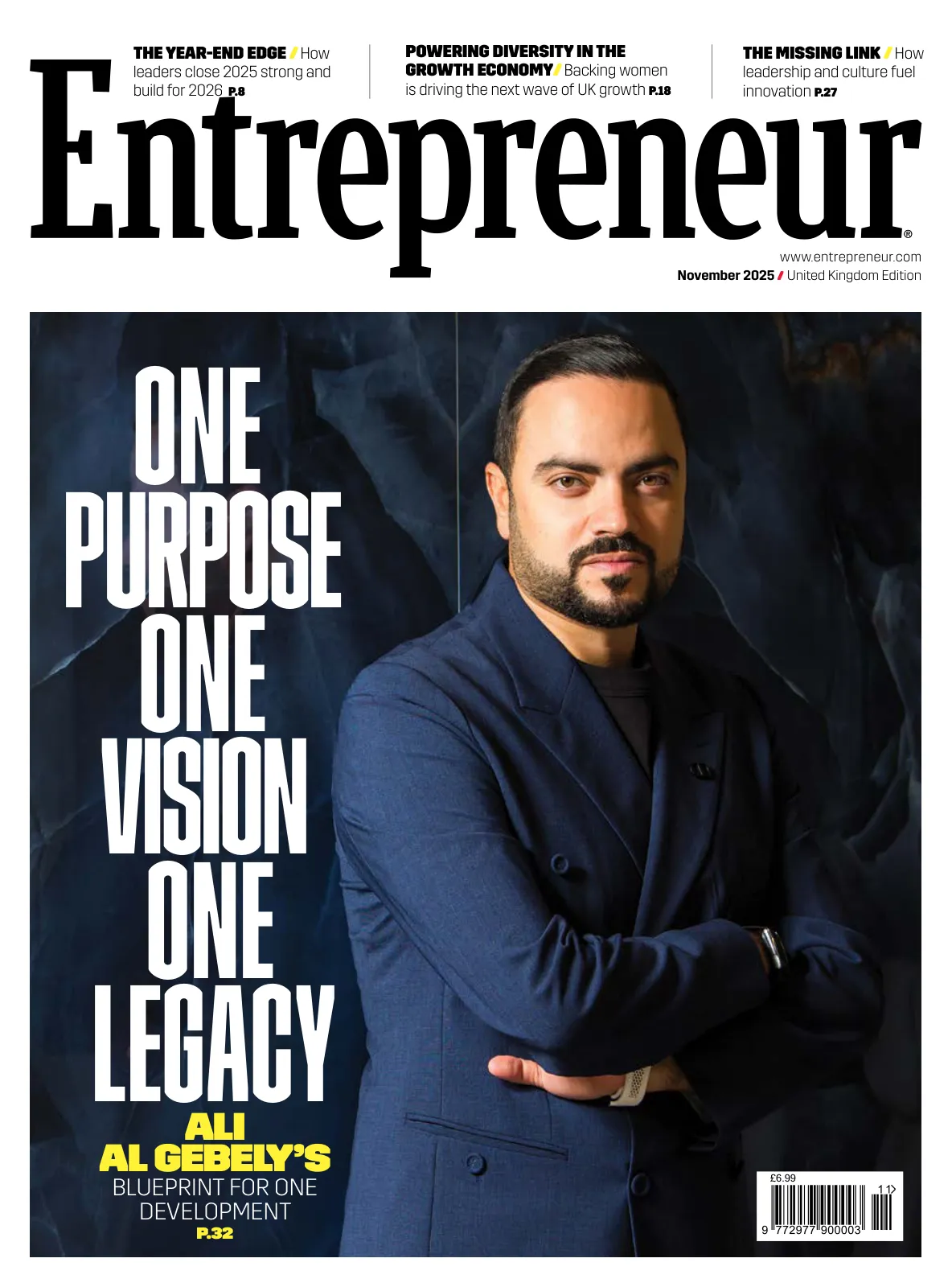
Entrepreneur UK, November 2025
Page 1
THE MISSING LINK / How
leadership and culture fuel
innovation P.27
THE YEAR-END EDGE / How
leaders close 2025 strong and
build for 2026 P.8
POWERING DIVERSITY IN THE
GROWTH ECONOMY/ Backing women
is driving the next wave of UK growth P.18
£6.99
www.entrepreneur.com
November 2025 United Kingdom Edition
ONE
ONE
ONE
PURPOSE
VISION
LEGACY
ALI
AL GEBELY’S
BLUEPRINT FOR ONE
DEVELOPMENT
P.32
Page 2
BOLD
FOR THE
BOLD
UNITED KINGDOM
Page 3
Contents/November 2025
P.32
One
Purpose,
One
Vision,
One
Legacy
ALI AL GEBELY’S
BLUEPRINT FOR ONE
DEVELOPMENT
FEATURES
→ Ali Al Gebely:
Redefining real estate
with ONE Development
3
November 2025 / ENTREPRENEUR.COM /
Page 4
DOWNLOAD
YOUR DIGITAL
EDITION
HERE
UNITED KINGDOM
Out now in the UK
Page 5
5
November 2025 / ENTREPRENEUR.COM /
44 The First Believer
KIRSTEN CONNELL backs bold, early-
stage founders
46 From Lockdown to Liftoff
The entrepreneur fueling a new wave
of founders
50 How To…
…avoid hubris when growing your
start-up
52 From the Ring to the
Algorithm
LESLEY SACKEY’S journey from Team GB
boxer to tech visionary
‘TREPONOMICS
IN THE LOOP
Contents/November 2025
20 Future Tested First
DR BEN WARNER builds AI tools
simulating future decisions for
leaders
24 Tracking Trash
How POLYTAG makes recycling
visible
30 The Real Deal
ADAM KAMANI’S game-changing
property play
BUSINESS
UNUSUAL
STARTUP
SPOTLIGHT
27 The Missing Link
How leadership and culture fuel
innovation
40 Do We Really Want
One-Person Unicorns?
Why solo-founder unicorns
aren’t worth chasing
42 Why Franchising Beats
Going it Alone
Offering a faster, safer path
8 The Year-End Edge
How leaders close 2025 strong and
build for 2026
12 No-Frills, Big Thrills
Voices championing Britain’s hidden
industries
↑ Kirsten Connell, Partner and Head of
the First Cheque Fund at Octopus
Ventures
FEATURES EDITOR Patricia Cullen
patricia.cullen@bncb2b.com
CEO Wissam Younane
wissam@bncpublishing.net
MANAGING DIRECTOR Rabih Najm
rabih@bncpublishing.net
ART DIRECTOR Simona El Khoury
EDITORIAL TEAM
Tamara Pupic,
Aalia Mehreen Ahmed
MEDIA SALES MANAGER
Olha Kovalova olha.kovalova@bncb2b.com
GENERAL MANAGER
Daniel Malins daniel@bncb2b.com
REGIONAL DIRECTOR
Andy B.
CONTRIBUTING WRITERS
Jill Williams, Pip Wilkins, Cris Beswick,
Yasin Altaf and Dr Christian Hampel
SUBSCRIBE
Contact subscriptions@bncb2b.com to receive
Entrepreneur United Kingdom every issue.
COMMERCIAL ENQUIRIES
sales@bncb2b.com
WWW.ENTREPRENEUR.COM/EN-GB
Access fresh content daily on our website
All Rights Reserved 2025. Opinions expressed are solely those of the contributors.
Entrepreneur United Kingdom is officially licensed exclusively to BNC B2B In
United Kingdom by Entrepreneur Media Inc. No part of this magazine may be
reproduced or transmitted in any form or by any means without written permission
of the publisher. Images used in Entrepreneur United Kingdom are credited when
necessary. Attributed use of copyrighted images with permission. All images not
credited otherwise Shutterstock.
20 Wenlock Road, London, N1 7GU
entrepreneurMediaUK
entrepreneurUK
entrepreneurmedia-uk
entrepreneurmedia.uk
Page 6
6 / ENTREPRENEUR.COM / November 2025
Editor’s Note/
ARE YOU WELL POSITIONED FOR 2025’S
CLOSE?
Entrepreneur United Kingdom
A
s we approach the end of the year, this November
issue of Entrepreneur UK takes a closer look at
some of the most exciting developments in the
entrepreneurial world. Our cover story features
Ali Al Gebely, the visionary founder of ONE
Development, who is redefining the real estate
landscape. Al Gebely’s innovative approach
merges traditional property development with cutting-
edge technologies, creating sustainable, forward-thinking
solutions. His work demonstrates how even the most
established industries can evolve to meet the challenges
of the future - and how visionary leadership is crucial in
shaping tomorrow’s cities.
Beyond our cover, this issue explores the final stretch of
the year for entrepreneurs - those crucial last months
when strategic moves are made and businesses push to
meet their annual goals. November offers a moment for
reflection and action, whether entrepreneurs are
preparing for growth in the New Year, securing vital
funding, or scaling their operations. We spoke to
entrepreneurs about what they’re focusing on to ensure
success as the year comes to a close, and how these last
steps set the stage for the future. In addition, we spotlight
No-Frills, Big Thrills, a feature that uncovers industries
often overlooked but critical to the UK’s economic
success. At Entrepreneur UK, we believe it’s time to give
these sectors the attention they deserve, especially as
innovation is happening in unexpected corners of the
economy.
We also hear from Jill Williams, Partner at BGF, who
discusses why backing women entrepreneurs is key to
unlocking the next wave of UK growth. Supporting
women-led businesses is more than a trend - it’s a vital
economic strategy that’s reshaping industries, opening
new market opportunities, and strengthening the UK’s
economic resilience. Also in this issue, Kirsten Connell,
Partner and Head of the First Cheque Fund at Octopus
Ventures, shares her expertise on turning an idea into an
investment. Connell’s insights are invaluable for those
looking to navigate the early stages of building a
successful business. This Entrepreneur UK issue also
features the inspiring journey of Jack Whettingsteel, who
went from supermarket night shifts to co-founding
HelpBnk with Simon Squibb. These stories, along with
many others, remind us of the untold narratives that are
quietly driving the UK economy forward. As we close out
2025, let this issue inspire and encourage you to keep
pushing boundaries, embracing innovation, and setting
yourself up for success in the year ahead. Thank you for
reading, and we wish you continued success as you finish
2025 on a high note.
Patricia Cullen
Features Editor, Entrepreneur United Kingdom
Page 7
EMPOWERING
THE VISIONARIES
OF THE
UNITED KINGDOM
UNITED KINGDOM
Page 8
8 / ENTREPRENEUR.COM / November 2025
In the Loop/
The Year-End Edge
How leaders close 2025 strong and build for 2026 by PATRICIA CULLEN
A
s the final
quarter of
2025 unfolds,
businesses
find them-
selves
navigating a
critical
juncture. November, in particular,
often feels like the make-or-break
month - a time to lock in priorities,
sharpen strategy, and rally teams
amid mounting pressure. The
challenge? Balancing the urgency of
year-end goals with the need to
build sustainable momentum for the
coming year. Across industries,
successful leaders share a common
approach: they combine disciplined
execution with strategic foresight,
leverage technology thoughtfully,
and protect their teams from
burnout by fostering purposeful
cultures. We spoke to four CEOs
across sectors - from healthcare to
private equity, fintech to pension
technology - to understand how
they’re closing out 2025 and setting
up for 2026.
Finishing What You Start
Lyall Cresswell, CEO and founder of
Transport Exchange Group (TEG), a
technology company that operates
digital freight platforms, has learned
over 25 years that winning compa-
nies are those that “actually finish
what they started.” For him, Q4 is
“heads down time - making sure we
deliver on the strategy we set for the
year.” Rather than rushing to patch
new initiatives, Cresswell empha-
sises disciplined focus. “We reinvest
25% of revenue into R&D every year,
but we also protect our people,” he
explains. “Q4 isn’t about heroics, it’s
→ Lyall Cresswell,
founder and CEO,
Transport Exchange
Group
Page 9
9
November 2025 / ENTREPRENEUR.COM /
about executing the plan
we’ve built together.
Sustainable growth means
sustainable teams.” This
balance between focus and
team wellbeing is echoed
across sectors, underscoring
that the path to success
comes from steady,
deliberate progress rather
than rushing without
direction.
Technology as a Strategic
Enabler
Another key focus is
strengthening customer
relationships. “Our focus for
the final quarter is clear
- clients come first. Q4 is
always intense, but this year
there’s a noticeable lift
across the market. After a
year of slower deal flow,
activity is finally picking up
again. PitchBook data
shows PE exits rose across
the summer to their highest
monthly level of 2025 so far,
with new sell-side mandates
increasing each month
since May,” says Carrie
Osman, CEO and founder
of Cruxy, a private equity
→ Carrie Osman, CEO
and founder of Cruxy
}}
Q4 ISN’T
ABOUT
HEROICS, IT’S
ABOUT
EXECUTING
THE PLAN
WE’VE BUILT
TOGETHER.
SUSTAINABLE
GROWTH
MEANS
SUSTAINABLE
TEAMS”
“
Page 10
10 / ENTREPRENEUR.COM / November 2025
growth intelligence firm. The role of
technology in closing the year and
sprinting ahead into 2026 was also a
strong theme. Osman highlights how
tech powers competitive advantage.
“We refuse to treat technology as a
buzzword. Our proprietary Cortex
platform is the backbone of how we
deliver data-first insights that shape
smarter client decisions.” The other
side of that equation is their people.
“Standards matter. No matter how
fast we grow, our culture of account-
ability, drive to impact and excel-
lence remains non-negotiable. The
‘Cruxy way’ means showing up
curious, consistent, and committed
- that’s how we stay ahead of the
curve.” Looking forward, Osman says
Cruxy is “doubling down on how we
leverage AI to drive both perfor-
mance and value - not just efficiency,
but intelligence.” This mindset of
harnessing AI not simply for
automation, but to deepen insight
and drive smarter outcomes, also
resonates with Vivan Shridharani,
co-founder and CCO at Raindrop,
the pension-finding platform.
Shridharani describes a deliberate
push to “increase our technological,
operational, and business investment
in AI to deliver the enhanced
features clients need.” This invest-
ment supports their mission to
reunite savers with lost pensions -
over £800m recovered so far - and
sets the stage to surpass the £1bn
mark soon.
Customer-Centricity as the North
Star
Despite technological leaps, the laser
focus on real customer problems
OUR ADVANTAGE COMES FROM SOLVING REAL PROBLEMS
THAT OUR CUSTOMERS ACTUALLY FACE - THE PAYMENT
CHALLENGES THAT HAVE CONSTRAINED LOGISTICS
OPERATORS FOR DECADES. DELIVERING GENUINE VALUE
AND BUILDING LASTING RELATIONSHIPS CREATES
SUSTAINABLE DIFFERENTIATION”
“
In the Loop/
↑ Vivan Shridharani, co-founder
and CCO at pension-finding
platform, Raindrop
Page 11
11
November 2025 / ENTREPRENEUR.COM /
remains paramount.
Cresswell underscores this
by highlighting TEG’s
competitive edge: “Our
advantage comes from
solving real problems that
our customers actually
face - the payment
challenges that have
constrained logistics
operators for decades.
Delivering genuine value
and building lasting
relationships creates
sustainable differentia-
tion.”
Similarly, Jon Robinson,
CEO of medical cannabis
company Mamedica, talks
about how patient needs
are driving their year-end
focus. “Our patient base
has grown by over 100% in
the last year. Our priority
is strengthening our digital
healthcare platform to
make access to treatment
even more seamless. This
also involves optimising
our supply chain to
maintain an uninterrupted
source of high-quality
CBPMs for our growing
number of patients.”
Robinson is doubling
down on accessibility as a
key strategic lever:
“Following our recent
funding round, we’re
introducing a lower-cost
pricing model to make
treatment more affordable.
We aim to stay ahead not
by cutting corners, but by
widening access - proving
that premium clinical care
and affordability can
coexist.” Robinson points
out that “November always
feels like the sprint before
the finish line,” yet for
them, it’s really about
preparing the pace for the
year ahead.
Building Culture and
Protecting People
End-of-year pressures can
be intense, but all four
leaders emphasise the
importance of sustaining
their teams through this
demanding period.
Osman describes how
Cruxy manages the
relentless Q4 pace: “We
encourage the team to
zoom out and see the
bigger picture - the
progress made, lessons
learned, and opportunities
ahead. That perspective
turns fatigue into focus.
Our Friday team drinks
aren’t just social - they’re a
reset.” Shridharani adds
how Raindrop’s culture of
collaboration is key to
maintaining motivation
and innovation under
pressure: “We are in
constant dialogue with
our team, fostering a
collaborative environment
that encourages feedback
across all levels. Recently,
we held a company-wide
hackathon empowering
team members to take
leadership roles — many
winning ideas are now
part of our product and
strategic roadmap. This
helps colleagues to see the
impact of their effort and
continued innovation.” At
Mamedica, Robinson
acknowledges that
working in healthcare
means the stakes are
always high and he
stresses compassion: “Our
dedicated team supports
patients with chronic
conditions who rely on
consistent care all year
round. I feel like our
entire team takes that
responsibility deeply, and
that’s what keeps everyone
focused rather than
fatigued.” He goes on to
say that the team works
hard, celebrates wins,
stays flexible, and values
empathy as much as
ambition. Cresswell
echoes this sentiment with
a warning. “When you’re
building for the long term
you can’t afford to burn
people out.”
Looking Ahead
All leaders share a
conviction that Q4 is not
just a frantic dash, but a
strategic sprint that sets
the tone for the year
ahead. As Osman puts it:
“We don’t just want to
finish the year well - we
want to start the next one
already ahead.” With smart
tech investments,
customer-first thinking,
and a strong culture that
balances ambition with
care, these companies are
not just surviving the
year-end crunch - they’re
using it to build lasting
advantage. End-of-year
planning requires more
than crossing off tasks; it
demands disciplined
execution, strategic
foresight, and a relentless
focus on the human
element. As these leaders
show, by aligning
technology, customer
needs, and team wellbeing,
companies can close 2025
with strength and step into
2026 ready to lead.
→ Jon Robinson, CEO
of Mamedica
Page 12
T
hey’re not betting on buzzwords or billion-dollar valuations. Instead, three
thirty-something entrepreneurs are finding returns in Britain’s ‘unsexy’
foundation - and proving that the overlooked might just outperform the
overhyped. In an era where headlines celebrate unicorns and the start-
up world fixates on AI, crypto, and the next disruption, three
entrepreneurs are doing the opposite. “When we say ‘unsexy,’ we don’t
mean unimportant,” says Grégoire Louisy, co-founder of Tioopo Capital, a
private equity firm based in London. “We mean industries that are profitable,
cash-flowing, and critical in the value chain, but they don’t fit the VC narrative or
catch headlines.”
No-Frills, Big Thrills
From private equity founders to AI pioneers embedded in traditional sectors, this
Entrepreneur UK feature brings together voices championing the hidden industries
driving Britain’s economy - and why they deserve more attention. by PATRICIA CULLEN
Founded by Grégoire
Louisy, Cyril Aboujaoude,
and Shahan Sarkissian,
Tioopo Capital may be
one of the youngest
private equity firms in the
UK, but it’s already
making a name for itself
as a bit of a maverick.
Their strategy is as
straightforward as it is
S/Underdogs
12 / ENTREPRENEUR.COM / November 2025
→ Cyril
Aboujaoude,
Grégoire Louisy
and Shahan
Sarkissian,
co-founders of
Tioopo Capital
Page 13
unusual: forget the shiny
tech and invest in sectors
most investors ignore.
That means family-run
manufacturers,
advanced engineering
firms, and niche
industrial suppliers.
Some call them
low-profile businesses.
Others might call them
boring. Tioopo calls
them an opportunity.
“When we started
Tioopo Capital, our
strategy of investing in
unsexy businesses was a
calculated bet - better
risk-adjusted returns,”
says Aboujaoude. “A few
years later, Tioopo has
gone from one company
and 20 employees to
seven portfolio compa-
nies and over 500
employees through its
portfolio companies. It
shows the sheer growth
potential of backing
industries that most
investors overlook.”
While their peers chase
blitzscaling start-ups
hoping to turn losses
into future profits,
Tioopo’s founders focus
on companies generating
real cash from day one.
“That allows us to
compound value year
after year, deleverage
over time, and deliver
strong returns even
without an exit,” explains
Louisy. “Too many
younger investors are
skewed towards venture
capital, where compa-
nies live off raised money
and hope one day to
become profitable. We’ve
always believed the
essence of business is to
be profitable from the
start. It sounds obvious
- but it makes us
contrarian in today’s
market.” This approach
is not just about
preference - it’s strategic.
It’s about building
resilience in an increas-
ingly volatile economy.
“We’re not VCs, we’re a
private equity firm the
way it was intended - op-
erational and hands-on,”
says Aboujaoude. “Our
north star is risk-adjust-
ed returns - generating
VC-like outcomes with
far less downside.”
The hard yards
These are not businesses
you can toss money at
and forget. And that’s
precisely why most inves-
tors stay away. “The
reason others miss it is
because it’s hard work,”
says Sarkissian. “You
can’t just write a cheque
and wait. These
companies require
operational bandwidth,
energy, and real
involvement. But if
you’re willing to roll up
your sleeves, you can
unlock extraordinary
value.” It’s this kind of
value that Tioopo
believes the UK economy
can’t afford to ignore -
and that policy makers
rarely acknowledge.
“Unsexy businesses may
not grab headlines, but
they are the backbone of
the economy,” says
Aboujaoude. “Think
about advanced
engineering firms,
medical device suppliers,
or heritage leather
producers. They’re often
SMEs, but more
importantly, they’re the
businesses that keep
supply chains running
and employ millions.
Their growth is critical to
GDP - but many face
succession risk or stagna-
tion if no one invests in
them for the long term.”
That long-term mindset
means Tioopo takes an
unusually hands-on
approach. It’s not
uncommon for them to
embed team members
directly into portfolio
companies to drive trans-
formation from within.
Their playbook is
detailed: upgrade
leadership, streamline
operations, impose
financial discipline - and
bring in tech. “Every
single one of our
portfolio companies has
at least one AI integra-
tion project running
today,” says Sarkissian.
“Technology is about
survival, not just value
creation,” says Louisy.
Investing in staying
power
When asked what
separates a business
worth investing in from
one that isn’t, Louisy
doesn’t hesitate. “We
ask: will this business
still matter in 10 years?
Does it solve a critical
problem for customers?
Does it have pricing
power, sticky relation-
ships, and a product or
service that can’t easily
be replaced? If the
answer is yes, then we
know the fundamentals
are there.” It may sound
like old-school business
logic - but that’s the
point. In a market
obsessed with the new,
Tioopo is making the
case for the enduring.
“We ask: ‘Can this
reliably compound
capital and grow
stronger year after
year?’” says Aboujaoude.
13
November 2025 / ENTREPRENEUR.COM /
UNSEXY BUSINESSES MAY
NOT GRAB HEADLINES, BUT
THEY ARE THE BACKBONE OF
THE ECONOMY. THINK ABOUT
ADVANCED ENGINEERING FIRMS,
MEDICAL DEVICE SUPPLIERS, OR
HERITAGE LEATHER PRODUCERS.
THEY’RE OFTEN SMES, BUT MORE
IMPORTANTLY, THEY’RE THE
BUSINESSES THAT KEEP SUPPLY
CHAINS RUNNING AND EMPLOY
MILLIONS”
“
Page 14
14 / ENTREPRENEUR.COM / November 2025
Revolutionising the
‘Unsexy’ Construction
Industry
Tioopo’s embrace of
underappreciated indus-
tries is echoed by innova-
tors working directly within
these overlooked sectors.
The construction industry,
despite its massive global
impact, often gets dis-
missed as an outdated, inef-
ficient sector. As Qflow
founder Jade Cohen puts it,
construction is often seen
as a ‘dirty’ space, which has
led to it being overlooked
for technological innova-
tion. However, this
perception actually
presents a significant
opportunity to drive
change. Cohen and her
co-founder Brittany Harris,
both with firsthand
experience in the sector,
quickly saw how “chaotic,
S/Underdogs
“That’s what sets us apart.”
The future, they argue,
won’t be built solely by
unicorns and headline-
grabbing founders. It will
be shaped by the often-
ignored firms that power
Britain’s manufacturing
base, supply chains, and
skilled jobs.
“If these companies don’t
adapt, they risk disappear-
ing,” warns Louisy. “Our
role is to make sure they
evolve - preserving their
strengths while making
them competitive for the
future.” It’s not just talk. In
several cases, founders of
acquired businesses have
reinvested alongside
Tioopo - a rare show of
confidence. “We’ve seen
founders get so excited
about the bolt-on
acquisition strategies we
introduced that they
reinvested alongside us,”
says Sarkissian. “We’re
giving these companies
tools and visions they
might never have consid-
ered on their own.” There’s
a satisfaction that comes
from making things work
that others have ignored.
That, ultimately, might be
what drives this unortho-
dox trio more than returns
or recognition. “It really is
an adapt-or-die situation,”
says Aboujaoude. “The
principle is the same: help
them modernise, stay
relevant, and grow. When
they thrive, the whole
economy benefits.” And for
Tioopo Capital, that’s
exactly the kind of
headline worth chasing.
→ Qflow
founder Jade
Cohen
↑ Co Founders
(Cyril Aboujaoude,
Grégoire Louisy and
Shahan Sarkissian)
and Nigel
Lempriere, CEO at
TECNIQ
Page 15
15
November 2025 / ENTREPRENEUR.COM /
disjointed and discon-
nected” the industry is,
yet realised that “it really
didn’t need to be that
way.” The problem isn’t
the lack of skill - con-
struction is filled with
some of the “world’s
greatest problem solvers,”
but, as Cohen highlights,
these experts are often
“working under extreme,
very tightly constrained
circumstances.” Cohen
explains that construc-
tion is “responsible for
some of the most
resource intensive
activities out there, the
most carbon intensive,
the most wasteful,” much
of which is completely
avoidable and stems
from simple, preventable
errors. Recognising this
gap, Cohen and Harris
set out to tackle the
industry’s data problems
with their platform,
Qflow. “We thought,
‘we’re best-positioned to
look at this issue of poor
data and the impacts this
can have,’” Cohen notes.
The platform’s goal is to
bridge the gap between
information-rich,
data-poor construction
sites, aiming to reduce
waste, decarbonise, and
improve efficiency. One
of the challenges Cohen
faced was breaking into
such a “slow-moving”
and “traditional” sector,
but Qflow’s approach
was designed to be a
“light touch,” integrating
smoothly into existing
workflows. It’s as simple
as having workers “take
photographs of delivery
tickets that they’re
already receiving,” which
helps avoid a full
disruption to the system.
Looking ahead, Cohen
believes AI has huge
potential to revolutionise
the industry, adding that,
“we’re only scratching the
surface with what it can
deliver,” especially when
it comes to rethinking
how buildings are
constructed and
materials are reused.
Building AI solutions in
‘unsexy’ industries
Tom Bartley, Director of
Civil Infrastructure at
Oxford University
spin-out Mind Foundry,
explains how AI is
transforming the ageing
infrastructure sector - a
trillion-dollar global
challenge often ignored
by start-ups. “The
infrastructure we all rely
on every day is ageing.
Bridges, tunnels, water
networks, and coastal
protections are all
approaching the end of
their design life and
starting to show signs of
failure,” he says. “At
Mind Foundry, we’re
building an AI-enabled
predictive maintenance
platform to help owners
manage their asset risk
more effectively and
make the case for the
funding they need to
keep people and the
economy safe and
secure.”
Bartley highlights the
uphill battle of building
tech businesses in such
traditional fields. “The
non-software half of our
team all have our roots
in civil engineering. We
understand that building
a tech business in the
sector can feel like an
uphill battle, but we also
know that when
customers do sign up,
they’re in it for the long
run.” Predictive mainte-
nance AI tools help
surface risks by integrat-
ing sparse and fragment-
ed data, using computer
vision to quantify
deterioration, and
building predictive
models that allow
engineers to prioritise
repairs within tight
budgets. “The real
challenge is that the
owners can’t see or
quantify their risks. Data
on asset condition is
}}
→ Tom Bartley,
Director of Civil
Infrastructure at
Oxford University
spin-out Mind
Foundry
Page 16
16 / ENTREPRENEUR.COM / November 2025
has embedded AI features directly into their case
management software, helping lawyers analyse and
summarise large collections of legal documents faster.
“For example, reviewing and summarising a 75-page
transcript used to take around four hours. Opus 2’s AI
delivered near-instant results allowing the lawyer to
spend just a few minutes reviewing and validating the
results,” he says. The legal sector’s cautious and
competitive nature means trust in AI is critical. Opus 2’s
approach is to create a secure environment with human
oversight to reduce risk. “We don’t ask clients to change
how they work,” Harrel says. “We’ve built technology
that fits naturally into their existing workflows. By
showing that AI can be a trusted assistant, we’ve been
able to build confidence and adoption.” Looking
forward, Harrel believes AI will become integral to legal
work, shifting the conversation from ‘Are you using AI?’
to ‘How do you use AI?’ “The firms that succeed will be
those that combine trusted technology with human
expertise - and that’s exactly where we’ve always aimed
to be,” he says.
Together, these stories uncover a striking truth: the
future of success and innovation is rooted not only in the
flashy or fashionable, but in the unassuming industries
that form the bedrock of our economy. While they may
lack glamour, these sectors - armed with determination,
expertise, and the transformative force of AI, are
reshaping the landscape, driving sustainable growth and
delivering enduring value. It is here, in the unsexy yet
indispensable, that real progress is being made.
WE ASK: WILL THIS
BUSINESS STILL MATTER IN
10 YEARS? DOES IT SOLVE
A CRITICAL PROBLEM FOR
CUSTOMERS? DOES IT HAVE
PRICING POWER, STICKY
RELATIONSHIPS, AND A
PRODUCT OR SERVICE
THAT CAN’T EASILY BE
REPLACED? IF THE ANSWER
IS YES, THEN WE KNOW THE
FUNDAMENTALS ARE THERE”
“
sparse, subjective, and fragmented, so engineers have
to rely on their intuition,” Bartley explains. “We’re
using AI to surface risk by integrating and cleaning
data, utilising computer vision to quantify deteriora-
tion, and building predictive models that enable
engineers to compare risk and prioritise within
extremely limited budgets.”
By partnering closely with industry experts, Mind
Foundry has avoided speculative tech-building,
instead validating their ideas with real customers and
innovation funding before scaling. “We have a stellar
team of engineers, scientists, and designers, so the
proof points in these prototype projects had enough
wow factor for customers to commit,” Bartley says.
“It’s a trillion-dollar global challenge - and we’re
building the leading AI solution for the global ageing
infrastructure crisis.”
Tech meets tradition in the legal sector
Likewise, Charlie Harrel, CEO of Opus 2, another
example of innovation in a modest sector, shares how
legal tech start-ups are integrating AI into estab-
lished industries that many start-ups avoid. “Opus 2
was founded more than 15 years ago by lawyers and
seasoned legal technology experts,” Harrel says. “We
focus on creating tools that help lawyers work
smarter, not just faster.” As AI has matured, Opus 2
S/Underdogs
→ Charlie
Harrel, COO
of legal
technology
and services
company,
Opus 2
Page 17
The voice of
entrepreneurship
around the world
Access fresh content daily on our website
Page 18
18 / ENTREPRENEUR.COM / November 2025
S/Diversity
A
cross the UK, women are launching
businesses in record numbers - in
2023 alone, 164,000 new firms were
founded by women, accounting for
18% of all new companies. What’s
more, nearly half (47%) of early-stage
entrepreneurs in the UK are women.
The stats are growing and they’re
compelling. The fact is, these ventures are
transforming industries, creating jobs and
rewriting what leadership looks like. But
behind those success stories lies a persistent
truth: female founders still receive only a
fraction of the support and funding available
to their male counterparts. The imbalance is
holding back not just women, but the growth
potential of the UK economy as a whole.
Powering Diversity in the
Growth Economy
Backing women is driving the next wave of UK growth by JILL WILLIAMS
And yet when women do
receive the right backing,
the results can be
transformative. Take Kids
Planet, for example, born
from one mother’s desire for
flexible childcare, it’s grown
into one of the UK’s
fastest-scaling nursery
groups. It’s a story that
shows exactly what’s
possible when female
entrepreneurship meets
access to growth capital as
well as targeted scale up
support. The numbers say
everything about the
phenomenal success of Kids
Planet: 235 nurseries, 7,000
employees and 36,500
children under its care. At
the time of writing, those
numbers were correct.
However, such is the pace of
growth at Kids Planet that
they need updating on a
regular basis.
While Kids Planet is an
excellent example of
female-powered growth,
supported and accelerated
by external investment, the
need to build on the
growing numbers of female
entrepreneurs, create more
balance and unlock greater
potential in the UK business
landscape remains a
priority. The good news is,
there is clear movement
towards addressing the
gender divide and the pot of
funding being committed to
support women in business
is starting to fill up. So
where is that money coming
from?
Putting their money where
their mouth is
Earlier this year, BGF
announced a £3bn UK-wide
commitment to support
high-potential companies
over the next five years. As
part of this pledge, BGF is
committing at least £300m
to the Invest in Women
Taskforce’s funding pot, to
support scaling female-
powered businesses.
The IWT’s ‘Women
Backing Women’ fund,
supported by Chancellor
Page 19
19
November 2025 / ENTREPRENEUR.COM /
Rachel Reeves, has got some serious
financial clout and demonstrates a
shift in thinking. In fact, according
to the IWT, if women started and
scaled businesses at the same rate as
men, it would deliver a potential
£250bn boost to the UK economy.
It’s clear why the organisation is on a
mission to create the world’s largest
investment pool for female-led and
mixed businesses.
But it doesn’t stop there. FFinc, an
association dedicated to the
financial, career and personal
advancement of women, has already
built year-long tech accelerators with
KPMG, supported hundreds of
women to grow businesses globally
with HSBC, and helped 20% of its
most recent accelerator cohort to
secure funding. In September, the
organisation launched its latest
female-powered venture: the
Forward Faster Accelerator – a
comprehensive six-month
programme designed to supercharge
100 of the UK’s most ambitious
female-founded businesses. Backed
by BGF and a host of partners
including HSBC, the aim is to move
beyond traditional mentorship, to
deliver capital access, commercial
readiness and strategic scale
support. The funding landscape for
scaling female-led business is
gathering pace, with a concerted
effort from the investment
community and wider stakeholders
to support the growing number of
businesses founded by women,
building on the 164,000 started in
2023.
Being investment ready for when
the time comes
There is clearly a growing appetite to
invest, and there are countless
female entrepreneurs waiting in the
wings ready to supercharge their
business. But, after years of
underservice, how can they make the
most of that relationship when the
time comes? Regardless of whether
a founder is male or female, securing
investment for the next stage of a
business’ growth takes preparation.
Few are investor-ready from the
outset. The first step is to consider
what investors look for in a business.
Generally, it’s a strong management
team, good financial performance
and a well-thought-out growth plan,
among other things. Businesses
typically seek investment to finance
growth through expansion, which
may include research and
development into new propositions,
hiring people, or to finance the costs
of launching in a new market.
Alternatively, the investment may be
required to fund growth using a
buy-and-build acquisition strategy.
Whatever the driver, there are a
number of key things to consider
when preparing for investment:
}Growth plans: Whatever a business’
growth strategy, it should be
underpinned by a detailed step-by-
step plan, which should be support-
ed by as much evidence as possible.
}People: An investment is a
relationship, and relationships
depend upon people. A robust
growth plan should identify the
leadership, technical and profes-
sional skills of the top team.
Investors must have confidence that
a business has the right people to
deliver their growth plan.
}Credible financial plan: The due
diligence stage of the investment
process is crucial for determining
success or failure. If financial
accounts and supporting analysis are
in the wrong format, insufficiently
detailed, or in any way non-compli-
ant with legislation, no one will want
to invest.
}The right investor: While the pool
of investors with a specific female-
focused remit is still in its infancy,
there are many investors on the
market willing to fund high-poten-
tial businesses. Some have specific
expertise in market sectors, some are
generalists, some are known for
seeking returns in a short timeframe,
others are more long-term in nature.
Businesses should aim to engage
with those that are a good fit for
their business – alignment around
goals is key.
}Timing: If everything falls into place
and is aligned, a small number of
nimble and well-managed business-
es are able to achieve investor-readi-
ness in a few months. However, a
timeframe of at least three to six
months is more common, possibly
up to 12 or more if a business has a
lot of work to do.
More than money
The statistics tell us that the
business landscape is changing in
the UK and women are right at the
centre driving that growth. However,
there is still work to be done to
create more inclusive
entrepreneurship, and a more
equitable, dynamic future for
female-powered businesses. Capital
alone isn’t enough to drive growth.
Networks, community and visibility
for female business leaders are
crucial.
Collectively, we need to do more to
increase female representation on
boards and nurture successful
mentor-mentee relationships. It is a
challenge that has been accepted and
the time to power diversity in the
growth economy is now.
Jill Williams is a Partner at
BGF – the UK and Ireland’s
most active growth capital
investor . BGF has been
recognised as the #1 investor
in female-powered scale-ups in the UK
over the last five years.
REGARDLESS OF WHETHER A FOUNDER IS MALE OR FEMALE, SECURING
INVESTMENT FOR THE NEXT STAGE OF A BUSINESS’ GROWTH TAKES
PREPARATION. FEW ARE INVESTOR-READY FROM THE OUTSET. THE FIRST
STEP IS TO CONSIDER WHAT INVESTORS LOOK FOR IN A BUSINESS”
Page 20
20 / ENTREPRENEUR.COM / November 2025
S
Predict
/
Page 21
21
November 2025 / ENTREPRENEUR.COM /
“There are hundreds of
decisions being made
every day in business.
What we’re realy doing
with AI is moving a lot of
the smal decisions to AI,
so we can concentrate
on the biggest, most
important decisions”
I
n the world of leadership, timing is everything.
Make the right decision too late, and it can feel
like no decision at all. Make it too early - without
data or foresight - and it risks being disastrously
wrong. During the COVID-19 pandemic, Dr Ben
Warner, a theoretical physicist turned government
advisor, sat at the centre of this tension. “During
COVID-19, they tried to base as many decisions as
possible on data,” he says. “They were doing their
best to follow the science. But sometimes, the sort of
information and data just wasn’t there, and they had to
rely on their own gut feeling.” That reliance on instinct
- necessary but risky - in the absence of real-time
evidence drove Warner toward a question that has since
become his life’s work: What if leaders could test
decisions before they even made them?
Building a Twin for the Real World
Now co-founder of Electric Twin, a London-based
company that develops synthetic populations and tools
to simulate human behaviour, Warner’s answer to that
question is unapologetically ambitious. The start-up
builds software that allows organisations to simulate
real-world decisions in real time, predicting how people
might react to policies, messages, or product changes.
“So the idea behind Electric Twin is to create synthetic
populations to allow decision-makers to make decisions
at speed,” Warner explains. “We build out software
products that allow you to gain a deep understanding of
your audience, and then generate and test hypotheses,
at speed.”
Rather than relying on traditional methods like
surveys or polling - which are slow, expensive, and often
outdated- Electric Twin enables users to model and test
their assumptions digitally. “Rather than guessing as to
how a population might react, or what message or
content might resonate with your audience, you can
actually test it,” he says. “And that’s all done within
software tools so that you essentially have access to
cutting-edge data science in seconds.”
Replacing Gut Instinct?
The implications are vast. Warner imagines a future
where simulations are so fast and reliable, they begin to
supplant gut instinct altogether. Are we there yet?
“We’re getting close. Which means that you can make
bad decisions,” he adds pointedly. “But we use real-
world data to create our synthetic populations.”
Importantly, Electric Twin isn’t trying to discard
traditional methods - it’s aiming to enhance them.
“When we think about traditional methods, we’re also
talking about simple models which haven’t changed for
a large number of years,” Warner says. “So actually, all
we’re doing is coupling the best of the traditional
methodologies in terms of data collection with the best
of modern AI technologies, to give decision-makers the
best possible information they can have at the speed
”
}}
Future Tested First
Dr Ben Warner is co-founder of Electric Twin and helped shape COVID policy in Downing
Street. Now he’s building AI tools that let leaders simulate the future - before making a
single decision. by PATRICIA CULLEN
Page 22
22 / ENTREPRENEUR.COM / November 2025
they need it in.” In
Warner’s view, Electric
Twin isn’t a replacement
for human leadership - it’s
a partner to it. One that
accelerates insight and
opens space for greater
creativity, boldness, and
nuance.
Lessons From the
Pandemic
Looking back on his time
in government during
COVID-19, Warner sees a
clear use case for the
technology he’s now
building. “I think there are
some real highlights,” he
says. “For instance, the
ONS infection study is a
great example of really
high-quality, good data
collection for the real
world.” But, he argues, that
wasn’t where the biggest
problems lay. “Where we
fell down in COVID-19, I
think, is when it came to
trying to understand
human behaviour - either
how people would react to
policy, or what policies
would get the behaviour
we needed.” That’s where
Electric Twin could have
made the difference. “We
could have been able to
test different ideas in
seconds and give the Prime
Minister, and other
decision-makers, the
information they needed
to try and make decisions.”
From Delay to Velocity
Today, in both business
and government, leaders
are under pressure to
make high-stakes
decisions faster than ever
before. Speed is no longer
a luxury - it’s a require-
ment. “If it takes two
weeks to get a market
research study back, what
are you going to do?”
Warner asks. “That’s where
AI is really helpful.” The
tool is already proving its
value. “Sometimes, before
we’ve even had our kickoff
meeting with customers,
they’ve already used it
within the business on a
decision,” he notes.
Whether it’s marketing,
product development, or
public health policy,
Electric Twin is helping
teams simulate reactions
and test messaging in real
time. “It’s really exciting to
see how it’s developing and
how businesses are using it
to really have an impact in
their business.”
Democratising Insight
While many enterprise AI
tools are reserved for
senior execs or locked
behind expensive licenses,
Warner envisions some-
thing different: accessibil-
ity. “Usually, these are tens
of thousands of pounds. It
might be only the CMO
who commissions them,”
he says. “But there are
hundreds of people across
an organisation who care
about trying to give the
best possible service to
their customers or build
the best possible product.”
Warner calls this shift the
“democratisation of
insight.” “So everyone in an
organisation is suddenly
using really good, realistic
insights of the population,”
he explains. “Everyone is
making better decisions.”
That includes even the
most junior staff. “It also
empowers people,
including the more junior
employees who are
thinking about where
should we put our
advertising, etc? How can
I make my bit of the
company better?” The
result? Smarter, faster,
more confident decisions
- at every level.
Human + Machine, Not
Versus
If it all sounds like
algorithms are taking over,
Warner is quick to clarify:
AI is here to empower
human decision-making,
not replace it. “Businesses
are using technology to
make decisions all the
time,” he says. “There are
hundreds of decisions
being made every day in
business. What we’re really
↑ Dr Ben Warner, co-founder of Electric Twin
S
Insights
/
Page 23
23
November 2025 / ENTREPRENEUR.COM /
doing with AI is moving a
lot of the small decisions
to AI, so we can concen-
trate on the biggest, most
important decisions.”
Electric Twin is about
giving leaders the best
possible tools - not
removing them from the
process. “It’s about
empowering and enabling
a human - to give them
the best possible informa-
tion so that they can make
that big strategic decision,
rather than spending ages
trying to work it out.”
And what about
creativity? “There’s always
room for creativity. I think
creativity is probably the
most underappreciated
thing,” Warner says.
“Science has always been a
creative endeavour. I
think AI allows us to be
the most creative that
we’ve ever been.”
A Rare Optimism in UK
Tech
In a time of economic
uncertainty and political
fatigue, Warner remains
disarmingly hopeful
about the UK’s place in
the global AI race. “If you
look outside of the US
and China, the UK is the
clear leader,” he says. “We
are very lucky to have
DeepMind, which is the
heart of Google, sitting in
London... there is no
other country in the
world that has a research
institute like DeepMind.”
He points to the UK’s
world-class universities,
the concentration of AI
talent in London, and the
rise of ambitious
start-ups. “We’ve got
everything here to really
become one of the
powerhouses of AI,” he
says. “I think we just have
to be really careful that
we continue to culture it,
to improve it.” He also
sees early promise in UK
government efforts. “The
AI Safety Institute is
superb,” he says. “Govern-
ment is doing a good job
as well. But again, those
are small-scale pro-
grammes.” The challenge,
he argues, is scale. “We’ve
got to think about how
we’re driving them into
really changing the
percentage the govern-
ment spends, rather than
just smaller innovation
projects.”
What Comes Next?
The stakes are no longer
theoretical. Crises - from
climate change to
healthcare to public trust
- demand decisions that
are faster, smarter, and
more in tune with how
people actually behave.
“Organisations are trying
to do the best they can.
But at the moment, the
tools they have are slow,
they’re expensive. And
Electric Twin allows you
to be faster, and with the
same accuracy,” he says.
At its core, Warner’s
vision isn’t about
replacing human leaders
- it’s about equipping
them. “We’re trying to use
AI to actually shine a
floodlight on the most
human of all problems -
which is understanding
how humans behave.”
And maybe - just maybe
- this kind of technologi-
cal advancement can help
us stay one step ahead of
the next crisis.
“If you look outside of the US and China, the UK
is the clear leader. We are very lucky to have
DeepMind, which is the heart of Google, sitting in
London.. there is no other country in the world
that has a research institute like DeepMind”
Page 24
24 / ENTREPRENEUR.COM / November 2025
S
Recycle
I
n a world increas-
ingly conscious of
sustainability,
packaging remains
a stubborn
problem. Compa-
nies devote time and
resources to designing
recyclable packaging,
yet beyond the
consumer’s hand, a
critical blind spot
persists - what
happens to packaging
once it enters the
recycling bin? Alice
Rackley, CEO of
Polytag, knows this
gap well. “The hardest
blind spot we set out
to fix was the absence
of data once packaging
leaves the consumer’s
hand. Companies
invest heavily in
recyclable design, but
the moment it enters
the recycling bin, all
visibility is lost. It’s
like shipping a
package with no
tracking; unthinkable
in modern logistics.”
This absence of data
is more than a simple
oversight; it has
become a serious
regulatory challenge.
As governments enact
Extended Producer
Responsibility (EPR)
laws requiring
businesses to prove
their packaging has
been recycled,
companies face
mounting fines if they
cannot demonstrate
compliance. “This data
gap is now a critical
regulatory risk. With
Extended Producer
Responsibility (EPR)
laws mandating that
businesses prove they
recycled their packag-
ing, the lack of
visibility means
companies face
massive fines for
non-compliance.”
Polytag’s break-
through comes from a
surprisingly simple
innovation with
profound implications.
The company applies
invisible ultraviolet
(UV) tags directly to
packaging during
production.
“Polytag cracked this
by applying invisible
UV tags to packaging
during production.
This allows us to track
every item to its final
destination in the
recycling facility. We
turn ‘recyclable’ into
verifiable fact,
providing businesses
with the real-time,
item-level data they
need to meet their
legal obligations.”
For an industry
steeped in caution,
introducing new
technology is no easy
task. Convincing
major retailers and
Tracking Trash
How Polytag makes recycling visible. by ENTREPRENEUR UK STAFF
/
↓ Alice
Rackley, CEO
of Polytag
Page 25
25
November 2025 / ENTREPRENEUR.COM /
waste processors to adopt
innovations that impact
their operations is a
delicate balance. Yet,
Polytag’s approach targets
the acute pain points
businesses face today. “We
are solving very specific,
very expensive problems
that need to be tackled
today. For retailers, our
data becomes the audit
trail for compliance
required by EPR laws,
turning a financial liability
into a risk-mitigation
strategy. It’s also a
communication to savvy
customers and stakehold-
ers; demonstrating
investment in the
environment.”
For waste processors, the
solution fits seamlessly
into existing systems.
Crucially, the technology
has proven its reliability in
real-world settings. “For
waste processors, our solu-
tion is non-disruptive; our
Detection Units can be
retrofitted into existing
machine recycling
facilities (MRFs),
enhancing their infra-
structure without costly
overhauls. Critically, the
technology works.
Third-party tests,
including achieving 100%
detection accuracy with
CITEO in a live MRF
environment, show we’re
the real deal.”
But where does regula-
tion meet innovation?
And how does Polytag
navigate that sometimes
turbulent space? “The
collision point is scale,
primarily seen in the
limitation of Deposit
Return Schemes (DRS).
Legislators want high
recycling rates, but
traditional physical DRS is
an infrastructure night-
mare, requiring massive,
costly overhauls of retail
space and logistics.
Consumers can’t or won’t
take their recycling to a
third location.”
DRS, which require
consumers to return
packaging to collection
points in exchange for a
refund, have faced
criticism for their
logistical complexity and
limited consumer uptake.
Polytag advocates a digital
alternative — one that’s
scalable and consumer-
friendly. “Digital DRS
(DDRS) is the only viable,
scalable solution. We have
run multiple pilots
proving that digital DRS
works incredibly well,
especially when including
an incentive for the
consumer.”
Standardisation is
another crucial battle-
ground. Without common
data protocols, scaling
innovations across borders
becomes a technical and
regulatory quagmire.
Polytag built its systems
on GS1 open standards,
enabling global interoper-
ability and collaboration
with waste processors
worldwide. “The second
tension is data standards.
We choose to build our
systems on GS1 open
standards to ensure global
interoperability; the key to
cross-border scaling. We
partner with waste
processors across the
globe to not just tag and
trace recycling, but to
enable smarter detection
and sortation. This
wouldn’t be possible
without GS1 open
standards.”
Behind Polytag’s
cutting-edge tech lies an
ethos of integration over
disruption. This principle
guides how the company
builds solutions that
operate harmoniously
within the existing chaos
of waste management
infrastructure. “Integra-
tion beats disruption: our
detection units work
alongside existing }}
THE HARDEST BLIND SPOT WE SET OUT TO FIX WAS THE ABSENCE OF
DATA ONCE PACKAGING LEAVES THE CONSUMER’S HAND. COMPANIES
INVEST HEAVILY IN RECYCLABLE DESIGN, BUT THE MOMENT IT ENTERS THE
RECYCLING BIN, ALL VISIBILITY IS LOST”
Page 26
26 / ENTREPRENEUR.COM / November 2025
technology and often enhance the
insight generated by sorting
technology like near infra-red. Our
data enables a feedback loop to
businesses specifically about their
packaging and products, allowing
continuous improvement in design.
We’re adding this crucial data layer
without risky, expensive overhauls.”
Yet, creating technology that works
isn’t just about software or hard-
ware. It’s about engineering for
real-world messiness, too. Bottles get
crushed, labels torn, packaging
covered in organic waste. These
aren’t laboratory conditions, and
Polytag has been rigorous in testing
their solution against this relentless
chaos. “We learned to build for chaos
from day one. UV tags need to be
readable when bottles are crushed,
labels torn, packages covered in
organic waste. That meant endless
testing in actual MRFs with third
parties checking our homework, not
relying on sanitised lab conditions.”
So what if Polytag succeeds in
scaling its technology globally? What
will this mean for packaging,
business responsibility, and consum-
er behaviour? Rackley foresees a
fundamental shift in how packaging
is valued. “Packaging stops being
worthless waste and becomes a data
asset throughout its lifecycle. Brands
won’t just design for recyclability -
they’ll design for verified circularity,
because they’ll know exactly what
happens to every package.”
Consumers, too, will feel the
change, moving from guilt-ridden
disposal to active participation in
circular systems. By scanning codes,
they’ll see tangible proof of their
recycling’s impact - a visible loop
instead of an invisible void. “For
consumers, it changes packaging
from guilt-driven disposal to
informed participation. Scan a code,
see your previous packages were
recycled into new products. You’re
part of a visible loop, not throwing
things into an invisible void.”
Rackley’s vision through Polytag is a
step toward demystifying one of the
most persistent problems in
sustainability - what happens after
the packaging leaves the consumer.
By transforming packaging into
tracked, verified data assets, Polytag
offers companies a way to meet
regulatory demands, reduce financial
risk, and demonstrate genuine
environmental responsibility.
In doing so, it also invites consum-
ers to become informed participants
in the circular economy - seeing
their discarded packaging not as
waste, but as part of a traceable,
accountable lifecycle. The road
ahead may be complex, and the
waste management industry
notoriously challenging, but the
promise of technology that works
with existing infrastructure and
regulatory frameworks could be the
breakthrough the sector has long
awaited. As Polytag’s invisible tags
quietly map the journey of every
bottle and box, a new era of trans-
parency and accountability in
recycling may finally be within
reach.
“FOR CONSUMERS, IT
CHANGES PACKAGING
FROM GUILT-DRIVEN
DISPOSAL TO INFORMED
PARTICIPATION. SCAN
A CODE, SEE YOUR
PREVIOUS PACKAGES
WERE RECYCLED INTO
NEW PRODUCTS. YOU’RE
PART OF A VISIBLE LOOP,
NOT THROWING THINGS
INTO AN INVISIBLE VOID”
S
Recycle
/
Page 27
27
November 2025 / ENTREPRENEUR.COM /
F
or two decades now, I’ve advised companies and
governments worldwide on fostering innovation,
and a troubling pattern remains consistent.
Organisations invest heavily in innovation tools,
labs, methodologies, and even new technologies –
yet often fail to achieve breakthrough results or
drive growth. But, in my experience, the problem isn’t
usually a lack of knowledge, processes, or even the
right tools. It’s something far more fundamental. And, it
appears the facts don’t lie. A McKinsey study found that
while 84% of executives believe innovation is vital for
growth, a mere 6% are satisfied with their innovation
outcomes. This gap highlights two often-overlooked
factors crucial for innovation success: the actions of
leaders and the underlying organisational culture.
THE MISSING LINK
How leadership and culture drive innovation success. by CRIS BESWICK
The Illusion of Innovation
Step into many organisations today, and you’ll see
visible signs of innovation everywhere: design
thinking workshops, dedicated innovation labs,
ideation platforms, and lots of rhetoric around the
word innovation. However, what’s often missing are
the invisible ingredients that truly allow innovation
to flourish – the daily decisions made by leaders,
such as resource allocation, project prioritisation,
and team management, the unspoken cultural
norms, and the systemic conditions that either
encourage or stifle the breakthrough thinking that
innovation requires. This elaborate display, lacking
genuine substance, is known as ‘innovation theatre.’
Think of it like a play with all the right props and
costumes, but no real story or emotion. Despite its
prevalence and the widely cited statistic that
70-80% of corporate innovation programs fall short
of expectations, companies continue to invest
‘T/Leadership
}}
Page 28
28 / ENTREPRENEUR.COM / November 2025
resources in these visible
components while
neglecting the foundational
leadership and cultural
elements that dictate
success or failure.
The Psychology Leaders
Often Overlook
Here’s a critical point most
leadership teams miss;
innovation requires people
to overcome millions of
years of evolutionary
programming because our
brains are hardwired to
feel potential losses about
twice as intensely as
equivalent gains – a
phenomenon known as
“loss aversion.” So, when
organisations demand
groundbreaking ideas but
maintain systems that
punish unsuccessful
experiments, they are
asking employees to
override their biology
without providing the
necessary psychological
safety to do so.
The Corporate Executive
Board reported that 60%
of employees have withheld
innovative ideas
specifically due to a fear of
negative repercussions.
This isn’t a communication
issue or a process glitch;
it’s a deeply rooted
problem with leadership
and culture. I’ve personally
witnessed this dynamic
unfold repeatedly in
boardrooms around the
world: executives demand
innovation but reinforce
governance systems that
make it impossible to
deliver. They champion
“calculated risk-taking,”
then penalise people whose
experiments don’t yield
immediate returns. They
claim to value learning
from failure yet
consistently promote
individuals who never
appear to stumble.
What True Innovation-
Focused Leadership
Requires
Building the capability for
innovation demands a
fundamentally different
leadership approach than
simply managing existing
operations. Leaders must
transition from a
traditional ‘command-and-
control’ style to one that
emphasises coaching and
enabling. They must
demonstrate what I call
‘strategic vulnerability’ –
acknowledging uncertainty,
openly sharing their own
mistakes, and modelling
that not having all the
answers is perfectly
acceptable. It’s about being
open and honest about the
challenges and
uncertainties of innovation
and showing that it’s okay
not to have all the solutions
all the time!
Neuroscience also
confirms this: when
leaders exhibit
vulnerability, it can reduce
team threat responses by
74%, creating an
environment where
creative thinking can
thrive. Yet, most executives
have spent their entire
careers perfecting an
image of certainty and
control. Don’t get me
wrong, it’s not actually the
fault of most leaders.
Leadership development
and executive education
haven’t been fit for purpose
for decades. Meaning, what
many leaders have been
taught hasn’t set them up
well for the cultures that
they need to build and lead
today.
Effectively leading for
innovation involves several
consistent behaviours:
}Resource Allocation:
Leaders must dedicate
meaningful resources to
experimentation, even
when immediate return on
investment (ROI) is
unclear.
}Curiosity Over Judgment:
They must approach
early-stage ideas with
genuine curiosity rather
than immediate criticism
or judgment.
}Celebrating Learning:
They must celebrate
valuable failures as
opportunities for learning,
not just successful
outcomes.
}Aligned Actions: Most
critically, leaders must
align their daily decisions
with their stated innova-
tion priorities. Employees
judge an organisation’s
‘T/Leadership
Page 29
29
November 2025 / ENTREPRENEUR.COM /
actual values not by what’s
written on the walls, but by
what leaders are willing to
sacrifice to uphold them.
The Culture Equation
While leadership
behaviours set the stage for
innovation, culture
determines whether these
conditions truly take root
and spread throughout an
organisation. As the saying
goes, culture isn’t what you
say or what’s displayed on
the office walls – it’s “what
happens when no one is
watching.” It’s the
cumulative impact of daily
decisions, interactions, and
behaviours that define
“how we do things around
here.”
Building cultures that
foster innovation requires
leaders to address three
crucial dimensions:
}The Psychological
Dimension focuses on what
safety means and how it’s
created. It means cultivat-
ing environments where
appropriate risk-taking is
encouraged, and produc-
tive failures lead to
insights rather than career
consequences.
}The Physical Dimension
encompasses practical
aspects, such as dedicated
time for exploration, easy
access to customers and
data, and the authority to
act on promising ideas
without excessive bureau-
cratic hurdles.
}The Mental Dimension
addresses the necessary
skills and capabilities,
including design thinking,
systems thinking, collab-
orative problem-solving,
and the ability to navigate
ambiguity. Unfortunately,
most organisations neither
systematically develop nor
consistently reward these
critical capabilities.
The Middle Management
Multiplier
In my humble opinion,
one of the most
underestimated forces in
building innovation
capability is middle
management. They
operate at the perfect
intersection of strategic
vision and day-to-day
operations. They translate
executive aspirations into
practical actions, allocate
resources to promising
experiments, and create
the essential psychological
safety required for
risk-taking within their
teams. Furthermore,
research indicates that
organisations with strong
middle management
engagement in innovation
are 38% more likely to
succeed. When properly
empowered, middle
managers become the vital
“drive layer” that
transforms innovation
rhetoric into genuine
innovation capability.
Beyond the Program
Mentality
The most significant
mistake organisations
make is treating
innovation as a temporary
activity or a program to be
implemented, rather than
a fundamental capability
to be built. Programs have
defined start and end
dates. Culture, conversely,
emerges from thousands of
daily decisions and
interactions and is
continuously evolving.
Therefore, the right
culture for innovation is
cultivated through
consistent leadership
behaviours, aligned
systems, and sustained
commitment. Why is this
important? Because
building genuine
innovation capability
requires patience and
persistence. It means
making difficult choices
about resource allocation,
accepting that some
investments won’t deliver
immediate returns, and
maintaining commitment
even when short-term
pressures mount.
The Path Forward
For organisations serious
about embedding
innovation capability into
their DNA, the starting
point isn’t a new
methodology or
technology. It’s an honest
self-assessment. Do your
leaders consistently
demonstrate the
behaviours that genuinely
enable innovation? Does
your culture truly reward
calculated risk-taking and
learning from failure?
Organisations that
successfully build
innovation-led cultures
recognise that leadership
and culture are not “soft”
or secondary
considerations. They are
the primary determinants
of whether innovation
flourishes or fails. They
understand that
sustainable innovation
capability arises from the
patient cultivation of
organisational conditions
where breakthrough
thinking becomes both
inevitable and repeatable.
That isn’t innovation
theatre. That is innovation
leadership for the
twenty-first century.
Cris Beswick has
over 25 years of
extensive
experience as a
CEO, serial
entrepreneur, board adviser,
and investor, Cris is now a
globally recognised authority
on innovation strategy,
leadership and culture. The
co-author of the bestselling
management book ‘Building a
Culture of Innovation’, he
works directly with C-suite
executives to create what he
calls “the innovation
equilibrium” - where strategy,
leadership, and culture align
to embed innovation into
organisational DNA.
Organisations that successfully build innovation-
led cultures recognise that leadership and culture
are not “soft” or secondary considerations.
They are the primary determinants of whether
innovation flourishes or fails”
“
Page 30
THE REAL DEAL
Adam Kamani’s game-changing property play. by ENTREPRENEUR UK STAFF
I
Vision
/
→ Adam Kamani is
the CEO and
Founder of Kamani
Property
30 / ENTREPRENEUR.COM / November 2025
Page 31
W
hat inspired
you to start
your
business?
I think growing up in a
super entrepreneurial
family definitely
inspired me to try and
be my own boss one
day. It all started at
home and my upbring-
ing. It became second
nature just to be talking
about business at the
dinner table.
What was your biggest
challenge and how did
you overcome it?
My biggest challenge
has always been myself.
I’m my own worst critic.
I used to worry what
everyone thought of me,
how they perceived me
etc. I put a certain level
of expectation on myself
and I realised I was
trying to do what
made others happy.
Over time I
questioned why I
cared about other
people’s judgement
on me?! From that
day on, I started
acting in my own
best interest and
what was right for
me and things
started to change.
My mindset
changed. You have
to take care of yourself
first. It starts to fall into
place after that.
How did you secure
your initial finding?
I’ve always had an inter-
est in hotels and
properties. So for me,
naturally I was going to
do that. I just had to
figure out what made
me stand out and better
than the competition.
You start learning and
shaping your path along
the way. No-one has it
all figured out on day 1.
How do you handle
failure or setbacks?
I used to let it eat away
in my head. And don’t
get me wrong, some-
times now when things
haven’t gone the way I
thought, it still bothers
me. The truth is, if I’m
confident enough in my
own ability then there’s
no reason why I can’t
overcome a setback.
The motivation to go
out and prove people
wrong is enough for me
to look at a failure and
learn from it to be
better next time.
What advice would you
give to someone
starting their own
business?
Stay in your lane, be the
best in knowledge,
network with people,
learn information.
Listen to it, but don’t
use it as gospel.
Everything is constantly
evolving so don’t be
afraid to manoeuvre
things. Lastly, don’t let
other people’s opinions
on you dictate how you
do your own business.
How do you stay
motivated during tough
times?
For me, it’s my family.
We recently moved to
Dubai and that’s a big
move in itself. Making
sure my family is settled
and happy is key to our
next steps in our
journey. I’m now heavily
involved in Kamani
Living which is
redefining the way the
real estate agency works
out here. It’s given me a
huge motivation to be a
success and work
smarter especially in a
new country where I am
starting over again.
However, my past
experiences in work will
help me get there faster.
I have full confidence in
the business, the people
around me and most of
all myself.
E
ntrepreneurship runs in Adam Kamani’s blood. Raised in a family where business
was dinner table talk, Kamani has taken that legacy and made it his own. Now
leading Kamani Property in Dubai, he’s redefining how real estate operates in a new
market, fueled by lessons in self-belief, persistence, and innovation. In this exclusive
interview with Entrepreneur UK, Kamani opens up about the personal challenges
behind his rise and shares advice for anyone aiming to build their own path in
business.
31
November 2025 / ENTREPRENEUR.COM /
The truth is, if I’m confident enough in
my own ability then there’s no reason
why I can’t overcome a setback. The
motivation to go out and prove people
wrong is enough for me to look at a
failure and learn from it to be better
next time”
“
Page 32
32 / ENTREPRENEUR.COM / December 2024
Page 33
33
November 2025 / ENTREPRENEUR.COM /
ONE
ONE
ONE
PURPOSE
VISION
LEGACY
Ali Al Gebely’s blueprint for ONE
Development by PATRICIA CULLEN
→ Ali Al Gebely:
Redefining real
estate with ONE
Development
T
he world of real estate has long been a competitive arena of bricks and mortar,
with developers aiming to leave their mark in the form of glittering towers or
sprawling urban landscapes. But in a rapidly evolving industry, Ali Al Gebely,
the founder and chairman of ONE Development, a UAE based real estate
company focused on creating intelligent, sustainable communities that blend
technology, design and culture to shape the future of urban living, is trying something
different. He isn’t just constructing buildings - he’s creating communities, environments,
and, perhaps most notably, an entire way of life. ONE Development is not just about
capitalising on market opportunities.It’s about building with intent - anticipating and
responding to the evolving needs of future communities. When asked about his inspira-
tion for entering the real estate sector, Al Gebely answers with a conviction that reflects
his broader philosophy: “Our story begins with a simple purpose - to add value to
everyday life.” This guiding principle is at the core of everything he does. His company’s }}
Page 34
34 / ENTREPRENEUR.COM / November 2025
OUR STORY BEGINS
WITH A SIMPLE
PURPOSE - TO ADD
VALUE TO EVERYDAY
LIFE”
“
projects, spanning from
the iconic Laguna
Residence in Dubai to the
DO New Cairo in Egypt,
are infused with this sense
of purpose. They aren’t just
developments; they are
meticulously crafted spaces
that respond to the
changing needs of how we
live, work, and connect.
“Real estate, to me, is about
understanding those needs
and creating spaces that
truly respond to them,” he
says.
Shaping Tomorrow’s
Cities
In an era where the
boundaries between
technology and daily life
are increasingly blurred, Al
Gebely is at the forefront of
a new wave in real estate,
where smart design and
human needs come
together to shape the cities
of the future. At ONE
Development, technology
is not an afterthought - it’s
woven into the very fabric
of their designs. Whether
it’s integrating AI to
enhance daily living or
incorporating wellness and
sustainability into every
building, Al Gebely
believes in anticipating
what people need before
they even realise it
themselves. “My leadership
philosophy is built on
transparency, structure,
and agility,” says Al Gebely,
explaining how he
approaches both the
management of his
company and the real
estate projects it produces.
Transparency means
aligning his team with a
shared vision; structure
brings discipline and
accountability; and agility
enables the company to
move quickly in a volatile
market. This approach has
led to ONE Development
becoming a prominent
name in a very short period
of time. Al Gebely
attributes his company’s
rapid rise to the ‘clear
vision’ driving every aspect
of the business. His
background with Al Gebely
Holding, a family-owned
business with over 40 years
of industry experience, has
provided him with a solid
foundation of discipline,
innovation, and long-term
thinking.
DO Hotels: A Game-
Changer in Hospitality
Perhaps one of the most
defining moments in Al
Gebely’s career so far was
the launch of DO Hotels, a
ground-breaking hospital-
ity concept that merges AI,
music, and wellness into a
unique offering. This devel-
opment represents a new
frontier in both real estate
and hospitality. Al Gebely
views it as more than just
growth for his company;
it’s a bold move to
challenge industry norms.
“A pivotal moment in my
career was leading ONE
Development’s regional
expansion and launching
DO Hotels, the world’s first
themed hospitality brand
that integrates AI, music,
→ Pioneering smart,
sustainable cities for
tomorrow
Page 35
35
November 2025 / ENTREPRENEUR.COM /
}}
Page 36
36 / ENTREPRENEUR.COM / November 2025
and wellness,” Al Gebely reflects.
“It represented more than
growth; it was proof of how speed
and conviction can redefine
industries.” In a world where
digital transformation is fast
becoming a necessity, Al Gebely’s
ability to bring AI into the
hospitality space shows just how
adaptable the real estate sector
can be. It’s a far cry from the
traditional approach to hotel
developments, instead focusing
on integrating technology and
lifestyle effortlessly. “It was
inspiring to see how seamlessly
creativity, technology, and
lifestyle could coexist in real
estate. That experience reaf-
firmed my belief that progress
belongs to those who move first
and move with purpose.”
The True Meaning of Real Estate
For Al Gebely, real estate has a
deeper purpose than mere
financial gain. In a time when the
business world is often critiqued
for its pursuit of profits above all
else, Al Gebely stands as an
outlier. His focus is on creating
lasting impact - both for the
people who live and work in the
spaces he develops, and for the
broader urban environments in
which those spaces are embed-
ded. In an industry increasingly
under pressure to embrace
sustainability and responsible
development, Al Gebely’s
commitment to purpose-driven
work is refreshing. “Purpose
begins with impact,” he says. “It’s
about contributing to something
larger than your own organiza-
tion while shaping progress that
improves how people live, think,
and connect.” At ONE Develop-
ment, this purpose is translated
into every project, from the
AI-powered Laguna Residence in
Dubai to the DO New Cairo
project, which introduces ONE
Development’s hospitality model
into Egypt. Al Gebely’s vision is
→ Leading with purpose:
Ali Al Gebely at ONE
Development
Page 37
37
November 2025 / ENTREPRENEUR.COM /
clear: it’s not just about creating physical structures
but about fostering community and well-being - things
that go far beyond the concrete and steel of typical
construction.
The Role of Sustainability and Technology
Al Gebely sees sustainability as an inherent part of
modern real estate. This isn’t just a passing trend, but
an integral aspect of future developments. “We use
modular construction to reduce waste, AI-driven
systems to improve efficiency, and smart infrastructure
to enhance daily living,” he explains. These are not
buzzwords to him; these are tangible, strategic
approaches that are changing the way real estate is
developed, marketed, and lived in. This holistic view
extends to how ONE Development’s projects are
designed with long-term sustainability in mind. It’s not
just about meeting today’s needs, but ensuring that
these developments are resilient and relevant in the
face of future challenges. Whether it’s integrating
renewable energy into buildings or designing green
spaces that promote well-being, sustainability isn’t an
afterthought in ONE Development’s plans - it’s
embedded in their DNA. But sustainability isn’t just
about energy-efficient buildings; it’s also about
creating people-centric spaces. The smart systems built
into Laguna Residence, for instance, are designed not
only to conserve energy but to improve the quality of
“PURPOSE BEGINS
WITH IMPACT.
IT’S ABOUT
CONTRIBUTING TO
SOMETHING LARGER
THAN YOUR OWN
ORGANIZATION WHILE
SHAPING PROGRESS
THAT IMPROVES HOW
PEOPLE LIVE, THINK,
AND CONNECT”
life for residents. Whether it’s through controlling
temperature, lighting, or even the use of shared commu-
nity spaces, Al Gebely’s approach ensures that technology
is always working toward improving human experience.
“Every element, from its AI-enabled infrastructure to its
sustainable design approach, reflects our commitment to
anticipating how people want to live - not just today, but
in the years ahead,” he adds.
Real Estate as a Tool for Community Building
While many developers focus on profits, Al Gebely sees
real estate as a powerful tool to build strong communities.
In his eyes, the most successful developments are those
that not only offer a place to live but actively contribute to
the social fabric of a city or region.
“Whether in business, design, or leadership, purpose
means leaving things better than you found them and
ensuring that growth benefits more than just the bottom
line,” he explains. “In real estate, that translates into
creating environments that move people forward. It is not
only about building structures but designing spaces that
Page 38
38 / ENTREPRENEUR.COM / November 2025
foster culture, connection, and sustainability. Every project
should create lasting value by improving quality of life and
setting new standards for how cities evolve.” In a sense, ONE
Development is more than just a real estate firm. It’s a social
innovator. By focusing on creating intelligent, integrated
communities, Al Gebely is laying the foundation for a new kind
of urban living - one where residents are connected not only by
shared space but also by shared values.
The Future: Smart Cities and Global Expansion
Looking forward, Al Gebely has grand ambitions for ONE
Development. In the next five years, he envisions the company
becoming a global player, with a significant presence in
markets across the Middle East, Europe, and beyond.
“London, China, and Saudi Arabia represent the next frontiers
of opportunity,” he notes. “We are focused on building an
international brand that carries regional values and translates
them into developments that resonate on a global stage.” Al
Gebely’s strategy is grounded in understanding local cultures
and socioeconomic needs while adapting these insights to
global markets. His eye on markets like Egypt and Saudi
Arabia speaks to his broader understanding of urban transfor-
mation and his belief that real estate development can be a key
driver of social change. As for the wider implications of his
work, Al Gebely isn’t just aiming to create individual successes
but to set a precedent for the real estate industry. By integrat-
ing AI, sustainability, and community-driven design, he is
shaping a model for the future - one where developments are
not just financially profitable but socially and environmentally
responsible.
Guiding the Next Generation
Al Gebely’s advice to aspiring developers is rooted in purpose,
not prestige. “Stay driven by impact, not position,” he says.
“Move with speed, think with clarity, and never lose sight of
the bigger picture.” For him, success isn’t about titles or
accolades, but about creating meaningful change and shaping
the future of cities. As his company continues to expand, this
mindset - prioritising vision, impact, and strategy - serves as a
blueprint for the next generation of developers who will
redefine real estate. “Real estate is not only about building
structures but about shaping life itself,” he asserts. Those who
grasp this philosophy, he believes, will lead the future of urban
development.
IT WAS INSPIRING TO SEE HOW SEAMLESSLY CREATIVITY, TECHNOLOGY, AND LIFESTYLE
COULD COEXIST IN REAL ESTATE. THAT EXPERIENCE REAFFIRMED MY BELIEF THAT
PROGRESS BELONGS TO THOSE WHO MOVE FIRST AND MOVE WITH PURPOSE”
Page 39
39
November 2025 / ENTREPRENEUR.COM /
→ Ali Al Gebely: A
visionary transforming
real estate
Page 40
40 / ENTREPRENEUR.COM / November 2025
Do We Really Want One-Person
Unicorns?
Why solo-founder unicorns may not be worth chasing by YASIN ALTAF
E
ver since Sam Altman floated the prediction that
we could see the rise of the one-person tech
unicorn, the start-up world has been fixated on the
idea. Investors and founders alike are asking: what
happens if a single person, armed with AI tools, can
build a billion-dollar company? On the surface, the
numbers make this vision seem plausible. Lovable,
the Swedish start-up, reached a $1.8bn valuation
with a team of just 35. The pace of AI innovation is so fast
that we could see unicorns built by teams of fewer than 10 in
the very near future. Some speculate that within the next
year, a single founder and their AI “co-pilots” could be
enough to cross the billion-dollar line. But should this be
celebrated? Beyond the headlines and hype, we need to ask:
what is the actual value of a unicorn with just one founder
and one employee?
Why one-person unicorns ring alarm bells
First, one-person unicorns are unlikely to produce great
products and code. Innovation happens through
collaboration, iteration, and healthy debate. A solo founder
leaning too heavily on AI tools may generate products that
look polished at first glance but lack depth, robustness, and
scalability. Without diverse human perspectives, these
products risk being brittle - shiny prototypes that cannot
withstand the test of time or the complexity of global
markets.
Second, one-person unicorns are not going to produce great
Page 41
41
November 2025 / ENTREPRENEUR.COM /
companies. A business is
more than its product. It
is about culture,
leadership, and the ability
to inspire people to rally
behind a mission. A
founder with no team
cannot build resilience,
succession planning, or
trust with investors,
partners, or customers. To
deliver world-class
products and services, you
need people with different
mindsets - people who
challenge assumptions,
question strategy, and
bring in fresh
perspectives. Companies
are living organisms, not
codebases, and they
require more than one
brain to grow.
Third, one-person
unicorns won’t help the
economy or local
ecosystems. Start-ups
create value not just by
raising capital or booking
revenue, but by employing
people, paying taxes, and
strengthening supply
chains. A unicorn with
one employee does almost
nothing for job creation,
regional growth, or
community development.
Over the past decade,
governments have
supported tech with
favourable policies
precisely because it drives
employment and
prosperity. If AI-enabled
unicorns cut humans out
of the equation,
policymakers will be right
to ask: what’s the point?
Capital efficiency isn’t
everything
Capital efficiency should
absolutely be celebrated.
Founders who can achieve
more with less deserve
recognition, especially in
today’s funding climate.
But we cannot confuse
lean teams with no teams.
Even Lovable, after hitting
unicorn status, has begun
hiring aggressively across
departments. The reality
is that great companies
eventually need great
teams. The myth of the
one-person unicorn risks
distracting us from this
truth. It may play well on
social media, but it is not a
sustainable model for
building enduring
businesses or resilient
economies. Instead of
fetishising the solo
founder with an AI stack,
we should be asking how
AI can empower human
teams to go further, faster.
What we should be
building instead
The real opportunity is
the rise of the AI-
augmented team. This is
not about replacing
people, but about
equipping small, talented
groups with AI tools that
amplify their productivity
and creativity. Imagine a
five-person startup that
can move at the speed of a
fifty-person team. Or a
ten-person scale-up that
can serve millions of users
worldwide without
ballooning costs. These
are the kinds of
companies that will shape
the future. They will still
build cultures, create jobs,
and contribute to local
ecosystems, but they will
also be leaner and faster
than their predecessors.
They will use AI not as a
crutch, but as an
accelerator. And they will
be the ones to produce
products that are both
innovative and
sustainable.
A more human vision of
the AI future
AI will change the start-
up landscape forever. It
will lower barriers to
entry, reduce costs, and
help founders get from
zero to one faster than
ever before. But the goal
should not be to eliminate
people from the equation
entirely. The goal should
be to create better
companies, companies
that are agile, resilient
and capable of delivering
long-term value. Rather
than chasing the dream of
the one-person unicorn,
we should celebrate the
teams that are using AI to
build smarter, stronger,
more impactful
businesses. These are the
companies that will truly
move industries forward.
Leaner, faster, yes. But
still fundamentally
human
Yasin Altaf is
the co-founder
of GoodCore
Software, a
software consultancy
working with start-ups
through to global corporates.
GoodCore Software is
co-headquartered between
London and Karachi. Yasin
started his career in Silicon
Valley and has been a
software developer for more
than 20 years.
CAPITAL EFFICIENCY SHOULD ABSOLUTELY BE CELEBRATED. FOUNDERS
WHO CAN ACHIEVE MORE WITH LESS DESERVE RECOGNITION, ESPECIALLY IN
TODAY’S FUNDING CLIMATE. BUT WE CANNOT CONFUSE LEAN TEAMS WITH
NO TEAMS”
Page 42
42 / ENTREPRENEUR.COM / November 2025
What is a franchise?
A franchise is a business
built on a pre-determined
model, created by a company
(called the franchisor),
which is seeking to grow.
The franchisor provides you,
the franchisee, with its
business name, methods,
experience and support, in
exchange for an investment,
which can vary from under
£10,000 to a six-figure sum.
Your business belongs to
you, but you agree to follow
the franchisor’s business
model and pay a monthly fee
to the franchisor. Neil
Martin, Director of
Marketing and
Edutainment, at business
coaching firm Action-
COACH UK, explains:
“Starting a business is like
baking a cake. You can
experiment, guessing
ingredients and hoping it
turns out right, all whilst
juggling everything at once,
from building the brand to
finding customers.
Independent founders can
feel isolated, with no one to
turn to when things get
tough. Because the business
is new, they must fight hard
to earn customer trust.”
However, with a franchise,
he says: “You follow a proven
Why Franchising Beats
Going it Alone
Struggling to start a business alone? There is another way -
franchising. Many people choose the franchise route because
it’s usually faster, less risky, and less lonely than setting up
independently. by PIP WILKINS
recipe, tested many times.
A franchise provides the
right ingredients, clear
instructions, and expert
guidance. You still have to
bake the cake, but a good
franchise removes much of
the guesswork. With a
proven system, support,
and a trusted name behind
you, you can spend more
time growing the
business.”
The secret’s in the model
The secret of franchising’s
success is the business
model. Martin says: “From
day one, you’ve got
training, systems, brand
recognition, and a support
network that removes
much of the chaos most
start-ups face.” With an
established franchise you
can see its history, no
guesswork is required.
Franchising is also a
co-operative model: the
franchisor makes money if
you, the franchisee, make
money, so the franchisor is
motivated to support your
business success.
Researching franchises
There are around 320
BFA-accredited franchises.
Since 1977, the BFA has
championed ethical
business practices and
high standards. Our online
directory is a great place to
start, you can filter
opportunities by sector,
investment level and
lifestyle fit.
Why franchising is doing
well
Despite an uncertain
overall business climate,
franchising is thriving.
According to the latest
data from the British
‘T/Franchise
Page 43
43
November 2025 / ENTREPRENEUR.COM /
Franchise Journal 2024, compiled
for the BFA and sponsored by NIC
Local, the total number of franchise
systems has reached a record high of
1,009, an 8% increase since 2018.
The total number of franchise units
rose to 50,421 (a 4% increase) over
the same period and the personal
services sector saw a huge surge,
with a 53% increase in new systems.
Franchising has had a less than 6%
failure rate for over 20 years.
Barclays, one of several franchise
lenders, says that currently, 89% of
all franchise units are profitable,
with an average turnover of more
than £400,000 per unit.
Changing sectors successfully
The franchise model also allows you
to change career into a new sector,
because it provides training. It can
provide a way to use existing skills
gained as an employee, to set up your
own business.
The cat butler
Sandra James set up The Cat Butler
franchise in 2015, when she was
unable to find the right standard of
WITH RECORD GROWTH, STRONG SUCCESS RATES AND THE
FLEXIBILITY TO CHANGE CAREERS OR SECTORS, FRANCHISING HAS
NEVER BEEN A MORE POWERFUL ROUTE INTO BUSINESS OWNERSHIP”
care for her own cat.Sandra says: “The
franchise model is brilliant for people with
the passion but perhaps not the business
experience to set up a new venture. Our
franchisees want to build a career around
caring for cats and the support structure
makes all the difference.” Franchisees get
full training before their launch, in cat care
and first aid, but also in marketing,
customer service, operations, finance, and
compliance. “Once they’re up and running,
we stay closely involved with ongoing
mentoring, regular check-ins, group
meetings, and a library of resources.
Franchisees never feel alone – they
can share experiences, tips, and
encouragement with other
franchisees,” says James. “By
combining their love for animals
with solid business foundations,
franchisees can focus on delivering
excellent care to cats and reassurance
to owners, while knowing that
they’ve got a proven system, brand
reputation, and continuous support.
That’s why the model works so well
– it allows people to follow their
hearts while building a sustainable
and profitable business.” With record
growth, strong success rates and the
flexibility to change careers or
sectors, franchising has never been a
more powerful route into business
ownership. Before you make any big
decisions about starting a business,
explore the world of franchising.
You’ll still be your own boss, but with
a trusted brand, a proven system and
expert support on your side. Visit
www.thebfa.org to explore accredited
franchise opportunities and ‘Discover
your tomorrow’ today.
Pip Wilkins is the Chief
Executive of the British
Franchise Association
(BFA), bringing over 25
years of dedicated experience in the
franchising sector. Having progressed
through various roles within the BFA,
Pip has gained a comprehensive
understanding of the broader
franchise industry, earning
widespread respect for her deep
expertise and unwavering
commitment. She lives in Devon and
is an avid Chelsea FC fan
A franchise provides
the right ingredients,
clear instructions,
and expert guidance.
You stil have to
bake the cake, but
a good franchise
removes much of the
guesswork”
Page 44
44 / ENTREPRENEUR.COM / November 2025
What are the top three
things founders should
focus on when preparing
to raise their first round of
funding?
1/Nail your “why now, why
us.”
Investors want to see a
simple, must-have problem
and your unique edge in
solving it: whether that’s a
powerful insight into the
space, access to unique
data, or an execution
advantage that sets you
apart.
2/Show you can execute.
Early-stage investing is all
about belief in the team.
Demonstrate that you’re a
“complete finisher”: follow
up fast, build a smart
hiring plan, gather credible
references, and lay out an
actionable go-to-market
path.
3/Leverage your network
and distribution edge.
Great founders make unfair
advantages visible.
Whether through
partnerships, customer
access, or community
momentum, show that you
A
s Partner and Head of the First Cheque Fund, the
dedicated pre-seed fund at Octopus Ventures,
Kirsten Connell backs bold founders at their
earliest - and often riskiest - stage. Here’s what
she looks for, what she advises, and why the first
“yes” matters most.
Before the traction, before the pitch decks are
polished, before anyone else believes - Connell
does. She is often the first institutional investor to back an
idea. She specialises in helping ambitious entrepreneurs
get their companies off the ground with the capital,
conviction, and clarity they need to go the distance.
Entrepreneur UK sat down with Connell to unpack what
makes a standout early-stage founder, how to handle a
“no,” and the start-up trends she’s watching closely.
THE FIRST
BELIEVER
How Kirsten Connell helps
founders go from idea to
investment by PATRICIA CULLEN
→ Kirsten Connell,
Partner and Head of
the First Cheque
Fund at Octopus
Ventures
S
Backer
/
Page 45
45
November 2025 / ENTREPRENEUR.COM /
know how to use your
network to accelerate
traction.
When evaluating early-
stage start-ups, what key
factors do you prioritise?
1/Founders, above all.
We back mission-led,
learning-agile, and reliable
founders who can sell to
their customers and attract
top talent. We have to
believe you’ll build a
venture-scale business.
2/A market that matters.
We look for markets that
can grow into something big
enough for venture returns,
and a clear path to
defensibility - through data,
product embedment, model
performance, or
distribution.
3/Early proof points.
Signals that you’re on the
right track: credible design
partners, an actionable
pipeline, or early
commercial traction - all
help us believe you’ll hit
your next funding
milestones.
How should founders
handle a “no” from an
investor?
A “no” isn’t the end of the
story - it’s just one investor’s
thesis or timing. Take what’s
useful from their feedback
and move on quickly. Many
breakout companies were
passed on early. If you’ve
built a genuine connection,
keep that relationship warm.
Share key updates, ask for
input, and invite them to be
part of your journey - even
informally. The best
investors will keep cheering
you on, whether they’re on
your cap table yet or not.
What start-up sectors or
trends excite you most
right now?
We’re excited by founders
applying advanced
technology - especially AI
- to big, unglamorous
problems. Think supply
chains, logistics, water, or
waste: the real, gritty
systems that power the
world. We’re also seeing
inference costs fall by nearly
90% over the last 18
months, unlocking use cases
that were previously
uneconomical - like
real-time AI video or
large-scale customer service.
And with around 70% of
enterprises saying
proprietary data is their
biggest blocker, startups
that help businesses
structure or monetise their
unique data are set to win.
Which Octopus Ventures
portfolio companies have
you been most excited
about this year?
}Gibran
Gibran is pioneering a new
class of AI - Scale-Free
Learning AI (SLAI) -
inspired by the “Major
Transitions” concept in
evolutionary biology. SLAI
could deliver step-change
efficiency gains, genuine
reasoning, and even new
knowledge creation. We love
their bold, science-first
approach to next-generation
AI.
}Flux
Flux is reimagining the
hardware foundation of AI.
By designing optical
processors for training and
inference, they’re building
the infrastructure that could
power the next leap in
general intelligence.
}Visible
Visible is a wearable
platform built for illness,
not fitness - empowering
people to manage chronic
health conditions rather
than count steps.
Early-stage investing is all about belief in the team.
Demonstrate that you’re a “complete finisher”:
follow up fast, build a smart hiring plan, gather
credible references, and lay out an actionable go-
to-market path”
“
Page 46
46 / ENTREPRENEUR.COM / November 2025
You’ve had an unconventional entrepreneurial journey.
Can you take us back to the beginning and share what first
sparked your passion for helping entrepreneurs?
I’ve always had an intense drive to do something meaning-
ful, but growing up, I wasn’t sure what that meant. As a kid,
I said I wanted to be an inventor because it seemed cool,
but the education system didn’t see that as a ‘real job’, so I
quickly abandoned that dream. Throughout school, I had a
real anger at the path it seemed to be pushing me down and
the things it was making me do. The system felt limiting - it
pushed me down a predetermined route that didn’t align
with who I was or what I felt capable of achieving. It wasn’t
until I was 19, during lockdown, whilst working at Sains-
bury’s as an assistant manager, that everything changed. I
had more time, like everyone did, and suddenly TikTok’s
algorithm started showing me content around self-develop-
ment. I began learning things school never taught me - how
finances actually worked, what mortgages were, basic life
skills that should have been fundamental education. The
algorithm, which seemed to know me better than I knew
myself, started serving up entrepreneurship content. I
started seeing people making an entire yearly salary in a
single month online, and I was absolutely hooked. For the
first time in my life, after feeling somewhat confused about
The entrepreneur fueling a new wave of founders
From Lockdown to Liftoff
J
ack Whettingsteel’s journey from
supermarket night shifts to
co-founding HelpBnk, a communi-
ty-powered platform that’s
redefining how entrepreneurs
access mentorship, with Simon
Squibb, is a striking reminder that
the path to entrepreneurship
doesn’t have to be conventional.
Whettingsteel’s entrepreneurial
journey didn’t begin in a boardroom or
business school - it started in a
Sainsbury’s during lockdown, with
nothing but curiosity, TikTok, and a
desire to break free from the system. In
this exclusive Entrepreneur UK
interview, Whettingsteel reflects on
investing his mum’s £3,000 life savings
in a marketing course, pitching Richard
Branson on a flight to New York, and
launching the Doorbell of Dreams to
bring bold ideas to life.
S
Mentor
/
→ Jack
Whettingsteel,
co-founder of
HelpBnk
Page 47
47
November 2025 / ENTREPRENEUR.COM /
what the right path was for me, everything suddenly made
sense. I became obsessed with the idea of entrepreneurship
- not just for the money, but for the freedom and possibility
it represented. That wake-up moment changed everything.
Ever since, I’ve been motivated to help others have that
same realisation - that life can be so much more than what
the system tells you it should be. I wanted to help people
have the same spark I did, to help them believe in them-
selves and take control of their own destiny. So many young
people, or people of any age really, simply don’t realise
what’s possible because they’ve never been shown an
alternative path.
Interestingly, as soon as I started making even a small
amount of money, I found I wasn’t as motivated by money
as I thought I would be. What really drove me was the idea
of helping other people take control of their lives. This
multiplied exponentially when I met Simon Squibb four
years ago. He was homeless at 15 and built his entire
platform specifically to give back to his younger self. Seeing
how deeply he cared about the purpose, how much it
motivated him despite the money he’d already made, was
absolutely infectious. Since meeting Simon, this mission
has been front of mind with everything we’ve built. It’s not
just about business success anymore - it’s about creating a
platform that can genuinely change lives and show people
what’s possible when they take control of their own future.
You invested your mum’s £3,000 savings in a marketing
course. What’s the most important lesson that taught you
about risk and investment?
The key difference wasn’t the amount - I’ve spent £3,000
on many things since then with my own money and it didn’t
have the same effect. When it was my mum’s savings, the
pain of letting her down was greater than any pain required
to build my business. I refused any option other than
succeeding because I couldn’t waste money she’d saved for
me. That £3,000 represented years of my mum putting
aside £20 here, £50 there - small amounts that added up
over time through genuine sacrifice. When she handed it to
me and said “spend it however you like,” I felt the weight of
every pound she’d saved. It wasn’t just money anymore - it
was her faith in me made tangible.
The pressure was immense. Every sales call I took for the
company I was starting, every rejection I faced, I could feel
that responsibility. I took 30+ sales calls before landing my
first client, and each “no” stung because it wasn’t just my
failure - it was potentially wasting her sacrifice. But that
pressure became my greatest asset. When you’re using
someone else’s belief in you as fuel, giving up simply isn’t an
option. It taught me that taking risks creates the motivation
to succeed, but it’s less about the money itself and more
about how much it really means to you and the consequenc-
es of failure. The best investments aren’t just financial -
they’re emotional. When someone puts their faith in you,
especially someone who’s made real sacrifices to do so, you’ll
move mountains to prove them right.
The Doorbell of Dreams is a unique and creative initiative.
Can you tell us more about it and how it came to life as
part of your mission to empower entrepreneurs?
It started when Simon Squibb bought a staircase in
Twickenham that was up for sale and in the news. His idea
was to turn it into a symbol of hope - showing how success
is step by step, maybe even an entrepreneur hub. Our head
of production, Dudley Dodd, had the idea to put a Ring
doorbell on it so people could pitch their ideas. Working
alongside our creative co-founder Callum Church, we’ve
I BECAME OBSESSED
WITH THE IDEA OF
ENTREPRENEURSHIP -
NOT JUST FOR THE MONEY,
BUT FOR THE FREEDOM
AND POSSIBILITY IT
REPRESENTED. THAT
WAKE-UP MOMENT
CHANGED EVERYTHING”
“
Page 48
48 / ENTREPRENEUR.COM / November 2025
since been able to turn
these simple doorbell
pitches into compelling
content that’s helped
people find mentors,
funding, and co-founders.
What makes this so
powerful is the contrast
with traditional platforms.
Unlike Shark Tank or
Dragons’ Den where only
a few people can get in
and give up huge equity,
anyone can pitch to our
doorbell and the best ones
are shared with millions
online. There’s no
gatekeeping, no barriers -
and anyone can pitch. You
never know what connec-
tions or opportunities
might emerge from that
exposure.
We took the concept to
the next level when I
pitched Richard Branson
on his plane. I’d been
waiting in the flight bar
for the right moment, and
when I finally got my
chance, he mentioned he’d
always wanted people to
pitch ideas in his hotel
lifts. So I suggested we put
doorbells there. To my
surprise, he loved it, gave
me his email, and after
following up a few days
later, he replied and
looped me in with his
amazing team.
Since then, we’ve
installed doorbells in
Virgin Hotels in London
and New York. Now
people in either city can
walk up to the lift and
pitch their idea directly.
Thousands have done
exactly that, and the
content has been seen by
millions across our
platforms. It’s given
entrepreneurs from all
backgrounds the chance
to get their ideas in front
of a global audience.
HelpBnk has really
leveraged social media to
change the mentorship
landscape. How is the
platform using digital
tools to revolutionise
mentorship for today’s
entrepreneurs?
The beauty of social media
today is that it allows you
to get in front of the whole
world, get your business
or idea in front of millions
of people just by recording
content or writing content
and uploading it online.
At HelpBnk, we encour-
age entrepreneurs to
leverage this by creating
their own content or by
pitching to our doorbells,
which we can then use to
create content to promote
their businesses and get
them the exposure they
need.
But beyond that, the
beauty of today’s technol-
ogy is that you don’t
necessarily need to find
one individual mentor to
help you grow your
business anymore. The
traditional mentorship
model was quite limiting
- you’d have to find
someone successful,
convince them to give you
their time, work around
their schedule, and hope
they had experience
relevant to your specific
situation. Now, you can
access a like-minded
community on a platform
like HelpBnk where
thousands of entrepre-
neurs are sharing
knowledge, experiences,
and advice in real-time.
We’ve also built tools like
our “My Journey” feature,
where you can simply
explain a bit about
yourself and what your
business idea is, and it will
give you a completely
personalised process and
guide to grow your
business, acting like your
own digital mentor that’s
available 24/7. It’s not
replacing human connec-
tion, but it’s giving people
immediate access to
guidance when they need
it most. What’s exciting
for us is really leveraging
the power of community
that we can build through
creating social media
content that people align
with and engage with,
whilst simultaneously
using AI and today’s
digital tools to create
technology that genuinely
helps people get the
specific help they need to
grow their business.
HelpBnk’s CEO Adam
Moss has been brilliant at
leading the team and
setting the product vision
that’s made tools like ‘My
Journey’ possible, working
closely with our CTO
Yordi De Klein to turn
these ideas into reality -
driving the strategy of how
S
Mentor
/
Page 49
We took the concept to the next level when
I pitched Richard Branson on his plane. I’d
been waiting in the flight bar for the right
moment, and when I finally got my chance,
he mentioned he’d always wanted people
to pitch ideas in his hotel lifts”
“
we can use technology to democratise
mentorship and make it accessible to
entrepreneurs worldwide. The
combination of community-driven
support and AI-powered guidance
means entrepreneurs can get help at
any stage of their journey, whether
they’re just starting out with an idea
or scaling an existing business. It’s
mentorship that scales, mentorship
that’s always available, and mentor-
ship that evolves with your specific
needs.
Reciprocal mentorship is at the heart
of HelpBnk. How do you balance the
act of giving and receiving mentor-
ship in a way that drives long-term
success?
The interesting thing is that as much
as people need help and ask for help
on a platform like HelpBnk, there are
also many, many other entrepreneurs
who are succeeding or have succeeded
or have been helped by someone who
wants to give back. We believe that
humans are inherently good, and
we’ve seen that entrepreneurs typically
really want to help each other - they
just need a convenient way to do so
that works on their time schedule.
What we’ve discovered is that
everyone has something to teach and
something to learn, regardless of
where they are in their journey. A
seasoned entrepreneur might know
about scaling and fundraising, but a
22-year-old might know things about
TikTok marketing or Gen Z consumer
behaviour that the experienced
entrepreneur has never encountered.
So reciprocal mentorship works
because it removes the traditional
hierarchy that makes mentorship feel
awkward or transactional.
Our head of community, Adam
Smith, has found that the balance
happens naturally when you create the
right environment for both giving and
receiving. On HelpBnk, someone
might ask for help with their pitch
deck in the morning and then spend
their lunch break helping someone
else with their social media strategy.
It’s not a formal system where you
have to “pay it forward” - it’s just that
when you make it easy and convenient
for people to help each other, they
naturally do.
We’ve also found that giving help is
often as valuable as receiving it. When
you help someone solve a problem,
you’re reinforcing your own knowl-
edge, seeing challenges from a fresh
perspective, and often learning
something new in the process. That’s
why we built HelpBnk to make it
equally easy to ask for help and give
help back. The platform is designed so
that you can contribute when you have
five minutes or when you have an
hour, fitting around your existing
commitments rather than requiring a
formal mentoring relationship with
set meetings and obligations.
Looking ahead, what’s the one crucial
skill entrepreneurs must develop in
the coming years to stay competitive
in an increasingly tech-driven world?
Purpose. The biggest thing I’ve
learned from Simon Squibb. It might
49
November 2025 / ENTREPRENEUR.COM /
sound cheesy, but I genuinely think
it’s the most important thing. AI
makes it easier than ever to build a
business - you can create websites,
write copy, design logos, and even
build basic apps without needing
technical skills. It’s also easier than
ever to market your business if you
understand social media and
digital tools.
So when the barriers to entry are
lower than they’ve ever been, and
when AI can help anyone create a
technically competent business,
what’s going to make you stand
out? What’s going to make you last
when the market becomes satu-
rated with AI-generated businesses
and cookie-cutter startups?
It’s having an authentic purpose
to your business that really matters
to you. Not a purpose you’ve
created because it sounds good in
investor pitches, but something
that genuinely drives you. Some-
thing that’s going to keep you going
when you face inevitable setbacks,
when competitors emerge, when
the market shifts, or when you’re
dealing with difficult customers or
regulatory challenges.
Purpose is what gets you out of
bed every day to ensure your
business succeeds, no matter what
obstacles arise. When you have a
real mission behind what you’re
building, you’ll outwork, outlast,
and outthink competitors who are
just chasing money or following
trends. You’ll make better decisions
because you have a clear north star,
you’ll attract better team members
who share that vision, and you’ll
build deeper connections with
customers who believe in what
you’re doing.
In a world where anyone can
build a technically solid business,
the differentiator becomes why
you’re building it and how much
you truly care about solving the
problem you’ve identified. That
authentic drive is something AI
can’t replicate and competitors
can’t easily copy.
Page 50
We’ve all seen the headlines:
start-ups that soared on hype only to
crash amid scandal. A hubristic
culture may feel like high-energy
hustle on the surface, but beneath it
often lies recklessness, denial of
criticism, and a disregard for key
stakeholders.
The Cost of Hubris
There are many cautionary tales of
how a culture of hubris can grow
unchecked in high-pressure start-up
environments. Together with my
colleague, Dr Elena Dalpiaz, I
studied how the problem of
hubristic culture arises and how to
solve it in a fintech start-up. The
company had to completely reform
its operations and culture to address
its problematic hubris. This was
important because it was leading the
company to pursue growth at all
costs and harm customers. This was
undermining its future. The writing
was on the wall. Founders can avoid
this fate for their start-up by looking
out for warning signs and taking
decisive action.
How to spot a hubristic culture
Hubris doesn’t announce itself with
flashing lights. But there are early
warning signs every founder should
watch out for:
}Pursuing growth at all costs
If your team starts chasing growth
with no regard for customers,
regulators, or the public, you are
veering into dangerous territory.
This often shows up as neglected
customer service, negative media
attention, or regulatory scrutiny.
T
he dream of many founders is to grow fast, make headlines,
and become the next unicorn. But in the rush to scale,
some start-ups fall into a dangerous trap: believing they’re
untouchable. When founders - and their teams - start
thinking they can do no wrong, they risk creating a culture
of hubris. This can sink the business before it reaches its
potential.
/ ENTREPRENEUR.COM / November 2025
50
How to Avoid Hubris When
Growing Your Start-Up
The early warning signs - and what founders can do about them by DR CHRISTIAN HAMPEL
S
How to
/
A
hubristic culture means that employees become convinced that they should do
whatever it takes to achieve the start-up’s grand ambitions. This mindset makes
employees believe that the end goal of start-up success justifies using any means.
This can involve threatening the company’s critics, spying on regulators, or releasing
products quickly before verifying that they are not harmful for customers. These actions
might help the start-up briefly in the short-term. However, they create major trouble for
the company and for society in the long-run.
Page 51
51
November 2025 / ENTREPRENEUR.COM /
This will catch up with you,
even if you may be able to
sustain fast growth for a while
longer.
}Defaulting to dismissing
criticism
Does your founder team
routinely wave off concerns -
whether from employees,
customers, or the press?
Ignoring feedback or even
attacking critics can be a red
flag. Some leaders rationalize
this by claiming outsiders
“don’t get” the company’s vision
or are biased to favour
incumbents. Ask yourself if
your company has become an
echo chamber that is not longer
able to take stakeholder
feedback on board?
}Generating the wrong kind
of excitement
If your team gets excited about
breaking rules and about
getting criticised by the outside
world, your company has fallen
prey to “antagonistic excite-
ment”. Employees are moti-
vated for the wrong reasons
and dangerously ignore the
needs of stakeholders. For
example, watch out when
employees get excited about
getting criticised for launching
products that are untested or
for ignoring regulatory
requirements. In one startup
we studied, an employee
admitted, “We were getting
attacked (by protestors) … You
live off that adrenaline.”
How to prevent hubris
The good news is that hubristic
cultures aren’t inevitable in
entrepreneurial companies.
Here are three steps founders
can take to safeguard their
ventures:
}Focus on sustainable
growth
Chasing growth at all costs
stores up long-term trouble. It’s
important to focus on growth
that is sustainable for custom-
ers, rather than on growth that
harms them. The fintech we
studied made a conscious shift
from chasing short-term wins
at all costs to helping custom-
ers navigate financial chal-
lenges responsibly. As a result,
the default rate on its consum-
er loans halved over three
years. Growth is healthiest
when it aligns with long-term
value for customers and
society.
}Build a transparent culture
It’s dangerous when companies
become echo chambers that
automatically dismiss any
external criticism, rather than
learning from it. Open dialogue
matters to understand what the
company is doing and how
stakeholders are reacting to it.
It’s important that employees
are encouraged to bring
problems to leaders so that
they can be resolved quickly.
The alternative is that these
problems are hidden until they
spiral out of control. Consider
introducing regular town halls
to acknowledge mistakes and
discuss how to fix them and
learn from them. The fintech
company that we studied
adopted this approach. This
transparency paid off: The
fintech stopped getting
regulatory fines, in a stark
reversal from its fine-riddled
early years.
}Channel excitement in the
right way
It’s great for teams to feel
passionate about the mission.
But founders need to steer that
excitement toward creating a
positive impact for what the
venture is building, rather than
focusing employees on
excitement about breaking
rules or creating controversy
for its own sake. For example,
are you generating
excitement by telling
employees to “fight the
establishment”? Consider
refocusing that excite-
ment on delivering on
the company’s purpose
and what it makes it
unique. At the fintech we
studied, such a shift bore
fruit: After the change,
70% of employees stated
on Glassdoor that they
would recommend the
company to a friend. The
fintech had successfully
transitioned from a
hubristic culture with its
accompanying toxic
behavior to a purpose-
driven approach that sets
the company up for
long-term success.
The bottom line
A culture of hubris can
derail even the most
promising ventures. It’s
important that compa-
nies recognise and
address hubris before it’s
too late. By watching out
for the warning signs and
fixing issues early,
founders can build
ventures that will go the
distance, rather than
crash and burn prema-
turely.
Dr Christian
Hampel is
Associate
Professor of
Entrepreneurship &
Social Innovation at
Imperial Business School.
IF YOUR TEAM STARTS CHASING
GROWTH WITH NO REGARD FOR
CUSTOMERS, REGULATORS, OR
THE PUBLIC, YOU ARE VEERING
INTO DANGEROUS TERRITORY.
THIS OFTEN SHOWS UP AS
NEGLECTED CUSTOMER SERVICE,
NEGATIVE MEDIA ATTENTION, OR
REGULATORY SCRUTINY”
“
Page 52
52 / ENTREPRENEUR.COM / November 2025
FROM THE
RING TO THE
ALGORITHM
Lesley Sackey’s journey from Team
GB boxer to tech visionary
by PATRICIA CULLEN
W
hen Lesley Sackey steps into a
room, she carries with her the
quiet confidence of someone
who’s already been knocked
down and got back up. Not
once, but over and over - first
in the boxing ring, and now in
the brutal arena of tech
entrepreneurship. “Boxing taught me
discipline, resilience, and how to get back
up after being knocked down,” she says.
“Those are all qualities you need as a
founder.”
For Sackey, the transition from athlete to
entrepreneur wasn’t a sharp pivot - it was a natural
extension of purpose. After representing Great
Britain in boxing, she found herself asking a different
kind of question: what now? “When I retired, I
realised what I’d loved most wasn’t just competing, it
was helping others find strength through struggle,”
she reflects. “Pillow came from that same instinct to
build something that could help women rebuild their
S
Pivot
/
Page 53
53
November 2025 / ENTREPRENEUR.COM /
lives after crisis, but at scale.”
That drive led to the creation of Pillow,
an AI-powered platform for survivors of
domestic abuse. It’s a solution born not
from abstract brainstorming, but from
deep, lived experience - and Sackey is
unapologetically clear about that. “Pillow
was born from both lived and learned
experience. I’ve seen how hard it can be to
rebuild when systems feel cold and
disconnected. I wanted to create a
trauma-informed platform that offers
warmth, choice, and community, where
women don’t just survive, they thrive.” In a
tech world often enamoured by disruption
for disruption’s sake, Sackey brings a
refreshing clarity to what innovation
should actually achieve: power
redistribution. “It is about using tech to
give back power, not take it away.”
But stepping from the comfort of the ring
into the coded corridors of tech came with
its own fight. “Tech can still feel like
walking into a boxing gym full of men. You
have to prove you deserve to be there,”
Sackey says. She’s candid about the
hurdles, not just personal, but systemic.
“The biggest challenge is learning the
language of tech without losing the
language of purpose. You quickly realise
imposter syndrome doesn’t mean you are
not capable, it means you are in a room
that needs your perspective.”
And she’s not alone. “This is not only my
experience,” she adds. “Research by
WeAreTechWomen shows tens of
thousands of women leave tech each year,
not because of family, but because
progression stalls and recognition dries up.
It’s not women’s commitment in question,
it’s the system.”
Still, purpose and product are not in
opposition in Sackey’s world - they’re
entwined. “For me, purpose is the product,”
she says. “If it does not genuinely serve the
people it is built for, it will not scale with
integrity.” That’s not to say she’s blind to
commercial realities. “I am also
commercial, and we cannot create systemic
change if the model does not sustain itself.
I want to build with the customers, not for
them, so testing, validating, and measuring
at each stage is really important.”
Pillow’s business model blends empathy
and scale, a rare pairing in tech. Using AI,
it aims to expand access to care without
losing the human touch. “AI can either
widen or close the gap. It depends on who
is building it,” Sackey explains. “If we
design AI through a trauma-informed and
human-centred lens, it can help people feel
seen, supported, and connected.” The
promise, as she sees it, lies in ethical
automation - and in not forgetting who the
technology is really for. “For Pillow, our
vision is to use AI to help triage support,
personalise resources, and make the
community scalable without losing care.
I WANT TO PROVE
THAT IMPACT AND
SCALE CAN CO-
EXIST, AND THAT
PURPOSE-DRIVEN
COMPANIES CAN
GROW FAST AND
CHANGE LIVES.
MY HOPE IS THAT
PILLOW BECOMES
THE FIRST
SOCIAL UNICORN,
NOT JUST BY
VALUATION
BUT BY HOW
MANY PEOPLE IT
UPLIFTS”
“
Page 54
54 / ENTREPRENEUR.COM / November 2025
S
Pivot
/
thrivers, the ones rebuilding
from scratch. Their stories
keep me grounded.” Still, the
fighter in her hasn’t retired.
“Boxing still lives in me. I
have learned to take hits,
reset, and keep my guard up
while chasing something
bigger than myself.” That
‘something bigger’ is more
than just a successful tech
venture - it’s a vision for
systemic change, powered by
people who’ve lived the
realities their technologies
are meant to address. “I
want to prove that impact
and scale can co-exist, and
that purpose-driven
companies can grow fast and
change lives,” she says. “My
hope is that Pillow becomes
the first social unicorn, not
just by valuation but by how
many people it uplifts.”
In a sector still largely
dominated by venture capital
metrics and hockey-stick
growth charts, Sackey is
building a tech company that
refuses to separate impact
from innovation. She wants
her work - and her legacy
- to be a blueprint for a
different kind of success.
“Beyond tech, I want my
daughters to see that courage
and compassion can build
empires too.” This
entrepreneur is not just
changing what it means to
be a founder - she’s
challenging who gets to
build the future. From
ringside to codebase, her
story is a reminder that the
most powerful innovations
often come not from Silicon
Valley, but from lived
experience - and from people
who know what it means to
get knocked down and rise
again, fists clenched, vision
clear.
That is the future I am
excited about - ethical
and empathetic AI.”
Her resilience, she
insists, doesn’t come
from some superhero
origin story, but from
those she’s building for.
“The survivors, the
Page 55
55
November 2025 / ENTREPRENEUR.COM /
A
t Uber, Fraser
Robinson learned
how to bend the
physical world to
the will of software.
During his years helping
scale the company
across Europe, he
watched as
smartphones
summoned drivers in
minutes, meals
materialised at
doorsteps, and freight
began moving with
algorithmic precision.
But what stayed with
him wasn’t just the tech
- it was the friction that
remained. As co-founder
and CEO of Beacon, the
London-based freight
and supply chain
start-up he launched in
2018, Robinson has
spent the past several
years tackling one of
the most unglamorous,
yet foundational,
challenges in modern
business: fixing the
fragmented, analogue
world of shipping and
logistics.
From Ride-Hailing to Rewiring
Global Trade Fraser Robinson’s second act by PATRICIA CULLEN
S
Rewired
/
→ Fraser Robinson,
co-founder and CEO
of Beacon
Page 56
56 / ENTREPRENEUR.COM / November 2025
The Uber years
“While I was at Uber (during the
growth years) I became fascinated by
the intersection of technology and
the movement of real world people
or things,” Robinson explains.
“Further products such as UberEats,
Uber Freight and the self-driving car
initiatives furthered that interest,
which naturally led to a deeper dive
into supply chains more generally.”
But it wasn’t until he left Uber and
began digging deeper into the world
of freight that the scale of the
opportunity - and dysfunction - be-
came clear. “It was during the
research stage (interviewing as many
people who worked in supply chain
as possible) that it became very
obvious how deep those
inefficiencies lay, and that the
challenge wasn’t whether or not
there was a problem to work on, but
which one to choose.” He recalls
speaking to countless business
owners about their shipping woes.
“Everyone seemed dissatisfied with
their supply chain, knew full well
that they could be better, but had no
idea what to do about it.” At the core
of Beacon’s vision is a deceptively
simple belief. “Data can solve most
problems in supply chains and that if
you can find ways to centralise and
structure supply chain data in
companies, you can unlock huge
operational efficiencies, while also
creating a path towards automation
at scale.”
Broken systems, big opportunity
Robinson is animated when talking
about the paradox that defines
modern commerce. “The rise of
e-commerce created this fascinating
contradiction,” he says. “You have
businesses using Slack for
communication and sophisticated
digital marketing tools, but then
there’s literally a fax machine in the
corner where the logistics team
operates. Yet supply chain is
absolutely fundamental - it’s often
what makes or breaks a company,
not great product design or
THE KEY INSIGHT IS THAT YOU OFTEN NEED TO SOLVE THE
PROBLEM CUSTOMERS CAN ARTICULATE FIRST, WHILE
GRADUALLY INTRODUCING THEM TO THE BIGGER
TRANSFORMATION”
marketing.” That disconnect came into
sharp focus through recurring patterns in
customer pain points. “What really struck
me was seeing patterns in the problems:
people drowning in multi-portal tracking,
stock not arriving on time, constantly
chasing updates across different systems,
struggling with document chaos, and being
unable to keep stakeholders informed when
things change.These aren’t small
inefficiencies - they’re systematic
productivity killers affecting entire
businesses.”
The real problem behind the problem
Surprisingly, one of the biggest challenges
Beacon encountered early on was customer
misdiagnosis. “The biggest surprise was
discovering that customers don’t actually
realise what their core problem is,”
Robinson says. “They think they need better
tracking, or another presentation tool, but
that’s actually a sideshow. The real issue is a
centralised source of truth that can alleviate
collaboration and communication chaos.”
He describes a two-tiered problem:
“Looking at customer problems across
various industries, I’ve found that
operators struggle with immediate
productivity issues - manual spreadsheet
tracking across multiple portals,
document management chaos, and email
overload.”
However, he goes on to say that
managers face a different set of
problems: they can’t identify supply
chain inefficiencies, lack visibility into
supplier and carrier performance,
struggle with inventory optimisation,
and face cost pressures around things
like detention and demurrage fees.
“Nobody searches for ‘collaboration
solutions’ or ‘supply chain performance
management tools’ - they search for
‘container tracking’ or ‘supplier chain
visibility.’ People describe symptoms
rather than the underlying condition,
and different levels of an organisation
experience the same root problem in
completely different ways.” And then
there’s the human element. “Another
challenge was the industry itself,” he
S
Rewired
/
Page 57
57
November 2025 / ENTREPRENEUR.COM /
adds. “Supply chain tends to attract
people who stay in it their whole
careers. These are people who rarely
get praised when things go right, but
everyone knows when something goes
wrong - it’s a thankless job that
encourages them to be risk averse.”
From now to next
Rather than building features first,
Beacon took a deliberate approach
shaped by early customer insights.
“These experiences taught me to
always start with deep customer
research rather than jumping to
solutions,” says Robinson. “We spend a
huge amount of time in the discovery
phase, mapping problems across
different user types - understanding
that front-line operators need
productivity gains whilst managers
need strategic insights and cost
control.” He says the trick is
sequencing. “The key insight is that
you often need to solve the problem
customers can articulate first, while
gradually introducing them to the
bigger transformation.”
And just as Uber had to win over
both drivers and riders, Beacon
obsessively focuses on user
experience. “In competitive markets,
the difference between success and
failure often comes down to how
intuitive and effortless your solution
feels. Think Apple versus Microsoft
- the underlying functionality might
be similar, but one just feels right.”
That includes building flexibility into
the product while maintaining focus.
“Building for different market
segments is crucial too. Enterprise
customers want different things than
SMEs, but they might have the same
underlying problems. You need to
frame solutions differently whilst
maintaining a coherent product
vision.”
Tech lessons vs. logistics needs
Reflecting on his journey, Robinson
points to a critical shift in mindset.
“Start from the bottom up, not the top
down,” he says. “Don’t begin by
defining what your product should be
- start by deeply understanding
customer pain points across different
user types and let the solution emerge
organically.” “Map the problems
systematically - understand not just
individual frustrations, but how they
cascade through organisations. The
most transformative solutions usually
address problems customers didn’t
even realise they had.” According to
Robinson the magic happens when
users suddenly think ‘I can’t believe I
ever worked the old way.’ “But getting
there requires patience and the
confidence to solve a different
problem than you initially set out to
tackle. The same root problem
manifests differently across
organisational levels. For example,
operators care about time savings and
reducing manual work, whilst
managers care about cost control,
performance insights, and providing
value to senior leadership. You can’t
serve everyone the same way.” And if
you’re picking a sector to tackle, don’t
overlook the mundane. “Embrace the
unglamorous work,” Robinson urges.
“The most impactful innovations
often happen in industries that seem
boring but touch millions of people’s
daily lives. Global supply chains,
transportation networks, business
workflows - these aren’t the showpiece
normally, but improvements here
create massive ripple effects.”
Advice to the next wave of builders
For other entrepreneurs looking to
take on complex, systemic problems,
Robinson’s advice is practical. “First,
make sure you understand your
customer problems deeply. Talk to as
many people as possible who have the
problem you want to fix.” He
continues, “Second, don’t be afraid of
grey sectors. Everyone’s building AI
chatbots and consumer apps, but
some of the biggest opportunities exist
in traditional industries crying out for
digital transformation. If an industry
still relies on spreadsheets and email
for critical processes, there’s probably
an interesting opportunity hiding
there. Third, understand that your
customers might not know what
problem you’re really solving.” And
finally, he advises that different
customer types have different pain
points and priorities, but don’t try to
serve everyone equally. “Build depth
with specific personas rather than
shallow solutions for generic users.”
The best tech doesn’t just accelerate -
it unlocks new possibilities and
expands human potential. As
Robinson experienced at Uber and is
proving with Beacon, true innovation
isn’t about speed alone - it’s about
enabling people to work smarter and
transform how they operate.
THE MOST IMPACTFUL
INNOVATIONS
OFTEN HAPPEN IN
INDUSTRIES THAT
SEEM BORING BUT
TOUCH MILLIONS
OF PEOPLE’S DAILY
LIVES. GLOBAL
SUPPLY CHAINS,
TRANSPORTATION
NETWORKS,
BUSINESS
WORKFLOWS -
THESE AREN’T
THE SHOWPIECE
NORMALLY, BUT
IMPROVEMENTS
HERE CREATE
MASSIVE RIPPLE
EFFECTS”
“
Page 58
58 / ENTREPRENEUR.COM / November 2025
Sole, Soul,
Scale
Daniel Rubin founded Dune on the
promise of affordable luxury. Three
decades later, the global footwear
brand has weathered shifting trends,
economic shocks and fast fashion - all
without compromising on craft. Over
30 years and countless designs later,
Rubin has built Dune into a resilient
British brand with global ambitions - all
while staying close to the product that
started it all. Entrepreneur UK finds out
more… by PATRICIA CULLEN
the 1980s when production of low technology, high labour cost
products, like footwear, was rapidly moving the Far East. Since
then, I have tried, not always successfully, to anticipate change
and stay ahead of the game.
As Dune scaled, how did your role as founder change - and
what was hardest to let go of?
I still get involved in the product and send design ideas to the
buying team. They don’t always agree with my ideas but that’s
okay. I also regularly attend range reviews. I am good at
spotting what won’t sell. So, I haven’t let go of involvement in
the product. Being the guardian of the brand I am still
involved in some aspects of marketing. To be honest I was
happy to let go of other areas of the business because I
recognise our CEO and senior team are much better at
managing these areas than me.
After 50 years in the industry, what still challenges or
excites you day to day?
The main thing that excites me is making Dune London a
truly global brand. The UK economy is sluggish and unfortu-
nately, I can’t see any great change in the next few years. Our
main growth is going to be international. Currently interna-
tional retail sales accounts for 35% of our business. We want
that to be 50% in the next three years. We are seeing very
encouraging sales in the US. The Middle East is already our
second biggest market after the UK with great growth
potential. We are getting a tremendous reaction to our shoes
and bags in so many other markets where there is a gap for an
affordable luxury footwear and accessories brand like Dune
London.
What do you think the next generation of fashion entrepre-
neurs will need to succeed that yours didn’t?
There is no doubt that in an uncertain and rapidly changing
world the fashion business is generally getting more challeng-
ing. However, there are businesses and brands that buck the
trend. Above all, fashion entrepreneurs will need to find a
niche and a real point of difference in their products, in a
growth sector of the fashion business, to succeed. They then
must be ambitious (and look for global growth) and resilient,
to handle the many global crises that will continue to buffet
the global economy.
}When the first Dune store opened on King’s Road, what
gap did you see in the market - and were you building a
business or a brand?
In the early 1990s there were a lot of lower priced footwear
specialists selling much the same range. Almost all have
disappeared from the high street as clothing, department
and discount stores started to sell the same product at lower
prices. The gap I saw in the market was for what I called
“affordable luxury”. Leather shoes that didn’t compromise on
quality or design but sold (unlike the luxury brands) at
affordable prices. My big goal, even in those early days, was
to make Dune a global footwear brand.
Dune has stayed relevant while others disappeared -
what’s the one thing you’ve never compromised on?
For me the product is key. Although a chartered accountant
my passion has always been product. If you don’t get the
product right, you are dead in the water. So, at Dune, we
have never compromised on product design, development
and ranging.
What was a painful mistake that taught you something
you couldn’t have learned any other way?
My biggest mistake was not reacting quickly enough to a
rapidly changing world. I kept making shoes in London in
S
Timeless
/
Page 59
YOUR ENTREPRENEURIAL JOURNEY STARTS HERE
FOLLOW ENTREPRENEUR UNITED KINGDOM
ON SOCIAL MEDIA
entrepreneurMediaUK
entrepreneurUK
entrepreneurmedia-uk
entrepreneurmedia.uk
UNITED KINGDOM
Page 60