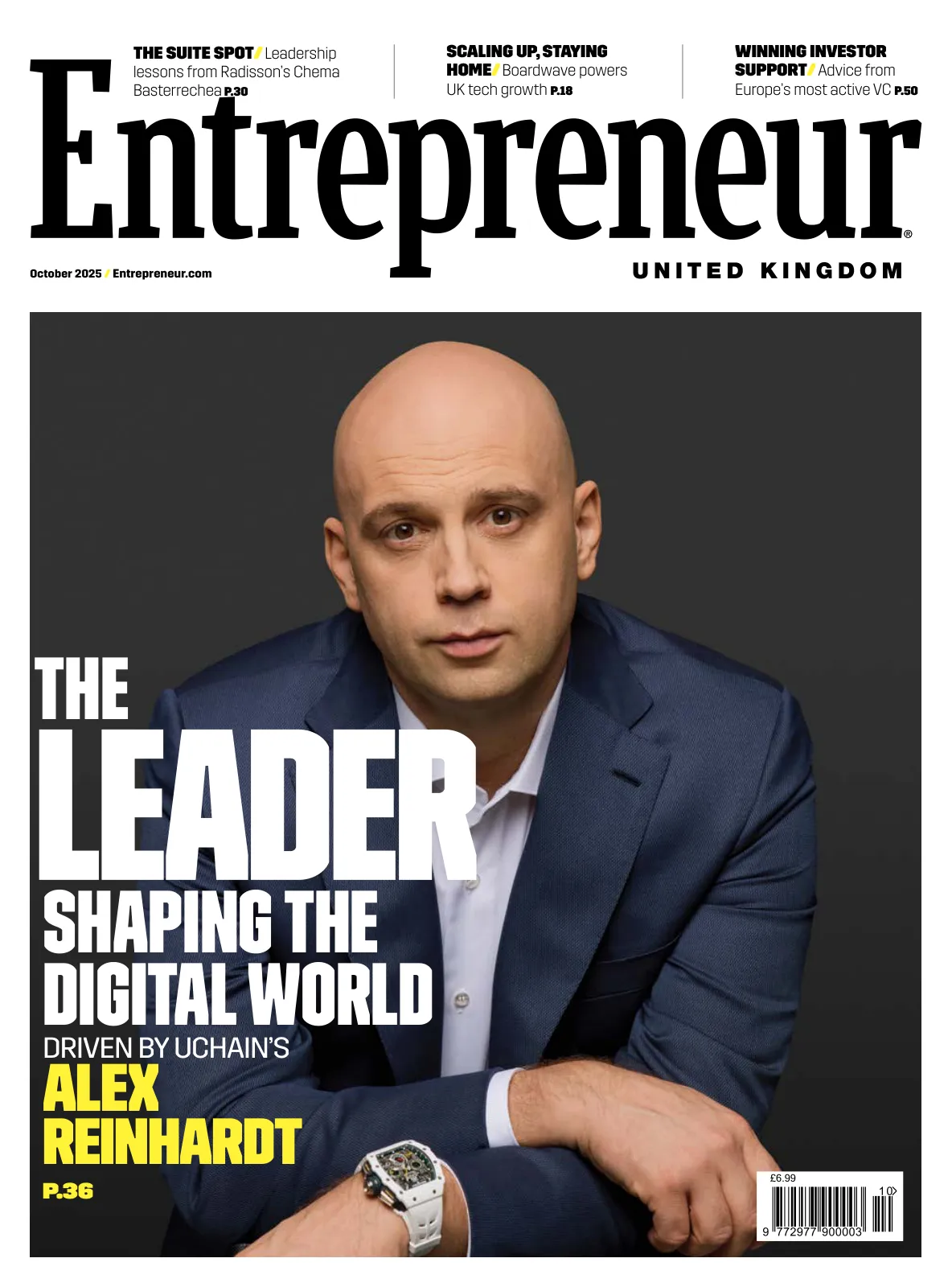
Entrepreneur UK, October 2025
Page 1
WINNING INVESTOR
SUPPORT/ Advice from
Europe’s most active VC P.50
THE SUITE SPOT/ Leadership
lessons from Radisson’s Chema
Basterrechea P.30
SCALING UP, STAYING
HOME/ Boardwave powers
UK tech growth P.18
October 2025 / Entrepreneur.com
LEADER
SHAPING THE
DIGITAL WORLD
THE
DRIVEN BY UCHAIN’S
ALEX
REINHARDT
P.36
£6.99
Page 2
BOLD
FOR THE
BOLD
UNITED KINGDOM
Page 3
Contents/October 2025
P.36
The Leader
Shaping
the Digital
World
BLOCKCHAIN’S NEXT
CHAPTER WITH ALEX
REINHARDT
FEATURES
3
October 2025 / ENTREPRENEUR.COM /
Page 4
DOWNLOAD
YOUR DIGITAL
EDITION
HERE
UNITED KINGDOM
Out now in the UK
Page 5
5
October 2025 / ENTREPRENEUR.COM /
52 The Legal Case for AuDHD
Awareness in Business
Compliance and neurodiversity at work
54 Beyond the Cloud
How MARK SWEENY’S DE NOVO is
redefining digital transformation
57 Hitting The Right Note
Modernising brand engagement with
entertainment
8 Never Too Late to Innovate
Turning experience into entrepreneurial
success
‘TREPONOMICS
Contents/October 2025
24 The Philanthro-Bit
Crypto solutions for social good
27 Orbital Innovation
UK entrepreneurs shaping space
technology
30 The Suite Spot
Leadership lessons from
RADISSON’S CHEMA BASTERRECHEA
BUSINESS
UNUSUAL
STARTUP
SPOTLIGHT
IN THE LOOP
42 Inspirational
Leadership
Catching people in, not out
44 The Cost You Can’t
Ignore
Sharing the leadership stage
46 How to Build Your
Authority as a CEO
Raise your profile, gain
influence
48 The UK’s £1.7bn
Perimenopause Problem
Supporting women keeps businesses
strong
→ Kath Easthope,
CEO and
co-founder of
Boardwave
FEATURES EDITOR Patricia Cullen
patricia.cullen@bncb2b.com
CEO Wissam Younane
wissam@bncpublishing.net
MANAGING DIRECTOR Rabih Najm
rabih@bncpublishing.net
ART DIRECTOR Simona El Khoury
EDITORIAL TEAM
Tamara Pupic,
Aalia Mehreen Ahmed
MEDIA SALES MANAGER
Olha Kovalova olha.kovalova@bncb2b.com
GENERAL MANAGER
Daniel Malins daniel@bncb2b.com
REGIONAL DIRECTOR
Andy B.
CONTRIBUTING WRITERS
Pip Wilkins, Sarah Bird, Karolina Löfqvist,
Ella Davidson, Mikael Landau and Kevin Gaskell
SUBSCRIBE
Contact subscriptions@bncb2b.com to receive
Entrepreneur United Kingdom every issue.
COMMERCIAL ENQUIRIES
sales@bncb2b.com
WWW.ENTREPRENEUR.COM/EN-GB
Access fresh content daily on our website
All Rights Reserved 2025. Opinions expressed are solely those of the contributors.
Entrepreneur United Kingdom is officially licensed exclusively to BNC B2B In
United Kingdom by Entrepreneur Media Inc. No part of this magazine may be
reproduced or transmitted in any form or by any means without written permission
of the publisher. Images used in Entrepreneur United Kingdom are credited when
necessary. Attributed use of copyrighted images with permission. All images not
credited otherwise Shutterstock.
20 Wenlock Road, London, N1 7GU
entrepreneurMediaUK
entrepreneurUK
entrepreneurmedia-uk
entrepreneurmedia.uk
Page 6
6 / ENTREPRENEUR.COM / October 2025
Editor’s Note/
INNOVATION, INSIGHT,
INSPIRATION, IMPACT
Entrepreneur United Kingdom
O
ctober’s cover feature dives into the world of
blockchain with one of the most influential
voices: Alex Reinhardt - serial entrepreneur,
venture capitalist, and founder of UChain. In an
exclusive interview with Entrepreneur UK,
Reinhardt shares his vision for a more practical
and inclusive blockchain future. He reflects on
how the UK compares to other global markets, where
the industry is heading, and offers five powerful pieces
of advice for UK entrepreneurs looking to navigate the
next digital wave.
Entrepreneur UK celebrates entrepreneurship across
generations. In this issue, we explore the unique
journeys of entrepreneurs at every stage of life.
Whatever your age, there’s inspiration here for you. Step
forward Dr. Isabella Moore, the first female president of
both the Coventry and Warwickshire and British
Chambers of Commerce, who is now launching the Later
Creator programme to help those over 50 turn
experience into business success. On the younger side,
we speak with 33-year-old Cédric Garnier-Landurie,
CEO of Cordiant Capital, showcasing the fresh ideas
youth bring to entrepreneurship.
Another exciting highlight is our exclusive interview
with Chema Basterrechea, Global President and COO of
Radisson Hotel Group, who shares valuable leadership
lessons from the hospitality industry. Plus, while bitcoin
and charity might seem like unlikely partners, our
conversation with Ismael Dainehine, CEO of charity-
tech start-ups GiveMatch and EverGive, proves
otherwise. We also look to the stars with Mark Boggett,
CEO of Seraphim Space, who reveals how the UK can
play a defining role in shaping the future of space
technology.
Closer to home, Karolina Löfqvist, CEO and co-
founder of London-based women’s health company
Hormona, takes us inside the UK’s £1.7bn
perimenopause problem. Meanwhile, Adam French,
Partner at Antler UK, the most active early-stage VC
firm in Europe, outlines the critical factors that can
help founders secure the backing they need to grow their
businesses. And there’s plenty more inside, including
guidance on building your authority as a CEO and a
timely exploration of the legal case for AuDHD
awareness in business. From practical guidance to
visionary thinking, this issue offers something for
everyone.
Enjoy the read!
Patricia Cullen
Features Editor, Entrepreneur United Kingdom
Page 7
Page 8
→ Dr. Isabella Moore
CBE, founder of the
Later Creator
8 / ENTREPRENEUR.COM / October 2025
In the Loop/
Page 9
9
October 2025 / ENTREPRENEUR.COM /
Never Too Late to Innovate
Dr. Isabella Moore is proving that age is no barrier to entrepreneurial success. With a legacy spanning from
founding a translation company to challenging ageist stereotypes, she’s now launching the Later Creator
program - empowering those over 50 to turn life experience into business brilliance. by PATRICIA CULLEN
National Centre for Languages and
Vice President of Eurochambres, she
has broken countless glass ceilings.
But it was a phone call in her 60s,
when she bought back the company
she had sold years earlier, that set her
on a new path as a champion for older
entrepreneurs. “I just thought, why
not? Why not buy the business back?”
Moore recalled. “My daughter, Sophie,
was working in London at the time,
and I picked up the phone and said,
‘Sophie, how about it? Fancy buying
the business back?’ It was just one of
those moments, and she said, ‘Yes.’”
They went on to raise the capital and
purchased the company for much less
than they had sold it for years earlier.
But her entrepreneurial journey wasn’t
without its personal hurdles. As Moore
dealt with an aging mother and the
retirement of her husband, she began
THE BIGGEST HURDLE
IS CONFIDENCE.
PEOPLE THINK IT’S A
GREAT IDEA, BUT
THEY BELIEVE IT’S
NOT FOR THEM. THEY
THINK THEY’RE TOO
OLD OR THEIR SKILLS
AREN’T
TRANSFERABLE. BUT
THAT’S SIMPLY NOT
THE CASE”
“
}}
A
t 77, Dr. Isabella Moore is
proving that it’s never too
late to become an
entrepreneur. Far from
slowing down, the grandmother,
who made waves in the business
world decades ago, is preparing to
launch an e-learning initiative that
could change the way older people
view entrepreneurship. Her Later
Creator programme is designed to
break down the barriers that
prevent older individuals from
starting their own businesses.
But Dr. Moore’s journey is far from
ordinary. From founding and selling
Comtec Translations, to becoming
the first female president of both
the Coventry and Warwickshire and
British Chambers of Commerce, her
career spans decades of trailblazing
leadership. As a former CEO of The
to contemplate the broader challenges
faced by older individuals wanting to
pivot their careers. It was this personal
reflection that led her to pursue a PhD,
exploring why more people over 50
weren’t taking the leap into
entrepreneurship.
“My research showed that older
people have unique challenges when it
↓ Later Creator Panel:
Entrepreneurs over
50 share their
experiences
Page 10
10 / ENTREPRENEUR.COM / October 2025
comes to entrepreneurship,”
Moore explained. “It’s not just
about needing more money. It’s
about the motivation to do
something you’re passionate
about, to make a difference. And
yet, there’s this stereotype that
once you hit a certain age, you’re
either supposed to be taking it
easy or caring for grandchildren.
It’s simply not true.” It was this
revelation that inspired Moore to
launch the Later Creator
program, aimed at empowering
individuals in later life to unlock
their entrepreneurial potential.
Drawing on her years of
experience, Moore, along with
her daughter, designed an
e-learning programme that
challenges the assumptions
around age and business.
However, the Later Creator isn’t
just an e-learning programme - it
actually began as a classroom-
based course before being
adapted into an online format.
Unlike many traditional
business programmes, Later
Creator isn’t focused on the hard
skills of business planning,
marketing, or finance. Instead, it
begins by tackling the emotional
and psychological barriers that
often hold older individuals back.
“The biggest hurdle is
confidence,” Moore said. “People
think it’s a great idea, but they
believe it’s not for them. They
think they’re too old or their skills
aren’t transferable. But that’s
simply not the case.”
Moore wants to shift the
mindset that entrepreneurship is
only for the young. The
programme is structured in three
levels: Discover, Accelerate, and
Advance. Each level begins by
helping participants overcome
common barriers, such as self-
doubt, a lack of confidence, and
the belief that age is a
disadvantage. Instead, the
programme encourages
participants to see age as a
valuable asset. As they move
forward, the focus shifts to
real-world application, offering
practical strategies and support
to help develop their ideas.
The Discover level introduces
the core foundations, while the
Accelerate level offers deeper
engagement through extended
time with an Enterprise Guide
(mentor) and access to the
Entrepreneur Skills Index app, a
risk-free business simulation. The
final level, Advance, can be
delivered in traditional classroom
settings in collaboration with
partner organisations, with online
cohorts currently in development.
Moore’s PhD research revealed
that the most significant barrier to
entrepreneurship for older people
is the perception that they can’t
compete with younger, more
dynamic businesspeople. “Older
OLDER ENTREPRENEURS
FACE A LOT OF
STEREOTYPES, BUT IN
REALITY, OLDER PEOPLE
HAVE A WEALTH OF
EXPERIENCE THAT CAN BE
AN ASSET. AGE CAPITAL,
AS I CALL IT, IS A REAL
THING”
“
→ Dr. Isabella
Moore and her
daughter Sophie
In the Loop/
Page 11
11
October 2025 / ENTREPRENEUR.COM /
I believe policy must evolve to support older
people in business. We’re living longer, and
we have a lot to offer. But the current
business support landscape is not set up for
older people who want to start a business”
“
entrepreneurs face a lot of
stereotypes, but in reality,
older people have a wealth
of experience that can be
an asset. Age capital, as I
call it, is a real thing.” The
Later Creator programme
encourages individuals to
look at their lifetime
experiences as valuable
resources. “It’s about
creatively assessing the
skills you’ve developed over
the years,” Moore said. “For
example, I worked with one
woman who had been a
senior project manager in
the NHS. She wanted to
start an arts and crafts
shop, but what really stood
out was her project
management expertise. She
had the skills to run an
event planning business -
her NHS experience was
gold.” Age Capital and Later
Creator are both registered
trademarks.
One of the key
components of the
programme is confidence-
building. Moore observed
that older entrepreneurs
often struggle with the
emotional aspects of
starting a business, such as
overcoming self-doubt and
battling imposter syndrome.
Many, she believes, need to
feel supported before they
can even think about setting
up a business plan. “Older
people are more likely to
seek help than younger
entrepreneurs, and that’s
why the Later Creator
programme includes one-
on-one guidance,” Moore
said. “It’s about helping
people build the self-
assurance they need to
move forward.”
But Moore’s ambitions
extend far beyond individual
coaching. She envisions a
future where the
government and financial
institutions recognise the
untapped potential of older
entrepreneurs. “I believe
policy must evolve to
support older people in
business. We’re living
longer, and we have a lot to
offer. But the current
business support landscape
is not set up for older
people who want to start a
business,” she argued. Her
vision includes offering tax
breaks for those over 50
starting a business, as well
as fostering a more
supportive environment
where older entrepreneurs
feel valued. Moore also
believes that financial
institutions, such as banks,
should recognise the wealth
of experience older people
bring to the table when they
apply for loans. "Banks
need to adopt a more
creative approach," she
said. "Older entrepreneurs
have assets - like their skills
and experience - that
should be valued in the
same way as traditional
collateral."
Moore’s advocacy for
older entrepreneurs is not
just a personal mission; it’s
a societal necessity. She
points out that nearly 2m
people over 50 are currently
on welfare benefits in the
UK, with a significant
number suffering from
mental health issues.
According to Moore,
entrepreneurship could be
the key to improving both
their financial situation and
their mental wellbeing.
“Starting a business later in
life isn’t just about financial
independence; it’s about
mental health and
wellbeing. Feeling relevant,
feeling excited about the
future - those things have a
huge impact,” she said.
“One man I spoke with, for
example, had concerns
about dementia running in
his family, and he wanted to
keep his cognitive abilities
sharp. Entrepreneurship
provided a way to keep his
mind active and engaged.”
The Later Creator
programme is also working
to offer financial support for
those who may not be able
to afford the course fee.
Through Moore’s social
enterprise, the Olderpreneur
Alliance, she hopes to raise
funds to help older
individuals on benefits
access the course. The goal
is to bridge the gap
between financial need and
entrepreneurial ambition.
Looking ahead, Moore
sees a future where
entrepreneurship in later life
is not seen as exceptional
but as a mainstream option
for those seeking to make a
change. “In five years, I
want to see more older
entrepreneurs. I want it to
be common knowledge that
entrepreneurship is for
everyone - no matter your
age,” Moore said. “Older
people can contribute
massively to the economy,
but we need a shift in
thinking, both from society
and from the government.”
Through her work, Moore
hopes to not only challenge
the ageist attitudes that
persist in the business
world but also to empower
individuals to take control of
their future, regardless of
age. “If you’ve worked hard
all your life, there’s no
reason why you can’t set up
your own business,” she
said. “It’s never too late.”
Dr. Isabella Moore’s Later
Creator programme offers a
powerful invitation to
reimagine the potential of
later life. Rather than
slowing down, Moore’s
vision seeks to ignite and
accelerate the
entrepreneurial spirit,
showing that it's never too
late to build something new.
After all, the only thing that
gets old is the outdated
belief that age can limit
ambition.
Page 12
12 / ENTREPRENEUR.COM / October 2025
Grey Matters
I
magine this: your
20-year-old niece is
starting an internship as
part of her sandwich
degree course - just as
your 51-year-old sister starts
her own internship at a local
law firm. Absurd? Or the
future of recruitment, where
midlifers’ experience can be
employed while meeting the
growing demand for flexible,
skilled talent.
View any social media
platform these days and
you’ll find a wealth of
commentary on the perils of
job-seeking in midlife. From
senior executives being “let
go” in favour of more junior
(read: cheaper) staff to their
roles being outsourced to
low-cost countries, many
midlifers are finding that the
“older and wiser” label is not
necessarily garnering the
opportunities that it may
have done in the past.
Even the World Health
Organization has admitted
ageism is a global challenge
with its report declaring that
every second person in the
world is believed to hold
ageist attitudes. Isn’t it ironic
that experience can be
considered irrelevant when
you have so much of it later
in life and yet its absence is a
barrier to the newly
educated struggling to get
started?
Just because your hair may
begin to turn grey as the
pigment melanin fades, it
doesn’t follow that the rest of
you is disintegrating. Indeed,
midlife job-seeking may be
less about serendipity or
planning and more a matter
of perspective. As a coach for
an employability course I see
first-hand how midlifers are
struggling with confidence
that hampers job-seeking
efforts - and how changing
the story they tell themselves
can lead to career reinven-
tion.
Realising the rewards of
silver interns
Midlifers have long ago
embraced reliability,
stickability and empathy
- and in a world of artificial
intelligence (AI) we all need
to exploit these human
capabilities. What if midlife
candidates could take
advantage of “silver
internships” to share these
hard-won qualities and
improve their own health?
There are rich rewards, to
individuals, to business and
to the economy from
embracing midlife skills:
}Benefits to individuals:
Midlife candidates have so
much valuable experience to
bring to other generations.
In research undertaken by
the hotel and resort chain
Hilton, 60% of over 50s said
they can learn from working
with those younger than
themselves. And it works
both ways: more than three
quarters (77%) of Gen-Z
respondents said they can
learn from older colleagues,
with leadership (44%) and
problem solving (40%),
communication (39%) and
organisational skills (39%)
being areas most cited where
over-50s excel.
}Benefits to business:
Diversity, equity and
inclusion (DEI) can lead to
greater creativity, innovation
and profitability. According
to Forbes, firms that display
culturally and ethnically
diverse executive teams are
33% more likely to lead
their industries in profitabil-
ity. When people feel
welcomed for who they are,
they perform at a higher
level, enabling the business
to attract the best people.
}Benefits to the economy:
By continuing to engage in
the world of work, silver
interns contribute to society
in more ways than one. A
survey from the Interna-
tional Monetary Fund (IMF)
that found that people in
their 70s in 2022 had the
same cognitive and physical
function as people in their
50s in 2000 and their
physical health was the same
as 56-year-olds 25 years ago
based on grip strength and
lung functionality tests.
Since they are sharper and
stronger than they were a
quarter of a century ago,
midlife jobseekers could
work far longer.
Instead of worrying about
the grey hairs, let’s put that
grey matter to good use and
not only refresh recruitment
models, but also reinvent
midlife careers with
storytelling.
Sarah Bird is a
professional
business writer
and editor with
more than 30
years of experience working
with large corporate
organisations. She is the
writer and coach for two
training programmes for
post-education jobseekers and
students in education. Her
book: “Nail Your Narrative”
reveals how to embrace
storytelling to unlock your
full potential in midlife.
Why your business should welcome the
silver intern by SARAH BIRD
In the Loop/
Page 13
UNITED KINGDOM
11th June 2026, QEII Centre, London, UK
Key Partners:
Grow Your
Global Business
Network
Get Involved!
1200+ Delegates
11th June 2026
In Person & Virtual
33+ Expert Speakers
BOOK PASS
EXHIBIT
2026
2026
WWW.GLOBALBRITAINTRADEEXPO.COM
Build
your
global
business
network
at
Global Britain Trade Expo 2026. Now in its
seventh year, GBTE continues to promote the
UK as a global trade and business destination
and welcomes delegates from 36 countries.
The event is designed for those businesses
looking grow internationally, be it setting up
overseas, sourcing new suppliers or exporting
to new markets.
Page 14
14 / ENTREPRENEUR.COM / October 2025
The New Age of Leadership
At 33, a new generation of leaders are making their mark across industries, showing that
innovation, adaptability, and a global perspective can create a lasting impact long before middle
age. by PATRICIA CULLEN
Consider Sir James Dyson. By the time
he was 33, Dyson had already developed
his groundbreaking bagless vacuum
cleaner, which went on to revolutionise
the home appliance industry. His
innovation, backed by years of relentless
trial and error, led to the creation of
Dyson Ltd, a company that would later
expand into hand dryers, air purifiers,
and even electric cars. Ben Francis, the
founder of Gymshark, is another
standout. He started the fitness apparel
brand at just 19, growing it from his
bedroom. By the age of 28, Gymshark
had achieved a valuation of over £1bn,
making him one of the youngest
self-made billionaires in the UK. Francis
→ Cédric Garnier-Landurie,
co-managing Partner and
CEO of Cordiant Capital
B
usiness has long been
the preserve of those
with decades of
experience, where age
and seniority were the
hallmarks of
leadership. But a new
generation of entrepreneurs
is upending that tradition. In
today’s fast-paced,
interconnected world, vision,
adaptability, and global
perspective are just as
crucial as experience - and
increasingly, it’s younger
leaders who are driving
innovation and reshaping
entire industries before
reaching 40.
In the Loop/
Page 15
15
October 2025 / ENTREPRENEUR.COM /
}}
has continued to lead the company
through rapid global growth,
solidifying Gymshark as one of the
top fitness brands worldwide. While
Victoria Beckham officially
launched her fashion line in 2008 at
the age of 34, her rise in the fashion
industry began earlier, with her
transition from pop star to style
icon. By 33, she was already making
a name for herself in the fashion
world, and her eponymous brand
would go on to become a global
success. Beckham has since
expanded her business ventures into
beauty and fragrance, securing her
place as a major figure in the
fashion industry. Finally, Richard
Branson had already founded Virgin
Records by the time he was 30, and
by 33, he had launched Virgin
Atlantic, fundamentally changing
the UK’s airline industry. Branson’s
entrepreneurial spirit and willing-
ness to take risks saw Virgin expand
into numerous industries, from
travel to telecommunications,
making him one of the most
Recognised business figures in the
world.
In the financial world, Cédric
Garnier-Landurie, co-managing
Partner and CEO of Cordiant
Capital, a specialist global infra-
structure and real assets investment
manager, is another example of a
leader who broke the mould at a
young age. At just 33, Garnier-Lan-
durie is steering one of the most
significant asset management firms
in the infrastructure sector, with
over $3bn in assets under manage-
ment. His career trajectory is
emblematic of a new approach to
leadership in the financial sector,
where adaptability, innovation, and
a global perspective are increasingly
recognised as equally important as
traditional experience.
His rise to the top at such a young
age speaks to a larger trend in which
the business world is embracing
fresh, dynamic leadership from
younger generations - individuals
who are increasingly seen as capable
of managing and driving multi-
“IT’S NO LONGER PURELY
ABOUT TENURE OR
DECADES SPENT IN THE
SAME SEAT. THE INDUSTRY
IS RECOGNISING THAT
ADAPTABILITY, CURIOSITY,
AND A GENUINELY GLOBAL
PERSPECTIVE ARE JUST AS
CRITICAL AS EXPERIENCE”
Page 16
16 / ENTREPRENEUR.COM / October 2025
billion-pound enterprises. This shift is
happening across industries, from
technology to infrastructure, as young
leaders are demonstrating that their
agility, innovative thinking, and global
outlook are key to navigating the
challenges of a rapidly changing world.
A New Kind of Leadership
At the helm of Cordiant Capital,
Garnier-Landurie has been entrusted
with overseeing billions of pounds in
capital. For many, the idea of a
33-year-old leading such a significant
operation might seem improbable, but
Garnier-Landurie is quick to challenge
that notion. “I think it reflects a broader
shift in how leadership is defined in
finance,” he says. “It’s no longer purely
about tenure or decades spent in the
same seat. The industry is recognising
that adaptability, curiosity, and a
genuinely global perspective are just as
critical as experience.”
In an industry that has traditionally
placed a premium on experience,
Garnier-Landurie’s rise signals a shift in
how leaders are evaluated. The world is
moving faster than ever before, and the
challenges businesses face require more
than just technical knowledge. They
require vision, the ability to anticipate
change, and an understanding of how
interconnected the world has become.
“The pace of change in infrastructure
and real assets is extraordinary,” he
notes, listing climate change, supply
chain disruptions, and technological
advancements as the driving forces
behind this transformation. “Leaders
today need the ability to anticipate
those shifts early, connect the dots
across regions and sectors, and mobilise
teams to act decisively.”
This mindset - one that combines
adaptability with global experience -
has shaped Garnier-Landurie’s career.
Having worked across North America,
Latin America, Africa, the Middle East,
and Europe, he brings a comprehensive,
cross-border perspective to his
leadership role. His experiences have
shown him that success in today’s
business world requires a willingness to
embrace change, rather than simply
relying on traditional formulas of
experience. “We’ve seen it in the tech
world, where young leaders are
entrusted with multi-billion-dollar
companies driving global innovation;
there’s no reason investing should be
different,” he explains, drawing a
parallel to the tech industry’s embrace
of young, innovative leaders.
Balancing Legacy and Innovation
One of the core challenges for any
business leader is balancing the weight
of legacy with the need for innovation.
In Garnier-Landurie’s case, he is not
only managing a company with a rich
history but also charting a course for its
future. Yet, for him, tradition and
progress aren’t mutually exclusive - they
work in tandem. “I see legacy and
“WE’VE SEEN IT IN THE
TECH WORLD, WHERE
YOUNG LEADERS ARE
ENTRUSTED WITH
MULTI-BILLION-DOLLAR
COMPANIES DRIVING
GLOBAL INNOVATION;
THERE’S NO REASON
INVESTING SHOULD BE
DIFFERENT”
In the Loop/
Page 17
17
October 2025 / ENTREPRENEUR.COM /
innovation not as opposing
forces, but as complemen-
tary,” Garnier-Landurie says.
“A strong legacy provides the
foundation of trust,
discipline, and credibility -
qualities that are indispens-
able when you’re stewarding
capital. Innovation,
meanwhile, is what ensures
that foundation remains
relevant in a world that
refuses to stand still.”
At Cordiant, this balance is
critical. The firm’s legacy of
creating value beyond just
financial engineering forms
the bedrock of its approach,
which prioritises long-term
value creation through an
“operating-first” mentality.
This approach focuses on
building businesses - not just
balance sheets - and has
allowed Cordiant to remain
both bold and responsible in
its investment strategies.
But as the world changes,
so too must business
practices. From demograph-
ic shifts and the rise of the
digital economy to the
urgency of achieving
net-zero emissions, the
environment in which
companies operate is in
constant flux. “How do you
preserve and grow investor
capital in an environment
that is shifting so quickly?”
Garnier-Landurie asks,
acknowledging the complex-
ity of this challenge. For him,
the answer lies in evolving
the legacy of the firm to
meet the needs of a rapidly
changing world.
The Generational
Perspective
When asked about the
unique perspective his
generation brings to
infrastructure and real
assets, Garnier-Landurie is
clear: unlike previous
generations, his sees
infrastructure as more than
just ‘concrete and steel.’It’s
about understanding how
physical assets - whether
they are roads, ports, or
energy grids - interact with
the digital world. “We see it
as part of a living, intercon-
nected ecosystem: dynamic
systems where technology is
embedded at the core of how
assets are designed,
operated, and scaled,” he
explains. For his generation,
the physical and digital are
inseparable. Today’s
infrastructure is not just
about building roads or
bridges; it’s about creating
integrated systems where
technology enhances the
function, sustainability, and
efficiency of these assets.
This shift is evident in the
way Cordiant is investing.
For example, the firm is not
just focusing on traditional
‘core’ assets like toll roads or
bridges, but also on
emerging opportunities in
sectors like sustainable
agriculture and renewable
energy. This focus on
‘value-add’ infrastructure -
where expanding the asset
and revenue bases is central
to the investment thesis -
aligns with a broader trend
in which young investors are
looking to shape the future,
not just preserve the past.
“For us, infrastructure
today is both physical and
technological,” Garnier-
Landurie says, citing
examples like precision
farming, renewable-pow-
ered ports, and cybersecuri-
ty-enhanced fibre networks.
These investments represent
a shift in the way infrastruc-
ture is built, where the
integration of technology is
no longer an afterthought
but a core component of the
design. Beyond the
integration of technology,
Garnier-Landurie’s
generation is also deeply
attuned to the need for
resilience in the face of
climate change, cyber
threats, and geopolitical
instability. Whether it’s
enhancing the resilience of
agricultural systems,
strengthening digital
infrastructure against cyber
attacks, or ensuring the
sustainability of energy
grids, this focus on resil-
ience is increasingly seen as
both a societal imperative
and a critical investment
consideration.
Looking ahead
Leadership isn’t defined by
age; it’s a collective effort,
never a solo act. “Age is not a
substitute for perspective,
and the key is surrounding
yourself with strong people
of all generations and
experiences. True leadership
is about harnessing that
diversity of thought to drive
long-term value.” And
perhaps most importantly,
Garnier-Landurie’s
generation came of age
during a time when peace
and collaboration were often
seen as the norm - some-
thing that is now being
tested. “It’s a reminder that
the “peace dividend” is not
automatic; it must be
earned and safeguarded
every day. That mindset of
global collaboration, even
under pressure, is some-
thing we carry into the way
we invest and build
platforms at Cordiant.”
“AGE IS NOT A SUBSTITUTE FOR
PERSPECTIVE, AND THE KEY IS
SURROUNDING YOURSELF WITH
STRONG PEOPLE OF ALL GENERATIONS
AND EXPERIENCES. TRUE LEADERSHIP
IS ABOUT HARNESSING THAT
DIVERSITY OF THOUGHT TO DRIVE
LONG-TERM VALUE”
Page 18
F
rom London to the broader European stage, Kath Easthope, CEO and co-
founder of Boardwave - a European community for software founders and
CEOs offering mentorship, peer networks, and practical resources - is on a
mission to change the game for UK tech leaders. Boardwave demonstrates
that ambitious software companies don’t have to sell early to succeed
globally - they can grow from home, faster, smarter, and with confidence.
Following the Boardwave Live 2025 Beyond Disruption: Shape the Future
event on 24 September, Entrepreneur UK sits down with Easthope to explore her
vision.
Scaling Up, Staying Home
18 / ENTREPRENEUR.COM / October 2025
For those who aren’t
familiar - what is
Boardwave, and how is it
supporting the next
generation of UK
software leaders?
Boardwave is a
European community of
software leaders, bringing
together more than 2,400
founders, CEOs, and
senior executives across
SaaS, AI, and software.
Our mission is simple: to
help Europe’s next
generation of software
leaders scale faster,
smarter, and with greater
confidence.
We connect and support
founders with seasoned
operators and peers who
have already navigated
the journey from start-up
to global scale. Each of
our members bring
something different to the
network whether that’s
knowledge and advice,
mentoring and even
connections to capital.
The ‘no-ego’ ethos of the
community is incredible
to watch in action, and
the generous spirit of our
members, alongside the
vast programme we’ve
built, helps to create
growth and scaling
opportunities flow more
freely for businesses
across Europe.
Boardwave is a social
enterprise focused on
→ Kath Easthope,
CEO and
co-founder of
Boardwave
Kath Easthope on empowering UK software founders to build global champions without selling
out. by PATRICIA CULLEN
In the Loop/
Page 19
CEOs and founders,
funded by more than 80
blue-chip partners who
share the costs and
support our vision.
How is the company
actively helping UK
software founders
build confidence and
capabilities to scale
here, rather than
looking to exit abroad?
Too often, founders and
CEOs feel their only
route to global growth is
to sell early to a US
buyer. Boardwave exists
to change that mindset.
We provide European
leaders with access to
mentorship, strategic
guidance, and cross-
border connections so
they can build confi-
dence in scaling
independently from UK
and European soil. For
example, our peer-to-
peer mentoring
platform connects
emerging founders with
leaders who have taken
companies through
IPOs or billion-dollar
exits.
We also run regular
Boardwave Breakout
groups designed to
create small groups of
like minded CEOs, and
Founders, who we take
on a 12 month develop-
ment journey, with
access to some of the
world’s leading
technology profession-
als. Members are also
invited to take part in
our Boardwave
Masterclasses, currently
a seven part series
including topics from
‘scaling sales and
optimising your exit’ to
‘practical AI’ and
‘product strategy’. The
sessions deliver strategic
insights and actionable
guidance, as well as
downloadable tools and
templates, and are
created from the ground
up by founders and
CEOs with relevant
lived experience.
By demystifying the
challenges of scaling
and providing tangible
playbooks, we’re helping
founders see that it is
possible to build
enduring, globally
competitive businesses
here. We know that
there is a high likelihood
that the challenge our
early stage founders are
facing today, is one that
a more experienced
CEO or founder of an
established company
will have faced in the
past.
What do you see as the
biggest structural
barriers stopping
UK-born tech compa-
nies from becoming
TOO OFTEN,
FOUNDERS AND
CEOS FEEL THEIR
ONLY ROUTE TO
GLOBAL GROWTH
IS TO SELL EARLY
TO A US BUYER.
BOARDWAVE
EXISTS TO
CHANGE THAT
MINDSET”
“
19
October 2025 / ENTREPRENEUR.COM /
→ Double-
Edged Tech:
AI, Drones
and Cyber
panel at
Boardwave
Live!
community and the
mission, over profit.
Membership is completely
free for approved software
Page 20
20 / ENTREPRENEUR.COM / October 2025
global leaders from home soil?
Our recent joint research with
McKinsey found that Europe’s
software sector consistently
underperforms on growth
compared to the US. For
example, ARR growth here is just
55% of the US benchmark. For
UK and European founders,
several structural barriers stand
in the way. Access to later-stage
growth capital is still limited,
making it harder to fund
aggressive international expan-
sion. The market itself is
fragmented, with complex regula-
tions slowing the pace of scale
compared to the more unified US
landscape. And finally, many
founders simply don’t have access
to experienced operators who
have already built and scaled
large software businesses, leaving
them without the guidance
needed to break through these
barriers. These barriers combine
to create what we call “growth
bottlenecks”,even with brilliant
products, UK companies too
often stall before they can
become global champions.
Many founders still feel that
scaling in the UK means
eventually selling to a US buyer
- how can we shift that
mindset?
We need to prove, through lived
examples, that global category
leaders can be grown and built
here. That means celebrating the
success stories, but also providing
the infrastructure and support
that makes independent scaling
viable. At our annual conference
Boardwave Live, Dame Julia
Hoggett, CEO of the London
Stock Exchange (LSE), spoke at a
pre-event dinner with some of our
members. She talked at length
about the need to reignite
Britain’s passion for investing, her
vision to modernise and open up
the UK’s markets and pointed to
capital and culture as the
country’s untapped strengths. We
share the belief in the software
sector that if we “invest in
ourselves,” the UK could look
radically different in just five
years.
At Boardwave, we champion the
founders who have resisted early
WITH THE RIGHT
SUPPORT SYSTEM,
THE EMERGING
COMPANIES,
AND THOSE WITH
ENORMOUS
INTERNATIONAL
POTENTIAL, CAN HAVE
THE CONFIDENCE
TO SEE THEMSELVES
NOT AS ACQUISITION
TARGETS, BUT
AS GLOBAL
COMPETITORS”
“
In the Loop/
→ Networking at Boardwave Live!
Page 21
21
October 2025 / ENTREPRENEUR.COM /
exits and gone on to build
enduring, globally-leading
companies. With the right
support system, the
emerging companies, and
those with enormous
international potential, can
have the confidence to see
themselves not as acquisi-
tion targets, but as global
competitors.
What role should
investors, policymakers,
and operators each play
in building a stronger UK
scale-up ecosystem?
Investors, policymakers,
and operators each have a
vital role to play if we want
the UK to compete on a
global stage. For investors,
this is about going beyond
the early rounds and
providing deeper pools of
growth capital, especially at
Series C and beyond.
Too many promising
founders end up selling
early simply because they
can’t access the funding
needed to expand interna-
tionally. Policymakers,
meanwhile, need to make it
easier for innovation to
scale across borders. The
UK and Europe have huge
strengths, but market
fragmentation and complex
regulations slow companies
down, streamlining that
environment would make a
real difference. And then
there are the operators: the
people who have already
built, scaled, and exited
businesses. Their experi-
ence is invaluable. Whether
it’s mentoring, advising, or
joining scale-ups directly,
they can help founders
avoid common pitfalls and
accelerate growth. It’s only
when all three - capital,
policy, and knowledge
sharing - come together
that UK and European tech
can truly compete on a level
playing field with the US
and China.
For a first-time UK
founder eyeing global
expansion, what’s the
single most important
strategic decision they
can make early on?
For a first-time UK founder
eyeing global expansion,
the most important
decision is to design for
scale from the very
beginning, not just aim for
product:market fit. Too
many founders underesti-
mate how quickly they’ll
need to internationalise,
whether that’s structuring
go-to-market functions for
global reach, building
compliance into systems
that work across multiple
jurisdictions, or hiring
leadership with genuine
global experience.
The companies that
succeed are those that bake
scaling into their DNA early
on, while also cultivating a
growth mindset and staying
mission-driven. That
combination: thinking big,
learning fast, and keeping
the long-term mission at
the centre, gives founders
the resilience and clarity
they need to navigate the
inevitable challenges of
global expansion.
Looking ahead, what’s the
one shift you’d most like
to see in the UK tech
ecosystem over the next
five years?
I’d like to see the UK move
to a genuine global hub of
scale-ups that go the
distance. That means more
UK-born companies
reaching IPO on home soil,
more founders choosing to
stay independent, and more
stories of UK software
leaders setting the global
standard. If we can unlock
that shift, we not only grow
stronger companies, we
grow an ecosystem that
continually reinvests
experience, capital, and
confidence back into the
next generation of
founders.
THE COMPANIES THAT SUCCEED ARE THOSE THAT BAKE
SCALING INTO THEIR DNA EARLY ON, WHILE ALSO CULTIVATING A
GROWTH MINDSET AND STAYING MISSION-DRIVEN.
→ Kath Easthope with
Dame Julia Hoggett,
CEO at London Stock
Exchange
Page 22
22 / ENTREPRENEUR.COM / October 2025
Franchise Branding
B
randing builds
business. But who
builds the
branding? One of
the benefits of
starting a
business with a
franchise is that
the franchisor has already created the
branding, so you have a recognised
brand right away. Branding is a big
focus in franchising, and that’s a huge
benefit to people looking to invest.
Franchisees don’t need to build their
brand themselves, because the franchi-
sor will have already done it. The right
branding gives your new business a
head start, but not all branding is the
equal, so anyone considering a
franchise should check its brand
offering first.
RESEARCHING FRANCHISE BRANDS
Since 1977, the BFA has championed
ethical business practices and high
standards in franchising; we work
hard to ensure franchisees choose the
right franchise for them, so you can
use the BFA website to compare
franchises, branding included.
WHY FRANCHISES BIG-UP BRANDING
Almost all franchises aim to create a
nationwide network of units operated
by franchisees, so it makes sense for
them to create a consistent, widely
known brand. Suzie McCafferty,
Principal Franchise Consultant at
Platinum Wave Franchising, says:
“Brand consistency is absolutely
critical in franchising - it’s what gives
customers confidence that they’ll have
the same experience wherever they
go.” Brand recognition brings in more
customers for franchisees, and means
a thriving franchisor, so the whole
network grows.
FRANCHISE BRANDING BENEFITS
Usually, a franchise package will
include a bundle of branded products,
all designed by a specialist branding
agency (no need for you to spend
money and time on creating it).
Typically, this includes specified brand
colours and typefaces, branded
webspace, stationery, equipment,
The ready-made advantage that builds businesses faster. by PIP WILKINS
In the Loop/
Page 23
23
October 2025 / ENTREPRENEUR.COM /
leaflets and flyers, model
adverts, and more. It’s a
policy based on research
that shows the more often a
customer sees your brand,
the more they warm to it.
ECONOMIES OF SCALE
Yes, you’ll have to pay for
these branded products,
but because the franchisor
buys in bulk, the cost could
well be lower than you’d
pay as an independent busi-
ness, ordering in lower
quantities.
BRANDING IS MORE THAN
LOGOS
A well-crafted brand
specifies the tone of voice
used in all communica-
tions, says Ben Ashton,
Founder and Owner of the
GoodOaks homecare
franchise. He says: “Our
brand is reflected in the
behaviour of everyone in
the business. We focus on
premium quality care, and
if we don’t reflect that in
interactions with all
stakeholders, including
clients and families, it
damages our brand.”
BRANDING CAN BE A
COMPETITIVE ADVANTAGE
An attractive brand can
help you win customers
who might otherwise buy
only on price, says Ashton.
“A brand, built up over
time, lives inside people’s
heads. If it conveys quality
and expertise, it delivers a
competitive edge, with
potential customers, and
when recruiting staff.”
Prospective franchisees
should investigate brand
differentiation within
sectors. Dijana Radisevic,
Head of Marketing at
Trafalgar Education, which
operates the Stagecoach
performing arts franchise,
says: “Our brand prioritises
life skills over performing
arts. Other franchises focus
on technical training alone,
but we show parents how
singing, dancing, and
acting translate into
confidence, resilience, and
everyday skills their
children carry with them.
You see this across
everything we do. It gives
our franchisees a powerful,
unique proposition in their
local markets.”
LOOK FOR TARGETED
BRANDING
Check whether a franchise’s
branding is aligned with its
target market. What suits a
sales franchise will not
work for child care, and
branding devised overseas,
even in English, may not
suit the UK.
For instance, at US-found-
ed fresh-baked pretzel
franchise, Auntie Anne’s,
Head of Marketing Siobhan
Randles says: “Our brand
remains rooted in hand-
crafted, fresh-baked
pretzels. But recent
research has shown that
one new slogan, which
worked well in Asia, the
Middle East and South
America, did not work in
the UK. We are looking to
change that. Sometimes
messages need to be
adjusted to suit particular
countries.” McCafferty says:
“The best franchisors
constantly focus on
protecting the core brand,
while allowing just enough
flexibility for franchisees to
add a local touch that
resonates with their
community. Any changes
are usually best kept
subtle.”
HOW DOES THE BRANDING
RESPOND TO THE FUTURE?
Radisevic says prospective
franchisees should be
asking franchisors: “Are
they active on new
channels? Do they keep
campaigns fresh? Stage-
coach continually invests in
evolving our brand.” Ashton
adds: “At GoodOaks we are
working on getting AI to
understand our brand so
that, for instance, it shows
up in Google’s AI-generated
overviews when people
search for ‘best homecare
franchise’. Branding should
be kept up to date.”
SIX QUESTIONS FOR
PROSPECTIVE FRANCHI-
SEES TO ASK ABOUT
BRANDING
McCafferty says:
• How do you ensure the
brand looks and feels
consistent across every
location?
• What marketing materials
and digital assets will I get?
• Who creates them?
• How often are they
refreshed?
• How is the brand
monitored and protected?
• Can I adapt the brand
locally?
Remember, when you invest
in a franchise, you’re not
just buying a logo, you’re
buying a brand that should
help you grow faster, win
trust sooner and stand out
in your market, so spend
plenty of time researching
the franchises you are
interested in, to evaluate if
their brand is strong enough
to deliver the right message
to your clients and support
fledgling business.
Pip Wilkins is
the Chief
Executive of the
British
Franchise
Association (BFA), bringing
over 25 years of dedicated
experience in the franchising
sector. Having progressed
through various roles within
the BFA, Pip has gained a
comprehensive
understanding of the
broader franchise industry,
earning widespread respect
for her deep expertise and
unwavering commitment.
She lives in Devon and is an
avid Chelsea FC fan
“Branding is a big focus in
franchising, and that’s a huge
benefit to people looking to
invest. Franchisees don’t need to
build their brand themselves,
because the franchisor will have
already done it”
Page 24
24 / ENTREPRENEUR.COM / October 2025
B
Charity
The Philanthro-Bit
Tech entrepreneur Ismael Dainehine is on a mission to
solve one of the charity sector’s most urgent problems:
financial instability. His solution? A Bitcoin-backed
reserve designed to make social impact sustainable.
by PATRICIA CULLEN
/
→ Ismael Dainehine,
Co-Founder and CEO of
charity-tech start-ups
GiveMatch and
EverGive
A
t first glance, Bitcoin and charity may seem
like odd bedfellows. One conjures images of
high-stakes trading and blockchain bros;
the other, bake sales and donor forms. But
in an office in London, Ismael Dainehine is
building something that defies both stereo-
types - a new kind of financial foundation
for the charitable sector, powered by
Bitcoin, rooted in purpose, and born of hard-won lessons in tech,
scale, and soul.
Dainehine is the co-founder and
CEO of EverGive, a bold new venture
aiming to reshape how we think
about long-term philanthropy. Not
by simply raising more money - but
by questioning the very systems that
leave charities scrambling for
survival. “The tech industry is all
about solving problems,” Dainehine
says. “But the most important work
is when technology addresses the
biggest societal challenges facing
humankind.” And for him, this work
is personal.
From E-Commerce to Empathy
Long before EverGive, Dainehine
had what many would consider a
textbook tech success story. He built
an e-commerce business that scaled
to $35m in revenue - an entrepre-
neurial dream by most standards.
But somewhere along the way,
something didn’t sit right. “In the
early stages this was fun and creative,
but over time it became soulless,” he
reflects. “I wanted to get back to my
roots of community and charity.”
That search for meaning led to
MyTenNights, a Ramadan-focused
giving platform Dainehine launched
in 2017 as a side project. It took off
globally, raising over £100m for
causes around the world. For many
founders, that would be the final act
- a story arc that ends in mission-
aligned success. But for Dainehine, it
was just the beginning. “I discovered
that I could use what I’d learned in
the tech space and apply it to making
a real difference,” he says. “However,
as I was building in the charity tech
space… I realised the real problem
wasn’t just about raising money.
Financial instability was eroding the
sector and holding back long-term
change.” And just like that, a founder
known for building efficient digital
systems began thinking more like an
activist. “That’s when I moved from
being a social tech entrepreneur to
adopting a more activist mindset
- focusing less on patching symp-
toms and more on tackling the root
financial problem head-on.”
Page 25
25
October 2025 / ENTREPRENEUR.COM /
The Bitcoin Epiphany
To understand what
EverGive is doing, it helps to
understand what it’s not
doing. This isn’t about
simply accepting crypto
donations or tokenizing
philanthropy. Instead, it’s
about seeing Bitcoin not as
speculative currency, but as
infrastructure - a decentral-
ised, durable store of value
that could fundamentally
rebalance the financial insta-
bility in the charity sector.
“We started to ask ourselves
how technology could
address this problem and
that’s when we realised the
potential of Bitcoin as more
than just an investment for
tech bros, but as a powerful
humanitarian technology.”
From that insight, EverGive
was born: the world’s first
Bitcoin Reserve for the
charity sector. It’s a radical
idea, and like any radical
idea, it comes with resis-
tance. “There is so much
noise about [Bitcoin] as an
investment or get-rich-quick
scheme,” he says. “The
challenge is to shift the
conversation from specula-
tion to its potential as a
financial freedom technol-
ogy that can underpin
long-term social good.”
Building the World’s First
Bitcoin Reserve for
Charity
What does that look like in
practice? Think of EverGive
as a long-term financial
reserve for charities - backed
by Bitcoin, immune to
inflation, and built to last.
But building something
entirely new brings a
familiar mix of excitement
and friction. “Whenever you
are creating something truly
new, there are always going
to be challenges,” Dainehine
says. “From a technology
perspective it’s about the
model we use to drive
donations and whether we
concentrate on building our
own platform or integrating
with existing platforms and
charities’ channels.”
That part, at least, is
familiar territory. With his
experience in charity-tech,
Dainehine feels confident in
navigating the nuts and
bolts. But the real challenge
- the one that has shaped the
company’s entire strategy -
isn’t tech. It’s trust. “The
unique challenge for
EverGive is reframing
Bitcoin itself as a force for
good. Education in the
charity sector is essential, so
they don’t miss out on the
opportunity.”
Culture, Not Code
This is where EverGive
starts to feel less like a
fintech and more like a
movement. The mission
may be powered by Bitcoin,
but it’s being driven by a }}
“WE STARTED TO ASK OURSELVES HOW
TECHNOLOGY COULD ADDRESS THIS PROBLEM
AND THAT’S WHEN WE REALISED THE
POTENTIAL OF BITCOIN AS MORE THAN JUST
AN INVESTMENT FOR TECH BROS, BUT AS A
POWERFUL HUMANITARIAN TECHNOLOGY”
Page 26
26 / ENTREPRENEUR.COM / October 2025
deeper understanding of
how people feel about
technology. “We had to get
pragmatic very fast,”
Dainehine says. “It’s all
about educating people
about the mission and the
reasons why we believe in
building EverGive on a
Bitcoin-only foundation.”
He adds: “We realised early
on that the real challenge
was not technological but
educational - framing the
solution and bringing
people with us on the
journey towards financial
freedom.” Two lessons
emerged: First, simplify
the message. “We refined
and simplified our
messaging to strip away
complexity so that the idea
of ‘making social good last
forever’ could be under-
stood in its purest form.”
Second, choose the right
entry point into the
marketplace. Should they
start with donors or
charities? For Dainehine,
the answer was soon
evident. “Over time, it
became clear that starting
with donors was the most
effective path, and so we
resolved to focus on acquir-
ing that side of the
marketplace first. It’s a
strategy that shows a rare
blend of idealism and prag-
matism - common in the
best kind of founders, and
essential for those trying to
reshape broken systems.
Ask Dainehine what the
hardest part of building
EverGive has been, and
he’ll pause - but not for
long. “The hardest
problems are very rarely
technical – they’re cultural,”
he says. “Culture deter-
mines how much change
people can absorb, how
much simplicity they need,
and how far they’re willing
to trust a new idea.”
And so much of Ever-
Give’s energy has gone into
creating a cultural bridge
between a cutting-edge
financial tool and a deeply
human cause. “We
discovered the real work
was not building the
infrastructure, but
cultivating a mindset
people could step into.”
“Once you solve for culture
– once you align with how
people think, feel, and trust
– the rest follows.”
Start with What Matters
For other entrepreneurs
facing similar problems,
Dainehine offers his advice
- start not with the tech,
but with the truth. “Ask
yourself the difficult
questions. What are the
real problems in the world
that you care about? How
can you help to solve
them? And what barriers
must you tear down along
the way?” And then, he
says, prepare to confront
the real challenge - not in
your codebase, but in the
hearts and minds of your
users. “Don’t mistake the
hard part for technical
ones - they’re almost
always cultural.”
For founders raised on
the mythology of innova-
tion-through-complexity,
Dainehine’s next words cut
through like a sharp wind:
“The instinct is to keep
building, keep adding
features, keep engineering
your way through the
problem. But what really
moves the needle is
understanding how people
absorb new ideas, where
their trust lies, and how
much simplicity they need
to feel safe enough to
engage.” what’s the
takeaway? “Obsess over
clarity, not complexity,” he
says. “And choose the
cultural entry point that
lowers the most resistance.”
A Quiet Revolution in
Philanthropy
That mantra - make social
good last forever - is now
EverGive’s rallying cry. It’s
more than a tagline. It’s a
reimagining of what
philanthropy could be in
an era of decentralised
finance, long-term
thinking, and global crises.
And perhaps the most
powerful line Dainehine
shares in our interview isn’t
about Bitcoin, tech, or even
charity. It’s about the spark
that fuels every meaningful
start-up - the intersection
between purpose and
personal desire. “Paul
Graham offered great
advice when he said, ‘make
things people want’. I’d just
add that the real magic lies
somewhere between that
advice and ‘make some-
thing YOU want’. You’re a
formidable force at that
intersection.” At its best,
technology doesn’t merely
solve problems; it uplifts
people, refines systems,
and, when shaped with
vision, has the ability to
make lasting impact.
B
Charity
/
Page 27
27
October 2025 / ENTREPRENEUR.COM /
B
Opportunity
/
“When we launched Seraphim, space
was still largely seen as the preserve
of governments and defense primes,”
Boggett recalls. “But we saw the
early signals of a seismic shift.
Launch costs were falling by an
order of magnitude, satellites were
becoming smaller and cheaper, and
a new wave of entrepreneurs were
bringing Silicon Valley-style
innovation into orbit.”
Seraphim’s conviction stemmed
from a belief that space was destined
to be the foundation of a new, digital
economy. “Our conviction was that
space would evolve into a
foundational layer of the digital
economy, enabling everything from
global connectivity, defense and
security, and climate resilience,”
Boggett says. In 2015, this vision
seemed audacious. Yet today, space
is at the very core of technological
advancement and is rapidly
becoming one of the world’s most
valuable industries.
The Growth of SpaceTech
Fast forward to 2023, and the space
economy is now valued at an
impressive $600bn, with projections
suggesting it could surge to $1.8tn
by 2035. This rapid expansion is
driven by a variety of factors -
Orbital Innovation
As space evolves from a government preserve to a trillion-
dollar industry, Seraphim Space’s Mark Boggett explains why
UK entrepreneurs have a unique opportunity to shape the
future of space technology. by PATRICIA CULLEN
I
n 2015, Mark Boggett saw
an opportunity that most
investors overlooked: the
commercial space industry. At
the time, the space sector
was still the domain of
governments and defense
contractors. Space
exploration was viewed as a
costly, niche field - one far
removed from Silicon Valley’s
fast-paced tech scene. But
Boggett and his team at
Seraphim Space saw things
differently.
}}
→ Mark
Boggett, CEO of
Seraphim
Space
Page 28
28 / ENTREPRENEUR.COM / October 2025
reduced costs for launching
satellites, innovations in
data processing, and
government investment.
“We’re proud that
Seraphim has backed more
than 140 companies across
that ecosystem, from
early-stage start-ups to
some of the fastest-scaling
companies from across the
globe,” Boggett says.
Seraphim’s strategy is
simple: Invest in visionary
founders and help them
scale their technologies.
From AST Space Mobile to
ALL.SPACE, Seraphim has
been a catalyst for growth
in companies solving
real-world problems at a
planetary scale. Many of
Seraphim’s investments
have far exceeded
expectations. AST Space
Mobile, for instance, is
working to deploy cell
towers in space. Valued at a
staggering $150bn, the
company is redefining
global connectivity. “These
aren’t just commercial wins,
they’re examples of space
solving real-world problems
at scale,” Boggett
emphasizes.
Meanwhile, ICEYE, which
started as a small radar-
focused start-up, is now a
leader in global Earth
observation. The company
has secured government
contracts worth hundreds
of millions, offering vital
real-time data for
everything from climate
monitoring to national
defense. “ICEYE is now a
market leader globally
securing government
contracts in $100m’s,”
Boggett adds.
Dramatic Shifts in Space
Technology
Seraphim’s investments
have tracked some of the
most significant turning
points in the space sector.
For Boggett, three
developments stand out as
particularly game-
changing: cost reduction,
miniaturisation of satellites,
and the data revolution.
“Dramatic cost reductions
- the cost to orbit has fallen
more than 10x in the past
decade, thanks to
reusability and private
launch providers,” says
Boggett. SpaceX’s
pioneering work in reusable
rockets has brought the cost
of launching payloads to a
fraction of what it once was.
What’s more, launch
cadence is now every 34
hours, drastically improving
the efficiency of global
space operations.
“Constellations of
smallsats can now deliver
real-time data on
everything from climate to
defense,” Boggett explains.
Thanks to innovations in
small satellite technology,
companies can deploy
entire constellations of
these miniature spacecraft
to provide high-resolution
data on a global scale.
“Large low constellations,
delivering high-resolution
digital data,” says Boggett,
underlining the scale and
impact of this new wave of
technology.
Most importantly,
however, is the data
revolution. Space-derived
data has become core
digital infrastructure.
“Cloud and edge processing
have unlocked the value of
space-derived data, making
satellites core digital
infrastructure,” Boggett
notes. As AI and quantum
technologies continue to
advance, the value of space
data will only increase,
unlocking entirely new
business opportunities and
applications. “Now AI and
next Quantum will take this
dataset to the next level,” he
adds, pointing to the
endless possibilities that
space-derived data will offer
in sectors ranging from
agriculture to national
security.
The Changing Dynamics of
Investment in SpaceTech
As the space sector has
evolved, so too has
Seraphim’s approach to
investment. The fund has
built its portfolio across a
broad spectrum, from
early-stage innovators to
mature companies scaling
globally. “Our strategy is to
identify visionary founders
and back them through
critical inflection points,
while also supporting
mature companies scaling
globally,” Boggett explains.
Seraphim is not just a
source of funding - it’s an
active participant in the
growth of its portfolio
companies. “We’re hands-
on investors, not just
B
Opportunity
/
Page 29
29
October 2025 / ENTREPRENEUR.COM /
financiers,” says Boggett.
Seraphim supports its
companies through
initiatives like Seraphim
Space Accelerator, which
helps businesses refine their
models, connect with
industry players, and scale
effectively. For Boggett, it’s
not enough to simply invest
in promising technologies.
The key is to support the
founders and companies
every step of the way. “To
help refine their models,
connect with government
and industry, and accelerate
growth,” he explains.
Navigating Market
Volatility
Being a publicly listed
investment trust brings its
own set of challenges,
particularly during periods
of market volatility. In a
sector like space, which is
still emerging and prone to
cyclical ups and downs,
Seraphim faces the same
external pressures as other
frontier technologies. These
pressures include shifting
investor sentiment,
macroeconomic factors, and
geopolitical instability.
“Navigating market
volatility is part of the
reality of pioneering a new
asset class,” Boggett says.
However, Seraphim has
managed to stay grounded
in its long-term approach.
“We stay focused on long-
term fundamentals,” says
Boggett, highlighting that
Seraphim invests in
companies that have robust
intellectual property, clear
commercial pathways, and
the ability to solve real-
world problems.
Seraphim also takes an
active role in supporting
portfolio companies during
difficult times. “We work
closely with our portfolio
companies to help them
extend runways, optimise
their operations, and adapt
their strategies to changing
market conditions,” Boggett
notes. This proactive
approach has been key to
navigating volatility and
ensuring that companies
continue to scale despite
challenges.
The Role of Government
Investment
Government investment
has played a significant role
in the rise of the space
sector. As nations recognise
the strategic importance of
space for defense, security,
and sustainability, they have
poured funding into space-
related technologies.
“Government investment in
space has surged in recent
years, driven by strategic
imperatives around
national security, climate
resilience, and digital
sovereignty,” says Boggett.
For entrepreneurs in the
space sector, this influx of
government funding creates
fertile ground for
innovation. “This influx of
funding is creating fertile
ground for entrepreneurial
innovation, particularly in
dual-use technologies that
serve both public and
commercial markets,”
Boggett explains. These
technologies, which have
applications in both
military and civilian
contexts, are gaining
increased attention from
both private investors and
government agencies alike.
One notable example of
this trend is ICEYE, which
is already providing real-
time insights that support
military operations, border
security, and disaster
response. “ICEYE is
providing real-time insights
that support military
operations, border security,
and disaster response,” says
Boggett, highlighting how
space technology is being
harnessed to solve pressing,
real-world problems.
Similarly, Xona Space
Systems, which focuses on
Positioning, Navigation,
and Timing (PNT)
technologies, is innovating
in resilient navigation
solutions for both
government and
commercial applications.
“Xona Space Systems is
innovating in PNT and
resilient navigation services
for both government and
commercial applications,”
Boggett adds.
The UK’s Growing Space
Industry
The space sector is also
seeing rapid growth in the
UK, with the government
positioning space as a key
part of its industrial
strategy. “Space is now a
central pillar of the UK’s
industrial strategy,” says
Boggett. As the UK works
to build sovereign
capabilities in space, there
are growing opportunities
for entrepreneurs to
capitalize on this
momentum.
The UK is investing
heavily in upstream
capabilities, including
sovereign launch systems
and spaceports in Scotland
and Cornwall. “The UK is
investing in sovereign
launch capabilities, with
spaceports in Scotland and
Cornwall enabling domestic
access to orbit,” says
Boggett. For start-ups
focused on propulsion,
launch services, or in-orbit
servicing, the UK offers a
wealth of opportunities.
The UK is also leading the
way in downstream
industries, particularly in
areas like data analytics, AI,
and software.
Entrepreneurs can develop
scalable solutions in sectors
like climate tech,
agriculture, insurance, and
urban planning by
leveraging space-derived
data. “The UK excels in
data analytics, AI, and
software, making it a hub
for companies turning
space-derived data into
actionable insights,” says
Boggett.
Shaping the Future of
SpaceTech
As one of the leading
investors in the space
sector, Seraphim continues
to back cutting-edge
companies that are pushing
the boundaries of what’s
possible in space. “We’ve
already backed 7 companies
that have become unicorns,”
says Boggett, reflecting on
the firm’s successful track
record.
Despite the volatility and
challenges that come with
pioneering a new industry,
Boggett is confident in the
future of space. “Ultimately,
our conviction in the space
sector remains strong. We
believe space will become
increasingly central to
global infrastructure,” he
says. With government
investment, a growing
ecosystem of private
entrepreneurs, and rapidly
advancing technologies, the
sky is no longer the limit -
it’s just the beginning.
Page 30
30 / ENTREPRENEUR.COM / October 2025
THE SUITE
SPOT
Leadership lessons
from Radisson’s Chema
Basterrechea
by PATRICIA CULLEN
Page 31
31
October 2025 / ENTREPRENEUR.COM /
}}
Page 32
32 / ENTREPRENEUR.COM / October 2025
Embracing a global mindset
“First and foremost, having a
global mindset is key when
leading teams and scaling
businesses worldwide,” Basterre-
chea asserts. In a world where
borders are increasingly porous
but local nuances remain vital, a
leader’s ability to think beyond
their immediate environment can
unlock new growth opportunities.
“It’s all about being flexible and
ready to adapt to rapid changes.
Thinking laterally helps you
address various audiences and
markets, turning problems in one
geography into opportunities in
another.”
This lateral thinking is no
abstract ideal but a practical
imperative. Whether engaging
with customers, area teams, or
investors, maintaining close ties
across the spectrum is vital.
“Staying close to all stakeholders,
from customers to area teams and
investors, is essential. This
international mentality is
something I’ve embraced from
Radisson’s watchword of ‘Yes I
can!’, which embodies our
spontaneous and individual
approach to guests and employ-
ees.”
It’s al about being flexible and ready to adapt
to rapid changes. Thinking lateraly helps
you address various audiences and markets,
turning problems in one geography into
opportunities in another.”
→ Chema
Basterrechea,
Global President
and Chief
Operations Officer
at Radisson Hotel
Group
“
I
n an era where businesses must navigate increasingly
complex global markets, the role of leadership has
never been more critical. Chema Basterrechea, Global
President and Chief Operations Officer (COO) at
Radisson Hotel Group, offers a masterclass in how to
lead and scale with agility, cultural sensitivity, and an
unwavering focus on operational excellence. Drawing
on his extensive international experience, Basterrechea
reveals the strategic mindset entrepreneurs need to
thrive amid rapid change and shifting consumer
expectations.
Page 33
33
October 2025 / ENTREPRENEUR.COM /
The value of such an ethos is evident in
Radisson’s expansive footprint, where a
unified brand experience must be
balanced against diverse cultural and
regulatory landscapes. Basterrechea’s
global mindset is a blueprint for
entrepreneurs looking to transcend
local markets and compete on an
international stage.
The post-pandemic hospitality
landscape
The hospitality industry, battered by
the COVID-19 pandemic, is now
navigating a path toward recovery and
reinvention. “Leisure travel is still the
powerhouse of global tourism, driving
growth in resorts and premium lifestyle
brands,” Basterrechea notes, emphasis-
ing that this segment remains the
cornerstone of the industry’s revival.
Radisson’s strategy mirrors these
trends, focusing on expanding its
“Radisson Collection and Radisson
RED portfolios,” which cater to
discerning travelers seeking unique and
lifestyle-oriented experiences. But the
company isn’t just betting on leisure.
Recognising the evolving nature of
business travel, Radisson is “diversify-
ing business travel offerings with
stadium hotels and ‘hybrid rooms’ that
cater to both business and leisure
needs.”
In a world where the boundaries
between work and leisure increasingly
blur, such innovation is vital. Guests
expect seamless digital interactions
throughout their stay, prompting
Radisson to invest heavily in technol-
ogy. “The digital interaction between
guests and properties will continue to
grow, and innovation in this space is
crucial,” Basterrechea explains.
Radisson+ exemplifies this focus,
offering “seamless digital experiences
for check-in, check-out, and during
stays.” Meanwhile, AI’s impact is
palpable, with innovations like the
“Radisson Meetings Dream Machine,”
which enables event professionals to
visualise and customise event spaces
digitally - a timely solution as corporate
events rebound. Booking convenience }}
Page 34
34 / ENTREPRENEUR.COM / October 2025
SUSTAINABILITY AND
RESPONSIBLE BUSINESS ARE
ENDURING TRENDS THAT WILL
CONTINUE TO SHAPE THE FUTURE.
ENTREPRENEURS SHOULD VIEW
INVESTING IN SUSTAINABILITY
AS A COMPETITIVE ADVANTAGE,
ESPECIALLY AS ESG GAINS
SIGNIFICANCE AS AN INVESTMENT
PERFORMANCE METRIC.”
“
is also a priority. “We’re also expanding Hotel & Flight,
making booking as easy and joined up as possible.” As
travelers demand more integrated services, Radisson’s
efforts to simplify the customer journey reflect broader shifts
in consumer expectations.
Sustainability: A non-negotiable business imperative
Looking ahead, sustainability emerges as a defining trend
for the hospitality and property sectors. Basterrechea
stresses its growing importance: “Sustainability and
responsible business are enduring trends that will continue
to shape the future. Entrepreneurs should view investing in
sustainability as a competitive advantage, especially as ESG
gains significance as an investment performance metric.”
Radisson’s commitment is concrete. The company has
“launched industry-first Verified Net Zero Hotels in
Manchester and Oslo,” setting ambitious targets aligned
with “Net Zero by 2050.” This focus on reducing carbon
footprints isn’t just about corporate responsibility - it’s
integral to long-term viability and investor appeal.
Basterrechea highlights the value of conversion hotels,
which demonstrate that sustainability initiatives can “be
valuable assets.” Entrepreneurs ignoring these imperatives
risk obsolescence in a market increasingly driven by
conscious consumers and regulatory pressures.
Turning around struggling businesses
For entrepreneurs grappling with underperforming
operations, Basterrechea offers pragmatic advice grounded
in his leadership at Radisson. His focus on profitability is
underpinned by a rigorous approach: “When dealing with a
troubled business model, it’s essential to strip down
operations to focus on the basics of P&Ls, operating
models, and organisational efficiency to identify weak-
nesses.”
This back-to-basics approach enables leaders to pinpoint
where performance lags and implement targeted improve-
ments. But operational discipline alone isn’t enough.
Basterrechea underscores the importance of growth: “It’s
also crucial to drive future growth by identifying new
market segments and untapped customer bases.” Such a
dual focus - efficiency and opportunity - has helped
Radisson grow by 50% since the launch of its five-year
plan, proving that turnaround efforts must balance
consolidation with innovation.
Page 35
35
October 2025 / ENTREPRENEUR.COM /
Mindset shifts for international scaling
Scaling a business internationally requires more than
replication; it demands adaptability and cultural
intelligence. Basterrechea distills this into an “experience
mindset” that transcends the physical. “In property and
hospitality, this means shifting to an experience mindset
– beyond the bricks and mortar, what will unify your
brand experience globally?” Operational scalability is
critical. “You need systems that can be replicated
internationally,” he explains, highlighting Radisson’s
investments in “global initiatives like our Career Fest,
first-class IT systems like Radisson’s EMMA, and strong
brand standards ensuring a uniform experience compat-
ible with local diversity.” This blend of standardisation
and localization enables consistency without sacrificing
relevance - a delicate balance that start-ups and scale-ups
must master to succeed on the world stage.
Watching the horizon
According to the COO, sustainability and responsible
business practices are key forces that will continue to
define the future. “Entrepreneurs should view investing
in sustainability as a competitive advantage, especially as
ESG gains significance as an investment performance
metric…Sustainability measures are non-negotiable for
long-term viability.”
Looking five years ahead, Basterrechea advises
entrepreneurs to pay close attention to geography and
governance. “Entrepreneurs should also keep an eye on
growth regions like India, Saudi Arabia, and Egypt,
where demand for business and leisure travel is on the
rise due to government initiatives promoting tourism.”
These emerging markets represent fertile ground for
hospitality and property investment, propelled by rising
incomes and strategic national policies. Combined with
relentless technological change and shifting consumer
values, the sector stands poised for transformation.
From embracing a flexible global mindset and
prioritising customer experience to rigorously managing
operations and anticipating market shifts, Basterre-
chea’s experience at Radisson offers a playbook for
entrepreneurs aiming to scale successfully. Today’s
challenges need leaders who innovate responsibly and
build cultures that thrive globally. On future planes,
Basterrechea says sustainability will be a major focus.
“We’re committed to Net Zero by 2050 and have
launched industry-first Verified Net Zero Hotels in
Manchester and Oslo.”
Page 36
T
here are plenty of entrepreneurs in the blockchain
world who talk about disruption, decentralisation
and innovation. But few speak from a place of hard-
won insight quite like Alex Reinhardt. Born in Siberia
and raised in Germany, Reinhardt’s worldview was
shaped not in boardrooms or whitepapers, but in the
deeply personal process of starting over.
THE LEADER
SHAPING THE
DIGITAL
WORLD
BLOCKCHAIN’S NEXT STEP, LED BY UCHAIN’S
ALEX REINHARDT
“
by ENTREPRENEUR UK STAFF
My parents emigrated from Siberia to Germany when I was 15.
Moving at such a young age, leaving behind one culture and im-
mersing myself in another, shaped me profoundly,” he says. “I
studied economics at Humboldt University in Berlin, but even
while at university, I was already launching entrepreneurial
ventures.”
These early experiences taught him how to operate across
cultural lines, to think flexibly, and - crucially - to stay moti-
vated in uncertainty. “What influenced me most was growing
up between two worlds. On the one hand, I understood
European ways of thinking; on the other, I carried the values
and perspective of my Slavic childhood. This combination gave
me a broader mindset, the ability to see situations from
multiple angles,” he explains.
From the moment
I discovered
blockchain, I
could see its
revolutionary
potential. I sensed
how it could scale
and transform
entire industries,
and I understood
very early on that
this was not just
another technology
but a foundation
for the future”
“
36 / ENTREPRENEUR.COM / October 2025
Page 37
37
October 2025 / ENTREPRENEUR.COM /
Page 38
38 / ENTREPRENEUR.COM / October 2025
Though he navigated
different cultures, there
was always a lingering
sense of distance - a feeling
that he never quite
belonged fully to any one of
them. “In Russia, I was seen
as German. In Germany,
many considered me
Russian. That experience of
being an outsider meant I
always had to work twice as
hard to prove myself. It was
difficult, even painful at
times, but it taught me
resilience, adaptability, and
the importance of constant-
ly learning.” His perspective
is one that resonates with
anyone who’s had to
navigate displacement,
reinvention or being
underestimated. “Starting
over in a new country
builds a strong character,”
he says, “and I know many
in the UK will share this
sentiment.”
Seeing the Signal Before
the Noise
By 2011 - long before NFTs,
DeFi, or blockchain made
headlines - Reinhardt had
already zeroed in on a new
obsession. “From the
moment I discovered
blockchain, I could see its
revolutionary potential. I
sensed how it could scale
and transform entire
industries, and I understood
very early on that this was
not just another technology
but a foundation for the
future.”
What he saw in blockchain
wasn’t hype - it was
infrastructure. A blueprint
for doing things differently,
and, he believed, more
fairly. “Because I had been
involved in start-ups from a
young age, I immediately
recognised that blockchain
could change how business,
finance, and even society
operate. That conviction
never left me.”
Conviction, however, rarely
translates to smooth
success. Reinhardt’s
journey was - like the
technology itself - experi-
mental, volatile, and
instructive. “Over the years,
I worked on many projects
- some were successful,
others brought new
challenges, but with every
challenge we grew stronger
and learned more. All of
this became a foundation
for the biggest step of my
career: creating a truly
global ecosystem designed
to help millions of people.”
A Real-World Blockchain for
Real-World Use
That ecosystem is UChain
- a blockchain project
designed not for insiders or
crypto diehards, but for
everyday users. “Over the
years, I encountered
recurring obstacles in
blockchain such as slow
transaction speeds,
scalability issues and high
fees,” Reinhardt explains.
“Every project became a
learning experience,
pushing us to search for
solutions and making the
team stronger.” He
describes UChain as a
response to those systemic
flaws - a way to redesign
participation in digital
finance from the ground
up. “With time, I realised
that the biggest challenge
was not just overcoming
technical barriers but
building a truly global
ecosystem that could
improve people’s everyday
lives. That vision became
the foundation for UChain.
UChain is a step toward a
future where blockchain is
no longer a niche for
enthusiasts but the
backbone of the digital
economy, an ecosystem
where millions of people
worldwide can transact,
build and innovate with
confidence and efficiency
every day.”
The Power of Splitting
At the heart of UChain is a
concept Reinhardt
believes will redefine
blockchain participation:
splitting technology.
“When we launched
UChain, our mission was
not to build just another
blockchain but to design a
network with a truly
unique growth engine.
One of its key innovations
is splitting technology.”
Unlike energy-intensive
mining or lock-up staking,
splitting is designed to be
user-friendly - and
radically inclusive.
“Users freeze their
split-tokens in smart
contracts, which act as
their shares in the
liquidity pool. Every 24
hours, the blockchain
automatically distributes
rewards among partici-
pants, transparently and
according to the rules of
the contract. The more
tokens you freeze, the
greater your share of the
Page 39
39
pool and the larger your
reward. This makes
participation simple, fair
and accessible to anyone,
regardless of technical
background.”
In a world of crypto
platforms that often cater
to the already-rich or
tech-savvy elite, this
approach is a deliberate
departure. “Splitting
combines the best aspects
of mining and staking,
such as autonomy, security
and decentralisation, but
adds what those models
lacked: speed, eco-efficien-
cy and everyday usability.
It transforms users from
passive holders into active
co-creators of liquidity…
That is why I believe
splitting is one of the most
important steps toward
building a sustainable and
future-proof decentralised
economy.”
A Wary Eye on UK
Regulation
For all his optimism about
blockchain’s potential,
Reinhardt is realistic about
its limitations - especially
under restrictive regulation.
And when it comes to the
UK, he sees both opportu-
nity and friction. “The UK
is, by nature, a fairly
conservative country and
its legislation reflects that.
In fintech and digital assets,
this sometimes means there
isn’t quite enough freedom
for start-ups. On one hand,
this is understandable and
even necessary: the sector
is high-risk, and there are
still many players who try
to take advantage of
inexperienced users.
Regulation is needed to
protect them.”
However, he goes on to say
that “regulation should not
go so far as to ‘cut off the
oxygen’ to legitimate
projects… If rules are too
rigid, the most promising
start-ups simply move to
If the UK
continues
to remain
modern, open,
and forward-
thinking
when it
comes to new
technologies
and digital
assets, it has
a real chance
to move far
ahead”
“
October 2025 / ENTREPRENEUR.COM /
Page 40
40 / ENTREPRENEUR.COM / October 2025
other countries with lighter
frameworks.”
His concern is echoed
across the industry - that
over-regulation might stifle
not just bad actors, but
meaningful innovation.
“Taxation in the UK can
also feel tough, which
makes the balance even
more complex… That
tension is strongly felt in
the industry today.”
The Path Forward for British
Fintech
Still, Reinhardt sees the UK
as well-positioned to lead in
the next wave of digital
finance - if policymakers are
willing to adapt.
“There are many opportuni-
ties. For fintech and the
digital assets sector to truly
grow, legislation needs to be
adapted to global trends
and best practices. Regula-
tion must be flexible.” That
flexibility, he says, must
begin with understanding.
“In many countries,
decision-makers and
regulators often lack
technical knowledge, which
leads to laws that limit the
full potential of high-tech
companies.”
Capital attracts opportunity
- whether it’s for businesses,
emerging start-ups, or
funding cutting-edge
innovations. “If the UK
continues to remain
modern, open, and forward-
thinking when it comes to
new technologies and
digital assets, it has a real
chance to move far ahead.”
Lessons for the Next
Generation of Entrepreneurs
Reinhardt’s focus extends
beyond platforms and
policy. Through the Alex
Reinhardt Academy, he’s
coached over half a million
aspiring entrepreneurs. His
advice is straightforward,
unromantic, and rooted in
practical survival. “The
single most important skill
for entrepreneurs today, no
matter UK or any country,
is learning how to generate
revenue from the very
beginning,” he says. “Too
many founders rely on the
hope that an investor will
step in and fund their idea.
But raising capital has
become much harder, and
waiting for outside money
is a dangerous strategy.
Instead, entrepreneurs need
to build business models
that can start earning early
- models that can at least
sustain themselves before
external investment comes
in.”
In 2025, we find ourselves
in a period of profound
change, defined by
uncertainty and rapid
transformation. “Uncer-
tainty is the new normal…
My advice is simple: focus
on earning money early,
standing firmly on your
own feet, and building
businesses that can survive
and grow in most turbulent
times.”
Reinhardt’s philosophy is
crystallized in his bestsell-
ing book, You’re Number
One: How to Become a
Leader in 30 Days and
Remain One, which was
inspired by the countless
people who approached
him asking, “Alex, how do
you stay so productive?
How do you keep your
energy so high?”. For him,
leadership is less about
strategy and more about
stamina. “Leadership isn’t
about titles, it’s about
habits. The small things you
do every day - how you
manage your time, how you
speak to others, how you
treat challenges - these are
what make you a leader and
keep you one.”
Advice from the Trenches
He offers a blueprint for
anyone struggling to break
through. “First, you need to
become a leader for
yourself. Even if you don’t
lead anyone else yet, you
must lead yourself - moti-
vate yourself every day to
keep going, to keep
learning, to keep moving
forward.”
“Second, design your
business model so it can
sustain itself from the very
beginning… Your business
must be able to ‘feed itself’
as early as possible. That
stability is what allows you
to survive long enough to
succeed.”
Page 41
41
October 2025 / ENTREPRENEUR.COM /
What’s Next?
Looking to 2026 and beyond, Reinhardt remains
focused on blockchain. “Our goal is to take blockchain
further, to refine it, to scale it, and to make it more
accessible to people everywhere.” UChain will
continue to prioritise creating innovative projects and
products that advance the blockchain industry and
help integrate it into everyday life worldwide. But he
remains tightlipped on details. “One lesson I have
learned the hard way is that if you share an idea
before it is implemented, there is always a risk that
someone else will take it.”
Five Rules to Live By
His final words are a condensed guide for future
founders:
1/BE A TRULY ENTREPRENEURIAL ENTREPRENEUR
When an idea comes to mind, don’t overthink or
over-plan. Test it quickly, prototype it with minimal
effort, and get it out into the market as soon as
possible. Speed matters more than perfection. The
earlier you launch, the sooner you get real feedback -
and that’s where the real learning begins.
2/TREAT MISTAKES AS FUEL, NOT FAILURE
You will make mistakes - and that’s not only normal,
it’s necessary. What defines success is how fast and
effectively you correct them. A great entrepreneur
doesn’t avoid mistakes; they master the art of fixing
them quickly, finding better solutions, and moving
forward stronger.
3 / LAUNCH MORE THAN ONE PRODUCT
Don’t bet everything on a single idea. Even if you have
one “big” product, develop smaller or related ones
around it; some may even compete with each other.
You never know which one will truly take off.
Diversifying your product base increases your chances
of finding a winner.
4 / FOLLOW THE MONEY
Not every idea will generate revenue, and that’s fine
- just don’t waste energy where there’s no return. Out
of ten launches, maybe only two will start making
money, but those two will guide you. Money is the
ultimate compass in entrepreneurship.
5 / UNDERSTAND THE 3–5–7 RULE
Set the right expectations from day one. For the first
three years, you will be feeding your company,
investing everything into growth, people, product,
and brand. Between years three and five, you are
fighting for survival, pushing hard to keep your vision
alive. Only after five years will the business begin to
feed you back. The seven-year mark is especially
critical. If a company survives this long, it usually
enters a phase of explosive growth. By year seven or
eight, most businesses have accumulated enough
experience, built a loyal and professional team,
secured a share of the market, and gathered the
resources needed to expand
Page 42
42 / ENTREPRENEUR.COM / October 2025
Trust and transparency as the foundation
When I became MD at Porsche GB, the company was struggling
with sales down and morale low. Many commentators had written
us off. Beneath the gloom, I knew my team cared deeply, but
short-term pressure had created a culture of fear and blame. Ideas
were judged too quickly. People who cared and spoke up were being
caught out, and suggestions dried up.
My first priority was to change that environment. I made it clear: no
more blame game. We would be open, transparent and supportive. I
was inviting new ideas, knowing some wouldn’t work, but we would
treat them as lessons.
When the team realised their efforts were valued, trust began to
return. With trust came energy. We started talking about big goals,
pushing boundaries, and step by step turning the business around.
In three years, Porsche went from near collapse to number one in
the UK for customer satisfaction and became one of the most
profitable brands in the market.
Mistakes as opportunities
Fear of mistakes is one of the biggest obstacles to progress. If people
are worried about being criticised, they stop experimenting. They
stick to what feels safe, even if it’s ineffective. But building a
world-class business requires confidence and bold steps.
When I joined BMW GB, the challenge was different. The company
was already strong, but we wanted to become exceptional. The
W
hen people talk about leadership, they
usually default to strategy, systems, or
processes. Those things matter, but they
don’t change a business on their own.
What really makes the difference is
people. Transformation begins when
colleagues feel trusted, valued, and
inspired to give their best. For me, that
has always meant catching people in, not out.
It’s about recognising that change requires new
approaches and finding those approaches is not
straightforward or error free. It is crucial to treat
missteps as part of progress and help teams to grow
through them. Get that right and you find energy,
ambition and commitment where before there was
hesitation and doubt.
Inspirational Leadership
Catching people in, not out by KEVIN GASKELL
‘T/Leadership
Page 43
43
October 2025 / ENTREPRENEUR.COM /
principle was the same: mistakes
weren’t to be feared; they were
valuable feedback.
I encouraged the team to dream
big, own projects, challenge the
status quo, and use setbacks as
opportunities. Accountability
mattered, but so did freedom.
Each success was celebrated by
catching people in and recognis-
ing their contribution. That shift
encouraged innovation and
collaboration, strengthened
BMW’s performance and
achieved almost 100% growth in
four years.
Culture change is a journey
Transforming culture doesn’t
happen overnight. At Porsche, it
took three years before results
were fully visible. In every
business I’ve worked with,
multinational or start-up, the les-
son has been the same.
Culture change is a journey
requiring daily effort, not a
one-off campaign. As a leader,
you must display the behaviours
you want others to adopt.
Demonstrate trust, recognise
contributions, and remind people
that you’re on the journey
together.
Taking everyone along
For transformation to stick, it
must involve everyone. Each
employee must feel part of the
team driving the change.
When I first address any
business, I don’t present a fixed
plan. I say, “Here’s the future we
could create together. Let’s make
it happen.” By involving everyone
in shaping the vision, people feel
ownership. Ownership leads to
commitment, and commitment
drives results.
When you catch people in by
acknowledging ideas, celebrating
successes and supporting them
when things go wrong, you
inspire them to buy into the
dream. And when an entire
organisation begins to dream
together, the impact is remark-
able.
Inspiring the dream
Leadership isn’t about being the
cleverest person in the room. It’s
about sparking belief in a future
that people want to be part of.
Many of the companies I have led
were start-ups or young busi-
nesses. I always stress excellence
as our goal - not as a slogan, but
as a shared ambition.
We have asked: What would a
world-class business look like?
How would it feel to work in
one? What would our clients
experience? Those questions
became powerful motivators.
What catching people in looks
like
In practice, to make this happen
means being visible, walking the
floor and noticing effort. It
means saying “thank you” when
someone tries something new,
even if it doesn’t work perfectly.
It means giving credit where it’s
due, rather than worrying about
errors.
We don’t ignore mistakes. We
analyse them, learn, and
improve. But we don’t dwell on
them. Focus too much on
mistakes and you kill creativity.
Turn them into lessons, and you
fuel innovation.
The path to world-class
Creating a world-class business
requires a world-class team.
Trust and transparency are the
foundations, support and
encouragement are the tools, and
inspiration is the fuel. I have seen
firsthand the effect of catching
people in, not out. By celebrating
efforts, we have inspired teams to
share in the dream. When you
catch people in, not out, you
don’t just transform the business,
you transform the people.
Recognised as ‘the
man who fixes
businesses’, Kevin
Gaskell has an
impressive track
record in building and leading
successful companies. As CEO of
Porsche, Lamborghini, and BMW,
Kevin led hugely successful
turnarounds and business growth.
Today, he remains actively involved
in numerous companies worldwide,
as both an investor and founder,
including the UK’s fastest-growing
B2B fibre network provider.
Gaskell’s entrepreneurial approach
to business has earned him
numerous accolades. He was
recognised as one of the UK’s Top 40
leaders reflecting his exceptional
ability to inspire teams to trans-
form companies and achieve
extraordinary results. His focus on
developing innovative strategies
and building high-performance
cultures has been instrumental in
driving business growth and
success.
In addition to drawing on his
extensive experience, Gaskell’s
speaking style is engaging,
energetic, and thought-provoking.
His presentations are designed to
provide practical insights and
actionable strategies that audiences
can implement immediately to
drive business success.
CREATING A WORLD-CLASS BUSINESS REQUIRES A
WORLD-CLASS TEAM. TRUST AND TRANSPARENCY ARE THE
FOUNDATIONS, SUPPORT AND ENCOURAGEMENT ARE THE
TOOLS, AND INSPIRATION IS THE FUEL”
Page 44
44 / ENTREPRENEUR.COM / October 2025
‘T/Evolution
THE COST YOU CAN’T
IGNORE
E
very six months, it feels
like I work at a
completely new
company. The team is
bigger, the challenges
are different, and my
role changes entirely.
For half the year I can
be deep in technical
decisions, and the next half
I’m raising capital with my
co-founder. Then before I
know it, I’m building out a
technical leadership team
and trying to manage at
scale. I have never done any
of these jobs before, yet I
need to be effective from day
one. That constant
reinvention is part of the
thrill of being a founder, but
it comes with a hidden cost.
Over the years, I have built
up what I think of as
‘leadership debt’. It’s the
organisational equivalent of
technical debt. Sometimes
I’ve been faced with the
decision of whether to
promote people before they
were ready because we
needed someone in the seat
immediately, not in six
months. Sometimes I have
avoided hard calls because I
did not have the confidence
to make them. None of this
was done carelessly and
without thinking about the
people in question first. It
was done in service of
keeping the company
moving. But just like
technical debt, leadership
debt compounds over
time.
The doer era: building at
full tilt
At the beginning of
getting a start-up off the
ground, you hire the best
individual contributors
you can possibly find.
These are the kind of
people who can deliver at
a pace that makes the
impossible look easy. They
are builders, problem-
solvers, fixers. They have
an almost uncanny ability
to figure things out.
Together, you move
mountains.
At this stage, no one is
thinking about leadership
frameworks or
management training.
The team is small,
everyone is hands-on, and
alignment happens
When accidental managers and
seasoned leaders share the same
stage
by MIKAEL LANDAU
Page 45
45
October 2025 / ENTREPRENEUR.COM /
naturally because you are all in the
same room, chasing the same urgent
goals.
The accidental manager era: promoting
without preparation
Then the company grows. You need
team leads, managers, department
heads. Naturally, you look to your early
doers. They know the product inside
out, they have delivered again and
again. They’ve built trust across the
whole company.
But doing and leading are different
skills. Coaching, delegating, managing
performance do not appear overnight
just because someone gets a title. Some
accidental managers adapt brilliantly.
Others feel overwhelmed or frustrated.
Many never wanted to lead in the first
place. They just wanted to keep
building.
The seasoned leader era: professional-
ising leadership
Eventually, continuing on a high-
growth trajectory requires you to bring
in seasoned leaders who have been
through scale before. They bring
processes, structure, and foresight.
They know how to plan two steps
ahead and how to manage complexity
at size.
Suddenly, you have two leadership
cultures side by side. The accidental
managers are holders of deep
institutional knowledge, culture
carriers, and the people who have been
there since the earliest fires. The
seasoned leaders are trained in the
playbooks of scale, with the muscle
memory of leading larger teams.
If you are not careful, these groups
can misread each other’s value.
Accidental managers might feel
pushed aside. Seasoned leaders might
underestimate the ingenuity and
context the early team brings. The
friction can slow execution, erode
trust, and contribute to you losing
great people.
Servicing leadership debt: bridging
worlds with empathy and time
Servicing leadership debt is not about
replacing one kind of leader with
another. It is about helping people
adapt to change, rebuilding trust when
needed, and making space for different
leadership styles to coexist and evolve.
New leaders often join with valuable
experience from more structured
environments. They bring clarity,
process, and a sense of scale. But when
those approaches are introduced
without understanding the company’s
history or the context that shaped it,
they can land badly. The most
successful new leaders are the ones
who take time to listen, observe, and
learn from those who have been in the
trenches.
Simultaneously, some of our earliest
leaders are discovering that the
methods that worked brilliantly at 50
people strain under the weight of more
complexity. Reinvention doesn’t mean
starting from scratch; it means
learning what good looks like at this
stage and drawing on the experiences
of leaders who have seen excellence
elsewhere.
At Semble, the responsibility to bridge
these two worlds feels even sharper.
Every decision we make - even about
who steps into a leadership role -
ultimately ripples out to a patient. It’s a
reminder that our work is never just
about organisational structure. It’s
about building a company where the
right leaders help us serve patients
better, every single day.
That’s why a strong mission and
shared cultural drivers anchor
everything we do. “Impact” is not just a
buzzword – it gives clear leadership
direction, empowering those closest to
our product to make the next right
decision and focus on outcomes. To
reinforce this, we have structured,
personalised onboarding checklists
that send new leaders on listening
tours to understand how we operate,
our culture, and how deeply we care
about our users.
We also operate with empathy at our
core. We strengthen this for our users
through concrete actions: customer
visits in our onboarding programme
“First Shot” that every new starter
attends, company-wide workshops
featuring the very healthcare
organisations that rely on us every day,
and role playing how to set up a clinic
as further opportunities for our leaders
to step into our users’ shoes.
This is how we repay leadership debt.
It takes time and deliberate effort. But
if we do it well, we get the best of both
worlds - the deep context and
ingenuity of our early builders, and the
clarity and maturity of those who have
helped other companies scale. That is
how we grow without losing ourselves
- and grow in a way that keeps the
heart of the company intact.
Mikael Landau co-founded
Semble after witnessing the
challenges of a fragmented
healthcare system first-hand.
Driven by a desire to create meaningful
change, he joined forces with fellow tech
entrepreneur and friend, Christoph
Lippuner, who had also seen the impact of
disconnected care.
THE ACCIDENTAL
MANAGERS ARE HOLDERS
OF DEEP INSTITUTIONAL
KNOWLEDGE, CULTURE
CARRIERS, AND THE
PEOPLE WHO HAVE
BEEN THERE SINCE THE
EARLIEST FIRES. THE
SEASONED LEADERS
ARE TRAINED IN THE
PLAYBOOKS OF SCALE,
WITH THE MUSCLE
MEMORY OF LEADING
LARGER TEAMS IF YOU
ARE NOT CAREFUL, THESE
GROUPS CAN MISREAD
EACH OTHER’S VALUE”
“
Page 46
46 / ENTREPRENEUR.COM / October 2025
Why do you need to build
authority?
Using PR to build your profile and
authority doesn’t just enhance your
external reputation, it also
generates credibility within your
business. A strong public presence
helps others to find your services
and also creates a kind of CV that
goes beyond your expertise to tell
people what you stand for, what
drives you, and what matters to you
beyond the bottom line.
It will also help you:
}Sell yourself as a quality service.
If a business made the best trainers
in the world, they wouldn’t rely on
quality alone. They would need to
actively show and tell people why
they are worth it. The same goes for
your personal brand – you need to
invest time and thought into your
public image and messages.
}Show the human behind the
business.
In a world of AI-driven content,
people are increasingly drawn to
real voices and authentic stories. It’s
never been more important to ‘see’
the human being behind a business.
It’s through interviews and articles
that you can demonstrate what you
care about and what makes you tick,
which allows others to connect with
you as a human.
}Leave a mark that helps people
find you.
AI tools prioritise high-quality,
informative content when
delivering answers, so writing
articles is the key to getting found
in AI searches. Expert-led articles
increase your chances of being
cited, ranked and recommended,
helping the right people discover
you and your work long after the
piece is published.
How long does it take to build
authority?
The time it takes to build authority
varies depending on how much time
How to build your
authority as a CEO
If you are a CEO or a senior executive, then you are already
established as a credible expert within your organisation.
You might now be wondering how to extend that credibility
outside your business. Raising your public profile doesn’t
have to be a slow process, but the more you promote yourself
and the more ideas you share, the more authority you will
establish in your industry and beyond. by ELLA DAVIDSON
‘T/Influence
→ Ella
Davidson,
founder and
director of
The Book
Publicist
Page 47
47
October 2025 / ENTREPRENEUR.COM /
you have to commit and
whether you bring in
support. Much of the media
works to long lead times,
often four months or more.
While it’s possible to make
an impact in three months,
a six-month campaign is the
ideal amount of time to
establish yourself as a
credible expert. This allows
time to prepare for the
campaign, including photos,
copy and key target
publications, as well as to
pitch and secure media,
podcast and speaking
opportunities and allow
enough time for them to be
published and shared.
It’s also important to
amplify any exposure
through your own social
channels. This is a key step
for maximising impact and
building lasting authority.
Whether you are a CEO,
founder, business professor,
speaker, or author, there are
many routes to raising your
profile in the media. The
most effective approach is
to be visible in the right
places – consistently
sharing the expertise you
already have.
1/Thought leadership
articles
Publishing thought
leadership articles is one of
the most effective ways to
share original insights,
demonstrate expertise, and
add value to your industry’s
conversation. To maximise
impact, try to ground these
in your personal experience
and offer practical value to
your audience. They can be
shared with general
business outlets or more
targeted industry
publications, particularly
those in the sectors you
have worked in – or sectors
you are looking to expand
into.
2/‘Newsjacking’
Reacting quickly to
breaking news with expert
commentary positions you
as a go-to voice in your
field. Media outlets and
AI-driven platforms
prioritise timely, relevant
perspectives. Inserting
yourself into the news cycle
at the right moment helps
you increase your chances
of being quoted, featured
and found in both media
and search results.
To make the most of this
opportunity, create a strong
profile highlighting your
areas of expertise and key
talking points. Many
producers and editors will
keep expert profiles on file.
If you deliver a strong
interview and are flexible
and available, you might
even be asked to be a
regular contributor.
3/Conferences and events
Speaking on stage at
industry events instantly
boosts your credibility. It
signals that others trust
your expertise, which can
lead to media interest,
interview requests and
increased search visibility as
your name is mentioned
online.
4/Speak on relevant
podcasts, particularly
long-form
Long-form podcast
interviews are brilliant
because they allow you to
dive deeper into your story,
share unique insights and
build a personal connection
with listeners. They also
create searchable content –
titles, transcripts and links
– that AI tools can pick up.
This will increase the
chances of showing in niche
search results and topic-
based recommendations.
5/Radio and TV interviews
Broadcast media offers
unmatched exposure,
allowing you to reach wide
and diverse audiences.
Participating in timely,
relevant conversations,
whether live or pre
recorded, will increase your
digital footprint and the
chances of being discovered
by both media and AI
search engines.
6/Share stats, surveys, and
white papers
Original data and insights
are highly valuable to
journalists, researchers and
AI platforms. Whether
through formal reports or
by sharing key findings
from your work, this type of
content positions you as a
thought leader and draws
attention from both media
outlets and online
audiences.
7/Share advice around
awareness days
Tying your insights to
topical moments like World
Leadership Day or
Innovation Day makes your
advice timely, relevant and
more likely to catch the
attention of journalists
covering those themes.
Leveraging these occasions
can create a ripple effect, as
PR often leads to more PR,
amplifying your visibility
and authority.
8/Enter entrepreneur
awards (and promote any
shortlists or winners)
Awards provide third-party
endorsement and are an
excellent proof of your
success. Publicising any
nominations and wins will
create content that is
shareable, searchable, and
helps cement your
authority in your sector.
9/Consider writing a book
A book, particularly a
short, focused one, can be
your most powerful PR
tool. Whether it’s a
standalone guide, a spinoff
from existing work, or a
25k-word book on a niche
topic, it positions you as a
category expert, opens
doors to media, and helps
you land speaking gigs and
partnerships. It helps to
think of it as a business
card with real substance.
Creating ‘pitch books’ that
you are happy to give away
can significantly boost
your authority and
credibility on your chosen
subject.
Finally, share, share, share
Landing coverage in a
global outlet is a huge
achievement, but the real
value comes with how you
amplify it. Sharing your
coverage across LinkedIn
and newsletters helps you
reach a wide audience and
build momentum, which
can lead to speaking
invitations, partnerships,
new clients and even
career opportunities.
Consistent sharing keeps
you top of mind and drives
your authority forward.
Ella Davidson,
founder and
director of The
Book Publicist,
authority
building PR for founders and
authors.
Page 48
48 / ENTREPRENEUR.COM / October 2025
The UK’s £1.7bn
Perimenopause Problem
Perimenopause is draining UK businesses of experienced women as symptoms like fatigue and
brain fog push many to leave work. The lack of awareness and support is costing companies in
lost productivity and talent.by KAROLINA LÖFQVIST
U
K
busi-
nesses are
being
gutted
from the
inside
out. Not
by AI or job-stealing bots, but
because of an entirely natural
and inevitable biological
transition called perimenopause,
and the impact it’s having on
women in work. While compa-
nies haemorrhage one of their
most valuable assets – experi-
enced women hitting their
professional stride – this silent
crisis is costing the UK at least
£1.7bn a year in lost productiv-
ity, lost working days, and
menopause-driven unemploy-
ment.
Right now, 13m women in the
UK are navigating the throes of
perimenopause and menopause.
That’s 1 in 3 of the total female
workforce. But due to a lack of
awareness, education, and
workplace support, 1 in 10 of
these women will leave work
altogether because of their
symptoms. Why? Because – un-
surprisingly – battling hot
flushes, brain fog, fatigue,
insomnia, mood swings and any
other of the 34 recognised
perimenopause symptoms
(although some research reports
up to 100) impacts a woman’s
confidence and wellbeing at
work. Several studies have
revealed the extent of this
problem, showing that 53% of
women feel that perimenopause
symptoms reduce their work
confidence; 40% find they make
work difficult to enjoy; and 27%
struggle to cope in their
professional roles.
This talent drain is detrimental
on many levels. To start, the
average woman enters peri-
menopause between the ages of
45 and 55, the age at which -
more than two decades into her
career - a woman is likely to be
occupying a senior role, running
a department, training up
teams, or sitting on a board.
These women possess invaluable
institutional know-how and
industry prowess, 10% of which
will disappear entirely when
10% of perimenopausal women
inevitably stop working due to
their symptoms. This problem
runs deeper than lost productiv-
ity: we’re losing decades of
hard-won expertise and industry
insight every single year.
From an entrepreneurial
perspective, the median age of
founders in the UK is 38 to 40,
while 35% of UK businesses are
started and run by people over
50. This means that just as
women consider using their
hard-earned experience,
network, and confidence to
launch a venture, perimeno-
pause hits, and plans can be
→ Karolina
Löfqvist, CEO/
co-founder of
London-based
women’s health
company, Hormona
‘T/Awareness
Page 49
49
October 2025 / ENTREPRENEUR.COM /
thwarted. This demo-
graphic overlap of
perimenopause and
founders creates a critical
entrepreneurial bottle-
neck, as the UK loses
potential entrepreneurs
just when they have the
resources to build sustain-
able businesses.
On a wider level,
turbocharging the UK’s
productivity and
economic growth is the
talk of the town for this
Labour government.
However, the question
over sustained growth in
the face of £1.7 billion
menopause-related
annual losses is at odds.
Labour’s industrial
strategy emphasises
high-skill, high-wage jobs,
and yet it’s failing to
address the fact that we’re
systematically pushing
out the women most
likely to create and fill
those roles. The UK
government cannot afford
to lose so many experi-
enced workers during a
crucial economic growth
period. This perimeno-
pause problem lacks a
simple solution, but there
are concrete actions that
can be taken at every
level.
What business leaders
can do
First, a reframing is
needed: addressing this
problem is not a plea to
be nicer to women
(historically, that plea
hasn’t gotten us very far).
Instead, this is a question
of economic growth,
sustained innovation, and
capitalisation of skill. You
shouldn’t fix menopause
support because it’s the
right thing to do; you
should do it because you’ll
see immediate returns in
your bottom lines, quality
of ideas, hiring, retention,
and company culture.
Forward-thinking UK
employers have already
cottoned onto the fact
that menopause support
is a whole lot more than
good PR. Companies
implementing compre-
hensive menopause
policies report reduced
absenteeism and burnout,
leading to higher
productivity and
retention of experienced
women, many of whom
hold senior roles. What
do menopause policies
look like in practice? Flex-
ible working arrange-
ments that accommodate
unpredictable symptoms;
subsidised access to
menopause specialists
and healthcare; adequate
mental health support;
temperature-controlled
offices and meeting
rooms; menopause
support groups; and
menopause training for
management, to name a
few.
Building a menopause-
inclusive workplace starts
with awareness and
education. Too many
business leaders and
managers have little idea
what perimenopause
means or involves,
including how long it lasts
(a staggering 14 years for
some). Shame thrives on
secrecy and silence, which
is why adequate training,
knowledge sharing,
support groups, and open
conversations in the
workplace are critical if
women are to discuss
their concerns and
symptoms without the
fear of judgement or
retribution.
What employees can do
For employees, it’s very
important to know your
rights. In the UK,
approximately 25% of
companies have specific
menopause policies in
place. This number is
higher than most of
Europe, but significantly
lower than it needs to be.
However, regardless of
whether your employer
falls into this top quarter,
women do have work-
place rights when it
comes to menopause.
Under the Equality Act
2010, employers must
make reasonable
adjustments for meno-
pausal symptoms that
substantially affect
day-to-day activities. This
means employees can
legally request flexible
working hours, workspace
modifications, or adjusted
roles to meet their needs.
What individual
entrepreneurs can do
For entrepreneurs
navigating perimeno-
pause while building their
own venture – who can’t
rely on HR support or
accommodating employ-
ers – perimenopause
strategies are different but
equally important.
Perimenopause and
hormone tracking
solutions can be invalu-
able for spotting patterns
and getting access to help.
While perimenopause can
be alarmingly unpredict-
able, data is your best
friend (especially for
accurately explaining your
symptoms to medical
professionals), allowing
you to identify and
preempt trickier periods
and adjust your calendar,
priorities, and workload
accordingly. Femtech
solutions are bridging
critical gaps in meno-
pause care – from testing
to tracking to specialists
– making support more
accessible and affordable.
Every time a perimeno-
pausal woman leaves the
workforce, she takes over
two decades worth of
institutional knowledge
with her. Every female
entrepreneur who
abandons her business
plans due to perimeno-
pausal symptoms
represents lost economic
growth, innovation, and
job creation. The £1.7bn
we’re haemorrhaging
annually isn’t just a
women’s issue - it’s an
economic crisis hiding in
plain sight.
Karolina Löfqvist is a
serial entrepreneur and
CEO and co-founder of
London-based women’s
health company,
Hormona. Karolina has
been passionate about
women’s health and
founded Hormona after
being misdiagnosed
throughout her 20s despite
severe hormonal imbalance
symptoms (leading to
depression and job loss)
that simple interventions
fixed within a month once
properly diagnosed. She
raised £4.7m to help tackle
this crisis through
data-driven
perimenopause support
and at-home testing.
Page 50
50 / ENTREPRENEUR.COM / October 2025
S
ecuring investment for your start-up is a crucial step in turning
your vision into a reality. But in a market where competition is
fierce, what sets successful founders apart? Adam French,
Partner at Antler UK, shares his top strategies for founders
looking to attract investors and raise their first funding round.
From showcasing a standout team to proving traction and
presenting a bold vision, French outlines the critical factors that
can help founders win the backing they need to grow their
businesses.
‘T/Investment
WINNING INVESTOR
SUPPORT
Key insights from Adam French, Partner at Antler UK. by PATRICIA CULLEN
What are the top three things
founders should focus on
when preparing to raise their
first round of funding?
Raising at pre-seed or seed
stage has become more
competitive and rigorous
than ever. On average, it takes
founders longer to raise their
first funding round now than
it did ten years ago. That’s
because investor expectations
are increasing and they
demand to see higher levels
of traction and revenue
growth than ever before.
For their first funding round,
founders need to focus on:
1/THE TEAM - don’t bury this
slide in your deck. Why are
you the ones to win this
space? What do you believe
or know that no-ones else
knows? Why do you beat the
10,0000 other teams going
after this problem?
2/TRACTION - can you validate
demand? Can you evidence
that this is a problem worth
solving? Can you show your
bias towards action?
3/VISION - VCs want to back
ambitious founders. If
everything goes right how big
could this be? 10 years from
now, how could this business
be doing $100m+ in revenue?
When evaluating early-stage
startups, what key factors do
you prioritise?
Antler is an inception stage
investor, filling a gap in the
UK market where most
investors are waiting for more
signals on the business before
they invest. We care almost
entirely in the beginning
about the strength of the
founding team.
That’s why we invite the best
to participate in our founder
Page 51
51
October 2025 / ENTREPRENEUR.COM /
residencies, that allows us to conduct
an eight week due diligence process
on them as individuals. We see how
they operate under pressure, make
decisions and problem solve. We are
looking for outlier founders with the
grit, determination and ambition to
build generational-defining
companies. The chances of achieving
that are vanishingly small, but the
best founders do it anyway.
How should founders handle a “no”
from an investor? What’s the best
way to build long-term relationships,
even if they don’t secure investment
straight away?
Every successful founder has faced
rejection from investors. There are
countless examples of the world’s
biggest tech companies being ignored
by investors at the start of their
growth journey. It is common for
founders to start a fundraising
process by building out a list of 200
funds and angels they want to
approach. If you get four funds on
your cap table, that’s a 98% failure
rate to secure a great outcome.
Founders learn that ‘no’ often means
‘not right now’. Sharing monthly or
quarterly updates with investors is a
critical way of staying in touch,
showing progress and warming up
prospects for future funding rounds,
and proving out, over time, what you
say you are going to do
What start-up sector or trend excites
you the most at the moment, and
why?
Founders in the UK and across
Europe are building the application
layer for AI. We’re seeing AI founders
building AI-powered technologies to
drive real innovation in numerous
sectors and industries, ranging from
energy consumption in homes
through to the ways hotels interact
with guests. Perhaps the most
exciting trend is speed. AI software
building tools are allowing founders
to build and execute faster than ever
before.
Which three start-ups funded by
Antler this year excite you the most -
and why?
Not an easy question to answer as we
have so many companies in our
portfolio who are just getting started,
but if I were to pick three which are
emerging very quickly, I would say:
}AskVinny: Automating property
management with AI agents,
AskVinny is streamlining tenant-
landlord interactions and enhancing
service delivery in the real estate
sector.
}SAMMY: AI that explores your app
like a real user to automatically
generate documentation, onboarding,
and testing
}Synthax: Automating healthcare
admin, so doctors can focus on the
patient
As Adam French underscores,
securing that first round of funding is
no longer just about having a great
idea - it’s about the relentless work
behind it. It’s about crafting a team
that investors trust, proving traction
in a way that shows genuine demand,
and presenting a vision that
transcends the present. In today’s
competitive landscape, the pressure
on founders has never been greater.
But as French reminds us, rejection is
part of the process, not the end of the
road. By staying committed, refining
their approach, and fostering
meaningful relationships with
investors, founders can lay the
groundwork for future success. After
all, the most successful companies
didn’t win on their first try - they
persisted, adapted, and ultimately,
thrived.
We are looking for outlier founders with the
grit, determination and ambition to build
generational-defining companies. The chances
of achieving that are vanishingly smal, but the
best founders do it anyway”
“
Page 52
52 / ENTREPRENEUR.COM / October 2025
S/Neurodi ersity
I
ncreasingly, employers are having to grapple with ‘AuDHD’ - the
co-occurrence of autism and ADHD - a fast-emerging area of
awareness that carries not only human and cultural
implications, but also serious legal consequences.
The legal landscape: what
employers need to know
For businesses, this is not just a
matter of wellbeing - it’s a legal
necessity. Neurodevelopmental
conditions including autism and
ADHD are generally recognised
as disabilities under equality
legislation, which means
employees are legally entitled to
reasonable adjustments at work.
Failure to provide adequate
support can lead to claims of
disability discrimination, which
have risen in UK employment
tribunals by a third in a single
year. As compensation awards are
uncapped, the financial exposure
is significant: while the average
award is tens of thousands of
pounds, some cases have reached
into the millions.
AuDHD complicates matters
further. Many employees are
misdiagnosed, undiagnosed, or
juggling multiple conditions that
intersect in ways that employers
may not recognise. Well-inten-
tioned approaches addressing
only single conditions risk falling
short of legal duties, leaving
organisations exposed to claims
from those who do not fit neatly
into a check-box. Moreover, the
test for disability is legal, not
medical. This means that under
legislation such as the Equality
Act 2010, formal diagnosis - and
in some cases, even disclosure - is
not required for an employer’s
proactive legal duties to be
triggered.
The Legal Case for AuDHD
Awareness in Business
In today’s workplaces, neurodiversity is recognised as a driver of innovation and growth.
However, whilst terms like ADHD and autism are entering the mainstream, the reality is far more
complex than tackling conditions in isolation. by LEANNE MASKELL
Beyond labels: understanding AuDHD
Human beings do not fit neatly into diagnostic boxes. Research shows 60-80% of
people with ADHD will experience at least one co-occurring condition during their
lifetime. Some may be acquired, such as anxiety, while others are lifelong - such as
autism, which may not be diagnosed until adulthood.
AuDHD is a striking example of this complexity. Until 2013, clinicians could not
diagnose both autism and ADHD in one person. Today, studies suggest that 50-70%
of autistic individuals also meet criteria for ADHD.
As a result, many employees are navigating challenges out of their control, often
without understanding why - such as the 89% of autistic adults aged over 40 who are
undiagnosed.
Page 53
53
October 2025 / ENTREPRENEUR.COM /
AuDHD Awareness
When autism and ADHD
co-occur, the interaction of
traits can produce both
powerful strengths and
complex challenges:
}Impulsivity combined with
structure: ADHD may
drive quick action, while
autism brings a preference
for structure. Together, this
can spark bursts of
innovative problem-solving
- or, at times, internal
conflict and overwhelm.
}Hyper-focus and distract-
ibility: Autism’s capacity for
‘monotropic’ intensive
focus is heightened by
ADHD’s interest-based
nervous system. AuDHD
employees may excel in
areas of passion and
challenge, yet struggle with
seemingly simple adminis-
trative tasks and switching
off.
}Creativity and rule-orien-
tation: ADHD’s free-flow-
ing idea generation
combines with autism’s
rule-based thinking, often
leading to unique solu-
tions, though sometimes
creating tension within
rigid systems and bureau-
cracy.
}Social perception: Autistic
traits may heighten
sensitivity to social nuance
or overload, while ADHD
may drive energetic
communication. The result
can be authentic collabora-
tion, but also misunder-
standings.
Practical steps for
businesses
Here’s how employers can
turn risk into retention,
whilst unlocking potential:
1/PROVIDE
NEUROAFFIRMATIVE
TRAINING
Rather than focusing
narrowly on specific labels,
train employees to
recognise signs of vulner-
ability and approach all
colleagues with curiosity,
rather than judgement.
Neuroaffirmative training
encourages open, respect-
ful conversations - equip-
ping teams to listen with
integrity, handle difficult
discussions constructively,
and reduce fear of ‘saying
the wrong thing.’
2/TRAIN MANAGERS AND HR
ON DISABILITY LAW
It is crucial that managers
and HR teams understand
their legal duties around
neurodiversity. They do not
need to be medical experts,
but they must recognise
their duty of care, particu-
larly as they could be held
personally liable for
failures to meet legal
obligations.
3/BACK UP WITH POLICIES
Grounding commitments
in clear policies ensures
consistency and account-
ability, providing a shared
reference point for
everybody. Policies should
make clear that reasonable
adjustments are not limited
to specific conditions,
instead providing simple,
accessible steps and scripts
that can be followed with
confidence, such as this
one.
4/TRAIN AUDHD COACHES
Investing in AuDHD
EMPLOYERS THAT TAILOR ENVIRONMENTS TO INDIVIDUALS, RATHER THAN
ASSUMING ONE-SIZE-FITS-ALL, UNLOCK NOT ONLY COMPLIANCE BUT ALSO
CREATIVITY, PRODUCTIVITY, AND LOYALTY. IT IS ONLY WHEN DIFFERENCE IS
TRULY UNDERSTOOD AND SUPPORTED, THAT IT CAN BE HARNESSED”
coaches enables organisa-
tions to build in-house
expertise that supports both
individuals and teams,
whilst understanding
industry-specific nuances
and requirements, such as
billable hours within the
legal sector. This approach
transforms potential
obstacles into opportunities
and demonstrates a
genuine, long-term
commitment to inclusion.
Beyond compliance: the
business case
With 51% of neurodivergent
employees reporting time
off work due to neurodiver-
gence - and sick days at
their highest level in 15
years - the case for support-
ing all employees effectively
is undeniable.
Providing support out of
obligation leads to fire-
fighting time-consuming,
easily avoidable problems
instead of preventing them.
Whilst accommodating
disabilities is a legal
requirement, this should be
the floor, rather than the
ceiling. Employers that
tailor environments to
individuals, rather than
assuming one-size-fits-all,
unlock not only compliance
but also creativity, produc-
tivity, and loyalty. It is only
when difference is truly
understood and supported,
that it can be harnessed.
Leanne Maskell is
National
Specialist Coach of
the Year, the
founder of ADHD
coaching company, ADHD
Works, and best-selling author
of AuDHD: Blooming
Differently and ADHD Works
at Work
Page 54
54 / ENTREPRENEUR.COM / October 2025
I
n the world of enterprise tech, some stories unfold slowly -
iterative, predictable, and safe. Others move with the pace and
precision of a start-up rocketship, driven by experience, instinct,
and a refusal to accept convention. Mark Sweeny’s journey
belongs to the latter. As the founder and Chief Executive of de
Novo Solutions, a specialist digital consultancy that reinvented
enterprise operations by delivering personalised, data-driven
experiences using Oracle Cloud and ServiceNow solutions,
Sweeny isn’t just building another tech consultancy - he’s
reshaping how enterprise operations are digitised. And judging by
the company’s meteoric rise since its founding in 2021, he may be
onto something. Placed eighth on The Sunday Times 100 as one of
Britain’s fastest-growing private companies, de Novo now
generates over £5m in annual revenues. Its growth, however, is
only part of the story. What’s more telling is the way the business
has evolved - and what that evolution reveals about the changing
face of cloud transformation.
Beyond the Cloud
From Scaling to Soul-Searching
Before de Novo, there was Certus
Solutions. Founded by Sweeny and his
team, Certus was the UK and Ireland’s
first Oracle SaaS Cloud
implementation partner. It scaled
rapidly into an Oracle Platinum
Partner with a global footprint and
ultimately caught the attention of
Accenture UK, which acquired it in
2018. That exit might have marked the
end of the story. But for Sweeny, it was
the beginning of something more
considered. “Back in 2019, we could
see that cloud applications - business
software delivered over the internet
rather than installed locally - were
evolving in exciting new ways,” he
recalls. “Yet, at the same time, we saw
many organisations were struggling to
take advantage of the powerful
innovations being introduced by major
How Mark Sweeny’s de Novo is redefining digital transformation by ENTREPRENEUR UK STAFF
S/Innovation
→ Mark Sweeny,
founder and CEO,
de Novo Solutions
Page 55
55
October 2025 / ENTREPRENEUR.COM /
platform vendors like
Oracle and ServiceNow. It
was a clear, untapped
opportunity waiting to be
addressed.”
The question, then, was
how to capture that
opportunity- without
repeating the past. What
emerged was the
foundation of de Novo: a
company that could
transform generic software
into industry-specific
solutions, while offering
long-term services focused
on measurable value. “We
asked ourselves: what if
we built a technology
company that could take
generic software and
transform it into
industry-specific solutions,
supported by ongoing
services focused purely on
delivering measurable
value?” Sweeny explains.
“That idea became the
foundation of de Novo
Solutions.”
Vision Meets Timing
Timing, of course, was
critical. “As cloud
applications became more
accessible and affordable
to new markets, we saw
this huge business
opportunity to bring
personalised, industry-
focused solutions to
markets that had
previously been
overlooked,” says Sweeny.
The advantage?
Experience. Having
pioneered Oracle Cloud
for the UK government
sector with Certus, the
team understood how to
create specialisation
within complex systems.
At de Novo, they evolved
that model - and brought
it to new markets like
policing and secondary
education, particularly
Multi-Academy Trusts.
More than
implementation, the focus
was on value. “We created
the definitive service
wrapper to provide not
only support, but to
address maximising a
client’s investment in the
platform through our
Value as a Service (VaaS)
service,” he says.
VaaS became a
distinctive offering.
“Unlike traditional
support models, VaaS goes
further. We don’t just fix
problems; we use ongoing
platform innovations to
drive measurable return
on investment, and most
importantly, we measure
and prove that value.” By
2025, the idea had scaled
far beyond its original
scope. de Novo had grown
from a concept into a
market leader.
A Fast Climb
Success, however, didn’t
come without friction.
“Two major challenges
completely blindsided us
and forced us to rethink
everything,” Sweeny
admits. The first was the
education market, which
had initially seemed ripe
for transformation. But
things didn’t go to plan.
“The education market-
which we considered to
have the highest potential
for growth - is extremely
immature when it comes
to buying technology and
adopting digital solutions.
The messaging and
business development
approach we’d successfully
used with more
experienced government
sectors just didn’t work at
all with schools and
educational organisations.
It was like speaking
different languages.”
The second curveball
came from an unexpected
direction: ServiceNow.
While de Novo had deep
Oracle credentials,
replicating that same
credibility and traction in
the ServiceNow ecosystem
proved much harder.
“With Oracle, we were
already an established
brand from day one -
many people wanted to see
us return to the market,
and we had this rich
trusted heritage from our
previous company.
ServiceNow required
significant investment,
and while we could see the
product and the market
going through similar
evolution, we were
starting from the back of
the grid, to use a Formula
1 metaphor.” Trying to
copy-paste the Oracle
model simply didn’t work.
“The approach we’d used }}
Page 56
56 / ENTREPRENEUR.COM / October 2025
in the Oracle world was just
too expensive and time-
consuming to replicate.”
Pivoting with Precision
Challenges like these can stall
a company - or sharpen its
edge. For de Novo, it was the
latter.“You know, part of the
journey of being an
entrepreneur is finding ways
through whatever challenges
get thrown at you,” says
Sweeny. “Quite simply, we
pivoted quickly, and instead
of shrinking our thinking and
solutions for the market, we
went in completely the
opposite direction.”
When it came to the
education sector, the team
made a radical shift. “While
lack of understanding is
usually addressed by
educating the marketplace,
this was proving way too
costly and time-consuming. It
could seriously take 3–5 years
to achieve this - far too long
when you consider that the
pace of technology innovation
moves at approximately every
12 weeks.”
And so, they changed
course: moving into Business
Process Outsourcing,
beginning with payroll. “We
positioned ourselves through
outsourcing corporate
services, specifically payroll,
as a fast path to digital
transformation.” It wasn’t just
a tactical move - it was
strategic. “The key difference
being our service is based on
our industry-specific cloud
solution called Odyssea. Once
this operation comes online
in 2026, we can branch out
into other sectors quite easily,
as we already have solutions
ready for central government,
local government, and police.”
The ServiceNow play, too,
was rethought. Instead of
chasing implementation
deals, de Novo built its own
IP on the platform - and used
it internally. “We became a
customer ourselves, using the
product as the backbone of
our Value as a Service
offering. Building our own
intellectual property on the
platform has allowed us to
create a £2m+ recurring
revenue stream within three
years.”
Tech Problems Are Culture
Problems
Asked what he’s learned most
about solving tough tech
problems, Sweeny doesn’t
hesitate. “Technology is all
about people - it always has
been. The people that use the
technology, and most
importantly, the people who
are impacted by it.” Change
management, in other words,
is not optional - it’s the core
issue. “This is usually
TECHNOLOGY
IS ALL ABOUT
PEOPLE - IT
ALWAYS HAS
BEEN. THE PEOPLE
THAT USE THE
TECHNOLOGY,
AND MOST
IMPORTANTLY, THE
PEOPLE WHO ARE
IMPACTED BY IT”
“
S/Innovation
Page 57
57
October 2025 / ENTREPRENEUR.COM /
addressed through market
education, but that takes
both time and money, and
when you’re running a
business, you’re usually
constrained by both,
especially since ‘cash flow
is king.’” That leads to the
fundamental question
every founder must face:
“How quickly can I get
this product or service to
market and generate
positive cash flow?”
For Sweeny, the answer
lies in leveraging wider
market trends while
staying brutally honest
about what’s viable in the
short term. “Allowing this
thinking and discipline to
heavily influence your
decision-making can
make all the difference
between having a viable,
sustainable business and,
frankly, not having a
business at all.”
Five Lessons for Founders
Reflecting on the road
travelled, Sweeny offers
five guiding principles for
entrepreneurs navigating
similar terrain. First, he
says, focus on the
fundamentals. “The most
important question is:
what problem are you
trying to solve, and why?
Be willing and receptive
to constantly test the
market for feedback on
your assumptions. Don’t
fall in love with your
solution before you really
understand the problem.”
Second, he urges
entrepreneurs to master
basic business strategy.
“Can you deliver better,
cheaper, or faster than
your competition? If you
can achieve two out of
three, you’re in with a real
chance, but you must stay
focused and be able to
execute consistently.”
Third, never forget: “Cash
flow is king.” Sweeny
emphasises the need for
pragmatism. “How
quickly can you get to
positive cash flow? You
need to be creative
because the answer isn’t
always about raising
external money from
investors.” Fourth, hire
well - and trust your
team. “Surround yourself
with people who are more
skilled than you in their
areas, who share your
passion for solving the
problem, and be prepared
to listen to them.” And
finally, keep relationships
central. “Always stay in
touch with your
customers, especially
when they’re not buying
from you, because they’ll
remember you when the
time comes and they’re
ready to invest.”
The Road Ahead
From the outset, de Novo
was never about scaling a
consultancy in the
conventional sense. It was
about transforming
enterprise operations into
something genuinely
valuable, measurable, and
lasting. And while de
Novo has already achieved
standout recognition -
from awards shortlists to
rapid revenue growth - it
remains a company with
its eyes firmly on the
future. With innovations
like VaaS, Odyssea, and a
blueprint for entering new
markets, it’s setting the
pace for a new era of cloud
transformation. Sweeny
may have started de Novo
to solve a problem, but
what he’s built is far rarer:
a business with the
audacity to pivot, a focus
on delivering true value,
and the conviction to keep
pushing boundaries.
THE MOST IMPORTANT QUESTION IS: WHAT
PROBLEM ARE YOU TRYING TO SOLVE, AND WHY? BE
WILLING AND RECEPTIVE TO CONSTANTLY TEST THE
MARKET FOR FEEDBACK ON YOUR ASSUMPTIONS.
DON’T FALL IN LOVE WITH YOUR SOLUTION BEFORE
YOU REALLY UNDERSTAND THE PROBLEM”
“
Page 58
58 / ENTREPRENEUR.COM / October 2025
Hitting The Right
Note
Mitch Strong founded Pulse in 2022 with a mission:
to modernise the way brands interact with live
entertainment. by ENTREPRENEUR UK STAFF
T
raditionally, if a brand
wanted to do something in
live entertainment, they’d
sign a contract with a
rights holder, then have to go find
an experiential agency to build and
activate it, a production agency for
the content, and a media agency to
amplify it. It’s fragmented, messy,
and a nightmare for marketers to
manage,” Strong explains.
Pulse was built to solve this
problem. “We’re a centralised
specialist team that delivers
everything under one roof-
sponsorship management,
experiential build, content
production, and guaranteed media
delivery,” says Strong. The timing
was right, particularly in the UK’s
flourishing live entertainment
market. “The UK needs this now
because brands are demanding
efficiency, accountability, and
impact more than ever,” Strong
observes. “Live entertainment is
booming, but the old model is
broken, and we’re here to fix it.”
In August 2024, Pulse experienced
a pivotal shift. “For nearly two years,
we were pushing against the
industry norm, showing brands and
agencies how media planning teams
could work with festivals through
us, and how sponsorship teams
could expand their scope to include
media, content, and digital,” recalls
Strong. “It took time, but the penny
dropped eventually.” This
breakthrough saw Pulse move from
being “the new kids trying
something different” to becoming
the “go-to partner for modern live
entertainment campaigns.”
A major factor in Pulse’s success
has been its focus on education. “So
many businesses rush to sell their
services. We took a step back and
said: let’s make sure people actually
understand the market first,” Strong
notes. Rather than focusing solely
on sales, Pulse spends time
educating brands and agencies on
the power of live entertainment.
“Rather than ‘pitch pitch pitch,’ we
actively spend time teaching brands
and agencies what works, what
doesn’t, and why live entertainment
is such a powerful medium.”
This approach has proven
effective. “Our slower, consultative
approach has been
transformational,” says Strong. “It
builds trust and shows that whilst
we’re of course here to sell, we’re
also looking for a greater
understanding of the power of live
entertainment.” It’s this
methodology that has driven Pulse
to grow fivefold year-on-year.
Despite challenges, Pulse remains
confident in the value of live
entertainment. “In tough economic
climates, partnerships and
sponsorships are often the first
thing brands put in the ‘luxury’
bucket,” Strong admits. “But we see
it differently, and instead educate
marketers and advertisers that live
entertainment isn’t a luxury. It’s one
of the most powerful ways to build
culture, loyalty, and conversion.”
Strong’s advice for new founders:
commitment is key. “Don’t
underestimate how long it takes to
shift a market’s mindset. You might
see the future crystal clear, but the
people you’re selling to are often
stuck in the past.” His number one
message? “Persistence wins. Stick to
your vision, even if it feels like you’re
talking to a brick wall at the start.
Keep educating, keep proving, keep
delivering results. The turning point
will come.”
Strong’s personal connection to the
UK’s festival culture is evident.
“Honestly, our festival culture is
unlike anywhere else in the world. I
grew up going to every gig, every
festival I could. This culture is in my
DNA,” he says. With the UK’s
festival market growing 5.7%
year-on-year, Pulse has a unique
opportunity to tap into a passionate,
engaged audience.
However, the industry faces
challenges, especially with
independent festivals. “60
independent festivals closed in the
UK last year - a heartbreaking
figure,” Strong notes. These festivals,
with loyal, niche audiences, struggle
financially. “If we can direct
marketing budgets into those
festivals, we keep the culture alive,
we help advertisers build
meaningful connections, and we
create a win-win for everyone.”
Ultimately, Pulse is about more than
just commercial success. “What
excites me is building a business
that isn’t just commercially
successful, but culturally essential
- and remembered for doing good by
everyone we work with.”
↑ Mitch Strong, founder, Pulse
S/Culture
Page 59
The voice of
entrepreneurship
around the world
Access fresh content daily on our website
Page 60