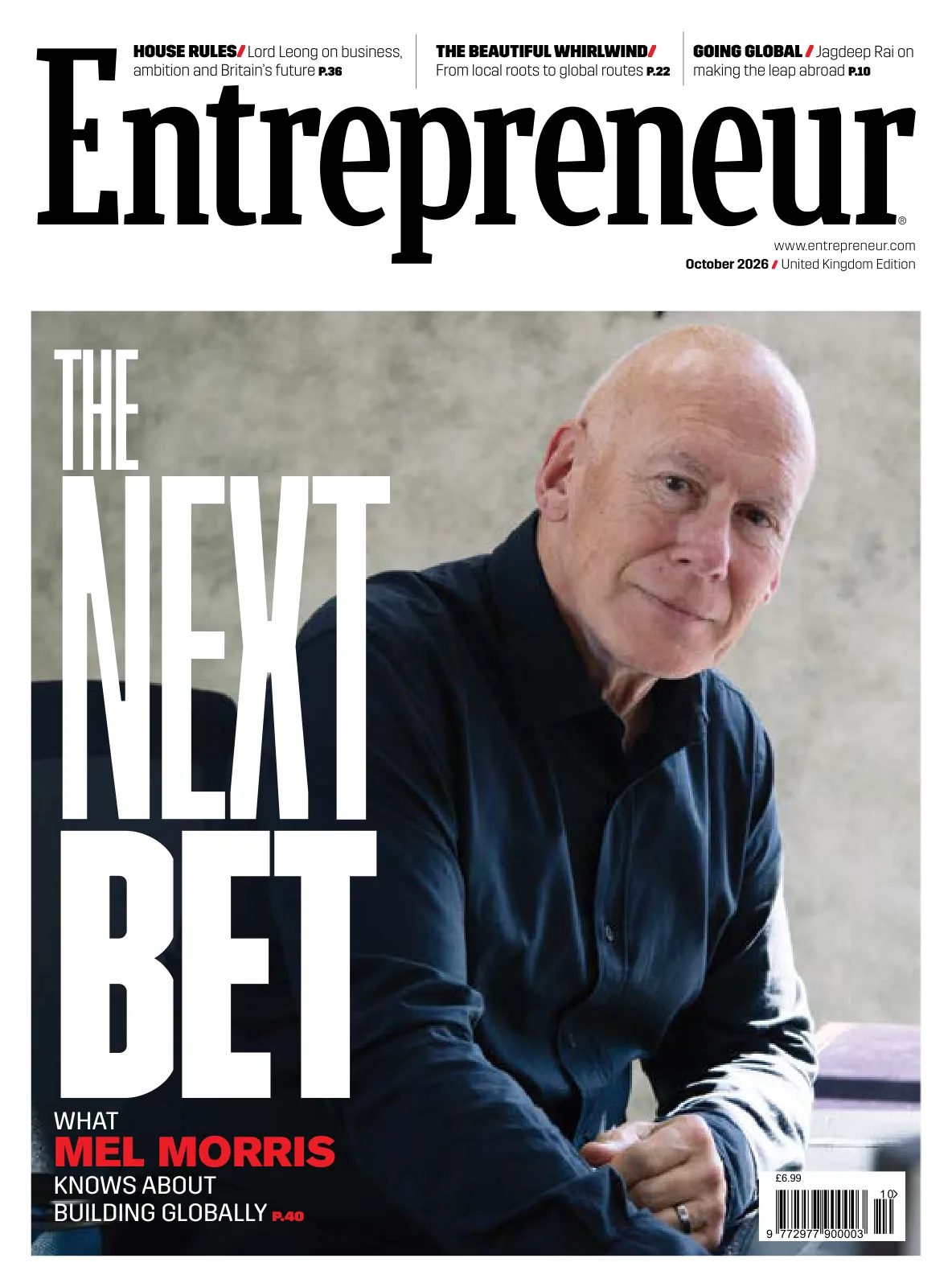
Entrepreneur UK, October 2026
Page 1
www.entrepreneur.com
October 2026 United Kingdom Edition
GOING GLOBAL / Jagdeep Rai on
making the leap abroad P.10
HOUSE RULES/ Lord Leong on business,
ambition and Britain’s future P.36
THE BEAUTIFUL WHIRLWIND/
From local roots to global routes P.22
£6.99
£6.99
WHAT
MEL MORRIS
KNOWS ABOUT
BUILDING GLOBALLY P.40BET
THE NEXT
Page 2
Page 3
Eywa Way of Water is a state-of-the-art residential community with only
65 exceptional waterfront residences, with a holistic wellness ecosystem, curating
authentic experiences and best-in-class amenities few have dreamed of.
Contact us today:
+971 54 308 6000 I sales@byrevolution.com
E Y
W A
.
A E
E V E R Y T H I N G T H AT O N E C O U L D I M A G I N E
F O R E X T R A O R D I N A R Y L I F E
Page 4
ODE TO BAG END
Limited Edition
Make every epic writing journey a cosy one. Hobbiton handcraft from the makers of
the world’s most magical pens.
©����������������������������������������������������������������������������������������������������������������������
�������������������������������™�����������������������������������������������������������������������������������
Page 5
5
October 2026 / ENTREPRENEUR.COM /
Contents/October 2026
P.40
The Next
Bet
MEL MORRIS ON STAYING
AHEAD OF CHANGE
FEATURES
Page 6
October 20, 2026
Guildhall, London
Under the
Patronage of
CONNECT WITH
UK–GCC DECISION-MAKERS
The Business Year presents a high-level forum convening a select group of senior
UK and Gulf government and business leaders to discuss shared economic
priorities and the next phase of UK-GCC cooperation.
More
details
Page 7
55 Making Room for Growth
Katie Keith is reshaping the global
entrepreneurial journey
‘TREPONOMICS
IN THE LOOP
Contents/October 2026
28 Britain’s Banking Export
How Starling’s technology is going
global
36 House Rules
Lord Leong’s vision for business,
ambition and the UK
BUSINESS
UNUSUAL
STARTUP
SPOTLIGHT
60 THE GLOBAL COMPANY
Built for the world from day one
10 The New Rules of Going
Global
Jagdeep Rai on HSBC and UK
ambition
22 The Beautiful Whirlwind
From local roots to global routes
7
October 2026 / ENTREPRENEUR.COM /
FEATURES EDITOR Patricia Cullen
patricia.cullen@bncb2b.com
CEO Wissam Younane
wissam@bncpublishing.net
MANAGING DIRECTOR Rabih Najm
rabih@bncpublishing.net
ART DIRECTOR Simona El Khoury
EDITORIAL TEAM
Tamara Pupic,
Aalia Mehreen Ahmed
MEDIA SALES MANAGER
Olha Kovalova olha.kovalova@bncb2b.com
CONTENT MANAGER
Viktoria Walkowiak viktoria@bncb2b.com
REGIONAL DIRECTOR
Andy B.
CONTRIBUTING EDITOR
Omar Hamdi
CONTRIBUTING WRITERS
Christoph Klink and Jonathan Selbie
SUBSCRIBE
Contact subscriptions@bncb2b.com to receive
Entrepreneur United Kingdom every issue.
COMMERCIAL ENQUIRIES
sales@bncb2b.com
WWW.ENTREPRENEUR.COM/EN-GB
Access fresh content daily on our website
All Rights Reserved 2026. Opinions expressed are solely those of the contributors.
Entrepreneur United Kingdom is officially licensed exclusively to BNC B2B In
United Kingdom by Entrepreneur Media Inc. No part of this magazine may be
reproduced or transmitted in any form or by any means without written permission
of the publisher. Images used in Entrepreneur United Kingdom are credited when
necessary. Attributed use of copyrighted images with permission. All images not
credited otherwise Shutterstock.
20 Wenlock Road, London, N1 7GU
entrepreneurMediaUK
entrepreneurUK
entrepreneurmedia-uk
entrepreneurmedia.uk
→ June Angelides,
helping a new
generation
understand what
their time is worth,
credit: Kiran Gidda
and Me + Em
Page 8
8 / ENTREPRENEUR.COM / October 2026
Editor’s Note/
WHAT TRAVELS NOW
Entrepreneur United Kingdom
T
he most interesting thing about
entrepreneurship today may be how little it
has to do with geography. A good idea can be
developed in one country, financed in another
and reach customers almost anywhere. Talent
moves. Technology travels. Networks have
become as important as markets. And
increasingly, the people building businesses are
thinking globally long before their companies
actually are. That came through in the conversations
behind this issue.
Mel Morris has seen that transformation first-hand,
from King and Candy Crush to his work today with
Corpora.ai. Sam Everington is taking another route,
looking at how the technology developed at Starling
can become a platform for a new generation of banks
beyond the UK. But technology is only one part of
the picture. The less visible infrastructure around a
business matters too. Jagdeep Rai sees this through
her work with SMEs at HSBC UK, where access to
finance and the right support can make the
difference between an ambition and its next stage of
growth. Lord Leong brings another perspective,
drawing on his own experience as an entrepreneur as
well as his role in government, where the conditions
in which small businesses operate are part of a much
bigger conversation.
Then there is the question of who gets access to
opportunity in the first place. That is something
June Angelides has made central to her work
through MyPholyo and Levare Ventures,
championing founders and opportunities that can
too easily be overlooked. I was also struck by Katie
Keith’s work with Global Chamber London and her
creation of Invarah House - a focused space for
experienced women to have the kind of conversations
that challenge and move them forward. Taken
together, these stories suggest that global
entrepreneurship is becoming less about expansion
for its own sake and more about connection:
connecting people to capital, ideas to markets,
technology to new applications and experienced
leaders to one another.
Because while the world may be more connected
than ever, knowing how to make those connections
count is becoming a business skill in its own right.
Enjoy the read!
Patricia Cullen
Features Editor, Entrepreneur United Kingdom
Page 9
7 OCT 2026, 8AM - 11AM, RIVIERA LONDON
LIMITED SPACES RSVP: viktoria@bncb2b.com
Page 10
The New Rules of Going
Global
10 / ENTREPRENEUR.COM / October 2026
THE OPPORTUNITY IS TO
MAKE MORE VIABLE
FOUNDERS VISIBLE,
CONNECTED, AND READY TO
TURN THAT MOMENTUM INTO
REAL SCALE, JOBS AND
PROSPERITY ACROSS EVERY
REGION ACROSS THE UK”
“
“
In the Loop/
A
s Managing Director and Head of UK
Client Coverage, SME Business
Banking at HSBC UK, Jagdeep Rai
meets ambitious business owners
across the country every day. What
she sees is a UK with no shortage of
ideas, optimism or entrepreneurial
nerve. The challenge, she believes, is turning
that ambition into something that can last:
businesses that are ready to finance
growth, ready to scale and ready to take on
the world. There comes a point when a
business stops being just an idea and the
questions become more practical. The
customers are there. The opportunity is
there. Perhaps the next big contract is
within reach, or a new market is opening up.
But what happens next? Can the business
afford to grow at the pace it wants to? Is
there enough cash to support it? Are the
margins right? Does it have the people and
processes in place to deliver? And, perhaps
most importantly, can it keep growing
without everything resting on the founder?
For Rai, these are not theoretical questions.
They are conversations she has with
business owners across the UK every day.
A
A great idea may have been enough in the past,
but it is no longer enough on its own, she says.
What she does see, however, is plenty of
appetite. “One thing that you can't fault is
ambition, that desire for entrepreneurialism,” Rai
says. “There's a massive resilience.” You can hear
the enthusiasm in the way she talks about the entrepreneurs
she meets at HSBC events around the country. These are
business owners coming together to learn, compare notes and
make connections - and Rai clearly enjoys being in the
room with them. “They're ambitious, they're positive,” she
says. “I just get so energised when I talk to all of them.”
That optimism is striking, particularly after the economic
shocks and uncertainty businesses have had to contend
with in recent years. But Rai doesn't confuse optimism
with readiness. For her, the next step is making sure
businesses have the foundations to turn determination
into sustainable growth.
“
The UK has the entrepreneurial momentum, that's
not the challenge,” she says. “The opportunity now
is helping more viable SMEs get finance ready early
on so that they can turn that growth ambition into scale
and jobs across the country.” For Rai, being “finance
ready” is about much more than securing funding. It
means understanding the numbers, proving customer
demand, having credible forecasts and cash-flow plans,
putting proper governance in place and building a
business that can grow without everything depending on
one person. Entrepreneurship has always had a soft spot
for the idea. The lightbulb moment. The founder who sees
something everyone else missed. The product that
Page 11
11
October 2026 / ENTREPRENEUR.COM /
→ Jagdeep Rai,
Managing
Director and Head
of UK Client
Coverage, SME
Business Banking
at HSBC UK
Page 12
12 / ENTREPRENEUR.COM / October 2026
changes an industry. The company that starts around a
kitchen table and ends up operating across continents. Rai
isn't dismissing any of that. But once a business starts to
grow, she says, the focus has to shift. The founder needs to
know whether the business can actually support the vision
behind it. That means understanding unit economics.
Knowing how much it costs to acquire and serve customers.
Watching cash carefully. Proving that demand is real. Putting
governance around the organisation. And, increasingly,
building a team and infrastructure capable of repeating the
founder's success without requiring the founder to
personally intervene in everything.
T
he distinction becomes even more important when the
ambition is international. A founder may be able to run
a £1m business through instinct and sheer force of
personality. Running a £10m business is different. Running
one across several countries is different again. At some
point, the organisation has to become bigger than the
individual who created it. Rai talks about the importance of
“repeatable execution.” Rather than relying on one person to
hold everything together, the business needs “the right
infrastructure around them.” Founders are often celebrated
for doing everything themselves. They make the sales calls.
They negotiate with suppliers. They know the customers.
They understand the product intimately. In the early days,
that can be exactly what a business needs. But what works
at the beginning can become a weakness later. If everything
depends on one person, the company hasn't really scaled.
The founder has simply become very good at carrying more.
The businesses that make the transition are the ones that
start building the organisation around the growth. Rai has a
neat shorthand for what she sees as the foundations of that
process: the three Ds - Demand. Delivery. Discipline. “The
businesses that we see scaling internationally or globally are
the ones that get the fundamentals right.”
F
irst comes demand. Not assumed demand, but
evidence. Are customers buying? Are they coming
back? Is there genuine traction and retention? Then
delivery. Can the organisation fulfil what it has sold? Does it
have the right people, processes and operational capacity?
And finally, discipline - particularly when it comes to money.
“Having that cash discipline, really credible forecasting and
that governance to manage growth without overstretching
themselves is vital.” It is easy to underestimate how quickly
growth can consume finances. A larger order may mean
buying inventory before the customer pays. A new market
may mean employing people before revenue arrives.
International customers may work on longer payment terms.
Foreign exchange movements can affect margins. A
business can therefore look extremely successful from the
outside while feeling quite different from the inside. “The
best founders are those that see scaling is an organisational
challenge, not simply a sales target.” The question is what
happens underneath the sales figure. Who is delivering the
product? Who is making the decisions? What happens if
demand doubles? Where does the cash come from? And
what happens when the founder isn't there? “Winning more
customers and getting more business through the front door
only creates value if the business can continue to serve them
well.”
T
hat distinction - between growth and scale - runs
through much of Rai's thinking. Growth brings in more
business. Scale means having an organisation
capable of absorbing it. Rai also advises businesses to have
the finance conversation before they need it. One of the
mistakes she sees is businesses waiting until the need for
money becomes urgent before thinking about how to obtain
it. By then, the conversation has changed. “The best-
prepared SME founders are the ones who are really clear
about what the finance is going to unlock for them,” she
says. It starts with a basic question: what is the money for?
Working capital? Equipment? Entering a new market?
Longer-term growth? Being clear about that forces the
entrepreneur to think through the business itself. How much
is needed? When is it needed? What will it generate? What
evidence exists to support the plan? Rai says businesses
can come under pressure when they leave those
conversations too late. “Where we see businesses struggle
is when they leave the conversation about finance until it's
really urgent.”
P
reparation gives businesses options. It also gives a
potential funder something to work with: a track
record, credible forecasts, management information,
realistic cash flows and a clear explanation of what the
company is trying to do. “And that story is really important.”
But Rai is keen to move the conversation beyond money.
“Finance is one thing, but also that capability support is
equally important.” That means knowing where to get
advice. Finding mentors. Meeting other founders. Learning
from people who have already made mistakes that you
would rather not repeat. It is part of the thinking behind
SCALING INTERNATIONALLY
ISN’T JUST SELLING MORE.
IT’S BUILDING THE
CAPABILITIES, THE FUNDING
AND THE HEADROOM TO
OPERATE REALLY RELIABLY IN
NEW MARKETS”
“
In the Loop/
Page 13
13
October 2026 / ENTREPRENEUR.COM /
HSBC UK's Small Business
Growth Programme, which
Rai says has reached more
than 2m SMEs in the last
year, providing training,
events and insights
alongside financial support.
For a small business owner,
those connections can be
particularly valuable
Sometimes the most useful
thing another entrepreneur
can give you isn't money. It
is five minutes of
experience. There is a more
uncomfortable question
running through Rai's
thinking, however. Who
gets the chance to build
these businesses in the first
place? “Opportunity
definitely isn't evenly
distributed.”
S
he points to
significant disparities
in access to venture
capital and investment for
female-only teams and
Black founders, as well as
the barriers reported by
disabled founders. The
figures she cites are stark:
female-only teams received
just 2% of venture capital in
2024, while Black founders
captured 0.9% of
investment value between
2013 and 2023. Disabled
founders, she says, are
reported to be 400 times
less likely to secure
investment.
T
hese statistics need
to be understood
carefully and in
context, but Rai's
underlying point is
straightforward. A country's
entrepreneurial potential
cannot be measured only
by the businesses that are
already visible. There may
be viable founders who
have not yet found the right
networks, advisers,
customers or sources of
capital. And if those people
remain invisible, the
economic cost is potentially
much wider than the
fortunes of individual
businesses. “The
opportunity is to make
more viable founders
visible, connected, and
ready to turn that
momentum into real scale,
jobs and prosperity across
every region across the
UK.” It is a striking
formulation. Not simply
funded. Visible. Connected.
Ready. Those three words
broaden the conversation
about access. Money
matters, obviously. But so
does knowing where to find
it. So does having someone
who can explain the
process. So does meeting
the customer who might
become the breakthrough
account. And so does
having a network that isn't
limited to people who look,
sound or operate like you.
F
or Rai, some of the
answers may already
be sitting inside
existing systems. “One of
the biggest missed
opportunities isn't
necessarily a shortage of
money,” she says. “It's
actually not making full use
of the pathways and the
support that's already
available.” She points to
existing institutions and
programmes, the expansion
of Community Development
Finance Institutions, better
use of public data and
changes to business
support. Her conclusion is
provocative precisely
because it is not simply
another demand for more
capital. “Backing more
viable business through
better pathways. Not
necessarily through more
money.” The temptation to
expand internationally is
understandable. Once a
business has proved itself
in Britain, the world can
look like the obvious next
step. But Rai's view of
international growth is
much less romantic.
I
nternational expansion
brings logistics, payment
terms, foreign exchange
exposure, longer cash
cycles and working capital
requirements, she says.
There are different
regulatory and commercial
environments, different
customer expectations and,
potentially, an organisation
that becomes much more
complicated almost
overnight. The strongest
businesses don't simply
take their UK model and
drop it into another country.
“They choose those
markets deliberately,” Rai
says. They test demand.
They think about how the
proposition will work locally.
And, crucially, they build
relationships. “The
strongest ones we see
really look at their local
market and how that will
work with their local
partnerships.” Being global
doesn't mean behaving
identically everywhere. A
business may have a global
product, but customers are
still local. Regulations are
local. Business culture is
local. Distribution is local.
The companies that
understand that distinction
have a better chance of
building something that
lasts. There is another trap,
too: trying to conquer too
much territory too quickly.
Rai sees businesses enter
too many markets at once,
underestimate the
operational complexity and
fail to put enough resources
behind the move. It is a
Page 14
14 / ENTREPRENEUR.COM / October 2026
In the Loop/
reminder that ambition can
have a downside. You can
want something very badly
and still not be ready for it.
“Scaling internationally isn't
just selling more,” Rai
repeats. “It's building the
capabilities, the funding
and the headroom to
operate really reliably in
new markets.”
T
he implication is
almost
counterintuitive.
Sometimes the most
ambitious thing an
entrepreneur can do is
move more slowly. Pick
one market. Prove the
model. Build the local
relationships. Make sure
the business can finance
the journey. Then go again.
It is inevitable that the
conversation comes back
to HSBC. But Rai's
definition of the bank's role
is broader than simply
providing capital. “A bank's
role goes well beyond
money.” HSBC UK
supports more than
675,000 SME customers,
according to Rai, and she
describes the bank's role
as helping businesses
understand finance
readiness, strengthen the
information behind their
plans and navigate the
different options available
at different stages of
growth. That can mean
lending. It can mean broker
routes. It can mean pre-
approved lending. And
where conventional finance
isn't appropriate, it can
mean referrals to
alternative providers. Rai
highlights Community
Development Finance
Institutions as one route
that can help broaden
access for underserved
communities. The principle
is that there should be a
clearer route to the right
finance, at the right time,
for the right business. But
perhaps the more
interesting part is what
happens around finance.
HSBC's Small Business
Growth Programme
continues to expand,
alongside its Strategies for
Success programme and
the women's business
growth initiatives. There is
a growing emphasis on
events, information and
connections. And Rai
clearly enjoys this part of
the work. She talks about
travelling around the
country and seeing local
entrepreneurs gather in the
same room. They are, she
says, “hungry for
knowledge, hungry to meet
new people”. For all the
talk of capital, forecasts
and governance, the thing
that seems to energise her
most is people. Founders
talking to founders.
Business owners asking
questions. Entrepreneurs
comparing experiences.
Someone discovering a
new route into a market.
Someone else hearing
about a mistake they can
now avoid. It is the human
infrastructure of
entrepreneurship. And Rai
is clearly a believer in it.
S
o what happens
next? What will
distinguish the
entrepreneurs who thrive in
a more competitive global
economy? Rai's answer
begins with a word she
admits is one of her
favourites. “Execution.”
There are more fashionable
words in the entrepreneurial
vocabulary. Innovation.
Disruption. Transformation.
But execution is where all
of them become real. “I
think the successful
founders of the future who
will thrive will innovate.
They'll build resilience.
They'll be very adaptable.”
They will remain disciplined
around cash and customer
value. They will build proper
governance. They will use
the networks and support
systems around them. And
they will understand that
being international does not
mean losing touch with the
individual markets that
make up that international
business. “They'll be
globally minded, but locally
rooted.” It is perhaps the
cleanest expression of
Rai's philosophy. The
global entrepreneur of the
future will need to think
beyond their home market
while understanding it
better than ever.
F
or Rai, the
entrepreneurs who
will thrive in the next
phase of the global
economy won't be defined
by ambition alone. They will
be the ones who can turn
ambition into something
tangible: a business with
the customers, cash
discipline, people and
infrastructure to support its
growth. And perhaps that is
the real opportunity for
Britain's entrepreneurial
economy - not simply to
produce more great ideas,
but to help more of those
ideas become businesses
capable of going the
distance.
“
Ultimately the global
winners will be
founders who pair
ambition with execution,
who can prove viability in a
way that unlocks that
capital partnership and
long-term scale.”
“ULTIMATELY THE GLOBAL WINNERS WILL
BE FOUNDERS WHO PAIR AMBITION WITH
EXECUTION, WHO CAN PROVE VIABILITY
IN A WAY THAT UNLOCKS THAT CAPITAL
PARTNERSHIP AND LONG-TERM SCALE”
Page 15
15
October 2026 / ENTREPRENEUR.COM /
Page 16
16 / ENTREPRENEUR.COM / October 2026
→ June Angelides,
founder of MyPholyo
and Levare Ventures,
credit: Kiran Gidda
and Me + Em
Page 17
THE GLOBAL
ENTREPRENEUR
The new rules of building a career - and a company
by ENTREPRENEUR UK STAFF
In the Loop/
F
rom Lagos to London,
from venture capital to
her latest fintech venture,
June Angelides has spent
her career questioning
the rules of work, money and
entrepreneurship. Now she
believes the next generation will
build careers - and companies -
very differently. For most of the
20th century, the recipe for a
successful working life was
reassuringly simple: do well at
school, go to university, get a job,
work hard and, if things went
well, stay there. Angelides thinks
that model is changing. Not
because people have stopped
wanting careers, but because the
world of work has evolved. A job
can disappear. An industry can
be transformed almost over-
night. Artificial intelligence (AI)
is already redrawing the
boundaries of what people do for
a living. And increasingly, the
people best equipped to weather
those changes may not be those
with one immaculate career
ladder, but those who have built
a portfolio of skills, relationships
and income streams. Angelides
has a name for them: the
‘multi-income earner.’ It is also
the thinking behind MyPholyo,
the company she is building after
years as an investor and
entrepreneur. Its purpose is
straightforward: to help people
understand what their skills are
worth, where their income is
coming from, what they should
be charging and, crucially, which
opportunities are actually worth
their time. As she puts it, “the
labour market has changed
faster than the infrastructure
that exists to support it.”
In 2026, a mortgage applica-
tion still asks for one income. A
CV tells the story of one career.
Yet more people are now
working across jobs, projects and
businesses. Angelides has met
people juggling seven things at
once, often undercharging or
taking on work simply because it
looks good on paper. One
woman had taken a role with
17
October 2026 / ENTREPRENEUR.COM /
Page 18
18 / ENTREPRENEUR.COM / October 2026
In the Loop/
BAFTA. “The logo sounds
amazing,” she said. But it
wasn’t paying enough for
the time involved. The
answer isn’t to work harder,
but to understand what that
time was worth. That
thinking sits behind
MyPholyo, which is building
data around portfolio
careers to help people
benchmark their rates and
spot where they may be
leaving money on the table.
So far, 65% of MyPholyo
users didn’t know their
effective hourly rate. More
than 300 have used the
Mapper, with 59% targeting
over £100,000 in revenue
this year. This isn’t a
side-hustle crowd. It reflects
a wider shift in global
entrepreneurship: people
are building careers around
their skills, rather than a
YOU CAN’T
JUST ASSUME
THAT YOU WIN
IN ONE MARKET
AND YOU’RE
GOING TO WIN
IN THE OTHER”
single job. “We don’t talk
about money enough,”
Angelides says. MyPholyo
aims to give people better
information about what their
time is worth - from speaking
fees to board roles and
fractional work. “I’m not
saying go and do 10 jobs,” she
says, “but do the actual jobs
that compound and make
sense for you.” Angelides’
career reflects her belief in
learning and access. She
began in banking, working
with early-stage technology
businesses, and in 2015
decided to learn to code while
on maternity leave from
Silicon Valley Bank. With a
toddler and baby at home,
she attended the General
Assembly while her sister
waited outside with the baby.
“She cried the entire time,”
Angelides recalls. Realising
there had to be a better way,
she approached Code First
Girls about creating a
programme for mothers.
They introduced her to
ThoughtWorks, which offered
her space to run the pro-
gramme. Angelides then
approached contacts across
the technology industry to see
if they would teach, and they
agreed.
What began as a maternity-
leave project became Mums
in Tech, teaching women to
turn ideas into products
through coding. Angelides
ran 12 cohorts and taught
250 women before leaving
Silicon Valley Bank to build it
full time. Raising investment
revealed another problem:
women and underrepresent-
ed founders struggled to
access funding. “There just
wasn’t a playbook.” Angelides
“
Page 19
→ June Angelides,
helping a new
generation
understand what
their time is worth,
credit: Kiran Gidda
and Me + Em
19
October 2026 / ENTREPRENEUR.COM /
Page 20
→ June Angelides,
on building a career
without following
the usual rules,
credit: Kiran Gidda
and Me + Em
20 / ENTREPRENEUR.COM / October 2026
Page 21
21
October 2026 / ENTREPRENEUR.COM /
began asking how many promising
businesses never got started because
the right investor was never found.
Her answer was to move to the other
side of the table. Today, Angelides
invests in early-stage businesses
through Levare Ventures, with a
focus on opportunities beyond the
main markets. Africa is one. Having
grown up in Nigeria in an entrepre-
neurial family, she has long admired
the resourcefulness of founders
there. “There are a lot of problems
and a lot of talent. All that’s missing
is capital.” She has invested across
Nigeria, Kenya, Ghana, South Africa
and Senegal, but stresses that Africa
is not one market. Each country has
different customers, regulations,
payment systems and cultural
expectations. “You can’t just assume
that you win in one market and
you’re going to win in the other.” For
Angelides, it is a lesson in global
entrepreneurship: a business that
succeeds in one country cannot
simply be copied elsewhere.
Angelides points to Airbnb and
Uber as examples of companies that
expanded market by market,
learning how each worked rather
than assuming the same formula
would apply everywhere. “Every
expansion is a start-up starting all
over again,” she says. She believes
global founders need humility,
recognising that the rules change
with geography. The same applies to
investors, who must be willing to
back businesses before success is
obvious. “You are taking a bet on
something you believe will have an
outsized return.” She cites fintech
company Raenest which she backed
early and says has since delivered
more than an eightfold return. For
Angelides, the point is to spot
opportunities before everyone else
does.
The UK has great talent, entrepre-
neurs and universities, but Angelides
believes it lacks enough long-term
capital. UK companies can reach the
point where they need serious
funding and find deeper pools of
investment in the US, potentially
moving their headquarters with it.
How do we keep entrepreneurs in
the UK and UK-owned? She believes
the UK should become a stronger
customer for its own technology,
particularly AI, using it to improve
productivity and keep more
economic value at home. “We’ve got
great talent,” she says, “but who’s
relying on the UK?” Angelides sees
AI as making entrepreneurship more
accessible. She used AI-assisted
software to build the first version of
MyPholyo, testing the idea before
investing heavily. However, she is
wary of businesses built on little
more than someone else’s AI model.
“There is a lot of AI slop on there,”
she warns.
For investors, Angelides believes
the strongest businesses need more
than technology. Proprietary data,
distribution and trust can create last-
ing advantages in global markets.
For MyPholyo, data is central to
understanding what professionals
charge, what different roles are
worth and how people build multiple
income streams. Angelides sees this
as part of a wider shift in entrepre-
neurship and careers. The traditional
model of one employer and one
income is no longer the only path.
She describes her own approach as a
“career stack”, combining investing,
public speaking, fractional work and
building companies. “If one falls
away, I will be okay,” she says. But it’s
not just about financial security. It
gives her the freedom to take on new
opportunities.
Angelides is less interested in
turning everyone into an entrepre-
neur than giving people agency. That
idea runs through her career: when
she couldn’t find a way to learn that
worked for her, she built Mums in
Tech; when she saw women
struggling to access funding, she
became an investor; and when
professionals struggled to under-
stand the value of their work, she
began building a platform around it.
Her approach is simple: find what
isn’t working and build something
better. She is also comfortable admit-
ting she doesn’t have all the answers.
“I wouldn’t be serving anyone if I sat
here and said I know it all,” she says.
Angelides’ career has been about
spotting opportunities before she has
all the answers. Mums in Tech,
investing and MyPholyo all grew
from seeing a problem and doing
something about it. The same
thinking applies to global business.
Careers are becoming less linear,
while companies are being built
across markets, borders and cultures.
Success no longer comes from simply
copying what works elsewhere. It
comes from knowing when to adapt.
The opportunity, she believes, is in
seeing the change early.
“EVERY
EXPANSION IS
A START-UP
STARTING ALL
OVER AGAIN.
YOU ARE
TAKING A BET
ON SOMETHING
YOU BELIEVE
WILL HAVE
AN OUTSIZED
RETURN”
Page 22
22 / ENTREPRENEUR.COM / October 2026
In the Loop/
→ Zandra
Moore,
founder of
Zygens
Page 23
23
October 2026 / ENTREPRENEUR.COM /
W
hen Zandra Moore talks about her mother, she talks
about technology. Not in the way you might expect.
There is no grand story of a childhood spent taking
computers apart, or of a mother who mapped out a
career in technology for her daughter. Moore’s
mother left education as a young teen. She found
her way into tech because she needed to work, and
went on to have a successful career at the dawn of the internet.
What Moore remembers most is not what her mother taught her, It
is what she showed her. “My mum went to work in tech very early,”
she says, “she fell out of education at 14.” She never seemed fazed
by the new. When the internet arrived, she embraced it. Later, after
being widowed in her 60s, she went online dating. “She is not afraid
of the internet,” Moore says. It is a small detail, but it explains a
great deal about Moore herself. “I didn’t realise my path into tech
and entrepreneurship was that I could see it. I had a role model.
Most women don’t.”
The Beautiful
Whirlwind
From local roots to global routes by ENTREPRENEUR UK STAFF
F
or Moore, possibility was visible from the beginning. Technology was not an
intimidating world occupied by other people. It was simply something her
mother did. Something that could be understood. Something you could have a
go at. “I just didn’t see the risk because I always thought I could do it,” she says. “I
could believe in myself because of what I could see.” That belief has taken Moore a
long way. She has been self-employed since her twenties, built and scaled technology
companies, employed people and made them redundant, expanded businesses and
had to scale them back. She has spent much of her career in data, machine learning
and SaaS, and now, in what she describes as her “third rodeo”, with Zygens, she is
building again. This time, the territory is artificial intelligence.
But Moore’s story is not simply about technology. It is about who gets to imagine
themselves building something in the first place - and what happens when they do.
She is candid about the advantages she had. “My privilege was having a role model.”
For all the talk about encouraging more women into technology and entrepreneur-
ship, Moore believes the problem is not a shortage of ability, it is a shortage of
access: to networks, capital, childcare, opportunity and, crucially, to other people
who have already done it. “It’s not a lack of capability for women but a lack of access
and networks.” That conviction has become part of the work she does alongside
building businesses. Moore was involved in the taskforce with Anne Boden, founder
Page 24
24 / ENTREPRENEUR.COM / October 2026
direction and wondering
whether the thing you
have poured years into is
still the thing worth
pursuing. “I’ve been
through the mire,” she
says. “I’ve grown and
scaled a company, I’ve
employed lots of people,
I’ve had to make people
redundant, I’ve had to
scale things back, expand
them out.” But there is
another lesson in all that
experience: entrepreneur-
ship can be lonely.
M
ore men start
businesses than
women, and the
numbers become smaller
again when you look at
women building compa-
nies with the appetite and
potential to scale. “If you
look at that high growth
bit, the bit where women
have the appetite, the
ambition, the will, and the
business that can scale,
there are so few of us.”
Because the hardest
business decisions aren’t
found in a textbook. They
are about people, timing,
money, ego and instinct.
Sometimes you need
someone who’s been there
to see what you can’t. “We
all need to know when to
let go of the things that
aren’t good for us,” Moore
adds. It is one reason she
believes so strongly in
peer networks. Coaches
can help, but there is a
particular honesty that
comes from sitting with
people who understand
the experience because
they have lived it
themselves. Most of the
time, she says, the
conversation is about
difficult things. “The stuff
that’s on our mind, that’s
draining our energy, that’s
keeping us up at night.”
T
here is something
almost addictive
about that pressure.
Founders can want to step
away from the intensity
while simultaneously
being unable to imagine
doing anything else.
Moore knows that feeling.
And she knows that
sometimes the way
forward is not to push
harder, but to let some-
thing go. She has an
almost physical dislike of
the word “pivot.” The word
makes changing direction
sound like an enormous
act of corporate manoeu-
vring. Moore sees it
differently. “To pivot is just
being prepared to let your
ego get out of the way.”
That may be one of the
hardest disciplines of
entrepreneurship.
Founders become
attached to ideas because
they have invested so
much of themselves in
them. They build teams
around them. They give
them names. They tell
other people that this is
where they are going.
Then something changes.
The market moves. The
customer changes. The
technology makes the
original idea less relevant.
“You’ve got to be prepared
to step back from the
decisions you’ve made, the
investments you’ve made,
the people who might no
longer be right, and move
towards what is.”
Moore has had to do that
herself. Her previous
company, Panintelligence,
grew from a management
buyout into a data and
machine-learning
business, and Moore spent
years working at the
intersection of software,
data and prediction. Then
generative AI arrived and
the market began moving
again. Rather than watch
the shift from the
sidelines, she stepped into
it. “I wanted to be on the
AI side of the conversa-
tion,” she says. That
“I JUST DIDN’T SEE
THE RISK BECAUSE I
ALWAYS THOUGHT I
COULD DO IT. I COULD
BELIEVE IN MYSELF
BECAUSE OF WHAT I
COULD SEE”
of Starling Bank, and
went on to establish The
Whole Point, a network
designed to support
women growing and
scaling companies. It
now has boards across
five UK cities. The fact
that those networks are
outside London is
important to Moore. “I’m
unapologetically
regional, not in London,
because I’m a Leeds lass,”
she says.
Being outside London
can make entrepreneur-
ship harder, she argues.
It can be harder to find
other women like
yourself, harder to access
capital, harder to build
the right relationships
and harder to become
visible. But why should
women have to leave the
places where they are
building businesses,
employing people and
raising families simply to
find the networks that
might help them grow?
Moore’s answer has been
to bring the network to
them. She believes that
the people best placed to
overcome an obstacle are
often individuals who
have actually lived it.
Those of us who are at
the coalface, who have
lived with the problem,
understand how to solve
it, she says. However, she
has little interest in
pretending that entrepre-
neurship is a smooth
ascent. Her own
experience has included
the parts that rarely
make it into a founder’s
biography: difficult
decisions, redundancy,
scaling back, changing
In the Loop/
Page 25
25
October 2026 / ENTREPRENEUR.COM /
→ Zandra
Moore, on
building,
scaling and
starting
again
Page 26
26 / ENTREPRENEUR.COM / October 2026
decision led to Zygens, her latest venture, focused on helping
organisations understand where AI can genuinely create
value rather than simply adding another piece of technology
to the pile. Moore calls some of what she sees “AI theatre”. It
reminds her of the early internet. Back then, businesses were
told they needed websites. Many built them without really
understanding why. They had a digital presence, but not
necessarily a digital business. Moore remembers those early
days vividly because she watched them unfold at home with
her mother. “I remember sitting with my mum the first day
we got the modem in the house, watching the screen for the
ICI chemical polymers just slowly appear.” Then came the
page: white background, blue URLs and a pixelated logo. “It
was just hyperlinks to another page with some text on it, a bit
like Wikipedia for you today.” The technology was primitive.
The possibilities were not.
In the Loop/
Page 27
27
October 2026 / ENTREPRENEUR.COM /
M
oore sees AI going through a
similar stage now. People are
experimenting. Companies are
trying things because they have been
told they should. There is plenty of
noise, and not everything being built
will matter. But that is how technologi-
cal revolutions work. The maturity
comes later, when people stop asking
what the technology can do and start
asking what they actually need it to do.
That is the thinking behind Zygens.
Moore starts with the business
strategy, then the problems standing in
its way, then the potential use cases.
Only after that does she consider the
technology. The question is not simply
whether AI can be applied. It is
whether applying it will drive value.
For Moore, the question goes beyond
AI: is this still working, is the team still
right, and is what we’re doing actually
creating value? That, she says, is where
entrepreneurship is less about bravado
and more about judgement. For
women, there are still added barriers,
but the fundamental difficulties of
building a company are not gender-
specific. “I think sometimes we need to
separate the challenges of gender from
the truth of building a business,” she
says. Cash flow does not care who you
are. Markets change for everyone.
Every founder eventually has to make a
decision they would rather avoid. What
differs is who has someone to call when
that happens. Moore believes that
bringing more people into those
conversations - women, people from
minority backgrounds, people without
inherited wealth or elite educational
networks - is not simply a question of
fairness. It is an economic one. “If
people that aren’t already in those
circles are not in the same rooms, that
slows our economy down.” That is why
the networks matter. And why role
models matter. Moore knows what it
means to see someone like yourself
doing the thing you had not yet
imagined doing. She also knows the
responsibility that comes with
becoming that person for someone else.
W
omen who become successful
are often encouraged to be
more visible, more vocal,
more available. They are expected to
speak, mentor, advocate and inspire
the next generation, even while they
are trying to run their own companies.
Moore feels that pull herself. “We have
a massive compulsion to show up and
be role models and be visible because
we know that’s part of the problem.”
But visibility has a cost. “If you want
more women scaling companies, we
also need to not put loads of pressure
on the women that are scaling
companies.” If we want more women to
build ambitious companies, we cannot
make being a role model another
full-time responsibility.
There is a generosity to Moore’s
thinking. “Legacy’s really important,”
she says, “it’s not about money, it’s
about putting the ladder down, making
it easier for others to climb up.” Like
mother, like daughter. Her mother
showed her what was possible; Moore
has spent her career following that
example, from the early internet to the
leading edge of AI. Technology keeps
changing. Moore keeps moving. Her
mother always called her a “beautiful
whirlwind”. It is hard to think of a
better description. At 50, Moore is
already onto her next company,
working in a field that is changing
almost by the week. She laughs about
the chaos of it. Then she gets back to
work.
LEGACY’S REALLY IMPORTANT. IT’S NOT ABOUT
MONEY, IT’S ABOUT PUTTING THE LADDER DOWN,
MAKING IT EASIER FOR OTHERS TO CLIMB UP”
“
→ Zandra Moore, on the influence of
her first role model
Page 28
28 / ENTREPRENEUR.COM / October 2026
BRITAIN’S
BANKING EXPORT
How Sam Everington is
turning Starling's
technology into a global
platform for the next
generation of banks
by ENTREPRENEUR UK STAFF
→ Sam
Everington,
CEO of Engine
by Starling
B
Disruptor
/
Page 29
29
October 2026 / ENTREPRENEUR.COM /
“BRITAIN’S
STRENGTHS INCLUDE
GENUINELY DEEP
ENGINEERING TALENT
AND A REGULATORY
ENVIRONMENT
WHICH ENABLES AND
ENCOURAGES POSITIVE
INNOVATIONS”
B
anking was built on decades of
accumulated technology, regulation and
infrastructure. But what if the next
generation doesn’t have to inherit any of it?
Sam Everington was there from the
beginning of Starling, helping build the
technology that powered one of Britain’s
most influential digital banks. Today, as CEO of
Engine by Starling, he is taking that architecture
beyond Britain - from Romania and Australia to
Canada, New Zealand and the Gulf - giving
established institutions and emerging markets the
chance to leapfrog legacy banking systems
altogether. His ambition is bigger than exporting
software. It is to export a blueprint: a radically
different way to build, operate and scale a bank in
the digital age. For this Global Entrepreneurship
edition, Everington discusses why ageing
infrastructure has become banking’s innovation
ceiling, why emerging markets may have the
advantage, and how British fintech could turn one
of its greatest technological success stories into
a global industry.
Page 30
30 / ENTREPRENEUR.COM / October 2026
}You were part of the team
that built the technology
powering Starling from the
ground up. What did that
experience teach you about
how banking could be built
differently?
I joined Starling back in
2016 as a software engineer,
building the systems and
apps behind the current
account launch. What that
experience really taught me is
the difference in impact you
can have between digitalising
an existing process and
designing the ideal journey
from the customer and
employee perspectives. Most
banks are trying to bolt
modern capability onto core
foundations that are twenty
to forty years old. We got to
start by focusing on solving
the problem at hand - build-
ing on modern foundations
that can operate intelligently,
with full content to deliver
real-time outcomes for
everyone. That’s what
convinced me the technology
itself is the thing worth
exporting.
Engine is now taking
technology developed in
Britain into international
markets. What made you
believe that what worked for
Starling could work for
banks around the world?
The proof point for me is Salt
Bank in Romania. They went
live on Engine in under twelve
months - a fraction of the
time it would take to compose
component systems, yet alone
build a proprietary core
banking system from scratch.
We’ve seen the same pattern
with AMP in Australia, and
are now delivering this for
Tangerine in Canada and SBS
Bank in New Zealand. The
basic needs of people, families
and businesses are the same
everywhere. Further, almost
every financial institution,
regardless of geography, is
dealing with the same rigid,
ageing core infrastructure that
is trying to meet the needs of
ever modernising tech savvy
customers. If the platform
solved that once in the UK,
there was every reason to
believe it can solve it again
elsewhere.
Could countries with less
established banking
infrastructure actually
leapfrog the UK and build the
next generation of banks
faster?
Yes, and I think that’s an
underappreciated point.
“EVERYWHERE
WE LOOK, THERE
ARE HUGE
OPPORTUNITIES.
PERSONALISED
AND MORE HUMAN
BANKING CAN
BE THE FUTURE,
AT A SCALABLE
PRICE-POINT, WITH
TECHNOLOGY BUILT
ON THE RIGHT
FOUNDATIONS”
Page 31
31
October 2026 / ENTREPRENEUR.COM /
Markets that don’t have the
same decades of legacy
spaghetti, don’t have to go
through what I’d call the
graveyard phase - the years
banks spend trying, and
frequently failing, to wrap
their cores and replace all
the components around.
Incumbency can be as much
a liability as an asset. A
market building its banking
infrastructure today can
start where the world’s best
digital banks are right now,
rather than where we
started decades ago.
What has expanding
Engine internationally
taught you about what
Britain does well in fintech
- and where it needs to
improve?
Britain’s strengths include
genuinely deep engineering
talent and a regulatory
environment which enables
and encourages positive
innovations. From real-time
payments, to open banking,
to AI in financial services,
Britain has set new
standards of expectation.
London is where our tech
stack was built, and it’s still
where we’re investing,
including our new HQ.
While we’ve expanded
beyond the UK, London
remains a hub for innova-
tion for us. Where British
fintech needs to improve:
for all the sleek apps UK
neobanks have built,
relatively few of us have
become customers’ primary
bank account. There is a
huge opportunity in the UK
for deepening customer
relationships, with digital
players expanding into
primary accounts by
building high-trust products
customers can rely on.
The Middle East is
investing heavily in
financial innovation and
building new digital econo-
mies. What opportunity do
you see for Engine - and
for British fintech more
broadly - in the region?
The Middle East is a key
region for Engine which is
why we opened our first
Engine officesin the region
last year. The GCC is
deploying real capital, both
financial and political
support, into digital-first
financial capabilities, which
makes it a natural fit for a
platform-led approach of
enabling the uplift and
rapid modernisation of
existing institutions. We’re
already running a genuinely
international, cloud-native
operation across Canada,
Romania, Australia, and
New Zealand — the Gulf is
a real focus for us, and one
where we feel both our
technology and operating
experience can have a
significant impact on
growth.
Are traditional banks
becoming increasingly
constrained by the legacy
technology they have
spent decades building
around, and what does
that mean for the future of
banking?
The core banking software
market is dominated by a
handful of incumbent
providers, and plenty of bank
executives have tried to
replace their core systems
and failed. But legacy
technology isn’t just a cost
problem, it’s an innovation
ceiling. It’s often expensive
just to deploy real-time
payments, yet alone give
breadth of context to AI tools
at speed, if the core under-
neath can’t support it.
Everywhere we look, there
are huge opportunities.
Personalised and more
human banking can be the
future, at a scalable price-
point, with technology built
on the right foundations.
Could Engine ultimately
become bigger than
Starling - and if it does,
what will you have
changed about banking
around the world?
We’ve set ourselves a target
of £100m in annual
recurring revenue, and we’re
well on track to get there
soon, off the back of our
footprint across the UK,
Canada, Romania, New
Zealand and Australia.
Engine is still a smaller
business, relative to
Starling’s overall Group
revenue today, but it’s highly
scalable and it’s asset-light.
Engine gives the wider
group real resilience and fee
income, and all clients the
benefits to learn from the
experience of a community
of like-minded banks. If we
get this right, what I’ll have
changed is proving that a
handful of banks built on
Engine can deliver both
high levels of customer
satisfaction and operating
efficiency. We’ll have
effectively exported the
blueprint for what a
well-built digital bank looks
like, instead of every
institution attempted to
reinvent it.
Page 32
E
min Can Turan,
founder & CEO of
Pebbles AI, has an
unusual answer to the
question of where he
gets his instincts
from. His mother was
a philosopher, his father a
physicist, and there is a long
history of military intelligence
in the wider family. Now he is
building an AI company
between London and Lviv,
where his team has worked
through blackouts and air-raid
sirens. Turan is convinced that
the next generation of AI will
have to do more than produce
convincing answers: it will
have to reason. We talked
about what that means, what
war does to a company, and
why he thinks small teams
can still take on giants.
Code, Conflict and Conviction
32 / ENTREPRENEUR.COM / October 2026
→ Emin Can
Turan, founder &
CEO of Pebbles AI
Can you tell us a little about your
background?
I was born in the Netherlands to two
academics, my mother in philosophy,
my father in physics, so I could be
proven wrong empirically and
morally at the same table. There is
also a long line of military intelligence
in the wider family, and the apple, I’m
afraid, does not fall far from the tree.
Since then I’ve lived in 10 countries,
been featured as a primary case study
in an Oxford University Press
publication, and spent a decade in
B2B go-to-market across FAANG,
unicorns and decacorns, and
B/Intelligence
Inside the start-up building through war in Lviv by ENTREPRENEUR UK STAFF
Page 33
startups, one thing was
always true: everyone
was building point
solutions. But you
cannot move the
commercial needle with
a point solution, one
tool for email, another
for outreach. Go-to-
market is an intercon-
nected, collaborative
effort, management and
strategy, marketing,
sales, even product, all
pulling in the same
direction. So we built
GTMOS™, an operating
system for the entire
commercial team to
collaborate, cut friction
and hit their KPIs.
Underneath it sits our
neurosymbolic AI. A
reasoning system, not a
chatbot. Where most
point solutions are thin
wrappers or template
agents over a generic
model, ours genuinely
reasons. This is also
33
October 2026 / ENTREPRENEUR.COM /
early-stage startups. Seeing
companies at every stage
taught me what the ones
that succeed have in
common: the recurring
human mistakes, the
systems you truly need, and
how much science-based,
systems-level thinking mat-
ters. Pebbles is my second
venture; the first was a
boutique strategy consul-
tancy, effectively a
McKinsey for SMEs, which
took more than 30
companies to market.
What made you believe
Pebbles AI needed to
exist?
At its heart, this is David
versus Goliath. Big tech
and the Tier-1 strategy
consultancies can afford
the top 1% of talent and
diabolically expensive
technology to dominate
their markets, which
quietly squeezes the small
and mid-sized businesses
that make up most of the
economy. The elite
go-to-market know-how
the giants take for granted
should be within reach of
every SME, and closing
that gap is the whole
reason we exist. I saw it
from the inside. Across big
tech, unicorns and
decacorns, and small
WHEN YOU’RE YOUNG AND
UNKNOWN, NOBODY CARES
ABOUT YOUR VISION, SO AT
FIRST ALL YOU HAVE IS AN IDEA.
BUT I ALSO DID NOT ASK ANYONE
TO JOIN A BLANK PAGE”
→ The Pebbles AI team
Page 34
34 / ENTREPRENEUR.COM / October 2026
why, step by step, we go from
automation toward genuinely
reliable autonomous capabilities, at
a precision, accuracy and efficacy
the best base models cannot match.
Not even close.
Who are the people behind
Pebbles AI, and what makes the
team special?
The core engineering group is the
whole story here, and they are
extraordinary. Our values set the
tone: hard work, focus, real
camaraderie, and strict meritocracy,
where the best idea wins, not the
most senior title. The company
culture is a cocktail of Dutch
directness, British polish and Ukrai-
nian grit. The result is what I can
only call a Navy SEAL squad, a
small unit of elite operators who
out-build teams many times their
size. Between them, this group has
built centaurs and a unicorn,
trained as mathematicians and
applied scientists, competed at
Olympic level and been headhunted
by Google, with pedigrees spanning
Cisco, HubSpot and Philips. And it
shows in what they build: at public
launch, Pebbles reached number 2
out of 1,097 on Product Hunt at
launch beating even Kimi K3
(ranked 3), and the top 10% of all
time launches to date. Furthermore,
some of our investors mentor us
closely: from renowned entrepre-
neurs to senior executives spanning
London, Lucerne and Lviv, our own
triple-L axis. We are blessed to have
such a supportive and intelligent
angel group.
How did you build such an
exceptional team in Lviv from
scratch?
It was brutally hard. When you’re
young and unknown, nobody cares
about your vision, so at first all you
have is an idea. But I also did not
ask anyone to join a blank page.
Before a single line of code was
written, I spent 2 years doing
PhD-grade research that became
the blueprint for our entire
neurosymbolic AI. That IP is one of
the real reasons the best people said
yes: they could see genuine
foundations, laid by domain
experts, before they ever arrived. I
have taken no salary in over 3 years,
everything goes to the team. Each
of them is an A-player who also cut
their own salary, and in several
cases moved countries and left a
comfortable big-tech job, to build
something truly innovative. Our
capital efficiency and discipline
shows up in the numbers: over
75,000 hours of validated engineer-
ing delivered, roughly £7 of output
for every £1 we spend, and is
reflected in the company’s value.
What has it been like building a
company through a war?
We ship on time, every release cycle,
through power cuts, air-raid sirens,
and the occasional Shahed drone
overhead. 3 years in, we’ve never
missed a shipment. These are
conditions that forge a team, not
break it. A favourite memory:
during one raid the team took
shelter, and instead of the drone,
IT IS A TOP-LEVEL
SPORT: PUNCH
AFTER PUNCH, THE
ROLLERCOASTER
RIDE ALL FOUNDERS
KNOW TOO WELL,
REGULAR PAIN.
YET WITH AN
INCREDIBLE TEAM
BESIDE YOU, YOU
BECOME RESILIENT”
“
B/Intelligence
Page 35
35
October 2026 / ENTREPRENEUR.COM /
worried about the release, kept
working, closing tickets from the
bunker, shipped on schedule, and
had delicious noodles.
Why has the London–Lviv
model worked so well?
London brings the commercial
polish and the go-to-market
instinct; Lviv brings world-class
engineering and a work ethic
built under conditions most
teams will never face. Outside
Silicon Valley, the best engineers
on earth are in Ukraine, that isn’t
sentiment, it’s observable fact.
Pair that with London’s commer-
cial nous and you have an unfair
advantage. Others have noticed:
Google made an exception to
grant us a substantial allocation
of Google Cloud credits normally
reserved for venture-backed
scale-ups, and Mountside
Ventures, Europe’s leading
early-stage accelerator, admitted
us as one of just 20 companies
from 514 applicants.
Looking back on your journey
as a founder, what has sur-
prised you most, and what are
you most proud of?
The war is devastating, there is
nothing good to say about it, and
I would never diminish what it
has cost Ukraine and its
beautiful people. But building a
leading neurosymbolic operating
system is its own kind of war,
and in truth we have been
fighting 2 at once. It is a top-level
sport: punch after punch, the
rollercoaster ride all founders
know too well, regular pain. Yet
with an incredible team beside
you, you become resilient. What
surprised me most is that the war
did not weaken us. It made us
stronger, more focused, and
more united than ever. And if
next winter means trading our
state-of-the-art set-up for
candlelight, Starlink and
EcoFlow batteries, so be it.
Page 36
36 / ENTREPRENEUR.COM / October 2026
→ Lord Leong,
Minister for
Small Business
and Enterprise
Page 37
37
October 2026 / ENTREPRENEUR.COM /
HOUSE
RULES
LORD LEONG on business, ambition
and Britain’s future
by PATRICIA CULLEN
L
ong before entering public life,
Lord Leong was an entrepreneur.
As co-founder of Cavendish
Publishing, he built an
independent business from the
ground up - an experience that
continues to shape his perspective
as Minister for Small Business and
Enterprise. In this Entrepreneur UK
interview, he reflects on the realities
facing entrepreneurs, from finance
and late payments to AI and
regulation, where the UK can
improve, and his vision for business
- and his own legacy - by 2030.
You co-founded and built Cavendish
Publishing into a successful independent
business. What did that experience teach
you about building and growing a company,
and how has it shaped your approach to
policymaking?
Building Cavendish Publishing taught me
that a successful company is never built on a
good idea alone. It takes courage, resilience
and relentless execution - and, above all, it
takes good people. We had to understand our
customers, manage cash flow carefully, invest
before the returns were certain and constantly
adapt as the market changed. It also taught
me that culture matters. My guiding principle
has always been: “Happy staff equal healthy
profits.” If people feel trusted, valued and
connected to a shared purpose, they will do
extraordinary things. That experience
profoundly shapes how I approach
policymaking today. I try to look at every
policy through the eyes of the person running
a business: Does it solve a real problem? Is it
practical? Is the cost proportionate? Will it
help them invest, recruit and grow - or simply
give them another form to complete?
Government cannot - and should not - run
businesses. But it can create the conditions in
which enterprise succeeds: fair markets,
reliable infrastructure, access to opportunity
and a stable environment that rewards
ambition. My experience at Cavendish taught
me that behind every business is a founder
who took a risk, employees whose livelihoods
depend upon it and families who made
sacrifices. That is the human reality I bring to
policymaking - and why I believe Britain
cannot succeed unless its entrepreneurs and
small businesses succeed.
What do you believe the UK needs to do now
to become one of the world’s best places to
start, scale and build a globally successful
business?
The UK is already a great place to start and
grow a business. We have a strong
entrepreneurial culture, world-class
universities, a determination to innovate, and
are seen around the world as open for trade.
Building on these strengths, we now need to
create the conditions that turn ambition into
sustainable growth that is felt in every
postcode of this country. That means making
it easier to access finance; business advice and
Page 38
38 / ENTREPRENEUR.COM / October 2026
support; helping firms adopt new
technologies to improve productivity;
whilst reducing unnecessary barriers
whether through regulation or tackling
late payments. By creating the right
conditions for growth, we can help
more UK businesses become more
globally successful.
AI is giving small businesses capabili-
ties once available only to large
corporations. Could it level the playing
field for entrepreneurs, and what must
the government do to make that
happen?
I believe AI can play a role in providing
SMEs with more resources and
capabilities that once required huge
teams and significant investment. This
can free up entrepreneurs from routine
administrative tasks and instead help
them focus on innovating, competing,
and ultimately growing their
companies. Our ambition is for the UK
to be the fastest adopter of AI in the
G7, helping to unlock growth and
productivity across the economy, and
generate new opportunities for
workers. With AI Minister Kanishka
Narayan and the Prime Minister’s new
AI Taskforce leading this agenda, we
are focused on harnessing the
opportunities of AI to drive
productivity and growth across the UK
economy. So, my role is to work with
industry to help remove the barriers
that hold entrepreneurs and smaller
firms back: by helping businesses with
practical support, whether that be AI
skills, guidance, and access to expertise
on how to use AI to boost productivity.
We’ve already committed over £200m
to help UK businesses adopt AI so they
can realise this opportunity – and my
department wants to work with
industry to equip 10m workers with
essential AI skills by 2030 through the
AI Skills Boost initiative.
The UK has no shortage of entrepre-
neurial talent, but we have often
struggled to turn promising start-ups
into global scale-ups. Where, in your
view, are we still falling short?
You are absolutely right to praise the
amount of talent we have on offer in
this country. It’s a concern to me that
far too many promising businesses
have to relocate abroad to countries
such as the United States to get the
investment they need to grow. One of
our biggest focuses in Government is
how we make the most of that and
ensuring scale-ups have the funding
and business environment they need to
stay and grow in the UK is central to
that. Over the summer we announced
that major pension funds were coming
together to explore setting up a
dedicated UK Scale-up Fund worth
around £1bn. This would provide
substantial investment to British scale
ups that are desperately needed,
keeping them here along with any jobs
and supply chain boosts that come
with that. Through the Industrial
Strategy and Plan for Small
Businesses, we’re also unlocking
capital, expanded tax incentives,
overhauled public procurement and
strengthened our public finance
institutions, all to give scale-ups every
opportunity to grow into global
leaders.
Late payments can be existential for a
small business. Do you believe enough
is being done to tackle the culture of
late payment, and what more needs to
change to give entrepreneurs greater
financial security?
I am determined to tackle late
payments between businesses. It is
such a significant problem, causing the
closure of 38 businesses a day and
costing our economy £11bn per year.
This is personal to me. I spent 45 years
in business before entering
Government. I know cash flow is the
lifeblood of every enterprise. In my own
business, we paid suppliers on time
because it was the right thing to do
– and it was good business. Suppliers
remember those who treat them fairly
and provide their best service to
customers they trust. I am currently
leading the Commercial Payments Bill
through the House of Lords. This is the
most significant legislation to tackle
late payments in over 25 years and will
give the UK the strongest laws on late
payment in the G7. It will impose strict
maximum payment terms of 60 days
and mandate the payment of interest
on all late payments. It will also give
the Small Business Commissioner new
powers to adjudicate payment disputes,
to investigate companies with poor
payment practices, and to fine
persistent late payers. Beyond our late
payments legislation, we are continuing
to improve access to finance, through
programmes such as Start Up loans,
Growth Guarantee Scheme and
support for under-served founders.
Entrepreneurs increasingly have to
navigate geopolitics, supply-chain
disruption, regulation and rapidly
changing global markets. What do you
see as the biggest opportunities - and
the biggest challenges - for entrepre-
neurs over the next five years?
Entrepreneurs are operating in an
increasingly complex world. From
geopolitical uncertainty and supply-
“WHEN WE LOOK BACK
FROM 2030, I WOULD LIKE
ENTREPRENEURS TO SAY
THAT 2026 WAS THE YEAR
THE GOVERNMENT BEGAN
MAKING BRITAIN THE BEST
PLACE IN THE WORLD TO
START, BUILD AND GROW A
BUSINESS - NOT SIMPLY
THROUGH WARM WORDS,
BUT THROUGH PRACTICAL
CHANGE”
Page 39
39
October 2026 / ENTREPRENEUR.COM /
chain disruption to
emerging technologies,
businesses face a wide
range of challenges that
can affect their confidence,
resilience and ability to
grow. Our focus is on
helping businesses navigate
that complexity by
reducing regulatory
barriers, improving access
to support and finance, and
ensuring the voice of small
business is central to policy
making. Through our SME
Regulatory Taskforce, we
are reducing regulatory
burdens by 25% and the
Business Growth Service is
making it easier for
businesses to access
support and advice they
need. We recently launched
the Supply Chain Centre to
bolster the UK’s supply
chains and growth
ambitions, as well as
safeguard us against
disruption. We established
a dedicated response team
to the Middle East crisis
and recently released
guidance for businesses on
how they could manage
challenges arising from the
conflict. We will continue
to work in partnership with
industries and business
leaders to get ahead of any
future disruption. If any
business needs advice and
support around supply
chain issues, our new
Economic Security
Advisory Service is more
than happy to help.
If you had £1bn to invest in
the UK’s entrepreneurial
future, where would you
put it - access to finance,
skills, technology, infra-
structure, exports or
something else - and why?
If I had £1bn to invest in
Britain’s entrepreneurial
future, I would invest it in
turning potential into
productivity - particularly
among small businesses
outside the usual centres of
opportunity. Access to
finance would be central,
but finance alone is not
enough. Giving a business
capital without the skills,
technology or market
access to use it effectively
risks treating the symptom
rather than unlocking its
full potential. I would
therefore create an
Entrepreneurial Growth
Fund combining patient
finance with practical
management support,
digital and AI adoption,
and help to export. A
significant share would be
delivered through trusted
local partners - business
groups, universities, further
education colleges and
regional finance
institutions - because
entrepreneurs need
support that understands
their sector and
community. I would
particularly focus on
founders who have
historically struggled to
access capital, including
women, ethnic-minority
entrepreneurs and
businesses in regions often
overlooked by traditional
investors. The goal would
not be to subsidise
businesses indefinitely. It
would be to give ambitious
firms the tools to become
more productive, win new
customers, enter
international markets and
create good jobs. Every
pound of public investment
should be designed to
attract additional private
capital and generate a
lasting economic return.
Britain does not lack ideas
or ambition. What we too
often lack is the bridge
between starting a business
and scaling it successfully. I
would use that £1bn to
build that bridge.
Looking back from 2030,
what would you like
UK-based entrepreneurs to
say this Government
changed for the better -
and what would you like
your legacy as Minister for
Small Business and
Enterprise to be?
When we look back from
2030, I would like
entrepreneurs to say that
2026 was the year the
Government began making
Britain the best place in the
world to start, build and
grow a business - not
simply through warm
words, but through
practical change. I want
them to say that we listened
to the realities of running a
business: the pressure on
cash flow, the struggle to
secure finance, the time lost
navigating regulation, the
challenge of adopting new
technology and the
difficulty of breaking into
new markets. I want them
to feel that the government
became a partner in
enterprise - opening doors
rather than placing
obstacles in their way.
Success would mean more
small firms being paid on
time; more founders able to
access the finance they need
to scale; more businesses
adopting digital technology
and AI; and more British
companies exporting with
confidence. It would also
mean entrepreneurs in
every region and from every
background believing that
opportunity is genuinely
open to them. My own
legacy as Minister for Small
Business and Enterprise is
not for me to declare – it
will be judged by the
businesses we serve. But I
would be proud to be
remembered as a Minister
who listened, understood
and then acted; who
brought the voice of the
entrepreneur into the heart
of government; and who
never forgot that behind
every business statistic is a
human story - a founder
taking a risk, a family
making sacrifices and
employees depending upon
that business to succeed.
Above all, I would like
entrepreneurs in 2030 to
be able to say: “The
Government gave us the
confidence and the
conditions to grow - and
then trusted us to get on
with it.” Because when
small businesses succeed,
communities prosper,
opportunity spreads and
Britain succeeds.
Page 40
40 / ENTREPRENEUR.COM / October 2026
THE NEXT
BET
WHAT
MEL MORRIS
KNOWS ABOUT
BUILDING GLOBALLY
by PATRICIA CULLEN
Page 41
41
October 2026 / ENTREPRENEUR.COM /
}}
← Mel Morris
CBE,
entrepreneur
and technology
investor
Page 42
42 / ENTREPRENEUR.COM / October 2026
H
is career has moved
from early computing
and internet dating to
gaming, cybersecurity,
search intelligence and now
artificial intelligence and frontier
energy technology. But the thread
running through it is consistent:
he is drawn to problems that other
people have either dismissed,
misunderstood or decided are too
difficult. His first major lesson
came with uDate, the internet
dating business he built at the
turn of the millennium. The
company was preparing to float
when the dot-com crash arrived,
transforming the fundraising
landscape almost overnight.
Instead of the huge nine-figure
sum they had expected, they
raised only a more conservative
seven-figure amount. Within
months, the money was disap-
pearing. The technology worked,
the platform was monetising, but
there wasn’t enough capital to
market it properly. Morris asked
his CFO and COO how long they
I CAN TREAD WATER AND DIE,
OR I CAN TRY AND SWIM TO
SOME YET UNSEEN ISLAND”
“T
here is a particular kind of entrepreneur who
becomes more interesting after the big exit. The
obvious route is to slow down, invest, advise, sit on
boards and tell stories about the companies that
made the fortune. Mel Morris appears to have little
interest in that version of retirement. He is still
looking for the next thing - and preferably not the
obvious thing.
↑ Mel Morris CBE, entrepreneur and co-founder of Corpora.ai
Page 43
43
October 2026 / ENTREPRENEUR.COM /
Page 44
44 / ENTREPRENEUR.COM / October 2026
A COMPANY’S BUSINESS MODEL
IS A KEY FACTOR AMONG SEVERAL
THAT DISTINGUISHES THOSE
THAT SUCCEED AND CONTINUE
GROWING”
“
had left. Three or four months, perhaps a little longer. Then
came the choice that would become emblematic of his
approach to entrepreneurship: “I can tread water and die, or
I can try and swim to some yet unseen island.” He went
looking for that island and found another dating business
with something uDate lacked - a much larger customer base.
The business itself had less money, but together the two
companies could potentially become something stronger.
Morris structured a deal using stock and a loan note,
effectively asking the seller to bet on the combined
business. The gamble worked. The merged company was
profitable from its first quarter, the seller was paid out
within nine quarters and the company became the number
two dating site in the world. Looking back, Morris is candid
about what went wrong in the first place: “We hadn’t
learned the lesson of not spending quickly.” A simple
observation perhaps, but it says a great deal about the
entrepreneur behind it. When the obvious route disap-
pears, Morris doesn’t seem to spend much time mourning
it. He starts looking for another route.
That instinct would become even more important when
King Games entered the picture. Today, it is almost
impossible to discuss King without immediately saying
Candy Crush Saga, but Morris’s version of the story begins
almost a decade earlier. In 2003, he became chairman of
what was then Midasplayer, alongside people including
Riccardo Zacconi and Toby Rowland, who had previously
worked with him at uDate. They had a gaming business, a
talented team and a proposition they believed in. What
they didn’t have was investors willing to back it. Morris and
the team spent months travelling around Europe, talking to
venture capital firms and trying to raise relatively modest
amounts of money. Three million. Five million. Ten million.
Twenty million. “No one wanted to know,” Morris recalls.
By Christmas 2003, the company was running out of
money. So Morris wrote the cheque himself. He remained
chairman through the company’s eventual public listing in
2014, and one of the great misconceptions about King’s rise
is that it was somehow an overnight Candy Crush phenom-
→ Mel Morris
joined UCR
Group’s
advisory board
in September
2025
Page 45
45
October 2026 / ENTREPRENEUR.COM /
enon. It wasn’t. There were more than ten years between
the company’s foundation and its flotation. The break-
through came from understanding that the game itself
was only part of the proposition. King had been making
tournament games in which thousands of people could
compete and one person could walk away with a
significant prize. Morris saw the problem immediately:
one winner had a reason to talk about the experience;
almost everybody else did not. The model couldn’t
generate the kind of virality the company needed. The
thinking had to change.
Instead of games that ended,
build a game that could
continue indefinitely. Instead
of a new title every year,
create more levels. Instead of
competing against strangers,
compete against your friends.
And instead of simply selling
the game, create a mechanism
where players could wait, pay
or invite friends when they
ran out of lives. The genius
was not one particular
feature. It was the combina-
tion. The user became part of
the acquisition strategy. The
game became a social
network. And the business
model became more impor-
tant than the game itself. “A
company’s business model is a
key factor among several that
distinguishes those that
succeed and continue
growing.” It is probably the
single most important lesson
he took from King - and it is one he believes is even more
relevant now.
AI is changing the rules of entrepreneurship again. The
ability to build is becoming dramatically cheaper and
faster. A small team can now create software, websites,
marketing material and prototypes that previously
required significant technical and financial resources.
That is an extraordinary democratisation of capability,
but Morris sees a corresponding problem: if everybody
can build, what makes one company difficult to displace?
His answer is uncomfortable, but it’s hard to argue with.
“Accept the fact that you’re never going to have a moat
around what you’ve done,” he says. Instead, the company
has to keep moving. “You have to innovate constantly,
making it better, pushing the boundaries. Don’t sit on
your laurels.” It is a very different philosophy from the
classic start-up model of building something defensible
and then protecting it. Morris believes the defensibility
may increasingly lie in the speed of innovation itself. The
company that survives isn’t necessarily the one with the
most sophisticated technology on day one; it is the one
that can keep improving after everybody else has caught
up. That thinking feeds directly into his current interest
in AI and energy. Morris is involved as an adviser and
minority shareholder in a company developing what he
describes as a highly advanced solar technology designed
to significantly increase the usable output from solar
panels. The first scaled installation is planned for his own
home and is expected to be roughly a third of a megawatt
- large enough, he believes, to
demonstrate whether the
technology can move from
laboratory proposition to
something genuinely scalable.
His interest isn’t simply
technological. It is strategic.
The UK wants to become an
AI powerhouse, but Morris
believes the country has
overlooked a fundamental
constraint: energy. “How can
you exploit AI if you can’t
afford to power it?” he asks.
That question sits at the
centre of the work being
developed by UCR Group
(Universal Collaboration
Research), the UK frontier
deep-tech company working
across advanced scientific
electrical and materials
engineering, including solar
energy capture, power
conditioning and advanced
ceramic materials. Keith Cook,
founder and CEO of UCR
Group, describes the proposition simply: to generate
more energy, lose less of it, and strengthen the infrastruc-
ture that carries it. “Our Alvolt Solar Capture technology
is designed to increase useful generation from solar PV,
particularly under the low-irradiance and diffuse-light
conditions, which are typical of much of the UK, and
exactly where conventional systems tend to underper-
form,” Cook says. The company is now moving from
validation into scaled UK reference installations, where
performance can be measured under commercial
operating conditions. Alongside this, UCR Group is
developing a proprietary ultra-low-energy ceramic
synthesis process with applications across the energy
sector in electrical infrastructure. According to Cook, the
technology is intended to improve component durability,
strengthen grid interaction and reduce transmission
losses. The wider proposition, Cook says, is energy
security. Electricity demand is expected to rise signifi-
cantly, not least from AI and data-centre infrastructure.
“Accept the fact that you’re
never going to have a
moat around what you’ve
done. You have to innovate
constantly, making it better,
pushing the boundaries.
Don’t sit on your laurels”
Page 46
46 / ENTREPRENEUR.COM / October 2026
New generation and grid capacity take years to plan and build,
so getting more from existing assets can be an important part
of addressing that constraint. UCR Group believes that
technology developed, validated and manufactured in the UK
to address a national energy challenge represents “a sovereign
capability worth owning.” The company’s research also
extends into the way frontier research is conducted. “Our
work sits at the frontier of established research,” Cook says. He
adds that UCR Group’s partnership with Corpora.ai, where
Morris is CEO and co-founder, has become an important part
of how the company works, enabling it “to interrogate the
scientific landscape faster, identify unrealised cross domain
pattern correlations, and build stronger academic and
literature based foundations for our collaborative research
and validation programmes.”
AI requires computing. Computing requires energy. If
energy remains expensive, the cost of developing and running
AI remains high. The UK may have outstanding universities,
researchers and technical talent, but none of that matters if
the underlying economics prevent businesses from scaling.
For Morris, energy is therefore not a side issue in the AI race.
It is part of the race itself. For Morris, becoming genuinely
global means more than taking a successful British product
abroad. The economics have to work, the service has to travel
and, increasingly, technology has to remove the friction of
international expansion. Candy Crush is a useful example. It
was simple, required little explanation and barely needed
translation. You opened it and played. That simplicity became
a global advantage. AI could create similar opportunities
elsewhere, allowing smaller teams to automate customer
service, produce marketing, build software and enter
international markets. But lower barriers also mean more
UCR GROUP’S PARTNERSHIP WITH CORPORA.AI, HAS BECOME AN IMPORTANT PART OF HOW THE COMPANY
WORKS, ENABLING IT “TO INTERROGATE THE SCIENTIFIC LANDSCAPE FASTER, IDENTIFY UNREALISED CROSS
DOMAIN PATTERN CORRELATIONS, AND BUILD STRONGER ACADEMIC AND LITERATURE BASED FOUNDATIONS
FOR OUR COLLABORATIVE RESEARCH AND VALIDATION PROGRAMMES.”
Page 47
47
October 2026 / ENTREPRENEUR.COM /
months. Give them their
PhD in nine months.” It is
provocative, but it captures
the instinct that has run
through his career: judge the
outcome, not the tradition.
So what would Morris do if
he were starting again at 20?
Build around AI, make it
scalable, accept that
someone will copy you, and
keep innovating. That
sounds simple, but it means
accepting that there is no
longer a point where a
business is finished or
secure. Technology,
competitors and customer
expectations move too
quickly. The answer, for
Morris, is permanent
movement. His career
reflects that. uDate survived
a funding crisis through a
different deal structure.
King struggled to attract
venture capital when online
gaming was unfashionable,
so he invested himself.
When tournament gaming
failed to generate enough
engagement, the model
became a league that never
ended. Candy Crush then
showed how product design,
social behaviour and
monetisation could combine
into a global business. Now,
with AI, Morris is looking
beyond the obvious
questions: what will power
the technology, what will
make AI businesses durable
when everyone has the same
tools, and how quickly can
institutions adapt? His
instinct is to look one step
further. He is drawn to ideas
that initially seem slightly
unreasonable - rockets to
Mars, new forms of energy,
technologies and businesses
that are difficult to value. “If
you think you’ve got
something valuable, have the
confidence to stay with it,” he
says. It may be the clearest
summary of his philosophy:
entrepreneurship is not
about knowing you are right.
It is about having enough
evidence, conviction and
resilience to keep going
while everyone else is still
deciding whether you are
wrong.
What stands out about
Morris’s career is not just the
companies he has built, but
the questions he keeps
coming back to. What
happens when the obvious
route closes? Where is the
demand? What is the
business model? Can it
scale? And what comes
next? That approach has
taken him from the early
internet to mobile gaming
and now into AI and frontier
science. It also explains why
he seems more interested in
what is still unresolved than
in looking back at what he
has already achieved. That
has been a theme through-
out his career. uDate needed
a different route when
funding dried up. King
needed a business model
that investors did not yet
understand. Candy Crush
became much more than a
game. Now AI is opening up
a different set of questions
around energy, education,
competition and scale. For
the next generation of
entrepreneurs, Morris thinks
the tools will be more
powerful and the barriers to
entry lower. But that also
means more competition.
Having good technology will
not be enough. The business
model, distribution, timing
and people will matter just
as much. And so will
persistence. The future
rarely looks obvious at the
start. Someone has to be
prepared to move before
everyone else can see where
things are going. Morris has
spent much of his career
doing that.
TECHNOLOGY, COMPETITORS
AND CUSTOMER EXPECTATIONS
MOVE TOO QUICKLY. THE ANSWER,
FOR MORRIS, IS PERMANENT
MOVEMENT.
competition. For Morris, the challenge is building businesses
that can withstand it. He is also critical of the UK’s failure to
turn world-class research into world-class companies. The
talent is there; what is often missing is the machinery to take
ideas to market. Universities face a similar challenge. AI is
disrupting a system built around the gradual accumulation of
knowledge when information is now instantly accessible.
Morris argues that institutions need to judge outcomes rather
than cling to old timelines. If someone can prove a thesis in
nine months, why wait three years? “In my book, they’ve done
the job,” he says. “They’ve proved the thesis. They did it in nine
Page 48
Think Global, Act Local
Global growth starts with understanding local markets
by ENTREPRENEUR UK STAFF
‘T/Expansion
F
or Salman Shaheen, building a global business was never
the plan. A journalist for a decade before moving into
communications, he eventually became Chief
Communications Officer at T4 Education, where he learned a
crucial lesson about international growth: global success
depends on thinking locally. “I was a journalist for a decade,
before turning to the dark side,” he jokes Based in London,
Shaheen already had strong relationships with UK
journalists. T4 Education operated across dozens of markets, so he
built a global team of PR experts in approximately 50 countries.
Campaign strategies and messaging were developed centrally,
while stories were pitched locally by people who understood their
markets. “I’ve learned that there is no one-size-fits-all model if you
want to do global PR well,” he says.
↓ Salman Shaheen, founder and CEO, Carter Fleet
T
he results were
significant. In
2024 alone, the
team secured
almost 4,000
articles for T4
Education in
major news outlets, with a
combined readership
reach of 11.6bn. For
Shaheen, the lesson
extends far beyond
communications.
Entrepreneurs expanding
internationally can easily
assume that what works at
home will work elsewhere.
“A lot of companies and
organisations that may be
sitting on a gold mine of
potential news stories
across many different
countries don’t stick the
landing because they just
put out one generic global
press release from their
HQ in London or San
Francisco,” he says. The
answer is localisation:
“Telling bespoke stories,
tailoring them to all the
different individual
markets, based on local
knowledge, understanding
what journalists are
looking for in those
countries and what’s going
to cut through, and then
pitching locally with a
local PR expert.”
That experience eventually
led to Carter Fleet, the
global PR business
Shaheen now leads. The
company emerged almost
by accident. Other
organisations began
approaching T4 Education
after seeing what its global
communications operation
was achieving and asking
whether the team could
work with them. “Initially,
we kept having to say no,
48 / ENTREPRENEUR.COM / October 2026
Page 49
49
October 2026 / ENTREPRENEUR.COM /
because T4 Education wasn’t a PR
firm,” he recalls. “But over time, it
dawned on us that we’d ended up
building a PR firm without ever
intending to.” Shaheen eventually
partnered with Vikas Pota, founder
and CEO of T4 Education and
executive chair of the Education
Leaders Forum, to turn that
unexpected opportunity into a
business. Carter Fleet has been
selective about the organisations it
represents. For Shaheen, effective
PR starts with believing in the
story. “Despite the reputation of
PRs for being soulless, I believe
you have to believe in the story
you’re telling to tell it well,” he says.
“We specialise in telling good
stories about good people and good
organisations who are doing good,
and we make them look good.”
His experience at T4 Education
demonstrated how a local story
can become an international one
when given the right platform. The
World’s Best School Prizes
uncovered stories including a
Polish school educating Ukrainian
refugees and helping prepare them
to rebuild their country after the
war. The team arranged for BBC
World and the Telegraph to visit,
giving the school a global platform.
In Soweto, children danced in the
streets when their school won. In
Chile, a winning school attracted a
visit from the country’s president,
who announced a new policy to
scale up its work. “By telling these
stories, and gaining international
media coverage, we are able to
spread their best practices and
help improve education,” Shaheen
says. The challenge of getting
noticed has only increased as the
media landscape has become more
crowded. Shaheen points out that
there are now six PR professionals
for every journalist, with reporters
potentially receiving hundreds of
press releases every day. “They are
looking for a news story,” he says.
“Finding the way in – to make
what you’re doing news – is the
magic of good PR.” It is also why
Shaheen believes relationships will
remain valuable as AI changes
communications. “Having good
contacts who will pick up the
phone to you” remains vital, he
says. “With all the changes being
brought about by AI, that’s
something a machine can never
replace.”
Carter Fleet is now applying the
same principles to its own
expansion. The business remains
bootstrapped and profitable, with
much of its growth coming
through word of mouth. In 2026,
it worked on global PR for
organisations including Cambridge
University Press & Assessment’s
Partnership for Education team,
HP and AIA, with plans to steadily
expand its client base and team in
2027. For Shaheen, going global is
not simply about getting bigger. It
is about knowing what should
remain consistent and what needs
to change. “In PR, as in
journalism, you’re only as good as
your last story,” he says. For
entrepreneurs looking beyond
their home market, his experience
offers a simple lesson: global
ambition needs local
understanding.
A LOT OF COMPANIES
AND ORGANISATIONS
THAT MAY BE SITTING
ON A GOLD MINE OF
POTENTIAL NEWS
STORIES ACROSS
MANY DIFFERENT
COUNTRIES DON’T
STICK THE LANDING
BECAUSE THEY JUST
PUT OUT ONE GENERIC
GLOBAL PRESS
RELEASE FROM THEIR
HQ IN LONDON OR
SAN FRANCISCO”
“
Page 50
50 / ENTREPRENEUR.COM / October 2026
The Next Global Giants
T
here has never been a better time to be a
founder in Europe. Nor has there been a
harder time to raise early-stage capital.
According to our research based on
81,055 European funding rounds and 760
unicorn founders, record levels of
founding activity and international
investor appetite have given rise to a new
class of 33 ‘rocketship’ unicorns. Those
companies were founded in 2020 and
have reached billion-dollar valuations in
an average of just two years. In addition, Europe is
now home to more than a dozen decacorns, private
companies worth more than $10bn, a breed that did
not exist in Europe prior to 2020. But, with lots of
attention on fixing the growth stage funding gap, we
may be overlooking a problem much earlier in the
funnel. While global Tier 1 VCs compete increasingly
for these breakout hits, the number of active pre-seed,
seed and Series A investors across Europe has fallen by
over 40% since 2022. As a result, the number of
pre-seed through Series A rounds is down by 40 to
50% since 2021 and Seed-to-Series A conversion rate
has plummeted from a historic baseline of 23% down
to just 9%. In other words: the number of new
companies founded keeps steadily increasing while the
number of those that successfully raise capital is in
steep decline. Crucially, the data reveals that capital is
concentrating around two very specific company and
founder archetypes:
Juggernauts: Technology-heavy deep tech, defence,
and frontier labs like Ineffable Intelligence, Helsing
and AMI Labs. These founders average 37 years when
starting their companies; 66 per cent have technical
backgrounds, 39% hold PhDs, and 35% come from
Big Tech or research labs.
Jets: Hyper-efficient, lean AI-native companies that
exhibit steep revenue growth unlike anything we have
ever seen. Think of Lovable or Legora. Their founders
are young, on average 31 years old when starting out;
71% are technical, 81% have held prior leadership
roles, and none of them come from Big Tech or
research labs. Across all rocketships founded since
2022, 78% of founders hold formal technical degrees
- a significant rise from 52% among pre-2020
‘T/Capital
Europe’s next generation of companies faces a funding crunch by CHRISTOPH KLINK
Page 51
51
October 2026 / ENTREPRENEUR.COM /
unicorns. If your company
does not show early growth
spikes like today’s genera-
tion of Jets or you do not
have the pedigree of a
frontier researcher, the
funding market appears
increasingly narrow. All
the while founder experi-
ence and skillsets are
steadily increasing. More
founders than ever have
scaled companies from
Seed through Series C
before and bring an
unparalleled breadth of
technical expertise. So why
are fewer of them attracting
investor interest? Efficient
use of AI will enable some
founders to bootstrap to
growth, making them
independent of investor
interest. And with the cost
and bar to building
software products drop-
ping, it is also likely that a
higher share of companies
is started without strong
market validation. Yet, I
firmly believe that a fair
number of companies meet
all conditions of a strong
investment prospect - they
just cannot stand out in
today’s environment. The
early-stage cliff is driven by
a drop in active investors,
not a drop in founder
quality. To navigate a
market where fewer
investors are making fewer
deals, founders must adjust
their fundraising play-
books. This is what our
data and experience
suggests.
Level up technical
differentiation
With 80% technical
founder share on rocket-
ship cap tables today, VCs
are prioritising more
technologically differenti-
ated deeper tech deals,
therefore often ignoring
generalist founding teams.
Distribution is still the
make or break for early
stage companies, but
today’s outliers are more
technically differentiated
than the previous decade’s
unicorns. Therefore,
generalist founders need to
complement their skills
with technical co-founders
more than ever.
Build capital-efficiently
Juggernauts account for
$22.6bn across 60 rounds
because their underlying
infrastructure demands
immense capital. If you are
not building frontier
compute or energy
hardware, do not try to
emulate Juggernaut
fundraising strategies.
Follow the “Jet” blueprint
instead: build AI-first to
run lean, unlock early ARR
growth, and prove cash-
flow efficiency so that you
can raise, but do not have
to. Your fundraising success
will largely depend on
commercial momentum.
Raise when your numbers
are strong, until then
prioritise cash efficiency.
Build relationships early
Post-2020 rocketships
have almost twice as many
A FAIR NUMBER OF COMPANIES MEET ALL CONDITIONS OF A STRONG
INVESTMENT PROSPECT - THEY JUST CANNOT STAND OUT IN TODAY’S
ENVIRONMENT. THE EARLY-STAGE CLIFF IS DRIVEN BY A DROP IN ACTIVE
INVESTORS, NOT A DROP IN FOUNDER QUALITY”
investors on their cap tables
at Seed and Series A
compared to their pre-2020
unicorn peers. Capital is
concentrating in a much
stronger way. At the same
time, a lot more founders
are trying to get in front of
fewer and fewer active
investors. Building trusted
relationships with as many
of the right investors early,
before you raise capital,
helps to get the visibility you
need once you need it.
Repairing this early-stage
funnel across Europe with
the potential of adding an
additional 10 European
unicorns every year requires
an estimated $8bn in capital
- just 10% of what European
tech start-ups raise every
year. Until investor partici-
pation recovers, founders
who understand these
structural shifts can
position themselves to
survive the crunch and
secure the right to scale.
Christoph Klink
is a General
Partner at Antler
based in
Germany. He is
responsible for Antler’s
investments across Continental
Europe, spanning multiple
sectors around the core themes of
AI, resilience and deeptech.
Many of these start-ups are now
recognised as the most
promising start-ups in the
region, including Peec AI,
NeoCarbon and Voltrac.
← Christoph
Klink is a
General Partner
at Antler
Page 52
T
he world is full of markets. That does not mean they are yours. For
Avril Millar, one of the first mistakes an entrepreneur can make
when taking a business abroad is assuming that a good idea will
travel simply because it worked at home. “What travels is a genuine,
validated need - not a good idea, a proven one.” At 74, Millar has had
five careers, built and exited a wealth-management business, worked
across financial services and emerging markets, and rebuilt her financial
independence after what she describes as a series of disasters. She
began as an engineer in the late 1960s, later moving into physics
teaching, financial services and, from 2009, what she calls going
“portfolio”, working largely with SMEs. Her career has taken her across
sectors and markets, making her an interesting guide to the current
enthusiasm for global entrepreneurship. Not because she has a formula
for expanding overseas. Quite the opposite. She is suspicious of formulas.
“What doesn’t travel is a passion project someone built because they
liked making it, then assumed everyone else would want it too.”
The World Is Not Your Oyster
S
he has little time for
asking friends and
family whether an
idea is good. “They’re
about as useful as a
chocolate fireguard.” The
work, she says, is finding
out what people actually
want. “You rarely need
something wholly new
- doing something a bit
better than the local
incumbent is usually
enough to make a market
switch to you.” Crossing
into another culture,
however, is anything but
straightforward. “Culture,
every time,” Millar says
‘T/Opportunity
Avril Millar on why going global starts with understanding where you are
by ENTREPRENEUR UK STAFF
← Avril Millar,
founder of
Andersen
Charnley and
author of
FERAL.
52 / ENTREPRENEUR.COM / October 2026
Page 53
53
October 2026 / ENTREPRENEUR.COM /
when asked what founders
most often underestimate
when entering a new
country. “English-speaking
countries feel deceptively
familiar - even different US
states are worlds apart.”
Her answer is to assume
difference from the start.
“Treat everyone you meet
as genuinely foreign in
your head, work out what
motivates them, and you
stand a chance of them
letting you in.” She is
equally sceptical of
countries being described
as ‘less developed’. “Big
mistake. Much of what’s
happening there isn’t
shackled by our history of
industrialisation and
management-speak. Put
the backpack down.” The
global entrepreneur is not
necessarily the person
arriving with the most
confidence. It may be the
person prepared to
recognise what they do not
know. Millar is also
sceptical about the idea
that international business
depends on having an
enormous network. “I’ve
never built networks - I’ve
built deep relationships
with a handful of people
who happened to move to
other geographies, and
that’s the better long
game.” When she wanted
work in the Middle East,
she called three or four
people she had known and
helped for two decades.
“Same principle moving
sectors: deep trust beats a
wide contact list.” She has
watched networking
become an industry in
itself, but is not convinced
by the result. “Networking
events themselves are a
blunt instrument, often a
room full of people
shouting and selling.”
What matters is what
happens over time. “Time
compounds everything, but
what compounds is the
value you’ve actually
brought to someone, not
how many cards you
collected or LinkedIn
contacts you made.”
Millar’s own experience in
investment has also left her
wary of some of the
language surrounding
ambitious businesses. She
built a substantial
wealth-management
company before exiting it
and remains a director of
an investment business
specialising in emerging-
market corporate debt.
When founders send her
proposals, she is looking
for whether the numbers
stand up and whether the
idea has a market. “I’m
sense-testing the numbers
and gauging fit between
the idea and actual market
appetite, not doing deep
diligence.” It is perhaps no
surprise, then, that she has
become less convinced by
the current fixation with
scale. “What I’m increas-
ingly unconvinced by is
scalability itself as the
goal.”
The start-up world has
made the billion-dollar
company seem like the
natural endpoint of
entrepreneurship. Millar
sees the distortion. “Most
businesses are SMEs, most
people work for SMEs, and
the god-like status of tech
giants has skewed what we
think a business is for.”
There are other ways to
build. A company can work
across several markets
without trying to dominate
them. A specialist business
can have loyal customers.
An owner can build
something profitable and
independent without
turning it into a global
household name. “Some-
times the question isn’t
how big the market is - it’s
how devoted your
customers will be.” That
thinking connects with
another part of Millar’s
work. Her book, FERAL,
challenges the expectations
placed on women at work
and the energy women
spend trying to fit systems
that were not designed for
them. Millar began her
own career in an era when
women in engineering
were unusual. She has
spent much of her working
life as “the only woman in
the room, or one of very
few.” “I’ve never been a
small cog in a corporate
machine,” she says. She
watched women try to
compete by making
themselves more like men.
“It doesn’t work, and I’m
completely convinced the
system doesn’t give a s**t
about women.” The
argument in FERAL is that
women have to stop
spending so much of
themselves trying to fit. “I
wrote FERAL because if
women can understand
and control themselves,
they can control their lives
far better than by leaning
into the system.”
Nor does she see women as
a single group with a single
experience. “There are
women across Africa, the
Middle East and Asia
building and leading
businesses hugely
successfully, with far less
self-doubt than we carry
here.” That is particularly
interesting when applied
to international entrepre-
neurship. People do not
leave their assumptions at
the airport. They take them
into boardrooms, partner-
ships and new markets.
Millar says she “turned
feral” in her sixties.
Looking back, she realised
that she had spent years
rebuilding her financial
independence after a
difficult period in her life.
“I’d refused to engage with
the system at all.” Instead,
she concentrated on what
she knew she could offer:
“a strong opinion, a clear
mind, a good work ethic,
and the ability to see what
others couldn’t.” She has no
interest in turning that
expertise into a huge
business. “What I do isn’t a
scalable skill, and it doesn’t
need to be.” Entrepreneur-
WHAT
TRAVELS IS
A GENUINE,
VALIDATED
NEED - NOT
A GOOD
IDEA, A
PROVEN
ONE”
“
Page 54
54 / ENTREPRENEUR.COM / October 2026
ship is routinely presented as a
pursuit of bigger markets, faster
growth and ever higher valua-
tions. Millar’s measure is more
personal. “It’s me and a small
audience of people who want
someone like me, and that’s
produced a financial situation
beyond anything I hoped for
when my world went to s**t in
my forties.”
The same applies to money.
“We’re also burdened by the idea
that we need to be rich. What we
need is enough - health, relation-
ships, and enough money to feel
secure.” For founders thinking
about international expansion,
Millar is reluctant to offer a neat
formula. What she does have is a
rule of thumb. “Find good
people, and give it long enough
to actually judge their integrity
and intentions, and to let them
judge yours.” And don’t make
every conversation a business
conversation. “My rule of thumb:
go and make friends wherever
you’re considering, and have
conversations that have nothing
to do with business.” Then: “Be
interested in people, the stranger
the better.” Global business may
now move at extraordinary
speed. Relationships do not.
Markets can be entered quickly;
understanding them takes
longer. A business can be
replicated across borders in
months. Trust cannot. Millar’s
career offers no neat model for
building the next global
company. Instead, it suggests
that knowing people may matter
more than knowing the system,
curiosity can be more useful
than certainty, and a business
does not have to become
enormous to matter. The world,
after all, is not your oyster. It
belongs to the people who
already live there. And if you
want to do business with them,
Millar’s advice is simple. Listen
first.
‘T/Opportunity
I’VE NEVER BUILT NETWORKS - I’VE BUILT
DEEP RELATIONSHIPS WITH A HANDFUL OF
PEOPLE WHO HAPPENED TO MOVE TO OTHER
GEOGRAPHIES, AND THAT’S THE BETTER LONG
GAME”
“
Page 55
55
October 2026 / ENTREPRENEUR.COM /
Making Room for
Growth
Katie Keith is reshaping the global entrepreneurial journey
by ENTREPRENEUR UK STAFF
→ Katie Keith is the
founder of Invarah
House, a private
advisory platform for
women in business
W
hen Katie Keith moved from Australia to
the UK 10 years ago, she arrived with
two suitcases and a sense of adven-
ture. “I didn’t know a soul,” she says. “I
just threw myself into it.” That instinct
to take the leap now defines her next
chapter. After almost three decades in
the corporate world, including nearly 20
years in banking and seven years in international payments, Katie has
built Invarah House - a new advisory platform bringing experienced
women in business together to challenge their thinking, make better
decisions and unlock their next stage of growth.
K
atie’s route to this
point has been
anything but linear.
After almost two
decades in financial
services, she began
questioning what she
wanted from the next
stage of her career. “I just
felt like I needed to do
something more,” she says.
“I almost became institu-
tionalised in corporate.”
She returned to study,
completing a Master’s in
coaching and behavioural
change at Henley, and left
banking for a senior
leadership role in
international payments.
The pandemic brought
another turn when she lost
her job. It was a pivotal
moment that led her to
build her own business
and take on the leadership
of Global Chamber
S
Growth
/
Page 56
56 / ENTREPRENEUR.COM / October 2026
S
Growth
/
London, a role she held for five
years working with businesses
around the world. Across this work,
she began noticing a recurring
theme among experienced women
who had achieved a great deal, but
lacked a place to step back, chal-
lenge their thinking and consider
what came next. “A lot of the women
I work with are in mid-stride,” Katie
says. “They’ve been around the block
for a couple of decades at least and
are ready to take on the world.”
Success, Katie argues, can create its
own paradox. The more established
leaders become, the more connec-
tions and opportunities they have
- yet difficult decisions can still feel
lonely. “They’ve run successful
businesses or been in the industry
for a very long time, but connection
is lacking,” she says. That observa-
tion led Katie to launch Invarah
House, a curated peer advisory
environment for experienced
women who have outgrown the
spaces that give them access to
better thinking and stretch. It gives
members a trusted space to test
ideas, challenge assumptions and
draw on the perspective of peers
facing similar decisions. For Katie,
the value lies in having people who
will ask difficult questions, chal-
lenge assumptions and bring
different perspectives. She is also
careful not to assume women share
the same experience. “Just because
we’re women, there’s a general bias
there that we’ve all had the same
ALOT OF THE
WOMEN I WORK
WITH ARE IN MID-
STRIDE. THEY’VE
BEEN AROUND
THE BLOCK FOR A
COUPLE OF DECADES
AT LEAST AND ARE
READY TO TAKE ON
THE WORLD”
“
← Ariel Renous
is the
co-founder and
CEO, Augment
Page 57
57
October 2026 / ENTREPRENEUR.COM /
experience. We haven’t.” At
the heart of Invarah is
what Katie calls discern-
ment: making better
decisions while staying
aligned with what you are
building. Her methodol-
ogy brings together three
elements - the woman, the
business and the wider
system around them. “All
three cannot exist without
each other.”
Katie’s international
career has shaped her
understanding of how
quickly external condi-
tions can affect a business,
but she believes the
biggest constraint is often
closer to home. “They’re
always the biggest
bottleneck in their own
business.” For many of the
women she works with,
the goal is not simply
growth but financial
fulfilment and greater
freedom. “That’s always
one of their burning
ambitions,” she says. In
one recent case, she
helped a founder shift her
model “from fractional to
advisory in the C-suite
space.” Katie sees these
decisions as part of a
wider question about
women, business and
investment. She points to
the Working Mums Club,
a modern thinking
childcare and co-working
business who is raising
investment to expand
nationally, and asks why
solutions to major social
problems can struggle for
attention compared with
fashionable technology
ventures. “We don’t take it
seriously, because she’s not
AI, because she’s not tech,
because it’s not sexy.”
For Katie, some barriers to
growth are deeply rooted.
“These women are
carrying ancestral beliefs
through to their businesses
today,” she says. Her
response is to create spaces
where women can
challenge those assump-
tions and make better
decisions. Katie sees an
opportunity to rethink
traditional executive peer
networks who have been in
existence for many years.
“Why can’t we have
something which is
transformed for the female
mind? That’s what Invarah
is.” Her ambition is
international: to build a
model where experienced
female leaders can run and
facilitate their own
advisory circles. “I want to
expand into multiple coun-
tries around the world,”
she says, creating new
opportunities for women
to build six-figure advisory
businesses of their own.
For Katie, the next chapter
is about more than
helping women grow their
businesses. It is about
changing who gets to build
the rooms where those
decisions are made. Her
own journey - from
Australia to the UK, from
banking to coaching and
now entrepreneurship -
has taught her that
experience is not always
enough. Sometimes what
matters is having people
around you who will
question the obvious,
challenge the comfortable
and ask what comes next.
That is the space Katie
wants Invarah to occupy.
“I’m building rooms that I
wish I had.”
“Why can’t we have
something which is
transformed for the
female mind? That’s
what Invarah is”
Page 58
58 / ENTREPRENEUR.COM / October 2026
E
arly in my career,
I was an engineer
at Red Bull
Racing. With my
peers, we strived
to find ways to
make our cars the
best performing, fastest
vehicles on the grid come
race day. From improving
aerodynamics to under-
standing how tyre
temperature affected
traction, in Formula One,
every aspect of perfor-
mance is measured and
analysed. The quality of
the data directly shapes
the decisions that follow.
In a roundabout way, this
time at the peak of
motorsport led me to
think about how else we
could apply hyper-local-
ised data and track
performance, with a focus
on improving the built
environment and creating
a safer, better road
network for everyone. I
want to share the lessons
I’ve learnt about entrepre-
neurship: how to look at
emerging technologies
differently, not just asking
what they can do, but
where else they can be
applied to solve real-world
problems. Innovation
doesn’t always mean
reinventing the wheel.
Sometimes, it is about
looking at the resources
already available and
finding new ways to apply
them. For me, that
problem was how we
monitor and maintain our
roads. The scale of the
challenge is enormous. In
England and Wales alone,
the backlog of road repairs
has now reached
£18.62bn, with roads
resurfaced on average only
once every 97 years (RAC,
2026). The World Bank
has also projected that an
additional 1.2 billion cars
will be on the road by
2050, doubling today’s
total (World Bank, 2025).
Billions of people rely on
road networks every day,
but most authorities still
have limited visibility over
the infrastructure they are
responsible for. Inspec-
tions are often infrequent,
sometimes with years
between assessments, and
resource-intensive,
allowing small defects to
develop unnoticed into
problems that are
expensive to fix and
become a public hazard.
Coming from F1, that
struck me immediately.
You would never make
decisions about a race car
based on a snapshot of
what happened six months
ago. Collecting data is one
part of the job, the real
challenge is then working
out what the data is telling
you and where there is
opportunity to improve. In
the UK, for example,
potholes are estimated to
cause more than 26,000
breakdowns each year
(RAC, 2025). With
modern technology, why
should we settle for this?
With this in mind, I joined
the Swedish artificial
intelligence and computer
vision company Univrses
in 2018. My initial
assumption was that
monitoring an entire road
network would require
dedicated fleets of
inspection vehicles along
with in-built sensor
systems. But as I took a
step back, the resources
were already there. Waste
collection trucks, taxis and
passenger cars are
travelling through cities
every single day. By
combining technology
with the resources that
already exist, we could
apply a new approach to
an old problem.
At Univrses, that idea
became our 3DAI product
suite, using computer
vision and AI to turn what
cameras capture into
actionable insights about
BEYOND THE
TRACK
Taking racing technology into
new markets by JONATHAN SELBIE
S
Innovation
/
Page 59
59
October 2026 / ENTREPRENEUR.COM /
the roads and wider highway
infrastructure. As vehicles move
through a road network, the
cameras capture their surround-
ings. Algorithms process the
footage as the vehicles follow their
daily routes. In Helsingborg,
Sweden, we work with waste
management vehicles, which cover
most of the city’s roads every two
weeks. We’ve also collaborated with
major automotive manufacturers,
with our technology now deployed
in production vehicles including
the Polestar 3 and Volvo EX90 to
help them interpret their sur-
roundings. The camera sees the
same things as a driver, but our
algorithms process the footage to
anticipate where potholes could
emerge, deteriorating road
markings, delayed roadworks, and
obscured traffic signs. The results
speak for themselves. In Helsing-
borg, a city roughly the size of
Portsmouth, our technology
reduced the number of potholes
from around 3,000 to 900 in just
six months. Checking roads in the
city used to take days and could
now be completed in an hour. The
journeys were already happening
and the vehicles needed were
already on the road. AI and
computer vision have turned what
previously existed into impactful
information. Our collaboration
with Pirelli and its Cyber Tyre
technology follows a similar logic.
Pirelli integrated sensors into tyres
to capture road conditions. A
camera can identify what is coming
ahead, including damaged or
uneven surfaces, while sensors
within the tyre detect the physical
structure of the road. Bringing
those perspectives together gives a
deeper understanding of the
condition of road maintenance. We
are now applying this approach in
projects in Puglia, Italy, and
elsewhere.
Applying technology to real-
world issues is not just about
finding the right combination. It is
also about understanding how that
solution needs to work in different
markets. We work with road
authorities across six European
countries, including National
Highways in England, Trafikverket
in Sweden, and in the Netherlands
the Road Monitor project
(ROMO). Each collaboration
comes with its own requirements.
It became clear, very quickly, that
we couldn’t build something in one
market and replicate it in another.
In the Netherlands, for example,
the focus is on understanding when
road markings have deteriorated to
affect lane-keeping systems. In
England, we have used computer
vision to build an inventory of
more than 110,000 streetlights.
Both show how the underlying
technology can be adapted to
different requirements. It is crucial
to listen to what local authorities
need and shape the service around
their priorities. That relationship is
just as important as the technology
itself. Safety and trust are a huge
part of this too. As vehicles become
increasingly capable of sensing and
processing the world around them,
privacy is a priority. Registration
plates and faces are encrypted:
technology also has to work in a
way that people are comfortable
with. For me, that is central when
taking emerging technology from
an idea and making it work in
practice. Throughout my career,
the opportunity has often started
with understanding a problem,
looking at what tools are at my
disposal, and then working out
how to deploy new technology
effectively and safely.
We have more data and technol-
ogy at our fingertips than ever
before, but having access to it is
only the starting point. The real
challenge is understanding what it
can tell us and how to turn it into
something that works in the real
world. Those connections are not
always the most obvious. Finding
them can take time and curiosity,
but also a willingness to look
beyond the industry that technol-
ogy was originally designed for.
That, in my experience, is where
some of the most interesting
entrepreneurial opportunities
begin.
Jonathan Selbie is a
former Formula 1 engineer
at Red Bull Racing, with a
background spanning
aerospace, autonomous
systems and deep tech. He now leads
Univrses, a Stockholm-based company
using AI and computer vision to
transform how roads and infrastructure
are monitored and maintained, as well
as make vehicles smarter and safer.
“We have more data
and technology at
our fingertips than
ever before, but
having access to it
is only the starting
point. The real
challenge is
understanding what
it can tell us and
how to turn it into
something that
works in the real
world”
Page 60
60 / ENTREPRENEUR.COM / October 2026
The Global Company
“
International for me isn’t
just about selling in many
places,” says Matt Acton
Davis, Partner and VP,
Revenue at Revolut Business. “A
global business is one that
thinks from a platform
perspective.” A company can
sell into several countries
without truly being global. Its
technology, operations and
culture may still be designed
around its home market, with
international expansion added
on afterwards. A genuinely
global company, by contrast,
builds with multiple markets in
mind from the outset. “Truly
global companies think globally
from the moment they build,”
F
or decades, the conventional
route for a company with
global ambitions was
predictable: build at home,
prove that customers want it,
raise money and then begin
the slow, expensive process
of expanding overseas. First, the UK. Then,
Europe. Then perhaps the US. That playbook
is starting to look increasingly dated. For
internet-native businesses, the world can
be the market from the moment they launch.
Payments, foreign exchange, international
employment and digital infrastructure are
becoming easier to access, while artificial
intelligence is reducing the cost of tasks such
as translation, localisation and customer
support. The result is a fundamental change
in how companies can be built.
Built for the world from day one by ENTREPRENEUR UK STAFF
says Acton Davis. “They don’t
bolt it on later when they
expand.”
Global by design
Revolut itself is an example of
the model. Founded in 2015,
the company initially tackled
the cost and inconvenience
consumers faced when
exchanging currencies while
travelling or sending money
abroad. It subsequently expand-
ed its product range and
geographical footprint, building
a financial platform designed to
operate across markets. Revolut
Business followed in 2017, after
business customers began
asking for the same kind of
experience in their professional
lives. The problems were
familiar: expensive foreign
exchange, cumbersome
international payments and the
difficulty of managing cards,
employees and finances across
multiple countries. Today,
businesses can use Revolut
Business for payments, foreign
exchange, cards and other
financial services, bringing
functions that might previously
have required multiple
providers into a single platform.
That matters because the
nature of the modern company
is changing too.
An app, software company or
online marketplace can acquire
a customer in another country
almost immediately. The
customer can arrive long before
the business has established a
traditional physical presence
there. “Companies launching
nowadays aren’t stuck in one
→ Matt Acton
Davis, Partner
and VP,
Revenue for
Revolut
Business
‘T/Markets
Page 61
61
October 2026 / ENTREPRENEUR.COM /
market,” says Acton Davis.
“If you think like an app or
a marketplace or a SaaS
product, typically they’ll
launch globally from day
one.” Historically, that
would have created a
significant operational
problem. Entering a new
country might require
local banking relation-
ships, payment providers,
payroll infrastructure,
foreign exchange capabil-
ity and a host of adminis-
trative arrangements.
Increasingly, those layers
can be accessed digitally.
“You’re actually contract-
ing that all into one
motion very early on,”
Acton Davis says, “which
means the business can
scale much quicker than
they would have previ-
ously.” But geography has
not stopped mattering. If
technology can make
international expansion
cheaper and faster, what
remains difficult?
For Acton Davis, the
durable advantage
increasingly lies in
understanding the market
itself: trust, regulation,
customer expectations,
cultural nuance and what
he describes as ‘taste.’
Global infrastructure can
get a company into a
market. It cannot
necessarily tell the
company how to win
customers there. When
Revolut launched in New
Zealand, for example, its
central teams brought the
company’s existing
product and technology
infrastructure into the
market. But it also hired
locally, including in
marketing and operations,
to develop what he calls
“that sense of taste, that
sense of connection to the
local market”. The lesson
for founders is important:
globalisation does not
necessarily mean making
every market identical. It
means separating the
things that should be
globally consistent from
the things that need to be
locally understood.
The AI effect
That distinction is
becoming even more
important as AI changes
the economics of running
a company. AI can reduce
the time and cost involved
in translation, localisation,
customer support and
producing market-specific
content. Tasks that once
required additional
employees, agencies or
specialist providers can
increasingly be handled
with software. Acton Davis
believes this means a
relatively small team can
operate with the reach and
responsiveness that would
previously have required a
much larger organisation.
At some point, growth isn’t
about adding more
employees; it’s about
having people who deeply
understand the local
market, culture, and
customers. In other words,
the scarce resource is
moving. For years, one of
the principal constraints
on international growth
was the cost of doing
business across borders.
Banking relationships had
to be established.
Employees had to be paid.
Currency had to be
converted. Customers had
to be supported. As those
costs fall, the competitive
question becomes less
about whether a company
can technically enter a
market and more about
whether it understands the
people already operating
there. That could have
profound consequences for
British entrepreneurship.
The internet weakened the
traditional barriers to
international growth.
Cloud computing
weakened more. AI is now
attacking another layer.
Financial infrastructure is
following the same
trajectory.
Revolut Business says it
now has more than
800,000 business
customers globally and
operates across the UK,
Europe, the US, Australia,
Singapore and New
Zealand. In 2025, Revolut
Business accounted for
$365bn (£277bn) of
transaction volume. The
company is therefore both
a participant in and a
beneficiary of the shift it
describes: building
infrastructure that allows
smaller businesses to
operate in ways previously
associated with multina-
tional companies. But
access to better technology
does not guarantee
success. Instead, Acton
Davis sees the emerging
formula as a combination
of global efficiency and
local relevance. “The
winning formula from my
perspective would be the
global efficiency,” he says,
“which is driven by one
platform that caters to all
of the fundamentals that a
business will require, and
then the local relevance.”
That may be the more
important lesson for
founders than simply ‘go
global’. The opportunity is
to design a company so
that international growth
does not require it to
reinvent itself every time it
crosses a border. “We
underestimate how fast
global business will
become the default,” says
Acton Davis. The next gen-
eration of companies may
therefore be defined less
by how many offices they
have or how many people
they employ, and more by
how easily they can move
into their next market. The
question for the next
British founder may no
longer be when to expand
overseas. It may be why
the business was designed
as a domestic one in the
first place.
“Truly global
companies
think globaly
from the
moment they
build. They
don’t bolt it
on later when
they expand”
Page 62
62 / ENTREPRENEUR.COM / October 2026
Built to Roam
Running a thriving business while sailing the
world by ENTREPRENEUR UK STAFF
C
hristina Handasyde Dick has had an
unusual route to entrepreneurship. From
competing at two Olympic Games to
scrubbing toilets and eventually building
a multi-million-pound franchise business,
her career has taken some unexpected
turns. Along the way, she has built
Guardian Angel Carers into a business that can run
without her being tied to an office - allowing her to
pursue another ambition too. Today, Christina runs
the growing UK franchise network while sailing
around the world with her husband and children.
Young sailor
Despite her first trip in a
boat with her father at the
age of seven ending in near
disaster, ‘we tipped the
boat and nearly sank’,
Christina was a talented
sailor from a young age,
qualifying to represent
GBR three times at the
International 420 World
Championships, but her
father refused to let her
compete, saying: “Not until
you’re good enough to win
it”; which she did, on her
first attempt at the age of
18. Sailing success
continued with two
Olympic Games appear-
ances, Athens in 2004 and
Beijing in 2008. Then
things took a turn, putting
Christina through ‘a very
dark time.’ Within weeks of
returning from Beijing, her
father died, her sailing
partnership ended and she
split up with her boyfriend.
As she rallied to bounce
back, a friend, who knew
she was ‘a super-organised,
clean freak’, suggested she
play to her strengths and
offer people a lifestyle
management or home
organisation service; as
often happens, while
contemplating the idea, a
family friend reached out
for domestic help, their
own father’s cleaner
couldn’t get to him, so
Christina stepped in.
Promotional postcards
offering odd jobs were
made and handed around
the village and the jobs
rolled in.
Hard comparisons
Despite now having a
fledgling business, it was
hard for Christina not to
reflect on how far she’d
fallen (her words not ours).
As her former team mates
prepared for the next
Olympics, she was cleaning
toilets. It was a tough pill
to swallow. Little did she
know those toilets were
about to change her life.
Those menial cleaning jobs
became her first business,
Task Angels. Initially she
did all the work herself,
then employed sub-con-
tractors until finally taking
on her first member of
staff, all within 12 months.
Christina describes the
challenges of those early
days: We were the classic
jack of all trades; every-
thing relied on me, pricing,
sourcing the right people,
checking the work; it was
→ Christina Handasyde
Dick MBE, founder & CEO,
Guardian Angel Carers
S
Freedom
/
Page 63
63
October 2026 / ENTREPRENEUR.COM /
exhausting, unsustainable
and ultimately unprofit-
able.” Having grown up
with two grandmothers in
the house, Christina
quickly recognised that
some of her older clients
also needed help with
cooking, companionship
and personal care. She
realised she could create a
business offering all those
services, that would allow
them to stay in their
homes for longer, and,
with guidance from her
new boyfriend (now
husband) who was a
doctor, the pieces fell into
place and Guardian Angel
Carers was born.
Funding
Having borrowed
£10,000 from her cousin
to get Task Angels off the
ground, a figure she
repaid within the first
year, Christina was
receptive when she
received an offer to invest
in her company for a 20%
share of the business; she
was flattered and her
confidence was given a
much-needed boost. On
reflection she says the
percentage was ‘a lot for
the value contribution’
and she ended up having
to remortgage her house
to buy them out, but they
then doubled their initial
investment, leaving her
with a “clear growth plan
with 100% equity gain.”
With an eye firmly fixed
on the future, Christina
set about building
Guardian Angel Carers so
it could be run by a head
office team in the UK,
with her working from
anywhere in the world.
Having already done
some research about
using the franchise
method to grow a
business, in the winter of
2020 with three compa-
ny-owned branches and a
pilot franchisee, Christina
officially launched the
franchise opportunity.
Travel dreams
She explains why she built
the business to run
without her physical
presence: “My husband
Andrew and I had decided
we wanted to sail to New
Zealand after visiting in
early 2020. Everything I
did was focused on
building the business so it
could operate as if I was
on a boat. We got there,
just. Sometimes I wasn’t
sure we’d actually make it,
there were some bumps
along the way, including
the MD I had brought in
to run the company,
starting a competing
company on our doorstep,
but what doesn’t kill you
makes you stronger. I’d
looked at franchising for
Task Angels, so was aware
of the concept and
researched other care
franchisors and utilised
information from the BFA
(British Franchise
Association) for further
guidance.” Fourteen years
after its launch, Guardian
Angel Carers now has 11
franchisees operating out
of 17 territories, with a
monthly network
turnover of £1.58m, and
in 2022 Christina was
awarded the MBE from
the Queen for ‘Services to
Homecare during
COVID’. And the plan to
travel worked: Christina,
husband Andrew and
children Izzy (11),
Jasmine (9) and Oscar (7)
have been living aboard
their floating home Freya
for nearly two years and
are currently based in
Santa Marta, Colombia,
for four months, while the
kids attend a local school
and learn Spanish.
Communications
With Starlink, Christina
says: “I have better
connectivity sailing across
an ocean than I do
walking through
Chichester”; and although
she is five to six hours
behind UK time and
meetings are taken with
children waking up
around her and a mug of
coffee in hand, she’s
forging ahead with
ambitious growth plans,
including recruiting more
franchisees who want to
build care businesses in
their local communities
and to become the most
human, tech-enabled care
company in the UK. The
company is also launch-
ing nursing services
through their home
branches; a new service
for the brand.
Goals achieved
As she gets ready for
another day of online
meetings, Christina says:
“The Olympics taught me
discipline, resilience and
focus, but business taught
me something equally
important: Confidence
doesn’t come first. You
take the next step, then
the next and eventually
you look back and realise
how far you’ve come. I’m
not the biggest homecare
franchisor in the country
and that’s ok. Success for
me is leading an incred-
ible team remotely, whilst
sailing around the world
with my husband and
children, knowing we’ve
built a business that
changes lives daily, for our
clients, our colleagues and
our franchisees.”
“Confidence doesn’t
come first. You take the
next step, then the next
and eventually you look
back and realise how far
you’ve come”
Page 64
64 / ENTREPRENEUR.COM / October 2026
S
Perspective
/
Knowing Your
Market
S
ome businesses begin with a grand idea. Panther
began with Ashling Coyle noticing that the way an
entire industry worked simply wasn’t good enough.
Years later, the company has grown far beyond that
original frustration. Now, with another stage of growth
ahead, Coyle is looking at where Panther goes next.
Entrepreneur UK finds out more…
→ Cas Paton, CEO and
founder of rapidly
scaling British tech
business, OnBuy.
P
anther has filled more than
40m shifts in the UK. As you
look at what’s next for the
business, what has building
that scale here taught you
about what it’ll take to
compete in a new market?
I’d say reaching this kind of scale has
taught me the importance of focusing on
the details. With every single shift you fill,
so many things have to be in place and go
right for it to go through seamlessly. You
need to look at qualifications,
certifications, which documents are in
date, what the correct rates are at that
hour on that day in that location. Getting
all of this right can mean the difference
between a shift that goes smoothly –
patients get treated, meals get served,
classes get taught. Getting it wrong can be
disastrous, from people not getting paid
to people’s health and wellbeing being
endangered. You can get this right once
with enough time and concentration, but
doing it at scale and volume is incredibly
complex and difficult, which is why the
depth of the software is so important. So
when I look at a new market, I don’t tend
to think about scale, more about how
different the rules and requirements are,
and whether we understand them well
enough to be trusted with them. If it’s a
new country, that can mean a totally new
compliance regime, new ways of paying
people. To win there, you can’t turn up
with what worked in a different market,
you have to learn the market properly first
and then build for it.
Panther serves sectors from healthcare
and education to construction and
hospitality. How do you adapt the
platform to very different markets and
industries?
We’ve built one platform that can be
configured to the realities of each
industry. The amount of information and
the depth of capability is something we’re
proud of because it means we can help
support temporary recruiters and the
workers that keep these critical industries
running. Each one is very different. And
there are nuances within the industries
themselves. In healthcare, you might have
one hospital that needs thirty compliance
Building Panther beyond the UK
by ENTREPRENEUR UK STAFF
→ Ashling Coyle,
founder and CEO of
Panther Software
Page 65
65
October 2026 / ENTREPRENEUR.COM /
documents in place for a single worker
– another hospital might need fifteen
of those and fifteen different ones.
Education obviously has a different set
of requirements, with safeguarding at
the centre. Construction has certain
certifications that are required, and
site rules that vary from location to
location. Hospitality moves at a bit of a
different speed, with shifts changing at
short notice. And the rates work
differently across all of these, sign-offs
work differently, the documents work
differently. We have built the Panther
platform so all of this can be
configured rather than building
custom software from scratch. All it
takes is for a client to set the rules for
their sector and their business, and the
system holds every booking to those
rules so nothing gets missed when
filling a shift. The reason we can do
that is that the people who built the
software, myself included, have
worked in these sectors. We have not
guessed the requirements of
temporary recruitment – we have lived
with them.
There are different requirements even
across Scotland and England and
Wales. As you think about expanding
further, what should stay consistent
and what needs to be localised?
The core of the platform will stay the
same, with clean and connected data
so compliance can be checked before
someone starts a shift rather than
after. Other things like workers being
paid correctly and on time, booking
processes built to withstand spikes –
like the winter pressures in the NHS
for example – these are the same
across the UK, so that always stays
consistent. Where we do have to
configure differently is, again, on the
detail and the rules. Scotland has a
different set up of compliance and
documentation to England & Wales so
the frameworks, the checks and the
rates all have to be localised and they
all have to be right ahead of time.
Otherwise you could end up with
someone turning up to a shift they’re
not certified to be on. If you think of
that happening in a hospital or a
school, it’s not acceptable. So we have
to be really on the specific local detail.
We built the platform so that the
engine, which connects and delivers
the data, is consistent, but the rules
are configurable. That means we can
move into new regions without
building from scratch, and without
cutting corners on the bits that keep
people safe.
Panther was born from problems you
experienced yourself. How important
is that first-hand understanding when
building a business for such a
complicated, multi-industry market as
temp recruitment?
It’s everything. It’s extremely difficult
to design for problems you haven’t
experienced yourself. I think this
applies to most successful businesses.
I grew up around the recruitment
industry, then qualified as an
accountant, then I ran my own temp
agency. Which is where Panther came
IF IT’S A NEW
COUNTRY, THAT CAN
MEAN A TOTALLY
NEW COMPLIANCE
REGIME, NEW WAYS
OF PAYING PEOPLE.
TO WIN THERE, YOU
CAN’T TURN UP WITH
WHAT WORKED IN A
DIFFERENT MARKET,
YOU HAVE TO
LEARN THE MARKET
PROPERLY FIRST AND
THEN BUILD FOR IT”
“
from. I was trying to scale my agency
but everything was still being done
on paper – big application packs and
timesheets filled in by hand. This
inevitably led to people being paid
the wrong amount or clients being
sent invoices with the wrong job code
on them because someone’s writing
wasn’t clear. It sounds quite
backward because it was. It just
wasn’t an efficient, scalable or,
honestly, safe way to fill these shifts.
But that experience has helped us
build software that temp recruitment
agencies can genuinely rely on
because we know all of the nuances,
we know the kind of detail that’s
needed and we know the 24/7
support that’s required in 24/7
industries like healthcare and other
sectors.
Where do you see the biggest
opportunities, either within the UK or
internationally?
Honestly the biggest opportunity
right now is here in the UK. Most
temp agencies in the UK are still
running on spreadsheets or even on
paper. For years nothing has been
built specifically for temp
recruitment, everything is built for
the more generic permanent
recruitment market, which has very
different needs. So there’s still a
whole industry that needs bringing
up to date. Then of course you’ve got
the incoming legislation which is
raising the bar on compliance, for
instance on the new guaranteed
hours rules, which makes doing
things on paper both harder and
riskier. So the UK will be keeping us
busy for a while yet. Internationally,
we’ll take it slowly and in that order
that I mentioned earlier: understand
the market, map the compliance
requirements, then build. The US is
the one I find the most interesting for
the longer term. There was a
relatively very small temp market
there before COVID but that’s
obviously changed and a real market
is forming around temp recruitment
there now.
Page 66
66 / ENTREPRENEUR.COM / October 2026
‘T/Predictions
The New Luxury of Wellness
L
ERÉI is a new
women-only
wellness
residence in
Knightsbridge,
London. LERÉI
brings together fitness,
recovery, beauty and
longevity, with an
emphasis on privacy and a
more considered approach
to wellbeing. Set on the
second floor of 171–175
Brompton Road, the
residence has been
designed by Italian design
house Visionnaire. The
intention was to create
somewhere that feels
more like a private home
than a traditional wellness
club, with the interiors
shaped around light,
materials and spatial flow
The experience is
organised around five
“rhythms” of wellbeing:
Renew, Restore,
Replenish, Reconnect and
Revitalise. They cover
everything from Lagree,
Suspended Flow and
infrared Mat Sculpt
powered by Bon Charge to
hydrothermal contrast
experiences and
restorative movement.
Beauty and recovery
treatments include
enzyme peels, oxygen
dome treatments, caviar
therapy, Japanese head
spa rituals, Brazilian
lymphatic massages and
ceremonial body wraps.
There are also educational
talks and intimate
seminars.
Personalisation is a key
part of the offering.
LERÉI is collaborating
with Dr Mansoor
Mohammed, an
internationally recognised
pioneer in genomics and
personalised healthcare.
Members will have access
to advanced DNA and
genomic testing, with
their experience tailored
around their biology,
lifestyle and stage of life.
The idea came from the
founder’s own search for a
different kind of space. “I
was searching for a space
where fitness and
restoration could exist
without scrutiny,” she
explains. “Somewhere
curated rather than
crowded, luxurious in its
silence, and elegantly
feminine in its design.”
Privacy is reflected in the
membership model.
LERÉI is limited to 150
women, and more than
60% of the places were
already secured ahead of
opening in September
2026. Membership starts
at £1,000 per month,
with a small number of
tiers offering different
levels of access.
Depending on
membership, benefits
include semi-private
fitness and recovery
classes, Korean Glass
Hydrafacials, Japanese
head spa rituals, advanced
facial therapies, lymphatic
treatments, hydrothermal
access, concierge services
and chauffeur transfers.
Perhaps the point of
LERÉI is what it leaves
out. No crowds, no noise,
and no sense of wellness
becoming another thing
on the to-do list. Instead,
there is space to exercise,
recover and take some
time for yourself. In a city
that rarely stops, finding a
little quiet has its own
appeal.
Inside Knightsbridge’s most private wellness sanctuary by ENTREPRENEUR UK STAFF
→ LERÉI’S
DRESSING SUITES
Page 67
CO-LOCATED WITH
DISCOVER THE FUTURE OF
BUSINESS
The world’s largest award-winning business event, The Business
Show, will return to Excel London on the 11th and 12th of November
2026. This renowned gathering brings together business leaders,
innovators and aspiring entrepreneurs from across the globe in
an environment built for learning and opportunity.
More than 25,000 SMEs and startups will come together at this
premier London business event. It is designed to give you the
guidance, tools and inspiration you need to start your business,
expand your operations or scale to the next level.
BOOK YOUR
FREE TICKETS
Page 68
Sit your best.
Everybody sits.