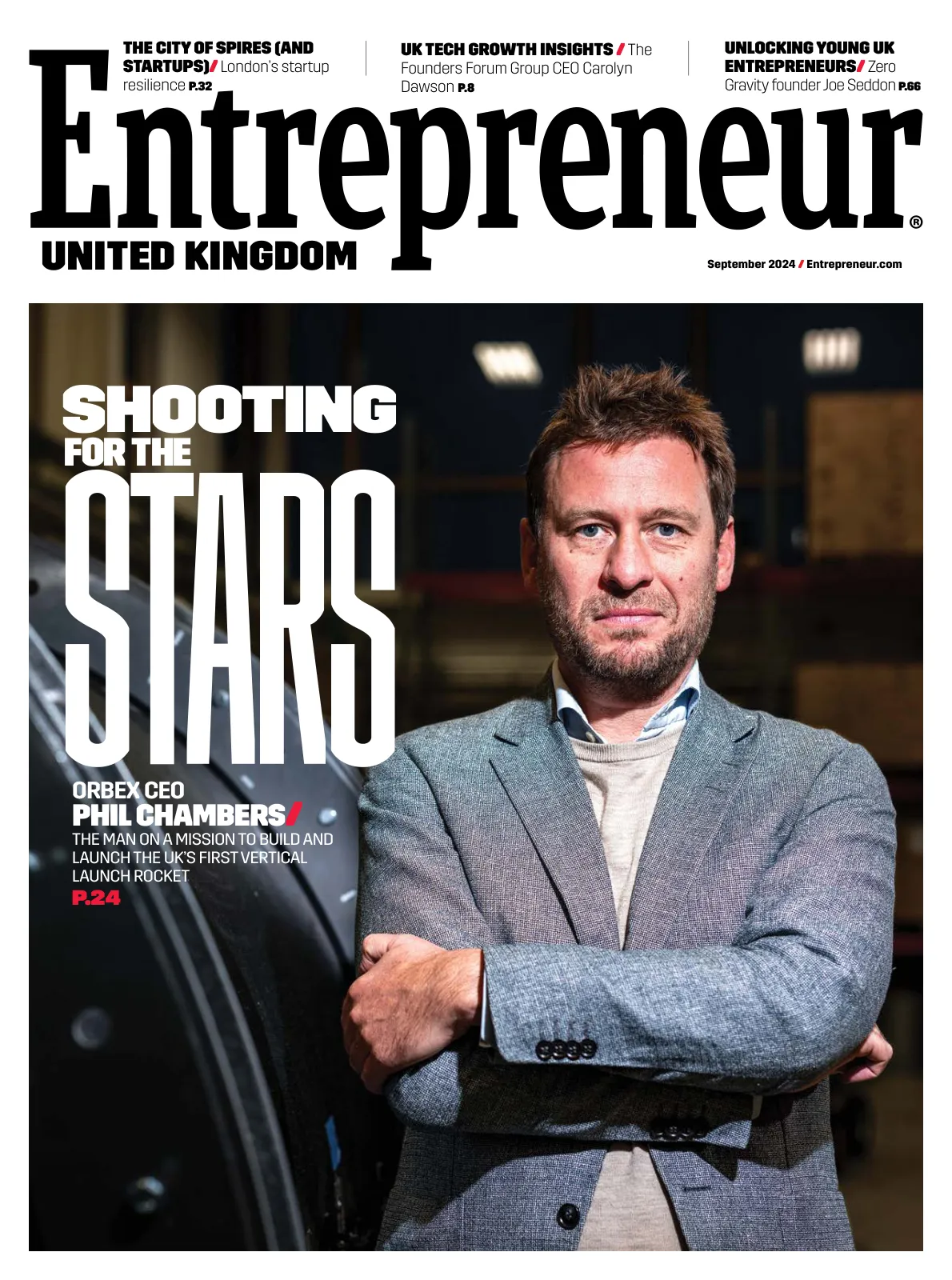
Entrepreneur UK, September 2024
Page 1
UNLOCKING YOUNG UK
ENTREPRENEURS/ Zero
Gravity founder Joe Seddon P.66
THE CITY OF SPIRES (AND
STARTUPS)/ London’s startup
resilience P.32
UK TECH GROWTH INSIGHTS / The
Founders Forum Group CEO Carolyn
Dawson P.8
ORBEX CEO
PHIL CHAMBERS/
THE MAN ON A MISSION TO BUILD AND
LAUNCH THE UK’S FIRST VERTICAL
LAUNCH ROCKET
P.24
September 2024 / Entrepreneur.com
STARS
SHOOTING
FOR THE
UNITED KINGDOM
Page 2
BOLD
FOR THE
BOLD
UNITED KINGDOM
Page 3
Contents/September 2024
P.24
Shooting
for the
Stars
ORBEX CEO PHIL CHAMBERS is on
a mission to build and launch
the UK’s first vertically-launched
orbital rocket
P.32
The City of
Spires (and
Startups)
A look at how London is holding
its own among global startup
hubs.
P.40
Let’s All be
“Day One”
People
And not “one day” dreamers,
says Whalar Group co-founder
and co-CEO NEIL WALLER.
FEATURES
→ Phil Chambers is the
CEO of Orbex, a private,
low-cost orbital launch
services company.
3
September 2024 / ENTREPRENEUR.COM /
Page 4
DOWNLOAD
YOUR DIGITAL
EDITION
HERE
UNITED KINGDOM
Out now in the UK
Page 5
Contents
September 2024
8 Growth on the Agenda
After the successful staging of
London Tech Week 2024, Founders
Forum Group CEO CAROLYN DAWSON
shares her notes on the UK tech
scene.
43 Deal or No Deal
An entrepreneur’s playbook for
bargaining success.
48 From Pitch to Payday
Five key insights to help you
secure funds for your business.
50 Fostering Equity
Hatch Enterprise Managing
Director REBEKAH CAPON lists
five notes that can help
underrepresented entrepreneurs
carve their own paths to success.
IN THE LOOP
53 The Ties That Bind
The co-founder of Lottie, WILL
DONNELLY, is here to debunk the
myth that family and business
don’t mix.
58 Franchising in the UK:
Tips, Trends, and Triumphs
Explore top expert advice, tips,
and success stories to fuel your
entrepreneurial journey.
66 Powering the Next
Generation
Zero Gravity founder and CEO JOE
SEDDON explains how the potential
of Britain’s young entrepreneurs
can be unlocked.
13 A Woman’s Woman
How TRINNY WOODALL disrupted
beauty norms (and won).
18 From Blogging to Big
Bucks
Insights (and inspiration) from
SaaStock founder and CEO ALEX
THEUMA.
‘TREPONOMICS
STARTUP
SPOTLIGHT
BUSINESS
UNUSUAL
FEATURES EDITOR Patricia Cullen
patricia.cullen@bncb2b.com
CEO Wissam Younane
wissam@bncpublishing.net
MANAGING DIRECTOR Rabih Najm
rabih@bncpublishing.net
ART DIRECTOR Simona El Khoury
EDITORIAL TEAM
Aby Sam Thomas, Tamara Pupic,
Aalia Mehreen Ahmed
MEDIA SALES MANAGER
Olha Kovalova olha.kovalova@bncb2b.com
REGIONAL DIRECTOR
Andy B. andy@bncb2b.com
CONTRIBUTING WRITERS
Rebekah Capon, Joe Seddon, Neil Waller,
Matt Ford, Will Donnelly
SUBSCRIBE
Contact subscriptions@bncb2b.com to receive
Entrepreneur United Kingdom every issue.
COMMERCIAL ENQUIRIES
sales@bncb2b.com
WWW.ENTREPRENEUR.COM/EN-GB
Access fresh content daily on our website
All Rights Reserved 2024. Opinions expressed are solely those of the contributors.
Entrepreneur United Kingdom is officially licensed exclusively to BNC B2B In
United Kingdom by Entrepreneur Media Inc. No part of this magazine may be
reproduced or transmitted in any form or by any means without written permission
of the publisher. Images used in Entrepreneur United Kingdom are credited when
necessary. Attributed use of copyrighted images with permission. All images not
credited otherwise Shutterstock.
20 Wenlock Road, London, N1 7GU
↑ TRINNY WOODALL is the founder and CEO of Trinny London.
U N I T E D K I N G D O M
entrepreneurMediaUK
entrepreneurUK
entrepreneurmedia-uk
entrepreneurmedia.uk
5
September 2024 / ENTREPRENEUR.COM /
Page 6
6 / ENTREPRENEUR.COM / September 2024
Editor’s Note/
Editor’s Note/
PIONEERING INNOVATION;
CELEBRATING VISIONARIES
Say hello to Entrepreneur United Kingdom
W
elcome to the inaugural edition of
Entrepreneur United Kingdom!
We’re delighted to present this first issue,
crafted with passion, purpose, and an
unyielding commitment to showcasing the
best of British entrepreneurship. As we
embark on this journey, we’re here to celebrate
the visionaries, disruptors, and dreamers who are
redefining what it means to be an entrepreneur in today’s
fast-evolving world.
At the heart of this issue is a story that’s truly out of this
world. We are thrilled to feature Phil Chambers, CEO of
Orbex, a cutting-edge space agency that’s taking giant
leaps towards the stars. Orbex’s upcoming space launch is
not just a technological marvel, but a powerful testament
to what can be achieved with determination, innovation,
and a touch of audacity. Chambers’ leadership at Orbex
exemplifies the spirit of entrepreneurship that we’re here
to champion: the courage to break new ground, and the
vision to see beyond the horizon.
As we navigate through these pages, we also turn our
focus to London, the UK capital that has become a
thriving hub for startups and innovation. In this vibrant
metropolis, where historic charm meets modern
dynamism, entrepreneurs are finding fertile ground to
turn their ideas into reality. Carolyn Dawson, CEO of
Founders Forum Group, is one of the key voices helping
to shape this landscape. Her insights into what makes
London such a fertile ecosystem for startups are
invaluable, and her work in connecting entrepreneurs
with the resources they need is nothing short of
transformative.
But it doesn’t end there. This magazine is packed with
stories, strategies, and insights that will inspire, inform,
and empower you, no matter where you are on your
entrepreneurial path. From exploring the latest trends in
tech with Trinny Woodall, to top tips to attract investors,
we’ve curated content that speaks to the diverse
challenges and opportunities facing today’s
entrepreneurs. This edition also features entrepreneurs
like Alex Theuma of SaaStock, who provides key advice
for scaling in the competitive SaaS sector; Will Donnelly,
co-founder of Lottie, a company that has rapidly become
a leading UK care home marketplace, and many, many
more.
As we launch Entrepreneur UK, we invite you to join us
on this exciting journey. Together, we’ll explore the
uncharted territories of innovation, celebrate the
victories, and learn from the setbacks. The
entrepreneurial spirit in the UK is alive and thriving, and
we’re here to capture it all.
Thank you for being part of our very first issue. The
future of entrepreneurship is bright, and it’s an honour to
have you with us as we chart the course ahead.
Patricia Cullen
Features Editor, Entrepreneur United Kingdom
Page 7
14 - 18 OCTOBER
DUBAI WORLD TRADE CENTRE
MON
11 AM - 5 PM
TUE - FRI
10 AM - 5 PM
Where the visionaries and policy makers meet.
Exhibitors
6,700+
Speakers
1,800+
Visitors
187k
THE LARGEST TECH & STARTUP
EVENT IN THE WORLD
Global Collaboration
to Forge a Future
AI ECONOMY
# G I T E X G L O B A L
g i t e x . c o m
ORGANISED BY
Scan the QR code to
SECURE YOUR PASS
Page 8
8 / ENTREPRENEUR.COM / September 2024
LTW is produced by the
Founders Forum Group in
partnership with Informa
Tech and London &
Partners. Since its incep-
tion in 2005, the Founders
Forum Group has estab-
lished a premier network
for European entrepre-
neurs, and its 2023
acquisition of Tech Nation,
a platform for tech growth,
offering insights, connec-
tions, and support to help
founders and teams
succeed from startup to
scaleup, further strength-
ens its mission to support
tech entrepreneurs, scale
startups, and offer a unified
platform for UK tech
founders. And LTW? It
brings all this innovation
and energy into one
spectacular showcase.
In an interview with
Entrepreneur United
Kingdom, Carolyn Dawson,
CEO of the Founders
Forum Group, shared her
insights on a variety of
topics, ranging from her
optimistic outlook on
artificial intelligence (AI),
to the critical “secret sauce”
that defines successful
founders. Here are more
excerpts from our conversa-
tion with her on the
side-lines of the event:
}In your opinion, what were
the three most valuable
takeaways from this year’s
London Tech Week?
From the onset, we were
thrilled because we moved
In The Loop/
Growth on the Agenda
After the successful staging of London Tech Week 2024, Founders Forum Group CEO
Carolyn Dawson shares her notes on the UK tech scene by PATRICIA CULLEN
H
osted from June 10th-12th, 2024, London Tech Week (LTW) is the UK’s
premier tech event, which continues to grow in scale and impact.
Featuring 45,000 delegates from 165 countries and 5,500 innovative
startups, this annual event underscores the impressive expansion of the
UK tech sector.
To accommodate the growing interest in the scene, LTW 2024 was held
at Kensington Olympia, nearly twice the size of last year’s Queen
Elizabeth II Centre. This larger venue hosted keynotes from Dr. Nicola Hodson, CEO
of IBM UK & IRELAND, and insights on “leading in the era of artificial intelligence”
from Clare Barclay, CEO of Microsoft UK, and Mark Chaban, Microsoft’s CTO of
Customer Success, along with numerous other experts and several exciting fringe
events. It’s no wonder LTW 2024 drew in the crowds.
↑ Carolyn Dawson is the CEO of the Founders Forum Group.
Page 9
9
September 2024 / ENTREPRENEUR.COM /
to a venue that was nearly double in
size, and we had a phenomenal result
of approximately 20,000 people
attending LTW –45,000, if you count
the many fringe events throughout
the week. If LTW is a platform for
the sector, it really did mirror the
energy and enthusiasm for tech right
now, and the positive sentiment that
the UK is in a brilliant position on
the global stage.
We also had a phenomenal number
of startups, over 6,000, coming to
the event, and meeting and interact-
ing with corporates and larger tech
players. That was also really fantastic
to see come to life, signifying LTW as
an event that truly brings the whole
ecosystem together, from later stage
enterprises to startups and investors.
This year, there was less government
presence with the elections, but
policymakers and key advisors that
have an interest in ensuring the UK
has got the best tech sector possible
were present.
However, the biggest takeaways
were AI-related. While we expected
that to be the week’s biggest theme, if
we think about the AI Safety Summit
in November last year and the UK’s
approach around that time, it was
perhaps one of trepidation, regula-
tion, and uncertainty. At this year’s
LTW seven months later, it was much
more about showing tangible
applications, really showing how
enterprises can enhance their
productivity and their efficiency
using AI.
Major companies like NatWest
demonstrated how they’re using AI
day-to-day to build more efficiency
and creativity into their customer
service. With technology ramping up
at a very fast pace, there is a real
sentiment of the time is now.
Companies that do not adopt AI and
what it has to offer run a very real
risk of being left behind–and quickly.
}The UK government says it hopes to
become a tech superpower by 2030.
Is the UK on course to achieve this,
and what can help build momentum?
The UK has the third largest tech
sector after the US and China, and it
ranks as the number one destination
in Europe for AI investments,
highlighting the country is already a
tech superpower on the global stage.
Obviously, we can never be compla-
cent, especially as the pace changes
so fast. There are other countries in
Europe doing well, so the UK can’t
take its foot off the gas.
In July, the UK held a general
election that resulted in Keir
Starmer’s Labour Party coming into
power. The message to any govern-
ment is clear: we must continue to
strongly support and nurture the tech
sector. It has huge potential for
economic growth, and it needs to be
front and centre. To build momen-
tum, Starmer must prioritise both
promotion and celebration of the tech
sector, ensuring its continued growth.
There are plenty of startups in the
UK, the focus should be on harness-
ing more scaleups. Answering key
questions is crucial to achieving this
goal. How can we achieve the best
financial conditions to attract fast
growth tech companies? How can the
UK attract outside investment? How
can we ensure that the UK is front
and centre in our education system,
but also bring in enough internation-
al talent to maintain our position?
This is especially important when
you’re looking at deeper tech areas
like climate, deep tech, quantum, or
AI. The success of these areas is
really down to having skilled talent,
guaranteeing we get the best next
generation of entrepreneurs and
companies.
}What do you believe are the key
differences between the UK, the US,
and Asia in terms of fostering
unicorn startups?
For UK companies to grow at scale,
they have to think about their
international growth longer term, but
I don’t know if comparisons are neces-
sarily helpful. While it’s down to the
investment size and scope, we are
seeing significant US investors like
Sequoia Capital and Institutional }}
RATHER THAN
FOCUSING ON
COMPARISONS, THE
KEY IS TO ENHANCE
COLLABORATION
BETWEEN
ECOSYSTEMS.”
“
← From left: Mark
Bergen (Bloomberg),
Philip Belmant (Zilch),
Nadine Hachach-
Haram (Proximie), Sir
Colin Humphreys
(Paragraf)
Page 10
10 / ENTREPRENEUR.COM / September 2024
Venture Partners, choosing the UK as
their headquarters for Europe, and
making sizable investments here.
The Pension Reforms highlight the
need for educating stakeholders on
risk appetite to attract more institu-
tional-scale investments. Over the
past decade, both the UK and Asia
have developed robust ecosystems.
The exponential growth seen in
UK-based businesses is especially
noteworthy, and recent years have
seen a rise in deep tech firms.
Additionally, verticals like retail are
gaining traction thanks to AI and
demonstrating exceptional perfor-
mance, further enhancing their
attractiveness. This diverse growth
landscape underscores the UK’s
accelerating pace in various special-
ised areas.
Rather than focusing on compari-
sons, the key is to enhance collabora-
tion between ecosystems. The UK
and Asia benefit from a robust trade
agreement and network, facilitating
growth and scalability for companies.
Specialising in areas such as fintech,
climate, food, and health, these
sectors offer substantial growth
opportunities.
Ensuring sufficient large-scale
investment is also crucial, especially
as the UK leads in critical areas like
climate innovation.
}Is unicorn status the ultimate
benchmark for a startup's success?
Over the past year, the UK has
witnessed the emergence of four new
unicorns, including Quantexa and
Wayve. These companies are
relatively young, highlighting the
significant potential for more
AI-driven unicorns to originate in the
UK. Wayve secured over US$1 billion
to develop AI for self-driving vehicles
in May, marking the largest European
venture capital (VC) investment in AI
to date.
While achieving unicorn status is
noteworthy, equally important is
building companies with robust,
renewable revenue streams and
scalable business models. This dual
approach signifies substantial success
in the tech ecosystem.
}Which UK businesses are spear-
heading innovations in 2024?
In the Tech Nation Report 2024 that
we released in June, we announced
there are 1,800 VC-backed AI
startups, and over 20 AI unicorns in
the UK.
Tech Nation’s Future 50 pro-
gramme, established several years
ago, has propelled numerous
outstanding companies to success,
with a third of UK unicorns complet-
ing the programme. Notable exam-
ples include Zilch, Deliveroo, Zoopla,
Revolut, and Starling Bank, all
thriving within the UK and globally,
particularly showcasing the nation’s
strong fintech sector.
Also, Patchwork Health is revolu-
tionising healthcare, particularly in
staffing, offering significant benefits
to the National Health Service (NHS)
and demonstrating scalability on a
global level. Another standout
company is PolyAI, leveraging AI to
develop conversational assistants for
enterprises. This innovation enhances
customer interactions, significantly
boosting efficiency in problem-solv-
ing processes.
}Can you offer one bit of advice for
aspiring tech entrepreneurs looking
to make an impact in the industry?
My advice for founders is to first
identify their unique strengths—their
“secret sauce.”
Then, surround yourself with an
executive team that complements
your strengths, while acknowledging
and filling any skill gaps. Embrace AI
technologies to maximise efficiency
and leverage available tools for scaling
your startup rapidly, rather than solely
relying on expanding your workforce.
It’s also crucial to define a clear
long-term plan aligned with your
vision. Whether aiming for an initial
public offering or preparing for a
strategic sale, ensure that this vision
aligns with the expectations of board
members and investors from the
outset. This alignment fosters a
cohesive strategy, top talent retention,
and enhances the likelihood of
achieving long-term success.
IF LONDON TECH WEEK IS A PLATFORM FOR THE SECTOR, IT
REALLY DID MIRROR THE ENERGY AND ENTHUSIASM FOR
TECH RIGHT NOW, AND THE POSITIVE SENTIMENT THAT THE
UK IS IN A BRILLIANT POSITION ON THE GLOBAL STAGE.”
→ From left: Timothy
Armoo (Fanbytes),
Roham Gharegozlou
(Dapper Labs), Lilly
Sabri (LEAN), Jordan
Schwarzenberger
(Arcade Media)
Page 11
11
September 2024 / ENTREPRENEUR.COM /
}What can Entrepreneur
United Kingdom expect from
the Founders Forum Group in
the near future?
We will be at Olympia again
next year for LTW, building
on this year’s growth.
We anticipate even greater
growth with increased
participation from enterpris-
es, even more international
delegations, startups,
scaleups, and investors as we
approach our 20th year of
Founders Forum Global
punctuating the week. This
milestone will be a mega
celebration of our impact on
the entrepreneurial ecosys-
tem and our success in
connecting founders with
enterprises.
We are expanding our
presence not only in Asia and
Europe, but also in the
Middle East, reflecting the
Founders Forum Group’s
global perspective, strategi-
cally planning significant
milestones and events to
commemorate this journey of
growth and collaboration.
We have also begun
exploring new verticals such
as critical technologies,
defence, and longevity, which
are key areas of focus for us.
We are collaborating with the
government to advise
founders and shape policies
in these crucial areas,
particularly in AI, to ensure
responsible growth while
enhancing the UK’s competi-
tive edge.
Through our work at Tech
Nation, we are committed to
producing research and
insights that continually
support entrepreneurs. Our
focus remains on facilitating
connections and helping
entrepreneurs access the
right investors, clients, and
support networks.
We are especially excited
about programs like Future
50, Upscale, and Libra,
which support underrepre-
sented founders. We’re also
enthusiastic about Climate
and Creo, a groundbreaking
growth program launching
later this year, focused on
disabled founders and
innovations for people with
disabilities. These initiatives
underscore the Founders
Forum Group’s dedication to
fostering innovation and
inclusivity in the tech
ecosystem and beyond.
COMPANIES
THAT DO NOT
ADOPT AI AND
WHAT IT HAS
TO OFFER RUN A
VERY REAL RISK
OF BEING LEFT
BEHIND–AND
QUICKLY.”
“
→ From left: Julia Hartz
(Eventbrite), Lisa Mae Brunson
(Wonder Women Tech), Aaron
Rajan (Unilever)
→ From left: Daphne
Koller (Insitro), Lord
Nick Markham
(Cignpost Diagnostics
& ExpressTest),
Thomas Clozel
(Owkin), Lara
Lewington (BBC Click)
Page 12
Invests
In
Entrepreneurs
What Are
You Building?
Learn more at entrepreneur.vc
Page 13
13
September 2024 / ENTREPRENEUR.COM /
A Woman’s Woman
How Trinny Woodall disrupted beauty norms (and won) by PATRICIA CULLEN
← Dubomedy
co-founder Mina
Liccione is a
performance
artist, tap dancer
and comedian.
IMAGES COURTESY TRINNY WOODALL
← TRINNY WOODALL is
the founder and CEO of
Trinny London.
Page 14
14 / ENTREPRENEUR.COM / September 2024
B/The Big Idea
I
t is the toughest thing to let go of your dream, but
the thing about being an entrepreneur is, you never
just have one dream,” says Trinny Woodall.
This statement by Woodall points to her ability to
always pivot and focus on what truly excites her as
an entrepreneur—which, in turn, has been the
driving force behind her success with her UK-born
beauty brand, Trinny London.
Her journey from digital innovator to beauty
powerhouse demonstrates how resilience and a
strategic approach can turn rejections into
remarkable success.
THE ORIGIN STORY
“I’ve always been intrigued by
business,” Woodall says. “I launched
my first venture at just 16 while still
in school.”
Fast forward to 1999, and Woodall
co-founded Ready2Shop.com with
Susannah Constantine, a direct-to-
consumer brand that almost
certainly set new standards for the
industry. However, despite early
promise, the nascent digital market
presented challenges, but the
experience offered invaluable
lessons.
Reflecting on the early 2000s
dot-com boom and bust, Woodall
notes that rapid—often hasty—
decisions led to expensive
mistakes.
“We were ahead of our time, and
without a viable monetisation
model, it was challenging to
sustain. I learned that timing and
financial planning are crucial.”
Early “big”’ hires also meant that
Ready2Shop.com quickly burned
through its funding, forcing
Woodall to close the business.
Years later, when building
Trinny London, Woodall waited to
hire in experts with deep industry
experience until three years in.
This time around, she also chose
to bootstrap the business so as to
ensure it was in a strong place
before raising venture capital.
Looking back on her experiences,
Woodall advises aspiring
entrepreneurs to be ready for the
unexpected. “Startups are a
numbers game. I approached 250
investors to secure 50 meetings,
and ultimately one investment.
Persistence and learning from
each rejection are key.”
Reflecting on her journey, she
acknowledges that failures have
been as instructive as the
successes. The early closure of
Ready2Shop.com, despite its
potential, highlighted the
importance of timing and
adapting to market conditions.
Woodall also cautions entrepre-
neurs against pursuing a path
solely due to obligations, commit-
ments, or partnerships if their
instinct says otherwise. “Some-
times we go down a path because
we feel that we’re expected to...
and sometimes it’s very challeng-
ing to listen to our intuition, and
choose another route,” she says.
She recalls developing two
business ideas in tandem, one of
which was more developed than
Trinny London. After discussing
both with a friend, his remark—
”the light came on in your eyes
when you talked about Trinny
London”—highlighted her genuine
passion for the idea, and convinced
her to pursue it instead.
→ With multifunctional products,
personalised solutions, and a
focus on simplifying your
routine, TRINNY LONDON is
revolutionising beauty through
custom formulations, artificial
intelligence-driven
recommendations, authentic
representation, and savvy
marketing.
Page 15
15
September 2024 / ENTREPRENEUR.COM / 15
THE BIRTH OF A BEAUTY
REVOLUTION
Trinny Woodall’s early
experiences set the stage for
her innovative career.
During her time on What Not
To Wear, the BAFTA-nominat-
ed BBC television show,
Woodall noticed that women
struggled to find beauty
products that suited them and
their needs, often getting
caught up in fleeting trends.
This insight sparked her
passion for creating person-
alised beauty solutions.
Welcome Trinny London.
With multifunctional products,
personalised solutions, and a
focus on simplifying your
routine, the brand revolution-
ises beauty through custom
formulations, artificial
intelligence (AI)-driven recom-
mendations, authentic
representation, and savvy
marketing.
“Through my work on TV, I
saw women of all ages
struggling with beauty norms.
I realised there was a gap—
women needed products
tailored to their individuality,
not just seasonal trends.”
Woodall’s expertise in
creating a personalisation-
focused online business,
combined with her deep
emotional insight into women’s
needs, has been crucial in
advancing her tech venture.
With money raised through
the UK’s Seed Enterprise
Investment Scheme and her
own funds, she embarked on
creating a beauty brand
addressing the personalisation
gap.
“I knew I wanted to sell
online—I got the bug in the
late nineties. I loved the idea,
you have a global audience,
and you can ship around the
world immediately,” she says.
The emotional intelligence
Woodall gained from working
with thousands of women
around the world helped her
build a brand based on trust
and genuine connection. Her
vibrant social media presence,
engaging millions, is also a
major factor in her brand’s
success.
She underscores the value of
trust by avoiding retouching in
Trinny London photos and
featuring over a hundred
non-professional models, aged
17 to 83, to showcase the
products across different }}
I REALISED THERE WAS A GAP—WOMEN
NEEDED PRODUCTS TAILORED TO THEIR
INDIVIDUALITY, NOT JUST SEASONAL
TRENDS.”
← Dubomedy is behind
several community projects
like Clowns Who Care,
through which they host arts
camps, shows and workshops
at refugee camps and
centers for children with
determination.
↓ TRINNY LONDON’S intense
peptide moisturiser, Bounce Back.
Page 16
16 / ENTREPRENEUR.COM / September 2024
B/The Big Idea
skin tones, hair colours,
and ages.
“The most important
thing is to be candid and
honest. You get trust
through an emotional
connection, not through
how the product works.”
Woodall finds it difficult
when entrepreneurs use
arbitrary figures in five-year
plans. Instead, she opts for
more realistic assumptions.
Right at the beginning of
Trinny London, she
projected that 3% of her
followers will make a
purchase—a figure she felt
she could believe in, and
that made her projections
more credible.
Later, her first venture
capital investor showed her
a graph of Trinny London’s
five-year plan and re-
marked, “You’re the only
person we’ve invested in
where the numbers turned
out to be exactly as
projected.” By setting
realistic sales targets and
rigorously testing her
business plan, Woodall
achieved sustainable
growth and market
validation, goals that many
startups aim for.
When launching Trinny
London, Woodall had a
fundamental understand-
ing of makeup, but needed
to dive deep into the
technical side—which
included prototypes,
formulations, and packag-
ing.
“It was a steep learning
curve, but it was essential. I
think everything I’ve done,
I’ve learnt on the fly, but
I’ve really been determined
to learn.”
Woodall emphasises the
need to be involved in every
aspect of a business in its
early stages. As the
company grows and tasks
are delegated, it’s crucial to
understand your team’s
processes in finance,
operations, customer
service, technology,
marketing, and perfor-
mance—even if you don’t
know every detail.
“If you’re going to
challenge your team on
things and work with them
to grow, you need to be able
to have a certain amount of
knowledge,” she says.
EMBRACING A DIGITAL-
FIRST STRATEGY
As a digital-first beauty
brand, technology is key to
Trinny London’s success.
The use of AI and
personalised experiences
has fueled growth and kept
the brand at the cutting
edge of beauty industry
innovation.
“It’s about using more AI
in the business, as the work
we do with skin analysis,
we can do with augmented
reality (AR) and AI,” she
says.
Trinny London leverages
technology to enhance
customer connections and
streamline shopping. The
Match2Me algorithm
assesses each customer’s
skin, hair, and eye combi-
nation to recommend
tailored products and
shades. This helps
customers select items
suited to their specific age,
skin type, and concerns,
avoiding a one-size-fits-all
routine.
“Today, over 75% of
customers use this
tech-enabled personalisa-
tion service when buying a
product from Trinny
London, and this is set to
increase as the technology
rolls into Trinny London’s
stores,” she says.
In just seven years, Trinny
London has evolved from a
small team sitting around a
table to a major success.
Starting with six employ-
ees, Woodall focused on
creating products that
resonated with her
audience. “I wanted our
brand to be a reflection of
real beauty, not just trends,
aiming to create products
that empower women to
embrace their individual-
ity.”
She advises founders to
analyse customer data and
tailor products to their
needs, reflecting her
unconventional marketing
approach of using social
media for genuine
conversation rather than
just advertising.
“Instead of traditional
ads, we engage our
STARTUPS ARE A NUMBERS GAME. I APPROACHED 250
INVESTORS TO SECURE 50 MEETINGS, AND ULTIMATELY ONE
INVESTMENT. PERSISTENCE AND LEARNING FROM EACH
REJECTION ARE KEY.”
→ Founded in 2017, Trinny
London is now one of
Europe’s fastest-growing
beauty brands.
Page 17
audience with relatable content
that feels like a conversation
rather than a pitch,” she says.
By making ads indistinguish-
able from editorial content,
they enhance viewer interac-
tion, and the results are
impressive. The brand
achieved remarkable growth,
driven by word-of-mouth and
product effectiveness.
“One of our hero products,
the Plump-Up Serum, became
a bestseller because it delivered
results. Customers started
recommending it, and it took
off.”
Connections are important
when building a business.
Believing in the six degrees of
separation theory, Woodall
believes that regardless of your
background, there’s always
someone in your network who
knows someone who can assist.
With time being crucial,
Woodall recommends sending
a brief, informative email that’s
easy to forward, making it
simple for others to act on your
behalf and make introductions.
“A WOMAN’S WOMAN”
As 2025 nears, gender bias
persists in fundraising, with
only 2% of UK investments in
female-founded businesses.
Despite more women
entering venture capital, the
field remains 70% male,
leading to biassed decisions
that disadvantage female
entrepreneurs. Woodall
advocates for strong networks
and practical advice for female
entrepreneurs, advising
founders to follow up on
declines with an email seeking
clarification on the refusal.
“Sometimes it’s a reason that
isn’t so much to do with the
strength of your business, but
with their remit for how they
invest,” she says. According to
Woodall, understanding the
reason behind a refusal is
crucial for entrepreneurs to
move forward effectively.
Describing herself as “a
woman’s woman,” Woodall
continues to support female
founders, emphasising the
importance of a strong
network.
“I am as supportive as I can
be to other female founders
because it is important to have
that sort of old girl’s network
with other women,” she says.
Looking ahead, with 160
employees at the head office
and 70 in retail, Trinny
London is scaling up and
staying ahead with fresh ideas.
“We’re doubling our retail
presence in key markets,
exploring AI and AR for
personalisation, and planning
a major push into the US
market. Our goal is to be a
global leader in personalised
beauty,” Woodall says.
The next game plan?
Expanding across the US,
ramping up the team, and
unveiling a flagship store in
London—all of which proves
that this entrepreneur is just
getting started.
IT IS THE TOUGHEST
THING TO LET GO
OF YOUR DREAM,
BUT THE THING
ABOUT BEING AN
ENTREPRENEUR IS,
YOU NEVER JUST
HAVE ONE DREAM.”
“
→ TRINNY
WOODALL’S vibrant
social media
presence,
engaging millions,
is also a major
factor in her
brand’s success.
17
September 2024 / ENTREPRENEUR.COM /
Page 18
18 / ENTREPRENEUR.COM / September 2024
B/Strategies
A
lex Theuma is the founder of SaaStock, the
world’s leading community and media platform
for the global B2B SaaS ecosystem. While
SAASTOCK started out as a blog, it’s now a
multi-million-dollar company, hitting US$4.8
million in revenue last year. In an interview with
Entrepreneur United Kingdom, Theuma offers a peek
into his entrepreneurial journey, sharing actionable
strategies for other founders to take inspiration from.
Here are excerpts from the conversation.
From Blogging to Big Bucks
Insights (and inspiration) from SaaStock founder and CEO Alex Theuma by PATRICIA CULLEN
→ ALEX THEUMA is
the founder of
SaaStock, the
world’s leading
community and
media platform for
the global B2B
SaaS ecosystem
Page 19
19
September 2024 / ENTREPRENEUR.COM /
What was your motivation
behind starting SaaStock,
and how has building a
strong community contrib-
uted to its success and
growth?
Entrepreneurs often share a
common trait: a lifelong
entrepreneurial spirit. From
a young age, I was building
lemonade stands, creating
perfume, selling various
items, and doing newspaper
rounds. By 16, I had a job at
McDonald’s—I was always
looking for ways to earn
money.
In my early 20s, I had
business ideas, but felt
limited by a lack of capital.
If I had known you could
bring ideas to life without
money, I would have started
SaaStock much sooner.
Entering my 30s, with 11
years in sales and three in
cloud computing, I became
increasingly intrigued by
SaaS and thought, if I don’t
start a business now, when
will I, which spurred me into
action. Around 2014, I
noticed a gap in the SaaS
blogosphere. Existing blogs
were either from vendors
like HubSpot, trying to sell
products, or from venture
capitalists looking to elevate
their profiles. A neutral,
community-driven blog
didn’t exist.
I decided to create
SaaScribe, a blog for SaaS
founders. Despite not
being a writer or having
run a SaaS business, I
reached out to experts for
original content. Within
three months, the blog had
around 30,000 monthly }}
AS SOMEONE WHO RUNS A SAAS EVENTS COMMUNITY BUSINESS, I UNDERSTAND
THE CRITICAL ROLE OF BUILDING A STRONG AND CAPABLE TEAM TO ACHIEVE SUCCESS.”
↓ SaaStock helps SaaS founders
and their teams scale faster
through the most actionable
SaaS conference and
membership on the planet.
IMAGE COURTESY SAASTOCK
← While SaaStock
started out as a blog,
it’s now a multi-million-
dollar company, hitting
US$4.8 million in
revenue last year
Page 20
20 / ENTREPRENEUR.COM / September 2024
During the COVID-19 pandemic, there was an influx of money
from venture capitalists, leading to numerous investments, the
creation of thousands of unicorns, and inflated valuations.
Companies hired massively, planning for the next 24 months.
But in 2023, due to macroeconomic issues, there was a
substantial pullback from investors. The market saw a drastic
reduction in available funds, especially at the growth stage.
Investors advised their portfolio companies to focus on
profitability, leading to numerous redundancies and down
rounds, where companies had to raise funds at lower valuations
than before. Certainly the period from 2023 to now has been
the toughest time in SaaS in the nine years I’ve been running
SaaStock.
However, there is more investment expected in 2024, with
significant hype around artificial intelligence (AI) and substan-
tial funding rounds for AI companies. The expectation is that
Q4 of 2024 will improve, and by 2025, we will be back on track.
The SaaS market is still growing, albeit at a slower rate over the
last two years. Despite this slowdown, the growth rate is
expected to pick up. Currently, the SaaS market is worth
around$350 billion, with projections that by 2030, it could
reach $900 billion to $1 trillion.
What trends do you anticipate shaping the industry in the
coming years?
AI is here to stay, and it’s evident that every SaaS company will
need to integrate AI, and become, in some sense, an AI
company. This integration ties in nicely because AI, while it can
be a standalone sector, is fundamentally about enhancing
software. Therefore, it’s likely that nearly all SaaS products will
incorporate AI. New companies are building AI capabilities
from the ground up, while legacy companies are integrating AI
into their existing products. This trend will shape the industry
over the next few years and possibly even longer.
Last year was marked by a significant focus on AI as well as
the challenges tech companies faced due to budget cuts, leading
to slowed growth. Despite these challenges, AI’s integration into
SaaS is becoming a necessity. Both new and legacy SaaS
companies are embedding AI into their products, and this will
play a crucial role in shaping the future of the industry.
What are common scaling mistakes SaaS founders make, and
how can they avoid them?
First-time founders will inevitably make mistakes; there will be
bumps along the road. The biggest mistakes typically revolve
around hiring the right people—arguably the number one
challenge. People are the driving force behind every business,
and getting hiring right is crucial. Whether it’s hiring a Vice
President of Sales too early, or just choosing the wrong one,
people issues will almost always arise as you scale.
You can mitigate these mistakes to some extent, and there are
numerous excellent books on the hiring process, but it’s
essential to have a thorough process in place. You need to find
the right person for your business’s current stage and where you
aim to go. Ideally, hire someone who has “been there, done that.”
If they haven’t experienced your specific growth stage, or have
B/Strategies
AI IS HERE TO STAY, AND IT’S
EVIDENT THAT EVERY SAAS
COMPANY WILL NEED TO
INTEGRATE AI, AND BECOME,
IN SOME SENSE, AN AI
COMPANY.
↓37SIGNALS founder and CEO Jason Fried, beside Alex Theuma,
at a SaaStock event in the US.
visitors. This success led me to start the SaaS Revolution
Show podcast, a Slack channel for founders, SaaS-focused
meetups, and a newsletter.
The community’s demand for a conference led to the
launch of SaaStock in 2016, attracting 700 entrepreneurs
from 34 countries. Building an engaged community was key
to our success, and it still is today. Through meetups, Slack
channels, and our annual conference, we have fostered a
thriving community that continues to support SaaStock’s
growth.
How do you view the rapid growth of the SaaS market, and
its attractiveness to entrepreneurs and investors?
The SaaS industry has grown rapidly for most of the time
I’ve been running SaaStock. However, there was a significant
market correction last year.
Page 21
21
September 2024 / ENTREPRENEUR.COM /
only worked for established
companies, they might not
be the right fit, despite an
impressive resume and
big-name logos.
When scaling, consider
using executive search
companies. Although
headhunters are expensive,
they often provide signifi-
cant value. Also, don’t go it
alone. Being part of a
support network is invalu-
able. At SaaStock, we offer
the SaaStock Founder
Membership, offering
Traction, Growth, or Scale
packages, depending on the
stage of their business.
These memberships provide
the right support network
and education, bringing
peers together to discuss
challenges, opportunities,
plans, problems, and
progress. This network
helps keep each other
accountable, and makes the
journey less lonely.
From your experience,
what are the critical
factors investors look for
when evaluating early-
stage startups?
When you’re in the pre-seed
and seed stages, you won’t
have the metrics that
investors at later stages want
to see, like revenue and net
retention. Without these key
performance indicators
(KPIs), investors are
essentially making an
educated bet on the team.
They look at whether the
team is the best group of
individuals to execute the
vision and build the
platform or solution. If
you’re building something in
a space where you have
experience—say, after
working for 10 years in the
sector, or studying relevant
topics in university—this
will certainly be advanta-
geous. However, investors
back the team first and
foremost.
For example, my fund,
BackFuture Ventures,
invests at the pre-seed and
seed stages, and our primary
focus is the team, particu-
larly the founder and CEO.
Are they impressive, smart,
and well-suited to execute
their vision? We also look for
grit and resilience—traits
often demonstrated through
overcoming hardships.
In addition to team
strength, the vision must be
compelling. The SaaS
market is saturated,
especially in areas like
marketing and sales tech. A
new startup needs to offer
something innovative,
something that does things
differently, and can poten-
tially become a market
leader. If a startup is merely
replicating what already
exists, it won’t generate
excitement.
For me, the hierarchy of
importance is team, vision,
product, and then market
size. As someone who runs a
SaaS events community
business, I understand the
critical role of building a
strong and capable team to
achieve success.
What are the most valuable
lessons you’ve learned
about building and leading
a successful conference in
the tech industry?
Community is crucial, and
it’s the core of what we’re
about. Without an engaged
audience and super fans, the
conference wouldn’t be
successful. Our community
will help us prevail, and they
will lead us to become the
best SaaS conference on the
planet. Understanding
this—and staying focused
on it—is essential. }}
I’M VERY OPTIMISTIC ABOUT THE FUTURE OF SAASTOCK, AND WE
HAVE A 10-YEAR VISION TO SCALE THE COMPANY 10X.”
Page 22
22 / ENTREPRENEUR.COM / September 2024
People and hiring are equally important. Over the last nine
years, different stages of the business required different
types of hires. Getting the right people for each stage has
been crucial. In the early days, we had more generalists in
the business, but we always looked for people with startup
DNA, who were missionaries, not mercenaries. Initially, we
had a very young team, mostly smart graduates with little
experience, but immense drive and hunger. These individu-
als were missionaries, eager to learn, put in the hours, and
make a difference.
As we grew and scaled, we needed to balance our team
composition. While I prefer missionaries, having some
mercenaries became necessary. We now look ahead to the
next three years, hiring people who have specialised
experience, and can help us reach our goals. For the first
time, we have a much more senior team with a lot of
experience, which is crucial for where we want to go.
Looking ahead, our focus is on hiring individuals with
experience in specific roles to guide us to our future goals.
For the first time, we have a senior team with extensive
experience, which is essential for our next phase of growth.
These key lessons—focusing on community, adapting our
hiring practices, and understanding the changing needs of
the business—are what have driven our success so far and
will continue to do so in the future.
What advice do you have for founders looking to foster
similar communities in their respective industries?
There’s nothing better than just getting out there and doing
it. Don’t overthink things, and don’t just sit on ideas
without taking action. Start somewhere—take action, do
the groundwork, the grassroots stuff, and build your
community. While some people may plan a large confer-
ence right away, it’s much harder to do without an engaged
community.
Begin small, and start building your community in any way
you can. This could be hosting quarterly dinners for
founders, creating a WhatsApp group, a Slack channel, or
organising regular meetups. Building an audience takes
time and effort, and you have to love what you’re doing. If
you lack excitement, passion, and interest, it will become a
chore. Remember, it’s a long-term commitment.
YOU NEED TO FIND THE RIGHT PERSON FOR YOUR BUSINESS’S
CURRENT STAGE AND WHERE YOU AIM TO GO. IDEALLY, HIRE
SOMEONE WHO HAS ‘BEEN THERE, DONE THAT.”
B/Strategies
← A SaaStock event
in Dublin, Ireland.
IMAGE COURTESY ROD SLOANE
Page 23
23
September 2024 / ENTREPRENEUR.COM /
Do you have any advice on how to
transition from being a hands-on
entrepreneur, to a CEO who delegates
responsibilities?
Running a SaaS business for nine years
has been a transformative journey for
me. In the first half, I was a hands-on
micromanager. I constantly checked
the website, monitored the social
media, and sent numerous Slack
messages to my team. I traveled
extensively, and I was always involved
in group discussions. While this level of
involvement might be necessary in the
first year or two, it’s crucial to evolve
beyond it.
It took me about four years to realise
this. During that time, the business
likely lost some talented people who
didn’t feel as empowered as they should
have. Empowerment is essential—you
need to hire people for roles, because
they are better at those roles than you
are.
As the CEO, you are a generalist. My
personal growth in this area correlated
with starting executive coaching. With an
executive coach, I learned to be a better
manager, and how to delegate effec-
tively. I built a structure within the
business, establishing a hierarchy of
reporting. Now, as the CEO, I focus on
strategy, envisioning the future, and
providing advice regularly. We have a
Managing Director who handles
day-to-day operations, and we’ve hired
capable managers and teams in sales,
finance, and other functions. These
individuals create the plans to deliver
on our vision, which we then sign off
on, trusting in their expertise.
It doesn’t always go perfectly, and
sometimes more involvement is
necessary. Scaling requires time,
reflection, and the willingness to
delegate and reinvent your role
continuously. You can’t scale if you’re
trying to own everything. It’s not easy,
but reflection on past management
behaviors, engaging with an executive
coach, and extensive reading in the
field have been invaluable for me.
What’s next for you and SaaStock?
I’m very optimistic about the future of
SaaStock, and we have a 10-year vision
to scale the company 10x. Currently, we
host SaaStock in Europe, and our goal
is to continue innovating to ensure it
remains the number one SaaS event
there. The next event is coming up next
month in October.
Last year, we launched SaaStock in
the US, and we aim to scale it up,
potentially making it even bigger than
our European event, given the vast
market there. Looking ahead, we
envision expanding to other interna-
tional markets, including South
America and Asia.
In addition to our events, we’re
building the SaaS Founder Member-
ship, which aims to be the world’s
leading support organisation for B2B
SaaS founders. Although we’re early in
this journey, our goal is to help
thousands of SaaS founders scale
faster through this membership.
Furthermore, I’ve launched the fund
BackFuture Ventures, which adds
another layer of support for SaaS
companies. This initiative allows us to
invest in early-stage companies that
excite us, providing them with the
capital needed to grow. This ability to
offer not only networking and learning
opportunities through SaaStock, but
also financial support through
BackFuture Ventures is incredibly
exciting for me.
This robust 10-year plan for SaaStock
includes scaling our events, expanding
internationally, supporting SaaS
founders through our membership
program, and investing in promising
early-stage companies. It’s very
exciting!
YOU CAN’T SCALE IF
YOU’RE TRYING TO
OWN EVERYTHING.
IT’S NOT EASY, BUT
REFLECTION ON
PAST MANAGEMENT
BEHAVIORS,
ENGAGING WITH AN
EXECUTIVE COACH,
AND EXTENSIVE
READING IN THE
FIELD HAVE BEEN
INVALUABLE FOR ME.
Page 24
24 / ENTREPRENEUR.COM / September 2024STARS
SHOOTING
FOR THE
ORBEX CEO PHIL CHAMBERS
The man on a mission to build and launch the
UK’s first vertical launch rocket
by PATRICIA CULLEN
24 / ENTREPRENEUR.COM / September 2024
Page 25
25
September 2024 / ENTREPRENEUR.COM / 25
September 2024 / ENTREPRENEUR.COM /
→ CEO Phil Chambers
Page 26
26 / ENTREPRENEUR.COM / September 2024
Page 27
27
September 2024 / ENTREPRENEUR.COM /
T
here’s a
new
space
race in
Europe.”
That’s
what Phil Chambers
believes in his role as
CEO of Orbex, a
UK-based private,
low-cost orbital launch
services company.
Chambers, a software
industry veteran with a
distinguished 20-year
career, first made an
impact at Gumtree, a
leading UK website, then
played a key role at Qype,
Europe’s top local review
site, which was acquired by
Yelp. Most recently, he
co-founded Peakon, an
employee success platform
that achieved industry
leadership before being
acquired by Workday for
$700 million. Now, as the
CEO at Orbex, Chambers is
venturing into a completely
different realm: aerospace.
This new chapter not only
marks a shift from software
to space, but it also presents
a unique opportunity to put
the UK on the map in the
aerospace industry.
“The thing that really excites
me is the opportunity to
build the UK’s first ever
vertical launch space rocket,
and have a British majority-
owned rocket launching
from British soil to deliver
British satellites,” Chambers
says. “We don’t have a
sovereign launch capability
in the UK at the moment.”
In the 1980s, the UK
government chose not to
join the Ariane program, a
European space initiative led
by the European Space
Agency as well as the French
national space agency,
Centre National D’Études
Spatiales, to develop a
cost-effective satellite launch
system. This decision
redirected aerospace jobs
predominantly to France
and Germany, significantly
shaping the industry’s
landscape in Europe.
Now, Chambers aims to
change that trajectory. “Not
only does the UK have a seat
at the table, but we have the
chance of becoming the
European champion,” he
says.
AMBITION UNLEASHED
Today, Orbex is focused on
the successful launch of its
Prime rocket next summer,
and it also intends to enter
the European Launcher
Challenge, a competition by
the European Space Agency.
This competition offers
substantial funding for
developing a larger rocket.
To secure this opportunity,
Orbex engages with the UK
Space Agency and the
Department for Science,
Innovation and Technology
frequently, emphasising the
critical role of government
support in their plans.
“If we want the UK to be a
leader in launching satel-
lites, then we also need the
UK government to support
it,” Chambers declares.
Across Europe, countries
like France, Germany, and
Spain have invested
significantly in small }}
NOT ONLY DOES THE UK HAVE A SEAT AT THE TABLE, BUT WE HAVE
THE CHANCE OF BECOMING THE EUROPEAN CHAMPION.”
→ Orbex is a UK-based
private, low-cost orbital
launch services
company.
“
Page 28
28 / ENTREPRENEUR.COM / September 2024
launch vehicle programs—France
with EUR400 million, Germany
with over EUR100 million, and
Spain with EUR45 million. In
comparison, the UK government’s
investment has been relatively low.
However, Chambers remains
optimistic saying that the ruling
Labour party is developing a new
industrial policy document that may
address this disparity.
“I hope to see space as part of
industrial policy,” he says. “If you
look at Labour’s priorities around
levelling up, around green growth,
creating new jobs and new economic
opportunities for the UK, we tick a
lot of boxes there.”
Orbex is leading the way with
green credentials in Northern
Scotland, and this is translating into
significant job creation. Currently,
the company employs over 200
people, with more than 150 of these
positions based in Northern
Scotland. As it continues to grow, it
will create even more job opportuni-
ties.
“If we succeed in scaling up the
manufacturing of Prime and larger
vehicles, we anticipate creating
nearly a thousand high-tech
manufacturing jobs in the UK.”
NEXT-GEN TECH
Orbex is developing the nearly
zero-carbon rocket to address the
environmental impact of space
launches. Traditional kerosene
rockets emit harmful black carbon
soot and carbon dioxide, which are
growing concerns as launches
increase.
Orbex’s innovative approach uses
biopropane, a byproduct of biodiesel,
reducing carbon dioxide emissions
by 96%, and eliminating black
carbon altogether. It has also
advanced with a fully carbon fibre
rocket, and constructed the world’s
first cryogenic coaxial tank in
Scotland. Additionally, Orbex is
pioneering 3D-printed engines and
managing all aspects of production
and software development across the
UK and Denmark.
Looking at the ecosystem at large,
Chambers highlights that the recent
rocket engine explosion in Shetland
involving Rocket Factory Augs-
burg—a competitor of Orbex—un-
derscores the inherent risks in
aerospace development. Neverthe-
less, the entrepreneur remains
hopeful about the industry’s future,
emphasizing the necessity for
ongoing innovation and improve-
ment.
“It’s not uncommon for rocket
programs to experience technical
setbacks,” Chambers says. “Elon
Musk, for instance, needed four
attempts to launch Rocket One. All
companies launching in the UK,
including Orbex, must undergo
rigorous testing to prevent such
incidents from recurring.”
Maintaining momentum is
essential for sustained growth and
success, Chambers points out. If you
↑ Left to right are Orbex's chief executive
Phillip Chambers and chair Miguel Bello
Mora
Page 29
29
September 2024 / ENTREPRENEUR.COM /
cease pushing forward and enhancing your efforts,
you risk falling behind. “Even SpaceX, despite achiev-
ing a remarkable level of reliability, recently faced an
issue with a Falcon 9,” he adds. “Although they’ve had
over 100 successful launches, they encountered
another problem.”
Orbex is on the brink of an exciting new chapter,
with its Prime rocket set to make its debut in 2025
from the Sutherland Spaceport in Northern Scotland.
As the company continues to advance technical
development, construct the spaceport, and navigate
the licensing process, Chambers remains cautious
about pinning down an exact date for its first launch
of its small launch vehicle. However, all signs point to
a promising launch on the horizon next year.
Orbex is also set to make significant strides with its
launch vehicle capabilities, and the company is
working on developing a larger vehicle designed to
handle a wider array of missions. “This new vehicle
will not only cater to low Earth orbit, but it will also
be capable of reaching geostationary orbits, the
Moon, Mars, and even interplanetary destinations,
marking a substantial advancement in technological
offerings,” he says.
In addition to the upcoming rocket launch, Orbex is
also expanding its horizons by developing a diverse
array of products to support these missions. This
strategic diversification is set to unlock fresh
opportunities across the space industry, positioning
If we succeed in scaling up the
manufacturing of Prime and
larger vehicles, we anticipate
creating nearly a thousand
high-tech manufacturing jobs
in the UK.”
“
}
→ The Orbex Prime
rocket has been
designed to be one of
the most
environmentally friendly
space launch vehicles
}}
Page 30
30 / ENTREPRENEUR.COM / September 2024
Orbex as a formidable force in
the rapidly evolving space
landscape.
THE TIME IS NOW
If Chambers had one piece of
advice for aspiring entrepre-
neurs, it would be to get started
as soon as possible.
Having never met an entrepre-
neur who regretted jumping in
too early, especially when timing
is so crucial, Chambers believes
one should start ahead of their
competition rather than wait.
Plus, Chambers says, talent is
everything. With over 20 years
of experience scaling businesses
and navigating the complexities
of growth, Chambers has
uncovered valuable lessons
about the dynamic interplay
between core values, evolving
operations, and the critical role
of talent in achieving lasting
success.
While a company’s values and
mission may remain constant,
its operations and people evolve,
and subsequently, he believes
that getting the right people in
place is crucial to success.
“It’s about finding ways that
the original founding team can
succeed, but also bringing in
new talent,” he explains. “That’s
how you shortcut your way to
success—that blend of the
↑ Orbex aims to finish Spaceport Sutherland by early 2025 for a Prime rocket launch later that year.
If you look at Labour’s
priorities around
levelling up, around
green growth,
creating new jobs
and new economic
opportunities for the
UK, we tick a lot of
boxes there.”
}“
Page 31
31
September 2024 / ENTREPRENEUR.COM /
original creativity, enthusi-
asm, and dedication of the
founding team, plus the
experience in the hands of
management.”
The entrepreneur thinks
that it’s a bit of a myth to
credit groundbreaking
inventions to just one genius,
like how we often think of
Thomas Edison and the
lightbulb. In reality, he says,
similar ideas often pop up in
different places at the same
time—what really makes the
difference is the team you
have behind you.
Besides lacking talent,
running out of money can
also spell disaster for your
company. Chambers points
out that one sure way to
deplete your funds is by
hiring too many people too
soon, before you’ve really
nailed down the right
product for the market. It’s
tempting to think your
product is a perfect fit for
small companies, but as you
scale up to larger organisa-
tions, it might not meet their
needs. By then, you might
have already poured a lot of
money into sales, which is a
common trap many entre-
preneurs fall into.
Another common pitfall
Chambers encountered in
his career was neglecting the
core values of the company.
He stresses the importance
of clearly defining what it
means to work at the
organisation—not just with
abstract terms, but by
specifying the actual
behaviours expected from
everyone.
“At Peakon, we had a value
called ‘serious, not seriously,’”
he says. “We wanted to be a
serious company, we were
building a serious product,
but we were determined to
also have fun at work. And
that worked incredibly well.”
At the end of the day, if
you’re thinking about
starting your own venture,
Chambers’ advice is simple:
don’t wait for the perfect mo-
ment. Dive in now, and make
things happen—as Chambers
put it: “Start yesterday would
be my advice.”
“START YESTERDAY WOULD BE MY ADVICE.”
Page 32
32 / ENTREPRENEUR.COM / September 2024SPIRES
CITY
OF
THE
(AND STARTUPS)
A look at how London is
holding its own among
global startup hubs
by PATRICIA CULLEN
32 / ENTREPRENEUR.COM / September 2024
Page 33
33
September 2024 / ENTREPRENEUR.COM /
↑ Anything World
co-founder and CEO
Gordon Midwood.
E
ver wondered what makes London
a magnet for startups?
Hint: it’s more than just tea and
Big Ben!
The UK capital has emerged as
the country’s most valuable tech
hub, with a US$621.5 billion
valuation in 2023, up from $70
billion in 2014, according to Startup
Genome’s Global Startup
Ecosystem Ranking 2024. London
also holds its own among global
tech giants, standing shoulder to shoulder
with New York, and trailing only behind Silicon
Valley.
The Tech Nation Report 2024 also highlights
London’s dominance, with it especially noting
that of the 1,800 venture capital (VC)-backed
artificial intelligence (AI) startups and scaleups
in the UK, 66% are based in the capital. Coupled
with 103 unicorns and an 800% jump in VC
investment over the past decade, what is it
about the big smoke?
Entrepreneur UK chats to a few dynamic
businesses that chose London, exploring their
motivations for setting up shop in the city.
B
ased in
Brick Lane,
Anything
World is
transform-
ing
interactive 3D experiences,
enabling developers to create
them 40% faster than
competitors.
With their user base nearly
doubling to 25,000 in 2023,
while also clinching a 2024
Webby Award for Technical
Achievement, how much of
Anything World’s success
can be attributed to
London’s prime location?
For co-founder and CEO
Gordon Midwood, the
capital was the perfect
launchpad.
“London is one of the best
places to run a startup in
Europe,” he says. “Crucially
for us as a deep tech startup,
access to highly skilled 3D
and machine learning talent
is excellent.”
Plus, “it’s an excellent and
vibrant place to live and
work too, which helps,”
Midwood adds.
However, Midwood
pinpoints price as a
potentially debilitating
factor, acknowledging the
significant costs associ-
ated with hiring a
workforce and maintain-
ing a studio in London.
“Those are genuine
challenges for a startup,
especially in the early days,”
he says.
He suggests that London
needs to step up its game to
stay competitive with other
places offering similar
benefits for less—a key point
of interest for entrepreneurs
weighing their options.
“Clearly, infrastructure
needs to be world-class, but
even more key is talent and
access to world-class
education,” he says. “London
needs to invest even more
heavily in cutting-edge
education facilities with a
particular focus on AI.”
After all, in today’s
knowledge economy, having
top-tier expertise in AI is
crucial for staying ahead and
maintaining a competitive
edge. }}
THE PERFECT
LAUNCHPAD
London is one of the
best places to run a
startup in Europe.”
“
}
Page 34
London is far less onerous
than the US from a regulatory
and reporting perspective.”
I
t might have seemed
like like an obvious
choice to have Boku,
a US-based company,
listed on the Nasdaq
stock exchange in
New York.
However, Stuart Neal,
CEO of the innovative,
mobile-focused payment
method (and recipient of the
PayTech Company of the
Year Award at the Fintech
Awards London 2023),
admitted that Nasdaq
wasn’t conducive to smaller
tech firms.
Explaining his rationale
for choosing London, he
says it’s great to be on the
Nasdaq when you are “big
tech,” but not necessarily
when you’re “small tech.”
“In contrast, we thought
the London market, with
fewer growth companies,
provided us with ample
opportunity to attract more
attention,” Neal adds.
He also credits London’s
lighter regulatory frame-
work in helping Boku
establish and grow without
heavy administrative
burdens.
“London is far less onerous
than the US from a
regulatory and reporting
perspective,” he points out.
“We only have to report
semi-annually instead of
quarterly, and we aren’t
subjected to stringent
regulations such as the
Sarbanes-Oxley Act,” he
says.
And while he acknowl-
edges that London is not the
largest market in terms of
funds, Neal admits that the
capital offers numerous
pathways to reach inves-
tors—namely through
analyst coverage.
“If your numbers are
strong, analyst coverage is
readily available, which has
been beneficial for us in
attracting investor interest
and funding opportunities,”
he reveals.
He credits London with
better visibility and a larger
share of voice due to having
fewer tech competitors,
unlike Nasdaq, which has
more competition.
For startups considering
where to establish them-
selves, Neal’s advice is to
have a clear and detailed
plan about how you can
generate revenue and grow.
“It’s crucial to understand
the mix of investors in the
market and their investment
theses—whether they are
seeking long- term growth,
or short-term profits,” he
adds.
}
← Boku CEO Stuart Neal.
“
CENTRE OF ATTENTION
34 / ENTREPRENEUR.COM / September 2024
Page 35
35
September 2024 / ENTREPRENEUR.COM /
H
oxton Farms, a
London-based biotech
startup, grows real
animal fat–but
without the animals.
Co-founded in 2020
by Max Jamilly and Ed Steele, Hoxton
Farms are a team of 45 based in
London, who believe that food should
be made in the city, not the country-
side.
“We grow cultivated fat in a convert-
ed office block, just minutes away from
where it will be eaten and enjoyed,”
Jamilly says.
A highly interdisciplinary team is
required to power Hoxton Farms,
which include chefs, food scientists,
synthetic biologists, cell culture
scientists, machine learning engineers,
software developers and operations
specialists.
“There are very few cities that have
the diversity of talent to enable us to
fill all these positions,” Jamilly says.
“We’re lucky London is one of them.”
According to Jamilly, early-stage
startups thrive on talent, and London’s
vibrant atmosphere attracts top
scientists and experts, offering a
diverse talent pool in biotech, cellular
agriculture, and bio-manufacturing.
“Another key factor is easy access to
investors and regulators,” Jamilly adds.
“London is a hub for venture capital
firms. Whitehall, home to politicians,
policy-makers and regulators, is a
short journey from our office. We’re
defining a new category in food; so, we
need to be close to the action.”
He credits being based in London as
a key enabler for Hoxton Farms’ rapid
growth over the past four years,
building strong commercial relation-
ships with key industry players who
are headquartered here.
“The availability of capital in London
is also unmatched. By being based
here, we’ve been able to more easily
fundraise, raising financing early on
from top UK funds such as Systemiq
Capital, Backed VC, and more,” he says.
However, no location is perfect.
London-based companies like Hoxton
Farms often have to seek growth-stage
VC funding in the US or Asia due to a
lack of such financing opportunities in
London. Plus, according to Jamilly,
regulatory processes could be im-
proved, having gone through them
himself when Hoxton Farms’ cultivated
fat was designated a novel ingredient
by the UK’s Food Standards Agency
(FSA).
“After Brexit, we inherited a system
that is not designed with innovation in
mind,” Jamillly notes. That said, he
believes “we now have an opportunity
to adapt it, to enable the UK to become
a world leader in food tech, and the
FSA has shown great willingness to
collaborate.”
However, Jamillly admits that
despite such challenges, the benefits of
being in London far outweigh them,
making it the ideal location for
Hoxton Farms. }}
→ Hoxton Farms
co-founders Ed Steele
and Max Jamilly.
CLOSE TO (ALL)
THE ACTION
↑ Based in London,
Hoxton Farms crafts
cruelty-free,
sustainable fats to
combine with plant
protein for delicious
meat alternatives.
Page 36
36 / ENTREPRENEUR.COM / September 2024
A
s an American from
Silicon Valley, Nina
Mohanty, CEO at
Bloom Money, found
building a tech startup
in London offered the
best of all worlds.
“London has the financial sector and
energy of New York City, the proximity to
regulators and government of Washing-
ton D.C., the art and creativity of Los
Angeles, and incredible ideas and
problem solvers to rival Silicon Valley—
all with better public transport,” she says.
According to Mohanty, building
a fintech company in London
was a no-brainer, with London’s
tech ecosystem growth making
hiring a dream come true for any
founder.
“Importantly, London is a hub
for more established industry
players, be it financial institu-
tions or multi-national conglom-
erates which makes it an exciting
place to pursue partnerships for
startups.”
Mohanty acknowledges that
London and Europe more broad-
ly are often lambasted as being
more risk-averse than the US,
and therefore comparatively, the
UK’s tech ecosystem is quite
nascent.
“This can make fundraising
difficult for founders tackling
large, hairy problems,” she says.
“Access to capital is improving,
but the willingness to bet big will
take more exits and longevity to
secure London as the true jewel
in the European crown of tech.”
London has the financial sector
and energy of New York City,
the proximity to regulators and
government of Washington D.C., the
art and creativity of Los Angeles,
and incredible ideas and problem
solvers to rival Silicon Valley—all
with better public transport.”
“
}
↑ Bloom Money CEO Nina Mohanty.
THE BEST OF ALL WORLDS
Page 37
37
September 2024 / ENTREPRENEUR.COM /
NOT EVERY STARTUP’S
DREAM DESTINATION
L
ondon was a no-go for Meetfreed, the app incentivizing
plant-based eating.
Patrick Huang, founder of Meetfreed, cited costs,
marketing budgets, and a crowded market as reasons for
bypassing the capital.
“Starting outside of London let us scale thoughtfully,
and make sure our mission to inspire more plant-based living
reaches diverse communities across the UK,” he reveals.
Manchester’s vibrant and less saturated food scene, coupled with
its substantial student population, proved an ideal location for the
ambitious startup. Collaborating closely with local eateries, Huang
believes they can effectively promote plant-based options.
“It’s tough to stand out in such a saturated market, and
we thought it might slow down our initial growth,” he
says
With over 400,000 university students within an
hour’s drive, Manchester offers a sizable user base,
which was better aligned with Meetfreed’s target
demographic. }}
↓ Meetfreed founder Patrick Huang.
Page 38
38 / ENTREPRENEUR.COM / September 2024
The availability
of capital
in London is
unmatched.”
}“
OPPORTUNITY KNOCKS
L
ondon still has a lot
going for it though.
With over 20
years of experience
in equity capital
markets (ECM),
Simon Olsen, a Partner at
Deloitte’s ECM division,
emphasizes that a London
listing for a UK startup offers
significant opportunities to
raise growth capital during an
initial public offering (IPO)
and subsequent funding
rounds.
“A startup would also benefit
from a liquidity platform for
existing shareholders, a
potential enhancement in its
brand and reputation, and a
liquid currency for mergers and
acquisitions (M&A) as well as
employee remuneration,” he
adds.
However, Olsen notes that
businesses must ensure these
benefits outweigh the incremen-
tal costs and time involved in
the IPO process, and maintain-
ing the listing.
“London’s Alternative
Investment Market (AIM) offers
these benefits in a market
intended for growth companies,
with lower costs and less
regulation than London’s main
market,” he reveals.
Commenting on the current
state of play, Olsen says IPO
markets are re-opening, driven
by improving macroeconomic
conditions.
“These include less uncertain
geopolitics, pent-up demand,
the need for private equity to
exit, and the impact of higher
interest rates making alternative
funding options less attractive,”
he points out.
Given the advantages of a
London listing, the resurgence
of IPO markets, and the
increasing difficulty in securing
private investment, now may be
an opportune moment for
early-stage, high-growth
businesses to contemplate a
London listing.
L
ondon navigates the
complex balance
between innovation,
affordability, regulatory
agility and growth
opportunities, main-
taining its leadership, despite the
IPO choices of giants like Arm,
CRH and Flutter.
With UK tech professionals and
founders feeling optimistic (64%
and 84%, respectively, are confident
about the future of the sector, as per
the Tech Nation AI Report), London
looks set to solidify its role as a
global tech leader in 2024 and
beyond.
→ Deloitte ECM division
Partner Simon Olsen
Page 39
39
September 2024 / ENTREPRENEUR.COM /
Five Must-Have Tech Gadgets For
Everyday Life
According to AMY KNIGHT
B/Gear
Amy Knight is the co-founder of Must Have Ideas, and as a busy working mother, here’s her list of the top five tech
gadgets she makes use of, and why she wouldn’t be without them. From her indispensable iPhone, to the AirPods that
help her multitask, here are the tech essentials that help her juggle her business and family life with ease.
1/APPLE IPHONE 14 PRO
MAX “Like everyone else
on the planet, I’d be
completely lost without my
Apple iPhone. Not only
does it keep me in touch, it
enables me to schedule
my diaries, stay
connected, and generally
organise my life from one
easy place! I try not to use
it when I’m spending
quality time with friends
and family, but let’s face it,
who does without a mobile
now! The numerous apps
that are available are
amazing, making it easy to
do workouts on the go,
banking, booking
appointments, and keeping
up to date with the world.
Plus, the Global
Positioning System (GPS)
is great for getting me to
and from important
meetings or any other new
places I need to get to.”
2/ DELL XPS15 LAPTOP
“My laptop means I can
take work home with me or
work on the go, depending
on where I am if I’m not in
the office. As a rule, I have
set times when to work or
when I’m spending time
with my two young
daughters, but laptops are
so easy to use and a
convenient way to get
things done professionally.
It also comes in handy for
the odd film if we’re away
on a break, or, if I need to
jump onto a work
meeting.”
3/APPLE WATCH SERIES
8 “My Apple watch is great
for getting me to where I
need to be on time! Not
only this, I can measure my
steps to ensure I’m getting
the right amount of
exercise, and even the
quality of sleep I’m getting,
which is all so important as
a business owner and
mother. What’s also great
is that by keeping
everything Apple, I can
sync everything including
my contacts and my diary
entries, and anything else I
want to. Taking the odd
call from the watch can
also be quite useful, or, to
pay for things instead of
digging out the card or
phone.”
4/AIR PODS PRO “These
are a brilliant invention,
and they mean that I can
accept calls hands-free,
allowing me to multitask! I
can also use the noise-
cancelling features to
focus on work or relax
without background noise.
It’s also very convenient
being able to switch
between devices, such as
my phone and laptop
when I need to. I listen to
music, podcasts, or
audiobooks while
commuting or during any
spare moments. I also use
Siri to ask quick questions,
set reminders, and control
other smart devices
hands-free.
5/HUBBLE NURSERY PAL
BABY MONITOR “This
device is a brilliant way to
have peace of mind and to
keep track of my little ones
if they are in a different
room to me. It helps me to
do things while they are
having a nap, knowing that if
they wake up, I’ll be on hand,
and ready for when they need
me. More modern baby
monitors come with features like
video feeds, sound detection,
and even smartphone
connectivity, which are fantastic
and they’re so sophisticated,
with some featuring temperature
sensors which is great for any
parents or carers.”
27-year-old
Amy Knight is
a disruptive
entrepreneur,
owner, founder,
and Director of Must Have
Ideas, a leading UK
e-commerce company
generating an annual
turnover of GBP65 million.
Specialising primarily in
problem-solving household
solutions, what started with
packing orders on her dining
room table and storing stock
in the spare room has evolved
into a thriving business with
a 40,000 sq. ft. distribution
centre in Kent. The business
now employs 135 people,
dispatches around 7,000
orders a day, and focuses on
the highest standards of
customer service. Amy is a
mother of two young children,
and she lives with her
husband and (co-founder of
Must Have Ideas) Rob
Knight, in Maidstone. In
2024, Must Have Ideas
achieved a place on The
Sunday Times Hundred list
of Britain’s fastest growing
companies.
1
2
3
4
5
Page 40
40 / ENTREPRENEUR.COM / September 2024
T
he rise of entrepreneurs is reshaping the
economic and cultural landscape, with a
new generation of innovators driving
change and creating opportunities like
never before.
There are 582 million entrepreneurs in
the world (MARKINBLOG, 2020). In the US,
according to the latest statistics, nearly
5.1 million new businesses were
registered in 2022 (US Census Bureau,
2023). This was the second year in a row
that that number exceeded five million.
My own journey in entrepreneurship began in 2006,
when my friend James Street and I took a leap of faith.
We decided to drop out of an entrepreneur-focused
university program, just shy of graduation, to pursue our
first business venture—ironic, right?
Though not everyone supported our decision, that
hands-on experience taught us invaluable lessons. Over
nearly a decade in, we’ve had significant successes and
crushing failures. We’ve discovered that the best way to
grow is often by diving headfirst into the unknown,
learning by doing.
In 2015, James and I won the Shopify Build a Business
award for one of our direct-to-consumer (DTC)
companies. After seeing first-hand the rising success of
creator marketing and the opportunities to elevate
creators, we launched Whalar in 2016. Over the years,
Whalar has evolved into Whalar Group: a global creator
company with a unique, end-to-end creator ecosystem.
This includes six companies: Whalar, Whalar Talent, Moby
Ventures, The Lighthouse, Umi Games, and Foam. }}
by NEIL WALLER
“PROSPECTIVE ENTREPRENEURS
OFTEN WONDER HOW TO EVEN
START. I LOVE TO SHARE PAULO
COELHO’S QUOTE: ‘IT’S EITHER ONE
DAY OR DAY ONE. YOU DECIDE.”
Let’s all be Day One People
(And Not One Day Dreamers)
Page 41
41
September 2024 / ENTREPRENEUR.COM /
P
rospective entrepre-
neurs often wonder
how to even start. I
love to share Paulo
Coelho’s quote: “It’s
either one day or day
one. You decide.” Day
One embodies the spirit of
entrepreneurship. I challenge
myself—and all entrepreneurs—to
embrace this mantra each day.
Earlier this year, I had the
opportunity to tour the SpaceX
facility in Los Angeles, where
employees focused on the “rate of
learning.” They emphasized that
the most valuable asset is a
willingness to stay curious and
keep learning. The best ideas
pivot, evolve, and adapt; that’s
where real growth happens. You
can’t learn if you don’t start.
My best advice? Be a Day One
person, not a One Day person.
Half of the battle is managing
risks, and being willing to learn
and evolve. My favourite part of
this journey is the challenge of
embracing the uncertainty: being
at point A, with a goal at point Z,
when the path isn’t clear. When
we started Whalar, it was just a
small team of five. Today, we’ve
grown into a global company with
over 300 employees. Taking the
first step, at Day One, can lead to
extraordinary growth.
Having a business is immensely
rewarding, but it comes with
intense pressure. Hiring a team
means taking on the responsibil-
ity for their livelihoods and
navigating uncharted territory.
The stakes are high.
I’m fortunate to share it all with
my co-founder and co-CEO,
James. Having a partner means
you’re not navigating challenges
alone; you can “play better ball.”
For example, when one of us isn’t
on our A-game, the other is
always there to take the reins.
Many people saw a “global
creator company” as a risky
business move. But we always
believed that creators were the
future, not a temporary trend.
Creators are the heart of enter-
tainment, media, and culture.
After all, they drive 39% of watch
time in entertainment. They will
shape the future of these indus-
tries.
As Whalar grew, we knew it was
time to define our core philoso-
phies, providing us with a
blueprint to guide our journey.
We focused on our mission,
“liberating the creative voice.”
This guiding principle is key to
our growth.
I tell up-and-comers that every
experience is a learning opportu-
nity. There’s no shortcut to
gaining wisdom; struggles make
you a better entrepreneur. Listen
to advisors and mentors, but,
ultimately, you need your own
perspective to build something
great. It’s also crucial to tackle
problems you understand and are
interested in.
When we started Whalar, our goal
was to better support creators and
the industry. Solving a problem
you’re passionate about makes the
journey not only easier, but also
more enjoyable and fulfilling.
One of my favorite TED Talks is
by Bill Gross of IdeaLab. He
discusses why few startups
succeed, while many falter. Many
people believe that having the
perfect idea is the key to success—
hence Gross’ idea to name his
company IdeaLab. However, he
found that timing is actually the
most crucial factor—followed by
team and execution. The idea
itself ranks third in importance.
While ideas can pivot and
evolve, timing is critical, and
often the hardest element to
gauge as an entrepreneur. If
Whalar had launched five years
earlier, our story might have been
very different. So, embrace the
uncertainty.
Entrepreneurs grapple with
imposter syndrome, so it’s
important to take it day by day.
While you might overestimate
what you can achieve in a year,
you likely underestimate what you
can achieve in five or more years.
Success is about making progress
one day at a time. James and I
thrive on the limitless opportuni-
ties within the industry.
Entrepreneurship is a roller-
coaster, full of challenges and
rewards. You have to power
through.
The line between success and
failure is thin. During uncertain
moments, I’m always inspired by
this quote from Winston
Churchill: “Success consists of
going from failure to failure
without loss of enthusiasm.”
That’s the thrill of entrepreneur-
ship, facing setbacks with
unwavering passion.
Let’s all be Day One people, not
One Day dreamers, and enjoy
every twist and turn. And yes,
starting a business and being an
entrepreneur is tough as hell, but
damn, it’s so worth it.
Neil Waller is an
entrepreneur who’s the
co-founder and Co-CEO
of Whalar Group.
whalar.com
“THERE’S NO
SHORTCUT
TO GAINING
WISDOM;
STRUGGLES
MAKE YOU
A BETTER
ENTREPRENEUR.”
Page 42
200+
expert fintech
speakers
300+
fintech
brands
26k
regional and
international
attendees
200+
investors
REGISTER
for this fintech movement now
24fintech.com
3 – 5
September,
2024
Riyadh Front Exhibition &
Conference Center (RFECC)
Riyadh, Saudi Arabia
#24fintech l @24Fintech
Hosted by:
Co-organised by:
The world’s leading fintech
event that is reimagining
financial services
Page 43
43
September 2024 / ENTREPRENEUR.COM /
Deal or No Deal
An entrepreneur’s playbook for bargaining success by PATRICIA CULLEN
For startup success, mastering negotiation is non-negotiable.
Effective negotiation skills are a founder’s secret weapon.
Building strong relationships, maintaining integrity, and
prioritising open communication emerge as fundamental
principles for navigating high-stakes negotiations.
For entrepreneurs eager to elevate their game in this regard,
here’s Entrepreneur United Kingdom’s winning playbook for
bargaining success. }}
Page 44
44 / ENTREPRENEUR.COM / September 2024
1/MINDSET MATTERS
Unitary, an artificial intelligence
(AI)-powered media analysis company,
has demonstrated significant success in
securing investment, raising GBP12.3
million in a Series A funding round in
October 2023. This achievement is
particularly impressive given that the
company had raised GBP6.7 million just
seven months earlier. This rapid
succession of funding rounds under-
scores the confidence investors have in
Unitary’s vision and capabilities.
SASHA HACO, co-founder and CEO at
Unitary, believes that effective negotia-
tion is a crucial skill in business, and
according to her, mindset is key.
“Negotiating is hard, particularly if you
feel the stakes are high,” Haco points
out. “If you’re ready to walk away, then it
takes the heat out of the situation.” As
such, by maintaining a readiness to walk
away from the negotiating table, Haco
says she and her team can make
decisions that are not driven by
desperation, and instead by a clear
evaluation of what is best for the
company. This attitude not only
alleviates pressure, but also empowers
the negotiating team to hold firm on
terms that are beneficial for long-term
success. “You have to feel ready to walk
away,” she reiterates.
2/RAPPORT RESONATES
Building rapport is your golden ticket
to sealing deals. People are more
inclined to do business with those they
feel connected to and trust. However,
there is a general deterioration in
communication skills that we all need to
contend with. Mike Greene, serial
entrepreneur and star of Channel 4’s
The Secret Millionaire, attributes this
decline to the widespread use of
technology, particularly social media
and mobile devices, alongside the
lingering effects of the COVID-19
pandemic.
According to GREENE, this combination
has led to a societal “hangover” where
interpersonal and social skills have
reached an all-time low, with people
struggling to effectively communicate.
“They say that it takes 7-12 points of
interaction before you can successfully
close a deal, and yet, many expect
marriage at the first date—in business at
least!” Greene says. “If we believe—and I
certainly do— that ‘your network = your
net worth,’ then business owners need to
up their game in networking, connect-
ing, engaging, listening and responding
to the needs of the partner, customer, or
party on the other side of a negotiation.”
‘T/ Skillset
FOR STARTUP SUCCESS, MASTERING NEGOTIATION IS
NON-NEGOTIABLE.”
↓ MIKE GREENE, serial entrepreneur and star
of Channel 4's The Secret Millionaire.
↑ SASHA HACO, co-founder
and CEO at Unitary.
→ ROSS TEMPLE is
one of the UK’s
leading business
success and
transformation
coaches.
Page 45
45
September 2024 / ENTREPRENEUR.COM /
3/CONVICTION
CONQUERS
Negotiation is not about
convincing, but conviction.
One of the UK’s leading
business success and
transformation coaches,
ROSS TEMPLE, reveals that
the skill of a successful
negotiation comes down to
three Ls:
Language Take note of the
words being used. Matching
the language shared to you is
the quickest way to build
rapport, and to confidently
reiterate you understand
what they are saying. If you
don’t repeat similar
terminology, a client is not
going to feel like they are
being heard, and less likely
to convert during a
negotiation.
NEGOTIATING IS HARD, PARTICULARLY IF YOU FEEL THE STAKES
ARE HIGH. IF YOU’RE READY TO WALK AWAY, THEN IT TAKES THE
HEAT OUT OF THE SITUATION.”
Leverage Drive a
conversation forward by
using the momentum built
by the earlier conviction to
your negotiating advantage.
Listen Make sure you are
listening to what the
individual is saying. Are you
taking on board what their
fears are, what problems
they are facing, and what
frustrations they are
experiencing?
CHARLIE DAY, founder of
Sales Is Easy If You Just
Know How and its accom-
panying podcast, helps
entrepreneurs boost sales
and scale their business.
She also stresses that
mastering the art of
listening is essential for
successful negotiations.
“Active listening ensures
you hear what the client
wants/their pain points and
barriers, which you can
then use to negotiate,” she
shares.
4/WIN-WIN
WISDOM
The best deals are made
when both sides feel like
winners. Levi Levenfiche,
co-founder of PerfectTed,
the UK’s first matcha-pow-
ered energy drinks brand
that secured investment
from Dragon’s Den investor
Steven Bartlett last year,
says that you need to know
exactly what matters to your
counterparty. “At Perfect-
Ted, whether we are
negotiating a new super-
market listing, or with
prospective investors, we
place major emphasis on
researching the person that
is on the other side of the
negotiating table,” he says.
LEVENFICHE goes on to say
you can garner a huge
amount of information
about a person online,
beyond LinkedIn. “The
research goes as deep as
knowing what the person’s
favourite workout class is,
or what pets they have,” he
reveals. Levenfiche also
advises entrepreneurs to
listen (not just hear) what
the other person is saying.
“In a negotiation, if you let
the other side talk—they
will eventually give you even
more information and
insight into what matters to
them,” he adds. It’s worth
listening to Levenfiche’s
words—after all, PerfectTed
has earned the distinction
of being Steven Bartlett’s
most successful Dragons’
Den venture, with 5000%
business growth, and
projected GBP12 million
revenue this year. }}
← CHARLIE DAY, founder
of Sales Is Easy
→ LEVI LEVENFICHE,
co-founder of
PerfectTed.
Page 46
46 / ENTREPRENEUR.COM / September 2024
5/TRUTH
TRIUMPHS
Whenever you’re in an important
negotiation, it is essential that you
never lie. That’s the advice given by
Cashing Out author ALEXIS SIKOR-
SKY, a consultant who helps
entrepreneurs scale and exit their
businesses. He has successfully
achieved a US$100 million+ exit
himself and has assisted other
founders in doing the same. Accord-
ing to Sikorsky, successful partner-
ships with investors and clients are
grounded in transparency and trust,
and this needs to be established from
the get-go. “Be honest in your
intentions from the beginning, and
try to understand as precisely as
possible what the other person’s
priorities are,” he says.
Sikorsky points out that truth
stands as the linchpin for forging
strong relationships and sealing
agreements; it’s the honesty and
transparency that ultimately pave the
path to successful outcomes and
lasting partnerships. “When trying to
secure investment in particular, any
dishonesty during negotiation will be
quickly found out during the
following due diligence process, and
this could prevent you from closing
the deal,” he adds.
6/PREPARATION POWER
Thorough preparation is crucial for
successful negotiations as it enables
informed decision-making and
effective strategy planning. RYAN
EDWARDS, founder and CEO of
Audoo, a multi award-winning
technology company, is a skilled
negotiator, propelling the London-
based music tech startup into over
ten countries across Europe, the
Middle East, and Australasia, while
also securing investment from Sir
Elton John and Björn Ulvaeus. “The
first piece of advice I’d give would be
to over-prepare,” Edwards says.
“When I go into any investment
meeting, I think of every possible out-
come, and how I can prepare for each
potential eventuality, with lots of
research.”
As an example, Edwards reveals
that during Audoo’s first big raise, he
was up against a billionaire investor.
However, it helped that he knew his
numbers and had prepared for every
possible outcome of the conversation
“Through this preparation, I was able
to triple the business valuations, and
additionally negotiate a further GBP7
million in investment,” he says.
7/FOCUS ON THE
FOUNDER (I.E. YOURSELF!)
Founders must demonstrate grit, and
they should have the perseverance to
navigate the inevitable ups and
downs of building a startup. This
resilience is critical to overcome the
myriad challenges that arise in the
entrepreneurial journey, from
securing funding and building a
team, to managing market competi-
tion and adapting to changing
industry landscapes. NUAN ZHANG, a
Senior Associate at Breega, one of the
fastest growing venture capital (VC)
firms in Europe, reveals that while a
compelling pitch is important, the
eventual investment hinges on the
founders themselves.
“Great founders can inspire and
lead their teams effectively, com-
manding respect from all stakehold-
ers,” Zhang points out. “Understand-
ing what motivates a founder is
crucial. A strong ‘why’ often trans-
lates into a passionate and committed
founder, which is a key ingredient for
success.” Zhang’s insights underscore
the importance of personal attributes
and leadership skills in the startup
ecosystem. It’s not just about having a
great product or service; it’s about
having the tenacity, vision, and ability
to inspire and lead a team toward
achieving that vision.
‘T/ Skillset
THEY SAY THAT IT TAKES 7-12 POINTS OF INTERACTION BEFORE YOU CAN
SUCCESSFULLY CLOSE A DEAL, AND YET, MANY EXPECT MARRIAGE AT THE FIRST
DATE—IN BUSINESS AT LEAST!”
← NUAN ZHANG, Senior
Associate at Breega.
Page 47
47
September 2024 / ENTREPRENEUR.COM /
“In 2014, I set up a
money management
business called Pariti. In
some ways, you could
consider it a success,
because we got an exit,
selling to Tandem Bank.
However, we arguably
failed, because we never
raised enough money.
At the time, there was
only one other company
that went down the same
path as Pariti, but they
Raised significantly more
than us, and they were
able to stay in the game
much longer before they
found product-market
fit.
A decade ago, the
funding landscape was
markedly different. Ten
years ago, there was a
prevailing ethos of ‘build it
first, monetise later.’
Drawing inspiration from
successes like Facebook,
the mantra was clear:
prioritise building robust
businesses without
immediate revenue
concerns, aiming to
monetise once established.
I was a fresh-faced,
20-something-year-old,
and I had never raised
money before. Raising
only GBP500,000 meant
we were setting ourselves
up for failure from day
one, because we just
didn’t have enough
runway. I made all the
errors that first-time
founders do, because I
couldn’t attract the
senior people who’d done
it 20 times before to
de-risk the process.
This approach meant I
consistently operated
with a small, predomi-
nantly junior team.
While this had its
limitations, it also had its
benefits. Operating with
minimal financial
flexibility wasn’t entirely
negative; in fact, it
fostered creativity
through constraints.
In 2024, startup
entrepreneurs must
embrace failures as
learning opportunities,
and remain focused on
solving real problems for
their customers. The key
lesson is the importance
of securing sufficient
time and resources to
properly develop and test
a business idea, rather
than rushing into a
venture with limited
funding.
Some entrepreneurs
just get lucky—they have
an idea, see a problem,
find a solution, and it
changes the world.
However, for the
majority of entrepre-
neurs, it is not like that
at all. You think you see a
problem, you believe
you’ve got a solution for
it, and then you realise
over the next 12, 24, 36
months, all the reasons
you’re wrong.
You need to keep trying
and adapting and failing,
trying and adapting and
failing, and eventually,
hopefully, you actually
get to the right answer.
Early stage startups
don’t have this buffer.
Fast forward to today,
my current
entrepreneurial venture,
Sidekick, has secured a
total of GBP8.5 million
in funding, providing an
ample runway. My
journey through failure
has thus strengthened
me, and emphasised the
importance of
prioritising the needs of
our customers.”
sidekickmoney.com
S/Insights
Turning Failure
Into Fuel
IMAGE COURTESY SIDEKICK
→ MATT FORD,
co-founder and
CEO at Sidekick
U
nlock the power of failure.
Entrepreneurs often worry about it, but by
embracing setbacks, you learn what doesn’t
work, push the boundaries to innovate, and
cultivate the resilience needed to succeed.
That’s why we at Entrepreneur United
Kingdom are asking entrepreneurs to share
their personal stories of how they’ve turned troubles
into triumphs.
Under the banner of Turning Failure Into Fuel, here’s
Matt Ford, co-founder and CEO at Sidekick, a next-
generation digital wealth manager for the modern
investor, sharing his own story to highlight the valuable
lessons entrepreneurs can learn from their failures.
Lessons on harnessing setbacks for growth
by PATRICIA CULLEN
Page 48
48 / ENTREPRENEUR.COM / September 2024
‘T/Pro
1/ ADOPT A TARGETED APPROACH
When it comes to finding funding, get
specific. Competition is rife, and David B.
Horne, founder of Funding Focus and the
bestselling author of Add Then Multiply,
says that it’s essential that founders take
time to research investors, and single out
ones that are a good fit in terms of sector,
deal size, and stage of the business.
“Recently, I was speaking with the
managing partner of a mid-sized venture
capital (VC) firm in London, and he told me
that last year they received over 8,000
pitch decks from companies,” he shares.
“They made 16 investments- that’s 0.2%
of decks submitted that led to funding!”
As such, Horne urges entrepreneurs to
do their homework, tailor their pitch for
each one, and secure an introduction from
someone they know to significantly
increase one’s chances of joining the
0.2% of founders who succeed.Horne also
says that problems tend to occur when
founders look at pitching to investors as a
single activity rather than a multi-step
process. “With angel, VC, and private
equity (PE) investors, the process will
have many steps, from initial meeting to
term sheet, to signed agreement and
money in the bank,” he advises. “The
founder’s goal at each stage in the
process is to stay in the game and get to
the next stage.”
From Pitch to Payday
W
ith today’s tough market
conditions, investors
demand assurance of a
viable route to profitabil-
ity before committing
funds. A recent report
from the British Private
Equity and Venture Capital Association revealed
that the number of investment private business-
es in the UK attracted, as well as the number of
UK-led investment rounds, have both dropped by
nearly 50% since their peak in 2021, all of which
highlights a need for improvement in the
country’s entrepreneurial ecosystem. In such an
investment landscape, here are a few essential
actions that you, as an entrepreneur, should take
to attract investors and secure funds for your
startup:
Five key insights to help you secure funds for your business by PATRICIA CULLEN
2/ ALWAYS LOOK INTO ALTERNATIVES
Remaining open to a variety of financing
options can propel a brand’s growth.
For his sustainable children’s footwear
brand, Dubs Universe, co-founder Stuart
Davis initially raised funds through the
crowdfunding platform Kickstarter, allowing
the self-funded startup to connect directly
with its customers.
“Understanding our audience was crucial;
we knew the type of parents we wanted to
reach were creative and active on
platforms like Kickstarter,” he shares.
“Leveraging our backgrounds in the
creative and design industries, we tailored
our messaging to resonate with this
audience, ensuring we captured their
attention and support.”
Additionally, the brand engaged the
community through updates, social media,
and interactive content. According to Davis,
communicating a compelling story about
→ DAVID B. HORNE,
founder of Funding
Focus.
Page 49
49
September 2024 / ENTREPRENEUR.COM /
the brand’s mission and the
unique value of the product,
along with showcasing tangible
progress and milestones, built
trust and confidence among
potential backers. “These
strategic actions were
essential in securing our initial
funding and laying a strong
foundation for future growth,”
he says.
Davis encourages other
startups to embrace alternative
funding sources like
crowdfunding, revealing that for
Dubs Universe, a tiny startup
with no access to VC or
contacts in that space, not
pursuing it would have been a
significant misstep. “Despite it
being daunting and outside our
comfort zone, we recognised its
potential, and took the leap,” he
says. “If we hadn’t embraced
crowdfunding, Dubs wouldn’t
exist today.”
3/ KNOW YOUR STUFF
Clarity and confidence in
presenting business plans to
potential investors can be the
decisive factor in securing
crucial funding for startups.
Sneha Morjaria, an angel
investor who’s also the
entrepreneur behind
enterprises like The Growth
Chain and OBM Studios, advises
her fellow founders to know
their stories inside out. “Be able
to explain your business plan,
figures, and forecasts- mutual
trust is so important when an
investor is considering giving
you their cash, and the best
way you can earn that trust is
by being able to answer
questions about your forecasts,
and how you are going to
achieve them clearly and
easily,” she says.
And once you have explained
your story, sell it, Morjaria adds.
“Investors, and angel investors
in particular, who are investing
into an early-stage startup are
looking at whether they can get
behind your mission and vision,”
she explains. “So, spend time
crafting your story ensuring
that you are answering these
questions: Why this concept?
Why you? Why now?”
4/ STAY OPTIMISTIC
In business, maintaining a
positive attitude benefits both
your team and potential
investors.
According to Leo Smigel, a
personal finance expert as well
as the founder of Analyzing
Alpha, investors want to see
that you believe in what you’re
doing, and that you know }}
WITH ANGEL, VENTURE CAPITAL, AND PRIVATE EQUITY INVESTORS, THE PROCESS WILL HAVE
MANY STEPS, FROM INITIAL MEETING TO TERM SHEET, TO SIGNED AGREEMENT AND MONEY IN
THE BANK. THE FOUNDER’S GOAL AT EACH STAGE IN THE PROCESS IS TO STAY IN THE GAME AND
GET TO THE NEXT STAGE.”
→ STUART DAVIS.
co-founder of Dubs
Universe
→ Angel investor,
SNEHA MORJARIA
↓ LEO SMIGEL, founder of
Analyzing Alpha.
Page 50
50 / ENTREPRENEUR.COM / September 2024
where you’re headed. “Remember that
investors aren’t just giving you cash,” he
says. “They want to back a plan and a
group that will work hard and find a way to
succeed, even when it’s tough. Staying
hopeful is key to convincing them to take a
chance on our vision.” Passion and
enthusiasm are contagious traits that
attract support, and staying optimistic
during challenges will pay dividends.
5/ COME RECOMMENDED
The proof is in the pudding. Zain Ali,
founder of Centuro Global, says never
underestimate the power of social proof
when fundraising. “If you have any happy
investors from an earlier stage, put their
quotes on your pitchbooks,” he declares.
“Satisfied customers and clients? Their
testimony should stand at the centre of
your pitch.”
Your peer network is also a valuable
resource. A recommendation from a fellow
founder to their investor significantly
boosts your chances of success. “We’re
social animals who take our cues from
each other, and the voice of real people
who’ve stuck their heads above the
parapet to back you is far more valuable
than any technical walkthrough or deck
design could ever be, no matter how slick,”
Ali says.
At the end of the day, when it comes to
securing funding, it’s all about crafting
personalised pitches, exploring creative
financing options, and tapping into the
power of social connections for that extra
edge.
↑ ZAIN ALI, founder of Centuro Global.
‘T/Pro
Fostering Equity
Five notes to help underrepresented entrepreneurs carve their
own paths to success by REBEKAH CAPON
A
lot of people can feel like
entrepreneurship is not for
them, mostly due to outdated
stereotypes, and the image that a
lot of us carry of the archetypal
business tycoon—often white,
male, and non-disabled.
Indeed, recent research
showed that 74% of people in the UK do
not believe that an entrepreneur is
someone that looks like them, which can
be a big problem for diversity and
accessibility in the sector.
The following tips are thus to help
prepare anyone who does not feel that they
fit the traditional mould of a business
owner to take the leap, and start their
entrepreneurial journey
1/ FIND YOUR COMMUNITY Entrepreneur-
ship doesn’t have to be lonely, and finding
your community should be your first
priority. Whether that’s an online
community on LinkedIn, or in-person
networking sessions, you may be surprised
how many opportunities there are to meet
and learn from likeminded people.
Here’s what Christina Fonthes, the
founder of REWRITE, a community
interest company for women of colour
writers, suggests doing. “Reach out for
assistance and participate in numerous
groups and programmes until you find
your community,” Fonthes advises. “There
are countless programmes out there, and
once you join one, you’ll discover even
more opportunities. Entrepreneurship is
challenging! Seek as much support as
possible, and surround yourself with
individuals who are on a similar journey,
or have already walked that path.”
Also, start signing up to newsletters,
following people you’re inspired by, and
joining events and further-learning
programmes. There can be a perception of
the startup community as being fuelled by
competition, but the reality is one of
collaboration. There are networks
specifically for Black founders, disabled
founders, female and non-binary founders,
Page 51
51
September 2024 / ENTREPRENEUR.COM /
impact-led founders, and more, and once you start putting yourself
out there, you’ll be rewarded with a wealth of expertise, opportuni-
ties, and support.
United by shared experience, and the shared aspiration to see the
world of entrepreneurship diversified and democratised, these
communities will provide you and your business with a legion of
new cheerleaders, and a network of potential mentors, collabora-
tors, and customers.
2/ DEFINE SUCCESS FOR YOURSELF Every business has a different
goal, and you need to be clear on what success would look like for
you from the beginning. Whatever your motivation for starting the
business, this needs to guide your business plan as well as the
metric that you use to keep on track.
Are you looking to create wealth, have a positive impact in your
sector, or build a lifestyle that works for you? All of these things can
be true, but committing to your one guiding star will make it easier
to prioritise decisions moving forward. It will also be important to
keep this in mind when pitching your business, whether that’s for
investment, for a contract, or an award.
Remember that there is no right or wrong goal for your business;
this is something that is personal to you. Think about what
prompted you to start this journey, and don’t feel pressured to
switch course to align yourself with those around you.
3/ FIT YOUR BUSINESS TO YOUR LIFE Something that is important
to unlearn right away is the “hustle culture” narrative that we are
often fed by the media. The entrepreneurial journey is unique to
everyone, and for groups often underrepresented in the sector, it
offers an alternative to the unrealistic expectations of the traditional
workplace. For anyone managing a health condition or with caring
responsibilities for others, running a business gives you the
autonomy and flexibility to fit your work around your life.
But being the one in charge can come with a weight of responsi-
bility to always be working and available to potential customers or
clients. However, it is important to remember that the boundaries
you set early on can become the boundaries people come to expect
from you, and it is up to you to set a healthy working culture for
yourself and your business.
A lack of structure in your own working patterns can lead to
burnout, and it can also set unhealthy expectations to any staff that
you bring into your operation. Being the one managing the business
gives you the power to do things differently, to be more creative, and
to be the boss that you wish you’d had.
4/ YOUR PERSONAL BRAND HAS POWER Your founder story is an
important tool that can help you grow your business. Think about
having an “about me” section on your website, invest in your social
media presence, and put yourself forward for opportunities.
You don’t have to be an extrovert, and it’s okay to feel a bit wary
about putting yourself out there—but the value-add to your
business is huge. People want to know about the person behind the
brand, and connect on a human level to a business; so, the more
authentic you can be, the more people will trust in your brand, and
want to invest in your story.
There are lots of ways you can do this without going too far out of
your comfort zone. Put yourself forward for awards, send a story to
your local paper, volunteer as a speaker on a podcast, comment on
relevant LinkedIn posts, submit a guest blog. Whatever works for
you, adding a human element to your brand will not only help your
business, it can also be a great way to celebrate diverse entrepre-
neurship, and maybe inspire someone else to take the leap.
Representation is so important- in fact, Fonthes remembers that
this as being a key challenge she faced in her own entrepreneurial
journey. “It was difficult to enter and navigate the scene, as there
were few businesses, I felt, that were led by people of colour,” she
recalls. “I think that for this reason, I didn’t really see myself as a
business owner for a long time, even though I was running my
business full time!”
5/ JUST START This can be the hardest part—but don’t overthink it;
just start! The reality is that there’s never going to be a perfect
moment for you and your business to start, and holding off until
you have absolutely everything ready will just result in infinite
delays. You have to accept the fact that having something out there
and live is better than having a perfect plan you keep to yourself,
and real-life experience and feedback will be the most valuable
thing you can gain.
Think about your minimum viable product and be brave enough
to put it out there. Confidence is often the biggest barrier, and this
is especially the case if you struggle to see yourself as an entrepre-
neur, and don’t see many people who look like you in the sector.
But at the end of the day, being a business owner is all about
learning as you go, and having a healthy dose of audacity! You will
inevitably have to change things about your plan, and adjust the
initial vision you had for your business, but the only way to work
this out is to try.
Rebekah Capon is the Managing Director of Hatch
Enterprise, an entrepreneurship charity supporting
those typically underrepresented to launch and grow
sustainable, successful businesses. hatchenterprise.org
YOUR FOUNDER STORY IS AN
IMPORTANT TOOL THAT CAN HELP
YOU GROW YOUR BUSINESS.”
Page 52
EMPOWERING
THE VISIONARIES
OF THE
UNITED KINGDOM
UNITED KINGDOM
Page 53
53
September 2024 / ENTREPRENEUR.COM /
The Ties That Bind
The co-founder of Lottie is here to debunk the myth that family and business don’t mix
by WILL DONNELLY
Page 54
54 / ENTREPRENEUR.COM / September 2024
S/Strategies
MY ADVICE FOR ANYONE LOOKING TO START THEIR OWN BUSINESS,
ESPECIALLY IN THE HEALTHTECH SPACE, IS TO ALWAYS HAVE A
PURPOSE BEHIND EVERY DECISION.”
C
ontrary to popular belief, starting a successful business with a family member is highly
advantageous, as my brother Chris and I co-founded Lottie in July 2021.
Combining Chris’s tech expertise and my experience in social care, we aimed to
improve elder care standards globally. Lottie emerged from our personal struggles to
find suitable care for loved ones, and it now helps thousands of families across the UK.
Despite challenges, including the COVID-19 pandemic’s impact and adjusting to each
other’s working styles, our complementary skills have driven Lottie’s rapid growth.
Today, Lottie is a trusted and respected brand, leading the later living marketplace in the UK and
valued at US113 million. Our journey shows that family partnerships can thrive in business,
driving positive change in a competitive market.
Disgruntled by our own
experience of finding a
care home for our
grandmother, Chris and I
founded Lottie as a care
home marketplace. Our
aim is to transform the
later life sector by
connecting care seekers to
the UK’s best care homes
at a fair price.
Before co-founding
Lottie, I spent over five
years advising the UK’s
leading care and retire-
ment operators, and I was
also part of the property
team that helped the
National Health Service
(NHS) throughout the
COVID-19 pandemic.
Chris has a strong
background in digital and
tech. Prior to co-founding
Lottie, he was the founder
and CEO of Verb Brands,
a company he launched at
university and grew
organically into one of the
world’s leading digital and
tech agencies.
The idea for Lottie was
born when Chris’
expertise in technology
and my experience in the
social care sector were
combined.
Exactly three years after
launching, Lottie
continues to empower
← Lottie co-founders CHRIS
and WILL DONNELLY.
Page 55
55
September 2024 / ENTREPRENEUR.COM /
care seekers by simplifying the
process of searching for care, i.e.
care homes, home care, and
retirement properties. We blend
innovative technology with
market-leading human expertise
(through our free concierge
service).
Each care provider and retirement
living property listed on Lottie is
reviewed by a team of care experts
using “The Lottie Standard” for
outstanding care, facilities, and
homely environments.
This Lottie Standard is constantly
being reviewed and updated, but it
currently considers industry-ac-
cepted metrics like the UK’s Care
Quality Commission (CQC) ratings
(per category), as well as more
subjective measures like external
reviews.
When we first established the
Standard, we used it to dictate
which care homes we would target
to partner with Lottie. In the
future, we will also consider new
data points that will benefit care
seekers.
To date, we’ve placed thousands of
residents into Lottie care homes;
compared to the industry-wide rate
of 44% of care seekers regretting
their care home decision, our
move-out rate is incredibly low.
Our company’s pre-launch
financiers included Tom Blomfield
(founder of Monzo), Victoria van
Lennep (founder of Lendable),
Jacob Haddad (founder of AccuRx),
Jamie Bolding (founder of Jungle
Creations), and Dominic McGregor
(founder of Social Chain/Fearless
Ventures). In August 2023, we
completed our Series A funding
round backed by leading investors,
including Accel, General Catalyst,
and Kindred Capital. Three years
later, Lottie is now valued at
GBP113 million. }}
“LOTTIE WAS BORN
FROM OUR PERSONAL
STRUGGLES TO FIND
SUITABLE CARE FOR
OUR FAMILY MEMBERS,
DRIVING OUR MISSION
TO TRANSFORM
THE ELDERLY CARE
SECTOR.”
Page 56
56 / ENTREPRENEUR.COM / September 2024
However, our successes haven’t come without challenges.
The pandemic heavily impacted the care sector, making
our mission to drive positive change even more challeng-
ing. We knew this was an obstacle we needed to over-
come from the beginning, and we are pleased to share
that through Lottie’s bold pink branding and creative
marketing strategies, we have successfully addressed
common misconceptions of care.
In November 2022, we launched our “Nights On Lottie”
campaign, pledging 1,000 free nights for UK carers.
Partnering with Unplugged, a company who offer a
variety of digital detox cabins in the UK countryside, we
gave away 100 free 3-night stays in one of their cabins.
Endorsed by Anton Du Beke, best known for being a
professional dancer and a judge on the BBC One
celebrity dancing show Strictly Come Dancing, the
campaign was launched on the ITV television show,
Good Morning Britain, on Carer’s Day.
This campaign raised Lottie’s awareness and generated
over 1,000 nominations for carers. We are now surpris-
ing our first winners with their well-deserved breaks.
Additionally, it fostered sector unity, with care operators
supporting our nominated carers with respite care.
Building on this success, our latest PR campaign, Meet
The Senior Swifties, featured care home residents
recreating Taylor Swift’s iconic album covers, went viral,
while also demonstrating that age is no barrier to
enjoying music.
Campaigns like this make us proud to see how far we
have come, and we’re excited to see the positive impact
our marketing activity can continue to drive within the
social care sector and beyond.
However, one of our biggest challenges has been
addressing the long-standing status quo in a stagnant
OUR JOURNEY SHOWS THAT FAMILY PARTNERSHIPS CAN THRIVE IN
BUSINESS, DRIVING POSITIVE CHANGE IN A COMPETITIVE MARKET.”
S/Strategies
↓ The Lottie team.
Page 57
57
September 2024 / ENTREPRENEUR.COM /
market. For too long, the social
care sector has needed more
innovation that benefits care
seekers and their loved ones.
As a newcomer to the
market, we’re constantly
reviewing our business services
to show how we’re revolution-
ising the care sector. For
example, in May 2022, we
launched Care IQ, Lottie’s
proprietary data insights tool
offering unrivalled insights
into the UK elderly care and
retirement living industries.
Care IQ has supported over
20 clients in confidential
projects totalling over GBP1
billion of deal activity,
including mergers and
acquisitions and operational
performance reviews. Care IQ’s
clients include some of the
industry’s largest real estate
investors and lenders in the
UK and European markets.
We also recently launched our
home care marketplace,
which connects care seekers
directly to home care and
support providers. We’re proud
to share that with the launch of
our Homecare Marketplace,
we now cover all three core
types of elderly care—care
homes, home care, and
retirement living.
My advice for anyone looking
to start their own business,
especially in the healthtech
space, is to always have a
purpose behind every decision.
Lottie was born from our
struggles to find suitable care
for our family members, which
drove our mission to trans-
form the elderly care sector.
Staying true to Lottie’s mission
when making important
business decisions has helped
grow our success over the last
few years.
Will Donnelly is the co-founder
and CEO of Lottie, a rapidly
growing tech startup dedicated to
improving later life. Launched
from his parents’ spare bedroom
in August 2021, Lottie now has
one million monthly users and
70 employees across the UK. With
over EUR30m in funding from
top investors like Accel and
General Catalyst, Donnelly
recently acquired Found, the UK’s
leading care software. Lottie is the
top platform for finding and
booking later life care in the UK,
and it is preparing for
international expansion, starting
with the USA. lottie.org
← Valued at US$113 million,
Lottie leads the later living
marketplace in the UK.
Page 58
58 / ENTREPRENEUR.COM / September 2024
S
Franchise
T
he UK’s franchising sector has undergone
substantial expansion and diversification,
witnessing numerous brands establishing
prosperous niches and drawing the
interest of ambitious entrepreneurs
seeking established business models.
With a remarkable GBP15 billion
contribution to the UK economy, marking a
46% increase over the past decade, this industry’s
continued growth facilitates streamlined
franchising opportunities for businesses and
aspiring franchisees alike.
Franchising has a long history in the UK, going
back to early 70s, and it remains a desirable
growth strategy for most British brands across all
sectors from food and beverage, hospitality and
retail, to B2B and B2C services.
We asked Farrah Rose, International Franchise
Director at The Franchising Centre UK, a company
that has helped thousands start their franchising
journey, to share with us the top tips she’d give a
first-time franchisee—here’s what she told us:
Franchising in the UK:
Tips, Trends, and Triumphs
Could the UK’s vibrant franchising scene be your next big move? Explore top expert
advice, tips, and success stories to fuel your entrepreneurial journey by PATRICIA CULLEN
/
1/ DO YOUR MARKET
RESEARCH Choose your
franchise concept carefully,
and ensure that you have the
relevant skillset and affinity.
Examine the demand for the
concept in your area,
identify market potential,
competition, and logistics of
operation, and how these
would convert into a
financially viable
venture
2/ PREPARE A ROBUST
BUSINESS PLAN
Ensure that you have
sufficient capital to
fund the venture
without risking your
total livelihood. Do not
overstretch yourself to
the point of losing
everything if the venture is
unsuccessful.
3/ DO AS MUCH RESEARCH
AS YOU CAN Search the
category on your local
Franchise Association
Website, find various
franchises in the selected
sector, and then establish
whether or not they are a
member of their respective
collective. Talk to franchise
industry stake holders—
think banks, franchise
association, franchise
consultants–all of whom
may know more about the
franchisor ‘s reputation than
you do. Talk to the franchi-
sor’s existing franchisees as
well, and seek their experi-
ence of dealing with the
franchisor.
4/ CONTACT THE SELECTED
BRANDS Gather as much
information as you can
about the franchisor’s track
record in both company-
owned and franchise
operations, as well as the
business model, the
financials, training and
support, franchisor resourc-
↑ FARRAH ROSE, International
Franchise Director at The
Franchising Centre UK.
Page 59
59
September 2024 / ENTREPRENEUR.COM /
es, and key terms and conditions
of the franchise agreement. It is
extremely important to get
properly orientated by the
franchisor—keep away from those
who don’t invest time in helping
you make the right decision.
5/ BE REALISTIC Franchising
reduces the risk of failure
prevalent in business startups, but
it does not eliminate it totally
either. Go into the venture with
your eyes open, and prepare
yourself to work extremely hard.
THE UK MARKET HAS A WIDE RANGE OF FRANCHISES WITH PRICE POINTS FOR MOST
CIRCUMSTANCES, AND A BUSINESS THAT WOULD APPEAL, WHATEVER YOUR PASSION. IT IS A
GENUINE ALTERNATIVE TO EMPLOYMENT FOR MANY PEOPLE; WORK JUST NEEDS TO BE DONE
ON SHARING NEWS OF THIS MORE WIDELY.”
Five of the top
franchises that have
made their mark in
the UK market
}PIZZA HUT The UK Pizza
Hut franchise has expanded
since 2000 to encompass 320
delivery stores across the UK
and Ireland. The Pizza Hut
franchise cost in the UK can
range from GBP161,000 to
GBP942,000. The Franchising
Centre UK’s Farrah Rose puts
the success of the Pizza Hut
franchise down to a strong
track record before
franchising, robust operating
systems, sufficient resources,
a protected trademark, and
excellent training and support,
all underpinned by a financially
viable model for both
franchisees and the franchisor.
“Staying ahead of the trend
through frequent menu
modification, whilst
introducing ways to improve
the operation,” as well as
having the “stamina to last the
journey when the going got
tough” are also key reasons
for its staying power, Rose
adds.
}MCDONALD’S McDonald’s
stands as an undisputed giant
in the world of franchising,
with a ubiquitous presence
across the UK with 1,439
restaurants as of 2024.
Renowned for its iconic golden
arches and beloved menu
items, McDonald’s offers
franchisees a proven business
model, extensive training
programs, and ongoing
support. But at a cost ranging
from GBP349,000 to GBP1.84
million in 2024, this franchise
does not come cheap.
}SUBWAY As one of the
largest submarine sandwich
chains in the world, Subway
has established a strong
foothold in the UK market.
SNAPSHOT
Franchisees are drawn to
Subway’s flexible business
model, low startup costs, and
emphasis on fresh ingredients
and customer choice. On
average, you can expect to pay
between GBP100,000 and
GBP200,000 to open a Subway
franchise in the UK.
}DOMINO’S PIZZA A UK
household name, Domino’s
Pizza offers delicious pizzas,
convenient delivery, and
innovative digital platforms. With
a focus on quality and speed,
franchisees benefit from
comprehensive support and a
proven business model catering
to growing demand. In the UK,
the average cost of a Domino’s
franchise is about GBP280,000.
}COSTA COFFEE With its
inviting atmosphere, artisanal
coffee blends, and delectable
pastries, Costa Coffee has
cultivated a loyal customer base
and a strong franchise network.
Franchisees are attracted to
Costa Coffee’s reputation for
quality, its robust training
programs, and the opportunity
to tap into the thriving coffee
culture sweeping the nation. The
initial franchise fee is
GBP25,000, alongside royalty
fees of 6% of your gross sales.
Page 60
60 / ENTREPRENEUR.COM / September 2024
Understanding the appeal of the
franchise business model
} Franchises come in all shapes and sizes, and they
span pretty much every industry, and Andrew Walters,
founder of Kindling Franchise Group, a consulting
service for franchisors, puts this down to the inherent
flexibility of the franchising model. “It’s a simple way of
growing a business by letting other talented business
people learn, and share in your successes,” he says.
Outlining the benefits of the franchising model,
Walters says that when done correctly, it can help new
business owners to grow bigger, faster, and stronger–
something of real value in the turbulent economic times
in the UK at present.
“The UK market has a wide range of franchises with
price points for most circumstances, and a business
that would appeal, whatever your passion,” Walters
says. “It is a genuine alternative to employment for
many people; work just needs to be done on sharing
news of this more widely.”
According to Walters, a successful franchise is based
on a proven, established concept that can be replicated
with consistent quality in every location. However, when
it comes to real success, any good franchisor is driven
by great franchisees– they are the heartbeat of the
business, Walters says. Provided that they are happy,
capable, supported, and profitable, they will be
passionate brand advocates and drivers of growth.
“When a franchise is in balance, and both franchisor
and franchisee share in each other’s success, then
growth usually happens. When either of these gets out
of kilter, problems usually arise,” he warns.
The thriving UK franchise scene presents a compelling
opportunity for entrepreneurs seeking proven business
models, steady growth, and a pathway to expand market
presence with confidence and efficiency.
S/Franchise
SUCCESS
STORIES
(Of the franchise kind)
Consider the example of The Party Tent Company, a Warrington-based
marquee hire business, that entered the franchise industry through a
simple case of supply and demand. According to Iain Griffiths, Franchi-
sor at The Party Tent Company, it became evident early to him and his
team that they would be able to take the brand UK-wide with franchis-
ing. “However, I wanted to ensure that all the systems and processes
were watertight before I considered franchising,” Griffiths adds.
While acknowledging that starting the franchise during the onset of
the COVID-19 pandemic in 2020 probably wasn’t the best time to do
so, the leadership at The Party Tent Company decided to keep going,
and as restrictions started to lift, they went into partnership with their
first franchisees. Fast forward to today, and Griffiths believes the
franchise model is excellent shape in the UK in 2024.
THE
RUNDOWN
↑ IAIN GRIFFITHS, Franchisor at The Party Tent Company.
↓ ANDREW WALTERS, founder,
Kindling Franchise Group.
Page 61
61
September 2024 / ENTREPRENEUR.COM /
Q&A with Carrie Walsh,
President of Subway
Europe, Middle East,
and Africa
What key factors do
you attribute to
Subway’s success in
the franchise industry?
Subway was founded with an
expansion mindset, which
helped it become one of the
world’s largest quick service
restaurant brands. In 1974, after
Subway’s founders opened 16
restaurants throughout Connecticut in
the US, they made the decision to begin
franchising. The franchise business model
launched the brand into a period of
incredible growth and popularity.
Today, Subway is focused on smart growth,
and ensuring restaurants are in the right
location, [have the right] image to help drive
guest traffic, and deliver a high-quality,
convenient guest experience. In addition,
the brand is continuing to partner with
strong, well-established operators with local
market expertise to strategically expand
and strengthen our global footprint.
There are many benefits to franchising with
Subway, including that it is a proven, global
brand focused on continuous menu and
digital evolution. Subway franchisees also
have the advantage of a low-cost initial
investment, access to scalable concepts,
extensive growth opportunities and
in-market support and resources. In
addition, the brand’s menu updates and
strategic marketing initiatives and
campaigns, such as the recent launch of
Footlong Sidekicks featuring the Footlong
Cookie, help drive guest traffic and
excitement.
What advice would you give to
someone considering becoming a
franchisee?
There are a few pieces of advice we
frequently hear from some of our most
successful franchisees. The first is that if
you take good care of your team members,
they will, in turn, take good care of your
guests.
The second is about leveraging the ongoing
support, resources and guidance that
Subway provides its new and existing
franchisees. The brand’s leadership and
field teams are made up of tenured industry
professionals with significant experience in
franchising. Franchisees that take
advantage of resources, including team
member training, strategic pricing guidance,
digital and in-restaurant promotions, are
often more successful in driving traffic and
increasing profitability at their locations.
THE EXECUTIVE
SUMMARY
“From a franchisee’s perspective, they
can buy into a tried-and-tested model,
which minimises the risk of going into
business and enjoy the support of the
franchise network,” he points out.
“Franchisees can also qualify for
funding on favourable terms when they
buy into a franchise.”
Another example of an enterprise in
which franchising is taking centerstage
is mySTAYINN, a professional property
management firm that aims to change
the hospitality industry. The company
is currently on a mission to grow, with
it hoping to reach 2,000 listings by
2027, sharing its proven system with
other aspiring Short Term Lets owners
and operators.
Pav Masutes, founder and CEO at
mySTAYINN, acknowledges that
running any business has several risks,
but reveals that investing in a franchise
greatly reduces those risks. “Franchise
businesses are very successful,” he says.
“Less than 3% fail, compared to 50% of
non-franchised businesses failing
within the first five years. Also, 93% of
franchisees are profitable, with over
66% of those franchisees running their
businesses for over five years.”
↑ CARRIE WALSH, President of Subway
Europe, Middle East, and Africa.VP MENAT,
Organon, with their guests at the event.
↑ As one of the largest
submarine sandwich chains in
the world, SUBWAY has
established a strong foothold in
the UK market.
↓ PAV MASUTES, founder and
CEO at mySTAYINN.
Page 62
62 / ENTREPRENEUR.COM / September 2024
D
ating is highly
competitive; so to stand
out, you need to think
creatively.
Jamie Johnston,
co-founder of Mattr, a
London-based dating
app for the neurodivergent
community, has reimagined how
dating apps work. Following his
attention-deficit/hyperactivity
disorder (ADHD) diagnosis in
early 2021, he realised that
matching is just one part of the
overall dating experience. Based on
feedback from target groups that
traditional dating apps are
“overwhelming,” Mattr provides
tools and support, including date
suggestions to alleviate stress and
make the dating experience less
daunting.
Traditional dating apps have
always worked on a model of
paying for improved chances,
meaning if you have a premium
account, you should have more
chance of success. However,
because dating is a double-sided
marketplace where no single
person controls the outcome, this
model does not work, says
Johnston. “With Mattr, we looked
at the dating landscape and
determined where we could always
guarantee value,” he continues. “We
have access to experiences,
wellness, bars/restaurants,
coaching, and therapy, all within
the app at a discounted rate,
meaning users can always benefit
from the app.”
When it comes to advice for his
fellow entrepreneurs, Johnston
suggests starting slowly. “Think of
your customer’s current experience,
and try to remove pain points from
that journey,” he adds. Plus,
Johnston urges founders to
carefully examine the market, and
consider additional elements for
their offering. For instance, brands
might be interested in partnerships
to access your audience, providing
a revenue source as you grow. In
the early stages, such partnerships
can build awareness and earn free
media, demonstrating potential for
growth and success. mattr.social
IMAGES COURTESY MATTR
Q&A
I
n the competitive startup scene, business
model innovation is not just important—
it’s invaluable.
With a record-breaking 900,000 startups
incorporated in the UK in 2023, and with
nearly 20% of new companies destined
to fail within the first year, can original
business models ensure your business beats
the odds?
Adopting innovative business models help
companies stay ahead of the curve.
Entrepreneur United Kingdom looks at four
examples of businesses doing things
differently.
Doing Things Differently
Mastering the power of business model innovation by PATRICIA CULLEN
Decoding the dating dilemma
S/
MATTR/
THINK OF YOUR
CUSTOMER’S
CURRENT
EXPERIENCE, AND
TRY TO REMOVE
PAIN POINTS FROM
THAT JOURNEY.”
← JAMIE
JOHNSTON is
the co-founder
of Mattr.
Page 63
63
September 2024 / ENTREPRENEUR.COM /
IMAGES COURTESY MYEDSPACE
Disrupting education
MYEDSPACE/
SPEED OFTEN BECOMES THE BEST
ATTRIBUTE FOR YOUR TEAM AS
YOU CAN FAIL FAST, AND EQUALLY
QUICKLY LEARN AND ADAPT.”
→ SEAN
HIRONS,
co-founder of
MyEdSpace.
S
ean Hirons remembers going from poor
General Certificate of Secondary Education
(GCSE) results, to top A-levels, and further to
landing a spot in London School Economics. “I
had a turning point when I moved school to a
sixth form college,” he recalls. “In my first
school, I was going down the wrong path, and
did pretty poorly in my GCSEs. Then, I moved to a college
where I had teachers that really encouraged me, and who
delivered incredible teaching.”
Inspired by his own experience of the impact teachers
can have, Hirons co-founded MyEdSpace, which
reimagines education and gives everyone the opportunity
to learn from the best teachers, regardless of their
postcode or income. “We believe the best teachers in the
country should teach the whole country,” he says. “Our
tech and delivery model allows us to deliver this in a
one-to-many model, at scale.”
By democratising access to top teachers and building
something completely different to what’s available, Hirons
knows all too well that there isn’t any playbook that you
can follow along your entrepreneurial journey. That said,
validation is crucial, and Hirons recommends entrepre-
neurs with innovative business models to aim to sell their
product or service before it’s built, as it’s the most effective
way to gauge demand. “When ready, build a minimum
viable product (MVP), ideally without involving any third
parties,” he says. “Once launched, continuously talk to
your customers, and create what they ask for, not what
you think is needed. Growth at any cost is not the mantra
anymore.”
This mindset also ties into Hirons belief that when you
are venturing into uncharted territory, there is no expert
to guide you. He suggests using the savings made from
avoiding high salaries to hire young, innovative graduates
to work with you on solving the challenges, harnessing
new perspectives to drive your vision forward effectively.
“Speed often becomes the best attribute for your team as
you can fail fast, and equally quickly learn and adapt,” he
adds. myedspace.co.uk
→ SEAN HIRONS
and KHARIS
YANAKIDIS,
co-founders of
MyEdSpace
Page 64
64 / ENTREPRENEUR.COM / September 2024
S/Q&A
Home sweet home
JARVO/
D
riven by a frustration
over the limited
availability of flexible
workspaces outside
major city centers,
Dan Hillman
founded Jarvo, a
company that transforms
existing homes into functional
environments for remote work.
This super asset-light model
significantly reduces the cost of
opening new spaces.
“We are also not carrying the
weight of capex and operational
costs to set up and run, thus
meaning faster routes to
learning, revenue, and scale,”
Hillman says. “The long term
will demonstrate how well this
works, but that was a much
more exciting path to take.”
When asked for tips he’d give
his fellow entrepreneurs,
Hillman urges founders to seek
out markets that are overlooked
and lack innovation, as not all
markets are competitive.
However, that’s not to say that
competition should be avoided.
Competition can be a motivator,
indicating areas that others have
identified, and the market can
often have room for multiple
players. After all, Tesla wasn’t
the first electric car company,
and Facebook wasn’t the first
social site.
“I hate the misconception that
you have to be the first,” Hillman
says. “The first doesn’t always
win, and the second or third
learns the most from the
first-timer. Plus, with the huge
benefits of artificial intelligence
(AI) and tech, you can leverage
tools at very low costs to give
yourself a huge competitive
advantage over others.”
As someone finds inspiration
in Jeff Bezos’s motto, “Be
stubborn on the vision, and
flexible on the details,” Hillmann
stresses the importance of
thorough research, continuous
experimentation, and swift
product or service deployment.
“I previously believed that
everyone would want a desk and
chair (most of our homes today
don’t have desks, and no one’s
ever asked), and I have been
wrong on many occasions. I
wasted the first year of Jarvo
messing around, trying to get
everything perfect—scrap all that,
perfect is the enemy of done, get
out there, and make it happen,”
he advises. jarvoapp.com
I WASTED THE FIRST YEAR OF
JARVO MESSING AROUND, TRYING
TO GET EVERYTHING PERFECT—
SCRAP ALL THAT, PERFECT IS THE
ENEMY OF DONE, GET OUT THERE,
AND MAKE IT HAPPEN.
↑ Jarvo, an online
platform that allows
homeowners to share
their homes with local
remote workers
→ DAN HILLMAN is the
founder of Jarvo.
IMAGES COURTESY JARVO
Page 65
65
September 2024 / ENTREPRENEUR.COM /
Same same but different
IPLICIT/
L
yndon Stickley, CEO of iplicit,
a technology company that
ranked eighth on the
Financial Times’ list of fastest
growing UK companies of
2024 emphasises that success
comes not just from having
an innovative business model, but
from executing it well.
“There’s nothing worse than a
solution looking for a problem,”
Stickley says. “In each of the things
with which I’ve been involved, and
particularly those that have been
most successful, it’s about timing,
identifying the opportunity, and
having the right solution for the
problem.”
THERE’S
NOTHING
WORSE
THAN A
SOLUTION
LOOKING FOR
A PROBLEM.
After setting up seven companies
across various industries, Stickley
notes that many small businesses and
startups have almost identical
challenges.
“It’s about finding the opportunities
in the market where the target
audience has a sizeable
amount of pain, and therefore is
more receptive to a solution—and
then connecting the right
solution with the right audience,” he
says.
According to Stickely, everything
takes twice as long as you think, and
costs twice as much to bring to
market.
“The first two years are always about
establishing reputation and
positioning, and rarely do you get
much else done. The exciting things
happen between years three and
seven in my experience,” he says.
Stickely advises testing ideas and
gaining traction before committing,
cautioning against impulsive
decisions based solely on one’s
passion or social media trends.
“Be really careful what you step into.
It’s easy to lose money and get it
wrong, so make sure you know what
you’re doing, and why you’re doing it,
and make sure you’ve got sufficient
funds to buy enough time to get the
right amount of traction,” he warns.
iplicit.com
↓ LYNDON
STICKLEY is the
CEO of iplicit.
IMAGES COURTESY IPLICIT
Page 66
66 / ENTREPRENEUR.COM / September 2024
S/Ecosystem
I
n the summer of 2018, I was a naive 21-year-old who’d recently
graduated from the dreaming spires of the University of Oxford,
becoming the first person in my family to do so. Suddenly finding
myself back in my childhood bedroom in Morley, West Yorkshire, I
considered splashing the last GBP200 of my student loan on a
final big night out. But, instead, I took a chance and invested the
money in starting my own tech startup, Zero Gravity.
What started as a bedroom project has since grown into a platform
that has supported over 8,000 students from low-opportunity areas
into top universities, and the business powering the social mobility
strategies of major companies like Lloyds Bank, Snapchat, and KPMG.
I’ve built a team of 27 based in Central London, raised over GBP6m of
equity investment, and deployed GBP1.5m of scholarships to low-
income students along the way.
Running towards danger paid off. But unfortunately, my story is an
outlier in a country where only 12% of venture capital (VC)-backed
founders come from working class backgrounds. And whilst more
young people than ever before are interested in the idea of starting a
business, the rate of startup creation in the UK is still half of that in the
US. That needs to change.
Powering the Next Generation
How to unlock the potential of Britain’s young entrepreneurs by JOE SEDDON
THERE’S A BIG OPPORTU-
NITY FOR GROWTH
More people than ever in
the UK are starting their
own businesses, with almost
half of Brits having a side
hustle nowadays. This is
particularly a trend among
young people, with recent
research finding that there
are 243,000 Gen Z
company directors in the
UK, climbing 42% in just
one year, as young entrepre-
neurs opt to work for
themselves, rather than be
solely reliant on climbing
the corporate ladder.
There is so much young
talent out there; all with
huge potential to transform
the UK economy, and drive
innovation for decades to
come. Young entrepreneurs
often bring a fresh perspec-
tive to societal challenges,
not being restricted by
traditional ways of doing
things. There’s also a
risk-taking inherent to
youth that is a breeding
ground for forward-think-
ing and disruptive ideas.
Young people also often
have their eyes on purpose,
often setting up ventures
with a social mission at the
core. Social enterprise
leaders are often young,
with a significant percent-
age aged between 16-24 in
most countries (Pioneer’s
Post). Young entrepreneurs
are also twice as likely to say
that their business’s primary
goal is a social or environ-
mental goal (The Entrepre-
neur’s Network).
Page 67
67
September 2024 / ENTREPRENEUR.COM /
That’s how my story
started too. Like many
young entrepreneurs, I
wanted to use my skills to
make positive change for
both individuals, and, as a
result, whole communities. I
saw first-hand just how high
the barriers are for talented
individuals from socially
mobile backgrounds to
reach top universities and
careers. I wanted to change
this by starting my own
technology platform that
could unlock their potential.
This is how Zero Gravity
was born.
My story is one of many
young entrepreneurs
entering the UK market-
place. But there are huge
barriers to unlocking this
talent.
THE NETWORK
DISADVANTAGE
In the world of startups,
there’s a scary concept: “the
friends and family funding
round.” To get the invest-
ment needed to initially
kickstart an idea into a real
business, entrepreneurs are
usually expected to fund
their startup by raising
money from people within
their immediate network.
Young entrepreneurs are
particularly dependent on
this funding, being more
likely to raise finance from
friends and family than
older entrepreneurs, and
less likely to have attended a
comprehensive school (The
Entrepreneur’s Network).
But while 75% of founders
come from wealthy
backgrounds, and have
access to a network they can
call on for funds, for most
people, this is simply not an
option. It definitely wasn’t
for me. Not everyone has a
rich uncle working in
finance who can invest
thousands in their idea.
So, how can we plug this
gap? It’s up to VC funds and
angel investors to change
their sourcing methods to be
less dependent on privileged
networks. More dedicated
funds should be set up to
fund founders from
low-opportunity back-
grounds, and those from
outside London. This is the
only way the UK can stop
missing out on top working
class talent, and harness the
unique perspectives of this
group to solve national
challenges.
Beyond financing your
business, your network can
take your idea to the next
level in other ways. Be it
finding a cheap office space,
building a team, generating
public relations (PR)
opportunities, or giving you
advice on business chal-
lenges, a stellar network
connects you with the right
people to make things
happen.
It’s common knowledge
that the UK is heavily run by
networks. Zero Gravity’s
Gap Zero Report found that
a state school student is as
likely to know zero people
who attended either Oxford
or Cambridge as a private
school student is to know
more than nine. State school
students are more than
twice as likely to report
having no “professionals” in
their life to support their
education compared to
private school students.
With these stats, it’s no
wonder that young entrepre-
neurs often come from a
subset of privileged
backgrounds. Students who
have a professional network
to lean on for advice and
connections have the tools,
resources, and insider
information at their disposal
to get their ideas off the
ground.
To combat this, we need to
democratise access to
mentorship. Learning from
those that came before is }}
WHILST MORE YOUNG PEOPLE THAN EVER BEFORE ARE INTERESTED IN THE IDEA OF
STARTING A BUSINESS, THE RATE OF STARTUP CREATION IN THE UK IS STILL HALF OF
THAT IN THE US. THAT NEEDS TO CHANGE.”
Page 68
68 / ENTREPRENEUR.COM / September 2024
S/Ecosystem
an invaluable way of
building knowledge, and
can provide the building
block for a successful
startup.
Like many entrepreneurs,
I had to move down to
London to make my tech
startup dreams a reality. But
this doesn’t have to be the
case. Other countries offer
better models that support
innovation. For all of Silicon
Valley’s hype and success,
the US has a wider variety
of startup networks across
the country than the UK
does with its dependence on
London. By building tech
clusters outside of central
London, we can democra-
tise access to entrepreneur-
ship for young people across
all four corners of the UK
from a wide variety of
backgrounds.
THE NEED FOR AN
ENTREPRENEURIAL
EDUCATION
Most people in the UK have
their entrepreneurial energy
set alight by social media
and squashed by the
education system. While
Gen Z can find plenty of
inspiration through
podcasts, TikTok, and other
kinds of media, this same
drive for business isn’t
matched by what they’re
learning in the lecture hall.
UK universities in particu-
lar don’t emphasise
entrepreneurship and are
often cynical about
business. Entrepreneurship
needs to be baked into the
curriculum and entrepre-
neurial skills developed
before students enter the
workforce. How else can we
create competitive busi-
nesses on a global scale?
The UK also has a
risk-averse culture, which is
sceptical of budding
entrepreneurs. When I told
people that I wanted to be
an entrepreneur in Morley,
I’m pretty sure they thought
it was an innuendo for
unemployment. We
celebrate business successes
like Richard Branson,
James Dyson, and Alan
Sugar, but we don’t
celebrate the little guy
starting out.
There is a greater stigma
associated with business
failure in the UK, which can
deter young people from
starting their own ventures.
We need to talk more about
failure, and what can be
learned from it. That not
only starts in schools, but
also in businesses and
government too. In
addition, UK investors need
to increase their risk
appetite and acceptance of
failure. Their anxiety rubs
off on prospective founders
and how they run their
businesses, discouraging
people from taking risks.
Ultimately, playing it safe
does not equal progress. To
really drive innovation, we
need to encourage bold
risk-taking from the UK’s
young talent.
With more support in the
right places, young
entrepreneurs can power
the future of the UK. It’s up
to those investors and entre-
preneurs who have made it,
to push for better funding
and accessible networks for
young talent. Only then can
young entrepreneurs take
big bets on the big ideas
that will drive progress for
everyone.
Joe Seddon is
the 26-year-old
founder and
CEO of Zero
Gravity, a mission-driven
tech startup that powers
talented students from
low-opportunity
backgrounds into top
universities and careers. Joe
is one of Europe’s leading
social entrepreneurs, having
been recognised in The
Sunday Times Young Power
list, the Forbes 30 Under 30
list, and honoured in the
King’s 2023 Birthday
Honours List.
zerogravity.co.uk
LEARNING FROM THOSE THAT CAME BEFORE IS AN INVALUABLE WAY OF BUILDING
KNOWLEDGE, AND CAN PROVIDE THE BUILDING BLOCK FOR A SUCCESSFUL
STARTUP.”
Page 69
YOUR ENTREPRENEURIAL JOURNEY STARTS HERE
FOLLOW ENTREPRENEUR UNITED KINGDOM
ON SOCIAL MEDIA
entrepreneurMediaUK
entrepreneurUK
entrepreneurmedia-uk
entrepreneurmedia.uk
UNITED KINGDOM
Page 70
The voice of
entrepreneurship
around the world
Access fresh content daily on our website