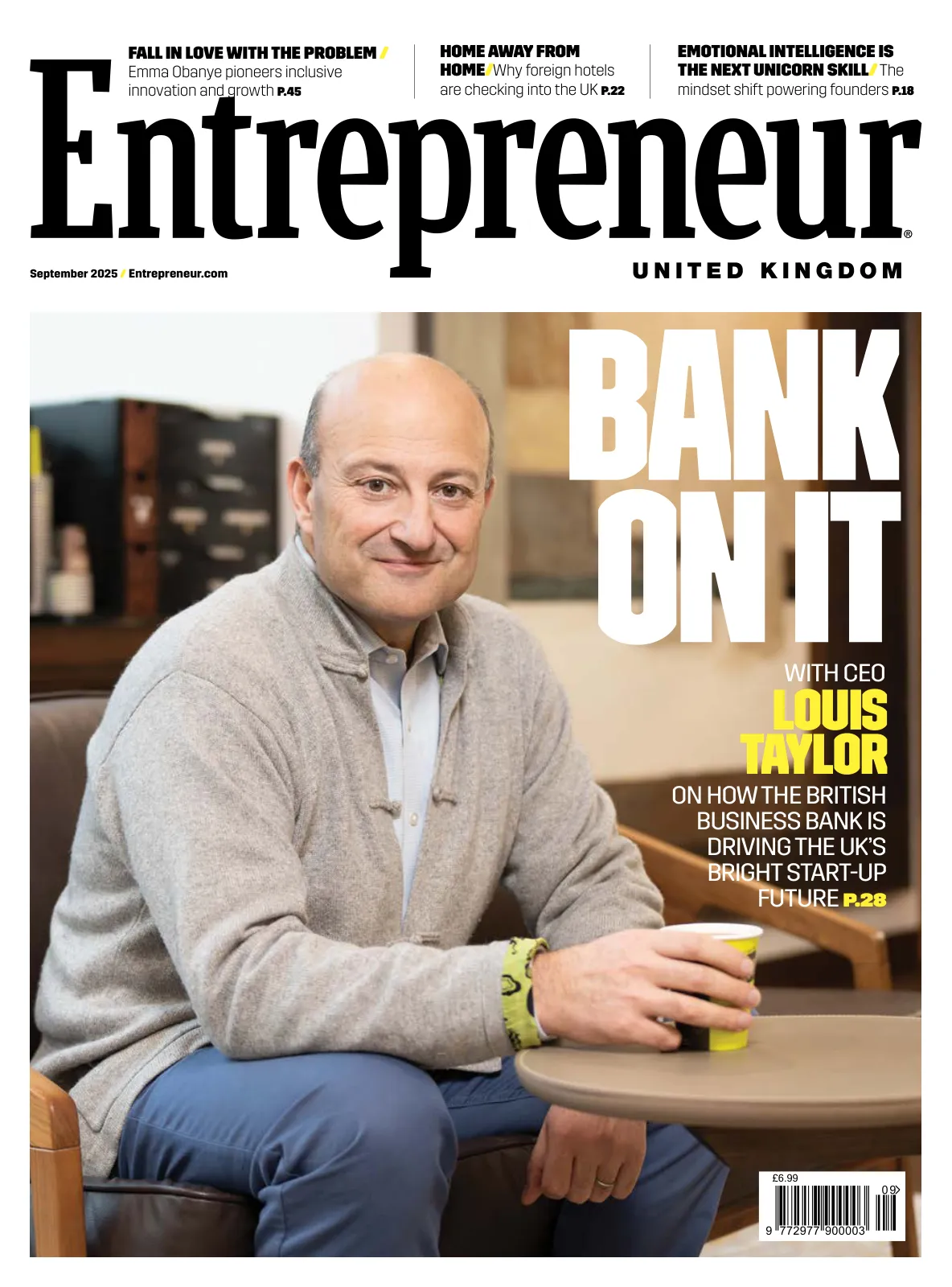
Entrepreneur UK, September 2025
Page 1
EMOTIONAL INTELLIGENCE IS
THE NEXT UNICORN SKILL/ The
mindset shift powering founders P.18
FALL IN LOVE WITH THE PROBLEM /
Emma Obanye pioneers inclusive
innovation and growth P.45
HOME AWAY FROM
HOME/Why foreign hotels
are checking into the UK P.22
September 2025 / Entrepreneur.com
BANK
ON IT
£6.99
ON HOW THE BRITISH
BUSINESS BANK IS
DRIVING THE UK’S
BRIGHT START-UP
FUTURE P.28
LOUIS
TAYLOR
WITH CEO
Page 2
BOLD
FOR THE
BOLD
UNITED KINGDOM
Page 3
Contents/September 2025
P.28
Louis
Taylor
INSIDE THE MIND OF A
MODERN BANKER.
FEATURES
3
September 2025 / ENTREPRENEUR.COM /
Page 4
DOWNLOAD
YOUR DIGITAL
EDITION
HERE
UNITED KINGDOM
Out now in the UK
Page 5
5
September 2025 / ENTREPRENEUR.COM /
48 From Cost to Competitive
Edge
A journey to going green.
50 How to…
Build a company everyone wants to
work for.
54 The Funding Fix
5 investor-ready tips.
56 Why UK Start-ups Need AI
Cybersecurity
Lessons from Blacklight AI’s RALPH
CHAMMAH.
‘TREPONOMICS
IN THE LOOP
Contents/September 2025
18 Emotional Intelligence Is the
Next Unicorn Skill
The mindset shift powering founders.
21 The 3 G’s of Building
Something Real
DEBBIE WOSSKOW’S rules of reinvention.
22 Home Away from Home
Why foreign hotels are checking into
the UK.
BUSINESS
UNUSUAL
STARTUP
SPOTLIGHT
36 The Business Show London
London’s biggest business event
returns this November.
39 Tap into TikTok
Strategies that actually work.
42 Bridging Capital and
Capability
Discover how IMS DIGITAL is
transforming tech.
8 Builders not Bureaucrats
Can entrepreneurs revive the
UK?
12 In Code we Trust
Driving public-sector innovation
↑ Andy Ayim MBE, entrepreneur and advocate for human-centred leadership.
FEATURES EDITOR Patricia Cullen
patricia.cullen@bncb2b.com
CEO Wissam Younane
wissam@bncpublishing.net
MANAGING DIRECTOR Rabih Najm
rabih@bncpublishing.net
ART DIRECTOR Simona El Khoury
EDITORIAL TEAM
Tamara Pupic,
Aalia Mehreen Ahmed
MEDIA SALES MANAGER
Olha Kovalova olha.kovalova@bncb2b.com
GENERAL MANAGER
Daniel Malins daniel@bncb2b.com
REGIONAL DIRECTOR
Andy B.
CONTRIBUTING WRITERS
Omar Hamdi, Pip Wilkins, Abigail Fisher,
Jolyon Bennett, Alex Martinez and Andrea Reynolds
SUBSCRIBE
Contact subscriptions@bncb2b.com to receive
Entrepreneur United Kingdom every issue.
COMMERCIAL ENQUIRIES
sales@bncb2b.com
WWW.ENTREPRENEUR.COM/EN-GB
Access fresh content daily on our website
All Rights Reserved 2025. Opinions expressed are solely those of the contributors.
Entrepreneur United Kingdom is officially licensed exclusively to BNC B2B In
United Kingdom by Entrepreneur Media Inc. No part of this magazine may be
reproduced or transmitted in any form or by any means without written permission
of the publisher. Images used in Entrepreneur United Kingdom are credited when
necessary. Attributed use of copyrighted images with permission. All images not
credited otherwise Shutterstock.
20 Wenlock Road, London, N1 7GU
entrepreneurMediaUK
entrepreneurUK
entrepreneurmedia-uk
entrepreneurmedia.uk
Page 6
6 / ENTREPRENEUR.COM / September 2025
Editor’s Note/
BANKROLLING DREAMS,
BUILDING FUTURES
Entrepreneur United Kingdom
W
hat does it take to build the
future of the UK economy? This
month, Entrepreneur UK sat
down with Louis Taylor, CEO of
the British Business Bank, for a
rare and timely conversation on
how capital, confidence, and
calculated risk are powering the next
generation of founders. As Taylor points
out, the biggest bottleneck often comes at
the scale-up stage, where risk-averse
institutional investors hesitate to back bold
growth. Bridging that gap, and changing
how institutions view entrepreneurial risk,
is central to Taylor’s vision.
But money isn’t the only currency that
matters in today’s entrepreneurial
landscape. In this issue, we also ask a more
provocative question: should entrepreneurs
help run the country? In a time of political
fatigue and economic reinvention, we
explore what founder mindsets could bring
to the halls of power - and what might get
lost in translation.
Elsewhere, Andy Ayim MBE shares why
emotional intelligence is the next unicorn
skill - and why human-centred leadership is
fast becoming a competitive edge in
boardrooms and beyond. Also inside: a
deep dive into why franchisors are obsessed
with exits, what’s transforming the UK tech
investment landscape, and how to plug your
brand into the TikTok growth engine.
Plus, real-world advice on AI-powered
cybersecurity, funding strategies that
actually work, and how to build a company
people want to work for. In times of change,
hope becomes a powerful currency. The
stories in this issue show that with courage
and clear purpose, entrepreneurs have the
potential to shape a future that is both
innovative and inclusive.
Hope you enjoy the read!
Patricia Cullen
Features Editor, Entrepreneur United Kingdom
Page 7
Page 8
8 / ENTREPRENEUR.COM / September 2025
T
he UK stands at a crossroads. With
growing economic inequality and a
changing workforce, there’s a real
question about whether
entrepreneurs - those who create,
innovate, and solve problems - should
play a bigger role in running the
country. Many believe this fresh
perspective could breathe new life into
both our economy and democracy, driving
growth, trust, and shared success.
BUILDERS, NOT BUREAUCRATS
Should entrepreneurs help run the country? by Patricia Cullen
In the Loop/
THE CRISIS OF GOVER-
NANCE AND THE CASE FOR
CHANGE
A palpable frustration
simmers beneath the
surface of public life in the
UK today. Political
discourse often feels stuck
in endless cycles of debate,
delay, and deflection. Voters
are disillusioned, trust in
government institutions is
waning, and the urgent
issues facing the country -
from housing shortages and
public health pressures to
the seismic shifts brought
on by automation and AI
- feel increasingly out of
reach for traditional
politicians.
And as things continue to
shift, one question keeps
coming up: Should the
nation be led by those who
have already successfully
built things - entrepreneurs,
business leaders, innovators
- rather than career
politicians and bureaucrats?
This debate is not new, but
its intensity has grown with
the rapid pace of techno-
logical, social, and economic
change. Advocates argue
that the skills, accountabil-
ity, and real-world experi-
ence that entrepreneurs
bring are desperately
needed in government.
Critics warn of the risks of
bringing business mindsets
into public service, citing
differences in goals,
incentives, and democratic
accountability.
Entrepreneur UK spoke to
five figures who know what
it’s like to straddle business
and policy. Serena Kern-
Libera, a former senior
government strategist now
in the private sector, offers
rare insight into how policy
and enterprise can align.
Jason Stockwood, an
entrepreneur and former
political candidate, makes
the case for more account-
ability in politics. Gerard
Boon, a broker advising
entrepreneurs who have
stepped into government
roles, sheds light on the
barriers they face. Serial
entrepreneur Mike Greene
advocates for ministers with
direct sector experience.
And Rose Ross, founder of
the Tech Trailblazers
Awards underscores the
need for diversity in
policymaking. Together,
their voices paint a picture
of what is at stake - and
what might be possible.
WHEN BUSINESS INSIGHT
MEETS EXECUTION
That cross-pollination of
experience - from business
into government - is
something Serena Kern-
Libera knows firsthand. As
Chief Operating Officer at
LinkGevity, a biotech
start-up, and a former
senior leader in govern-
ment, including roles at the
Bank of England, HM
Treasury, and as Chief of
Staff to the Chancellor, she
→ Serena
Kern-Libera is COO
at LinkGevity
Limited, former Head
of Global Trade
Strategy at the Bank
of England, UK
Market Access
Policy lead at HM
Treasury, and Chief
of Staff to the
Chancellor.
Page 9
9
September 2025 / ENTREPRENEUR.COM /
brings rare insight into how policy and
enterprise can align. “Coming from
outside politics gives you the ability to
truly step into the shoes of those
directly affected by policy changes.” She
recalls how her varied background
informed post-Brexit trade strategy:
“We were able to translate industry
asks into a final agreement that met
their priorities as well as the govern-
ment’s wider economic agenda... I
think that was because the government
both listened and executed.” Looking
ahead, she sees massive opportunity in
deepening engagement with entrepre-
neurs, especially in emerging technolo-
gies: “A more open, cross-sector
government is one that keeps its finger
on the pulse of emerging technologies,
engages deeply, listens actively, and
consistently follows through to enable
entrepreneurs to turn world-class ideas
into world-class outcomes.” She goes
on to say that when it comes to
emerging, cutting-edge technologies,
there’s an opportunity to go further in
partnering with entrepreneurs,
showing what’s possible when business
insight shapes policy that not only
listens, but delivers.“The UK has the
talent and skills to lead globally, but we
need to ensure the right practical
conditions are in place - from how
grant funding is structured to which
areas the government prioritises.”
ACCOUNTABILITY AND REAL-WORLD
URGENCY
Jason Stockwood, a UK-based
businessman, offers a case study in
bridging business and public life. With
senior leadership roles at companies
including Travelocity, Match.com, and
Simply Business, and as joint majority
shareholder of Grimsby Town FC,
Stockwood has spent decades building
and scaling organisations. His recent
foray into politics as the Labour Party
candidate for the 2025 Greater
Lincolnshire mayoral election marks a
new chapter - a commitment to
bringing entrepreneurial thinking to
policymaking. “People from outside
politics bring lived experience of what
works, what fails, and how to adapt
when real life kicks in,” he explains. His
critique of current politics is blunt but
fair: it is full of commentators who
discuss but rarely build. “Some of the
most talented people I know run
businesses, create jobs, and spend
hours moaning about how broken
politics is. My challenge to them is
simple: if you are smart enough to
build a business, you are smart enough
to fix a policy. Stop complaining and
step up.” This call to action is about
more than rhetoric. For Stockwood, the
entrepreneurial mindset brings
something sorely missing in politics:
accountability. “If something doesn’t
work, you do not write a press release,
you fix it. That mindset is missing in
politics.” He envisions a future where
the government is a collaborative
A more open, cross-sector
government is one that
keeps its finger on the pulse
of emerging technologies,
engages deeply, listens
actively, and consistently
folows through to enable
entrepreneurs to turn
world-class ideas into
world-class outcomes”
“
→OLIVER BRUCE,
co-founder of
House of Unicorns,
pioneering the next
wave of innovative
startup
→ Gerard
Boon,
Managing
Director of
Boon
Brokers
→ Entrepreneur
and business
mentor, Mike
Greene
Page 10
10 / ENTREPRENEUR.COM / September 2025
ecosystem: “In ten years, a
cross-sector government
should include business
leaders, entrepreneurs, and
public servants working
side by side.” Stockwood
warns of a democratic
crisis if policymakers fail to
create an economy that
benefits all: “Business
leaders know how to fix
problems, balance
interests, and deliver
outcomes. If we get this
right, business and
democracy will thrive
together. If we don’t, we
should not be surprised
when people lose faith in
both.”
WHY TALENTED ENTRE-
PRENEURS STAY AWAY
Gerard Boon is managing
director of Suffolk based
Boon Brokers, a firm that
works with clients who
have experience in both
business and government.
While he can’t name
names, Boon offers an
insider’s perspective on
what happens when
entrepreneurs step into
public life. “We have a
number of clients who
currently work in parlia-
ment and assist in
policy-making for the
country. Those clients
previously ran their own
businesses.” Despite their
skills and accomplish-
ments, Boon says the
consensus is stark: working
in government is “thank-
less” and financially
unrewarding. “It’s no
wonder that the govern-
ment functions far less
efficiently than large-scale
businesses, as the
incentives are not good
enough to optimise their
operations.” He argues that
attracting private-sector
talent to the government
requires overhauling
outdated systems and
incentives. Bureaucracy, he
says, remains a core
barrier: “As there is no
competitive pressure in
government, like there is in
the private sector, there is
little to no incentive to
improve the speed of
decision making.” Without
structural reform, he
warns, the best minds may
continue to sit it out. “Our
clients have expressed that
the government need to
significantly improve the
talent level of its civil
servants and attract the
brightest minds from the
private sector, with real
world experience, to
improve public affairs.
Otherwise, with its current
labour incentives, the
government will breed a
complacent work force.”
LIVED EXPERIENCE, NOT
JUST LOYALTY
Serial entrepreneur Mike
Greene, a contestant on
Channel 4’s Secret
Millionaire, builds on this
argument with a focus on
sector-specific expertise in
government leadership. “In
my view, the best person to
be a Housing Minister is
someone who understands
construction.” Greene
makes a compelling case
for practical, lived
experience across depart-
ments: “In Health, it
makes sense to involve
those who have walked the
corridors of hospitals…not
In the Loop/
People from
outside politics
bring lived
experience of
what works,
what fails, and
how to adapt
when real life
kicks in”
“
→ JASON
STOCKWOOD is
an English
businessman
who is joint
majority
shareholder
and former
chairman of
Grimsby Town
F.C
Page 11
11
September 2025 / ENTREPRENEUR.COM /
just as figureheads, but as ministers or at the very least, as
core advisors.” He believes that if the government is to serve
its people effectively, it needs to bring in people who
actually speak the language of those people - not just in
words, but through a firsthand perspective. “We need
people in power who have lived the journey: who’ve known
the pressure of payroll, the highs and lows of growth, the
reality of regulation, and the risks of entrepreneurship.
They should be practitioners, not preachers - giving
qualified advice, not theoretical opinion,” he adds.
THE DANGER OF ONE-DIMENSIONAL DECISION-MAKING
Rose Ross, founder of the global tech start-up platform
Tech Trailblazers, reinforces this point with a focus on
representation and reach. Ross warns of the risks of
ignoring diverse, ground-level insights in fast-moving
sectors like tech. “There is a danger that politicians and civil
servants are predominately exposed to senior people within
the tech industry and industry itself. The failure to hear the
opinions, insights and suggestions from the start-up
community, academia and front-line practitioners doesn’t
give the best context for balanced decision-making.” She
argues that involving entrepreneurs in policymaking is
essential for effective governance: “Better informed
policymakers with input from real experts... will make
better policies. If entrepreneurs have a seat at the table,
governments will be able to create better financial, taxation,
business, immigration, education and business-related
policies… This will be better for entrepreneurs and, with a
healthy and supportive approach to innovation, better for
the UK.”
BRIDGING TWO WORLDS
Together, Kern-Libera, Stockwood, Boon, Greene and Ross’s
perspectives illuminate a shared truth: real change requires
doers, not just desk workers. Their insights suggest that
practical experience, accountability, and sector expertise can
inject much-needed energy and innovation into policymak-
ing. From the boardroom to the classroom, the factory floor
to frontline trade negotiations, these voices represent the
breadth of what a cross-sector government could look like
- one rooted in practical knowledge and lived experience,
not just political theory. Yet the path is far from straightfor-
ward. The obstacles are institutional, cultural, and
economic. Government roles often lack competitive
compensation and incentives to attract top entrepreneurial
talent. Bureaucracy slows action. And political culture often
prioritises loyalty and rhetoric over practical expertise. But
the rewards of change could be transformational. Imagine
ministers who understand the industries they oversee.
Policy shaped by those who have created jobs and faced
market realities. Government that moves with the agility
and accountability of a successful business. Such a shift
could restore public trust and deliver solutions that work for
everyone.
THE FUTURE IS BUILT, NOT BUREAUCRATISED
The call for builders to lead is growing louder. Entrepre-
neurs like Stockwood, advisors like Boon, and seasoned
leaders like Greene, Ross, and Kern-Libera argue persua-
sively that the government must evolve - or risk losing faith
on all fronts. The question is no longer whether business
experience is valuable in politics, but how to make it happen
on a meaningful scale. If the government can open its doors
to builders - those who fix, innovate, and deliver - it may yet
build a future where democracy and enterprise thrive side
by side.
BETTER INFORMED POLICYMAKERS WITH INPUT FROM REAL EXPERTS... WILL MAKE BETTER
POLICIES. IF ENTREPRENEURS HAVE A SEAT AT THE TABLE, GOVERNMENTS WILL BE ABLE TO
CREATE BETTER FINANCIAL, TAXATION, BUSINESS, IMMIGRATION, EDUCATION AND BUSINESS-
RELATED POLICIES”
→ Rose Ross,
founder of a
global tech
startup
platform, Tech
Trailblazers
Awards
Page 12
12 / ENTREPRENEUR.COM / September 2025
In Code We Trust
One entrepreneur’s mission to future-proof the public-sector. by PATRICIA CULLEN
A
t the heart of this move-
ment is Martin Neale, the
61-year-old founder and
CEO of ICS.AI, a company
helping councils transform how
they serve citizens through
practical, scalable applications of
AI. Neale’s story doesn’t begin in
a Silicon Valley garage. It begins
in 2018, when, at the age of 55, he
did something most financial
advisors would balk at: he cashed
in his pension to launch a tech
start-up focused entirely on the
public sector. “Fundamentally, it
came down to belief,” Neale says.
“Belief in the value and transfor-
mative power of AI in the public
sector, and confidence that it was
going to make a huge difference.
My excitement for technology
hasn’t dimmed and I’ve always
been a lover of innovation.”
At the time, AI was beginning
to reach a critical tipping point.
The breakthrough, as Neale saw
it, came in 2016, when major
cloud providers like Microsoft,
Amazon, and Google began
commoditising AI capabilities.
What once cost millions to test
and deploy could now be accessed
for pennies. “It was clear AI was
going to explode,” he says. “And
while I’ve been pleasantly
surprised by the scale of that
growth, its inevitability was
obvious back then.” What’s less
obvious is just how quickly the
UK public sector has embraced
AI in meaningful, operational
ways. Contrary to the image of
government bureaucracy bogged
down by outdated legacy systems,
↓ Martin Neale,
CEO of ICS.AI
In the Loop/
I
n an age of tightening budgets
and rising public demand,
artificial intelligence (AI) might
seem like a luxury. But for the
UK’s overstretched councils, it’s
becoming a lifeline. It doesn’t
involve street protests or
political grandstanding. Instead, it’s
powered by data, algorithms, and a
belief that the UK public sector -
often caricatured as slow, bloated,
and technologically behind - can
not only keep pace with innovation,
but it can lead it.
“THE UK IS COMMITTED TO PROVIDING
A HIGH LEVEL OF STATE SUPPORT, BUT
LIKE ALL WESTERN DEMOCRACIES, IT
FACES THE PRESSURES OF AN AGEING
POPULATION AND THE KNOCK-ON
EFFECT ON TAX REVENUES.
NECESSITY REALLY IS THE
MOTHER OF INVENTION”
Page 13
13
September 2025 / ENTREPRENEUR.COM /
Neale believes the UK is
actually ahead of much of
the world when it comes to
real-world AI deployment
in public services.
“It comes down to
economics and necessity,” he
explains. “The UK is
committed to providing a
high level of state support,
but like all Western
democracies, it faces the
pressures of an ageing
population and the
knock-on effect on tax
revenues. Necessity really is
the mother of invention.”
That fiscal squeeze has
driven innovation in
unlikely places - council
offices, healthcare trusts,
and public housing
departments - where AI is
now quietly streamlining
operations, handling citizen
queries, and identifying
inefficiencies at scale.
The company is doubling
year-on-year, and it’s done
so without the flash that
tends to dominate tech
headlines. There are no
moonshot promises or
glossy investor decks. Just a
focus on delivering
outcomes that matter - and
doing so repeatedly. In
many ways, Neale’s vision
can be summed up in a
comparison he draws with
one of the most influential
– and controversial – names
in tech: Palantir. “Palantir,
for those unfamiliar, is a
highly successful US AI and
data analytics company,”
Neale explains. “One of the
things that propelled them
was their ability to simplify
the engagement and
decision-making process for
organisations, cutting
through ‘pilot paralysis’ with
an effective, repeatable
model.”
ICS.AI has taken a similar
approach in the UK public
sector, creating what Neale
calls a “go-to-market
mechanism” - essentially a
framework that enables
councils and public bodies
to easily buy, deploy, and see
measurable returns on AI
investments. It’s an
approach designed not for
headlines, but for results.
“For Derby City Council, we
helped them identify £7.5m
in savings from their AI
transformation,” he says.
“Using a process we can
apply elsewhere. It’s about
enabling measurable,
scalable impact.”
Yet Neale is quick to note
that success in this space
isn’t just about savings – it’s
about sustainability and
ethics. In an era where
concerns about AI misuse,
bias, and transparency are
dominating global dis-
course, ICS.AI has built its
platform with public trust in
mind from the ground up.
“In the public sector, ethics
aren’t optional,” Neale says.
“Security, accessibility,
engagement, and ethics
must be woven into how you
design and deploy AI. That’s
been our approach from day
one.” He believes this
→ Chris Fraser
and Ricky
Gervais, a
British
comedian,
actor, writer,
and producer
↑The ICS.AI team
at the Birmingham
City Council offices
Page 14
14 / ENTREPRENEUR.COM / September 2025
mindset gives the UK a
unique advantage - one that
could position it as a global
leader in ethical AI
specifically designed for
public service delivery.
“Our platforms are often
the first in the world to
solve certain problems. That
gives the UK a head start in
applying these lessons to
other countries that are
slower to adopt,” he says. “If
we continue to embed
ethics as a core principle,
while sharing and exporting
our expertise, the UK can
cement its role as a leader in
ethical AI for public
services.”
That message appears to
be resonating far beyond
the UK. ICS.AI is now
seeing growing interna-
tional interest in its model
- not from tech giants or
venture capitalists, but from
other governments who are
beginning to grapple with
the same demographic and
economic pressures that
have long defined UK
policymaking. But for all
the attention and expan-
sion, Neale remains focused
on the mission that drove
him to launch ICS.AI in the
first place: building
solutions that genuinely
work for public bodies - and
by extension, the people
they serve.
“Customers aren’t buying
AI for its novelty; they’re
investing because they
expect tangible outcomes
that weren’t possible
before,” he says. “Entrepre-
neurs need to work
backwards from that.” It’s
advice he offers freely to the
next wave of tech founders,
especially those building
mission-driven ventures in
risk-averse sectors like
health, education, or
government. “Start by
clearly articulating the
benefits so customers can
build strong business cases.
Then ensure those benefits
are actually realised, so
clients become advocates
for you in the marketplace.
That advocacy is what
drives sustainable growth.”
He’s also bullish on the
need for an ‘AI-first’
mindset – not just in tech,
but across the broader
business community.
“Entrepreneurs shouldn’t
wait to be forced into AI
adoption by competitors –
they need to be proactive,”
he says. “AI gives organisa-
tions the ability to work
faster and more effectively,
and embracing that early is
an advantage.”
For a man who put his
retirement on the line to
launch a company in a
sector often seen as stuck in
the past, Neale’s outlook is
refreshingly forward-look-
ing. He isn’t chasing the
next funding round or
betting on a flashy exit. He’s
betting on the power of AI
to help governments do
more with less – and on the
idea that deep, sustainable
change often begins in the
places you least expect. The
public sector has its
challenges, but it also has
the most to gain from
getting this right.
“In the public
sector, ethics aren’t
optional. Security,
accessibility,
engagement, and
ethics must be
woven into how
you design and
deploy AI”
In the Loop/
↑ Members of the ICS.AI leadership, marketing, AI launchpad team at the
2025 Enterprise Awards
Page 15
The voice of
entrepreneurship
around the world
Access fresh content daily on our website
Page 16
16 / ENTREPRENEUR.COM / September 2025
Why Franchisors Are
Obsessed With Exits –
Before They’ve Even Begun!
In most businesses, planning your exit before you start sounds like madness. In franchising, it’s
the norm - and for good reason. by PIP WILKINS
S
ince 1977, the BFA
has championed
ethical business prac-
tices and high
standards in
franchising; we work
hard to ensure
franchisees choose
the right franchise for them, which
often means franchisors asking why
they want to invest and what their end
goal is. Do they want to sell it, hand it
over to their children or keep it until
they retire? A franchisee’s end
destination will help the franchisor
determine the route they take, what
their priorities are for the business,
and when and how they take action.
Know your destination
When talking to franchisors, and even
before you’ve settled on your dream
franchise, be ready to answer the
question “Where do you want your
business to be in five years?”
Plan the path
Jo White and husband Ryan, head up
the pet care franchise We Love Pets,
whose franchisees manage teams of
staff who provide dog sitting, pet
feeding and home boarding. Jo says:
“We always tell potential franchisees to
consider their exit strategy, even before
they invest in our franchise. Your
intention changes the way you run
your franchise, your growth targets,
and the decisions you make.”
Imogen Clarke, Head of Franchise
Development at home care franchise
Home Instead, says: “We always put
the ‘exit goals’ question to prospective
franchisees. Many say that they were
not considering an exit strategy when
they joined.”
About franchising
The UK has more than 1,000 franchise
systems, according to the latest British
Franchise Journal sponsored by NIC
local. Franchise agreements typically
last five to ten years.
When goals shift
She adds: “Few people have a clear
goal, such as owning a business for 12
years and selling when the revenue or
business performance gets to x
amount. We explain that it’s important
↑ Stuart Hart, Home Instead
franchisee Ruislip and Harrow
↓ Imogen Clarke, Head of Franchise
Development Home Instead
In the Loop/
Page 17
17
September 2025 / ENTREPRENEUR.COM /
for us to understand their
overall goals so we can help
them achieve them, and for
them to understand what
they want from buying a
business.”
What if exit plans change?
Franchise development
managers commonly raise
this with franchisees in
business development calls.
Tracey Alexander, who has
been the We Love Pets
franchisee for Reading, says
her exit plans could change
in the future. “My eight-
year-old son William might
take over the business, but
it’s too soon to consider that
seriously. In the future I
could sell off some parts of
my area and operate a
smaller territory myself.”
Time to prepare
Jo adds: “We ask franchi-
sees selling to give us two
years’ notice, so there’s time
to build up the business in
ways that enhance its attrac-
tion for buyers.” At Home
Instead, Imogen says: “The
most unusual exit goal I’ve
heard is someone who
wanted to own a business
for x amount of time, so at
some point they’d be able to
set up a Home Instead
franchise in the US.”
Plot twist
Goals can change fast. Jo
says: “You can have people
wanting to invest in
multiple units, but in a
matter of months perhaps
they’ve had a health scare or
they’ve welcomed their first
grandchild and now they
want to sell.”
Coaching through change
However, she says:
“Sometimes franchisees
suddenly decide to exit and
it appears to come from
nowhere. It’s rare but we
tread carefully, to ensure
this isn’t an impulsive
decision based on some-
thing that will be short term
pain, perhaps in their
personal life. We can have
open conversations to check
if that’s something they’re
ready for right now.” The
BFA can help you through
each step from franchise
choice to exit. Our strapline,
‘Discover Your Tomorrow,’
reflects our commitment to
helping new franchisees
take their first step towards
a successful business future.
Consider us your ‘friend in
franchising’ and if you can’t
find the answer on our
website, call us, we’re here
to help.
Family legacies
“We didn’t specifically think
about exit when we bought
our business. We were more
focused on growth, though
that ultimately prepares you
for exit,” says Stuart Hart,
the Home Instead franchi-
see for Ruislip and Harrow.
“We wanted to deliver high
quality care and Home
Instead’s model enabled us
to deliver that to clients as
well as building a business.
“We are doing that, but now
our son has joined us in the
business and will become
our General Manager soon.
We are now focused on
creating a legacy for him as
well as expanding. We’d love
to own multiple businesses
with Home Instead, and
that’s our strategy.”
The best way to start a
franchise is to know how
you’ll leave it; visit our
website www.thebfa.org for
more advice on investing in
a franchise business.
Pip Wilkins is
the Chief
Executive of the
British
Franchise
Association (BFA), bringing
over 25 years of dedicated
experience in the franchising
sector. Having progressed
through various roles within
the BFA, Pip has gained a
comprehensive understanding
of the broader franchise
industry, earning widespread
respect for her deep expertise
and unwavering
commitment. She lives in
Devon and is an avid Chelsea
FC fan.
“Few people have a clear goal, such
as owning a business for 12 years and
seling when the revenue or business
performance gets to x amount. We explain
that it’s important for us to understand
their overal goals so we can help them
achieve them, and for them to understand
what they want from buying a business”
↑ Tracey Alexander We Love
Pets Reading
Page 18
18 / ENTREPRENEUR.COM / September 2025
W
hile much of the start-up
world chases growth at all
costs, Andy Ayim MBE, an
advisor, facilitator and
entrepreneur, whose work
spans companies from
Google to Uber, is asking a
different question: what happens when
founders lead with emotional intelligence,
not ego? “Companies are the sum of the
people they employ,” Ayim says. “To
embed a mindset, I believe you have to
start with the individual and understand
internally what they think and feel.” This
philosophy - centred not on productivity
hacks or frameworks, but on emotional
intelligence - has earned Ayim a
reputation as one of the most thoughtful
voices in UK entrepreneurship. In a
conversation that moves from AI and
remote work to trauma and truth-telling,
he lays out a clear case for why human-
centred leadership is not a soft skill - it’s
a survival skill.
B/Leadership
Why
Emotional
Intelligence
Is the Next
Unicorn Skill
Inside the mindset shift that’s turning
founders into human-centred leaders
- and start-ups into powerhouses.
by ENTREPRENEUR UK STAFF
↓ Andy Ayim MBE,
entrepreneur and
advocate for
human-centred
leadership.
Page 19
19
September 2025 / ENTREPRENEUR.COM /
“True leadership isn’t
about being liked. It’s
about creating the
conditions where people
feel they belong and can
do their best work. Where
your people can take
risks, speak openly and
honestly, and grow
The mindset behind the metrics
It’s easy to talk about values. Much harder to change
behaviour. Ayim argues that most start-up culture
change efforts fail because they skip the most vital
step: understanding what’s happening inside each
person. “By this, I mean it is important to under-
stand how people process their feelings and
thoughts, things such as their beliefs, attitudes and
values,” he explains. “This is what influences their
mindsets and how they show up -observable behav-
iours.” He shares an example: someone in a team
might carry a deep-seated belief that they’re “not
good enough,” stemming from childhood experi-
ences. That belief, unless surfaced and challenged,
will subtly shape their work, their relationships, and
their sense of agency. “When you understand things
like this, you can meet people where they are and
ground them with a simple question, ‘What is true?’
This question can allow an individual to process and
discover that what is true is that they are enough.”
This isn’t therapy disguised as leadership - it’s practi-
cal emotional work that enables people to show up
more fully. And for Ayim, it’s the foundation of any
high-performing culture.
From ‘family feel’ to true safety
As a start-up scales, founders quickly shift from
building products to building people. Many stumble.
Ayim has seen it time and time again: well-meaning
founders mistaking friendliness for psychological
safety. “Start-ups don’t come with a manager manu-
al. As a founder, you might be brilliant at managing
products, timelines and pitch decks, but people are
not tasks to be optimised. They are whole human
beings, with hopes, fears and brilliance waiting to be
unlocked.”
The ‘family feel’ often lauded In early start-up cul-
ture can become a trap - masking avoidance of the
hard stuff: feedback, accountability, conflict. “That
‘family feel’ culture can create warmth, but it can
also mask avoidance. Avoidance of hard conversa-
tions. Avoidance of accountability and ownership.
Avoidance of truth.” Ayim calls on founders to reject
the popularity contest, and instead, step into leader-
ship that holds both care and candour. “True leader-
ship isn’t about being liked. It’s about creating the
conditions where people feel they belong and can do
their best work. Where your people can take risks,
speak openly and honestly, and grow.”
In his view, the ultimate competitive advantage isn’t
code or capital. It’s culture. “Because when your
team feels seen, safe, and stretched - not just sup-
ported but sharpened - that’s when they do their
best work. That’s when culture becomes your com-
petitive advantage.”
The rise of human-centred entrepreneurship in the UK
Ayim sees a shift emerging among a new generation
of UK entrepreneurs. One that’s less interested in
hustle culture and more committed to building with
intention. “I believe we’re moving from founder-led
hustle to human-led culture. The most forward-
thinking UK entrepreneurs are realising that success
isn’t just about scaling products, it’s about scaling
people.” This shift, he argues, is urgent. With AI,
hybrid work, and shifting generational values, the
rules of engagement are being rewritten. But the
foundation remains unchanged: how we feel impacts
how we perform. “Human-centred leadership is no
longer a nice-to-have, it’s the engine for innovation,
retention, and fulfilment. I see a growing shift to-
ward leaders who prioritise emotional intelligence,
create space for truth-telling, and build cultures
where people feel seen, safe and stretched.” The
businesses that will stand out in the next decade,
Ayim says, will innovate not only in what they build
- but in how they lead.
Tools for building emotional intelligence
It’s one thing to value empathy. It’s another to prac-
tice it. Ayim offers a practical tool called See–Hear–
Speak, learned from a team at Psalt, as a transforma- }}
”
Page 20
20 / ENTREPRENEUR.COM / September 2025
“IN SHORT, HUMAN-CENTRED
LEADERS WON’T JUST MANAGE
PEOPLE, THEY’LL MULTIPLY
POTENTIAL. AND THAT WILL BE
THEIR UNFAIR ADVANTAGE”
tive emotional intelligence
framework for founders.
“It begins with seeing the
whole person, not just their
output. Then, hearing - lis-
tening deeply to under-
stand, not to fix. Finally,
speaking with care by
asking, ‘What can I do to
support you?’” This kind of
emotional presence fosters
what psychologists call
psychological safety - the
single most predictive
factor in high-performing
teams, according to
Google’s own research.
“This simple practice
builds emotional presence
and psychological safety,
the foundations of every
growing start-up.” This
isn’t about being “soft” on
people - it’s about unlock-
ing their full potential.
Three practices that will
define the next decade
When asked what specific
leadership practices UK
start-ups should embrace
over the next 10 years,
Ayim doesn’t hesitate. “The
start-ups that stand out
won’t just innovate in what
they build, but in how they
lead.” He breaks it down
into three core practices:
}Listening before leading
“Founders who stay curi-
ous about how their people
feel and think will build
cultures rooted in trust,
not just talent.”
}Courageous conversa-
tions
“Replacing avoidance with
care and candour will
create environments of
truth, accountability, and
growth.”
}Designing for belonging
“Building teams where
every person feels safe,
seen and stretched will
turn inclusion from a
statement into a system.”
The goal isn’t just better
culture - it’s scaling people.
“In short, human-centred
leaders won’t just manage
people, they’ll multiply
potential. And that will be
their unfair advantage.”
Building in a world of AI and
uncertainty
Ayim isn’t blind to the
rapid evolution of work -
he embraces it. But while
others fear AI will replace
human jobs, he sees it
differently. “Don’t try to
compete with AI, see it as a
co-pilot that complements
the unique brilliance and
creativity of your people.”
The real edge, he says, isn’t
speed or data. It’s empathy,
imagination, and human
connection. “AI can handle
repetition, but only hu-
mans can bring deep
empathy, emotional intel-
ligence, and courageous
imagination to the table.”
In an increasingly remote
and tech-first world, it’s
not the tools that make the
difference. It’s the environ-
ment leaders create. “Cul-
ture becomes your anchor.
The leaders who win won’t
just adopt new tools;
they’ll create environments
where people feel they
belong, are challenged, and
are trusted to lead.”
Ayim doesn’t offer silver
bullets. What he offers is
deeper: a way of thinking
about leadership that is
anchored in humanity,
scalable with purpose, and
essential for the unpredict-
able future we’re all step-
ping into. “The future
belongs to founders who
prioritise human connec-
tion.” He leaves us with a
challenge - a mindset shift
that sounds deceptively
simple, but could reshape
everything: “People are not
tasks to be optimised.” In a
world chasing productivity,
it might be the most revo-
lutionary idea of all.
→ Entrepreneur
and advisor Andy
Ayim MBE is
redefining what
leadership looks
like in tech.
B/Leadership
Page 21
21
September 2025 / ENTREPRENEUR.COM /
B/Innovators
D
ebbie Wosskow OBE
is one of the UK’s
most influential
female business speakers,
renowned for her multi-exit
entrepreneurial career and
leadership in driving
gender equity. She
co-founded Mantra PR at
just 25, launched Love
Home Swap - growing it to
over 100,000 homes in 150
countries before its
multimillion-pound sale
- and went on to create
AllBright and Maidthorn
Partners. In this exclusive
interview with
Entrepreneur UK, Wosskow
reflects on the key lessons
of scaling a business - what
she calls the 3 G’s: graft,
grace and grit.
What are the key lessons
business owners should
know about scaling a
business successfully?
I started my first business
26 years ago and I have
built three businesses to
exit. When I think about
investing - or what’s next - I
always come back to the
three Gs. The first is graft.
I’m a northerner and graft
is everything. It’s just about
hours in. In an
entrepreneurial career, you
can’t underestimate the
sheer volume of work
required. The second G is
grace, especially grace
under pressure. For me that
is about building
relationships and building
networks. Networks have
been the absolute bedrock
of my career. As you move
through the entrepreneurial
journey, protecting those
relationships and not
burning bridges becomes
absolutely critical. The final
and most important G for
me is grit. I think that grit
trumps genius every day of
the week. I reflect on this in
my book, Believe, Build,
Become: How to
Supercharge Your Career,
and it’s the heart of my
podcast, Grit and Grace.
Yes, I care about metrics -
revenue, product–market
fit, all the numbers. But in
the end, temperament is
everything. Attitude is what
wins.
How can businesses foster
a culture of innovation to
stay competitive in today’s
market?
I approach innovation from
both ends of the spectrum
- big business and
start-ups. I am expert in
turning an idea and an
innovative thought into a
business that raises capital
and scales but I also do big
company work, whether
that is on the board of
Channel 4 or the senior
advisor role for McKinsey,
or indeed chairing the
Investing in Women
Taskforce for the
Chancellor. I’m increasingly
struck by how much
innovation depends on
networks. It’s about making
sure that you surround
yourself with real diversity
of thought. I’ve done a lot of
The 3 G’s of Building
Something Real
Debbie Wosskow reveals how flipping the script on traditional business through bold moves, diverse networks,
and embracing failure is reshaping what success looks like. by ENTREPRENEUR UK STAFF
work with people across
the world who are true
technology innovators. I
see my role as founder
CEO is to harness those
ideas and turn them into a
culture and a vision that
drives revenue and scale.
And doing that from the
UK matters, because
innovation needs to sit
firmly at the heart of our
growth agenda.
What’s the biggest
leadership lesson you’ve
learned that every
business owner should
apply?
We all need to learn how
to fail. I wasn’t very good
at thinking about failure
in my earlier career.
Founding a business in
the late ’90s and raising
capital as a woman was
very unusual. I see failure
as teaching me lessons
about myself. I also think
that we need to learn how
to fail on our way to
success. I think good
entrepreneurs are
constantly pivoting - both
in their careers and their
ideas. None of the
businesses I’ve sold ended
up looking exactly like the
idea I started with - and
that’s part of the process
and part of what keeps me
going as an entrepreneur
into my 50s and beyond.
→ Debbie
Wosskow, OBE
co-chair of the
Invest in Women
Taskforce,
co-founder of
Mantra PR,
co-founder of
Maidthorn
Partners,
co-founder of
AllBright &
Executive Chair
of The Better
Menopause
Page 22
22 / ENTREPRENEUR.COM / September 2025
→ Ralph Porciani,
CEO of JA Resorts
& Hotels
Page 23
23
September 2025 / ENTREPRENEUR.COM /
HOME
AWAY
FROM
HOME
Why foreign hotels are checking
into the UK. by PATRICIA CULLEN
A
s international travel
rebounds and guest
expectations evolve, a
shift is underway in the
UK hospitality
landscape: foreign hotel
brands are moving in
- not with brash
takeovers, but with
carefully chosen
investments grounded
in heritage, location, and
long-term value. Among them is JA
Resorts & Hotels, the Dubai-based
group making its UK debut with two
Scottish properties. For CEO Ralph
Porciani, a native of Dumbarton, it’s
both a strategic move and a personal
return. But JA is far from alone. From
luxury groups to boutique operators,
global players are increasingly viewing
the UK - notably Scotland - as a
natural extension of their brand story.
The draw? A blend of cultural cachet,
loyal outbound travellers, and
properties that offer character over
conformity
Page 24
24 / ENTREPRENEUR.COM / September 2025
Why was the UK – particularly Scotland – chosen as the next
chapter in JA Resorts & Hotels’ growth story?
The UK has long been one of our most important
international markets, with many guests returning to our
resorts in Dubai and the Indian Ocean year after year.
Scotland, in particular, has always drawn travellers, both
from within the UK and from the Middle East; thanks to its
heritage, cooler climate, leisure offering, and natural beauty.
This step was enabled by our parent company, Dutco Group,
whose acquisition of Mar Hall and The Bruntsfield created
the foundation for JA Resorts & Hotels to bring our
operational expertise and guest-first philosophy to the UK.
It felt both natural and sustainable: entering a destination
our guests already value, while broadening our international
footprint in a considered way. On a personal note, having
grown up in Dumbarton and begun my career here,
Scotland holds special meaning for me. Bringing JA’s ethos
of authentic, nurturing hospitality back to a place so close to
my own roots makes this chapter particularly rewarding.
This move into the UK marks a major milestone. What made
now the right time for JA Resorts & Hotels to expand beyond
your traditional markets?
Over the past four decades, JA Resorts & Hotels has evolved
into an experience-led hospitality group with a portfolio
spanning beach, mountain, city, and island stays. Heritage
has always been central to our identity from JA Beach Hotel
and JA Hatta Fort Hotel, both founded in 1981 and adding
two storied Scottish properties continues that tradition.
Dutco Group’s acquisition of Mar Hall and The Bruntsfield
BY PROTECTING THE HERITAGE OF THESE PROPERTIES WHILE BRINGING IN THE
STRENGTH OF JA’S SERVICE ETHOS, THE AMBITION IS TO ADD VALUE IN A WAY THAT FEELS
NATURAL, NOT IMPOSED. OVER TIME, THAT BALANCE IS WHAT HELPS A NEW ENTRANT
STAND APART”
← The Bruntsfield,
a historic
Edinburgh hotel
joining JA Resorts
& Hotels’ growing
UK collection
Page 25
25
September 2025 / ENTREPRENEUR.COM /
”
provided the foundation
for JA to bring its
operating expertise to the
UK. This represents a
natural extension of our
journey: strengthening our
position in key source
markets such as the UK,
Middle East, and the
Americas, while entering a
destination that speaks to
travellers looking for
distinctive and meaningful
stays. This is not growth for
its own sake, but careful
expansion into places that
align with our values. Our
repositioning as an
experience-led group has
prepared us to steward
heritage properties,
established and newly
added with the same
respect, individuality, and
authenticity that define our
resorts worldwide.
The UK hospitality sector is
both mature and highly
competitive. What excites
you most – and what
challenges do you antici-
pate as a new entrant?
The most exciting aspect is
the opportunity to
introduce JA’s philosophy
of experience-led
hospitality into a market
where history and tradition
already run deep. Both Mar
Hall and The Bruntsfield
carry distinct character,
and the role of JA is to
respect that individuality
while refining service,
enhancing guest journeys,
and creating experiences
that connect multigenera-
tional travellers to nature,
sport, wellness, culture,
and to one another. The
challenge is not simply
about entering a mature
market, but about earning
trust within it. That
requires consistency,
authenticity, and sensitivity
to local nuances rather
than applying a
one-size-fits-all approach.
By protecting the heritage
of these properties while
bringing in the strength of
JA’s service ethos, the
ambition is to add value in
a way that feels natural, not
imposed. Over time, that
“THE UK IS
BOTH A
MATURE
MARKET AND A
NATURAL
GATEWAY INTO
EUROPE,
MAKING THIS
STEP MORE
THAN A SINGLE
INVESTMENT.
IT PROVIDES A
FOUNDATION
IN A REGION
THAT IS
STRATEGICALLY
IMPORTANT
AND
CULTURALLY
CONNECTED TO
JA’S FUTURE
AMBITIONS
↓ Alistair Bruce,
General Manager of
The Bruntsfield, Ralph
Porciani, CEO of JA
Resorts & Hotels and
Andy Roger, Resort
Director of Mar Hall
Golf & Spa Resort
→ Grind's CEO and
founder David
Abrahamovitch.
Page 26
26 / ENTREPRENEUR.COM / September 2025
balance is what helps a new entrant
stand apart.
For other business leaders looking to
expand internationally, what has been
your biggest lesson so far in entering
a new and competitive market like the
UK?
Every market has its own nuances,
and the greatest lesson is to listen
before you lead. Scotland is close to
my heart, I grew up in Dumbarton
and began my career here - and I
understand the importance of
respecting the country’s strong sense
of place. Preserving the unique
history and character of Mar Hall
and The Bruntsfield, while
introducing JA’s global standards and
service philosophy, has reinforced
that staying true to identity matters
most. Both guests and local
communities connect more deeply
when a property and destination’s
authentic character is protected and
celebrated. For JA, the role is to act
as a custodian of these heritage
properties while elevating them in a
way that feels natural. Striking the
right balance between local character
and international expertise is what
builds trust, and ultimately what
ensures longevity in any new market.
Looking ahead, do you see the UK
becoming a strategic hub for JA’s
European expansion – or is this more
of a selective, standalone invest-
ment?
For us, growth is approached with
intention, always guided by
destinations that align with JA’s
vision and values. The UK is both a
mature market and a natural gateway
into Europe, making this step more
than a single investment. It provides
a foundation in a region that is
strategically important and culturally
connected to JA’s future ambitions.
The focus remains on expansion that
is authentic and sustainable. The UK
marks the beginning of a new
chapter, one that strengthens JA’s
global presence while leaving the
flexibility to explore further
opportunities across Europe when
the conditions align. Supported by
Dutco Group’s long-term vision, this
is a measured step forward that can
create further opportunities in the
future.
With evolving guest expectations and
rapid shifts in hospitality tech, how is
JA planning to innovate within your
new UK properties over the next 3–5
years?
Innovation is not about technology
for its own sake, but about enhancing
the guest journey in ways that feel
natural and meaningful. Over the
next few years, seamless digital
touchpoints will be introduced across
the UK properties, from booking
through to in-stay personalisation;
allowing guests to engage on their
own terms. Equally important is
keeping the human connection at the
heart of hospitality. Technology
should support, not replace, the
warmth of service. With smart
systems complemented by attentive
teams, preferences can be anticipated
and recognition delivered
consistently, whether the stay is at
Mar Hall, The Bruntsfield, or one of
JA’s resorts in Dubai or the Indian
Ocean. Sustainability will also remain
part of this innovation agenda. With
both UK properties already holding
INNOVATION IS NOT ABOUT TECHNOLOGY
FOR ITS OWN SAKE, BUT ABOUT
ENHANCING THE GUEST JOURNEY IN WAYS
THAT FEEL NATURAL AND MEANINGFUL.”
“
Page 27
27
September 2025 / ENTREPRENEUR.COM /
strong accreditations, data-driven tools will be used to reduce
energy use and waste while maintaining comfort. The goal is
simple: to build trust, make stays easier, and leave a lighter
footprint.
Analysis
Ultimately, JA Resorts & Hotels’ expansion into the UK may
carry personal weight for Porciani, but it also reflects a
broader calculation playing out across the sector: the UK
remains a prize market for global hospitality brands seeking
both credibility and connection. In a landscape rich with
history and visitor loyalty, the opportunity lies not in
reinvention, but in restoration - with a modern lens. As
international operators continue to look beyond their home
turf, the UK’s appeal endures: stable, storied, and still full of
potential.
← Mar Hall, part
of JA Resorts &
Hotels’ UK
portfolio, blends
heritage and
hospitality
Page 28
BANKROLLING DREAMS AND
CHECKING RISKS - HOW THE BRITISH
BUSINESS BANK FUELS THE UK’S NEXT
BIG MOVES.
by PATRICIA CULLEN BANK
ON IT
28 / ENTREPRENEUR.COM / September 2025
Page 29
← Louis Taylor, CEO
of the British
Business Bank
29
September 2025 / ENTREPRENEUR.COM / 29
Page 30
T
hat moment
didn’t just
explain the
customer
experience - it
reframed Taylor’s entire
leadership mindset.
“Alignment is really
important,” Taylor says,
“but so is being approach-
able and staying in tune
with what the organisation
is there to do - and what it’s
experiencing in the market.
And finally, a leader needs
to put themselves in the
mindset of their customer
as much as possible.”
Now, as CEO of the
British Business Bank, the
UK’s government-backed
institution that supports
small and medium-sized
businesses by improving
their access to finance, he is
challenging the status quo
in how Britain funds its
entrepreneurs. In a
start-up landscape tangled
with red tape and scarce
capital, his guiding
question is simple: “Are our
processes built to help
founders succeed, or just to
make our own jobs easier?”
It’s a question grounded
not in theory but in lived
experience - and it fuels
Taylor’s mission to strip
back bureaucracy and
rethink how the UK backs
its builders. “Who are we
there to serve?” he says.
This straightforward,
almost obvious truth forms
the heart of Taylor’s
philosophy - one shaped far
beyond the boardroom,
where it matters most: on
the ground.
Solutions, solutions,
solutions
At a time when headlines
warn of economic slow-
downs, volatile investment,
and founders struggling to
secure funding, the British
Business Bank is recalibrat-
ing its approach. “The
W
hen Louis Taylor was
CEO of Standard
Chartered in Vietnam, a
sudden problem with his
own bank account gave
him an unexpected jolt
of empathy - and shifted
his entire outlook. “I’d
get a lot of complaints
from customers about
things on their accounts.
They were vociferous,”
he recalls. “Then, one day, something went
wrong with my own account - and my blood
pressure went through the roof. You suddenly
think - this is what it feels like to be a customer
when things don’t go right.”
THE GOVERNMENT
HAS
UNDERSTANDABLE
DEMANDS - BUT
THEY’RE NOT
ALWAYS VALUE-
MAXIMISING IN
A COMMERCIAL
SENSE. OUR JOB
IS TO TRANSLATE
THOSE INTO
SOMETHING THAT
STILL WORKS IN
THE REAL WORLD”
30 / ENTREPRENEUR.COM / September 2025
“
Page 31
31
September 2025 / ENTREPRENEUR.COM /
Page 32
32 / ENTREPRENEUR.COM / September 2025
funding journey isn’t
uniform all the way
through the different
stages,” Taylor says,
referring to the difficulties
entrepreneurs face today.
“The earliest stage is not
necessarily the hardest
time, but it’s definitely
pretty tricky out there.”
Since its creation in 2014,
the British Business Bank
has built up a series of
capabilities, a wide range
of programmes - funds,
guarantees, loans, and
equity schemes - targeting
different stages of
business growth. But
Taylor acknowledges that
the system became
fragmented. “We had lots
of programmes individu-
ally, and the handovers
weren’t easy. The siloed
nature made it hard.”
Now, that’s changing.
“We’re creating a single
banking business, a single
investment business,” he
explains. “We want to
provide solutions, rather
than push programmes or
interventions. It comes
back to customer-centric-
ity.” He aims to deliver
what he calls “a continu-
um of solutions” - a clear,
consistent, and coherent
pathway for founders
BE REALISTIC, BUT BE AMBIENTLY POSITIVE ABOUT YOUR PROSPECTS. DON’T
UNDERPLAY HOW GOOD YOU ARE. KNOW YOUR NUMBERS, UNDERSTAND YOUR MARKET
- BUT BACK YOURSELF”
→ From its
offices in Steel
City House, the
British Business
Bank is driving
change
Page 33
struggling to make sense of the
complex funding maze. The Bank
plans to strengthen its existing
capabilities and put them to more
effective use. Reflecting on the state
of the UK’s entrepreneurial
ecosystem, Taylor sees genuine cause
for optimism. “Of course, we could
do better - there are things that
need fixing,” he acknowledges. “But
there’s also a lot that’s working well.
If we ignore the good, we’ll never
improve on what’s already strong.”
Public good vs private urgency
Serving entrepreneurs while also
answering to the government isn’t
always seamless. One of the more
delicate balancing acts Taylor
manages is reconciling the British
Business Bank’s public mission and
the risk-driven mindset that
entrepreneurs embody. “Alignment
is really important,” Taylor says. “But
it’s about making sure our business
teams deliver for SMEs and
entrepreneurs on as commercial a
basis as possible.” As Taylor puts it,
“Entrepreneurs are fundamentally
value maximisers, yet our share-
holder is a government - which is a
loss minimiser.” The challenge is
both philosophical and practical:
how does a public bank juggle
high-risk, high-reward ambition
with the caution Westminster
expects? “There’s quite an alignment
of outcomes,” he argues. “Entrepre-
neurs want capital, support, market
access. The government wants
stronger growth, innovation, and
ideally not to lose money in the
process. So where we’re able to
operate best is where there is that
mutuality of interest.”
He admits the British Business
Bank’s frontline teams can be caught
between the competing expecta-
tions. “Our Executive Committee’s
role is partly to insulate those teams
from political pressures that might
not maximise commercial value,
translating those stipulations into
workable solutions.” It’s a pragmatic
stance, acknowledging the chal-
lenges while keeping focus on
outcomes that benefit both the
September 2025 / ENTREPRENEUR.COM / 33
BEING FUNDABLE
ISN’T JUST ABOUT
THE TECH OR THE
MARKET TRENDS.
IT’S ABOUT
DELIVERING
CONSISTENT,
CREDIBLE VALUE
AND STAYING
TRUE TO THAT”
“
→ Louis Taylor,
discusses the
Bank’s role in
supporting UK
entrepreneurs
and driving
regional growth
Page 34
public and entrepreneurs.
“The government has
understandable demands -
but they’re not always
value-maximising in a
commercial sense. Our job
is to translate those into
something that still works
in the real world.” That
balancing act will be tested
even more as the Bank
prepares to raise third-
party capital for the first
time. “We’re going to find
out whether our track
record is good enough,”
Taylor says with confidence.
“I think it is.”
The funding bottleneck
The CEO thinks the UK
ecosystem is in pretty good
shape, broadly speaking.
The data backs him up.
“850,000 new companies
were registered with
Companies House last year.
Not all of them are
high-growth ventures, but a
significant portion were,”
he adds. For all the talk of
Britain as a start-up nation,
there’s a hard truth that
founders learn the moment
they try to grow: the leap
from start-up to scale-up is
where many stumble - not
for lack of talent or
ambition, but for lack of
capital. And not just any
capital, but patient,
risk-tolerant investment
that understands the long
game. Taylor is blunt about
it. “I think the biggest
barrier is when entrepre-
neurs start to need
institutional financial help,”
he says. “That’s when the
risk appetite of those
institutions kicks in - par-
ticularly at the scale-up
stage - and that’s when it
becomes most difficult to
get the money they need to
really grow.”
It’s a well-worn gap in the
UK market: early-stage
founders can often scrape
together seed capital from
angel investors or govern-
ment-backed schemes, but
when the time comes to
raise serious money - to
enter new markets, hire
experienced teams, develop
IP - the funding well runs
dry. And it’s not because
the ideas aren’t good.
“We’ve got to get our invest-
ment institutions, who are
professionally managed but
also professionally
risk-managed, to appreci-
ate the absolute goldmine
of opportunity that British
entrepreneurialism
represents,” Taylor says.
“Not just in consumer
businesses, but in innova-
tive tech and science-led
companies as well. We’re
amazing at this stuff.”
The ambition is there.
The ideas are there. What’s
missing, often, is the capital
that meets founders where
they are - especially those
building beyond London,
or outside of traditional
industries. That’s part of
why the British Business
Bank exists. But even
Taylor admits that
government funding can
only do so much. “The far
bigger solution is market-
driven,” he says. “And that
means a cultural shift in
how British institutions
view entrepreneurial risk.”
Realism, resilience - and a
little optimism
Some entrepreneurial
traits, Taylor believes, are
universal. “Resilience,
belief, willingness to experi-
ment and course-correct,”
he says. Regardless of
geography, founders must
be able to build what he
calls “a consistent, credible
investment proposition
from your business - iden-
tifying a problem, why you
are the solution, whether
I THINK THE BIGGEST BARRIER IS WHEN ENTREPRENEURS START TO NEED INSTITUTIONAL
FINANCIAL HELP. THAT’S WHEN THE RISK APPETITE OF THOSE INSTITUTIONS KICKS IN -
PARTICULARLY AT THE SCALE-UP STAGE - AND THAT’S WHEN IT BECOMES MOST DIFFICULT TO GET
THE MONEY THEY NEED TO REALLY GROW”
34 / ENTREPRENEUR.COM / September 2025
↓ Steel City House, Sheffield – home to the British Business Bank
Page 35
what you do works, and whether it’s
deliverable.” But spend enough time
speaking to British entrepreneurs and
a different pattern emerges: caution.
It’s not that UK founders lack
ambition - but many still feel
compelled to hedge their bets,
downplay their potential, or even
apologise for aiming high. Taylor
recognises it. “There’s a greater degree
of optimism in the US among
entrepreneurs,” he observes. “In the
UK, perhaps a greater degree of
realism. And while both traits have
their strengths, they can also go too
far.”
His solution? Something he calls
ambient positivity. “Be realistic,” he
says, “but be ambiently positive about
your prospects. Don’t underplay how
good you are. Know your numbers,
understand your market - but back
yourself.” It’s advice that’s rooted not
in motivational fluff, but in credibility.
For Taylor, today’s - and tomorrow’s
- fundable founder must demonstrate
substance: a clear proposition, a
validated product, and a market that
wants it. “This isn’t linear,” he adds.
“It’s iterative. It takes resilience,
creativity, and integrity.” Taylor
stresses that successful founders -
now and into the future - must clearly
define the problem they’re solving,
articulating why their solution works,
and proving that the market wants it.
Backing Britain’s innovation
hotspots
Historically the British Business Bank
was sector agnostic, particularly in
the early stage. Following a recent
government spending review, Taylor
explains that the British Business
Bank was given £4bn to back the new
industrial strategy sectors - the eight
key industrial sectors, aiming to
catalyse growth where the country can
really lead. “These sectors cover a
significant part of the economy,” he
says, “and none exist in isolation. For
example, advanced manufacturing
overlaps with agriculture, even if
agriculture itself isn’t one of the eight
sectors we’re backing directly.”
This targeted approach aims to not
only support existing innovators but
also to attract new investment - espe-
cially from private third-party sources
that can multiply the British Business
Bank’s efforts. “We’re hoping to
catalyse third-party money alongside
us to create a much larger pool of
capital backing innovation in the UK,”
Taylor explains. This strategy reflects
a nuanced understanding of the
entrepreneurial ecosystem. Public
funds can seed and support, but
long-term growth depends on private
investment confident in British
innovation’s potential.
A vision for founders
Looking ahead to 2030 and beyond,
Taylor envisions founders who will
thrive by sticking to the fundamental
values of business - clear purpose, solid
execution, and integrity - rather than
chasing fleeting fads or flashy trends.
It’s a reminder that, even in a
fast-changing world, the basics remain
the bedrock of lasting success. While
technologies and markets will evolve,
these core traits remain vital. In a
world of constant change, those
qualities will be your greatest assets.
“Being fundable isn’t just about the
tech or the market trends,” he reflects.
“It’s about delivering consistent,
credible value and staying true to that.”
Britain’s bold business reboot
In a climate where uncertainty
dominates and growth feels harder to
grasp, Taylor’s leadership at the
British Business Bank offers some-
thing rare: measured optimism rooted
in action. His approach isn’t about
empty promises - it’s about strength-
ening a startup ecosystem where
founders are understood, supported,
and empowered to succeed. For UK
entrepreneurs, that means embracing
realism without surrendering hope,
thoughtful discipline without
sacrificing creativity, and purpose
with integrity. Scaling doesn’t have to
feel like a leap into the unknown.
With the right infrastructure, it
becomes a journey of steady forward
momentum.
As the British Business Bank
sharpens its focus - championing
innovation-led sectors and drawing in
private capital - it’s mastering the
delicate balance between public good
and entrepreneurial drive. In doing
so, it affirms a vital truth: The UK’s
future rests on leaders who are
grounded, resilient, and unafraid to
build. Taylor sees this as a moment to
embody what he calls “ambient
positivity,” and to recognise what’s
already working in UK entrepreneur-
ship - not just what needs fixing. For
now, there’s one clear challenge
ahead:
“We’ve got to find a way to bring the
quality of UK entrepreneurship to the
attention of our major investment
institutions - because they should be
backing it far more than they
currently do.” Britain’s founders don’t
need permission - they need belief,
backing, and the capital to match
their ambition. The horizon is wide
open. The question is: who’s ready to
claim it?
SCALING DOESN’T
HAVE TO FEEL LIKE
A LEAP INTO THE
UNKNOWN. WITH
THE RIGHT
INFRASTRUCTURE,
IT BECOMES A
JOURNEY OF
STEADY FORWARD
MOMENTUM.”
“
September 2025 / ENTREPRENEUR.COM / 35
Page 36
36 / ENTREPRENEUR.COM / September 2025
LONDON, LET’S
DO BUSINESS...
ENTREPRENEURS
SEMINARS
EXHIBITORS
The world’s largest business event is returning to London this November,
packed with opportunities to start or scale your dream business.
25.000
200
500
WELCOME
The UK’s most highly anticipated
business event of the year—The
Business Show, is making its return
to London, a city renowned for
innovation, opportunity, and global
entrepreneurial spirit.
Taking place in the heart of this
iconic business capital, at the Excel,
this year’s show promises to be
more impactful than ever, drawing in
over 25,000 entrepreneurs, small
business owners, investors, and
professionals from across the
country and beyond.
Whether you’re a start-up founder
taking your first steps, a scale-up
ready to expand globally, or a
seasoned entrepreneur seeking
fresh ideas and connections, The
Business Show is the ultimate
platform to learn, network, and grow.
A NEW ERA OF OPPORTUNITY
One of the most exciting focuses of
this year’s event is the transforma-
tive power of digital platforms in
reshaping how businesses grow and
scale.
Social media has moved far beyond
brand awareness and community
building—it has become a powerful
monetisation engine and a direct line
to consumers.
This year, we’ll dive into how
platforms like TikTok, YouTube, and
emerging creator tools are giving
rise to a new generation of
entrepreneurs.
Sessions will explore how short-form
video content, influencer marketing,
and platform monetisation are
enabling businesses of all sizes—
even one-person operations—to
build massive audiences, drive sales,
and create global impact in record
time.
You’ll hear from digital creators
who’ve turned content into
commerce, business owners who’ve
grown entire brands off the back of
viral content, and experts who will
help you decode the algorithms and
tactics for success.
INVESTORS & MENTORS
In a major highlight of the show,
some of the UK’s most well-known
and respected investors will be
taking the stage.
These include Dragons from BBC’s
Dragons’ Den—individuals who have
not only built businesses of their
own but have invested in dozens of
small and medium enterprises
across the UK.
Page 37
37
September 2025 / ENTREPRENEUR.COM /
Your free ticket gives you access not only to The Business Show, but also to two co-located events—each offering valuable
insights to elevate your business and professional development. Whether you’re looking to expand internationally or invest in
growth opportunities for yourself and your team, these events are here to help you move your business forward.
SPEED NETWORKING
Think of it as the business version
of speed dating. You’re seated
across from another entrepreneur,
investor, or your next big client. A
bell rings.
You’ve got two minutes to make a
memorable impression, exchange
ideas, and plant the seeds of a
future partnership.
Then—ding!—you’re on to the next.
New face, new story, new
opportunity.
It’s fast. It’s focused. And it’s fun.
PANELS & SEMINARS
Across both days, our seminar the-
atres will host leading speakers
from across the UK, covering the
most relevant and up-to-date
topics in modern day business.
These speakers will provide you
with practical tools and strategies
that you can use to enhance your
daily operations and also support
the long-term growth of your
business.
MASTERCLASSES
Led by some of the UK’s most
forward-thinking companies, our
masterclasses offer a more
focused look at proven strategies
to grow your business.
Released in the run-up to the
show, these sessions cover
popular and on-trend topics—past
themes include property
investment, finance, and
marketing.
This year’s lineup is shaping up to
be just as exciting—check our
website soon for updates.
GOING GLOBAL LIVE
THE CPD EXPO
WHATS ON?
RUNNING ALONGSIDE...
KEYNOTES
GET YOUR BRAND INVOLVED
Want to know more about speaking,
exhibiting, or sponsorship opportunities?
SPEAK TO OUR EVENTS TEAM:
enquiries.tbs@bsmexpo.com
+44 (0)1173134746
ALEX PARTRIDGE
FOUNDER OF UNILADS
LUCIE MACLEOD
FOUNDER
OF HAIR SYRUP
TOUKER
SULEYMAN
SCAN HERE TO
CLAIM YOUR
FREE TICKET!
Visit Greatbritishbusinessshow.co.uk For More Details!
Going Global Live is the leading event for
businesses looking to expand internationally,
export products, or establish operations overseas.
From navigating post-Brexit trade to mastering
global imports and exports, it offers essential
insights and connects you with top minds in
international business.
The CPD Expo is the UK’s premier event for
professionals eager to continue learning, stay
up-to-date, and advance their own and their team’s
careers.
At the event, you can earn CPD points and network
with like-minded individuals dedicated to skill
development and staying ahead in their fields.
Page 38
YOUR ENTREPRENEURIAL JOURNEY STARTS HERE
FOLLOW ENTREPRENEUR UNITED KINGDOM
ON SOCIAL MEDIA
entrepreneurMediaUK
entrepreneurUK
entrepreneurmedia-uk
entrepreneurmedia.uk
UNITED KINGDOM
Page 39
39
September 2025 / ENTREPRENEUR.COM /
How to tap into the TikTok
growth machine
Strategies that actually work. by ABIGAIL FISHER
Page 40
40 / ENTREPRENEUR.COM / September 2025
‘T/Social Media
S
ome brand
teams may
feel that
TikTok isn’t
for them
- but it’s not
just a trendy social plat-
form or one aimed exclu-
sively at Gen Z. It’s a global
engine of awareness, dis-
covery, and influence,
where consumer decisions
are made in seconds and
startup brands can achieve
global fame overnight.
That said, success on
TikTok isn’t accidental or a
given. There’s always a
clear strategy behind the
brands that get it right -
and a fine line between
cultural relevance and
trying too hard. Knowing
you should be on TikTok
isn’t the same as knowing
how to show up effectively
- it takes a deep under-
standing of the platform,
its culture, and its creators
to strike the right tone.
Here are 5 strategies for
tapping into the TikTok
growth machine.
}Creator-first: Trusted
voices are cultural
currency
Creators are a modern
version of word-of-mouth.
They hold trust, shape
conversations, and when
you partner with the right
ones, they can dramatically
accelerate brand traction.
84% of consumers trust
creator recommendations
more than traditional ads,
and TikTok’s creator-first
ecosystem rewards
authenticity. Skin+Me, a
British skincare brand,
grew fast by leaning into
creator-led storytelling.
They didn’t run overly
glossy campaigns - instead,
they worked with relatable
creators who actually use
the product and filmed
‘day in the life’ routines
that felt raw, personal and
believable. That
authenticity helped build
loyalty quickly, because
their talent choices weren’t
just seen as influencers
doing a job - they were
seen as community
members.
Takeaway: Don’t force a
script. Partner with
creators who genuinely like
and care about your
product or niche, and let
them speak in their own
voice - that’s what
resonates with their
audience. It’s not about
control or scripting every
word; it’s about what’s
credible, and in turn, going
to build consumer trust.
}Speak the platform’s
language - not just your
own
Repurposing brand
content that was made for
Instagram or YouTube
won’t work here. To
succeed, you need to be
fluent in the style, the
humour, the pacing, and
the native behaviours of
the platform. Whether
you’re using a trending
format or jumping on a
viral sound, the content
still needs to be original.
The algorithm prioritises
posts that are both
engaging and fresh, not
carbon copies. That means
understanding what’s
trending and adding
something new - even your
product-focused content
should be tailored to
TikTok’s native style: short,
sharp, relevant and
creative.
This doesn’t mean
starting from scratch every
time, it means starting
with TikTok in mind if you
want to get traction there.
Later, great content can be
adapted and scaled across
other channels, but in
terms of format - it isn’t
one size fits all. Every
platform has its nuances.
Creators can play a
powerful role here - they
live and breathe hacking
the algorithm and often
spot cultural shifts long
before brands do. They’re
your cultural currency.
Takeaway: Design content
with TikTok in mind from
day one. Focus on what
works here, not elsewhere
- then scale from there.
Create natively first,
repurpose second.
}Focus on the right
communities, rather than
the broadest audience
Going viral isn’t always
the goal, and it shouldn’t
be your first one.
Relevance should be.
TikTok’s power lies in its
micro-communities, such
as #MoneyTok, #SkinTok,
#BeautyTok, #CleanTok,
#FitTok, and
#SustainabilityTok - each
has its own tone,
GOING VIRAL ISN’T ALWAYS THE GOAL, AND IT SHOULDN’T BE YOUR FIRST
ONE. RELEVANCE SHOULD BE. THE FASTEST-GROWING BRANDS ARE THE
ONES THAT EMBED THEMSELVES WITHIN THE RIGHT COMMUNITIES EARLY,
AND GROW FROM THE INSIDE OUT”
Page 41
41
September 2025 / ENTREPRENEUR.COM /
references, and trusted top creators.
The fastest-growing brands are the
ones that embed themselves within
the right communities early, and grow
from the inside out.
Takeaway: Use TikTok search and
community tools to understand where
your audience really lives. Then work
with creators who are already native
to that space, giving them enough of a
brief to communicate the brand to
that audience - but letting them do it
in an authentic way.
}Repurpose, localise and scale
creator assets
One smart creator partnership can
fuel your entire content funnel - from
awareness-driving stories, to product
cutdowns, to retargeted assets that
convert. When we worked with
Wonderskin, we produced over 300
assets using just 12 creators. That was
only possible because we built a
content strategy upfront: planning
hooks, shot types, and platform edits
that were then optimised to support
different objectives. With sharp
editing, localisation for different
regions, and a clear creative strategy
tailored to each platform and
audience, it’s possible to scale your
message without scaling your spend.
Takeaway: Don’t brief for a single
post. Brief for a full asset suite. Agree
usage and formats in advance, outline
your editing plan, and make sure your
creators capture enough raw footage
to allow for cutdowns, translations,
and platform-specific tweaks. This is
how you build a high-performing
content engine – not a one-hit-won-
der.
}Move at the speed of culture - but
with structure behind you
TikTok moves fast, and so should you
– but reacting in real time only works
if you’ve built in the structure to do it
properly. Cultural moments, product
drops, trending formats… these are all
huge opportunities, but only if you’re
genuinely ready to move. 53% of
consumers say they’re more likely to
buy from brands that respond quickly
to cultural moments, but very few
startups are set up to act on that at
the moment.
Takeaway: Build a forward-facing
cultural calendar that includes
seasonal peaks, retail dates, and
relevant awareness days. Create an
appropriate approval process that
allows for speed, without sacrificing
brand safety.
Most importantly, always leave
20–30% of your content schedule
open for last-minute opportunities
that align with trends or conversations
in real time, with someone monitoring
conversations so they’re not missed. A
TikTok strategy shouldn’t just be
focussed on chasing a viral moment. It
should be about relevance, trust, and
consistency - showing up where your
audience is, in a way that feels natural
and unforced.
The brands seeing real traction
aren’t always the loudest or the
biggest, they’re the ones that
understand the platform, partner with
the right creators, and build content
strategies designed to evolve and
grow. Remember, TikTok rewards
authenticity, even if you start by
tapping into smaller communities.
You don’t need a massive budget or a
viral hit. You need a sharp message, a
clear brand identity, creators who
genuinely understand and care about
your brand, and a team with the
capacity to move at the speed of online
culture. That’s what drives sustainable
growth - and that’s how brands can
harness the driving power of this
phenomenal platform.
Abigail Fisher is Business
Director at Influencer, the
global creator marketing
agency helping brands connect
with culture through strategic,
creator-first, insight-led campaigns. With
over eight years of experience in the
creative and creator industries, Abigail has
led full-funnel campaigns and branded
content solutions for some of the UK’s
biggest brands.
TIKTOK MOVES FAST, AND
SO SHOULD YOU - BUT
REACTING IN REAL TIME
ONLY WORKS IF YOU’VE
BUILT IN THE STRUCTURE TO
DO IT PROPERLY. CULTURAL
MOMENTS, PRODUCT
DROPS, TRENDING
FORMATS… THESE ARE ALL
HUGE OPPORTUNITIES, BUT
ONLY IF YOU’RE GENUINELY
READY TO MOVE”
“
Page 42
42 / ENTREPRENEUR.COM / September 2025
‘T/Scale
T
he UK’s tech and investment landscape is evolving
fast. At the forefront of this transformation is
London-based IMS Digital Ventures, an
investment house with multiple asset classes
across venture building, private credit, real estate, and
hedge fund stakes - all while delivering an eye-watering
100% internal rate of return. One of its founding partners,
Manuela Burki, offers an insight into the firm’s early vision,
its unique model, and what the future holds for UK
start-ups and family offices.
“There are three key parts to it,” Burki explains when
asked what inspired IMS Digital Ventures and propelled its
remarkable success. “We learned early on that there is a
critical gap between capital and capability. An MVP, even
with good tech, won’t get you far without operational
firepower, regulatory fluency (especially in emerging
sectors like tokenisation), and distribution.” This
understanding became the foundation of IMS’s hybrid
approach: “Merging operational experience with an
ecosystem advantage driven by an internal R&D lab that
focuses on proprietary, defensible tech. It’s how we beat
industry benchmarks across the board.”
This model not only accelerates start-ups’ journeys but
also offers family offices an attractive way to engage.
According to Burki, “There is a changing of the guard for
family offices with a new generation of decision makers
Bridging Capital and Capability
How IMS Digital Ventures’ venture builder model is transforming UK tech investment with operational
firepower and global reach by PATRICIA CULLEN
→ Angus Walker
(IMS Partner),
Anastasios
Papadopoulos
(CEO and Founder)
and Edward Myer
(IMS Partner)
Page 43
43
September 2025 / ENTREPRENEUR.COM /
who want to be in on the
action. But unless you have
built up in-house capabilities
and have exceptional access to
entrepreneurs and spare
resources to be hands-on with
your investment, knowing
which early-stage tech
companies to invest in is
hard.”
The challenges of vetting
technology, helping with
distribution, and pivoting
when necessary make
traditional investment
approaches risky, she says: “A
venture builder model that is
backed by a network of
investors like you, each one
bringing something unique to
the table, is an incredibly
powerful way to strategically
structure venture capital
investing.”
IMS’s strategy is defined by a
long-term vision that operates
independently of market
noise. Burki notes, “We were
never distracted by the tech
industry’s hype cycles. For
example, B2B SaaS has gotten
a lot of attention in the last
few years but we were there
before it was cool.” They focus
instead on “underexplored
categories with asymmetric
upside where our tech is a
serious threat or deterrent to
other competitors.” And while
the crypto boom dazzled
many, IMS took a more
measured approach: “We
often joke we were the last
ones to invest in crypto. All of
our blockchain and NFT
investments are backed by
real-world assets with serious
industry use cases and have
liquid secondary markets.”
On the broader UK fintech
landscape, Burki is optimistic
about the nation’s potential to
become a hub for tokenised
real-world assets (RWAs) like
real estate. “The UK
recognises that long-term
investor and industry
confidence in cryptoassets
depends on clear and
competitive regulation.” The
recent FCA draft legislation
around cryptoassets and
stablecoins is a step in the
right direction. She adds, “We
believe that the UK can merge
its financial legacy with
forward-thinking policy to
position it as a leading market
for fintech. It’s about
recognising the role that
crypto can play as a credible,
positive force for growth.”
While the UK trails markets
like Dubai or Switzerland on
crypto regulation, Burki
believes it can lead in RWAs:
“RWAs are a natural extension
of the UK’s institutional base
and asset management space.
Take the forces shaping real
estate in the UK today. Over
£260bn in UK property
wealth is held in UHNW
portfolios. Higher-end
properties fell 1.6% compared
with 0.6% for smaller
properties in London.
Tokenisation can create
liquidity and infrastructure
for broader participation as
investors favour smaller-
ticket, cross-border access in a
time of general market
uncertainty.”
When it comes to start-ups,
Burki highlights challenges
unique to the UK: “UK-based
start-ups are in a big market
but face their own challenges,
and specifically ones that slow
them down just as they are
trying to scale-up.” In the US,
corporates are less cautious
about early-stage
procurement, and in Asia or
the Middle East, governments
often act as early adopters.
But in the UK, start-ups must
navigate “tougher processes to
get early validation.” She
points to IMS’s AI
cybersecurity company
Blacklight as a case study,
where “it takes so much time
and effort to get contracts
over the line with
governments and tier-one
clients in the financial
industry.”
The venture builder model,
Burki argues, can provide vital
legitimacy, reassurance, and
hands-on support during
these fragile early phases. This
approach is especially timely,
as the traditional “blitzscaling”
mindset loses favour: “The
WE WERE NEVER
DISTRACTED BY
THE TECH
INDUSTRY’S HYPE
CYCLES. FOR
EXAMPLE, B2B
SAAS HAS GOTTEN
A LOT OF
ATTENTION IN THE
LAST FEW YEARS
BUT WE WERE
THERE BEFORE IT
WAS COOL”
“
Page 44
44 / ENTREPRENEUR.COM / September 2025
blitzscaling playbook
doesn’t sit well with
investors any more,
especially with family
offices and HNWIs who
are increasingly turning to
venture capital as a way of
diversifying their
portfolios.” Today’s
investors demand
resilience, defensible IP,
and clear paths to
profitability: “A good
venture builder provides
proven experience with
teams that have fought on
the VC battlefield and
understand how to scale
defensible IP portfolios
that align with future
market needs.”
The UK’s venture capital
ecosystem also depends
heavily on international
capital for later-stage
companies. Burki observes,
“Different investor profiles
from markets like
Singapore or Dubai are
backing UK tech start-ups
in verticals such as fintech
and AI. Other UK start-ups
look to the US, offering
competitive valuations and
a way to diversify into other
markets.” This global
connectivity imposes
additional demands on
founders who must “travel,
build relationships, create
compelling go-to market
strategies in international
markets, and fend off
global tech competitors.”
IMS’s hybrid model bridges
these gaps: “We merge
operational expertise with a
well connected global
partnership of family
offices that have real skin in
the game to support our
portfolio companies.”
Finally, Burki addresses
how UK family offices are
adapting to emerging
technologies like
blockchain and AI: “What’s
changing now is speed. UK
family offices don’t want to
be the last in the room.
What they need is a
platform that speaks both
languages: innovation and
intergenerational capital
stewardship.” But many
still lack the infrastructure
to vet, support, and scale
next-gen tech investments.
IMS has responded by
offering “venture building
as a service: we give them
skin in the game and back
it up with infrastructure
that de-risks and
accelerates company
growth.”
This model - where
operational expertise,
technical depth, and
strategic capital converge
- offers a sharp contrast to
traditional venture capital.
In a landscape where
speed, resilience, and
hands-on support
increasingly determine
success, it may well signal
the next chapter in the
evolution of UK tech
investment.
‘T/Scale
WE BELIEVE THAT THE UK
CAN MERGE ITS
FINANCIAL LEGACY WITH
FORWARD-THINKING
POLICY TO POSITION IT
AS A LEADING MARKET
FOR FINTECH. IT’S ABOUT
RECOGNISING THE ROLE
THAT CRYPTO CAN PLAY
AS A CREDIBLE, POSITIVE
FORCE FOR GROWTH”
“
→ Manuela
Burki, one of
the founding
partners of
IMS Digital
Ventures.
Page 45
45
September 2025 / ENTREPRENEUR.COM /
‘T/Technology
E
mma Obanye didn’t grow
up dreaming of launching
a start-up. She grew up
watching her family
survive - and hustle - in
Hackney, when “living in
Hackney wasn’t cool.”
Back then,
entrepreneurship wasn’t a
TED Talk topic. It was
what you did when you
had no other choice. “I
watched my mum, aunt and sister
dealing with necessity
entrepreneurship, from a low-income
background,” she says. “Now
entrepreneurship is a badge of
honour. Back then it was more a case
of how do I survive? My sister took it
to another level - she used it as a path
to freedom.”
That early exposure - not just to
business, but to a mindset built on
resilience - would lay the foundations
for a very different kind of career.
Today, Obanye is founder and CEO of
OneTech, a programme building
equity in the start-up ecosystem by
supporting underrepresented
entrepreneurs with coaching, funding
access and practical support. But
before that came a heady rise, a hard
exit, and a sharp education in what
she calls the “non-negotiables” of
founding: purpose, wellbeing, and
identity. “I studied engineering and
taught myself how to build products. I
co-founded BuddyBounce with Julia
Pew, and we sold it to Crowdmix in
Why the Problem Should Be
Your First Love
Emma Obanye grew up watching survival-driven hustle in Hackney, long before entrepreneurship was a
buzzword. Today, the OneTech founder is reshaping what inclusive innovation really looks like - and why
wellbeing, identity and capital-efficient growth matter more than ever. by PATRICIA CULLEN
→ Emma Obanye
leads OneTech’s
mission for
inclusive
innovation
Page 46
46 / ENTREPRENEUR.COM / September 2025
‘T/Technology
2016 - a wild ride and a major
milestone. But the aftermath was
tough, especially when Crowdmix
went into administration. That
experience taught me a lot.”
That aftermath turned out to be the
pivot point. It gave Obanye a new lens
on the cost of success - and a new set
of rules for how to build things better.
“It taught me that identity, wellbeing
and purpose matter as much as
product-market fit. They were
non-negotiable from then and those
lessons really pushed me towards
inclusive entrepreneurship.” The shift
from surviving founder to ecosystem
builder began with another turning
point - this time, not personal, but
collective. “Around the Grenfell time I
aligned that to a purpose- seeing that
happening - I felt in resonance with
people who had lost their homes. It
really drove me. Soon after I met with
Alison Partridge and we went on to
co-found OneTech.”
Filling the gaps
Launched in 2018, OneTech was
created to support founders from
communities historically excluded
from the tech ecosystem. But the
model isn’t just about “opening doors.”
It’s about rethinking how we judge
what makes a founder worth backing.
“Inclusive entrepreneurship is
building an ecosystem where talent
and ambition - not your background
or network - determine what
outcomes you see.” The timing
couldn’t be more urgent. The capital
landscape has cooled, and while
unicorn headlines still dominate,
many early-stage founders are
navigating a harsher reality. “Capital is
much more concentrated. Deal
volumes have cooled - as a founder
you need capital-efficient growth,
credible revenue path far earlier. AI
makes starting easier but it is also
easier to copy.”
OneTech’s response? Strip it back to
what matters. Two flagship
programmes - Funding School and
Bootstrap School - are designed to
help founders understand and access
the right kind of funding at the right
time. “Today, your marketing and
go-to-market is much more important.
We help with traction - it beats theory
all day long.” A lot of money that was
once focused on DEI has been scaled
back but society’s needs haven’t
changed. At a time when many
companies are quietly walking back
IDENTITY, WELLBEING AND PURPOSE MATTER AS MUCH AS
PRODUCT-MARKET FIT. THEY WERE NON-NEGOTIABLE FROM THEN AND
THOSE LESSONS REALLY PUSHED ME TOWARDS INCLUSIVE
ENTREPRENEURSHIP”
→ Emma Obanye
is reshaping the
UK start-up
scene from the
inside outt
Page 47
47
September 2025 / ENTREPRENEUR.COM /
their diversity pledges,
OneTech is doing the
opposite. “We are keeping
our doors open.”
Start-up life = real life
Obanye speaks with the
insight of someone who
has done the work - not
just as a founder, but as a
person. Her advice is sharp
and unsentimental.
“Having done this several
times, choosing the right
problem is vital. Fall in
love with the problem -
that helps to keep you
adaptable. It’s really akin
to life - the resilience you
build up no matter what.
It’s a much healthier place
to be in.” Mental health is
another pillar - not as a
perk, but as part of the
founder’s actual job.
“Helping my mental health
- therapy and fast feedback
loops - not burying things
- helped me to rebuild.
Honesty is important to
teach founders - a
discipline, a microcosm of
life.” And she stresses the
value of building not just
companies, but
communities - from the
very start. “Third, building
community early - not just
for your product, but your
network. OneTech was
built [with] all
stakeholders and operators
in the same room. That
intentionality was vital.”
It’s never been easier to
start a start-up - but
equally, it’s never been
easier to copy one. For all
its challenges, today’s
start-up scene is both
more accessible and more
ruthless than it was a
decade ago. The barriers to
entry are lower. So are the
moats. “Being AI-native
and distribution-obsessed
- progress comes through
your brand, your
partnerships and your
sales and marketing. It’s
never been easier to start
- but also it’s never been
easier to be copied.” That
means founders have to
move differently. You can’t
just build; you have to
validate. “It’s about being
capital-efficient, validating
customers, and raising to
accelerate.” And you have
to stay upright - because
burnouts don’t scale.
“Look after yourself and
the team. Founder
resilience - it’s a core
metric. We are going to see
more founder care and it’s
vital. Burnout kills great
companies.”
What ambition looks like
now
Obanye draws a clear
distinction between
founders aiming to build a
solid business and those
striving to lead a category.
Both paths are valid, but
the mindset differs. “I
normally class ambitious
founders as the ones that
have the goal of being
category winners.” Outside
of high-demand sectors
like AI and life sciences,
she explains, capital moves
slower and expectations
rise. That doesn’t mean
there’s no path - just that it
demands sharper focus.
“Expect slower rounds
outside of deep tech, AI,
life sciences.” For those
watching the broader
ecosystem, Obanye sees
opportunity everywhere
- especially in the overlaps.
“Opportunities come
together where AI meets
finance, health, climate,
public services etc.” And
perhaps more surprisingly
- outside the capital city.
“Not just London - the
regional ecosystems are
maturing and investing,
especially where there are
hubs and strong public-
private partnerships.
Founders are exploring
opportunities beyond
London.”
Making the future work for
more people
What Obanye offers,
ultimately, is a version of
start-up life that doesn’t
require you to be rich,
white, Oxbridge-trained,
or backed by mates from
VCs. OneTech was built to
be the kind of place where
people like her - and her
family - would have had a
shot. This is more than a
business mission; it’s a
powerful response to the
realities of the ecosystem,
paving the way for a more
inclusive and equitable
future. Entrepreneurship
may have become
fashionable - a badge of
honour, as Obanye puts it
- but for many, it remains a
vital survival tool. Her
career is a reminder that
both can be true, and that
the industry is at its best
when it stays connected to
its roots. Obanye’s work
poses a bigger question:
what if survival wasn’t the
baseline? What if we built
something better?
NOT JUST LONDON - THE
REGIONAL ECOSYSTEMS ARE
MATURING AND INVESTING,
ESPECIALLY WHERE THERE ARE
HUBS AND STRONG PUBLIC-
PRIVATE PARTNERSHIPS.
FOUNDERS ARE EXPLORING
OPPORTUNITIES BEYOND
LONDON”
“
Page 48
48 / ENTREPRENEUR.COM / September 2025
W
ith the ongoing cost of living crisis, the increasing
conflict in the Middle East, and the general uncertainty
that meets the world in 2025, it’s no surprise that
sustainability as a fashionable buzzword has slightly
lost its impact. However, consumers still place
significant value on sustainability when making
purchasing decisions, as an April survey by Ipsos found.
It examined the Environmental, Social and Governance
(ESG) factors influencing the British public’s purchasing decisions and
revealed a growing awareness of sustainability among consumers,
though ultimately price remains paramount when buying products or
services. As a CEO, sustainability is not just the right thing to do, but it
also makes good business sense. It’s a strategic investment, and one
that will only become more prevalent as consumers’ buying habits
continue to evolve and become increasingly eco-conscious.
S/Sustainability
Listen to the market
At Juice, we started our
sustainability journey in 2020
when we removed all single-use
plastic from our packaging. As a
result, we saw a 12.5% increase
in overall sales just two months
later and subsequently saw our
market share double between
December 2019 and December
2020. Despite this, we wanted to
go one step further and focus on
our products themselves – not
just the packaging. We knew we
needed to change how our
products were made and what
they were made from to keep up
with a more demanding and
discerning customer base – so we
From Cost to Competitive Edge
Our journey to going green. by JOLYON BENNETT
Page 49
49
September 2025 / ENTREPRENEUR.COM /
did – all whilst keeping
our prices exactly the
same. So, in 2022 we
launched our ‘Juice Made
Mindfully’ initiative and
became the first mobile
accessories brand in the
UK to use 100% post-
consumer waste to
manufacture every single
one of our products. In
doing so, we have saved a
grand total of 519 tonnes
of plastic over the last
three years, including
257.5 tonnes saved during
2024 alone. By making
this simple shift, not only
did we win consumer trust
but also helped drive
measurable growth and
strengthened trade
relationships. For
example, according to the
latest GFK data [May
2025], Juice is the clear
market leader in selling
more cables than any
other brand in the UK,
while boasting 68% value
share in the Apple
Lightning Wall Charger
segment.
Doing the right thing
The number of
inhabitants on Planet
Earth recently reached a
new milestone of over
eight billion. Whilst this
provides fantastic
opportunities for many
consumer brands, there
are significant challenges
regarding sustainability.
In the consumer
electronics industry
specifically, the amount of
waste produced is
staggering, with the
average device lifecycle
being just over 16 months.
Little has been done to
address this in recent
years, however, increasing
consumer demand
combined with new
legislation will force us to
be more accountable.
Although the introduction
of sustainably focused
taxes and government-led
environmental policies has
resulted in more
businesses “going green”,
there are still too many
organisations that don’t
value sustainability as
highly as they do profits,
and adhering to these laws
alone won’t encourage the
level of environmental
commitment needed to
make a real difference.
Not only do we need to see
leadership teams being
more authentic, but brave
enough to do the right
thing. Certainly, through
my leadership, I’ve had to
make some risky decisions
to align with our philoso-
phy of “doing the right
thing” – such as investing
hundreds of thousands of
pounds in making our
packaging better for the
planet – whilst not
knowing whether our
customers were going to
care. Ultimately, consum-
ers do care, and if we as
business owners and
companies make it easy
for consumers to do the
right thing, this will drive
change – and change for
good.
Think outside the box
Sustainable business
practices shouldn’t just be
viewed as a ‘tick-box’
exercise or an unwanted
cost, but a commercially
viable investment that can
make you stand out from
the crowd whilst doing
your bit to help the
environment. From
product design to
manufacturing and
transportation, every
process within your
business can be reassessed
to lower your carbon
footprint as much as
possible. At Juice, we are
developing new
technologies that better
meet consumer needs,
including sustainability,
faster charging, durability
and increased
convenience. As well as
our long-term goal of
manufacturing our
products in the UK and
carrying out all product
development in-house, we
want to allow consumers
to make a more ethical
choice. We will be
launching our first repair
service later this year,
along with a range of
products that will allow
for the production of
electricity – effectively
taking mobile phones
off-grid and allowing
consumers to generate
their own personal
electricity to charge their
devices.
Fly the sustainable flag
There’s no doubt that
consumers’ sustainability
consciousness is here to
stay, so more businesses
should be making
groundbreaking
developments and
innovations in
sustainability, allowing
other companies to follow
in their footsteps. As
business owners, we have
the resources and power
to take more
accountability for our
environmental impact and
transform the current
standards within every
industry – the more steps
we take in this direction,
the more positive impact
we’ll have on the world!
Research by consumer
analytics provider Growth
from Knowledge (GfK)
not only showed that Juice
had retained its position
as market leader in 2024
for the fourth year in a
row, but August 2024 was
our best ever month on
record in terms of overall
market share, with more
people opting for our
products over any other
mobile accessories brand
in the UK. We should aim
to lead the way and fly the
flag for sustainability,
continuing to develop
products that make a real
impact on consumers’
lives – all whilst being a
little bit kinder to planet
Earth.
Jolyon Bennett, CEO of Juice
UK, the UK’s leading
supplier of mobile phone
accessories to major retailers
including Sainsbury’s, Tesco,
Argos, and WHSmith.
SUSTAINABLE BUSINESS PRACTICES SHOULDN’T JUST BE VIEWED AS A
‘TICK-BOX’ EXERCISE OR AN UNWANTED COST, BUT A COMMERCIALLY VIABLE
INVESTMENT THAT CAN MAKE YOU STAND OUT FROM THE CROWD WHILST
DOING YOUR BIT TO HELP THE ENVIRONMENT”
Page 50
50 / ENTREPRENEUR.COM / September 2025
W
hat makes someone join
a company they’ve
never heard of, in an
industry they don’t
understand - and then
stay for years? That’s
the question I asked
myself often in the early
days of building our first business.
When we launched our conference
company in 2004, we focused on
procurement and supply chain -
functions that, at the time, weren’t
well known or widely understood
outside their professional circles.
Procurement didn’t have a glossy
brand or cool reputation. In fact, most
of the brilliant, creative, ambitious
people who joined us had never even
heard of it before walking through our
doors. And yet - they joined. Some
had offers from larger companies,
more glamorous industries, or
well-trodden career paths. But they
chose us. And more importantly, they
stayed. So what was it? What makes
a company not just a job, but a place
people genuinely want to be? In our
case, it came down to a few powerful
but deceptively simple things:
purpose, energy, connection, and
opportunity. We didn’t always get it
right. We learned plenty along the
way. But we always tried to build the
kind of company we’d want to work in
ourselves.
How to Build a Company
Everyone Wants to Work For
by ALEX MARTINEZ
Purpose over prestige
From the start, we were clear about what we were building and why it
mattered. We weren’t just hosting events or producing industry insights
- we were giving procurement professionals a voice, a seat at the table.
We were creating a community, helping the world’s biggest companies
make better decisions about how they spend and operate. That’s big,
important work. For a culture to really thrive, people need to care about
the mission. They need to believe in what the company stands for and
feel like they have a part to play in the story. In our world, that sense of
shared purpose created alignment and pride - especially when times
were tough.
The power of complementary leadership
One thing that made a difference from the beginning was having three
founders - each bringing a distinct skill set. That balance helped us
S
How To
/
Page 51
51
September 2025 / ENTREPRENEUR.COM /
make better decisions,
move faster, and see
problems from different
angles. It also gave the
team something to
connect to. People
aligned with different
personalities depending
on what motivated them
- whether it was
big-picture thinking,
product excellence or
commercial drive. That
variety gave the
company more texture.
It meant teams like
sales, content, and tech
didn’t just coexist - they
were led by people who
understood their world,
and who could translate
across departments.
That created trust and
unity early on.
Energy and tone start at
the top
An easy thing to forget
is that people pay close
attention to their leaders
- how hard they work,
whether they care about
staff and customers,
whether they’re genuine,
and how much belief
they bring to the
mission. I took that
seriously. Each morning,
before walking into our
head office, where we
had our core group of
maybe 100 people, I’d
pause at the top of the
stairs. Whatever was on
my mind —deadlines,
pressures, the latest fire
to fight— I’d remind
myself to set the right
tone and bring the
energy. Culture doesn’t
flourish in a vacuum. It
needs leadership people
can trust. When teams
see those at the top
putting everything into
the business - especially
through the tough days
- they respond. If you
look at the most highly
successful businesses,
they almost always have
leaders who are visibly
committed - fully in,
through good times and
bad. That level of belief
creates momentum. And
momentum spreads. I
wanted our team to
work at speed, make
confident decisions, and
feel momentum. So I
tried to lead the way. It
was a signal. Pace and
urgency were part of our
rhythm. And people
mirrored it.
Knowing people, not just
roles
One thing that made a
big difference -
especially early on - was
taking time to
understand the people
who joined us. Not just
their skills, but who they
were, what they wanted
CULTURE DOESN’T
FLOURISH IN A
VACUUM. IT NEEDS
LEADERSHIP
PEOPLE CAN
TRUST. WHEN
TEAMS SEE
THOSE AT THE
TOP PUTTING
EVERYTHING INTO
THE BUSINESS
- ESPECIALLY
THROUGH THE
TOUGH DAYS -
THEY RESPOND”
“
}}
Page 52
52 / ENTREPRENEUR.COM / September 2025
from their careers, and
how we could help them
grow into the best version
of themselves. For years, I
met every new hire over
lunch. I’d ask them to
share one interesting,
non-work-related fact
about themselves. That
small moment often
revealed something
personal - a curiosity, a
passion, a story - and gave
us a thread to follow. It
helped make future
conversations easier and
more human.
As we got to know people
and what they were
working towards, it also
meant we could help shape
their compensation in a
way that supported their
goals. Sometimes that
meant helping someone get
over the line on a
mortgage, or giving them
the flexibility to save for
something important like a
holiday or personal
milestone. These were
small adjustments that
made a big difference -
because they were rooted
in understanding, not
policy. For cultures to
flourish, work and life can’t
be treated as completely
separate. People need to
feel like they belong - not
just as job titles, but as
individuals with ambitions,
stories, and potential. The
better we got at
understanding those
things, the stronger our
team became.
People over perfection
In the early days, we
couldn’t afford to hire the
most experienced or
in-demand professionals.
But what we did find were
people with drive, curiosity,
huge potential and a
healthy dose of positive
personality. Many came
from overseas - Portugal,
Italy, Argentina, Germany,
Poland. They left families
and comfort behind in
search of opportunity. That
kind of hunger and belief
shaped the culture of our
business more than any
process ever could. We also
learned - sometimes the
hard way - that hiring
decisions have a ripple
effect. We certainly saw the
old analogy play out in real
life: A-players attract
A-players, while B-players
attract C-players. When
you hire well, standards
rise. When you
compromise, they fall. One
bad hire, left unchecked,
can do real damage - not
just to output, but to
morale and culture. As
leaders, our job wasn’t to
shape people into who we
thought they should be. It
was to push them beyond
the limits they’d set for
themselves, and help them
discover what they were
really capable of. That’s
often where job satisfaction
lives—not in comfort, but
in challenge, growth, and a
sense of personal
momentum.
The work was the reward
We never tried to sell a
fantasy. But we made sure
the work mattered. It was
fast, high-impact, and
visible. People weren’t
tucked away in corners -
they were speaking to
clients, shaping ideas,
building things from
scratch – it was incredibly
rewarding. That kind of
exposure is gold for
ambitious people. When
you see your impact, and
take ownership for it, you
grow faster. And you stick
around.
Real ownership meant real
pride
As the company grew, our
share option scheme
became increasingly
important. It gave people a
genuine stake in the
future—and rewarded
those who helped shape it.
When we sold the business,
many long-serving
employees received
significant bonuses. That
was a proud moment for all
of us. The outcome
reflected everyone’s
contribution.
We never lost sight of what
matters
In a business world shaped
by AI, hybrid work, and
constant change, it’s easy
to overthink what culture
should be. But some things
don’t change. A strong
company is still built on a
group of talented people
who like working together
and believe in what they’re
building. We never forgot
that - and it served us
well.
Alex Martinez is a
serial
entrepreneur,
angel investor,
and board advisor
with a strong track record of
building and scaling successful
companies, particularly in
events, networks, and B2B
platforms.
S
How To
/
Page 53
EMPOWERING
THE VISIONARIES
OF THE
UNITED KINGDOM
UNITED KINGDOM
Page 54
The Funding Fix
S
ecuring the right funding
can accelerate the growth
of your business. Get it
wrong and you risk
stalling your momentum
or putting your company
in financial jeopardy.
Capital isn’t won on passion alone,
it’s earned through preparation,
insight, and clarity. Whether you’re a
start-up looking for your first raise
or a scale-up ready to expand, here
are five actionable ways to make
your business more fundable.
1/ Know how much you need and what it will do for you
One of the most common missteps is vague or poorly justified
funding requests. Lenders and investors aren’t interested in
arbitrary numbers, they want to know exactly what the money
is for and how it will drive returns. Owners should be precise.
Break down your funding requirements. Is the money for
hiring a sales team? Purchasing equipment? Launching a new
product? Outline each line item and quantify the financial or
operational uplift it will enable. You should also be able to
demonstrate ROI, so don’t just ask for capital, but show how
that capital will yield growth. Strategic funding isn’t about
getting as much money as possible, it’s about asking for the
right amount, for the right reasons, with the right impact.
2/ Master your financial story and keep it tidy
Your financials are more than just numbers on a spreadsheet;
they are the autobiography of your business. Lenders want to
understand your past and predict your future, both of which
rely on clean, consistent financial records. With the availability
S/How to
5 investor-ready tips from a CEO who’s helped 80,000+ SMEs by ANDREA REYNOLDS
Page 55
55
September 2025 / ENTREPRENEUR.COM /
of modern cloud-based
software, there’s no excuse
for messy ledgers. Your
business credit score, and
often your personal one,
play a significant role in
financing decisions, so
monitor them closely.
Simple actions like paying
suppliers on time and
responsibly managing
credit lines can steadily
improve your score.
Planning ahead is also key.
Develop robust financial
projections for at least the
next 12 to 24 months.
Include profit and loss,
balance sheet, and cash
flow forecasts. Include
best-case, base-case, and
worst-case scenarios to
show resilience. Your
financial hygiene reflects
your business discipline,
but it also builds trust,
which is an essential
currency in any funding
conversation.
3/ Look beyond your bank
Many SMEs instinctively
turn to their traditional
bank for funding, and
many end up disappointed.
The reality is that the
funding landscape today is
vast, varied, and evolving
rapidly. It’s important to
explore the full ecosystem
when acquiring funding.
The key is matching the
right product to the right
need. Don’t ignore grants
from Innovate UK, local
councils, and industry
bodies offer valuable
non-dilutive funding.
These opportunities are
competitive, but for
businesses pursuing R&D,
sustainability, or
innovation, they’re well
worth pursuing. If rapid
growth is your goal, angel
investors and venture
capital can offer not just
cash, but strategic value,
introductions, mentoring,
and industry insight. Yes,
you give up equity, but in
return you gain a partner
in your growth journey.
4/ Make the case for
funding
Securing funding is
fundamentally a sales
exercise. You’re selling
your business’ potential, to
generate returns, to grow
sustainably, to solve
problems that matter.
Business owners should
craft a compelling business
plan. This is more than a
formality, as a strong plan
articulates your market
opportunity, your
competitive edge, your
leadership team’s strength,
and your strategic
roadmap. I’d recommend
keeping it concise, but
thorough. This leads me
on to my next point of
honing your pitch.
Whether you’ve got 60
seconds or 30 minutes,
you must be able to
communicate your value
proposition clearly and
confidently. Be ready for
the tough questions as
investors will more than
likely challenge your
assumptions and lenders
will probe your numbers.
IF RAPID GROWTH IS YOUR GOAL, ANGEL INVESTORS AND VENTURE
CAPITAL CAN OFFER NOT JUST CASH, BUT STRATEGIC VALUE, INTRO-
DUCTIONS, MENTORING, AND INDUSTRY INSIGHT. YES, YOU GIVE UP EQUITY,
BUT IN RETURN YOU GAIN A PARTNER IN YOUR GROWTH JOURNEY”
It’s vital to pre-empt
objections and think like a
lender here. Question if
you can address concerns
about your market size,
your team’s experience,
and your repayment
ability. I’d come prepared
with data too, as doing so
shows maturity. However,
SMEs need to welcome the
scrutiny, as it likely means
they’re interested.
Investors fund people as
much as they fund
businesses. Show that you
know your business better
than anyone else.
5/ Get the right support
Timing and guidance can
mean the difference
between success and
stagnation. Don’t wait
until you’re desperate- the
best time to seek funding
is when things are going
well; not when cashflow is
squeezed and you’re under
pressure.
Proactive funding reflects
stability and planning,
which is exactly what
lenders want to see. Using
expert partners is also
advised, as navigating the
funding ecosystem alone is
time-consuming and risky.
Securing funding isn’t
about luck, it’s about
strategy. When you’re clear
about what you need, keep
your finances in top shape,
explore the full spectrum
of funding options, and
present your case like the
high-potential business
you are, the odds shift
dramatically in your
favour.
Andrea Reynolds
is CEO and
Founder of Swoop
Funding,
Page 56
56 / ENTREPRENEUR.COM / September 2025
Why UK Start-ups Can’t Afford
to Ignore AI-Driven
Cybersecurity
S
Artificial Intelligence
/
I
n today’s digital-first world,
the greatest innovations
can quickly become the
biggest vulnerabilities.
Ralph Chammah, co-
founder and CEO of
Blacklight AI, a pioneering
UK cybersecurity software firm,
offers a compelling wake-up
call to entrepreneurs:
cybersecurity isn’t just a box to
tick - it’s a growth imperative.
“UK start-ups can leverage AI in
cybersecurity cost-effectively by
choosing the right partners. This
means actively seeking out
innovative, emerging vendors
rather than defaulting to large,
expensive incumbents whose
solutions often clash with a modern
start-up’s tech stack.” For
Chammah, start-ups don’t need
huge in-house teams. Instead they
should focus on predictive,
AI-driven SaaS cybersecurity
platforms from these agile
providers to ‘force-multiply’ their
capabilities. “These systems can sift
through vast amounts of security
data to identify and respond to
potential threats before they
materialize - a task that would
otherwise require significant
human resources.” This approach
delivers enterprise-grade
protection on a subscription basis,
ensuring start-ups can scale
securely and sustainably from day
one.
Despite these advances, Chammah
identifies persistent myths still
hampering founders. Among the
most dangerous is the idea that “we
are not mature enough yet to look
for AI-driven cybersecurity
software” or that “cybersecurity is
too expensive for us, and our cloud
provider is providing us this
already…” Perhaps most damaging
is the false sense of security that
start-ups are “too small to be a
target.” He warns bluntly: “This is
fundamentally untrue.
Cybercriminals often see smaller,
Lessons from Blacklight AI’s
Ralph Chammah by ENTREPRENEUR UK STAFF
CYBERCRIMINALS
OFTEN SEE
SMALLER, AGILE
COMPANIES AS
SOFT TARGETS
BECAUSE THEY
PRESUME A
LACK OF ROBUST
SECURITY
MEASURES. AS
SOON AS A START-
UP ANNOUNCES A
MAJOR FUNDING
ROUND, THEY
IMMEDIATELY
MOVE UP THE
TARGET LIST, AS
ATTACKERS KNOW
THEY NOW HAVE
THE MONEY TO PAY
A SIGNIFICANT
RANSOM”
“
Page 57
57
September 2025 / ENTREPRENEUR.COM /
agile companies as soft
targets because they
presume a lack of robust
security measures.”
Start-ups hold valuable
intellectual property and
often serve as gateways
into larger networks,
making them ripe targets.
“As soon as a start-up
announces a major
funding round, they
immediately move up the
target list, as attackers
know they now have the
money to pay a significant
ransom.”
This reality has sparked a
shift in the UK start-up
ecosystem. Security is no
longer an afterthought but
a fundamental business
pillar. Chammah notes:
“There’s a growing
recognition that security
needs to be baked into the
foundation of a business.”
Investors and customers
are increasingly
demanding it.
Government initiatives
aimed at strengthening
national resilience add
further momentum. “AI
has evolved at an
exponential rate and is
now being widely used by
hackers, allowing them to
automate attacks, create
more sophisticated
phishing campaigns, and
exploit vulnerabilities with
greater speed and
efficiency.”
For founders balancing
rapid growth with
security, Chammah
advocates a mindset shift:
“Integrate security into
your growth strategy, not
treat it as a separate,
competing priority.” He
champions a ‘secure by
design’ approach where
security considerations are
woven into every decision.
Chammah advises
start-ups to prioritise
essentials over “nice-to-
have” tools until they
scale, and to align security
with certifications such as
ISO 27001 or SOC 2.
Looking ahead, Chammah
urges UK entrepreneurs
to keep an eye on
emerging cybersecurity
tech trends. “UK
entrepreneurs must
understand advancements
in AI and cybersecurity,
especially ‘offensive AI’
used by threat actors for
sophisticated attacks. Just
as we use AI to defend,
threat actors are using it
to launch more
sophisticated and
automated attacks.”
Autonomous security
operations centres,
AI-driven detection
models, and cyber AI
assistants are no longer
futuristic concepts - they
are the frontline tools
start-ups need to stay
ahead.
Yet, one often overlooked
risk remains the security
of data throughout its
entire lifecycle,
particularly given the
complex software supply
chains start-ups depend
on. Chammah warns: “A
vulnerability in any one of
these components can
create a backdoor for
attackers to access or
compromise your valuable
data. It’s no longer enough
to secure just your own
applications; you must
have visibility and control
over the security of your
entire data ecosystem.”
Ultimately, Chammah’s
message to UK start-ups
is that security isn’t a
problem for later.
“Procrastinating on
cybersecurity can lead to
devastating consequences,
including a hack or
ransomware attack that
could force you out of
business entirely.
Implementing a proactive
and comprehensive
security strategy now is
not just good practice; it’s
an imperative for survival
and sustained growth.”
UK ENTREPRENEURS MUST UNDERSTAND ADVANCEMENTS IN AI AND
CYBERSECURITY, ESPECIALLY ‘OFFENSIVE AI’ USED BY THREAT ACTORS FOR
SOPHISTICATED ATTACKS. JUST AS WE USE AI TO DEFEND, THREAT ACTORS
ARE USING IT TO LAUNCH MORE SOPHISTICATED AND AUTOMATED ATTACKS”
Page 58
58 / ENTREPRENEUR.COM / September 2025
The spark
Ben Peters, CEO and
co-founder of Cogna didn’t
set out to disrupt. He set
out to fix something
broken. “I grew tired of
seeing essential services
falter,” he says. “Politics
tinkers at the edges, but
productivity is what truly
moves the needle.” Across
physical industries - trans-
port, logistics,
infrastructure - digital
transformation often stalls.
Not for lack of ambition,
but because generic tools
can’t stretch to fit messy,
local realities. “Their
operations depend on
countless, messy ‘local’
processes, and off-the-shelf
software can’t flex to that
complexity. As a result,
digitisation often stalls.”
Cogna was built to meet
that complexity head-on.
To design software shaped
to real-world workflows
- and support it like
infrastructure. “Advances
in generative AI make this
possible, but no large
language model can solve it
alone. Building reliable
tools that underpin critical
operations is a technically
demanding challenge.”
The blocker
What Cogna found early
wasn’t just technical
friction - it was
organisational tension.
“Operations want results in
weeks, while IT must
guard against breaches,
outages, and runaway
complexity,” Peters says.
Speed without trust led to
what IT feared most:
shadow tech. Even good
tools got sidelined if they
couldn’t meet enterprise
standards. Add brittle
legacy systems and
decade-old procurement
habits, and the stack itself
became a blocker. “To
succeed, we had to show
fast business value and
lower risk for the CIO.”
The breakthrough
Treat the infrastructure
with as much care as the
interface. Codify control,
auditability, integration
- and build for trust from
day one. “We built strong
foundations from day one
- ISO 27001, SOC 2, Cyber
Essentials - and made sure
we were building for the
CIO as much as the COO.”
Quick wins weren’t
enough. The system had to
be visible, recoverable, and
secure by design. “Every
app comes with
observability, so you can
see what ran, what failed,
and why.” That’s when the
work stopped being
project-based - and started
being product-based.
The principle
“Solve the whole problem,”
Peters says. “The bottleneck
is rarely the shiny new opti-
miser; it’s usually the messy
job of mapping processes,
resources, and constraints
so software can act on
them.” Cogna’s playbook
isn’t radical. It’s Ben Peters,
CEO and Co-Founder of
Cogna. rigorous. Ship
early. Observe the user.
Build for dependability -
not for demo day.
“Reliability and support
aren’t afterthoughts -
they’re the foundation for
continuous improvement.
Being depended on by
customers to solve
problems they truly care
about creates an urgent,
purposeful culture that’s
hard to beat.”
One Founder. One Problem.
One Lesson.
Building tailored software for critical physical operations means rethinking corporate tech - because
productivity challenges here are unlike anywhere else. by ENTREPRENEUR UK STAFF
S
The Fix
/
→ Ben Peters,
CEO and
co-founder of
Cogna
Page 59
PROPERTIES
solproperties.ae
800-765-1
Learn More
Page 60