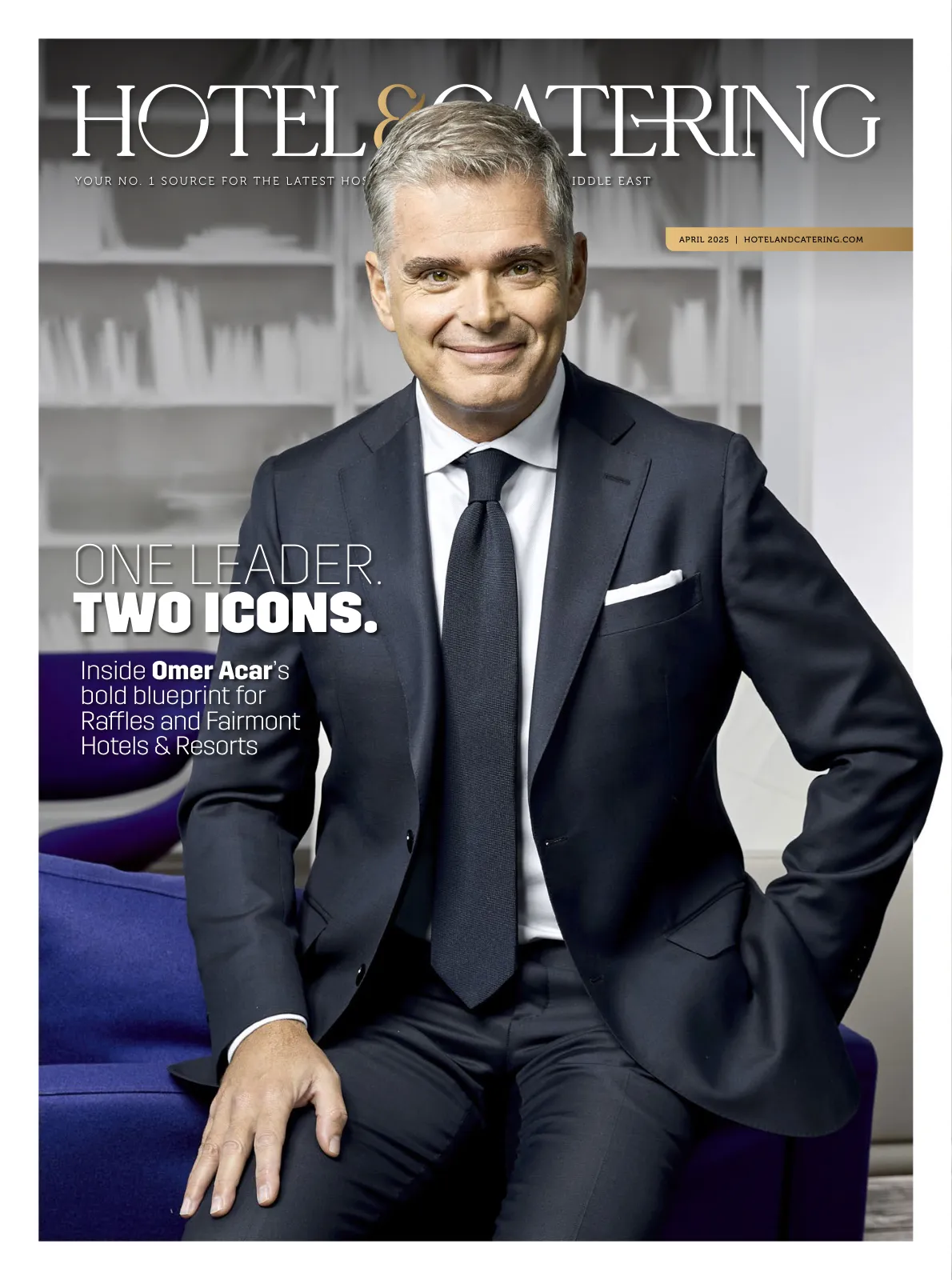
Hotel & Catering, April 2025
Page 1
Y O U R N O . 1 S O U R C E F O R T H E L AT E S T H O S P I TA L I T Y I N S I G H T S I N T H E M I D D LE E A S T
APRIL 2025 | HOTELANDCATERING.COM
ONE LEADER.
TWO ICONS.
Inside Omer Acar’s
bold blueprint for
Raffles and Fairmont
Hotels & Resorts
Page 2
Nestled by the coast of Lusail sits the splendor of
Raffles and Fairmont Doha, where luxury is rooted
in even the smallest details. Open the doors to
mesmerizing hospitality and make memories in a
world of sophistication.
Page 3
Page 4
On Arabsat Badr 26° East
More info:
travel.tv5monde.com
© Agence 17 mars - Ankama Animations / FTV / Tous droits réservés - Cube Creative / Blue Spirit / Télétoon+ / Canal+ - Cyber Group Studios - Peyo / Licensed through I.M.P.S. (Brussels)/ smurf.com
Page 5
travel.tv5monde.com
Idéfix et les Irréductibles © Les éditions Albert René / Goscinny-Uderzo - Remorques © MK2 - Tous droits réservés - 2025
VOD
PLATFORM
ENTERTAINMENT
TV CHANNEL
YOUTH
TV CHANNEL
Every family member’s show ’’en français’’ for free
Arabic subtitles available
TV5MONDE,
the package for your hotel guests
Page 6
6
APRIL 2025 | HOTELANDCATERING.COM
IN THIS ISSUE
THE LATEST
ADDITIONS
FROM MELIÁ
AND ME HOTELS
Meliá Hotels
International
and its lifestyle
brand ME by
Meliá continue
to expand their
global footprint
with a series of
exciting new
openings
MEET CHEF
OSMAN SEZENER
At Desert Rock
Resort in Saudi
Arabia’s Red Sea
region, where
sandstone cliffs rise
from the earth like
ancient sculptures,
a new culinary
experience is quietly
making waves
22
44
INSIDE OMER ACAR’S BOLD BLUEPRINT FOR
RAFFLES AND FAIRMONT HOTELS & RESORTS
ONE LEADER. TWO ICONS.
Contents
40 HOW TEAM DEVELOPMENT DRIVES SUCCESS AND PROFITABILITY
In today’s hospitality industry, the key to success isn’t just about having a
great strategy - it’s about having a great team
46 A NATION ON THE RISE
UAE tourism topped AED 45 billion in hotel revenues in 2024 as visitor
numbers soared and new developments fuelled global appeal
56 HOW AGRI-TECH IS TRANSFORMING THE UAE’S F&B LANDSCAPE
As global food supply chains face disruptions and environmental challenges
mount, the UAE’s F&B landscape is embracing a transformation powered by
agricultural technology, or agri-tech
18 UNLOCKING THE POWER OF REST
Four Seasons uncovers Sleep Insights in the GCC
26 MASTERING THE ART OF TRAVEL
As travel trends evolve, Collinson International – a
global company dedicated to helping travellers
move with ease and confidence – guides travellers
on how to become savvy in 2025
34 DINE-IN ORDERS DROP 15% IN DUBAI
DURING RAMADAN
Ramadan is reshaping the UAE food service market
28
Page 7
It’s time to gather
with loved ones during this
benevolent time, and share
heartwarming meals. Saint-
Félicien and Abondance
cheeses will bring a touch
of indulgence to your
celebration.
Photography & food styling by TheKateTin.com
Funded by the European Union. Views and opinions expressed are
however those of the author(s) only and do not necessarily reflect
those of the European Union or FranceAgrimer. Neither the
European Union nor the granting authority can be held responsible
for them.
Abondance
Saint-
Félicien
Pair together
Pair together
this Eid
this Eid
Page 8
8
APRIL 2025 | HOTELANDCATERING.COM
SUBSCRIBE
Contact subscriptions@bncpublishing.net to receive
Hotel & Catering every issue
CEO
Wissam Younane wissam@bncpublishing.net
MANAGING DIRECTOR
Rabih Najm rabih@bncpublishing.net
EDITOR-IN-CHIEF
Seymone L Moodley seymone@bncpublishing.net
COMMERCIAL MANAGER
Alex Brown alex@bncpublishing.net
MARKETING & COMMUNICATION LEAD
Aaron Joshua Sinamban aj@bncpublishing.net
DIGITAL EDITORIAL SUPPORT
Karan Moodley karan@bncpublishing.net
CREATIVE LEAD
Christian Harb chriss@bncpublishing.net
PO Box 502511 Dubai, United Arab Emirates
P +971 4 4200 506 | F +971 4 4200 196
For all commercial enquiries related to Hotel & Catering News ME,
contact sales@bncpublishing.net
All rights reserved 2025.
Opinions expressed are solely those of the contributors.
Hotel & Catering is officially licensed exclusively
to BNC Publishing in the MENA region.
No part of this magazine may be reproduced or transmitted in any form or
by any means without written permission of the publisher.
Printed by United Printing and Publishing | upp.ae
Images used in Hotel & Catering are credited when necessary.
Attributed use of copyrighted images with permission.
Hotel and Catering News ME
HotelCateringME
Hotel & Catering News Middle East
hotelcateringme
In addition to our print edition, we’re
bringing you all sorts of industry news on
our web mediums. We’re looking forward
to interacting with our readers on all of
our social media and web platforms. See
you on the web!
CREDITS
Page 9
9
HOTELANDCATERING.COM | APRIL 2025
CONTRIBUTORS
Contributors
01
03
02
04
CHEF OSMAN SEZENER,
“It’s not just about food—
it’s about fire, land, and
memory.”
BEN KOUIDER,
Founder, ChampagneSmart
& Champavin
“Champagne has always
been synonymous with
celebration, luxury, and
prestige.”
COLLINSON
INTERNATIONAL
“The airport experience
plays a crucial role in
how relaxed or stressed
your journey will be.”
PANOS LOUPASIS,
Market Managing Director Türkiye,
Middle East & Africa, Wyndham
Hotels & Resorts
“Staying agile and responsive to
these evolving demands is key to
ensuring sustained growth and
relevance.”
Hospitality Voices This Month
Page 10
Page 11
SUITE TREAT
Step into a world of opulence when you book a Suite at Raffles Doha.
Experience the added luxury of QAR 750 credit to spend
on dining in the hotel, and QAR 500 towards any Spa treatment.
Children aged 12 and below are welcome to indulge in the
enchantment of complimentary dining.
Rates starting from QAR 3,500 per night
For reservations, please call +974 4030 7100
or email reservations.doha@raffles.com
Raffles Doha, Iconic Towers, Marina District, PO BOX 4747, Lusail, Qatar
Page 12
12
APRIL 2025 | HOTELANDCATERING.COM
White Lotus
D
on’t judge me, but I didn’t jump on the White
Lotus train until a few days ago. I gave in because
it’s been such a big reference point in hospitality
insights since it aired. I mean, the show put hotel
brands and locations on the map, it stirred up a
frenzy, and I was genuinely curious about the connection. I’ve
only watched Season One and WOW. It’s quirky, dramatic, and
slightly insane, but I get why so many of my hospitality friends
are obsessed with it. It’s what I imagine a reality show about
hotel life would be like if it was completely raw and unfiltered,
and everyone was unhinged.
Yes, it’s a fictional story set in luxury-style resorts, but
it captures nuances that only hospitality professionals
truly recognise. It highlights the challenges of managing
guest expectations, maintaining professional boundaries,
developing emotional intelligence, and navigating stress
and burnout. It even opens up deeper social and cultural
conversations, the kind we’re rarely encouraged to express,
let alone explore. But White Lotus said it all, wrapped up in a
deliciously dark comedy bow, and it was great fun to watch.
What’s really interesting is the effect it has
on consumer behaviour and the luxury hotel
industry. For the latest season, a bunch of
brands collaborated with HBO to create White
Lotus-inspired products, including scented
candles, sunscreen, and overnight bags, all
priced at a pretty penny. Not to mention
that research found 51.9% of all social media
conversations mentioning Anantara in Asia
were driven by The White Lotus as of February
16. The show has triggered major spikes in
hotel search activity since it began.
So, if anyone wants to binge Season Two and
Three with me, provided you fill me in on all
the little details I might miss (off the record, of
course), I’m in! :)
While we don’t have any White Lotus
characters in this issue, we do have a great line-
up of features to choose from.
In this issue, we had the pleasure of speaking
with Omer Acar, CEO of Raffles and Fairmont,
about his global strategy to redefine luxury
hospitality with purpose and precision. We
look into recent travel trends during Ramadan
from a tourism perspective, with some
surprising findings on dine-in behaviour.
Plus, we explore a fascinating study by Four
Seasons examining core sleep patterns, guest
well-being, and how hotels can respond to these insights. And
there’s plenty more.
As always, I hope you enjoy this issue and I hope to see many
of you later this month at the Leaders in Hospitality Awards.
SEYMONE L MOODLEY
EDITOR-IN-CHIEF
seymone@bncpublishing.net
Seymone Leigh Moodley
seymonemoodley
EDITOR’S NOTE
H&C
Page 13
Part of:
Destination Partner:
Official Partners:
www.wtm.com/atm
The gateway to
global travel and
tourism growth
REGISTER NOW
#ATMDubai
Page 14
14
APRIL 2025 | HOTELANDCATERING.COM
Soar above the clouds and
discover a new take on wellness
at ZETA Seventy Seven in Address
Beach Resort. The stunning
destination is set to make history
once again with the launch of
Dubai’s first-ever Floating Yoga &
Pilates experience at the world’s
highest outdoor infinity pool. In
collaboration with Super SupFit,
renowned for its boutique fitness
sessions on stand-up paddle
boards at luxurious destinations,
this innovative event offers a
chance to elevate your fitness
routine while soaking in
breathtaking views of the Arabian
Gulf and the Dubai skyline.
ZETA SEVENTY SEVEN LAUNCHES THE WORLD’S FIRST
FLOATING YOGA & PILATES CLASS AT THE WORLD’S
HIGHEST OUTDOOR INFINITY POOL
DUBAI COLLEGE OF TOURISM COLLABORATES WITH MARRIOTT INTERNATIONAL
TO LAUNCH NEW HOSPITALITY APPRENTICESHIP PROGRAMME FOR EMIRATIS
Dubai College of Tourism (DCT),
part of the Dubai Department
of Economy and Tourism (DET),
has collaborated with Marriott
International to launch a new
Hospitality Apprenticeship
Programme for Emiratis,
reinforcing their joint commitment
to shaping the future of the UAE
hospitality industry. This initiative,
accredited by the UAE Ministry of
Education, will provide students
with a comprehensive education
that blends theoretical learning
with hands-on experience, setting
them on a path to successful
careers in the hospitality industry
in Dubai and the wider UAE.
OPENINGS & LAUNCHES
H&C
Page 15
15
HOTELANDCATERING.COM | APRIL 2025
The Future Hospitality Sum-
mit Saudi Arabia, taking place in
Riyadh, 11th –13th of May, will
host the region’s first NextGen
Investment Forum to address the
challenges and opportunities sur-
rounding education, training and
talent retention in KSA’s growing
hospitality sectors.
Investing in the next genera-
tion of leaders in hospitality is
fundamental to delivering KSA’s
Vision 2030 goals, according to
industry experts, who will come
together at FHS to explore and
discuss issues such as bridging
skill gaps, creating new pathways
to career growth, empowering
Saudi nationals and encouraging
more women to take up a career
in hospitality.
IDeaS, a SAS company and the
world’s leading provider of
hospitality revenue management
software, today announces
the launch of its cutting-edge
API data integration developer
portal. This innovative platform
is set to transform the hospitality
technology landscape by
enabling faster, more efficient
data integrations and fostering
unparalleled collaboration among
technology providers across the
ecosystem.
FHS SAUDI ARABIA LAUNCHES NEXTGEN INVESTMENT FORUM
TO HELP DELIVER KSA’S FUTURE LEADERS IN HOSPITALITY
IDeaS UNVEILS
GROUNDBREAKING API
DEVELOPER PORTAL
TO REVOLUTIONIZE
PARTNER
INTEGRATIONS
OPENINGS & LAUNCHES
Page 16
16
APRIL 2025 | HOTELANDCATERING.COM
NEWS & APPOINTMENTS
H&C
W Abu Dhabi – Yas Island,
the iconic five-star property
on Yas Island, is delighted to
announce the appointment
of its new General Manager,
Spencer Wadama.
With nearly three decades of
experience in the hospitality
industry, Spencer has a
proven track record of driving
operational excellence,
enhancing guest experiences,
and leading high-performing
teams. In his new role,
Spencer aims to elevate
W Abu Dhabi – Yas Island
through strategic leadership,
innovative guest offerings,
and a deep commitment to
service excellence, leveraging
his extensive expertise in the
luxury hospitality sector.
SPENCER WADAMA JOINS W ABU DHABI – YAS ISLAND
AS THE NEW GENERAL MANAGER
Epik Foods, the dynamic UAE-
born F&B group has announced
the acquisition of Sauce Capital, a
prominent Abu Dhabi-based food
group with a strong presence in Saudi
Arabia. This milestone acquisition
brings 15 new brands under the
Epik Foods umbrella, reinforcing the
group’s commitment to expanding
its regional footprint and introducing
diverse dining experiences. The
acquisition marks a significant step in
Epik Foods’ ongoing journey to build
a portfolio of innovative, customer-
focused concepts that resonate across
the region.
EPIK FOODS ACQUIRES
SAUCE CAPITAL
Page 17
NEWS & APPOINTMENTS
ROR Coffee Solutions, an
Emirati-owned speciality cof-
fee provider, has announced a
landmark AED 30 million invest-
ment to accelerate its expansion
and innovation strategy over the
next five years. This funding will
enhance the company’s pres-
ence across the MENA region
and Europe while reinforcing its
commitment to sustainability,
ethical sourcing, and cutting-
edge technology in the speciality
coffee industry.
Hilton announced the appointment of
Alessandro Redaelli as Vice President of
Operations for North Africa and Levant, based
at Hilton’s office in Cairo.
In his new role, Redaelli will be responsible
for Hilton’s dynamic portfolio across North
Africa and Levant, overseeing operations at
35 hotels across seven of Hilton’s market-
leading brands, with almost 50 additional
properties set to open in the coming years. His
appointment marks the creation of a dedicated
leadership role for North Africa and Levant,
further strengthening Hilton’s operations in the
respective key markets.
HILTON APPOINTS ALESSANDRO
REDAELLI AS VICE PRESIDENT OF
OPERATIONS FOR NORTH AFRICA
& LEVANT
ROR COFFEE SOLUTIONS SECURES AED 30 MILLION INVESTMENT TO DRIVE REGIONAL
AND GLOBAL EXPANSION
Page 18
18
APRIL 2025 | HOTELANDCATERING.COM
REPORT
H&C
Page 19
19
HOTELANDCATERING.COM | APRIL 2025
Power of Rest
Unlocking the
Four Seasons uncovers Sleep Insights in the GCC
A
fter undertaking a GCC-wide Yougov survey, the leading
luxury hospitality brand spotlights a series of core sleep
patterns, challenges, and opportunities to enhance guest
well-being.
As wellness continues to take centre stage in today’s world, the
consistency and quality of sleep are becoming increasingly impor-
tant in balancing the demands of fast-paced environments often
associated with urban lifestyles in the GCC. To uncover more spe-
cific insights, Four Seasons recently commissioned a region-wide
YouGov survey to explore sleep patterns and behaviours among
GCC residents. The findings offer valuable insights, guiding Four
Seasons in exploring how best to enhance offerings that prioritise
quality rest for GCC guests, both within the region and across its
global properties.
UNLOCKING THE POWER OF REST
Page 20
20
APRIL 2025 | HOTELANDCATERING.COM
The State of Sleep in the GCC
The survey of 2,727 respondents reveals core
insights into the region's sleep habits:
> Quantity of Sleep: While 51% of respondents
report sleeping six to eight hours per night, only
19% achieve the recommended eight or more hours
per night and 24% consistently sleep less than six
hours per night.
> Sleep’s Importance: 62% of GCC respondents
consider sleep “very important” to their overall
well-being, with women (67%) prioritising it more
than men (59%). Married individuals with children
(65%) place higher importance on sleep than
singles (55%).
> Symptoms of Sleep Deprivation: Fatigue (58%),
headaches (56%), and low energy (52%) are wide-
spread among those experiencing insufficient rest.
Notably, 65% of respondents aged 45 and above
report feeling fatigued, compared to an overall
average of 48%.
> Regional Variations: Sleep patterns differ across
the GCC, with respondents in Bahrain reporting
the highest average sleep duration (56% getting
6-8 hours) compared to lower averages in KSA and
Kuwait (48%).
A Home Away from Home
Understanding what makes a perfect night’s sleep
allows hotels to fine-tune their offerings and pro-
vide a truly restful escape that feels just like home
- or better. Here are some factors to consider:
> Key Amenities: In terms of important hotel
amenities, GCC respondents cited high-quality
mattresses and pillows (62%), temperature control
(61%), soundproofing (53%) and blackout curtains
(51%) as the most important contributors to a good
night’s sleep at a hotel.
> Gendered Experiences: Men (53%) report better
sleep quality in hotels compared to women (51%).
REPORT
H&C
“Understanding what
makes a perfect night’s sleep
allows hotels to fine-tune their
offerings and provide a truly
restful escape that feels just like
home - or better.
Page 21
21
HOTELANDCATERING.COM | APRIL 2025
The Role of Sleepcations in the
Hospitality Industry
The survey reveals a growing awareness
of quality sleep as a cornerstone of over-
all wellness. High-level professionals
and travellers are increasingly seeking
“sleepcations,” short stays designed to
optimise rest and rejuvenation. Four
Seasons properties are uniquely posi-
tioned to meet this demand by address-
ing common sleep barriers with offerings
that include:
> Signature Four Seasons Mattresses:
Four Seasons beds are designed for
maximum comfort, with three customis-
able mattress toppers available to every
guest, including Signature, Plush, or
Firm.
> Luxurious Linens and Robes: High-
thread-count sheets and plush robes
enhance comfort, making bedtime feel
indulgent and restorative.
> Enhanced Sleep Environments: Incor-
porating double-walled windows for
soundproofing, in-room temperature
controls, and blackout shades.
> Targeted Offerings: Recognising that
women and families with children value
sleep highly, properties can introduce
gender-specific amenities and family-
friendly packages to ensure restful stays
for these demographics.
Sleep at Four Seasons
To further elevate sleep quality, Four Seasons provides a selection of sleep-
focused experiences at select properties, allowing guests to discover personal-
ised approaches that align with their wellness needs:
> Sleeping Ritual at Four Seasons Resort Dubai at Jumeirah Beach: The Pearl
Spa offers a Sleeping Ritual comprising a relaxing tea ritual, foot bath, aro-
matic breath exercise, 20-minute back massage, and 20-minute scalp massage.
> Custom Pillow Menu at Four Seasons Hotel Bahrain Bay: Guests can choose
from a specially curated pillow menu tailored to individual sleep preferences,
including options like the Symphony Pillow for all-night support, the Long
Hug Pillow for added comfort, and the V-Shape Back Support Pillow for proper
neck and shoulder alignment.
> The Pearl Spa & Wellness at Four Seasons Hotel Abu Dhabi at Al Maryah Is-
land: Guests can enjoy sound healing therapy, guided meditation, and person-
alised yoga sessions to reduce stress and enhance overall sleep quality.
> Wellness Programmes at Four Seasons Hotel Amman: Complimentary night
stretching classes, yoga, and meditation sessions are available for in-house
guests to enhance sleep quality.
With sleep tourism emerging as a significant trend, Four Seasons focuses on
ensuring guests enjoy the most restful night’s sleep through unparalleled
luxury, customisable sleep amenities, and renowned personalised service. By
leveraging these insights, Four Seasons seeks to empower guests to unlock the
restorative power of rest, enhancing both their health and productivity.
UNLOCKING THE POWER OF REST
Page 22
22
APRIL 2025 | HOTELANDCATERING.COM
THE LATEST ADDITIONS
from MELIÁ and ME HOTELS
M
eliá Hotels International and
its lifestyle brand ME by
Meliá continue to expand
their global footprint with a
series of exciting new openings. From
vibrant city escapes to serene coastal
retreats, these upcoming proper-
ties promise bold design, exceptional
service, and unique guest experiences
worth looking out for.
STYLE & LEISURE
H&C
Page 23
THE LATEST ADDITIONS FROM MELIÁ AND ME HOTELS
Meliá Pattaya Hotel,
The Level One
Bedroom Suite
Page 24
24
APRIL 2025 | HOTELANDCATERING.COM
STYLE & LEISURE
H&C
With a design inspired by Pattaya’s attractions and
melting pot history and culture, and an eclectic din-
ing landscape including a beach club, Meliá Pattaya
Hotel is slated to open Q1 2025. Situated in vibrant
Pattaya, a short drive from Bangkok, on the Gulf of
Thailand’s east coast, the hotel stands 12 stories high
on Second Road, also known as Pattaya Sai Song.
In addition to the sun-soaked beach club fronting
Pattaya Beach, Meliá Pattaya Hotel will also cut
the ribbon on 234 contemporary rooms and suites,
a rooftop restaurant, an executive lounge, a vast
swimming pool with an enchanting adjacent bar and
function lawn, Meliá’s signature YHI Spa, kids club
Kidsdom, a fully-equipped gym, coworking area,
collection of versatile meeting spaces and more.
Meliá Pattaya Hotel’s debut follows the rollout of
Meliá Koh Samui in 2020, Meliá Chiang Mai in 2022
and INNSiDE By Meliá Bangkok Sukhumvit in 2023
in Thailand under the ownership of Asset World
Corporation (AWC).
Images courtesy of
Meliá Pattaya Hotel
Meliá Pattaya Hotel
Page 25
25
HOTELANDCATERING.COM | APRIL 2025
THE LATEST ADDITIONS FROM MELIÁ AND ME HOTELS
Images courtesy of
ME Lisbon
Opening in the heart of the historic Portuguese
capital in early 2025, ME Lisbon will showcase the
brand’s signature avant-garde design and cultural
programming, as well as world-class gastronomic
concepts, a Radio Rooftop Bar with panoramic
views, and over 600m2 of meeting and event space.
The 213-key property features rooms and suites ranging
from 31 - 138 sqm. Restaurants include Fismuler, an award-
winning restaurant from the La Ancha Family Group mak-
ing its debut outside of Spain; and Attiko, a rooftop restau-
rant launching for the first time in Europe. Attiko, by Chef
Moon, currently has a sister restaurant in W Dubai.
Further development plans for ME by Meliá include Spain
– with ME Málaga opening in Q1 2025 and ME Marbella fol-
lowing in Q2 2025 – as well as Greece, Albania, and China.
The brand will also bolster its presence in Mexico, with ME
Guadalajara and ME Sayulita both set to launch in 2025.
Joining ME Cabo, these new Mexican properties further
fortify Meliá’s expansion into Mexico, where it is expected
to double its presence in the next two years.
ME Lisbon
Page 26
26
APRIL 2025 | HOTELANDCATERING.COM
A
s travel trends evolve, Col-
linson International – a global
company dedicated to helping
travellers move with ease and
confidence – guides travellers
on how to become savvy in 2025. From
smart card spending and flight book-
ing to travel insurance and pre-airport
preparation, these insights ensure
seamless, cost-effective, and enjoyable
trips.
Expedia’s Unpack ’25 report reveals
key travel trends for 2025, focusing on
travellers from the UAE. One significant
trend is the rise of Detour Destina-
tions – lesser-known, tranquil locations
offering an escape from crowded tourist
hotspots. According to the report, 49%
of UAE travellers say they are likely to
visit a Detour Destination on their next
trip. Popular choices include destina-
tions like Reims, France, Brescia, Italy
and Santa Barbara, USA.
As more travellers seek relaxed, enrich-
ing experiences, Detour Destinations
are set to become popular choices for
2025. This shift is driven by a desire
for tranquillity and a growing trend of
mindful, conscious travel.
Booking flights to these lesser-known
yet accessible locations can be costly,
with transfers and car rentals often
required. However, travellers can save
by using flight comparison websites
(Skyscanner, Google Flights, Kayak) and
setting up price alerts to track fluctua-
tions. Flexibility is key: consider flying
to alternative airports or choosing
flights with layovers, which are often
cheaper than direct flights. Additionally,
airlines offering no-change fee options
provide peace of mind if plans change
unexpectedly. For added conveni-
ence, Priority Pass members can take
Mastering
the Art of Travel
TRENDS
H&C
Page 27
27
HOTELANDCATERING.COM | APRIL 2025
advantage of preferential rates for car rentals at over 50,000
locations worldwide, a service provided in partnership with
CarTrawler.
Hilton’s 2025 Travel Trends report highlights that travel-
lers from the UAE are increasingly prioritising rest and re-
laxation during their holidays. The research found that 81%
of UAE travellers value pampering during their trips, with
71% enjoying a day lying on the beach or by the pool. Ad-
ditionally, 43% book wellness or spa experiences to enhance
sleep during their travels, reflecting how travellers priori-
tise wellness and rejuvenation when it comes to holidays.
The airport experience plays a crucial role in how relaxed
or stressed your journey will be. As travel anxiety rises,
airports are improving passenger well-being. For example,
Dubai Airports recently launched yoga sessions and cycling
experiences to help travellers de-stress before their flights.
Another key trend in 2025 is long-haul travel, with more
travellers seeking adventures beyond familiar regions. This
shift reflects a desire to expand horizons and immerse in
new cultures. Along with this, unique experiences are top of
mind for many, with one in four travellers planning outdoor
adventures or cultural activities off the beaten path.
As travellers venture on action-packed trips, travel insur-
ance becomes essential. While only 7% of UAE residents
consider it a desirable feature when choosing a new pay-
ment card, travel insurance is crucial for protecting against
disruptions such as medical emergencies, trip cancellations
and lost luggage. Comprehensive coverage should include
medical expenses abroad, emergency evacuation, and
personal liability. Many premium travel credit cards offer
built-in travel insurance when booking flights, hotels, or car
rentals, providing coverage without additional
costs.
The rise of solo travel is another emerging trend.
Many travellers are seeking authentic connec-
tions, and operators like G Adventures now offer
small-group tours that transform strangers into
a close-knit crew. This growing trend reflects a
desire for shared experiences, fostering mean-
ingful relationships and friendships.
This trend ties into the challenge of digital dis-
connect. A significant number of UAE travellers
struggle to disconnect from their digital devices,
with 58% admitting they find it hard to reduce
phone use on vacation. Nearly half of UAE
residents report difficulty switching off entirely,
even on holiday. To address this, airports are
adding amenities to promote relaxation, with
airport lounges becoming essential spaces for
stress-free travel.
According to Skift, global travel spending is
expected to increase by 9%, highlighting that
travel remains a vital experience in helping
people feel connected and recharged. Collinson
International is every traveller’s helping hand
and leveraging tools like Priority Pass member-
ships, rewards cards and comprehensive travel
insurance to ensure travel is smoother, more
affordable and ultimately more rewarding is key.
Prioritise well-being, book flights smartly, and
invest in the right tools to ensure a seamless and
enjoyable travel experience.
MASTERING THE ART OF TRAVEL
Page 28
28
APRIL 2025 | HOTELANDCATERING.COM
COVER STORY
H&C
Inside Omer Acar’s bold blueprint for
Raffles and Fairmont Hotels & Resorts
BY SEYMONE L. MOODLEY
One Leader.
Two Icons.
OMER ACAR,
CEO of Raffles &
Fairmont Hotels
Page 29
29
HOTELANDCATERING.COM | APRIL 2025
ONE LEADER, TWO ICONS
I
n the ever-shifting landscape
of luxury hospitality, where
experience is currency and
perception is power, few leaders
have mastered the balancing
act between heritage and innovation
quite like Omer Acar, the globally
respected CEO of Raffles & Fairmont
Hotels & Resorts.
To lead not one, but two of the world’s
most storied luxury hotel brands is
no small undertaking. Each name
carries a weighty legacy. Each has set
the stage for some of history’s most
iconic gatherings, groundbreaking
events, and unforgettable personal
milestones. Yet Acar brings a clarity of
vision that transcends nostalgia.
He isn’t here to preserve a golden age
of hospitality. He’s here to define its
next era.
Two Icons
Raffles and Fairmont. Just the names
evoke cinematic grandeur, storied
lobbies, and impeccable service. How-
ever, while the brands share a position
at the pinnacle of luxury, their DNA
could not be more distinct.
“Raffles is a brand of inspiration and
elegance, wrapped in enchanted
glamour,” Acar tells me. “It offers an
escape into a curated world where
each stay is like stepping into a story.
On the other hand, Fairmont is about
energy and community. It’s where cit-
ies gather, where life’s most meaning-
ful celebrations unfold.”
Under Acar’s leadership, both brands
are being propelled into bold, ambi-
tious chapters with expansion plans
stretching across North America, the
Middle East, Europe, and Asia. But
rather than treat growth as a numbers
game, Acar’s approach is strategic and
thoughtful. His goal? Not just market
penetration, but cultural resonance.
“Our strategy is never about planting
flags. It’s about creating experiences
that feel tailor-made for the places
and people we serve.”
“Our strategy
is never about
planting
flags. It’s
about creating
experiences that
feel tailor-made
for the places
and people we
serve.
Raffles Udaipur
Raffles Spa Relaxation Area, Raffles Udaipur
Raffles Spa Reception, Raffles Udaipur
Page 30
30
APRIL 2025 | HOTELANDCATERING.COM
COVER STORY
H&C
Purposeful Growth, Global
Footprint
With only 23 Raffles properties
worldwide, the growth potential is im-
mense. However, Acar is meticulous
in how and where the brand expands.
In the last 18 months alone, Raf-
fles has opened in London’s historic
OWO, Boston, and two Indian cities,
Udaipur and Jaipur. In the pipeline:
Saudi Arabia, North America, and per-
haps most intriguingly, the possibility
of a Raffles ski resort in the American
West.
“The opportunities are endless, but
with Raffles, everything must be in-
tentional,” he says. “It’s not just about
luxury. It’s about soul.”
Fairmont, by contrast, is already a
global force, with 88 hotels across 30
countries. But Acar sees white space
still to be filled.
“In India, we’re expanding from one
to five hotels. In Saudi Arabia, we’re
building momentum. In the U.S., the
transformation of Fairmont Breakers
Long Beach and the groundbreak-
ing of Fairmont New Orleans are
symbolic of where we’re headed: new
icons for a new generation.”
Each new property isn’t just a place to
stay, it’s a declaration of intent.
Heritage Meets Tomorrow
Perhaps one of Acar’s most admirable
qualities is his deep reverence for
heritage, without being shackled by it.
He’s as comfortable referencing
Raffles Singapore’s storied 1887
beginnings as he is discussing
the fashion-forward “The Butler
Did It” campaign that reintro-
duced Raffles’ legendary service
with modern flair.
Page 31
31
HOTELANDCATERING.COM | APRIL 2025
“Legacy is a gift, not a limitation. It’s our responsibility
to evolve that legacy into something meaningful for today’s
traveller.
ONE LEADER, TWO ICONS
Page 32
COVER STORY
H&C
“Legacy is a gift, not a limitation,” he
reflects. “It’s our responsibility to evolve
that legacy into something meaningful for
today’s traveller.”
For Raffles, that evolution means a bespoke,
immersive guest experience: from marine
butlers educating guests on responsible
snorkelling to eliminating buffets in favour
of a la carte menus with locally sourced pro-
duce. It’s a new kind of luxury- experiential,
intentional, and surprising.
Fairmont, meanwhile, leverages its role as
the epicentre of city life. From iconic lobby
parties to high-stakes diplomatic meetings,
Fairmont properties have long hosted the
pulse of their communities. Now, through
innovations like Fairmont Gold, a “hotel
within a hotel”, Acar is ensuring that even
large-scale properties feel intimate, per-
sonal, and memorable.
Sustainability as a Brand Standard
In a sector where opulence often clashes
with environmental concern, Acar sees no
contradiction.
“Luxury and sustainability are not at odds,
they’re complementary,” he says.
Both brands fall under Accor’s ambitious
ESG strategy, but each interprets sustain-
ability through its own lens. At Raffles,
circular economy practices, architectural
sustainability from the outset, and hyper-
local food sourcing are standard. At Fair-
mont, the focus is on renovation, innova-
tion, and scale.
The jewel in this effort: the Fairmont Royal
York in Toronto, which, through a multi-
million-dollar retrofit, is set to reduce 80%
of its annual carbon emissions, the equiva-
lent of removing 1,558 cars from the road.
“This isn’t just marketing. It’s impact. And
that’s the kind of leadership we want to
show.”
More importantly, Acar calls for industry-
wide collaboration, noting that “in sustain-
ability, cooperation must eclipse competi-
tion.”
Hospitality Powered by Humanity
For all his strategic precision, Acar’s phi-
losophy rests on something deeply human.
“In an age of automation and AI, what makes luxury unforgettable is the
people behind it.”
Whether it’s a Raffles butler texting a guest to confirm a dinner reserva-
tion or a Fairmont Gold concierge remembering your preferred tea,
Acar believes in empowering his teams to deliver authentic, anticipatory
service.
He speaks with admiration about his time visiting Fairmont The Palm
in Dubai, where staff instinctively set his breakfast table just the way he
likes it. “Those gestures create emotional connections. That’s loyalty.
That’s love.”
He’s equally passionate about internal leadership. “Great hospitality be-
gins behind the scenes. If we inspire our teams, they’ll inspire our guests.”
His leadership philosophy is clear: elevate the people, and the brand will
follow.
Page 33
Looking Ahead
As 2025 approaches, the brands’ future looks not just expan-
sive, but transformational.
Raffles will return home to Singapore with the unveiling of
Raffles Sentosa, a 62-villa sanctuary overlooking Tanjong Bay,
dedicated to wellness and private seclusion. In Jeddah, a cul-
turally rich hotel will celebrate Saudi art and craftsmanship.
Meanwhile, Fairmont’s debut in Japan, with a striking Tokyo
property near Rainbow Bridge, and its first in the Czech
Republic, Fairmont Golden Prague, will usher in a new era of
East-meets-West grandeur. In Spain, Fairmont La Hacienda
Costa del Sol will reinterpret Mediterranean joy with Andalu-
sian flair.
This is more than a pipeline. It’s a global repositioning an-
chored by vision and driven by purpose.
Omer Acar isn’t merely guiding Raffles
and Fairmont through market expan-
sions and brand refreshes. He is rede-
fining what global luxury hospitality
looks and feels like in this century.
He is doing so with courage, clarity, and
most of all, conviction.
In a world where travellers seek more
than just five-star service, Acar’s legacy
will be defined not by the number of
hotels he opens, but by the worlds he
creates within them.
He’s not just leading a brand. He’s
shaping the future of hospitality.
ONE LEADER, TWO ICONS
Page 34
34
APRIL 2025 | HOTELANDCATERING.COM
THE BUSINESS OF RAMADAN
H&C
R
amadan is reshaping the
UAE food service mar-
ket, which was valued at
$16.58 billion in 2024 and
is projected to reach $50.21
billion by 2033, growing at a CAGR
of 12.20%. Recent data from Syrve
MENA, a leading restaurant software
provider in the Middle East, reveals
notable shifts in consumer behaviour
during this holy month.
Syrve MENA reported a 15% decrease
in dine-in restaurant orders in Dubai
during Ramadan compared to the
rest of the year. This pattern suggests
that residents often prefer evenings
with family instead of dining out.
While the data doesn't explicitly
confirm that people prepare Iftar
meals at home, the decrease in res-
taurant visits indicates that evening
meals typically occur at home or with
guests.
Despite declining restaurant orders,
the food delivery sector has demon-
strated resilience, as evidenced by
the differing peak hours across various cuisines and locations. According to Syrve
MENA's internal data, venues in mall locations show a 13.6% increase in delivery
orders during Ramadan compared to regular periods. For example, food halls re-
ceived approximately 26.7% of their orders between 19:00 and 21:00 during Rama-
dan. Middle Eastern restaurants, which locals prefer for Iftar, showed a significant
concentration of orders during late-night hours, with 51.3% of their total orders
occurring between 23:00 and 03:00 during Ramadan.
This pattern aligns with broader regional trends. Restaurants in Saudi Arabia also
experience peak demand before Iftar and late at night. Food delivery orders in the
MENA region typically surge between 8:00 PM and 11:00 PM, reflecting the cul-
tural importance of breaking fast together. Traditional dishes dominate Ramadan
orders, with Samosas, Mahshi, Knafeh, Opor Ayam, and Rendang being popular
Iftar choices.
DURING RAMADAN
DROP 15% IN DUBAI
Dine-In Orders
A REPORT BY SYRVE MENA
Page 35
DINE-IN ORDERS DROP 15% IN DUBAI DURING RAMADAN
Restaurants also experienced an
average decline of approximately
11% in dine-in orders across dif-
ferent cuisine types compared to
regular weeks. This trend varies by
restaurant category: Middle East-
ern cuisine (20.6%), Italian cuisine
(10.8%), Indian (7.6%), and Central
Asian cuisine (5.1%). While some
establishments maintain stable
delivery numbers, overall patterns
shift during fasting hours.
At the same time, average dine-in
order values show a slight overall
increase of approximately 5.3%
during Ramadan. “The average
order value across Syrve MENA cli-
ents' restaurants for delivery dur-
ing Ramadan is 140.34 AED, while
for dine-in, it is 158.00 AED. While
most of our clients experienced
decreased dine-in orders, 13.6%
of establishments saw a rise in
delivery despite slightly lower order
values,” said Alexander Ponomarev,
CEO at Syrve MENA.
These trends reflect the broader
cultural impact of Ramadan on
dining habits in the MENA region.
With 54% of consumers in Saudi
Arabia and the UAE planning to
share more meals with family and
friends and 41% of UAE residents
expecting to increase spending, the food
service industry continues adapting to
these seasonal changes. The projected
52% rise in online grocery sales results
from the growing preference for
convenient dining solutions during the
holy month, as consumers opt for
home-cooked meals and traditional
dishes during Ramadan.
DESPITE DECLINING
RESTAURANT
ORDERS, THE FOOD
DELIVERY SECTOR
HAS DEMONSTRATED
RESILIENCE, AS
EVIDENCED BY THE
DIFFERING PEAK
HOURS ACROSS
VARIOUS CUISINES
AND LOCATIONS.
ALEX PONOMAREV,
CEO of Syrve MENA
Page 36
36
APRIL 2025 | HOTELANDCATERING.COM
I
n today’s connected world, hotels have become
increasingly attractive targets for cybercriminals.
Among the most common and dangerous threats
are phishing scams - deceptive tactics that exploit
human error to gain access to sensitive information
or financial resources. From guest data to internal
systems, hotels have a lot to protect - and often, not enough
safeguards in place. In the Middle East’s often hectic hotel
markets, which feature guests and staff from a larger mix of
countries than many other locations around the globe, extra
risks exist. Here’s why the industry is vulnerable and how
hotel professionals can stay ahead of the risks.
The hospitality industry presents a perfect storm for
cybercriminals. Several operational realities make hotels
particularly susceptible to phishing attacks:
> High Staff Turnover: With seasonal staff and frequent
changes, cybersecurity training often falls behind.
> Multiple Data Touchpoints: Guest information passes
through many hands - reception, reser-vations, housekeep-
ing - each one a potential entry point.
> Vendor Dependencies: Hotels rely on
a variety of external partners, which
scammers can im-personate with rela-
tive ease.
> Outdated Systems: Legacy property
management systems may lack mod-
ern cybersecurity fea-tures.
> Urgency Culture: Hotel staff are
trained to respond quickly - exactly
the kind of environment scammers
exploit.
Additionally, in the UAE and many
other Middle Eastern markets, often
employ more expatriate workers
from diverse linguistic and cultural
backgrounds. This can create com-
munication gaps or misunderstand-
ings—especially when phishing emails
are written in imperfect English but
still ap-pear “official.” Employees un-
familiar with the nuances of phishing
language might not recognise red flags.
Also, in many Middle Eastern cultures,
hierarchical respect is deeply embed-
ded in the workplace. This makes Busi-
ness Email Compromise (BEC) attacks
particularly effective - staff may be
more likely to follow a directive from
someone posing as a GM or area direc-
tor without ques-tioning its legitimacy.
Personally, I feel that there’s also an
overall culture that normalises digital
behaviour, which is frowned upon in many other parts of
the world. For example: How many times in the past year
have you sent your passport or ID card copy to a company/
individual via email or WhatsApp? It’s still relatively nor-
mal in the Middle East, yet virtually unheard of in Europe.
At the same time, the region is home to a concentration
of luxury properties and high-net-worth clien-tele. This
makes hotels in the Middle East attractive to attackers
not only for the data they hold but also because phishing
messages can be crafted to appear as urgent or elite guest
service issues - further reducing suspicion.
Understanding the typical scams can help you recognise red
flags before damage is done:
> Email Phishing: Spoofed emails that appear legitimate,
prompting users to click malicious links or attachments.
> Business Email Compromise (BEC): Fake requests from
‘executives’ for wire transfers or gift cards.
> Spear Phishing: Highly targeted emails referencing real
people or events.
PHISHING & SCAMS IN HOSPITALITY
WHY AWARENESS IS YOUR BEST LINE OF DEFENCE
BY MARTIN KUBLER, CHIEF SLOTH AT THE GLUTTONOUS SLOTH, HORECA CONSULTING WITH ATTITUDE
POINT OF VIEW
H&C
Page 37
host.fieramilano.com
17–21
OCTOBER
2025
fieramilano
INTERNATIONAL
HOSPITALITY EXHIBITION
NEW SHAPES OF
HOSPITALITY
> Fake Attachments: Job applications or invoices with em-
bedded malware.
> Phone-Based Scams: Imposters pretending to be IT staff
or vendors seeking credentials.
If you think that you’re immune from falling victim to
scams and frauds, think again. Unfortunately, the hotel
industry has already seen high-profile and costly examples
of phishing and scam-related breaches. One of the most
notable cases was the Marriott International data breach,
which began as early as 2014 but was only discovered in
2018. The breach, which affected over 500 million guests,
involved compromised login credentials - likely obtained
through phishing or other social engineering tactics.
Smaller hotels have also been hit. For instance, a boutique
hotel in the UK lost over £100,000 after receiving what
appeared to be a legitimate invoice from a regular supplier,
which turned out to be a spoofed email from a fraudster.
In another case, a hotel group in the U.S. had to shut down
part of its reservation system for days after an employee
opened a malware-infected resume attachment, leading
to ransomware being deployed across its network. These
incidents highlight that no hotel is too large - or too small -
to be targeted.
Cybersecurity doesn’t have to be complicated, but it must
be consistent. Here are practical ways hotels can protect
themselves:
> Offer regular training for staff on recognising phishing
attempts. Some great tools to use here are services like
phished.io or Hoxhunt, which automate cybersecurity
training and make it a lot of fun.
>
Use multi-factor authentication for all essential sys-
tems.
> Establish clear internal procedures for verifying pay-
ment or bank detail changes.
> Restrict access to sensitive systems based on roles.
> Keep all software and systems up-to-date.
> Have an incident response plan ready - and test it
periodically.
Hotels operate in a fast-paced, guest-centric environ-
ment - but that doesn't mean cybersecurity should take
a back seat. With the right training, tools, and aware-
ness, the risk of falling for phishing and similar scams
can be drastically reduced. In the hospitality industry,
protecting guests starts with protecting their data.
PHISHING & SCAMS IN HOSPITALITY
Page 38
38
APRIL 2025 | HOTELANDCATERING.COM
F&B FOCUS
H&C
C
hampagne has always
been synonymous with
celebration, luxury, and
prestige. Yet, for many
years, the local market had ac-
cess to only a limited selection
of renowned champagne houses,
resulting in restaurant wine lists
that looked almost identical.
While these brands introduced
guests to exceptional champagne,
they also created a somewhat
narrow perception of what cham-
pagne could be.
Today, that landscape is shifting.
The UAE has emerged as a major
player in the global champagne
market, with imports surging
from 1.9 million bottles in 2022 to
2.8 million in 2023. The country
is now on track to enter the top 10
Champagne-consuming nations
worldwide – a testament to the
growing enthusiasm for this ex-
traordinary wine. But it’s not just
about volume; it’s about diversity.
The Rise of Grower Champagnes
One of the most exciting develop-
ments in recent years is the rising
popularity of grower Cham-
pagnes – boutique, terroir-driven
wines crafted by independent
producers who cultivate their
own grapes and oversee the entire
winemaking process. Unlike
the large champagne houses
that source fruit from multiple
vineyards to ensure consistency,
grower champagnes offer a more
expressive and unique taste of the
land.
Distributor like Champavin and
champagne educator like Cham-
pagneSmart have played a crucial
role in this transformation, ex-
panding access to artisanal labels
and educating consumers. As a
result, grower champagnes are
now a prominent feature in top
restaurants, private collections,
BUBBLING UP
Champagne’s Evolution
on Local Menus
Page 39
39
HOTELANDCATERING.COM | APRIL 2025
BUBBLING UP
and luxury hospitality venues. This shift reflects a broader
consumer trend – people are seeking authenticity, crafts-
manship, and a deeper connection to what they drink.
A More Adventurous Consumer
A decade ago, champagne offerings in the region lagged be-
hind global trends. But thanks to the efforts of sommeliers,
wine educators, food critics, and distributors, that gap has
narrowed significantly. The influx of new residents to Dubai
has also accelerated change, bringing a more adventurous
mindset to champagne consumption.
There’s a growing demand for low-intervention, low-sulfite,
and low-dosage champagnes, mirroring global trends
toward more natural winemaking. Consumers from Russia
and Asia are already familiar with grower champagnes,
as these wines were widely available in their home coun-
tries. Their influence, combined with a new generation of
consumers who are eager to explore, is reshaping the way
champagne is enjoyed in the region.
Champagne as a Full Dining Experience
Once limited to aperitifs and celebrations, champagne is
now taking centre stage in full dining experiences, with
restaurants curating thoughtful pairings that highlight its
versatility. Rich, creamy cheeses like Brillat-Savarin find
an ideal match in Rosé de Saignée Champagne, where the
wine’s acidity and red fruit notes cut through the cheese’s
luscious texture. For heartier dishes, lamb chops pair
beautifully with rosé champagne, as its depth and structure
enhance the meat’s richness. Even fried foods are being
reimagined alongside champagne, with crisp Blanc de
Blancs proving to be an unexpectedly perfect complement
to fried chicken or simple French fries, its bright acidity
balancing the fat for a refined yet playful contrast. These
creative pairings are redefining champagne’s role at the
table, challenging traditional perceptions and expanding
the possibilities of how it can be enjoyed.
The Future of Champagne on Menus
Restaurants are also redefining their champagne programs
by moving away from predictable selections and embracing
Champagne maps and regional diversity. This shift allows
venues to curate wine lists based on their cuisine and iden-
tity, rather than defaulting to familiar labels.
Producers like Henri Giraud from Aÿ are at the forefront
of innovation, gaining traction for their oak-aged Blanc de
Blancs and Ratafia Champenois, a fortified wine that has
found its way onto pairing menus. These
unique offerings showcase the depth of
champagne beyond the classics.
A Bright Future Despite Challenges
The upcoming reintroduction of the
30% alcohol sales tax in 2025 will un-
doubtedly impact champagne prices, but
the demand for quality remains strong.
Consumers today are more willing to
invest in exceptional, terroir-driven
champagnes, and if producers, distribu-
tors, and restaurants work together, the
impact on accessibility can be mini-
mised.
The evolution of champagne on local
menus is not just about drinking trends
– it’s about storytelling, craftsmanship,
and experience. As the region continues
to embrace this transformation,
champagne is moving beyond its role as
a celebratory drink and cementing itself
as a dynamic, versatile, and essential
part of the dining experience.
BEN KOUIDER,
Founder,
ChampagneSmart
& Champavin
There’s a growing demand for low-
intervention, low-sulfite, and low-dosage
champagnes, mirroring global trends toward
more natural winemaking.
Page 40
40
APRIL 2025 | HOTELANDCATERING.COM
PEOPLE OPS
H&C
In today’s hospitality industry, the key to success isn’t just
about having a great strategy - it’s about having a great
team. As guest expectations continue to rise and operations
become more complex, it’s the hotels that invest in their
people that stand out. Strong, well-trained teams don’t
just provide better service; they create memorable guest
experiences and drive long-term profitability. In fact, a
report by Deloitte found that 94% of executives and 88% of
employees believe a strong organisational culture is crucial
to business success, with team dynamics at its core.
There’s no doubt about it - developing our teams directly
impacts our bottom line. When employees are engaged, the
results speak for themselves. When teams are highly en-
gaged, the business is undoubtedly more profitable, proving
that when our staff feel valued, motivated, and supported,
our business thrives.
The Link Between Team Development and Employee
Engagement
In my experience, engaged employees don’t just clock in
and out - they take pride in their work and genuinely care
about the guest experience. That level of commitment starts
with investing in team-building initiatives, training, and
fostering a strong workplace culture. Studies support this
too with research showing that a positive workplace culture
leads to a 36% higher employee retention rate. When we
create an environment where employees feel supported,
they don’t just stick around - they flourish. The message is
clear: when we invest in our teams, we strengthen both our
culture and our business performance.
Fostering a Collaborative Culture to Drive Innovation
Collaboration isn’t just a buzzword - it’s essential for in-
novation. When departments work together, share ideas,
HOW TEAM DEVELOPMENT DRIVES
SUCCESS and PROFITABILITY
BY SHERIF KASSEB, GENERAL MANAGER AT RIXOS AL MAIRID RAS AL KHAIMAH
Page 41
41
HOTELANDCATERING.COM | APRIL 2025
HOW TEAM DEVELOPMENT DRIVES SUCCESS AND PROFITABILITY
and communicate openly, we can solve problems faster and
adapt more easily to industry shifts. McKinsey & Company
found that organisations prioritising collaboration can see a
20-30% increase in productivity. This isn’t just theory; I’ve
seen first-hand how breaking down silos and encouraging
cross-team communication leads to fresh ideas and better
problem-solving.
The Power of Cross-Training in Hospitality
In hospitality, adaptability is everything. Whether it’s man-
aging unexpected staff shortages or handling peak seasons,
cross-training gives teams the flexibility to keep operations
running smoothly.
According to studies, cross-training optimises resource
allocation and ensures a seamless guest experience. These
employees are more engaged and less likely to leave, helping
us reduce turnover. Investing in structured cross-training
programs not only improves service levels but also prepares
team members for leadership roles, fostering a culture of
continuous learning and growth.
Enhancing Efficiency and Cost Management
When we prioritise team development, we’re not just creat-
ing a positive work environment - we’re also improving
efficiency and managing costs more effectively. Training
programs streamline operations, reduce redundancies, and
optimise staffing, leading to tangible cost savings. Linked-
In’s research highlights that strong teamwork initiatives
enhance a company’s reputation, motivating employees
and increasing retention. And as we all know, retaining staff
means lower recruitment and training expenses, allowing
us to reinvest in our teams and guest experiences.
The Role of Team Development in Customer Service Excel-
lence
At the heart of hospitality is great service, and great service
starts with well-trained, engaged employees. When we
create a culture where our teams take pride in delivering
exceptional guest experiences, we build long-term guest
loyalty. Additionally, businesses that invest in staff train-
ing for service enhancement see a 63% higher customer
retention rate. Whether it’s through role-playing scenarios
or real-time customer service simulations, continuous
training ensures our staff are equipped to exceed guest
expectations.
Turnover and Increasing Employee Retention
Turnover is one of the biggest challenges in our industry,
and we all know how costly it is to constantly recruit and
train new employees. The good news? Investing in profes-
sional development makes employees more likely to stay.
And it’s not just about training - recognition and rewards
also play a huge role. Hotels that implement structured rec-
ognition programs, like performance incentives and career
development awards, see noticeable increases in
employee engagement and retention.
Long-Term ROI of Team Development
There’s no question that investing in our teams
pays off. Research shows that businesses offering
comprehensive training programs experience
a 27% lower turnover rate. Hospitality Insights
also reports that hotels with structured team de-
velopment initiatives see a return on investment
ranging from 10% to 40% - clear evidence that
when we invest in people, we see real financial
benefits.
Leadership development is another key factor.
Properties that integrate leadership training into
their frameworks report higher internal promo-
tion rates, reducing recruitment costs and ensur-
ing leadership continuity.
At the end of the day, a hotel is only as strong as
its team. By fostering collaboration, enhancing
employee engagement, and prioritising continu-
ous learning, we don’t just improve our opera-
tions- we build a culture where employees feel
valued and guests feel welcomed.
The data is clear: investing in our teams leads to
higher productivity, better guest experiences, and
stronger financial performance. If we want to stay
ahead in this competitive industry, we must make
team development a priority. Because when our
employees thrive, our business thrives.
SHERIF KASSEB,
General Manager at
Rixos Al Mairid Ras
Al Khaimah
Page 42
42
APRIL 2025 | HOTELANDCATERING.COM
Deliveroo for Work Evolves into an All-in-One
Corporate Companion
MOVERS AND SHAKERS
H&C
Page 43
43
HOTELANDCATERING.COM | APRIL 2025
D
eliveroo for Work (DFW),
the corporate division of the
well-known food delivery
platform, has expanded its
services beyond meals to include office
supplies and a selection of non-food
items. The move reflects a broader
shift in corporate consumption habits
and highlights a strategic push by
the company to diversify its offering
at a time when workplace dynamics
and procurement models continue to
evolve.
The expansion allows businesses to
order items such as cleaning products,
stationery, flowers, and pharmacy
goods through the Deliveroo app, in
addition to meals and snacks. It is a
response to growing demand from
companies seeking a centralised sys-
tem for managing everyday workplace
needs. What was once a platform for
ordering lunches or team breakfasts is
increasingly being used to stock pan-
tries, coordinate birthday celebrations,
and facilitate in-office events.
Francis Henderson, Head of Deliveroo
for Work Middle East, noted that the
way businesses operate is changing,
and that there is a greater need for
streamlined, flexible systems that
reduce operational complexity. "We
are committed to providing a seamless
and efficient solution for companies
looking to simplify their workplace
management," he said.
The shift is part of a wider trend within
platform-based service providers that
are extending their reach into adjacent
categories in order to retain users and
increase the lifetime value of corporate
clients. For companies like Deliveroo,
which operates on high-frequency,
high-convenience models, diversifica-
tion into non-food categories is a logi-
cal step. It also offers a potential buffer
against seasonal fluctuations in food
delivery and opens the door to new
revenue streams.
This type of expansion is also a
reflection of how corporate procure-
ment has changed. As hybrid working
models become more common, many
businesses are reassessing how they
support their employees — both in and
out of the office. There is a growing
expectation for workplaces to of-
fer thoughtful amenities and create
environments that promote comfort,
convenience, and well-being. Services
that can consolidate multiple procure-
ment needs into one platform help
businesses manage this complexity
more efficiently.
The integration of retail and office sup-
ply items into Deliveroo for Work also
offers practical advantages. Compa-
nies benefit from simplified invoicing,
centralised expense reporting, and a
reduction in administrative overhead.
Instead of managing multiple suppli-
ers and delivery schedules, businesses
are able to access a broad range of
goods and services through a single
interface, with unified payment terms
and consistent delivery standards.
Importantly, this move positions
Deliveroo for Work within a broader
conversation about the future of
workplace services. As companies
continue to streamline their opera-
tions and seek cost-effective ways to
manage employee engagement and
office management, platforms that of-
fer wider solutions are likely to play a
more prominent role.
While this expansion may seem like a
small operational adjustment, it
signals a larger shift in how on-de-
mand platforms are evolving to remain
relevant in the business-to-business
space. By diversifying their offerings,
companies such as Deliveroo are not
only adapting to customer demand but
are also finding new ways to remain
competitive in a market where
flexibility and breadth of service are
increasingly valued.
DELIVEROO FOR WORK EVOLVES INTO AN ALL-IN-ONE CORPORATE COMPANION
Page 44
44
APRIL 2025 | HOTELANDCATERING.COM
Who’s cooking
CHEF OSMAN
MEET
SEZENER
The celebrated
Consulting Chef known
for blending tradition
with bold innovation.
WHO’S COOKING
H&C
Page 45
45
HOTELANDCATERING.COM | APRIL 2025
At Desert Rock Resort in Saudi Arabia’s Red Sea region,
where sandstone cliffs rise from the earth like ancient
sculptures, a new culinary experience is quietly making
waves. At the heart of this dramatic desert landscape is
Nyra, a restaurant that embraces elemental cooking in its
purest form—where flames, smoke, and local ingredients
are the stars of the show. Steering the vision is Chef Osman
Sezener, the celebrated Consulting Chef known for blend-
ing tradition with bold innovation.
For Sezener, this isn’t just another restaurant project—it’s
a deeply personal expression of his culinary identity. “Nyra
is about creating something timeless,” he says. “It’s not just
about food—it’s about fire, land, and memory.”
Long before he became a Michelin-starred chef, Sezener
was shaped by his family’s legacy in Izmir, Turkey. His
father’s Italian restaurant, Ristorante Pizzeria Venedik,
has been a fixture in the city for over 45 years, earning a
MICHELIN Guide recommendation and serving genera-
tions of loyal guests. “It’s where I learned that food is more
than taste—it’s emotion, connection, heritage,” he reflects.
Sezener’s culinary education spans continents. After study-
ing in New York at the French Culinary Institute and in-
terning in Europe’s finest kitchens, he returned to Turkey
with a vision to redefine local fine dining. That vision came
to life with OD Urla, his flagship restaurant set among olive
groves near the Aegean coast. Embracing a farm-to-table
approach, OD Urla is now one of Turkey’s most celebrated
restaurants, honoured with a Michelin Star, a Green Star,
and the 2025 Michelin Sommelier Award.
At Nyra, Sezener brings the same philosophy—rooted in
sustainability, locality, and authenticity—to the Saudi
desert. Here, he explores what it means to cook with fire,
not just as a technique, but as a form of storytelling. The
menu is built around Saudi-sourced ingredients—camel
milk, dates, zaatar—and seasonal produce found in nearby
markets. His aim? To eventually source at least 80% of the
ingredients from within the Kingdom.
“There’s a rawness to this place,” Sezener says, gesturing
to the surrounding rock formations. “It demands honesty
in the way we cook. Fire strips everything down to its es-
sence.”
Nyra’s dishes mirror that ethos. Expect dry-aged meats
kissed by embers, wood-fired seafood, and vegetables
charred to perfection. Signature plates—like grilled
octopus with smoked potato cream or braised beef cheek
with Turkish coffee and barley—carry echoes of Sezener’s
roots while honouring the local context. Even vegetarian
dishes—like roasted celeriac or fire-grilled zucchini—are
given space to shine.
Beyond technique and flavour, Nyra is designed to spark a
connection—with nature, with people, and with the ancient
rituals of cooking over fire. “The desert slows you down,”
Sezener says. “It invites you to pause, to reflect. That’s what
we want our guests to feel here.”
With a portfolio that includes OD Urla, Kitchen by Osman
Sezener at The Bodrum Edition, and now Nyra at Desert
Rock, Sezener continues to redefine what contemporary
Turkish cuisine looks like. But in the stillness of the Saudi
desert, where fire meets silence and food becomes a
memory, it’s clear that Nyra holds something even deeper:
a sense of place, purpose, and passion.
“ It’s not just about
food—it’s about fire,
land, and memory.
MEET CHEF OSMAN SEZENER
Page 46
46
APRIL 2025 | HOTELANDCATERING.COM
TRAVEL AND TOURISM
H&C
A Nation on the Rise
UAE tourism topped AED 45 billion in hotel
revenues in 2024 as visitor numbers
soared and new developments fuelled
global appeal
T
he UAE’s tourism sector delivered a
standout performance in 2024, rein-
forcing its position as one of the most
dynamic contributors to the national
economy. Hotel revenues reached approxi-
mately AED 45 billion—a 3% increase from
the previous year—highlighting the country’s
continued success in attracting travellers from
around the world and delivering exceptional
guest experiences. With world-class infra-
structure, a diversified tourism offering, and a
strong strategic vision, the UAE continued to
pave the way for sustainable tourism growth.
His Excellency Abdulla bin Touq Al Marri,
Minister of Economy and Chairman of the
Emirates Tourism Council, credited this
achievement to the UAE’s leadership and its
commitment to innovation and resilience in
the tourism sector. “The UAE continued to
advance its national efforts to develop innova-
tive tourism initiatives and projects, while
strengthening collaboration with all relevant
local and international tourism bodies,” said
H.E. Bin Touq.
Page 47
47
HOTELANDCATERING.COM | APRIL 2025
A NATION ON THE RISE
Page 48
48
APRIL 2025 | HOTELANDCATERING.COM
TRAVEL AND TOURISM
H&C
He added that the tourism sector remained a central pillar
of the country’s economic strategy in 2024, supporting its
transition towards a knowledge- and innovation-driven
economy. Through sustainable policies, targeted invest-
ment, and strong public-private partnerships, the UAE laid
the groundwork for long-term success across its tourism
ecosystem.
In 2024, hotel occupancy rates across the country reached
78%, ranking among the highest both regionally and glob-
ally. This milestone reflected the UAE’s broad appeal—of-
fering everything from modern city breaks and luxury re-
treats to rich cultural experiences and natural adventures.
The increase in occupancy was further supported by the
opening of 16 new hotels across the seven emirates, bring-
ing the national total to 1,251 hospitality establishments.
Simultaneously, hotel room capacity expanded to 216,966,
marking a 3% growth compared to 2023.
The rise in guest numbers was equally noteworthy. The
total number of hotel guests in 2024 reached approxi-
mately 30.8 million, representing a 9.5% year-on-year
Page 49
49
HOTELANDCATERING.COM | APRIL 2025
A NATION ON THE RISE
increase. Notably, this figure accounted for 77% of the hotel
guest target set by the ‘National Tourism Strategy 2031’—a
goal achieved seven years ahead of schedule. H.E. Bin Touq
noted that this early success positioned the country well on
its path to attracting 40 million hotel guests annually.
The performance in 2024 was further bolstered by the
UAE’s efforts to promote tourism through dynamic market-
ing campaigns, new product development, and landmark
events. These initiatives showcased the country’s most
iconic destinations across all seven emirates, strengthening
the UAE’s global tourism identity and
building lasting connections with new
and returning travellers.
Now, in 2025, the UAE is poised to
build on this momentum with a packed
calendar of events and strategic initia-
tives aimed at enhancing the visitor
experience and further diversifying its
offerings. A key highlight for the year
is the designation of Al Ain as the Gulf
Tourism Capital for 2025, a recognition
that places renewed focus on the coun-
try’s cultural and natural heritage. This
milestone is expected to stimulate inter-
est in inland tourism, especially among
visitors seeking authentic experiences
beyond the major urban hubs.
The government continues to priori-
tise the development of niche tourism
segments—including eco-tourism,
adventure tourism, wellness travel, and
cultural heritage experiences—while
creating greater opportunities for
Emirati talent and entrepreneurship in
the sector. At the same time, it is actively
fostering investment in new attractions
and hospitality developments, ensuring
the industry remains agile and future-
ready.
As the UAE progresses toward its goal of
becoming the best tourism identity
globally by the next decade, its results
speak for themselves. The achievements
of 2024 stand as proof of a destination
that not only delivers on its promises but constantly evolves
to exceed expectations. With strong foundations in place
and a clear vision for the future, the UAE’s tourism journey
is set to inspire the world.
“The UAE continued
to advance its national
efforts to develop
innovative tourism
initiatives and projects,
while strengthening
collaboration with
all relevant local and
international tourism
bodies.
Page 50
50
APRIL 2025 | HOTELANDCATERING.COM
TRAVEL AND TOURISM
H&C
MEETING THE EVOLVING
NEEDS OF TRAVELLERS
Panos Loupasis, Market Managing Director Türkiye, Middle East & Africa
at Wyndham Hotels & Resorts, shares his insights on the changing travel
preferences the industry is seeing across the region and beyond.
PANOS LOUPASIS, MARKET MANAGING DIRECTOR TÜRKIYE, MIDDLE EAST & AFRICA,
WYNDHAM HOTELS & RESORTS
T
he Middle East is experiencing a
transformative moment in travel,
fueled by rapid developments
and a vibrant sense of reinven-
tion. Travellers are drawn by the region's
innovative hospitality, cultural richness,
and the promise of meaningful, immersive
experiences. This momentum is further
validated by the region's global tourism re-
covery, with international arrivals exceed-
ing pre-pandemic levels by 32 percent in
2024. Projections indicate this growth will
continue, with a 3-5% increase in interna-
tional tourist arrivals anticipated in 2025,
reaffirming the Middle East's position as a
leader in the global tourism landscape.
As visitor numbers rise, so does the
diversity of traveller preferences and
needs. Staying agile and responsive to
these evolving demands is key to ensuring
sustained growth and relevance, fostering
trust, and ultimately building enduring
brand loyalty.
The ‘trend’ that is here to stay
The rise of sustainability has moved far
past the realm of being a passing prefer-
ence, and rightly so. Sustainable prefer-
ences and practices have become an
integral pillar of how the travel industry
operates or strives to operate, and how
travellers make decisions. From seeking
more eco-friendly accommodation options
to exploring local culture and communi-
ties as opposed to bigger cities; eco-con-
sciousness is a large part of hospitality that
is here to stay. Ensuring these efforts are
communicated transparently with guests
is just as big of a part of implementing and
maintaining eco-friendly efforts. Trans-
parency builds trust and allows travellers
to align their values with their accommo-
dation choices.
At Wyndham, we believe in leading by
example, showcasing our commitment
to sustainability through our Wyndham
Green Certification programme. This al-
lows guests to easily see a hotel’s sustain-
ability rating, comprised of five progres-
sive levels measuring energy and water
conservation, waste diversion, and opera-
tional efficiency, simply by looking for the
badge on our hotels’ website pages. By the
end of 2024, we proudly achieved an 85%
compliance rate across 195 sites, dem-
onstrating our dedication to embedding
Page 51
51
HOTELANDCATERING.COM | APRIL 2025
MEETING THE EVOLVING NEEDS OF TRAVELLERS
sustainable practices throughout our
portfolio. Striving to be accountable
for our brand's environmental impact
is very important to us, as it allows us
to make better connections with our
guests as they make informed and
trusted decisions regarding their ac-
commodation preferences.
The next generation of travellers
The newest generation of travellers,
‘Gen Z,’ is becoming a significant
driver of global tourism trends. Char-
acterised by their digital savviness,
hyper-awareness and social con-
sciousness, they are challenging the
status quo and remaining steadfast in
what they want as travel consumers.
The newest generation of travel-
lers appears to prefer to spend their
hard-earned money on experiences
rather than high-end amenities, with
motives such as experiencing differ-
ent cultures and trying local cuisine
ranking highly in their motives to
travel. Ensuring your brand caters
to this new wave of potential guests
means luxury isn’t always the top
option, and providing accommoda-
tion options that are accessible and
affordable while not compromising
on quality can ensure you remain on
their radar. Additionally, global trends
such as over-tourism, restrictions on
platforms like Airbnb in major cities,
and quotas on tourism visitation at
popular global sites are gradually
driving travellers to explore new, re-
mote destinations. These destinations
often provide unique experiences,
from direct engagements with local
communities and authentic cultural
interactions to culinary adventures
and nature-based activities.
Travellers today are increasingly
drawn to historical sites, cultural
landmarks, and activities that pro-
mote physical and mental wellness.
They seek destinations where they
can balance visitation with relaxation,
discovery, and meaningful, unique
experiences. For brands in the hospi-
tality and tourism sector, embracing
this shift and creating opportunities
for travellers to connect with these
emerging trends will be vital to cap-
turing their attention and loyalty.
Embracing the Fluidity of Modern
Travel
Gone are the days of rigid vacation
schedules confined to a week or two
before returning to reality and resum-
ing normal operation. Today, travel
is becoming much more fluid and
flexible, seamlessly integrating into
our lifestyles. The rise of remote work
and digital nomadism has blurred the
lines between leisure and business
travel, with individuals opting for
extended stays and finding balanced
ways to incorporate work into their
trips.
This shift in travel behaviour presents
an immense opportunity for hotels
to innovate and provide ever more
flexible accommodation options that
cater to the needs of those who don’t
fit the traditional traveller mould.
Whether offering comfortable options
for extended stays that feel like home
or providing remote work-friendly
amenities or package offers, embrac-
ing this fluidity enables hotels to
stay relevant and appeal to those not
looking for a standard one-size-fits-all
accommodation option. In addition
to this, new accommodation trends
are gradually coming to the forefront.
Concepts such as student housing and
hostels—often design-led—are becom-
ing popular for their generous public
areas featuring coworking spaces,
shared kitchens, and laundry rooms.
Another rising trend is branded
residences, whether sold as invest-
ments under rental pool programs or
as permanent residences for buyers.
At Wyndham, we recognised this
opportunity early on and launched
dedicated residential brands a few
years ago, including Wyndham Grand
Residences, Wyndham Residences,
and Ramada Residences. Equally no-
table are design-led lifestyle brands,
which emphasise generous public
areas and distinctive F&B concepts,
often catering to the surrounding
community and creating a vibrant,
inclusive atmosphere.
Another critical trend shaping the
future of travel and hospitality is the
growing role of artificial intelligence.
As AI continues integrating into our
daily lives, it is poised to become a
powerful enabler in travel planning
and execution. Rather than replac-
ing the human factor, AI serves as a
complement, optimising data mining
and analysis to deliver tailored solu-
tions and actionable insights. From
enhanced personalisation to data-
driven strategies across the entire
customer journey, AI is expected to
contribute to a more seamless and
efficient travel experience, help-
ing hotels and travellers alike make
more informed and customised
decisions.
The future face of hospitality
As we look ahead, it's evident that
the landscape of travel will continue
to evolve at a rapid pace. Embrac-
ing innovation and adaptability is
imperative for our industry to stay
ahead of the curve. By anticipating
the shifting needs and preferences of
travellers, we can not only meet but
exceed their expectations, cementing
our position as trusted players in the
ever-changing world of travel.
Let us chart a course toward a more
prosperous and inclusive future for
the travel industry, seizing the
opportunities that lie ahead and
continuing to pave the way for
unforgettable journeys that transcend
borders and cultures for tomorrow’s
travellers.
PANOS LOUPASIS, Market Managing
Director Türkiye, Middle East & Africa,
Wyndham Hotels & Resorts
Page 52
52
APRIL 2025 | HOTELANDCATERING.COM
TRENDS
H&C
Saudi Travel Trends
During Ramadan
A
s the holy month of Ramadan approached,
Wego, the number one travel app and
largest online travel marketplace in the
Middle East and North Africa (MENA)
unveiled insights into the travel habits of Saudi
travellers during this spiritually significant season.
From homecoming trips to performing Umrah and
international getaways, Wego’s data highlighted key
trends that shaped travel preferences during Rama-
dan 2024 and offered early indicators for 2025.
A Surge in Ramadan Travel Bookings
Ramadan has long been a peak travel period for Sau-
di residents, with many planning trips for religious,
cultural, or leisure purposes. According to Wego’s
data at the time, travel bookings from Saudi Arabia
witnessed a 131.69% month-over-month surge,
signalling heightened interest in both domestic and
international travel as the holy month neared.
While March drove peak bookings, Egypt, India, and
Pakistan remained the top international destina-
tions for Saudi travellers, reflecting strong cultural
and familial ties. On the domestic front, Jeddah,
Riyadh, and Dammam continued to dominate travel
preferences, offering a mix of spiritual, family, and
leisure experiences.
Luxury and Comfort Took Centre Stage
Saudi travellers placed a premium on comfort, with
4- and 5-star hotels accounting for 53.12% of all ac-
commodation bookings for both international and
domestic stays. This trend underscored the prior-
itisation of luxury hospitality and high-end services
when travelling during Ramadan.
Additionally, performing Umrah remained a key
driver of travel during this period. The top five most-
booked hotels in Saudi Arabia for Ramadan 2024
and early 2025 were all located in Makkah, reaffirm-
ing the city's central role in Ramadan travel. While
Umrah can be performed year-round, its spiritual
significance during Ramadan continues to attract
visitors seeking an enriched religious experience.
Aparthotels and luxury resorts ranked as secondary
choices, catering to families and individuals who
sought comfort with added privacy.
The Rise of Solo Travel
An emerging trend in Saudi Arabia’s travel land-
scape was the growing preference for solo trips.
Wego’s data revealed that 76.32% of all Saudi users
booking Ramadan trips in 2024 were solo travellers,
with early 2025 numbers indicating a continuation
of this pattern.
While family and couples’ travel remained im-
portant segments, the dominance of solo travel
suggested a shift in how Saudi residents approached
personal and spiritual experiences during Ramadan.
This trend was particularly evident among younger
travellers who embraced the flexibility of solo trips
for Umrah and leisure travel.
Mobile-First Travel Planning
The digital shift in travel planning continued to gain
momentum, with 62% of Ramadan 2024 bookings
made via the Wego app. The increasing reliance on
mobile technology highlighted the growing demand
for seamless, on-the-go itinerary management, real-
time booking convenience, and personalised travel
recommendations.
“As Saudi travellers prepared for Ramadan and Eid,
we saw a clear preference for effortless mobile-first
travel planning, along with a strong inclination
toward premium hospitality and performing
Umrah,” said Mamoun Hmidan, Chief Business
Officer at Wego. “Our insights reaffirmed Wego’s role
in enabling travellers to find the best experiences
tailored to their needs, whether they were travelling
for Umrah, reuniting with family, or exploring new
destinations.”
Saudi Arabia Saw a 131% Surge in Travel
Bookings Ahead of Ramadan
A STUDY BY WEGO
Page 53
53
HOTELANDCATERING.COM | APRIL 2025
SAUDI TRAVEL TRENDS DURING RAMADAN
MAMOUN HMIDAN,
Chief Business Officer
at Wego
“Our insights
reaffirmed Wego’s
role in enabling
travellers to
find the best
experiences
tailored to their
needs, whether they
were travelling for
Umrah, reuniting
with family, or
exploring new
destinations.
Page 54
54
APRIL 2025 | HOTELANDCATERING.COM
TECH & INNOVATION
H&C
O
ver the past decade, the hospitality industry
has faced mounting pressure to meet the
evolving needs of travellers who crave more
than just a place to stay. From the initial
research of their destination to checking
out and going home, today’s travellers seek
experiences that are tailored to their preferences, delivered
quickly, and offered with the utmost convenience. Whether
it's finding the best local restaurant, securing a last-minute
spa appointment, or receiving personalised recommenda-
tions for activities, travellers want instant access to all of
this from their mobile devices.
Looking ahead, the hospitality and travel industry will have
to completely discard the one-size-fits-all solution. In the
future, each guest will have to be treated as an individual,
and at the forefront of the inevitable
transformation is Artificial Intelli-
gence (AI). A technology which, with
its ability to continually learn and
adapt, will drive the modernisation of
an industry that has long been resist-
ant to change.
It is beyond question that AI will
play an increasingly crucial role in
transforming guest experiences by –
in simplified terms - leveraging data to provide customised
services. The technology can analyse guest behaviours,
preferences, and even contextual factors like the time of
day or the type of trip (business, leisure, romantic getaway)
to offer real-time recommendations. Inherently, AI holds
extensive potential for intelligent applications of hotel and
travel technology.
Let’s take the example of the concierge service. Traditional
concierge services are often constrained by office hours and
limited staff availability, making scalability and efficiency
a pain point. In contrast, an AI-powered concierge plat-
form can operate 24/7, across multiple languages, and can
handle unlimited guest interactions at once. It’s like having
an entire team of highly efficient, omnipresent concierges
working around the clock.
IN MODERNISING THE GUEST EXPERIENCE
THE FUTURE OF AI
BY SAMIR ABI FREM, CEO OF LOKALEE
It’s time for the hospitality industry to discard the one-
size-fits-all solution and go all in with personalisation
Page 55
55
HOTELANDCATERING.COM | APRIL 2025
THE FUTURE OF AI IN MODERNISING THE GUEST EXPERIENCE
While hotel staff can offer recommendations based on their
expertise, these rarely align perfectly with each guest's pref-
erences. An AI-powered platform, however, is able to pro-
cess advanced data analytics to understand individual guest
behaviours and desires. For instance, based on a guest’s
past interactions or preferences, AI can suggest a local
restaurant that matches their culinary tastes or recommend
an itinerary for sightseeing activities that align with their
interests. Eliminating the need for guests to sift through ge-
neric recommendations or wait for human assistance, this
level of detail is what makes each stay feel bespoke.
The true strength of AI lies in its ability to learn and adapt
over time. By tracking guest behaviours, preferences, and
traffic patterns over time, AI acquires a predictive capability
and becomes more intuitive with each use. This means that
repeat guests will enjoy an increasingly personalised expe-
rience, as the AI tech solution adapts to their changing pref-
erences and anticipates future needs with greater accuracy.
The more you use the platform, the smarter it becomes.
Furthermore, AI can tackle the challenge of handling
routine guest requests. Tasks like booking transportation,
ordering room service, or providing directions can be man-
aged digitally, freeing up staff to focus on more complex
and high-value guest interactions. This shift not only
boosts operational efficiency but also transforms the guest
experience, ensuring that every need is met promptly and
effectively.
Looking further into the future, what can we expect? I per-
sonally believe that the next big development within AI will
be human-like communication. Thanks to advancements in
natural language processing (NLP), AI is rapidly improving
its ability to understand and engage in conversations that
feel more human. This technology will enable smoother,
more intuitive interactions between guests and hotel sys-
tems, whether through chatbots or messaging platforms.
Soon, guests will be able to make reservations, request ser-
vices, or receive local recommendations simply by speaking
or typing in natural language. This breakthrough will create
a more seamless, instant, and personalised experience,
allowing guests to communicate with a hotel in a way that
feels just like talking to a real person.
SAMIR ABI FREM, CEO of Lokalee
Page 56
56
APRIL 2025 | HOTELANDCATERING.COM
TECH & INNOVATION
H&C
How Agri-Tech
F&B Landscape
is Transforming the UAE’s
A
s global food supply chains face disruptions
and environmental challenges mount,
the UAE’s F&B landscape is embracing a
transformation powered by agricultural
technology, or agri-tech. This shift is enhancing
local food production, promoting sustainability,
and ensuring food security in a region historically
reliant on imports. Agri-tech innovations are not
only reducing dependency on foreign produce but
also reshaping the culinary landscape by providing
chefs and caterers with consistent, high-quality, lo-
cally sourced ingredients that support a sustainable
future.
The Shift Towards Local, Sustainable Sourcing
For years, the UAE has relied on imports to meet
over 85% of its food needs. However, the UAE’s Na-
tional Food Security Strategy 2051 is now prioritis-
ing sustainable, local food production and resilience
against external shocks, with the goal of ranking
among the top 10 countries in the Global Food Secu-
rity Index by 2021 and aspire to become the world’s
most secure by 2051. By supporting initiatives like
climate-smart farming and increasing investments
in agri-tech, the UAE is working towards creating a
reliable, environmentally friendly source of high-
quality ingredients.
BY LEO MUSATOV, CO-FOUNDER AND MANAGING DIRECTOR AT FUTURE FOOD FOUNDRY (3F).
Page 57
57
HOTELANDCATERING.COM | APRIL 2025
HOW AGRI-TECH IS TRANSFORMING THE UAE’S F&B LANDSCAPE
Significantly, the Emirates Development Bank recently
launched the UAE’s first-of-its-kind AgriTech Loans
Program, allocating AED 100 million to support the food
security sector. Investments such as these enable local
farmers to adopt agri-tech solutions, which both enhance
food security and reduce the environmental impact of
transportation emissions, promoting fresher and premium
ingredients. Additionally, the agri-tech market in the UAE
is projected to grow from USD 3.17 billion in 2023 to USD
4.09 billion by 2029, reflecting a compound annual growth
rate (CAGR) of 4.30%. These developments underscore the
UAE's commitment to advancing its agri-tech industry and
achieving greater self-sufficiency in food production.
Supporting Culinary Innovation with Tech-Driven Agricul-
ture
The UAE’s embrace of Agriculture 4.0, which includes
vertical farming, hydroponics, and data-driven precision
agriculture, is transforming the nation’s agricultural land-
scape. Agri-tech advances have already enabled the UAE to
grow an impressive array of produce domestically, includ-
ing herbs, leafy greens, salmon, and organic eggs, which
reduces the need for imports and lowers carbon emissions.
Notably, vertical farming alone comprises 36% of the UAE’s
agri-tech industry, indicating its substantial role in local
food production.
For example, Greeneration, a Dubai-based vertical farming
company, specialises in growing premium edible flowers,
microgreens, and speciality leaves tailored for high-end
culinary professionals.
The Role of Agri-Tech in Crafting Sustainable Menus
Modern diners are prioritising sustainability, and agri-tech
is providing chefs with the tools to meet this demand by
offering functional, locally grown ingredients with reduced
environmental impact. The UAE is now producing an im-
pressive variety of foods domestically, from herbs and leafy
greens to salmon and organic eggs, reducing dependence
on imports and lowering carbon emissions.
Through innovations such as precision
agriculture, farms can optimise resources,
resulting in environmentally friendly crops
that support health-conscious and eco-
friendly menus. This approach allows chefs
to offer fresh, sustainable options while
reducing their carbon footprint.
Building a Resilient, Future-Ready Supply
Chain
In the UAE’s journey towards food security,
resilience in supply chains is essential. The
National Food Security Strategy 2051 is a
key framework in this mission, emphasising
the need to protect against global disrup-
tions by building strong local food networks.
The Sharjah Investment Forum and similar
platforms highlight the role of agri-tech
in addressing environmental challenges,
conserving water, and building stable supply chains. Ad-
ditionally, the UAE is now producing climate-resistant
crops, including drought-tolerant wheat varieties, to ensure
a more resilient and secure food system.
Embracing a Future-Ready F&B Landscape
The UAE’s commitment to local sourcing, advanced
farming methods, and resilient supply chains is setting a
new standard for food security and sustainability. By
reducing reliance on imports, integrating tech-driven
agriculture, and supporting culinary creativity, the nation’s
F&B industry is paving the way for a future of enhanced
food security and innovation. Agri-tech is enabling the UAE
to build a sustainable, adaptable, and future-ready food
landscape, meeting today’s challenges and preparing for a
more resilient tomorrow.
LEO MUSATOV,
Co-Founder and
Managing
Director at Future
Food Foundry
(3F)
Page 58
58
APRIL 2025 | HOTELANDCATERING.COM
D
ata and data analytics are increasingly playing a
vital role across various sectors, including agri-
culture. Today, people can enjoy efficient delivery
of their favourite agricultural produce, thanks to
the modern food supply chain that relies heavily on data
analytics.
Large-scale agriculture involves managing large quantities
of inputs and outputs, which generates a huge number of
data points. To improve the productivity of crops and live-
stock, scientists are developing and deploying technologies
such as drones and Internet of Things (IoT) sensors, with
machine learning being used to gather and process these
data. These give farmers real-time information about their
crops, the weather, and soil conditions, leading to enhanced
decision-making and productivity.
The success of modern agriculture relies on being able to
extract and analyse the data and act on the insights obtained
– something easier said than done due to fragmented data
and technology inequalities. Nonetheless, it is important to
harness the capabilities of data analytics to tackle various
challenges in feeding the global population, which is fast
approaching 8.2 billion.
Among the most important factors in agriculture are the
climate and the weather. Knowledge of climate and weather
patterns gained over thousands of years has been passed
down by farmers, dictating planting and harvesting sched-
ules. Unfortunately, numerous famines throughout history
were caused by weather anomalies, such as droughts or
floods. With modern weather satellite imagery and other
meteorological technologies, farmers are now able to pre-
dict and prepare for weather disturbances. This is especially
important as climate change moves humanity into unchart-
ed territory and poses a significant threat to global food se-
curity. Such a scenario makes it imperative for agricultural
scientists to acquire greater knowledge more rapidly and
be able to identify data patterns to find out what works and
what doesn’t and allow farmers to adapt accordingly.
Large-scale agriculture uses tremendous amounts of
resources, such as land, energy, water, and fertilisers, with
agricultural waste posing a significant environmental con-
cern. With proper data analysis, farmers can identify areas
where inefficiency and wastage are high and take corrective
measures, giving rise to precision farming. One example is
the use of an IoT-enabled precision irrigation system that
can reduce water consumption by 30% while producing
larger yields. On the other hand, practices such as restora-
tive agriculture, integrated pest management, and agroecol-
ogy require a more intimate understanding of how nature
works – and what better way to achieve this than through
accurate data.
Another positive side effect of increased efficiency is profit-
ability, which can stimulate more investments into data-
driven agriculture, especially with consumer preferences
leaning towards more organic and ethical farming practices.
Clearly, as digital technology and data analytics continue to
advance, their contributions to strengthening agriculture
and food production are becoming more crucial.
BY JADD ELLIOT DIB, FOUNDER & CEO, PANGAEA X
HOW DATA AND DATA ANALYTICS HELP BRING
YOUR FAVOURITE DISHES TO THE DINING TABLE
TECH & INNOVATION
H&C
Jadd Elliot Dib is the founder of data analytics platform Pangaea X, which
allows clients from all industries to access high-quality, specialised data
analytics talent.
Page 59
A Luxury Beachfront Escape
Boasting one of the destination’s most enviable settings, Anantara Mina Al Arab Ras Al Khaimah Resort
sits on a private peninsula of golden sands, overlooking a mangrove lagoon and the open ocean. Bask in
the emirate’s first overwater villas. Savour global flavours with exquisite dining experiences. Embark on
sea adventures or cocoon yourself in spa tranquility.
ANANTARA MINA AL ARAB RAS AL KHAIMAH RESORT
ANANTARA.COM
P.O. Box 4005, Al Huwailat St, Mina Al Arab, Ras Al Khaimah, UAE I +971 720 42222 I rasalkhaimah@anantara.com
Page 60