Logistics News, April 2023
Page 1
CONNECTING TRADE PROFESSIONALS WITH INDUSTRY INTELLIGENCE
L A S T- M I L E
J&T Express
Middle East
M A R I T I M E
Artemis
Technologies
O P E D
complexities of short
shelf-life goods
APRIL 2023
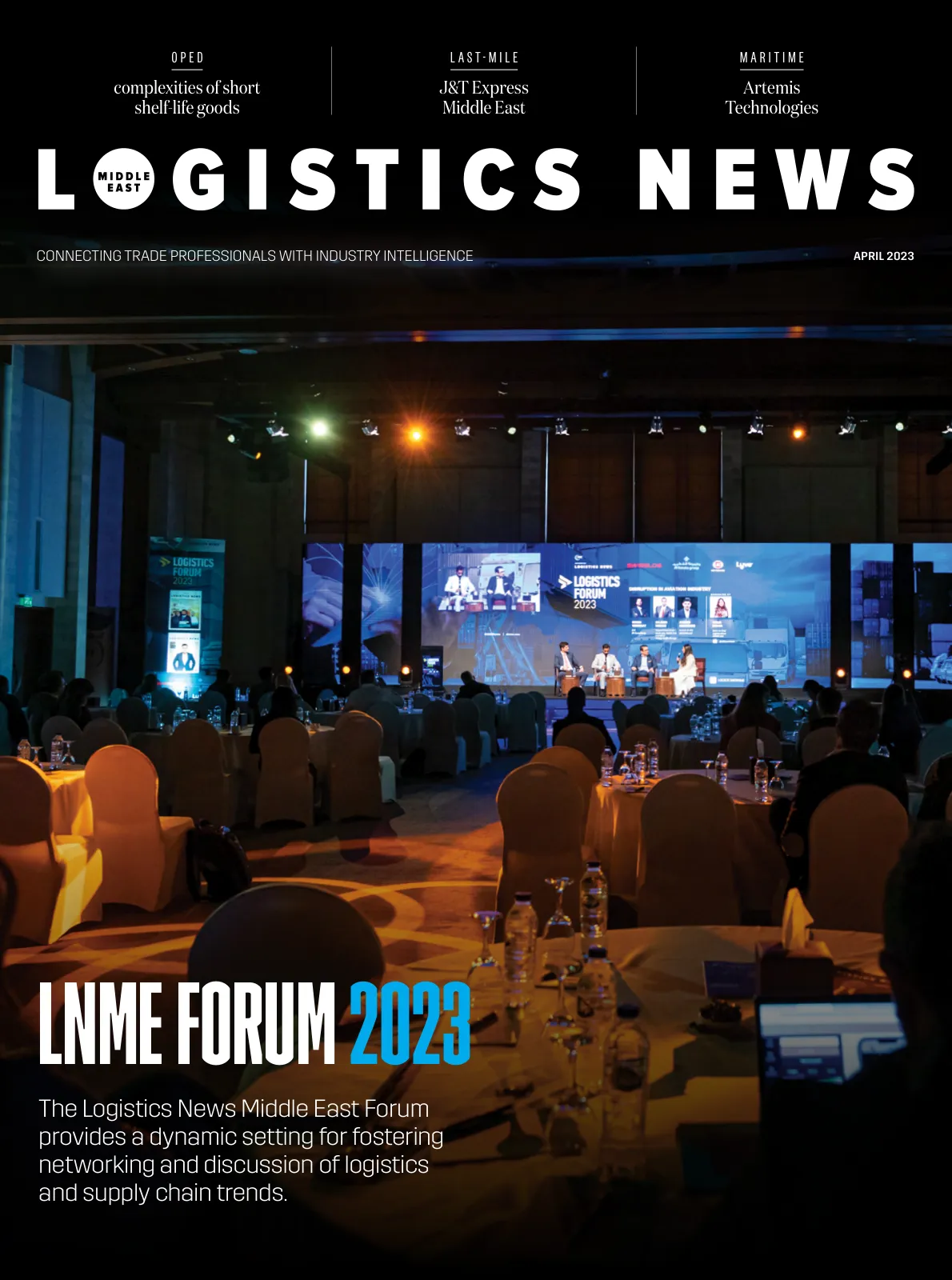
LNME FORUM 2023
The Logistics News Middle East Forum
provides a dynamic setting for fostering
networking and discussion of logistics
and supply chain trends.
Page 2
New IVECO T-WAY: high productivity and safety on off-road terrains
With a complete line-up of AWD and PWD versions and the the 16-speed HI-TRONIX automated
gearbox, the IVECO T-WAY features a host of functionalities such as Rocking Mode, Off-road Mode,
Creeping Mode and 4 reverse gears to tackle with ease the toughest off-road conditions. The new
architecture of the EBS system, combined with disc brakes on all wheels, greatly improves the vehicle’s
performance and the driver’s safety in the most demanding applications.
New IVECO S-WAY: high technology and efficiency for on-road missions
The new IVECO S-WAY, with a completely redesigned and reinforced cab, offers a wide choice of
Euro III/V diesel engines, a delivering class-leading power from 360 HP to 560 HP Euro III / 570 HP
Euro V and superior fuel-saving devices, such as anti-idling feature, Ecoswitch, Ecoroll and Smart
Alternator, 12-speed HI-TRONIX automated transmission with the most advanced technology
in its category, electronic clutch and best-in-class torque-to-weight ratio.
Drive the new way.
Page 3
LOGISTICS NEWS ME | APRIL 2023 | 3
IN THIS ISSUE
LNME FORUM 2023
16 OPED
MANAGING THE LOGISTICS
COMPLEXITIES OF SHORT SHELF-LIFE
GOODS
Dr Shereen Nassar, global director of
logistics studies and director of MSc
Logistics and supply chain management
suite at Heriot-Watt University Dubai, pens
down her thoughts
18 ANALYSIS
ESG INVESTMENT
And how COP28 will impact regional
sustainability trends
20 FORETHOUGHT
DOMINO EFFECT
How incremental change can make waves
for sustainable logistics in the Middle East
22 DATA
HOW TO BUILD SUPPLY CHAIN
RESILIENCE THROUGH DATA?
Mohamed Zouari, General Manager at
Snowflake Middle East, Turkey, and Africa,
discusses with us the sheer pliability of
data in the future of the supply chain
26 LAST MILE
THE EXCEPTIONAL REGIONAL EXTENSION
Vibha Mehta talks to Sean Xiao, CEO of J&T
Express Middle East, to learn about the
business’s progressive growth in the region
44 MARITIME
EVERYTHING YOU WANT TO KNOW
ABOUT MARITIME TECHNOLOGY
Logistics News ME speaks with David Tyler,
Commercial Director at Artemis Technologies, to
learn more about Smart Shipping and Maritime
Tech
46 E-COMMERCE
AMAZON MENA LAUNCH DXB5
FULFILMENT CENTRE IN DUBAI
Vibha Mehta speaks with Prashant Saran,
Director of Operations for Amazon MENA, to
know more about Amazon’s increasing footprint
in the region
50 HOSPITALITY
LOGISTICS IN HOSPITALITY
Richard Cowling, Director of Operations at
Gates Hospitality shared with us about the
essentials of logistics and supply chain
THE LOGISTICS NEWS
MIDDLE EAST FORUM
PROVIDES A DYNAMIC
SETTING FOR FOSTERING
NETWORKING AND
DISCUSSION OF LOGISTICS
AND SUPPLY CHAIN
TRENDS
18
50
30
Page 4
Page 5
Page 6
6 | LOGISTICS NEWS ME | APRIL 2023
WWW.CBNME.COM
SUBSCRIBE
subscriptions@bncpublishing.net
PO Box 502511 Dubai, United Arab Emirates
P +971 4 4200 506 | F +971 4 4200 196
For all commercial enquiries, contact jo@bncpublishing.net
T +971 50 440 2706
All rights reserved © 2023.
Opinions expressed are solely those of the contributors.
Logistics News ME and all subsidiary publications in the MENA region are
officially licensed exclusively to BNC Publishing in the MENA region by
Logistics News ME.
No part of this magazine may be reproduced or transmitted in any form or
by any means without written permission of the publisher.
Printed by United Printing and Publishing | upp.ae
Images used in Logistics News ME are credited when necessary. Attributed
use of copyrighted images with permission. All images not credited courtesy
Shutterstock.
cbnme.com
ACCESS FRESH CONTENT DAILY ON OUR WEBSITE!
Logistics News ME
@Logisticsnewsme
Logistics News ME
logistcsnewsme
In addition to our print edition,
we’re bringing you all sorts
of industry news on our web
mediums. We’re looking forward
to interacting with our readers on
all of our social media and web
platforms. See you on the web!
CEO
Wissam Younane wissam@bncpublishing.net
Director
Rabih Najm rabih@bncpublishing.net
Group Publishing Director
Joaquim D'Costa jo@bncpublishing.net
Managing Editor
Kasun Illankoon kasun@bncpublishing.net
Editor-in-Chief
Vibha Mehta vibha@bncpublishing.net
Editorial design
Christian Harb
Marketing Executive
Aaron Joshua Sinanbam aj@bncpublishing.net
Photographer
Alexander Bungas
CONNECTING TRADE PROFESSIONALS WITH INDUSTRY INTELLIGENCE
Page 7
The Arocs. Your Reliable Partner for
Every Construction Transportation Task.
Regardless of whether it is a rigid chassis, concrete mixer or heavy-duty tipper: The
Mercedes-Benz Arocs provides an especially robust, resilient vehicle that is optimally
prepared for use for any construction haulage challenge. Configure it now to suit your
requirements and those of your project.
Page 8
8 | LOGISTICS NEWS ME | APRIL 2023
WWW.CBNME.COM
EDITOR’S NOTE
LNME
M
y parents have emphasised the
value of surrounding myself
with the 'right' people ever since
childhood. At first, I assumed
it was just so I wouldn't fall for
the ruses, but with time, I realised that these
individuals or rather 'your friends,' become
an integral part of your life.
Over time, I have learnt to choose my set
of people. Moreover, I have started letting go
of people who still matter to me but who do
not count on me. And thus, sometimes, you
need to give up and move on. I have begun
to let not people affect me. Given a chance,
I would try to explain myself once or twice,
but if they choose not to listen – I am happy
to let them move on with their judgement,
gladly accepting myself to be comfortable in
my skin.
We, humans, are unique. Everyone has
their whims and fancies. Not to judge here,
but if you are comfortable, be satisfied with
your set. My friends, or called family in
Dubai, have always been the solid SUPPORT
SYSTEM I could count on. They have always
been there for me, from cheering on my big
days to even sulking with me on the bad
ones. To add some extra spotlight to my
family and friends back home, you have been
there for me throughout – those video calls
do some magic, after all.
Thanking everyone in the professional
space, my BNC team and the industry
professionals who have known me since I
started my journey; thank you!
This feature will cover my first-ever LNME
Forum 2023, which I hosted last month,
with some fantastic people sharing their
insights, highlighting big industry hits and
great conversations. And, of course, we are
getting ready to go to Riyadh next month in
May 2023, for something exciting! For more
information, keep reading this space (online).
Vibha Mehta
Editor-in-Chief
vibha@bncpublishing.net
Support System
Vibha Mehta
vibhamehta01
@vibhamehta01
Page 9
Page 10
Page 11
Page 12
12 | LOGISTICS NEWS ME | APRIL 2023
WWW.CBNME.COM
REGIONAL NEWS
LNME
T
he Ninth Retail Leaders Circle
MENA Conference lasted two
days and was held in Riyadh
on March 7 and 8, 2023. It
was concluded after two days of open
discussions on how the industry may
grow in the future and better fulfil the
changing demands of the region’s
customers.
Strategic partners for the occasion
were Cenomi Group and Saudi Pay-
ments. TikTok, Chahoub Group and
Channels by STC were platinum part-
ners.
Opening keynote speaker H.E. Eng Am-
mar Nagadi, Vice Minister of Economy
& Planning, set the tone for the event
– and laid out the Ministry’s strategic
priorities for the sector. The Vice Min-
ister put forth the Ministry’s expansion,
modernisation and optimisation goal
and said, “Our aim is to lead in the sec-
tor. To help shape the future of retail
by harnessing the enormous potential
of merging technologies and the retail
metaverse. To transform Saudi into a
regional hub for e-commerce, delivering
on the promise of the digital ecosystem
through state-of-the-art logistics.”
The first day’s discussions centred on
how the retail industry might most ef-
fectively use technology, especially im-
mersive features like augmented reality,
in their business strategies. The panels
also addressed the impact of retail on
other economic development sectors
like tourism, entertainment, and new
hotspots for a particular lifestyle. The
heads of some of the most prominent
retail organisations in the region partici-
pated in an unprecedented roundtable
at the closing session.
Patrick Chalhoub Group, President
of the Chalhoub Group; John Hadden,
CEO of the Alshaya Group; Renuka
Jagtiani, Chairwoman of the Landmark
Group and Mohamad Mourad, CEO
and Managing Director of Cenomi
Group gathered to talk about how the
industry should work together both
within and with the government to pro-
mote change.
On the second day of the summit,
they concentrated on how other indus-
tries, including tourism and emerging
lifestyle destinations, might affect retail.
Speakers also addressed the chang-
ing dynamics and increasing capabili-
ties of the payments markets, as cash
transactions fall below 50 per cent of
total retail spend. The expanding Saudi
fashion industry and the rise of intrigu-
ing homegrown labels were also on the
agenda.
The event included an interactive
hybrid room where partners, including
Cenomi Group, Saud Payments, Visa,
TikTok, Snap and the 100 Saudi Brands
Initiative, exhibited their latest innova-
tions and ambitions for the area.
“The Ninth Retail Leaders Circle
MENA Summit has been an enormous
success, bringing together the sec-
tor leaders and industry pioneers and
emphasising the centrality of the Saudi
Arabian market to the regional retail
ecosystem,” added Panos Linardos,
Chairman of the Retail Leaders Circle.
“The level of attendance and the qual-
ity of the conversation was extraordi-
nary. The Retail Leaders Circle remains
passionate about facilitating ongoing
engagement and strategic collabora-
tion to drive positive change in this vital
sector.”
EVERYTHING YOU WANT TO KNOW ABOUT THE
NINTH RETAIL LEADERS CIRCLE MENA SUMMIT IN
RIYADH
Page 13
LOGISTICS NEWS ME | APRIL 2023 | 13
REGIONAL NEWS
D
eliveroo and Deliverect hosted
a panel discussion with Seham
AlHusaini, General Manager
of Deliveroo, Naji Haddad,
MENA General Manager at Deliverect,
and Abdulrahman Al Omar, Managing
Partner at Thinnies, as part of their
mission to illustrate advancements in
the food industry and support regional
restaurants.
The speakers spoke about the critical
role technology plays in assisting local
restaurants to optimise their delivery
operations, maximise profitability in the
delivery-only model, maintain customer
loyalty in the digital food space, and
predict food trends for 2023 during the
course of the event.
Naji Haddad, MENA General Manager
at Deliverect, said, “Now more than
ever, restaurants are realising technolo-
gy’s integral role in the food industry. We
saw it before the pandemic when online
delivery started increasing, and then the
pandemic accelerated it tenfold. Most
restaurants started adopting delivery, on-
line ordering, and digital menus. While
technology has already improved several
aspects of the restaurant industry, much
more must be done. The future of food
is digital, and technology will continue
to be a key driver in achieving growth,
profitability, and improving customer
experience.”
Deliveroo supports thousands of res-
taurant partners and hundreds of thou-
sands of consumers thanks to its dedica-
tion to improving its technology tools.
By anticipating demand, optimising de-
livery, and enabling testing, analysis, and
continuous improvement, Deliveroo’s
technology aids partners in streamlining
operations, managing companies more
effectively, and offering a fantastic cus-
tomer experience.
Seham AlHusaini, General Manager
of Deliveroo, added, “As leaders in the
food technology space, Deliveroo is
proud to have spearheaded a variety
of tools that have made life that much
easier for restaurants, customers, and
riders. With years of experience in the
regional and international food industry,
Deliveroo has long been at the forefront
of digital food delivery, recognising
food trends and paving new strategies
to keep customers engaged. We look
forward to surprising and inspiring cus-
tomers to keep trying new foods while
continuing to work with riders and res-
taurant partners that make Kuwait such
an outstanding food hub.”
Deliverect is the backbone of digital
food and aids businesses in connect-
ing with their customers through online
commerce. Deliverect has accomplished
several milestones, including processing
over 250 million orders, having a failure
rate of less than 2%, and collaborating
with more than 700 trustworthy online
integration partners in more than 32,000
locations worldwide.
DELIVEROO AND DELIVERECT DISCUSS LATEST TECHNOLOGY TRENDS
TO EMPOWER THE F&B INDUSTRY
“AS LEADERS IN THE
FOOD TECHNOLOGY
SPACE, DELIVEROO
IS PROUD TO HAVE
SPEARHEADED A
VARIETY OF TOOLS
THAT HAVE MADE LIFE
THAT MUCH EASIER
FOR RESTAURANTS,
CUSTOMERS, AND
RIDERS.”
Page 14
14 | LOGISTICS NEWS ME | APRIL 2023
WWW.CBNME.COM
REGIONAL NEWS
LNME
T
he third edition of EZDubai’s
“E-commerce Report in
the MENA region” was
released in collaboration with
Euromonitor International,
the top global business intelligence
provider, market analysis, and consumer
insights. EZDubai is a fully dedicated
e-commerce zone in Dubai South. The
report revealed that the MENA region’s
total e-commerce market reached
US$37 billion in 2022, with a double-
digit growth rate from 2021 and a 32%
CAGR over 2018 - 2022.
The MENA’s double-digit growth is
due to robust internet usage, a well-de-
veloped infrastructure, and supportive
policies. Several trends also contrib-
uted, including the increasing popularity
of digital payment platforms, the rise of
online grocery shopping, and expanding
tech initiatives. Furthermore, economic
stability, technology investment, and a
young, tech-savvy population which has
fueled the strong development of the
digital landscape in the MENA region,
as highlighted in the report.
The UAE, KSA, and Israel accounted for
72.1% of the total market size, with the
growth in these countries attributed to
factors including their technologically
advanced populations, high-internet
usage rates, and strong government
finances. Specifically, Israel’s innovative
economy and the rising demand for
speedy delivery services propelled it to
the forefront of the market. The report
also notes that companies in the UAE
use dark stores to streamline inventory
management and provide delivery.
Meanwhile, the KSA’s rapidly growing
population, technological advance-
ments, and development of secure
payment systems contributed to its
strong performance in the e-commerce
sector.
The MENA e-commerce market is
expected to reach US$57 billion in
2026, with a CAGR of 11% over 2022-
2026. Although countries like the UAE,
KSA and Israel are expected to remain
leaders in e-commerce market share,
countries like Algeria are expected to
see strong growth.
In his comments, Mohsen Ahmad,
CEO of Dubai South Logistics District,
said, “The MENA region’s e-commerce
industry has experienced rapid growth
in recent years, driven by a combina-
tion of factors, such as increasing inter-
net and mobile penetration, rising con-
sumer demand for convenience and
value, and the emergence of innova-
tive business models. It is worth noting
that government initiatives have also
played a vital role in supporting this
growth, with several regional govern-
ments implementing policies to sup-
port digital transformation and encour-
age entrepreneurship and investing in
the necessary infrastructure and tech-
nology to facilitate e-commerce opera-
tions. At EZDubai, we recognise the
strategic importance of e-commerce to
the region’s economic development.
We are committed to further working
closely with the government sector
and local and international businesses
to support this dynamic industry’s
growth and success.”
Engy Naguib, Senior Engagement
Manager, Public Sector MENA region
at Euromonitor International, added,
“The demand for online shopping ser-
vices in the MENA region is expected
to continue growing. In particular,
consumer electronics are expected
to have a penetration rate of 29% for
KSA and 50% in Egypt within total e-
commerce by 2026. Meanwhile, the
food and drink industry in the UAE
is projected to experience strong
growth, with penetration rates reach-
ing 13% by 2026. Additionally, the
KSA’s average order size is expected
to increase by 50% in 2026. To sustain
growth, E-commerce players should
prioritise personalisation of the online
experience, adopt an omnichannel ap-
proach, and improve last-mile delivery
services.”
EZDubai was designed to attract
leading e-commerce companies and
create a benchmark with its infrastruc-
ture. The e-commerce zone, launched
in January 2019 by HH Sheikh Moham-
med bin Rashid Al Maktoum, Vice
President and Prime Minister of the
UAE and Ruler of Dubai, aims to pro-
mote the emirate’s position as a hub
for regional e-commerce.
EZDUBAI LAUNCHES THIRD E-COMMERCE REPORT
HIGHLIGHTING DOUBLE-DIGIT GROWTH OF MENA
E-COMMERCE MARKET
Page 15
LOGISTICS NEWS ME | APRIL 2023 | 15
REGIONAL NEWS
T
he Dubai Economic
Agenda (D33), which aims
to place Dubai among the
top three global cities and
double its economy in the
following ten years, was
discussed at the meeting
of the Dubai Free Zones Council
(DFZC), presided over by His Highness
Sheikh Ahmed bin Saeed Al Maktoum,
Chairman of the Council.
The Council confirmed its commitment
to attaining the aims of D33 through
many initiatives and addressed its plan
of action in light of the UAE’s prepara-
tions to host the Conference of the
Parties to the UN Framework Conven-
tion on Climate Change (COP 28) at
the Dubai Expo City. This was done by
detailing its packages that streamline
services and improve the experience of
international investors. The Council also
emphasised the significance of working
with the Emirati Human Resources De-
velopment Council in Dubai to encour-
age Emirati talent to work in free zone
enterprises in Dubai and several other
issues about the economic sectors in
the free zones.
FREE ZONES ENERGY DEMAND MANAGE-
MENT STRATEGY 2030
The Council discussed the results of
the Free Zones Energy Demand Man-
agement Strategy, which aims to lower
the demand for electricity and energy
consumption by free zone businesses to
achieve sustainability and help realise
the vision of Dubai’s wise leadership to
solidify its position as a global leader
and create creative and environmentally
friendly communities. In combination
with the Year of Sustainability and prep-
arations for hosting COP 28, this plan
opens the path for advancing the goals
of the UAE Net Zero strategic initiative,
which aims to achieve climate neutrality
by 2050.
The strategy aims to reduce demand
for energy and water by 30% by 2030
for free zones and companies, in addi-
tion to providing added value to busi-
nesses. The strategy also describes how
to collaborate with the relevant govern-
ment organisations to lessen the carbon
impact of free zones while introducing
innovation, awareness technology, and
procedures linked to energy demand
reduction and sustainability.
UNIFIED SERVICE PACKAGES
The Council also explored a pro-
posal to unify the title and classifica-
tions of services at Dubai free zones.
This adheres to the Dubai Model’s
philosophy, which provides packag-
es that streamline benefits, improve
service channels in free zones, sat-
isfy client needs and expectations,
and boost customer happiness.
ATTRACTING EMIRATI TALENTS
The Council reviewed the efforts
and successes accomplished over
the previous period to explore the
significance of luring Emirati talent
to work in free zone enterprises in
Dubai. It was also reaffirmed how
important it is to maintain collabo-
ration with free zone authorities to
encourage their businesses to hire
UAE citizens and use government
capabilities and incentives like
the Nafis programme. In order to
achieve the best results and develop
a new generation of Emirati talents
in various industries within Dubai
Free Zones, the Council emphasised
the necessity of supporting these
initiatives and collaborating with
work teams and the Emirati Human
Resources Development Council in
Dubai.
DUBAI FREE ZONES COUNCIL SETS GREEN ECONOMY
AS A KEY PRIORITY ON ITS AGENDA
Page 16
16 | LOGISTICS NEWS ME | APRIL 2023
WWW.CBNME.COM
OPED
LNME
T
he rise in urban population,
evolving food consumption
habits, and increased trade
globalisation have compli-
cated and prolonged food
supply chains. To tackle
the issue of food loss at every stage
of the supply chain, there is a need to
shift from a traditional approach to an
integrated one. Implementing practical,
affordable, and eco-friendly processing
technologies, employing appropriate
storage, and packaging solutions, en-
hancing road infrastructure and market
linkages, as well as providing training
and education to all participants in the
supply chain, including customers, are
some of the successful measures that
can enhance the chain’s efficiency and
decrease food waste and loss.
Dr Shereen Nassar, Global Direc-
tor of Logistics Studies and Director
of MSc Logistics and Supply Chain
Management Suite at Heriot-Watt
University Dubai share insights on the
complexities of managing logistics for
perishable goods and the role of tech-
nology in better composing shelf-life
food products.
Dr Shereen Nassar,
Global Director of
Logistics Studies
and Director of MSc
Logistics and Supply
Chain Management
Suite at Heriot-Watt
University Dubai, pens
down her thoughts
COMPLEXITIES
MANAGING THE LOGISTICS
OF SHORT SHELF-LIFE GOODS
Page 17
LOGISTICS NEWS ME | APRIL 2023 | 17
MANAGING THE LOGISTICS COMPLEXITIES OF SHORT SHELF-LIFE GOODS
The management of perish-
able products during ship-
ping is a task that requires a
higher level of precision than
conventional retail supply
chain management, as the
products must be transport-
ed and stored in a strictly
regulated environment. Per-
ishable goods, such as food
items, pharmaceuticals, and
other temperature-sensitive
products, have a limited
shelf life and are highly
susceptible to spoilage. Ac-
cording to a 2019 report by
the Food and Agriculture
Organisation of the United
Nations (FAO), around 33
per cent of all food products,
with an astonishing 45 per
cent of fresh produce, are
lost or wasted due to non-
compliance with tempera-
ture limits during harvesting,
packaging, transportation,
or trade.
The challenges of managing
perishable goods start at the
source, where farmers and
producers must ensure that
their products are harvested,
processed, and packaged
correctly to preserve their
quality. Once these products
are ready for shipment, they
must be transported to their
destination quickly and ef-
ficiently while maintaining
the optimal temperature and
humidity conditions.
One of the biggest chal-
lenges in managing perish-
able goods is maintaining
the cold chain, the tempera-
ture-controlled supply chain
that ensures the quality and
safety of perishable goods.
It starts at the source, where
the products are harvested or
manufactured and continue
through transportation,
warehousing, and distribu-
tion. Any break in the cold
chain can result in spoilage,
leading to significant losses
for the producer and sup-
plier.
Managing the inventory is
another critical challenge in
handling perishable goods.
Since these products have a
limited shelf life, it is essen-
tial to address the inventory
carefully to avoid overstock-
ing or understocking.
Overstocking can lead to
spoilage while understock-
ing can result in lost sales
and dissatisfied customers.
To manage the inventory
effectively, companies must
have accurate demand fore-
casting, efficient storage and
retrieval systems, and effec-
tive monitoring of product
expiry dates.
The increased use of
technology in the food sup-
ply system has improved
perishable food safety and
quality. Different technolo-
gies can be integrated into
the food supply system to
mitigate risks, maximise
efficiency, and manage
complexities. Moreover,
modern technologies have
become more user-friendly
and are used for different
activities in the food sup-
ply chain, such as planting,
harvesting, preparation,
processing, packaging,
transportation, and inven-
tory management. Radio-
Frequency Identification
(RFID) and smart labels
have been considered easy
methods for implementa-
tion in current packaging
formats.
For instance, RFID (radio-
frequency identification)
tags can be used to track the
location and temperature
of products throughout the
supply chain. This technol-
ogy enables companies to
monitor the product’s condi-
tion in real-time and quickly
respond to any issues.
Smart packaging is another
significant advancement in
the food production system,
which helps maintain prod-
uct quality throughout the
supply chain and can extend
the shelf life of perishable
products.
Similarly, temperature-
controlled containers, re-
frigerated trucks, and other
specialised equipment have
made transporting and stor-
ing perishable goods easier.
Furthermore, the data col-
lected from these devices can
be integrated into the com-
pany’s logistics management
system to provide real-time
visibility and transparency
to stakeholders. This can
help the logistics team to
proactively identify potential
issues and take preventative
measures to avoid delays or
damage to the perishable
goods. The use of block-
chain technology is another
example of establishing a
secure and transparent sup-
ply chain. With blockchain
technology, it is possible to
track the entire supply chain
process, from the origin to
the destination, guarantee-
ing that perishable goods
are appropriately handled
during transit. The technol-
ogy offers an unalterable
account of each stage in the
supply chain, which includes
recording the temperature
and humidity levels during
transportation and storage.
Managing the logistics
complexities of perish-
able goods requires careful
planning, coordination,
and execution. Companies
must maintain the cold
chain throughout the supply
chain, manage the inven-
tory effectively, and leverage
technology to improve vis-
ibility and control over the
process. By addressing these
challenges, companies can
ensure the quality and safety
of their products, minimise
losses, and increase cus-
tomer satisfaction. Also,
Innovation in the supply
chain continues to develop
as academics and scholars
continuously study and
evolve the processes based
on the feedback received
from the industry.
Page 18
18 | LOGISTICS NEWS ME | APRIL 2023
WWW.CBNME.COM
ANALYSIS
LNME
Page 19
LOGISTICS NEWS ME | APRIL 2023 | 19
ESG INVESTMENT AND HOW COP28 WILL IMPACT REGIONAL SUSTAINABILITY TRENDS
I
n recent years, the
UAE’s commitment to
accelerate its sustain-
ability objectives from
discussion to action
has been highlighted
through the laser-
focused implementation
of Environmental, Social and
Governance (ESG) plans and
policies by numerous public
and private entities nation-
wide.
Having declared 2023 as
the ‘Year of Sustainability’,
the host nation of COP28
is escalating its efforts to
lead global efforts on ESG
education and benchmark the
contribution levels expected
from organisations across the
Emirates. These latest moves
are progressive and ambitious
but follow a clear pattern.
In 2021, the UAE announced
its Net Zero by 2050
initiative, making it the
first country in the densely
populated, carbon economy-
rich MENA region to pledge
publicly. Last year, the Dubai
Investment Fund launched an
ESG Investment Department
to monitor global and local
markets to identify investment
opportunities. Critical
regulators, including Dubai
Financial Services Authority
(DFSA) and Abu Dhabi
Global Market (ADGM),
have continued maturing
secure financial ecosystems
with enforced sustainable
frameworks for organisations
to prioritise sustainability and
align their policies with social
and community impact.
Now, with sustainable
practices permeating multiple
industries domestically and
internationally, a rising trend
of green stocks represents
a massive opportunity for
investors. Institutional
investors are driving the
sustainable market, but
interest from millennials has
been growing steadily, creating
a domino effect that will make
companies more purpose-
driven and improve their
sustainable business objectives.
In this landscape, it is vital to
take a comprehensive view
of potential ESG impacts
and understand the long-
term financial returns of the
investment before determining
whether to invest.
While the ESG data market
is relatively nascent, there
is no doubt the region’s
transition towards it – a
shift which comes despite
the many regional nations’
historical dependence on
carbon contributions to their
economies and growth. Some
key regional sustainability
trends include financial entities
promoting sustainable finance
and encouraging stronger
cooperation between the
public and private sectors.
According to a Sustainable
Future Study by Bloomberg
Media, renewables and clean
energy lead the pack in terms
of return on investment.
However, businesses are now
being encouraged to explore
other avenues of investment
that deliver a more integrated
approach to sustainability.
While the UAE’s hosting
of COP28 underlines its
commitment to fight climate
change, an investment
pledge of AED 600 billion
investment by 2050 comes
with its own set of challenges.
As climate change intensifies
each year, there is an urgent
need to transform multiple
industries to meet sustainable
development targets, avoid
greenwashing, and create
transparent and pragmatic
resolutions.
With COP28 fast
approaching, there is increased
emphasis on regional and
global leaders putting
monolithic political and
economic differences aside to
explore the role of technology
and how it will support
sustainable development
and influence investment
opportunities to address
sustainable agriculture,
greenhouse emissions, marine
ecosystems and clean energy
resources.
ESG INVESTMENT
AND HOW COP28
WILL IMPACT REGIONAL SUSTAINABILITY TRENDS
Damian Hitchen, CEO of SAXO Bank MENA shares his analysis
on how recent trends will be shaping the country
Damian Hitchen,
CEO of SAXO
Bank MENA
Institutional investors are driving the sustainable market,
but interest from millennials has been growing steadily,
creating a domino effect that will make companies more
purpose-driven and improve their sustainable business
objectives.
Page 20
20 | LOGISTICS NEWS ME | APRIL 2023
WWW.CBNME.COM
FORETHOUGHT
LNME
I
n January, Sheikh Mohamed Bin
Zayed Al Nahyan, President of the
United Arab Emirates, declared
2023 the ‘Year of Sustainability’:
12 months of initiatives, activities,
and events to drive home the na-
tion’s commitment to environmen-
tal and sustainable practices.
Similar initiatives have been seen
throughout the Middle East in
recent years. Sustainability remains
a foundation of Saudi Arabia’s and
Bahrain’s Vision 2030 programmes.
Qatar, buoyed by the successful
sustainability strategy for the last year’s
FIFA World Cup, continues to drive
innovations in sustainable technology.
And Oman will transition to a net-zero
carbon economy by 2050.
The prosperity of the region was
founded on its oil and gas reserves.
However, in recent years the Middle
East has been looking to reduce its
dependence on hydrocarbons by
diversifying and working towards a
future built on innovations, technology,
renewable energy, and sustainability.
Meanwhile, its role in the wider supply
chain continues to expand. Home to key
shipping routes such as the Suez Canal
and the Strait of Hormuz, the region’s
geographical position and world-leading
logistics facilities, ports and airports are
critical in connecting Asia and Europe.
By nature, the global logistics and
transport sector has a tremendous carbon
output. According to a January 2023
report by the International Organisation
for Standardisation, it contributes just
over a third of global carbon emissions,
the largest-emitting sector in many
developed countries.
To meet global decarbonisation
targets, every aspect of the logistics and
supply chain industry must seriously
review its carbon footprint. This means
looking at warehouses and investing in
digitalisation, automation and greener
modes of transportation and freight
methods.
Fredrik Nystrom, Vice President at GAC Group Middle East,
tells us why third-party logistics partners must invest in
sustainable technologies
HOW INCREMENTAL CHANGE
CAN MAKE WAVES
FOR SUSTAINABLE LOGISTICS IN THE MIDDLE EAST
DOMINO EFFECT:
Page 21
LOGISTICS NEWS ME | APRIL 2023 | 21
DOMINO EFFECT | HOW INCREMENTAL CHANGE CAN MAKE WAVES FOR SUSTAINABLE LOGISTICS
A Jewel In The Crown
That is precisely what GAC
Group has been striving
to achieve in its logistics
operations. In 1993, it opened
its first independent third-
party distribution centre in
Dubai. Located in the Jebel
Ali Free Zone, the GAC
Logistics Park has become a
jewel in the company’s crown
as one of the Middle East’s
largest and most advanced
centres.
Additionally, our facility
in Dubai was a new concept
for the Middle East at its
launch. It was a bold step
into the unknown but vital
to tap into the potential of
the region’s logistics market.
We staked our claim to the
Middle East market early and
have continued to be one of
the region’s leading players
in contract logistics and
warehousing. This is down
to our drive to innovate, use
technology to enhance our
service offerings, and remain
adaptable to ever-changing
customer and market
demands.
The development of the
GAC Logistics Park laid the
foundations for world-class
warehousing and distribution
capabilities to be replicated
throughout the Middle East
and beyond, in the Americas,
Europe, Africa and Asia. In
Dubai alone, GAC has five
major distribution centres
with a combined 116,000
m2 of facility space covering
significant sectors, including
fast-moving consumer goods,
pharmaceuticals, fashion
and automotive. To further
expand its reach, the company
opened dedicated contract
logistics facilities with modern
innovations and technology
in Bahrain and Qatar, as well
as in Indonesia, Malaysia,
Singapore, Sri Lanka, and
Thailand.
We have invested in digital
platforms, including
our bespoke warehouse
management systems and
advanced IT capabilities, to
optimise operational efficiency
while going paperless. We are
committed to sustainability,
and these investments enable
us to stay on course. Apart
from day-to-day operations,
the buildings that comprise
the region’s logistics landscape
can become sustainable
landmarks.
Green Facilities
In December 2022, GAC
Qatar opened its new 27,000
m2 multi-user contract
logistics facility and office
building in Ras Bufontas
Free Zone featuring 40,000
pallet positions, temperature,
and humidity-controlled
chambers, dedicated value-
added services space and
mezzanine storage.
Sustainable materials,
methods and techniques were
used in its construction. The
building was given Global
Sustainability Assessment
System (GSAS) certification
and boasts several energy-
saving features such as
environmentally friendly
controlled thermal insulation,
thermal transmittance
technology, advanced
building management systems
and LED lighting with
motion sensors. Further, the
facility is partly powered by
solar energy and uses 100%
recycled water from in-built
storage building air coolers.
There are plans to further
improve the facility with solar
panels, a sanitary wastewater
treatment plant for irrigation,
and a plantation and
irrigation system that requires
low water consumption. GAC
Qatar also invested in seven
new fuel-efficient tractor
heads last year to reduce its
carbon footprint and a project
to recover and reuse 85%
of the wastewater generated
from container cleaning at its
inland container depot.
The site draws on the
Group’s experience from
constructing other regional
centres. In Dubai, GAC
installed nearly 21,000 solar
panels on the rooftops of
three of its contract logistics
facilities, which produce
enough clean energy to meet
up to 93% of the site’s total
needs – the equivalent of
powering 20,000 households.
It also recycles more than 37
million litres of wastewater
annually through two
sewerage treatment plants
at its facilities and is on
its way to replacing all its
conventional vehicles with
electric vehicles, with the first
two launched in October last
year.
Meanwhile, in Bahrain,
GAC has installed 552 solar
panels in its warehouse in
Bahrain Investment Wharf
in Al Hidd to generate
approximately 300KW of
energy to fully cover its total
electricity needs.
Timely Decisions
As the Middle East deepens its
commitment to sustainability,
technology and innovation –
third-party logistics partners
must also, capitalise on
burgeoning opportunities and
ensure their practices are on
the same path.
That does not just mean
building eco-friendly
warehouses from the ground
up. Investing in small-scale
sustainable technologies and
projects, such as in-built
solar panels and advanced
warehouse management
systems can significantly
impact the broader carbon
footprint of the logistics
sector.
At a time when becoming
greener has never been more
important, these types of
investments are critical to
long-term sustainable goals.
As an old proverb says, ‘The
best time to plant a tree was
20 years ago. The second-best
time is now.’
Fredrik Nystrom, Vice President at GAC Group Middle East
Page 22
22 | LOGISTICS NEWS ME | APRIL 2023
WWW.CBNME.COM
T
oday’s supply chains are highly susceptible to
disruption due to congested global transportation
networks and just-in-time manufacturing techniques,
and the last few years have provided a stark example
of how flimsy they are.
The COVID-19 disruption had authentic effects on
the world economy; it is estimated that $4 trillion in
global revenue was lost due to the pandemic. The war
in Ukraine is causing additional problems this year, such as rising
freight costs and product shortages. How can manufacturers
strengthen their supply chains’ resilience and expand their
businesses despite the ongoing economic unrest? The key is data.
For manufacturers, a data-driven approach can provide cleaner,
more sustainable operations and agile responses in the face of
disruption and customer demand.
“To achieve this, there are three key strategies manufacturers
can adopt which will enable them to build their businesses even
in turbulent economic times: improving supply chain resiliency,
powering industry 4.0 analytics, and enhancing the customer
experience while generating new revenue streams,” says
Mohamed Zouari, General Manager at Snowflake Middle East,
Turkey, and Africa.
Using Data To Bolster Resiliency
All parties in the supply chain must communicate effectively
with one another for a product to be manufactured and reach
consumers, but this has become increasingly challenging in
recent years. “Manufacturers can solve issues with data that
identifies limitations in raw materials or provides customer and
market characteristics. But this information frequently resides
HOW TO BUILD
SUPPLY CHAIN
RESILIENCE
DATA
LNME
Mohamed Zouari, General Manager at Snowflake Middle East, Turkey, and Africa,
discusses with us the sheer pliability of data in the future of the supply chain
THROUGH DATA?
Page 23
not only on the manufacturer’s
systems but also on those of
the ecosystem of third parties
it collaborates with, such as
clients, suppliers, and logistics
providers,” Mohamed adds.
Gaining visibility and spotting
opportunities for improvement
requires collaboration with
partners from across the
ecosystem.
The difficulty lies in
combining that data to produce
a ‘big picture’ understanding
of current events. Data
must be accessible to allow
analysis to spot supply chain
risks and potential hiccups.
Manufacturers must also
securely and legally share
data with partners externally.
By doing this, data sets can
be improved, providing a
complete picture of the entire
supply chain that keeps
everyone up to date.
Once this end-to-end
view has been established,
analytical technologies such as
Artificial Intelligence (AI) and
Machine Learning (ML) can
offer insights in the form of
alerts, forecasts, and business
intelligence recommendations.
“Insights such as these give
businesses the luxury of agility
- the ability to proactively
spot a problem or predict an
outcome and act on these
insights quickly, based on an
understanding of the real-time
situation. If manufacturers
identify an issue, they can
alter their plans. For example,
switching suppliers or using
another material and being
able to inform partners of
any changes that might affect
them,” states Mohamed.
A Data-Driven Approach To
Industry 4.0
Regarding developing
technologies, manufacturers
also have numerous
chances to use data to take
advantage of ‘Industry 4.0’
opportunities, improve their
intelligence, and adopt more
sustainable practices. The
Industrial Internet of Things
(IIoT) is critical to this, with
intelligent sensors from factory
equipment, robotics, handheld
devices, and wearable
technology providing a flood
of data that, when combined
and analysed, can significantly
improve production processes’
efficiency and quality.
For far too many
manufacturers, this data still
needs to be locked away in
disparate systems like shop
floor systems like Historians,
MES, QM, control systems,
supply chain management
platforms, and ERP (enterprise
resource planning) platforms.
“Once combined, this data
can be used to perform many
tasks, such as predictive
maintenance.” This involves
taking data from equipment
used to predict how it might
perform, for example, when
machinery breakdown is
imminent or a building’s energy
use, to formulate plans that
take advantage of the correct
type of energy at the right cost,
to help organisations hit their
environmental goals. “Which
will be a priority as we enter
the new year, with almost half
of the British manufacturers
(49%) planning to invest in
green technologies for energy-
efficiency measures over the
next 12 months.”
Improving customer
experience and harnessing
new opportunities
Smart, connected products
allow manufacturers to use IoT
data to improve the customer
experience both during
production and after. These
products continue to report
back to the manufacturer after
being used by the customer,
giving the manufacturer a
chance to offer distinctive sales
and services or create entirely
new business models.
“These advantages are
only possible if the data they
produce is gathered, examined,
and used immediately.
For instance, performance
management, most frequently
related to expensive
industrial machinery, allows
manufacturers to introduce
‘outcome-based services,’
where customers are charged
based on increased uptime
or better output quality.”
Additionally, this information
allows manufacturers to
introduce equipment-as-
a-service (EaaS) offerings,
where customers can purchase
equipment as needed and pay
in related ways.
Similar to smart field services,
which rely on information
gathered from defective
products, these services give
service technicians a general
idea of the problem and the
tools and parts they will need
before they even reach the
customer’s site. The process’
effectiveness lowers costs and
significantly enhances the
customer experience.
Meeting The Future
There is no getting around
the fact that manufacturers
are dealing with a challenging
economic environment and
will continue to deal with
several difficulties in the future.
“Manufacturers can weather
the storm and expand their
businesses, despite what this
might imply. All the data at
their disposal, from point-
of-sale terminals in stores to
sensors on forklifts - it all holds
value - will be essential to
achieving this. Manufacturers
will increase their resilience,
enhance customer experience,
and discover new revenue
streams by utilising the
data and sharing it with
ecosystem partners,” concludes
Mohamed.
HOW TO BUILD SUPPLY CHAIN RESILIENCE THROUGH DATA?
Mohamed Zouari,
General Manager at
Snowflake Middle
East, Turkey, and
Africa
Page 24
24 | LOGISTICS NEWS ME | APRIL 2023
WWW.CBNME.COM
GROWTH
LNME
T
he Department of Health Abu
Dhabi (DoH), Pure Heath
and its subsidiary Rafed have
joined the National In-Country
Value (ICV) program, one
of the UAE’s Projects of the
50, following the signing of a
memorandum of understanding with the
Ministry of Industry and Advanced Tech-
nology (MoIAT).
The MoU was signed by HE Dr Sultan
Ahmed Al Jaber, Minister of Industry
and Advanced Technology, HE Sarah
bint Yousef Al Amiri, Minister of State
for Public Education and Advanced
Technology, and HE Mansoor Ibrahim Al
Mansoori, Chairman of the Department
of Health Abu Dhabi.
The three entities’ enrollment in the
National ICV program incentivizes
ICV-certified companies, increasing
the demand for local products and
services and redirecting higher portions
of public and private spending to the
national economy. This contributes
to the growth of the industrial sector
and the creation of quality job
opportunities.
The MoU was signed by HE Omar Al
Suwaidi, Undersecretary of the Ministry
of Industry and Advanced Technology,
HE Dr Jamal Mohammad Al Kaabi,
Undersecretary of the Department of
Health Abu Dhabi, and Farhan Malik,
CEO of Pure Health, on behalf of Pure
Health and Rafed.
Empowering The Industrial Sector
HE Omar Al Suwaidi said, “As part
of the Projects of the 50 and under
the National Strategy for Industry and
Advanced Technology, the National
ICV program has had tangible benefits
through enhancing integration between
the ministry, federal and local authorities
to stimulate entrepreneurship and
innovation within companies, including
startups and SMEs.
“The companies enrolled on the
National ICV program injected AED
53 billion into the national economy in
2022. The program aims to empower the
industrial sector, improve its performance,
and ensure its sustainability by increasing
the In-Country Value of national
industries and services and redirecting
public and private spending into the
national economy.”
His Excellency added, “We use a specific
methodology to empower the industrial
sector, support national industries,
stimulate investments, and enhance the
industrial sector’s contribution to GDP. In
doing so, we contribute to the objectives
of the UAE to become a global industrial
hub that attracts capital and invests in
the industries of the future as well as
develops industries based on technology
RAFED AND PURE HEALTH JOIN THE NATIONAL
IN-COUNTRY VALUE PROGRAM
DEPARTMENT OF
HEALTH ABU DHABI
MoU signed in the presence of HE Dr. Sultan Al Jaber, HE
Sarah bint Yousef Al Amiri and HE Mansour Al Mansouri
Page 25
LOGISTICS NEWS ME | APRIL 2023 | 25
THE ESSENTIALS OF RAS AL KHAIMAH ECONOMIC ZONE
and 4IR solutions in line
with UAE’s efforts to achieve
net-zero emissions across all
industries by 2050. Alongside
initiatives, such as “Make
it in the Emirates”, the
National ICV program, the
Technological Transformation
Program and UAE Industry
4.0 play a fundamental role
in supporting the growth and
competitiveness of national
industries.”
Joint Efforts
Under the MoU, the
Department of Health Abu
Dhabi, Rafed and Pure
Health will cooperate in
implementing the program
according to the standards set
by MoIAT.
This partnership will
support the resilience of
local supply chains and
motivate national companies
to enter new partnerships
to manufacture quality and
globally competitive products.
It will also contribute to
integrating supply chains,
enhancing self-sufficiency
and boosting pharmaceutical
and medical supply
competitiveness.
Commenting on the
occasion, H.E Dr Jamal
Mohammed Al Kaabi,
Undersecretary of the
Department of Health Abu
Dhabi, stated, “Under the
directives of the UAE’s
wise leadership, we are
pleased to be joining the
ICV program, in a step
that aligns with DoH’s
strategy and our relentless
efforts to reinforce Abu
Dhabi’s position as a leading
destination for healthcare,
capable of providing
a competitive edge for
investors and entrepreneurs.
As the Emirate’s healthcare
regulator, we strive to
support our national
industry and strengthen the
healthcare sector and its
services. By joining the ICV
program, DoH will support
the UAE’s investments in a
value-added economy and a
sustainable healthcare sector
while ensuring the creation
of new job opportunities
for local talents, thus
benefiting the members
of our community in Abu
Dhabi and the UAE. With
the end goal of contributing
to developing our national
economy, we remain focused
on cooperating with local
and international partners,
elevating our research
capabilities and empowering
our workforce.”
Farhan Malik, Managing
Director and CEO of
PureHealth Group stated,
“As the UAE’s largest
healthcare group, PureHealth
is committed to not only
elevating the healthcare
landscape in the country but
also supporting the growth
of the UAE’s industrial sector,
developing local capabilities,
and boosting the In-Country
Value to ensure a sustainable
future to achieve the future
industrial vision. PureHealth,
and its subsidiary Rafed, are
privileged to sign the MoU
with the Ministry of Industry
and Advanced Technology on
furthering the ICV agenda,
which will help build a
sustainable and prosperous
future for the UAE.”
Farhan added, “Over the
years, PureHealth has closely
collaborated with MoIAT,
and we are thankful to the
ministry for facilitating the
platforms and initiatives
for companies to create
synergies that support the
UAE’s national industrial
agenda. PureHealth has also
committed AED 10 billion
in the next ten years towards
local procurement to boost
local industrial production in
the country.”
The National In-Country Value
Program
The MoU aligns with the
ministry’s strategic objectives
to support the UAE’s
industrial sector and national
economy. It aims to expand
the implementation of the
National ICV program to
include all sectors at the
federal and local levels.
The National ICV program
redirected more than AED
53 billion into the national
economy in 2022, a year-on-
year increase of 25%.
Page 26
26 | LOGISTICS NEWS ME | APRIL 2023
WWW.CBNME.COM
C
hina-based J&T Express,
one of leading Asia’s most
prominent multinational
logistics companies, is
expanding its clientele
throughout the Middle
East, and how! J&T
Express Middle East has
more exciting plans for
the area in the coming
years after its formal launch in the Dubai
market in 2021.
Here is everything you want to know
about the company’s profitable operations
and future growth goals…
Operations Over The Years
As they continue to connect the MENA
region with China and other markets
while fostering logistics innovation and
sustainable development, J&T Express
Middle East has been rapidly growing its
operations in the region and establishing
itself as a deeply rooted business within
the fabric of the communities. The
MENA headquarters are based in Riyadh,
Saudi Arabia, supported by a substantial
presence in the UAE.
“I am proud of the great strides we
have made since inception in the region
and of the exceptional, trusted and
quality services and solutions we are
offering,” says Sean Xiao, CEO of J&T
Express Middle East.
Their customers in the Middle East
benefit from their all-inclusive integrated
services. Their last-mile delivery service
concentrates on delivering the products to
their destination, while their international
freight service guarantees that
commodities are delivered across borders
securely and effectively.
“We have achieved exceptional growth
and a strong foothold in the region,
which aligns with our global strategy
grounded with long-term and steady
expansion and growth,” adds Sean.
The J&T Express Middle East family is
likewise gradually expanding. They now
have offices in Saudi Arabia with 3,000
personnel, seven branches that serve every
city in the country, 1,600 delivery trucks,
seven sorting facilities, and 49 courier
depots. The company also has offices in
THE EXCEPTIONAL
REGIONAL EXTENSION
LAST MILE
LNME
Vibha Mehta talks to Sean Xiao, CEO of J&T Express
Middle East, to learn about the business’s progressive
growth in the region
Page 27
LOGISTICS NEWS ME | APRIL 2023 | 27
the UAE with 800 staff, 500
vehicles, three sorting facilities,
and 14 courier depots.
Express Elements Of J&T
Express Middle East
J&T Express Middle East
offers several distinct features
for express delivery in the
region:
> Broad Coverage: J&T Middle
East covers the major cities
and the outlying regions of the
Kingdom and the Emirates.
J&T Express Middle East is
solidifying its reputation as a
locally based company that
values its clients and gives
back to the community while
providing top-notch services
and comprehensive coverage.
> Real-Time Tracking: J&T
Express Middle East provides
clients with real-time package
tracking, allowing them to
follow the movement of
their shipment from pickup
to delivery. Customers may
prepare for the delivery of their
items thanks to this function,
which gives them peace of
mind.
> Cash On Delivery: J&T
Express Middle East allows
clients to pay for their
packages in cash at the time
of delivery. This feature offers
simplicity and flexibility for
consumers needing access to
online payment options.
> Competitive Pricing: J&T
Express Middle East provides
express delivery services at a
competitive price, allowing
consumers to send products
at a reasonable cost while
still enjoying prompt and
dependable service.
“All these qualities ensure
that our customers enjoy our
fast, reliable, and convenient
express delivery services in the
Middle East,” states Sean.
Competitive Quarter
Globally renowned players
with decades of regional
presence dominated the Middle
Eastern market. However, their
highly replicable successful
business model allowed
J&T Express Middle East
to expand its operations
rapidly throughout the region
while also forging strong
partnerships and relationships
with critical governments and
businesses.
“We play to our strengths,
and our commitment to
customer service remains
unwavering. We have
established a presence in
the Middle East market by
leveraging our expertise in
e-commerce logistics and
providing customers with cost-
effective services,” claims Sean.
J&T Express has also
invested in infrastructure and
technology to raise the calibre
of its services and broaden its
regional reach.
“J&T Express has
contributed significantly to
the expansion of e-commerce
in the Middle East, and we
have assisted the region’s
e-commerce companies by
enhancing logistics and delivery
services. We provide a unique
range of services, including
last-mile delivery, cross-border
shipping, and warehousing,
which has streamlined the
e-commerce supply chain
and enhanced the consumer
experience,” says Sean.
They have worked closely
with nearby e-commerce
companies to offer specialised
logistics solutions that satisfy
their needs. Its biggest local
client is Noon, the most
significant regional e-commerce
company.
Software Tracking Device
For Real-Time Tracking And
Delivery
Similar to its international
branches, J&T Express Middle
East offers real-time delivery
tracking services powered by
cutting-edge Technological
infrastructure. Customers
may follow the status of their
shipments in real time by
entering their order number
or the recipient’s phone
number; it is user-friendly and
straightforward to browse.
Customers have access to a
thorough history to manage
their orders quickly. This has
improved delivery process
clarity and confidence, making
J&T Express a well-liked
option for consumers and
corporations.
The J&T Express tracking
system is multilingual and
covers languages including
English, Arabic, Chinese,
etc. It is compatible with
PC and mobile platforms.
Clients may receive SMS
notifications on the
arrival of their shipments,
and if they need any
more information, J&T
Express customer care
representatives are available
to help immediately by
phone, email, or online
chat.
THE EXCEPTIONAL REGIONAL EXTENSION | SEAN XIAO, CEO OF J&T EXPRESS MIDDLE EAST
>>>
LOGISTICS NEWS ME | APRIL 2023 | 27
Sean Xiao,
CEO of J&T
Express
Middle East
Page 28
28 | LOGISTICS NEWS ME | APRIL 2023
WWW.CBNME.COM
Sean claims that because it can be easily
linked with their platforms, it is simple
to handle their shipments and track
orders inside their existing systems,
“Our tracking software is built to
service our vast e-commerce customers.
Customers will have a smooth
experience thanks to the software’s
customisable tracking pages that can be
branded with the e-commerce company’s
logo and colours.
“The software tracking system is not
only a crucial instrument for assisting us
in providing our clients with dependable
and effective logistics services, but it also
helps us optimise our cross-border IT
infrastructure and enhance our customer
service offerings.”
Major Challenges
Sean explains, “Our staff throughout
the area has worked extremely hard
to negotiate the particular operating
environment in the Middle East and
adapt to the particular requirements
while preserving customer happiness
and the quality of our services at the
forefront of all considerations.” They
have highlighted two major issues that
they feel are confronting all worldwide
participants in the sector:
The Payment System:
Due to the low adoption of online
payment systems, one must change how
they do business to accommodate cash
and credit cards as the preferred payment
methods. Because of this, J&T Express
Middle East offers cash-on-delivery
services, allowing clients to pay for their
packages conveniently and flexibly at
delivery time.
Workforce and talent:
Recruiting the proper individuals for
our quickly growing company is always
challenging, particularly in a region with
as intense competition as the Middle East.
In such a short period, we have developed
a strong, cohesive, and diversified team,
which continues to expand impressively,
continues Sean.
Major Concerns From The Customers
Customers in the Middle East have
consistent concerns across the board due
to their constantly changing demands and
requirements:
> Safety and Reliability: Consumers
anticipate receiving their purchases on
schedule and in good shape, and any
delays or damage can significantly affect
their company operations. This includes
safety precautions, GPS tracking, secure
packing, and safe storage and delivery
techniques.
> Cost: Consumers desire affordable,
trustworthy services. As the industry
gets more competitive, customers are
searching for logistics suppliers offering
top-notch services at reasonable pricing.
> Customary Rules: Consumers want
to be confident that these rules are
followed when handling their items.
This entails having the appropriate
paperwork, adhering to import and
export regulations, and following
clearance processes.
As we all experienced during the
Covid-19 outbreak, the fear of a
worldwide logistical standstill is
another major concern we have
observed in the area and throughout
the world. Because of this, J&T Express
Middle East has constructed sizable
warehouses and sorting facilities
locally as a part of the solution.
LAST MILE
LNME
Page 29
LOGISTICS NEWS ME | APRIL 2023 | 29
These facilities help to cut
down on transportation
times, enhance inventory
management, tighten
control over supply risk,
and ultimately improve the
overall quality of our services
and give our clients peace of
mind.
“I think J&T Express
Middle East is in a good
position to convert problems
and worries into chances
for development and
achievement. Because of
our extensive expertise
and proven track record of
success in attaining rapid
development in several
areas worldwide, we have
a competitive advantage,”
shares Sean.
Adapting Automation
“We have always believed
that technology will bring
substantial advantages, such
as improvement in efficiency
and productivity. Globally
we are always exploring new
and multifaceted approaches
to automation as part of our
strong initiatives to increase
efficiency, reduce costs, and
provide a better customer
experience,” maintains Sean.
> Automated Sorting and
Picking: J&T Express uses
automatic sorting and picking
technologies to handle high
shipments efficiently and
correctly. Compared to
manual labour, computerised
systems can sort and choose
items more quickly and
precisely, which improves
packaging efficiency, lowers
mistake rates, and accelerates
delivery times.
> Automated Warehouse
Management: J&T Express
uses a computerised
warehouse management
system to streamline
its internal warehouse
operations. Inventory
management, shelf layout
optimisation, and inventory
turnover are all facilitated
by technology. Also, it
lessens the need for manual
intervention, which boosts
productivity while lowering
the likelihood of a human
mistake.
> Automated Tracking and
Notification: To improve
the client experience, J&T
Express offers an automated
tracking and notification
system. Customers are
informed of the status of their
orders through automated
order status updates and SMS
notifications of order arrival
sent by the system.
> Automated Data Analysis:
J&T Express uses an
automated data analysis
system to improve its
operational methods. To give
accurate market projections
and consumer demand
analysis, the system analyses
order data, logistical data,
and user input. This helps
J&T Express make better
business decisions.
“Lastly, increased speed
and accuracy, cost savings,
improved customer
experience, greater scalability,
and improved safety are
currently the key areas where
automation has played a key
role in streamlining processes
and increasing efficiency for
us,” concludes Sean.
Sean Xiao,
CEO of J&T
Express
Middle East
THE EXCEPTIONAL REGIONAL EXTENSION | SEAN XIAO, CEO OF J&T EXPRESS MIDDLE EAST
“WE HAVE ACHIEVED EXCEPTIONAL GROWTH AND A
STRONG FOOTHOLD IN THE REGION, WHICH ALIGNS
WITH OUR GLOBAL STRATEGY GROUNDED WITH
LONG-TERM AND STEADY EXPANSION AND GROWTH.”
Page 30
30 | LOGISTICS NEWS ME | APRIL 2023
WWW.CBNME.COM
LNME FORUM 2023
The Logistics News Middle East Forum provides a dynamic setting for fostering
networking and discussion of logistics and supply chain trends. During this
year’s LNME Forum 2023, industry experts shared their perspectives on crucial
issues and trends, including Automation, Logistics and Supply Chain in F&B, Mile
Delivery, and Disruption in the Aviation Industry.
The LNME FORUM 2023 took place at the Sofitel The Palm on March 20, 2023.
30 | LOGISTICS NEWS ME | APRIL 2023
WWW.CBNME.COM
Page 31
LOGISTICS NEWS ME | APRIL 2023 | 31
LOGISTICS NEWS ME | APRIL 2023 | 31
Page 32
32 | LOGISTICS NEWS ME | APRIL 2023
WWW.CBNME.COM
LOGISTICS FORUM 2023
This insightful panel
discussed creating a road
map for an automation
strategy and how the
human element still forms
the basis of any successful
transformation project. The
primary area these changes
might impact is the human
capital one possesses
and employs. Similarly, if
handled properly, these same
changes act as a source
of employment. The panel
also discussed how people
are eager and prepared to
collaborate with sophisticated
but intelligent devices like
drones and robotics.
According to David, firms may
increase their productivity,
accuracy, and scalability
by employing automated
systems. He emphasised that
all this could be done while
saving money and improving
the client experience.
Companies may position
themselves to prosper in
today’s fiercely competitive
market and meet the
changing expectations of
their consumers by putting
the proper automation
solutions in place.
Alain also emphasised
that using automation in
logistical operations requires
a strategic approach, which
was his main takeaway
from the conversation. This
requires creating a long-
term vision that aligns with
corporate goals and precisely
outlining specific procedures
within the framework of the
market and clientele.
At the same time, Majda
provided insight into the
trucking sector. Technology
breakthroughs, such as
autonomous trucks, electric
vehicles, and the Internet
of Things, drive the trucking
industry’s rapid revolution
(IoT). She believes that, as a
result, people should expect
significant changes to both
the workplace environment
and their working practices.
DAVID DRONFIELD, GENERAL
MANAGER AT SWISSLOG, SAYS,
“We have been talking a lot
about the ability of robotics
to transform warehouse
operations. Mobile, intelligent
robots address many of
the most pressing issues
warehouse operators face,
like the need for greater
productivity and throughput,
in a way that delivers more
flexibility and scalability than
bolted-down approaches to
automation.”
MAJDA ROCHDI, MARKETING AND
COMMUNICATIONS DIRECTOR
AT UD TRUCKS MEENA, ADDS,
“In the medium to long term,
and particularly in more
established markets, truck
drivers may face hurdles
as automation and self-
driving technology continue
to evolve. However, the
industry’s transformation is
also expected to generate
fresh employment prospects,
Almost every industry you can think of is evolving in terms of automation. The first panel at the LNME
FORUM 2023 discussed how different automation developments affect businesses in the logistics
sector. Majda Rochdi highlighted how the trucking sector is reacting to this new development,
while David Dronfield spoke about how companies should concentrate on technology that is more
relevant to them than the others that are now available on the market. Alain Kaddoum discussed
advancements in warehouse technology simultaneously, while Marwa Kaabour served as the ideal
moderator, guiding the discussion by bringing her book Marketing Communications At Work as an
example and her experience at Al Masaood.
PANEL 1 | TRANSFORMATION WITH ADAPTATION WITH AUTOMATION
Page 33
LOGISTICS NEWS ME | APRIL 2023 | 33
PANEL 1 | TRANSFORMATION WITH ADAPTATION WITH AUTOMATION
such as jobs focused on maintaining and operating autonomous
vehicles, logistics, and data analysis.”
ALAIN KADDOUM, MANAGING DIRECTOR AT SAVOYE MIDDLE EAST,
SHARES, “It is believed that, while the resistance from employees
to adopting automation is possible, it can also open new career
opportunities in data analysis and other autonomous services.
Additionally, we had the opportunity to share insights with the peer
professionals as they discussed how automation can support
sustainability initiatives, like streamlining the supply chain to use
less energy.”
MARWA KABBOUR, GROUP HEAD OF MARKETING AND COMMUNICATION
AT AL MASAOOD, COMMENTS, “Touching on the state of affairs for
the society at large, there was no doubt that sustainability was
discussed and that it has impacted the sector and will have its
influence on future technologies which in turn has pushed for the
delivery of upgraded software and machinery that if used properly
will contribute to the lower carbon footprint.”
David Dronfield
General Manager
Swisslog Middle East
Alain Kaddoum
Managing Director
Savoye Middle East
Majda Rochdi
Marketing and
Communications Director
UD Trucks Middle East
Marwa Kaabour
Group Head of Marketing and
Corporate communication
Al Masaood
Page 34
34 | LOGISTICS NEWS ME | APRIL 2023
WWW.CBNME.COM
LOGISTICS FORUM 2023
The second panel saw Rajesh
Menon, who shared his
essential industry insights
from the airline perspective.
Andrei Diminescu spoke about
how technology is changing
the aviation sector, while Robin
Vermaat spoke on crucial
topics, including the influence
of leadership. Vibha Mehta,
Editor-in-Chief of Logistics
News ME, moderated the panel
and helped the discussion
amongst the aforementioned
industry leaders flow naturally.
The rising need for technical
developments integrated
into supply chain solutions
for aerospace and industrial
repair facilities was
emphasised by Andrei, the
Founder and CEO of AirAi
Network. He did provide
his perspective on the
happenings in the much
wider sector. At the same
time, Robin structured his
discourse around the crucial
components of leadership
amid these interruptions, and
Rajesh contributed a sizeable
portion of thoughts from an
airline’s standpoint.
Vibha continued the
discussion by addressing
essential facets of the
aviation sector, including the
dynamics of the air freight
industry, difficulties the
sector faces, governmental
regulations, fuel costs, and
sustainability.
Correspondingly, Rajesh
shared how Cathay Pacific
conducts its operations by
navigating the challenges.
He focused on how new
technologies reshape
aerospace with artificial
intelligence, the internet of
things (IoT), aircraft systems
and hybrid aeroplanes. Apart
from that, he highlighted how
digitalisation and sustainability
efforts are game changers.
Cathay’s Fly Greener initiative
enabled their cargo customers
to work out the carbon
emissions of shipments and
the cost to offset them, and
then contribute to purchase
carbon-offset projects.”
On the other hand, Robin
explained why leadership
is a paramount concern
regardless of whether
changes come suddenly or
gradually. He says effective
leadership gives employees
comfort and motivates them
to adjust to it more easily.
Oddly enough, the panel also
discussed the burgeoning
e-commerce sector and how
it influences the aviation
industry to make changes that
address economic demands
and psychological needs.
Express and quick deliveries
are vital components of the
e-commerce sector, which
motivates the air freight and
air cargo sectors to ramp up
their performance.
ANDREI DIMINESCU, FOUNDER
AND CEO OF AIRAI NETWORK,
SAYS, “Air Cargo and any other
Supply Chain related industry,
in that sense, should navigate
thru crisis using technology. It
The aviation industry took a significant blow at the start of COVID-19 in 2020. The world’s
uncertainties and fragile state of mind required them to be quick and active while the industry was
still attempting to digest the new developments. Airlines had to step up their game with their cargo
services to meet the world’s needs. Along with the uncertainty, there were a number of technological
advancements, governmental regulations, and changes in the competitive environment to look at.
PANEL 2 | DISRUPTION IN THE AVIATION INDUSTRY
Page 35
LOGISTICS NEWS ME | APRIL 2023 | 35
PANEL 2 | DISRUPTION IN THE AVIATION INDUSTRY
all comes back to data and how you use it: The better you
understand your demand, your market, your customer’s
behaviour, the easier it is to adapt.”
ROBIN VERMAAT, CEO OF RV CONSULTANCY, ADDS, “It was my
honour and pleasure being invited to sit on the panel
and discuss with fellow peers and industry leaders
while having the opportunity to network and exchange
knowledge.”
RAJESH MENON, REGIONAL HEAD OF CARGO SOUTH ASIA, MIDDLE
EAST AND AFRICA AT CATHAY PACIFIC AIRLINE, COMMENTS,
“It was an honour to be able to share my knowledge
with others from different logistics industry sectors.
Not only did the forum give me the platform to share my
knowledge, but it also gave me great insight into my fellow
panellists’ experience within the industry. Overall, it was
great to have an event that brings everyone from different
logistics sectors together to share their experiences.”
Robin Vermaat
Chief Executive Officer
RV Consultancy
Andrei Diminescu
Founder and CEO
AirAI Network
Rajesh Menon
Regional Head of Cargo
South Asia, Middle East
and Africa
Cathay Pacific Airways
Vibha Mehta
Editor in Chief
Logistics News ME
Page 36
36 | LOGISTICS NEWS ME | APRIL 2023
WWW.CBNME.COM
LOGISTICS FORUM 2023
Manufacturers of food
and beverages are under
pressure from several points
throughout the value chain.
The force that retailers
are under the most strain
is a direct outcome of the
industry’s ongoing power
transfer from producers to
retailers. More and more
market share and power
are being concentrated in
fewer retail chains due to
ongoing grocery and other
retail channel consolidation,
giving them more clout when
negotiating terms with their
food and beverage suppliers
regarding pricing, services, and
supply chain technology.
Companies in the food and
beverage industries are
aggressively battling for
growth, market share, and
profitability while dealing
with this demand from their
retail clients. Nevertheless,
companies are engaged in
fierce competition to wring
out little market share gains,
sometimes at great expense
to marketing and developing
novel products.
Seymone Moodley moderated
this panel, which included
several well-known industry
figures like Sooraj Mathew,
Marwan Khalife, and Tarek
Almuhanna.
The conversation covered the
following topics:
1. Let’s start by discussing
your various responsibilities
within the supply chain. What
are you doing in the food and
beverage industry’s logistics
and supply chain ecosystem?
2. What are some of the main
issues you encounter in the
F&B business among all the
diverse industries you serve?
(Includes from the perspective
of commercial and F&B project
management)
3. From the perspective
of company development,
what are your plans to meet
the industry’s escalating
demands?
4. What facilities and systems
are required to guarantee the
highest food handling, safety,
and storage levels?
5. Let’s talk about developing
a supply chain for F&B
businesses.
6. What should one consider
while selecting suppliers,
clients, or partners?
7. What challenges do
consumers face when
choosing suppliers?
8. How can logistics firms
and food and beverage
establishments make sure the
right product is available when
it is needed while addressing
environmental issues? (For
example: How does the most
recent news on a brief spike in
the price of eggs and poultry
products affect you?)
9. Can you describe the
present food waste scenario
from where you each operate?
10. The contribution that
logistics makes to establishing
food security.
11. Could you describe a few
of your sustainable projects
or plans?
12. What technological
changes have affected the
logistics and supply chain
sectors?
13. In the context of your
various responsibilities, how
will the future of food look?
MARWAN KHALIFE, BUSINESS
DEVELOPMENT MANAGER
– MENA, LOGSQUARE, SAYS,
“F&B handling is critical,
especially from a hygiene
perspective—the less human
touches, the lesser the risk
of contamination. Hence, the
industry is converging towards
automation. Even SMEs are
initiating the automation of
the production lines and all
links of the supply chain such
as storage and distribution.”
What we overlook is the fact that the food and beverage (F&B) business is highly reliant on the
proper set of supply chains and logistical operations. A restaurateur may ensure that their patrons are
satisfied by serving them food that is prepared with the freshest ingredients. This panel concentrated
on the logistics and supply chain, a far less-discussed food and beverage ecosystem component.
PANEL3 | LOGISTICS AND SUPPLY CHAIN IN F&B
Page 37
LOGISTICS NEWS ME | APRIL 2023 | 37
PANEL 3 | LOGISTICS AND SUPPLY CHAIN IN F&B
TAREK ALMUHANNA, OWNER AND FOUNDER OF SWISSKNIFE,
COMMENTS, “Throughout the discussion, we covered
various topics, from supply chain management
to inventory control to transportation logistics. It
was fascinating to hear about the challenges and
opportunities faced by those in attendance and learn
about the innovative solutions implemented to address
them.”
SOORAJ MATHEW, HEAD OF COMMERCIAL AT AL FUTTAIM
LOGISTICS, SAYS, “In the logistics industry, we don’t own
the products, so we have to create strategies that help us
across industries. Even in the food and beverage industry,
there are a variety of temperatures to consider: frozen,
refrigerated, fresh, finished, ready to eat, defrosting, etc.
So, determining where we will be adding sustainability
in return needs a substantial quantity of data, which we
have been gathering over the previous few years with
short-term gains.”
Tarek Almuhanna
Owner & Founder
Swissknife Consultancy
Marwan Khalifé
Business Development Mgr.
LogSquare
Sooraj Mathew
Head of Commercial
Al-Futtaim Logistics
Seymone Moodley
Editor in Chief
Hotel & Catering News ME
Page 38
38 | LOGISTICS NEWS ME | APRIL 2023
WWW.CBNME.COM
LOGISTICS FORUM 2023
Aby Sam Thomas moderated
the fourth panel, including
notable business leaders
Shailen Shukla, Bassant
Zein, and Juan Garza. Shailen
started the discussion by
providing a general overview
of last-mile delivery in the
UAE and the larger MENA
region. We know that the
e-commerce sector is also
investing in cutting-edge
technology like artificial
intelligence, machine learning,
and big data analytics to
boost efficiency, decrease
delivery times, and optimise
delivery routes. The
environment for last-mile
delivery has undergone a
substantial transformation,
and last-mile delivery startups
and internet companies are
now posing a more significant
threat to established courier
firms.
Then, concerning the future,
he added more about ‘What
comes next?’ ‘What will the
future hold, and what trends
should everyone involved in
this sector be aware of?’ He
revealed some fascinating
information, such as how
autonomous delivery robots,
smart lockers, and delivery
drones are altering the
business and will do so in the
future.
Juan also discussed some
of the significant challenges
that the industry is currently
facing. Juan highlighted that
automation is a crucial issue
for businesses to consider for
adaptation not later but soon.
He concentrated on how AI
and machine learning would
play a vital role in the logistics
and supply chain sector, far
beyond the last mile.
Aby shared his thoughts
based on his expertise and
relevant information, being
outstanding in ensuring that
the talk flowed well.
Bassant, who has experience
in the media, explained the
customer-centric approach
to knowledge acquisition.
Customers are well aware
that there are various
retailers and delivery services,
including FedEx and DHL,
on the market, according to
her, but identifying last-
mile delivery as the link in
the e-commerce supply
chain that connects brands
and customers requires
extensive and methodical
media campaigns. As a
result, media departments
should adapt to digital
means of communicating the
process to the very average
customers. Players in the
sector are well-established,
and know-how supply chains
function from A to Z in their
complex fashion, but we
cannot expect the customers
to be aware of this.
BASSANT ZEIN, MEDIA EDITOR
AT PORTS, CUSTOMS AND FREE
ZONE CORPORATION, SAYS, “One
of the biggest challenges that
almost all logistics companies
are facing since E-commerce
had boomed in the market
is how to reach the final
leg, which is the customer,
so it’s recommended that
Companies working in the
logistics field to reach out to
the journalists responsible
The LNME FORUM 2023’s last panel discussed how the e-commerce sector is changing the last-mile
ecosystem in the region. Consumers like to have their online orders delivered within a day or, at most,
the following day. This preference may be psychologically motivated, or the business model may have
been modified to accommodate it. Correspondingly, between now and 2027, the size of the global
e-commerce logistics industry is projected to expand by USD 404.84 billion at a CAGR of 20%.
PANEL 4 | MILE DELIVERY
Page 39
LOGISTICS NEWS ME | APRIL 2023 | 39
PANEL 4 | MILE DELIVERY
for covering their news, in different media outlets and try
to get him how the process sig going behind the scenes
to ease the explanation of the process to the ordinary
consumer.”
JUAN S. GARZA, BUSINESS DIRECTOR AT ROUTEMAGIC
LOGISTICS, ADDS, “For me, the LOGISTICS FORUM 2023
was an opportunity to experience, in one single very
well-designed event, comprehensive learning on the
most relevant topics of interest for us, the logistics
professionals; explained by real, active industry experts.”
SHAILEN SHUKLA, CHIEF LOGISTICS OFFICER AT PICTRUC,
COMMENTS, “Last mile delivery has become the new
battleground for e-commerce companies as the Last
Mile service is the only factor which is emerging as a
USP while product lines are similar and often overlapping,
and those who can provide a seamless, fast and reliable
delivery experience will emerge as winners in the fiercely
competitive market.”
Bassant Zeineldeen
Media Editor
The Ports, Customs and
Free Zone Corporation
Shailen Shukla
Chief Logistics
Officer
PicTruc LLC
Juan S.Garza
Business Director
RouteMagic Logistics
Aby Sam Thomas
Editor in Chief
Entrepreneur Middle East
Page 40
40 | LOGISTICS NEWS ME | APRIL 2023
WWW.CBNME.COM
LOGISTICS FORUM 2023
Page 41
N E W S
16 – 18 May 2023
Dubai World Trade Centre
Dubai, UAE
Connecting the Middle East maritime
sector for over 20 years...
And now, for the first time, with a new
focus on integrated maritime logistics
As part of
Under the patronage of
Register for FREE at SeatradeMaritime-MiddleEast.com
#SMLME
Supporters, Sponsors & Partners
REGISTER TODAY
Register free of charge as a
visitor and delegate. Simply
scan the QR code with your
smart device
Page 42
42 | LOGISTICS NEWS ME | APRIL 2023
WWW.CBNME.COM
FREIGHT FORWARDING
LNME
Explain the DHL Fast Forward Challenge
in more detail.
The DHL Fast Forward Challenge
is a global competition to encourage
companies across the globe to showcase
innovative technologies in the logistics
industry, focusing on sustainability.
The challenge is part of the DHL Era of
Sustainable Logistics Global Summit,
a three-day event that brings together
decision-makers, thought leaders and
stakeholders to promote the development
of cleaner, greener logistics. The DHL
Fast Forward Challenge recently
concluded its regional final, witnessing
Kenya-based ARC Ride emerge
victorious. The winner will be able to
participate in the final in Valencia this
April, competing with other champions
from across the globe. All DHL Fast
Forward Challenge finalists presenting
their solutions at the Global Summit will
benefit from increased visibility and reach
by offering their solutions to an audience
of senior executives from some of DHL’s
largest customers. Cash prizes will also
be awarded, with the first place receiving
€50,000, then €10,000, and €5,000 for
second and third place, respectively.
What are your key takeaways from the
Fast Forward Challenge this year?
There were some genuinely outstanding
ideas at the Fast Forward Challenge this
year. Every single one of the ideas and
pitches at the regional edition was path-
breaking, but ARC Ride showcased a
robust, scalable model that incorporated
a fleet of electric vehicles and the
infrastructure for battery charging. We
witnessed a definitive shift and growing
commitment among young entrepreneurs
to pursue sustainable business ideas.
There was also increased collaboration
using technology in transformational new
ways.
Can you explain how blockchain
technology eliminates the complexity of
ports and shipping?
Blockchain can limit the number of
known participants with access to
business operations and thus mitigate any
risk of malicious actors while supporting
better performance. Blockchain also
streamlines processes by replacing slow,
manual processes that still rely on paper
with digitized systems, thus accelerating
the process while reducing any human
errors. Moreover, moving the data to the
digital space improves traceability, adding
value by reducing any high costs of
rectifying problems. Because blockchain
has the potential to track tens of millions
of shipping containers annually, it can
significantly reduce delays and fraud,
which could lead to billions of dollars in
savings for the logistics industry.
How does logistics impact the global
economy?
Logistics is vital to the global economy
and the backbone of trade and other
entrepreneurial activities. The COVID-19
pandemic showed us the world’s
reliance on the global logistics industry.
In the absence of flourishing trade
and commerce, entire economies can
stagnate. In the Middle East, regional
investments in infrastructure, air, and
road capabilities are increasingly driving
the growing global trade and logistics
demand.
IN CONVERSATION:
AMADOU DIALLO
Amadou on Fast Forward Challenge, labour retainment,
blockchain, and much more
CEO OF DHL GLOBAL FORWARDING,
MIDDLE EAST AND AFRICA
Page 43
LOGISTICS NEWS ME | APRIL 2023 | 43
AMADOU DIALLO, CEO OF DHL GLOBAL FORWARDING, MIDDLE EAST AND AFRICA
Labour is still challenging to find in many
markets. What is DHL doing to attract and
retain workers?
Labour shortages will continue to pose a
challenge not just in the logistics sector
but in other industries as well. Supply
chain talent in the logistics sector is a
significant concern for local businesses
and global companies because future
growth depends on increased sales.
DHL Global Forwarding combines
digitalization and skills training for better
resource optimization. For example,
we have a Labour Share app in some
markets through which DHL’s warehouse
operations personnel can easily facilitate
workforce sharing among the company’s
facilities where surges are in demand.
Technology can create a better platform
for engagement, maximize workforce
skills, improve job satisfaction, and lead
to more creativity, better customer service,
and, ultimately, a better organization.
As a company consistently ranked as
the Best Place to Work, we invest in our
people and their professional growth
through skills development programs and
community outreach. We lead by example
through various projects that foster
inclusion, diversity, and sustainability.
Through initiatives like Global
Volunteering Day, SALAM, and other
regional projects, DHL consistently builds
on its core values to create an environment
where people shine and grow with the
company.
How do you see logistics market
conditions from a domestic and
international perspective?
The logistics market, regionally and
globally, is being driven by two major
trends – digitalization and sustainability.
In the Middle East and globally, retail
e-commerce remains a crucial segment
of the overall logistics market as an
ever-growing number of consumers
shift their shopping activities online.
Since millennials account for 73%
of all professional B2B purchasing
decisions, companies invest in digital
solutions to meet their needs. Meanwhile,
decarbonizing the logistics and transport
sector is also climbing the agenda by
reshaping consumer behaviour and green
offerings.
Are there particular technologies that the
logistics sector can focus on to improve
operations?
Big data analytics, machine learning,
sensors, IoT, and next-generation wireless
are pivotal in strengthening supply chain
resilience within the logistics industry. AI
has enormous potential to improve supply
chain efficiency by leveraging its prediction
and vision-recognition capabilities, driving
intelligent workflow automation, and
delivering new customer experiences. It
allows for high data transparency and
availability in near real-time so that issues
and disruptions can be identified quickly,
and counter-measurements can be taken.
Looking ahead, where would you like to
see the market a year from now?
Economists worldwide forecast weak
economic growth in 2023. While larger
companies are expected to weather the
stormy waters ahead, small, and medium-
sized operations will struggle in these
turbulent conditions. Therefore, the
focus will be on the efficiency of supply
chains and resilience and flexibility. At
DHL, we remain focused on harnessing
globalization, e-commerce, digitalization,
and sustainability for the profitable long-
term growth of our business. We want to
intensify the trade between Asia and the
Middle East (UAE) and expand trade in
Africa. We are very focused on enhancing
last-mile delivery, a crucial component
of e-commerce fulfilment, which can be
made more efficient by deploying artificial
intelligence and automation. We are
working on some innovations, service
upgrades and expansion plans to further
these ambitions over the next few years.
Amadou Diallo, CEO of DHL Global Forwarding, Middle East
and Africa
Page 44
44 | LOGISTICS NEWS ME | APRIL 2023
WWW.CBNME.COM
MARITIME
LNME
G
reen Marine Technology’
describes the application
of ecologically
responsible and
sustainable technologies
in the maritime sector.
This entails creating
and implementing clean
propulsion options and using energy-
saving tools and strategies to reduce fuel
use and emissions.
By designing and producing high-
performance, zero-emission hydro
foiling vessels, Artemis Technologies
is passionate about promoting the
development of Green Maritime
Technology. The vessels include cutting-
edge technology, such as our exceptional
electric drivetrain that offers efficient,
clean propulsion.
It is impossible to exaggerate the value
of green maritime technology. David
Tyler, Commercial Director at Artemis
Technologies, states, “The maritime
industry is a big contributor to global
carbon emissions, and we must take
action to lessen our influence on the
environment.”
“We can lessen our carbon footprint
and build a more sustainable future for
future generations by using sustainable
habits and technologies. Our goal at
Artemis Technologies is to advance Green
Marine Technology and foster innovation
in this significant area. Our state-of-the-
art technologies can completely change
the sector, making it more profitable,
efficient, and environmentally benign.”
They are delighted to be setting
the pace in this dynamic and quickly
expanding sector and think Green Marine
Technology is the way of the future.
Also, they are actively engaged in various
research and development projects, such
as creating our marine-grade battery
system and our hydrogen fuel cell-
powered eFoiler® vessel range extender.
The UAE has a tremendous
opportunity to establish the standard
for environmentally friendly shipping
methods since marine technology is
critical in advancing maritime trade in
the region. “We must work to lessen
the effect of the marine sector, which
accounts for roughly 3% of annual
global greenhouse gas emissions.” A great
example of this action is the Clydebank
Declaration, which was unveiled at
COP26 and calls on countries to create
six ‘green lanes’ by 2025 to hasten the
creation of zero-emission fuels, low-
carbon supporting infrastructure, and
efficient laws and regulations.
“Hence, by employing unique
technologies like our zero-emission
hydro foiling vessels, our company is
committed to developing sustainable
shipping practices. Our ships are built to
use less fuel and emit fewer emissions,
which helps the world achieve the Paris
Agreement’s goal of keeping global
warming to 1.5 degrees Celsius,” David
continues. Correspondingly, the country
can encourage sustainable trade practices,
spur economic growth, and strengthen the
UAE’s position as a central international
trading hub by utilising technology to
lessen the environmental impact of the
maritime industry.
David also provided several vital tenets
for developing maritime technology in the
UAE. He first thinks that there needs to
be a regulatory environment that supports
innovation and financial investment in
new technology. The UAE has previously
shown that it is committed to this by
announcing several programmes that
encourage the creation of exclusive
technologies for the marine sector, such as
the Innovation Quay and the Innovation
Lab of the Abu Dhabi Ports Authority.
Secondly, the collaboration between
representatives from business,
government, and academics must
receive much attention. “At Artemis
Technologies, we think working together
is essential to advancing technology and
EVERYTHING YOU WANT TO KNOW
ABOUT MARITIME TECHNOLOGY
Logistics News ME speaks with David Tyler, Commercial
Director at Artemis Technologies, to learn more about Smart
Shipping and Maritime Tech
Page 45
LOGISTICS NEWS ME | APRIL 2023 | 45
realising its full potential.
For instance, we can stay at
the forefront of innovation
and extend the bounds of
what is possible thanks to
our connections with top
universities and research
organisations.”
Thirdly, there must be a large
talent pool of qualified experts
with the know-how to create
and apply new technologies.
He thinks that because of
the vibrant community of
entrepreneurs and inventors
in the UAE, it is crucial to
continually invest in education
and training to have the
competent workforce needed
to advance the maritime sector.
Finally, there needs to be
a readiness to adopt new
shipping technology and
methods. “The UAE has
demonstrated a remarkable
openness to innovation and
a commitment to sustainable
shipping practises. We feel
that this mindset will be
crucial to maritime technology
development in the region,”
shares David.
David thinks that the UAE’s
smart shipping industry has a
bright future. Given the UAE’s
status as a central international
hub for trade and shipping,
the region is well-positioned to
take the lead in implementing
smart shipping technology.
Using data analytics and
machine learning to enhance
shipping operations is one of
the main areas of concentration
for smart shipping in the UAE.
One can pinpoint areas for
improvement and make data-
driven decisions to optimise
shipping routes, lower fuel
consumption, and lessen
the environmental effect by
gathering and analysing data
from ships, ports, and other
sources.
“Yet, in contrast to the
automotive, aviation, and rail
sectors, I believe the global
maritime transport sector
has not invested enough in
innovation, which has raised
pressure to develop and
execute disruptive technology
to meet ambitious emissions
reduction targets.”
If the industry is to advance,
global standards must be
created and applied more
swiftly to establish an
institutional framework that
supports a globally sustainable
and environmentally friendly
maritime sector. The Middle
East will host COP28, which
will present an opportunity
to demonstrate our marine
tech solutions and reaffirm
our commitment to intelligent
green solutions for the
maritime industry.
Smart shipping is being
picked up by most of the
industry leaders. Thus, Artemis
Technologies offers innovative
solutions and services for
the marine industry. Many
water-based communities are
reinvesting in water transit
infrastructure as they struggle
with the issue of expanding
populations, congestion, and
pollution. Operators are under
pressure from the public and
the government to green their
fleets. “We have received
interest from throughout
the world in the Artemis EF-
24 Passenger because it is a
practical public transportation
option that strives to do this,
including from eco-tourism and
busy metropolitan commuter
services,” shares David.
Second, the region’s
competence in using advanced
materials and composites can
help improve maritime vessels’
toughness and longevity,
lowering maintenance costs
and lengthening vessel
lifespans.
Finally, they will be able
to maintain their position at
the forefront of innovation in
the maritime sector because
they collaborated with top
universities and research
centres. “We can advance
technology development and
the industry by working with
other industry participants and
exchanging knowledge and
skills.”
The UAE’s objectives for a
more sustainable and effective
marine industry align with its
commitment to sustainability
and innovation. “Together, we
can hasten the advancement
and implementation of green
marine technology, advancing
the industry’s transition to
a more sustainable future,”
claims David.
Additionally, it is increasingly
evident that AI permeates
many industries, and the
marine industry is no
exception. The potential uses
of AI in this sector range
from strengthening safety and
security measures to optimising
vessel performance.
Automation of vessels
is one key area where AI
is anticipated to have an
enormous influence. The
creation of autonomous ships,
which might navigate and
make choices without human
interaction, may fall under this
category. Significant gains in
efficiency, as well as decreases
in costs and environmental
effects, might result from this.
According to David, “Taking
into consideration variables
like weather patterns, fuel
use, and cargo demand, AI
may also be used to improve
shipping routes and timetables.
Limiting fuel use and emissions
might shorten delivery
times and lower shipping
costs while promoting more
environmentally friendly
practices.”
At Artemis Technologies,
sustainability is at the
core of everything we do.
“Sustainability, in our opinion,
is more than a trendy term;
it is a crucial component of
our obligation as a marine
enterprise. To lessen our
influence on the environment
and encourage sustainable
habits, we have included
a variety of sustainability
measures into all aspects of our
operations.”
They emphasised
sustainability in their products
and services and other
initiatives. “We use cutting-
edge technology and materials
that are more energy and
ecologically friendly while
designing our goods,” the
company claims. For instance,
their high-speed foiling
catamaran’s autonomous
flight control system combines
cutting-edge sensor technology
to maximise efficiency and
minimise energy usage.
David adds, “We also
engage with other industry
participants, governments,
and NGOs to find sustainable
solutions and advocate best
practices for the benefit of the
industry and the globe.”
EVERYTHING YOU WANT TO KNOW ABOUT MARITIME TECHNOLOGY
Page 46
46 | LOGISTICS NEWS ME | APRIL 2023
WWW.CBNME.COM
T
he new building has
five floors and over
350,000 square feet
of space, with 2.1
million cubic feet of
storage capacity. It houses
over three kilometres of
conveyance equipment and
our cutting-edge operational
technology and procedures.
“We are excited to announce
our latest Fulfilment Center
in the UAE as customers
mark the Holy month of
Ramadan and begin prepara-
tions for Eid,” adds Prashant
Saran, Director of Opera-
tions for Amazon MENA.
“We call our warehouses’
Fulfilment Centres’ because
the entire process is fulfilled
E-COMMERCE
LNME
AMAZON MENA
LAUNCH FULFILMENT CENTRE IN DUBAI
Vibha Mehta speaks with Prashant Saran,
Director of Operations for Amazon MENA,
to know more about Amazon’s increasing
footprint in the region
Page 47
LOGISTICS NEWS ME | APRIL 2023 | 47
from start to finish—inven-
tory comes in from sellers
and is shipped out directly to
customers. In these build-
ings, the latest Amazon
technology and employees
come together to raise the
bar of customer experience,
ensuring fast, reliable, and
convenient delivery.”
This investment will
increase their overall storage
capacity by 70%, allowing
them to keep millions of
items and provide clients
with more options. With
access to Amazon’s top-
notch logistical know-how
and shipping technology,
thousands of small and
medium-sized enterprises in
the UAE will be able to ex-
pand their online operations
and their companies thanks
to the company’s increased
capacity.
Additionally, as the UAE’s
digital economy continues to
expand, the range of roles,
training, upskilling, and
mentorship programmes
offered to employees at the
Fulfilment Centre will help
them develop skill sets ap-
plicable across the industry.
Prashant continues, “We
believe that our investments
will assist in accelerating the
expansion of the UAE’s e-
commerce sector by sharing
best-in-class expertise and
best practices.”
Amazon is renowned for
continuously innovating on
behalf of its customers to
guarantee a quick, simple,
and dependable buying
experience. Although a large
portion of the technology
in the Fulfilment Centres
is invisible, it nonetheless
constitutes the foundation
of their operations. “We use
machine learning and arti-
ficial intelligence to define
where products are and how
they should most efficiently
move from point A to point
B,” adds Prashant.
Complex algorithms map
the route of a package in the
most efficient way possible
– from when it enters the
Fulfilment Centre to when it
arrives at a customer’s door-
step. With the help of inno-
vative technology, Amazon
constantly raises the bar on
both safety of employees, as
well as the speed and quality
for the customer.
The way they organise the
inventory is one of the things
that makes Amazon Fulfil-
ment Centres innovative and
savvy. At this fulfilment cen-
tre, all the stock is arranged
randomly. Prashant empha-
sised, “Our systems know
where every item is situated
and optimises the picking
order to make the process
as efficient as possible, even
though the randomness
may appear chaotic to an
observer.” The optimum
path is given to staff using
sophisticated algorithms and
optimised to minimise walk-
ing throughout the facility.
Technology also drives the
entire pack process, enabling
internal quality control
processes.
AMAZON MENA LAUNCH FULFILMENT CENTRE IN DUBAI
“TECHNOLOGY IS THE KEY TO ACHIEVING
A SEAMLESS CUSTOMER EXPERIENCE.
SERVICES LIKE REAL-TIME ORDER TRACKING
AND FLEXIBLE DELIVERY OPTIONS CAN BE
ACHIEVED THROUGH ADVANCED DIGITAL
TOOLS.”
Prashant Saran,
Director of Operations
for Amazon MENA
>>>
Page 48
48 | LOGISTICS NEWS ME | APRIL 2023
WWW.CBNME.COM
E-COMMERCE
LNME
The company’s box suite
technology suggests the ideal
box size to guarantee item
protection and environ-
mentally friendly practices.
As a result, they may use
less packing and fit more
products per van. Moreover,
routing technologies enable
them to employ fewer cars
on the road by reducing the
number of empty kilometres
they cover.
Additionally, during the
holy month of Ramadan, the
gifting tradition plays a vital
role. “We are constantly in-
venting on behalf of custom-
ers to meet their desire for
lower prices, better selection,
and convenient services. Our
Fulfilment network plays an
integral role in supporting
demand, especially during
peak customer occasions
such as Ramadan and Eid,”
adds Prashant. With 2.1
million cubic feet of storage
space, or more than 22
Olympic-sized swimming
pools, the new Fulfilment
Centre can house millions of
products. Thanks to the new
facility’s additional capacity,
they can provide customers
with an even more extensive
range of products during the
bustling Ramadan season.
The ‘unattended delivery’
option is also being expand-
ed for consumers this Rama-
dan. This allows customers
to securely deliver packages
to a desired location, such as
a front door, security desk,
or reception and includes
notification features like a
photo on delivery. “This
service offers a frictionless
delivery experience and
significantly expands our
flexible delivery alternatives
for busy UAE consumers.”
As Amazon’s network
expands, they continue to
offer chances for business
owners and SMBs in the lo-
gistics and delivery industry
in the United Arab Emirates
to take advantage of their
infrastructure, technology,
and training to build their
companies as Delivery Ser-
vice Partners (DSPs).
Now, the Amazon network
in the region consists of 65
owned and third-party de-
livery stations spread across
the UAE, Saudi Arabia, and
Egypt, more than 13 Fulfil-
ment Centres, 720 external
fulfilment nodes, and more.
According to Prashant,
“Building our DSP network
will help us to continue to
reach more locations and re-
mote areas as we continue to
grow. Furthermore, thanks
to Amazon’s operations
network in the UAE, fuelled
by cutting-edge technology,
optimised transportation
services, devoted staff, and
partners, fast, free delivery
of Ramadan and Eid orders
is made possible.”
When Prashant was ques-
tioned about how the new
facility will help SMEs, he
emphasised that every time
a new Fulfilment Centre
opens, it has a transforma-
tive effect on the host city’s
economy. It was launched
and immediately impacted
talent development, e-
commerce sales growth, and
entrepreneurship accelera-
tion.
By utilising Amazon’s
unique fulfilment network
and global technologies to
store, pick, pack, and ship
customer orders, entrepre-
neurs and independent sell-
ers may reach online custom-
ers through the Fulfilment by
Amazon (FBA) model. Most
of the thousands of mer-
chants on Amazon.ae who
sell things on the website
are small and medium-sized
businesses (SMBs). “Many
SMBs ventured into e-com-
merce for the first time using
our simple and conveni-
ent process to start selling
online, access to listing tools,
Page 49
LOGISTICS NEWS ME | APRIL 2023 | 49
safe payment processing,
promotional features and
customer service.”
While the UAE had an-
nounced 2023 as the ‘Year
of Sustainability’, Amazon
MENA also follows The
Climate Pledge – a vision to
be net zero carbon across
all their businesses by 2040.
“In MENA, we are imple-
menting carbon reduction
practises across all facets of
our business, with a focus
on three key pillars: building
energy-efficient infrastruc-
ture powered by renewable
energy; transforming our
transportation network with
new technology, electric
vehicles, alternative fuels,
and delivery methods; and
reducing packaging waste
through collaboration and
innovation.”
Correspondingly, the UAE
Government is making
substantial efforts to speed
up the nation’s transition
to a digitally enhanced and
diversified economy, opening
up many prospects for the
e-commerce industry. Ac-
cording to market research,
e-commerce is expanding
quickly throughout the
MENA region, with the
UAE taking the lead. A 2022
Dubai Chamber of Com-
merce analysis predicts that
the UAE’s e-commerce busi-
ness will grow from US$4.8
billion in 2021 to US$9.2
billion by 2026. The adop-
tion of e-commerce is ac-
celerating, and e-commerce
logistics must quickly keep
up with last-mile delivery
and fulfilment.
“Technology is the key to
achieving a seamless cus-
tomer experience. Services
like real-time order tracking
and flexible delivery options
can be achieved through
advanced digital tools,”
exclaims Prashant. From
the moment an item reaches
a fulfilment centre until it
arrives at a customer’s door-
step, advanced algorithms at
Amazon plot the product’s
itinerary most effectively.
They employ technology
to speed up delivery times,
guide drivers on delivery
routes, and maximise effi-
ciency on the road. “We con-
tinue to innovate on behalf
of our customers to ensure
a fast, safe and convenient
shopping experience as we
expand our footprint across
the region,” concludes
Prashant.
AMAZON MENA LAUNCH FULFILMENT CENTRE IN DUBAI
Page 50
50 | LOGISTICS NEWS ME | APRIL 2023
WWW.CBNME.COM
HOSPITALITY
LNME
How essential are logistics and
supply chain operations in the
hospitality industry?
Logistics and supply chain opera-
tions are vital to our industry, and
this has been highlighted in the last
few years, during and post covid.
The massive disruptions Globally
have impacted product availabil-
ity and price, driving up inflation
throughout the world markets.
Over the last ten years, we have
seen an enormous shift in suppli-
ers coming to the F&B market in
the UAE and the range of products
available in the marketplace sup-
port the growth of the industry
overall and the vision of Dubai to
be a food tourism destination.
What are the key pillars for your
portfolio for smooth supply chain
management?
We never stop learning. We are
always looking for new products to
market, suppliers and ingredients
that we can use to enhance our
businesses financially and from a
guest perspective. One of our key
pillars as a company is Engage,
which is particularly relevant to
our supply chain partner with
whom we engage daily. While we
are always looking to innovate
with fresh new ideas and produce,
we always value the significant re-
lationships we have built with our
suppliers over the last 12 years.
How does supplier consolidation
support the smooth functioning of
various eateries you hold?
Supplier consolidation should, in
theory, streamline processes and
enhance the efficiency of our day-
to-day systems, reducing costs and
improving margins. As an indus-
try, we should also be mindful of
the scale of such consolidation
is not in jeopardy of the smaller,
specialist suppliers who are pas-
sionate experts in their field and
either import specific high-quality
ingredients from markets or, as we
are seeing a growing sector now
for grown in, or manufactured in
the UAE.
IN HOSPITALITY
LOGISTICS
Richard Cowling, Director of Operations at Gates
Hospitality shared with us about the essentials of
logistics and supply chain
Page 51
LOGISTICS NEWS ME | APRIL 2023 | 51
How does purchasing power play a vital
role in the hospitality industry?
Purchasing power will always signifi-
cantly impact a company’s financial
capabilities, driving down costs and
helping to represent the best value for
money for our guests. We work hand
in hand with our supply chain partners
to continually strive to get the best
quality ingredient at the best value
for money so that we can follow this
philosophy into our menus.
Where do you see logistics and supply
chains shifting the F&B industry?
As the UAE F&B market grows at the
fantastic pace it is currently at and
continues to mature in terms of guests’
expectations and demands, we can
expect to see more and more products
being available in the market, suppliers
will hold more stock, and availability
will be improved significantly. The
explosion in locally grown produce
and the technology involved in driving
forwards the agri-tech industry is both
exciting and sustainably responsible.
Passion-based farmers are now using
this technology in harmony with local
land and oceans to create produce lo-
cally that would previously have to be
transported thousands of miles. This
impacts costs long term, product fresh-
ness, shelf life and availability.
How are F&B outlets adopting
automation in their operations?
Automation in purchasing continues to
develop alongside purchasing depart-
ments. This allows improved com-
munications between suppliers and the
venues and better accuracy in purchas-
ing loose items and bulk produce.
What are the turning points in a
competitive landscape for the hospitality
industry in the region?
The enormous potential of the locally
grown and home-produced markets
not only does make sense from a
sustainability standpoint but also from
a food safety perspective as the region
heads closer to the direction of control-
ling its source ingredients and becomes
less reliant on global markets and the
associated fluctuations.
How are you adapting sustainability in
your operations?
We have made a considerable effort
over the last few years to lead chang-
es in behaviour towards sustain-
ability, from being the first to reduce
single-use plastics in all our venues
and ending the use of plastic straws
to some of our current sustainability
initiatives, such as our own vegetable
and herb gardens in our media. We
have worked alongside and support-
ed our local supply chain partners as
they have developed their products
and always look to use locally
grown or made in the UAE wherever
possible, supported by international
suppliers who also share our vision
around sustainability and reducing
our impact on the planet in all areas
of our operations.
Additional comments
We work with some of the biggest
suppliers in the market, as we will
always need to drive value for our
guests. However, quality and sustain-
ability are at the heart of everything
we do, and we love meeting new and
exciting local partners. We currently
have vegetables explicitly grown for
the folly, planted around a calendar
developed alongside our local farming
partners and used by the culinary team
to engineer menu changes and show-
case the best of the UAE.
LOGISTICS IN HOSPITALITY | RICHARD COWLING
Richard Cowling, Director of Operations
at Gates Hospitality
Page 52
52 | LOGISTICS NEWS ME | APRIL 2023
WWW.CBNME.COM
T
he Fujairah Bunkering &
Fuel Oil Conference (FU-
JCON 2023), which took
place from March 13–15,
was attended by the
National Bank of Fujairah
(NBF), which had already
confirmed its attendance. Participants
in the downstream oil and maritime
industries had the opportunity to dis-
cuss the issue of “the Maritime Energy
Transition and Future Fuels” at the
event, and NBF’s involvement reflected
its extensive knowledge and experience
in both areas.
The thirteenth edition of the event,
which was organised by global industry
analysts S&P Global, was attended by
His Highness Sheikh Hamad bin Mo-
hammed Al Sharqi, member of the UAE
Supreme Council and ruler of Fujairah.
Speaking on the forum’s sidelines,
Vince Cook, CEO of NBF, commented,
“This year’s edition of FUJCON reflects
the intersection of two areas of critical
importance to NBF – the marine indus-
try and sustainability. Our longstanding
experience and deep expertise in work-
ing with the marine and oil industries
give us a unique understanding of their
banking needs and allow us to develop
the solutions we can offer as these criti-
cal industries evolve. As the marine and
oil industries look to align with sustain-
ability measures across the region and
beyond, particularly around the uptake
of clean energy sources, we see exciting
new opportunities opening.”
The forum, an established fixture in
the calendar, was expected to draw
participants from the UAE and other
countries in the MENA region and
beyond. To discuss the energy transition
and carbon reduction standards push-
ing a paradigm change in the marine
industry, it gathered banks, oil and
bunker producers/traders, oil majors,
national oil corporations, shipowners
and operators, refiners, attorneys, and
more.
On the first day, the opening ses-
sion featured a speech by Bilal Hasan
Ashraf, Head of Energy & Marine at
NBF, who discussed the importance of
finance in the forecast for the maritime
sector. The session included viewpoints
on decarbonisation, the energy transi-
tion, future fuels, fuel sustainability in
the maritime industry, and the chances
for cooperation created by the green
transition, new technologies, and sus-
tainability objectives.
Lastly, the FUJCON 2023 examined
market developments and Fujairah’s
future fuel options from the supply, op-
erational, environmental and economic
perspectives, as well as the possible
technologies, investments, delivery in-
frastructure and industry collaboration
needed to uncover new green maritime
solutions and achieve sustainability
goals.
BANKING
LNME
NATIONAL BANK OF FUJAIRAH
GIVES INSIGHTS INTO THE OUTLOOK FOR THE MARINE INDUSTRY
NBF participated in FUJCON 2023 in Fujairah
Page 53
A MEMBERS OF EMIRATES TRANSPORT BUSINESS CENTERS:
Page 54