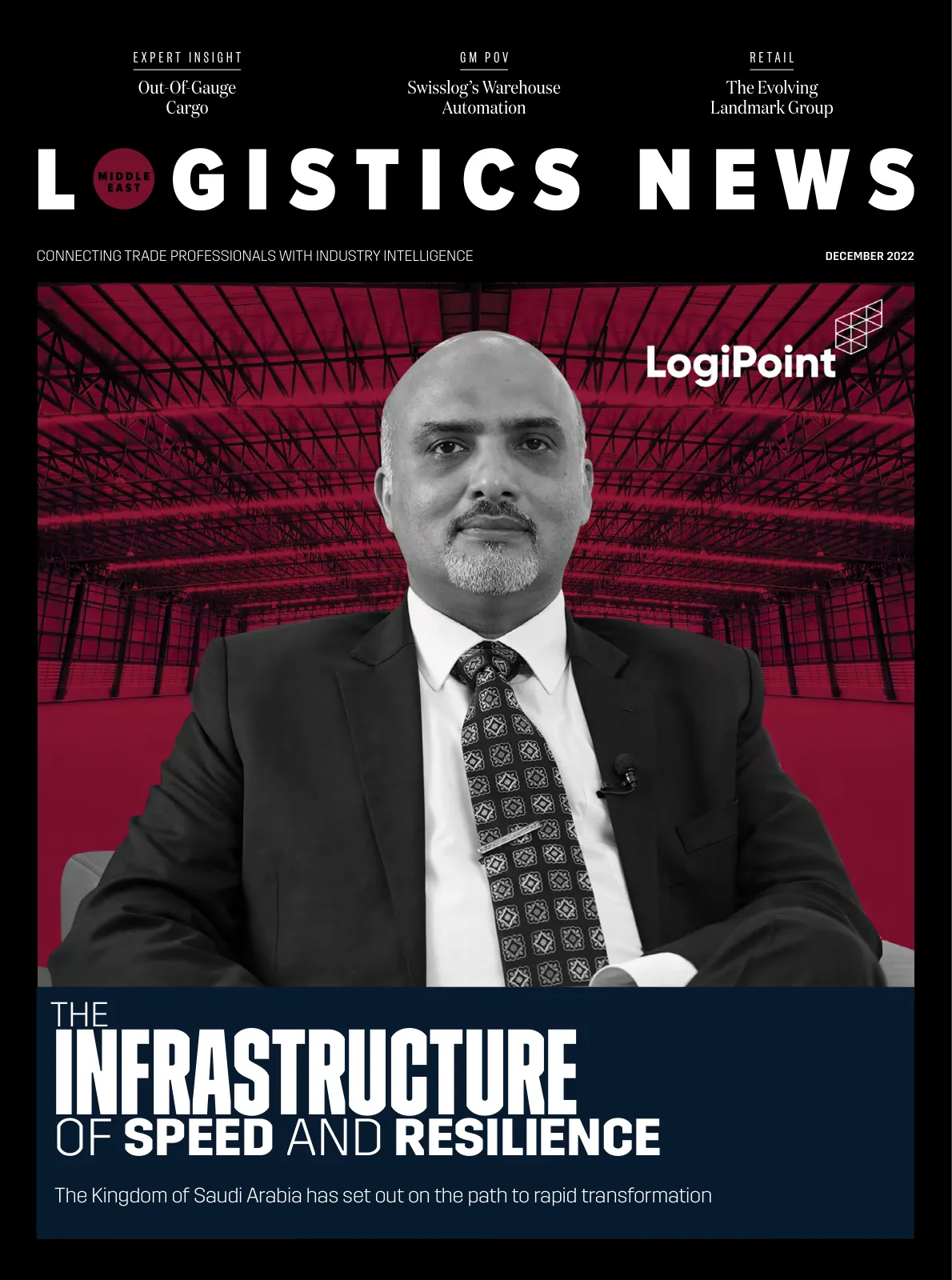
Logistics News, December 2022
Page 1
CONNECTING TRADE PROFESSIONALS WITH INDUSTRY INTELLIGENCE
DECEMBER 2022
OF SPEED AND RESILIENCE
THEINFRASTRUCTURE
The Kingdom of Saudi Arabia has set out on the path to rapid transformation
G M P O V
Swisslog’s Warehouse
Automation
E X P E R T I N S I G H T
Out-Of-Gauge
Cargo
R E T A I L
The Evolving
Landmark Group
Page 2
A MEMBERS OF EMIRATES TRANSPORT BUSINESS CENTERS:
Page 3
IN THIS ISSUE
THE INFRASTRUCTURE OF
SPEED AND RESILIENCE
16 EXPERT INSIGHT
OUT-OF-GAUGE CARGO
The team of Ceva Logistics, one of the
exceptional players for out-of-gauge
cargo, pens down the importance of
early planning and detailed logistics
engineering
20 SOFTWARE
MICROSOFT ANNOUNCED THE
LAUNCH OF MICROSOFT SUPPLY
CHAIN PLATFORM
A novel method to shaping supply
chains by including sustainability,
automation, agility, and changing its
users to adapt to changing market
conditions
34 GM POV
SWISSLOG’S WAREHOUSE
AUTOMATION
Vibha Mehta, Editor of Logistics News
ME, sits down with David Dronfield,
General Manager at Swisslog Middle
East, to talk about the company’s
future, its participation at Gulfood
Manufacturing and much more…
36 RETAIL
THE EVOLVING RETAIL LOGISTICS
LEADER
Ashish Sood, Chief Supply Chain Manager
of Landmark Group, a regional multi-national
conglomerate, talks to us about the changing
standards in retail logistics and its future
42 WAREHOUSE
LEADING THE PATH
Vibha Mehta, Editor of Logistics News ME,
interviews Vikas Chadha, as they discuss the
company operations and its future…
44 PHARMA
THE PHARMA CONNECT
Abu Dhabi Airports has joined Forces with
Pharma.Aero as a Middle East Strategic
Member
50 E-COMMERCE
E-COMMERCE TRENDS
The FedEx survey, which concentrated on
important Asian regions, revealed tendencies
comparable to how MENA customers value
substantiality in their e-commerce purchase
decisions
The Kingdom of Saudi
Arabia has set out
on the path to rapid
transformation in its pursuit
to diversify away from an
economy which is over-
dependent on oil.
14
48
26
Page 4
Page 5
Page 6
6 | LOGISTICS NEWS ME | DECEMBER 2022
WWW.CBNME.COM
All rights reserved © 2022.
Opinions expressed are solely those
of the contributors.
Logistics News ME and all subsidiary
publications in the MENA region are officially
licensed exclusively to BNC Publishing in the MENA
region by Logistics News ME.
No part of this magazine may be reproduced or
transmitted in any form or by any means without
written permission of the publisher.
Images used in Logistics News ME are credited
when necessary. Attributed use of copyrighted
images with permission. All images not credited
courtesy Shutterstock.
Printed by UPP
SUBSCRIBE
subscriptions@bncpublishing.net
For all commercial enquiries, contact
sales@bncpublishing.net
T +971 50 440 2706
PO Box 502511
Dubai, United Arab Emirates
P +971 4 4200 506 | F +971 4 4200 196
Keep up to date with all the latest
news, features and much more
on our website and social media
platforms.
CBNME.COM
CBNME
@CBNME
CONSTRUCTION BUSINESS NEWS ME
CEO
Wissam Younane
wissam@bncpublishing.net
DIRECTOR
Rabih Najm
rabih@bncpublishing.net
GROUP PUBLISHING DIRECTOR
Joaquim D'Costa
jo@bncpublishing.net
+971 50 440 2706
MANAGING EDITOR
Kasun Illankoon
kasun@bncpublishing.net
EDITOR
Vibha Mehta
vibha@bncpublishing.net
EDITORIAL DESIGN
Christian Harb
MARKETING EXECUTIVE
Aaron Joshua Sinanbam
aj@bncpublishing.net
PHOTOGRAPHER
Alexander Bungas
EDITOR’S NOTE
LNME
P
utting together the last
issue of this year has
been quite an intriguing
process as we draw to a
close. While the rest of
the world is anticipating
the holidays, the ongoing
FIFA World Cup in Qatar has
generated enthusiasm in the Middle
East. Despite only being held
for a month, the world cup has
created a platform for businesses
to expand. At the FIFA World
Cup in Qatar, Visa, the official
payment technology partner, offers
guests a cutting-edge payment
experience (pg. 12). Although
gauge cargo could be challenging,
CEVA Logistics has outlined the
importance of early planning and
detailed logistics engineering (pg.
14). Our cover story is about
LogiPoint, the leading logistics real
estate firm in the Kingdom of Saudi
Arabia (pg. 22); Farooq Shaikh,
CEO of LogiPoint, talks to us about
the business and how it is reshaping
the logistics sector. This edition also
emphasizes two additional subjects:
How Landmark Retail is advancing
retail logistics (pg. 32) and how
Pharma.Aero is a special cross-
industry partnership platform that
offers straightforward delivery for
medications and vaccines (pg. 40). I
wish all of my readers a wonderful
Christmas season and a beautiful
2023 year ahead with much more
to share. Cheers to reading!
Vibha Mehta
Editor
vibha@bncpublishing.net
Page 7
Page 8
Page 9
Page 10
10 | LOGISTICS NEWS ME | DECEMBER 2022
WWW.CBNME.COM
REGIONAL NEWS
LNME
T
he country’s desire for
automation solutions is driven
by growth in the e-commerce
industry and rising demand
for industrial and retail
warehouses. Acme, one of the regional
pioneers in warehousing automation
systems, has launched an office in
Riyadh to meet the Kingdom’s growing
demand.
According to Navin Narayan, CEO
of Acme Intralog, “Saudi Arabia is on
course to augment the non-oil industrial
capabilities of the Kingdom by 2030.
Adopting industry 4.0 automation solu-
tions for both factories and distribution
centres are imperative to achieving Vi-
sion 2030; we are here to support Saudi
companies to achieve further growth
through automation and robotics. We
have delivered automation solutions to
our Saudi customers for nearly a decade
from our facilities in Dubai. By invest-
ing in a new office in Riyadh, we will be
closer to our Saudi customers and can
promptly support their operations and
service any equipment without down-
time. By the end of 2023, we aim to
have a team of over 30 professionals in
Saudi. We expect the demand for our
services to come from industrial produc-
tion companies, automotive, FMCG and
F&B manufacturers, e-commerce, and
fulfilment centres.”
Over the last few years, the Acme
team has completed ten industrial and
warehouse automation projects in Saudi
Arabia. These include constructing a
cutting-edge distribution centre in Jed-
dah for a multinational dairy firm. The
customer significantly increased their
capacity and improved their warehouse
space by implementing automated
solutions for truck unloading, pallet stor-
age and retrieval, and WMS-controlled
storage. The same customer then com-
missioned Acme to implement a robotic
palletisation system, one of the largest
in the region, and an automated truck-
loading system.
Acme also implemented over six sor-
tation centres in KSA for one of the
largest global e-commerce organisa-
tions. Moreover, the company is cur-
rently delivering and commissioning
two of the largest automated distribu-
tion centres in KSA for a leading fash-
ion retailer. To create awareness of the
company’s solutions and capabilities,
Acme also participated in the Gulfood
Manufacturing industry show in Dubai
until November 10, 2022. At the Acme
stand, visitors could experience Kang-
har, a high-density pallet shuttle from
Acme, and cobots and automation
components.
ACME OPENS AN NEW OFFICE IN RIYADH TO SUFFICE
THE DEMAND FOR AUTOMATED DISTRIBUTION
CENTRES AND WAREHOUSE
“ADOPTING INDUSTRY 4.0
AUTOMATION SOLUTIONS
FOR BOTH FACTORIES AND
DISTRIBUTION CENTRES
ARE IMPERATIVE TO
ACHIEVING VISION 2030;
WE ARE HERE TO SUPPORT
SAUDI COMPANIES TO
ACHIEVE FURTHER GROWTH
THROUGH AUTOMATION
AND ROBOTICS.”
Page 11
LOGISTICS NEWS ME | DECEMBER 2022 | 11
REGIONAL NEWS
R
AMZIQ, one of the latest
ultra-secure and user-friendly
blockchain systems, just
concluded its yearly initiative
at the Smart Chain Forum in
Dubai, which was held on November 13,
2022, at the Armani Hotel, Burj Khalifa,
in Dubai.
With the primary purpose of transform-
ing the UAE’s expanding Blockchain
technology ecosystem and bringing
Blockchain into the lives of people who
do not currently have access to it. Cur-
rently, just 3% of all prospective custom-
ers are aware of and have access to
blockchain technology; RAMZIQ claims
to be aiming for the other 97%.
The event allows delegates to gener-
ate ideas and long-term strategies for
enhancing the future of digital assets in
the sixth technological age. Throughout
the discussion, several intriguing themes
were explored. Mr Patrick Campos,
Chief Strategy Officer of Securrency, was
one of the key speakers, discussing the
‘Future of Digital Assets and How Block-
chain Is Altering The Banking Industry.’
Also, there was an intriguing panel dis-
cussion on ‘Shaping the Future of Digital
Assets In The Sixth Era Of Innovation.’
Additionally, Solaiman Al Rifai, Found-
ing Partner at RAMZIQ, emphasised to
industry executives and innovators at the
forum that his business was motivated
by the UAE’s objective to be a pioneer in
Blockchain and is focused on delivering
the technology to every person.
As a keynote speaker at the Smart
Chain Forum, Mr Al Rifai announced the
ZENIQ NFT Marketplace, which oper-
ates on the ZENIQ blockchain and allows
clients to find, collect, and sell NFTs.
Mr Rifai also discussed the ZENIQ App,
one of the most exciting aspects of the
ZENIQ Ecosystem. The app is a secure
smartphone wallet and includes a man-
agement system. The software also has
the first decentralized and encrypted
end-to-end blockchain-enabled chat
system. This chat system supports both
video and voice. It also improves the
capacity to exchange large currencies
and tokens.
Similarly, the app is compatible with
the ZENIQ debit card and the ZENIQ
Hub, allowing the app to be biometri-
cally secure and offer recovery words.
“RAMZIQ aims to guarantee consum-
ers now have a digitalised environment
where they can leverage Blockchain
technology and tokenisation for all
their assets,” explained Solaiman Al
Rifai. “RAMZIQ will fill a critical market
vacuum for digital asset storage and
security as the tokenisation of digital as-
sets becomes fundamental to the UAE’s
financial agenda.”
He also addressed the RAMZIQ To-
kenization Whitepaper, which analyses
Blockchain as a key enabler of Web 3.0
and provides a comprehensive overview
of the ZENIQ blockchain ecosystem. The
whitepaper discusses in detail how to-
kenization is the key motor of the digital
economy. “ZENIQ is opening the flood-
gates to blockchain technology, making
it accessible to everybody, and assuring
broad adoption of blockchain technol-
ogy.” RAMZIQ’s primary aim through
ZENIQ is to reach the 97% of individuals
who do not have access to blockchain
technology,” Al Rifai remarked.
Lastly, Erwin Dokter, CEO of ZENIQ
Corporation, commented, “According
to forecasts, the tokenisation market will
reach a global volume of around US$
24 trillion by 2027. ZENIQ’s ecosystem
and cutting-edge blockchain technology
allow users to dive into this promising
market.”
SMART CHAIN FORUM 2022: RAMZIQ PROMISES TO GROW THE UAE’S IMMENSELY
BLOCKCHAIN TECHNOLOGY ECOSYSTEM THROUGH ITS ANNUAL INITIATIVE
Page 12
12 | LOGISTICS NEWS ME | DECEMBER 2022
WWW.CBNME.COM
REGIONAL NEWS
LNME
A
.P. Moller - Maersk
(Maersk), a Danish
shipping corporation,
will be introducing a new
ocean shipping service,
‘Shaheen Express,’ in the last week of
November 2022. The ‘Shaheen Express’
will run between Mundra, Pipavav,
Jebel Ali, Dammam, and Jebel Ali
before returning to Mundra, providing
a consistent and dependable service
along the India-UAE-Saudi Arabia axis.
The new service will predominantly
target the increasing demand for
consumers trading between the Indian
and Gulf markets, with the goal of
providing a faster and more dependable
connection to its customers.
“The markets have started stabilising,
and the ocean networks are normalis-
ing after over two years of disruptions
caused by the Covid-19 pandemic,”
said Bhavan Vempati, Head of Regional
Ocean Management, Maersk West &
Central Asia. “During this time, not only
did we strive hard to ensure we ad-
dressed all our customers’ challenges,
but we also got a chance to look ahead
and understand what their requirements
would be in the future.”
The India-UAE Comprehensive Eco-
nomic Partnership Agreement (CEPA)
went into effect in May 2022, significant-
ly increasing trade flows between the
two countries. FMCG, such as electron-
ics, perishables, food, retail products like
textiles and clothing, and chemicals, are
among the primary commodities travel-
ling between these two nations that will
profit from expanded capacity. Moreo-
ver, the ‘Shaheen Express’ will help pet-
rochemical exporters from Saudi Arabia’s
eastern area. “Through our customer
conversations, we were able to make a
more meaningful forecast around the
rising demand and proactively deploy a
new service to create a supply of space
for this demand,” Bhavan adds.
Lastly, the’ Shaheen Express’ will offer
improved transit time and better predict-
ability between Indian and Gulf ports
than the existing services.
Bhavan further says, “We remain
committed to our customers in West &
Central Asia and want to bring reliable
service to them. We will continue build-
ing robust partnerships with our custom-
ers and design solutions that create
value for their business and contribute to
the region’s overall economic growth.”
The ‘Shaheen Express’ will include two
vessels with a nominal capacity of 1,700
TEUs per week.
A.P. MOLLER – MAERSK TO LAUNCH ‘SHAHEEN EXPRESS’ LINKING THE INDIA–UAE–
SAUDI ARABIA CORRIDOR
Page 13
LOGISTICS NEWS ME | DECEMBER 2022 | 13
REGIONAL NEWS
A
ccording to a
recent DP World
study conducted
in October,
the responses
of hundreds of freight
forwarders portray a grim
picture of the industry’s
future - with climate change
and access to talent
weighing heavily on company
resilience, the capacity to
establish seamless supply
chains is gloomy. While
inflation is the primary
source of concern for 63%
of respondents, geopolitical
tensions are a vital source of
concern for 56%. The poll
findings were presented at
the Global Freight Summit,
a three-day conference that
brings industry experts,
executives, and innovators
together under one roof to
share information and focus
on how data can enhance
connectivity in global supply
chains.
The event was inaugu-
rated by His Highness Sheikh
Ahmed bin Saeed Al Mak-
toum, President of the Dubai
Civil Aviation Authority,
Chairman and CEO of Emir-
ates airline and Group and
Chair of the World Logistics
Passport (WLP) Global Steer-
ing Group, and attended by
Sultan Ahmed Bin Sulayem,
Group Chairman and CEO of
DP World, as well as mem-
bers from the Digital Freight
Alliance (DFA).
“Global supply chains are
significantly impacted by the
pandemic, geopolitical ten-
sions and the looming threat
of the global climate change
crisis. These challenges have
demonstrated that many
parts of the global supply
chain infrastructure are frag-
ile. These rising concerns
make it imperative for logis-
tics operators to develop the
tools and solutions that offer
real-time visibility across the
entire supply chain. This can
allow trade routes to be fit for
purpose, thus facilitating a
more seamless movement of
trade around the globe,” said
Sultan Ahmed Bin Sulayem,
Group Chairman and CEO of
DP World.
This has severe implica-
tions for businesses. Due
to uncertainty, almost 10%
of respondents stated they
had altered the markets in
which they conduct business.
Indeed, these concerns will
occupy freight forwarders’
minds for the foreseeable
future. 78% expect geopo-
litical tensions and inflation
to remain problematic over
the next five years, with
two-thirds (66%) feeling it is
‘difficult to predict when eco-
nomic disruptions will end.
Encouragingly, many in the
supply chain industry ap-
pear cautiously optimistic.
Three-quarters (75%) of the
respondents said they expect
technology to be a significant
factor in easing the current
supply chain woes. In fact,
more than half (56%) believe
digitalization will be the
biggest driver of efficiency,
reducing bottlenecks and
supporting the industry as
we advance. Technology will
considerably impact the sup-
ply chain, with three in four
saying it will lead to cost sav-
ings and a more remarkable
ability to target and deliver to
new customers.
However, many needed
helps incorporating technol-
ogy into their sector, with a
third indicating they wanted
to but needed to know how.
It’s hardly a surprise that half
of the freight forwarders
claimed their company’s digi-
tal transformation journey is
taking longer than expected.
“The uncertainties of to-
day’s world are making trade
harder, increasing the discon-
nect at various points across
the whole supply chain,”
says, Mike Bhaskaran, Group
Chief Operating Officer of
Digital Technology at DP
World. “The freight forward-
ing community must act to
mitigate risk to build a more
resilient future. This is why we
are proud to host the first-
ever Global Freight Summit
here in Dubai. The event will
bring together the brightest
minds from the whole supply
chain for discussions that will
help us agree on concrete
actions to solve some of the
major challenges keeping the
community awake at night,”
he added.
Other difficulties freight
forwarders face includes ris-
ing and uncertain freight
rates, with 80% citing this as
the most significant concern
keeping them awake at night.
Another big concern is a lack
of funding choices, which
37% of those polled claim
has hampered their capacity
to deliver goods.
Surprisingly, while the
epidemic has affected every
business, including logistics,
it has resulted in several
good outcomes. A third of
freight forwarders reported
that it sparked a much-need-
ed reform of their firm, with
41% reporting that it has im-
pacted how they track ship-
ments. Over half (54%) said
it had put more significant
pressure on management to
operate more sustainably.
ACCORDING TO DP WORLD’S RESEARCH, INFLATION AND
GEOPOLITICS ARE THE BIGGEST WORRIES FOR THE GLOBAL
SUPPLY CHAIN IN THE NEXT FIVE YEARS
Page 14
14 | LOGISTICS NEWS ME | DECEMBER 2022
WWW.CBNME.COM
PAYMENT SOLUTIONS
LNME
W
ith over one million fans
anticipated to attend the
event, Visa has placed
5,300 contactless pay-
ment stations at official
FIFA venues, making
FIFA World Cup Qatar 2022™ the larg-
est payment-enabled FIFA tournament
ever. Visa will also test new payment tech-
nologies to provide fans with convenient
and secure digital payment options.
The FIFA World Cup™ offers Visa a
worldwide platform to demonstrate and
test innovative technologies, improve the
fan experience, and leave a lasting imprint
on the host country. Visa will deliver
many digital payment options to Qatar,
including a few restricted pilots, to show
how future Visa payment solutions may
work.
Pay with Your Face: Facial recognition
technology will be deployed for the first
time in Qatar, is a partnership between
Qatar National Bank (QNB) and POP ID
and is backed by Visa via tokenization.
After initial enrolment, users may use
their faces to authenticate payments
instead of a physical card or mobile
phone. It will be trialed at three Flat
White Specialty Coffee locations.
Card Art Gets Animated: Visa is
pioneering a digital card issuing option
for restricted cardholders in Doha as
customers get more accustomed to
obtaining goods instantly. A digital
prepaid card will be issued quickly after
scanning a QR code and may be linked to
a mobile wallet. The digital card will have
animated card graphics with the official
mascot La’eeb, illustrating a future in
which users can add more customization
and digital animation to their Visa cards.
Accepting Payments Gets Simpler for
SMBs: The Visa Tap-to-Phone solution,
developed in collaboration with three
Qatar-based banks, is now accessible to
VISA INTRODUCES UNIQUE PAYMENT SOLUTIONS OPTIONS
FOR FIFA WORLD CUP
QATAR 2022™
As the FIFA World Cup Qatar 2022™ approaches, Visa, FIFA’s Official Payment
Technology Partner, has prepared a payments network that will allow cashless
purchases throughout all official venues, including eight stadiums and the FIFA
Fan Festival.
Page 15
LOGISTICS NEWS ME | DECEMBER 2022 | 15
VISA INTRODUCES UNIQUE PAYMENT SOLUTIONS OPTIONS
merchants in Qatar that wish
to accelerate their capacity
to take digital payments
ahead of the projected tourist
inflow. Visa Tap to Phone
enables retailers to accept
contactless payments on their
existing Android NFC-enabled
handsets by simply installing
an app.
Tap-to-Ride Around Doha:
Maintaining traffic flow has
been a top priority during
the FIFA World Cup™, and
Visa, in collaboration with
Qatar’s Ministry of Transport,
is facilitating contactless
payment acceptance on taxis
so fans and Qatari residents
can pay for their trips with
their Visa card or smartphone,
making paying for their
journeys in and around Doha
more quickly and easily.
Visa debuted Visa Masters
of Movement earlier this
month, a first-of-its-kind
hybrid experience including
an interactive pitch at the
FIFA Fan Festival™ in Doha,
where fans can create digital
art inspired by their unique
moves. In collaboration with
Crypto.com, eligible fans can
mint this digital art into their
own NFT.
Dr Saeeda Jaffar, Senior
Vice President and Group
Country Manager for GCC
at Visa, says, “As FIFA’s
long-standing partner, Visa
wants to give football fans
from around the world the
best way to pay in Qatar
while experiencing exciting
innovations such as the fusion
of art, football and technology
at Visa’s Masters of Movement
venue. With thousands of
contactless payment terminals,
FIFA World Cup Qatar
2022™ promises to be the
most payment-enabled FIFA
tournament ever for the
more than one million fans
coming to enjoy the magic of
football.”
Since 2007, Visa has been
FIFA’s Official Payment
Technology Partner. As a
global sponsor of both men’s
and women’s football, Visa
seeks to provide experiences
that bring people closer to
the action. Whether they are
among the one million as a
global sponsor of both men’s
and women’s football or
seek to provide experiences
that bring people closer
to the action. Whether
they are among the one
million expected in Qatar
or the five billion spectators
predicted globally for this
year’s event. In addition to
providing the most recent
payment innovations at
official FIFA venues, Visa is
looking for ways to further
its commitment to improving
people’s lives through the
power of sport through
programs like Financial
Football, a video game that
integrates entertainment and
education in an action-packed
virtual football tournament.
Tim Cahill and
Maxi Rodriguez
Page 16
16 | LOGISTICS NEWS ME | DECEMBER 2022
WWW.CBNME.COM
EXPERT INSIGHT
LNME
T
his article defines complex and
out-of-gauge (OOG) cargo as
items with estimated measures of
more than 70 tons, five meters in
height, four meters in width, and
15 meters in length per single
unit. Typical OOG cargo turbines, trans-
formers, windmills, platforms, generators,
big cranes, and so forth. OOG cargo fre-
quently possesses the majority, if not all,
of the following characteristics: It has a
high economic value and a long lead time,
and it is prone to sudden movement, par-
ticularly during shipment and handling.
As a result, there are no margins for
error when it comes to on-time and
damage-free freight delivery to the
project site. Assume that OOG cargo
is destroyed during transit or handling
or is not delivered to the site on time.
In such an instance, the principal
contractor’s contractual penalties
considerably outweigh any savings
realized by pressing logistics suppliers to
take unexpected risks that may result in
little cost savings. It isn’t worth the risk.
Even if the insurance covers losses up to
the cargo invoice value, the insurance
provider is unlikely to reimburse the
contractor for delay responsibility and
reputational damage completely. For
example, manufacturing a new wind
turbine can take around six months, as
this type of OOG cargo cannot simply be
taken from the manufacturer’s existing
stock.
Furthermore, efficient logistics for
out-of-gauge (OOG) freight necessitates
rigorous research early in the project
cycle. This analysis should be included
in the project feasibility assessment.
The following text includes case studies
altered to highlight best industry
practices.
OUT-OF-GAUGE
CARGO
The team of Ceva Logistics, one of the exceptional players for out-of-gauge
cargo, pens down the importance of early planning and detailed logistics
engineering
Page 17
LOGISTICS NEWS ME | DECEMBER 2022 | 17
OUT-OF-GAUGE CARGO
CASE STUDY 1
A GOLDEN TRIANGLE: EARLY
COLLABORATION BETWEEN
THE CONTRACTOR’S LOGISTICS
TEAM, A LOGISTICS DELIVERY
PARTNER AND THE OOG CARGO
MANUFACTURER
A multi-modal mode of
transportation was planned
for 70-ton, four-meter-high
transformers with vertical
alignment restrictions (Road
– Rail – Road). The road
was gravel for 20 kilometres.
Early joint planning team
workshops confirmed that
transporting a transformer on
a gravel road could damage
its internal components and
that this damage would not
be visible upon preliminary
inspection. The study was
carried out during the early
stages of project planning to
determine the best gravel road
improvements and to ensure
that the project schedule
and budget included the
necessary civil infrastructure
work. As a result, the gravel
road was shaved, and two
meters of exposed pipes
were covered to disperse the
weight generated during the
movement. The infrastructure
improvements were completed
on time and without any
downtime of equipment or
assets. Most importantly,
project execution at the site
did not stall, as it would have
if the road improvements
had not been completed
ahead of the transformers’
scheduled transportation.
The components were safely
transported to the site with no
internal component damage,
thanks to an early planning
strategy shared by all parties
involved.
CASE STUDY 2
WIND FARM PROJECT: A SMALL
CHANGE THAT MADE A BIG
DIFFERENCE
The project site was in a
mountainous region of the
African continent, and it
required the delivery of
windmill blades measuring
approximately 60 meters in
length. Two and half years
before construction began,
the EPC contractor decided
to involve the delivery of
its logistics partner. The
logistics provider was asked to
evaluate the initial route plan
and report to the client. The
detailed study of the site and
road conditions revealed that
following the planned route
would necessitate significant
changes, costing the client
more than $20 million.
Instead, following a
thorough logistics engineering
study, it was proposed to
change the site’s entrance
point and ‘shift’ the site by
one kilometre to allow for
an alternate road. The plan
was approved and carried out
successfully.
Summing up the readings
from the aforementioned case
studies, Axel Herzhauser,
Regional Managing Director
Middle East Africa at CEVA
Logistics, says, “Getting
the logistics off to a great
start involves a healthy
communication flow
between the contractor’s
project management team, a
competent logistics delivery
partner and the manufacturer.
“The sooner this
communication starts, the
higher the likelihood of a
smooth logistics operation
delivery. On the contrary,
if the contractor’s project
logistics team is the last
department to be informed
about detailed cargo
“Two and half
years before
construction
began, the
EPC contractor
decided to
involve the
delivery of
its logistics
partner.”
>>>
Page 18
18 | LOGISTICS NEWS ME | DECEMBER 2022
WWW.CBNME.COM
specifications and delivery
timelines, the logistics
operation is set up for failure.
Early involvement from a
logistics Subject Matter Expert
(SME) allows contractors and
project owners to benefit by
receiving free consultancy.”
CASE STUDY 3
THE UNDERLINING IMPORTANCE
OF IMPLEMENTING A LOGISTICS
PLAN
It is critical to implement
the logistics plan that was
created because of careful and
collaborative planning. Plan
deviations should be kept to
a minimum. Such a logistics
plan typically includes tasks
and activities covering all
logistics operations. These
tasks and activities can thus
be seamlessly integrated into
the overall project schedule.
Because the logistics plan’s
activities are interconnected,
any abrupt, frequent, or
significant changes can render
the entire plan useless.
Early logistics operation
planning typically includes a
sequential series of activities
and timelines that cover,
among other things, fleet
booking in addition to making
recommendations to the client.
The plan covers all actions
required to ensure ocean
fleet availability, practical
storage areas, thorough
route assessment and civil
works planning, booking
of unconventional vessels if
required, bracing for specific
modes, heavy haulage and
many other activities. A
deviation from a logistics plan
could easily result in vessel
unavailability or a lack of
skilled workers.
Luis Gonzalez Garcia,
Project Logistics Global EPC
and Infrastructure Expert at
CEVA Logistics, emphasises,
“Delivering out-of-gauge
cargo most often requires a
set of thoroughly planned
and intricately intertwined
activities. Securing adequate
fleet availability must be
aligned with the planned
on-site delivery target dates.
Logistics activities also cover
securing suitable handling
equipment and a lashing plan
to match the chosen mode of
transport. We have seen time
and time again an attempt
to change the logistics plan
to make last-minute cost
savings profoundly, and it
hardly ever ends well. Some
changes to the plan do and
will occur, and they are
often easily accommodated.
However, major changes to
an agreed-upon logistics plan
in the execution phase pull
the rug out from under the
entire logistics operation.”
Eventually, sticking to the plan
is critical and should always
be reinforced, especially for
projects requiring OOG cargo
to be delivered on short notice.
A case study below depicts a
series of activities to keep a
power plant operational.
EXPERT INSIGHT
LNME
Page 19
LOGISTICS NEWS ME | DECEMBER 2022 | 19
OUT-OF-GAUGE CARGO
CASE STUDY 4
FOLLOWING THROUGH A DETAILED LOGISTICS
PLAN TO DELIVER OOG POWER ENGINES
The 78-ton power plant engine was
required to travel 3,530 miles (5,680
kilometres) between continents in record
time. The cargo’s nature and destination
presented the project with unique
and complex challenges. The delivery
site’s distance from the coastline, poor
infrastructure, and limited installation
equipment hampered the cargo delivery.
The project had several distinct phases
planned and sequenced A-to-Z, and
the logistics operation was carried out
exactly as planned. If the delivery failed
to carry out any planned activities,
the entire operation would have been
significantly delayed.
The first step was to decide on a
delivery method, and after obtaining
permission to use the military terminal,
it was decided to use an Antonov An-
124 cargo plane. This was followed by
securing the plane by the program.
The next step was to deploy a 300-ton
mobile crane to lift the engine onto the
loading ramp, which was pulled into the
aircraft. Before the plane took off, the
team planned to use additional lashing
to keep the engine safely in place and
avoid the risk of movement during the
flight. When the engine arrived on time,
it was skidded out on a rail, jacked up
on elephant legs, and tandem lifted to the
trailer.
Because the roads from the airport to
the plant were congested and in poor
condition, the logistics plan identified
the need for road restoration. The work
was done ahead of time and following
the plan. Furthermore, the main road
was closed during the final leg of
transportation, and local police escorted
the OOG vehicles to the plant. The crew
at the job site used jacking and skidding
to remove the engine from the trailer.
Given the plant’s limited equipment and
space, this was also planned.
Despite meticulous planning and
preparation, not everything goes
exactly as planned, especially since
the logistics plan may be implemented
two to five years after a contractor has
been commissioned to deliver a project.
In such cases, experience is critical to
keeping the project on time and on
budget while minimizing changes to the
master plan.
Siddiq Khatri, Regional Manager
Heavy lifts & Projects Specialist at
CEVA Logistics, adds, “I cannot
emphasise enough the importance of
diligent planning and replanning. The
replanning process must always happen
within the framework of an existing
logistics masterplan.”
“On one of our projects where we were
transporting a 100-ton steam turbine,
we realised that the main road was
being excavated for placing culverts for
the rainwater. Instead of changing the
route, which would have jeopardized the
entire logistics plan and caused a domino
effect on all logistics activities, we
requested that the work be suspended.
As a solution, we used sandbags to fill
the excavated area and covered the top
with steel plates. This method permitted
the road to sustain the ground-bearing
pressure generated during the movement
of the turbine. This decision was made
only after we calculated our quick-fix
solution’s safety factors and the bearing
capacity. We managed to move three
turbines in one go safely.”
In conclusion, Finally, Early engagement
of all major stakeholders is critical
throughout the logistics operation
execution phase. Unsurprisingly, current
trends reveal that many worldwide EPC
contractors are taking a mature approach
to logistics and selecting excellent logistics
providers with proven track records. It
is vital to have logistics partners capable
of delivering a highly comprehensive
logistics plan and are prepared to
take ownership and responsibility for
delivering OOG cargo to the site on
time, all while safeguarding the cargo’s
integrity during the logistics operation.
Thus, cheap logistics for OOG goods are
unaffordable.
“EARLY LOGISTICS OPERATION PLANNING TYPICALLY INCLUDES A
SEQUENTIAL SERIES OF ACTIVITIES AND TIMELINES THAT COVER,
AMONG OTHER THINGS, FLEET BOOKING IN ADDITION TO MAKING
RECOMMENDATIONS TO THE CLIENT.”
Page 20
20 | LOGISTICS NEWS ME | DECEMBER 2022
WWW.CBNME.COM
SOFTWARE
LNME
C
harles Lamanna, Corporate Vice President, Business
Applications & Platform, shares her vision of how
Microsoft aims to change the future of Logistics
and Supply Chain by launching this platform. While
Microsoft Supply Chain Platform is hoping to hold
a broad vision, here is everything you would like to
know about the game-changing platform.
Well, supply chain disruptions are not new, but their
complexity and rate of development exceed enterprises’
abilities to solve global challenges. Many current solutions
are exclusively focused on supply chain execution and
management and need to prepare to accommodate this
new reality. Correspondingly, Enterprises are dealing with
petabytes of data spread across legacy systems, Enterprise
Resource Planning programs (ERPs), and custom solutions,
resulting in a fragmented view of their supply chain.
Likewise, the agility and resilience of an organization’s
supply chain will determine how well it can link its data
and orchestrate operations across all relevant systems.
However, to adapt swiftly to changing market conditions,
supply chain software must improve visibility across data
sources, foresee and reduce disruption, enhance faster
communicational patterns, and fulfil orders – all while
being sustainable and safe.
Furthermore, Microsoft announced the Microsoft Supply
Chain Platform in November, which enables organizations
to maximize their existing supply chain investments by
bringing the best of Microsoft AI, collaboration, low code,
security, and Software as a Service (SaaS) applications to
scalable platform. As part of the new Microsoft Supply
Chain Platform, we are also releasing a preview of the
Microsoft Supply Chain Center. The Supply Chain Center
ANNOUNCED THE LAUNCH OF MICROSOFT SUPPLY CHAIN PLATFORM
MICROSOFT
A novel method to shaping supply chains by including sustainability, automation,
agility, and changing its users to adapt to changing market conditions
Page 21
LOGISTICS NEWS ME | DECEMBER 2022 | 21
helps clients get up and running quickly
by providing a ready-made ‘command
center’ those interfaces natively
with existing supply chain data and
applications.
THE MICROSOFT SUPPLY CHAIN PLAT-
FORM – is an open, collaborative, and
modular foundation for data and supply
chain orchestration. It provides a wide
range of capabilities throughout Mi-
crosoft to enable companies like Grupo
Bimbo, Mercedes-Benz, and Tillamook to
create their specialized supply chain solu-
tions. With the past announcement, the
platform will be aiding in making it easier
for clients to use the Microsoft Cloud
to improve their supply chain. The Mi-
crosoft Supply Chain Platform provides
building blocks across Microsoft Azure,
Dynamics 365, Microsoft Teams, and the
Power Platform for customers to adopt
capabilities that address their specific sup-
ply chain needs. With Dataverse, custom-
ers can use hundreds of data connectors
to gain visibility and act across their sup-
ply chain. And lastly, The Power Platform
also enables custom workflows, data re-
porting, and applications that connect to
existing Supply Chain systems.
PARTNERING TO EMPOWER CUSTOMERS
IN SUPPLY CHAIN TRANSFORMATION –
The Microsoft partner ecosystem will
remain crucial in supporting client supply
chain resilience and agility. Partners may
use Dynamics 365 Supply Chain Manage-
ment, Microsoft Azure, Microsoft Teams,
and the Power Platform in conjunction
with the Microsoft Supply Chain Plat-
form to develop integrated solutions. Ac-
centure, Avanade, EY, KPMG, PwC, and
TCS are among the supply chain partner
ecosystem’s advisors and implement-
ers. In addition, the Microsoft Supply
Chain Platform integrates Blue Yonder,
Cosmo Tech, Experlogix, Flintfox, InVia
Robotics, K3, O9 Solutions, SAS, Sonata
Software, To-Increase, and many more to
assist clients in choosing the optimal solu-
tion for their supply chain needs.
ACCELERATING BUSINESS AGILITY AND
EFFICIENCY WITH THE MICROSOFT SUP-
PLY CHAIN CENTER – The Microsoft Sup-
ply Chain Center is in preview and at the
heart of the Supply Chain Platform. The
Supply Chain Center offers practitioners
a ‘command center’ experience for inte-
grating data from current supply chain
systems like Dynamics 365 and other
ERP providers such as SAP and Oracle,
as well as stand-alone supply chain so-
lutions. In Supply Chain Center, Data
Manager provides data ingestion and
orchestration to offer insight across the
supply chain and push action back into
execution systems. Our launch partners
C.H. Robinson, FedEx, FourKites, and
Overhaul, will provide native experiences
within the Supply Chain Center through-
out the preview period.
EXISTING DYNAMICS 365 SUPPLY CHAIN
MANAGEMENT CUSTOMERS WILL AUTO-
MATICALLY GAIN ACCESS TO THE SUPPLY
CHAIN CENTER as part of their current
agreements. The Supply Chain Center
includes pre-built modules that address
supply chain disruptions across supply
and order fulfillment, as outlined below:
> The supply and demand insights module
adopts advanced Azure AI models to
predict upstream supply constraints and
shortages through supply intelligence.
Organizations can perform simulations
using their supply chain network data
to predict out-of-stock, over-stocking,
or missed-order lines. With smart
news insights, which provide relevant
news alerts in the Supply Chain Center
on external events, supply chain
practitioners can make decisions and
plan with real-world event information
and historical insights for product
demands.
> The order management module in
Supply Chain Center intelligently
orchestrates and automates fulfillment
with a rules-based system using real-time
omnichannel inventory data, AI, and
Machine Learning. Organizations can
quickly meet future order volumes and
fulfillment complexities by extending their
capabilities with pre-built connectors
to specialized technology partners for
order intake, delivery and third-party
logistics services. Existing Dynamics 365
Intelligent Order Management customers
will automatically get access to Supply
Chain Center and the order management
module at launch.
> With secure, built-in Teams integration,
clients may reduce supply restrictions
by working in real-time with external
suppliers to obtain new supply sources,
fix transportation challenges, and
communicate upstream and downstream
implications depending on changes.
> By incorporating partner modules
into the Supply Chain Center, users
can quickly access solutions like freight
visibility from Overhaul. Because
everything runs on Dataverse, the data is
consistent regardless of whatever module
you use. This eliminates the need to copy
and paste information and reconcile
which reports have the most up-to-date
information.
Additionally, Microsoft announced
Daimler Trucks North America, iFit,
and Kraft-Heinz as some of their Supply
Chain Center preview customers. “Our
collaboration with Microsoft is critical
to our supply chain transformation. The
platform allows our team to be more agile
– assessing risk and opportunities faster
than ever before. Simply put, it provides
the end-to-end visibility we need to keep
our products on people’s tables across
North America, and there’s nothing more
important,” says Mitch Arends, Senior
Vice President, Head of Operations, Kraft
Heinz North America.
MICROSOFT ANNOUNCED THE LAUNCH OF MICROSOFT SUPPLY CHAIN PLATFORM
Page 22
22 | LOGISTICS NEWS ME | DECEMBER 2022
WWW.CBNME.COM
ECONOMICAL IMPACT
LNME
T
he FIFA World Cup is bringing new opportunities to
Qatar and the GCC nations, thus enabling economic
growth across a range of critical sectors such as
travel and tourism, hospitality, and infrastructure.
This World Cup will pave the way for Qatar to enjoy
potential near-term economic gains but also highlights
the logistical challenges of managing the event, which will
likely lead to positive spill over effects for the rest of the
region. This trend is expected to continue as these economies
are looking to capitalise on the attention that a global event
like captures.
OPPORTUNITIES
Ever since Qatar was picked to host the Football World Cup,
companies in GCC countries have sensed the opportunities
which are suddenly presented in front of them, and they
are all set to reap the rewards as the mega event kicks in
November 2022. Over the past few years, Qatar, along
with the countries expected to benefit from this mega event
(such as UAE), has been working with regional and global
entrepreneurs and innovators to provide solutions which will
directly support them in managing the logistical challenges
expected to manage a sporting event of such large scale.
These entrepreneurs and innovators are mostly SMEs
(Small and Medium Enterprises) and MSMEs (Micro, Small
and Medium Enterprises) who rely on trade finance to
increase the volumes of goods and services they trade, fulfil
large contracts and scale operations internationally.
CHALLENGES FOR THE SMES
However, opportunities come with challenges as SMEs
usually face funding gaps as long credit periods can drain
their finance. These companies typically have more difficulty
obtaining credit from formal financial institutions. This is
IS A CRUCIAL TOOL FOR SMES CAPITALIZING
ON A MAJOR SPORTS EVENT
WHY TRADE FINANCE
Ankit Goel, Senior Vice President, Global Accounts at MODIFI puts down his
thoughts on utilising significant sports events as an incentive in Trade Finance
Page 23
LOGISTICS NEWS ME | DECEMBER 2022 | 23
mainly due to information asymmetry,
lack of previous credit history, legal
documentation and many more., leading
to the unwillingness of traditional lenders
to provide financing. Even if they get
funding, it typically involves lengthy
approval processes, requiring hard
collateral such as movable property and
other onerous documentation. These
lenders adopt a risk-averse approach to
trade financing that’s likely to continue in
the future, especially regarding SMEs who
want to trade internationally.
Another prevalent issue for SMEs has
been managing their trade documents
– packing lists, warehouse receipts,
certificates of origin, and export licenses.
This whole process is manual and paper-
intensive. Digitising this entire shipping
documentation process can save SMEs
time in delivering cargo and eliminate
potential shipment delays – ultimately
saving money.
ROLE OF DIGITAL TRADE FINANCE FIRMS
FinTech trade finance firms such as
MODIFI have emerged to help businesses
fund global partnerships and secure digital
trade financing through game-changing
non-recourse factoring. These companies
use technology solutions to identify
credit-worthy borrowers and are usually
less insistent on borrowers providing
collateral. Equally, because their due
diligence is technology-driven, it is faster
and more accurate than the traditional
people-driven approach.
HOW MODIFI MANAGES ITS RISKS
MODIFI generally adopt a more
customised approach to making lending
decisions over a one-size-fits-all process.
It leverages data to assess the risks of a
growing pool of underserved merchants.
For example, digital trade financing can
present a holistic view of a seller’s risk
profile by analysing multiple operational
data points from credit insurance
companies and additional, underused
sources. Another advantage of a data-
based infrastructure is that the system
continually gets better at identifying the
types of information most helpful in
determining the risks involved with any
particular buyer or seller.
PAPERLESS TRANSACTIONS
Fintech firms digitise the entire shipping
documentation process, saving SMEs
time in delivering cargo and eliminating
potential shipment delays – ultimately
saving money. One of the most pressing
problems digital trades solves is a
dramatic decrease in paperwork through
digital economy agreements (DEAs),
which help SMEs gain access to digital
trade opportunities, electronic invoicing,
e-signatures, cross-border data protection
and digital IDs—ultimately connecting
overseas business partners more efficiently
and assisting companies to improve
productivity and reduce expenses. This
also reduces fraud risk through greater
control of the original and eliminating the
possibility of losing documents.
HOW DOES IT WORK
By leveraging digital trade financing,
small and mid-sized traders can
get invoices paid early rather than
wait up to 120 days or even longer.
Moreover, by leveraging numerous
data sources, digital trade financiers
have a better understanding of risk
for SMEs and can, therefore, not
only vet and confirm the buyer’s
legitimacy but also ensure the
payment of the invoice, even if the
buyers were to go bankrupt. This
eliminates credit risks that often
prevent sellers from offering more
favourable contract terms to buyers.
With Fintech solutions SMEs can
optimise their cash flow without
needing collateral or a Letter of
Credit. They can: Apply for finance
in 5 minutes and have the cash in
their account 48hours later; remove
credit risk and trade confidently;
reduce payment disputes; make their
cash flow more predictable; free up
current lines of credit for investing
in growth-producing initiatives like
purchasing equipment; seamlessly
track their shipments.
In conclusion, the renewed
collaboration between Qatar
and GCC nations will encourage
reciprocal trade and foster
economic stability for the GCC
region. This will provide further
opportunities for businesses within
this region to grow. FinTech
companies can make the supply
chain more efficient for these
businesses by providing alternative
solutions that cannot get traditional
financing. Digital trade finance
tools can help these businesses
reduce their credit risk, forecast
cash flow, and allocate working
capital. In addition, having access
to a digital trade finance solution
can help companies to explore a
broader customer and supply base,
possibly discovering new channels
to buy or sell goods.
WHY TRADE FINANCE IS A CRUCIAL TOOL FOR SMES CAPITALIZING ON A MAJOR SPORTS EVENT
Ankit Goel, Senior Vice President – Global Accounts,
MODIFI
“Digital trade finance tools can help these businesses reduce their credit risk,
forecast cash flow and allocate working capital. In addition, having access to a
digital trade finance solution can help companies to explore a broader customer
and supply base, possibly discovering new channels to buy or sell goods.”
Page 24
24 | LOGISTICS NEWS ME | DECEMBER 2022
WWW.CBNME.COM
N
eeraj Srivastava is a forerun-
ner of corporate blockchain
technology and one of the
early proponents of utilizing
blockchain to transform the
financial and supply chain sectors. He
is the Founder and CTO of DLT Labs,
a global pioneer in developing block-
chain solutions leveraging distributed
ledger technology. Furthermore, Neeraj
managed a team that was one of the
first in the industry to introduce Apple
Pay. During this period, in 2011, he
stumbled upon the Bitcoin code base
and became intrigued, delving deep
into the blockchain code. He saw right
away that blockchain could be used
for more than just bitcoin and could
potentially transform financial cryptog-
raphy. Neeraj has spent the last decade
raising awareness of this issue world-
wide, beginning with the financial and
supply chain sectors.
Here the article takes the reader
through how the technology has been
scaled up to solve challenges in incon-
gruent systems, Neeraj shares…
The once fledgling industry of enter-
prise blockchain, which was initially
closely integrated and associated with
cryptocurrencies, has now grown its
wings, and flown the nest to revolu-
tionize a score of global sectors from
money transfers and financial services
to personal identity security, mining,
NFTs, healthcare, as well as logistics
and supply chains.
Despite the initial doubts and disil-
lusionment surrounding its adoption,
several global technology firms, and
enterprises – led by our very own DLT
Labs – have disproved naysayers with
proof of concepts, case studies, and
real-life applications transforming
industries around the globe.
Although I have witnessed the growth
of blockchain from its birth over a
decade ago, I have found its journey
over the last five years truly fascinating
as the technology has been scaled up to
solve challenges in incongruent systems
such as direct store delivery, invoicing,
inventory tracking and more – and no
industry has needed these solutions as
much as the supply chain sector.
The global supply chain sector, which
still remains chaotic to a large extent,
has not just needed ‘a technological
intervention’ to rescue it from a score
of challenges and constant disruption,
but more importantly, has needed the
‘right technological intervention’.
THE CHASM BETWEEN DATA CREATION
AND BUSINESS OUTCOMES
In fact, for many years now, global
organizations have invested billions
of dollars in advanced technologies to
create, aggregate, streamline, process,
interpret, manage, and forecast data to
save an industry wrought with lengthy
paper trails, human errors, legacy
systems, complicated cross-border pay-
ment, clandestine third-party contracts,
and so much more.
On one hand, the digital ‘creation
of data’ within supply chains has
stepped up. Enterprises have begun
recording transactional data through
ERPs, CRM, SCM, as well as IoT data
through RFID, bar codes, X-Ray cam-
E-MONEY
IS BLOCKCHAIN
A REALISTIC SOLUTION
TO GLOBAL SUPPLY CHAIN COST
AND EFFICIENCY CONCERNS?
LNME
NEERAJ SRIVASTAVA, FOUNDER OF
CTO LABS AND DLT LABS, SHARES
HIS THOUGHTS ON THE SHIFTING
DYNAMICS BECAUSE OF BLOCKCHAIN
TO REVOLUTIONIZE THE FINANCIAL AND
SUPPLY CHAIN INDUSTRIES
Page 25
LOGISTICS NEWS ME | DECEMBER 2022 | 25
eras, QR Codes, scanners, and more.
However, on the other hand, every
other step of the process that follows
the “creation” stage still lacks the tech-
nology support it needs.
To put this in perspective, the global
spend on enterprise IoT tech – which
aggregates data - is expected to reach
a whopping $411.9 billion by 2025,
according to IoT Analytics Research
2021. Yet, according to Allied Mar-
ket Research, global investments into
enterprise AI – which interprets, man-
ages, and offers actionable intelligence
on data – are a fraction of that, with
a projected $22.46 billion by 2026.
Hence, the current chasm between data
aggregation and business outcomes is
evident.
As a result, the supply chain industry
remains broken with a lack of trace-
ability and provenance, poor sustaina-
bility metrics, and continued consumer
impact due to resulting shortages.
BENEFITS OF DISTRIBUTED LEDGER TECH-
NOLOGY
To address these supply chain concerns,
no other technology has come as close
to supporting the supply chain industry
as distributed ledger technology (DLT)
has – and that’s a fact.
In its simplest form, DLT can be
explained as a distributed electronic
ledger that is shared between multiple
stakeholders within a network, which
allows either all of them and/or the
‘permissioned’ ones among them to
access and make updates on the ledger
without tampering with it.
The fact that the technology offers
simultaneous access, validation, and
record updating without the need for
a central authority, makes it not only
distributed but also transparent, im-
mutable, trustworthy, and secure – and
each of these facets greatly benefits the
fragmented supply chain industry.
For instance, supply chains have
historically relied on trusted third par-
ties to cross-check, verify, and validate
invoices and contracts, which are both
extremely time-consuming and expen-
sive to maintain in the long term.
This wastage of time and money
on third parties can be eliminated by
enterprise blockchain and distributed
ledger technology, which allows stake-
holders to keep copies of an invoice,
transaction, or payment, which is then
digitally verified based on consensus
and cryptography, thus ensuring re-
cords can’t be counterfeited or altered.
DATA SILOES VS DATA ‘TALKING TO’ DATA
Furthermore, the way that most supply
chain enterprises store, organize, op-
timize, and process data in traditional
servers and legacy client management
systems is far from ideal. Such serv-
ers and systems operate with multiple
levels of data, broken down storage,
outdated data processing software,
data locks – where multiple clients
can’t access the same data and data
siloes – where the data cannot ‘talk to’
other data.
Distributed ledger technology can
not only store data immutably but also
organize and process data accurately,
as well as smart action contracts when
data ‘talk to’ data.
For instance, this is how the time-con-
suming and error-prone process of data
reconciliation is simplified remarkably
by DLT. In the supply chain industry,
processes often grind to a halt when
something as simple as an ‘invoice’
and the corresponding “goods received
documentation” don’t tally. The recon-
ciliation process is tedious because it is
filled with paperwork and takes a long
time for experts to fix.
With DLT, this data is sent to the
blockchain directly from systems of
record. This reduces human error that
comes from continuous manual data
entry at every point of the supply chain
and simultaneously grants visibility to
all the relevant participants.
Suppose there is a discrepancy be-
tween the documentation of an invoice
and the goods received. In that case,
the reconciliation process is simple and
swift because the blockchain business
logic identifies it and can determine the
root cause of it, whether it is an error
in a unit of measure of the quantity
delivered.
Furthermore, DLT also offers auto-
mated dispute resolution by triggering
certain rules and digital coding to fix
the discrepancy data through a con-
sensus. This decision, along with the
applied rules, is visible to all stakehold-
ers in the supply chain.
To establish a comprehensive, immu-
table audit history, all the initial data,
the discrepancies identified, the con-
sensus, as well as the resulting decision
and action taken is all stored within the
distributed ledger blockchain.
“HYPER-AUTOMATION ON STEROIDS”
DLT Labs has already brought this
idea to life through its partnership with
Walmart Canada.
DLT Labs achieved this through its
DL Asset Track technology, which
allows organizations such as Walmart
to store all their data on a single ledger,
which then gets deeply integrated with
smart contracts.
For example, for Walmart to calcu-
late invoices, it needs a bunch of data
such as fuel rates, lane charges, load
information, discounts, taxes, IoT data,
mileage, contractual and payment data,
and so much more.
DL Asset Track allowed Walmart
and its carriers to store all this data
on a single enterprise blockchain and
configure a smart contract, which
governed the immutable data and
made it actionable. This granted great
visibility and audit abilities to all users
on the blockchain network and in turn,
reduced disputes and raised trust.
DLT Labs helped Walmart reduce
disputes with its carriers from 70%
to less than 1% while simultaneously
enabling Walmart – through distrib-
uted ledger technology – to pay more
than 95% of their invoices without any
human touch.
As this “hyper-automation on ster-
oids” using distributed ledger technol-
ogy gets scaled globally, enterprise
blockchain will become a realistic
solution to global supply chain cost
and efficiency concerns.
PAYTABS AND DIGITAL PAY
DESPITE THE INITIAL DOUBTS AND
DISILLUSIONMENT SURROUNDING ITS ADOPTION,
SEVERAL GLOBAL TECHNOLOGY FIRMS, AND
ENTERPRISES – LED BY OUR VERY OWN DLT
LABS – HAVE DISPROVED NAYSAYERS WITH
PROOF OF CONCEPTS, CASE STUDIES, AND REAL-
LIFE APPLICATIONS TRANSFORMING INDUSTRIES
AROUND THE GLOBE.
Page 26
26 | LOGISTICS NEWS ME | DECEMBER 2022
WWW.CBNME.COM
COVER STORY
LNME
OF SPEED AND RESILIENCE
THEINFRASTRUCTURE
The Kingdom of Saudi Arabia has set out on the path to rapid transformation in its pursuit
to diversify away from an economy which is over-dependent on oil. Driven by the ambitious
‘Saudi Arabia Vision 2030’ and powered in large part by lucrative revenues from high oil prices,
the Kingdom has announced a series of mega-projects, development plans and initiatives,
which are unparalleled in scale and unprecedented in what they aim to achieve and deliver.
Page 27
LOGISTICS NEWS ME | DECEMBER 2022 | 27
THE INFRASTRUCTURE OF SPEED AND RESILIENCE
A
s recently as October,
2022, His Royal High-
ness Prince Moham-
med bin Salman bin
Abdulaziz, Crown
Prince, Prime Minister
and Chairman of the
Council for Economic and Develop-
ment Affairs, announced the launch
of the Global Supply Chain Resilience
Initiative (GSCRI). Under the GSCRI,
‘SAR 10 Billion (USD 2.7 Billion) has
been earmarked to support several
initiatives, including financial and non-
financial support for global investors
interested in incorporating Saudi Arabia
in their supply chains. The initiative will
support growth in key sectors and is
expected to attract investments of SAR
40 Billion (USD 10.7 Billion) within the
first two years of being launched.
The GSCRI is welcome news for the
Kingdom’s premier Logistics Real Estate
Company LogiPoint, which is mak-
ing its own investments and launching
its own initiatives in the Logistics and
Supply Chain sector to facilitate trade
and attract investments from local as
well as international businesses. As
the Kingdom’s leading developer of
logistics parks and economic zones
and the pioneering organization which
successfully launched and developed the
Kingdom’s first and the largest Bonded
and Re-Export Zone over 20 years ago,
the company realizes only too well the
far reaching impact a resilience-centric
initiative like GSCRI can have in the
global logistics ecosystem.
>>>
Page 28
COVER STORY
LNME
NEED FOR RESILIENCE:
First, there was the COVID-19 pandemic;
then, there was the Russian invasion of
Ukraine; each setting into motion series of
events across the globe which snowballed
into unprecedented disruptions for the
modern business world in general and for
the supply chain industry in particular. All
along, there was the usual fare of political
upheavals, natural disasters, economic
uncertainties, technical glitches, system
failures, human errors, and so much more
that keeps the job of Supply Chain profes-
sionals interesting by throwing up new
challenges every day.
For the latter group of agents of chaos,
the supply chain and logistics industry has
evolved practices and processes as well as
tools and frameworks, which mitigate, if
not altogether eliminate, the effects of dis-
ruptions supply chain professionals must
grapple with every day. However, when a
Black Swan event like a global pandemic
throws the proverbial spanner in the
works, or when the world’s food and ener-
gy supplies are disrupted by an interna-
tional conflict like the Russia-Ukraine war,
conventional supply chains are stretched
to breaking point, and sometimes beyond
the breaking point.
Black Swan events aside, the dynam-
ics of changing demographics, consumer
behavior shifts, disruptive technologies
and competition pose constant challenges
to conventional models of supply chain
management. Pre-pandemic research by
the McKinsey Global Institute found
that, on average, companies experience
a disruption of one to two months in
duration every 3.7 years. The fallout of
these disruptions is costly both in terms of
outlays as well as lost opportunities and
so part of the mandate of logistics leader-
ship has always been to design and build
supply chains which have the resilience
to mitigate and withstand disruptions,
the elasticity to adapt and the agility to
respond quickly to the changing demand
scenarios.
Today, more than ever before, ‘Resil-
ience, Elasticity and Agility’ have taken
center stage in the Supply Chain discourse
in the boardrooms. Many businesses have
learnt the hard way not to treat supply
chain resilience as a necessary cost but
an investment in competitive advantage.
It is in this background that the King-
dom of Saudi Arabia has launched The
Global Supply Chain Resilience Initiative
(GSCRI).
LOGIPOINT – AN INTRODUCTION.
LogiPoint is the Kingdom’s leading Lo-
gistics Real Estate Company developing
economic zones and logistics parks across
the Kingdom. These economic zones
and logistics parks provide specialized
infrastructure to the supply chain and
logistics industry, which delivers opera-
tional excellence, efficiency and agility in
times of smooth sailing, while enabling
contingency planning for resilient supply
chain strategy during disruptions.
“BLACK SWAN EVENTS
ASIDE, THE DYNAMICS OF
CHANGING DEMOGRAPHICS,
CONSUMER BEHAVIOR SHIFTS,
DISRUPTIVE TECHNOLOGIES
AND COMPETITION POSE
CONSTANT CHALLENGES TO
CONVENTIONAL MODELS OF
SUPPLY CHAIN MANAGEMENT.”
28 | LOGISTICS NEWS ME | DECEMBER 2022
Page 29
LOGISTICS NEWS ME | DECEMBER 2022 | 29
Farooq Shaikh, CEO Lo-
giPoint, says: “Building an
infrastructure to compete in a
fiercely competitive world re-
quires substantial and continu-
ous investments into innovative
technologies, infrastructure
development, value creation,
and business development.
LogiPoint investments in these
areas have traditionally had a
multiplier effect on the econo-
my, because we provide proof
of concept to global blue-chip
companies looking to leverage
the Saudi Arabian market and
its strategic location. In this
way, we help draw valuable
and substantial investments
into the Kingdom.”
Jeddah Logistics Hub in
Modon 1, Jeddah and the
314,000 Sqm Logistics Park,
South Jeddah in Khomrah are
two examples of such invest-
ments, which will help create
thousands of jobs directly and
indirectly. There are exciting
new projects in the pipeline,
which will see LogiPoint
expand its footprint across the
Kingdom through strategically
located new Logistics Parks
and Economic Zones.
LogiPoint began its journey
in 1999 as the Kingdom’s first
and the largest Bonded and Re-
Export Zone (BRZ). The BRZ
has since gone from strength
to strength over the years as it
has grown into a multi-award
winning logistics hub located
inside Jeddah Islamic Port
serving a wide spectrum of
local and international clients.
In many ways, the company
crystallizes the Kingdom’s
ambition under Vision 2030
to transform into a global
logistics hub.
Farooq Shaikh agrees: “With
Saudi Arabia’s Vision 2030,
we have seen a culture of
collaboration evolve across
the stakeholders as we work
collectively towards the stated
common goal of becoming a
global logistics hub and we
believe in this way the Vision
2030 is playing a pivotal role
in helping expedite this trans-
formation. For LogiPoint, it is
a matter of privilege and pride
that we find ourselves aligned
naturally and historically with
the Vision 2030.”
THE BONDED AND RE-EXPORT
ZONE (BRZ)
The BRZ is One Million
Square Meters of transforma-
tive bonded logistics space lo-
cated inside the Jeddah Islamic
Port. It boasts state-of-the-art
logistics infrastructure, includ-
ing Pre-Built and Built-to-Suit
facilities, Container Yards,
Reefer Zone, and multi-pur-
pose Open Yards. Additionally,
a dedicated customs office
for BRZ clients expedites the
customs clearing procedure
and allows clients to achieve a
considerably faster turn-around
time than average clearance.
Most significantly, the infra-
structure is backed by a team
of highly qualified logistics
specialists who collaborate
with regulatory bodies to cre-
ate and execute user-friendly,
industry-specific processes that
simplify the whole supply chain
for efficiency and agility. These
benefits help build resilience
into the clients’ supply chains
by providing them with cost-
effective and agile contingency
options in case of disruptions
and the ability to scale quickly
with demand fluctuations.
Strategic BRZ clients have
also been provided fenced
out non-bonded space on the
BRZ premises, since it helps
them reduce lead times and
achieve faster delivery to client
premises because of the central
location of the BRZ. BRZ
clients are spread across all the
major market segments includ-
ing 3PLs, Couriers and Express
Delivery, e-Commerce, FMCG,
Automobiles, Metals, Miner
“WITH SAUDI ARABIA’S VISION 2030, WE HAVE SEEN A CULTURE OF COLLABORATION
EVOLVE ACROSS THE STAKEHOLDERS AS WE WORK COLLECTIVELY TOWARDS THE
STATED COMMON GOAL OF BECOMING A GLOBAL LOGISTICS HUB AND WE BELIEVE IN
THIS WAY THE VISION 2030 IS PLAYING A PIVOTAL ROLE IN HELPING EXPEDITE THIS
TRANSFORMATION.”
>>>
THE INFRASTRUCTURE OF SPEED AND RESILIENCE
Page 30
30 | LOGISTICS NEWS ME | DECEMBER 2022
WWW.CBNME.COM
als and Commodities, Pharmaceuticals,
Retail, and Projects. Some of the Logistics
Solutions rolled out in BRZ over the last
couple of years are as follows:
Export Distribution Hub: Petrochemicals
are the Kingdom’s greatest export, with
hundreds of thousands of containers
shipped annually to destinations world-
wide. LogiPoint collaborated diligently
with Saudi Aramco, SABIC, and other
high-volume exporters to re-engineer the
whole export process and bring custom-
ers closer to their markets by shortening
the lead time between order and delivery.
In this high-volume, high-stakes business,
logistical efficiency lends vital competitive
advantage to KSA exporters.
Cross-border Gulf: Shipments originating
in Europe and the Americas, and pass-
ing through the Red Sea, typically have a
transit time of 8-12 days ahead of them to
reach the GCC ports in the Arabian Gulf.
LogiPoint introduced the Cross-border
Gulf service under which shipments can be
discharged in Jeddah and moved to ports
and final destinations in the GCC countries
via bonded trucking. This helps reduce the
transit times by 7-10 days and translates to
greater efficiency as well as higher revenues
and profitability for the clients.
Sea/Air and Air/Sea: LogiPoint have been
working extensively with the industry
stakeholders and the regulatory bodies to
design and streamline multimodal move-
ment of shipments seamlessly. Thanks to
the initiatives taken by LogiPoint, Sea-Air
and Air-Sea multi-modal shipments have
become a reality in KSA. This is an impor-
tant development in putting the KSA on
the world logistics map as a strategically
located multimodal logistics hub.
Bonded Express Facility: Lightning-fast
e-commerce relies extensively on efficient,
error-free and high-speed logistics for
survival and success. LogiPoint launched
the Bonded Express Facility to serve the
e-commerce market. This facility, the first
of its type in a Saudi port, is dedicated to
the clearance and fulfilment of express and
e-commerce shipments. Ground-breaking
contracts with global e-commerce giants
Amazon and with regional and national
industry leaders such as Aramex and
Naqel highlight the relevance and success
of this facility.
Value Added Services: LogiPoint has been
offering a wide array of Value-Added Ser-
vices (VAS) over the years. These include
short-term storage, packing, co-packing,
labelling, bundling and distributing goods,
duty deferment (important especially when
VAT has become such an important part
of the cost for a supply chain), and clear-
ance and delivery support. In addition, the
Reefer Village boasts a Reefer Container
Yard with 240 plug-in points, Reefer cross-
stuffing stations, and an ever-expanding
fleet of trucks and gensets.
JEDDAH LOGISTICS PARK (JLP)
Jeddah Logistics Park is the latest addi-
tion to the LogiPoint portfolio. It is being
developed on a 314,000 SQM parcel of
land located in Khumrah, south of Jeddah,
around 20 KMs away from the bustling
and busy port of Jeddah.
JLP will be a multi-purpose logistics
space, which will boast state-of-the-art
warehousing facilities including both pre-
built and Built-to-Suit facilities. Addition-
ally, there will be opportunities for light
industrial units to set up manufacturing
units by capitalizing on the Kingdom’s
strengths in affordable, skilled and well-
trained labor, uninterrupted power supply,
government support through initiatives
such as GSCRI, and lastly global reach and
COVER STORY
LNME
Page 31
LOGISTICS NEWS ME | DECEMBER 2022 | 31
connectivity to gain a competitive edge
over their competition.
Since JLP is planned as a self-contained
eco-system, it will also include a sector
for staff accommodation and plenty of
retail space to cater to the day-to-day
needs of the residents. JLP’s world-class,
sustainable infrastructure will be built
to LogiPoint’s highest standards and will
be powered by reusable resources, while
reliable, high-speed connectivity will be
ensured via scalable and customizable ICT
infrastructure. LogiPoint’s commitment to
complying with ESG protocols also means
that there will be built-in systems to en-
sure waste reduction, water conservation
and sustainable recycling.
The JLP clients will be able to integrate
resilience into their supply chains because
of the LogiPoint Real Estate infrastructure
and the proximity to the Jeddah port. In
addition, the clients will be able to incor-
porate cutting-edge technical solutions
into their processes, allowing them to
achieve more agility and flexibility in their
operations while adhering to ESG norms
for sustainability.
JEDDAH LOGISTICS HUB
Jeddah Logistics Hub is a BOT (build,
operate & transfer) project in partnership
with the Saudi Industrial Cities Author-
ity (Modon) in line with objectives of
the Saudi Vision 2030 and the National
Industrial Development and Logistics
Program (NIDLP). It is a 120,000 sqm,
fully integrated logistics platform enabling
Modon 1 users to optimise and streamline
their logistics operations while adhering to
sustainability goals.
Jeddah Industrial City is home to over
1,000 factories and is the beating heart of
Jeddah’s manufacturing economy. Heavy
congestion in the bustling area led to cost-
ly delays, pollution, stress and strife on
an ongoing basis. Phase 1-JLP addressed
the problem by building a dedicated truck
parking zone with 380 parking spaces
supported by ancillary services like repair
workshops, and facilities for drivers like
rest areas, prayer areas and other utilities.
Phase 2 saw the commissioning of
the first Built-to-Suit facility to be built
outside the BRZ. LogiPoint started work
on building a dedicated, first-of-its-kind
facility for United Warehouse Company in
JLH. The multi-purpose facility will have
specialized temperature-controlled zones
to handle frozen, chilled, ambient and dry
cargoes and is being built over a 15,000
sqm area which includes a 12,000 covered
warehousing space. The ground-breaking
ceremony took place on November 29,
2022 and was attended by dignitaries
from Modon, UWC and LogiPoint.
SUSTAINABLE WAREHOUSING – PRE-
BUILT AND BUILT-TO-SUIT (BTS)
LogiPoint operates primarily as a Logistics
Real Estate company designing, build-
ing, delivering and managing elements of
Logistics infrastructure like warehouses,
container yards, reefer yards, and open
storage yards. Warehouses are the most >>>
THE INFRASTRUCTURE OF SPEED AND RESILIENCE
Page 32
32 | LOGISTICS NEWS ME | DECEMBER 2022
WWW.CBNME.COM
investment intensive and the
most complex of these struc-
tures – not to mention the most
rapidly evolving in design,
structure, construction and
utilization. LogiPoint offers
warehousing solutions in two
ways:
Pre-Built Standard Warehous-
ing, where LogiPoint draws on
customer feedback and own
past experience, while also
anticipating the changing needs
of the general warehousing cli-
entele to design and construct
Warehousing Villages which
have multiple, often identical,
units available for short to
medium term lease. These units
range in size from 500 SQM
each in the earliest Warehouse
Villages to 2000 SQM each
in Warehouse Village 5, the
latest and state-of-the-art
facility about to be delivered
in a few weeks. These facilities
are designed as multi-purpose,
multi-client facilities and cater
to clients whose requirements
can be met with standard sized
warehouses.
Built-to-Suit (BTS) Warehous-
ing, where LogiPoint builds
a tailor-made facility for the
client according to the specifi-
cations provided by the client.
Usually, such facilities are built
for a single client under a long-
term partnership agreement,
where LogiPoint brings the
design and the construction
expertise as well as world-class
LogiPoint standards to the
project, while the client designs
the facility in line with their
operational requirements. Lo-
giPoint have won accolades for
building state-of-the-art BTS
facilities, which maintain strict
compliance to ESG protocols
and global safety standards,
and for delivering reliable high
quality buildings on schedule.
THE CAPTAIN SPEAKS:
Speaking about the LogiPoint
Warehousing Solutions in the
pipeline, Farooq Shaikh says,
“These are exciting times for
LogiPoint. On the one hand,
we are delivering our Ware-
house Village 5 this year, which
will reset the bar for state-of-
the-art multipurpose warehous-
ing solutions inside the Jeddah
Islamic Port, especially with
its dedicated Pharmaceuticals
section – a first in the Kingdom
and a vitally important addi-
tion in a post-pandemic world.
We will also be delivering our
Built-to-Suit facilities to two of
our blue chip clients this year,
while discussions for an an-
other two Built-to-Suit facilities
with a global 3PL organization
and an e-commerce giant are in
the final stages.”
LogiPoint look at them-
selves as not only a Logistics
Real Estate Company, but as
stakeholders in the develop-
ment of the Kingdom’s logistics
ecosystem. Farooq Shaikh,
CEO LogiPoint, believes that
initiatives like the GSCRI will
go a long way to boost interest
in the Saudi Arabian market
– especially in times when
organizations world over are
looking at resilience not as a
cost, but an essential invest-
ment in gaining a competitive
edge in the market: “After all,
building resilience into sup-
ply chains is what LogiPoint
specializes in. ‘Resilience’
might be a mantra in a volatile
world today, but it has been
the primary value proposition
from LogiPoint for over two
decades. A multi-billion dollar
government initiative focused
on developing supply chain re-
silience in the Kingdom makes
the world a very exciting place
for LogiPoint”, he beams.
COVER STORY
LNME
“RESILIENCE’ MIGHT
BE A MANTRA IN A
VOLATILE WORLD
TODAY, BUT IT HAS
BEEN THE PRIMARY
VALUE PROPOSITION
FROM LOGIPOINT FOR
OVER TWO DECADES.”
Farooq Shaikh,
CEO LogiPoint
Page 33
NEW IVECO S-WAY: HIGH TECHNOLOGY AND EFFICIENCY FOR ON-ROAD MISSIONS
The new IVECO S-WAY, with a completely redesigned and reinforced cab, offers a wide choice of Euro III/V diesel engines,
a delivering class-leading power from 360 HP to 560 HP Euro III / 570 HP Euro V and superior fuel-saving devices,
such as anti-idling feature, Ecoswitch, Ecoroll and Smart Alternator. 12-speed HI-TRONIX automated transmission with the most advanced
technology in its category, electronic clutch and best-in-class torque-to-weight ratio.
NEW IVECO T-WAY: HIGH PRODUCTIVITY AND SAFETY ON OFF-ROAD TERRAINS
With a complete line-up of AWD and PWD versions and the the 16-speed HI-TRONIX automated gearbox, the IVECO T-WAY features
a host of functionalities such as Rocking Mode, Off-road Mode, Creeping Mode and 4 reverse gears to tackle with ease the toughest off-road conditions.
The new architecture of the EBS system, combined with disc brakes on all wheels, greatly improves the vehicle’s performance
and the driver’s safety in the most demanding applications.
DRIVE THE NEW WAY
Page 34
34 | LOGISTICS NEWS ME | DECEMBER 2022
WWW.CBNME.COM
S
wisslog, one of the global
leaders in robotic, data-
driven, and flexible auto-
mated solutions, participated
in Gulfood Manufacturing
2022 – which was hosted in November
2022. The trade fair is the region’s
definitive destination to see the future
of food production, from advanced
technologies to integrated supply chain
solutions and ground-breaking innova-
tions propelling the industry ahead.
Highlighting its presence, Swiss-
log Middle East notably focused on
cutting-edge technology solutions that
might assist businesses in adapting to
changes in manufacturing, distribution,
and retailing as well as the automation
of the food supply chain. Addition-
ally, the attendees were also assisted
by Swisslog’s automation specialists in
choosing the appropriate automation
approach for their vertical farming
endeavours and identifying the auto-
mation technology required for their
operations.
Emphasising advancing vertical farm-
ing, David Dronfield, General Manager
at Swisslog Middle East, says, “The
emergence of indoor vertical farm-
ing as a potential solution to growing
food capacity more sustainably has
been quite evident. Vertical farming
can reduce space requirements, water
consumption and fertiliser use by up
to 99% while eliminating the need for
chemical pesticides. This approach
is already being used to support the
production of fresh greens such as
lettuce and herbs, but a broad range
of popular produce products could be
grown in vertical farms.”
Additionally, the operation of this
model is also affected by automation,
which means that early adopters of
vertical farming have already experi-
mented with it and found that it may
effectively enable increased space
utilisation and optimise vertical farm-
ing procedures. Automation, then, is a
critical innovation for logistics organi-
sations. Whether due to post-COVID
developments or the industry-disrupt-
ing waves, automation has brought
about an influence that has been much
more noticeable and put into practice.
Companies must be careful to avoid
just incorporating automation into
anything and everything. A successful
supply chain operation comprises the
right product, location, and technique.
GM POV
LNME
WAREHOUSE AUTOMATION
SWISSLOG’S
Vibha Mehta, Editor of Logistics News ME, sits down with David
Dronfield, General Manager at Swisslog Middle East, to talk about
the company’s future, its participation at Gulfood Manufacturing and
much more…
Page 35
LOGISTICS NEWS ME | DECEMBER 2022 | 35
A lack of knowledge of these subjects
has put businesses in predicaments
where the best course of action may
not be available, making it crucial for
companies to comprehend the key
relevance.
“We have our parent company,
KUKA Group, heavily into the automa-
tion, the robotics, the assembly line
automation, so we are working closely
with them. However, we are also look-
ing into tap into essential industries
and not just every industry, but the
ones which are vital to the population
and the linked businesses,” adds David.
Similarly, automation is already being
used in food distribution but must
adapt to changes in production and
retailing. Here are three ways that the
food supply chain will likely become
more automated: MFC-ready distribu-
tion, urban distribution, and adequate
cold storage.
First of all, food distribution centres
(FDCs) are already getting ready to
facilitate more effective store replenish-
ment using robotic palletising technolo-
gies that can produce pallets prepared
for the aisles for more effective replen-
ishing. Building micro fulfilment centre
(MFC) ready bins, which allow for
more effective robotic replenishment,
is the next stage in this progression.
Instead of unpacking and bin loading
at the MFC, shuttle systems can be
used to create automation-ready bins
at the DC. The delivery of automation-
ready bins to each MFC by the DC is
made possible by the MFCs’ software
interface to the DC based on current
inventory levels.
Second, as the population grows, se-
vere challenges within the food supply
chain have surfaced - traffic conges-
tion and regulations that limit delivery
frequency, necessitating the use of
automated urban distribution centres.
However, doing this will be made pos-
sible through automation. Additional-
ly, it is possible to build adaptable and
quickly deployable urban distribution
centres customised to specific markets’
needs by using small, containerised
automation modules.
Lastly, supplying a rising popula-
tion with food will depend on a solid
cold chain. More vertical cold storage
is made possible by automation, and
when combined with advanced energy
management techniques, these settings
can enable greater energy efficiency
within the environments.
Not to mention, it is crucial to rec-
ognise that industries are still recover-
ing from the pandemic’s impact. The
lockdowns caused by COVID-19 and
as a result had a significant effect on
the food and beverage industry. The
industry is expected to develop at a
compound annual growth rate of 3.6%
between 2019 and 2024, according to
Interact Analysis. This is greater than
the industry’s average annual growth
rate over the preceding five years,
which was 3.5%.
But in this demanding climate, success
depends on adaptability, effectiveness,
and quality. It has become clear that
manual methods cannot provide the
profitability and scalability that food
producers need to expand their com-
panies. Swisslog’s team demonstrated
a cohesive ecosystem at Gulfood that
integrates food production, in-person
and online sales, and trash recycling.
Considering the future of logistics and
Swisslog, David stated, “The industry
is going to be very highly automated,
not just because people can learn about
it on YouTube, but because there is
a huge demand for it. The current
generation prefers automated, faster,
sustainable, and easier options – result-
ing in higher demand. Fitting right in
here, Swisslog is planning to make the
necessary changes that will suit the
company to thrive and make wiser
business decisions. Correspondingly,
the future will be economical, sustain-
able, and robotically driven on bigger
perspectives.”
HOW SAAS IS DEVELOPING THE LOGISTICS INDUSTRY
David Dronfield,
General Manager,
Swisslog Middle East
Page 36
36 | LOGISTICS NEWS ME | DECEMBER 2022
WWW.CBNME.COM
RETAIL
LNME
L
andmark has reached a milestone
and influenced the retail industry
in the region since its inception
in 1973. From the inauguration
of their first shop in Bahrain to
the debut of other brands across
the Middle East, Landmark Group has
established a set definition.
However, a company’s supply chain,
operations, and logistics are critical
to any success – making it crucial for
a company with over 2000 stores
of various brands worldwide. Here,
Logistics News ME interviewed Ashish
Sood, who has extensive industry
expertise and shares his perspective
on retail logistics, crucial challenges
tackled, an adaptation of automation
in operations, and plans for Landmark
Group…
How would you describe the current
supply chain and logistics landscape in
the retail segment in the UAE?
UAE is a global trading hub, and the
logistics industry has been at the heart of
this. There has been steady growth in the
UAE’s supply chain and logistics sector
due to the region’s rapid e-commerce
growth and the expansion of global trade.
Although COVID affected the industry
significantly, the UAE and the rest of
the world’s core sectors are stabilising
and thriving. The UAE and Dubai have
implemented many measures to develop
their infrastructure and technology to
create a well-integrated transport, supply
chain, and logistics ecosystem to facilitate
trade and the e-commerce sector.
THE EVOLVING RETAIL
LOGISTICS LEADER
Ashish Sood, Chief Supply Chain Officer, Landmark Retail,
a regional multi-national conglomerate, talks to us about the
changing standards in retail logistics and its future
Page 37
LOGISTICS NEWS ME | DECEMBER 2022 | 37
According to a recent analysis
by Dubai Alpen Capital, the
retail sector in the GCC area is
positioned for a bright future,
with the market forecast to
rise to $308 billion by 2023.
We are proud that we have
successfully maintained pace
with the GCC’s evolving
retail landscape with our
commitment to addressing and
fulfilling our customer’s needs.
Landmark Group’s vision
led to investments in future
technologies, and an advanced
supply chain to support
the omnichannel business
demands have enabled quicker
adaptability.
In November 2019, we
inaugurated Omega DC, a
fully automated logistics and
distribution hub with cutting-
edge technology and processes
to service our expanding
omnichannel business – it is
located in JAFZA, the largest
privately owned facility in the
MENA region.
Which current business-
related issues are you
observing in the global
logistics retail market?
Over the past few years,
unprecedented disruptions
have highlighted the need
for more resilient and agile
supply chain operations.
Top businesses worldwide
understand that technology
and connected supply
chains are the way forward
to generate and optimise
efficiency while serving their
customers’ expectations.
Logistical disruptions
stemming from COVID-19
and the Russian-Ukraine war
have limited goods’ production
and movement, resulting in
long purchase lead times.
The industry also
experienced the need
to increase technology
investments to improve
logistics planning through
advanced digital enablers
like cognitive planning, AI
systems, and blockchain
technologies. Capacity
challenges with logistics
providers, inflation, shipment
delays, higher freight prices,
reduced inventory levels,
labour shortages, and
managing demand peaks have
all taken centre stage and
demanded attention.
It is becoming increasingly
important for companies to
ensure the effective use of
technology to
get visibility across multiple
areas, including vendor
management and ongoing
risk monitoring, and their
capabilities are strong enough
to adapt to new digital
operations.
How do you plan to apply
logistics and supply chain
automation?
Landmark Group is committed
to playing a significant part in
enabling the retail supply chain
of the future, as Dubai is rising
as a global and economical
business and logistics centre.
The Group’s supply chain
goal is to create a best-in-class
supply chain function in which
every step is founded on math
and science, is cost-effective,
and aims to provide a superior
customer experience.
Acquiring and retaining the
right talent and creating a
future-ready and agile supply
chain is a crucial part of this
vision to support the growing
consumer demand across
our omnichannel business.
Additionally, we implemented
advanced warehouse
automation technologies
and hyper-automation with
optimisers and simulators. We
are also added advanced robots
(AMRs) to our warehouses.
These features will facilitate
decision-making and reduce
manual effort.
THE EVOLVING RETAIL LOGISTICS LEADER
“ACQUIRING AND RETAINING THE RIGHT TALENT
AND CREATING A FUTURE-READY AND AGILE
SUPPLY CHAIN IS A CRUCIAL PART OF THIS VISION
TO SUPPORT THE GROWING CONSUMER DEMAND
ACROSS OUR OMNICHANNEL BUSINESS.”
>>>
Ashish Sood, Chief Supply
Chain Manager of Landmark
Group
Page 38
38 | LOGISTICS NEWS ME | DECEMBER 2022
WWW.CBNME.COM
Furthermore, we have
collaborated with renowned
warehouse automation
and software professionals
to increase the company’s
warehousing operations scope.
This has improved capabilities
in handling and storing items,
resulting in a more efficient
warehouse management
system that assures a smooth
flow of goods following client
expectations.
One of the noteworthy
achievements is that these
measures have led to improved
services offered across our
businesses and external 3PL
clients. Correspondingly,
it is crucial to note that
the supply chain team at
Landmark Group fully
recognise that automation
of logistics is the key to the
company’s success. The Group
is transforming its supply
chains to provide impressive
customer experiences and
highlighting that automation
is one of the key pillars in
the company’s vision for an
agile logistics framework. By
offering scalability, speed, and
efficiency, it provides a robust
client experience.
What special measures
and business techniques
were used to stand out from
competitors in 2022?
As one of the region’s top
retail businesses, we have
constantly reinvented ourselves
to remain relevant and succeed
in an ever-changing business
context. Omega DC, a fully
automated distribution and
warehousing centre in JAFZA,
serves the region’s 2,300
outlets across forty-three
brands. A compelling vision
propels us to continually alter
our supply chain to provide
a superior client experience
while maintaining high
operational efficiency. Our
present transition era, driven
by the adoption of cutting-
edge logistical technology
and leading innovation in the
GCC region’s supply chain,
has resulted in the company’s
victory.
We have partnered with
multiple organisations
to ensure that Landmark
Group implements the latest
technology, including an
end-to-end go-to-market
(GTM) supply visibility and
workflow management tool
to deliver optimised customer
services even in an uncertain
environment. We are also
implementing advanced robots
(AMRs) in our warehouses.
This automation will reduce
cost, reduce manual work and
improve the speed at which we
service our customers.
Consumers expect
effectiveness, efficiency,
speed, flexibility, and agility
in today’s fast-paced retail
world. A robust supply chain
approach and technological
advances are required to meet
changing demands and increase
productivity. Based on this
“THE GROUP IS TRANSFORMING
ITS SUPPLY CHAINS TO PROVIDE
IMPRESSIVE CUSTOMER
EXPERIENCES AND HIGHLIGHTING
THAT AUTOMATION IS ONE
OF THE KEY PILLARS IN THE
COMPANY’S VISION FOR AN
AGILE LOGISTICS FRAMEWORK.”
RETAIL
LNME
Page 39
LOGISTICS NEWS ME | DECEMBER 2022 | 39
understanding, we create new processes, strengthen existing ones,
and implement technologies that improve the customer experience.
Customer feedback is essential in allowing us to evaluate our service
standards continuously. Our NPS has increased by nearly 10%
across our e-commerce business and 15% across our stores since
last year.
Methodologies like KATA & Lean are key levers we have
implemented to drive better efficiency, resulting in a 20 – 30%
productivity benefit. We also implement end-to-end piece-level
visibility using RFID across the entire value chain, from suppliers to
warehouses, stores, and customers. These continuous improvement
initiatives ensure that the supply chain team is continuously focused
on raising the bar on customer experience and cost metrics.
How does a seamless logistics process aid you in achieving your
desired objectives in your line of work?
The launch of the GTM platform is one way Landmark uses a
seamless logistics process to achieve its goals. Our goal is to have
complete visibility and supplier collaboration, to check the quality
of commodities purchased, to reduce customs delays, and to
automate and digitise previously manual procedures, all of which
are critical to remaining competitive in today’s retail market.
We implement RFID-enabled end-to-end piece-level visibility
throughout the entire value chain, from suppliers to
warehouses, stores, and customers.
What growth initiatives or strategies do you have a close
eye on as a company, now and into 2023 too?
People are a critical component of our supply chain vision,
so we focus on building a world-class supply chain team
by hiring the best talent from the region and worldwide.
We have a well-defined and structured approach to scaling
up supply chain professionals through intensive coaching
and mentoring, classroom, and on-the-job training, and
stretch assignments. We have seen significant results from
these people’s development initiatives, allowing us to
partner in their growth.
Any additional comments?
In the future, we plan to broaden our reach while
promoting various brands. Renuka Jagtiani, Chairwoman
of Landmark Group, and Kabir Lumba, CEO of
Landmark Retail, are spearheading initiatives to ensure
that the organisation remains relevant now and in the
future as the regional retail scene evolves rapidly in the
changing business landscape.
THE EVOLVING RETAIL LOGISTICS LEADER
“CONSUMERS EXPECT EFFECTIVENESS, EFFICIENCY, SPEED,
FLEXIBILITY, AND AGILITY IN TODAY’S FAST-PACED RETAIL WORLD.
A ROBUST SUPPLY CHAIN APPROACH AND TECHNOLOGICAL
ADVANCES ARE REQUIRED TO MEET CHANGING DEMANDS AND
INCREASE PRODUCTIVITY.”
Page 40
40 | LOGISTICS NEWS ME | DECEMBER 2022
WWW.CBNME.COM
AUTOMOBILE
LNME
H
is Royal Highness
Crown Prince
Mohammad
bin Salman bin
Abdulaziz, Prime
Minister and
Chairman of the
Public Investment
Fund (PIF) announced
the launch of Ceer at the
beginning of November
2022. This first Saudi electric
car brand will serve the
automotive manufacturing
industry in Saudi Arabia.
The launch is consistent with
PIF’s goal of unlocking the
possibilities of promising
sectors locally that may assist
foster economic diversification
and help accomplish Vision
2030 objectives.
Ceer is the first Saudi
automotive brand to
manufacture electric vehicles
in Saudi Arabia. It will
develop, build, and market
various cars for consumers in
Saudi Arabia and the MENA
region, including sedans and
SUVs. Ceer will generate over
US$150 million in foreign
direct investment and produce
up to 30,000 direct and
indirect employees as part of
PIF’s plan to diversify Saudi
Arabia’s GDP development
by investing in attractive
emerging areas. In addition,
Ceer is expected to contribute
$8 billion to Saudi Arabia’s
GDP directly by 2034.
“Saudi Arabia is not just
building a new automotive
brand; we are igniting a new
industry and an ecosystem
that attracts international and
local investments. Not only
does it create job opportunities
for local talent and enables
the private sector, but it also
contributes to increasing Saudi
Arabia’s GDP over the next
decade as part of PIF’s strategy
to drive economic growth in
line with Vision 2030,” His
Royal Highness Crown Prince
Mohammed bin Salman said.
Furthermore, Ceer, a
collaboration between PIF and
Hon Hai Precision Industry
Co. (“Foxconn”), will license
BMW component technology
for vehicle development.
Foxconn will create the
cars’ electrical architecture,
culminating in a range
of goods that will lead to
entertainment, networking,
and autonomous driving
technology. Each vehicle will
be developed, constructed in
Saudi Arabia, and evaluated
per the most stringent
worldwide automotive quality
control and safety standards.
Ceer automobiles are expected
to hit the market in 2025.
In response, Ceer’s Board
of Directors has nominated
James DeLuca as CEO.
DeLuca has almost four
decades of automotive
expertise, including top
leadership positions at
General Motors and
VinFast. DeLuca will oversee
developing, manufacturing,
and selling Ceer’s consumer
vehicle portfolio to
develop iconically designed
electric cars packed with
sophisticated technology and
amenities.
“Saudi Arabia recognizes
the importance of the
automotive sector when it
comes to economic growth
and job creation, and I am
looking forward to shaping
Ceer into a car brand that
is admired by both Saudi
consumers as well as the
wider industry,” said James.
“Ceer will help ignite Saudi
Arabia’s automotive sector
and create synergies of scale
that the automotive industry
will benefit from as more
automotive manufacturing
moves to the Middle East
to make electric vehicles
mainstream in the country
and the wider region.”
SAUDI ARABIA’S FIRST ELECTRIC CAR BRAND,
CEER PROMISES TO REVOLUTIONIZE
THE AUTOMOBILE INDUSTRY
Are electronic cars the new future? Here is everything you
need to know about the recently launched automobile brand
Page 41
LOGISTICS NEWS ME | DECEMBER 2022 | 41
Q
ashio is a spend
management
platform and
financial control
centre for MENA
organizations that provides
transparency on corporate
costs and payments using
software-enabled cards and
all-inclusive accounts payable
automation. Brands may
regulate their finances, mini-
mize expenditures, and detect
areas of cash overspending
with Qashio’s comprehensive
software suite and general
assistance. Recently, Qashio,
a UAE-based fintech, has
secured $10 million in a
seed round led by important
international and regional
investors to accelerate its
entry into the Kingdom of
Saudi Arabia.
Global investors include
One Way Ventures (early
Brex investors), MITAA, and
Cadorna Ventures, as well
as regional investors like
Sanabil 500 MENA, Nuwa
Capital, Iliad Partners, Phoe-
nix Investments, and strategic
family offices and angels.
The rounds consisted of
both equity and non-equity
financing.
Additionally, Qashio is the
first fintech in UAE history
to issue corporate employee
cards programmatically,
founded in 2021 by seasoned
serial entrepreneurs with
many successful exits, Jona-
than Lau and Armin Moradi.
Its enterprise-grade spend
management technology
provides complete visibility
and control of all spending to
business owners and finance
professionals. Their dash-
board incorporates real-time
tracking for all business ex-
penses, enabling corporations
and SMEs to make educated
cash flow choices.
Lex Zhao, Partner at
One Way Ventures, com-
mented, “The co-founders
Armin and Jonathan are a
unique combination of deep
ERP expertise and have a
demonstrated track record of
building world-class software
products. We’re excited and
grateful to join this round
and to share our experience
as early investors in Chipper
Cash and Brex.”
Armin Moradi, CEO and
co-founder of Qashio, says,
“Saudi Arabia is making
significant efforts to align
with its Vision 2030, taking
fintech-friendly approaches
and bringing more fintech
firms into the market. At
Qashio, we are proud to be
an integral part of propelling
a cashless society in the UAE
and now KSA. We are com-
mitted to helping companies
remove all those manual
finance processes and get
more visibility and control
by providing a secure, safe
solution ready for enterprise-
grade deployment and SMEs.
Qashio’s virtual and physi-
cal cards, in conjunction with
its software, enable business-
es to control their spending
more automated and trans-
parently, saving hundreds of
person-hours and decreasing
petty cash leaks. Finance and
HR departments gain from
improved expenditure report-
ing, visibility, cash flow con-
trol, and empowered staff.
Qashio has signed promi-
nent brands and customers
in Saudi Arabia and the
UAE and continues adding
new clients. Nana, Swiss
International, Yaa Foods, Al
Shiha Group, Tasoru Hold-
ing, Instashop, Saif Belhasa,
EFS Facilities Management
Services Group, Papa Johns,
Bulldozer Group, and others
are among them. Qashio
has won the Gulf Capital
FinTech Business Solution of
the Year 2022 award.
Jonathan Lau, CPO and
co-founder of Qashio, said,
“We’re grateful to all our in-
vestors and advisors for their
support on our expansion
into the largest country in the
Middle East. This round of
funding will help us expand
hiring and growth into Saudi
Arabia and other parts of
the GCC and accelerate the
execution of the product
roadmap. We are excited for
the days ahead.”
Lastly, business owners,
CFOs, HR leaders, and fi-
nance teams may use Qashio
to set spending restrictions
on virtual and real cards
issued in seconds and limit
and manage expenditure
categories and suppliers.
This removes the need for
cash, minimizes time spent
on reimbursements, and
eventually replaces manual
invoicing and vendor/supplier
payment.
QASHIO
A UAE-BASED FINTECH, HAS RAISED
$10 MILLION TO ACCELERATE SPEND
MANAGEMENT SOLUTIONS FOR A
CASHLESS ECONOMY IN SAUDI ARABIA
FINTECH
Page 42
42 | LOGISTICS NEWS ME | DECEMBER 2022
WWW.CBNME.COM
WAREHOUSE
LNME
J
umbo Logistics is a prominent
3PL service provider in the Middle
East. Jumbo Group provides a
wide range of services, including
warehousing, imports, clearing
and forwarding, Last Mile
Delivery, and Reverse Logistics.
Here is everything you need to
know about Jumbo Logistics, a division
of Jumbo Group...
Tell us about your services and how they
appeal to various brands or industries
Jumbo Group’s flagship company,
Jumbo Electronics Co. Ltd. LLC,
is widely credited with introducing
consumer electronics to the UAE market
through a 1975 partnership with Sony.
Jumbo Logistics, a division of Jumbo
Electronics, arose due to the retailer’s
rapid expansion. It seemed like a natural
progression for us.
Jumbo Logistics has accumulated
capabilities and grown its roots through
strategic investments in warehousing
and technology. Jumbo Logistics is now
a 3PL service provider. We provide a
comprehensive range of logistics services,
including packaging, warehousing,
transportation, VAS, inventory control,
and freight forwarding. Jumbo Logistics
delivers integrated solutions to clients
across industries with over 500,000
square feet of warehousing, 130+ skilled
employees, over 132 vehicles, and state-
of-the-art WMS. But, without a doubt,
and based on our experience, we have
and continue to find a large customer
base among consumer electronics and
durables manufacturers.
How has Jumbo Logistics performed
in 2022, and has it exceeded its
expectations from the beginning of the
year?
Consistent and stable. We set a 21%
growth target for 2022 and are currently
outperforming. We did hit 27% in the
third quarter. We have always nurtured
the logistics business unit through well-
planned, timely investments. We have
warehousing space on the mainland of
Dubai and in free zones, which gives
us an advantage and allows us to offer
greater flexibility to our clients.
What have been some of the challenges
faced during the year, and what
opportunities have you tapped into?
The industry as a whole has been
dealing with some common issues.
Transportation costs, for example, have
risen. Furthermore, the war-induced crisis
in Eastern Europe has increased fuel price
volatility. This impacts operational costs,
and companies like ours must revisit
pricing and contracts to make changes
and stay within margins.
On the other hand, the impact of the
growing e-commerce industry has worked
in our favour. Businesses are transitioning
from massive multiple storage facilities to
single, smaller facilities on the mainland
LEADING THE PATH
Vibha Mehta, Editor of Logistics News ME, interviews
Vikas Chadha, as they discuss the company
operations and its future…
Page 43
LOGISTICS NEWS ME | DECEMBER 2022 | 43
as they are forced to adjust their strategies
to provide low-cost and on-demand
delivery services. Jumbo has warehouses
in free zones and on the mainland, as well
as open yards, giving our clients greater
flexibility. Our captive infrastructure also
enables them to operate efficiently at all
hours. In addition, we have improved our
last-mile delivery by increasing milk runs
to reach hundreds of more customers per
day.
Can you talk us through your warehouse
and cold chain operations?
Currently, we don’t have cold chain
operations as many of our clients are
electronics, general goods, and durables
manufacturers.
How have last-mile deliveries and
reverse logistics altered since the
epidemic, in your opinion?
Without a doubt, last-mile deliveries and
reverse logistics increased dramatically
during the pandemic. And we haven’t
observed a noticeable difference in this
trend since.
Reverse logistics is challenging to
manage, and inefficiencies in management
lead to inefficient space utilization and
incremental spending, which can erode
margins. We used technology to improve
deliveries through real-time vehicle and
order status tracking. When dealing with
fluctuating returns, our scalable resources
come in handy.
Tell us about the most recent innovation/
technology implemented by Jumbo
Logistics to improve your services.
Jumbo began its journey toward digital
transformation a few years before the
pandemic. This gave us a competitive
advantage and the necessary traction
in recent years. For a long time, we
have used technology to streamline our
operations and ensure transparency,
from stickering and RFID to a WMS
that covers inventory tracking, storage
optimization, automated documentation,
analytics, and reporting. We recently
launched a new platform to streamline
our last-mile mandate. It enables us to
track real-time deliveries and pick-ups
for more efficient order tracking and
fulfilment controls.
What measures has Jumbo taken to
become more sustainable, and how has
this benefited the supply chain?
Our logistics operations rely heavily
on technology. We will positively
impact the supply chain by optimizing
our operations and implementing
customer-centric processes. We are also
investigating alternative power sources
for our warehouses and optimizing
delivery routes to reduce our carbon
footprint.
What growth/expansion ambitions
do you have for Jumbo logistics in the
following years?
In the coming year, Jumbo Group will
celebrate its 50th anniversary. That
says a lot about our organization and
its dependability. We believe in long-
term growth for our company, even if it
means reducing our profit margins. We
have set our sights on modest growth
by acquiring new space, renovating, and
upgrading. In fact, we recently renovated
a 38,500-square-foot warehouse to
increase capacity.
How do you see the UAE/Dubai market
right now? Can you keep up with the
demand generated by this market?
As more businesses focus on their core
competencies, there is a high demand for
logistics services. There are numerous
logistics players in the UAE. On the other
hand, Jumbo has made a name for itself,
particularly among OEMs. Our priority
is to capitalize on our inherent strengths
and serve our clients in the electronics,
technology, and durables segments.
LEADING THE PATH
“JUMBO BEGAN ITS JOURNEY TOWARD
DIGITAL TRANSFORMATION A FEW YEARS
BEFORE THE PANDEMIC. THIS GAVE US
A COMPETITIVE ADVANTAGE AND THE
NECESSARY TRACTION IN RECENT YEARS.”
Vikas Chadha, the CEO of Jumbo Group
Page 44
44 | LOGISTICS NEWS ME | DECEMBER 2022
WWW.CBNME.COM
PHARMA
LNME
P
harma.Aero is a global cross-
industry collaboration platform
for LifeScience and MedTech
companies, certified cargo
communities, airport operators,
and other air cargo market players.
The association encourages collaboration
through projects that address air
transportation issues, the challenges faced
by the Life Science and MedTech sectors,
and the challenges faced by LifeScience
and MedTech sectors.
Recently, Abu Dhabi Airports partnered
with Pharma.Aero. The collaboration
builds on Abu Dhabi’s growth as a global
healthcare and life sciences hub, as well
as the success of the HOPE Consortium,
an Abu Dhabi-led public-private
partnership, determined to work together
to overcome vaccine distribution and
logistics challenges. Here, Logistics News
ME interviews Trevor Caswell, Chairman
of Pharma.Aero and Frank Van Gelder,
Secretary General of Pharma.Aero about
their recent collaboration and plans for
the Middle East…
COLLABORATION WITH ABU DHABI AIR-
PORTS
The region of the Middle East is
geographically an essential region
for airfreight and having a strategic
international airport hub such as Abu
Dhabi International Airport is vital.
Etihad Airways has been a Pharma.
Aero member for the past four years –
collaborating intensively, seeing their
focus on pharma logistics growth.
In 2022, Pharma.Aero, Etihad and Abu
Dhabi Airports had the opportunity of
working together closely on a significant
and ambitious project, the Pharma
Logistics Masterclass that Abu Dhabi
hosted this past September.
“We collaborated with HOPE Consortium
and Khalifa University to organize this
unique 5-day event that attracted over
120 industry experts and international
academics to Abu Dhabi,” says Trevor
Caswell, CEO of Pharma.Aero.
“With the full support and active
contribution of the Department of Health
– Abu Dhabi (DoH), the collaboration
brought together industry professionals,
policymakers, international experts, and
academics representing 50 pharma supply
and manufacturing companies, five world-
renowned universities and government
authorities from the United Arab Emirates
and Belgium.”
Abu Dhabi Airports and Etihad (another
of Pharma.Aero member) made important
contributions to the success of this
massive event. It was an experience that
opened the door to a more active, robust
cooperation. The addition of Abu Dhabi
International Airport as a Pharma.Aero’s
Strategic Airport Member was a logical
result of their excellent partnership this
year.
FUTURE PATHWAY FOR THIS PARTNER-
SHIP
For Pharma.Aero, the top priority is to
secure the satisfaction of the strategic
airport partner in the first place. This
will induce support in their regional
pharma fora, involve them in the different
projects and initiatives our organization
is standing for and finally support their
development as a reference hub in the
region and globally.
“If you look at our projects, and I
encourage you to check our website,
they cover a wide variety of topics, from
digitization to next-generation therapies
or innovative logistics solutions, with an
important focus on sustainability,” says
Frank Van Gelder, Secretary General
of Pharma.Aero. “Every member and
partner brings a valuable perspective,
thus having an important contribution in
identifying challenges and opportunities
to be explored.”
Moreover, Etihad recently announced
the launch of its state-of-the-art cold-
chain facility to double the pharma
handling capacity at Abu Dhabi
International Airport. It is the perfect
location to connect the Middle East to the
world.
THE PHARMA CONNECT
ABU DHABI AIRPORTS HAS JOINED FORCES WITH
PHARMA.AERO AS A MIDDLE EAST STRATEGIC MEMBER
Page 45
LOGISTICS NEWS ME | DECEMBER 2022 | 45
THE PHARMA CONNECT
“It is an investment that
reflects the vision to play
an active role in the global
ecosystem, and this is an
important ingredient for a
strong, active, collaborative
partnership that will, beyond
any doubt, result in new
innovative projects to further
contribute to achieving
excellence in reliable end-
to-end transportation of
life science and med tech
products.”
CHALLENGES IN DEVELOPING
THE STRATEGIC PARTNER-
SHIP
When there is an onboarding
of an international airport
hub as a strategic partner,
they give the candidate
a set of obligations and
responsibilities. “The end
goal is reciprocal growth and
participation in providing
content and walking the walk
for the life science air freight
business,” says Frank.
“Moreover, Pharma.
Aero carefully assesses the
prospective airport’s passion
and motivation to represent
Pharma.Aero in the region
and potential interests we can
support and grow with the
airport.”
They will also be included
in the organization’s general
assembly, putting them
in charge alongside other
important airport partners
and pharmaceutical makers –
they become ingrained in the
organization’s DNA.
PHARMA.AERO’S GROWTH
PLANS IN THE MIDDLE EAST
For Pharma.Aero, a leading
cross-industry collaboration
platform, it is critical for
them to have strategic airport
hubs in different regions of
the world – enabling them
to further create a good
foundation for international
collaboration.
Trevor adds, “There is no
other neutral organization
like ours that brings shippers
and end-to-end supply
chain partners together to
collaborate, share ideas,
challenges and opportunities,
and ultimately strengthen our
global pharma supply chains.”
By becoming Pharma.Aero’s
Strategic Airport Member for
the Middle East, Abu Dhabi
International Airport, will
represent Pharma.Aero and
its work in the region, thus
raising awareness of what they
do and attracting new partners
for new projects that target
genuine issues faced by the
industry.
“Jointly with our members,
we ideate and develop projects
that focus on end-to-end
supply chain visibility and
address air transportation
issues and challenges faced by
the Life Science and MedTech
industry,” says Trevor.
On the other side, it provides
opportunities for Pharma.Aero
to connect healthcare and
pharmaceutical manufacturing
development in the Middle
East. Abu Dhabi is home
to renowned healthcare
providers. It has been working
closely with key players in the
biopharmaceutical industry
to boost local and global
capabilities in life science
research and innovation,
digital health, and supply
chain - cementing its position
as a leading destination in
healthcare and life sciences.
Furthermore, as a life
science hub, Abu Dhabi has
exhibited an exceptional
reaction and accomplished
impressive achievements since
the commencement of the
COVID-19 pandemic. The
UAE’s capital established an
outstanding model for offering
the most incredible quality of
care to patients in the Emirate
and topped worldwide
“Jointly with our members, we ideate and develop
projects that focus on end-to-end supply chain
visibility and address air transportation issues and
challenges faced by the Life Science and MedTech
industry.”
Frank Van Gelder,
Secretary General of
Pharma.Aero
>>>
Page 46
PHARMA
LNME
rankings, reinforcing
its position as a leading
destination for advanced
healthcare and an incubator
for healthcare innovation,
both locally and globally.
SHAPING THE PHARMA LO-
GISTICS
Pharma.Aero is still a young
organization that matured over
the past few years. Founded
in 2016, it expanded into a
global network of 49 members
and associate partners on six
continents.
“Our platform brings
pharma manufacturers, airport
communities, airlines, ground
handlers, digital platforms,
and other stakeholders along
the pharma supply chain. It is
great that we are increasingly
referred to as a global leader
in the pharma logistics space.
This is mainly driven by
the unique combination of
having the pharmaceutical
manufacturers and the different
industry stakeholders at the
same table. Through our
projects, we deep dive into
pharma logistics and air cargo
aspects and assure a more
global and neutral approach,”
says Frank.
Furthermore, they represent
the pharma logistics industry
at important international
events, where their members
participate and share
valuable insights into
industry cases. They also
have strong partnerships with
complementary international
associations, fulfilling the
aspects of pharma logistics in
the different programs.
Trevor states, “We actively
contribute to the definition
of the future roadmap for
pharma logistics through our
unique collaboration with the
academic world, as we bring
an international masterclass
on pharma logistics, where
academics and industry
experts focus on current and
future scientific and industry
developments.”
“And we will not stop here.
We are working on developing
more new initiatives in which
we embrace international
collaboration between
pharmaceutical manufacturers
and the air cargo industry,”
adds Frank.
REGIONAL STRATEGIC INITIA-
TIVES CONCENTRATING ON
2023
To kick off 2023, Pharma.Aero
will participate at the World
Cargo Summit in Abu Dhabi.
Their strategic partner, Abu
Dhabi International Airport,
will host the conference, and
Pharma.Aero will be involved
in the program, bringing in
the valuable expertise of our
global network of members
representing the end-to-end
pharma supply chain.
Lastly, Trevor comments,
“Furthermore, we will present
and have a Pharma.Aero
booth at the LogiPharma
conference in Lyon, and we
will, together with our strategic
airport partners, investigate
supporting regional initiatives.
And, of course, for the third
consecutive year, in September,
we will organize our
International Pharma Logistics
Masterclass that will bring
together industry executives,
experts, policymakers and
international academics for a
unique knowledge exchange.”
Trevor Caswell,
Chairman,
Pharma.Aero
“Our platform brings
pharma manufacturers,
airport communities,
airlines, ground handlers,
digital platforms, and
other stakeholders along
the pharma supply chain.”
Page 47
Page 48
48 | LOGISTICS NEWS ME | DECEMBER 2022
WWW.CBNME.COM
ENERGY
LNME
A
lfa Laval has agreed to
supply small heat exchang-
ers for the world’s largest
green hydrogen plant, which
will be built in the Middle
East. The renewable energy-powered
complex will be part of Neom, a city
created from the ground up in the
northwest desert to establish a new
paradigm for sustainable living.
According to the International
Energy Agency (IEA), hydrogen is one
of the leading solutions for storing
energy from renewables for days,
weeks, or even months, and it allows
for long-distance transportation.
However, green hydrogen generation
is fraught with difficulties. Improv-
ing efficiency is critical to maintain-
ing a steady temperature in the
electrolyser when purified water is
divided into hydrogen and oxygen
using renewable power. Excess heat
is generated when water is split into
two gases, which must be continu-
ally cooled. This project employs
Alfa Laval energy-efficient plate heat
exchangers.
“Our business within hydrogen has
developed well over the past years,
and we are today supplying effi-
cient heat exchangers to the various
steps of the process; for production,
distribution and use,” says Thomas
Møller, President of the Energy Divi-
sion at Alfa Laval. “With our prod-
ucts and expertise, we will continue
to be part of accelerating and scaling
this area, which is so important in the
race to net zero emissions.”
Alfa Laval is a significant provider
of heat exchangers to several major
electrolyser manufacturers. Further-
more, Neom’s location and infra-
structure will enable the develop-
ment of 4 GW of renewable energy
from solar and wind, with the green
hydrogen manufacturing facility
using around half of it. It will be the
world’s largest green hydrogen plant
and the first gigawatt-scale installa-
tion, producing 650 tons of hydrogen
per day. This will then create 1.2
million tons of green ammonia each
year.
RENEWABLE ENERGY
FACILITATOR
ALFA LAVAL PROVIDES HEAT EXCHANGERS TO THE
WORLD’S LARGEST GREEN HYDROGEN PLANT
Page 49
Now you can work in sensitive areas without disrupting the surrounding environment.
Powered by safe, quick-charging lithium ion batteries and two electric motors, JLG® EC booms
deliver clean operation and greater energy efficiency on any job site. Experience uncompromised
performance with the flexibility to work inside or out with a single machine.
Learn how all-electric booms can help you meet environmental regulations without
impacting productivity at jlg.com/EC-boom
JLG EMEA BV | Polaris Avenue 63 | 2132 JH | Hoofddorp | The Netherlands | europe@jlg.com
LIKE YOU WERE NEVER HERE
EMISSION-FREE, NOISE-FREE
EC BOOMS FROM JLG
Page 50
50 | LOGISTICS NEWS ME | DECEMBER 2022
WWW.CBNME.COM
R
ecent e-commerce research
shows that small and medi-
um-sized businesses (SMEs)
that adopted e-commerce dur-
ing the COVID pandemic are
underestimating the importance that
consumers now place on sustainabil-
ity in their purchase decisions. FedEx
Express (FedEx), a subsidiary of FedEx
Corp, is one of the world’s largest
express transportation companies.
According to 75% of the SMEs
polled, buyers are more interested in
getting their items as soon as pos-
sible than in shopping sustainably.
Additionally, 73% of SMEs said that
clients value price more than anything
else when purchasing items. Consumer
insights reveal that the reality is sub-
stantially different.
In July 2022, the What’s Next in
E-Commerce study surveyed SMEs
and consumers in 11 significant Asian
regions. The survey looked at how e-
commerce was developing in Asia and
uncovered several tendencies that may
lead to further development – from
each market, 300 SMEs with fewer
than 250 workers and 500 customers
were surveyed.
KEY FINDING: CONSUMERS WANT BOTH
SUSTAINABILITY AND SPEED
Consumer worries about the environ-
ment continued to rise throughout the
COVID-19 pandemic, contributing to
the faster expansion of e-commerce.
Many customers put the planet’s future
first and do not want to make any con-
cessions; they want both sustainability
and quick delivery. In the study, 67%
of respondents said they were just
as concerned about how long online
shopping would last as they were
about getting their purchases swiftly.
According to an e-commerce study,
eight out of ten customers want the
online retailers they do business with
to use sustainable business practices.
Additionally, seven out of ten custom-
ers prefer doing business with organi-
sations with strong Environmental,
Social, and Governance (ESG) poli-
cies. This offers an intriguing chance
for SMEs to spend money on more
environmentally friendly procedures.
United Arab Emirates consumers are
also the most likely to consider sus-
tainability factors when purchasing.
The entire Middle East and North
Africa area are also exhibiting similar
trends, according to a PwC poll, with
53% of respondents indicating they
frequently or constantly buy environ-
mentally friendly items.
TAKING A MORE SUSTAINABLE AP-
PROACH TO DELIVERY
“Sustainability is no longer optional
for SMEs interested in expanding
their e-commerce businesses. Con-
sumers increasingly see it as an essen-
tial and non-negotiable part of their
decision-making process,” said Kawal
Preet, president of Asia Pacific, Mid-
dle East & Africa (AMEA) at FedEx
Express. “SMEs can make an im-
mediate difference by thinking about
the logistics connecting their supply
chain to the end-consumer. At FedEx,
we’re already taking tangible steps to
mitigate the impact of delivery on the
planet.”
Lastly, to cut carbon emissions dur-
ing the delivery cycle and achieve car-
bon-neutral worldwide operations by
2040, FedEx is taking a multi-track
approach. For last-mile deliveries, this
entails the purchase of electric trucks
and digital solutions like FedEx®
Electronic Trade Documents, which
enable users to submit their customs
documentation electronically and
therefore cut down on paper usage.
Additionally, FedEx is putting waste-
reduction strategies into practice, such
as reusable packaging.
E-COMMERCE
LNME
E-COMMERCE TRENDS
The FedEx survey, which concentrated on important Asian regions,
revealed tendencies comparable to how MENA customers value
substantiality in their e-commerce purchase decisions.
Page 51
Free Nominations are Open for
Pioneering
Engineering
Project
Best
Engineering
Services or
Consultancy
Company
Best
Construction
Company
Best
Industrial
Company
Leading
Personnel
Award
Outstanding
Engineer
Award
Future
Engineer
Award
Outstanding
Student
Award
To learn more and nominations, visit our website: www.ecea.ae
or contact: Suhail.Saleh@ecea.ae
Individuals
Legal Personality
Deadline 14th October 2022
7t h D e c e m b e r 2 0 2 2
Page 52
52 | LOGISTICS NEWS ME | DECEMBER 2022
WWW.CBNME.COM
SUSTAINABILITY
LNME
A
gility, a provider of
supply chain services,
infrastructure, and in-
novation, announced
that a warehouse at its
Agility Logistics Park
complex in Riyadh is the
first in Saudi Arabia and the only one
in the GCC to earn EDGE Advanced
certification as a sustainable building.
The International Finance Corp.
(IFC), a subsidiary of the World Bank,
oversees the EDGE (Excellence in
Design for Greater Efficiencies) certifi-
cation system for energy-efficient build-
ings. Basic accreditation necessitates a
minimum anticipated savings of 20%
in energy usage, water use, and “em-
bodied energy” in materials compared
to standard local construction.
Agility received EDGE Advanced
certification for a warehouse situated
in 870,000 SQM Riyadh park. EDGE
Advanced buildings are “zero-carbon
ready” structures that are at least 40%
more energy efficient than others in the
market.
“Agility is determined to lead the way
in developing modern, energy-efficient
logistics infrastructure. We want to
help drive Saudi growth, generate jobs,
conserve resources and be an example
for others around sustainability,” said
Michel Saab, CEO of Agility Logistics
Parks/Global Operations.
Agility Logistics Parks are secure,
connected, 24/7 complexes with Grade
A, international-standard warehouses
designed with advanced engineering
and sustainability features. In addition
to its Riyadh complex, Agility Logistics
Parks operates a 200,000 SQM facility
in Dammam and recently announced
plans to invest SAR 611 billion (USD
163 million) to build a 576,000 SQM
warehouse park near Jeddah.
International and local enterprises
from the retail, consumer products,
technology, automotive, energy, and
e-commerce industries are among the
clients of Agility Logistics Parks. In Oc-
tober, Saudi Arabia released outlines of
a comprehensive strategy to establish
the nation as a global logistics hub.
The Global Supply Chain Resilience
Initiative (GSCRI) of Saudi Arabia
hopes to encourage $11 billion in new
investment in its first two years and to
strengthen the country’s role as a criti-
cal supply chain crossroads through the
advancement of logistics and industrial
base, economic cities, green energy,
innovation, and production.
“We believe Agility has an important
role to play in helping the Kingdom
achieve its ambition to be a key link in
global supply chains and to meet the
goals outlined in its broader Vision
2030 plan,” Michel concluded.
AGILITY SAUDI WAREHOUSE MAKES HISTORY AS THE FIRST
IN THE GCC TO EARN EDGE STATUS
Page 53
The Arocs. Your Reliable Partner for
Every Construction Transportation Task.
Regardless of whether it is a rigid chassis, concrete mixer or heavy-duty tipper: The
Mercedes-Benz Arocs provides an especially robust, resilient vehicle that is optimally
prepared for use for any construction haulage challenge. Configure it now to suit your
requirements and those of your project.
Page 54