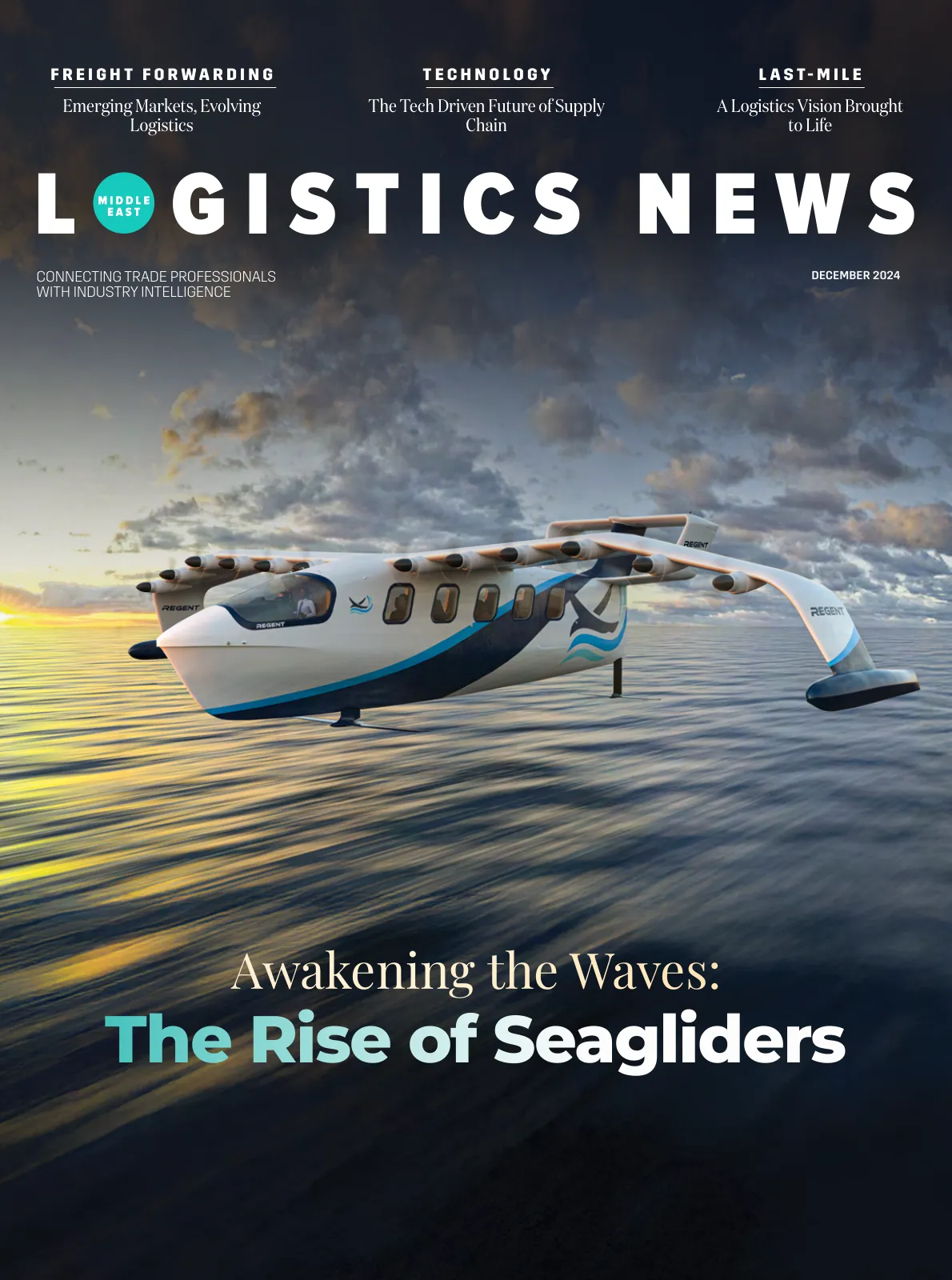
Logistics News, December 2024
Page 1
DECEMBER 2024
CONNECTING TRADE PROFESSIONALS
WITH INDUSTRY INTELLIGENCE
F R E I G H T F O R W A R D I N G
Emerging Markets, Evolving
Logistics
L A S T- M I L E
A Logistics Vision Brought
to Life
T E C H N O L O G Y
The Tech Driven Future of Supply
Chain
Awakening the Waves:
The Rise of Seagliders
Page 2
New IVECO S-Way: high technology and efficiency on all missions
A wide choice of Euro III / V diesel engines, delivering class-leading power from 360 hp
to 560 hp Euro III / 570 hp Euro V and superior fuel economy.
12-speed HI-TRONIX automated transmission with the most advanced technology
in its category, electronic clutch and best-in-class torque-to-weight ratio.
Full range of fuel-saving devices, such as anti-idling feature, EcoSwitch, Ecoroll and Smart Alternator.
Top levels of comfort and safety, with a completely redesigned and reinforced cab,
featuring enhanced direct visibility and enlarged cab livability.
Drive the new way.
Page 3
LOGISTICS NEWS ME | DECEMBER 2024 | 3
IN THIS ISSUE
28 INNOVATION
A MARVELOUS ROADMAP
32 FREIGHT FORWARDING
EMERGING MARKETS, EVOLVING
LOGISTICS
34 AUTOMATION
THE ACME OF AUTOMATION
38 INTERVIEW
AWAKENING THE WAVES: THE RISE OF
SEAGLIDERS
16 TALKING POINT
TOMORROW’S FUTURE
18 OP-ED
RIPPLE EFFECT: SANCTIONS ON
GLOBAL SUPPLY CHAINS
20 TRENDS
2025 TRENDS: SHAPING THE
FUTURE OF WAREHOUSING AND
INTRALOGISTICS
24 KSA
SAUDI ARABIA’S LOGISTICS
ASCENT
42 DRONES
THE SKY IS NOT THE LIMIT
44 SHIPPING
TURMOIL ON THE RED SEA
48 TECHNOLOGY
THE TECH DRIVEN FUTURE
OF SUPPLY CHAIN
52 LAST-MILE
A LOGISTICS VISION
BROUGHT TO LIFE
28
20
38
Page 4
Nestled by the coast of Lusail sits the splendor of
Raffles and Fairmont Doha, where luxury is rooted
in even the smallest details. Open the doors to
mesmerizing hospitality and make memories in a
world of sophistication.
Page 5
Page 6
6 | LOGISTICS NEWS ME | DECEMBER 2024
WWW.CBNME.COM
SUBSCRIBE
subscriptions@bncpublishing.net
PO Box 502511 Dubai, United Arab Emirates
P +971 4 4200 506 | F +971 4 4200 196
For all commercial enquiries, contact jo@bncpublishing.net
T +971 50 440 2706
All rights reserved © 2023.
Opinions expressed are solely those of the contributors.
Logistics News ME and all subsidiary publications in the MENA region are
officially licensed exclusively to BNC Publishing in the MENA region by
Logistics News ME.
No part of this magazine may be reproduced or transmitted in any form or
by any means without written permission of the publisher.
Printed by United Printing and Publishing | upp.ae
Images used in Logistics News ME are credited when necessary. Attributed use of
copyrighted images with permission. All images not credited courtesy Shutterstock.
cbnme.com
ACCESS FRESH CONTENT DAILY ON OUR WEBSITE!
Logistics News ME
@Logisticsnewsme
Logistics News ME
In addition to our print edition, we’re bringing
you all sorts of industry news on our web
mediums. We’re looking forward to interacting
with our readers on all of our social media and
web platforms. See you on the web!
CEO
Wissam Younane wissam@bncpublishing.net
Director
Rabih Najm rabih@bncpublishing.net
Group Publishing Director
Joaquim D’Costa jo@bncpublishing.net
Commercial Director
Andrea Mocay andrea@bncpublishing.net
Editor-in-Chief
Vibha Mehta vibha@bncpublishing.net
Editor
Aya Zhang aya@bncpublishing.net
Creative Lead
Christian Harb chriss@bncpublishing.net
Editorial Design
Rizaldi Febrian
Marketing Executive
Aaron Joshua Sinanbam aj@bncpublishing.net
Videographer
Eduardo Buenagua
CONNECTING TRADE PROFESSIONALS WITH INDUSTRY INTELLIGENCE
Page 7
Page 8
8 | LOGISTICS NEWS ME | DECEMBER 2024
WWW.CBNME.COM
T
here is a small flame
running around
somewhere inside of
us. This is our small
goal that drives us to
wake up every day and
do better. Everyone’s
small flame varies depending on
different motives - family, success,
money, a lifelong legacy, or it could be
anything. If what we are doing every
day to achieve this goal happens to
be what we love doing at the same
time, this flame can turn into a fire -
and this fire will make us undefeated
individuals, not in the sense that
we won’t fail, but that we would fail
999 times and go again for the one
thousand until it works. It will create
miracles - something that is truly
unseen before, and every single one
of us is capable of that.
As the year is coming to an end, it
is the perfect time to reflect on our
milestones in the year and check
on whether we are taking care of
this little flame, if it’s not already
a fire. The logistics industry, much
like our personal journeys, has
been growing more than ever. It
is an exciting time to witness all
the changes that are taking place.
Technology, in particular, has been
under the spotlight frequently, with
advancements in automation to
AI, robotics, drones, and more. The
region is also undergoing remarkable
transformations. From the UAE’s
ongoing strides in innovation and
sustainability to Saudi Arabia’s Vision
2030, the sector is constantly evolving
to meet the diverse needs of the
businesses and individuals alike.
It is truly thrilling to see this
continuous evolvement in this sector,
in everything around us, and within
us. This is a good time to pause and
reflect on what we have achieved and
what we will achieve. Let’s step into
2025 with renewed energy, letting that
fire burn brighter as we do it all over
again, but better.
LNME
Ignite the Fire
Aya Zhang
Editor
aya@bncpublishing.net
Xiaoyue (Aya) Zhang
xiaoyuezhangg
EDITOR’S NOTE
Page 9
Page 10
Page 11
SUITE TREAT
Step into a world of opulence when you book a Suite at Raffles Doha.
Experience the added luxury of QAR 750 credit to spend
on dining in the hotel, and QAR 500 towards any Spa treatment.
Children aged 12 and below are welcome to indulge in the
enchantment of complimentary dining.
Rates starting from QAR 3,500 per night
For reservations, please call +974 4030 7100
or email reservations.doha@raffles.com
Raffles Doha, Iconic Towers, Marina District, PO BOX 4747, Lusail, Qatar
Page 12
12 | LOGISTICS NEWS ME | DECEMBER 2024
WWW.CBNME.COM
REGIONAL NEWS
LNME
NMDC GROUP CREATES NEW LOGISTICS & TECHNICAL SERVICES DIVISION
The new business unit builds on NMDC’s extensive portfolio by adding logistics and
technical services to its marine, EPC, engineering, and civil construction business lines
N
MDC Group (ADX: NMDC), the Abu Dhabi
based EPC powerhouse in the global
dredging, marine civil, and energy sectors,
announced today the latest step in its
remarkable growth and innovation story;
the establishment of its new business unit, NMDC LTS.
The new business unit will enable customers and
partners to gain the benefit of NMDC Group’s
extensive experience and capabilities in the logistics
and technical services sector that have been built
over decades of outstanding EPC project delivery.
Built on NMDC Group’s strong foundations of world
class resources, operational excellence, and industry
leading technical expertise, NMDC LTS will enable
customers and partners to benefit from NMDC Group’s
innovative solution driven approach that underpins
its ongoing journey of growth and diversification.
NMDC LTS will own and/or operate NMDC Group’s
significant resource pool of marine support craft,
technical capabilities, plant & equipment to enable
the expansion of its services beyond the ongoing
support to NMDC Group’s business units to the
wider construction and industrial sectors. Through
collaborative strategic partnerships, cross-industry
synergies, and AI driven optimisation, NMDC LTS
will be strongly positioned to deliver cost effective,
innovative solutions across a wide range of services
beyond the delivery of world class infrastructure that
NMDC Group is renowned for.
Eng. Yasser Zaghloul, CEO of NMDC Group, said:
“NMDC Group is a global leader in the marine EPC
sectors which, by its nature, demands efficient and
effective logistics and technical services to enable
remarkable projects to be delivered to our clients.
The scale and breadth of our operations naturally
positions us to extend our services beyond the
delivery of dredging & marine and energy EPC
projects.
NMDC LTS will be a trusted platform that gives new
partners access to one of the biggest construction
logistics and technical services operators in the
region and enable them to gain the benefits of
efficiency, innovation, and service focused delivery
that NMDC Group has built over the decades of
success. We look forward to continuing to work with
our current partners in this exciting next phase of
NMDC Group’s growth, and to take our expertise and
offering to new clients and markets.”
Page 13
LOGISTICS NEWS ME | DECEMBER 2024 | 13
REGIONAL NEWS
H
is Majesty King Salman bin Abdulaziz Al Saud
inaugurated the Riyadh Metro, the backbone of the
capital’s public transport network.
Riyadh Metro will feature six lines spanning 176 kilometres to
ensure a fast, reliable, comfortable commuting experience.
The network has been developed to transport over 3.6 million
passengers at maximum capacity and operates on a fully
automated (driverless) metro system. In line with Vision 2030,
Riyadh Metro will significantly bolster Riyadh’s urban mobility
and the services and logistics sector.
Riyadh Metro is a key component of Riyadh Public Transport
(RPT), a well-integrated and efficient public transport network
designed to serve residents and tourists alike. It includes
metro lines, buses, feeders, Bus Rapid Transit (BRT), Bus on
Demand, and Park & Ride facilities.
His Royal Highness Crown Prince, Prime Minister, and
Chairman of the Royal Commission for Riyadh City (RCRC)
stated: “The Riyadh Public Transport Project, which spans
metro and bus networks, is the culmination of concerted
efforts made by His Majesty King Salman bin Abdulaziz Al
Saud, and the outcome of His Majesty’s visionary leadership
while serving as Chairman of the High Commission for the
Development of Arriyadh, the predecessor of RCRC.”
The metro will operate in phases, with the first three lines
– the Blue Line (Line 1), the Yellow Line (Line 4), and the
Purple Line (Line 6) – opening to the public on December
1st. Subsequent launches of the Red line (Line 2) and the
Green line (Line 5) are scheduled for December 15th, while
the Orange line (Line 3) is set to launch on January 5th,
2025, culminating
in a complete
network of six
lines featuring 85
strategically located
stations, including
four iconic main
stations: King
Abdullah Financial
District (KAFD), STC,
Qasr Al Hokm, and
Western Station.
H.E. Ibrahim bin
Mohammed Al-
Sultan, Minister
of State, Member
of the Council of
Ministers, and RCRC
CEO, commented:
“Today, Riyadh City is reaping the benefits of this project
that will reshape the capital’s image and redefine mobility for
its residents and visitors. The network aligns with Riyadh’s
economic, social, environmental, and urban development
objectives and represents a historic milestone in the capital’s
transportation sector. Riyadh Metro will ease the daily lives
and commute of citizens, residents and visitors, offering them
a world-class urban travel experience.”
The Riyadh Metro is a crucial milestone of the ambitious
plans outlined by RCRC to improve mobility and enhance
quality of life. The project comprises 183 trains with a total
of 448 cars manufactured by three leading global train
manufacturers—Siemens (Germany), Bombardier (Canada),
and Alstom (France)—and features a modern and unified
design by Avant Premiere (France).
Riyadh Metro is integral to the city’s infrastructure network,
supporting its future development and providing an efficient
transport solution for Expo 2030 and other major world-class
events.
Riyadh Metro reflects Saudi Arabia’s commitment to
sustainable urban development, driven by the need to reduce
pollution while addressing transportation demands. Aligning
with global sustainability standards and smart, sustainable
solutions, the network integrates environmental practices,
featuring stations constructed with 20% recycled materials
and local resources and engineered to lower energy and water
usage. Riyadh Metro stations are committed to international
sustainability standards in design and execution, having won
gold LEED certifications for both the KAFD and Qasr Al Hokm
stations.
A MAJOR MILESTONE FOR KSA’S CONSTRUCTION INDUSTRY
WITH THE INAUGURATION OF RIYADH METRO
Riyadh Metro represents the backbone of the capital’s public
transportation network
Page 14
14 | LOGISTICS NEWS ME | DECEMBER 2024
WWW.CBNME.COM
J&T EXPRESS EXCEEDS 100 MILLION GLOBAL PARCELS HANDLED IN A
SINGLE DAY
J&T Express , a global logistics service provider,
announced a new milestone in its growth trajectory,
surpassing 100 million parcels handled worldwide
in a single day during this year’s Double 11 shopping
festival on November 12th.
Double 11 is a traditional peak season for China and
Southeast Asia. From October 20 to November 12,
J&T Express saw significant growth in parcel volume
in both markets. In China, the daily average parcel
volume during this period reached nearly 66 million,
a 25% year-over-year (“YoY”) increase, setting a new
record. In Southeast Asia, the daily average parcel
volume from November 1 to 11 exceeded 15 million,
marking an impressive 73% YoY growth.
In anticipation of the expected surge in parcel
volumes during the multiple year-end shopping
festivals, J&T Express implemented early
preparations across various markets, increasing
investment in infrastructure and human resources
to ensure operational efficiency and service
quality. In China, based on business forecasts
and actual production needs, J&T upgraded and
renovated 32 sorting centers nationwide, expanding
operating areas and improving timeliness. Over 600
distribution hubs and outlets were also upgraded
across the country, with over 400 sets of automated
equipment deployed to enhance operational
capacity and effectively manage the peak parcel
volume.
Benefiting from the vast growth potential of
Southeast Asian markets and close collaboration
with e-commerce clients, J&T Express anticipated
the increase in e-commerce parcel volume during
Double 11 and made proactive preparations. In
September and October, J&T Express Vietnam
deployed over 300 trucks, and the company
constructed its largest sorting center in North
Vietnam, equipped with advanced operating
technology and equipment, which officially
commenced its operations. This center boasts a
parcel handling accuracy rate of 99.99%, significantly
enhancing operational efficiency.
In Thailand, J&T Express upgraded four sorting
centers and five distribution hubs, adding over 13
sets of automated equipment to boost operational
capacity. As a result, the peak processing capacity
of sorting centers increased by approximately 25%,
and the distribution hubs saw a 20% improvement.
Furthermore, J&T Express Thailand expanded its
sorting area by approximately 19,000 square meters,
added over 900 transport vehicles, and recruited
over 3,800 personnel to meet the growing demand
of sorting, delivery, and customer service sectors.
In other new markets, Black Friday (November 29th)
marks the largest logistics peak season in Latin
America. J&T Express has observed a significant
upward trend in parcel volumes in Brazil and Mexico.
To address the upcoming peak, J&T Express in both
countries has proactively invested in infrastructure
and human resources, upgrading automated
equipment to meet the high-quality express service
demands of both clients and consumers.
REGIONAL NEWS
LNME
The historical record highlights the company’s strong operational abilities and
steadfast dedication to meeting the needs of its global clientele
Page 15
LOGISTICS NEWS ME | DECEMBER 2024 | 15
DHL EXPRESS APPOINTS ABDULAZIZ BUSBATE AS CEO FOR MENA REGION
D
HL Express has
appointed Abdulaziz
Busbate as the new
Chief Executive
Officer (CEO) of DHL
Express MENA (Middle East
and North Africa), effective
January 1, 2025. He will succeed
Nour Suliman, who recently
stepped into a non-executive
advisory role within DHL Group
as President MENA. Abdulaziz
Busbate will be based in Bahrain
and will report directly to John
Pearson, CEO of DHL Express.
Bringing 24 years of
management experience
at DHL Express to the role,
Busbate began his journey
in Saudi Arabia, leading
various commercial teams and
contributing significantly to the
organisation’s profitable growth.
In 2014, he transferred to Bahrain
as Country Manager, where he
focused on service improvement
and commercial development. In
2021, Busbate returned to Saudi
Arabia as Managing Director,
successfully driving forward the
company’s strategy, including
significant enhancements to
service quality, investments
in infrastructure and capacity,
and development of the local
workforce.
“We are excited to welcome
Abdulaziz Busbate to this
pivotal role,”
said John
Pearson, CEO
of DHL Express.
“His extensive
experience,
proven track
record, and deep
understanding
of the region will
be invaluable as
we continue to
drive growth and
innovation in
the Middle East
and North Africa
market, which
continues to be
a strategically
important market
for our customers
and a source of
talented, motivated employees
for our global organisation.”
“I’m honored to lead this great
team and build upon our strong
foundations in this diverse,
dynamic, and entrepreneurial
region,” said Abdulaziz Busbate.
“My focus will remain on
expanding DHL’s leadership
position in the Middle East and
North Africa, enabling growth
and delivering exceptional
service to our customers. We
will continue to invest in making
DHL a Great Place to Work for
our people and a pioneer of
sustainable logistics, delivering
a positive contribution to the
communities we serve.”
REGIONAL NEWS
Busbate embarked on his journey in Saudi Arabia, taking on several commercial
roles that drove the organisation’s profitable growth
Page 16
16 | LOGISTICS NEWS ME | DECEMBER 2024
WWW.CBNME.COM
TALKING POINT
LNME
E
-commerce has revolutionised
the retail sector globally, and
the GCC region is no different.
As a region with a promising
digital economy, a young and
well-knowledgeable population, and
increasing urbanisation, the GCC has
become a hub of e-commerce propelling
activities. Among these advancements,
last-mile delivery innovations are most
significant in determining the industry’s
future. They improve efficiency and
enhance sustainability – a critical factor
in the region’s recent efforts to transition
to an environmentally friendly economy.
Data from 2021 indicates that sales figures
for retail made through e-commerce
reached nearly 5.8 trillion dollars, which is
expected to grow in 2023 as more and more
consumers move towards shopping online
instead of the traditional brick-and-mortar
model. The COVID-19 pandemic fast-tracked
this process and made it possible by
increasing the amount spent online so that
even the most opposing shoppers became
accustomed to using e-commerce regularly.
The increased volume of online
transactions has resulted in greater reliance
on logistics services, especially last-mile
delivery coverage, which is crucial in the
supply chain. The last mile is the last
leg in the supply chain and includes the
movement of stocks from the distribution
or depot to the customers’ end. Stats from
Tomorrow’s
Future
Innovations transforming last-
mile logistics for tomorrow
Originally written by Dr.Shereen Nassar.
Edited by Vibha Mehta.
Dr. Shereen Nassar,
Global Director of
Logistics Studies
and Director of MSc
Logistics and Supply
Chain Management
Suite at Heriot-Watt
University Dubai
Page 17
LOGISTICS NEWS ME | DECEMBER 2024 | 17
TOMORROW’S FUTURE
Capgemini suggest that the last mile represents
53% of the shipping costs and 41% of all expenses
incurred in the supply chain. Businesses are
under pressure to meet consumer expectations
for services like same-day or hourly deliveries
while balancing speed, cost, and sustainability.
Effective last-mile delivery solutions are essential
in the GCC region, where e-commerce will exceed
USD 50 billion by 2025. Consumers in the UAE
and Saudi Arabia demand efficiency, quality,
and sustainability, driving companies to adopt
innovative technologies and transform traditional
delivery methods.
Drones and self-driving trucks, also known as
autonomous delivery vehicles, are being efficiently
trialed and implemented in the GCC. Dubai’s Roads
and Transport Authority (RTA) has partnered with
technology firms to explore autonomous delivery
systems, which reduce human labor, improve
delivery speed, and cut operational costs while
supporting the UAE’s sustainability goals by
lowering emissions. Smart lockers and pick-up
points are also transforming last-mile logistics in
cities. Firms like Aramex and Noon have introduced
these features in several GCC cities, allowing
customers to collect parcels at their convenience,
reducing failed deliveries, and enhancing delivery
route efficiency. Additionally, crowdsourced
delivery models use third-party drivers and
couriers to provide quick, flexible shipping solutions
and increase scalability during shopping seasons.
AI and data analytics work hand in hand with
these models by automating delivery routes and
schedules. For example, firms in Saudi Arabia
are utilising AI-based systems to track traffic
flow and customer locations, ensuring deliveries
are made on time while minimising fuel costs.
Implementation of such technologies can not
only satisfy consumers but also reduce the
environmental impact of deliveries. The GCC
countries are set to gain a competitive edge in
last-mile delivery thanks to recent technological
innovations. Government initiatives supporting
eco-friendly technology, such as Dubai’s ambition
to become a global hub for self-driving vehicles
and Saudi Arabia’s commitment to green logistics,
will further drive this growth.
The transformation in consumer shopping habits
and increasing demand for bio-sustainability will
significantly impact logistics and supply chain
companies in the GCC. This focus on sustainability
and modern technology is essential for regional
operators.
By embracing biodegradable packaging and self-
delivery systems, the GCC can capitalise on the
expected growth in e-commerce. Addressing issues
like waste management will help the region become
a leader in the green economy, yielding substantial
returns. Another notable trend is the presence of
smart technology in packaging. More companies
are applying IoT devices in their packaging to
track conditions during transport, maintaining
product quality and minimising losses. Additionally,
many companies have started working with local
distribution organisations that use electric cars or
bicycles, sustainably enhancing last-mile delivery
solutions. The combination of green packaging
with green logistics will enable companies to
significantly reduce their environmental footprint.
Finally, the need for sustainable development
goals has improved green packaging for last-mile
connectivity. By using eco-friendly, biodegradable
materials, reusable systems, intelligent technology,
and green logistics, the companies operating in the
GCC are responding to their customers, who are
becoming more eco-conscious and participating in
creating a better world.
To conclude, observing the current trend of smart
cities and green economy growth in the GCC region,
last-mile logistics will always be at the forefront.
Last-mile logistics will ensure companies meet
customers’ growing demands and help achieve
broader development in the respective areas.
Such a development period is a great time for
e-commerce and logistics in the Gulf region, where
innovation and environmental sustainability
become key factors in performance and customer
interaction changes completely.
Page 18
18 | LOGISTICS NEWS ME | DECEMBER 2024
WWW.CBNME.COM
LNME
OP-ED
Originally written by James Willn, Partner - Energy & Natural Resources Group, Reed Smith
and Finlay Donaldson, Associate - Energy & Natural Resources Group, Reed Smith
Edited by Vibha Mehta.
I
n today’s highly interconnected world,
governments frequently use sanctions as
a strategic tool to influence the behaviour
of other nations. While these measures can
effectively advance diplomatic objectives,
they often trigger far-reaching and unexpected
ripple effects, notably disrupting global supply
chains.
In the rapidly evolving economic landscape of
the GCC, where trade and commerce are the
lifeblood of prosperity, understanding
the implications of international
sanctions is not just beneficial -
it’s essential. The region is deeply
integrated into the global economy, so
businesses must be adept at navigating
the complexities of sanctions that
can disrupt supply chains, affect
market access, and challenge financial
operations.
This article explores the impact of
sanctions on supply chains within the
GCC and offers strategies for mitigating
these risks through diversification and
proactive planning.
How Sanctions Disrupt Supply Chains
Sanctions can prevent businesses from
accessing key resources or markets.
For example, energy sanctions on oil-
producing nations can destabilize global
energy markets, leading to shortages
and price hikes.
In the technology sector, sanctions on
countries like China and Russia have
limited access to semiconductors
and software, reverberating through
industries reliant on high-tech
components, such as automotive and
consumer electronics.
Moreover, companies that depend
on these sanctioned markets for raw
materials or as export destinations
are forced to either find alternative
suppliers or reconfigure their supply chain to
comply with new regulations, which can result
in increased costs and lead times.
Sanctions create a multitude of regulatory
hurdles, including the need for enhanced
due diligence. Companies must ensure that
they are not inadvertently dealing with
sanctioned entities or individuals, a challenge
compounded by complex global networks of
Countries may be penalised for
legitimate reasons, but it’s important
for companies to know how this
affects access to materials, markets,
financing, and logistics
Ripple Effect:
Sanctions on Global
Supply Chains
James Willn
Partner - Energy &
Natural Resources
Group, Reed Smith
Page 19
LOGISTICS NEWS ME | DECEMBER 2024 | 19
RIPPLE EFFECT: SANCTIONS ON GLOBAL SUPPLY CHAINS
suppliers, subsidiaries, and third-
party contractors.
Many sanctions target financial
systems, blocking access to global
banking networks. This can create
significant liquidity problems
for companies in the supply
chain, especially when banks
refuse to process transactions
linked to sanctioned entities. In
recent years, sanctions on Russia
have cut off several of its major
banks from the SWIFT system,
limiting their ability to transact
internationally.
Trade embargoes, shipping
restrictions, and airspace closures
can bring physical supply chains
to a grinding halt. For instance,
sanctions against Russia in
February 2022 closed European
airspace to Russian airlines,
complicating the movement
of goods between Europe and
Asia. Companies had to reroute
cargo through longer and more
expensive paths, exacerbating
existing challenges in global
logistics already strained by
the COVID-19 pandemic.
Strategies to Mitigate
Sanction Risks
In the GCC, where
economies heavily rely on
oil exports and imports of
technology and consumer
goods, sanctions can have
profound effects. One of
the most effective ways
to reduce exposure is by
diversifying suppliers and
markets. Companies that
rely heavily on a single
region of the world are
particularly vulnerable to
sanctions, as a disruption in
that region can have widespread
effects. By sourcing from multiple
areas, companies can minimize
risks and ensure continuity
of supply, even if one region
becomes inaccessible due to
sanctions.
Investing in advanced compliance
and risk management systems is
critical for navigating a sanctions-
heavy environment. Automated
systems that track regulatory
changes, screen for sanctioned
entities, and flag potential risks
can reduce non-compliance
chances. In addition, regular
audits of supply chains and
continuous engagement with
legal and compliance experts can
help identify and mitigate risks in
real-time.
Furthermore, businesses should
review and renegotiate contracts
with suppliers and partners to
include clauses that address
potential disruptions caused by
sanctions. Including clauses that
address unforeseen disruptions
caused by sanctions can provide
an extra layer of protection,
allowing companies to terminate
agreements without penalties if
a partner becomes sanctioned
or the business environment
changes drastically.
Resilience in supply chains
can be built through strategic
stockpiling of critical materials,
forging stronger relationships
with logistics providers, and
adopting flexible production
techniques that allow for rapid
adjustments to shifting trade
conditions. Additionally, adopting
digital supply chain technologies
that offer greater transparency
and real-time tracking can help
companies better navigate
disruptions when they occur.
Preparing for a Sanction-Heavy
Future
As the GCC continues to play a
significant role in global trade,
understanding and managing the
impact of sanctions on supply
chains is vital. Sanctions will
continue to play a prominent
role in international politics, and
their effects on supply chains
will remain a critical concern for
businesses worldwide.
By understanding the nature
of sanctions, staying compliant
with international regulations,
and taking proactive measures
to diversify and secure supply
chains, GCC businesses can better
prepare for the uncertainties
of the modern geopolitical
landscape. In doing so, they can
ensure continued growth and
stability in an ever-evolving
global market.
Finlay Donaldson
Associate - Energy & Natural
Resources Group, Reed Smith
Page 20
20 | LOGISTICS NEWS ME | DECEMBER 2024
WWW.CBNME.COM
LNME
TRENDS
Page 21
LOGISTICS NEWS ME | DECEMBER 2024 | 21
Warehousing
Intralogistics
2025 TRENDS: SHAPING THE FUTURE OF WAREHOUSING AND INTRALOGISTICS
T
he future of warehousing is shaped
by technological innovation,
evolving consumer demands, and
the drive for operational excellence.
In the Middle East, governments are
positioning the region as a global logistics
hub, with Saudi Arabia committing over USD
267 billion to its logistics sector by 2030.
As we enter the new year, organisations are
overcoming automation barriers, increasing
investments in proven technologies,
and unlocking new efficiencies through
orchestration and artificial intelligence.
These advancements are transforming the
logistics landscape, setting the stage for
groundbreaking changes. The key trends
expected to redefine the sector in the year
ahead are now in motion.
AI in the Warehouse
AI will be pivotal to future warehouse
technology, driving efficiency, optimisation,
and intelligent decision-making. AI-powered
systems will enable accurate demand
forecasting, predictive maintenance, real-
time inventory management, and seamless
integration with warehouse automation
Rami Younes, General Manager of Swisslog Middle East,
explores the key drivers and trends poised to shape the
warehousing industry in the coming year
2025
Trends:
Shaping the Future of
and
Page 22
22 | LOGISTICS NEWS ME | DECEMBER 2024
WWW.CBNME.COM
solutions. These
insights streamline
order fulfilment,
optimise material
flow, and boost
overall supply chain
performance, enabling
warehouses to meet
increasing demands
with precision.
The synergy between
AI, robotics, and
automation further
strengthens decision-
making capabilities,
allowing real-time
adjustments to
changing conditions
or unforeseen events.
These adaptive
systems learn and
refine their processes,
ensuring operations
remain agile and responsive in a dynamic industry.
The future warehouse will rely heavily on AI to
optimise intralogistics, enabling businesses to
achieve unprecedented levels of productivity and
flexibility.
Big Data for Competitive Advantage
Sophisticated Warehouse Management Systems
(WMS) and data analytics tools will provide real-
time insights into inventory levels, order patterns,
and operational bottlenecks. By leveraging machine
learning, AI, and advanced algorithms, these data-
driven solutions can identify patterns, accurately
predict demand, optimise resource allocation, and
streamline processes for maximum efficiency.
Moreover, predictive maintenance capabilities
enabled by data analytics will minimise equipment
downtime, further enhancing operational efficiency
and reducing costly disruptions. Real-time tracking
and visibility into asset locations, inventory levels,
and process bottlenecks will facilitate proactive
decision-making and expedite problem resolution,
driving continuous improvement across the entire
supply chain.
Data-driven warehouse software will also enable
advanced capabilities like digital twin simulations,
allowing businesses to virtually model and test
various scenarios before implementing changes.
This data-driven approach ensures well-informed
decision-making and maximised warehouse
performance.
Uptake Robotic Revolution
Robots are taking on tasks such as picking, packing
and maintenance. Recent reports suggest that
by 2025, autonomous robots may be responsible
for processing up to 50% of e-commerce orders,
highlighting the growing inclination among forward-
thinking companies to leverage automation for
LNME
TRENDS
Page 23
LOGISTICS NEWS ME | DECEMBER 2024 | 23
process optimisation and
efficiency improvements.
In the Middle East, the
deployment of automation
technologies, such as robotic
storage systems and autonomous
mobile robots, has brought about
remarkable advancements in
warehouse operations. These
innovations empower businesses
to enhance their capabilities in
order fulfilment, reduce errors,
and meet the ever-evolving
demands of customers.
By 2025, advancements in
Autonomous Mobile Robots
(AMRs), Automated Guided
Vehicles (AGVs), and Automated
Storage and Retrieval Systems
(AS/RS) will transform dynamic
warehouse operations. AS/RS
technologies will revolutionise
inventory management,
automating storage and retrieval,
maximising floor space by up to
85%, and driving ROI in sectors
like grocery retail.
Nearshoring
After years of industry focus
on automating each picking to
support growing e-commerce and
omnichannel distribution, pallet
handling systems are back in the
spotlight. That’s partly due to the
continued momentum around re-
shoring, in which manufacturers
are re-centering their supply
chain to improve resiliency.
This is driving the development
of high-bay warehouses that
support the distribution of
palletised products and that will
result in increased investment
in pallet handling technologies,
particularly crane-based
Automated Storage & Retrieval
Systems (ASRS).
Solutions based on technologies
like the Swisslog Vectura crane
maximise space utilisation in
high-bay warehouses and deliver
proven reliability over decades
of service. Supply chains already
dependent on crane-based ASRS
will extend the value of these
solutions by investing in lifecycle
services that ensure reliability and
enable adaptability.
Sustainability at the Forefront
The Middle East is seeing an
increased demand for eco-
friendly logistics, aligned with
KSA’s Vision 2030 and UAE’s Net-
Zero initiatives aimed at reducing
carbon emissions.
Sustainability tends to
be a core principle within
emerging economies.
As the Middle East
embraces clean
energy technologies,
automation plays a
vital role in reducing
energy consumption.
For instance, high
bay warehouse pallet
stacker cranes harness
regenerative power
and braking modules,
resulting in energy
efficiency and reduced
reliance on non-
renewable energy sources.
Electric automation technologies,
like robotics, are energy-efficient,
using as little as 0.1 kW per
hour, and can be powered by
renewable sources. Swisslog has
set a precedent by implementing
the first 100% solar-powered
warehouse automation system,
showcasing the potential for
these systems to run on on-site
renewable energy.
Embracing trends like advanced
automation, AI, data-driven
insights, micro-fulfilment centres,
and autonomous robots enables
businesses to future-proof
operations and gain a competitive
edge. Intralogistics is evolving
rapidly, and companies that adapt
to these trends will thrive in an
era of futuristic, highly optimised
warehouses.
2025 TRENDS: SHAPING THE FUTURE OF WAREHOUSING AND INTRALOGISTICS
Page 24
24 | LOGISTICS NEWS ME | DECEMBER 2024
WWW.CBNME.COM
S
udi Arabia (KSA) is on the cusp of a
transformative evolution, poised to
become the premier logistics hub
in the Middle East. With its strategic
location, ambitious investments, and
groundbreaking initiatives, the Kingdom
is redefining the logistics and supply chain landscape
in the region. Spearheaded by key players such as
Agility, SAL Logistics, DSV, DP World, FedEx, DHL,
and other major cargo firms, KSA is leveraging its
resources, infrastructure, and vision to cement its
status as a global logistics powerhouse.
Strategic Location: A Gateway to the World
KSA’s geographical advantage is a cornerstone of its
logistics ambitions. Nestled at the crossroads of three
continents — Asia, Europe, and Africa — the Kingdom
is uniquely positioned to serve as a global trade
corridor. With 13 ports along its extensive coastline,
including major facilities in Jeddah and Dammam,
KSA is primed to facilitate the seamless movement of
goods across the globe. The government’s focus on
modernizing these ports has already begun to yield
results, with increased cargo throughput and reduced
turnaround times. This strategic positioning not
only benefits regional trade but also connects Saudi
Arabia to emerging global markets.
Vision 2030: A Blueprint for Logistics Excellence
Central to KSA’s logistics transformation is the Vision
2030 initiative, an ambitious roadmap to diversify
the economy and reduce reliance on oil revenues. The
National Transport and Logistics Strategy (NTLS), a
critical component of Vision 2030, aims to position
Saudi Arabia among the top
10 global logistics hubs by
2030. This strategy focuses
on enhancing infrastructure,
streamlining regulations,
and integrating advanced
technologies to drive
efficiency and innovation in
logistics operations.
Key objectives include:
•
Increasing the capacity
of air cargo to over 4.5
million tons annually.
•
Expanding the network
of ports to handle
more than 40 million
containers per year.
•
Establishing over
59 logistics zones
nationwide to support
businesses and
facilitate trade.
•
Creating robust
connections to
neighboring countries
to boost intra-regional trade and global
competitiveness.
Global Players Shaping the Future
One of the major contributors to Saudi Arabia’s
logistics revolution is Agility, a global leader in supply
chain services. Agility has invested heavily in state-
of-the-art logistics facilities across the Kingdom,
The Kingdom is transforming into the Middle East’s logistics
powerhouse, blending strategic location, bold investments, and industry
giants like Agility and DHL to redefine global supply chains
Words by: Vibha Mehta
Saudi Arabia’s Logistics Ascent
LNME
KSA
Page 25
LOGISTICS NEWS ME | DECEMBER 2024 | 25
offering advanced warehousing,
freight forwarding, and last-mile
delivery solutions. The company’s
focus on digital transformation
has brought cutting-edge
technologies like AI-driven
supply chain optimization and
IoT-enabled tracking systems to
KSA’s logistics sector, enhancing
operational efficiency and
customer satisfaction.
DSV, another global logistics
giant, has expanded its footprint
in Saudi Arabia, integrating
innovative solutions to
optimize freight forwarding
and warehousing. With their
expertise in sustainability and
technology-driven logistics, DSV
is contributing to streamlining
Saudi Arabia’s logistics processes
and making them globally
competitive.
FedEx and DHL have also
established themselves as critical
players in the region. DHL is
spearheading green logistics
initiatives, deploying electric
vehicles for last-mile delivery,
and integrating carbon-neutral
shipping solutions. Meanwhile,
FedEx is focused on enhancing
express transportation services
to meet the growing demands of
e-commerce and international
trade.
Air Cargo Expansion
SAL Logistics, the Kingdom’s
leading air cargo operator,
is playing a pivotal role in
transforming KSA into a regional
logistics hub. With a focus on
expanding air freight capabilities,
SAL is aligning its operations
with Vision 2030 to support
the growing demand for swift
and efficient cargo movement.
The company operates
world-class facilities at major
airports, including King Khalid
International Airport in Riyadh
and King Abdulaziz
International Airport in
Jeddah.
Other operators, such
as Saudi Airlines Cargo,
are also contributing
significantly, offering
extensive international
cargo routes and
advanced freight
solutions to bolster the
Kingdom’s air logistics
network. SAL’s recent
initiatives include
the implementation
of automated cargo
handling systems and
the development of
temperature-controlled
warehouses to support
the growing demand
for pharmaceutical and
perishable goods logistics.
By investing in innovation
and infrastructure, SAL
is ensuring that KSA’s air
cargo sector remains competitive
on a global scale.
Transforming Land and Sea
Logistics
While air cargo is a significant
focus, KSA is also making strides
in land and sea logistics. The
Kingdom’s extensive highway
SAUDI ARABIA’S LOGISTICS ASCENT
Page 26
26 | LOGISTICS NEWS ME | DECEMBER 2024
WWW.CBNME.COM
network, spanning over 80,000
kilometers, is being upgraded
to facilitate faster and safer
cargo movement. Additionally,
the Saudi Landbridge project,
a railway initiative connecting
the eastern and western
coasts, will revolutionize freight
transportation by significantly
reducing transit times.
On the maritime front, KSA’s
ports are undergoing substantial
upgrades to accommodate
mega-vessels and increase
container handling capacity. The
expansion of the Jeddah Islamic
Port and King Abdullah Port has
positioned them as key players in
global maritime trade. DP World,
a global leader in port operations,
has been instrumental in driving
these upgrades, ensuring
seamless port operations and
logistics management. These
developments are complemented
by the establishment of free
zones, such as the Red Sea
Gateway Terminal, which offers
tax incentives and streamlined
customs processes to attract
international businesses.
Technological Advancements:
The Future of Logistics
KSA’s logistics sector is embracing
technological advancements to
drive efficiency and innovation.
Blockchain technology is being
implemented to enhance
transparency and traceability in
supply chains, while autonomous
vehicles and drones are being
trialed for last-mile delivery
solutions. AI-powered analytics
are optimizing route planning and
inventory management, reducing
costs and improving service
quality.
The Kingdom’s commitment to
sustainability is also evident in
its logistics initiatives. Electric
vehicles, green warehouses,
and renewable energy-powered
facilities are being integrated
into the logistics ecosystem to
minimize environmental impact.
Agility, SAL, DHL, and FedEx have
all embraced these technologies,
integrating them into their daily
operations to improve efficiency
and ensure sustainability. Their
efforts align with the Kingdom’s
broader goals of achieving
environmental stewardship and
economic growth.
Global Partnerships and
Investments
KSA’s logistics ambitions have
attracted significant interest from
global investors and partners.
Companies like DP World, Maersk,
and CMA CGM are collaborating
with local stakeholders to
enhance infrastructure and
expand trade networks. The Public
Investment Fund (PIF) is also
playing a critical role by financing
mega-projects such as NEOM’s
Oxagon, which is set to become a
futuristic logistics hub.
These partnerships are fostering
innovation and bringing global
expertise to Saudi Arabia,
positioning the Kingdom as a
logistics gateway for the wider
Middle East, Africa, and Asia. By
leveraging these collaborations,
KSA is rapidly scaling its logistics
capacity to meet the growing
demands of global trade.
Challenges and Opportunities
While the progress is remarkable,
challenges remain. The sector
needs to address skill gaps,
streamline regulatory processes,
and ensure seamless coordination
among various stakeholders.
However, these challenges
also present opportunities for
innovation and collaboration,
which can further strengthen
KSA’s position as a logistics hub.
The growing e-commerce market
in the region, expected to exceed
USD 50 billion by 2025, presents
a significant opportunity for
logistics providers. Companies like
Noon and Amazon are expanding
their operations in KSA, relying
on the evolving logistics
infrastructure to meet consumer
demands for faster and more
reliable deliveries.
A Bright Future Ahead
With its strategic vision, robust
investments, and collaboration
with leading logistics players,
Saudi Arabia is well on its
way to becoming the Middle
East’s logistics epicenter. The
Kingdom’s efforts to integrate
advanced technologies, enhance
infrastructure, and promote
sustainability are setting new
standards for the industry. As
Agility, SAL Logistics, DSV, DP
World, FedEx, DHL, and other
key players continue to reshape
the landscape, KSA is poised to
redefine logistics in the region and
beyond.
LNME
KSA
Page 27
Require formwork and scaffolding? Check out Doka’s extensive list of products and systems, which
now includes scaffolding for a variety of applications. At Doka, our philosophy is to provide a broad
range of services under one umbrella based on a growing demand for single-source solutions that
adhere to the highest standards.
One-stop-shop
meaapmarketing@doka.com | www.doka-me.com
/DokaMEA
/company/doka-middle-east-africa
/doka_mea
Page 28
28 | LOGISTICS NEWS ME | DECEMBER 2024
WWW.CBNME.COM
LNME
INNOVATION
Christopher (Chris) Cahill, Managing Director of the Middle East and India Sub-
continent at GEODIS, highlights the various remarkable innovative approaches in the
company
A Marvelous Roadmap
Christopher (Chris) Cahill
Managing Director of the
Middle East and India Sub-
continent, GEODIS
Page 29
LOGISTICS NEWS ME | DECEMBER 2024 | 29
A MARVELOUS ROADMAP
G
EODIS is a leading worldwide
provider of customised
transportation, warehousing, global
logistics, and supply chain solutions.
As an active partner in its clients’ growth,
the company focuses on four core business
lines: freight forwarding, contract logistics,
distribution & express deliveries, and road
transport.
With a global network spanning nearly 170
countries and 53,000 employees, GEODIS is
ranked no. 5 in its sector across the world. In
2023, GEODIS generated EUR 11.6 billion in
revenue. GEODIS, a company owned by SNCF
group, is an international full-service logistics
company with French roots, its head office is
located in Levallois, France.
Roadmap for Innovation
GEODIS’ strategy is designed to strengthen
its position as a leader in sustainable and
innovative end-to-end logistics solutions to
help its customers succeed and grow around
the world. GEODIS’s capacity for innovation is
a key differentiator, a means of creating value
for its customers and a major lever for growth
and performance. The company focuses on
three main areas of innovation:
•
Digital technology, at all stages of
the Group’s processes, from customer
relations to delivery.
•
Robotics, a powerful lever for operational
performance and making tasks less
arduous.
•
Decarbonisation.
In addition, GEODIS leverages AI and machine
learning to optimise routes, improve delivery
accuracy, and manage inventory more
effectively. IoT technologies provide real-time
tracking of shipments and assets (e.g. drivers
and trucks), ensuring timely and secure
deliveries. The business also launched its very
own Geodis GPT to support and enable their
employees to work more efficiently, while
keeping their data and environment secure.
By continuously investing in these
technologies and fostering a culture of
innovation, GEODIS aims to stay at the
forefront of the logistics industry, offering
cutting-edge solutions that meet the evolving
needs of its clients.
Automation & Robotics
Moreover, GEODIS adopts and integrates
advanced automation and robotics solutions
Page 30
30 | LOGISTICS NEWS ME | DECEMBER 2024
WWW.CBNME.COM
LNME
INNOVATION
through deploying automated
guided vehicles (AGVs) and
robotic arms in warehouses to
streamline picking, packing, and
sorting operations, minimising
errors, and increasing throughput.
GEODIS also employs Warehouse
Management Systems (WMS)
that leverage robotics for real-
time inventory tracking and
management, providing end-to-
end visibility and control over
stock levels.
Automation extends to
transportation logistics, where
GEODIS uses automated systems
for route optimisation and load
planning, ensuring the most
efficient use of resources and
timely deliveries.
Robotic Process Automation
(RPA) streamlines processes
and automated data capture
and processing tools improve
the accuracy and speed of
information flow across the
supply chain.
In response to the growth of
e-commerce, GEODIS aims
to offer customers the same
personalized experience online
and in-store. Smart robots are
improving the quality and speed
of operations. Data management
solutions combined with artificial
intelligence (AI) systems increase
operational efficiency and
accuracy of forecasting.
With approximately 80 highly
automated sites around the world,
GEODIS is one of the leaders in
integrating the latest generations
of robots within warehouses.
A key challenge in implementing
new technologies, however, is
change management. Effective
change management should be
integrated from the project’s
inception, ensuring a smoother
transition and greater adoption
of new technologies. Security and
availability of skilled personnel
are also key considerations
in implementing or scaling
technology solutions.
Digital Tools & Platforms
In freight forwarding, GEODIS has
invested in a state-of-the-art
freight management application,
IRIS (Intelligent Real-time
Information System), that allows
its customers to manage their
supply chain activities and track
their cargo in real-time. IRIS
uses AI technology for swift and
secure connections to all data
sources, delivering reliable and
real-time information which is
unique in the market. It offers
seamless integration of online
pricing, booking, track & trace,
documentation, reporting,
invoicing as well as carbon
offsetting and emissions reporting
capabilities.
Additionally, GEODIS is investing
in Warehouse 4.0, featuring auto
store, end-to-end visibility with
real time inventory tracking, full
integration with IoT, AMRs and
AGVs and leveraging ML and
AI smart analytics for better
productivity and continuous
improvements.
Reducing Carbon Footprint
The company is recognised by
CDP at “Leadership” level with
an “A-“ score for its commitment
to the climate. GEODIS has made
decarbonisation a driving force
Page 31
LOGISTICS NEWS ME | DECEMBER 2024 | 31
for its transformation and has pledged to reduce its
scope 1 and 2 greenhouse gas (GHG) emissions by 42%
and the carbon intensity of subcontracted transport
(scope 3) by 30% by 2030 compared to 2022.
To achieve these goals, GEODIS has implemented
several sustainable logistics innovations. These
include the adoption of Sustainable Aviation and
Marine Fuel, and the latest fleet technologies in the
Middle East to reduce fine particle emissions by 16%.
Additionally, as a pioneer in multimodal
transportation, GEODIS combines multimodal air,
road, rail, and sea transport, to reduce reliance on
more carbon-intensive modes like solely using air
freight, e.g. GEODIS’ Sea-Air freight solution via
UAE to Europe and America helps their customers
optimise costs, enhance speed to market and
minimise the carbon footprint of their shipments.
The company also offers an emissions calculator
allowing customers to calculate Greenhouse Gases
(GHG’s) and air pollutants emissions of their freight.
Eco-friendly warehousing technologies, such as
energy-efficient lighting, solar panels, and optimised
heating and cooling systems, further minimise
energy consumption. These innovations, including
route optimisation, supply chain visibility tools and
sustainable packaging solutions, have led to more
efficient and environmentally friendly logistics
operations.
The Steps Ahead
GEODIS is optimistic about the Middle East’s transport
and logistics industry driven by its strategic location
as a global hub for cross-continent trade.
A key focus for the Middle East region is the
energy sector where the company customises and
implements end-to-end project logistics for the
handling of complex, oversized and extra-heavy
cargo. Significant efforts are invested in compliance
measures to ensure a zero-harm environment for
these projects.
To support its customers in the high-tech sector, the
company is boosting security with initiatives like
TAPA FSR A certification for its warehousing facilities
and geofencing its road network. The healthcare
sector is a key organisational vertical, with significant
investments made to strengthen its air freight
temperature-controlled shipment capabilities. Its
Center of Excellence for Independent Validators in
Pharmaceutical
Logistics
(CEIV Pharma)
certification in the
UAE underscores
GEOODIS
commitment to
excellence in this
sector. In line with
its commitment
to innovation and
sustainability,
GEODIS will
continue to invest
in its digital
transformation and
technologies and
practices to reduce
its carbon footprint.
A MARVELOUS ROADMAP
Page 32
32 | LOGISTICS NEWS ME | DECEMBER 2024
WWW.CBNME.COM
W
eFreight is a
relatively young and
growing company
that focuses
on connecting
emerging markets to the global
logistics network. As the logistics
industry continues to expand,
the demand for efficient, reliable,
cost-effective and innovative
solutions is more pronounced than
ever. We recognise the significance
of emerging markets, which are
becoming increasingly important in
the global trade landscape. These
markets are not only growing in
terms of economic power but also in
their share of global trade, creating
opportunities for businesses to tap
into new markets.
WeFreight provides tailored services
that meet the unique needs of
companies involved in these regions.
Axel Herzhauser, Global
Managing Director, WeFreight,
discusses the freight forwarding
market in the region, focusing on
what distinguishes the company
from its counterparts
Emerging
Markets,
Evolving
Logistics
LNME
FREIGHT FORWARDING
Axel Herzhauser,
Global Managing
Director at WeFreight
32 | LOGISTICS NEWS ME | DECEMBER 2024
Page 33
LOGISTICS NEWS ME | DECEMBER 2024 | 33
The company’s ambition is
rooted in its commitment to
supporting customers and
becoming trusted partners in
their success. We strive to offer
innovative logistics solutions
that enable businesses to
navigate the complexities of
emerging markets.
The Middle Eastern Scene
The freight forwarding market
is highly competitive, with
numerous providers competing
for market share. Despite
the intense competition, the
market is large enough for everyone to participate
and grow, as global trade continues to expand. The
freight forwarding market is projected to grow by
approximately 4% annually until 2029, presenting
significant opportunities for businesses.
Every freight forwarder has its own unique value
proposition. Wefreight distinguishes itself by
focusing on connecting emerging markets and
offering flexible, customer-centric solutions.
New Opportunities
The logistics markets in the Middle East have been
primarily driven by key sectors such as oil and gas,
and petrochemicals. Increasingly, there is a focus
on diversification and boosting the contribution of
the non-oil economy. This shift has created new
opportunities for freight forwarders, who must adapt
to the evolving landscape.
New verticals such as retail, cold chain, automotive,
and manufacturing are growing, each requiring
specialised expertise to meet their unique supply
chain needs. Freight forwarders are developing
tailored solutions to address the specific
requirements of these diverse industries, as adapting
to these changes is essential for success in an
evolving market.
Attracting Top Talents
The region has a well-developed logistics
infrastructure, but the market is highly competitive,
with numerous players. As a service provider, our
success relies on people, and attracting top talent is
key to that success. However, all freight forwarders
are after the same pool of skilled professionals,
making it increasingly challenging to hire the best
talent.
At Wefreight, we take pride in fostering an excellent
work environment where employees thrive, making
us one of the top choices for talent in the industry.
In 2023, we were certified as a Great Place to Work in
four countries: India, UAE, Saudi Arabia, and Türkiye.
This recognition is a testament to the company’s
commitment to creating a positive and inclusive
work environment for all employees.
The Future Ahead
The freight forwarding industry is undergoing a
significant transformation. Digitisation is reshaping
how the industry plans, operates, and is managed,
with technology driving greater efficiency,
transparency, and flexibility. At the same time,
geopolitical uncertainties are challenging supply
chains, pushing companies to rethink traditional
strategies and diversify their approaches. Inflation
is also prompting businesses to seek greater
efficiencies to maintain profitability.
To navigate these challenges, the industry is
embracing innovation and diversification. The
key to success lies in adopting diverse strategies,
technologies, and partnerships, while staying agile
and forward-thinking.
EMERGING MARKETS, EVOLVING LOGISTICS
Page 34
34 | LOGISTICS NEWS ME | DECEMBER 2024
WWW.CBNME.COM
LNME
AUTOMATION
Major Milestones
Acme has established itself as a leader in
the automation and intralogistics sector. The
biggest milestone that set this development
in motion was establishing the company’s
manufacturing and R&D facility in Jebel Ali
in 2019. This strategic move enabled the
development and delivery of customised
automation solutions to meet the specific
needs of customers in the region.
Since then, Acme expanded its operations,
both domestically and internationally, with
offices in Saudi Arabia, India, and Colombia. It
also strengthened its other verticals such as
software solutions, maintenance services, and
advanced robotics. Overall, its team strength
has grown from 60 in 2019 to over 220
employees today.
The company’s participation in the
Industry 4.0 Forge Program, aiming to
propel innovation, efficiency, and global
competitiveness in the UAE’s manufacturing
sector, is another major milestone. This
collaborative initiative between the Ministry
of Industry & Advanced Technology (MoIAT),
du, and the Emirates Development Bank
(EDB) aligns perfectly with its vision of driving
innovation and transformation. As the first
Navin Narayan, CEO of Acme, reflects
on the company’s journey towards
becoming a leader in the logistics
industry, with a particular focus on its
cutting-edge automation solutions
The Acme
Automation
of
Navin Narayan,
CEO of Acme
Page 35
LOGISTICS NEWS ME | DECEMBER 2024 | 35
THE ACME OF AUTOMATION
SME enrolled in the program, Acme is
honoured and excited to contribute to
the UAE’s industrial growth.
A Unique Player
Acme differentiates itself through
a combination of factors. Being the
only solution provider with in-
house manufacturing capabilities
in the Middle East allows it to offer
highly customised solutions. This,
coupled with the company’s strong
engineering expertise, in-house
software development capabilities,
and a deep understanding of local
and regional market dynamics, sets it
apart.
Moreover, Acme’s commitment to
quality, reliability, and after-sales
support has earned it a
strong reputation in the
industry. The company
is not just providing
solutions; it is building
long-lasting partnerships
with its customers.
Challenges in the Region
Balancing cost-
effectiveness and high
service levels has become
a constant challenge
in today’s competitive
logistics landscape. At the
same time, the logistics
industry has undergone a
dramatic transformation
over the years, driven
primarily by technological
advancements. While the
core principles of logistics
– transportation, storage,
and distribution – remain
constant, the tools and
strategies used to achieve
these goals have evolved
significantly.
Warehouse automation solutions, like the ones Acme
provides, have become indispensable in optimising
operations, improving efficiency, and reducing costs
to remain competitive.
The company supports its customers in navigating
these changes by finding the best suited
advancement for their individual business size
and operational process. The aim is to leverage
technology to create more connected, efficient,
and sustainable supply chains – which can happen
gradually with scalable solutions.
Upcoming Trends
One significant trend, AI, has already been
revolutionising the logistics industry for a while. Its
capabilities however have advanced significantly.
Acme continuously improves its systems and
software to help its customers leverage the huge
Page 36
36 | LOGISTICS NEWS ME | DECEMBER 2024
WWW.CBNME.COM
LNME
AUTOMATION
potential in using technology
to automate tasks, improve
efficiency, and enhance decision-
making in logistics operations.
The company’s software offers
advanced AI-powered predictive
analytics to forecast demands
more accurately, optimise
inventory levels, and identify
potential disruptions in the
supply chain. Additionally,
its robotic solutions, such as
AGVs and robotic arms, are
streamlining material handling
processes and improving
productivity.
Sustainability is another key
trend shaping the industry.
Through innovative automation
solutions, businesses can
significantly reduce their
environmental impact. The
company’s solutions can lead
to 20-30% reduction in energy
consumption, minimised waste,
improved resource efficiency
and reduced resource
consumption. Additionally,
automation can enhance
traceability and transparency
throughout the supply chain,
enabling better decision-
making and waste reduction.
Growth Plans
Acme’s focus for the next few
years is clear: innovation,
expansion, and customer
satisfaction. It is committed
to pushing the boundaries
of automation technology,
especially in areas like robotics
and AI.
The goal is to empower
businesses across various
industries to optimise their
operations and achieve
sustainable growth. To
democratise automation, the
business is developing modular
solutions that are both flexible
and affordable. Specific solutions
for smaller businesses and the
growing number of start-ups
will help make automation more
accessible.
Page 37
ANANTARA SHARJAH RESIDENCES
A NEW CHAPTER OF LUXURY EXPERIENCES
BY THE SEA
Bringing luxury seaside living to Sharjah for the first time, owners at the Anantara Sharjah
Residences enjoy access to the Anantara Sharjah Resort’s world-class amenities, including an
infinity pool, five distinctive restaurants, an Anantara Spa and a state-of-the-art gym.
As an investment, owners can enjoy the benefits of a rental management scheme operated by
Anantara Hotels, Resorts & Spas, allowing them to maximize their returns when they are not
resident in the property.
To register your interest, visit arada.com
LIFE IS A JOURNEY.
Page 38
38 | LOGISTICS NEWS ME | DECEMBER 2024
WWW.CBNME.COM
Shadi El Abdallah, Managing Director - Middle East, REGENT, reveals the transformative potential of the
company’s Viceroy seagliders and how they are set to revolutionise the transportation and logistics sphere
Awakening the Waves:
The Rise of Seagliders
LNME
INTERVIEW
Page 39
LOGISTICS NEWS ME | DECEMBER 2024 | 39
Could you tell us more about REGENT’s
seagliders.
REGENT (Regional Electric Ground Effect
Nautical Transport) is developing and
manufacturing seagliders to revolutionize
regional maritime transportation. Seagliders
are novel high-speed, all-
electric maritime vessels that
will drastically reduce the
time and cost of transporting
passengers and goods between
coastal destinations.
How will these seagliders
revolutionise the logistics and
transportation landscape?
The Viceroy seaglider, which
can carry 12 passengers or
1,600 kg of payload, will fly over
open water at speeds up to
300 kph for routes up to 300
km on a cushion of air using a
phenomenon called “ground
effect,” always flying within one
wingspan of the water’s surface.
Increased efficiencies and lower
operating costs make seagliders
an ideal transportation solution
for a range of use cases, from
passenger travel and cargo
transport to offshore energy
logistics.
What challenges have you
faced in scaling up seaglider
deployment for logistics
purposes, and how are these
being addressed?
We are currently developing
our first full-scale Viceroy
seaglider prototype after
proving the technology with our
quarter-scale prototype. We are
focused on ensuring the highest
levels of safety and quality
as we prepare for sea trials of the full-scale
prototype and the entry into service of our first
Viceroy seagliders.
How is the market response so far?
REGENT has already secured more than 600
AWAKENING THE WAVES: THE RISE OF SEAGLIDERS
Page 40
40 | LOGISTICS NEWS ME | DECEMBER 2024
WWW.CBNME.COM
LNME
INTERVIEW
Shadi El Abdallah,
Managing Director –
Middle East
Page 41
LOGISTICS NEWS ME | DECEMBER 2024 | 41
seaglider orders valued at more than USD 9 billion
from leading aviation and ferry operators around the
world with multiple orders from the Middle East.
What key technologies enable the seagliders’
operational efficiency and reliability?
Seagliders leverage modern maritime technologies
like carbon fiber composites, cutting-edge hydrofoils,
and advanced vehicle controls. The unique design
and functionality of seagliders enable them to
be the first type of vessel to make ground-effect
transportation and logistics an efficient, affordable,
comfortable reality.
How do seagliders contribute to
reducing carbon emissions?
Seagliders are all-electric, zero-
emission vehicles. If they were to
replace other forms of transportation
that service regional coastal routes,
that would result in a removal of up to
110 megatons of CO2 globally per year,
which is equivalent to removing about
26 million cars from the road every
year.
What advancements can we expect in
seaglider technology that will further
optimise their use in logistics?
Future advances in seaglider
technology will continue to increase
efficiencies for logistics. The Viceroy seaglider will
be our first model to enter into service, followed by
the Monarch seaglider, which will carry up to 50-100
passengers or 10,000 kg of payload and have a range
of up to 650 km, which can play a key role in middle-
mile logistics.
What is REGENT’s long-term vision for integrating
seagliders into global logistics networks?
Seagliders can play a key role in augmenting existing
logistics networks, offering a low-cost, high-speed,
sustainable solution. We look forward to working with
our existing customers and partners to realise the
benefits seagliders can bring to the industry.
AWAKENING THE WAVES: THE RISE OF SEAGLIDERS
Page 42
42 | LOGISTICS NEWS ME | DECEMBER 2024
WWW.CBNME.COM
W
e live in an exciting era where
the thought of drone deliveries
are not a mere notion but an
actual possibility. Receiving
our packages through a flying
drone does not look like a scene from a science
fiction film anymore, rather, it is right in front of
our eyes. The surge in e-commerce is driving
companies to create innovations for faster
deliveries in order to achieve a higher level of
customer satisfaction. According to Statista, the
global e-commerce market revenue is projected
to reach USD 4,117 billion in 2024. This is also
estimated to increase by an annual growth
rate (CAGR 2024-2029) of 9.49%, leading to a
projected market volume of USD 6,478 billion by
2029. Thus, to make the process more seamless,
drone technologies are emerging as a game
changer in the logistics scene.
A New Concept
Drone delivery systems are built on a foundation
of sophisticated technologies - autonomous flying
vehicles, GPS systems, and artificial intelligence
(AI) - that work together to ensure precise and safe
deliveries. Unlike traditional delivery methods, drones
can fly over traffic, reduce delivery times, and access
hard-to-reach areas. Companies like Amazon, UPS,
and startups such as Wing are already investing
heavily in drone delivery trials and are working to
bring this technology to scale.
Real-World Testing and Success Stories
Several companies have begun testing drone
deliveries with promising results. For instance,
Amazon recently completed its first drone test flight
in Italy using the MK30 drone, capable of carrying
up to five pounds (2.27 kg) through light rain. The
country is set to be the first European country where
the e-commerce giant plans to launch the service.
The drone is also licensed in the U.S. to operate
Beyond Visual Line of Sight (BVLOS).
Previously, Amazon had plans to operate drone
deliveries in Italy and the UK by the end of 2024, with
the goal of launching Prime Air commercially in Italy
Will drones be delivering our packages by 2025?
The Sky
Is Not theLimit
LNME
DRONES
Words by: Aya Zhang
Page 43
LOGISTICS NEWS ME | DECEMBER 2024 | 43
by 2025, pending regulatory approval.
According to Reuters, the UK has selected six
drone testing projects, including Amazon’s, but
testing dates have not yet been confirmed. In the
U.S., Amazon’s drone delivery service is already
operational in College Station, Texas, and Phoenix,
Arizona, with plans to expand to more locations in
2025.
Are There Challenges?
While the concept of drone delivery is tantalizing,
several hurdles remain before widespread adoption.
First, there’s the issue of airspace regulation.
Governments and aviation authorities
are still working on establishing the
legal frameworks for commercial drone
operations, ensuring they can safely coexist
with manned aircraft in shared airspace.
Countries like the US, the UK, and Australia
are already in the process of developing
policies for drone integration, but it’s a
complex challenge that requires careful
coordination.
Safety concerns also pose a significant
barrier. For drones to operate at scale, they
need to be able to avoid obstacles, deal
with inclement weather, and ensure that
packages are delivered
without risk to people or
property. Additionally,
there are privacy concerns
related to drones flying
over residential areas,
which could raise alarms
for both regulators and
consumers.
Infrastructure is another
consideration. Drones will
need specialised landing
pads, charging stations,
and tracking systems to
ensure that deliveries are
made efficiently. In urban
areas, where drone traffic
could become dense,
smart air traffic management systems will need to
be put in place to coordinate flight paths and avoid
collisions.
The Future of Drone Deliveries
Despite these challenges, the promise of drone
deliveries is undeniable. As technology improves,
regulatory frameworks evolve, and infrastructure
adapts, drones have the potential to revolutionise
the logistics industry. In the near future, we might see
drones delivering everything from everyday parcels
to emergency medical supplies, taking a significant
load off traditional delivery vehicles and helping
speed up services for consumers.
THE SKY IS NOT THE LIMIT
Page 44
44 | LOGISTICS NEWS ME | DECEMBER 2024
WWW.CBNME.COM
T
he Red Sea shipping crisis has hit headlines
again recently, following a series of
Houthi attacks on the 163,759-deadweight
tonnage M/V Sounion tanker.
Occurring late in the summer, the attack and
subsequent disruption of shipping operations in the
Red Sea have the potential to cause significant global
economic impact, especially as retailers ramp up for
the Christmas season.
How Has the Red Sea Crisis Already Affected
Shipping
There are 21,344 estimated ships crossing the Red Sea
during 2023. This works out at around 59 ships using
the shipping route each day, with these making up
12% of global trade throughout that year.
However, defence
and security think
tank the Royal
United Services
Institute reports that
only 905 cargo-
carrying vessels
sailed in the Red Sea
in July 2024 – which
is about 30 ships
per day.
This is just one
startling fact about
the impact that the
Red Sea tensions
has had on the
shipping industry.
Integrated container
logistics and supply
chain services
specialist Maersk has stated that the crisis has
resulted in the following challenges:
•
Cargo travel distances have increased by an
average of 9% due to vessels traveling around
Africa via the Cape of Good Hope to avoid the
Red Sea route. This detour has led to longer
transit times and a higher number of ships
needed to transport the same amount of cargo.
•
Due to increased transit times and additional
ships being needed, this has also caused the
number of vessels being available to transport
cargo to reduce considerably. In fact, Maersk
estimates that available capacity had decreased
by between 15% and 20% during the second
quarter of 2024 alone.
•
Another knock-on effect of ships taking a longer
route to avoid the Red Sea route is that both
How Global Shipping Disruptions Could Cripple Your Christmas
Turmoil on the Red Sea
LNME
SHIPPING
Originally written by Andrew Thompson, CEO, Cleveland Group.
Edited by Aya Zhang.
Page 45
LOGISTICS NEWS ME | DECEMBER 2024 | 45
carriers and businesses
are subjected to increased
costs. These costs are to
cover the additional time,
fuel and resources required
to complete an extended
journey.
The Insights Unit of the British
Chambers of Commerce has
also shed light on how the Red
Sea disruption has impacted
businesses across the UK.
According to their research, over
55% of UK exporters believe
they’d been impacted by the
crisis. More than 53 per cent of
business-to-consumer service
firms and manufacturers felt the
same way.
Firms surveyed pointed
out that they’ve noticed
increased costs – some
have seen rises of 300
per cent for container
hire, for example – as
well as logistical delays,
whereby up to three or
four weeks have been
added to delivery times.
Andrew Thompson is the
Chief Executive Officer
of the Cleveland Group.
The Group consists of
Cleveland Hire, Cleveland
Modular and Cleveland
Containers, the latter of
which offers the widest
selection of containers
in the UK, including
20ft containers. He
commented on the
disruption experienced
earlier this year by
saying: “It’s difficult
to ignore the ongoing
impact of the Red Sea
crisis on our shipping
operations.
“In response to these
terrible ongoing
attacks, shipping lines are
understandably acting on their
heightened security concerns
and are continuing to reroute as
a precautionary measure. We are
anticipating a 2-3 week delay in
container deliveries into the UK,
which creates a knock-on effect
for our customers.”
THE RED SEA CRISIS
Andrew Thompson,
CEO, Cleveland Group
Page 46
46 | LOGISTICS NEWS ME | DECEMBER 2024
WWW.CBNME.COM
Ways that retailers can reduce
delays in the lead up to
Christmas
Insights by INVERTO, which
is the specialist supply chain
management arm of the
Boston Consulting Group, has
suggested that retailers across
the UK have already had to alter
their procurement strategies
significantly in the lead up to the
Christmas trading period.
INVERTO’s Principal Patrick
Lepperhoff commented: “The
prolonged impact of Red Sea
disruptions is having knock-
on effects across supply
chains. Usually, the summer
is a quiet time for shipping
and warehousing. However, at
present, the shipping industry is
remarkably busy, as the complex
process of getting shops stocked
for the key Christmas period is
moved forward by two months.
“This has put pressure on the
retailers themselves as they take
in more stock early, for which they
may not have warehouse space.
Instead, retailers will need to
seek short-term storage back-up
space, which can be very costly.”
Block-space agreements,
whereby retailers and carriers
can negotiate a price for a fixed
weight or volume of cargo in the
future, has been recommended by
INVERTO to ensure retailers have
absolute clarity on available stock
and upfront costs.
The company also advises
retailers to:
1.
Set up a logistics taskforce,
which will work to monitor
freight rates and lead times
with the aim of optimising
costs.
2.
Look into AI solutions, which
can analyse real-time rate
fluctuations and conditions
to identify optimal shipping
routes.
3.
Strike up stronger
relationships between
suppliers and procurement,
with the aim of looking into
options for nearshoring so
that supply chains become
more resilient to risks in the
future.
Maersk has echoed these
recommendations, stating that
businesses should invest more
in data analytics and build solid
partnerships in the supply chain
sphere when learning from the
Red Sea disruption.
They also advise retailers to look
into supply chain diversification,
as a business having numerous
material suppliers covering
various regions can help them
to reduce the impact felt on any
supply chain disruptions.
LNME
SHIPPING
Page 47
Page 48
48 | LOGISTICS NEWS ME | DECEMBER 2024
WWW.CBNME.COM
T
he logistics and supply
chain industry has
made significant
progress in terms of
technological adoption
this year. It is not driven by a
single technology or innovation,
but by the interaction of multiple
technologies and the entire
ecosystem. Software solutions
integrated with other advanced
robotic systems or management
systems, are examples of how
technology in this sector works in
tandem.
Moreover, businesses are
experiencing significant
improvements in order fulfilment
and customer satisfaction,
especially with the integration of
automation, artificial intelligence
(AI), and robotics into software
systems and supply chain
operations.
This progress is fuelled by
growing consumer demand for
goods, which has created an
increasing need for fulfilment
centres across the UAE and the
Middle East. These centres rely
on advanced systems to manage
the high volume of daily orders,
a challenge effectively addressed
by cutting-edge software
technology working in synergy
with other innovations.
Notably, the supply chain
management software market in
the UAE is anticipated to grow
significantly in following years,
with revenues expected to reach
USD 54.53 million by end of 2024.
Alain Kaddoum, Managing
Director of Savoye
Middle East unveils the
company’s groundbreaking
innovations when it comes
to technology, automation,
robotics and AI
The Tech
Driven
Future
of
LNME
TECHNOLOGY
Supply
Chain
Alain Kaddoum,
Managing Director of
Savoye Middle East
Page 49
The market is further anticipated to exhibit
an annual growth rate of 5.07%, resulting in a
market volume of USD 69.82 million by 2029.
Savoye entered the UAE market in 2021,
introducing its superior solutions to the
region’s supply chain and logistics sector. A key
contribution has been the introduction of the
industry-leading ODATiO
software, which seamlessly
integrated a Warehouse
Management System
(WMS) and a Transport
Management System
(TMS). This innovative
combination, previously
rare in the Middle East, has
significantly transformed
the sector.
The company has
continually evolved
ODATiO, enhancing it
further this year by
integrating an Order
Management System
(OMS), making it a comprehensive modular
software platform that drives efficiency and
automation in the country’s supply chain,
logistics and warehouse operations. Savoye also
collaborated with InCube to
facilitate ODATiO sales in the
region and have been seeing
continuous growth and
progress.
When it comes to robotics,
Savoye has expanded
its robotics offering by
integrating ACR solutions
to its automation portfolio
and further partnered with
new regional customers
such as CJ Logistics and
New East General Trading,
delivering fully integrated
and automated warehouse
systems with advanced
software and robotics
solutions. These partnerships
and yearly growth resulted
in the firm’s expansion into
Saudi Arabia, where it has been continuously
building partners and providing the kingdom
with its advanced suite of solutions.
THE TECH DRIVEN FUTURE OF SUPPLY CHAIN
Page 50
50 | LOGISTICS NEWS ME | DECEMBER 2024
WWW.CBNME.COM
Furthermore, one of the
company’s most exciting new AI
initiatives is the Barcode-Free
Warehouse, a state-of-the-
art research and development
project. It is currently in its pilot
and R&D stages, but Savoye
remains committed to fostering
innovation and pushing the limits
of what is feasible in warehouse
management.
The company’s vision here is to
create an AI-powered warehouse
and eliminate the need for
barcodes on items. The idea is
to use LiDAR technology, which
is similar to radar, to detect
objects as they pass in front of
the camera using camera vision.
This ensures that all items have
been properly placed. By using
complex machine learning and
image processing algorithms, the
system tends to function similarly
to the human brain, which is able
to recognise colours and shapes
automatically. Moreover, the
technology also includes 360°
cameras that not only identify
objects but also verify their
placement, thereby streamlining
warehouse management for
businesses.
Additionally, Savoye leverages
AI in robotics. By using machine
learning and image processing
algorithms, it has enabled robots
to identify and handle objects
according to their size, shape, and
texture. The technology is already
incorporated into a number
of other offerings, such as the
ODATiO platform.
The company also employs
AI-powered learning algorithms
to support logistics and supply
chain managers by enhancing
predictability in domains
such as labour and inventory
LNME
TECHNOLOGY
Page 51
LOGISTICS NEWS ME | DECEMBER 2024 | 51
management. In order to test and
improve its automated solutions
in a virtual setting, Savoye uses
AI to create digital twins that
replicate actual warehouse
operations. These are only a
few instances of how AI can
guarantee successful results and
revolutionise productivity.
Today, AI is crucial for
streamlining tasks and improving
human productivity. Although
AI and robotics are not new
concepts, their real-world uses
are being explored rapidly today.
The real innovation, however, is in
making them more intelligent by
enabling them to make choices
instead of just repeating actions.
Savoye is at the forefront of
transforming the logistics and
supply chain industry through
its groundbreaking innovations
in AI, robotics, and automation.
By seamlessly integrating these
technologies with cutting-edge
software solutions, Savoye is not
only streamlining operations
but also driving significant
improvements in efficiency and
customer satisfaction. As the
industry continues to evolve,
the company’s commitment to
pushing the boundaries of what’s
possible positions it as a leader in
shaping the future of supply chain
management.
THE TECH DRIVEN FUTURE OF SUPPLY CHAIN
Page 52
52 | LOGISTICS NEWS ME | DECEMBER 2024
WWW.CBNME.COM
LAST-MILE
LNME
I
n the heart of the Middle East’s thriving logistics
landscape, iMile stands out as a beacon of
innovation, sustainability, and operational
excellence. As the e-commerce sector continues
its meteoric rise, iMile has proven itself not just
as a logistics provider, but as a transformative force
reshaping last-mile delivery in the region. With
its intelligent blend of technology, sustainability,
and an acute understanding of regional dynamics,
iMile’s story in 2024 is one of remarkable growth and
strategic evolution.
Tech Powered Logistics Pioneer
When iMile first set foot in the competitive world
of logistics, the mission was clear: to tackle the
complexities of last-mile delivery in the Middle
East. By the end of 2024, that vision has blossomed
into a fully-fledged operation, powered by cutting-
edge technological intelligence. With proprietary
algorithms driving its delivery optimisation, iMile is
able to reduce operational costs, enhance accuracy,
and expedite delivery timelines, especially in regions
known for their logistical challenges.
AI has become the cornerstone of iMile’s operations,
enabling real-time data-driven decision-making.
Whether navigating the bustling streets or
reaching remote areas, iMile’s system recalculates
delivery routes dynamically, ensuring faster and
more efficient deliveries while minimising fuel
consumption. “Tech is transforming the logistics
sector, not just as an add-on but as an integral part
of how we do business,” says CEO Rita Huang.
Strategic Partnerships and Regional Expansion
2024 marked a significant year for iMile in terms of
regional partnerships. In Saudi Arabia, the company
expanded its footprint with a groundbreaking
collaboration with JMC and Al Jabr, two well-
established entities in the Kingdom. This partnership
aims to redefine logistics by utilising advanced
vehicle technologies to streamline deliveries and
enhance operational efficiency. By tackling the
unique challenges of last-mile delivery in a vast and
diverse market like Saudi Arabia, iMile is helping
businesses thrive in one of the Middle East’s largest
economies.
In addition to its success in Saudi Arabia, iMile
is making significant strides in the UAE with the
opening of a new customs clearance facility at the
Dubai Airport Freezone (DAFZA) soon. This move
allows iMile to bring the entire customs process
in-house, expediting clearance times, enhancing
shipment visibility, and improving compliance
with local regulations. Alex Chen, General Manager
of iMile UAE, highlights: “By handling customs
CEO Rita Huang, GM Alex Chen, Co-Founder Naveen Joseph, and Chief Strategy Officer
Amar Rizvi reflect on iMile’s significant strides and achievements in 2024
A Logistics Vision Brought to Life
Rita Huang,
CEO of iMilie
Page 53
LOGISTICS NEWS ME | DECEMBER 2024 | 53
A LOGISTICS VISION BROUGHT TO LIFE
internally, we offer faster delivery times, greater
control, and more transparent operations for our
clients.” This strategic shift is expected to further
solidify iMile’s leadership in the region, positioning
it as a key player in the UAE’s drive towards smart
logistics.
The opening of a new state-of-the-art office &
RDC in Dubai also underscores iMile’s rapid growth
and commitment to fostering innovation within
its operations. The new headquarters, designed
to accommodate the company’s expanding team,
provides a modern and collaborative environment
to support continued excellence in logistics while
the RDC will support higher business efficiency and
growth.
Sustainability: Leading the Charge for a Greener
Future
Sustainability has always been central to iMile’s
ethos. In 2024, the company ramped up its
commitment to the environment by integrating
electric vehicles into its delivery fleet. These vehicles
not only reduce carbon emissions but also help iMile
align with the UAE’s ambitious net-zero goals for
2050. iMile’s eco-friendly initiatives extend beyond
its fleet, with the company adopting sustainable
packaging solutions that minimise waste,
contributing to a greener future in logistics.
As part of iMile’s green initiative, the
company launched a unique program
during World Environment Day in 2024,
distributing plants with deliveries to raise
environmental awareness among customers.
This thoughtful gesture not only underlines
iMile’s sustainability drive but also connects
the company to its customers in meaningful,
eco-conscious ways.
“iMile’s dedication to ESG is at the core of our
growth strategy. We emphasize sustainability
through initiatives like carbon reduction,
green energy solutions, and waste reduction.
Socially, we focus on promoting employee
well-being, fostering inclusivity, and engaging
with the community. In terms of governance,
we uphold transparency, integrity, and ethical
decision-making. These principles are integrated
into every aspect of our operations, positioning
iMile as a responsible and innovative leader in the
logistics industry.” says Naveen Joseph, Co-Founder.
Naveen Joseph,
Co-Founder of iMilie
Page 54
54 | LOGISTICS NEWS ME | DECEMBER 2024
WWW.CBNME.COM
A Smarter Way to Deliver
As consumer expectations for speed and
transparency increase, iMile’s technology-driven
solutions ensure that it remains ahead of the curve.
The company’s automated sorting hubs and IoT-
enabled tracking systems provide real-time updates
on deliveries, offering customers peace of mind,
especially when handling sensitive or high-value
shipments. This technological infrastructure is
particularly important during peak seasons like the
holy month of Ramadan and Black Friday, where
demand surges and last-mile solutions must be
executed flawlessly.
By adopting the latest technology and constantly
innovating, iMile continues to set new standards
in the logistics sector, ensuring that its customers
experience seamless, reliable deliveries every time.
Navigating Regional Complexities: Expertise That
Delivers
Navigating the challenges of last-mile delivery in the
Middle East requires more than just technological
solutions—it demands an understanding of the
region’s unique logistics landscape. The company’s
deep cultural understanding and flexibility with
scheduling ensure that deliveries happen on time,
respecting local customs and peak season demands.
iMile’s ability to address regional complexities—
whether it’s managing delivery routes in congested
cities or accommodating specific cultural
preferences—has made it a trusted logistics partner
for businesses across the GCC.
Looking Forward: A Bright Future for iMile
As iMile wraps up an impressive year in 2024, the
company is poised for even greater success in the
years to come. With its continued expansion across
the Middle East, along with strategic plans to tap
into Africa and Latin America, iMile is laying the
groundwork for significant growth in these high-
potential regions. Recent funding rounds provide
the company with the necessary capital to enhance
its customer interface, integrate more smart
technologies, and expand its service offerings.
“2024 has been a milestone year for iMile, but this is
just the beginning. Our strategic initiatives in the UAE,
Saudi Arabia, and soon, other regions like Africa and
Latin America, are designed to position us as a global
logistics leader,” says Amar Rizvi, Chief Strategy
Officer at iMile. “We’re not just expanding our reach
geographically but also deepening our technology
stack and sustainable practices to ensure our growth
aligns with the future needs of the logistics and
e-commerce sectors.”
With its commitment to driving technological
innovation, sustainability, and regional expertise,
iMile is uniquely positioned to redefine last-mile
delivery in the coming years. As the company
continues to innovate and lead the way in the
logistics space, it’s clear that iMile is not just meeting
the needs of today’s e-commerce but also shaping
the future of global delivery systems—faster, smarter,
and greener.
LAST-MILE
LNME
Amar Rizvi,
Chief Strategy Officer
of iMilie
Page 55
LOGISTICS NEWS ME | DECEMBER 2024 | 55
Page 56
THE ALL NEW NISSAN PATROL
BOOK NOW