Logistics News, February 2021
Page 1
T E C H N O L O G Y
New trends to drive
the tech sector in 2021
I N T E R V I E W
H.E. Dr. Sultan Ahmed Al Jaber,
ADNOC Group
I N T E R V I E W
Ramez Hamdan,
Al-Futtaim Automotive
CONNECTING TRADE PROFESSIONALS WITH INDUSTRY INTELLIGENCE
FEBRUARY 2021
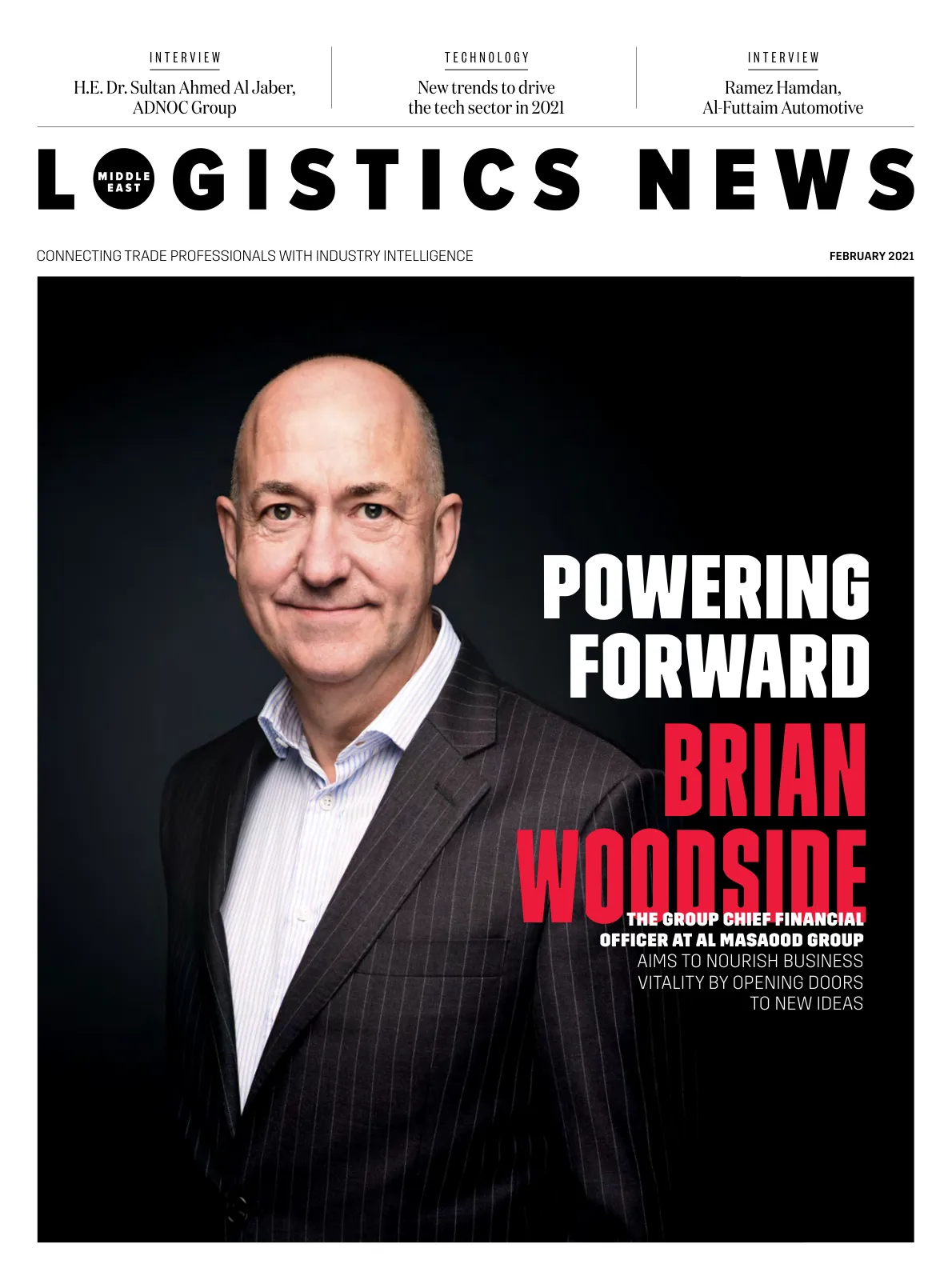
BRIAN
WOODSIDE
POWERING
FORWARD
THE GROUP CHIEF FINANCIAL
OFFICER AT AL MASAOOD GROUP
AIMS TO NOURISH BUSINESS
VITALITY BY OPENING DOORS
TO NEW IDEAS
Page 2
A MEMBERS OF EMIRATES TRANSPORT BUSINESS CENTERS:
Page 3
LOGISTICS NEWS ME | FEBRUARY 2021 | 3
POWERING
FORWARD
BRIAN
WOODSIDE
10 NEWS
16 OP-ED
PENNED
Creating stronger bonds in
supply chain: Independence is
out of the question as reliance on
other regions and countries has
become a necessity
24 INTERVIEW
VALUABLE BRAND
In conversation with
H.E. Dr. Sultan Ahmed Al Jaber,
CEO, ADNOC Group
26 TECHNOLOGY
NEW TRENDS TO DRIVE
THE TECH SECTOR IN 2021
Damo Academy, Alibaba Group’s
research initiative, shares its
forecast of the top 10 principal
trends that will shape the tech
industry for the year
28 INTERVIEW
AHEAD OF THE CURVE
Ramez Hamdan, Managing
Director- Industrial Equipment
at Al-Futtaim Automotive shares
his insight on the company’s
way forward in the face of the
pandemic
30 TRADE
TRADE & INVESTMENT
2021 Middle East forecast
32 FLEET MANAGEMENT
SMART CREDENTIALS
Farnek launches in-house smart
fleet management solution
34 TRUCKS
RENAULT TRUCKS: ENOC’S
NEWEST ‘PARTNER OF CHOICE’
Major fleet deal sees ENOC take
delivery of eight new C 380 tractor
heads from Renault Trucks
The Chief Financial
Officer at Al Masaood
Group aims to nourish
business vitality by
opening doors to
new ideas
18
IN THIS ISSUE
24
28
Page 4
Your business continuity
is our top priority.
Our initiatives and remote solutions
have got you covered in all situations.
du.ae/wegotyourb
Page 5
Page 6
6 | LOGISTICS NEWS ME | FEBRUARY 2021
WWW.CBNME.COM
All rights reserved © 2020.
Opinions expressed are solely those
of the contributors.
Logistics News ME and all subsidiary
publications in the MENA region are officially
licensed exclusively to BNC Publishing in the MENA
region by Logistics News ME.
No part of this magazine may be reproduced or
transmitted in any form or by any means without
written permission of the publisher.
Images used in Logistics News ME are credited
when necessary. Attributed use of copyrighted
images with permission. All images not credited
courtesy Shutterstock.
Printed by UPP
D
ubai’s trade with Israel in the last
five months (Sep 2020 -Jan 2021)
touched a value of Dhs1 billion
and a volume of 6.217k tonnes. Of
this, imports were valued at Dhs325
million (718 tonnes), exports at
Dhs607 million (5.4k tonnes), and
transit trade at Dhs98.7 million (52.4
tonnes), according to Dubai Customs
statistics.
The normalisation of relations
between the UAE and Israel is set to
be a turning point in the economic
and investment relationship between
the two countries with mutual trade
expected to grow to AED15 billion
in the next few years generating more
than 15,000 jobs, Sultan bin Sulayem,
DP World Group Chairman & CEO
and Chairman of Dubai’s Ports,
Customs and Free Zone Corporation
noted.
In the light of this exceptional
growth, Sultan bin Sulayem believes
opening new markets and stimulating
mutual trade between Dubai and
Israel will encourage companies
to increase production, leading to
greater economic growth and more
job creation.
Ahmed Mahboob Musabih,
Director General of Dubai Customs,
stated that the volume of Dubai’s
seaborne trade with Israel amounted
to 5.7k tonnes (Dhs82.8 million),
while airborne trade reached 423
kg (Dhs948.6 million). Dubai’s
main imports from Israel include
vegetables and fruits, diamonds and
flat screens, hi-tech devices, and
medical and mechanical devices,
while exports include diamonds,
smart phones, engine spare parts,
perfumes, and lubricants.
Ahmed Mahboob Musabih stated
that Dubai and Israel can both
generate new growth opportunities
by virtue of possessing exceptional
competitive advantages that place
them in a good position to promote
win-win cooperation between each
other’s business communities.
DUBAI-ISRAEL TRADE PROVIDES
SIGNIFICANT BOOST TO THE ECONOMY
Kasun Illankoon
Deputy Editor
kasun@bncpublishing.net
SUBSCRIBE
subscriptions@bncpublishing.net
For all commercial enquiries, contact
sales@bncpublishing.net
T +971 50 440 2706
PO Box 502511
Dubai, United Arab Emirates
P +971 4 4200 506 | F +971 4 4200 196
Keep up to date with all the latest
news, features and much more
on our website and social media
platforms.
CBNME.COM
CBNME
@CBNME
CONSTRUCTION BUSINESS NEWS ME
EDITOR’S NOTE
LNME
CEO
Wissam Younane
wissam@bncpublishing.net
DIRECTOR
Rabih Najm
rabih@bncpublishing.net
GROUP PUBLISHING DIRECTOR
Joaquim D'Costa
jo@bncpublishing.net
+971 50 440 2706
BUSINESS DEVELOPMENT DIRECTOR
Rabih Naderi
rabih.naderi@bncpublishing.net
+966 50 328 9818
DEPUTY EDITOR
Kasun Illankoon
kasun@bncpublishing.net
ASSISTANT EDITOR
Jochebed Menon
EDITORIAL DESIGN
Christian Harb
MARKETING EXECUTIVE
Aaron Sinanbam
aj@bncpublishing.net
Page 7
Page 8
Timeless Elegance
Where modern French art de vivre meets ancient Egyptian charm.
Book your stay at sofitel-dubai-theobelisk.com
PARIS - LONDON - ROME - DUBAI - SYDNEY - MEXICO CITY
Page 9
Page 10
10 | LOGISTICS NEWS ME | FEBRUARY 2021
WWW.CBNME.COM
T
rack-laying works across Al
Dhafrah Region in Package A of
Stage Two of the UAE’s national
railway were inaugurated by His
Highness Sheikh Hamdan bin Zayed Al
Nahyan, the Ruler’s Representative in
Al Dhafra Region.
His Highness was briefed by Shadi
Malak, Chief Executive Officer of Etihad
Rail, on the construction progress of
Package A, which will connect the UAE
rail network to Al Ghuwaifat on the Sau-
di border and the wider GCC region.
Having started in early 2020, steady
progress has been made on construc-
tion of Package A, which is now 59%
complete.
A progress report presentation was
also held, it revealed that across Pack-
age A half of the soil preparation works
have been completed, with 79% of
sand and rock cutting also finished.
STAGE TWO OF
UAE RAILWAY
COMPLETES 59%
CONSTRUCTION
REGIONAL NEWS
LNME
Page 11
LOGISTICS NEWS ME | FEBRUARY 2021 | 11
T
he Red Sea Development Company (TRSDC), the developer
behind the world’s most ambitious regenerative tourism pro-
ject, has named daa International as the operator of The Red
Sea Project’s unique and iconic airport.
daa International will provide airfield and terminal operations, avia-
tion services, facilities management and commercial activities, as well
as corporate and financial services. “Our state-of-the-art airport will
provide a unique gateway for guests arriving at our destination, and
this announcement is an important step in bringing the experience
to life ahead of welcoming visitors by the end of 2022,” said John
Pagano, CEO of TRSDC. “daa International was selected because
we are confident that they can deliver not only an airport experience
worthy of our luxury destination, but for their commitment to ensur-
ing our sustainability goals are met.”
daa International will manage the operations of the airport during
three separate stages. Stage one will involve ensuring that all airport
designs benefit the customer. Stage two covers planning a full and
seamless operational model for the airport when it opens to the pub-
lic. The final stage will be to manage and operate this plan, maintain-
ing the highest standards in customer experience and sustainability,
and prioritizing safety and security.
“The Red Sea International Airport will become a fundamental part
of each visitor’s journey to this unique destination, and we believe
their holiday experience should start from the moment they land,”
said daa International Chief Executive, Nick Cole. “That is why we
intend to deliver a seamless airport experience for passengers, un-
derpinned by a commitment to achieving TRSDC’s stringent sustain-
ability goals. We’re pleased to play our role in helping to open up
this new destination and wonderful country to the rest of the world.”
The Red Sea International Airport is accessible by 80 percent of the
world’s population in less than eight hours and is set to serve one
million passengers annually by the project’s completion in 2030, with
a peak capacity of 900 passengers per hour. Visitor numbers will be
limited to one million, based on the environmental carrying capacity
of the destination. The entire transport network at the site, including
the airport, will be powered by 100 percent renewable energy. In
line with TRSDC’s commitment to set new standards in regenerative
tourism, the airport is designed to include shaded areas and natural
ventilation that minimizes reliance on air conditioning.
TRSDC awarded the airport design contract to international archi-
tecture firm Foster + Partners in October 2019, after it presented ex-
citing designs that are explicitly informed by the natural Saudi land-
scape. TRSDC also awarded a contract for construction of a Code F
runway, Code B seaplane runway, aprons, taxiways, helipad, roads
and navigation aids to a Saudi joint-venture, Nesma + Partners and
Almabani, earlier this year and work is well underway at the site.
Upon completion in 2030, The Red Sea Project will comprise 50
hotels, offering up to 8,000 hotel rooms and around 1,300 residential
properties across 22 islands and six inland sites. The destination will
also include a luxury marina, entertainment and leisure facilities.
THE RED SEA DEVELOPMENT COMPANY
APPOINTS DAA INTERNATIONAL TO MANAGE OPERATIONS
AT DESTINATION’S INTERNATIONAL AIRPORT
REGIONAL NEWS
Page 12
T
he leading wholesaler in the
Swiss organic market, Bio
Partner, has doubled its output
following the implementation of
innovative robotic logistics from Swisslog
at its facility in Aargau, Switzerland.
Bio Partner supplies business custom-
ers in the organic specialist trade as well
as the rest of the retail and food industry
from its location in Seon. As a result of
the merger with Somona GmbH, the
warehouse reached its performance and
capacity limits, and the wholesaler turned
to a local partner with a global footprint
to deliver an automated storage system.
The 12,200 metre square warehouse
handles 10,000+ products, a process
now optimized thanks to the high-
performance AutoStore storage solution,
delivered by global warehouse automa-
tion specialist, Swisslog, a member of the
KUKA group.
“Companies with large warehouses
have to constantly work on increasing
efficiency and our robot systems work
flawlessly around the clock,” says Swiss-
log CEO, Dr. Christian Baur. The aim of
this new system from Swisslog is to auto-
mate the storage and picking of the dry
assortment and to compress it in terms
of volume.
The new AutoStore system at Bio Part-
ner has 44 robots with the ability to han-
dle 25,000 containers and at least 6,000
products completely autonomously. “The
high-tech robots create a volume of 900
containers per hour and, depending on
the development, this system can still
be expanded considerably,” says CEO,
Dr. Baur.
The orders are automatically transmitted
to the AutoStore system and processed
in accordance with parallel processes,
which is a huge advantage in large ware-
houses. This means that higher volumes
can be made available in a shorter time.
Picking errors cost time and money, and
robots don’t make mistakes since the
hardware and software work together
perfectly. Bio Partner relies on the modu-
lar warehouse management software
SynQ from Swisslog to orchestrate the
warehouse and picking processes based
on data-based insights.
“Our company relies on long-term,
sustainable partnerships. With Swisslog,
we found a strong local partner and the
system installation was quick and easy,”
commented Lukas Mettler, head of ware-
house logistics at Bio Partner.
As a leading global integrator with over
200 realized projects, this is just one ex-
ample of many projects which showcase
the wide implementation spectrum of
AutoStore empowered by Swisslog.
ORGANIC WHOLESALER
DOUBLES OUTPUT WITH AUTOSTORE
EMPOWERED BY SWISSLOG
REGIONAL NEWS
LNME
12 | LOGISTICS NEWS ME | FEBRUARY 2021
Page 13
LOGISTICS NEWS ME | FEBRUARY 2021 | 13
REGIONAL NEWS
C
athay Pacific Cargo is launching a new scheduled
freighter service between Hong Kong and Riyadh
(RUH) starting 5 January 2021. The airline has seen a
growing demand for air cargo flights between Saudi
Arabia and Hong Kong (HKG), a leading cargo and logistics
hub in Asia. These new flights will meet
the strong demand for shipments of e-
commerce and other general cargo such
as garments, providing our customers
with reliable, efficient and direct air cargo
services offering the high level of quality
for which Cathay Pacific Cargo is known.
The inaugural flight on 5 January will see
Cathay Pacific Cargo operate the service
using its Boeing B747-400 ERF aircraft.
Cathay Pacific Cargo has launched a
number of scheduled and charter services
recently to meet the air cargo needs of its
customers. On 16 December 2020, the
airline launched a seasonal cargo service
between Hong Kong and Hobart in Aus-
tralia, providing an important airfreight lane for the export of
fresh produce from Hobart to various parts of Asia via Hong
Kong. Meanwhile in September last year, the airline launched
a temporary service to Pittsburgh in the US to serve the sea-
sonal upsurge in demand.
In addition to operating a full freighter flight schedule, Cathay
Pacific has also been operating thousands of pairs of cargo-
only passenger flights, some with cargo loaded in the passen-
ger cabins, and chartered hundreds of pairs of flights from its
all-cargo subsidiary Air Hong Kong to provide additional air
freight capacity.
CATHAY PACIFIC CARGO
LAUNCHES FREIGHTER SERVICE
TO RIYADH
Page 14
14 | LOGISTICS NEWS ME | FEBRUARY 2021
WWW.CBNME.COM
REGIONAL NEWS
LNME
T
estament to the success of region-
wide economic diversification
efforts, Middle Eastern cities
performed impressively in the
inaugural Transport and Warehousing
Cities of the Future ranking, produced
by fDi Intelligence – a specialist division
of the Financial Times. Middle Eastern
economies’ strong performance in a sector
traditionally dominated by the Asia-Pacific
region comes in spite of global supply
chain disruption owing to the COVID-19
pandemic.
The Kingdom of Bahrain’s Al Hidd was
ranked first globally in the Transport and
Warehousing Cost Effectiveness category,
which also saw both Egypt’s Port Said and
Damietta as well as Dubai and Abu Dhabi
included in the top 10. In this category
a range of data points were examined
such as the cost of construction permits,
fuel prices, electricity prices, and tax rates
amongst others. Bahrain is one of the
region’s most cost-effective distribution
hubs. According to the KPMG Cost of Do-
ing Business Report 2019, Bahrain offers
up to 43% operational costs savings, and
33% savings in living costs when com-
pared to the region, as well as, zero cor-
porate and income tax and no free zone
restrictions.
Bahrain and the UAE also ranked in the
top 10 for the Economic Potential cat-
egory. The top ranking for cities overall
was awarded to Hong Kong, with Dubai
and Abu Dhabi at fourth and sixth place
respectively.
Bahrain’s Minister of Transportation
and Telecommunications H.E. Engineer
Kamal bin Ahmed Mohammed com-
mented: “Bahrain has long prided itself in
offering the many global manufacturing
and logistics players a place to call home
with some of the most competitive setup
and operating costs in the GCC. We are
therefore delighted that Al Hidd City has
been ranked so highly by fDi Intelligence
for cost effectiveness in the Transport and
Warehousing sectors – a testament to the
Kingdom’s reputation as the region’s de
facto transport and logistics hub.
“The year 2020 has been a challenging
year for transport and logistics globally,
but thanks to Bahrain’s strategic loca-
tion at the nexus of the Middle East and
our technologically streamlined customs
processes, we have been able not just to
maintain the continued flow of cross-bor-
der trade but enhance it, seeing a 13.5%
year-on-year surge of shipments into
Khalifa Bin Salman port in the first nine
months of 2020. In 2021, we look forward
to building on the successes of 2020, and
welcoming many more global transport
and logistics players seeking an efficient
and cost-competitive gateway to the re-
gion’s largest market and beyond.”
Located at the nexus of the Middle East,
Bahrain has earned a reputation as the re-
gion’s de facto transport and logistics hub
and is fast emerging as the main regional
distribution and fulfilment centre hub.
The COVID-19 pandemic has catalysed
the uptake of technology in these sec-
tors, including the launch a first-of-its-kind
“SmartHub” logistics warehouse for phar-
maceuticals and food to be headquar-
tered in Bahrain to serve the GCC market.
BAHRAIN RANKED FIRST GLOBALLY
IN TRANSPORT AND WAREHOUSING COST
EFFECTIVENESS
H.E. Kamal bin Ahmed Mohammed,
Minister of Transportation and
Telecommunications, Bahrain Economic
Development Board
“BAHRAIN HAS LONG
PRIDED ITSELF IN OFFERING
THE MANY GLOBAL
MANUFACTURING AND
LOGISTICS PLAYERS A PLACE
TO CALL HOME WITH SOME
OF THE MOST COMPETITIVE
SETUP AND OPERATING
COSTS IN THE GCC.”
Page 15
LOGISTICS NEWS ME | FEBRUARY 2021 | 15
REGIONAL NEWS
T
he Emirates Group today rolled
out a COVID-19 vaccination
programme for its substantial
UAE based workforce in coor-
dination with the Dubai Health
Authority and the Ministry of Health and
Prevention.
The inoculation drive began this morn-
ing, with priority being placed on its
frontline aviation workforce, including
Cabin Crew, Flight Deck and other op-
erationally focused roles.
The airline, along with dnata, are among
the first transport and air services organi-
sations in the world to offer employees
the option to get vaccinated against
the COVID-19 virus. Over the course of
the pandemic, Emirates and dnata have
implemented multiple layers of safety
measures, to ensure the health and
safety of customers, employees and the
communities served. The rollout of its
vaccination programme is another step
forward, helping to safeguard the health
and wellbeing of aviation employees
who serve the travelling public and help
move essential goods around the world.
The Emirates Group is making both the
Pfizer-BioNTech and Sinopharm vaccines,
which have been approved by the UAE
health authorities, conveniently accessi-
ble to its employees at various company
locations across the UAE. Inoculation
appointments will run 12 hours a day, 7
days a week to ensure as many essential
aviation workers as possible can get the
vaccine. Like all citizens and residents,
Emirates Group employees in the UAE
can also opt to get vaccinated at gov-
ernment designated medical centres
and clinics, as the UAE’s leadership and
health authorities have spared no effort
to make vaccines free and accessible to
the population.
According to the data compiled by Our
World In Data, a research website based
at Oxford University, the UAE is ranked
second highest in the world for vaccina-
tion rates, with over 19.04 doses admin-
istrated for every 100 people, and close
to 1.9 million vaccinations have been
given to citizens and residents since their
rollout in December 2020. The UAE is
also on track to inoculate over 50% of its
population by the end of March.
EMIRATES GROUP ROLLS OUT COVID-19
VACCINATION PROGRAMME
Page 16
16 | LOGISTICS NEWS ME | FEBRUARY 2021
WWW.CBNME.COM
OP-ED
LNME
C
OVID-19 threw the global
supply chain into a complete
frenzy. Many companies
were astonished by their own
susceptibility. The risk of
depending on a supply base
that is concentrated in one geographic
region has been increasing over the past
30 years, but the pandemic quickly dem-
onstrated how much chaos and pain one
unexpected event could inflict.
It was a powerful wake-up call. The
disruption triggered by COVID-19 has
prompted leadership teams to confront a
new era of supply chain volatility.
Flexibility and resilience
Bracing for an era of increased turbu-
lence, leading multinationals are rethink-
ing their supply chain strategies to lower
the risk of disruption. In a recent survey
of 200 global manufacturers by Bain &
Company and the Digital Supply Chain
Institute, executives ranked flexibility and
resilience as their top supply chain goals.
Only 36% of senior executives ranked
cost reduction as a top three goal, down
from 63% who saw it as a priority over
the past three years.
To improve supply chain resilience,
45% of respondents plan to shift produc-
tion closer to home markets in the coming
years. The good news is that automation
has reduced the cost of manufacturing,
eroding the labour arbitrage advantage
that fuelled decades of investment in off-
shore production. The cost of humanoid
robots is comparatively lower now which
means companies with processes capable
of being automated such as consumer
electronics can opt to move supply chains
closer to home without raising costs sig-
nificantly.
Expanding boundaries
For the last 30 years, manufacturing com-
panies have wrung out supply chain costs
by disaggregating the various steps of the
value chain, concentrating each step with
a limited number of companies and geog-
raphies to improve economies of scale. As
a result, most leadership teams lack suffi-
cient supply chain visibility to assess their
geopolitical and geographical risks. Be-
fore investing in a new supply chain strat-
egy, successful leadership teams evaluate
their supplier and contract manufacturer
risk according to two factors: the country
where goods are produced and the sup-
plier’s headquarters location.
Independence is out of the question as reliance on other
regions and countries has become a necessity
Creating stronger bonds in supply chain
BY KARIM SHARIFF, PARTNER AT BAIN & COMPANY MIDDLE EAST
PENNED
Page 17
LOGISTICS NEWS ME | FEBRUARY 2021 | 17
PENNED | CREATING STRONGER BONDS IN SUPPLY CHAIN
Two key factors that determine geopoliti-
cal supply chain risk are the supplier’s
headquarters and its manufacturing loca-
tion.
Once leaders understand their risk ex-
posure, they start building resilience into
their value chains in a two-step process.
First, they quickly add flexibility to the
supply of finished goods and high-risk
subcomponents where possible, to limit
immediate risks and satisfy customers.
Second, they take a strategic approach to
rethinking the value chain from end to
end. That includes deciding the pace of
change and periodically reviewing deci-
sions based on external conditions and
internal capabilities.
Here are three steps that can help com-
panies pioneer the shift to supply chain
resilience:
Boost resilience
Supply chain flexibility is becoming an
increasingly important concept for gain-
ing competitive advantages. The first
priority in making supply chains shock-
proof is increasing flexibility for supply-
ing finished goods and high-risk subcom-
ponents. This would open the possibility
for companies to respond to short term
changes in demand and supply situations
as well as structural shifts in the environ-
ment of the supply chain on an immediate
basis.
Not many countries have the capacity
and infrastructure to handle all the vol-
ume, so manufacturers often have to piece
together a solution across multiple neigh-
bouring countries. For many companies,
aligning a new production location with
demand can deliver significant benefits,
particularly in industries where demand
is rising even through the downturn, in-
cluding MedTech and certain consumer
products.
Reworking network strategies
For each value chain, leadership teams
need to properly balance risk and resil-
ience at the lowest total landed cost. This
includes decisions on single vs. multiple
sourcing, where to manufacture at each
stage of assembly, and proximity to
customers. They also need to determine
whether to produce in-house or out-
source, taking into account variables such
as national incentives and declining man-
ufacturing costs. Successful companies
revisit their value chain choices regularly,
especially in turbulent times.
Balancing cost and risk
Resilience does not eclipse every consid-
eration. As leadership teams start to un-
derstand where they need flexibility, they
face important trade-offs on cost. Invest-
ing in too much flexibility can render a
company uncompetitive. As they look to
reshape supply chains for the future, suc-
cessful companies determine how much
resilience they need, where it matters
most, and what they can afford.
Resilient and flexible supply chains can
be a powerful defensive hedge, but also a
source of competitive advantage. Leaders
make the most of options such as capacity
buffers, digital infrastructure and nimble
teams to react faster and more efficiently
than their peers. The investment to build
and maintain these capabilities varies,
depending on a company’s need for re-
sponsiveness and efficiency, as well as the
level of industry competition. This is why
the roadmap for resilient supply chains
must be linked to a company’s long-term
business strategy.
For example, a high-growth business
that has high margins and short product
life cycles, and is dependent on compo-
nents coming from widely distributed
sources such as high-end cell phones, will
require a different type of supply chain
resilience than a hypercompetitive low-
margin business, such as clothing or toys,
which relies on imported finished goods.
Geopolitical volatility and market
turbulence will transform supply chain
management in the coming decade. Lead-
ership teams that invest in strategies to
increase supply resilience will simultane-
ously create a new source of competitive
advantage.
FOR MANY COMPANIES,
ALIGNING A NEW
PRODUCTION LOCATION
WITH DEMAND CAN
DELIVER SIGNIFICANT
BENEFITS, PARTICULARLY
IN INDUSTRIES WHERE
DEMAND IS RISING
EVEN THROUGH THE
DOWNTURN, INCLUDING
MEDTECH AND CERTAIN
CONSUMER PRODUCTS.
Page 18
18 | LOGISTICS NEWS ME | FEBRUARY 2021
WWW.CBNME.COM
COVER STORY
POWERING
FORWARD
THE GROUP CHIEF FINANCIAL OFFICER AT
AL MASAOOD GROUP AIMS TO NOURISH BUSINESS
VITALITY BY OPENING DOORS TO NEW IDEAS
BRIAN
WOODSIDE
18 | LOGISTICS NEWS ME | FEBRUARY 2021
WWW.CBNME.COM
LNME
Page 19
LOGISTICS NEWS ME | FEBRUARY 2021 | 19
POWERING FORWARD | BRIAN WOODSIDE
“I am passionate
about taking part in
moving the Group
towards an even
stronger position.
In this process, I try
to instill the spirit of
empowerment and
innovation.”
LOGISTICS NEWS ME | FEBRUARY 2021 | 19
Page 20
20 | LOGISTICS NEWS ME | FEBRUARY 2021
WWW.CBNME.COM
COVER STORY
Over the last decade or more, Al
Masaood has developed into a highly
diversified and dynamic organisation.
With a significant market share in the
automotive sector, Al Masaood’s diversi-
fied portfolio also includes substantial
interests in many other sectors including
engineering, power, oil and gas, property
and retail.
Logistics News ME sat down with
Brian Woodside, Group Chief Financial
Officer of Al Masaood Group, to discuss
his overall role and how the internal
logistics for Al Masaood will play a key
role in the company’s ambitious plans to
expand and diversify.
Brian Woodside joined the Al Masaood
Group in January 2018 as Group Chief
Financial Officer and a member of the
Executive Committee. He is a British
national with over 35 years of experience
in business and finance, with around half
of this time spent in the Middle East.
He began his career in the UK with
Price Waterhouse as an auditor and tax
consultant before moving into industry
in 1990. He subsequently worked in
London for a global consulting engi-
neering group before moving to the
Middle East. His experience is now
diverse across different sectors, forms of
organisation and geographies. His focus
for the Group is to initiate restructuring,
develop governance/risk management
structures and implement system and
policy improvements.
Taking Al Masaood Group Forward
“I am trying to use my career experi-
ences to help move the Group forward
towards greater success and an even
stronger position in our markets. The
Group has grown over the past 50 years
and the future looks most promising. We
spent more than two years reengineering
substantial parts of the business and in
particular finding business and corporate
services leaders who could then build
their own first class management teams
who could implement group policies and
standard operating procedures. We have
tried to instill a spirit of empowerment
and innovation and nourish business
vitality by opening doors to new ideas –
for me, the biggest inhibitor to progress
is not making decisions and not being
prepared to take a risk.”
AL MASAOOD is one of the leading trading families of Abu
Dhabi with a rich diversity of companies and businesses in Abu
Dhabi, elsewhere in the UAE and further afield. They were the
first company to be registered by the Abu Dhabi Chamber of
Commerce. Al Masaood Group has been involved in the commercial
development of Abu Dhabi, mirroring the Government’s development
path with some key ‘firsts’ such as delivering to the country its first
gas turbine and developing the UAE’s first desalination plant.
The Group is celebrating its 50th Anniversary this year and has
expansion on its horizon. This is a time where Al Masaood celebrates
the legacy and good will it built in its home market, Abu Dhabi and
the Western Emirates. The Group will continue to be a pioneer and
leverage on its position as one of the country’s more reputable
companies that helping to develop and enrich the local economy
working closely with both the private and the public sector.
Page 21
LOGISTICS NEWS ME | FEBRUARY 2021 | 21
POWERING FORWARD | BRIAN WOODSIDE
Re-Imagining Al Masood’s Internal
Logistics Operations
“Post joining the Group and after I had
seen the span of operations, it seemed
to me that the internal logistics and
supply chain management of the Group
needed to be re-imagined. There were
apparent opportunities across our key
business areas such as automotive, re-
tail, power and manufacturing whereby
each business unit was approach-
ing management on a decentralized
basis. And at a wider group level there
was again no joined up operational
management for our other logistical
movements including, people, adminis-
tration, cash, and the like”.
“Whilst I am not a logistics or sup-
ply chain expert, I have a dominant
career experience in the built environ-
ment where just-in-time delivery (and
removal) of plant, employee resources
and materials are critical to the ef-
ficiency of the operational business
model. With margins so thin in the
sector, any inefficiency is magnified.
When designed a managed expertly, it
can create a business differentiator on
cost”.
“As part a broader group-wide
operational overhead and expenses
strip down initiative, we launched
a sub-project to complete a holistic
review of Group logistics and sup-
ply chain management. Recognising,
that we did not have the appropriate
in-house expert to drive the review, we
carried out an international search to
find a consultant to work with us and
re-strategize our internal operations.
The review process of course required
the collation of substantial and diverse
data. But the work has progressed
as planned and the first opportunities
and results are now emerging. The
magnitude of the potential savings has
surprised us and believe that over 12
months, we can entirely reshape all
aspects of our logistics operations and
achieve significant financial benefits”.
“The Group is fortunate in that the
Founders invested in the business
infrastructure for their then current
requirements, but also had the vision
to consider future needs. Many times,
what they built was dimensionally
oversized for the business at the time,
but now years later, we can continue
to grow in the world-class facilities
they built”. >>>
“WE NEED TO BE BRAVE ENOUGH TO BET ON OURSELVES
AND CONTINUE GROWING. THESE ARE TIMES OF SAFE KEEPING;
THESE ARE TIMES OF EXPANSION.”
Page 22
22 | LOGISTICS NEWS ME | FEBRUARY 2021
WWW.CBNME.COM
Al Masaood Celebrating 50 years
“To me the mark of 50 years is like
half time, it is not about winning only,
it’s about hopes, fears, making come
backs and getting through rough times.
It is about rallying and making our
own way if even when one is not ap-
parently there”.
“Over 50 years, the innumerous day-
to-day decisions and actions of our
Founders created the goodwill of the
Al Masaood name that we leverage off
today. This goodwill is a precious as-
set and we must ensure it is protected”.
“These are testing times, but we need
to be brave enough to bet on ourselves
and continue growing. These are times
of safe keeping; these are times of
expansion. A level of risk must always
be tolerated and not over assessed.
The people of the UAE know a little
something about this, they started
from nothing, they pulled together, and
pushed through.”
Biggest Lessons Learnt in 2020
“I would say Having the right teams in
place and having them empowered. Al
Masaood has always been ahead of its
time. In 2017, the Group ventured into
a significant management and opera-
tional transformation and brought to
its leadership team specialist individu-
als. It also undertook extensive leader-
ship and management training for its
middle management teams. When the
Pandemic hit, the executive created
a project anticipated in three phases.
Corporate services and operations
took responsibility and moved quickly
to overcome any obstacles coming
their way. Team boundaries quickly
dissolved, and our staff worked seam-
lessly together used lateral thinking
and did not get caught up in a plan-
ning fetish. Rather they assessed what
resources were available and took
direct action to make facilities safe for
employees and customers and to keep
the maximum permitted commercial
operations engaged. What was also
learnt, was that increasing pressure
on the decision-making process itself,
increased efficiency”.
Abu Dhabi Market & Outlook in 2021
“My personal expectation is that the
price of commodities including oil will
continue to rise in 2021. And I am
therefore expecting this will unlock
more confidence and interest in the
Abu Dhabi market and we will experi-
ence a recovery on a solid foundation.
With this backdrop in mind, everyone
has full faith in the government of the
UAE leading its markets back out of
the Pandemic. If there is one country
that knows how to do it right, it would
be the UAE”.
“Our Power Division has been expe-
riencing very healthy growth and this
business is at the core of our further
diversification plans; new projects are
arising from strong inward investment
into the UAE. We also see a positive
and steady growth in our commercial
vehicles and manufacturing businesses
and will ensure our automotive arm
continues to capture more market
share and maintain its leading position
as defying the sector regional trends”.
COVER STORY
“WITH ALL WHAT WE HAD TO REACT TO AND HANDLE,
THE GROUP CLOSED THE YEAR ON A POSITIVE NOTE WITH
SOME BUSINESS REPORTING A NOTABLE INCREASE IN
THEIR MARKET SHARE.”
Page 23
lyveglobal.com
E-COMMERCE
MADE EASY
Supercharge your ecommerce and online operations
with Lyve. Get fast, flexible, and full-featured delivery and
technology solutions that meet your customers’ needs
and allow you to focus on what you do best.
Go Lyve Today �
lyveglobal.com/ecommerce
#golyve
Page 24
24 | LOGISTICS NEWS ME | FEBRUARY 2021
WWW.CBNME.COM
INTERVIEW
LNME
What role does technology play in the ADNOC brand
and your reputation among key stakeholders?
Technology plays a key role in enabling us to maximize
greater value from our assets and resources to reliably and
responsibly deliver energy supplies to our global custom-
ers. This was apparent last year as we navigated volatile
market conditions following the Covid-19 pandemic and
responded with agility and strength to the challenges we
faced. In the same vein, technology is at the core of our
environmental performance, a driving force of our ESG
position and, as a national oil company, our contributions
to the UAE’s sustainable development agenda.
How has the response to this tough year (Covid-19,
oil price volatility) helped differentiate the ADNOC
brand and business?
Our recognition as the most valuable brand in the UAE
for the third consecutive year and our ranking among the
top ten brands in the oil and gas industry is testament
to the efforts of my colleagues at ADNOC throughout
2020. We delivered strong operational and financial per-
formance as a result of our resilience and the fact that
we are benefiting from the transformation we started
over four years ago at the direction of the UAE Leader-
ship. Over this period, we have focused on improving our
performance, strengthening our agility, and reinforcing
efficiency throughout our business. Most importantly, we
have focused on reducing our costs and this will continue
to be the case.
Looking forward, what dimensions and strengths of
the ADNOC brand will enable long term sustainable
growth?
The ADNOC brand is defined by our values of being
collaborative, efficient, progressive, respectful, and re-
sponsible, which are underpinned by an unwavering focus
on protecting health, safety and the environment (HSE).
These attributes inspire the way we do business, guide our
decision-making, and lay the foundation for our long-term
growth. Our commitment to our values as well as our
focus on producing the world’s most cost-efficient and car-
bon-efficient barrels will ensure we continue to sustainably
deliver energy to the world and drive value to the UAE for
decades to come.
They will also enable us to drive deeper connections and
resonate with our partners, communities and stakeholders,
increase ADNOC’s brand equity and strengthen our brand
proposition.
VALUABLE/BRAND
H.E. DR. SULTAN AHMED AL JABER
CEO, ADNOC GROUP
IN CONVERSATION WITH
Page 25
LOGISTICS NEWS ME | FEBRUARY 2021 | 25
VALUABLE BRAND | H.E. DR. SULTAN AHMED AL JABER, CEO, ADNOC GROUP
“Technology is at the core of
our environmental performance,
a driving force of our ESG position
and, as a national oil company, our
contributions to the UAE’s sustainable
development agenda.”
Page 26
26 | LOGISTICS NEWS ME | FEBRUARY 2021
WWW.CBNME.COM
TECHNOLOGY
LNME
T
echnology is constant-
ly evolving offering
better solutions with
the passing of time.
As we progress into
the new year, fresh
ideas hit the market from the
application of third-generation
semiconductor materials, AI-
driven R&D of medicines and
vaccines, to automatic opti-
misation of data management
system and data intelligence-
powered agriculture.
Technology breakthroughs
are expected to accelerate and
make impacts across all sectors
in the economy and the society
at large.
Third-gen semiconductor
materials
These products represented
by gallium nitride (GaN) and
silicon carbide (SiC), boast
high temperature resistance,
high breakdown voltage, high
frequency, high power, and
high radiation resistance. In
recent years, breakthroughs
in material growth and device
fabrication have helped reduce
the costs of third-generation
semiconductor materials. In
the Middle East, countries such
as the UAE and Saudi Arabia
have already started deploying
5G networks.
Quantum error correction
and quantum computing
In 2020, investors worldwide
flocked to the quantum com-
puting field, related technolo-
gies and ecosystems thrived,
and numerous quantum com-
puting platforms rose to promi-
nence. In 2021, this trend will
garner further attention from
all corners of society. Quantum
computing must deliver enough
value to make it worthwhile.
The mission in the ‘post-
quantum-supremacy’ era must
be aligned across the industry:
to tackle critical scientific and
engineering problems through
collaborative innovation and
to pave the way for quantum
error correction and practical
utility, two milestones in quan-
tum computing.
Carbon materials to boost
growth of flex circuits
Flexible electronics deliver
stable performance even af-
ter mechanical deformations
such as bending, folding, and
stretching. They are favoured
in wearable devices, electronic
skins, and flexible screens. In
the past, flexible materials were
simply not flexible enough or
could not compete with rigid
NEW TRENDS TO DRIVE
THE TECH SECTOR IN 2021
Damo Academy, Alibaba Group’s research initiative, shares its forecast
of the top 10 principal trends that will shape the tech industry for the year
Mohammad Shihab,
Managing Director,
Maersk Saudi Arabia
Page 27
LOGISTICS NEWS ME | FEBRUARY 2021 | 27
NEW TRENDS TO DRIVE THE TECH SECTOR IN 2021
silicon-based materials. In recent years,
ground-breaking developments in carbon-
based materials have allowed flexible
electronics to go far beyond their previous
capabilities.
AI accelerates R&D of medicines and
vaccines
Artificial intelligence (AI) technology has
been widely adopted to interpret medical
images and manage medical records while
its application in vaccine development
and the clinical research of drugs is still
in the pilot stage. As new AI algorithms
are emerging and computing power is
reaching new heights, this technology will
make it easier to complete R&D of medi-
cines and vaccines that were previously
very time-consuming and costly.
Brain-computer interface technology
This tech is essential for new-generation
human-machine interactions and collabo-
rative intelligence between humans and
machines. It is the pillar and driving force
of neuroengineering. It analyses how
the human brain works from a higher
dimension. A brain-computer interface
forms a direct communication pathway
between the brain and an external device.
It acquires, analyses, and translates brains
signals to control machines. In the future,
brain-computer interface technology will
help control robotic arms more precisely
than ever before and help patients who
are fully conscious but cannot speak or
move to overcome their physical limita-
tions.
Data processing to become autono-
mous
The rapid development of cloud com-
puting and exponential growth in the
amount of data have posed daunting chal-
lenges to computing task processing, stor-
age cost control, and cluster management
during traditional data processing. AI
and machine learning will be adopted in
a variety of fields, such as intelligent cold/
hot data separation, anomaly detection,
intelligent modeling, resource scheduling,
parameter tuning, stress testing data gen-
eration, and index recommendation.
Cloud technologies will reshape IT
systems
Long product development cycles and
low R&D efficiency in traditional soft-
ware development have long been a
source of pain. Cloud-native architectures
featuring distribution, scalability, and
flexibility look to be the cure. They allow
enterprises to utilise and manage their
heterogeneous hardware devices and
cloud computing resources more effective-
ly. Cloud-native methodologies, tool sets,
best practices, products, and techniques
allow developers to focus only on creating
new applications.
Agriculture will be powered by data
intelligence
New-generation digital technologies, in-
cluding the Internet of Things (IoT), AI,
and cloud computing, are being applied
to the agriculture industry throughout
the production process to retail. New-
generation sensors help obtain real-time
farmland data. Big data analytics and AI
expedite the processing of large amounts
of agricultural data. Agricultural prac-
titioners can monitor crops, implement
precision breeding, and allocate environ-
mental resources on demand. In addition,
technologies such as 5G, IoT, and block-
chain are utilised to control and trace the
transportation of agricultural products,
ensuring their safety and reliable delivery.
Industrial intelligence grows leaps
and bounds
Industrial intelligence has been mainly
used to meet partial requirements because
its implementation is costly and compli-
cated. After the outbreak of COVID-19,
the remarkable resilience of the digital
economy drew great attention from en-
terprises, digital technologies developed
and spread rapidly, and more investments
were injected into the construction of
new infrastructure. These factors helped
build a picture in which we can see indus-
trial intelligence leap from single-point
implementation to industry-wide imple-
mentation. It will make an impact on a
large scale, applying to the supply chain,
production, asset management, logistics,
and sales.
Future cities to depend on intelligent
operations centres
Smart city initiatives were first launched a
decade ago and have sparked a significant
improvement in city governance through
digital technologies. When coping with
the COVID-19 outbreak, a number of
smart cities faced challenges. This is why
intelligent operations centres are widely
accepted and deployed to maximise the
usage of data resources and promote
global, fine-grained, and real-time gov-
ernance and public services. By keeping
‘digital twins’ of cities, intelligent opera-
tions centres consider each city as a uni-
fied system and deliver city-wide services
capabilities.
Cloud-native methodologies,
tool sets, best practices,
products, and techniques
allow developers to focus only
on creating new applications.
Page 28
28 | LOGISTICS NEWS ME | FEBRUARY 2021
WWW.CBNME.COM
INTERVIEW
LNME
AHEAD OF
THE CURVE
The Managing Director- Industrial
Equipment at Al-Futtaim Automotive
shares his insight on the company’s way
forward in the face of the pandemic
Ramez Hamdan
Page 29
LOGISTICS NEWS ME | FEBRUARY 2021 | 29
AHEAD OF THE CURVE | RAMEZ HAMDAN, AL-FUTTAIM AUTOMOTIVE
W
ith supply-chains hit
by the ongoing crisis,
Al Futtaim Commercial
Vehicles (CV) has
had their fair share of
challenges as well as
successes. There has been a high demand
for deliveries of goods in the country, and
this has helped Al Futtaim CV maintain its
business, while combating the disruptions.
Robust plans are in place as the region
normalises operations, providing a relief
across all sectors.
Tell us what Al Futtaim CV goals and ob-
jectives are heading into 2021?
The pandemic has disrupted the way
businesses operate. Now more than ever,
there is a need to continually adapt and
overcome the challenges presented by
the ever-changing business environment
whether it is COVID-19 or any other cir-
cumstances that may become evident.
That being said, for 2021 our main goal
and objective is to steadily satisfy our
customers’ demands by overcoming chal-
lenges whether it be a global pandemic
or any other local or global circumstance
and continue to offer market-leading sup-
port and a superior product experience.
In the face of COVID-19, has Al Futtaim CV
been forced to revisit its strategies for
adaptability?
To ensure customer service continuity
and delivery of the same standards of
aftersales, we at Al-Futtaim Commercial
Vehicles had to redeploy our associates,
putting more people on our mobile ser-
vice vans to ensure our customers receive
our support on time.
During the movement restrictions, we
were able to deliver parts to our custom-
ers twice a day thereby ensuring critical
logistics functions continued without any
delay or disruptions, especially that the
majority of our customers fall into the
vital FMCG, logistics, e-commerce and
water distribution industries.
The commercial vehicles sector has
realised much success in the period.
How has Al Futtaim CV thrived during the
pandemic?
The ongoing pandemic has disrupted
supply chains worldwide and the GCC
markets are striving to overcome grueling
challenges. In the UAE, governmental au-
thorities have facilitated and ensured the
business continuity and reach of essential
industries which have enabled Al-Futtaim
CV to deliver uninterrupted services.
We put a massive focus on specific sec-
tors including FMCG, logistics, water and
food distribution, e-commerce and other
high-demand critical industries ensuring
proper support from our sales, after-sales
and parts teams. During the lockdown pe-
riod, we had the highest sales for HINO
trucks in a single month in the UAE.
Which market in the GCC do you see po-
tential when it comes to sales?
The UAE market remains a front-runner
for sales activities, as well as Saudi-Arabia
and Oman. However, our scope of opera-
tions is limited to the UAE.
Can you give us a market overview in
Dubai and what are the positive signs
you see heading into 2021?
Dubai enjoys a dynamic, fast-paced and
competitive business environment/market
and there are strong indicators of im-
provement heading into this year as con-
ditions normalise and businesses across
all sectors aim to recover from the effects
of last year.
We had a strong 2020 and remain posi-
tive for 2021. We have established solid
plans and solutions to meet our custom-
ers’ growing demand through sales and
after-sales activities, complete with dy-
namic financing options and strong after-
sales campaigns and support.
What are the key trends you see going
forward into 2021 that would be innova-
tive in the CV industry?
Looking ahead to 2021 and beyond it
is clear that buying behavior is shifting
rapidly towards online ordering of goods
and services and the demand for fulfill-
ment by the commercial vehicles sector is
heightened as a second or perhaps third
leg of deliveries is added to supply goods
and services door-to-door.
Another growing trend is the shift to-
wards alternative energy solutions and we
expect the introduction of more electric-
powered commercial vehicles in the near
future.”
“We put a massive focus on
specific sectors including
FMCG, logistics, water
and food distribution,
e-commerce and other high-
demand critical industries
ensuring proper support from
our sales, after-sales and
parts teams.”
Page 30
30 | LOGISTICS NEWS ME | FEBRUARY 2021
WWW.CBNME.COM
TRADE
LNME
The first and most obvious thing to suggest is that it will
be a good year, taken in isolation. The effect of Covid19
in 2020 and the impact it has had on trade and investment
(estimated to be down by 40% versus 2019) was such that
even very modest growth would look good in relative terms.
As such, don’t be fooled by year-on-year figures - for anyone
who’s reporting them in 2021 - a more accurate benchmark
would be 2019 or 2018 figures, but do expect a return to
growth, albeit from a much lower base. The flurry of activ-
ity between the UAE and Israel that’s marked the last few
months looks set to continue into 2021. It’s likely to change
in nature however, with more substance replacing the initial
excitement, as tangible deals start to be struck. Based on
the work we’ve been doing with Israeli companies, the main
focus at this stage looks to be on establishing trade links –
finding agents, distributors & commercial partners – ahead
of potential inward FDI projects over the next few years
once the market has been proven.
F
or all the challenges that currently exist
in making predictions for the year ahead,
I don’t envy those who were doing the
same exercise a year ago, given what’s
transpired since (much as they’d have
been able to claim Force Majeure). Based
on where we are now, in the latter stages
of the whole Covid-19 episode and with the
signal advances in vaccination progress in No-
vember & December however, I do think that we
can make some relatively confident calls on the
year ahead in terms of the foreign direct invest-
ment and international trade landscape for the
Middle East.
2021 MIDDLE EAST FORECAST
TRADE & INVESTMENT
BY JOE HEPWORTH, DIRECTOR, OCO GLOBAL, AND FOUNDER OF THE BRITISH CENTRES FOR BUSINESS (BCB)
Page 31
LOGISTICS NEWS ME | FEBRUARY 2021 | 31
2021 FORECAST FOR TRADE & INVESTMENT IN THE MIDDLE EAST
Should other GCC countries beyond
Bahrain and the UAE also agree peace
terms with Israel, a similar commercial
dividend would be reaped across the
whole region. The UAE would stand to
benefit the most from this as it would
bring its regional hub status into full
play for Israeli companies, and this in
turn would be a significant stimulus for
inward investment from Israel.
Of course, geopolitics continues to
have a massive impact on trade and
investment, and the thawing of other
regional relationships would have a
similar impact, whilst we also wait
to see how the new rulers of Kuwait
and Oman will shape their respec-
tive national approaches post-Covid.
International politics also has a large
influence and all eyes are on the new
Biden administration in the USA to see
how it will engage with the Middle East,
and Iran in particular.
America’s relationship with China is
likely to impact the region. As a result
of Covid, we’re already seeing multina-
tional companies look at reshoring or
near-shoring key supply chain nodes to
reduce the reliance on China. We see
the Middle East as a likely winner from
this pattern with its relative proximity
to key demand markets in India, Africa
and Europe. Add in the continued USA-
China tensions – and we don’t expect a
material thaw under Biden in the short
term – and the Middle East looks to
play an important role as a ‘neutral’
region relatively unscathed by bilateral
trade wars, which is obviously positive
for trade and investment here.
The region also stands to benefit from
continued disruption of the uncertain-
ties around the Brexit trade deal, with
UK companies in particular looking for
benign regions to trade with. The recent
raft of new laws announced in the
UAE regarding both corporate legisla-
tion (100% ownership etc.) and social
changes for expats, further enhances
the UAE’s position as the ‘go to’ MENA
location for foreign companies looking
to establish a regional presence.
Related to this, one of the biggest
trends for 2021, in the UAE in particu-
lar, is likely to be wholesale corporate
restructuring amongst multi-nationals
already present here as they look to
realign and take advantage of the new
rules emerging in Q1. This will most
likely see a consolidation of sites and
trade licenses and a flight to value, with
the winners being those jurisdictions –
emirates or free zones – who appreciate
this and can offer something more than
an office or warehouse lease.
A look at 2021 wouldn’t be complete
without considering the importance of
Expo 2020 Dubai as a vital celebration
of the UAE in its golden jubilee year.
The Middle East’s first ever mega-event
moment in the sun and, by October
2021 I hope, the global lodestar for
post-CV19 recovery. Whilst Expo isn’t
a trade show, it’s still the ultimate forum
for countries to showcase their best fea-
tures – technology, culture, innovation,
ecology and more - so expect this to
be done with fervent pride, and for the
UAE to benefit as the host of an event
that’s now even more important than
was originally intended.
THE RECENT RAFT OF NEW
LAWS ANNOUNCED IN THE UAE
REGARDING BOTH CORPORATE
LEGISLATION (100% OWNERSHIP
ETC.) AND SOCIAL CHANGES FOR
EXPATS, FURTHER ENHANCES
THE UAE’S POSITION AS THE
‘GO TO’ MENA LOCATION FOR
FOREIGN COMPANIES LOOKING TO
ESTABLISH A REGIONAL PRESENCE.
Page 32
32 | LOGISTICS NEWS ME | FEBRUARY 2021
WWW.CBNME.COM
FLEET MANAGEMENT
LNME
L
eading UAE-based smart and
green facilities management (FM)
company Farnek has launched an
in-house smart fleet management
solution that will not only opti-
mise the performance of its transport
fleet, but also improve service delivery
to its customers.
The solution, which covers Farnek’s
entire transport fleet of more than 300
buses, vans and cars across the UAE,
was built by its in-house technology di-
vision, which after a lengthy process of
research and development, has simply
and ingeniously adopted and adapted
the latest smart technology to produce
a homemade solution.
“This bespoke telematics system has
been developed in-house by our own
IT engineers, using proven technology
and is a Cloud and mobility-based
platform. Our fleet is now powered by
IoT telematic sensors connected with
Google Maps for route optimisation
with our drivers, fleet, service schedule
and of course our customers, front of
mind,” said Javeria Aijaz, Director
Technology & Innovation, Farnek.
Using Farnek’s live administrative
portal, operational staff at its logistics
centre compare vehicle inventory with
the current and scheduled demand and
issue instructions to the drivers (each
vehicle is fitted with a dedicated smart
phone loaded with an app).
The drivers log in, accept the notifica-
tion based on a QR code sent to the
smart phone in the vehicle and start
their journey. The app automatically
calculates and compares the estimated
and actual journey times and presents
the driver with Google Maps-based
navigation, to show the most time-
efficient route to take.
“All vehicles are integrated with an IoT
SMART CREDENTIALS
FARNEK LAUNCHES IN-HOUSE SMART FLEET
MANAGEMENT SOLUTION
Custom-built by Farnek’s technology team, the innovative, sustainable
and cost-effective initiative underscores the FM company’s smart
and green credentials, by optimising its fleet performance and serving
its customers more efficiently
Page 33
LOGISTICS NEWS ME | FEBRUARY 2021 | 33
SMART CREDENTIALS | FARNEK LAUNCHES IN-HOUSE SMART FLEET MANAGEMENT SOLUTION
sensor that essentially tracks the vehicle
and monitors ignition status, sends
idling notifications and speeding alerts,
all in real time, which all contribute
positively towards our drivers’ perfor-
mance,” commented Markus Oberlin,
CEO, Farnek.
“Moreover, if for example we have
two buses with a capacity of 30 seats
each travelling to the same destina-
tion, if available, we can switch to one
60-seater bus. Furthermore, by down-
loading the app, customers can also
track the vehicle themselves and at the
end of their shifts, our own employees
will be able to see where the bus is and
how long they will have to wait,” com-
mented Oberlin.
“Overall, this improves safety, saves
fuel, cuts our CO2 emissions as well as
reducing wear and tear on the vehicle,
prolonging the operational life of our
transport fleet,” added Oberlin.
The operational dashboard can also
generate incident reports, organise new
transport schedules, search for the near-
est and most relevant available vehicle,
corelating with customer demand.
A whole host of reports can also be
generated by the system as well, from
vehicle assignment and utilisation
to monthly expense reports. There’s
also a driver’s module holding driving
documents and records of any previous
incidents or violations.
“Through cross referencing, these
reports can identify vehicles that are
maybe not performing particularly well
and could require some sort of repair or
maintenance. Also, we can share fuel-
efficiency figures with individual drivers,
which will encourage them to drive
more carefully and not to leave engines
idling for long periods of time,” stated
Aijaz.
Page 34
34 | LOGISTICS NEWS ME | FEBRUARY 2021
WWW.CBNME.COM
E
nergy value chain firm, ENOC
Group, has taken delivery of
eight new C 380 Renault Trucks
models, which will be used to
deliver fuel to the Group’s service
stations across the UAE.
All vehicles are supplied
through United Diesel, Renault Trucks’
authorised distributor for Dubai and
Northern Emirates.
The purchase of the new trucks will
enhance the Group’s existing fleet.
Renault Trucks and United Diesel will
deliver after-sales support to ENOC,
including 24/7 support, driver and tech-
nician training, and a comprehensive
repairs and maintenance contract.
The Renault Trucks C 380 Tractor
Head 6×2 with rear liftable axle offers
superior driver comfort, exceptional
reliability and optimal fuel efficiency,
making it ideal for regional and long-
haul applications. It is equipped with a
range of features ensuring a high level
of safety, for the driver as well as for
other road users.
The cab of the C 380 is built around
the driver. All controls are at the
driver’s fingertips, while there is also a
7’’ HD LCD information display and
seats with fitted red seat belts designed
by Recaro. The design of the wind-
shield and side mirrors guarantee clear
visibility around the cab with minimum
blind spots, essential for helping keep
other road users safe.
Other safety features include an
automatic parking brake, EBS (Elec-
tronic Braking System), ESC (Electronic
Stability Control) to help maintain
route stability control in difficult condi-
tions, and AEBS (Advanced Emergency
Braking System), which uses a radar
unit and a camera to detect an immi-
nent risk of collision. The LDWS (Lane
Departure Warning System) alerts the
driver when it detects the vehicle is
unintentionally deviating beyond the
lane markings, so they can react in time
to avoid an accident.
The C 380 is equipped with a fuel-
efficient DXI 11 Euro 5 engine and
Optidriver gearbox, which combine to
help minimise fuel consumption and
reduce operating costs. The trucks are
also fitted with CALS (Centralised Au-
tomatic Lubrication System), to ensure
maximum uptime and lower service
and repair costs.
H.E Saif Humaid Al Falasi, Group
CEO of ENOC, said: “We pride our-
selves on our robust retail network and
our capabilities in ensuring an unin-
terrupted supply of fuel to meet our
customers’ demand for fuel. Working
with reliable partners such as Renault
Trucks and United Diesel will without a
doubt allow us to enhance our opera-
tional efficiency and adhere to best HSE
and industry practices.”
TRUCKS
LNME
RENAULT TRUCKS
ENOC’S NEWEST ‘PARTNER OF CHOICE’
Major fleet deal sees ENOC take delivery of eight
new C 380 Tractor Heads from Renault Trucks
Page 35
LOGISTICS NEWS ME | FEBRUARY 2021 | 35
Our SME eShop delivers.
So your business can keep growing.
du.ae/SME
Page 36
RENAULT TRUCKS T X-PORT
NEW TIMES,
NEW OPPORTUNITIES
RENAULT TRUCKS
T X-PORT 4X2
EURO 3
CERTIFIED
B
Y
R
E
N
A
U
L
T
T
R
U
C
K
S
U
S
E
D
T
R
U
C
K
S
WWW.USED-RENAULT-TRUCKS.AE
Benefit from a truck transformed in our factory with the manufacturer high quality standards.
For a long-term performance get more than a Used Trucks, contact your local Renault Trucks dealer
to get your Renault Trucks T X-Port with 24 months warranty and 24 months service contract to
guarantee total peace of mind.
WITH 24 MONTHS
INTERNATIONAL
WARRANTY
+
24 MONTHS
SERVICE CONTRACT
MORE THAN A USED TRUCK