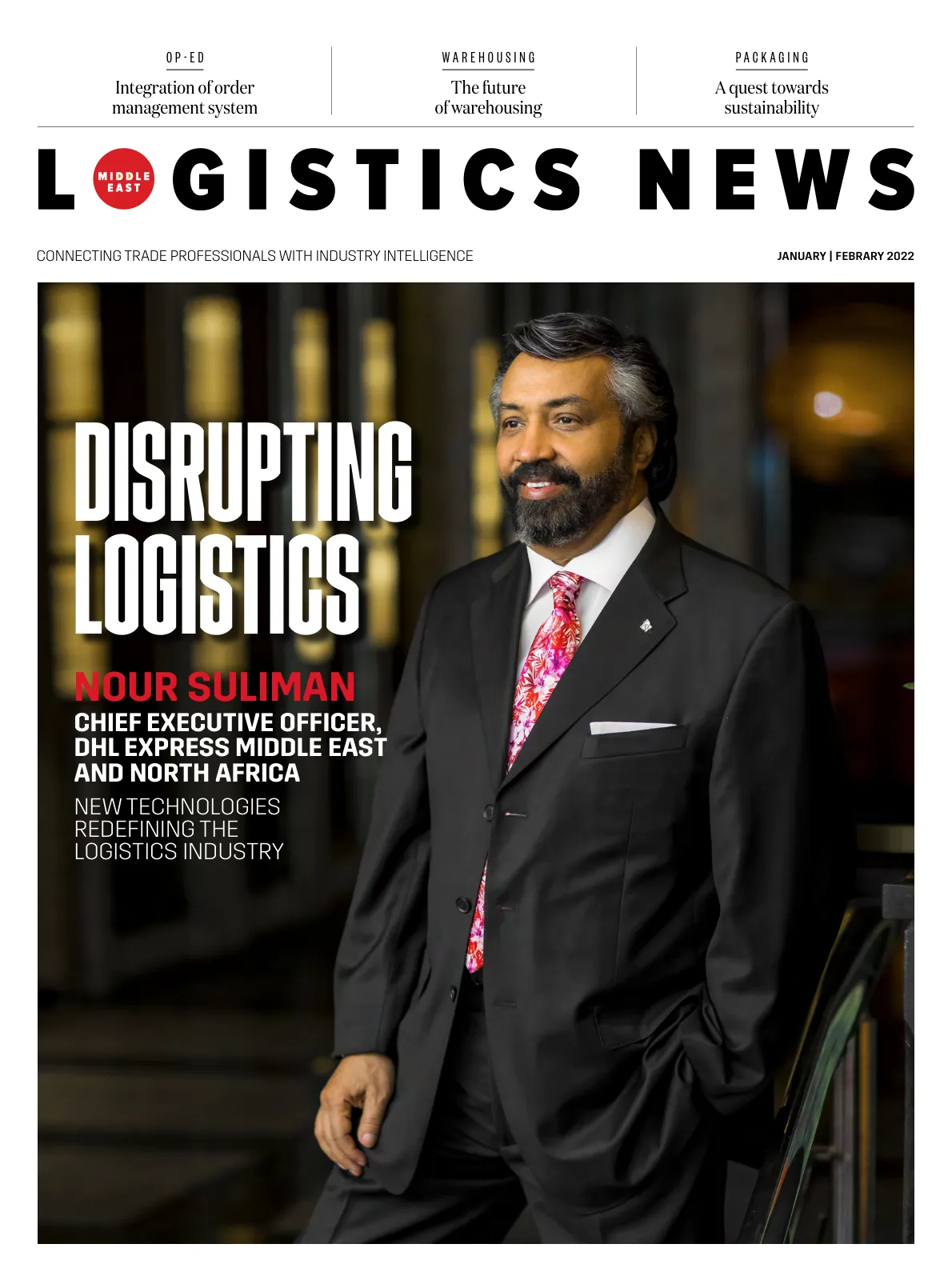
Logistics News, Jan/Feb 2022
Page 1
CONNECTING TRADE PROFESSIONALS WITH INDUSTRY INTELLIGENCE
JANUARY | FEBRARY 2022
DISRUPTING
LOGISTICS
O P - E D
Integration of order
management system
W A R E H O U S I N G
The future
of warehousing
P A C K A G I N G
A quest towards
sustainability
NOUR SULIMAN
NEW TECHNOLOGIES
REDEFINING THE
LOGISTICS INDUSTRY
CHIEF EXECUTIVE OFFICER,
DHL EXPRESS MIDDLE EAST
AND NORTH AFRICA
Page 2
A MEMBERS OF EMIRATES TRANSPORT BUSINESS CENTERS:
Page 3
LOGISTICS NEWS ME | JANUARY - FEBRUARY 2022 | 3
DISRUPTING
LOGISTICS
18 TRUCKS
THE WAY FORWARD
Traversing extreme off-road conditions or
long-haul routes?
IVECO’s Fabio De Serafini shares how the
new trucks are perfect for these missions
28 TRUCKS
CONTINUOUS GROWTH
UD Trucks announces exceptional growth
across the MEENA region in 2021
30 ELECTRIC FLEETS
A GREENER TOMORROW
Electric vehicle (EV) charging app, Monta,
and e-mobility solution provider, CITA EV,
recently partnered to help supercharge EV
charge point infrastructure in the Middle
East, Casper Rasmussen, CEO and Co-
founder at Monta tells us more
32 WAREHOUSING
THE FUTURE OF WAREHOUSING
Automation, robotics, and energy efficiency
are at the centre of warehouse innovation.
David Taylor, Commercial Director at Flogas
reveals
36 OP-ED
INTEGRATION OF ORDER MANAGEMENT
SYSTEM
Alain Kaddoum, Managing Director, Savoye
Middle East, Savoye, shares about the limitless
benefits of incorporating an order management
system
38 PACKAGING
A QUEST TOWARDS SUSTAINABILITY
Tetra Pak Arabia’s Managing Director, Niels
Hougaard, speaks to Logistics news ME about
the latest efforts of the company in making
the regional food and beverage industry more
sustainable
42 INTERVIEW
A CENTRAL SOLUTIONS PROVIDER
Paul Morgan, the CEO of Centre Point Logistics
(CPL) reveals his plans for the company, the
changes he has brough about, and how the
pandemic has impacted the industry
46 CARGO
TO RUSSIA WITH LOVE
UAE-based Dibba Bay Oysters rely on Emirates
SkyCargo to export premium oysters to Moscow
Nour Suliman, The Chief
Executive Officer of DHL
Express MENA speaks to
Logistics News ME about
new technologies that are
redefining the logistics
industry
22
18
32
IN THIS ISSUE
Page 4
Page 5
Page 6
MARCH 29, 2022
VIRTUAL EVENT
As a celebration of women business leaders across the Middle East
and Africa, Mastercard has partnered with Entrepreneur Middle East
to present the first ever Women SME Leaders Awards 2022.
We are inviting every women SME leader across all walks of life-
individuals and organizations- to take part.
There are no costs for attending or nominating at this event.
Good luck to all and let’s celebrate women SMEs together!
RECOGNIZING THE ACHIEVING WOMEN
OF MIDDLE EAST AND AFRICA
Page 7
WOMENSMELEADERS.COM #WOMENSMELEADERS
NOMINATE NOW
Page 8
8 | LOGISTICS NEWS ME | JANUARY - FEBRUARY 2022
WWW.CBNME.COM
All rights reserved © 2022.
Opinions expressed are solely those
of the contributors.
Logistics News ME and all subsidiary
publications in the MENA region are officially
licensed exclusively to BNC Publishing in the MENA
region by Logistics News ME.
No part of this magazine may be reproduced or
transmitted in any form or by any means without
written permission of the publisher.
Images used in Logistics News ME are credited
when necessary. Attributed use of copyrighted
images with permission. All images not credited
courtesy Shutterstock.
Printed by UPP
SUBSCRIBE
subscriptions@bncpublishing.net
For all commercial enquiries, contact
sales@bncpublishing.net
T +971 50 440 2706
PO Box 502511
Dubai, United Arab Emirates
P +971 4 4200 506 | F +971 4 4200 196
Keep up to date with all the latest
news, features and much more
on our website and social media
platforms.
CBNME.COM
CBNME
@CBNME
CONSTRUCTION BUSINESS NEWS ME
CEO
Wissam Younane
wissam@bncpublishing.net
DIRECTOR
Rabih Najm
rabih@bncpublishing.net
GROUP PUBLISHING DIRECTOR
Joaquim D'Costa
jo@bncpublishing.net
+971 50 440 2706
BUSINESS DEVELOPMENT DIRECTOR
Rabih Naderi
rabih.naderi@bncpublishing.net
+966 50 328 9818
MANAGING EDITOR
Kasun Illankoon
kasun@bncpublishing.net
EDITOR
Jochebed Menon
EDITORIAL DESIGN
Christian Harb
MARKETING EXECUTIVE
Aaron Joshua Sinanbam
aj@bncpublishing.net
PHOTOGRAPHER
Alexander Bungas
EDITOR’S NOTE
LNME
While the supply chain crisis is still
something we’re battling and trying our
best to resolve, the way the industry
has responded to the need of the hour
is praiseworthy – whether it be last mile
delivery, innovation in eCommerce,
marketplace launches and warehousing
solutions, the industry has powered
through.
This year, we’ll focus on newer
technologies that are breaking through
the logistics sector and shine the light
on marketplaces. Prior to 2020, logistics
companies were reluctant to make the
switch to digital and were more reliant
on manually carrying out tasks. The
pandemic pressed them to move online.
Sustainability in the logistics and
supply chain sectors is another area
we’re going to focus more on in the
year. It’s the need of the hour and we’ve
seen the big movers take the right steps
towards this.
Lastly, we thank you, our readers,
for providing us with your support
throughout 2021 and we hope to bring
out the latest and most interesting
information from the logistics industry
to you.
We’ve got some interesting stories in
this issue, so happy reading!
R
esilience is the world of the year for
2021. As we enter 2022, we’ve begun
to accept the fact that COVID-19 isn’t
going anywhere, and we have to live
with it. But we have to give it to ourselves
and to the industry for standing in the
face of this pandemic despite the various
variants.
Jochebed Menon
Editor, Logistics News Middle East
jochebed@bncpublishing.net
Page 9
GLOBALLY
RANKED 7TH
AVAIL EXCLUSIVE
EXPO2020 OFFERS
START YOUR
BUSINESS TODAY
LICENSE
REGISTRATION
FEES
FREE
OFF ON RENT
ON ALL LEASING
FACILITIES
15%
DISCOUNT ON AJMAN
CHAMBER OF COMMERCE
MEMBERSHIP CERTIFICATE
50%
afz.ae
8002392
For more information:
Page 10
come as
you are.
Page 11
@ / # 25hourshotels
#hellodubai
we are now open!
25% off,
book via
enjoy
25hours-hotels.com
Overlooking the museum of the future, near dubai international
financial centre, 25hours hotel one central boasts 434 rooms
and suites in addition to flexible events and co-working spaces.
A total of four characterful restaurants and bars take guests on
a culinary trip around the world from northern india to the beer
gardens of bavaria: this is where urban nomads meet desert
flowers, where local heroes meet the well-traveled. Alongside
rental of mini cars and schindelhauer bikes the hotel will also
feature the extra hour spa, rooftop pool and dubai's first
mixed-gender rooftop sauna.
434 rooms | co-working spaces | monkey bar | tandoor tina
ernst | nomad dar bar | rooftop pool & sauna | spa | gym
Page 12
12 | LOGISTICS NEWS ME | JANUARY - FEBRUARY 2022
WWW.CBNME.COM
H
H Sheikh Ahmed
bin Saeed Al
Maktoum, Chair-
man of Dubai
Integrated
Economic Zones Authority
(DIEZ), appointed a new
leadership team to drive
DIEZ’s free zones and central
divisions towards a new era
of excellence and integra-
tion.
DIEZ aims to raise Dubai’s
position as a regional and
global investment desti-
nation and contribute to
achieving the emirate’s stra-
tegic priorities through its
economic zones, which are
the Dubai Airport Free Zone,
Dubai Silicon Oasis, and
Dubai CommerCity.
Further, DIEZ aims to boost
economic growth, contribute
to shaping the future eco-
nomic map of Dubai, and
create more diverse invest-
ment opportunities.
HH Sheikh Ahmed bin
Saeed Al Maktoum empha-
sised that the new appoint-
ments for the Authority’s top
leadership positions came
in line with the directives of
HH Sheikh Mohammed bin
Rashid Al Maktoum, Vice
President and Prime Minis-
ter of the UAE and Ruler of
Dubai, in developing and
strengthening the role of
human resources for sustain-
able growth, business expan-
sion, and in consolidating
the emirate’s position as a
global investment hub.
He called on them to
strengthen the spirit of
teamwork and openness,
foster best practices, im-
prove commercial services
and solutions, and stimulate
the culture of innovation
and proactive thinking while
keeping pace with the rapid
economic developments.
HH Sheikh Ahmed added:
“We look forward to the suc-
cess of the Dubai Integrated
Economic Zones Authority
and its new structure. We
are confident in the com-
petence of our new top
officials, which they have
proven over the past years.
We believe in their capabili-
ties to lead the Authority in
providing comprehensive
and integrated solutions to
the business community and
investors in the free zones in
Dubai.
“DIEZ presents an equal
economic model that creates
new prospects and expan-
sion opportunities through
providing seamless and ef-
ficient services and solutions
to the business community,
which in turn improve the
operational efficiency of the
three free zones.”
Amna Lootah was appoint-
ed as a Director General
DAFZ to lead and implement
strategic plans according
to the approved structure,
driven by its vision, mission,
and values. Further, Lootah
will also lead the executive
management team at the
Dubai Airport Free Zone.
Dr. Juma Al Matrooshi
was appointed as Director-
General of Dubai Silicon
Oasis (DSO) to supervise the
implementation of its strat-
egy according to the new
organizational structure.
At central divisional func-
tions, Eng. Muammar Al
Kathiri was appointed as
Chief Engineering & Smart
City Officer in the Authority
to lead and direct engineer-
ing planning and make stra-
tegic planning, design, and
construction decisions.
For DIEZ’s financial goals,
William Chapel will serve as
Chief Financial Officer (CFO)
in DIEZ, where he will be re-
sponsible for financial man-
agement. He will oversee
strategic financial direction
to ensure the achievement of
strategic business objectives
and increasing economic re-
turns for all stakeholders.
Youssef Behzad was ap-
pointed as Chief People &
Organizational Development
Officer at DIEZ to lead and
implement the institutional
approach in empowering
human capital, ensuring the
quality of human resources
in all departments and the
authorities’ functions. In
addition, the duties include
providing means to enhance
the effectiveness and ef-
ficiency of the organizational
structure, backed by creative
talents capable of leading
operations to achieve the
organizational goals.
Bader Buhannad will as-
sume the position of Chief
Corporate Support Officer
at DIEZ. He will be manag-
ing and directing digital
and information technology
activities, managing the
supply chain, in addition
to providing the necessary
guidance for the Authority’s
integrated management and
project management office
functions.
The list of appointments
also included Saeed Al-Su-
waidi as the new Chief Legal
& Regulatory Affairs Office at
DIEZ and Abdul Rahman Ba-
saeed, Chief Internal Audit &
Enterprise Risk Management
Officer.
REGIONAL NEWS
LNME
12 | LOGISTICS NEWS ME | JANUARY 2022
DIEZ ANNOUNCES
NEW LEADERSHIP
TEAM TO STEER
GROWTH PATH FOR
FREE ZONES
Page 13
REGIONAL NEWS
DP WORLD INTRODUCES CARGOES
CUSTOMS TO ENABLE TRANSPARENCY
AND PAPERLESS TRADING
D
P World announced the launch of its
new digital compliance and revenue
platform, CARGOES Customs to facili-
tate completely paperless trade.
This will ease the flow of the customs
process using innovative technology solutions, in-
cluding an Artificial Intelligence driven risk engine
and smart valuation.
Its advanced classification wizard, based on ma-
chine learning, vastly reduces classification issues.
It is designed and supported by customs experts
and digital transformation leaders and is backed
by more than 40 years of experience in logistics to
solve challenges in the supply chain.
CARGOES Customs provides an intelligence-en-
abled, unified customs operating model that opti-
mizes border management and revenue collection
activities. The system empowers customs agencies
to facilitate trade, secure global supply chains, and
increase compliance.
At the same time, it minimises revenue leakage
for government agencies. The platform is built
to assist global customs organizations in reform-
ing and modernizing processes by streamlining
digital transformation through the latest technol-
ogy and tools.
The CARGOES Customs platform is based on
the belief that with technology as a foundation,
any customs organization can vastly improve its
digital capabilities and better integrate with key
agencies and other countries, while also satisfying
any regional agreements.
The CARGOES Customs system is further en-
hanced by its powerful risk engine which detects
revenue leakages. This technology improves
visibility and traceability, and is based on WCO
best practices, thereby optimising the customs
clearance process. As an intelligent risk engine, it
helps enforce compliance and promotes seamless
collaboration between authorities, government
departments and stakeholders.
Offering a single window interface, CARGOES
Customs is highly configurable and uses a tem-
plate-based design which means customs organi-
zations can update or roll-out new services at the
click of a button. It supports all file formats com-
monly used in customs, and is WCO, WTO and
SAFE framework compliant.
Sultan Ahmed Bin Sulayem, Group Chairman
and Chief Executive Officer ofP World said: “Trade
is a key driver to help economies around the world
to recover fairly and sustainably from the eco-
nomic shock of the pandemic. At DP World, we
are doing our part to make trade flow as smoothly
and seamlessly as possible, and with CARGOES
Customs we really help customs authorities around
the world to become dramatically more efficient –
now and for the long term.
“This new digital solution connects customs of-
ficials and traders through an easy-to-use interface
and a suite of custom-built tools. We will continue
to invest in our digital platforms to bring simplic-
ity, transparency and efficiency to global trade – at
customs, and beyond.”
Pradeep Desai, Chief Technology Officer, DP
World added: “Demand for digital solutions has
never been higher and will only keep growing.
We are leveraging technology to create value for
our customers and help drive growth. CARGOES
Customs by DP World is part of the broader CAR-
GOES software suite of products.
“DP World created CARGOES to solve press-
ing challenges caused by supply chain related
inefficiencies. It’s a holistic solution powered by
technology targeting all aspects of global trade
including Finance, ERP, Tracking, Terminal Op-
erating System, Customs software and enabling
end-to-end logistics. We are excited to provide
Logistics as one of our first CARGOES offerings to
customers.”
Page 14
14 | LOGISTICS NEWS ME | JANUARY - FEBRUARY 2022
WWW.CBNME.COM
REGIONAL NEWS
LNME
N
icolas Sibuet brings over
26 years of experience
across the shipping, oil
and gas, and aviation industries
to Aramex where he will serve
as the Chief Financial Officer
(CFO).
Most recently, he served as
CFO and Acting Senior Vice
President for Strategy, Market-
ing and Communications at
Abu Dhabi Airports.
Sibuet also has extensive ex-
perience as an expert advisor to
Boston Consulting Group where
he worked on transforming and
restructuring companies.
Additionally, he was the
Vice President for Marketing
and Business Development at
Weatherford, where he partici-
pated in the restructuring and
disbursement of Weatherford
drilling contracting arm, WDI.
Prior to that, he held multiple
roles in the oil and gas and
shipping industries, delivering
successful funding requirements
to support business growth as
well as leading and structuring
finance departments.
Othman Aljeda, Chief Execu-
tive Officer of Aramex, said: “I
am pleased to welcome Nicolas
as Aramex’s CFO. He is a sea-
soned executive with a proven
track record of leading compa-
nies towards transformational
growth and has deep knowl-
edge in various industry trends.
“His extensive experience will
play a key role in the execution
of our strategic priorities and
will enable us to further opti-
mise our recently redesigned
operating model, as we seek to
grow our global market share.
The management team and I
are looking forward to working
closely with Nicolas to enable
the company achieve sustain-
able growth for our key stake-
holder groups.”
Sibuet holds a master’s
degree in Economics and Ac-
counting from the University
of Western Brittany in France
and a postgraduate degree in
Finance from the Strasbourg
University in France.
ARAMEX
APPOINTS
FORMER
ABU DHABI
AIRPORTS’
CFO
AS CHIEF
FINANCIAL
OFFICER
Page 15
LOGISTICS NEWS ME | JANUARY - FEBRUARY 2022 | 15
REGIONAL NEWS
F
edEx Express announced the launch of FedEx Interna-
tional Priority Express (IPE) in the UAE offering custom-
ers who ship internationally the flexibility to schedule
delivery by 10:30 am or noon to select destinations world-
wide. With the addition of this new service, FedEx now
provides a wider range of time-definite international priority
shipping options to its customers.
Businesses across the Middle East region can select the
right delivery option that suits their needs with choices, giv-
ing them enhanced convenience and flexibility. The newly
launched FedEx International Priority Express (IPE) service
provides customers in the Middle East with delivery by
10:30 or noon to select markets in Asia, the United States,
Canada, and Europe.
FedEx International First offers customers in the Middle
East the option for early-day delivery to select postal codes
and destinations in the United States, Canada, and Europe.
And FedEx International Priority (IP) offers end of the day
delivery to more than 220 countries and territories around
the globe. These time-definite cross-border delivery options
are part of FedEx efforts to support businesses amidst the
soaring demand for cross-border commerce. Across the
Middle East and Africa, the Freight and Cargo market is
expected to reach USD315 billion, growing at a compound
annual growth rate (CAGR) of 4% by 2027.
“Adding International Priority Express (IPE) is an important
enhancement to our portfolio and we’re launching it at a
critical moment in time. As economies begin to recover,
businesses and consumers alike are placing heightened
value on trackable, time-definite delivery, and the segment
is set to grow,” said Kawal Preet, president, Asia Pacific,
Middle East, and Africa region, FedEx Express. IPE is an
enhanced service with delivery windows early in the day for
critical time sensitive shipments. The expanded range of
solutions we now offer gives businesses of all sizes greater
control, by providing them with more choices that match
their needs.”
FEDEX EXPRESS OFFERS NEW
TIME-DEFINITE DELIVERY OPTIONS
T
radeling has appointed Iyad Kamal as a member of its Board
of Directors. Tradeling is the Dubai-based hyper-growth e-
marketplace focused on business-to-business (B2B) transac-
tions in the Middle East and North Africa region. Iyad Kamal,
a seasoned logistics and supply chain expert and business
operations executive brings vast experience in cross-border logistics
and operations and will be collaborating with Tradeling’s executive
management team in developing the company’s logistics expansion
plans and capabilities in the UAE and across the MENA region.
Kamal has over 30 years of solid and progressively responsible expe-
rience in the field of logistics and operations, as well as last-mile deliv-
ery. He was at the helm of operations at Aramex for 29 years the last
10 of which he served as the company’s Chief Operating Officer.
At Aramex, Kamal was instrumental in building and transforming the
logistics giant into a global brand. Since leaving Aramex, he has been
advising global logistics players and startups on international expan-
sion, digital transformation, strategy, and operations.Commenting on
the occasion, Marius Ciavola, CEO of Tradeling said: “We are excited
to welcome Iyad as our newest board member. His expertise in the
field will be essential in helping guide our operations to achieve rapid
growth and steering our expansion across the region.
I am glad to be joining Tradeling’s board of directors, and eager to
contribute to the company’s strategic growth in order to enhance its
regional reach and positioning as the leading B2B platform,” added
Iyad Kamal.
FORMER ARAMEX COO
IYAD KAMAL GETS APPOINTED
TO TRADELING’S BOARD
Page 16
REGIONAL NEWS
LNME
#LNMEforum
LOGISTICSNEWSME
@LOGISTICSNEWSME
LOGISTICS NEWS ME
CBNME.COM
LOGISTICS
FORUM
2022
INNOVATION
IN TECHNOLOGY
How blockchain, artificial
intelligence and IoT
is revolutionising the
logistics and supply chain
industries
1
WAREHOUSING
How automation
is reinventing the
warehousing business and
disruptive technologies
are allowing warehouses
to accommodate the F&B,
retail and pharma sectors’
growing requirements.
2
SUPPLY CHAIN WOES
The shipping network
upended by the pandemic
shows no respite – supply
chains continue to find itself
in a logistics knot, ports
face a never-seen-before
congestion and shipping rates
are yet to fall. What is the
solution?
4
SUSTAINABLE
MOBILITY
Green fuels, sustainable
infrastructure and
sustainable modes
of transport
3
Topics
FOR SPEAKING OPPORTUNITIES
KASUN ILLANKOON
+971 56 135 4769
kasun@bncpublishing.net
JOCHEBED MENON
+971 55 969 8037
jochebed@bncpublishing.net
FOR SPONSORSHIP OPPORTUNITIES
CLAYTON RODRIGUES
+971 50 929 3982
clayton@bncpublishing.net
JOAQUIM D’COSTA
+971 50 440 2706
jo@bncpublishing.net
MARCH 29
FAIRMONT THE PALM
Page 17
LOGISTICS NEWS ME | JANUARY - FEBRUARY 2022 | 17
REGIONAL NEWS
A
.P. Moller – Maersk an-
nounced new aspiring emis-
sions targets expected to
align the company with the
Net Zero criteria of the Sci-
ence Based Targets initiative (SBTi) path-
way to limit global warming to 1.5°C.
They include a societal commitment to
act now and drive material impact in this
decade, and a commitment to deliver net
zero supply chains to customers by 2040.
The targets go beyond previous efforts
to reduce emissions related to the ocean
fleet as they cover all direct and indirect
emissions across the entire Maersk busi-
ness.
“As a global provider of end-to-end lo-
gistics services across all transport modes,
it is a strategic imperative for Maersk to
extend our net zero ambition to the total
footprint of the business. The science is
clear, we must act now to deliver signifi-
cant progress in this decade. These very
ambitious targets mark our commitment
to society and to the many customers
who call for net zero supply chains,” says
Soren Skou, CEO of A.P. Moller – Maersk.
Tangible near-term targets for 2030 are
set to ensure significant progress on curb-
ing direct Maersk emissions already in this
decade.
These include a 50% reduction in emis-
sions per transported container in the
Maersk Ocean fleet and a 70% reduction
in absolute emissions from fully controlled
terminals. Depending on growth in the
ocean business, this will lead to absolute
emissions reductions between 35% and
50% from a 2020 baseline.
“Our updated targets and accelerated
timelines reflect a very challenging, yet
viable pathway to net zero which is driven
by advances in technology and solutions.
What is needed is a rapid scale-up which
we will strive to achieve in close collabo-
ration with customers and suppliers across
the entire supply chain,” says Henriette
Hallberg Thygesen, CEO of Fleet & Stra-
tegic Brands, A.P. Moller – Maersk.
As recommended by SBTi, over the dec-
ade Maersk will go above and beyond the
1.5°C-aligned targets and invest in build-
ing a portfolio of natural climate solu-
tions that will result in around five million
tonnes of CO2 savings per year by 2030.
To maximise progress towards net zero
supply chains in 2040, ambitious 2030
targets for a range of green product offer-
ings are introduced, adding to solutions
including Maersk’s Emissions Dashboard
and Maersk ECO Delivery.
They aim to reinforce Maersk as a lead-
ing provider of green supply chain solu-
tions and cover ocean, air, contract logis-
tics (warehouses and depots) and cold
chain. These products will utilise green
technologies and solutions to ensure that
they provide real emission reductions
within the supply chain.
Covering indirect emissions means the
targets also address emissions from e.g.,
inland transport services and vessel build-
ing which are provided by third party sup-
pliers. Tackling this challenge will require
extensive data insights and close collabo-
ration with local and regional suppliers of
products and services across the Maersk
business footprint.
Maersk’s 2030 targets include:
> Ocean: Around 50% reduction in green-
house gas emissions intensity
> Terminals: Close to 70% absolute reduc-
tion of greenhouse gas emissions
> Natural Climate Solutions used above
and beyond 1.5°C target to build a port-
folio that generates around five million
tons of CO2 savings per year by 2030
> Ocean: 25% of all cargo transported us-
ing green fuels
> Air: Minimum 30% of cargo transported
using Sustainable Aviation Fuels (SAF)
> Contract logistics (warehouses and
depots) and cold chain: Minimum 90%
green operations
> Inland transportation: Industry leading
green offering – targets will be set during
2022
MAERSK ACCELERATES NET ZERO EMISSION TARGETS
TO 2040 AND SETS 2030 TARGETS
Page 18
18 | LOGISTICS NEWS ME | JANUARY - FEBRUARY 2022
WWW.CBNME.COM
TRUCKS
LNME
THE WAY FORWARD
Traversing extreme off-road conditions or long-haul routes?
IVECO’s Fabio De Serafini shares how the new trucks are perfect for these missions
Page 19
LOGISTICS NEWS ME | JANUARY - FEBRUARY 2022 | 19
THE WAY FORWARD | FABIO DE SERAFINI, BUSINESS DIRECTOR, IVECO AFRICA & MIDDLE EAST
I
n June 2021, Turin-based Indus-
trial Vehicles Corporation (IVECO)
introduced its new range of off-
road and on-road trucks T-WAY
and S-WAY in Europe. Following
which, it launched the trucks
in the Middle East in December
2021.
Fabio De Serafini, Business Direc-
tor, IVECO Africa & Middle East,
tells Logistics News ME about
the key features of the two models
including safety, efficiency, and perfor-
mance.
Tell us about the T-WAY and S-WAY,
and what makes it a right fit for the
construction sector.
The IVECO T-WAY is the off-road ve-
hicle designed and engineered for the
toughest missions in the most extreme
conditions, which takes over from the
TRAKKER. It introduces a new Hi-
Tronix automated transmission with
functions specifically developed for
off-road mobility.
IVECO completes the IVECO WAY
heavy range with the IVECO S-WAY
the on-road truck developed to
deliver a complete package of features
focused on the driver, on efficiency and
business oriented. The IVECO S-WAY
delivers a fuel efficiency increase of
up to 4% with a new engine line-up,
a redesigned cabin, and advanced
features, further reducing its total cost
of ownership and raising the stakes on
business productivity.
What makes these two models suit-
able for the UAE – considering the
climate and weather conditions?
With the new T-WAY and S-WAY,
IVECO is offering customers com-
plete and renewed business-oriented
product range for both off-road and
on-road application. The new range is
perfect to work in in the most extreme
climate and weather conditions both
for their robustness and the new cabin
comfort, the air conditioning system,
and integrated parking cooler and
heater systems ensure an ideal internal
climate within the cab in all weather
conditions, when driving or during
stops.
“SUSTAINABILITY ENTAILS OUR RESPONSIBILITY TO
MAKE THIS JOB, WHICH IS CRUCIAL FOR OUR SOCIETY.
THE NEW IVECO WAY RANGE IS THE CULMINATION
OF A PRODUCT INNOVATION CYCLE THAT IMPROVE
PRODUCTIVITY AND FUEL EFFICIENCY TO FACE THE
SUSTAINABILITY CONCEPT.”
>>>
Page 20
20 | LOGISTICS NEWS ME | JANUARY - FEBRUARY 2022
WWW.CBNME.COM
TRUCKS
LNME
Elaborate on key features of the T-WAY and S-WAY.
The IVECO T-WAY is the toughest vehicle we’ve engineered
for extreme off-road missions and the new IVECO S-WAY is a
driver-centric long-haul truck.
Along with a new Hi-Tronix automated transmission with func-
tions specifically developed for off-road mobility, the T-WAY also
boasts new rear disc brakes, heavy-duty rear suspension system
for tandem axles, lower kerb weight and a host of features such
as the off-rode mode, together with ESP, hill holder and high-
comfort cab add up to outstanding efficiency and safety.
The IVECO T-WAY has been designed to offer best-in-class
performance in every off-road mission, robustness, and torsional
rigidity. It carries over from its predecessors the legendary ro-
bustness of the high-resistance steel chassis with a 10mm thick
frame, with a rail bending moment at the top of the segment at
177 kNm. The front axle has a maximum capacity of up to nine
tonnes. Hub reduction on the rear axle is standard to maximise
strength and performance.
The heavy-duty rear suspension system for tandem axles op-
timises vehicle weight and improves off-road performance with
greater ground clearance and a better departure angle. The
IVECO T-WAY delivers all the power needed for traction and
PTO with IVECO’s reliable and efficient Cursor 13 engine (13
litres) that develops up to 470/480 hp.
Page 21
LOGISTICS NEWS ME | JANUARY - FEBRUARY 2022 | 21
UD TRUCKS LAUNCHES NEW EURO 5 RANGE IN THE REGION
The engines are coupled with the proven
16-speed Hi-Tronix automated gearbox,
which now also features new functions
specifically intended for off-road mobility
including a hill holder function to help
departure on steep slopes, rocking mode
to help recover traction in slippery condi-
tions and Creep Mode for ultra-low speed
when idling; for the on-road sections of the
mission, the Ecoroll, function that uses the
vehicle’s inertia when travelling downhill
enhances the transmission’s efficiency.
With the S-WAY, IVECO has redesigned
the cab from the ground up and taken
every opportunity to deliver cost savings
and productivity gains to the benefit
of the owner’s profitability. All the
elements of the new design work together
to achieve a superior aerodynamic
performance and deliver fuel savings up
to 4% on top of the outstanding fuel
efficiency that is the hallmark of this
product family. Every detail of the cab
exterior has been studied with care to
minimise air resistance.
The new roof is perfectly integrated into
the front end of the vehicle, presenting a
flat surface that minimises drag. Even the
retractable front step that provides easy
access to the windshield completely disap-
pears when not in use. The front grille
with high radius corners and side fins,
the integrated headlights, the two new
bumper design with integrated deflectors,
together with the new design of the wheel
arches, create flowing lines that optimise
air flow – and make a statement with a
distinctive style.
The IVECO S-WAY carries over all
the advances introduced in the previous
generations and adds a new cab entirely
redesigned around the driver to provide
the ultimate driving environment with
outstanding ergonomics and controls
layout.
The ergonomic layout of the controls
ensures all the key functions are within
easy reach of the driver. The multi-func-
tional steering wheel, with 22 switches,
puts all the necessary functions, at the
driver’s fingertips this set-up eliminates
distractions for the driver who can oper-
ate without ever needing to move their
hands from the steering wheel.
WHAT ROLE DOES SUSTAINABILITY PLAY
AT IVECO?
Sustainability entails our responsibility to
make this job, which is crucial for our so-
ciety. The new IVECO WAY range is the
culmination of a product innovation cycle
that improve productivity and fuel ef-
ficiency to face the sustainability concept.
It addresses the key trends driving the
transport industry: a blurring of the lines
separating the vehicle and the services
around it, the advanced connectivity, the
need to attract and keep highly skilled
professional drivers, and increasingly de-
manding requirements in sustainability.
SHED SOME LIGHT ON THE CHALLENGES
IVECO FACES IN THE REGION.
The product we present now is the sym-
bol of our re-creation and re-invention.
The new IVECO heavy range exemplifies
the achievements of a product innovation
cycle developed step by step over the last
years. When we decided to develop the
new model, we knew we were building
the truck for the next decade, facing a
high frequency and amplitude of regula-
tory challenges around emissions, safety,
and connectivity.
Page 22
22 | LOGISTICS NEWS ME | JANUARY - FEBRUARY 2022
WWW.CBNME.COM
COVER STORY
LNME
T
he 21st century has reshaped the logistics industry by advancing
technology, new business models, and causing dramatic shifts in customer
behavior. In the last decade alone, we have seen a transformational pace
perhaps greater than in the past 100 years combined. Wave after wave
of disruptive technologies, from cloud computing to collaborative robots,
big data analytics, artificial intelligence, and the Internet of Things, have
challenged supply chain resilience and industry performance.
The pandemic caused another drastic shift. It accelerated eCommerce growth
and industry digitization by years, putting tremendous pressure on logistics
players to shift gears and think in agile mode to weather the storm.
DISRUPTING
LOGISTICS
THE CHIEF EXECUTIVE OFFICER
OF DHL EXPRESS MENA
SPEAKS TO LOGISTICS NEWS ME
ABOUT NEW TECHNOLOGIES THAT
ARE REDEFINING THE LOGISTICS
INDUSTRY
NOUR
SULIMAN
Page 23
LOGISTICS NEWS ME | JANUARY - FEBRUARY 2022 | 23
“IT HAS BECOME
ABUNDANTLY CLEAR
THAT LOGISTICS
IS ENTERING A
TRANSFORMATIVE
DECADE AND THOSE
WHO DO NOT
EMBRACE
TECHNOLOGY
INNOVATION
WILL BE
HARDEST HIT.”
LOGISTICS NEWS ME | JANUARY 2022 | 23
Page 24
24 | LOGISTICS NEWS ME | JANUARY - FEBRUARY 2022
WWW.CBNME.COM
COVER STORY
LNME
TRANSFORMATIVE ERA
“In light of the business and social trends to come, it
has become abundantly clear that logistics is entering a
transformative decade and those who do not embrace
technology innovation will be hardest hit,” explains Nour
Suliman.
“Key moves to scale and adopt new technology, automa-
tion and digital tools need to take centre stage on the
strategic agendas of logistics and supply chain organisa-
tions and will ultimately determine industry leadership
positions in the future.”
With the turning point of the COVID-19 crisis, the
subsequent shocks in demand and supply, and the spike
in online commerce, key evolving technologies have come
to the forefront, and will pave the way for resilient supply
chains and industry progress in the coming decade.
The Internet of Things (IoT) has had a profound impact
not only on logistics but the world at large. With its vast
potential to link billions of objects and connect virtually
anything to everything, IoT and the new generation of
communications technologies powered by higher speeds,
increased capacities and greater flexibility of 5G networks,
are accelerating data-driven logistics and proving to be vi-
tal drivers of higher industry efficiency and service quality.
As the integration of IoT in supply chains becomes
easier and less costly, it promises far-reaching payoffs for
logistics, generating actionable insights that drive change
and new solutions. “IoT devices and the data they collect
will be crucial in overcoming the complexities of logistics
networks by enabling enhanced visibility, transparency,
reliability, security and supply chain efficiencies. This in
turn will create a more dynamic and customized delivery
service which is paramount to our business,” states Suli-
man.
DATA-LED APPROACH
Big Data Analytics is fast transforming the industry.
It holds the key to better issues diagnostics, network
planning optimisation, customer service enhancements,
disaster risk mitigation, and new business model creation
based on predicted future scenarios.
“As worldwide complexity grows, maintaining peak
efficiency while processing millions of pieces of informa-
tion daily on orders, shipment movements, locations, is
no trivial task. A data-led approach leveraging analytics
should be a strategic priority for the supply chain to derive
forecast models and build future strategies,” explains
Suliman.
24 | LOGISTICS NEWS ME | JANUARY 2022
WWW.CBNME.COM
Page 25
LOGISTICS NEWS ME | JANUARY - FEBRUARY 2022 | 25
DISRUPTING LOGISTICS | NOUR SULIMAN, CEO, DHL EXPRESS MENA
Artificial Intelligence (AI) is finding strong
adoption within logistics. While high
capital costs and tough requirements are
putting a hamper on speedier progress, re-
search firm McKinsey predicts that almost
a third of the USD4.2 trillion of value to
be created by AI in the next 20 years will
result from applying the technology to
supply chains alone.
“AI’s predictive capabilities will be criti-
cal to solving complex challenges related
to our business operations, resulting in
more dynamic route optimisation, capac-
ity accuracy, and demand prognostics.
This will have a knock-on effect on cost
and operational efficiencies in key vari-
ables such as last-mile delivery, and will
definitely create new customer experi-
ences,” clarifies Suliman.
As AI becomes more intelligent with its
predictive technology, logistics can step
into new territory of anticipatory delivery
models, supplying goods to customers
before they even realize what is needed.
AUGMENTED AND VIRTUAL
REALITY
The social and travel restrictions imposed
by COVID-19, have catalysed greater
adoption of Augmented and Virtual Real-
ity technologies in the realm of logistics.
“AR and VR is slowly but surely perme-
ating our sector; and the blending of the
digital and physical worlds is enabling us
to better drive cost savings, productivity,
and optimize training,” explains Suliman.
Smartglasses for example have had pro-
found effects on inspection and quality
assurance, as well as repair and mainte-
nance and according to Suliman, DHL
has systematically rolled out smartglasses
to enhance the traditional picking pro-
cedure, citing 25% faster pick time and
nearly 100% accuracy.
The rapid pace of technology advance-
ment and greater affordability are driving
the integration of more robotics and
automation in the logistics industry.
Referencing the International Federation
of Robotics, USD3.7 billion worth of
logistics systems (111,000 robots) were
sold in 2018, a 53% jump from the year
before. In 2022, this is expected to grow
to USD22.5 billion. Advanced robotics
and automation in the supply chain hold
great power to boost output, cut costs,
and meet growing customer demand.
“As logistics robots are diversifying and
achieving higher proficiency with human-
like dexterity, they are taking on more
and more supplementary roles in the
supply chain; be it assisting workers with
warehousing, transportation, or even
last-mile delivery activities. This allows
us to free up our human resources and re-
allocate them for better utilisation.”
Innovation in bionic enhancements is also
picking up pace although there are still
many hurdles to overcome in terms of
high cost and usage explains Suliman.
“Advanced wearables and exoskeletons
are being used to augment human capa-
bilities and support logistics workforces
in areas such as training, communication,
process execution, and optimisation.
“Most importantly, they can minimize
health and safety risks in the workplace
related to sorting, picking, packing, (un)
loading, and inducting parcels.”
WEARABLES AND AI
From headbands that detect driver
fatigue, to protective wear that monitors
the handling of hazardous materials, and
exoskeletons that facilitate easier manual
activity, the logistics sector will increas-
ingly be exposed to new technologies that
monitor posture and movement and help
to reduce injury.
Although legal, regulatory and safety
restrictions have halted the wide-spread
adoption of autonomous road and aerial
vehicles, in the last few years we have
seen this concept mature and is gradually
entering the shared and public spaces.
“AS LOGISTICS ROBOTS ARE
DIVERSIFYING AND ACHIEVING
HIGHER PROFICIENCY WITH
HUMAN-LIKE DEXTERITY, THEY
ARE TAKING ON MORE AND
MORE SUPPLEMENTARY ROLES
IN THE SUPPLY CHAIN.”
>>>
Page 26
26 | LOGISTICS NEWS ME | JANUARY - FEBRUARY 2022
WWW.CBNME.COM
COVER STORY
LNME
“Driverless trucks, rovers, drones; all hold vast potential
to upgrade logistics because they can unlock new levels of
safety, efficiency, and quality; this is especially important
in the last mile delivery leg which accounts for more than
50% of total fulfilment costs,” states Suliman.
Driverless trucks have made significant headway,
proving capable of slashing delivery time and opera-
tional costs; while the need to reduce contact during the
COVID-19 pandemic prompted the use of rovers and
Unmanned Aerial Vehicles (UAVs) into the supply chains.
According to Suliman, despite the technology and regula-
tory challenges, the potential benefits are too great for
industry leaders to ignore.
Enhanced transparency
Blockchain is fast becoming a widely used technology in
logistics. Given that global supply chains are inherently
fragmented, having a single information system that is
accessible to all transaction parties - from customers, to
operators, and authorities - facilitates greater trust and
transparency.
“This is especially important with regulatory and
government processes where trust is a vital part of the
transactional cycle which at the moment is reliant on
more traditional paper methods.”
In partnership with Dubai Customs, DHL developed
and launched TED-X, a blockchain platform solution
in the UAE for cross-border e-commerce. In less than a
year, almost 7,000 shipments were digitally processed in
the blockchain system, saving USD10,000 in duties and
customs for DHL customers and enabling 60% product
revenue growth for platform users.
While the industry is consistently exploring how Block-
chain and other such distributed ledger technologies can
be applied, the use of blockchain-based smart contracts is
being expanded for processes beyond payment and cross-
border customs documentation.
The potential adoption of cryptocurrency as viable
payment will also create opportunities for new services
and business models in logistics. While volatility is still
a concern, recent announcements and speculations of
new digital currencies being released by giants Amazon,
Apple, Facebook, and Google in the next couple of years,
may fuel widespread consumer adoption once imple-
mented.
“Just like the debit, credit, and PayPal methods of
payment, cryptocurrencies are a viable payment method
for logistics products and services. More widespread
acceptance of crypto will strengthen the competitiveness
of logistics providers and further their integration in the
digital consumer world,” explained Suliman.
“WE MUST ENSURE THAT
OUR PEOPLE FEEL
COMFORTABLE WITH
HANDLING THESE
TECHNOLOGIES AND
PRIORITISE UPSKILLING
TO BEST CAPITALISE
ON THE SOPHISTICATED
SOFTWARE AND
EQUIPMENT AVAILABLE
AT OUR DISPOSAL.”
Page 27
LOGISTICS NEWS ME | JANUARY - FEBRUARY 2022 | 27
DISRUPTING LOGISTICS | NOUR SULIMAN, CEO, DHL EXPRESS MENA
Disruptive trends
3D printing is considered one of the most potentially
disruptive trends for logistics, and the pandemic gave a
glimpse of how it could impact the industry in the future.
The unexpected spike in demand for PPE and ventila-
tion machines meant traditional manufacturers could
not ramp up supply in a timely manner. Companies and
individuals stepped in to produce critical healthcare
equipment, while local supply chains had to rapidly adapt
their logistics patterns to deliver from within communi-
ties, instead of from abroad.
While the widespread adoption of 3D printing is still
many years away, its potential to revolutionize how and
where items are produced opens a world of opportuni-
ties for the industry. According to Suliman, logistics
players can take centre stage as orchestrators of complex
and fragmented supply chains for raw materials and end
products, as well as B2B printing services and delivery.
Regional logistics networks will expand as advances in
3D printing technology allow more product types to be
made from diverse materials as well as locations.
But while technology investments will continue to be
essential to operate successfully, according to Suliman,
logistics is a service industry which heavily depends on
trust - a human connection that ultimately, can only be
nurtured between people.
“We must ensure that our people feel comfortable with
handling these technologies and prioritize upskilling to
best capitalise on the sophisticated software and equip-
ment available at our disposal; at the same time, industry
leaders must also execute effective change management
strategies to encourage and motivate employees through
this transformation.”
LOGISTICS NEWS ME | JANUARY 2022 | 27
Page 28
28 | LOGISTICS NEWS ME | JANUARY - FEBRUARY 2022
WWW.CBNME.COM
CONTINUOUS
GROWTH
TRUCKS
LNME
U
D Trucks has announced sales growth in the
MEENA (Middle East, East and North Africa)
region of approximately 30 percent in 2021,
continuing an upwards trend for the brand,
which had experienced 6 percent growth in the
previous year. The Japanese commercial vehicle
manufacturer recorded an increase in sales in most
markets, including Saudi Arabia, the United Arab
Emirates, Qatar, Pakistan and a number of countries in
East Africa. vvUD Trucks’ flagship market, Bahrain, saw
an increase of around 40 percent, reinforcing the brand’s
number one status in the country. The trucks brand also saw
an increase in sales by about 30 percent in Qatar. Sales also
grew in Saudi Arabia, which is UD Trucks’ biggest market
by volume, by 24 percent. The United Arab Emirates, which
hosted the regional launch of the brand’s Euro 5 models,
registered an increase of 22 percent compared to 2020.
Outside the Middle East, UD Trucks earned positive
traction in Pakistan where it enjoyed an impressive year.
Similarly, the brand registered significant growth in East
Africa in 2021, where a number of strategic deals for both
heavy-duty and medium-duty trucks were signed off, despite
the challenging business climate.
The growth came as a result of a fantastic collaboration
and coordinated effort by UD Trucks and its partners
throughout the region and their joint focus on supporting
UD Trucks announces
exceptional growth across
the MEENA region in 2021
Page 29
LOGISTICS NEWS ME | JANUARY - FEBRUARY 2022 | 29
EMPOWERING TRADE | DP WORLD’S DUBUY.COM
UD customers. The brand’s well-built and
robust products, the introduction of the
Euro 5 range and upgrades to the Euro
3 line-up, a strong retail network and
partnerships, and the impact of its ‘Better
Life’ strategy, have all played significant
roles in the company’s success.
UD Trucks’ widest-ever range, which
covers almost all segments in the heavy-
duty and medium-duty truck sector,
and the nature of the brand’s product
portfolio have also been crucial factors
in this growth. The range has been
developed to meet the market’s needs by
covering all key segments in the industry.
UD Trucks’ focus of launching new
trucks that will enhance profitability for
customers by lowering the total cost of
ownership has also been crucial.
An important factor in the Japanese
brand’s expansion has been the
introduction of upgraded Euro 3 models
as well as the brand’s new Euro 5 range
of its popular Quester and Croner trucks.
The launch of the Euro 5 models is a
result of UD Trucks’ strategic vision
and objective to ensure peace-of-mind
for its customers by allowing them
to better prepare for running more
environmentally-friendly fleets as new
regulations are introduced across the fast-
developing region. The new range reduces
NOx emissions by about 43 percent
compared to Euro 4 models, while
providing an enhanced driving experience
and safety. The upgrades to the Euro 3
trucks are centred around creating a more
driver-centric experience. They receive
similar upgrades to the Euro 5 range,
including a new instrument cluster, the
ESCOT automated manual transmission,
body builder module and the UD Trucks
Telematics Services.
Another factor in the brand’s growth is
its exceptional regional retail network.
Their commitment to providing and
delivering the highest quality customer
service and aftersales support is
supported by comprehensive warranty
offers and readily available spare parts,
which prioritise the smooth operation
of customers’ businesses. UD Trucks’
Telematics services allow its customers
and retail partners to follow the trucks’
performances over time, creating a closer
relationship with the brand’s customers.
2021 was also the year that saw
UD Trucks implement its ‘Better Life’
strategy. The strategy has allowed
the truck brand to demonstrate its
commitment to providing sustainable
logistics solutions and to delivering
a better life for both people and the
planet. This strategy reflects UD Trucks’
objective to becoming a Japanese leader
of sustainability in the industry.
Mourad Hedna, President of UD Trucks
MEENA, commented: “The resilience
our brand showed in 2020, built around
a consistent and comprehensive strategy
and supported by our strong regional
partners, provided a solid platform for us
to build on in 2021. Registering about a
30 percent sales increase in one year is a
remarkable feat. I am grateful to the UD
Trucks MEENA team, our customers,
partners, and stakeholders throughout
the region for their hard work and
dedication. Together, we look forward
to another positive year as we continue
on our path to become a sustainability
leader.”
> UD Trucks registered sales increase
of around 30% in the MEENA region
> Qatar ranked first in growth followed
by Bahrain and Saudi Arabia
> Saudi Arabia remains UD Trucks’
biggest market in the region
> Introduction of Euro 5 products,
upgrades to Euro 3 models, strong
retailer network and ‘Better Life’
strategy played key roles in the growth
Mourad Hedna,
UD Trucks
MEENA President
Page 30
30 | LOGISTICS NEWS ME | JANUARY - FEBRUARY 2022
WWW.CBNME.COM
ELECTRIC FLEETS
LNME
E
lectric charge point infrastructure
is set to undergo significant trans-
formation in the Middle East as the
adoption rate of electric vehicles
increases, something which is seen
as a significant opportunity for growth in
the region. In this interview, we identify
how this will influence the logistics sector.
How is the EV market impacting the lo-
gistics and supply chain sector?
Recent issues have certainly tried to hin-
der the progress of electric vehicles in the
Middle East and across the world. Chip
shortages have slowed down EV manu-
facturers from producing and delivering
vehicles to promised customers, while the
fallout from the Covid-19 crisis contin-
ues to be felt in even the most efficient of
factories.
However, both problems are short-
term and have done nothing to stop the
appetite of electric vehicles from a con-
sumer standpoint. The average EV also
requires 40% fewer parts than a petrol
or diesel powered one, making the life
of a logistics manager a little easier, and
there are micro factories popping up in
cities that are developing fewer compo-
nents and parts that remove the need for
a lengthy supply chain.
We are in a period of fundamental
change for the automotive sector, but the
logistics industry has so far shown it can
adapt to the changing needs of manu-
facturers as well as a global pandemic
without severe disruption to the supply
chain.
A GREENER TOMORROW
Electric vehicle (EV) charging app, Monta, and e-mobility solution
provider, CITA EV, recently partnered to help supercharge EV charge
point infrastructure in the Middle East, Casper Rasmussen, CEO
and Co-founder at Monta tells us more
Page 31
EMPOWERING TRADE | DP WORLD’S DUBUY.COM
What does the partnership between
Monta and CITA EV Middle East mean for
the region?
The Middle East is one of the most prom-
ising markets for clean transportation
technology on the planet right now, with
the sales of EVs expected to skyrocket.
But without the right infrastructure to
support vehicles, this progress will be
stunted, which is why partnerships like
this are so important.
Monta has signed an exclusive partner-
ship with CITA smart solution for the
Middle East region. Monta would be
supporting CITA smart solutions with its
app and back-office resources while CITA
would provide the hardware and installa-
tion points for the end clients. We strongly
believe in this partnership and look for-
ward to achieving new milestones with
CITA in the Middle East.
The partnership enables CITA to lead
the EV charging infrastructure in the
MENA region. Using the Monta charge
point management system, CITA will ex-
pand the charging network, while offering
a seamless EV charging experience with
multiple payment solutions and smart
charging features such as smart charging,
smart queue, and smart booking for all
EV drivers. The partnership will improve
the accessibility of EVs as a more sustain-
able mobility choice in the region.
As EV sales continue to increase in the
region, we need to be able to provide and
install more charge points. However, it’s
impractical to have cables and chargers
installed at every home right now, and we
see the business community playing an
important role in providing more charge
points to EV drivers while adding new
revenue streams for themselves - a win-
win situation and one that can help drive
up demand for electric vehicles.
Another important point is that the
partnership will create a legacy free EV
charging infrastructure in the MENA
region. A lot of the problems we see in Eu-
rope revolve around a poorly structured
foundation, which isn’t built to scale. That
means that Europe right now has prob-
lems accommodating the growing number
of electric vehicles. Together with CITA,
we’re taking all the learnings from Europe
and implementing them in the MENA
region to avoid those mistakes that early
movers in Europe had made.
While it is important to move away from
oil, the region still depends on coal to
produce electricity. Is this a cause for
concern?
We know all too well the long-lasting
damage that petrol and diesel engine
vehicles have on the planet. And while
the region is still heavily reliant on fossil
fuels, a significant shift towards clean and
renewable energy is always going to take
some time.
What’s promising is that we have seen
a big change in policy during the past
five years from countries in the region.
Qatar and Saudi Arabia are pushing for
at least 10% and 30% of cars on their
respective roads to be electric by 2030,
while the UAE is aiming to have 42,000
electric vehicles on its streets within the
same period. This might seem a long way
away, however sales of electric vehicles
are increasing year-over-year in the Middle
East. Change will happen, it’s only a mat-
ter of time.
Tell us why you chose to partner with
each other.
Although, Monta is still a young com-
pany, we’ve grown a lot in a very short
amount of time. We’ve recently launched
our app for EV drivers and charge point
management system for charge point own-
ers across countries in Europe and the UK,
and we are constantly looking to grow
and provide open EV charge solutions to
businesses and drivers across the world.
CITA already has strategic partners and
a good network in the ME. We already
work with them in the UK market and
having looked at the potential growth op-
portunities in the ME, we decided to part-
ner with CITA to support them with back
office and app. CITA liked the idea of
having a proven software provider which
they already use in the UK and are very
happy with, so it was an easier transition
to strike a mutual deal for the ME region.
CITA EV is an important player in the
market, and it shares the same vision as
Monta to help increase the rate of EV
charge points in the region to better de-
velop the market, so we knew it would be
the perfect partnership between the two
businesses. Together, our aim is to deliver
solutions that make driving and charging
electric vehicles as simple as possible so
that more businesses and people can ben-
efit from them.
“THE SWISSLOG SITE ASSESSMENT PROCESS IS
DESIGNED TO HELP YOU DETERMINE THE FEASIBILITY
OF YOUR FACILITY TO ACCOMMODATE AUTOMATION
AND IDENTIFY ANY LIMITATIONS THAT MUST
BE ADDRESSED BEFORE AUTOMATION CAN BE
DEPLOYED.”
Page 32
32 | LOGISTICS NEWS ME | JANUARY - FEBRUARY 2022
WWW.CBNME.COM
WAREHOUSING
LNME
THE FUTURE OF WAREHOUSING
Automation, robotics, and energy efficiency are at the centre of warehouse
innovation. David Taylor, Commercial Director at Flogas reveals
Page 33
LOGISTICS NEWS ME | JANUARY - FEBRUARY 2022 | 33
THE FUTURE OF WAREHOUSING | DAVID TAYLOR, COMMERCIAL DIRECTOR AT FLOGAS
T
he rise of eCommerce is underway
and impacting our highstreets –
even before the rise of Covid-19.
Due to the pandemic, the shift
from physical shops towards on-
line spending has accelerated by
an average of five years. In 2020,
87% of UK households made purchases
online and recent statistics show that
70% now prefer it.
Now, eCommerce is booming, and it is a
trend that is here to stay, with online re-
tail spending in the UK expected to reach
GBP75 billion by 2024.
So, what does this transition towards
digital spending mean logistically for
businesses? The race is now on for retail-
ers and third-party logistics (3PL) provid-
ers to secure more warehouse space and
capture a share in this growing market.
As is stands, warehouse space has already
increase by 73% since Covid-19 restric-
tions began in March 2019.
In addition to this, Brexit also played a
role in companies bringing their supply
chains closer to home. It’s predicted that,
by 2024, the impact of growing eCom-
merce sales in the UK could require an
additional 92 million sq ft of warehouse
space.
Businesses need also address speed and
accuracy, with the average consumer
expecting rapid deliveries of products
that are both made to order and easily
returned. Therefore, the pressure is on for
businesses to operate as efficiently and
effectively as possible to service a growing
marketplace with increasingly high expec-
tations – and all with fewer errors and at
a lower cost to serve.
This is where technology is set to play
a major supporting role, bringing fun-
damental changes to the ways in which
warehouses operate. So, what exactly
does the future hold for warehousing?
Here, we will explore how technology
and energy efficiency will be the driving
force behind a successful, smarter, and
more sustainable future.
The Internet of things (IoT)
The IoT broadly refers to the connection
of devices and sharing data via the in-
ternet. In the world of warehousing, this
has become an increasingly important
driver in boosting automation. Thanks
to the IoT, modern warehouses can be
more connected, coordinated, and seam-
less in their operations, helping them
manage escalating demand and run more
efficiently.
IoT sensors give an object digital intel-
ligence. This enables devices to commu-
nicate with other online systems in real-
time and share vital data with warehouse
workers. Businesses can use the IoT to
connect their equipment, robots, drones,
and pallets, while monitoring their in-
ventory and even supervising employees
remotely.
“RENEWABLE ENERGY IS SET TO PLAY A MAJOR ROLE IN HELPING WAREHOUSES BECOME MORE
SUSTAINABLE. WITH LARGE ROOF AREAS AVAILABLE, THEY ARE ALREADY PERFECTLY SET UP TO
HARNESS ENERGY FROM THE SUN WITH SOLAR PANELS.”
>>>
Page 34
34 | LOGISTICS NEWS ME | JANUARY - FEBRUARY 2022
WWW.CBNME.COM
WAREHOUSING
LNME
The IoT is particularly useful for a real-
time view of inventory and capacity. Busi-
nesses can spot gaps when they appear
and make best use of available space.
Meanwhile, customers can receive full
transparency on package tracking.
Warehouse management systems
(WMS)
A fully optimised WMS can enhance a
business’s productivity, boost efficiency,
and lower costs by digitising its processes.
It also helps avoid common mistakes like
slow shipments, poor inventory manage-
ment, or incorrect product details – all of
which can be costly and lead to unhappy
customers.
This software assists with an extensive
range of key day-to-day operations.
These activities might include inventory
management, stock replenishment, order
picking, labour management, and ship-
ping. Ultimately, it gives an insightful and
holistic overview of operations.
As a result, informed decisions can be
made. For example, an accurate, real-time
view of inventory means companies can
effectively gauge stock needs and avoid
back orders. A WMS can even be used
to boost productivity amongst workers,
matching them to specific jobs at the right
time, and guiding them around the ware-
house in the most efficient manner.
Increased automation
Automation has become a key part of
boosting warehouse operations. This can
enhance efficiency, speed, accuracy, and
safety. Over the coming years, all ware-
house operation is expected to have some
level of automation. In fact, automation
is already a significant market, represent-
ing over USD10 billion in annual global
spending.
There are lots of exciting emerging
technologies on the horizon, and it ap-
pears that the more established, proven
technologies will have the biggest initial
uptake. Recent industry research reveals
that 65% of warehousing operations are
expected to invest in conveyors and sorta-
tion systems over the next three years.
Close to 56% will adopt shuttle sys-
tems, which allow warehouses to increase
throughput and storage density. Even
well-established technology – such as
stacker cranes and traditional automated
guided vehicles (AGVs) – are expected to
see relatively high levels of automation
adoption.
A way to help transport bulk goods
quickly and safely, forklift trucks (FLTs)
are a popular form of automation in
warehouses. Modern FLTs are fast to fuel,
as they do run on liquid gas rather than
batteries. Therefore, warehouses with
their own centralised supply tank can
benefit from automatic top-up technol-
ogy. This means they always have the
power they need, increasing productivity
and reducing downtime.
Robot installations
As we look to the future, robots are
expected to take centre stage. In ware-
houses, robots can help operations be-
come more efficient and productive whilst
reducing errors and improving safety. It’s
estimated that there’ll be around 50,000
robotic warehouses by 2025 with over
four million robot installations.
Robots are already used for a whole
host of warehouse functions, from pick-
ing and packing, to sorting, batching,
transporting, inspection, and security.
Many large corporations are investing in
these emerging technologies. As of 2021,
Amazon has around 350,000 mobile
drive units.
Mobile robots have been trending over
the past couple of years. Among their
Page 35
LOGISTICS NEWS ME | JANUARY - FEBRUARY 2022 | 35
EMPOWERING TRADE | DP WORLD’S DUBUY.COM
many talents, they are particularly help-
ful for moving goods from warehouse
shelves to fulfilment zones. They can also
be programmed to perform duties tradi-
tionally carried out by conveyors, manual
forklifts, carts, and towing machines.
Drones are also becoming increasingly
important.
They are affordable, easily able to
reach any part of a warehouse, useful
for inventory management (working in
tandem with barcode technology), and
able to support workers with shipping
and delivery.
Energy efficiency
Warehouses often have high energy
requirements, from heating to cooling
and lighting. According to the Orlando
Utilities Commission, energy costs typi-
cally account for 15% of a warehouse’s
operating budget. Therefore, businesses
are keen for warehouses to become more
energy efficient. As well as reducing
costs, this will minimise their impact on
the environment and reduce emissions.
Renewable energy is set to play a major
role in helping warehouses become more
sustainable. With large roof areas avail-
able, they are already perfectly set up to
harness energy from the sun with solar
panels.
Renewable green gas will also be a key
part of the future sustainable energy mix.
Warehouses will be able to use renew-
able energy for heating or even to power
their forklift truck fleet. Once it’s widely
available, warehouses already running on
commercial LPG will be able to switch to
renewable green gas and become carbon
neutral without changing any of their
equipment.
Lighting is another big energy consum-
er for warehouses. Significant savings can
be made by upgrading to more efficient
LEDs, bringing in more natural light with
skylights, and controlling lighting more
effectively. For example, a warehouse
could have automatic lights-out areas
where human workers are absent.
Greener, smarter warehouses
There’s no doubt that warehouses are
getting greener, and there are a whole
host of other efficiency measures avail-
able. Energy management systems; cool
roof systems; radiant heaters; high-
volume, low-speed (HVLS) fans; green
building materials; and measures to re-
duce, reuse, and recycle materials can all
have a major impact.
These green initiatives, married with
the introduction of digital intelligence,
have increased automation. This emer-
gence of new technology means that we
can expect a truly smarter, more sustain-
able, and more productive warehouse in
the future.
Overall, the future of warehousing is
technological. Warehouses will be digi-
tally intelligent and able to communicate
efficiently. For example, warehouse man-
agement systems might organise the daily
activities of shipments and so on.
Modern forklift trucks have evolved to
rely on liquid gas, improving productiv-
ity in the workplace. Robots operate
alongside warehouse workers to optimise
labour and companies are investing in
renewable energy sources to lead the way
in sustainable manufacturing. How will
you modernise warehousing?
“LIGHTING IS ANOTHER BIG ENERGY CONSUMER FOR
WAREHOUSES. SIGNIFICANT SAVINGS CAN BE MADE BY
UPGRADING TO MORE EFFICIENT LEDS, BRINGING IN MORE
NATURAL LIGHT WITH SKYLIGHTS, AND CONTROLLING
LIGHTING MORE EFFECTIVELY.”
Page 36
36 | LOGISTICS NEWS ME | JANUARY - FEBRUARY 2022
WWW.CBNME.COM
OP-ED
LNME
T
he innovations and
technological advancements
being widely used in every step
of business operations and
managements brings limitless
benefits and undoubtedly
making work easy.
Software, hardware, and other AI-
powered tools increase efficiency, save
money and time, encourage, and facilitate
connection among stakeholders. They
also significantly reduce margin error and
ensure smooth workflow. One example
of such software is the Order Manage-
ment System (OMS).
OMS is a software programme that
allows managing of the order and its ac-
curate inventory. It covers activities of the
entire order management process such as
taking, processing, receiving, and fulfill-
ing a customer’s order received via omni
channels. Companies of all sizes, in any
industry with a supply chain, can greatly
benefit from integrating this software as
it enables cost optimization and yields
service quality.
More businesses are seeing this value as
noted in the increasing number of supply
chain groups investing in this software.
CHALLENGES OF MANUAL TASKS
For years, order management in ware-
houses and supply chain groups are faced
with challenges of doing manual tasks
and numerous errors especially in order
entry and inventory management. Data
recorded on papers are often passed back
and forth among departments within a
supply chain, increasing risks and errors
along the process.
The use of different software pro-
grammes also added up to the chaos,
misunderstanding and miscommunica-
tion within the stakeholders, as this is not
centralised and unified.
OMS addresses these with its ability
to refine the order-to-fulfilment cycle for
supply chain groups. The automation
process in the system replaces the time
and effort spent on manual work, and it
gives control over the entire supply chain
process. An OMS system also functions
in optimisation of the logistics network,
risks management, and reduction of the
stock levels.
MEETING EXPECTATIONS
The rise of eCommerce activities also
highlights the importance of having
an OMS. It helps businesses meet the
customers’ expectations such as being
able to use any platforms to place orders,
delivery or pick up options, and being
able to return or exchange products. In
addition, it helps fulfill an order that
involves multiple locations and enables
businesses to handle increased sales vol-
umes or demands.
The competitive business landscape
today heightened the need for timely
and standard delivery, and this has given
a rise to the demand for automation
systems and other AI tools. Logistics
solution providers are coming up with
improvised solutions to meet this as
they aim to construct a responsive sector
through a high performance and func-
tional system like OMS.
ENABLE NEW INTERACTIONS
As a benefit for businesses, OMS also
enable new interactions between ware-
houses and stores, to an extent where
any store can be a place for reception,
preparation, picking, and delivery. Un-
like enterprise resource planning and
warehouse management systems, OMS
implements assignment rules that previ-
ously weren’t available. This software
requires information from other systems,
and therefore needs to deal with interfac-
ing and data reliability.
To protect your business, you need a
clear perimeter in terms of functional
coverage. Hence, to minimise risks, it is
generally a good idea to start with inven-
tory management and order orchestration
followed by resource management, i.e.,
the preparation capacity of the warehous-
es and their interactions with the flow of
transport.
Nevertheless, suffice it to say that while
supply chain organizations focus on im-
proving customers’ experience, solution
providers are focused on improving the
overall operations of these organisations.
Both are aiming for a common goal- to
meet demands and expectations.
Alain Kaddoum, Managing Director, Savoye Middle East, Savoye, shares
about the limitless benefits of incorporating an order management system
INTEGRATION OF
ORDER MANAGEMENT SYSTEM
Page 37
INTEGRATION OF ORDER MANAGEMENT SYSTEM
“OMS IS A SOFTWARE
PROGRAMME THAT
COVERS ACTIVITIES
OF THE ENTIRE ORDER
MANAGEMENT PROCESS
SUCH AS TAKING,
PROCESSING, RECEIVING,
AND FULFILLING A
CUSTOMER’S ORDER
RECEIVED VIA OMNI
CHANNELS.”
Page 38
38 | LOGISTICS NEWS ME | JANUARY - FEBRUARY 2022
WWW.CBNME.COM
How did the pandemic affect the sustainability journey
of the F&B industry?
The food and beverage (F&B) industry tackles one of the
most basic human needs: nutrition. The pandemic has pushed
the industry to innovate solutions that address the increased
demand for food safety among consumers, while carrying on
the global sustainability journey. In fact, consumer behavioral
change is the core drive of how the industry operated during
the pandemic and beyond.
According to the latest Tetra Pak Index, the pandemic has
rewired today’s consumers, forcing them to rethink their
priorities and behaviours, as they seek a more resilient and
sustainable future. Worries about the environment are
stronger than ever. Pollution and plastic litter in the ocean
are the joint top environmental worry (at 83%). Global
warming closely follows, cited by over three quarters (78%)
of consumers. This is ahead of food waste (77%) and food
accessibility (71%).
Food safety and security are also top priorities for the
public as the pandemic has shone a spotlight on health
and highlighted weak points in our food systems. Two-
thirds (65%) believe that being healthy is being safe, this
heightened awareness creating demand spaces for immunity-
boosting food products.
PACKAGING
LNME
A QUEST
TOWARDS SUSTAINABILITY
TETRA PAK ARABIA’S MANAGING DIRECTOR, NIELS HOUGAARD,
SPEAKS TO LOGISTICS NEWS ME ABOUT THE LATEST EFFORTS OF THE COMPANY
IN MAKING THE REGIONAL FOOD AND BEVERAGE INDUSTRY MORE SUSTAINABLE
Page 39
LOGISTICS NEWS ME | JANUARY - FEBRUARY 2022 | 39
As a purpose-led company and a
global industry leader, at Tetra Pak,
we believe the world’s food systems
need to transform to meet future needs
of society, improving food security
while reducing the impact on natural
resources. We, therefore, aim to focus
on three key areas: increasing access
to safe, nutritious food; reducing food
loss and waste; and building more
sustainable value chains.
Sustainability is obviously a top
priority for Tetra Pak. What is the
company doing to make the value
chain more sustainable?
At Tetra Pak, our approach to
sustainability is shaped by our brand
promise: ‘Protects What’s Good’.
We bring this promise to life by
committing to protect food, to protect
people and to protect our planet. And
protecting our planet is one important
aspect of our sustainability approach.
We have three priorities:
Climate change
We are minimising emissions across
our value chain from raw materials
sourcing through to packaging end-of-
life. We have successfully delivered on
our 2020 climate goal, exceeding our
ambition to cap our emissions at 2010
levels despite business growth – in
fact, we have reduced total emissions
by 19%. Now we are working
towards an even more ambitious
goal: to achieve net zero greenhouse
gas (GHG) emissions in our own
operations by 2030, with an ambition
to go net zero across the value chain
by 2050.
Biodiversity
Our goal is to make all of our
packages from 100 percent renewable
materials. Already, our cartons made
mostly from plant-based materials
have a significantly lower climate
impact than packages made from
fossil or mineral sources. The lifetime
carbon impact of a ‘Tetra Recart’ food
package, for example, is five times
less than its steel or glass equivalent.
With renewable materials, products
can also have positive environmental,
economic, and social impacts,
capturing carbon as well as reducing
emissions during their lifecycle, and
promoting sustainable land use and
biodiversity.
Circular economy
We use high-quality raw materials
to make our packaging and fulfil
our mission to make food safe and
available everywhere. Once our
packaging has fulfilled its purpose,
those raw materials should not
go to waste. Instead, they can be
collected and -using relatively simple
techniques- recycled into something
useful. On average, more than 70% of
our packaging material is made from
long, strong paper fibres that can be
recycled several times. The thin layer
of polymers – or plastics – in our
beverage cartons can be blended with
other polymers and turned into new
products, such as roofing tiles, crates,
carton boxes and more.
A QUEST TOWARDS SUSTAINABILITY | NIELS HOUGAARD, TETRA PAK ARABIA’S MANAGING DIRECTOR
“FOOD SAFETY AND
SECURITY ARE ALSO
TOP PRIORITIES
FOR THE PUBLIC
AS THE PANDEMIC
HAS SHONE
A SPOTLIGHT
ON HEALTH AND
HIGHLIGHTED WEAK
POINTS IN OUR FOOD
SYSTEMS.”
>>>
Page 40
40 | LOGISTICS NEWS ME | JANUARY - FEBRUARY 2022
WWW.CBNME.COM
PACKAGING
LNME
As we continue to drive collection and fibre recycling, we
are also increasing our focus on polymer recycling in our
packaging. As part of our pledge to the EU Plastics Strategy,
we will work with partners to ensure that by 2030, recycling
solutions are in place for all components of our beverage
cartons.
Recycling contributes to a low-carbon circular economy that
keeps valuable materials in use. It also helps prevent littering,
saves resources, and reduces climate impact.
How about on a regional level, what is Tetra Pak doing
to make the industry more sustainable in the Middle
East?
Tetra Pak has been present in the Middle East for over four
decades, supplying to 25 countries in the Middle East, Europe
and Asia including most of the demand in Saudi Arabia.
Sustainability as it embodies our brand promise – Protects
What’s Good – pushes us to seek for opportunities across the
entire recycling value chain, together with other stakeholders
across the industry, to improve the way carton packaging gets
collected, sorted, and recycled.
The goal is to scale the recycling of paper-based cartons,
helping to make them the world’s most sustainable food
package. We recently signed two industry-first joint initiatives.
the first with Obeikan Paper Industries (OPI), a Riyadh-based
paper mill that produces 180 thousand tons of duplex board
annually, to recycle used beverage cartons in Saudi Arabia and
manufacture new products. the second with regional recycling
leader, Saudi Top Plastic (STP) Factory, to recycle ‘Polyethylene
and Aluminum Polymers’ resulting from the collection and
recycling of used cartons.
Creating a circular economy has been a top priority
for Tetra Pak over the past few years, even before the
pandemic hit. Update us on your efforts to boost this
business model, with recycling at the core of it.
Collaboration and partnership are especially vital to recycling,
which is one of the key enablers of a low-carbon circular
economy. We have worked to develop collection and recycling
infrastructure across the globe for many years.
The global number of our carton packages collected for
recycling increased from 32 billion in 2010 to 49 billion in
2020. We also launched a major global communications
campaign called Go nature. Go carton. By fostering debate
about sustainable packaging and laying out our approach in
a more transparent way it sets out our belief that sustainable,
high-performance packaging is critical to help mitigate climate
change and address other environmental concerns while
feeding a growing population.
With a strong sustainability foundation and bold ambitions
to lead the sustainability transformation, we will continue to
pioneer a sustainable future that protects what’s good: Food,
People, Planet.
How do you see the Middle East progress in terms of
sustainability?
I believe that the Middle East is on the right track to achieving
remarkable sustainability achievements.
In 2017, the UAE launched ‘Energy Strategy 2050’, aiming
to increase the contribution of clean energy in the total energy
mix from 25% to 50% by 2050 and reduce the carbon
footprint of power generation by 70%, thus saving Dhs700
billion by 2050.
Since then, the UAE Government has been promoting vast
changes in the decarbonizing process of the supply chain,
logistics and transportation in collaboration with financial
and industry factors such as local banks and commercial ports
authorities. In Saudi Arabia, sustainability has been at the
heart of Vision 2030 since its inception. The Kingdom is now
ushering in a new era as it aims to reach Net Zero by 2060.
Regional supply chain stakeholders are on the lookout for
innovative implementations in different parts of the chain,
from autonomous vehicles, emission monitoring drones, solar
warehouses and more due to consumer demand and cost
optimisation needs.
Page 41
Page 42
42 | LOGISTICS NEWS ME | JANUARY - FEBRUARY 2022
WWW.CBNME.COM
INTERVIEW
LNME
“WE AIM TO BECOME
A TRUSTED PARTNER
OF CHOICE FOR
ALL CUSTOMERS
IMPORT AND EXPORT
REQUIREMENTS,
OFFERING A
COMPLETE SUPPLY
CHAIN SERVICE
PACKAGE FROM
MANUFACTURER TO
CONSUMER.”
Page 43
LOGISTICS NEWS ME | JANUARY - FEBRUARY 2022 | 43
Tell us about Centre Point Logistics and
what it aims to achieve?
Established in 2005, Centre Point Logis-
tics (CPL) is an asset-based innovative
third-party logistics provider offering
integrated logistics support services from
warehousing, transportation, technical
and skilled labour, to equipment and oth-
er operations management. Centre Point
Logistics adds value through strategic
partnerships with 3PLs across the logis-
tics industry to save resources, time and
money, providing multi-national custom-
ers with competitive world-class services
in the region.
We aim to become a trusted partner of
choice for all customers import and export
requirements, offering a complete supply
chain service package from manufacturer
to consumer.
Since you took over in December 2020,
how has business progressed, and what
changes have you brought about?
CPL’s past strategy was to be a logistics
enabler, providing storage solutions for
3PL organisations that required additional
storage capacity. When I took over in
December, it was my intention to change
the strategy to offer a complete supply
chain package, focusing on a new customer
base, cargo owners rather than other
logistics companies. The aim was for CPL
to be a one-stop-shop for all our customer
requirements. In the second quarter of
2021, CPL appointed a new business
development team, and they have been
instrumental in the growth of the business.
To give an example, to date, 50% of all
CPLs revenue is being generated through
the newly introduced value-added services.
A CENTRAL SOLUTIONS PROVIDER | PAUL MORGAN, CEO, CENTRE POINT LOGISTICS
THE CEO OF
CENTRE POINT
LOGISTICS
(CPL)
reveals his plans
for the company,
the changes
he has brough
about, and how
the pandemic has
impacted
the industry
PAUL MORGAN
PROVIDER
A CENTRAL SOLUTIONS
Page 44
44 | LOGISTICS NEWS ME | JANUARY - FEBRUARY 2022
WWW.CBNME.COM
INTERVIEW
LNME
Another fundamental change that I have brought to the
organisation is the introduction of a new warehouse manage-
ment system, a web-based system that customers can access
anywhere in the world that allows them the ability to track
and trace their cargo accurately and in real-time.
eCommerce seems to have skyrocketed in the past year.
How do you see the next few years pan out?
eCommerce is at an all-time high. We are currently working
as a freight forwarding partner for some of the eCommerce
giants in the region. By 2022, e-retail revenues will grow to
USD6.54 trillion, up from USD3.53 trillion in 2019.
This is a clear indication that there is significant growth
anticipated for warehousing and logistics needs for this sec-
tor, and I expect the speed of development within the GCC to
continue at the same pace for the next few years.
What are some of the most significant changes the pan-
demic has given rise to?
It has been well documented that working from home and
quarantine restrictions have led to a boom in eCommerce and
the growth was unprecedented. The pandemic has also had a
negative effect on the logistic supply chain business, through
shipping, as demand has increased, shipping lines have not
had the capacity to meet all of their customer requirements.
This has resulted in the container shipping rate to increase,
in some cases by more than 400% globally. Ultimately, it has
led to an increase in cost, which is passed on to the consumer.
What are some of the challenges the logistics sector is cur-
rently facing?
The industry is still facing extraordinary demand for fleets,
but the current infrastructure needs to catch up. The increase
in demand has led to delays and rising prices. The cost for
freight forwarding is very expensive at the moment and is set
to remain high for the next 12-18 months.
What is in the pipeline for Centre Point Logistics?
As part of the CPL’s strategy, we will continue to focus on
business development, with a focus on growing the team in
2022 and onboarding new business in the region. Operation-
ally we have a world-class warehouse, a winning culture
with a can-do attitude and the ability to expand quickly, as
needed.
Page 45
here’s to a
cleaner future
Choosing a gas powered truck will put you and your fleet in the forefront of
sustainable truck operations, reduce your CO2 emissions and achieve Euro 6
Emission Legislation without using Adblue or Particulate Matter.
Well suited for both urban and regional operations.
It can be matched with R, G, L or P cabs and combined with either the Scania
Opticruise gearbox or automatic transmissions.
For more information about our Alternative Fuels options, please visit www.scania.com/ae/en/home/prod-
ucts-and-services/articles/alternative-fuels.html
Natural gas (CNG/LNG)
Natural gas is methane from
pockets in the Earth’s crust.
Although it is a fossil fuel, it
emits up to 15% less CO2
compared to regular diesel.
15%*
Page 46
46 | LOGISTICS NEWS ME | JANUARY - FEBRUARY 2022
WWW.CBNME.COM
CARGO
E
very day, Emirates SkyCargo transports between 500
and 700 tonnes of food items ranging from fresh fruits
and vegetables to gourmet ice creams and cheeses on its
flights around the world.
Over the last one year, the cargo division of Emirates
airline has been transporting a new home-grown
delicacy from the UAE to some of the finest restaurants
in Moscow: premium oysters. Watch this video to find
out more.
Dibba Bay Oysters, a UAE start-up based in the
emirate of Fujairah, has been growing premium oysters
in the sparkling blue waters of Dibba Bay since 2016,
currently harvesting around 200,000 oysters every month and
set for exponential growth in the coming years.
It is the first shellfish farm established in the Middle East
region and founder Ramie Murray pioneered the pivot from
the traditional Arabian pearl oyster industry to the farming of
an edible oyster species.
Largest export market
Around 50% of Dibba Bay’s oyster produce is exported and
Emirates SkyCargo has been facilitating the exports of these
delectable oysters from the UAE to Russia, currently the most
important export market for Dibba Bay Oysters.
“Emirates SkyCargo is delighted to help transport this
premium UAE-grown produce to some of the most discerning
connoisseurs of oysters in international markets such as Russia.
Air cargo connectivity plays an important role in rapidly trans-
porting such time and temperature sensitive food items from
the farm to the fork across the globe.
“In the case of Dibba Bay Oysters, we are able to transport
oysters freshly harvested in the morning to restaurant tables
that very evening in Moscow. With our network, capacity and
expertise in handling premium food products, we look forward
to supporting Dibba Bay Oysters as well as other UAE based
and international SMEs in their international expansion plans
over the years to come,” said Nabil Sultan, Emirates Divisional
Senior Vice President, Cargo.
“When exporting live seafood, the freshness of the prod-
uct through the adherence to the cold chain is of the utmost
importance, and our partnership with Emirates Sky Cargo
has allowed us to achieve this by supporting us in reaching
many major capitals around the world within the same day of
harvest.
“Because of this we are able to arrive to virtually any major
capital in the world fresher than any other oyster brand; Emir-
ates Sky Cargo has truly enabled us to become the world’s
oyster,” said Ramie Murray, Founder and CEO, Dibba Bay
Oysters.
Dedicated cool dollys
To support companies such as Dibba Bay Oysters and other
premium food exporters from around the world catering to
an international audience, Emirates SkyCargo has introduced
Emirates Fresh, a three-tiered product to help maintain fresh-
ness of the food items during transportation by air. Emirates
SkyCargo also has a fleet of cool dollys in Dubai dedicated to
transporting food under temperature-controlled conditions.
TO
RUSSIA
WITH
LOVE
UAE-BASED
DIBBA BAY OYSTERS
RELY ON EMIRATES
SKYCARGO TO
EXPORT PREMIUM
OYSTERS TO MOSCOW
LNME
RAMIE MURRAY
FOUNDER, DIBBA BAY OYSTERS
Page 47
Page 48
NEW IVECO S-WAY: HIGH TECHNOLOGY AND EFFICIENCY FOR ON-ROAD MISSIONS
The new IVECO S-WAY, with a completely redesigned and reinforced cab, offers a wide choice of Euro III/V diesel engines,
a delivering class-leading power from 360 HP to 560 HP Euro III / 570 HP Euro V and superior fuel-saving devices,
such as anti-idling feature, Ecoswitch, Ecoroll and Smart Alternator. 12-speed HI-TRONIX automated transmission with the most advanced
technology in its category, electronic clutch and best-in-class torque-to-weight ratio.
NEW IVECO T-WAY: HIGH PRODUCTIVITY AND SAFETY ON OFF-ROAD TERRAINS
With a complete line-up of AWD and PWD versions and the the 16-speed HI-TRONIX automated gearbox, the IVECO T-WAY features
a host of functionalities such as Rocking Mode, Off-road Mode, Creeping Mode and 4 reverse gears to tackle with ease the toughest off-road conditions.
The new architecture of the EBS system, combined with disc brakes on all wheels, greatly improves the vehicle’s performance
and the driver’s safety in the most demanding applications.
DRIVE THE NEW WAY