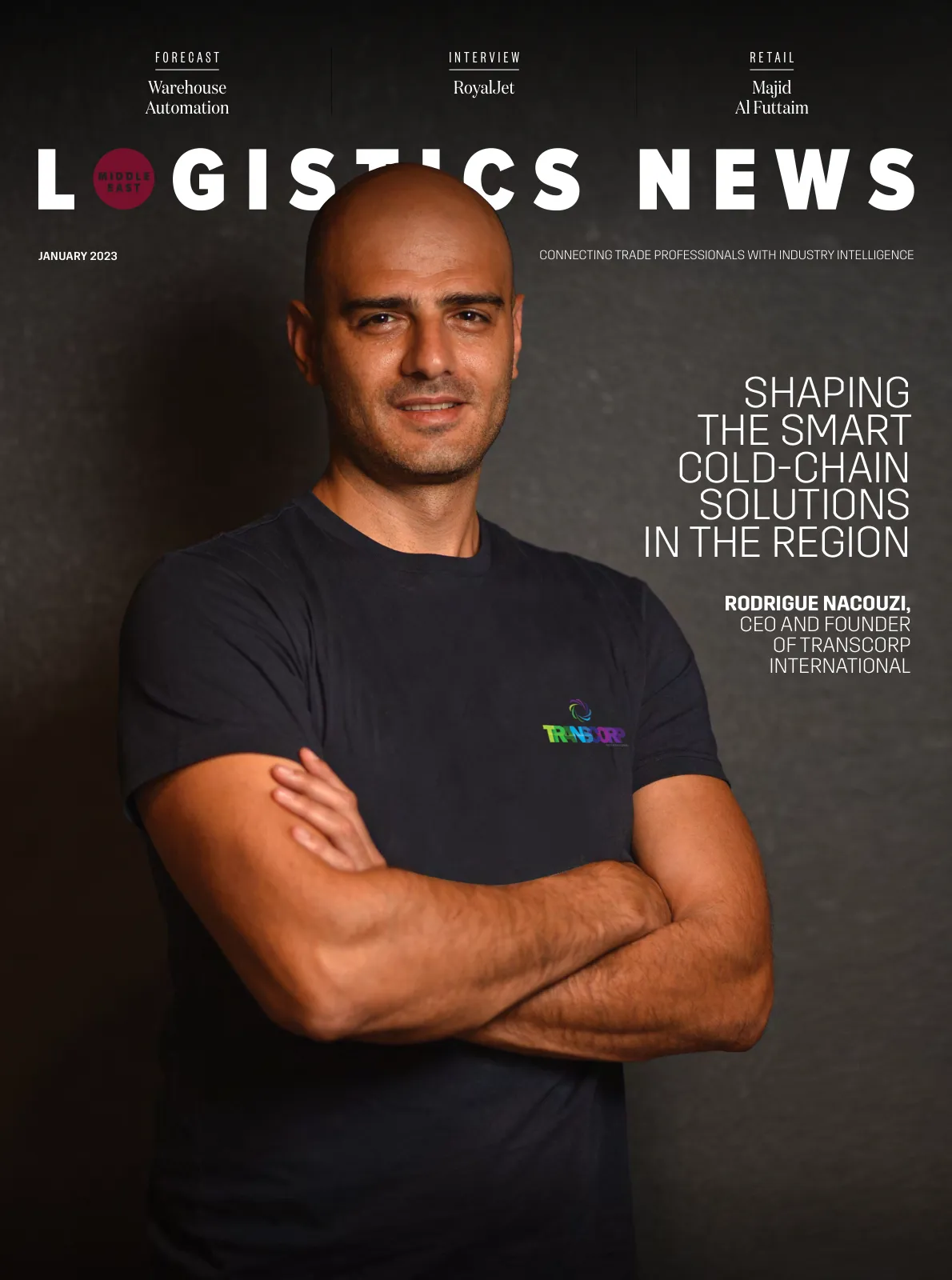
Logistics News, January 2023
Page 1
RODRIGUE NACOUZI,
CEO AND FOUNDER
OF TRANSCORP
INTERNATIONAL
JANUARY 2023
I N T E R V I E W
RoyalJet
F O R E C A S T
Warehouse
Automation
R E T A I L
Majid
Al Futtaim
SHAPING
THE SMART
COLD-CHAIN
SOLUTIONS
IN THE REGION
CONNECTING TRADE PROFESSIONALS WITH INDUSTRY INTELLIGENCE
Page 2
A MEMBERS OF EMIRATES TRANSPORT BUSINESS CENTERS:
Page 3
IN THIS ISSUE
SHAPING THE SMART
LOGISTICS SOLUTIONS
IN THE REGION
14 REPORT
THE TEAM OF KPMG INTERNATIONAL
share their valuable insights on the future of
public transport
16 EXPERT INSIGHT
PREDICTABLE. RELIABLE. CONSISTENT.
Karl Crowther, Vice President of Alteryx, MEA
sheds lights on how logistics can learn from
air freight in 2023
18 OP-ED
FUTURE OF WAREHOUSE AUTOMATION
How UAE’s Vertical Urbanization And
Logistics Management Technologies Are
Paving The Way For Logistics Sustainability
20 FORECAST
WAREHOUSE AUTOMATION MARKET
Grew 28% in 2021 but Will the Good Times
Last?
22 CONSTRUCTION
ALL THE DETAILS YOU NEED ABOUT
HOW
PlanRadar can help logistics companies
enhance their operations
32 GM POV
TAPPING INTO PRIVATE AVIATION
Mohamed Husain Ahmed, CEO of RoyalJet,
talks to us about changing trends in the
aviation industry
34 F&B
LOGISTICS IN F&B
In conversation with Alwin Varghese
40 AUTOMOBILE
PRAGA GOES GLOBAL AS BOHEMA
DEBUTS IN DUBAI
Praga Bohema revealed to UAE Royal Family
members, car collectors and supercar
enthusiasts at The Space last month
42 OIL
LAUNCH OF GOODYEAR GROOVE
Sunil Khanchandani, Managing Director of
Alonsa Electric Group, unveils details about
the new product range by Goodyear
44 ENERGY
ANKER REDIFINES
Portable Power With Its New Range Of
Powerhouse Stations In The UAE
Vibha Mehta, Editor of
Logistics News ME, speaks
with Rodrigue Nacouzi, CEO
and Founder of Transcorp
International about the
company, regional logistics
landscape, challenges
faced by the company, and
much more
14
44
24
Page 4
Page 5
Page 6
6 | LOGISTICS NEWS ME | JANUARY 2023
WWW.CBNME.COM
All rights reserved © 2022.
Opinions expressed are solely those
of the contributors.
Logistics News ME and all subsidiary
publications in the MENA region are officially
licensed exclusively to BNC Publishing in the MENA
region by Logistics News ME.
No part of this magazine may be reproduced or
transmitted in any form or by any means without
written permission of the publisher.
Images used in Logistics News ME are credited
when necessary. Attributed use of copyrighted
images with permission. All images not credited
courtesy Shutterstock.
Printed by UPP
SUBSCRIBE
subscriptions@bncpublishing.net
For all commercial enquiries, contact
sales@bncpublishing.net
T +971 50 440 2706
PO Box 502511
Dubai, United Arab Emirates
P +971 4 4200 506 | F +971 4 4200 196
Keep up to date with all the latest
news, features and much more
on our website and social media
platforms.
CBNME.COM
CBNME
@CBNME
CONSTRUCTION BUSINESS NEWS ME
CEO
Wissam Younane
wissam@bncpublishing.net
DIRECTOR
Rabih Najm
rabih@bncpublishing.net
GROUP PUBLISHING DIRECTOR
Joaquim D'Costa
jo@bncpublishing.net
+971 50 440 2706
MANAGING EDITOR
Kasun Illankoon
kasun@bncpublishing.net
EDITOR
Vibha Mehta
vibha@bncpublishing.net
EDITORIAL DESIGN
Christian Harb
MARKETING EXECUTIVE
Aaron Joshua Sinanbam
aj@bncpublishing.net
PHOTOGRAPHER
Alexander Bungas
EDITOR’S NOTE
LNME
F
irst things first: Happy 2023 to
each and every one of our readers!
As we begin this year, Logistics
News ME will promise readers
that they will read traditional
articles from a variety of topics
each month, joining me in making
a few new year's resolutions.
To begin with, this month we bring
forward our cover story hero (p.22),
Rodrigue Nacouzi, CEO and Founder
of Transcorp International, a self-made
hero who is influencing the smart cold-
chain solutions in the region. “Being at
the hub of the supply chain, we took
this challenge to new levels and created
new procedures, cutting-edge supply
and demand strategies, and improved
technology to address the issues with the
new timely deliveries,” says Rodrigue.
While the story walks you through the
logistical landscape in the region and the
various challenges the industry is facing,
Rodrigue has also shared some wise
words for all the budding entrepreneurs to
take the big jump.
According to Karl Crowther, Vice
President of Alteryx, MEA sheds lights on
how logistics can learn from air freight
in 2023 (p.14), and collected, processed,
comprehended, and used - is the essential
component for innovations and decision
making in 2023. Subsequently, our
Logistics in F&B feature (p.32) complies
valuable insights from Alwin Varghese,
Cluster Purchasing Manager at Grand
Millennium Dubai Barsha Heights,
on how the supply chain and logistics
operations are conducted for the hotel.
Jean Luc Graziato, Chief Commercial
Officer at Majid Al Futtaim Retail (p.34),
talks about Carrefour’s smooth supply
chain operations to withstand its position
in the market. Simon Mason, Chief
Operating and Chief Revenue Officer of
Writer Relocations (p.44), outlines the
foundations of sustainability. Cheers to
reading!
Vibha Mehta
Editor
vibha@bncpublishing.net
Page 7
Page 8
Page 9
Page 10
10 | LOGISTICS NEWS ME | JANUARY 2023
WWW.CBNME.COM
REGIONAL NEWS
LNME
A
dmiral Mobility,
one of the
top energy
management
providers
and accessible eMobility
solutions, has committed to
bringing 5000 commercial
electric cars to the Middle
East. The commitment
includes 2000 Electric
Farizon SuperVANs and 3000
Electric Commercial Trucks,
which are divided between
6T and 8T.
The order is the outcome of
a strategic alliance between
Admiral Mobility and Geely
Farizon Commercial Group,
which was established in
response to the rising need
for environmentally friendly
mobility on city streets,
highways, and backroads
to protect the environment
for all of us. The UAE is
concentrating on fulfilling its
Sustainable Development
Goals (SDGs) to offer access
to clean energy and pro-
mote sustainable economic
growth. The pledge to im-
port 500 commercial vehicles
into the UAE in 2023 would
aid in developing the ‘green
transportation industry,’ par-
ticularly in the run-up to the
COP28 climate change sum-
mit in 2019.
Admiral Mobility’s focus will
be on providing businesses
that distribute goods with
the opportunity to do so
sustainably with EV (electric
vehicle) trucks, thereby pro-
viding an environmentally
friendly and financially viable
business model. Admiral
Mobility supports govern-
ments, municipalities, and
‘mega-projects’ in its quest
to ‘decarbonize’ the trans-
portation industry. Admiral
Mobility will also give a vari-
ety of methods to serve both
public and private sector en-
terprises by handling after-
sales services, dealing with
charging network needs and
providing appealing lease
model agreements to offer
total flexibility and peace of
mind.
Frank Bernthaler, Chief Op-
erating Officer of Admiral
Mobility, commented on
the announcement: “With
COP28 fast approaching
and sustainability being high
on everyone’s agendas, this
partnership is an important
step forward to build a ro-
bust EV truck portfolio in
the region. As we transition
towards more environmen-
tally friendly energy and
transportation solutions, we
are proud to play a key role
in building an infrastructure
that empowers the gov-
ernment’s electrification
strategy. We look forward
to supporting businesses as
they move towards electric
vehicles in the region.”
The zero-emissions electric
Farizon SuperVAN travels up
to 400 km safely and charg-
es in less than two hours us-
ing its effective LFP battery.
Advanced safety features
include cruise control with
lane-keeping assistance,
remote locking systems,
high-beam LED lights with
automatic traffic adaptation,
and, of course, ease of com-
fort while driving.
The UAE ranks seventh inter-
nationally in terms of being
ready for electric mobility,
with significant govern-
ment measures planned to
expand the number of elec-
tric cars on the roads as an
alternative to ensure clean
energy. The UAE wants to
achieve carbon neutral-
ity by 2050. The country’s
electric vehicle (EV) industry
is anticipated to expand at
a CAGR of 30% between
2022 and 2028, according to
the Global Electric Mobility
Readiness Index - Gemrix
2022.
Mingshi Lin, Vice President
of Geely Farizon New En-
ergy Commercial Vehicle
Group, adds, Developing
and promoting new en-
ergy commercial vehicles
is essential and urgent for
creating a globally sustain-
able future. With Farizon’s
advanced automotive tech-
nology enabled by our R&D
capabilities, now aided by
the extensive market reach
and customer insights of Ad-
miral Mobility, we are confi-
dent in bringing high-quality
carbon-free commercial
vehicles to the entire GCC
region.
ADMIRAL MOBILITY REVEALS TO BRING 5000 ELECTRIC
COMMERCIAL VEHICLES TO THE MIDDLE EAST
Page 11
LOGISTICS NEWS ME | JANUARY 2023 | 11
REGIONAL NEWS
N
EXT50, an Abu Dhabi-based
technology company, is well
underway in delivering the
first phase of the biometric
initiative at Abu Dhabi
International Airport. The project, which
sees NEXT50 introduce its cutting-edge
A.I. solutions alongside global artificial
intelligence and technology solutions
partners IDEMIA and SITA, will initially
see the deployment of next-generation
biometric solutions at select self-service
baggage touchpoints, immigration
e-gates, and boarding gates before
implementing the technology across all
passenger touchpoints in the airport.
“We are excited to be leading the
biometrics project at the UAE capital’s
state-of-the-art International Airport as
part of the Emirate’s digital transforma-
tion vision,” said Ibrahim Al Mannaee,
NEXT50’S Chief Executive Officer. “Once
the project is fully realized, the airport
will be the only airport in the region with
biometric solutions implemented across
all customer touchpoints, contributing
to Abu Dhabi Airport’s vision to become
the operator of the most technology-
driven airport in the world, providing a
seamless journey to all its passengers.
We are proud to join forces with IDEMIA
and SITA and offer our artificial intel-
ligence and data sciences expertise to
make this initiative a reality.”
H.E. Eng. Jamal Salem Al Dhaheri,
MD and CEO of Abu Dhabi Airports,
says, “The phase one deployment of
advanced biometrics at Abu Dhabi In-
ternational Airport further cements our
commitment to shaping the future of
airport experiences by delivering innova-
tion and technology that drives efficien-
cy, convenience and service excellence.
Upon completing the project, Abu Dhabi
will be home to the world’s first airport
to include every touch point in the bio-
metric journey, providing travellers with
a seamless, safe and secure passenger
experience.”
Once the project is delivered, it will of-
fer passengers a convenient, simplified,
contactless and hygienic experience
from ‘curb-to-gate’. In addition, this will
result in reduced wait times and less
time queuing for passengers. The sys-
tems will use hi-tech biometric cameras
to verify passenger details along several
airport touchpoints, including the self-
service baggage drop, passport control,
business class lounge, and boarding
gates.
Hani El Assaad, President of Middle
East & Africa, SITA, said: “We’re excited
to collaborate with NEXT50 to imple-
ment cutting-edge biometric solutions in
Abu Dhabi. The airport of the future will
be driven by technology that enables
safe, seamless, and easy travel every
step of the way. This latest deployment
showcases the power of Smart Path to
deliver a fluid journey where a passen-
ger’s face becomes their boarding pass,
from check-in to boarding.
Osama Al Makharmeh, Executive Di-
rector, IDEMIA, UAE, commented on
the biometrics project: “Our collabora-
tion today with NEXT50 will see the
latest in biometric technologies brought
here to the UAE’s modern capital of
Abu Dhabi. We admire the UAE’s tech-
nologically driven growth trajectory and
are proud to participate in this incred-
ible transformation and be part of the
success story of Abu Dhabi Internation-
al Airport. This partnership harnesses
contactless biometric technology that
gives users an unrivalled airport expe-
rience without letting up one jot on
security. This bears out our capacity to
constantly innovate to safeguard pas-
senger trust and help pave the way for
even smoother and more secure future
travel”.
NEXT50 INITIATES PHASE 1 DEPLOYMENT OF
NEXT-GENERATION BIOMETRICS AT ABU DHABI
INTERNATIONAL AIRPORT
Page 12
12 | LOGISTICS NEWS ME | JANUARY 2023
WWW.CBNME.COM
REGIONAL NEWS
LNME
T
his past year, on 8th
December 2022, Byrne
Equipment Rental held a
successful product open
day at their depot in Oman,
located just outside Muscat in Barka.
Since its inception in 2009, the Oman
branch of Byrne Equipment Rental has
gone from strength to strength, from
a small team of 5 to a skilled team of
40, with two depot locations, and an
extensive fleet of over 600 items of
equipment, with the ability to extend
this via their Byrne network which has a
fleet of over 14,000 items of equipment,
located in 20 operational depots and
offices spread across the GCC in KSA,
Kuwait, UAE, Oman and Bahrain.
The Oman economy has always been
largely dependent on the O&G sec-
tor. However, under ‘Oman’s Vision
2040′ program, the government is
focusing on diversification to stimulate
economic growth – with various ongo-
ing projects encompassing multiple
industries, including manufacturing,
tourism, logistics, energy, and mining
sectors.
Mick Tipp, General Manager of
Byrne Oman, says, “The level of
projected development in Oman is
fantastic for the economy as well as
Byrne Equipment Rental’s operations,
and the business is well positioned to
meet the requirements for equipment
rental across all these industries.”
“We have been in Oman for 12 years,
and the decision to hold an open day
has been a long time coming and was
taken to liaise with our clients, both
existing and prospective, and show that
we have a vast range of equipment that
people may not be aware of and be
able to use in the future, for projects
across various industries.”
On the day itself, doors opened at 9
am and invited clients to come along
and view a range of selected equip-
ment that was on display, including
ablutions, boom lifts, scissor lifts, diesel,
and power generators, as well as hoist
and mast climbers which were set up for
interactive demonstrations. The Oman
team had also prepared several tem-
porary buildings in various configura-
tions that were furnished and set up to
demonstrate their capabilities, including
ensuite junior and VIP accommodation,
office facilities, a mess and dining hall,
prayer rooms and more.
Mick continues, “The open day was a
first for the Byrne Oman location, and
it exceeded our expectations – we had
a great turnout, and it was a pleasure
to welcome all that attended. We were
able to connect with our clients, both
existing and new, and demonstrate our
business capabilities as a single-source
solution provider that can cater to a vast
range of industries, including but not
limited to O&G, construction and infra-
structure, events, manufacturing, and
logistics, marine and ports, retail and
commercial and defence and military.
Most of our business in Oman comes
from the shutdown and turnaround
industry, as we can supply camps and
support any shutdown needs, whether
accommodation, ablutions, and other
supporting equipment. However, this
open day proved a fantastic opportu-
nity to demonstrate what we can offer
other industries as a turnkey solutions
provider and show our versatility and
adaptability. We are the single source
solution for equipment rental; this was
an excellent opportunity to demon-
strate this. In the future, we intend to
hold these open days regularly and
look forward to the next one in April
2023!”
BYRNE EQUIPMENT RENTAL OMAN SHOWCASE EQUIPMENT AT OPEN DAY
Page 13
LOGISTICS NEWS ME | JANUARY 2023 | 13
REGIONAL NEWS
S
enior officials from
UD Trucks and
Al Masaood met
before the opening
of a new plant in
Mussafah, Abu Dhabi, which
is planned to open shortly to
accommodate the expanding
client base of the Japanese
truck manufacturer. This
brand-new, cutting-edge
servicing facility will assist UD
Trucks in meeting increasing
demand while maintaining
high quality and customer
satisfaction standards.
Jacques Michel, senior
vice president of UD Trucks,
Mourad Hedna, and Hani
Tannir, CEO of Group Indus-
trial at Al Masaood, met with
clients to discuss the brand’s
long-term strategy and direc-
tion as well as its future with-
in the Isuzu Motors Group. At
the occasion, clients from all
across the emirate attended,
giving them a chance to tour
the new facility and learn
more about its advantages.
With service space for 30
vehicles and 12 body repairs,
this new facility will quad-
ruple the brand’s servicing
capacity compared to its
prior location. The number
of technicians has also grown
significantly, from 21 to 39.
Mourad Hedna, UD Trucks
Middle East, East & North
Africa President, says, “At UD
Trucks, we strive to provide
uncompromising service
support, which means ad-
hering to efficient and clear
standards. The unwavering
premium service that we
aim to deliver needs to be
complemented by having the
right instruments to execute
our approach. We firmly be-
lieve that our long-standing
partner, Al Masaood, will
serve our customers in their
newly established location
with unmatched tenacity,
providing excellent after-
sales services and ensuring
our promise, To Go the
Extra Mile.”
The new workshop, which
is focused on offering and
delivering the best after-
sales support and cus-
tomer services, reflects the
commitment of both UD
Trucks and Al Masaood to
positively contribute to the
communities of Abu Dhabi
and Al Ain in line with the
Abu Dhabi 2030 Vision,
which aims to create a robust
and sufficient infrastructure
that can support economic
growth in the coming years.
The workshop is expected
to strengthen UD Trucks’
market position by offer-
ing sustainable aftersales
services, while Al Masaood
will continue to provide cli-
ents of UD Trucks with the
best calibre support on a
larger scale. The expanded
workspace will also include
substantial components
warehouse, reducing turna-
round times.
Mohammed El Zeftawi,
General Manager of Al
Masaood Commercial Vehi-
cles and Equipment, adds,
“Al Masaood CV&E Division
and UD Trucks have enjoyed
a long-lasting relationship
that is built on a shared vi-
sion of offering customers
sustainable end-to-end sales
and aftersales services. Our
much-anticipated M40 facility
will help us achieve our com-
mon objectives and further
strengthen our relationship.
Besides offering excellent
after-sales services on a
larger scale, the new work-
shop also has a sizable parts
warehouse, which will greatly
reduce the turnaround time,
further enhancing the overall
customer experience. We
look forward to continuing
to build our partnership with
UD Trucks, which was estab-
lished in 1981, as part of our
commitment to consistently
improving our customers’ ex-
perience in the region.”
UD TRUCKS SENIOR EXECUTIVES VISIT
ABU DHABI’S AL MASAOOD SERVICE
FACILITY
Page 14
14 | LOGISTICS NEWS ME | JANUARY 2023
WWW.CBNME.COM
REPORT
LNME
T
his sector will continue to ex-
perience an increasing amount
of disruption over the next five
years. Forward-looking players
can ride this wave successfully,
given that they act now. Public
transport organizations should take the
time to pause, reflect and map out a new
future of enhanced customer experiences
and integrated services, along with decar-
bonized and digitalized operations, while
securing stable finances.
KPMG International, in a
commissioned survey conducted by
Forrester Consulting, engaged 483
leaders from public transportation
organizations across the globe to
understand their perspectives on the
sector’s future. Participants included
public transport ministries and
authorities, operators and outsourced
vendors.
In this report, we explore the
potential that a connected public
transport enterprise has in forging
robust enterprise-wide business and
delivery models that can drive excellent
customer experience while enhancing
efficiency and contributing to the
prosperous future we all want to see.
The report documents current industry
trends, presents compelling hypotheses
on the sector’s future and charts the way
forward to support this journey.
The Traditional Model Of Public Transport
Service Delivery Is Being Challenged As
Never Before…
Public transport has traditionally been
provided by heavily subsidized public-
sector bodies operating discrete/siloed
transportation modes. This approach
made sense from an asset-management
perspective, but it led to journey options
for citizens when timetables, ticketing and
customer service were not always aligned
to expedite travel across various transit
systems. Additionally, agencies typically
took a monopoly mindset to protect
revenue and market share.
New market entrants are changing the
last-mile equation through enhanced
services and convenient new offerings.
Additonally, disruptive transport
technologies are on the horizon.
Frictionless service interactions in other
sectors have raised customer expectations
of public transport. Joined-up services,
seamless payments and enhanced
customer experiences are the way forward
for mature transport systems.
Priorities are shifting as decision-
makers listen to the voice of their
constituents and look beyond the
operation of transport infrastructure,
fleets and workforce to fully consider the
advantages of a connected, 21st-century
ecosystem. The signals of change are
powerful and unmistakable.
Firstly, evolving customer and
community expectations for connected,
personalized services will require
organizations to be even more
responsive. Secondly, public transport
can be a crucial enabler of sustainable
economic growth and equitable
access to opportunity. New public
transport modes, entrants and enabling
technologies such as autonomous
vehicles, air taxis and hyperloops are
poised to change how services are
delivered. Additionally, Mobility-as-a-
Service and autonomous vehicles have
the potential to be cost-competitive
with public transport services and more
convenient in servicing the last mile of
customer journeys. Lastly, the pace of
THE TEAM OF KPMG INTERNATIONAL
SHARE THEIR VALUABLE INSIGHTS ON
THE FUTURE OF PUBLIC TRANSPORT…
Page 15
LOGISTICS NEWS ME | JANUARY 2023 | 15
INSIGHTS ON THE FUTURE OF PUBLIC TRANSPORT
innovation is accelerating and
exceeding the rate at which
regulatory systems can adapt.
Regulation will need to be
dynamic amidst ongoing
innovation.
In addition to these signals,
the profound impact of
the global pandemic has
reshaped workforces,
lifestyles and reliance on
public transportation systems.
Demand for services may
evolve as many citizens
embrace hybrid work models
or replace urban lifestyles with
more-affordable suburban
settings. But KPMG believes
that vibrant cities will remain
relevant and prosper, and
transport systems will evolve
to serve citizens, drive equity
and meet net-zero targets.
The Future Of Public Transport
Is Here…
Public transport agencies must
become more innovative and
more agile. They should focus
on the essential core of public
transport operations to evolve
networks, service patterns,
fare policy, investment strategy
and asset custodianship.
In their role as market
stewards, agencies should
direct modern ecosystems in
partnership with the private
sector to meet cost pressures,
public expectations and
environmental goals. Agencies
should position themselves
to meet these challenges by:
Considering if their operating
model enables multi-modal
planning; redefining their
role as commissioner of
markets within new regulatory
frameworks; deploying policy
and behavioural change
initiatives to meet net-zero
targets; implementing new
funding models and revenue
sources to help ensure
financial sustainability; and,
understanding how planned
investments can drive social
and economic opportunity.
As change unfolds and the
pace of change accelerates,
we present seven thought-
provoking predictions on the
future of public transport:
1. The political influence over
public transport is expected to
grow as it is increasingly seen
as a lever to drive social and
economic opportunity.
2. The agencies will likely
become the commissioner
of markets rather than the
deliverer of services. The
future transport algorithms
will likely nudge customers
through the network,
balancing individual
preferences with network and
social requirements.
3. Decarbonization of
transport operations will likely
become a strategic business
priority.
Public transport is expected
to be accessible for some
citizens and communities
and funded in innovative
new ways. Agencies will
also likely require more in-
house technology and digital
transformation. Automation
will likely result in a reskilled
and redeployed workforce.
Lastly, outcome and risk-
based regulation are expected
to be needed to embed
flexibility.
2040: A Look Into The Future
Of Services
Electrified network to help
meet net-zero targets:
Aiming to reduce air and noise
pollution with ubiquitous
electric vehicles (EVs) can
create healthier communities.
Mobility-as-a-Service (MaaS)
solutions:
Single customer interface to
enable easy-to-understand
journeys in a broad market of
transport services
Algorithms nudge customer
choices:
Movements can be dictated
according to network needs
and user preferences.
On-demand services:
Localized services responding
to customer needs — a
transition from the traditional
hub and spoke model to point-
to-point services.
Autonomous services:
Enabled by the Internet of
Things, smart technologies
and 5G connectivity
Integration of new and
emerging modes:
Last-mile offerings,
hyperloops, e-helicopters,
autonomous vehicles.
Outcome and risk-based
regulation:
To facilitate more outstanding
market entry for new and
emerging modes. The creation
of innovative partnerships
will likely drive the delivery of
seamless services.
Mohammad
AbuDalo
PRIORITIES ARE SHIFTING AS
DECISION-MAKERS LISTEN
TO THE VOICE OF THEIR
CONSTITUENTS AND LOOK
BEYOND THE OPERATION OF
TRANSPORT INFRASTRUCTURE.
Page 16
16 | LOGISTICS NEWS ME | JANUARY 2023
WWW.CBNME.COM
EXPERT INSIGHT
LNME
P
redictability, reliability, and
consistency are three sacred
hallmarks of logistics and sup-
ply chain success. If deliveries
don’t get where they need to go
on time, each time, every time,
then the trust process breaks down, and
the promise of on-time freight delivery
goes down with it.
The double-edged sword of disruption
cuts both during and after the event. With
the reduced supply of a product available
but consistent demand, stores will rapidly
sell out, and end-customer purchasing
behaviour will adjust. We saw this during
COVID-19 when shoppers panic-bought
essentials – pushing artificial shortages.
Despite eminently manageable supply
chain issues, the perception of reduced
supply drove demand through the roof
and caused even more chaos.
The difference between organisations
that have thrived – versus just survived
– amidst this disruption comes
down to those who have – and have
not – effectively used data to make
decisions. Nowhere is this trend seen
as significantly as in the air freight
industry, and with an adequate
understanding of customer needs and
changing external signals, supply chain
managers can use real-time insights to
inform decisions quickly. By delivering
insights on demand forecasting, material
availability, inventory levels, and SKU
rationalisations, successful businesses
were able to combat market disruption
at pace.
Large-scale disruption continues to be
seen across all industries today. The air
freight industry faces similar challenges.
While far-reaching and impactful,
disruption can also be contextually
simple to identify and mitigate with the
correct data.
PREDICTABLE.
RELIABLE.
CONSISTENT.
Karl Crowther, Vice President of Alteryx, MEA
sheds lights on how logistics can learn from air
freight in 2023
Page 17
PREDICTABLE. RELIABLE. CONSISTENT
Changing Business
Environments Require Fast
Insights
Historically, without the
insights to assess macro
demand or identify
interruptions in advance,
supply chain specialists could
not make fast decisions to
mitigate that disruption. In
an era defined by uncertainty
and upheaval, this lack of
business intelligence is no
longer a feasible strategy.
Leaders who once made
decisions based on gut instinct
and pattern recognition alone
are now finding entirely new
patterns – ones that are wholly
different from those they have
experienced.
Alteryx-commissioned IDC
research highlighted that 71%
of global businesses believe
‘the business landscape is
changing faster than ever.’
For the UAE specifically, it
highlighted a huge demand for
faster insights – fuelled by data
and AI analytics – to overcome
that industry disruption
and fully harness decision
intelligence for business
benefit.
Dubai International Airport,
for example, completely
reimagined its passenger
demand forecasting using
analytics. They delivered 40%
improvements in passenger
wait times over two years.
They combined camera and
sensor data in their Airport
Operations Control centre,
collating it against live flight
arrival times, to give them the
minute-by-minute decision
intelligence they needed to
deliver on their business goals.
Air freight is traditionally
used for urgent items like
medicine or perishables
that would not last on a
long sea voyage. Due to the
high-value items transported
and the importance of
them being delivered on
time, air freight developed
a well-earned reputation
for success - delivering on
time, each time, every time.
With requirements for
predictability, reliability, and
consistency, alongside those
tight delivery timeframes,
the aviation sector has – by
necessity – transformed into
an innovation crucible.
The key ingredient behind
these innovations is data
– collected, transformed,
understood, and utilised for
decisions across the business
landscape.
The Competition Crucible:
Why Data Is The Deciding
Factor
Accessible data, upskilled
teams, and easy-to-use analytic
technology are all key to the
aviation sector’s success - as
is an overarching business
imperative to do more with
less. There are core lessons
for supply chain specialists to
learn here. Analytical adoption
like this is essential to fast and
predictable cargo delivery as
and when needed.
In many cases, the missing
ingredient is a lack of human
talent. Our IDC research
shows that 82% of UAE
businesses do not closely
match their technology
investment with the human
upskilling and training
required to take advantage of
that technology.
Data democratisation and
analytics upskilling are the
core ingredients needed to
solve this challenge – giving
the workers closest to the
problem the tools they need
to solve it themselves. After
all, if you’re lost and looking
for directions, you’ll ask the
delivery driver, not the data
science team.
Just as every cloud has
a silver lining, so to does
every challenge come with
the opportunity for change.
This utilisation of data and
analytics insights in the air
freight sector is a case study
for wider analytic adoption in
the UAE logistics space.
Karl Crowther,
Vice President,
Alteryx, MEA
Page 18
18 | LOGISTICS NEWS ME | JANUARY 2023
WWW.CBNME.COM
OP-ED
LNME
S
oham Chokshi, CEO & Co-
Founder of Shipsy, shares
his opinions on various re-
sources enabling sustainable
logistics. From UAE’s world-
class infrastructure compris-
ing green skyscrapers to the
adoption of cutting-edge technologies
to digitize processes and launch smart
mobility resources, UAE has established
itself as one of the frontrunners in the
sustainability game —in alignment with
Dubai Vision 2030. But how exactly can
UAE’s vertical urbanization influence
sustainable logistics operations?
Let’s get to the bottom of this…
High-rise residential buildings in Dubai
reached 581,166 units (79%) in 2020
and are a common residential type.
This number continues to increase as
the city expands its real estate horizons.
Since these tall residential towers
house numerous people, the chances
of receiving multiple orders from
one particular tower are higher. This
reduces the time the delivery agents
spend on the road to deliver an order. It
also shrinks trip volumes and distance
travelled and reduces carbon emissions
to fulfil delivery commitments.
Compared to a city with a horizontal
infrastructure, this proves far more
effective and supports the government’s
efforts to work toward a collective goal
of sustainability.
Dubai’s polycentric city approach
further supports this. A polycentric city
is an area with three or more clusters of
buildings that are significantly taller than
the surrounding urban fabric. Skyscraper
districts and clustered communities such
as Downtown Dubai, JLT; Business Bay;
Dubai Marina; Palm Jumeirah; and
several others today cover a significant
portion of the city’s infrastructure and
contribute to reducing travel time to
execute deliveries in these clusters.
So while the volume of deliveries
within these areas will be higher, a
comparatively shorter delivery radius
will also make implementing smart
mobility concepts, such as driverless
shuttles, e-bikes, and so on, possible.
But are these factors alone enough to
tackle the logistical challenges in the
country?
The Need To Pivot to the Evolving
Customer Expectations
61% of transportation and logistics
organizations globally consider the last
mile as the costliest leg of the entire
logistics operation. Moreover, challenges
such as poor address quality are unique
to the region, eventually adding up
to fuel consumption and a brand’s
carbon footprint. Beyond such logistics
inefficiencies lay the ever-evolving
customer demands around faster,
economical, and sustainable deliveries.
Delivery is a critical component of a
customer’s online purchasing experience.
For instance, 64% of customers want
to know the ETA of their orders, 28%
consider delivery time to determine
how good a retailer is, while 61%
will continue to shop with the brand
if they are happy with the delivery
experience. As a result, delivery services
have become critical in establishing a
competitive edge in the eCommerce and
retail industries.
Many companies offer same-day
delivery services to consumers looking
for easier and faster delivery options.
This has resulted in delivery partners
increasing the volume of vehicles on
FUTURE OF
VERTICAL URBANIZATION
How UAE’s Vertical Urbanization And Logistics Management
Technologies Are Paving The Way For Logistics Sustainability
Page 19
LOGISTICS NEWS ME | JANUARY 2023 | 19
FUTURE OF VERTICAL URBANIZARION
road, and trip frequencies
to meet same-day delivery
SLAs, thereby shooting up the
carbon footprint.
Additionally, a surge in fuel
prices is a significant cause
of worry as it considerably
swells overall logistics costs.
Businesses need to shell out
more money for each mile
travelled which directly hits
profitability. Please address
this challenge to avoid passing
the cost-burden baton to
the consumer, which can
be detrimental to customer
retention. Moreover, 65%
of consumers in the Middle
East have become more eco-
friendly during the pandemic,
engaging in sustainable
behaviours. It will not be
surprising to see customers
buying into brands that focus
on sustainability.
To tackle evolving customer
expectations and such
unprecedented variables,
businesses must invest
in innovative and agile
technologies. Such solutions
can improve process
efficiencies, reduce costs, and
drive sustainable logistics
operations.
Executing Sustainable
Logistics Operations
Here’s how joining forces
with intelligent logistics
management tools can
further support actualizing
sustainable logistics
operations in the UAE.
Optimizing Routes to Curb
Carbon Footprint
Smart logistics management
platform digitizes the
product journey. It allows
businesses to tame areas of
logistical inefficiencies. Digital
documentation removes
paper trails. AI and ML-
powered route planning and
optimization engines chalk
the plan for the most efficient
travel route across logistics
operations. This results in
lesser time spent on the road.
Intelligent route optimizers
help eliminate empty miles,
reduce the distance travelled
by 5%, prevent vehicle idling,
and shrink trip volumes by
6%.
Accurate ETAs, real-time
tracking of delivery progress,
and flexible deliveries enable
customers to stay available
at the time of delivery or
request a reschedule as per
their preferred time slots. This
helps logistics stakeholders
to maximize the first-attempt
delivery success rate and
reduce multiple reattempts,
trip volumes, and CO2
emissions.
Such solutions also
empower delivery managers
to configure and prioritize
eco-friendly delivery modes
for a select, often short,
delivery radius, which is
particularly favourable
given Dubai’s polycentric
city model. With this
pre-fed logic, the system
automatically allocates
bicycles, EVs, or driverless
vehicles to execute short-
distance deliveries.
Improving Address Quality to
Minimize Returns
Poor quality addresses or
drivers’ inability to navigate
to the customer location
on time is a big concern for
express parcel delivery service
providers. This leads to more
fuel consumption and CO2
emissions. Moreover, 51%
of shoppers go for returns if
their order arrives late, which
puts all the logistical efforts
to waste.
Geocoding helps convert poor-
quality addresses into exact
coordinates. This shows up as
a clear polyline on the driver’s
mobile app leading them to
the exact customer location.
Enhancing Capacity
Utilization
Another method to enhance
delivery performance
is automating capacity
planning. AI-powered logistics
management tools leverage
intelligent algorithms that
seamlessly map consignment
and vehicle data. They can
optimize a vehicle’s capacity
by considering parameters
such as delivery location,
weight, volume, time SLAs,
storage type, and much more,
which helps improve fleet
capacity without hampering
mileage or vehicle life as it
runs on optimum load. It
thereby increases vehicle
capacity utilization by 31%.
Clubbing Orders to Bring Down
Trip Volumes
AI-powered logistics
management platforms
improve delivery productivity
by enabling multi-stop pickups
and deliveries for drivers on
a single trip. En-route order
clubbing combines pickups
and drops to reduce trip
frequencies and improve driver
productivity by 14%.
The right mix of
infrastructure and technology
can significantly drive
green logistics operations
and support the UAE’s
sustainability goals, one
delivery at a time.
Soham Chokshi,
CEO & Co-founder,
Shipsy
Geocoding helps convert
poor-quality addresses into
exact coordinates. This
shows up as a clear polyline
on the driver’s mobile app
leading them to the exact
customer location.
Page 20
20 | LOGISTICS NEWS ME | JANUARY 2023
WWW.CBNME.COM
FORECAST
LNME
R
awan has an academic background in physics
and experience in experimental environments and
works in the automation sector. While he has a
keen interest in micro-fulfilment, rapid delivery
and last-mile logistics, he is also helping expand
Interact Analysis’ research coverage in this fast-
growing industry.
Following the publication of our Warehouse
Automation – 2022 report, we have produced this insight
to discuss the major themes which have influenced the
forecast. The report provides a highly granular assessment
of the market and factors in many nuances. This insight,
therefore, intends to provide a top-level summary of the
key trends.
COVID-Fuelled Growth
The warehouse automation market grew by a
phenomenal 28% in 2021, with revenues reaching $36
billion, up from $28.5 billion in 2020. The growth
of automation revenues in 2021 was driven mainly
by the e-commerce spike caused by the pandemic.
According to FRED, US E-commerce penetration
peaked at 16.4% in 2020, rising from 10% in Q1
2019. To service this increase in e-commerce demand,
we saw several retailers bolstering their fulfilment
capacity. For example, according to its annual reports,
Amazon’s total warehouse square footage ballooned
from 272 million at the end of 2019 to 525 million at
the end of 2021.
GREW 28% IN 2021 BUT WILL
THE GOOD TIMES LAST?
WAREHOUSE AUTOMATION MARKET
Rowan Stott, a Research Analyst at Interact Analysis, presents an acute report
on how warehouse automation is forecasted to perform in the near future
Page 21
LOGISTICS NEWS ME | JANUARY 2023 | 21
Because automation is often used in
fulfilment centres due to the complexity
of the operation, we saw warehouse
automation investments spike during the
pandemic as retailers rapidly expanded
their fulfilment capacity. Amazon led
the charge in automation investments,
accounting for more than 30% of total
automation investments in the US in 2021.
The pandemic also significantly impacted
commodity prices, which skyrocketed
in 2020. Steel prices, for example, had
more than tripled by the end of 2021
compared to pre-pandemic levels, while
the cost of electronic components also
increased significantly due to supply-chain
constraints and poor demand forecasting.
The cost of steel can make up to 80%
of the value of some automated systems
like unit-load AS/RS, which meant that
automation increased significantly during
the pandemic.
Lastly, the early lockdowns resulted in
many companies having artificially low
revenues in 2020 as project completion
dates were pushed back into 2021.
Knapp, for example, suffered a -1.8%
decrease in revenues in 2020, despite
a 55% increase in order intake. This
revenue ‘push-back’ led to somewhat
artificially high gains in 2021, and we
expect completion timing will recalibrate
by 2023.
Good Times Don’t Last Forever
Since its peak of 16.4%, US e-commerce
penetration dropped slightly in 2021. This
was mainly due to a shift back to brick-
and-mortar retail which is going through
a renaissance. This caught many retailers
off-guard as they expected the pandemic
would permanently change buying
habits. In response to the slowdown in
e-commerce sales, many e-commerce
retailers announced a pullback in their
fulfilment network expansions.
For example, Amazon announced it
would slow down its fulfilment expansion
after posting a loss in Q1 2022. This
will significantly impact its warehouse
automation investments, which we expect
will be cut by 30% in 2022 and a further
15% reduction in 2023. Ocado also
announced it would reduce its expansion
plans as it ponders how it will fully utilize
its new facilities in Bicester and Luton in
England.
Since Amazon accounted for more than
30% of total US warehouse automation
investments in 2021, this will significantly
impact the overall warehouse automation
market. Furthermore, the automation
vendors most exposed to Amazon will
likely be looking elsewhere for projects
that may erode margins as competition
heats up.
In addition to the slowdown in
e-commerce sales growth, there have
also been several other geopolitical and
economic factors that have affected
the market. For example, the Russia-
Ukraine war has led to a rise in economic
uncertainty in Europe. Coupled with
soaring energy prices, some retailers and
manufacturers are postponing significant
capital investments, according to our
research interviews.
Furthermore, we’ve also seen many
central banks raise interest rates to tackle
high inflation. This will increase the cost
of capital and may result in companies
considering postponing investments in
automation financed using debt. High-
interest rates, inflation and low consumer
confidence, will also slow retail growth
and reduce appetite for warehouse
automation.
2024 Onwards
Long-term, however, we expect a return
to steady growth. Between 2024 and
2027, we forecast revenues to grow at
a CAGR of 19%, driven by improving
macroeconomic conditions. From
2024 onwards, we expect e-commerce
growth to increase as the geopolitical
and economic environment strengthens.
Furthermore, as economic conditions
improve, we expect a renewed focus on
shorter delivery windows from consumers,
which haven’t been a top priority in recent
months due to the cost-of-living crisis in
many countries.
Our latest Warehouse Building Stock
Database shows that just 18% of
warehouses have some form of physical
automation, which is expected to grow
to 26% by 2027. With such a significant
opportunity, short-term challenges
shouldn’t take away from this market’s
long-term growth potential.
WAREHOUSE AUTOMATION MARKET
Page 22
22 | LOGISTICS NEWS ME | JANUARY 2023
WWW.CBNME.COM
CONSTRUCTION
LNME
A
cloud-based SaaS field management tool for
communication and documentation in building
and real estate projects, PlanRadar is independent
of platforms and gear. Maintenance, building
inspections, construction documentation, handovers,
fault and task management, and other uses are
all possible. Teams may interact, exchange digital floor
plans or BIM models, and track information using web
applications for all smartphones and tablets (iOS, Android,
and Windows).
Additionally, PlanRadar’s digitization of workflows lowers
the frequency of errors, frees up time for everyone involved,
and allows for substantial productivity improvements.
Customers report saving up to 7 working hours each week.
The firm, which has its headquarters in Vienna, Austria,
currently gives more than 20,000 clients in more than 65
countries the ability to track, connect, and resolve issues on
all global construction and real estate projects.
The Co-Founder, Group Co-CEO, and CEO for MENA
& APAC at PlanRadar, Ibrahim Imam, explains his
thoughts on how the logistics sector may benefit from this
application.
Logistic centres and warehouses play a critical role for
businesses, regardless of size or industry. These facilities
must be managed and maintained to optimal levels,
ensuring goods are stored safely and transported efficiently.
With facility management and maintenance being an
integral component to the success of logistics companies,
PlanRadar provides its clients with the tools they need
to ensure their facilities run smoothly and prevent costly
repairs down the line, thus reducing production costs and
enabling companies to compete in the global market.
CAN HELP LOGISTICS COMPANIES
ENHANCE THEIR OPERATIONS
ALL THE DETAILS YOU NEED ABOUT HOW
PLANRADAR
Page 23
LOGISTICS NEWS ME | JANUARY 2023 | 23
FACILITIES MANAGEMENT
Facilities management teams may manage
warehouses and logistics centres more
effectively using PlanRadar. Facilities
managers can plan, organize, document, and
track activities in one location with simple
task creation, automatic reporting, and real-
time updates.
They can immediately obtain current
information on their facilities and equipment
to ensure they are always ready to go with
the aid of PlanRadar, which assists them
in scheduling maintenance, maintaining
records, and monitoring the performance of
warehouses.
The cloud-based platform from PlanRadar
enables facilities management teams to
view all project data from any location,
enhancing collaboration and streamlining
communication inside their facility. All of
this guarantee improved long-term upkeep of
logistical centres and warehousing facilities.
FIRE SAFETY
To protect their workers, infrastructure,
and inventory from fire, logistic centres and
warehouses must adhere to the strictest
fire safety regulations. During fire risk
assessments, PlanRadar makes gathering data
simpler and identifying possible fire dangers
before they become significant problems.
Users can easily access
all required papers in
one location thanks
to customized forms,
checklists, templates, and
secure storage options,
ensuring that crucial
information is always
available when needed.
Additionally,
PlanRadar offers
thorough reports on fire
safety evaluations so
that logistic clients can
effectively maintain track
of fire safety evaluation
records and follow
changes over time. This
assists logistics clients in
adhering to regional laws
and ensuring everyone’s
safety.
USING QR CODES & NFC
TAGS WITH PLANRADAR
Clients may use
PlanRadar’s support
for QR codes and
NFC tags to guarantee
ongoing maintenance of
warehouses and logistics
centres and fire safety.
The different teams
may rapidly access
and manage necessary
information or given
tasks by posting these
tags throughout the site
and scanning them with
a smart device’s camera
or the PlanRadar app.
This enables teams to
increase cooperation,
track the position
of their assets and
equipment, and provide
everyone on-site with
an easy method to
access vital safety
information.
PlanRadar task
management using QR
codes or NFC tags is
a great approach to
increase communication
and free up time for
additional chores.
In conclusion, PlanRadar
is an effective digital
task management tool
created to support users
in achieving better
results through enhanced
communication,
collaboration, and
reporting. By offering
processes, automatic
reporting, and integrated
chat dialogues that can
be customized to meet
any project or industry,
it simply adjusts to the
user’s unique demands.
PLANDAR
“Logistic centres and warehouses play a critical
role for businesses, regardless of size or industry.
These facilities must be managed and maintained
to optimal levels, ensuring goods are stored safely
and transported efficiently.”
Page 24
24 | LOGISTICS NEWS ME | JANUARY 2023
WWW.CBNME.COM
COVER STORY
LNME
T
ranscorp Intl, a Logi-Tech
firm headquartered in
Dubai since 2013, serves
the markets in the UAE and
KSA. The business adopts a
B2B2C business model that
addresses the omnichannel
difficulties of the logistics sector’s tem-
perature controlled ‘First, Middle, and
Last Mile services.’
Additionally, the company is known
for its distinctive temperature-controlled
last-mile delivery programmes supported
by cutting-edge technology that gives its
end-users the most visibility and flexibil-
ity. By reducing waiting times, expanding
delivery windows to four per day, and
attaining an average success percentage of
98.2% for guaranteed next-day deliver-
ies, Transcorp has been on a mission to
disrupt and change the delivery standards
for the last-mile services in every location
it operates in. Transcorp also provides a
specific same-day delivery option in addi-
tion to its usual services, which is popular
and necessary for millennials.
With 16 warehouses dispersed around
the region, Transcorp boasts one of the
largest fleets of temperature-controlled
“Coolest Van in Town” vans. Transcorp’s
activities are supported by the largest
food and beverage fulfilment centre in
the region, which has a storage capacity
of 40,000 bins and can handle +100,000
SKUs (stock keeping units). Likewise,
its main fulfilment centre in Dubai has
a daily capacity of 15,000 orders, but
during the peak month of November, this
capacity rises to 25,000 orders.
Beyond its core services, Transcorp covers
the whole spectrum for online businesses,
assisting such enterprises in navigat-
ing the complex logistical landscape.
Correspondingly, Transcorp’s cutting-
edge technology offers a wide range of
advanced logistics services, from high vis-
ibility to interconnectivity and controlling
returns, to satisfy the complex logistical
needs of its different customers.
TRANSCORP INTL’S UNIQUE OFFERINGS
Among Transcorp’s exclusive offers are:
5 daily delivery windows (instead of the
industry standard of 2); 7 days a week,
16 hours a day; 98% of deliveries are
successful; 3 delivery options, including
next-day, same-day, and express delivery
services; and live data sharing with API/
Plugin integrations. Transcorp complies
fully with all business regulations and
company policies as well as with global
standards for corporate governance.
Having said that, Transcorp Interna-
tional consistently leads the industry with
exceptional compliance and speed, one of
the key factors contributing to its success.
Transcorp Intl believes in combining
resources to generate mutual interests.
“We operate in a fast business environ-
ment where companies need to evolve
and develop new products and services
constantly,” says Rodrigue Nacouzi,
CEO and Founder of Transcorp Inter-
national. Thus, the team at Transcorp
are constantly developing their strategic
alliances – be it aggregating unused re-
sources and speeding up the development
of new services or streamlining market
IN THE REGION
SHAPING
THE SMART COLD-CHAIN
SOLUTIONS
>>>
Vibha Mehta, Editor of Logistics News ME, speaks with Rodrigue
Nacouzi, CEO and Founder of Transcorp International where they
discuss about the business, regional logistics landscape, client
concerns, and much more
Page 25
LOGISTICS NEWS ME | JANUARY 2023 | 25
SHAPING THE SMART LOGISTICS SOLUTIONS IN THE REGION
Page 26
penetration costs and reducing unneces-
sary competition. Rodrigue believes that
nothing is more illuminating and fruitful
than a solid ecosystem – because of that,
strong strategic alliances have helped
Transcorp forge strong partnerships and a
community-like environment in their disci-
pline. “We are proud to have spearheaded
this initiative since it has proven to all
parties how beneficial it is to create syner-
gies,” adds Rodrigue.
Whereas, for their KSA operations,
Transcorp partnered with local distribu-
tors with excess and unutilised capacity
(in their warehouses and fleet). A hybrid
aggregation model that enables the
company to create a short supply chain
when an urgent demand is required.
“The results were brilliant and helped
our company to moderate its investment
on CAPEX (while we plug & play) and
generated sizable income from an unused
capacity for our local partners,” said
Rodrigue. Moreover, the above steps
are completed through a user-friendly
interface that saves time and money and
eliminates the troublesome process of a
traditional distributor. Rodrigue continued
by saying that the firm has had +220%
growth, thanks to their improved methods
over the last four years. This attests to the
accomplishment of the vision, objectives,
and strategic partnerships that Transcorp
has effectively designed, executed, and
sustained.
THE CURRENT SUPPLY CHAIN AND
LOGISTICS LANDSCAPE IN THE REGION
The country’s or region’s overall supply
chain and logistics environment provide
excellent visibility into the region’s unique
environment, how it functions, and what
the prospects are. In 2025, the MENA
region’s temp-controlled e-commerce
industry is expected to reach $6 billion,
with Egypt, Saudi Arabia, and the United
Arab Emirates accounting for 87% of
the sector’s revenue. “We have observed
a change in consumer behaviour to-
wards e-commerce purchasing during the
post-COVID era, which strengthened the
first and last mile sectors.” According to
analysis, e-commerce will increase rapidly
between 2020 and 2022, with a CAGR
of 20%, and then gradually until 2025,
at a CAGR of 14%. It should be noted
that before Covid, the same growth was
predicted to increase by 14% and 10%
gradually, respectively.
Widespread e-commerce practices are
what are causing the logistics industry in
the GCC to accelerate digitally. Strong
purchasing power resulting from a high
per capita income, improved logistical
systems and infrastructure, digital literacy,
and increased internet usage are the main
driving forces behind this development.
With a strong logistics and supply chain
industry, the UAE economy continues to
expand steadily. Businesses are increas-
ing their online channel investments,
particularly in q-commerce. Only 7.8% of
the nation’s whole food sector is currently
available for online orders, although
the online grocery business in the UAE
expanded by around 50% in 2021 and is
projected to produce $1.6 billion by the
end of the year.
“WITH A STRONG
LOGISTICS AND SUPPLY
CHAIN INDUSTRY, THE UAE
ECONOMY CONTINUES
TO EXPAND STEADILY.
BUSINESSES ARE
INCREASING THEIR ONLINE
CHANNEL INVESTMENTS,
PARTICULARLY IN Q-COMM.”
COVER STORY
LNME
Page 27
LOGISTICS NEWS ME | JANUARY 2023 | 27
Whereas, the Kingdom of
Saudi Arabia is outpacing
UAE (38% CAGR) in GCC
e-commerce growth, with
a growth rate of 39%. The
fashion and beauty industries
have experienced phenomenal
development and are now
among the most popular, com-
petitive, and rapidly expand-
ing e-commerce sectors. The
Kingdom is focused on the
innovation of three essential
areas: digitisation, infrastruc-
ture, and e-commerce, in
order to take advantage of the
logistics sector’s untapped po-
tential and support domestic
growth.
According to the govern-
ment’s Vision 2030 initiative,
the growth of Saudi Arabia’s
logistics industry may be
ascribed to the country’s three
primary industries’ rising
logistical needs: food and
beverage, pharmaceuticals,
and internet enterprises. “By
continuing to invest in the in-
novation of these industries, as
well as the adoption of digital
solutions to overcome pre-ex-
isting challenges, Saudi Arabia
hopes to turn into a regional
logistics and e-commerce
hub,” adds Rodrigue.
The latest buzzword is
supply chain disruption. The
logistics sector captured eve-
ryone’s interest in COVID-19.
Manufacturers, warehouse
providers, transporters, and
retailers need more time to fix
their deadlines nowadays and
require innovative solutions.
The previous two years
have been crucial in shaping
Transcorp’s new strategy,
from addressing supply chain
interruptions to developing
new omnichannel fulfilment
techniques. “Being at the hub
of the supply chain, we took
this challenge to new levels
and created new procedures,
cutting-edge supply and
demand strategies, and im-
proved technology to address
the issues with the new timely
deliveries. Moreover, businesses
in our field must constantly
innovate to be competitive and
keep up with the ever-changing
technologies. Greater reach,
quicker deliveries, and more af-
fordable options are constantly
in demand,” states Rodrigue.
“We had to overcome such
challenges by developing a
hybrid aggregation strategy
without compromising quality
and compliance when e-com-
merce in the region witnessed
unexpected development. This
concept is crucial in the current
environment and is increasingly
important in the cutthroat
e-commerce market. With their
growth in orders, our clients
began significantly benefiting
from lower prices. In addition,
we have increased our presence
in new markets, supported
the development of regional
emerging companies, and kept
entrepreneurship inspiring.”
SHAPING THE SMART LOGISTICS SOLUTIONS IN THE REGION
>>>
Page 28
28 | LOGISTICS NEWS ME | JANUARY 2023
WWW.CBNME.COM
Parallel to this, Transcorp has noticed a fall
in international trade and investment. They
contend that significant recent events—
including Brexit, the conflict in Ukraine,
supply-chain disruptions, and the world en-
ergy crisis—have ushered in a brief period
of deglobalisation. With the appropriate
sourcing and strategic alliances, emerging
nations will have the chance to move up the
income ladder more quickly.
It is believed that businesses in the area
no longer maintain a lean inventory model
with a low stock level sufficient to fulfil
demand. Instead, they have begun to shift
how they view stock keeping. They have
started hoarding more to be ready in case
of another supply chain issue. “The shift
from ‘just in time’ to ‘just in case’ has
significantly increased our warehousing ser-
vices, which has naturally had an impact on
our delivery volumes,” remarks Rodrigue.
CUSTOMERS EXPRESSING THEIR BIGGEST
CONCERNs
By 2040, it is estimated that 95% of trans-
actions would take place online. “It’s time
for retailers to face e-commerce problems
and find solutions. As more customers rely
on online shopping, in my opinion, a new
window of opportunity will open for com-
pany leaders,” continues Rodrigue.
CAPITALISATION OF TECH AND DATA
As we know, retailers were not prepared
to manage the high number of transactions
brought on by the COVID e-commerce
boom, especially given the numerous inte-
gration touchpoints that every platform will
have, such as payment gateways, shipping
solutions, procurement and sourcing, and
much more. Online channels stopped being
a wholly integrated element of the firm
then and turned into a side gig. Moreover,
companies need to focus on implementing
synchronised solutions, and here is where
Transcorp may play a crucial role through
its plugins, layers, and APIs – as the appro-
priate blend is required to connect internet
channels to other business divisions.
However, with the proper solutions,
data should be consistently collected at all
touchpoints and put to the best possible
use. Similarly, Transcorp assists companies
with data analysis to better understand
trends, consumer behaviour, and the ideal
time to launch their subsequent marketing
initiatives.
COVER STORY
LNME
Page 29
LOGISTICS NEWS ME | JANUARY 2023 | 29
CUSTOMERS ACQUISITION AND RETENTION
Among other things, having the correct
tools is essential for engaging with your
consumers effectively. Keep your current
customers satisfied using tech tools, some-
times called customer service or logistical
tools, that automate your activities. “In
the long term, I think client retention
is much more crucial and effective than
customer acquisition,” says Rodrigue.
However, surveys reveal that 50% of
businesses continue to give the acquisition
component priority. “This may result from
investors’ pressure on businesses to gain
new clients.” Yet, according to 70% of
the executives of those businesses, keeping
current customers is more cost-effective
than finding new ones. Transcorp’s client
retention programme has demonstrated
its effectiveness with a less than 3% churn
rate.
LOGISTICS COST
In the Gulf, the transportation industry is
mainly dependent on fuel. In addition to
considerable rises in the price of fuel, the
cost of package delivery is increasing at
an unprecedented rate. All parties must
understand the interconnectedness of cost
increases. For instance, raw materials also
increase in price as oil prices do. Addition-
ally, in a domino effect, when the price
of raw materials rises, so do the prices
for logistics and transportation. “You’re
going to see that inflation reflects in the
cost of goods and services to include first,
middle, and last mile services as long as we
have underlying inflation across the global
economy.”
Landlords are hesitant to approve new
long-term leases based on the present mar-
ket prices. Therefore, signing a short-term
lease now is in their best interests. “This
dynamic will continue to pressure ware-
house rent, which will affect the cost of
warehousing services. The recent changes
will significantly impact E-commerce retail-
ers and their e-commerce fulfilment.” The
tenuous supply chain, workforce shortage,
and rising costs will make e-commerce
fulfilment orders more challenging to
complete. One important aspect is that
online retailers must place product orders
far in advance if they want to guarantee
adequate stock levels and prevent stock-
outs, which will also raise their storage
expenses.
CUSTOMER EXPECTATIONS & REVIEWS
The primary issue for internet firms nowa-
days is to keep customers satisfied with
prompt deliveries of high-quality goods.
Some companies have gone as far as
promising clients’ deliveries within a 10- to
15-minute window. “However, they rarely
delivered on their promises, which left
customers dissatisfied and businesses un-
able to live up to expectations. Transcorp
makes it a priority to have openness,
responsibility, and trust at the core of all
our business dealings. This means that
we guarantee our client’s satisfaction and
prompt delivery of our services.” Notably,
this has had a significant and favour-
able impact on their consumers’ positive
reviews of the services. Many of their
clients have evolved into some of their
finest advocates, complementing personal
conversations, online reviews, and word-
of-mouth offerings.
PHARMA LOGISTICS SOLUTIONS
FFor good reason, the pharmaceutical
logistics industry ought to have the strictest
regulations of all. The effectiveness of a
product can be impacted by even the tini-
est fault in shipping, storage, or delivery.
In pharma logistics, control and quality
are crucial. Following the pharmaceutical
supply chain, best practices is essential
to guarantee that goods are delivered
quickly and securely. “Since the outbreak,
we have seen an increase in pharmaceuti-
cal shops compromising the accuracy of
their delivery. Considering that they are
providing aggressive delivery services at no
additional expense, their main concern is
to safeguard their margins.” Resulting in
subpar deliveries that disrespect industry
standards, temperature control, and general
package cleanliness.
“We support quick deliveries in the
pharmaceutical sector, but only when done
correctly! How often have we witnessed a
bike in our area bringing a drugstore order
in a shoddy insulated bag? This posed a
threat to life. By improving the procedures
of any temperature-sensitive items, we
are collaborating closely with regulatory
organisations to end those practices. We
must guarantee complete traceability. At
Transcorp, we uphold the ethical pharma-
ceutical distribution methods supported by
strict compliance standards.”
SHAPING THE SMART LOGISTICS SOLUTIONS IN THE REGION
>>>
“IN THE LONG TERM, I
THINK CLIENT RETENTION IS
MUCH MORE CRUCIAL AND
EFFECTIVE THAN CUSTOMER
ACQUISITION.”
Page 30
30 | LOGISTICS NEWS ME | JANUARY 2023
WWW.CBNME.COM
STRATEGIC ALLIANCES IN 2023
Transcorp’s stakeholders,
who are as eager as the team
to expand regionally as an
ecosystem, are also enthused
by the company’s expansion
strategy. With growth strate-
gies, Transcorp’s plans for
the region are extensive and
follow the company’s objec-
tive of becoming an innova-
tive global cold-chain player,
beginning with Qatar in Q2
2023, followed by the debut of
Kuwait in Q4 2023, and Egypt
is scheduled for Q3 2024. “We
regard every day as an oppor-
tunity to move the company
and its employees one step
closer to a bright future. Our
goal is to create a business
where employees can prosper
along with the business,” said
Rodrigue.
In 2023, Transcorp will con-
tinue building and sustaining
strategic alliances within the
industry. “We believe in collab-
orative growth by developing
and scaling our ecosystem. A
new vertical will be launched,
automation will be introduced,
and further green initiatives
will be added.”
NEW VERTICAL – DARK STORES
Due to the pandemic, the
market shifted from large-scale
supermarket purchases to in-
dividualised pick-ups delivered
to the client’s doors. Around
79% of consumers switched
to online grocery shopping
during the epidemic, and more
than 47% anticipate keeping
this change. The online grocery
market in the UAE rose by
roughly 73% in 2020.
The major players in the
UAE market converted a
portion of their online sales
to offline sales and began
delivering goods in 20
minutes or less to populated
locations around the UAE
and KSA.
Transcorp will redefine the
dark store business models
in the region by providing
a more excellent selection
of goods, which benefits
both the merchant and the
end-user by giving them
more options within realistic
delivery windows. “Since we
favour sustainable models,
we won’t try the careless
free delivery in 20 minutes
model. Our research and
analysis indicate that couples
and families prefer a 90-minute
delivery for large basket sizes.”
WAREHOUSE AUTOMATION
In order to achieve a fully
automated operation by 2025,
“our R&D team is significantly
invested in introducing new
automation to our warehouse
business unit.” The automa-
tion plans are meant to boost
accuracy and efficiency while
enhancing worker safety.
Automation will help them
process orders more quickly
where humans are unable to
match the accuracy and relent-
less pace of robots due to the
on-demand model’s increasing
popularity.
“Another objective for our
R&D team is to improve
space optimisation within our
warehouses, allowing us to
utilise every square inch of
space within our warehouses.
We will make our racks more
space-efficient by converting
wider aisles to compact ones
with the aid of Automated
Guided Vehicles (AVGs),”
explains Rodrigue. With these
technologies, Transcorp’s ware-
houses will be able to make
more money from their cubic
metres by needing less time
and space to choose, pack, and
ship online orders.
INITIATIVE FOR CLIMATE
CHANGE
The largest domestic source of
climate change is the trans-
portation industry. This sector
produces more greenhouse gas
emissions than any other in the
economy.
“We consider climate change
to be a difficult task that calls
for coordinated and collabora-
tive efforts.” Real solutions
will necessitate global action,
but Transcorp will make deci-
sions in its daily operations to
lessen its environmental im-
pact. To address the issue and
develop a strategy to achieve
net-zero carbon emissions by
2050, our team has already
started several Environmental,
COVER STORY
LNME
“SINCE WE FAVOUR SUSTAINABLE MODELS, WE WON’T TRY THE CARELESS FREE
DELIVERY IN 20 MINUTES MODEL. OUR RESEARCH AND ANALYSIS INDICATE THAT
COUPLES AND FAMILIES PREFER A 90-MINUTE DELIVERY FOR LARGE BASKET
SIZES.”
Page 31
LOGISTICS NEWS ME | JANUARY 2023 | 31
Social, and Governance (ESG) projects.”
Some of the initiatives that the company
already has in place are the following:
> Route Optimization is a vital tool in
achieving the company’s goal of reduc-
ing CO2 emissions by 50% by 2030. A
geocoder included in the technology au-
tomatically completes incorrect addresses
that are collected by the system. “It
also keeps an eye on traffic and notifies
our drivers when there are roadblocks.
According to our delivery philosophy,
drivers should make more stops per run
while travelling fewer miles.” Fuel emis-
sions can be significantly reduced with
an effective routing that includes exact
addresses and clear directions.
> Space Optimisation: Optimisation of
space Transcorp loads the vans to capac-
ity on every journey to ensure that the
movements of its vehicles are optimised.
Using the proper equipment will ensure
smooth van loading, which will result in
fewer vans and full runs. “By doing this,
we lessen the number of automobiles on
the road and their last-mile emissions.”
> Fuel Sensors: in every Transcorp vehicle
comes a fuel sensor to monitor fuel con-
sumption. Their system will alert its ad-
ministrators with any sudden fluctuation
in fuel usage versus the mileage crossed.
> Returns: Returned packages “Returns”
or failed deliveries strongly impact the
environment since it means doubling the
amount of transportation and its CO2
emissions into the atmosphere. With
their advanced and efficient end-to-end
communication tools, they managed
to reduce the returns and unsuccessful
deliveries by 60%.
> Sustainable Packaging: As the e-
commerce industry has grown, packaging
manufacturing has also increased, lead-
ing to higher CO2 emissions. A pack-
age already causes environmental harm
before it is securely delivered to the cus-
tomer’s door. A single container can have
up to nine types of packing materials;
examples include tape, cardboard boxes,
bubble wrap, paper wrap, and Styrofoam
padding. All this extra packaging is
thrown in the trash. To minimise plastic
usage, “we are closely collaborating with
our clients to offer easy-open packaging
made of 100% recyclable cardboard.
Transcorp uses packaging that is recy-
clable, compostable, and biodegradable.
Our warehouse management system is
equipped with all the necessary techno-
logical instruments to help us choose the
appropriate package size for the goods.”
By 2025, Transcorp plans to launch
a few new initiatives, including assist-
ing universities with cutting-edge green
logistics programmes, researching the
viability of EV use in the area and the
temperature-controlled industry, switch-
ing 25% of the power usage to solar
energy for their warehouses, adopting
waterless technology for carwashes, and
constructing a water recycling system
beneath for their carwash garage.
“We believe climate change provides
enormous difficulties and great potential
for improved and greener transportation
systems,” says Rodrigue.
Lastly, entrepreneurship is increas-
ingly seen as the ideal method to amass
wealth while living life to the fullest in
the YOLO economy. Finding the perfect
product/market fit and building profit-
able businesses are challenging tasks.
The journey has been idealised by the
success of well-known tech entrepreneurs
by the international media, yet there are
more failures in those journeys than
successes they need to be aware of. A
discipline that has been upheld over
time and involves regular ‘fire-fighting’
only to keep the business afloat defines
the spirit of an entrepreneur. What-
ever the nature of the issue, business
owners must maintain composure and
focus on solutions. Although there is
no one-size-fits-all manual for success-
ful entrepreneurship, it is essential to
know where you are to concentrate on
the activities that will have the most
considerable positive effects on your
company.
On an ending note, Rodrigue shares
some wise thoughts saying, “New busi-
ness owners should educate themselves
about and concentrate on these two
metrics: profitability and a solid cash
flow. I strongly advise young entrepre-
neurs to do this. I had to learn it the
hard way, but I’m willing to share it
now. The importance of confidence in
any entrepreneur’s journey is something
I would want to emphasise. Things will
work out if you always have confidence
in yourself, welcome criticism, and ad-
just swiftly to market developments.”
SHAPING THE SMART LOGISTICS SOLUTIONS IN THE REGION
Page 32
32 | LOGISTICS NEWS ME | JANUARY 2023
WWW.CBNME.COM
H
is Highness Sheikh Mo-
hammed Bin Hamad Bin
Tahnoon Al Nahyan chairs
the RoyalJet LLC, an Abu
Dhabi-owned and controlled
collection of firms that dominates the
worldwide premium private aviation
market. RoyalJet is also a multiple
World Travel Awards laureate in the
‘World’s Leading Private Jet Charter’
category, and its FBO has received
other awards for its facilities and
services.
LOGISTICAL OPERATIONS FOR ROYALJET
The logistical operations for RoyalJet
involved a wide range of activities
designed to ensure the smooth and ef-
ficient operation of the company’s avia-
tion services. From fleet management
Nd ground handling to supply chain
management and customer service, the
private aviation provider caters to all
legs of the logistical operations for a
smooth service offering for its clients.
Bottom of Form
Fleet management
RoyalJet has been managing its fleet
of aircraft, including maintenance,
repairs, and upgrades. We have also
been working on our crew scheduling
– scheduling pilots, flight attendants,
and other crew members to ensure
that there are always enough personnel
available to operate the flights.
Flight planning
Where they schedule their flights,
considering factors such as fuel require-
ments, airspace restrictions, weather
conditions, and customer preferences.
Ground handling
They have been actively arranging air-
port ground handling services, includ-
ing baggage handling, aircraft fuelling,
and ramp services.
Customer service
To ensure high-quality customer service
to our clients, including responding
to inquiries, making reservations, and
handling any issues that may arise dur-
ing travel.
Regulatory compliance
Focusing on complying with vari-
ous aviation regulations, including
those related to safety, security, and
environmental protection. This also
involves working with regulatory
agencies and obtaining necessary
certifications and approvals.
Supply chain management
RoyalJet has been working on its
supply chain, including sourcing and
procuring the goods and services we
need to operate.
OPERATIONAL CHALLENGES DUE TO UN-
PREDICTABLE GLOBAL SITUATIONS
The year 2021 has been the busi-
est worldwide business jet activity.
The Middle East area had some of
the most rapid rise in business jet
demand, particularly from the UAE,
which increased by 73% year on year.
Likewise, in 2023, the Middle East
business aviation market will con-
tinue to expand. During the recovery
phase last year, demand outpaced
GM POV
TAPPING
INTO PRIVATE
AVIATION
LNME
MOHAMED HUSAIN AHMED, CEO
OF ROYALJET, TALKS TO US ABOUT
CHANGING TRENDS IN THE AVIATION
INDUSTRY
Page 33
LOGISTICS NEWS ME | JANUARY 2023 | 33
supply in the region’s premium aviation
business.
“The overall health of the global pri-
vate jet market has been going strong,
and this growth is expected to reach
greater heights in the coming months,”
says Mohamed Husain Ahmed, CEO
of RoyalJet.
“We have also witnessed an upward
growth trajectory since the second
half of last year, especially with the
increased demand for private aviation
within the GCC due to the FIFA World
Cup in Qatar.”
REGIONAL AND INTERNATIONAL MARKET
PERSPECTIVE
The region’s strategic location as a
hub between Europe, Asia, and Africa
has also contributed to the rise of the
Middle East’s private aviation busi-
ness. Globally, the private aviation
industry has expanded recently as
leisure and business travel demand has
increased. However, the COVID-19
pandemic, on the other hand, has had
a substantial influence on the aviation
industry, particularly the private avia-
tion sector, with many firms reporting
lower demand and operating issues as
a result of travel restrictions and other
measures. To remain competitive and
satisfy the needs of their clients, firms
in the private aviation sector must stay
up to speed on market conditions and
adapt to changing situations.
“The RoyalJet mission is to deliver
personalized services to each of our
guests, and we are committed to ex-
ceeding customer expectations at every
step of their journey. In general, the
private aviation market in the Mid-
dle East has been growing in recent
years, with increasing demand for
luxury travel and business travel in the
region,” said Mohamed.
CUSTOMERS BIGGEST CONCERNS
RoyalJet’s biggest priority is to ensure
that the aircraft they are flying on is
safe and well-maintained. They say
customers look for a comfortable and
luxurious experience when flying,
including amenities such as comfort-
able seating and high-end in-flight
catering, and we offer them the best in
our aircraft.
Mohamed adds, “Our customers rely
on us for flights for business or other
important travel and are concerned
with the reliability and punctuality of
the service.”
Additionally, some private aviation
customers may be concerned with
privacy and security when flying and
may be looking for options that offer a
higher level of privacy and security. At
RoyalJet, they offer the highest level of
confidentiality to ensure that the pas-
senger travels hassle-free.
MARKET’S FUTURE
Because of the region’s significant
concentration of ultra-high-net-worth
individuals, the GCC is one of the
most promising markets for business
aviation. Foreign charter providers are
attempting to enter the market, increas-
ing competition. Likewise, companies
are seen concentrating on adopting
technology, which is projected to push
their growth even further – the GCC
countries are witnessing an increase in
demand for new business jet mod-
els with larger passenger rooms and
ranges.
“Without a doubt, there is high
demand for private aviation, which will
grow in the next few years – as people
increasingly opt for private charters
to save time and travel accordingly
to their tailored schedules. We see a
certain growth in this sector, especially
in the region. The UAE is becoming a
hub for people in business, celebrities,
and ultra-high-net-worth individuals,
and we understand that there will be a
growing need to fly private in the next
few years. In addition to providing the
best premium private aircraft in the
world, we aim to deliver the highest
levels of service to our guests every
time they fly,” states Mohamed.
Lastly, RoyalJet aims to tap into
enhancing the experience they provide
to their clients in luxury and business
travel.
TAPPING INTO PRIVATE AVIATION
“THE OVERALL HEALTH OF THE GLOBAL
PRIVATE JET MARKET HAS BEEN GOING
STRONG, AND THIS GROWTH IS EXPECTED
TO REACH GREATER HEIGHTS IN THE
COMING MONTHS.”
Mohamed Husain
Ahmed, CEO of
RoyalJet
Page 34
34 | LOGISTICS NEWS ME | JANUARY 2023
WWW.CBNME.COM
F&B
LNME
G
rand Millennium is home to one
of the most fun spots to hang
out in the emirate. In addition, a
restaurant’s success depends on
the warmth of its staff and the
calibre of the food and drinks
it serves, which facilitates a seamless
logistics and supply chain. Housing
restaurants like Belgium Beer Café, Lucky
Voice, Hitchki, and Lock Stock and
Barrel, to name a few, Logistics News ME
brings forward a part of their behind-the-
scenes operations.
Alwin Varghese, Cluster Purchasing
Manager at Grand Millennium Dubai
Barsha Heights, talks us through the
supply chain and logistics for many
restaurants in the hotel…
How necessary is proper due diligence
about supply identification and
evaluation for smooth supply chain
management?
To maintain a smooth operation in
supply chain management, it is essential
to evaluate suppliers and their products
before making any purchase. We always
recommend seeing a physical sample of
the requested products to pass our due
diligence before deciding to examine
quotes and finalize a purchase. This is
to ensure we achieve the best desirable
outcome from the purchased products of
the selected suppliers.
What are the different purchasing
challenges you face?
The biggest challenges during any
purchase include estimated delivery
time and product quality. This remains
a critical factor in purchasing the
desired products as it can affect future
relationships with suppliers if operations
don’t go as planned. Late deliveries
cause unnecessary delays that prove to
be unsatisfactory. Quality of products
is also important to us as it can affect
the hotel’s overall operations about not
only guest complaints but also several
LOGISTICS IN F&B
In conversation with Alwin Varghese
Page 35
LOGISTICS NEWS ME | JANUARY 2023 | 35
LOGISTICS IN F&B | ALWIN VARGHESE
other departments, such as
engineering and F&B, and
many more within the hotel.
What policies/ elements
have you adapted at Grand
Millennium Dubai Barsha
Heights for a smooth
implementation of logistical
operations?
To follow a smooth
implementation of logistical
operations, we make sure
to purchase products when
the store needs more than
those items or at least 20
days before the event date.
This allows us enough time
to revise and review products
before they reach our guests
and to ensure we prevent
unnecessary delays and costs.
By adequately implementing
operations from our selected
suppliers, we can build long-
term relationships, which
helps better communication
and trust between the two
parties.
How does supplier
consolidation support the
smooth functioning of Grand
Millennium Dubai Barsha
Heights?
We have a list of suppliers
we usually order from, and
these are based on continuous
years of built trust, previous
purchases and the credit
terms we have set. This is an
essential factor for us as we
can maintain a smooth, long-
term relationship and achieve
desirable satisfactory outcomes
through time and costs for the
hotel.
How does purchasing
power play a vital role in the
hospitality industry?
We understand that purchasing
takes a huge responsibility to
maintain a smoothly running,
lucrative hotel. The hotel
always has unique needs that
are not shared by any other
industry. Therefore, we follow
a set line of processes through
our brand standards and initial
procedures to reduce costs,
ensure quality, productivity
and stability are maintained
and are on par with what our
guests and clients expect from
our business.
When do you make a supplier
a partner?
Choosing a desired supplier as
a partner is challenging as it
requires a lot of negotiations
and communications for
the selected products. We
make a supplier a partner
when we reach a desired set
level of transactions and are
promised to supply the same
product with the same quality
standards we agreed on with
our initial purchase. Becoming
a partner requires high
reliability, responsiveness and
flexibility to maintain smooth
operations and achieve desired
success for the business.
How do you focus on aligning
procurement as a business
function with overall business
objectives?
We are keeping close track of
changing business goals and
priorities. As a well-connected
team, we are very well aware
of the needs and wants before
we send out any inquiry. We
always set procurement KPIs to
ensure every single one reflects
not just a procurement goal but
an organizational one. We also
conduct regular and ongoing
“alignment checks” to ensure
procurement activity remains
relevant and focused on the
right things.
Any specific features or issues
you would like to convey?
The current market is saturated
with many suppliers providing
the same product. This is a
challenge as initially, they
would offer an excellent quality
product for decent pricing,
but they need to assure a set
standard on either of those
points for future orders. They
always compromise on quality
or price, forcing us to look for
better suppliers in the market.
“TO MAINTAIN
A SMOOTH
OPERATION IN
SUPPLY CHAIN
MANAGEMENT,
IT IS ESSENTIAL
TO EVALUATE
SUPPLIERS AND
THEIR PRODUCTS
BEFORE MAKING
ANY PURCHASE.”
Page 36
36 | LOGISTICS NEWS ME | JANUARY 2023
WWW.CBNME.COM
GROCERY RETAIL
LNME
Jean Luc Graziato, Chief Commercial Officer, Majid Al Futtaim
Retail, on logistics and supply chain operations of the biggest
grocery retailers in the region
RUNNING ITS OPERATIONS IN THE REGION
HOW IS
THE GROCERY POWERHOUSE
Page 37
LOGISTICS NEWS ME | JANUARY 2023 | 37
HOW IS THE GROCERY POWERHOUSE RUNNING ITS OPERATIONS IN THE REGION
M
ajid Al Futtaim
originally
franchised
Carrefour, one
of the leading
grocery brands in
the area, in 1995.
The company
currently holds the right to run
the brand in over 30 nations
in the Middle East, Africa,
and Asia – today, with more
than 400 Carrefour shops in
16 countries, serving around
750,000 consumers each day.
Bringing forward all the
details you would like to read
about the day-to-day logistical
operations.
What special measures were
implemented in the supply
chain for Majid Al Futtaim
Retail in 2022 to cope with the
post-pandemic situation?
Food security has been one
of the most critical aspects
of grocery retail since the
pandemic’s arrival, not only
in the UAE but globally. As
the logistics and supply chain
challenges we face continue to
evolve, we must double down
on our commitment to cost
control in order to keep rising
prices from being passed on to
our customers.
Pre-pandemic, grocery
retailers could rely on suppliers
to fulfil orders accurately and
quickly. However, securing
goods, especially fresh produce,
became a challenge during the
pandemic, the legacy of which
continues to present obstacles
today. Planning during the
pandemic became a real
challenge and a critical supply
chain concern for regional
retailers.
We navigated this challenge
by sourcing for multiple
countries, mainly within the
GCC, in our negotiations and
direct farm sourcing from
one country’s operations to
another. We stocked up on
non-perishable and long-life
products where possible,
allowing our team to anticipate
and mitigate critical inflation-
related business pressures.
We also took other proactive
measures by consolidating our
purchases in some categories
to take advantage of our
reach. For example, our size
enabled us to buy on behalf of
all our markets – negotiating
with suppliers to ensure a
mutually beneficial outcome
and eventually providing better
prices to our customers.
While sourcing from
local suppliers still needs to
become more competitive
for mass market distribution,
our strategy is to help local
suppliers grow their businesses
and supply major retailers
in every market where we
operate. In doing so, we
forecast that we can double
the volume ordered from
local suppliers, generating
new opportunities locally
and leading to a 5% to 7%
savings in total.
As we emerge from the
pandemic, we are committed
to finding ways to improve
as well as test new solutions
to maintain robust supply
chains and offer unparalleled
value for Majid Al Futtaim
customers.
“PRE-PANDEMIC, GROCERY RETAILERS COULD RELY ON SUPPLIERS TO FULFIL
ORDERS ACCURATELY AND QUICKLY. HOWEVER, SECURING GOODS, EXCEEDINGLY
FRESH PRODUCE, BECAME A CHALLENGE DURING THE PANDEMIC, THE LEGACY
OF WHICH CONTINUES TO PRESENT OBSTACLES TODAY.”
>>>
Page 38
38 | LOGISTICS NEWS ME | JANUARY 2023
WWW.CBNME.COM
GROCERY RETAIL
LNME
How do you plan to apply
automation and AI in the
logistics and supply chain?
AI and automation play
a pivotal role in the digital
transformation of supply
chains. A report by Precedence
Research suggests that global
AI in the retail market is
projected to surpass USD 45
billion by 2032.
At Majid Al Futtaim,
we are fully aware of this
potential and the level of
transformation that technology
will bring to retail and the
broader economy. With
that in mind, we have made
significant progress in our
digital transformation journey
since we first embraced it five
years ago. For example, we
collaborated with US-based
e-Grocery innovator Takeoff
Technologies to bring the latest
robotised picking technology
to Carrefour, allowing up to
2,000 items to be picked per
hour per automated fulfilment
centre. This digitised storage
picking technology automates
managing orders, significantly
reducing the processing time by
up to 50%.
Please elaborate on the
regional breakdown for Majid
Al Futtaim Retail’s logistical
operations.
Majid Al Futtaim Retail
serves over 750,000 customers
daily across its 16 markets
and, as a result, has strength
in predicting and meeting
customer demands. We work
closely with local suppliers
in each of our operating
markets, and we are proud
that more than 80% of our
products are sourced from
the region to support local
producers, suppliers, families,
and economies. We are
utilising different skill sets
and technological innovations
to continue leading the
digital transformation curve
in grocery retail, including
introducing more fulfilment
centres in response to the
growing demand following
COVID-19. For example,
Carrefour KSA recorded
a 285% increase in online
sales in 2020, and we reacted
quickly to address this demand
by opening multiple fulfilment
centres across the Kingdom.
We remain committed to
expanding our logistical
capabilities to meet evolving
customer needs.
Do events like the Russia-
Ukraine war have adverse
effects on the operations?
If so, how do you cope with
these time-sensitive events?
As the conflict in Ukraine
approaches one full year, it
continues to impact supply
chain operations globally
significantly. It has caused
ongoing disruptions in the
flow of goods and services in
this region, resulting in higher
costs, delays, and supply
shortages. The conflict has
also caused uncertainty in the
market, making it difficult to
make long-term plans.
The ongoing situation
in Ukraine reinforces the
imperative for organisations
to develop more resilient
supply chain operations. Of
the most critical vulnerabilities
witnessed today is an
overreliance on commodities
from a single market or region.
Majid Al Futtaim navigates this
by sourcing more than 80% of
its products from the MENA
region. This commitment to
sourcing locally also supports
producers and suppliers,
“AS THE CONFLICT
IN UKRAINE
APPROACHES
ONE FULL YEAR,
IT CONTINUES
TO IMPACT
SUPPLY CHAIN
OPERATIONS
GLOBALLY
SIGNIFICANTLY.”
Page 39
LOGISTICS NEWS ME | JANUARY 2023 | 39
HOW IS THE GROCERY POWERHOUSE RUNNING ITS OPERATIONS IN THE REGION
families and economies in our
locations. We will continue this
approach by sourcing first from
the best producers and trusted
companies in our local markets
before looking further afield
to the region and international
suppliers.
Would adopting blockchain aid
you in achieving a seamless
logistics process in your line
of work?
Blockchain can enable us to
enhance supply chains through
faster and more cost-effective
product delivery, improving
product traceability, boosting
partner coordination, and
facilitating access to funding.
At Majid Al Futtaim Retail,
we introduced IBM Food
Trust, a blockchain-enabled
global ecosystem for the food
industry run on IBM Cloud.
This initiative made Carrefour
the first retailer in the region
to offer better insight and
transparency to our customers
about the origin of their food
via end-to-end visibility on
products throughout the supply
chain from farm to shelf. This
in turn, promoted increased
quality, credibility and safety
for shoppers. The complete
history of the production
process, the current location of
participating food items, and
accompanying information,
such as certifications, test data
and temperature data, are
readily available once uploaded
onto the blockchain.
What growth opportunities are
you planning to be tapping into
in 2023?
Retail is constantly evolving,
and – as a forward-thinking
and agile brand – we are
excited to pioneer new
concepts and services that
anticipate the needs of our
local communities.
In 2023, we remain
committed to providing
our customers with the best
value for money, including
the best price, quality, and
omnichannel experience. Our
data shows that customers are
increasingly shifting toward
buying goods on promotion.
For example, in Oman and
Kenya, we nearly doubled
promotional sales – and in
Pakistan, there is already high
promotion penetration at 44%.
Leveraging these insights, we
are well-positioned to take
significant steps to ensure
consumers can access all the
products they require.
“RETAIL IS CONSTANTLY
EVOLVING, AND WE ARE
EXCITED TO PIONEER
NEW CONCEPTS
AND SERVICES THAT
ANTICIPATE THE
NEEDS OF OUR LOCAL
COMMUNITIES..”
Page 40
AUTOMOBILE
LNME
P
raga has relocated to the United Arab Emirates for
the car’s first public displays, beginning with a lavish
launch event staged on a Saturday night last month at
The Space in Dubai, three weeks after introducing the
new road-legal Bohema hypercar.
The lightweight, track-focused, and road-legal
Bohema was presented in front of members of the UAE
Royal families, hypercar collectors, and supercar aficionados
against the appropriate background of one of the UAE’s most
significant hypercar collections.
Mark Harrison, Sales and Marketing Director and CEO
of Praga Cars UK, said, “It’s a very significant moment in
Praga’s 115-year history. I have enjoyed working in the
region and believe the unique mix of Bohema’s engineering,
performance statistics, stunning looks, and build quality will
turn heads here. I am convinced hypercar collectors in the
Middle East will love this car.”
A unique luxury carbon table created by Praga’s Design
Director, Juraj Mitro, and a Praga R1 that won the Dubai
Autodrome race was also on show at The Space for the
big presentation. On the night, it was made known that a
Bohema with complementary details may be specified with
Juraj’s limited edition carbon tables.
Although the Bohema and the R1 have no parts in common,
Praga’s three philosophies—carbon construction, lightweight
engineering, and eye-catching design—are shared by the table,
the race vehicle, and the hypercar.
After the inaugural ceremony, Praga will provide private
viewings at The Space and Dragon Racing, the official Middle
Eastern distributor for the brand’s race cars, located at the
Dubai Autodrome. By finding the company in the UAE
until March, while a new UK global brand centre is being
built in the UK, early 2023 will see the addition of outdoor
development sessions and test drives for depositors. This
will be the ideal chance to demonstrate the Praga Bohema’s
capabilities, which is 700hp at under 982kgs.
Last but not least, only 10 of the limited runs of just eight
Bohema automobiles will be distributed to consumers in
2019, with the production of the car not beginning until the
second half of 2023: Praga is already accepting reservations
for 2024 and has already agreed to sell the last vehicle,
number 89, to a US client.
Praga Bohema revealed to UAE Royal Family members, car
collectors and supercar enthusiasts at The Space last month
PRAGA GOES GLOBAL AS
BOHEMA DEBUTS IN DUBAI
Page 41
LOGISTICS NEWS ME | JANUARY 2023 | 41
Q-COMMERCE
Y
ango Deli Tech believes that the
e-grocery business in these areas
has much promise and is growing
fairly quickly. The MENA
e-grocery sector is worth roughly
25 billion USD and has room to
expand. The average order is one of the
largest in relation to the cost of fulfilment
and delivery, and estimations indicate
that Dubai has the potential for at least
double the number of daily deliveries.
The number of employed individuals,
their income, and their use of grocery
delivery services are all expanding. The
most cutting-edge technologies are a
driver for the continued market share
growth because the Middle East has a 4%
penetration rate for e-commerce.
At the same time, service providers still
need to be at the desired level of maturity.
For instance, e-grocery businesses had
double-digit growth even when 20 to 30
per cent of orders were missing products.
“We believe that with our proprietary
tech, we can help local companies that
want to capture a significant market share
of e-grocery fuel their exponential growth
and together with them, we can transform
the e-grocery sector in the region,” says
Max Avtukhov, CEO and Co-Founder of
Yango Deli Tech. “Our tech solutions will
allow customers to receive their goods on
time and in full, raising profitability and
overall efficiency for the grocer.”
While most businesses focus on
individual aspects of logistical problems,
such as the last mile, mid-mile, or
fulfilment, Yango Deli Tech offers an end-
to-end tech stack. “Our solutions include
a variety of features for the fulfilment,
delivery, client experience and analytics;
it ranges from essential functions such
as warehouse management systems
and ERP systems to AI-based demand
prediction and dynamic surge systems.
We understand the process end-to-end
and can help retailers at every step of
the e-grocery business process, be it a
fulfilment, last-mile delivery or analytics
for informed business decisions. The wide
range of tech modules and high flexibility
of our solutions help to meet the most
complex customer needs,” adds Max.
Yango Deli Tech also offers exclusive
technology and knowledge to retailers and
E/Q-Commerce.
Following this, when a retail business
decides to go online, it either tries to
develop its technology or chooses third-
party solutions for each segment or
stage in the process, integrating them
into its infrastructure and producing a
cumbersome and complex system that
could be more efficient. To increase
efficiency, businesses aim to introduce
their products into the market, giving up
some of their brand identity.
Yango Deli Tech provides the
infrastructure for our clients to go online,
helping them to avoid the unnecessary
costs of maintaining non-core functions.
“We also allow businesses to scale fast —
leapfrogging the competition,” says Max.
For companies with a footprint
in e-grocery, we help improve unit
economics, which is a significant pain
point for many Q-commerce players.
“According to our estimates, by using
our solutions, our client can achieve
assembly time reduced by 50% thanks to
instruments for pickers aimed at quality
check and in-store logistics efficiency
improvement, almost 100% stock
accuracy – by implementing the innovative
Warehouse Management System,
cancellation rate can also be cut by up
to 35% by using a machine learning-
based model that predicts supply-demand
balance for each warehouse to control
CTE. All this translates into revenue
growth that our clients usually witness in
a matter of months.”
Lastly, their unique solutions can
assist merchants in achieving their ESG
objectives. It uses innovative auto-
replenishment technology and a carefully
thought-out dynamic discounting system
to decrease food waste by up to 40%. By
determining the most practical path for
couriers and logistics while minimising
unnecessary miles, the smart routing
solution and batching algorithms assist in
cutting fuel use and CO2 emissions.
YANGO DELI TECH
ENTERS THE UAE MARKET
In an exclusive interview with Logistics News ME, Max Avtukhov, CEO
and Co-Founder of Yango Deli Tech, tells us about the company and
its plans
Page 42
42 | LOGISTICS NEWS ME | JANUARY 2023
WWW.CBNME.COM
OIL
LNME
A
lonsa Electric Group (a member
of Al Tara Group since 1978)
revealed at Automechanika
2022 a comprehensive portfolio
of Goodyear engine oils
throughout the Middle East,
Africa, and Asia, totalling to 72
kinds of lubricants with over
300 SKUs. Moreover, Goodyear is one
of the world’s largest tire companies
which strives to develop state-of-the-
art products and services that set the
technology and performance standard for
the industry.
Could you please brief us on this new
range of oils and lubricants?
Goodyear Lubricants has been
developing fluids for electric cars, such
as coolants, brake fluids, transmission
fluids and greases for heavy industrial
applications.
We launched Goodyear Groove at
Automechanika 2022 last month on the
traditional front. It is a range of fully
synthetic SP-grade gasoline engine oils
for high performance in a new series of
engines.
How are these new ranges of
oils and lubricants produced and
manufactured?
The petroleum-derived lubricating oil
is made up of a mixture produced by
atmospheric and vacuum distillation
of selected paraffinic and naphthenic
crude oils. Afterwards, chemical changes
may be required to refine the product’s
properties.
We go through a stringent quality
control departmental process with our
multinational blending partners to
ensure our lubricants are up to the mark
with ongoing market trends.
GOODYEAR GROOVE
LAUNCH OF
Sunil Khanchandani, Managing Director of Alonsa
Electric Group, unveils details about the new product
range by Goodyear
Page 43
LOGISTICS NEWS ME | JANUARY 2023 | 43
LAUNCH OF GOODYEAR GROOVE
What unique elements are
adapted in the new range?
The new range of fluids and
greases is catered to the electric
vehicle segment. We forecast a
lot of light vehicles entering the
logistics segment over the next
two years. Many companies
will transition to electric trucks
for distribution needs, and at
Goodyear Lubricants, we are
starting very early to ensure
we have a complete range
of electric vehicle fluids for
the light commercial vehicle
segment.
What unique technology is
used to produce this range?
We have technology transferred
from well-known multinational
R&D centres to meet the
market’s lubricant grease
and fluids requirements. The
demand for optimized fluids
requires ensuring performance
in thermal management, energy
efficiency, corrosion resistance,
and oxidative stability,
amongst other factors.
Group 3|4 & 5 synthetic-base
oils help formulators achieve
these impressive performance
goals. It is essential to develop
optimized formulations to
meet the needs of the growing
market.
What are the particular oil
components that can help
maintain a car?
Engine oils are composed of
two essential components:
base oils and additives. The
base oils constitute 70-90%
of the total and are created
from natural gas or crude oil,
while additives round out the
remaining 10-30% and can
be various things. The right
mix of the above two ensures
the smooth function of any
vehicle.
Fluids are composed of
water-based glycol chemicals.
Goodyear Lubricants are
planning on investing in R&D
to strengthen its foray into this
- the future of mobility fluids.
Logistically, how are you
planning to supply this
product range in the region?
We intend to cater to the light
vehicle commercial electric
market as soon as it starts
being launched and growing
market share in the region.
Are you planning to advance
the supply chain operations in
the GCC?
We intend to stock our product
varieties with key 3PL across
the region for faster delivery to
the end markets.
What is your opinion on the
growing automobile industry in
the Middle East?
Despite a slowdown in
recent years brought about
by the Covid-19 pandemic
and disruptions in global
supply chains, 2022 saw the
automotive industry adapt
and move forward on several
fronts.
As the need for more
extraordinary technology in the
automotive industry increases,
we are dedicated to building
cleaner and greener options as
we harness innovations being
made globally.
“WE GO THROUGH A
STRINGENT QUALITY
CONTROL DEPARTMENTAL
PROCESS WITH OUR
MULTINATIONAL BLENDING
PARTNERS TO ENSURE OUR
LUBRICANTS ARE UP TO
THE MARK WITH ONGOING
MARKET TRENDS.”
Page 44
44 | LOGISTICS NEWS ME | JANUARY 2023
WWW.CBNME.COM
ENERGY
LNME
O
ne of the world’s foremost manufacturers of
mobile chargers, Anker, has debuted its latest line
of PowerHouse power stations in the United Arab
Emirates. The Anker 757 Portable Power Station
(PowerHouse 1229Wh), Anker 535 Portable Power
Station (PowerHouse 512Wh), and Anker 521
Portable Power Station (PowerHouse 256Wh), equipped
with the most recent technologies, provide a wide variety
of ports in portable designs to satisfy the needs of any
outdoor enthusiast.
A lithium iron phosphate (LiFePO4) battery, similar to
those seen in contemporary electric automobiles, powers
the new series of high-capacity PowerHouse stations,
providing six times the utilization of ordinary batteries.
Compared to lithium-ion batteries, LiFePO4 batteries
have better discharge and charge efficiency. The stations
have been built using corrosion- and temperature-resistant
automotive-grade aluminium alloy that offers unsurpassed
endurance to survive the roughest environments.
“With the winter season being underway in the UAE,
we are thrilled to launch the latest PowerHouse series
to provide power for endless possibilities to outdoor
enthusiasts. The modern outdoor lifestyle requires power
for practical gadgets and appliances as well as personal
electronics,” said Faraz Mehdi, General Manager, Anker
Innovations Middle East, Africa and South Asia.
“Beyond simple wattage metrics, the Anker PowerHouse
series represents a new generation of mobile battery
generator offering the greatest degree of flexibility between
portability and power capacity to satisfy each user’s
unique needs for their outdoor lifestyles.”
The PowerHouse series has an energy-saving mode that
turns the station off automatically after all connected
devices have fully charged to ensure energy efficiency.
In contrast, users can stop the energy-saving mode to
guarantee that their devices will stay charged for longer,
such as while taking time-lapse pictures or movies.
Additionally, the station series can keep you and your
loved ones safe in the dark or during a blackout, thanks
to a built-in LED light. On the front of the stations, an
easy-to-read LED display further displays the battery’s
remaining capacity, the current input and output status,
and the anticipated recharging time.
Anker 535 Portable Power Station
A portable power station with many charging ports, a
built-in lighting bar, and a challenging build is the Anker
535 Portable Power Station. The 535 stations can charge
any mobile device, including smartphones, tablets, and
laptops, as well as small appliances and medical equipment
like CPAP machines, thanks to its 512Wh (138k mAh)
power capacity and 500W total output power. This makes
it the perfect tool for outdoor activities like trekking and
camping without access to power. It may also be helpful
during blackouts or natural catastrophes.
Anker 521 Portable Power Station
Anker’s entry-level portable power station, the 521
Portable Power Station, has a power capacity of 256Wh
(698k mAh) and a 200W total output power. The station
has a 50,000-hour life expectancy, five times longer than
the market average. It is also highly sturdy and practical,
with a drop-proof construction and components that meet
industry standards. Any outdoor enthusiast looking for a
portable companion should choose the PowerHouse 521.
Anker 757 Portable Power Station
The Anker 757 PowerHouse is the most sophisticated
and durable portable battery generator in the world, with
a power capacity of 1229Wh (330k mAh) and a 1500W
total output power. The Anker 757 PowerHouse can
be charged from empty to more than 80% capacity in
just one hour, as opposed to other power stations on the
market that take several hours to recharge. HyperFlash
technology, a bi-directional converter that carries
electricity from the regular AC outlet quicker, makes
the fast recharge feasible. The Anker 757 PowerHouse
provides a record-breaking 5-year complete device
guarantee, three years longer than the industry standard.
PORTABLE POWER WITH ITS NEW RANGE
OF POWERHOUSE STATIONS IN THE UAE
ANKER REDIFINES
Page 45
The Arocs. Your Reliable Partner for
Every Construction Transportation Task.
Regardless of whether it is a rigid chassis, concrete mixer or heavy-duty tipper: The
Mercedes-Benz Arocs provides an especially robust, resilient vehicle that is optimally
prepared for use for any construction haulage challenge. Configure it now to suit your
requirements and those of your project.
Page 46
46 | LOGISTICS NEWS ME | JANUARY 2023
WWW.CBNME.COM
W
riter Relocations has
been a prominent player
in the international
relocation market for
more than 65 years,
offering end-to-end services in the area
of people and asset mobility. Moreover,
one of the chosen premium mobility
players, Writer Relocations, arranges
more than 8,000 relocations annually.
Likewise, Writer Relocations has the
vision to make a difference in the lives
of the people they serve. In this article,
Logistics News ME speaks with Simon
Mason, Chief Operating and Chief
Revenue Officer of Writer Relocations,
where they discuss the fundamentals of
sustainability in the region’s logistics
industry…
How important do you think sustainability
is essential in the logistics industry?
At a time transportation is account-
able for one-fifth of all CO2 emissions
worldwide, businesses have come to
realise the importance of recyclable
and eco-friendly practices to transition
towards a clean and green future, and
the logistics industry, most notably,
mobility, is no exception!
We at Writer Relocations believe
that green concepts and climate risk
awareness are presently driving forces
in business and our personal and com-
munity lives. While the environmental
impact of COVID-19 has yet to pan
out entirely, there has been a noticeable
increase in recent years in the propen-
sity to enact green policies.
Sustainable logistics often refers to
strategies and procedures that strive to
improve the sustainability of supply-
chain operations spanning from raw
material supply through product stor-
age, manufacturing, and distribution.
Regarding CO2 emissions and green-
house gas output, the transportation
industry is only second to the energy
sector. In addition, the industry’s share
of CO2 emissions has grown 1.9%
yearly since 2000, mostly due to the ac-
celeration of globalisation and the rise
in consumer demand.
Renewable energy and efficient
systems are increasingly becoming
commonplace in global logistics. Com-
panies that reduce their pollution have
a better chance of winning contracts,
therefore, changing their operations to
take these variables into account can
help them win bids in logistics tenders.
Moreover, it enhances compliance with
government regulations and raises
brand exposure through consumer
involvement.
Are companies take an extra initiative to
incorporate sustainability in logistics?
In product packaging, an area of con-
cern for the world’s long-term health is
the use of packaging in shipping prod-
ucts. The extra boxes, bubble wrap,
tissue paper, and additional packaging
materials can harm the environment. If
the end consumer does not recycle the
excess material, it clogs landfills and
contributes to a growing problem.
It is worth mentioning that interna-
tional businesses are creating pack-
aging that is “functional, safe, and
ecologically friendly.” The Institute of
Packaging Sciences lab will test various
product lines for the new packaging
that will examine recyclable, biode-
gradable, and compostable technolo-
gies.
In the global supply chain, warehouse
sustainability is a big challenge for en-
ergy efficiency. However, there are sev-
eral initiatives warehouses may take to
become more sustainable, particularly
in terms of energy use. Proper ware-
house lighting is a critical component
that may dramatically reduce energy
use, with many businesses saving 50 to
60 per cent on yearly lighting expendi-
tures. Less energy use is a gain for the
environment.
The usage of alternative energy
sources is another aspect of energy
efficiency. Solar and wind power are
increasingly being used by businesses to
lessen their dependency on traditional
energy sources and create their electric-
ity. Many warehouses may repay the
SUSTAINABLITY
LNME
MOVING TOWARDS A CLEANER AND GREENER FUTURE
SUSTAINABILITY IN MOBILITY
With industry leaders incorporating more sustainable solutions into
their operations, sustainability has recently taken a new direction
Page 47
LOGISTICS NEWS ME | JANUARY 2023 | 47
cost of solar panel installation within
the first six months. Wind energy and
skylights may bring in natural light and
minimise the amount of electric light-
ing required in warehouses that are not
appropriate for solar panels.
As a part of our Sustainability drive,
we at Writer Relocations are following
the above initiatives.
Are Middle Eastern companies taking an
extra initiative towards sustainability in the
supply chain?
They are considering the strategic loca-
tion they’re functioning in along major
shipping routes and the availability
of resources like world-class air and
seaports, efficient and adequate logis-
tics infrastructure, limited government
bureaucracy and reasonable charges
and cost-effectiveness.
Logistics companies have started
embracing technology transformations
and customer-centricity via building ag-
ile and resilient supply chains. Compa-
nies have begun to use data to improve
inefficient supply chain processes, like
optimising routes with necessary trips
for loading and unloading trucks.
With technological adoption, there is
growth in new roles traditionally not
found in the logistics sector, and they
are beginning to emerge with technol-
ogy adoption. These roles include data-
analysis and data-management roles,
software development job roles, and
digitalisation and automation.
Where do you see the industry moving
forward with embedding sustainability?
Most would know that the logistics
industry is deemed to be a conservative
industry. Transportation and logistics
companies’ biggest challenge is the lack
of digital culture and training.
However, I’ve seen that most of the
transportation and logistics firms
expect to spend their earnings over the
coming few years like other sectors of
the economy.
Adopting technological innovation
in AI, robotics, and the Internet of
Things (IoT) will make it easier to fa-
cilitate autonomy. Companies work-
ing in the logistics industry will be
able to prosper in this new economy
by taking advantage of their capacity
to adopt new technology.
The future of logistics technol-
ogy and warehousing solutions will
significantly rely on rapidly develop-
ing technologies like drones or other
cutting-edge robotics!
Your take on sustainable initiatives?
Sustainable initiatives in the mobil-
ity industry are still nascent, and it
will take a few years for the industry
to align itself entirely to the require-
ments. While technology is taking
its course, the industry needs to do
more to create a more significant
impact.
We admire the regional govern-
ments’ visions, and there is a massive
potential for stakeholders across the
industry to collaborate and work
closely on innovative solutions to
bring about the desired change.
To sum up, minor development will
only make a better and more sustain-
able future for future generations!
SUSTAINABILITY IN MOBILITY | MOVING TOWARDS A CLEANER AND GREENER FUTURE
Simon Mason, Chief
Operating and Chief Revenue
Officer of Writer Relocations
Page 48
48 | LOGISTICS NEWS ME | JANUARY 2023
WWW.CBNME.COM
CARGO
LNME
W
ith the addition of an extra three
weekly flights to John F. Kennedy In-
ternational Airport (JFK) beginning
on April 24 2023, Etihad Cargo,
the cargo and logistics division of
Etihad Aviation Group, will further
strengthen its commitment to the
US market. The new flights will increase Etihad Cargo’s
weekly cargo capacity from the US to nearly 600 tonnes.
Both the Airbus A350 and the Boeing 787-9 Dreamliner,
two of the world’s most fuel-efficient aeroplanes that
emit much less CO2 than dual aisle aircraft from earlier
generations, will be used for the flights.
“The introduction of double-daily direct flights from
our Abu Dhabi hub to New York comes in response to
increased demand from customers, and Etihad Cargo will
continue to explore opportunities to expand its global net-
work and introduce the required capacity,” said Martin
Drew, Senior Vice President Global Sales & Cargo, Etihad
Aviation Group.
“The addition of more flights per day to New York com-
bined with Etihad Cargo’s services to other key US desti-
nations and comprehensive road feeder service network
will enable Etihad Cargo to fully support its customers in
the transportation of their cargo to online and offline loca-
tions throughout this key market.”
On average, Etihad Cargo runs 11 flights per week to
John F. Kennedy International Airport; starting on April
24, 2023, that number will rise to 14. The company
also has daily flights to Chicago O’Hare International
Airport and Washington’s Dulles International Airport.
Additionally, with an offline network, Etihad Cargo runs
two weekly Boeing 777 freighter flights from Dubai to
Chicago through Amsterdam.
ETIHAD CARGO
EXPANDS CAPACITY OFFERING TO THE UNITED STATES
From April 24 2023, Etihad Cargo will offer over 600 tons of cargo capacity out of the US
per week, along with 28 widebody passenger flights and two freighter flights weekly
Page 49
NEW IVECO S-WAY: HIGH TECHNOLOGY AND EFFICIENCY FOR ON-ROAD MISSIONS
The new IVECO S-WAY, with a completely redesigned and reinforced cab, offers a wide choice of Euro III/V diesel engines,
a delivering class-leading power from 360 HP to 560 HP Euro III / 570 HP Euro V and superior fuel-saving devices,
such as anti-idling feature, Ecoswitch, Ecoroll and Smart Alternator. 12-speed HI-TRONIX automated transmission with the most advanced
technology in its category, electronic clutch and best-in-class torque-to-weight ratio.
NEW IVECO T-WAY: HIGH PRODUCTIVITY AND SAFETY ON OFF-ROAD TERRAINS
With a complete line-up of AWD and PWD versions and the the 16-speed HI-TRONIX automated gearbox, the IVECO T-WAY features
a host of functionalities such as Rocking Mode, Off-road Mode, Creeping Mode and 4 reverse gears to tackle with ease the toughest off-road conditions.
The new architecture of the EBS system, combined with disc brakes on all wheels, greatly improves the vehicle’s performance
and the driver’s safety in the most demanding applications.
DRIVE THE NEW WAY
Page 50