Logistics News, July 2020
Page 1
T A L K I N G P O I N T
Transforming Distribution through
Modern Cloud ERP Systems
O P - E D
Protecting Your Supply
Chain During COVID-19
V E H I C L E S
Scania, Pushing the
Boundaries of Comfort
CONNECTING TRADE PROFESSIONALS WITH INDUSTRY INTELLIGENCE
JULY 2020
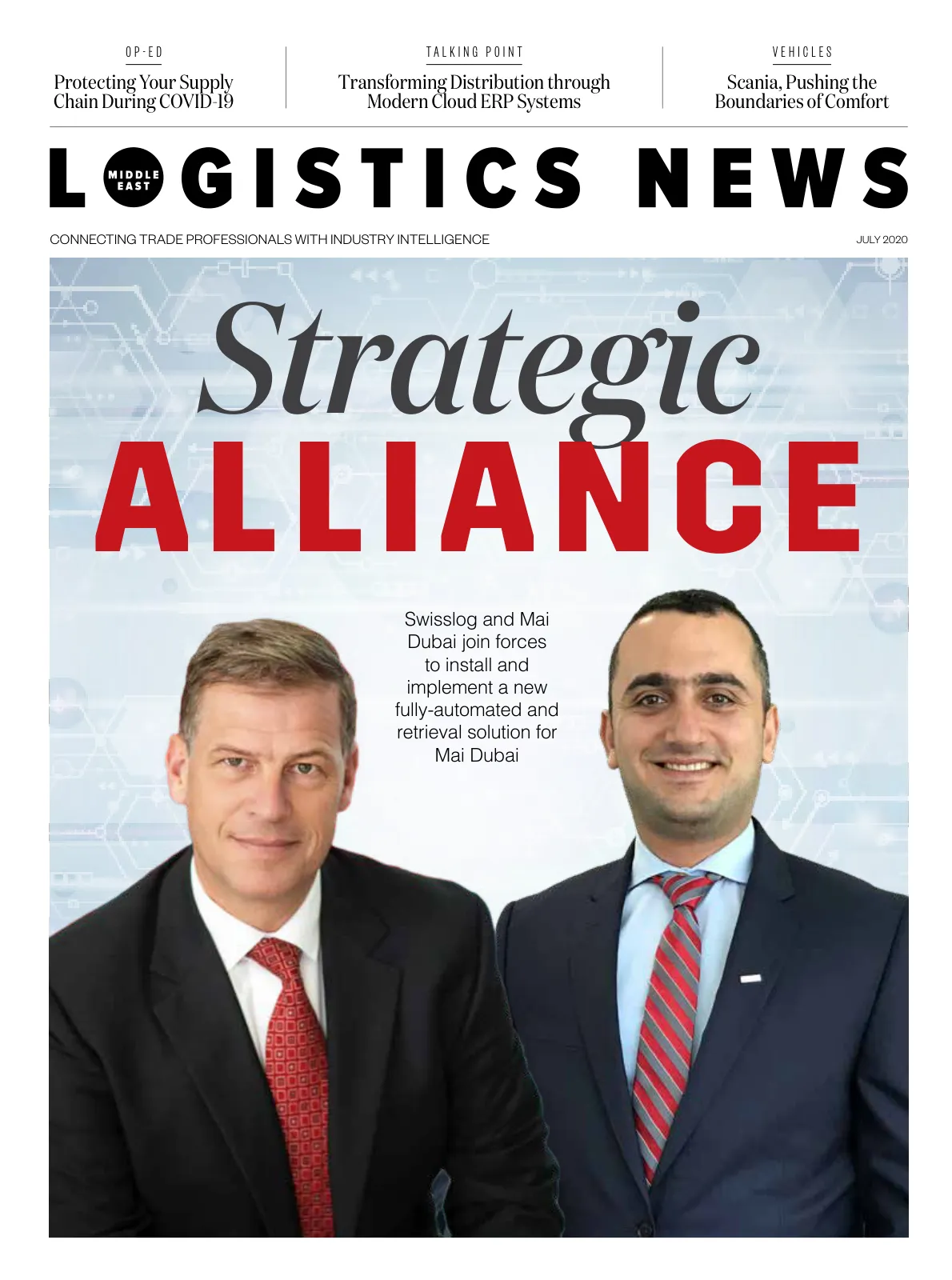
Swisslog and Mai
Dubai join forces
to install and
implement a new
fully-automated and
retrieval solution for
Mai Dubai
Strategic
ALLIANCE
Page 2
A MEMBERS OF EMIRATES TRANSPORT BUSINESS CENTERS:
Page 3
LOGISTICS NEWS ME | JULY 2020 | 3
JULY 2020
CONTENTS
START
10 | NEWS
FEATURES
18 | TALKING POINT
20 | COVER
26 | CONNECTIVITY
28 | SHIPPING
30 | OP-ED
32 | VEHICLE
FIND US ON YOUTUBE
Subscribe to our YouTube
channel to see things like site
visits, interviews and much more
CONTENTS
J U L Y 2 0 2 0
R E A D A L L T H E L A T E S T I S S U E S O N I S S U U
24
26
10
18
WEBSITE: WWW.CBNME.COM/LOGISTICS-NEWS
TWITTER: @LOGISTICSNEWSME
FACEBOOK: /LOGISTICSNEWSME
Page 4
WWW.CBNME.COM
REGIONAL NEWS
Your business continuity
is our top priority.
Our initiatives and remote solutions
have got you covered in all situations.
du.ae/wegotyourb
Page 5
JULY 2020
Page 6
6 | LOGISTICS NEWS ME | JULY 2020
WWW.CBNME.COM
EDITOR’S LETTER
JULY 2020
subscriptions@bncpublishing.net
CEO
Wissam Younane
wissam@bncpublishing.net
Director
Rabih Najm
rabih@bncpublishing.net
Group Publishing Director
Joaquim D›Costa
jo@bncpublishing.net
+971 50 440 2706
Business Development Director
Rabih Naderi
rabih.naderi@bncpublishing.net
+966 50 328 9818
Editor
Kasun Illankoon
kasun@bncpublishing.net
Art Director
Aaron Sutton
aaron@bncpublishing.net
Marketing Executive
Aaron Joshua
aj@bncpublishing.net
Photographer
Ahmad Khader
PO Box 502511 Dubai, United Arab Emirates
P +971 4 4200 506 | F +971 4 4200 196
For all commercial enquiries related to
Logistics News ME contact
sales@bncpublishing.net
All rights reserved © 2015.
Opinions expressed are solely those of the contributors.
Logistics News ME and all subsidiary
publications in the MENA region are officially licensed
exclusively to BNC Publishing in the MENA region by
Logistics News ME.
No part of this magazine may be reproduced or
transmitted in any form or by any means without
written permission of the publisher.
Images used in Logistics News ME are credited when
necessary. Attributed use of copyrighted images
with permission. All images not credited courtesy
Shutterstock.
Printed by UPP
ON THE WEB
Keep up to date with all the
latest news, features and
much more on our website.
W W W . C B N M E . C O M / L O G I S T I C S - N E W S
S U B S C R I B E
According to data released by IATA
released data for global air freight
markets in May showing a slight
improvement in the air cargo
market. But capacity remains
unable to meet demand as a result
of the loss of belly cargo operations
on passenger aircraft that have been
parked.
Global demand, measured in
cargo tonne-kilometers (CTKs*),
fell by 20.3% in May (-21.5% for
international operations) compared
to the previous year. That is an
improvement from the 25.6%
year-on-year drop recorded in April.
Meanwhile, global export orders
continue to fall but at a slower pace.
The Purchasing Managers Index
(PMI) tracking new manufacturing
export orders improved from the
trough seen in April despite remain-
ing in contractionary territory.
All regions suffered declines in
May. Airlines in Europe and Latin
America suffered the sharpest
drops in year-on-year growth in
total air freight volumes, while
airlines in Asia-Pacific and the
Middle East experienced slightly
less dramatic declines. Airlines in
North America and Africa saw more
moderate drops compared to the
other regions.
Middle Eastern carriers report-
ed a decline of 25% year-on-year in
May, a significant improvement
from the 36.2% fall in April.
Despite a number of carriers in the
region maintaining some cargo
capacity, traffic on all key routes
was low. International capacity
decreased 24.4%.
Kasun Illankoon
Editor, Logistics News Middle East
A NOTE FROM
THE EDITOR
K A S U N I L L A N K O O N
Page 7
A Smart Move For
New Possibilities
New Quester’s flexibility makes it suitable across a variety of applications and segments
such as general cargo, long haul and construction.
And now, ESCOTs’ added power and performance in New Quester means assignments can
be carried out with increased fuel and driver efficiency.
Optimized specifications such as reduced tare weight allow you to carry more.
And with the introduction of smart new connected features such as telematics,
you can stay on top of your tough daily schedule.
A smart move for your business
Page 8
COVER THE CITY
Unlocking the Power
of Digital Signage Advertising
Page 9
WITH YOUR ADS
Visit www.lifeonscreen.com
Page 10
10 | LOGISTICS NEWS ME | JULY 2020
WWW.CBNME.COM
REGIONAL NEWS
PARTNERSHIP
UAE-based
sustainable
mobility
solutions
provider
ION, announced a partnership
agreement
with
University
Hospital
Sharjah
to
use
ION’s fleet of electric vehicles
to
provide
sustainable
transportation
services
for
its
medical
logistics
and
transportation
needs
across
the Emirate. The agreement
signed between the two entities,
comes as part of ION’s remit
to support the community by
providing transport & delivery
solutions that are sustainable
and innovative.
Trips are being conducted
using ION’s electric vehicles and
drivers, who also provide ride-
hailing services in the Emirate.
These
include
patient
and
medical staff transportation,
in addition to deliveries and
distribution
solutions,
with
plans to expand ION’s offerings
to meet future demand.
Established
to
promote
sustainable modes of transport
and green mobility solutions
in the region, ION is a joint
venture between Bee’ah and
CE-Creates,
the
business
incubation platform of Crescent
Enterprises. ION offers electric
vehicle
ride-hailing
services
and manages and operates
autonomous shuttle services
as part of its dedication to
spearheading
the
provision
of accessible and sustainable
ION PARTNERS WITH UNIVERSITY HOSPITAL
SHARJAH TO PROVIDE SUSTAINABLE LOGISTICAL
SOLUTIONS
transport solutions, we are
enhancing
the
quality
and
efficiency
of
our
services
while easing healthcare access
to residents and healthcare
professionals
across
the
Emirate.”
As part of the agreement
with
University
Hospital
Sharjah, ION has also developed
an on-demand ride hailing
and
dispatch
solution
for
transportation and deliveries. It
is also maintaining all shipment
records,
with
dedicated
supervisory
support
and
a
platform dashboard to monitor
daily progress. In keeping with
stringent safety standards, ION
disinfects its vehicles before
and after each journey, and its
drivers have been trained on
health and safety protocols.
transport solutions.
Commenting on the new
service, HE Khaled Al Huraimel,
Group CEO of Bee’ah and
Chairman of ION, said: “ION
was established as a forward-
thinking company that provides
cleaner
alternatives
to
the
current
transport
offerings.
We believe strongly in helping
the
community
through
social impact initiatives, and
we are happy to create new
value by adding our fleet of
electric vehicles to provide
logistical
services.
Through
our agreement with University
Hospital
Sharjah,
ION
is
performing an essential service
for the healthcare industry
with
efficiency,
safety
and
sustainability in mind.”
Samer Choucair, Director,
CE-Creates,
said:
“From
the outset, ION has been
helping alleviate the impact
of
COVID-19
through
the
deployment
of
its
electric
vehicle fleet serving the medical
community in Sharjah and
beyond. We remain committed
to empowering our healthcare
heroes and communities during
these complex times, while
contributing to environmental
conservation.”
Dr. Ali Obaid Al Ali, CEO
of
University
Hospital
Sharjah,
added:
“Together
with our distinguished team
of
healthcare
professionals,
we continue to maintain the
highest standards of service
as we safeguard the health of
communities in Sharjah. By
utilizing
ION’s
sustainable
A N U P D A T E F R O M A R O U N D T H E R E G I O N
REGIONAL NEWS
Page 11
LOGISTICS NEWS ME | JULY 2020 | 11
JULY 2020
AVIATION
DHL Express recently added
two new Boeing 767-300Fs to
its MENA air fleet, marking a
further step in the Company’s
efforts to enhance its regional
aviation network and improve
its air capability to better
support the region’s logistical
demands.
The
new
aircraft
will
increase DHL’s overall load
capacity by more than 25%,
servicing
existing
high-
demand lanes across the GCC,
extended Middle East, Africa
& Indian Subcontinent which
house some of DHL’s key
commercial partners.
“Investments
in
strengthening our MENA air
network continue to form
part of our wider strategy to
enhance our capabilities in
DHL EXPRESS EXPANDS ITS MENA AVIATION
FLEET WITH TWO BOEING 767-300Fs
this region and better service
high
demand
destinations
with greater speed, reliability
and
efficiency,
ultimately
improving service excellence
which lies at the heart of
DHL’s business model. In
the past 6 years, in addition
to almost doubling DHL’s
Aviation touch points and
boosting international flights
to over 175 per week, we have
consistently increased load
capacities to vital trade links
such as Egypt, Saudi Arabia,
UAE, Lebanon, Jordan, East
Africa and on our Asian lanes
amongst others, to support
the growing logistics needs
of our clients for better
cross-regional
and
global
connectivity,”
commented
Richard Gale, Head of DHL
Aviation Middle East and
Africa.
“eCommerce
is
a
key
business driver for us and
keeping on top of the shifts
in world trade and how we
adapt is very important. We
are
continually
analyzing
our network and adding air
capacity to capitalise on the
increased activity between
Asia, the Middle East and
Africa which are vital trade
hubs for our regional clients,”
continued Gale.
The two new Boeings will
complement DHL’s existing
fleet of 767-200SFs operating
in the region, bringing its
total fleet size to 8 aircraft,
while helping to significantly
improve fuel efficiency and
decrease CO2 emissions.
“One of our main criteria
when deciding to add new
planes to our DHL fleet, is to
reduce
our
environmental
impact; this supports our
global vision and GoGreen
targets to become the first
zero
emissions
logistics
company
by
2050,
an
ambitious journey that is
already being implemented
across
key
operational
verticals
through
clean
transport
solutions
and
greener supply chains. We are
continuously upgrading our
fleet with larger more fuel
and energy efficient planes
and the new Boeings are
considered amongst the most
cost efficient aircraft available
today in the regional freighter
industry”, further stated Gale.
Page 12
12 | LOGISTICS NEWS ME | JULY 2020
WWW.CBNME.COM
REGIONAL NEWS
TECHNOLOGY
TECHNOLOGY
TABBY SECURES $7mn FUNDING TO LAUNCH IN KSA
ALLEGION MIDDLE EAST INTRODUCES TOUCHLESS
ACCESS SOLUTIONS FOR MIDDLE EAST MARKETS
Tabby,
the
UAE-based
FinTech
startup
and
the
region’s
first
Buy
Now
Pay Later solution, today
announced
it
has
raised
$7M to fund its growth and
launch its offering in Saudi
Arabia. The funding round
was led by Raed Ventures
with participation from MSA
Capital and existing investor
Arbor Ventures.
Launched in 2019 by Hosam
Arab, previously co-founder
and CEO of online retail site
Namshi, with an initial $2M
in
seed
funding,
Tabby’s
mission
is
to
empower
consumers to easily buy what
they want, when they want,
while remaining in control of
Allegion
Middle
East
a
pioneer in seamless access
and provider of safety and
security
products,
today
unveiled its comprehensive
portfolio of smart, secure,
touchless
access
solutions
with the focus on multifamily
properties,
healthcare
facilities, commercial offices
and
education
campuses.
Allegion is providing that
portfolio to businesses in the
UAE and across the Middle
East, actively addressing the
unique and growing needs of
the safety and security sector
there.
With
the
COVID-19
pandemic,
organizations
are facing new challenges
that
centre
around
how
to open-up to the public
or
to
keep
operations
running while maintaining
a safe environment for both
employees
and
customers.
their finances. Tabby helps
retailers
across
the
UAE
and KSA boost their sales
by offering their customers
flexible payment solutions.
Tabby’s
Pay
Later
option
offers an alternative to cash
on delivery (COD) by allowing
In doing so, one concern
that
needs
addressed
is
contact transmission: some
studies have found that the
COVID-19 virus can survive
on certain surfaces for days
unless properly disinfected.
As a result, lessening the
customers
to
purchase
products online using only
their mobile phone number
and
email
address
and
requires no pre-registration
or credit card to use. Tabby’s
Pay in Installments option
gives customers the flexibility
amount of contact people
have with commonly touched
surfaces
is
one
measure
facilities
managers
can
consider in seeking to provide
safer, cleaner environments.
“Offering safe and clean
environments is clearly top
to pay for their purchases
in
multiple,
interest-free
installments
without
requiring a credit card.
E-commerce in the GCC is
rapidly growing as a result of
Covid-19 as consumers shift
their purchase behavior to do
more of their shopping online.
Hosam Arab, co-Founder
and CEO of Tabby said: “We
are very pleased to bring our
best-in-market
solution
to
Saudi Arabia at a time when
consumers
and
merchants
alike will be strapped for cash.
This funding will give our
merchant
partners
further
security and assurance that
we are sufficiently capitalized
to support their sales.”
of mind for many – and for
good reason. Adapting new
technology
and
changing
the way we access buildings
or rooms is one opportunity
to make a difference. Going
wireless is already a popular
trend, and when combined
with automation of a door or
opening, it can help reduce
the chance of transmitting
viruses and bacteria through
hand-to-door
contact.
With
increasing
demand
for
social
distancing
and
safe infrastructure in place,
businesses are redesigning
their spaces, adapting them to
the ‘new normal.’ Touchless
door solutions can provide
seamless access that’s aligned
with those new requirements
and
provide
quality
experience,” commented Jeff
Bennett, commercial director
for Middle East & Africa at
Allegion.
Page 13
LOGISTICS NEWS ME | JULY 2020 | 13
JULY 2020
Gulftainer announced the
launch of the Future of
Ports Startup Challenge
2020 to identify startups
from across the globe
with the ambition to lead
the transformation of the
port management and lo-
gistics industries.
Gulftainer
has
part-
nered with the Global
Silicon Valley labs (GS-
Vlabs), a leading global
innovation platform, to
engage startups in five
unique areas of opportu-
nity where Gulftainer is
pursuing new solutions:
The Internet of Things
and Robo-Doctors; Ar-
tificial Intelligence and
Autonomous Drones; Big
Data and Advanced Ana-
lytics;
Blockchain
and
Bring Your Own Idea.
This competition chal-
lenges entrepreneurs and
startups from around the
world to set their mark
in the ports and logistics
ecosystem, to grow, and
to position their solutions
in the industry. The call for
applications is now open
till August 15 and startups
interested in participating
can apply through the Fu-
ture of Ports Startup Chal-
lenge website – gtinnova-
tionchallenge.com.
“Gulftainer isn’t looking
for incremental technol-
ogy or ‘easy fixes’ – we are
committed to developing
long-term
partnerships
with emerging technology
companies and working
together to build the port
of the future. Our aim is
to seek entrepreneurs and
unconventional thinkers,
with a vision for the future,
to chase groundbreaking
innovation in technology
areas that will transform
the industry,” said Peter
Richards, Group CEO of
Gulftainer.
“The Future of Ports
Startup
Challenge
is
coming at a time when
the supply chain and lo-
gistics industry is ripe for
innovation. We’re excited
about
our
partnership
with Gulftainer and being
involved in the port in-
dustry’s revolution,” says
Nikhil Sinha, CEO of GS-
Vlabs. “The application
of AI, Robotics, Cloud
and Blockchain technolo-
gies will be a driver of in-
novation in the industry
and this Challenge is the
perfect opportunity to
source and uncover the
most promising startups
that are poised to lead in
this space.”
GULFTAINER LAUNCHES GLOBAL STARTUP
CHALLENGE TO BOOST TECH INNOVATION IN PORTS
AND LOGISTICS SECTOR
Page 14
14 | LOGISTICS NEWS ME | JULY 2020
WWW.CBNME.COM
REGIONAL NEWS
COVID-19
‘WORLD SECURITY’ BECOMES UAE’S FIRST SERVICE
PROVIDER TO INTRODUCE SMART HELMET TO DETECT
COVID-19
World Security, the innovative
security
solutions
provider
of DP World, UAE Region
has unveiled a new Smart
Helmet that is designed to
make
contactless
detection
of people potentially infected
with COVID-19, and help ease
the movement of traffic in
areas where it operates, while
ensuring the highest levels of
safety and security.
World Security is the first
security
services
provider
in the UAE to adopt and use
the
revolutionary
headgear,
which is a product of decades
of innovation and research
and is positioned to be the first
choice for epidemic prevention
activities. Made of advanced
tough, yet lightweight materials,
it is packed with high-precision
sensors,
processors
and
transmission systems.
The KC N901 Smart Helmet’s
top five powerful functions
are:
Efficient
contactless
temperature recording, rapid
screening for both indoors and
outdoors, rapid screening of
vehicles and passengers, and
rapid face recognition and
identity
verification,
using
thermal imaging that enables
the invisible visible.
Mohammed
Al
Muallem,
CEO and Managing Director,
DP
World,
UAE
Region,
said: “With the reopening of
the economy, we have now
entered a new phase where
monitoring public places for
potential infection has become
imperative. By introducing this
technology at a time when the
fight against the pandemic is
in full swing, World Security
has reaffirmed its commitment
to keeping the community
secure.
As
the
frontline
economic growth engine, DP
World, UAE Region and its
businesses are strictly adhering
to the COVID-19 containment
programme
requirements,
and we’re constantly working
towards
introducing
such
new and effective measures to
ensure business continuity.”
Page 15
LOGISTICS NEWS ME | JULY 2020 | 15
JULY 2020
PORTS
KIZAD BREAKS GROUND ON NEW DEVELOPMENTS OF
WAREHOUSES, SHOWROOMS AND INDUSTRIAL UNITS
Khalifa Industrial Zone Abu
Dhabi (KIZAD) announced
breaking ground for its new
products for supporting the
increasing demand for pre-
built facilities in KIZAD.
The
range
of
small-to-
medium
light-industrial
warehousing units comprise
the fourth, fifth, sixth and
seventh phases of the KIZAD
Logistics Park and are set to
be introduced to the market
starting from the end of the
year to cater to increasing
customer
demands
for
additional
ready
to
move
facilities.
Abdullah Al Hameli, Acting
Head
of
Industrial
Zones
Cluster,
Abu
Dhabi
Ports,
of 500 sqm; six units of 1,000
sqm; one unit of 1,666 sqm;
and six light industrial units of
1,028 sqm).
Further, KLP 6 & KLP 7
offer dedicated plots spanning
a total of 330,000 sqm, housing
20 large terraced units, each
with an individual floor space
of 2,500 sqm, while KLP 7
will feature 56 medium light-
industrial and warehousing
units.
Located in KIZAD Area A,
all modules will be equipped
with
raised
floors,
open
loading yard access for trucks
and forklifts, ample on-site
parking will include their own
office area with toilets and
kitchenettes.
said: “Industrial activity and
warehousing
demand
has
been quite resilient, and we
are confident that launching
these ultra-modern units will
propel tremendous growth in
Abu Dhabi’s manufacturing
base. Customers are looking
for flexible and asset-light
options, and we are expanding
our portfolio to address these
needs through the launching
of a new modular, pre-built
units in various sizes and
configurations.
“With
the
availability
of options to buy or lease
warehouses
based
upon
a
business’s
individual
requirements, investors are
benefit from our flexible offers
for low-cost operations at
scale as well as our ability to
offer the region’s lowest utility
costs. This is complemented
by the unique location at the
industrial heart of the UAE,
and its direct access to global
markets via our flagship deep-
water port, Khalifa Port.”
New
developments
in
KLP 4 and KLP 5 span total
plot area of approx. 250,000
sqm, and offer a range of
mixed-use warehousing and
light industrial units. These
comprise of 26 showroom
warehouse units (24 units
of 795 sqm and two units of
1,920 sqm) and 88 small-to-
medium light-industrial and
warehousing units (76 units
Page 16
16 | LOGISTICS NEWS ME | JULY 2020
WWW.CBNME.COM
REGIONAL NEWS
MARITIME
DMCA LIFTS TIMING
RESTRICTIONS ON
MARITIME ACTIVITIES
Dubai
Maritime
City
Authority (DMCA) has issued
a circular lifting the timing
restrictions
for
maritime
activities. The step indicates
the return of the maritime
sector in Dubai to its normal
pace following the Dubai
Government’s
successful
completion of the National
Disinfection
Programme,
which paved the way for
the restoration of economic
activities including tourism
initiatives.
DMCA
continues
its
efforts
to
implement
all
the
necessary
measures
to
regulate
and
facilitate
maritime activities that would
strengthen Dubai’s position
as a leading global maritime
hub. The Authority focuses on
developing and implementing
the
legal
and
legislative
frameworks needed to further
regulate the maritime sector
in Dubai, as well as constantly
enhance its procedures to
provide the best services that
support maritime activities.
Sheikh Saeed bin Ahmed
bin Khalifa Al Maktoum,
Executive Director of Dubai
Maritime
City
Authority,
said: “The decision to lift
the restrictions on maritime
activities comes in line with
the government’s directives
to ease the movement of
people
in
Dubai,
paving
the way for the maritime
sector
to
return
to
its
normal operations as we
move
towards
the
post-
coronavirus phase. This is an
important step in facilitating
the commercial activities in
the emirate, especially that
it now prepares to welcome
huge number of tourists from
all over the world.”
TOP 5 ONLINE
STORIES THIS MONTH
IRTI partners with Blocko’s E24P to
build a blockchain-based smart credit
management platform
1
Strata completes construction of its JV
facility with Solvay in Al Ain
2
Tabadul launches second phase of the ‘Truck
Management System’ through the FASAH platform
3
New Autonomous Internal Terminal Vehicles to
boost operational efficiency at Jebel Ali Port
4
Ajman Free Zone claims 2020
Superbrands title
5
FIND US ON YOUTUBE
Subscribe to our YouTube
channel to see things like site
visits, interviews and much more
Page 17
LOGISTICS NEWS ME | JULY 2020 | 17
JULY 2020
TRADE
DUBAI CUSTOMS TRANSACTIONS UP 36% IN FIRST FIVE
MONTHS OF 2020 DESPITE PANDEMIC
Dubai’s economy continued
its exceptional performance
despite
headwinds
from
a
slowdown
in
global
economic
growth
due
to
the coronavirus pandemic.
Number
of
customs
transactions
processed
by
Dubai
Customs
jumped
36% in the first five months
of
2020
to
reach
5.9
million
compared
to
4.4
million transactions in the
corresponding period of 2019.
In May, Dubai Customs
carried
out
1.1
million
transactions
compared
to 994,000 in May 2019,
growing 10.6%. The growth
reflects economic resilience
and efficient response to
and Ruler of Dubai helped
mitigate the impact of the
pandemic,”
said
Ahmed
Mahboob Musabih, Director
General of Dubai Customs.
“Our
wise
leadership
supports business and trade
sector in these challenging
circumstances.
A
number
of
initiatives
launched
by
the
government
have
helped the business sector
keep
going,
enhanced
liquidity and reduced the
impact of the current global
economic
situation.
This
is clearly manifested in the
growing number of customs
transactions
handled
by
Dubai Customs in the first
five months of this year.”
coronavirus pandemic and its
impact on economic sector
in general, thanks to Dubai
Customs’
highly
advanced
infrastructure,
stimulus
packages and smart services.
Customs declarations rose
42% in the first five months
of this year to reach 5 million
declarations
compared
to
3.5 million declarations in
the corresponding period in
the previous year. A million
declarations were completed
in January, almost the same for
February, 1.3 million in March,
691,000 in April, and a million
declarations
in
May.
The
advanced Smart Workspace
helped complete a declaration
in 4 minutes as average.
Dubai
saw
exceptional
growth
in
business
registration
applications.
Against
all
odds,
Dubai
Customs completed 107,000
business
registration
requests from January to
May,
growing
95%
from
55,000
in
the
first
five
months in 2019. There were
358,700
refund
requests,
220,700
certificate/report
requests,
and
146,900
inspection
date
booking
requests in the first five
months this year.
“Stimulus
package
announced by His Highness
Sheikh
Mohammed
Bin
Rashid Al Maktoum, Vice
President, Prime Minister
Page 18
18 | LOGISTICS NEWS ME | JULY 2020
WWW.CBNME.COM
TALKING POINT
TRANSFORMING
DISTRIBUTION
The competitive landscape in the distribution in-
dustry is fiercer than ever before. Rapidly chang-
ing customer demands, global supply chain dis-
ruption, and a shifting labour market are adding
to the pressure on distributors, while accelerated
digitalization is forcing them to re-evaluate their
business to compete. According to Deloitte,
“distributors now have the opportunity to gener-
ate incremental value via effectively leveraging
digital assets and applying information, analyt-
ics, and insights to critical business decisions
and stakeholder interactions.”
To get ahead, leading distributors are invest-
ing in digital technologies to empower produc-
tivity across their operations, workforce, and
customer experience.
While a modern, cloud-based system will of-
fer a continuous flow of new technologies and
industry-specific capabilities, many distributors
are still limited by legacy enterprise resource
planning (ERP) systems. Many find themselves
grappling with significant ERP modifications,
making them feel locked into their old system.
Others are overwhelmed by the thought of
disrupting their daily operations by adopting a
new system and choose not to act at all. In both
cases, the gap between these distributors and
their more tech-forward competitors is widen-
ing every day.
Here are three key reasons why a modern,
cloud-based ERP system can make distributors
more agile, efficient, and better able to serve
changing customer needs.
1. HIGHLIGHT CUSTOMER-CENTRICITY
Perhaps the most significant success factor for
distributors today is developing innovative ser-
vices beyond the typical distributor-customer
relationship.
Distributors should look for a modern ERP
system that not only supports these types of
services, but also incorporates the use of tech-
Khaled AlShami, Director, Solution Consulting, Middle East & Africa (MEA), Infor, gives us an
overview on how modern cloud ERP systems can transform distribution.
Page 19
LOGISTICS NEWS ME | JULY 2020 | 19
JULY 2020
nologies such as the internet of things (IoT),
artificial intelligence (AI), machine learning
(ML), and mobile devices to enhance their of-
fering. For example, a distributor can leverage
IoT to monitor equipment and collect data to
determine the optimal time to perform main-
tenance, safeguarding against customer equip-
ment failure. Another example might be put-
ting mobile devices in their field service team’s
hands to provide them immediate access to the
information they need to complete the repair.
In addition to providing customers innova-
tive value-added services, distributors can lev-
erage a modern cloud-based ERP system to
improve their customer’s buying experience.
An advanced ERP system can use AI and ML
to deliver highly personalized product recom-
mendations, even factoring in external sources,
such as weather, to recommend the type of
drill needed in freezing conditions.
The rise of customer desires for self-ser-
vice can’t be ignored. When it comes to e-
commerce, customers desire powerful online
research tools to design their products and
mobile access from any device. A functional
website that lets customers operate on their
terms can inspire loyalty and give the distribu-
tor a competitive advantage.
2. ENHANCE PRODUCTIVITY
Customer demand for speed and accuracy re-
quires streamlined and efficient operations
across the supply chain, impacting every aspect
of the distributor’s business – from sales to ser-
vice, to inventory and warehouse management.
Modern ERP systems leverage new technolo-
gies to anticipate fluctuations in demand better
to make better buying decisions. These systems
also offer warehouse automation, replacing
slow and error-prone manual processes, and as-
set management capabilities to better manage a
fleet of trucks to ensure they are always operat-
ing and delivering the right product to the right
place, at the right time.
Modern ERP systems offer workflow tools
to automate business processes and eliminate
manual steps to achieve optimal efficiency.
Leveraging this technology enables the distrib-
utor to ensure best practices are followed and
prevents problems that might have otherwise
occurred. Workflow tools act as a manager and
ensure work is passed from one person to the
next in the appropriate sequence until the pro-
cess is complete.
Another benefit of a workflow tool is the
ability to identify potential issues proactively.
Without tools like this, distributors often are
playing catch-up and resolving customer prob-
lems in hindsight. To offer the best service,
distributors must operate in an environment
where they stay one step ahead. A modern
ERP system can identify potential problems
before they occur. For example, if a purchase
order is going to arrive later than expected, the
system will alert employees of customer orders
that will be impacted by the delay. As such,
employees can address the issue before it be-
comes a problem.
3. IMPROVE EMPLOYEE ADOPTION
When it comes to seeing a return on invest-
ment with any new technology, a business
will only be successful if employees read-
ily adopt and integrate the system into their
working ways. Perhaps not surprisingly, the
lack of learning tools in legacy ERP systems
represents a significant barrier to entry in the
enterprise software industry. Making emerging
technologies accessible to any person in any
business area is what makes modern enterprise
technology so powerful.
Modern ERP systems emphasize seamless
user experience and design, making it easy for
employees to engage with the software and
seek out data to inform their decision mak-
ing. Twenty years ago, distribution employees
had to tolerate lengthy training sessions to un-
derstand their workflows. But by choosing an
ERP solution with modern training tools and
pre-built content, employees can skip those ex-
tended classes and continuously learn within
the system itself.
These modern training tools and intuitive
systems are also particularly useful for distribu-
tors that hire temporary workers during busy
seasons, like the holidays. Not everyone will
be familiar with every technology that a work-
place utilizes, so having help buttons to guide
them through processes, as they go, increases
employee productivity, and lets managers focus
on higher-level tasks.
DEFINE YOUR FUTURE IN THE DIGITAL AGE
Distributors still using legacy ERP systems
to face an opportunity cost every day. While
tech-forward competitors race ahead with
modern cloud ERP systems that let them bet-
ter serve customers and their changing needs,
improve their overall productivity, and support
and retain employees in a tight labour market,
distributors without modern systems will only
continue to fall behind the pack. The compa-
nies that succeed will be those that progress be-
yond legacy systems and step into the continu-
ously evolving world of modern ERP.
Page 20
Swisslog and Mai Dubai join forces to install and implement a new fully-automated and retrieval
solution for Mai Dubai
Strategic
ALLIANCE
COVER STORY
20 | LOGISTICS NEWS ME | MARCH 2020
WWW.CBNME.COM
Page 21
LOGISTICS NEWS ME | JULY 2020 | 21
JULY 2020
G
lobal logistics automation specialist Swiss-
log has revealed the successful installation
of a new fully automated storage and re-
trieval solution of Goods for Mai Dubai, a lead-
ing Dubai-based bottled drinking water company.
The move is part of Mai Dubai’s ongoing expan-
sion initiative and involves implementing a fully
automated and data-driven intralogistics system
that is future ready.
Swisslog is shaping the future of logistics au-
tomation and transforming warehouses and dis-
tribution centres to achieve maximum efficiency,
flexibility, and agility.
Alain Kaddoum, General Manager, Swiss-
log Middle East, said, “Warehouse and factory
managers constantly need to synchronize their
material flow between production and warehouse
to optimize the inventory level and reduce the op-
erational costs.”
Alexander van’ t Riet, CEO of Mai Dubai
LLC, said: “Swisslog’s many years of experience
and expertise in logistics automation for the food
and beverage industry convinced us to go with
Swisslog Middle East as our intralogistics partner
for our expansion project.”
The benefits that Mai Dubai will reap out of
this are plentiful; a complete solution for end-to-
end material flow, requisite logistics in place to
handle considerable increases in capacity, signifi-
cant improvement of flow of goods through au-
tomation, and having tight control of all logistics
components through the usage of software and
technology. With this installation, Swisslog of-
fered complete system design, engineering, simu-
lation, implementation, and integration of two
high-bay warehouses with associated monorail
and conveyor technology.
EXEMPLARY FOOD SAFETY STANDARDS
Since its establishment in December 2012, Mai
Dubai LLC has enjoyed exponential growth of
the bottled water it produces and is an excel-
lent example of an inspiring success story. The
fully owned subsidiary of the Dubai Electricity
and Water Authority (DEWA) has been invest-
ing in state-of-the-art technologies from the
start for its facilities to guarantee the produc-
tion of high-quality end products. Due to its
commitment to excellence, the young company
has earned the region’s highest award for food
safety year after year.
Mai Dubai currently is the number two
brand in the market and also enjoys an excel-
lent reputation beyond the borders of the Unit-
ed Arab Emirates (UAE). Apart from being the
official bottled water partner of Emirates Air-
lines, the company’s distinctive and iconic wa-
ter bottles with red lettering have also become
a fixture in 13 countries across the GCC, Asia,
Europe, and Africa.
The use of Swisslog’s fully automated storage
and retrieval solution will help drive critical ben-
efits and advantages for Mai Dubai, including a
Page 22
22 | LOGISTICS NEWS ME | JULY 2020
WWW.CBNME.COM
COVER STORY
significant reduction in labour costs, improved
production flows and enhanced storage efficien-
cies. The installation proves to be both timely and
strategic, and is expected to sustain Mai Dubai’s
continued growth ambitions.
SWIFT AND EFFICIENT PROCESSES IN TWO HIGH-
BAY WAREHOUSES
To meet the steadily climbing demand, the com-
pany decided in 2016 to expand production by
2020. Mai Dubai committed to massive invest-
ments in production and intralogistics and elect-
ed to rely on the expertise of Swisslog to deliver
its needs and requirements.
As part of an order valued over Euro 20 mil-
lion, Swisslog planned and implemented a fully
automated system based on intelligent software
in the context of big data. The major expansion
project included planning and implementing a
six-aisle automated high-bay warehouse for raw
material and packaging materials as well as -only
a few hundred meters away- a high-bay ware-
house with 17,560 pallet locations for finished
goods with 10 aisles.
“The introduction of new automation de-
ployments driven by strong warehouse manage-
ment software (WMS) can maximize return on
investment and minimize risks to supply chain
operations. Combining Swisslog’s SynQ WMS
solution, Mai Dubai was able to modernize their
warehousing, distribution, and production opera-
tions by optimizing the performance of the vari-
ous components while maximizing the storage
capacity,” said Alain.
Swisslog’s SynQ is a modular, service-orient-
ed software platform for warehouse manage-
ment and material flow orchestration. SynQ,
representing Synchronized Intelligence, gives
the organization the precise functionality they
need to optimize warehouse operations. It lit-
erally embeds intelligence in the operation
and synchronizes the performance of their au-
tomated and manual warehouse equipment
in the best possible way. It encompasses ware-
house management (WMS), material flow
(MFC/WCS), and automation control systems
(ACS) functionality, along with an array of
business intelligence tools to boost the ware-
house performance. SynQ covers the full spec-
trum of an organization’s supply chain needs
to optimize their warehouse operation in the
era of interconnectivity, automation, machine
learning, and real-time data and help them stay
ahead of the competition.
“Our SynQ software is a future-proof solution
offering efficient integration to 3rd party ERP
systems, comes with integrated user-friendly
interfaces for all the shop floor operations and
condition monitoring of the entire site as well as
administrative tasks. Our modular platform also
Page 23
LOGISTICS NEWS ME | JULY 2020 | 23
JULY 2020
“The introduction of new automation deployments
driven by strong warehouse management software
(WMS) can maximize return on investment and
minimize risks to supply chain operations.”
includes the visualization of the entire plant in
3D, VR and AR,” Alain commented.
Swisslog Vectura stacker cranes connected
to the transport system will provide swift and
efficient storage and retrieval processes in both
warehouses. Fundamental to the material and
goods flow concept is the over 1,100-meter long
monorail system, which guarantees process-
optimized transports - from receiving the raw
products and packaging materials from ware-
house to the production lines, transporting the
Finished Goods from production lines to the
finished goods warehouse, and to the shipping
lanes in the distribution center. Within the con-
figuration, a total of 44 Swisslog trolleys, each
capable of carrying two pallets at a time, can
travel along with the rail system.
Alexander explained, “Working closely with
Swisslog was part of our expansion strategy. The
implementation of an automated and digitalized
Page 24
24 | LOGISTICS NEWS ME | JULY 2020
WWW.CBNME.COM
JULY 2020
COVER STORY
logistics solutions is part of -and contributes to-
our customer-focused approach. This initiative
will help us not only to improve our production
control but also allows for greater storage density
and increased efficiency.”
HIGH-PERFORMANCE IT INFRASTRUCTURE
In addition to the installation of warehouse
technology components, the mega expansion
project implemented by Swisslog also includes
advanced high-performance information tech-
nology (IT) infrastructure and control tech-
nology. The ProMove pallet conveyor system
ensures the efficient flow of goods and the se-
quencing of pallets in receiving and shipping.
Swisslog Warehouse Management Software
is crucial to this process. Algorithms guide the
movement of goods across two floors to the
right locations at the right time.
FUTURE READY
The modular software platform also offers sev-
eral big-data business intelligence tools that can
be flexibly added over time. With its modular
architecture and intelligent, automation-friendly
design, the software helps Mai Dubai prepare for
the changes that digitalization brings so the com-
pany can benefit from its opportunities.
“Implementing automation can help com-
panies with achieving their best supply chain
performance, which now acts as an indicator of
resiliency and not merely cost management. In
the current competitive and dynamic market, risk
of disruption in the supply chain can cause is-
sues with business continuity, losing competitive-
ness, reduced short-term financial performance.
Automation can help companies deal with the
complexities, increase the performance of supply
chain and make it resilient for any kind of dis-
ruptions,” concluded Alain.
Page 25
EFFICIENCY IN A
SMALL PACKAGE
GENIE® GS™-1330m SCISSOR LIFT
2 Person
Platform Occupancy
227 kg (500lb) max lift capacity
Lightweight
Only 885 kg (1,950 lb)
Efficient Electric
Drive System
Provides maximum runtime
per charge
© 2020 Terex Corporation. Terex, Genie and Taking You Higher are registered trademarks of Terex Corporation or its subsidiaries.
LEARN MORE AT GENIELIFT.COM/GS1330M
Page 26
26 | LOGISTICS NEWS ME | JULY 2020
WWW.CBNME.COM
CONNECTIVITY
FUTURE IN
CONNECTIVITY
Crises reveal weaknesses. The coronavirus pan-
demic has highlighted the value of connected
manufacturing and logistics. The internet of
things (IoT) helps manufacturing companies
react more flexibly than before to disruptions,
since the utilization and condition of each ma-
chine can be tracked in real-time, and there is
transparency along the supply chain. “Espe-
cially in exceptional times such as the current
crisis, connectivity makes companies less vul-
nerable and helps them keep an even keel,”
says Rolf Najork, a member of the Bosch
board of management responsible for indus-
trial technology. For example, where the risk
of infection makes physical proximity a chal-
lenge, shift handovers can be handled digitally.
Digitalization enables remote monitoring and
maintenance of systems and machines, with
no need for a technician on site. Intelligent
software can track goods and deliveries, and
ensure replenishment, from any location. All
this is possible, thanks to Industry 4.0. Con-
nected solutions will help make manufacturing
and logistics simpler, more efficient, flexible,
and more robust. Bosch is an IoT pioneer. The
company began adding connectivity to pro-
duction and logistics in 2012 – both in its own
plants and in those of its customers.
INDUSTRY 4.0 BOOSTS FACTORY PRODUCTIVITY
In the factory of the future, the only static and
fixed things are the floors, walls, and ceilings.
The factory of the future continually rein-
vents itself as needed. It is guided by a vision
of a manufacturing set-up that can produce
thousands of different products and vari-
ants, down to a batch size without the need
for expensive retrofitting. This is why Bosch
is committed to connectivity. Projects in this
area drive progress and deliver measurable
benefits. With the help of Industry 4.0, it is
possible to increase productivity at individual
locations by up to 25 percent.
“Connectivity is essential for any com-
pany that wants to stay competitive. Industry
4.0 is a historic opportunity, offering enor-
mous potential,” Najork says. “We are not
only improving factory productivity, but also
enabling companies to respond quickly and
appropriately to changes.” To take the exam-
ple of Bosch, the transition of the automo-
tive industry means pressure on costs for its
powertrain division and pressure to adapt.
For precisely this reason, the division will
be investing some 500 million euros in com-
prehensively digitalizing and adding connec-
tivity to its manufacturing operations over
the next few years. The expected saving will
be twice as high: roughly 1 billion euros by
2025. And the use of artificial intelligence is
expected to add even more of a boost. The
focus here is on AI-based solutions for pre-
dictive maintenance of machinery, for qual-
ity assurance, and for improving production
processes. For example, AI is used in highly
complex wafer fabs – such as the Bosch
plant in Reutlingen – for detailed production
scheduling, saving time and costs as it guides
the wafers through more than 500 process-
ing steps. This alone means a 5 percent faster
wafer throughput, with an investment pay-
back time of just three months.
Bosch sees factories’ future in connectivity as industry 4.0 shows
productivity level at sites has increased by 25 percent
FROM INDIVIDUAL PROJECTS TO LARGE-SCALE
IMPLEMENTATION
In Germany, six out of ten industrial compa-
nies with more than 100 employees already
use Industry 4.0 applications, according to a
recent study by the industry association Bit-
kom. In many cases, however, the applications
are only piecemeal. The VDMA, the asso-
ciation of German machinery and equipment
manufacturers, estimates that 80 percent of the
country’s existing machinery has yet to be digi-
Page 27
LOGISTICS NEWS ME | JULY 2020 | 27
JULY 2020
talized. “There’s still a lot more we can do in
manufacturing, and many points we can tweak
and adjust. Our task now is to make Industry
4.0 the norm in all parts of the manufacturing
sector,” Najork says. For companies, the big-
gest obstacle to implementing Industry 4.0 is
the large sums of capital this requires (Bitkom,
2020). In fact, machinery can also be retrofit-
ted with communications technology and sen-
sor systems. Doing so opens the door to the in-
dustrial internet of things. The Bosch Rexroth
plant in Erbach, Germany, shows how even
minor investments in large-scale machine lines
can pay off: It spent 25,000 euros on equipping
these lines with sensors and light barriers saves
some 200,000 euros a year.
BALANCING ECONOMIC AND ECOLOGICAL FACTORS
THROUGH CONNECTED SOLUTIONS
As a leading IoT company, Bosch has all the
core competencies required to shape Industry
4.0. Its portfolio includes software packages for
maintenance, monitoring, and logistics, robot-
ics systems for manufacturing and transport,
retrofit solutions for existing machinery, and
assistance systems for machine operators. Now
Bosch is debuting a software-based, 5G-capa-
ble control technology that is open to third-
party applications. ctrlX Automation marks an
end to isolated solutions in factories.
Featuring more than 30 data protocols, the
new Bosch Rexroth automation platform will
be the control center of the factory of the fu-
ture. With its improved Nexeed Industrial
Application System, Bosch Connected Indus-
try offers more than merely an “app store”
for manufacturing and logistics. The various
software applications can be ordered, used,
and combined as needed. All machine data
is available in a transparent and standardized
format, thus ensuring greater transparency and
efficiency. A prime example of how to harmo-
nize economic and ecological considerations is
the Bosch Energy Platform. Once a machine
has been connected to it, its power consump-
tion can be tracked, analyzed, and controlled.
The result is that more economical factories,
require less energy, and emit less CO2, con-
nectivity will play a significant role in making
manufacturing climate neutral.
Page 28
28 | LOGISTICS NEWS ME | JULY 2020
WWW.CBNME.COM
DECARBONIZING
SHIPPING
The shipping industry has made a strong commitment to reduce its global carbon
emissions towards 2050. A group of leading industry players are taking the next step
to develop new fuel types and technologies by launching the Mærsk Mc-Kinney Møller
Center for Zero Carbon Shipping.
SHIPPING
The founding company partners behind this
initiative are ABS, A.P. Møller – Mærsk,
Cargill, MAN Energy Solutions, Mitsubishi
Heavy Industries, NYK Lines and Siemens
Energy. The center, which will be based in
Copenhagen, Denmark, is made possible by a
start-up donation of DKK 400m by the A.P.
Møller Foundation.
Chairman of the Board in the A.P. Møller
Foundation, Ane Uggla comments: “With
this donation, The A. P. Møller Founda-
tion wishes to support the efforts to solve
the climate issue in global shipping. My fa-
ther, Mærsk Mc-Kinney Møller was a vision-
ary leader in the global shipping industry
for more than 7 decades. He was concerned
about shipping’s impact on the environment.
Already in the 1980’s he championed the use
of low sulphur fuel, and he pioneered the first
double hull oil tankers in the 1990’s to mini-
mize the risk of oil spills. Therefore, I find it
very natural that my Father’s name will be
connected to the center.”
The center will be a non-profit organiza-
tion, set up as a commercial foundation with
a charitable purpose. As an independent re-
search center, it will work across the entire
shipping sector with industry, academia and
authorities. A highly specialized, cross-disci-
plinary team will collaborate globally to cre-
ate overviews of decarbonization pathways,
accelerate the development of selected de-
carbonizing fuels and powering technologies,
and support the establishment of regulatory,
financial and commercial means to enable
transformation.
To define the strategic direction of the cent-
er, a Board of Directors is being established.
Søren Skou, CEO of A.P. Møller – Mærsk
Page 29
LOGISTICS NEWS ME | JULY 2020 | 29
JULY 2020
has been confirmed as Board Member. Addi-
tional members of the Board of Directors will
be announced upon appointment.
Future member of the Board, Søren Skou,
says: “The founding partners and the A.P.
Møller Foundation share a long-term ambi-
tion to decarbonize the shipping industry. The
establishment of the center is a quantum leap
towards realizing that ambition. This joint
initiative will fast-track the maturation of so-
lutions and strengthen the basis for decision
making among industry players and regula-
tors and hence accelerate investments and
implementation of new technologies. I am
looking forward to join the Board of this am-
bitious collaboration.”
Furthermore, the center will have a man-
agement board, which will be headed by Bo
Cerup-Simonsen as CEO of the center. Bo
Cerup-Simonsen holds a PhD from the Tech-
nical University of Denmark in Mechanical
Engineering, Naval Architecture and has a
proven track record in leadership of large-
scale industry projects, maritime technology,
research and innovation.
“This is the early days of a demanding
and necessary transformation of an entire
industry. Thanks to the A.P. Møller Foun-
dation and the support from industry-
leading partners we now have a unique
opportunity to unfold the potential of a
sector-wide collaboration towards com-
plete decarbonization. The Mærsk Mc-
Kinney Møller Center for Zero Carbon
Shipping provides a solid platform for the
entire eco-system to join forces, demon-
strate new solutions and identify the next
steps to make it happen. I’m excited to let
the work begin, expanding the collabora-
tion with a broad variety of contributors,”
adds Bo Cerup-Simonsen.
The founding partner companies bring a
common commitment to decarbonizing ship-
ping and specialized knowledge and research
capabilities. Furthermore, the founding part-
ners will donate expert people resources and/
or testing platforms to support the operations.
The Center expects to attract several more
partner companies in the future.
During the first two to three years the cent-
er will recruit around 100 employees to the
Copenhagen-based office and collaborate with
new partners across the globe. The founding
partner companies have committed one-third
of the needed staff, the remaining two-thirds
will be recruited independently. In addition
to leadership and administration, the Center
staff will include subject matter experts in
energy, fuels and ship technology as well as
regulatory affairs, finance and the global en-
ergy transition.
Shipping’s road map to decarbonization
The shipping sector accounts for around
3% of global carbon emissions. The industry
has made a firm commitment to reduce this
to zero within this century. Short-term meas-
ures related to increased energy efficiency is
enabling a 40% relative reduction by 2030.
Achieving the long-term target requires new
fuel types and a systemic change within the
industry. As shipping is a globally regulated
industry, there is opportunity to secure broad-
based industry adoption of new technology
and fuels.
To accelerate the development of viable
technologies a coordinated effort within ap-
plied research is needed across the entire sup-
ply chain. Industry leaders play a critical role
in ensuring that laboratory research is suc-
cessfully matured to scalable solutions match-
ing the needs of industry. At the same time,
new legislation will be required to enable the
transition towards decarbonization.
Page 30
30 | LOGISTICS NEWS ME | JULY 2020
WWW.CBNME.COM
OP-ED
PROTECTING YOUR
SUPPLY CHAINS
Anas A. Abdul-Haiy, Director and Deputy CEO of Proven Consult, tells us how you can protect
your supply chain during the COVID-19 Pandemic
As the world is battling against COVID-19, the
pandemic has an uneven effect on the supply
chain industry. Industries such as auto, travel,
consumer goods, electronics, and retail have
been profoundly impacted. The supply chain
economy has a large and distinct impact on
economies of the world that is driven by indus-
trial activities and innovation.
DATA LEADING THE WAY
Having a data-centric approach towards supply
chain management is making suppliers more agile
in their operations. Using predictive modeling and
data simulations, businesses can predict the impact
of a sudden decline in demand in one country that
can impact the entire supply chain. Live tracking
the sales, shipments, and orders with minimum
latency will help businesses to identify surge or de-
cline in demand and these data can guide the deci-
sions regarding the production levels.
END-TO-END DIGITISING
Having a cloud-based or web-based ordering sys-
tem, allows businesses to act on shifts in demand
proactively. Creating an end-to-end digital IT eco-
system is key to drive and minimize the latencies.
However, to track actual production, inventory
levels, and shipments, businesses must leverage
various Internet of Things technologies together
to bridge data between various processes. Starting
from placing the order or query to the actual pro-
duction and distribution, these various processes
in the value chain funnel need to be digitized to
enable faster decision making.
AUTOMATION FOR AGILE SUPPLY CHAIN
While the manufacturers are looking for alter-
nate vendors for their critical components, the
reduced labour force and increased demand
have led to increased lead time. Accelerating
production and reducing manual interventions
in the business processes are critical to solving
these problems. Suppliers must develop greater
automation capabilities to accelerate produc-
tion and minimize manual interventions in the
business process. Using IoT and robotics, busi-
nesses can fast track assembly lines, inventory
management, and data analytics.
EMBRACING THE DIGITAL WORKFORCE:
For manufacturers, labour shortage and
replenishment serve as focal points for op-
Page 31
LOGISTICS NEWS ME | JULY 2020 | 31
JULY 2020
erations to manage ramp-up in produc-
tion after temporary shutdowns. Therefore,
businesses are embracing the digital work
environment and communication channels
to continue their operations remotely. De-
partments such as marketing, finance, and
HR has moved to virtual desks. While these
techniques act as a solution to cope with the
supply chain crisis, it is the principles that
are leading the decision making.
NEW PRINCIPLES FOR SUSTAINABLE SUPPLY
CHAIN
Diversifying the supply chain will not only
make supply chain reliable also help businesses
to optimize cost. Businesses can source compo-
nents for new products from low-cost sources
and can launch new products at a lower price
to boost their sales. This crisis has key lessons
for businesses about reliable and efficient sup-
ply chain management. In the immediate term,
organizations need to take steps to stabilize
supply chain operations by conducting risk as-
sessments and implementing business continu-
ity plans using crisis-management teams.
CRISIS MANAGEMENT FOR SHORT TERM IMPACT
To address the volatile nature of current supply
chain operations, organizations should mobi-
lize a crisis-management team or a war-room
setup that has the power to make quick, analy-
sis-based supply chain decisions.
Analysts should examine supplier delivery
performance, deviations from plans, canceled
orders, fulfillment rates more frequently to
identify any potential supply chain issues.
OPTIMIZING HR STRATEGIES
While protecting supply chain businesses is para-
mount for economies; at the heart of this crisis,
people are most affected. Protecting the people
working in the supply chain ecosystem must be a
priority for businesses amidst the pandemic.
At an unprecedented time of pandemic
threats, businesses must make quick decisions led
by talented executives to implement new policies
and standards to the ground level. As businesses
shift towards automation and digitalization, the
focus has to be on finding new executive talent
for implementing strategical and analytical func-
tions of supply chain management.
Page 32
32 | LOGISTICS NEWS ME | JULY 2020
WWW.CBNME.COM
SCANIA TOURING –
PUSHING THE
BOUNDARIES
OF COMFORT
VEHICLES
If your business relies heavily on buses to meet
your business needs and bottom line, look no
further than the Scania Touring Bus model.
Giving your customers the unique and
seamless experience as they go from one
point to another.
After all, providing such a seamless expe-
rience is what Scania offers in its products
as its purpose is to drive the shift towards
a sustainable transport system, creating a
world of mobility that is better for business,
society and the environment.
Scania offers a complete range of buses and
coaches for public transport operators and
coach companies. Scania buses and coaches
are renowned for their outstanding total oper-
ating economy. Each component is engineered
to heighten the vehicle’s performance and set
world-class standards for fuel economy, drive-
ability, road handling, reliability, and uptime.
So what does the Scania Touring Bus offer?
DESIGN
The Scania Touring Coach has a powerful-
ly sculpted exterior, it’s a versatile coach,
designed to meet the demands of occasion-
al service and regular service over longer
distances. For the passengers, Scania Tour-
ing’s smart design makes even the longest
trip a safe, relaxed, and harmonious expe-
rience. The coach has been designed for
functional quality, from the seating and cli-
mate system to each safety feature.
Double-glazing creates a quiet interior that
lets passengers usually converse, and the en-
tertainment system is a welcome addition on
longer journeys. Comfort features, including a
toilet and mini-kitchen, are also available.
The luggage area is adapted to fulfil different
needs within occasional and regular service. In
both models, parallel, pneumatically, or manu-
ally controlled luggage hatches open along the
side of the bus, making it easier to load and
unload, even in cramped areas.
For the driver, they would enjoy a well-
designed ergonomic workplace with a highly
adjustable steering wheel, and pendant pedals
enable the driver to find the optimal position
Page 33
LOGISTICS NEWS ME | JULY 2020 | 33
JUNE 2020
for safer and more comfortable driving. The
optimised driveline features all Scania com-
ponents, and Scania Opticruise automatically
selects the right gear for pleasant, economical
travel. Furthermore, the Scania Touring Bus
flexible features allow operators to explore
wide-open expanses or narrow city streets
without much hassle. The two-axle version is
a perfect combination of manoeuvrability and
capacity. With the three-axle version, you gain
higher capacity, while still retaining manoeu-
vrability via the steering tag-axle to navigate
the tough territory.
MEETING YOUR DRIVER’S EXPECTATIONS
Taking care of your drivers is of utmost impor-
Page 34
34 | LOGISTICS NEWS ME | JULY 2020
WWW.CBNME.COM
JULY 2020
VEHICLES
tance, and Scania Touring gives them a great
driving experience. That means benefits that
flow on to your passengers – as well as your
bottom line. Your drivers can help you drive
down operating costs and CO2 emissions.
That’s why Scania has developed a number
of services that focus on making driving more
comfortable.
It begins with their training, which will help
to increase their engagement as well as the up-
time and service life of your fleet. At the same
time, you can decrease accident rates, fuel
consumption, unscheduled services, and total
cost of ownership in the long run. To further
increase the value of the Driver Training, you
can add Scania Driver Coaching to keep skills
up to date.
Furthermore, when drivers understand the
impact of how they drive, it makes them better
drivers. The best way to do this is an on-board
system that gives the driver real-time feedback
on performance and fuel economy. Each driver
has their own fuel consumption data. This lets
them set targets and compete with each other
or against themselves. Scania Fleet Manage-
ment System connected to your offices will
help monitor vehicle location, performance,
and fuel consumption. You can also receive re-
ports if something is wrong, so you can sched-
ule a service break rather than being taken by
surprise. It lets you fine-tune your operation
and maximise uptime.
FUEL EFFICIENCY
Fuel efficiency is essential, and for operators
focused on the low total cost of ownership, this
coach is destined to be your profit source for
years to come. So, Scania Touring Coach can
operate on HVO, biodiesel, and other alterna-
tive forms of diesel to increase your fuel effi-
ciency for long-distance driving.
Hydrogenated Vegetable Oil – HVO – is a
modern way to produce high-quality bio-based
diesel fuels without compromising fuel logis-
tics, engines, exhaust after-treatment devices,
or exhaust emissions.
HVO can be made from different sources –
such as waste oil, rapeseed oil, palm oil, and
animal fat. Using these sources of energy has a
significant impact on the total greenhouse gas
savings. Compared to standard diesel, an opti-
mal CO2-reduction can reach up to 90% reduc-
tion in CO2-emissions.
Biodiesel can be made from various
sources like rapeseed, plants, and waste
cooking oil. Biodiesel also has the advan-
tage of being a liquid, available in large
quantities. The supply of sustainable bio-
diesel is primarily being used for blend-
ing in diesel, or a pure 100 % form. Com-
pared to standard diesel, an optimal CO2
-reduction is estimated to be up to 66% in
CO2-emissions.
Scania have contributed to more than a cen-
tury of bus evolution by having the right peo-
ple, products, and solutions.
This is because Scania believes these buses,
such as Scania Touring, will be a win for every-
one involved.
Page 35
Our SME eShop delivers.
So your business can keep growing.
du.ae/SME
Page 36
Scania Touring HD range
a privilege
to own
The Scania Touring is a coach designed
to meet your needs for occasional
service and regular service over long
distances. You will enjoy full support
from a single point of contact since
all parts, maintenance and repairs are
backed by Scania’s comprehensive
global service work. The possibility
of fast deliveries gives your business
plenty of flexibility. If you’re focused
on good total operating economy, this
coach is destined to be a profit source
for years to come.