Logistics News, July 2025
Page 1
JULY 2025
CONNECTING TRADE PROFESSIONALS
WITH INDUSTRY INTELLIGENCE
O P - E D
Beyond Survival
I N T E R V I E W
Mastering Warehousing
C H I N A
From China to the GCC
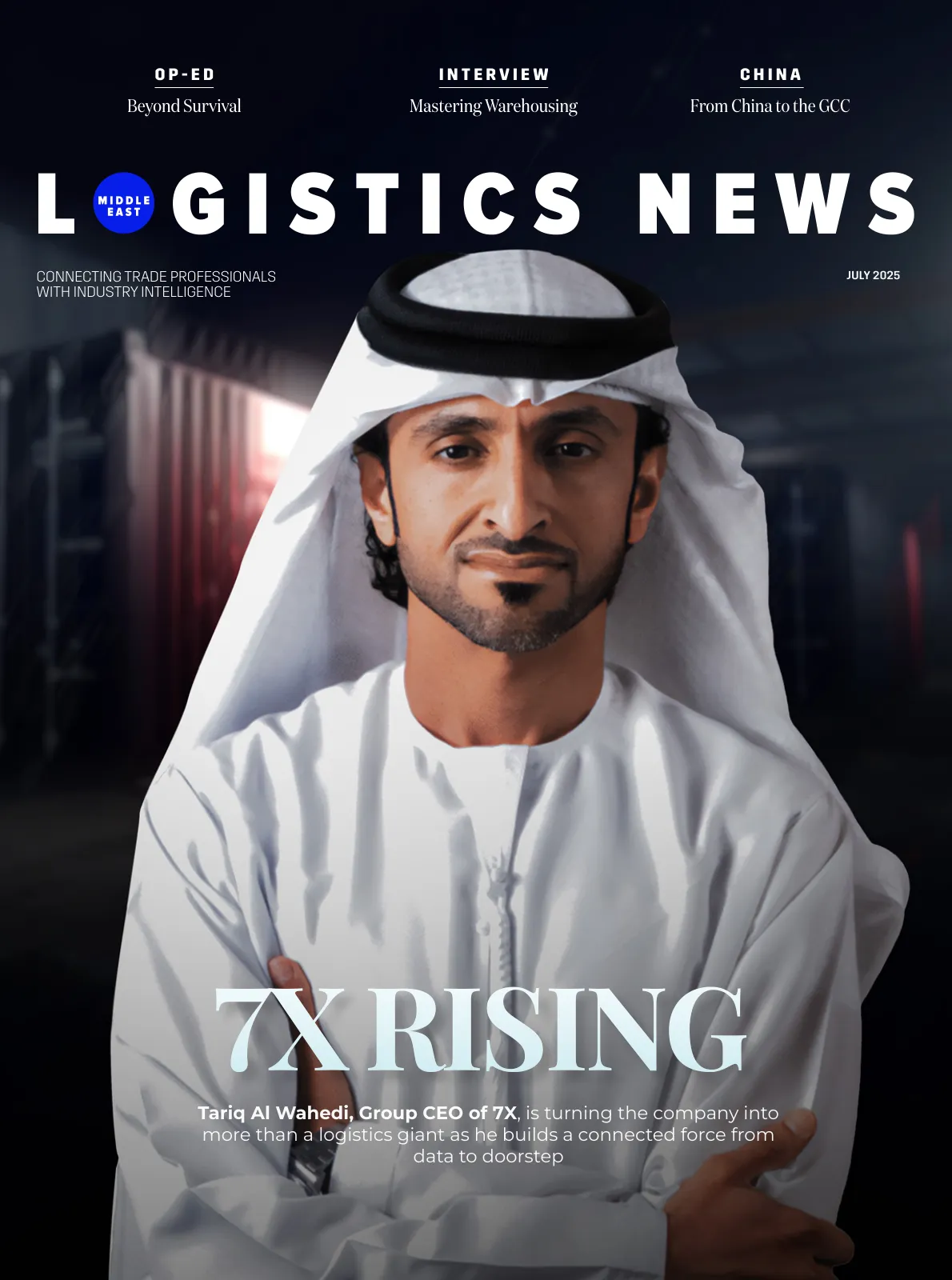
Tariq Al Wahedi, Group CEO of 7X, is turning the company into
more than a logistics giant as he builds a connected force from
data to doorstep
7X RISING
7X RISING
Page 2
New IVECO S-Way: high technology and efficiency on all missions
A wide choice of Euro III / V diesel engines, delivering class-leading power from 360 hp
to 560 hp Euro III / 570 hp Euro V and superior fuel economy.
12-speed HI-TRONIX automated transmission with the most advanced technology
in its category, electronic clutch and best-in-class torque-to-weight ratio.
Full range of fuel-saving devices, such as anti-idling feature, EcoSwitch, Ecoroll and Smart Alternator.
Top levels of comfort and safety, with a completely redesigned and reinforced cab,
featuring enhanced direct visibility and enlarged cab livability.
Drive the new way.
Page 3
LOGISTICS NEWS ME | JULY 2025 | 3
WWW.CBNME.COM
IN THIS ISSUE
28 COVER STORY
7X RISING
34 TECHNOLOGY
BUILT TO WORK TOGETHER
36 INTERVIEW
MASTERING WAREHOUSING: A
CONVERSATION WITH MAS LOGISTICS
CEO
44 AI
NAVIGATING THE DOUBLE EDGE
16 TALKING POINT
REWIRED ROADS TO A GREENER
FUTURE
18 OP-ED
BEYOND SURVIVAL
22 KSA
THE HUMAN-TECH HARMONY
24 E-COMMERCE
PRECISION, PERFORMANCE, AND
PEOPLE
46 SUSTAINABILITY
LEAN, GREEN, ON THE MOVE
50 CHINA
7X RISING
54 SUPPLY CHAIN
THE LOGISTICS BOOM
BEHIND THE BOOM
50
18
28
Page 4
Nestled by the coast of Lusail sits the splendor of
Raffles and Fairmont Doha, where luxury is rooted
in even the smallest details. Open the doors to
mesmerizing hospitality and make memories in a
world of sophistication.
Page 5
Page 6
6 | LOGISTICS NEWS ME | JULY 2025
WWW.CBNME.COM
SUBSCRIBE
subscriptions@bncpublishing.net
PO Box 502511 Dubai, United Arab Emirates
P +971 4 4200 506 | F +971 4 4200 196
For all commercial enquiries, contact jo@bncpublishing.net
T +971 50 440 2706
All rights reserved © 2025.
Opinions expressed are solely those of the contributors.
Logistics News ME and all subsidiary publications in the MENA region are
officially licensed exclusively to BNC Publishing in the MENA region by
Logistics News ME.
No part of this magazine may be reproduced or transmitted in any form or
by any means without written permission of the publisher.
Printed by United Printing and Publishing | upp.ae
Images used in Logistics News ME are credited when necessary. Attributed use of
copyrighted images with permission. All images not credited courtesy Shutterstock.
cbnme.com
ACCESS FRESH CONTENT DAILY ON OUR WEBSITE!
Logistics News ME
@Logisticsnewsme
Logistics News ME
In addition to our print edition, we’re bringing
you all sorts of industry news on our web
mediums. We’re looking forward to interacting
with our readers on all of our social media and
web platforms. See you on the web!
CEO
Wissam Younane wissam@bncpublishing.net
Managing Director
Rabih Najm rabih@bncpublishing.net
Group Publishing Director
Joaquim D’Costa jo@bncpublishing.net
Commercial Director
Andrea Mocay andrea@bncpublishing.net
Editor
Aya Zhang aya@bncpublishing.net
Digital Reporter
Reeba Asghar reeba@bncpublishing.net
Creative Lead
Christian Harb chriss@bncpublishing.net
Editorial Design
Rizaldi Febrian
Marketing Executive
Aaron Joshua Sinanbam aj@bncpublishing.net
Videographer
Eduardo Buenagua
CONNECTING TRADE PROFESSIONALS WITH INDUSTRY INTELLIGENCE
Page 7
Page 8
8 | LOGISTICS NEWS ME | JULY 2025
WWW.CBNME.COM
T
here was a time when logistics quietly
supported everything behind the scenes, off
the radar. That time is over.
Today, this industry is out front. It’s setting
the pace rather than following it. The Middle East is
no longer just a link in the global supply chain but the
critical backbone of it. Smart ports,
autonomous fleets, AI-managed
warehouses, carbon-cutting corridors,
what used to be buzzwords are now
business plans. What used to be future
goals are now current operations.
In this issue of Logistics News ME, we go
inside that shift.
We look at technologies reshaping
efficiency, not years from now, but right
now. From Tariq Al Wahedi’s connected
logistics network at 7X, to Fawad
Ahmed Mian’s AI-driven platform at
Mile, and Mohamed Salah Al-Sulaim’s
warehousing innovations at MAS
Logistics, regional players are designing
infrastructures that answer to speed,
scale, and sustainability all at once.
Yes, the challenges are real, from
regulatory friction to talent shortages
and geopolitical pressure, but the
progress is undeniable. The momentum
is regional, and the message is that
logistics in fact isn’t waiting anymore.
Neither should you.
LNME
Logistics Is the Main Character
Aya Zhang
Editor
aya@bncpublishing.net
Xiaoyue (Aya) Zhang
xiaoyuezhangg
EDITOR’S NOTE
Page 9
Page 10
Page 11
Page 12
12 | LOGISTICS NEWS ME | JULY 2025
WWW.CBNME.COM
REGIONAL NEWS
LNME
SAUDI GLOBAL PORTS GROUP AWARDED FOUR 20-YEAR CONCESSIONS
TO OPERATE KEY MULTIPURPOSE TERMINALS
S
audi Global Ports
Group (together with
its subsidiaries, “SGP”),
through its subsidiary,
Modern Port Services
Company Limited (SGP
Multipurpose Terminals, “SGPMP”),
has been awarded four 20-year
concession agreements by the Saudi
Ports Authority (“Mawani”) to operate
multipurpose terminals along the
Eastern Coast of Saudi Arabia, located
at King Abdulaziz Port Dammam
(“KAPD”), Jubail Commercial Port
(“JCP”), King Fahad Industrial Port
Jubail (“KFIP”) and Ras Al-Khair Port
(“RAK”). The concession agreements
were signed by the CEO of SGP Mr. Rob
Harrison and the Acting President of
Mawani Mr. Mazen bin Ahmed Al-Turki,
and witnessed by His Excellency the
Minister of Transport and Logistics
Services H.E. Saleh Al Jasser, the
Chairman of Board of Saudi Global
Ports, Eng. Abdullah Al Zamil and Vice
Chairman of the Board of Saudi Global
Ports, Mr. Bakr AlMuhanna.
An established terminal operator in
Saudi Arabia, SGP is currently the
operator of container terminals at
KAPD and the rail intermodal Riyadh
Dry Port Ecosystem (Riyadh Dry Port,
Riyadh Empty Yard and Dammam
Empty Container Yard) and also has
an ongoing investment to develop
the Dammam Integrated Logistics
Zone (“DILZ”). In 2024, SGP handled
more than 4 million TEUs across its
ecosystem of seaports and inland
terminals, cementing itself as a leader
in the industry.
Under the four concession agreements,
SGP plans to invest more than 700
million Saudi Riyals (~USD 187 million)
to upgrade the terminals and purchase
new equipment. SGP also aims to
integrate the four multipurpose
terminals with its existing operations
across Dammam and Riyadh, and to
transform the terminals into more
efficient and resilient gateways
supporting the robust growth in the
Kingdom, which will be key for the
ongoing and upcoming mega projects
in the country.
Page 13
LOGISTICS NEWS ME | JULY 2025 | 13
WWW.CBNME.COM
AUTOWORLD INTERNATIONAL BUILDS AED 45 MILLION DISTRIBUTION
CENTER IN JAFZA
A
utoworld International FZCO, a leading regional
distributor for India’s Bajaj Auto Ltd, is investing
AED 45 million to develop a new logistics and
distribution hub in the Jebel Ali Free Zone (Jafza).
The facility will enhance Autoworld’s ability to
serve rapidly growing markets across Africa and the Middle
East with affordable, fuel-efficient two- and three-wheelers.
Spanning over 162,000 sq. ft, the facility will include an
assembly plant for Bajaj motorcycles and three-wheelers,
as well as storage and distribution space for spare parts,
tyres, and lubricants. Scheduled for completion by 2026,
the hub will also support the introduction of new product
lines through partnerships with international manufacturers,
strengthening the company’s presence.
The global two- and three-wheeler market is expanding
quickly, particularly in emerging economies where
urbanisation, e-commerce, and last-mile delivery needs are
reshaping mobility needs. Industry analysts project Africa’s
two-wheeler market alone will grow at nearly 5% annually,
driven by demand for affordable and fuel-efficient vehicles.
“This facility marks a major step forward in our growth
strategy. Jafza’s
connectivity, infrastructure,
and business-friendly
environment have helped
us serve high-growth
markets across Africa
and the GCC since 2008.
With this investment,
we are living up to our
commitment to the region
and to the Bajaj brand,”
said Vishal Kumar Lakhani,
Director at Autoworld.
Abdulla Al Hashmi, Chief
Operating Officer, Parks
and Zones, DP World
GCC, added, “Autoworld’s
expansion underscores
the strength of Jafza’s
integrated trade and
logistics ecosystem
which now connects 940
automotive companies
from 88 countries.
Last year alone, Jafza
supported automotive
trade valued at nearly AED 102 billion. We are proud to
support long-term partners like Autoworld, who are helping
connect world-class manufacturing with high-potential
markets through Dubai.”
The project is expected to create over 100 direct and indirect
jobs, supporting Dubai’s growing mobility and logistics
ecosystem. It also strengthens the UAE’s role as a central
trade hub connecting manufacturers with global markets.
The agreement was officially signed in the presence of
Abdullah Bin Damithan, CEO and Managing Director of
DP World GCC; Abdulla Al Hashmi, Chief Operating Officer,
Parks & Zones at DP World GCC; Kumar Motiram Lakhani,
Chairman of Autoworld; Monish Lakhani, Managing Director at
Autoworld and Vishal Lakhani, Director at Autoworld.
Autoworld has operated from Jafza for over 16 years,
leveraging its world-class multimodal infrastructure to
distribute Bajaj vehicles across 25+ countries. The move aligns
with DP World’s broader strategy to develop automotive trade
in the region, including its plan to build the world’s largest car
market in Dubai, which is expected to double current annual
sales of AED 6.8 billion.
REGIONAL NEWS
Page 14
14 | LOGISTICS NEWS ME | JULY 2025
WWW.CBNME.COM
J&T EXPRESS SETS NEW RECORD WITH 13.99 BILLION PARCELS
IN H1 2025
J
&T Global Express Limited, a global logistics service
provider, announced its key operating metrics for the
second quarter and first half of 2025. For the second
quarter ended 30 June 2025, the company handled
approximately 7.39 billion parcels, a 23.5% year-on-
year increase, with an average daily parcel volume of 81.2
million.
Meanwhile, in the first half of 2025, the company’s total parcel
volume reached 13.99 billion parcels, a 27% year-on-year
increase, with an average daily parcel volume of 76.9 million.
In both the second quarter and the first half of this year, J&T’s
total parcel volume reached new highs, with parcel volumes in
all major markets continuing to achieve double-digit growth.
As the leading express delivery company in Southeast Asia
for five consecutive years, J&T Express achieved robust
growth in the region during the second quarter of this year.
Parcel volume in Southeast Asia reached approximately
1.69 billion, marking a 65.9% year-on-year increase – the
fastest single-quarter growth since the company’s listing. The
average daily parcel volume stood at 18.5 million. For the first
half of the year, the company’s Southeast Asia parcel volume
grew by 57.9% year-on-year to 3.23 billion, with an average
daily volume of 17.7 million.
The strong performance in Southeast Asia during the
period was primarily driven by J&T’s strengthened strategic
partnerships with mainstream e-commerce platforms, local
brands, and clients across various industries, fostering
mutually beneficial growth.
In the second quarter, increased promotional efforts and
a wider range of product categories from e-commerce
platforms significantly boosted business volume. As
an independent enabler for e- commerce, J&T Express
successfully capitalised on the overall growth opportunities
within the region’s e-commerce sector. This was achieved by
leveraging J&T’s high-quality, cost- effective services, thereby
consistently solidifying its market-leading position.
Concurrently, the company’s partnerships with local
brands across Southeast Asian countries and the proactive
expansion into non-platform parcel services have also
yielded significant results, becoming another crucial engine
driving business growth in Southeast Asia.
REGIONAL NEWS
LNME
Page 15
LOGISTICS NEWS ME | JULY 2025 | 15
WWW.CBNME.COM
DUBAI CUSTOMS AND CBIC UNITE TO ACCELERATE BILATERAL TRADE AND
LOGISTICS
A
s part of its ongoing
efforts to develop
international economic
relations and facilitate
trade between Dubai and
its trading partners, Dubai Customs
hosted an expanded meeting with
the participation of a delegation from
the Republic of India, headed by Arti
Agarwal Srinivas Director General,
Directorate General of Systems and
Data Management at the Central Board
of Indirect Taxes and Customs (CBIC).
A delegation from DP World also
participated in the meeting. The
meeting tackled ways to enhance
cooperation in inter-MENA trading
trends and supply
chain, logistics services,
fast-tracked clearance
procedures, and customs
facilitations used to
accelerate trade movement
and increase the flow of
goods. The meeting also
discussed the development
of the India-Middle East-
Europe Economic Corridor
(IMEEC) and its associated
virtual trade corridor.
At the beginning of the
meeting, His Excellency Dr.
Abdulla Busenad, Director
General of Dubai Customs,
welcomed the visiting
delegation, emphasising
that this visit is part of the
Dubai Economic Agenda’s
vision to enhance Dubai’s
role as a global trade
and logistics hub. It also
underscores the strength
of relations between
Dubai and India, which are
witnessing rapid growth
across various economic
sectors. Dr. Busenad added
that Dubai Customs is
committed to facilitating
trade with its key Asian partners,
the first one of which is the Republic
of India. The overarching goals are
to promote investment, streamline
trade processes, and enhance Dubai’s
standing in global competitiveness
rankings.
For her part, the head of the Indian
delegation, Arti Agarwal Srinivas,
praised the significant developments
witnessed by Dubai’s customs and
logistics system, emphasising that
India views Dubai as a pivotal partner
in supporting the smooth flow of
supply chain and a strategic gateway to
markets in the Middle East, Africa, and
Europe.
The meeting was attended by Mansoor
Al-Malik, Executive-Director for
Policies and Legislation Division at
Dubai Customs, and Ateeq Al Muhairi,
the Executive Director of the Customs
Development Sector at Dubai Customs.
“The MAITRI platform” was reviewed; it
is a single digital platform that aims to
facilitate the data exchange between
Customs and Port systems in the UAE
and India. This aims to increase the
movement of goods, reduce delays and
customs costs, and open up broader
horizons for logistics partnerships that
serve common interests and keep pace
with future ambitions.
REGIONAL NEWS
Page 16
16 | LOGISTICS NEWS ME | JULY 2025
WWW.CBNME.COM
LNME
TALKING POINT
T
he transport sector is responsible for
nearly 25 per cent of the global carbon
emissions. Therefore, any credible effort
towards net-zero targets has to consider
strategies for optimising and innovating all
modes of transport. Historically, the economy of
the United Arab Emirates (UAE) relied heavily on
oil; however, this is no longer the case. The major
transition towards a diversified and sustainable
economy depends on innovative solutions for
energy diversification, environmental resilience
and economic transformation.
The UAE Net Zero by 2050 strategic initiative
guides the country’s sustainability journey.
Transport, as a carbon-heavy sector, is vital
for this transition. As part of the larger Energy
Strategy 2050, the government envisions
tripling the share of renewables in the power
mix and intends to invest AED 150 to AED 200
billion by 2030 to meet the country’s growing
energy demand, driven by a rapidly expanding
economy.
Recent statistics in
the UAE indicate
that road transport
alone accounts for
around 22 per cent
of the country’s
CO2 emissions.
This urges the
need for an
integrated solution
that includes
infrastructure
development,
policy innovations,
and behavioural
shifts. All are
currently being
progressed
through national
and emirate-level
initiatives.
Accelerating the
Electric Vehicles
(EVs) Revolution
Electrification is
a key component of sustainable transportation.
The UAE is launching an ambitious programme
to lead the region in electric mobility. According
to a recent PWC report, Dubai’s Roads and
Transport Authority (RTA) aims for 50 per cent of
all vehicles in the city to be electric or hybrid by
2030. The ATA announced a detailed roadmap
to meet that target. Abu Dhabi’s Department of
Energy supports the large-scale adoption of EVs
by providing subsidies and establishing public-
private partnerships. Masdar, the UAE’s top
renewable energy company, laid the foundation
for this change as part of this shift. Though
Masdar is recognised globally for its solar
and wind energy projects, it has progressively
invested in clean transport infrastructure and
innovation. Masdar City is a living hub for
sustainable urban mobility, with autonomous
EVs and pedestrian-friendly layouts that reduce
automobile reliance. Additionally, the UAE
government has heavily invested in increasing
the charging infrastructure to respond to the
surge in demand for EVs. According to PwC,
Originally written by Dr. Shereen Nassar.
Edited by: Vibha Mehta
Rewired Roads to a Greener
Future
Driving the UAE’s green future through smarter mobility
Dr. Shereen Nassar,
Global Director of Logistics Studies and Director
of MSc Logistics and Supply Chain Management
Suite at Heriot-Watt University Dubai
Page 17
LOGISTICS NEWS ME | JULY 2025 | 17
WWW.CBNME.COM
Dubai aims to improve the city’s
public Green Charging Station
network by 170 per cent, from 370
in 2023 to 1,000 by 2025.
Addressing Current Challenges
Despite the UAE’s ongoing
efforts toward sustainable
transportation, numerous
challenges must be addressed
to guarantee a green shift. One
primary concern with EVs is range
anxiety. This was augmented
by the dispersion of charging
stations, especially on long
routes between Emirates and
in remote areas. This raises
serious concerns about the
reliability of route planning and
service continuity for a logistics-
dependent economy.
Up-front costs for EVS remain
relatively high. For many fleet
operators, the transition presents
a challenge, despite the long-
term fuel and maintenance
savings. Similarly, the logistics
sector still relies heavily on
diesel-powered heavy vehicles,
which are a major source of
carbon emissions, particularly in
freight-intensive supply chains.
The UAE addressed these
challenges by implementing
an integrated strategy that
considered various dimensions.
One dimension offered
economic incentives such as
toll exemptions and discounted
vehicle registration that should
support logistics companies
in reducing their costs while
benefiting from using low-
emission vehicles. The strategy
also focuses on investing in
electrified public and freight
transport infrastructure, covering
urban and distribution networks.
This is part of a long-term shift
toward decarbonised urban
mobility.
Despite these challenges, the
UAE government aims to target
42,000 EV vehicles by 2030. The
EV sales forecast predicts a rise
in sales with a compound annual
growth rate (CAGR) of 45.84%
from 2024 to 2032. According
to Dubai Electricity & Water
Authority DEWA, in July 2023,
EVs could constitute up to 25 per
cent of new passenger and light
commercial vehicle sales by 2035.
Etihad Rail, in 2024, announced
that its operations are forecast
to reduce CO2 emissions by 21
per cent per year from the UAE’s
road transport sector by 2050, if
freight transport is shifted from
road to rail. For every train trip
made, Etihad Rail can remove 300
trucks from the streets, equating
to 8.2 million tonnes of CO2
annually.
The UAE is piloting hydrogen-
powered transport solutions
for industrial and heavy-duty
applications—an innovation
that, if scaled effectively, could
redefine the sustainability
landscape of freight mobility
in the region. However, with
the UAE’s current contracts
concerning the exportation
of hydrogen and ongoing
international conversations about
future cross-border trade in
clean hydrogen, one key concern
is whether the UAE intends to
prioritise green hydrogen exports
or local consumption. The UAE
remains heavily reliant on fossil
fuels for its energy and electricity
mix. The country’s initial focus is
likely to shift towards increasing
deployment of renewable energy
due to the significant potential
of new renewable capacity in
decarbonising the country’s
utilities and economies.
The UAE’s sustainability
path in the mobility sector is
emerging with a clear direction
guided by innovation, evolving
regulations, and incentives.
The UAE has demonstrated a
strong alignment between the
decarbonisation of the mobility
sector and its national energy
strategy, focusing on establishing
global partnerships and
investing in renewable energy
infrastructure. This qualifies
the UAE as a leading country
in setting a benchmark for a
climate-forward transport model.
However, sustaining these efforts
requires continuous innovation,
stakeholder engagement and
policy development. Key enablers
for a seamless, low-carbon
transport ecosystem include AI-
driven traffic management and
mobility-as-a-service (MaaS)
platforms. Moreover, behavioural
change and education campaigns
that alter societal attitudes
toward green mobility, particularly
among younger generations, will
enhance awareness and cultivate
a culture of sustainability and
champions.
As the UAE accelerates its
transition toward sustainability,
positioning transportation as a
cornerstone of decarbonisation
efforts represents an
environmental imperative and
a strategic lever to propel the
nation’s vision for a green, tech-
driven, and equitable tomorrow.
REWIRED ROADS TO A GREENER FUTURE
Page 18
18 | LOGISTICS NEWS ME | JULY 2025
WWW.CBNME.COM
LNME
OP-ED
Rodrigue Nacouzi,
Founder and CEO of Transcorp International
Beyond Survival
Originally written by Simon Bowes.
Edited by Aya Zhang.
Building resilient supply chains to withstand
unforeseen disruptions
G
lobal supply chains remain in constant
turmoil, with many organisations facing
unprecedented levels of disruption
to their business operations. Amidst
an unfavourable global economic climate, with
limited indications of improvement, consumer
confidence remains persistently low.
International trade tensions and evolving tariffs
continue to challenge supply chains worldwide,
with ripple effects felt across markets. For
example, ongoing US-EU tariff adjustments
and trade negotiations between the UK and the
US create uncertainty that can disrupt supply
routes and costs.
Page 19
LOGISTICS NEWS ME | JULY 2025 | 19
WWW.CBNME.COM
BEYOND SURVIVAL
Yet, amid this turbulence, the
UAE continues to demonstrate
resilience. Positioned as a key
logistics and trade hub in the
Middle East, the country’s rapidly
growing non-oil trade surged to
a record AED 3 trillion (USD 817
billion) in 2024, up 14.6% from
the previous year, as it leans on
strategic trade deals to drive
future growth.
Perhaps the UAE’s promising
progress is an outlier, but activity
overseas highlights the critical
need for resilient and agile
supply chains to navigate both
global disruptions and regional
developments.
Add in increased costs, labour
shortages, rising geopolitical
tensions, cybersecurity attacks,
and weather-related disasters,
and it’s clear that a state of
perpetual instability is becoming
the norm for today’s supply
chains. In the UAE, companies
must also consider region-specific
risks such as port congestion
during peak trade seasons, cross-
border logistics dependencies,
and extreme weather events like
sandstorms or flooding, all of
which can disrupt supply and
distribution timelines.
Senior executives agree. In Blue
Yonder’s recent survey, 84% said
they had encountered disruptions
within their supply chain over
the past year. This illustrates
the need to be prepared for the
unexpected, understand the
potential consequences, and have
a plan in place to mitigate such
risks.
But how can organisations go
about creating a strategy for
events that are, by their nature,
unpredictable?
The answer is by building
a comprehensive plan that
brings together the capabilities,
processes and technologies
needed to continue operating
efficiently, come what may.
Inclusive, End-to-End Supply
Chain Planning
The first step is to create an
overarching strategy that
encompasses the entire supply
chain. Having visibility across
Page 20
20 | LOGISTICS NEWS ME | JULY 2025
WWW.CBNME.COM
LNME
OP-ED
all areas will support synchronised planning and
communication across disparate functions.
By bringing together teams and processes,
organisations can start to overcome the traditionally
fragmented approach to supply chain management.
Uncoordinated procedures inevitably create an
inefficient and weaker supply chain, which makes it
particularly vulnerable to disruptions.
Whereas, resilience is strengthened by collaboration
between functions, if backed with integrated data
systems and communication methods to enable
sharing of real-time information.
A recently published Supply
Chain Compass Report that
polled nearly 700 global
industry leaders reinforces
this notion; 45% highlighted
investments in tracking and
visibility solutions as essential
to achieving strategic goals,
showcasing the importance
of end-to-end visibility and
seamless integration across the
supply network.
Essentially, keeping all parties in
the loop, with relevant data and
meaningful insights, encourages
better and faster responses to
problems, as well as increases
awareness of potential
forthcoming issues.
Ideally, what’s needed is an
end-to-end connected platform
where all departments, offices
and sites are working from
the same consistent, up-to-
date data. And, one that is not
required to change systems
to find or cross-check relevant
information and iron out
anomalies.
Incorporate AI and
Automation
Next, it’s vital to incorporate
intelligent automation to improve and speed up
decision making. Companies are already using data
tools to forecast supply and demand planning, but
they now have the opportunity to incorporate AI’s
‘always-on’ capabilities to dynamically evaluate and
adapt to changes in supply and demand.
AI-powered solutions can assess how work is
progressing by automating data gathering for
analysis and optimisation. Automation can handle
routine issues, leaving supply chain professionals
free to focus on more strategic tasks. Furthermore,
Simon Bowes,
CVP Manufacturing Industry Strategy
EMEA at Blue Yonder
Page 21
LOGISTICS NEWS ME | JULY 2025 | 21
WWW.CBNME.COM
BEYOND SURVIVAL
AI can facilitate transparent, trackable decision-
making to accommodate predicted supply chain
disruptions or react to unexpected ones.
The significance of embracing AI and automation
is clearly showcased with a substantial 83%
of global supply chain leaders actively using
or implementing AI-powered automation to
strengthen operational resilience and enhance
decision-making capabilities
. This wide-scale
adoption reflects the industry’s growing reliance
on AI to proactively manage disruptions and
maintain agility. Moreover, this level of auditing
provides vital insights that will help refine future
decisions and actions for the next time similar
circumstances materialise, improving outcomes
in the long-term.
Additionally, organisations can leverage AI
to predict the likelihood of disruptive events
happening. Knowing how often they occur and
how they have unfolded in the past can inform
decision-making and planning. Whether that’s
examining competitor behaviour or economic
trends, AI tools can process millions of pieces
of real-world data to model likely what-if and
worst-case scenarios that could impact the
supply chain. While these instances may seldom
occur, proactive scenario pre-planning provides
the foundation for an effective response in the
event of real-world disruptions or disasters.
Organisations should identify the specific issues
which present the highest risk to their business
and ensure appropriate mitigation measures are
ready to be activated immediately, when they
are needed.
Invest in Agile, Scalable Technology
Restrictive working practices coupled with
outdated technology can make it harder to react
effectively when disruptions occur. Building
long-term supply chain resilience means finding
a best-in-class solution and partner with deep
domain expertise to guide deployment of
appropriate modern technologies.
When considering options, businesses should
keep in mind fundamental requirements
for flexible, agile solutions. These include
checking how a software or platform supports
data integration and cross-organisational
collaboration, whether it can simulate market
conditions in near real-time, if the technology
architecture is compatible with AI, and how
easily it scales.
Implementing new technology is a leading
priority for 51% of global supply chain leaders
over the next three years. Furthermore, 61% plan
to invest significantly (between USD 1 million to
USD 10 million) in supply chain technologies,
clearly demonstrating the widespread
recognition of agile, scalable, and innovative
platforms as important to building resilient
supply chains.
It’s critical to have a technology platform that’s
designed for scalability and extensibility to
manage changing workloads and requirements.
Therefore, organisations should look for
products with a cloud-native architecture for
scalability and resilience, a microservices-
based approach for flexibility, and solutions
that are easy to configure and maintain without
specialised IT expertise.
In an unstable commercial world, it’s essential
for entities to build resiliency into their end-to-
end supply chain and have the right technical
infrastructure to do this. What’s more, investing
in modern technologies and platforms can
bring other benefits too. Modern solutions that
respond easily to changing conditions, remove
manual processes, and leverage the powerful
potential of AI can also deliver competitive
advantage. For example, utilising AI’s power for
data crunching and analysis can uncover hidden
opportunities that arise out of unexpected
events but may have gone unnoticed in the past.
By making well-informed technology choices,
organisations can build more resilient supply
chains not just to survive in today’s unstable
conditions, but also to optimise performance
and operate more profitably.
Page 22
22 | LOGISTICS NEWS ME | JULY 2025
WWW.CBNME.COM
LNME
KSA
The Evolving Logistics Imperative
Saudi Arabia’s supply chain landscape is evolving
— rapidly and purposefully. As Vision 2030
reshapes the business environment, logistics now
stand at a powerful intersection: where advanced
technologies meet irreplaceable human insight.
At Starlinks, we’ve embraced a core belief — real
transformation doesn’t come from choosing
between innovation and intuition. It comes from
aligning them. This isn’t just about deploying the
latest tools; it’s about fundamentally rethinking
how supply chains operate, respond, and serve
with intelligence and adaptability.
When Innovation Meets Experience
Today’s most successful logistics operations
balance technological precision with human
expertise. Advanced
systems analyse vast
data and predict trends
accurately, but it is human
insight that converts
those insights into timely,
effective decisions.
Take the recent sandstorms
in Jeddah. Our AI-driven
platforms promptly
flagged supply chain
risks, generating accurate
alerts. However, it was
our experienced logistics
managers, leveraging
local knowledge, who
adjusted safety stock levels
and rerouted shipments
according to disruption
patterns beyond any
algorithm’s scope.
This synergy — technology,
laying the groundwork
and human intelligence
guiding strategy — is what
sets us apart. While our
Transportation Management
Systems optimise
routes and monitor KPIs,
continuous feedback from drivers and field teams
refines our processes and elevates service quality.
Retail Agility: The Empathy Factor
In the fast-moving world of logistics —
particularly in sectors like F&B and quick-
commerce — agility isn’t optional, it’s critical.
At Starlinks, we’ve seen that the most resilient
supply chains are built when technology and
human capability work in true alignment.
Our fulfilment network combines highly
automated hubs with traditionally operated sites.
Robotics and data analytics underpin our speed,
accuracy, and scalability. Yet, the real strength
lies in how our teams use these systems with
precision and intent.
Originally written by Hiba El-Mohbi.
Edited by Aya Zhang.
The Human-Tech
Harmony
Starlinks is proving that the future isn’t about man
or machine, it’s about the magic that happens when
both work in sync
Hiba El-Mohbi,
Executive Director & B2B
General Manager, Starlinks
Page 23
LOGISTICS NEWS ME | JULY 2025 | 23
WWW.CBNME.COM
THE HUMAN-TECH HARMONY
During Ramadan, demand surged over 40%
beyond our most aggressive forecasts. Our BI
dashboards and automation systems responded
immediately — providing real-time visibility,
highlighting operational pressure points, and
reallocating resources. But the true impact came
from our warehouse leads. Armed with these
insights and deep local understanding, they made
precise floor-level adjustments: reconfiguring
picking paths, shifting workforce allocations to
meet night-order peaks, and prioritising SKUs
aligned with Iftar and Suhoor needs.
These were not overrides of systems, but frontline
decisions powered by operational empathy
— people interpreting context and working in
tandem with technology to serve customers with
purpose.
This harmony of system-driven scale and human
adaptability defines our approach. The results
speak for themselves: we not only avoided
stockouts during this critical period but also
achieved an 18% revenue uplift for partners who
trusted our collaborative model.
The Core Truth: Ownership Drives Results
Here’s what technology alone can never solve for:
Operational empathy: In a recent chilled shipment
challenge for a key F&B client, our team’s agility
and ownership were paramount. SOPs provided a
framework, but success depended on cross-team
collaboration. Drivers and operations personnel
coordinated to reroute the shipment through
cross-docks, preserving product quality end-to-
end. This went beyond process compliance — it
reflected a culture of accountability and care.
Contextual intelligence: As one Riyadh
operations lead said, “Dashboards show the
‘what,’ but our teams understand the ‘why.’” This
understanding transforms data into meaningful
action, grounded in local insight.
Ethical innovation: Real-time blockchain tracking
offers transparency, but it’s human accountability
that guarantees our commitments—far beyond
what technology alone can ensure.
Building Trust Through Radical Collaboration
The future of logistics demands that we tear down
these “black boxes” once and for all:
Transparency as culture: We share dashboards
showing inventory flows, robotics efficiency, and
carbon footprints because this shifts our clients
from being spectators to becoming co-pilots in
this journey. We’re in it together.
Wisdom integration: Our retail partners embed
priority rules directly into our WMS; automotive
clients co-set TMS alert thresholds with us. This
approach completely erodes those old vendor-
client barriers that don’t serve anyone.
Reliability redefined: SFDA-certified cold chains
provide the framework we need, absolutely. But
it’s the daily human validation of sensitive goods
that ensures our promises translate to reality for
our customers.
The Path Forward
As Saudi Arabia steps confidently toward its
economic future, the logistics sector must evolve
with it — not just in scale, but in substance.
The supply chains that will lead this
transformation are the ones that embrace three
fundamental truths:
•
Algorithms calculate; people innovate.
•
Data informs; context decides.
•
Technology enables; passion executes.
At Starlinks, we’ve learned that warehouses
thrive not when people serve systems, but when
systems empower people to excel. This harmony
between technological precision and human
ingenuity builds resilience, accountability, and
performance — simultaneously.
Looking ahead, as Vision 2030 unfolds, this
human-tech symbiosis could well become Saudi
Arabia’s most valuable export to the global
logistics industry. And honestly? I can’t wait to
see it happen.
Page 24
24 | LOGISTICS NEWS ME | JULY 2025
WWW.CBNME.COM
Precision, Performance,
and People
Driving Brands For Less into
New Territories
Brands For Less’ logistics
infrastructure is fundamental
to its expansion strategy. The
company has built a scalable
and agile logistics network
that enables entry into new
markets efficiently while
maintaining critical supply chain
requirements. This includes
strategically located warehouses,
streamlined customs processes,
and strong partnerships with
multinational service providers.
The UAE headquarters supports
replenishment across the group
and online fulfilment with speed
and flexibility, ensuring product
availability across all locations.
Inside Brands For Less’ Smarter
Warehousing
Brands For Less has embraced
automation and digital tools
across its warehousing and
distribution functions. From
warehouse management systems
(WMS) and robotics to handheld
scanners and data-driven picking
strategies, the company ensures
real-time visibility, minimises
errors, and reduces processing
time. Over 400 robots are
currently used to segregate stock
between stores, significantly
improving stock accuracy,
streamlining inventory control,
and reducing inventory losses.
Demand Balance Across
Regional Markets
Brands For Less uses a hybrid
approach that combines data
analytics with human insight.
Planning teams analyse historical
LNME
E-COMMERCE
Khaled Arnaout, Chief Operating Officer at Brands For Less, is steering the brand’s growth with
smart logistics, digital innovation, and a sharp focus on customer experience
LNME
E-COMMERCE
Page 25
LOGISTICS NEWS ME | JULY 2025 | 25
WWW.CBNME.COM
sales data, seasonality trends,
promotional activities, and market
signals to forecast demand. Close
alignment with commercial and
buying teams ensures timely
adjustments, helping reduce
overstock, avoid stockouts, and
maintain optimal inventory
levels across all stores, including
e-commerce, and warehouses.
Delivering with a Conscience
The company has implemented
multiple sustainability initiatives
across its supply chain, including
optimising truck routes to reduce
fuel consumption, transitioning
to LED lighting in warehouses
and offices, and launching water
conservation efforts. Digital
documentation is encouraged
to reduce paper usage, and
partnerships with green logistics
providers are under evaluation to
further minimise the company’s
carbon footprint.
Sustainability is deeply
embedded in Brands For Less’
ESG (Environmental, Social,
and Governance) framework,
which guides its commitment
to responsible supply chain
management. Initiatives include:
•
Solar panel installations
across warehouses, head
offices, and flagship stores
•
Waste segregation and
recycling programmes for
both trade and non-trade
waste, alongside partnerships
with recycling companies
for further processing and
upscaling
PRECISION, PERFORMANCE, AND PEOPLE
Khaled Arnaout,
Chief Operating Officer at Brands For Less
Page 26
•
Optimised transportation logistics to reduce fuel
consumption and CO₂ emissions
•
LED lighting retrofits in warehouses and offices to
cut energy usage
•
Digitisation of supply chain documentation to
reduce paper waste and improve transparency
•
Supplier engagement programmes focused on
carbon reduction and sustainable packaging
•
Board-level oversight of ESG strategy and
performance to ensure long-term accountability
These efforts reflect the company’s long-term vision
to build a resilient, ethical, and
environmentally responsible
supply chain that supports
both business performance
and sustainability.
Digital Tools Behind the
Competitive Edge
Digital innovation is a key
enabler of Brands For Less’
competitive advantage,
allowing operations to
run with greater speed,
precision, and intelligence.
The company leverages
advanced technologies
across its network — from
automated warehousing and
real-time inventory visibility
to data-driven forecasting
and intelligent supply chain
optimisation. These tools
allow Brands For Less to
quickly adapt to market shifts
and reinforce its position as
the leading off-price retailer
in the region.
Building Lasting Loyalty
Customer experience remains
central to the company’s
strategy. In-store, Brands For
Less curates a treasure-hunt
shopping experience with
daily fresh assortments and
clear visual merchandising. Online, it ensures fast
delivery, easy returns, and a seamless user interface.
By making iconic brands accessible at unbeatable
prices, the company continues to spread smiles and
drive loyalty.
Customer loyalty is nurtured through consistent
value, exceptional service, and personalised
communication via digital channels and CRM
systems. Active feedback loops allow the company to
refine offerings continuously based on real customer
insights.
LNME
E-COMMERCE
26 | LOGISTICS NEWS ME | JULY 2025
WWW.CBNME.COM
Page 27
12–14 September 2025
ADNEC • Abu Dhabi
Organised by:
P.O. Box 52641, Abu Dhabi UAE
+971 2 674 4040
arun.bose@domeexhibitions.com
www.realestateshow.ae
Gateway to Prime UAE Real Estate
Meet Experts, Make Smart Moves
Residency & Investment Opportunities
LOGISTICS NEWS ME | JULY 2025 | 27
WWW.CBNME.COM
Page 28
28 | LOGISTICS NEWS ME | JULY 2025
WWW.CBNME.COM
LNME
SEAMLESS MIDDLE EAST
Tariq Ahmed Al Wahedi
Group CEO 7X
Page 29
LOGISTICS NEWS ME | JULY 2025 | 29
WWW.CBNME.COM
7X RISING
Tariq Al Wahedi, Group CEO of 7X, is turning the company into
more than a logistics giant as he builds a connected force from
data to doorstep
7X RISING
7X RISING
I
n April 2025, 7X - the UAE-based
investment and holding group
operating across trade, transport,
and logistics - announced the
appointment of Tariq Ahmed Al
Wahedi as its new Group CEO,
following approval from the Board of
Directors. This strategic move marks
a pivotal moment in 7X’s ongoing
organisational and operational
transformation, aimed at reinforcing
its position both locally and globally,
while driving accelerated growth
and innovation across its portfolio of
subsidiaries.
Al Wahedi brings more than 20 years
of leadership experience spanning
logistics, CEP solutions, investment,
agri-food technologies, and venture
capital. In his most recent role,
as General Manager of EMX, he
successfully led the company’s strategic
expansion, solidifying its role as a
regional logistics leader. Throughout his
career, he has held senior roles across
multiple industries, spearheading
transformative strategies, overseeing
complex mergers and acquisitions,
and attracting significant foreign
direct investment. With his breadth
of expertise and forward-thinking
leadership, Al Wahedi is well poised
to propel 7X into its next chapter of
ambitious growth and global influence.
In this exclusive interview, Al Wahedi
shares his vision for 7X’s future, the
strategic priorities shaping its next
phase of growth, and how the Group
plans to redefine the logistics and
trade landscape through innovation,
integration, and investment.
Page 30
30 | LOGISTICS NEWS ME | JULY 2025
WWW.CBNME.COM
LNME
COVER STORY
You’ve just stepped into one of the UAE’s
most ambitious trade, transport and
logistics groups. What’s the first bold move
on your radar as Group CEO of 7X?
Reimagining 7X not as a traditional operator,
but as an enabler of commerce and
connectivity. This marks a significant shift:
one focused on accelerating the integration of
our digital infrastructure and physical assets
to build a seamless, data-driven logistics
ecosystem. In doing so, we are transforming
logistics from a fragmented experience into a
unified national platform — one that removes
friction, eliminates bureaucracy, and brings
integrated services under one roof.
We are embedding advanced technologies
that drive interoperability, transparency, and
Page 31
LOGISTICS NEWS ME | JULY 2025 | 31
WWW.CBNME.COM
speed, while forging strategic
public-private partnerships to
create seamless access to all
our services. This is to position
7X at the heart of the UAE’s
transformation - for a future
where logistics powers economic
resilience, digital inclusion,
and future industries. Our
focus extends beyond
operational efficiency,
to create a trusted,
accessible, and easy
journey for the people and
businesses we serve.
Transformation is a
buzzword, but what
does real, boots-on-the-
ground transformation
look like at 7X under
your leadership?
At 7X, transformation means
outcomes, not just initiatives.
It’s about building platform-
based infrastructure that
is agile, scalable, and data-
enabled. We are operationalising
transformation through tangible
moves like restructuring delivery
ecosystems, digitising the entire
parcel journey, launching fintech
solutions that empower SMEs,
and embedding ESG principles
into our operations. We are also
innovating systems that adapt in
real-time, developing platforms
that scale with market shifts, and
providing frontline teams with
the tools and autonomy to lead
change.
Whether it’s digitising our
delivery networks or redesigning
service models, every initiative
is designed to activate the UAE’s
national priorities - from AI
and EV adoption to enhancing
customer trust and global trade
facilitation. Transformation is no
longer a back-office ambition; it’s
a front-line reality.
7X RISING
Page 32
32 | LOGISTICS NEWS ME | JULY 2025
WWW.CBNME.COM
Is 7X going to lead the logistics
game, or reinvent it? What
makes your model different
from regional players?
We are not here to lead an
existing model - we are here
to set a new benchmark. Our
competitive edge lies in the
convergence of infrastructure,
regulation, technology, and
capital. We operate as a digitally
intelligent ecosystem, integrating
freight, express, fulfilment, and
fintech through AI, automation,
and predictive logistics. From
drone deliveries and electrified
last-mile fleets to AI-powered
distribution models, we are
building logistics for the next era.
We are also building infrastructure
that’s open, modular, and ready
for Web3, IoT, and cross-border
innovation. Unlike others who
optimise within silos, we ensure
cross-domain impact to create
shared value at a national scale.
What sets us apart is our ability to
move fast, think big, and execute
with precision across every layer,
from e-commerce fulfilment to
national logistics infrastructure.
Everyone’s talking digital, but
how is 7X bringing the UAE’s
digital economy vision to life
through its logistics footprint?
For 7X, digital transformation goes
beyond adopting tools, it’s about
shaping entire ecosystems. We are
actively contributing to national
dialogues like the Policy Hack
with UICCA and Amazon, helping
to define the regulatory
frameworks that will power
EV adoption and smart
mobility. Our logistics
platforms are designed to
be interoperable, data-
rich, and future-ready,
laying the foundation for
a truly digital supply chain
that supports e-commerce,
fintech, and government
services alike.
Moreover, our
infrastructure is API-
ready, cloud-native,
and fully aligned with
national platforms such
as UAE Pass, TAMM, and
MOHRE. From a technology
standpoint, we are driving
digital transformation
through initiatives like
the CEP marketplace, the
Digital P.O. Box and our
carrier-agnostic PUDO
logistics network. These
ventures highlight 7X’s role
as the execution engine of
the UAE’s digital economy,
not just as a service
provider.
What makes the UAE a
uniquely powerful launchpad
for a logistics and trade
powerhouse like 7X?
LNME
COVER STORY
Page 33
LOGISTICS NEWS ME | JULY 2025 | 33
WWW.CBNME.COM
The UAE features a rare blend of regulatory
foresight, infrastructure sophistication, and global
connectivity, making it one of the few places where
ambitious ideas can seamlessly move from concept
to deployment. It’s a place where global ambition
meets fast execution, due to its strategic geographic
position, commitment to innovation, and investor-
friendly climate.
Hence, we are not constrained by legacy systems but
empowered by a national ecosystem that enables
bold experimentation, rapid scaling, and regional
leadership. Whether it’s piloting drone delivery
corridors or redefining postal franchising, the UAE is
both our proving ground and springboard to shape
the future of logistics within this region and beyond.
What kind of leadership culture are you
cultivating at 7X, and how do you keep teams
aligned in a high-speed, high-stakes industry?
At 7X, we are building a culture of entrepreneurial
accountability - where leaders at every level think
like owners, act with urgency, and are empowered to
deliver outcomes. We prioritise clarity of purpose,
cross-functional collaboration, and continuous
development through open lines of communication,
collective decision-making, and an unwavering
commitment to learning. In a fast-moving ecosystem,
alignment isn’t about control, it’s about shared vision
and real-time transparency. We ensure this through
structured governance, agile delivery models, and
open communication, wherein our people are not just
executors of a strategy but architects of the future.
What’s one big disruption you think the logistics
industry isn’t ready for, and how is 7X getting
ahead of it?
The next disruption in logistics will be driven by the
convergence of automation, robotics, sustainability,
and smart regulation. It’s no longer just about
speed, it’s about operating in a carbon-regulated,
AI-governed, and data-sovereign environment
characterised by agility and precision.
At 7X, we’re not just adapting to this future, we
are building it by working with regulators, tech
innovators, and climate institutions to future-
proof our capabilities, through drone logistics,
electric vehicle adoption, and AI integration. We
are also rolling out EV-ready infrastructure,
enabling regulated drone corridors, piloting robotic
automation in fulfilment, and deploying AI-driven
compliance and optimisation systems, to make our
network faster, smarter, and greener.
Presently, logistics is evolving into a nationally
integrated, automated utility - one that enables
same-day delivery, meets climate targets, secures
digital infrastructure, and powers trade. At 7X, we are
laying the foundation for a future where logistics
is not just a service, but a sovereign platform for
sustainable growth and innovation.
7X RISING
Page 34
LNME
TECHNOLOGY
M
ile has established
itself as one of Saudi
Arabia’s most advanced
logistics technology
providers. It is not just another
logistics software company but
the architect of the industry’s fully
integrated Multi Modal Logistics
platform, unifying every aspect of
logistics management through a
single codebase.
The company is revolutionising
logistics through the world’s
first truly integrated AI-powered
platform. Its mission is clear: to
eliminate the complexity that has
challenged logistics operations
for decades by delivering a unified
solution that works seamlessly
out-of-the-box.
As CPTO at Mile, Fawad Ahmed
Mian has witnessed firsthand
how fragmented systems have
held back the logistics industry.
His background in Enterprise
Solutions has driven the
company’s focus on creating
technology that genuinely solves
real operational challenges rather
than adding further complexity.
Saudi Arabia’s Fragmented
Last-Mile Challenge
The Saudi logistics landscape
has long been dominated by
fragmented systems, forcing
businesses to juggle multiple
platforms, APIs, and vendors
simply to gain basic visibility. As
a result, many companies have
found themselves spending more
time managing their technology
stack than optimising operations.
Mile has addressed this
complexity with a unified
architecture that integrates
Order Management, Warehouse
Management, Transportation
Management, CRM, Shipping
Aggregation, and Omni-Channel
Communication into a single,
seamless solution—requiring no
custom coding and eliminating
technical headaches.
What traditionally took months of
integration and development can
now be deployed within days. As
a result, businesses are achieving
levels of operational excellence
previously thought unattainable,
empowered by technology that
truly supports their workflows
rather than complicating them.
Revolutionary AI Capabilities:
Milo Introduction
Mile is proud to introduce Milo,
the region’s first AI Logistics
Agent. Far beyond standard
automation, Milo represents true
artificial intelligence that makes
autonomous decisions across the
entire supply chain, while keeping
data secure on local grounded
environments.
Drawing on real-time data from all
of Mile’s platform modules, Milo
delivers advanced capabilities
including autonomous route
optimisation, predictive inventory
management, intelligent
order prioritisation, proactive
customer communication, and
Fawad Ahmed Mian, CPTO & Co-
Founder of Mile, is on a mission to
simplify logistics with a platform
that thinks, acts, and scales as one
Built to Work
Together
Fawad Ahmed Mian,
CPTO & Co-Founder of Mile
34 | LOGISTICS NEWS ME | JULY 2025
WWW.CBNME.COM
Page 35
LOGISTICS NEWS ME | JULY 2025 | 35
WWW.CBNME.COM
BUILT TO WORK TOGETHER
dynamic pricing optimisation.
Effectively, it serves as an expert
logistics manager operating
24/7, enhancing efficiency and
performance across every aspect
of the operation.
Milo isn’t just processing
data—it’s making intelligent
decisions that improve with every
operation. It’s the difference
between automation and actual
artificial intelligence.
Unified Platform Architecture
The company’s breakthrough is
the unified codebase approach.
While competitors require
complex integrations between
separate systems, every Mile
module was built to work together
from day one.
Mile’s unified architecture enables
seamless integration across all
core logistics functions:
•
OMS & WMS: When an
order comes in, Mile’s OMS
immediately coordinates with
WMS for optimal fulfilment
without any data transfer
delays or synchronisation
issues.
•
TMS Integration:
Transportation planning
happens in real-time using
live order and inventory
data, enabling dynamic route
optimisation that traditional
systems simply can’t achieve.
•
CRM Connectivity: Every
customer interaction, delivery
update, and service issue is
automatically logged and
accessible across all modules,
creating a complete customer
view.
•
Shipping Aggregator: Mile
connects with multiple
carriers through one interface,
with Milo automatically
selecting optimal shipping
methods based on real-time
conditions and customer
preferences.
•
Omni-Channel
Communication: Customers
receive coordinated updates
across SMS, email, WhatsApp,
VOIP Calls and in-app
notifications—all triggered by
the same system events.
The logistics industry has been
held back by the false belief that
best-of-breed means separate
systems. Mile has proven that
true best-of-breed means
unified architecture where every
component enhances every other
component.
Multi-Modal Excellence
The company supports every
logistics operation mode through
one integrated platform: first-mile
supplier integration, middle-mile
distribution, last-mile delivery,
and reverse logistics for returns.
Each operation shares the
same data foundation, enabling
complete supply chain visibility.
Mile’s integrated approach has
delivered significant operational
improvements for businesses
across Saudi Arabia. Companies
report streamlined processes,
enhanced inventory accuracy, and
improved customer satisfaction—
all because they’re finally working
with technology designed to
integrate rather than fragment
their operations.
Industry Leadership &
Innovation
Mile is not merely participating in
the logistics technology market—
it is actively defining its future.
As the first to introduce a fully
integrated AI platform and the
world’s first AI Logistics Agent,
the company has established a
clear position of technological
leadership.
Unlike competitors that require
businesses to manage multiple
vendors and complex integration
projects, Mile delivers enterprise-
grade logistics management
as a fully unified, off-the-shelf
solution—eliminating the
need for custom development,
technical dependencies, or vendor
management complexity.
Future of Logistics in Saudi Arabia
Mile believes the future belongs
to platforms capable of delivering
intelligent automation across
fully integrated systems. Milo
marks only the beginning of what
becomes possible when AI is
granted access to complete, real-
time operational data.
As Saudi Arabia accelerates its
digital transformation under
Vision 2030, the need for scalable,
future-ready logistics solutions
is more critical than ever. Mile’s
unified platform provides the
technological foundation required
to support the Kingdom’s
economic diversification and
growth ambitions.
The company continues to
enhance Milo’s AI capabilities
and expand overall platform
functionality, unlocking a level of
sophisticated automation that
fragmented systems are simply
unable to achieve.
Page 36
36 | LOGISTICS NEWS ME | JULY 2025
WWW.CBNME.COM
LNME
INTERVIEW
In this interview with Mohamed Salah Al-Sulaim, CEO of MAS Logistics,
we explore how the company is transforming warehousing into a powerful
competitive advantage for businesses across industries
Mastering Warehousing:
A Conversation with MAS Logistics CEO
Mohamed Salah Al-Sulaim,
CEO of MAS Logistics
Page 37
LOGISTICS NEWS ME | JULY 2025 | 37
WWW.CBNME.COM
MASTERING WAREHOUSING: A CONVERSATION WITH MAS LOGISTICS CEO
Can you share your journey and
the story behind the growth of MAS
Logistics?
As the CEO of MAS Logistics, I’ve always
believed in the power of operational
excellence and long-term partnerships.
Since founding MAS Logistics in 2021,
we’ve grown from a single warehouse with
a capacity of 5,000 pallets to a leading
3PL provider with over 50,000 pallet
spaces across Saudi Arabia.
MAS Logistics specialises in third-
party logistics, with a focus on scalable
warehousing solutions and supply chain
support for a diverse range of sectors—
from food and retail to healthcare
and electronics. We combine strategic
infrastructure with professional teams
to offer flexible storage contracts,
advanced inventory systems, and a deep
commitment to customer success.
What is warehousing about nowadays?
How do you turn a warehouse into
a competitive advantage, not just a
holding space?
Today, warehousing is no longer just
about storing goods—it’s about enabling
businesses to move faster, reduce
overhead, and gain better control of
their operations. At MAS, we’ve built our
model around turning storage into value
creation. Our warehouses are equipped
with real-time inventory tracking,
temperature-controlled zones, and
optimised workflows that reduce waste
and enhance efficiency.
Page 38
38 | LOGISTICS NEWS ME | JULY 2025
WWW.CBNME.COM
LNME
INTERVIEW
Clients choose us because we don’t just hold
their inventory—we help them scale, pivot, and
serve their customers with precision and speed.
How are your clients’ expectations of
storage changing?
Clients now expect flexibility, visibility, and
integrated solutions. Gone are the days when
a fixed rack and long-term lease were enough.
Businesses today demand customisable
spaces, short-term contracts, and access to
real-time inventory data.
That’s why at MAS Logistics, we offer flexible
contracts, smart warehousing systems, and
scalable options tailored to growth stages.
Whether you’re a startup shipping 100 orders a
month or an enterprise managing thousands,
we adapt to your model—not the other way
around.
If a product sits in storage for 60 days,
what’s that costing the client, and how do
you flip that into value?
Every day a product sits idle, it costs the client
in terms of cash flow, opportunity, and storage
fees. That’s why we work closely with clients to
understand their inventory turnover goals and
build systems that support faster movement.
We offer inventory analytics, cycle count
scheduling, and cross-docking options to
minimise idle time. For some sectors, we also
provide fulfilment support and order prep,
helping clients reduce dwell time and convert
logistics costs into business gains.
Page 39
LOGISTICS NEWS ME | JULY 2025 | 39
WWW.CBNME.COM
MASTERING WAREHOUSING: A CONVERSATION WITH MAS LOGISTICS CEO
What does a ‘bad’
warehouse look like? and
how do you make sure MAS
never becomes one?
A bad warehouse is one that
lacks structure, transparency,
and safety. Disorganised
layouts, lost inventory,
poor cleanliness, and weak
communication with clients all
contribute to costly mistakes
and a lack of trust.
At MAS, we prevent this by
maintaining strict operational
SOPs, investing in training,
and regularly upgrading our
systems. Our warehouses
are monitored, licensed by
the Saudi Food and Drug
Authority, and audited
internally to ensure high
service levels are consistently
delivered.
What’s something 90%
of clients misunderstand
about warehousing?
Many clients initially see
warehousing as a passive cost
center—just a place to keep
goods. In reality, warehousing
is a core driver of supply chain
performance. It can impact
customer satisfaction, financial
agility, and business scalability.
At MAS Logistics, we help
clients understand that
warehousing is not just
storage—it’s a strategic tool.
By using the right solutions,
clients can increase their order
accuracy, reduce returns, and
free up resources to focus on
growth.
Page 40
40 | LOGISTICS NEWS ME | JULY 2025
WWW.CBNME.COM
LNME
WAREHOUSE AUTOMATION
F
rom the initial stages of designing a conventional
warehouse, one of the primary challenges lies in
ensuring the facility’s capacity for the gradual
integration of automation systems, aligned with
evolving market demands. As such, the warehouse must be
pre-configured to accommodate the phased implementation
and operation of automation—from 0% to 100%.
This transition encompasses the deployment of static storage
systems, very narrow aisle (VNA) racking, Automated Guided
Vehicles (AGVs), and Automated Storage and Retrieval
Systems (AS/RS) for pallets or totes. These technologies are
complemented by advanced order picking and consolidation
systems.
Design–Build Methodology
Fundamentally, the warehouse must be designed and
constructed in a way that aligns the building and
From Conventional
toAutomated Warehousing
Experts Ioannis Manolas, Kostas Sakellariou, and Kostas Orietas from IBLS explore
the transition from conventional to automated warehousing, highlighting key design
elements and emerging technologies shaping the future of logistics
Page 41
LOGISTICS NEWS ME | JULY 2025 | 41
WWW.CBNME.COM
FROM CONVENTIONAL TO AUTOMATED WAREHOUSING
electromechanical infrastructure with a roadmap enabling
full automation. This process is highly intricate and requires
meticulous planning and construction of:
•
A flexible structural grid (including technical corridors
and mezzanines)
•
Industrial flooring (considering flatness and both static
and dynamic load capacities)
•
Fire suppression systems (with or without sprinklers)
•
Power distribution and electrical support networks
•
Adaptable fire compartments and protective measures
for the structural framework
Implementing these provisions during the design phase
may increase initial costs by 5% to 8%. However, failure to
incorporate these considerations early on can lead to costs
more than double—or even higher—during later retrofits.
The installation of storage systems and associated
mechanical infrastructure (e.g., HVAC, lighting, fire protection,
surveillance), as well as the construction of industrial floors
suitable for warehouse operations, must strictly adhere to the
initial design specifications.
Project Delivery Phases
1.
Concept Design (CD) – Data Collection, Design Brief
Validation
2.
Schematic Design (SD)
3.
Detailed Design (DD) + Issued for Construction Drawings
(IFC)
4.
Shop Drawings and Construction, incl. Testing &
Commissioning (CON)
5.
Project Completion, Handover and Certification (COM)
Project Management must enforce strict adherence to the
approved design, overseeing every construction detail and
documenting permissible changes that may arise during
execution.
All deliverables—construction and maintenance
documentation, detailed inspection checklists, etc.—must be
available to the Project Manager, including “As Built” drawings
and O&M (Operation & Maintenance) manuals. These form the
foundation for safe and effective system commissioning and
asset handover.
Constructing a warehouse facility capable of addressing
a full range of operational requirements—from standard
selective racking to full or partial automation—is a complex
Ioannis Manolas
Kostas Orietas
Page 42
42 | LOGISTICS NEWS ME | JULY 2025
WWW.CBNME.COM
undertaking. To enable optimal performance
management, this foundational design and
documentation process must be completed
thoroughly.
Based on this comprehensive database, protocols
can be established for system monitoring, facility
supervision, asset management, and
maintenance of all supporting electromechanical
systems, industrial flooring, and equipment. Coupled
with continuous regulatory analysis and compliance
processes, this ensures seamless operation and
optimal utilisation of a flexible warehouse.
Moreover, the integration of real-time monitoring
systems and data-driven optimisation mechanisms
forms the basis for enhancing both the operational
and economic efficiency of the facility.
Flexibility & Automation
What, then, are the core automation systems,
what needs do they fulfil, and why must modern
warehouse design anticipate their future
implementation?
In recent years, warehouse automation
technologies have emerged as
transformative forces in logistics.
Advanced solutions such as Automated
Guided Vehicles (AGVs) and Automated
Storage and Retrieval Systems (AS/
RS) are redefining traditional storage
paradigms, driving gains in efficiency,
accuracy, and overall productivity.
AGVs are autonomous or semi-
autonomous mobile robots that navigate
warehouse environments to transport
goods between locations. Equipped with
sophisticated sensors and navigation
systems, AGVs operate safely and
efficiently, eliminating manual handling,
reducing human error, and streamlining
material flow. They are now vital to order
fulfilment operations, ensuring timely
and accurate delivery.
AS/RS automate the storage and
retrieval of goods and typically consist
of high-density racking, Storage and
Retrieval Machines (SRMs), conveyor
systems, and control software. These
systems optimise vertical space
utilisation, maximising storage capacity
and enabling rapid access to products at
the pallet, case, or item level.
A global trend shaping the future of warehouse
automation is the integration of Artificial Intelligence
(AI). AI empowers systems with advanced data
analytics, machine learning algorithms, and
predictive capabilities, enhancing their efficiency,
adaptability, and autonomy. Additionally, the
adoption of collaborative robotics, where robots and
humans work in synergy, allows for safe, efficient,
and intelligent execution of complex tasks requiring
human oversight and dexterity.
The Path Forward
Automation systems must be integral to the
planning of any modern warehouse. AGVs and AS/RS
offer scalable, precise, and safe solutions that reduce
labour costs while enhancing productivity. Emerging
global trends such as AI integration and collaborative
robotics are pushing the boundaries of traditional
automation, fostering continuous innovation and
improved performance across storage operations.
Kostas Sakellariou
LNME
WAREHOUSE AUTOMATION
Page 43
W W W . A L S . A E R O
info@als.aero
@AEDLERLogistikSolutions
INNOVATIVE
CAR PARK
SOLUTIONS
Page 44
44 | LOGISTICS NEWS ME | JULY 2025
WWW.CBNME.COM
LNME
AI
AI is revolutionising logistics across the Middle East—but not without
raising eyebrows. Is it a breakthrough or a brewing storm?
Navigating The
Double Edge
Words by: Vibha Mehta
T
he Middle
East is quickly
emerging as
a logistics
powerhouse,
taking advantage of its
strategic location as a
global trade hub while
investing significantly
in infrastructure, ports,
and free zones. Amid
this growth, artificial
intelligence (AI) is
revolutionising the sector,
offering remarkable
potential to streamline
operations, reduce
costs, and enhance
delivery efficiency.
However, alongside these
advancements, AI raises
challenging questions
about job displacement,
data ethics, and the risk
of losing human oversight.
In practical terms, AI is assisting logistics companies in
predicting and optimising routes, as well as automating
warehousing. Major players in the Gulf region, such as DP
World, Aramex, and Agility, are already incorporating AI into
their operations to improve supply chain visibility and reduce
turnaround times. Innovations like autonomous vehicles, AI-
Page 45
NAVIGATING THE DOUBLE EDGE
powered robotics, and machine learning
algorithms are facilitating faster cargo
handling, predictive maintenance,
and smarter inventory management.
These advancements not only lower
operational costs but also enable
businesses to scale more precisely—a
critical capability as the region aims for
global logistics leadership under long-
term strategies like Saudi Vision 2030
and the UAE Industry 4.0 initiative.
The impact of AI goes beyond
operational efficiency; it also enhances
decision-making. By utilising real-time
data and predictive analytics, logistics
providers can foresee disruptions,
dynamically manage resources, and
offer more reliable delivery experiences.
In areas with harsh climate conditions
and vast desert landscapes, AI-powered
drones and autonomous ground
vehicles are proving valuable for last-
mile delivery to remote or difficult-
to-access locations. This is especially
important in rapidly
growing e-commerce
markets, such as Saudi
Arabia and the UAE, where
customer expectations
for quick fulfilment are
increasingly high.
Nonetheless, these
opportunities come with
significant concerns. The
automation of traditionally
labour-intensive logistics
processes poses a threat to
employment, particularly
for low-skilled workers. In
country-nationalisation
programs, the aim is
to create more jobs for
citizens; however, AI-driven
displacement may clash
with broader economic
goals. This challenge
intensifies when AI is
deployed without upskilling
or reskilling the existing
workforce, widening the digital divide
and potentially leading to economic
disenfranchisement.
Additionally, AI in logistics requires
massive amounts of data, including
information on routes, drivers,
customers, and inventory. This raises
urgent concerns regarding data privacy
and security, particularly in a region
where data governance laws are still in
development. The potential for misuse
or leakage of sensitive commercial and
consumer information can undermine
trust and attract regulatory scrutiny.
There is also the concern that AI
systems might perpetuate biases in
decision-making if algorithms are not
trained on diverse, ethically sourced
data.
Another issue is the over-reliance on
technology. Logistics is a complex
ecosystem that often requires human
intuition, especially in crisis scenarios
such as political instability, border
conflicts, or pandemics. While AI is
fast and efficient, it may lack the
adaptability and nuance needed in
unforeseen situations. A complete
shift toward machine-driven logistics
risks losing the human flexibility that
has historically defined the industry’s
resilience.
Despite these challenges, one truth
stands out: AI is here to stay. The
question is no longer whether to adopt
AI, but how to integrate it responsibly.
Industry leaders in the Middle East must
find a careful balance—leveraging AI to
boost efficiency and competitiveness
while protecting jobs, privacy, and
human judgment. Governments
also have a role to play in crafting
frameworks that foster innovation
without compromising ethical and
socio-economic principles.
As the logistics sector continues to
evolve, AI will remain both a promise
and a challenge. The Middle East is
at a crucial crossroads; the choice to
embrace AI as an enabler or approach
it with necessary caution will shape the
logistics industry’s future for decades
to come. The solution may not lie
in choosing sides but in designing a
future where both human and artificial
intelligence can coexist, each enhancing
the other’s strengths while addressing
their blind spots.
Page 46
46 | LOGISTICS NEWS ME | JULY 2025
WWW.CBNME.COM
Words by: Khadeeja Hamid
As a member of Impact Innovation Board, Khadeeja merges creative strategy,
emerging trends, and community building to drive transformation. With a
Fine Art background and a passion for cultures, she crafts impactful narratives
bridging startups, industry insights, and public-private sectors.
In logistics, it’s not the size of your fleet that shapes sustainability,
it’s the agility and grit of small players rewriting the supply‑chain
rulebook
Lean, Green, On the Move
Lean, Green, On the Move
Page 47
LOGISTICS NEWS ME | JULY 2025 | 47
WWW.CBNME.COM
LEAN, GREEN, ON THE MOVE
W
e often equate
sustainability with scale,
electric fleets, mega-
warehouses, billion-
dirham eco-hubs. But across the
GCC, the most meaningful change
might be in the smaller, smarter
spaces. From micro-warehousing to
circular supply chains, local startups
with leaner operations are proving
that going green isn’t about scale.
It’s about sharper systems, lighter
footprints and real impact.
The COP28 ripple lingers. DHL, DP
World, and Agility are doubling down
on green fleet rollouts and biofuel
corridors, but real transformation
often happens under the radar. We’re
talking about lean GCC logistics
SMEs and startups: small fleets,
micro‑hubs, data‑driven routing,
that are quietly
cutting carbon and
cost. Their moves
may not make
headlines, but they’re
rewriting what it
means to move
goods sustainably.
When Margins
Shrink, Innovation
Thrives
Profit pressure
breeds ingenuity.
Quiqup, born in the
UAE in 2014, has
expanded into KSA
with on‑demand
e‑commerce delivery
and fulfilment,
growing under less
than 200 staff
and fleet drivers,
optimised by tech,
not scale. Less asset-
heavy, more agile. 7X
and Zelostech, DHL’s
2025 Fast Forward
Challenge winner, are
rethinking last-mile
delivery in the UAE.
Together, they’re
rolling out Level‑4
autonomous, zero-
emission logistics systems, driverless
electric vehicles that are already
operational in China and Singapore.
It’s a leaner, smarter approach to
urban mobility, aligning seamlessly
with the UAE’s innovation and
sustainability ambitions.
Green Micro‑Hubs & Smart Fleets
Decentralised infrastructure is where
the magic happens. Zelostech’s
electric vehicle uses AI and
autonomy to reduce repeat trips
and congestion. Quiqup’s micro-
hubs and last-mile strategies, now
racing across KSA, mean fewer miles
per drop and fewer failed deliveries.
These aren’t token green projects,
they’re systems thinking at speed.
Rewriting the Green Narrative
The demo is easy. Proven impact
is rarer. Fodel (a UAE PUDO
network) launched 2,000 pickup/
dropoff points across the GCC,
slashing failed‑home‑delivery
miles. Reachware in Saudi deploys
real‑time routing platforms to
reduce idle times tracking metrics,
not headlines.
Small logistics firms may lack slick
Page 48
LNME
SUSTAINABILITY
ESG decks but they deliver measurable change: fewer
emissions per parcel, fewer empty miles.
Smart Collaboration
The future of logistics is increasingly collaborative, where
big players and startups build off each other’s strengths.
DHL’s Fast Forward program actively accelerates homegrown
startups into enterprise-scale operations. Quiqup, backed
by the Mohammed bin Rashid Innovation Fund, is expanding
into Saudi Arabia, aligning its growth with national
sustainability goals. These aren’t just partnerships; they’re
part of a thriving ecosystem where established giants fuel
lean innovation, and nimble startups inject fresh thinking
into regional supply chains.
The biggest logistics challenge in the GCC now? Not fleet
size, but adaptability. As megaprojects and e‑commerce
grow, success hinges on hundreds of micro‑decisions:
optimised routes, electric vehicles, micro‑hubs, smart
pickups. These lean players may be smaller, but they’re
networked, strategic, and impactful. In logistics, when
building green futures, agility often outpaces scale.
48 | LOGISTICS NEWS ME | JULY 2025
WWW.CBNME.COM
Page 49
Page 50
50 | LOGISTICS NEWS ME | JULY 2025
WWW.CBNME.COM
LNME
CHINA
Aron Schiller, Sales Director for CIMC TIANDA GCC & MEA, unpacks
what’s driving the next wave of smart logistics in the region
From China
the GCC
to
Page 51
LOGISTICS NEWS ME | JULY 2025 | 51
WWW.CBNME.COM
FROM CHINA TO THE GCC
C
IMC TIANDA, a subsidiary of China
International Marine Containers (CIMC)
Group, is a global leader in intralogistics and
automated warehouse solutions. Backed
by over 35 years of industry expertise
and more than 1,800 global projects, the company’s
comprehensive portfolio includes Cargo Handling
Systems, Automated Storage and Retrieval Systems
(ASRS), Conveyor Systems, AGV/AMR Solutions, Digital
Twin Software, and Warehouse Control Systems. Its end-
to-end integration approach supports a wide range
of industries, including e-commerce, 3PL operations,
cold chain logistics, retail and wholesale, food and
beverage, pharmaceuticals and healthcare, industrial
and petrochemical sectors, as well as express logistics
such as post and parcel last mile delivery.
CIMC TIANDA’s Strategic Focus for the GCC and MEA
Regions
The GCC and MEA regions offer unique opportunities
driven by rapid urbanisation, e-commerce growth, and
strategic trade corridors, such as the UAE’s gateway
status. CIMC TIANDA’s strategy focuses on high-density,
vertical automation to address spatial limitations—
particularly important in markets like the UAE and Saudi
Arabia. Their solutions, including multi-level automated
storage systems, dynamic slotting algorithms, and
modular designs, maximise warehouse capacity without
expanding physical footprints. The company also
prioritises climate adaptability, providing temperature-
controlled solutions for pharmaceuticals and ruggedised
systems for heavy industries. With sustainability goals
like the UAE’s Net Zero 2050, CIMC TIANDA is working
to integrate solar-powered warehouses and energy-
efficient robotics. Believing that local partnerships are
key to success, the company is expanding its presence
through collaborations with regional distributors and
tech providers, ensuring compliance with customs
regulations and cultural nuances.
Top Opportunities in Middle East Logistics
The next few years present several exciting
opportunities, with three key areas standing out:
1.
Smart Ports and Free Zones: Enhanced digital
connectivity at hubs like Jebel Ali and King
Abdullah Economic City will drive demand for AI-
driven cargo handling and customs automation.
2.
E-commerce Expansion: With MENA e-commerce
projected to surpass USD 50 billion by 2025,
automated micro-fulfilment centers and last-mile
delivery networks will be critical.
3.
Sustainability Investments: Regional
governments are
incentivising green
logistics, with solar-
powered warehouses,
electric AGVs, and
circular supply chains
presenting key growth
opportunities.
Additionally, GCC
nations’ push to diversify
economies (e.g., Saudi
Vision 2030) will spur
logistics investments
in manufacturing and
cold chain infrastructure,
particularly for
pharmaceuticals and
perishables.
Unique Challenges of
Selling in the GCC and
MEA vs. Other Regions
While the GCC’s growth
is transformative, it
also comes with several
challenges, including:
Page 52
52 | LOGISTICS NEWS ME | JULY 2025
WWW.CBNME.COM
LNME
CHINA
•
Climate Extremes:
Sandstorms and high
temperatures require
ruggedised IoT sensors
and corrosion-resistant
infrastructure.
•
Regulatory Complexity:
Diverse customs
regulations across GCC
states demand agile,
localised compliance
strategies, particularly
for pharmaceutical and
cold-chain logistics.
•
Global Economic and
Political Tension:
Project life cycles can
be highly influenced by
governmental policies,
government budget
shifts due to global
supply & demand of Oil
& Gas, and multi-tiered
stakeholder landscapes
with state owned
entities under airport
authorities. The region
is planning exceptional
growth by 2030 and
2032, however, regional
tensions may alter
these plans.
•
Digital Maturity vs.
Operational Readiness
Across Clients:
While some regional
operators are highly
progressive—embracing
full automation and
digitalisation— others
are just beginning the
journey from manual
to semi-automated
operations. This creates
a demand for flexible,
modular solutions
and consultative selling, where the company is not just
delivering systems, but driving long-term operational
transformation.
•
Lead Times and Cash Flow Expectations Significantly
Differ: Capex-heavy investments require stronger risk
management and deeper engagement during both
tendering and
implementation
phases. From a
cultural standpoint,
success often
hinges on local
credibility, long-
term presence,
and agility in
responding to
evolving political
or regulatory
dynamics.
Market
Consolidation and
Strategic Alliances
There are clear
signals of strategic
realignment
across the regional
logistics landscape,
driven by three
major factors:
infrastructure
mega-projects,
national logistics
visions (such as
Saudi Arabia’s
Vision 2030),
and the growing
role of state
backed operators.
These drivers
are accelerating
consolidation
in both ground
handling and
cargo operations,
where scale
and integration
offer cost and
operational
synergies.
From a warehouse
automation and cargo systems perspective, this consolidation
creates opportunities for technology providers to form long-
term alliances—not just with logistics providers, but also
with airport operators, free zone authorities, and investment
vehicles.
Page 53
LOGISTICS NEWS ME | JULY 2025 | 53
WWW.CBNME.COM
There is an expectation for a stronger trend toward integrated
value chains, where warehousing, freight forwarding, last-
mile, and even e-commerce fulfilment are unified under large
regional players or joint ventures. This positions turnkey
system manufacturers and providers like CIMC TIANDA to
offer end-to-end automation handling systems linking
airside, landside, and warehousing functions together.
Strategic alliances between
OEMs, digital solution providers,
and infrastructure developers
will be critical to meet the
scale, speed, and flexibility
that regional customers now
demand.
Emerging Trends Shaping
Global Logistics and Cargo
Systems
Several key trends are emerging
that warrant close attention in
the global logistics and cargo
systems space:
•
Hyper-Automation: The
convergence of RPA, AI,
and IoT to create self-
optimising warehouses.
•
Resilient “Nearshoring”:
Post-pandemic, companies
are regionalising supply
chains—boosting demand
for agile, compact
automation near
production hubs.
•
Blockchain
Integration:
Enhancing
transparency
in cross-border
trade, particularly
for high-value or
regulated goods.
•
Urban
Logistics: As cities
grow, compact
automated storage
embedded in retail
spaces or metro
hubs will redefine
last-mile delivery.
•
Carbon
Accounting Tools:
Tech that tracks emissions across supply chains, aligning
with global ESG reporting mandates.
For CIMC TIANDA, these trends validate the company’s focus
on modularity, AI-driven decision platforms, and green
technologies. By staying ahead of these shifts, CIMC TIANDA
aims to empower businesses to turn logistical complexity into
competitive advantage—both in the Middle East and globally.
FROM CHINA TO THE GCC
Page 54
54 | LOGISTICS NEWS ME | JULY 2025
WWW.CBNME.COM
LNME
SUPPLY CHAIN
T
he GCC is in the
middle of a logistics
revolution, but not
always where you’d
expect. While mega-
projects and smart ports grab
the headlines, a second layer of
growth is unfolding behind the
scenes: logistics supporting non-
logistics sectors. From healthcare
to hospitality, agriculture to EVs,
it’s the hidden demand fueling a
whole new wave of infrastructure
and innovation.
Logistics Is No Longer Just a
Sector, but a Service Layer
Whether it’s cold chain
solutions for pharma, controlled
environments for fresh produce,
or warehouse space for electric
vehicle parts, businesses across
the region are realising one thing:
they can’t grow without logistics
growing with them.
Healthcare: Demand for pharma-
grade storage and compliant
distribution is soaring with
new hospitals and biopharma
expansion.
Hospitality & F&B: Tourism
growth equals massive pressure
on foodservice supply chains and
import handling.
EV & Tech Industries: Battery
logistics, high-value component
storage, and secure transport are
now in high demand.
This hidden growth is pushing
logistics players to adapt faster,
diversify smarter, and localise
deeper. The best operators
aren’t just building warehouses,
they’re solving industry-specific
problems, building custom
workflows, and integrating into
entire ecosystems.
And for investors? This is a
signal. The region’s logistics story
is no longer just about cargo,
it’s about enabling every other
industry to scale.
If logistics is the backbone of the
economy, then it’s time to focus
on the muscles that make it move
and the sectors quietly driving
the next wave of demand.
The Logistics Boom Behind the Boom
Inside the hidden growth fueling the Middle East’s supply chain surge
Page 55
THE ALL NEW NISSAN PATROL
BOOK NOW
Page 56
Visit Our Website