Logistics News, July/Aug 2022
Page 1
CONNECTING TRADE PROFESSIONALS WITH INDUSTRY INTELLIGENCE
AUGUST 2022
E X P E R T I N S I G H T
The workforce of tomorrow
in logistics
S U S T A I N A B L E F U E L S
Overcoming supply chain
challenges
S U P P LY C H A I N
Rethinking value creation to
support local content
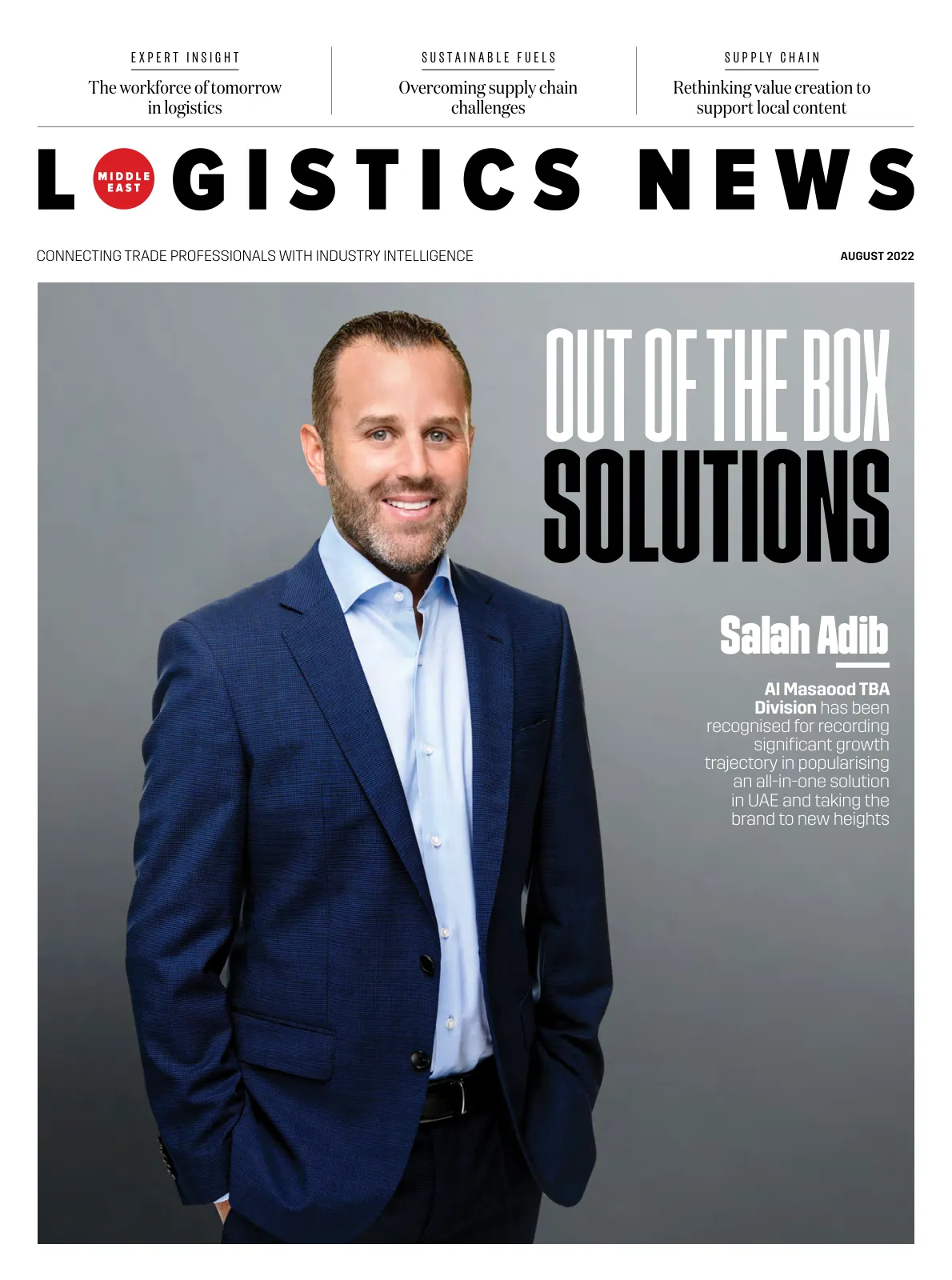
Salah Adib
Al Masaood TBA
Division has been
recognised for recording
significant growth
trajectory in popularising
an all-in-one solution
in UAE and taking the
brand to new heights
OUT OF THE BOX
SOLUTIONS
Page 2
A MEMBERS OF EMIRATES TRANSPORT BUSINESS CENTERS:
Page 3
LOGISTICS NEWS ME | AUGUST 2022 | 3
IN THIS ISSUE
OUT OF THE BOX
SOLUTIONS
22 EXPERT INSIGHT
THE WORKFORCE OF TOMORROW IN
LOGISTICS
Dr. Shereen Nassar writes about the key
role technology plays in logistics
26 ANALYTICS & SMART
TECHNOLOGIES
THE SMART NETWORKED FACTORY
Salem Machaka writes how analytics can
be used for logistics, demand forecasts,
production scheduling, and quality control
28 REPORT
BAIN & COMPANY
Machinery enters brave new world
“Beyond the Machine” as digital drives a
high-stakes race for growth
32 SUSTAINABLE FUELS
OVERCOMING SUPPLY CHAIN
CHALLENGES
Samer Kaissi writes about how
diversifying supply chains can steer
electrical vehicles in the right direction
34 SUSTAINABILITY
A SUSTAINABLE OUTLOOK
G. V. Gomes and Johan Bergwerff
discuss the company’s
sustainability initiatives and the
direction in they’re headed toward
38 SUPPLY CHAIN
RETHINKING VALUE CREATION
TO SUPPORT LOCAL CONTENT
Kenan Nouwailati and Omar
Alhalabi discuss Saudi Arabia’s
transformation and the
opportunities that lie ahead for
the country
40 INTERVIEW
FUTUREPROOFING THE
LOGISTICS OF TOMORROW
New age technologies across
the supply chain can help digitise
processes and automate manual
practices to enhance efficiency,
says Dhruvil Sanghvi, Founder &
CEO, LogiNext
Al Masaood TBA Division
has been recognised
for recording significant
growth trajectory in
popularising an all-in-one
solution in UAE and taking
the brand to new heights
16
34
28
Page 4
SIGN UP & SAVE 30% ON STAYS WITH BREAKFAST INCLUDED
ALL.COM
SUMMER OF
Page 5
Page 6
6 | LOGISTICS NEWS ME | AUGUST 2022
WWW.CBNME.COM
All rights reserved © 2022.
Opinions expressed are solely those
of the contributors.
Logistics News ME and all subsidiary
publications in the MENA region are officially
licensed exclusively to BNC Publishing in the MENA
region by Logistics News ME.
No part of this magazine may be reproduced or
transmitted in any form or by any means without
written permission of the publisher.
Images used in Logistics News ME are credited
when necessary. Attributed use of copyrighted
images with permission. All images not credited
courtesy Shutterstock.
Printed by UPP
SUBSCRIBE
subscriptions@bncpublishing.net
For all commercial enquiries, contact
sales@bncpublishing.net
T +971 50 440 2706
PO Box 502511
Dubai, United Arab Emirates
P +971 4 4200 506 | F +971 4 4200 196
Keep up to date with all the latest
news, features and much more
on our website and social media
platforms.
CBNME.COM
CBNME
@CBNME
CONSTRUCTION BUSINESS NEWS ME
CEO
Wissam Younane
wissam@bncpublishing.net
DIRECTOR
Rabih Najm
rabih@bncpublishing.net
GROUP PUBLISHING DIRECTOR
Joaquim D'Costa
jo@bncpublishing.net
+971 50 440 2706
BUSINESS DEVELOPMENT DIRECTOR
Rabih Naderi
rabih.naderi@bncpublishing.net
+966 50 328 9818
MANAGING EDITOR
Kasun Illankoon
kasun@bncpublishing.net
EDITOR
Jochebed Menon
EDITORIAL DESIGN
Christian Harb
MARKETING EXECUTIVE
Aaron Joshua Sinanbam
aj@bncpublishing.net
PHOTOGRAPHER
Alexander Bungas
EDITOR’S NOTE
LNME
There’s a lot been happening in the delivery
sector too. In the past we’ve had big players
such as Zomato and Deliveroo capture the
market, however in the last few years local
companies such as Talabat, Careem Now
and noon Food are clamouring in for their
share of the market. Making it an even more
competitive market.
And recently, UAE’s first and only RTA-
approved sustainable electric bike logistics
solutions provider entered the scene offering
on-demand environment-friendly deliveries
across Dubai.
In fact, the home-grown on-demand electric
delivery services provider has signed a
Memorandum of Understanding (MoU) with
talabat UAE, attaining a month-long pilot
phase, offering sustainable deliveries across
Dubai, as the regionally renowned eCommerce
platform seeks eco-friendly solutions for its
deliveries.
Globally, the food logistics market crossed
the value of USD100 billion in 2021,
according to market research firm Imarc
Group. The report further suggests that the
global market will reach USD154.5 billion
by 2027, exhibiting a CAGR of 8.1% during
2022-2027.
A report by Statista reveals that UAE is the
second largest F&B market for food delivery
in the Middle East & North Africa with
a market share of USD834 million a year.
We’re going to see these numbers increase
as newer players enter the market and the
economy recovers from the slump caused by
the pandemic.
T
he food and beverage scene has
always been vibrant in the UAE due
to the high expat population and the
burst of cultures and palates. From
high-end luxurious dining to quick
home deliveries, the demand for food and
drinks continues to grow. In the UAE,
we see the F&B logistics sector booming
thanks to the abundance of cloud kitchens
and secure supply chains.
In 2021, homegrown logistics services
provider Al Futtaim Logistics, announced
its expansion into the food and beverage
logistics services. The announcement
came as the company scaled up its services
to meet the needs of eCommerce and
marketplace clients with all-inclusive last-
mile home delivery solutions.
Jochebed Menon
Editor, Logistics News Middle East
jochebed@bncpublishing.net
Page 7
Page 8
Page 9
Page 10
10 | LOGISTICS NEWS ME | AUGUST 2022
WWW.CBNME.COM
REGIONAL NEWS
LNME
E
tihad Credit Insurance
(ECI), the UAE’s Federal
export credit company, has
partnered with the Hamriyah
Free Zone Authority (HFZA)
and the Sharjah Airport International
Free Zone Authority (SAIF Zone)
to support Sharjah exporters and
re-exporters to start and grow their
international business and secure
their receivables globally.
The strategic initiative will boost the
exports from Sharjah, one of the key
manufacturing and industrial hubs in
the region, and a major contributor
to UAE’s non-oil GDP and national
employment.
The Memorandum of Understanding
(MoU) was signed by H.E. Saud Salim
Al Mazrouei, Director of Hamriyah
Free Zone Authority and Sharjah Air-
port International Free Zone Authority
and Massimo Falcioni, CEO of Etihad
Credit Insurance, in the presence of
senior officials of both entities.
Underscoring the importance of
this strategic agreement, Al Mazrouei
said: “Our agreement with UAE Fed-
eral export credit company is a major
effort in unlocking new avenues of
financing for companies seeking to
open operations in Sharjah.
“This deal will strengthen the exist-
ing initiatives in the free zones to en-
hance SMEs’ contribution to the local
economy with ECI’s insurance and
project finance facilities as well as the
market intelligence and advisory ser-
vices. It signifies our collective vision
to nurture an entrepreneurial ecosys-
tem in Sharjah, thereby contributing
to the sustainable economic growth
of the UAE.”
Meanwhile, Falcioni said: “In line
with our strategy to accelerate the
UAE’s economic diversification and
non-oil trade agenda, ECI is helping
to enhance the bankability of SMEs,
start-ups and innovative projects
launched by younger entrepreneurs
across the country. We are honoured
to team up with one of the biggest in-
dustrial free zones in the UAE to em-
power local businesses and exporters
through the state-backed financial
and insurance support.”
“We are confident that ECI’s trade
and project financing support to
UAE businesses will reinforce HFZA
and SAIF Zone’s visions to solidify
Sharjah’s position as a destination
for global investments and a busi-
ness centre in the Middle East while
sustaining UAE’s position as an export
powerhouse even amid the severe
disruptions in the current economic
cycle” he added.
As per the agreement, Etihad
Credit Insurance will offer its range
of flexible trade credit insurance
and financial solutions – including its
Sharia-compliant insurance product
‘ECI Islamic’ – to start-ups and small-
and-medium enterprises (SMEs) oper-
ating in the two free zones. The MoU
reflects the shared commitment of the
state-owned organisations to devel-
oping a supportive environment for
business and accelerating the UAE’s
economic diversification agenda by
championing pioneering projects and
emerging industries.
Through this collaboration, they
will jointly conduct seminars and
workshops to educate the UAE busi-
ness community about the benefits of
trade protection solutions of Etihad
Credit Insurance. By providing coun-
try risk reports and in-depth market
intelligent services, ECI will also help
the companies in the free zones to
successfully carry out export to for-
eign countries as well as identify and
flourish in new growth markets around
the world confidently.
Over the last few decades, HFZA
and SAIF Zone have emerged as
strong pillars of Sharjah’s economic
performance. From attracting foreign
investment to creating employment
and implementing the latest technol-
ogies, HFZA and SAIF Zone have laid
the ground for a future where busi-
ness transcends geographical borders
and economic divisions.
ETIHAD CREDIT INSURANCE TO SUPPORT SAIF AND
HFZA EXPORTERS TO SECURE THEIR BUSINESSES
GLOBALLY
Page 11
LOGISTICS NEWS ME | AUGUST 2022 | 11
REGIONAL NEWS
A
l Seer Marine PJSC (ASM), a global player
across multiple marine sectors and subsidiary
of International Holding Company (IHC), is
expanding to provide freight solutions for bulk
cargoes globally through its subsidiary, ASM
Chartering.
This subsidiary will focus on delivering effective and efficient
freight services for cargo interests internationally, focused on
the Middle East market.
As part of ASM’s worldwide growth strategy on commercial
management, ASM Chartering intends to transport approxi-
mately two-three million tonnes of bulk cargoes in 2022.
At present, ASM manages a total of five dry bulk and general
cargo ships and provided freight solutions to an international
mining group for approximately 850,000 metric tonnes of iron
ore from Asia Pacific to East Asia. Al Seer Marine is currently in
negotiations for a long-term contract for carriage of 2 million
tonnes annually.
Guy Neivens, Chief Executive Officer of Al Seer Marine, said:
“We have seen a global rise in demand for dry bulk tonne-
mile trade with 2021 recording a 3.7% increase, while this
year, continued growth is forecast at about 1.4%. Al Seer
Marine will capitalise on this trend and increase our capac-
ity, transporting about 2-3 million tonnes of bulk cargoes in
2022.
“Given the fragmented nature of this market, we are seizing
the opportunity to consolidate cargo volumes and plan to
establish a world-class and transparent commercial maritime
business through strategic partnerships across the Middle
East region.”
Al Seer Marine is a global leader in marine services and has
been expanding rapidly in the commercial shipping segment.
The company aims to increase its fleet to become the largest
in the MEA market and is analysing expansion initiatives in
product tankers, gas tankers, and dry bulk shipping sectors,
with short-term plans of acquiring 10 to 15 ships in 2022.
AL SEER MARINE TO PROVIDE SOLUTIONS FOR 3M TONNES
OF BULK CARGO IN 2022
Page 12
12 | LOGISTICS NEWS ME | AUGUST 2022
WWW.CBNME.COM
REGIONAL NEWS
LNME
C
HEP, one of the world’s largest supply chain
businesses based on a circular economy, is
operating a ‘share and reuse’ concept for the
pooling of its 345 million pallets, crates, and
containers.
Leasing pooled pallets is a sustainable and cost-effective
alternative to purchasing one-way white wood pallets, which
have steadily increased in cost, commonly exhibit quality is-
sues, and often end up in landfills as waste.
Pallet pooling companies like CHEP have been recognised
by different international organizations for their contribution to
reducing waste and CO2 emissions, as they are considered a
key example of the circular economy at a global scale.
Reusable pallets are durable and of consistent quality and
strength, minimizing the chance of customers’ product dam-
age.
The sheer scale of CHEP’s network means that some of its
assets inevitably move out of the eco system of the company’s
customers, ending up where they should not be, such as with
pallet dealers, plastic re-grinders and on non-customer prem-
ises.
In an ever-changing environment like todays, where pal-
let availability is key to keep the supply chain moving, non-
returned or destroyed pallets can have a very negative impact
on the whole supply chain and ultimately on the end con-
sumer.
CHEP manages the entire administrative procedure, retrieval,
and quality assurance of the pallets in a closed-loop system.
CHEP equipment or its pallets are owned by CHEP. CHEP nev-
er sells its equipment, and all customers acknowledge CHEP’s
full ownership rights.
CHEP never transfers ownership of its pallets either. No one
can acquire, sell, recycle, or destroy CHEP pallets. All custom-
ers are required to return pallets back to CHEP.
CHEP’s trademark blue pallets, which are the same colour
all over the world where they operate, are legally owned by
CHEP, and never sold to any third party. CHEP’s business mod-
el requires that this equipment is returned to the company so
that it can be checked, refurbished, and then reused by other
customers. Non-returning of CHEP pallets is therefore a legal
infringement that can lead to legal action to recover those pal-
lets.
Feras Abual Hamayel, Manager of Asset Management for
CHEP Middle East and North Africa said, “As pioneers of the
circular economy, we are proud to be one of the most sustain-
able businesses globally and are passionate about protecting
our pallets, and other assets, so that they can fulfil our custom-
ers’ needs. Unreturned CHEP pallets not only have a negative
impact on the environment, but they also add costs to produc-
ers, retailers and ultimately the end consumers.”
CHEP’s pallets are easy to spot thanks to their distinctive
blue colour and the fact that their name, trademark, and legal
title messages are printed on each pallet as well.
Moreover, the collection of CHEP pallets is easy to arrange
and is free. CHEP takes care of it and has made this service
easy to access via a public contact page for anyone who wants
to request a pallet pick-up.
CHEP EMPHASISES PALLET OWNERSHIP RIGHTS
Page 13
LOGISTICS NEWS ME | AUGUST 2022 | 13
REGIONAL NEWS
A
lmajdouie
Logistics and
CMA CGM Saudi
Arabia signed
an agreement
for the handling and repair
of shipping containers
at a dedicated depot in
Dammam.
Almajdouie Logistics COO
Kris Brusselmans said: “We
are pleased to enter this
new partnership and look
forward to working together
to further enhance CMA
CGM Saudi Arabia’s high
standards.
“Almajdouie has extensive
experience providing stor-
age and repair services to a
variety of leading shipping
lines, helping to facilitate
trade and improve container
turnover. The supply chain
in Saudi Arabia has gone
through a paradigm shift in
the last few years and our
vision is to help facilitate the
Kingdom’s goal of handling
40 million containers annu-
ally by providing smart, effi-
cient, and competitive depot
services.”
Almajdouie’s state-of-the-
art terminals are equipped
with the latest technology
and operated by specialized
staff adhering to the high-
est safety standards in the
industry.
The facilities are strategi-
cally located near the main
seaports and industrial cities
across Saudi Arabia, and the
UAE.
Its terminals operate 24/7
and the team is available
to respond to customer re-
quests and inquiries around
the clock. It offers a wide
range of services to meet
customers’ requirements,
including container handling,
material handling, and reefer
plug-in. Through its con-
tainer service center, it also
offers repair, sea bulk, wash-
ing, and pre-trip inspection
services.
Present in Saudi since 1984,
the CMA CGM Group oper-
ates 24 weekly maritime calls
from and to Saudi Arabia,
connecting the country to
major global destinations
with a state-of-the-art inter-
modal network on land. The
Group is committed to offer-
ing the Saudi market com-
plete maritime and logistics
solutions combined with
agility, professionalism, and
efficiency.
Michel Azrak, Gen-
eral Manager of CMA CGM
Saudi Arabia said: “With
Almajdouie’s extensive ser-
vices and the comprehensive
range of CMA CGM can offer
in Saudi Arabia, this partner-
ship is a great opportunity
for both our companies. Our
teams will work together to
provide excellence in terms
of service to our customers
and to respond quickly to
market needs.”
ALMAJDOUIE LOGISTICS SIGNS KEY AGREEMENT
WITH CMA CGM SAUDI ARABIA
Page 14
14 | LOGISTICS NEWS ME | AUGUST 2022
WWW.CBNME.COM
REGIONAL NEWS
LNME
E
tihad Airways, the national
airline of the UAE, has become
the country’s first airline to
join the In-Country Value (ICV)
Programme.
The Ministry of Industry and Ad-
vanced Technology (MoIAT) is expand-
ing the program’s scope to include new
sectors like aviation as part of the na-
tional industrial strategy to sustain eco-
nomic growth and raise the efficiency
and competitiveness of the industrial
sector.
The In-Country Value Programme,
part of the UAE’s Projects of the 50, is a
pillar of the national industrial strategy
and benefits certified companies by
increasing local demand for their prod-
ucts and services. By joining the ICV
programme, Etihad Airways will prior-
itize local suppliers and UAE companies
in the procurement process. It will also
encourage global suppliers to establish
branches in the UAE, attracting more
foreign investments to the country.
Etihad Airways joins 18 other lead-
ing national institutions and 45 federal
entities that have joined the ICV pro-
gramme since it launched on a federal
level late last year. The programme
redirected more than Dhs41 billion
in 2021 from implementing entities
purchases and services expenses, com-
pared to Dhs27 billion two years ago.
His Excellency Omar Al Suwaidi,
Undersecretary of the Ministry and for
Etihad Airways said: “The In-Country
Value Programme is one of the pillars
of the national strategy for advanced
industry and technology, Operation
300Bn. It benefits certified companies
by increasing demand for their products
and services by redirecting government
expenditure towards local companies.
“The initiative encourages the growth
of the industrial sector in the UAE, sup-
ports the creation of quality jobs, and
provides incentives for companies to
adopt advanced technologies. Certifi-
cation is awarded based on criteria such
as the value of spending and invest-
ment in the country, Emiratsation, and
the adoption of advanced technology.”
His Excellency said: “The addition of
leading Emirati companies like Etihad
Airways reflects the advantages pro-
vided by the programme, such as help-
ing to boost growth, innovation, and
competitiveness.
“The programme also helps to cre-
ate more robust, efficient supply chains
and underlines the close cooperation
between the ministry, federal and lo-
cal authorities, and major national
companies. Purchasing the services
of programme members will become
one of the most important means of
supporting and empowering the UAE
industrial sector over the course of the
next 50 years.”
The In-Country Value Programme
aims to increase the number of certified
vendors within the programme from
5,000 to 7,300 companies and increase
government expenditure on Emirati
products and services from Dhs33 bil-
lion in 2020 to Dhs55 billion by 2025.
In 2021, the National ICV Programme
succeeded of redirecting expenditure
up to Dhs41.2 billion.
Tony Douglas, Group Chief Executive
Officer, Etihad Aviation Group, said:
“Etihad’s participation in the ICV Pro-
gramme aligns with the airline’s overall
vision and demonstrates our commit-
ment to supporting UAE industry. As
the national carrier of the United Arab
Emirates, we are committed to support-
ing local companies, and firmly believe
it is important for private sector com-
panies in the region to cooperate with
the Ministry of Industry and Advanced
Technology across its innovative pro-
jects, which seek to achieve the UAE’s
future ambitions.
“In joining this latest initiative, we
can expand our reach to local supply
chains, contributing to the develop-
ment of a sustainable, diversified, and
value-added economy for the UAE.
He added: “As part of our strategy, in
2020 Etihad launched the ‘Al Watani’
local content programme. Since then,
we have collaborated with more than
1,000 local vendors, and more than
35% of Etihad’s spending is on purchas-
es in the UAE market. We aim for this
agreement with the Ministry of Industry
and Advanced Technology to sustain
Etihad’s expenditure on national com-
panies and enhance the opportunities
for local vendors and SMEs in Etihad’s
supply activities.”
ETIHAD AIRWAYS JOINS UAE’S IN-COUNTRY VALUE
PROGRAMME
Page 15
LOGISTICS NEWS ME | AUGUST 2022 | 15
REGIONAL NEWS
A
D Ports Logistics (ADPL), a subsidiary of AD Ports
Group’s Logistics Cluster, has secured the coveted
International ISO Certification for its integrated
end-to-end supply chain management services
covering medical devices.
With the latest ISO award, issued by Bureau Veritas – one of
the world’s leading testing, inspection, and certification bodies
– ADPL became one of the first service providers in the UAE to
be fully accredited for supply chain management services cov-
ering medical devices, equipment, and consumables.
The certified services include, import, export, transport, stor-
age, warehousing, freight forwarding, distribution and value-
added services.
Furthermore, combining the new ISO certification with the
reputed Good Distribution Practice (GDP) award against both
the European Union (EU) and the World Health Organisation
(WHO) standards, also received from Bureau Veritas, further el-
evates the organisation’s position as a growing global provider
of specialised healthcare business services.
The services include, logistics and supply chain manage-
ment, quality management and pharmacovigilance, regula-
tory compliance, commercial and trading, market access, and
value-added services.
Robert Sutton, Chief Executive Officer of the Logistics Clus-
ter, AD Ports Group, said: “As the demand for extensive, spe-
cialised and increasingly complex healthcare supply chains
grows, healthcare logistics service providers will need to con-
tinue making strategic investments in infrastructure, technol-
ogy, procedures, and expertise to stay ahead of the curve.
“By securing this important international certification, our
team at AD Ports Logistics, serving both the healthcare and
life science sectors, is demonstrating our steadfast commit-
ment to supply chain excellence, and is contributing to Abu
Dhabi’s position as a world-class life science logistics hub.
“Given our previous success in securing the world-re-
nowned GDP accreditation for twin leading standards, ADPL
is in an excellent position to serve the global healthcare mar-
ketplace, and our customers can be rest assured that their
products will be handled safely, efficiently, and according to
the highest levels of global regulatory and quality compli-
ance.”
As part of the certification process, Bureau Veritas rep-
resentatives evaluated several facets of ADPL’s activities,
including handling processes, business continuity planning,
cold chain management, competency of staff, and training
standards, in line with the best global practices.
AD PORTS GROUP SECURES CERTIFICATION FOR SUPPLY
CHAIN MANAGEMENT OF MEDICAL DEVICES
Page 16
16 | LOGISTICS NEWS ME | AUGUST 2022
WWW.CBNME.COM
COVER STORY
LNME
“THIS ACCOLADE IS A
TESTAMENT TO OUR
SINCERE EFFORTS TO
PRESENT CONVENIENT
SOLUTIONS AND
SERVICES THAT
RESPOND TO OUR
CUSTOMERS’ NEEDS.”
Page 17
LOGISTICS NEWS ME | AUGUST 2022 | 17
A
l Masaood’s Tyres, Batteries, and Accessories (TBA) Division was recently
presented with the prestigious Global Mobox Award by Bridgestone in Paris,
France, for the successful launch of the Mobox solution in Abu Dhabi and Al Ain.
When Al Masaood introduced the solution to the region in 2021, it became
the first to market the Bridgestone service outside Europe. Since then, it’s been
an exhilarating journey for Salah Adib, General Manager, Al Masaood Tyres,
Batteries & Accessories Division, and the team.
OUT OF THE BOX SOLUTIONS
Al Masaood TBA Division has been
recognised for recording significant growth
trajectory in popularising an all-in-one
solution in UAE and taking the brand to new
heights, General Manager Salah Adib tells
us more
OUT
OF THE
BOXSOLUTIONS
>>>
Salah Adib,
General Manager,
TBA Division,
Al Masaood
Page 18
18 | LOGISTICS NEWS ME | AUGUST 2022
WWW.CBNME.COM
He explains: “We’ve had a successful
year in 2021 with our principal brand
Bridgestone supporting us to bring
MOBOX – the new and efficient all-
in-one subscription package for buying
tires and car maintenance services – to
Abu Dhabi, Al Ain, and the Western
region. “The launch of MOBOX,
which we have piloted for the first-time
outside Europe, has been a great suc-
cess as it provides immense value and
convenient mobility solutions to our
customers. Our strengthened partner-
ship with Bridgestone has enabled us to
bring innovative and sustainable mobil-
ity solutions and value-added offerings
to our customers.”
What is MOBOX?
Mobox is aimed at reducing the pos-
sibility of unexpected bills by offering
a monthly payment scheme for a range
of car services and tires. It is designed
to reduce the cost and inconvenience of
vehicle maintenance. Bridgestone pio-
neered Mobox in early 2018 in France
and then expanded across other Euro-
pean countries such as Spain, Germany,
Italy, and the UK.
The launch of the all-in-one MOBOX
subscription service in Abu Dhabi is
Bridgestone’s first pilot in the MENA
region.
Speaking about the award, Adib says:
“This accolade is a testament to our sin-
cere efforts to present modern mobility
solutions and services that respond to
our customers’ needs. Since its launch,
we have witnessed a significant growth
in the popularity of MOBOX among
our customers, with a substantial num-
ber of contracts already sold and no let-
up in fresh subscribers. As an organisa-
tion that places customer satisfaction
as a top priority, we focus on adopting
new and simple ways to elevate our
customers’ experience with us.”
He believes that customer trends and
preferences are continually changing.
“Today, customers are more and more
seeking simple solutions such as lease-
based and subscription-based services.
COVER STORY
LNME
Page 19
LOGISTICS NEWS ME | AUGUST 2022 | 19
As we constantly monitor new and developing trends,
we see MOBOX as an efficient solution to customers’
auto care needs,” Adib notes. “MOBOX is a personal car
maintenance subscription that provides customers with a
flexible range of services that can be customised such as
tires, full warranty, and other car-related services available
for a set monthly fee.”
Al Masaood TBA are offering three MOBOX solutions to
customers: MOBOX Light, MOBOX Plus and MOBOX
Premium. He explains: “These packages include two-four
tires and services like tubeless valves, tire fitting, wheel
balancing, nitrogen filling, wheel alignment, tire rota-
tion, aircon services, in addition to warranty. Through
its monthly subscription scheme, MOBOX can help in
reducing the possibility of unexpected bills for tires, as
well as reduce the cost and inconvenience of vehicle main-
tenance.”
Safety and environment-friendly solutions
The division is continually looking at improving driver safety
and tire health, the tie up with Bridgestone for MOBOX is
just one of its solutions. Others include the Summer Road
Safety campaigns and raising awareness about tire safety
among truck drivers to name a few.
“We have a primal goal of preserving the safety of our
community on the road. Over the past several years, we have
taken an active role in the Summer Road Safety campaigns
rolled out by Abu Dhabi Police,” Adib divulges. “This year,
together with Bridgestone we teamed up with the Integrated
Transport Centre in Abu Dhabi, and Road Safety UAE to
raise awareness about tire safety among truck drivers, espe-
cially in the hot summer months. The team carried out truck
tire condition inspections at the Mussafah truck weighing
station in Abu Dhabi, with a total of 276 truck tires being
examined during the campaign.”
“EXPERTS FROM A WIDE RANGE OF SECTORS HAVE BEEN COLLABORATING TO
FURTHER IMPROVE THE ENERGY EFFICIENCY AND ENVIRONMENTAL FRIENDLINESS
OF THE TIRE OF THE FUTURE DURING THE PHASES OF PRODUCTION, USAGE, AND
RECYCLING.”
>>>
OUT OF THE BOX SOLUTIONS
>>>
Page 20
20 | LOGISTICS NEWS ME | AUGUST 2022
WWW.CBNME.COM
COVER STORY
LNME
The division is also look-
ing at sustainability and
eco-friendly solutions for its
business. “Experts from a
wide range of sectors have
been collaborating to further
improve the energy efficiency
and environmental friendli-
ness of the tire of the future
during the phases of produc-
tion, usage, and recycling,” he
says. “They have emphasised
the necessity to guarantee
sustainability, especially in
production processes, and to
replace tire components with
more ecologically friendly
material.”
He adds: “As far as we are
concerned, TBA is installing
EV chargers in some of its
prime retail outlets in Abu
Dhabi to support the transi-
tion from the traditional fuel
engine vehicles to EV cars.
As a Bridgestone authorised
dealer, we are aware that the
firm is making investments in
tire development technologies
to support EVs on a world-
wide scale. The Japanese tire
company anticipates chang-
ing its tire offering to address
some pressing EV issues.
Fostering employee-oriented
growth
Overall, Al Masaood TBA
under Adib’s able leader-
ship has prospered. Speaking
about his role at the division,
he says: “As the head of this
department, I ensure its overall
operational efficiency - includ-
ing increasing profitability
prospects and maintaining
highest standards of customer
satisfaction. To keep up with
the market trends and adjust
to our customers’ changing
needs, we are continually
seeking to improve our service
offerings and elevate our cus-
tomer experience.”
He adds: “Our company’s suc-
cess is based on keeping things
simple, coupled with our
investment in employee skill
development. Today, we have
young and creative profession-
als that help us generate new,
productive, and out-of-the-
box business growth ideas. I
believe that the wellbeing of
our employees is paramount
in the success of our company
as they are our most impor-
tant assets. So, I ensure that
they stay motivated by going
beyond formalities through
‘personal leadership.’ Not
only do I understand what
they value, such as earning for
their families or fulfilling their
dreams, but I also help them
achieve their goals by fostering
their professional and personal
growth.”
For Adib, his goal is to keep
serving customers to best of
their ability through offer-
ing quality and value-added
soft tire and pitstop auto care
services in Abu Dhabi, Al
Ain, and the Western Region.
He adds: “My team and I are
working relentlessly to present
a professional and convenient
experience to customers that
answers to their needs. We
also are continuously working
towards further improving our
range of offerings and techni-
cal services, all the while keep-
ing the safety and wellbeing
of our Abu Dhabi community
top of mind.”
He concludes: “We started
the year on a high note and
are looking forward to a busy
and fruitful remainder of the
year.”
“OUR COMPANY’S SUCCESS IS BASED ON KEEPING THINGS
SIMPLE, COUPLED WITH OUR INVESTMENT IN EMPLOYEE
SKILL DEVELOPMENT. TODAY, WE HAVE YOUNG AND CREATIVE
PROFESSIONALS THAT HELP US GENERATE NEW, PRODUCTIVE,
AND OUT-OF-THE-BOX BUSINESS GROWTH IDEAS.”
Page 21
Page 22
22 | LOGISTICS NEWS ME | AUGUST 2022
WWW.CBNME.COM
T
he global supply chain
market is growing expo-
nentially and encountering
major transformations. The
growth is unquestionable;
according to Allied Mar-
ket Research, the global supply chain
management market size valued at
USD15.85 billion in 2019 is projected
to reach USD37.41 billion by 2027,
growing at a CAGR of 11.2% from
2020 to 2027.
Technology has become a key player
in moving logistics from its traditional
recourse to forming an advanced out-
look supporting its growth. According
to a report by UNCTAD, the market
for frontier technologies (a group of
new technologies that take advantage
of digitalisation) could grow to over
USD 3.2 trillion by 2023.
Advanced technologies such as arti-
ficial intelligence, robotics, blockchain
and the Internet of Things seem to have
increasing prominence across sectors
and are playing a big role in making
the industry more agile and resilient.
EXPERT INSIGHT
LNME
Dr. Shereen Nassar, Global Director of Logistics Studies and the Director of the MSc Logistics and
Supply Chain Management Programme - Edinburgh Business School, Heriot-Watt University Dubai,
writes about the key role technology plays in logistics
THE WORKFORCE OF TOMORROW IN LOGISTICS
Page 23
LOGISTICS NEWS ME | AUGUST 2022 | 23
THE WORKFORCE OF TOMORROW IN LOGISTICS | DR. SHEREEN NASSAR
New disruption-based advance-
ments
In addition, shifting demographics,
advances in logistics technology,
and the COVID-19 pandemic have
converged to alter how we work,
arguably at a rate never before seen in
the logistics industry. This requires a
workforce prepared to integrate into
the new disruption-based advance-
ments and successfully navigate
industry demands.
As the industry looks to the future,
it is becoming increasingly clear that
shifting demographics in the sector
are also a catalyst for change within
its functionality. As a result, the
industry currently needs and will have
increased requirements in the future
for new talent with appropriate skills
and new mindsets, which also means
that the older generation is on the
way to retirement.
The current concerns stem from the
fact that if the industry is changing, so
is the workforce. Every industry has
seen multi-faceted shifts in employee
and consumer behaviour and needs
through the pandemic. As a result,
there is a fear of employees moving
due to employers’ lack of priority
fulfillment, resulting in the organisa-
tion losing institutional knowledge
and experience.
Additionally, due to competitiveness, it
is becoming increasingly difficult to re-
tain employees. According to Gartner
(2020), struggling to hire, train and
retain logistics talent is the top critical
priority for logistics leaders.
Historically the logistics industry
has used manual processes to man-
age huge amounts of data and other
work. However, recent years have seen
the increased adoption of technology
across its work processes. Addition-
ally, the COVID-19 pandemic directly
impacted supply chains. As a result,
logistics companies urgently navigated
increased demands, employee absen-
teeism, and new health and safety pro-
tocols, among several other evolving
challenges to keep production running.
These challenges led many facilities to
accelerate their automation initiatives
and digitalisation efforts for improved
resilience.
New technologies
Technologies such as robotics, ma-
chine learning, augmented reality,
3D printing, drones, and unmanned
ground vehicles (UGV’s), have been
increasingly key in the growth of the
logistics sector. As a result, the current
workforce will need to extensively
upskill themselves to improve technical
capabilities and understand the rapid
changes that digitisation is causing.
Furthermore, educational institutions
are tasked with expanding horizons
and tweaking curriculums to address
future technological needs. According
to a survey report by PWC, 74% of
respondents are ready to learn new
skills or re-train to remain employable
in the future.
Furthermore, data literacy is another
very crucial requirement for logistics
personnel. Gartner predicts that by
2022, 90 per cent of corporate strate-
gies will explicitly mention informa-
tion as a critical enterprise asset and
analytics as an essential competency.
As a result, supply chain organisations
must build an employee base with data
literacy to be successful.
Data literacy is the skill of reading,
writing, and communicating data
in context, including understanding
data sources and constructs, analyti-
cal methods and techniques applied,
and the ability to describe the use-case
application and resulting value. It will
play a crucial role in employability
which will be connected to the growth
of an organisation.
There are four key interdepend-
ent roles identified for digital supply
chains. These are driven by technol-
ogy, data, end-to-end insights, and
innovation. The first is related to
the technical skills needed to design,
configure, use, and maintain new
technologies e.g., 3-D printing, AI, and
robotics.
“ADVANCED TECHNOLOGIES SUCH
AS ARTIFICIAL INTELLIGENCE,
ROBOTICS, BLOCKCHAIN AND THE
INTERNET OF THINGS SEEM TO
HAVE INCREASING PROMINENCE
ACROSS SECTORS AND ARE
PLAYING A BIG ROLE IN MAKING
THE INDUSTRY MORE AGILE AND
RESILIENT.”
>>>
Page 24
24 | LOGISTICS NEWS ME | AUGUST 2022
WWW.CBNME.COM
EXPERT INSIGHT
LNME
The second is concerned with analyti-
cal skills that drive scenario planning
and data-led modelling to enable the
supply chain to inform business deci-
sions. The third is the orchestration
ability to develop end-to-end insights
that drive internal and external
collaboration. The fourth is about
innovation that drives new business
opportunities and brings a commercial
lens through understanding the big
picture.
Tech talents
Tech personnel must understand and
decide if a technology solution is
required and is a suitable option. An-
other important factor that the future
workforce needs to consider is their
knowledge on sustainability. Globally,
sustainability is on the agenda of every
industry, and the logistics sector is no
different. Understanding the environ-
mental, financial, and social impacts of
logistics will serve advantageously to
those looking to work in the industry.
Sustainability will be key in securing
the future of any industry. And every
individual working or looking to work
in the sector must acquire the neces-
sary knowledge to support sustainabil-
ity. Furthermore, enterprises are now
creating employment positions focused
on environmental, social, and govern-
ance (ESG) activities in logistics.
Logistics leaders need to grasp what
drives career decision of the future
workforce. This should not be limited
to compensation and career path. A
recent report by Gartner showed that
future generations value companies
with high corporate social responsibil-
ity profiles. Future workforces also
value innovation, flexibility and short-
track progression plans.
They can move from one job to
another in a short time to harness op-
portunities. They are tech-savvy, and
it is challenging for them to cope with
outdated systems. Logistics leaders
need to demonstrate how the future
workforce’s expectations are met to
enhance the profession’s awareness.
While soft skills such as empathy,
adaptability, problem-solving, industry
knowledge, and accountability have
always been important to employers,
the pandemic has further put a spot-
light on soft skills that will support the
growth of employees in an organisa-
tion. The workforce of tomorrow
in logistics will not only be equated
with the technological advancements
and their grasp on it but also through
the ability to constantly adapt to and
embrace change.
The world as we know it has changed.
Universities and educational insti-
tutions are tasked with building a
resilient workforce of tomorrow
through education that is in line with
the industry demands, rapid shifts, and
unprecedented changes. Furthermore,
for the current workforce it is extreme-
ly important to upskill themselves to
learn relevant skills to advance their
careers and contribute to the industry’s
growth.
Developing in-demand skills, enhanc-
ing capabilities, and embracing tech-
nology will create a futuristic work-
force that can adapt to changes and
be agile. With the industry’s projected
growth, it is indeed a fast-growing
labour market that needs equipped,
motivated, and focused individuals.
The sector is set to take on challenges
to lead and thrive.
“UNIVERSITIES AND EDUCATIONAL
INSTITUTIONS ARE TASKED
WITH BUILDING A RESILIENT
WORKFORCE OF TOMORROW
THROUGH EDUCATION.”
Page 25
The Arocs. Your Reliable Partner for
Every Construction Transportation Task.
Regardless of whether it is a rigid chassis, concrete mixer or heavy-duty tipper: The
Mercedes-Benz Arocs provides an especially robust, resilient vehicle that is optimally
prepared for use for any construction haulage challenge. Configure it now to suit your
requirements and those of your project.
Page 26
26 | LOGISTICS NEWS ME | AUGUST 2022
WWW.CBNME.COM
ANALYTICS & SMART TECHNOLOGIES
LNME
J
udging by the headlines, continuous global
logistics issues, prolonged pandemic
restrictions, and rising prices for raw
materials mean that manufacturers have their
work cut out for 2022. In addition, the drive
towards sustainability is adding pressure to
readjust the manufacturing footprint.
Most manufacturers are still stuck with a
geographic footprint, which was driven by labour
arbitrage around the globe, rather than by factors
such as closeness to customers or ecological
concerns.
Industry 4.0 technologies
To increase efficiency, many producers have
started to implement Industry 4.0 technologies.
Industry 4.0 came with the promise of a smart
factory being profitable at the production lot size
of one unit.
The concept was introduced at the brink of
the millennium change with the introduction
of cyber-physical systems to share, analyse, and
guide intelligent actions for various processes in
the industry to make the machines smarter and
to lower downtime. Analytics can also be used
THE SMART NETWORKED FACTORY
Salem Machaka, Vice President, Global Professional Services, Infor writes how
analytics can be used for logistics, demand forecasts, production scheduling,
and quality control
Page 27
LOGISTICS NEWS ME | AUGUST 2022 | 27
for other aspects like logistics, demand
forecasts, production scheduling and
quality control, capacity utilisation and
efficiency boosting.
But we still stand at the beginning for
leveraging the true potential of Industry
4.0. Smart technologies offer no less
than the possibility to redesign the global
manufacturing footprint, to position
factories closer to markets, reduce
logistics nightmares and increase visibility
of the ecosystem partners, including
suppliers and customers.
Futureproofing
So, what are the most important
ingredients for a strategy to create the
future-proof smart factory?
Customers increasingly demand
highly personalized products as well
as an enhanced customer experience.
Manufacturing companies adopt highly
agile cloud-based solutions to gain the
ability to increase individualisation,
service additions, and serve higher
flexibility requirements.
The need to reduce delays and transport
costs, as well as the drive toward a more
sustainable production and the imperative
to reduce the distance to the physical end-
consumer lead organisations to redesign
the manufacturing footprint, with the
support of leading-edge technologies, to
build smaller, smart factories closer to the
customer.
Smart decisions require end-to end-
visibility. This requires a consolidated
view across the manufacturing
business, including the commercial, the
procurement and the operational sides.
A tightly linked view and streamlined
processes across the order system, shop
floor operations, and the supply chain
optimize capacity and requirement
management and failover alternatives
across the entire system.
Connected supply chains
A global view and command structure to
react quickly to supply chain challenges.
A connected supply chain operating with
a single view of orders, shipments and
inventory, and shared digital processes
provides the visibility needed to improve
velocity and the agility to respond to
disruptions in a timely and efficient
manner.
More intelligent automation, using AI-
driven insights, can lead to assembly lines
that are adjusting automatically.
Smart technologies allow smaller
manufacturing sites to be situated close
to the customers. But how can producers
reach fundamental business decisions as
to how to relocate manufacturing sites?
The most important ingredient needed is
good intelligence. True, manufacturing
organisations leverage plenty of data
across the operation. But is the data
linked up, consistent and treated to
enable insightful business decisions?
A smart factory is a highly digitized,
connected production facility that uses
technologies such as artificial intelligence
(AI), Internet of Things (IoT) and robotics
to help companies manufacture products,
create new business value, unlock data-
driven insights, and automate or eliminate
business processes.
These technologies enable people to
do their jobs in a more productive and
efficient manner while improving quality
and overall safety. At the same time, the
technologies enable smart factories to
self-adapt and autonomously optimise
manufacturing operations, helping
organizations to compete better amid the
many global challenges they face.
Salem Machaka, Vice President, Global Professional
Services, Infor
“Manufacturing companies
adopt highly agile cloud-based
solutions to gain the ability
to increase individualisation,
service additions, and serve
higher flexibility requirements.”
THE SMART NETWORKED FACTORY | SALEM MACHAKA
Page 28
28 | LOGISTICS NEWS ME | AUGUST 2022
WWW.CBNME.COM
REPORT
LNME
T
he global machinery and equipment industry stands at a
critical moment as it confronts a whirlwind of disruptive
forces, facing its leaders with fundamental and accelerat-
ing change over the next decade.
In its first Global Machinery & Equipment Report,
Bain & Company analyses the wave of digital-driven
transformation sweeping the sector.
The report explains how the emerging winners from these
powerful trends are embracing “machinery beyond the
machine,” experimenting aggressively beyond the industry’s
traditional boundaries. It reveals how this strategic approach is
propelling winning companies past competitors in a high-stakes
race that is turbocharging sales growth and profits—as well as
fueling a surge in mergers and acquisitions (M&A) activity and
private equity (PE) dealmaking. And it maps out the key moves
that machinery and equipment players can make over the next
two to three years to tackle this transformational agenda.
“The tectonic shifts reshaping the entire machinery sector are
being driven by rapidly intensifying competition, a slowdown in
hardware-centered innovation, and the power of digitalization
to radically change virtually every aspect of the business,”
Michael Staebe, leader of Bain & Company’s Global Machinery
and Equipment practice, said.
“The industry’s traditional focus on smarter, faster, cheaper
machines as the key to drive growth no longer gives any
guarantee of success. Even the most technologically advanced
machines, and their makers, are not immune from disruption.”
Instead, the report shows that the fundamental transition
now happening takes the industry “beyond the machine”
to “machinery as a service.” This means combining makers’
BAIN & COMPANY
MACHINERY ENTERS BRAVE NEW WORLD
‘BEYOND THE MACHINE’ AS DIGITAL DRIVES
A HIGH-STAKES RACE FOR GROWTH
Page 29
LOGISTICS NEWS ME | AUGUST 2022 | 29
BAIN & COMPANY
hardware with software, automation
and services developed around the
machines. It means delivering tightly
integrated solutions that are precisely
tailored to customers’ needs—and
within dramatically altered new
business models.
“The industrial machinery and
equipment sector has reached a
turning point. While the industry never
stood still, regionally, it is currently
experiencing the most profound
transformation in decades. The
push for more sustainable, diverse,
equitable, inclusive, and socially
and environmentally conscious
operations is the strongest it has
ever been. We see senior executives
investing heavily in digitization and
this is affecting talent retention and
workforce management. These changes
are being expressed at various speeds
depending on the subsectors, which is
leaving decision makers in significant
ambiguity,” said Karim Shariff, Partner
at Bain & Company Middle East and
leader of Bain & Company’s EMEA
Construction, Building Products, Real
Estate and B2B Services practice.
Services-based solutions are “shape of
things to come” for machinery
The report sets out how this critical
shift to a digitally-enabled and services-
based ‘bundled solutions’ model is
already developing at pace. Bain &
Company’s research projects that in
the industrial automation sector, where
this shift is well underway, the share
of profits coming from hardware will
fall from 31% today to just 23% by
the end of the decade. The rest of the
profit will come from bundled software,
services and solutions. In some sectors,
companies already generate more than
half of sales and 100% of their profits
from services.
“This trend is accelerating and will
become the norm—the shape of things
to come—for the industry in the next
few years,” Thomas Lustgarten, leader
of Bain & Company’s Global Advanced
Manufacturing & Services practice,
said. “By 2030, Bain projects that the
leading machinery companies will
sell most equipment as only a part of
bundled solutions that include software
and services, further cutting hardware’s
contribution to profits. In many cases,
companies making this shift have the
chance to capture market growth rates
several times those of their current
businesses.”
Karim Shariff, Partner at Bain & Company Middle East and leader of Bain & Company’s EMEA Construction, Building Products,
Real Estate and B2B Services practice
“The push for more sustainable, diverse, equitable, inclusive,
and socially and environmentally conscious operations is the
strongest it has ever been.”
>>>
Page 30
30 | LOGISTICS NEWS ME | AUGUST 2022
WWW.CBNME.COM
Among the top machinery companies,
Bain & Company found that the
average annualized total shareholder
return was 32% from 2019 to 2021,
compared with a mere 4% among the
industry’s laggards. But most machinery
and equipment companies have so far
been slow to act. Bain finds that fewer
than 5% of industrial companies have
successfully executed a technologically or
digitally based transformation.
“Industrials that put effort into digital
are four-times more likely to outperform
the competition—but two out of three
digital laggards are worse performers
than the competition, according to Bain
& Co.’s 2019 survey of 205 industrial
businesses,” Lustgarten adds.
“Great Retooling” for global
sustainability and net-zero creates
multi-decade opportunity
The sweeping machinery sector
transformations triggered by the forces
of digitalization and “Industry 4.0” are
only part of the story for the machinery
and equipment sector, however. The
reshaping of the industry also presents
an enormous opportunity for its
companies to give a powerful response
to the global push for businesses of all
kinds to meet and master the challenges
of sustainability and environmental
responsibility: to become more energy
efficient, less wasteful, and to tailor
operations to improve the circularity and
recyclability of machinery products.
As in other industries, machinery
makers are already changing operations
and supply chains to reduce greenhouse
gas and carbon emissions and pursue
net-zero goals. But for this sector,
the implications go deeper. Because
every industry is changing, a “Great
Retooling” is underway as nearly every
industrial and manufacturing company
rethinks its operations. Machinery
businesses that quickly grasp the
potential and develop the products and
services to allow customers to meet
decarbonization goals, are likely to
gain first-mover advantage in a huge
transition set to last decades rather than
years, the report finds.
Spate of supply chain shocks fuel
retooling for resilience
The global opportunities of rising to
sustainability goals, as well as from
this Great Retooling trend, are closely
tied to the challenge posed by a new
era of supply chain vulnerability. Over
the past two years, a spate of major
supply chain disruptions has battered
the machinery sector, from materials
shortages and price fluctuations sparked
by the global pandemic to, most recently,
the consequences of the war in Ukraine.
These and future unexpected disruptions
reinforce and extend the market for
machinery makers to equip customers
for the future with the equipment that
ensures more resilient and sustainable
supply chains.
Bain & Company’s research shows
that supply chain executives across all
industries have shifted investments to
prioritize resilience and flexibility over
cost and speed. Machinery companies
are on the front line to provide the tools
and equipment to meet these objectives
while simultaneously meeting the urgent
aim of greater resilience for their own
operations. Digital tools are important
here, too, and can help firms manage
supply chain risks, improve efficiency and
measure environmental impact and cost
in real time.
Companies at the forefront of this
evolution have a head start in building
competitive advantage in the markets
of 2030 and beyond. They are building
new capabilities, such as supply risk
assessments, to bolster their customers
and their own operations. As such, they
will also bounce back faster in times
of supply disruption and gain from a
tailwind of support from customers,
investors and regulators.
China’s industry vanguard of innovative
insurgents drives imperative for
strategic change
While the machinery sector’s winners
over the coming decade will move
aggressively to expand their business
ecosystem beyond machinery, other
companies will struggle to keep up.
Those that fail to climb the software
and automation ladder, focus on
tailored solutions for “verticals” specific
sectors, and adapt to the new business
models, will be at risk from the growing
commoditization of machines sold purely
as hardware. Chinese manufacturers are
rapidly developing competing, lower-cost
hardware.
Thomas Lustgarten, leader of Bain & Company’s
Global Advanced Manufacturing & Services practice
REPORT
LNME
Page 31
LOGISTICS NEWS ME | AUGUST 2022 | 31
The competitive challenge is underscored
by the reality that China is also in the
vanguard of the broader industry trends
examined in the report, with Chinese tech
start-ups and other insurgents introducing
a new generation of innovative service
offerings. The cloud service Machine
Commander, offered by the Chinese start-
up Zeaho, offering real-time monitoring
of construction sites to improve
equipment efficiency is one example:
it has 135,000 units of equipment
connected to its cloud-based platform just
seven years since it was founded.
To defend their turf, equipment markets
are increasing investments in digital
technologies and accelerating the rollout
of advanced services. For example, 100%
of original equipment manufacturers
(OEMs) surveyed by Bain & Company
plan to offer “predictive maintenance”
of machines by 2024. 95% will provide
remote maintenance, and new services
geared to operational efficiency.
M&A jumps to decade-highs as
companies accelerating moves to buy in
capabilities
The wave of change across the machinery
sector is also stimulating a surge in
dealmaking as many companies and their
investors reshape business portfolios
in the face of the evolving industry
dynamics. Industrial machinery
manufacturers have a growing appetite
for big deals as they accelerate these
strategies.
The jump in M&A activity means
that the average deal size in the
sector shot up to an average of $179
million in 2020 and $161 million in
2021 breaking the prior downward
trend seen up to 2017. Last year’s
$63 billion global deal value was the
sector’s second highest annual total
in the past decade, only exceeded by
2020’s $72 billion tally.
“For machinery executives, M&A
provides access to higher-growth and
strategically-critical markets. These
leaders are leaning-in to acquire new
capabilities around software, the Internet
of Things (IoT), artificial intelligence and
connectivity – and at higher valuations, as
they move to meet the challenge from the
sector’s digitalization and move to service-
driven, solutions-based business models,”
Michael Staebe said. “We don’t expect
momentum to slow for large M&A deals
in the machinery sector.”
PE drives faster pulse of machinery
dealmaking on rising valuations and
returns
As in M&A, the machinery industry is
now among the most active industrial
sectors for global PE dealmaking—and
machinery and equipment deals are
outperforming those in other industrial
sectors.
Some of the largest industrial PE deals
have been in machinery, such as Advent
and Cinven’s €17.2 billion ($20.2 billion)
purchase of Thyssenkrupp Elevators
in 2020. Over the past decade, Bain &
Company finds that such deals produced
returns 10% higher than for industrials
as whole, as shown by a median multiple
on invested capital (MOIC) of 2.5. Over
the same period, the enterprise value of
machinery companies grew 1.9-fold.
Winning PE firms are spotting
opportunities to reposition traditional
machinery businesses amid the broad
trends reshaping the sector. Top
performing funds are taking a holistic
approach to value creation, looking well
beyond cost structures to tap all areas
of potential improvements, including
commercial and service excellence,
pricing, and M&A potential.
BAIN & COMPANY
Michael Staebe, leader of Bain & Company’s Global
Machinery and Equipment practice
Page 32
32 | LOGISTICS NEWS ME | AUGUST 2022
WWW.CBNME.COM
SUSTAINABLE FUELS
LNME
L
ured by the prospect of tax
incentives and deterred by rising
oil prices, a growing number of
consumers are making the shift to
Electric Vehicles (EVs). According
to the latest industry figures, Ford
recorded EV sales growth rate
of 139%, Tesla reported 81% growth
and Volkswagen 65%, as of May 2022.
Deloitte anticipates that the world is on
course to reach annual EV sales of 31.1
million by 2030.
This is encouraging news for EV
manufacturers, who are grappling with
securing supply chains. Shortages of key
materials like lithium batteries, ongoing
sanctions against Russia (a key market
for raw materials like nickel), impact
of COVID-19 lockdowns, amidst other
regulatory challenges, could curtail
manufacturers’ ability to meet growing
demands.
Furthermore, raw materials necessary
for EVs are mined only in certain
parts of the world, and their lack of
availability directly impacts prices.
Batteries and electronic parts are largely
sourced from Asia. In fact, China is a
leader in the lithium battery market,
with the country manufacturing 60%
of global battery components. But the
pandemic-induced lockdowns have
badly affected global production and
supply chains.
Diversifying supply chains
To address such challenges in the future,
there is a need to diversify supply chains.
Moreover, the public and private sectors
must adopt an integrated approach to
secure the EV supply chain, right from
the design and production of a new
OVERCOMING SUPPLY CHAIN
CHALLENGES
Samer Kaissi, Country Manager Dubai and Northern
Emirates at DHL Global Forwarding, writes about how
diversifying supply chains can steer electrical vehicles
in the right direction
Page 33
LOGISTICS NEWS ME | AUGUST 2022 | 33
OVERCOMING SUPPLY CHAIN CHALLENGES | SAMER KAISSI
vehicle, all the way through
reclamation and recycling
programs, and beyond.
Given that the automotive
industry is undergoing drastic
evolution, with convergence
between engineering and
modern technology, logistics
companies must also adapt
their offerings.
The UAE has set ambitious
targets to transition to EVs,
with Dubai aiming for
government organisations
to increase the number of
purchased or leased electric
and hybrid vehicles to 20%
from 2025 to the end of
2029, and 30% from 2030.
This is encouraging, but there
is a need for compliant and
cost-efficient supply chains
that support EV development
to support this growth.
The batteries powering these
EVs will need maintenance,
repair, and exchange, which
in turn requires a way to
transport replacements
quickly and safely on a
regular basis. Being able to
transport them via freight
makes this process far faster
than ever before. But a
conveniently located hub
would accelerate the growth
of EVs in the region.
In anticipation of a booming
lithium-ion battery market,
DHL launched a 23,478-sq
m EV and battery logistics
hub in Dubai South earlier
this year. It includes a 652-sq
m EV battery storage area,
which can be expanded
to 2,000 sq m, to support
future growth. It is the
region’s first compliant
facility for EV batteries and
other dangerous goods. The
hub enables the EV circular
economy – batteries can be
stored, recycled, repaired,
and processed at end of
life – ensuring long-term
sustainability.
Addressing infrastructure
bottlenecks
There is an urgent need to
manage the complexities of
storing parts for different EV
variants, amidst regulations
constraints. Given that there
is no standard battery size
– lithium-ion batteries come
as battery cells, modules,
and packs – more logistical
planning by automakers is
needed as original equipment
manufacturers (OEMs) have
different sourcing strategies
for all three.
PWC anticipates that
the lithium-ion battery
pack alone can account
for up to 50% of the value
of EVs. Battery prices,
which had fallen in recent
years, suddenly went up
to an estimated USD160
per kilowatt-hour in the
first quarter of 2022 from
USD105 last year.
Many of these batteries are
made by companies outside
the traditional auto supply
chain, which has created
competition with legacy
suppliers. Some EV battery
suppliers are also developing
expertise in manufacturing
electric powertrains, which
presents a shrinking potential
market for suppliers and
narrower margins as EV
adoption rises. In short,
suppliers that provide
components for ICE vehicles
will have to diversify to retain
a share of the market, or risk
falling revenues.
Auto makers, OEMs and
aftermarket suppliers must
invest in the right logistics
framework to manage
EV components, despite
regulatory constraints. Access
to the right infrastructure,
including temperature-cooled
shipping containers and
managed customs-clearance
solutions, can minimise the
actual burden for business
in the long run and help
establish a reliable supply
chain for EV production.
Samer Kaissi, Country Manager Dubai and Northern Emirates at DHL Global Forwarding
“Auto makers, OEMs
and aftermarket
suppliers must
invest in the right
logistics framework
to manage EV
components,
despite regulatory
constraints.”
Page 34
34 | LOGISTICS NEWS ME | AUGUST 2022
WWW.CBNME.COM
SUSTAINABILITY
LNME
A SUSTAINABLE OUTLOOK
Emirates Logistics’ G. V. Gomes, General Manager – Fleet Logistics and Johan
Bergwerff, Managing Director sit with Jochebed Menon to discuss the
company’s sustainability initiatives and the direction in they’re headed toward
Page 35
LOGISTICS NEWS ME | AUGUST 2022 | 35
A SUSTAINABLE OUTLOOK
A
ccording to the Interna-
tional Energy Agency, the
transport sector account
for 21% of global carbon
emissions. This has caused
many logistics companies
like Emirates Logistics in the region
to explore renewable energy source to
power their businesses.
Emirates Logistics, the logistics
vertical of Sharaf Group, has gained a
name in the market for being a reputed
logistics firm offering total supply chain
services such as 3PL logistics, land
transport, freight forwarding, reloca-
tion, eCommmece & last mile delivery,
breakbulk cargoes, and custom broker-
age services.
Since its inception Emirates Logistics
has made strategic investments in in-
frastructural development, worldwide
agent network and technological exper-
tise, enabling its speedy acceleration as
a renowned and successful brand both
in UAE and Middle East Subcontinent
& Africa catering to some of the top
brands in retail, furniture and FMCG
sector.
The firm has also strategically
established itself in the Middle East,
Southeast Asia and the Indian subcon-
tinent, enabling to grow and expand
into newer markets aligned with their
client’s expansions plans. Today Emir-
ates Logistics has its global footprints
in India, Pakistan, Saudi Arabia,
Morocco, Malaysia, Egypt and Kenya.
And has multiple distribution cent-
ers in each country and transport and
logistics support capabilities to cater to
the growing volumes and capacities of
their clients. So with 54 office network
across continents and 1,700 grow-
ing workforce Emirates Logistics has
built its brand as a logistics provider
for their clients who can be steadfast,
secure and importantly flexible to their
clients changing needs).
As it began its global expansions, the
company focused its resources on sus-
tainability and the environment, which
are now key priorities of its business
strategy.
Eco-friendly logistics
Managing Director Johan Bergwerff
reveals: “From solar panelling in our
warehouse, to energy saving initiatives
in the offices, and electric vehicles for
transport. We believe logistics can be
conducted in an eco-friendly and sus-
tainable manner where all parties come
out winners.”
He adds: “As a company, we are
constantly researching and developing
more sustainable, efficient, and cost-
effective ways of providing logistics
service to our customers. In line with
the global 2030 sustainability develop-
ment goals, we are setting our internal
objectives and targets to achieve in the
coming years. We started our electric
vehicle truck testing and implementa-
tion project two years ago and we are
now proud to provide this service to
our customers in the UAE and looking
forward to implementing this in other
territories.”
G. V. Gomes, General
Manager – Fleet Logistics,
Emirates Logistics
>>>
Page 36
36 | LOGISTICS NEWS ME | AUGUST 2022
WWW.CBNME.COM
Emirates Logistics’ main warehouse
and office in Jebel Ali & DWC Free
zone and its electric vehicles fleet are
powered by solar energy generated
from the rooftops of its warehouse.
In 2019, the company began the
testing of electric trucks and after a
two-year period, Emirates Logistics
introduced two varieties into its fleet
– a 6x4 heavy truck and a three-tonne
box pickup.
Electric trucks
G. V. Gomes, General Manager – Fleet
Logistics explains in detail: “All our
electric vehicles are classified as BEV,
which stands for Battery Electric
Vehicles. They run completely on
electricity provided by the battery of
the vehicle that is charged daily by DC
fast charges that we installed in our
warehouse premises. We are currently
running two types of vehicles in our
operations the 6x4 heavy trucks that
are used for container movement in
the freezone which can carry a payload
of 35 tonnes and with an energy
capacity of 200kms on 100% charge,
and the three-tonne box pickups that
is being used for distribution of cargo
locally inside UAE which can carry a
payload of three tonnes and can run
upto 300kms on 100% charge.”
The Dubai Electricity and Water Au-
thority (DEWA) approved fast charg-
ers enable the trucks to be charged
100% in 20 to 30 minutes.
Highlights and challenges
Gomes tells us that the team and well
as their clients are ecstatic to have
the EV trucks in operation after a
two-year testing period. He adds:
“Our demanding customers promote
sustainability and environmental
responsibility in their operations. We
are pleased to provide solutions and
initiates such as EV transport to help
meet that requirements and goals.
“When you are a market leader every
milestone achieved is a highlight, right
from identifying the exact vehicle
manufacturing partner, to importing,
setting-up the charging infrastructure,
to testing and mobilising the fleet.
We are proud how our achievements
will contribute to moving the regional
transport and logistics industry in a
more sustainable and environmentally
responsible direction.”
The journey so far hasn’t been easy,
Gomes and the team have had to cross
my hurdles.
“When you are implementing
something new in a region, there will
always be challenges. The main chal-
lenge was educating the market on
the benefits of EV transport so that
the industry can move in the right
direction. We also continue to face
challenges in charging infrastructure
in the region that we hope will grow
as the region becomes more aware and
educated about electric vehicles and its
benefits.”
Up next
Going ahead, Emirates Logistics aims
to have an all-electric vehicle fleet.
Bergwerff explains: “We hope to
implement an EV fleet for transport
across all our locations globally. We
understand that every region will pose
its own set challenges, but we are
confident that we have the knowledge,
experience, and capability to overcome
these challenges.”
The firm is also looking to replicate
its development in solar powered
warehouse operations across all its
businesses. He adds: “We will con-
tinue to research and developed more
sustainable, efficient and cost-effective
ways of doing logistics.”
Bergwerff believes the logistics sector
is undergoing a major shift and will
continue to do so for the next few
years. “With the surge in diesel prices
and sustainability goals in the region,
we can expect to see massive changes
in vehicles and transport infrastruc-
ture.
“For domestic transport, we expect
there will be a shift to electric vehicle
combined with sustainable energy
sources such and solar and wind
energy. In the long distance and cross
border transport we can expect to see
a shift to intermodular transport us-
ing a combination of rail and electric
vehicles giving users a carbon neutral
solution.”
SUSTAINABILITY
LNME
Johan Bergwerff, Managing Director, Emirates Logistics
Page 37
RECOGNIZING INDIVIDUAL EXCELLENCE, CORPORATE STRENGTHS, AND PROJECT SUCCESS
#LNMEAWARDS
FACEBOOK.COM/LOGISTICSNEWSME
@LOGISTICSNEWSME
LOGISTICS NEWS ME
CBNME.COM
LOGISTICS &
TRANSPORT
2022
AWARDS
SEPTEMBER 16, DUBAI | SOFITEL DUBAI THE OBELISK
Page 38
38 | LOGISTICS NEWS ME | AUGUST 2022
WWW.CBNME.COM
SUPPLY CHAIN
LNME
A
strong supply chain network
is a key enabler for a country’s
resilience and ability to provide
for its local needs while
playing a significant role in the
global supply chain linkages.
The global supply chain
disruption witnessed as
result of the pandemic has
challenged this resilience from multiple
fronts. Managing business continuity
during disruptive times became a primary
concern for many organisations. This
can be achieved by developing greater
resilience through the build-up of a
world-class digitally enabled supply
chain.
A new KPMG publication delves into
Saudi Arabia’s transformation phase and
the opportunities ahead for the country to
leapfrog other countries to establish data-
driven local supply chains. Leveraging
Data to Establish Local Supply Chains,
the new publication by KPMG, takes
learnings from best practices from other
resource-rich countries that strived to
diversify their economies and build up
domestic manufacturing industries.
Sector strategy
As such, the Kingdom has already
developed a sector strategy to improve
supply chain efficiencies to increase
locally sourced products and services, as
well as adopt Industrial Revolution 4.0
technologies.
Currently, manufactured parts in the
Kingdom constitute less than 10% of the
annual spending on spare parts. Over the
next decade, the country plans to spend
more than SAR1 trillion purchasing
industrial equipment and spare parts,
excluding military. These investments are
predominantly set to be spent overseas
(75%) with limited value-add to the local
economy – this presents an opportunity
for a significant localization of the supply
chain for industrial products.
RETHINKING VALUE CREATION
TO SUPPORT LOCAL CONTENT
KPMG’s Kenan Nouwailati, Head of Procurement,
Supply Chain and Local Content Advisory and Omar
Alhalabi, Director, Global Strategy Group discuss
Saudi Arabia’s transformation and the opportunities
that lie ahead for the country
Page 39
LOGISTICS NEWS ME | AUGUST 2022 | 39
The Ministry of Industry and Mineral
Resources (MIM) has embarked on a
journey to boost the localization efforts
in the industrial sector. These efforts are
driven by Vision 2030 and the National
Industrial Development and Logistics
Program (NIDLP), with a primary focus
on the energy, mining, industry, and
logistics sectors.
The Kingdom’s efforts are driven by
two key areas of focus: developing local
content and implementing concepts of
the Industrial Revolution 4.0. As global
supply chains become more complex and
continue to be sensitive to disruption, it
makes sense to call for national agendas
and development of local content.
The strategic directions to boost
promising sectors in Saudi Arabia have
been set out by NIDLP. In its assessment,
NIDLP identified 15+ sectors in the
Kingdom that would need screening to
define priorities and ensure maximum
value generation via localization.
Selected assessment parameters
Prioritizing sectors would require an
initial assessment of their maturity within
the Kingdom and region, using a set
of selected assessment parameters such
as share of GDP contribution, demand
(local, regional, global), capacity to attract
foreign direct investment, barriers to entry,
capacity to generate employment, sales,
and exports.
In addition, the sectors in focus should
also be aligned with the objectives of
Vision 2030, which defines mining and
energy sectors among its top priority
sectors.
Saudi Arabia has also established a Local
Supply Chain Development Initiative
(LSCDI) to provide an information
platform and tools that lead to the
establishment of local supply chains that
are integrated, sustainable, and expected
to facilitate the development of locally
integrated industries.
Once implemented and operational,
the LSCDI will help raise awareness of
local supply chains – structure, gaps,
database, supporting industrial network,
and increasing visibility of SMEs. Open
government best practices have been
leveraged by Saudi Arabia to help enhance
transparency and competitiveness in
government procurement.
With an aim to transform Saudi Arabia
into a leading industrial powerhouse
and international logistics hub, the latest
venture came from the NEOM project,
with the announcement of Oxagon,
which is set to become a leading modern
manufacturing and industrial research and
development (R&D) facility.
Promoting localisation
Close coordination among entities
concerning policies and actions will
allow LSCDI to achieve its commitment
to supporting local supply chains in the
Kingdom. With the MIM spearheading the
initiative, it will be the National Industrial
Information Center’s (NIIC) role to lead
and orchestrate the coordination of data
and information among all the entities to
promote localization.
Local content policies are commonly used
in resource-rich countries with varied goals
and degrees of success. Investments in
supply chain infrastructure, a strong local
value chain and an integrated industrial
ecosystem allow policymakers to have a
holistic understanding of the parts that
need to be put together to develop a
successful program instead of focusing on
incentivizing single products and services.
Saudi Arabia has the potential to pave its
path to becoming a global powerhouse in
the manufacturing sector and support its
goal of building a resilient future.
RETHINKING VALUE CREATION TO SUPPORT LOCAL CONTENT
Omar Alhalabi, Director,
Global Strategy Group
Kenan Nouwailati, Head of Procurement, Supply Chain
and Local Content Advisory, KPMG
“the Kingdom has already
developed a sector strategy
to improve supply chain
efficiencies to increase locally
sourced products and services,
as well as adopt Industrial
Revolution 4.0 technologies.”
“Once implemented
and operational,
the LSCDI will help
raise awareness of
local supply chains
– structure, gaps,
database, supporting
industrial network,
and increasing
visibility of SMEs.”
Page 40
40 | LOGISTICS NEWS ME | AUGUST 2022
WWW.CBNME.COM
INTERVIEW
LNME
FUTUREPROOFING THE LOGISTICS
OF TOMORROW
New age technologies across the supply chain
can help digitise processes and automate
manual practices to enhance efficiency, says
Dhruvil Sanghvi, Founder & CEO, LogiNext
Page 41
LOGISTICS NEWS ME | AUGUST 2022 | 41
FUTUREPROOFING THE LOGISTICS OF TOMORROW
TELL US ABOUT LOGINEXT AND YOUR SOLUTIONS FOR LOGISTICS
AND SUPPLY CHAIN SECTORS.
LogiNext is a SaaS based delivery management platform that can
be used by enterprises across industries- F&B, retail, CEP (cou-
rier, express & parcel), FMCG and transportation.
LogiNext Mile is the flagship product used by brands to digit-
ise, optimise and automate logistical operations. Be it first mile
movement from warehouse to hub, middle mile movement be-
tween hub to hub or the last mile from hub to the end customer,
the LogiNext platform can be used to simplify end-to-end logis-
tics.
WHICH ARE THE KEY TECHNOLOGIES INFLUENCING THE LOGIS-
TICS SECTOR TODAY?
There are several technologies like IoT, autonomous robotics,
artificial intelligence and machine learning that influence the lo-
gistics sector.
Areas like inventory management with capacity utilisation, real
time visibility, automated order allocation with route optimisa-
tion and delivery driver management are areas where technology
has brought in a revolution. All of these technologies across the
supply chain help in digitising processes and automating manual
procedures to improve efficiency.
ACROSS THE DELIVERY CHAIN, LAST MILE IS THE MOST EXPEN-
SIVE AND TIME-CONSUMING SEGMENT OF THE JOB. HOW CAN
TECHNOLOGY MAKE LAST MILE AFFORDABLE?
The last mile accounts for about 53% of the entire delivery
chain. There are several reasons for this and technology is an aid
in the following ways:
1. The end customer is not at home/failed delivery attempt: 5% of
all orders fail to get delivered in the first attempt. Technology can
help fix this through a driver chat or real time communication
wherein a customer can inform the driver and dispatcher that he
or she isn’t home and provide an alternative time window.
2. Driver management: Many brands don’t have a clear estima-
tion on the number of drivers that would be required for effi-
cient deliveries. Hybrid fleet management technology solves this
issue by forecasting demand, showing pre-order ETA, position-
ing of drivers in areas of high order density and dynamic order
allocation.
“LOGINEXT MILE IS THE FLAGSHIP
PRODUCT USED BY BRANDS TO DIGITISE,
OPTIMISE AND AUTOMATE LOGISTICAL
OPERATIONS.”
>>>
Page 42
42 | LOGISTICS NEWS ME | AUGUST 2022
WWW.CBNME.COM
3. Better customer experience: Use of
technology provides a great delivery ex-
perience that leads to customer retention
and more repeat orders. Regular custom-
ers in turn leads to more sales and quicker
deliveries since the process is streamlined
and the system already knows customer
preferences.
4. Route optimisation: Without technol-
ogy, drivers rely on memory and can’t
optimise delivery routes. A route optimi-
sation algorithm takes in several patterns
like weather conditions, traffic conditions
and customer preferences to assign and
deliver orders in the most optimum way.
This in terms reduces delivery cost as less
distance is travelled by drivers in the last
mile.
WHAT IS LOGINEXT’S SOLUTION TO REM-
EDY HIGH LAST MILE DELIVERY COSTS?
LogiNext Mile is a D-I-Y platform which
can be setup in a matter of minutes. There
are hundreds of APIs through which an
enterprise can start using LogiNext on
top of their existing systems without any
hassle. Apart from this, the carrier inte-
gration marketplace is a unique feature
of the LogiNext platform which allows
brands to add carriers at the click of but-
ton enabling them to deliver much more
efficiently in the last mile.
WHAT ARE SOME OF THE CHALLENGES
LOGINEXT FACES TODAY?
The biggest challenges that the logistics
sector faces are the lack of digitisation
and change management. We’re put-
ting in a lot of effort to highlight the
benefits of technology and how it can
create a positive impact on businesses.
Digitisation and sustainability are on
the agenda of many enterprises, but
more emphasis is required, and brands
need to move quicker to stay in line
with customer expectations and the
realities of the modern times.
COMPARED TO THE REST OF THE
WORLD, HOW DOES THE MIDDLE EAST
FARE REGARDING LOGISTICS AND SUP-
PLY CHAIN EFFICIENCIES?
In our experience, the Middle East is
one of the fastest growing regions in
terms of adopting technology in the
supply chain. The North American
market is the most developed but the
Middle East and APAC is catching up
fast especially with region specific inno-
vations coming up. We expect the Mid-
dle East to lead the way when it comes
to premium shipping.
IN YOUR OPINION, HOW CAN THE LO-
GISTICS SECTOR BECOME MORE EFFI-
CIENT – ESPECIALLY AS WE’RE SEEING
A HIGH DEMAND FOR SAME DAY/ 60
MINUTES DELIVERY TIMES?
Technology and automation is the way
forward. Same day delivery and quick
commerce requires a lot of informa-
tion and data on the basis of which
efficiency can be improved. Forecast-
ing demand, accounting for peak hour
sales and fluctuations, advanced route
optimisation and the rise of dark stores
are some of the trends paving the way
for more efficiency in the logistics sec-
tor.
WHAT’S NEXT FOR LOGINEXT IN THE
REGION?
We have more than 20 enterprise cus-
tomers in the Middle East region and
the number is growing fast. We have
an office in Dubai and plan is to double
down our efforts in the region to de-
liver more success stories.
The Middle East is a key market for
growth for LogiNext and we’re actively
hiring as well as increasing customer
support in the region. We aim to grow
at least by 100% in the coming year in
the Middle East.
INTERVIEW
LNME
“IN OUR EXPERIENCE, THE MIDDLE EAST IS ONE OF THE
FASTEST GROWING REGIONS IN TERMS OF ADOPTING
TECHNOLOGY IN THE SUPPLY CHAIN. THE NORTH AMERICAN
MARKET IS THE MOST DEVELOPED BUT THE MIDDLE EAST
AND APAC IS CATCHING UP FAST ESPECIALLY WITH REGION
SPECIFIC INNOVATIONS COMING UP.”
Page 43
Your go to delivery solution!
Introducing
New Renault Duster Cargo
An efficient, reliable & modern fleet solution
This is a first-of-its-kind Cargo SUV model which is now available across
Al Masaood Automobile , Renault showrooms in Abu Dhabi & Al Ain.
Bluetooth
Automatic
Transmission
Fuel
Efficiency
Cruise control
with speed limiter
½ a ton boot
capacity
Call us at 800 300 500 to place an enquiry
Or visit our website https://abudhabi.renault.ae/DusterCargo.html
Page 44
NEW IVECO S-WAY: HIGH TECHNOLOGY AND EFFICIENCY FOR ON-ROAD MISSIONS
The new IVECO S-WAY, with a completely redesigned and reinforced cab, offers a wide choice of Euro III/V diesel engines,
a delivering class-leading power from 360 HP to 560 HP Euro III / 570 HP Euro V and superior fuel-saving devices,
such as anti-idling feature, Ecoswitch, Ecoroll and Smart Alternator. 12-speed HI-TRONIX automated transmission with the most advanced
technology in its category, electronic clutch and best-in-class torque-to-weight ratio.
NEW IVECO T-WAY: HIGH PRODUCTIVITY AND SAFETY ON OFF-ROAD TERRAINS
With a complete line-up of AWD and PWD versions and the the 16-speed HI-TRONIX automated gearbox, the IVECO T-WAY features
a host of functionalities such as Rocking Mode, Off-road Mode, Creeping Mode and 4 reverse gears to tackle with ease the toughest off-road conditions.
The new architecture of the EBS system, combined with disc brakes on all wheels, greatly improves the vehicle’s performance
and the driver’s safety in the most demanding applications.
DRIVE THE NEW WAY