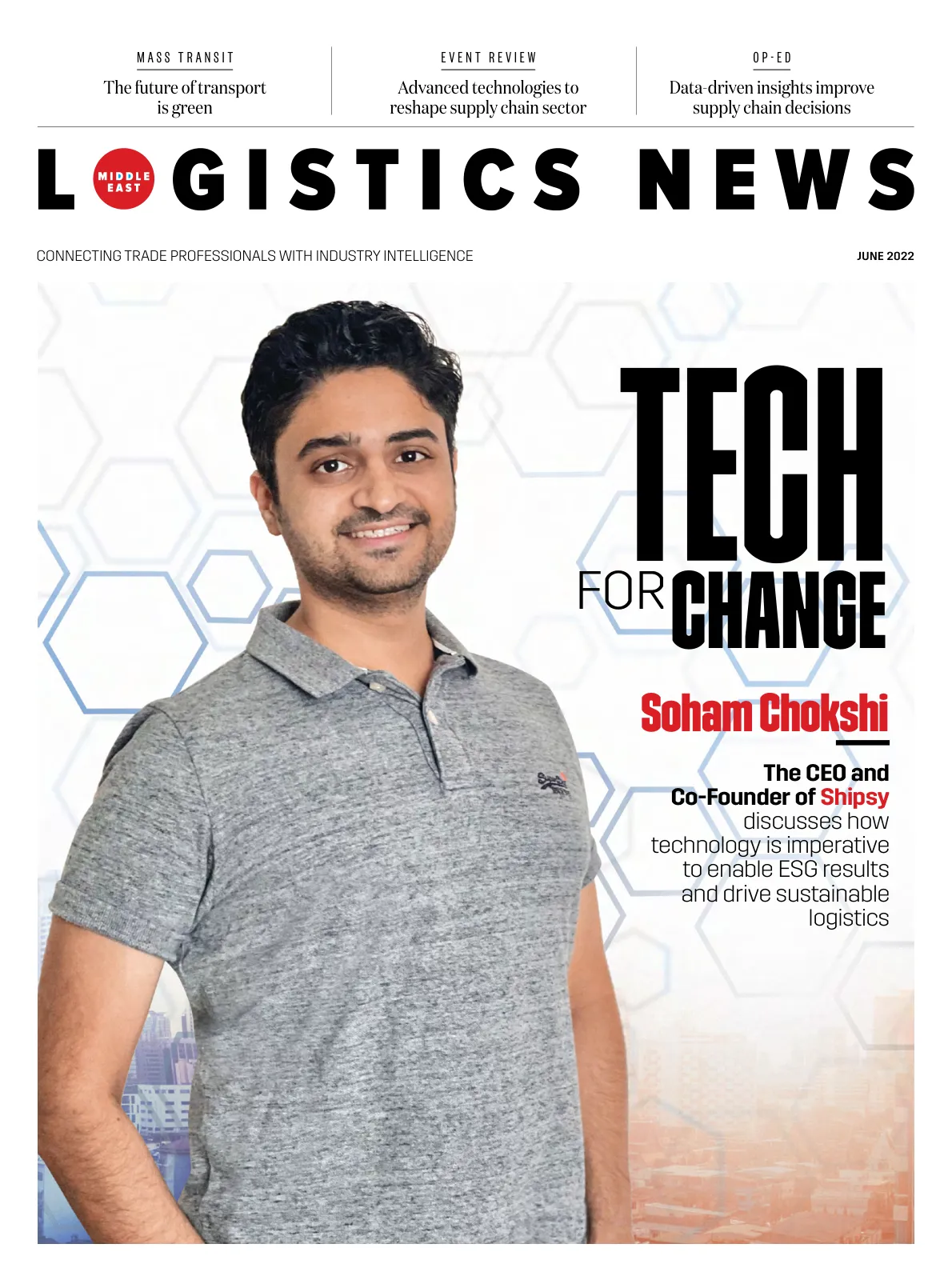
Logistics News, June 2022
Page 1
CONNECTING TRADE PROFESSIONALS WITH INDUSTRY INTELLIGENCE
JUNE 2022
M A S S T R A N S I T
The future of transport
is green
E V E N T R E V I E W
Advanced technologies to
reshape supply chain sector
O P - E D
Data-driven insights improve
supply chain decisions
Soham Chokshi
The CEO and
Co-Founder of Shipsy
discusses how
technology is imperative
to enable ESG results
and drive sustainable
logistics
CHANGE
FORTECH
Page 2
A MEMBERS OF EMIRATES TRANSPORT BUSINESS CENTERS:
Page 3
LOGISTICS NEWS ME | JUNE 2022 | 3
IN THIS ISSUE
TECH FOR
CHANGE
10 REGIONAL NEWS
16 FINANCE & INVESTMENT
PRESENTING THE RIGHT
OPPORTUNITY
Manrre Logistics Fund’s Chief Executive
Officer Kunal Lahori shares his insights
on industrial real estate investments
and his vision for the company
20 SPECIAL REPORT
TOP LAST-MILE DELIVERY SERVICE
PROVIDERS IN THE REGION
Logistics News ME delves into
discovering the best last-mile delivery
service providers in the region in terms
of efficiency, transparency, cost-
effectiveness, and sustainability
28 EVENT REVIEW
ADVANCED TECHNOLOGIES TO
RESHAPE SUPPLY CHAIN SECTOR
Over 60 industry leaders shed light on
ways to accelerate digitalisation and
sustainability within the supply chain,
logistics and procurement industry at
the Digital Supply Chain Show
30 COLD CHAIN
WHAT’S ON THE HORIZON
FOR COLD CHAIN LOGISTICS
Ken West, Reefer Digital
Development Manager at Maersk,
shares his expert opinion on the
future of cold chain logistics
38 OP-ED
DATA-DRIVEN INSIGHTS
IMPROVE SUPPLY CHAIN
DECISIONS
Gib Basset, Director of Solutions
Marketing, Supply Chain, Alteryx
shares how data-driven insights
can mitigate supply chain risks
40 MASS TRANSIT
THE FUTURE OF TRANSPORT
IS GREEN
Leading societies to a low carbon
future, Alstom’s Managing Director
for the Middle East, North Africa,
and Turkey Mama Sougoufara
reveals how the company is
frontrunning energy-efficient
mobility
Soham Chokshi, CEO and
co-Founder of Shipsy,
discusses how technology
is imperative to enable
ESG results and drive
sustainable logistics
32
20
40
Page 4
Page 5
Page 6
6 | LOGISTICS NEWS ME | JUNE 2022
WWW.CBNME.COM
All rights reserved © 2022.
Opinions expressed are solely those
of the contributors.
Logistics News ME and all subsidiary
publications in the MENA region are officially
licensed exclusively to BNC Publishing in the MENA
region by Logistics News ME.
No part of this magazine may be reproduced or
transmitted in any form or by any means without
written permission of the publisher.
Images used in Logistics News ME are credited
when necessary. Attributed use of copyrighted
images with permission. All images not credited
courtesy Shutterstock.
Printed by UPP
SUBSCRIBE
subscriptions@bncpublishing.net
For all commercial enquiries, contact
sales@bncpublishing.net
T +971 50 440 2706
PO Box 502511
Dubai, United Arab Emirates
P +971 4 4200 506 | F +971 4 4200 196
Keep up to date with all the latest
news, features and much more
on our website and social media
platforms.
CBNME.COM
CBNME
@CBNME
CONSTRUCTION BUSINESS NEWS ME
CEO
Wissam Younane
wissam@bncpublishing.net
DIRECTOR
Rabih Najm
rabih@bncpublishing.net
GROUP PUBLISHING DIRECTOR
Joaquim D'Costa
jo@bncpublishing.net
+971 50 440 2706
BUSINESS DEVELOPMENT DIRECTOR
Rabih Naderi
rabih.naderi@bncpublishing.net
+966 50 328 9818
MANAGING EDITOR
Kasun Illankoon
kasun@bncpublishing.net
EDITOR
Jochebed Menon
EDITORIAL DESIGN
Christian Harb
MARKETING EXECUTIVE
Aaron Joshua Sinanbam
aj@bncpublishing.net
PHOTOGRAPHER
Alexander Bungas
EDITOR’S NOTE
LNME
In this issue, we highlight how last-mile
delivery has evolved post the pandemic.
What we learn from the experts how
technology has enabled their businesses
to flourish increasing efficiency,
visibility, scalability, and safety.
The Digital Supply Chain Show, held
on 25 May in Dubai, echoed the same
sentiment with speakers emphasising
how technology helps manage end-
to-end supply chains better. Examples
demonstrated at the conferences
revealed the efficiency gains possible
when companies have a well-planned
digital transformation.
Another key event – Seamless Middle
East 2022, held from 31 May to 1
June – reiterated the same. Efficiency,
visibility, data-driven capabilities,
automation, digital commerce,
qCommerce, localisation and smart data
segmentation were some of the topics
discussed at the event. Detailed coverage
will feature in the July issue.
And finally, Shipsy – the smart logistics
management platform – features on
the cover. CEO and Co-founder Soham
Chokshi talks sustainability in logistics
and how technology is imperative to
drive down carbon emissions while
remaining profitable.
H
ello June! We’ve crossed
the halfway mark to 2022
with a lot taking place in
the past six months. A key
takeaway is the amplification
of technology in the logistics and
supply chain sector. We’re almost over
the pandemic – not there yet – but
we’ve achieved considerable progress
in dealing with the aftermath and
moving forward.
Jochebed Menon
Editor, Logistics News Middle East
jochebed@bncpublishing.net
Page 7
Page 8
Page 9
Page 10
10 | LOGISTICS NEWS ME | JUNE 2022
WWW.CBNME.COM
REGIONAL NEWS
LNME
A
ir France-KLM Group and the
CMA CGM Group announced
an exclusive partnership that
will see both parties combine
their complementary cargo networks,
full freighter capacity and dedicated
services to build an even more com-
petitive offer thanks to the unrivalled
know-how and global footprint of Air
France-KLM and CMA CGM.
CMA CGM and Air France-KLM share
a strong ambition to invest and grow
sustainably in the air freight business.
The agreement will have an initial
duration of 10 years. Air France-KLM
and CMA CGM will join and exclusively
operate the full-freighter aircraft capac-
ity of the respective airlines consisting
initially of a fleet of 10 full-freighter
aircraft, and an additional combined 12
aircraft on order:
Four full-freighter aircraft at CMA
CGM Air Cargo (with outstanding or-
ders for an additional eight aircraft,
two of which may be operated by Air
France-KLM in the future)
Six full-freighter aircraft at Air France-
KLM Group based at Paris-Charles de
Gaulle airport and Amsterdam Airport
Schiphol (with outstanding orders for an
additional four aircraft).
This new commercial partnership also
covers Air France-KLM’s belly aircraft
capacity, including over 160 long-haul
aircraft.
The partnership will leverage both
partners’ respective global sales teams,
presenting one voice to the customer.
The strategic commercial partnership
is expected to generate significant
revenue synergies including the joint
design of the full freighter networks and
enhanced products and services mix
opportunities.
It will help meet customers’ ever-
increasing need for more integrated
and resilient supply chains and will
leverage Air France-KLM’s vast existing
franchise, experience, and capabilities
in air freight, backed by a global cargo
network.
CMA CGM will mobilise its large com-
mercial network and global logistics
platform and will complete this offer
with innovative logistics and multimodal
solutions, particularly in sea and land
transport.
As part of this long-term exclusive
partnership, CMA CGM will reinforce its
commitment in the air freight industry
by becoming a new reference share-
holder in Air France-KLM.
CMA CGM has the firm intention
to take up to 9% of Air France-KLM’s
ex-post share capital, for a period con-
sistent with the implementation of the
strategic commercial partnership.
This investment could be made
as part of the contemplated capital
increase of Air France-KLM, as an-
nounced on February 17th, 2022.
Air France-KLM’s main shareholders
will support a resolution for the ap-
pointment of one board member rep-
resenting CMA CGM at the next share-
holders’ meeting (May 24, 2022).
Rodolphe Saadé, Chairman and CEO
of the CMA CGM Group said: “I am
very pleased with this strategic partner-
ship with Air France-KLM. It allows us
to significantly accelerate the develop-
ment of our air division, CMA CGM Air
Cargo, which was created just over a
year ago, and to position our two com-
panies among the world’s leading play-
ers in air freight.
“This partnership is fully in line
with CMA CGM’s strategy and its
ambition to become a leader in inte-
grated logistics, for the benefit of its
customers. Through our stake in the
company, Air France-KLM will be able
to count on us to support its future
development.”
Air France-KLM Group CEO Benja-
min Smith said: “This strategic part-
nership leverages the complementary
skills, expertise and activities of Air
France-KLM and CMA CGM. It is a
landmark step which will significantly
strengthen and expand the Group’s
position in the air cargo industry. I am
also extremely pleased that this com-
mercial partnership with CMA CGM
has resulted in their decision to invest
directly in the Air France-KLM Group,
demonstrating a strong testimony of
their belief in the future success of our
Group.”
AIR FRANCE-KLM AND CMA CGM INK LONG-TERM
STRATEGIC PARTNERSHIP IN GLOBAL AIR CARGO
Page 11
LOGISTICS NEWS ME | JUNE 2022 | 11
REGIONAL NEWS
M
ODIFI, a global platform for
SMEs to finance and man-
age international trade,
announced a partnership
with DP World. The partnership aims
to facilitate rapid and seamless access
to working capital by adding MODIFI’s
trade finance products to CARGOES
Finance by DP World.
CARGOES Finance by DP World is a
fintech platform that brings together
global importers, exporters, logistics
companies and financial institutions to
facilitate expeditious end-to-end global
trade finance. CARGOES Finance pro-
vides lenders with access to data on
cargo movements, enabling them to
lend with confidence to the SME seg-
ment.
DP World customers with cargo and
shipping requests will now be able to
take advantage of MODIFI’s trade fi-
nance products for both importers and
exporters, enabling them to get access
to working capital and manage their
cash flow with confidence via a unified
digital cockpit.
Mike Bhaskaran, COO for Logistics
& Technology, DP World said: “We
strive to provide new solutions for our
customers that not only add value to
the service we provide, but also help
to digitise the trade ecosystem and en-
able smarter trade across all markets.
Our partnership with MODIFI will see us
continue our progress on this mission
and continue developing the offering of
the CARGOES Finance platform for our
SME customers.”
Nelson Holzner, CEO & Co-Founder
of MODIFI, said: “With global trade
witnessing significant disruption dur-
ing the COVID-19 pandemic, finance
and payments are playing a vital role
in reducing the impact of disruption on
importers and exporters.
“Our partnership with CARGOES
Finance will deliver huge value across
the supply chain by unifying our fintech
platforms and allowing us to leverage
each other’s expertise. This collabora-
tion will ultimately ensure businesses
are able to access the finance, the
data, and the tools they need in order
to meet their customers’ needs world-
wide.”
MODIFI PARTNERS WITH
DP WORLD TO ENABLE
DIGITISATION OF TRADE
Page 12
12 | LOGISTICS NEWS ME | JUNE 2022
WWW.CBNME.COM
REGIONAL NEWS
LNME
A
ir Arabia, the Middle East & North Africa’s low-
cost carrier operator, reported a strong first
quarter (January to March) in 2022 as recovery
in demand for air travel continued.
Air Arabia reported a net profit of Dhs291
million for the first three months ending March 31, 2022, an
increase of 756% compared to Dhs34 million registered in
the corresponding quarter in 2021. In the same period, the
airline posted a turnover of Dhs1.12 billion, a 97% increase
in turnover compared to the first quarter of last year.
The financial and operational results achieved in the
first quarter were backed by the continuous recovery in
demand for air travel. More than 2.4 million passengers
flew with Air Arabia between January and March 2022
across the carrier’s five hubs, an 86% increase compared to
a total of 1.3 million passengers carried in the first quarter
of last year.
The airline’s average seat load factor – or passengers
carried as a percentage of available seats – during the first
three months of 2022 stood at an impressive 79%, up 4%
compared to the same period last year.
Commenting on the results, Sheikh Abdullah Bin
Mohammad Al Thani, Chairman of Air Arabia, said: “The
strong performance we witnessed last year continued in
the first quarter of 2022 and was supported by higher
customer demand for Air Arabia’s value driven product
as well as rigid cost control measures that the airline took
since the start of the pandemic.”
He added: “We have continued with our network
expansion strategy in the first quarter of this year by
adding new routes and new frequencies across all
operating hubs as well as continuing with preparations for
the launch of our new ventures in Armenia and Pakistan.”
Air Arabia added four new routes from its operating hubs
in the UAE, Morocco, and Egypt the first three months of
2022 and fully resumed its city check-in across the UAE. Air
Arabia Group also unveiled the brand identity of its latest
two ventures ‘Fly Arna’ and ‘Fly Jinnah’ in Armenia and
Pakistan respectively. Both joint ventures are expected to
be operational by mid-year.
Al Thani concluded: “In addition to the lasting impact
of COVID-19 on global aviation, the industry continues
to face geo-political challenges, higher oil prices and
uncertainty towards full economic recovery. Although all
these challenges are of a changing nature, we have full
confidence in the business model that we operate, the
strength of the aviation industry worldwide, as well as its
role in supporting regional and global economic recovery.”
AIR ARABIA REPORTS 97% INCREASE IN TURNOVER
IN FIRST QUARTER COMPARED TO 2021
Page 13
LOGISTICS NEWS ME | JUNE 2022 | 13
REGIONAL NEWS
A
l Masaood Commercial Vehicles and Equipment
(CV&E), part of Al Masaood Group, Abu Dhabi’s
leading conglomerate, has announced that it has
been selected as the authorised distributor for
Toyo Carriers Manufacturing (TCM) in the UAE
(Abu Dhabi, Al Ain, Western region, Dubai, and the Northern
Emirates).
TCM, a long-established global brand in the material han-
dling industry, offers a high-quality portfolio of forklift prod-
ucts designed and engineered to meet client requirements.
Supplied from production facilities in Japan, China, Thailand,
and Europe, TCM’s value-for-money product range includes
internal combustion engine forklifts, electric counterbalanced
forklifts, reach trucks and skid steer loaders.
The load capacity of small TCM forklifts ranges from 1.5
tonnes to 23 tonnes, with the brand’s large-size products able
to support heavy tasks such as container handling operations
in ports.
Mohamed El Zeftawi, General Manager of Al Masaood
CV&E, said: “As its authorized distributor, we at Al Masaood
CV&E are tying our customer-centric sales and aftersales sup-
port to TCM’s robust product range through this partnership,
thereby providing an end-to-end service to our customers.
“To offer holistic solutions, we also provide flexible financing
schemes and attractive leasing options. TCM is the latest in
Al Masaood’s growing network of partnerships with renowned
global brands, best known for their quality and excellence.
This partnership exemplifies our commitment to bringing to
the UAE market top quality products to support the opera-
tions of relevant local sectors. TCM’s line of forklifts is avail-
able at Al Masaood CV&E showrooms in Abu Dhabi, Al Ain,
and Northern Emirates (Sharjah).”
Kosuke Matsuda, Acting Deputy Manager – Overseas Sales
and Marketing Headquarters, Mitsubishi Logisnext Co., Ltd.,
said: At Mitsubishi Logisnext, we are proud of the enviable
legacy of the TCM brand in the history of Japanese technol-
ogy. The TCM brand had pioneered the manufacturer of the
first “Made in Japan” internal combustion forklift truck in
1949. We are indeed grateful for the many years of trust from
our customers in the UAE who appreciate the reliability of the
TCM brand.
“Our increasing collaboration with Al Masaood CV&E, the
exclusive TCM agent in the UAE, is intended to open new
frontiers to continue in the excellent delivery of our after-sales
service and for be-spoke solutions in material handling. “The
UAE is one of the most important global markets for us at
TCM.”
He added: “As we aim to build a more robust market pres-
ence in the country and the region, we are confident that
partnering with Al Masaood CV&E is the right strategy for us
given its proven track record in sales and aftersales support,
technical capability, and outstanding customer service. TCM’s
diverse product range has been designed to deliver affordable
top quality that satisfies varying customer needs across multi-
ple sectors.”
The TCM forklift range is available at Al Masaood CV&E’s
showrooms in Abu Dhabi, Al Ain, and Northern Emirates
(Sharjah).
TCM APPOINTS AL MASAOOD AS DISTRIBUTOR FOR HEAVY
AND MEDIUM FORKLIFTS IN THE UAE
Page 14
14 | LOGISTICS NEWS ME | JUNE 2022
WWW.CBNME.COM
REGIONAL NEWS
LNME
E
tihad Cargo, the cargo and logistics
arm of Etihad Aviation Group, has
appointed Tim Isik as Vice Presi-
dent – Commercial. Based in Etihad
Cargo’s headquarters in Abu Dhabi,
Isik will oversee the carrier’s global commer-
cial operations.
Isik joins Etihad Cargo from American
Airlines, where he gained over a decade of
experience working within the aviation and
air cargo sectors. In his new role with Etihad
Cargo, Isik will oversee the development
and deployment of the carrier’s sales strat-
egy and be responsible for further growing
Etihad Cargo’s strategic relationships, exe-
cuting sales and marketing plans and driving
team performance.
Isik will lead Etihad Cargo’s commercial
operations globally, supported by Latha
Narayan, Etihad Cargo’s Director – Com-
mercial Asia Pacific, Australasia and Indian
Subcontinent, and Mark Faulkner, Director
– Cargo Commercial West. Isik will report to
Martin Drew, Senior Vice President – Sales
& Cargo.
“Etihad Cargo is delighted to have Tim on
the team. I am confident his knowledge and
expertise will contribute to Etihad Cargo’s
continued growth, enabling the carrier to
further strengthen its position as the air
cargo partner of choice,” said Drew.
Isik said: “It’s an exciting time to be joining
Etihad Cargo, following the carrier achieving
a milestone year in 2021. I look forward to
working closely with Martin and the rest of
the team as Etihad Cargo continues its jour-
ney of growth through innovation and suc-
cessfully adapting to the needs of customers
and the dynamic challenges of the air cargo
market.”
D
ubai Municipality’s Geo-
graphic Information Systems
(GIS) Centre, the official
source for providing and
updating maps, plans and
geographic information for Dubai, has
initiated a project of designing highly
precise digital maps for autonomous
vehicles.
This step comes in line with the ambi-
tions and visions of the smart Dubai
government to promote digital trans-
formation of public utilities and make
Dubai ‘the best city to live’ in the world
as well as strengthening Dubai Munici-
pality vision of making it the pioneering
global city.
The project targets preparing and
designing maps as per the best
standards and international practices,
reflecting the emirate’s spirit of innova-
tion and creativity. These maps are set
to be utilized by businesses offering
specialized solutions for autonomous
vehicles, which are perceived to con-
stitute most of Dubai’s transportation
in the future.
Dubai Municipality’s GIS Centre con-
tinues to coordinate with partners and
concerned entities to promote inte-
grated concepts of highly precise maps.
Such efforts aim to ensure optimum
implementation of the maps in line with
the specific standards and requirements,
hence allowing map users to enjoy a
unique and exceptional driving experi-
ence.
ETIHAD CARGO APPOINTS EX-AMERICAN AIRLINES’
TIM ISIK AS VP COMMERCIAL
DUBAI
MUNICIPALITY
INTRODUCES
PRECISE
DIGITAL MAP
PROJECT FOR
AUTONOMOUS
VEHICLES
Page 15
LOGISTICS NEWS ME | JUNE 2022 | 15
REGIONAL NEWS
E
tihad Rail will host the 16th
edition of Middle East Rail
to outline the roadmap for
transforming the transporta-
tion & logistics industries in the
region.
Middle East Rail will be taking place
at the Abu Dhabi National Exhibition
Centre (ADNEC) on 17-18 May 2022.
The event, which is the largest trans-
port event in the Middle East, North
Africa and South Asia, will bring to-
gether leaders of the entire transporta-
tion community, forward-thinking senior
executives, key decision makers, and
government representatives to con-
vene, discuss the most pressing topics
in the global railway and transportation
sector, and highlight the latest innova-
tions in the industry.
Middle East Rail will bring together
more than 600 VIPs, government offi-
cials, transport and infrastructure indus-
try experts from the Gulf Cooperation
Council (GCC), as well as 6,000 attend-
ees, more than 200 speakers, and more
than 250 exhibitors.
Following the launch of the UAE Rail-
ways Programme by the UAE govern-
ment in December 2021, which will be
the largest integrated system for trans-
porting goods and passengers across
the country, Middle East Rail 2022 will
provide a platform to support and drive
the growth of ambitious transporta-
tion projects across rail, infrastructure,
freight, and logistics.
To support achieving a smart and
clean transportation system, Middle
East Rail 2022 will include conference
presentations, panels and interviews on
connected and intelligent systems, au-
tomated and safe processes, Internet of
things (IoT) and data analysis, sustain-
able operations and more.
The event will showcase the latest rail
innovations and technologies, and gen-
erate business opportunities in the rail,
logistics, and transportation industry
through facilitating networking oppor-
tunities and engaging discussions.
Middle East Rail 2022 will include dedi-
cated conferences that provide more
than 50 hours on sustainability, digital
innovation, and innovative mobility,
across the two days of the event.
It will also include more than 50 hours
of Continuing Professional Develop-
ment (CPD) certified workshops and
seminars, which aims at highlighting
the latest challenges operating in the
region to the engineering community
who are building world class projects. In
addition, attendees will have a chance
to explore more than 100 startups op-
erating in the smart mobility ecosystem,
their new products, and innovations.
Omar Al Sebeyi, Executive Director of
the Commercial Sector at Etihad Rail,
said: “We are delighted to be hosting
the upcoming edition of Middle East
Rail, which comes as part of our com-
mitment to support the development of
the transportation and logistics industry
in the UAE and the region. Middle East
Rail will contribute to showcasing the
latest technologies, fostering partner-
ships, stimulating investments, and
exchanging knowledge and expertise,
which are key for driving the growth in-
dustry in the UAE and the region.”
“At Etihad Rail, we ensure integrating
cutting-edge technologies and follow-
ing the best practices in the develop-
ment of the UAE National Rail Network,
to support the country’s economic
growth. We look forward to conven-
ing with industry leaders and experts
at Middle East Rail to shape the future
of the rail industry in the region,” he
added.
Etihad Rail aims to link the UAE’s cen-
tres of trade, industry, and population,
and will provide passenger and freight
services. Stage One of the Network has
been operational since 2016. Stage Two
is progressing at an accelerated pace,
achieving 75% of the project’s comple-
tion.
ETIHAD RAIL TO UNVEIL ROADMAP FOR
TRANSPORTATION AND LOGISTICS SECTORS
AT MIDDLE EAST RAIL
Page 16
16 | LOGISTICS NEWS ME | JUNE 2022
WWW.CBNME.COM
T
he UAE retail eCommerce
market reached a record
USD3.9 billion in 2020, a
53% year-over-year increase
driven by the COVID-
19-led digital shift. With
this growth comes the significant re-
quirement for last mile fulfilment cen-
tres and operational hubs; all of which
require vast amounts of warehousing
square footage.
Manrre Logistics Fund, a private
Dubai-based investment company, en-
tered the market in 2018 to capitalise
on this and offers investors investment
opportunities in industrial and logistics
real estate.
Manrre focuses on institutional-
grade logistics and industrial proper-
ties in locations including Jafza, Dubai
Investments Park and Dubai South, in
addition to investments in the cloud,
dark kitchen and alternative spaces in
the UAE.
Strategic investments
The company recently announced two
strategic investments in Jebel Ali Free
Zone (Jafza) increasing the value of
its portfolio by 22.5% to USD71.3
million. The first of the investments in
Jebel Ali is a facility leased to Infofort,
a subsidiary of Iron Mountain, a com-
pany focused on records management,
data backup and recovery, document
management and data centres.
The second is AMS Integrated Solu-
tions, a Danish company operating
in nine countries specialising in fleet
management, technical training, and
logistical needs for mission readiness.
Both new additions have fully guaran-
teed 10-year lease agreements in place.
Kunal Lahori explains how the fund
works. “Manrre is the one of the few
players in this niche space and presents
investors with a unique opportunity
for exposure to a growing class of
regional assets. The fund has a three-
year track record and has delivered an
annual ROI of 7.7% since inception
which in comparison to other global
real estate funds is on the higher end
of the spectrum,” he says.
Commenting on the twin invest-
ments, Lahori says: “We are extremely
proud of the new additions to our
ever-growing investment portfolio.
Both investments align with our strat-
egy on long-term and stable income
generation of logistics assets, with
high exposure to the rapidly growing
e-commerce market. This allows our
investors to benefit from a higher-yield
and a commitment to capital preserva-
tion.”
High yields
There has been significant growth over
the last ten years in Dubai’s industrial
real estate sector. He adds: “We have
seen a shift in demand which is more
towards eFulfilment and distribution
rather than other areas. Technology
is being used more in the space along
with a big focus on environmental,
social, and governance (ESG) factors
which includes LEED and solar as a
priority, our new facilities will incor-
FINANCE & INVESTMENT
LNME
PRESENTING THE RIGHT
OPPORTUNITY
Manrre Logistics Fund’s Chief Executive Officer Kunal Lahori
shares his insights on industrial real estate investments and his
vision for the company
Julian Maynard,
Managing
Director,
Maynard
Design
Page 17
LOGISTICS NEWS ME | JUNE 2022 | 17
PRESENTING THE RIGHT OPPORTUNITY | KUNAL LAHORI
porate such sustainability features. For
us, ESG is more than good intentions.
It’s about creating a tangible, practi-
cal plan that achieves real results. It’s
about embedding these principles - and
more across our businesses - from
investment to sustainable innovation.”
Lahori further notes: “If you look at
the UAE market, the eCommerce sec-
tor currently accounts for about 8%
compared to more mature markets like
the US. This illustrates the significant
growth opportunity ahead. We are
confident that there is only an upside
for the demand for the industrial real
estate.”
Lahori is confident the future invest-
ment plans of the fund will continue
to build on the successful investment
strategy the firm has laid out. “When
evaluating any further growth or
expansion, our team is consistently
evaluating them as per our strategy
and investment criteria; right asset,
right tenant, right industry, long-term
growth viability,” he shares.
The company has plans to acquire
real estate that is strategically integral
to the success of the regional logistics
sector and have a futuristic focus on
technology such as data centres, cloud
kitchens, dark stores.
“Manrre’s journey has just started,
and we’re now looking to scale to the
wider GCC market. Moving forward,
we will continue to focus on expand-
ing our footprint in a steady pace. In
today’s inflationary environment, real
estate investments provide potential
recurring income for investors and can
keep pace or exceed inflation in terms
of recurring income and appreciation,”
he notes.
Into the next phase
To boost its position across the region,
Manrre recently appointed CBRE as
their evaluator and advisor for the
next phase of growth of the fund.
CBRE is the world’s largest commer-
cial real estate services and investment
company, with the leading global
market position in leasing, property
sales, outsourcing, property manage-
ment and valuation.
“Since the inception of the fund,
we have had a laser-focused commit-
ment to this specific asset class and
COVID-19 was a natural stress test on
the portfolio. Having a solid strategy
and working with the right partners
has allowed us to weather the global
macro-economic challenges and now
focus on the continued growth of the
fund,” adds Lahori.
This continued growth, drives
increasing demand for logistics real
estate, industrial warehouses, and ful-
filment centres, all of which form the
core of the Manrre Fund’s portfolio.
“Manrre’s journey has
just started, and we’re
now looking to scale to
the wider GCC market.
Moving forward, we will
continue to focus on
expanding our footprint
in a steady pace.”
Page 18
CO-WORKING
SPACES
Get our mobile
app for an
all-around
smooth
experience
www.fluidmeet.com
OFFICE
SPACES
BOOK
YOUR
Page 19
Book Online & SAVE!*
Use this coupon "FMSBO2022" to get 10% off
all bookings
*Terms & Conditions apply
BANQUET &
EVENT HALLS
SPACE
WORK
MEETING
EVENT
MEETING
ROOMS
Page 20
20 | LOGISTICS NEWS ME | JUNE 2022
WWW.CBNME.COM
SPECIAL REPORT
LNME
TOP LAST-MILE
DELIVERY SERVICE PROVIDERS
in the region
Logistics News ME delves into discovering
the best last-mile delivery service providers
in the region in terms of efficiency,
transparency, cost-effectiveness, and
sustainability
*In alphabetical order
20 | LOGISTICS NEWS ME | JUNE 2022
WWW.CBNME.COM
Page 21
LOGISTICS NEWS ME | JUNE 2022 | 21
TOP LAST-MILE DELIVERY SERVICE PROVIDERS IN THE REGION
I
n the past five years, we have seen a lot of changes
in last-mile delivery. Among the main disruptors are
the pandemic-induced surge in eCommerce volumes,
changing consumer trends, and innovation in last-mile
delivery,” Alaa Saoudi says.
The growth in eCommerce sales can be attributed to the
growing number of businesses with new digital business
models that allow for digital payments, increasing
purchasing power of customers, and the widening range of
products that can be purchased online.
He adds: “Customer preferences have also shifted for instant,
time-definite, seamless, and contactless deliveries with free or
low shipping costs. In addition, customers also want to be in
control of their own delivery experience including the ability
to track deliveries in real-time, flexibility to select delivery
windows, and optionality to communicate directly with the
delivery driver or customer care representative.”
Scaling operations
This has pushed last-mile delivery companies such as Aramex
Express to figure out how to improve their operations by
scaling their capacity to keep up with the surge in demand and
leveraging technologies to drive efficiencies and reduce delivery
costs.
Saoudi explains: At Aramex, we have accelerated our
investments towards scaling our operations to capture the
strong demand and surge in eCommerce volumes. Last year,
we inaugurated a new express courier handling facility at the
Model Cargo Village at King Khalid International Airport.
“The new facility is equipped with the latest technologies
including the latest automated parcel sorting systems with a
capacity to handle more than 100,000 shipments per day. In
addition, it is directly connected to the Saudi Customs Clearance
systems, which will significantly reduce the time needed to
clear the shipments and deliver them to their destination. We
have also established two new hubs specifically in Prague to
cover Europe and Accra to cover West Africa. Additionally, in
Kuwait, we expanded our presence by moving to a new 12,500
sqm fulfilment centre.”
Leveraging technology
The firm has also employed technology-driven solutions such
as Aramex Spot and Aramex Fleet, both of which are delivering
flexible operations and scalability along with new delivery
preferences for end customers.
He adds: “In addition, we are leveraging several technologies
including the migration to the cloud and operation-enhancing
AI technologies that optimise delivery routes and shorten
delivery times.
“Our recent investments in technology, AI and analytics data
adds greater visibility and predictability to our Express business,
leading to greater efficiency and enhanced customer service. Of
note, we teamed up with Salesforce to integrate a customised
CRM system that provides us with greater access to gain a
holistic view of customers across its portals, apps, and social
media to offer optimised solutions.”
Aramex is also seeking ways to every mile of the delivery
journey – from first to last mile – as efficient and eco-friendly as
possible. “We dedicate resources – time, people, and money – to
constantly innovate our operations and processes. We have a
very clear roadmap for automation across all facilities in our
core markets in the coming two years,” Sauodi signs off.
ALAA SAOUDI
Chief Operating Officer
Aramex Express
Page 22
22 | LOGISTICS NEWS ME | JUNE 2022
WWW.CBNME.COM
SPECIAL REPORT
LNME
e
Commerce has been
a huge benefactor of
the pandemic, and
a driving force for
last-mile evolution.
Amidst store closures,
lockdowns and health
concerns, online
shopping increased
in popularity and
ushered in a new wave of consumers who
embraced it out of necessity.
Bachi Spiga explains: “The pandemic
shifted consumer demand patterns.
Financial constraints and social shifts
caused many consumers to re-evaluate
their spending, prioritising items
considered more of a necessity during a
‘stuck at home’ situation. In the Middle
East, DHL saw the fastest moving product
categories to be hygiene, self-care, fitness
apparel, office equipment and food
items.”
The insatiable rise in eCommerce has
brought in a flood of new customers who
are demanding to receive competitively
priced shipments at their convenience.
“This trend is challenging fulfilment,”
discloses Spiga.
“Last mile is the most expensive and
time-consuming part of the supply
process, accounting for over 50% of the
shipping costs, and continuous investment
is necessary in technology and solutions
to improve fulfilment timelines through
faster and more efficient deliveries, at
lower costs,” he adds.
Innovation in last-mile logistics
New last mile delivery services are
inspired by the need for safe, contact-free
options, and have grown in popularity
due of the flexibility and convenience
they offer. With customers spoilt for
choice, expectations for last-mile delivery
innovation remain high.
Heralding the last mile delivery revolution
is technology. “Technology is crucial in
driving efficiencies and curbing costs in
last-mile delivery,” Spiga notes.
“From the predictive capabilities of
AI and big data-analytics used to solve
operational challenges and determine
dynamic route optimisation, capacity
accuracy, and demand prognostics; to
driverless trucks, rovers, and drones
which can unlock new levels of safety,
efficiency, and quality in last mile delivery,
the integration of latest technologies in
logistics can create a more dynamic and
customised delivery service capitalising
on enhanced visibility, transparency,
reliability, and security.”
As last mile delivery service continues to
evolve, sustainability and environment-
friendly practices comes to fore. Spiga
says: “Sustainability gained momentum
during the pandemic and has become
an extremely important differentiator in
logistics.
“Consumers have become more
conscious of the environmental impact
of their online shopping and are turning
away from unsustainable brands. There
is a higher expectation on the businesses
they buy from, to play their part to reduce
waste across their entire supply chains.
Logistics is increasingly prioritising
environmental operational efficiency
in last-mile delivery, re-visiting the
transportation sector which is one of the
main causes of global carbon emissions,
and adopting eco-friendly strategies
to green the last mile, be it through
route optimisation, electric vehicles, or
localisation of warehousing, to reduce
our carbon footprint while maximising
efficiencies.”
Looking ahead
With technology moving at a rapid pace,
DHL is focused on localised and digitised
fulfilment to improve the last mile. The
sky is really the limit with last-mile
delivery innovation. We have seen so
much development already in last-mile
solutions, from robots rolling down the
sidewalk, to drones and parcelcopters
landing in peoples’ back yards. We are still
competing on time and cost, so we need
to make sure we stay agile in adjusting to
market trends and we are open to learning
and reinvention,” he concludes.
BACHI SPIGA
Head of Operations
DHL Express MENA
Page 23
LOGISTICS NEWS ME | JUNE 2022 | 23
F
or delivery
companies, last-
mile delivery is
often the most
challenging, time-
consuming, and
labour-intensive
part of the entire
delivery process,” Taarek
Hinedi says.
“At FedEx, we continuously
look for innovative solutions
to make deliveries more
flexible, convenient, cost
effective, and sustainable. One
example is electric vehicles.
With the increase in demand
for last-mile deliveries, thanks
to rapid eCommerce growth,
electric vehicles are now being
tested and added to our fleet
around the world in phases
with the goal of making the
FedEx pickup and delivery
fleet zero–emission by 2040.”
The pandemic has
fundamentally changed
the way people shop for
their goods, accelerating
the rise in online shopping.
Changes to how much and
what consumers are buying
online are transforming how
deliveries are managed.
Rising customer demand
In 2021, consumer electronics,
apparel and footwear, and
F&B were the top three
products in demand in the
Middle East and North
Africa region, according to
reports. Another report states
that, during the same year,
the demand for smartphone
in India increased with 5G
shipments registering a growth
of 555% year-on-year.
Increasing demand is driving
delivery companies to consider
how they can become more
efficient, while growing
environmental concerns
are increasingly influencing
consumer purchasing
decisions.
He adds: “Globally
millennials are choosing
alternatives to home delivery
on account of environmental
concerns. Alternative pick-
delivery solutions such as ‘hold
at location’ or parcel lockers
are becoming increasingly
popular worldwide alongside
innovative solutions such
as zero tailpipe emission
delivery robots and electric
vehicles as companies look at
environmentally sustainable
transport options.”
Every aspect of commerce
is undergoing radical change
and businesses are demanding
greater control, flexibility, and
visibility across their supply
chains. Delivery companies
are looking at new business
models to operate more
efficiently, while meeting the
increase in demand for last-
mile deliveries.
Hinedi explains: “We’ve
seen an exponential growth in
eCommerce and the long-term
shift that’s affected buying
behaviour and how companies
think about logistics. And,
at the same time, with the
advancement of logistics
technology, supply chains are
creating increasingly more
data.
“Today’s economy is rooted
in the transfer and availability
of information that moves
things forward. Having real-
time insights about supply
chain decisions better informs
how we can adapt to new and
unexpected challenges. But
with new tools now at our
disposal…the possibilities may
very well be limitless.”
As technology evolves, so
does its application. The
transportation industry will
see benefits of next-generation
innovation for team members
and operations, including
computer-assisted vehicles,
artificial intelligence, robotics,
and drones.
“These new technologies and
innovations to use, and using
data to inform future change,
both in how we interact with
packages travelling through
the system and create and
maintain more efficient supply
chains will shape the future of
last-mile deliveries,” he says.
TOP LAST-MILE DELIVERY SERVICE PROVIDERS IN THE REGION
TAAREK HINEDI
Vice President of Middle East
and Africa Operations
FedEx Express
“TODAY’S ECONOMY IS ROOTED IN THE TRANSFER
AND AVAILABILITY OF INFORMATION THAT MOVES
THINGS FORWARD.”
Page 24
24 | LOGISTICS NEWS ME | JUNE 2022
WWW.CBNME.COM
SPECIAL REPORT
LNME
E
nsuring packages
reach customers
on time in the face
of unprecedented
demand has been
the biggest challenge
last mile delivery companies
are facing since the pandemic.
According to a report by
McKinsey, ten years’ worth of
eCommerce growth occurred
in just the first few months
after the pandemic began.
As eCommerce continues
to grow, last-mile delivery is
being pushed to limits with
challenges like limited public
space, traffic congestion,
shorter delivery windows and
road safety. With just a few
clicks, a consumer is given
a day and time for home
delivery.
Roman Poludnev says: “For
last-mile delivery, the last-click
begins a symphonic production
consisting of countless digital
algorithms, resources, and
people to deliver on consumer
expectations to have the parcel
delivered to their doorstep.
“Consumers expect real-time
visibility over their orders.
They want to see where the
driver is at any given time and
exactly when the parcel will
be delivered. They expect the
delivery when it was promised.
Delivery delays can cost
brands their reputation, loss of
customers and return business.
This is where online customer
loyalty is won or lost.”
Advanced technology
adoption
He notes that since 2020,
how the industry has seen
“home delivery go from
nice-to-have to essential”.
“In a very short time,
there have been changes
to delivery processes that
have been in place for years
and rapid adoption of new
technologies.”
Poludnev maintains that as
eCommerce grows, delivery
service operators know that
their share of the competitive
landscape depends on their
ability to fulfil customer
expectations in areas of
same and next-day delivery,
offering a wide range of
convenient delivery windows,
accurate estimated time of
delivery, as well as efficient
and timely communications.
He adds: “Technology
plays a huge role in helping
compete and perform at or
above customer expectations.
For instance, Honeywell’s
comprehensive solution for
entire supply chain ensures
products and packages are
trackable and traceable
throughout the supply chain
– a critical requirement when
it comes to products such as
pharmaceuticals, vaccines
and for the food and tobacco
industries. Track and Trace
is a software solution that
provides real-time visibility
and reporting of products
within a vehicle, a container, a
pallet, or a packaging box at
the micro-level, enabling users
to track products throughout
the supply chain.”
Industries that have been
challenged by the economic
impact of the pandemic are
rebuilding with a focus on
resilience. “This is creating
opportunities for optimisation
and efficiency while furthering
the digitalisation of the
sectors, which we are enabled
through Honeywell’s advanced
technologies,” he expresses.
Sustainable practices
Advanced technologies are
also helping companies to
implement environment-
friendly measures. Honeywell’s
Voice Guided Work enables
operations to efficiently handle
eCommerce volumes, speeds,
complexity and collaboration
within warehouse and
distribution centres. It also
enables sustainable practices.
Using a hands-free system,
Voice Guided Work cuts back
on paper waste.
“Providers must meet or
exceed the service needs of
customers both in ways they
expect, and in ways they have
not yet imagined. This includes
collaboration throughout the
process and making a clear
commitment to sustainability.
To this end, Honeywell has
made a commitment to drive
sustainability in all aspects of
business,” Poludnev says.
Honeywell
ROMAN POLUDNEV
General Manager - Safety and Productivity
Solutions for Middle East, Russia, Turkey,
and Africa
Page 25
NEW IVECO S-WAY: HIGH TECHNOLOGY AND EFFICIENCY FOR ON-ROAD MISSIONS
The new IVECO S-WAY, with a completely redesigned and reinforced cab, offers a wide choice of Euro III/V diesel engines,
a delivering class-leading power from 360 HP to 560 HP Euro III / 570 HP Euro V and superior fuel-saving devices,
such as anti-idling feature, Ecoswitch, Ecoroll and Smart Alternator. 12-speed HI-TRONIX automated transmission with the most advanced
technology in its category, electronic clutch and best-in-class torque-to-weight ratio.
NEW IVECO T-WAY: HIGH PRODUCTIVITY AND SAFETY ON OFF-ROAD TERRAINS
With a complete line-up of AWD and PWD versions and the the 16-speed HI-TRONIX automated gearbox, the IVECO T-WAY features
a host of functionalities such as Rocking Mode, Off-road Mode, Creeping Mode and 4 reverse gears to tackle with ease the toughest off-road conditions.
The new architecture of the EBS system, combined with disc brakes on all wheels, greatly improves the vehicle’s performance
and the driver’s safety in the most demanding applications.
DRIVE THE NEW WAY
Page 26
26 | LOGISTICS NEWS ME | JUNE 2022
WWW.CBNME.COM
SPECIAL REPORT
LNME
D
ata and technology innovation have
transformed last-mile delivery, helping to drive
operational efficiency and productivity. noon
has worked hard to push these boundaries,
enhancing the customer experience through
smarter warehouse capabilities and locations,
innovative order tracking, and more
streamlined deliveries to ensure safety and
sustainability within its last-mile fleet especially in the past few
years.
Ammar Tambawala explains how the pandemic has impacted
noon’s last-mile delivery in the last two and a half years. “We
have seen an uplift in two key areas: safety, and demand. The
demand for silent, contactless deliveries increased significantly,
providing a safer experience for both noon’s customers and
delivery team. We were able to match the increase in online
purchases after travel restrictions were lifted by increasing the
scope and efficiency of our last-mile fleet.”
Challenges and hurdles
This hasn’t come around without its fair set of challenges. “A
key focus is on increasing the efficiency and productivity of our
last-mile fleet in order to meet customer demand at a sustainable
rate for delivery associates,” he says.
“The global supply chain crisis is putting a strain on vehicle
lead times and availability, and rising cost inflation (fuel prices)
has been a strain on the industry. We’re addressing these issues
through smarter operational planning.”
Technology plays a crucial role in helping last-mile delivery
service providers such as noon to overcome these challenges.
Tambawala notes: “A robust technological network is essential
for effective last-mile delivery operations. Accurate address
codes, smart location tracking, route optimisation, and high-
frequency order updates have all contributed to smoother
deliveries. This has allowed us to define optimal delivery clusters
and delivery path optimisation, as well as improve our customer
experience and expectations.”
noon is also invested in ensuring its last-mile delivery services
are more efficient while following sustainable practices. “Our
‘Get It Together’ mode allow customers to receive multiple
packages in a single delivery, reducing fuel consumption
and increasing productivity,” he reveals. “Allocation of
click and collect lockers at multiple convenient touchpoints,
more compact and reusable packaging are also important in
decreasing our footprint.”
Future focused
Looking forward noon anticipates a significant increase in
delivery volumes as the eCommerce industry expands. “Our
primary focus will be on scaling up efficiently and sustainably
to meet this demand. Consumer expectations have shifted
dramatically, and we anticipate an increase in demand for faster
deliveries, particularly in the Q-commerce space,” Tambawala
says.
He concludes: “noon’s fastest delivery service, noon in
minutes, now offers customers in select parts of Dubai an
assortment of thousands of products delivered in just 15
minutes.”
AMMAR TAMBAWALA
VP Ops Strategy
noon
Page 27
LOGISTICS NEWS ME | JUNE 2022 | 27
TOP LAST-MILE DELIVERY SERVICE PROVIDERS IN THE REGION
L
ast-mile logistics has become increasingly critical for
the efficient operation of supply chains, especially as
eCommerce is on the rise and consumer behaviour
undergoes a rapid evolution.
Borhene Ben Mena believes that urbanisation,
eCommerce, and digitalisation have had a major
impact on last-mile delivery in the last five years.
He explains: “The rate of movement of people
from rural areas into cities has continued to grow, despite being
slowed for a period by the pandemic. The continual increase
in consumer density has piled pressure on infrastructure and
resources and challenged supply chain managers to devise new
ways to fulfil and deliver orders to end consumers.”
He adds: “The pandemic drove traditional brick-and-mortar
shoppers to online shopping channels, giving them a taste of
the ease of eCommerce. For many, online shopping has now
become the preferred way of buying products and are flocking
to eCommerce channels in droves. The increased demand for
home deliveries means shippers must significantly boost their
fulfilment and last-mile delivery processes.
“With Amazon, Uber, and fast-food delivery firms offering a
slick user experience, customers are expressing frustration at
the slower standard of service offered by traditional delivery
carriers. If they have a choice, they opt for tech-savvy companies
that offer faster delivery. They are also demanding additional
features such as selection and modification of delivery windows
and tracking deliveries in real-time.”
eCommerce a boon or a bane?
eCommerce is spurring retail growth globally. “The demand
for last-mile delivery services is exploding—luring many new
players into the industry and spurring many companies to offer
omnichannel services,” Mena adds.
“Consequently, the last-mile delivery sector has also grown
across the board. The biggest boom has been in the expected
industries—food and groceries, apparel, and furniture—but also
in less-expected industries such as pharmacies, banks, tobacco,
coffee, luxury goods, and accessories.”
Like consumers around the world, GCC clients have become
used to the luxury of shopping from home and getting what
they need, or fancy delivered in the shortest possible time.
This surge in eCommerce has had its pitfalls: rise in global
carbon emissions. “Customers are seemingly oblivious to the
fact that the single-item delivery they are demanding is the most
polluting leg of last-mile delivery.
“Fortunately, more and more consumers are considering
environmental and health concerns when buying products
online. They are also becoming more ecologically conscious,
with more than half of millennials citing protection of the
environment as the reason for choosing alternatives to home
delivery.”
However, if eCommerce grows at the galloping rate that
economists are predicting, a whopping 36% more delivery
vehicles globally will be weaving in and around inner-city streets
by 2030, increasing congestion and adding to carbon emission
levels, Mena discloses.
“To mitigate some of this choking carbon footprint,
responsible last-mile delivery companies are investing in greener
modes of transport, including electric vehicles, eScooters, and
electric bicycles,” he adds.
“Other innovations include establishing parcel lockers for
the self-service collection of parcels, coordinating with other
companies to improve load pooling, using AI for efficient real-
time route optimisation, buying local, and tightening up returns
policies by limiting the number of sizes and colours of the same
item customers are allowed to order.”
Mena believes that robotic delivery and drone delivery are
going to revolutionise the shipping process. He concludes:
“The cost of labour for last-mile delivery is approximately
60% of the overall delivery cost. By implementing robotic and
drone delivery, companies will save costs. At the same time,
implementing more automatic processes will keep workers
safer.”
BORHENE BEN MENA
Chief Executive Officer
Shipa Delivery
Page 28
28 | LOGISTICS NEWS ME | JUNE 2022
WWW.CBNME.COM
EVENT REVIEW
LNME
T
he third Digital Supply Chain
Show concluded on Wednesday,
25th May at Address Marina,
Dubai. The anticipated event saw
the successful participation of more
than 300 supply chain experts
from across the MENA region.
Attendees and sponsors networked in
person, reconnected with peers, and made
new connections. Digital innovations that
are accelerating visibility, efficiency, and
predictability within the supply chain,
logistics, and procurement industry were
discussed at the event.
Organised by Ventures Connect and
supported by CIPS MENA, the primary
focus of the event was on how companies
in the region can set up and implement
supply chain and procurement processes
for improved resiliency, agility, and
sustainability.
Industry insights
The Digital Supply Chain Show offered
real-world examples and practical insights
from supply chain giants like Amazon,
DP World, Noon, Unilever, Lulu Group
International, Chalhoub Group, ADNOC
Group, Emirates Airline, Saudi Telecoms
Company, and Mondelēz International.
The practical examples demonstrated the
efficiency gains possible when companies
have a well-planned digital transformation
and can access new knowledge by
leveraging big data and technologies
such as cloud, ERP systems, artificial
intelligence, control tower and digital
twins.
Organisations have learnt in recent years
the importance of de-risking their supply
chains, especially if they are heavily reliant
on one supplier or country. Digitalisation
and data intelligence is giving companies
new, faster insights that will support their
decision-making.
“65% of the increase in price is due
to supply chain issues globally and not
because of demand issues,” says Dr.
Ashraf Mahate, Chief Economist, Dubai
Industries and Exports
Increasingly, multinational corporations
and people are pledging to associate only
with companies and brands who adhere
to social and environmental standards.
Companies are expected to have a high-
quality sustainability strategy in place
that allows them to meet their carbon
reduction targets. The Digital Supply
Chain Show explored how to build
resilient and responsible procurement and
supply chain operations, working with
supply chains to reduce indirect emissions.
Resilient digital supply chain
“Leveraging emerging technologies is
critical for increased accountability,
transparency and efficiency and is
one of the first steps towards building
agile and resilient digital supply chain
transformations,” says Baljeet Nagi,
Director of SCM Sales Development &
Strategy, Oracle.
Speaking about the evolution of delivery
and how each region differs. Ritesh
Somani, Director, Supply Chain and 3PL
Trans, Amazon MENA, shared how the
variety of options offered by logistics and
retail companies are adopting advanced
Ritesh Somani, Director, Supply Chain and 3PL Trans,
Amazon MENA
ADVANCED TECHNOLOGIES
TO RESHAPE SUPPLY CHAIN SECTOR
Over 60 industry leaders shed light on ways to accelerate digitalisation
and sustainability within the supply chain, logistics and procurement
industry at the Digital Supply Chain Show
Page 29
LOGISTICS NEWS ME | JUNE 2022 | 29
ADVANCED TECHNOLOGIES TO RESHAPE SUPPLY CHAIN SECTOR
technologies to offer the customer the
quickest and most efficient option.
“It is critical to use technology to
be able to provide delivery choices
to customer in a seamless manner.
Whether it’s delivered to their car boot,
doorstep, or a locker, they want to have
that freedom of choice. This is where
technology comes into play.”
He also discussed the global supply
chain disruption, where getting things
from point A to point B is becoming
increasingly challenging. “What used to
x days takes 1.4 to 2x days now. The
challenge is how do you plan ahead
with your vendors, manufacturers and
suppliers, and use technology to ensure
that once you get space on a container
vessel or a cargo carrier, the inventory
that you get is the right inventory - else
that space is wasted.”
He added: “This is where technology
comes into the picture: to be able to
predict the future demand and ensure that
the orders placed are worth getting in the
first place. With technology, we’re now
able to predict where and when products
are needed.”
First-mile logistics
Praveen Khare, Vice President, Retail
Logistics & Fulfillment at Noon.
com highlighted how Noon.com is
realigning the business to focus on
first-mile logistics. “We’re going back
to the basics,” he said. “We’re taking
into account all the learnings from
the COVID-19 disruption. What is
happening is no more merely a factory or
port problem. “
He added: “What we’re try to emphasis
on now is the project or container
journey right from the time it enters the
port to being placed on the vessel. It
might look simple but it’s not the case.
With the kind of blank sailing taking
place everywhere, the entire supply chain
needs to be re-calibered. Each vessel
carries up to 20,000 of which 300 are
mine, which means I need to also look at
the sequence at which the containers are
being offloaded. We’re focused more on
creating visibility at the first mile of the
business. If the base is correct, the rest is
falls into place.”
The key to the success of the supply
chain sector now lies with technology.
Blockchain, machine learning and
artificial intelligence are key to creating
visibility, efficiency and agility. SAP
MENA’s Abdul Hakeem, Regional Sales
Head - Digital Supply Chain Solutions,
believes that the next big thing for supply
chain technology is networking.
Multi-directional collaboration
He elaborated: “The COVID-19
pandemic brought to the forefront the
need for multi-directional collaboration.
Looking at the current scenario, most
customers are still in the uni-directional
flow. For example: you send the order
to the supplier, the supplier sends the
stuff to you. There is no proper flow of
collaboration on what you want to do
versus what constraints they have.”
He added: “If we really want to build
resilience, we need to transparently
exchange information with suppliers
and be aware of events that happen
during the transit so we can respond
accordingly. The disarray caused by
COVID-19 was a deep tier disruption,
supply chains didn’t have visibility.”
He also revealed that the two main
challenges the sector is facing now are
full visibility and the convergence of
planning and execution. “Artificial
intelligence and machine learning
gets one to a significantly better place
in terms of planning, but if one’s
unable able to get a consistent data
fabric and bridge the gap between
planning and execution - then you’re
not achieving much in object user
resilience. Convergence is a crucial
factor, and we’re try to address it at
SAP.”
Abdul Hakeem, Regional Sales Head - Digital Supply
Chain Solutions, SAP MENA
Praveen Khare, Vice President, Retail Logistics &
Fulfillment, Noon.
Page 30
30 | LOGISTICS NEWS ME | JUNE 2022
WWW.CBNME.COM
COLD CHAIN
LNME
W
hen thinking about the
current state of refrigerated
logistics, two words come
to mind immediately:
challenges and innovation.
Such different words, but
intrinsically connected as one is the
main cause for the other to come to
life.
If you are shipping any cargo today,
particularly if your products are
perishable, you are certainly familiar
with challenges. A global pandemic,
delays, congestions, political instability,
shortages, and several other issues are
plaguing the world of container logistics
and weakening the links of global cold
chains.
Supply chain challenges are sparking
fascinating innovation efforts, among
both established players in the market
for perishable goods as well as small
start-ups, in areas ranging from pure
data aggregation to new methods for
extending shelf-life.
There are huge opportunities to
revolutionise and digitise the container
logistics industry that is unfortunately
still depending on unique paper copies
for certain transport documents. But
what is currently at the top of the wish
list for cold chain customers?
Levels of visibility
Visibility is becoming a buzzword within
logistics. Typically, cold chain customers
are looking for a level of visibility and
control that can answer three simple
questions:
WHAT’S ON THE HORIZON
FOR COLD CHAIN LOGISTICS
Ken West, Reefer Digital Development Manager at
Maersk, shares his expert opinion on the future of
cold chain logistics
Page 31
LOGISTICS NEWS ME | JUNE 2022 | 31
WHAT’S ON THE HORIZON FOR COLD CHAIN LOGISTICS
When will my container arrive?
Customers want to know the exact time
their refrigerated container is ready
for pick-up from the terminal or when
the trailer truck will arrive with their
goods at the destination. To meet this
need, Maersk is currently seeing an
increased use of GPS trackers mounted on
containers and GPS signals coming from
the truck driver’s smartphone. Machine
learning is also being applied to achieve
more accurate arrival estimations taking
both historic transport times and weather
forecasts into account.
Will my cargo arrive in the expected
condition?
Given the pandemic, customers are
no longer able to travel as easily to
destinations to check the quality of their
cargo upon arrival. Now they need to
rely more heavily on data points collected
during the journey, and here temperature
is the most important parameter to look
at.
More container carriers are investing
in infrastructure which enables a remote
data flow from the container, and several
customers are even applying temperature
loggers themselves on a few pallets inside
the container. Despite this, we are still in
the early days of having a fully connected
cold supply chain:
The container temperature does not tell
the full story of cargo which might also
have travelled through packhouses and
cold store facilities on both import and
export side.
Transmitting temperature loggers
have so far been too costly to apply on
every single pallet or box of a shipment.
Combining data from different sources
into a single overview is a challenge,
unless you have one party handling the
entire cold chain.
There is ongoing work on quality
prediction models which can estimate the
remaining shelf-life of certain perishable
commodities based on parameters
measured during the journey, but
these models will in future be heavily
dependent on data input from across the
entire supply chain. New technology,
such as smart- labels and sticker sensors,
will soon come to a more realistic cost
level and thereby enable reliable shelf-life
predictions.
Has my container been opened by any
unauthorised parties?
Container contamination, or even
theft of cargo, are becoming a growing
challenge for cold chain customers.
Different compartments of a refrigerated
container can be used by criminals to
place illegal substances, unknown to
the shipper or the receiver of the goods.
Therefore, it is necessary for customers to
know whether their container has been
opened while in transit, especially during
inland transportation or storage.
Several types of door-opening and
light detection sensors are becoming
available in the market, and we are
seeing an increased interest from customs
service and import/export authorities to
collaborate with logistics providers on
data sharing to achieve more intelligent
inspection routines, and therefore reduce
unnecessary disruptions to customers’
supply chains.
Enabling mitigating actions
Overall, the logistics industry is
undergoing transformation in terms of
digitization and data offerings, with great
momentum around new visibility related
solutions and technology. Once the
above mentioned three customer needs
for visibility have reached a satisfactory
level, then comes the next question to
the logistics providers: which mitigating
actions can I take here and now if things
are not going according to plan?
Serving customers with data is crucial,
but the real benefits will only be achieved
if the information is up-to-date, and
everyone can interpret the aggregated
data in the same way to take the right
strategic decisions based on it.
That will be the next big leap in terms
of optimising global supply chains for
perishable cargo to ultimately avoid cargo
damage, contamination, or loss.
Ken West, Reefer Digital Development Manager at Maersk
Page 32
32 | LOGISTICS NEWS ME | JUNE 2022
WWW.CBNME.COM
COVER STORY
LNME
Soham Chokshi, CEO and co-Founder
of Shipsy, discusses how technology
is imperative to enable ESG results
and drive sustainable logistics
TECH FOR
CHANGE
Page 33
LOGISTICS NEWS ME | JUNE 2022 | 33
TECH FOR CHANGE | SOHAM CHOKSHI
W
hen Soham Chokshi, Dhruv Agrawal,
Himanshu Gupta, and Sahil Arora
established Shispy back in 2015, their
focus was on addressing the challenges
that existed in the last-mile ecosystem.
But soon they realised that supply
chain and logistics sectors are all connected and that last-
mile inefficiencies were only the tip of the iceberg. They
saw an alarming need to marry the physical and digital
parts of logistics. This in turn resulted in massive expan-
sion of the platform across first, middle, last-mile, cross
border logistics and intermodal freight movement.
Today, Shipsy has grown into a sprawling business em-
powering the biggest retailers, manufacturers, eCommerce
providers, on demand delivery brands, and logistics service
providers to build resilient, agile, and automated supply
chain and logistics processes.
Shipsy’s intuitive platform provides complete visibility of
first, middle and last-mile operations, unlocks operational
efficiency, and leverages real-time analytics to empower
businesses to make data driven decisions, better manage
costs, boost customer experience, and reduce carbon emis-
sion.
Rising environment pollution
Carbon emissions pose an enormous threat to the environ-
ment, living species, and businesses with some hard facts.
Melting glaciers, growing cases of forest fires, and floods,
among other natural calamities, are nature’s way of voicing
her state of depletion.
The consistent rise in global average temperature is trig-
gering unprecedented floods, especially in Australia, Asia,
and South America. Growing carbon emissions are a major
contributor to these alarming figures. >>>
Page 34
34 | LOGISTICS NEWS ME | JUNE 2022
WWW.CBNME.COM
COVER STORY
LNME
Unfortunately, today 24% of global
CO2 emissions can be attributed to
the transportation sector, and 30%
of this comes from trucks carrying
freight. Going by the numbers, CO2
emissions from road freight transpor-
tation have grown by 20% since 1995.
These figures can be overwhelming.
Taking just the region into consid-
eration, in 2018, the Middle East
and North Africa emitted 3.2 billion
tonnes of CO2 and produced 8.7%
of global greenhouse gas emissions
(GHG) despite making up only 6% of
the worldwide population, according
to reports.
Soham says: “As supply chain and
logistics stakeholders, we can no
longer ignore these figures and should
consider it our responsibility to make
the movement of goods sustainable.
On the brighter side, governments,
especially in this part of the world, are
taking solid actions to battle growing
carbon emissions.”
Countries in the region have chalked
out stringent penalties for those flout-
ing environmental norms. Depending
on the kind of violation and extent of
damage caused to the environment,
the Abu Dhabi government can levy
fines on responsible parties up to Dhs1
million. “This can significantly impact
the bottom lines of businesses that are
heavily dependent on logistics opera-
tions,” Soham suggests.
Quick yet sustainable shipping
With environmentalism going
mainstream, modern customers are
gradually showing signs of purchasing
from brands that are socially responsi-
ble and are taking measures to reduce
their carbon footprint, especially in the
last mile, says Soham. “But if one fol-
lows the trend, this is not surprising.”
A Global Customer Insights Survey
revealed that 35% of consumers
“AS SUPPLY CHAIN AND LOGISTICS
STAKEHOLDERS, WE CAN NO LONGER
IGNORE THESE FIGURES AND SHOULD
CONSIDER IT OUR RESPONSIBILITY
TO MAKE THE MOVEMENT OF GOODS
SUSTAINABLE.”
Page 35
LOGISTICS NEWS ME | JUNE 2022 | 35
PURSUING PROGRESS | MADHAV KURUP
choose sustainable products, and 37%
want products that come with environ-
mentally friendly packaging. “Expecta-
tions around eco-friendly deliveries can
be considered an organic progression.
Especially in the Middle East, where cus-
tomers are more empowered and aware,”
he notes.
He adds: “At the same time, customers
also love fast deliveries and are willing to
pay more for the same. Ensuring deliver-
ies with turnaround times of less than 30
minutes tends to consume more resources,
more delivery trips, and more fuel, leaving
behind bigger carbon footprints.
“So, how does one balance customer
experience and an organisation’s sustain-
ability goals? The answer lies in deploying
advanced logistics management solutions
like Shipsy. What really inspires me is that
a recent survey by Nielson highlighted
that 73% of eCommerce customers say
they would want to change their pur-
chasing behavior to reduce any negative
impact on the environment.”
Driving logistics sustainability
Shipsy’s smart logistics management
powered by AI helps businesses reduce
their carbon footprint by ensuring lesser
miles traveled, shrinking trip volumes,
improving first-attempt success rates, gain-
ing better visibility of carbon footprint
and more.
He explains: “We are making this possi-
ble through our technology by improving
address accuracy, driving intelligent route
planning, optimising vehicle capacity,
ensuring dynamic clubbing of orders,
improved customer communication, elimi-
nating diversions and idling, leveraging
intermodal transportation, and providing
sustainability dashboards.”
Inaccurate customer addresses are a
massive challenge in the Middle East. “It
increases last-mile delivery attempts and
subsequently results in greater carbon
emissions,” Soham reveals.
According to Statista, last-mile delivery
failure rates range from 15% in the UAE
to 40% in Saudi Arabia, and this can im-
pact eCommerce revenue worth USD7.42
billion in the Middle East.
“Shipsy’s advanced geocoding capabili-
ties seamlessly convert physical addresses
into highly accurate latitude/longitude- >>>
Page 36
36 | LOGISTICS NEWS ME | JUNE 2022
WWW.CBNME.COM
COVER STORY
LNME
based locations and drastically eliminates
delivery failures due to incorrect address-
es. This boosts profitability and brings
down delivery reattempts,” he shares.
With regards to driving intelligent
route planning, Shipsy considers mul-
tiple constraints like fuel consumption,
turnaround times, proximity, cost, speed
and more before finally creating routes to
travel from point A to B to C. He adds:
“We also enable businesses to eliminate
empty miles by ensuring round trips are
productive. Research reveals that almost
40% of trucks often run empty, result-
ing in emissions that could have been
avoided.”
Furthermore, Shipsy’s capacity opti-
misation algorithms consider multiple
factors while planning routes. It reflects
constraints like delivery location, weight,
volume, service type, vehicle make,
storage type, and more when allocating
delivery tasks. “We empower businesses
to optimise capacity by 31% and reduce
delivery trips,” Soham notes.
Through dynamic clubbing of orders,
Shipsy ensures that in case subsequent or-
ders fall under the same radius on either
side of the already planned delivery route,
the system clubs them and assigns them
to the same driver, significantly bringing
down trips needed for pickup and delivery
tasks. “Our customers are experiencing a
14% increase in deliveries per driver by
using the dynamic order clubbing capabil-
ity,” he explains.
Making logistics sustainable
Shipsy’s platform is accompanied by data-
rich and intuitive sustainability dash-
boards. These dashboards help delivery
stakeholders monitor carbon emissions at
a granular level throughout disparate legs
of a logistics network. Soham says: “This
improves logistics planning and delivers
actionable insights on shrinking an organi-
sation’s carbon footprint.”
He adds: “In a nutshell, three critical
factors will drive businesses to make
logistics sustainable. One, government
regulations and compliance. The second
is customer expectations, and the third
is the need to reduce operational costs.
These factors will also trigger the need for
enterprises, shippers, retailers, and logis-
tics service providers to embrace advanced
logistics management solutions.”
According to inhouse reports, with
Shipsy’s end-to-end smart logistics man-
agement solution, businesses across the
globe are reducing their carbon footprint
by curbing distance traveled by 5% and
decreasing trip volumes by 6%.
He concludes: “Let’s play our part in
restoring the balance that allows nature,
wildlife and human lives to thrive in the
same ecosystem.”
Page 37
JUNE 17, DUBAI | SOFITEL DUBAI THE PALM2022
SUSTAINABILITY
Innovation Awards
#CBNMEAWARDS
SUBMIT YOUR ENTRIES
FACEBOOK.COM/CBNME
@CBNME
CONSTRUCTION BUSINESS NEWS ME
FOR SPONSORSHIP OPPORTUNITIES JOAQUIM D’COSTA
+971 50 440 2706 jo@bncpublishing.net
FOR NOMINATIONS KASUN ILLANKOON
+971 56 135 4769 kasun@bncpublishing.net
Page 38
38 | LOGISTICS NEWS ME | JUNE 2022
WWW.CBNME.COM
OP-ED
LNME
T
he supply chain and logistics
sector is one that’s defined by
change… and yet is also highly
dependent on consistency and
stability.
While, on a micro-scale,
roadblocks, diversions, and
traffic delays are known
challenges on any route, success
often comes down to the experience of
the driver, the quality of the information
they have available to make route
adjustments, and the timeliness of just
how quickly that information reaches
them.
Data-driven insights have been the
lifeblood of the supply chain sector for
decades, with hard-won knowledge used
to make strategic decisions. Today, data
is the navigator for this journey. Once
gathered, processed, and analysed, it can
get you to where you need to be while
mitigating risk.
Access to right information
Supply chain activities directly impact
each part of the customer journey – from
anticipating and influencing demand to
responding and fulfilling that demand
and retaining and growing the business.
Without the right information at the right
time, that disruption can rapidly pile
up. Commerce and customer loyalty is,
naturally, experience-led.
Broken supply chain processes,
comparatively, also break the positive
customer experience that businesses
need to thrive. Aeroplanes are reportedly
off course at least 90% of the time due
to weather conditions, turbulence, and
other factors. They are kept on track
through hundreds of tiny data-informed
adjustments – one degree at a time.
But what happens when those micro-
adjustments are no longer sufficient?
Just as these micro-adjustments are
key en route, so too are they key across
the supply chain journey. Quality
data insights can help steer the whole
customer engagement life-cycle and keep
the journey on track - from automating
production, warehouse, and logistic
tracking, to delivering progress updates
to the customer. Recognising and
undertaking these micro-adjustments
is vital in foreseeing and reacting to
unanticipated disruption.
DATA-DRIVEN INSIGHTS IMPROVE
SUPPLY CHAIN DECISIONS
Gib Basset, Director of Solutions Marketing, Supply
Chain, Alteryx shares how data-driven insights can
mitigate supply chain risks
Page 39
LOGISTICS NEWS ME | JUNE 2022 | 39
DATA-DRIVEN INSIGHTS IMPROVE SUPPLY CHAIN DECISIONS
When the entire global supply chain model
comes under strain - as buying habits flip
or suppliers become unable to source raw
materials - using data and analytics to
quickly solve issues and provide alternative
solutions to bring the process back on
track fast becomes a key business enabler.
What’s over the horizon?
What’s changing in supply chains is that
this data no longer resides in the head of
the most experienced driver or warehouse
leader. Now, that data has gone digital,
with a massive shift in how that data is
collected, stored, processed, and used.
Route optimisations and disruption
mitigations can be decentralised and
distributed across the entire business.
The McLaren Racing Formula 1 team
is a key example of an optimised supply
chain underpinned by analytics - with
the need to secure materials for more
than 80,000 unique and custom-built
components.
The car would not be built within
operational budget caps without that
reliability and consistency across inventory
and part performance tracking. They
use data science and analytics to help
track and oversee the journey of each
car part, from design and simulation
to the complicated manufacturing and
maintenance supply chains, to help drive
that resilience.
McKinsey research notes that of the
supply chain executives surveyed in May
of 2020, 93% intended to make their
supply chains more flexible, agile, and
resilient. For the organisations able to
harvest, capture, and turn that data into
insights, the potential competitive edge is
significant.
In rising to meet these data challenges,
supply chain specialists are transforming
the ways in which they work and
solve problems through data insights -
providing more flexibility, agility, and
resilience across their business. However,
the true value of data increases when
the responsibility for analysing data is
democratised to the broader team.
With the advent of accessible low-code
no-code tools, the responsibility for
analytics no longer needs to be the domain
of data scientists exclusively. Instead, those
closest to the challenge can be empowered
to solve it – using their expertise and
experience to deliver insights that would
have otherwise been missed and then easily
and effectively automating that very same
process. The missing ingredient is training
– investing in human potential and not just
layering technological solutions on top of
each other.
Using data for intelligence
The pandemic effectively saw businesses
take five years of digital transformation
progression and condense it into six
months. While vital to the continuation
of service at short notice, any project
concentrated to such a timeline is – by
definition – going to run into roadblocks
of its own without the necessary training
to support it. While automation is a
powerful tool, it is still a tool. Just as
a hammer does not pick itself up and
swing itself, automation technology
only becomes a valuable resource when
combined with human intelligence.
While an achievable and valuable goal,
automation needs to come from a firm and
robust foundation of practical data work.
Instead, businesses need to start small by
building intelligence and visibility across
all teams and processes. By solving micro
problems regularly and accurately, data
teams can begin to expand their remit.
According to a new Deloitte survey, 67%
of business executives say they are “not
[currently] comfortable” accessing or using
data from advanced analytic systems.
A comparable study from KPMG explains
that this phenomenon is due to reliability.
With inconsistent results from data, many
executives are confirmed to “lack a high
level of trust in their organisation’s data”,
with 67% of CEOs stating they “prefer
to make decisions based on their own
intuition.”
In fully optimising supply chains and
mitigating the risk of disruption, CEOs
and business leaders must be provided the
right information at the right time to make
the right decisions. Providing these leaders
with regular, accurate information is a core
route to a data-driven supply chain. Still,
that information must be accurate every
time to build that trust.
A core premise within data science
is reducing a challenge to its core
components – to a point where reliability
and accuracy are guaranteed - and building
from there. While a micro solution can
be scaled up to a macro one, a macro
solution can rarely be condensed to work
on a smaller scale. Materials shortages,
delays from downstream facilities, and
non-standard disruptions across any point
of the chain are core examples of macro
problems that can be addressed at the
micro level.
Domain specialists achieve actual value
when they can utilise the data to look
for incremental gains as analytics helps
optimise the entire supply chain journey.
Analysing the most common delay routes
or factors between the raw materials
supplier and the initial warehouse by
tracking late or ‘missing’ deliveries and
factoring in other important data points
like drivers or delivery service used.
By building a grouping of data analyses
across the numerous moving parts of
the supply chain, we can begin to build
a better picture of what is happening,
what is causing specific disruptions, and
what the critical points of failure are. We
can create an impactful risk profile and
mitigate macro supply chain risk beyond
‘gut feel’ decision making.
Gib Basset, Director of Solutions Marketing, Supply Chain,
Alteryx
“Data-driven insights have been
the lifeblood of the supply chain
sector for decades, with hard-won
knowledge used to make strategic
decisions.”
Page 40
40 | LOGISTICS NEWS ME | JUNE 2022
WWW.CBNME.COM
MASS TRANSIT
LNME
F
rench manufacturer and operator of rail transport
across the globe Alstom has been part of region’s trans-
portation and mobility development since the 1950s.
In the UAE, the sustainable mobility company de-
livered the Dubai tramway, the first fully integrated
tramway system in the Middle East and the world’s first 100%
catenary-free line, which opened in 2014. Since then, it has
been awarded the maintenance of the tram for a period of 13
years.
Alstom delivered the turnkey automatic people mover
(APM) system at Dubai Airports to connect Terminal 1 to
Concourse D which opened for passenger services in February
2016 and designed to carry up to 200,000 passengers a day.
Mama Sougoufara reveals: “We designed and supplied all
electrical and mechanical (E&M) elements, 18 Innovia 300
cars (operating as five-car trains), the Cityflo 650 communi-
cations-based train control (CBTC) technology for driverless
operation and responsible of operations and maintenance
(O&M).”
More recently, the Alstom-led consortium was responsible
for delivering the world’s fastest-built turnkey driverless
metro project, Dubai Route 2020 Metro extension, which
was inaugurated in June 2020.
Elaborating on the Dubai Metro project, Sougoufara
says: “We are proud of the work we did for Dubai Metro
Route 2020’s 15km-long line.
“As a leader of the consortium, we were responsible
for the integration of the entire metro system including
50 metropolis trainsets, power supply, communication,
signalling, automatic ticket control, track works, platform
THE FUTURE OF TRANSPORT IS GREEN
Leading societies to a low carbon future, Alstom’s Managing Director for
the Middle East, North Africa, and Turkey Mama Sougoufara reveals how
the company is frontrunning energy-efficient mobility
Page 41
LOGISTICS NEWS ME | JUNE 2022 | 41
THE FUTURE OF TRANSPORT IS GREEN
screen doors and a three-year warranty on the whole system, as
well as the enhancement of the existing metro line by upgrad-
ing power supply, signalling systems, communication, and track
works.”
MIDDLE EAST FOCUS
Furthermore, in the region the company has several projects
– completed and ongoing. In Saudi Arabia, Alstom, as part of
FAST consortium, is supplying a fully integrated metro system
for lines 4, 5 and 6, which includes 69 metropolis-based Riyadh
Metro trains, as well as the delivery of 47 two-car driverless In-
novia Metro 300 trains for line 3.
In Makkah, Alstom was part of the Haramain high-speed rail
line between Mecca and Medina, supplying Talgo with the Mi-
trac TC 3300 propulsion equipment and Flexifloat high speed
bogies for the powerheads of the 35 very high-speed trains as
well as the VIP train for the 450km line.
Towards Jeddah, Alstom is also the supplier of the turnkey
Innovia APM 300 automated people mover system at the King
Abdulaziz International Airport and responsible for operation
and maintenance until June 2022.
In Qatar, Alstom delivered the Lusail Tramway, the country’s
first catenary-free tramway and a system that will provide ef-
ficiency, availability, and easier maintenance, supporting the
country’s Vision 2030
Sougoufara says: “We are proud to be contributing to the sus-
tainable mobility landscape in the region - as we are convinced
that it will bring about the change needed towards a clean and
ultimately emission-free energy system.”
A NEW SHIFT
For decades the Gulf region was dependent on road transport –
it’s only in the past 15 years that other modes of transport such
as rail and marine have made inroads. “An efficient, tech driven
rail network is rapidly becoming an important need. It can offer
a much more efficient mode of transport for goods and people
movement around the region,” Sougoufara suggests.
“The Middle East has experienced rapid economic develop-
ment and has the youngest population in the world and second
highest urbanisation rate in the world. This development can
only be sustained by resilient and modern transport infrastruc-
ture,” he adds.
“For this purpose, it is important that the Middle East has
modern, interconnected, and reliable public transport systems to
ensure access to economic centres for everyone, reduce pollution
and congestion.”
Sougoufara also believes that an efficient rail network will sup-
port the region’s drive to meet sustainability goals – particularly
as the UAE and the Egypt gear up to host COP conferences.
He is of the opinion that at a regional level a robust and in-
terconnected transport network will firmly position the Middle
East as a business leader. “An example of this is the USD100bn
Etihad Rail project between the GCC, which is set to open new
trade corridors for business and travel opportunities.”
“According to official sources, in the UAE alone, Etihad Rail
can bring an excess of USD1 billion to the country’s gross do-
mestic product (GDP) by 2030, with the project promising an
economic return rate of 15.5%,” he adds.
SUSTAINABILITY AT THE CENTRE
Alstom wants to capitalise on these opportunities and bring
sustainable rail systems to the region. He explains: “The effects
of climate change are increasingly felt across the world, putting
sustainability at the forefront of everything. At Alstom, we are
aware of this reality and the significant potential for better trans-
portation solutions must curb worldwide emissions.
Mama Sougoufara, Alstom’s Managing Director for the Middle East, North Africa,
and Turkey
“WE ARE PROUD TO BE CONTRIBUTING TO
THE SUSTAINABLE MOBILITY LANDSCAPE IN
THE REGION - AS WE ARE CONVINCED THAT
IT WILL BRING ABOUT THE CHANGE NEEDED
TOWARDS A CLEAN AND ULTIMATELY
EMISSION-FREE ENERGY SYSTEM.”
>>>
Page 42
42 | LOGISTICS NEWS ME | JUNE 2022
WWW.CBNME.COM
“Rail transportation is currently the
most energy-efficient transport mode and
therefore offering residents an efficient
rail network will support the reduction
per capita emissions. Approximately 85%
of greenhouse gas emissions from the
transport sector are related to the surface
systems. Therefore, a single person switch-
ing from a car to public transport can save
up to 20 pounds of their CO2 emissions
per day. At Alstom, we have a full range
of green traction options, so we can help
our customers go even further to reduce
their emissions and address the rapid ur-
banisation that is taking place across the
region.”
Alstom is also introducing innovative
digital solutions to increase capacity and
improve efficiency throughout its opera-
tions. An example is the improved naviga-
tion software which not only reduces the
carbon footprint but also addresses some
of the biggest transportation issues such as
traffic congestion.
Alstom has announced clear environ-
mental targets for 2025 which include:
achieving science-based CO2 emission
reduction targets under the COP21 Paris
Agreement; 25% reduction of CO2 emis-
sions; 100% of newly developed solutions
are eco-designed; and 100% of electricity
supplied by renewable energies.
He says: “For us this means Alstom is
looking to reduce its carbon emissions
across the entire value chain. For our
customers it means we are ready to work
with them to address the challenges we
collectively face because of rapid urbanisa-
tion and global warming.
“And we do it by addressing their indi-
vidual needs, there isn’t a one size fits all
solution and because we have the largest
portfolio of solutions, we are able to pro-
vide them exactly what they need to meet
their sustainability targets whatever they
may be.”
And Alstom is not relying on a single
green energy source. “There are many
options to power mobility and transport
systems. As a leader in sustainable mobil-
ity, Alstom has developed a wide range
of green and innovative technologies to
reduce emissions and pollution in catena-
ry-free operation. Customers can choose
from a wide portfolio of proven solutions
based on Alstom’s unrivalled expertise in
hydrogen, battery, or dual mode electric-
hydrogen,” Sougoufara says.
He adds: “On the hydrogen front, we
are proud to have the Coradia iLint, the
world’s first hydrogen train in passenger
service in Germany since 2018. This repre-
sents a true alternative to diesel power.
“Additionally, Alstom is a pioneer in
battery trains and offers the trains for
various platforms. We recently supplied
the world’s first battery train for passenger
operation in Germany.
“Depending on the need, infrastructure,
and environment we will be able to advice
customers on the best solution. We need
to look at the entire eco-system and ensure
when a green solution is introduced, the
full system, including rolling stock, is op-
timised.”
MASS TRANSIT
LNME
Page 43
Your go to delivery solution!
Introducing
New Renault Duster Cargo
An efficient, reliable & modern fleet solution
This is a first-of-its-kind Cargo SUV model which is now available across
Al Masaood Automobile , Renault showrooms in Abu Dhabi & Al Ain.
Bluetooth
Automatic
Transmission
Fuel
Efficiency
Cruise control
with speed limiter
½ a ton boot
capacity
Call us at 800 300 500 to place an enquiry
Or visit our website https://abudhabi.renault.ae/DusterCargo.html
Page 44