Logistics News, June 2023
Page 1
CONNECTING TRADE PROFESSIONALS WITH INDUSTRY INTELLIGENCE
E N E R G Y
The Driving
Partnership To COP28
JUNE 2023
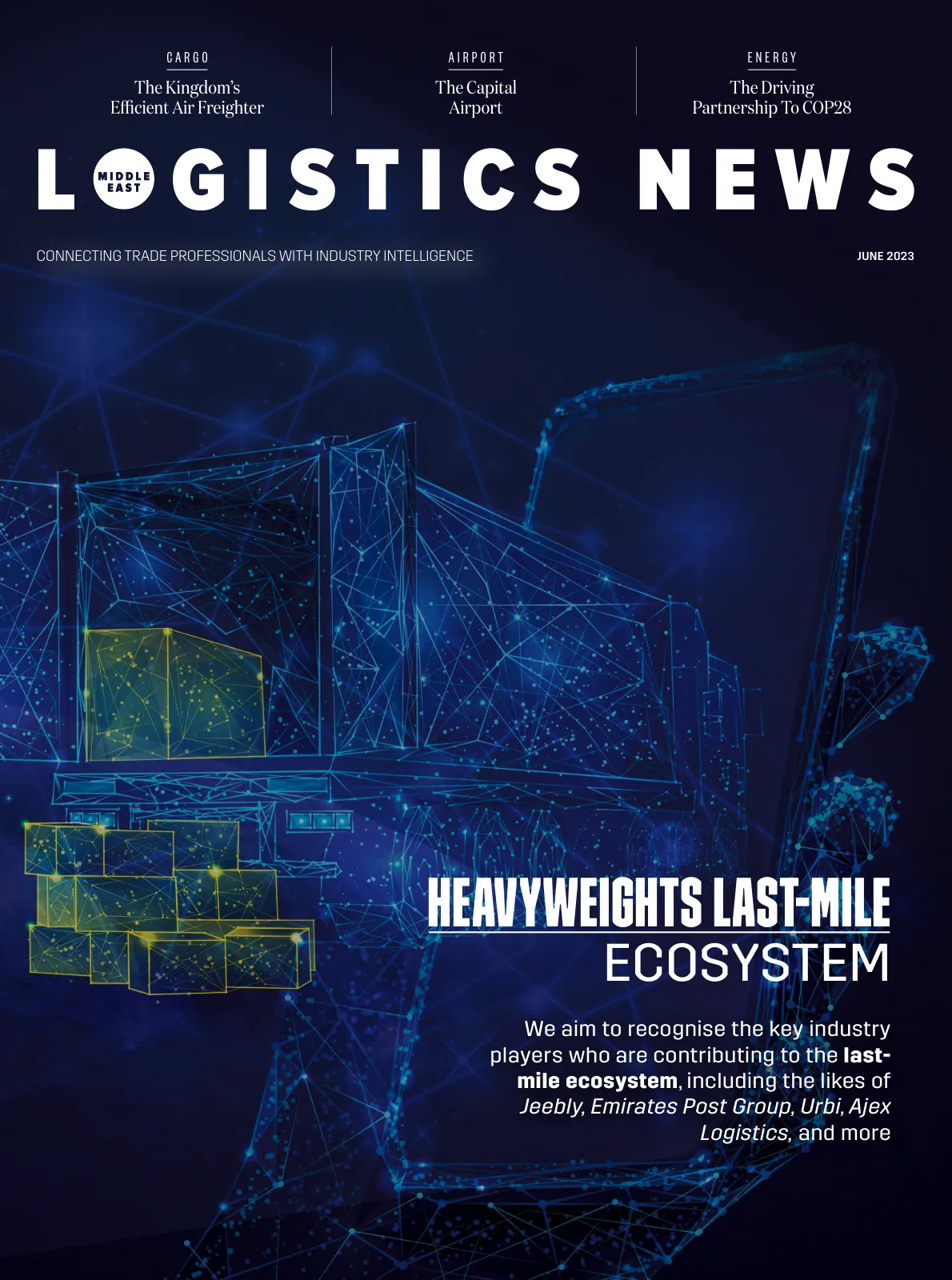
We aim to recognise the key industry
players who are contributing to the last-
mile ecosystem, including the likes of
Jeebly, Emirates Post Group, Urbi, Ajex
Logistics, and more
HEAVYWEIGHTS LAST-MILE
ECOSYSTEM
C A R G O
The Kingdom’s
Efficient Air Freighter
A I R P O R T
The Capital
Airport
Page 2
New IVECO T-WAY: high productivity and safety on off-road terrains
With a complete line-up of AWD and PWD versions and the the 16-speed HI-TRONIX automated
gearbox, the IVECO T-WAY features a host of functionalities such as Rocking Mode, Off-road Mode,
Creeping Mode and 4 reverse gears to tackle with ease the toughest off-road conditions. The new
architecture of the EBS system, combined with disc brakes on all wheels, greatly improves the vehicle’s
performance and the driver’s safety in the most demanding applications.
New IVECO S-WAY: high technology and efficiency for on-road missions
The new IVECO S-WAY, with a completely redesigned and reinforced cab, offers a wide choice of
Euro III/V diesel engines, a delivering class-leading power from 360 HP to 560 HP Euro III / 570 HP
Euro V and superior fuel-saving devices, such as anti-idling feature, Ecoswitch, Ecoroll and Smart
Alternator, 12-speed HI-TRONIX automated transmission with the most advanced technology
in its category, electronic clutch and best-in-class torque-to-weight ratio.
Drive the new way.
Page 3
LOGISTICS NEWS ME | JUNE 2023 | 3
IN THIS ISSUE
HEAVYWEIGHTS LAST-
MILE ECOSYSTEM
14 ROUND-UP
SEAMLESS MIDDLE EAST 2023
Logistics News ME spoke to Swisslog, Yango
Deli Tech and Savoye Middle East on their time
at Seamless this year
20 FORESIGHT
HOW QATAR IS POSITIONED
for future success with logistics in the spotlight
Adrian Peiris, Business Manager for Contract
Logistics at GAC Qatar, examines how the
nation’s expanding logistics industry can leave
its mark on the global scene
22 PORTS
FROM SIMULATION TO REAL-WORLD
SUCCESS
How Digital Twins Revolutionise Port
Operations
Dr Mohamed Rahmah, Vice-President, Zodiac,
DP World, sheds light on how they are one of
the vital smart solutions technology players in
the ports and terminals industry
24 AIRPORTS
THE CAPITAL AIRPORT
Robert Sutton, Senior Vice President, Freezone,
Cargo and Logistics at Abu Dhabi Airport
shares his insights on the air cargo
industry, Abu Dhabi Airport Free Zone,
and more
46 CARGO
THE KINGDOM’S EFFICIENT AIR
FREIGHTER
Vibha Mehta discusses the extensive
spectrum of cargo services provided by
Saudia Cargo with Marwan Niazi, Vice
President of Commercial
50 TRANSPORTATION
A TRUCKING PHENOMENON
We chatted with the Ford Trucks team
to learn more about the business’s
expanding efforts in the trucking sector
52 ENERGY
THE DRIVING PARTNERSHIP TO
COP28
U.S.-UAE Partnership for Accelerating
Clean Energy (PACE) announces support
for a landmark project to deploy clean
nuclear energy to decarbonize the
Romanian power sector
WE AIM TO RECOGNISE THE KEY
INDUSTRY PLAYERS WHO ARE
CONTRIBUTING TO THE LAST-
MILE ECOSYSTEM, INCLUDING
THE LIKES OF JEEBLY, EMIRATES
POST GROUP, URBI, AJEX
LOGISTICS, AND MORE
22
50
26
Page 4
SIGN UP & SAVE 25% ON STAYS
WITH BREAKFAST INCLUDED
Page 5
Book, stay, enjoy.
THAT’S
Page 6
6 | LOGISTICS NEWS ME | JUNE 2023
WWW.CBNME.COM
SUBSCRIBE
subscriptions@bncpublishing.net
PO Box 502511 Dubai, United Arab Emirates
P +971 4 4200 506 | F +971 4 4200 196
For all commercial enquiries, contact jo@bncpublishing.net
T +971 50 440 2706
All rights reserved © 2023.
Opinions expressed are solely those of the contributors.
Logistics News ME and all subsidiary publications in the MENA region are
officially licensed exclusively to BNC Publishing in the MENA region by
Logistics News ME.
No part of this magazine may be reproduced or transmitted in any form or
by any means without written permission of the publisher.
Printed by United Printing and Publishing | upp.ae
Images used in Logistics News ME are credited when necessary. Attributed
use of copyrighted images with permission. All images not credited courtesy
Shutterstock.
cbnme.com
ACCESS FRESH CONTENT DAILY ON OUR WEBSITE!
Logistics News ME
@Logisticsnewsme
Logistics News ME
logistcsnewsme
In addition to our print edition,
we’re bringing you all sorts
of industry news on our web
mediums. We’re looking forward
to interacting with our readers on
all of our social media and web
platforms. See you on the web!
CEO
Wissam Younane wissam@bncpublishing.net
Director
Rabih Najm rabih@bncpublishing.net
Group Publishing Director
Joaquim D'Costa jo@bncpublishing.net
Editor-in-Chief
Vibha Mehta vibha@bncpublishing.net
Managing Editor
Kasun Illankoon kasun@bncpublishing.net
Design
Christian Harb
Marketing Executive
Aaron Joshua Sinanbam aj@bncpublishing.net
Photographer
Alexander Bungas
CONNECTING TRADE PROFESSIONALS WITH INDUSTRY INTELLIGENCE
Page 7
The Arocs. Your Reliable Partner for
Every Construction Transportation Task.
Regardless of whether it is a rigid chassis, concrete mixer or heavy-duty tipper: The
Mercedes-Benz Arocs provides an especially robust, resilient vehicle that is optimally
prepared for use for any construction haulage challenge. Configure it now to suit your
requirements and those of your project.
Page 8
8 | LOGISTICS NEWS ME | JUNE 2023
WWW.CBNME.COM
EDITOR’S NOTE
LNME
K
nowing new individuals daily is
one of my job's most exciting
aspects. When we meet people,
we editors tend to have a better
knowledge of navigating different
mindsets. This typically enables us to
view them from an altered angle and, not
only that, but also to determine how to
respond in a particular circumstance. Be it
a professional space or personal.
Situations frequently enter our lives;
some may react relentlessly, some may
respond calmly, and some may simply
be apathetic. I have done a lot of self-
introspection over the past month.
Facing moments in which I was a little
taken aback by my responses. I don't
understand how I should act, even if
some days I feel like being impolite,
ignoring it, or putting it in the past
and allowing them to open up. So,
to maintain my mental sanity, I have
decided to just GO WITH THE FLOW
when it comes to events, people's
emotions, and behaviours, helping myself
to reinstate my reactions.
I know this may have some dramatic
results, but I want to focus on developing
my personality, which entails managing
my emotions, being content, and not
letting other people's actions influence
me. Because I care, my feelings could
be hurt, but I cannot control their
actions. So, as I tell my best friends
and family to GO WITH THE FLOW
in odd situations, it also means letting
other people have their moment; they
might realise their conduct eventually –
entailing me to lead my path. Until you
process my monthly piece of monologue,
happy reading!
Vibha Mehta
Editor-in-Chief
vibha@bncpublishing.net
Go With The Flow
Vibha Mehta
vibhamehta01
@vibhamehta01
Page 9
Origin & Destination
Services in
150+
Countries
Surface
Transportation in
06
Continents
Aircraft
Parts
Movement
Engine
Movements
AOG
Services
Time
Critical
Movements
Airside
Deliveries
24/7
Operations
Service
Cargo
On Board
Courier
Charter
Logistics
Dangerous
Goods
Handling
Multiple
Control
Towers
Warehousing
and Quality
Control
P.O. Box 61450, Dubai, United Arab Emirates. Tel: +971 4 881 8288, Fax: +971 4 881 9157 e-mail: contact@aflogistics.com
www.aflogistics.com
Expertise in the
Aerospace
Logistics
Page 10
10 | LOGISTICS NEWS ME | JUNE 2023
WWW.CBNME.COM
REGIONAL NEWS
LNME
D
ubai Maritime City (DMC)
has received the ISO
9001:2015 certificate of
approval for its Reservation
Department from Lloyd’s
Register Quality Assurance
(LRQA). The certification acknowledges
DMC’s commitment to quality
management systems of wet and dry
berth reservation and booking services
for vessels of DMC. This achievement
reinforces DMC’s focus on maintaining
high quality that meets global standards
and underscores its position as a leader
in the maritime industry.
DMC’s berthing facilities cater to varied
types of vessels. Spread over 1.4 million
running meters, the wet berthing stretch
primarily provides maritime services,
including ship repair, maintenance and
manufacturing. The industrial district
also has 42 dry berths to serve the needs
of its partners.
INTERNATIONAL STANDARDS GUAR-
ANTEED
Commenting on DMC’s achievement of
receiving the ISO 9001:2015 certifica-
tion, Mohammed Al Muallem, Executive
Vice President of DP World, said, “Re-
ceiving the ISO 9001:2015 certification
for our Reservation Department is a
testament to the hard work and dedica-
tion of the DMC team to ensure that we
maintain the highest quality standards
in our services for our customers. We
are committed to providing efficient
and effective services to the more than
280 registered maritime businesses in
our purpose-built maritime cluster. As a
premier maritime destination in the UAE
and the GCC, Dubai Maritime City is at
the forefront of industry best practices,
implementing the most up-to-date ap-
proaches. Our suitable environment for
investments has guaranteed internation-
al standards for all partners.”
Al Muallem added, “In 2022, DMC ex-
perienced a surge in wet and dry berth
reservations, with 581 vessels arriving,
comprising 373 dockings and 332 un-
dockings. The ISO accreditation will
bolster our efforts to expand national
and regional maritime industries. This
recognition further solidifies DMC’s posi-
tion as a prime destination for global in-
vestments and a significant driving force
behind the UAE’s flourishing maritime
economy.”
Of the 581 vessels that arrived at DMC
last year, 538 were steel ships, 22 were
wooden ships, and 21 were leisure boats
and yachts. The certification indicates
DMC’s ability to consistently meet cus-
tomer needs and adhere to laws and
regulations. This highlights DMC’s dedi-
cation to maintaining a customer-centric
approach and continually enhancing pro-
cesses to deliver efficient and effective
services to maritime businesses.
Ahmed Mohammed Alhammadi, the
Chief Operating Officer at DMC, said,
“DMC has always been dedicated to
providing its clients with exceptional
services and ensuring their satisfaction.
Focusing on putting our clients first, we
have worked tirelessly to build a strong
relationship of trust with them. The re-
cent achievement of ISO certification is a
testament to our commitment to quality
management systems. This accomplish-
ment reinforces our position as a mari-
time industry leader, demonstrating our
ongoing efforts to advance the UAE’s
blue economy. With this achievement,
DMC’s clients can rest assured that they
are receiving services of the highest
quality and that we are dedicated to
continuously improving our processes to
meet their evolving needs.”
DMC’s accomplishment reflects the
booming maritime industry in the UAE,
where the country has been investing
heavily in its infrastructure and services.
It is an indicator of the high standards
set by the UAE maritime industry. It
highlights its continuous growth and
development, which has galvanised its
position as a trustworthy partner for
trade activities.
DUBAI MARITIME CITY OBTAINS ISO ACCREDITATION
TO ENHANCE ITS COMPETENCIES IN ADVANCING THE
UAE’S MARITIME INDUSTRY
Page 11
LOGISTICS NEWS ME | JUNE 2023 | 11
REGIONAL NEWS
L
yve Global, a B2B SaaS organisation
founded in the UAE, has introduced
its new one-stop-shop business
model that offers a suite of end-to-
end solutions and services designed
to digitalise and scale businesses
across different industries.
Lyve’s unique ecosystem consists of various
advanced digital products and solutions that
operate across the entire value chain, cover-
ing the spectrum from order generation to
payment and delivery.
Businesses can leverage their easy-to-
integrate cloud products and solutions to
diversify their revenue stream, simplify pro-
cesses and payments, expand their markets,
manage manpower, streamline and enhance
operations, and cover their logistics require-
ments.
By integrating multiple services through
one solution provider, Lyve Global’s clients
can effortlessly scale their business require-
ments as it evolves and build lasting growth.
This allows them to quickly adapt to market
demands and incorporate new functionali-
ties and expand into new areas without the
complexities of sourcing and integrating
multiple solutions.
Hassan Hallas, CEO of Lyve Global, ex-
plains: “Lyve is making significant strides in
expanding its presence across the region.
We are revolutionising how businesses oper-
ate by developing and acquiring the cutting-
edge technologies needed to build such a
comprehensive ecosystem. Our innovative
platforms have already driven efficiency, cost
savings and revenue for many of the region’s
leading brands - a testament to our proven
robustness and reliability at scale.”
Lyve is operational in over 22 countries
worldwide – focusing on the region, with
main offices in KSA, Oman and Egypt –
serving over 500 businesses and hundreds
of thousands of customers. Through its
commitment to innovation and customer-
centricity, Lyve Global continues to lead the
way in delivering transformative solutions
that propel businesses in the region towards
success in today’s dynamic market.
LYVE GLOBAL LAUNCHES
ITS ONE-STOP SHOP
ECOSYSTEM OF TECH
SOLUTIONS AND SERVICES
Page 12
12 | LOGISTICS NEWS ME | JUNE 2023
WWW.CBNME.COM
REGIONAL NEWS
LNME
A
dmiral
Mobility,
a leading
company
that provides
accessible
eMobility and energy
charging solutions, has
announced a significant
partnership with the vehicle
hire company, Avis, to bring
commercial electric trucks
to the leasing market in the
UAE.
The strategic partnership
represents a commitment
to deliver the GCC’s largest
rollout of commercial electric
trucks, which will be leased
to fleets across the UAE.
They are set to be let out to
companies who want to move
towards cleaner, more sus-
tainable fleets as part of their
pledge to operate more envi-
ronmentally friendly ways.
Comprising commercial
electric trucks split between
6T and 8T, the announcement
was made during Mobility
Live in Abu Dhabi, which
brought together world lead-
ers in the green transport and
EV space. With a range of up
to 220km with a full load, the
zero-emissions electric vehi-
cle takes less than 90 minutes
to fully charge via its efficient,
safe, liquid-cooled CATL LFP
battery.
Advanced safety features
include lane-keeping assist
adapt cruise control, remote
locking systems, high beam
LED lights equipped with
auto adaption to the sur-
rounding traffic, and ease of
driving comfort.
The news builds on the
commitment of Admiral
Mobility back in December
last year, when it announced
a strategic partnership with
Geely Farizon New Energy
Commercial Vehicle Group to
bring 5,000 commercial elec-
tric vehicles to the Middle
East region.
Building on the requirement
to create a green transporta-
tion industry’, Admiral Mo-
bility has extensively tested
the vehicles over the last six
months to ensure they are fit
for the GCC market when it
comes to operationally and
commercially viable.
General Manager from Ad-
miral Mobility, Graham Brem-
er, commented: “In our quest
to ‘decarbonise’ the transport
industry, we are proud of our
latest announcement, rep-
resenting a significant step
forward for commercial fleets
and the UAE market. This
commitment with AVIS UAE
means the largest rollout of
EV trucks to be leased in the
UAE. It is an exciting time
to partner with a forward-
thinking company the size of
Avis, which has a significant
footprint in the commercial
leasing market.
“We are looking forward to
our vehicles hitting the road,
as per our commitment to
support the growing demand
for cleaner transportation,
be it for highways, the city or
backroads, to ensure a clean-
er environment for us all.”
Dominic Hagerty, General
Manager from AVIS UAE,
commented: “We are de-
lighted to enter this strategic
partnership with Admiral
Mobility to provide a more
sustainable solution for our
fleet customers in the UAE.
Through this agreement,
we can offer businesses an
attractive leasing model
arrangement to provide
complete flexibility for fleets
who want to move towards
a more sustainable mode of
transport.”
“The Electric commercial
trucks in this agreement
represent a step change in
commercial fleets by being
the first of its kind available in
its category, anywhere in the
GCC. We are truly excited to
be a launch partner for this
vehicle.”
With the UAE’s focus on
achieving its Sustainable De-
velopment Goals (SDGs) to
provide access to clean ener-
gy and sustainable economic
growth, the latest commit-
ment from Admiral Mobility
and Avis UAE will further help
build the ‘green transporta-
tion industry’, especially in
the lead up to COP28.
The vehicles are expected
to be available from August
this year.
ADMIRAL MOBILITY ANNOUNCES MAJOR PARTNERSHIP
WITH AVIS TO BRING ELECTRIC COMMERCIAL TRUCKS
TO THE UAE’S LEASING MARKET
Page 13
LOGISTICS NEWS ME | JUNE 2023 | 13
REGIONAL NEWS
H
amad International Airport,
the gateway to the State of
Qatar and the Middle East,
offers a remarkable airport
journey for travellers with
optimized operations,
innovative experiences, luxury retail
and F&B offering and the highest safety
standards.
As part of its commitment to excel-
lence, Hamad International Airport has
selected DataDirect Networks (DDN)
to provide advanced data storage solu-
tions to enhance its security measures.
Hamad International Airport com-
menced Phase B of its expansion plan in
January, increasing its capacity to over
70 million passengers annually. With this
enormous volume of travellers, closed-
circuit television (CCTV) is an essential
part of the passenger safety infrastruc-
ture for the airport. DDN’s solutions
were chosen because of their unique
performance, scalability and cost-
effectiveness. DDN’s high-performance
EXAScaler 7990 systems with IntelliFlash
6200 systems were implemented to
meet both primary and secondary re-
cordings with 100+ Petabytes of storage
capacity.
Suhail Kadri, Senior Vice President of
Technology & Innovation at Hamad In-
ternational Airport, said, “As the airport
continues to proliferate, the safety and
security of our passengers travelling to,
from and through Hamad International
Airport remains a top priority. Data is an
integral enabler for our digital transfor-
mation agenda; hence partnering with
DDN, which has a strong understanding
of modern data storage demands, sup-
ports our commitment towards offering
an innovative, safe and smart airport
experience.”
At the start of 2018, DDN made a
multi-year, multi-million-dollar invest-
ment in Qatar by establishing a local
sales and support team, a state-of-
the-art performance and compatibility
test lab, and partnerships with the best
regional technology organizations.
Hamad International Airport’s decision
to select DDN confirms the prudence of
this commitment. It is a prime example
of the unprecedented surge in demand
for content-optimized storage technol-
ogy and DDN’s leadership in this data-
intensive market.
“We are very excited to support Ham-
ad International Airport and provide so-
lutions to its complex scale-out storage
and IT requirements,” said Dipl. Eng.
Laurent Thiers, VP, DDN Storage. “With
over 100 petabytes of our File and Block
Storage systems already delivered, DDN
answers the challenge by providing
storage systems that deliver unrivalled
throughput, reliability, scalable capacity
and consistency.”
“DDN is very pleased to be a technol-
ogy partner for Hamad International
Airport, as it is at the forefront of high-
resolution camera deployments.” con-
tinued Laurent. “DDN’s solutions can
confidently, diligently, and easily deploy
truly scalable storage systems and effi-
ciently and safely implement online vid-
eo archives designed to hold months-
to-years of security cameras with
significantly fewer systems, less network
infrastructure, space and power.”
HAMAD INTERNATIONAL AIRPORT SELECTS
DATADIRECT NETWORKS STORAGE SYSTEMS TO
MODERNIZE SECURITY PLANS
Page 14
14 | LOGISTICS NEWS ME | JUNE 2023
WWW.CBNME.COM
SWISSLOG MIDDLE EAST
David Dronfield, General Manager, Swiss-
log Middle East
The Seamless Middle East 2023 is an
excellent platform for us to drive the
message that automation is the prime
force taking retailers and e-commerce
marketplaces to new heights of success.
According to industry estimates, the au-
tomation market in the MENA region
is projected to reach $1.6 billion by
2025. Swisslog delivers data-driven and
robotic solutions for logistics automa-
tion alongside reliable, modular service
concepts. Collaborating with forward-
thinking companies, we are committed
to setting new standards in warehouse
automation to provide future-proof
products and solutions.
At the event, we will showcase Au-
toStore with a spectacular live demo.
AutoStore is a highly efficient robotic
storage and order processing solu-
tion that integrates easily into existing
buildings, designed to help retailers
and e-commerce companies meet the
growing demand for fast, accurate, and
reliable order fulfilment while con-
tinuing to compress order cycles and
delivery times. One of our key USPs is
the ease with which AutoStore and our
other solutions can be implemented
without impacting existing infrastruc-
ture, ensuring minimal downtime or
disruption. Our tailored automation
solutions improve order fulfilment, and
accuracy, while significantly reducing
operating costs.
How is tech transformation changing
e-Commerce in the region?
The convenience of online shopping in
the MENA region has led to a surge in
demand for quick and reliable deliver-
ies, putting pressure on warehouses to
streamline their operations. Forward-
thinking companies are turning to
warehouse automation technology to
optimise their processes and improve
efficiency to keep up. Recent reports
suggest that by 2025, autonomous
robots will process up to 50% of all
e-commerce orders, while the average
order fulfilment time is projected to de-
crease from 4 hours to just 30 minutes
by 2028.
In addition, the UAE is taking signifi-
cant strides towards becoming a global
leader in the robotics and automation
industry, aiming to increase the sector’s
contribution to the gross domestic
product (GDP) to 9%. The benefits of
automation are clear, and the invest-
ment and effort required to implement
these systems are worth it for their
increased efficiency and customer
satisfaction.
Our mission is to change the per-
ception of automation in the Middle
East and be at the forefront of smart
transformation in the e-Commerce
industry. Our proven track record in
the field of automation technology
ensures that businesses can trust our
expertise to provide tailored solutions
that set them apart from the rest.
SAVOYE MIDDLE EAST
Alain Kaddoum, Managing Director at
Savoye Middle East.
Savoye Middle East participated in
the Seamless 2023 exhibition for the
second consecutive year, showcasing
their state-of-the-art robotic and soft-
ware solutions designed specifically
for e-commerce and retail fulfilment.
Due to the market’s favourable re-
sponse to the advanced Autonomous
Case-Handling Robot (ACR) technol-
ogy introduced last year in the region,
Savoye has established itself as a
pioneer in providing superior logistics
solutions ranging from mechanised to
fully automated systems.
This year’s participation aimed
to strengthen the brand’s market
position, build relationships with
current clients, and highlight its most
recent innovations. Savoye’s software
portfolio, which complements its
hardware offerings, was another criti-
cal area of focus. The primary focus
was on their state-of-the-art software
called ODATiO, which combines
a warehouse management system
(WMS), transportation management
system (TMS), and order manage-
ment system (OMS).
Additionally, Alain Kaddoum,
Managing Director of Savoye’s Mid-
dle East region, took part in a panel
discussion on the first day of the
conference centred on the future of
automation and autonomous robots.
By addressing issues like the advan-
tages and uncertainties of automa-
tion, new trends in automation, and
the increasing use of robotics in the
e-commerce sector, Savoye actively
led conversations about automation
in the industry.
ROUND-UP
LNME
SEAMLESS MIDDLE EAST
2023
Logistics News ME spoke to Swisslog
Middle East, Yango Deli Tech and
Savoye Middle East on their time at Seamless this
year, Seamless Middle East 2023 was held in Dubai
at World Trade Centre on May 23-24, 2023
David Dronfield,
General Manager,
Swisslog Middle East
Page 15
LOGISTICS NEWS ME | JUNE 2023 | 15
How is automation transforming the
industry?
Alain shares, “Today, customers
actively seek cutting-edge technologi-
cal solutions for warehouse opera-
tions, including software-driven order
management, warehouse management,
and storage automation. This transfor-
mation is driving the industry towards
greater efficiency and advanced opera-
tional capabilities. Similarly, Savoye
minimises plastic usage and shipping
costs by optimising packaging and
reducing carton size. Our intelligent
software solutions precisely determine
the required packaging size, reduc-
ing waste and the carbon footprint
of additional transportation. These
actions can reduce emissions associ-
ated with shipping up to 40 per cent,
which would significantly positively
affect both the environment and overall
logistics operations.”
During its participation, Savoye
revealed promising plans. They are ex-
panding their presence in the Kingdom
of Saudi Arabia (KSA) by establish-
ing a dedicated team, building upon
the groundwork laid by their current
management. These developments
reflect Savoye’s commitment to driving
growth and building strategic partner-
ships to serve the middle east market
better.
YANGO DELI TECH
Max Avtukhov, CEO and Co-Founder of
Yango Deli Tech
We are excited to share our expertise
with the participants of Seamless Mid-
dle East this year. Our solutions have
enabled companies to deliver goods on
time and in full while raising profit-
ability and overall efficiency for our
clients. We will use this opportunity to
share our insights and discuss the latest
technologies and innovations that are
transforming the retail landscape in the
region.
At the event, we will present a
demo of our software, showcasing
a miniature version of a warehouse
with a comprehensive order flow that
demonstrates our user-friendly client
app, last-mile solution as a courier
app with batching and surge manage-
ment, as well as an easy-to-use picker
app to scan products. Additionally, we
will present our warehouse manage-
ment system (WMS), which enables
real-time order tracking and provides
a clear and accurate understanding of
order status and inventory manage-
ment.
We are determined to make an
impact in the region and have recently
partnered with Nana, the leading on-
line grocery and commodities delivery
platform in Saudi Arabia. According to
our research, the UAE’s e-grocery mar-
ket, compared to mature markets, has
an estimated $2.8 billion in untapped
potential, while in KSA, this number is
evaluated as $8.2 billion.
How is digital transformation changing
the future of commerce in the region?
Digital transformation is significantly
changing the retail and e-grocery envi-
ronment in the Middle East. The adop-
tion of digital channels and increased
spending through these channels is on
the rise, indicating a shift in consumer
behaviour. According to PwC’s recent
Global Consumer Insights Pulse
Survey, 43% of consumers plan to
increase online shopping in the next
six months. In 2022, the MENA online
grocery market was valued at approxi-
mately $4.5 billion and is forecasted to
expand at a CAGR of ~24%, reaching
$25 billion by 2030.
Customers increasingly emphasise
consistent product availability and an
improved customer experience and are
willing to switch to competitors if they
don’t receive it. This creates a valuable
opportunity for retailers to transition
from traditional brick-and-mortar op-
erations to online businesses powered
by technology and enhance existing
online processes.
Our cutting-edge tech platform incor-
porates robust tools for data analytics
and customer engagement, enabling
retailers to deliver personalised experi-
ences while aiding businesses in achiev-
ing almost 99.9% stock accuracy,
lowering write-offs and unnecessary
mileage, enhancing customer experi-
ence, and improving unit economics.
According to our estimates, adopting
this solution can enable enterprises to
reduce error rates by 15% and cancel-
lation rates by 35%, increasing revenue
for the company. With the rise of
digital consumers in the Middle East,
companies must formulate winning
strategies to capture the total value of
digital offerings.
SEAMLESS MIDDLE EAST 2023
Alain Kaddoum.
Managing
Director at
SAVOYE Middle
East.
Max Avtukhov, CEO and Co-Founder of Yango Deli Tech
Page 16
16 | LOGISTICS NEWS ME | JUNE 2023
WWW.CBNME.COM
KSA
LNME
MINISTRY OF TRANSPORT
AND LOGISTICS SERVICES
KSA LOGISTICS SECTOR MARKET SIZE
TO GROW TO 57.4 BILLION SAR BY 2030
Page 17
LOGISTICS NEWS ME | JUNE 2023 | 17
I
n line with the Vision 2030 objec-
tive of transforming the Kingdom
into a leading industrial power-
house and global logistics hub, the
Ministry of Transport & Logistics
Services (MOTLS) has laid out an am-
bitious strategy that aims to develop
the Kingdom’s transport & logistics
sector and address the increasing
global demand for logistics services.
Ever since, the sector has witnessed
unprecedented growth and progress,
making its mark on the global logistics
industry, a direct outcome of the con-
tinuous efforts by MOTLS. In the re-
cently released Logistics Performance
Index 2023 (LPI) recently published by
the World Bank, Saudi Arabia made
significant progress, moving up 17
ranks to achieve 38th position, from
55th in 2018.
To bolster the Kingdom’s efforts in
this direction, HRH Crown Prince
Mohammed bin Salman has launched
comprehensive programs focused on
different aspects of the sector. The Na-
tional Transport and Logistics Strategy
(NTLS) was launched in 2021 with the
aim to strengthen human and technical
capabilities in the transport and logis-
tics sector in the Kingdom. Earlier in
2019, the National Industrial Develop-
ment and Logistics Program (NIDLP)
was launched to build the country’s
industrial and logistical capabilities
and position it as a global leader in the
industry.
The programs aspire to position the
Kingdom as a global logistics hub.
With a unique geographical location,
connecting three continents: Europe,
Asia, and Africa, the country is in an
advantageous position to become the
gateway facilitating easy trade and
movement of goods across continents.
Located on the Asia-Europe trade
route, the country already hosts 12%
of the global container trade passes
annually.
Saudi Arabia has been on the fast
track to shift its economy away from
oil and build a more diverse and holis-
tic economic ecosystem. Currently, the
logistics sector contributes 6% of the
KSA GDP and is projected to contrib-
ute 10% by 2030, that is, around SAR
20.1 billion.
Boosting its cargo capacity and
bolstering supply chains further, the
Kingdom announced the launch of 59
logistics zones by 2030, 21 of which
are already operational. The country
also inaugurated its first Special Inte-
grated Logistics Zone at King Khalid
International Airport, Riyadh. The
measures are part of the infrastructure
development strategy and aim to fuel
business growth, attract investment,
and increase the sector’s non-oil rev-
enue to about 45 billion riyals a year
by 2030.
Vision 2030 is the roadmap to build-
ing a globalized country with sustain-
able progress. Transport & logistics
are the backbone of any economy, and
our aim is to develop the sector, build
connectivity and enhance our global
competitiveness as a country. We are
putting all our weight into develop-
ing internal & external supply chains
and streamlining processes to the best
international standards to provide
world-class infrastructure and services.
Our focus is on opening Saudi to the
world with a multitude of opportuni-
ties.
In October 2022, HRH The Crown
Prince also launched the Global
Supply Chain Resilience Initiative
(GSCRI) to attract local and interna-
tional investments in the supply chain
sector. Aiming to raise 40 billion riyals
($10.64 billion) in its first two years,
the initiative has set 10 billion riyals in
financial and non-financial incentives
for investors.
Pushing toward a fast-paced trans-
formation, the Kingdom has ear-
marked milestones for the rail, road,
maritime, and aviation sectors. The
largest and most populous GCC na-
tion, the Kingdom also aims to create
over two hundred thousand jobs in
the sector by 2030.
A-Z OF E-COMMERCE | NICOLAS BRUYLANTS
Vision 2030 is
the roadmap
to building
a globalized
country with
sustainable
progress.
Page 18
18 | LOGISTICS NEWS ME | JUNE 2023
WWW.CBNME.COM
INSIGHT
LNME
R
everse logistics has become
a key feature of modern
supply chains that supports
the new business model and
the trend toward the circu-
lar economy. The tradi-
tional linear business model continues
to have immense negative consequences
on the planet and is no longer sustain-
able or acceptable. Although reverse
logistics in the retail supply chain is
seen as a competitive differentiator
that is driven mainly by unprecedented
customer expectations and customer
centricity approach, the development
of reverse logistics strategies needs
to address the transition towards the
circular supply chain model through
which waste can be eliminated, and
materials/ products can be circulated.
The article explains in more detail how
this transition can happen and the as-
sociated challenges and enablers.
The reverse logistics process typi-
cally involves various activities such
as handling returns, managing recalls,
conducting repairs, repackaging items
for restocking or resale, recycling ma-
terials, and facilitating proper disposal.
In considering the retail supply chain,
a typical instance of reverse logistics
occurs when a consumer returns a pur-
chased item for a refund. The returned
Dr Shereen Nassar,
Global Director of
Logistics Studies
and Director of MSc
Logistics and Supply
Chain Management
Suite at Heriot-Watt
University Dubai, shines
her thoughts on the
evolving subject
REVERSE LOGISTICS
AND CIRCULAR ECONOMY
A NEW APPROACH TO RETAIL
SUSTAINABILITY
Page 19
LOGISTICS NEWS ME | JUNE 2023 | 19
REVERSE LOGISTICS AND CIRCULAR ECONOMY | A NEW APPROACH TO RETAIL SUSTAINABILITY
products can either be resold
or permanently disposed
of. In recent times, reverse
logistics has emerged as an
integral part of a well-opti-
mised supply chain, contrib-
uting to its smooth opera-
tion and success. It is gaining
momentum as consumer
demand continues to rise ex-
ponentially, and product life
cycles become increasingly
shorter under the traditional
linear economy, resulting
in resource scarcity and a
significant increase in waste.
As per the findings of
the 2023 Global Reverse
Logistics Market Report,
the global market for reverse
logistics is projected to reach
a valuation of USD 993.28
Billion this year. The sector
is also expected to witness
a steady compound an-
nual growth rate (CAGR) of
10.34 per cent from 2023 to
2032.
The logistics sector is one
of the most critical indus-
tries globally; it keeps the
world moving. Practices
such as reverse logistics offer
significant advantages to
retailers by enabling them to
extract value from returned
products. Retailers can
achieve this by refurbishing,
repairing, or repurposing
returned products, reducing
waste and extending product
lifecycles. This approach not
only improves a retailer’s
environmental performance
but also has the potential to
positively impact their profit-
ability. The reverse logistics
process, which involves
managing end-of-use or end-
of-life products, has become
an essential component
of manufacturers’ circular
economy practices.
As the shift towards a
circular economy continues,
there is a growing emphasis
on redirecting products,
components, and materials
towards recovery pathways
like recycling and reuse.
Despite this, a considerable
number of resources are still
being landfilled instead of
being recovered. Due to the
increasing pressure on com-
panies to tackle sustainabil-
ity challenges like resource
depletion, climate change,
waste, and toxicity caused
by the traditional linear
economy, businesses now
recognise the significance of
reverse logistics.
Businesses encounter vari-
ous product return scenarios
across their supply chain,
including manufacturing,
commercial, product recalls,
warranty, service, end-of-
use, and end-of-life returns.
For instance, Apple serves as
an exemplary model of re-
verse logistics practices. The
company actively encourages
customers to trade their out-
dated devices for discounts
on new products. Once these
returned items are received,
Apple directs them to
their factories, where
they undergo a meticu-
lous breakdown process,
allowing for the recycling
of their components.
These recycled parts are
then incorporated into the
production of new devices.
Reverse logistics involves
managing complex and
often unpredictable flows
of goods and materials.
This can be incredibly
challenging for companies
that operate in global sup-
ply chains where returned
products may need to
be transported over long
distances, through multiple
facilities, and across various
jurisdictions.
Moreover, the significant
investment required in
infrastructure and technol-
ogy and the need to navigate
a complex regulatory and
legal landscape are addi-
tional factors which make it
challenging for businesses to
implement a robust reverse
logistics process. Despite
these challenges, companies
are recognising the benefits
of reverse logistics and are
investing in the systems and
techniques needed to man-
age this critical aspect of the
supply chain.
A new industrial paradigm
has given rise to new logisti-
cal demands. The integration
of technology, automation,
and digitalisation is enhanc-
ing the efficiency of reverse
logistics. For instance, track-
ing technology has revolu-
tionised the field of logistics.
This can be seen through the
deployment of GPS track-
ing devices on trucks. This
enables dispatchers to locate
drivers and monitor their
real-time progress as they
transport goods from one
location to another. Har-
nessing the power of data
analytics, companies can
now optimise their reverse
logistics operations by iden-
tifying areas for enhance-
ment. This enables them to
recover more products while
reducing the expenses of re-
turning goods to the market
or repurposing them through
reconditioning or remanu-
facturing processes.
As the expenses continue to
rise, retailers must balance
ensuring customer satisfac-
tion through flexible return
policies and effectively han-
dling the complex logistics
and costs associated with an
increasing reverse logistics
infrastructure. Retailers must
also be prepared to take the
mounting expectations to
embrace end-of-life returns
to uphold sustainability prin-
ciples and advance the con-
cept of a circular economy.
This necessitates careful
navigation and strategic
decision-making to balance
customer-centricity and
operational efficiency, all
while aligning with broader
environmental goals.
Professionals in reverse
logistics must be able to
gather, analyse, and apply
data for informed decision-
making and process optimi-
sation. They should know
the expenses, advantages,
and risks of various reverse
logistics alternatives, includ-
ing repair, refurbishment,
recycling, or disposal. Since
education and analytical
skills are crucial in assisting
reverse logistics profession-
als in identifying issues,
opportunities, and trends
and implementing solutions
that generate value for their
customers and stakeholders,
higher education institu-
tions can play a vital role by
providing relevant educa-
tion and training to aspiring
professionals.
Page 20
20 | LOGISTICS NEWS ME | JUNE 2023
WWW.CBNME.COM
I
n late 2022, the eyes of the world
were on Qatar as the first country
in the Middle East to host the FIFA
World Cup. The spectacle of the
world’s biggest sporting event was
the culmination of a 12-year-long
logistical action plan that resulted in the
construction of new stadiums, hotels,
airports and even cities at a reported cost
of more than US$200 billion.
The country strengthened its logistical
network to provide a wide range of
event logistics, venue support, customs
brokerage, freight forwarding and
warehousing services for tournament
venues, teams, broadcasters and the more
than three million fans attending the four-
week sports celebration.
The groundwork for developing and
efficiently running the behind-the-scenes
facilities that supported the event laid a
firm foundation for Qatar’s standing as a
logistical and transport hub powerhouse,
both regionally and globally. And it
highlighted the importance of streamlined,
structured and supported supply chains,
so often unnoticed and underappreciated
when everything goes to plan.
But Qatar’s growing infrastructure and
logistics activity is not only down to the
World Cup. It also embodies the country’s
increasing operational efficiencies and
support for the global e-commerce
market, which has proliferated in recent
years due to the Covid-19 pandemic.
And now, it is looking to take advantage
of its new position as one of the Middle
East’s leading providers of state-of-the-art
logistical services. But to do so, it must
embrace forward-thinking, technology
and flexibility.
Forward-Thinking
Qatar’s National Vision 2030 seeks to
expand its current capacities and diversify
its economy through investments in
world-class infrastructure such as new
airports, ports and railways to become a
logistical powerhouse for cargo transiting
to and from Asia and Europe, primarily
serving the fast-moving and perishable
consumer goods markets.
According to research by Invest Qatar,
the country’s logistics market is set to
grow at 6.2% by 2026: the fastest in
the Gulf Cooperation Council. Further,
according to a recent Qatar National
Bank Financial Services report, the sector
could make up more than 10% of the
country’s total economic output as it looks
to diversify away from dependence on oil
and gas.
To fulfil Qatar’s logistics ambitions,
third-party logistics (3PL) providers
are investing heavily in state-of-the-art
FORESIGHT
LNME
Adrian Peiris, Business Manager for Contract Logistics at GAC Qatar,
examines how the nation’s expanding logistics industry can leave its
mark on the global scene
HOW QATAR IS POSITIONED
FOR FUTURE SUCCESS WITH
LOGISTICS IN THE SPOTLIGHT
Page 21
LOGISTICS NEWS ME | JUNE 2023 | 21
facilities and operations to
ensure fast turnaround and
remain flexible in adapting to
the needs of customers from
diverse sectors.
During the World Cup, GAC
Qatar provided industry-
leading warehousing and
logistical services to meet
operational requirements. Our
challenge was ensuring that we
had an optimum number of
resources and could effectively
use them without dealing with
excess amounts at the end of
the event. We devised various
plans, such as leasing facilities
to cater to peak demands,
getting additional vendors
to support us with different
vehicles and pooling resources
between multiple departments
and operations.
This need to keep cargo
and infrastructure at optimal
and sustainable levels has
always been GAC’s approach
to warehousing and logistics
operations – even when
a significant event is not
occurring. We have achieved
operational efficiencies
through careful planning and
the use of data.
These include on-the-go
mobile scanners to scan
cargo, streamline operations
and reduce human error,
as well as a proprietary
Warehouse Management
System that keeps track of
stock levels, expiration dates
and product data in real time
and issues alert customers
during each transaction stage
to drive customers’ planning
and decision-making. Such
efforts have had a much more
significant impact in elevating
day-to-day operations, with
a smaller logistical footprint
reducing overheads and carbon
emissions.
Surging Demand
To meet surging demand
from the global fast-moving
consumer goods (FMCG)
and food & beverage sectors,
GAC Qatar recently opened
a new logistics facility and
office in Ras Bufontas Free
Zone featuring 40,000 pallet
positions, temperature and
humidity-controlled chambers
and additional mezzanine
storage. It has been designed to
meet two increasingly essential
needs of customers using
Qatar as a logistics hub: multi-
temperature storage and value-
added services (VAS) under one
roof.
Cold-chain logistics solutions
are now a must for 3PL players
in Qatar to provide adequate
facilities for those looking to
tap into this market, as they
enable perishable goods to be
stored at safe temperatures and
to reach their destination at a
high quality.
VAS devote space for
traditional services beyond
cargo storage and handling,
such as labelling, co-packing,
and order fulfilment. Such
complementary services
provide a competitive edge
which allows customers to
work within the confines of
Qatar’s strict regulations on
perishable products and, at the
same time, focus on their core
business and outsource the
more mundane yet necessary
tasks to third parties.
World-Class Workforce
Qatar is also heavily investing
in its people to spur its
logistics sector and bridge
the gap between its advanced
infrastructure and a perceived
lack of labour. Several
academic programmes are now
running at higher education
institutions across the country,
including Hamad Bin Khalifa
University and the Community
College of Qatar, teaching
advanced logistics and supply
chain management skills to
develop a workforce equal
to the task of taking Qatar’s
logistics sector to the next
level.
GAC Qatar, recently named
one of the country’s top
workplaces by Great Place
to Work, has empowered
its workforce to improve
its standing as a global
logistics hub. Its team has
the experience and expertise
to make crucial and timely
decisions for customers
that can enhance their daily
operations and use of facilities.
Flexibility is critical to
effective and robust supply
chain operations, and that
means retaining a close
relationship with customers
and adapting to their needs
by challenging the day-to-day
processes from top to bottom.
Leading 3PL providers always
seek to improve their processes,
modifying them to enhance
their customers’ operations.
Wise Investments
Despite having a population
of just three million, Qatar is
emerging as a global leader in
logistics serving Europe, Asia
and the wider Middle East
region. The Gulf State’s supply
chain resilience and logistical
prowess were showcased
during the World Cup, and
it now looks set to reap the
rewards.
3PLs in Qatar must invest
to stay competitive – in
infrastructure, operations
and people, all of which will
place them in good stead as
it continues to diversify their
economic portfolio. Customers
today are looking for partners
in the right place with the
proper facilities to support
their goals, and those that
invest effectively will stand
at the forefront of Qatar’s
logistical future.
HOW QATAR IS POSITIONED FOR FUTURE SUCCESS WITH LOGISTICS IN THE SPOTLIGHT
Adrian Peiris, Business Manager for Contract
Logistics at GAC Qatar
Page 22
22 | LOGISTICS NEWS ME | JUNE 2023
WWW.CBNME.COM
I
n today’s era of pervasive smart devices and cutting-
edge technology, the concept of digital twins is fast
gaining prominence. However, many people need to
be made aware of what digital twins are and their
role in the advancement of digitisation.
In its most basic form, a digital twin is a virtual
model designed to accurately reflect a physical
object. The object, which is being virtually copied,
is fitted with sensors related to its functionality. This can
range from its core functions down to the most precise
details. These sensors then produce data relating to the
different aspects of the physical objects’ performance, like
their temperature, output or weight – the possibilities are
endless. A virtual copy or digital twin is created once this
data is processed into the system.
This, in turn, means we can manipulate the digital version
of the object without physically altering the real thing.
By running simulations and monitoring performance,
improvements can be made that only affect the original
integrity of the object once these are tried, tested and
deemed beneficial.
Unlocking Efficiency And Optimisation In Ports
Now imagine instead of an object, we take a port and
create a digital twin of this. This means there is a visual
representation of the entire port infrastructure, including
terminals, berths, cranes, storage areas, and all other
assets. This allows port operators to simulate and analyse
different scenarios to optimise operations and improve
resource allocation. Some examples of ways digital twins
FROM SIMULATION TO REAL-WORLD SUCCESS
HOW DIGITAL TWINS REVOLUTIONISE PORT OPERATIONS
PORTS
LNME
Dr Mohamed Rahmah, VP – Ports and Terminals Systems at DP World, sheds light on how they are
one of the vital smart solutions technology players in the ports and terminals industry
Page 23
LOGISTICS NEWS ME | JUNE 2023 | 23
can significantly impact a port
include container placement,
streamlined berth scheduling
and optimisation of cargo
movement within the port.
By analysing real-time sensor
data and integrating it into
the digital twin, operators
can gain insights into vessel
arrivals, container movements,
traffic congestion and berth
utilisation, facilitating
better decision-making and
operational planning.
Digital twins don’t just alter
the physical aspect of a supply
chain or port; they can also
simulate different scenarios.
For example, you could map
out a currently existing port,
add in all the necessary real-
time data, and plan for what
would happen to expand the
port to double its original
size. You can also look at how
much more manpower would
be needed and how many
more berths and warehouses
would be required to construct
this. By providing real-time
data, the digital twin can
create insights into better,
more efficient ways of working
and optimising operational
planning for now and the
future.
Visibility Of Supply Chain
Networks
Furthermore, digital twins
enable the optimisation of
supply chain networks that
rely on shipping ports. By
creating a digital twin of the
supply chain, stakeholders can
comprehensively understand
the entire network. By having
visibility over the movement
of goods, inventory levels,
and demand patterns, we
can identify bottlenecks,
optimise and overall improve
performance, allowing for
better forecasting, inventory
management and distribution
schedule. By creating digital-
first solutions, you can go
beyond the port and help
optimise every step of the
cargo’s journey, considering
factors such as cost, time and
environmental impact.
Accelerating Information
Exchange
Digital twins in ports and
supply chains also facilitate
collaboration and information
sharing among various
stakeholders. By providing a
digital platform that integrates
data from multiple sources,
such as shipping lines, logistics
providers, customs agencies,
and regulatory bodies,
digital twins enable real-time
information exchange and
coordination. This improves
communication, reduces
delays, and enhances the
overall efficiency of port and
supply chain operations. This
means stakeholders can use
the digital twin to track the
progress of shipments, share
documentation, and streamline
customs clearance processes,
resulting in faster and more
reliable cargo movement.
Improving Safety
Another benefit of the digital
twin is improved safety and
efficiency across a port.
Having the ability to track in
real-time where all vehicles
and assets are, insights can be
learned on where new ways
of working can impact the
overall reduction of emissions,
optimisation of energy
efficiency and minimising
waste. With up-to-date
information, stakeholders
can easily see when an asset
is not where it should be, and
corrective action can be taken
immediately to help prevent
accidents.
Simplifying The Digitisation
Process
Deploying a digital twin is
now a more straightforward
process than ever before. The
democratisation of design
tools and the widespread
efforts to upskill and
digitise the manufacturing
and engineering industry
in recent years have made
digitisation more accessible to
organisations. Consequently,
running and executing digital
twins has become more
affordable, opening up new
possibilities for organisations
seeking technological
advancements in their supply
chains.
While digital twins alone
cannot address all the
challenges supply chains face,
they certainly play a crucial
role in establishing long-
term smart port digitisation
strategies. Developing digital
twins requires substantial
upfront investment; however,
instead of committing to a
complete overhaul of existing
IT infrastructure, ports can
gradually incorporate digital
twin technologies during
the planning stages of the
digitisation process. This
approach allows teams to
make more informed decisions
regarding prioritising specific
aspects within the supply
chain.
When implemented
effectively, digital twins can
enhance just about every
aspect of the supply chain
for the better, which means
the potential for digital twin
technology is limitless –
although it will take time for
ports and cities worldwide to
fully adopt and benefit from
such advancements. Smart
ports will lead to the ultimate
creation of smart cities,
making a data-rich, digital
future a possibility.
SUPPLY CHAIN AND SHIPPING PREDICTIONS FOR 2023
Dr Mohamed Rahmah, VP – Ports and Terminals Systems at DP World
Page 24
24 | LOGISTICS NEWS ME | JUNE 2023
WWW.CBNME.COM
AIRPORTS
LNME
According to you, how is the air cargo
industry shifting post-COVID-19?
The air cargo industry is certainly evolving
in today’s post-pandemic era. We know
air cargo capacity was negatively impacted
by widespread travel restrictions and route
disruption during COVID-19. However,
air cargo was pivotal in ensuring equitable
vaccine access throughout this period.
Post covid we have seen an increase in
both air and ocean capacity resulting in a
knock-on effect on rates and demand.
Another pandemic-related impact on
the industry is an increased awareness
of supply chain risks and the need for
mitigation through the easy adoption of
multi-modality solutions. For air cargo
operators, partnerships and collaborative
ventures with other logistics providers
are becoming increasingly important,
and airports have an instrumental role
to play by ensuring that services, assets,
and solutions continuously support &
facilitate multi-modality.
What are the current key driving pillars in
the air cargo industry?
We see various key pillars driving today’s
air cargo industry. New partnerships and
greater capacity are one formula driving
the latest industry trends, primarily as
regional and international organisations
focus on route and asset optimisation.
Air cargo growth is also driven by asset
& route strategies as the operators
seek to leverage new alliances, multi-
modal options, and harmonised trade.
Digitalisation and technology use is also
critical in helping shape and drives the
industry.
How is Abu Dhabi Airport adopting digital
transformation?
As a leading airport operator, we work
closely with our partners, stakeholders,
and the wider industry to ensure our
digitalisation strategy fulfils its potential
and creates new value for those we serve.
Partnership investments and embracing
the latest technologies are at the forefront
of these efforts, as has been proven by a
series of digital transformation-related
activities in recent years.
For example, we began trialling a new
enhanced ‘Smart Travel’ system in 2020
alongside Convergent AI to shorten
queues, streamline processes and deliver
more seamless passenger experiences
at Abu Dhabi International. AI and big
data have been fundamental behind our
success in accomplishing these goals in
the years since, whilst recent activities
further underscore our long-term digital
transformation commitment.
In November 2022, we signed a
Memorandum of Understanding
(MoU) with leading French engineering
and operations firm Groupe ADP to
explore the potential of Advanced Air
Mobility (AAM) in Abu Dhabi, whilst
another example pertains to Abu Dhabi
Airports Free Zone (ADAFZ). To further
complement our air cargo offering and
support our partners, we are rapidly
scaling up our Free Zone logistics
facilities and services, leveraging the latest
technologies in design and operational
elements.
What sustainable initiatives have been
incorporated to celebrate the ‘Year of
Sustainability’?
We are proud to have an evident focus
on sustainability across our entire
operational scope, which is one of our
brand values and guides our efforts to
reinforce Abu Dhabi’s commitment to
sustainability by implementing global
best practices and related initiatives. One
of the latest initiatives is using Carbon
Credits, which rewards our partners based
on the efficiency of their processes and
their success in minimising their carbon
footprint for environmental purposes.
What are some of the recent
developments at the Abu Dhabi Airport
Free Zone?
Recent months alone have seen various
vital developments within our Free Zone,
all of which create additional value and
will benefit companies that take the
opportunity to work within our free
zones and expand their business. We have
made tremendous progress in the final
stages of our cargo village and terminal
THE CAPITAL AIRPORT
Robert Sutton, Senior Vice President, Freezone, Cargo and
Logistics at Abu Dhabi Airport shares his insights on the air
cargo industry, Abu Dhabi Airports Free Zone, and more
Page 25
LOGISTICS NEWS ME | JUNE 2023 | 25
THE CAPITAL AIRPORT | ROBERT SUTTON
rehabilitation project. This
project is part of our expansion
strategy to increase cargo
capacity, enhance operational
capabilities and equip our
facilities with upgrades that
meet the latest aviation
industry standards.
We have also made our
commitment to strengthen
commercial bonds and
explore global collaboration
opportunities publicly. This
past November, we welcomed
a delegation of international
investors to our premises
to drive progress in this
direction whilst we are also
collaborating with multiple
specialist partners to expand
our range of support products
and services. Covering a broad
range of areas such as carbon
offset, trade financing and
trade digitalisation, these form
an evolving part of our offering
designed to help facilitate
employment, streamline
processes and add value to our
partners.
Most recently, we reported a
two-fold increase in leased-
out spaces and properties,
including commercial areas,
land development plots and
administrative facilities.
Our 256% increase in
annual leases reaffirmed our
status as a unique preferred
business destination for local,
regional, and international
organisations from various
economic sectors.
How is Abu Dhabi Airport
Free Zone facilitating
business in alignment with
AD Vision 2030?
First and foremost, our
focus is on ensuring that
we understand our client’s
business requirements and
provide them with the
essential support they need,
which is a central part of our
efforts to continuously align
with Abu Dhabi Economic
Vision 2030. With airports’
free zones, business parks,
business centres, one-stop-
shop services, and a logistics
park all under our jurisdiction,
these have helped us establish
a dynamic business community
that fully aligns with the
emirate’s economic vision.
Whilst continuously
developing our free zone and
facilities, our organisational
structure attracts a diverse
client base, and we are now
home to businesses from a
wide range of sectors, including
aviation, logistics, e-commerce,
ICT and more.
In line with the ambitions of
Vision 2030 and our internal
strategy, we are also building
the Midfield Cargo Terminal,
a state-of-the-art 60’000
sqm facility designed to drive
economic diversification
and development by
accommodating all forms of air
cargo, including temperature
and environmentally sensitive
products.
What are some of the
challenges that you are
currently facing?
Much like many areas across
the supply chain ecosystem,
the air cargo industry remains
in a post-pandemic recovery
phase, despite progression and
positive outcomes in recent
times. Throughout 2023,
we expect to see another
adjustment period as capacity,
assets, routing, and rates are
normalised, and our role
during this period is to ensure
we continue providing our
full support to address the
challenges facing our air cargo
partners and the wider business
community within ADAFZ.
Robert Sutton, Senior Vice
President, Freezone, Cargo
and Logistics at Abu Dhabi
Airport
Page 26
COVER STORY
LNME
26 | LOGISTICS NEWS ME | JUNE 2023
WWW.CBNME.COM
Page 27
LAST-MILEECOSYSTEM
HeavyWeights
The last mile of the delivery process,
when products are delivered from a hub
of transportation or a fulfilment centre
to the ultimate customer, is referred
to as the last-mile ecosystem. It is an
essential part of the supply chain and
has a significant impact on consumer
happiness, retail operations, and
e-commerce as a whole.
The last-mile ecology is quickly growing
and changing in the Middle East for
various reasons. First, due to reasons
including rising internet and smartphone
penetration, shifting consumer behaviour,
and a youthful, tech-savvy population,
the area has seen a substantial increase
in e-commerce. This rise has increased
the necessity for effective last-mile
delivery services to fulfil the growing
demand.
Here is a curation of our top picks for
heavyweights in the last-mile ecosystem
TOP HEAVYWEIGHTS IN LAST-MILE ECOSYSTEM
LOGISTICS NEWS ME | JUNE 2023 | 27
Page 28
28 | LOGISTICS NEWS ME | JUNE 2023
WWW.CBNME.COM
TOP HEAVYWEIGHTS IN LAST-MILE ECOSYSTEM
LNME
INCEPTION:
Around a decade ago, phrases like
E-commerce, online shopping, home
delivery were less familiar to customers.
The only thing frequently ordered and
delivered at home was the pizzas and
visiting malls for groceries, shopping and
just about everything was a normal part
of our lives.
With the advent of technological
advancements, rise of social media, easy
access to internet and awareness amongst
customers, a boom in the ecommerce
industry was brought about and the slow
yet steady transition of ordering online
started showing growth. Year 2016,
we identified that there aren’t as many
delivery companies as possible in the
market to support growing needs to e-com
industry and evaluated the prospective
scope this industry has in the coming
years. It took many hits, misses, trials,
and errors in understanding the complex
concepts and science behind a seemingly
simple delivery of an item from point A
to B.
We conducted our pilot with a renowned
international quick service restaurant in
2018, which was a gamechanger for us.
It wasn’t an easy feat to convince people
to place their trust in a new company
which based its operations on a new
technological concept and was still
evolving.
Our other major challenges were
identifying and building a strong team
who would resonate with our vision,
collaborating with the right stakeholders
and the financial support that’s crucial
for any startup like us. We were very
fortunate that Mr. Abdullah Al Shaibani,
CEO of Axeed LLC and a renowned
investor helped us with our seed funding
in 2018.
DELIVERY SPACE PRE & POST COVID19:
Lockdown during COVID19, drastically
changed and shaped the buying behavior
of the consumers. The transition from
mall visits to ordering everything
essential such as food, groceries,
medicines, or apparel, from the comfort
of a couch being delivered to the
doorstep has been very sudden and steep.
This in a way has been a boon for us and
we were quick to evaluate the business
opportunity and expanded our horizon
of services.
We believe that it is our foresight and
proactive approach that has helped
us to always be one step ahead of our
peers and competition. We have never
hesitated to explore new avenues or
business verticals and are presented with
many hurdles and challenges to which we
have always been able to find the right
solutions and been effectively successful
in delighting our customers and achieving
our targets too.
CUSTOMER FIRST:
We take our customers very seriously
and go an extra mile to ensure that they
are heard and supported the way they
want. We ensure that our team is notified
of each, and every query registered on
our various social media handles, phone
calls and website. This in effect pushes
us to achieve our quality goals. Social
media and the new age technology
has been instrumental in bringing us
closer to our customers and we take
all necessary steps to ensure that the
feedback is constructively utilized to
make enhancements to our services. We
are evolving every day as a company.
THE JEEBLERS
We have been blessed with a strong team,
many of which have been with us since
the beginning. We ensure that we provide
adequate opportunities for our employees
to grow and climb up the professional
ladder. Employees are the foundation of
any organization, and it is imperative
to foster a strong connection within
the team which then cascades down to
our frontline staff. We do not believe in
micromanagement which creates a sense
of responsibility in the employees, and
they strive to outperform themselves
without any hierarchical pressure.
JEEBLY LLC
Raman Pathak & Ram Parashar, the founders of Jeebly
expounds how they have carved a distinguished niche in
today’s Last-Mile Ecosystem
Raman Pathak & Ram Parashar,
the founders of Jeebly
Page 29
LOGISTICS NEWS ME | JUNE 2023 | 29
SERVICES:
We understand the pulse of
today and provide a wide
range of services to cater to
all kinds of customers and
requirements. We support
both forward & reverse
logistics and have ventured
into international shipping
and cross-border trucking,
making us a one stop shop
for all logistics needs of
individuals & businesses.
We thrive on our PPT
Model (People – Process
– Technology) driven
by Standard Operating
Procedures, Quality Control
Mechanisms, Technological
advancements, and effective
team management backed by
customized training programs
for our frontliners who
represent us as a company to
the outside world.
SUCCESS STORY
We are proud to boast of
over 5000+ (5*) Google
reviews with a cumulative
rating of 4.3 Stars. Jeebly’s
recent notable achievements
include partnering with one
of the largest healthcare/
pharmaceutical chains in
the UAE to deliver their
over-the-counter products
within 3-4 hours. Our state-
of-the-art facility, fulfills
and warehouses Over the
Counter (OTC) products
which has enabled them to
increase efficiency, reduce
their delivery TATs and ensure
that the team meets their
SLAs. We have incorporated
temperature controlling
apparatuses in our bikes and
cars to maintain adequate
temperatures for these fragile
products. This integration of
cold supply chain technology
in our operations gives us
a cutting edge in the supply
chain space.
Jeebly NoW
Our latest technological
achievement is Jeebly NoW,
a self-service platform
which enables individuals
and businesses of all sizes
to deliver parcels to their
customers without any
complexity of traditional
onboarding. The small
merchants face intense
scrutiny in terms of
documentation and vetting
due to a smaller number of
orders and are many a times
rejected, which is a cause of
major disappointment for
them.
The self-service application
provided by Jeebly NoW is
user-friendly, simple to use
platform created to meet
delivery requirements of
individuals and businesses
alike. In less than 5 minutes,
users can register themselves
and start placing orders,
including On-demand (Point
A to Point B), Same-day,
Next-day, Expedited
delivery, Domestic shipping,
and home moving services.
Jeebly NoW platform has
been designed keeping the
following main pain-points
of customers in mind:
Pay-As-You-Go Model: There
is no minimum order or
long-term contracts required
to start the services. Users
pay for what they use.
Prepaid Wallet: The prepaid
wallet facility provides
transparent pricing and no
hidden charges, allowing
users to appropriately
budget their logistics
requirements.
Interactive Dashboard:
Users gain access to an
elaborate yet comprehensive
dashboard that provides
detailed analysis and reports
on delivery performance,
order volume, and other
critical metrics. This real-
time monitoring empowers
users to take data-driven
decisions and optimize
delivery processes. The
dashboards are customizable
as per metrics required
by the user as per their
business.
Real-Time Order Tracking: A
robust order tracking system
allows users to keep their
customers informed about
the real-time status of their
orders. This transparency
ensures customer satisfaction
and loyalty.
COD Settlements and
Auto Tax Invoicing: Jeebly
NoW offers Cash-on-
Delivery settlements to
meet the unique needs of
SMEs operating in the UAE.
Auto tax invoicing feature
provides convenient invoice
generation in lieu of the
local government tax laws.
Our vision and continuous
efforts to create something
new have helped us emerge
as a brand standing shoulder
to shoulder with bigger
international brands and
providing services at par
with the benchmarks set by
these conglomerates in a fairly
short time.
For more details visit www.
jeebly.com or download
Jeebly NoW on your Android
or iOS devices.
THE ESSENTIALS OF RAS AL KHAIMAH ECONOMIC ZONE
Raman Pathak,
Co-Founder of
Jeebly LLC
Ram Parashar,
co-founder of
Jeebly
Page 30
30 | LOGISTICS NEWS ME | JUNE 2023
WWW.CBNME.COM
LNME
E
mEmirates Post Group Company
(EPG), an enterprise that
conducts business throughout
the Emirates and beyond with
its headquarters in Dubai, is a
Public Joint Stock Company
governed by the Emirates Investment
Authority (EIA). Along with its official
fintech arm, FINTX, and its digital
solutions arm, Electronic Documents
Centre (EDC), it manages and supervises
its postal operational division, Emirates
Post. The Company’s portfolio is crucial
to advancing the country’s strategy
to become a global leader in logistics,
eCommerce, financial inclusion, and
digital integration.
Current Courier Delivery Landscape
The courier express parcel industry in
the region is experiencing significant
growth and development. With the
increasing demand for online shopping
and the rapid expansion of e-commerce,
the need for reliable and efficient
delivery services has surged both for
e-tailers and customers. Customers
who used to be happy with several-
days to week-long delivery dates are
now looking for next-day and same-
day deliveries of their packages. These
increasing and changing demands will
drive the growth of the industry. It will
also drive innovation and technological
advancements to cater to these demands.
Additionally, we know that the UAE
is a valuable market for cross-border
e-commerce retailers, and the retailers
are investing and expanding into
the region accordingly. Our efforts
are focused on promoting the UAE
as a seamless gateway and strategic
logistics hub facilitating cross-border
e-Commerce traffic into the UAE and
region, and you need a strong local last-
mile partner to address the complexities
that come with cross-border e-commerce
transactions – Emirates Post is that
partner for the UAE and GCC region.
Challenges
Given that the industry is growing fast,
three challenges are on top of mind:
> Skilled Talent: Talent acquisition and
retention are critical challenges in the
logistics industry, especially as the
industry grows and demand for the
EMIRATES POST GROUP
Abdulla Mohammed Alashram, Group CEO of Emirates
Post Group Company, shares his valuable knowledge on
the developing last mile industry
TOP HEAVYWEIGHTS IN LAST-MILE ECOSYSTEM
Abdulla Mohammed
Alashram, Group CEO
of Emirates Post Group
Company
Page 31
EMIRATES POST GROUP | ABDULLA MOHAMMED ALASHRAM
right talent is high. Attracting,
recruiting, and training the
right skills can be challenging,
especially in a rapidly evolving
digital landscape.
> Technology: The challenges
mainly revolve around
managing the fast growth
of e-commerce volumes,
harnessing the opportunities
from cross-border business,
and continuing the digital
transformation of our retail
and back-office activities.
Grasping and benefitting
from the digital ecosystem
of AI, robotics, automation,
big data, IoT, blockchain, 3D
printing, and drone technology
will undoubtedly grow the
industry. It is more than just
a matter of ‘upgrading or
digitising’ - especially with
legacy systems (technology)
issues.
> Changing Industry Trends:
Given that the industry is fast-
paced and dynamic, it is vital
to stay ahead of the game,
informed of global trends, and
caught up.
Increased Competition
Our commitment to excellence
and customer satisfaction has
been our guiding principle.
The testament we receive from
our valued customers and
partners is the most accurate
measure of our performance
and success. Furthermore, we
secured the bid for the UAE
to host the 28th edition of the
Universal Postal Congress,
which will be held in Dubai
in 2025. This achievement
reflects the confidence industry
leaders and postal operators
have placed in us. There is
good competition out there,
and that is why at EPG, we
continuously strive to raise the
bar, innovate, and adapt to the
evolving needs of our market,
consistently providing efficient,
reliable, and customer-centric
solutions.
Digital Transformation
EPG is dedicated to being at
the forefront of technological
innovation in the logistics
industry, supporting our
long-term plans of meeting
the evolving needs of our
customers and the market. Our
digital team is always looking
to digitise our current way
of operations, products, and
services to provide enhanced
innovative solutions and drive
growth in the logistics industry.
EPG is on track regarding
its digital strategy; 2023 is
witnessing a significant leap
in digitisation efforts across
all our businesses, introducing
new digital programmes,
products, and solutions in the
first half of 2024.
Sustainability
The logistics sector plays a vital
role in the global economy
by facilitating the movement
of goods, ensuring the
availability of products, and
supporting various industries.
However, it is also true that
logistics operations contribute
significantly to greenhouse gas
emissions, primarily using fossil
fuels in transportation and
warehousing activities. These
emissions contribute to climate
change and significantly impact
the environment.
Thus, the logistics sector
must address sustainability
and reduce its environmental
footprint. Adopting greener
practices, such as ensuring the
buildings and warehouses it
operates from are sustainably
managed with improved
energy efficiency, using
alternative fuels and optimised
transportation routes, and
implementing sustainable
packaging solutions, can help
mitigate the environmental
impact. Additionally, investing
in technology, such as electric
vehicles and renewable
energy sources, can reduce
greenhouse gas emissions in
logistics operations. Ensuring
business partners operate
sustainably helps create this
environmentally conscious
business community or model.
At Emirates Post Group,
we recognise that our actions
today have a lasting impact
on the environment, society,
and the well-being of future
generations. Therefore, we
have integrated sustainability
as a priority into our business
strategy. We are benchmarking
our plans against other
global players and partners
and looking at implementing
best practices into our daily
operations. We have begun to
measure our carbon footprint
to find ways to reduce our
impact year on year.
Future Plans
At EPG, we are currently
undergoing a strategic
restructuring to position the
organisation as the logistics
market enabler in the UAE.
The new structure follows the
organisation’s transition to a
Public Joint Stock Company.
As a Group, we will
focus on our new five-year
strategy to drive growth
in Postal, Courier Express
Parcels, Fintech, and other
ventures. So as our existing
subsidiaries undergo the
necessary effective changes to
stay updated with changing
market dynamics and the
ongoing evolution of the
overall logistics industry, we
will also create new business
units and subsidiaries to
achieve our vision.
We will utilise our strengths,
capabilities, and partnerships
to grow the organisation
and reach new heights as we
continue to build on our rich
history, solid foundation, and
talented workforce… Stay
tuned!
Page 32
32 | LOGISTICS NEWS ME | JUNE 2023
WWW.CBNME.COM
LNME
T
he logistics industry
in the Middle East
is undergoing
a remarkable
transformation,
driven by the growing demand
for efficient last-mile solutions.
This trend is particularly
evident in Saudi Arabia,
where the last-mile ecosystem
has experienced significant
advancements. The surge
in online shopping and the
government’s focus on logistics
as part of its Vision 2030
initiative have been critical
drivers of this transformation.
The Saudi Arabian last-mile
delivery (LMD) market, valued
at $285 million in 2020,
is projected to reach $521
million by 2030, reflecting
a compound annual growth
rate of 6.3% from 2021 to
2030. Companies have been
implementing innovative
strategies and leveraging
technology to optimise their
last-mile operations in response
to the increased demand for
efficient and timely deliveries.
Against this backdrop,
AJEX Logistics Services has
emerged as a prominent
player, revolutionising the
transportation sector in Saudi
Arabia and the wider Middle
East region. With a focus
on empowering businesses
involved in heavyweight
logistics, AJEX is reshaping
the last-mile ecosystem by
providing innovative solutions
tailored to meet the unique
demands of both the industrial
and flourishing non-oil sectors.
This article will delve into
AJEX’s strategic initiatives,
network coverage, and
significant contributions to the
regional logistics landscape.
A Comprehensive Network for
Seamless Connectivity
AJEX’s vision is to provide
seamless connectivity
throughout the Middle East
and its global network. The
company has established
a comprehensive network
that spans Saudi Arabia
and the GCC region to
achieve this. This extensive
network comprises five
main transportation hubs
across Saudi Arabia and 19
strategically located shipping
centres in Saudi Arabia, UAE,
and Bahrain. Additionally,
AJEX has established bonded
gateway zones in critical
locations such as Dammam,
Jeddah, Dubai, and Manama.
The strategic placement
of transportation hubs and
shipping centres by AJEX
enables timely and efficient
last-mile delivery. With
extensive coverage of bustling
cities like Riyadh, Dammam,
Jeddah, Dubai, and Abu
Dhabi, as well as emerging
trade hubs including Al Hofuf,
Taif, and Jubail, AJEX ensures
businesses have access to
reliable and responsive last-
mile solutions. By leveraging
its comprehensive network,
AJEX bridges the gap
between companies and their
customers, providing seamless
connectivity and enabling
businesses to meet the growing
demands of their customers in
a rapidly evolving market.
“Where AJEX truly excels
is in our commitment to
revolutionising last-mile
solutions. Recognising the
critical importance of the last
mile in the logistics chain,
we at AJEX have developed
innovative strategies and
solutions to address the
unique challenges faced during
this stage of transportation.
Combined with our extensive
network, we ensure efficient
cargo movement and
distribution, strengthening
regional trade ties. By focusing
on empowering businesses
involved in heavyweight
logistics, we take pride in
how AJEX is reshaping the
last-mile ecosystem in the
Middle East,” said Fahad Al
Salhi, Chief Solutions Officer
at AJEX.
Expertise in Cold Chain
Logistics
AJEX stands out in the
Middle Eastern logistics
industry for its expertise
in cold chain logistics,
AJEX LOGISTICS
Fahad Al Salhi, Chief Solutions Officer at AJEX, reflects with us on how AJEX
Logistics Services is Revolutionizing Last-Mile Solutions across the Middle East
TOP HEAVYWEIGHTS IN LAST-MILE ECOSYSTEM
Page 33
LOGISTICS NEWS ME | JUNE 2023 | 33
AJEX LOGISTICS | FAHAD AL SALHI
which adds another layer
of specialisation to its last-
mile services. As the region
experiences unprecedented
growth, AJEX recognises
the need for agile and
reliable last-mile solutions
to meet escalating customer
expectations. Among the
region’s fastest-growing
sectors, AJEX caters to the
pharma and life-sciences
industry with its unrivalled
temperature-controlled
logistics and optimised cold
chain management solutions
for heavyweight goods.
With a robust infrastructure
and specialised expertise,
AJEX ensures the integrity
and safety of temperature-
sensitive cargo throughout
the supply chain. At the heart
of AJEX’s capabilities lies its
extensive domestic network
strategically positioned
across Saudi Arabia,
featuring temperature-
controlled facilities in Riyadh,
Dammam, and Jeddah. These
state-of-the-art facilities offer
precise temperature ranges,
including ambient (15-25°C),
chilled (2-8°C), and frozen
(-15 to -25°C), catering to the
diverse needs of temperature-
sensitive goods and are paired
with temperature-controlled
gateways at each of the
airports.
“From collection to final
delivery, AJEX implements
stringent quality control
measures and cutting-edge
technology to maintain
optimal temperature
conditions. By adhering to
industry-leading standards
and regulations, AJEX
ensures full compliance in
transporting temperature-
sensitive goods, providing
businesses with the confidence
to transport perishable items,
pharmaceuticals, and other
temperature-sensitive cargo,”
said Al Salhi.
Future Expansion
AJEX is proactively expanding
its network to cover 12
additional cities by land and
freight networks across Saudi
Arabia in the short term. The
company also plans to open
warehouses in Qasim, Al Jouf,
and Abha. By extending its
reach, AJEX fosters economic
growth and empowers
local businesses, creating a
network of interconnected
logistics nodes that support
the region’s trade aspirations.
Additionally, AJEX boasts
a strong network coverage
in China, the Middle East’s
largest trading partner. With
a focus on facilitating trade
and supporting businesses
seeking to enter and establish
themselves in Saudi Arabia,
AJEX provides comprehensive
logistics solutions that bridge
the gap between these vibrant
markets.
Driving Economic
Empowerment: Saudization
and Gender Diversity
Initiatives at AJEX
AJEX Logistics Services
strongly emphasises
Saudization and gender
diversity within the
workforce, contributing
to Saudi Arabia’s Vision
2030. AJEX is committed to
supporting the employment
and development of Saudi
nationals in the private sector
through comprehensive
training programs and career
advancement opportunities.
The company actively
contributes to the economic
growth of Saudi Arabia
by empowering its local
workforce and fostering a
culture of excellence.
AJEX also recognises the
value of gender diversity and
equal opportunities in driving
innovation and success. The
company promotes a work
environment that encourages
the professional growth
of women in the logistics
industry. By implementing
mentorship programs and
leadership development
initiatives, AJEX aims to
empower women to take
on critical organisational
roles and make meaningful
contributions to the industry.
“With a focus on
Saudization and gender
diversity, AJEX Logistics
Services not only supports
Saudi Arabia’s economic goals
but also nurtures a diverse
and inclusive workforce that
reflects the vibrant cultural
fabric of the region. By
harnessing its employees’
collective talents and
perspectives, AJEX strengthens
its position as a leading
logistics provider, fostering
innovation and driving the
growth of the industry in
Saudi Arabia and the wider
Middle East,” said Al Salhi.
Conclusion
AJEX Logistics Services
is a pioneer in the
Middle Eastern logistics
industry, revolutionising
last-mile solutions and
contributing to the
economic diversification
goals outlined in Saudi
Arabia’s Vision 2030.
Through its expansive
network coverage,
innovative last-mile
services, and commitment
to Saudization and
gender diversity, AJEX
is reshaping the logistics
landscape and empowering
businesses. As the company
continues to grow and expand,
AJEX’s strategic initiatives
will play a vital role in driving
economic development,
fostering inclusivity, and
supporting the realisation of
Vision 2030’s aspirations for
a sustainable and diversified
Saudi economy.
Fahad Al Salhi,
Chief Solutions
Officer at AJEX
Page 34
34 | LOGISTICS NEWS ME | JUNE 2023
WWW.CBNME.COM
LNME
Overview
Established in 2015, LogiNext is a global
technology firm that offers a SaaS-based
Delivery Automation Platform. The
company’s solutions enable brands across
various sectors – including Food &
Beverage, Logistics, eCommerce & Retail,
Pharmaceuticals, Manufacturing, Utilities,
Energy and Transportation – to digitise,
optimise and automate deliveries across
the supply chain.
LogiNext has successfully streamlined
multiple models of inter-city as well as
intra-city logistics, including last-mile
delivery. With over 250 large-scale SaaS
implementations globally, its clientele
includes leading brands such as KFC,
Starbucks, McDonald’s, Decathlon
and SingaporePost. The industry has
recognised the company’s work in route
planning, route optimisation, reverse
logistics and workforce management as
genuinely innovative and disruptive.
LogiNext has reduced costs, enhanced
on-time delivery efficiency, and increased
overall end-customer satisfaction ratings
for its clients through its cloud-based
application network. It has effectively
bridged all knowledge gaps between
companies and their resources, including
those utilised by 3PL (third-party logistics)
vendors.
LogiNext’s critical solutions to facilitate
last-mile delivery are LogiNext Mile and
LogiNext On-Demand.
LogiNext Mile
LogiNext Mile is a proprietary cloud-
based solution which manages resource
capacity utilisation, route optimisation,
real-time tracking, schedule management
and order validation. The product
includes multiple features that address
every customer’s expectation concerning
last-mile delivery.
Clients have witnessed multifold
increases in customer satisfaction
ratings following the implementation of
LogiNext Mile. The product functions
with total control and customizability
in alignment with the client’s unique
problem scenario. With Mile, LogiNext
LOGINEXT
ON HOW KEY TECHNOLOGICAL SOLUTIONS
ARE DISRUPTING LAST-MILE DELIVERY
TOP HEAVYWEIGHTS IN LAST-MILE ECOSYSTEM
Page 35
has perfected resource allocation, tracking
and optimisation to create the highest
grade of product to function within
the particular parameters of the retail
industry. Moreover, LogiNext integrates
with multiple enterprise-level management
systems to consider different ‘flavours of
planning’ (i.e., numerous permutations of
possible planning constraints, running on
AI/ML) to a client’s central management
tools.
One of the most oversized Consumer
Packaged Goods (CPG) retail chains in
the United States faced some challenges
with its last-mile delivery – including
inconsistent schedule planning, delayed
deliveries, poor route optimisation, and
lack of real-time tracking or delivery
status updates. The client approached
LogiNext, seeking a solution to enhance
its last-mile delivery efficiency.
LogiNext Mile integrated all the client’s
problem scenarios into a single solution
pitch to facilitate efficient allocation,
tracking and optimisation to help the
client realise its vision of customer-
centricity. Mile streamlined the logistics
movement for the client’s entire store
network. LogiNext’s patent algorithms
structured the most optimal allocation
structure by integrating all the essential
resource details into the system.
Implementing Mile ensured effective
resource allocation automation, schedule
planning and real-time delivery tracking
for the client. It enabled the client to
realise its vision of efficient ‘partial
deliveries’ (allowing customers to accept
only a part of their complete ordered list
at the point of delivery while returning
the rest of the units, which would not be
billed).
Post-implementation, the client’s
resource utilisation was increased by 30%,
with a 37% decrease in delivery delays.
Factoring in the increase in delivery
efficiency and the total value of each
utilised resource, the effectual cost benefit
for the client was as high as 77.7%.
LogiNext On-Demand
LogiNext On-Demand is an enhanced
route planning and auto-delivery
allocation solution that ensures timely
pickups and deliveries. The software has
complete visibility of a client’s available
resources, allocated orders, location,
load, routes etc. This enables it to
dynamically auto-allocate new orders to
the best available help, considering all the
aforementioned factors. On-Demand is
thus able to improve both the resource
utilisation and efficiency of the client.
One of the world’s largest Quick Service
Restaurants (QSR) required a solution to
optimise its on-demand delivery system.
The objective was to maintain the high-
quality standards demanded by the
brand while completing deliveries within
the ideal delivery period of 30 minutes.
Initially, the client required many delivery
personnel to sustain this model, achieving
a turnaround time of 40 minutes from the
point of dispatch. Fulfilling the 30-minute
delivery assurance would have required it
to invest in additional resources.
LogiNext On-Demand solution was
integrated with the client’s various
enterprise resource planning systems and
order management systems across all their
outlets within 4 weeks. By the end of the
first quarter post-implementation, the
order delivery lifecycle (one of their key
metrics) improved by over 40%! Also,
their overall delivery costs decreased by
about 15% by the end of the first quarter.
Moreover, end customers could
effectively track their deliveries through
the client’s app, which was integrated
with LogiNext’s real-time tracking and
delivery status alerts. This transparency
significantly improved the customer’s
experience, as well as their satisfaction
rating post-delivery.
In addition, this LogiNext
implementation enabled seamless
onboarding of third-party delivery
partners to help the client scale their
operations while further improving
delivery costs and customer experience.
“It is amazing to see the possibilities
that our platform opens up for our
customers in terms of helping them up
their game on delivery optimisation and
customer delight. Our platform has the
good velocity to ensure that we stay
relevant to the evolving tech landscape &
client expectations and can leverage the
ecosystem well to help our users thrive!”
says Dhaval Thanki, VP of APAC & MEA
at LogiNext.
LOGINEXT ON HOW KEY TECHNOLOGICAL SOLUTIONS ARE DISRUPTING LAST-MILE DELIVERY
The product functions with total control and customizability in alignment
with the client’s unique problem scenario. With Mile, LogiNext has perfected
resource allocation, tracking and optimisation to create the highest grade of
product to function within the particular parameters of the retail industry.
Page 36
36 | LOGISTICS NEWS ME | JUNE 2023
WWW.CBNME.COM
LNME
Key Features
FarEye’s Delivery Management platform
turns deliveries into a competitive
advantage. Retail, e-commerce, and third-
party logistics companies use FarEye’s
unique combination of orchestration,
real-time visibility, and branded customer
experiences to simplify complex last-mile
delivery logistics. The FarEye platform
allows businesses to increase consumer
loyalty and satisfaction, reduce costs and
improve operational efficiencies. FarEye
has 150+ customers across 30 countries
and five offices globally.
FarEye’s pioneering efforts with
renowned global brands have recognised
it as a representative vendor in Gartner’s
first-ever Market Guide for Last-Mile
Delivery Technology. Additionally,
FarEye has maintained its position in
Gartner’s Vehicle Routing and Scheduling
Market Guide for four consecutive years.
FarEye’s last-mile expertise receives
validation not only from industry experts
but also from satisfied customers. In the
recent G2 Spring reports for 3PL and
Last-mile Delivery, FarEye emerged as
a leader, garnering impressive scores in
essential categories such as ‘Quality of
Support’ and ‘Ease of Use’. G2’s ratings
are based on customer reviews, reflecting
their product satisfaction.
FarEye has raised $150 Mn in funding,
with the Series E funding round led by
top investors like TCV and Dragoneer
Investment Group. This is a further
testament to investors’ trust in FarEye’s
abilities to solve challenging problems in
the last-mile delivery segment.
FarEye’s products Ship, Track, Route,
Execute, Experience, Analyse and Grow
help companies solve last-mile logistics
complexity and manage consumer
expectations. It empowers companies to
ship from anywhere to everywhere and
ensures deliveries reach every customer on
time, every time.
Enhance Customer Satisfaction
FarEye works with clients across the
CEP, Retail and large & heavy furniture
delivery companies. Each company
is laser-focused on improving its last-
mile process because it directly impacts
customer loyalty and revenue.
In the middle east, the e-commerce
market is becoming increasingly
competitive as it will grow by 16.4% in
the coming years. UAE’s retail mobile-
commerce market is expected to grow
at a CAGR of 18.9% until 2025. To
manage this surge in consumer demand,
retailers have no option but to pivot to
an intelligent last-mile delivery platform
that can help them reduce last-mile
delivery costs and make the most of the
e-commerce opportunities.
Efficient last-mile delivery leads to faster
and more reliable service, enhancing
customer satisfaction and loyalty.
Satisfied customers are more likely to
make repeat purchases and recommend
the business to others, driving revenue
growth.
Last mile is the most costly leg of
delivery, with challenges such as
effective route planning, managing
multiple delivery partners and carriers,
ensuring real-time visibility of deliveries,
meeting customer expectations for fast
and convenient delivery, and handling
exceptions or delays effectively.
FarEye addresses these challenges
by offering a comprehensive delivery
management platform that optimises
FarEYE
Gautam Kumar, Co-Founder
and COO at FarEye, describes
the platform’s key features
and how it enhances
customer satisfaction and
more
TOP HEAVYWEIGHTS IN LAST-MILE ECOSYSTEM
Page 37
LOGISTICS NEWS ME | JUNE 2023 | 37
routes, enables collaboration with
multiple delivery partners, provides real-
time tracking and visibility of deliveries,
offers automated exception handling, and
empowers businesses to provide superior
delivery experiences to their customers.
FarEye’s solution streamlines the last-mile
delivery process, improving operational
efficiency, customer satisfaction, and
competitive advantage.
By optimising delivery routes,
scheduling, and resource allocation,
FarEye helps businesses reduce delivery
time, improve on-time delivery rates,
and lower costs associated with last-mile
logistics.
Real-time visibility provided by
FarEye’s delivery management software
allows businesses to proactively identify
and address potential issues or delays
in the delivery process. This ensures
transparency and helps in managing
customer expectations effectively.
With features like branded tracking,
personalised notifications, and seamless
post-purchase experiences, FarEye enables
businesses to provide a frictionless and
engaging delivery experience, increasing
customer satisfaction and loyalty.
Various Companies and Fareye’s
Solutions
FarEye’s delivery management platform
enables courier and logistics, 3PL,
food and grocery, restaurants, retail,
and consumer packaged goods (CPG)
companies to make better deliveries and
enhance customer experience.
FarEye has partnered with big names
like Sharaf Dg, Hilti Qatar, and Danube
Home in the Middle East. We work with
some of the biggest names in a cross-
section of industries worldwide. For
instance, Gordon Food Service (GFS),
a food distribution company in North
America, wanted to offer same-day orders
and delivery to their customers. Planning
same-day van delivery routes manually
took time, leading to efficient routing and
missed delivery windows that ultimately
impacted their sales revenue.
With the help of FarEye, GFS could
route drivers efficiently through a driver
app using optimised routes to hit target
delivery windows. GFS grew their sales
by 8.6% in 2021 by adding digital last-
mile capability.
A multinational pizza delivery company
that had been in the pizza business for
more than five decades wanted to reduce
its delivery turnaround time from its
existing window of 30 minutes. Due to
inefficiencies in core delivery operations,
this goal needed to be met. FarEye
enabled the pizza delivery company to
reduce their delivery time by 27% and
helped them achieve more than 1.4
million contactless deliveries during the
pandemic.
With FarEye’s platform, these
companies have reduced delivery costs,
improved delivery times, and enhanced
overall operational efficiency. FarEye
has over 150+ customers across 30+
countries, rapidly expanding its global
presence and improving billions of
deliveries worldwide.
Differentiation
FarEye’s platform facilitates flexibility
and scalability. Its platform is built on
a low code/no code framework, making
it easy for businesses to configure and
customise the software according to their
needs. This enables rapid deployment and
quick updates and reduces dependence on
IT resources.
Real-Time Tracking And Visibility
FarEye’s real-time visibility and tracking
offering- Track has been exclusively built
to keep in mind the need for customers
and stakeholders to track shipments
across the multiple legs of their delivery
operation. Track helps retail, e-commerce,
and third-party logistics companies gain
accurate, real-time visibility into the
movement of customer orders. With
shipment-level visibility, detect delays
and disruptions and collaborate to ensure
every delivery arrives on time.
Real-time visibility from first-to-last mile
is integral to delivery success, but it is
equally challenging. Multiple carriers,
delivery vehicles, and interdependent
systems like TMS, WMS, and other
carrier software increase the complexity
of your delivery network. The track
provides a unified view of the delivery
network so stakeholders can monitor
the movement of shipments accurately,
calculate ETAs, predict disruptions,
avoid delays, and achieve on-time order
delivery.
In the middle east, a range of companies
like Alliance Foods Company LLC, Eirad
Trading & Contracting Company and
Hilti Qatar are using FarEye’s capabilities
to gain more visibility into their delivery
operations. With FarEye, they have
identified gaps in their delivery operations
and are now better prepared to handle
any disruptions or delays in the delivery
process.
Another example of a company
benefiting from FarEye’s real-time
visibility is Blue Tribe Foods, a pioneer
in plant-based meat products. Blue Tribe
wanted to deliver their products to the
consumers on demand and always on
time. They faced challenges related to
a need for real-time courier and driver
visibility. FarEye’s delivery management
platform helped Blue Tribe increase real-
time visibility into customers’ orders from
the order to the doorstep. More visibility
led to an increase in driver productivity.
A leading logistics company in
QuadX in the Philippines specialising in
e-commerce deliveries needed complete
visibility into its last-mile delivery process.
QuadX was able to digitalise its courier
services and provide more real-time
visibility across first-to-last-mile logistics
throughout the delivery process. This led
to a 307% growth in orders delivered
since deploying FarEye.
FAREYE | GAUTAM KUMAR, CO-FOUNDER AND COO AT FAREYE
LOGISTICS NEWS ME | FEBRUARY 2023 | 37
FarEye has raised $150 Mn in funding, with the Series E
funding round led by top investors like TCV and Dragoneer
Investment Group. This is a further testament to investors’
trust in FarEye’s abilities to solve challenging problems in
the last-mile delivery segment.
Page 38
38 | LOGISTICS NEWS ME | JUNE 2023
WWW.CBNME.COM
C
athay Cargo, the
Cathay Pacific
Group’s cargo
division, supports
the last-mile deliv-
ery landscape by implement-
ing advanced digital innova-
tions that drive efficiency
from the offset. With a focus
on integrating state-of-the-
art technology and refin-
ing operational processes,
the leading cargo services
provider sets new bench-
marks for convenience and
sustainability in end-to-end
cargo operations.
Undergoing a transforma-
tive rebranding earlier this
year, Cathay Cargo has in-
troduced a range of digital
advancements to streamline
product transportation,
making significant contribu-
tions to trade across the Ca-
thay network and beyond.
With an extensive fleet of
over 200 aircraft, Cathay
Cargo provides world-
class air cargo services,
offering direct shipping to
more than 70 destinations
worldwide.
Implementing the new
technological innovations is
poised to serve as a game-
changer for the cargo indus-
try. It indirectly supports
the fast-evolving last-mile
delivery business, allowing
more efficient and reliable
deliveries in the final leg of
the supply chain.
Vishnu Rajendran, Area
Manager Middle East at
Cathay Pacific, expressed his
enthusiasm for the com-
pany’s digital transformation
and its impact on the logis-
tics landscape. He said, “We
are thrilled to be at the fore-
front of pioneering efforts in
the cargo industry through
our digital innovations,
LNME
THE EXPANDING CARGO
DIVISION OF CATHAY PACIFIC GROUP
CATHAY CARGO TOUTS ITS SUPPORT
TO THE LAST-MILE INDUSTRY
TOP HEAVYWEIGHTS IN LAST-MILE ECOSYSTEM
Page 39
LOGISTICS NEWS ME | JUNE 2023 | 39
which results in support for
our last-mile delivery part-
ners. By leveraging cutting-
edge technology and refining
our operational processes,
Cathay Cargo is revolution-
ising air cargo solutions’
convenience, efficiency, and
sustainability. This includes
the transportation of goods
such as animals, pharma-
ceuticals, secure items, and
dangerous goods to major
cities worldwide.
“By embracing technology
and data-driven solutions,
the company has achieved
enhanced operational effi-
ciency, increased transparen-
cy, and improved customer
satisfaction, setting new
standards in the industry,”
he added.
Vishnu further emphasised
the company’s commitment
to embracing digital tools
and their benefits, add-
ing, “While introducing
new digital solutions may
present initial challenges,
we firmly believe that the
positive outcomes outweigh
any adjustments required.
We invest significant time
and resources to ensure a
seamless transition, provid-
ing comprehensive employee
training. We foster a culture
of innovation through these
digital innovations, ultimate-
ly delivering exceptional
customer service.”
One notable addition to
Cathay Cargo’s recent
digitalisation efforts is the
Click & Ship platform. The
user-friendly tool prioritises
customers’ needs by enabling
them to book shipments
effortlessly in three simple
steps: accessing price and
space availability informa-
tion, making their book-
ing, and receiving instant
confirmation. The platform
has received accolades from
customers in India, affirming
its effectiveness, and Cathay
Cargo actively promotes
its utilisation among its
clientele.
Cathay Cargo has also
implemented the Interna-
tional Air Transport Associa-
tion’s (IATA) ONE Record
initiative in Hong Kong.
This data-sharing standard
initiative aims to create a
single record view of the
shipment. The implementa-
tion builds on the success of
the e-AWB (Electronic Air
Waybill). This critical air
cargo document serves as the
contract of carriage between
the shipper and the carrier,
which is the airline.
Cathay Cargo establishes
a Virtual Shipment Record
for all shipments with the
ONE Record initiative. This
ensures end-to-end transpar-
ency as consignments move
through multiple stages in
the air cargo chain. The
ONE Record initiative also
includes emissions informa-
tion, crucial for corporate
social responsibility report-
ing. The addition allows
Cathay Cargo to track
and report emissions data
related to the transported
shipments, further enhanc-
ing their commitment to
sustainability and environ-
mental responsibility.
Pioneering the use of
blockchain technology
in cargo operations and
staying at the forefront of
the global trend, Cathay
Cargo has introduced a
blockchain-enabled ULD
(Unit Load Device). The
industry-first implementa-
tion ensures secure and
tamper-proof documenta-
tion of custody transfers,
enhancing data integrity
and reducing risks.
Cathay Cargo also of-
fers Ultra Track, a multi-
dimensional track-and-trace
service that provides cus-
tomers with near-real-time
information on the airport-
to-airport leg of their
shipment journey. Leverag-
ing low-energy Bluetooth
data loggers, Ultra Track
offers 24/7 support and is
particularly well-suited for
pharmaceutical and perish-
able shipments. Tracked
metrics include Cargo iQ
Milestones, GPS location,
temperature, and humidity,
which can be expanded to
light and vibration.
THE EXPANDING CARGO DIVISION OF CATHAY PACIFIC GROUP
Page 40
40 | LOGISTICS NEWS ME | JUNE 2023
WWW.CBNME.COM
LNME
L
ast-mile delivery is a crucial cog in
the wheel of logistics. It is the last
part of the supply chain, where
goods’ final movement occurs
from a business to its consumer.
Because it is a customer’s first
point of contact with a product, it
can determine a retailer’s success.
The last mile is increasingly becoming
a critical component of the e-commerce
supply chain, with many companies
developing targeted strategies to compete
effectively. The last mile requires
considerable attention because it will
remain one of the main touchpoints in the
customer experience.
This is particularly relevant in the UAE,
where e-commerce is booming, with
estimates that it could grow by 60 per
cent to more than $8 billion by 2025.
Companies that make their urban delivery
networks more flexible by investing in
data for better customer experiences,
managing their inventory efficiently and
deploying new technologies to boost
productivity will have a competitive
advantage in the dynamic e-commerce
marketplace of tomorrow.
To support the rapid expansion of
e-commerce, it is also critical for logistics
companies to decarbonise last-mile
transport not only in the B2C segment
when it comes to parcels but also in B2B
when it comes to providing end-to-end
solutions for business customers.
Digitalisation in route optimisation
for the last mile is helping to improve
utilisation, efficiency and sustainability.
This is especially beneficial during
seasonal retail surges, like Eid, shopping
festivals and other promotional days,
which puts significant pressure on
logistics companies to build additional
capacity.
As urban customers’ demands for speed
and convenience grow, retailers must
overhaul their warehousing networks
and replace centralised networks
with local fulfilment and distribution
infrastructure. Transport capacity gaps
must be addressed so trucks are utilised
optimally. For example, when it comes
to heavyweight (full truckload), the truck
may return empty after it delivers its load.
Digital solutions can improve last-
mile optimisation and sustainability.
For instance, DHL’s GoGreen solutions
plan to convert at least 60% of its last-
mile delivery fleets to electric vehicles to
help clients reduce their environmental
footprint. By partnering with such
providers, retailers can enhance their
image as sustainable organisations
without making costly investments in
their own eco-friendly vehicles.
Battery-electric vehicles for pickup and
delivery are the ideal last-mile solution.
These vehicles are designed for short-
range trips, making them well-suited to
reduce emissions, especially in urban
areas. DHL Global Forwarding launched
the UAE’s first electric truck – the
Mercedes-Benz eActros 300 – to reduce
carbon emissions as part of the Saloodo!
Digital road freight solution platform.
This fully electric truck is equipped
with Daimler’s cutting-edge eAxle
technology and two integrated electric
motors, delivering power and efficiency.
A remarkable gross combination
weight of up to 40 tons proves that
heavy-duty distribution transport can
be environmentally friendly without
compromising performance.
Intermodal transport and combining
different transport modes are also vital
to designing effective last-mile delivery
solutions. Through intermodal and
multimodal transportation, handling
costs and the risk of damage and
loss are minimised, and goods get to
their destination in a shorter time. It
also helps to reduce lead times, lower
inventory costs, and keep freight costs
under control. Optimised route planning
reduces emissions and transportation
carbon footprint.
Increasing intermodal solutions is an
integral part of DHL’s sustainability
roadmap. The company has signed a
20-year partnership with Etihad Rail to
strengthen end-to-end logistics and supply
chain services for regional customers.
The partnership aims to offer secure
and reliable transportation and is also
an environmentally friendly alternative
to cargo transportation via road or air
freight. Each train trip will shift around
300 truckloads from road to rail and
significantly reduce pressures on road
transport. It will also boost trade,
commerce, and logistics in the UAE and
help the UAE meet its environmental
responsibility commitments.
Enhancing business productivity and
meeting customer expectations can
become a herculean task without a robust
last-mile delivery solution. However,
an effective last-mile delivery network
can alert customers of potential delays
and offer retailers end-to-end visibility
of shipments. Brands can then design
a holistic brand experience for their
customers, leading to better expectation
management and trust while meeting
their own sustainability targets.
GLOBAL FORWARDING
DHL
AMADOU DIALLO, CEO OF DHL GLOBAL FORWARDING, MIDDLE
EAST AND AFRICA ON TRANSFORMING LAST-MILE LOGISTICS
IN THE UAE
TOP HEAVYWEIGHTS IN LAST-MILE ECOSYSTEM
Page 41
LOGISTICS NEWS ME | JUNE 2023 | 41
I
n today’s fast-paced world, the
last-mile delivery segment plays
a crucial role in the success of
e-commerce businesses. As the final
step in the supply chain, it directly
impacts customer satisfaction
and loyalty. To thrive in this
highly competitive industry, last-
mile delivery companies must adopt
innovative and strategic approaches to
build more substantial businesses. Some
key strategies can be game changers in
the last-mile delivery space to achieve
exceptional success.
Embrace Technological Advancements
Last-mile delivery companies must
leverage technology to streamline
operations, enhance efficiency, and
improve customer experience to stay
ahead. Innovative tools such as route
optimisation software, real-time tracking
systems, and smart analytics enable
companies to optimise delivery routes,
reduce costs, and provide accurate
estimated delivery times. iMile Delivery
has invested heavily in cutting-edge
technologies and developed a proprietary
delivery management platform that
integrates with e-commerce systems and
allows seamless order processing and
tracking.
Invest in Robust Logistics Networks
Establishing a solid logistics network is
critical for last-mile delivery companies.
By strategically locating distribution
centres, optimising warehouse operations,
and partnering with local fulfilment
centres, companies can reduce delivery
times, increase flexibility, and enhance
overall service quality. iMile Delivery
has built a vast network of strategically
located fulfilment centres, providing
swift and reliable deliveries across a wide
geographical area.
Prioritise Customer Experience
In the last mile, the delivery experience
is a crucial customer touchpoint.
Companies must enhance customer
satisfaction through prompt, transparent
communication, flexible delivery
options, and convenient return
processes. Implementing customer-
centric initiatives like SMS updates
and real-time delivery notifications
can significantly enhance customer
experience. Miele Delivery’s customer-
centric approach has distinguished
itself by offering personalised delivery
preferences and proactive notifications,
ensuring a seamless and transparent
customer experience.
Sustainable and Eco-Friendly Practices
In an era of increased environmental
awareness, adopting sustainable
practices is both a moral imperative
and a competitive advantage. Last-mile
delivery companies can minimise their
carbon footprint by optimising delivery
routes, adopting electric or hybrid
vehicles, and implementing eco-friendly
packaging solutions. iMile Delivery
has actively pursued sustainability by
investing in a green fleet and utilising
recyclable packaging materials, reducing
their environmental impact and
appealing to eco-conscious consumers.
Collaboration and Partnerships
Finally, to overcome last-mile delivery
challenges, companies should actively
seek collaborations and partnerships
with relevant stakeholders such as
e-commerce platforms, retailers,
and local courier services. These
collaborations facilitate shared
resources, expand service coverage, and
promote mutual growth. iMile Delivery
has forged strong partnerships with
leading e-commerce platforms, allowing
them to tap into a vast customer base and
gain a competitive edge in the market.
In the highly competitive last-mile
delivery industry, companies must
adopt effective strategies to build more
substantial businesses and remain ahead
of the curve to secure long-term success
in the dynamic world of e-commerce
logistics.
iMile Delivery differentiates itself in the
last-mile delivery industry through its
commitment to innovation, continuous
improvement, and customer-centric
practices. The company invests in
cutting-edge technology, builds robust
logistics networks, prioritises customer
experience, and adopts sustainable
practices. With a dedicated workforce
and a focus on employee training, the
company stays at the forefront of the
industry, adapting to market dynamics
and ensuring customer satisfaction.
Miele Delivery’s success is attributed to
its holistic approach, making it a trusted
and innovative leader in the last-mile
delivery space.
iMILE DELIVERY
AMAR RIZVI ON DELIVERING EXCELLENCE ON THE IMILE
APPROACH TO LAST-MILE DELIVERY
TOP HEAVYWEIGHTS IN LAST-MILE ECOSYSTEM
Page 42
42 | LOGISTICS NEWS ME | JUNE 2023
WWW.CBNME.COM
LNME
Urbi Industry Solutions:
Navigation: Seamlessly Charting The
Course
One of the critical pillars of Urbi’s offerings
is its advanced navigation technology.
Gone are the days of getting lost, missing
exits, or taking wrong turns. With Urbi’s
precise turn-by-turn directions, offline data
available and route planning from point A
to B, drivers can navigate with confidence
and ease. Urbi ensures optimal routes,
minimises travel time, and enhances overall
productivity, whether delivering goods or
transporting passengers.
Citylens: A New Vision For Urban
Management
Urbi’s innovative CityLens takes urban
management to unprecedented heights.
CityLens provides a comprehensive and
intelligent solution for cities and businesses
by digitising the urban environment like
never before. With its perfect integration
with Urbi Pro, CityLens allows users to
work at the object level and combine
datasets, unlocking a new level of analysis
and growth. CityLens empowers decision-
makers to make informed choices, optimise
resources, and create sustainable urban
ecosystems, from road signs and pits to
city lights and waste management.
GIS Technology: Unleashing The Power Of
Location Intelligence: Location intelligence
is a game-changer in the transportation
and logistics industry, and Urbi leverages
GIS technology to harness its full
potential. Businesses gain valuable
insights into their operations by
integrating GIS data with real-
time information. With Urbi’s GIS
solutions, companies can optimise
routes, monitor fleet performance,
track assets, and make data-driven
decisions that drive efficiency
and cost savings – transforming
challenges into opportunities.
Urbi Pro: Data, Analysis, Management
And Strategy Are Key
Urbi Pro’s data analysis and
strategic capabilities give logistics
and transportation companies
a competitive edge. Businesses
can unlock valuable insights and
make informed decisions that
drive efficiency and growth by
harnessing the data generated in
their operations. Urbi Pro’s robust
analytics tools enable companies to
analyse key performance indicators,
track trends, and identify areas for
improvement. With detailed reports
and visualisations, businesses can
comprehensively understand their
operations.
Additionally, with this knowledge,
companies can develop data-driven
strategies that streamline processes,
reduce costs, and enhance customer
experience.
I
n today’s fast-paced world, transpor-
tation and logistics companies face
numerous challenges that require
intelligent, efficient, and forward-
thinking solutions. That’s where Urbi
comes in, revolutionising the industry
with its cutting-edge navigation, Cit-
yLens, and GIS technology solutions,
bringing uplift management, improving
efficiency, strategizing smart spending,
and solving service complications.
“Urbi’s innovative solutions are
designed to transform the transportation
and logistics industry, providing
businesses with the tools they need to
overcome challenges and thrive in a
rapidly evolving landscape,” says Pavel
Mochalkin, CEO of Urbi. “With our
advanced navigation, CityLens, and GIS
technology, we empower companies
to make informed decisions, optimise
operations, and deliver exceptional
experiences to their customers.”
Mohammed Al Beloushi, Deputy CEO
of Urbi, adds, “At Urbi, we understand
the importance of seamlessly integrating
technology into the transportation
and logistics sector. Our solutions are
built with customisation, scalability,
and future-proofing in mind, enabling
businesses to adapt and excel in an
ever-changing environment. We are
committed to driving innovation
and empowering our clients with
the intelligent tools they need to stay
ahead.”
With a mind-forward approach,
reasonable investment, and speed
implementation, Urbi empowers
businesses to overcome obstacles,
streamline operations, and unlock new
levels of efficiency and success.
From Chaos to Efficiency: urbi’s
Mind-Forward Approach to
Revolutionize Transportation
and Logistics
Pavel Mochalkin,
CEO of Urbi
TOP HEAVYWEIGHTS IN LAST-MILE ECOSYSTEM
Page 43
LOGISTICS NEWS ME | JUNE 2023 | 43
URBI | FROM CHAOS TO EFFICIENCY
Unlocking The Future: Urbi’s Mind-Forward Business
Approach
Urbi’s approach goes beyond technology; it’s about enabling
businesses to thrive in a rapidly evolving world. By adopting
Urbi’s solutions, transportation and logistics companies gain a
competitive edge and stay ahead of the curve. Here’s how Urbi’s
mind-forward business approach sets it apart:
1. Innovation and Adaptability: Urbi stays at the forefront of
technology advancements, constantly evolving its solutions to
meet the industry’s ever-changing needs. With an agile mindset,
Urbi embraces innovation and ensures its solutions remain
relevant and effective.
2. Seamless Integration: Urbi understands the importance of
seamless integration into existing business processes. Its solutions
seamlessly integrate with other systems, making implementation
smooth and hassle-free. This ensures minimal disruption and
maximum efficiency for businesses.
3. Customization and Scalability: Recognising that every business
is unique, Urbi offers customisation options to tailor its solutions
to specific requirements. Whether a small-scale operation or a
large logistics enterprise, Urbi’s solutions are designed to scale and
adapt as businesses grow.
4. Future-Proofing: With a focus on the future, Urbi’s solutions are
designed to be future-proof. By embracing emerging technologies
like AI and machine learning, Urbi ensures its offerings remain
relevant and continue to drive innovation and growth.
By harnessing the power of navigation, CityLens, and GIS
technology, Urbi enables companies to overcome challenges,
optimise operations, and embrace a future of efficiency,
sustainability, and success. Discover the transformative
power of Urbi’s solutions today and unlock a new era of
transportation and logistics excellence.
8 Logistic and Transportation industry main navigation
challenges:
1. Route Optimisation: Logistics and Transportation companies
often face the challenge of optimising routes for efficient and
timely deliveries – considering factors such as traffic conditions,
road restrictions, and delivery schedules.
2. Real-Time Traffic Management: Dealing with congested
roads, accidents, and road closures is a common challenge for
transportation companies where GIS technology comes into
play.
3. Multi-Modal Transportation: Transportation companies often
operate across various modes, such as road, rail, air, or sea.
Coordinating and integrating these different efficient modes can
be a challenge.
4. Last-Mile Delivery: It can be particularly challenging due to
factors like congested urban areas, complex addresses, and
unpredictable customer availability.
5. Fleet Tracking and Management: Managing a fleet of
vehicles efficiently is another significant challenge for logistics
companies. This includes tracking vehicle locations, monitoring
fuel consumption, optimising driver assignments, and ensuring
compliance with regulations.
6. Warehouse and Inventory Management: Efficiently managing
warehouse operations and inventory is crucial for logistics
companies. To optimise warehouse layouts, track inventory
levels, and facilitate efficient stock replenishment, that’s where
the main hurdle comes.
7. Supply Chain Visibility: Maintaining visibility and
transparency throughout the supply chain is essential for
logistics companies. Challenges such as delays, disruptions,
and inventory shortages can impact the overall supply chain
efficiency.
8. Safety and Compliance: Safety and compliance with
regulations are paramount in the transportation industry.
Identifying safe and compliant routes, considering factors
such as bridge heights, weight restrictions, hazardous material
regulations, and other relevant constraints.
By addressing these challenges by implementing navigation
and GIS technologies, logistics and transportation companies
can enhance operational efficiency, reduce costs, and provide
superior customer experiences.
Mohammed Al
Beloushi, Deputy
CEO of Urbi
Page 44
44 | LOGISTICS NEWS ME | JUNE 2023
WWW.CBNME.COM
Page 45
U
nilever Arabia has announced
the addition of the first-ever
Electric Van (EV) to its fleet in
the UAE. Making deliveries to
its key customers in Dubai as of
this March, the incorporation
of the 1-tonne battery-powered
van signifies a significant stride
in Unilever’s efforts towards reduced
emissions via its logistics operations and
achieving net zero value chain emissions
by 2039.
As part of a strategic partnership with
leading retailer Carrefour – owned and
operated by Majid Al Futtaim in the
UAE –the EV van will initially deliver
Unilever’s products to Carrefour’s Mall
of the Emirates store. This will provide
customers in Dubai with a sustainable
delivery solution, reducing emissions
by up to 15 per cent compared with
traditional vehicles.
The region’s first EV van was launched
in the presence of Mr Youssef Lootah,
CEO of Corporate Strategies and
Performance Sector, Dubai Department
of Tourism and Commerce Marketing
(Dubai Tourism), along with Ahmed
Kadous, Unilever’s Head of Supply Chain
MENA & PC Middle-East & Turkey,
Khalil Yassine, Head of Unilever Arabia
and Luc Charrier Vice President of
Merchandise for Carrefour, at Majid Al
Futtaim Retail.
Commenting on the milestone, Ahmed
Kadous, Unilever’s Head of Supply Chain
MENA & PC Middle-East & Turkey,
said, “Sustainability is integrated into
everything we do at Unilever. As part of
our vision to ensure a purpose-led and
sustainable business model, the EV van
aligns with our bold ambitions towards
delivering good yet reliable performance
and growth. Introducing electric vehicles
to our delivery fleet is a core ambition
central to Unilever’s sustainability
commitment.”
“We look forward to working more
closely with the public sector and
industry to expand the infrastructure
and seamlessly support the transition to
electric mobility.”
I congratulate the team for their
unwavering efforts in driving Unilever’s
vision forward and thank our partners
for sharing our ambitions towards
achieving a net zero business model.”
Bertrand Loumaye - Country Manager
for Carrefour - at Majid Al Futtaim
Retail, commented, “We are committed
to sourcing and delivering sustainably
sourced produce as part of our ‘Dare
Today, Change Tomorrow’ strategy. The
launch of the first electric delivery van in
the UAE from Unilever, a highly valued
partner, marks a major milestone in
Majid Al Futtaim’s journey to becoming
net positive in carbon and water by
2040 – as well as our collaborative
efforts to achieve the UAE’s Net Zero
2050 strategy. It is exciting to be at the
forefront of such momentous, positive
change as we continue to make industry-
firsts happen.”
Before joining the existing fleet, the
EV van underwent a series of planning
and testing to ensure its readiness and
compliance. These included driver
training, vehicle maintenance, insurance
and on-site charging port installation in
collaboration with the EV distributor,
Emirates Global Electric Motors, a
member of Al Fahim group, and leading
global logistics provider DB Schenker.
Emirates Global Motor Electric
(EGME) is the official dealer in the UAE
for Yaxing EV vans, which features
a 105 kWh Liquid Cooling Battery
with a range of up to 300 km and
can carry a payload of 1,400 kg. This
van’s Co2 CO2 emission reduction
versus a similar van run on diesel is
around 250kg CO2e per truck per day.
As part of its commitment towards
developing a greener supply chain,
Unilever has commenced a programme
to test alternative fuels. Since late 2022,
Unilever has been testing biodiesel in the
UAE with two trucks, which reduce CO2
emissions by up to 15% compared to
conventional fuels.
UNILEVER
FIRST COMPANY TO ADD AN ELECTRIC VAN
TO ITS LOGISTICS FLEET IN THE UAE
ELECTRIC VEHICLE
Page 46
46 | LOGISTICS NEWS ME | JUNE 2023
WWW.CBNME.COM
CARGO
LNME
THE KINGDOM’S EFFICIENT
AIR FREIGHTER
Vibha Mehta discusses the
extensive spectrum of cargo
services provided by Saudia
Cargo with Marwan Niazi, Vice
President of Commercial
Page 47
LOGISTICS NEWS ME | JUNE 2023 | 47
How has the supply chain demand increased
from the pre-Covid era?
When the COVID-19 pandemic was declared
in March 2020, the global capacity was around
1 million Tons/Day and constantly fluctuated
with certain periods hitting as low as the
0.5Million Ton/day up until January 2022.
From then onwards we began seeing a slow
but steady growth reaching 0.75Million Tons/
day towards the end of January 2023. The
demand also fluctuated in the same manner,
mostly remaining overall positive until March
2021 when it stabilized, and we saw a consistent
growth towards the end of 2022. We did expect
a decline in 2023, and as per our expectations
we are now seeing demand decrease due to
several reasons of a geopolitical, commercial,
and operational nature. However, despite this,
inventory levels are currently higher than they
were in 2022 and we believe that demand will
pick up and increase again in the second half of
2023.
Can you please walk us through the services
you offer?
We offer a number of services that meet
consumer demands and we consistently explore
various means to add to our offering based on
consumer trends. Our most notable services
include:
> Sky team network.
> Secured cold chain for temperature-controlled
cargo.
> Trucking services across the network.
> Specialized live animal transport (such as
horses).
> Special customized solution charter
How are logistics companies using Saudia
Cargo services?
Saudia Cargo offers logistics companies several
benefits as well as strengthens their positioning
in the industry through its services. These
benefits include a strategic customer centric
approach, high-tech automation, innovative
digitalization, asset optimization, and a
focus on the human factor. As such, logistics
companies can benefit from Saudia Cargo
services through reliable and fast delivery, cost-
effective transportation, customized solutions,
technology-enabled tracking and management,
and enhanced security. These factors enable
logistics companies to streamline their businesses
towards being more dependable and reliable
in addition to receiving support from Saudia
Cargo’s high calibre team of professionals.
THE KINGDOM’S EFFICIENT AIR FREIGHTER
Marwan Niazi,
Vice President
of Commercial,
Saudia Cargo
>>>
LOGISTICS NEWS ME | JUNE 2023 | 47
Page 48
48 | LOGISTICS NEWS ME | JUNE 2023
WWW.CBNME.COM
CARGO
LNME
What are the core pillars for your fleet
management?
Fleet planning is a fundamental part of
airline operations that requires thorough
consideration and design. Having the right
mix of fleet is key to the success of an
airline. Other factors are:
> Placing the right aircraft for a specified
route.
> Having a mix of owned and leased fleet
to cater to seasonality.
> Integrating a route-based model.
Can you tell us more about the software
which several aeronautical operators
use?
We use an advanced system for our
network design which takes into
consideration both operational and
commercial aspects. Results are based
on various aspects such as revenue
maximization, cost minimization,
profitability, and others. Scenario building
cases are performed for evaluation of a
network and how to further improve it.
In terms of the impact of route expansion
or reduction on the network, these
software tools play a critical role in
ensuring that flights are scheduled and
managed efficiently. When an airline
expands its route network, it must ensure
that it has the necessary resources to
operate those additional flights, including
aircraft, crew, and ground support.
The systems can help the airline plan
and manage these resources to ensure
that flights are operated safely and
efficiently. On the other hand, when
an airline reduces its route network, it
must make adjustments to its resources
and operations to ensure that it is still
able to provide service to its remaining
destinations. Specific systems can help
the airline make these adjustments and
optimize its operations to maximize
efficiency.
All in all, software tools used by
aeronautical operators are critical
for safe and efficient operation of air
transportation, and they play a vital
role in managing the impact of route
expansion or reduction on the network.
How does fuel pricing and volatile
markets due to uncertain events play a
crucial role in your operations?
Fuel is the highest cost head for any
airline, and it severely impacts the
profitability of the routes. Cargo
Page 49
LOGISTICS NEWS ME | JUNE 2023 | 49
THE KINGDOM’S EFFICIENT AIR FREIGHTER
businesses are very dynamic, and
airlines need to be too agile to react to
changes in volatile markets.
According to you, how will the air
cargo industry will be shaping in the
region?
First, we must admit that regionally
and globally the COVID-19 pandemic
accelerated pre-existing issues in the
supply chain and brought to light
priorities such as visibility, resilience,
and digitization to the top supply
chain priorities. The pandemic
changed consumer behaviours and
triggered a long-term rigorous growth
in E-commerce. The region in general
and Saudi Arabia specifically is seeing
the development of a large number of
mega projects which will create more
growth in the industry and lead to its
transformation.
Is Saudia Cargo incorporating
automation in its operations? Can you
talk more about it?
Saudia Cargo prides itself on always
being ahead of the curve particularly
with innovation and technology. We
have incorporated automation into
our operations in the following ways:
> Tracking of ULD’s globally is now
90% inaugurated and will rise to 95-
97% by the end of 2023.
> Fully automated MHS in KSA
covering both imports and exports.
> VNA storage racking system partly
implemented in KSA.
> Full scale use of HHT for tracking
‘real time data’ in KSA.
> Full automation MHS system in
progress for handling of Transfer
cargo.
> Separate PIL and PER facilities
inaugurated throughout KSA with
semi-automated functionality.
> Detailed and controlled data capture
of all FSU messages from GSA’s,
trucking companies as well as GHA’s
in progress.
What are the plans for Saudia Cargo
in the future?
Saudia Cargo has made great strides
in the industry and in positioning
the Kingdom of Saudia Arabia as
a leading air cargo hub. We aim to
continue our success and build on it
to transform the Kingdom’s logistics
industry in alignment with the Saudi
Vision 2030. Our plans include:
> Expanding our fleet.
> Widening our network.
> Increasing our focus on automation,
digitalization, and sustainability.
> Increasing the capacity of our teams
through specialized training initiatives
and programs.
> Redefining and raising the Cargo
industry’s capabilities and standards.
> Delivering industry leading services
to our valuable consumers and
partners.
Page 50
50 | LOGISTICS NEWS ME | JUNE 2023
WWW.CBNME.COM
3 Biggest Leads In The Trucking Industry
The automotive industry is undergoing
an environmental and technological
transformation worldwide. One of the
most essential items of this change is the
industry’s energy needs. The hydrogen
and electricity ecosystem is replacing
the existing fossil fuel production
and distribution infrastructure.
Sustainability efforts and regulations,
especially in Europe, are accelerating
this transformation. Additionally, one
of the most important trends shaping
the industry is electrification. Electric
trucks are becoming more prevalent as
manufacturers and companies invest
in developing and deploying electric
vehicles. Electric trucks have the potential
to reduce emissions and operational
costs, as well as improve efficiency and
performance.
Self-driving trucks are also a hot
topic in the heavy commercial industry.
Autonomous trucks have the potential
to improve safety, reduce labour costs,
and increase efficiency. Ford Trucks is
testing and developing L4 Highway Pilot
autonomous driving technology. The
trucking industry is also increasingly
digitised with GPS, telematics, and
remote diagnostics technologies. These
technologies can help trucking companies
optimise routes, track shipments, and
improve fleet management efficiency.
Technological progress enables trucks
to establish real-time communication
with other vehicles, infrastructure, and
transportation management systems,
leading to enhanced efficiency and safety.
As Ford Trucks, we are also leading in
transforming our industry to electric,
connected, and autonomous vehicles.
Trucking For Logistics Companies
The trucking industry is critical to
logistics companies as it provides a
vital link in the supply chain for the
transportation of goods. With trucks,
many businesses could transport their
products efficiently and effectively. Trucks
are essential for transporting goods over
short to medium distances, which is
often more cost-effective than air or rail
transportation. They are also critical for
the final mile delivery of goods, as they
can deliver directly to customers’ homes
or businesses.
Digital Transformation
We are adopting advanced technologies
like AI and machine learning to
innovate and stay competitive in the
transportation industry. By leveraging
these technologies, we are improving our
operations, products, and services and
delivering more value to our customers.
We have invested in Level 4 Highway
Pilot technology to automate mid-mile
transportation.
With the Level 4 Highway Pilot, we are
now developing technologies allowing
trucks to deliver goods between logistical
hubs, a process known as hub-to-hub.
Furthermore, using our remote vehicle
TRANSPORTATION
LNME
A TRUCKING PHENOMENON
We chatted with the Ford Trucks team to learn
more about the business’s expanding efforts in
the trucking sector
Page 51
LOGISTICS NEWS ME | JUNE 2023 | 51
control technology, we enable
operators to remotely connect
to the autonomous car and
take over driving in the
event of an unexpected event
during autonomous driving
or when human supervision is
required. We are also working
to autonomic the movement
of our vehicles within logistics
bases with our autonomous
back parking technology at the
loading and unloading station,
which brings us closer to our
goal of fully autonomous
driving. We are using
machine learning to predict
when vehicles will require
maintenance or repairs, which
can help reduce downtime and
improve vehicle performance.
Ford Trucks AI and machine
learning applications help fleets
to optimise their operations
and to provide better service to
our customers.
Human Element
As automation plays an
increasingly important role
in the trucking industry, we
are taking steps to safeguard
the human element and
ensure that drivers remain
integral to the transportation
ecosystem. We are focusing on
driver assistance technologies,
training supports, and
collaboration, and we are
safeguarding the human
element and ensuring that
drivers remain safe, productive,
and valued members of the
transportation industry.
Logistics Companies And
Ford Trucks
It is precious to develop long-
term collaborations where we
create value with our business
partners. As Ford Trucks, our
primary goal is to provide
efficiency and contribution to
our customers’ operations. We
express our vision of “creating
value with the most efficient
transportation solutions” and
our purpose as “the road mate
who cares about customers and
helps their businesses thrive.”
As Ford Trucks, we have
a reputation for building
reliable, durable trucks that
withstand heavy use and harsh
conditions. This makes us a
popular choice for businesses
that rely on their vehicles to
operate efficiently and reliably.
And our extensive network of
dealerships and service centres
worldwide can provide logistics
companies with the support
they need to keep their vehicles
running smoothly and increase
uptime.
Sustainability
Our primary goal at Ford
Trucks is to provide our
customers with sustainable
transportation solutions that
use alternative propulsion
technologies. Electrification,
followed by hydrogen
technology, is one of our top
priorities. We have many
promising technological talents
and capabilities, and our work
is progressing quickly and
successfully. In addition, we
support ACEA’s pledge that
by 2040, all new trucks sold
shall be fossil-fuel-free. We
are committed to reducing
our environmental impact and
promoting sustainability in
our operations, products, and
services.
Our sustainability efforts
start with our vehicles and
production process. In Ford
Trucks, we are working to
develop a range of electric
trucks that emit no greenhouse
gases and have lower operating
costs than traditional diesel-
powered trucks. We have also
developed more fuel-efficient
diesel engines, which can help
reduce emissions and operating
costs. Ecotorq engines are
designed to provide better fuel
economy and lower emissions.
Sustainable Manufacturing is
at the heart of our business. We
have implemented sustainable
manufacturing practices in
our factories, such as reducing
waste, water use, and energy
consumption. We also focus
on recycling and reusing
materials to minimise waste
and conserve resources. As a
result of the audits conducted
by the Zero Waste Regulation,
our Eskişehir Plant received
the “Zero Waste Basic Level
Certificate” within the
scope of effective zero waste
management. We reuse water
with the help of closed-cycle
cooling towers.
As Ford Trucks, we
have started an incredible
transformation journey with
zero emission, connected, and
autonomous technologies with
the ‘Generation F movement’.
This transformation movement
includes technologies that
serve different needs, from
zero-emission vehicles to
connected and autonomous
vehicles. In this direction,
we introduced the 100%
domestic electric truck,
designed and manufactured
entirely in Turkiye, at the 2022
International Commercial
Vehicle Fair (IAA) held in
Hannover in 2022. The zero-
emission, quiet, efficient new-
generation truck also features
connected and innovative
technologies.
Foresight
The trucking industry is
undergoing significant changes
because of technological
advancements, changing
consumer preferences,
and evolving regulatory
environments.
Zero Emission Vehicles
are the primary trend that
shaping the future of the
heavy commercial industry.
Battery-electric and hydrogen-
fuelled trucks are becoming
more prevalent as companies
look to reduce emissions and
improve sustainability in the
transportation industry.
The development of
autonomous trucking
technology is also expected
to transform the trucking
industry, reducing the need for
human drivers and improving
safety and efficiency. Last
but not least, companies
are increasingly focused on
sustainability and reducing
their environmental impact,
driving the adoption of
alternative fuels, electrification,
and other sustainable practices
in the industry.
A TRUCKING PHENOMENON | FORD TRUCKS
Page 52
52 | LOGISTICS NEWS ME | JUNE 2023
WWW.CBNME.COM
ENERGY
LNME
T
he UAE has joined global part-
ners in the U.S., Japan, and
South Korea to commit up to
$275 million toward nuclear
energy in Romania. The an-
nouncement by U.S. President
Joseph R. Biden at the G7
Summit in Japan is the first major atomic
energy initiative to be supported under the
Partnership for Accelerating Clean Energy
(PACE).
Support from the UAE and partners will
go toward deploying a NuScale Small
Modular Reactor (SMR) in Romania.
UAE engagement comes through the
Emirates Nuclear Energy Corporation
(ENEC). It will leverage its expertise
in constructing and operating light
water reactors and support essential
procurement, engineering, and project
management.
The Partnership for Accelerating Clean
Energy (PACE) was launched at COP27,
in Egypt, in November 2022. PACE aims
to catalyze $100 billion in financing,
investment, and other support to deploy
100 new gigawatts of clean energy
capacity by 2035. Building on five decades
of energy cooperation, the UAE and U.S.
established PACE to promote projects
and new technologies to accelerate the
energy transition and create economic
opportunities globally.
Dr Al Jaber noted, “The world needs
to reduce emissions by 43% by 2030 to
bring the goals of the Paris Agreement
within reach. The only way to do this
is to work together, build partnerships
across regions and with public and private
sectors, and invest in transformational,
game-changing initiatives. PACE reflects
precisely the sort of initiatives that we
hope to see come out of COP28.
“This is a landmark moment for
PACE. This Small Modular Reactor
project will replace a coal plant and offer
reliable, clean, baseload energy. It will
THE DRIVING PARTNERSHIP
TO COP28
U.S.-UAE Partnership for Accelerating Clean Energy (PACE)
announces support for a landmark project to deploy clean
nuclear energy to decarbonize the Romanian power sector.
Page 53
LOGISTICS NEWS ME | JUNE 2023 | 53
THE DRIVING PARTNERSHIP TO COP28
also help to reduce emissions in heavy-
emitting industrial sectors and support
low-carbon, sustainable economic
development. We are proud to be
working with our partners to make this
possible, and we are excited that this is
only the beginning.”
Amos Hochstein, U.S. Special
Presidential Coordinator for
Global Infrastructure and Energy
Security, remarked that “This week’s
announcement of continued support
for the small modular reactor (SMR)
project to be deployed in Romania is
an example of the value of the U.S.
Partnership for Global Infrastructure
Investment (PGII) and of the U.S.-UAE
Partnership for Advancing Clean Energy
(PACE). I’m delighted that the first
flagship deliverable of PACE underscores
the U.S.-UAE shared commitment to
a new generation of nuclear energy
technologies to achieve net zero goals
and energy security.”
H.E. Mohamed Ibrahim Al Hammadi,
Managing Director & CEO of the
Emirates Nuclear Energy Corporation
(ENEC), commented: “Decarbonizing
the power sector is a critical factor for
achieving Net Zero 2050, and the UAE
has prioritized this through a proactive
transition to clean energy sources with
crucial investments in renewables and
nuclear energy. In the field of peaceful
nuclear power, the UAE is today a
global leader in the development of
large-scale new nuclear programs, with
significant expertise developed through
the successful delivery of the flagship
Barakah Nuclear Energy Plant, and
this is recognized by the fact that we
are partnering today with key entities
across the USA, Japan and the Republic
of Korea to support the deployment of
advanced peaceful nuclear energy.
“ENEC will provide its unique
know-how and expertise to support
this crucial project with our experts to
advance in the deployment of advanced
nuclear technologies in Romania. This
is one of the many steps ENEC takes as
part of our wider ambitions of the UAE
Peaceful Nuclear Energy Program to
support domestic and overseas nuclear
programs, develop clean molecule
generation projects, and drive green
investment and green premiums in
nuclear energy to drive the Net Zero
Economy.” He added.
ENEC will harness its significant
institutional knowledge and technical
capabilities to offer in-kind contributions
to support the deployment of the
NuScale technology in Romania
by sharing expertise and personnel.
ENEC recently signed an MOU with
NuclearElectrica in Romania to explore
opportunities in advanced nuclear
technologies and related development,
deployment, and financing activities,
demonstrating ENEC’s commitment to
supporting Romania with these critical
national infrastructure programs to
secure its clean energy transition.
As the host country for COP28, the
upcoming U.N. climate conference, the
UAE has made a just energy transition
and access to clean energy technologies
essential priorities in the fight against
climate change. The UAE COP28
Presidency has called for broad and
inclusive partnerships, such as PACE, to
help accelerate clean energy uptake.
The UAE has delivered one of the
most ambitious energy transitions in
modern history with vital investments
in solar and the delivery of the Barakah
Nuclear Energy Plant. Today, Barakah
is the largest provider of clean electricity
and green certificates in the UAE and
the Arab world, generating 30TWh of
carbon-free electricity per year from
three units, with a total of 40TWh
annually, with the addition of Unit 4.
With Barakah, the UAE drives energy
security and grid stability, along with
rapidly decarbonizing the UAE’s power
sector.
As the host country for COP28, the
upcoming U.N. climate conference, the
UAE has made a just energy transition
and access to clean energy technologies
essential priorities in the fight against
climate change. The UAE COP28
Presidency has called for broad and
inclusive partnerships, such as PACE, to
help accelerate clean energy uptake.
Dr Sultan Al Jaber, the UAE COP28
President-Designate, has stressed that
the world needs to triple renewable
energy by 2030 and boost investment in
hydrogen and industrial decarbonization
to achieve the goals of the Paris
Agreement.
COP28 will see the conclusion of
the Global Stocktake on the Paris
Agreement, offering a mandated
review of progress on implementation.
The COP28 President-Designate has
been clear that the UAE will call for a
robust plan of action to respond to the
Stocktake and to reignite momentum
on each of the pillars of the Paris
Agreement: mitigation, adaptation, loss
and damage, and finance.
Since January, the COP28 leadership
team has been on a global listening tour,
engaging with stakeholders from civil
society to business leaders. Dr Al Jaber,
speaking to both energy executives in
Houston and climate leaders in Berlin,
was clear: the world needs to go further
and go faster. The COP President-
Designate stressed the urgency of
unlocking resources, ensuring access to
climate finance, and investing in proven
and new technologies to accelerate the
path to net zero.
The Barakah plant has four units, of
which three are commercially operating,
with the fourth set to join the operating
fleet soon and will generate 25% of
the UAE’s electricity while preventing
the release of 22.4m tons of carbon
emissions annually. The plant is the
largest source of clean electricity in
the UAE and the wider Arab region,
generating electricity equal to billions of
dollars of natural gas each year, which
can be diverted to higher value uses. It
develops over 80% of the clean electricity
for the Abu Dhabi Clean Electricity
Certification Program annually, enabling
companies such as ADNOC, EGA, and
others to produce greener products,
demonstrating nuclear energy’s impact on
decarbonizing hard-to-abate sectors.
ENEC is now entirely focused on
operating its plants to the highest
standards of nuclear excellence while also
using its leading position as a successful
nuclear build to drive significant value
from its expertise in nuclear energy
to identify opportunities in local and
international projects and investments
in civil nuclear energy and related
sectors, as well as generation of clean
molecules such hydrogen and ammonia,
in addition, to process heat and steam
to decarbonize heavy industry (which
account for 10% of global emissions).
Page 54
54 | LOGISTICS NEWS ME | JUNE 2023
WWW.CBNME.COM
B
ahrain cemented
new rankings on
the Logistics Per-
formance Index
2023 published
by World Bank
as the ‘Most Improving
Country in the GCC’, rank-
ing 2nd in the Arab World,
with the United Arab
Emirates (UAE) ranking
1st. Owing to the milestone
projects and initiatives
delivered within the logistics
sector across the past years,
the Kingdom advanced 25
positions on the index and
58 positions on the ‘Timeli-
ness Subindex’ to reach 2nd
in MENA (10th globally)
in view of the least avia-
tion import dwell time on
average. Moreover, Bahrain
ranked 1st in the GCC in
terms of minimal number
of delay observations in
imports and exports.
The World Bank report
offers a comprehensive
review of the trade logistics
performance, collecting data
from May to October 2022
across 139 countries, using
six components assessing
namely efficiency of customs
clearance, quality of trade
& transport infrastructure,
ease of arranging com-
petitively priced interna-
tional shipments, quality of
logistics services, the ability
to track consignments, and
timeliness.
Commenting on the
occasion, Ahmed Sultan,
Executive Director of
Business Development of
Manufacturing, Transport,
and Logistics at the Bahrain
Economic Development
Board, said: “Bahrain’s
high ranking and favour-
able performance was
earned in view of its robust
supply chain and advanced
logistics infrastructure.
Bahrain serves as a gateway
to the Gulf, with unparal-
leled access to MENA and
beyond, where companies
can benefit from Free Trade
Agreements covering 22
countries offering privileged,
duty-free access to 30% of
the world’s GDP.”
“In line with the Economic
Recovery Plan, this mile-
stone ranking is a step in the
right direction in achieving
the targets outlined in the
Logistics Services Sector
Strategy which seeks to se-
cure the Kingdom’s position
among the leading global
logistics services hubs.”
The logistics sector is a pri-
ority sector under the King-
dom’s Economic Recovery
Plan, which aims to position
Bahrain as one of the top 20
global destinations for logis-
tics services and increase the
sector’s GDP contribution in
2030 to be 10%. Launched
in November 2021, the key
pillars under the four-year
Logistics Services Sec-
tor Strategy’s (2022-26)
are backed by strategic
initiatives, which focus on
reviewing laws and regula-
tions, developing infrastruc-
ture facilities, enhancing
policies and procedures,
providing incentives for
investors, and promoting
investment opportunities,
all while strengthening
regional and international
engagement.
BAHRAIN
LNME
BAHRAIN and UAE
TOP WORLD BANK’S LOGISTICS PERFORMANCE INDEX 2023
Ahmed Sultan, Executive Director of Business Development of Manufacturing, Transport,
and Logistics at the Bahrain Economic Development Board
Page 55
A MEMBERS OF EMIRATES TRANSPORT BUSINESS CENTERS:
Page 56