Logistics News, March 2021
Page 1
I N N O V A T I O N
Rare earth magnets to assist
supply chain for luxury cars
I N T E R V I E W
Yury Duzhnikov,
Head of Sales, Peugeot
S U S T A I N A B I L I T Y
Michelin tires,
100% sustainable in 2050
CONNECTING TRADE PROFESSIONALS WITH INDUSTRY INTELLIGENCE
MARCH 2021
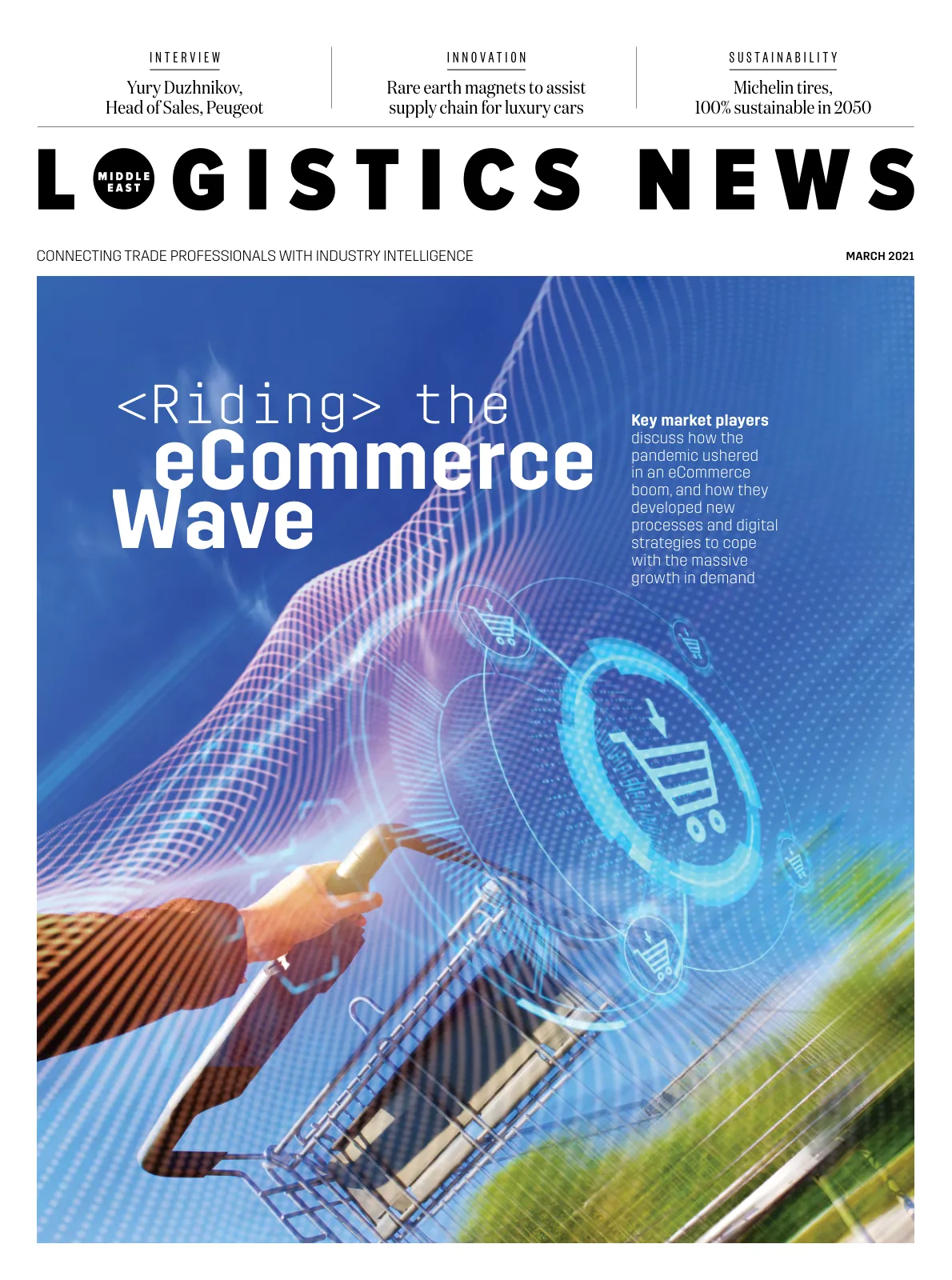
<Riding> the
eCommerce
Wave
Key market players
discuss how the
pandemic ushered
in an eCommerce
boom, and how they
developed new
processes and digital
strategies to cope
with the massive
growth in demand
Page 2
A MEMBERS OF EMIRATES TRANSPORT BUSINESS CENTERS:
Page 3
LOGISTICS NEWS ME | MARCH 2021 | 3
RIDING
THE ECOMMERCE
WAVE
14
INTERVIEW
MEETING THE DEMAND
Yury Duzhnikov, Head of Sales,
Peugeot
24
SUPPLY CHAIN
VACCINE DISTRIBUTION
CHALLENGES
Limited capacity, shortage of
supplies, lack of coordination,
and misinformation are some
of the issues impacting the
COVID-19 vaccine rollout,
according to JAGGAER
28
MOBILITY
GLOBAL AUTOMOTIVE
MOBILITY STUDY highlights
market uncertainty
30
OP-ED
CAN MACHINES THINK?
By Marek Lukaszczyk,
European and Middle East
Marketing Manager at motor and
drive manufacturer WEG
34
REPORT
OPTIMISTIC OUTLOOK
UAE women leaders more
optimistic about revenue
growth and digitalization than
global peers, while striving to
make
a positive impact, KPMG
report reveals
36
INNOVATION
RARE EARTH MAGNETS TO
ASSIST SUPPLY CHAIN FOR
LUXURY CARS
The project will help create
a technique to recycle
magnets removed from
computer hard drives to make
rare earth magnets
38
SUSTAINABILITY
100% SUSTAINABLE IN 2050
By 2050, Michelin tires will be
made entirely from renewable,
recycled, biosourced or
otherwise sustainable
materials
In this special feature
we speak to key market
players on how the
pandemic ushered in
an eCommerce boom.
Logistics companies
explain how they
developed new processes
and digital strategies to
cope with the massive
growth in demand
18
IN THIS ISSUE
14
26
Page 4
4 | LOGISTICS NEWS ME | MARCH 2021
WWW.CBNME.COM
There is no other industry where
so many industry experts ascribe
a high importance to data and
analytics in the next five years
than transportation and logistics.
There are vast opportunities here
to improve performance and serve
customers better, and LSPs who
are part of a digitally integrated
value chain can benefit from
significantly improved forecasting
to scale capacity up or down and
plan routes. Adding machine
learning and artificial intelligence
techniques to data analytics can
deliver truly dynamic routing.
Logistics companies will need
to focus on ‘digital fitness’, cost
efficiency, asset productivity,
and innovation if they want to
meet changing expectations.
Building and refining these and
other capabilities, and then
bringing them to scale across the
enterprise, will be key as they
translate the strategic into the
everyday.
All rights reserved © 2021.
Opinions expressed are solely those
of the contributors.
Logistics News ME and all subsidiary
publications in the MENA region are officially
licensed exclusively to BNC Publishing in the MENA
region by Logistics News ME.
No part of this magazine may be reproduced or
transmitted in any form or by any means without
written permission of the publisher.
Images used in Logistics News ME are credited
when necessary. Attributed use of copyrighted
images with permission. All images not credited
courtesy Shutterstock.
Printed by UPP
L
ogistics companies are facing an
era of unprecedented change as
digitisation takes hold and customer
expectations evolve. New technolo-
gies are enabling greater efficiency and
more collaborative operating models;
they’re also re-shaping the marketplace
in ways that are only just beginning
to become apparent. New entrants,
whether they be start-ups or the indus-
try’s own customers and suppliers, are
also shaking up the sector.
WHAT LIES AHEAD FOR THE LOGISTICS
INDUSTRY, DIGITALLY?
Kasun Illankoon
Editor
kasun@bncpublishing.net
SUBSCRIBE
subscriptions@bncpublishing.net
For all commercial enquiries, contact
sales@bncpublishing.net
T +971 50 440 2706
PO Box 502511
Dubai, United Arab Emirates
P +971 4 4200 506 | F +971 4 4200 196
Keep up to date with all the latest
news, features and much more
on our website and social media
platforms.
CBNME.COM
CBNME
@CBNME
CONSTRUCTION BUSINESS NEWS ME
EDITOR’S NOTE
LNME
CEO
Wissam Younane
wissam@bncpublishing.net
DIRECTOR
Rabih Najm
rabih@bncpublishing.net
GROUP PUBLISHING DIRECTOR
Joaquim D'Costa
jo@bncpublishing.net
+971 50 440 2706
BUSINESS DEVELOPMENT DIRECTOR
Rabih Naderi
rabih.naderi@bncpublishing.net
+966 50 328 9818
EDITOR
Kasun Illankoon
kasun@bncpublishing.net
ASSISTANT EDITOR
Jochebed Menon
EDITORIAL DESIGN
Christian Harb
MARKETING EXECUTIVE
Aaron Sinanbam
aj@bncpublishing.net
Page 5
Page 6
Page 7
Page 8
8 | LOGISTICS NEWS ME | MARCH 2021
WWW.CBNME.COM
REGIONAL NEWS
LNME
G
lobal logistics provider Agility
announced that it has invested
USD35 million in Queen’s
Gambit Growth Capital, a
blank-check company that
will target businesses offering sustainable
solutions in clean energy, healthcare, finan-
cial technology, industrials, mobility, and
emerging technology.
Queen’s Gambit’s all-female management
team is led by CEO Victoria Grace, a
New York-based venture capitalist, and
supported by an all-female Board with
strategic networks and diverse industry
experience.
“Agility’s investment in Queen’s Gambit
reflects our commitment to sustainability
and our belief that innovative technol-
ogy can yield both social and economic
returns,” Tarek Sultan, Vice-Chairman of
Agility said. “This is not a new position for
us. We’ve been investing in stakeholder
capitalism for more than a decade.”
Queen’s Gambit’s female-led
management team “has the potential
to tap into a differentiated network and
perspective that positions it to execute a
business combination with an attractive
target,” Sultan said. “This is a chance to
take a more inclusive view of opportunities
in the market, and drive value in the
process.”
Agility has been intensifying its long-
standing commitment to the environment,
sustainability and improved governance.
It was recently added to the FTSE4Good
Index Series, a resource used by investors
to identify companies around the world
with strong environmental, social and
governance (ESG) practices.
KUWAIT’S AGILITY
INVESTS USD35MN
IN QUEEN’S GAMBIT
Tarek Sultan, Vice-Chairman, Agility
Victoria Grace, CEO, Queen’s Gambit
Page 9
LOGISTICS NEWS ME | MARCH 2021 | 9
REGIONAL NEWS
G
AC, one of the largest
integrated providers of
shipping, logistics and marine
services in the region and the
world, has signed an agreement with Qatar
Free Zones Authority (QFZA) to establish
a contract logistics facility and office in the
Ras Bufontas Free Zone. The agreement
with GAC will play an important role in
expanding the logistics offerings for QFZA
and Qatar, strengthening supply chains
and bolstering Qatar’s position as a global
hub for trade.
Virtual ceremony
The virtual signing ceremony was attended
by H.E. Ahmad bin Mohammed Al-Sayed,
the Minister of State and Chairman of
QFZA. The agreement was signed by
Björn Engblom, GAC Group Executive
Chairman & Trustee (via video conference)
and Lim Meng Hui, Chief Executive Officer
of QFZA, in the presence of Abdulla Al-
Misnad, Deputy CEO of QFZA.
Sustainability & business
The purpose-built 27,000 sqm multi-
user contract logistics facility, due to be
completed in the first quarter of 2022,
will be built from sustainable materials,
partly fuelled by solar power, have several
energy-saving features, and use recycled
water in its operations.
The warehouse will serve key sectors
including fast-moving consumer goods
(FMCG), food & beverage (F&B), fashion,
sports, energy, aerospace, and healthcare.
It will maintain temperatures ranging from
-18°C to +22°C to support cold chain
operations and will feature dedicated
mezzanine levels for Value-Added Services
activities such as component assembly,
repacking and labelling to enhance
customers’ supply chains.
GAC’s marine and offshore services
will be well supported by Marsa Port,
the marine cluster in Qatar Free Zones.
Its operations at the port will serve the
energy companies active in the North Field
expansion projects.
Lim Meng Hui, Chief Executive Officer
of QFZA praised the partnership and said:
“We welcome the partnership with GAC,
and we are pleased to see them join the
group of logistics companies in Qatar Free
Zones. The role of the free zones is to
partner with companies who bring services
that our local and regional market needs,
allowing them to grow and our economy
to grow with them. To bring in the world’s
best companies to the zones, we are
focused on sectors where we have a strong
value proposition for these companies.”
Engblom added: “As a pioneer of
contract logistics in the region in 1993,
GAC continues to augment its capabilities
in this area at key locations globally. This
agreement with the Qatar Free Zones
marks another exciting milestone for GAC
as we continue to invest in and expand our
service offerings in strategic areas.
“We have seen robust demand for GAC’s
logistics services including integrated
solutions for the energy sector and
foresee even greater opportunities in
Qatar in the lead-up to the global football
sporting event in 2022 and as the North
Field expansion projects progress. Qatar
Free Zones is an excellent base for our
contract logistics operations in the country
from which we will serve our local and
international clients.”
Located in the heart of the Middle East,
Qatar is well positioned to connect markets
across three continents – all placed within
reach of the Free Zones through Qatar’s
award-winning air and seaports that sit
directly adjacent to Qatar Free Zones,
providing streamlined access for logistics
and other companies.
According to the recent Mordor
Intelligence report about the freight and
logistics market, Qatar’s logistics sector
is predicted to grow at an annual 7% in
the coming years, outpacing the global
average. This growth has been enabled by
two factors: heavy investment in logistics
infrastructure which has helped establish
Qatar as a major regional hub for logistics
companies; and major national projects
including the North Field Expansion and
the World Cup Qatar 2022 which are
helping to fuel the domestic demand for
specialised logistics services.
GAC TO ESTABLISH CONTRACT LOGISTICS
FACILITY IN QATAR FREE ZONES
Page 10
10 | LOGISTICS NEWS ME | MARCH 2021
WWW.CBNME.COM
REGIONAL NEWS
LNME
D
ubal Holding’s decision to acquire a majority stake in Dubai-
based aluminium extrusion company OSE Industries is a
major vote of confidence in the UAE economy, according
to Dubai Industrial City. The region’s largest manufacturing and
logistics hub, home to OSE Industries, lauded the deal as a reflec-
tion of the growth opportunities and underlying strength in Dubai’s
industrial sector.
OSE Industries began manufacturing operations in 2015 and
now exports MPE, precision tubing and industrial piping across the
Middle East and North Africa, Asia, Europe, and the US. Its clients
include a well-known US electric carmaker, as well as major players
in the heating, ventilation, and air conditioning (HVAC) sector.
Dubal Holding’s acting chief executive officer, Ahmad Bin Fahad,
said: “We have strong faith in the fundamentals of Dubai’s econ-
omy and continue to actively explore investment opportunities in
key growth sectors to create value and downstream opportuni-
ties. Our agreement with OSE Industries underscores our resolute
confidence in the emirate’s industrial ecosystem. I would also like
to commend Dubai Industrial City’s role in creating a vibrant eco-
system with infrastructure and an enabling environment to help
companies scale and grow.”
OSE president and chairman, Othman Sharif, added: “As the shift
to electric vehicles in Europe and the US steps up a gear, our busi-
ness is uniquely positioned to capitalise on this evolution in the au-
tomotive market and the move towards a cleaner, greener future.
The UAE is a regional leader in sustainability, and we are proud to
be a family-run, Dubai-based company that has grown organically,
exporting high-quality products to markets all around the world.”
For his part, Saud Abu Al-Shawareb, Managing Director of Dubai
Industrial City, said: “This deal is a major boost for Dubai’s indus-
trial sector. It will enhance the emirate’s position as a hub for manu-
facturing and logistics in line with the vision of our leaders for a
diversified, sustainable economy. As a strategic driver and enabler
of the Dubai Industrial Strategy 2030, we work hard alongside our
750 business partners to position Dubai as a global platform for
knowledge and innovation-based industries with a focus on priority
sub-sectors including aluminium and fabrication metals.”
Situated near Jebel Ali Port and Al Maktoum International Air-
port, OSE Industries’ strategic location in Dubai Industrial City af-
fords the business trade access to two-thirds of the global popula-
tion in eight hours. This has enabled it to expand quickly as electric
vehicles become more popular and the HVAC sector shifts its focus
to aluminium rolled tubes.
Dubal Holding, a wholly owned subsidiary of Investment Cor-
poration of Dubai, is focused on expanding its industrial footprint
and stimulating growth in the downstream value chain. Its stake in
OSE Industries sends a positive message to the global investment
community in Dubai’s future growth potential as the restart in the
global economy gains momentum.
DUBAL HOLDING’S OSE
INDUSTRIES ACQUISITION
A MAJOR BOOST FOR DUBAI’S
INDUSTRIAL SECTOR
Page 11
LOGISTICS NEWS ME | MARCH 2021 | 11
REGIONAL NEWS
T
he Saudi Logistics Company (SAL)
has signed a memorandum of
cooperation with King Abdullah
Economic City to provide further
support to both the logistics sector in the
Kingdom and King Abdullah Economic
City (KAEC).
The signed memorandum by Omar
Hariri, CEO of SAL, and Ahmed Linjawi,
CEO of KAEC, focuses on enhancing
logistics services and contributes to
creating promising logistic and economic
opportunities in conjunction with Saudi
Arabia’s ambitious 2030 vision to transform
the Kingdom into a global logistic hub.
Commenting on the event, Omar
Hariri emphasised on the importance
of this strategic partnership and its role
to enhance the cargo ground handling
services from and to KAEC. He also
mentioned that selecting KAEC was a
perfect choice due to its unrivaled logistic
position in the region and prominent
strategic economic and investment
location. He added that SAL would utilize
all its logistic capabilities to take advantage
of the competitive benefits of what the
Industrial Valley at KAEC has to offer.
Commenting on the memorandum,
Ahmed Linjawi said: “This memorandum
aims to enhance the strategic partnerships
we enjoy with different public and private
entities and is part of our continuous
efforts to provide investors from inside and
outside the Kingdom with a comprehensive
stimulant investing environment to support
and diversify the national economy.
“The signing of this memorandum is
parallel with KSA’s 2030 vision to becoming
a global logistic hub and cements the
Industrial Valley’s position as an important
logistic connection point for the east and
west trade routes.”
SAL is the logistic arm of Saudi Arabian
Airlines offering premium cargo handling
services to airline carriers at Saudi Arabia’s
domestic airports and a multi-model con-
nectivity service.
Thanks to its competitive privileges, the
Industrial Valley at KAEC serves as an at-
tractive destination for the world’s reputed
Food and Pharmaceutical firms offering
investors with high quality logistic and inte-
grated infrastructure services.
What makes the Industrial Valley so spe-
cial is its connection with King Abdullah
Port and the International Flight Network,
not to mention the fully integrated facili-
ties, housing solutions and social services
that remain affordable to all budgets.
The Economic Cities & Special Zones
Authority (ECZA) is the sole regulator of
KAEC, which serves as the facilitator of all
governmental procedures and ensures a
comfortable and stimulant environment for
all investors in and outside the Kingdom.
SAUDI’S LOGISTICS SECTOR GETS A BOOST
AS SAL AND KAEC INK MOC
Page 12
12 | LOGISTICS NEWS ME | MARCH 2021
WWW.CBNME.COM
T
he World Logistics
Passport (WLP) wel-
comed Israel as a
participant in the pro-
gramme at a virtual signing cer-
emony with the Federation of
Israeli Chambers of Commerce,
according to WAM.
As the tenth country to enter
the WLP, whose trade strategy
and expertise aims to increase
the resilience of economies
around the world, Israel joins
recent member countries India,
South Africa, Indonesia, among
others.
The signing ceremony was
attended by Sultan Ahmed bin
Sulayem, Chairman of Dubai’s
Ports, Customs and Free Zone
Corporation (PCFC), and Amir
Shani, Vice President of the
Federation of Israeli Chambers
of Commerce, as well as other
Israeli executives from the
Chamber.
Trade between Dubai and
Israel reached a value of Dhs1
billion (USD272 million) be-
tween September 2020 and
January 2021. This included
6,217 tonnes of sea-freight and
airfreight moving between the
two nations.
Major imports and exports
included mechanical and medi-
cal devices, electronic devices,
flat screens, smart phones,
diamonds, and engine spare
parts.
Amir Shani, VP FICC and Chair-
man of the Freight Forwarders
Association, said: “We are ex-
cited about joining the World
Logistics Passport global net-
work as a partner. We believe
our members will greatly ben-
efit from this global incentive
programme to expand their
trade opportunities.”
This partnership will allow
Israeli companies to reduce
cost and improve their supply
chain to and from Israel using
Dubai as logistical hub for new
markets.
The Abrahams accords and
Israel’s connection to Dubai
enables it to become a region-
al and global player and open
new trade routes, possibilities,
and business exchange.
This in return will reduce the
cost of living and promote
business growth in the most
needed time of COVID-19
crisis. Moreover, the specific
incentives under the relief
tier of the WLP should further
improve the logistics of Israel’s
COVID-19 vaccine distribution.
Shani added: “The FICC
continue to lead the private
business sector and to
advocate for free global
trade by building business
platforms as the WLP and
partnering with the Dubai
Chamber of Commerce to
facilitate Business-to-business
interactions.”
Through the WLP, traders can
expect to save 25% on freight
costs and 10% on transit time.
For instance, the cargo jour-
ney from Israel to South East
Asia. Transporting high-value,
low-weight goods through his-
torically established transport
routes in Asia takes consider-
ably longer, and is therefore
more expensive, than if the
goods pass through Dubai.
The WLP loyalty programme
provides traders with several
financial and non-financial
benefits for increased trade
volumes, spread across a
four-tier membership scheme.
Global brands leveraging the
WLP and its benefits include
anchor tenants such as UPS,
Pfizer, Sony, Johnson &
Johnson, and LG, all part of the
programme’s Platinum tier. The
WLP also provides participating
members with access to Gold
and Silver tiers of benefits,
which vary based on the value
and frequency of trade.
As part of Israel’s participation
in the WLP, the country will
be part of the programme’s
Relief Tier – which supports
humanitarian organizations
and governments in
providing relief in crises. In
the case of COVID-19 all
companies registered as WLP
members involved in vaccine
manufacturing and distribution
will receive immediate cost
and time efficiency benefits
and part of the Gold Tier
of membership. The WLP
Relief Tier promotes and
reinforces Dubai’s position as
a global crisis logistics hub for
humanitarian supplies.
With Israel’s entry into the
programme, both countries
will be strengthening their
bi-lateral ties through close
cooperation on COVID-19
vaccine distribution and supply
chains. Furthermore, Israel will
benefit from increased freight
through Dubai while providing
humanitarian organisations an
efficient, centrally located hub
for their logistics in the region.
The WLP has a proven track
record. In Dubai, 15 local
providers have confirmed
more than 50 benefits which
have in turn been applied to
over 300 traders, accounting
for approximately 50% of
the emirate’s trade. Since its
inception in 2019, the WLP has
generated more than AED3
billion in total trade.
ISRAEL JOINS WORLD LOGISTICS
PASSPORT TO BOOST TRADE
REGIONAL NEWS
LNME
12 | LOGISTICS NEWS ME | FEBRUARY 2021
Amir Shani,
Vice President of the Federation
of Israeli Chambers of Commerce
Page 13
LOGISTICS NEWS ME | MARCH 2021 | 13
REGIONAL NEWS
A
gility, a leading global logis-
tics provider, and its digital
innovation arm Shipa, a
trusted last-mile delivery and
e-commerce logistics player,
announced the launch of a bonded,
express road freight network to connect
businesses and consumers across the
GCC.
The new service provides customers
with less-than-truckload (LTL) and full
truckload (FTL) options and a fast, cost-
effective way to ship packages, pallets, or
containers of goods with daily departures
and scheduled pickups in the UAE, Saudi
Arabia, Oman, Kuwait, and Bahrain.
The service draws on the network and
expertise of the Gulf’s leading logistics
provider. Agility’s warehousing footprint
is the GCC’s largest and includes world-
class facilities in the UAE, Saudi Arabia,
Oman, Kuwait, and Bahrain, that are sup-
ported by teams of customs clearance
experts. Agility owns one of the region’s
largest road fleets and provides online
tracking for parcels and other cargo.
Shipa specializes in e-commerce and ef-
ficient last-mile delivery.
Express road freight provided by Agility
and Shipa offers parcel tracking through-
out the GCC and includes value-added
services including temperature-controlled
transportation; merge-in-transit; just-
in-time delivery; reverse logistics; and
control-tower management. It also will
help shippers deal with undelivered par-
cels that must be returned to fulfillment
centers. The bonded road freight service
is licensed to carry cargo that has not yet
been subject to taxes and duties in coun-
tries where applicable.
“The growth in e-commerce across the
GCC has provided an opportunity to
better serve customers with cost effec-
tive and reliable solutions,” says Henadi
Al-Saleh, Agility Chairperson and leader
of Agility’s corporate ventures arm. “E-
commerce growth has been accelerated
by the pandemic, and many companies
have been transacting more of their busi-
ness online. The Shipa-Agility partnership
is aimed at helping these companies
expand their businesses across the region
and tap into new markets.”
Elias Monem, Agility Global Integrated
Logistics (GIL) CEO for Middle East &
Africa, says: “Agility is continuously look-
ing to improve and expand what we
offer to clients. This new service allows
us to use our bonded and non-bonded
infrastructure and our modern road fleet
to provide customers with a faster, more
cost-effective shipping and delivery.”
AGILITY AND SHIPA LAUNCH GCC CROSS-BORDER EXPRESS
ROAD FREIGHT
Page 14
14 | LOGISTICS NEWS ME | MARCH 2021
WWW.CBNME.COM
C
OVID-19 brought our world to a stand-
still, at least for most of us. Not for the
logistics industry though, while businesses
across the globe have seen a sharp decline,
there has been an uptake in demand for
the supply chain and delivery sectors.
French automotive manufacturer Peugeot testifies to
this fact. Yury Duzhnikov, Head of Sales – Peugeot,
says: “With lockdowns in place all over the region,
companies had to figure out a way to deliver their
goods to end users.
“As such, many companies restructured operations to
operate through e-commerce, and logistics companies
supported this initiative by increasing their vehicle fleet
sizes to meet the sudden influx of demand.”
This led to auto-manufacturers having to prioritise
production of light commercial vehicles (LCV), to sup-
port the last mile deliveries and distribution networks.
INTERVIEW
Peugeot has seen a steady increase in business for its light
commercial vehicles since the pandemic began last year.
Yury Duzhnikov, Head of Sales, speaks to Jochebed Menon
MEETING THE DEMAND
“Many companies
restructured
operations to operate
through e-commerce,
and logistics
companies supported
this initiative by
increasing their
vehicle fleet sizes to
meet the sudden influx
of demand.”
LNME
>>>
Page 15
LOGISTICS NEWS ME | MARCH 2021 | 15
MEETING THE DEMAND | PEUGEOT SEES A STEADY INCREASE IN BUSINESS
PEUGEOT Boxer 2020
Page 16
16 | LOGISTICS NEWS ME | MARCH 2021
WWW.CBNME.COM
INTERVIEW
He elaborates: “As a result of this, Peugeot finalised deals with
the likes of Noon and DHL to support this rising demand.”
The company is a key LCV supplier to several logistics firms
in the country including DHL, TCS, Sky Express, First Flight,
Skynet, Road Rider, Mainland, Steady Routes, Transguard,
Fetchr, Zajil, Aramex as well as large e-commerce companies like
Noon, DHL, and Carrefour.
Heightened demand
Peugeot has particularly seen a spike in demand for its Van-B,
Van-D and Van-E vehicles. He adds: “The van segment has wit-
nessed a boost in growth throughout the region. Van-D remains
the largest segment in terms of demand, however, Van-E has had
the largest year-on-year growth, followed by Van-B, thanks in
part to the introduction of the new Peugeot Partner model in
2019.
“Due to this, we witnessed a 203% growth in 2020, and dou-
bled our market share in the segment. We also rank second in the
region for this Van-B segment which I can say is a great achieve-
ment for us.”
Overcoming the hurdles
With demand increasing, Peugeot had to ramp up production,
which proved to be a tall order. Yury explains: “Meeting demand
for our LCV line-up was one of the biggest challenges Peugeot
faced. As lockdowns spread across Europe, production in turn
was put on hold. Despite this, once markets began to open, pro-
duction recovery had to be smart to meet the shortage in supply
without jeopardising quality of our vehicles.
“We successfully overcame this unprecedented challenge, and a
lot of credit goes to the entire logistics industry for supporting in
delivering parts from suppliers as well as the actual vehicles from
production facilities all the way to the end users.”
Bright outlook
As for the time ahead, the carmaker is expecting a breakthrough
this year with an almost completely revamped passenger vehi-
cle line-up - the all-new Peugeot 208, 2008, 508 GT and 3008
PHEV, as well as the redesigned 3008 and 5008.
Yury adds: “Furthermore, as the e-commerce growth continues
to fuel the demand for last-mile deliveries and enhanced distribu-
tion networks, we look forward to supporting the logistics indus-
try by enhancing our product offering for our LCV line-up, while
also introducing the 2022 models for our partners.”
What is also in the pipeline for Peugeot is electrification in the
LCV segment. Since 2019, all new models launched by Peugeot
are either all-electric or plug-in hybrid variants. “As part of our
global strategy, the aim is for Peugeot’s entire passenger car and
LCV range to be electrified by 2025,” he notes.
Globally for the LCV segment, Peugeot has already electri-
fied its entire line-up with models like the e-Boxer and e-Expert,
which won the 2021 International Van of the Year award, and
the recently announced e-Partner.
He concludes: “Our first Plug-In Hybrid (PHEV) the 3008
PHEV is set to arrive in the region in spring 2021. The product
team is already working with the R&D department at our head-
quarters to also bring the e-LCV line-up over as soon as possible.
“Despite the availability of vaccines, the current repercussions
are in the uncertainty of what lies in the short term. However,
what is clear, is that e-commerce and door-to-door services for
logistics are here to stay, even when it comes to purchasing big-
ticket items like vehicles.”
“We successfully overcame
this unprecedented challenge,
and a lot of credit goes to
the entire logistics industry
for supporting in delivering
parts from suppliers as well
as the actual vehicles from
production facilities all the
way to the end users.”
PEUGEOT Partner 2020
LNME
Page 17
here’s to a
cleaner future
Choosing a gas powered truck will put you and your fleet in the forefront of
sustainable truck operations, reduce your CO2 emissions and achieve Euro 6
Emission Legislation without using Adblue or Particulate Matter.
Well suited for both urban and regional operations.
It can be matched with R, G, L or P cabs and combined with either the Scania
Opticruise gearbox or automatic transmissions.
For more information about our Alternative Fuels options, please visit www.scania.com/ae/en/home/prod-
ucts-and-services/articles/alternative-fuels.html
Natural gas (CNG/LNG)
Natural gas is methane from
pockets in the Earth’s crust.
Although it is a fossil fuel, it
emits up to 15% less CO2
compared to regular diesel.
15%*
Page 18
COVER STORY
Key market players
discuss how the
pandemic ushered
in an eCommerce
boom, and how
they developed new
processes and digital
strategies to cope
with the massive
growth in demand
LNME
18 | LOGISTICS NEWS ME | MARCH 2021
WWW.CBNME.COM
<Riding> the
eCommerce
Wave
Page 19
LOGISTICS NEWS ME | MARCH 2021 | 19
T
he eCommerce indus-
try has been seeing a
steady growth since
its advent and more
so in the recent years.
According to Statista,
an estimated 1.92 bil-
lion people purchased
goods or services
online in 2019, and
during the same year,
eRetail sales sur-
passed USD3.5 trillion worldwide.
The pandemic has further boosted
this sector. Statista revealed that in
June 2020, global retail eCommerce
traffic stood at a record 22 billion
monthly visits, with demand being
exceptionally high for everyday items
such as groceries, clothing, but also
retail tech items.
Aboobacker Ashraf, eCommerce
Manager - UAE at Hellmann World-
wide Logistics - Middle East and South
Asia, attests to this fact: “Multiple
markets have seen agile growth in busi-
ness during this period such as health
and safety items. These products are
being purchased far faster than they
can be produced and restocked. Im-
pressive demand in seen in the sports
and fitness sector. With the lockdown,
it comes to no surprise that people are
at home and are no longer pursuing
external fitness options, there is an in-
crease in home fitness. Other blistering
sectors that are seeing an uptake are
shelf-stable goods, food and beverage,
and last but not the least fashion.”
He adds: “Customers have moved
from shopping in stores to buying
online for obvious reasons. Online
orders are now higher than we have
ever imagined. We are continuously on
the lookout for solutions that help us
minimise challenges and speed up our
fulfilment process.
“Businesses dealing with this situa-
tion include those with omnichannel
inventory strategies that have shifted
to BOPIS (buy online, pick up in-store)
models, and smaller businesses such
as restaurants that converted their
websites into delivery businesses. The
changes in consumer demand also rip-
pled through the supply chain at ever
greater magnitudes, creating long-term
problems for production and supply.”
Re-evaluating business models
Shifting to BOPIS and adapting to the
new norm have been challenging for
some. GAC Dubai and its customers
were severely affected by COVID-19,
particularly when the lockdown was
first announced as buying habits
changed instantly with malls and retail
stores shut and many people working
from home.
Neil McMaster, General Manager
– Contract Logistics, GAC Dubai, ex-
plains: “This new situation led numer-
ous clients to re-evaluate their supply
chains and seek solutions to implement
eCommerce in parallel to their core
business. We at GAC Dubai actively
engaged with clients and authorities to
devise operational and IT solutions.
“Although there has been a strong
rebound since lockdown restrictions
eased, some sectors still face difficult
market conditions.
“The changes in
consumer demand
also rippled through
the supply chain
at ever greater
magnitudes, creating
long-term problems
for production and
supply.”
KEY MARKET PLAYERS ON HOW THE PANDEMIC USHERED IN AN ECOMMERCE BOOM
>>>
Aboobacker Ashraf, eCommerce Manager - UAE,
Hellmann Worldwide Logistics - Middle East
and South Asia
Page 20
20 | LOGISTICS NEWS ME | MARCH 2021
WWW.CBNME.COM
Particularly, replenishment to
duty-free retail operators remains at
exceptionally low levels and, despite
some recovery around year-end, this
is expected to persist until the global
vaccine rollout facilitates a large-scale
return to passenger travel by air.
“The slowdown in high-street retail
for fast fashion and business attire
has been offset by a boom in demand
for leisure wear and fitness equip-
ment. Furniture and homeware sectors
also performed well as more people
switched to working from home.
FMCG, pharmaceutical and food
industries tracked against forecast.”
Since the pandemic, GAC received
many enquiries seeking e-commerce
solutions, either directly to customers
or replenishing major local eCom-
merce platforms. Neil adds: “We are
well-equipped to meet that demands
with our modern, tailored IT solu-
tions and operational efficiency, and
we look forward to a challenging and
successful 2021.”
COVER STORY
LNME
“Replenishment to duty-free retail operators remains
at exceptionally low levels and, despite some recovery
around year-end, this is expected to persist until the
global vaccine rollout facilitates a large-scale return to
passenger travel by air.”
Neil McMaster,
General Manager – Contract Logistics, GAC Dubai
Page 21
LOGISTICS NEWS ME | MARCH 2021 | 21
Thinking ahead
Companies who future planned
and were moving online to offer
both offline and online solutions
were able to adapt quickly to
this quickly evolving model.
Emirates Post is one such com-
pany. Abdulla M. Alashram,
Group CEO of Emirates Post
Group, says: “We were in a
strong position to adapt to the
pandemic as we had already
begun working on a business
transformation, focused on
last-mile delivery and digitalisa-
tion. As consumer preferences
shifted online and eCommerce
boomed, we focused our efforts
on developing new processes
and investing in the right tech-
nologies to make our last-mile
delivery system seamless and
more efficient.
“For example, we partnered
with smart last mile technology
providers and boosted our in-
ternal digital capabilities, which
enabled us to orchestrate, track,
and optimse logistic operations
more efficiently.”
In addition, Emirates Post in-
creased its front-line workforce
to cope with increased deliveries
and quickly adapt its capacity
while providing enhanced vis-
ibility, control, efficiency, and
exceptional customer service.
Abullada notes: “To help the
community stay connected, we
offered customers the chance
to book pick-up and delivery
services online, started a web-
shop for stamps, and created
the ‘epostcard’ app that allowed
customers to create customized
postcards.
“The pandemic has vastly
accelerated digital adoption and
put eCommerce at the forefront
of retail. eCommerce giant Am-
azon’s response to COVID-19 is
worth noting, as they embraced
the surge in demand, set up the
necessary infrastructure, and
responded efficiently.”
“To help the community stay
connected, we offered customers
the chance to book pick-up
and delivery services online,
started a webshop for stamps,
and created the ‘epostcard’ app
that allowed customers to create
customized postcards.”
“This new
situation led
numerous clients
to re-evaluate
their supply
chains and
seek solutions
to implement
eCommerce in
parallel to their
core business.”
>>>
Abdulla M. Alashram, Group CEO of Emirates Post Group
KEY MARKET PLAYERS ON HOW THE PANDEMIC USHERED IN AN ECOMMERCE BOOM
Page 22
22 | LOGISTICS NEWS ME | MARCH 2021
WWW.CBNME.COM
Bridging the gap
Firms whose operations are fully
supported digitally have been able to
capitalise on the eCommerce boom and
expand their business. TruKKer, MENA’s
largest digital freight network that con-
nects incoming truck demands and the
supply in real-time, has been able to offer
watertight solutions.
Anish Garg, Vice President of Op-
erations - GCC, TruKKer, reveals: “We
witnessed rapid client activations during
the peak COVID-19 period as tradi-
tional transportation brokers faced severe
disruption and operational challenges.
The surge in online demands offered us a
unique chance to implement and leverage
our advanced load prediction capabili-
ties. While we succeeded in forecasting
demands effectively, our freight platform
ensured the right transport for each
demand at the best price.
“Although, it was somewhat challeng-
ing in the second quarter of 2020, we re-
cuperated fast and got back on the track.
March was a pre-COVID high for us in
terms of business. Among the markets,
Saudi Arabia and North Africa presented
us with maximum growth and traction.
In 2020, TruKKer saw an increased 3.5
times growth from the previous year. The
digital native generation has been the
necessary fuel for our growth, and we
hope it will only increase with time as
digital tightens its grip and we increase
our digital endeavours.”
As eCommerce shows no slowing,
TruKKer hopes to tap into new address-
able markets worth over USD200 billion
across 20 countries in the coming years.
Anish adds: “Apart from tapping into
new markets, we want the TruKKer
platform integrated into the daily ship-
ping operations. It’s envisioned to become
a disruptive force for the traditional
brokers business model, accounting for
a double-digit share of the addressable
market.”
Trukkin, another technology cloud-
based techno-logistics platform, is also
looking to capitalise on the boom and
accommodate the increase in demand
of services. Janardan Dalmia, Founder
and CEO at Trukkin, says: “Trukkin has
always been a technology-first company.
We use Artificial Intelligence, Internet of
Things, and a well-researched, highly in-
novative user interface to fulfil our clients’
logistics requirements. Our highly scal-
able platform can empower thousands of
users, shippers, transporters, and drivers
at the same time while ensuring reliability
and efficiency consistently.
“Our platform was always built to
accommodate large surges in traffic and
constantly changing requirements. This
has helped us always stay online and
available where other competitive plat-
forms may struggle.”
Trukkin has seen a boom in growth in
the region and Pakistan, where is recently
expanded to. Janardan explains: “The
GCC and Pakistan have seen a massive
uptake in business as economies struggle
to get back to near-normalcy, movement
of goods has increased. With our large
partner base and robust systems in place,
we have been able to ride the wave of suc-
cess throughout 2020 and into 2021.”
“While we succeeded
in forecasting demands
effectively, our freight
platform ensured the
right transport for
each demand at the
best price.”
“Our platform was always
built to accommodate
large surges in traffic
and constantly changing
requirements. This has
helped us always stay
online and available where
other competitive platforms
may struggle.”
COVER STORY
LNME
Page 23
lyveglobal.com
E-COMMERCE
MADE EASY
Supercharge your ecommerce and online operations
with Lyve. Get fast, flexible, and full-featured delivery and
technology solutions that meet your customers’ needs
and allow you to focus on what you do best.
Go Lyve Today �
lyveglobal.com/ecommerce
#golyve
Page 24
24 | LOGISTICS NEWS ME | MARCH 2021
WWW.CBNME.COM
Limited capacity, shortage of
supplies, lack of coordination,
national security issues, and
misinformation are some of the
issues impacting the COVID-19
vaccine rollout, according to
JAGGAER
SUPPLY CHAIN
LNME
J
AGGAER, the world’s largest independent spend
management company, has underscored the need
for supply chain risk mitigation procedures within
businesses following the difficulties surrounding
the COVID-19 vaccine distribution experienced in
Europe and America.
Countries worldwide, including many in Europe, have
been put under considerable strain as demand for the
vaccine has considerably outpaced supply. According to
data tracked by Bloomberg, some 4.25 million doses are
being given daily, with Israel, the UAE, Seychelles and the
UK leading the way in terms of doses per 100 people.
Thomas Dieringer, President for Europe Middle East
and Africa, JAGGAER said: “With any supply chain, it
is vital to be aware of the risks and everything that could
go wrong.
“National security issues, poor coordination, limited
capacity, misinformation, shortage of personnel, vaccine
damage and logistical difficulties in reaching rural areas
have all contributed to the challenges faced by many
countries. Supply shortages to make the vaccine has been
perhaps one of the major issues. Distribution has been
hampered by the drug makers inability to produce the
number of vaccines initially planned. The vaccine com-
prises several components and raw materials that have
been subject to a fragile supply chain, built at record
speed. Understandably delays have occurred as a result
of setting up supply chains while still developing the vac-
cine.”
According to JAGGAER, there are several critical sup-
ply chain mitigation steps to address the issue. These re-
volve around business impact analysis, assess and moni-
VACCINE DISTRIBUTION
CHALLENGES
Page 25
LOGISTICS NEWS ME | MARCH 2021 | 25
tor existing suppliers, reduce
the concentration of supply,
work hand-in-hand with sup-
pliers and proactively manage
supply chain threats.
COVID-19 has had far-
reaching impacts on a range
of business around the world,
according to research released
by the Institute of Supplier
Management in the whitepa-
per, COVID-19 and Supply
Chains: Increasing impacts,
decreasing revenues, 95%
respondents, stated that their
supply chains have been or
will be impacted by COV-
ID-19’s spread.
Furthermore, the results also
revealed that one in five stated
continuity disruption as one
of the top three impacts.
“Understanding when the
supply chain has been impact-
ed, and indeed what suppliers
have been impacted is crucial.
However, perhaps even more
important is a system that
supports finding alternatives
to ensure any disruption is
minimised,” said Dieringer.
Greater visibility into sup-
ply, not just immediate
sources such as distributors,
but visibility into upstream
suppliers of materials and
components is crucial. In
turn, distributors need to
understand the demand from
their customers better and
share this knowledge with
manufacturers. The crisis has
illustrated the need for broad
visibility into both demand
and supply across the entire
system.
Organisations must utilise
digital supply networks rather
than relying on the conven-
tional linear supply chain
model to achieve greater visi-
bility. Digital supply networks
are dynamic and integrated
and will increasingly rely on
artificial intelligence tech-
nology to provide fast and
continuous information and
analytics flows. This can em-
power organisations to stay
connected with their entire
supply network and deal with
major disruptions such as
those caused by Covid-19.
There also needs to be
greater cooperation at a local,
regional, and international
level, in particular, to develop
contingency plans to prepare
for the next crisis.
“Although none of us could
have prepared for COVID-19,
one thing we have seen is
those businesses who invested
in procurement technology
are those that have been able
to adapt quickest, pivot and
ensure business continuity,”
he concluded.
Thomas Dieringer,
president for Europe, Middle-East
and Africa, Jaggaer
“The vaccine comprises
several components and raw
materials that have been
subject to a fragile supply
chain, built at record speed.
Understandably delays have
occurred as a result of setting
up supply chains while still
developing the vaccine.”
VACCINE DISTRIBUTION CHALLENGES | ISSUES IMPACTING THE COVID-19 VACCINE ROLLOUT
Page 26
26 | LOGISTICS NEWS ME | MARCH 2021
WWW.CBNME.COM
E
mirates SkyCargo has signed an agreement with
UNICEF to prioritise the transport of COVID-19 vac-
cines, essential medicines, medical devices and other
critical supplies to help fight the COVID-19 pandemic.
The announcement is the latest in a series of measures
undertaken by the freight division of Emirates to sup-
port global communities in recovering from the devastating
impact of COVID-19.
The Humanitarian Airfreight Initiative spearheaded by
UNICEF brings together a number of partners collectively
capable of distributing essential supplies to more than 100
markets in support of the COVAX Facility, the global effort
aimed at equitable access to COVID-19 vaccines. UNICEF’s
Humanitarian Airfreight Initiative will also act as a blueprint
for collective global partnership in the face of future health and
humanitarian crises.
“Every single day counts in the fight against COVID-19 and
the sooner that communities can have access to COVID-19
vaccines, the sooner they can curb the spread of the virus and
get back on their feet. As a global player flying to more than
CARGO
LNME
COVID-19 vaccine
distribution
Emirates SkyCargo to work with UNICEF
Under UNICEF’s Humanitarian Airfreight Initiative, Emirates will prioritise transport and delivery of COVID-19 vaccines and related supplies
Initiative in support of COVAX facility for equitable distribution of COVID-19 vaccines
Page 27
LOGISTICS NEWS ME | MARCH 2021 | 27
130 destinations, Emirates SkyCargo has been committed to
the fight against the pandemic from the very early stages and
we have rolled out a number of initiatives to expedite the
distribution of COVID-19 vaccines through Dubai, starting
with our GDP certified dedicated airside hub. Through our
partnership with UNICEF, we will be taking yet another step
to prioritise and facilitate the rapid and secure movement of
COVID-19 vaccines particularly to communities hard hit by
the disease,” said Nabil Sultan, Emirates Divisional Senior
Vice President, Cargo.
Emirates SkyCargo is an industry leader in the air cargo sec-
tor for the transport of temperature sensitive pharmaceuticals
including vaccines. The cargo carrier features a global network
spanning six continents, a modern fleet of widebody only air-
craft as well as state of the art EU GDP certified infrastructure
at its hub in Dubai for the secure transport of pharmaceuticals
and vaccines.
In October 2020, Emirates SkyCargo announced that it
was setting up the world’s largest EU GDP certified airside
distribution hub dedicated for the storage and distribution of
COVID-19 vaccines. With over 15,000 sq metres of storage
space available for vaccines, Emirates SkyCargo is able to store
large quantities of the COVID-19 vaccine in Dubai, and fly in
smaller quantities regularly to markets with limited cold chain
infrastructure, reducing the need for large scale storage solu-
tions.
In January 2021, under the directives of Vice President and
Prime Minister of the UAE and Ruler of Dubai HH Sheikh
Mohammed bin Rashid Al Maktoum, Emirates SkyCargo
joined hands with three other Dubai-based entities- DP World,
International Humanitarian City and Dubai Airports to form a
COVID-19 vaccine alliance for rapid transport of COVID-19
vaccines to the developing world through Dubai.
EMIRATES SKYCARGO TO WORK WITH UNICEF FOR COVID-19 VACCINE DISTRIBUTION
Page 28
28 | LOGISTICS NEWS ME | MARCH 2021
WWW.CBNME.COM
MOBILITY
LNME
GLOBAL
AUTOMOTIVE
MOBILITY
STUDY
from Arthur
D. Little
highlights
market
uncertainty
Page 29
LOGISTICS NEWS ME | MARCH 2021 | 29
GLOBAL AUTOMOTIVE MOBILITY STUDY FROM ARTHUR D. LITTLE HIGHLIGHTS MARKET UNCERTAINTY
A
rthur D. Little (ADL) re-
leased the third edition of its
Global Automotive Mobility
Study. Entitled ‘The Future
Of Automotive Mobility’ and
based on a global survey of
over 8,500 end customers in 13 countries,
it shows that global automotive markets
are currently at a crossroads. While the
study identifies that the internal combus-
tion engine still dominates the market,
many vehicle owners are weighing up
the pros and cons of going electric – as a
result, there is confusion about where the
automotive sector is heading and at what
speed.
Whereas ADL’s previous Global Auto-
motive Mobility Study in 2018 depicted a
‘business as usual’ industry only just tak-
ing its first steps towards electric, the mo-
bility landscape three years later is mark-
edly different. For example, there has been
a dramatic change in both demand for cars
and how ownership of them is perceived
– while the COVID-19 pandemic has
highlighted the protection and independ-
ence that a private car offers, a significant
number of people are contemplating giving
them up for environmental reasons and
embracing alternative transport solutions.
The auto industry’s 2% compound annual
growth rate is much less than ADL’s last
survey predicted.
The study also shows that the move
away from petrol and diesel fueled vehicles
is real and growing stronger – asked about
their next vehicle, 29% of survey respond-
ents favored a hybrid product, while 12%
were considering the move to pure electric.
And if established brands don’t provide an
EV offering, many of their customers are
ready to migrate to other manufacturers.
However, market growth is hampered by
both limited model range and an immature
charging infrastructure, with vehicle range
still dictated by the availability of public
charging points.
One of the study’s most intriguing find-
ings is the emergence of China as a ‘special
market’ with markedly different attitudes
to consumers in the rest of the world. For
instance, while excitement over self-driving
autonomous vehicles has dimmed in both
Europe and the US due to safety fears,
71% of Chinese drivers remain positive
about using such vehicles. They are also
more adventurous in trying new power-
trains, mobility services, and even purchase
options – 71% of drivers in China would
be willing to buy a car wholly online,
against 35% in Europe and 42% in the
US. Given the size of China’s domestic
market, these attitudes could have signifi-
cant implications for the global automo-
tive industry.
Klaus Schmitz, co-author of the study
and Partner in ADL’s Automotive and
Manufacturing Practice, comments:
“While the global automotive industry
isn’t exactly in turmoil, the findings of
this study definitely indicate significant
turbulence, plus an uncertainty about the
speed and direction of the market. Estab-
lished trends are meeting new, emerging
ones, which has inevitably led to a state
of flux. We believe that the industry faces
four main market-related challenges: how
to better anticipate changes in vehicle
demand and ownership profile; how to
better transition towards electric; how to
profitably grow the mobility services seg-
ment; and how to optimize the new value
chain.”Wolf-Dieter Hoppe, co-author of
the study and Partner in ADL’s Automotive
and Manufacturing Practice, adds: “Given
the degree of uncertainty in the sector,
the automotive industry needs to develop
a better understanding of the modern
driver’s priorities if it is to fully exploit
electric’s potential and counter concerns
over autonomous vehicles. This will re-
quire an evaluation of current investments
and an informed calculation about how
markets and the value chain will look in
ten years. For those manufacturers who
get this right, there will be significant op-
portunities.”
“THE STUDY SHOWS THAT THE
MOVE AWAY FROM PETROL
AND DIESEL FUELED VEHICLES
IS REAL AND GROWING
STRONGER – ASKED ABOUT
THEIR NEXT VEHICLE, 29%
OF SURVEY RESPONDENTS
FAVORED A HYBRID
PRODUCT, WHILE 12% WERE
CONSIDERING THE MOVE TO
PURE ELECTRIC.”
Wolf-Dieter Hoppe
Klaus Schmitz
Page 30
30 | LOGISTICS NEWS ME | MARCH 2021
WWW.CBNME.COM
OP-ED
LNME
C
omputing Machinery and
Intelligence’, the seminal
paper by Alun Turing, posed
the question “Can machines
think?” Turing’s research
proved that a digital com-
puter could simulate the behaviour of
any other digital machine, given enough
memory and time.
AI, which was originally coined by
American academic John McCarthy in
1956, involves creating algorithms and
programmes that allow computers to fol-
low hundreds of millions of instructions,
thanks to significant improvements in
data-processing power and the advent of
big data.
Machine learning
AI is now a key component in today’s
manufacturing plants and machine learn-
ing is rapidly being adopted across many
industries. It is no surprise, therefore, that
according to Research and Markets, the
machine learning market is predicted to
grow to GBP6.39 billion by 2022.
As the market grows, new types of ma-
chine learning will emerge, allowing new
applications to be explored. In fact, there
are already two types of machine learn-
ing, called supervised and unsupervised.
Supervised learning identifies inputs and
outputs and trains algorithms using la-
belled examples. It also uses methods like
classification, regression, prediction, and
gradient boosting for pattern recognition,
before using these patterns to predict
the values of the labels on the unlabelled
data.
Unsupervised learning, on the other
hand, works with datasets without histor-
ical data. It explores collected data to find
a structure and identify patterns. In ad-
dition, unsupervised machine learning is
now being used in factories for predictive
maintenance purposes. For instance, ma-
chines can learn the data and algorithms
responsible for causing faults in a mo-
tor, enabling them to identify potentially
costly problems before they arise.
Advanced machine learning has allowed
computers to solve problems without
Marek Lukaszczyk, European and Middle East Marketing Manager at motor and drive
manufacturer WEG, shares how machine learning has led to an effective digital manufacturing
environment in which the potential of artificial intelligence (AI) in electric motor and drive applications
could soon be unleashed
CAN MACHINES THINK?
Page 31
LOGISTICS NEWS ME | MARCH 2021 | 31
PENNED | CREATING STRONGER BONDS IN SUPPLY CHAIN
needing to follow a comprehensive list of
instructions. This allows powerful pro-
grammes, which are based on neural net-
works, to be trained to perform specific
tasks, carrying huge potential for motor
and drive applications.
Motion control
Design engineers want to harness this po-
tential and introduce the power of AI to
motors, for advanced motion control. For
example, embedded algorithms could be
used, based on information provided by
intelligent sensors, to alleviate some com-
mon motor performance limitations.
Essentially, these systems compare a
data-based model of motor performance
with real time analytics to correct per-
formance issues with voltage commands,
generating torque when phase faults arise.
The goal of these systems is to minimise
the impact from phase faults, making
them more manageable, especially in criti-
cal safety situations.
Additionally, these motors can boost
motion control performance by improv-
ing efficiency, uptime, and energy con-
sumption. By using WEG’s Motor Scan,
the performance of electric motors can be
monitored with sensors, which facilitates
predictive maintenance. Once installed
onto the motor, WEG’s Motor Scan tech-
nology uses these sensors to send data to
the cloud for analysis, alerting operators
to suboptimal data trends.
What the future holds
In the past, technology was simply too
expensive to measure the temperatures
in an electric motor. Since then, however,
sensors have developed and become much
more accessible.
For example, thermal protection is
achieved by monitoring the temperature
of the motor windings. By using Positive
Temperature Coefficient (PTC) sensors,
thermistors can be installed into the mo-
tor windings to protect the motor against
locked-rotor conditions, continuous over-
load, and high ambient temperature.
Going forward, scientists from the De-
partment of Power Electronics and Elec-
trical Drive Technology at the University
of Paderborn, aim to develop software
capable of estimating the temperatures
at certain points. As part of the project,
funded by the German Research Founda-
tion (DFG), researchers are using AI and
machine learning to find new models for
estimating the temperature in drives and
other power engineering applications.
This involves training their software,
with a software testing method that ex-
amines the functionality of an application
without peering into its internal struc-
tures, and test-bench measurements, to
obtain precise temperature readings.
Looking back, what Turing was really
seeking to develop was an integral vi-
sion of what we call intelligence. He used
machines for this purpose because they
can solve tasks that humans could too.
This is not to say a simulated intelligence
surpasses a real one, or a machine can
solve problems that a person cannot, but
more that they can replicate basic human
actions.
In fact, Turing’s research proved that
a digital computer could simulate the
behaviour of any other digital machine,
which has led to digital manufacturing
as we know it. AI holds huge potential,
especially for electric motor and drive ap-
plications, but research still has some way
to go.
GOING FORWARD,
SCIENTISTS FROM
THE DEPARTMENT OF
POWER ELECTRONICS
AND ELECTRICAL
DRIVE TECHNOLOGY
AT THE UNIVERSITY
OF PADERBORN,
AIM TO DEVELOP
SOFTWARE CAPABLE
OF ESTIMATING THE
TEMPERATURES AT
CERTAIN POINTS.
Page 32
32 | LOGISTICS NEWS ME | MARCH 2021
WWW.CBNME.COM
A
bu Dhabi Ports, part
of ADQ, one of the
region’s largest holding
companies, has signed
an agreement with
Transportr Ltd to man-
age its inland container
depot (ICD) in Musaf-
fah, provide handling
facilities within the ICD
and deliver fully inclusive transportation
solutions for containers between the ICD
and Khalifa Port.
Transportr is an Abu Dhabi-based digi-
tal freight platform that connects shippers
to carriers locally and regionally. The
platform saves money for shippers and
increases earnings for carriers while digi-
talizing the entire freight lifecycle. Trans-
portr provides inland, cross border and
sea freight shipping services to clients in
UAE, and has plans to extend its services
regionally. Transportr entered into agree-
ment with shippers and truckers and ef-
ficiently managed to move a total of 4,000
truckloads locally, 2,000 truckloads cross
border and over 10,000 containers in sea
freight in less than 6 months.
The agreement will not only improve
connectivity between Transportr’s depot
located within Ittihad Paper Mill LLC and
Khalifa Port, but will also aid in reducing
costs for transport of containers, while
simultaneously improving the efficiency of
the supply chain. Transportr had already
secured the movement of over 15,000
TEUS for 2021 from several prominent
industrialists located in ICAD 1, 2 and 3,
and is expected to increase the handling
to over 20,000 TEUs over the course of
next year.
Saif Al Mazrouei, Head of Ports Cluster
at Abu Dhabi Ports, said: “We are proud
to have been selected by Transportr to
handle the transportation of their goods
between Khalifa Port and their inland
container depot in Mussafah.
“Leveraging our expertise in delivering
top of the line logistics services, as well as
our long-standing experience as a facilita-
tor of trade within the emirate of Abu
Dhabi, we will aid Transportr in reducing
costs and streamlining their operations.
“Connectivity for the entire Musaffah
trade will also be improved through re-
duced waiting times, increased availability
and integration with shipping lines.”
Alaa Hawari, General Manager of
Transportr, said: “We’re tremendously
excited to work closely with Abu Dhabi
Ports, the region’s primary facilitator of
industrial logistics.
“The ICD establishment at the heart of
Mussafah will be instrumental as we tar-
get significant strengthening of our digital
freight marketplace operations and infra-
structure, in addition, to collectively ad-
dress the challenge of empty miles within
the industry.
“Transportr’s unique ICD logistics
model along with its efficient digital
freight network will provide customers
with access to a new fully integrated lo-
gistics model for servicing diverse range
of cargo.”
Under the new contract, Abu Dhabi
Ports will bring forth its full logistic
capabilities to oversee inward and out-
ward container handling at Khalifa Port,
delivery of orders, processing customs
documentation and procedures, container
terminal handling, truck loading and un-
loading, as well as container inspections.
At the same time, the company will
provide ICD-related container handling
services as part of the contract offering
shipping lines, local importers, and or
exporters the ability to collect and offload
containers within the ICD.
In addition to assisting Transportr,
one of the fastest-growing digital freight
platform in the UAE, in achieving greater
economies of scale through reduced trans-
portation costs — thanks to the utilisation
of mixed-sized containers to and from its
Mussafah-based ICD — the operation is
expected to improve supply between the
companies under the group’s umbrella via
an ongoing shuttle service.
CONTAINER
TRANSPORTATION
SERVICES
Abu Dhabi Ports accelerates transport’s inland container
depot with premium logistics services
Mohammad Shihab,
Managing Director,
Maersk Saudi Arabia
PORTS
LNME
“LEVERAGING OUR
EXPERTISE IN DELIVERING
TOP OF THE LINE LOGISTICS
SERVICES, AS WELL AS OUR
LONG-STANDING EXPERIENCE
AS A FACILITATOR OF TRADE
WITHIN THE EMIRATE OF
ABU DHABI, WE WILL AID
TRANSPORTR IN REDUCING
COSTS AND STREAMLINING
THEIR OPERATIONS.”
Page 33
Page 34
34 | LOGISTICS NEWS ME | MARCH 2021
WWW.CBNME.COM
REPORT
LNME
T
he UAE’s female lead-
ers are embracing
digital, are motivated
to make a positive
impact on the world
and optimistic about
the growth of their business
despite pandemic-related chal-
lenges. This, according to the
third edition of KPMG’s UAE
Female Leaders Outlook. The
report examines economic and
business outlooks, risks and
opportunities, as well as career
and gender diversity factors;
highlighting notable differ-
ences with global findings and
comparisons with the previous
edition of the UAE report.
Marketa Simkova, Partner,
Head of People & Change
at KPMG Lower Gulf, said:
“Even as governments and
organizations swiftly adopted
measures to tackle the pandem-
ic, it brought profound per-
sonal and professional changes
for a disproportionate number
of women in the workforce.
However, our 2020 survey has
found UAE female leaders less
pessimistic about Covid-19’s
impact. In fact, some female
leaders believe the crisis may
unlock new growth opportuni-
ties from advances in technol-
ogy and changed stakeholder
expectations.”
Embracing Covid-19-related
changes
Today’s leaders face a multi-
tude of obstacles, stemming
in large part from the current
pandemic. A large-scale shift to
remote work, changes in stake-
holder expectations and the in-
creased importance of environ-
mental, social and governance
(ESG) performance, among
many others. Operational risk,
followed by disruptive tech-
nologies and talent risk, will
likely remain key concerns for
the near term. However, 67%
of UAE women leaders believe
their company has potential to
grow in the next three years.
KPMG findings indicate more
than half (55%) of UAE female
leaders found their pre-Cov-
id-19 business models enabled
the shift to and/or focus on
digital. Further highlighting the
importance of digitalization,
nearly all of them (95%) are
confident that digital economy
and e-commerce companies
will emerge winners from the
current crisis.
Optimistic Outlook
UAE women leaders are more optimistic about revenue
growth and digitalization than their global peers, while
striving to make a positive impact, KPMG report reveals
Mohammad Shihab,
Managing Director,
Maersk Saudi Arabia
Page 35
LOGISTICS NEWS ME | MARCH 2021 | 35
UAE FEMALE LEADERS BELIEVE COMBATING CLIMATE CHANGE
WILL BE OF EVEN GREATER IMPORTANCE IN THE
POST-COVID-19 ERA, ACCORDING TO THE KPMG REPORT.
IMPLYING A LONG-TERM COMMITMENT, NINE OUT OF TEN (89%
IN UAE, 57% GLOBALLY) WANT TO LOCK IN SUSTAINABILITY AND
CLIMATE CHANGE GAINS MADE AS A RESULT OF THE CRISIS.
Three out of ten (28%) UAE female leaders believe combating
climate change will be of even greater importance in the post-
Covid-19 era, according to the KPMG report. Implying a long-
term commitment, nine out of ten (89% in UAE, 57% globally)
want to lock in sustainability and climate change gains made as
a result of the crisis. Three-quarters (73%) of female leaders in
the UAE ranked ‘making a positive impact on the world’ as one
of the top three factors motivating them, compared with 57%
globally. This was followed closely by ‘enabling long-term busi-
ness success.’
A diversified agenda
Despite clear progress and strong support from the government,
nearly all UAE female leaders (95%) indicate there is more to
be done to build gender diversity on boards and at management
level. Almost two-thirds (61% in UAE, 43% globally) indicated
that targets or quotas may be an effective approach. Regarding
discrimination and racism, nearly two thirds (61%) of UAE
female leaders (41% globally) believe recent measures taken by
their company have had a positive impact; 78% expect recent
progress will not be affected by Covid-19.
On the gender pay gap, UAE figures show a significant and
positive change compared with last year. In 2020, six out of
ten UAE-based female leaders (61%, 46% globally) confirmed
their company is transparent regarding equal pay, compared
with only 26% in 2019. Despite the pandemic’s socio-economic
impact, four out of ten female leaders in the UAE (44%) do not
believe Covid-19 will have an impact on their career. This is
aligned with KPMG’s global findings.
Maryam Zaman, Partner, Head of Corporate Governance at
KPMG Lower Gulf, concluded: “Our survey shows that for
UAE women leaders, making a positive impact on the world
is both a personal and commercial imperative. In line with the
renewed focus on ESG policies, employees are most motivated
by a meaningful and purposeful work environment. Companies
looking to retain and attract talent, will have to compete in this
digitalized and dynamic environment, while meeting fundamen-
tally changing values and priorities.”
About KPMG UAE Female Leaders Outlook
The KPMG UAE Female Leaders Outlook: Covid-19 special
edition offers insight into how local female leaders are reacting
to rapidly evolving events. In the last quarter of 2020, KPMG
surveyed 675 female leaders around the world from 52 coun-
tries and territories, including 18 in the UAE.
Fifty percent of UAE-based participants hold senior manage-
ment positions, such as CEO, chairwoman or C-level executive.
The remaining 50% comprised vice presidents, heads of depart-
ment/business units and founders. A majority of the women
surveyed (78%) had children.
OPTIMISTIC OUTLOOK | UAE WOMEN LEADERS
Marketa Simkova, Partner, Head of People & Change at KPMG Lower Gulf
Maryam Zaman, Partner, Head of Corporate
Governance at KPMG Lower Gulf
Page 36
36 | LOGISTICS NEWS ME | MARCH 2021
WWW.CBNME.COM
T
he University of Birmingham
announced a three-year research
project with Bentley Motors to
deliver a sustainable source of rare
earth magnets for electric and hybrid
vehicles for one of the most sought-after
luxury car brands in the world.
The GBP2.6 million (Dhs13.3 million)
RaRE (Rare-earth Recycling for
eMachines) project is funded by the Office
for Low Emission Vehicles (OLEV) and
delivered in partnership with Innovate
UK and involves six partners who will
work together to establish the first end-
to-end supply chain of recycled rare earth
magnets in the UK.
Low carbon producer
Rare earth magnets are found in almost
every appliance that uses electricity to
generate motion. In the last 30 years
their use has increased exponentially, and
although they are increasingly important
in the transition to a low carbon
economy, less than 1% of these magnets
is recycled.
RaRE will build on an innovative
technology developed by Professor Allan
Walton and Professor Emeritus Rex
Harris of the University of Birmingham’s
Magnetic Materials Group, the only
research group in the UK focused on
processing and recycling permanent rare
earth magnetic materials.
The technology, called Hydrogen
Processing of Magnet Scrap (HPMS),
extracts rare earth metals from waste
electronics by breaking them into a
powder that is easily separated from
remaining components.
The project will help create a technique
to recycle magnets removed from computer
hard drives to make rare earth magnets
to assist supply chain
for luxury cars
Rare earth magnets
LNME
INNOVATION
Page 37
LOGISTICS NEWS ME | MARCH 2021 | 37
RARE EARTH MAGNETS TO ASSIST SUPPLY CHAIN FOR LUXURY CARS
The technology was patented by
University of Birmingham Enterprise,
and subsequently licensed to HyProMag
Ltd, the company that was set up by the
Birmingham researchers. HyProMag has
since received substantial investment from
Mkango Resources, which will be fully
funding HyProMag’s contribution to
RaRE.
Magnet recycling
The project will develop a process to
recycle magnets extracted from computer
hard drives to make rare earth magnets
for use in bespoke ancillary motors and
will involve HyProMag scaling up the
recycling techniques developed at the
University of Birmingham.
The University will also provide cast
alloys, which HyProMag will blend
with secondary materials to produce the
‘sintered’ magnets, which are formed by
press moulding the metal powders.
Nick Mann, Operations General
Manager at HyProMag, stated: “RaRE
is an exciting project and a fantastic
opportunity. HyProMag’s recycling
technologies allow us to produce NdFeB
magnets with a much lower embedded
carbon cost than using virgin supply and
with independence from Chinese supply
and we are working closely with our
major shareholder Mkango Resources to
further grow the business. “We are proud
to be working with established, innovative
and renowned companies in the RaRE
project with whom we can showcase
the technologies of the RaRE project as
a whole – recycled magnets being used
for cutting edge products in a prestige
application.”
In addition to the University, Bentley
and HyProMag, the other partners in the
RaRE project are:
> Unipart Powertrain Applications Ltd,
which will lead the development of
manufacturing scale up routes to ensure
facilities and processes defined are suitable
for volume automotive manufacture.
> Advanced Electric Machines Research
Ltd, leading on the design and
development of the motors.
> Intelligent Lifecycle Solutions Ltd will
pre-process computer hard disk drives to
remove the rare earth magnet containing
components from the waste, which will be
shipped to HyProMag for recycling of the
rare earth magnets.
Jon Bray, R&D Manager, Office for Zero
Emissions Vehicles commented: “We are
excited to be supporting this innovative
project as part of our ambition to put
the UK at the forefront of the design,
manufacture and use of zero emission
vehicles.”
“WE ARE PROUD TO BE WORKING
WITH ESTABLISHED, INNOVATIVE
AND RENOWNED COMPANIES
IN THE RARE PROJECT WITH
WHOM WE CAN SHOWCASE THE
TECHNOLOGIES OF THE RARE
PROJECT AS A WHOLE – RECYCLED
MAGNETS BEING USED FOR
CUTTING EDGE PRODUCTS IN A
PRESTIGE APPLICATION.” Nick Mann
Page 38
38 | LOGISTICS NEWS ME | MARCH 2021
WWW.CBNME.COM
I
nspired by the VISION concept
tire introduced in 2017, an airless,
connected, rechargeable and entirely
sustainable solution, the Michelin
Group is committed to making its tires
100% sustainable by 2050.
Today, nearly 30%* of the compo-
nents used in the manufacture of tires
produced by the Michelin Group are
already made from natural, recycled or
otherwise sustainable raw materials.
A Michelin tire is a high-tech product
comprising more than 200 ingredients.
The main one is natural rubber, but the
many ingredients also include synthetic
rubber, metal, fibers and components
that strengthen a tire’s structure, like
carbon black, silica and plasticizers
(resins, etc.). Incorporated in perfect
proportions, these materials interact to
deliver an optimal balance of perfor-
mance, driveability and safety, while
steadily reducing the tire’s environmen-
tal impact.
An objective being met with powerful
R&D capabilities
Michelin’s maturity in materials
technology stems from the strength
of its R&D capabilities, which are
supported by 6,000 people working in
seven research and development centers
around the world and mastering 350
areas of expertise. The commitment of
these engineers, researchers, chemists
and developers has led to the filing of
10,000 patents covering tire design and
manufacturing. They work hard every
day to find the recipes that will improve
tire safety, durability, ride and other
performance features, while helping to
make them 100% sustainable by 2050.
Bold partnerships with innovative
companies
Michelin is also aware that the speed
and nature of innovation requires new
forms of cooperation, which is why it
has forged partnerships with innova-
tive companies and start-ups whose
advances offer unlimited prospects. The
developed technologies go well beyond
the world of tires and could be used
in other industries, enabling them to
benefit as well from recovered raw ma-
terials that are infinitely reusable. These
technologies will also make it possible
to recycle polystyrene and recover
carbon black or pyrolysis oil from used
tires.
Axens and IFP Energies Nouvelles, the
two companies that are spearhead-
ing the BioButterfly project, have been
working with Michelin since 2019 on
producing bio-sourced butadiene** to
replace petroleum-based butadiene. Us-
ing the biomass from wood, rice husks,
leaves, corn stalks and other plant
waste, 4.2 million tonnes of wood chips
could be incorporated into Michelin
tires every year.
Signed in November 2020, the
partnership between Michelin and
Canada-based Pyrowave can produce
recycled styrene from plastics found in
packaging, like yogurt pots and food
trays, or in insulating panels. Styrene is
an important monomer used to manu-
facture not only polystyrene but also
synthetic rubber for tires and a wide
variety of consumer goods. Eventually,
several tens of thousands of tonnes of
polystyrene waste could be recycled
back into its original products as well as
into Michelin tires every year.
The revolutionary process developed
by French startup Carbios uses enzymes
to deconstruct PET*** plastic waste
into its original pure monomers, which
can be infinitely recovered and reused
to make new PET plastics. One of these
recovered plastics just happens to be the
polyester yarn used in tire manufactur-
ing. Some four billion plastic bottles
could potentially be recycled into
Michelin tires every year.
Lastly, Michelin announced in Febru-
ary 2021 that it will launch the con-
struction of its first tire recycling plant
in the world with Enviro. This Swedish
company has developed a patented
technology to recover carbon black,
pyrolysis oil, steel, gas and other new,
high-quality reusable materials from
end-of-life tires. It will enable everything
in these tires to be recovered and reused
in several types of rubber-based produc-
tion processes.
Michelin also supports the circular
economy, as attested by its participation
in the European BlackCycle consortium.
This project, which is coordinated by
the Group and financed by the Euro-
pean Union, brings together 13 public
and private-sector partners to design
processes to produce new tires from
end-of-life tires.
SUSTAINABILITY
LNME
100% SUSTAINABLE IN 2050
By 2050, Michelin tires will be made entirely
from renewable, recycled, biosourced or
otherwise sustainable materials
Page 39
RENAULT TRUCKS T X-PORT
NEW TIMES,
NEW OPPORTUNITIES
RENAULT TRUCKS
T X-PORT 4X2
EURO 3
CERTIFIED
B
Y
R
E
N
A
U
L
T
T
R
U
C
K
S
U
S
E
D
T
R
U
C
K
S
WWW.USED-RENAULT-TRUCKS.AE
Benefit from a truck transformed in our factory with the manufacturer high quality standards.
For a long-term performance get more than a Used Trucks, contact your local Renault Trucks dealer
to get your Renault Trucks T X-Port with 24 months warranty and 24 months service contract to
guarantee total peace of mind.
WITH 24 MONTHS
INTERNATIONAL
WARRANTY
+
24 MONTHS
SERVICE CONTRACT
MORE THAN A USED TRUCK
Page 40
The Arocs. Your Reliable Partner for
Every Construction Transportation Task.
Regardless of whether it is a rigid chassis, concrete mixer or heavy-duty tipper: The
Mercedes-Benz Arocs provides an especially robust, resilient vehicle that is optimally
prepared for use for any construction haulage challenge. Configure it now to suit your
requirements and those of your project.