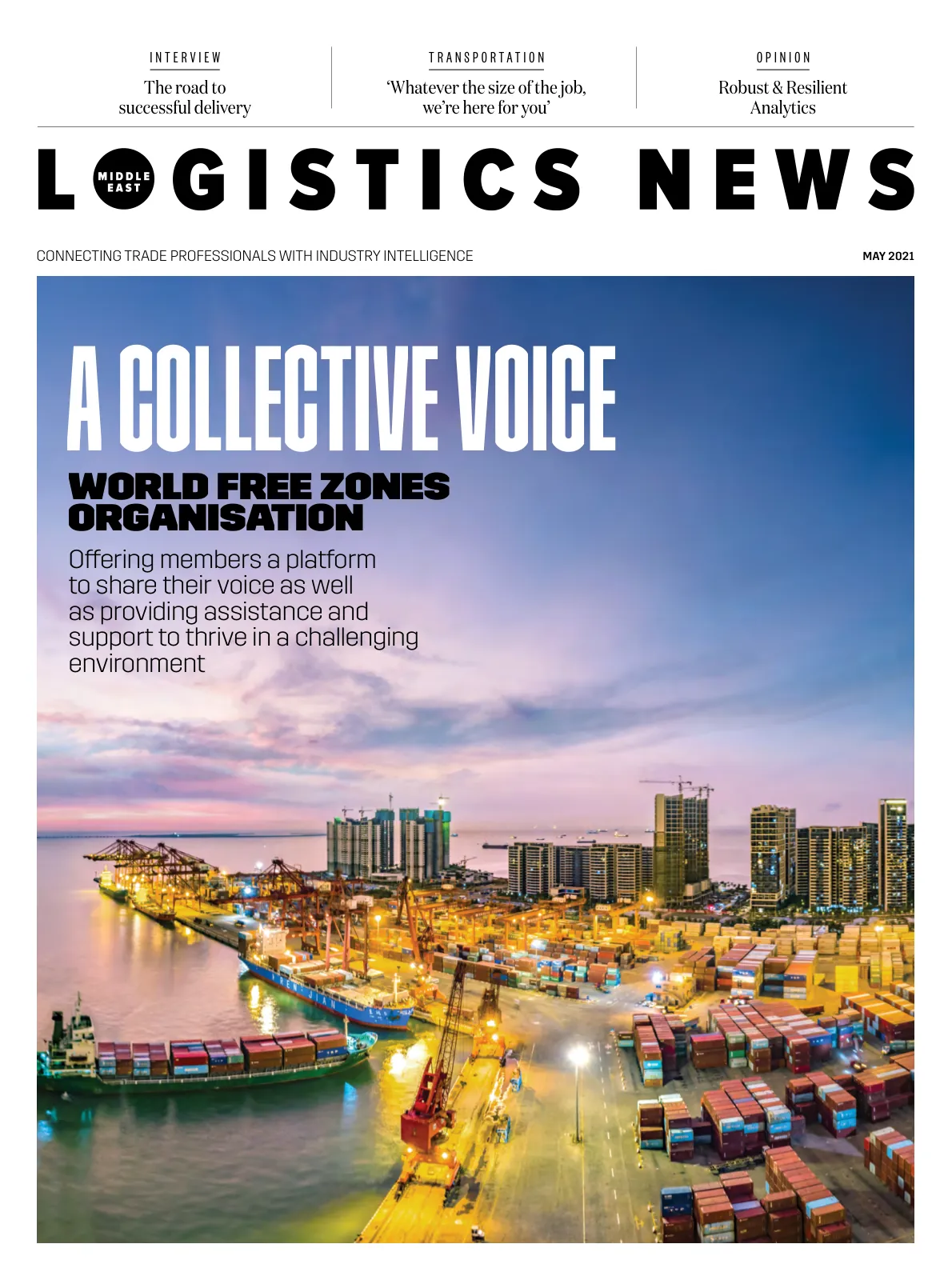
Logistics News, May 2021
Page 1
T R A N S P O R T A T I O N
‘Whatever the size of the job,
we’re here for you’
I N T E R V I E W
The road to
successful delivery
O P I N I O N
Robust & Resilient
Analytics
CONNECTING TRADE PROFESSIONALS WITH INDUSTRY INTELLIGENCE
MAY 2021
WORLD FREE ZONES
ORGANISATION
A COLLECTIVE VOICE
Offering members a platform
to share their voice as well
as providing assistance and
support to thrive in a challenging
environment
Page 2
MORE UPTIME, MORE COMFORT, MORE SECURITY, MORE FUEL SAVINGS
renault-trucks.com
NEW RENAULT TRUCKS
T HIGH, T, C & K
NEW RENAULT TRUCKS T HIGH, T, C & K
One of the best steering column of the market, new super comfortable bunk,
monitoring vehicle’s components in real time, and more.
We have gone a long way to support you better.
Find out more in your local Renault Trucks dealership.
Page 3
LOGISTICS NEWS ME | MAY 2021 | 3
A COLLECTIVE
VOICE
14
GENDER BALANCE WEBINAR
PUSHING GENDER BOUNDARIES
A recent webinar by APM Terminals
on gender balance highlighted how
and why more needs to be done to
make the industry inclusive for both
men and women
16
AI - SUSTAINABLE LOGISTICS
AI PAVES PATH TO SUSTAINABLE
LOGISTICS
Artificial intelligence is slowly but
surely making its way into the
logistics industry and is making real
and quantifiable improvements
on sustainability, Jon Fath, CEO at
Transmetrics, tells us
24
INNOVATION IN TRANSPORT
TECHNOLOGY DRIVES THE WAY
FORWARD
The rail industry is the backbone
of public transport, Thales is
introducing innovate solutions to
better the experience for passengers
and the operators
28
COMMERCIAL VEHICLE
ADAPT, EVOLVE AND THRIVE
Al Masaood’s Commercial Vehicles &
Equipment division reveals how the
business is evolving to accommodate
customer needs
30
INTERVIEW
THE ROAD TO SUCCESSFUL DELIVERY
Daniel Caton, General Manager of
Suhara Logistics, explains how good
road infrastructure makes for seamless
delivery of goods
32
TRANSPORTATION
‘WHATEVER THE SIZE OF THE JOB,
WE’RE HERE FOR YOU’
Mammoet’s new Group Commercial
Officer Darren Adams is making it his
mission to serve small and medium-
sized businesses
36
OPINION
ROBUST & RESILIENT ANALYTICS
keep supply chains running’
World Free Zones
Organisation is offering
members a platform to
share their voice as well
as providing assistance
and support to thrive in a
challenging environment
20
IN THIS ISSUE
16
32
DR SAMIR
HAMROUNI
CHIEF EXECUTIVE OFFICER,
WORLD FREE ZONES
ORGANISATION
Page 4
4 | LOGISTICS NEWS ME | MAY 2021
WWW.CBNME.COM
DHL Supply Chain - part of Deutsche Post
DHL Group - is increasingly relying on intel-
ligent, IT-based forecasting and analysis tools
to optimise warehousing and processing of
online orders. In 2019, the group invested
USD300 mn to modernise its warehouses in
North America.
“Accelerating the implementation of selected
technologies such as robotics, augmented
reality, robotics process automation, IoT
and DHL’s proprietary end-to-end visibility
solution – MySupplyChain – is the objective
of DHL Supply Chain’s global digitalisation
strategy,” a DHL report stated.
US-based FedEx Corporation is also seeing
the benefits of next-generation innovation. It
is making investments in robotics and AI that
“could radically alter the logistics landscape,
impacting everything from small individual
shipments to the movement of fleets of vehi-
cles globally”.
In February 2019, FedEx unveiled a proto-
type of the FedEx SameDay Bot, an autono-
mous delivery device designed in response to
the rapid growth of eCommerce. FedEx has
also been collaborating with Mercedes-Benz
Vans since 2018 to help develop and test its
intelligent and innovative technology product,
Coros, a machine learning and computer vi-
sion package tracking solution that brings
added efficiency, transparency, and intelli-
gence to package delivery operations.
In the next few years, we’re going to hear a
lot more on this topic as the logistics sector
will continue to adopt latest technologies to
enhance its offerings.
All rights reserved © 2021.
Opinions expressed are solely those
of the contributors.
Logistics News ME and all subsidiary
publications in the MENA region are officially
licensed exclusively to BNC Publishing in the MENA
region by Logistics News ME.
No part of this magazine may be reproduced or
transmitted in any form or by any means without
written permission of the publisher.
Images used in Logistics News ME are credited
when necessary. Attributed use of copyrighted
images with permission. All images not credited
courtesy Shutterstock.
Printed by UPP
T
here has been a gradual rise in the use of
artificial intelligence (AI) in the supply
chain and logistics sectors. Businesses
are realising that to survive and thrive, they
need to invest in technology that will help
them automate operations.
AI, specifically, is enhancing efficiencies in
predictive demand, inventory management
and network planning.
Inside, Jon Fath, CEO of Transmetics, tells
us how applying AI in transport optimisa-
tion, robotics, drones, and anticipatory
shipping is making tangible and quantifiable
improvements in the industry. “At present,
only 12% of logistics businesses use AI in
operations, but this is expected to grow to
60% by 2025.”
According to a report by All The Research,
AI in the logistics and supply chain market
was valued at USD1.7 bn in 2018 and is
projected to reach USD12 bn in 2027, grow-
ing at a CAGR of 24%. The report also
states that major players are investing in AI
worldwide.
Jochebed Menon
Editor, Logistics News Middle East
jochebed@bncpublishing.net
SUBSCRIBE
subscriptions@bncpublishing.net
For all commercial enquiries, contact
sales@bncpublishing.net
T +971 50 440 2706
PO Box 502511
Dubai, United Arab Emirates
P +971 4 4200 506 | F +971 4 4200 196
Keep up to date with all the latest
news, features and much more
on our website and social media
platforms.
CBNME.COM
CBNME
@CBNME
CONSTRUCTION BUSINESS NEWS ME
EDITOR’S NOTE
LNME
CEO
Wissam Younane
wissam@bncpublishing.net
DIRECTOR
Rabih Najm
rabih@bncpublishing.net
GROUP PUBLISHING DIRECTOR
Joaquim D'Costa
jo@bncpublishing.net
+971 50 440 2706
BUSINESS DEVELOPMENT DIRECTOR
Rabih Naderi
rabih.naderi@bncpublishing.net
+966 50 328 9818
MANAGING EDITOR
Kasun Illankoon
kasun@bncpublishing.net
EDITOR
Jochebed Menon
EDITORIAL DESIGN
Christian Harb
MARKETING EXECUTIVE
Aaron Joshua Sinanbam
aj@bncpublishing.net
PHOTOGRAPHER
Alexander Bungas
Page 5
Page 6
Page 7
Page 8
8 | LOGISTICS NEWS ME | MAY 2021
WWW.CBNME.COM
A
bu Dhabi Ports’ offshore logis-
tics service provider, Offshore
Support and Logistics Services
Company (OFCO – Offshore
International), has announced
the start of a collaboration with Mammoet
UAE, a subsidiary of the global engineered
heavy lifting and transport services com-
pany.
The two organisations signed a
Memorandum of Understanding (MoU).
OFCO, will work closely with the heavy
lift and transport specialist Mammoet to
create an integrated package of on and
offshore turnkey transport and installation
solutions for projects in the GCC.
Captain Maktoum Al Houqani, Chief
Corporate Authority Officer and Head of
Maritime Cluster, Abu Dhabi Ports, said:
“The newly-announced collaboration
between Abu Dhabi Ports’ OFCO and
Mammoet marks a critical milestone in Abu
Dhabi Ports’ ongoing efforts to foster an
integrated logistics ecosystem catering to
our commercial and industrial customers’
every need.
“By combining each organisation’s
expertise and resources, we can
complement each other’s service offering
and explore potential operational and
logistical synergies, which would allow
us to create an integrated, cost-effective
solution for the major project market within
the GCC and beyond.”
Initially targeting UAE-based projects with
future ambitions to venture further into the
GCC, OFCO and Mammoet will leverage
their respective maritime, engineering, and
logistical expertise, together with strategic
positioning, infrastructure, and in-house
assets, to create a joint value proposition
that is both flexible and competitive. This
in turn will not only provide customers with
a streamlined, flexible, and cost-effective
solution for handling their heavy cargo
transport needs but will also enable them
to partner with a single service provider,
rather than having to rely on several
subcontractors to meet their supply chain
requirements.
Commenting on the announcement,
Paul van Gelder, CEO Mammoet added:
“At Mammoet, we always look for ways
to improve the efficiency of projects for
our customers. The strategic alliance
with OFCO is a testament to that, as our
collaboration will reduce the number
of interfaces within the logistics chain
of projects, enabling the planning and
operations to be streamlined, and
therefore realising the most efficient and
cost-effective approaches.
“Mammoet maintains the largest fleet of
heavy lifting equipment in the world, and
so is well-positioned to scale its service
in response to any challenge. We look
forward to bringing this enhanced offering
to clients in the GCC, as part of this
strategic partnership.”
Launched earlier this year, OFCO
operates under SAFEEN Group, Abu Dhabi
Ports’ marine services arm, and is one
of the largest cost-efficient providers of
onshore and offshore integrated logistics
solutions and subsea services in the GCC.
Holding extensive experience in marine
service solutions and a diversified fleet with
experience in offshore logistics and supply
chain management, the company’s “one-
stop-shop” offering is ideal for meeting
the complex logistical requirements of
customers within the oil and gas, energy,
and offshore markets.
OFFSHORE INTERNATIONAL, MAMMOET INK
MOU TO OFFER LOGISTICAL SOLUTIONS
REGIONAL NEWS
LNME
Page 9
LOGISTICS NEWS ME | MAY 2021 | 9
REGIONAL NEWS
H
eavy transportation and heavy
equipment rental company Al Faris
Group purchased two latest genera-
tion Mercedes-Benz Arocs SLT trucks, a
first in the Middle East and North Africa,
from Emirates Motor Company.
Hillary Pinto, Managing Director of Al
Faris Group, said during the handover
ceremony: “We have performed numerous
heavy transport operations for abnormally
sized objects for more than 25 years and
it has always been our priority to provide
safe, innovative, and reliable solutions for
heavy lifting, heavy transport and energy
projects.
“When it comes to heavy transportation,
the Arocs SLT meets the demands and our
high standards. The addition of these two
new trucks will add value to the company
and we look forward to our long-term
partnership with Emirates Motor Com-
pany.”
The Mercedes-Benz Arocs 4058 AS 6×6
SLT is a particular heavy-duty tractor unit.
It is driven by Mercedes-Benz Trucks’ most
powerful engine: the six-cylinder in-line
OM 473 engine with 15.6l displacement
with an output of 578 hp (425 kW), offer-
ing torque of 2,800 Nm in Euro 5 emission
norm.
To take to the road with transport loads of
up to 250 tonnes, the truck is equipped
with the automated Mercedes PowerShift
3 gearshift system and G 280 transmission
with 16 gears and a fluid coupling.
Bilal Al Ribi, General Manager Commer-
cial Vehicles of Emirates Motor Company,
said: “Heavy duty transportation requires
very high-tech equipment and uncompro-
mising reliability, and this is precisely what
the Arocs SLT delivers. We thank Al Faris
Group for their confidence in us. We are
committed to providing long-term support
to Al Faris Group and to contributing to
their business growth.”
MERCEDES-BENZ DELIVERS NEW-GEN AROCS
SLTS TO AL FARIS GROUP
Page 10
10 | LOGISTICS NEWS ME | MAY 2021
WWW.CBNME.COM
T
echnology-driven delivery company
iMile has stepped into Egypt with
operations in Cairo and Suez.
Dubai-based, iMile specialises in delivering
goods from eCommerce sellers in China
to customers in the MENA region. iMile’s
recent expansion into Egypt is part of its
commitment to continue supporting ef-
ficient cross-border eCommerce across the
region. The company has partnered with
two eCommerce companies Egypt so far
and is working with several SMEs for door-
to-door delivery. iMile is investing in a local
team in Egypt, hiring exceptional local tal-
ent to ensure the best team is in place.
With the rise of online shopping in Egypt,
local companies are focused on develop-
ing strategies that enhance digital trade.
The growth of Egypt’s eCommerce industry
has been spurred by its rising population,
its increasingly affluent middle class and
most notably, by consumers’ readiness to
trial new retail options, a phenomenon ac-
celerated by the COVID-19 crisis.
These factors enable iMile to help
improve overall delivery experience for
eCommerce customers by providing logis-
tics and customer services for companies
in Egypt. iMile is confident that Egypt will
remain a key market for the business going
forward.
iMile CEO, Rita Huang, said: “We have
solid plans for what we want to achieve in
2021 and our launch into Egypt plays a big
part into this. We aim to continue growing
at rapid pace into next year and will invest
in our technology and our people to en-
sure we are ahead of the curve.”
IMILE FORAYS INTO EGYPT, PARTNERS WITH
TWO ECOMMERCE FIRMS
REGIONAL NEWS
LNME
Page 11
LOGISTICS NEWS ME | MAY 2021 | 11
REGIONAL NEWS
A
l-Futtaim Toyota Material Han-
dling, an Al-Futtaim Automotive
company and distributor of
Toyota Material Handling equip-
ment in the UAE, has signed a long-term
supply and maintenance contract for 32
Toyota electric forklifts to be delivered to
first-time customer DHL.
DHL has already received 26 light-duty
electric forklifts and the remaining units
will be delivered before the end of this
year. The forklifts ranging from two- to
three-tonnes are deployed across DHL’s
warehouses located in the UAE.
They are equipped with Toyota’s pat-
ented System of Active Stability (SAS).
SAS works by continually monitoring the
forklift’s operations and automatically tak-
ing protective action when needed.
The system takes over 3,000 readings
per second to detect unsafe operating
conditions and if a safety hazard is de-
tected, the SAS activates one of its two
main features – Active Control Rear Sta-
bilizer System and Active Mast Function
Control System, that improve lateral and
longitudinal stability of the forklift.
“We are extremely delighted that DHL
has chosen the Toyota electric forklifts for
their material handling needs. This deal
further reaffirms our leading position in
the material handling industry in the UAE.
“These electric forklifts provide substan-
tial fuel savings and reduced carbon foot-
print also contributes to the UAE’s Vision
2021 to create and maintain a sustainable
environment,” said, Ramez Hamdan,
Managing Director – Industrial Equipment
(FAMCO, HINO, Toyota Material Han-
dling), Al-Futtaim Automotive.
He added: “Toyota forklifts are known
for their solid build quality, reliability
and durability that is second to none.
Combine this with our strong after-sales
service support, we are confident we can
fully meet and exceed the expectations
of our customers.”
DHL ORDERS ELECTRIC FORKLIFTS FROM
AL-FUTTAIM TOYOTA MATERIAL HANDLING
LOGISTICS NEWS ME | MAY 2021 | 11
Page 12
12 | LOGISTICS NEWS ME | MAY 2021
WWW.CBNME.COM
D
ubai CommerCity (DCC), the first
dedicated eCommerce free zone
in the Middle East, North Africa,
and South Asia (MENASA) regions, has
announced the launch of 470,000 sqft of
new facilities as part of its first stage in line
with its planned schedule.
Dubai CommerCity is situated in the
Umm Ramool area in Dubai, and is a
Dhs3.2billion, 2.1 million sqft project.
The launch of the new phase includes
a built-up area of over 320,000 sqft of
offices spaces in the Business Cluster. It
also includes 145,000 sqft eCommerce
logistics units and multi-client warehouses
in the Logistics Cluster, which will be man-
aged and operated by Hellmann World-
wide Logistics and DHL.
Given its strategic location and the
increased demand for its facilities and
services, the new free zone managed
to lease more than 51% of the logistics
warehouses to companies launching their
operations in different sectors, ranging
from eCommerce, logistics and informa-
tion technology to fashion, jewellery and
electronics.
H.H. Sheikh Ahmed Bin Saeed Al Mak-
toum, Chairman of the Dubai Airport
Freezone Authority (DAFZA), emphasised
how the eCommerce industry has proven
to be a key enabler of growth for compa-
nies and a new module adopted by many
businesses to ensure business continuity
because of the increased demand overall.
He added that the acceleration of digital
transformation within supply chains and
trade because of the COVID-19 pan-
demic, has spurred companies to ensure
continued operations which are picking up
with great optimism in 2021.
“The eCommerce sector is key as its
value is expected to reach USD148.5 bil-
lion by 2022 in the Middle East, Africa and
South Asia regions,” he said.
“The GCC region is the fastest growing
in the eCommerce sector, and the UAE
comes in second place as it is expected to
grow 38.3% Compound Annual Growth
Rate (CAGR).
“The UAE is also ranked the fifth larg-
est B2C products eCommerce market in
sales within the Middle East, Africa and
South Asia regions valued at USD4 billion.
The UAE companies in eCommerce ac-
count for 6% of the list of the 100 largest
companies in the sector within the Middle
East, Africa and South Asia region.”
The launch of the facility is supported
by the strategic partnerships signed by
Dubai CommerCity and aims to sup-
port businesses to run effectively and
seamlessly.
The eCommerce free zone has
signed agreements with Hellmann
Worldwide and DHL Express that
complement the efforts to grow and
enhance the portfolio of services that
Dubai CommerCity provides.
As part of the partnerships, Hellmann
Worldwide will manage and operate a
shared, multi-client warehouse within
the logistics cluster of the free zone
and clients will have access to last mile
delivery services through DHL Express.
Dubai CommerCity’s customers will
also utilise unique storage options and
pay-as-you-go payment model which
are highly cost efficient and allow flex-
ibility to scale their operations in line
with demand. The strategic partner-
ships will allow for fast eCommerce
fulfilment across the region and will
provide a suitable and stable ground-
work from where customers can grow
businesses and enter new markets.
Hellmann will also provide end-to-end
warehousing including services like order
management systems and streamlined
customs clearance processes. As part of
end-to-end logistics services, Hellmann
will also offer last mile delivery services,
through its last mile partner DHL Ex-
press, from the warehouse directly to
the consumer.
Dubai CommerCity has signed part-
nership agreements with Magento Com-
merce, a leading eCommerce software
provider and Redbox Digital, a global
digital consultancy and platinum Ma-
gento implementation partner.
Focused on offering ‘eCommerce-as-
a-Service’, the collaboration will provide
Dubai CommerCity customers with
tailored access to e-commerce solutions
and services that will enhance digital
experiences and brand growth.
eCommerce needs vary from one
company to another, as such, customers
will be provided with start-up, B2B, B2C
and cross-industry solutions that have
been exclusively designed for Dubai
CommerCity to accelerate e-commerce
adoption times.
DUBAI COMMERCITY COMMENCES PHASE
ONE OF OPERATIONS WITH LAUNCH OF NEW
FACILITIES
REGIONAL NEWS
LNME
Page 13
LOGISTICS NEWS ME | MAY 2021 | 13
‘eCommerce-as-a-Service’ offerings
include special rates on key Magento
software, pre-integration with payment
gateways, third party logistics systems,
marketing affiliates and analytics tools. A
wide range of project services including
consultancy, discovery and requirements
building, testing major and minor custom-
izations will also be provided by Redbox.
The free zone provides advanced
opportunities for global and regional
manufacturers, as well as distributors and
global e-retailers while offering a vast ar-
ray of tax and investment incentives.
Divided into three main clusters – busi-
ness, logistics and social, Dubai Com-
merCity seeks to encourage customers
to adopt an active approach while doing
business, meet the needs of logistics ser-
vices providers and customers and offer
vibrant facilities that exceed the expecta-
tions of e-commerce companies looking
to establish regional headquarters in
Dubai.
His Excellency Dr. Mohammed Al Zaroo-
ni, Director General of DAFZA said: “The
launch of the new Dubai CommerCity
facilities comes in line within the planned
schedule. Despite the global circum-
stances and the challenges posed by the
COVID-19 pandemic, we have witnessed
an urgent need to build a world-class
eCommerce platform.
“It is set to attract specialised compa-
nies aiming to establish their regional
headquarters in the emirate of Dubai,
which helps them expand and develop
their regional operations to be able to
keep pace with the significant growth in
eCommerce.”
The global eCommerce sector is ex-
pected to grow 16.6% CAGR between
2019 and 2022. The Middle East, Africa
and South Asia region is also expected to
grow 18.4%, the Middle East and North
Africa region 24.9% and the GCC 32.9%
CAGR.
“Dubai CommerCity’s activities align
with the strategies set out by the visionary
leadership that have been placed to ad-
dress the critical issues that have surfaced
throughout the past months. The pan-
demic has redefined the nature of work in
various sectors including e-commerce.
“During this period, the role of eCom-
merce has expanded and offered several
solutions. It has also allowed the UAE
to offer unprecedented opportunities to
businesses across the region and glob-
ally,” added Al Zarooni.
REGIONAL NEWS
Page 14
14 | LOGISTICS NEWS ME | MAY 2021
WWW.CBNME.COM
GENDER BALANCE WEBINAR
LNME
T
here is an increasing push to
generate gender balance awareness
in the logistics and supply chain
industry as regionally and interna-
tionally, there is a genuine lack of
female representation.
Looking to remedy the situation locally,
Bahrain’s APM Terminals recently hosted
a webinar on ‘Promoting Gender Balance
in Supply Chain and Logistics’. It was
attended by more than 250 local, regional,
and international participants.
PUSHING
GENDER BOUNDARIES
A RECENT WEBINAR BY APM
TERMINALS ON GENDER BALANCE
HIGHLIGHTED HOW AND WHY MORE
NEEDS TO BE DONE TO MAKE THE
INDUSTRY INCLUSIVE FOR BOTH
MEN AND WOMEN
Page 15
LOGISTICS NEWS ME | MAY 2021 | 15
PUSHING GENDER BOUNDARIES | MAKING THE INDUSTRY INCLUSIVE FOR BOTH MEN AND WOMEN
The virtual session shed light on the im-
portant role gender balance and inclusion
can play in sustainable industry growth
and advancement.
Speakers engaged in an interactive panel
discussion looking at several key topics
including how to shape company culture,
solutions for attracting more women to
the industry and methods for supporting
their promotion.
Joining the panel were: Susan Hunter,
Managing Director of APM Terminals
Bahrain; Rania Al Jarf, Director of Gen-
der Balance Centre at the Supreme Coun-
cil for Women; Eman Ebrahim, General
Manager Supply Chain of Foulath Hold-
ing; Elizabeth Ndaire, Head of Human
Resources – Africa and Middle East at
APM Terminals; Esam Hammad, Director
of Partnership & Customer Engagement
of Bahrain Labour Fund (Tamkeen) and
Fatema Ahmed, Senior Ports Develop-
ment Specialist for Ports and Maritime
Affairs, Ministry of Transportation and
Telecommunications.
Gender inclusivity
Morten Engelstoft, CEO of APM Termi-
nals, who was elated with the success of
the forum, said: “We are incredibly happy
to see gender balance become a more
prominent theme in the supply chain and
logistics sector.
“While there is clearly a long way to go,
we all have a responsibility to make this
industry more inclusive for both women
and men and we at APM Terminals take
this commitment very seriously.”
Also, commenting on the event, modera-
tor Kalyan Krishnan, Head of Markets
at KPMG Fakhro, said: “The session on
Gender Balance hosted by APM Terminals
and supported by the Supreme Council
for Women was an opportunity to engage
senior leaders and engage in conversation
around some of the major challenges, op-
portunities, misconceptions and leverages
in achieving Gender Balance.”
A few points evident from the session
was that the industry needs to work to-
gether to be able to achieve this milestone
and there is ‘silver bullet’ solution. The
session also highlighted that while there
has been some significant progress, we
still need to keep the pressure on to en-
sure that we are building a healthy talent
pipeline to be able to sustain the progress
and build on it.
Structured approach
There is also a need to influence and
transform mindsets and change percep-
tions in terms of what women ‘can’ and
‘cannot’ do.
With Bahrain being driven by 49%
women workforce, which exceeds the
47% globally, there is a need to raise
a ‘call to action’ amongst all business
leaders in the region to develop a more
structured approach towards gender bal-
ance within their organisations to ensure
they leverag the best talent within the
community.
Susan Hunter, Managing Director of
APM Terminals Bahrain, added: “We’re
delighted with the exceptional turnout for
this event, which we organised to raise
awareness of this important topic and
the positive impact that achieving greater
gender balance can have for our industries
and organisations.
“Strong uptake of the forum and the re-
markable support we received in hosting
it underscores this is an issue that is top
of mind for both the public and private
sectors, and we look forward to build-
ing on the insightful recommendations
and solutions that were touched up by
the diverse group of business leaders that
took part.”
Page 16
16 | LOGISTICS NEWS ME | MAY 2021
WWW.CBNME.COM
AI - SUSTAINABLE LOGISTICS
LNME
T
he current landscape of in-
ternational trade has been
defined by globalisation and
the geographical fragmentation
of international production
processes. Modern consumer
preferences, new manufacturing require-
ments, and big, unexpected events such
as the COVID-19 pandemic have further
reshaped freight patterns.
It has led to smaller and more frequent
freight shipments and, as a result, to
underutilised container space. This has
caused a growing number of empty runs
and increased demand for rapid and ener-
gy-intensive transport such as air cargo.
Now, most of the cargo transport de-
pends heavily on fossil fuel for propulsion.
According to the International Transport
Forum report, carbon dioxide emissions
from freight transportation account for
30% of all transportation-related carbon
emissions from fuel combustion and repre-
sent over 7% of global emissions.
Trend-setting initiatives
The need for smarter and—more impor-
tantly—sustainable logistics has become
more urgent than ever due to these devel-
opments. Luckily, many logistics giants
are paving the way for a sustainable future
with their trend-setting initiatives.
A.P. Moller - Maersk, an integrated
container logistics company, has recently
announced that they are launching the
world’s first methanol-fuelled carbon-
neutral liner vessel in 2023 with the goal
to achieve a completely carbon-neutral
fleet by 2050.
Deutsche Post DHL Group, another lo-
gistics company, is also on track to become
the market leader in green logistics by aim-
ing to reduce all logistics-related emissions
to zero by 2050.
Amazon is taking these efforts even further
by co-founding The Climate Pledge - an
initiative committed to achieving net-zero
carbon across Amazon business by 2040.
To accomplish that, Amazon plans to move
its operations to renewable energy and de-
ploy over 100,000 electric delivery vans.
AI PAVES PATH TO
SUSTAINABLE LOGISTICS
Artificial intelligence is slowly but surely making
its way into the logistics industry and is making real
and quantifiable improvements on sustainability, Jon
Fath, CEO at Transmetrics, tells us
Page 17
LOGISTICS NEWS ME | MAY 2021 | 17
The Climate Pledge will invest USD100
million in reforestation projects and cli-
mate mitigation solutions.
Sustainable mindset
These efforts are fundamental not only
due to their direct impact but because
they inspire the whole industry to adopt a
more sustainable mindset. Ultimately, the
decision about which logistics vendor to
choose is made by customers and their ex-
pectations will continue to evolve.
Consumers start to look beyond the
speed of deliveries, demanding the trans-
parency of the environmental impact that
they make. Following that sentiment, the
companies with more eco-friendly offers
will lead the market while other players
will lag by sticking to the ‘old ways’.
To stay ahead of the curve, modern logis-
tics companies should adopt innovation as
one of the core components of their strat-
egy. Now is the right time to invest in an
electric or alternative fuel-powered fleet.
It can position your company as a sus-
tainability leader and will also require
building the relevant infrastructure, which
in return will serve other people beyond
the freight sector, thereby pushing the
adoption of eco-friendly transportation
even further.
Nonetheless, electrification and carbon
neutrality do not solve the other problems
that the logistics industry faces today:
congestion, high energy consumption,
and huge inefficiencies are ubiquitous.
This is where Artificial Intelligence (AI)
can empower the industry to make a leap
forward.
AI in transport
Applying AI in transport optimisation,
robotics, drones, and anticipatory ship-
ping can make real and quantifiable
improvements on sustainability—while
making the process smoother and more
cost-effective at the same time. Cur-
rently, only 12% of logistics companies
use AI in operations, but this is expect-
ed to grow to 60% by 2025, changing
the industry as we know it.
One important way that AI is already
disrupting freight transportation is
through autonomous vehicles. There are
many companies across the globe that are
working towards fully autonomous trucks
that require a sophisticated analysis of
road conditions that only modern com-
puter vision systems can perform.
Furthermore, successful pilot projects
have been conducted in both rail cargo
and even ocean freight. On top of that, the
adoption of AI-powered robotics in ware-
houses has increased the overall efficiency
of the fulfillment operations.
The biggest environmental impact of AI
in logistics will come from streamlining
and optimising transportation networks
and flows. Demand forecasting and predic-
tive capacity management can reduce the
number of empty trips, increase container
utilisation, and optimise vehicle routing.
This then decreases the CO2 emissions
while improving service levels and profit
margins, providing positive side effects
such as less congestion in big cities and
more accurate delivery forecasts.
It is important to outline that AI’s goal is
not to replace logistics professionals but to
enhance their work. By tackling the most
tedious and time-consuming tasks such
as analysing the data and forecasting the
demand, AI saves time for people to focus
on what really matters—customer service.
Therefore, the biggest benefits for logistics
organisations prevail in the synergy be-
tween humans and AI.
While building an AI platform for logis-
tics, the Transmetrics team has decided
that the core focus of our platform is to
be a positive impact on the environment
and people. By assisting our clients with
AI-powered demand forecasting and op-
timisation today, we are investing in the
sustainable logistics of tomorrow.
Adopting AI as the core component of
their innovation strategy ultimately leads
logistics organisations to become more
efficient, eco-friendly, and consequently
more customer centric.
“CONSUMERS START TO LOOK
BEYOND THE SPEED OF DELIVERIES,
DEMANDING THE TRANSPARENCY
OF THE ENVIRONMENTAL IMPACT
THAT THEY MAKE. FOLLOWING THAT
SENTIMENT, THE COMPANIES WITH
MORE ECO-FRIENDLY OFFERS WILL
LEAD THE MARKET WHILE OTHER
PLAYERS WILL LAG BY STICKING TO
THE ‘OLD WAYS’.”
AI PAVES PATH TO SUSTAINABLE LOGISTICS | ARTIFICIAL INTELLIGENCE IS MAKING ITS WAY INTO THE LOGISTICS INDUSTRY
Jon Fath, CEO, Transmetrics
Page 18
18 | LOGISTICS NEWS ME | MAY 2021
WWW.CBNME.COM
REPORT
LNME
N
on-profit organisation Dubai
Chamber of Commerce and
Industry revealed that its member
exports and re-exports increased
by nearly 24% to reach Dhs22.1 billion
in March 2021, compared to the same
month last year.
During the first quarter of 2021, the
value of member exports and re-exports
grew by 6.5% year-over-year to reach
Dhs54.8 billion, reflecting growing
momentum and increased trade activity
in Dubai.
A total of 166,759 certificates of ori-
gin (COO) were issued by the Chamber
during the first quarter of this year and
March saw a high of 62,235 certificates,
reflecting signs of a recovery of the trade
sector and enhanced economic competi-
tiveness.
More than 6,000 new member com-
panies joined Dubai Chamber in the
first three months of 2021, marking a
growth rate of 38.6% y-o-y. Member-
ship growth comes after several new
initiatives and measures were unveiled
over the last year which enhanced
Dubai’s value proposition to foreign
investors and companies.
In addition, 174,000 electronic trans-
actions were processed by the Chamber
in Q1-2021, while the number of ATA
Carnets that were issued and received
by the Chamber reached 965 over the
same period, amounting to Dhs1.4
billion.
Commenting on the latest figures,
Hamad Buamim, President & CEO
of Dubai Chamber of Commerce and
Industry, said: “The statistics reflect
improving business conditions in Dubai
and the positive impact of various
stimulus packages and business-friendly
measures, as well as an advanced logis-
tics infrastructure and increased efforts
to boost and diversify the emirate’s
foreign trade.”
Buamim also noted that Dubai Cham-
ber’s 11 international offices play a
crucial role in expanding Dubai’s trade
links with promising markets around
the world, by identifying bilateral
business opportunities, promoting the
emirate as a global business hub, and
assisting foreign investors who are keen
to enter the market.
Furthermore, members’ exports and
re-exports to Latin America surged
69% to reach a record USD60.5 million
in the first quarter of 2021, a trend
supported by increased activity among
companies in Dubai that are already
trading with the region.
Brazil accounted for the largest share
of issued COOs in the first quarter, or
36%, followed by Mexico with 26%
and Venezuela (14%).
New data released Dubai Chamber
indicated that the increase in Latin
America-bound shipments among mem-
bers reflected a long-term trend rather
than a COVID-led rebound as the
declared value of COOs increased at a
compound annual growth rate (CAGR)
of 17.4% since Q1-2016.
The total number of COOs issued for
shipments targeting Latin America in
Q1-2021 reached a record 739 certifi-
cates, which is double the level recorded
five years ago.
Dubai’s trade sector gets a boost as exports increase
by 24%, despite the pandemic and economic showdown
NEARLY DHS55 BN WORTH
EXPORTS RECORDED IN Q1
“THE STATISTICS REFLECT IMPROVING
BUSINESS CONDITIONS IN DUBAI AND
THE POSITIVE IMPACT OF VARIOUS
STIMULUS PACKAGES AND BUSINESS-
FRIENDLY MEASURES, AS WELL AS AN
ADVANCED LOGISTICS INFRASTRUCTURE
AND INCREASED EFFORTS TO BOOST AND
DIVERSIFY THE EMIRATE’S FOREIGN TRADE.”
Page 19
LOGISTICS NEWS ME | MAY 2021 | 19
here’s to a
cleaner future
Choosing a gas powered truck will put you and your fleet in the forefront of
sustainable truck operations, reduce your CO2 emissions and achieve Euro 6
Emission Legislation without using Adblue or Particulate Matter.
Well suited for both urban and regional operations.
It can be matched with R, G, L or P cabs and combined with either the Scania
Opticruise gearbox or automatic transmissions.
For more information about our Alternative Fuels options, please visit www.scania.com/ae/en/home/prod-
ucts-and-services/articles/alternative-fuels.html
Natural gas (CNG/LNG)
Natural gas is methane from
pockets in the Earth’s crust.
Although it is a fossil fuel, it
emits up to 15% less CO2
compared to regular diesel.
15%*
Page 20
20 | LOGISTICS NEWS ME | MAY 2021
WWW.CBNME.COM
World Free Zones Organisation
is offering members a platform
to share their voice as well
as providing assistance and
support to thrive in a challenging
environment
A COLLECTIVE
VOICE
COVER STORY
LNME
Page 21
LOGISTICS NEWS ME | MAY 2021 | 21
A COLLECTIVE VOICE | THRIVE IN A CHALLENGING ENVIRONMENT
G
lobalisation contin-
ues to the boost the
logistics sector as
increased produc-
tion of goods means
the increased move-
ment of commodi-
ties. The formation
of free zones in
1959 at Shannon,
Ireland, was cre-
ated to improve
international trade and ease business
operations.
Over the past few decades, free zones
have gained prominence in the world of
business, especially in developing coun-
tries such as Asia, the Middle East and
Africa, there are an estimated 3,000 such
zones across the world, supporting more
than 70 million jobs, according to the
World Free Zones Organisation.
As the establishment of free zones
across the world increased, a governing
body was set up in 2014 – the World
Free Zones Organisation (World FZO).
“We represent the interests of this large
and diverse group and operate as a
not-for-profit global entity, which offers
a platform for these free zones as a col-
lective voice,” says Dr Samir Hamrouni,
the Chief Executive Officer of World
Free Zones Organisation.
Integration of services
The free zones integrate services such
as logistics and transportation net-
works within a modern infrastructure
and offer job opportunities to boost
the economy of the host countries. Dr
Hamrouni adds: “For them to have
a significant impact in the industry,
World FZO plays an important role in
bringing them together. The organisa-
tion acknowledges their accomplish-
ments and supports them in moving
towards success.”
The logistics industry plays a particu-
larly important role in the future of
free trade zones (FTZs) as the sector
has a direct impact on a country’s com-
petitiveness. To become a key interna-
tional player, it needs to have a strong
logistics support.
Dr Hamrouni reveals: “Increased
production of goods and services and
international trade have changed the
dynamics of the logistics operations
in free zones. This has given rise to
node-to-node logistics. These nodes,
also called logistics clusters, are loca-
tions where shipments are shipped and
received from different places through
various means of transportation. These
clusters involve heavy investments and
are beneficial for regional economies in
terms of employment opportunities.” >>>
Page 22
22 | LOGISTICS NEWS ME | MAY 2021
WWW.CBNME.COM
COVER STORY
LNME
Close to 23% of global
trade, valued over USD3.5
trillion, flows through free
zones, Dr Hamrouni tells us.
“As an integral part of the
global value chain, free zones
play an important role in en-
suring that responsible trade
practices – from production
to distribution and final con-
sumption – are maintained.
“However, illicit trade con-
tinues to be a global problem
which affect 3.3% of global
trade, where counterfeit and
pirated goods continue to
enter the trade flow. This
involves illegal works such
as relabeling, repackaging, or
even falsifying paperwork,”
he says.
To tackle these challenges
and promote the security and
safety of free zones, World
FZO has designed the Safe
Zone Certification pro-
gramme, in line with the
WCO’s SAFE Framework
and strictly follow the
OECD’s Code of Conduct.
It is a voluntary compliance
model which helps protect
free zones’ reputation and
ensure stakeholders of free
zones’ integrity, transpar-
ency, and clean governance,
as well as commitment to
responsible trading.
A helping hand
The pandemic has further
given rise to unprecedented
challenges for these busi-
nesses in free zones across
the world. The impact has
been such that several trade
facets including exchange of
resources have been affected
drastically.
“Turning the situation
around to benefit rather than
harm the trade is important.
We can do that by under-
standing the magnitude of
the damage and figuring
out how it can be steered
towards positive change so
businesses under free zones
can pivot to the new industry
normal,” Dr Hamrouni
adds.
World FZO has been sup-
porting the global free zones
by offering conversations
with global experts and spe-
cialists and has come up with
the New World Model.
He explains what the
model does: “The model
aims to offer solutions for
businesses to cope and thrive
in this disrupted economic
environment. The New
World Model focuses on
cash management for busi-
nesses, supports disruption
of current trends to establish
sustainability, digitalisation,
risk management through
data, information transpar-
ency, and inclusivity.”
With businesses today
facing challenges which are
different from what compa-
nies were tackling in the past
decade alone, free zones are
mindful that there is a need
to implement new pro-
grammes that would facili-
tate industrial development.
“However, to achieve that,
companies need a different
strategy, deriving from the
experience of past decades,”
he says.
He adds: “For rapid
growth, it is important for
businesses to be agile in their
decision making and daily
operations to cope with the
continuously evolving trade
sector of emerging econo-
mies. If businesses have a
central platform which
oversee all processes, it is
easier for companies to enter
new markets faster with less
risk.”
Transparency and com-
munication
Along with agility, trans-
parency and open com-
munication is also vital to
the success of businesses in
free zones. He states: “The
success of the New World
Model relies on transparency
when it comes to exchange
of information. With a more
open communication chan-
nels, partners will mutually
benefit from collaborations
and customers will be able
to make a more informed
decision over companies to
choose from.
“It will further provide
clarity to governments as
to which policies work best
and which require reforms.
Transparent communication
will boost the brand value
while creating awareness
among employees, increase
customer engagement and
lead to better coordination
between stakeholders and
business partners.”
He adds: “Through our
Global Certification Stand-
ard, free zones will have ac-
cess to a solid framework for
transparent governance that
complies with international
standards set by the World
Trade Organisation (WTO)
and the World Customs
Organisation (WCO). These
tools can work towards
improving product safety,
personnel training, and trade
monitoring for free zones.”
Sustainability and social
responsibility
Sustainability is another
important aspect that World
FZO is pushing forward
with its members. Free zones
“Turning the situation around to
benefit rather than harm the trade
is important. We can do that by
understanding the magnitude of the
damage and figuring out how it can
be steered towards positive change
so businesses under free zones can
pivot to the new industry normal.”
Dr Samir Hamrouni,
Chief Executive Officer,
World Free Zones
Organisation
Page 23
LOGISTICS NEWS ME | MAY 2021 | 23
A COLLECTIVE VOICE | THRIVE IN A CHALLENGING ENVIRONMENT
must align their goals to sustainability
and social responsibility if they want
to maintain business and economic
leadership, he says.
The organisation has been developing
ways to enhance free zones’ engage-
ment in sustainable development,
particularly its role in contributing to
the achievement of the 17 Sustainable
Development Goals of the United Na-
tions or the SDGs 2030.
He reveals: “To help free zones
measure their performance level, we
launched the FZF Izdihar Package,
which is part of our ‘Free Zones – The
Future (FZF) Programme’ initiative.”
The package comprises several tools
such as the Izdihar Index, Maturity
Curve, and Tailored Training and Con-
sultancy. The Izdihar Index measures
the performance of free zones in terms
of their use of natural resources, adher-
ence to ethical and labour standards
and sustainability, and other qualita-
tive indicators.
“Their performances are rated and
revealed through an annual survey and
free zones which deliver strong perfor-
mances are awarded and certified. This
inspires them to improve their per-
formance and contribute to achieving
global goals,” he notes.
“The Maturity Curve offers a bench-
marking tool where areas of improve-
ment of the individual free zones are
identified. A specific recommendation
or roadmap is then developed for the
free zone to help improve its perfor-
mance. In this regard, the Tailored
Training and Advisory provides free
zones with customised solutions that
will enhance its value proposition and
make the free zone future ready.”
Concluding, Dr Hamrouni says:
“The World FZO is a representative
and collective voice for all the free
zones across the globe. The organisa-
tion treats the issues and challenges of
these free zones as its own and strives
to solve them with the best possible
outcome.”
“To help free zones measure
their performance level,
we launched the FZF Izdihar
Package, which is part of
our ‘Free Zones – The Future
(FZF) Programme’ initiative.”
Page 24
24 | LOGISTICS NEWS ME | MAY 2021
WWW.CBNME.COM
INNOVATION IN TRANSPORT
LNME
F
rench MNC Thales, a pioneer in
advanced technologies such as
connectivity, big data, artificial
intelligence, cybersecurity, and
quantum computing, is using
its expertise to enhance public
transport systems, especially the
rail industry.
Rail transport operators are looking to in-
novative digital solutions and services for
improved service performance and energy
efficiency, and to boost the attractiveness
for users.
Thales helps transporting passengers
safely, and with best possible experience,
supervises operations with accurate situ-
ation awareness, and optimises transport
service efficiency.
Using digital technologies such as IoT,
5G, cloud and web IT, data analytics and
AI, Thales designs advanced solutions
such as digital signalling, train autonomy,
mobile ticketing, passenger flow analyt-
ics, data driven operation control, smart
maintenance, which will drastically impact
the way we all travel.
Long lifespan metro systems
With the digital architecture of Thales’
latest metro signalling system SelTrac G8,
software functionalities are permanently
upgradable with no traffic disruption, a
modular and resilient equipment platform
approach allows for future technology
insertion such as train autonomy, and
health monitoring facilitates data driven
operations and maintenance. SelTracG8
helps operators reduce installation and
maintenance costs while upgrading system
functionalities to meet passenger demand,
preserving safety and service reliability.
Sustainable mobility is another driving
force pushing Thales to innovate. Thanks
to the capability of several complex al-
gorithms, Thales’ driver advisory system,
GreenSpeed, can optimise the speed for
TECHNOLOGY
DRIVES THE WAY FORWARD
The rail industry is the backbone of public transport, Thales is
introducing innovate solutions to better the experience for passengers
and the operators
Page 25
LOGISTICS NEWS ME | MAY 2021 | 25
TECHNOLOGY DRIVES THE WAY FORWARD | THALES IS INTRODUCING INNOVATE SOLUTIONS
energy saving. This will reduce emissions
for up to 15% that is the equivalent to
the consumption of a city of some 2,000
inhabitants per year.
For metros, Thales latest signalling
system SelTracTM G8 will enable to
reduce traction energy consumption by
15% when compared to traditional CBTC
by loading efficient speed profiles into the
train’s on-board system.
Alcino de Sousa, VP - Managing
Director, Thales’s Urban Rail Signalling,
explains: “Since its introduction on the
urban rail market, SelTracTM has become
a global benchmark. With this new gen-
eration of the SelTracTM system, Thales
is supporting the digital transformation
of urban rail operators by delivering an
innovative solution that includes the latest
technologies and paves the way for the
autonomous train operations of the next
30 years and beyond.”
SelTrac G8 also brings enhanced services
to support operators to achieve 100%
availability and on time service. Services
capabilities including health monitoring
features for leaner maintenance teams and
faster response capability, increased resil-
iency to failure with greater visibility of
seamless hardware and software enhance-
ments to extend the system life with no
interruption to operations.
Among other improvements, the SelTrac
G8 platform is autonomy ready. One of
the autonomous capabilities is designed
to make both greenfield and brownfield
CBTC deployments faster and easier than
ever, with rapid train conversion and mini-
mal trackside equipment.
Innovative collaborations
Co-innovation is also essential as it
bridges the gap between a new concept
or technology in the lab and an actual
working solution solving a real opera-
tional problem. This accelerates market
entry for new solutions and is a sign of
trust between customers and Thales. For
instance, Thales works with New York
Metro and France National Railways for
autonomous metros and trains, German
national Railways for advanced signalling
concepts, or Singapore Metro for pas-
senger guidance systems and hands-free
ticketing.
SERVICES CAPABILITIES
INCLUDING HEALTH MONITORING
FEATURES FOR LEANER
MAINTENANCE TEAMS AND
FASTER RESPONSE CAPABILITY,
INCREASED RESILIENCY TO
FAILURE WITH GREATER VISIBILITY
OF SEAMLESS HARDWARE AND
SOFTWARE ENHANCEMENTS TO
EXTEND THE SYSTEM LIFE WITH NO
INTERRUPTION TO OPERATIONS.
>>>
Page 26
26 | LOGISTICS NEWS ME | MAY 2021
WWW.CBNME.COM
“In a competitive market, it is absolutely
vital that industrials find ways to make
railway more attractive. And this is where
innovation helps. One of the biggest chal-
lenges today is that you cannot just close a
railway network while you upgrade them.
People still need to go to work and to
travel. That’s why we’re putting so much
effort into the solutions that can be de-
ployed whilst having minimal disruption,”
says Millar Crawford, Executive VP,
Thales’s Ground Transportation Systems.
Real-time passenger density insights
AI and data analytics driven applica-
tions are improvements that Thales are
introducing for either task automation or
decision support. Distributed Intelligent
Video Analytics (DIVA) is the new Thales
solution to monitor social distancing, and
to guide passengers in the station and on
the platform. The solution helps alleviate
crowding by reducing busy times, and
consequently enhances overall passenger
safety, comfort, and travel experience.
Nobody likes crowded trains and plat-
forms. For passengers, crowding is one
of the main causes of dissatisfaction. For
operators, crowding is a concern because
it adds to delays and can affect safety.
This challenge is amplified by grow-
ing passenger demand. On the eve of the
COVID-19 crisis, annual metro ridership
globally was more than 62 billion – up
40% in just seven years – and rising at a
rate of more than 5% a year.
Covid-19 has reversed this trend, at
least temporarily. At the same time, it
has brought the dangers of crowding into
sharp focus for everyone. The immediate
need is to enable social distancing and to
do everything possible to prevent crowds
from developing.
But crowding is difficult to manage.
First, railways are complex and there are
hundreds of locations to be monitored,
including trains. Secondly, if transport
operators can detect crowding, they still
need a way to guide passengers to less
busy parts of platforms and trains.
Existing tools
DIVA uses existing CCTV cameras – on
platforms and trains – to measure crowd
density. No additional sensors are re-
quired. Passenger density is calculated in
real time using video analytics and passen-
ger guidance can be provided via platform
displays that show which carriages of an
approaching train are busy and which are
not with three levels of density - red, yel-
low, and green coding is used to indicate
density.
Meanwhile, heat maps of stations and
trains can be used in the Operations Con-
trol Centre (OCC) to monitor passenger
movements across the entire system.
Video analytics can also be used for
many other transportation use cases,
among them the detection of unattended
luggage and trespassing on platforms, and
whether there are still passengers onboard
when the train reaches the end of the line.
Benoît Couture, VP, Managing Director,
Thales’s Integrated Communication and
Supervision Systems, says: “Rail operators
are facing new challenges about passen-
gers’ safety. Passengers need to be able
to move freely on stations and platforms,
to embark and disembark from trains
safely and quickly. These are fundamental
requirements for the smooth running of a
railway network. Crowding makes all this
more difficult.
“I’m pleased to present our new video
analytics solution for passenger density
monitoring and guidance. This solution
provides operators with tools to man-
age crowding on stations and trains and
allows them to tackle the root causes of
congestion.”
INNOVATION IN TRANSPORT
LNME
“IN A COMPETITIVE MARKET,
IT IS ABSOLUTELY VITAL THAT
INDUSTRIALS FIND WAYS TO MAKE
RAILWAY MORE ATTRACTIVE. AND
THIS IS WHERE INNOVATION HELPS.
ONE OF THE BIGGEST CHALLENGES
TODAY IS THAT YOU CANNOT JUST
CLOSE A RAILWAY NETWORK WHILE
YOU UPGRADE THEM.”
Page 27
02 – 04 NOVEMBER 2021
DUBAI EXHIBITION CENTRE
GET INVOLVED TODAY
Next generation mobility
and logistics event
3,000+ VISITORS | 200+ SPEAKERS | 100+ HOURS OF CONTENT
hypermotion@uae.messefrankfurt.com
www.hypermotiondxb.com
Page 28
28 | LOGISTICS NEWS ME | MAY 2021
WWW.CBNME.COM
COMMERCIAL VEHICLE
LNME
T
he heavy vehicle and
equipment industry is
undergoing a change.
Customers, whether they
be logistics companies or
construction magnates,
are no longer just looking
to just purchase an asset they are
demanding a whole suite of services.
Competition is fierce in this market
which means customer is king. Truck
and equipment manufacturers as well as
distributors have to offer a lot more to
woo customers than just the vehicle and
its features.
Al Masaood Commercial Vehicles
& Equipment, the Abu Dhabi-based
distributor for UD Trucks, Renault
Trucks and Unicarriers Forklift, has seen
a demand for products that offer a whole
suite of benefits from warranty, servicing
to financing and driver training.
MEETING DEMANDS
General Manager Mohamed Nabih El
Zeftawi says: “With people choosing to
shop online more and not in the malls as
much, there is any increased delivery of
products to homes, and logistics firms are
benefiting. Which means there is a need
for more trucks and lorries in the market.
“This has become more challenging
for all the players in the market. We
are in a very demanding market as
customer expectation is extremely
high. They are always looking for the
best, and customers in this region are
educated, they know what they want.
The responsibility falls on us to approach
customers and convince them that we are
the best solution.”
ADAPT, EVOLVE AND THRIVE
Abu Dhabi conglomerate Al Masaood’s
Commercial Vehicles & Equipment division reveals
how the business is evolving to accommodate
customer needs and environmental requirements
Page 29
LOGISTICS NEWS ME | MAY 2021 | 29
ADAPT, EVOLVE AND THRIVE | AL MASAOOD’S COMMERCIAL VEHICLES & EQUIPMENT DIVISION
Customer requirements have become
incredibly detailed, he says. “The
customer is no longer looking to purchase
a truck but rather he is looking for a
solution. When we talk of a solution, we
mean a vehicle with a fixed superstructure
and bumper-to-bumper warranty (most
probably extended warranty - three to
five years), which is risky for the dealer.
The customer wants a peace of mind.
In addition to that, customers are also
looking for financing options and training
for drivers.”
POSITIVE OUTLOOK
Al Masaood is also seeing a demand
coming from the construction sector.
With many construction projects put on
hold in 2020 due to the pandemic, the
market slowed down. However, as the
pace has picked up, developers are fast
tracking project delivery.
El Zeftawi adds: “Since the beginning
of the year, we’ve witnessed a steady
increase in sales. The first quarter was
looking good, which indicates that the
rest of the year will be better. We are
expecting the last quarter to bring a big
change in the market.”
The company has recently begun the
dealership for Japanese forklift brand
TCM. Al Masaood forecasts a demand
for forklifts as eCommerce and eShopping
are here to stay.
“The rise in eCommerce has positively
impacted the trucks and machinery
sector, and we are seeing a requirement
for our vehicles. We are also increasing
our market share within the sector which
means that our turnover and bottom-
line in increasing year-on-year. We are
quite elated with this success, El Zeftawi
reveals.”
He adds: “The region is quite busy,
and we are constantly monitoring every
movement in the market. This is the only
way to be proactive and get a lead. We
have noticed a difference in customer
perceptions in the past few years and this
has changed our approach towards our
sales techniques. The UAE is a dynamic
market, and we need to be quick in our
approach to keep our market share and
increase it each year.”
GOING GREEN
Al Masaood Commercial Vehicles &
Equipment also has a fair share of hurdles
to overcome, one being environmental
issues. El Zeftawi, explains: “The country
has moved to Euro IV and very soon it
will jump to Euro V and VI. We were
the first country in the region to apply
this emission standards. It kept us a bit
isolated from the GCC, but we are taking
the lead and we are proud to do that.”
The distributor is also taking a head
on approach to the electric vehicle (EV)
movement. “We are overly excited to be
support the sustainability initiative and
are very keen to offer hybrid and electric
options to our customers. We are working
with our partners to provide these options
in the region.”
Electric vehicles pose quite a few
challenges for the region due to the
high temperatures. Especially for heavy
vehicles such as trucks and buses, the
batteries are unable to withstand the heat
– 50 degrees Celsius and higher.
He concludes: “A lot of our truck
manufacturers such as UD and Renault
are operating electric trucks in Europe,
but there is a lot more to be done for
them to exported to the Middle East.
They are doing their absolute best to
make this happen very soon, and we hope
to be the first agency in the region to offer
EVs to our customers.”
Mohamed Nabih El Zeftawi, General Manager,
Al Masaood’s Commercial Vehicles & Equipment
division
“WITH PEOPLE CHOOSING
TO SHOP ONLINE MORE AND
NOT IN THE MALLS AS MUCH,
THERE IS ANY INCREASED
DELIVERY OF PRODUCTS
TO HOMES, AND LOGISTICS
FIRMS ARE BENEFITING.”
Page 30
30 | LOGISTICS NEWS ME | MAY 2021
WWW.CBNME.COM
INTERVIEW
LNME
What are Suhara Logistics’ plans?
After a seamless change of ownership
from Barloworld Logistics LLC (Mid-
dle East) and rebranding the business in
2020, our strategy for 2021 is to further
establish ourselves in the UAE market
and launch operations in East Africa’s
rapidly growing logistics industry.
In the UAE, via investment in new
transport assets and world class fleet
management software, we aim to capture
a larger portion of the transportation
business, by providing effective logistics
options and a one-stop solution to our
customer base.
Growing our transport credentials and
presence, whilst challenging the competi-
tive transport market evident within the
UAE, will be supported by our group
partner, Primefuels. Primefuels is a multi-
modal logistics company with over 25
years’ experience, specialising in trans-
port solutions in East and Central Africa,
operating a fleet of over 500 trucks.
How crucial is road infrastructure to
the logistics industry?
Extremely vital, as it is the medium in
which arguably, the most important step
of the supply chain is completed. Roads,
and good road infrastructure allows
companies like Suhara Logistics to get
goods to the end customer efficiently and
on time. Logistics operations prior to last
mile delivery sets the supply chain up for
the crucial transport leg, this is where
a company can showcase its efficiency,
planning and customer service to get
goods to where the customer needs it,
when the customer needs it.
What is the current state of road
infrastructure in the UAE and what
improvements can be made?
The UAE road infrastructure is one of the
most advanced globally and is improving
constantly. The UAE is home to some of
the most well-constructed road corridors
in the world; housing multiple lane high-
ways, linking the key areas throughout
all seven emirates. The UAE’s consistent
upkeep and maintenance on a large per-
centage of all roads is to be commended.
This lends itself favourably to the logis-
tics industry and it allows people and
companies to get large volumes of goods
from A to B.
THE ROAD
TO SUCCESSFUL
DELIVERY
explains how good road infrastructure makes for
seamless delivery of goods, and is one of the most
essential aspects of the logistics industry
Daniel Caton,
General Manager of Suhara Logistics
Page 31
LOGISTICS NEWS ME | MAY 2021 | 31
THE ROAD TO SUCCESSFUL DELIVERY | DANIEL CATON
Many improvements are currently being
made that will iron out some inefficiencies
dealt with in past years, primarily ensuring
road networks are not overly complicated,
as navigating road signs is a continual
concern, occasionally resulting in increased
transit time, unnecessary drive time and
driver frustration.
What are some of the challenges the
logistics industry is facing in terms of
road infrastructure and getting goods
across the country?
Current challenges stem from high vol-
umes of heavy vehicles (buses, trucks,
tankers etc.) consistently operating on
main roads in the main regions, creating
large amounts of congestion and slowing
down overall traffic flow. Increased transit
times due to some UAE main roadways
not crossing (i.e., drive a considerable dis-
tance in the opposite direction just to get
to your destination that is behind you!).
We find our light vehicles delivering into
the heart of urban areas face issues locat-
ing delivery destinations and sufficient
parking, to combat this, we believe invest-
ment in technological innovation is key.
The UAE is blessed with an abundance of
available software tools and services to
assist logistics providers in finding our cus-
tomers’ locations and communicating with
them whilst en route.
Why do we need good road infrastruc-
ture and how are you working with
government authorities to implement
your ideas?
The global pandemic has highlighted the
role of truck drivers as essential workers
in challenging times, ensuring essential
cargo reaches those who need it. Good
road infrastructure is vital to move goods
around the country to the end user and as
logistics continues to grow, and in turn the
transportation portion of the supply chain,
it is crucial to continue development,
maintenance, and expansion to allow free
and efficient flow of passenger and cargo
traffic.
We are extremely fortunate in the UAE
that the government has invested so heav-
ily in this area, our group partner, Primefu-
els, operate in East and Central Africa, one
of the harshest geographies in the world to
transport goods. Covering long distances
over generally poor road infrastructure
leads primarily to challenges in driver
safety. As a group, the safety and welfare
of our drivers is of the upmost importance
and we will continue to invest in best-in-
class practises and technologies to main-
tain their wellbeing.
Ideas stemming from Suhara Logistics
have not been taken up with any govern-
ment body yet, but we are aware of the
UAE governments number of platforms
that welcome ideas and feedback. As we
grow and continue to develop our trans-
port offerings, our ideas will be conveyed
to the government to improve the already
impressive road infrastructure evident in
the UAE.
“THE GLOBAL PANDEMIC HAS
HIGHLIGHTED THE ROLE OF
TRUCK DRIVERS AS ESSENTIAL
WORKERS IN CHALLENGING
TIMES, ENSURING ESSENTIAL
CARGO REACHES THOSE WHO
NEED IT.”
Page 32
32 | LOGISTICS NEWS ME | MAY 2021
WWW.CBNME.COM
TRANSPORTATION
LNME
S
omebody could give us a call this morning, we’ll be
there this afternoon and tomorrow we’ve probably
got equipment on the ground.”
A bold statement from the man now leading Mam-
moet’s commercial activity - but one gained from a
lifetime of understanding customers of all sizes.
Like many of us, Darren Adams finds his horizons narrowed,
working from his home office in the north-east of England; the
signed Newcastle United shirt on his wall a reminder of the
world that will shortly return.
A mechanical engineer at heart, he was given his first big break
in the industry thanks to a familiar name. Starting with a local
heavy haulage firm, he was head-hunted for the new UK branch
of an exciting foreign-owned company - Van Seumeren - start-
ing his career in North Sea offshore.
“I was working with all the self-propelled modular transport-
ers (SPMT) that Van Seumeren had in the UK, which was about
176 lines if I remember rightly – at that time this was a huge
amount, now it’s very little, you know,” he says.
It was a time spent getting his hands dirty. “I was doing the
engineering, but I was also going to the job sites and running
the jobs, executing the work with the guys. If we had to connect
the SPMTs together and get them ready, I was there with the
team doing it.”
‘Whatever the size of the job,
we’re here for you’
Mammoet’s new Group Commercial Officer Darren Adams is making it his mission
to serve small and medium-sized businesses better than ever before - and it is more
than just talk. Throughout a lifetime in heavy lifting, he’s taken on every job it has to
offer - from managing continents to clambering under SPMTs
Page 33
LOGISTICS NEWS ME | MAY 2021 | 33
Work hard, play hard
He was responsible for projects from
the first call until equipment was back at
base, taking care of colleagues deployed
from their native Netherlands. “The guys
really liked coming to the UK because
everything was organised for them, and
it was also close to some pubs and some
decent eating houses. That part of the job;
the human side, is especially important
for the job,” he explains.
It’s a time Adams remembers fondly,
and clearly one that plays a big part in
who he is today, and how he approaches
his work. His passion for projects lies
first and foremost in the yard; in using
his experience to understand each
lift on a detailed technical level and
communicating it effectively - or as he
puts it “I’ve been there, I’ve got the
T-shirt”.
One project stands out for an offshore
fabrication yard in Scotland: “I sold the
project, but also drove the module out
of the fabrication shop, put it onto the
barge, set it down, brought the trailers
back off, de-mobilized – with the team
alongside me - so the clients saw that
we could tender, negotiate, engineer and
execute the whole thing,” he elaborates.
Around the turn of the century, Adams
took the opportunity to manage the
North American business of the newly
renamed Mammoet.
This experience was transformative – he
would spend the majority of the following
two decades there, becoming an increas-
ingly important figure in the no-nonsense
world of Texas oil and gas.
It’s from these experiences – leaving
projects filthy and exhausted, working
side-by-side with customers – that Adams
draws his conclusions about business.
“You’ve got to be close to the customer.
You’ve got to understand their needs;
their wishes, their drivers – why they get
up in the morning.”
Increasing understanding
It’s an attitude that is fundamental for
Adams, whatever the project’s size or
scope. And it’s about more than just being
easy to deal with, personally – it’s about
being able to hold meaningful conversa-
tions from the very first moment.
He says: “To serve customers best,
you’ve got to have a good solid under-
standing in some detail of how to do the
work. You should be able to explain step-
by-step how you’re going to do the job,
where you see the pros, where you see
the cons, how you can save some time for
them, where we can save costs for them.”
To help with this, Adams is putting his
faith in young engineers – in developing
experts that are capable of understanding
and communicating technical concepts -
ideally borne of their own experience.
He adds: “I’m a big believer in the skill-
set we have inside this organisation. Some
of our talents rise to be more commercial
people, some will go down the project
‘WHATEVER THE SIZE OF THE JOB, WE’RE HERE FOR YOU’ | MAMMOET
>>>
“I’M A BIG BELIEVER IN THE SKILLSET WE HAVE INSIDE
THIS ORGANISATION. SOME OF OUR TALENTS RISE TO
BE MORE COMMERCIAL PEOPLE, SOME WILL GO DOWN
THE PROJECT MANAGEMENT ROUTE.”
Darren Adam, Group
Commercial Officer, Mammoet
Page 34
34 | LOGISTICS NEWS ME | MAY 2021
WWW.CBNME.COM
management route. If we can guide them
and see which ones go left, which ones
go right - that is the only way forward
in my opinion.”
So, he is on a mission to make Mam-
moet focus just as closely on its “bread
and butter” customers - small and
medium-sized businesses – as it does
on global megaprojects. As he did in
the yard, Adams wants to see the entire
Mammoet organisation continue to
build long-lasting, meaningful customer
relationships. “The focus has got to
be on this, from the boardroom to the
smallest job site, in every region,” he
emphasises.
“You would say that we are
closer to most jobs – sure there
is always local competition – but
we should be able to be cost-
effective from a mobilisation and
demobilisation perspective.”
SUPPLY CHAIN
LNME
Page 35
LOGISTICS NEWS ME | MAY 2021 | 35
Helping local businesses
By changing its focus here and elsewhere,
Mammoet can use the many assets it
already has to help small and medium-
sized business to thrive. With over 140
offices worldwide, distance should never
be an excuse. He adds: “You would say
that we are closer to most jobs – sure
there is always local competition – but
we should be able to be cost-effective
from a mobilisation and demobilisation
perspective.”
Then there’s technical expertise. Quite
often, smaller projects demand the
engineering skill of much larger ones - “if
we’re moving a 20,000t module, it’s never
going to fall off the trailer”.
However, when you need to remove
façade modules from a building using its
own window cleaning track or drive a
suburban house down the street, specialist
skillsets are needed – even though the
loads themselves are smaller. Adams
notes, “it’s good to be supported by such a
highly-experienced group of people.”
Finally, where emergencies happen
customers need fast action. Mammoet’s
position as the holder of the largest fleet
of heavy lifting equipment allows it to
respond quickly, and without delay.
He explains: “If you’ve got an emer-
gency job or something has cropped up
and you’ve got to address it, then we have
the resources to deliver this with our own
assets, with our own toolbox, locally –
without having to wait for any third-party
suppliers.”
Adams knows from personal experience
what is at stake when someone picks up
the phone to call Mammoet, and his mes-
sage to customers is clear.
“Whatever the size of the job, your busi-
ness is as important to us as working with
an energy multinational. And no matter
if the load is a 10,000t topside or a single
air conditioning unit, we have the local
resources, capability and backup to help
you succeed.”
‘WHATEVER THE SIZE OF THE JOB, WE’RE HERE FOR YOU’ | MAMMOET
Page 36
36 | LOGISTICS NEWS ME | MAY 2021
WWW.CBNME.COM
T
he COVID-19 pandemic had put supply
chains leaders under extreme stress
and forced many companies, and entire
industries, to rethink and transform
their global supply chain model to meet
the needs of this new normal and ensure
resiliency in the era of social distance
working.
The UAE has impressively trans-
formed itself from a logistics hub
into a supply chain nerve centre in
recent years. The Dhs220 billion UAE
logistics sector is expected to contribute 8% to the UAE
economy by 2021.
With many industries depending on goods and
materials from across the globe, ramifications were felt
through global supply chains, from raw materials to
finished products. Increased globalisation, economic
uncertainty, and faster product lifecycles made today’s
supply chains much more complex to manage.
The pandemic proved that a single event could have a
domino effect across an entire chain, and many busi-
nesses had to navigate through unchartered waters.
Protecting the supply chain in a crisis requires speed
and skill; it’s better to plan ahead than be forced to
play catch-up. 4
Of course, it’s difficult to predict and get ahead of
natural disasters and accidents. Still, the inability to
fully understand how to plan for disruptions and the
inevitable shortages are the signs and symptoms of a
stressed supply chain. Being able to play out scenarios
and have a disaster recovery plan is key. To do so,
requires data transparency, agility, and the prepared
recommendations to take actions.
As businesses recover from this disaster, the focus
during this year will be to use data to build in transpar-
ency first, use that transparency to understand their
risk exposure and finally make recommendations to
plan accordingly.
There are numerous ways data analytics can improve
supply chain efficiency: validating data; detecting
anomalies; benchmarking operations; allowing for
mobile reporting and visibility into global logistics’ of-
fering real-time route optimisation, improved demand
forecasts, and inventory management; and providing
for responses to government audits.
A recent Gartner survey revealed that 29% of
surveyed organisations said they had achieved high
levels of ROI by using analytics for their supply chain
business.
Analytics can help augment the emergency response
to predict future risks by spotting patterns and trends
throughout the supply chain and help keep three major
parts of a supply chain moving.
Reshaping demand forecasting
The unexpected rise in demand can prompt planners
to quickly evaluate the level of safety stock inventory
and move it to mitigate the risk of running out of raw
materials or finished goods. Through the analysis of
demographics and population densities, planners can
easily reprioritise shipping locations as well as utilise
drive times and logistic details so that inventory moves
to the right locations in time.
To further optimise production during shifting
demand patterns, planners and buyers may need to
reshape previous forecasts based on alternative sup-
pliers and raw material availability, including current
running and safety stock levels.
Analysts need to interpret historical dark data from
known situations like previous recessions, or crisis
data from flood or hurricane emergencies to model and
build a forward-looking forecast into recovery. Data
science and predictive modelling is the only way to see
into the future. It provides deep and actionable insights
for teams looking to optimise the production and dis-
tribution of equipment, services or other supply-chain
processes required.
ROBUST & RESILIENT
ANALYTICS
KEEP SUPPLY
CHAINS RUNNING
>>>
Abboud Ghanem,
Regional Vice-President - Middle East
& Africa, Alteryx, reveals how analytics
can help the supply chain industry adapt
to the future
LNME
OPINION
Page 37
LOGISTICS NEWS ME | MAY 2021 | 37
ROBUST & RESILIENT ANALYTICS KEEP SUPPLY CHAINS RUNNING
THE PANDEMIC PROVED THAT
A SINGLE EVENT COULD HAVE
A DOMINO EFFECT ACROSS
AN ENTIRE CHAIN, AND MANY
BUSINESSES HAD TO NAVIGATE
THROUGH UNCHARTERED
WATERS.
Abboud Ghanem, Regional Vice-President -
Middle East & Africa, Alteryx
Page 38
38 | LOGISTICS NEWS ME | MAY 2021
WWW.CBNME.COM
Reshaping suppliers and activating
new resources
Maintaining a flexible supplier frame-
work is critical in times of crisis and
supplier failure can put an instant stop
to operations if raw materials necessary
for manufacturing aren’t ready in time.
The measurement and optimisation of
supplier performance is critical to meet-
ing procurement needs, and complex
supply chain environments require a
pool of alternative suppliers to draw
upon to avoid stoppages down the line.
Analytically savvy businesses are:
> Empowering procurement functions
to assess risks by analysing goods
supplied from alternative suppliers to
quickly identify a pre-approved part or
material substitutions and activate the
product or material redesigns.
> Utilising analytic forecasting to ensure
that in-market sourcing groups diver-
sify suppliers to reduce dependence on
a possible single high-risk facility or
part.
> Evaluating what-if scenarios to source
pre-approved alternative tier two and
three vendors or product substitutions
to cover the shortfall and activate
product redesigns based on currently
available resources.
Reshaping logistics and time to de-
livery
When working on redistributing cur-
rent inventory and materials from
possible quarantined areas, or mov-
ing safety stock to feed high demand
areas, its crucial to be able to quickly
analyse and secure additional means
of transportation based on individual
product lead times as supply and capac-
ity fluctuate.
From understanding carrier options
and analysing spatial components --
such as drive time variables and trade
areas to carry out effective rerouting
of deliveries -- data from geospatial
sources, including real-time satellite po-
sitioning, tracking and geofencing can
make sense of a company’s complex,
distributed supply chain.
Understanding where 100,000 trucks
are moving raw or processed materials
across continents can lead to better
insights around potential bottlenecks
or transportation hubs to improve
deliveries or reduce downtime.
Predictive analytics can model scenarios
and help create workflows to deliver
real-time estimations of inventory and
forecasts for spare capacity or shortfall.
Building robust supply chains
Critical decision-making requires
good information and good data.
Consequently, data and analytics
should serve as stabilisers to help
companies model prospective business
scenarios so they can enable the
necessary evaluation, adaption, and
course-correction in response to market
conditions.
As businesses across the UAE gear
up not just to survive, but to thrive in
2021, predictive analytics will further
emerge as a crucial tool for mitigating
risks, managing volatility and offsetting
risk. During the pandemic we saw
forecasting models and processes
simply break down.
With supply chains more complex
and dynamic than ever, moving
forward it will be crucial that they
be augmented, automated, and
enhanced through the support of
analytics processing that matches their
sophistication.
LNME
OPINION
Page 39
A MEMBERS OF EMIRATES TRANSPORT BUSINESS CENTERS:
Page 40
The Arocs. Your Reliable Partner for
Every Construction Transportation Task.
Regardless of whether it is a rigid chassis, concrete mixer or heavy-duty tipper: The
Mercedes-Benz Arocs provides an especially robust, resilient vehicle that is optimally
prepared for use for any construction haulage challenge. Configure it now to suit your
requirements and those of your project.