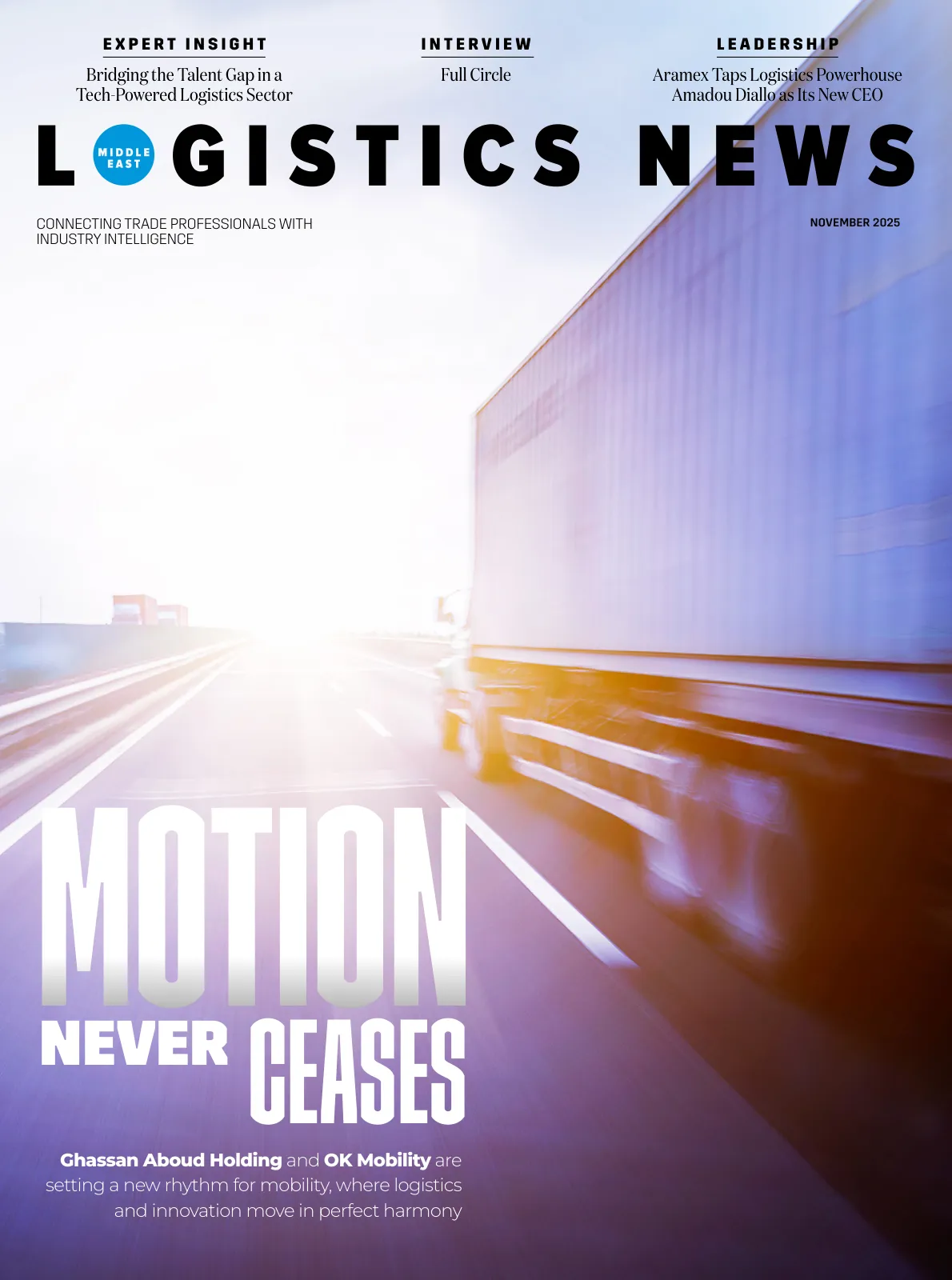
Logistics News, November 2025
Page 1
NOVEMBER 2025
CONNECTING TRADE PROFESSIONALS WITH
INDUSTRY INTELLIGENCE
E X P E R T I N S I G H T
Bridging the Talent Gap in a
Tech-Powered Logistics Sector
I N T E R V I E W
Full Circle
MOTION
NEVERCEASES
Ghassan Aboud Holding and OK Mobility are
setting a new rhythm for mobility, where logistics
and innovation move in perfect harmony
L E A D E R S H I P
Aramex Taps Logistics Powerhouse
Amadou Diallo as Its New CEO
Page 2
New IVECO S-Way: high technology and efficiency on all missions
A wide choice of Euro III / V diesel engines, delivering class-leading power from 360 hp
to 560 hp Euro III / 570 hp Euro V and superior fuel economy.
12-speed HI-TRONIX automated transmission with the most advanced technology
in its category, electronic clutch and best-in-class torque-to-weight ratio.
Full range of fuel-saving devices, such as anti-idling feature, EcoSwitch, Ecoroll and Smart Alternator.
Top levels of comfort and safety, with a completely redesigned and reinforced cab,
featuring enhanced direct visibility and enlarged cab livability.
Drive the new way.
Page 3
LOGISTICS NEWS ME | NOVEMBER 2025 | 3
WWW.CBNME.COM
IN THIS ISSUE
46 MARITIME
WAVES WITHOUT HANDS
48 ANALYSIS
GLOBAL SUPPLY CHAIN ANXIETY
SUBSIDES, YET RISKS PERSIST
52 SUSTAINABILITY
HOW ESG REPORTING IS
REWIRING THE GULF’S TRADE
INFRASTRUCTURE
16 EXPERT INSIGHT
BRIDGING THE TALENT GAP IN
A TECH-POWERED LOGISTICS
SECTOR
21 OP-ED
THE INVISIBLE THREAT IN GLOBAL
TRADE
30 TRANSPORT
NEXT IS NOW
34 LEADERSHIP
ARAMEX TAPS LOGISTICS
POWERHOUSE AMADOU DIALLO
AS ITS NEW CEO
38 INTERVIEW
FULL CIRCLE
42 SUPPLY CHAIN
REINVENTED BOLDLY
18
48
24
MOTION NEVER
CEASES
GHASSAN ABOUD HOLDING
AND OK MOBILITY ARE
SETTING A NEW RHYTHM FOR
MOBILITY, WHERE LOGISTICS
AND INNOVATION MOVE IN
PERFECT HARMONY
Page 4
Nestled by the coast of Lusail sits the splendor of
Raffles and Fairmont Doha, where luxury is rooted
in even the smallest details. Open the doors to
mesmerizing hospitality and make memories in a
world of sophistication.
Page 5
Page 6
6 | LOGISTICS NEWS ME | NOVEMBER 2025
WWW.CBNME.COM
SUBSCRIBE
subscriptions@bncpublishing.net
PO Box 502511 Dubai, United Arab Emirates
P +971 4 4200 506 | F +971 4 4200 196
For all commercial enquiries, contact jo@bncpublishing.net
T +971 50 440 2706
All rights reserved © 2025.
Opinions expressed are solely those of the contributors.
Logistics News ME and all subsidiary publications in the MENA region are
officially licensed exclusively to BNC Publishing in the MENA region by
Logistics News ME.
No part of this magazine may be reproduced or transmitted in any form or
by any means without written permission of the publisher.
Printed by United Printing and Publishing | upp.ae
Images used in Logistics News ME are credited when necessary. Attributed use of
copyrighted images with permission. All images not credited courtesy Shutterstock.
cbnme.com
ACCESS FRESH CONTENT DAILY ON OUR WEBSITE!
Logistics News ME
@Logisticsnewsme
Logistics News ME
In addition to our print edition, we’re bringing
you all sorts of industry news on our web
mediums. We’re looking forward to interacting
with our readers on all of our social media and
web platforms. See you on the web!
CEO
Wissam Younane wissam@bncpublishing.net
Managing Director
Rabih Najm rabih@bncpublishing.net
Group Publishing Director
Joaquim D’Costa jo@bncpublishing.net
Commercial Director
Andrea Mocay andrea@bncpublishing.net
Editor
Aya Zhang aya@bncpublishing.net
Digital Reporter
Reeba Asghar reeba@bncpublishing.net
Creative Lead
Christian Harb chriss@bncpublishing.net
Editorial Design
Rizaldi Febrian
Marketing Executive
Aaron Joshua Sinanbam aj@bncpublishing.net
Videographer
Eduardo Buenagua
Joel Amparo
CONNECTING TRADE PROFESSIONALS WITH INDUSTRY INTELLIGENCE
Page 7
Page 8
8 | LOGISTICS NEWS ME | NOVEMBER 2025
WWW.CBNME.COM
E
very month, the logistics world reminds us that it never
sits still. But as we put together this issue, it became clear
that something bigger is taking shape. This month feels like
the moment when the future stops knocking and simply walks
right in, fully formed and unapologetically ambitious.
Across the region, we are witnessing breakthroughs that
were once ideas on drawing boards. Offshore vessels are
now navigating without crews on board. Supply chains are
being redesigned around intelligence rather than instinct.
New logistics powerhouses are entering the market with
confidence. And leadership transitions at major
companies signal that the next chapter of growth
will be defined by vision, strategy, and bold
execution.
While reviewing this month’s stories, a single
theme kept echoing through every interview,
announcement, and insight. Reinvention. Not the
loud kind that comes with dramatic headlines,
but the quieter, determined reinvention that
begins inside control rooms, engineering labs,
and boardrooms where teams are quietly
rewriting the future of the industry. This is the
type of transformation that starts small and then
suddenly becomes the new normal.
In this issue, you will find a region that is not
waiting for change. This edition is both a
snapshot and a signal. A snapshot of where
we are today, and a signal of how fast we are
moving toward a smarter, cleaner, more resilient
logistics ecosystem. I hope you enjoy exploring
these stories as much as we enjoyed bringing
them together.
LNME
Aya Zhang
Editor
aya@bncpublishing.net
Xiaoyue (Aya) Zhang
xiaoyuezhangg
EDITOR’S NOTE
Page 9
Page 10
Page 11
Page 12
12 | LOGISTICS NEWS ME | NOVEMBER 2025
WWW.CBNME.COM
A
l Khayyat Investments (AKI) has launched a
new business unit offering third-party logistics
(3PL) services to business customers across the
UAE. Operating from multiple locations, AKI Logistics is
anchored by its central hubs in Dubai Industrial City and
Dubai Investment Park.
The end-to-end 3PL services will cater to UAE
businesses in the retail, healthcare, and FMCG sectors,
among others. AKI Logistics customers will benefit from
AKI’s industry-leading solutions, facilitating product
customs clearance, product track-and-trace, co-packing
and relabelling, specialised product handling such as
cold chain storage, and last-mile delivery.
AKI has already been awarded a large Dubai government
contract for its 3PL services in the UAE. Following its
initial rollout in the UAE, AKI plans to expand its services
across the wider region, leveraging its existing footprint
across nine markets in the MENA region.
Zaid S. Al Khayyat, Managing Director of AKI, said: “For
decades, we have been a growth partner to some of
the biggest global brands to reach a varied portfolio
of channels, from healthcare providers to large and
small retailers, to hotels, airlines, as well as direct to
consumers. The launch of AKI Logistics is part of our
continued efforts to power businesses, communities, and
people’s well-being whilst setting new benchmarks in
speed, agility, and sustainability across the region.”
Samer Sabri, Chief Supply Chain Officer of AKI, added:
“Our logistics operations are designed to give our
customers an edge, whether that’s faster delivery,
reliable cold chain solutions, or the ability to scale
seamlessly. With our Fulfilment and Innovation Centre
as the backbone, AKI Logistics is setting the standard
for efficiency and innovation in the UAE and beyond.”
The launch of AKI’s 3PL services follows the opening
of its next-generation Fulfilment and Innovation
Centre in Dubai Industrial City this April. Serving
as the hub of AKI’s supply chain, the one-million-
square-foot facility has quadrupled the company’s
fulfilment capacity in the UAE to over 1.5 million units
per day, and includes provisions for an additional
200,000 square feet of future expansion. The facility
already serves more than 30,000 business customers.
In total, AKI now operates a combined warehouse
footprint of 2.4 million square feet just in the UAE
alone.
AKI’s influence in the UAE logistics market goes back
over four decades since its founding in 1982. The
family-owned conglomerate was an early investor
in facilities in Dubai Investments Park (DIP), and
today operates across multiple sectors spanning
pharmaceuticals, medical equipment, retail, food
and non-food consumer goods, fitness, automotive,
environmental services, manufacturing, contracting,
and now, logistics.
AL KHAYYAT INVESTMENTS LAUNCHES AKI LOGISTICS, EXPANDING
INTO 3PL SERVICES
REGIONAL NEWS
LNME
From cold chain storage to last-mile delivery, AKI Logistics is Al Khayyat Investments’ latest venture
to streamline and modernise logistics across the UAE.
Page 13
LOGISTICS NEWS ME | NOVEMBER 2025 | 13
WWW.CBNME.COM
REGIONAL NEWS
ETIHAD CARGO PARTNERS WITH LODD AUTONOMOUS TO EXPLORE HYBRID
VTOL AIRCRAFT
E
tihad Cargo, the cargo and logistics arm of Etihad
Airways, is continuously redefining traditional air freight
while supporting the airline’s overall business growth
ambitions. The carrier has recently signed an agreement with
LODD Autonomous, a leader in advanced air mobility and
autonomous logistics, to explore the integration of next-
generation ‘Hili’ hybrid VTOL aircraft into UAE operations.
This collaboration will complement conventional fleets
with agile, short-range capacity that enhances operational
resilience and service speed while ensuring lower emissions
and more sustainable logistics.
With a payload capacity of 250 kilograms and a range of more
than 700 kilometres, the ‘Hili’ aircraft offers the ideal balance
between capacity and agility, being capable of transporting
high-value shipments across a wide range of terrains and
conditions.
The new partnership will centre on experimental operations
to test the efficiency, safety, and ground logistics
compatibility of LODD Autonomous’ flagship drone for
point-to-point UAE-wide transfers. The impact on logistics
could be significant, as ‘Hili’ removes the need for runways
and traditional airport infrastructure, cutting
delivery times by hours or even days.
As part of the trial, Etihad Cargo will also
explore the operational and commercial
potential of integrating ‘Hili’ aircraft into its
future fleet.
Stanislas Brun, Chief Cargo Officer of Etihad
Airways, said, ‘As a fellow Abu Dhabi-based
company, LODD Services shares Etihad
Cargo’s ambition to transform the future of
air mobility. We’re continuously looking for
new ways to enhance connectivity within
the UAE, empowering both the people and
businesses behind every shipment. Together
with LODD Autonomous, we hope to open up
new possibilities for air cargo, creating smarter,
faster, and more sustainable ways to move
goods across the country.’
Based in Abu Dhabi, LODD Autonomous
is transforming civilian logistics through
automation, autonomous vehicles, and AI-
driven software. Simplifying operations,
reducing costs, and minimising emissions,
its automated solutions serve industries
spanning e-commerce, freight forwarding, healthcare, and
beyond. LODD Autonomous’ focus on reliable, efficient
transport seamlessly aligns with Etihad Cargo’s role as a local
connector, ensuring every shipment is handled with purpose
and precision.
‘We designed the ‘Hili’ Hybrid VTOL UAV to address the
gaps in traditional logistics, particularly in the middle-mile
sector,’ added Rashid Al Manai, Chief Executive Officer of
LODD Autonomous. ‘By creating direct air corridors between
logistic hubs and warehouses, it enables seamless and rapid
transfers. This is especially important for high-value, time-
sensitive shipments such as pharmaceuticals and industrial
components, where even minor delays can disrupt operations
and lead to substantial financial losses.’
This partnership marks an exciting new chapter for Etihad
Cargo and the middle-mile logistics sector, unlocking new
efficiencies that could transform how goods are transported
across the UAE. Through collaborations with the likes of LODD
Autonomous, Etihad Cargo remains focused on empowering
partners with faster and more reliable means of moving
cargo.
Etihad Cargo is redefining traditional air freight while advancing the airline’s growth strategy.
Stanislas Brun, Chief Cargo Officer of Etihad Airways
& Rashid Al Manai, Chief Executive Officer of LODD Autonomous
Page 14
14 | LOGISTICS NEWS ME | NOVEMBER 2025
WWW.CBNME.COM
REGIONAL NEWS
LNME
DHL EXPRESS TO BUILD $85.1 MILLION AIRCRAFT MAINTENANCE HANGAR
AT BAHRAIN INTERNATIONAL AIRPORT
D
HL Express, the world’s leading express and logistics
provider, has announced plans to construct a
world-class aircraft maintenance hangar at Bahrain
International Airport. With a total investment of $85.1 million,
the project marks one of DHL’s largest aviation infrastructure
investments in the Middle East and North Africa.
The new facility will be the first DHL maintenance hangar in
the region, designed to support the company’s growing fleet
and expand its line maintenance capabilities. Covering a
total built-up area of 33,850 square metres, the development
will include a 9,800-square-metre hangar and 21,515
square metres of land, equipped to handle a range of line
maintenance tasks for DHL’s global fleet of Boeing 777 and
767 aircraft.
Construction is expected to commence in October 2026,
with the facility scheduled to go live by August 2028. Once
operational, the hangar will consolidate DHL’s MENA Aviation
(AVI) team, which encompasses management, maintenance,
operations, and administrative support, into one unified
location.
The project also reflects DHL’s commitment to environmental
sustainability and operational efficiency. The hangar will
feature solar panels capable of generating up to 40% of
its power consumption, along with advanced data network
provisions to support streamlined operations. Compliant with
international aviation authority standards, the facility will
ensure a fit-for-purpose maintenance environment for the
maintenance of DHL’s expanding fleet.
On the occasion, Abdulaziz Busbate, Chief
Executive Officer of DHL Express MENA,
commented, “This investment will significantly
strengthen our ability to manage the growing
scale and complexity of DHL’s expanding
air operations across MENA. By centralising
maintenance, logistics, and technical functions
within a single advanced facility, we will achieve
new operational synergies while reducing
maintenance-related emissions in line with
our sustainability goals. This development also
underscores DHL’s confidence in the region’s
continued economic growth and its strategic role
as a hub for the future of global trade.”
Richard Gale, Vice President of Aviation at DHL
Express MENA, added, “Beyond operational
advantages, the new hangar will help rationalise
DHL’s global maintenance network by offering
additional capacity for its international fleet
and other DHL airlines. It will enable us to better
manage spare parts and optimise inventory
planning, while reducing turnaround times and
enhancing the reliability of our international
fleet.”
Once complete, the modern facility will contribute
to DHL’s global strategy of decentralising
maintenance operations across key hubs
worldwide, ensuring greater efficiency and
sustainability across its network. It further
underscores Bahrain’s importance as a key
gateway equipped with world-class infrastructure
and regulatory readiness for aviation and
logistics development.
Abdulaziz Busbate,
Chief Executive
Officer of DHL
Express MENA
The construction is set to begin in October 2026, with completion targeted for August 2028.
Page 15
LOGISTICS NEWS ME | NOVEMBER 2025 | 15
WWW.CBNME.COM
DHL AVIATION LAUNCHES XCELERATE TO REDEFINE EXPRESS AIR FREIGHT
T
urkish Airlines, the airline flying to more countries than
any other, has successfully completed a landmark
financing transaction with Bank of China, arranged by
Bank of China Türkiye A.Ş. The five-year facility, amounting
to 2.9 billion Chinese Yuan (equivalent to USD 412 million), will
support Airline’s core development initiatives, including fleet
expansion, business growth, the construction of new facilities
and infrastructure projects at Istanbul Airport.
The transaction marks a new milestone in Turkish Airlines’
ongoing efforts to diversify its funding sources while
reinforcing its commitment to sustainable and globally
inclusive growth. Coordinated by Bank of China Türkiye and
BOC Macau branch as the lender of the facility, the financing
also represents a strengthening of financial cooperation
between Türkiye and China, further aligning with both
countries’ long-term strategic initiatives.
Commenting on the successful transaction, Turkish Airlines
Chief Financial Officer and Member of the Board of Directors
and the Executive Committee, Assoc. Prof. Murat Şeker stated:
“We are pleased to deepen our collaboration with Bank
of China through this important financing transaction. As
Turkish Airlines continues to pursue sustainable growth and
global expansion, we highly value the trust and partnership
established with leading international institutions such as the
Bank of China. This cooperation not only strengthens our flag
carrier’s financial position but also contributes to the broader
economic and cultural ties between Türkiye and China.
This transaction highlights Turkish Airlines’ strategic vision of
embracing innovative and diversified financing solutions that
support its long-term sustainability goals. The airline remains
committed to advancing its financial strategy through
partnerships with globally respected institutions, reinforcing
its leadership in the global aviation industry as it continues
to expand its fleet and network toward its 2033 centennial
targets.
REGIONAL NEWS
Turkish Airlines is accelerating its fleet and infrastructure upgrades as it charts its path
toward a bold new decade of growth.
Murat Şeker,
Chief Financial
Officer and
Member of the
Board of Directors
and the Executive
Committee,
Turkish Airlines
Page 16
16 | LOGISTICS NEWS ME | NOVEMBER 2025
WWW.CBNME.COM
LNME
EXPERT INSIGHT
T
he logistics sector in the Middle
East has been a leading driver
of economic growth for decades.
According to a report by IMARC,
the market size was USD 250
billion in 2024 and is expected to reach USD
407 billion by 2033, showing a strong CAGR
of 5.57 per cent over the period. The region’s
strategic geographic location, combined
with the government’s focus on developing
a robust logistics sector as part of broader
economic diversification efforts, has
further propelled the market. For instance,
the National Industrial Development and
Logistics Program was introduced in 2019
as part of the Saudi Vision 2030 program to
position Saudi Arabia as a leading industrial
power and a global logistics hub through
the development of ports, simplification of
customs processes, and enhancement of
transportation infrastructure. The UAE has
also set ambitious goals to empower its
logistics sector under the aegis of We the
UAE 2031. Under this vision, the government
aims to position the UAE among the top
three globally in the Logistics Performance
Index and increase the logistics sector’s
economic contribution from approximately
AED136.7 billion (USD 37.2 billion) in 2024 to
over AED200 billion (USD 54.4 billion) within
the next seven years.
The logistics sector is undergoing
profound change driven by technological
advancements, changing customer
behaviours, and sustainability needs. As the
industry adopts digital platforms, it faces a
significant shortage of talent that can hinder
its progress. Bridging the gap requires an
employee cohort that continually upskills
and adapts to emerging technological
advancements in every element of logistics,
including transportation, warehouse
operations, and last-mile delivery. As
warehouses become automated, fleets
become electric, and data informs decisions,
logistics professionals must acquire new
skills to prepare for the future, which are:
Digital Competency
Manual processes and disintegrated systems
have characterised the logistics sector. As
digital technologies such as the Internet
of Things (IoT), artificial intelligence (AI),
big data analytics, and blockchain emerge,
logistics processes are being revolutionised
Originally written by Dr. Shereen Nassar.
Edited by Vibha Mehta
Bridging the talent
gap in a tech-powered
logistics sector
Dr. Shereen Nassar,
Global Director of Logistics Studies and Director of MSc Logistics and
Supply Chain Management Suite at Heriot-Watt University Dubai
Upskill.
Onboard.
Excel.
Page 17
LOGISTICS NEWS ME | NOVEMBER 2025 | 17
UPSKILL. ONBOARD. EXCEL.
at a core level. These technologies enable real-time tracking
of shipments, predictive analytics to anticipate demand, and
enhanced visibility across the supply chain.
The logistics industry of tomorrow relies on tech-enabled
logistics professionals who can readily embrace Transport
Management Systems (TMS), Warehouse Management
Systems (WMS), Enterprise Resource Planning (ERP) systems
and IoT and AI-based visibility solutions. They need to learn
to excel at intricate dashboard reading, real-time analysis,
predictive modelling, and the use of automated warehousing
systems and robotics. This will enable them to deliver
actionable and data-driven insights to enterprises, resulting
in enhanced accuracy and efficiency.
International Trade Regulations & Cultural Awareness
Because logistics activities often cross cultures and
borders, practitioners must possess excellent knowledge of
international trade regulations. This helps them understand
the complexities of cross-border transactions and comply
with various legal requirements. These include export control
compliance, trade agreements, and customs regulations.
This makes understanding compliance and international
trade regulations crucial in today’s globalised economy.
Developments in tariffs and duties, import and export
documentation, and Free Trade Agreements can have a
significant impact on an organisation’s viability, making
personnel with the proper knowledge a highly valuable asset.
Artificial intelligence and digital technologies continue to
transform international trade and logistics, as the rapid rate
of change in AI challenges the role of AI in international trade
regulation (WTO Report, September 2025).
Furthermore, professionals should possess cultural
awareness and sensitivity. This includes understanding
different business practices, communication styles, and
regulatory environments.
Sustainability and Green Logistics
A significant portion of a company’s carbon footprint often
results from outdated supply chain processes, making
sustainable logistics a key priority. Freight and warehousing
logistics emissions alone account for a minimum of 7 per
cent of worldwide greenhouse gas emissions, which is
why there is a growing demand for green logistics that is
expected to amount to some USD 350 billion by 2030. In
such a context, experts with formal education
and skills in implementing sustainable systems
will be in high demand with corporations. This
includes data on freight transport emissions,
environmentally friendly packaging materials,
carbon offsetting actions, alternative fuels, and the
circular economy.
Additionally, International trade environmental
regulations are increasingly important to be aware
of, particularly as most organisations emphasise
sustainability. Professionals should be aware
of how regulations impact logistics operations,
including packaging, waste disposal, and emissions
controls.
Automation and Robotics
The operations of warehouses and distribution
centres are being reshaped by automation and
robotics. Autonomous mobile robots (AMRs),
automated storage and retrieval systems (AS/RS),
drones for inventory management, and AI-based
picking systems are now widely implemented,
clearing the path for individuals capable of working
these technologies with precision and dexterity.
Data Analysis
The logistics sector is no longer driven by
firefighting but by decision-making. Statisticians
with analysis and forecasting skills, pattern
recognition, and scenario modelling will allow
organisations to unlock data intelligence and
succeed in a global, competitive world.
Page 18
18 | LOGISTICS NEWS ME | NOVEMBER 2025
WWW.CBNME.COM
Communications & problem-solving
Supply chains today are fast-paced, cross-border, and
cross-functional. Current employees must be capable of
communicating with all stakeholders, whether internal sales
and finance teams or external customs agents and vendors.
Negotiating contracts, conflict resolution, managing a
virtual team, and delivering client presentations are some
of the key skills required for leaders in the logistics sector of
the future.
All these abilities are in high demand from employers
today, who are looking to hire individuals who are flexible
and dedicated towards continuous learning. A skills gap
in a technology-based logistics company can only be
bridged through collaboration among organisations, training
institutions, and prospective employees.
Organisations are required to ensure that they have robust
upskilling and onboarding programs in place for their staff
members, offering them a well-defined process through
which to achieve the desired technical proficiency. Training
institutes can also play a crucial role in shaping the
upcoming workforce by providing relevant learning and
courses that cater to the evolving needs of the logistics
sector. Lastly, students and prospective employees can stand
out by being current with the latest industry trends,
attending industry conventions, and obtaining
internationally accepted certificates and degrees.
LNME
EXPERT INSIGHT
Page 19
Das gute Licht.
Protecting
the night sky
BEGA pole-top luminaires with BugSaver® technology
protect nocturnal fauna by reducing the color temperature
from 3000 Kelvin to an amber color around 1800 Kelvin,
which reduces the light attractive effect. The color
temperature and output can be controlled dynamically.
bega.com/bugsaver
Page 20
20 | LOGISTICS NEWS ME | NOVEMBER 2025
WWW.CBNME.COM
LNME
OP-ED
Global Trade
The Invisible Threat in
A recent report shows 54% of large organisations see supply chain
vulnerabilities as the biggest threat to cyber resilience. From ransomware
on logistics firms to software breaches disrupting ports, these risks are
already reshaping global trade.
By Richard Staynings
Richard Staynings is a globally renowned cybersecurity thought leader. He serves as Chief Security Strategists for
Cylera, and as Professor of Healthcare Cybersecurity at the University of Denver. A 25-year veteran of cybersecurity
leadership, Richard has served as a subject matter expert on government Committees of Inquiry into some of the
highest profile cyber-attacks and data breaches.
Page 21
THE INVISIBLE THREAT IN GLOBAL TRADE
T
he rapid expansion of globalised
manufacturing in the 1990s has led
to the formation of lengthy complex
supply lines that now circumnavigate the
planet. Securing this supply chain is perhaps
one of the greatest of all cybersecurity
challenges given its complexity. Obscured by
lengthy supply chains of fourth, fifth- and
sixth-party suppliers, risk is often impossible
to quantify or qualify and a changing mix of
supplier vendors and partners makes this a
moving target, as parties shop around for the
best quality, availability, and price.
But it’s not just manufactured goods that
are the concern, cybersecurity risks are
growing in the digital and software supply
chains that feed government, education,
and other critical infrastructure industries
like healthcare, where risks are measured in
patient lives rather than simple downtime or
delays.
Software Supply Chains
Nearly every industry sector today has
a high and growing dependence upon
technology and the interconnected systems,
IoT devices, and cloud-based platforms that
power them. An expanding cyber-attack
surface formed by misconfigured software,
API vulnerabilities, and poorly designed
OT and IoT connected devices, all lead to
inevitable breaches.
According to Security Magazine, 91% of
organisations have suffered a software
supply chain attack in the past year. In
fact, a recent study found that, since 2017,
supply chain cyber-attacks have increased
by 2,227% in the US alone, and ultimately,
software supply chain attacks will cost the
world $60 billion in 2025, and $138 billion by
2031.
Systems and software vulnerabilities
ultimately lead to exploitation by
criminals and pariah states. One is intent
on monetising its access through theft,
extortion, and terrorism, while the other is
intent on espionage or causing disruption
to its enemies. While both ultimately lead
to operational disruption, cyber-attacks
usually also lead to productivity delays,
financial loss, regulatory and reputational
damage.
Perhaps the biggest software supply chain
attack is that of the SolarWinds Orion hack in
2020, which injected an espionage backdoor
into network monitoring software that was
delivered to more than 30,000 companies
and government agencies.
Page 22
22 | LOGISTICS NEWS ME | NOVEMBER 2025
WWW.CBNME.COM
LNME
OP-ED
In addition, the most devastating software supply
chain attack is that of NotPetya, malicious code that
wiped the hard drives of thousands of computers
when companies installed an update to the Ukrainian
M.E.Doc tax accounting software in 2017. The attack
impacted computer systems worldwide and caused
an estimated $12 billion in damages.
Logistics
While container ships, ports and rail systems are
increasingly reliant upon operational software to
load and balance freight, and schedule ‘just-in-time’
delivery of supplies, these too are subject to supply
chain risks.
As recently as last week, an IT outage caused a
systemwide ground-stop on all Alaska Airlines flights
- its second this year. An August 2025 ground-stop
for United Airlines was caused by a technology
issue in its weight and balance computer system.
Other airlines have suffered complete technology
meltdowns when crew scheduling software failed
stranding flight crews, or when a software glitch
in a CrowdStrike update blanked thousands of
airline computer systems worldwide. These logistics
stoppages were all the result of vulnerabilities and
failures in third party software.
Maritime ports, responsible for 80% of global trade
and serving as critical NATO logistics hubs, are facing
a surge in cyberattacks from state-linked actors,
according to a new policy brief from the NATO
Cooperative Cyber Defence Centre of Excellence
(CCDCOE). The report detailed how surveyed
countries have experienced cyber-attacks within the
past five years against access control systems and
vessel traffic management systems in particular.
The transportation of goods is also subject to natural
disasters like typhoons and hurricanes, geopolitical
tensions and trade wars, and armed conflict that
close transportation routes such as the Red Sea,
Suez Canal, or flights over Russia. Port congestion,
and operational errors that wedge container ships
in narrow waterways can cost millions in delayed or
diverted traffic. While the distribution of software is
subject to supply chain attacks and the poisoning
of AI systems through adversarial machine learning
Page 23
LOGISTICS NEWS ME | NOVEMBER 2025 | 23
WWW.CBNME.COM
THE INVISIBLE THREAT IN GLOBAL TRADE
and fake training data. Indeed, a growing ocean of
disinformation is impacting more than just supply
logistics but messing with demand itself.
Achieving Security and Resiliency
The greatest risk to security and resiliency is lack of
visibility into lengthy opaque supply chains where
nefarious parties may have coded in backdoors for
observation, foothold, and delayed cyber-attack.
Insider threats should also be evaluated with
rising use of pariah state agents to plant software
backdoors in critical components, or with countries
subject to international sanctions covertly inserting
untrustworthy developers into global software
engineering organisations.
Thorough and deep risk assessments are now
necessary to identify vulnerabilities throughout the
entire supply chain before any level of operational
resiliency can be achieved. Diversification of
suppliers to hedge against failures or geopolitical
tensions is now a necessity. The February 2024
ransom attack against Change Healthcare, part
of United Health Group (UHG), which impacted
a third of all US healthcare providers,
is an example of what happens where
a single point of failure is allowed to
develop. So too was South London’s
dependence upon a single pathology
provider, when in June 2024 Synnovis
was attacked by ransomware, resulting
in the death of one patient and injury to
14 others. Geographical diversification is
also necessary to avoid environmental
difficulties, national lockdowns, trade spats
and geopolitical tensions.
Perhaps of all the conceivable risks to
supply chains, technology is now the
single greatest potential point of failure.
Our slow ability to secure application code
and its underlying infrastructure, combined
with an insatiable appetite for greater
automation of systems and processes
using further technology, sets us on a
high-risk path. Investment in cybersecurity
and resiliency has now become critical to
ensure continued availability of goods and
services.
THOROUGH AND DEEP RISK
ASSESSMENTS ARE NOW
NECESSARY TO IDENTIFY
VULNERABILITIES THROUGHOUT
THE ENTIRE SUPPLY CHAIN
BEFORE ANY LEVEL OF
OPERATIONAL RESILIENCY CAN
BE ACHIEVED.
Page 24
24 | LOGISTICS NEWS ME | NOVEMBER 2025
WWW.CBNME.COM
LNME
COVER STORY
MOTION
NEVERCEASES
Ghassan Aboud Holding and
OK Mobility are setting a new
rhythm for mobility, where
logistics and innovation move in
perfect harmony.
In the rapidly evolving world of mobility, few partnerships promise to redefine
the way people and goods move across a region. Ghassan Aboud Holding and OK
Mobility are joining forces in the UAE, blending decades of local expertise with
global innovation to create a seamless, forward-looking mobility ecosystem.
For Maher Aboud, Group CEO of Ghassan Aboud Holding, and Othman Ktiri, Founder
and Executive Chairman of OK Mobility, this is more than a business alignment, it’s
a shared vision for how logistics, technology, and customer experience converge to
shape the future of movement.
In the pages that follow, they reflect on the challenges, opportunities, and ambitions
driving this collaboration, revealing how two distinct approaches can merge to create
a new benchmark for mobility in the region.
Page 25
LOGISTICS NEWS ME | NOVEMBER 2025 | 25
WWW.CBNME.COM
MOTION NEVER CEASES
Page 26
Your two companies have recently aligned through OK
Mobility’s entry into the UAE market, supported by Ghassan
Aboud Holding. What strategic goals are you both pursuing
through this collaboration, and how does logistics enable
that vision?
Othman: Our collaboration with Ghassan Aboud Holding
marks a pivotal step in OK Mobility’s global expansion.
The UAE represents a dynamic and strategic market where
innovation and customer experience define success.
By partnering with a trusted group that shares our forward-
looking mindset, we are combining operational excellence
with cutting-edge global mobility solutions to offer a
seamless and flexible experience for customers across the
country.
Maher: This partnership perfectly reflects Ghassan Aboud
Holding’s mission of “Building a better future, together.”
Through Transit Auto Rental, our automotive mobility arm,
and with over three decades of experience across automotive,
logistics, and retail sectors, we provide the local expertise,
infrastructure, and agility needed to enable OK Mobility’s
successful entry into the UAE market. Together, we’re setting a
new benchmark for smart and sustainable mobility solutions
in the region.
Othman — OK Mobility is expanding from Europe into
the Gulf. What were the main logistical and operational
challenges of entering the UAE market?
Expanding from Europe into the Gulf presented new logistical
and operational challenges, from navigating regulatory
frameworks to adapting to the UAE’s climate and diverse
customer base.
We focused on localising our services to meet these
expectations, offering convenient retail locations in high-
demand areas and personalised Meet & Greet services at key
airports, all while maintaining the high-quality standards that
define OK Mobility across Europe.
Maher — From your side, what capabilities or infrastructure
did Ghassan Aboud Holding provide to support OK
Mobility’s entry into the region?
Ghassan Aboud Holding, through its established automotive
and logistics capabilities, provided OK Mobility with a strong
operational foundation. With our long-standing presence
in the UAE and diversified expertise, this partnership
demonstrates how our integrated ecosystem helps
international partners scale effectively and sustainably in this
market.
LNME
COVER STORY
Maher Aboud,
Group CEO of
Ghassan Aboud
Holding
26 | LOGISTICS NEWS ME | NOVEMBER 2025
WWW.CBNME.COM
Page 27
LOGISTICS NEWS ME | NOVEMBER 2025 | 27
WWW.CBNME.COM
With Ghassan Aboud Holding’s logistics infrastructure,
including the Global Auto Hub and Gallega Logistics, and
OK Mobility’s technology-driven operations, how do your
strengths come together to create a seamless mobility
ecosystem in the UAE?
Maher: Our Group’s assets, including the Global Auto Hub
and Gallega Logistics, play a vital role in enabling efficient
vehicle movement, servicing, and regional distribution.
These capabilities form a solid backbone for OK Mobility’s
operations in the UAE, ensuring reliability and speed across
the value chain. It’s a prime example of how our logistics
and automotive infrastructure empower partners to achieve
operational excellence.
MOTION NEVER CEASES
Othman Ktiri,
Founder and
Executive
Chairman of OK
Mobility
Page 28
28 | LOGISTICS NEWS ME | NOVEMBER 2025
WWW.CBNME.COM
LNME
COVER STORY
Othman: OK Mobility brings
complementary expertise in fleet
management and digital-first
operations. By integrating our
technology-driven approach with
Ghassan Aboud Holding’s logistics and
infrastructure, we’re building a seamless
end-to-end mobility ecosystem. This
synergy allows us to deliver a superior
customer experience, combining
innovation, efficiency, and convenience
in a fast-evolving market like the UAE.
The boundaries between mobility and
logistics are becoming increasingly
blurred, from fleet leasing and EV
logistics to last-mile enablement. How
do you both see this convergence
shaping your businesses, and what
new models are you planning to
pursue in the next 2–5 years?
Othman: The line between logistics and
mobility continues to blur, creating
new opportunities for collaboration.
We see strong potential in areas like
“TOGETHER, WE’RE
SETTING A NEW
BENCHMARK
FOR SMART AND
SUSTAINABLE
MOBILITY
SOLUTIONS IN THE
REGION.”
Maher Aboud
Page 29
LOGISTICS NEWS ME | NOVEMBER 2025 | 29
WWW.CBNME.COM
MOTION NEVER CEASES
fleet leasing, EV logistics, and last-
mile enablement. Over the next few
years, we aim to expand these models
through smart technologies and data-
driven solutions that enhance efficiency
and user experience.
Maher: Ghassan Aboud Holding is
deeply invested in shaping the future
of logistics and mobility across the
region. We believe the convergence
of these sectors will drive innovation
and efficiency, from supporting electric
vehicle adoption to enabling smarter,
greener supply chains. Working
alongside OK Mobility, we’re building
the infrastructure and partnerships
that will define the next generation of
mobility solutions.
From predictive fleet management to
end-to-end supply chain visibility,
what technologies are you prioritising
to optimise operations, enhance
efficiency, and prepare for future
growth?
Othman: Technology sits at the core
of OK Mobility’s operations. From
predictive fleet management to AI-
driven demand forecasting, our goal
is to optimise every aspect of the
customer journey. This allows us to
provide real-time mobility solutions
while improving efficiency and reducing
environmental impact.
Maher: Digitalisation is a cornerstone
of Ghassan Aboud Holding’s growth
strategy. Across our automotive and
logistics verticals, we are investing
in platforms that enhance supply
chain transparency, automation, and
customer connectivity.
By aligning our digital capabilities
with OK Mobility’s advanced fleet
technology, we’re building a fully
integrated, data-driven ecosystem that
supports future growth.
You both operate across Europe, the
Middle East, and Africa — each with
distinct regulatory, infrastructural,
and customer dynamics. What’s your
shared vision for the logistics and
mobility ecosystem across these
regions over the next 5–10 years?
Maher: With a presence across the
world, Ghassan Aboud Holding’s vision
is to create interconnected ecosystems
that drive trade, innovation, and
sustainable growth. Our diversified
portfolio and international footprint
position us to support the next wave of
mobility and logistics evolution across
these regions, with the UAE as a hub for
innovation and connectivity.
Othman: Our shared goal is to make
mobility more global, sustainable, and
accessible. Together with Ghassan
Aboud Holding, we are committed to
expanding responsibly across key
regional markets, leveraging our
combined expertise to deliver value-
driven, customer-focused solutions
that align with the UAE’s leadership in
innovation and smart mobility.
“BY PARTNERING
WITH A TRUSTED
GROUP THAT
SHARES OUR
FORWARD-
LOOKING
MINDSET, WE
ARE COMBINING
OPERATIONAL
EXCELLENCE WITH
CUTTING-EDGE
GLOBAL MOBILITY
SOLUTIONS.”
Othman Ktiri
Page 30
I
n the bustling streets and industrial hubs of the
Middle East, commercial vehicles are more than
just machines, they are the lifeblood of commerce,
construction, and connectivity. Amidst this dynamic
landscape, Tata Motors, India’s automotive giant,
is redefining what it means to lead in the commercial
vehicle sector, blending cutting-edge technology,
sustainability, and customer-centric innovation.
With over six decades of presence in the region, Tata
Motors has become a household name for reliability
and performance. “Our legacy in the Middle East is built
on understanding our customers and providing value
consistently,” said Mr. Asif Shamim, Head, International
Business, Tata Motors Commercial Vehicles, during
a recent showcase in the UAE, one of the largest
commercial vehicle markets in the region. “We have
survived and thrived because we know the segments
we operate in and continuously adapt to meet evolving
demands.”
A Customer-Centric Approach
Tata Motors’ success in the Middle East stems from a
deep understanding of its customer base. Unlike many
global brands that adopt a one-size-fits-all strategy,
Tata Motors tailors its offerings to meet the specific
operational and environmental conditions of the
region. From the extreme heat of the Gulf deserts to the
NEXT IS NOW
Tata Motors is shifting gears in the Middle East where innovation,
sustainability, and smart engineering meet the road, with insights
from Mr. Asif Shamim and Mr. Anirudhha Kulkarni.
LNME
LNME
TRANSPORT
Page 31
LOGISTICS NEWS ME | NOVEMBER 2025 | 31
WWW.CBNME.COM
demanding logistics requirements of
construction and retail supply chains, the
company designs vehicles that are robust,
reliable, and efficient.
“Our philosophy is simple,” Mr. Shamim
continued. “We don’t wait for the future—
we make it happen. That’s why we are
proactive in offering solutions before the
market demands them. Safety, reliability,
and cost-efficiency are not optional—they
are mandatory.”
Building the Future: Innovation and
Technology
Innovation lies at the heart of Tata Motors’
strategy. The company emphasises
three key pillars: world-class products
tailored for local conditions, a strong
distribution and service network, and
customer-focused financing solutions.
Each pillar reinforces the other, ensuring
that customers not only acquire high-
quality vehicles but also benefit from
support systems that maximise uptime
and efficiency.
Tata Motors’ commitment to innovation
extends to safety, comfort, and total
cost of ownership (TCO). Its commercial
vehicles, including the Tata Prima and
Alta ranges, feature cabins compliant with
stringent European safety standards—an
attribute rarely matched in the region.
Advanced features such as electronic
stability control, anti-lock braking
systems, and ergonomic design ensure
driver safety and comfort, while smart
engineering reduces operational costs,
fuel consumption, and maintenance
frequency.
Moreover, Tata Motors leverages artificial
intelligence and digital validation in its
vehicle development process. “Every
component—from engine calibration to
suspension systems—is simulated and
tested digitally, allowing us to predict
performance under extreme conditions,”
explained Mr. Anirudhha Kulkarni, Head
Engineering, Tata Motors Commercial
Vehicles. “This not only enhances
reliability but also accelerates innovation
cycles, ensuring that we remain ahead
of competitors in delivering superior
products.”
Sustainability: Driving a Greener Tomorrow
In an era of environmental consciousness, Tata Motors is pushing the envelope
with its commitment to sustainability. The company is actively exploring
alternative fuels—from compressed natural gas (CNG) and liquefied natural gas
(LNG) to hydrogen and battery-electric solutions. These initiatives are part of
Tata Motors’ ambitious net-zero target by 2045, which encompasses circularity
in product life cycles, energy-efficient production, and broader biodiversity
considerations.
“Our goal is not only to meet regulatory standards but to exceed them,” Mr.
Shamim said. “We are committed to creating vehicles that are not just functional,
but responsible, contributing to a cleaner, safer, and more sustainable world.”
Asif Shamim,
Head,
International
Business,
Tata Motors
Commercial
Vehicles
NEXT IS NOW
“OUR LEGACY IN THE MIDDLE EAST IS BUILT ON
UNDERSTANDING OUR CUSTOMERS AND PROVIDING
VALUE CONSISTENTLY. WE HAVE SURVIVED AND
THRIVED BECAUSE WE KNOW THE SEGMENTS WE
OPERATE IN AND CONTINUOUSLY ADAPT TO MEET
EVOLVING DEMANDS.” - Asif Shamim
Page 32
32 | LOGISTICS NEWS ME | NOVEMBER 2025
WWW.CBNME.COM
This commitment resonates with a growing demand in the Middle East for
vehicles that align with national sustainability agendas, particularly in the
UAE and Saudi Arabia, where governments are incentivising clean energy
adoption and emissions reduction in the transport sector. Tata Motors’
focus on alternative-fuel technologies positions the company as a front-
runner in the transition toward greener commercial mobility.
Market Strategy: Strengthening Regional Presence
The UAE, as the largest commercial vehicle market in the Middle East,
serves as a strategic hub for Tata Motors. However, the company’s
vision extends far beyond a single market. With a strong presence in
Saudi Arabia and other GCC countries, Tata Motors aims to expand its
product portfolio, strengthen after-sales services, and develop strategic
partnerships. One notable collaboration is with Mohamed Yousuf Naghi
Motors Co. in Saudi Arabia, which enhances distribution capabilities and
customer support.
“Our growth strategy is region-specific but globally informed,” Mr.
Shamim said. “We leverage insights from our operations in India and other
international markets to introduce products and services that are relevant
for our Middle Eastern customers.”
The “Next is Now” Philosophy
Tata Motors embodies a forward-thinking philosophy captured by the
tagline “Next is Now.” Rather than reacting to market trends, the company
anticipates them, ensuring that customers experience innovation,
safety, and efficiency before they become industry standards. Whether
LNME
LNME
TRANSPORT
“EVERY
COMPONENT,
FROM ENGINE
CALIBRATION
TO SUSPENSION
SYSTEMS, IS
SIMULATED AND
TESTED DIGITALLY,
ALLOWING US
TO PREDICT
PERFORMANCE
UNDER EXTREME
CONDITIONS.” -
Anirudhha Kulkarni
Page 33
LOGISTICS NEWS ME | NOVEMBER 2025 | 33
WWW.CBNME.COM
it’s adopting Euro 6 emissions
compliance ahead of local regulations
or integrating AI-driven diagnostics in
vehicle fleets, Tata Motors consistently
stays one step ahead.
The company’s connected vehicle
platform, the largest in India for
commercial vehicles, is gradually
being adapted for the Middle East. This
system allows real-time monitoring of
vehicle health, predictive maintenance,
and fleet optimisation, offering tangible
cost savings and operational benefits
for businesses.
People and Partnerships
Behind every Tata vehicle is a network
of skilled engineers, technicians, and
regional partners who embody the
company’s customer-first philosophy.
Training programs, local workshops,
and continuous engagement with fleet
operators ensure that the company’s
commitment to quality extends beyond
the factory floor.
“Our partnerships are more
than business arrangements,”
Mr. Shamim emphasised.
“They are collaborations built
on trust, performance, and
shared values. Together, we
deliver vehicles that meet
the exacting standards of
our customers while driving
industry evolution in the
region.”
Looking Ahead
As the Middle East continues
its rapid development in
logistics, construction, and
urban infrastructure, the
demand for safe, reliable, and
environmentally responsible
commercial vehicles is
expected to grow. Tata
Motors is uniquely positioned
to meet this demand with
its combination of legacy,
innovation, and vision.
By integrating AI-driven
engineering, sustainability
initiatives, and customer-
centric strategies, Tata
Motors is not just participating in the
region’s growth, it is shaping the very
future of commercial mobility. The
company’s journey reflects a rare blend
of pragmatism and ambition, rooted in
decades of experience but propelled by
a clear vision for tomorrow.
As Mr. Shamim summed up: “We are
not waiting for the next revolution in
mobility. We are creating it. In every
market, in every vehicle, and in every
partnership, Tata Motors is leading
the charge toward a safer, greener, and
smarter future.”
In the fast-moving world of commercial
transport, where uptime, efficiency, and
safety are paramount, Tata Motors’
story is a testament to foresight,
innovation, and unwavering
commitment to customers—a story that
is only just beginning in the Middle
East.
Anirudhha
Kulkarni,
Head
Engineering,
Tata Motors
Commercial
Vehicles
NEXT IS NOW
Page 34
LNME
LEADERSHIP
TAPS LOGISTICS POWERHOUSE AMADOU DIALLO
AS ITS NEW CEO
Page 35
LOGISTICS NEWS ME | NOVEMBER 2025 | 35
WWW.CBNME.COM
ARAMEX NEW CEO, AMADOU DIALLO
With a proven global
track record and a
passion for innovation,
Aramex is charting
a bold new course
under the leadership
of Amadou Diallo.
D
ubai-based logistics leader Aramex
has announced the appointment
of Amadou Diallo as its new Group
Chief Executive Officer (CEO), effective 1 May
2026.
Amadou Diallo brings over 30 years of
experience in the logistics sector to the
role. He most recently served as CEO for
the Middle East & Africa at DHL Global
Forwarding, where he led the company’s
regional operations.
Over the course of his distinguished career,
he has held a range of senior leadership
positions, including CEO, CFO, and COO
roles, across major business units spanning
Europe, Asia Pacific, the Middle East, and
Africa. His extensive operational expertise,
global perspective, and strategic acumen
are complemented by a leadership style
grounded in collaboration, performance,
and innovation.
Amadou Diallo,
CEO, Aramex
Page 36
36 | LOGISTICS NEWS ME | NOVEMBER 2025
WWW.CBNME.COM
Leadership Continuity During Transition
Until Amadou formally assumes his new position, Nicolas
Sibuet will continue to serve as Acting Group CEO, guiding
the company through the close of the 2025 financial year
and into 2026. Nicolas has demonstrated strong, steady
leadership throughout a period of significant transformation,
ensuring consistency, focus, and delivery across all areas of
the business.
Aramex remains fully committed to ensuring a seamless
leadership transition and enters this next chapter with
confidence. Under Amadou’s stewardship, the company
will continue to advance its Accelerate28 strategy and
transformation programme, driving sustainable growth,
operational excellence, and long-term value creation.
Founded in 1982, Aramex has grown into a global leader in
logistics and transportation, renowned for its innovative
services tailored to both businesses and consumers.
Headquartered in the United Arab Emirates and listed on the
Dubai Financial Market since 2005, the company leverages its
strategic location to provide seamless connectivity,
effectively bridging the gap between East and West.
LNME
LEADERSHIP
Captain Mohamed Juma Alshamisi, Chairman of the Board of Directors of Aramex
“WE ARE DELIGHTED TO
WELCOME AMADOU DIALLO
AS THE NEW CHIEF EXECUTIVE
OFFICER OF ARAMEX. WITH
HIS EXTENSIVE GLOBAL
EXPERIENCE, STRONG
OPERATIONAL EXPERTISE,
AND PEOPLE-CENTRED
LEADERSHIP APPROACH,
AMADOU IS EXCEPTIONALLY
WELL PLACED TO GUIDE THE
COMPANY INTO ITS NEXT
PHASE OF GROWTH. HIS
APPOINTMENT REFLECTS
OUR FULL CONFIDENCE IN
HIS ABILITY TO SUSTAIN OUR
MOMENTUM AND DELIVER
LONG-TERM VALUE FOR ALL
STAKEHOLDERS. WE WOULD
ALSO LIKE TO EXPRESS OUR
SINCERE GRATITUDE TO
NICOLAS SIBUET FOR HIS
STEADFAST LEADERSHIP AND
DEDICATION THROUGHOUT
THIS IMPORTANT PERIOD OF
TRANSITION.”
Page 37
Visit Our Website
Page 38
38 | LOGISTICS NEWS ME | NOVEMBER 2025
WWW.CBNME.COM
LNME
LNME
INTERVIEW
Page 39
LOGISTICS NEWS ME | NOVEMBER 2025 | 39
WWW.CBNME.COM
Circle
In this interview with Aya Zhang, Mr. Mansoor
Al Malik, Executive Director for policies and
legislation Division, reveals how Dubai Customs’
Project Zero gives counterfeit goods a second
life, turning seized items into sustainable
solutions that benefit both the community and
the environment.
FULL CIRCLE
Page 40
40 | LOGISTICS NEWS ME | NOVEMBER 2025
WWW.CBNME.COM
What is “Project Zero”, launched by Dubai Customs,
and what is its main goal?
“Project Zero” is a pioneering initiative launched by Dubai
Customs in collaboration with the DP World Foundation
and Landmark Group — the first of its kind in the region.
The project aims to combat the illicit trade in counterfeit
goods not only by seizing them but by repurposing them
sustainably within a circular economy model.
Its core objective is to transform confiscated counterfeit
goods into useful, usable products instead of destroying
them, thereby achieving the principle of “zero waste”,
protecting the environment, and promoting social
responsibility.
How does “Project Zero” support circular economy and
sustainability concepts?
“Project Zero” contributes to the circular economy by
recycling counterfeit goods in a way that prevents them
from ending up in landfills or causing environmental
pollution.
It represents a paradigm shift in how customs authorities
handle counterfeit items — focusing on waste reduction,
resource efficiency, and cutting carbon emissions from
destruction processes. Additionally, the recycled products
are redirected to communities in need, adding a social
and humanitarian dimension to the initiative.
What role does Landmark Group play in the
implementation of the project?
Landmark Group has been tasked with handling around
500,000 counterfeit items through a sustainable
recycling system designed to achieve zero waste.
LNME
LNME
INTERVIEW
Page 41
LOGISTICS NEWS ME | NOVEMBER 2025 | 41
WWW.CBNME.COM
The group’s role includes refurbishing and rehabilitating
these goods to make them suitable for use once again —
reducing the environmental footprint of seized products and
increasing their community value.
What are the social and economic dimensions of the
initiative?
Socially, the initiative provides usable products to
underprivileged and affected families across various
countries through our strategic partner, the DP World
Foundation. This helps meet essential needs and reinforces
the values of community solidarity and social responsibility.
Economically, the project reduces waste disposal costs and
maximizes the use of existing resources instead of discarding
them. It also strengthens Dubai’s position as a global hub that
balances economic oversight with environmental and social
sustainability — attracting investments and partnerships
that prioritize environmental responsibility.
How does the initiative reflect Dubai Customs’ future
direction in customs work?
The initiative reflects Dubai Customs’ forward-thinking
approach — evolving from a purely regulatory and
enforcement body into an active partner in sustainability
and innovation strategies.
It underscores the idea that modern customs work must
adapt to environmental and social challenges, helping
build a resilient and sustainable economy. This vision
reinforces Dubai’s global leadership in adopting smart,
green solutions and places Dubai Customs at the forefront
of entities driving comprehensive and sustainable
development.
FULL CIRCLE
Mansoor Al Malik,
Executive Director
for policies and
legislation Division,
Dubai Customs
Page 42
42 | LOGISTICS NEWS ME | NOVEMBER 2025
WWW.CBNME.COM
Reinvented Boldly
Landmark Group is rewriting the rules of retail logistics in the Middle East. Mr. Ashish Sood,
Chief Supply Chain Officer, shares how Logistiq is turning automation, AI, and cross-border
reach into a seamless, next-generation fulfilment network.
Tell us more about Logistiq.
We are a Landmark Group company, with 50+ years of supply
chain expertise in the Middle East, offering express last-
mile delivery across GCC and X-border shipping from China
& India, with integrated fulfilment solutions and contract
logistics.
Our in-house delivery network, with its own hubs and
vehicles, ensures complete operational control & reliability.
We provide timely COD remittances, doorstep-returns & real-
time visibility, all powered by our AI-driven tech platform
- delivering a faster, smarter, and fully connected last-mile
experience.
What specific gap or challenge within Landmark Group’s
supply chain led to the creation of Logistiq, and how has
that founding vision evolved?
The Landmark Group has made significant investments in its
supply chain, infrastructure, technology, fleet, and network.
Logistiq was created to leverage this deep supply chain
expertise and build a new business vertical serving external
customers.
With online retail surging, Logistiq has evolved its
infrastructure to deliver faster, more flexible, and reliable
fulfilment across its three core service lines—Last Mile,
E-commerce Fulfilment, and Cross-Border Freight.
LNME
LNME
SUPPLY CHAIN
Page 43
LOGISTICS NEWS ME | NOVEMBER 2025 | 43
WWW.CBNME.COM
In Last Mile, we power e-commerce through seamless
deliveries ensuring every shipment reaches its
destination with speed, precision, and quality. We offer
express, same-day, and next-day solutions supported
by automated COD and returns management and 24x7
customer service. Our in-house delivery network—
covering 100% in UAE and 90% in KSA—ensures
full operational control. With direct hub-to-hub
connections and first-mile pickups across all major
cities, we meet every customer promise: same-day/
next-day in Tier 1, and within 48–72 hours for Tier 2/3
cities.
In Fulfilment, our smart storage and fulfilment network
streamlines every stage—from inbound receipt to
dispatch. Strategically located GCC-wide hubs combine
automation, multi-format racking, temperature control,
and real-time visibility for efficient warehousing. Our
bonded and non-bonded facilities handle storage,
order processing, and regional distribution, powered
by an advanced WMS for speed and accuracy. At the
core stands the Logistiq Mega Distribution Center—the
region’s most advanced facility—featuring ASRS, GTP
systems, automated GOH, matrix sorters, and 1,300
robotic multi-shuttles, the largest such installation
globally. It sets new benchmarks in automation,
scalability, and efficiency, positioning Logistiq as a
trusted partner for technology-driven warehousing.
In Cross-Border Freight, we simplify complex regional
logistics through integrated road, air, and sea freight
solutions. With a 1,000+ truck fleet, we provide reliable
door-to-door delivery across the GCC, supported by
FTL/LTL flexibility and real-time tracking. Our air and
sea forwarding network connects key trade lanes from
China and India, while our customs clearance teams
ensure compliant, end-to-end movement across all
major UAE and KSA ports.
We also offer specialised large-format delivery
services tailored for furniture and homeware brands,
covering delivery, assembly, and returns via trained
crews. With 500+ dedicated vehicles, optimised
routing, and 93% FTIF performance, Logistiq ensures
exceptional and reliable customer experience across
the GCC.
How are data analytics and AI shaping the way
Logistiq plans routes, manages inventory, and
forecasts demand across different retail brands?
Logistiq has implemented several AI/ML-driven
initiatives to enhance delivery efficiency and
accuracy. The Customer Address Book identifies
repeat customers for optimised routing. Fake Attempt
Validation uses GPS tracking and AI (ChatGPT) to verify
genuine delivery attempts.
REINVENTED BOLDLY
THE LANDMARK GROUP
HAS MADE SIGNIFICANT
INVESTMENTS IN ITS SUPPLY
CHAIN, INFRASTRUCTURE,
TECHNOLOGY, FLEET, AND
NETWORK. LOGISTIQ WAS
CREATED TO LEVERAGE THIS
DEEP SUPPLY CHAIN EXPERTISE
AND BUILD A NEW BUSINESS
VERTICAL SERVING EXTERNAL
CUSTOMERS.
Ashish
Sood,
Chief Supply
Chain
Officer,
Landmark
Group
Page 44
44 | LOGISTICS NEWS ME | NOVEMBER 2025
WWW.CBNME.COM
The Order Success Prediction Engine assigns success scores
to orders based on factors like location and customer
behavior, guiding dispatch planning. The Customer Address
Completeness Score evaluates address quality to improve
delivery accuracy.
Future initiatives focus on capacity optimisation—predicting
hub workload dynamically—and network optimisation
through ML-generated heatmaps to identify high-demand
areas for new feeder hubs.
Data Analytics plays a key role in transforming fulfilment and
last-mile operations at Logistiq. Data Analytics supported by
AI/ML/IOT models drive NDR and fraud prediction, route and
workforce optimisation, and customer profiling to improve
delivery accuracy and efficiency.
Advanced analytics support damage reduction through
AI-driven root cause analysis and bin space and inventory
optimisation for better warehouse utilisation, real time
operational intelligence dashboard for decision making
on volume/revenue variances. IoT solutions enable real-
time vehicle and route tracking, efficient last-mile delivery,
capacity utilisation, ensuring operational visibility and data-
driven decision-making across the logistics network.
As Landmark expands across the GCC and beyond, how is
Logistiq balancing regional standardisation with the need
for local adaptability?
Logistiq is well positioned to build a pan-GCC and cross-
border network, creating a key differentiator in the region.
We have already established China, India, Turkey, UK sales
partnerships, use freight forwarders and partners for customs,
and are in the process of building a pan-GCC own last-mile
network (Rest of GCC - Oman, Bahrain, Kuwait, Qatar) to
achieve 100% GCC coverage.
As our customers expand across the GCC and beyond, Logistiq
is focused on creating the right balance between regional
standardisation and local adaptability across our service lines
— last mile, e-commerce fulfilment, and cross-border freight.
We’re building region-wide operating standards for processes,
technology platforms, and performance metrics - ensuring
consistency, reliability, and scalability. At the same time, we
embed local intelligence into our operations — tailoring
LNME
LNME
SUPPLY CHAIN
Page 45
delivery models, partner networks, and regulatory
compliance to each market’s unique infrastructure,
customer expectations, and cultural nuances.
Looking ahead, what trends do you believe will redefine
retail logistics in the Middle East and how is Logistiq
positioning itself to lead that change?
The Middle East retail logistics landscape is driven by
multiple emerging trends:
Omnichannel Fulfilment – Rapid digital adoption is
blurring lines between online and offline retail. Retailers
expect real-time visibility and same/next-day fulfilment
as the norm. Logistiq invests in AI-driven multiple
interchangeable fulfilment models, automated hubs,
and integrated tech platforms to power seamless
omnichannel operations.
Advanced Automation & Robotics – Mega distribution
centers are shifting toward high-density, automated
operations. Our Mega Distribution Center—featuring
ASRS, GTP, robotic shuttles, and smart sortation—is
setting new efficiency benchmarks. Our network of last
mile hubs across other GCC countries are equipped with
the latest technology, applications and infrastructure.
Cross-border & regional network consolidation – GCC
retail is becoming borderless, requiring unified logistics
networks. Logistiq is developing a pan-GCC and cross-
border network to enable fast, compliant, door-to-door
movement across markets.
Sustainability & Green Logistics – Customers and
regulators are demanding eco-efficient operations.
Logistiq is investing in electric fleets, optimising
processes to eliminate waste, converting fleets into using
biofuels, and paperless operations to cut emissions and
waste.
AI/ML/Data Analytics -led decisioning, Cloud
Technologies & Predictive Operations – AI/ML and other
supporting technologies will drive routing, demand
forecasting, and customer personalisation. The Logistiq
Data Labs team is embedding analytics and AI across
last mile, fulfilment, and freight to enable predictive, agile
logistics.
Social Commerce & Influencer-driven Retail – Social
media is becoming a powerful retail channel, driving
small-batch, high-frequency delivery needs. Logistiq is
adapting its fulfilment and last-mile models to support
influencer stores, live selling, and dark stores for agile
response.
In essence, Logistiq is positioning itself as the region’s
technology-led logistics partner, combining automation,
data intelligence, and regional reach to deliver faster,
greener, and smarter retail supply chains.
REINVENTED BOLDLY
Page 46
46 | LOGISTICS NEWS ME | NOVEMBER 2025
WWW.CBNME.COM
LNME
LNME
MARITIME
A
t the inaugural Abu Dhabi Autonomous
Week 2025, ADNOC Logistics & Services Plc
(ADNOC L&S) made waves in the maritime
world by unveiling the UAE’s first Remotely
Operated Landing Craft Vessels, a bold
step that signals the future of offshore logistics. These
60-metre vessels, developed in partnership with SeaOwl,
marry cutting-edge AI with satellite-linked control
systems, allowing operations to be fully managed from
ADNOC L&S’s Remote-Control Center in Mussafah. The
result is a game-changing blend of safety, efficiency, and
sustainability that sets a new benchmark for the global
maritime industry.
At the inaugural Abu Dhabi Autonomous Week 2025,
ADNOC Logistics & Services Plc (ADNOC L&S) made
waves in the maritime world by unveiling the UAE’s
first Remotely Operated Landing Craft Vessels—a bold
step that signals the future of offshore logistics. These
60-metre vessels, developed in partnership with SeaOwl,
marry cutting-edge AI with satellite-linked control
systems, allowing operations to be fully managed from
ADNOC L&S’s Remote-Control Center in Mussafah. The
result is a game-changing blend of safety, efficiency, and
sustainability that sets a new benchmark for the global
maritime industry.
“This milestone showcases ADNOC L&S’s leadership in
redefining the future of maritime logistics and represents
a major leap in our digital transformation journey,” says
Captain Abdulkareem Al Masabi, CEO of ADNOC L&S.
“By advancing AI-powered remote vessel technology, we
are enhancing safety, cutting emissions, and improving
operational efficiency—supporting both ADNOC’s and
the UAE’s Net Zero ambitions.”
The vessels’ innovative design eliminates the need
for onboard crew accommodation, reducing weight,
improving fuel efficiency, and enabling 24/7 operations.
AI-enabled route optimisation is expected to cut CO2
emissions by up to 30% compared with traditional
vessels, a tangible step toward greener maritime
Waves Without Hands
The UAE’s offshore waters are getting a high-tech upgrade as ADNOC L&S
launches its first remotely controlled landing craft vessels.
Page 47
LOGISTICS NEWS ME | NOVEMBER 2025 | 47
WWW.CBNME.COM
WAVES WITHOUT HANDS
operations. Construction of two prototype vessels
will begin by the end of 2025, with delivery slated for
Q4 2026, followed by rigorous sea trials and safety
validations in UAE waters.
“This collaboration with ADNOC L&S and the UAE
maritime authorities sets a new global benchmark for
autonomous vehicle operations,” said Xavier Genin, CEO
of SeaOwl. “It brings together advanced teleoperation and
AI capabilities to reshape the future of offshore logistics.”
With this initiative, ADNOC L&S is doing more than
launching vessels—it is redefining what is possible in
offshore operations. By combining digital mastery, AI
innovation, and a strong commitment to sustainability,
the company is charting a course for a safer, smarter, and
greener maritime future.
The vessels’ innovative design eliminates the need
for onboard crew accommodation, reducing weight,
improving fuel efficiency, and enabling 24/7 operations.
AI-enabled route optimisation is expected to cut CO2
emissions by up to 30% compared with traditional
vessels, a tangible step toward greener maritime
operations. Construction of two prototype vessels
will begin by the end of 2025, with delivery slated for
Q4 2026, followed by rigorous sea trials and safety
validations in UAE waters.
“This collaboration with ADNOC L&S and the UAE
maritime authorities sets a new global standard for
autonomous vessel operations,” adds Xavier Genin, CEO
of SeaOwl. “By merging advanced teleoperation with
AI capabilities, we are reshaping the future of offshore
logistics on a truly international scale.”
With this initiative, ADNOC L&S is doing more than
launching vessels—it is redefining what is possible in
offshore operations. By combining digital mastery, AI
innovation, and a strong commitment to sustainability,
the company is charting a course for a safer, smarter, and
greener maritime future.
Page 48
LNME
LNME
ANALYSIS
YET RISKS PERSIST
Global Supply Chain Anxiety Subsides,
The latest CIPS Pulse Survey (Q3 2025) indicates a slight easing in
global supply chain anxiety following record highs earlier in the year.
T
he latest CIPS Pulse Survey (Q3 2025)
reveals that while global supply chain
anxiety has eased slightly from record
highs earlier this year, procurement
leaders remain alert to mounting risks,
including tariffs, geopolitical instability, and a
sharp rise in cybersecurity threats.
The quarterly survey, conducted by the Chartered
Institute of Procurement and Supply (CIPS), found
both short-term and 12-month concern levels
have moderated since Q2, but remain above 2024
averages. The findings highlight that despite
temporary relief, global supply chains are still
operating under significant pressure.
Across the Middle East, procurement and supply
professionals report similar trends: a cautious
improvement in sentiment but heightened
vigilance over digital vulnerabilities and tariff
exposure.
Signs of Relief, but Risks Persist
Ben Farrell MBE, Chief Executive Officer of
CIPS, said: “Procurement and supply chain
professionals report that the panic spikes
of earlier this year have eased, but the
fundamentals - tariffs, geopolitics, and global
volatility - haven’t gone away. Leaders are now
prioritising long-term resilience, with cyber
threats emerging as a risk equal to physical
supply shocks. Recent high-profile breaches
underscore the need for organisations to
embed cybersecurity at the heart of supply
chain strategy or risk severe operational and
reputational consequences.”
Cybersecurity Emerges as the New Frontline
For the first time, the CIPS Pulse Survey asked
respondents about cybersecurity. Nearly one in
three organisations (29%) reported an increase
in cyberattacks on their supply chains over the
past six months, a clear sign that digital risk has
become a core boardroom issue.
Sam Achampong, Regional Director of CIPS
MENA, commented: “Cyber resilience is now a
fundamental part of procurement leadership.
In the Middle East, where digital transformation
is accelerating across industries, supply
chains are becoming increasingly data-driven
and interconnected. This brings enormous
opportunity but also heightened exposure.
Procurement professionals must now act as the
first line of defence, ensuring suppliers, partners
and systems are secured from end to end.”
Page 49
LOGISTICS NEWS ME | NOVEMBER 2025 | 49
WWW.CBNME.COM
GLOBAL SUPPLY CHAIN ANXIETY SUBSIDES, YET RISKS PERSIST
Sam Achampong,
Regional Director
of CIPS MENA
Page 50
LNME
LNME
ANALYSIS
Achampong added that the survey’s findings mirror
discussions at recent regional CIPS events, where leaders
emphasised the strategic shift toward local manufacturing
and technology-driven transparency.
“Nearshoring and local content development are becoming
real priorities for MENA economies. These strategies not only
mitigate tariff and logistics risks but also create stronger,
more self-reliant supply ecosystems that are critical for long-
term economic sustainability,” he added.
Shifting Supply Dynamics and Tariff Pressures
The Q3 survey data highlights several emerging trends
shaping procurement strategies worldwide:
> Technology supply risk is on the rise, with 19% of
respondents citing significant price increases in
computers and high-tech equipment.
> Petroleum and transport equipment also remain
elevated at 16%.
> 59% of procurement teams are now exploring local
manufacturing or nearshoring to reduce tariff exposure.
> 54% are renegotiating supplier contracts, and 41% are
consolidating spend for volume leverage.
Dr John Glen, CIPS Economist, noted: “We are seeing a
structural pivot in supply chains. Tariffs are no longer a
theoretical risk - they’re reshaping where and how businesses
source. The fact that nearshoring and contract renegotiation
are leading strategies shows how procurement is moving from
firefighting to long-term redesign.”
Global Resilience, Local Readiness
While the global data indicates a measured improvement
in sentiment, CIPS highlights that procurement teams in
every region, including MENA, must continue to strengthen
their resilience against emerging digital, geopolitical and
environmental risks.
Ben Farrell concluded: “The data tells us procurement is
adapting fast. Nearshoring, contract renegotiation, and cyber
defence are now everyday boardroom topics. The pressure
may have eased slightly this quarter, but global supply chains
remain fragile, and procurement leaders are still sounding the
alarm.”
The CIPS Pulse Survey is a quarterly global study of
procurement and supply professionals, forming part of the
wider Global State of Procurement & Supply programme
supported by GEP. Q3 2025 results were collected in
September from hundreds of senior procurement leaders
worldwide across industries including manufacturing, energy,
healthcare, construction, government, and technology.
Page 51
Page 52
52 | LOGISTICS NEWS ME | NOVEMBER 2025
WWW.CBNME.COM
LNME
LNME
SUSTAINABILITY
As governments roll out national visions for decarbonisation and diversification,
logistics companies are discovering that robust ESG disclosure is the passport to
international credibility, investment, and future growth.
I
n recent years the realm of logistics, often regarded purely
as a mechanistic backbone of global trade, has increasingly
come under the spotlight for its environmental, social and
governance (ESG) credentials. Nowhere is this more evident
than in the Gulf Cooperation Council (GCC) region, where
the convergence of ambitious national visions, transport-
intensive economies and mounting investor pressure has
brought ESG reporting in logistics from the margins into the
mainstream.
Yet the journey is far from complete. In the fallout of this shift,
the question stands: can ESG reporting in the logistics and
supply-chain sector truly become a value-creating engine
for trade-driven economies of the GCC, or will it remain an
aspirational “tick-box” exercise?
To begin with, the logic for applying ESG frameworks to
logistics is compelling. The sector sits at an intersection
of carbon‐intensive transport flows, major warehousing
footprints, complex labour‐and-supplier relationships, and a
high degree of regulatory intensity. As one recent study puts
it: “the logistics industry, as a key link connecting production
and consumption, is facing many challenges, and ESG scores
are gradually becoming a key indicator of the ability to
measure the sustainable development of enterprises”.
In the GCC, where ports, freight corridors and multi-modal
infrastructure form part of national strategic platforms (for
example, as enablers of trade diversification under national
visions in Saudi Arabia and the UAE), the need to align
logistics operations with ESG principles is particularly acute.
But turning the logic into reality demands more than
ambition. One peer-reviewed study of 117 companies across
the UAE, Saudi Arabia and Qatar between 2021-22 found
that while ESG performance overall has advanced, the pace
and depth vary considerably, with the UAE leading, Saudi
Arabia progressing moderately, and Qatar lagging behind,
particularly on governance and social pillars. This unevenness
matters, because strong ESG reporting depends not only on
environmental disclosure but on governance rigour and social
ballast, dimensions that logistics firms in the region must
contend with, often under challenging structural constraints.
Consider the logistics player Gulf Warehousing Company
(GWC) of Qatar, which in its 2024 ESG report explicitly sets
out “sustainable logistics” as one of its key pillars. That is
indicative of a broader shift: logistics firms in the GCC are
increasingly placing ESG not as an add-on but as core to their
operational and strategic identity. Equally telling, consultancy
reporting on the sector notes that in the GCC: “The ESG
imperative in GCC logistics and transportation” is becoming
IS REWIRING THE GULF’S TRADE INFRASTRUCTURE
Reeba Asghar,
Digital reporter,
B2B Group
Page 53
LOGISTICS NEWS ME | NOVEMBER 2025 | 53
WWW.CBNME.COM
a major talking point, with firms recognising that tomorrow’s
“licence to operate” will depend on credible sustainability
disclosures and green-logistics practices.
Why all the urgency? The trade-logistics eco-system in the
Gulf is exposed to multiple pressures. First, climate-policy
alignment: ports and freight corridors must increasingly
account for emissions, fuel-intensity and energy use,
especially given the region’s commitments under net-zero
and decarbonisation frameworks.
Second, investor and stakeholder scrutiny: while GCC
listed firms have generally fewer mandatory ESG disclosure
requirements compared with mature markets, there is
growing evidence of “high-performers on ESG” emerging in
sectors including logistics.
Third, trade competitiveness: as global supply chains evolve,
buyers are seeking increased transparency, carbon-footprint
data and traceability, meaning logistics links that cannot
credibly report ESG risk being bypassed.
Given the stakes, the “how” of ESG reporting in logistics
deserves scrutiny. Effective reporting should move beyond
mere metrics to narrative, context, and forward-looking
commitments.
Logistics operators ought to align with recognised
frameworks (for example, the Global Reporting Initiative (GRI),
Sustainability Accounting Standards Board (SASB), or Task
Force on Climate‑related Financial Disclosures (TCFD), yet
adapt them to the idiosyncrasies of freight, warehousing and
multi-modal networks.
HOW ESG REPORTING IS REWIRING THE GULF’S TRADE INFRASTRUCTURE
Page 54
54 | LOGISTICS NEWS ME | NOVEMBER 2025
WWW.CBNME.COM
They must measure not only Scope 1 and 2 emissions (direct
and energy use) but increasingly Scope 3 (supplier-chain
emissions) and social-governance factors such as labour
standards in logistics networks, diversity of workforce, and
board oversight of sustainability strategies. They must invest
in data-collection, verification and supplier engagement,
especially in a region where standardisation of ESG
measurement remains nascent. Critically, reporting must
be coupled with targets and progress-against-targets (not
simply rear-view disclosure) if it is to build credibility and
stakeholder trust.
In the GCC logistics sector the time is ripe for a pivot from
aspiration to action. Logistics companies that treat ESG
reporting as mere compliance risk will fall behind those that
seize it as an enabler of operational superiority, trade-route
competitiveness and future readiness.
Policymakers, too, have a role: harmonising ESG disclosure
requirements, enabling green-finance instruments for
logistics players, incentivising green corridors and low-
emission freight hubs will accelerate the transition. The
potential is clear: logistics in the Gulf can become not just the
physical arteries of trade but the sustainable veins that power
it into the future.
“THE LOGISTICS INDUSTRY,
AS A KEY LINK CONNECTING
PRODUCTION AND
CONSUMPTION, IS FACING
MANY CHALLENGES,
AND ESG SCORES ARE
GRADUALLY BECOMING
A KEY INDICATOR OF THE
ABILITY TO MEASURE THE
SUSTAINABLE DEVELOPMENT
OF ENTERPRISES”.
LNME
LNME
SUSTAINABILITY
Page 55
W W W . A L S . A E R O
info@als.aero
@AEDLERLogistikSolutions
INNOVATIVE
CAR PARK
SOLUTIONS
Page 56