Logistics News, September 2020
Page 1
S U P P LY C H A I N
Creating a
Contingency Plan
M O B I L I T Y
Autonomous Mobility-
On Demand Solutions
S U P P L I E R F O C U S
Driven by
Sustainability
CONNECTING TRADE PROFESSIONALS WITH INDUSTRY INTELLIGENCE
SEPTEMBER 2020
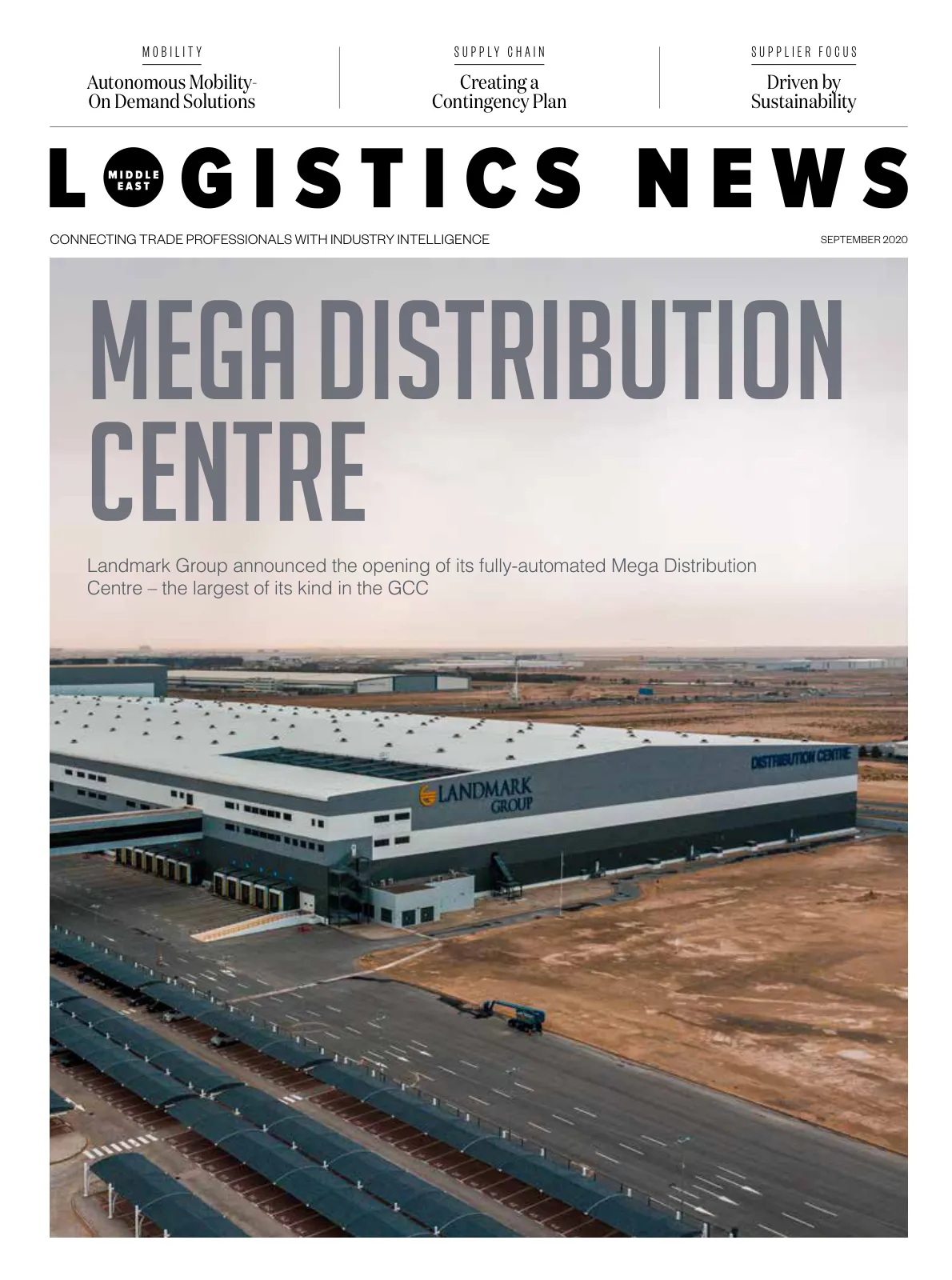
Landmark Group announced the opening of its fully-automated Mega Distribution
Centre – the largest of its kind in the GCC
MEGA DISTRIBUTION
CENTRE
Page 2
A MEMBERS OF EMIRATES TRANSPORT BUSINESS CENTERS:
Page 3
LOGISTICS NEWS ME | SEPTEMBER 2020 | 3
SEPTEMBER 2020
CONTENTS
START
12 | NEWS
FEATURES
16 | TALKING POINT
18 | MOBILITY
20 | COVER
26 | ADVERTORIAL
28 | SUPPLY CHAIN
30 | OP-ED
32 | SUPPLIER FOCUS
FIND US ON YOUTUBE
Subscribe to our YouTube
channel to see things like site
visits, interviews and much more
CONTENTS
S E P T E M B E R 2 0 2 0
R E A D A L L T H E L A T E S T I S S U E S O N I S S U U
20
32
12
16
WEBSITE: WWW.CBNME.COM/LOGISTICS-NEWS
TWITTER: @LOGISTICSNEWSME
FACEBOOK: /LOGISTICSNEWSME
Page 4
WWW.CBNME.COM
REGIONAL NEWS
Your business continuity
is our top priority.
Our initiatives and remote solutions
have got you covered in all situations.
du.ae/wegotyourb
Page 5
SEPTEMBER 2020
Page 6
6 | LOGISTICS NEWS ME | SEPTEMBER 2020
WWW.CBNME.COM
EDITOR’S LETTER
SEPTEMBER 2020
subscriptions@bncpublishing.net
CEO
Wissam Younane
wissam@bncpublishing.net
Director
Rabih Najm
rabih@bncpublishing.net
Group Publishing Director
Joaquim D›Costa
jo@bncpublishing.net
+971 50 440 2706
Business Development Director
Rabih Naderi
rabih.naderi@bncpublishing.net
+966 50 328 9818
Editor
Kasun Illankoon
kasun@bncpublishing.net
Art Director
Aaron Sutton
aaron@bncpublishing.net
Marketing Executive
Aaron Joshua
aj@bncpublishing.net
Photographer
Ahmad Khader
PO Box 502511 Dubai, United Arab Emirates
P +971 4 4200 506 | F +971 4 4200 196
For all commercial enquiries related to
Logistics News ME contact
sales@bncpublishing.net
All rights reserved © 2015.
Opinions expressed are solely those of the contributors.
Logistics News ME and all subsidiary
publications in the MENA region are officially licensed
exclusively to BNC Publishing in the MENA region by
Logistics News ME.
No part of this magazine may be reproduced or
transmitted in any form or by any means without
written permission of the publisher.
Images used in Logistics News ME are credited when
necessary. Attributed use of copyrighted images
with permission. All images not credited courtesy
Shutterstock.
Printed by UPP
ON THE WEB
Keep up to date with all the
latest news, features and
much more on our website.
W W W . C B N M E . C O M / L O G I S T I C S - N E W S
S U B S C R I B E
A new Covid-19 Response Report
(CRR) by Oxford Business Group
(OBG), produced in partnership with
Saudi Payments, charts the shift
under way in the Kingdom towards
e-commerce and digital transac-
tions, which is expected to be
instrumental in supporting the
economy’s recovery.
The CRR provides an in-depth
analysis of Saudi Arabia’s response
to the coronavirus in an easy-to-
navigate and accessible format,
focusing on key data and infograph-
ics relating to the country’s socio-
economic landscape.
The Kingdom’s national payment
infrastructure, which had already
been strengthened before the
pandemic took hold, and its pivotal
part in easing the transition to
online and mobile transactions, is a
key focus.
In its analysis, OBG shines a
spotlight on the financial technology
(fintech) segment, which is ripe for
growth, buoyed by the efforts of the
Saudi Arabia Monetary Authority
(SAMA) to encourage its develop-
ment and rising demand for
innovative solutions. Topical issues
examined include the steps finance
companies are expected to take to
adapt to the industry’s changing
landscape, which range from
collaborating with fintech enter-
prises to ensuring they have the
necessary technologies in place.
Kasun Illankoon
Editor, Logistics News Middle East
A NOTE FROM
THE EDITOR
K A S U N I L L A N K O O N
Page 7
A Smart Move For
New Possibilities
New Quester’s flexibility makes it suitable across a variety of applications and segments
such as general cargo, long haul and construction.
And now, ESCOTs’ added power and performance in New Quester means assignments can
be carried out with increased fuel and driver efficiency.
Optimized specifications such as reduced tare weight allow you to carry more.
And with the introduction of smart new connected features such as telematics,
you can stay on top of your tough daily schedule.
A smart move for your business
Page 8
COVER THE CITY
Unlocking the Power
of Digital Signage Advertising
Page 9
WITH YOUR ADS
Visit www.lifeonscreen.com
Page 10
EXPERIENCED
PLAYER.
NEW SUIT.
Over the coming weeks you’ll be meeting a whole
new fleet of delivery drivers and riders.
Whether you’re receiving your favourite meal, your bank
card, the latest i-gadget, or that little black dress,
a person wearing this jacket will greet you at the door.
Page 11
lyveglobal.com
Go Lyve Today �
BEYOND DELIVERY
What you won’t see is the orchestra of advanced technologies
and innovations that led to you receiving what you wanted
when you wanted it.
Lyve makes this possible with the vision that an always-on
connected world is a better world.
lyveglobal.com
Page 12
12 | LOGISTICS NEWS ME | SEPTEMBER 2020
WWW.CBNME.COM
REGIONAL NEWS
SHIPPING
Dubai has successfully
retained
its
leading
position as the first city
in the region to rank
among the world’s top
five
destinations
for
the maritime industry
in
the
International
Shipping
Centre
Development,
ISCD,
Index
for
the
third
consecutive
year,
ranking
ahead
of
Rotterdam,
Hamburg,
Athens, New York, New
Jersey and Tokyo.
The
emirate’s
continuing status as a
global hub for maritime
shipping and logistics
was revealed in a report
that was recently issued
by
Baltic
Exchange,
and Xinhua, a London-
based
international
news agency affiliated
with the China Economic
Information Service, CEIS.
The
latest
recognition
once
again
underscores
the
competitiveness,
attractiveness
and
inclusiveness
of
Dubai’s
local maritime environment,
which
can
be
compared
to the best in the world.
The
achievement
can
be
attributed
to
the
directives
of
the
wise
leadership
to
constantly
enhance
the
legislative,
regulatory
frameworks
and infrastructure, marine
services,
and
logistical
DUBAI AMONG WORLD’S TOP FIVE SHIPPING
CENTRES FOR 3RD CONSECUTIVE YEAR
continue
to
enhance
Dubai’s competitiveness
on the global shipping
landscape,
in
line
with
the
vision
of
His Highness Sheikh
Mohammed
bin
Rashid
Al
Maktoum,
Vice President, Prime
Minister
and
Ruler
of Dubai, led by our
comprehensive
strategies to establish
an attractive legislative
and
legal
structure
and
further
develop
shipping
operations,
ports
and
marine
support
services
and
operations
and
maintenance of ships,
taking
advantage
of
technological
developments,
innovation
and
research.”
“Outperforming
other
leading
global
maritime
capitals such as Rotterdam,
Tokyo and Hamburg, Dubai’s
maritime industry has also
become the first in the Arab
world
to
accomplish
this
achievement.”
“This recognition motivates
us to continue our efforts to
support Dubai’s position as
a global business hub where
East meets West, in line with
the
preparations
for
the
next fifty years that chart a
new stage of economic and
development renaissance,” he
concluded.
capabilities,
which
also
contributes
to
reinforcing
the
global
community’s
confidence
in
Dubai’s
maritime sector. The index
is based on objective criteria,
which include the quality and
efficiency of infrastructure,
port productivity, the scope
of maritime support services,
and the competitiveness of
the business and investment
environment, among others.
Sultan Ahmed bin Sulayem,
Chairman of Dubai Ports,
Customs and Free Zone and
Chairman, Dubai Maritime
City
Authority,
DMCA,
said, “For the third year in
a row, Dubai has succeeded
to
maintain
its
position
among the world’s top five
destinations
for
maritime
shipping. The latest accolade
is
the
outcome
of
the
unwavering support provided
by the wise leadership, in
addition to the joint efforts
undertaken by the public and
private sectors to enhance the
components of the maritime
sector, to match the best in
the world.”
He
continued,
“Further
inspired
by
this
newest
achievement,
DMCA
will
A N U P D A T E F R O M A R O U N D T H E R E G I O N
REGIONAL NEWS
Page 13
LOGISTICS NEWS ME | SEPTEMBER 2020 | 13
SEPTEMBER 2020
ENVIRONMENT
The Cathay Pacific Group
has
released
its
2019
Sustainable
Development
Report,
providing
a
comprehensive
overview
of Cathay Pacific’s and its
subsidiaries’
approach
to
and
performance
in
the
areas
of
environmental,
social and governance that
are of great importance to
our stakeholders.
In his message in the
report, Cathay Pacific Chief
Executive Officer Augustus
Tang writes: “At the time
of preparing this report, a
public health emergency has
rocked the global economy.
It feels more important than
CATHAY PACIFIC TO HALF SINGLE-USE PLASTIC
FOOTPRINT BY 2022
ever
to
foster
positivity,
to protect our people, to
strengthen our communities
and to confront the major
challenges we face. We are
very
determined
to
play
our part in this hugely
important
undertaking;
one which requires us to
be
financially
successful
but
in
a
socially
and
environmentally responsible
manner. Our commitment
to
developing
sustainably
with
transparency
and
accountability
is
undiminished.”
With a focus on climate
change,
the
efficient
use
of
resources,
waste
management,
and
supporting our people and
community, the Report sets
out the Group’s efforts in
moving
towards
greener
aviation.
Some
highlights
from 2019 include:
New single-use plastic
reduction target:
We have set the target
to reduce our single-use
plastic footprint by 50% by
the end of 2022, removing
nearly 200 million pieces
of single-use plastic from
our operations annually.
Fighting climate change
We have introduced new
efficiency
initiatives,
added
six
new,
more
fuel-efficient
Airbus
A350s to our fleet, and
scaled up climate change
risk
and
mitigation
planning.
Since
1998,
our efforts have yielded
a
27%
cumulative
improvement
in
fuel
efficiency.
Caring for our community:
We continued to support
the positive development
of
our
communities
through our new Cathay
ChangeMakers
initiative
and the longstanding I Can
Fly programme.
Page 14
14 | LOGISTICS NEWS ME | SEPTEMBER 2020
WWW.CBNME.COM
REGIONAL NEWS
PRODUCTION
FREIGHT
AUTOMATION ENABLES
MAI DUBAI TO MEET
SOARING DEMAND FOR
BOTTLED WATER
AGILITY REPORTS USD
$53mn NET PROFIT FOR
THE FIRST 6 MONTHS
OF 2020
Mai Dubai, a bottled water
company fully owned by the
Dubai Electricity and Water
Authority (DEWA), revealed
that it has been able to
successfully address more than
15 per cent increase in demand
for
bottled
water,
thanks
to the company’s advanced
technological capabilities and
a fully automated production
unit.
With
eight
fully
automated production lines
that are seamlessly integrated
to two high bay warehouses,
one for raw material and the
other for finished goods, Mai
Dubai has taken the lead step
in technology adoption in the
bottled water industry.
The operations of the facility
are fully automated, starting
from the arrival of raw material
in the warehouses till the very
end, contributing to 100 per
cent
hands-free
operations.
Enterprise Resource Planning
(ERP)
and
Warehouse
Management System (WMS)
platforms
are
smartly
integrated to ensure smart and
smooth intra-logistics. Digitally
operated crane systems, lifts,
monorails
and
conveyors
receive the packaging material
and store them in high bay
warehouse to be issued to
the production lines when
demanded by the ERP. The
Agility, a leading global logistics
provider,
today
reported
first-half earnings of 8.47 fils
per share on net profit of KD
16.2 million (USD $53mn),
a decrease of 61.3% over the
same period in 2019. EBITDA
declined by 20.1% to KD 75.8
million, and revenue declined
1.3% to KD 765.1 million.
Tarek Sultan, Agility Vice
Chairman
and
CEO,
said:
“We entered 2020 with our
business on sound footing,
which is one reason that we
were able to react quickly to
the sweeping impact of the
COVID-19
pandemic.
We
acted immediately to protect
employees,
customers,
and
communities,
including
providing
donated
logistics
support for local governments
and NGOs around the world.
We also took steps to bring
operating expenses and other
costs in line with the new
environment. If the crisis has
demonstrated anything, it is
the essential value of logistics
finished
goods
are
then
collected from the production
lines and stacked in high bay
warehouse.
Alexander
van
‘t
Riet,
CEO of Mai Dubai, said: “We
have been able to effortlessly
address
the
increasing
demand
for
our
products
with
highest
efficiencies,
optimized
transactions,
improved
productivity
and
highly streamlined operations,
thanks to our commitment to
technology adoption. We are
currently witnessing a ‘flight to
quality’ as consumers prefer a
trusted brand, like Mai Dubai
during challenging times such
as this. The advanced, flexible
technical robotic solutions that
we use give us a competitive
advantage, helping us achieve
fast turnaround times, full
traceability
and
error
free
transactions.”
“Artificial
Intelligence-
enabled and powered with
smart
data,
our
facility
continues
to
run
at
a
production capacity of over 1.5
million units per day. What’s
more, the fully automated
facility eliminates the need
for human touch, from the
receipt of packing materials
all the way to the issuance of
product to the sales vehicles,”
he concluded.
and supply chain providers in
times of severe disruption.”
Sultan said the economic
fallout
from
the
pandemic
has had an uneven effect
on Agility businesses. “Our
contract logistics business and
logistics parks have weathered
this reasonably well because
demand
for
storage
space
has been steady or increased,
especially as customers have
looked to add to safety stock
or support pandemic-driven
increases
in
e-commerce
sales. In many instances, we
are experiencing accelerated
adoption of disruptive and
emerging technologies related
to the COVID-19 pandemic or
underlying
CSR
paradigms.
Other Agility businesses, such as
aviation and airport operations
have been directly impacted
by the decline in air travel and
traffic and are now pivoting
towards the development of
pioneering new technologies
that will be essential to the re-
enablement of global travel.”
Page 15
LOGISTICS NEWS ME | SEPTEMBER 2020 | 15
SEPTEMBER 2020
Abu Dhabi Airports Free
Zone (ADAFZ), a wholly
owned subsidiary of Abu
Dhabi Airports, has record-
ed a 109% increase in the
number of companies reg-
istering with the free zone
authority in the first half of
2020, as compared to the
same period in 2019.
ADAFZ has also wel-
comed two major interna-
tional companies, SMSA
Express and Honeywell,
to its portfolio. The recent
success is a reflection of
ADAFZ’s central role in
bolstering the economy
of both the emirate and
the nation during the CO-
VID-19 outbreak.
Speaking on ADAFZ’s ex-
ceptional results for the first
half of the year, Shareef
Hashim Al Hashmi, Chief
Executive Officer of Abu
Dhabi Airports, comment-
ed: “ADAFZ’s excellent per-
formance in the first half of
this year demonstrates its
role as a powerhouse that
enables economic activity
across the emirate of Abu
Dhabi. Through its work,
ADAFZ helps to supple-
ment the comprehensive
stimulus packages imple-
mented by Abu Dhabi’s
leadership,
and
ensures
that international compa-
nies can continue to have a
robust and reliable partner
in the emirate.
“We
are
particularly
pleased to welcome both
Honeywell
and
SMSA
Express to ADAFZ, dem-
onstrating the calibre of
companies which our free
zone
attracts.
Through
furthering the number of
companies which work in-
side ADAFZ, we are able to
burgeon Abu Dhabi’s eco-
nomic future and contrib-
ute to the wider growth of
the emirate.”
Adel Al Taheri, Head of
Property
Management
and Leasing at Abu Dhabi
Airports Free Zone, com-
mented: “The success of
ADAFZ in attracting new
international customers is
testament to the strategic
investments which our or-
ganisation has made in our
suite of services and wide
range of facilities available
at the three airports, pro-
viding organisations with
a one-stop-shop to estab-
lishing a business in the
emirate of Abu Dhabi.
“Our investments have
proven particularly pru-
dent during the current
global pandemic, with our
enhanced air cargo and
freight
transport
capa-
bilities supporting the suc-
cessful operation of the
health, food and beverage,
and e-commerce sectors.
We will continue to work
with our partners to ensure
they can benefit from our
range of services as the
world emerges from the
impact of the pandemic.”
ADAFZ has reported in
its 2020 bi-annual results,
with a 109% increase in
the issuing of licenses
highlighting that the most
significant portion of com-
panies signing agreements
with ADAFZ come from
the aviation, e-commerce,
and healthcare sectors.
In addition, ADAFZ also
holds a strategic focus on
welcoming
companies
based in both Europe and
the Middle East in the ICT,
logistics, pharmaceutical,
and consultancy manage-
ment sectors.
ABU DHABI AIRPORTS FREE ZONE SEES INCREASE
OF NEW CUSTOMERS BY 109% IN H1 OF 2020
Page 16
16 | LOGISTICS NEWS ME | SEPTEMBER 2020
WWW.CBNME.COM
TALKING POINT
FUTURE OF UAE’S
LOGISTICS &
INDUSTRIAL SECTOR
Ahead of this year’s Cityscape exhibition, Ian Albert, CEO of Colliers MENA, sheds light
on the trends, developments and investment opportunities shaping the warehouse and
logistics space
The warehouse and logistics space is under-
going a period of evolution in response to
technological advances and other key drivers
which are influencing changes in demand.
We have seen many major developments
within the logistics and industrial sector of
the UAE and other countries across the GCC,
with the proliferation of industrial zones and
free zones driving and supporting the local
and international manufacturing and indus-
trial sectors.
But a recent rise of automation and value-
added services has brought rapid changes to
the sector globally, transforming the way that
warehouses operate, and redefining the way
that the industry thinks about warehousing
and logistics.
This progress could offer a dynamic future
for the UAE and the region, offering some
genuine investment opportunities - from 3PL
logistics and operational outsourcing through
Page 17
LOGISTICS NEWS ME | SEPTEMBER 2020 | 17
SEPTEMBER 2020
to automation which streamlines everything
from inventory to productivity within ware-
housing.
MANUFACTURING – SLOW AND STEADY WINS THE
RACE
The manufacturing sector makes up 10% of
GDP for the UAE. Before coronavirus and
the lockdown, growth in manufacturing was
steady but healthy with highlights including
KIZAD, the region’s largest industrial zone
which is home to over 600 different compa-
nies, and DP World, investing in smart trade,
new technologies and innovation, as well as
free zones across the Emirates.
While COVID has asked some complex
questions of various industries, it could pro-
vide a genuine opportunity moving forward.
The global supply chain was without doubt
heavily impacted by the pandemic and the
subsequent restrictions placed on travel, and
this will likely persuade governments to invest
heavily in local manufacturing.
There is a real opportunity to produce lo-
cally in order to become less reliant on inter-
national supply, and the recent months of cri-
sis management could persuade businesses to
become more aware of the need to invest lo-
cally. Investment in production lines, retailers
and suppliers will fulfil the growing demand
of fast but quality products that can cut out
long-term costs and third parties.
This shift will not happen overnight, but we
are likely to see the foundations being laid for
future expansion of the industry and action
plans coming into play in the coming months
and years.
LOGISTICS AND WAREHOUSING – ROOM TO GROW
Pre- COVID, ecommerce had been growing
steadily as players in the UAE retail sector
caught up with the demand for more online
shopping and the decline of the need for retail
space. This demand has only increased due to
COVID, and the local lockdown and the re-
strictions placed on travel worldwide.
This dramatic shift in consumer behaviour
has led to surging demand and an increased
need for warehousing space from retailers, to
support and maintain growth in this thriving
and transforming sector.
Changes include an increase in the number
of fulfilment centres - support facilities which
ensure the efficient preparation and delivery
of products to the growing online audience.
Dropshipping has also emerged as a retail
fulfilment method for some brands, whereby
items are shipped directly from a third party
to a customer rather than being stored and
transported by the brand.
There is also a huge opportunity regionally
for governments and investors in ‘on-demand
warehousing’. This Airbnb style arrangement
for logistics allows empty space within ware-
housing to be let out for customers requiring
extra space.
Manufacturers and warehouse owners sim-
ply advertise free space online or on an app
and retailers and brands can secure ware-
house and fulfilment solutions without any
need for setup fees or long-term commit-
ments.
This marketplace model has proved to be a
scalable and flexible solution to warehousing
in the US, UK and other countries, and the
format can offer huge success for retailers dur-
ing peak periods, where demand spikes can be
between 3-5x higher than normal.
Recent data supports these transformative
changes in approach to warehousing – almost
60-75% of customers have confirmed that
they are willing to choose different retailers
depending on speed of delivery time, meaning
that any investment in improving warehous-
ing and logistics is likely to pay for itself in
the long term.
HOW TECHNOLOGY WILL SHAPE WHAT IS TO COME
All future growth in the region will require a
strong foundation and investment on the tech-
nological side, with AI and robotics needed
to improve speed, efficiency and overall qual-
ity control, and the Internet of Things funda-
mental in brining all the pieces to together in
the supply chain.
What we can learn from this global pan-
demic is that now is not the time for retailers
to shy away from investment - on improved
technology and development within the in-
dustry. It is evident that the next phase for
buyers and consumers will be linked to a
price-premium relationship with speed of de-
livery. This new structure and outlook for the
industry is not difficult to achieve within the
UAE, as the infrastructure is already in place
to successfully roll out this modern approach.
The growth within the UAE’s industrial
and logistics industry has already proven it-
self to be one that will sustain itself for years
to come, and that growth will only continue
to exceed expectations with continued invest-
ment and improvement.
Page 18
18 | LOGISTICS NEWS ME | SEPTEMBER 2020
WWW.CBNME.COM
MOBILITY
AUTONOMOUS
MOBILITY-ON-
DEMAND SOLUTIONS
Intensifying Urban Mobility Challenges Emphasize The Need For An Overhaul Of Public
Transport Services, Says New Report By BCG and HSG
Page 19
LOGISTICS NEWS ME | SEPTEMBER 2020 | 19
SEPTEMBER 2020
Traffic systems worldwide are broken, and
countless cities across all continents are be-
ing confronted with mounting urban mobil-
ity challenges year-on-year, with congestion,
carbon emissions, space, and road accidents
all becoming increasing causes for concern.
Although several new mobility solutions
are poised to address these issues beyond
2030, determining which solutions to adopt
for each city has been unclear until now, ac-
cording to a new report by Boston Consult-
ing Group (BCG) and the University of St.
Gallen (HSG), Switzerland. The report, ti-
tled ‘Can Self-Driving Cars Stop the Urban
Mobility Meltdown,’ illustrates how emerg-
ing mobility solutions will benefit some me-
tropolises more than others depending on the
suitability and mobility ecosystem of each
individual city – with the KSA and UAE
likely to benefit most in the region from au-
tonomous
mobility-on-demand
(AMoD)
with the adoption of AVs and robo-shuttles
to rejuvenate public transport services.
Although AVs could transform urban mo-
bility, enthusiasm toward them has cooled
because they will not be available at scale for
at least another decade and could exacerbate
urban sprawl or traffic volume if they appear
independently of suitable regulations and
polices. Despite the current skepticism, how-
ever, AV pilot programs continue to attract
investment. As per BCG and HSG research,
the major obstacle facing the KSA and UAE
is comparatively new and developing public
transport systems, which leads to higher con-
gestion in metropolitan areas. Riyadh and
Dubai’s population is currently over seven
million and three million, respectively, and
rising every year – emphasizing the under-
lying need to introduce sustainable public
transportation systems.
“Many
cities,
including
Riyadh
and
Dubai, have been grappling with transpor-
tation-related issues on multiple fronts, and
AMoD solutions could help tackle these
challenges,” said Giovanni Moscatelli, man-
aging director and partner, BCG. “We antici-
pate around half of AVs alone will be com-
mercial vehicles instead of privately owned,
which would deliver greater convenience
than conventional mass transit options do.”
To investigate the impact of AMoD solu-
tions on mobility ecosystems in the future,
BCG and HSG developed a sophisticated
simulation tool to analyze the technology’s
effects over time concerning traffic volume,
road fatalities, transportation costs, total
parking space, energy consumptions, and
journey times. As a first step, five city ar-
chetypes were identified – Highly compact
middleweight, Car-centric giant, Prosperous
innovation center, Developing urban power-
house, and High-density megacity. Crucially,
Riyadh and Dubai have both been placed in
the Car-centric giant category as they that
have large populations but very low density.
Car-centric giants such as Riyadh and
Dubai, which are spread out and have devel-
oping public transportation systems, would
benefit from robo-shuttles and AVs more
than any other scenario. As these would re-
place private cars, BCG and HSG have con-
cluded that annual fatalities and total park-
ing areas would decline by 37 percent and 35
percent, respectively. Traffic volume would
drop by four percent, energy consumption
by 12 percent, and transportation costs by
13 percent, while journey times would also
decrease by 3 percent. At the same time,
journeys per year in terms of private cars
and public transit would decrease by 27
percent and two percent, respectively, when
compared to current and projected future
modal splits – while robo-taxi’s and robo-
pods each account for 11 percent of trips
annually in the forecasted model. However,
while some automakers and tech companies
plan to launch AVs by the mid-2020s, it will
most likely take cities several more years to
fully prepare for them – meaning such ben-
efits will not come to fruition until the early
2030s. Both Riyadh and Dubai stand to capi-
talize, and the development of AVs could
make their respective urban environments
greener, more flexible, and help support sus-
tainable transportation systems.
“AVs, including robo-shuttles and robo-
taxis, are suitable for Riyadh and Dubai,
and the onus is on planners to conduct and
continue conducting pilot projects – using
policy measures such as dedicated lines, easy
availability, price advantages, and good user
experiences to promote their uptake,” said
Edoardo Geraci, who works on the Future
of Mobility for BCG Middle East. “Mass
transit systems in car-centric giants tend to
be subpar, thus AMoD solutions will have to
be extremely convenient and embedded into
a wider digital ecosystem to convince com-
muters to dispose of their private vehicles,”
complemented Ingmar Schaefer a core team
member of the BCG automotive and mobil-
ity practice.
Edoardo Geraci, who works on the Future of
Mobility for BCG Middle East
Giovanni Moscatelli, managing director and
partner, BCG
Page 20
Landmark Group announced the opening of its fully-automated Mega Distribution Centre – the
largest of its kind in the GCC
COVER STORY
20 | LOGISTICS NEWS ME | SEPTEMBER 2020
WWW.CBNME.COM
L
andmark Group announced the open-
ing of its fully-automated Mega Distri-
bution Centre (DC) at JAFZA, Dubai
– the largest of its kind in the GCC. With
distribution being the backbone of retail,
the Group invested over AED 1 billion with
a firm strategy to further strengthen its sup-
ply chain capabilities and build a facility that
can serve as a logistics and distribution hub
for the region. The Mega DC will also play
an integral role in enhancing Dubai’s posi-
tion as a hub for global logistics and trade.
Chairwoman and CEO of Landmark
Group, Renuka Jagtiani, said: “The open-
ing of Mega DC marks a huge milestone for
Landmark Group. As a home-grown brand
present in this region for over 46years, we
remain committed to this market and are
always looking ahead. Through the years,
we have seen Dubai emerge as a global and
economic business hub, giving us the op-
portunity to innovate and invest in the most-
advanced technology and processes for our
business. Today, innovation drives economic
growth and development, greatly influencing
modern industry. We are very proud to have
built this fully-automated facility, which will
serve our customers even better by ensuring
speed and agility of operations but will also
project the future of supply chain for our re-
gion.”
Mihin Shah, Group Chief Supply Chain
Officer, Landmark Group, talked to Logistics
News ME to discuss about their decision to
open the new mega distribution centre:
OPENING OF NEW MEGA DISTRIBUTION CENTRE
As one of the largest non-food retailers in
the region, Landmark Group handles and
distributes substantial volumes of apparel,
footwear, accessories and general merchan-
dise. To begin with, we realized that han-
dling enormous volumes in manual DCs
could limit our growth. Second, the Mega
DC in the Free Zone gives us the advantage
and flexibility to distribute our goods as we
want within the region at short notice with
options of multi-modal transport. As a fully
automated DC, it is also an enabler for e-
commerce as it can service both B&M stores
and B2C direct to the end consumer at very
high speed and turnaround times. Finally,
this is our investment for the future. We also
built this facility with an additional capac-
ity for our 3PL venture, Omega logistics, to
cater to external customers who can benefit
from this facility and associated efficiencies.
There are several associated benefits of
the fully automated mega distribution cen-
tre. For instance, there has been a significant
reduction in lead times/order cycle time due
to high processing speeds. We have been
Page 21
LOGISTICS NEWS ME | SEPTEMBER 2020 | 21
SEPTEMBER 2020
able to provide a greater level of service to
our stores and end consumers. Another huge
benefit is that centralization of stock in a
connected free-zone enables us to distribute
last minute as per demand, resulting in better
realizations.
POSITIVE EFFECTS ON THE SUPPLY CHAIN
While we are fresh out of transition, we
are already seeing the benefits in terms of
speed to market and improved OTIF per-
formance. The enabler for delayed distribu-
tion decisions has started helping us to meet
our demands of different markets better and
improve realizations. We have already seen
during COVID times that this allowed us to
change original allocations and instead send
supply to markets that were more open and
trading well. Also, we are able to service the
stores with store friendly deliveries thereby
increasing the efficiency of the retail floor.
Page 22
22 | LOGISTICS NEWS ME | SEPTEMBER 2020
WWW.CBNME.COM
COVER STORY
Omega Logistics has already attracted some
big customers and discussions are on to take
advantage of the many benefits of using our
Mega Distribution Center.
TECHNOLOGY AND INNOVATION
The Mega DC is equipped with the state of
art logistics technology handling merchan-
dise across all load units – piece level, carton
or tote, palletized and Garment on Hanger.
The material flow is interchangeable across
these load units and is supported by an in-
tegrated array of automated systems con-
trolled by the WMS that is connected with
our ERP systems. Some latest innovative
technologies include Robotic Shuttle Sys-
tems equipped with inter-aisle technology,
High Speed Conveyors and sortation sys-
tems,
Fully automated unmanned High Bay
warehouse having an ASRS system for pal-
lets - this is a unique rack-clad SILO con-
struction at 43 m height making it the tallest
warehouse in the GCC.
The Oxy-Reduct fire Prevention System in
the High Bay is another key element which
prevents fire by reducing the oxygen in the
fully automated warehouse so fires can nev-
er break out. This is again a first in GCC
at this scale. We have also deployed Auto-
matic inbound and induction systems with
3D Scanners, High speed Goods to Person
(GTP) picking stations that improve picking
efficiencies by up to 8X than manual ware-
houses and Unit sortation systems with Gar-
ment on Hangers.
AUTOMATION
Automation is an enabler for business
growth. Besides providing a very fast servic-
ing and turnaround time, it also allows man-
aging volume volatility without associated
uncertainties like availability of manpower.
It certainly also aids in meeting changing
requirements of end customers, like shift to-
wards e-commerce. The current pandemic
has certainly brought technology and digiti-
zation to the fore, with benefits such as han-
dling high volumes that too with safe social
distancing. Logistics and supply chain, by
the very nature of operations, is hence set for
major transformation towards automation.
CHALLENGES
An automated DC is made of multiple inte-
grated systems and must be well supported
by associated processes of planning, opti-
mum resourcing, services and maintenance
support, and highly skilled technical person-
nel. The journey from a manual DC to an
(Right to Left)
Chairwoman and CEO
of Landmark Group,
Renuka Jagtiani and
Group Chairman and
Chief Executive Officer
of DP World Sultan
Ahmed Bin Sulayem
Page 23
LOGISTICS NEWS ME | SEPTEMBER 2020 | 23
SEPTEMBER 2020
Mihin Shah, Chief
Supply Chain Officer,
Landmark Group
Page 24
24 | LOGISTICS NEWS ME | SEPTEMBER 2020
WWW.CBNME.COM
COVER STORY
SEPTEMBER 2020
automated one requires an intensive trans-
formation exercise across all functions of the
supply chain from sourcing, planning, logis-
tics, operations and retail. Multiple internal
and external stakeholders have to relearn the
business processes, but once accomplished
the benefits are immense.
SMART DUBAI 2021
As a homegrown retailer headquartered
in Dubai since 1995, we are proud to have
grown along with the city’s unique vision
and inevitable growth. As an organization
that is committed to its customers and in-
vested in the region, over the years we have
embraced and led innovative technology
in retail that not only helped our business
grow steadily but also contributed to the lo-
cal economy. As I mentioned, the Mega DC
is one of our key investments into the future.
This DC is made not only for challenges of
today but for the future as well and echoes
the vision of Smart Dubai 2021. With fully
integrated smart technologies and first-of-its
kind innovations in logistics automation, the
Mega DC is our investment and commitment
to the future of retail in the region. We have
brought together the best of technology and
innovation to strengthen supply chain not
only for our group but also as an offering
to other businesses and make our business
future ready, for our online & offline cus-
tomer, much like how the Smart Dubai 2021
initiative is preparing Dubai to embrace the
future.
Page 25
EFFICIENCY IN A
SMALL PACKAGE
GENIE® GS™-1330m SCISSOR LIFT
2 Person
Platform Occupancy
227 kg (500lb) max lift capacity
Lightweight
Only 885 kg (1,950 lb)
Efficient Electric
Drive System
Provides maximum runtime
per charge
© 2020 Terex Corporation. Terex, Genie and Taking You Higher are registered trademarks of Terex Corporation or its subsidiaries.
LEARN MORE AT GENIELIFT.COM/GS1330M
Page 26
26 | LOGISTICS NEWS ME | SEPTEMBER 2020
WWW.CBNME.COM
ADVERTORIAL
ONE CLICK DELIVERY
SERVICES REBRANDS AS LYVE
One Click Delivery Services, one of the fastest
growing last-mile delivery platform compa-
nies, has just completed an extensive rebrand-
ing effort to mirror its ushering into a new era
of digital growth and development. One Click
Delivery Services – now known as Lyve – has
cemented its position as one of the major play-
ers in the last-mile delivery solutions market in
under three years by partnering with tycoons
across multiple verticals and rising up to the
challenge during the COVID-19 pandemic.
All throughout 2019, Lyve has invested its
resources and manpower in technology, believ-
ing that the success of last-mile logistics lies at
the core of digitization. Through the continuous
improvement of its software and the diversifica-
tion of its products, Lyve branched out into new
verticals such as courier, pharmaceuticals, Tel-
ecom and e-commerce – acquiring prominent
clients while also penetrating new markets such
as Kuwait, KSA, Egypt and India.
During the COVID-19 pandemic lockdown
which has required outlets to temporarily close
their doors and revisit their business model –
Lyve has experienced an unprecedented surge
in delivery demand.
“Through our acquisition of new verticals
and multiple new clients, we have naturally
been led to optimize and further enhance our
operation strategies as well as our image to bet-
ter meet our clients’ demands. Rebranding has
come as a step towards asserting our presence
as a reliable and experienced partner”. Hassan
Hallas, CEO and co-founder of Lyve.
The rebranding of One Click Delivery Ser-
vices’ identity consists of a new company
name, logo and website which express the dy-
namic expansion of the company and its vast
growth and development, with digital efficien-
cy as its core value. The name Lyve - a play on
The last-mile delivery technology company One Click Delivery Services announces exciting rebranding
the word ‘live’ is synonymous to a continuous
presence and connectivity on ground and on-
line. The slogan ‘Beyond delivery’ explains the
multiple ways in which Lyve assists its clients
– referring not only to its adaptability and cus-
tom-made solutions, but also to the data and
analytics available for clients to assess and op-
timize their activities.
Its clear-cut and neat logo reflects
straightforwardness and transparency – val-
ues by which the company operates. With
the color theme being bright red with a
twist of black and white, Lyve asserts its
boldness – a confidence acquired by the sat-
isfaction of both its clients and employees,
whom they see as partners.
As for the website, it was entirely re-
vamped into a customer centric platform de-
signed to empower prospect clients to fully
learn about the multiple services available in
Page 27
LOGISTICS NEWS ME | SEPTEMBER 2020 | 27
SEPTEMBER 2020
a clear and user-friendly manner.
‘Our brand has developed and matured tre-
mendously through great new products and ro-
bust technology, which we are ready to show-
case in an up-to-date, sophisticated manner
that reflects our capabilities. We are proud of
what we have achieved so far and are excited
to take on new challenges in Lyve’s name.
Krystel Hodroge, Marketing Director of Lyve
The rebranding of Lyve embodies its mis-
sion to grow along its partners and raise the
standard of the last-mile delivery, changing
the way customers experience delivery in the
region.
On a mission to help businesses thrive in to-
day’s digital landscape, Lyve empowers their
partners with the latest and most advanced
platforms enabling them to efficiently cater to
the modern customer’s needs. Together with
its ever-expanding portfolio of digital transfor-
mation and patented technologies, Lyve’s plug
and play solutions empower businesses across
multiple verticals to seamlessly manage logistic
operations, optimize fleet schedule and track-
ing, enable brand presence and enhance more
customer reach-out channels. All this with an
advanced and powerful analytics engine at
your fingertips. Leading brands from the e-
commerce, pharmaceutical, telecom, grocery
and F&B industries are amongst Lyve’s numer-
ous clients globally. With its main offices in the
UAE, Lyve also operates from multiple coun-
tries around the world.
Hassan Hallas, CEO
and co-founder of Lyve
Page 28
28 | LOGISTICS NEWS ME | SEPTEMBER 2020
WWW.CBNME.COM
CONTINGENCY PLAN
Mansoor Sarwar, Regional Director, SAGE Middle East, give his view on the value of the
supply chain contingency plan
SUPPLY CHAIN
The exponential growth in global trade over the
past few decades has led to today’s supply chains
becoming incredibly complex, which has resulted
in disruption to manufacturers and distributors.
While you may have risk management processes
in place to deal with controllable and foreseeable
challenges, such as compliance, financial and ca-
pacity issues, these processes may still not prepare
you for world-defining events. For example, draw-
ing from the ongoing pandemic, you may need to
cope with fewer staff, a dramatic decrease in pro-
ductivity, and a change in customer spending.
TEN BUSINESS CONTINUITY STEPS TO TAKE NOW
In terms of contingency planning, what should
you do in the short and medium-term, and what
steps can you put in place to ensure you’re pre-
pared in the long run? Here are some immedi-
ate and long-term business continuity steps you
should take to protect the supply chain.
1. Consider your people. Their welfare is para-
mount, and they are a critical resource in the suc-
cess of your business. You may have to rethink
work practices. Look at who can work from
home and who needs to be on the front line.
2. Monitor all developments across your sup-
ply chain. If you don’t have full visibility, pri-
oritise getting this set up as soon as possible.
3. Build an in-depth emergency operations
structure and process at the plant level, with
predetermined action plans for communica-
tion and coordination. This could include
allocating designated roles for employees, en-
suring you have communication and decision-
making protocols in place and emergency ac-
tion plans for customers and suppliers.
4. Make sure your inventory is accessible and
Page 29
LOGISTICS NEWS ME | SEPTEMBER 2020 | 29
SEPTEMBER 2020
outside the impacted areas and logistical hubs.
5. Work closely with your legal, finance and
HR teams to understand what the financial
and legal implications are if you can’t get sup-
plies to customers.
6. You may have to include additional steps
to the contractual arrangements with custom-
ers. If you can’t meet your obligations, a clear
understanding of your contractual terms will
allow you to plan and prioritise your response.
7. Look at ways to balance supply and de-
mand, and build a buffer when it comes
preventing contingencies from recurring. If
you take the necessary action such as scenar-
io planning exercises, for instance, you can
develop action plans and include steps to di-
versify your supply chain and source alterna-
tive supplies. If you’re also looking to handle
better disruptive events in the future, it’s not
enough to think about supply chain strategy
in the conventional sense. You’ll need to re-
think logistical strategy and manage supply
chains proactively to anticipate disruption
rather than merely responding to it.
Be clear on the processes of all your suppli-
ers, even those upstream and several tiers back.
If you don’t have this clarity, your business is
less likely to have the ability to respond or es-
timate impacts as you are unfamiliar with up-
stream suppliers. Understand where your criti-
cal vulnerabilities lie. Your supply chain may
have a dependency that puts your business at
risk if a major issue requiring extensive dam-
age control occurs. For example, you may be
dependent on a supplier with a single facility
and a large share of the market. If a problem
occurs (anything from your supplier going out
of business to a pandemic), you’ll be left with
massive difficulties.
RETHINK THE DESIGN OF YOUR SUPPLY CHAIN
Several organisations build supply chains with
globalisation in mind – the assumption has
been that global trade allows us to source, pro-
duce and distribute products from locations
at the lowest cost. Today, we may be looking
at an era of new supply chain design where
businesses can be ultra-agile and responsive
in dealing with changing policies, regulations
and natural disasters. Redesigning your supply
chain is a complex undertaking. However, en-
suring backup capacity for supply, production,
and distribution means you reduce the risk of
your entire supply being disrupted.
The second and primary sources should
ideally be located away from each other. This
will minimise your risk but could lead to an in-
crease in costs. Similarly, having production fa-
cilities with local sources of supply spreads the
risk and could cut transportation and logistical
costs. It’s almost impossible to anticipate the
arrival of a global crisis, but businesses can di-
minish their impact by improving their supply
chain preparedness. By putting the right plans
in place before a disruption occurs, and testing
and learning before the fact, you’ll ensure your
business is in the best possible position to move
ahead and weather the storm.
to stock.
8. Identify ways to diversify your suppliers and
revisit your risk management process.
9. Work with stakeholders and your most criti-
cal suppliers to prepare for potential material
and manufacturing capacity shortages.
10. Review business forecasts and run scenari-
os to determine where you are at risk now and
in the future.
ADAPT YOUR LONG-TERM SUPPLY CHAIN STRATEGY
Once you have these steps in place, it’s about
Page 30
30 | LOGISTICS NEWS ME | SEPTEMBER 2020
WWW.CBNME.COM
OP-ED
PAPERLESS STRATEGY
Yasser Ali, Sales Director for Pagero Middle East, looks at how GCC countries are implementing
digital initiatives to build a smarter economy in an effort to close the VAT gap, as well as four key
reasons why organisations should consider a paperless strategy
Post the coronavirus pandemic, globally,
there is a growing focus on improving sus-
tainability. Adoption of new technologies
like AI, Data Analytics and RPA (robotic
process automation) means that the focus is
no longer just about being digital, but rather
better equipping internal business processes
to survive challenging situations like this in
the future.
Yasser Ali, Sales Director for Pagero Mid-
dle East, looks at how GCC countries are im-
plementing digital initiatives to build a smart-
er economy in an effort to close the VAT gap,
as well as four key reasons why organisations
should consider a paperless strategy.
GCC GOES DIGITAL
Paperless strategies are already in action
across the GCC. Committed to delivering
its last paper transaction in 2021, the Smart
Dubai paperless initiative has been imple-
mented by the government in a major step
towards making Dubai a smart city of the
future. Smart Dubai is well into its second
phase: organisations like Dubai Electricity
and Water Authority, Dubai Land Depart-
ment, Roads and Transport Authority and
Department of Tourism and Commerce
Marketing have now become completely
paperless. With 100 percent of internal pro-
cesses scheduled to be digitalised from 2021,
initiatives such as electronic invoicing (e-in-
voicing) will soon become an integral part of
the digital transformation journey.
Saudi Arabia generates over 15 million
tons of solid waste each year, with paper
making up almost 29 percent. To tackle this,
the Saudi Ministry of Justice took the first
step last year with the paperless courts initia-
Page 31
LOGISTICS NEWS ME | SEPTEMBER 2020 | 31
SEPTEMBER 2020
tive to increase efficiency and reduce paper
waste. Now 72 percent of ministries are pa-
perless in KSA, with initiatives in place for
all ministries to go paperless by 2023. More
recently, Kuwait’s Government, in response
to counter the effects of Covid19, announced
that Kuwait Municipality would be going pa-
perless by introducing e-correspondence with
Government agencies as part of the precau-
tions to fight the virus.
FOUR REASONS TO GO PAPERLESS
Gartner’s 10 IT Cost Optimization Tech-
niques for Private and Public Sector Organi-
sations report highlighted that the imple-
mentation of shared services, standardised
applications and optimisation of the work-
force to streamline costs should be explored
by CIOs. One initiative which aligns with a
paperless, cost effective strategy would be
to automate the Accounts Payable process
– particularly the automation of supplier in-
voicing through e-invoicing.
Millions of invoices are sent and received
means achieving huge cost savings and pro-
cessing data quickly and automatically.
2. Increased productivity: Without an auto-
mated AP process, 84 percent of staff time is
spent on transaction processing, leaving only
16% for value-added activities (Ardent Part-
ners, 2020). Adopting technology to automate
the supplier invoice flow means the amount of
human time to process an invoice in reduced
substantially. Increasing the overall productiv-
ity of staff, more time can be devoted to fur-
ther enriching tasks such as ensuring contract
compliance, mitigating compliance issues, ra-
tionalising supplier spend, and managing cash
flows and budgets.
3. Faster cycle times: Ardent Partners reports
that the average time to process an invoice is
8.3 days based on the fact that approximately
75 percent of the suppliers still submit invoices
on paper. This explains why only 4 percent
of businesses pay their invoices on time. Slow
cycle times can have an adverse effect on busi-
ness and unplanned cash flows while invoices
with inaccurate data delays further processing.
This means using more human resource and
time and often effects the relationship with
vendors which may cause you to miss out on
early-pay discounts. Automating the AP pro-
cess allows you to achieve quicker cycle times
and accurate processing of data.
4. Fewer errors: An automated AP process
helps eliminate payment errors because:
a. Invoice headers and line-item data is cap-
tured without manually keying, ensuring
data accuracy; and
b. Invoice data is validated against ERP in-
formation early in the AP process, quickly
calling out duplicate payments
Data accuracy is vital. With a completely au-
tomated system, all the relevant data points are
validated against supporting documents such as
POs and delivery notes. This results in a seam-
less flow of accurate data into the ERP system,
meaning fewer payment errors as invoice dupli-
cation and data validation/manual errors are
avoided.
Automating your supplier invoice process is
huge step in the right direction on the journey to
digitalisation. Working in line with government
initiatives to reduce waste and create efficient
processes, organisations in the Middle East can
benefit from the value that supplier automation
through electronic invoicing.
globally each year, and the number of in-
voices sent is forecasted to quadruple by 2025.
Whilst necessary for profit and growth, the in-
voicing process takes time and resource. Giv-
en the current state of the economy post pan-
demic, organisations now need to maximize
as much of their limited resources as possible.
With this in mind, let’s highlight the bene-
fits of adopting a completely automated sup-
plier invoice process:
1. Significant labour savings: Huge finan-
cial gains and decreased labour costs can be
achieved through streamlining the supplier in-
voicing process. Manual tasks like download-
ing PDF attachments, scanning documents,
manually keying in data or coding invoice
information, searching for lost data, reconcil-
ing supplier and PO information, and much
more are some of the biggest contributors to
high accounts payable (AP) processing costs.
Up to 80 percent of these costs can be saved
when adopting a software that streamlines the
invoicing processing (Billentis 2019). Automat-
ing the entire AP process journey therefore
Page 32
32 | LOGISTICS NEWS ME | SEPTEMBER 2020
WWW.CBNME.COM
DRIVEN BY
SUSTAINABILITY
SUPPLIER FOCUS
Bin Brook Motors & Equipment L.L.C.,
was established in the year 1969 and is a
member of the Bin Brook Group – a pio-
neer business house in Abu Dhabi, United
Arab Emirates. Logistics News ME takes
a closer look at how the company has per-
formed in 2020, their objectives, there vi-
sion towards a sustainable transport future,
and their relationship with Scania.
GOALS AND OBJECTIVES
“Our goal is to lead the shift towards a sus-
tainable transport system with alternative
fuels and connectivity being the two pri-
mary objectives. We also aim to expand our
service network to reach more customers
in the region and be known as a one-stop-
shop. We are not only a distributor of com-
mercial vehicles and heavy equipment but
also as a provider of service maintenance
contracts, fleet management, genuine spare
parts, and financing.”
PERFORMANCE IN 2020
“This year has been remarkable so far, one
that was completely unforeseen, and the
disruption in our market was no exception.
Our performance in Q1 & Q2 was excep-
tional, where we could meet the heights of
the same level of last year in Year to Year
comparison. The result was an outcome of
unstopped business activities, fulfilling the
norms of authority, which was initiated dur-
ing the Q1. We expect a two-digit increase
in the market share when the year ends.”
COVID-19 IMPACT
“Bin Brook Motors & Equipment L.L.C.
have taken a pledge to fulfill our customers’
In conversation with Mansur Ali, Sales Manager at Bin Brook Motors & Equipment LLC
Page 33
LOGISTICS NEWS ME | SEPTEMBER 2020 | 33
SEPTEMBER 2020
commitment by delivering quality products,
services, and maintaining operations safely
and healthily. Since the world announced
the pandemic outbreak, the company im-
plemented precautions based on the regula-
tions made by the local government, world
health organization, and our principals.
This was then communicated to our em-
ployees, customers, and suppliers in order
to avoid the spread of the virus. A regular
disinfection program is also practiced, and
it is mandatory to disinfect all incoming
and outgoing vehicles from the workshop.
All our employees are provided with
hygiene essentials. Social distancing is
strictly practiced inside the facility to avoid
contamination, and our staff was also put
on a work from home schedule to reduce
manpower in the workplace. All meetings
and training were done online. Since visi-
tation was temporarily prohibited, we took
advantage of the latest technology to com-
municate with our customers and princi-
pals. Adapting to these new precautionary
standards is not easy, but we have to em-
brace these changes as it is now our new
normal to carry on business while main-
taining the health and safety of everyone,
depending on it.”
COMPANY’S GROWTH
“Commercial vehicle business has wit-
nessed remarkable changes in the past
decade. More than buying the vehicle or
service, the focus shifted more towards the
complete solution. We lead the journey
from the front, providing tailor-made mod-
els to match different business segments.
We pioneered in adapting the concept of
Total Operating Economy (T.O.E.), which
consider more realistic business situations,
rather than Total Operating Cost (T.O.C.).
The legal demand for more environmental-
ly friendly vehicles was another milestone,
and we expect the trend will continue with
stronger demands for it.”
RELATIONSHIP WITH SCANIA
“In 2019, we celebrated 40 years of a fruit-
ful relationship with Scania. We have seen
and have been a part of Scania’s historical
developments and always wanted to bring
the Scania’s philosophy to Abu Dhabi. In
return, we have contributed by sharing our
experience in developing Scania’s product
to fit the local working atmosphere best. It
Mr. Ayman Hafez –
General Manager at
Bin Brook Motors &
Equipment LLC
Mr. Mansur Ali, Sales
Manager at Bin Brook
Motors & Equipment
LLC
Page 34
34 | LOGISTICS NEWS ME | SEPTEMBER 2020
WWW.CBNME.COM
SEPTEMBER 2020
SUPPLIER FOCUS
was not only the geographical facts, but the
complete work culture was always on the
discussion at Scania’s R&D. The journey
has seen its ups and downs, but the relation
with Scania is phenomenal.”
PROVIDING AN EFFECTIVE SERVICE
“Since the beginning of the last decade, cus-
tomers from different segments have been
focusing on their operational demands,
and it surprisingly varies from business to
business. This was when we established
the ‘Pre-sales’ department, which acted as
a strong link between the factory and the
Sales department and the customers. It was
then that we started working on the segmen-
tation to optimize our products to fit best
the customer needs. The factory was well
prepared, thanks to the iconic modular con-
cept, which later became Scania’s philoso-
phy. Our sales force is actively involved in
discussions with the customer to ensure that
our solution is for the business that matters.
In any case, we firmly believe that trust is
earned by the After Sales support. Our ser-
vice team loop in at a very early stage, when
the vehicle is being specified, to never face
surprises. The priority is to increase the
uptime and profitability by proper use of
cars. This journey starts with comprehen-
sive driver training and continues through
monitoring and sharing operational analysis
and corrective coaching. The exceptionally
trained support staff are always equipped
to meet any challenges, and our focus on
T.O.E. continues.”
SUSTAINABLE SOLUTION PROVIDER
“Our journey towards becoming a sustain-
able solution provider for the transport in-
dustry has begun, and our focus moving
forward is to improve our current facili-
ties to offer a wide variety of services and
increase our market share. We believe the
shift would be possible with the help of in-
frastructure development, new products,
advanced technical training for service tech-
nicians, dedicated customer service, and
extending support to the authorities on the
discussion for the future of Abu Dhabi.”
Mr Moeen Bin Brook
- Owner of Bin Brook
Motors & Equipment
LLC
Page 35
Our SME eShop delivers.
So your business can keep growing.
du.ae/SME
Page 36
Scania Touring HD range
a privilege
to own
The Scania Touring is a coach designed
to meet your needs for occasional
service and regular service over long
distances. You will enjoy full support
from a single point of contact since
all parts, maintenance and repairs are
backed by Scania’s comprehensive
global service work. The possibility
of fast deliveries gives your business
plenty of flexibility. If you’re focused
on good total operating economy, this
coach is destined to be a profit source
for years to come.