Logistics News, September 2021
Page 1
C A S E S T U D Y
Flavouring the world through
better logistics integration
B 2 B E C O M M E R C E
Growth of eCommerce
in the F&B industry
O P - E D
The backbone to a century
of motoring evolution
CONNECTING TRADE PROFESSIONALS WITH INDUSTRY INTELLIGENCE
SEPTEMBER 2021
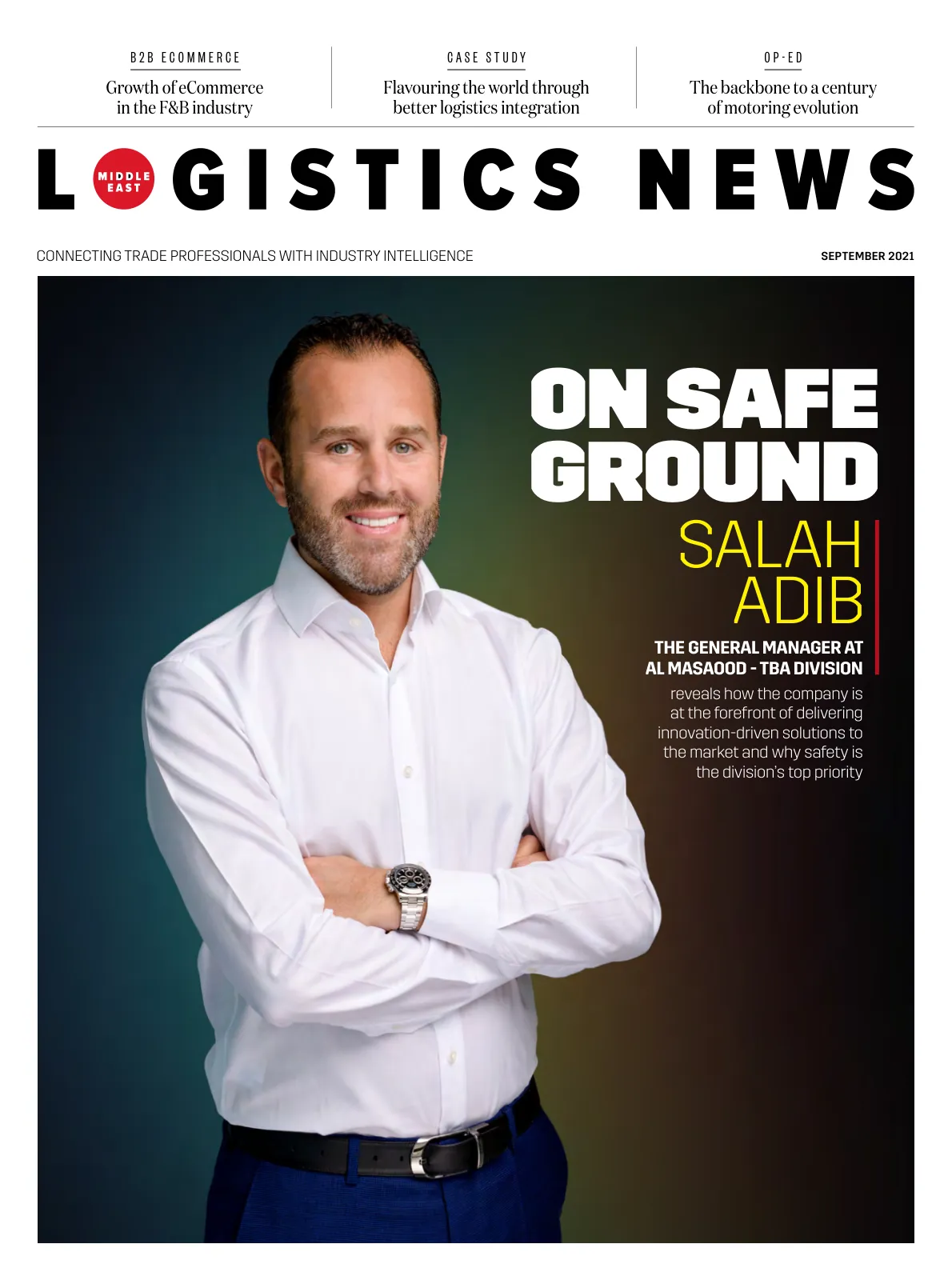
THE GENERAL MANAGER AT
AL MASAOOD - TBA DIVISION
reveals how the company is
at the forefront of delivering
innovation-driven solutions to
the market and why safety is
the division’s top priority
SALAH
ADIB
ON SAFE
GROUND
Page 2
A MEMBERS OF EMIRATES TRANSPORT BUSINESS CENTERS:
Page 3
LOGISTICS NEWS ME | SEPTEMBER 2021 | 3
ON SAFE GROUND
14 FREIGHT FORWARDING
LESSONS LEARNED FROM
THE PANDEMIC
Amadou Diallo, CEO of DHL
Global Forwarding Middle
East and Africa, shares how
COVID-19 holds opportunities for
digitalisation, globalisation, and
the future of logistics
24 OP-ED
LUBRICANTS - THE
BACKBONE TO A CENTURY
OF MOTORING EVOLUTION
Fausto Lupone, Automotive
Sector Expert at Petronas
Lubricants International, writes
how lubricants is inseparable
from motoring
32 CASE STUDY
FLAVOURING THE WORLD
THROUGH BETTER
LOGISTICS INTEGRATION
Lee Michael Sissons, Regional
Head, APA Ocean Management,
A.P. Moller-Maersk, reveals how
the shipping firm is providing
end-to-end logistics solutions
to garlic producers in China
34 SUPPLY CHAIN
STRENGTHENING THE
AUTOMOTIVE SUPPLY
CHAIN
Khaled AlShami, Senior Director,
Solution Consulting, Middle
East & Africa, Infor, writes why
building trust and visibility
across the automotive supply
chain is crucial
38 AUTOMATION
IMPROVING WAREHOUSE
AUTOMATION VALUE
Developing a strategy for
keeping automation systems
and software current and
in good working order is
essential to minimizing risk
and maximizing equipment
performance
The General Manager
at Al Masaood - TBA
Division reveals how the
company is at the forefront
of delivering innovation-
driven solutions to the
market and why safety is
the division’s top priority
Salah Adib
18
IN THIS ISSUE
24
34
Page 4
4 | LOGISTICS NEWS ME | SEPTEMBER 2021
WWW.CBNME.COM
Igor Nikolenko, Co-founder & CEO
of SupplyMe, tells us about the surge
in online food sales and how the
advent of technology and the need
for personalized online experiences
has created new dynamics in the ever-
evolving F&B industry (read more on
pages 30-32).
Furthermore, logistics companies
across the globe are heavily investing in
warehouses and logistics infrastructure
to cater to the burgeoning demand.
The eCommerce sector in the GCC,
especially the UAE and Saudi Arabia is
witnessing a spike in online sales.
The Abu Dhabi Investment Office
(ADIO) recently announced financial
and non-financial incentives as part of its
Dhs2 billion (USD545 million) Innovation
Programme for three companies, one
of which is Lyve, a UAE-based logistics
solutions and technology company.
In Dubai, a dedicated eCommerce free
zone has been set up to offer seamless
solutions to businesses to drive the growth
of licensed eCommerce companies. Dubai
CommerCity has already succeeded in
leasing 30% of its facilities within a period
of only two months in the first part of the
development phase of the free zone, which
extends over an area of 2.1 million sqft
and backed by an investment of Dhs3.2
billion.
All rights reserved © 2021.
Opinions expressed are solely those
of the contributors.
Logistics News ME and all subsidiary
publications in the MENA region are officially
licensed exclusively to BNC Publishing in the MENA
region by Logistics News ME.
No part of this magazine may be reproduced or
transmitted in any form or by any means without
written permission of the publisher.
Images used in Logistics News ME are credited
when necessary. Attributed use of copyrighted
images with permission. All images not credited
courtesy Shutterstock.
Printed by UPP
T
he COVID-19 pandemic and
digitalisation has further fuelled the
eCommerce sector. We’re beginning
to see increased demand for online
purchases across multiple sectors.
Recently, JD Property, a subsidiary
of China’s eCommerce firm JD.com,
revealed that it is purchasing a stake in
China Logistics Property Holdings Co.
for USD2.1 billion. This move is said to
give JD Property an edge over its rivals in
China’s already competitive market.
There are also new players entering the
eCommerce domain, food and beverage
companies for example.
Jochebed Menon
Editor, Logistics News Middle East
jochebed@bncpublishing.net
SUBSCRIBE
subscriptions@bncpublishing.net
For all commercial enquiries, contact
sales@bncpublishing.net
T +971 50 440 2706
PO Box 502511
Dubai, United Arab Emirates
P +971 4 4200 506 | F +971 4 4200 196
Keep up to date with all the latest
news, features and much more
on our website and social media
platforms.
CBNME.COM
CBNME
@CBNME
CONSTRUCTION BUSINESS NEWS ME
EDITOR’S NOTE
LNME
CEO
Wissam Younane
wissam@bncpublishing.net
DIRECTOR
Rabih Najm
rabih@bncpublishing.net
GROUP PUBLISHING DIRECTOR
Joaquim D'Costa
jo@bncpublishing.net
+971 50 440 2706
BUSINESS DEVELOPMENT DIRECTOR
Rabih Naderi
rabih.naderi@bncpublishing.net
+966 50 328 9818
MANAGING EDITOR
Kasun Illankoon
kasun@bncpublishing.net
EDITOR
Jochebed Menon
EDITORIAL DESIGN
Christian Harb
MARKETING EXECUTIVE
Aaron Joshua Sinanbam
aj@bncpublishing.net
PHOTOGRAPHER
Alexander Bungas
Page 5
الشركاء االستراتيجيون
Strategic Partners
تـرشــــح اآلن
2021 سبتمبـــر15 حتـى
Nominate Now
Till 15th September, 2021
المجد
لمـن يصنعــهGlory Belongs To Those Who Make It
Page 6
Page 7
Page 8
8 | LOGISTICS NEWS ME | SEPTEMBER 2021
WWW.CBNME.COM
REGIONAL NEWS
LNME
D
ubai Industrial City
(DIC), a member of
Dubai Holding Asset
Management, has signed
a strategic agreement with
Emirates Development Bank (EDB),
a financial enabler of the country’s
economic diversification and industrial
transformation agenda, to provide
innovative financing and banking
solutions to small and medium-sized
enterprises and support the growth
of vital national industries such as
advanced manufacturing and logistics.
Signed by Saud Abu Al-Shawareb,
Managing Director of Dubai Industrial
City and Shaker Zainal, Head of Busi-
ness Finance at EDB, the strategic
agreement aims to support Dubai
Industrial City’s efforts to develop
the industrial sector in Dubai and the
UAE, provide new opportunities to at-
tract local and international manufac-
turing companies, and offer financial
solutions to develop state-of-the-art
infrastructure.
The agreement also aligns with
EDB’s continuous efforts to enable the
industrial transformation and econom-
ic diversification agenda in the UAE,
build a knowledge-based economy,
increase global competitiveness and
sustainable growth, and support start-
ups and SMEs, which are key drivers
of the national economy.
Shaker Zainal, Head of Business
Finance at EDB, said: “Through this
agreement with Dubai Industrial City,
we will offer the right support to
finance SMEs. We are always keen
on cooperating with related entities
especially in terms of financing small
and medium-sized enterprises, and
we believe that this collaboration with
one of the region’s largest industrial
hubs will help us reach potential cus-
tomers and study the possibility of
funding them.
“We will also work together on devel-
oping entrepreneurship and aware-
ness programmes and sharing indus-
trial knowledge.”
Earlier in the year, EDB announced it
had allocated an investment portfolio
of AED30 billion until 2025, to sup-
port the development of industrial
sector. This is part of EDB’s commit-
ment to support the goals of the Na-
tional Agenda under Operation 300
bn – a 10-year strategy to empower
the country’s industrial sector to pro-
pel a sustainable national economy by
boosting the SME ecosystem in UAE
as well as enhancing the contribution
of SMEs to the country’s GDP.
Saud Abu Al-Shawareb, Managing
Director of Dubai Industrial City, said:
“Today’s strategic partnership reaf-
firms our efforts to transform Dubai
Industrial City into a world-class busi-
ness destination for manufacturing
and logistics.
“It will galvanize our business com-
munity, unlock new investment op-
portunities, create skilled jobs, and
consolidate Dubai’s position as a
business-friendly hub for trade and
commerce. With additional capital
expenditure, we hope the SME sector
will be empowered to play an even
greater role in advancing the UAE’s
national industrial transformation and
building a knowledge and innovation-
based economy. We look forward to
working in partnership with EDB on
this imperative initiative.”
DIC AND EMIRATES DEV. BANK INK DEAL TO BOOST
SME GROWTH AND LOGISTICS SECTOR
“WITH ADDITIONAL
CAPITAL EXPENDITURE,
WE HOPE THE
SME SECTOR WILL
BE EMPOWERED
TO PLAY AN EVEN
GREATER ROLE IN
ADVANCING THE UAE’S
NATIONAL INDUSTRIAL
TRANSFORMATION
AND BUILDING A
KNOWLEDGE AND
INNOVATION-BASED
ECONOMY.”
Page 9
LOGISTICS NEWS ME | SEPTEMBER 2021 | 9
REGIONAL NEWS
O
ffshore Support and Logistics Services Company
(OFCO – Offshore International), the integrated mari-
time logistics service provider that is jointly owned by
Allianz Marine & Logistics Services (AMLS) and SAFEEN, Abu
Dhabi Ports’ marine services arm, has announced the acquisi-
tion of seven support vessels as part of its offshore marine
services fleet.
Comprising of four Anchor Handling Tugs (AHT), a 65-metre
landing craft, as well as a supply ship and multipurpose safety
standby vessel, the newest additions to OFCO’s fleet will fur-
ther extend the new company’s capabilities in providing highly
efficient and cost-effective onshore and offshore integrated
logistics solutions and subsea services.
Combined with a fully operational offshore supply land base
and led by a growing team of industry-leading talent, OFCO’s
fleet expansion marks Abu Dhabi Ports’ venture into the ever-
evolving field of regional and international offshore logistics.
Captain Maktoum Al Houqani, Chief Corporate Authority Of-
ficer of Abu Dhabi Ports, Acting Head of Maritime Cluster, and
Chairman of OFCO said: “With the acquisition of diversified
and ultra-modern support vessels as part of our ever-expand-
ing offshore marine services fleet, Abu Dhabi Ports is rapidly
taking its strategic move into offshore logistics to new heights,
while simultaneously cementing its role as the preferred mari-
time services provider in the Middle East and beyond.”
He added: “Possessing a unique proposition that combines
industry-leading capabilities, rich talent, and cost-efficient
solutions as part of a holistic offering, OFCO will deliver im-
mense value to our customers, particularly for those active
within the GCC’s offshore oil and gas market.
“We will continue to explore other potential vessel acquisi-
tions and other related expansion opportunities in an effort to
broaden our overall service capabilities, and to ensure we are
well-positioned to satisfy the increasingly complex needs of
the offshore market for years to come.”
Officially launched in January 2021, OFCO currently serves
as one of the largest and competitively priced providers of on-
shore and offshore integrated logistics solutions, and subsea
services in the GCC.
Deploying a winning combination of exceptional fleet assets,
logistics solutions and supply-base operations, OFCO is well-
placed to deliver a wide range of specialised services geared
towards large offshore infrastructure projects, including active
operations within the Middle East’s oil and gas sector.
Offering a unique ‘one-stop-shop’ offering, the company’s
solution portfolio, which in addition to subsea services include
integrated logistics for O&G and EPC organisations, as well as
inspection repair and maintenance (IRM), is further supported
by Abu Dhabi Ports’ land-based logistical assets.
Ahmed Khalil, General Manager, Allianz Middle East Ship
Management, said: “The expansion of OFCO’s offshore ma-
rine service fleet has greatly enhanced the organisation’s capa-
bilities in meeting the ever-evolving demands of the region’s
offshore energy market.
“Building on this momentous occasion, we aim to continue
developing our unique offering incorporating not only the
latest in support vessel design, the highest industry best prac-
tices and innovations, but we also strive to embrace new ca-
pabilities that will enable us to serve the end-to-end logistical
needs of customers in other expanding industries.”
AD PORT’S OFCO EXPANDS FLEET WITH PURCHASE OF SEVEN VESSELS
Page 10
10 | LOGISTICS NEWS ME | SEPTEMBER 2021
WWW.CBNME.COM
REGIONAL NEWS
LNME
O
ffshore Support and Logistics
Services Company (OFCO –
Offshore International), the
integrated maritime logistics service
provider that is jointly owned by Allianz
Marine & Logistics Services (AMLS)
and SAFEEN, Abu Dhabi Ports’ marine
services arm, has announced the
acquisition of seven support vessels as
part of its offshore marine services fleet.
Comprising of four Anchor Handling
Tugs (AHT), a 65-metre landing craft, as
well as a supply ship and multipurpose
safety standby vessel, the newest addi-
tions to OFCO’s fleet will further extend
the new company’s capabilities in pro-
viding highly efficient and cost-effective
onshore and offshore integrated logis-
tics solutions and subsea services.
Combined with a fully operational
offshore supply land base and led by
a growing team of industry-leading
talent, OFCO’s fleet expansion marks
Abu Dhabi Ports’ venture into the ever-
evolving field of regional and interna-
tional offshore logistics.
Captain Maktoum Al Houqani, Chief
Corporate Authority Officer of Abu
Dhabi Ports, Acting Head of Maritime
Cluster, and Chairman of OFCO said:
“With the acquisition of diversified
and ultra-modern support vessels as
part of our ever-expanding offshore
marine services fleet, Abu Dhabi Ports
is rapidly taking its strategic move into
offshore logistics to new heights, while
simultaneously cementing its role as the
preferred maritime services provider in
the Middle East and beyond.”
He added: “Possessing a unique
proposition that combines industry-
leading capabilities, rich talent, and
cost-efficient solutions as part of a
holistic offering, OFCO will deliver im-
mense value to our customers, particu-
larly for those active within the GCC’s
offshore oil and gas market.
“We will continue to explore other
potential vessel acquisitions and other
related expansion opportunities in an
effort to broaden our overall service
capabilities, and to ensure we are well-
positioned to satisfy the increasingly
complex needs of the offshore market
for years to come.”
Officially launched in January 2021,
OFCO currently serves as one of the
largest and competitively priced pro-
viders of onshore and offshore inte-
grated logistics solutions, and subsea
services in the GCC.
Deploying a winning combination
of exceptional fleet assets, logistics
solutions and supply-base operations,
OFCO is well-placed to deliver a wide
range of specialised services geared to-
wards large offshore infrastructure pro-
jects, including active operations within
the Middle East’s oil and gas sector.
Offering a unique ‘one-stop-shop’
offering, the company’s solution
portfolio, which in addition to subsea
services include integrated logistics for
O&G and EPC organisations, as well
as inspection repair and maintenance
(IRM), is further supported by Abu
Dhabi Ports’ land-based logistical as-
sets.
Ahmed Khalil, General Manager, Al-
lianz Middle East Ship Management,
said: “The expansion of OFCO’s off-
shore marine service fleet has greatly
enhanced the organisation’s capabili-
ties in meeting the ever-evolving de-
mands of the region’s offshore energy
market.
“Building on this momentous occa-
sion, we aim to continue developing
our unique offering incorporating
not only the latest in support ves-
sel design, the highest industry best
practices and innovations, but we also
strive to embrace new capabilities that
will enable us to serve the end-to-end
logistical needs of customers in other
expanding industries.”
CARTLOW PARTNERS WITH BLUE OCEAN GLOBAL
TO BOOST CIRCULAR ECONOMY
“THE EXPANSION OF
OFCO’S OFFSHORE
MARINE SERVICE FLEET
HAS GREATLY ENHANCED
THE ORGANISATION’S
CAPABILITIES IN MEETING
THE EVER-EVOLVING
DEMANDS OF THE
REGION’S OFFSHORE
ENERGY MARKET.”
Page 11
LOGISTICS NEWS ME | SEPTEMBER 2021 | 11
REGIONAL NEWS
A
.P. Moller – Maersk has identified its
partners to produce green fuel for its
first vessel to operate on carbon neutral
methanol: REintegrate, a subsidiary of
the Danish renewable energy company
European Energy.
REintegrate and European Energy will establish a
new Danish facility to produce the approx. 10.000
tonnes of carbon neutral e-methanol that Maersk’s
first vessel with the ability to operate on green e-
methanol will consume annually. Maersk will work
closely with REintegrate and European Energy on the
development of the facility.
“This type of partnership could become a blueprint
for how to scale green fuel production through collab-
oration with partners across the industry ecosystem,
and it will provide us with valuable experiences as we
are progressing on our journey to decarbonise our
customers’ supply chains.
“Sourcing the fuels of the future is a significant chal-
lenge, and we need to be able to scale production
in time. This agreement with European Energy/REin-
tegrate brings us on track to deliver on our ambition
to have the world’s first container vessel operated on
carbon neutral methanol on the water by 2023,” says
Henriette Hallberg Thygesen, CEO of Fleet & Strate-
gic Brands, A.P. Moller – Maersk.
The methanol facility will use renewable energy and
biogenic CO2 to produce the e-methanol. The fuel
production is expected to start in 2023.
The energy needed for the power-to-methanol pro-
duction will be provided by a solar farm in Kassø,
Southern Denmark.
REintegrate has a proven track record for producing
green e-methanol with a test laboratory in Aalborg.
The new facility will be its third e-methanol facility,
as they are also constructing an e-methanol facility in
Skive with startup 2022.
While the renewable energy will be produced in
Southern Jutland it is yet to be decided where in
Denmark the power-to-methanol facility will be lo-
cated.
Maersk announced the dual fuel vessel, an industry
first, in February 2021. In June, Maersk announced
that Hyundai Mipo Dockyards will be building the
2100 TEU (Twenty Foot Equivalent) feeder.
MAERSK SECURES GREEN METHANOL FOR FIRST CONTAINER VESSEL
OPERATING ON CARBON NEUTRAL FUEL
Page 12
12 | LOGISTICS NEWS ME | SEPTEMBER 2021
WWW.CBNME.COM
REGIONAL NEWS
LNME
M
anufacturing and
logistics hub Dubai
Industrial City has
announced that
Himalaya Wellness has
signed an agreement to
set up a Dhs120 million state-of-the-art
herbal pharmaceutical plant that will be
producing three billion tablets, 15 million
syrup bottles and three million units of
ointment annually at Dubai Industrial
City.
Himalaya, with over 90-plus years of
herbal expertise, is a producer of over
300 herbal medicines, nutritional sup-
plements, skin care, hair care, oral care,
baby care and animal health products.
The new herbal pharmaceutical facility
in Dubai Industrial City will export medi-
cines to over 100 countries.
The commercial production at the new
facility will start in the first quarter of
2024. The proposed factory will sit on
760,000 sq. ft of land and will be the first
of three facilities Himalaya will build in
Dubai Industrial City. The herbal pharma-
ceutical facility will be followed by dedi-
cated units for Personal care products
and Functional foods in future.
Shailendra Malhotra, Global CEO,
Himalaya Wellness, added: “After over
20 years of successful operations in the
region, we have decided to build the
manufacturing facility here for our herbal
pharmaceuticals.
“We pride ourselves on being environ-
ment friendly and this facility would be
Leeds certified – Green Building. Our
flagship brands like Liv.52 & Cystone are
household names in many countries and
the proposed manufacturing facility will
be supplying to over 100 countries.”
He further added: “The objective is
to increase our global manufacturing
capacity for herbal medicines, and we
decided on UAE due to its strategic
location, state-of-the-art infrastructure,
and efficient business environment. UAE
has been the cornerstone of Himalaya’s
global success and this partnership with
Dubai Industrial City shall further rein-
force our global strategy.”
The plant will be built to the highest
standards recognised by the World
Health Organisation, the US Food and
Drug Administration and the European
Medicine Agency’s good manufacturing
practices. It will enhance global trust
and confidence in high-quality made in
UAE products, boost medical security,
and support the nation’s industrial strat-
egy, Operation 300Bn.
It has operations all around the world
and established its UAE presence in the
year 2000, followed by setting up its
R&D centre ‘Himalaya Global Research
Centre’ in Dubai Science Park in 2013.
Abdulla Belhoul, Chief Commercial
Officer of Dubai Holding Asset Manage-
ment, said: “In line with the vision of
our leadership, the UAE continues to
consolidate its status as a global leader
thanks to a raft of infrastructure invest-
ments, new initiatives and regulations.
Combined, these factors have created
a competitive and enabling industrial
ecosystem.
“Under Operation 300Bn, the manu-
facturing of pharmaceutical and medical
products is a crucial segment, and our
partnership with Himalaya is another
milestone that will contribute towards
achieving the nation’s ambitious plans
for the industrial sector”.
Saud Abu Al-Shawareb, Managing
Director of Dubai Industrial City, said:
“Stimulating growth in the pharmaceu-
tical industry by increasing domestic
medicine production is of vital national
importance in line with the vision of
our leaders for economic diversifica-
tion. We are delighted to enter into this
agreement with the leading wellness
company Himalaya and believe our
competitive ecosystem, with advanced
infrastructure and an easy setup pro-
cess, is the perfect place for its next
phase of growth.
“For more than a decade, we have
been a strategic driver and enabler of
Dubai’s knowledge and innovation-
based economy and today’s announce-
ment is the latest step forward in our
ongoing efforts to position this city as a
global hub for advanced manufacturing
and logistics.”
HIMALAYA WELLNESS TO BUILD DHS120MN HERBAL
PHARMA FACTORY IN DUBAI INDUSTRIAL CITY
Page 13
LOGISTICS NEWS ME | SEPTEMBER 2021 | 13
G
ulf Cryo, a provider of
industrial gas solutions,
received a Supply
Achievement Award from
Hyundai Engineering
Co., Ltd. due to unrivalled supply
performance during the commissioning
phase of the world’s largest single
construction Liquified Natural Gas
(LNG) Terminal at Al Zour, Kuwait
designed to import as much as 22
million tonnes of LNG per year.
In an unprecedented move, Gulf Cryo
has successfully supplied Al Zour LNG
Terminal with more than 2,700 metric
tonnes of Liquid Nitrogen to cooldown
the LNG terminal’s facilities hitting a
temperature of -120°C prior to unload-
ing the LNG from ships to storage
tanks.
The whole procedure was complete
in no longer than a week time, and the
LIN has been fully supplied through
Gulf Cryo’s cryogenic gas production
plants in Kuwait. Day four of the supply
event marked the peak in supply where
the LIN consumption reached 540 met-
ric tonnes per day.
Once the terminal facilities have
reached cryogenic temperatures, they
are assessed whilst maintaining an inert
atmosphere, ensuring the mechanical
integrity of the jetties and the piping
system.
This makes the unloading of LNG
from the carrier a simpler and less time-
consuming process that would have
otherwise not been the case.
Both the cooldown procedure and
the equipment utilised were subject to
HAZOP studies, assuring all risks associ-
ated with the process were identified
and minimized.
This was a phenomenal deviation from
standard terminal cooldown proce-
dures, where the entire cooldown of the
unloading lines was achieved through
utilizing cold vapour sprayed into the
lines that were initially at ambient tem-
perature, rather than direct introduction
of cryogenic liquid.
The impact has been marked substan-
tial as it is proved to increase energy
efficiency by avoiding the flaring of LNG
vapour during the process.
Amer Huneidi, Executive Chairman of
Gulf Cryo said: “We are glad to have
provided an innovative and world class
solution that is highly efficient and well-
suited to meet the significant require-
ments of our customer. The success of
this supply is a hallmark of our perfor-
mance and supply chain competency
and will inspire us to work towards a
continued leading position across the
region.
“I will also take this opportunity to
thank Hyundai Engineering Co. Ltd. for
collaborating with us in this commis-
sioning, providing us an opportunity to
surpass this momentous milestone in
our journey.”
Once fully operational, the LNG Ter-
minal at Al Zour is expected to import
as much as 22 million tonnes of the
super-chilled gas per year and will have
a storage capacity of 1.8 million cubic
metres of LNG. The liquefaction capaci-
ty of the terminal will be 30 billion cubic
metres per day.
REGIONAL NEWS
GULF CRYO RECEIVES ‘SUPPLY ACHIEVEMENT AWARD’
FROM HYUNDAI ENGINEERING CO. LTD.
Page 14
14 | LOGISTICS NEWS ME | SEPTEMBER 2021
WWW.CBNME.COM
FREIGHT FORWARDING
LNME
I
t’s been more than a year since
the first COVID-19 case came
to light, uncertainty still drives
our decisions. Despite wide-
spread vaccinations and control
mechanisms put in place across
the globe, we continue to fight a pro-
longed battle.
As challenging as the situation may
be, it contains within it the seeds of
learning and growth. Here are five
lessons distilled from the pandemic,
critical to the future of our business.
1. PEOPLE OVER PROFITS
Best-in-business companies have
always operated with this ethos. But
COVID-19 really drove this lesson
home. A people-centric approach dur-
ing challenging times is not just ethi-
cally correct, but it also makes sound
business sense. If employees are happy
and motivated, their productivity is
greater than those who feel underval-
ued or unappreciated.
Businesses should remember that it’s
their people who work to achieve the
profit in the first place, therefore they
must always be priority. People-first
companies are not only great places
to work, but they are also profitable
enterprises.
2. CRISIS SITUATIONS HELP TO
BENCHMARK RESILIENCE
Uncertainty and volatility are the only
certainty today. Logistics provid-
ers had to showcase real strength in
situations when things are not going
according to plan. We expect the un-
expected, and plan for it. This builds
resilient organisations.
From shipping large quantities of
personal protective equipment (PPE)
to communities that urgently needed
it, to shipping vaccines around the
world so they can be used to save
lives, logistics providers have been
crucial in the fight against the global
pandemic. We have the monumental
responsibility of distributing approxi-
mately 10 billion doses of vaccines
over the next two years.
Amadou Diallo, CEO of DHL Global
Forwarding Middle East and Africa,
shares how COVID-19 holds opportunities
for digitalisation, globalisation, and the
future of logistics
Amadou Diallo
LESSONS LEARNED
FROM THE PANDEMIC
Page 15
LOGISTICS NEWS ME | SEPTEMBER 2021 | 15
Uncertainty also drives flexibility and
agility. Businesses and people have dem-
onstrated incredible agility and resilience
in adapting to the new situation. New
transport solutions and connections have
been set up without anyone being able to
travel. Digital such as a new Transport
Management System enabled supply
chains to keep going on.
3. REMOTE WORK, WORKS
Technology has enabled us to stay
connected with colleagues through the
pandemic and manage businesses across
geographies. Though frontline workers in
the operations are not able to work from
home, the pandemic proved the power of
teamwork in logistics.
If there is one thing that the pandemic
has taught us, it is that together we are
stronger. For a successful transition to
work remotely, trust is one of the most
powerful leadership skills. A global com-
pany can be managed remotely – but not
without trust. You must trust your people
and equally important, tell them that you
trust them.
4. DIGITALISE TO THRIVE
In the UAE, we have witnessed the
exponential rise of eCommerce, supply
chain innovation and digital transforma-
tion, which are contributing factors to the
growth of logistics sector.
As many parties are involved in getting
goods moved around the world, digitalisa-
tion has the potential to ease not only the
life of shippers but make processes even
faster and leaner.
The recently launched customer platform
myDHLi is one example, while Saloodo!,
the digital road freight solution platform,
is leading the movement to ‘Uberise’
trucking. It helps carriers manage their
fleets better and optimize the capacity of
their full truckload (FTL) shipments.
5. WE NEED MORE GLOBALISATION
A globalised world stands not only for
trade, but also for the free flow of infor-
mation, vital supplies, and people. Back
in April last year when air freight capacity
was severely impacted due to border
closures, DHL Global Forwarding had
operated dedicated flights carrying PPEs
as well as essential supplies from China to
Middle East and Africa via Dubai, ensur-
ing a steady supply of these life-saving
items especially for frontline healthcare
workers.
We are learning to share information,
and this is resulting in growing pros-
perity, not only economically but also
socially and socio-culturally. Without
a globalised world we wouldn’t be able
to fight this pandemic. We hope that the
level of globalisation will even increase
after COVID-19, which will put us in
a stronger position to face existing and
future challenges.
LESSONS LEARNED FROM THE PANDEMIC
“WE ARE LEARNING
TO SHARE
INFORMATION, AND
THIS IS RESULTING
IN GROWING
PROSPERITY, NOT
ONLY ECONOMICALLY
BUT ALSO SOCIALLY
AND SOCIO-
CULTURALLY.”
LOGISTICS NEWS ME | SEPTEMBER 2021 | 15
Page 16
16 | LOGISTICS NEWS ME | SEPTEMBER 2021
WWW.CBNME.COM
REPORT
LNME
T
he UAE has the most com-
petitive industrial sector in the
Arab world, according to the
latest UN global rankings.
The country has reached
30th in the world in the 2021
United Nation’s Industrial Or-
ganisation’s (UNIDO) Com-
petitive Industrial Performance Index
(CIP) report which tracks 152 countries.
The UAE has climbed five places since
2020 and nine places since 2017 in the
UNIDO CIP, demonstrating the competi-
tiveness of the nation’s industrial sector
and its business ecosystem, in line with
the National Strategy for Industry and
Advanced Technology, Operation 300Bn.
The report noted the UAE’s progress in
infrastructure and the industrial sector’s
business ecosystem. It referred to the
UAE’s strategy for sustainable growth in
the industrial sector through incorporat-
ing advanced technology, promoting
science-based education, balancing indus-
trial progress with environmental sustain-
ability, and encouraging innovation.
His Excellency Dr. Sultan bin Ahmed Al
Jaber, the UAE’s Minister of Industry and
Advanced Technology said: “UNIDO’s
report reaffirms the UAE’s global reputa-
tion for developing an innovative indus-
trial ecosystem underpinned by advanced
technologies and Fourth Industrial
Revolution solutions.
“Our rapid advances as a global indus-
trial pioneer are a great testament to the
foundations laid by our leadership, who
have paved the way for dynamic and
sustainable economic growth over the
next fifty years, and beyond.”
He added: “The UAE’s continuous
progress in UNIDO’s CIP shows we are
well on the way to achieving the goals set
out by Operation 300Bn. Thanks to the
country’s attractive business environment
to local and international investors in the
industrial sector, the UAE is cementing
its position as a global destination for
pioneering future industries.”
His Excellency said that UNIDO’s CIP
monitored the UAE’s industrial sector’s
growth, by identifying the key features
of the nation’s industrial development
model and linking it to the UAE Vision
2021 and the 2014 National Agenda.
The UAE’s Vision and Agenda aim to
create a knowledge-based economy and
help the nation climb global indices.
To achieve these goals and manage the
strategy, the Ministry of Industry and
Advanced Technology (MoIAT) was
established in July 2020.
UNIDO’s CIP assesses and measures
the industrial competitiveness of global
economies through three main dimen-
sions: the capacity to produce and export
manufactured goods, technological deep-
ening and upgrading, and world impact.
These three dimensions are divided into
eight indicators.
The Emirates has ascended 14 places –
from 31st to 17th – for its manufacturing
exports per capita, while moving up to
32nd for its total manufacturing exports.
Furthermore, the UAE is now up to
28th globally for manufacturing value
added per capita, while also rising eight
places for the share of its manufactured
goods in its total export mix, moving up
to 107th from 115th last year.
THE COUNTRY HAS RAPIDLY SOARED UP
THE GLOBAL INDUSTRIAL RANKS BY INCREASING
ITS INDUSTRIAL PERFORMANCE IN FOUR OUT
OF EIGHT INDICATORS, MARKING A QUANTUM
LEAP FOR THE SECTOR
UAE HAS ‘MOST COMPETITIVE
INDUSTRIAL SECTOR IN ARAB WORLD’
UN REPORT
A scene from ‘Middle East Energy Dubai 2020’
- the leading trade expo for power generation,
transmission and distribution, lighting,
renewables and digitalization sectors.
Page 17
here’s to a
cleaner future
Choosing a gas powered truck will put you and your fleet in the forefront of
sustainable truck operations, reduce your CO2 emissions and achieve Euro 6
Emission Legislation without using Adblue or Particulate Matter.
Well suited for both urban and regional operations.
It can be matched with R, G, L or P cabs and combined with either the Scania
Opticruise gearbox or automatic transmissions.
For more information about our Alternative Fuels options, please visit www.scania.com/ae/en/home/prod-
ucts-and-services/articles/alternative-fuels.html
Natural gas (CNG/LNG)
Natural gas is methane from
pockets in the Earth’s crust.
Although it is a fossil fuel, it
emits up to 15% less CO2
compared to regular diesel.
15%*
Page 18
18 | LOGISTICS NEWS ME | SEPTEMBER 2021
WWW.CBNME.COM
LNME
COVER STORY
18 | LOGISTICS NEWS ME | SEPTEMBER 2021
“AT AL MASAOOD TBA OUR GOAL
IS TO ALIGN OUR STRATEGIES
WITH THE UAE GOVERNMENT’S
VISION, DIRECTIONS AND
ASPIRATIONS WHILE DELIVERING
INNOVATIVE-DRIVEN SOLUTIONS
DESIGNED TO BETTER SERVE
OUR COMMUNITIES. WE ARE AT
THE FOREFRONT OF DELIVERING
INNOVATION-DRIVEN SOLUTIONS
TO THE MARKET.”
Page 19
LOGISTICS NEWS ME | SEPTEMBER 2021 | 19
ON SAFE GROUND | SALAH ADIB, GENERAL MANAGER AT AL MASAOOD
Tell us about your role at Al Masood Tyres, Batteries and
Accessories Division.
As the General Manager (GM) of Al Masaood Tyres,
Batteries and Accessories (TBA) Division, which is
part of Al Masaood Group, I take the lead in ensur-
ing its overall operational efficiency and increasing
its profitability prospects.
I make sure that our organisation advances accord-
ing to our goals. At Al Masaood TBA, one of our
main aims is consistent customer satisfaction. This
drives us to step up our digital initiatives and innova-
tions to keep up with the market trends and evolve
alongside the changing needs of our customers.
Another is to sustain our achievements as a busi-
ness enterprise. The secret to our company’s success
is our commitment to keeping things simple, sup-
ported by our continuous investment in the skills
development of the younger generations. Our young
and creative professionals today are helping bring
fresh and out-of-the-box business growth ideas to
the company.
I also prioritise the wellbeing of our employees,
ensuring that they stay motivated by going beyond
formalities through ‘personal leadership.’ My leader-
ship style stems from the fact that our employees are
among the most important assets of our organisa-
tion.
As such, understanding what’s important to them -
which is to earn for their families and achieve their
life’s dreams - is an expression of my genuine care
and a demonstration of my commitment to their
personal and professional growth.
Salah Adib, General Manager at Al Masaood - TBA Division, reveals
how the company is at the forefront of delivering innovation-driven
solutions to the market and why safety is the division’s top priority
GROUND
ON SAFE
>>>
Page 20
20 | LOGISTICS NEWS ME | SEPTEMBER 2021
WWW.CBNME.COM
LNME
COVER STORY
How is Al Masaood TBA a preferred choice for
customers?
At Al Masaood TBA our goal is to align our
strategies with the UAE Government’s vision,
directions and aspirations while deliver-
ing innovative-driven solutions designed to
better serve our communities. We are at the
forefront of delivering innovation-driven
solutions to the market.
The company is the exclusive distributor
of the full Bridgestone tyre range for cars,
trucks, industrial, agricultural and earthmov-
er vehicles in Abu Dhabi. We have the largest
retail chain for tyre distributors in the region,
including 16 outlets across Abu Dhabi, Al
Ain, and the Western Region.
Our outlets provide the following services:
tyre change, wheel balancing and alignment,
engine flushing, battery change, nitrogen
filling, engine diagnostics, puncture repair,
wiper change, centre fit service, A/C service,
and many more.
In addition, through our association with
Total France, the division has established
a chain of rapid oil change centres to offer
oil and filter change, among others. With
our team of professional technicians, we
guarantee convenient automotive solutions
that are delivered safely and in line with the
highest standards. Our commitment to our
customers is this: to have you back on the
road in no time. The combination of all these
elements makes TBA the brand of choice for
many customers.
Tyres are a crucial element to road safety. What
have been some of the steps Al Masaood TBA
has taken to ensure safety on the roads?
People’s safety is our top priority. We have,
in fact, been initiating multiple successful
road safety campaigns aside from offering
essential products and services to help keep
our drivers safe on the road as well as protect
the public.
“THE COMPANY IS THE
EXCLUSIVE DISTRIBUTOR
OF THE FULL BRIDGESTONE
TYRE RANGE FOR CARS,
TRUCKS, INDUSTRIAL,
AGRICULTURAL AND
EARTHMOVER VEHICLES IN
ABU DHABI. WE HAVE THE
LARGEST RETAIL CHAIN
FOR TYRE DISTRIBUTORS
IN THE REGION, INCLUDING
16 OUTLETS ACROSS ABU
DHABI, AL AIN, AND THE
WESTERN REGION.”
Page 21
LOGISTICS NEWS ME | SEPTEMBER 2021 | 21
ON SAFE GROUND | SALAH ADIB, GENERAL MANAGER AT AL MASAOOD
For the past three years, we have been
proud participants in Abu Dhabi Police’s
annual ‘Safe Traffic Summer’ awareness
campaign. In partnership with Abu Dhabi
Police, the initiative allows us to educate
drivers about the dangers of worn-out
tyres, including fatal accidents and serious
injuries.
The summer safety campaign promotes
vehicle and tyre safety and encourages
motorists to carry out regular mainte-
nance of their vehicles. As part of the
campaign, we also conduct free tyre
checks at designated points across
Abu Dhabi. Our teams are trained
to make sure that tyres are in good
condition.
Another activity under the ‘Safe Traffic
Summer’ campaign is numerous lectures
on the danger of using old, too much or
too little air-pressured tyres. Reinforcing
these sessions are strategic social media
posts promoting the campaign’s goals
and activities.
Please explain Al Masaood TBA’s tyre
assessment and tracking system and how
it works.
We use ‘Toolbox’ which is Bridgestone’s
proprietary software for tyre assessment
and track-ing, to easily and quickly
generate the results of the tyre inspec-
tions conducted by our team. The report
produced by ‘Toolbox’ provides our fleet
customers with insightful, direct, and
actionable recommendations to maintain
and optimise their tyre performance.
Further-more, it enables them to monitor
tyre consumption.
As Bridgestone’s authorised distributor in
Abu Dhabi, tell us about your relationship
and some of the measures you’ve taken
jointly in promoting safe driving and
ensuring tyre health.
We are proud of our fruitful 35-year
partnership with Bridgestone. We have
jointly undertaken numerous initiatives
over the years to bring to the fore the
important role of tyre health in safe
driving.
Bridgestone has awarded us the ‘Gulf
Cooperation Council Distributor of the
Year’ title on several occasions through-
out the years. Moreover, our Fleet
Solution team was recognised as the Best
Commercial Team across all Bridgestone
distributors worldwide at Bridgestone’s
Toolbox Global Awards 2020. As one
of Bridgestone’s worldwide partners, we
were honoured for our consistent efforts
to become a solution provider of choice
among fleet customers. We continually
strive to maintain our market lead and
grow hand in hand with Bridgestone
MEA as one team committed to achiev-
ing our shared goals. I would like to
thank the Bridgestone MEA team for
their ongoing support to us, and for the
fruitful relationship we’ve had together
over the years.
Our mission to promote road safety
continues by conducting a free tyre
check in all our outlets, in addition to
our on-the-go assist vans that provide
car care services whenever and wherever
our customers are. They just need to call
our call centre to get the assistance they
need.
Moreover, at Al Masaood TBA we
provide quality products and services
through the latest equipment available in
our service centres.
Tell us about your collaboration with
Abu Dhabi Ports and the police department
on driver safety.
Al Masaood TBA’s collaboration with
Abu Dhabi Ports and Abu Dhabi Police
has led to multiple successful initiatives,
one of which was the ‘Eyes on the Road’
campaign. Under this initiative, we
provided truck drivers with complimen-
tary tyre checks and well-deserved rest at
truck stops in Abu Dhabi. >>>
Page 22
22 | LOGISTICS NEWS ME | SEPTEMBER 2021
WWW.CBNME.COM
LNME
COVER STORY
We launched it to highlight the impor-
tance of the health and safety of truck
drivers, given the long hours they spend
on the road. Poor health conditions could
result in diminished concentration with
drastic consequences to truck drivers,
other road users and pedestrians. In addi-
tion to health check-ups, drivers were also
treated to some well-deserved refresh-
ments and fun activities to help them relax
and unwind.
Cars, buses, and trucks account for the
largest chunk of the transport and logistics
industry in the region. This puts a focus
on tyre usage as well as on repairs and
recycling. How can we make tyres more
sustainable and what measures have Al
Masaood TBA undertaken in this respect?
Experts from a wide variety of fields have
been working together to make the tyre
of the future even more energy-efficient
and eco-friendly during the manufactur-
ing, use, and recycling stages of its life
cycle. More than anything, they have
emphasised the need to replace every tyre
component with more environmentally
compatible materials, if necessary, and
ensure sustainability, especially in produc-
tion processes.
Regular tyre inspection and maintenance
are essential to prevent overheating, incor-
rect inflation pressures, and poor wheel
balance and alignment, among others – all
of which contribute to a reduction in tyre
life and safety. It is also vital to regularly
check the tyres’ tread depth.
When it comes to tyre replacement, we
make sure that the old tyres are properly
disposed of by working with a certified
scraping company.
What are some of the key challenges facing
the tyre market today? What role does
climate play in this?
In the Middle East, tyres are consid-
ered the largest segment for spare parts.
Although the market had slowed down
in 2020, we are confident of its steady
recovery this year and beyond.
The region is known for its hot weather
and dry climate, which may negatively
impact tyre health and performance.
Therefore, we have been partnering with
relevant government entities on awareness
campaigns throughout the year, and we
will continually strive to do our best in
promoting tyre health and road safety in
our community.
What is your vision for Al Masaood TBA?
Our vision is to be the ‘first choice’
partner for all tyre and auto care service
needs. I am proud that we are getting
closer to achieving this. I am committed
to doing my level best to sustain our gains
and accelerate our expansion.
To accomplish this, we will continuously
offer our customers exceptional prod-
ucts and professional auto care services
and gain a deeper understanding of our
evolving market. To maintain quality
and help improve the safety and lives of
people everywhere, we are committed
to implementing consistent innovation
of our products and services backed by
our uncompromising pursuit of excellent
customer experience.
“EXPERTS FROM A
WIDE VARIETY OF
FIELDS HAVE BEEN
WORKING TOGETHER
TO MAKE THE TYRE
OF THE FUTURE EVEN
MORE ENERGY-
EFFICIENT AND
ECO-FRIENDLY DURING
THE MANUFACTURING,
USE, AND RECYCLING
STAGES OF ITS LIFE
CYCLE.”
Page 23
renault-trucks.com
RENAULT TRUCKS
360� SOLUTION PROVIDER
NEW RENAULT TRUCKS EVOLUTION RANGE
Renault Trucks bringing major improvements in terms of driving comfort, on-board
comfort, safety and productivity.
More comfort, More uptime, more safety, more fuel savings
We have gone a long way to support you better.
Page 24
24 | LOGISTICS NEWS ME | SEPTEMBER 2021
WWW.CBNME.COM
OP-ED
LNME
O
ver the last century, scientific
breakthroughs in motoring
have seen the capabilities of
industrial, commercial and
motorsport vehicles rise expo-
nentially to meet drivers’ needs.
However, it’s fair to say that
none of these innovations would achieve
their potential without the vast strides
made by lubricant technology every step
of the way.
Lubricants may seem like a second
thought for the industrial buyer or the
first-time driver looking to take their test
as quickly as possible to get on the road.
However, the contribution of oils to mo-
toring is fundamental and unparalleled. In
fact, it is now inseparable from the high-
class performances challenging every part
of the industry to innovate and advance.
Here, the Petronas’ expert shares how
the power and agility of lubricants have
shaped motoring in the past, craft tailored
performances in the present, and become
inseparable partners to those innovating
the future of motoring.
A rich heritage in winning formulas
Motor oil was never a retrospective at-
trition to the motorist’s arsenal of tools.
It has always been essential to perfor-
mance.
These first lubricants reduced fric-
tion in far more ways than one. Born
of steam engine innovations following
the Industrial Revolution, they emerged
side-by-side with cars as they entered the
international scene.
The ability of quality lubricants to
optimise and lengthen the performance
of engines not only allowed early drivers
to hit the road smoothly for the first time
but, consequently, it paved the way for
the acceptance and development of the
motor car. Critically, lubricants proved
to the world that a frictionless motorcar
ride was far better than the ‘faster horses’
which the people supposedly wanted.
As lubricants developed, so did
vehicles. Fiat, for instance, began its lu-
bricants division in 1912, designing ‘first
fill’ fluids that would soon become the
industry standard for achieving optimal
performance on the road.
As the Second World War prompted
a need for higher performance military
vehicles, lubricants enabled this. In the
post-war period, this newfound variety
and quality in motor oils allowed the
car industry to evolve its design diversity
to cater for the modern drivers of the
1960s.
Advanced formulation and manufac-
turing never failed to meet the needs of
the latest contemporary technologies.
As a result, the knowledge that new
engine types and new materials could be
supported by key lubricants players has
powered motoring innovation ever since.
Collaborating to achieve best results
With a century of development in fluid
technology under its belt, the lubricants
industry is now capable of truly democ-
ratising driving in the modern day. This
means ensuring that every industry or
individual can secure the highest quality
performance from their vehicle possible –
regardless of make or model.
FAUSTO LUPONE, AUTOMOTIVE SECTOR EXPERT AT
PETRONAS LUBRICANTS INTERNATIONAL, WRITES
HOW LUBRICANTS IS INSEPARABLE FROM MOTORING
Lubricants
THE BACKBONE TO A CENTURY
OF MOTORING EVOLUTION
Page 25
LOGISTICS NEWS ME | SEPTEMBER 2021 | 25
LUBRICANTS | THE BACKBONE TO A CENTURY OF MOTORING EVOLUTION
Optimal compatibility between system and
product is only achievable through close
collaboration between lubricants develop-
ers and original equipment manufacturers
(OEMs).
Both teams must share knowledge and
workspaces to ensure that lubricants are
co-engineered to achieve the highest stand-
ards for specific vehicles. A continued com-
mitment to high quality research is what
enables lubricants manufacturers to turn
their hand to any brief, understanding the
needs of equipment, recognising challenges,
and ultimately formulating the best results
for the OEM’s customers.
For instance, the development of a
scheme like Petronas Lubricants Interna-
tional’s (PLI’s) Fluid Technology Solutions
(FTS) programme has helped to maximise
productivity for customers, with value-add-
ed products and services that are global, yet
refined to specific needs.
Through detailed user and market re-
search, analysis of legislative requirements
and collaboration between engineers and
scientists, schemes like this foster a unique
approach to deliver the right fluid to the
right user.
The development of lubricants for
Formula One cars is a case in point. The
collaboration between Mercedes and Pet-
ronas began with the engineering of fuels
and lubricants independently by PLI, which
were then handed over to the Mercedes
team for testing.
However, in 2014, an integration exercise
saw the teams begin to work much more
closely together, enabling Petronas special-
ists to gain a better understanding of
technical aspects of the Mercedes engine,
thereby increasing trust as well as efficiency
and delivering results. The results were im-
mediate, and the Mercedes-AMG Petronas
team has won every championship since.
Powering the future of sustainable
motoring
The lubricants industry has always been
highly adaptable to the development of
new vehicle technologies. Now, as motor-
ing undergoes the biggest shift towards sus-
tainability in its history, lubricants science
is leading the way by enabling ‘greener’
technologies to reach their potential,
ultimately proving the value of eco-friendly
vehicles to manufacturers, investors, and
consumers.
Research into lubricants to empower
hybrid and electric vehicles (EVs) is already
fully underway at the world’s top fluid
development labs, as demand for these
vehicles’ booms.
EV motors require several fluids: oil for
the reduction gear that is the EV’s trans-
mission unit, and oils specifically for the
electric motor if the oil cooling is used for
the motor. Teams are focussing their R&D
efforts on battery thermal management
fluids: ways to help electric vehicles reach
maximum performance when operating at
various conditions and to prolong battery
life.
The pace of innovation in vehicle per-
formance is just as quick as that at the
forefront of vehicle production and design.
Both start with conversation; such discus-
sions at Petronas’ EV Fluids Symposium
are a direct result of the automotive care
fostered in Fiat’s own garages over one
hundred years ago.
The innovations these conversations
produce is then a testament to that ongo-
ing excellence: thermal battery fluids for
optimised delivery of electrical energy,
fluid for friction management of integrated
driveline systems, and next generation
bearing greases for a quieter ride and long-
lasting performance. Once again, lubricant
technology remains firmly by the side of
those pushing for the brighter future of
driving.
Reducing waste is also high on the
agenda of lubricants manufacturers.
Older cars can still reach maximum
performance through the development
of modern lubricants which draw on
the original oil specifications from the
manufacturer.
By using the most appropriate additives
and the most advanced technologies to
ensure protection of older engines against
wear and tear, modern lubricants can
enable top class, efficient performances
from older cars. This ultimately prolongs
their lifespan and delays highly pollutive
disposal processes.
Keeping up with innovation
There has never been a more exciting
time for motoring than today. The chal-
lenges of sustainability, combined with
the democratisation of technology, means
that pioneering new technologies are mak-
ing their way to the market continually.
Each must be able to demonstrate long-
term efficiency to meet the expectations
of drivers, and limit impact upon the
environment. Quality lubricants will be
integral in enabling cars to meet this high
standard - as they have been throughout
the history of the modern motor vehicle.
“OLDER CARS CAN STILL REACH MAXIMUM PERFORMANCE THROUGH
THE DEVELOPMENT OF MODERN LUBRICANTS WHICH DRAW ON THE
ORIGINAL OIL SPECIFICATIONS FROM THE MANUFACTURER.”
Page 26
26 | LOGISTICS NEWS ME | SEPTEMBER 2021
WWW.CBNME.COM
LNME
CASE STUDY
W
ith a history of cultivation
that spans more than 2,000
years, Jining, Shandong in
North-eastern China is a
well-known hub for garlic.
The region grows about
700,000 mu of garlic each year, which is
exported to more than 160 countries and
regions around the world. Naturally, there
is a need to transport the produce in reefer
containers to retain its quality.
Sissons says: “Our customers specialise
in the export of agricultural products, and
their enterprises are involved in several
focus areas, including base planting inte-
gration, purchasing, refrigeration, deep
processing, and international trade.”
The sales markets cover more than 70
countries in Europe, the Americas, the
Middle East, South and Southeast Asia,
and more.
CHALLENGES ENCOUNTERED
For many years, customers generally used
a combination of trucking and ocean
transport to ship high-quality garlic from
the region all over the world. “However,
the inland leg of this journey is currently
fraught with various complications.
There is only one type of trucking service,
transportation costs are high, timings are
irregular, and the service is frequently
affected by natural and social factors,” he
adds.
Particularly during the ongoing pandem-
ic, it has become difficult for exports to
avoid unforeseen supply chain breaks, and
the entire logistics supply chain plan for
the export of garlic cannot be accurately
guaranteed. This poses a major hurdle for
customers.
In response to the problems encountered
by customers, the Maersk team has been
committed to helping them find cost-
effective and stable logistics solutions
to help boost the garlic product export.
LEE MICHAEL SISSONS, REGIONAL HEAD, APA OCEAN
MANAGEMENT, A.P. MOLLER-MAERSK, REVEALS HOW
THE SHIPPING FIRM IS PROVIDING END-TO-END LOGISTICS
SOLUTIONS TO GARLIC PRODUCERS IN CHINA
FLAVOURING THE WORLD
THROUGH BETTER LOGISTICS INTEGRATION
Page 27
LOGISTICS NEWS ME | SEPTEMBER 2021 | 27
FLAVOURING THE WORLD THROUGH BETTER LOGISTICS INTEGRATION
While communicating and coordinating
with foreign companies to carry out one-
stop product trials, the Maersk cold chain
expert team also actively explored new
domestic logistics solutions.
FINDING A SOLUTION
Based on the strategic cooperation with
China Railway Jinan Bureau Group, Mae-
rsk were actively exploring a new one-stop
service that connects the garlic product
rail transportation to our maritime
services and extends the starting point of
traditional export services right from the
inland warehouse to the port.
After a customer completes the booking,
they only need to wait for the packaging
to be completed in the factory warehouse.
The rest of the short-distance inland
transportation, and the railway connec-
tion to port, are arranged by Maersk in
coordination with the railway and the
port authorities.
“This prevents the fragmented coordina-
tion of various touchpoints across the sup-
ply chain and helps considerably improve
efficiency,” he adds.
Upgrading the whole process from ‘port-
to-port’ to ‘end-to-end’ helped empha-
sise the value of our cold chain service
coverage, and ensure the timely, safe, and
efficient delivery of the goods to the final
consignee.
Maersk’s Jining West-Qingdao railway
service not only provides us with more
choices for domestic transportation, but
also brings us a new end-to-end logistics
solution.
In the past two years, Maersk has suc-
cessfully promoted the sea-rail combined
transport of Jining garlic exports. On 29
June 2021, it was officially announced
that Maersk would start operating a cus-
tomised train for freezers.
This is a cold chain inland product
specially curated by Maersk for customers
according to their needs, providing them
with a one-stop cold chain solution.
Sissons concludes: “This new service
perfectly highlights the benefits our
integrated services can provide. We will be
able to provide more proactive assistance
and be more innovative in our end-to-end
approach by leveraging this new inland
offering.
“It also aids our mission to decarbonise
logistics, given the low CO2 emissions
from trains compared to trucking. The
‘Garlic Train’ will be the first of other
similar initiatives, and I look forward to
seeing more.”
“UPGRADING THE WHOLE
PROCESS FROM ‘PORT-
TO-PORT’ TO ‘END-TO-
END’ HELPED EMPHASISE
THE VALUE OF OUR
COLD CHAIN SERVICE
COVERAGE, AND ENSURE
THE TIMELY, SAFE, AND
EFFICIENT DELIVERY OF
THE GOODS TO THE FINAL
CONSIGNEE.”
Page 28
28 | LOGISTICS NEWS ME | SEPTEMBER 2021
WWW.CBNME.COM
FREIGHT
LNME
F
reight rates have quadrupled since
the COVID-19 pandemic caused
a worldwide lockdown in March
2020, pushing retail prices up,
that has been affecting consumers
worldwide who are trying to re-
cover from loss in income, business.
World Dry Baltic Index jumped from –
50% in May 2020 to more than 400% in
May 2021 – an unprecedented increase
in a year. China Container Freight Rate
Index jumped 170% in April this year
compared to what it was in July 2020,
while Harpex World Charter Rate Index
jumped 350% in a year from July 2020
to July 2021.
The rate increase was caused by COV-
ID-19 pandemic, which caused a massive
decline in trade, resulting a decline in
shipments worldwide, says Rizwan Sajan.
Many shipping companies were forced
to dock the ships and send the sailors to
long holidays. So, when the economic
activities resumed after the lockdown,
there was a shortage of sailors and other
professionals in Autumn 2020.
A combination of factors including
soaring demand, a shortage of containers,
saturated ports, too few ships and dock
workers, have contributed to the situation
on almost all the trade routes. Recent
COVID-19 outbreak in Asian countries
– especially India and China in particular
– are worrying.
Transporting a 40-feet container cargo
by sea from Shanghai to Rotterdam costs
a record USD10,522, a whopping 547%
higher than the seasonal average over
the last five years, according to Drewry
Shipping.
With more than 85% of the goods trade
transported by sea, freight rate increase
threatens to push up the price of every-
thing from toys, building materials, fur-
niture, auto spare parts, and components
of all types of goods to tea and coffee –
compounding concerns on rising inflation.
Although still relatively minor part of
SOARING FREIGHT RATES
Rizwan Sajan, Founder and Chairman,
Danube Group, tells us how high freight charges
are affecting businesses and consumers
Page 29
LOGISTICS NEWS ME | SEPTEMBER 2021 | 29
SOARING FREIGHT RATES | RIZWAN SAJAN, FOUNDER AND CHAIRMAN, DANUBE GROUP
the overall cost of the goods,
a research by HSBC Holdings
estimates that a 205% jump
in shipping costs over the past
year could increase the Euro-
area producer prices by as
much as 2%.
At the retail level, traders
are faced with three choices –
absorb the cost, pass it on to
the consumers or halt trading!
Most active traders would
pass half of it to their custom-
ers and absorb the other half,
eventually hitting the bottom
line.
What was initially thought as
a temporary spike initially,
the high freight rate seems to
have become the new norm,
industry sources say. Although
things might change in future,
however, the high-rate envi-
ronment might continue for a
year or two, before returning
to the pre-COVID-19 situa-
tion.
The high shipping expenses
are being factored into con-
tracts for the next 12 months,
forcing companies to pass the
extra costs on to consumers.
There is hardly any sign of
relief in the short term, and
rates are therefore likely to
continue spiking in the second
half of this year, as rising
global demand will con-
tinue to be met with limited
increases in shipping capacity
and the disruptive effects of lo-
cal lockdowns, according to a
report by economists at ING.
Even when new capacity
arrives, container liners may
continue to be more active in
managing it, keeping freight
rates at a higher level than
before the pandemic, they say.
Container liners have
enjoyed outstanding financial
results during the pandemic,
and over the first five months
of 2021, new orders for con-
tainer vessels reached a record
high of 229 ships with a total
cargo capacity of 2.2 million
TEU.
When the new capacity is
ready for use, in 2023, it will
represent a 6% increase after
years of low deliveries, which
the scrapping of old vessels
is not expected to offset,” the
report said.
Along with global growth
moving past the catch-up
phase of its recovery, the com-
ing increase in ocean freight
capacity will put downward
pressure on shipping costs but
won’t necessarily return freight
rates to their pre-pandemic
levels, as container liners seem
to have learned to manage ca-
pacity better in their alliances.
In the near term, freight
rates may yet reach new highs
thanks to the combination of
further increases in demand
and the constraints of a con-
gested system. And even when
capacity constraints are eased,
freight rates may remain at
higher levels than before the
pandemic.
What is the way out? A de-
cline in port handling charges,
customs duty and VAT reliefs
by governments could help
ease the situation. Ship own-
ers, shipping agencies, freight
forwarders could chip in.
However, it needs a quick
and coordinated response – as
soon as possible.
“WITH MORE THAN 85% OF THE GOODS
TRADE TRANSPORTED BY SEA, FREIGHT RATE
INCREASE THREATENS TO PUSH UP THE
PRICE OF EVERYTHING FROM TOYS, BUILDING
MATERIALS, FURNITURE, AUTO SPARE PARTS,
AND COMPONENTS OF ALL TYPES OF GOODS
TO TEA AND COFFEE – COMPOUNDING
CONCERNS ON RISING INFLATION.”
Rizwan Sajan,
Founder and
Chairman,
Danube Group
Page 30
30 | LOGISTICS NEWS ME | SEPTEMBER 2021
WWW.CBNME.COM
B2B ECOMMERCE
LNME
T
he food and beverage industry
has always faced consider-
able consumer, food safety and
regulatory challenges. Consum-
ers expect companies to source
ingredients sustainably and ethi-
cally, to do more for less and ‘business as
normal’ or ‘the status quo’ isn’t going to
produce returns on investment.
When 2020 started, only 56% of com-
panies in the food and beverage industry
had an eCommerce presence. With the
outbreak of the pandemic, these compa-
nies were able to compete and capitalise
on the surge in online sales triggered by
the pandemic.
The accelerated digital transformation
has changed many parts of our lives
beyond recognition. The smart phone
has enabled the business consumer to
communicate and do business ‘on-the-
go’. One of the biggest spikes we have
witnessed during 2020 is the surge in
online food sales which made it clear that
the digitalisation of B2B eCommerce is
now inevitable.
ACCELERATED DIGITAL
TRANSFORMATION
In 2020, B2B has overtaken B2C sales
through online transactions, with B2B
reaching a worldwide market value
of USD7.7 trillion, as opposed to the
USD2.3 trillion of B2C. The World Eco-
nomic Forum has estimated the UAE’s
2020 eCommerce market to be valued at
USD27.2 billion. The eGrocery market
grew by 300% during the third quarter
of 2020 in the UAE, while Saudi Arabia’s
market has grown by 500%.
The buying behaviour initiated by the
pandemic continued even after the lock-
down was lifted. An unhappy customer
isn’t a repeat customer, so businesses had
to align their internal processes to meet
buyer demands as quickly as possible.
And this is the current reality being faced
by many food & beverage industry sup-
pliers.
The advent of technology and the need
for personalized online experiences has
created new dynamics in the ever-evolv-
ing F&B industry. According to a report
by The Business Research Company, the
global food & beverage eCommerce mar-
ket is expected to grow from USD25.36
billion in 2020 to USD31.25 billion in
2021 at a compound annual growth
rate (CAGR) of 23.2% and is projected
IGOR NIKOLENKO, CO-FOUNDER & CEO OF SUPPLYME, OUTLINES
HOW ECOMMERCE IS PICKING UP IN THE FOOD AND BEVERAGE SECTOR
GROWTH OF ECOMMERCE
IN THE F&B INDUSTRY
Page 31
LOGISTICS NEWS ME | SEPTEMBER 2021 | 31
GROWTH OF ECOMMERCE IN THE F&B INDUSTRY
“SMALL AND MEDIUM
F&B COMPANIES
CAN TAKE ADVANTAGE
OF THE SHIFT AND
CLAIM THEIR SHARE
OF THE PIE BY CREATING
A COMPELLING
ONLINE PRESENCE
LISTING THEMSELVES
ON MARKETPLACES
AND ECOMMERCE
PLATFORMS.”
to reach USD66.95 billion in 2025
at a CAGR of 21%. The change in
growth trend is mainly due to the
companies stabilising their output
after catering to the demand that
grew exponentially during the
COVID-19 pandemic in 2020.
HEIGHTENED INTERNET
PENETRATION
Experts have predicted that by 2022
online grocery shopping is expected
to be a USD100 billion business.
One of the major drivers of the
growth in the F&B eCommerce is
the increase in smartphone users and
internet penetration.
Ultimately, supplier and producer’s
cost will be the key restraint for the
food and beverage eCommerce mar-
ket. These include the cost incurred
for order fulfilment, delivery cost,
adjusting business resources to dy-
namic market demand and last-mile
connectivity.
A report from Capgemini in 2019
shows that retailers’ net profit could
fall by up to 26% in the next three
years, if they don’t radically improve
last-mile solutions, despite increased
online grocery sales.
Since the industry deals with prod-
ucts that have a limited shelf life,
organisations need to have a robust
supply chain and meet consumer
demands to grow and achieve profit-
able margins. >>>
Igor Nikolenko,
Co-founder & CEO,
SupplyMe
Page 32
32 | LOGISTICS NEWS ME | SEPTEMBER 2021
WWW.CBNME.COM
B2B ECOMMERCE
LNME
CONNECTING BUYERS WITH CUSTOMERS
B2B eCommerce platforms such as Sup-
plyMe that connects local food suppliers
with restaurants, hotels, cafes, supermar-
kets, and other foodservice businesses of
all sizes is the best bet for manufacturers
and suppliers to reach out to the millen-
nial generation taking over executive-level
realms at companies and give them every-
thing they need to do business in the most
streamlined manner possible.
Small and medium F&B companies can
take advantage of the shift and claim their
share of the pie by creating a compelling
online presence listing themselves on mar-
ketplaces and eCommerce platforms.
B2B eCommerce platforms with their
user-friendly interface, low costs, and
trackable delivery options have made
eCommerce trend over traditional sellers
and present a huge opportunity for the
food and beverage sector, considering the
growing digital maturity of the industry.
Successful B2B businesses understand
the importance of digital readiness and
use digital tools to help them streamline
their operations and meet fast-changing
consumption and purchasing patterns.
The platform can help food & beverage
companies to optimise the entire experi-
ence from research to delivery. The app
can help businesses to tap into new and
difficult-to-reach markets, prioritize cus-
tomer service, lower operating costs, and
increase the bottom line.
B2B ECOMMERCE PLATFORMS
Another significant benefit of a B2B
eCommerce platform for the F&B indus-
try includes the ease of access to all sales
related activities, which in turn makes it
easier to plan the stock based on demand,
facilitate returns, obtain copy invoices,
and live statements of accounts through
the platform.
Also, setting up a price in B2B eCom-
merce can get quite complex. Prices may
depend on the purchasing volume, pre-ne-
gotiated discounts, frequency of purchas-
ing, and many other factors such as the
type of business. These complex scenarios
call for the ability to create and custom-
ise multiple price list for each customer,
company, or business unit willing to
deal with your business. B2B market-
place platform enables businesses to use
flexible pricing models, giving them an
element of control over the transactions
made through the platform.
Additionally, B2B eCommerce plat-
forms allows businesses to leverage data
and analytics to segment audiences and
deliver the right messages at the right
time. Data is accumulated to gather
insights into customers buying pattens,
help them penetrate new markets, im-
prove conversions. Delivering the right
message directly to their screen helps
organizations to increase their average
order value and drive brand loyalty.
ENHANCING CUSTOMER EXPERIENCE
To gain a competitive edge over busi-
ness rivals, meet customer expectations,
and keep costs to a minimum, major
supermarkets, and food companies
large or small are now much more
conscious of the need to map out and
understand their supply chains. In this
day and age of the experience economy,
B2B online marketplaces can enhance
the customer experience by making the
journey easier and seamless and provide
more than just functional and rational
benefits.
The digital transformation in the
F&B industry has turned processes that
were disorganised, time-consuming,
and burdensome into something simple
and convenient helping organisations
recover the lost revenue and to save
more.
Page 33
Page 34
34 | LOGISTICS NEWS ME | SEPTEMBER 2021
WWW.CBNME.COM
SUPPLY CHAIN
LNME
STRENGTHENING
THE AUTOMOTIVE SUPPLY CHAIN
I
f any event reveals the need for resilient supply
chains, it’s COVID-19. The disruptions shook every
industry, including automobile. Early 2020 forecasts
projected a significant drop in new vehicle sales, but
ultimately turned out much better with only a 15%
reduction from the total 2019 sales.
It’s no surprise the pandemic has prompted several
automotive companies to embrace new supply chain
strategies that allowed them to recover quickly while
also setting them up for future growth.
Many automotive companies set up crisis teams
and control towers to improve visibility and maintain profit-
ability, which in turn developed into an advanced strategy
around predictive risk management and multitier supplier
collaboration.
Managing shortage
Even with the automotive industry embracing new supply
chain practices, another disruption has risen in the semicon-
ductor chip shortage.
With modern vehicles often containing thousands of semi-
conductors, this crisis underscores another dimension of sup-
ply chain risk exposure and highlights the critical need to col-
laborate with multitier partners for globally limited supplies.
KHALED ALSHAMI, SENIOR DIRECTOR, SOLUTION CONSULTING, MIDDLE EAST & AFRICA, INFOR,
WRITES WHY BUILDING TRUST AND VISIBILITY ACROSS THE AUTOMOTIVE SUPPLY CHAIN IS CRUCIAL
Page 35
LOGISTICS NEWS ME | SEPTEMBER 2021 | 35
STRENGTHENING THE AUTOMOTIVE SUPPLY CHAIN
When the automotive de-
mand initially dipped, chip
manufacturers saw a rise in
demand from other sectors
like home electronics and high
tech, creating a diversion from
chip manufacturers to fulfill-
ing demand from these other
sectors. When automotive
demand bounced back earlier
than anticipated, the limited
supply was painfully exposed.
The microchip crisis mostly
emerged due to the semicon-
ductor industry’s diamond-
shaped supply chain. In this
type of supply chain network,
only a few manufacturers are
completely vertically inte-
grated and self-reliant as most
manufacturing is outsourced
to sub-tier suppliers who are
often capacity constrained and
stretch lead times. Any disrup-
tion at the sub-tier level direct-
ly affects the tiers above, and
indirectly affect the OEMs.
OEMs with visibility into
sub-tier supply levels are better
positioned to identify bottle-
necks early and better manage
the crisis. Now manufacturers
are starting to realize that sup-
ply chain visibility and suppli-
er collaboration are no longer
‘nice-to-have’ capabilities but
have become table stakes for
staying competitive or in busi-
ness at all.
Harnessing visibility to
build resilience
Sustained collaboration only
comes when transparency cre-
ates trust across the network.
Supply chain visibility can
carry different meanings de-
pending on who you ask, but
at its core it’s about providing
transparency and access to
supply chain events.
This gives your organisation
the ability to see where orders
and goods are in the network,
enabling collaboration and
synchronisation between part-
ners, customers, dealers, etc.
On the demand side, many
automotive companies in-
crease visibility through
customer preference research,
creating better forecast models
and mix levels. Achieving vis-
ibility into the demand and
supply outlooks allows for
early detection of risk so better
decisions can be made sooner.
Creating a culture of provid-
ing visibility to the network
sounds great, but it’s difficult
to achieve. The ability to share
information both within and
outside the four walls of your
company is constrained by
behaviours built over decades.
Some of these behaviours need
to be dismantled so higher
levels of trust are established
and generate this degree of
visibility.
To build this level of trust,
digital ecosystems should
incorporate stringent identity
and access controls related to
network participant activities
and data access. Multi-enter-
prise collaboration platforms
or digital supply networks
provide the appropriate se-
curity that can foster more
trusting behaviours and user
adoption of new technologies
within the network.
This encourages OEMs and
suppliers to share informa-
tion at scale in a sustainable
manner that wasn’t possible
before, which is the key to cre-
ating an agile and responsive
supply chain.
“SUSTAINED COLLABORATION ONLY
COMES WHEN TRANSPARENCY CREATES
TRUST ACROSS THE NETWORK. SUPPLY
CHAIN VISIBILITY CAN CARRY DIFFERENT
MEANINGS DEPENDING ON WHO YOU
ASK, BUT AT ITS CORE IT’S ABOUT
PROVIDING TRANSPARENCY AND ACCESS
TO SUPPLY CHAIN EVENTS.”
Khaled AlShami,
Senior Director,
Solution Consulting,
Middle East &
Africa, Infor
Page 36
36 | LOGISTICS NEWS ME | SEPTEMBER 2021
WWW.CBNME.COM
SUPPLY CHAIN
LNME
F
ollowing a year of intense
changes in the logistics indus-
try, new research from Reuters
Events Supply Chain in partner-
ship with Blue Yonder reveals
the priority strategies and invest-
ments for supply chain execu-
tion and risk management.
The State of Supply Chain Execution
Report 2021 analysed responses of
supply chain professionals and found
that the COVID-19 pandemic, customer
centricity, rising eCommerce complexity
and costs, need for Direct-to-Consumer
(D2C), and the risk of financial peril
are propelling retailers, manufacturers,
and logistics service providers (LSPs) to
digitally transform.
Companies looking to capitalise on
the omni-channel opportunities created
by increased online-order volume over
the last 18 months are now prioritis-
ing more agile delivery and fulfilment
models, like D2C. Retailers’ and manu-
facturers’ online sales increased more
than 120% over the past year. LSPs have
also seen eCommerce volumes explode,
reporting a 200% increase compared to
2019-2020.
“As the economy transitions to a post-
pandemic environment, retailers, manu-
facturers and LSPs are transforming their
transportation and broader supply chain
operations to address their most pressing
supply chain challenges,” said Raj Patel,
senior director, 3PL Industry Strategy,
Blue Yonder.
“In the long term, investment in execu-
tion systems like Transportation Man-
agement Systems (TMS) and Warehouse
Management Systems (WMS), as well as
end-to-end visibility, automation, and
cloud strategies will help them – and
their customers – build more sustainable,
resilient and agile organisations for the
future.”
Re-evaluation of supply chain risk
management
From constraints on raw materials to
labour shortages to growing cyberse-
curity threats on distributed networks,
pandemic-related challenges have shifted
supply chain risk management priorities:
> Respondents are hesitant to pursue
near/onshoring plans, with only 29% of
retailers/manufacturers making an invest-
ment.
> 63% of retailers/manufacturers stated
that dual sourcing was a favoured strate-
gy for risk management moving forward.
Constraints on the availability of raw
materials caused supply side disruptions,
even for those with distributed manufac-
turing facilities.
> Environmental concerns are also being
considered when planning for supply
chain risks. Over half (53%) of retailers/
manufacturers and half (50%) of LSPs
plan to invest in sustainability as a strat-
egy for risk management.
Digital-first practices and technology
investments
With the growth of eCommerce, invest-
ment in modern supply chain technolo-
gies and new approaches have become
essential for businesses to keep pace with
shifting trends and customer expecta-
tions.
The report found that there are various
factors driving investment in supply chain
technologies and digital-first practices.
LSPs cited the pressure to reduce supply
chain costs (58%) while also improving
service levels for their retailer customers
(48%) and dealing with labour shortages
(30%).
In the current supply chain environ-
ment, companies are moving away from
legacy systems and prioritising technolo-
gies that enable visibility for customers
and their operations, automate processes
and support enterprise agility. 63% of
retailers/manufacturers and 60% of LSPs
agreed that end-to-end visibility is cur-
rently yielding the highest ROI in their
supply chain execution process.
Roughly half (48%) of retailers/manu-
facturers and more than half (57%) of
LSPs have a robust cloud strategy in
place, helping to create high levels of
infrastructure agility that on-premises,
legacy technology systems can’t achieve.
NEW BLUE YONDER AND REUTERS EVENTS REPORT SURVEYS
RETAILERS, MANUFACTURERS, AND LOGISTICS SERVICE PROVIDERS
TO IDENTIFY TOP SUPPLY CHAIN PRIORITIES AND STRATEGIES IN 2021
DRIVES INVESTMENTS IN SUPPLY CHAIN
ECOMMERCE GROWTH
Page 37
18TH IRF WORLD MEETING & EXHIBITION
R O A D S TO TO M O R R O W
7-10 NOVEMBER 2021 | DUBAI | www.irf2021.global
4
DAYS
CONFERENCE
TRACKS
SESSIONS
SPEAKERS
ATTENDEES
60
12
250
2500
DELIVERING SOLUTIONS TO THE WORLD’S MOBILITY CHALLENGES
FOR MORE INFORMATION VISIT
www.irf2021.global
PLATINUM
SPONSORS
BRONZE
SPONSORS
MEDIA
PARTNERS
GOLD
SPONSORS
SILVER
SPONSORS
Page 38
38 | LOGISTICS NEWS ME | SEPTEMBER 2021
WWW.CBNME.COM
AUTOMATION
LNME
A
utomation expert Swisslog has
revealed that many warehouse
operators that do not know
the controls and component on
which their automated systems
depend on can experience a
vulnerable situation due to unplanned
downtime.
Control system suppliers, for example,
routinely introduce new components and
end-of-life older ones. If you do not know
you have components that are already, or
are approaching, obsolescence you may
find yourself struggling to find replace-
ments for failed parts. Instead of replac-
ing a component, you are faced with the
challenge of modernising the panel with-
out the benefit of being able to schedule
work around planned downtime.
Minimising risk
Developing a strategy for keeping au-
tomation systems and software current
and in good working order is essential to
minimising risk and maximising equip-
ment performance. At Swisslog, we have
developed several programmes to help
our customers extend the life of their
warehouse and get more from their in-
vestment in automation. These include:
Hardware modernisation: Our hard-
ware modernisation programmes begin
with a comprehensive audit to identify all
relevant components, their manufacturer,
and their risk of obsolescence. We then
develop a plan to address any vulner-
abilities.
In some cases, the automation systems
themselves may be so old they can no
longer deliver reliable service and may be
recommended for replacement. Once the
initial work is complete, we use the list of
system components and our knowledge
of product lifecycles to continually and
proactively identify components that are
at risk of obsolescence.
This transforms modernisation from an
event into a continuous process that can
be managed with minimal investment and
disruption.
Safety standards
Safety assessments: Safety standards, like
technology, are continually evolving. Our
safety assessments review existing equip-
ment considering newer safety regula-
tions and recommend changes that bring
systems in compliance, such as adding
doors to cranes or using light curtains in
place of mechanical gates.
Software updates and upgrades: Keep-
ing software current is as important as
maintaining hardware. Whether it is per-
forming technology updates necessitated
by changes to the underlying software
systems, upgrading from previous genera-
tions of Swisslog software to SynQ or
installing SynQ to prepare for automa-
tion, Swisslog can manage all aspects of a
software update or upgrade. We even of-
fer IT Managed Services in which our ex-
perts assume responsibility for managing
all the IT systems and software required
to keep your equipment operating at peak
performance.
Meeting current needs
System expansions: One of the benefits of
the current generation of automation sys-
tems delivered by Swisslog is the ability to
size systems to meet current needs while
maintaining the flexibility to expand the
system when needs change. We have the
experience and expertise to plan system
expansions to maximize your investment
in automation and minimise the impact
on operations.
Whether you are operating cranes, Au-
toStore, CarryPick or one of our shuttle
systems, Swisslog can help you design and
implement the upgrades and expansions
that give you the storage and throughput
you need to enable continued growth.
From modernising hardware to upgrad-
ing software and expanding modular
automation systems, Swisslog has the
experience and expertise to develop a
strategy and plan that minimises the
impact on existing operations and deliv-
ers the reliability and performance your
business needs.
DEVELOPING A STRATEGY FOR KEEPING AUTOMATION SYSTEMS AND
SOFTWARE CURRENT AND IN GOOD WORKING ORDER IS ESSENTIAL TO
MINIMIZING RISK AND MAXIMIZING EQUIPMENT PERFORMANCE
IMPROVING WAREHOUSE
AUTOMATION VALUE
“In some cases, the automation
systems themselves may be so
old they can no longer deliver
reliable service and may be
recommended for replacement.”
Page 39
Page 40
Your go to delivery solution!
Introducing
New Renault Duster Cargo
An efficient, reliable & modern fleet solution
This is a first-of-its-kind Cargo SUV model which is now available across
Al Masaood Automobile , Renault showrooms in Abu Dhabi & Al Ain.
Bluetooth
Automatic
Transmission
Fuel
Efficiency
Cruise control
with speed limiter
½ a ton boot
capacity
Call us at 800 300 500 to place an enquiry
Or visit our website https://abudhabi.renault.ae/DusterCargo.html